WO2020251003A1 - 液体クロマトグラフィーによるアミンの分離方法 - Google Patents
液体クロマトグラフィーによるアミンの分離方法 Download PDFInfo
- Publication number
- WO2020251003A1 WO2020251003A1 PCT/JP2020/023153 JP2020023153W WO2020251003A1 WO 2020251003 A1 WO2020251003 A1 WO 2020251003A1 JP 2020023153 W JP2020023153 W JP 2020023153W WO 2020251003 A1 WO2020251003 A1 WO 2020251003A1
- Authority
- WO
- WIPO (PCT)
- Prior art keywords
- acid
- salt
- mobile phase
- group
- anion
- Prior art date
- Legal status (The legal status is an assumption and is not a legal conclusion. Google has not performed a legal analysis and makes no representation as to the accuracy of the status listed.)
- Ceased
Links
- GKVXYQQSXSAIOM-UHFFFAOYSA-N C1Cc2cc(-c3ccccc3)c3OCCOCCOCCOCCOCCOc(c(-c4ccccc4)cc4c5CCCC4)c5-c3c2CC1 Chemical compound C1Cc2cc(-c3ccccc3)c3OCCOCCOCCOCCOCCOc(c(-c4ccccc4)cc4c5CCCC4)c5-c3c2CC1 GKVXYQQSXSAIOM-UHFFFAOYSA-N 0.000 description 1
Images





Classifications
-
- B—PERFORMING OPERATIONS; TRANSPORTING
- B01—PHYSICAL OR CHEMICAL PROCESSES OR APPARATUS IN GENERAL
- B01D—SEPARATION
- B01D15/00—Separating processes involving the treatment of liquids with solid sorbents; Apparatus therefor
- B01D15/08—Selective adsorption, e.g. chromatography
- B01D15/26—Selective adsorption, e.g. chromatography characterised by the separation mechanism
- B01D15/36—Selective adsorption, e.g. chromatography characterised by the separation mechanism involving ionic interaction, e.g. ion-exchange, ion-pair, ion-suppression or ion-exclusion
-
- B—PERFORMING OPERATIONS; TRANSPORTING
- B01—PHYSICAL OR CHEMICAL PROCESSES OR APPARATUS IN GENERAL
- B01D—SEPARATION
- B01D15/00—Separating processes involving the treatment of liquids with solid sorbents; Apparatus therefor
- B01D15/08—Selective adsorption, e.g. chromatography
- B01D15/10—Selective adsorption, e.g. chromatography characterised by constructional or operational features
- B01D15/16—Selective adsorption, e.g. chromatography characterised by constructional or operational features relating to the conditioning of the fluid carrier
- B01D15/166—Fluid composition conditioning, e.g. gradient
-
- B—PERFORMING OPERATIONS; TRANSPORTING
- B01—PHYSICAL OR CHEMICAL PROCESSES OR APPARATUS IN GENERAL
- B01D—SEPARATION
- B01D15/00—Separating processes involving the treatment of liquids with solid sorbents; Apparatus therefor
- B01D15/08—Selective adsorption, e.g. chromatography
- B01D15/26—Selective adsorption, e.g. chromatography characterised by the separation mechanism
- B01D15/32—Bonded phase chromatography
-
- B—PERFORMING OPERATIONS; TRANSPORTING
- B01—PHYSICAL OR CHEMICAL PROCESSES OR APPARATUS IN GENERAL
- B01D—SEPARATION
- B01D15/00—Separating processes involving the treatment of liquids with solid sorbents; Apparatus therefor
- B01D15/08—Selective adsorption, e.g. chromatography
- B01D15/26—Selective adsorption, e.g. chromatography characterised by the separation mechanism
- B01D15/38—Selective adsorption, e.g. chromatography characterised by the separation mechanism involving specific interaction not covered by one or more of groups B01D15/265 and B01D15/30 - B01D15/36, e.g. affinity, ligand exchange or chiral chromatography
-
- B—PERFORMING OPERATIONS; TRANSPORTING
- B01—PHYSICAL OR CHEMICAL PROCESSES OR APPARATUS IN GENERAL
- B01D—SEPARATION
- B01D15/00—Separating processes involving the treatment of liquids with solid sorbents; Apparatus therefor
- B01D15/08—Selective adsorption, e.g. chromatography
- B01D15/26—Selective adsorption, e.g. chromatography characterised by the separation mechanism
- B01D15/38—Selective adsorption, e.g. chromatography characterised by the separation mechanism involving specific interaction not covered by one or more of groups B01D15/265 and B01D15/30 - B01D15/36, e.g. affinity, ligand exchange or chiral chromatography
- B01D15/3833—Chiral chromatography
-
- B—PERFORMING OPERATIONS; TRANSPORTING
- B01—PHYSICAL OR CHEMICAL PROCESSES OR APPARATUS IN GENERAL
- B01J—CHEMICAL OR PHYSICAL PROCESSES, e.g. CATALYSIS OR COLLOID CHEMISTRY; THEIR RELEVANT APPARATUS
- B01J20/00—Solid sorbent compositions or filter aid compositions; Sorbents for chromatography; Processes for preparing, regenerating or reactivating thereof
- B01J20/281—Sorbents specially adapted for preparative, analytical or investigative chromatography
- B01J20/286—Phases chemically bonded to a substrate, e.g. to silica or to polymers
-
- B—PERFORMING OPERATIONS; TRANSPORTING
- B01—PHYSICAL OR CHEMICAL PROCESSES OR APPARATUS IN GENERAL
- B01J—CHEMICAL OR PHYSICAL PROCESSES, e.g. CATALYSIS OR COLLOID CHEMISTRY; THEIR RELEVANT APPARATUS
- B01J20/00—Solid sorbent compositions or filter aid compositions; Sorbents for chromatography; Processes for preparing, regenerating or reactivating thereof
- B01J20/281—Sorbents specially adapted for preparative, analytical or investigative chromatography
- B01J20/29—Chiral phases
-
- B—PERFORMING OPERATIONS; TRANSPORTING
- B01—PHYSICAL OR CHEMICAL PROCESSES OR APPARATUS IN GENERAL
- B01J—CHEMICAL OR PHYSICAL PROCESSES, e.g. CATALYSIS OR COLLOID CHEMISTRY; THEIR RELEVANT APPARATUS
- B01J20/00—Solid sorbent compositions or filter aid compositions; Sorbents for chromatography; Processes for preparing, regenerating or reactivating thereof
- B01J20/30—Processes for preparing, regenerating, or reactivating
- B01J20/32—Impregnating or coating ; Solid sorbent compositions obtained from processes involving impregnating or coating
- B01J20/3202—Impregnating or coating ; Solid sorbent compositions obtained from processes involving impregnating or coating characterised by the carrier, support or substrate used for impregnation or coating
- B01J20/3204—Inorganic carriers, supports or substrates
-
- B—PERFORMING OPERATIONS; TRANSPORTING
- B01—PHYSICAL OR CHEMICAL PROCESSES OR APPARATUS IN GENERAL
- B01J—CHEMICAL OR PHYSICAL PROCESSES, e.g. CATALYSIS OR COLLOID CHEMISTRY; THEIR RELEVANT APPARATUS
- B01J20/00—Solid sorbent compositions or filter aid compositions; Sorbents for chromatography; Processes for preparing, regenerating or reactivating thereof
- B01J20/30—Processes for preparing, regenerating, or reactivating
- B01J20/32—Impregnating or coating ; Solid sorbent compositions obtained from processes involving impregnating or coating
- B01J20/3202—Impregnating or coating ; Solid sorbent compositions obtained from processes involving impregnating or coating characterised by the carrier, support or substrate used for impregnation or coating
- B01J20/3206—Organic carriers, supports or substrates
- B01J20/3208—Polymeric carriers, supports or substrates
- B01J20/321—Polymeric carriers, supports or substrates consisting of a polymer obtained by reactions involving only carbon to carbon unsaturated bonds
-
- B—PERFORMING OPERATIONS; TRANSPORTING
- B01—PHYSICAL OR CHEMICAL PROCESSES OR APPARATUS IN GENERAL
- B01J—CHEMICAL OR PHYSICAL PROCESSES, e.g. CATALYSIS OR COLLOID CHEMISTRY; THEIR RELEVANT APPARATUS
- B01J20/00—Solid sorbent compositions or filter aid compositions; Sorbents for chromatography; Processes for preparing, regenerating or reactivating thereof
- B01J20/30—Processes for preparing, regenerating, or reactivating
- B01J20/32—Impregnating or coating ; Solid sorbent compositions obtained from processes involving impregnating or coating
- B01J20/3202—Impregnating or coating ; Solid sorbent compositions obtained from processes involving impregnating or coating characterised by the carrier, support or substrate used for impregnation or coating
- B01J20/3206—Organic carriers, supports or substrates
- B01J20/3208—Polymeric carriers, supports or substrates
- B01J20/3212—Polymeric carriers, supports or substrates consisting of a polymer obtained by reactions otherwise than involving only carbon to carbon unsaturated bonds
-
- B—PERFORMING OPERATIONS; TRANSPORTING
- B01—PHYSICAL OR CHEMICAL PROCESSES OR APPARATUS IN GENERAL
- B01J—CHEMICAL OR PHYSICAL PROCESSES, e.g. CATALYSIS OR COLLOID CHEMISTRY; THEIR RELEVANT APPARATUS
- B01J20/00—Solid sorbent compositions or filter aid compositions; Sorbents for chromatography; Processes for preparing, regenerating or reactivating thereof
- B01J20/30—Processes for preparing, regenerating, or reactivating
- B01J20/32—Impregnating or coating ; Solid sorbent compositions obtained from processes involving impregnating or coating
- B01J20/3214—Impregnating or coating ; Solid sorbent compositions obtained from processes involving impregnating or coating characterised by the method for obtaining this coating or impregnating
- B01J20/3217—Resulting in a chemical bond between the coating or impregnating layer and the carrier, support or substrate, e.g. a covalent bond
- B01J20/3219—Resulting in a chemical bond between the coating or impregnating layer and the carrier, support or substrate, e.g. a covalent bond involving a particular spacer or linking group, e.g. for attaching an active group
-
- B—PERFORMING OPERATIONS; TRANSPORTING
- B01—PHYSICAL OR CHEMICAL PROCESSES OR APPARATUS IN GENERAL
- B01J—CHEMICAL OR PHYSICAL PROCESSES, e.g. CATALYSIS OR COLLOID CHEMISTRY; THEIR RELEVANT APPARATUS
- B01J20/00—Solid sorbent compositions or filter aid compositions; Sorbents for chromatography; Processes for preparing, regenerating or reactivating thereof
- B01J20/30—Processes for preparing, regenerating, or reactivating
- B01J20/32—Impregnating or coating ; Solid sorbent compositions obtained from processes involving impregnating or coating
- B01J20/3231—Impregnating or coating ; Solid sorbent compositions obtained from processes involving impregnating or coating characterised by the coating or impregnating layer
- B01J20/3242—Layers with a functional group, e.g. an affinity material, a ligand, a reactant or a complexing group
- B01J20/3244—Non-macromolecular compounds
- B01J20/3246—Non-macromolecular compounds having a well defined chemical structure
- B01J20/3248—Non-macromolecular compounds having a well defined chemical structure the functional group or the linking, spacer or anchoring group as a whole comprising at least one type of heteroatom selected from a nitrogen, oxygen or sulfur, these atoms not being part of the carrier as such
- B01J20/3255—Non-macromolecular compounds having a well defined chemical structure the functional group or the linking, spacer or anchoring group as a whole comprising at least one type of heteroatom selected from a nitrogen, oxygen or sulfur, these atoms not being part of the carrier as such comprising a cyclic structure containing at least one of the heteroatoms nitrogen, oxygen or sulfur, e.g. heterocyclic or heteroaromatic structures
-
- B—PERFORMING OPERATIONS; TRANSPORTING
- B01—PHYSICAL OR CHEMICAL PROCESSES OR APPARATUS IN GENERAL
- B01J—CHEMICAL OR PHYSICAL PROCESSES, e.g. CATALYSIS OR COLLOID CHEMISTRY; THEIR RELEVANT APPARATUS
- B01J41/00—Anion exchange; Use of material as anion exchangers; Treatment of material for improving the anion exchange properties
- B01J41/20—Anion exchangers for chromatographic processes
-
- G—PHYSICS
- G01—MEASURING; TESTING
- G01N—INVESTIGATING OR ANALYSING MATERIALS BY DETERMINING THEIR CHEMICAL OR PHYSICAL PROPERTIES
- G01N30/00—Investigating or analysing materials by separation into components using adsorption, absorption or similar phenomena or using ion-exchange, e.g. chromatography or field flow fractionation
- G01N30/02—Column chromatography
-
- G—PHYSICS
- G01—MEASURING; TESTING
- G01N—INVESTIGATING OR ANALYSING MATERIALS BY DETERMINING THEIR CHEMICAL OR PHYSICAL PROPERTIES
- G01N30/00—Investigating or analysing materials by separation into components using adsorption, absorption or similar phenomena or using ion-exchange, e.g. chromatography or field flow fractionation
- G01N30/02—Column chromatography
- G01N2030/022—Column chromatography characterised by the kind of separation mechanism
- G01N2030/027—Liquid chromatography
Definitions
- the present disclosure relates to a method for separating amines by liquid chromatography.
- a separating agent having a crown ether-like cyclic structure is widely used as a stationary phase in liquid chromatography for separating compounds having a primary amino group and similar substances thereof.
- a separating agent in which a crown ether-like cyclic structure is bound to a chiral structure is known to be useful for separating enantiomers.
- Patent Document 1 and Patent Document 2 disclose, as an excellent separating agent for optical isomers, a separating agent in which a crown ether-like cyclic structure is bonded to an S-form or R-form binaphthyl structure. These separating agents are considered to exhibit their separating ability as follows. That is, primary amine primary ammonium group (-NH 3 +) generated by protonation is found crown ether-like by hydrogen bonding with three hydrogen atoms and crown oxygen atom of an ether-like ring structure of the primary ammonium groups It is considered that separation is possible as a result of being encapsulated in the cyclic structure and retained by the separating agent.
- -NH 3 + primary amine primary ammonium group
- Patent Document 2 discloses a mobile phase prepared by mixing an aqueous solution of perchloric acid or an aqueous solution of trifluoroacetic acid with an organic solvent such as methanol or acetonitrile.
- the strongly acidic mobile phase contains a strong acid, and among the strong acids, perchloric acid is known to be an acid that best retains amines and improves resolution.
- perchloric acid is not only a strong acid but also a strong oxidant, so if it is mishandled, it may lead to an explosion accident or corrode the metal part of the liquid chromatography device. Further, when another strong acid is added to the mobile phase instead of perchloric acid, there is a problem that the holding power for amine cannot be secured and the amine cannot be separated well.
- the present disclosure can realize good retention and separation of amines without adding a large amount of perchloric acid to the mobile phase in liquid chromatography using a separating agent having a crown ether-like cyclic structure.
- the challenge is to provide a method.
- the present inventors have conducted a solution containing an aqueous solution of a hydrophobic anion salt as a mobile phase in liquid chromatography using a separating agent having a crown ether-like cyclic structure. It was found that the above problem can be solved by using. That is, the gist of the present disclosure is as follows.
- a separating agent in which a ligand having a crown ether-like cyclic structure was supported on a carrier was used as a stationary phase.
- the salt of the hydrophobic anion is a salt of a chaotropic anion.
- the hydrophobic organic acid is a hydrophobic organic acid having one or more acid groups selected from the group consisting of a sulfate ester group, a sulfonic acid group and a phosphoric acid group and an alkyl group having 4 to 18 carbon atoms.
- [6] The separation method according to [4] or [5], wherein the hydrophobic organic acid is an alkane sulfonic acid having 4 to 18 carbon atoms.
- liquid chromatography using a separating agent having a crown ether-like cyclic structure good retention and separation of amines can be realized without adding a large amount of perchloric acid to the mobile phase.
- a method can be provided.
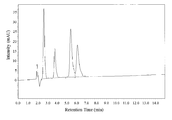
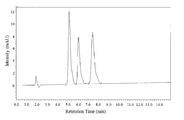
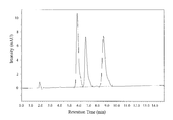
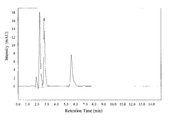
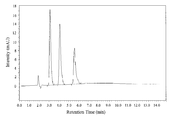
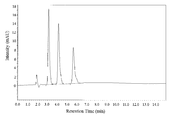
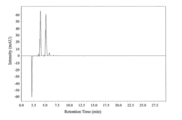
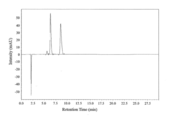
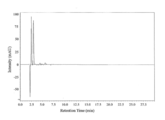
- Example 3 is a liquid chromatogram of dl-tryptophan in Example 1. It is a liquid chromatogram of dl-tryptophan in Comparative Example 1. It is a liquid chromatogram of dl-tryptophan in Comparative Example 2. It is a liquid chromatogram of the aniline analog mixture in Example 2. 3 is a liquid chromatogram of the aniline analog mixture in Example 3. It is a liquid chromatogram of the aniline analog mixture in Comparative Example 3. 3 is a liquid chromatogram of dl-1-phenylethylamine in Example 4. 5 is a liquid chromatogram of dl-1-phenylethylamine in Example 5. 6 is a liquid chromatogram of dl-1-phenylethylamine in Example 6.
- 3 is a liquid chromatogram of dl-1-phenylethylamine in Example 7.
- 8 is a liquid chromatogram of dl-1-phenylethylamine in Example 8. It is a liquid chromatogram of dl-1-phenylethylamine in Comparative Example 4.
- 9 is a liquid chromatogram of the aniline analog mixture in Example 9.
- 3 is a liquid chromatogram of dl-1-phenylethylamine in Example 10.
- 8 is a liquid chromatogram of dl-1-phenylethylamine in Example 11.
- 8 is a liquid chromatogram of dl-1-phenylethylamine in Example 12.
- 5 is a liquid chromatogram of dl-1-phenylethylamine in Comparative Example 5.
- the separation method according to one embodiment of the present disclosure is a method for separating amine by liquid chromatography, using a separating agent in which a ligand having a crown ether-like cyclic structure is supported on a carrier as a stationary phase, and chaotropic as a mobile phase.
- a solution containing an aqueous solution of one or more hydrophobic anion salts selected from the group consisting of anion salts and hydrophobic organic acid salts is used.
- the separation method according to this embodiment may be any as long as the amine separation means is liquid chromatography using the above-mentioned stationary phase and mobile phase, and has other configurations such as identification and quantification of the separated amine as appropriate. May be good.
- an amine is separated by using a separating agent in which a ligand having a crown ether-like cyclic structure is supported on a carrier as a stationary phase.
- a mixture of a plurality of amines can be separated into each amine, or an amine can be separated from a mixture containing an amine and a non-amine.
- the separation method according to the present embodiment is particularly effective for separating a mixture of amines having similar structures into each amine.
- the amine is not particularly limited and may be a primary amine, a secondary amine and / or a tertiary amine.
- Specific amines include amino acids such as alanine, cysteine, glutamate, methionine, leucine, tyrosine, and tryptophan; derivatives such as esters of the amino acids; amino alcohols such as dimethylaminoethanol, propanolamine, methioninol, and norephedrine; phenylethylamine. , Amino group-containing hydrocarbons such as aniline, methylaniline, diphenylamine; and the like.
- the separation method according to this embodiment is suitable for separating a desired primary amine from a mixture containing a primary amine. This is because the primary amine can be separated well due to the crown ether-like cyclic structure of the stationary phase. Further, according to the separation method according to the present embodiment, it is possible to separate a mixture of amines, which is difficult to separate because the structures are similar to each other, into each amine because the separation ability is high. Examples of the mixture of amines having similar structures include a mixture of chain isomers, a mixture of positional isomers, a mixture of geometric isomers, a mixture of analogs, and the like.
- the crown ether-like cyclic structure is an optically active substance, it is effective in separating the mixture of enantiomers into each enantiomer.
- separation of these mixtures specifically, as shown in Examples described later, separation of a mixture of aniline analogs consisting of aniline, 2-methylaniline, 3-methylaniline and 4-methylaniline; tryptophan. Separation; etc.
- the separation method according to this embodiment is highly useful in that a mixture of enantiomers of a compound containing an amino group can be separated by using a ligand having an optically active crown ether-like cyclic structure.
- the mobile phase used for liquid chromatography contains an aqueous solution of one or more hydrophobic anion salts selected from the group consisting of chaotropic anion salts and hydrophobic organic acid salts.
- the amine is retained in the separating agent without adding perchloric acid to the mobile phase, and the desired amine can be separated.
- the components contained in the mobile phase will be described, but the mobile phase may contain arbitrary components other than these components as long as the effects of the present disclosure are not impaired.
- the salt of the hydrophobic anion in this embodiment is one or more salts selected from the group consisting of a salt of a chaotropic anion and a salt of a hydrophobic organic acid. That is, in the present embodiment, the "hydrophobic anion" is a hydrophobic having a hydrophobic organic group such as an anion which is difficult to hydrate (that is, has a small hydration energy) such as a chaotropic anion or an alkyl group. It means a sex organic acid ion. Hydrophobic anions are presumed to exert the effects of the present disclosure due to their low hydration energy and high hydrophobicity.
- the aqueous solution of the salt of the hydrophobic anion may contain both the salt of the chaotropic anion and the salt of the hydrophobic organic acid, but it is preferable that the aqueous solution contains either one.
- Chaotropic anions are understood to be ions that make organic matter more soluble in water by breaking the agglutinating structure of water.
- chaotropic anions are understood to be anions in the Hofmeister series that have a low tendency to salt out organic matter.
- the chaotropic anion itself is an anion with low hydration energy. The present inventors speculate as to why the salt of the chaotropic anion contributes to the separation of amines as follows.
- the chaotropic anion forming an ion pair with the ammonium group is considered to be dehydrated. Be done. Then, the chaotropic anion having a small hydration energy is considered to be advantageous in retaining the ammonium group because the ammonium group is well encapsulated as a result of easy dehydration.
- Specific chaotropic anions for example PF 6 - (hexafluorophosphate), BF 4 - (tetrafluoroborate), ClO 4 - (perchlorate ion), CF 3 SO 3 - (trifluoromethane sulfonate ion), FSO 3 - (fluorosulfonic acid ion), (CF 3 SO 2) 2 N - ( bis (trifluoromethanesulfonyl) imide ion), PCl 6 - (hexachloro phosphate ions), SbCl 6 - (hexachloroantimonate acid ion), CF 3 CO 2 - (trifluoroacetate ion), CCl 3 CO 2 - (trichloroacetic acid ion), NO 3 - (nitrate ion), ClO 3 - (like chlorate ions), and the like.
- PF 6 - hexafluorophosphate
- BF 4 - te
- chaotropic anions PF 6 -, BF 4 -, ClO 4 - and / or CF 3 SO 3 - is preferably, PF 6 - and / or BF 4 - is more preferable. This is because they can improve the holding power of amines.
- the cations forming a salt with the chaotropic anion are not particularly limited as long as the forming salt is highly soluble and does not inhibit separation and detection. This is because the effect on the retention time and separation ability of cation species is significantly smaller than that of chaotropic anions.
- the ion having a high relationship with the retention time and the separability can be said to be a chaotropic anion rather than a cation. Therefore, the cation that forms a salt with the chaotropic anion may be appropriately selected from the well-known cations that form a salt with the chaotropic anion described above.
- Examples of such cations include Group 1 metals such as Li + (lithium ion), Na + (sodium ion), K + (potassium ion), Rb + (rubidium ion), and Cs + (cesium ion).
- Group 1 metals such as Li + (lithium ion), Na + (sodium ion), K + (potassium ion), Rb + (rubidium ion), and Cs + (cesium ion).
- NH 4 +, Me 4 N +, Et 4 N +, Bu 4 N +, Li +, Na +, K +, Mg 2+ and / or Ca is preferably 2+, NH 4 +, Me 4 N +, Et 4 N +, Bu 4 N +, Li +, more preferably Na + and / or K +.
- the cation forming a salt with the chaotropic anion is more preferably Na + .
- chaotropic anion salts include lithium perchlorate, sodium perchlorate, ammonium perchlorate, tetramethylammonium perchlorate, lithium hexafluorophosphate, sodium hexafluorophosphate, and potassium hexafluorophosphate. , Lithium tetrafluoroborate, sodium tetrafluoroborate, potassium tetrafluoroborate and the like.
- salts of chaotropic anions include lithium perchlorate, sodium perchlorate, ammonium perchlorate, tetramethylammonium perchlorate, sodium hexafluorophosphate, potassium hexafluorophosphate, ammonium trifluoroacetate and / Or sodium tetrafluoroborate is preferable, and sodium perchlorate, ammonium perchlorate, tetramethylammonium perchlorate, sodium hexafluorophosphate and / or potassium hexafluorophosphate is more preferable. This is because they can improve the holding power of amines.
- the salt of the chaotropic anion contained in the mobile phase in the present embodiment may be one kind or two or more kinds.
- the concentration of the chaotropic anion in the aqueous solution of the salt of the chaotropic anion is not particularly limited, but is usually 1 mM or more, preferably 5 mM or more, more preferably 8 mM or more, still more preferably 10 mM or more, and usually 200 mM or less, preferably 200 mM or less. Is 150 mM or less, more preferably 100 mM or less, still more preferably 50 mM or less, and particularly preferably 40 mM or less. Although it depends on the type, if the concentration of the chaotropic anion is too high, the retention of the amine may be weakened. However, by keeping the concentration within the above range, the amine can be well retained.
- the holding power of the amine can be secured even if the concentration of the chaotropic anion is higher than the above concentration range.
- examples of such cations include quaternary ammonium ions and sulfonium ions.
- the chaotropic anion has different effects such as retention time and separation performance depending on the type. When a chaotropic anion having a relatively low effect is adopted, the effect can be enhanced by increasing the concentration in the aqueous solution.
- the chaotropic anion does not need to have a high concentration, so that it is economically advantageous in that the device can be used for a long period of time while suppressing deterioration of the liquid chromatography device. is there.
- the present inventors speculate as to why the salt of the hydrophobic organic acid ion contributes to the separation of amines as follows. That is, when the ammonium group generated by protonation of the amino group of the amine to be separated is encapsulated in a ligand having a crown ether-like cyclic structure, the hydrophobic organic acid ion forming an ion pair with the ammonium group is at some stage. Is thought to be dehydrated.
- the hydrophobic organic acid ion having a small hydration energy due to the influence of the hydrophobic group easily dehydrates, and as a result, the ammonium group is stably encapsulated, which is advantageous for the retention of the ammonium group. Be done.
- the hydrophobic organic acid is not particularly limited as long as it has an acid group and a hydrophobic organic group.
- the acid group for example, a sulfonic group (-SO 3 H), sulfuric acid ester group (-OSO 3 H), phosphoric acid group (-OP (O) (OH) 2), phosphonic acid group (-P (O) (OH) 2 ) and the like can be mentioned.
- the acid group is preferably a sulfonic acid group and / or a sulfate ester group, and more preferably a sulfonic acid group.
- the number of acid groups contained in the hydrophobic organic acid may be 1, or may be 2 or more.
- the plurality of acid groups may be the same or different from each other, but are preferably the same.
- Examples of the hydrophobic organic group in this embodiment include an alkyl group having 4 to 18 carbon atoms (hereinafter, may be simply referred to as “alkyl group” or “alkyl”).
- the alkyl group may be any of a linear alkyl group, a branched alkyl group and a cyclic alkyl group. The longer the alkyl chain, the higher the holding power of the alkyl group having 4 to 18 carbon atoms with respect to the amine. Therefore, the alkyl group may be appropriately selected depending on the desired holding time and the ease of separation of the sample.
- the number of carbon atoms of the alkyl group is preferably 6 or more, more preferably 8 or more, still more preferably 10 or more, and preferably 16 or less, more preferably 14 or less.
- the retention time of the amine is long enough, the peak of the liquid chromatogram appears sharply, the mobile phase is less likely to foam during degassing of the mobile phase, and water Alternatively, it has an advantage that it is easily dissolved in a solvent having a low organic solvent content.
- the alkyl group having 4 to 18 carbon atoms may be unsubstituted or substituted with a halogen atom such as a fluorine atom, a chlorine atom, a bromine atom or an iodine atom.
- the number of alkyl groups having 4 to 18 carbon atoms contained in the hydrophobic organic acid may be 1, or may be 2 or more.
- the hydrophobic organic acid has two or more alkyl groups having 4 to 18 carbon atoms, the plurality of alkyl groups may be the same or different from each other, and the above-mentioned carbon number refers to the carbon number of one alkyl group. ..
- hydrophobic organic acid having the above-mentioned acid group and hydrophobic organic group examples include alkane sulfonic acid, alkyl sulfuric acid, alkyl phosphate, alkyl phosphonic acid and the like.
- Alcan sulfonic acid includes butane sulfonic acid, pentan sulfonic acid, hexane sulfonic acid, heptane sulfonic acid, octane sulfonic acid, nonane sulfonic acid, decane sulfonic acid, undecane sulfonic acid, dodecane sulfonic acid, tridecane sulfonic acid, tetradecane sulfonic acid.
- Pentadecane sulfonic acid Pentadecane sulfonic acid, hexadecane sulfonic acid, heptadecane sulfonic acid, octadecane sulfonic acid and the like.
- the alkane sulfonic acid is preferably hexane sulfonic acid, heptane sulfonic acid, octane sulfonic acid, nonane sulfonic acid and / or decane sulfonic acid.
- alkyl sulfuric acid butyl sulfuric acid, pentyl sulfuric acid, hexyl sulfuric acid, heptyl sulfuric acid, octyl sulfuric acid, nonyl sulfuric acid, decyl sulfuric acid, undecyl sulfuric acid, dodecyl sulfuric acid, tridecyl sulfuric acid, tetradecyl sulfuric acid, pentadecyl sulfuric acid, hexadecyl sulfuric acid, heptadecyl sulfuric acid, octadecyl sulfuric acid, etc. Can be mentioned.
- alkyl phosphates monobutyl phosphate, dibutyl phosphate, monopentyl phosphate, dipentyl phosphate, monohexyl phosphate, dihexyl phosphate, monoheptyl phosphate, diheptyl phosphate, monooctyl phosphate, dioctyl phosphate, phosphoric acid Monononyl, Dinonyl Phosphate, Monodecyl Phosphate, Didecyl Phosphate, Monoundecyl Phosphate, Diundecyl Phosphate, Monododecyl Phosphate, Didodecyl Phosphate, Monotridecyl Phosphate, Ditridecyl Phosphate, Monotetradecyl Phosphate, Ditetradecyl Phosphate, Phosphate Examples thereof include monopentadecyl phosphat
- Alkylphosphonic acids include butylphosphonic acid, pentylphosphonic acid, hexylphosphonic acid, heptylphosphonic acid, octylphosphonic acid, nonylphosphonic acid, decylphosphonic acid, undecylphosphonic acid, dodecylphosphonic acid, tridecylphosphonic acid, and tetradecyl. Examples thereof include phosphonic acid, pentadecylphosphonic acid, hexadecylphosphonic acid, heptadecylphosphonic acid, octadecylphosphonic acid and the like.
- the hydrophobic organic acid is preferably alkane sulfonic acid and / or alkyl sulfuric acid, and more preferably alkane sulfonic acid.
- the hydrophobic organic acid may consist only of an acid group and a hydrophobic organic group, but has an aroma of other atomic groups such as phenyl group and naphthyl group which do not adversely affect the detection of components in liquid chromatography. It may have a group such as a group hydrocarbon group; an alkenyl group such as a dodecenyl group or an oleyl group;
- the cations that form salts with hydrophobic organic acids are highly soluble in the salts that form, and can be separated and detected for the same reasons as described in the description of chaotropic anions and cations that form salts. As long as it does not inhibit, there is no particular limitation. Examples of such cations include cations similar to cations that form salts with chaotropic anions.
- the cation forming a salt with the hydrophobic organic acid is preferably a Group 1 metal ion such as Li + , Na + , K + , Rb + , Cs + , and Li + , Na + and / or K +. Is more preferable. Further, from the viewpoint of availability and separability, the cation forming a salt with the hydrophobic organic acid is more preferably Na + .
- Hydrophobic organic acid salts are preferably sodium butane sulphate, sodium pentane sulphate, sodium hexane sulphate, sodium heptane sulphate, sodium octane sulphate, sodium nonane sulphate, sodium decane sulphate, sodium undecane sulphate, Sodium dodecane sulfonate, sodium tridecane sulfonate, sodium tetradecane sulfonate, sodium pentadecane sulfonate, sodium hexadecane sulfonate, sodium heptadecane sulfonate, sodium octadecane sulfonate, sodium butyl sulphate, sodium pentyl sulphate, sodium hexyl sulphate, heptyl Sodium sulfate, sodium octyl sulfate, sodium nonyl sulfate
- the salt of the hydrophobic organic acid contained in the mobile phase in this embodiment may be 1 type or 2 or more types.
- the concentration of the hydrophobic organic acid ion in the aqueous solution of the salt of the hydrophobic organic acid is not particularly limited, but when the hydrophobic organic acid has one acid group, it is usually 1 mM or more, preferably 5 mM or more, more preferably 8 mM or more. It is more preferably 10 mM or more, and usually 200 mM or less, preferably 150 mM or less, more preferably 100 mM or less, still more preferably 50 mM or less, and particularly preferably 40 mM or less.
- the normal concentration and the preferable concentration of the hydrophobic organic acid ion are values obtained by dividing the above concentration by the number of acid groups.
- the hydrophobic organic acid is mainly a hydrophobic organic acid having an alkyl group.
- the larger the number of carbon atoms in the alkyl group the higher the effect of strengthening the retention even at the same molar concentration, but the larger the number of carbon atoms.
- micelles are likely to be formed, and the holding power of amines may decrease. Therefore, the amine can be well retained by setting the concentration of the hydrophobic organic acid ion in the aqueous solution of the salt of the hydrophobic organic acid within the above range.
- Hydrophobic organic acid ions have different effects such as retention time and separation performance depending on the type, particularly the number of carbon atoms (length of the alkyl chain) of the alkyl group.
- the retention strength correlates with the number of carbon atoms at the same concentration, so that there is an advantage that the type of the hydrophobic organic acid can be easily selected.
- a hydrophobic organic acid ion having a relatively low effect is adopted, the effect can be enhanced by increasing the concentration in the aqueous solution.
- the hydrophobic organic acid ion does not need to have a high concentration, so that the device can be used economically for a long period of time by suppressing deterioration of the liquid chromatography device. It is advantageous.
- aromatic amines have a lower basicity and are less protonated than aliphatic amines, it is generally preferable to separate aromatic amines at a slightly lower pH than aliphatic amines (). Details will be described later).
- the mobile phase contains an organic solvent described later in addition to the aqueous solution of the salt of the hydrophobic anion, the pH of the mobile phase becomes closer to neutral as compared with the case where the organic solvent is not contained. Separation is done under mild conditions. Further, for example, when an amino acid is used as a separation target, good separation can be easily realized by suppressing dissociation (ionization) of a carboxyl group under relatively low pH conditions of weak acidity to strong acidity.
- neutral to weakly acidic means that the pH (25 ° C.) is 2.0 or more and 8.0 or less.
- weakly acidic to strongly acidic means that the pH is 1.0 or more and 4.0 or less.
- the pH of the aqueous solution of the salt of the hydrophobic anion contained in the mobile phase depends on the structure and / or functional group of the amine, the type and amount of the organic solvent described later, the sample containing the amine, and the like, but is usually 8. 0 or less, preferably 6.0 or less, more preferably 4.0 or less, and usually 1.0 or more, preferably 2.0 or more, more preferably 2.5 or more, still more preferably 3.0 or more. Is.
- the pH of the aqueous solution of the salt of the hydrophobic anion can be adjusted by adding an acid described later to the mobile phase.
- the pH required for protonation also differs depending on the structure and / or functional group of the amine.
- the suitable pH range of the aqueous solution of the aqueous solution of the hydrophobic anion salt varies between 1.0 and more and 8.0 or less depending on the type of amine will be described with reference to specific examples.
- the pH of the aqueous solution of the aqueous solution of the hydrophobic anion salt is slightly low because the aromatic amine is a weak base and is difficult to protonate. Is preferable.
- the specific pH of the aqueous solution of the hydrophobic anion salt used for the separation of aromatic amines is 6.0 or less, 5.0 or less, 4.0 or less, 3.5 or less or 3.0 or less. It may be 1.0 or more, 2.0 or more, or 2.5 or more. Although it depends on the functional group of the aromatic amine, the pH of the aqueous solution of the salt of the hydrophobic anion is preferably 4.0 or less.
- the amine is an aliphatic amine (an amine in which an amino group is bonded to an aliphatic carbon atom)
- the pH of the aqueous solution of the hydrophobic anion salt is that of the aromatic amine. Protonation proceeds as much as or more than the case, and separation becomes possible. Therefore, the specific pH of the aqueous solution of the hydrophobic anion salt used for the separation of aliphatic amines may be 8.0 or less, 7.0 or less, 6.0 or less or 5.0 or less. Further, it may be 1.0 or more, 2.0 or more, 2.5 or more, 3.0 or more, or 3.5 or more.
- the specific pH of the aqueous solution of the salt of the hydrophobic anion used for separating the enantiomer of the amino acid is 4.0.
- it may be 3.5 or less, 3.0 or less, 2.6 or less or less than 2.0, and may be 1.0 or more, 1.5 or more or 1.8 or more. Since the resolution tends to be improved by suppressing the dissociation of the carboxyl group, the pH of the aqueous solution of the salt of the hydrophobic anion is lower than that of the above-mentioned aromatic amine and aliphatic amine having no carboxyl group. It is preferable to have.
- the pH of the aqueous solution of the salt of the hydrophobic anion is preferably 3.0 or less, more preferably 2.6 or less, still more preferably less than 2.0, and preferably 1.0 or more. More preferably, it is 1.5 or more.
- the retention of amines may be affected by the properties of the amino group (particularly the basicity) of the sample, functional groups other than the amino group, impurities, the amount of the sample to be separated, and the like.
- the pH can be adjusted to the above-mentioned pH by further adding an acid to the aqueous solution of the salt of the hydrophobic anion.
- an amine having no acid group such as a carboxyl group
- the amino group can be protonated even under neutral to weakly acidic conditions, so no acid is added to the aqueous solution of the hydrophobic anion salt.
- good separation is possible with the addition of a weak acid.
- the pH may be adjusted by adding a strong acid to an aqueous solution of a salt of a hydrophobic anion.
- a strong acid when used, it means the acid of this item, not the hydrophobic organic acid.
- the acid is an acid other than the above-mentioned hydrophobic organic acid and perchloric acid, and is not particularly limited as long as it does not inhibit separation, and one or more of the organic acid and the inorganic acid can be appropriately selected.
- the organic acid include formic acid, acetic acid, propionic acid, butyric acid, oxalic acid, malonic acid, succinic acid, glutaric acid, adipic acid, lactic acid, and various sulfonic acids having 3 or less carbon atoms.
- the inorganic acid include hydrochloric acid, sulfuric acid, nitric acid, phosphoric acid and the like.
- the acid is preferably hydrochloric acid, sulfuric acid, nitric acid, phosphoric acid, formic acid, acetic acid and / or various sulfonic acids having 3 or less carbon atoms.
- the acid is preferably hydrochloric acid, sulfuric acid, nitric acid, phosphoric acid and / or various sulfonic acids having 3 or less carbon atoms.
- the acid is preferably formic acid.
- a mobile phase that does not contain a salt of a hydrophobic anion contains only the above acid as a component other than the solvent, and has a pH of 1.0 or more has an amine retention time as shown in Comparative Example 2 described later. It is short and cannot achieve good separation.
- the mobile phase in this embodiment in which the salt of the hydrophobic anion and the above acid coexist good retention and separation of the amine is possible as shown in each example described later. is there.
- the mobile phase since it is not necessary to contain a large amount of perchloric acid, the mobile phase can be easily prepared and handled, and the corrosion of the apparatus can be reduced.
- the above description is not intended to contain no perchloric acid in the mobile phase in this embodiment, and may be a mode in which the mobile phase contains perchloric acid.
- the mobile phase may or may not contain an organic solvent in addition to the aqueous solution of the salt of the hydrophobic anion.
- the mobile phase does not contain an organic solvent, it has an advantage that a long holding time and an appropriate separation ability can be easily obtained, which is preferable. Further, when the mobile phase contains an organic solvent, there is an advantage that the holding time of the amine does not become too long and the peak of the liquid chromatogram tends to be sharp, which is preferable.
- the content and type of the organic solvent in the mobile phase are not particularly limited as long as the miscibility of the hydrophobic anion salt with the aqueous solution is good and the hydrophobic anion salt and the sample can be dissolved at the required concentration. , One or more can be appropriately selected from various organic solvents according to the separation target, the holding strength, the desired peak shape, and the like.
- organic solvent examples include alcohols such as methanol, ethanol, n-propanol and 2-propanol; ethers such as tetrahydrofuran and 1,2-dimethoxyethane; ketones such as acetone and methyl ethyl ketone; acetonitrile, propionitrile and benzonitrile. And the like; nitriles such as DMSO, sulfolane, HMPA, DMF, DMAC, NMP, relatively highly polar solvents such as formamide; and the like. These organic solvents are not limited to one type, and may be a mixed organic solvent in which two or more types are combined.
- the organic solvent is preferably methanol, ethanol, n-propanol, 2-propanol, tetrahydrofuran, acetone, methyl ethyl ketone, methyl isobutyl ketone or acetonitrile. This is because these organic solvents have high solubility of the salt of the hydrophobic anion. Moreover, in this embodiment, it is also preferable that the organic solvent is methanol or acetonitrile. This is because these organic solvents are suitable for the UV detection method because they can suppress an increase in column pressure due to their low viscosity and have substantially no ultraviolet absorption.
- the mixing ratio of the aqueous solution containing the salt of the hydrophobic anion and the acid if necessary and the organic solvent is good in the solubility of the salt of the hydrophobic anion and the sample and the miscibility of the aqueous solution and the organic solvent.
- the ratio of the aqueous solution and the organic solvent may be selected in the range of 5:95 to 100: 0, which is suitable for improving the holding time and the separability.
- the mobile phase can be prepared by mixing a salt of hydrophobic anion, water, an organic solvent and, if necessary, an acid.
- the order of mixing is not particularly limited, but when the mobile phase contains an organic solvent, the hydrophobic anion salt is dissolved in water in advance in order to allow the hydrophobic anion salt to exist in the mobile phase in a dissolved state. It is preferable to prepare an aqueous solution and then mix it with an organic solvent to prepare a mobile phase.
- the stationary phase in this embodiment is a separating agent in which a ligand having a crown ether-like cyclic structure is supported on a carrier.
- the term "ligand” means a compound that is supported on a carrier and exhibits a physical affinity for a separation target and, if necessary, an asymmetric recognition ability.
- the ligand in this embodiment has a crown ether-like cyclic structure. That is, the ligand is a compound in which the crown ether skeleton represented by the formula (I) is chemically bonded to an aliphatic, alicyclic, or aromatic hydrocarbon to form a macrocyclic polyether structure. ..
- n can be appropriately selected from an integer of 4 to 6, depending on the hydrocarbon to which the amino group of the amine and the crown ether skeleton are bonded.
- the ligand represented by the formula (II) or (III) described later has n of 5, and has a crown ether-like cyclic structure having a size suitable for subsuming a primary ammonium group, and thus has a primary amine. It is preferably used for the separation of.
- the hydrogen atom of the ethylene group in the repeating unit may be substituted with various functional groups, but it is preferable that the hydrogen atom is not substituted.
- a compound in which a crown ether-like cyclic structure is bound to a homochiral structure is used as the ligand.
- a ligand represented by the formula (II) described in JP-A-2-69472 and International Publication No. 2012/050124 examples of such a ligand include a ligand represented by the formula (II) described in JP-A-2-69472 and International Publication No. 2012/050124, and a ligand represented by the formula (II) described in JP-A-2014-169259. ), And the like.
- the phenyl groups at the 3- and 3'-positions of the 1,1'-binaphthyl structure in the formula (II) are halogen atoms such as bromine atoms; alkyl groups such as methyl groups; substituted aromatic groups; heterocyclic groups; Ligands (Peng Wu, et. Al., Chin. J. Chem., 2017, 35, 1037-1042) that have been replaced with the above can also be adopted.
- the ligand is used as a separating agent while being supported on a carrier.
- a known mode can be adopted, and a mode in which the ligand is supported on the carrier by a chemical bond such as a covalent bond can be preferably adopted.
- Specific examples of the supporting method include a method in which a reactive group is introduced into a ligand, a raw material of the ligand, or an intermediate of the ligand, and the substituent is reacted with the reactive group existing on the surface of the carrier.
- the reactive group present on the surface of the carrier may be a group existing on the surface of the untreated carrier, and the carrier is used as a surface treatment agent such as 3-aminopropyltriethoxysilane or 3-glycidyloxypropyltri.
- the group may be introduced into the surface of the carrier by surface-treating with a silane coupling agent such as methoxysilane.
- the carrier is not particularly limited as long as the ligand can be fixed by a chemical bond such as a covalent bond.
- a carrier may be an inorganic carrier or an organic carrier, but is preferably an inorganic carrier.
- the inorganic carrier include silica, alumina, magnesia, glass, kaolin, titanium oxide, silicate, hydroxyapatite and the like.
- the organic carrier include polystyrene, polyacrylamide, polyacrylate, polysaccharide and the like. It is preferable that these organic carriers are insolubilized by being crosslinked with a crosslinking agent.
- the shape of the carrier is not particularly limited, and examples thereof include particles and a porous cylinder (monolith) that is liquid-tightly housed in a column tube. Moreover, the inner wall of the capillary can be mentioned as a carrier.
- the carrier is preferably a porous body from the viewpoint of improving the separation ability, and more preferably a porous body having a BET specific surface area of 100 to 600 m 2 / g. Further, from the viewpoint of improving the separability, the porous body preferably has a pore diameter of 60 to 300 ⁇ as measured by the mercury intrusion method. Further, in the present embodiment, the carrier is preferably silica gel. This is because silica gel has the above-mentioned properties, that is, excellent separation ability, and is hard and durable. As the silica gel, a so-called core-shell type may be used in addition to the totally porous silica gel.
- Example 1 Separation of dl-tryptophan> 0.15 g of 88% formic acid was dissolved in 100 mL of a 20 mmol / L lithium perchlorate aqueous solution to obtain an aqueous solution of a salt of a chaotropic anion.
- Mobile phase A was prepared by mixing the obtained aqueous solution of a chaotropic anion salt and acetonitrile at a volume ratio of 70:30.
- the composition of mobile phase A and the pH (25 ° C.) of an aqueous solution of a salt of a chaotropic anion are shown in Table 1. The pH was measured with a pH meter (manufactured by HORIBA). The same applies to the following examples.
- FIG. 1 The obtained chromatogram is shown in FIG. In FIG. 1, peaks derived from l-tryptophan and d-tryptophan were observed around the retention time of 2.1 minutes and 2.9 minutes, respectively.
- ⁇ Comparative Example 2 Separation of dl-tryptophan> 1.31 g of formic acid was dissolved in 1 L of water to obtain an aqueous solution of formic acid. Mobile phase C was prepared by mixing the obtained aqueous solution of formic acid and acetonitrile at a volume ratio of 70:30. The composition of mobile phase C and the pH (25 ° C.) of the aqueous formic acid solution are shown in Table 1. Samples were separated in the same manner as in Example 1 except that mobile phase C was used as the mobile phase.
- Comparative Example 1 is a conventional example using a mobile phase containing an aqueous solution of perchloric acid having a pH of 1.79, and it was confirmed that dl-tryptophan was separated into each enantiomer.
- Comparative Example 2 is an experimental example using a mobile phase containing a formic acid aqueous solution having the same concentration as the perchloric acid aqueous solution of Comparative Example 1. It was found that dl-tryptophan could not be separated into each enantiomer even by using a mobile phase containing an aqueous solution of formic acid having a pH of 2.64, which does not contain a salt of a chaotropic anion.
- Example 1 using a mobile phase containing an aqueous solution of pH 2.60 containing lithium perchlorate in addition to the same concentration of formic acid as in Comparative Example 2, it was confirmed that dl-tryptophan was separated into each enantiomer. Was done. That is, it was shown that the salt of the chaotropic anion contained in the mobile phase contributes to good separation.
- Mobile phase D was prepared by mixing a 20 mmol / L potassium hexafluorophosphate aqueous solution, which is an aqueous solution of a salt of a chaotropic anion, and acetonitrile at a volume ratio of 70:30.
- the composition of mobile phase D and the pH (25 ° C.) of an aqueous solution of a salt of a chaotropic anion are shown in Table 1.
- the obtained chromatogram is shown in FIG. In FIG. 4, the retention time was about 5.1 minutes, about 5.5 minutes, about 7.4 minutes, and about 8.9 minutes, respectively, to aniline, 2-methylaniline, 3-methylaniline, and 4-methylaniline, respectively. Derived peaks were observed.
- Example 3 Separation of aniline analog mixture> 1.31 g of formic acid was dissolved in 1 L of a 20 mmol / L potassium hexafluorophosphate aqueous solution to obtain an aqueous solution of a salt of a chaotropic anion.
- a mobile phase E was prepared by mixing an aqueous solution of the obtained chaotropic anion salt and acetonitrile at a volume ratio of 70:30.
- the composition of mobile phase E and the pH (25 ° C.) of an aqueous solution of a salt of a chaotropic anion are shown in Table 1. Samples were separated in the same manner as in Example 2 except that mobile phase E was used as the mobile phase.
- the obtained chromatogram is shown in FIG. In FIG. 5, the retention time was about 4.6 minutes, about 7.3 minutes, about 11.8 minutes, and about 13.7 minutes, respectively, to 2-methylaniline, aniline, 3-methylaniline, and 4-methylaniline, respectively. Derived peaks were observed.
- the obtained chromatogram is shown in FIG. In FIG. 6, the retention time was about 2.6 minutes, 3.8 minutes, 5.4 minutes, and 6.2 minutes, respectively, to 2-methylaniline, aniline, 3-methylaniline, and 4-methylaniline, respectively. Derived peaks were observed.
- Comparative Example 3 is a conventional example using a mobile phase containing an aqueous solution of perchloric acid having a pH of 1.79, and it was confirmed that a mixture of aniline analogs was separated.
- Example 2 is an experimental example using a mobile phase containing an aqueous solution of potassium hexafluorophosphate having a pH of 4.31 which does not contain an acid, and a mixture of aniline analogs is good without adding perchloric acid to the mobile phase. It turned out that it can be separated into.
- Example 3 is an experimental example using a mobile phase containing an aqueous solution of potassium hexafluorophosphate having a pH of 2.57 containing formic acid.
- Example 3 it was confirmed that the retention time of each aniline analog was longer than that of Comparative Example 3 and Example 2. That is, it was shown that the mixture of aniline analogs was separated very well by using the mobile phase containing the salt and acid of the chaotropic anion.
- the obtained chromatogram is shown in FIG. In FIG. 7, peaks derived from each enantiomer of 1-phenylethylamine were observed at a retention time of around 5.1 minutes and around 7.4 minutes, respectively.
- the peak with a retention time of around 6.0 minutes is a peak derived from impurities.
- Example 5 Separation of dl-1-phenylethylamine> Samples were separated in the same manner as in Example 4 except that mobile phase E was used as the mobile phase.
- the obtained chromatogram is shown in FIG. In FIG. 8, peaks derived from each enantiomer of 1-phenylethylamine were observed around the retention time of 5.8 minutes and 8.6 minutes, respectively.
- the peak with a retention time of around 6.7 minutes is a peak derived from impurities.
- Example 6 Separation of dl-1-phenylethylamine> 1.31 g of formic acid was dissolved in 1 L of a 20 mmol / L sodium tetrafluoroborate aqueous solution to obtain an aqueous solution of a salt of a chaotropic anion. A mobile phase F was prepared by mixing the obtained aqueous solution of a chaotropic anion salt and acetonitrile at a volume ratio of 70:30. The composition of mobile phase F and the pH (25 ° C.) of an aqueous solution of a salt of a chaotropic anion are shown in Table 1. The sample was separated in the same manner as in Example 4 except that the mobile phase F was used as the mobile phase.
- the obtained chromatogram is shown in FIG. In FIG. 9, peaks derived from each enantiomer of 1-phenylethylamine were observed around the retention time of 2.3 minutes and 2.7 minutes, respectively.
- the peak with a retention time of around 5.6 minutes is a peak derived from impurities.
- Example 7 Separation of dl-1-phenylethylamine> 1.31 g of formic acid was dissolved in 1 L of an 80 mmol / L ammonium trifluoroacetate aqueous solution to obtain an aqueous solution of a salt of a chaotropic anion. A mobile phase G was prepared by mixing an aqueous solution of the obtained chaotropic anion salt and acetonitrile at a volume ratio of 70:30. The composition of mobile phase G and the pH (25 ° C.) of the aqueous solution of the salt of the chaotropic anion are shown in Table 1. The sample was separated in the same manner as in Example 4 except that the mobile phase G was used as the mobile phase.
- Mobile phase H was prepared by mixing a 20 mmol / L lithium perchlorate aqueous solution, which is an aqueous solution of a salt of a chaotropic anion, and acetonitrile at a volume ratio of 70:30.
- the composition of mobile phase H and the pH (25 ° C.) of an aqueous solution of a salt of a chaotropic anion are shown in Table 1. Samples were separated in the same manner as in Example 4 except that mobile phase H was used as the mobile phase.
- FIG. 11 The obtained chromatogram is shown in FIG. In FIG. 11, peaks derived from each enantiomer of 1-phenylethylamine were observed at a retention time of around 3.2 minutes and around 4.2 minutes, respectively. The peak with a retention time of about 5.7 minutes is a peak derived from impurities.
- the obtained chromatogram is shown in FIG. In FIG. 12, peaks derived from each enantiomer of 1-phenylethylamine were observed around the retention time of 3.1 minutes and 4.1 minutes, respectively. The peak with a retention time of around 5.6 minutes is a peak derived from impurities.
- Comparative Example 4 is a conventional example using a mobile phase containing a perchloric acid aqueous solution having a pH of 1.79, and it was confirmed that dl-1-phenylethylamine was separated into each enantiomer.
- Example 4 is an experimental example using a mobile phase containing an aqueous potassium hexafluorophosphate solution having a pH of 4.31 which does not contain an acid, and dl-1-phenylethylamine is added to the mobile phase without adding perchloric acid. It was found that it can be well separated into each enantiomer.
- Example 5 is an experimental example using a mobile phase containing an aqueous solution of potassium hexafluorophosphate having a pH of 2.57 containing formic acid, and each enantiomer of dl-1-phenylethylamine is more than Comparative Example 4 and Example 4. It was confirmed that the retention time of was long. That is, it was shown that by using a mobile phase containing a salt and an acid of a chaotropic anion, dl-1-phenylethylamine was well retained in the crown ether-like cyclic structure and separated into each enantiomer well.
- Example 6 is an experimental example in which the type of salt of the chaotropic anion is different from that of Example 5 and the pH is about the same.
- Example 6 it was confirmed that dl-1-phenylethylamine could be satisfactorily separated into each enantiomer. It was also found that when a hexafluorophosphoric acid anion was used as the chaotropic anion, the retention time was longer and the separation ability was more excellent than when the tetrafluoroborate anion was used.
- the salt of the chaotropic anion was combined with a salt of trifluoroacetate, which has lower chaotropic properties than hexafluorophosphoric acid ions (Examples 4 and 5) and tetrafluoroborate ion (Example 6). This is an example of an experiment.
- Example 8 is an experimental example in which the pH of an aqueous solution of a salt of a chaotropic anion is increased. It was found that dl-1-phenylethylamine can be well separated into each enantiomer even when the pH is as high as 7.29.
- Mobile phase I was prepared by mixing an aqueous solution of a salt of a hydrophobic organic acid having a formic acid concentration of 30 mmol / L and a sodium octane sulfonate concentration of 20 mmol / L and acetonitrile at a volume ratio of 70:30.
- the composition of mobile phase I and the pH (25 ° C.) of an aqueous solution of a salt of a hydrophobic organic acid are shown in Table 2.
- Mobile phase I was used as the mobile phase, and 1 ⁇ L of a mixture of aniline, 2-methylaniline, 3-methylaniline and 4-methylaniline (acetritale solution having a concentration of 0.02 to 0.03% by mass of each compound) was used as a sample. Except for the above, the sample was separated in the same manner as in Example 1.
- the obtained chromatogram is shown in FIG. In FIG. 13, the retention time was about 3.5 minutes, 4.5 minutes, 6.5 minutes, and 7.3 minutes, respectively, to 2-methylaniline, aniline, 3-methylaniline, and 4-methylaniline, respectively. Derived peaks were observed.
- Example 9 is an experimental example in which the salt of the hydrophobic anion is different from that of Example 3 and the pH is about the same.
- sodium octane sulfonate which is a salt of a hydrophobic organic acid
- the retention time was longer than in Example 3 in which potassium hexafluorophosphate was used as the salt of the hydrophobic anion.
- the peak of the liquid chromatogram was sharper than that in Example 3. That is, it was shown that the salt of the hydrophobic organic acid contained in the mobile phase contributes to good separation.
- Example 10 Separation of dl-1-phenylethylamine> Samples were separated in the same manner as in Example 4 except that mobile phase I was used as the mobile phase. The obtained chromatogram is shown in FIG. In FIG. 14, peaks derived from each enantiomer of 1-phenylethylamine were observed at a retention time of around 3.9 minutes and around 5.1 minutes, respectively.
- a mobile phase J was prepared by mixing an aqueous solution of a salt of a hydrophobic organic acid having a formic acid concentration of 30 mmol / L and a sodium decanesulfonate concentration of 20 mmol / L and acetonitrile at a volume ratio of 70:30.
- the composition of mobile phase J is shown in Table 2. Samples were separated in the same manner as in Example 10 except that mobile phase J was used as the mobile phase.
- a mobile phase K was prepared by mixing an aqueous solution of a salt of a hydrophobic organic acid having a formic acid concentration of 30 mmol / L and a sodium hexanesulfonate concentration of 20 mmol / L and acetonitrile at a volume ratio of 70:30.
- the composition of mobile phase K is shown in Table 2. Samples were separated in the same manner as in Example 10 except that mobile phase K was used as the mobile phase.
- Examples 10, 11 and 12 are experimental examples using a mobile phase containing formic acid together with aqueous solutions of sodium alkanesulfonate having 8, 10 and 6, respectively, and in each of the examples, the mobile phase is excessive. It was shown that dl-1-phenylethylamine can be satisfactorily separated into each enantiomer without the addition of chloric acid. Further, from these examples, the larger the carbon number of the hydrophobic organic group, the longer the retention time of each enantiomer of dl-1-phenylethylamine, and the smaller the carbon number of the hydrophobic organic group, the sharper the peak of the liquid chromatogram. It turns out that there is a tendency to become.
- a mobile phase L was prepared by mixing an aqueous solution having a formic acid concentration of 30 mmol / L and a sodium methanesulfonate concentration of 20 mmol / L and acetonitrile at a volume ratio of 70:30.
- the composition of mobile phase L is shown in Table 2. Samples were separated in the same manner as in Example 10 except that the mobile phase L was used as the mobile phase.
- dl-1-phenylethylamine was separated under the same conditions as in Examples 10 to 12, except that sodium methanesulfonate was used instead of sodium alkanesulfonate having 6 to 10 carbon atoms.
- Methanesulfonic acid is an alkane sulfonic acid having 1 carbon atom, which is not sufficiently hydrophobic and does not correspond to the hydrophobic organic acid in the present disclosure.
- sodium methanesulfonate it was confirmed that the retention time of dl-1-phenylethylamine was short and the effect of improving the retention of amine could not be obtained.
- amines can be separated by liquid chromatography without the need to add a large amount of perchloric acid to the mobile phase. Therefore, such a separation method can be widely used in fields such as organic chemistry, medicine, and pharmacy, which perform analysis and purification by various liquid chromatography.
Landscapes
- Chemical & Material Sciences (AREA)
- Analytical Chemistry (AREA)
- Chemical Kinetics & Catalysis (AREA)
- Organic Chemistry (AREA)
- Inorganic Chemistry (AREA)
- Biochemistry (AREA)
- Health & Medical Sciences (AREA)
- Life Sciences & Earth Sciences (AREA)
- Physics & Mathematics (AREA)
- General Health & Medical Sciences (AREA)
- General Physics & Mathematics (AREA)
- Immunology (AREA)
- Pathology (AREA)
- Organic Low-Molecular-Weight Compounds And Preparation Thereof (AREA)
- Treatment Of Liquids With Adsorbents In General (AREA)
- Solid-Sorbent Or Filter-Aiding Compositions (AREA)
Abstract
クラウンエーテル様環状構造を有するリガンドが担体に担持された分離剤を固定相として用い、カオトロピック陰イオンの塩及び疎水性有機酸の塩からなる群より選択される1種以上の疎水性陰イオンの塩の水溶液を含有する移動相を用いる、液体クロマトグラフィーによるアミンの分離方法。
Description
本開示は、液体クロマトグラフィーによるアミンの分離方法に関する。
クラウンエーテル様環状構造を有する分離剤は、液体クロマトグラフィーの固定相として、1級アミノ基を有する化合物及びその類似物質の分離に広く用いられている。特に、クラウンエーテル様環状構造がキラル構造に結合した分離剤は、エナンチオマーの分離に有用であることが知られている。
特許文献1及び特許文献2には、優れた光学異性体用分離剤として、クラウンエーテル様環状構造がS体又はR体のビナフチル構造に結合した分離剤が開示されている。これらの分離剤は、以下のようにして分離能を発揮するものと考えられている。即ち、1級アミンがプロトン化して生じた1級アンモニウム基(-NH3
+)が、該1級アンモニウム基の3つの水素原子とクラウンエーテル様環状構造の酸素原子との水素結合によりクラウンエーテル様環状構造に包摂され、分離剤に保持される結果、分離が可能となると考えられる。そのため、このような固定相を用いる場合、高い分離能を得るために、強酸性の移動相が好適に用いられることが知られている。例えば、特許文献2には、過塩素酸水溶液又はトリフルオロ酢酸水溶液とメタノール、アセトニトリル等の有機溶媒と混合してなる移動相が開示されている。このように、強酸性の移動相は強酸を含有するものであり、強酸の中でも、過塩素酸が最も良好にアミンを保持し、分離能を向上させる酸であることが知られている。
しかしながら、過塩素酸は単に強酸であるだけではなく、強い酸化剤でもあり、そのため取り扱いを誤れば爆発事故につながったり、液体クロマトグラフィー装置の金属部分を腐食させるなどの問題があった。また、過塩素酸に代えて他の強酸を移動相に添加した場合、アミンに対する保持力を確保できず、アミンを良好に分離できないという問題があった。
そこで、本開示は、クラウンエーテル様環状構造を有する分離剤を用いた液体クロマトグラフィーにおいて、移動相に多量の過塩素酸を添加することなく、かつ、アミンの良好な保持及び分離を実現し得る方法を提供することを課題とする。
本発明者らは、上記課題を解決するために鋭意検討した結果、クラウンエーテル様環状構造を有する分離剤を用いた液体クロマトグラフィーにおいて、移動相として疎水性陰イオンの塩の水溶液を含有する溶液を用いることで、上記課題を解決できることを見出した。すなわち、本開示の要旨は、以下の通りである。
[1]
クラウンエーテル様環状構造を有するリガンドが担体に担持された分離剤を固定相として用い、
カオトロピック陰イオンの塩及び疎水性有機酸の塩からなる群より選択される1種以上の疎水性陰イオンの塩の水溶液を含有する移動相を用いる、液体クロマトグラフィーによるアミンの分離方法。
[2]
前記疎水性陰イオンの塩が、カオトロピック陰イオンの塩である、[1]に記載の分離方法。
[3]
前記カオトロピック陰イオンが、PF6 -、BF4 -、ClO4 -、CF3SO3 -、FSO3 -、(CF3SO2)2N-、PCl6 -、SbCl6 -、CF3CO2 -、CCl3CO2 -、NO3 -及びClO3 -からなる群より選択される1種以上である、[2]に記載の分離方法。
[4]
前記疎水性陰イオンの塩が、疎水性有機酸の塩である、[1]に記載の分離方法。
[5]
前記疎水性有機酸が、硫酸エステル基、スルホン酸基及びリン酸基からなる群より選択される1種以上の酸基と炭素数4~18のアルキル基とを有する疎水性有機酸である、[4]に記載の分離方法。
[6]
前記疎水性有機酸が、炭素数4~18のアルカンスルホン酸である、[4]又は[5]に記載の分離方法。
[7]
前記水溶液のpHが、1.0以上8.0以下である、[1]~[6]の何れかに記載の分離方法。
[8]
前記移動相が、疎水性有機酸及び過塩素酸以外の酸を含む、[1]~[7]の何れかに記載の分離方法。
[9]
前記酸が、ギ酸である、[8]に記載の分離方法。
[10]
前記アミンが、1級アミンである、[1]~[9]の何れかに記載の分離方法。
クラウンエーテル様環状構造を有するリガンドが担体に担持された分離剤を固定相として用い、
カオトロピック陰イオンの塩及び疎水性有機酸の塩からなる群より選択される1種以上の疎水性陰イオンの塩の水溶液を含有する移動相を用いる、液体クロマトグラフィーによるアミンの分離方法。
[2]
前記疎水性陰イオンの塩が、カオトロピック陰イオンの塩である、[1]に記載の分離方法。
[3]
前記カオトロピック陰イオンが、PF6 -、BF4 -、ClO4 -、CF3SO3 -、FSO3 -、(CF3SO2)2N-、PCl6 -、SbCl6 -、CF3CO2 -、CCl3CO2 -、NO3 -及びClO3 -からなる群より選択される1種以上である、[2]に記載の分離方法。
[4]
前記疎水性陰イオンの塩が、疎水性有機酸の塩である、[1]に記載の分離方法。
[5]
前記疎水性有機酸が、硫酸エステル基、スルホン酸基及びリン酸基からなる群より選択される1種以上の酸基と炭素数4~18のアルキル基とを有する疎水性有機酸である、[4]に記載の分離方法。
[6]
前記疎水性有機酸が、炭素数4~18のアルカンスルホン酸である、[4]又は[5]に記載の分離方法。
[7]
前記水溶液のpHが、1.0以上8.0以下である、[1]~[6]の何れかに記載の分離方法。
[8]
前記移動相が、疎水性有機酸及び過塩素酸以外の酸を含む、[1]~[7]の何れかに記載の分離方法。
[9]
前記酸が、ギ酸である、[8]に記載の分離方法。
[10]
前記アミンが、1級アミンである、[1]~[9]の何れかに記載の分離方法。
本開示によれば、クラウンエーテル様環状構造を有する分離剤を用いた液体クロマトグラフィーにおいて、移動相に多量の過塩素酸を添加することなく、かつ、アミンの良好な保持及び分離を実現し得る方法を提供することができる。
以下に、本開示について具体的な実施態様を挙げて説明するが、各実施態様における各構成及びそれらの組み合わせ等は、一例であって、本開示の主旨から逸脱しない範囲内で、適宜、構成の付加、省略、置換、及びその他の変更が可能である。本開示は、実施態様によって限定されることはなく、クレームの範囲によってのみ限定される。
また、本明細書に開示される各々の態様は、本明細書に開示される他のいかなる特徴とも組み合わせることができる。
また、本明細書に開示される各々の態様は、本明細書に開示される他のいかなる特徴とも組み合わせることができる。
<1.分離方法>
本開示の一実施態様である分離方法は、液体クロマトグラフィーによるアミンの分離方法であって、固定相としてクラウンエーテル様環状構造を有するリガンドが担体に担持された分離剤を用い、移動相としてカオトロピック陰イオンの塩及び疎水性有機酸の塩からなる群より選択される1種以上の疎水性陰イオンの塩の水溶液を含有する溶液を用いる。本実施態様に係る分離方法は、アミンの分離手段が上述した固定相及び移動相を用いた液体クロマトグラフィーであればよく、分離されたアミンの同定、定量等のその他の構成を適宜有してもよい。
本開示の一実施態様である分離方法は、液体クロマトグラフィーによるアミンの分離方法であって、固定相としてクラウンエーテル様環状構造を有するリガンドが担体に担持された分離剤を用い、移動相としてカオトロピック陰イオンの塩及び疎水性有機酸の塩からなる群より選択される1種以上の疎水性陰イオンの塩の水溶液を含有する溶液を用いる。本実施態様に係る分離方法は、アミンの分離手段が上述した固定相及び移動相を用いた液体クロマトグラフィーであればよく、分離されたアミンの同定、定量等のその他の構成を適宜有してもよい。
<2.アミン>
本実施態様に係る分離方法では、固定相としてクラウンエーテル様環状構造を有するリガンドが担体に担持された分離剤を使用し、アミンを分離する。本実施態様に係る分離方法によれば、複数のアミンの混合物を各アミンに分離したり、アミンと非アミンとを含む混合物からアミンを分離することができる。本実施態様に係る分離方法は、前者の中でも、構造が互いに類似するアミンの混合物を各アミンに分離することに特に有効である。
本実施態様に係る分離方法では、固定相としてクラウンエーテル様環状構造を有するリガンドが担体に担持された分離剤を使用し、アミンを分離する。本実施態様に係る分離方法によれば、複数のアミンの混合物を各アミンに分離したり、アミンと非アミンとを含む混合物からアミンを分離することができる。本実施態様に係る分離方法は、前者の中でも、構造が互いに類似するアミンの混合物を各アミンに分離することに特に有効である。
アミンは、特に限定されず、1級アミン、2級アミン及び/又は3級アミンであってよい。具体的なアミンとしては、アラニン、システイン、グルタミン酸、メチオニン、ロイシン、チロシン、トリプトファン等のアミノ酸;前記アミノ酸のエステル等の誘導体;ジメチルアミノエタノール、プロパノールアミン、メチオニノール、ノルエフェドリン等のアミノアルコール;フェニルエチルアミン、アニリン、メチルアニリン、ジフェニルアミン等のアミノ基含有炭化水素;等が挙げられる。
本実施態様に係る分離方法は、1級アミンを含む混合物から所望の1級アミンを分離することに適している。1級アミンは、固定相が有するクラウンエーテル様環状構造により、良好に分離し得るからである。
また、本実施態様に係る分離方法によれば、高い分離能を示すことから、構造が互いに類似するために分離が難しいアミンの混合物を各アミンに分離することもできる。構造が互いに類似するアミンの混合物としては、連鎖異性体の混合物、位置異性体の混合物、幾何異性体の混合物、類縁体の混合物等が挙げられる。さらに、クラウンエーテル様環状構造が光学活性体である場合には、エナンチオマーの混合物を各エナンチオマーに分離するのに有効である。これらの混合物の分離としては、具体的には、後述する実施例に示されるように、アニリン、2-メチルアニリン、3-メチルアニリン及び4-メチルアニリンからなるアニリン類縁体の混合物の分離;トリプトファンの分離;等が挙げられる。本実施態様に係る分離方法は、光学活性なクラウンエーテル様環状構造を有するリガンドを用いることにより、アミノ基を含む化合物のエナンチオマーの混合物を分離できる点で、有用性が高い。
また、本実施態様に係る分離方法によれば、高い分離能を示すことから、構造が互いに類似するために分離が難しいアミンの混合物を各アミンに分離することもできる。構造が互いに類似するアミンの混合物としては、連鎖異性体の混合物、位置異性体の混合物、幾何異性体の混合物、類縁体の混合物等が挙げられる。さらに、クラウンエーテル様環状構造が光学活性体である場合には、エナンチオマーの混合物を各エナンチオマーに分離するのに有効である。これらの混合物の分離としては、具体的には、後述する実施例に示されるように、アニリン、2-メチルアニリン、3-メチルアニリン及び4-メチルアニリンからなるアニリン類縁体の混合物の分離;トリプトファンの分離;等が挙げられる。本実施態様に係る分離方法は、光学活性なクラウンエーテル様環状構造を有するリガンドを用いることにより、アミノ基を含む化合物のエナンチオマーの混合物を分離できる点で、有用性が高い。
<3.移動相>
本実施態様では、液体クロマトグラフィーに用いる移動相は、カオトロピック陰イオンの塩及び疎水性有機酸の塩からなる群より選択される1種以上の疎水性陰イオンの塩の水溶液を含有する。これにより、移動相に過塩素酸を添加することなくアミンが分離剤に保持され、所望のアミンを分離することができる。
以下、移動相に含まれる成分について説明するが、移動相は、本開示の効果を損なわない範囲で、これらの成分以外の任意成分を含有していてもよい。
本実施態様では、液体クロマトグラフィーに用いる移動相は、カオトロピック陰イオンの塩及び疎水性有機酸の塩からなる群より選択される1種以上の疎水性陰イオンの塩の水溶液を含有する。これにより、移動相に過塩素酸を添加することなくアミンが分離剤に保持され、所望のアミンを分離することができる。
以下、移動相に含まれる成分について説明するが、移動相は、本開示の効果を損なわない範囲で、これらの成分以外の任意成分を含有していてもよい。
(3-1.疎水性陰イオンの塩の水溶液)
本実施態様における疎水性陰イオンの塩は、カオトロピック陰イオンの塩及び疎水性有機酸の塩からなる群より選択される1種以上の塩である。即ち、本実施態様において、「疎水性陰イオン」とは、カオトロピック陰イオンのような水和しにくい(すなわち、水和エネルギーが小さい)陰イオン又はアルキル基のような疎水性有機基を有する疎水性有機酸イオンを意味する。疎水性陰イオンは、水和エネルギーが小さく、疎水性が高いことにより、本開示の効果を奏するものと推測される。
疎水性陰イオンの塩の水溶液は、カオトロピック陰イオンの塩及び疎水性有機酸の塩の両者を含んでいてもよいが、何れか一方を含んでいることが好ましい。
本実施態様における疎水性陰イオンの塩は、カオトロピック陰イオンの塩及び疎水性有機酸の塩からなる群より選択される1種以上の塩である。即ち、本実施態様において、「疎水性陰イオン」とは、カオトロピック陰イオンのような水和しにくい(すなわち、水和エネルギーが小さい)陰イオン又はアルキル基のような疎水性有機基を有する疎水性有機酸イオンを意味する。疎水性陰イオンは、水和エネルギーが小さく、疎水性が高いことにより、本開示の効果を奏するものと推測される。
疎水性陰イオンの塩の水溶液は、カオトロピック陰イオンの塩及び疎水性有機酸の塩の両者を含んでいてもよいが、何れか一方を含んでいることが好ましい。
(3-1-1.カオトロピック陰イオンの塩)
カオトロピック陰イオンは、水の凝集構造を崩すことによって、有機物を水に溶け易くするイオンであると理解されている。また、カオトロピック陰イオンは、ホフマイスター系列において、有機物を塩析する傾向の小さい陰イオンであると理解されている。そして、カオトロピック陰イオンそれ自体は、水和エネルギーの小さい陰イオンである。
カオトロピック陰イオンの塩がアミンの分離に寄与する理由については、本発明者らは、以下のように推測している。即ち、分離対象であるアミンのアミノ基がプロトン化して生じたアンモニウム基が、クラウンエーテル様環状構造を有するリガンドに包接されると、アンモニウム基とイオンペアをなすカオトロピック陰イオンは、脱水和すると考えられる。そして、水和エネルギーの小さいカオトロピック陰イオンは、容易に脱水和する結果、アンモニウム基が良好に包接されるため、アンモニウム基の保持に有利に働くものと考えられる。
カオトロピック陰イオンは、水の凝集構造を崩すことによって、有機物を水に溶け易くするイオンであると理解されている。また、カオトロピック陰イオンは、ホフマイスター系列において、有機物を塩析する傾向の小さい陰イオンであると理解されている。そして、カオトロピック陰イオンそれ自体は、水和エネルギーの小さい陰イオンである。
カオトロピック陰イオンの塩がアミンの分離に寄与する理由については、本発明者らは、以下のように推測している。即ち、分離対象であるアミンのアミノ基がプロトン化して生じたアンモニウム基が、クラウンエーテル様環状構造を有するリガンドに包接されると、アンモニウム基とイオンペアをなすカオトロピック陰イオンは、脱水和すると考えられる。そして、水和エネルギーの小さいカオトロピック陰イオンは、容易に脱水和する結果、アンモニウム基が良好に包接されるため、アンモニウム基の保持に有利に働くものと考えられる。
具体的なカオトロピック陰イオンとしては、例えばPF6
-(ヘキサフルオロリン酸イオン)、BF4
-(テトラフルオロホウ酸イオン)、ClO4
-(過塩素酸イオン)、CF3SO3
-(トリフルオロメタンスルホン酸イオン)、FSO3
-(フルオロスルホン酸イオン)、(CF3SO2)2N-(ビス(トリフルオロメタンスルホニル)イミドイオン)、PCl6
-(ヘキサクロロリン酸イオン)、SbCl6
-(ヘキサクロロアンチモン酸イオン)、CF3CO2
-(トリフルオロ酢酸イオン)、CCl3CO2
-(トリクロロ酢酸イオン)、NO3
-(硝酸イオン)、ClO3
-(塩素酸イオン)等が挙げられる。これらのうち、カオトロピック陰イオンは、PF6
-、BF4
-、ClO4
-及び/又はCF3SO3
-であることが好ましく、PF6
-及び/又はBF4
-であることがより好ましい。これらは、アミンの保持力を向上させることができるからである。
カオトロピック陰イオンと塩を形成する陽イオンは、形成する塩の溶解性が高く、かつ、分離及び検出を阻害しない限り、特に限定されない。これは、陽イオン種の保持時間及び分離能に与える影響が、カオトロピック陰イオンに比して大幅に小さいからである。換言すると、カオトロピック陰イオンの塩において、保持時間及び分離能との関連性が高いイオンは、陽イオンというよりはむしろカオトロピック陰イオンであるといえる。従って、カオトロピック陰イオンと塩を形成する陽イオンは、上述したカオトロピック陰イオンと塩を形成する周知の陽イオンから適宜選択すればよい。このような陽イオンとしては、例えば、Li+(リチウムイオン)、Na+(ナトリウムイオン)、K+(カリウムイオン)、Rb+(ルビジウムイオン)、Cs+(セシウムイオン)等の第1族金属イオン;Mg2+(マグネシウムイオン)、Ca2+(カルシウムイオン)、Sr2+(ストロンチウムイオン)、Ba2+(バリウムイオン)等の第2族金属イオン;NH4
+(アンモニウムイオン)、Me3HN+(トリメチルアンモニウムイオン)、Et3HN+(トリエチルアンモニウムイオン)、Me4N+(テトラメチルアンモニウムイオン)、Et4N+(テトラエチルアンモニウムイオン)、Bu4N+(テトラブチルアンモニウムイオン)、Me3S+(トリメチルスルホニウムイオン)等のオニウムイオン;等が挙げられる。これらのうち、カオトロピック陰イオンと塩を形成する陽イオンは、NH4
+、Me4N+、Et4N+、Bu4N+、Li+、Na+、K+、Mg2+及び/又はCa2+であることが好ましく、NH4
+、Me4N+、Et4N+、Bu4N+、Li+、Na+及び/又はK+であることがより好ましい。また、入手容易性及び分離能の観点から、カオトロピック陰イオンと塩を形成する陽イオンは、Na+であることがさらに好ましい。
カオトロピック陰イオンの塩の具体例としては、過塩素酸リチウム、過塩素酸ナトリウム、過塩素酸アンモニウム、過塩素酸テトラメチルアンモニウム、ヘキサフルオロリン酸リチウム、ヘキサフルオロリン酸ナトリウム、ヘキサフルオロリン酸カリウム、テトラフルオロホウ酸リチウム、テトラフルオロホウ酸ナトリウム、テトラフルオロホウ酸カリウム等が挙げられる。これらのうち、カオトロピック陰イオンの塩は、過塩素酸リチウム、過塩素酸ナトリウム、過塩素酸アンモニウム、過塩素酸テトラメチルアンモニウム、ヘキサフルオロリン酸ナトリウム、ヘキサフルオロリン酸カリウム、トリフルオロ酢酸アンモニウム及び/又はテトラフルオロホウ酸ナトリウムであることが好ましく、過塩素酸ナトリウム、過塩素酸アンモニウム、過塩素酸テトラメチルアンモニウム、ヘキサフルオロリン酸ナトリウム及び/又はヘキサフルオロリン酸カリウムであることがより好ましい。これらは、アミンの保持力を向上させることができるからである。
なお、本実施態様における移動相に含有されるカオトロピック陰イオンの塩は、1種類であってもよく、2種以上であってもよい。
なお、本実施態様における移動相に含有されるカオトロピック陰イオンの塩は、1種類であってもよく、2種以上であってもよい。
カオトロピック陰イオンの塩の水溶液におけるカオトロピック陰イオンの濃度は、特に限定されないが、通常1mM以上、好ましくは5mM以上、より好ましくは8mM以上、さらに好ましくは10mM以上であり、また、通常200mM以下、好ましくは150mM以下、より好ましくは100mM以下、さらに好ましくは50mM以下、特に好ましくは40mM以下である。種類にもよるが、カオトロピック陰イオンの濃度が高すぎるとアミンの保持が弱まる場合があるところ、上記範囲内とすることにより、アミンを良好に保持することができる。ただし、カオトロピック陰イオンと塩を形成する陽イオンの種類によっては、カオトロピック陰イオンの濃度が上記濃度範囲より高濃度であっても、アミンの保持力を確保することができる。このような陽イオンとしては、例えば4級アンモニウムイオン、スルホニウムイオン等が挙げられる。
なお、カオトロピック陰イオンは、種類によって保持時間、分離性能等の効果に差を生じる。効果が比較的低いカオトロピック陰イオンを採用する場合は、水溶液中の濃度を高くすることで効果を高めることができる。上記濃度範囲からわかるように、カオトロピック陰イオンは、高濃度とする必要がないため、液体クロマトグラフィー装置の劣化を抑制して長期にわたって装置を使用することができる点で、経済的にも有利である。
なお、カオトロピック陰イオンは、種類によって保持時間、分離性能等の効果に差を生じる。効果が比較的低いカオトロピック陰イオンを採用する場合は、水溶液中の濃度を高くすることで効果を高めることができる。上記濃度範囲からわかるように、カオトロピック陰イオンは、高濃度とする必要がないため、液体クロマトグラフィー装置の劣化を抑制して長期にわたって装置を使用することができる点で、経済的にも有利である。
(3-1-2.疎水性有機酸の塩)
疎水性有機酸イオンの塩がアミンの分離に寄与する理由については、本発明者らは、以下のように推測している。即ち、分離対象であるアミンのアミノ基がプロトン化して生じたアンモニウム基が、クラウンエーテル様環状構造を有するリガンドに包接されると、アンモニウム基とイオンペアをなす疎水性有機酸イオンは、何らかの段階で脱水和すると考えられる。そして、おそらく疎水基の影響で水和エネルギーの小さい疎水性有機酸イオンは、容易に脱水和する結果、アンモニウム基が安定的に包接されるため、アンモニウム基の保持に有利に働くものと考えられる。
疎水性有機酸イオンの塩がアミンの分離に寄与する理由については、本発明者らは、以下のように推測している。即ち、分離対象であるアミンのアミノ基がプロトン化して生じたアンモニウム基が、クラウンエーテル様環状構造を有するリガンドに包接されると、アンモニウム基とイオンペアをなす疎水性有機酸イオンは、何らかの段階で脱水和すると考えられる。そして、おそらく疎水基の影響で水和エネルギーの小さい疎水性有機酸イオンは、容易に脱水和する結果、アンモニウム基が安定的に包接されるため、アンモニウム基の保持に有利に働くものと考えられる。
疎水性有機酸は、酸基と疎水性有機基とを有する限り、特に限定されない。
酸基としては、例えばスルホン酸基(-SO3H)、硫酸エステル基(-OSO3H)、リン酸基(-OP(O)(OH)2)、ホスホン酸基(-P(O)(OH)2)等が挙げられる。酸基は、スルホン酸基及び/又は硫酸エステル基であることが好ましく、スルホン酸基であることがより好ましい。
疎水性有機酸が有する酸基の数は、1であってよく、2以上であってもよい。疎水性有機酸が2以上の酸基を有する場合、複数の酸基は互いに同一でも異なっていてもよいが、同一であることが好ましい。
酸基としては、例えばスルホン酸基(-SO3H)、硫酸エステル基(-OSO3H)、リン酸基(-OP(O)(OH)2)、ホスホン酸基(-P(O)(OH)2)等が挙げられる。酸基は、スルホン酸基及び/又は硫酸エステル基であることが好ましく、スルホン酸基であることがより好ましい。
疎水性有機酸が有する酸基の数は、1であってよく、2以上であってもよい。疎水性有機酸が2以上の酸基を有する場合、複数の酸基は互いに同一でも異なっていてもよいが、同一であることが好ましい。
本実施態様における疎水性有機基としては、炭素数4~18のアルキル基(以下、単に「アルキル基」又は「アルキル」と称する場合がある。)が挙げられる。アルキル基は、直鎖状アルキル基、分岐状アルキル基及び環状アルキル基の何れであってもよい。炭素数4~18のアルキル基は、アルキル鎖が長いほどアミンに対する保持力が高いため、所望の保持時間、試料の分離の容易性に応じて適宜選択すればよい。アルキル基の炭素数は、好ましくは6以上、より好ましくは8以上、さらに好ましくは10以上であり、また、好ましくは16以下、より好ましくは14以下である。アルキル基の炭素数をかかる範囲内とすると、アミンの保持時間が十分な長さとなる、液体クロマトグラムのピークがシャープに現れる、移動相の脱気の際に移動相の泡立ちが生じにくい、水又は有機溶媒含有量の低い溶媒に溶けやすい等の利点がある。なお、炭素数4~18のアルキル基は、無置換であってもよく、フッ素原子、塩素原子、臭素原子、ヨウ素原子等のハロゲン原子で置換されていてもよい。
疎水性有機酸が有する炭素数4~18のアルキル基の数は、1であってよく、2以上であってもよい。疎水性有機酸が炭素数4~18のアルキル基を2以上有する場合、複数のアルキル基は互いに同一でも異なっていてもよく、上述した炭素数は1つのアルキル基の炭素数を指すものとする。
疎水性有機酸が有する炭素数4~18のアルキル基の数は、1であってよく、2以上であってもよい。疎水性有機酸が炭素数4~18のアルキル基を2以上有する場合、複数のアルキル基は互いに同一でも異なっていてもよく、上述した炭素数は1つのアルキル基の炭素数を指すものとする。
上述した酸基と疎水性有機基とを有する疎水性有機酸としては、例えばアルカンスルホン酸、アルキル硫酸、りん酸アルキル、アルキルホスホン酸等が挙げられる。
アルカンスルホン酸としては、ブタンスルホン酸、ペンタンスルホン酸、ヘキサンスルホン酸、ヘプタンスルホン酸、オクタンスルホン酸、ノナンスルホン酸、デカンスルホン酸、ウンデカンスルホン酸、ドデカンスルホン酸、トリデカンスルホン酸、テトラデカンスルホン酸、ペンタデカンスルホン酸、ヘキサデカンスルホン酸、ヘプタデカンスルホン酸、オクタデカンスルホン酸等が挙げられる。これらのうち、アルカンスルホン酸は、ヘキサンスルホン酸、ヘプタンスルホン酸、オクタンスルホン酸、ノナンスルホン酸及び/又はデカンスルホン酸であることが好ましい。
アルキル硫酸としては、ブチル硫酸、ペンチル硫酸、ヘキシル硫酸、ヘプチル硫酸、オクチル硫酸、ノニル硫酸、デシル硫酸、ウンデシル硫酸、ドデシル硫酸、トリデシル硫酸、テトラデシル硫酸、ペンタデシル硫酸、ヘキサデシル硫酸、ヘプタデシル硫酸、オクタデシル硫酸等が挙げられる。
りん酸アルキルとしては、りん酸モノブチル、りん酸ジブチル、りん酸モノペンチル、りん酸ジペンチル、りん酸モノヘキシル、りん酸ジヘキシル、りん酸モノヘプチル、りん酸ジヘプチル、りん酸モノオクチル、りん酸ジオクチル、りん酸モノノニル、りん酸ジノニル、りん酸モノデシル、りん酸ジデシル、りん酸モノウンデシル、りん酸ジウンデシル、りん酸モノドデシル、りん酸ジドデシル、りん酸モノトリデシル、りん酸ジトリデシル、りん酸モノテトラデシル、りん酸ジテトラデシル、りん酸モノペンタデシル、りん酸ジペンタデシル、りん酸モノヘキサデシル、りん酸ジヘキサデシル、りん酸モノヘプタデシル、りん酸ジヘプタデシル、りん酸モノオクタデシル、りん酸ジオクタデシル等が挙げられる。
アルキルホスホン酸としては、ブチルホスホン酸、ペンチルホスホン酸、ヘキシルホスホン酸、ヘプチルホスホン酸、オクチルホスホン酸、ノニルホスホン酸、デシルホスホン酸、ウンデシルホスホン酸、ドデシルホスホン酸、トリデシルホスホン酸、テトラデシルホスホン酸、ペンタデシルホスホン酸、ヘキサデシルホスホン酸、ヘプタデシルホスホン酸、オクタデシルホスホン酸等が挙げられる。
本実施態様において、疎水性有機酸は、アルカンスルホン酸及び/又はアルキル硫酸であることが好ましくアルカンスルホン酸であることがより好ましい。
アルカンスルホン酸としては、ブタンスルホン酸、ペンタンスルホン酸、ヘキサンスルホン酸、ヘプタンスルホン酸、オクタンスルホン酸、ノナンスルホン酸、デカンスルホン酸、ウンデカンスルホン酸、ドデカンスルホン酸、トリデカンスルホン酸、テトラデカンスルホン酸、ペンタデカンスルホン酸、ヘキサデカンスルホン酸、ヘプタデカンスルホン酸、オクタデカンスルホン酸等が挙げられる。これらのうち、アルカンスルホン酸は、ヘキサンスルホン酸、ヘプタンスルホン酸、オクタンスルホン酸、ノナンスルホン酸及び/又はデカンスルホン酸であることが好ましい。
アルキル硫酸としては、ブチル硫酸、ペンチル硫酸、ヘキシル硫酸、ヘプチル硫酸、オクチル硫酸、ノニル硫酸、デシル硫酸、ウンデシル硫酸、ドデシル硫酸、トリデシル硫酸、テトラデシル硫酸、ペンタデシル硫酸、ヘキサデシル硫酸、ヘプタデシル硫酸、オクタデシル硫酸等が挙げられる。
りん酸アルキルとしては、りん酸モノブチル、りん酸ジブチル、りん酸モノペンチル、りん酸ジペンチル、りん酸モノヘキシル、りん酸ジヘキシル、りん酸モノヘプチル、りん酸ジヘプチル、りん酸モノオクチル、りん酸ジオクチル、りん酸モノノニル、りん酸ジノニル、りん酸モノデシル、りん酸ジデシル、りん酸モノウンデシル、りん酸ジウンデシル、りん酸モノドデシル、りん酸ジドデシル、りん酸モノトリデシル、りん酸ジトリデシル、りん酸モノテトラデシル、りん酸ジテトラデシル、りん酸モノペンタデシル、りん酸ジペンタデシル、りん酸モノヘキサデシル、りん酸ジヘキサデシル、りん酸モノヘプタデシル、りん酸ジヘプタデシル、りん酸モノオクタデシル、りん酸ジオクタデシル等が挙げられる。
アルキルホスホン酸としては、ブチルホスホン酸、ペンチルホスホン酸、ヘキシルホスホン酸、ヘプチルホスホン酸、オクチルホスホン酸、ノニルホスホン酸、デシルホスホン酸、ウンデシルホスホン酸、ドデシルホスホン酸、トリデシルホスホン酸、テトラデシルホスホン酸、ペンタデシルホスホン酸、ヘキサデシルホスホン酸、ヘプタデシルホスホン酸、オクタデシルホスホン酸等が挙げられる。
本実施態様において、疎水性有機酸は、アルカンスルホン酸及び/又はアルキル硫酸であることが好ましくアルカンスルホン酸であることがより好ましい。
なお、疎水性有機酸は、酸基及び疎水性有機基のみからなっていてもよいが、液体クロマトグラフィーにおける成分の検出に悪影響を及ぼさないその他の原子団、例えばフェニル基、ナフチル基等の芳香族炭化水素基;ドデセニル基、オレイル基等のアルケニル基;等の基を有していてもよい。
疎水性有機酸と塩を形成する陽イオンは、カオトロピック陰イオンと塩を形成する陽イオンの説明で述べたのと同様の理由から、形成する塩の溶解性が高く、かつ、分離及び検出を阻害しない限り、特に限定されない。このような陽イオンとしては、カオトロピック陰イオンと塩を形成する陽イオンと同様の陽イオンが挙げられる。疎水性有機酸と塩を形成する陽イオンは、Li+、Na+、K+、Rb+、Cs+等の第1族金属イオンであることが好ましく、Li+、Na+及び/又はK+であることがより好ましい。また、入手容易性及び分離能の観点から、疎水性有機酸と塩を形成する陽イオンは、Na+であることがさらに好ましい。
疎水性有機酸の塩は、好ましくはブタンスルホン酸ナトリウム、ペンタンスルホン酸ナトリウム、ヘキサンスルホン酸ナトリウム、ヘプタンスルホン酸ナトリウム、オクタンスルホン酸ナトリウム、ノナンスルホン酸ナトリウム、デカンスルホン酸ナトリウム、ウンデカンスルホン酸ナトリウム、ドデカンスルホン酸ナトリウム、トリデカンスルホン酸ナトリウム、テトラデカンスルホン酸ナトリウム、ペンタデカンスルホン酸ナトリウム、ヘキサデカンスルホン酸ナトリウム、ヘプタデカンスルホン酸ナトリウム、オクタデカンスルホン酸ナトリウム、ブチル硫酸ナトリウム、ペンチル硫酸ナトリウム、ヘキシル硫酸ナトリウム、ヘプチル硫酸ナトリウム、オクチル硫酸ナトリウム、ノニル硫酸ナトリウム、デシル硫酸ナトリウム、ウンデシル硫酸ナトリウム、ドデシル硫酸ナトリウム、トリデシル硫酸ナトリウム、テトラデシル硫酸ナトリウム、ペンタデシル硫酸ナトリウム、ヘキサデシル硫酸ナトリウム、ヘプタデシル硫酸ナトリウム及び/又はオクタデシル硫酸ナトリウムであり、より好ましくはヘキサンスルホン酸ナトリウム、ヘプタンスルホン酸ナトリウム、オクタンスルホン酸ナトリウム、ノナンスルホン酸ナトリウム、デカンスルホン酸ナトリウム、ウンデカンスルホン酸ナトリウム、ドデカンスルホン酸ナトリウム、トリデカンスルホン酸ナトリウム、テトラデカンスルホン酸ナトリウム、ペンタデカンスルホン酸ナトリウム、ヘキサデカンスルホン酸ナトリウム、ヘプタデカンスルホン酸ナトリウム及び/又はオクタデカンスルホン酸ナトリウムであり、さらに好ましくはヘキサンスルホン酸ナトリウム、オクタンスルホン酸ナトリウム及び/又はデカンスルホン酸ナトリウムである。
なお、本実施態様における移動相に含有される疎水性有機酸の塩は、1種類であってもよく、2種以上であってもよい。
なお、本実施態様における移動相に含有される疎水性有機酸の塩は、1種類であってもよく、2種以上であってもよい。
疎水性有機酸の塩の水溶液における疎水性有機酸イオンの濃度は、特に限定されないが、疎水性有機酸が酸基を1つ有する場合、通常1mM以上、好ましくは5mM以上、より好ましくは8mM以上、さらに好ましくは10mM以上であり、また、通常200mM以下、好ましくは150mM以下、より好ましくは100mM以下、さらに好ましくは50mM以下、特に好ましくは40mM以下である。なお、疎水性有機酸が酸基を2以上有する場合、疎水性有機酸イオンの通常の濃度及び好ましい濃度は、上述の濃度を酸基の数で除した値となる。
上述したように、疎水性有機酸とは主にアルキル基を有する疎水性有機酸であるところ、一般にアルキル基の炭素数が大きいほど同じモル濃度でも保持を強める効果が高いが、炭素数が大きいと高濃度においてはミセルを形成しやすくなり、アミンの保持力が低下する場合がある。そのため、疎水性有機酸の塩の水溶液における疎水性有機酸イオンの濃度を上記範囲内とすることにより、アミンを良好に保持することができる。
疎水性有機酸イオンは、種類、特にアルキル基の炭素数(アルキル鎖の長さ)によって保持時間、分離性能等の効果に差を生じる。疎水性有機酸の塩を用いる場合、同じ濃度なら保持の強さが炭素数と相関するため、疎水性有機酸の種類を選定しやすい利点がある。効果が比較的低い疎水性有機酸イオンを採用する場合は、水溶液中の濃度を高くすることで効果を高めることができる。上記濃度範囲からわかるように、疎水性有機酸イオンは、高濃度とする必要がないため、液体クロマトグラフィー装置の劣化を抑制して長期にわたって装置を使用することができる点で、経済的にも有利である。
上述したように、疎水性有機酸とは主にアルキル基を有する疎水性有機酸であるところ、一般にアルキル基の炭素数が大きいほど同じモル濃度でも保持を強める効果が高いが、炭素数が大きいと高濃度においてはミセルを形成しやすくなり、アミンの保持力が低下する場合がある。そのため、疎水性有機酸の塩の水溶液における疎水性有機酸イオンの濃度を上記範囲内とすることにより、アミンを良好に保持することができる。
疎水性有機酸イオンは、種類、特にアルキル基の炭素数(アルキル鎖の長さ)によって保持時間、分離性能等の効果に差を生じる。疎水性有機酸の塩を用いる場合、同じ濃度なら保持の強さが炭素数と相関するため、疎水性有機酸の種類を選定しやすい利点がある。効果が比較的低い疎水性有機酸イオンを採用する場合は、水溶液中の濃度を高くすることで効果を高めることができる。上記濃度範囲からわかるように、疎水性有機酸イオンは、高濃度とする必要がないため、液体クロマトグラフィー装置の劣化を抑制して長期にわたって装置を使用することができる点で、経済的にも有利である。
(3-2.疎水性陰イオンの塩の水溶液のpH)
pHが保持時間及び分離能に与える影響としては、アミノ基のプロトン化が挙げられる。そして、アミンは、その構造や官能基よってプロトン化の容易さが異なり、従って、プロトン化に必要なpHも異なる。そのため、各種アミンは、それぞれ保持時間及び分離能に適したpHも異なる。
例えば、カルボキシル基のような酸基を有しない脂肪族アミンを分離対象とした場合、中性~弱酸性の条件下でもアミノ基がプロトン化し得るため、中性~弱酸性の比較的高いpH条件下でも良好な分離が可能となる。この場合、クロマトグラフィー装置の腐食を抑制し、装置の長期にわたる使用が可能となるという利点がある。芳香族アミンは、脂肪族アミンと比較すると塩基性度が低く、プロトン化されにくいため、一般的に、芳香族アミンの分離には、脂肪族アミンよりもやや低いpHで行われることが好ましい(詳細は後述)。なお、移動相が、疎水性陰イオンの塩の水溶液に加え、後述する有機溶媒を含有する場合は、有機溶媒を含まない場合と比較して、移動相のpHはより中性に近くなり、温和な条件での分離がなされる。
また、例えばアミノ酸を分離対象とした場合、弱酸性~強酸性の比較的低いpH条件下でカルボキシル基の解離(イオン化)を抑えることにより、良好な分離を実現し易い。
なお、本願明細書において、「中性~弱酸性」とは、pH(25℃)が、2.0以上8.0以下であることを意味する。また、「弱酸性~強酸性」とは、pHが1.0以上4.0以下であることを意味する。
pHが保持時間及び分離能に与える影響としては、アミノ基のプロトン化が挙げられる。そして、アミンは、その構造や官能基よってプロトン化の容易さが異なり、従って、プロトン化に必要なpHも異なる。そのため、各種アミンは、それぞれ保持時間及び分離能に適したpHも異なる。
例えば、カルボキシル基のような酸基を有しない脂肪族アミンを分離対象とした場合、中性~弱酸性の条件下でもアミノ基がプロトン化し得るため、中性~弱酸性の比較的高いpH条件下でも良好な分離が可能となる。この場合、クロマトグラフィー装置の腐食を抑制し、装置の長期にわたる使用が可能となるという利点がある。芳香族アミンは、脂肪族アミンと比較すると塩基性度が低く、プロトン化されにくいため、一般的に、芳香族アミンの分離には、脂肪族アミンよりもやや低いpHで行われることが好ましい(詳細は後述)。なお、移動相が、疎水性陰イオンの塩の水溶液に加え、後述する有機溶媒を含有する場合は、有機溶媒を含まない場合と比較して、移動相のpHはより中性に近くなり、温和な条件での分離がなされる。
また、例えばアミノ酸を分離対象とした場合、弱酸性~強酸性の比較的低いpH条件下でカルボキシル基の解離(イオン化)を抑えることにより、良好な分離を実現し易い。
なお、本願明細書において、「中性~弱酸性」とは、pH(25℃)が、2.0以上8.0以下であることを意味する。また、「弱酸性~強酸性」とは、pHが1.0以上4.0以下であることを意味する。
移動相に含まれる疎水性陰イオンの塩の水溶液のpHは、アミンの構造及び/又は官能基の他、後述する有機溶媒の種類及び量、アミンを含む試料等にもよるが、通常8.0以下、好ましくは6.0以下、より好ましくは4.0以下であり、また、通常1.0以上、好ましくは2.0以上、より好ましくは2.5以上、さらに好ましくは3.0以上である。
なお、疎水性陰イオンの塩の水溶液のpHの調整は、移動相に後述する酸を添加することにより行うことができる。
なお、疎水性陰イオンの塩の水溶液のpHの調整は、移動相に後述する酸を添加することにより行うことができる。
上述したように、アミンの構造及び/又は官能基によってプロトン化に必要なpHも異なる。以下、アミンの種類に応じて疎水性陰イオンの塩の水溶液の好適なpHの範囲が1.0以上8.0以下の間で変動する場合について、具体例を挙げながら説明する。
例えばアミンが芳香族アミン(アミノ基が芳香族炭素原子に結合したアミン)である場合、芳香族アミンは弱塩基でありプロトン化されにくいため、疎水性陰イオンの塩の水溶液のpHはやや低いことが好ましい。芳香族アミンの分離に採用される疎水性陰イオンの塩の水溶液の具体的なpHは、6.0以下、5.0以下、4.0以下、3.5以下又は3.0以下であってよく、また、1.0以上、2.0以上又は2.5以上であってよい。芳香族アミンが有する官能基にもよるが、疎水性陰イオンの塩の水溶液のpHは、4.0以下であることが好ましい。
一方、アミンが脂肪族アミン(アミノ基が脂肪族炭素原子に結合したアミン)である場合、芳香族アミンよりもプロトン化され易いため、疎水性陰イオンの塩の水溶液のpHは芳香族アミンの場合と同程度又それ以上でもプロトン化が進み、分離が可能となる。従って、脂肪族アミンの分離に採用される疎水性陰イオンの塩の水溶液の具体的なpHは、8.0以下、7.0以下、6.0以下又は5.0以下であってよく、また、1.0以上、2.0以上、2.5以上、3.0以上又は3.5以上であってよい。
また、アミンがアミノ基以外の官能基としてカルボキシル基を有するアミノ酸の各エナンチオマーである場合、アミノ酸のエナンチオマーの分離に採用される疎水性陰イオンの塩の水溶液の具体的なpHは、4.0以下、3.5以下、3.0以下、2.6以下又は2.0未満であってよく、1.0以上、1.5以上又は1.8以上であってよい。カルボキシル基の解離を抑えることで、分離能が向上する傾向があるため、疎水性陰イオンの塩の水溶液のpHは、カルボキシル基を有しない上述の芳香族アミン及び脂肪族アミンよりも低い値であることが好ましい。より具体的には、疎水性陰イオンの塩の水溶液のpHは、好ましくは3.0以下、より好ましくは2.6以下、さらに好ましくは2.0未満、また、好ましくは1.0以上、より好ましくは1.5以上である。
(3-3.酸)
試料の有するアミノ基の性質(特に塩基性度)、該アミノ基以外の官能基、不純物、分離に供する試料の量等によっては、アミンの保持に影響を与えることがある。そのような場合には、疎水性陰イオンの塩の水溶液に、さらに酸を含有させることで前述のpHに調整することができる。
例えば、カルボキシル基のような酸基を有しないアミンを分離対象とした場合、中性~弱酸性の条件下でもアミノ基がプロトン化し得るため、疎水性陰イオンの塩の水溶液に酸を添加しないか、或いは弱酸の添加でも良好な分離が可能である。
また、例えば、アミノ酸又はそのエナンチオマーを分離対象とした場合、カルボキシル基の解離を抑えることが望ましいため、弱酸性~強酸性で良好な分離が可能である。かかる場合には、疎水性陰イオンの塩の水溶液に強酸を添加することでpHを調整すればよい。
なお、本明細書において、単に「酸」、「強酸」又は「有機酸」と言及する場合は、疎水性有機酸ではなく、本項目の酸を指すものとする。
試料の有するアミノ基の性質(特に塩基性度)、該アミノ基以外の官能基、不純物、分離に供する試料の量等によっては、アミンの保持に影響を与えることがある。そのような場合には、疎水性陰イオンの塩の水溶液に、さらに酸を含有させることで前述のpHに調整することができる。
例えば、カルボキシル基のような酸基を有しないアミンを分離対象とした場合、中性~弱酸性の条件下でもアミノ基がプロトン化し得るため、疎水性陰イオンの塩の水溶液に酸を添加しないか、或いは弱酸の添加でも良好な分離が可能である。
また、例えば、アミノ酸又はそのエナンチオマーを分離対象とした場合、カルボキシル基の解離を抑えることが望ましいため、弱酸性~強酸性で良好な分離が可能である。かかる場合には、疎水性陰イオンの塩の水溶液に強酸を添加することでpHを調整すればよい。
なお、本明細書において、単に「酸」、「強酸」又は「有機酸」と言及する場合は、疎水性有機酸ではなく、本項目の酸を指すものとする。
酸としては、上述した疎水性有機酸及び過塩素酸以外の酸であって、かつ、分離を阻害しない限り特に限定されず、有機酸及び無機酸から1種以上を適宜選択することができる。
有機酸としては、ギ酸、酢酸、プロピオン酸、酪酸、シュウ酸、マロン酸、コハク酸、グルタル酸、アジピン酸、乳酸、炭素数3以下の各種スルホン酸等が挙げられる。無機酸としては、塩酸、硫酸、硝酸、リン酸等を挙げられる。これらのうち、酸は、塩酸、硫酸、硝酸、リン酸、ギ酸、酢酸及び/又は炭素数3以下の各種スルホン酸であることが好ましい。疎水性陰イオンの塩の水溶液を弱酸性~強酸性に調整する場合、酸は、塩酸、硫酸、硝酸、リン酸及び/又は炭素数3以下の各種スルホン酸であることが好ましい。また、疎水性陰イオンの塩の水溶液を中性~弱酸性に調整する場合、酸は、ギ酸であることが好ましい。これらの酸は、過塩素酸と比較して取り扱いが容易である。
有機酸としては、ギ酸、酢酸、プロピオン酸、酪酸、シュウ酸、マロン酸、コハク酸、グルタル酸、アジピン酸、乳酸、炭素数3以下の各種スルホン酸等が挙げられる。無機酸としては、塩酸、硫酸、硝酸、リン酸等を挙げられる。これらのうち、酸は、塩酸、硫酸、硝酸、リン酸、ギ酸、酢酸及び/又は炭素数3以下の各種スルホン酸であることが好ましい。疎水性陰イオンの塩の水溶液を弱酸性~強酸性に調整する場合、酸は、塩酸、硫酸、硝酸、リン酸及び/又は炭素数3以下の各種スルホン酸であることが好ましい。また、疎水性陰イオンの塩の水溶液を中性~弱酸性に調整する場合、酸は、ギ酸であることが好ましい。これらの酸は、過塩素酸と比較して取り扱いが容易である。
疎水性陰イオンの塩を含有せず、溶媒以外の成分として上記酸のみを含有し、pHが1.0以上の移動相は、後述する比較例2に示されるように、アミンの保持時間が短く、良好な分離を実現することができない。これに対して、疎水性陰イオンの塩と上記酸とが共存する本実施態様における移動相を用いることにより、後述する各実施例に示されるように、アミンの良好な保持及び分離が可能である。また、過塩素酸を多量に含有させる必要がないため、移動相の調製及び取扱いが容易であり、装置の腐食を低減することもできる。
なお、上記説明は、本実施態様における移動相に過塩素酸が一切含まれないことを意図するものではなく、移動相に過塩素酸が含まれる態様であってもよい。
なお、上記説明は、本実施態様における移動相に過塩素酸が一切含まれないことを意図するものではなく、移動相に過塩素酸が含まれる態様であってもよい。
(3-4.有機溶媒)
移動相は、疎水性陰イオンの塩の水溶液に加え、有機溶媒を含んでいてもよく、有機溶媒を含んでいなくてもよい。移動相が有機溶媒を含有しない場合、長い保持時間及び適切な分離能を得やすいという利点があり、好ましい。また、移動相が有機溶媒を含有する場合、アミンの保持時間が長くなりすぎず、液体クロマトグラムのピークがシャープになり易いという利点があり、好ましい。
移動相における有機溶媒の含有量及び種類は、疎水性陰イオンの塩の水溶液との混和性が良好であり、かつ、疎水性陰イオンの塩及び試料を必要濃度で溶解できる限り特に限定されず、分離対象、保持の強さ、所望のピーク形状等に応じて、各種有機溶媒から1種以上を適宜選択することができる。
移動相は、疎水性陰イオンの塩の水溶液に加え、有機溶媒を含んでいてもよく、有機溶媒を含んでいなくてもよい。移動相が有機溶媒を含有しない場合、長い保持時間及び適切な分離能を得やすいという利点があり、好ましい。また、移動相が有機溶媒を含有する場合、アミンの保持時間が長くなりすぎず、液体クロマトグラムのピークがシャープになり易いという利点があり、好ましい。
移動相における有機溶媒の含有量及び種類は、疎水性陰イオンの塩の水溶液との混和性が良好であり、かつ、疎水性陰イオンの塩及び試料を必要濃度で溶解できる限り特に限定されず、分離対象、保持の強さ、所望のピーク形状等に応じて、各種有機溶媒から1種以上を適宜選択することができる。
このような有機溶媒としては、メタノール、エタノール、n-プロパノール、2-プロパノール等のアルコール;テトラヒドロフラン、1,2-ジメトキシエタン等のエーテル;アセトン、メチルエチルケトン等のケトン;アセトニトリル、プロピオニトリル、ベンゾニトリル等のニトリル;DMSO、スルフォラン、HMPA、DMF、DMAC、NMP、ホルムアミド等の比較的極性の高い溶媒;等が挙げられる。これらの有機溶媒は1種類に限られず、2種以上を組み合わせた混合有機溶媒であってもよい。
本実施態様において、有機溶媒は、メタノール、エタノール、n-プロパノール、2-プロパノール、テトラヒドロフラン、アセトン、メチルエチルケトン、メチルイソブチルケトン又はアセトニトリルであることが好ましい。これらの有機溶媒は、疎水性陰イオンの塩の溶解性が高いからである。また、本実施態様において、有機溶媒は、メタノール又はアセトニトリルであることも好ましい。これらの有機溶媒は、粘度が小さいことによりカラム圧の上昇を抑制でき、かつ、実質的に紫外線吸収を持たないことによりUV検出法に適しているからである。
疎水性陰イオンの塩及び必要に応じて酸を含む水溶液と有機溶媒との混合比率は、疎水性陰イオンの塩及び試料の溶解性、並びに水溶液と有機溶媒との混和性が良好であり、かつ、検出への悪影響がない限り、特に限定されない。従って、水溶液と有機溶媒とが、体積比5:95~100:0の範囲内で、保持時間及び分離能を向上させるために適した比を選択すればよい。
(3-5.移動相の調製)
移動相は、疎水性陰イオンの塩、水、有機溶媒、及び必要に応じて酸を混合することで調製することができる。混合の順番は特に限定されないが、移動相が有機溶媒を含む場合、疎水性陰イオンの塩を移動相中に溶解した状態で存在させるため、予め疎水性陰イオンの塩を水に溶解して水溶液を調製し、その後さらに有機溶媒と混合することで移動相を調製することが好ましい。
移動相は、疎水性陰イオンの塩、水、有機溶媒、及び必要に応じて酸を混合することで調製することができる。混合の順番は特に限定されないが、移動相が有機溶媒を含む場合、疎水性陰イオンの塩を移動相中に溶解した状態で存在させるため、予め疎水性陰イオンの塩を水に溶解して水溶液を調製し、その後さらに有機溶媒と混合することで移動相を調製することが好ましい。
<4.固定相>
本実施態様における固定相は、クラウンエーテル様環状構造を有するリガンドが担体に担持された分離剤である。
本実施態様における固定相は、クラウンエーテル様環状構造を有するリガンドが担体に担持された分離剤である。
(4-1.リガンド)
本明細書において、リガンドとは、担体に担持され、かつ、分離対象に対して物理的な親和性、及び必要に応じて不斉認識能を示す化合物を意味する。本実施態様におけるリガンドは、クラウンエーテル様環状構造を有する。即ち、リガンドは、式(I)で表されるクラウンエーテル骨格が、脂肪族、脂環式、又は芳香族炭化水素に化学的に結合されることで大環状ポリエーテル構造を形成した化合物である。
本明細書において、リガンドとは、担体に担持され、かつ、分離対象に対して物理的な親和性、及び必要に応じて不斉認識能を示す化合物を意味する。本実施態様におけるリガンドは、クラウンエーテル様環状構造を有する。即ち、リガンドは、式(I)で表されるクラウンエーテル骨格が、脂肪族、脂環式、又は芳香族炭化水素に化学的に結合されることで大環状ポリエーテル構造を形成した化合物である。
-O(CH2CH2O)n- (I)
式中、nは、アミンのアミノ基及びクラウンエーテル骨格が結合する炭化水素に応じて、4~6の整数から適宜選択することができる。例えば、後述する式(II)又は(III)で表されるリガンドは、nが5であり、1級アンモニウム基を包摂するのに適したサイズのクラウンエーテル様環状構造を有するため、1級アミンの分離に好適に用いられる。
また、繰り返し単位中のエチレン基の水素原子は、各種官能基により置換されていてもよいが、置換されていないことが好ましい。
式中、nは、アミンのアミノ基及びクラウンエーテル骨格が結合する炭化水素に応じて、4~6の整数から適宜選択することができる。例えば、後述する式(II)又は(III)で表されるリガンドは、nが5であり、1級アンモニウム基を包摂するのに適したサイズのクラウンエーテル様環状構造を有するため、1級アミンの分離に好適に用いられる。
また、繰り返し単位中のエチレン基の水素原子は、各種官能基により置換されていてもよいが、置換されていないことが好ましい。
本実施態様においてエナンチオマーの分離を行う場合、リガンドとしては、クラウンエーテル様環状構造がホモキラルな構造に結合した化合物を用いる。このようなリガンドとしては、例えば、特開平2-69472号公報及び国際公開第2012/050124号に記載の式(II)で表されるリガンド、特開2014-169259号公報に記載の式(III)で表されるリガンド等が挙げられる。また、式(II)中の1,1’-ビナフチル構造の3位及び3’位のフェニル基が、臭素原子等のハロゲン原子;メチル基等のアルキル基;置換芳香族基;複素環基;等に置き換わったリガンド(Peng Wu, et.al., Chin. J. Chem., 2017, 35, 1037-1042)も採用することができる。
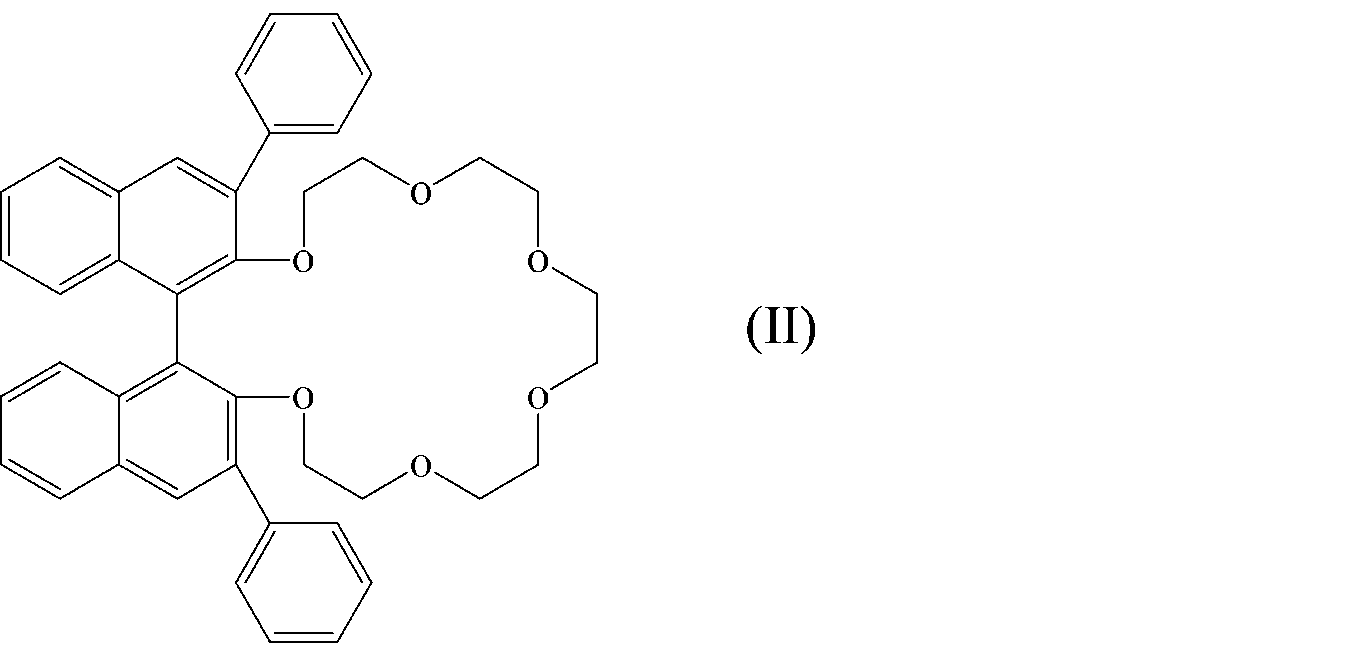
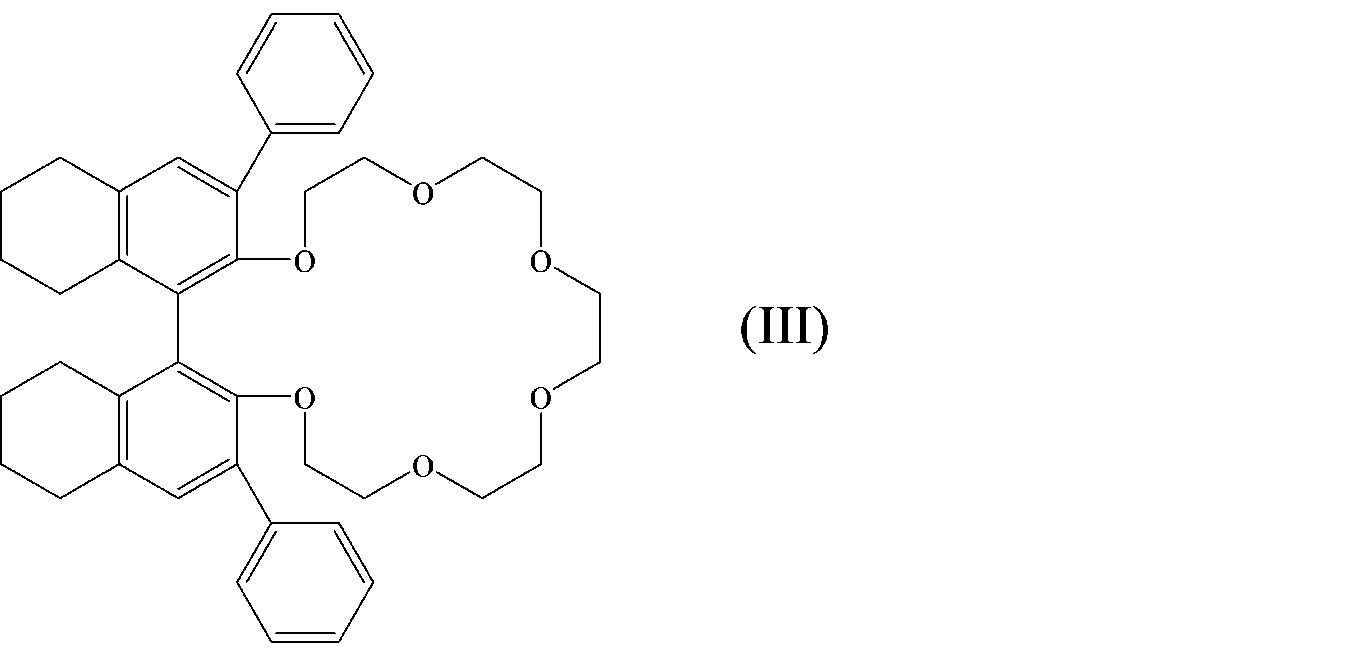
リガンドは、担体に担持した状態で分離剤として使用される。担持の態様は、公知の態様を採用することができ、例えば共有結合等の化学結合によりリガンドが担体に担持される態様を好適に採用することができる。具体的な担持方法としては、リガンド、リガンドの原料又はリガンドの中間体に反応性基を導入し、この置換基と担体表面に存在する反応性基とを反応させる方法が挙げられる。なお、担体表面に存在する反応性基とは、未処理の担体の表面に存在する基であってもよく、担体を表面処理剤、例えば3-アミノプロピルトリエトキシシラン、3-グリシジルオキシプロピルトリメトキシシラン等のシランカップリング剤で表面処理することにより担体表面に導入された基であってもよい。
(4-2.担体)
担体としては、リガンドを共有結合等の化学結合によって固定することができる限り、特に制限されない。このような担体は、無機担体であってもよく、有機担体であってもよいが、無機担体であることが好ましい。無機担体としては、例えばシリカ、アルミナ、マグネシア、ガラス、カオリン、酸化チタン、ケイ酸塩、ヒドロキシアパタイト等が挙げられる。有機担体としては、例えばポリスチレン、ポリアクリルアミド、ポリアクリレート、ポリサッカライド等が挙げられる。これらの有機担体は、架橋剤によって架橋されることで不溶化していることが好ましい。
担体としては、リガンドを共有結合等の化学結合によって固定することができる限り、特に制限されない。このような担体は、無機担体であってもよく、有機担体であってもよいが、無機担体であることが好ましい。無機担体としては、例えばシリカ、アルミナ、マグネシア、ガラス、カオリン、酸化チタン、ケイ酸塩、ヒドロキシアパタイト等が挙げられる。有機担体としては、例えばポリスチレン、ポリアクリルアミド、ポリアクリレート、ポリサッカライド等が挙げられる。これらの有機担体は、架橋剤によって架橋されることで不溶化していることが好ましい。
担体の形状は、特に制限されず、例えば粒子、及びカラム管に液密に収容される多孔性の円柱体(モノリス)等が挙げられる。また、担体としてキャピラリーの内壁を挙げることもできる。
本実施態様において、担体は、分離能向上の観点から、多孔体であることが好ましく、BET比表面積が100~600m2/gの多孔体であるであることがより好ましい。また、該多孔体は、分離能向上の観点から、水銀圧入法によって測定される細孔径が60~300Åであることが好ましい。
また、本実施態様において、担体は、シリカゲルであることが好ましい。シリカゲルは、前述した特性、即ち分離能に優れ、また硬くて丈夫だからである。シリカゲルとして、全多孔性のものに加え、いわゆるコア-シェル型のものを用いてもよい。
また、本実施態様において、担体は、シリカゲルであることが好ましい。シリカゲルは、前述した特性、即ち分離能に優れ、また硬くて丈夫だからである。シリカゲルとして、全多孔性のものに加え、いわゆるコア-シェル型のものを用いてもよい。
以下、本開示を実施例によりさらに具体的に説明するが、本開示はその要旨を逸脱しない限り、下記の実施例に限定されるものではない。
<実施例1:dl-トリプトファンの分離>
20mmol/L 過塩素酸リチウム水溶液100mLに88%ギ酸0.15gを溶解し、カオトロピック陰イオンの塩の水溶液を得た。得られたカオトロピック陰イオンの塩の水溶液とアセトニトリルとを体積比70:30で混合することで移動相Aを調製した。移動相Aの組成及びカオトロピック陰イオンの塩の水溶液のpH(25℃)を表1に示す。なお、pHは、pHメーター(HORIBA社製)により測定した。以下の実施例でも同様である。
次いで、下記式(IV)で表されるクラウンエーテル様環状構造を有するリガンドがシリカゲルに担持された分離剤の充填されたカラム(株式会社ダイセル製;CROWNPAK CR-I(-);内径3mm;長さ150mm)を液体クロマトグラフ(島津製作所製;LC7高速液体クロマトグラフ)に取り付けた。
続いて、移動相Aを用い、上記液体クロマトグラフにより下記分離条件にて試料を分離した。その際、UV検出器により波長254nmでピークの検出及び同定を行った。
20mmol/L 過塩素酸リチウム水溶液100mLに88%ギ酸0.15gを溶解し、カオトロピック陰イオンの塩の水溶液を得た。得られたカオトロピック陰イオンの塩の水溶液とアセトニトリルとを体積比70:30で混合することで移動相Aを調製した。移動相Aの組成及びカオトロピック陰イオンの塩の水溶液のpH(25℃)を表1に示す。なお、pHは、pHメーター(HORIBA社製)により測定した。以下の実施例でも同様である。
次いで、下記式(IV)で表されるクラウンエーテル様環状構造を有するリガンドがシリカゲルに担持された分離剤の充填されたカラム(株式会社ダイセル製;CROWNPAK CR-I(-);内径3mm;長さ150mm)を液体クロマトグラフ(島津製作所製;LC7高速液体クロマトグラフ)に取り付けた。
続いて、移動相Aを用い、上記液体クロマトグラフにより下記分離条件にて試料を分離した。その際、UV検出器により波長254nmでピークの検出及び同定を行った。
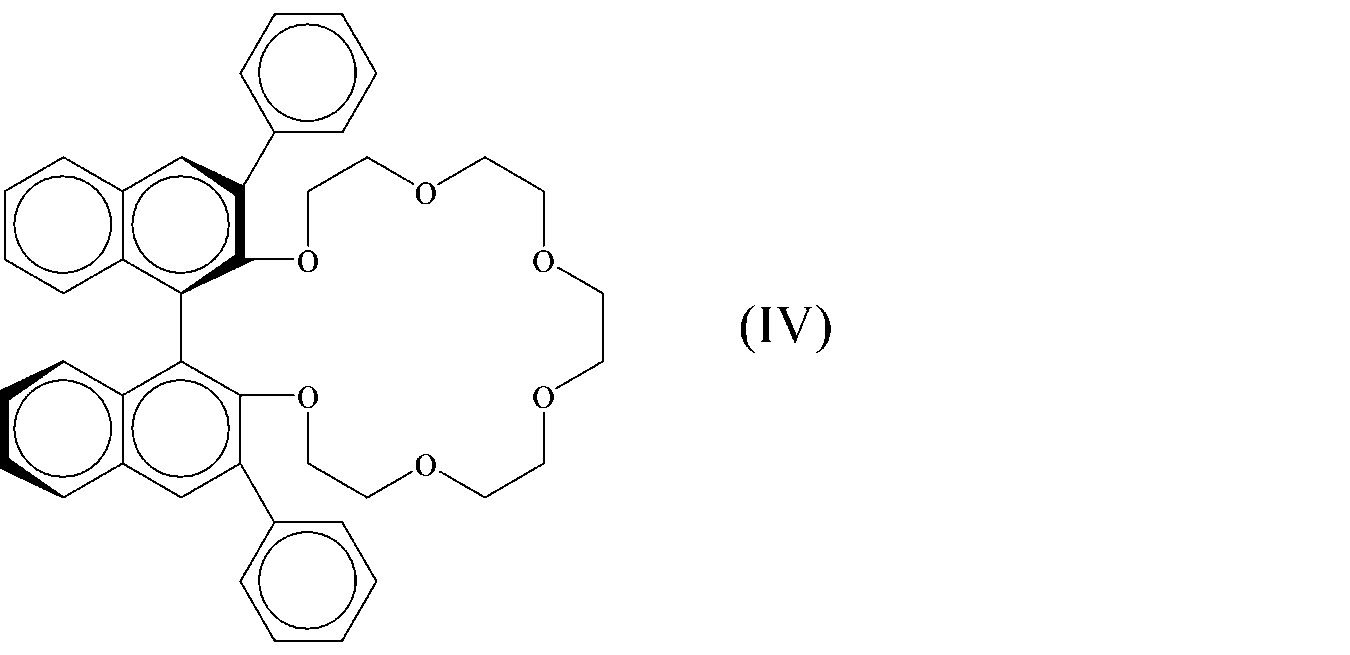
(分離条件)
試料:0.1mg/mL dl-トリプトファン水溶液;1.0μL
流速:0.43mL/min
温度:30℃
試料:0.1mg/mL dl-トリプトファン水溶液;1.0μL
流速:0.43mL/min
温度:30℃
得られたクロマトグラムを図1に示す。図1中、保持時間2.1分付近及び2.9分付近に、それぞれ、l-トリプトファン及びd-トリプトファンに由来するピークが観察された。
<比較例1:dl-トリプトファンの分離>
20mmol/L 過塩素酸水溶液とアセトニトリルとを体積比70:30で混合することで移動相Bを調製した。移動相Bの組成及び過塩素酸水溶液のpH(25℃)を表1に示す。
移動相として移動相Bを用いた以外は、実施例1と同様にして試料の分離を行った。
20mmol/L 過塩素酸水溶液とアセトニトリルとを体積比70:30で混合することで移動相Bを調製した。移動相Bの組成及び過塩素酸水溶液のpH(25℃)を表1に示す。
移動相として移動相Bを用いた以外は、実施例1と同様にして試料の分離を行った。
得られたクロマトグラムを図2に示す。図2中、保持時間2.3分付近及び3.4分付近に、それぞれ、l-トリプトファン及びd-トリプトファンに由来するピークが観察された。
<比較例2:dl-トリプトファンの分離>
水1Lにギ酸1.31gを溶解し、ギ酸水溶液を得た。得られたギ酸水溶液とアセトニトリルとを体積比70:30で混合することで移動相Cを調製した。移動相Cの組成及びギ酸水溶液のpH(25℃)を表1に示す。
移動相として移動相Cを用いた以外は、実施例1と同様にして試料の分離を行った。
水1Lにギ酸1.31gを溶解し、ギ酸水溶液を得た。得られたギ酸水溶液とアセトニトリルとを体積比70:30で混合することで移動相Cを調製した。移動相Cの組成及びギ酸水溶液のpH(25℃)を表1に示す。
移動相として移動相Cを用いた以外は、実施例1と同様にして試料の分離を行った。
得られたクロマトグラムを図3に示す。図3中、保持時間1.9分付近に、dl-トリプトファン(エナンチオマー混合物)に由来するピークが観察された。
比較例1は、pH1.79の過塩素酸水溶液を含む移動相を用いた従来例であり、dl-トリプトファンが各エナンチオマーに分離していることが確認された。
比較例2は、比較例1の過塩素酸水溶液と同濃度のギ酸水溶液を含有する移動相を用いた実験例である。カオトロピック陰イオンの塩を含有しないpH2.64のギ酸水溶液を含有する移動相を用いても、dl-トリプトファンを各エナンチオマーに分離できないことがわかった。
一方、比較例2と同濃度のギ酸に加え、過塩素酸リチウムを含むpH2.60の水溶液を含有する移動相を用いた実施例1では、dl-トリプトファンが各エナンチオマーに分離されることが確認された。即ち、移動相に含まれるカオトロピック陰イオンの塩が、良好な分離に寄与することが示された。
比較例2は、比較例1の過塩素酸水溶液と同濃度のギ酸水溶液を含有する移動相を用いた実験例である。カオトロピック陰イオンの塩を含有しないpH2.64のギ酸水溶液を含有する移動相を用いても、dl-トリプトファンを各エナンチオマーに分離できないことがわかった。
一方、比較例2と同濃度のギ酸に加え、過塩素酸リチウムを含むpH2.60の水溶液を含有する移動相を用いた実施例1では、dl-トリプトファンが各エナンチオマーに分離されることが確認された。即ち、移動相に含まれるカオトロピック陰イオンの塩が、良好な分離に寄与することが示された。
<実施例2:アニリン類縁体混合物の分離>
カオトロピック陰イオンの塩の水溶液である20mmol/L ヘキサフルオロリン酸カリウム水溶液とアセトニトリルとを体積比70:30で混合することで移動相Dを調製した。移動相Dの組成及びカオトロピック陰イオンの塩の水溶液のpH(25℃)を表1に示す。
移動相として移動相Dを用い、試料としてアニリン、2-メチルアニリン、3-メチルアニリン及び4-メチルアニリンの混合物(各化合物の1mg/L水溶液及び1M 塩酸水溶液を、それぞれ等量ずつ混合した試料)1μLを用いた以外は、実施例1と同様にして試料の分離を行った。
カオトロピック陰イオンの塩の水溶液である20mmol/L ヘキサフルオロリン酸カリウム水溶液とアセトニトリルとを体積比70:30で混合することで移動相Dを調製した。移動相Dの組成及びカオトロピック陰イオンの塩の水溶液のpH(25℃)を表1に示す。
移動相として移動相Dを用い、試料としてアニリン、2-メチルアニリン、3-メチルアニリン及び4-メチルアニリンの混合物(各化合物の1mg/L水溶液及び1M 塩酸水溶液を、それぞれ等量ずつ混合した試料)1μLを用いた以外は、実施例1と同様にして試料の分離を行った。
得られたクロマトグラムを図4に示す。図4中、保持時間5.1分付近、5.5分付近、7.4分付近及び8.9分付近に、それぞれ、アニリン、2-メチルアニリン、3-メチルアニリン及び4-メチルアニリンに由来するピークが観察された。
<実施例3:アニリン類縁体混合物の分離>
20mmol/L ヘキサフルオロリン酸カリウム水溶液1Lにギ酸1.31gを溶解し、カオトロピック陰イオンの塩の水溶液を得た。得られたカオトロピック陰イオンの塩の水溶液とアセトニトリルとを体積比70:30で混合することで移動相Eを調製した。移動相Eの組成及びカオトロピック陰イオンの塩の水溶液のpH(25℃)を表1に示す。
移動相として移動相Eを用いた以外は、実施例2と同様にして試料の分離を行った。
20mmol/L ヘキサフルオロリン酸カリウム水溶液1Lにギ酸1.31gを溶解し、カオトロピック陰イオンの塩の水溶液を得た。得られたカオトロピック陰イオンの塩の水溶液とアセトニトリルとを体積比70:30で混合することで移動相Eを調製した。移動相Eの組成及びカオトロピック陰イオンの塩の水溶液のpH(25℃)を表1に示す。
移動相として移動相Eを用いた以外は、実施例2と同様にして試料の分離を行った。
得られたクロマトグラムを図5に示す。図5中、保持時間4.6分付近、7.3分付近、11.8分付近及び13.7分付近に、それぞれ、2-メチルアニリン、アニリン、3-メチルアニリン及び4-メチルアニリンに由来するピークが観察された。
<比較例3:アニリン類縁体混合物の分離>
移動相として移動相Bを用いた以外は、実施例2と同様にして試料の分離を行った。
移動相として移動相Bを用いた以外は、実施例2と同様にして試料の分離を行った。
得られたクロマトグラムを図6に示す。図6中、保持時間2.6分付近、3.8分付近、5.4分付近及び6.2分付近に、それぞれ、2-メチルアニリン、アニリン、3-メチルアニリン及び4-メチルアニリンに由来するピークが観察された。
比較例3は、pH1.79の過塩素酸水溶液を含む移動相を用いた従来例であり、アニリン類縁体の混合物が分離することが確認された。
実施例2では、酸を含有しないpH4.31のヘキサフルオロリン酸カリウム水溶液を含有する移動相を用いた実験例であり、移動相に過塩素酸を添加することなくアニリン類縁体の混合物を良好に分離できることがわかった。
実施例3は、ギ酸を含有するpH2.57のヘキサフルオロリン酸カリウム水溶液を含有する移動相を用いた実験例である。実施例3では、比較例3及び実施例2よりも各アニリン類縁体の保持時間が長いことが確認された。即ち、カオトロピック陰イオンの塩及び酸を含有する移動相を用いることで、アニリン類縁体の混合物が非常に良好に分離することが示された。
実施例2では、酸を含有しないpH4.31のヘキサフルオロリン酸カリウム水溶液を含有する移動相を用いた実験例であり、移動相に過塩素酸を添加することなくアニリン類縁体の混合物を良好に分離できることがわかった。
実施例3は、ギ酸を含有するpH2.57のヘキサフルオロリン酸カリウム水溶液を含有する移動相を用いた実験例である。実施例3では、比較例3及び実施例2よりも各アニリン類縁体の保持時間が長いことが確認された。即ち、カオトロピック陰イオンの塩及び酸を含有する移動相を用いることで、アニリン類縁体の混合物が非常に良好に分離することが示された。
<実施例4:dl-1-フェニルエチルアミンの分離>
移動相として移動相D用い、試料としてdl-1-フェニルエチルアミン(0.1質量%アセトニトリル溶液)1μLを用いた以外は、実施例1と同様にして試料の分離を行った。
移動相として移動相D用い、試料としてdl-1-フェニルエチルアミン(0.1質量%アセトニトリル溶液)1μLを用いた以外は、実施例1と同様にして試料の分離を行った。
得られたクロマトグラムを図7に示す。図7中、保持時間5.1分付近及び7.4分付近に、それぞれ、1-フェニルエチルアミンの各エナンチオマーに由来するピークが観察された。なお、保持時間6.0分付近のピークは、不純物に由来するピークである。
<実施例5:dl-1-フェニルエチルアミンの分離>
移動相として移動相Eを用いた以外は、実施例4と同様にして試料の分離を行った。
移動相として移動相Eを用いた以外は、実施例4と同様にして試料の分離を行った。
得られたクロマトグラムを図8に示す。図8中、保持時間5.8分付近及び8.6分付近に、それぞれ、1-フェニルエチルアミンの各エナンチオマーに由来するピークが観察された。なお、保持時間6.7分付近のピークは、不純物に由来するピークである。
<実施例6:dl-1-フェニルエチルアミンの分離>
20mmol/L テトラフルオロホウ酸ナトリウム水溶液1Lにギ酸1.31gを溶解し、カオトロピック陰イオンの塩の水溶液を得た。得られたカオトロピック陰イオンの塩の水溶液とアセトニトリルとを体積比70:30で混合することで移動相Fを調製した。移動相Fの組成及びカオトロピック陰イオンの塩の水溶液のpH(25℃)を表1に示す。
移動相として移動相Fを用いた以外は、実施例4と同様にして試料の分離を行った。
20mmol/L テトラフルオロホウ酸ナトリウム水溶液1Lにギ酸1.31gを溶解し、カオトロピック陰イオンの塩の水溶液を得た。得られたカオトロピック陰イオンの塩の水溶液とアセトニトリルとを体積比70:30で混合することで移動相Fを調製した。移動相Fの組成及びカオトロピック陰イオンの塩の水溶液のpH(25℃)を表1に示す。
移動相として移動相Fを用いた以外は、実施例4と同様にして試料の分離を行った。
得られたクロマトグラムを図9に示す。図9中、保持時間2.3分付近及び2.7分付近に、それぞれ、1-フェニルエチルアミンの各エナンチオマーに由来するピークが観察された。なお、保持時間5.6分付近のピークは、不純物に由来するピークである。
<実施例7:dl-1-フェニルエチルアミンの分離>
80mmol/L トリフルオロ酢酸アンモニウム水溶液1Lにギ酸1.31gを溶解し、カオトロピック陰イオンの塩の水溶液を得た。得られたカオトロピック陰イオンの塩の水溶液とアセトニトリルとを体積比70:30で混合することで移動相Gを調製した。移動相Gの組成及びカオトロピック陰イオンの塩の水溶液のpH(25℃)を表1に示す。
移動相として移動相Gを用いた以外は、実施例4と同様にして試料の分離を行った。
80mmol/L トリフルオロ酢酸アンモニウム水溶液1Lにギ酸1.31gを溶解し、カオトロピック陰イオンの塩の水溶液を得た。得られたカオトロピック陰イオンの塩の水溶液とアセトニトリルとを体積比70:30で混合することで移動相Gを調製した。移動相Gの組成及びカオトロピック陰イオンの塩の水溶液のpH(25℃)を表1に示す。
移動相として移動相Gを用いた以外は、実施例4と同様にして試料の分離を行った。
得られたクロマトグラムを図10に示す。図10中、保持時間2.9分付近及び3.6分付近に、それぞれ、1-フェニルエチルアミンの各エナンチオマーに由来するピークが観察された。
<実施例8:dl-1-フェニルエチルアミンの分離>
カオトロピック陰イオンの塩の水溶液である20mmol/L 過塩素酸リチウム水溶液とアセトニトリルとを体積比70:30で混合することで移動相Hを調製した。移動相Hの組成及びカオトロピック陰イオンの塩の水溶液のpH(25℃)を表1に示す。
移動相として移動相Hを用いた以外は、実施例4と同様にして試料の分離を行った。
カオトロピック陰イオンの塩の水溶液である20mmol/L 過塩素酸リチウム水溶液とアセトニトリルとを体積比70:30で混合することで移動相Hを調製した。移動相Hの組成及びカオトロピック陰イオンの塩の水溶液のpH(25℃)を表1に示す。
移動相として移動相Hを用いた以外は、実施例4と同様にして試料の分離を行った。
得られたクロマトグラムを図11に示す。図11中、保持時間3.2分付近及び4.2分付近に、それぞれ、1-フェニルエチルアミンの各エナンチオマーに由来するピークが観察された。なお、保持時間5.7分付近のピークは、不純物に由来するピークである。
<比較例4:dl-1-フェニルエチルアミンの分離>
移動相として移動相Bを用いた以外は、実施例4と同様にして試料の分離を行った。
移動相として移動相Bを用いた以外は、実施例4と同様にして試料の分離を行った。
得られたクロマトグラムを図12に示す。図12中、保持時間3.1分付近及び4.1分付近に、それぞれ、1-フェニルエチルアミンの各エナンチオマーに由来するピークが観察された。なお、保持時間5.6分付近のピークは、不純物に由来するピークである。
比較例4は、pH1.79の過塩素酸水溶液を含む移動相を用いた従来例であり、dl-1-フェニルエチルアミンが各エナンチオマーに分離することが確認された。
実施例4では、酸を含有しないpH4.31のヘキサフルオロリン酸カリウム水溶液を含有する移動相を用いた実験例であり、移動相に過塩素酸を添加することなくdl-1-フェニルエチルアミンを良好に各エナンチオマーに分離できることがわかった。
実施例5は、ギ酸を含有するpH2.57のヘキサフルオロリン酸カリウム水溶液を含有する移動相を用いた実験例であり、比較例4及び実施例4よりもdl-1-フェニルエチルアミンの各エナンチオマーの保持時間が長いことが確認された。即ち、カオトロピック陰イオンの塩及び酸を含有する移動相を用いることで、dl-1-フェニルエチルアミンがクラウンエーテル様環状構造に良好に保持され、良好に各エナンチオマーに分離することが示された。
実施例6は、実施例5とはカオトロピック陰イオンの塩の種類が異なり、pHが同程度の実験例である。実施例6においても、dl-1-フェニルエチルアミンを良好に各エナンチオマーに分離できることが確認された。
また、カオトロピック陰イオンとしてヘキサフルオロリン酸アニオンを用いると、テトラフルオロホウ酸アニオンを用いた場合よりも保持時間が長く、より分離能に優れることがわかった。
実施例7は、カオトロピック陰イオンの塩を、ヘキサフルオロリン酸イオン(実施例4、5)及びテトラフルオロホウ酸イオン(実施例6)と比較してカオトロピック性の低いトリフルオロ酢酸イオンの塩とした実験例である。カオトロピック性の低いカオトロピック陰イオンであっても、濃度を高くすることにより、実施例4~6と同等の分離性能を示すことが確認された。
実施例8は、カオトロピック陰イオンの塩の水溶液のpHを高くした実験例である。pHが7.29と高い値であっても、dl-1-フェニルエチルアミンを各エナンチオマーに良好に分離できることがわかった。
実施例4では、酸を含有しないpH4.31のヘキサフルオロリン酸カリウム水溶液を含有する移動相を用いた実験例であり、移動相に過塩素酸を添加することなくdl-1-フェニルエチルアミンを良好に各エナンチオマーに分離できることがわかった。
実施例5は、ギ酸を含有するpH2.57のヘキサフルオロリン酸カリウム水溶液を含有する移動相を用いた実験例であり、比較例4及び実施例4よりもdl-1-フェニルエチルアミンの各エナンチオマーの保持時間が長いことが確認された。即ち、カオトロピック陰イオンの塩及び酸を含有する移動相を用いることで、dl-1-フェニルエチルアミンがクラウンエーテル様環状構造に良好に保持され、良好に各エナンチオマーに分離することが示された。
実施例6は、実施例5とはカオトロピック陰イオンの塩の種類が異なり、pHが同程度の実験例である。実施例6においても、dl-1-フェニルエチルアミンを良好に各エナンチオマーに分離できることが確認された。
また、カオトロピック陰イオンとしてヘキサフルオロリン酸アニオンを用いると、テトラフルオロホウ酸アニオンを用いた場合よりも保持時間が長く、より分離能に優れることがわかった。
実施例7は、カオトロピック陰イオンの塩を、ヘキサフルオロリン酸イオン(実施例4、5)及びテトラフルオロホウ酸イオン(実施例6)と比較してカオトロピック性の低いトリフルオロ酢酸イオンの塩とした実験例である。カオトロピック性の低いカオトロピック陰イオンであっても、濃度を高くすることにより、実施例4~6と同等の分離性能を示すことが確認された。
実施例8は、カオトロピック陰イオンの塩の水溶液のpHを高くした実験例である。pHが7.29と高い値であっても、dl-1-フェニルエチルアミンを各エナンチオマーに良好に分離できることがわかった。
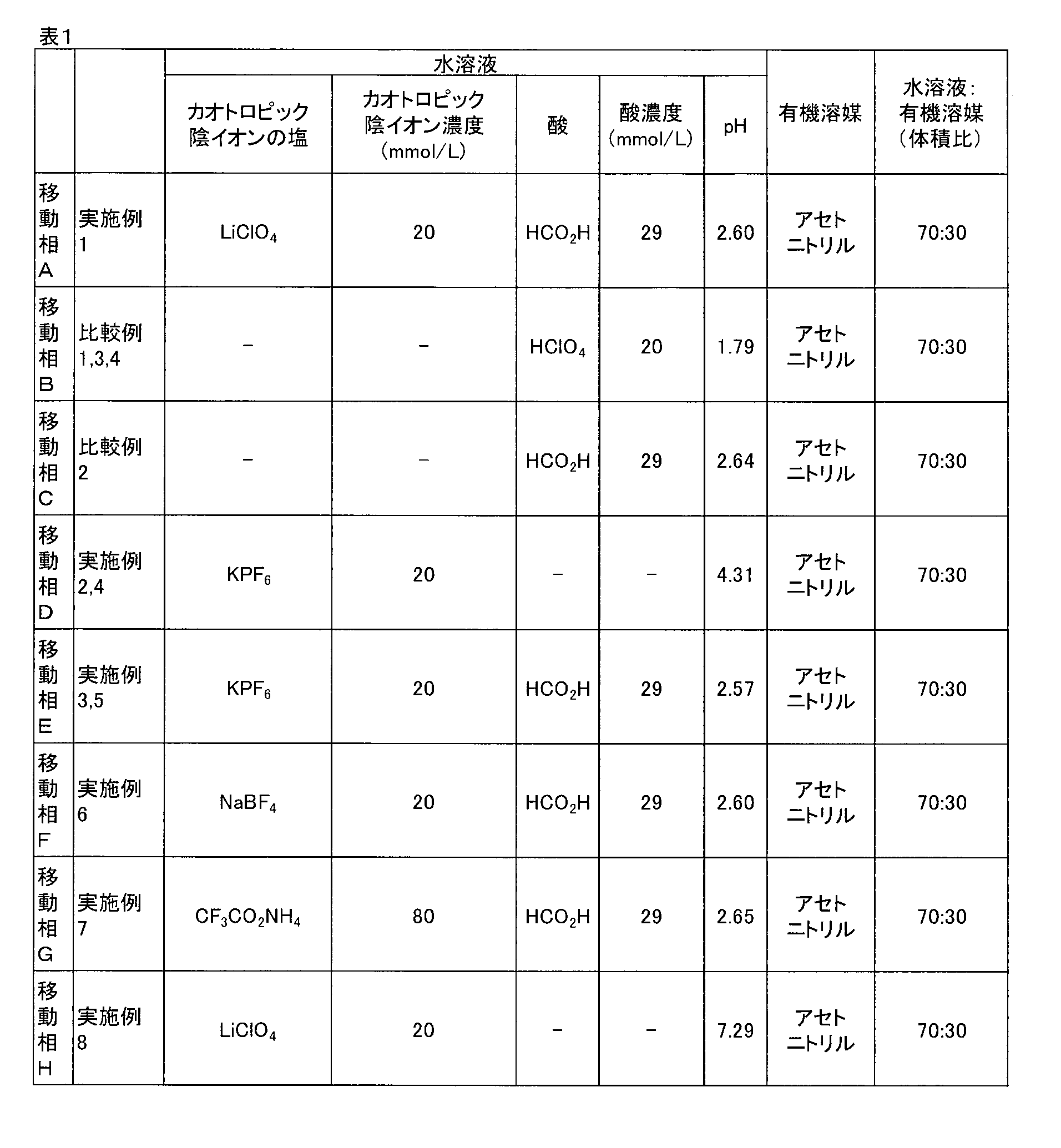
<実施例9:アニリン類縁体混合物の分離>
ギ酸濃度30mmol/L及びオクタンスルホン酸ナトリウム濃度20mmol/Lである疎水性有機酸の塩の水溶液とアセトニトリルとを体積比70:30で混合することで移動相Iを調製した。移動相Iの組成及び疎水性有機酸の塩の水溶液のpH(25℃)を表2に示す。
移動相として移動相Iを用い、試料としてアニリン、2-メチルアニリン、3-メチルアニリン及び4-メチルアニリンの混合物(各化合物濃度0.02~0.03質量%のアセトニトリル溶液)1μLを用いた以外は、実施例1と同様にして試料の分離を行った。
ギ酸濃度30mmol/L及びオクタンスルホン酸ナトリウム濃度20mmol/Lである疎水性有機酸の塩の水溶液とアセトニトリルとを体積比70:30で混合することで移動相Iを調製した。移動相Iの組成及び疎水性有機酸の塩の水溶液のpH(25℃)を表2に示す。
移動相として移動相Iを用い、試料としてアニリン、2-メチルアニリン、3-メチルアニリン及び4-メチルアニリンの混合物(各化合物濃度0.02~0.03質量%のアセトニトリル溶液)1μLを用いた以外は、実施例1と同様にして試料の分離を行った。
得られたクロマトグラムを図13に示す。図13中、保持時間3.5分付近、4.5分付近、6.5分付近及び7.3分付近に、それぞれ、2-メチルアニリン、アニリン、3-メチルアニリン及び4-メチルアニリンに由来するピークが観察された。
実施例9は、実施例3とは疎水性陰イオンの塩が異なり、pHが同程度の実験例である。疎水性陰イオンの塩として疎水性有機酸の塩であるオクタンスルホン酸ナトリウムを用いた実施例9では、疎水性陰イオンの塩としてヘキサフルオロリン酸カリウムを用いた実施例3よりも保持時間が短かったものの、移動相に過塩素酸を添加することなくアニリン類縁体の混合物を良好に分離できることがわかった。また、実施例9では、実施例3よりも液体クロマトグラムのピークがシャープであった。即ち、移動相に含まれる疎水性有機酸の塩が、良好な分離に寄与することが示された。
<実施例10:dl-1-フェニルエチルアミンの分離>
移動相として移動相Iを用いた以外は、実施例4と同様にして試料の分離を行った。
得られたクロマトグラムを図14に示す。図14中、保持時間3.9分付近及び5.1分付近に、それぞれ、1-フェニルエチルアミンの各エナンチオマーに由来するピークが観察された。
移動相として移動相Iを用いた以外は、実施例4と同様にして試料の分離を行った。
得られたクロマトグラムを図14に示す。図14中、保持時間3.9分付近及び5.1分付近に、それぞれ、1-フェニルエチルアミンの各エナンチオマーに由来するピークが観察された。
<実施例11:dl-1-フェニルエチルアミンの分離>
ギ酸濃度30mmol/L及びデカンスルホン酸ナトリウム濃度20mmol/Lである疎水性有機酸の塩の水溶液とアセトニトリルとを体積比70:30で混合することで移動相Jを調製した。移動相Jの組成を表2に示す。
移動相として移動相Jを用いた以外は、実施例10と同様にして試料の分離を行った。
ギ酸濃度30mmol/L及びデカンスルホン酸ナトリウム濃度20mmol/Lである疎水性有機酸の塩の水溶液とアセトニトリルとを体積比70:30で混合することで移動相Jを調製した。移動相Jの組成を表2に示す。
移動相として移動相Jを用いた以外は、実施例10と同様にして試料の分離を行った。
得られたクロマトグラムを図15に示す。図15中、保持時間6.3分付近及び8.6分付近に、それぞれ、1-フェニルエチルアミンの各エナンチオマーに由来するピークが観察された。
<実施例12:dl-1-フェニルエチルアミンの分離>
ギ酸濃度30mmol/L及びヘキサンスルホン酸ナトリウム濃度20mmol/Lである疎水性有機酸の塩の水溶液とアセトニトリルとを体積比70:30で混合することで移動相Kを調製した。移動相Kの組成を表2に示す。
移動相として移動相Kを用いた以外は、実施例10と同様にして試料の分離を行った。
ギ酸濃度30mmol/L及びヘキサンスルホン酸ナトリウム濃度20mmol/Lである疎水性有機酸の塩の水溶液とアセトニトリルとを体積比70:30で混合することで移動相Kを調製した。移動相Kの組成を表2に示す。
移動相として移動相Kを用いた以外は、実施例10と同様にして試料の分離を行った。
得られたクロマトグラムを図16に示す。図16中、保持時間2.5分付近及び2.9分付近に、それぞれ、1-フェニルエチルアミンの各エナンチオマーに由来するピークが観察された。
実施例10、11及び12は、それぞれ、炭素数8、10及び6のアルカンスルホン酸ナトリウム水溶液とともにギ酸を含有する移動相を用いた実験例であり、何れの実施例においても、移動相に過塩素酸を添加することなくdl-1-フェニルエチルアミンを良好に各エナンチオマーに分離できることが示された。
また、これらの実施例より、疎水性有機基の炭素数大きいほどdl-1-フェニルエチルアミンの各エナンチオマーの保持時間が長く、疎水性有機基の炭素数が小さいほど液体クロマトグラムのピークがシャープになる傾向があることがわかった。
また、これらの実施例より、疎水性有機基の炭素数大きいほどdl-1-フェニルエチルアミンの各エナンチオマーの保持時間が長く、疎水性有機基の炭素数が小さいほど液体クロマトグラムのピークがシャープになる傾向があることがわかった。
<比較例5:dl-1-フェニルエチルアミンの分離>
ギ酸濃度30mmol/L及びメタンスルホン酸ナトリウム濃度20mmol/Lの水溶液とアセトニトリルとを体積比70:30で混合することで移動相Lを調製した。移動相Lの組成を表2に示す。
移動相として移動相Lを用いた以外は、実施例10と同様にして試料の分離を行った。
ギ酸濃度30mmol/L及びメタンスルホン酸ナトリウム濃度20mmol/Lの水溶液とアセトニトリルとを体積比70:30で混合することで移動相Lを調製した。移動相Lの組成を表2に示す。
移動相として移動相Lを用いた以外は、実施例10と同様にして試料の分離を行った。
得られたクロマトグラムを図17に示す。図17中、保持時間1.6分付近及び1.9分付近に、それぞれ、dl-1-フェニルエチルアミンの各エナンチオマーに由来するピークが観察された。
比較例5は、炭素数6~10のアルカンスルホン酸ナトリウムに代えて、メタンスルホン酸ナトリウムを用いた以外は、実施例10~12と同様の条件にてdl-1-フェニルエチルアミンの分離を行った実験例である。メタンスルホン酸は、炭素数1のアルカンスルホン酸であり、疎水性が十分でなく、本開示における疎水性有機酸には該当しない。メタンスルホン酸ナトリウムを用いた比較例5では、dl-1-フェニルエチルアミンの保持時間が短く、アミンの保持力を向上させる効果が得られないことが確認された。また、比較例5では、液体クロマトグラムにおいて、dl-1-フェニルエチルアミンの各エナンチオマーのピークが重なっていた。即ち、過塩素酸を含有しない移動相にメタンスルホン酸を添加したとしても、キラルなアミンをエナンチオマー毎に分離できないことが確認された。
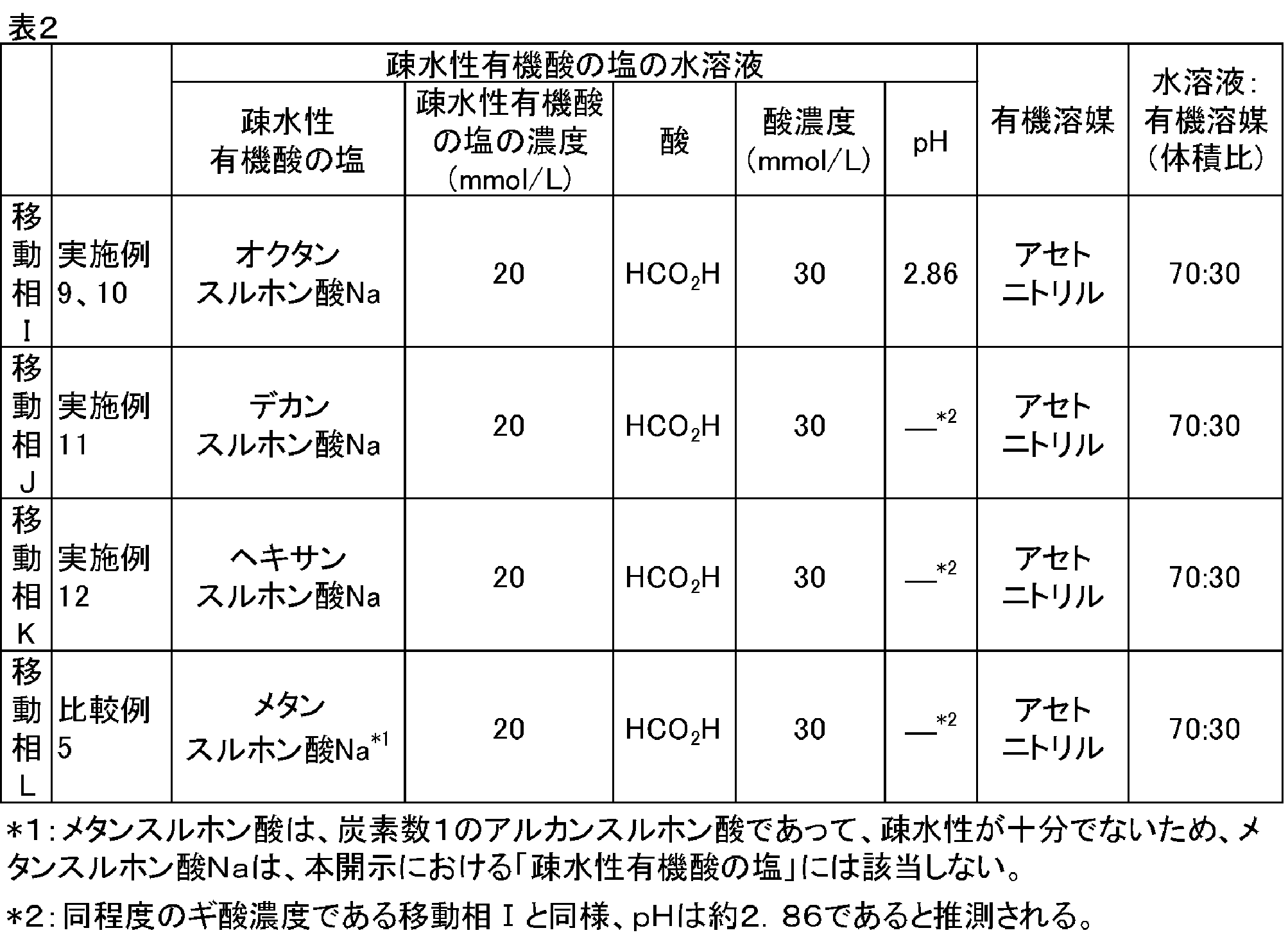
本開示の少なくとも幾つかの実施態様に係る分離方法によれば、移動相に多量の過塩素酸を添加する必要なく、液体クロマトグラフィーによりアミンを分離することができる。従って、かかる分離方法は、各種液体クロマトグラフィーによる分析、精製等を行う有機化学、医学、薬学等の分野において広く利用することができる。
Claims (10)
- クラウンエーテル様環状構造を有するリガンドが担体に担持された分離剤を固定相として用い、
カオトロピック陰イオンの塩及び疎水性有機酸の塩からなる群より選択される1種以上の疎水性陰イオンの塩の水溶液を含有する移動相を用いる、液体クロマトグラフィーによるアミンの分離方法。 - 前記疎水性陰イオンの塩が、カオトロピック陰イオンの塩である、請求項1に記載の分離方法。
- 前記カオトロピック陰イオンが、PF6 -、BF4 -、ClO4 -、CF3SO3 -、FSO3 -、(CF3SO2)2N-、PCl6 -、SbCl6 -、CF3CO2 -、CCl3CO2 -、NO3 -及びClO3 -からなる群より選択される1種以上である、請求項2に記載の分離方法。
- 前記疎水性陰イオンの塩が、疎水性有機酸の塩である、請求項1に記載の分離方法。
- 前記疎水性有機酸が、硫酸エステル基、スルホン酸基及びリン酸基からなる群より選択される1種以上の酸基と炭素数4~18のアルキル基とを有する疎水性有機酸である、請求項4に記載の分離方法。
- 前記疎水性有機酸が、炭素数4~18のアルカンスルホン酸である、請求項4又は5に記載の分離方法。
- 前記水溶液のpHが、1.0以上8.0以下である、請求項1~6の何れか1項に記載の分離方法。
- 前記移動相が、疎水性有機酸及び過塩素酸以外の酸を含む、請求項1~7の何れか1項に記載の分離方法。
- 前記酸が、ギ酸である、請求項8に記載の分離方法。
- 前記アミンが、1級アミンである、請求項1~9の何れか1項に記載の分離方法。
Priority Applications (4)
| Application Number | Priority Date | Filing Date | Title |
|---|---|---|---|
| US17/617,059 US12115467B2 (en) | 2019-06-14 | 2020-06-12 | Amine separation method using liquid chromatography |
| JP2021526148A JP7544698B2 (ja) | 2019-06-14 | 2020-06-12 | 液体クロマトグラフィーによるアミンの分離方法 |
| CN202080041179.9A CN113905797B (zh) | 2019-06-14 | 2020-06-12 | 胺的基于液相色谱的分离方法 |
| EP20822139.0A EP3984615B1 (en) | 2019-06-14 | 2020-06-12 | Amine separation method using liquid chromatography |
Applications Claiming Priority (4)
| Application Number | Priority Date | Filing Date | Title |
|---|---|---|---|
| JP2019-110811 | 2019-06-14 | ||
| JP2019110811 | 2019-06-14 | ||
| JP2019-219615 | 2019-12-04 | ||
| JP2019219615 | 2019-12-04 |
Publications (1)
| Publication Number | Publication Date |
|---|---|
| WO2020251003A1 true WO2020251003A1 (ja) | 2020-12-17 |
Family
ID=73781036
Family Applications (1)
| Application Number | Title | Priority Date | Filing Date |
|---|---|---|---|
| PCT/JP2020/023153 Ceased WO2020251003A1 (ja) | 2019-06-14 | 2020-06-12 | 液体クロマトグラフィーによるアミンの分離方法 |
Country Status (5)
| Country | Link |
|---|---|
| US (1) | US12115467B2 (ja) |
| EP (1) | EP3984615B1 (ja) |
| JP (1) | JP7544698B2 (ja) |
| CN (1) | CN113905797B (ja) |
| WO (1) | WO2020251003A1 (ja) |
Cited By (2)
| Publication number | Priority date | Publication date | Assignee | Title |
|---|---|---|---|---|
| WO2023008546A1 (ja) * | 2021-07-29 | 2023-02-02 | 株式会社ダイセル | 液体クロマトグラフィーによるアミンの分離方法 |
| WO2024043296A1 (ja) | 2022-08-25 | 2024-02-29 | 株式会社ダイセル | アミンの分離方法 |
Citations (5)
| Publication number | Priority date | Publication date | Assignee | Title |
|---|---|---|---|---|
| JPH0269472A (ja) | 1988-09-05 | 1990-03-08 | Agency Of Ind Science & Technol | 新規なクラウンエーテル化合物及び分離剤 |
| JP2003535819A (ja) * | 2000-03-10 | 2003-12-02 | アイビーシー アドバンスト テクノロジーズ インコーポレイテッド | アミンまたはアミノ酸エナンチオマーをそれらの対エナンチオマーに優り選択的に結合するための組成物および方法 |
| JP2006516928A (ja) * | 2002-09-17 | 2006-07-13 | アイビーシー アドバンスト テクノロジーズ インコーポレイテッド | アミンおよびアミノ酸をそれらの対掌エナンチオマーから分離するための組成物および方法 |
| WO2012050124A1 (ja) | 2010-10-13 | 2012-04-19 | 株式会社ダイセル | クロマトグラフィー用分離剤 |
| JP2014169259A (ja) | 2013-03-05 | 2014-09-18 | Toyoji Shimada | オクタヒドロビナフチル誘導体 |
Family Cites Families (12)
| Publication number | Priority date | Publication date | Assignee | Title |
|---|---|---|---|---|
| JP2672865B2 (ja) * | 1989-09-19 | 1997-11-05 | ダイセル化学工業株式会社 | α―アミノケトン類の直接分割方法 |
| US6270640B1 (en) * | 1998-04-29 | 2001-08-07 | Board Of Supervisors Of Louisiana State University And Agricultural And Mechanical College | Polymerized oligopeptide-surfactant chiral micelles |
| JP3395671B2 (ja) * | 1998-10-20 | 2003-04-14 | 栗田工業株式会社 | 高塩類含有溶液中のアミン類の分析方法 |
| CN1864853A (zh) * | 2006-04-19 | 2006-11-22 | 劳文剑 | 生物小分子或其类似物键合手性固定相 |
| WO2009003952A2 (en) * | 2007-06-29 | 2009-01-08 | Pronota N.V. | Column and method for preparing a biological sample for protein profiling |
| US9815712B2 (en) * | 2008-10-03 | 2017-11-14 | California Institute Of Technology | High capacity perchlorate-selective resins from hyperbranched macromolecules |
| WO2013126331A1 (en) * | 2012-02-20 | 2013-08-29 | Cerulean Pharma Inc. | Methods of separating nucleic acid-polymer conjugates |
| US20160151511A1 (en) * | 2014-12-02 | 2016-06-02 | Antriabio, Inc. | Proteins and protein conjugates with increased hydrophobicity |
| CN104475066B (zh) * | 2014-12-08 | 2017-04-26 | 云南师范大学 | 一种适用于氨基酸手性拆分的高效液相色谱分离柱 |
| US20160282371A1 (en) * | 2015-03-28 | 2016-09-29 | Quantalytical Labs Inc. | Solid Phase Extraction, Derivatization with Crown Ethers, and Mass Spectrometry, Methods, Reagents and Kits |
| CN107649105A (zh) * | 2017-09-19 | 2018-02-02 | 福州大学 | 一种奎宁固定化离子液多模式毛细管整体柱及其制备方法 |
| US20190126241A1 (en) * | 2017-09-26 | 2019-05-02 | Waters Technologies Corporation | High purity chromatographic materials comprising an ionizable modifier for retention of acidic analytes |
-
2020
- 2020-06-12 US US17/617,059 patent/US12115467B2/en active Active
- 2020-06-12 EP EP20822139.0A patent/EP3984615B1/en active Active
- 2020-06-12 WO PCT/JP2020/023153 patent/WO2020251003A1/ja not_active Ceased
- 2020-06-12 CN CN202080041179.9A patent/CN113905797B/zh active Active
- 2020-06-12 JP JP2021526148A patent/JP7544698B2/ja active Active
Patent Citations (5)
| Publication number | Priority date | Publication date | Assignee | Title |
|---|---|---|---|---|
| JPH0269472A (ja) | 1988-09-05 | 1990-03-08 | Agency Of Ind Science & Technol | 新規なクラウンエーテル化合物及び分離剤 |
| JP2003535819A (ja) * | 2000-03-10 | 2003-12-02 | アイビーシー アドバンスト テクノロジーズ インコーポレイテッド | アミンまたはアミノ酸エナンチオマーをそれらの対エナンチオマーに優り選択的に結合するための組成物および方法 |
| JP2006516928A (ja) * | 2002-09-17 | 2006-07-13 | アイビーシー アドバンスト テクノロジーズ インコーポレイテッド | アミンおよびアミノ酸をそれらの対掌エナンチオマーから分離するための組成物および方法 |
| WO2012050124A1 (ja) | 2010-10-13 | 2012-04-19 | 株式会社ダイセル | クロマトグラフィー用分離剤 |
| JP2014169259A (ja) | 2013-03-05 | 2014-09-18 | Toyoji Shimada | オクタヒドロビナフチル誘導体 |
Non-Patent Citations (2)
| Title |
|---|
| CHOI HEE JUNG, HYUN MYUNG HO: "Liquid Chromatographic Chiral Separations by Crown Ether-Based Chiral Stationary Phases", JOURNAL OF LIQUID CHROMATOGRAPHY & RELATED TECHNOLOGIES, vol. 30, 7 March 2007 (2007-03-07), pages 853 - 875, XP055771087 * |
| PENG WU, CHIN. J. CHEM., vol. 35, 2017, pages 1037 - 1042 |
Cited By (2)
| Publication number | Priority date | Publication date | Assignee | Title |
|---|---|---|---|---|
| WO2023008546A1 (ja) * | 2021-07-29 | 2023-02-02 | 株式会社ダイセル | 液体クロマトグラフィーによるアミンの分離方法 |
| WO2024043296A1 (ja) | 2022-08-25 | 2024-02-29 | 株式会社ダイセル | アミンの分離方法 |
Also Published As
| Publication number | Publication date |
|---|---|
| EP3984615A4 (en) | 2022-07-20 |
| CN113905797A (zh) | 2022-01-07 |
| JP7544698B2 (ja) | 2024-09-03 |
| US20220339555A1 (en) | 2022-10-27 |
| EP3984615B1 (en) | 2023-09-27 |
| CN113905797B (zh) | 2023-04-18 |
| US12115467B2 (en) | 2024-10-15 |
| EP3984615A1 (en) | 2022-04-20 |
| JPWO2020251003A1 (ja) | 2020-12-17 |
Similar Documents
| Publication | Publication Date | Title |
|---|---|---|
| EP2114969B1 (en) | High stability polyionic liquid salts | |
| JP5947765B2 (ja) | 安定性の高いジイオン液体塩 | |
| US8734673B2 (en) | Boron selective ionic liquids and polymeric ionic liquids, methods of making and methods of use thereof | |
| CN101061099B (zh) | 高稳定性双离子液体盐 | |
| JP7544698B2 (ja) | 液体クロマトグラフィーによるアミンの分離方法 | |
| CN103958018B (zh) | 用于疏水性置换色谱法的阳离子置换剂分子 | |
| JP5914731B1 (ja) | 親水性相互作用クロマトグラフィー用充填剤、及び親水性化合物の分離方法 | |
| EP3068765A1 (en) | Process for fluorinating compounds | |
| ES2720234T3 (es) | Procedimiento de fluoración de compuestos | |
| Rouch et al. | Tartrate-based ionic liquids: unified synthesis and characterisation | |
| WO2024043296A1 (ja) | アミンの分離方法 | |
| US20180021723A1 (en) | Gas treating solutions containing imidazole-amine compounds | |
| WO2021095874A1 (ja) | オリゴ核酸化合物の製造方法 | |
| JP2023161874A (ja) | 移動相、及びイオン化可能な有機化合物の分離方法 | |
| CN103772300B (zh) | 一种1-乙基-4-烷基哌嗪离子液体、制备方法及其应用 | |
| US10702858B2 (en) | Methods of hydrofluorination | |
| Flieger | Application of ionic liquids in liquid chromatography | |
| WO2023008546A1 (ja) | 液体クロマトグラフィーによるアミンの分離方法 | |
| Sharma | Ionic liquids: Syntheses, characterization and applications in analytical chemistry | |
| RU2339016C1 (ru) | Способ концентрирования ртути (ii) | |
| HK1195886B (en) | Cationic displacer molecules for hydrophobic displacement chromatography | |
| Marques | Carlos Filipe |
Legal Events
| Date | Code | Title | Description |
|---|---|---|---|
| 121 | Ep: the epo has been informed by wipo that ep was designated in this application |
Ref document number: 20822139 Country of ref document: EP Kind code of ref document: A1 |
|
| ENP | Entry into the national phase |
Ref document number: 2021526148 Country of ref document: JP Kind code of ref document: A |
|
| NENP | Non-entry into the national phase |
Ref country code: DE |
|
| WWE | Wipo information: entry into national phase |
Ref document number: 2020822139 Country of ref document: EP |