WO2020241735A1 - 身体活動支援システム、方法、及び、プログラム - Google Patents
身体活動支援システム、方法、及び、プログラム Download PDFInfo
- Publication number
- WO2020241735A1 WO2020241735A1 PCT/JP2020/021074 JP2020021074W WO2020241735A1 WO 2020241735 A1 WO2020241735 A1 WO 2020241735A1 JP 2020021074 W JP2020021074 W JP 2020021074W WO 2020241735 A1 WO2020241735 A1 WO 2020241735A1
- Authority
- WO
- WIPO (PCT)
- Prior art keywords
- user
- avatar
- physical activity
- information
- partner
- Prior art date
- Legal status (The legal status is an assumption and is not a legal conclusion. Google has not performed a legal analysis and makes no representation as to the accuracy of the status listed.)
- Ceased
Links
Images



Classifications
-
- A—HUMAN NECESSITIES
- A63—SPORTS; GAMES; AMUSEMENTS
- A63B—APPARATUS FOR PHYSICAL TRAINING, GYMNASTICS, SWIMMING, CLIMBING, OR FENCING; BALL GAMES; TRAINING EQUIPMENT
- A63B69/00—Training appliances or apparatus for special sports
-
- A—HUMAN NECESSITIES
- A63—SPORTS; GAMES; AMUSEMENTS
- A63B—APPARATUS FOR PHYSICAL TRAINING, GYMNASTICS, SWIMMING, CLIMBING, OR FENCING; BALL GAMES; TRAINING EQUIPMENT
- A63B71/00—Games or sports accessories not covered in groups A63B1/00 - A63B69/00
- A63B71/06—Indicating or scoring devices for games or players, or for other sports activities
Definitions
- An embodiment of the present invention relates to a technique for supporting a user's physical activity by using an avatar.
- the user may practice movements such as dance choreography and martial arts patterns while watching the video displayed on the display.
- Patent Document 1 the image pickup device images a user facing the projection surface from diagonally above, and the captured image of the user's movement is superimposed on the sample image of the instructor's model movement, and the superimposed image is superimposed on the projection surface.
- the technology to be displayed on is disclosed.
- the size of the image captured by the user and the size of the sample image of the instructor are the same.
- the technology for determining the degree of deviation of the user's movement from the instructor's model movement (hereinafter referred to as the degree of deviation) and displaying the degree of deviation on the projection surface is also disclosed.
- the user can simultaneously view the captured image of the user, the sample image of the instructor, and the degree of deviation on the projection surface, and the degree of deviation can be easily grasped.
- Patent Document 1 a sample image of an instructor who quickly performs a series of operations is displayed. Therefore, even if the user tries to imitate the movement while observing the movement of the sample so as to reduce the degree of divergence, he / she cannot keep up with the movement and it is difficult to obtain the training effect.
- the present invention has been intensively researched and completed by paying attention to such a problem, and an object of the present invention is to provide a technique for effectively supporting a user's physical activity.
- the present invention is a physical activity support system using a generation unit that generates a user's avatar, and calculates operation information of the user's avatar based on the information from the generation unit. Based on the information from the first calculation unit and the generation unit, the second calculation unit that calculates the operation information of the partner avatar that is the partner of the physical activity of the user, and the motion information of the user avatar are added to the partner. It is a physical activity support system equipped with an interlocking part that interlocks the movement information of the avatar.
- Another invention is a physical activity support system using a generation unit that generates a user's avatar, and includes a first calculation unit that calculates motion information of the user's avatar based on information from the generation unit. Based on the information from the generation unit, the second calculation unit that calculates the operation information of the partner avatar that is the partner of the physical activity of the user, the operation information of the user avatar, and the operation information of the partner avatar It is a physical activity support system provided with a virtual object motion adjusting unit that calculates the interaction with the virtual object accordingly.
- Another invention is a physical activity support method using a generation unit that generates a user's avatar, and calculates motion information of the user avatar based on the information from the generation unit, and obtains the operation information of the user avatar from the generation unit.
- This is a physical activity support method that calculates the motion information of the partner avatar that is the partner of the physical activity of the user based on the information, and links the motion information of the partner avatar with the motion information of the user avatar.
- Another invention is a physical activity support method using a generation unit that generates a user's avatar, and calculates motion information of the user avatar based on the information from the generation unit, and obtains the operation information of the user avatar from the generation unit. Based on the information, the motion information of the partner avatar that is the partner of the physical activity of the user is calculated, and the interaction with the virtual object is calculated according to the motion information of the user avatar and the motion information of the partner avatar. It is a physical activity support method.
- Another invention is a physical activity support program using a generation unit that generates a user's avatar, and includes a step of calculating motion information of the user avatar based on information from the generation unit, and the generation unit. Based on the information from, the computer performs a step of calculating the motion information of the partner avatar that is the partner of the physical activity of the user and a step of linking the motion information of the partner avatar with the motion information of the user avatar. It is a physical activity support program to be executed by the computer.
- Another invention is a physical activity support program using a generation unit that generates a user's avatar, and includes a step of calculating motion information of the user avatar based on information from the generation unit, and the generation unit.
- a virtual object according to the step of calculating the motion information of the partner avatar that is the partner of the physical activity of the user, the motion information of the user avatar, and the motion information of the partner avatar based on the information from It is a physical activity support program that causes a computer to execute the steps of calculating the interaction of.
- FIG. 1 is a functional block diagram of a physical activity support system according to an embodiment of the present invention.
- the physical activity support system 100 can be roughly divided into a functional block group that generates and reproduces a user avatar, an opponent avatar, and an image of a real object, and a functional block group that generates and reproduces a virtual object.
- the user motion detection device 111 is a device that detects the motion of the user (also referred to as the first user), and is a motion sensor attached to the user, a video camera that captures the motion of the user, or the like.
- the other party motion detection device 121 is a device that detects the movement of the other party (also referred to as the second user) of the physical activity of the user (first user), and is a motion sensor attached to the other party or a video for capturing the movement of the other party. Such as a camera.
- the real object motion detection device 131 is a device that detects the movement of an object (referred to as an object or a real object) actually used in the real space when the user or the other party performs physical activity, and is attached to the real object.
- An object referred to as an object or a real object
- the motion sensor worn by humans can acquire the position, speed, acceleration, and angle.
- the positions where the motion sensor is attached to the body are, for example, near the elbows of the left and right forearms, near the left and right toes, near the knees of the left and right thighs, near the center of the back, near the center of the back of the waist belt, and the left and right temporal regions. It is in the vicinity.
- the position, speed, acceleration, and angle of the person may be acquired by image analysis of the moving image taken without attaching the motion capture marker to the person.
- a motion sensor or a motion capture marker may be attached to an object (for example, a grip of a golf club) actually used in a real space when a person performs physical activity.
- the first data recording unit 112 records the user's movement detected by the user movement detection device 111.
- the second data recording unit 122 records the movement of the other party detected by the other party motion detection device 121.
- the third data recording unit 132 records the movement of the real object detected by the real object motion detection device 131.
- the movement of the user, the other party, or a real object is also referred to as each motion information.
- the user avatar generation unit 113 can generate a user avatar from the user's operation information recorded by the first data recording unit 112.
- the avatar is a virtual person who acts as a human alter ego in the computer graphics space.
- the user avatar generation unit 113 can also generate a user avatar by processing the user's movement detected by the user motion detection device 111 in real time.
- the generation unit that generates the user's avatar is composed of hardware called the user motion detection device 111 and software called the first data recording unit 112 and the user avatar generation unit 113.
- the generation unit that generates the user's avatar may be delivered to the user together with the physical activity support system 100, or may be delivered to the user without being included in the physical activity support system 100, and the user side. You may prepare at. That is, the generation unit that generates the user's avatar is not necessarily an essential configuration for the physical activity support system 100. The same is true for opponent avatars and real objects.
- the opponent avatar generation unit 123 can generate the opponent avatar from the operation information of the opponent recorded by the second data recording unit 122. Further, the opponent avatar generation unit 123 can also generate the opponent avatar by processing the movement of the opponent detected by the opponent motion detection device 121 in real time.
- the real object image generation unit 133 can generate a real object image from the motion information of the real object recorded by the third data recording unit 132.
- the real object image means an image in the computer graphics space corresponding to the real object in the real space.
- the real object image generation unit 133 can also process the movement of the real object detected by the real object motion detection device 131 in real time to generate the real object image.
- the generated user avatar, partner avatar, and real object image are input to the user interlocking processing unit 140.
- the user interlocking processing unit 140 can link the movement of the other avatar and / or the movement of the real object image with the movement of the user avatar.
- the user interlocking processing unit 140 includes a first calculation unit 141, a second calculation unit 142, and a third calculation unit 143.
- the first calculation unit 141 calculates the operation information of the user avatar based on the information generated by the user avatar.
- the second calculation unit 142 calculates the operation information of the partner avatar based on the information generated by the user avatar.
- the third calculation unit 143 calculates the motion information of the real object image based on the information generated by the user avatar. Then, the user interlocking processing unit 140 links the operation information of the other avatar with the operation information of the user avatar.
- the movements of the user avatar, the opponent avatar, and the real object image linked by the user interlocking processing unit 140 are reproduced by the user avatar reproduction unit 114, the opponent avatar reproduction unit 124, and the real object reproduction unit 134, respectively.
- the reproduced user avatar, opponent avatar, and real object are displayed on the display device 150.
- the display device 150 is a head-mounted display (HMD) worn by the user, a flat display installed so that the user can see while practicing, or the like, and is a three-dimensional display even in a two-dimensional display. It may be.
- HMD head-mounted display
- the virtual object is an image displayed only in the computer graphics space, unlike the real object described above. That is, the virtual object is an image that does not exist and is virtually created by a computer.
- the virtual object information input device 161 is an input device that sets the position of the virtual object and the speed and / or acceleration according to the contact with the real object. You can input from the keyboard of your computer.
- the virtual object setting recording unit 162 records the speed, acceleration, etc. input from the virtual object information input device 161.
- the virtual object generation unit 163 generates an image of the virtual object and outputs it to the virtual object motion adjustment unit 164.
- the virtual object motion adjusting unit 164 sets the movement in advance in the virtual object setting recording unit 162 according to the movement of at least one of the user avatar, the opponent avatar, and the real object image linked to the user interlocking processing unit 140. It is possible to adjust the behavior of the virtual object.
- the virtual object reproduction unit 165 reproduces the movement of the virtual object adjusted by the virtual object motion adjustment unit 164.
- the reproduced virtual object is displayed on the display device 150.
- the physical activity support system 100 composed of the above-mentioned functional block group may be implemented in a computer as software, and the implementation form thereof is not limited. For example, it may be implemented as a physical activity support program installed on a dedicated server connected to a client terminal such as a personal computer and a wired or wireless communication line (Internet line, etc.), or by using a so-called cloud service. It may be implemented.
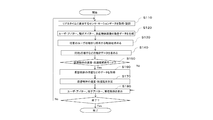
- FIG. 2 is a flowchart of a case where the other party is a skilled person in physical activity performed by the user (No. 1; a movement practice mode in which the user receives a movement practice from the skilled person).
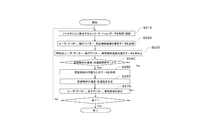
- FIG. 3 is a flowchart when the user practices movement alone or when the user competes with the opponent through physical activity (No. 2; one person or battle mode). The difference between FIGS. 2 and 3 is that S130 (obtaining the time i from the user's movement data) in FIG. 2 is not in FIG.
- S110 is a step of acquiring a sensor or motion data of a user or the like to be displayed in real time from the user motion detection device 111 or the like. Further, it may be recorded in the first data recording unit 112 or the like.
- the first calculation unit 141 and the second calculation unit of the user interlocking processing unit 140 are used for the user avatar, the other party avatar, and the real object image generated by each generation unit based on the information from each detection device and each recording unit.
- the third calculation unit 143 is a step of calculating the movement data of the user avatar, the movement data of the opponent avatar, and the movement data of the actual object image, respectively.
- the motion data refers to position, velocity, acceleration, and / or angle data (also referred to as motion information) at a predetermined time interval (time 1 to time n). From the position data and the angle data, it is possible to calculate whether the user avatar or the like is moving all the time or is paused.
- S130 is a step of obtaining the time i corresponding to the movement of any user that the user wants to know.
- the motion sensor corresponding to the user motion detection device 111 in FIG. 1
- the user interlocking processing unit 140 determines that the user wants to know the movement of the partner (lesson pro) avatar at the time of the pause. Then, the user interlocking processing unit 140 obtains the paused time i.
- the movement data of the opponent (lesson pro) avatar at that time i is obtained.
- the movement data of the opponent (lesson pro) avatar at the time i corresponds to the movement data of the user avatar at the time i.
- motion data of a real object image (a golf club used by a user and a golf club used by an opponent) may be obtained.
- S150 is a step of determining whether or not there is a mode for adjusting the speed / acceleration of the virtual object.
- the physical activity support system of the present embodiment can be used as a virtual object as a result of a) selecting the swing of the golf club and b) swinging the golf club. It is possible to select either one when you want to check how the ball flies in the virtual space. The user can make such a selection using the virtual object information input device of FIG.
- the user interlocking processing unit 140 can interlock the movement of the other avatar with the movement of the user avatar from the time i. Further, the movements of the golf club (image of the real object) in which the user avatar swings and the golf club (image of the real object) in which the opponent avatar swings can also be linked.
- S180 is a step in which the display device 150 displays an image of a user avatar, a partner avatar, and / or a real object reproduced by each reproduction unit.
- the virtual object motion adjusting unit 164 of FIG. 1 acquires the position data of the virtual object and the data related to the contact with the real object (S160).
- the virtual object motion adjusting unit 164 determines the velocity and acceleration of the virtual object (S170).
- the virtual object reproduction unit 165 reproduces the virtual object according to the determined speed and acceleration, and displays it on the display device 150 (S180).
- S210 is a step of acquiring sensors and motion data of the user or the like to be displayed in real time from the user motion detection device 111 or the like. Further, it may be recorded in the first data recording unit 112 or the like.
- S220 is a step in which each generation unit generates motion data for each of the user avatar, the other party avatar, and the real object image based on the information from each detection device and each recording unit. Please note that it is not essential to generate the movement data of the opponent avatar in S220.
- S230 does not have S130 in FIG. 2, and unlike S140 in FIG. 2, obtains motion data of the user avatar and / or the opponent (opponent) avatar at time i.
- the motion data of the real object image (the real object used by the user and / or the real object used by the opponent in the battle) may be obtained.
- S240 is a step of determining whether or not there is a mode for adjusting the speed / acceleration of the virtual object.
- S250 is a step of acquiring the position data of the virtual object and the data related to the contact with the real object.
- S260 is a step of determining the velocity and acceleration of the virtual object.
- S270 is a step of regenerating the virtual object and displaying it on the display device 150 according to the determined speed and acceleration.
- the first and second embodiments relate to the flowchart of FIG. 2 (No. 1; operation practice mode).
- the third and fourth embodiments relate to the flowchart of FIG. 3 (No. 2; one person or battle mode).
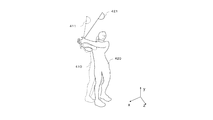
- FIG. 4 is a diagram showing a display example of the user avatar and the partner avatar according to the first embodiment.
- the x-axis is the foot width direction from the left foot to the right foot of the person
- the y-axis is the height direction of the person
- the z-axis is the direction from the back to the ventral side of the person.
- the image 411 of the user avatar 410 and the real object (golf club) on the user side is displayed by a dotted line
- the image 421 of the opponent avatar 420 and the real object (golf club) on the other side is displayed by a solid line.
- the user avatar 410 operates in real time according to the motion sensor attached to the user. Further, the image 411 of the real object (golf club) on the user side also operates in real time according to the motion sensor attached to the grip of the golf club that the user swings.
- the image 411 of the real object (golf club) on the user side also operates in real time according to the motion sensor attached to the grip of the golf club that the user swings.
- the movement of the opponent is recorded in advance by the motion sensor attached to the grip of the opponent (expert such as a golf lesson professional) and the real object (golf club) of the opponent. Then, the opponent avatar 420 and the image 421 of the opponent's real object (golf club) move in conjunction with the user avatar 410 that operates in real time.
- FIG. 5 is a diagram for explaining a method of calculating the position data of a partner and / or a real object corresponding to the position data of the user.
- FIG. 5a is an example of numerical data when measuring the position, angle, and speed of the user's left hand in real time.
- p represents position (position)
- r represents rotation (angle)
- v represents velocity (velocity).
- FIG. 5b) is data in which the position group, the angle group, and the speed group of the left hand of the opponent (expert) are recorded for t (time; time) of 1 to n. The interval between each time is 0.01 seconds.
- the one whose x-axis is positive or negative is the same as the x-axis of the user's left hand in the speed group of the expert's left hand.
- the mathematical formula shown in c-1) of FIG. 5 is the smallest, or the mathematical formula shown in c-2) (the angle between the user and the expert's left hand) is the most. Find the near time i.
- the movement of the partner (expert) avatar recorded in advance is reproduced by superimposing it on the movement of the user avatar by a predetermined time interval before or after. You can also do it.
- an adjustment unit capable of adjusting a predetermined time interval may be provided so that the opponent (expert) avatar moves several frames before or after the movement of the user avatar 410 (delayed). One frame is about 0.01 seconds.
- the virtual object adjusting unit 164 of FIG. 1 has an image 411 of a real object (golf club) on the user side, an image 421 of a real object (golf club) of an opponent (expert), and each virtual object (golf). By calculating the interaction with the ball), it is possible to adjust the difference in the trajectory of the virtual object (golf ball) for the user and the opponent (expert), and display the reproduction.
- the user avatar 410 is displayed without transmitting the opponent avatar 420.
- the present invention is not limited to this, and if the opponent avatar 420 is displayed semi-transparently, the user avatar 410 can be displayed without being hidden.
- FIG. 6 is a diagram showing a display example of the user avatar and the partner avatar according to the first embodiment.
- FIG. 6a shows the user avatar 610, the image 611 of the real object (Kendama Ken) on the user side, and the virtual object (Kendama ball) 621 on the user side.
- FIG. 6b shows the opponent (expert) avatar 620, the image 621 of the opponent's real object (Kendama's ken), and the opponent's virtual object (Kendama's ball) 622.
- the kendama ball of the user and the opponent (expert) is a virtual object, so it is not the one actually used in the real space when the user and the opponent (expert) perform the kendama. I want to.
- the partner when the user performs physical activity (practice of kendama), the partner (skilled) recorded in advance in conjunction with the movement of the user avatar 610 processed in real time. Person)
- the movement of the avatar 620 is reproduced by superimposing it on the movement of the user avatar.
- the interaction with the image 611 of the real object (Kendama Ken) on the user side, the image 621 of the real object (Kendama Ken) on the other side, and the virtual objects (Kendama Tama) 612 and 622, respectively, is calculated.
- the difference in whether the virtual object (Kendama ball) lands well on the real object (Kendama Ken) is calculated for each of the user case and the opponent (expert) case, and is reproduced and displayed.
- the movement of the user avatar processed in real time is linked with the movement of the partner (expert) avatar recorded in advance, and further. It can be played back in layers. Alternatively, it may be reproduced and displayed side by side. Therefore, the user has the effect of being able to easily follow the movement of the opponent (expert) and perform effective training while practicing continuous movements such as kendama practice.
- the third embodiment describes a case where the user practices kendama alone (without displaying the opponent's avatar).
- the display example in this case corresponds to the case where only a) of FIG. 6 is displayed and b) is not displayed.
- the flowchart of the third embodiment corresponds to the flowchart of FIG. 3 (No. 2; one person or battle mode). Then, regarding the processing of S220, S230, and S270, the processing may be performed on the user avatar, the user's real object (Kendama Ken), and the user's virtual object (Kendama Tama) without processing the other party's avatar. ..
- the speed of the user's virtual object (Kendama no Tama). For example, if "after hit by user: 1/2" is recorded in the virtual object setting recording unit 162 of FIG. 1, the virtual object motion adjustment unit 164 of FIG. 1 is the user's virtual object (Kendama no Tama). The speed can be set to 1/2.
- the user when practicing kendama, the user can adjust (slow down) the falling speed of the kendama, unlike the actual kendama, and can practice without rushing. Has. Therefore, while checking the movement, the user can naturally learn that it is important to move the knee at the same time as the hand, instead of simply moving the hand.
- FIG. 7 is a diagram showing a display example of the user avatar and the partner avatar according to the fourth embodiment.
- 610 represents a user avatar
- 611 represents an image of a real object (table tennis racket) on the user side.
- 620 represents the opponent's (opponent) avatar
- 621 represents the image of the opponent's real object (table tennis racket).
- 630 represents a table tennis ball which is a virtual object
- 631 represents a table tennis table which is a virtual object
- 632 represents a net of a table tennis table which is a virtual object
- 633 represents a boundary surface which is a virtual object.
- the x-axis is the longitudinal direction of the table tennis table 631 which is a virtual object
- the y-axis is the lateral direction
- the z-axis is the height direction.
- the speed of the virtual object is adjusted to a plurality of values depending on the position and state of the virtual object.
- the speed of the virtual object 630 (table tennis ball) is set to 1/6 on the user avatar 610 side (front side of the paper) from the boundary surface 633, and virtual on the opponent avatar 620 side (back side of the paper) from the boundary surface 633.
- the speed of the object 630 (table tennis ball) is set to 1/2.
- Such a setting is made by the virtual object motion adjusting unit 164 of FIG. Specifically, in the virtual object setting recording unit 162 of FIG.
- PositionX (Boundary): 1/6" are displayed in advance.
- Set by recording Immediately after the opponent avatar hits the virtual object (table tennis ball), the speed of the virtual object 630 (table tennis ball) is set to 1/6, and immediately after the user avatar hits the virtual object (table tennis ball). May set the speed of the virtual object 630 (table tennis ball) to 1/2.
- the virtual object setting recording unit 162 of FIG. 1 is set by recording "after hit by competitor: 1/6" and "after hit by user: 1/2" in advance.
Landscapes
- Health & Medical Sciences (AREA)
- General Health & Medical Sciences (AREA)
- Physical Education & Sports Medicine (AREA)
- Processing Or Creating Images (AREA)
- User Interface Of Digital Computer (AREA)
Applications Claiming Priority (2)
| Application Number | Priority Date | Filing Date | Title |
|---|---|---|---|
| JP2019-103324 | 2019-05-31 | ||
| JP2019103324A JP2020195551A (ja) | 2019-05-31 | 2019-05-31 | 身体活動支援システム、方法、及び、プログラム |
Publications (1)
| Publication Number | Publication Date |
|---|---|
| WO2020241735A1 true WO2020241735A1 (ja) | 2020-12-03 |
Family
ID=73552583
Family Applications (1)
| Application Number | Title | Priority Date | Filing Date |
|---|---|---|---|
| PCT/JP2020/021074 Ceased WO2020241735A1 (ja) | 2019-05-31 | 2020-05-28 | 身体活動支援システム、方法、及び、プログラム |
Country Status (2)
| Country | Link |
|---|---|
| JP (2) | JP2020195551A (https=) |
| WO (1) | WO2020241735A1 (https=) |
Families Citing this family (2)
| Publication number | Priority date | Publication date | Assignee | Title |
|---|---|---|---|---|
| WO2023276215A1 (ja) * | 2021-06-29 | 2023-01-05 | ソニーグループ株式会社 | 情報処理装置、情報処理方法及びプログラム |
| JP2025097505A (ja) * | 2023-12-19 | 2025-07-01 | ソニーグループ株式会社 | 情報処理装置、情報処理方法、およびプログラム |
Citations (1)
| Publication number | Priority date | Publication date | Assignee | Title |
|---|---|---|---|---|
| JP2017060891A (ja) * | 2010-11-05 | 2017-03-30 | ナイキ イノベイト セー. フェー. | 自動化個人トレーニングのための方法およびシステム |
Family Cites Families (5)
| Publication number | Priority date | Publication date | Assignee | Title |
|---|---|---|---|---|
| US5846086A (en) * | 1994-07-01 | 1998-12-08 | Massachusetts Institute Of Technology | System for human trajectory learning in virtual environments |
| US20130178960A1 (en) * | 2012-01-10 | 2013-07-11 | University Of Washington Through Its Center For Commercialization | Systems and methods for remote monitoring of exercise performance metrics |
| JP6601136B2 (ja) * | 2015-10-13 | 2019-11-06 | 富士通株式会社 | 反応出力システム、反応出力プログラム、反応出力方法 |
| WO2017094356A1 (ja) * | 2015-12-01 | 2017-06-08 | シャープ株式会社 | 映像生成装置、映像生成装置の制御方法、表示システム、映像生成制御プログラム、およびコンピュータ読み取り可能な記録媒体 |
| JP2019012965A (ja) * | 2017-06-30 | 2019-01-24 | 富士通株式会社 | 映像制御方法、映像制御装置、及び映像制御プログラム |
-
2019
- 2019-05-31 JP JP2019103324A patent/JP2020195551A/ja active Pending
-
2020
- 2020-05-28 WO PCT/JP2020/021074 patent/WO2020241735A1/ja not_active Ceased
-
2021
- 2021-05-31 JP JP2021090890A patent/JP7054276B2/ja active Active
Patent Citations (1)
| Publication number | Priority date | Publication date | Assignee | Title |
|---|---|---|---|---|
| JP2017060891A (ja) * | 2010-11-05 | 2017-03-30 | ナイキ イノベイト セー. フェー. | 自動化個人トレーニングのための方法およびシステム |
Non-Patent Citations (1)
| Title |
|---|
| ANONYMOUS: "Freely walk around the gymnasium for another competition! ?? HTC VIVE table tennis game "Ping Pong League", HTC VIVE, STEAM, NEWS, 28 February 2017 (2017-02-28), XP055767020, Retrieved from the Internet <URL:http://panora.tokyo/21892> [retrieved on 20200710] * |
Also Published As
| Publication number | Publication date |
|---|---|
| JP2020195551A (ja) | 2020-12-10 |
| JP2021142345A (ja) | 2021-09-24 |
| JP7054276B2 (ja) | 2022-04-13 |
Similar Documents
| Publication | Publication Date | Title |
|---|---|---|
| US10821347B2 (en) | Virtual reality sports training systems and methods | |
| Miles et al. | A review of virtual environments for training in ball sports | |
| Hämäläinen et al. | Martial arts in artificial reality | |
| JP5943913B2 (ja) | ユーザー追跡フィードバック | |
| Vignais et al. | Which technology to investigate visual perception in sport: Video vs. virtual reality | |
| JP2552427B2 (ja) | テレビ遊戯システム | |
| JP2016182338A (ja) | スクリーン野球システム競技方法 | |
| JP2000033184A (ja) | 全身動作入力型のゲ―ム及びイベント装置 | |
| US12179086B2 (en) | Mixed reality simulation and training system | |
| US11130063B2 (en) | Gaming system for sports-based biomechanical feedback | |
| JP7054276B2 (ja) | 身体活動支援システム、方法、及び、プログラム | |
| Saint-Louis et al. | Survey of haptic technology and entertainment applications | |
| JP2019083996A (ja) | 動体反応確認システム | |
| US20250001294A1 (en) | System to determine a real-time user-engagement state during immersive electronic experiences | |
| JP2021197110A (ja) | 触覚メタデータ生成装置、映像触覚連動システム、及びプログラム | |
| JP7630469B2 (ja) | 仮想空間移動装置、仮想空間移動方法、及び仮想空間移動プログラム | |
| JP7502957B2 (ja) | 触覚メタデータ生成装置、映像触覚連動システム、及びプログラム | |
| US20240286005A1 (en) | Exercise apparatus with integrated holographic display | |
| JP7760544B2 (ja) | 処置対象に対する処置を提案するプログラム、装置、システム及び方法 | |
| Higuchi et al. | Scarecrow: Avatar representation using biological information feedback | |
| Bogdanovych et al. | A novel approach to sports oriented video games with real-time motion streaming | |
| US20240189664A1 (en) | Exercise apparatus with integrated holographic display | |
| WO2025184209A1 (en) | Exercise apparatus with integrated holographic display | |
| JP2026014461A (ja) | 情報処理装置、情報処理装置の制御方法およびプログラム | |
| WO2025177697A1 (ja) | 情報処理装置、情報処理方法、及びプログラム |
Legal Events
| Date | Code | Title | Description |
|---|---|---|---|
| 121 | Ep: the epo has been informed by wipo that ep was designated in this application |
Ref document number: 20814004 Country of ref document: EP Kind code of ref document: A1 |
|
| NENP | Non-entry into the national phase |
Ref country code: DE |
|
| 122 | Ep: pct application non-entry in european phase |
Ref document number: 20814004 Country of ref document: EP Kind code of ref document: A1 |