WO2020226067A1 - 生体認証装置 - Google Patents
生体認証装置 Download PDFInfo
- Publication number
- WO2020226067A1 WO2020226067A1 PCT/JP2020/017544 JP2020017544W WO2020226067A1 WO 2020226067 A1 WO2020226067 A1 WO 2020226067A1 JP 2020017544 W JP2020017544 W JP 2020017544W WO 2020226067 A1 WO2020226067 A1 WO 2020226067A1
- Authority
- WO
- WIPO (PCT)
- Prior art keywords
- point
- feature amount
- biometric authentication
- authentication device
- foot
- Prior art date
- Legal status (The legal status is an assumption and is not a legal conclusion. Google has not performed a legal analysis and makes no representation as to the accuracy of the status listed.)
- Ceased
Links
Images





Classifications
-
- G—PHYSICS
- G01—MEASURING; TESTING
- G01G—WEIGHING
- G01G19/00—Weighing apparatus or methods adapted for special purposes not provided for in the preceding groups
- G01G19/44—Weighing apparatus or methods adapted for special purposes not provided for in the preceding groups for weighing persons
- G01G19/50—Weighing apparatus or methods adapted for special purposes not provided for in the preceding groups for weighing persons having additional measuring devices, e.g. for height
-
- A—HUMAN NECESSITIES
- A61—MEDICAL OR VETERINARY SCIENCE; HYGIENE
- A61B—DIAGNOSIS; SURGERY; IDENTIFICATION
- A61B5/00—Measuring for diagnostic purposes; Identification of persons
- A61B5/117—Identification of persons
- A61B5/1171—Identification of persons based on the shapes or appearances of their bodies or parts thereof
- A61B5/1174—Identification of persons based on the shapes or appearances of their bodies or parts thereof using footprinting
-
- A—HUMAN NECESSITIES
- A61—MEDICAL OR VETERINARY SCIENCE; HYGIENE
- A61B—DIAGNOSIS; SURGERY; IDENTIFICATION
- A61B5/00—Measuring for diagnostic purposes; Identification of persons
- A61B5/103—Measuring devices for testing the shape, pattern, colour, size or movement of the body or parts thereof, for diagnostic purposes
- A61B5/1036—Measuring load distribution, e.g. podologic studies
- A61B5/1038—Measuring plantar pressure during gait
-
- A—HUMAN NECESSITIES
- A61—MEDICAL OR VETERINARY SCIENCE; HYGIENE
- A61B—DIAGNOSIS; SURGERY; IDENTIFICATION
- A61B5/00—Measuring for diagnostic purposes; Identification of persons
- A61B5/103—Measuring devices for testing the shape, pattern, colour, size or movement of the body or parts thereof, for diagnostic purposes
- A61B5/11—Measuring movement of the entire body or parts thereof, e.g. head or hand tremor or mobility of a limb
-
- A—HUMAN NECESSITIES
- A61—MEDICAL OR VETERINARY SCIENCE; HYGIENE
- A61B—DIAGNOSIS; SURGERY; IDENTIFICATION
- A61B5/00—Measuring for diagnostic purposes; Identification of persons
- A61B5/103—Measuring devices for testing the shape, pattern, colour, size or movement of the body or parts thereof, for diagnostic purposes
- A61B5/11—Measuring movement of the entire body or parts thereof, e.g. head or hand tremor or mobility of a limb
- A61B5/112—Gait analysis
-
- G—PHYSICS
- G01—MEASURING; TESTING
- G01G—WEIGHING
- G01G19/00—Weighing apparatus or methods adapted for special purposes not provided for in the preceding groups
- G01G19/44—Weighing apparatus or methods adapted for special purposes not provided for in the preceding groups for weighing persons
-
- G—PHYSICS
- G06—COMPUTING OR CALCULATING; COUNTING
- G06F—ELECTRIC DIGITAL DATA PROCESSING
- G06F21/00—Security arrangements for protecting computers, components thereof, programs or data against unauthorised activity
- G06F21/30—Authentication, i.e. establishing the identity or authorisation of security principals
- G06F21/31—User authentication
- G06F21/32—User authentication using biometric data, e.g. fingerprints, iris scans or voiceprints
-
- A—HUMAN NECESSITIES
- A61—MEDICAL OR VETERINARY SCIENCE; HYGIENE
- A61B—DIAGNOSIS; SURGERY; IDENTIFICATION
- A61B2562/00—Details of sensors; Constructional details of sensor housings or probes; Accessories for sensors
- A61B2562/02—Details of sensors specially adapted for in-vivo measurements
- A61B2562/0247—Pressure sensors
Definitions
- the present invention relates to a biometric authentication technique for identifying an individual.
- Biometrics based on human physical characteristics such as fingerprint authentication, pupil iris authentication, finger vein authentication, voice print, face shape, and handwriting are widely used.
- the present invention has been made in such a situation, and one of the exemplary purposes of the embodiment is to provide an authentication method capable of completing authentication without human awareness.
- the biometric authentication device is laid on the ground where a person walking barefoot or in a similar state walks, and a sheet-like sensor that comes into contact with the sole of the right foot and the sole of the left foot, and when the person stands still on the sheet-like sensor, or Based on the output of the sheet-like sensor generated during walking, the first point located inside the ground contact part under the metatarsal bone of the right foot or left foot, the second point located outside, and the ground contact part under the calcaneus. It is provided with a feature amount acquisition unit that derives a feature amount based on the third point located in, and an authentication unit that authenticates a person based on the feature amount.
- the feature amount may include the coordinates of the first to third points.
- the feature amount may be described based on the triangle formed by the first to third points.
- the feature amount may be generated based on the first to third points of the right foot and the first to third points of the left foot when a person advances one step on the sheet-shaped sensor.
- the feature amount may include the coordinates of the first to third points of each of the right foot and the left foot.
- the features are the first quadrangle with the first point of the right foot and the first point of the left foot as diagonal vertices, the second quadrangle with the second point of the right foot and the second point of the left foot as diagonal vertices, and the right foot. It may be described based on a third quadrangle having a third point of the above and a third point of the left foot as diagonal vertices.
- the feature amount may include the vertical length and the horizontal length of each of the first quadrangle, the second quadrangle, and the third quadrangle.
- the sheet-shaped sensor may be a pressure-sensitive sensor.
- the feature quantity may include weighted information measured for at least one of the first to third points.
- the feature amount acquisition unit may correct the geometric feature amount related to the first to third points based on the measured weight.
- the feature amount may include temporal information.
- the feature quantity may include time information from the landing of one of the right foot and the left foot to the landing of the other.
- the feature amount may include information regarding the timing at which at least two of the first to third points land.
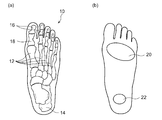
- FIG. 2A is a diagram showing the skeleton of a human foot
- FIG. 2B is a diagram showing a main ground contact portion of the sole of the foot
- 3A to 3D are diagrams for explaining an example of the feature amount. It is a figure explaining the feature amount that can be acquired during walking. It is a figure which shows the feature quantity obtained about both feet when a person is stationary. It is a figure which shows the feature amount obtained about both feet when a person is walking. It is a figure which shows another example of the description of the feature amount at the time of walking.
- FIG. 1 is a diagram showing a biometric authentication device 100 according to an embodiment.
- the biometric authentication device 100 includes a sheet-shaped sensor 110, a feature amount acquisition unit 120, and an authentication unit 130.
- the sheet-shaped sensor 110 is laid on the ground or floor on which the person 2 who is barefoot or in a similar state walks, and comes into contact with the sole of the right foot 4 and the sole of the left foot 6.
- Similar to barefoot includes wearing socks, socks, stockings, etc., and does not interfere with the acquisition of the feature amount of the foot, which will be described later.
- the sheet-shaped sensor 110 is configured to be able to detect a portion where the pressure on the sole of the foot is strong.
- known techniques such as a resistance film sensor and a capacitance sensor may be used, and the sheet-shaped sensor 110 is not particularly limited.
- FIG. 2A is a diagram showing the skeleton 10 of the human foot
- FIG. 2B is a diagram showing the main ground contact portion of the sole of the foot.
- the human foot usually touches the ground at two points 20, 22 on the sole of the foot.
- the ground contact portion 20 of FIG. 2 (b) is located below the metatarsal bone 12 of FIG. 2 (a), and this is referred to as a first ground contact portion.
- the ground contact portion 22 of FIG. 2 (b) is located below the heel bone 14 of FIG. 2 (a), and this is referred to as a second ground contact portion.
- the distal phalanx 16 and the proximal phalanx 18 are moving, but the other bones (indirect) are not moving while standing upright or walking. That is, the positional relationship between the first grounded portion 20 and the second grounded portion 22 in FIG. 2B can be regarded as substantially invariant.
- the geometric information of the first ground contact portion 20 and the second ground contact portion 22 is used as a feature amount of biometric authentication.
- the feature amount acquisition unit 120 of FIG. 1 is the first shown in FIG. 2B based on the output of the sheet-shaped sensor 110 generated when the person 2 is stationary on the sheet-shaped sensor 110 or while walking.
- the features related to the geometric information of the ground contact portion 20 and the second ground contact portion 22 are extracted.
- 3A to 3D are diagrams for explaining an example of the feature amount.
- the first ground contact portion 20 can be characterized by an inner first point P1 and an outer second point P2.
- the second ground contact portion 22 can be characterized by the third point P3 at the center thereof.
- the feature amount acquisition unit 120 acquires the quantities related to the first point P1, the second point P2, and the third point P3 as feature amounts. From another point of view, the feature quantity is the triangle 24 formed by the first point P1 to the third point P3.
- the feature amount acquisition unit 120 may use a combination of coordinates of the first point P1 to the third point P3 as the feature amount.
- the lengths l 1 to l 3 of the three sides of the triangle 24 formed by the first point P1 to the third point P3 may be used as the feature quantity.
- FIG. 3C it is characterized by a combination of any two sides l 1 , l 2 and an angle ⁇ between them among the three sides of the triangle 24 formed by the first point P1 to the third point P3. It may be an amount.
- a combination of the length l 1 of any one side of the triangle 24 formed by the first point P1 to the third point P3 and the angles ⁇ and ⁇ at both ends thereof may be used as the feature quantity. ..
- the authentication unit 130 authenticates the person 2 based on the feature amount acquired by the feature amount acquisition unit 120.
- the feature amount acquisition unit 120 holds a database in which the feature amount measured in advance is registered.
- the feature amount acquisition unit 120 may determine whether or not the currently acquired feature amount is registered in the database by pattern matching.
- the authentication method and algorithm are not particularly limited.
- the sheet-shaped sensor 110 may be a pressure-sensitive sensor.
- the weight obtained for at least one of the first point P1 to the third point P3 may be included in the feature amount.
- the feature amount includes information such as the weight of the person 2, and the accuracy of authentication can be improved.
- the weights of the first point P1 and the second point P2 may be included in the feature amount.
- the feature amount includes information on the posture of the person 2 (outer weight, inner weight, etc.), and the accuracy of authentication can be improved.
- FIG. 4 is a diagram for explaining the feature amount that can be acquired during walking. For example, the angle ⁇ formed by the straight line 26 extending in the traveling direction and the line segments P2-P3 may be added to the feature amount.
- the feature amount was generated only for one foot (right foot), but the feature amount may be acquired for both feet.
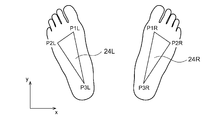
- FIG. 5 is a diagram showing the feature amounts obtained for both feet when the person 2 is stationary.
- the triangle 24R (3 points P1R to P3R) obtained for the right foot and the triangle 24L (1st point P1L to 3rd point P3L) obtained for the left foot are the feature quantities. Since the human foot is different on the left and right, the amount of information on the feature amount increases, and the authentication accuracy can be improved. In this case, the relative positional relationship between the left and right triangles 24L and 24R may be included in the feature amount.
- the origin may be an arbitrary position
- the x-axis in the left-right direction of the person 2 and the y-axis in the traveling direction, and the coordinates of the first points P1L to P3L and P1R to P3R may be used as feature quantities.
- FIG. 6 is a diagram showing the amount of features obtained for both feet when the person 2 is walking.
- the triangle 24R (3 points P1 to P3) and the triangle 24L obtained for the left foot (1st point P1 to 3rd point P3) are the basic information of the feature amount.
- the left foot is shown forward, but vice versa.
- the amount of information of the feature amount is increased, and the authentication accuracy can be improved.
- the relative positional relationship between the left and right triangles 24L and 24R may be included in the feature amount, such as the stride length ⁇ y, the distance between the left and right feet (step distance) ⁇ x, and the orientation ⁇ L of each of the left and right feet.
- any combination of theta R may be included in the feature quantity.
- authentication can be performed in consideration of the walking pattern determined by the skeleton of the person 2.
- an arbitrary position may be the origin, the x-axis in the left-right direction of the person 2 and the y-axis in the traveling direction may be taken, and the coordinates of the first points P1L to P3L and P1R to P3R may be used as feature quantities.
- FIG. 7 is a diagram showing another example of the description of the feature amount during walking.
- the features are the first quadrangle 31 with the first point P1R of the right foot and the first point P1L of the left foot as the vertices of the diagonal, and the second point P2R of the right foot and the second point P2L of the left foot as the vertices of the diagonal. It may be described based on the second quadrangle 32, the third quadrangle 33 having the third point P3R of the right foot and the third point P3L of the left foot as diagonal vertices.
- the feature amount may be described based on the vertical length and the horizontal length of each of the first quadrangle 31, the second quadrangle 32, and the third quadrangle 33.
- the feature quantity may include temporal information. For example, when the feature amount is acquired during walking, the time from the heel landing to the midfoot portion landing may be included in the feature amount.
- it may include time information from the landing of one of the right foot and the left foot to the landing of the other.
- the feature amount acquisition unit 120 uses the measured load to determine the geometric feature amount (coordinates and triangles) related to the first to third points. , Information about the rectangle) may be corrected.
- a walking pattern different from the normal walking pattern may be observed due to a narrow stride, a wide stride, or an widening angle between the left and right legs. ..
- Based on the weight measured there it is determined whether or not the person has luggage, and if it is estimated that the person has luggage, the measured feature amount is corrected and the person does not have luggage.
- the normal feature amount of the time may be generated and the authentication may be performed.
- the correction formula used for the correction may be generated from the correspondence between a large number of people by measuring the feature amount in the state of having luggage and the state of not having luggage.
- the use of the biometric authentication device 100 is not particularly limited, but it can be used for authentication in hospitals, security checks at airports, and the like.
- the present invention relates to a biometric authentication technique for identifying an individual.
Landscapes
- Health & Medical Sciences (AREA)
- Engineering & Computer Science (AREA)
- Life Sciences & Earth Sciences (AREA)
- Physics & Mathematics (AREA)
- Theoretical Computer Science (AREA)
- Computer Security & Cryptography (AREA)
- Animal Behavior & Ethology (AREA)
- Veterinary Medicine (AREA)
- Heart & Thoracic Surgery (AREA)
- Medical Informatics (AREA)
- Molecular Biology (AREA)
- Surgery (AREA)
- Pathology (AREA)
- General Health & Medical Sciences (AREA)
- Public Health (AREA)
- Biomedical Technology (AREA)
- Biophysics (AREA)
- General Physics & Mathematics (AREA)
- Software Systems (AREA)
- General Engineering & Computer Science (AREA)
- Computer Hardware Design (AREA)
- Dentistry (AREA)
- Oral & Maxillofacial Surgery (AREA)
- Physiology (AREA)
- Measurement Of The Respiration, Hearing Ability, Form, And Blood Characteristics Of Living Organisms (AREA)
Abstract
シート状センサ110は、裸足またはそれに準ずる状態の人2が歩行する地面に敷設され、右足4の足底および左足6の足底と接触する。特徴量取得部120は、人2がシート状センサ110の上で静止したとき、もしくは歩行中に生成されるシート状センサ110の出力にもとづき、右足4または左足6の中足骨の下の接地部分の内側に位置する第1点、外側に位置する第2点および踵骨の下の接地部分に位置する第3点にもとづく特徴量を導出する。認証部130は、特徴量にもとづいて人2を認証する。
Description
本発明は、個人を特定する生体認証技術に関する。
指紋認証や瞳の虹彩認証、指の静脈認証、声紋、顔形、筆跡など、人間の身体的特徴にもとづく生体認証が広く普及している。
これらの認証は、認証プロセスを人が意識した状態で行われる点で共通している。たとえば、指紋認証や静脈認証では、認証を受ける人が、指をセンサに意図的に接触させる必要があり、虹彩認証では、認証を受ける人が瞳をセンサの正面に固定する必要がある。
本発明は係る状況においてなされたものであり、そのある態様の例示的な目的のひとつは、人に意識させずに認証を完了できる認証方式の提供にある。
本発明のある態様は、生体認証装置に関する。生体認証装置は、裸足またはそれに準ずる状態の人が歩行する地面に敷設され、右足の足底および左足の足底と接触するシート状センサと、人がシート状センサの上で静止したとき、もしくは歩行中に生成されるシート状センサの出力にもとづき、右足または左足の中足骨の下の接地部分の内側に位置する第1点、外側に位置する第2点および踵骨の下の接地部分に位置する第3点にもとづく特徴量を導出する特徴量取得部と、特徴量にもとづいて人を認証する認証部と、を備える。
特徴量は、第1点から第3点の座標を含んでもよい。
特徴量は、第1点から第3点がなす三角形にもとづいて記述されてもよい。
特徴量は、人がシート状センサの上を1歩進んだときの、右足の第1点から第3点と、左足の第1点から第3点と、にもとづいて生成されてもよい。
特徴量は、右足、左足それぞれの第1点から第3点の座標を含んでもよい。
特徴量は、右足の第1点と左足の前記第1点を対角の頂点とする第1四角形、右足の第2点と左足の第2点を対角の頂点とする第2四角形、右足の第3点と左足の第3点を対角の頂点とする第3四角形、にもとづいて記述されてもよい。
特徴量は、第1四角形、第2四角形、第3四角形それぞれの縦の長さおよび横の長さを含んでもよい。
シート状センサは、感圧センサであってもよい。特徴量は、少なくとも第1点から第3点のひとつについて測定された加重の情報を含んでもよい。
特徴量取得部は、測定された加重にもとづいて、第1点から第3点に関連する幾何学的な特徴量を補正してもよい。
特徴量は時間的な情報を含んでもよい。特徴量は、右足と左足の一方が着地してからそれらの他方が着地するまでの時間情報を含んでもよい。特徴量は、第1点から第3点のうち少なくとも2点が着地するタイミングに関する情報を含んでもよい。
なお、以上の構成要素を任意に組み合わせたもの、あるいは本発明の表現を、方法、装置などの間で変換したものもまた、本発明の態様として有効である。
本発明のある態様によれば、人が無意識に歩行している最中に認証できる。
以下、本発明を好適な実施の形態をもとに図面を参照しながら説明する。各図面に示される同一または同等の構成要素、部材、処理には、同一の符号を付するものとし、適宜重複した説明は省略する。また、実施の形態は、発明を限定するものではなく例示であって、実施の形態に記述されるすべての特徴やその組み合わせは、必ずしも発明の本質的なものであるとは限らない。
図1は、実施の形態に係る生体認証装置100を示す図である。生体認証装置100は、シート状センサ110、特徴量取得部120、認証部130を備える。シート状センサ110は、裸足またはそれに準ずる状態の人2が歩行する地面や床に敷設され、右足4の足底と左足6の足底と接触する。「裸足に準ずる」とは、靴下や足袋、ストッキングなどを履いた状態を含み、後述する足の特徴量の取得を妨げない状態をいう。
シート状センサ110は、足底の圧力が強い部分を検出可能に構成される。シート状センサ110としては、抵抗膜センサや静電容量センサなど、公知の技術を用いればよく、特に限定されない。
図2(a)は、人間の足の骨格10を示す図であり、図2(b)は、足底の主たる接地部分を示す図である。図2(b)に示すように、通常、人間の足は、足底の二箇所20,22で接地する。図2(b)の接地部分20は、図2(a)の中足骨12の下側に位置しており、これを第1接地部分と称する。また図2(b)の接地部分22は、図2(a)の踵骨14の下側に位置しており、これを第2接地部分と称する。
本発明者らが検討したところ、直立状態あるいは歩行中に、末節骨16、基節骨18は動いているが、それ以外の骨(間接)は動いていない。つまり、図2(b)の第1接地部分20と第2接地部分22の位置関係は実質的に不変とみなすことができる。本実施の形態では、第1接地部分20と第2接地部分22の幾何学的な情報を生体認証の特徴量として利用する。
図1の特徴量取得部120は、人2がシート状センサ110の上で静止したとき、もしくは歩行中に生成されるシート状センサ110の出力にもとづいて、図2(b)に示す第1接地部分20および第2接地部分22の幾何学的な情報に関連する特徴量を抽出する。図3(a)~(d)は、特徴量の一例を説明する図である。図3(a)に示すように、第1接地部分20は、内側の第1点P1と、外側の第2点P2によって特徴付けることができる。また第2接地部分22は、その中央の第3点P3によって特徴付けることができる。特徴量取得部120は、第1点P1、第2点P2および第3点P3に関する量を、特徴量として取得する。別の観点からみると、第1点P1~第3点P3がなす三角形24を特徴量としている。
たとえば特徴量取得部120は、第1点P1~第3点P3それぞれの座標の組み合わせを特徴量としてもよい。以下では、人2の左右方向をx軸、進行方向をy軸にとるものとする。このとき、特徴量は、P1=(x1,y1)、P2=(x2,y2)、P3=(x3,y3)のように表してもよい。
あるいは図3(b)に示すように、第1点P1~第3点P3がなす三角形24の3辺の長さl1~l3を特徴量としてもよい。
あるいは図3(c)に示すように、第1点P1~第3点P3がなす三角形24の3辺のうち、いずれか2辺l1,l2とそれらの間の角度αの組み合わせを特徴量としてもよい。
あるいは図3(d)に示すように、第1点P1~第3点P3がなす三角形24のいずれか一辺の長さl1と、その両端の角度α,βの組み合わせを特徴量としてもよい。
図1に戻る。認証部130は、特徴量取得部120が取得した特徴量にもとづいて人2を認証する。たとえば特徴量取得部120は、予め測定しておいた特徴量が登録されるデータベースを保持している。特徴量取得部120は、現在取得された特徴量が、データベースに登録されているかを、パターンマッチングによって判定してもよい。認証の方式やアルゴリズムは特に限定されない。
シート状センサ110は、感圧センサであってもよい。この場合、第1点P1~第3点P3の少なくともひとつに関して得られた加重を、特徴量に含めてもよい。これにより、特徴量は、人2の体重などの情報を含むこととなり認証の精度を高めることができる。
より好ましくは、第1点P1と第2点P2の加重を特徴量に含めてもよい。これにより、特徴量は、人2の姿勢に関する情報(外側加重か内側加重など)を含むこととなり、認証の精度を高めることができる。
好ましくは、人2が静止しているときよりも、歩行中に得られるシート状センサ110の出力にもとづいて、特徴量を生成するとよい。歩行中に特徴量を生成することにより、特徴量に、第1点P1~第3点P3がなす三角形24の情報に加えて、この三角形24が進行方向に対してどれくらい傾いているか、すなわち歩行中の足の向きの情報を付加することができる。図4は、歩行中に取得可能な特徴量を説明する図である。たとえば、進行方向に伸びる直線26と、線分P2-P3がなす角度θを、特徴量に追加してもよい。
図3(a)~(d)、図4の例では、片足(右足)のみについて特徴量を生成したが、両足について特徴量を取得するようにしてもよい。
図5は、人2が静止したときに両足に関して得られる特徴量を示す図である。この場合、右足について得られる三角形24R(3点P1R~P3R)と、左足について得られる三角形24L(第1点P1L~第3点P3L)が特徴量となる。人間の足は左右で異なるため、特徴量の情報量が増え、認証精度を高めることができる。この場合において、左右の三角形24L,24Rの相対的な位置関係も、特徴量に含めてもよい。たとえば、任意の位置を原点とし、人2の左右方向にx軸、進行方向にy軸をとり、第1点P1L~P3L,P1R~P3Rの座標を特徴量としてもよい。
図6は、人2が歩行しているときに両足に関して得られる特徴量を示す図である。右足について、三角形24R(3点P1~P3)と、左足について得られる三角形24L(第1点P1~第3点P3)が特徴量の基本的な情報となる。この例では左足が前に出た状態を示すが、その逆であってもよい。図5の場合と同様に、人間の足は左右で異なるため、特徴量の情報量が増え、認証精度を高めることができる。
それに加えて、左右の三角形24L,24Rの相対的な位置関係も、特徴量に含めてもよく、歩幅Δyや、左右の足の間隔(歩隔)Δx、左右それぞれの足の向きθL、θRの任意の組み合わせを特徴量に含めることができる。この場合、人2の骨格から決まる歩行のパターンを考慮した認証が可能となる。
図6の場合においても、任意の位置を原点とし、人2の左右方向にx軸、進行方向にy軸をとり、第1点P1L~P3L,P1R~P3Rの座標を特徴量としてもよい。
図7は、歩行時の特徴量の記述の別の一例を示す図である。たとえば特徴量は、右足の第1点P1Rと左足の第1点P1Lを対角の頂点とする第1四角形31、右足の第2点P2Rと左足の第2点P2Lを対角の頂点とする第2四角形32、右足の第3点P3Rと左足の第3点P3Lを対角の頂点とする第3四角形33、にもとづいて記述されてもよい。
図7において、特徴量は、第1四角形31、第2四角形32、第3四角形33それぞれの縦の長さおよび横の長さにもとづいて記述されてもよい。
以上、本発明について、実施の形態をもとに説明した。この実施の形態は例示であり、それらの各構成要素や各処理プロセスの組み合わせにいろいろな変形例が可能なこと、またそうした変形例も本発明の範囲にあることは当業者に理解されるところである。以下、こうした変形例について説明する。
(変形例1)
特徴量は、時間的情報を含んでもよい。たとえば歩行中に特徴量を取得する場合、踵が着地してから、中足部分が着地するまでの時間を、特徴量に含めてもよい。
特徴量は、時間的情報を含んでもよい。たとえば歩行中に特徴量を取得する場合、踵が着地してから、中足部分が着地するまでの時間を、特徴量に含めてもよい。
あるいは、右足と左足の一方が着地してから、それらの他方が着地するまでの時間情報を含んでもよい。
(変形例2)
加重を検出可能なシート状センサ110を用いた場合において、特徴量取得部120は、測定された加重にもとづいて、第1点から第3点に関連する幾何学的な特徴量(座標や三角形、四角形に関する情報)を補正してもよい。人は、重い荷物を抱えて持つと、歩幅が狭くなったり、歩隔が開いたり、左右の足の角度が開いたりして、通常の歩行パターンとは異なる歩行パターンが観測される場合がある。そこで測定された加重にもとづいて、人が荷物を持っているか否かを判定し、荷物を持っていると推定される場合には、測定された特徴量を補正して、荷物を持っていないときの通常時の特徴量を生成し、認証を行ってもよい。補正に用いる補正式は、多数の人について、荷物を持った状態と持たない状態とで特徴量を測定し、それらの対応関係から生成してもよい。
加重を検出可能なシート状センサ110を用いた場合において、特徴量取得部120は、測定された加重にもとづいて、第1点から第3点に関連する幾何学的な特徴量(座標や三角形、四角形に関する情報)を補正してもよい。人は、重い荷物を抱えて持つと、歩幅が狭くなったり、歩隔が開いたり、左右の足の角度が開いたりして、通常の歩行パターンとは異なる歩行パターンが観測される場合がある。そこで測定された加重にもとづいて、人が荷物を持っているか否かを判定し、荷物を持っていると推定される場合には、測定された特徴量を補正して、荷物を持っていないときの通常時の特徴量を生成し、認証を行ってもよい。補正に用いる補正式は、多数の人について、荷物を持った状態と持たない状態とで特徴量を測定し、それらの対応関係から生成してもよい。
(用途)
生体認証装置100の用途は特に限定されないが、病院内での認証や、空港でのセキュリティチェックなどに用いることができる。
生体認証装置100の用途は特に限定されないが、病院内での認証や、空港でのセキュリティチェックなどに用いることができる。
実施の形態にもとづき、具体的な用語を用いて本発明を説明したが、実施の形態は、本発明の原理、応用を示しているにすぎず、実施の形態には、請求の範囲に規定された本発明の思想を逸脱しない範囲において、多くの変形例や配置の変更が認められる。
本発明は、個人を特定する生体認証技術に関する。
2 人
4 右足
6 左足
10 骨格
12 中足骨
14 踵骨
20 第1接地部分
22 第2接地部分
100 生体認証装置
110 シート状センサ
120 特徴量取得部
130 認証部
P1 第1点
P2 第2点
P3 第3点
4 右足
6 左足
10 骨格
12 中足骨
14 踵骨
20 第1接地部分
22 第2接地部分
100 生体認証装置
110 シート状センサ
120 特徴量取得部
130 認証部
P1 第1点
P2 第2点
P3 第3点
Claims (13)
- 裸足またはそれに準ずる状態の人が歩行する地面に敷設され、右足の足底および左足の足底と接触するシート状センサと、
前記人が前記シート状センサの上で静止したとき、もしくは歩行中に生成される前記シート状センサの出力にもとづき、前記右足または左足の中足骨の下の接地部分の内側に位置する第1点、外側に位置する第2点および踵骨の下の接地部分に位置する第3点にもとづく特徴量を導出する特徴量取得部と、
前記特徴量にもとづいて前記人を認証する認証部と、
を備えることを特徴とする生体認証装置。 - 前記特徴量は、前記第1点から前記第3点の座標を含むことを特徴とする請求項1に記載の生体認証装置。
- 前記特徴量は、前記第1点から前記第3点がなす三角形により記述されることを特徴とする請求項1または2に記載の生体認証装置。
- 前記特徴量は、前記人が前記シート状センサの上を1歩進んだときの、前記右足の前記第1点から前記第3点と、前記左足の前記第1点から前記第3点と、にもとづいて生成されることを特徴とする請求項1に記載の生体認証装置。
- 前記特徴量は、前記右足、前記左足それぞれの前記第1点から前記第3点の座標を含むことを特徴とする請求項4に記載の生体認証装置。
- 前記特徴量は、
前記右足の前記第1点と前記左足の前記第1点を対角の頂点とする第1四角形、
前記右足の前記第2点と前記左足の前記第2点を対角の頂点とする第2四角形、
前記右足の前記第3点と前記左足の前記第3点を対角の頂点とする第3四角形、
により記述されることを特徴とする請求項4に記載の生体認証装置。 - 前記特徴量は、前記第1四角形、前記第2四角形、前記第3四角形それぞれの縦の長さおよび横の長さを含むことを特徴とする請求項6に記載の生体認証装置。
- 前記シート状センサは、感圧センサであることを特徴とする請求項1から7のいずれかに記載の生体認証装置。
- 前記特徴量は、前記第1点から前記第3点の少なくともそれらのひとつについて測定された加重の情報を含むことを特徴とする請求項8に記載の生体認証装置。
- 前記特徴量取得部は、測定された加重にもとづいて、第1点から第3点に関連する幾何学的な特徴量を補正することを特徴とする請求項8に記載の生体認証装置。
- 前記特徴量は時間的な情報を含むことを特徴とする請求項1から10のいずれかに記載の生体認証装置。
- 前記特徴量は、前記右足と前記左足の一方が着地してからそれらの他方が着地するまでの時間情報を含むことを特徴とする請求項11に記載の生体認証装置。
- 前記特徴量は、前記第1点から前記第3点のうち少なくとも2点が着地するタイミングに関する情報を含むことを特徴とする請求項11に記載の生体認証装置。
Priority Applications (5)
| Application Number | Priority Date | Filing Date | Title |
|---|---|---|---|
| CN202080033046.7A CN113784661A (zh) | 2019-05-07 | 2020-04-23 | 生物认证装置 |
| KR1020217035986A KR20220005476A (ko) | 2019-05-07 | 2020-04-23 | 생체 인증 장치 |
| JP2021518344A JP7390372B2 (ja) | 2019-05-07 | 2020-04-23 | 生体認証装置 |
| DE112020002259.5T DE112020002259T8 (de) | 2019-05-07 | 2020-04-23 | Vorrichtung zur biometrischen authentifizierung |
| US17/519,955 US20220058253A1 (en) | 2019-05-07 | 2021-11-05 | Biometric authentication apparatus |
Applications Claiming Priority (2)
| Application Number | Priority Date | Filing Date | Title |
|---|---|---|---|
| JP2019087721 | 2019-05-07 | ||
| JP2019-087721 | 2019-05-07 |
Related Child Applications (1)
| Application Number | Title | Priority Date | Filing Date |
|---|---|---|---|
| US17/519,955 Continuation US20220058253A1 (en) | 2019-05-07 | 2021-11-05 | Biometric authentication apparatus |
Publications (1)
| Publication Number | Publication Date |
|---|---|
| WO2020226067A1 true WO2020226067A1 (ja) | 2020-11-12 |
Family
ID=73051145
Family Applications (1)
| Application Number | Title | Priority Date | Filing Date |
|---|---|---|---|
| PCT/JP2020/017544 Ceased WO2020226067A1 (ja) | 2019-05-07 | 2020-04-23 | 生体認証装置 |
Country Status (6)
| Country | Link |
|---|---|
| US (1) | US20220058253A1 (ja) |
| JP (1) | JP7390372B2 (ja) |
| KR (1) | KR20220005476A (ja) |
| CN (1) | CN113784661A (ja) |
| DE (1) | DE112020002259T8 (ja) |
| WO (1) | WO2020226067A1 (ja) |
Citations (3)
| Publication number | Priority date | Publication date | Assignee | Title |
|---|---|---|---|---|
| JP2002233517A (ja) * | 2001-02-09 | 2002-08-20 | Nippon Telegr & Teleph Corp <Ntt> | 歩行の美しさ評価装置および方法 |
| JP2011002907A (ja) * | 2009-06-16 | 2011-01-06 | Kansai Electric Power Co Inc:The | 個人認証システム |
| WO2017188418A1 (ja) * | 2016-04-28 | 2017-11-02 | Necソリューションイノベータ株式会社 | 歩行振動解析システム、振動解析装置、歩行振動解析方法、及びコンピュータ読み取り可能な記録媒体 |
Family Cites Families (23)
| Publication number | Priority date | Publication date | Assignee | Title |
|---|---|---|---|---|
| DE840882C (de) * | 1950-08-04 | 1952-06-09 | Heinrich Ad Berkemann Fa | Vorrichtung zum Kenntlichmachen der Trittspur und der Druckverteilung des menschlichen Fusses |
| JPS469640Y1 (ja) | 1967-11-11 | 1971-04-05 | ||
| DE3533737A1 (de) | 1985-09-21 | 1987-03-26 | Hoechst Ag | Dekorative platte mit verbesserten oberflaecheneigenschaften |
| JPH05324955A (ja) | 1992-05-27 | 1993-12-10 | Kazuo Nakazawa | 人数計数装置 |
| JPH10106384A (ja) | 1996-09-30 | 1998-04-24 | Japan Aviation Electron Ind Ltd | 足跡パターンセンサ |
| CN1289580A (zh) * | 1999-09-28 | 2001-04-04 | 赵荣春 | 人体足迹虚点线的鉴定方法 |
| JP4609640B2 (ja) | 2004-12-13 | 2011-01-12 | 日本ソアー株式会社 | 歩行跡分析装置 |
| WO2009101702A1 (ja) * | 2008-02-15 | 2009-08-20 | Fujitsu Limited | 生体認証用の撮影装置及び生体認証装置 |
| KR101038509B1 (ko) * | 2008-06-12 | 2011-06-01 | (주)에이치쓰리시스템 | 발 특징 정보를 이용한 사용자 식별 시스템 및 방법 |
| US8639455B2 (en) * | 2009-02-09 | 2014-01-28 | Alterg, Inc. | Foot pad device and method of obtaining weight data |
| CA2662431A1 (en) * | 2009-02-24 | 2010-08-24 | The Business Accelerators Inc. | Biometric characterizing system and method and apparel linking system and method |
| CN101874738B (zh) * | 2009-12-23 | 2011-11-09 | 中国科学院自动化研究所 | 基于压力累积足印图像的人体生理分析与身份识别的方法 |
| CN102106734B (zh) * | 2011-02-15 | 2012-05-23 | 河北工业大学 | 一种人体身份识别系统 |
| JP6299147B2 (ja) | 2013-10-29 | 2018-03-28 | 花王株式会社 | 歩行特徴の表示方法 |
| JP6394323B2 (ja) * | 2014-11-25 | 2018-09-26 | 富士通株式会社 | 生体認証方法、生体認証プログラム、生体認証装置 |
| US9759599B2 (en) * | 2015-06-15 | 2017-09-12 | Withings | Weighing device having inductive sensing elements |
| CN105224845A (zh) * | 2015-09-01 | 2016-01-06 | 京东方科技集团股份有限公司 | 身份识别装置及其制造方法、身份识别方法 |
| JP6501727B2 (ja) * | 2016-06-02 | 2019-04-17 | 株式会社スペース・バイオ・ラボラトリーズ | 歩行動作補助装置 |
| JP6834553B2 (ja) * | 2017-02-09 | 2021-02-24 | セイコーエプソン株式会社 | 運動解析システム、運動解析装置、運動解析プログラム及び運動解析方法 |
| US10552596B2 (en) * | 2017-12-20 | 2020-02-04 | International Business Machines Corporation | Biometric authentication |
| CN108489585A (zh) * | 2018-03-26 | 2018-09-04 | 苏州科技大学 | 一种智能识别的电子秤 |
| CN108805138B (zh) * | 2018-04-19 | 2022-04-22 | 北京金尺云数科技有限公司 | 一种手机拍照计算脚部数据的方法 |
| US10587615B2 (en) * | 2018-06-06 | 2020-03-10 | Capital One Services, Llc | Systems and methods for using micro accelerations as a biometric identification factor |
-
2020
- 2020-04-23 WO PCT/JP2020/017544 patent/WO2020226067A1/ja not_active Ceased
- 2020-04-23 DE DE112020002259.5T patent/DE112020002259T8/de active Active
- 2020-04-23 KR KR1020217035986A patent/KR20220005476A/ko not_active Withdrawn
- 2020-04-23 JP JP2021518344A patent/JP7390372B2/ja active Active
- 2020-04-23 CN CN202080033046.7A patent/CN113784661A/zh active Pending
-
2021
- 2021-11-05 US US17/519,955 patent/US20220058253A1/en not_active Abandoned
Patent Citations (3)
| Publication number | Priority date | Publication date | Assignee | Title |
|---|---|---|---|---|
| JP2002233517A (ja) * | 2001-02-09 | 2002-08-20 | Nippon Telegr & Teleph Corp <Ntt> | 歩行の美しさ評価装置および方法 |
| JP2011002907A (ja) * | 2009-06-16 | 2011-01-06 | Kansai Electric Power Co Inc:The | 個人認証システム |
| WO2017188418A1 (ja) * | 2016-04-28 | 2017-11-02 | Necソリューションイノベータ株式会社 | 歩行振動解析システム、振動解析装置、歩行振動解析方法、及びコンピュータ読み取り可能な記録媒体 |
Also Published As
| Publication number | Publication date |
|---|---|
| CN113784661A (zh) | 2021-12-10 |
| JP7390372B2 (ja) | 2023-12-01 |
| US20220058253A1 (en) | 2022-02-24 |
| DE112020002259T8 (de) | 2022-02-17 |
| DE112020002259T5 (de) | 2022-01-20 |
| JPWO2020226067A1 (ja) | 2020-11-12 |
| KR20220005476A (ko) | 2022-01-13 |
Similar Documents
| Publication | Publication Date | Title |
|---|---|---|
| US9870622B1 (en) | Systems and methods for analyzing a motion based on images | |
| Castelli et al. | A 2D markerless gait analysis methodology: Validation on healthy subjects | |
| KR101053491B1 (ko) | 모션 센서를 이용한 보행주기 검출시스템과 방법 | |
| US20020028003A1 (en) | Methods and systems for distinguishing individuals utilizing anatomy and gait parameters | |
| CN106887019B (zh) | 一种足迹压力分布特征表示方法 | |
| Capecci et al. | An instrumental approach for monitoring physical exercises in a visual markerless scenario: A proof of concept | |
| JP6649323B2 (ja) | 歩行解析システム及び方法 | |
| Kim et al. | Development of an IMU-based foot-ground contact detection (FGCD) algorithm | |
| US20240115214A1 (en) | Measurement device, measurement system, measurement method, and recording medium | |
| Nazarahari et al. | Foot angular kinematics measured with inertial measurement units: A reliable criterion for real-time gait event detection | |
| Lee et al. | Fall-detection algorithm using plantar pressure and acceleration data | |
| CN108885087A (zh) | 测量装置、测量方法和计算机可读记录介质 | |
| WO2013088517A1 (ja) | 停立人物の向き推定方法 | |
| Bora et al. | Understanding human gait: A survey of traits for biometrics and biomedical applications | |
| Kim et al. | Human body model using multiple depth camera for gait analysis | |
| KR102054818B1 (ko) | 족적 영상 패턴 분석 기반 가상현실 제공 방법 | |
| JP7390372B2 (ja) | 生体認証装置 | |
| Parks et al. | Development of a mobile motion capture (MO2CA) system for future military application | |
| Liu et al. | Characterizing patients with unilateral vestibular hypofunction using kinematic variability and local dynamic stability during treadmill walking | |
| Sulovská et al. | Appropriateness of gait analysis for biometrics: Initial study using FDA method | |
| JP2017158644A (ja) | 測定装置、測定方法及び測定プログラム | |
| Kurita | Human identification from walking signal based on measurement of current generated by electrostatic induction | |
| Zheng et al. | A wearable capacitive sensing system with phase-dependent classifier for locomotion mode recognition | |
| KR20200063378A (ko) | 상호 보완형 복합센서를 이용한 인체 동작인식장치 및 인체 동작인식방법 | |
| JPH10228540A (ja) | 歩行パターン処理装置 |
Legal Events
| Date | Code | Title | Description |
|---|---|---|---|
| 121 | Ep: the epo has been informed by wipo that ep was designated in this application |
Ref document number: 20801804 Country of ref document: EP Kind code of ref document: A1 |
|
| ENP | Entry into the national phase |
Ref document number: 2021518344 Country of ref document: JP Kind code of ref document: A |
|
| 122 | Ep: pct application non-entry in european phase |
Ref document number: 20801804 Country of ref document: EP Kind code of ref document: A1 |