WO2020218368A1 - 運動用設備 - Google Patents
運動用設備 Download PDFInfo
- Publication number
- WO2020218368A1 WO2020218368A1 PCT/JP2020/017381 JP2020017381W WO2020218368A1 WO 2020218368 A1 WO2020218368 A1 WO 2020218368A1 JP 2020017381 W JP2020017381 W JP 2020017381W WO 2020218368 A1 WO2020218368 A1 WO 2020218368A1
- Authority
- WO
- WIPO (PCT)
- Prior art keywords
- user
- image
- screen
- display
- exercise
- Prior art date
- Legal status (The legal status is an assumption and is not a legal conclusion. Google has not performed a legal analysis and makes no representation as to the accuracy of the status listed.)
- Ceased
Links
Images





Classifications
-
- A—HUMAN NECESSITIES
- A63—SPORTS; GAMES; AMUSEMENTS
- A63B—APPARATUS FOR PHYSICAL TRAINING, GYMNASTICS, SWIMMING, CLIMBING, OR FENCING; BALL GAMES; TRAINING EQUIPMENT
- A63B71/00—Games or sports accessories not covered in groups A63B1/00 - A63B69/00
- A63B71/06—Indicating or scoring devices for games or players, or for other sports activities
- A63B71/0619—Displays, user interfaces and indicating devices, specially adapted for sport equipment, e.g. display mounted on treadmills
- A63B71/0622—Visual, audio or audio-visual systems for entertaining, instructing or motivating the user
-
- A—HUMAN NECESSITIES
- A63—SPORTS; GAMES; AMUSEMENTS
- A63B—APPARATUS FOR PHYSICAL TRAINING, GYMNASTICS, SWIMMING, CLIMBING, OR FENCING; BALL GAMES; TRAINING EQUIPMENT
- A63B22/00—Exercising apparatus specially adapted for conditioning the cardio-vascular system, for training agility or co-ordination of movements
- A63B22/06—Exercising apparatus specially adapted for conditioning the cardio-vascular system, for training agility or co-ordination of movements with support elements performing a rotating cycling movement, i.e. a closed path movement
- A63B22/0605—Exercising apparatus specially adapted for conditioning the cardio-vascular system, for training agility or co-ordination of movements with support elements performing a rotating cycling movement, i.e. a closed path movement performing a circular movement, e.g. ergometers
-
- G—PHYSICS
- G06—COMPUTING OR CALCULATING; COUNTING
- G06T—IMAGE DATA PROCESSING OR GENERATION, IN GENERAL
- G06T7/00—Image analysis
- G06T7/50—Depth or shape recovery
-
- G—PHYSICS
- G06—COMPUTING OR CALCULATING; COUNTING
- G06T—IMAGE DATA PROCESSING OR GENERATION, IN GENERAL
- G06T7/00—Image analysis
- G06T7/70—Determining position or orientation of objects or cameras
- G06T7/73—Determining position or orientation of objects or cameras using feature-based methods
- G06T7/74—Determining position or orientation of objects or cameras using feature-based methods involving reference images or patches
-
- G—PHYSICS
- G06—COMPUTING OR CALCULATING; COUNTING
- G06V—IMAGE OR VIDEO RECOGNITION OR UNDERSTANDING
- G06V40/00—Recognition of biometric, human-related or animal-related patterns in image or video data
- G06V40/10—Human or animal bodies, e.g. vehicle occupants or pedestrians; Body parts, e.g. hands
-
- G—PHYSICS
- G06—COMPUTING OR CALCULATING; COUNTING
- G06V—IMAGE OR VIDEO RECOGNITION OR UNDERSTANDING
- G06V40/00—Recognition of biometric, human-related or animal-related patterns in image or video data
- G06V40/20—Movements or behaviour, e.g. gesture recognition
- G06V40/23—Recognition of whole body movements, e.g. for sport training
-
- H—ELECTRICITY
- H04—ELECTRIC COMMUNICATION TECHNIQUE
- H04N—PICTORIAL COMMUNICATION, e.g. TELEVISION
- H04N13/00—Stereoscopic video systems; Multi-view video systems; Details thereof
- H04N13/30—Image reproducers
- H04N13/332—Displays for viewing with the aid of special glasses or head-mounted displays [HMD]
- H04N13/344—Displays for viewing with the aid of special glasses or head-mounted displays [HMD] with head-mounted left-right displays
-
- H—ELECTRICITY
- H04—ELECTRIC COMMUNICATION TECHNIQUE
- H04N—PICTORIAL COMMUNICATION, e.g. TELEVISION
- H04N13/00—Stereoscopic video systems; Multi-view video systems; Details thereof
- H04N13/30—Image reproducers
- H04N13/366—Image reproducers using viewer tracking
-
- A—HUMAN NECESSITIES
- A63—SPORTS; GAMES; AMUSEMENTS
- A63B—APPARATUS FOR PHYSICAL TRAINING, GYMNASTICS, SWIMMING, CLIMBING, OR FENCING; BALL GAMES; TRAINING EQUIPMENT
- A63B24/00—Electric or electronic controls for exercising apparatus of preceding groups; Controlling or monitoring of exercises, sportive games, training or athletic performances
- A63B24/0021—Tracking a path or terminating locations
- A63B2024/0025—Tracking the path or location of one or more users, e.g. players of a game
-
- A—HUMAN NECESSITIES
- A63—SPORTS; GAMES; AMUSEMENTS
- A63B—APPARATUS FOR PHYSICAL TRAINING, GYMNASTICS, SWIMMING, CLIMBING, OR FENCING; BALL GAMES; TRAINING EQUIPMENT
- A63B24/00—Electric or electronic controls for exercising apparatus of preceding groups; Controlling or monitoring of exercises, sportive games, training or athletic performances
- A63B24/0087—Electric or electronic controls for exercising apparatus of groups A63B21/00 - A63B23/00, e.g. controlling load
- A63B2024/0096—Electric or electronic controls for exercising apparatus of groups A63B21/00 - A63B23/00, e.g. controlling load using performance related parameters for controlling electronic or video games or avatars
-
- A—HUMAN NECESSITIES
- A63—SPORTS; GAMES; AMUSEMENTS
- A63B—APPARATUS FOR PHYSICAL TRAINING, GYMNASTICS, SWIMMING, CLIMBING, OR FENCING; BALL GAMES; TRAINING EQUIPMENT
- A63B71/00—Games or sports accessories not covered in groups A63B1/00 - A63B69/00
- A63B71/06—Indicating or scoring devices for games or players, or for other sports activities
- A63B71/0619—Displays, user interfaces and indicating devices, specially adapted for sport equipment, e.g. display mounted on treadmills
- A63B71/0622—Visual, audio or audio-visual systems for entertaining, instructing or motivating the user
- A63B2071/0636—3D visualisation
-
- A—HUMAN NECESSITIES
- A63—SPORTS; GAMES; AMUSEMENTS
- A63B—APPARATUS FOR PHYSICAL TRAINING, GYMNASTICS, SWIMMING, CLIMBING, OR FENCING; BALL GAMES; TRAINING EQUIPMENT
- A63B71/00—Games or sports accessories not covered in groups A63B1/00 - A63B69/00
- A63B71/06—Indicating or scoring devices for games or players, or for other sports activities
- A63B71/0619—Displays, user interfaces and indicating devices, specially adapted for sport equipment, e.g. display mounted on treadmills
- A63B71/0622—Visual, audio or audio-visual systems for entertaining, instructing or motivating the user
- A63B2071/0638—Displaying moving images of recorded environment, e.g. virtual environment
-
- A—HUMAN NECESSITIES
- A63—SPORTS; GAMES; AMUSEMENTS
- A63B—APPARATUS FOR PHYSICAL TRAINING, GYMNASTICS, SWIMMING, CLIMBING, OR FENCING; BALL GAMES; TRAINING EQUIPMENT
- A63B71/00—Games or sports accessories not covered in groups A63B1/00 - A63B69/00
- A63B71/06—Indicating or scoring devices for games or players, or for other sports activities
- A63B71/0619—Displays, user interfaces and indicating devices, specially adapted for sport equipment, e.g. display mounted on treadmills
- A63B71/0622—Visual, audio or audio-visual systems for entertaining, instructing or motivating the user
- A63B2071/0638—Displaying moving images of recorded environment, e.g. virtual environment
- A63B2071/0644—Displaying moving images of recorded environment, e.g. virtual environment with display speed of moving landscape controlled by the user's performance
-
- A—HUMAN NECESSITIES
- A63—SPORTS; GAMES; AMUSEMENTS
- A63B—APPARATUS FOR PHYSICAL TRAINING, GYMNASTICS, SWIMMING, CLIMBING, OR FENCING; BALL GAMES; TRAINING EQUIPMENT
- A63B71/00—Games or sports accessories not covered in groups A63B1/00 - A63B69/00
- A63B71/06—Indicating or scoring devices for games or players, or for other sports activities
- A63B71/0619—Displays, user interfaces and indicating devices, specially adapted for sport equipment, e.g. display mounted on treadmills
- A63B2071/0658—Position or arrangement of display
- A63B2071/0661—Position or arrangement of display arranged on the user
- A63B2071/0666—Position or arrangement of display arranged on the user worn on the head or face, e.g. combined with goggles or glasses
-
- A—HUMAN NECESSITIES
- A63—SPORTS; GAMES; AMUSEMENTS
- A63B—APPARATUS FOR PHYSICAL TRAINING, GYMNASTICS, SWIMMING, CLIMBING, OR FENCING; BALL GAMES; TRAINING EQUIPMENT
- A63B71/00—Games or sports accessories not covered in groups A63B1/00 - A63B69/00
- A63B71/06—Indicating or scoring devices for games or players, or for other sports activities
- A63B2071/0675—Input for modifying training controls during workout
- A63B2071/0677—Input by image recognition, e.g. video signals
-
- A—HUMAN NECESSITIES
- A63—SPORTS; GAMES; AMUSEMENTS
- A63B—APPARATUS FOR PHYSICAL TRAINING, GYMNASTICS, SWIMMING, CLIMBING, OR FENCING; BALL GAMES; TRAINING EQUIPMENT
- A63B22/00—Exercising apparatus specially adapted for conditioning the cardio-vascular system, for training agility or co-ordination of movements
- A63B22/02—Exercising apparatus specially adapted for conditioning the cardio-vascular system, for training agility or co-ordination of movements with movable endless bands, e.g. treadmills
- A63B22/0235—Exercising apparatus specially adapted for conditioning the cardio-vascular system, for training agility or co-ordination of movements with movable endless bands, e.g. treadmills driven by a motor
-
- A—HUMAN NECESSITIES
- A63—SPORTS; GAMES; AMUSEMENTS
- A63B—APPARATUS FOR PHYSICAL TRAINING, GYMNASTICS, SWIMMING, CLIMBING, OR FENCING; BALL GAMES; TRAINING EQUIPMENT
- A63B22/00—Exercising apparatus specially adapted for conditioning the cardio-vascular system, for training agility or co-ordination of movements
- A63B22/06—Exercising apparatus specially adapted for conditioning the cardio-vascular system, for training agility or co-ordination of movements with support elements performing a rotating cycling movement, i.e. a closed path movement
-
- A—HUMAN NECESSITIES
- A63—SPORTS; GAMES; AMUSEMENTS
- A63B—APPARATUS FOR PHYSICAL TRAINING, GYMNASTICS, SWIMMING, CLIMBING, OR FENCING; BALL GAMES; TRAINING EQUIPMENT
- A63B2220/00—Measuring of physical parameters relating to sporting activity
- A63B2220/05—Image processing for measuring physical parameters
-
- A—HUMAN NECESSITIES
- A63—SPORTS; GAMES; AMUSEMENTS
- A63B—APPARATUS FOR PHYSICAL TRAINING, GYMNASTICS, SWIMMING, CLIMBING, OR FENCING; BALL GAMES; TRAINING EQUIPMENT
- A63B2220/00—Measuring of physical parameters relating to sporting activity
- A63B2220/10—Positions
-
- A—HUMAN NECESSITIES
- A63—SPORTS; GAMES; AMUSEMENTS
- A63B—APPARATUS FOR PHYSICAL TRAINING, GYMNASTICS, SWIMMING, CLIMBING, OR FENCING; BALL GAMES; TRAINING EQUIPMENT
- A63B2220/00—Measuring of physical parameters relating to sporting activity
- A63B2220/80—Special sensors, transducers or devices therefor
- A63B2220/806—Video cameras
-
- H—ELECTRICITY
- H04—ELECTRIC COMMUNICATION TECHNIQUE
- H04N—PICTORIAL COMMUNICATION, e.g. TELEVISION
- H04N2213/00—Details of stereoscopic systems
- H04N2213/002—Eyestrain reduction by processing stereoscopic signals or controlling stereoscopic devices
Definitions
- the present invention relates to a technique for simultaneously providing a video and an exercise experience.
- Patent Documents 1 and 2 disclose exercise equipment that combines exercise equipment and a video device.
- Non-Patent Document 1 proposes exercise equipment that provides images on a large display to improve the image experience during exercise.
- Non-Patent Document 2-4 proposes an exercise facility that provides an image by a head-mounted display to improve the image experience during exercise.
- Non-Patent Document 1 the user exercises while watching the image displayed on the large display.
- the large display can be expected to have the effect of increasing the sense of presence and immersiveness to some extent.
- the image displayed on the large display does not follow the movement. Therefore, it cannot be said that the user can obtain a high sense of presence and immersion as if he / she actually entered the world of video.
- Non-Patent Document 2-4 exercises while watching the image displayed on the head-mounted display. Since the head-mounted display displays a virtual reality image that can be seen from the user's point of view, a high sense of presence and immersion can be expected.
- the head-mounted display is in close contact with the forehead, there is a problem that the user may feel uncomfortable when sweating due to exercise. There is also a problem that the screen of the head-mounted display may become cloudy due to sweat and the image may not be visible. There is also a problem that hair may be caught between the head-mounted display and the face, causing discomfort to the user. There is also a problem that the weight of the head-mounted display may hinder exercise. There is also a problem that the head-mounted display may shift due to exercise.
- One object of the present disclosure is to provide exercise equipment capable of reducing anxiety and discomfort of the user while giving the user a high sense of presence and immersion.
- the exercise equipment includes an exercise device for causing the user to perform a predetermined exercise, and a viewpoint position of the user in a predetermined reference coordinate system when the user exercises with the exercise device.
- the measuring device to be measured and the display image of the object that imitates the appearance when the object in the virtual space of the reference coordinate system is viewed from the viewpoint position through the fixed screen are displayed according to the viewpoint position. It has a video apparatus for generating and displaying the display video on the screen.
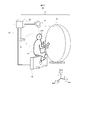
- FIG. 1 is a schematic configuration diagram of exercise equipment according to the first embodiment.
- the exercise equipment 10 includes an exercise device 11, a measuring device 12, and a video device 13.
- the measuring device 12 is realized by the information processing device 14 and the sensor 16.
- the image device 13 is realized by an information processing device 14, a projection device 15, and a screen 17.
- the screen 17 has three screens 17A, 17B, and 17C.
- the information processing device 14 is a computer that executes a software program on a processor, and is shared by the measuring device 12 and the video device 13.
- the exercise device 11 is an exercise device for the user 19 to perform a predetermined exercise.
- the exercise device 11 is a fitness bike for allowing the user 19 to perform a bicycle-riding exercise.
- the measuring device 12 positions the viewpoint position 19A of the user 19 in a predetermined reference coordinate system.
- the viewpoint position 19A is a position corresponding to the position of the eyes.
- the specific viewpoint position 19A used for the processing is not particularly limited, but for example, the midpoint of both eyes, the center point of the head, the position inside the head by a predetermined dimension from the center of both eyes, and the like can be used as the viewpoint position 19A. it can.
- FIG. 1 shows a Cartesian coordinate system having an X-axis toward the right, a Y-axis toward the upward direction, and a Z-axis toward the rear direction of the user 19.
- the positions and orientations of the projection device 15, the sensor 16, and the screen 17 are fixed to this reference coordinate system.
- the posture is represented by Yaw in the X-axis direction, Pitch in the Y-axis direction, and Roll in the Z-axis direction.
- the image device 13 generates a display image of an object that imitates the appearance of an object in the virtual space of the reference coordinate system from the viewpoint position 19A through a fixed screen according to the viewpoint position 19A. Then, the displayed image is displayed on the screen.
- the screen fixed to the reference coordinate system is the screen of the screen 17. Since the screen 17 has three screens 17A, 17B, and 17C, the image device 13 is a virtual space that can be seen from the viewpoint position 19A on each of the screens 17A, 17B, and 17C through the respective screens. The display image of the above object is displayed on each screen.
- the image device 13 stores a three-dimensional image representing a three-dimensional object in the virtual space as an original image in advance in an internal storage device, and for the user 19, whether the three-dimensional object in the virtual space exists there.
- a display image is generated from a three-dimensional image by a process that makes it look like a reliable and natural image in order to give the illusion of.
- the video apparatus 13 projects a three-dimensional object in the virtual space defined in the three-dimensional data onto the screen of the screen 17A, that is, a two-dimensional surface. Perform a projective transformation like this.
- the video apparatus 13 For the screens 17B and 17C, the video apparatus 13 generates a display video by the same processing.
- the image corresponding to the viewpoint position 19A of the user 19 is displayed on the screen 17, it is possible to give the user 19 a high sense of presence and immersiveness by fusing the motion and the image. Further, in the present embodiment, since the method of displaying the image on a fixed screen instead of the head-mounted display is adopted, the user 19 is given anxiety and discomfort such as when exercising with the head-mounted display attached. I will not give it.
- the video apparatus 13 generates a display video using a three-dimensional video as the original video
- the original video may be a two-dimensional video.
- An example of a process for generating a display image to be displayed on the screen of the screen 17 based on the two-dimensional image will be described later.
- the fitness bike is illustrated here as an example of the exercise device 11, other exercise devices may be used.
- a toledo mill for causing the user 19 to perform a running and / or walking exercise
- a rowing machine for causing the user 19 to perform a rowing exercise
- a horse riding exercise machine for causing the user 19 to perform a riding exercise
- a user 19 for performing a riding exercise There are a cross trainer for performing exercises in which the arms and legs are linked, and a steer climber for allowing the user 19 to perform stairs exercises.
- the screen of the screen 17 is shown as an example of a fixed screen, which is not a screen that moves with the user's head like a head-mounted display.
- An example of projecting an image from the projection device 15 onto the screen of the screen 17 is shown, but the image device 13 can have other configurations.
- a display device such as a liquid crystal display or an organic EL (Electro-Lumisensence) display may be used instead of the projection device 15 and the screen 17.
- the measuring device 12 continuously measures the viewpoint position 19A, and the video device 13 generates a display image so as to follow the viewpoint position 19A and displays it on the screen of the screen 17. According to this, when the user 19 moves and the head moves, the image changes according to the viewpoint position 19A that moves accordingly, so that the user 19 has a high sense of presence and immersion that combines the movement and the image. Can give a feeling. Following the viewpoint position 19A is to generate and draw an image of how the drawing content is viewed from the viewpoint position 19A at that time.
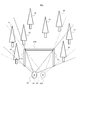
- FIG. 2 is a conceptual diagram for explaining a display image that follows the viewpoint position.
- This is a conceptual diagram of the exercise equipment 10 as viewed from above.
- the objects 21 to 28 are virtual objects arranged in the reference coordinate system displayed as a display image on the screens 17A to 17C. It is assumed that the viewpoint position 19A moves left and right as shown by the solid line and the broken line in FIG. 2 when the user 19 performs the bicycle riding motion.
- the viewpoint position 19A moves as shown in FIG. 2, the images to be displayed on the screens of the screens 17A, 17B, and 17C change.
- the viewpoint position 19A is on the left side (solid line)
- the entire object 22 is displayed on the screen 17A
- the viewpoint position 19A is on the right side (broken line)
- the object 22 is displayed so as to straddle the screen 17A and the screen 17B. Will be done.
- the measuring device 12 of the present embodiment includes an imaging unit that captures an image of a region including the head of the user 19 and a calculation unit that determines the viewpoint position 19A based on the position of the head of the user 19 imaged by the imaging unit. It is a structure to have.
- the imaging unit is realized by the sensor 16 shown in FIG.
- the calculation unit is realized by the information processing device 14 shown in FIG.
- the sensor 16 (imaging unit) is a depth sensor that measures the depth from the sensor 16 to an object (here, the human body of the user 19) in each pixel.
- the calculation unit realized by the information processing device 14 estimates the shape of the human body based on the depth of each pixel measured by the sensor 16, and calculates the viewpoint position 19A based on the position of the head in the human body. According to this, since the human body shape is estimated from the depth of each pixel and the position of the head in the human body shape is used, the viewpoint position is highly accurate even if the position and orientation of the user 19's body change variously due to movement. Can be identified by.
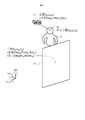
- FIG. 3 is a conceptual diagram for explaining the calculation of the viewpoint position.
- the position (x s , y s , z s ) and posture (Yaw s , Pitch s , Roll s ) of the sensor 16 in the reference coordinate system are preset.
- the coordinates (x h , y h , z h ) of the viewpoint position 19A can be calculated from the depth of each pixel acquired by the sensor 16 and the position and orientation of the sensor 16. As shown in FIG.
- the position in the reference coordinate system of the screen 17B (x m, y m, z m), posture (Yaw m, Pitch m, Roll m), and shape (Heght m, Width m) also It is preset.
- the positions, postures, and shapes of the screens 17A and 17C are preset.
- the image captured by the sensor 16 may be a depth image, a depth image, and a visible image.
- the imaging unit may include a sensor that captures a depth image and a camera that captures a visible image, and the calculation unit may calculate the viewpoint position 19A using both the depth image and the visible image.
- the senor 16 is installed behind the user 19, but it is also possible to arrange the sensor 16 in front of the user 19 at a position that does not overlap the screen 17.
- the calculation unit estimates the shape of the human body based on the depth of each pixel acquired by the sensor 16, and calculates the viewpoint position 19A based on the position of the head in the human body, but other configurations are used. Is also possible.
- the sensor 16 is located higher than the head of the user 19, and the calculation unit extracts a region of the head from the depth of each pixel acquired by the sensor 16 and bases the region on the image. The position of the head may be calculated, and the viewpoint position 19A may be calculated based on the position of the head.
- the viewpoint position can be determined even if the camera moves.
- the installation position of the sensor 16 and the process of calculating the viewpoint position 19A can be arbitrarily combined.
- the image device 13 includes a screen 17 that extends to a predetermined range including the front surface of the user 19, and a projection device 15 (projector) that projects a display image on the screen 17.
- the front surface of the user 19 here means a direction fixed in advance as the direction in which the face faces when the user 19 is using the exercise device 11, and changes even if the user 19 moves. Not a person (hereinafter, the same applies).
- this configuration is an example, and other configurations are possible.
- the image device 13 may have a display device such as a liquid crystal or an organic EL that extends over a predetermined range including the front surface of the user 19.
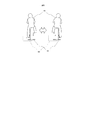
- FIG. 4 is a plan view showing an installation example of exercise equipment. Referring to FIG. 4, two exercise equipments 10 are installed side by side.
- the exercise equipment 10 has a front wall 31 in front of the user 19 and a side wall 32 that contacts the wall at a right angle of 90 degrees, and is surrounded by the front wall 31 and the side wall 32 on three sides. It has been.
- the image device 13 includes screens 17A to 17C extending over a predetermined range including the front surface of the user 19, and a projection device 15 (projector) located higher than the head of the user 19 and projecting a display image on the screens 17A to 17C.
- the front wall 31 and the side wall 32 continuously form the screens 17A, 17B, and 17C. According to this, since the screens 17A to 17C are continuously formed by the front wall 31 in front of the user 19 and the side walls 32 on the side, the user 19 has a lateral spread while suppressing the width of the equipment. It can provide images and give a high sense of presence and immersion.
- the projection device 15 is installed at a position higher than the head of the user 19 .
- one ultra-short throw projector capable of displaying an image on a large screen even if the distance to the screen is short is arranged at a position higher than the head of the user 19, and the screens of the front wall 31 and the side wall 32 are arranged.
- This is an example of projecting an image on 17A to 17C.
- a rear projection projector may be used to project a display image from behind the screen.
- a configuration may be adopted in which the degree of freedom in the relative position between the projector and the screen is improved by projecting the display image from the projector onto the screen via the mirror.
- the screen 17 is configured on the front surface and the three surfaces on both sides of the user 19 is shown here, other configurations are also possible.
- the screen 17 may be configured on any one or two or all of the ceiling, the floor, and the back of the user, and the screen 17 may be configured on four, five, or six sides.
- a plurality of projectors may be used. In that case, the same number of projectors as the number of flat screens may be used.
- three projectors may be arranged corresponding to the respective screens.
- the number of screens and the number of projectors do not have to match. For example, it is possible to project the display image on the three screens 17A to 17C by two projectors. It is also possible to project the display image on the three screens 17A to 17C with four projectors.
- two exercise equipments 10 are arranged side by side in the horizontal direction, and the two exercise equipments 10 share a side wall 32 between them, and the side wall 32 thereof. Both sides constitute a screen 17A of one exercise equipment 10 and a screen 17C of the other exercise equipment 10. According to this, it is possible to efficiently construct a plurality of exercise equipments 10 capable of providing the user 19 with an image spread in the lateral direction in a limited installation area.
- the fitness bike which is the exercise device 11 of the present embodiment is a device for performing an exercise simulating movement by exercise called a bicycle pedal, and is a notification based on the state of the user 19 and / or the state of the exercise device 11.
- the information is transmitted to the video device 13.
- This notification information is information regarding the distance traveled.
- the information regarding the travel distance is information that makes it possible to calculate the travel distance and the travel speed based on the information. Examples of information include a pulse signal generated each time the pedal is rotated, and a code signal indicating the rotation speed of the pedal, such as how many rotations per minute.
- the movement distance can be calculated from the pulse signal by defining that the movement is performed by a predetermined distance by one rotation of the pedal.
- the movement speed can be calculated based on the movement distance and the time required for the movement. Further, the moving speed can be calculated from the rotating speed of the pedal by defining that one rotation of the pedal moves by a predetermined distance. Then, the moving distance can be calculated based on the moving speed and the moving time.
- the video device 13 controls the displayed video based on the notification information received from the exercise device 11.
- the video device 13 calculates a moving speed from the notification information, and displays a display video as if the user 19 is moving in the virtual space at the moving speed. For example, the faster the moving speed obtained from the notification information, the faster the moving speed in the virtual space. According to this, since the state of the user and / or the exercise device can be reflected in the image, it is possible to enhance the sense of presence and immersiveness.
- the display image in which the user 19 is moving in the virtual space may be an image in which the scenery of the virtual space is moved, or an image with an image effect reminiscent of the movement.
- the image may be an image in which the scenery is moved and an image effect pronounced of the movement is applied.
- the displayed image in which the user 19 is moving in the virtual space does not have to be based on the moving speed or the moving distance calculated from the notification information. If there is movement based on the notification information, a display image that moves in the virtual space at a predetermined speed may be displayed.
- the image device 13 stops the movement in the virtual space when the user 19 stops moving and stops moving. At that time, the menu information prompting the next operation may be superimposed on the display image and displayed. Further, the video apparatus 13 may switch the scene of the displayed video when the predetermined notification information is received by the user 19 performing the predetermined exercise.
- the exercise equipment 10 provides a game to the user 19 as an example.
- the game of the present embodiment is a game in which the exercise device 11 performs the same exercise as the instructor running on a bicycle in the image on the screen 17. Specifically, this game is a game that utilizes the movement distance and movement speed of the movement of the user 19.
- the user 19 is a game in which the exercise device 11 performs a bicycle rowing exercise so that the instructor in the image travels by a predetermined target distance at a speed within a predetermined range of the speed of riding a bicycle. According to this game, the user 19 can naturally and effectively perform the exercise by rowing a bicycle so as to follow the instructor in the simulated scene.
- FIG. 5 is a flowchart showing the processing of the exercise game by the exercise equipment.
- the video device 13 starts displaying the game video at the start of the game (step S101).
- the video device 13 continuously displays a video of an object acting in a simulated scene seen by the user 19 as a game video on the screen 17.
- the image device 13 displays an image in which an anthropomorphized object runs on a bicycle in a simulated scene.
- the game image may be a live-action image or a CG (computer graphics) image.
- the video device 13 starts measuring the index value (step S102).
- the measured index value includes an index value according to the time when the state of the user 19 satisfies the behavior in the simulated scene of the object and the predetermined condition. Specifically, the video device 13 measures the play time and the synchronization distance. The play time is the elapsed time from the start of the game.
- the synchro distance is an example of an index value according to the time when the state of the user 19 satisfies the action in the simulated scene of the object and the predetermined condition, and the speed at which the user 19 pedals the exercise device 11 and the simulated distance. It is a cumulative value of the distance corresponding to the distance traveled by the user 19 on the bicycle during the time when the difference from the speed at which the object pedals the bicycle in the scene is equal to or less than a predetermined value.
- the rotation speed of the pedal of the object's bicycle is set as the speed at which the object rides the bicycle, and that is set as the target rotation speed.
- the target rotation speed is preset in the game.
- the target rotation speed may be a fixed value or a fluctuating value.
- the rotation speed of the pedal of the exercise device 11 is defined as the speed at which the user 19 pedals the pedal of the exercise device 11, and this is defined as the measured rotation speed. It is shown in the notification information transmitted from the exercise device 11 to the video device 13, or can be calculated from the notification information.
- the video apparatus 13 determines that the user 19 is synchronized with the object, and measures the time during which the user 19 is synchronized with the object as the synchronization time. ..
- the synchronization distance Lsin [m] can be calculated by the equation (1).
- Lsin l ⁇ Tsin ⁇ (R / 60).
- the equation (1) calculates the synchronization distance using the target rotation speed, but is not limited to this.
- the synchro distance may be calculated using the measured rotation speed instead of the target rotation speed.
- FIG. 6 is a diagram showing an example of a game image displayed by the image device.
- FIG. 6 shows screens 17A, 17B, and 17C of the image device 13.
- the screens 17A and 17C are actually arranged so as to surround the user 19 at an angle of 90 degrees with the screen 17B in front of the user 19 as described above, but in FIG. 6, the content of the image is shown. Is shown in a state of being opened in the same plane as the screen 17B so that is easy to see.
- screens 17A to 17C display anthropomorphic objects 41 simulating an instructor traveling on a bicycle in a simulated scene.
- the user 19 pedals the exercise device 11, the background image of the simulated scene moves accordingly.
- the user 19 rides a bicycle together with the object 41 in a simulated scene.
- a target rotation speed presentation unit 42 indicating the target rotation speed is displayed in the vicinity of the object 41.
- the target rotation speed is 60 [rpm].
- an actually measured rotation speed presenting unit 43 indicating the actually measured rotation speed is displayed in the lower right region of the screen 17B.
- the game status display unit 44 is displayed in the upper right area of the screen 17B.
- the game status display unit 44 displays a synchronized distance and a distance (target distance) to be traveled at a speed within a predetermined range of the instructor's speed.
- the sync distance is 589 [m] and the target distance is 3000 [m].
- the video apparatus 13 determines whether or not the synchro distance Lsin has reached a predetermined target distance (threshold value Lth) (step S103). If the synchro distance Lsyn has reached the target distance Lth, the video apparatus 13 determines that the game is cleared and displays that fact (step S104).
- the video apparatus 13 determines whether or not the play time Tple has reached the time limit (threshold value Tmax) (step S105). If the play time Tple has reached the time limit Tmax, the video apparatus 13 determines that the game is over and displays that fact (step S106).
- the video apparatus 13 continuously displays the object 41 that acts in the simulated scene seen by the user 19, and the state of the user 19 is the simulated scene of the object 41.
- the index value is measured according to the action and the time when the predetermined condition is satisfied, and when the index value reaches the predetermined value, the end of the exercise is displayed in a simulated scene.
- the video device 13 changes the screen display according to the fact that the viewpoint position 19A of the user 19 goes out of the predetermined range, for example, during the game. For example, when the user stops exercising or stops the exercise device 11, the image is stopped or a predetermined image including a menu or other text is displayed in conjunction with the movement. Since the screen display can be changed when the user 19 gets off the exercise device 11, the convenience of the exercise equipment 10 can be enhanced.
- the object may mimic an instructor leading a user 19 on a motorcycle.
- the object may be a model of an istractor who is in a car traveling in front of the user 19 and calls out to the user 19.
- the object does not have to be anthropomorphic.
- the object of the marker targeted by the user 19 may be displayed.
- a plurality of objects may be displayed.
- the object 41 performs substantially the same action as the user 19 in a simulated scene.
- the user 19 can easily perform the exercise by imitating the behavior of the object 41 in the simulated scene.
- the exercise device 11 is a fitness bike for causing the user 19 to perform an exercise simulating running by a bicycle.
- the image device 13 displays the object 41 traveling by the bicycle in a simulated scene, and measures and measures the speed at which the user 19 pedals the speed at which the object 41 pedals the bicycle and the time when a predetermined condition is satisfied. When the time reaches a predetermined time, the object displays the end of the bicycle running in a simulated scene.
- the image device 13 may display an image in which the object 41 prompts the user 19 to adjust the speed according to the difference between the speed at which the user 19 pedals and the speed at which the object 41 pedals.
- the measuring device 12 identifies as an instruction action that the user 19 has tilted a predetermined part of the body (for example, the neck or the torso) or the exercise device 11, or has tilted the handle of the exercise device 11, and the image device 13 has After the instruction action is specified, the image of the simulated scene seen by the user 19 when the user 19's bicycle is made to perform a predetermined movement in the simulated scene may be displayed.
- the measuring device 12 may estimate the shape of the human body based on the image of the depth acquired by the sensor 16 and specify that the predetermined portion is tilted based on the shape of the human body.
- the measuring device 12 estimates the shape of the moving device 11 based on the depth image acquired by the sensor 16, and based on the shape, it may be specified that the moving device 11 or the handle of the moving device 11 is tilted. ..
- the measuring device 12 indicates that the user 19 has tilted a predetermined part of the body (for example, the neck or the body) or the exercise device 11, or has tilted the handle of the exercise device 11, and indicates the tilted direction.
- the image device 13 may move the user 19's bicycle in the direction instructed by the direction instruction action in the simulated scene. For example, the lateral position of the user 19's bicycle on the course can be changed, and actions such as avoiding obstacles and overtaking can be performed.
- the measuring device 12 identifies that the user 19 stands up on the pedal of the exercise device 11, and the video device 13 identifies that when the user 19 stands up on the pedal, the user 19 takes a predetermined action in a simulated scene.
- the image of the pseudo scene seen from 19 may be displayed.
- the behavior of the user 19 on the exercise device 11 such as a fitness bike is restricted.
- the user 19 can be made to act in a simulated scene by the action of standing up on the pedal. For example, in a simulated scene, it is possible to simulate an action such as reaching out and grabbing an object on the course.
- the video apparatus 13 of a certain exercise equipment 10 transmits the own user information based on the state of its own user (own user) 19 to the other exercise equipment 10, and the other exercise equipment 10 to the other exercise equipment 10 It is also possible to receive other user information based on the state of the user (other user) 19 and display an object that acts in a pseudo scene seen from the own user 19 based on the other user information.
- the transmission / reception of the own user information and the other user information may be realized by any communication means such as wired or wireless communication or a combination thereof.
- the plurality of exercise facilities 10 may be adjacent to each other or may be located at a remote location.
- the screen 17A and the screen 17B form an angle of 90 degrees and the screen 17C and the screen 17B form an angle of 90 degrees is illustrated, but other configurations are also possible.
- the screen includes partial screens on a plurality of planes forming a predetermined angle with each other, and the image device 13 looks at each of the plurality of planes when an object is viewed through the partial screens on the planes. Is generated by following the movement of the viewpoint position 19A, and the display image is displayed on a partial screen on a plane. Since a wide-angle image is provided to the user by using a plurality of flat screens having a predetermined angle, it is possible to give the user a high sense of presence and immersion during exercise.
- the plurality of planes are not limited to the three illustrated in the present embodiment. Two or four or more flat screens may be used.
- the image device 13 generates a display image following the viewpoint position 19A, but the followability may be different between the horizontal direction and the vertical direction.
- the measuring device 12 measures the viewpoint position 19A as three-dimensional coordinates including a two-dimensional position on the horizontal plane and a position in the height direction.
- the image device 13 may generate a display image by a follow-up process with respect to the viewpoint position 19A, which is different between the horizontal plane of the viewpoint position 19A and the height direction.
- the horizontal head movement due to muscular strength may exhibit different characteristics from the vertical head movement affected by gravity as well as muscular strength.
- the image device 13 stores in advance a three-dimensional image representing a three-dimensional object in the virtual space as an original image in the internal storage device, and the three-dimensional object in the virtual space is stored for the user 19.
- a display image is generated from a three-dimensional image by a process that makes it look like an accurate and natural image so as to give the illusion that it exists there, but as a modification, the display image is the difference between the left and right eyes. It may be a three-dimensional image consisting of two images given the above.
- the image device 13 includes a display device that displays a display image on the screen and a three-dimensional eyeglass device worn by the user, and the display devices are two for the left and right eyes having parallax according to the viewpoint position 19A.
- the three-dimensional spectacle device displays two display images to the left and right eyes of the user 19, respectively.
- the left and right eyes parallax the image corresponding to the viewpoint position 19A of the user 19, it is possible to give the user 19 a stereoscopic effect of the image and give a higher sense of presence and immersion.
- the display device and the three-dimensional image system of the three-dimensional glasses according to this modification are not particularly limited.
- it may be an anaglyph type, a polarized type, or a liquid crystal shutter type.
- three-dimensional glasses do not give anxiety or discomfort like a head-mounted display.
- the image device 13 illustrates a configuration in which one projection device 15 projects a display image on three screens 17A, 17B, and 17C.
- the second embodiment an example in which three projection devices are used is shown.
- the configuration and operation of the exercise equipment of the second embodiment are basically the same as those of the first embodiment, but the configuration having three projection devices and the operation related to the configuration are the same as those of the first embodiment. Different from the one.
- the points different from the first embodiment in the second embodiment will be mainly described.
- FIG. 7 is a plan view for explaining the exercise equipment according to the second embodiment.
- the exercise equipment 10 of the present embodiment includes three projection devices 51A, 52B, and 53C.
- the projection device 51A projects a display image on the screen 17A.
- the projection device 51B projects a display image on the screen 17B.
- the projection device 51C projects a display image on the screen 17C. Since the projection devices 51A, 51B, 51C project the respective images onto the screens 17A, 17B, 17C, a bright image can be displayed over a wide area.
- the image device 13 shows an example of calculating the moving distance and the moving speed based on the notification information about the moving distance from the moving device 11.
- the measuring device that identifies the viewpoint position of the user identifies the state of the user's movement and notifies the video device 13, and the video device 13 is the user notified from the measuring device 12.
- the movement distance and movement speed are calculated based on the state of exercise.
- the configuration and operation of the exercise equipment of the third embodiment are basically the same as those of the first embodiment, but the measuring device for specifying the viewpoint position of the user specifies the state of the user's movement and the image device.
- the configuration and operation of notifying 13 and calculating the moving distance and moving speed based on the state of movement of the user notified from the measuring device 12 are different from those of the first embodiment.
- the points different from the first embodiment in the third embodiment will be mainly described.
- the measuring device 12 captures a user 19 who is exercising by the exercising device 11 in order to specify the viewpoint position.
- the image data captured by the measuring device 12 is also used to identify the state of the user 19.
- the measuring device 12 also uses the image data obtained by capturing the image of the user 19 to acquire the state of the user 19 and the viewpoint position of the user 19, so that an efficient configuration realizes an exercise that gives a sense of presence and immersion. can do.
- the state of the user 19 referred to here includes a dynamic state and a static state of the user 19. As a dynamic state, it is possible to specify that the user 19 is performing a bicycle rowing motion and the rotation speed of the pedal at that time. Further, as a static state, the user 19 has separated the buttocks from the saddle, the user 19 has stopped exercising, the user 19 is on the exercise device 11, and the user 19 raises his hand. It is possible to specify that there is.
- the video device 13 displays on the screen of the screen 17 an image of the virtual space seen by the user 19, which changes according to the simulated movement of the user 19 in the movement simulating the movement based on the state of the user 19. Since the image that changes according to the movement of the user 19 in the pseudo world recognized from the imaged state of the user 19 is displayed on the screen, the world in the image is displayed to the user 19 as in the first embodiment. It can give you a sense of realism and immersiveness as if you were exercising in.
- the sensor 16 of the measuring device 12 measures the depth to the object (here, the user 19 and surrounding objects) in each pixel, and the information processing device 14 measures the depth of each pixel measured by the sensor 16. Identify the user's state based on. Since the state of the user 19 is specified by using the depth image, the state of the user 19 can be stably determined by suppressing the influence of the image displayed on the screen and the color of the wear of the user 19.
- the exercise equipment 10 of the present embodiment is equipment for the user 19 to perform exercises in which a specific part of the body is repeatedly operated. Specifically, the user 19 performs an operation of alternately raising and lowering both feet on a fitness bike.
- the calculation unit realized by the information processing device 14 identifies the state of the user 19 based on the depth value of the pixels in the predetermined region. Since the movement is recognized by the change in the depth value of the predetermined region due to the repetitive movement of a specific part, the repetitive movement can be stably recognized by suppressing the influence of the color and shape of the user's wear.
- the calculation unit specifies the state of the user 19 by an index value based on the sum of the depth values of the pixels in the region where the specific part enters and exits by the repetitive operation.
- the specific part here is the foot. Since the sum of the pixel values in the area where the predetermined part enters and exits due to the repetitive operation changes depending on whether the specific part is shown or not, the user's state can be specified based on the sum.
- FIG. 8 is a conceptual diagram for explaining a method of specifying the state of the user in the third embodiment.
- the depth value of the pixels changes in the area 60 near the pedal as the user 19's feet move in and out.
- the region in which the depth value of the pixel changes due to the movement of the user 19 is set in advance according to the movement device 11.
- the calculation unit specifies the user's state by an index value based on the sum of the depth values of the pixels in the area where the specific part (foot in FIG. 8) enters and exits by the repetitive motion of the user 19.
- the index value based on the sum of the depth values is, for example, the sum of the depth values or the average value of the depth values. Since the sum of the pixel values in the area where the predetermined part enters and exits due to the repetitive operation changes depending on whether the specific part is shown or not, the user's state can be specified based on the sum.
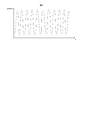
- FIG. 9 is a graph showing an example of the total sum of the depth values of the pixels in the area where the specific part of the user enters and exits.
- FIG. 9 is a graph showing the time change of the total depth value of each pixel in the region 60 when the user 19 is performing a bicycle rowing exercise. Since the maximum point and the minimum point appear periodically in the total value, it can be seen that the user 19 is rowing a bicycle at a constant speed.
- the rotation speed of the pedal can be calculated from the cycle. For example, the time from the maximum point to the maximum point via the minimum point represents the rotation cycle of the pedal.
- the state of the user 19 may be specified by an index value based on the sum of the pixel values such as RGB of a normal visible image such as a color image or a monochrome image of the area 60. If the foot of the user 19 moves in and out of the area 60, the sum of the pixel values changes, so that the state of the user 19 can be specified from the index value based on the sum of the pixel values. Further, if the marker is attached to the foot of the user 19 or the pedal of the exercise device 11, the accuracy of identifying the state of the user 19 from the pixel value of the normal visible image is improved.
- a marker As a marker, a reflector, an infrared LED (Light Emitting Diode), a two-dimensional bar code, or the like can be used. Further, the state of the user 19 may be specified by using both the depth value of each pixel in the depth image and the pixel value of each pixel in the visible image.
- the video device 13 uses the state of the user specified as described above for controlling the displayed video.
- the rotation speed of the pedal is used as the measured rotation speed in the above-mentioned game for the calculation of the synchronization time Tsync and the value displayed on the actually measured rotation speed presentation unit 43 (see FIG. 6) displayed on the screen 17.
- the measuring device 12 of the present embodiment may calibrate the parameters before the process of identifying the state of the user 19. For example, the user 19 may be urged to perform a bicycle rowing exercise before the start of the game, and suitable parameters may be acquired during that time.
- the calculation unit of the measuring device 12 acquires a substantial maximum value and a minimum value of the index value when the user 19 is exercising. After that, the calculation unit uses the acquired maximum value and minimum value to specify the state of the user 19.
- the substantial maximum value and the minimum value may be, for example, a threshold value at which it can be determined that the index value has reached the maximum point or the minimum point.
- a value obtained by subtracting a predetermined value from the maximum value may be used as a threshold value for determining that the index value has reached the maximum point.
- the value obtained by adding a predetermined value to the minimum value may be used as a threshold value for determining that the index value has reached the minimum point.
- the user's state since the actual maximum value and the minimum value of the index value are acquired and used to identify the user's state, the user's state even if there is a difference in the size of a specific part for each user or a difference in wear. Can be well identified.
- FIG. 10 is a schematic plan view of the exercise equipment according to the fourth embodiment.
- the exercise equipment 10 of the fourth embodiment is the first in that one curved screen 71 is used instead of the three screens 17A, 17B, 17C in the exercise equipment of the first embodiment shown in FIG. 1 Different from that of the embodiment.
- the fourth embodiment is the same as the first embodiment.
- the processing of the video apparatus 13 of the present embodiment is basically the same as that of the first embodiment.
- the image device 13 displays a display image of an object that imitates the appearance of an object in the virtual space of the reference coordinate system from the viewpoint position 19A via the screen of the fixed screen 71 to the viewpoint position 19A.
- the displayed image is displayed on the screen of the screen 71 fixed to the reference coordinate system.
- the screen 71 has a curved screen. More specifically, the screen 71 is shaped to include at least a portion of the circumferential inner surface of the cylinder surrounding the user 19's head.
- the video device 13 displays on the screen of the screen 71 a display video of an object in the virtual space that can be seen from the viewpoint position 19A via the respective screens.
- the image device 13 stores a three-dimensional image representing a three-dimensional object in the virtual space as an original image in advance in an internal storage device, and for the user 19, whether the three-dimensional object in the virtual space exists there.
- a display image is generated from a three-dimensional image by a process that makes it look like a reliable and natural image in order to give the illusion of.
- the image device 13 when the image device 13 generates an image to be displayed on the screen of the screen 71, the image device 13 projects a three-dimensional object in the virtual space defined in the three-dimensional data onto the screen of the screen 71, that is, a two-dimensional surface. Perform projective conversion.
- the video apparatus 13 has a screen including the front surface of the user 19 and surrounding at least a part of the periphery of the user 19, and when the object is viewed through the screen.
- a display image simulating the appearance of is generated by following the movement of the viewpoint position 19A, and the display image is displayed on the screen.
- the user 19 is provided with an image over a wide angle, and by controlling the displayed image following the viewpoint position 19A, the user 19 is irrespective of the shape of the screen. Since it is possible to display a natural image for the user 19, it is possible to give the user 19 during exercise a high sense of presence and immersion.
- the screen of the screen 71 includes a music screen covering at least a part of the circumferential direction of the cylindrical inner surface surrounding the head of the user 19, and the video apparatus 13 covers each part of the music screen.
- a display image that imitates the appearance when the object is viewed through the object is generated following the movement of the viewpoint position 19A, and the display image is displayed on each part of the song screen.
- FIG. 11 is a schematic configuration diagram of the exercise equipment according to the fifth embodiment.
- the exercise equipment 10 of the fifth embodiment is the first in that one curved screen 72 is used instead of the three screens 17A, 17B, 17C in the exercise equipment of the first embodiment shown in FIG. 1 Different from that of the embodiment.
- the fifth embodiment is the same as the first embodiment.
- the processing of the video apparatus 13 of the present embodiment is basically the same as that of the first embodiment.
- the image device 13 generates a display image of an object that imitates the appearance of an object in the virtual space of the reference coordinate system from the viewpoint position 19A via the fixed screen according to the viewpoint position 19A. Then, the displayed image is displayed on the screen of the screen 72 fixed to the reference coordinate system.
- the screen of the screen 72 has a shape including a curved screen covering at least a part of the spherical inner surface surrounding the head of the user 19.
- the video device 13 displays on the screen of the screen 72 a display video of an object in the virtual space that can be seen from the viewpoint position 19A via the respective screens.
- the image device 13 stores a three-dimensional image representing a three-dimensional object in the virtual space as an original image in advance in an internal storage device, and for the user 19, whether the three-dimensional object in the virtual space exists there.
- a display image is generated from a three-dimensional image by a process that makes it look like a reliable and natural image in order to give the illusion of.
- the image device 13 projects a three-dimensional object in the virtual space defined in the three-dimensional data onto the screen of the screen 72, that is, a two-dimensional surface. Perform projective conversion.
- the screen of the screen 72 includes a song screen covering at least a part of the spherical inner surface surrounding the head of the user 19, and when the video device 13 sees an object through each part of the song screen.
- a display image simulating the appearance of is generated by following the movement of the viewpoint position 19A, and the display image is displayed on each part of the song screen. Since the image over a wide angle is provided to the user 19 by using the music screen covering a part of the circumferential direction of the inner surface of the sphere, it is possible to give the user 19 a high sense of presence and immersion during exercise.
- the exercise device 11 is a fitness bike for performing a bicycle rowing exercise, but other configurations are also possible.
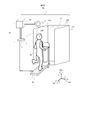
- the exercise device 11 is a treadmill for running or walking.
- FIG. 12 is a schematic configuration diagram of the exercise equipment according to the sixth embodiment.
- the exercise equipment 10 according to the sixth embodiment is different from the one according to the first embodiment in that it has an exercise device 81 instead of the exercise device 11.
- the sixth embodiment is basically the same as that of the first embodiment.
- the exercise device 81 is a device for running or walking on a step.
- the viewpoint position 19A of the user 19 is affected by gravity and the speed of the vertical motion is faster than that of the fitness bike of the first embodiment.
- the measuring device 12 measures the viewpoint position 19A as three-dimensional coordinates including the two-dimensional position on the horizontal plane and the position in the height direction
- the image device 13 measures the viewpoint position.
- a configuration is adopted in which a display image is generated by a follow-up process with respect to the viewpoint position 19A, which is different between the horizontal plane of 19A and the height direction.
- the movement of the head in the horizontal direction due to muscular strength and the movement of the head in the vertical direction, which is further affected by gravity, may exhibit different characteristics. By applying different tracking processes to them, it is possible to provide a more suitable image to the user.
- the image device 13 of the present embodiment makes the followability of the viewpoint position 19A in the height direction equal to the followability of the movement on the horizontal plane for a certain period of time immediately after the start of the movement. Then, in the meantime, the video apparatus 13 calculates a representative value of the height of the viewpoint position 19A. After a certain period of time has passed, the video apparatus 13 gradually reduces the followability to zero. When the followability is set to zero, the height of the viewpoint position 19A is fixed to the above representative value.
- the representative value of the viewpoint position 19A for example, the average value or the median value of the heights of the viewpoint position 19A at a predetermined time or a predetermined period may be used.
- the followability is reduced by multiplying the moving distance in the height direction of the viewpoint position 19A by a coefficient of 1 or less.
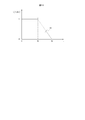
- FIG. 13 is a graph showing a control example of followability in the height direction.
- the graph of FIG. 13 shows the time change of the coefficient with respect to the moving distance in the height direction.
- the control is performed based on the time, but the control may be performed based on the mileage instead of the time.
- the image device 13 makes the followability of the viewpoint position 19A to the movement in the height direction lower than the followability to the movement on the horizontal plane, the vertical movement is more than the horizontal movement. It is possible to prevent the displayed image from being sensitively changed up and down when a fast movement is included.
- the video apparatus 13 equally follows the movement in the height direction of the viewpoint position 19A and the movement on the horizontal plane from the time when the user 19 starts running until it reaches a predetermined time or a predetermined distance, and the predetermined time or When the predetermined distance is reached, the followability in the height direction is lowered.
- the followability can be lowered when the user 19 becomes accustomed to the exercise in the exercise device 11, so that the followability can be naturally lowered while maintaining a sense of presence and immersion.
- the image device 13 determines a representative value in the height direction of the viewpoint position 19A based on the viewpoint position 19A measured by the measuring device 12, and fixes the position of the viewpoint position 19A in the height direction to the representative value. Generate a display image. As a result, the height of the viewpoint position 19A is fixed at an appropriate position, so that a natural image can be displayed due to the followability in the horizontal direction.
- the image device 13 shows an example in which a three-dimensional image representing a three-dimensional object in a virtual space is used as an original image, and a display image is generated and displayed from the three-dimensional image.
- a two-dimensional plane image is used as the original image is shown.
- a flat image is composed of frames of a plurality of flat images in a time series.
- the basic configuration of the exercise equipment 10 of the seventh embodiment is the same as that of the first embodiment shown in FIG.
- a flat image is an image for displaying on one flat surface like a normal movie image. If the flat image as it is is displayed over the screens 17A, 17B, and 17C, the image becomes unnatural for the user 19, and the sense of presence and immersiveness is lowered.
- the exercise equipment 10 of the present embodiment enhances the sense of presence and immersiveness by performing a predetermined process on a flat image.
- FIG. 14 is a conceptual diagram for explaining the generation of the display image in the seventh embodiment. This is a conceptual diagram of the exercise equipment 10 as viewed from above.
- the image device 13 attaches the flat screen included in the flat image as a texture to the surface of the virtual object 101 for image conversion in the virtual space, and screens from the viewpoint position 19A specified by the measuring device 12.
- Each display screen that imitates the appearance when the virtual object 101 for image conversion is viewed via 17A, 17B, and 17C is generated, and each display screen is displayed on each of the screens 17A, 17B, and 17C.
- the screens 17A, 17B, and 17C are arranged so as to include the front surface of the user 19 and surround at least a part of the periphery of the user 19.
- the image conversion virtual object 101 is an object having a curved surface whose side portion is curved toward the side where the user 19 is located, and the image device 13 performs a process of pasting a flat image as a texture on the curved surface. By doing so, it is possible to display an image surrounding the user 19 according to the viewpoint position 19A of the user 19, and it is possible to give the user 19 a high sense of presence and immersion.
- the image device 13 may be fixed at the viewpoint position 19A once obtained by the measuring device 12 and generate a display screen that imitates the appearance when viewed from the viewpoint position 19A.
- the measuring device 12 continuously measures the viewpoint position 19A, and the video device 13 generates a display image following the viewpoint position 19A and displays it on the screens of the screens 17A, 17B, and 17C.
- the flat image referred to here may be, for example, a live-action image taken by a camera, or may be a two-dimensional image obtained by pre-rendering a three-dimensional image. It may also be an image (mirrored image) captured in real time from an external device such as a camera, tablet, smartphone, or personal computer.
- a 360-degree image that is, a live-action image taken by a 360-degree camera and a flat image pre-rendered as a 360-degree image
- a screen image for display on a normal flat screen may be used.
- the present embodiment shows an example in which the displayed image is displayed on the screens 17A, 17B, and 17C which are connected at a right angle of 90 degrees to each other, other configurations are also possible.
- the image device 13 has a screen including the front surface of the user 19 and surrounds at least a part of the periphery of the user 19, and displays a display image simulating the appearance when an object is viewed through the screen at the viewpoint position 19A. It may be generated accordingly and the displayed image may be displayed on the screen. For example, the image may be displayed on the screen 71 of the fourth embodiment shown in FIG. 10, or the image may be displayed on the screen 72 of the fifth embodiment shown in FIG.
- the video apparatus 13 has shown an example in which video data of the original video is stored in advance, and a display video is generated from the original video and displayed.
- the video apparatus 13 has an external input interface for video signals, and generates and displays a display video in real time from the original video input from the external input interface.
- the exercise equipment 10 of the eighth embodiment is different from the first embodiment in that the video device 13 has the external input interface, but other basic configurations are the same as those of the first embodiment.
- the original video input from the external interface may be a three-dimensional video similar to that of the first embodiment, or a flat video similar to that of the seventh embodiment.
Landscapes
- Engineering & Computer Science (AREA)
- Multimedia (AREA)
- Health & Medical Sciences (AREA)
- Physics & Mathematics (AREA)
- General Physics & Mathematics (AREA)
- Theoretical Computer Science (AREA)
- Human Computer Interaction (AREA)
- General Health & Medical Sciences (AREA)
- Computer Vision & Pattern Recognition (AREA)
- Physical Education & Sports Medicine (AREA)
- Signal Processing (AREA)
- Psychiatry (AREA)
- Social Psychology (AREA)
- Cardiology (AREA)
- Vascular Medicine (AREA)
- Processing Or Creating Images (AREA)
Priority Applications (2)
| Application Number | Priority Date | Filing Date | Title |
|---|---|---|---|
| EP20796345.5A EP3960255A4 (en) | 2019-04-26 | 2020-04-22 | EXERCISE EQUIPMENT |
| US17/604,687 US12268947B2 (en) | 2019-04-26 | 2020-04-22 | Exercise equipment |
Applications Claiming Priority (2)
| Application Number | Priority Date | Filing Date | Title |
|---|---|---|---|
| JP2019-085104 | 2019-04-26 | ||
| JP2019085104A JP7060544B6 (ja) | 2019-04-26 | 2019-04-26 | 運動用設備 |
Publications (1)
| Publication Number | Publication Date |
|---|---|
| WO2020218368A1 true WO2020218368A1 (ja) | 2020-10-29 |
Family
ID=72942499
Family Applications (1)
| Application Number | Title | Priority Date | Filing Date |
|---|---|---|---|
| PCT/JP2020/017381 Ceased WO2020218368A1 (ja) | 2019-04-26 | 2020-04-22 | 運動用設備 |
Country Status (4)
| Country | Link |
|---|---|
| US (1) | US12268947B2 (https=) |
| EP (1) | EP3960255A4 (https=) |
| JP (3) | JP7060544B6 (https=) |
| WO (1) | WO2020218368A1 (https=) |
Cited By (3)
| Publication number | Priority date | Publication date | Assignee | Title |
|---|---|---|---|---|
| US20220161120A1 (en) * | 2020-11-25 | 2022-05-26 | Saga Holographic, Inc. | Exercise apparatus with integrated holographic display |
| JPWO2023027046A1 (https=) * | 2021-08-26 | 2023-03-02 | ||
| US20240286005A1 (en) * | 2020-11-25 | 2024-08-29 | Saga Holographic, Inc. | Exercise apparatus with integrated holographic display |
Families Citing this family (6)
| Publication number | Priority date | Publication date | Assignee | Title |
|---|---|---|---|---|
| CN113230584A (zh) * | 2021-04-19 | 2021-08-10 | 陕西天朗嘉业科技发展有限公司 | 一种光影跑步健身系统 |
| JP7673504B2 (ja) * | 2021-06-03 | 2025-05-09 | 株式会社セガ | シミュレーション装置 |
| JP7210791B1 (ja) | 2022-03-18 | 2023-01-23 | 株式会社WisH Lab | 運動支援システム |
| JP2024047185A (ja) * | 2022-09-26 | 2024-04-05 | 株式会社リコー | 情報処理システム、情報処理方法及びプログラム |
| JP7849798B2 (ja) * | 2023-06-29 | 2026-04-22 | グリーホールディングス株式会社 | 情報処理装置、情報処理方法、及びプログラム |
| US20260102653A1 (en) * | 2024-10-16 | 2026-04-16 | Gamer Cycle Fitness Inc. | Exercise cycle with desktop for playing console video games |
Citations (7)
| Publication number | Priority date | Publication date | Assignee | Title |
|---|---|---|---|---|
| JP2000296185A (ja) | 1999-02-12 | 2000-10-24 | Nabco Ltd | トレーニングシステム |
| JP2011097988A (ja) | 2009-11-04 | 2011-05-19 | Pioneer Electronic Corp | トレーニング支援装置 |
| US9201499B1 (en) * | 2013-02-11 | 2015-12-01 | Amazon Technologies, Inc. | Object tracking in a 3-dimensional environment |
| US9204121B1 (en) * | 2012-11-26 | 2015-12-01 | Amazon Technologies, Inc. | Reflector-based depth mapping of a scene |
| JP2017526078A (ja) * | 2014-05-09 | 2017-09-07 | グーグル インコーポレイテッド | 実在および仮想のオブジェクトと対話するための生体力学ベースの眼球信号のためのシステムおよび方法 |
| WO2017177187A1 (en) * | 2016-04-08 | 2017-10-12 | Vizzario, Inc. | Methods and systems for obtaining. analyzing, and generating vision performance data and modifying media based on the data |
| JP2018056924A (ja) * | 2016-09-30 | 2018-04-05 | 匡佑 安本 | 画像表示装置、及びこれを用いた仮想現実インタフェースデバイス |
Family Cites Families (21)
| Publication number | Priority date | Publication date | Assignee | Title |
|---|---|---|---|---|
| JPS6125577A (ja) | 1984-07-13 | 1986-02-04 | 株式会社 ユニバ−サル | トレ−ニング用自転車 |
| US8306635B2 (en) | 2001-03-07 | 2012-11-06 | Motion Games, Llc | Motivation and enhancement of physical and mental exercise, rehabilitation, health and social interaction |
| JP2003102868A (ja) | 2001-09-28 | 2003-04-08 | Konami Co Ltd | 運動支援方法及びその装置 |
| US8123527B2 (en) * | 2006-10-31 | 2012-02-28 | Hoelljes H Christian | Active learning device and method |
| US20090135133A1 (en) * | 2007-11-26 | 2009-05-28 | Kunzler Patrik A | 3D Motion Control System and Method |
| KR100938922B1 (ko) * | 2009-06-26 | 2010-01-27 | (주)이랜서 | 트레드밀 시스템 및 그 구동 방법 |
| US8206266B2 (en) * | 2009-08-05 | 2012-06-26 | David Hall | Sensor, control and virtual reality system for a trampoline |
| JP5307060B2 (ja) * | 2010-03-12 | 2013-10-02 | 株式会社コナミデジタルエンタテインメント | 画像処理装置、画像処理方法、ならびに、プログラム |
| JP2011215968A (ja) * | 2010-03-31 | 2011-10-27 | Namco Bandai Games Inc | プログラム、情報記憶媒体及び物体認識システム |
| US9235765B2 (en) * | 2010-08-26 | 2016-01-12 | Blast Motion Inc. | Video and motion event integration system |
| WO2013058978A1 (en) * | 2011-10-17 | 2013-04-25 | Kimmel Zebadiah M | Method and apparatus for sizing and fitting an individual for apparel, accessories, or prosthetics |
| US10231662B1 (en) * | 2013-01-19 | 2019-03-19 | Bertec Corporation | Force measurement system |
| JP2015184986A (ja) * | 2014-03-25 | 2015-10-22 | 学校法人 創価大学 | 複合現実感共有装置 |
| JP6550307B2 (ja) * | 2015-09-11 | 2019-07-24 | 大和ハウス工業株式会社 | 画像表示システム及び画像表示方法 |
| JP6668660B2 (ja) | 2015-09-30 | 2020-03-18 | 株式会社リコー | 情報処理装置およびシステム |
| JP6798106B2 (ja) * | 2015-12-28 | 2020-12-09 | ソニー株式会社 | 情報処理装置、情報処理方法、およびプログラム |
| JP6362634B2 (ja) * | 2016-02-05 | 2018-07-25 | 株式会社バンダイナムコエンターテインメント | 画像生成システム、ゲーム装置及びプログラム |
| JP6841241B2 (ja) * | 2016-02-08 | 2021-03-10 | ソニー株式会社 | 情報処理装置、情報処理方法、およびプログラム |
| WO2018100800A1 (ja) | 2016-11-29 | 2018-06-07 | ソニー株式会社 | 情報処理装置及び情報処理方法、並びにコンピュータ・プログラム |
| US10839607B2 (en) * | 2019-01-07 | 2020-11-17 | Disney Enterprises, Inc. | Systems and methods to provide views of a virtual space |
| RU2696754C1 (ru) * | 2019-02-11 | 2019-08-05 | Общество с ограниченной ответственностью "ДВИЖЕНИЕ РЕАЛЬНОСТЬ" (ООО "ДВИЖЕНИЕ РЕАЛЬНОСТЬ") | Беговой тренажёр с системой виртуальной реальности и способ его работы |
-
2019
- 2019-04-26 JP JP2019085104A patent/JP7060544B6/ja active Active
-
2020
- 2020-04-22 US US17/604,687 patent/US12268947B2/en active Active
- 2020-04-22 WO PCT/JP2020/017381 patent/WO2020218368A1/ja not_active Ceased
- 2020-04-22 EP EP20796345.5A patent/EP3960255A4/en not_active Withdrawn
-
2022
- 2022-04-14 JP JP2022066835A patent/JP7399503B2/ja active Active
-
2023
- 2023-11-29 JP JP2023201260A patent/JP2024012699A/ja active Pending
Patent Citations (7)
| Publication number | Priority date | Publication date | Assignee | Title |
|---|---|---|---|---|
| JP2000296185A (ja) | 1999-02-12 | 2000-10-24 | Nabco Ltd | トレーニングシステム |
| JP2011097988A (ja) | 2009-11-04 | 2011-05-19 | Pioneer Electronic Corp | トレーニング支援装置 |
| US9204121B1 (en) * | 2012-11-26 | 2015-12-01 | Amazon Technologies, Inc. | Reflector-based depth mapping of a scene |
| US9201499B1 (en) * | 2013-02-11 | 2015-12-01 | Amazon Technologies, Inc. | Object tracking in a 3-dimensional environment |
| JP2017526078A (ja) * | 2014-05-09 | 2017-09-07 | グーグル インコーポレイテッド | 実在および仮想のオブジェクトと対話するための生体力学ベースの眼球信号のためのシステムおよび方法 |
| WO2017177187A1 (en) * | 2016-04-08 | 2017-10-12 | Vizzario, Inc. | Methods and systems for obtaining. analyzing, and generating vision performance data and modifying media based on the data |
| JP2018056924A (ja) * | 2016-09-30 | 2018-04-05 | 匡佑 安本 | 画像表示装置、及びこれを用いた仮想現実インタフェースデバイス |
Non-Patent Citations (6)
| Title |
|---|
| "HOLOFIT (registered trademark", FUN AND BODY, 19 March 2019 (2019-03-19), Retrieved from the Internet <URL:https//www.funandbody.com/wp-content/uploads/2017/07/05a3b4350d60984d4ba358da5d52b3ee.pdf>> |
| "ICAROS PRO (ICAROS is a registered trademark", ICAROS GMBH, 19 March 2019 (2019-03-19), Retrieved from the Internet <URL:https://www.icaros.com/en/products/icaros-pro/>> |
| "THE TRIP (registered trademark", LESMILLS, 19 March 2019 (2019-03-19), Retrieved from the Internet <URL:https://www.lesmills.com/workouts/fitness-classes/the-trip/>> |
| "VirZOOM", VIRZOOM, 19 March 2019 (2019-03-19), Retrieved from the Internet <URL:https://www.virzoom.com/>> |
| ANONYMOUS: "Immersive Space Entertainment Music Visualizer & Cyber gym", 19 May 2017 (2017-05-19), pages 1 - 7, XP055752765, Retrieved from the Internet <URL:https://www.sony.co.jp/Sonylnfo/design/stories/immersivespace> [retrieved on 20200604] * |
| See also references of EP3960255A4 |
Cited By (6)
| Publication number | Priority date | Publication date | Assignee | Title |
|---|---|---|---|---|
| US20220161120A1 (en) * | 2020-11-25 | 2022-05-26 | Saga Holographic, Inc. | Exercise apparatus with integrated holographic display |
| US11931641B2 (en) * | 2020-11-25 | 2024-03-19 | Saga Holographic, Inc. | Exercise apparatus with integrated holographic display |
| US20240286005A1 (en) * | 2020-11-25 | 2024-08-29 | Saga Holographic, Inc. | Exercise apparatus with integrated holographic display |
| JPWO2023027046A1 (https=) * | 2021-08-26 | 2023-03-02 | ||
| WO2023027046A1 (ja) * | 2021-08-26 | 2023-03-02 | 株式会社CaTe | プログラム、情報処理装置、および情報処理方法 |
| JP7411945B2 (ja) | 2021-08-26 | 2024-01-12 | 株式会社CaTe | プログラム、情報処理装置、および情報処理方法 |
Also Published As
| Publication number | Publication date |
|---|---|
| JP7060544B6 (ja) | 2022-05-23 |
| JP7399503B2 (ja) | 2023-12-18 |
| US20220203206A1 (en) | 2022-06-30 |
| EP3960255A4 (en) | 2023-01-11 |
| JP7060544B2 (ja) | 2022-04-26 |
| JP2022092045A (ja) | 2022-06-21 |
| JP2024012699A (ja) | 2024-01-30 |
| JP2020178973A (ja) | 2020-11-05 |
| US12268947B2 (en) | 2025-04-08 |
| EP3960255A1 (en) | 2022-03-02 |
Similar Documents
| Publication | Publication Date | Title |
|---|---|---|
| JP7060544B6 (ja) | 運動用設備 | |
| US12474767B2 (en) | Massive simultaneous remote digital presence world | |
| JP7454544B2 (ja) | 拡張現実及び仮想現実画像を生成するためのシステム及び方法 | |
| TWI786701B (zh) | 用於在hmd環境中利用傳至gpu之預測及後期更新的眼睛追蹤進行快速注視點渲染的方法及系統以及非暫時性電腦可讀媒體 | |
| US9599821B2 (en) | Virtual reality system allowing immersion in virtual space to consist with actual movement in actual space | |
| JP2023501079A (ja) | 共有人工現実環境における同じ場所での姿勢推定 | |
| US5577981A (en) | Virtual reality exercise machine and computer controlled video system | |
| Waltemate et al. | Realizing a low-latency virtual reality environment for motor learning | |
| CN106664401A (zh) | 用于在与内容交互时向用户提供反馈的系统和方法 | |
| JP2000033184A (ja) | 全身動作入力型のゲ―ム及びイベント装置 | |
| JP6200023B1 (ja) | シミュレーション制御装置及びシミュレーション制御プログラム | |
| KR20130061538A (ko) | 가상현실 기반 콘텐츠 제공장치 및 그 방법 | |
| TWI683687B (zh) | 雲端虛擬實境之運動健身機系統 | |
| Lou et al. | Reducing cybersickness by geometry deformation | |
| JP6820299B2 (ja) | プログラム、情報処理装置、および方法 | |
| KR101829656B1 (ko) | 증강된 가상현실을 이용하는 융합공간 기반의 무동력 승마장치 및 방법 | |
| US20240346736A1 (en) | Information processing device, information processing method, and program | |
| JP2020181123A (ja) | カラオケ演出システム | |
| JP2026014461A (ja) | 情報処理装置、情報処理装置の制御方法およびプログラム | |
| CHARDONNET et al. | Reducing Cybersickness by Geometry Deformation | |
| Broneder | Development and evaluation of a virtual reality adventure game for the virtualizer | |
| Zhang | Improving navigation and spatial judgments in head-mounted displays |
Legal Events
| Date | Code | Title | Description |
|---|---|---|---|
| 121 | Ep: the epo has been informed by wipo that ep was designated in this application |
Ref document number: 20796345 Country of ref document: EP Kind code of ref document: A1 |
|
| NENP | Non-entry into the national phase |
Ref country code: DE |
|
| ENP | Entry into the national phase |
Ref document number: 2020796345 Country of ref document: EP Effective date: 20211126 |
|
| WWG | Wipo information: grant in national office |
Ref document number: 17604687 Country of ref document: US |