WO2020203404A1 - 測定装置、測定方法、プログラム、及び、バイオセンサ - Google Patents
測定装置、測定方法、プログラム、及び、バイオセンサ Download PDFInfo
- Publication number
- WO2020203404A1 WO2020203404A1 PCT/JP2020/012673 JP2020012673W WO2020203404A1 WO 2020203404 A1 WO2020203404 A1 WO 2020203404A1 JP 2020012673 W JP2020012673 W JP 2020012673W WO 2020203404 A1 WO2020203404 A1 WO 2020203404A1
- Authority
- WO
- WIPO (PCT)
- Prior art keywords
- substrate
- sample
- response
- classifier
- measuring device
- Prior art date
- Legal status (The legal status is an assumption and is not a legal conclusion. Google has not performed a legal analysis and makes no representation as to the accuracy of the status listed.)
- Ceased
Links
Images




Classifications
-
- G—PHYSICS
- G01—MEASURING; TESTING
- G01N—INVESTIGATING OR ANALYSING MATERIALS BY DETERMINING THEIR CHEMICAL OR PHYSICAL PROPERTIES
- G01N27/00—Investigating or analysing materials by the use of electric, electrochemical, or magnetic means
- G01N27/26—Investigating or analysing materials by the use of electric, electrochemical, or magnetic means by investigating electrochemical variables; by using electrolysis or electrophoresis
- G01N27/28—Electrolytic cell components
- G01N27/30—Electrodes, e.g. test electrodes; Half-cells
- G01N27/327—Biochemical electrodes, e.g. electrical or mechanical details for in vitro measurements
-
- B—PERFORMING OPERATIONS; TRANSPORTING
- B01—PHYSICAL OR CHEMICAL PROCESSES OR APPARATUS IN GENERAL
- B01L—CHEMICAL OR PHYSICAL LABORATORY APPARATUS FOR GENERAL USE
- B01L3/00—Containers or dishes for laboratory use, e.g. laboratory glassware; Droppers
- B01L3/50—Containers for the purpose of retaining a material to be analysed, e.g. test tubes
- B01L3/502—Containers for the purpose of retaining a material to be analysed, e.g. test tubes with fluid transport, e.g. in multi-compartment structures
- B01L3/5027—Containers for the purpose of retaining a material to be analysed, e.g. test tubes with fluid transport, e.g. in multi-compartment structures by integrated microfluidic structures, i.e. dimensions of channels and chambers are such that surface tension forces are important, e.g. lab-on-a-chip
- B01L3/502715—Containers for the purpose of retaining a material to be analysed, e.g. test tubes with fluid transport, e.g. in multi-compartment structures by integrated microfluidic structures, i.e. dimensions of channels and chambers are such that surface tension forces are important, e.g. lab-on-a-chip characterised by interfacing components, e.g. fluidic, electrical, optical or mechanical interfaces
-
- C—CHEMISTRY; METALLURGY
- C12—BIOCHEMISTRY; BEER; SPIRITS; WINE; VINEGAR; MICROBIOLOGY; ENZYMOLOGY; MUTATION OR GENETIC ENGINEERING
- C12Q—MEASURING OR TESTING PROCESSES INVOLVING ENZYMES, NUCLEIC ACIDS OR MICROORGANISMS; COMPOSITIONS OR TEST PAPERS THEREFOR; PROCESSES OF PREPARING SUCH COMPOSITIONS; CONDITION-RESPONSIVE CONTROL IN MICROBIOLOGICAL OR ENZYMOLOGICAL PROCESSES
- C12Q1/00—Measuring or testing processes involving enzymes, nucleic acids or microorganisms; Compositions therefor; Processes of preparing such compositions
- C12Q1/02—Measuring or testing processes involving enzymes, nucleic acids or microorganisms; Compositions therefor; Processes of preparing such compositions involving viable microorganisms
- C12Q1/04—Determining presence or kind of microorganism; Use of selective media for testing antibiotics or bacteriocides; Compositions containing a chemical indicator therefor
-
- G—PHYSICS
- G01—MEASURING; TESTING
- G01N—INVESTIGATING OR ANALYSING MATERIALS BY DETERMINING THEIR CHEMICAL OR PHYSICAL PROPERTIES
- G01N27/00—Investigating or analysing materials by the use of electric, electrochemical, or magnetic means
- G01N27/26—Investigating or analysing materials by the use of electric, electrochemical, or magnetic means by investigating electrochemical variables; by using electrolysis or electrophoresis
- G01N27/28—Electrolytic cell components
- G01N27/30—Electrodes, e.g. test electrodes; Half-cells
- G01N27/327—Biochemical electrodes, e.g. electrical or mechanical details for in vitro measurements
- G01N27/3275—Sensing specific biomolecules, e.g. nucleic acid strands, based on an electrode surface reaction
-
- G—PHYSICS
- G01—MEASURING; TESTING
- G01N—INVESTIGATING OR ANALYSING MATERIALS BY DETERMINING THEIR CHEMICAL OR PHYSICAL PROPERTIES
- G01N27/00—Investigating or analysing materials by the use of electric, electrochemical, or magnetic means
- G01N27/26—Investigating or analysing materials by the use of electric, electrochemical, or magnetic means by investigating electrochemical variables; by using electrolysis or electrophoresis
- G01N27/416—Systems
- G01N27/417—Systems using cells, i.e. more than one cell and probes with solid electrolytes
-
- G—PHYSICS
- G01—MEASURING; TESTING
- G01N—INVESTIGATING OR ANALYSING MATERIALS BY DETERMINING THEIR CHEMICAL OR PHYSICAL PROPERTIES
- G01N27/00—Investigating or analysing materials by the use of electric, electrochemical, or magnetic means
- G01N27/26—Investigating or analysing materials by the use of electric, electrochemical, or magnetic means by investigating electrochemical variables; by using electrolysis or electrophoresis
- G01N27/416—Systems
- G01N27/49—Systems involving the determination of the current at a single specific value, or small range of values, of applied voltage for producing selective measurement of one or more particular ionic species
-
- G—PHYSICS
- G16—INFORMATION AND COMMUNICATION TECHNOLOGY [ICT] SPECIALLY ADAPTED FOR SPECIFIC APPLICATION FIELDS
- G16B—BIOINFORMATICS, i.e. INFORMATION AND COMMUNICATION TECHNOLOGY [ICT] SPECIALLY ADAPTED FOR GENETIC OR PROTEIN-RELATED DATA PROCESSING IN COMPUTATIONAL MOLECULAR BIOLOGY
- G16B40/00—ICT specially adapted for biostatistics; ICT specially adapted for bioinformatics-related machine learning or data mining, e.g. knowledge discovery or pattern finding
- G16B40/20—Supervised data analysis
-
- B—PERFORMING OPERATIONS; TRANSPORTING
- B01—PHYSICAL OR CHEMICAL PROCESSES OR APPARATUS IN GENERAL
- B01L—CHEMICAL OR PHYSICAL LABORATORY APPARATUS FOR GENERAL USE
- B01L2300/00—Additional constructional details
- B01L2300/06—Auxiliary integrated devices, integrated components
- B01L2300/0627—Sensor or part of a sensor is integrated
- B01L2300/0645—Electrodes
-
- G—PHYSICS
- G16—INFORMATION AND COMMUNICATION TECHNOLOGY [ICT] SPECIALLY ADAPTED FOR SPECIFIC APPLICATION FIELDS
- G16H—HEALTHCARE INFORMATICS, i.e. INFORMATION AND COMMUNICATION TECHNOLOGY [ICT] SPECIALLY ADAPTED FOR THE HANDLING OR PROCESSING OF MEDICAL OR HEALTHCARE DATA
- G16H50/00—ICT specially adapted for medical diagnosis, medical simulation or medical data mining; ICT specially adapted for detecting, monitoring or modelling epidemics or pandemics
- G16H50/20—ICT specially adapted for medical diagnosis, medical simulation or medical data mining; ICT specially adapted for detecting, monitoring or modelling epidemics or pandemics for computer-aided diagnosis, e.g. based on medical expert systems
-
- Y—GENERAL TAGGING OF NEW TECHNOLOGICAL DEVELOPMENTS; GENERAL TAGGING OF CROSS-SECTIONAL TECHNOLOGIES SPANNING OVER SEVERAL SECTIONS OF THE IPC; TECHNICAL SUBJECTS COVERED BY FORMER USPC CROSS-REFERENCE ART COLLECTIONS [XRACs] AND DIGESTS
- Y02—TECHNOLOGIES OR APPLICATIONS FOR MITIGATION OR ADAPTATION AGAINST CLIMATE CHANGE
- Y02A—TECHNOLOGIES FOR ADAPTATION TO CLIMATE CHANGE
- Y02A90/00—Technologies having an indirect contribution to adaptation to climate change
- Y02A90/10—Information and communication technologies [ICT] supporting adaptation to climate change, e.g. for weather forecasting or climate simulation
Definitions
- the present invention relates to a measuring device, a measuring method, a program, and a biosensor.
- Patent Document 1 describes a method for analyzing a bacterial flora by a T-RFLP (Terminal Restriction Fragment Length Polymorphisms) method from DNA (Deoxyribonuclic Acid) extracted from human gingival marginal and / or subgingival plaque. ..
- T-RFLP Terminal Restriction Fragment Length Polymorphisms
- Patent Document 1 The method described in Patent Document 1 is to extract DNA from a sample and perform microbiota analysis, and the operation is complicated. In addition, it was difficult to easily obtain microbiota information because specialized knowledge was required.
- a voltage application unit that applies a voltage between at least two electrodes arranged so as to contact a composite in which a sample containing a microorganism and a medium containing a substrate are in contact with each other, and the above voltage is applied.
- a measuring unit that measures the response when the test is performed, a storage unit that stores the classifier, an analysis output unit that applies the substrate and the response to the classifier and outputs microbiota information of the sample.
- the above classifier has microbiota information about known learning specimens, so that when the substrate used for the measurement and the obtained response are input, the microbiota information of the sample to be measured is output.
- a measuring device that is a classifier that has been trained in advance using training data including a substrate and a obtained response.
- the measuring apparatus wherein the substrate contained in the solid electrolyte is the substrate contained in the learning data.
- the response is measured by applying a voltage between at least two electrodes arranged so as to contact the composite in which the sample containing the microorganism and the medium containing the substrate are in contact with each other.
- the substrate and the response are applied to a classifier to obtain microbiota information of the sample, and the classifier is known to input the substrate used for the measurement and the obtained response.
- a measurement method which is a classifier pre-trained using learning data including microbiota information, substrates, and the resulting response for the sample.
- a voltage is applied to a computer between at least two electrodes arranged so as to be in contact with the composite in a composite in which a sample containing microorganisms and a medium containing the substrate are contacted. It is a program for executing a step of measuring a response and a step of applying the above substrate and the above response to a classifier to obtain microbiota information of the above sample, and the above classifier is a substrate used for measurement. When the obtained response is input, the information for estimating the microbiota of the sample to be measured is output for learning, including the microbiota information, the substrate, and the obtained response for the known learning sample.
- a program that is a classifier trained in advance using data.
- each of the solid electrolytes contains a different substrate.
- the present invention it is possible to provide a measuring device capable of easily obtaining microbiota information of a sample. Also according to the present invention, measurement methods, programs, and biosensors can be provided.
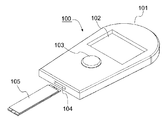
- FIG. 1 It is a perspective view which shows an example of the measuring apparatus which concerns on embodiment of this invention, and the biosensor which is loaded and used in the said measuring apparatus. It is an exploded perspective view of the biosensor which is loaded and used in the said measuring apparatus. It is an exploded perspective view of the biosensor which is loaded and used in the said measuring apparatus. It is a functional block diagram of the measuring apparatus which concerns on embodiment of this invention. This is a flow in which the control unit of the measuring device performs measurement according to a program stored in the storage unit. It is an electrochemical response of a solution containing a sample containing PG (Porphyromonas gingivalis) bacterium.
- PG Porphyromonas gingivalis
- the measurement unit that measures the response when a voltage is applied
- the storage unit that stores the classifier, the substrate, and the response to the classifier
- the microflora information of the sample is obtained. It has an analysis output unit that outputs data, and the classifier outputs information for estimating the microflora of the sample to be measured when the substrate used for measurement and the obtained response are input.
- a measuring device which is a classifier pre-trained using learning data including microflora information, substrates, and obtained responses for known learning samples.
- FIG. 1 is a perspective view showing an example of a measuring device according to an embodiment of the present invention (hereinafter, also referred to as “the present measuring device”) and a biosensor loaded and used in the measuring device.
- the measuring device 100 has a main body 101, a display unit 102, an operation button 103, and an insertion port 104 for loading the biosensor 105.
- the user can load the biosensor 105 via the insertion port 104 and operate the operation button 103 according to the display of the display unit 102 to perform a desired measurement.
- the biosensor 105 is typically disposable, and more accurate measurements can be made by using a new biosensor 105 for each measurement.
- the biosensor 105 is arranged so as to contact the cell 201, which is an area for introducing a sample, a medium, and / or a complex (hereinafter, also referred to as “solution”), and the complex introduced into the cell. It has a pair of electrodes 202 (composed of a first electrode 202a and a second electrode 202b).
- the cell 201 is defined by the support 208, the capillary substrate 205 arranged on the support 208, and the cover 207, and the solution is introduced from the introduction port 203 and circulates in the conduit portion 204 to flow through the cell 201. Introduced in. When introduced into cell 201, the solution comes into contact with electrode 202. Note that FIG. 2 shows the support 208 and the capillary substrate 205 without being separated, and FIG. 3 shows the support 208 and the capillary substrate 205 separated.
- the first electrode 202a and the second electrode 202b are electrically connected to the electrode pads 206a and 206b, respectively, and the biosensor 105 is loaded (inserted) into the main body 101 from the insertion port 104 shown in FIG.
- the electrode pads 206a and 206b are electrically connected to the circuit board arranged in the main body 101 via the connector portion arranged in the main body 101, and the voltage applying unit controlled by the control unit described later is used.
- a voltage is applied between the pair of electrodes 202, allowing the response from the composite to the applied voltage to be measured.
- the response is, for example, an electrochemical response such as a current value at a certain measurement time and a change with time of the current value, and may include, for example, the temperature of the complex in addition to the above.
- the above cell may be airtightly configured. If the cell is airtight, more favorable measurements may be possible.
- the method for forming the cell airtightly is not particularly limited, and a known method can be applied. For example, a method using a cell with a lid having a cell and a lid portion covering the opening of the cell can be mentioned.
- the thicknesses of the support 208, the capillary substrate 205, and the cover 207 are not particularly limited and can be appropriately selected, but from the viewpoint of easy handling, typically 0.1 ⁇ m to 10 mm is preferable.
- the biosensor 105 After the biosensor 105 is loaded in the main body 101, when the operator operates the operation button 103, the measurement is started.
- the identification number of the solution, the measurement conditions, the measurement result, and the like are displayed on the display unit 102.
- the biosensor 105 can be attached and detached, and the biosensor 105 can be replaced with a new one for each measurement, contamination for each measurement can be suppressed, and more accurate measurement can be performed.
- the measuring device according to the embodiment of the present invention is not limited to the above, and the biosensor 105 and the measuring device 100 may be integrally configured. When the biosensor and the main body are integrated, the structure of the measuring device is simpler, so that the manufacturing of the measuring device becomes easier.
- the measuring device has the operation button 103
- the measuring device according to the embodiment of the present invention is not limited to the above and does not have to have the operation button 103.
- the display unit 102 is provided with a touch panel, and the operator receives an instruction such as starting measurement via a GUI (Graphical User Interface) displayed on the screen of the display unit 102. You may.
- the biosensor 105 may be configured to automatically start the measurement when the biosensor 105 is loaded into the insertion port 104 of the main body 101 without having the operation button 103.
- this measuring device has a display unit 102, a series of steps from setting measurement conditions to displaying measurement results can be performed by one unit, and microbiota information can be easily obtained on-site. Can be obtained (in other words, microbiota analysis can be performed).
- the display unit may be a liquid crystal display, an organic EL (Electro Luminescence), or the like, and may further have a function as a touch panel.
- this measuring device has a temperature controller (not shown) in the main body 101.
- a temperature controller a heater or the like can be used. Since the measuring device 100 has a temperature controller, the measuring temperature can be maintained constant, and more accurate measurement results can be obtained.
- each part of the measuring device will be described in detail.
- the first electrode 202a is a working electrode and the second electrode 202b is a counter electrode, but the measuring device according to the embodiment of the present invention is not limited to the above.
- the second electrode 202b may be a reference electrode.
- the biosensor 105 may have yet another electrode (third electrode) so as to be in contact with the solution.
- the third electrode is preferably a reference electrode. That is, the first electrode 202a, the second electrode 202b, and the third electrode may be a working electrode, a counter electrode, and a reference electrode, respectively, or may be a working electrode and two reference electrodes. May be good.
- the measuring device having a reference electrode it becomes possible to measure the electrode potential, and a measuring device having a more excellent effect of the present invention can be obtained.
- a pair of electrodes combined in a key shape is shown, but the shape of the electrodes is not particularly limited to the above, and may be a comb-shaped electrode (interdigit electrode).
- These electrodes can be manufactured by a known method, and for example, the electrodes can be arranged in a pattern on the support by a photolithography method, a plating method, a printing method, or the like.
- the distance between the electrodes is not particularly limited, and may be a distance known as an electrochemical cell.
- the area of the electrode in contact with the solution is preferably 1 cm 2 or less in that electrochemical measurement can be performed with favorable sensitivity even with a smaller amount of solution (specifically, 0.001 to 5 ml).
- the electrode material is not particularly limited, and a known electrode material can be used.
- the electrode material include carbon, gold, platinum, silver, molybdenum, cobalt, nickel, palladium, ruthenium and the like, and may be indium tin oxide and the like, and a known material for the electrode is used. Can be done.
- a known reference electrode can be used, for example, a silver / silver chloride electrode or the like can be used. Further, as the counter electrode, a known counter electrode can be used.
- the cell 201 is a region provided in the biosensor 105 for introducing a complex in which a sample containing a microorganism and a medium containing a substrate are in contact with each other, and as shown in FIG. 2, the support 208 and the capillary substrate are provided. It is defined by 205 and cover 207.
- the cell is not limited to the above, and may be composed of a container having an opening and at least a pair of electrodes arranged in the container. In either case, the cell is preferably made of an insulating material.
- the insulating material examples include an organic material, an inorganic material, and a composite thereof, and more specifically, a resin, paper, etc.; glass, etc.;
- the resin examples include thermoplastic resins such as polyetherimide (PEI), polyethylene terephthalate (PET), and polyethylene (PE); and thermosetting resins such as polyimide resins and epoxy resins.
- the insulating material may be, for example, glass, paper, or the like.
- the size of the cell 201 is not particularly limited, but it can be appropriately selected according to the amount of the solution to be measured, and the volume is preferably about 0.0001 to 5 ml.
- the cell may be configured to be airtight. If the cell is configured to be airtight, more favorable measurements may be possible.
- the method for forming the cell so as to be airtight is not particularly limited, and a known method can be applied. For example, a method using a cell with a lid having a cell and a lid portion covering the opening of the cell can be mentioned.
- FIG. 4 is a functional block diagram of the measuring device.
- a biosensor 105 having a cell 201 into which a solution has been introduced is already loaded in the main body of the measuring device, and the first electrode 202a and the second electrode 202b are connected to the measuring device via the electrode pad 206 and the connector portion 406. It shows a state of being electrically connected to the control unit 401 arranged on the circuit board via the circuit board arranged inside.
- the voltage application unit 402 is controlled by the control unit 401 to apply a predetermined voltage (constant voltage) and / or a sweep voltage. Further, the response (typically, the current generated over time) is measured by the measuring unit 403 controlled by the control unit 401.
- the measuring device has the measuring unit 403 and the voltage applying unit 402 independently, the embodiment of the present invention is not limited to the above, and the measuring unit and the voltage applying unit are integrally configured. It may be in the form of
- the control unit 401 is a processor.
- the control unit 401 includes a central processing unit (CPU), a microprocessor, a processor core, a multiprocessor, an ASIC (application-specific integrated circuit), an FPGA (field programgable gate array), and a GPU (Graphics Processing).
- CPU central processing unit
- microprocessor a microprocessor
- processor core a multiprocessor
- ASIC application-specific integrated circuit
- FPGA field programgable gate array
- GPU Graphics Processing
- the control unit 401 reads out the program stored in the storage unit 404, controls the voltage application unit 402, the measurement unit 403, the storage unit 404, and the analysis output unit 405 according to this program, and performs predetermined arithmetic processing. In other words, the measurement method described later is carried out. In addition, the control unit 401 can appropriately write and read the calculation result according to the program in the storage unit 404.
- the storage function of the storage unit 404 is realized by a non-volatile memory such as an HDD (hard disk drive) and an SSD (solid state drive). Further, the storage unit 404 may have a function as a memory for writing or reading the progress of the arithmetic processing by the control unit 401.
- the memory function of the storage unit 404 is realized by a volatile memory such as a RAM (random access memory) or a DRAM (dynamic random access memory).
- the control unit 401, the storage unit 404, and the like constitute a computer.
- the measuring unit 403 is controlled by the control unit 401 and measures the response when a voltage is applied. Further, the analysis output unit 405 is a function realized by executing the program stored in the storage unit 404 by the control unit 401. The analysis output unit 405 applies the substrate used for the measurement and the obtained response to the classifier stored in the storage unit, and outputs the microbiota information of the sample.
- FIG. 5 is a flow in which the control unit 401 of the measuring device 100 performs measurement according to the program stored in the storage unit 404. In other words, it is a flow of a measuring method carried out using this measuring device.
- the above operation is started when the measuring device 100 receives an instruction to start measurement by the user, for example, by operating a button 103 or the like.
- the measurement target is typically a complex-introduced biosensor prepared by the user in advance. That is, before the start of measurement, the user prepares the biosensor in which the complex has been introduced.
- the complex may be prepared outside the cell of the biosensor and then introduced into the cell, or a sample or the like may be sequentially introduced to prepare the complex in the cell. It may be done.
- the complex When the complex is prepared outside the cell, the complex is prepared by contacting (typically mixing) a sample containing a microorganism with a medium containing a substrate, which is not particularly limited. The method can be mentioned.
- a substrate-containing (or substrate-free) medium is introduced into the cell, and a sample is introduced into the medium (or substrate and sample). There is a method of mixing (introducing and).
- the substrate is not particularly limited, and examples thereof include carbon source compounds, nitrogen source compounds, inorganic salts, and mixtures thereof.
- the content of the substrate in the complex is not particularly limited, but is typically 0.001 to 10% by mass with respect to the total mass of the complex.
- the complex may contain one kind of substrate alone or may contain two or more kinds. When the complex contains two or more kinds of substrates, the total content thereof is preferably within the above numerical range.
- carbon source compounds include sugars or sugar alcohols such as glucose, fructose, sucrose, mannose, maltose, mannitol, xylose, arabinose, galactose, starch, sugar honey, sorbitol, and glycerin; acetic acid, citric acid, lactic acid, etc.
- Organic acids such as fumaric acid, mannitol, and gluconic acid; alcohols such as methanol, ethanol, and propanol; and the like.
- nitrogen source compound examples include inorganic or organic ammonium compounds such as ammonium chloride, ammonium sulfate, ammonium nitrate, and ammonium acetate; urea, aqueous ammonia, sodium nitrate, potassium nitrate, and the like.
- inorganic salts examples include primary potassium phosphate, secondary potassium phosphate, magnesium sulfate, sodium chloride, ferrous nitrate, manganese sulfate, zinc sulfate, cobalt sulfate, calcium carbonate and the like.
- Examples of the above-mentioned mixture include meat extract, peptone, polypeptone, yeast extract, dried yeast, corn steep liquor, skim milk powder, skim soybean hydrochloric acid hydrolyzate, and extracts of animal and plant or microbial cells.
- vitamins for example, biotin, thiamine (vitamin B1), pyridoxine (vitamin B6), pantothenic acid, inositol, nicotinic acid and the like can also be used.
- the medium preferably contains water.
- the pH of the medium is not particularly limited, but is generally preferably 6 to 8.
- the control unit 401 controls the voltage application unit 402. Then, a voltage is applied between at least two electrodes arranged so as to be in contact with the composite, and the measuring unit 403 is controlled to measure the response (step S01).
- the applied voltage may be a specific voltage (constant voltage) or a sweep voltage.
- the response is typically a change in the generated current with respect to the voltage application time.
- PG bacteria Porphyromonas gingivalis
- AA bacteria Actinobacillus actinomycetemcomians
- the PG bacterium and the AA bacterium are known to be the causative bacteria of periodontal disease (also referred to as "periodontal disease bacterium" in the present specification). If the microflora in saliva is investigated and it is presumed that the above-mentioned bacteria are present or predominant, it is useful in that it can be an important index for determining the treatment of periodontal disease. As will be described later, this measuring device can obtain microbiota information of a sample containing various microorganisms, but when the sample contains saliva, a particularly excellent effect can be easily obtained.
- FIG. 6 shows the response of the solution containing the sample containing PG bacteria.
- the horizontal axis is the voltage application time (unit: time), and the vertical axis is the generated current (unit: ⁇ A).
- time the voltage application time
- ⁇ A the generated current
- FIG. 7 shows the response of the solution containing the sample containing AA bacteria.
- AA bacteria it can be seen that when glucose is added to the solution, the current value temporarily increases, but the current value does not increase with time. Further, it can be seen that when glucose is added for the second time, a temporary increase in the current value is hardly observed, and the response is different from that for the first glucose addition.
- lactic acid it can be seen that when lactic acid is added, the generated current increases rapidly. That is, it can be seen that AA bacteria specifically generate an electric current in the presence of lactic acid.
- the expression status of the current-producing ability of each bacterium (that is, the obtained response, particularly the electrochemical response) differs depending on the microflora of the sample and the type and concentration of the substrate present in the solution.
- the present invention has been completed since it was first clarified by the studies of the present inventors.
- the control unit 401 controls the analysis output unit 405 to apply the substrate and the response to the classifier (estimated model) to obtain the microbiota information of the sample (step S02).
- the response and the substrate are applied to the classifier.
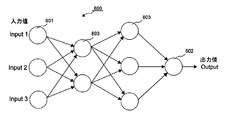
- a classifier is typically a trained neural network. The classifier inputs the substrate (typically the type of substrate and / or the concentration of the substrate in solution) and the response (typically the change in current value over time) to provide microbiota information. It is a classifier pre-trained using the training data including the microbiota information, the substrate, and the obtained response for the known training sample so that it can be output.
- FIG. 8 is a diagram showing an example of a 4-layer deep neural network.
- the four-layer deep neural network (hereinafter, also referred to as “DNN”) 800 shown in FIG. 8 has three nodes 801 corresponding to input values Input1, Output2, and Input3 as input layers, and output value Output as output1. It has one node 802.
- the 4-layer DNN has two intermediate layers, and the nodes 803 of the intermediate layers each have a weight.
- the 4-layer DNN can generate an appropriate weight for each node by using a large amount of input / output data, which is generally called deep learning.
- the data to be trained by the neural network is an n-dimensional tensor data structure.
- 9 and 10 show an example of learning data (training data) for training a neural network.
- FIG. 9 shows the relationship between the microbiota information, the substrate, and the response (change in current value over time) for the learning sample whose microbiota information is known, and is data prepared in advance for learning. Is.
- the microbiota information is information that includes at least the type of microorganism contained in the sample, and includes the type and amount of microorganism (in other words, the amount for each type of microorganism). Is preferable.
- the information including the type and amount of the microorganism is not particularly limited, and examples thereof include information required by the methods described in JP-A-2008-206516 and JP-A-2017-23093. That is, the type and amount of microorganisms of the learning sample have been known by the method using a DNA chip, the invader method, the quantitative PCR method (q-PCR) method such as the real-time PCR (Polymerase Chain Reaction) method, and the like. It is preferably a sample.
- the learning data includes a response (typically an electrochemical response) obtained using a predetermined substrate for the above-mentioned (microbiota information) known learning sample.
- a response typically an electrochemical response
- the substrate for the above-mentioned (microbiota information) known learning sample.
- the learning data includes a predetermined type of substrate for a learning sample having a predetermined microbiota information. It means that the response obtained when the measurement is performed using this measuring device using the medium containing a predetermined amount is a set of data.
- each learning sample is given a unique number (“Sample 001” and “Sample 002”).
- the type of substrate used and the electrochemical response corresponding to the content (mM) in the solution are identified by an "ID” indicating the individual measurement results.
- the measurement result ID “004” indicates that glucose and fructose were mixed and used as substrates for the sample 002.
- it may have information about the substrate after the third substrate.
- FIG. 10 shows microbiota information for each learning sample.
- the learning data includes information on the amount of each type of microorganism contained in each learning sample.
- the number of each learning sample corresponds to the number of the sample of the data shown in FIG. That is, when the microbiota information for each sample shown in FIG. 9 is used as the correct answer data, and the substrate (type and / or concentration) and the response are applied by giving a plurality of these data and performing supervised learning.
- a classifier that outputs microbiota information can be obtained.
- the microbiota information obtained in this step includes at least information on the type of microorganism contained in the sample, and information on the type and amount of microorganism (in other words, the amount for each type of microorganism).
- the measurement results can be compared over time to obtain information for determining the presence or absence of abnormality.
- the subject when the sample is saliva, the subject is obtained by obtaining multiple samples from the same subject over a total of several days and analyzing the difference between the samples (for example, the change in the amount of a specific microorganism). It is possible to detect changes over time of specific microorganisms in the oral cavity, for example, a tendency for caries bacteria to increase.
- FIG. 11 is a sequence diagram relating to a more specific processing mode executed in the measuring apparatus.
- a solution containing the sample and the substrate is introduced into the cell 201 of the biosensor 105, the biosensor 105 is inserted into the insertion port 104 of the measuring device, and the biosensor 105 is electrically connected to the connector portion 406. It is assumed that it is executed in the connected state.
- the operation of each unit of the measuring device 100 is controlled and executed by the control unit 401 that operates according to the program stored in the storage unit 404.
- the analysis output unit 405 receives a measurement start request from the operator (S1101).
- the analysis output unit 405 requests the storage unit 404 for a substrate list (S1102).
- the substrate list is a list (no duplication) of the substrates used in the training data (FIG. 9) of the classifier described above, and is stored in the storage unit 404.
- FIG. 12 shows an example of a substrate list.
- the storage unit 404 passes the substrate list to the analysis output unit 405 (S1103).
- the analysis output unit 405 executes a process for inquiring about the type of substrate used for measurement and the content in the solution (S1104: substrate inquiry).
- the substrate inquiry process is performed, for example, by the analysis output unit 405 displaying the substrate inquiry screen shown in FIG. 13 on the display unit 102.
- the transition of each display screen is performed by the analysis output unit 405.
- FIG. 13 shows an example of the substrate inquiry screen display.
- the operator can input the substrate to be used for the measurement via the GUI using the substrate inquiry screen display 1300 displayed on the display unit 107.
- the input substrate may be selected from the substrate list already described from the viewpoint of facilitating application of the obtained measurement result to the classifier and facilitating the acquisition of more accurate microbiota information. preferable.
- the screen display transitions to the screen display shown in FIG.
- the pull-down list 1401 is displayed, and the operator can select the substrate to be used for the measurement via the GUI using the above screen.
- the substrates displayed in this list are similar to the types of substrates stored in the substrate list described above. That is, the analysis output unit 405 determines the type of substrate to be displayed in the pull-down list 1401 based on the substrate list acquired from the storage unit 404. Typically, the substrates listed in the substrate list are displayed in the pull-down list 1401.
- the operator when the operator inputs the substrate concentration, selecting (typically touching) the substrate concentration box 1302 transitions to the screen display shown in FIG.
- the cursor 1501 is displayed in the substrate concentration box 1302, and the numeric keypad 1502 for inputting a numerical value is displayed.
- the operator can input the substrate concentration by operating (typically touching) the numeric keypad 1502. According to the GUI, the operator can easily input the substrate concentration without using an input device for a keyboard. Therefore, the measuring device can be miniaturized and simplified, and microbiota information can be obtained more easily on-site.
- the add button 1303 when a plurality of substrates are used in the measurement, when the operator operates (typically touches) the add button 1303, the screen display is displayed as shown in FIG. 16, and a plurality of substrates can be input. According to the GUI, even when a plurality of substrates are used, they can be input more easily.
- the button 1304 is operated by the operator, and the analysis output unit 405 acquires information on the type and concentration of the substrate used in the measurement.
- the analysis output unit 405 then requests the measurement unit 403 for electrochemical response data (S1105).
- the measuring unit 403 controls the biosensor 105 to start measuring the electrochemical response data (S1106).
- the measuring unit 403 requests the voltage applying unit 402 to apply a voltage between the electrodes of the biosensor (S1107).
- the voltage application unit 402 Upon receiving the request for voltage application from the measurement unit, the voltage application unit 402 applies a predetermined voltage and / or a sweep voltage between the electrodes of the biosensor (S1108).
- the above steps (S1106 to S1108) can be made simpler when the measuring unit and the voltage applying unit are integrated.
- the voltage application / measurement unit that receives the response data request may apply a voltage to the biosensor and measure the response data.
- the biosensor 105 passes the electrochemical response, that is, the measurement result, to the measurement unit 403 (S1109). After the measurement is completed, the measuring unit 403 passes the obtained electrochemical response to the analysis output unit 405 (S1110).
- the analysis output unit 405 that acquired the electrochemical response applies the type and concentration of the substrate acquired by the substrate inquiry (S1104) and the electrochemical response acquired from the measuring unit 403 to the classifier.
- Acquire microbiota information (S1111).
- the analysis output unit 405 that has acquired the microbiota information displays the microbiota information on the display unit 102 (S1112).
- the microbiota information of the sample can be easily output.
- the sample is saliva and the above solution contains PG bacteria, AA bacteria, etc.
- the sample that can be used is not limited to the above, and is not particularly limited as long as it is a sample containing a microorganism, and can be applied to any known sample. Among them, it has an excellent advantage that it can be applied to a sample containing a microorganism and a solvent without requiring pretreatment.
- the sample is saliva and the saliva contains PG bacteria and periodontal disease bacteria such as AA bacteria
- the subject who provided the saliva from the microbiota information acquired by this measuring device It is preferable in that information for diagnosing the health condition of the oral cavity can be easily obtained.
- animal body fluid can be used in addition to saliva.
- the animal is not particularly limited, and examples thereof include humans and livestock.
- body fluids include blood, lymph, tissue fluid, cavity fluid, digestive fluid, sweat, tears, runny nose, urine, semen, vaginal fluid, amniotic fluid, and milk.
- examples of the sample include a liquid containing sludge, water and sewage, and the like.
- examples of the liquid containing sludge include a liquid containing activated sludge used for water treatment, a liquid containing sludge generated by waste treatment, and the like.
- the sample may be a biological fluid of a plant, environmental water, or the like.
- the biological fluid of the plant is not particularly limited, and examples thereof include a conduit fluid, a phloem fluid, a petiole juice, and a leaf blade juice.
- target microorganism is not particularly limited, and DDBJ (DNA Data Bank of Japan), EMBL (European Molecular Biology Laboratory), Nucleotide Sequence Database, etc. are registered as microorganisms, and Gen.
- microorganisms Porphyromonas spp., Tannerella spp., Treponema spp., Campylobacter spp., Fusobacterium spp., Parvimonas spp., Streptococcus spp., Aggregatibacter genus, Capnocytophaga genus, Eikenella spp., Actinomyces spp., Veillonella genus, Selenomonas spp., Lactobacillus spp., Pseudomonas spp., Haemophilus It may be a genus, a genus Klebsiella, a genus Serratia, a genus Moraxella, and a genus Candida.
- microorganisms Porphyromonas gingivalis, Tannerella forsythia, Treponema denticola, Prevotella intermedia, Aggregatibacter actibacterium fusobacterium Vincentii, Fusobacterium nucleatum subsp. Polymorphum, Fusobacterium nucleatum subsp. Animalis, Fusobacterium nucleatum subsp.
- the biosensor used in the measuring device according to the embodiment of the present invention has a medium which is a solid electrolyte arranged so as to be in contact with an electrode in a cell, and the sample comes into contact with the surface of the medium to form a complex. May be a biosensor in which is formed. In the following description, the same parts as those of the measuring device already described will be omitted.
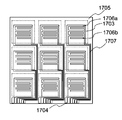
- FIG. 17 is a perspective view of the biosensor 1700 loaded and used in this measuring device.
- the biosensor 1700 has a solid electrolyte 1703 disposed on the support 1701.
- the biosensor 1700 has a plurality of solid electrolytes 1703, and each solid electrolyte 1703 is arranged in a certain region defined by a frame body 1702, and a pair of electrodes described later are combined to form a plurality of cells. ing.
- FIG. 18 is an exploded perspective view of the biosensor 1700.
- An electrode substrate 1705 is arranged between the solid electrolyte 1703 and the support 1701, and the electrode substrate 1705 has a one-to-one correspondence with each solid electrolyte 1703 so as to come into contact with each solid electrolyte 1703.
- a plurality of a pair of electrodes 1706 arranged in the above are arranged.
- the pair of electrodes 1706 are electrically connected to the electrode pad 1704 by a lead-out wiring 1707, and the electrode pad 1704 is inserted into the main body 101 to enter the measuring device via a connector portion in the measuring device. It is configured to be electrically connectable to the arranged circuit board.
- FIG. 19 is a top view of the electrode substrate 1705.
- a pair of electrodes (first electrode 1706a, which have a one-to-one correspondence with the solid electrolyte 1703 (the outline is shown by a broken line in FIG. 19) and are arranged so as to be in contact with the solid electrolyte 1703.
- a comb-shaped electrode composed of a second electrode 1706b.
- Each electrode is electrically connected to the electrode pad 1704 by a lead wire 1707.
- a sample containing a microorganism is brought into contact with each electrode (typically, the sample is dropped onto each electrode), and then covered with a solid electrolyte 1703 fixed to a frame 1702, the electrode, the sample, and the solid Contact with the electrolyte forms multiple complexes at the same time. Since the biosensor 1700 has electrodes arranged so as to correspond to each solid electrolyte, a plurality of electrochemical responses can be measured simultaneously or sequentially for the same sample.
- the solid electrolytes described later contain different substrates, that is, substrates of different types and / or concentrations, the operator can save the trouble of changing the medium and easily obtain more electrochemical responses. As a result, more accurate microbiota information can be obtained.
- the solid electrolyte is a medium containing a substrate, and means a solid electrolyte at room temperature that can contain components that may be contained in the medium described above.
- the form of the solid electrolyte is not particularly limited, but typically includes a hydrogel form, and examples of the hydrogel include an agar gel and a gelatin gel.
- the electrolyte is preferably one having high ionic conductivity, and more specifically, one in which ions (for example, hydrogen ion, sulfate ion, etc.) can move inside the electrolyte.
- the biosensor included in this measuring device has a plurality of solid electrolytes, and the substrates contained in the solid electrolytes as a medium may be the same or different.
- the substrates (type and / or concentration) contained in the solid electrolyte are different, an electrochemical response using a large number of substrates for the same sample can be easily obtained, and as a result, more accurate microorganisms can be obtained.
- the flora information can be obtained.
- the substrate contained in the solid electrolyte is the substrate contained in the learning data described above, more accurate microbiota information can be easily obtained.
- the substrate is included in the training data means that the type of substrate contained in the solid electrolyte (preferably a combination of the type of substrate and the concentration) is the type of substrate used in the training data (preferably, the combination of the substrate and the concentration). Preferably, it means that it is included in the combination of the type and concentration of the substrate).
- the measurement result of ID "001" is the result of using glucose as a substrate at 10 mM.
- at least one of the solid electrolytes may contain glucose. preferable.
- other solid electrolytes preferably contain the same substrates (preferably at the same concentration) as ID002, ID003, ID004 and the like.
- the measuring device of the present invention can easily obtain microbiota information. Since it is possible to quickly obtain microbiota information of a sample without performing complicated sample pretreatment or the like, an excellent effect can be obtained when on-site microbial control is required. For example, it can be used for managing the progress of various diseases and confirming the effects of drugs.
Landscapes
- Health & Medical Sciences (AREA)
- Chemical & Material Sciences (AREA)
- Life Sciences & Earth Sciences (AREA)
- Physics & Mathematics (AREA)
- General Health & Medical Sciences (AREA)
- Engineering & Computer Science (AREA)
- Analytical Chemistry (AREA)
- Molecular Biology (AREA)
- Immunology (AREA)
- Biochemistry (AREA)
- Organic Chemistry (AREA)
- Chemical Kinetics & Catalysis (AREA)
- Pathology (AREA)
- Electrochemistry (AREA)
- General Physics & Mathematics (AREA)
- Proteomics, Peptides & Aminoacids (AREA)
- Wood Science & Technology (AREA)
- Zoology (AREA)
- Biophysics (AREA)
- Bioinformatics & Cheminformatics (AREA)
- Biotechnology (AREA)
- Medical Informatics (AREA)
- Data Mining & Analysis (AREA)
- Spectroscopy & Molecular Physics (AREA)
- Microbiology (AREA)
- General Engineering & Computer Science (AREA)
- Toxicology (AREA)
- Genetics & Genomics (AREA)
- Bioinformatics & Computational Biology (AREA)
- Artificial Intelligence (AREA)
- Epidemiology (AREA)
- Evolutionary Computation (AREA)
- Computer Vision & Pattern Recognition (AREA)
- Public Health (AREA)
- Software Systems (AREA)
- Bioethics (AREA)
- Evolutionary Biology (AREA)
- Databases & Information Systems (AREA)
- Theoretical Computer Science (AREA)
- Dispersion Chemistry (AREA)
Priority Applications (3)
| Application Number | Priority Date | Filing Date | Title |
|---|---|---|---|
| US17/593,987 US20220154243A1 (en) | 2019-04-02 | 2020-03-23 | Measurement apparatus, measurement method, program, and biosensor |
| EP20783031.6A EP3933393A4 (en) | 2019-04-02 | 2020-03-23 | MEASURING DEVICE, MEASUREMENT PROCEDURE, PROGRAM AND BIOSENSOR |
| JP2021511471A JPWO2020203404A1 (https=) | 2019-04-02 | 2020-03-23 |
Applications Claiming Priority (2)
| Application Number | Priority Date | Filing Date | Title |
|---|---|---|---|
| JP2019070305 | 2019-04-02 | ||
| JP2019-070305 | 2019-04-02 |
Publications (1)
| Publication Number | Publication Date |
|---|---|
| WO2020203404A1 true WO2020203404A1 (ja) | 2020-10-08 |
Family
ID=72667713
Family Applications (1)
| Application Number | Title | Priority Date | Filing Date |
|---|---|---|---|
| PCT/JP2020/012673 Ceased WO2020203404A1 (ja) | 2019-04-02 | 2020-03-23 | 測定装置、測定方法、プログラム、及び、バイオセンサ |
Country Status (4)
| Country | Link |
|---|---|
| US (1) | US20220154243A1 (https=) |
| EP (1) | EP3933393A4 (https=) |
| JP (1) | JPWO2020203404A1 (https=) |
| WO (1) | WO2020203404A1 (https=) |
Families Citing this family (2)
| Publication number | Priority date | Publication date | Assignee | Title |
|---|---|---|---|---|
| US12158458B2 (en) * | 2020-07-06 | 2024-12-03 | Florida Atlantic University Board Of Trustees | Vascular occlusion testing device |
| GB2634255A (en) * | 2023-10-03 | 2025-04-09 | Univ Durham | An electrochemical system for detecting bacterial growth in a duct |
Citations (8)
| Publication number | Priority date | Publication date | Assignee | Title |
|---|---|---|---|---|
| JP2001516052A (ja) * | 1997-09-07 | 2001-09-25 | ノーディック センサー テクノロジーズ アーベー | 電子式味覚センサ |
| JP2008206516A (ja) | 2007-01-31 | 2008-09-11 | Gc Corp | 口腔内連鎖球菌数を測定する方法及びそれに用いるpcrプライマー及びプローブセット |
| JP2011193810A (ja) | 2010-03-19 | 2011-10-06 | Kao Corp | 歯周病リスクの評価方法 |
| JP2017023093A (ja) | 2015-07-27 | 2017-02-02 | 三菱レイヨン株式会社 | 歯周病及び齲蝕のリスクの判定方法 |
| US20180070870A1 (en) * | 2016-09-09 | 2018-03-15 | The Board Of Trustees Of The Leland Stanford Junior University | Autonomous Sweat Extraction and Analysis Using a Fully-Integrated Wearable Platform |
| WO2018207524A1 (ja) * | 2017-05-07 | 2018-11-15 | 国立大学法人大阪大学 | 識別方法、分類分析方法、識別装置、分類分析装置および記憶媒体 |
| JP2018537070A (ja) * | 2015-10-01 | 2018-12-20 | リヒター ライフ サイエンス ディヴェロップメント アクチエボラグRichter Life Science Development AB | 微生物ペプチドの検出 |
| JP2019012084A (ja) * | 2016-12-22 | 2019-01-24 | 国立大学法人 筑波大学 | データ作成方法及びデータ使用方法 |
Family Cites Families (7)
| Publication number | Priority date | Publication date | Assignee | Title |
|---|---|---|---|---|
| US4528270A (en) * | 1982-11-02 | 1985-07-09 | Kabushiki Kaisya Advance Kaihatsu Kenkyujo | Electrochemical method for detection and classification of microbial cell |
| US5571401A (en) * | 1995-03-27 | 1996-11-05 | California Institute Of Technology | Sensor arrays for detecting analytes in fluids |
| US20120077206A1 (en) * | 2003-07-12 | 2012-03-29 | Accelr8 Technology Corporation | Rapid Microbial Detection and Antimicrobial Susceptibility Testing |
| EP1709190A4 (en) * | 2003-12-15 | 2007-07-11 | Rapid Lab Microsystems Inc | THE ELECTROCHEMICAL ASSAY OF IDENTIFICATION OF MICROORGANISMS |
| DE102006016326B4 (de) * | 2006-04-06 | 2012-07-19 | Fraunhofer-Gesellschaft zur Förderung der angewandten Forschung e.V. | Vorrichtung und Verfahren zur Schnellmessung eines mikrobiologischen Zustands einer Probe |
| US8399262B2 (en) * | 2011-03-23 | 2013-03-19 | Darrel A. Mazzari | Biosensor |
| JP6487919B2 (ja) * | 2013-08-29 | 2019-03-20 | ノースイースタン ユニバーシティ | 病原菌用マトリクスによって強化された電気化学検出器 |
-
2020
- 2020-03-23 US US17/593,987 patent/US20220154243A1/en not_active Abandoned
- 2020-03-23 EP EP20783031.6A patent/EP3933393A4/en not_active Withdrawn
- 2020-03-23 JP JP2021511471A patent/JPWO2020203404A1/ja active Pending
- 2020-03-23 WO PCT/JP2020/012673 patent/WO2020203404A1/ja not_active Ceased
Patent Citations (8)
| Publication number | Priority date | Publication date | Assignee | Title |
|---|---|---|---|---|
| JP2001516052A (ja) * | 1997-09-07 | 2001-09-25 | ノーディック センサー テクノロジーズ アーベー | 電子式味覚センサ |
| JP2008206516A (ja) | 2007-01-31 | 2008-09-11 | Gc Corp | 口腔内連鎖球菌数を測定する方法及びそれに用いるpcrプライマー及びプローブセット |
| JP2011193810A (ja) | 2010-03-19 | 2011-10-06 | Kao Corp | 歯周病リスクの評価方法 |
| JP2017023093A (ja) | 2015-07-27 | 2017-02-02 | 三菱レイヨン株式会社 | 歯周病及び齲蝕のリスクの判定方法 |
| JP2018537070A (ja) * | 2015-10-01 | 2018-12-20 | リヒター ライフ サイエンス ディヴェロップメント アクチエボラグRichter Life Science Development AB | 微生物ペプチドの検出 |
| US20180070870A1 (en) * | 2016-09-09 | 2018-03-15 | The Board Of Trustees Of The Leland Stanford Junior University | Autonomous Sweat Extraction and Analysis Using a Fully-Integrated Wearable Platform |
| JP2019012084A (ja) * | 2016-12-22 | 2019-01-24 | 国立大学法人 筑波大学 | データ作成方法及びデータ使用方法 |
| WO2018207524A1 (ja) * | 2017-05-07 | 2018-11-15 | 国立大学法人大阪大学 | 識別方法、分類分析方法、識別装置、分類分析装置および記憶媒体 |
Non-Patent Citations (2)
| Title |
|---|
| See also references of EP3933393A4 |
| TAO FENG, BING FANGLING, YANG YAN, ZHUANG HAINING, YE RAN, LI XIAOBEI, XU ZHIMIN, WANG KAI: "Discrimination of edible fungi varieties and evaluation of their umami intensities by using an electronic tongue method", INTERNATIONAL JOURNAL OF FOOD SCIENCE AND TECHNOLOGY, vol. 51, no. 6, 17 April 2016 (2016-04-17) - June 2016 (2016-06-01), pages 1393 - 1400, XP055746340 * |
Also Published As
| Publication number | Publication date |
|---|---|
| EP3933393A1 (en) | 2022-01-05 |
| EP3933393A4 (en) | 2023-03-08 |
| US20220154243A1 (en) | 2022-05-19 |
| JPWO2020203404A1 (https=) | 2020-10-08 |
Similar Documents
| Publication | Publication Date | Title |
|---|---|---|
| Ghoneim et al. | Recent progress in electrochemical pH-sensing materials and configurations for biomedical applications | |
| CN107091870B (zh) | 确定分析物浓度的测量装置、生物传感器系统和方法 | |
| US20040079636A1 (en) | Biomedical ion sensitive semiconductor sensor and sensor array | |
| Vivaldi et al. | A voltammetric pH sensor for food and biological matrices | |
| Errachid et al. | New technology for multi-sensor silicon needles for biomedical applications | |
| Sakata et al. | Biocompatible and flexible paper-based metal electrode for potentiometric wearable wireless biosensing | |
| Darch et al. | Quantifying microbial chatter: scanning electrochemical microscopy as a tool to study interactions in biofilms | |
| DE19621241A1 (de) | Membranelektrode zur Messung der Glucosekonzentration in Flüssigkeiten | |
| JP2015503729A (ja) | 感染性微生物の迅速な検出のための方法及び装置 | |
| CN107271523A (zh) | 用于电化学传感器的提高的稳定性的系统和方法 | |
| JP7074753B2 (ja) | リスク因子モニタリング | |
| WO2020203404A1 (ja) | 測定装置、測定方法、プログラム、及び、バイオセンサ | |
| Sylvain et al. | The EcoChip: A wireless multi-sensor platform for comprehensive environmental monitoring | |
| Lin et al. | Self-adhesive and printable tannin–graphene supramolecular aggregates for wearable potentiometric pH sensing | |
| Foster et al. | Human oral cavity as a model for the study of genome-genome interactions | |
| EP3822628B1 (en) | Diagnosing device, analysis method, and program | |
| EP1910831B1 (de) | Verfahren und system zur konzentrationsbestimmung eines analyt-enzym-komplexes oder analyt-enzym-konjugats, insbesondere zur elektrochemischen detektion des analyten | |
| Eiler et al. | Thin-film transistor platform for electrophysiological and electrochemical characterization of biological cells | |
| Advantage | Electrochemistry for diabetes management | |
| JPH0469338B2 (https=) | ||
| Weber et al. | What Is a Biosensor?—A Terminological Guide From Biomolecular Recognition to Bioindicators | |
| JP7399456B2 (ja) | システム、サーバ装置、クライアント装置、バイオセンサ、バイオセンサセット、データ取得装置、及び、プログラム | |
| Hannah | Development of an in-dressing wound infection sensor | |
| Li | Multiplexed detection of chemical and biological analytes with microscale organic electrochemical transistor arrays | |
| Mele | Modelli Elettrochimici di Performance e Rumore per Biosensori e Bioattuatori elettronici |
Legal Events
| Date | Code | Title | Description |
|---|---|---|---|
| 121 | Ep: the epo has been informed by wipo that ep was designated in this application |
Ref document number: 20783031 Country of ref document: EP Kind code of ref document: A1 |
|
| ENP | Entry into the national phase |
Ref document number: 2021511471 Country of ref document: JP Kind code of ref document: A |
|
| NENP | Non-entry into the national phase |
Ref country code: DE |
|
| ENP | Entry into the national phase |
Ref document number: 2020783031 Country of ref document: EP Effective date: 20210928 |