WO2020202742A1 - カテーテル組立体、発光方法およびカテーテル操作の訓練方法 - Google Patents
カテーテル組立体、発光方法およびカテーテル操作の訓練方法 Download PDFInfo
- Publication number
- WO2020202742A1 WO2020202742A1 PCT/JP2020/002795 JP2020002795W WO2020202742A1 WO 2020202742 A1 WO2020202742 A1 WO 2020202742A1 JP 2020002795 W JP2020002795 W JP 2020002795W WO 2020202742 A1 WO2020202742 A1 WO 2020202742A1
- Authority
- WO
- WIPO (PCT)
- Prior art keywords
- catheter
- light emitting
- light
- phosphor
- illuminant
- Prior art date
- Legal status (The legal status is an assumption and is not a legal conclusion. Google has not performed a legal analysis and makes no representation as to the accuracy of the status listed.)
- Ceased
Links
Images








Classifications
-
- A—HUMAN NECESSITIES
- A61—MEDICAL OR VETERINARY SCIENCE; HYGIENE
- A61M—DEVICES FOR INTRODUCING MEDIA INTO, OR ONTO, THE BODY; DEVICES FOR TRANSDUCING BODY MEDIA OR FOR TAKING MEDIA FROM THE BODY; DEVICES FOR PRODUCING OR ENDING SLEEP OR STUPOR
- A61M25/00—Catheters; Hollow probes
-
- G—PHYSICS
- G09—EDUCATION; CRYPTOGRAPHY; DISPLAY; ADVERTISING; SEALS
- G09B—EDUCATIONAL OR DEMONSTRATION APPLIANCES; APPLIANCES FOR TEACHING, OR COMMUNICATING WITH, THE BLIND, DEAF OR MUTE; MODELS; PLANETARIA; GLOBES; MAPS; DIAGRAMS
- G09B23/00—Models for scientific, medical, or mathematical purposes, e.g. full-sized devices for demonstration purposes
- G09B23/28—Models for scientific, medical, or mathematical purposes, e.g. full-sized devices for demonstration purposes for medicine
-
- G—PHYSICS
- G09—EDUCATION; CRYPTOGRAPHY; DISPLAY; ADVERTISING; SEALS
- G09B—EDUCATIONAL OR DEMONSTRATION APPLIANCES; APPLIANCES FOR TEACHING, OR COMMUNICATING WITH, THE BLIND, DEAF OR MUTE; MODELS; PLANETARIA; GLOBES; MAPS; DIAGRAMS
- G09B9/00—Simulators for teaching or training purposes
Definitions
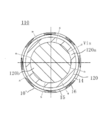
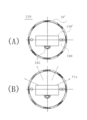
- FIG. 7 is a cross-sectional view of the catheter assembly according to the second embodiment of the present invention.
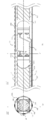
- FIG. 8 is a vertical sectional view of a modified example of the catheter assembly according to the second embodiment of the present invention.
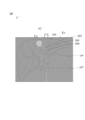
- FIG. 9 is a plan view showing a light emitting state in a bright field BF of the catheter assembly according to the second embodiment of the present invention.
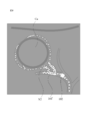
- FIG. 10 is a plan view showing a light emitting state in the dark field DF of the catheter assembly according to the second embodiment of the present invention.
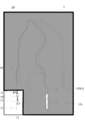
- FIG. 11 is a side enlarged view of a catheter assembly in a non-luminous state according to a second embodiment of the present invention and a lower limb blood vessel model in a bright field BF.
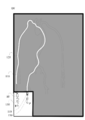
- FIG. 12 is a side enlarged view of the luminescent catheter assembly according to the second embodiment of the present invention and the lower limb blood vessel model in the dark field DF.
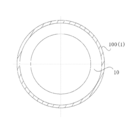
- FIG. 13 is a cross-sectional view of the catheter assembly according to the third embodiment of the present invention.
- FIG. 14 is a vertical cross-sectional view of the catheter assembly according to the third embodiment of the present invention.
- FIG. 15 is a plan view showing a light emitting state in the dark field DF of the catheter assembly according to the third embodiment of the present invention.
- FIG. 16 is an enlarged side view showing a light emitting state of the catheter assembly according to the third embodiment of the present invention.
- FIG. 17 is a schematic cross-sectional view showing a state of the catheter assembly according to the fourth embodiment of the present invention before expansion of the balloon portion in the bright field BF.
- FIG. 18 is a schematic cross-sectional view showing a state of the catheter assembly according to the fourth embodiment of the present invention before expansion of the balloon portion in the dark field DF.
- FIG. 19 is a schematic cross-sectional view showing a state of the catheter assembly according to the fourth embodiment of the present invention when the balloon portion is expanded in the bright field BF.
- FIG. 20 is a schematic cross-sectional view showing a state of the catheter assembly according to the fourth embodiment of the present invention when the balloon portion is expanded in the dark field DF.
- FIG. 21 is a schematic cross-sectional view showing a state in which powder crystals are recovered after the balloon portion contracts in the bright field BF of the catheter assembly according to the fourth embodiment of the present invention.
- FIG. 22 is a schematic cross-sectional view showing a state in which powder crystals are recovered after the balloon portion contracts in the dark field DF of the catheter assembly according to the fourth embodiment of the present invention.
- FIG. 23 is an overall view of the catheter assembly according to the fifth embodiment of the present invention in a bright field BF.
- FIG. 24 is an overall view of the catheter assembly according to the fifth embodiment of the present invention in the dark field DF.
- FIG. 25 is a schematic enlarged cross-sectional view of the catheter assembly according to the fifth embodiment of the present invention in the dark field DF.
- BF a bright field
- catheters outside the range of the X-ray contrast image using an X-ray contrast device and blood vessels that cannot be seen unless a contrast medium is injected are visually recognized, which causes a difference between actual surgery and visual recognition. ..
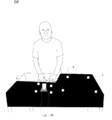
- the ceiling light 20 is turned off, the hand part outside the body cannot be seen.
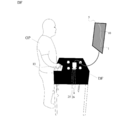
- the operator who cannot directly see the blood vessel model 2 and the catheter assembly 10 in the blood vessel model 2 is an image display unit that displays an image from the camera 4 as an imaging unit attached to the box body 3.
- the training is performed while observing the light emitting body 1 of the catheter assembly 10 projected on the flat panel display (FPD) 5.
- the light emitting body means at least one selected from a phosphor coated on the outer surface of the main body, a side light emitting optical fiber arranged in the main body cavity, and a chip type LED arranged in the main body cavity. ..
- the line of sight and posture of the catheter operation are different between the conventional bright field BF shown in FIG. 1 and the dark field DF of FIG. 2, and the hand sensation during the catheter operation is also different due to the difference in the positions of the neck and shoulders during the catheter operation. May occur.
- the light emitting method for emitting light from the catheter includes a step of preparing the catheter, a step of imparting a light emitting body to the catheter, and a step of causing the catheter to emit light by the light emitting body.
- the catheter assembly 10 used in the first embodiment is coated with the light emitting body 1 in order to impart the light emitting body 1 to at least a part of the outer surface.
- the light emitting body 1 preferably, a phosphor 100 that emits fluorescence that is visible light by ultraviolet rays is preferable.
- the phosphor a compound having an aromatic ring or a metal compound is particularly preferable.
- the phosphor 100 may be a water-soluble or water-dispersible pigment, a water-insoluble powder, or one fixed to the outer surface of the catheter by drying or cross-linking depending on the purpose or site. Those that do not detach from the outer surface of the catheter in warm water by fixation are particularly preferred because they can be used in training hard lesion models in warm water.
- the phosphor 1 is a powdery phosphor coated on the outer surface of the catheter, or is the phosphor 100 that can be peeled off from the outer surface of the catheter assembly by dissolving in water, the drug-coated balloon It is possible to perform training to visually check how the catheter and other drugs provided flow out at the lesion.
- the entire catheter assembly may be made to emit light so that the entire catheter assembly can be visually recognized under the dark field DF, and the water-soluble phosphor 160 may be injected into the balloon catheter 12.
- the balloon portion 12a may be made to emit light by injecting into the dilated lumen of the above.
- the phosphor 100 in the first embodiment is thinly applied to the outer surface of the tip soft tip of the guiding catheter 10', and the physical properties do not change, so that the same hand sensation as in an actual operation can be obtained.
- the catheter may be a balloon catheter, a stent delivery catheter, or an atherectomy catheter, in addition to a guiding catheter.
- the phosphor 100 may be applied to the guide wire 13.
- the site to which the phosphor 100 is applied may be any site of the catheter, but the outer surface of the catheter is preferable, and the base shaft or the tip is particularly preferable.
- the phosphor 100 When an ultraviolet light source 6 is arranged on the inner surface of the box 3 and irradiated with ultraviolet rays, the phosphor 100 emits visible light and the tip portion 10a of the catheter assembly emits light.
- the ultraviolet ray is light having a wavelength that is invisible to humans, and here, it means light having a wavelength of 10 nm to 400 nm, preferably including light having a wavelength of 300 nm to 380 nm.
- Visible light means that the short wavelength limit of the wavelength range defined in JISZ8120 is 360 nm to 400 nm and the long wavelength limit is 760 nm to 830 nm.
- the ultraviolet light source 6 does not contain visible light, only the emission of the phosphor 100 can be observed, but the ultraviolet light source 6 may include visible light due to the amount of light and the cost of the ultraviolet light source 6. In this case, if the amount of fluorescence emitted from the phosphor 100 is larger than the amount of visible light generated by the reflection from the medium on the blood vessel model or the water surface, training for visually recognizing the movement of the catheter assembly can be performed. Alternatively, visible light may be reduced from the light source by an ultraviolet transmitted visible light absorbing filter.
- At least one or more films 26 containing an ultraviolet absorber may be placed in the observation window 25 in order to directly visually recognize the movement of the catheter assembly 10 in the blood vessel model 2.
- the FPD5 is arranged at the same position as the FPD5 of the X-ray contrast apparatus normally used by the operator, and the operator's line of sight and posture can be arranged at the same position as the familiar position.
- the catheter assembly 10 can be operated while viewing the image of the dark field DF whose visual recognition is similar to that of the X-ray contrast image.
- guidance or training may be provided to correct a posture in which fatigue is likely to accumulate or an unnecessarily time-consuming movement.
- FIG. 7 is a cross-sectional view showing a state in which the catheter assembly 110 is made to emit light by causing the side light emitting optical fiber 120 to emit light.
- a normal optical fiber has a structure in which light introduced from the irradiation end (entrance) of light propagates in the long axis direction and does not emit light from the side.
- a side light emitting optical fiber 120 having an outer diameter of 2 mm is used. Inserted and connected to both ends of the side light emitting optical fiber 120, an LED light source 150 having a power LED having a light emitting amount of at least 30 lumens or more.
- the side light emitting optical fiber 120 When power is supplied to the LED light source 150 to cause the LED light source 150 to emit light, the side light emitting optical fiber 120 emits light, and the catheter assembly 110 emits light using the light of the side light emitting optical fiber 120.
- the side light emitting optical fiber 120 is arranged in the lumen of the catheter, and the light source is arranged on at least one of the tip opening side and the proximal opening side of the catheter.
- the reinforcing body may be a coil type, and the outer layer may contain a pigment, but it is preferable that the reinforcing body does not contain a pigment because the amount of light emitted from the catheter is large.
- the LED light source 150 is fixed to the end of the side light emitting optical fiber 120 and is fixed in an aluminum housing with a socket so that light does not leak to the surroundings unnecessarily and heat is dissipated. May be good.
- the light emitting surface of the tip-type LED 130 is arranged perpendicular to the long axis of the catheter in the lumen of the guiding catheter 10', and the tip-type LED 130 is made to emit light in the catheter lumen. You may.
- the side light emitting optical fiber 120 arranged in the catheter lumen at a position away from the distal end opening and the proximal end opening may emit light.
- the light emitting surface of the chip type LED 130 is arranged adjacently to 130A facing the tip side of the guiding catheter 10'and 130B facing the base end side, and a tube type spacer 180 having heat resistance and insulation is provided between them. , It is possible to avoid contact between LEDs and promote heat dissipation by light emission.
- the concave portion 120d may be provided on the end surface of the side light emitting optical fiber 120, and the spherical lens of the chip type LED 130 may be brought close to the concave portion 120d to increase the amount of light emitted from the side emitting optical fiber 120.
- the chip type means a surface mount type (SMD) or a chip-on-board type (COB).
- SMD surface mount type
- COB chip-on-board type
- the chip-type LED 130 a commercially available chip-type LED may be used.
- the corner portion 130a on the outer surface is polished.
- the light emitting surface can be inserted into the lumen of the guiding catheter 10'with an inner diameter of 2.2 mm even if the light emitting surface is directed in the direction perpendicular to the long axis of the catheter.
- the light emitting surface is a flat flat plate type LED chip (not shown), it may be arranged so as to be in contact with the irradiation end 120c of the side light emitting optical fiber 120.
- a copper wire having an outer diameter less than 1/2 of the difference between the inner diameter of the guiding catheter 10'and the outer diameter of the side light emitting optical fiber 120 between the chip type LED 130 and the power supply P for supplying power is used.
- a plurality of sets of copper wires connected to the anode and cathode of the chip type LED 130 by solder 195 can be arranged.
- the plurality of sets of leads are arranged between the inner surface of the guiding catheter 10'and the outer surface of the side emitting optical fiber 120.
- the total length of the guiding catheter 10' is 1500 mm and the length of the side emitting optical fiber 120 is 300 mm
- four sets of chip-type LEDs arranged in opposite directions and five side emitting optical fibers 120 are arranged in the lumen of the guiding catheter 10'. This is placed.
- the set of copper wires connected to the chip-type LED 130 is connected to the power supply P through the proximal opening of the guiding catheter 10'.
- the set of copper wires connected to the chip-type LED 130 is connected to the power supply P through the tip opening of the guiding catheter 10'.
- the amount of light emitted from the catheter assembly 110 can be increased as compared with arranging the LED light sources 150 only at both ends.
- the catheter assembly 110 When the amount of light emitted is increased, the catheter assembly 110 appears to emit light even in the bright field BF as shown in FIG. 9 for exhibition. Therefore, the ceiling light 20 may be turned off to make the catheter assembly 110 emit light more clearly in the dark field DF.
- the contrast-enhanced catheter may be visible in the X-ray contrast image.
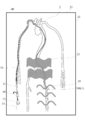
- FIG. 11 when the catheter assembly 110 according to the second embodiment is viewed from the side, the blood vessels of the blood vessel model 2 overlap and are difficult to see, but as shown in FIG. 12, the catheter assembly 110 emits light. Then, the arrangement and shape of the stationary catheter assembly 110 may be visually recognized in three dimensions.
- a chip-type light emitting diode (LED) 130' that causes the catheter assembly 210 to emit light is wired in the lumen of the guiding catheter and connected to a power source. Ru.
- a copper wire 190 is soldered to a chip-type LED 130'having a width of 1.6 mm or less, specifically, a chip-type LED 130'having a length of 4.0 mm and a width of 1.5 mm shown in FIG. At least one of those fixed at 195 can be inserted and arranged.
- a chip type resistor 196 having a length of 3.2 mm, a width of 1.6 mm, and a thickness of 0.6 mm or less, and a constant current diode 197 having an outer diameter of 1.8 mm or less.
- a protection circuit to prevent damage to the LED may be placed in the lumen of the guiding catheter 10'.
- the chip type LED 130' has a high light emission amount of 30 lm / mm 2 or more, as shown in FIG. 13 (B), the light is emitted outside the outer diameter of the catheter even under a bright field BF of about 300 lux. It can be visually recognized that the light is emitted larger than the outer diameter so as to spread.
- the light emitting surface is parallel to the long axis of the catheter as it is in the lumen of the guiding catheter having an inner diameter of 2.2 mm. It can also be inserted in the direction.
- the catheter assembly 210 emits light in the dark field DF.
- the catheter assembly 210 may be used for product display or the like in a bright field BF.
- the length is 1.6 mm or more and the length is 1.6 mm or more, the length is about the same as that of the tip contrast marker or the pipe marker of the catheter. Therefore, when the chip-type LED 130 emits light, a range larger than the maximum outer diameter of the guiding catheter 10'appears to emit light, so that it can be visually recognized as a marker.
- the current or voltage may be controlled to reduce the amount of light emitted from the chip-type LED 130, and training for finding a marker may be performed.
- the catheter that emits light by the light emitting method of the first to third embodiments can be used for training of catheter operation as described above.
- the training method of the fourth embodiment it can be used for training of drug application to the inner wall of the blood vessel by the drug coated balloon catheter 12 as shown in FIGS. 17 to 22.
- a phosphor 100 at the tip 10a of the guiding catheter 10'and a phosphor 101 are provided in the inner tube of the balloon catheter, and a powdery phosphor 140 is supported on the balloon 12a of the balloon catheter 12. Then, by arranging it in the model lesion X and irradiating ultraviolet rays from the ultraviolet light source 6 under the dark field DF, the position of the powdery phosphor 140 carried on the emitting balloon portion 12a is visually recognized, and the catheters are relative to each other. Training to visually recognize the position may be performed.
- the fifth embodiment as a training method is a tumor model Ca of the liver model Lv, so-called transcatheter arterial embolization (TAE) for treating liver cancer with a catheter, or transcatheter arterial hepatic artery chemoembolization (TAE). Training in catheter operation such as chemoembolization (TACE) can be performed.
- TACE transcatheter arterial embolization
- the mixture 163 is injected into the microcatheter 10 "with a syringe (not shown), and is injected from the tip of the microcatheter 10" into the occlusion target X2 of the tumor blood vessel model 2'.
- the mixture 163 when observed by irradiating ultraviolet rays with a dark field DF, the mixture 163 emits light in the microcatheter 10 ”, and it is possible to visually recognize whether the flow in the tumor model 2 ′ or the obstruction target position X2 is obstructed. can do.
- an angiographic catheter 10'''with a large inner diameter may be used, or a catheter capable of changing the flow path by attaching a balloon to the tip may be used, or a catheter having these functions can be used. Different catheters may be used together.
- the catheter assembly may be used for display.
Landscapes
- Engineering & Computer Science (AREA)
- Health & Medical Sciences (AREA)
- General Physics & Mathematics (AREA)
- Physics & Mathematics (AREA)
- Theoretical Computer Science (AREA)
- General Health & Medical Sciences (AREA)
- Life Sciences & Earth Sciences (AREA)
- Educational Technology (AREA)
- Educational Administration (AREA)
- Business, Economics & Management (AREA)
- Heart & Thoracic Surgery (AREA)
- Chemical & Material Sciences (AREA)
- Veterinary Medicine (AREA)
- Animal Behavior & Ethology (AREA)
- Hematology (AREA)
- Biomedical Technology (AREA)
- Anesthesiology (AREA)
- Pulmonology (AREA)
- Biophysics (AREA)
- Public Health (AREA)
- Medical Informatics (AREA)
- Medicinal Chemistry (AREA)
- Algebra (AREA)
- Computational Mathematics (AREA)
- Mathematical Analysis (AREA)
- Mathematical Optimization (AREA)
- Mathematical Physics (AREA)
- Pure & Applied Mathematics (AREA)
- Media Introduction/Drainage Providing Device (AREA)
Priority Applications (1)
| Application Number | Priority Date | Filing Date | Title |
|---|---|---|---|
| JP2021511147A JPWO2020202742A1 (https=) | 2019-03-29 | 2020-01-27 |
Applications Claiming Priority (2)
| Application Number | Priority Date | Filing Date | Title |
|---|---|---|---|
| JP2019065272 | 2019-03-29 | ||
| JP2019-065272 | 2019-03-29 |
Publications (1)
| Publication Number | Publication Date |
|---|---|
| WO2020202742A1 true WO2020202742A1 (ja) | 2020-10-08 |
Family
ID=72668090
Family Applications (1)
| Application Number | Title | Priority Date | Filing Date |
|---|---|---|---|
| PCT/JP2020/002795 Ceased WO2020202742A1 (ja) | 2019-03-29 | 2020-01-27 | カテーテル組立体、発光方法およびカテーテル操作の訓練方法 |
Country Status (2)
| Country | Link |
|---|---|
| JP (1) | JPWO2020202742A1 (https=) |
| WO (1) | WO2020202742A1 (https=) |
Cited By (3)
| Publication number | Priority date | Publication date | Assignee | Title |
|---|---|---|---|---|
| JP2022112907A (ja) * | 2021-01-22 | 2022-08-03 | テルモ株式会社 | 医療用長尺体と視認方法およびトレーニング方法 |
| WO2025079570A1 (ja) * | 2023-10-11 | 2025-04-17 | 株式会社R0 | 医療シミュレータ及び医療シミュレータを用いたトレーニング方法 |
| WO2026018892A1 (ja) * | 2024-07-18 | 2026-01-22 | 古河電気工業株式会社 | カテーテル可視化装置 |
Citations (7)
| Publication number | Priority date | Publication date | Assignee | Title |
|---|---|---|---|---|
| JP2007222387A (ja) * | 2006-02-23 | 2007-09-06 | Yamaguchi Univ | スタイレット |
| JP2010528818A (ja) * | 2007-06-11 | 2010-08-26 | ザ・トラステイーズ・オブ・ザ・ユニバーシテイ・オブ・ペンシルベニア | カテーテル留置用の三次元光誘導 |
| JP2011530082A (ja) * | 2008-08-04 | 2011-12-15 | ユニバーシティ オブ ユタ リサーチ ファウンデーション | 細胞ミクロ構造の共焦点画像化のための染料適用 |
| JP2015505678A (ja) * | 2011-09-22 | 2015-02-26 | ザ・ジョージ・ワシントン・ユニバーシティThe George Washingtonuniversity | アブレーションされた組織を視覚化するシステムと方法 |
| WO2017172385A1 (en) * | 2016-03-28 | 2017-10-05 | Becton, Dickinson And Company | Cannula with light-emitting optical fiber |
| JP2018175023A (ja) * | 2017-04-04 | 2018-11-15 | ウシオ電機株式会社 | カテーテル装置およびカテーテル位置確認方法 |
| WO2018207753A1 (ja) * | 2017-05-11 | 2018-11-15 | アルプス電気株式会社 | カテーテル装置、コネクタ装置およびカテーテルシステム |
-
2020
- 2020-01-27 JP JP2021511147A patent/JPWO2020202742A1/ja active Pending
- 2020-01-27 WO PCT/JP2020/002795 patent/WO2020202742A1/ja not_active Ceased
Patent Citations (7)
| Publication number | Priority date | Publication date | Assignee | Title |
|---|---|---|---|---|
| JP2007222387A (ja) * | 2006-02-23 | 2007-09-06 | Yamaguchi Univ | スタイレット |
| JP2010528818A (ja) * | 2007-06-11 | 2010-08-26 | ザ・トラステイーズ・オブ・ザ・ユニバーシテイ・オブ・ペンシルベニア | カテーテル留置用の三次元光誘導 |
| JP2011530082A (ja) * | 2008-08-04 | 2011-12-15 | ユニバーシティ オブ ユタ リサーチ ファウンデーション | 細胞ミクロ構造の共焦点画像化のための染料適用 |
| JP2015505678A (ja) * | 2011-09-22 | 2015-02-26 | ザ・ジョージ・ワシントン・ユニバーシティThe George Washingtonuniversity | アブレーションされた組織を視覚化するシステムと方法 |
| WO2017172385A1 (en) * | 2016-03-28 | 2017-10-05 | Becton, Dickinson And Company | Cannula with light-emitting optical fiber |
| JP2018175023A (ja) * | 2017-04-04 | 2018-11-15 | ウシオ電機株式会社 | カテーテル装置およびカテーテル位置確認方法 |
| WO2018207753A1 (ja) * | 2017-05-11 | 2018-11-15 | アルプス電気株式会社 | カテーテル装置、コネクタ装置およびカテーテルシステム |
Non-Patent Citations (1)
| Title |
|---|
| VERONICA GARCIA-VAZQUEZ: "Navigation and visualisation with HoloLens in endovascular aortic repair", INNOVATIVE SURGICAL SCIENCES, vol. 3, no. 3, 2018, pages 167 - 177, XP055746275 * |
Cited By (3)
| Publication number | Priority date | Publication date | Assignee | Title |
|---|---|---|---|---|
| JP2022112907A (ja) * | 2021-01-22 | 2022-08-03 | テルモ株式会社 | 医療用長尺体と視認方法およびトレーニング方法 |
| WO2025079570A1 (ja) * | 2023-10-11 | 2025-04-17 | 株式会社R0 | 医療シミュレータ及び医療シミュレータを用いたトレーニング方法 |
| WO2026018892A1 (ja) * | 2024-07-18 | 2026-01-22 | 古河電気工業株式会社 | カテーテル可視化装置 |
Also Published As
| Publication number | Publication date |
|---|---|
| JPWO2020202742A1 (https=) | 2020-10-08 |
Similar Documents
| Publication | Publication Date | Title |
|---|---|---|
| CN106943153B (zh) | 用于产生患者内部和外部图像的系统和方法 | |
| AU762236B2 (en) | Cardiovascular catheter apparatus and catheter positioning method using tissue transillumination | |
| US8185176B2 (en) | Method and apparatus for vasculature visualization with applications in neurosurgery and neurology | |
| US7992573B2 (en) | Optically guided system for precise placement of a medical catheter in a patient | |
| US10173075B2 (en) | Light-guided ophthalmic radiation device | |
| US20200015930A1 (en) | Method and device for enhanced transdermal visualization of medical devices | |
| JP2012115535A (ja) | 近赤外蛍光を発する医療具及び医療具位置確認システム | |
| US20080138289A1 (en) | Systems and methods for detecting infrared emitting composites and medical applications therefor | |
| WO2020202742A1 (ja) | カテーテル組立体、発光方法およびカテーテル操作の訓練方法 | |
| JP2010528818A (ja) | カテーテル留置用の三次元光誘導 | |
| KR20140001870A (ko) | 부비동 조명 라이트와이어 장치 | |
| AU2006291224A1 (en) | Light-guided transluminal catheter | |
| JP2022516171A (ja) | 徹照による管腔内でのチューブの位置決め | |
| JP7840081B2 (ja) | 血管モデルの観察装置及びその方法 | |
| WO2006049787A2 (en) | Optically guided system for precise placement of a medical catheter in a patient | |
| CN101128151A (zh) | 用于在病人体内精确放置医用导管的光学引导系统 | |
| JP2022529012A (ja) | 光によって給電される発光組織マーカ | |
| CN107713997B (zh) | 一种流动血液成像装置 | |
| JP4886698B2 (ja) | 医学的カテーテルの患者内精密配置用の光学的にガイドされるシステム | |
| US20120100515A1 (en) | Fluoroscopy Simulator | |
| JP2015126885A (ja) | 近赤外蛍光を発する医療具及び医療具位置確認システム | |
| CN215348815U (zh) | 一种医用红外电子纤维内窥镜 | |
| KR20240117095A (ko) | 의료용 광학 추적 시스템 | |
| US11045665B2 (en) | Light-guided ophthalmic radiation device | |
| CN113499017A (zh) | 一种医用红外电子纤维内窥镜 |
Legal Events
| Date | Code | Title | Description |
|---|---|---|---|
| 121 | Ep: the epo has been informed by wipo that ep was designated in this application |
Ref document number: 20784836 Country of ref document: EP Kind code of ref document: A1 |
|
| ENP | Entry into the national phase |
Ref document number: 2021511147 Country of ref document: JP Kind code of ref document: A |
|
| NENP | Non-entry into the national phase |
Ref country code: DE |
|
| 122 | Ep: pct application non-entry in european phase |
Ref document number: 20784836 Country of ref document: EP Kind code of ref document: A1 |