WO2020195145A1 - 通信制御装置、通信装置、及び通信制御方法 - Google Patents
通信制御装置、通信装置、及び通信制御方法 Download PDFInfo
- Publication number
- WO2020195145A1 WO2020195145A1 PCT/JP2020/003422 JP2020003422W WO2020195145A1 WO 2020195145 A1 WO2020195145 A1 WO 2020195145A1 JP 2020003422 W JP2020003422 W JP 2020003422W WO 2020195145 A1 WO2020195145 A1 WO 2020195145A1
- Authority
- WO
- WIPO (PCT)
- Prior art keywords
- communication
- information
- control device
- communication control
- communication device
- Prior art date
- Legal status (The legal status is an assumption and is not a legal conclusion. Google has not performed a legal analysis and makes no representation as to the accuracy of the status listed.)
- Ceased
Links
Images









Classifications
-
- H—ELECTRICITY
- H04—ELECTRIC COMMUNICATION TECHNIQUE
- H04W—WIRELESS COMMUNICATION NETWORKS
- H04W16/00—Network planning, e.g. coverage or traffic planning tools; Network deployment, e.g. resource partitioning or cells structures
- H04W16/14—Spectrum sharing arrangements between different networks
-
- H—ELECTRICITY
- H04—ELECTRIC COMMUNICATION TECHNIQUE
- H04W—WIRELESS COMMUNICATION NETWORKS
- H04W72/00—Local resource management
- H04W72/04—Wireless resource allocation
- H04W72/044—Wireless resource allocation based on the type of the allocated resource
- H04W72/0453—Resources in frequency domain, e.g. a carrier in FDMA
-
- G—PHYSICS
- G01—MEASURING; TESTING
- G01S—RADIO DIRECTION-FINDING; RADIO NAVIGATION; DETERMINING DISTANCE OR VELOCITY BY USE OF RADIO WAVES; LOCATING OR PRESENCE-DETECTING BY USE OF THE REFLECTION OR RERADIATION OF RADIO WAVES; ANALOGOUS ARRANGEMENTS USING OTHER WAVES
- G01S13/00—Systems using the reflection or reradiation of radio waves, e.g. radar systems; Analogous systems using reflection or reradiation of waves whose nature or wavelength is irrelevant or unspecified
- G01S13/88—Radar or analogous systems specially adapted for specific applications
- G01S13/93—Radar or analogous systems specially adapted for specific applications for anti-collision purposes
- G01S13/937—Radar or analogous systems specially adapted for specific applications for anti-collision purposes of marine craft
-
- H—ELECTRICITY
- H04—ELECTRIC COMMUNICATION TECHNIQUE
- H04W—WIRELESS COMMUNICATION NETWORKS
- H04W88/00—Devices specially adapted for wireless communication networks, e.g. terminals, base stations or access point devices
- H04W88/18—Service support devices; Network management devices
Definitions
- the present disclosure relates to a communication control device, a communication device, and a communication control method.
- cognitive radio technology can contribute not only to dynamic frequency sharing but also to improvement of frequency utilization efficiency by wireless systems.
- ETSI EN 303 387 and IEEE 802.19.1-2014 stipulate coexistence technology between wireless systems using databases.
- Non-Patent Document 1 provides a Dynamic Protection Area (DPA) as a protection area for the carrier-based radar, and environmentally describes the radio wave usage status of the carrier-based radar (that is, the primary communication service) in the DPA. It has been shown to be monitored by Sensing Capability (ESC).
- DPA Dynamic Protection Area
- the frequency bands that are subject to frequency sharing such as the CBRS band described above
- there is an error in the detection result of the frequency band used by the primary communication service As a result, a situation can be assumed in which the frequency band that is actually available for secondary use is limited.
- the present disclosure proposes a technique that enables frequency sharing in a more preferable manner even in a situation where an error occurs in the detection result of the frequency band used by the primary communication service.
- a communication control device includes a control unit that is assigned to one or more secondary use communication devices that provide a secondary communication service different from the primary communication service.
- a notification unit for notifying a communication control device of a request regarding allocation of a part of a plurality of channels assigned to the primary communication service, and the channel as a response to the request.
- the frequency bands corresponding to only a part of the frequency bands is specified for the channel occupied by the primary communication service, and the frequency band other than the part of the frequency band is assigned according to the allocation result.
- a communication device including an acquisition unit for acquiring the information of 4 is provided.
- the computer acquires the first information regarding the channel occupied by the primary communication service among the plurality of channels assigned to the primary communication service, and the frequency corresponding to the channel.
- the bands for the channel occupied by the primary communication service only for a part of the frequency band, specifying a frequency band other than the part of the frequency band and specifying the other frequency band specified.
- a communication control method is provided.
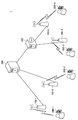
- FIG. 1 is an explanatory diagram for explaining a schematic example of the system according to the present embodiment.
- the system 1 according to the present embodiment includes a communication device 100 (for example, communication devices 100-1 to 100-4) and a terminal device 200 (for example, terminal devices 200-1 to 200-4). And the communication control device 300.
- the system 1 may also include a network manager 400.
- the communication device 100 is typically a device corresponding to a wireless base station (Base Station, Node B, eNB, gNB, etc.) or a wireless access point (Access Point).
- the communication device 100 may be a wireless relay station. Further, the communication device 100 may be an optical overhanging device called a Remote Radio Head (RRH).
- RRH Remote Radio Head
- the communication device 100 does not necessarily have to be fixed, and may be, for example, a device installed in a moving body such as an automobile. Further, the communication device 100 does not necessarily have to exist on the ground, and may be a device in which an object existing in the air or space has a communication function, such as an aircraft, a drone, a helicopter, a satellite, or the like. .. Further, the communication device 100 may be a device such as a ship or a submarine, in which an object existing on the sea or in the sea is provided with a communication function. Further, in such a case, the communication device 100 may carry out wireless communication with another communication device fixedly installed.
- the coverage provided by the communication device 100 can be of various sizes, from a relatively large one such as a so-called macro cell to a small one such as a so-called pico cell. Further, one cell may be formed by a distributed antenna system (DAS: Distributed Antenna System) and a plurality of communication devices 100. Further, when the communication device 100 has a so-called beamforming function, a cell or a service area may be formed for each beam.
- DAS Distributed Antenna System
- the communication device 100 can be used, operated, or managed by various entities.
- the entity include a mobile network operator (MNO: Mobile Network Operator), a virtual mobile network operator (MVNO: Mobile Virtual Network Operator), a virtual mobile communication enabler (MVNE: Mobile Virtual Network Enabler), and neutral.
- the communication device 100 may be a shared facility used by a plurality of businesses or a plurality of individuals.
- the installation and operation of the equipment may be carried out by a third party different from the user.
- the communication device 100 operated by the operator can typically be connected to various networks such as the Internet via the core network. Further, the communication device 100 can be operated and maintained by, for example, a function called OA & M (Operation, Administration & Maintenance). Further, for example, a network manager 400 for integrated control of the communication device 100 in the network may be provided.
- OA & M Operaation, Administration & Maintenance
- the terminal device 200 (User Equipment, User Terminal, User Station, Mobile Terminal, Mobile Station, etc.) can typically be realized as a communication device such as a so-called smartphone. Further, as another example, the terminal device 200 may be a device such as a commercial camera provided with a communication function. Further, the terminal device 200 does not necessarily have to be used by humans, and can be connected to a network such as a factory machine or a sensor installed in a building, for example, like a so-called MTC (Machine Type Communication). Equipment may be used.
- MTC Machine Type Communication
- the terminal device 200 may be a device called CPE (Customer Premises Equipment) used in a wireless backhaul or the like.
- CPE Customer Premises Equipment
- the terminal device 200 may have a relay communication function and an inter-terminal communication function.
- the terminal device 200 does not necessarily have to exist on the ground, and is configured as a device in which an object existing in the air or space, such as an aircraft, a drone, a helicopter, or a satellite, is provided with a communication function. May be good. Further, the terminal device 200 may be configured as a device in which an object existing on the sea or in the sea, such as a ship or a submarine, is provided with a communication function.
- the communication control device 300 is typically a device that determines and / or permits, instructs, and manages communication parameters of the communication device 100.
- a database server such as GLDB (Geolocation database) or SAS (Spectrum Access System) may further correspond to the communication control device 300.
- a control device such as Spectrum Manager / Coexistence Manager that controls radio wave interference between communication devices, such as ETSI EN 303 387 and IEEE 802.19.1a-2017, can also correspond to the communication control device 300.
- the Registered Location Secure Server (RLSS) defined by IEEE 802.11-2016 may also correspond to the communication control device 300.
- the control target of the communication control device 300 is the communication device 100, but the terminal device 200 under the control target may also be the control target of the communication control device 300.
- FIG. 2 is an explanatory diagram for explaining an outline of an example of a model in which a plurality of communication control devices 300 are arranged in a distributed manner.
- the plurality of communication control devices 300 that is, communication control devices 300-1 and 300-2
- Information may be exchanged, and various calculations related to necessary frequency allocation and interference control may be performed using the information acquired by the exchange.
- the communication control device 300 may be arranged outside the network to which the communication device 100 belongs, or may be arranged inside the network.
- a public cloud or the like can be assumed as a typical example when the communication control device 300 is arranged outside the network.
- the communication control device 300 may be arranged as a part of the core network of the cellular system or as a management device of the enterprise network.
- FIG. 3 is an explanatory diagram for explaining an outline of an example of a model (so-called master-slave type) in which some communication control devices 300 centrally control a plurality of communication control devices 300.
- the master communication control device 300-1 controls a plurality of slave communication control devices 300 (for example, slave communication control devices 300-2 and 300-3) and makes intensive decisions. Is also possible.
- the master communication control device 300-1 can transfer or destroy the decision-making authority to each slave communication control device 300 for the purpose of load balancing, for example. ..
- the communication control device 300 can acquire necessary information from other entities other than the communication device 100 and the terminal device 200 in order to fulfill the given role.
- information necessary for protecting various communications can be obtained from a database (regulatory database) managed and / or operated by a national or regional radio wave administrative agency. ..
- a regulatory database is the ULS (Universal Licensing System) operated by the Federal Communications Commission (US Federal Communications Commission).
- ULS Universal Licensing System
- Other examples of information required to protect various communications include out-of-band radiation limit (OOBE (Out-of-Band Emission) Limit), adjacent channel leakage ratio (ACLR: Adjacent Channel Selectivity), and adjacent channel selectivity (ACLR). It may include Adjacent Channel Selectivity), fading margin, and / or protection ratio (PR).
- OOBE Out-of-Band Emission
- ACLR Adjacent Channel Selectivity
- ACLR Adjacent Channel Selectivity
- PR protection ratio
- the communication control device 300 acquires radio wave sensing information from a radio wave sensing system installed and operated for the purpose of radio wave detection of the primary system.
- the communication control device 300 may acquire radio wave detection information of the primary system from a radio wave sensing system such as an environmental sensing function (ESC: Environmental Sensing Capability) in the US CBRS.
- ESC Environmental Sensing Capability
- the communication control device 300 may acquire radio wave detection information of the primary system from the communication device 100 or the terminal device 200.
- the interface between each entity is not particularly limited, and may be either wired or wireless, for example.
- a wireless interface that does not depend on frequency sharing for example, a wireless interface provided by a mobile communication operator via a licensed band or a Wi- that uses an existing license-exempt band. Examples include Fi (registered trademark) communication.
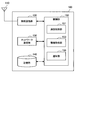
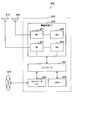
- FIG. 4 is a block diagram showing an example of the configuration of the communication device 100 according to the embodiment of the present disclosure.
- the communication device 100 includes an antenna unit 110, a wireless communication unit 120, a network communication unit 130, a storage unit 140, and a control unit 150.
- Antenna unit 110 The antenna unit 110 radiates the signal output by the wireless communication unit 120 into space as a radio wave. Further, the antenna unit 110 converts a radio wave in space into a signal and outputs the signal to the wireless communication unit 120.
- the wireless communication unit 120 transmits and receives signals. For example, the wireless communication unit 120 transmits a downlink signal to the terminal device and receives the uplink signal from the terminal device.
- the network communication unit 130 transmits / receives information.
- the network communication unit 130 transmits information to another node and receives information from the other node.
- the other nodes include other base stations and core network nodes.
- the terminal device may operate as a relay terminal and relay the communication between the remote terminal and the base station.
- the wireless communication device 100C corresponding to the relay terminal may not include the network communication unit 130.
- Storage unit 140 The storage unit 140 temporarily or permanently stores a program and various data for the operation of the communication device 100.
- Control unit 150 provides various functions of the communication device 100.
- the control unit 150 includes a communication control unit 151, an information acquisition unit 153, and a notification unit 155.
- the control unit 150 may further include other components other than these components. That is, the control unit 150 can perform operations other than the operations of these components.
- the communication control unit 151 executes various processes related to the control of wireless communication with the terminal device 200 via the wireless communication unit 120. In addition, the communication control unit 151 executes various processes related to the control of communication with other nodes (for example, other base stations, core network nodes, etc.) via the network communication unit 130.
- other nodes for example, other base stations, core network nodes, etc.
- the information acquisition unit 153 acquires various information from the terminal device 200 and other nodes.
- the acquired information may be used, for example, for controlling wireless communication with the terminal device, controlling for cooperation with other nodes, and the like.
- the notification unit 155 notifies the terminal device 200 and other nodes of various information.
- the notification unit 155 may notify the terminal device 200 of various information for the terminal device 200 in the cell to perform wireless communication with the communication device 100. Further, as another example, the notification unit 155 may notify another node (for example, another base station) of the information acquired from the terminal device in the cell.
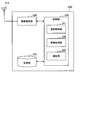
- FIG. 5 is a block diagram showing an example of the configuration of the terminal device 200 according to the embodiment of the present disclosure.
- the terminal device 200 includes an antenna unit 210, a wireless communication unit 220, a storage unit 230, and a control unit 240.
- Antenna unit 210 The antenna unit 210 radiates the signal output by the wireless communication unit 220 into space as a radio wave. Further, the antenna unit 210 converts the radio wave in the space into a signal and outputs the signal to the wireless communication unit 220.
- the wireless communication unit 220 transmits and receives signals. For example, the wireless communication unit 220 receives the downlink signal from the base station and transmits the uplink signal to the base station.
- Storage unit 230 The storage unit 230 temporarily or permanently stores the program and various data for the operation of the terminal device 200.
- Control unit 240 provides various functions of the terminal device 200.
- the control unit 240 includes a communication control unit 241, an information acquisition unit 243, and a notification unit 247.
- the control unit 240 may further include other components other than these components. That is, the control unit 240 may perform operations other than the operations of these components.
- the communication control unit 241 executes various processes related to the control of wireless communication with the communication device 100 and other terminal devices 200 via the wireless communication unit 220.
- the information acquisition unit 243 acquires various information from the communication device 100 and other terminal devices 200.
- the notification unit 247 notifies the communication device 100 and other terminal devices 200 of various information.
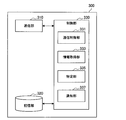
- FIG. 6 is a block diagram showing an example of the configuration of the communication control device 300 according to the embodiment of the present disclosure.
- the communication control device 300 includes a communication unit 310, a storage unit 320, and a control unit 330.
- the communication unit 310 transmits and receives information.
- the communication unit 310 transmits information to another device and receives information from the other device.
- the other device includes the communication device 100 and the network manager 400 shown in FIG.
- each configuration of the communication control device 300 shall transmit and receive information to and from other devices via the communication unit 310.
- the storage unit 320 temporarily or permanently stores the program and various data for the operation of the communication control device 300.
- the storage unit 320 temporarily outputs information about the operator of the wireless system, registration information of the wireless system described above, information about the frequency user, and each configuration of the communication control device 300 for processing. Information (for example, calculation result, etc.) may be stored.
- Control unit 330 provides various functions of the communication control device 300.
- the control unit 330 includes a communication control unit 331, an information acquisition unit 333, a specific unit 335, and a notification unit 337.
- the control unit 240 may further include other components other than these components. That is, the control unit 330 can perform operations other than the operations of these components.
- the communication control unit 331 executes various processes related to control for the communication device 100 shown in FIG. 2 to perform wireless communication.
- the communication control unit 331 executes various processes (for example, control of communication parameters, etc.) related to the allocation of at least a part of the frequency bands (channels) available for wireless communication to the communication device 100. You may.
- the information acquisition unit 333 acquires various information from the communication device 100 (for example, CBSD described later) or another entity (for example, ESC or PAL database described later).
- the identification unit 335 specifies a frequency band (channel) that can be assigned to the communication device 100 (for example, CBSD described later) based on information acquired from another entity (for example, ESC or PAL database described later). ..
- the notification unit 337 notifies various information to the communication device 100 (for example, CBSD described later) and other entities (for example, the PAL database described later).
- FIG. 7 is an explanatory diagram for explaining an example of a group in which each user is classified for frequency sharing.
- CBRS CBRS
- each user who is the target of frequency sharing is classified into one of the three groups shown in FIG.
- Such groups are referred to as "tiers".
- the existing layer Incumbent Tier
- the priority access layer Priority Access Tier
- the general authorized access layer General Authorized Access (GAA) Tier
- GAA General Authorized Access
- the existing layer is a group consisting of existing users in the shared frequency band.
- DOD Department of Defense
- fixed satellite operators fixed satellite operators
- wireless broadband licensees exempt from new conditions GWBL: Grandfathered Wireless Broadband Licensee
- the existing layer is not required to avoid or suppress interference with the priority access layer and the general licensed access layer having lower priority.
- the existing layer is protected from interference by the priority access layer and the general authorization access layer. That is, users in the existing layer can use the frequency band without considering the existence of other groups.
- a user belonging to the existing layer, that is, an existing user in the shared frequency band corresponds to an example of the "primary communication service".
- a user belonging to either the priority access layer or the general authorization access layer corresponds to an example of the "secondary communication service”
- the communication device that provides the secondary communication service is the "secondary use communication device”.
- a communication device for example, a base station or the like
- a part of the frequency band used by the primary communication service may correspond to the secondary use communication device.
- the Priority Access Tier is a group of licensed users called PAL (Priority Access License).
- the priority access layer is required to avoid or suppress interference with the existing layer having a higher priority, but is not required to avoid or suppress interference with a general authorization access layer having a lower priority.
- the preferred access layer is not protected from interference by existing layers with higher priority, but is protected from interference by general licensed access layers with lower priority.
- the general authorization access layer (GAA Tier) is a group consisting of other users who do not belong to either the existing layer or the priority access layer.
- the general authorization access layer is required to avoid or suppress interference with the existing layer and the priority access layer having higher priority.
- the general licensed access layer is not protected from interference by existing and preferred access layers with higher priority. That is, the general licensed access layer corresponds to a "tier" that is legally required to use opportunistic frequencies.
- CBRS is generally referred to as a 3-tier structure, but may have a 2-tier structure.
- 2-tier structure such as LSA (Licensed Shared Access) and TVWS (TV band White Space).
- LSA employs a structure equivalent to the combination of the existing layer and the priority access layer described above.
- TVWS a structure equivalent to the combination of the existing layer and the general authorization access layer described above is adopted.
- the intermediate layer corresponding to the priority access layer may be divided into a plurality of layers, and the plurality of layers may be further prioritized.
- the general authorization access layer may be divided into a plurality of layers, and the plurality of layers may be further prioritized.
- the primary system may be set as the primary system according to the applied frequency band.
- the primary system may be a wireless system such as a TV broadcast, a Fixed System (FS), a weather radar, a radio altimeter, or a wireless train control system (Communications-based Train Control). Not limited to these, any wireless system may be treated as the primary system.
- FS Fixed System
- weather radar a radar
- radio altimeter a radio altimeter
- a wireless train control system Common Train Control
- the relationship between the primary system and the secondary system is not necessarily limited to the above-mentioned example of the frequency sharing environment.
- an existing system that uses the target band is called a primary system
- a secondary user is called a secondary system.
- at least one Part terms may be replaced by other terms.
- the macro cell in HetNet may be the primary system
- the small cell or relay station may be the secondary system.
- the base station may be used as the primary system
- the Relay UE or Vehicle UE that realizes D2D or V2X existing in the coverage may be used as the secondary system.
- the base station is not limited to the fixed type, and may be a portable type or a mobile type.
- the communication control device 300 may be provided in a base station, a relay station, a Relay UE, or the like.
- frequency may be replaced by another term.
- frequency is “resource”, “resource block”, “resource element”, “channel”, “component carrier”, “carrier”, “subcarrier”, “Bandwidth Part (BWP)”. ) ”And other terms that have similar meanings.
- the registration procedure corresponds to a procedure for registering device parameters related to a communication device in a communication control device.
- one or more communication systems including a communication device or a plurality of communication devices initiate a registration procedure by notifying the communication control device of a registration request including the device parameters.
- the information unique to the communication device may correspond to information that can identify the communication device, information about the hardware of the communication device, and the like.
- Information specific to the communication device may include, for example, a serial number, a product model number, and the like.
- the information that can identify the communication device may correspond to the communication device user information, the communication device serial number, or the like.
- the communication device user information for example, a user ID, a call sign, or the like can be assumed.
- the user ID may be independently generated by the communication device user, or may be issued in advance by the communication control device.
- Information on the hardware of the communication device may include, for example, transmission power class information, manufacturer information, and the like.
- transmission power class information may include at least one of the two types of information.
- some classes of eNodeB and gNodeB are specified in 3GPP TS 36.104 and TS 38.104, and these classes can also be used as transmission power class information.
- the information about the software of the communication device may include, for example, version information, a build number, etc. about the execution program in which the processing necessary for interaction with the communication control device is described. Further, the information about the software of the communication device may include the version information of the software for operating as the communication device, the build number, and the like.
- the location information typically corresponds to information that can identify the geographic location of the communication device.
- the information related to the position includes, for example, coordinates acquired by a positioning function represented by GPS (Global Positioning System), Beidou, QZSS (Quasi-Zenith Satellite System), Galileo and A-GPS (Assisted Global Positioning System). Information etc. may be included. Also, typically, information about latitude, longitude, altitude, and positioning error may be included in the information about position. Further, as another example, the location information may include location information registered in an information management device managed by NRA (National Regulatory Authority) or its entrusted organization.
- NRA National Regulatory Authority
- the information related to the position may include the coordinates of the X-axis, the Y-axis, and the Z-axis having a specific geographic position as the origin. Further, as the information relating to the position, an identifier indicating outdoor or indoor can be given together with the coordinate information as described above.
- the information related to the position may be information indicating the area where the communication device is located.
- information related to the location information determined by the government, such as a zip code and an address, may be used.
- the area may be indicated by, for example, a set of three or more geographic coordinates. Information indicating such a region may be provided, for example, together with the coordinate information described above.
- information indicating the floor of the building may be added to the information related to the position. For example, information such as the number of floors and an identifier indicating ground / underground may be added to the information related to the position. Further, as another example, information indicating a further closed space indoors, such as a room number and a room name in a building, may be added to the information relating to the position.
- the positioning function is typically provided by a communication device. However, depending on the performance of the positioning function and the installation position, it is not always possible to acquire position information that satisfies the required accuracy. Therefore, the positioning function may be used by the installer. When the positioning function is used by the installer, it is desirable that the location information measured by the installer is written in the communication device.
- Antenna information typically corresponds to information indicating the performance and configuration of an antenna provided in a communication device.
- the antenna information may include information such as antenna installation height, tilt angle (Downtilt), horizontal orientation (Azimuth), aiming (Boresight), antenna peak gain, and antenna model.
- the antenna information may include information about the beam that can be formed. For example, information such as beam width, beam pattern, and analog / digital beamforming capabilities can be included in the antenna information.
- the antenna information may include information on the performance and configuration of MIMO (Mutiple Input Multiple Output) communication.
- MIMO Mobile Input Multiple Output
- information such as the number of antenna elements and the maximum number of spatial streams can be included in the antenna information.
- codebook information to be used unitary matrix obtained by weight matrix information (SVD (Singular Value Decomposition), EVD (Eigen Value Decomposition), BD (Block Diagonalization), etc., ZF (Zero-Forcing) matrix, MMSE (Minimum Mean Square Error) matrix) etc. can also be included in the antenna information.
- SVD Single Value Decomposition
- EVD Eigen Value Decomposition
- BD Binary Diagonalization
- ZF Zero-Forcing
- MMSE Minimum Mean Square Error
- the above antenna information may include ZoD (Zenith of Direction, Departure).
- the ZoD is a type of radio wave arrival angle.
- the ZoD may be estimated by another communication device based on the radio waves radiated from the antenna of the communication device.
- the communication device may be a terminal device that operates as a base station or an access point, a device that performs D2D communication, a moving relay base station, or the like.
- ZoD can be estimated by, for example, a radio wave arrival direction estimation technology such as MUSIC (Multiple Signal Classification) or ESPRIT (Estimation of Signal Propagation via Rotation Invariance Techniques).
- MUSIC Multiple Signal Classification
- ESPRIT Estimatiation of Signal Propagation via Rotation Invariance Techniques
- ZoD can be used by the communication control device as measurement information.
- the wireless interface information is typically information indicating the wireless interface technology provided in the communication device.
- the wireless interface information may include identifier information indicating standard technologies such as MAN (Metropolitan Area Network) such as registered trademark) and WiMAX2 +, and wireless LAN of IEEE 802.11 series. Further, the wireless interface information may be given a version number or a release number of a technical specification that defines the above-mentioned technology.
- the information given to the wireless interface information does not necessarily have to be information related to the standard technology, and may be, for example, information indicating a proprietary wireless technology.
- the wireless interface information may also include frequency band information related to the frequency band supported by the communication device.
- the frequency band information can be represented by, for example, one or more combinations of upper limit frequencies and lower limit frequencies, one or more combinations of center frequencies and bandwidths, or one or more 3GPP Operating Band numbers.
- the frequency band information related to the frequency band supported by the communication device may also include capability information of carrier aggregation (CA: Carrier Aggregation) and channel bonding (Channel Bonding).
- CA Carrier Aggregation
- Channel Bonding channel bonding
- the capability information may include, for example, band information that can be combined.
- the capability information of carrier aggregation may include, for example, information on a band desired to be used as a primary component carrier (PCC: Primary Component Carrier) or a secondary component carrier (SCC: Secondary Component Carrier).
- PCC Primary Component Carrier
- SCC Secondary Component Carrier
- the capability information of carrier aggregation may include the number of CCs that can be aggregated at the same time.
- information indicating the radio wave usage priority such as PAL and GAA may be included.
- the wireless interface information may also include modulation method information indicating the modulation method supported by the communication device.
- modulation method information indicating the modulation method supported by the communication device.
- FSK Frequency Shift Keying
- PSK Phase Shift Keying
- QAM Quadrature Amplitude Modulation
- n is 4, 16
- Information indicating the primary modulation method such as 64, 256, etc.
- information indicating the secondary modulation method such as OFDM (Orthogonal Frequency Division Multiplexing), DFT-s-OFDM (DFT spread OFDM), FBMC (Filter Bank Multi Carrier) are included. It can be.
- the wireless interface information may include information on the error correction code.
- the information regarding the error correction code may include, for example, capabilities such as a Turbo code, an LDPC (Low Density Parity Check) code, and a Polar code, and code rate information to be applied.
- MCS Modulation and Coding Scheme
- the wireless interface information may include information indicating a function peculiar to each wireless technology supported by the communication device. For example, as a typical example, there is information on Transmission Mode (TM) specified by LTE. In addition to this, those having two or more modes for a specific function can be included in the wireless interface information as in the TM. Further, even when two or more modes do not exist in the technical specifications, if the communication device supports a function that is not essential in the specifications, information indicating the function may be included in the wireless interface information.
- TM Transmission Mode
- the wireless interface information may include information on the wireless access method (RAT: Radio Access Technology) supported by the communication device.
- the wireless interface information includes, for example, information indicating an orthogonal multiple access method (OMA: Orthogonal Multiple Access), a non-orthogonal multiple access method (NOMA: Non Orthogonal Multiple Access), and an opportunistic connection method (Opportunistic Access). It can be included as information about the access method.
- OMA Orthogonal Multiple Access
- NOMA Non Orthogonal Multiple Access
- OFDMA Orthogonal Frequency Division Multiple Access
- PDMA a typical example is a method realized by a combination of Power Division Multiple Access, Superposition Coding (SPC) and Successive Interference Canceller (SIC)
- CDMA Code Division Multiple Access
- SCMA Separatse Code Multiple Access
- IDMA Interleaver Division Multiple Access
- SDMA Spatial Division Multiple Access
- examples of opportunistic connection methods include CSMA / CA (Carrier Sense Multiple Access / Collision Avoidance) and CSMA / CD (Carrier Sense Multiple Access / Collision Detection).
- the wireless interface information may also include information related to the duplex mode supported by the communication device. Typical examples of information related to duplex mode include FDD (Frequency Division Duplex), TDD (Time Division Duplex), and FD (Full Duplex). When information about TDD is included as wireless interface information, TDD Frame Configuration information used / supported by the communication device can be added. Further, the wireless interface information may include information related to the duplex mode for each frequency band indicated by the frequency band information.
- the wireless interface information may also include information about the transmission diversity method supported by the communication device.
- Examples of the transmission diversity method include space-time coding (STC: Space Time Coding) and the like.
- the wireless interface information may also include guard band information.
- guard band information for example, information regarding the guard band size defined in the standard may be included. Further, as another example, the guard band information may include information on the guard band size desired by the communication device.
- Legal information is typically information on regulations that communication equipment must comply with, or authentication information acquired by communication equipment, which is set by the radio wave administration agency of each country / region or an organization equivalent thereto. Equivalent to.
- the information regarding the above regulation may typically include, for example, information on the upper limit of out-of-band radiation, information on the blocking characteristics of the receiver, and the like.
- the above authentication information is typically, for example, type authentication (Type Approval) information (FCC ID, technical standard conformity certification, etc.), legal and regulatory information (for example, FCC rule number, ETSI Harmonized Standard number, etc.) that is the basis for acquiring certification. ) Etc. may be included.
- the upper limit value of out-of-band radiation may be derived and used by using the adjacent channel leakage ratio (ACLR: Adjacent Channel Leakage Ratio).
- ACLR Adjacent Channel Leakage Ratio
- ACLR itself may be used if necessary.
- adjacent channel selectivity ACS: Adjacent Channel Selectivity
- ACIR Adjacent Channel Interference Ratio
- the installer information may include information that can identify the person who installed the communication device (installer), information unique to the installer, and the like. For example, in Document 2 shown below, CPIR-ID (Certified Professional Installer Registration ID) and CPI name are disclosed as information that can identify the installer. Further, as unique information associated with the installer, for example, a contact address (Mailing / Contact address), an e-mail address, a telephone number, a PKI (Public Key Identifier), and the like are disclosed. Of course, the above is only an example, and the above example is not limited to the above example, and other information about the installer may be included in the installer information as needed.
- CBRS Spectrum Access System
- SAS Spectrum Access System
- CBSD Broadband Radio Service Device
- One or more communication devices including a communication device or a plurality of communication devices generate a registration request message using the above device parameters and notify the communication control device.
- the registration request may be processed to prevent tampering by using the installer information.
- a part or all of the information included in the registration request may be encrypted.
- a process is carried out in which a public key peculiar to the installer is shared in advance between the installer and the communication control device, and the installer encrypts the information using the private key. Can be done.
- the target of encryption includes, for example, security-sensitive information such as location information.
- the installer may directly write in the communication control device.
- the communication control device After receiving the registration request, the communication control device executes the registration process of the communication device and returns the registration response to the sender (for example, the communication device) of the registration request according to the processing result. If there is no shortage or abnormality of the information required for registration, the communication control device records the target information in the storage unit and notifies the sender (for example, the communication device) of the registration request of the normal completion. On the other hand, the communication control device notifies the sender of the registration request of the registration failure when there is a lack of information required for registration or an abnormality. When the registration is completed normally, the communication control device may assign an ID to each communication device and enclose the ID information at the time of response and notify the communication device. If registration fails, typically one or more communication systems, including communication devices or multiple communication devices, or operators (eg, mobile operators or individuals) or installers thereof. The registration request will be modified and the registration procedure will be tried until it is completed normally.
- the registration procedure may be executed multiple times. Specifically, for example, when the position information is changed beyond a predetermined standard due to movement of the communication device, improvement of accuracy, or the like, the registration procedure can be re-executed.
- Predetermined standards are typically set by the legal system. For example, in 47 C.F.R Part 15, Mode II personal / portable white space device is obliged to access the database again when the location information changes by 100 meters or more.
- the available frequency information inquiry procedure corresponds to a procedure in which a communication device or a communication system representing a plurality of communication devices inquires a communication control device for information on available frequencies.
- a communication device or a communication system representing a plurality of communication devices starts the procedure by notifying the communication control device of an inquiry request including information that can identify the communication device.
- the available frequency information typically corresponds to information indicating a frequency that can be safely secondarily used without causing fatal interference to the primary system at the position of the communication device.
- the frequency channel F1 will be assigned to the communication device. It will not be notified as an available channel.
- the frequency channel may not be notified as an available channel.
- frequency channels that are not notified as available channels due to conditions other than the primary system protection requirements mentioned above. Specifically, for example, in order to avoid possible interference between communication devices in advance, a frequency channel in use by another communication device existing in the vicinity of the communication device is not notified as an available channel. There is also.
- the same frequency as the primary system and other communication devices in the vicinity can be used even in a situation where interference may occur in the primary system and other communication devices in the vicinity. It is possible to notify as a channel.
- the maximum permissible transmit power information is typically included in the available frequency information.
- the maximum allowable transmission power is typically expressed as equivalent isotropic radiated power (EIRP: Equivalent Isotropic Radiated Power).
- EIRP Equivalent Isotropic Radiated Power
- the maximum allowable transmission power may be provided by a combination of antenna power (Conducted Power) and antenna gain. Further, as the antenna gain, an allowable peak gain may be set for each spatial direction.
- the inquiry request may include inquiry requirement information.
- the inquiry requirement information may include, for example, information indicating a frequency band to be checked for availability.
- the inquiry request may also include, for example, transmission power information.
- a communication system or a communication system representing a plurality of communication devices may include transmission power information in an inquiry request, for example, when confirming frequency information in which a desired transmission power can be used. In this case, the inquiry request does not necessarily include the inquiry requirement information.
- the inquiry request may also include a measurement report.
- the measurement report contains the results of the measurement performed by the communication device and / or the terminal.
- Measurement reports can include, for example, raw data as well as processed information.
- standardized metrics represented by RSRP (Reference Signal Received Power), RSSI (Reference Signal Strength Indicator), and RSRQ (Reference Signal Received Quality) can be used.
- the available frequencies are evaluated based on the inquiry requirement information. For example, as described above, it is possible to evaluate the available frequency in consideration of the primary system, the secondary use prohibited area associated with the primary system, the existence of a communication device in the vicinity, and the like.
- the maximum allowable transmission power information may be derived.
- the maximum allowable transmission power information is the allowable interference power information in the primary system or its protection zone, the reference point information of the interference power level incurred by the primary system, and the registration of the communication device. It is calculated using information and a propagation loss estimation model. Specifically, as an example, the maximum allowable transmission power information is calculated by the mathematical formula shown below (Equation 1).
- P MaxTx (dBm) indicates the maximum allowable transmission power.
- I Th (dBm) indicates the allowable interference power.
- d indicates the distance between the reference point and the communication device.
- PL (d) (dB) indicates the propagation loss at a distance d.
- the antenna gain in the transmitter / receiver is not explicitly shown in the above (Equation 1), the expression method of the maximum allowable transmission power (EIRP, Conducted power, etc.) and the reference point of the reception power (antenna input point, antenna output point, etc.) Etc.), the antenna gain may be included in the maximum allowable transmission power information.
- the maximum allowable transmission power information may include a safety margin or the like for compensating for fluctuations due to fading.
- feeder loss and the like may be considered as necessary.
- Equation 1 is described based on the assumption that a single communication device is an interference source. For example, when considering cumulative interference from a plurality of communication devices at the same time, a correction value may be added. Specifically, for example, the correction value can be determined based on the interference margin methods of three types (Fixed / Predetermined, Flexible, Flexible Minimized) disclosed in Document 3 shown below.
- Reference 3 ECC Report 186, Technical and operational requirements for the operation of white space devices under geo-location approach, CEPT ECC, 2013 January
- Equation 1 is expressed using a logarithm, it may be converted to an antilogarithm and used as a matter of course at the time of implementation.
- all logarithmic parameters described in this document may be appropriately converted into base numbers for use.
- the transmission power information explained above is included in the inquiry requirement information, it is possible to evaluate the available frequency by a method different from the above example. Specifically, for example, assuming that the desired transmission power indicated by the transmission power information is used, the estimated interference amount transmits the allowable interference power in the primary system or its protection zone (Protection Zone). If the power is lower, it is determined that the frequency channel is available and the communication device is notified.
- the method for deriving the available frequency information in the technology according to the present disclosure is not necessarily limited to the above example.
- the REM (Radio Environment Map) area if the area / space in which the communication device can use the shared band is predetermined, based on the above position-related information and the above-mentioned height-related information, Available frequency information may be derived. Further, for example, even when a lookup table for associating the position and height with the available frequency information is prepared, the available frequency information is derived based on the position-related information and the height-related information. May be good.
- Evaluation of available frequencies does not necessarily have to be performed after receiving an inquiry request.
- the communication control device may independently execute the registration procedure without requesting an inquiry.
- the REM or lookup table shown in the above example or an information table similar thereto may be created.
- the radio wave usage priority such as PAL and GAA may be evaluated. For example, if the registered device parameter or inquiry requirement includes information on radio wave usage priority, it is determined whether frequency can be used based on the priority, and notification is given according to the determination result. You may. Further, for example, as disclosed in Document 2 described above, information on a communication device that is used by a user with high priority (for example, PAL) in advance (information referred to as Cluser List in Document 2 described above). May be evaluated based on the information when is registered in the communication control device.
- PAL high priority
- the communication control device After the evaluation of the available frequency is completed, the communication control device notifies the communication device of the evaluation result.
- the communication device may select desired communication parameters based on the evaluation result received from the communication control device.
- the frequency use permission procedure (Spectrum Grant Procedure) is a procedure for a communication device to obtain a secondary use permission of a frequency from a communication control device. Typically, after the successful completion of the registration procedure, the communication device or one or more communication systems including the communication device notifies the communication control device of a frequency usage permission request containing information that can identify the communication device. The procedure starts at. Note that "after the normal completion of the registration procedure” also means that it is not always necessary to carry out the available frequency information inquiry procedure.
- the designation method is a request method in which the communication device specifies at least the frequency band desired to be used and the maximum transmission power as desired communication parameters, and requests the communication control device for operation permission based on the desired communication parameters.
- the target to be specified as the desired communication parameter is not necessarily limited to the above parameter, and parameters specific to the wireless interface technology (modulation method, duplex mode, etc.) may be specified.
- the desired communication parameter may include information indicating radio wave usage priority such as PAL and GAA.
- the flexible method is a request method in which the communication device specifies requirements related to communication parameters and requests the communication control device to specify communication parameters that can be used for secondary use while satisfying the requirements.
- Requirements for communication parameters may include requirements for bandwidth, desired maximum transmit power, or desired minimum transmit power.
- the specification target as a requirement regarding communication parameters is not necessarily limited to the above parameters, and parameters specific to the wireless interface technology (modulation method, duplex mode, etc.) may be specified.
- one or more parameters of TDD Frame Configuration may be selected in advance and requirements related to the parameters may be specified.
- the request may include a measurement report.
- the measurement report contains the results of the measurement performed by the communication device and / or the terminal.
- Measurement reports can include, for example, raw data as well as processed information.
- standardized metrics represented by RSRP (Reference Signal Received Power), RSSI (Reference Signal Strength Indicator), and RSRQ (Reference Signal Received Quality) can be used.
- the communication control device After receiving the frequency use permission request, the communication control device performs the frequency use permission process based on the frequency use permission request method. For example, by using the above-mentioned method, it is possible to perform frequency use permission processing in consideration of the primary system, the secondary use prohibited area associated with the primary system, the existence of a communication device in the vicinity, and the like.
- the maximum allowable transmission power information may be derived by using the method described above.
- the allowable interference power information in the primary system or its protection zone (Protection Zone) the reference point information for calculating the interference power level incurred by the primary system, the registration information of the communication device, and the propagation loss estimation model are provided. Calculated using. Specifically, as an example, it is calculated by the mathematical formula shown below as (Equation 2).
- P MaxTx (dBm) indicates the maximum allowable transmission power.
- I Th (dBm) indicates the allowable interference power.
- d indicates the distance between the reference point and the communication device.
- PL (d) (dB) indicates the propagation loss at a distance d.
- the antenna gain in the transmitter / receiver is not explicitly shown in the above (Equation 2), the expression method of the maximum allowable transmission power (EIRP, Conducted power, etc.) and the reference point of the reception power (antenna input point, antenna output point, etc.) Etc.), the mathematical formula may be modified and used.
- the maximum allowable transmission power information may include a safety margin or the like for compensating for fluctuations due to fading.
- feeder loss and the like may be considered as necessary.
- Equation 2 is described based on the assumption that a single communication device is the interference source.
- a correction value may be added.
- the correction value can be determined based on the three types (Fixed / Predetermined, Flexible, Flexible Minimized) disclosed in the above-mentioned Document 3.
- Various models can be used as the propagation loss estimation model.
- a model is specified for each application as a propagation loss estimation model, it is desirable to use the specified model.
- a propagation loss model such as Extended Hata (eHATA) or Irregular Terrain Model (ITM) is adopted for each application.
- eHATA Extended Hata
- ITM Irregular Terrain Model
- the propagation loss model need not be limited to the examples described above.
- the model may be used properly as needed.
- a model in which the loss is calculated to be small such as the free space loss model, is used, and when the coverage of the communication device is estimated. It is possible to use a model in which a large loss is calculated.
- different models may be used according to different criteria.
- the designated method it is possible to perform the frequency use permission process by using the above-mentioned method.
- the amount of interference estimated assuming that the communication device uses the desired transmission power indicated by the transmission power information is less than the allowable interference power in the primary system or its protection zone (Protection Zone). Determines that the use of the frequency channel can be permitted, and notifies the communication device of the determination result.
- the radio wave usage priority such as PAL and GAA may be evaluated. For example, if the registered device parameter or inquiry requirement includes information on radio wave usage priority, it is determined whether frequency can be used based on the priority, and notification is given according to the determination result. You may. Further, for example, as disclosed in Document 2 described above, information on a communication device that is used by a user with high priority (for example, PAL) in advance (information referred to as Cluser List in Document 2 described above). May be evaluated based on the information when is registered in the communication control device.
- PAL high priority
- the frequency usage permission process does not necessarily have to be performed when the frequency usage permission request is received.
- the communication control device may independently perform the frequency use permission process without requesting the frequency use permission.
- the frequency use permission determination process may be performed at regular intervals. In such a case, as an example, the above-mentioned REM, a look-up table, or an information table similar thereto may be created.
- a frequency use notification (Heartbeat) is a frequency based on a communication parameter approved by a communication device or a communication system representing a plurality of communication devices for a communication control device in the above frequency use permission procedure. It corresponds to the procedure for notifying the use.
- a communication device or a communication system representing a plurality of communication devices starts the procedure by notifying the communication control device of a notification message including information that can identify the communication device.
- the frequency usage notification procedure be carried out periodically until the frequency usage is rejected by the communication control device.
- the communication device may start or continue radio wave transmission.
- the communication control device may determine whether or not the start / continuation of radio wave transmission is permitted.
- a determination method for example, a method based on confirmation of frequency usage information of the primary system can be mentioned.
- the communication control device starts / continues radio wave transmission based on a change in the frequency used by the primary system or a change in the frequency used by the primary system (for example, a ship-borne radar) whose radio wave usage is not steady. It is possible to decide whether to allow or deny.
- the communication control device may issue a communication parameter reconfiguration command to the communication device.
- the communication parameter reconstruction instruction can be implemented in the response of the frequency utilization notification.
- the communication control device may provide the communication device with recommended communication parameter information.
- a procedure corresponding to the two different procedures may be realized by prescribing a third procedure having the role of two different procedures.
- the registration request and the available frequency information inquiry request may be notified integrally.
- the frequency use permission procedure and the frequency use notification may be carried out integrally.
- the procedure is not limited to these combinations, and three or more procedures may be defined as one procedure.
- the various procedures described above may be carried out separately.
- the expression "acquire information” or an expression equivalent thereto in the present disclosure does not necessarily mean only acquisition according to the above procedure.
- the position information of the communication device is used in the available frequency evaluation process, but it is not always necessary to use the information acquired in the registration procedure.
- the available frequency inquiry procedure request includes the position information. If so, it means that the location information may be used.
- the expression "acquiring information” in the present disclosure or an equivalent expression may include the described parameters in other procedures within the scope of the present disclosure and within the technical feasibility. It means that.
- the information that can be included in the response from the communication control device to the communication device shown in the above procedure may be push-notified.
- available frequency information, recommended communication parameter information, radio wave transmission continuation refusal notification, and the like may be push-notified.
- Procedures related to terminals> Basically, it is possible to apply each procedure described in "3.1 Registration Procedure” to "3.4 Spectrum Use Notification / Heartbeat" for the terminal. ..
- terminals have mobility. That is, the terminal can dynamically update the position information. Depending on the legislation, if the change in location information exceeds a certain level, re-registration with the communication control device may be required. Therefore, in the operation mode (see Reference 4 shown below) defined by the Office of Communication (UK), the following two types of communication parameters are specified.
- Operational Parameters are defined in Document 4 above as "operation parameters specific to a specific slave WSD (White Space Device)".
- the individual parameters correspond to the communication parameters calculated using the device parameters of the slave WSD corresponding to the terminal.
- the feature of the individual parameters is that they are calculated by WSDB (White Space Database) using the position information of the slave WSD.
- Information for terminals as described above can be provided by unicast or broadcast from a communication device.
- a broadcast signal represented by Contact Verification Signal (CVS) specified in FCC Rule Part 15 Subpart H can be used.
- the information for the terminal may be provided by a broadcast signal peculiar to the wireless interface.
- information for the above terminals may be provided by PBCH (Physical Broadcast Channel), NR-PBCH, etc. used in LTE and 5G NR.
- the communication control device can exchange management information with other communication control devices. For example, it is desirable that the following information be exchanged between the communication control device and another communication control device.
- Communication device registration information ⁇ Communication device communication parameter information ⁇ Area information
- the communication device registration information typically corresponds to the device parameter of the communication device registered in the communication control device in the above registration procedure. It should be noted that it is not always necessary for all the information registered in each communication control device to be exchanged between the plurality of communication control devices. For example, information that may correspond to personal information does not need to be exchanged between a plurality of communication control devices. Further, when exchanging communication device registration information, information that has been subjected to processing such as encryption or ambiguity may be exchanged. For example, information converted into a binary value or information signed by using an electronic signature mechanism may be exchanged between a plurality of communication control devices.
- the communication device communication parameter information typically corresponds to the information related to the communication parameter currently used by the communication device. It is desirable that the communication device communication parameter information includes, for example, information indicating the frequency used and the transmission power. Of course, the communication device communication parameter information may include other communication parameters.
- Area information typically corresponds to information indicating a predetermined geographical area.
- the area information may include area information of various attributes in various modes.
- the area information may include protected area information of a communication device that serves as a high priority secondary system, such as the PAL Protection Area (PPA) disclosed in Document 5 shown below.
- the area information in this case can be represented by, for example, a set of three or more geographic location coordinates.
- the area information can be represented by an ID indicating the information exemplified above.
- ⁇ Reference 5 WINNF-TS-0096-V1.3.1 Signaling Protocols and Procedures for citizens Broadband Radio Service (CBRS): Spectrum Access System (SAS)-SAS Interface Technical Specification
- the area information may include information indicating the coverage of the communication device.
- the area information in this case can also be represented by, for example, a set of three or more geographic location coordinates.
- the area information can be expressed by information indicating the radius size, assuming a circle whose origin is the geographical position of the communication device.
- the area information can be represented by an ID indicating the information exemplified above.
- the area information may include information relating to an area section predetermined by the government or the like. Specifically, for example, it is possible to indicate a certain area by showing an address as area information. Further, for example, a license area or the like can be similarly expressed as area information.
- the area information does not necessarily have to be defined to represent a flat area, and may be defined to represent a three-dimensional space.
- the area information may be represented using a spatial coordinate system.
- information indicating a predetermined closed space such as the number of floors of the building, the floor, the room number, or the like may be used.
- the ID designation method is a method of acquiring information corresponding to the ID by using an ID given in advance to specify the information managed by the communication control device.
- the communication control device 300-1 manages the communication device with ID: AAA.
- the communication control device 300-2 makes an information acquisition request to the communication control device 300-1 by designating the ID: AAA.
- the communication control device 300-1 searches for information corresponding to the specified ID: AAA, and notifies the communication control device 300-2 of the registration information and communication parameter information of the corresponding communication device as a response. ..
- the period designation method is a method in which information satisfying a predetermined condition is exchanged during a specific period.
- a condition regarding whether or not information is updated can be mentioned. For example, when the acquisition of communication device information in a specific period is specified in the request, the registration information of the communication device newly registered in the period, the registration information of the communication device whose communication parameters have been changed, and the communication parameters Information and can be notified as a response.
- a predetermined condition for example, a condition regarding whether or not the communication control device records predetermined information can be mentioned. For example, when the acquisition of communication device information in a specific period is specified in the request, the registration information of the communication device recorded by the communication control device in the period and the information of the communication parameter can be notified as a response. In addition, the latest information during the period may be notified. In addition, the update history may be notified for each information to be notified.
- the area designation method is a method in which information belonging to a specific area is exchanged by designating a specific area. For example, when acquisition of communication device information in a specific area is specified in a request, registration information of a communication device installed in the area and information of communication parameters can be notified as a response.
- the dump method is a method in which all the information recorded by the communication control device is provided. For example, it is desirable that information related to the communication device and area information are provided by the dump method.
- the explanation of information exchange between communication control devices up to this point corresponds to the one based on the pull method. That is, it is a form in which information corresponding to the parameter specified in the request is notified as a response, and as an example, the above information exchange can be realized by using the HTTP GET method.
- the information exchange between communication control devices according to the present disclosure does not have to be limited to the pull method, and information may be actively provided to other communication control devices by the push method.
- Situation exchange based on the push method can be realized by using the HTTP POST method as an example.
- the communication control device may execute commands and requests from each other with other communication control devices. Specifically, as an example, reconfiguration of communication parameters of a communication device can be mentioned. For example, when it is determined that the communication device 100-1 managed by the communication control device 300-1 receives a large amount of interference from the communication device 100-2 managed by the communication control device 300-2, the communication control device 300-1 may request the communication control device 300-2 to change the communication parameter of the communication device 100-2.
- Another example is the reconfiguration of area information.
- the communication control device 300-1 refers to the communication control device 300-2.
- You may request the reconstruction of the area information.
- the above is an example, and in addition to the above example, a request for reconstruction of area information may be made for various reasons.
- the CBRS band that can be used by Priority Access Licensee exercising Priority Access License is 3550-3650 MHz, and it is stipulated that 10 MHz channels are allocated per PAL.
- FIG. 8 is a diagram showing an example of a CBRS band that can be used by exercising PAL.
- up to 7 PALs are issued per license area. Therefore, it can be seen that there are at least 3 channels available per license area.
- the frequency band of 3550-3650 MHz is said to be used for carrier-based radar by the existing user DOD (Department of Defense).
- DOD Department of Defense
- a Dynamic Protection Area DPA
- ESC Environmental Sensing Capability
- the ESC When the radio wave use of the ship-mounted radar (that is, the primary communication service) is detected in the DPA monitored by the ESC, the ESC notifies the Spectrum Access System (SAS) of the detection result.
- SAS instructs to stop radio wave transmission of a part (DPA Move List) of the CBSD located near the DPA (Neighbor area) among the managed Citizens Broadband Radio Service Device (CBSD).
- the SAS can notify the CBSD of the free channel information and propose the channel change to the CBSD.
- ESC can be operated by multiple operators (ESC Operators).
- SAS can also be operated by a plurality of operators (SAS Administrator). Therefore, it can be assumed that each SAS is operated in cooperation with a different ESC.
- FIG. 9 is an explanatory diagram for explaining an example of a scenario when a plurality of SASs are present.
- an interface is provided between the SASs, and management information is sequentially exchanged.
- Each SAS manages CBSD using the PAL channel.
- each ESC monitors the same DPA and that all CBSDs managed by each SAS exist in the Neighbor area of the DPA monitored by the ESC.
- all 7 channels are used by exercising PAL.
- the channels that can be used by exercising PAL will also be referred to as "PAL channels" for convenience.
- the carrier-based radar signal is detected by the ESC over a certain continuous 3 channels out of the 7 PAL channels.
- the SAS instructs the CBSD using the three channels to stop the radio wave.
- the SAS can instruct the CBSD to change to the other three channels that are not used (hereinafter, the process is concerned). Is also called "Evacuation").
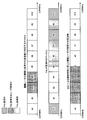
- FIG. 10 is an explanatory diagram for explaining the outline of the procedure for evacuation of CBSD using PAL.
- the carrier-based radar signals are detected for channels # 3 to # 5 under the condition that channels # 1 to # 7 are assigned to the CBSD that uses PAL. Therefore, in the example shown in FIG. 10, the SAS instructs the CBSD using the channels # 3 to # 5 to stop the radio wave, and evacuates the CBSD to the unused channels # 8 to # 10. There is.
- FIG. 11 is an explanatory diagram for explaining the outline of the procedure for evacuation of CBSD using PAL, and schematically shows a situation in which erroneous detection by ESC has occurred.
- channels # 3 to # 4 are used by the carrier-based radar under the condition that channels # 1 to # 7 are assigned to the CBSD that uses PAL.
- the ESC1 detects the carrier-based radar signals for channels # 2 to # 4.
- carrier-based radar signals are detected for channels # 3 to # 5. That is, when the logical sum of the detection results of each of ESC1 and ESC2 is taken into consideration, it means that the carrier-based radar signals are detected for channels # 2 to # 5.
- the present disclosure proposes a technique that enables frequency sharing in a more preferable manner even in a situation where an error occurs in the detection result of the frequency band used by the primary communication service. .. Specifically, in the present disclosure, even if an error occurs in the detection result of radio wave use by the primary communication service, secondary use is possible for CBSD (particularly, CBSD using PAL) as much as possible. We propose a technology that makes it possible to allocate frequency bands.
- FIG. 12 is an explanatory diagram for explaining an example of the system architecture according to the present embodiment.
- the system according to the embodiment of the present disclosure includes a plurality of SASs (SAS1 and SAS2), ESCs (ESC1 and ESC2) provided for each SAS, and a CBSD managed by the SAS. CBSD1 and CBSD2) and a PAL database (PAL Database) are included.
- the CBSD is assumed to be a CBSD that uses PAL.
- the PAL database is typically provided based on WINNF-TS-0245 and corresponds to a database in which PAL auction results and frequency allocation status are recorded. Basically, the PAL database is commonly used among a plurality of SASs. In addition, the PAL database may be replaced by an entity having an equivalent function during implementation in some areas or in some bands.
- SAS-CBSD Interface In the interface between SAS and CBSD (SAS-CBSD Interface), various procedures between SAS and CBSD described above are typically executed. In addition to the procedure, signaling may be performed separately between SAS and CBSD.
- SAS-SAS Interface various procedures between the plurality of SASs described above are typically executed. Further, in addition to the procedure, signaling may be separately performed between a plurality of SASs.
- the ESC corresponds to the radio wave sensing system described above. Typically, the ESC detects the Radar signal in the Federal incumbent. Further, the ESC may perform another Incumbent signal detection depending on the embodiment.
- SAS-ESC Interface In the interface between SAS and ESC (SAS-ESC Interface), information related to Incumbent Protection, such as the detection result of the Incumbent signal, is typically exchanged.
- CBRS if a standardized interface exists, the interface may be applied, or a proprietary interface protocol may be applied.
- SAS-PAL DB Interface In the interface between the SAS and PAL databases (SAS-PAL DB Interface), the information recorded in the PAL database is typically provided to the SAS.
- FIG. 13 is a sequence diagram showing an example of a series of processing flows of the system according to the present embodiment.
- the monitoring devices 530a and 530b, the communication devices 100a and 100b, the communication control devices 300a and 300b, and the PAL database 510, respectively are ESC1 and ESC2, CBSD1 and CBSD2, SAS1 and SAS2 in the example shown in FIG. It also supports the PAL database.
- the monitoring device 530a performs Incumbent Detection (S101) of the frequency band (channel) occupied by the primary communication service among the frequency bands to be shared. Notification of the detection result is performed to the communication control device 300a (S103).
- the communication control device 300a reassigns the channel (that is, the secondary available channel) to the communication device 100a based on the notification from the monitoring device 530a (S105).
- the communication device 100 (CBSD) to be reassigned is, for example, the communication device 100 (CBSD) that is presumed to give strong interference to the primary communication service.
- the CBSD included in the Move List specified in Document 1 described above may be the target of the reassignment.
- the Move List includes a communication device 100 (CBSD) that uses a PAL channel.
- the communication control device 300a also typically reallocates the PAL channel so that the rules for PAL allocation are adhered to.
- the communication control device 300a notifies the PAL database 510 of the result of the channel reassignment described above, and requests the PAL database 510 to update the database in which the PAL auction result and the frequency allocation status are recorded (S107).
- the PAL database 510 receives the request from the communication control device 300a, updates the database (Record Update) based on the information notified from the communication control device 300a (S109), and reports the result of the update. Notify the communication control device 300a (S111). In the following description, it is assumed that the database has been updated successfully.
- the communication control device 300a receives an inquiry (Channel accessibility inquiry) regarding the channel that can be secondarily used from the communication device 100a (S113), the communication control device 300a notifies the communication device 100a of the information regarding the newly assigned channel. (S115).
- the above-mentioned frequency usage notification procedure can be mentioned.
- the information regarding the newly assigned channel notified to the communication device 100a corresponds to an example of the "fourth information".
- a procedure (New channel authorization process) related to the use of the newly assigned channel is performed between the communication control device 300a and the communication device 100a (S117).
- a specific example of the procedure is the frequency use permission procedure described above.
- the communication device 100a resumes radio wave transmission using the newly assigned channel (S119).
- each process indicated by reference numerals S131 to S149 corresponds to each process indicated by reference numerals S101 to S119.
- FIGS. 12 and 13 an example of an architecture and a system that are premised on the explanation of the technical features of the system according to the embodiment of the present disclosure has been described above.
- FIG. 14 is a sequence diagram showing an example of a series of processing flows of the system according to the present embodiment, and is a procedure flow between the monitoring device 530a, the communication control device 300a, the PAL database 510, and the communication device 100a.
- An example is shown. Since the processes indicated by reference numerals S201 and S203 are substantially the same as the processes indicated by reference numerals S101 and S103 in FIG. 13, detailed description thereof will be omitted.
- the communication control device 300a when the communication control device 300a receives the notification from the monitoring device 530a (S203), the communication control device 300a inquires the PAL database 510 about the current PAL channel allocation status (S205). At this time, the communication control device 300a may confirm whether or not the Move List includes information regarding the channel allocation (Grant) for the communication device 100 (CBSD) to be evaluated. At this time, if the information about the communication device 100 to be evaluated is not included in the Move List, the communication control device 300a may cancel the subsequent processing. Further, the information according to the detection result of the frequency band occupied by the primary communication service acquired by the communication control device 300 from the monitoring device 530 associated with the communication control device 300 corresponds to an example of the "second information". ..
- the communication control device 300a acquires information on the current PAL channel allocation status from the PAL database 510 as a response to the inquiry (S207), and based on the information, the channel for the communication device 100a (that is, secondary availability). Channel) is reassigned (S209).
- the information regarding the current PAL channel allocation status acquired from the PAL database includes the primary communication service acquired by the other communication control device 300 (for example, the communication control device 300b shown in FIG. 13).
- Information about the detection result of the frequency band occupied by may be included.
- the communication control device 300a takes into account the detection results of the monitoring device 530a associated with itself and the detection results of the other monitoring device 530 associated with the other communication control device 300, and the communication device 100a It is also possible to reassign channels to.
- the information regarding the current PAL channel allocation status (in other words, the information according to the detection result by the other monitoring device 530) acquired from the PAL database corresponds to an example of the "third information".
- the information on the frequency band (channel) occupied by the primary communication service when the third information and the above-mentioned second information are not particularly limited is an example of the "first information". Equivalent to. That is, the first information may include at least one of the second information and the third information. Further, among the detection results of the frequency band occupied by the primary communication service by the plurality of monitoring devices 530 different from each other, a part corresponds to an example of the "first detection result", and the other part corresponds to the example. It corresponds to an example of "second detection result". As a specific example, when the detection result by the monitoring device 530a shown in FIGS. 13 and 14 is set as the "first detection result", the detection result by the monitoring device 530b shown in FIG. 13 is the "second detection result". Can be equivalent to.
- 15 and 16 are explanatory views for explaining an example of processing related to channel reallocation by the system according to the present embodiment.
- the upper figure shows the channels corresponding to the frequencies actually used by the carrier-based radar, which is the primary communication service. That is, in the example shown in FIG. 15, the carrier-based radar occupies two channels, channels # 3 to # 4, among channels # 1 to # 10.
- the middle figure shows the channel allocation status for each communication device 100 (CBSD) that uses PAL before the channel is reassigned. That is, in the example shown in FIG. 15, of the channels # 1 to # 10, 7 channels of channels # 1 to # 7 are assigned to the communication device 100. It is assumed that channels # 8 to # 10 are free channels.
- the lower figure shows the recognition result of the channel used in the carrier-based radar according to the detection result by the monitoring device 530.
- the lower figure shows, for example, the detection result by the monitoring device 530a, the current PAL channel allocation status notified by the PAL database 510 (in other words, the detection result by another monitoring device 530).
- It can correspond to the recognition result of the channel used in the carrier-based radar according to the above. That is, in the example shown in FIG. 15, an error has occurred in the detection results of some of the monitoring devices 530, and among channels # 1 to # 10, channels # 2 to # 4 and a part of channel # 5 (1). / 2) and 3.5 channels are recognized as being occupied by the onboard radar.
- the communication control device 300 is a part of the channel in which the occupation by the primary communication service (for example, a ship-mounted radar) is detected only in a part of the frequency band.
- the primary communication service for example, a ship-mounted radar
- the communication control device 300a confirms the degree of overlap of the occupied frequency bands for each channel corresponding to the frequency band recognized to be occupied by the onboard radar.
- SAS the communication control device 300a
- each of channels # 2 to # 4 is occupied over the entire channel (Full overlap), and only a part of channel # 5 is occupied (Partial overlap).
- the communication control device 300a may limit the channel to be confirmed for the degree of overlap of the occupied frequency bands. For example, if it is assumed that a series of frequency bands are occupied by the primary communication service, the communication control device 300a has channels at both ends of the frequency bands recognized as being occupied by the primary communication service. You may check the degree of overlap of the frequency bands occupied by the target.
- the communication control device 300a identifies a frequency band other than the part of the frequency band for the channel occupied only by a part of the frequency band, and sets the other frequency band as the communication device 100 (CBSD). It is used as a save destination for. That is, in the case of the example shown in FIG. 15, the frequency band corresponding to channel # 5 is divided into a frequency band occupied by the onboard radar (primary communication service) and another frequency band not occupied. The other unoccupied frequency band is used as a save destination of the communication device 100.
- the communication control device 300a is included in both the detection result by the monitoring device 530a and the detection result by another monitoring device 530 (for example, the monitoring device 530b) different from the monitoring device 530a.
- Non-channels may be subject to reassignment to one or more communication devices 100 (CBSD).
- the communication control device 300a specifies one or more communication devices 100 (CBSD) in other frequency bands other than the partial frequency band, which is specified for a channel in which only a part of the frequency band is occupied. It may be the target of reassignment to.
- one or more communication devices 100 (1 or more) for each of the other frequency bands other than the part of the frequency bands specified for each channel. It may be the target of reassignment to CBSD).
- FIG. 16 schematically shows the state after the channel is reassigned. That is, in the example shown in FIG. 16, other frequency bands different from the frequency band recognized as being used for the onboard radar shown in the lower figure, that is, channels # 1, # 6 to # 10, and channels. A part of # 5 and is assigned to the communication device 100 (CBSD).
- CBSD communication device 100
- the communication control device 300a determines the communication device 100 to be saved to a channel in which only a part of the frequency band can be used, according to the capability of each communication device 100 when the channel is reassigned. You may. Specifically, the communication control device 300a uses a communication device 100 that can use a carrier having a size acceptable by the bandwidth of a frequency band that is not occupied by the primary communication service among the target channels. It may be specified as a target for evacuation.
- a possible communication device 100 may be specified as a target for evacuation. That is, in this case, the communication device 100 capable of using a carrier having a size of 7 MHz or less (for example, a carrier of 5 MHz) can be specified as an evacuation target. As a more specific example, when a communication device 100 capable of using a 5 MHz carrier is specified as an evacuation target in a situation where 7 MHz can be used, 5 MHz of the 7 MHz wide frequency band is used. It will be assigned to the communication device 100.
- the communication control device 300 can recognize the capabilities of each communication device 100 at the timing of reallocating the frequency band, the acquisition method and acquisition opportunity of the information related to the capabilities are not particularly limited. As a specific example, it is possible to acquire the capability information of the target communication device 100 during the registration procedure described above. Further, as another example, the capability information of the communication device 100 may be acquired by a predetermined signaling.
- the communication device 100 does not need to change the cell ID of the carrier after degeneration. Therefore, the communication device 100 does not perform a handover (Handover) on the terminal device 200 (UE) that has been served by using the frequency band allocated when the radio wave is stopped. , It is possible to control the degenerate carrier to be used within the control of resource scheduling.
- the radio wave outage period that is, the period in which a part of the frequency band (channel) is occupied by the primary communication service
- only a part of the frequency band is controlled to be used.
- a procedure may be performed to return the communication device 100 to a state in which the frequency band for one channel can be used.
- SAS communication control device 300
- CBSD communication device 100
- the processing shown by reference numerals S211 to S221 is substantially the same as the processing shown by reference numerals S107 to S119 in the example shown in FIG. That is, the database managed by the PAL database 510 is updated according to the result of the reallocation (S211 to S215), and wireless communication is performed between the communication control device 300a and the communication device 100a using the frequency band after the reallocation. A series of procedures for starting the above is executed (S221).
- the monitoring device 530a the communication control device 300a, the PAL database 510, and the communication device shown in FIG.
- the explanation focused on the procedure between 100a.
- the application server 60, the network manager 400, and the PAL database 510 may be implemented as any type of server, such as a tower server, a rack server, or a blade server. Further, at least a part of the components of the application server 60, the network manager 400, and the PAL database 510 are inserted into a module mounted on the server (for example, an integrated circuit module composed of one die or a slot of a blade server). It may be realized in the card or blade).
- the communication device 100 may be realized as an eNB (evolved Node B) of any kind such as a macro eNB or a small eNB.
- the small eNB may be an eNB that covers cells smaller than the macro cell, such as a pico eNB, a micro eNB, or a home (femto) eNB.
- the communication device 100 may be realized as another type of base station such as NodeB or BTS (Base Transceiver Station).
- the communication device 100 may include a main body (also referred to as a base station device) that controls wireless communication, and one or more RRHs (Remote Radio Heads) arranged at a location different from the main body.
- RRHs Remote Radio Heads
- various types of terminals which will be described later, may operate as the communication device 100 by temporarily or semi-permanently executing the base station function.
- the terminal device 200 is a smartphone, a tablet PC (Personal Computer), a notebook PC, a portable game terminal, a mobile terminal such as a portable / dongle type mobile router or a digital camera, or an in-vehicle terminal such as a car navigation device. It may be realized as.
- the terminal device 200 is a terminal (also referred to as an MTC (Machine Type Communication) terminal) that performs M2M (Machine To Machine) communication, and moves a surveillance camera, a gateway terminal of various sensor devices, a car, a bus, a train, an aircraft, or the like. It may be realized in a vehicle or the like that realizes the means. Further, at least a part of the components of the terminal device 200 may be realized in a module mounted on these terminals (for example, an integrated circuit module composed of one die).
- FIG. 17 is a block diagram showing an example of a schematic configuration of a server 700 to which the technique according to the present disclosure can be applied.
- the server 700 includes a processor 701, a memory 702, a storage 703, a network interface 704, and a bus 706.
- the processor 701 may be, for example, a CPU (Central Processing Unit) or a DSP (Digital Signal Processor), and controls various functions of the server 700.
- the memory 702 includes a RAM (Random Access Memory) and a ROM (Read Only Memory), and stores programs and data executed by the processor 701.
- the storage 703 may include a storage medium such as a semiconductor memory or a hard disk.
- the network interface 704 is a wired communication interface for connecting the server 700 to the wired communication network 705.
- the wired communication network 705 may be a core network such as EPC (Evolved Packet Core) or a PDN (Packet Data Network) such as the Internet.
- EPC Evolved Packet Core
- PDN Packet Data Network
- the bus 706 connects the processor 701, the memory 702, the storage 703, and the network interface 704 to each other.
- the bus 706 may include two or more buses having different speeds (for example, a high-speed bus and a low-speed bus).
- At least one or more components may be implemented in processor 701.
- a program for causing the processor to function as one or more of the above components is installed in the server 700, and the processor 701 is installed.
- the program may be executed.
- the server 700 may include a module including a processor 701 and a memory 702, in which one or more of the above components may be mounted.
- the module may store a program for making the processor function as one or more of the above components in the memory 702, and execute the program by the processor 701.
- the server 700 or the module may be provided as a device including the one or more components, and the program for making the processor function as the one or more components may be provided. .. Further, a readable recording medium on which the above program is recorded may be provided.
- FIG. 18 is a block diagram showing a first example of a schematic configuration of an eNB to which the techniques according to the present disclosure can be applied.
- the eNB 800 has one or more antennas 810 and a base station device 820. Each antenna 810 and base station device 820 may be connected to each other via an RF cable.
- Each of the antennas 810 has a single antenna element or a plurality of antenna elements (for example, a plurality of antenna elements constituting a MIMO antenna), and is used for transmitting and receiving a radio signal by the base station apparatus 820.
- the eNB 800 has a plurality of antennas 810 as shown in FIG. 18, and the plurality of antennas 810 may correspond to a plurality of frequency bands used by the eNB 800, for example.
- FIG. 18 shows an example in which the eNB 800 has a plurality of antennas 810, the eNB 800 may have a single antenna 810.
- the base station device 820 includes a controller 821, a memory 822, a network interface 823, and a wireless communication interface 825.
- the controller 821 may be, for example, a CPU or a DSP, and operates various functions of the upper layer of the base station apparatus 820. For example, the controller 821 generates a data packet from the data in the signal processed by the wireless communication interface 825, and transfers the generated packet via the network interface 823. The controller 821 may generate a bundled packet by bundling data from a plurality of baseband processors and transfer the generated bundled packet. Further, the controller 821 is a logic that executes control such as radio resource management (Radio Resource Control), radio bearer control (Radio Bearer Control), mobility management (Mobility Management), inflow control (Admission Control), or scheduling (Scheduling). Function may be provided.
- Radio Resource Control Radio Resource Control
- Radio Bearer Control Radio Bearer Control
- Mobility Management Mobility Management
- Admission Control Inflow control
- scheduling scheduling
- the control may be executed in cooperation with the surrounding eNB or the core network node.
- the memory 822 includes a RAM and a ROM, and stores a program executed by the controller 821 and various control data (for example, terminal list, transmission power data, scheduling data, etc.).
- the network interface 823 is a communication interface for connecting the base station device 820 to the core network 824. Controller 821 may communicate with a core network node or other eNB via network interface 823. In that case, the eNB 800 and the core network node or other eNB may be connected to each other by a logical interface (for example, S1 interface or X2 interface).
- the network interface 823 may be a wired communication interface or a wireless communication interface for a wireless backhaul. When the network interface 823 is a wireless communication interface, the network interface 823 may use a frequency band higher than the frequency band used by the wireless communication interface 825 for wireless communication.
- the wireless communication interface 825 supports either a cellular communication method such as LTE (Long Term Evolution) or LTE-Advanced, and provides a wireless connection to a terminal located in the cell of the eNB 800 via the antenna 810.
- the wireless communication interface 825 may typically include a baseband (BB) processor 826, an RF circuit 827, and the like.
- the BB processor 826 may perform, for example, coding / decoding, modulation / demodulation, and multiplexing / demultiplexing, and each layer (for example, L1, MAC (Medium Access Control), RLC (Radio Link Control), and PDCP. (Packet Data Convergence Protocol)) Performs various signal processing.
- L1, MAC Medium Access Control
- RLC Radio Link Control
- PDCP Packet Data Convergence Protocol
- the BB processor 826 may have some or all of the above-mentioned logical functions instead of the controller 821.
- the BB processor 826 may be a module including a memory for storing a communication control program, a processor for executing the program, and related circuits, and the function of the BB processor 826 may be changed by updating the above program. Good.
- the module may be a card or a blade inserted into the slot of the base station apparatus 820, or may be a chip mounted on the card or the blade.
- the RF circuit 827 may include a mixer, a filter, an amplifier, and the like, and transmits and receives radio signals via the antenna 810.
- the wireless communication interface 825 includes a plurality of BB processors 826 as shown in FIG. 18, and the plurality of BB processors 826 may correspond to a plurality of frequency bands used by, for example, the eNB 800. Further, the wireless communication interface 825 includes a plurality of RF circuits 827 as shown in FIG. 18, and the plurality of RF circuits 827 may correspond to, for example, a plurality of antenna elements. Although FIG. 18 shows an example in which the wireless communication interface 825 includes a plurality of BB processors 826 and a plurality of RF circuits 827, the wireless communication interface 825 includes a single BB processor 826 or a single RF circuit 827. It may be.
- One or more components included in the control unit 150 described with reference to FIG. 4 shown in FIG. 18 are wireless communication. It may be implemented in interface 825. Alternatively, at least some of these components may be implemented in controller 821.
- the eNB 800 may include a module including a part (for example, BB processor 826) or all of the wireless communication interface 825 and / or a controller 821, and the module may be equipped with one or more of the above components. Good. In this case, the module stores a program for causing the processor to function as the one or more components (in other words, a program for causing the processor to execute the operation of the one or more components).
- the eNB 800, the base station device 820, or the module may be provided as a device including the one or more components, and a program for making the processor function as the one or more components is provided. You may. Further, a readable recording medium on which the above program is recorded may be provided.
- the wireless communication unit 120 described with reference to FIG. 4 may be mounted on the wireless communication interface 825 (for example, RF circuit 827). Further, the antenna unit 110 may be mounted on the antenna 810. Further, the network communication unit 130 may be implemented in the controller 821 and / or the network interface 823. Further, the storage unit 140 may be mounted in the memory 822.
- FIG. 19 is a block diagram showing a second example of a schematic configuration of an eNB to which the technique according to the present disclosure can be applied.
- the eNB 830 has one or more antennas 840, a base station device 850, and an RRH860. Each antenna 840 and RRH860 may be connected to each other via an RF cable. Further, the base station apparatus 850 and RRH860 may be connected to each other by a high-speed line such as an optical fiber cable.
- Each of the antennas 840 has a single or a plurality of antenna elements (for example, a plurality of antenna elements constituting a MIMO antenna) and is used for transmitting and receiving a radio signal by the RRH860.
- the eNB 830 has a plurality of antennas 840 as shown in FIG. 19, and the plurality of antennas 840 may correspond to a plurality of frequency bands used by the eNB 830, for example.
- FIG. 19 shows an example in which the eNB 830 has a plurality of antennas 840, the eNB 830 may have a single antenna 840.
- the base station device 850 includes a controller 851, a memory 852, a network interface 853, a wireless communication interface 855, and a connection interface 857.
- the controller 851, memory 852, and network interface 853 are similar to the controller 821, memory 822, and network interface 823 described with reference to FIG.
- the wireless communication interface 855 supports either a cellular communication method such as LTE or LTE-Advanced, and provides a wireless connection to terminals located in the sector corresponding to the RRH860 via the RRH860 and the antenna 840.
- the wireless communication interface 855 may typically include a BB processor 856 and the like.
- the BB processor 856 is similar to the BB processor 826 described with reference to FIG. 18, except that it is connected to the RF circuit 864 of the RRH860 via the connection interface 857.
- the wireless communication interface 855 includes a plurality of BB processors 856 as shown in FIG. 19, and the plurality of BB processors 856 may correspond to a plurality of frequency bands used by, for example, the eNB 830.
- FIG. 19 shows an example in which the wireless communication interface 855 includes a plurality of BB processors 856, the wireless communication interface 855 may include a single BB processor 856.
- connection interface 857 is an interface for connecting the base station device 850 (wireless communication interface 855) to the RRH860.
- the connection interface 857 may be a communication module for communication on the high-speed line connecting the base station apparatus 850 (wireless communication interface 855) and the RRH860.
- the RRH860 includes a connection interface 861 and a wireless communication interface 863.
- connection interface 861 is an interface for connecting the RRH860 (wireless communication interface 863) to the base station device 850.
- the connection interface 861 may be a communication module for communication on the high-speed line.
- the wireless communication interface 863 transmits and receives wireless signals via the antenna 840.
- the wireless communication interface 863 may typically include RF circuits 864 and the like.
- the RF circuit 864 may include a mixer, a filter, an amplifier, and the like, and transmits and receives radio signals via the antenna 840.
- the wireless communication interface 863 includes a plurality of RF circuits 864, and the plurality of RF circuits 864 may correspond to, for example, a plurality of antenna elements.
- FIG. 19 shows an example in which the wireless communication interface 863 includes a plurality of RF circuits 864, the wireless communication interface 863 may include a single RF circuit 864.
- the eNB 830 shown in FIG. 19 one or more components (at least one of the communication control unit 151, the information acquisition unit 153, and the notification unit 155) included in the control unit 150 described with reference to FIG. 4 are , Wireless communication interface 855 and / or wireless communication interface 863. Alternatively, at least some of these components may be implemented in controller 851. As an example, the eNB 830 includes a module including a part (for example, BB processor 856) or all of the wireless communication interface 855 and / or a controller 851, and even if one or more of the above components are implemented in the module. Good.
- the module stores a program for causing the processor to function as the one or more components (in other words, a program for causing the processor to execute the operation of the one or more components). You may run the program. As another example, even if a program for making the processor function as one or more of the above components is installed in the eNB 830 and the wireless communication interface 855 (eg, BB processor 856) and / or the controller 851 executes the program. Good.
- the eNB 830, the base station device 850, or the module may be provided as a device including the one or more components, and a program for making the processor function as the one or more components is provided. You may. Further, a readable recording medium on which the above program is recorded may be provided.
- the wireless communication unit 120 described with reference to FIG. 4 may be mounted on the wireless communication interface 863 (for example, RF circuit 864).
- the antenna unit 110 may be mounted on the antenna 840.
- the network communication unit 130 may be implemented in the controller 851 and / or the network interface 853.
- the storage unit 140 may be mounted in the memory 852.
- FIG. 20 is a block diagram showing an example of a schematic configuration of a smartphone 900 to which the technology according to the present disclosure can be applied.
- the smartphone 900 includes a processor 901, a memory 902, a storage 903, an external connection interface 904, a camera 906, a sensor 907, a microphone 908, an input device 909, a display device 910, a speaker 911, a wireless communication interface 912, and one or more antenna switches 915. It comprises one or more interfaces 916, bus 917, battery 918 and auxiliary controller 919.
- the processor 901 may be, for example, a CPU or a SoC (System on Chip), and controls the functions of the application layer and other layers of the smartphone 900.
- Memory 902 includes RAM and ROM and stores programs and data executed by processor 901.
- the storage 903 may include a storage medium such as a semiconductor memory or a hard disk.
- the external connection interface 904 is an interface for connecting an external device such as a memory card or a USB (Universal Serial Bus) device to the smartphone 900.
- the camera 906 has an image sensor such as a CCD (Charge Coupled Device) or a CMOS (Complementary Metal Oxide Semiconductor) and generates an image.
- the sensor 907 may include, for example, a group of sensors such as a positioning sensor, a gyro sensor, a geomagnetic sensor and an acceleration sensor.
- the microphone 908 converts the voice input to the smartphone 900 into a voice signal.
- the input device 909 includes, for example, a touch sensor, a keypad, a keyboard, a button, or a switch for detecting a touch on the screen of the display device 910, and receives an operation or information input from the user.
- the display device 910 has a screen such as a liquid crystal display (LCD) or an organic light emitting diode (OLED) display, and displays an output image of the smartphone 900.
- the speaker 911 converts the voice signal output from the smartphone 900 into voice.
- the wireless communication interface 912 supports either a cellular communication method such as LTE or LTE-Advanced, and executes wireless communication.
- the wireless communication interface 912 may typically include a BB processor 913, an RF circuit 914, and the like.
- the BB processor 913 may perform, for example, coding / decoding, modulation / demodulation, multiplexing / demultiplexing, and the like, and performs various signal processing for wireless communication.
- the RF circuit 914 may include a mixer, a filter, an amplifier, and the like, and transmits and receives radio signals via the antenna 916.
- the wireless communication interface 912 may be a one-chip module in which a BB processor 913 and an RF circuit 914 are integrated.
- the wireless communication interface 912 may include a plurality of BB processors 913 and a plurality of RF circuits 914 as shown in FIG. Although FIG. 20 shows an example in which the wireless communication interface 912 includes a plurality of BB processors 913 and a plurality of RF circuits 914, the wireless communication interface 912 includes a single BB processor 913 or a single RF circuit 914. It may be.
- the wireless communication interface 912 may support other types of wireless communication systems such as a short-range wireless communication system, a near field wireless communication system, or a wireless LAN (Local Area Network) system in addition to the cellular communication system.
- a short-range wireless communication system such as a Bluetooth Special Interest Group (SIG) system
- a near field wireless communication system such as a Wi-Fi Protected Access
- a wireless LAN Local Area Network
- the BB processor 913 and the RF circuit 914 for each wireless communication system may be included.
- Each of the antenna switches 915 switches the connection destination of the antenna 916 between a plurality of circuits (for example, circuits for different wireless communication methods) included in the wireless communication interface 912.
- Each of the antennas 916 has a single antenna element or a plurality of antenna elements (for example, a plurality of antenna elements constituting a MIMO antenna), and is used for transmitting and receiving a radio signal by the wireless communication interface 912.
- the smartphone 900 may have a plurality of antennas 916 as shown in FIG. Although FIG. 20 shows an example in which the smartphone 900 has a plurality of antennas 916, the smartphone 900 may have a single antenna 916.
- the smartphone 900 may be provided with an antenna 916 for each wireless communication method.
- the antenna switch 915 may be omitted from the configuration of the smartphone 900.
- the bus 917 connects the processor 901, the memory 902, the storage 903, the external connection interface 904, the camera 906, the sensor 907, the microphone 908, the input device 909, the display device 910, the speaker 911, the wireless communication interface 912, and the auxiliary controller 919 to each other. ..
- the battery 918 supplies electric power to each block of the smartphone 900 shown in FIG. 20 via a power supply line partially shown by a broken line in the figure.
- the auxiliary controller 919 operates the minimum necessary functions of the smartphone 900, for example, in the sleep mode.
- the smartphone 900 shown in FIG. 20 one or more components included in the control unit 240 described with reference to FIG. 5 (at least one of the communication control unit 241, the information acquisition unit 243, and the notification unit 247). May be implemented in the wireless communication interface 912. Alternatively, at least some of these components may be implemented in processor 901 or auxiliary controller 919. As an example, the smartphone 900 includes a module including a part (for example, BB processor 913), a processor 901, and / or an auxiliary controller 919 of the wireless communication interface 912, and one or more of the above-mentioned components in the module. May be implemented.
- the module stores a program for causing the processor to function as the one or more components (in other words, a program for causing the processor to execute the operation of the one or more components). You may run the program.
- a program for making the processor function as one or more of the above components is installed in the smartphone 900, with the wireless communication interface 912 (eg, BB processor 913), processor 901, and / or auxiliary controller 919. You may run the program.
- the smartphone 900 or the module may be provided as a device including the one or more components, and a program for making the processor function as the one or more components may be provided. Further, a readable recording medium on which the above program is recorded may be provided.
- the wireless communication unit 220 described with reference to FIG. 5 may be mounted on the wireless communication interface 912 (for example, RF circuit 914). Further, the antenna unit 210 may be mounted on the antenna 916. Further, the storage unit 230 may be mounted in the memory 902.
- FIG. 21 is a block diagram showing an example of a schematic configuration of a car navigation device 920 to which the technique according to the present disclosure can be applied.
- the car navigation device 920 includes a processor 921, a memory 922, a GPS (Global Positioning System) module 924, a sensor 925, a data interface 926, a content player 927, a storage medium interface 928, an input device 929, a display device 930, a speaker 931, and wireless communication. It comprises an interface 933, one or more antenna switches 936, one or more antennas 937, and a battery 938.
- GPS Global Positioning System
- the processor 921 may be, for example, a CPU or SoC, and controls the navigation function and other functions of the car navigation device 920.
- Memory 922 includes RAM and ROM and stores programs and data executed by processor 921.
- the GPS module 924 uses GPS signals received from GPS satellites to measure the position (eg, latitude, longitude and altitude) of the car navigation device 920.
- the sensor 925 may include, for example, a group of sensors such as a gyro sensor, a geomagnetic sensor and a barometric pressure sensor.
- the data interface 926 is connected to the vehicle-mounted network 941 via a terminal (not shown), and acquires data generated on the vehicle side such as vehicle speed data.
- the content player 927 reproduces the content stored in the storage medium (for example, CD or DVD) inserted in the storage medium interface 928.
- the input device 929 includes, for example, a touch sensor, a button, or a switch that detects a touch on the screen of the display device 930, and accepts an operation or information input from the user.
- the display device 930 has a screen such as an LCD or an OLED display, and displays an image of a navigation function or a content to be reproduced.
- the speaker 931 outputs the sound of the navigation function or the content to be played.
- the wireless communication interface 933 supports either a cellular communication method such as LTE or LTE-Advanced, and executes wireless communication.
- the wireless communication interface 933 may typically include a BB processor 934, an RF circuit 935, and the like.
- the BB processor 934 may perform, for example, coding / decoding, modulation / demodulation, multiplexing / demultiplexing, and the like, and performs various signal processing for wireless communication.
- the RF circuit 935 may include a mixer, a filter, an amplifier, and the like, and transmits and receives radio signals via the antenna 937.
- the wireless communication interface 933 may be a one-chip module in which a BB processor 934 and an RF circuit 935 are integrated.
- the wireless communication interface 933 may include a plurality of BB processors 934 and a plurality of RF circuits 935 as shown in FIG. Although FIG. 21 shows an example in which the wireless communication interface 933 includes a plurality of BB processors 934 and a plurality of RF circuits 935, the wireless communication interface 933 includes a single BB processor 934 or a single RF circuit 935. It may be.
- the wireless communication interface 933 may support other types of wireless communication systems such as a short-range wireless communication system, a proximity wireless communication system, or a wireless LAN system in addition to the cellular communication system, in which case wireless.
- a BB processor 934 and an RF circuit 935 for each communication method may be included.
- Each of the antenna switches 936 switches the connection destination of the antenna 937 between a plurality of circuits (for example, circuits for different wireless communication methods) included in the wireless communication interface 933.
- Each of the antennas 937 has a single antenna element or a plurality of antenna elements (for example, a plurality of antenna elements constituting a MIMO antenna) and is used for transmitting and receiving a radio signal by the wireless communication interface 933.
- the car navigation device 920 may have a plurality of antennas 937 as shown in FIG. Although FIG. 21 shows an example in which the car navigation device 920 has a plurality of antennas 937, the car navigation device 920 may have a single antenna 937.
- the car navigation device 920 may be provided with an antenna 937 for each wireless communication method.
- the antenna switch 936 may be omitted from the configuration of the car navigation device 920.
- the battery 938 supplies electric power to each block of the car navigation device 920 shown in FIG. 21 via a power supply line partially shown by a broken line in the figure. In addition, the battery 938 stores electric power supplied from the vehicle side.
- the car navigation device 920 shown in FIG. 21 at least one of one or more components (communication control unit 241, information acquisition unit 243, and notification unit 247) included in the control unit 240 described with reference to FIG. ) May be implemented in the wireless communication interface 933. Alternatively, at least some of these components may be implemented in processor 921.
- the car navigation device 920 includes a module including a part (for example, BB processor 934) or all and / or a processor 921 of the wireless communication interface 933, and one or more of the above components are mounted on the module. You may.
- the module stores a program for causing the processor to function as the one or more components (in other words, a program for causing the processor to execute the operation of the one or more components).
- a program for making the processor function as one or more of the above components is installed in the car navigation device 920, and the wireless communication interface 933 (eg, BB processor 934) and / or the processor 921 executes the program. You may.
- the car navigation device 920 or the module may be provided as a device including the one or more components, or a program for making the processor function as the one or more components may be provided. Good. Further, a readable recording medium on which the above program is recorded may be provided.
- the wireless communication unit 220 described with reference to FIG. 5 may be mounted on the wireless communication interface 933 (for example, RF circuit 935). Further, the antenna unit 210 may be mounted on the antenna 937. Further, the storage unit 230 may be mounted in the memory 922.
- the technique according to the present disclosure may be realized as an in-vehicle system (or vehicle) 940 including one or more blocks of the car navigation device 920 described above, an in-vehicle network 941, and a vehicle-side module 942. That is, the in-vehicle system (or vehicle) 940 may be provided as a device including at least one of the communication control unit 241 and the information acquisition unit 243, the measurement unit 245, and the notification unit 247.
- the vehicle-side module 942 generates vehicle-side data such as vehicle speed, engine speed, or failure information, and outputs the generated data to the vehicle-mounted network 941.
- the communication control device (for example, SAS) includes an acquisition unit, a specific unit, and a control unit.
- the acquisition unit acquires the first information regarding the channel occupied by the primary communication service among the plurality of channels assigned to the primary communication service.
- the specific unit specifies other frequency bands other than the partial frequency bands for the channels occupied by the primary communication service only for a part of the frequency bands. ..
- the control unit allocates the specified other frequency band to one or more secondary use communication devices that provide a secondary communication service different from the primary communication service.
- An acquisition unit that acquires the first information about the channel occupied by the primary communication service among the plurality of channels assigned to the primary communication service, and Of the frequency bands corresponding to the channels, with respect to the channel occupied by the primary communication service only for a part of the frequency bands, a specific unit for specifying a frequency band other than the part of the frequency bands, and A control unit that allocates the specified other frequency band to one or more secondary communication devices that provide a secondary communication service different from the primary communication service.
- a communication control device (2) The communication control device according to (1), wherein the first information includes second information according to a detection result of the channel occupied by the primary communication service.
- the first information according to the above (1) or (2) which includes a third information acquired by another communication control device according to the detection result of the channel occupied by the primary communication service.
- Communication control device The communication control device according to (3), wherein the acquisition unit acquires the third information from a predetermined database.
- the acquisition unit acquires the first detection result and the second detection result detected by different devices as the detection result of the channel occupied by the primary communication service.
- the control unit has one or more of the channels not included in any of the first detection result and the second detection result of the plurality of channels and the specified other frequency band.
- the control unit allocates the specified other frequency band to the secondary use communication device according to the capability regarding the allocation of the frequency band for the secondary use communication device, according to the above (1) to (5).
- the communication control device according to any one of the above.
- the communication control device according to the section.
- a notification unit that notifies the communication control device of a request regarding the allocation of some of the multiple channels assigned to the primary communication service.
- An acquisition unit that acquires the fourth information according to the bandwidth allocation result, and A communication device.
- the communication device wherein the acquisition unit acquires the fourth information according to the capability.
- the computer Acquiring the first information about the channel occupied by the primary communication service among the plurality of channels assigned to the primary communication service, and Of the frequency bands corresponding to the channels, for the channels occupied by the primary communication service only for a part of the frequency bands, the frequency bands other than the part of the frequency bands are specified. Allocating the specified other frequency band to one or more secondary communication devices that provide a secondary communication service different from the primary communication service, Communication control methods, including.
- System 100 Communication device 110 Antenna unit 120 Wireless communication unit 130 Network communication unit 140 Storage unit 150 Control unit 151 Communication control unit 153 Information acquisition unit 155 Notification unit 200 Terminal device 210 Antenna unit 220 Wireless communication unit 230 Storage unit 240 Control unit 241 Communication control unit 243 Information acquisition unit 245 Measurement unit 247 Notification unit 300 Communication control unit 310 Communication unit 320 Storage unit 330 Control unit 331 Communication control unit 333 Information acquisition unit 335 Specific unit 337 Notification unit 400 Network manager 510 PAL database 530 Monitoring device
Landscapes
- Engineering & Computer Science (AREA)
- Computer Networks & Wireless Communication (AREA)
- Signal Processing (AREA)
- Mobile Radio Communication Systems (AREA)
Priority Applications (3)
| Application Number | Priority Date | Filing Date | Title |
|---|---|---|---|
| JP2021508153A JP7509130B2 (ja) | 2019-03-25 | 2020-01-30 | 通信制御装置、及び通信制御方法 |
| US17/437,495 US12335930B2 (en) | 2019-03-25 | 2020-01-30 | Communication control device, communication device, and communication control method |
| EP20779273.0A EP3952383B1 (en) | 2019-03-25 | 2020-01-30 | Communication control device, communication device, and communication control method |
Applications Claiming Priority (2)
| Application Number | Priority Date | Filing Date | Title |
|---|---|---|---|
| JP2019056245 | 2019-03-25 | ||
| JP2019-056245 | 2019-03-25 |
Publications (1)
| Publication Number | Publication Date |
|---|---|
| WO2020195145A1 true WO2020195145A1 (ja) | 2020-10-01 |
Family
ID=72608598
Family Applications (1)
| Application Number | Title | Priority Date | Filing Date |
|---|---|---|---|
| PCT/JP2020/003422 Ceased WO2020195145A1 (ja) | 2019-03-25 | 2020-01-30 | 通信制御装置、通信装置、及び通信制御方法 |
Country Status (4)
| Country | Link |
|---|---|
| US (1) | US12335930B2 (https=) |
| EP (1) | EP3952383B1 (https=) |
| JP (1) | JP7509130B2 (https=) |
| WO (1) | WO2020195145A1 (https=) |
Cited By (4)
| Publication number | Priority date | Publication date | Assignee | Title |
|---|---|---|---|---|
| WO2022163406A1 (ja) * | 2021-01-27 | 2022-08-04 | ソニーグループ株式会社 | 通信制御装置及び通信制御方法 |
| WO2022185964A1 (ja) * | 2021-03-01 | 2022-09-09 | ソニーグループ株式会社 | 通信制御装置、ネットワーク装置、通信制御システム、通信制御方法及び情報通信方法 |
| WO2023013100A1 (ja) * | 2021-08-05 | 2023-02-09 | ソニーグループ株式会社 | 情報処理装置、通信システム、情報処理方法およびプログラム |
| WO2023182164A1 (ja) * | 2022-03-25 | 2023-09-28 | ソニーグループ株式会社 | 通信制御装置、通信制御方法およびコンピュータプログラム |
Families Citing this family (2)
| Publication number | Priority date | Publication date | Assignee | Title |
|---|---|---|---|---|
| US20190318064A1 (en) * | 2018-04-11 | 2019-10-17 | Flexera Software Llc | Dynamic reallocation of computing resources based on monitored usage activities of client systems |
| US11943171B2 (en) * | 2021-12-28 | 2024-03-26 | T-Mobile Innovations Llc | Assigning physical block resources |
Citations (5)
| Publication number | Priority date | Publication date | Assignee | Title |
|---|---|---|---|---|
| US3550370A (en) | 1967-11-10 | 1970-12-29 | Suwa Seikosha Kk | Electric timepiece |
| WO2012114971A1 (ja) * | 2011-02-24 | 2012-08-30 | ソニー株式会社 | 通信制御装置、通信制御方法、プログラム及び通信システム |
| JP2013187895A (ja) * | 2012-03-09 | 2013-09-19 | Toyota Infotechnology Center Co Ltd | 高移動度車両環境における分散スペクトルセンシングのためのシステム |
| WO2013161136A1 (ja) * | 2012-04-27 | 2013-10-31 | 日本電気株式会社 | 制御装置、無線局、無線端末、及び共用周波数の使用制御方法 |
| WO2016072468A1 (ja) * | 2014-11-07 | 2016-05-12 | 京セラ株式会社 | 無線基地局及びユーザ端末 |
-
2020
- 2020-01-30 WO PCT/JP2020/003422 patent/WO2020195145A1/ja not_active Ceased
- 2020-01-30 US US17/437,495 patent/US12335930B2/en active Active
- 2020-01-30 EP EP20779273.0A patent/EP3952383B1/en active Active
- 2020-01-30 JP JP2021508153A patent/JP7509130B2/ja active Active
Patent Citations (5)
| Publication number | Priority date | Publication date | Assignee | Title |
|---|---|---|---|---|
| US3550370A (en) | 1967-11-10 | 1970-12-29 | Suwa Seikosha Kk | Electric timepiece |
| WO2012114971A1 (ja) * | 2011-02-24 | 2012-08-30 | ソニー株式会社 | 通信制御装置、通信制御方法、プログラム及び通信システム |
| JP2013187895A (ja) * | 2012-03-09 | 2013-09-19 | Toyota Infotechnology Center Co Ltd | 高移動度車両環境における分散スペクトルセンシングのためのシステム |
| WO2013161136A1 (ja) * | 2012-04-27 | 2013-10-31 | 日本電気株式会社 | 制御装置、無線局、無線端末、及び共用周波数の使用制御方法 |
| WO2016072468A1 (ja) * | 2014-11-07 | 2016-05-12 | 京セラ株式会社 | 無線基地局及びユーザ端末 |
Non-Patent Citations (1)
| Title |
|---|
| See also references of EP3952383A4 |
Cited By (4)
| Publication number | Priority date | Publication date | Assignee | Title |
|---|---|---|---|---|
| WO2022163406A1 (ja) * | 2021-01-27 | 2022-08-04 | ソニーグループ株式会社 | 通信制御装置及び通信制御方法 |
| WO2022185964A1 (ja) * | 2021-03-01 | 2022-09-09 | ソニーグループ株式会社 | 通信制御装置、ネットワーク装置、通信制御システム、通信制御方法及び情報通信方法 |
| WO2023013100A1 (ja) * | 2021-08-05 | 2023-02-09 | ソニーグループ株式会社 | 情報処理装置、通信システム、情報処理方法およびプログラム |
| WO2023182164A1 (ja) * | 2022-03-25 | 2023-09-28 | ソニーグループ株式会社 | 通信制御装置、通信制御方法およびコンピュータプログラム |
Also Published As
| Publication number | Publication date |
|---|---|
| EP3952383B1 (en) | 2024-12-04 |
| EP3952383A4 (en) | 2022-09-07 |
| JP7509130B2 (ja) | 2024-07-02 |
| US12335930B2 (en) | 2025-06-17 |
| US20220150894A1 (en) | 2022-05-12 |
| JPWO2020195145A1 (https=) | 2020-10-01 |
| EP3952383A1 (en) | 2022-02-09 |
Similar Documents
| Publication | Publication Date | Title |
|---|---|---|
| JP7415941B2 (ja) | 通信制御装置、通信装置、通信制御方法、及び通信方法 | |
| US12395944B2 (en) | Communication control device and communication control method | |
| US20240244445A1 (en) | Communication control device, method of controlling communication, and communication system | |
| JP7509130B2 (ja) | 通信制御装置、及び通信制御方法 | |
| EP4132054A1 (en) | Communication control device, communication control method, communication device, and communication method | |
| US12550175B2 (en) | Communication control device, communication device, and communication control method | |
| US20220400386A1 (en) | Communication control device, communication device, and communication control method | |
| US12167249B2 (en) | Communication control device, a communication device, and a communication control method capable of realizing effective use of the radio wave resources | |
| JP7647750B2 (ja) | 通信制御方法および通信制御装置 | |
| WO2021131913A1 (ja) | 通信装置、通信制御装置、および通信方法 | |
| CN116848899A (zh) | 通信控制设备、通信设备和通信控制方法 | |
| WO2023063181A1 (ja) | 通信制御装置、通信装置、及び通信制御方法、及び通信方法 | |
| US12267816B2 (en) | Communication control device, communication device, and communication control method | |
| JP7447891B2 (ja) | 通信制御装置、通信装置、方法、通信制御方法、通信方法、及び装置 | |
| WO2023171737A1 (ja) | 通信制御装置、通信装置、通信制御方法および通信方法 | |
| US12615516B2 (en) | Communication control device, communication control method, communication device, and communication method | |
| WO2021200237A1 (ja) | 通信制御装置、通信制御方法、通信装置および通信方法 | |
| US12452116B2 (en) | Communication control device and communication control method | |
| JP2023181566A (ja) | 通信制御方法および通信システム | |
| US20250212006A1 (en) | Communication control apparatus, communication control method, and computer program |
Legal Events
| Date | Code | Title | Description |
|---|---|---|---|
| 121 | Ep: the epo has been informed by wipo that ep was designated in this application |
Ref document number: 20779273 Country of ref document: EP Kind code of ref document: A1 |
|
| ENP | Entry into the national phase |
Ref document number: 2021508153 Country of ref document: JP Kind code of ref document: A |
|
| NENP | Non-entry into the national phase |
Ref country code: DE |
|
| ENP | Entry into the national phase |
Ref document number: 2020779273 Country of ref document: EP Effective date: 20211025 |
|
| WWG | Wipo information: grant in national office |
Ref document number: 17437495 Country of ref document: US |