WO2020189641A1 - フタロシアニン化合物ならびにこれを用いるリポソーム製剤および癌/腫瘍治療剤 - Google Patents
フタロシアニン化合物ならびにこれを用いるリポソーム製剤および癌/腫瘍治療剤 Download PDFInfo
- Publication number
- WO2020189641A1 WO2020189641A1 PCT/JP2020/011529 JP2020011529W WO2020189641A1 WO 2020189641 A1 WO2020189641 A1 WO 2020189641A1 JP 2020011529 W JP2020011529 W JP 2020011529W WO 2020189641 A1 WO2020189641 A1 WO 2020189641A1
- Authority
- WO
- WIPO (PCT)
- Prior art keywords
- group
- lipid
- phthalocyanine compound
- carbon atoms
- derived
- Prior art date
- Legal status (The legal status is an assumption and is not a legal conclusion. Google has not performed a legal analysis and makes no representation as to the accuracy of the status listed.)
- Ceased
Links
Classifications
-
- A—HUMAN NECESSITIES
- A61—MEDICAL OR VETERINARY SCIENCE; HYGIENE
- A61K—PREPARATIONS FOR MEDICAL, DENTAL OR TOILETRY PURPOSES
- A61K31/00—Medicinal preparations containing organic active ingredients
- A61K31/33—Heterocyclic compounds
- A61K31/555—Heterocyclic compounds containing heavy metals, e.g. hemin, hematin, melarsoprol
-
- A—HUMAN NECESSITIES
- A61—MEDICAL OR VETERINARY SCIENCE; HYGIENE
- A61K—PREPARATIONS FOR MEDICAL, DENTAL OR TOILETRY PURPOSES
- A61K41/00—Medicinal preparations obtained by treating materials with wave energy or particle radiation ; Therapies using these preparations
-
- A—HUMAN NECESSITIES
- A61—MEDICAL OR VETERINARY SCIENCE; HYGIENE
- A61K—PREPARATIONS FOR MEDICAL, DENTAL OR TOILETRY PURPOSES
- A61K47/00—Medicinal preparations characterised by the non-active ingredients used, e.g. carriers or inert additives; Targeting or modifying agents chemically bound to the active ingredient
- A61K47/50—Medicinal preparations characterised by the non-active ingredients used, e.g. carriers or inert additives; Targeting or modifying agents chemically bound to the active ingredient the non-active ingredient being chemically bound to the active ingredient, e.g. polymer-drug conjugates
- A61K47/51—Medicinal preparations characterised by the non-active ingredients used, e.g. carriers or inert additives; Targeting or modifying agents chemically bound to the active ingredient the non-active ingredient being chemically bound to the active ingredient, e.g. polymer-drug conjugates the non-active ingredient being a modifying agent
- A61K47/54—Medicinal preparations characterised by the non-active ingredients used, e.g. carriers or inert additives; Targeting or modifying agents chemically bound to the active ingredient the non-active ingredient being chemically bound to the active ingredient, e.g. polymer-drug conjugates the non-active ingredient being a modifying agent the modifying agent being an organic compound
-
- A—HUMAN NECESSITIES
- A61—MEDICAL OR VETERINARY SCIENCE; HYGIENE
- A61K—PREPARATIONS FOR MEDICAL, DENTAL OR TOILETRY PURPOSES
- A61K9/00—Medicinal preparations characterised by special physical form
- A61K9/10—Dispersions; Emulsions
- A61K9/127—Synthetic bilayered vehicles, e.g. liposomes or liposomes with cholesterol as the only non-phosphatidyl surfactant
-
- A—HUMAN NECESSITIES
- A61—MEDICAL OR VETERINARY SCIENCE; HYGIENE
- A61P—SPECIFIC THERAPEUTIC ACTIVITY OF CHEMICAL COMPOUNDS OR MEDICINAL PREPARATIONS
- A61P35/00—Antineoplastic agents
-
- C—CHEMISTRY; METALLURGY
- C09—DYES; PAINTS; POLISHES; NATURAL RESINS; ADHESIVES; COMPOSITIONS NOT OTHERWISE PROVIDED FOR; APPLICATIONS OF MATERIALS NOT OTHERWISE PROVIDED FOR
- C09B—ORGANIC DYES OR CLOSELY-RELATED COMPOUNDS FOR PRODUCING DYES, e.g. PIGMENTS; MORDANTS; LAKES
- C09B47/00—Porphines; Azaporphines
- C09B47/04—Phthalocyanines abbreviation: Pc
- C09B47/06—Preparation from carboxylic acids or derivatives thereof, e.g. anhydrides, amides, mononitriles, phthalimide, o-cyanobenzamide
- C09B47/067—Preparation from carboxylic acids or derivatives thereof, e.g. anhydrides, amides, mononitriles, phthalimide, o-cyanobenzamide from phthalodinitriles naphthalenedinitriles, aromatic dinitriles prepared in situ, hydrogenated phthalodinitrile
Definitions
- the present invention relates to a phthalocyanine compound, a liposome preparation using the phthalocyanine compound, and a cancer / tumor therapeutic agent.
- thermochemotherapy and photodynamic therapy have been studied as treatment methods for cancer.
- These treatment methods are treatment methods in which a dye compound is irradiated with a light beam having a specific wavelength to generate heat or singlet oxygen to destroy tumor cells.
- International Publication No. 2013/051732 (corresponding to US 2014/0369935 A1) discloses a liposome complex using a light absorbing compound having an absorption wavelength in the near infrared region such as a phthalocyanine dye.
- the phthalocyanine dye described in International Publication No. 2013/051732 (corresponding to US 2014/0369935 A1) has a short maximum absorption wavelength (see Comparative Example 1 below), and only relatively short near-infrared light can be used.
- light of 780 nm or more has high permeability to human tissues. Therefore, the liposome complex using the phthalocyanine dye described in International Publication No. 2013/051732 (corresponding to US 2014/0369935 A1) can be applied to tumors existing on the body surface side, but is deeply present in the body. For tumors, the therapeutic effect cannot be sufficiently obtained because the tumor does not reach the deep infrared light sufficiently.
- an object of the present invention is to provide a phthalocyanine compound having a maximum absorption wavelength of 780 nm or more and solubility in phospholipids.
- the present inventors conducted diligent research in order to solve the above problems. As a result, they have found that the above problems can be solved by using a vanadium compound, an indium compound or a tin compound as the central metal and introducing 1 to 8 lipid-derived groups into the phthalocyanine skeleton, and completed the present invention.
- Z 1 to Z 16 independently represent a lipid-derived group, a phenoxy group which may have a substituent, or a phenylthio group which may have a substituent, and in this case, Z 1 1 to 8 of ⁇ Z 16 are lipid-derived groups, M represents an oxide or halide of vanadium, an oxide or halide of indium, or an oxide of tin. It can be achieved by the phthalocyanine compound shown by.
- the present invention has the following formula (1):
- Z 1 to Z 16 independently represent a lipid-derived group, a phenoxy group which may have a substituent, or a phenylthio group which may have a substituent, and in this case, Z 1 1 to 8 of ⁇ Z 16 are lipid-derived groups, M represents an oxide or halide of vanadium, an oxide or halide of indium, or an oxide of tin.
- M represents an oxide or halide of vanadium, an oxide or halide of indium, or an oxide of tin.
- the phthalocyanine compound of the present invention has a maximum absorption wavelength of 780 nm or more and solubility in phospholipids. Therefore, the phthalocyanine compound of the present invention can be suitably used for liposome preparation and can be effectively used for the treatment of cancer and tumor.
- the central metal (M in the above formula (1)) is an oxide or halide of vanadium, an oxide or halide of indium, or an oxide of tin. Therefore, the maximum absorption wavelength ( ⁇ max) of the phthalocyanine compound is shifted to the long wavelength side of 780 nm or more, and by irradiating near-infrared light of 780 nm or more with high transparency to human tissue, the phthalocyanine compound becomes heat or single. Generates singlet oxygen efficiently. Therefore, by using the phthalocyanine compound according to the present invention, a tumor deep in the human body can be destroyed.
- semiconductor lasers in the wavelength range of 780 to 850 nm are generally used for CDs, printers, optical communications, 3D sensors and the like. Therefore, with the phthalocyanine compound of the present invention, these semiconductor lasers can be easily diverted to the treatment of the above-mentioned cancers and tumors.
- the phthalocyanine compound of the present invention has 1 to 8 lipid-derived groups. Therefore, the maximum absorption wavelength ( ⁇ max) of the phthalocyanine compound can be shifted to the long wavelength side, and the solubility in lipids can be improved. Therefore, the phthalocyanine compound of the present invention can be suitably used for liposome formulation.
- X to Y indicating a range includes X and Y and means "X or more and Y or less”. Unless otherwise specified, the operation and physical properties are measured under the conditions of room temperature (20 to 25 ° C.) / relative humidity of 40 to 50% RH.
- Z 2 , Z 3 , Z 6 , Z 7 , Z 10 , Z 11 , Z 14 and Z 15 are also collectively referred to as “ ⁇ -position”.
- the phthalocyanine compound of the present invention has the structure of the above formula (1).
- M represents an oxide or halide of vanadium, an oxide or halide of indium, or an oxide of tin.
- the phthalocyanine compound can exhibit a maximum absorption wavelength ( ⁇ max) of 780 nm or more (particularly 810 nm or more).
- ⁇ max maximum absorption wavelength
- M is preferably vanadium oxide, vanadium chloride, or indium chloride, and preferably vanadium oxide or indium chloride. More preferred, vanadium oxide is particularly preferred.
- Z 1 to Z 16 independently represent a lipid-derived group, a phenoxy group which may have a substituent, or a phenylthio group which may have a substituent.
- Z 1 to Z 16 may be the same or different from each other.
- 1 to 8 of Z 1 to Z 16 are lipid-derived groups, and the rest are phenoxy groups which may have a substituent (—O—Ph: Ph is an unsubstituted or substituted phenyl group). Is) or a phenylthio group (—S—Ph: Ph is an unsubstituted or substituted phenyl group).
- the number of groups derived from lipids as shown in Z 1 ⁇ Z 16 is preferably 3 to 7, more preferably 4 to 6, particularly preferably Is four.
- the introduction position of the lipid-derived group is not particularly limited, and even if it is introduced at the ⁇ position (Z 1 , Z 4 , Z 5 , Z 8 , Z 9 , Z 12 , Z 13 , Z 16 ), ⁇ It may be introduced at positions (Z 2 , Z 3 , Z 6 , Z 7 , Z 10 , Z 11 , Z 14 , Z 15 ) or at both ⁇ and ⁇ positions.
- the lipid-derived group preferably exists at the ⁇ -position, and is composed of each structural unit (constituent unit A of Z 1 to Z 4 ; structural unit B of Z 5 to Z 6 ; Z 9 to Z 12 ).
- the unit C is present at at least one of the ⁇ positions of the structural units D) of Z 13 to Z 16 , and it is particularly preferable that the unit C is present at only one ⁇ position of each structural unit.
- 1 to 8 of Z 1 , Z 4 , Z 5 , Z 8 , Z 9 , Z 12 , Z 13 , and Z 16 are lipid-derived groups.
- at least one of Z 1 and Z 4 , at least one of Z 5 and Z 8 , at least one of Z 9 and Z 12 , and at least one of Z 13 and Z 16 are lipid-derived groups. is there.
- one of Z 1 and Z 4, one of Z 5 and Z 8, one of Z 9 and Z 12, and one of Z 13 and Z 16 is a group derived from lipids.
- 1 to 8 of Z 1 to Z 16 are lipid-derived groups.
- lipid in the term of a lipid-derived group means a complex lipid containing phosphoric acid or sugar in the molecule.
- Complex lipids include phospholipids having a phosphate ester as a partial structure and glycolipids to which sugars are bound.
- phospholipids are preferable from the viewpoints of liposome preparation (solubility in lipids), longer maximum absorption wavelength of phthalocyanine compounds, and high versatility, and phosphatidylcholine (for example, dioreoil phosphatidylcholine, etc.) Dilauroylphosphatidylcholine, dimyristoylphosphatidylcholine, dipalmitoylphosphatidylcholine, distearoylphosphatidylcholine, etc.) are more preferable. Therefore, the lipid-derived group is preferably a phospholipid-derived group, and more preferably a phospholipid (phosphatidylcholine) -derived group represented by the following formula (2).
- Y represents a hydrogen atom or an alkali metal.
- the alkali metals include lithium, sodium, and potassium.
- Y is preferably a hydrogen atom or sodium, and more preferably a hydrogen atom.
- R 1 represents a hydrogen atom or an alkyl group having 1 to 8 carbon atoms.
- the alkyl group having 1 to 8 carbon atoms is a linear, branched chain or cyclic alkyl group having 1 to 8 carbon atoms.
- R 1 is preferably a hydrogen atom or an alkyl group having 1 to 3 carbon atoms, more preferably a hydrogen atom, a methyl group or an ethyl group, and hydrogen. Atoms are particularly preferred.
- R 2 represents an alkylene group having 1 to 8 carbon atoms.
- the alkylene group having 1 to 8 carbon atoms is a straight chain, branched chain or cyclic alkylene group having 1 to 8 carbon atoms.
- R 2 is preferably an alkylene group having 1 to 5 carbon atoms, more preferably an alkylene group having 1 to 3 carbon atoms, a methylene group or Ethylene groups are particularly preferred.
- R 3 and R 4 each independently represent an alkyl group or an alkenyl group which may have a substituent having 8 to 24 carbon atoms.
- R 3 and R 4 may be the same or different.
- As the alkyl group having 8 to 24 carbon atoms a linear or branched alkyl group is preferable.
- the branching position is arbitrary.
- the alkenyl group having 8 to 24 carbon atoms is not particularly limited, and examples thereof include those having one or more carbon-carbon double bonds in the structure of the linear or branched alkyl group.
- octenyl group nonenyl group, decenyl group, undecenyl group, dodecenyl group, tridecenyl group, tetradecenyl group, pentadecenyl group, hexadecenyl group, heptadecenyl group, octadecenyl group, nonadesenyl group, icosenyl group, henicosenyl group, docosenyl group.
- R 1 represents a hydrogen atom, a methyl group or an ethyl group
- R 2 represents an alkylene group having 1 to 3 carbon atoms
- R 3 and R 4 each independently, represent an unsubstituted alkenyl group having a carbon number of 15-18
- Y represents a hydrogen atom or sodium.
- Z 1 to Z 16 other than the lipid-derived group are independently phenoxy groups which may have a substituent or a phenylthio group which may have a substituent, and preferably have a substituent. It is also a good phenoxy group.
- Z 1 to Z 16 other than the lipid-derived group may be the same or different.
- the phenoxy group or phenylthio has a substituent
- 1 to 5 substituents can be present in the phenoxy group or phenylthio group, respectively.
- substituents may be the same type or different from each other.
- the number of substituents is not particularly limited, but is preferably 1 to 4, more preferably 2 to 3, and most preferably 2.
- the bonding position of the substituent to the phenoxy group or the phenylthio group is not particularly limited.
- the substituents are the 2,6, 2,5, 2,4, 3,4,3 of these groups. It can bind to the 5th position, etc., and from the viewpoint of liposome formulation (solubility in lipids) and sharpening of absorption waveform (improvement of absorption coefficient), these groups are at the 2, 6th, 2, 5th, and 2,4 positions.
- the substituents are prepared from the viewpoint of liposome formulation (solubility in lipid) and sharpening of absorption waveform (improvement of absorption coefficient). Is preferably bonded to the 2, 4, 6 position, 2, 5, 6 position, and more preferably bonded to the 2, 4, 6 position.
- the "substituent” is not particularly limited, and for example, a halogen atom, an acyl group, an alkyl group, a phenyl group, an alkoxyl group, an alkyl halide group, an alkoxyl halide group, and a nitro group (-NO 2 ).
- Examples thereof include, but are not limited to, a carbonyl group, an oxyalkyl ether group, a hydroxyl group (-OH), a carboxyl group (-COOH), and a cyano group (-CN).
- halogen atoms and alkyl groups are preferable from the viewpoint of liposome preparation (solubility in lipids), and straight-chain or branched alkyl groups having 1 to 6 carbon atoms (particularly carbon atoms). 1 to 3 linear or branched alkyl groups) are more preferred.
- examples of the halogen atom include a fluorine atom, a chlorine atom, a bromine atom and an iodine atom. It is preferably a chlorine atom.
- acyl group examples include an acetyl group, an ethylcarbonyl group, a propylcarbonyl group, a butylcarbonyl group, a pentylcarbonyl group, a hexylcarbonyl group, a benzoyl group, a pt-butylbenzoyl group, and the like. Group is preferred.
- the alkyl group is a linear, branched or cyclic alkyl group having 1 to 20 carbon atoms, preferably a straight chain, branched or cyclic alkyl group having 1 to 8 carbon atoms.
- the alkoxyl group is a linear, branched or cyclic alkoxyl group having 1 to 20 carbon atoms, preferably a linear, branched or cyclic alkoxyl group having 1 to 8 carbon atoms.
- examples thereof include a pentyloxy group, a 1,2-dimethyl-propoxy group, an n-hexyloxy group, a cyclohexyloxy group, a 1,3-dimethylbutoxy group and a 1-isopropylpropoxy group.
- a methoxy group and an ethoxy group are preferable.
- the alkyl halide group is a linear, branched or cyclic alkyl group having 1 to 20 carbon atoms partially halogenated, preferably a linear chain having 1 to 8 carbon atoms.
- a part of the branched chain or cyclic alkyl group is halogenated. Specific examples thereof include a chloromethyl group, a bromomethyl group, a trifluoromethyl group, a chloroethyl group, a 2,2,2-trichloroethyl group, a bromoethyl group, a chloropropyl group and a bromopropyl group.
- the halogenated alkoxyl group is a linear, branched or cyclic alkoxyl group having 1 to 20 carbon atoms partially halogenated, preferably a straight chain having 1 to 8 carbon atoms.
- a part of the branched or cyclic alkoxyl group is halogenated. Specific examples thereof include a chloromethoxy group, a bromomethoxy group, a trifluoromethoxy group, a chloroethoxy group, a 2,2,2-trichloroethoxy group, a bromoethoxy group, a chloropropoxy group and a bromopropoxy group.
- the alkylamino group is an alkylamino group having an alkyl moiety having 1 to 20 carbon atoms, preferably an alkylamino group having an alkyl moiety having 1 to 8 carbon atoms.
- methylamino group, ethylamino group, n-propylamino group, n-butylamino group, sec-butylamino group, n-pentylamino group, n-hexylamino group, n-heptylamino group, n -Examples include an octylamino group and a 2-ethylhexylamino group. Of these, a methylamino group, an ethylamino group, an n-propylamino group and an n-butylamino group are preferable.
- arylamino group examples include an anilino group, an o-, m- or p-toluidino group, a 1,2- or 1,3-xylidino group, an o-, m- or p-methoxyanilino group.
- arylcarbonyl group examples include a phenyl group and a carbonyl group having a naphthyl group.
- the alkoxycarbonyl group is an alkoxycarbonyl group having 1 to 8 carbon atoms which may contain a heteroatom in the alkyl group portion of the alkoxyl group, preferably 1 to 5 alkoxycarbonyl groups, or 3 to 8 carbon atoms which may contain a heteroatom. , Preferably 5-8 cyclic alkoxycarbonyl groups. Specific examples thereof include a methoxycarbonyl group, an ethoxycarbonyl group, an n-propoxycarbonyl group, an isopropoxycarbonyl group, an n-butoxycarbonyl group, an isobutoxycarbonyl group, a sec-butoxycarbonyl group, and a tert-butoxycarbonyl group. .. Of these, a methoxycarbonyl group and an ethoxycarbonyl group are preferable.
- the alkylaminocarbonyl group is an alkylaminocarbonyl group having an alkyl moiety having 1 to 20 carbon atoms, such as a methylaminocarbonyl group, an ethylaminocarbonyl group, an n-propylaminocarbonyl group, an n-butylaminocarbonyl group, and sec-.
- the alkoxysulfonyl group is an alkoxysulfonyl group having an alkoxy group having 1 to 10 carbon atoms, and is a methoxysulfonyl group, an ethoxysulfonyl group, an n-propyloxysulfonyl group, an n-butyloxysulfonyl group, or an n-pentyloxysulfonyl group. , Ethylhexyloxysulfonyl group and the like.
- the alkylthio group is an alkylthio group having an alkyl moiety having 1 to 10 carbon atoms, and is a methylthio group, an ethylthio group, an n-propylthio group, an isopropylthio group, an n-butylthio group, an isobutylthio group, a sec-butylthio group, or a tert.
- n-pentylthio group isopentylthio group, neopentylthio group, 1,2-dimethylpropylthio group, n-hexylthio group, 1,3-dimethylbutylthio group, 1-isopropylpropylthio group, 1 , 2-Dimethylbutylthio group, n-heptylthio group, 1,4-dimethylpentylthio group, 2-methyl-1-isopropylpropylthio group, 1-ethyl-3-methylbutylthio group, n-octyl group, 2 -Examples include an ethylhexylthio group.
- the carbamoyl group preferably has 1 to 20 carbon atoms, more preferably 1 to 16 carbon atoms, and particularly preferably 1 to 12 carbon atoms.
- a carbamoyl group, a methylcarbamoyl group, a diethylcarbamoyl group, a phenylcarbamoyl group, or the like. can be mentioned.
- the aryloxycarbonyl group is an aryloxycarbonyl group having 6 to 20 carbon atoms, and examples thereof include a phenyloxycarbonyl group and a naphthyloxycarbonyl group.
- Examples of the oxyalkyl ether group include an ethylene glycol heptyl ether group, an oxyethylene oleyl ether group, an oxypropylene butyl ether group, and an oxypropylene 2-ethylhexyl ether group.
- Z 1 to Z 16 other than the lipid-derived group are preferably phenoxy or phenylthio groups that may be independently substituted with halogen atoms or alkyl groups, respectively; the number of halogen atoms and carbon atoms. More preferably, it is a phenoxy or phenylthio group substituted with at least one selected from the group consisting of 1-8 linear or branched alkyl groups; than the group consisting of chlorine atoms, methyl groups and ethyl groups. It is more preferably a phenoxy group substituted with two selected substituents; particularly preferably a phenoxy group substituted with two chlorine atoms or two methyl groups.
- the method for producing the phthalocyanine compound of the present invention is not particularly limited, and Japanese Patent Application Laid-Open No. 01-045474, Japanese Patent Application Laid-Open No. 02-282386, Japanese Patent Application Laid-Open No. 02-283769, Japanese Patent Application Laid-Open No. 02-175763, Conventionally known methods such as JP-A-2001-106689 and JP-A-2009-57430 can be appropriately used.
- a phenoxy group which may have a substituent or a phenylthio group which may have a substituent may be introduced into the phthalonitrile compound to obtain a phthalocyanine precursor A, and then the phthalocyanine precursor A and a metal salt are used.
- the phthalocyanine compound has a phenoxy group which may have two or more substituents or a phenylthio group which may have a substituent, a phenoxy group which may have a substituent.
- the introduction of the phenylthio group, which may have a substituent may be carried out in one step or in multiple steps (for each introduction).
- the introduction of the lipid-derived group may be carried out in one step or in multiple steps (for each introduction). You may go.
- a preferred method for producing the phthalocyanine compound of the present invention will be described. The present invention is not limited to the following preferred embodiments.
- the phthalonitrile compound is not particularly limited, but a compound in which four hydrogen atoms bonded on the benzene ring are replaced with halogen atoms (preferably fluorine atoms and chlorine atoms, particularly preferably fluorine atoms) can be used.
- the four hydrogen atoms bonded on the benzene ring may be substituted with the same halogen atom or different halogen atoms.
- the four hydrogen atoms bonded on the benzene ring may be at least partially substituted with halogen atoms, but preferably all four hydrogen atoms are substituted with halogen atoms.
- tetrafluorophthalonitrile and tetrachlorophthalonitrile are preferable, and tetrafluorophthalonitrile is particularly preferable.
- the fluorine atom is easily nucleophilically substituted with the amine group of the lipid-derived group (-N (R 1 ) (R 2 )-in formula (2)). Therefore, by using tetrafluorophthalonitrile as a starting material, the yield of the final product can be increased.
- the phthalocyanine compound according to the present invention exhibits a maximum absorption wavelength ( ⁇ max) of 780 nm or more. Therefore, it is possible to irradiate near-infrared light with higher transparency to human tissues, and when irradiating near-infrared light near the maximum absorption wavelength ( ⁇ max), the phthalocyanine compound emits heat or singlet oxygen. Occurs (which can kill cancer or tumor cells).
- semiconductor lasers in the wavelength range of 780 to 850 nm for example, 780 nm and 810 nm
- these semiconductor lasers can be easily diverted to the treatment of cancer and tumor.
- the maximum absorption wavelength ( ⁇ max) of the phthalocyanine compound according to the present invention is preferably 780 to 1400 nm, more preferably 800 to 1000 nm, and particularly preferably 810 to 900 nm or less.
- the “maximum absorption wavelength ( ⁇ max)” is a value measured in tetrahydrofuran using a spectrophotometer (manufactured by Hitachi High-Technologies Corporation: U-2910).
- the phthalocyanine compound according to the present invention exhibits high solubility in lipids (particularly phospholipids). Therefore, the phthalocyanine compound of the present invention can be suitably used for liposome formulation. That is, the present invention also provides a liposome preparation containing the phthalocyanine compound and the lipid of the present invention.
- the phthalocyanine compound according to the present invention emits heat and singlet oxygen when irradiated with light near the maximum absorption wavelength ( ⁇ max). Therefore, the phthalocyanine compound or liposome preparation according to the present invention can be suitably used for the treatment of cancer or tumor by thermochemotherapy or photodynamic therapy. Therefore, the present invention also provides the use of a cancer or tumor therapeutic agent containing the phthalocyanine compound or liposome preparation of the present invention, or the phthalocyanine compound or liposome preparation of the present invention for the treatment of cancer or tumor. Alternatively, the present invention also provides a method for treating cancer or tumor, which comprises administering the liposome preparation of the present invention to a cancer or tumor site.
- a therapeutically effective amount of the phthalocyanine compound or liposome preparation of the present invention is administered to the cancer or tumor site (affected area) of a patient in need of treatment, and then the affected area is irradiated with light to generate heat or singlet oxygen.
- the cancer or tumor is treated by generating.
- cancer is intended to be the first cancer, that is, primary cancer, and “tumor” is intended to be metastatic from cancer (primary cancer), that is, metastatic cancer.
- primary cancer primary cancer
- metastatic cancer metastatic cancer
- cancer or tumor therapeutic agent is also referred to as “cancer / tumor therapeutic agent”.
- the liposome preparation of the present invention has the same components as known liposome preparations such as WO 2013/51732 (US Patent Application Publication No. 2014/369935), except that the phthalocyanine compound of the present invention is used as a dye compound. And the manufacturing method can be applied. Preferred forms of the liposome preparation of the present invention will be described below. The present invention is not limited to the following preferred embodiments.
- the liposome preparation of the present invention essentially contains the phthalocyanine compound and lipid of the present invention.
- the lipid is not particularly limited, and phospholipids, glycolipids, sterols, saturated or unsaturated fatty acids and the like can be used.
- phospholipids are generally amphipathic substances having a hydrophobic group composed of a long-chain alkyl group and a hydrophilic group composed of a phosphoric acid group in the molecule.
- phosphatidylcholine for example, dioreoil phosphatidylcholine, dilauroylphosphatidylcholine, dimylistylphosphatidylcholine, dipalmitoylphosphatidylcholine, distearoylphosphatidylcholine, etc.
- phosphatidylglycerol eg, dioreoil phosphatidylglycerol, dilauroylphosphatidylglycerol, dimilistylglycerol.
- Phosphatidyl glycerol Phosphatidyl glycerol, phosphatidyl phosphatidyl glycerol, distearoyl phosphatidyl glycerol, etc.
- phosphatidyl ethanolamine for example, diore oil phosphatidyl ethanolamine, dilauroyl phosphatidyl ethanolamine, dimyristoyl phosphatidyl ethanolamine, dipalmitoyl phosphatidyl ethanolamine, distearoyl
- phosphatidylethanolamine and the like phosphatidylserine, phosphatidylinositol, phosphatidylic acid, cardiolipin, sphingomyelin, egg yolk lecithin and soy lecithin, and their hydrogen additives (eg, hydrogenated phosphatidylcholine) and the like.
- Glycolipids are also not particularly limited, and are, for example, glyceroglycolipids (eg, sulfoxyribosylglyceride, diglycosyldiglyceride, digalactosyldiglyceride, galactosyldiglyceride, glycosyldiglyceride), sphingoglycolipids (eg, galactosyl cerebroside, lactosyl cerebroside). , Ganglioside) and the like.
- glyceroglycolipids eg, sulfoxyribosylglyceride, diglycosyldiglyceride, digalactosyldiglyceride, galactosyldiglyceride, glycosyldiglyceride
- sphingoglycolipids eg, galactosyl cerebroside, lactosyl cerebroside.
- Ganglioside and the like.
- Sterols are also not particularly limited, for example, animal-derived sterols (eg, cholesterol, cholesterol succinic acid, lanosterol, dihydrolanosterol, desmosterol, dihydrocholesterol), plant-derived sterols (phytosterols) (eg, stigmasterols, etc. Citosterols, campesterols, brush casterols), microbially derived sterols (eg, thymosterols, ergosterols) and the like.
- animal-derived sterols eg, cholesterol, cholesterol succinic acid, lanosterol, dihydrolanosterol, desmosterol, dihydrocholesterol
- plant-derived sterols eg, stigmasterols, etc.
- Citosterols, campesterols, brush casterols microbially derived sterols (eg, thymosterols, ergosterols) and the like.
- Saturated or unsaturated fatty acids are also not particularly limited, and examples thereof include saturated or unsaturated fatty acids having 12 to 20 carbon atoms such as palmitic acid, oleic acid, stearic acid, arachidonic acid, and myristic acid. Of these, phospholipids and glycolipids are preferable, phospholipids are more preferable, and phosphatidylcholine and hydrogenated phosphatidylcholine are particularly preferable.
- the liposome preparation of the present invention may contain other components in addition to the above.
- examples of other components include stabilizers, sugars, antioxidants, hydrophilic polymers, drugs, diagnostic agents, excipients / solvents and the like.
- the stabilizer is not particularly limited, but is limited to cholesterol, dihydrocholesterol, cholesterol ester, phytosterol, citosterol, stigmasterol, campesterol, cholestanol, lanosterol, 2,4-dihydrolanosterol, 1-O-sterol.
- examples thereof include glucoside, 1-O-sterol maltoside, 1-O-sterol galactoside and the like. Of these, cholesterol is preferred.
- Cholesterol is particularly preferable because it can improve the strength of the liposome preparation.
- the phthalocyanine compound of the present invention exhibits high solubility in cholesterol.
- the saccharide include, but are not limited to, glucose, glycerol, mannitol, sorbitol, lactose, sucrose, glucuronic acid, sialic acid, dextran, pullulan, amylose, amylopectin, chitosan, mannan, cyclodextrin, pectin, and carrageenan. .. Of these, glucose is preferred.
- the antioxidant include ascorbic acid, uric acid, ⁇ , ⁇ , ⁇ , ⁇ -tocopherol and the like.
- the hydrophilic polymer is not particularly limited, but is limited to polyethylene glycol (PEG), polyglycerin (PG), polypropylene glycol (PPG), ficol, polyvinyl alcohol (PVA), styrene-maleic anhydride copolymer, and divinyl ether-anhydrous.
- maleic acid copolymer polyvinylpyrrolidone, polyvinylmethyl ether, polyvinylmethyloxazoline, polyethyloxazoline, polyhydroxypropyloxazoline, polyhydroxypropylmethacrylamide, polymethacrylamide, polydimethylacrylamide, polyhydroxypropylmethacrylate, polyhydroxyethylacrylate , Hydroxymethyl cellulose, hydroxyethyl cellulose, polyaspardamide, synthetic polyamino acids and the like.
- the hydrophilic polymer may have an alkoxylated (for example, methoxylated, ethoxylated, propoxylated) terminal on the side not bound to the lipid.
- polyethylene glycol PEG
- polyglycerin PG
- polypropylene glycol PPG
- PEG PEG is particularly preferable.
- PEG is preferable in that the liposome preparation can be efficiently guided to the target site.
- the presence of PEG has the advantage that the surface of the liposome preparation is smoothed and flows more smoothly in body fluids (eg, blood).
- the drug is not particularly limited, but is an anticancer agent, an antibiotic, a hormone agent, an antiinflammatory agent, a steroid agent, a vasodilator, an angiotensin converting enzyme inhibitor, an angiotensin receptor antagonist, a smooth muscle cell proliferation / migration inhibitor, Thrombocytopenia inhibitor, anticoagulant, chemical mediator release inhibitor, vascular endothelial cell growth promoter or inhibitor, aldose reductase inhibitor, mesangium cell growth inhibitor, lipoxygenase inhibitor, immunosuppressant, immunostimulator, Examples thereof include antiviral agents, mailard reaction inhibitors, amyloidosis inhibitors, nitrogen monoxide synthesis inhibitors, AGEs (Advanced glycolation endproducts) inhibitors, and radical scavengers.
- the diagnostic agent is not particularly limited, and examples thereof include an X-ray contrast agent, an ultrasonic diagnostic agent, a radioisotope-labeled nuclear medicine diagnostic agent, and a nuclear magnetic resonance diagnostic agent. These diagnostic agents are appropriately selected depending on the site to be administered and the like. Excipients / solvents are not particularly limited, but are limited to water, physiological saline, pharmaceutically acceptable organic solvents, collagen, polyvinyl alcohol, polyvinylpyrrolidone, carboxyvinyl polymer, sodium carboxymethyl cellulose, sodium polyacrylate, sodium alginate.
- phospholipids, stabilizers, sugars, antioxidants, hydrophilic polymers, drugs, diagnostic agents, excipients / solvents may be used alone or as a mixture of two or more. .. In addition, the above-mentioned phospholipids, stabilizers, sugars, antioxidants, hydrophilic polymers, drugs, diagnostic agents, and excipients / solvents may be used alone or in combination of two or more.
- the shape of the liposome preparation of the present invention is not particularly limited, and the same shapes as known can be used, such as spherical, substantially spherical, and elliptical.
- the size of the liposome preparation (liposomes) of the present invention is also not particularly limited, and the same size as known can be adopted. Specifically, the size (diameter) of the liposome preparation (liposome) when it is spherical or substantially spherical is preferably 20 to 250 nm, more preferably 50 to 200 nm.
- the size (diameter) of a liposome preparation is measured by measuring the diameter of a statistically reliable number (for example, 300 or more) of liposomes by a dynamic light scattering method. It is obtained by calculating the average of.
- the method for producing a liposome preparation of the present invention can be applied in the same manner or appropriately modified by a method known in the art such as WO 2013/51732 (corresponding to US 2014/0369935 A1).
- a phthalocyanine compound and a lipid and, if necessary, the above other components are dissolved in a solvent (for example, methanol, ethanol, chloroform) to prepare a mixed solution, and then the solvent is distilled off to obtain a solid product.
- a solvent for example, methanol, ethanol, chloroform
- an aqueous solution for example, a buffer solution containing glucose
- a preparation method using critical carbon dioxide, a preparation method using a microchannel, and the like can be used.
- a method for producing a cancer / tumor therapeutic agent using a phthalocyanine compound or a liposome preparation according to the present invention is also a method known in the art such as WO 2013/51732 (corresponding to US 2014/0369935 A1). It can be applied in the same manner or modified as appropriate.
- a phthalocyanine compound and a lipid and, if necessary, the above other components (excluding drugs) are dissolved in a solvent (for example, methanol, ethanol, chloroform) to prepare a mixed solution, and then the solvent is distilled off to obtain a solid substance.
- a solvent for example, methanol, ethanol, chloroform
- aqueous solution containing a drug for example, a buffer solution containing glucose
- a hydrate lipid membrane
- the method of hydrating the lipid membrane of the liposome preparation in an aqueous solution containing a drug; a method of forming an ion gradient inside and outside the lipid membrane of the liposome preparation and allowing the drug to pass through the lipid membrane according to the ion gradient is used. it can.
- the hydrate (lipid membrane) is passed through the filter, but it may be forcibly passed through using an extruder equipped with a filter.
- the pore size of the filter is not particularly limited as long as it can form a liposome preparation, and can be the same pore size as usual.
- the pore size of the filter is preferably about 0.08 to 0.2 ⁇ m from the viewpoint of the formability and size controllability of the liposome preparation and the sterilization effect.
- the filter may be passed a plurality of times (for example, 3 to 30 times, preferably 10 to 20 times).
- the liposome preparation may be size-fractionated in order to make the size more uniform.
- the liposome preparation of the present invention can be used for photoheat therapy and photodynamic therapy.
- Liposomal formulations are usually administered parenterally, eg, by intravenous, intramuscular, intraperitoneal, or subcutaneous injection.
- the liposome formulation may be administered directly to the tumor site by injection or via a catheter.
- the affected area tumor site
- the phthalocyanine compound generates heat or singlet oxygen to kill (destroy) the tumor.
- the dose of the liposome preparation, the light irradiation conditions (time, intensity, etc.) and the like can be appropriately set in consideration of the severity of the patient, the desired therapeutic effect, and the like.
- the liposome formulation is administered in such an amount that the effective dose of the drug encapsulated in the liposome formulation cures or at least partially improves the symptoms of the cancer / tumor.
- the administration may be performed after the cancer / tumor is confirmed, or may be administered prophylactically for symptom relief when the onset of the cancer / tumor is predicted.
- the administration period can be appropriately selected depending on the severity of the cancer / tumor, the age of the patient, and the symptoms.
- the liposome preparation of the present invention includes various cancers / tumors such as brain tumors, insulinomas, nasal cavity cancers, oral cancers, kidney cancers, lung cancers, colon cancers, soft sarcomas, and tumors (metastatic cancers) using these as primary cancers.
- cancers / tumors such as brain tumors, insulinomas, nasal cavity cancers, oral cancers, kidney cancers, lung cancers, colon cancers, soft sarcomas, and tumors (metastatic cancers) using these as primary cancers.
- it can be used for photothermal therapy or photodynamic therapy for the purpose of treating / preventing metastasis of the pleural tract, metastasis of the peritoneum, etc.
- Synthesis Example 1 Synthesis of 3- (2,6-dimethylphenoxy) -4,5-bis (2,5-dichlorophenoxy) -6-fluorophthalonitrile The description of Synthesis Example 1 of JP-A-2001-106689. By the method, 140.7 g (yield 79.8 mol%) of 3- (2,6-dimethylphenoxy) -4,5-bis (2,5-dichlorophenoxy) -6-fluorophthalonitrile was obtained.
- Synthesis Example 2 Synthesis of VOPc (2,5-Cl 2 PhO) 8 (2,6- (CH 3 ) 2 PhO) 4 F 4 ) (Intermediate VOPc)
- divanadium trioxide 1.43 g (9.53 mmol)
- 3.64 g (19.1 mmol) of p-toluenesulfonic acid monohydrate and 60 ml of benzonitrile were added, the temperature was raised to 170 ° C., and the mixture was kept under stirring for about 3 hours. ..
- Synthesis Example 3 Synthesis of ZnPc (2,5-Cl 2 PhO) 8 (2,6- (CH 3 ) 2 PhO) 4 F 4 ) (Intermediate ZnPc) 3- (2) synthesized in the above synthesis example 1 , 6-Dimethylphenoxy) -4,5-bis (2,5-dichlorophenoxy) -6-fluorophthalonitrile (substitute phthalonitrile raw material) 5.88 g, zinc iodide 0.88 g and benzonitrile 9 g in 50 ml three flasks It was put into a flask and reacted at 190 ° C. for about 5 hours to obtain a reaction solution.
- Synthesis Example 4 Synthesis of InClPc (2,5-Cl 2 PhO) 8 (2,6- (CH 3 ) 2 PhO) 4 F 4 ) (Intermediate InClPc)
- zinc iodide was indium trichloride.
- Indium phthalocyanine InClPc (2,5-Cl 2 PhO) 8 (2,6- (CH 3 ) 2 PhO) 4 F 4 ) was 4.5 g in the same manner as in Synthesis Example 3 except that it was changed to 0.61 g. Obtained (yield 71.1 mol% with respect to the substituted phthalonitrile raw material).
- Example 1 Phospholipid-substituted vanadium phthalocyanine [VOPc (1,2-dioleoil-sn-glycer-3-phosphoethanolamino) 4 (2,5-Cl 2 PhO) 8 (2,6- (CH 3 ) 2 PhO) ) 4 ] Synthesis A phospholipid-substituted vanadium phthalocyanine was synthesized according to the following reaction.
- VOPc (2,5-Cl 2 PhO) 8 (2,6- (CH 3 ) 2 PhO) 4 F 4 ) (intermediate VOPc) 1.21 g and benzonitrile 8 g obtained in Synthesis Example 2 were added to 50 ml of three flasks. The mixture was placed in a flask and heated to 110 ° C. to dissolve the intermediate VOPc to prepare an intermediate VOPc solution. Then, 4.09 g of phospholipid (1,2-dioleoyl-sn-glycel-3-phosphoethanolamine) was added to this intermediate VOPc solution, and the mixture was reacted at 140 ° C. for about 3 hours. Then, benzonitrile was distilled off under vacuum to obtain a crude product.
- the obtained crude product was subjected to column purification (filler: silica gel 60N, manufactured by Kanto Chemical Co., Inc.) using chloroform as a solvent, and phospholipid-substituted vanadium phthalocyanine [VOPc (1,2-dioleoil-sn-glycer-3-3). 1.03 g of phosphoethanolamino) 4 (2,5-Cl 2 PhO) 8 (2,6- (CH 3 ) 2 PhO) 4 ] was obtained (yield 43.3 mol% with respect to intermediate VOPc).
- the maximum absorption wavelength ( ⁇ max) of the phospholipid-substituted vanadium phthalocyanine thus obtained was measured in tetrahydrofuran using a spectrophotometer (manufactured by Hitachi High-Technologies Corporation: U-2910) and found to be 817 nm. It was.
- Example 2 Phospholipid-substituted indium phthalocyanine [InClPc (1,2-dioleoil-sn-glycer-3-phosphoethanolamino) 4 (2,5-Cl 2 PhO) 8 (2,6- (CH 3 ) 2 PhO) ) 4 ] Synthesis In Example 1, instead of the intermediate VOPc obtained in Synthesis Example 2, InClPc (2,5-Cl 2 PhO) 8 (2,6- (CH 3 ) obtained in Synthesis Example 4 ) 2 PhO) 4 F 4 ) (Intermediate InClPc) Except that 1.21 g was used, the procedure was the same as in Example 1, and the phospholipid-substituted indium phthalocyanine [InClPc (1,2-dioleoil-sn-glycer-) 3-phosphoethanolamino) 4 (2,5-Cl 2 PhO) 8 (2,6- (CH 3 ) 2 PhO) 4 ] was obtained in an amount of 1.03 g
- Comparative Example 1 Synthesis of phospholipid-substituted zinc phthalocyanine
- ZnPc (2,5-Cl 2 PhO) 8 (2) obtained in Synthesis Example 3 was replaced with the intermediate VOPc obtained in Synthesis Example 2.
- the phospholipid-substituted zinc phthalocyanine [ZnPc (1,2- Diole oil-sn-glycel-3-phosphoethanolamino) 4 (2,5-Cl 2 PhO) 8 (2,6- (CH 3 ) 2 PhO) 4 ] was obtained in 0.96 g (yield with respect to intermediate ZnPc). Rate 41.0 mol%).
- the maximum absorption wavelength ( ⁇ max) of the phospholipid-substituted zinc phthalocyanine thus obtained was measured in the same manner as in Example 1 and found to be 750 nm.
- Example 3 Preparation of Liposome Preparation A glucose solution was prepared by adding glucose to 1 L of a phosphate buffer solution (D-PBS (-), manufactured by Fujifilm Wako Pure Chemical Industries, Ltd.) to a concentration of about 20 wt%.
- D-PBS phosphate buffer solution
- Example 2 To a 50 ml eggplant flask, 3.88 mg of hydrogenated phosphatidylcholine, 1.02 mg of cholesterol, 0.271 mg of the phospholipid-substituted vanadium phthalocyanine obtained in Example 1 are added, and about 10 ml of methanol is further added until the solution becomes uniform. The mixture was heated and stirred at about 65 ° C. Then, methanol was completely distilled off while reducing the pressure using an evaporator to obtain a solid substance. To this solid, 3 ml of the above glucose solution was added, and the mixture was stirred and hydrated at 65 ° C. for 30 minutes to obtain a lipid membrane. The obtained lipid membrane was passed through the filter 11 times at 65 ° C.
- the sized product is appropriately diluted with a phosphate buffer solution (D-PBS (-), manufactured by Fujifilm Wako Pure Chemical Industries, Ltd.) and centrifuged at 12,000 ⁇ G for about 20 minutes to precipitate liposomes. I let you. After removing the supernatant, it was resuspended in a phosphate buffer solution to obtain a transparent liposome dispersion. The average particle size (diameter) of the obtained liposome was measured by a dynamic light scattering method and found to be 124 nm.
- D-PBS phosphate buffer solution
- Example 4 In Example 3, the procedure was the same as in Example 3 except that the phospholipid-substituted indium phthalocyanine obtained in Example 2 was used instead of the phospholipid-substituted vanadium phthalocyanine to obtain a transparent liposome dispersion. It was. The average particle size (diameter) of the obtained liposome was measured by a dynamic light scattering method and found to be 118 nm.
- Example 3 the procedure was the same as in Example 3 except that the phospholipid-substituted zinc phthalocyanine obtained in Comparative Example 1 was used instead of the phospholipid-substituted vanadium phthalocyanine.
- the filter was clogged, so that sizing could not be performed and a uniform liposome dispersion could not be obtained.
- a light source having a wavelength of 800 nm or more which is highly permeable to human tissues, can be used, and high effects in hyperthermia chemotherapy and photodynamic therapy can be expected.
Landscapes
- Health & Medical Sciences (AREA)
- Chemical & Material Sciences (AREA)
- Public Health (AREA)
- Veterinary Medicine (AREA)
- Medicinal Chemistry (AREA)
- Pharmacology & Pharmacy (AREA)
- Life Sciences & Earth Sciences (AREA)
- Animal Behavior & Ethology (AREA)
- General Health & Medical Sciences (AREA)
- Epidemiology (AREA)
- Organic Chemistry (AREA)
- Dispersion Chemistry (AREA)
- Engineering & Computer Science (AREA)
- Bioinformatics & Cheminformatics (AREA)
- Chemical Kinetics & Catalysis (AREA)
- General Chemical & Material Sciences (AREA)
- Nuclear Medicine, Radiotherapy & Molecular Imaging (AREA)
- Medicinal Preparation (AREA)
- Medicines That Contain Protein Lipid Enzymes And Other Medicines (AREA)
- Pharmaceuticals Containing Other Organic And Inorganic Compounds (AREA)
- Medicines Containing Antibodies Or Antigens For Use As Internal Diagnostic Agents (AREA)
Abstract
本発明は、780nm以上の最大吸収波長およびリン脂質への溶解性を有するフタロシアニン化合物を提供する。本発明のフタロシアニン化合物は、1~8個の脂質由来の基がフタロシアニン骨格に導入され、かつ中心金属がバナジウムの酸化物もしくはハロゲン化物、インジウムの酸化物もしくはハロゲン化物、またはスズの酸化物である構造を有する。
Description
本発明は、フタロシアニン化合物ならびにこれを用いるリポソーム製剤および癌/腫瘍治療剤に関する。
高寿命化もあり、癌で死亡する人の割合は、年々増加傾向にあり、平成19年には、心臓疾患などを上回り、死因の1位になっている。癌の治療法としては、外科手術、薬物療法(抗癌剤治療)及び放射線治療が主として適用されている。しかし、近年、上記治療法に加えて、温熱化学療法や光線力学療法が癌の治療法として研究されている。これらの治療法は、色素化合物に特定波長の光線を照射し、熱や一重項酸素を発生させて、腫瘍細胞を破壊する治療法である。例えば、国際公開第2013/051732号(US 2014/0369935 A1に相当)には、フタロシアニン色素等の近赤外領域に吸収波長を有する光吸収化合物を利用したリポソーム複合体が開示される。
しかしながら、国際公開第2013/051732号(US 2014/0369935 A1に相当)に記載されるフタロシアニン色素は、最大吸収波長が短く(下記比較例1参照)、比較的短い近赤外光しか使用できない。一方、780nm以上の光が人体組織に高い透過性を有する。このため、国際公開第2013/051732号(US 2014/0369935 A1に相当)に記載されるフタロシアニン色素を用いたリポソーム複合体は、体表面側に存在する腫瘍には適用できるが、体内深く存在する腫瘍に対しては、近赤外光が深い腫瘍まで十分到達しないため、治療効果が十分得られない。
したがって、本発明は、上記事情を鑑みてなされたものであり、780nm以上の最大吸収波長およびリン脂質への溶解性を有するフタロシアニン化合物を提供することを目的とする。
本発明者らは、上記課題を解決すべく、鋭意研究を行った。その結果、中心金属としてバナジウム化合物、インジウム化合物またはスズ化合物を使用し、かつ脂質由来の基を1~8個フタロシアニン骨格に導入することによって、上記課題を解決できることを見出し、本発明を完成した。
すなわち、上記目的は、下記式(1):
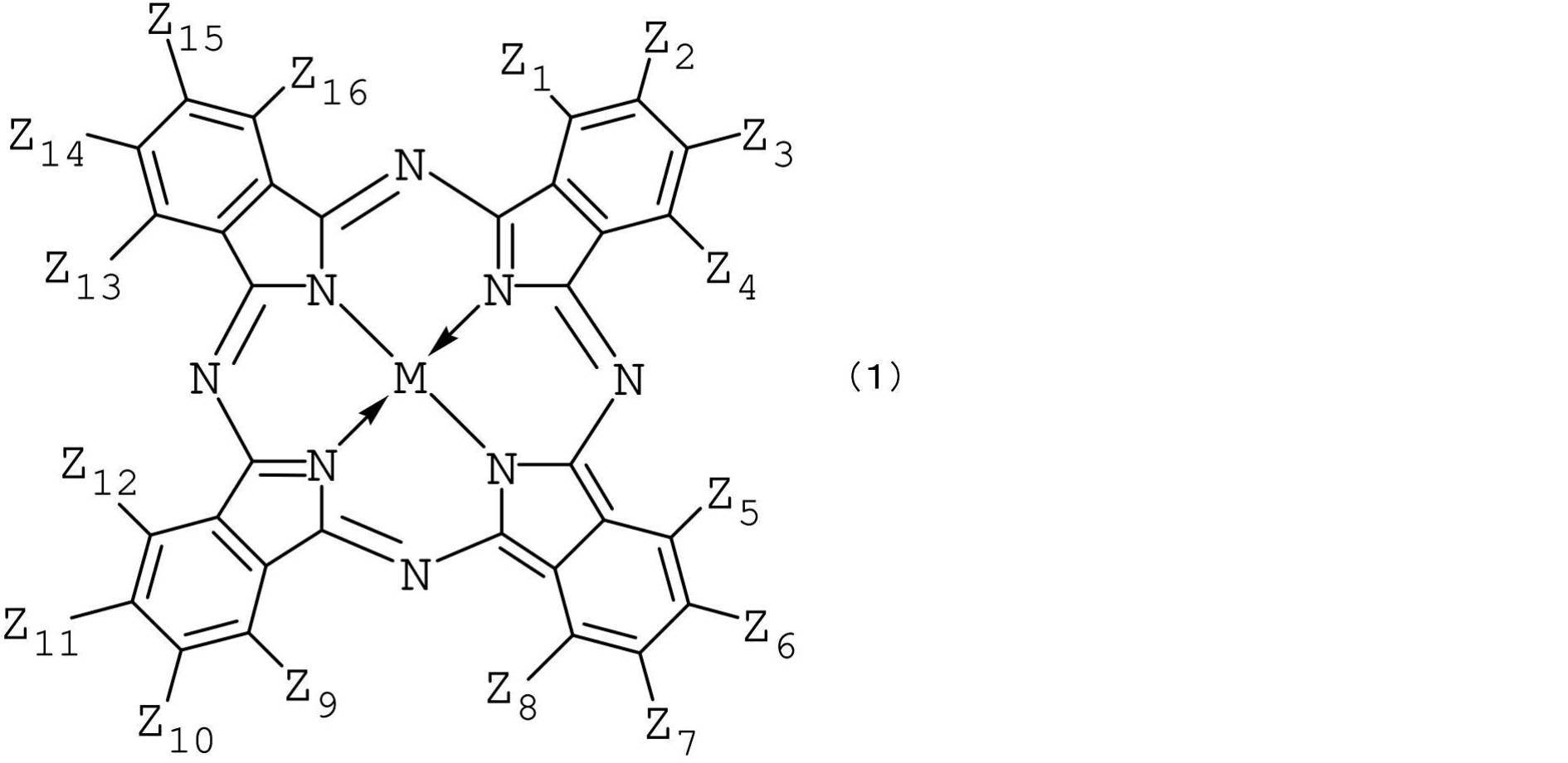
式中、Z1~Z16は、それぞれ独立して、脂質由来の基、置換基を有してもよいフェノキシ基、または置換基を有してもよいフェニルチオ基を表わし、この際、Z1~Z16のうち1~8個が脂質由来の基であり、
Mは、バナジウムの酸化物もしくはハロゲン化物、インジウムの酸化物もしくはハロゲン化物、またはスズの酸化物を表わす、
で示される、フタロシアニン化合物によって達成できる。
Mは、バナジウムの酸化物もしくはハロゲン化物、インジウムの酸化物もしくはハロゲン化物、またはスズの酸化物を表わす、
で示される、フタロシアニン化合物によって達成できる。
本発明は、下記式(1):
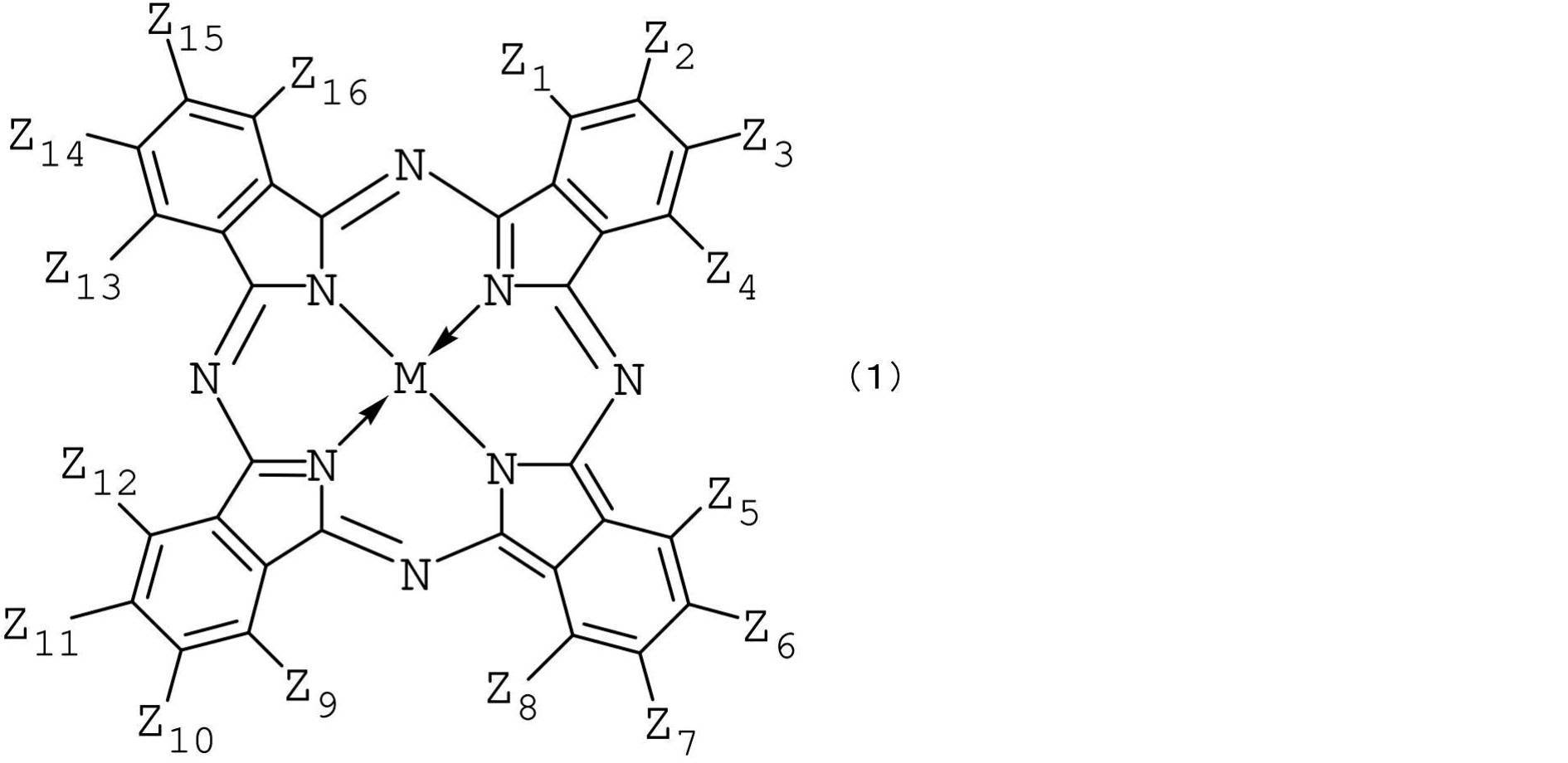
式中、Z1~Z16は、それぞれ独立して、脂質由来の基、置換基を有してもよいフェノキシ基、または置換基を有してもよいフェニルチオ基を表わし、この際、Z1~Z16のうち1~8個が脂質由来の基であり、
Mは、バナジウムの酸化物もしくはハロゲン化物、インジウムの酸化物もしくはハロゲン化物、またはスズの酸化物を表わす、
で示される、フタロシアニン化合物に関する。本発明のフタロシアニン化合物は、780nm以上の最大吸収波長およびリン脂質への溶解性を有する。このため、本発明のフタロシアニン化合物はリポソーム製剤化に好適に使用でき、癌や腫瘍の治療に有効に利用できる。
Mは、バナジウムの酸化物もしくはハロゲン化物、インジウムの酸化物もしくはハロゲン化物、またはスズの酸化物を表わす、
で示される、フタロシアニン化合物に関する。本発明のフタロシアニン化合物は、780nm以上の最大吸収波長およびリン脂質への溶解性を有する。このため、本発明のフタロシアニン化合物はリポソーム製剤化に好適に使用でき、癌や腫瘍の治療に有効に利用できる。
本発明のフタロシアニン化合物は、中心金属(上記式(1)中のM)がバナジウムの酸化物もしくはハロゲン化物、インジウムの酸化物もしくはハロゲン化物、またはスズの酸化物である。このため、フタロシアニン化合物の最大吸収波長(λmax)は780nm以上に長波長側にシフトし、人体組織への透過性の高い780nm以上の近赤外光を照射することにより、フタロシアニン化合物は熱や一重項酸素を効率よく発生する。ゆえに、本発明に係るフタロシアニン化合物を用いることで、人体深く存在する腫瘍を破壊することができる。また、780~850nm(例えば、780nm、810nm)の波長域の半導体レーザがCD、プリンタ、光通信、3Dセンサーなどに一般的に使用されている。このため、本発明のフタロシアニン化合物であれば、これらの半導体レーザを上記癌や腫瘍の治療に容易に転用できる。
また、本発明のフタロシアニン化合物は、1~8個の脂質由来の基を有する。このため、フタロシアニン化合物の最大吸収波長(λmax)を長波長側にシフトすると共に、脂質への溶解性を向上できる。ゆえに、本発明のフタロシアニン化合物はリポソーム製剤化に好適に使用できる。
なお、上記本発明の構成による上記作用効果の発揮のメカニズムは推測であり、本発明は上記推測に限定されない。
以下、本発明の実施の形態を説明する。なお、本発明は、以下の実施の形態のみには限定されない。
本明細書において、範囲を示す「X~Y」は、XおよびYを含み、「X以上Y以下」を意味する。また、特記しない限り、操作および物性等の測定は室温(20~25℃)/相対湿度40~50%RHの条件で測定する。
本明細書において、上記式(1)中の、Z1、Z4、Z5、Z8、Z9、Z12、Z13およびZ16の置換基を単に「α位の置換基」とも称する、またはZ1、Z4、Z5、Z8、Z9、Z12、Z13およびZ16を総称して「α位」とも称する。同様にして、上記式(1)中の、Z2、Z3、Z6、Z7、Z10、Z11、Z14およびZ15の置換基を単に「β位の置換基」とも称する、またはZ2、Z3、Z6、Z7、Z10、Z11、Z14およびZ15を総称して「β位」とも称する。
本発明のフタロシアニン化合物は、上記式(1)の構造を有する。
上記式(1)中、Mは、バナジウムの酸化物もしくはハロゲン化物、インジウムの酸化物もしくはハロゲン化物、またはスズの酸化物を表わす。当該構成により、フタロシアニン化合物は、780nm以上(特に810nm以上)の最大吸収波長(λmax)を示すことができる。また、リン脂質への溶解性を向上できる。これらのうち、フタロシアニン化合物の最大吸収波長のより長波長化の観点から、Mは、バナジウム酸化物、バナジウム塩化物、インジウム塩化物であることが好ましく、バナジウム酸化物、インジウム塩化物であることがより好ましく、バナジウム酸化物が特に好ましい。
上記式(1)中、Z1~Z16は、それぞれ独立して、脂質由来の基、置換基を有してもよいフェノキシ基、または置換基を有してもよいフェニルチオ基を表わす。ここで、Z1~Z16は、同じであっても相互に異なるものであってもよい。
ここで、Z1~Z16のうち1~8個が脂質由来の基であり、残りが置換基を有してもよいフェノキシ基(-O-Ph:Phは、無置換もしくは置換フェニル基である)またはフェニルチオ基(-S-Ph:Phは、無置換もしくは置換フェニル基である)である。ここで、Z1~Z16のうち9個以上が脂質由来の基である場合には、分子量が大きくなり過ぎて吸光係数が小さくなり添加量が多くなり過ぎる。また、フタロシアニン化合物(色素分子)に対してリン脂質が多すぎてリポソーム形成が阻害されるため、好ましくない。したがって、リポソーム製剤化(脂質への溶解性)の観点から、Z1~Z16に示す脂質由来の基の数は、好ましくは3~7個、より好ましくは4~6個であり、特に好ましくは4個である。
また、脂質由来の基の導入位置は、特に制限されず、α位(Z1、Z4、Z5、Z8、Z9、Z12、Z13、Z16)に導入しても、β位(Z2、Z3、Z6、Z7、Z10、Z11、Z14、Z15)に導入しても、α位およびβ位双方に導入してもよい。これらのうち、脂質由来の基は、α位に存在することが好ましく、各構成単位(Z1~Z4の構成単位A;Z5~Z6の構成単位B;Z9~Z12の構成単位C;Z13~Z16の構成単位D)のα位の少なくとも一方に存在することがより好ましく、各構成単位の一方のα位にのみ存在することが特に好ましい。このように脂質由来の基をフタロシアニン骨格のα位に導入することにより、得られるフタロシアニン化合物の最大吸収波長(λmax)をさらに長波長側にシフトできる(リポソーム製剤化した際に、より深い腫瘍に対して治療効果を奏しうる)。すなわち、本発明の好ましい形態では、Z1、Z4、Z5、Z8、Z9、Z12、Z13、Z16のうち1~8個が脂質由来の基である。本発明のより好ましい形態では、Z1およびZ4の少なくとも一方、Z5およびZ8の少なくとも一方、Z9およびZ12の少なくとも一方、ならびにZ13およびZ16の少なくとも一方が脂質由来の基である。本発明のより好ましい形態では、Z1およびZ4の一方、Z5およびZ8の一方、Z9およびZ12の一方、ならびにZ13およびZ16の一方が脂質由来の基である。
本発明では、Z1~Z16のうち1~8個が脂質由来の基である。ここで、脂質由来の基との用語における「脂質」とは、分子中にリン酸または糖を含む複合脂質を意味する。複合脂質としては、部分構造としてリン酸エステルを持つリン脂質、および糖が結合した糖脂質がある。これらのうち、リポソーム製剤化(脂質への溶解性)、フタロシアニン化合物の最大吸収波長のより長波長化、汎用性の高さの観点から、リン脂質が好ましく、ホスファチジルコリン(例えば、ジオレオイルホスファチジルコリン、ジラウロイルホスファチジルコリン、ジミリストイルホスファチジルコリン、ジパルミトイルホスファチジルコリン、ジステアロイルホスファチジルコリン等)がより好ましい。ゆえに、脂質由来の基は、リン脂質由来の基であることが好ましく、下記式(2)で示されるリン脂質(ホスファチジルコリン)由来の基であることがより好ましい。
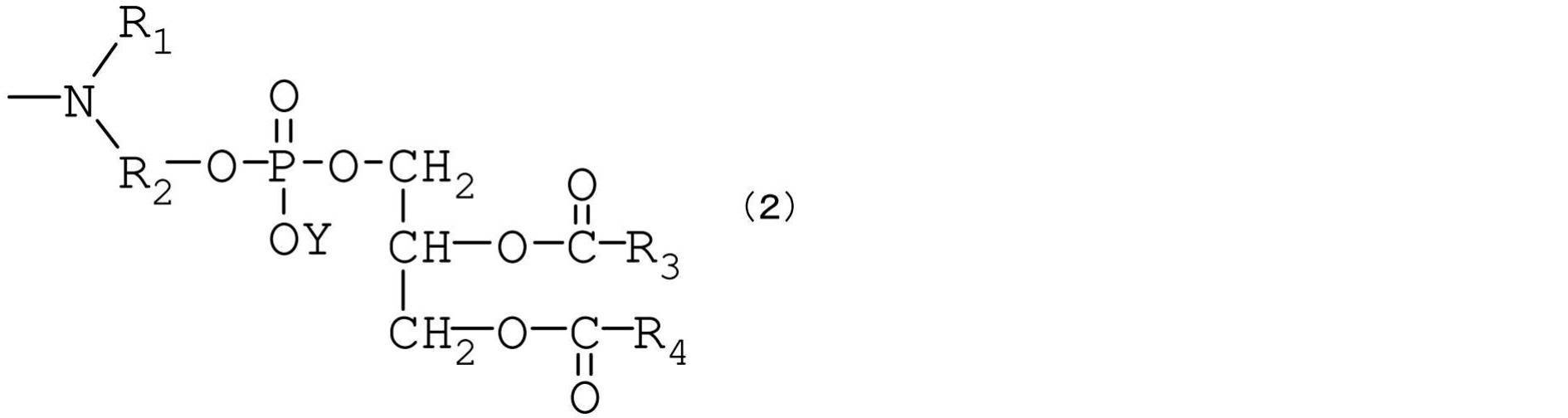
上記式(2)中、Yは、水素原子またはアルカリ金属を表わす。ここで、アルカリ金属としては、リチウム、ナトリウム、およびカリウムがある。これらのうち、リポソーム製剤化(脂質への溶解性)の観点から、Yは、水素原子、ナトリウムであることが好ましく、水素原子であることがより好ましい。
R1は、水素原子または炭素原子数1~8のアルキル基を表わす。ここで、炭素原子数1~8のアルキル基は、炭素原子数1~8の直鎖、分岐鎖または環状のアルキル基である。具体的には、メチル基、エチル基、n-プロピル基、イソプロピル基、n-ブチル基、イソブチル基、sec-ブチル基、tert-ブチル基、n-ペンチル基、イソペンチル基、ネオペンチル基、1,2-ジメチルプロピル基、n-ヘキシル基、シクロヘキシル基、1,3-ジメチルブチル基、1-イソプロピルプロピル基、1,2-ジメチルブチル基、n-ヘプチル基、1,4-ジメチルペンチル基、2-メチル-1-イソプロピルプロピル基、1-エチル-3-メチルブチル基、n-オクチル、2-エチルヘキシル基などが挙げられる。これらのうち、リポソーム製剤化(脂質への溶解性)の観点から、R1は、水素原子または炭素原子数1~3のアルキル基が好ましく、水素原子、メチル基またはエチル基がより好ましく、水素原子が特に好ましい。
R2は、炭素原子数1~8のアルキレン基を表わす。ここで、炭素原子数1~8のアルキレン基は、炭素原子数1~8の直鎖、分岐鎖または環状のアルキレン基である。具体的には、メチレン基、エチレン基、n-プロピレン基、イソプロピレン基、n-ブチレン基、イソブチレン基、sec-ブチレン基、tert-ブチレン基、n-ペンチレン基、イソペンチレン基、ネオペンチレン基、1,2-ジメチルプロピレン基、n-ヘキシレン基、シクロヘキシレン基、1,3-ジメチルブチレン基、1-イソプロピルプロピレン基、1,2-ジメチルブチレン基、n-ヘプチレン基、1,4-ジメチルペンチレン基、2-メチル-1-イソプロピルプロピレン基、1-エチル-3-メチルブチレン基、n-オクチレン基、2-エチルヘキシレン基などが挙げられる。これらのうち、リポソーム製剤化(脂質への溶解性)の観点から、R2は、炭素原子数1~5のアルキレン基が好ましく、炭素原子数1~3のアルキレン基がより好ましく、メチレン基またはエチレン基が特に好ましい。
R3およびR4は、それぞれ独立して、炭素原子数8~24の置換基を有してもよいアルキル基またはアルケニル基を表わす。ここで、R3およびR4は、同じであってもまたは異なるものであってもよい。炭素原子数8~24のアルキル基としては、直鎖または分岐鎖のアルキル基が好ましい。具体的には、n-オクチル基、n-ノニル基、n-デシル、n-ウンデシル基、n-ドデシル基、n-トリデシル基、n-テトラデシル基、n-ペンタデシル基、n-ヘキサデシル基、n-ヘプタデシル、n-オクタデシル基、n-ノナデシル基、n-イコシル基、n-ヘンイコシル基、n-ドコシル基、n-トリコシル基、n-テトラコシル基等の直鎖のアルキル基;メチルへプチル基、メチルオクチル基、メチルノニル基、メチルデシル基、メチルウンデシル基、メチルドデシル基、メチルトリデシル基、メチルテトラデシル基、メチルペンタデシル基、メチルヘキサデシル基、メチルヘプタデシル、メチルオクタデシル基、メチルノナデシル基、メチルイコシル基、メチルイコシル基、メチルヘンイコシル基、メチルドコシル基、メチルトリコシル基、ジメチルヘキシル基、ジメチルへプチル基、ジメチルオクチル基、ジメチルノニル基、ジメチルデシル基、ジメチルウンデシル基、ジメチルドデシル基、ジメチルトリデシル基、ジメチルテトラデシル基、ジメチルペンタデシル基、ジメチルヘキサデシル基、ジメチルヘプタデシル基、ジメチルオクタデシル基、ジメチルノナデシル基、ジメチルイコシル基、ジメチルイコシル基、ジメチルヘンイコシル基、ジメチルドコシル基、トリメチルへプチル基、トリメチルオクチル基、トリメチルノニル基、トリメチルデシル基、トリメチルウンデシル基、トリメチルドデシル基、トリメチルトリデシル基、トリメチルテトラデシル基、トリメチルペンタデシル基、トリメチルヘキサデシル基、トリメチルヘプタデシル基、トリメチルオクタデシル基、トリメチルノナデシル基、トリメチルイコシル基、トリメチルイコシル基、トリメチルヘンイコシル基、エチルヘキシル基、エチルへプチル基、エチルオクチル基、エチルノニル基、エチルデシル基、エチルウンデシル基、エチルドデシル基、エチルトリデシル基、エチルテトラデシル基、エチルペンタデシル基、エチルヘキサデシル基、エチルヘプタデシル基、エチルオクタデシル基、エチルノナデシル基、エチルイコシル基、エチルイコシル基、エチルヘンイコシル基、エチルドコシル基、プロピルペンチル基、プロピルヘキシル基、プロピルへプチル基、プロピルオクチル基、プロピルノニル基、プロピルデシル基、プロピルウンデシル基、プロピルドデシル基、プロピルトリデシル基、プロピルテトラデシル基、プロピルペンタデシル基、プロピルヘキサデシル基、プロピルヘプタデシル基、プロピルオクタデシル基、プロピルノナデシル基、プロピルイコシル基、プロピルイコシル基、プロピルヘンイコシル基、ブチルペンチル基、ブチルヘキシル基、ブチルへプチル基、ブチルオクチル基、ブチルノニル基、ブチルデシル基、ブチルウンデシル基、ブチルドデシル基、ブチルトリデシル基、ブチルテトラデシル基、ブチルペンタデシル基、ブチルヘキサデシル基、ブチルヘプタデシル、ブチルオクタデシル基、ブチルノナデシル基、ブチルイコシル基、ブチルイコシル基等の分岐鎖のアルキル基などが挙げられる。なお、上記分岐鎖のアルキル基の例において、分岐の位置は任意である。また、炭素数8~24のアルケニル基は、特に制限されず、上記直鎖または分岐鎖のアルキル基の構造中に1つ以上の炭素-炭素二重結合を有する構造のものが挙げられる。より具体的には、オクテニル基、ノネニル基、デセニル基、ウンデセニル基、ドデセニル基、トリデセニル基、テトラデセニル基、ペンタデセニル基、ヘキサデセニル基、ヘプタデセニル基、オクタデセニル基、ノナデセニル基、イコセニル基、ヘンイコセニル基、ドコセニル基、トリコセニル基、テトラコセニル基、4,8,12-トリメチルトリデシル基などが挙げられる。これらのうち、リポソーム製剤化(脂質への溶解性)の観点から、R3およびR4は、それぞれ独立して、置換基を有してもよい炭素原子数10~22のアルキル基またはアルケニル基であることが好ましく、置換基を有してもよい炭素原子数13~20のアルキル基またはアルケニル基であることがより好ましく、無置換の炭素原子数15~18のアルケニル基であることがさらに好ましく、ヘプタデセニル基(特に-(CH2)7CH=CH(CH2)7CH3)あることが特に好ましい。
すなわち、本発明の特に好ましい形態では、上記式(2)中、R1は、水素原子、メチル基またはエチル基を表わし;R2は、炭素原子数1~3のアルキレン基を表わし;R3およびR4は、それぞれ独立して、無置換の炭素原子数15~18のアルケニル基を表わし;およびYは、水素原子またはナトリウムを表わす。
脂質由来の基以外のZ1~Z16は、それぞれ独立して、置換基を有してもよいフェノキシ基または置換基を有してもよいフェニルチオ基であり、好ましくは置換基を有してもよいフェノキシ基である。ここで、脂質由来の基以外のZ1~Z16は、同じであってもまたは異なるものであってもよい。フェノキシ基またはフェニルチオが置換基を有する場合、置換基は、それぞれ、フェノキシ基またはフェニルチオ基に1~5個存在できる。置換基が複数個(2~5個)フェノキシ基またはフェニルチオ基に存在する場合には、これらの置換基は同種であってもまたは異種のいずれであってもよい。置換基の数は、特に制限されないが、好ましくは1~4個、より好ましくは2~3個、最も好ましくは2個である。また、置換基のフェノキシ基またはフェニルチオ基への結合位置は、特に制限されない。例えば、2個の置換基がフェノキシ基またはフェニルチオ基に結合する場合には、置換基は、これらの基の2,6位、2,5位、2,4位、3,4位、3,5位などに結合でき、リポソーム製剤化(脂質への溶解性)、吸収波形のシャープ化(吸光係数の向上)の観点から、これらの基の2,6位、2,5位、2,4位に結合することが好ましく、2,6位、2,5位に結合することがより好ましい。また、例えば、3個の置換基がフェノキシ基またはフェニルチオ基に結合する場合には、リポソーム製剤化(脂質への溶解性)、吸収波形のシャープ化(吸光係数の向上)の観点から、置換基は、2,4,6位、2,5,6位に結合することが好ましく、2,4,6位に結合することがより好ましい。
本明細書において、「置換基」は、特に限定されず、例えば、ハロゲン原子、アシル基、アルキル基、フェニル基、アルコキシル基、ハロゲン化アルキル基、ハロゲン化アルコキシル基、ニトロ基(-NO2)、アミノ基(-NH2)、アルキルアミノ基、アルキルカルボニルアミノ基、アリールアミノ基、アリールカルボニル基、カルボニル基、アルコキシカルボニル基、アルキルアミノカルボニル基、アルコキシスルホニル基、アルキルチオ基、カルバモイル基、アリールオキシカルボニル基、オキシアルキルエーテル基、ヒドロキシル基(-OH)、カルボキシル基(-COOH)、シアノ基(-CN)などが例示できるが、これらに限定されるものではない。これらのうち、リポソーム製剤化(脂質への溶解性)の観点から、ハロゲン原子、アルキル基が好ましく、ハロゲン原子、炭素原子数1~6個の直鎖または分岐鎖のアルキル基(特に炭素原子数1~3個の直鎖または分岐鎖のアルキル基)がより好ましい。
上記において、同一の置換基で置換されることはない。すなわち、置換のアルキル基は、アルキル基で置換されることはない。上記置換基よりその一部をより具体的な例を挙げて以下に示す。
ここで、ハロゲン原子としては、フッ素原子、塩素原子、臭素原子およびヨウ素原子が挙げられる。好ましくは塩素原子である。
アシル基としては、アセチル基、エチルカルボニル基、プロピルカルボニル基、ブチルカルボニル基、ペンチルカルボニル基、ヘキシルカルボニル基、ベンゾイル基、p-t-ブチルベンゾイル基など等が挙げられ、これらのうち、エチルカルボニル基が好ましい。
アルキル基は、炭素原子数1~20個の直鎖、分岐鎖または環状のアルキル基であり、好ましくは炭素原子数1~8個の直鎖、分岐鎖または環状のアルキル基である。具体的には、メチル基、エチル基、n-プロピル基、イソプロピル基、n-ブチル基、イソブチル基、sec-ブチル基、tert-ブチル基、n-ペンチル基、イソペンチル基、ネオペンチル基、1,2-ジメチルプロピル基、n-ヘキシル基、シクロヘキシル基、1,3-ジメチルブチル基、1-イソプロピルプロピル基、1,2-ジメチルブチル基、n-ヘプチル基、1,4-ジメチルペンチル基、2-メチル-1-イソプロピルプロピル基、1-エチル-3-メチルブチル基、n-オクチル基、2-エチルヘキシル基などが挙げられる。これらのうち、メチル基及びエチル基が好ましく、メチル基がより好ましい。
アルコキシル基は、炭素原子数1~20個の直鎖、分岐鎖または環状のアルコキシル基であり、好ましくは炭素原子数1~8個の直鎖、分岐鎖または環状のアルコキシル基である。具体的には、メトキシ基、エトキシ基、n-プロポキシ基、イソプロポキシ基、n-ブトキシ基、イソブトキシ基、sec-ブトキシ基、tert-ブトキシ基、n-ペンチルオキシ基、イソペンチルオキシ基、ネオペンチルオキシ基、1,2-ジメチル-プロポキシ基、n-ヘキシルオキシ基、シクロヘキシルオキシ基、1,3-ジメチルブトキシ基、1-イソプロピルプロポキシ基などが挙げられる。これらのうち、メトキシ基及びエトキシ基が好ましい。
ハロゲン化アルキル基とは、炭素原子数1~20個の直鎖、分岐鎖または環状のアルキル基の一部がハロゲン化されたものであり、好ましくは炭素原子数1~8個の直鎖、分岐鎖または環状のアルキル基の一部がハロゲン化されたものである。具体的には、クロロメチル基、ブロモメチル基、トリフルオロメチル基、クロロエチル基、2,2,2-トリクロロエチル基、ブロモエチル基、クロロプロピル基、ブロモプロピル基などが挙げられる。
ハロゲン化アルコキシル基とは、炭素原子数1~20個の直鎖、分岐鎖または環状のアルコキシル基の一部がハロゲン化されたものであり、好ましくは炭素原子数1~8個の直鎖、分岐鎖または環状のアルコキシル基の一部がハロゲン化されたものである。具体的には、クロロメトキシ基、ブロモメトキシ基、トリフルオロメトキシ基、クロロエトキシ基、2,2,2-トリクロロエトキシ基、ブロモエトキシ基、クロロプロポキシ基、ブロモプロポキシ基などが挙げられる。
アルキルアミノ基とは、炭素原子数1~20個のアルキル部位を有するアルキルアミノ基、好ましくは炭素原子数1~8個のアルキル部位を有するアルキルアミノ基である。具体的には、メチルアミノ基、エチルアミノ基、n-プロピルアミノ基、n-ブチルアミノ基、sec-ブチルアミノ基、n-ペンチルアミノ基、n-ヘキシルアミノ基、n-ヘプチルアミノ基、n-オクチルアミノ基、2-エチルヘキシルアミノ基などが挙げられる。これらのうち、メチルアミノ基、エチルアミノ基、n-プロピルアミノ基及びn-ブチルアミノ基が好ましい。
アリールアミノ基としては、アニリノ基、o-,m-若しくはp-トルイジノ基、1,2-若しくは1,3-キシリジノ基、o-,m-若しくはp-メトキシアニリノなどが挙げられる。
アリールカルボニル基としては、フェニル基、ナフチル基を有するカルボニル基などが挙げられる。
アルコキシカルボニル基とは、アルコキシル基のアルキル基部分にヘテロ原子を含んでもよい炭素数1~8個、好ましくは1~5個のアルコキシカルボニル基、またはヘテロ原子を含んでもよい炭素数3~8個、好ましくは5~8個の環状アルコキシカルボニル基を示す。具体的には、メトキシカルボニル基、エトキシカルボニル基、n-プロポキシカルボニル基、イソプロポキシカルボニル基、n-ブトキシカルボニル基、イソブトキシカルボニル基、sec-ブトキシカルボニル基、tert-ブトキシカルボニル基などが挙げられる。これらのうち、メトキシカルボニル基およびエトキシカルボニル基が好ましい。
アルキルアミノカルボニル基としては、炭素数1~20のアルキル部位を有するアルキルアミノカルボニル基であり、メチルアミノカルボニル基、エチルアミノカルボニル基、n-プロピルアミノカルボニル基、n-ブチルアミノカルボニル基、sec-ブチルアミノカルボニル基、n-ペンチルアミノカルボニル基、n-ヘキシルアミノカルボニル基、n-ヘプチルアミノカルボニル基、n-オクチルアミノカルボニル基、2-エチルヘキシルアミノカルボニル基、ジメチルアミノカルボニル基、ジエチルアミノカルボニル基、ジ-n-プロピルアミノカルボニル基、ジ-n-ブチルアミノカルボニル基、ジ-sec-ブチルアミノカルボニル基、ジ-n-ペンチルアミノカルボニル基、ジ-n-ヘキシルアミノカルボニル基、ジ-n-ヘプチルアミノカルボニル基、ジ-n-オクチルアミノカルボニル基等が挙げられる。
アルコキシスルホニル基としては、炭素数1~10のアルコキシ基を有するアルコキシスルホニル基であり、メトキシスルホニル基、エトキシスルホニル基、n-プロピルオキシスルホニル基、n-ブチルオキシスルホニル基、n-ペンチルオキシスルホニル基、エチルヘキシルオキシスルホニル基等が挙げられる。
アルキルチオ基としては、炭素数1~10のアルキル部位を有するアルキルチオ基であり、メチルチオ基、エチルチオ基、n-プロピルチオ基、イソプロピルチオ基、n-ブチルチオ基、イソブチルチオ基、sec-ブチルチオ基、tert-ブチルチオ基、n-ペンチルチオ基、イソペンチルチオ基、ネオペンチルチオ基、1,2-ジメチルプロピルチオ基、n-ヘキシルチオ基、1,3-ジメチルブチルチオ基、1-イソプロピルプロピルチオ基、1,2-ジメチルブチルチオ基、n-ヘプチルチオ基、1,4-ジメチルペンチルチオ基、2-メチル-1-イソプロピルプロピルチオ基、1-エチル-3-メチルブチルチオ基、n-オクチル基、2-エチルヘキシルチオ基等が挙げられる。
カルバモイル基としては、好ましくは炭素数1~20、より好ましくは炭素数1~16、特に好ましくは炭素数1~12であり、例えば、カルバモイル基、メチルカルバモイル基、ジエチルカルバモイル基、フェニルカルバモイル基等が挙げられる。
アリールオキシカルボニル基としては、炭素数6~20のアリールオキシカルボニル基であり、例えば、フェニルオキシカルボニル基、ナフチルオキシカルボニル基等が挙げられる。
オキシアルキルエーテル基としては、エチレングリコールヘプチルエーテル基、オキシエチレンオレイルエーテル基、オキシプロピレンブチルエーテル基、オキシプロピレン2-エチルヘキシルエーテル基等が挙げられる。
これらのうち、脂質由来の基以外のZ1~Z16は、それぞれ独立して、ハロゲン原子またはアルキル基で置換されてもよいフェノキシ基またはフェニルチオ基であることが好ましく;ハロゲン原子および炭素原子数1~8個の直鎖または分岐鎖のアルキル基からなる群より選択される少なくとも一種で置換されたフェノキシ基またはフェニルチオ基であることがより好ましく;塩素原子、メチル基およびエチル基からなる群より選択される2個の置換基で置換されたフェノキシ基であることがさらに好ましく;2個の塩素原子または2個のメチル基で置換されたフェノキシ基であることが特に好ましい。
本発明のフタロシアニン化合物の製造方法は、特に制限されるものではなく、特開平01-045474号公報、特開平02-282386号公報、特開平02-283769号公報、特開平02-175763号公報、特開2001-106689号公報、特開2009-57430号公報等の従来公知の方法を適当に利用することができる。好ましくは、フタロニトリル化合物に置換基を有してもよいフェノキシ基または置換基を有してもよいフェニルチオ基を導入してフタロシアニン前駆体Aを得た後、このフタロシアニン前駆体Aと金属塩とを環化反応して、フタロシアニン前駆体Bを得、このフタロシアニン前駆体Bに脂質由来の基を導入する方法が好ましく使用できる。なお、最終産物であるフタロシアニン化合物が2種以上の置換基を有してもよいフェノキシ基または置換基を有してもよいフェニルチオ基を有する場合には、置換基を有してもよいフェノキシ基または置換基を有してもよいフェニルチオ基の導入は、1段階で行ってもまたは複数回に分けて(各導入毎に)行ってもよい。同様にして、最終産物であるフタロシアニン化合物が2種以上の脂質由来の基を有する場合も、脂質由来の基の導入は、1段階で行ってもまたは複数回に分けて(各導入毎に)行ってもよい。以下、本発明のフタロシアニン化合物の好ましい製造方法を説明する。なお、本発明は、下記好ましい形態に限定されない。
上記方法においてフタロニトリル化合物は、特に制限されないが、ベンゼン環上に結合する4つの水素原子がハロゲン原子(好ましくはフッ素原子及び塩素原子、特に好ましくはフッ素原子)で置換された化合物が使用できる。なお、ベンゼン環上に結合する4つの水素原子は、同じハロゲン原子で置換されてもまたは異なるハロゲン原子で置換されてもよい。また、ベンゼン環上に結合する4つの水素原子は、少なくとも一部がハロゲン原子で置換されていればよいが、好ましくは4つ全ての水素原子がハロゲン原子で置換される。すなわち、フタロニトリル化合物は、テトラフルオロフタロニトリル、テトラクロロフタロニトリルが好ましく、テトラフルオロフタロニトリルが特に好ましい。フッ素原子は脂質由来の基のアミン基(式(2)中の-N(R1)(R2)-)と容易に求核置換する。このため、テトラフルオロフタロニトリルを出発原料として使用することにより、最終産物の収率を上げることができる。
本発明に係るフタロシアニン化合物は、780nm以上の最大吸収波長(λmax)を示す。このため、人体組織への透過性がより高い近赤外光を照射することが可能になり、最大吸収波長(λmax)付近の近赤外光を照射すると、フタロシアニン化合物は熱または一重項酸素を発生する(これにより、癌または腫瘍細胞を殺傷できる)。また、780~850nm(例えば、780nm、810nm)の波長域の半導体レーザがCD、プリンタ、光通信、3Dセンサーなどに一般的に使用されている。このため、本発明のフタロシアニン化合物であれば、これらの半導体レーザを癌や腫瘍の治療に容易に転用できる。
本発明に係るフタロシアニン化合物の最大吸収波長(λmax)は、好ましくは780~1400nm、より好ましくは800~1000nm、特に好ましくは810~900nm以下である。本明細書において、「最大吸収波長(λmax)」は、分光光度計((株)日立ハイテクノロジーズ製:U-2910)を用いてテトラヒドロフラン中で測定した値を採用する。上記に加えて、本発明に係るフタロシアニン化合物は、脂質(特にリン脂質)に対して高い溶解性を示す。ゆえに、本発明のフタロシアニン化合物はリポソーム製剤化に好適に使用できる。すなわち、本発明は、本発明のフタロシアニン化合物および脂質を含むリポソーム製剤をも提供する。
また、上述したように、本発明に係るフタロシアニン化合物は、最大吸収波長(λmax)付近の光を照射すると、熱や一重項酸素を発する。ゆえに、本発明に係るフタロシアニン化合物またはリポソーム製剤は、温熱化学療法や光線力学療法による癌や腫瘍の治療に好適に使用できる。したがって、本発明は、本発明のフタロシアニン化合物またはリポソーム製剤を含む癌または腫瘍治療剤、あるいは癌または腫瘍治療のための本発明のフタロシアニン化合物またはリポソーム製剤の使用をも提供する。または、本発明は、本発明のリポソーム製剤を癌または腫瘍部位に投与することを有する、癌または腫瘍の治療方法をも提供する。好ましくは、治療上有効量の本発明のフタロシアニン化合物またはリポソーム製剤を、治療を必要とする患者の癌または腫瘍部位(患部)に投与した後、前記患部に光を照射して熱または一重項酸素を発生させることにより、癌または腫瘍を治療する。
本明細書において、「癌」は、最初に発生したもの、即ち、原発性癌を意図し、「腫瘍」は、癌(原発癌)から転移したもの、即ち、転移性癌を意図する。また、本明細書では、「癌または腫瘍治療剤」を「癌/腫瘍治療剤」とも称する。
本発明のリポソーム製剤は、本発明のフタロシアニン化合物を色素化合物として使用する以外は、WO 2013/51732号公報(米国特許出願公報第2014/369935号明細書)等の公知のリポソーム製剤と同様の成分や製法が適用できる。本発明のリポソーム製剤の好ましい形態を以下で説明する。なお、本発明は、下記好ましい形態に限定されない。
本発明のリポソーム製剤は、本発明のフタロシアニン化合物および脂質を必須に含む。ここで、脂質としては、特に制限されず、リン脂質、糖脂質、ステロール、飽和または不飽和脂肪酸等を使用できる。このうち、リン脂質は、一般的に、分子内に長鎖アルキル基より構成される疎水性基とリン酸基より構成される親水性基とを持つ両親媒性物質である。具体的には、ホスファチジルコリン(例えば、ジオレオイルホスファチジルコリン、ジラウロイルホスファチジルコリン、ジミリストイルホスファチジルコリン、ジパルミトイルホスファチジルコリン、ジステアロイルホスファチジルコリン等)、ホスファチジルグリセロール(例えば、ジオレオイルホスファチジルグリセロール、ジラウロイルホスファチジルグリセロール、ジミリストイルホスファチジルグリセロール、ジパルミトイルホスファチジルグリセロール、ジステアロイルホスファチジグリセロール等)、ホスファチジルエタノールアミン(例えば、ジオレオイルホスファチジルエタノールアミン、ジラウロイルホスファチジルエタノールアミン、ジミリストイルホスファチジルエタノールアミン、ジパルミトイルホスファチジルエタノールアミン、ジステアロイルホスファチジエタノールアミン等)、ホスファチジルセリン、ホスファチジルイノシトール、ホスファチジン酸、カルジオリピン、スフィンゴミエリン、卵黄レシチンおよび大豆レシチン、ならびにこれらの水素添加物(例えば、水素添加ホスファチジルコリン)などが挙げられる。糖脂質もまた、特に制限されず、例えば、グリセロ糖脂質(例えば、スルホキシリボシルグリセリド、ジグリコシルジグリセリド、ジガラクトシルジグリセリド、ガラクトシルジグリセリド、グリコシルジグリセリド)、スフィンゴ糖脂質(例えば、ガラクトシルセレブロシド、ラクトシルセレブロシド、ガングリオシド)などが挙げられる。ステロールもまた、特に制限されず、例えば、動物由来のステロール(例えば、コレステロール、コレステロールコハク酸、ラノステロール、ジヒドロラノステロール、デスモステロール、ジヒドロコレステロール)、植物由来のステロール(フィトステロール)(例えば、スチグマステロール、シトステロール、カンペステロール、ブラシカステロール)、微生物由来のステロール(例えば、チモステロール、エルゴステロール)などが挙げられる。飽和または不飽和の脂肪酸もまた、特に制限されず、例えば、パルミチン酸、オレイン酸、ステアリン酸、アラキドン酸、ミリスチン酸等の炭素数12~20の飽和または不飽和の脂肪酸が挙げられる。これらのうち、リン脂質、糖脂質が好ましく、リン脂質がより好ましく、ホスファチジルコリン、水素添加ホスファチジルコリンが特に好ましい。
本発明のリポソーム製剤は、上記に加えて、さらに他の成分を含んでもよい。ここで、他の成分としては、安定化剤、糖類、酸化防止剤、親水性ポリマー、薬剤、診断剤、賦形剤/溶媒などが挙げられる。このうち、安定化剤としては、特に限定されないが、コレステロール、ジヒドロコレステロール、コレステロールエステル、フィトステロール、シトステロール、スチグマステロール、カンペステロール、コレスタノール、ラノステロール、2,4-ジヒドロラノステロール、1-O-ステロールグルコシド、1-O-ステロールマルトシド、1-O-ステロールガラクトシドなどが挙げられる。これらのうち、コレステロールが好ましい。特にコレステロールは、リポソーム製剤の強度を向上できるため、好ましい。なお、本発明のフタロシアニン化合物は、コレステロールに対して高い溶解性を示す。糖類としては、特に限定されないが、グルコース、グリセロール、マンニトール、ソルビトール、ラクトース、シュクロース、グルクロン酸、シアル酸、デキストラン、プルラン、アミロース、アミロペクチン、キトサン、マンナン、シクロデキストリン、ペクチン、カラギーナンなどが挙げられる。これらのうち、グルコースが好ましい。酸化防止剤としては、アスコルビン酸、尿酸、α,β,γ,δ-トコフェロールなどが挙げられる。これらのうち、アスコルビン酸が好ましい。親水性ポリマーとしては、特に限定されないが、ポリエチレングリコール(PEG)、ポリグリセリン(PG)、ポリプロピレングリコール(PPG)、フィコール、ポリビニルアルコール(PVA)、スチレン-無水マレイン酸共重合体、ジビニルエーテル-無水マレイン酸共重合体、ポリビニルピロリドン、ポリビニルメチルエーテル、ポリビニルメチルオキサゾリン、ポリエチルオキサゾリン、ポリヒドロキシプロピルオキサゾリン、ポリヒドロキシプロピルメタアクリルアミド、ポリメタアクリルアミド、ポリジメチルアクリルアミド、ポリヒドロキシプロピルメタアクリレート、ポリヒドロキシエチルアクリレート、ヒドロキシメチルセルロース、ヒドロキシエチルセルロース、ポリアスパルトアミド、合成ポリアミノ酸などが挙げられる。なお、上記親水性ポリマーは、脂質に結合していない側の末端がアルコキシ化(例えば、メトキシ化、エトキシ化、プロポキシ化)されていてもよい。これらのうち、ポリエチレングリコール(PEG)、ポリグリセリン(PG)、ポリプロピレングリコール(PPG)が好ましく、PEGが特に好ましい。特にPEGは、リポソーム製剤を標的部位まで効率よく誘導できるという点で好ましい。また、PEGが存在することにより、リポソーム製剤の表面が滑らかになり、体液(例えば、血液)中でよりスムーズに流れるという利点もある。薬剤としては、特に限定されないが、抗癌剤、抗生物質、ホルモン剤、抗炎症剤、ステロイド剤、血管拡張剤、アンジオテンシン変換酵素阻害剤、アンジオテンシン受容体拮抗剤、平滑筋細胞の増殖・遊走阻害剤、血小板凝集阻害剤、抗凝固剤、ケミカルメディエーターの遊離阻害剤、血管内皮細胞の増殖促進または抑制剤、アルドース還元酵素阻害剤、メサンギウム細胞増殖阻害剤、リポキシゲナーゼ阻害剤、免疫抑制剤、免疫賦活剤、抗ウイルス剤、メイラード反応抑制剤、アミロイドーシス阻害剤、一酸化窒素合成阻害剤、AGEs(Advanced glycation endproducts)阻害剤、ラジカルスカベンジャーなどが挙げられる。これらの薬剤は、治療される疾患の種類などによって適宜選択される。ここで、薬剤は、リポソーム製剤に内包されてもよい。診断剤としては、特に限定されないが、X線造影剤、超音波診断剤、放射性同位元素標識核医学診断薬、核磁気共鳴診断用診断薬などが挙げられる。これらの診断剤は、投与される部位などによって適宜選択される。賦形剤/溶媒としては、特に限定されないが、水、生理食塩水、医薬として許容される有機溶媒、コラーゲン、ポリビニルアルコール、ポリビニルピロリドン、カルボキシビニルポリマー、カルボキシメチルセルロースナトリウム、ポリアクリル酸ナトリウム、アルギン酸ナトリウム、水溶性デキストラン、カルボキシメチルスターチナトリウム、ペクチン、メチルセルロース、エチルセルロース、キサンタンガム、アラビアゴム、カゼイン、ゼラチン、寒天、ジグリセリン、プロピレングリコール、ポリエチレングリコール、ワセリン、パラフィン、ステアリルアルコール、ステアリン酸、ヒト血清アルブミン(HSA)、マンニトール、ソルビトール、ラクトース、リン酸緩衝生理食塩水(PBS)、界面活性剤、生体内で許容できる緩衝液などが挙げられる。上記リン脂質、安定化剤、糖類、酸化防止剤、親水性ポリマー、薬剤、診断剤、賦形剤/溶媒は、それぞれ、単独で使用されてもまたは2種以上の混合物として使用されてもよい。また、上記リン脂質、安定化剤、糖類、酸化防止剤、親水性ポリマー、薬剤、診断剤、賦形剤/溶媒は、それぞれの1種または2種以上を組み合わせて使用してもよい。
本発明のリポソーム製剤の形状は、特に制限されず、球状、略球状、楕円形等、公知と同様の形状が使用できる。また、本発明のリポソーム製剤(リポソーム)の大きさもまた、特に制限されず、公知と同様の大きさを採用できる。具体的には、球状または略球状である場合の、リポソーム製剤(リポソーム)の大きさ(直径)は、好ましくは20~250nm、より好ましくは50~200nmである。なお、本明細書において、リポソーム製剤(リポソーム)の大きさ(直径)は、統計学上信頼性のある数(例えば、300個以上)のリポソームの直径を動的光散乱法により測定し、これらの平均を算出することによって求められる。
本発明のリポソーム製剤の製造方法は、WO 2013/51732号公報(US 2014/0369935 A1に相当)等の当該分野において既知の方法を同様にしてまたは適宜修飾して適用できる。例えば、フタロシアニン化合物および脂質ならびに必要であれば上記他の成分を溶媒(例えば、メタノール、エタノール、クロロホルム)に溶解し混合液を調製した後、溶媒を留去して、固形物を得、これを水性溶液(例えば、グルコースを含む緩衝液)中に添加して水和させ水和物(脂質膜)を得、これをフィルターに通す方法;超音波処理法、逆相蒸発法、超臨界または亜臨界の二酸化炭素を使用する調製法、マイクロ流路を使用する調製法などが使用できる。
また、本発明に係るフタロシアニン化合物またはリポソーム製剤を用いて癌/腫瘍治療剤を製造する方法もまた、WO 2013/51732号公報(US 2014/0369935 A1に相当)等の当該分野において既知の方法を同様にしてまたは適宜修飾して適用できる。例えば、フタロシアニン化合物および脂質ならびに必要であれば上記他の成分(薬剤を除く)を溶媒(例えば、メタノール、エタノール、クロロホルム)に溶解し混合液を調製した後、溶媒を留去して、固形物を得、これを薬剤を含む水溶液(例えば、グルコースを含む緩衝液)中に添加して水和させ水和物(脂質膜)を得、これをフィルターに通す方法;上記したようにしてリポソーム製剤を製造し、リポソーム製剤の脂質膜を薬剤を含む水溶液中で水和させる方法;リポソーム製剤の脂質膜の内外にイオン勾配を形成して、薬剤をイオン勾配に従って脂質膜を通過させる方法などが使用できる。
上記方法では、水和物(脂質膜)をフィルターに通過させているが、フィルターを備えたエクストルーダーを用いて強制的に通過させてもよい。これにより、実質的に一枚膜(ユニラメラ)のリポソームを製造することができる。また、フィルターの孔径は、リポソーム製剤を形成できるものであれば特に制限されず、通常と同様の孔径でありうる。具体的には、リポソーム製剤の形成性やサイズの制御しやすさならびに滅菌効果などの観点から、フィルターの孔径は、好ましくは0.08~0.2μm程度である。また、上記したような大きさに制御するために、フィルターに複数回(例えば、3~30回、好ましくは10~20回)通過させてもよい。また、必要であれば、より大きさを揃えるために、リポソーム製剤をサイズ分画してもよい。
上述したように、本発明のリポソーム製剤は、光線温熱療法や光線力学療法に使用できる。リポソーム製剤は、通常、非経口で、例えば、静脈内、筋肉内、腹腔内、皮下への注射により投与される。あるいは、リポソーム製剤を、注射によりまたはカテーテルを介して腫瘍部位に直接投与してもよい。投与後、最大吸収波長付近の近赤外光を患部(腫瘍部位)に照射する。これにより、フタロシアニン化合物が熱または一重項酸素を発生して、腫瘍を殺傷(破壊)する。なお、リポソーム製剤の投与量や光照射条件(時間、強度等)などは、患者の重篤度、所望する治療効果などを考慮して適宜設定することができる。具体的には、リポソーム製剤は、リポソーム製剤に封入される薬物の有効投与量が癌/腫瘍の症状を治癒するまたは少なくとも一部の症状を改善するような量で投与される。投与時期は、癌/腫瘍が確認されてから投与されても、または癌/腫瘍の発症が予測される時に症状緩和のために予防的に投与されてもよい。また、投与期間は、癌/腫瘍の重篤度、患者の年齢、症状により適宜選択することができる。
本発明のリポソーム製剤は、各種の癌/腫瘍、例えば、脳腫瘍、インスリノーマ、鼻腔癌、口腔癌、腎臓癌、肺癌、大腸癌、軟部肉腫、およびこれらを原発癌とした腫瘍(転移性癌)(例えば、胸膜転移、腹膜転移)等を治療/予防することを目的とした光線温熱療法または光線力学療法に使用できる。
本発明の効果を、以下の実施例および比較例を用いて説明する。ただし、本発明の技術的範囲が以下の実施例のみに制限されるわけではない。なお、下記実施例において、特記しない限り、操作は室温(25℃)で行われた。また、特記しない限り、「%」および「部」は、それぞれ、「重量%」および「重量部」を意味する。
なお、下記例に記載のフタロシアニン化合物の略称において、最初にβ位に置換する8個の置換基を表わし、その後にα位に置換する8個の置換基を表わし、Phはフェニル基を表わし、Pcはフタロシアニン核を表わし、Pcの直前は中心金属を表わす。
合成例1:3-(2,6-ジメチルフェノキシ)-4,5-ビス(2,5-ジクロロフェノキシ)-6-フルオロフタロニトリルの合成
特開2001-106689号公報の合成例1に記載の方法により、3-(2,6-ジメチルフェノキシ)-4,5-ビス(2,5-ジクロロフェノキシ)-6-フルオロフタロニトリル140.7g(収率79.8モル%)を得た。
特開2001-106689号公報の合成例1に記載の方法により、3-(2,6-ジメチルフェノキシ)-4,5-ビス(2,5-ジクロロフェノキシ)-6-フルオロフタロニトリル140.7g(収率79.8モル%)を得た。
合成例2:VOPc(2,5-Cl2PhO)8(2,6-(CH3)2PhO)4F4)(中間体VOPc)の合成
300mlの4ツ口フラスコに、三酸化二バナジウム1.43g(9.53ミリモル)、p-トルエンスルホン酸一水和物3.64g(19.1ミリモル)およびベンゾニトリル60mlを加え、170℃に昇温し、撹拌下で約3時間保った。その後、還流温度まで昇温し、上記合成例1で合成された3-(2,6-ジメチルフェノキシ)-4,5-ビス(2,5-ジクロロフェノキシ)-6-フルオロフタロニトリル(置換フタロニトリル原料)30g(51.0ミリモル)を追加し、窒素雰囲気下で還流温度で4時間反応させて、反応液を得た。
300mlの4ツ口フラスコに、三酸化二バナジウム1.43g(9.53ミリモル)、p-トルエンスルホン酸一水和物3.64g(19.1ミリモル)およびベンゾニトリル60mlを加え、170℃に昇温し、撹拌下で約3時間保った。その後、還流温度まで昇温し、上記合成例1で合成された3-(2,6-ジメチルフェノキシ)-4,5-ビス(2,5-ジクロロフェノキシ)-6-フルオロフタロニトリル(置換フタロニトリル原料)30g(51.0ミリモル)を追加し、窒素雰囲気下で還流温度で4時間反応させて、反応液を得た。
この反応液を冷却後、メタノール700mlと水150mlとの混合液中に投入して晶析し、得られた結晶を濾別し、80℃で一晩真空乾燥することによって、バナジウムフタロシアニンVOPc(2,5-Cl2PhO)8(2,6-(CH3)2PhO)4F4)を22.7g得た(置換フタロニトリル原料に対し、収率73.5モル%)。
合成例3:ZnPc(2,5-Cl2PhO)8(2,6-(CH3)2PhO)4F4)(中間体ZnPc)の合成
上記合成例1で合成された3-(2,6-ジメチルフェノキシ)-4,5-ビス(2,5-ジクロロフェノキシ)-6-フルオロフタロニトリル(置換フタロニトリル原料)5.88g、ヨウ化亜鉛0.88gおよびベンゾニトリル9gを50mlの三口フラスコに投入し、190℃で約5時間反応させて反応液を得た。この反応液を冷却後、メタノール700mlと水150mlとの混合液中に反応液を投入して晶析し、得られた結晶を濾別し、80℃で一晩真空乾燥することによって、亜鉛フタロシアニンZnPc(2,5-Cl2PhO)8(2,6-(CH3)2PhO)4F4)を5.6g得た(置換フタロニトリル原料に対し収率92.6モル%)。
上記合成例1で合成された3-(2,6-ジメチルフェノキシ)-4,5-ビス(2,5-ジクロロフェノキシ)-6-フルオロフタロニトリル(置換フタロニトリル原料)5.88g、ヨウ化亜鉛0.88gおよびベンゾニトリル9gを50mlの三口フラスコに投入し、190℃で約5時間反応させて反応液を得た。この反応液を冷却後、メタノール700mlと水150mlとの混合液中に反応液を投入して晶析し、得られた結晶を濾別し、80℃で一晩真空乾燥することによって、亜鉛フタロシアニンZnPc(2,5-Cl2PhO)8(2,6-(CH3)2PhO)4F4)を5.6g得た(置換フタロニトリル原料に対し収率92.6モル%)。
合成例4:InClPc(2,5-Cl2PhO)8(2,6-(CH3)2PhO)4F4)(中間体InClPc)の合成
合成例3において、ヨウ化亜鉛を三塩化インジウム0.61gに変えた以外は全て合成例3と同様に操作しインジウムフタロシアニンInClPc(2,5-Cl2PhO)8(2,6-(CH3)2PhO)4F4)を4.5g得た(置換フタロニトリル原料に対し収率71.1モル%)。
合成例3において、ヨウ化亜鉛を三塩化インジウム0.61gに変えた以外は全て合成例3と同様に操作しインジウムフタロシアニンInClPc(2,5-Cl2PhO)8(2,6-(CH3)2PhO)4F4)を4.5g得た(置換フタロニトリル原料に対し収率71.1モル%)。
実施例1:リン脂質置換バナジウムフタロシアニン[VOPc(1,2-ジオレオイル-sn-グリセル-3-ホスホエタノールアミノ)4(2,5-Cl2PhO)8(2,6-(CH3)2PhO)4]の合成
下記反応に従って、リン脂質置換バナジウムフタロシアニンを合成した。
下記反応に従って、リン脂質置換バナジウムフタロシアニンを合成した。

合成例2で得られたVOPc(2,5-Cl2PhO)8(2,6-(CH3)2PhO)4F4)(中間体VOPc)1.21g及びベンゾニトリル8gを50mlの三口フラスコに投入し、110℃に昇温して、中間体VOPcを溶解させて、中間体VOPc溶液を調製した。その後、この中間体VOPc溶液に、リン脂質(1,2-ジオレオイル-sn-グリセル-3-ホスホエタノールアミン)4.09gを追加し、140℃で約3時間反応させた。その後、ベンゾニトリルを真空下で留去して、粗生成物を得た。得られた粗生成物を、クロロホルムを溶媒としてカラム精製(充填剤:シリカゲル60N、関東化学株式会社製)を行い、リン脂質置換バナジウムフタロシアニン[VOPc(1,2-ジオレオイル-sn-グリセル-3-ホスホエタノールアミノ)4(2,5-Cl2PhO)8(2,6-(CH3)2PhO)4]を1.03g得た(中間体VOPcに対し収率43.3モル%)。
このようにして得られたリン脂質置換バナジウムフタロシアニンについて、分光光度計((株)日立ハイテクノロジーズ製:U-2910)を用いてテトラヒドロフラン中で最大吸収波長(λmax)を測定したところ、817nmであった。
実施例2:リン脂質置換インジウムフタロシアニン[InClPc(1,2-ジオレオイル-sn-グリセル-3-ホスホエタノールアミノ)4(2,5-Cl2PhO)8(2,6-(CH3)2PhO)4]の合成
実施例1において、合成例2で得られた中間体VOPcの代わりに、合成例4で得られたInClPc(2,5-Cl2PhO)8(2,6-(CH3)2PhO)4F4)(中間体InClPc)1.21gを使用した以外は、実施例1と同様に操作して、リン脂質置換インジウムフタロシアニン[InClPc(1,2-ジオレオイル-sn-グリセル-3-ホスホエタノールアミノ)4(2,5-Cl2PhO)8(2,6-(CH3)2PhO)4]を1.03g得た(中間体InClPcに対し収率39.3モル%)。このようにして得られたリン脂質置換インジウムフタロシアニンについて、実施例1と同様にして最大吸収波長(λmax)を測定したところ、806nmであった。
実施例1において、合成例2で得られた中間体VOPcの代わりに、合成例4で得られたInClPc(2,5-Cl2PhO)8(2,6-(CH3)2PhO)4F4)(中間体InClPc)1.21gを使用した以外は、実施例1と同様に操作して、リン脂質置換インジウムフタロシアニン[InClPc(1,2-ジオレオイル-sn-グリセル-3-ホスホエタノールアミノ)4(2,5-Cl2PhO)8(2,6-(CH3)2PhO)4]を1.03g得た(中間体InClPcに対し収率39.3モル%)。このようにして得られたリン脂質置換インジウムフタロシアニンについて、実施例1と同様にして最大吸収波長(λmax)を測定したところ、806nmであった。
比較例1:リン脂質置換亜鉛フタロシアニンの合成
実施例1において、合成例2で得られた中間体VOPcの代わりに、合成例3で得られたZnPc(2,5-Cl2PhO)8(2,6-(CH3)2PhO)4F4)(中間体ZnPc) 1.21gを使用した以外は、実施例1と同様に操作して、リン脂質置換亜鉛フタロシアニン[ZnPc(1,2-ジオレオイル-sn-グリセル-3-ホスホエタノールアミノ)4(2,5-Cl2PhO)8(2,6-(CH3)2PhO)4]を0.96g得た(中間体ZnPcに対し収率41.0モル%)。
実施例1において、合成例2で得られた中間体VOPcの代わりに、合成例3で得られたZnPc(2,5-Cl2PhO)8(2,6-(CH3)2PhO)4F4)(中間体ZnPc) 1.21gを使用した以外は、実施例1と同様に操作して、リン脂質置換亜鉛フタロシアニン[ZnPc(1,2-ジオレオイル-sn-グリセル-3-ホスホエタノールアミノ)4(2,5-Cl2PhO)8(2,6-(CH3)2PhO)4]を0.96g得た(中間体ZnPcに対し収率41.0モル%)。
このようにして得られたリン脂質置換亜鉛フタロシアニンについて、実施例1と同様にして最大吸収波長(λmax)を測定したところ、750nmであった。
実施例3:リポソーム製剤の作製
リン酸バッファー液(D-PBS(-)、富士フイルム和光純薬(株)製)1Lに約20wt%濃度になるようグルコースを添加し、グルコース溶液を調製した。
リン酸バッファー液(D-PBS(-)、富士フイルム和光純薬(株)製)1Lに約20wt%濃度になるようグルコースを添加し、グルコース溶液を調製した。
50mlのナスフラスコに、水素添加ホスファチジルコリン3.88mg、コレステロール1.02mg、実施例1で得られたリン脂質置換バナジウムフタロシアニン0.271mgを添加し、メタノール約10mlをさらに加え、溶液が均一になるまで約65℃で加熱撹拌した。その後、エバポレーターを用いて減圧しながらメタノールを完全に留去して、固形物を得た。この固形物に、上記グルコース溶液3mlを加えて65℃で30分間撹拌し水和し、脂質膜を得た。得られた脂質膜を、0.1μm孔径のフィルターを装着したエクストルーダー(Avanti Polar Lipids,Inc.製)を用いて、65℃でフィルターに11回通過させ、整粒した。その後、整粒物をリン酸バッファー液(D-PBS(-)、富士フイルム和光純薬(株)製)で適宜希釈し、12,000×Gで約20分間遠心分離して、リポソームを沈殿させた。上清を除いた後、リン酸バッファー液で再懸濁して、透明感のあるリポソーム分散液を得た。なお、得られたリポソームの平均粒子径(直径)を動的光散乱法にて測定したところ、124nmであった。
実施例4
実施例3において、リン脂質置換バナジウムフタロシアニンの代わりに、実施例2で得られたリン脂質置換インジウムフタロシアニンを使用した以外は、実施例3と同様に操作し、透明感のあるリポソーム分散液を得た。なお、得られたリポソームの平均粒子径(直径)を動的光散乱法にて測定したところ、118nmであった。
実施例3において、リン脂質置換バナジウムフタロシアニンの代わりに、実施例2で得られたリン脂質置換インジウムフタロシアニンを使用した以外は、実施例3と同様に操作し、透明感のあるリポソーム分散液を得た。なお、得られたリポソームの平均粒子径(直径)を動的光散乱法にて測定したところ、118nmであった。
比較例2
実施例3において、リン脂質置換バナジウムフタロシアニンの代わりに、比較例1で得られたリン脂質置換亜鉛フタロシアニンを使用した以外は、実施例3と同様に操作した。その結果、エクストルーダーを用いて整粒する際に、フィルターが目詰まりしたため、整粒ができず均一なリポソーム分散液を得ることができなかった。
実施例3において、リン脂質置換バナジウムフタロシアニンの代わりに、比較例1で得られたリン脂質置換亜鉛フタロシアニンを使用した以外は、実施例3と同様に操作した。その結果、エクストルーダーを用いて整粒する際に、フィルターが目詰まりしたため、整粒ができず均一なリポソーム分散液を得ることができなかった。
これらの結果から、実施例1のリン脂質置換バナジウムフタロシアニンおよび実施例2のリン脂質置換インジウムフタロシアニンを用いると、透明感があり均一なリポソーム分散液が得られる。一方、比較例1のリン脂質置換亜鉛フタロシアニンを用いた場合には、整粒不能で均一なリポソーム分散液が得られなかった。これは、リン脂質置換亜鉛フタロシアニンがメタノールに対して溶解性が低いためであると考察される。
また、リン脂質置換バナジウムフタロシアニン(λmax=817nm)およびリン脂質置換インジウムフタロシアニン(λmax=806nm)は、リン脂質置換亜鉛フタロシアニン(λmax=750nm)に比して最大吸収波長が長波長側にシフトしている。このため、本発明に係るリポソーム製剤によれば、人体組織への透過性の高い800nm以上の波長の光源を用いることができ、温熱化学療法や光線力学療法での高い効果が期待できる。
本出願は、2019年3月18日に出願された日本特許出願番号2019-049752号に基づいており、その開示内容は、参照され、全体として、組み入れられている。
Claims (8)
- 下記式(1):

式中、Z1~Z16は、それぞれ独立して、脂質由来の基、置換基を有してもよいフェノキシ基、または置換基を有してもよいフェニルチオ基を表わし、この際、Z1~Z16のうち1~8個が脂質由来の基であり、
Mは、バナジウムの酸化物もしくはハロゲン化物、インジウムの酸化物もしくはハロゲン化物、またはスズの酸化物を表わす、
で示される、フタロシアニン化合物。 - Z1およびZ4の少なくとも一方、Z5およびZ8の少なくとも一方、Z9およびZ12の少なくとも一方、ならびにZ13およびZ16の少なくとも一方が脂質由来の基である、請求項1に記載のフタロシアニン化合物。
- Z1およびZ4の一方、Z5およびZ8の一方、Z9およびZ12の一方、ならびにZ13およびZ16の一方が脂質由来の基である、請求項2に記載のフタロシアニン化合物。
- 前記脂質由来の基は、下記式(2):
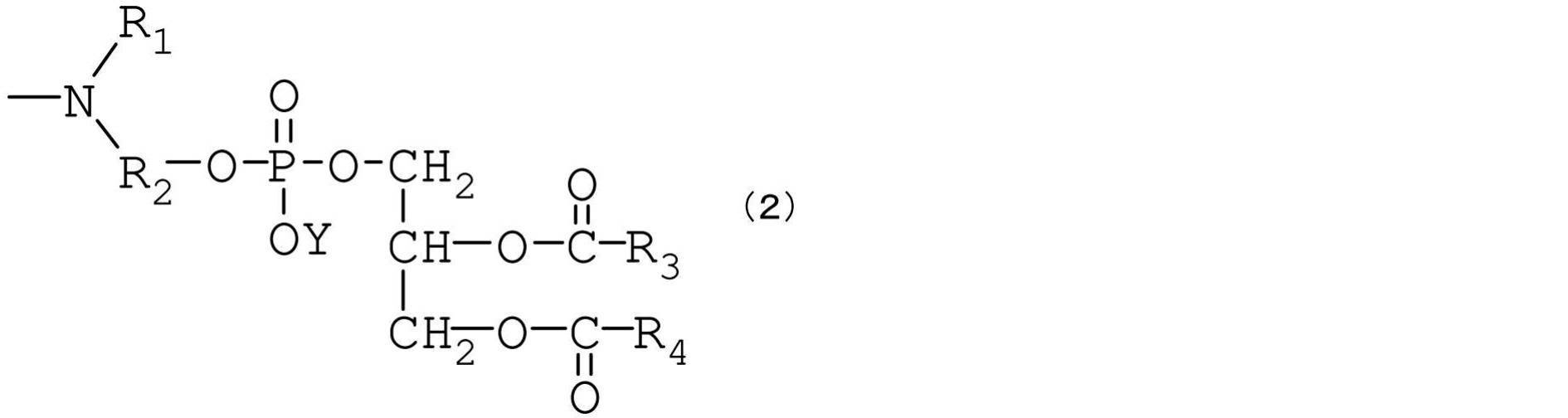
式中、R1は、水素原子または炭素原子数1~8のアルキル基を表わし、
R2は、炭素原子数1~8のアルキレン基を表わし、
R3およびR4は、それぞれ独立して、置換基を有してもよい炭素原子数8~24のアルキル基またはアルケニル基を表わし、
Yは、水素原子またはアルカリ金属を表わす、
で示されるリン脂質由来の基である、請求項1~3のいずれか1項に記載のフタロシアニン化合物。 - 上記式(2)中、R1は、水素原子、メチル基またはエチル基を表わし;R2は、炭素原子数1~3のアルキレン基を表わし;R3およびR4は、それぞれ独立して、無置換の炭素原子数15~18のアルケニル基を表わし;およびYは、水素原子またはナトリウムを表わす、請求項4に記載のフタロシアニン化合物。
- 脂質由来の基以外のZ1~Z16は、それぞれ独立して、塩素原子、メチル基およびエチル基からなる群より選択される2個の置換基で置換されたフェノキシ基を表わす、請求項1~5のいずれか1項に記載のフタロシアニン化合物。
- 請求項1~6のいずれか1項に記載のフタロシアニン化合物および脂質を含むリポソーム製剤。
- 請求項1~6のいずれか1項に記載のフタロシアニン化合物または請求項7に記載のリポソーム製剤を含む癌または腫瘍治療剤。
Priority Applications (1)
| Application Number | Priority Date | Filing Date | Title |
|---|---|---|---|
| JP2021507347A JP7222071B2 (ja) | 2019-03-18 | 2020-03-16 | フタロシアニン化合物ならびにこれを用いるリポソーム製剤および癌/腫瘍治療剤 |
Applications Claiming Priority (2)
| Application Number | Priority Date | Filing Date | Title |
|---|---|---|---|
| JP2019049752 | 2019-03-18 | ||
| JP2019-049752 | 2019-03-18 |
Publications (1)
| Publication Number | Publication Date |
|---|---|
| WO2020189641A1 true WO2020189641A1 (ja) | 2020-09-24 |
Family
ID=72520136
Family Applications (1)
| Application Number | Title | Priority Date | Filing Date |
|---|---|---|---|
| PCT/JP2020/011529 Ceased WO2020189641A1 (ja) | 2019-03-18 | 2020-03-16 | フタロシアニン化合物ならびにこれを用いるリポソーム製剤および癌/腫瘍治療剤 |
Country Status (2)
| Country | Link |
|---|---|
| JP (1) | JP7222071B2 (ja) |
| WO (1) | WO2020189641A1 (ja) |
Citations (6)
| Publication number | Priority date | Publication date | Assignee | Title |
|---|---|---|---|---|
| JPH0439361A (ja) * | 1990-06-04 | 1992-02-10 | Nippon Shokubai Co Ltd | 新規フタロシアニン化合物,その製造方法及びそれらを用いてなる近赤外線吸収材料 |
| JP2001106689A (ja) * | 1999-07-30 | 2001-04-17 | Nippon Shokubai Co Ltd | フタロシアニン化合物およびその製造方法ならびにこれを用いてなる近赤外吸収色素 |
| WO2013051732A1 (ja) * | 2011-10-07 | 2013-04-11 | 国立大学法人鳥取大学 | リポソーム複合体 |
| JP2013108060A (ja) * | 2011-10-26 | 2013-06-06 | Yamada Chem Co Ltd | フタロシアニン化合物、近赤外吸収色素及び近赤外吸収材 |
| JP2014500273A (ja) * | 2010-12-21 | 2014-01-09 | パナクセム カンパニー リミテッド | 光力学診断または治療のための結合体およびその製造方法 |
| JP2018522825A (ja) * | 2015-05-26 | 2018-08-16 | ザ ジェネラル ホスピタル コーポレイション | リポソームナノ構造並びにそれを製造及び使用する方法 |
-
2020
- 2020-03-16 JP JP2021507347A patent/JP7222071B2/ja active Active
- 2020-03-16 WO PCT/JP2020/011529 patent/WO2020189641A1/ja not_active Ceased
Patent Citations (6)
| Publication number | Priority date | Publication date | Assignee | Title |
|---|---|---|---|---|
| JPH0439361A (ja) * | 1990-06-04 | 1992-02-10 | Nippon Shokubai Co Ltd | 新規フタロシアニン化合物,その製造方法及びそれらを用いてなる近赤外線吸収材料 |
| JP2001106689A (ja) * | 1999-07-30 | 2001-04-17 | Nippon Shokubai Co Ltd | フタロシアニン化合物およびその製造方法ならびにこれを用いてなる近赤外吸収色素 |
| JP2014500273A (ja) * | 2010-12-21 | 2014-01-09 | パナクセム カンパニー リミテッド | 光力学診断または治療のための結合体およびその製造方法 |
| WO2013051732A1 (ja) * | 2011-10-07 | 2013-04-11 | 国立大学法人鳥取大学 | リポソーム複合体 |
| JP2013108060A (ja) * | 2011-10-26 | 2013-06-06 | Yamada Chem Co Ltd | フタロシアニン化合物、近赤外吸収色素及び近赤外吸収材 |
| JP2018522825A (ja) * | 2015-05-26 | 2018-08-16 | ザ ジェネラル ホスピタル コーポレイション | リポソームナノ構造並びにそれを製造及び使用する方法 |
Also Published As
| Publication number | Publication date |
|---|---|
| JPWO2020189641A1 (ja) | 2021-11-04 |
| JP7222071B2 (ja) | 2023-02-14 |
Similar Documents
| Publication | Publication Date | Title |
|---|---|---|
| JP6389539B2 (ja) | ポルフィリンナノ小胞 | |
| US9872833B2 (en) | Liposome composite body | |
| EP3285765B1 (en) | A composition comprising a photosensitive compound in a polymeric nanoparticle, and a method of using the composition | |
| WO2022077830A1 (zh) | 青蒿素及其衍生物在制备热动力治疗敏化剂中的应用 | |
| Cai et al. | A ph-activable chemo–photodynamic therapy based on cube-wrapped-cube α-naybf4: Tm@ caf2/nd@ zno nanoparticles mediated by 808 nm light | |
| WO2005099689A1 (en) | Topical delivery of phthalocyanines | |
| CN1225591A (zh) | 泰克萨菲瑞的膜结合 | |
| CN103435639B (zh) | 一种轴向核苷不对称修饰的硅酞菁及其制备方法和应用 | |
| US10086074B2 (en) | Compositions and method for light triggered release of materials from nanovesicles | |
| CN116574087B (zh) | 一种近红外七甲川菁光敏染料偶联物及其制备方法和应用 | |
| JP5926685B2 (ja) | 二光子光増感剤、それらを含むナノ粒子および薬物としてのそれらの使用 | |
| Li et al. | Platinum based theranostics nanoplatforms for antitumor applications | |
| JP7222071B2 (ja) | フタロシアニン化合物ならびにこれを用いるリポソーム製剤および癌/腫瘍治療剤 | |
| JP4741205B2 (ja) | 金属ポルフィリン錯体包埋リポソーム、その製造方法およびこれを利用する医薬 | |
| CN110003086B (zh) | 一种两亲性小分子ir820-1mt及其制剂以及其制备方法和应用 | |
| JP2021063036A (ja) | 蛍光標識剤、光線力学治療剤およびフタロシアニン | |
| JP2006056807A (ja) | 光線力学療法製剤 | |
| CN111840228A (zh) | 肿瘤免疫脂质体,其制备方法和用途 | |
| JP5252597B2 (ja) | 光線力学的治療に利用可能な脂質膜およびその利用 | |
| Geng et al. | NIR nanoadjuvant-mediated synergistic chemo/photothermal therapy with self-amplified immunogenic cell death to augment antitumor efficiency | |
| CN118791469B (zh) | 一种碘化七甲川菁缀合2-吡啶酮化合物及其制备方法与应用 | |
| KR102822996B1 (ko) | 디셀레나이드 함유 탄화수소를 포함하고 미토콘드리아 표적형 초음파감작제가 탑재된 ros/gsh 이중 감응성 세포 외 소포체 및 이를 이용한 초음파역학 치료제 | |
| Jin | Porphyrin-based nanostructure-dependent photodynamic and photothermal therapies | |
| WO2023210645A1 (ja) | Icg脂質誘導体及びこれを含む脂質微粒子 | |
| WO2022198124A1 (en) | Red-shifted photolipids and nanoparticles formed from same |
Legal Events
| Date | Code | Title | Description |
|---|---|---|---|
| 121 | Ep: the epo has been informed by wipo that ep was designated in this application |
Ref document number: 20772571 Country of ref document: EP Kind code of ref document: A1 |
|
| ENP | Entry into the national phase |
Ref document number: 2021507347 Country of ref document: JP Kind code of ref document: A |
|
| NENP | Non-entry into the national phase |
Ref country code: DE |
|
| 122 | Ep: pct application non-entry in european phase |
Ref document number: 20772571 Country of ref document: EP Kind code of ref document: A1 |