WO2020189481A1 - 硬化性樹脂組成物、硬化膜、積層体、硬化膜の製造方法、及び、半導体デバイス - Google Patents
硬化性樹脂組成物、硬化膜、積層体、硬化膜の製造方法、及び、半導体デバイス Download PDFInfo
- Publication number
- WO2020189481A1 WO2020189481A1 PCT/JP2020/010733 JP2020010733W WO2020189481A1 WO 2020189481 A1 WO2020189481 A1 WO 2020189481A1 JP 2020010733 W JP2020010733 W JP 2020010733W WO 2020189481 A1 WO2020189481 A1 WO 2020189481A1
- Authority
- WO
- WIPO (PCT)
- Prior art keywords
- group
- formula
- resin composition
- curable resin
- preferable
- Prior art date
- Legal status (The legal status is an assumption and is not a legal conclusion. Google has not performed a legal analysis and makes no representation as to the accuracy of the status listed.)
- Ceased
Links
Classifications
-
- B—PERFORMING OPERATIONS; TRANSPORTING
- B32—LAYERED PRODUCTS
- B32B—LAYERED PRODUCTS, i.e. PRODUCTS BUILT-UP OF STRATA OF FLAT OR NON-FLAT, e.g. CELLULAR OR HONEYCOMB, FORM
- B32B15/00—Layered products comprising a layer of metal
- B32B15/04—Layered products comprising a layer of metal comprising metal as the main or only constituent of a layer, which is next to another layer of the same or of a different material
- B32B15/08—Layered products comprising a layer of metal comprising metal as the main or only constituent of a layer, which is next to another layer of the same or of a different material of synthetic resin
- B32B15/088—Layered products comprising a layer of metal comprising metal as the main or only constituent of a layer, which is next to another layer of the same or of a different material of synthetic resin comprising polyamides
-
- C—CHEMISTRY; METALLURGY
- C08—ORGANIC MACROMOLECULAR COMPOUNDS; THEIR PREPARATION OR CHEMICAL WORKING-UP; COMPOSITIONS BASED THEREON
- C08G—MACROMOLECULAR COMPOUNDS OBTAINED OTHERWISE THAN BY REACTIONS ONLY INVOLVING UNSATURATED CARBON-TO-CARBON BONDS
- C08G73/00—Macromolecular compounds obtained by reactions forming a linkage containing nitrogen with or without oxygen or carbon in the main chain of the macromolecule, not provided for in groups C08G12/00 - C08G71/00
- C08G73/06—Polycondensates having nitrogen-containing heterocyclic rings in the main chain of the macromolecule
- C08G73/10—Polyimides; Polyester-imides; Polyamide-imides; Polyamide acids or similar polyimide precursors
-
- C—CHEMISTRY; METALLURGY
- C08—ORGANIC MACROMOLECULAR COMPOUNDS; THEIR PREPARATION OR CHEMICAL WORKING-UP; COMPOSITIONS BASED THEREON
- C08G—MACROMOLECULAR COMPOUNDS OBTAINED OTHERWISE THAN BY REACTIONS ONLY INVOLVING UNSATURATED CARBON-TO-CARBON BONDS
- C08G73/00—Macromolecular compounds obtained by reactions forming a linkage containing nitrogen with or without oxygen or carbon in the main chain of the macromolecule, not provided for in groups C08G12/00 - C08G71/00
- C08G73/06—Polycondensates having nitrogen-containing heterocyclic rings in the main chain of the macromolecule
- C08G73/10—Polyimides; Polyester-imides; Polyamide-imides; Polyamide acids or similar polyimide precursors
- C08G73/12—Unsaturated polyimide precursors
-
- G—PHYSICS
- G03—PHOTOGRAPHY; CINEMATOGRAPHY; ANALOGOUS TECHNIQUES USING WAVES OTHER THAN OPTICAL WAVES; ELECTROGRAPHY; HOLOGRAPHY
- G03F—PHOTOMECHANICAL PRODUCTION OF TEXTURED OR PATTERNED SURFACES, e.g. FOR PRINTING, FOR PROCESSING OF SEMICONDUCTOR DEVICES; MATERIALS THEREFOR; ORIGINALS THEREFOR; APPARATUS SPECIALLY ADAPTED THEREFOR
- G03F7/00—Photomechanical, e.g. photolithographic, production of textured or patterned surfaces, e.g. printing surfaces; Materials therefor, e.g. comprising photoresists; Apparatus specially adapted therefor
- G03F7/004—Photosensitive materials
- G03F7/027—Non-macromolecular photopolymerisable compounds having carbon-to-carbon double bonds, e.g. ethylenic compounds
-
- G—PHYSICS
- G03—PHOTOGRAPHY; CINEMATOGRAPHY; ANALOGOUS TECHNIQUES USING WAVES OTHER THAN OPTICAL WAVES; ELECTROGRAPHY; HOLOGRAPHY
- G03F—PHOTOMECHANICAL PRODUCTION OF TEXTURED OR PATTERNED SURFACES, e.g. FOR PRINTING, FOR PROCESSING OF SEMICONDUCTOR DEVICES; MATERIALS THEREFOR; ORIGINALS THEREFOR; APPARATUS SPECIALLY ADAPTED THEREFOR
- G03F7/00—Photomechanical, e.g. photolithographic, production of textured or patterned surfaces, e.g. printing surfaces; Materials therefor, e.g. comprising photoresists; Apparatus specially adapted therefor
- G03F7/004—Photosensitive materials
- G03F7/027—Non-macromolecular photopolymerisable compounds having carbon-to-carbon double bonds, e.g. ethylenic compounds
- G03F7/032—Non-macromolecular photopolymerisable compounds having carbon-to-carbon double bonds, e.g. ethylenic compounds with binders
- G03F7/037—Non-macromolecular photopolymerisable compounds having carbon-to-carbon double bonds, e.g. ethylenic compounds with binders the binders being polyamides or polyimides
-
- G—PHYSICS
- G03—PHOTOGRAPHY; CINEMATOGRAPHY; ANALOGOUS TECHNIQUES USING WAVES OTHER THAN OPTICAL WAVES; ELECTROGRAPHY; HOLOGRAPHY
- G03F—PHOTOMECHANICAL PRODUCTION OF TEXTURED OR PATTERNED SURFACES, e.g. FOR PRINTING, FOR PROCESSING OF SEMICONDUCTOR DEVICES; MATERIALS THEREFOR; ORIGINALS THEREFOR; APPARATUS SPECIALLY ADAPTED THEREFOR
- G03F7/00—Photomechanical, e.g. photolithographic, production of textured or patterned surfaces, e.g. printing surfaces; Materials therefor, e.g. comprising photoresists; Apparatus specially adapted therefor
- G03F7/20—Exposure; Apparatus therefor
-
- G—PHYSICS
- G03—PHOTOGRAPHY; CINEMATOGRAPHY; ANALOGOUS TECHNIQUES USING WAVES OTHER THAN OPTICAL WAVES; ELECTROGRAPHY; HOLOGRAPHY
- G03F—PHOTOMECHANICAL PRODUCTION OF TEXTURED OR PATTERNED SURFACES, e.g. FOR PRINTING, FOR PROCESSING OF SEMICONDUCTOR DEVICES; MATERIALS THEREFOR; ORIGINALS THEREFOR; APPARATUS SPECIALLY ADAPTED THEREFOR
- G03F7/00—Photomechanical, e.g. photolithographic, production of textured or patterned surfaces, e.g. printing surfaces; Materials therefor, e.g. comprising photoresists; Apparatus specially adapted therefor
- G03F7/26—Processing photosensitive materials; Apparatus therefor
- G03F7/40—Treatment after imagewise removal, e.g. baking
Definitions
- the present invention relates to a curable resin composition, a cured film, a laminate, a method for producing a cured film, and a semiconductor device.
- a resin obtained by cyclizing and curing a polymer precursor such as a polyimide resin or a polybenzoxazole resin (hereinafter, the polyimide resin precursor and the polybenzoxazole resin precursor are collectively referred to as a "heterocycle-containing polymer precursor").
- a polymer precursor such as a polyimide resin or a polybenzoxazole resin
- the polyimide resin precursor and the polybenzoxazole resin precursor are collectively referred to as a "heterocycle-containing polymer precursor”
- a semiconductor device for mounting include use as a material for an insulating film or a sealing material, or as a protective film. It is also used as a base film and coverlay for flexible substrates.
- the heterocycle-containing polymer precursor is used as a curable resin composition containing the heterocycle-containing polymer precursor.
- a curable resin composition is applied to a substrate by, for example, coating, and then the heterocyclic-containing polymer precursor is cyclized by heating or the like to form a cured resin on the substrate.
- the curable resin composition can be applied by a known coating method or the like, for example, there is a high degree of freedom in designing the shape, size, application position, etc. of the curable resin composition to be applied. It can be said that it has excellent adaptability.
- industrial application development of curable resin compositions containing heterocyclic-containing polymer precursors is expected more and more.
- Patent Document 1 contains (A) a polyimide precursor and (B) a photosensitizer, and the (A) polyimide precursor is an amic acid represented by (a-1) the general formula (1).
- a photosensitive resin composition which is a resin having a structural unit of an ester, is described.
- Patent Document 2 describes a tetracarboxylic acid diester compound characterized by having a specific structure.
- Patent Document 3 describes a polyamic acid characterized by containing a specific repeating unit.
- curable resin composition containing a heterocyclic-containing polymer precursor such as a polyimide precursor, it is desired to provide a curable resin composition having an excellent elongation at break of the obtained cured product.
- a heterocyclic-containing polymer precursor such as a polyimide precursor
- the present invention relates to a curable resin composition having an excellent elongation at break of the obtained cured film, a cured film obtained by curing the curable resin composition, a laminate containing the cured film, a method for producing the cured film, and the like.
- An object of the present invention is to provide a semiconductor device including the cured film or the laminate.
- At least one type of branched structure selected from the group consisting of the branched structure represented by the following formula (A-1) and the branched structure represented by the following formula (A-2).
- R 115 represents a tetravalent organic group
- RA 21 represents a hydrogen atom or a monovalent organic group
- * is an independent structure with another structure. Represents the binding site of.
- ⁇ 2> The curable resin composition according to ⁇ 1>, wherein the content of the branched structure contained in the polyimide precursor is 0.01 to 10 ⁇ mol / g with respect to the total solid content of the composition.
- ⁇ 3> The curable resin composition according to any one of ⁇ 1> or ⁇ 2>, wherein the polyimide precursor has a repeating unit represented by the following formula (1); In formula (1), A 1 and A 2 independently represent an oxygen atom or -NH-, R 111 represents a divalent organic group, R 115 represents a tetravalent organic group, and R 113 and R 114 each independently represent a hydrogen atom or a monovalent organic group, and * 1 and * 2 each independently represent a bonding site with another structure.
- R 111 in the above formula (1) is represented by the following formula (51) or formula (61);
- R 50 to R 57 independently represent a hydrogen atom, a fluorine atom or a monovalent organic group, and at least one of R 50 to R 57 is a fluorine atom and a methyl group.
- Fluoromethyl group, difluoromethyl group or trifluoromethyl group, R 58 and R 59 independently represent fluorine atom, fluoromethyl group, difluoromethyl group or trifluoromethyl group, and * independently represent each. Represents a site of connection with other structures.
- the curable resin composition according to one. ⁇ 9> The curable resin composition according to any one of ⁇ 1> to ⁇ 8>, further comprising a radical polymerization initiator, a radical polymerizable compound, a silane coupling agent, and an onium salt.
- ⁇ 10> The curable resin composition according to any one of ⁇ 1> to ⁇ 9>, which further contains another heterocyclic-containing polymer precursor different from the above-mentioned polyimide precursor.
- ⁇ 11> The curable resin composition according to any one of ⁇ 1> to ⁇ 10>, which is used for forming an interlayer insulating film for a rewiring layer.
- ⁇ 12> A cured film obtained by curing the curable resin composition according to any one of ⁇ 1> to ⁇ 11>.
- ⁇ 13> A laminate containing two or more layers of the cured film according to ⁇ 12> and containing a metal layer between any of the cured films.
- a method for producing a cured film which comprises a film forming step of applying the curable resin composition according to any one of ⁇ 1> to ⁇ 11> to a substrate to form a film.
- ⁇ 15> The method for producing a cured film according to ⁇ 14>, which comprises an exposure step of exposing the film and a developing step of developing the film.
- ⁇ 16> The method for producing a cured film according to ⁇ 14> or ⁇ 15>, which comprises a heating step of heating the film at 80 to 450 ° C.
- a semiconductor device comprising the cured film according to ⁇ 12> or the laminate according to ⁇ 13>.
- the present invention is not limited to the specified embodiments.
- the numerical range represented by the symbol "-" means a range including the numerical values before and after "-" as the lower limit value and the upper limit value, respectively.
- the term "process” means not only an independent process but also a process that cannot be clearly distinguished from other processes as long as the desired action of the process can be achieved.
- the notation not describing substitution and non-substitution also includes a group having a substituent (atomic group) as well as a group having no substituent (atomic group).
- the "alkyl group” includes not only an alkyl group having no substituent (unsubstituted alkyl group) but also an alkyl group having a substituent (substituted alkyl group).
- exposure includes not only exposure using light but also exposure using particle beams such as an electron beam and an ion beam. Examples of the light used for exposure include the emission line spectrum of a mercury lamp, far ultraviolet rays typified by an excimer laser, extreme ultraviolet rays (EUV light), X-rays, active rays such as electron beams, or radiation.
- (meth) acrylate means both “acrylate” and “methacrylate”, or either
- (meth) acrylic means both “acrylic” and “methacrylic", or
- (meth) acryloyl means both “acryloyl” and “methacrylic", or either.
- Me in the structural formula represents a methyl group
- Et represents an ethyl group
- Bu represents a butyl group
- Ph represents a phenyl group.
- the total solid content means the total mass of all the components of the composition excluding the solvent.
- the solid content concentration is the mass percentage of other components excluding the solvent with respect to the total mass of the composition.
- the weight average molecular weight (Mw) and the number average molecular weight (Mn) are defined as polystyrene-equivalent values according to gel permeation chromatography (GPC measurement) unless otherwise specified.
- GPC measurement gel permeation chromatography
- the weight average molecular weight (Mw) and the number average molecular weight (Mn) for example, HLC-8220GPC (manufactured by Tosoh Corporation) is used, and guard columns HZ-L, TSKgel Super HZM-M, and TSKgel are used as columns. It can be obtained by using Super HZ4000, TSKgel Super HZ3000, and TSKgel Super HZ2000 (manufactured by Tosoh Corporation).
- the direction in which the layers are stacked on the base material is referred to as "upper", or if there is a photosensitive layer, the direction from the base material to the photosensitive layer is referred to as “upper”.
- the opposite direction is referred to as "down”.
- the composition may contain, as each component contained in the composition, two or more kinds of compounds corresponding to the component.
- the content of each component in the composition means the total content of all the compounds corresponding to the component.
- the physical property values are values under the conditions of a temperature of 23 ° C. and an atmospheric pressure of 101,325 Pa (1 atm) unless otherwise specified.
- the combination of preferred embodiments is a more preferred embodiment.
- the curable resin composition of the present invention (hereinafter, also simply referred to as “the composition of the present invention”) is represented by a branched structure represented by the formula (A-1) and a formula (A-2).
- a polyimide precursor having at least one branched structure selected from the group consisting of branched structures and having a branched chain having a repeating unit as a branched chain to be bonded to the branched structure (hereinafter, Also referred to as "specific polymer precursor”).
- the curable resin composition of the present invention preferably further contains a radical polymerization initiator described later, a radical polymerizable compound described later, a silane coupling agent described later, and an onium salt described later.
- the curable resin composition of the present invention is excellent in the elongation at break of the obtained cured film.
- the mechanism by which the above effect is obtained is unknown, but it is presumed as follows.
- a polyimide precursor having a branched chain having a repeating unit as a specific branched structure and a molecular chain bonded to the branched structure
- the entanglement of the polymer chains in the polymer formed after curing is increased. Therefore, it is presumed that the elongation at break is improved.
- the storage stability is likely to be improved because the cyclization during storage is suppressed due to the steric hindrance effect of having the branched chain.
- Patent Documents 1 to 3 do not describe or suggest a composition containing a specific polymer precursor. Further, the cured film obtained by curing the curable resin composition in Patent Documents 1 to 3 has a problem that the elongation at break is low.
- the components contained in the curable resin composition of the present invention will be described in detail.
- the curable resin composition of the present invention contains a specific polymer precursor.
- the specific polymer precursor has at least one branched structure selected from the group consisting of the branched structure represented by the formula (A-1) and the branched structure represented by the formula (A-2).
- a polyimide precursor having a branched chain having a repeating unit is included as the branched chain having and bonded to the branched structure. It is preferable that * in the formulas (A-1) and (A-2) is bound to a molecular chain having a repeating unit.
- a molecular chain having a repeating unit and having the longest molecular chain is referred to as a main chain
- a molecular chain having a repeating unit and different from the main chain is referred to as a branched chain.
- the main chain may have a branched structure
- the branched chain may further have a branched structure and a branched chain.
- the branched chain is bound to the main chain or the branched chain via the branched structure.
- the specific polymer precursor has a branched structure represented by the following formula (A-1), a branched structure represented by the formula (A-2), and a branched structure represented by the formula (A-3). Includes a structure represented by at least one equation selected from the group consisting of branched structures.
- R 115 represents a tetravalent organic group
- RA 21 represents a hydrogen atom or a monovalent organic group
- * represents an independent structure with another structure. Represents a binding site.
- R 115 represents a tetravalent organic group.
- a tetravalent organic group containing an aromatic ring is preferable, and a group represented by the following formula (5) or formula (6) is more preferable.
- O) 2- O
- * Independently represent a binding site with another structure.
- the tetravalent organic group represented by R 115 in the formula (A-1) is a tetracarboxylic acid residue (tetracarboxylic acid) that remains after the acid dianhydride group is removed from the tetracarboxylic dianhydride. (Structure in which all four of the four carboxy groups in the above are amidated) and the like. Only one type of tetracarboxylic dianhydride may be used, or two or more types may be used.
- the tetracarboxylic dianhydride is preferably a compound represented by the following formula (7).
- R 115 represents a tetravalent organic group.
- R 115 has the same meaning as R 115 in formula (A-1).
- tetracarboxylic dianhydride examples include pyromellitic acid, pyromellitic dianhydride (PMDA), 3,3', 4,4'-biphenyltetracarboxylic dianhydride, 3,3', 4 , 4'-diphenylsulfide tetracarboxylic dianhydride, 3,3', 4,4'-diphenylsulfonetetracarboxylic dianhydride, 3,3', 4,4'-benzophenonetetracarboxylic dianhydride, 3,3', 4,4'-diphenylmethanetetracarboxylic dianhydride, 2,2', 3,3'-diphenylmethanetetracarboxylic dianhydride, 2,3,3', 4'-biphenyltetracarboxylic acid Dihydride, 2,3,3', 4'-benzophenonetetracarboxylic dianhydride, 4,4'-oxy
- R 115 represents a tetravalent organic group.
- R 115 in formula (A-2) has the same meaning as R 115 in formula (A-1), a preferable embodiment thereof is also the same.
- R A21 represents a hydrogen atom or a monovalent organic group, the group represented by hydrogen or -X A21 -R A22 is preferable.
- the X A21 represents an oxygen atom or ⁇ NH—, and an oxygen atom is preferable.
- the RA22 represents a monovalent organic group, and a monovalent organic group containing a radically polymerizable group is preferable.
- the radically polymerizable group may be any group that can undergo a cross-linking reaction by the action of a radical, and a preferable example thereof is a group having an ethylenically unsaturated bond.
- Examples of the group having an ethylenically unsaturated bond include a vinyl group, an allyl group, a (meth) acryloyl group, and a group represented by the following formula (III).
- R200 represents a hydrogen atom or a methyl group, and a methyl group is preferable.
- R 201 is an alkylene group having 2 to 12 carbon atoms, -CH 2 CH (OH) CH 2- or a (poly) oxyalkylene group having 4 to 30 carbon atoms (the alkylene group has 1 carbon atom).
- ⁇ 12 is preferable, 1 to 6 is more preferable, 1 to 3 is particularly preferable; the number of repetitions is preferably 1 to 12, 1 to 6 is more preferable, and 1 to 3 is particularly preferable).
- the (poly) oxyalkylene group means an oxyalkylene group or a polyoxyalkylene group.
- R 201 examples include ethylene group, propylene group, trimethylene group, tetramethylene group, 1,2-butandyl group, 1,3-butandyl group, pentamethylene group, hexamethylene group, octamethylene group, dodecamethylene group. , -CH 2 CH (OH) CH 2-, and more preferably ethylene group, propylene group, trimethylene group, -CH 2 CH (OH) CH 2- .
- R 200 is a methyl group and R 201 is an ethylene group.
- * represents a binding site with another structure.
- an aliphatic group, an aromatic group, an arylalkyl group or the like having one, two or three, preferably one acid group, etc. can be mentioned. Specific examples thereof include an aromatic group having an acid group having 6 to 20 carbon atoms and an arylalkyl group having an acid group having 7 to 25 carbon atoms. More specifically, a phenyl group having an acid group and a benzyl group having an acid group can be mentioned.
- the acid group is preferably a hydroxy group. That is, RA22 is preferably a group having a hydroxy group.
- a substituent that improves the solubility of the developing solution is preferably used.
- RA22 is a hydrogen atom, 2-hydroxybenzyl, 3-hydroxybenzyl and 4-hydroxybenzyl from the viewpoint of solubility in an aqueous developer.
- RA22 is preferably a monovalent organic group.
- a monovalent organic group a linear or branched alkyl group, a cyclic alkyl group, or an aromatic group is preferable, and an alkyl group substituted with an aromatic group is more preferable.
- the number of carbon atoms of the alkyl group is preferably 1 to 30 (3 or more in the case of a cyclic group).
- the alkyl group may be linear, branched or cyclic. Examples of the linear or branched alkyl group include methyl group, ethyl group, propyl group, butyl group, pentyl group, hexyl group, heptyl group, octyl group, nonyl group, decyl group, dodecyl group, tetradecyl group and octadecyl group.
- the cyclic alkyl group may be a monocyclic cyclic alkyl group or a polycyclic cyclic alkyl group.
- Examples of the monocyclic cyclic alkyl group include a cyclopropyl group, a cyclobutyl group, a cyclopentyl group, a cyclohexyl group, a cycloheptyl group and a cyclooctyl group.
- Examples of the polycyclic cyclic alkyl group include an adamantyl group, a norbornyl group, a bornyl group, a phenyl group, a decahydronaphthyl group, a tricyclodecanyl group, a tetracyclodecanyl group, a camphoroyl group, a dicyclohexyl group and a pinenyl group. Can be mentioned. Further, as the alkyl group substituted with an aromatic group, a linear alkyl group substituted with an aromatic group described below is preferable.
- aromatic group examples include a substituted or unsubstituted aromatic hydrocarbon group (the cyclic structure constituting the group includes a benzene ring, a naphthalene ring, a biphenyl ring, a fluorene ring, a pentalene ring, an inden ring, and azulene.
- the cyclic structure constituting the group includes a benzene ring, a naphthalene ring, a biphenyl ring, a fluorene ring, a pentalene ring, an inden ring, and azulene.
- the cyclic structure constituting the group includes a fluorene ring, a pyrrole ring, a furan ring, a thiophene ring, an imidazole ring, an oxazole ring, a thiazole ring, a pyridine ring, a pyrazine ring, a pyrimidine ring, a pyridazine ring, an indolin ring, an indol ring, and a benzofuran.
- Ring benzothiophene ring, isobenzofuran ring, quinolysin ring, quinoline ring, phthalazine ring, naphthylidine ring, quinoxaline ring, quinoxazoline ring, isoquinoline ring, carbazole ring, phenanthridin ring, acredin ring, phenanthrolin ring, thiantolen ring, chromium ring , Xanthene ring, phenoxatiin ring, phenothiazine ring or phenazine ring).
- the content of the branched structure contained in the specific polymer precursor is preferably 0.01 to 10 ⁇ mol / g with respect to the total solid content of the composition from the viewpoint of improving the elongation at break of the cured product. It is preferably 0.01 to 8 ⁇ mol / g, and more preferably 0.02 to 5 ⁇ mol / g.
- the specific polymer precursor may have only one type of branched structure represented by the formula (A-1) or the formula (A-2) as the branched structure, or the formula (A-1) or The branched structure represented by the formula (A-2) may be provided as two or more branched structures having different structures. When the specific polymer precursor has two or more kinds of branched structures, the content of the branched structure is the branching represented by all the formulas (A-1) or (A-2) in the specific polymer precursor. The total content of the mold structure.
- the specific polymer precursor may further have a branched structure represented by the following formula (A-3) as another branched structure.
- RA31 represents an n-valent linking group
- n represents an integer of 3 or more
- * represents a binding site with another structure independently.
- RA31 represents an n-valent linking group, which is a linear or branched aliphatic group, a cyclic aliphatic group, and an aromatic group, a heteroaromatic group, or these.
- Examples of a group in which two or more are combined are a linear aliphatic group having 2 to 20 carbon atoms, a branched aliphatic group having 3 to 20 carbon atoms, a cyclic aliphatic group having 3 to 20 carbon atoms, and a cyclic aliphatic group having 6 to 20 carbon atoms.
- An aromatic group of 20 or a group in which two or more of these are combined is preferable, and an aromatic group having 6 to 20 carbon atoms is more preferable.
- RA31 in the formula (A-3) is preferably derived from an n-valent amine compound.
- the n-valent amine compound used in the production of the polyimide precursor include linear or branched aliphatic, cyclic aliphatic or aromatic n-valent amine compounds. Only one type of n-valent amine compound may be used, or two or more types may be used.
- the n-valent amine compound includes a linear aliphatic group having 2 to 20 carbon atoms, a branched or cyclic aliphatic group having 3 to 20 carbon atoms, and an aromatic group having 6 to 20 carbon atoms.
- it is preferably an n-valent amine compound containing a group in which two or more of these are combined, and more preferably an n-valent amine compound containing an aromatic group having 6 to 20 carbon atoms.
- aromatic groups include the following.
- n represents an integer of 3 or more
- a represents an integer of 1 or more
- b represents an integer of 1 or more
- a + b is 3 or more
- A is a carbon which may be substituted with a fluorine atom.
- n is preferably an integer of 3 to 10, and more preferably an integer of 3 to 6.
- a is preferably an integer of 1 to 10, more preferably an integer of 1 to 4, and more preferably 1 or 2.
- b is preferably an integer of 1 to 10, more preferably an integer of 1 to 4, and more preferably 1 or 2.
- a + b is preferably an integer of 3 to 10, and more preferably an integer of 3 to 6.
- -It is more preferable that it is a divalent group selected from the group consisting of.
- Each of the n * may be bonded to the same carbon atom in the formula, but it is preferably bonded to different carbon atoms.
- Each of a * may be bonded to the same carbon atom in the formula, but it is preferably bonded to different carbon atoms.
- Each of the b * may be bonded to the same carbon atom in the formula, but it is preferably bonded to a different carbon atom.
- n-valent amine compound examples include compounds having the following structures.
- n represents an integer of 3 or more, preferably an integer of 3 to 10, and more preferably an integer of 3 to 6.
- the specific polymer precursor is selected as a repeating unit having a branched structure from a group consisting of a repeating unit represented by the following formula (B-1) and a repeating unit represented by the following formula (B-2). It is preferable to contain at least one kind. Further, the specific polymer precursor may further have a repeating unit represented by the following formula (B-3).
- R 115 represents a tetravalent organic group
- RA 21 represents a hydrogen atom or a monovalent organic group
- B14 , RB21 , RB22 and RB23 independently represent a divalent linking group
- RA31 represents an n-valent linking group
- n represents an integer of 3 or more
- a represents an integer of 1 to 3.
- B represents an integer of 0 to 2
- a + b is 3
- * represents a coupling site with another structure independently.
- R 115 has the same meaning as R 115 in the above formula (A-1), a preferable embodiment thereof is also the same.
- RB11 , RB12 , RB13 and RB14 each independently represent a divalent organic group.
- the divalent organic group include a linear or branched aliphatic group, a cyclic aliphatic group, an aromatic group, a heteroaromatic group, or a group in which two or more of these are combined, and the number of carbon atoms is exemplified.
- the group combined as described above is preferable, and an aromatic group having 6 to 20 carbon atoms is more preferable.
- R B11 , R B12 , R B13 and R B14 in the formula (B-1) are independently derived from the diamine.
- the diamine used for producing the polyimide precursor include linear or branched-chain aliphatic, cyclic aliphatic or aromatic diamines. Only one type of diamine may be used, or two or more types may be used.
- the diamine is a linear aliphatic group having 2 to 20 carbon atoms, a branched or cyclic aliphatic group having 3 to 20 carbon atoms, an aromatic group having 6 to 20 carbon atoms, or these. It is preferably a diamine containing two or more combined groups, and more preferably a diamine containing an aromatic group having 6 to 20 carbon atoms. Examples of aromatic groups include the following.
- diamine examples include 1,2-diaminoethane, 1,2-diaminopropane, 1,3-diaminopropane, 1,4-diaminobutane, 1,6-diaminohexane; 1,2- or 1 , 3-Diaminocyclopentane, 1,2-, 1,3- or 1,4-diaminocyclohexane, 1,2-, 1,3- or 1,4-bis (aminomethyl) cyclohexane, bis- (4-) Aminocyclohexyl) methane, bis- (3-aminocyclohexyl) methane, 4,4'-diamino-3,3'-dimethylcyclohexylmethane or isophoronediamine; meta or paraphenylenediamine, diaminotoluene, 4,4'-or 3 , 3'-diaminobiphenyl, 4,4'-diaminodiphenyl ether,
- diamines (DA-1) to (DA-18) shown below are also preferable.
- a diamine having at least two alkylene glycol units in the main chain is also mentioned as a preferable example.
- a diamine containing two or more of one or both of an ethylene glycol chain and a propylene glycol chain in one molecule is preferable, and a diamine containing no aromatic ring is preferable.
- Specific examples include Jeffamine (registered trademark) KH-511, Jeffamine (registered trademark) ED-600, Jeffamine (registered trademark) ED-900, Jeffamine (registered trademark) ED-2003, and Jeffamine (registered trademark).
- EDR-148 Jeffamine (registered trademark) EDR-176, D-200, D-400, D-2000, D-4000 (trade name, manufactured by HUNTSMAN), 1- (2- (2- (2)) -Aminopropoxy) ethoxy) propoxy) propane-2-amine, 1- (1- (1- (2-aminopropoxy) propoxy-2-yl) oxy) propane-2-amine, etc., but are limited to these. Not done.
- x, y, and z are arithmetic mean values.
- Ar 0 is independently an aromatic hydrocarbon group (preferably 6 to 22 carbon atoms, more preferably 6 to 18 carbon atoms, particularly preferably 6 to 10 carbon atoms), and a phenylene group is preferable.
- the preferred range of L 0 is synonymous with A above.
- R B11 , R B12 , R B13 and R B14 in the formula (1) are independently divalent organic groups represented by the following formula (51) or the formula (61) from the viewpoint of i-ray transmittance. Is preferable. In particular, a divalent organic group represented by the formula (61) is more preferable from the viewpoint of i-ray transmittance and availability.
- R 50 to R 57 are independently hydrogen atoms, fluorine atoms or monovalent organic groups, and at least one of R 50 to R 57 is a fluorine atom, a methyl group, a fluoromethyl group, It is a difluoromethyl group or a trifluoromethyl group, and * independently represents a binding site with another structure.
- the monovalent organic group of R 50 to R 57 includes an unsubstituted alkyl group having 1 to 10 carbon atoms (preferably 1 to 6 carbon atoms) and 1 to 10 carbon atoms (preferably 1 to 6 carbon atoms). Examples thereof include an alkyl fluoride group.
- R 58 and R 59 are independently fluorine atoms, fluoromethyl groups, difluoromethyl groups, or trifluoromethyl groups, respectively.
- Examples of the diamine compound giving the structure of the formula (51) or (61) include dimethyl-4,4'-diaminobiphenyl, 2,2'-bis (trifluoromethyl) -4,4'-diaminobiphenyl, 2,2. Examples thereof include'-bis (fluoro) -4,4'-diaminobiphenyl and 4,4'-diaminooctafluorobiphenyl. One of these may be used, or two or more thereof may be used in combination.
- R 115 has the same meaning as R 115 in the above formula (A-2), preferable embodiments thereof are also the same.
- R A21 has the same meaning as R A21 in the above formula (A-2), preferable embodiments thereof are also the same.
- R B21 , R B22, and R B23 are independently synonymous with R B11 , R B12 , R B13, and R B14 in the above formula (B-1), and the preferred embodiments are also the same. Is.
- R 115 has the same meaning as R 115 in the above formula (A-1), a preferable embodiment thereof is also the same.
- R A31 has the same meaning as R A31 in the above formula (A-3), preferable embodiments thereof are also the same.
- n has the same meaning as n in the above formula (A-3), and the preferred embodiment is also the same.
- a is preferably 1.
- b is preferably 2.
- the repeating unit represented by the formula (B-1) may be one kind, or two or more kinds. Good. Further, the structural isomer of the repeating unit represented by the formula (B-1) may be contained. Similarly, when the repeating unit represented by the formula (B-2) is included and when the repeating unit represented by the formula (B-3) is included, these repeating units may be one kind. However, it may be two or more kinds and may contain structural isomers.
- the specific polymer precursor preferably contains a repeating unit other than the repeating unit having the above-mentioned branched structure.
- the specific polymer precursor preferably has a repeating unit represented by the following formula (1) as the other repeating unit.
- a 1 and A 2 independently represent an oxygen atom or -NH-
- R 111 represents a divalent organic group
- R 115 represents a tetravalent organic group
- R 113 and R 114 each independently represent a hydrogen atom or a monovalent organic group
- * 1 and * 2 each independently represent a bonding site with another structure.
- the specific polymer precursor is selected from the group consisting of a repeating unit represented by the formula (1), a repeating unit represented by the formula (B-1), and a repeating unit represented by the formula (B-2).
- * 1 in the repeating unit represented by the formula (1) and the repeating unit represented by the formula (B-1) or the repeating unit represented by the formula (B-2) are shown. It is preferable that * in the repeating unit to be used is combined. Further, in this case, * 2 in the repeating unit represented by the formula (1) is preferably combined with * 1 in the repeating unit represented by the other formula (1).
- the specific polymer precursor contains a repeating unit represented by the formula (1) and a repeating unit represented by the formula (B-3), * 2 in the repeating unit represented by the formula (1). And * in the repeating unit represented by the formula (B-3) are preferably combined. Further, in this case, * 1 in the repeating unit represented by the formula (1) is preferably combined with * 2 in the repeating unit represented by the other formula (1).
- the repeating unit represented by the formula (B-1), the repeating unit represented by the formula (B-2), and the formula (B-) for all the repeating units.
- the specific polymer precursor in which the total content of the repeating unit represented by 3) and the repeating unit represented by the formula (1) is 50 mol% or more, further 70 mol% or more, particularly 90 mol% or more. Is exemplified. As an upper limit, 100 mol% or less is practical.
- the specific polymer precursor contains the repeating unit represented by the formula (1), the above-mentioned branched structure and the repeating unit represented by the formula (1) are bonded by any structure. May be good. That is, even when the specific polymer precursor contains the repeating unit represented by the formula (1), the structure of the specific polymer precursor is not particularly limited as long as it has the above-mentioned branched structure.
- -A 1 and A 2- A 1 and A 2 in the formula (1) independently represent an oxygen atom or -NH-, and an oxygen atom is preferable.
- R 111 has the same meaning as RB 11 in the above formula (B-1), and the preferred embodiment is also the same.
- R 115 has the same meaning as R 115 in the above formula (A-1), a preferable embodiment thereof is also the same.
- R 113 and R 114 are independently synonymous with RA 22 included in the preferred embodiment of RA 21 in the above formula (A-1), and the preferred embodiments are also the same.
- the repeating unit represented by the formula (1) is preferably a repeating unit represented by the formula (1-A) or the formula (1-B).
- a 11 and A 12 represent an oxygen atom or -NH-
- R 111 and R 112 each independently represent a divalent organic radical
- R 113 and R 114 independently represent a hydrogen atom or 1 It represents a valent organic group
- * 1 and * 2 each independently represent a bonding site with another structure
- at least one of R 113 and R 114 is preferably a group containing a radically polymerizable group. More preferably, it is a radically polymerizable group.
- a 11 , A 12 , R 111 , R 113, R 114 , * 1 and * 2 are A 1 , A 2 , R 111 , R 113 , R 114 , * 1 and * 1 in equation (1), respectively. It is synonymous with the preferable range of * 2 .
- R 112 has the same meaning as R 112 in formula (5), and more preferably among others oxygen atoms.
- the bonding position of the carbonyl group to the benzene ring in the formula is preferably 4, 5, 3', 4'in the formula (1-A). In formula (1-B), it is preferably 1, 2, 4, 5.
- the repeating unit represented by the formula (1) may be one kind, but may be two or more kinds. Further, the structural isomer of the repeating unit represented by the formula (1) may be contained. Further, the specific polymer precursor may contain other types of repeating units in addition to the repeating units of the above formula (1).
- the branched chain of the specific polymer precursor is the same as at least one of the repeating units contained in the main chain of the specific polymer precursor.
- the repeating units contained in the main chain only one branched chain containing the same repeating unit as at least one repeating unit may be contained in the specific polymer precursor, or two or more may be contained. ..
- the specific polymer precursor may further have a branched chain that does not contain the same repeating unit as at least one of the repeating units contained in the main chain, but an embodiment that does not have the repeating unit is also preferable.
- the branched chain preferably contains a repeating unit represented by the above formula (1).
- the main chain is represented by the formula (1) and at least one selected from the group consisting of the repeating unit represented by (B-1) and the repeating unit represented by the formula (B-2). It is preferable to include a repeating unit.
- the main chain may further contain a repeating unit represented by the formula (B-3). Further, it is preferable that both the main chain and the branched chain contain a repeating unit represented by the formula (1), and both the main chain and the branched chain are the repeating units represented by the formula (1). It is more preferable to include the same repeating unit.
- the weight average molecular weight of the specific polymer precursor is preferably 1,000 to 100,000, more preferably 3,000 to 90,000, and even more preferably 5,000 to 75,000. ..
- the degree of dispersion of the molecular weight of the polyimide precursor is preferably 1.2 to 3.5, more preferably 1.5 to 3.
- the degree of dispersion of the molecular weight means a value obtained by dividing the weight average molecular weight by the number average molecular weight (weight average molecular weight / number average molecular weight).
- Specific examples of the specific polymer precursor include PA-1 to PA-4 used in Examples described later, and compounds represented by the following structural formulas.
- two or three repeating units contained in parentheses are combined to form a resin.
- * and the wavy line portion are combined in each repetition unit.
- these resins may have still other repeating units as long as the effects of the present invention can be obtained.
- the specific polymer precursor is synthesized, for example, by the synthetic method shown in the synthetic examples in Examples described later. Specifically, for example, it is obtained by reacting a polyvalent carboxylic acid or a polyvalent carboxylic acid derivative with a diamine.
- a polyvalent carboxylic acid or the polyvalent carboxylic acid derivative at least a trivalent or higher polyvalent carboxylic acid or a trivalent or higher polyvalent carboxylic acid derivative is used, and a trivalent or tetravalent polyvalent carboxylic acid (tricarboxylic acid) is used.
- a tetracarboxylic acid or a trivalent or tetravalent polycarboxylic acid derivative (tricarboxylic acid derivative or tetracarboxylic acid derivative).
- a divalent carboxylic acid or a divalent carboxylic acid derivative (dicarboxylic acid derivative) is further used. May be good.
- the polyvalent carboxylic acid or the polyvalent carboxylic acid derivative is obtained by halogenating it with a halogenating agent and then reacting it with a diamine.
- a method of reacting a dicarboxylic acid or a dicarboxylic acid derivative with a trivalent or higher polyvalent amine can be mentioned.
- the dicarboxylic acid or the dicarboxylic acid derivative is halogenated with a halogenating agent and then reacted with a trivalent or higher polyvalent amine.
- the organic solvent may be one kind or two or more kinds.
- the organic solvent can be appropriately determined depending on the raw material, and examples thereof include pyridine, diethylene glycol dimethyl ether (diglyme), N-methylpyrrolidone and N-ethylpyrrolidone.
- the specific polymer precursor in the reaction solution can be precipitated in water, and the specific polymer precursor such as tetrahydrofuran can be dissolved in a soluble solvent to precipitate a solid.
- the content of the specific polymer precursor in the curable resin composition of the present invention is 0.001% by mass with respect to the total solid content of the curable resin composition from the viewpoint of improving the elongation at break of the obtained cured film.
- the above is preferable, 0.01% by mass or more is more preferable, and 0.5% by mass or more is further preferable.
- the upper limit of the content is preferably 30% by mass or less, more preferably 20% by mass or less, and 15% by mass or less from the viewpoint of improving the resolution of the curable resin composition. It is more preferably 10% by mass or less, and even more preferably 5% by mass or less.
- the content of the specific polymer precursor is specified from the viewpoint of improving the breaking elongation of the obtained cured film. It is preferably 0.01% by mass or more, more preferably 0.02% by mass or more, and 0.05% by mass or more, based on the total amount of the polymer precursor and other heterocyclic-containing polymer precursors. It is more preferable to have.
- the upper limit of the content is preferably 50% by mass or less, more preferably 40% by mass or less, and 30% by mass or less from the viewpoint of improving the resolution of the curable resin composition. It is more preferably 25% by mass or less, and even more preferably 10% by mass or less.
- the curable resin composition of the present invention may contain only one type of specific polymer precursor, or may contain two or more types. When two or more types are included, the total amount is preferably in the above range.
- the curable resin composition of the present invention preferably contains other heterocyclic-containing polymer precursors (hereinafter, also simply referred to as “other polymer precursors”) other than the above-mentioned specific polymer precursors.
- the curable resin composition of the present invention preferably contains, as the other polymer precursor, at least one precursor selected from the group consisting of a polyimide precursor and a polybenzoxazole precursor, and the polyimide precursor is used. It is more preferable to include it.
- the polyimide precursor preferably has the repeating unit represented by the formula (1) in the above-mentioned specific polymer precursor.
- the repeating unit represented by the formula (1) may be one kind, but may be two or more kinds. Further, the structural isomer of the repeating unit represented by the formula (1) may be contained. Further, the polyimide precursor may contain other types of repeating units in addition to the repeating units of the above formula (1).
- the polyimide precursor in the present invention 50 mol% or more, more 70 mol% or more, particularly 90 mol% or more of all the repeating units are the repeating units represented by the formula (1). Is exemplified. As an upper limit, 100 mol% or less is practical.
- the weight average molecular weight (Mw) of the polyimide precursor is preferably 2,000 to 500,000, more preferably 5,000 to 100,000, and further preferably 10,000 to 50,000.
- the number average molecular weight (Mn) is preferably 800 to 250,000, more preferably 2,000 to 50,000, and even more preferably 4,000 to 25,000.
- the degree of dispersion of the molecular weight of the polyimide precursor is preferably 1.5 to 3.5, more preferably 2 to 3.
- the polyimide precursor is obtained by reacting a dicarboxylic acid or a dicarboxylic acid derivative with a diamine.
- the dicarboxylic acid or the dicarboxylic acid derivative is obtained by halogenating it with a halogenating agent and then reacting it with a diamine.
- the organic solvent may be one kind or two or more kinds.
- the organic solvent can be appropriately determined depending on the raw material, and examples thereof include pyridine, diethylene glycol dimethyl ether (diglyme), N-methylpyrrolidone and N-ethylpyrrolidone.
- the polyimide precursor in the reaction solution can be precipitated in water, and the polyimide precursor such as tetrahydrofuran can be dissolved in a soluble solvent to precipitate a solid.
- the polybenzoxazole precursor preferably contains a repeating unit represented by the following formula (2).
- R 121 represents a divalent organic group
- R 122 represents a tetravalent organic group
- R 123 and R 124 independently represent a hydrogen atom or a monovalent organic group. Represent.
- R 121 represents a divalent organic group.
- the divalent organic group includes an aliphatic group (preferably 1 to 24 carbon atoms, more preferably 1 to 12 carbon atoms, particularly preferably 1 to 6 carbon atoms) and an aromatic group (preferably 6 to 22 carbon atoms, 6 to 14 carbon atoms). Is more preferable, and 6 to 12 is particularly preferable).
- the aromatic group constituting R 121 include R 111 of the above formula (1).
- the aliphatic group a linear aliphatic group is preferable.
- R 121 is preferably derived from 4,4'-oxydibenzoyl chloride.
- R 122 represents a tetravalent organic group.
- the tetravalent organic group has the same meaning as R 115 in the above formula (1), and the preferable range is also the same.
- R 122 is preferably derived from 2,2'-bis (3-amino-4-hydroxyphenyl) hexafluoropropane.
- R -R 123 and R 124- R 123 and R 124 independently represent a hydrogen atom or a monovalent organic group, and have the same meaning as R 113 and R 114 in the above formula (1), and the preferable range is also the same.
- the polybenzoxazole precursor may contain other types of repeating units in addition to the repeating units of the above formula (2).
- the polybenzoxazole precursor further contains a diamine residue represented by the following formula (SL) as another type of repeating unit in that the occurrence of warpage of the cured film due to ring closure can be suppressed.
- SL diamine residue represented by the following formula (SL) as another type of repeating unit in that the occurrence of warpage of the cured film due to ring closure can be suppressed.
- R 1s is a hydrogen atom or a hydrocarbon group having 1 to 10 carbon atoms (preferably 1 to 6 carbon atoms, more preferably 1 to 3 carbon atoms), and R 2s.
- Is a hydrocarbon group having 1 to 10 carbon atoms (preferably 1 to 6 carbon atoms, more preferably 1 to 3 carbon atoms), and at least one of R 3s , R 4s , R 5s , and R 6s is aromatic.
- a group preferably 6 to 22 carbon atoms, more preferably 6 to 18 carbon atoms, particularly preferably 6 to 10 carbon atoms
- the rest are hydrogen atoms or 1 to 30 carbon atoms (preferably 1 to 18 carbon atoms).
- the a structure and the b structure may be block polymerization or random polymerization.
- the a structure is 5 to 95 mol%
- the b structure is 95 to 5 mol%
- a + b is 100 mol%.
- preferred Z includes those in which R 5s and R 6s in the b structure are phenyl groups.
- the molecular weight of the structure represented by the formula (SL) is preferably 400 to 4,000, more preferably 500 to 3,000.
- the molecular weight can be determined by commonly used gel permeation chromatography. By setting the molecular weight in the above range, the elastic modulus of the polybenzoxazole precursor after dehydration ring closure can be lowered, and the effect of suppressing warpage and the effect of improving solubility can be achieved at the same time.
- the tetracarboxylic dianhydride is further provided in that it improves the alkali solubility of the curable resin composition. It is preferable that the tetracarboxylic acid residue remaining after the removal of the acid dianhydride group from the product is contained as a repeating unit. Examples of such a tetracarboxylic acid residue include the example of R 115 in the formula (1).
- the weight average molecular weight (Mw) of the polybenzoxazole precursor is preferably 2,000 to 500,000, more preferably 5,000 to 100,000, still more preferably 10,000 to 50,000. is there.
- the number average molecular weight (Mn) is preferably 800 to 250,000, more preferably 2,000 to 50,000, and even more preferably 4,000 to 25,000.
- the content of the other polymer precursor in the curable resin composition of the present invention is preferably 20% by mass or more, more preferably 30% by mass or more, based on the total solid content of the curable resin composition. It is more preferably 40% by mass or more, further preferably 50% by mass or more, further preferably 60% by mass or more, and even more preferably 70% by mass or more.
- the content of the other polymer precursor in the curable resin composition of the present invention is preferably 99.5% by mass or less, preferably 99% by mass or less, based on the total solid content of the curable resin composition. It is more preferably 98% by mass or less, further preferably 97% by mass or less, and even more preferably 95% by mass or less.
- the curable resin composition of the present invention may contain only one type of other polymer precursor, or may contain two or more types. When two or more types are included, the total amount is preferably in the above range.
- the curable resin composition of the present invention may further contain other resins.
- another resin for example, it has a branched structure represented by the above formula (A-1), and as a branched chain bonded to the branched structure, it has a branched chain having a repeating unit and has a branched chain.
- examples thereof include compounds that do not form an imide structure by heating.
- Other resins are not polyimide precursors because they do not form an imide structure when heated.
- Specific examples thereof include a resin having a branched structure represented by the above formula (A-1) and not having a repeating unit represented by the above formula (1).
- resins include, but are not limited to, PA-5 used in the examples, resins having the following structure, and the like.
- the two repeating units contained in parentheses are combined to form a resin.
- * and the wavy line portion are combined in each repetition unit.
- these resins may have still other repeating units as long as the effects of the present invention can be obtained.
- the content of the other resin may be more than 0% by mass and 50% by mass or less with respect to the total solid content of the curable resin composition. It is preferably more than 0% by mass and more preferably 30% by mass or less.
- the curable resin composition of the present invention preferably contains an onium salt.
- the type of onium salt and the like are not particularly specified, but ammonium salt, iminium salt, sulfonium salt, iodonium salt and phosphonium salt are preferably mentioned. Among these, ammonium salt or iminium salt is preferable from the viewpoint of high thermal stability, and sulfonium salt, iodonium salt or phosphonium salt is preferable from the viewpoint of compatibility with the polymer.
- the onium salt is a salt of a cation and an anion having an onium structure, and the cation and the anion may or may not be bonded via a covalent bond. .. That is, the onium salt may be an intermolecular salt having a cation portion and an anion portion in the same molecular structure, or a cation molecule and an anion molecule, which are separate molecules, are ionically bonded. It may be an intermolecular salt, but it is preferably an intermolecular salt. Further, in the curable resin composition of the present invention, the cation portion or the cation molecule and the anion portion or the anion molecule may be bonded or dissociated by an ionic bond.
- an ammonium cation, a pyridinium cation, a sulfonium cation, an iodonium cation or a phosphonium cation is preferable, and at least one cation selected from the group consisting of a tetraalkylammonium cation, a sulfonium cation and an iodonium cation is more preferable.
- the onium salt used in the present invention may be a thermobase generator.
- the thermal base generator refers to a compound that generates a base by heating, and examples thereof include an acidic compound that generates a base when heated to 40 ° C. or higher.
- ammonium salt means a salt of an ammonium cation and an anion.
- R 1 to R 4 independently represent a hydrogen atom or a hydrocarbon group, and at least two of R 1 to R 4 may be bonded to each other to form a ring.
- R 1 to R 4 are each independently preferably a hydrocarbon group, more preferably an alkyl group or an aryl group, and an alkyl group having 1 to 10 carbon atoms or 6 to 6 carbon atoms. It is more preferably 12 aryl groups.
- R 1 to R 4 may have a substituent, and examples of the substituent include a hydroxy group, an aryl group, an alkoxy group, an aryloxy group, an arylcarbonyl group, an alkylcarbonyl group, an alkoxycarbonyl group and an aryloxy group. Examples thereof include a carbonyl group and an acyloxy group.
- the ring may contain a hetero atom. Examples of the hetero atom include a nitrogen atom.
- the ammonium cation is preferably represented by any of the following formulas (Y1-1) and (Y1-2).
- R 101 represents an n-valent organic group
- R 1 has the same meaning as R 1 in the formula (101)
- Ar 101 and Ar 102 are each independently , Represents an aryl group
- n represents an integer of 1 or more.
- R 101 is preferably an aliphatic hydrocarbon, an aromatic hydrocarbon, or a group obtained by removing n hydrogen atoms from a structure in which these are bonded, and has 2 to 30 carbon atoms. More preferably, it is a group obtained by removing n hydrogen atoms from the saturated aliphatic hydrocarbon, benzene or naphthalene.
- n is preferably 1 to 4, more preferably 1 or 2, and even more preferably 1.
- Ar 101 and Ar 102 are preferably phenyl groups or naphthyl groups, respectively, and more preferably phenyl groups.
- the anion in the ammonium salt one selected from a carboxylic acid anion, a phenol anion, a phosphoric acid anion and a sulfate anion is preferable, and a carboxylic acid anion is more preferable because both salt stability and thermal decomposability can be achieved.
- the ammonium salt is more preferably a salt of an ammonium cation and a carboxylic acid anion.
- the carboxylic acid anion is preferably a divalent or higher carboxylic acid anion having two or more carboxy groups, and more preferably a divalent carboxylic acid anion.
- the stability, curability and developability of the curable resin composition can be further improved.
- the stability, curability and developability of the curable resin composition can be further improved.
- the carboxylic acid anion is preferably represented by the following formula (X1).
- EWG represents an electron-attracting group.
- the electron-attracting group means that the substituent constant ⁇ m of Hammett shows a positive value.
- ⁇ m is a review article by Yusuke Tono, Journal of Synthetic Organic Chemistry, Vol. 23, No. 8 (1965), p. It is described in detail in 631-642.
- the EWG is preferably a group represented by the following formulas (EWG-1) to (EWG-6).
- R x1 to R x3 independently represent a hydrogen atom, an alkyl group, an alkenyl group, an aryl group, a hydroxy group or a carboxy group, and Ar is an aromatic group. Represents.
- the carboxylic acid anion is preferably represented by the following formula (XA).
- L 10 represents a single bond or an alkylene group, an alkenylene group, an aromatic group, -NR X - represents and divalent connecting group selected from the group consisting a combination thereof, R X is , Hydrogen atom, alkyl group, alkenyl group or aryl group.
- carboxylic acid anion examples include maleic acid anion, phthalate anion, N-phenyliminodiacetic acid anion and oxalate anion.
- the onium salt in the present invention contains an ammonium cation as a cation, and the onium salt is an anion from the viewpoint that the cyclization of the specific precursor is easily performed at a low temperature and the storage stability of the curable resin composition is easily improved. It is preferable to contain an anion having a pKa (pKaH) of 2.5 or less, and more preferably to contain an anion having a pKa (pKaH) of 1.8 or less.
- the lower limit of pKa is not particularly limited, but it is preferably -3 or more, preferably -2 or more, from the viewpoint that the generated base is not easily neutralized and the cyclization efficiency of the specific precursor or the like is improved. Is more preferable.
- the above pKa includes Determination of Organic Strategies by Physical Methods (authors: Brown, HC, McDaniel, D.H., Hafliger, O., Nachod, FC See Nachod, F.C .; Academic Press, New York, 1955) and Data for Biochemical Research (Author: Dawson, RMC et al; Oxford, Clarendon Press, 19). Can be done. For compounds not described in these documents, the values calculated from the structural formulas using ACD / pKa (manufactured by ACD / Labs) software shall be used.
- ammonium salt examples include the following compounds, but the present invention is not limited thereto.
- the iminium salt means a salt of an iminium cation and an anion.
- the anion the same as the anion in the above-mentioned ammonium salt is exemplified, and the preferred embodiment is also the same.
- a pyridinium cation is preferable.
- a cation represented by the following formula (102) is also preferable.
- R 5 and R 6 each independently represent a hydrogen atom or a hydrocarbon group
- R 7 represents a hydrocarbon group
- at least two of R 5 to R 7 are bonded to each other to form a ring. It may be formed.
- R 5 and R 6 have the same meaning as R1 to R4 in the above formula (101), and the preferred embodiment is also the same.
- R 7 preferably combines with at least one of R 5 and R 6 to form a ring.
- the ring may contain a heteroatom. Examples of the hetero atom include a nitrogen atom. Further, as the ring, a pyridine ring is preferable.
- the iminium cation is preferably represented by any of the following formulas (Y1-3) to (Y1-5).
- R 101 represents an n-valent organic group
- R 5 has the same meaning as R 5 in the formula (102)
- R 7 is R in the formula (102) Synonymous with 7
- n and m represent integers of 1 or more.
- R 101 is preferably an aliphatic hydrocarbon, an aromatic hydrocarbon, or a group obtained by removing n hydrogen atoms from the structure to which these are bonded, and has 2 to 30 carbon atoms.
- n is preferably 1 to 4, more preferably 1 or 2, and even more preferably 1.
- m is preferably 1 to 4, more preferably 1 or 2, and even more preferably 1.
- iminium salt examples include the following compounds, but the present invention is not limited thereto.
- the sulfonium salt means a salt of a sulfonium cation and an anion.
- the anion the same as the anion in the above-mentioned ammonium salt is exemplified, and the preferred embodiment is also the same.
- sulfonium cation a tertiary sulfonium cation is preferable, and a triarylsulfonium cation is more preferable. Further, as the sulfonium cation, a cation represented by the following formula (103) is preferable.
- R 8 to R 10 each independently represent a hydrocarbon group.
- Each of R 8 to R 10 is preferably an alkyl group or an aryl group independently, more preferably an alkyl group having 1 to 10 carbon atoms or an aryl group having 6 to 12 carbon atoms, and 6 to 12 carbon atoms. It is more preferably an aryl group, and even more preferably a phenyl group.
- R 8 to R 10 may have a substituent, and examples of the substituent include a hydroxy group, an aryl group, an alkoxy group, an aryloxy group, an arylcarbonyl group, an alkylcarbonyl group, an alkoxycarbonyl group and an aryloxy group.
- Examples thereof include a carbonyl group and an acyloxy group.
- an alkyl group or an alkoxy group as the substituent, more preferably to have a branched alkyl group or an alkoxy group, and a branched alkyl group having 3 to 10 carbon atoms or a branched alkyl group having 1 to 10 carbon atoms. It is more preferable to have 10 alkoxy groups.
- R 8 to R 10 may be the same group or different groups, but from the viewpoint of synthetic suitability, they are preferably the same group.
- sulfonium salt examples include the following compounds, but the present invention is not limited thereto.
- the iodonium salt means a salt of an iodonium cation and an anion.
- the anion the same as the anion in the above-mentioned ammonium salt is exemplified, and the preferred embodiment is also the same.
- iodonium cation a diallyl iodonium cation is preferable. Further, as the iodonium cation, a cation represented by the following formula (104) is preferable.
- R 11 and R 12 each independently represent a hydrocarbon group.
- R 11 and R 12 are each independently preferably an alkyl group or an aryl group, more preferably an alkyl group having 1 to 10 carbon atoms or an aryl group having 6 to 12 carbon atoms, and 6 to 12 carbon atoms. It is more preferably an aryl group, and even more preferably a phenyl group.
- R 11 and R 12 may have a substituent, and examples of the substituent include a hydroxy group, an aryl group, an alkoxy group, an aryloxy group, an arylcarbonyl group, an alkylcarbonyl group, an alkoxycarbonyl group, and an aryloxy group.
- Examples thereof include a carbonyl group and an acyloxy group.
- R 11 and R 12 may be the same group or different groups, but from the viewpoint of synthetic suitability, they are preferably the same group.
- iodonium salt examples include the following compounds, but the present invention is not limited thereto.
- the phosphonium salt means a salt of a phosphonium cation and an anion.
- the anion the same as the anion in the above-mentioned ammonium salt is exemplified, and the preferred embodiment is also the same.
- a quaternary phosphonium cation is preferable, and examples thereof include a tetraalkylphosphonium cation and a triarylmonoalkylphosphonium cation. Further, as the phosphonium cation, a cation represented by the following formula (105) is preferable.
- R 13 to R 16 independently represent a hydrogen atom or a hydrocarbon group.
- Each of R 13 to R 16 is preferably an alkyl group or an aryl group independently, more preferably an alkyl group having 1 to 10 carbon atoms or an aryl group having 6 to 12 carbon atoms, and 6 to 12 carbon atoms. It is more preferably an aryl group, and even more preferably a phenyl group.
- R 13 to R 16 may have a substituent, and examples of the substituent include a hydroxy group, an aryl group, an alkoxy group, an aryloxy group, an arylcarbonyl group, an alkylcarbonyl group, an alkoxycarbonyl group and an aryloxy group.
- Examples thereof include a carbonyl group and an acyloxy group.
- R 13 to R 16 may be the same group or different groups, but from the viewpoint of synthetic suitability, they are preferably the same group.
- phosphonium salt examples include the following compounds, but the present invention is not limited thereto.
- the content of the onium salt is preferably 0.1 to 50% by mass with respect to the total solid content of the curable resin composition of the present invention.
- the lower limit is more preferably 0.5% by mass or more, further preferably 0.85% by mass or more, and even more preferably 1% by mass or more.
- the upper limit is more preferably 30% by mass or less, further preferably 20% by mass or less, further preferably 10% by mass or less, 5% by mass or less, or 4% by mass or less.
- the onium salt one kind or two or more kinds can be used. When two or more types are used, the total amount is preferably in the above range.
- the curable resin composition of the present invention may contain a thermal base generator.
- the thermobase generator may be a compound corresponding to the above-mentioned onium salt, or may be a thermobase generator other than the above-mentioned onium salt. It is assumed that the other thermobase generator does not contain the compound corresponding to the above-mentioned onium salt.
- Examples of other thermobase generators include nonionic thermobase generators. Examples of the nonionic thermobase generator include compounds represented by the formula (B1) or the formula (B2).
- Rb 1 , Rb 2 and Rb 3 are independently organic groups, halogen atoms or hydrogen atoms having no tertiary amine structure. However, Rb 1 and Rb 2 do not become hydrogen atoms at the same time. Further, none of Rb 1 , Rb 2 and Rb 3 has a carboxy group.
- the tertiary amine structure refers to a structure in which all three bonds of a trivalent nitrogen atom are covalently bonded to a hydrocarbon-based carbon atom. Therefore, this does not apply when the bonded carbon atom is a carbon atom forming a carbonyl group, that is, when an amide group is formed together with a nitrogen atom.
- Rb 1 , Rb 2 and Rb 3 contains a cyclic structure, and it is more preferable that at least two contain a cyclic structure.
- the cyclic structure may be either a monocyclic ring or a condensed ring, and a monocyclic ring or a condensed ring in which two monocyclic rings are condensed is preferable.
- the single ring is preferably a 5-membered ring or a 6-membered ring, and preferably a 6-membered ring.
- a cyclohexane ring and a benzene ring are preferable, and a cyclohexane ring is more preferable.
- Rb 1 and Rb 2 are hydrogen atoms, alkyl groups (preferably 1 to 24 carbon atoms, more preferably 2 to 18 carbon atoms, further preferably 3 to 12 carbon atoms), and alkenyl groups (preferably 2 to 24 carbon atoms). , 2-18 is more preferred, 3-12 is more preferred), aryl groups (6-22 carbons are preferred, 6-18 are more preferred, 6-10 are more preferred), or arylalkyl groups (7 carbons). ⁇ 25 is preferable, 7 to 19 is more preferable, and 7 to 12 is even more preferable). These groups may have substituents as long as the effects of the present invention are exhibited. Rb 1 and Rb 2 may be coupled to each other to form a ring.
- Rb 1 and Rb 2 are particularly linear, branched, or cyclic alkyl groups that may have substituents (preferably 1 to 24 carbon atoms, more preferably 2 to 18 carbon atoms, still more preferably 3 to 12 carbon atoms). It is more preferably a cycloalkyl group which may have a substituent (preferably 3 to 24 carbon atoms, more preferably 3 to 18 carbon atoms, still more preferably 3 to 12 carbon atoms) and having a substituent.
- a cyclohexyl group which may be used is more preferable.
- an alkyl group preferably 1 to 24 carbon atoms, more preferably 2 to 18 carbon atoms, further preferably 3 to 12 carbon atoms
- an aryl group preferably 6 to 22 carbon atoms, more preferably 6 to 18 carbon atoms, 6 to 6.
- alkoxy group (2 to 24 carbon atoms are preferable, 2 to 12 is more preferable, 2 to 6 is more preferable
- arylalkyl group (7 to 23 carbon atoms is preferable, 7 to 19 is more preferable).
- an arylalkenyl group (8 to 24 carbon atoms is preferable, 8 to 20 is more preferable, 8 to 16 is more preferable), and an alkoxyl group (1 to 24 carbon atoms is preferable, 2 to 2 to 24).
- 18 is more preferable, 3 to 12 is more preferable), an aryloxy group (6 to 22 carbon atoms is preferable, 6 to 18 is more preferable, 6 to 12 is more preferable), or an arylalkyloxy group (7 to 12 carbon atoms is more preferable).
- 23 is preferable, 7 to 19 is more preferable, and 7 to 12 is further preferable).
- a cycloalkyl group (preferably having 3 to 24 carbon atoms, more preferably 3 to 18 carbon atoms, still more preferably 3 to 12 carbon atoms), an arylalkenyl group, and an arylalkyloxy group are preferable.
- Rb 3 may further have a substituent as long as the effects of the present invention are exhibited.
- the compound represented by the formula (B1) is preferably a compound represented by the following formula (B1-1) or the following formula (B1-2).
- Rb 11 and Rb 12 , and Rb 31 and Rb 32 are the same as Rb 1 and Rb 2 in the formula (B1), respectively.
- Rb 13 has an alkyl group (preferably 1 to 24 carbon atoms, more preferably 2 to 18 carbon atoms, further preferably 3 to 12 carbon atoms) and an alkenyl group (preferably 2 to 24 carbon atoms, more preferably 2 to 18 carbon atoms, 3 to 12 carbon atoms). Is more preferable), an aryl group (preferably 6 to 22 carbon atoms, more preferably 6 to 18 carbon atoms, further preferably 6 to 12 carbon atoms), an arylalkyl group (preferably 7 to 23 carbon atoms, more preferably 7 to 19 carbon atoms). 7 to 12 is more preferable), and a substituent may be provided as long as the effects of the present invention are exhibited. Of these, Rb 13 is preferably an arylalkyl group.
- Rb 33 and Rb 34 independently have a hydrogen atom, an alkyl group (preferably 1 to 12 carbon atoms, more preferably 1 to 8 carbon atoms, still more preferably 1 to 3 carbon atoms), and an alkenyl group (preferably 2 to 12 carbon atoms). , 2 to 8 are more preferable, 2 to 3 are more preferable), aryl groups (6 to 22 carbon atoms are preferable, 6 to 18 are more preferable, 6 to 10 are more preferable), arylalkyl groups (7 to 7 carbon atoms are more preferable). 23 is preferable, 7 to 19 is more preferable, and 7 to 11 is further preferable), and a hydrogen atom is preferable.
- Rb 35 has an alkyl group (preferably 1 to 24 carbon atoms, more preferably 1 to 12 carbon atoms, further preferably 3 to 8 carbon atoms) and an alkenyl group (preferably 2 to 12 carbon atoms, more preferably 2 to 12 carbon atoms, 3 to 12 carbon atoms). 8 is more preferable), aryl group (6 to 22 carbon atoms is preferable, 6 to 18 is more preferable, 6 to 12 is more preferable), arylalkyl group (7 to 23 carbon atoms is preferable, 7 to 19 is more preferable). , 7-12 is more preferable), and an aryl group is preferable.
- the compound represented by the formula (B1-1) is also preferable.
- Rb 11 and Rb 12 have the same meanings as Rb 11 and Rb 12 in the formula (B1-1).
- Rb 15 and Rb 16 are a hydrogen atom, an alkyl group (preferably 1 to 12 carbon atoms, more preferably 1 to 6 carbon atoms, further preferably 1 to 3 carbon atoms), and an alkenyl group (preferably 2 to 12 carbon atoms, 2 to 6 carbon atoms). More preferably, 2 to 3 are more preferable), aryl group (6 to 22 carbon atoms are preferable, 6 to 18 is more preferable, 6 to 10 is more preferable), arylalkyl group (7 to 23 carbon atoms is preferable, 7).
- Rb 17 is an alkyl group (preferably 1 to 24 carbon atoms, more preferably 1 to 12 carbon atoms, further preferably 3 to 8 carbon atoms), an alkenyl group (preferably 2 to 12 carbon atoms, more preferably 2 to 12 carbon atoms, 3 to 8 carbon atoms). Is more preferable), an aryl group (preferably 6 to 22 carbon atoms, more preferably 6 to 18 carbon atoms, further preferably 6 to 12 carbon atoms), an arylalkyl group (preferably 7 to 23 carbon atoms, more preferably 7 to 19 carbon atoms). 7 to 12 is more preferable), and an aryl group is particularly preferable.
- the molecular weight of the nonionic thermobase generator is preferably 800 or less, more preferably 600 or less, and even more preferably 500 or less.
- the lower limit is preferably 100 or more, more preferably 200 or more, and even more preferably 300 or more.
- the following compounds can be mentioned as specific examples of the compound which is a thermal base generator or other specific examples of the thermal base generator.
- the content of the thermal base generator is preferably 0.1 to 50% by mass with respect to the total solid content of the curable resin composition of the present invention.
- the lower limit is more preferably 0.5% by mass or more, and further preferably 1% by mass or more.
- the upper limit is more preferably 30% by mass or less, further preferably 20% by mass or less.
- the thermobase generator one kind or two or more kinds can be used. When two or more types are used, the total amount is preferably in the above range.
- the curable resin composition of the present invention preferably contains a photopolymerization initiator.
- the photopolymerization initiator is preferably a photoradical polymerization initiator.
- the photoradical polymerization initiator is not particularly limited and may be appropriately selected from known photoradical polymerization initiators.
- a photoradical polymerization initiator having photosensitivity to light rays in the ultraviolet region to the visible region is preferable.
- it may be an activator that produces an active radical by causing some action with the photoexcited sensitizer.
- the photoradical polymerization initiator contains at least one compound having a molar extinction coefficient of at least about 50 L ⁇ mol -1 ⁇ cm -1 within the range of about 300 to 800 nm (preferably 330 to 500 nm). Is preferable.
- the molar extinction coefficient of a compound can be measured using a known method. For example, it is preferable to measure at a concentration of 0.01 g / L using an ethyl acetate solvent with an ultraviolet-visible spectrophotometer (Cary-5 spectrophotometer manufactured by Varian).
- a known compound can be arbitrarily used as the photoradical polymerization initiator.
- halogenated hydrocarbon derivatives for example, compounds having a triazine skeleton, compounds having an oxadiazole skeleton, compounds having a trihalomethyl group, etc.
- acylphosphine compounds such as acylphosphine oxide, hexaarylbiimidazole, oxime derivatives and the like.
- paragraphs 0165 to 0182 of JP2016-027357 and paragraphs 0138 to 0151 of International Publication No. 2015/199219 can be referred to, and the contents thereof are incorporated in the present specification.
- Examples of the ketone compound include the compounds described in paragraph 0087 of JP-A-2015-087611, the contents of which are incorporated in the present specification.
- KayaCure DETX manufactured by Nippon Kayaku Co., Ltd.
- Nippon Kayaku Co., Ltd. is also preferably used.
- a hydroxyacetophenone compound, an aminoacetophenone compound, and an acylphosphine compound can also be preferably used. More specifically, for example, the aminoacetophenone-based initiator described in JP-A-10-291969 and the acylphosphine oxide-based initiator described in Japanese Patent No. 4225898 can also be used.
- IRGACURE 184 (IRGACURE is a registered trademark)
- DAROCUR 1173 As the hydroxyacetophenone-based initiator, IRGACURE 184 (IRGACURE is a registered trademark), DAROCUR 1173, IRGACURE 500, IRGACURE-2959, and IRGACURE 127 (trade names: all manufactured by BASF) can be used.
- aminoacetophenone-based initiator commercially available products IRGACURE 907, IRGACURE 369, and IRGACURE 379 (trade names: all manufactured by BASF) can be used.
- the compound described in JP-A-2009-191179 in which the absorption maximum wavelength is matched with a wavelength light source such as 365 nm or 405 nm, can also be used.
- acylphosphine-based initiator examples include 2,4,6-trimethylbenzoyl-diphenyl-phosphine oxide. Further, commercially available products such as IRGACURE-819 and IRGACURE-TPO (trade names: both manufactured by BASF) can be used.
- metallocene compound examples include IRGACURE-784 (manufactured by BASF).
- An oxime compound is more preferable as the photoradical polymerization initiator.
- the exposure latitude can be improved more effectively.
- the oxime compound is particularly preferable because it has a wide exposure latitude (exposure margin) and also acts as a photocuring accelerator.
- the compound described in JP-A-2001-233842 the compound described in JP-A-2000-080068, and the compound described in JP-A-2006-342166 can be used.
- Preferred oxime compounds include, for example, compounds having the following structures, 3-benzoyloxyiminobutane-2-one, 3-acetoxyiminobutane-2-one, 3-propionyloxyiminobutane-2-one, 2-acetoxy. Iminopentan-3-one, 2-acetoxyimino-1-phenylpropan-1-one, 2-benzoyloxyimino-1-phenylpropane-1-one, 3- (4-toluenesulfonyloxy) iminobutane-2-one , And 2-ethoxycarbonyloxyimino-1-phenylpropan-1-one and the like.
- an oxime compound (oxime-based photopolymerization initiator) as the photoradical polymerization initiator.
- IRGACURE OXE 01 IRGACURE OXE 02, IRGACURE OXE 03, IRGACURE OXE 04 (above, manufactured by BASF), ADEKA PUTMER N-1919 (manufactured by ADEKA Corporation, Japanese Patent Application Laid-Open No. 2012-014052).
- the radical polymerization initiator 2) is also preferably used.
- TR-PBG-304 manufactured by Changzhou Powerful Electronics New Materials Co., Ltd.
- Adeka Arkuru's NCI-831 and Adeka Arkuru's NCI-930 can also be used.
- DFI-091 manufactured by Daito Chemix Corp.
- an oxime compound having a fluorine atom examples include compounds described in JP-A-2010-262028, compounds 24, 36-40 described in paragraph 0345 of JP-A-2014-500852, and JP-A-2013. Examples thereof include the compound (C-3) described in paragraph 0101 of JP-A-164471.
- Examples of the most preferable oxime compound include an oxime compound having a specific substituent shown in JP-A-2007-269779 and an oxime compound having a thioaryl group shown in JP-A-2009-191061.
- the photoradical polymerization initiator includes a trihalomethyltriazine compound, a benzyldimethylketal compound, an ⁇ -hydroxyketone compound, an ⁇ -aminoketone compound, an acylphosphine compound, a phosphine oxide compound, a metallocene compound, an oxime compound, and a triaryl.
- a trihalomethyltriazine compound Selected from the group consisting of imidazole dimer, onium salt compound, benzothiazole compound, benzophenone compound, acetophenone compound and its derivative, cyclopentadiene-benzene-iron complex and its salt, halomethyloxaziazole compound, 3-aryl substituted coumarin compound. Compounds are preferred.
- More preferable photoradical polymerization initiators are trihalomethyltriazine compounds, ⁇ -aminoketone compounds, acylphosphine compounds, phosphine oxide compounds, metallocene compounds, oxime compounds, triarylimidazole dimers, onium salt compounds, benzophenone compounds and acetophenone compounds.
- At least one compound selected from the group consisting of trihalomethyltriazine compounds, ⁇ -aminoketone compounds, oxime compounds, triarylimidazole dimers, and benzophenone compounds is more preferable, and metallocene compounds or oxime compounds are even more preferable, and oxime compounds are even more preferable. Is even more preferable.
- the photoradical polymerization initiator is N, N'-tetraalkyl-4,4'-diaminobenzophenone, 2-benzyl such as benzophenone, N, N'-tetramethyl-4,4'-diaminobenzophenone (Michler ketone).
- 2-benzyl such as benzophenone
- benzoin ether compounds such as benzoin alkyl ether
- benzoin compounds such as benzoin and alkyl benzoin
- benzyl derivatives such as benzyl dimethyl ketal.
- a compound represented by the following formula (I) can also be used.
- R I00 is an alkyl group having 1 to 20 carbon atoms, an alkyl group having 2 to 20 carbon atoms interrupted by one or more oxygen atoms, an alkoxy group having 1 to 12 carbon atoms, a phenyl group, and the like.
- R I01 is a group represented by formula (II), the same as R I00
- the groups, R I02 to R I04, are independently alkyls having 1 to 12 carbon atoms, alkoxy groups having 1 to 12 carbon atoms, or halogens, respectively.
- R I05 to R I07 are the same as R I 02 to R I 04 of the above formula (I).
- the compounds described in paragraphs 0048 to 0055 of International Publication No. 2015/1254669 can also be used.
- the content thereof is preferably 0.1 to 30% by mass, more preferably 0.1 to 20% by mass, based on the total solid content of the curable resin composition of the present invention. It is more preferably 0.5 to 15% by mass, and even more preferably 1.0 to 10% by mass. Only one type of photopolymerization initiator may be contained, or two or more types may be contained. When two or more kinds of photopolymerization initiators are contained, the total is preferably in the above range.
- the curable resin composition of the present invention may contain a thermal polymerization initiator as the polymerization initiator, and may particularly contain a thermal radical polymerization initiator.
- a thermal radical polymerization initiator is a compound that generates radicals by heat energy to initiate or accelerate the polymerization reaction of a polymerizable compound. By adding the thermal radical polymerization initiator, the polymerization reaction of the heterocyclic polymer precursor can be promoted together with the cyclization of the heterocyclic polymer precursor, so that higher heat resistance can be achieved.
- thermal radical polymerization initiator examples include compounds described in paragraphs 0074 to 0118 of JP-A-2008-063554.
- the content thereof is preferably 0.1 to 30% by mass, more preferably 0.1 to 20% by mass, based on the total solid content of the curable resin composition of the present invention. %, More preferably 5 to 15% by mass. Only one type of thermal radical polymerization initiator may be contained, or two or more types may be contained. When two or more types of thermal radical polymerization initiators are contained, the total is preferably in the above range.
- the curable resin composition of the present invention preferably contains a polymerizable compound.
- a radically polymerizable compound can be used as the polymerizable compound.
- the radically polymerizable compound is a compound having a radically polymerizable group.
- examples of the radically polymerizable group include groups having an ethylenically unsaturated bond such as a vinyl group, an allyl group, a vinylphenyl group, and a (meth) acryloyl group.
- the radically polymerizable group is preferably a (meth) acryloyl group, and more preferably a (meth) acryloyl group from the viewpoint of reactivity.
- the number of radically polymerizable groups contained in the radically polymerizable compound may be one or two or more, but the radically polymerizable compound preferably has two or more radically polymerizable groups, and preferably has three or more radically polymerizable groups. More preferred.
- the upper limit is preferably 15 or less, more preferably 10 or less, and even more preferably 8 or less.
- the molecular weight of the radically polymerizable compound is preferably 2,000 or less, more preferably 1,500 or less, and even more preferably 900 or less.
- the lower limit of the molecular weight of the radically polymerizable compound is preferably 100 or more.
- the curable resin composition of the present invention preferably contains at least one bifunctional or higher functional radical polymerizable compound containing two or more radical polymerizable groups, and is preferably a trifunctional or higher functional radical polymerizable compound. It is more preferable to contain at least one kind. Further, it may be a mixture of a bifunctional radical polymerizable compound and a trifunctional or higher functional radical polymerizable compound.
- the number of functional groups of a bifunctional or higher functional polymerizable monomer means that the number of radically polymerizable groups in one molecule is two or more.
- the radically polymerizable compound examples include unsaturated carboxylic acids (for example, acrylic acid, methacrylic acid, itaconic acid, crotonic acid, isocrotonic acid, maleic acid, etc.), esters thereof, and amides, and preferred examples thereof.
- an addition reaction product of an unsaturated carboxylic acid ester or amide having a nucleophilic substituent such as a hydroxy group, an amino group or a sulfanyl group with a monofunctional or polyfunctional isocyanate or an epoxy, or a monofunctional or polyfunctional group.
- a dehydration condensation reaction product with a functional carboxylic acid is also preferably used.
- an addition reaction product of an unsaturated carboxylic acid ester or amide having a parentionic substituent such as an isocyanate group or an epoxy group with a monofunctional or polyfunctional alcohol, amines or thiols, and a halogeno group.
- Substitution reactions of unsaturated carboxylic acid esters or amides having a releasable substituent such as tosyloxy group and monofunctional or polyfunctional alcohols, amines and thiols are also suitable.
- a compound having a boiling point of 100 ° C. or higher under normal pressure is also preferable.
- examples are polyethylene glycol di (meth) acrylate, trimethyl ethanetri (meth) acrylate, neopentyl glycol di (meth) acrylate, pentaerythritol tri (meth) acrylate, pentaerythritol tetra (meth) acrylate, dipentaerythritol.
- a compound obtained by adding ethylene oxide or propylene oxide to a functional alcohol and then (meth) acrylated, is described in JP-A-48-041708, JP-A-50-006034, and JP-A-51-0371993.
- Urethane (meth) acrylates such as those described in JP-A-48-064183, JP-A-49-043191, and JP-A-52-030490, the polyester acrylates, epoxy resins and (meth) acrylics. Examples thereof include polyfunctional acrylates and methacrylates such as epoxy acrylates which are reaction products with acids, and mixtures thereof. Further, the compounds described in paragraphs 0254 to 0257 of JP-A-2008-292970 are also suitable.
- a polyfunctional (meth) acrylate obtained by reacting a polyfunctional carboxylic acid with a cyclic ether group such as glycidyl (meth) acrylate and a compound having an ethylenically unsaturated bond can also be mentioned.
- a preferable radically polymerizable compound other than the above it has a fluorene ring and has an ethylenically unsaturated bond, which is described in JP-A-2010-160418, JP-A-2010-129825, Patent No. 4364216 and the like. It is also possible to use a compound having two or more groups having the above, or a cardo resin.
- the compound described in Japanese Patent Application Laid-Open No. 10-062986 together with specific examples as formulas (1) and (2) after addition of ethylene oxide or propylene oxide to a polyfunctional alcohol is also (meth) acrylated. It can be used as a radically polymerizable compound.
- radically polymerizable compound examples include dipentaerythritol triacrylate (commercially available KAYARAD D-330; manufactured by Nippon Kayaku Co., Ltd.) and dipentaerythritol tetraacrylate (commercially available KAYARAD D-320; Nihon Kayaku).
- SR-494 which is a tetrafunctional acrylate having four ethyleneoxy chains manufactured by Sartmer
- SR-209 which is a bifunctional methacrylate having four ethyleneoxy chains.
- DPCA-60 a hexafunctional acrylate having 6 pentyleneoxy chains manufactured by Nippon Kayaku Co., Ltd., TPA-330, a trifunctional acrylate having 3 isobutyleneoxy chains, urethane oligomer UAS- 10, UAB-140 (manufactured by Nippon Paper Co., Ltd.), NK ester M-40G, NK ester 4G, NK ester M-9300, NK ester A-9300, UA-7200 (manufactured by Shin-Nakamura Chemical Industry Co., Ltd.), DPHA-40H ( Nippon Kayaku Co., Ltd.), UA-306H, UA-306T, UA-306I, AH-600, T-600, AI-600 (manufactured by Kyoeisha Chemical Co., Ltd.), Blemmer PME400 (manufactured by Nichiyu Co., Ltd.), etc. Can be mentioned.
- Examples of the radically polymerizable compound include urethane acrylates as described in JP-A-48-041708, JP-A-51-0371993, JP-A-02-032293, and JP-A-02-016765.
- Urethane compounds having an ethylene oxide-based skeleton described in Japanese Patent Publication No. 58-049860, Japanese Patent Publication No. 56-017654, Japanese Patent Publication No. 62-039417, and Japanese Patent Publication No. 62-039418 are also suitable.
- radically polymerizable compound compounds having an amino structure or a sulfide structure in the molecule described in JP-A-63-277653, JP-A-63-260909, and JP-A-01-105238 are used. It can also be used.
- the radically polymerizable compound may be a radically polymerizable compound having an acid group such as a carboxy group or a phosphoric acid group.
- the radically polymerizable compound having an acid group is preferably an ester of an aliphatic polyhydroxy compound and an unsaturated carboxylic acid, and an acid is obtained by reacting an unreacted hydroxy group of the aliphatic polyhydroxy compound with a non-aromatic carboxylic acid anhydride.
- a radically polymerizable compound having a group is more preferable.
- the aliphatic polyhydroxy compound in a radical polymerizable compound in which an unreacted hydroxy group of an aliphatic polyhydroxy compound is reacted with a non-aromatic carboxylic acid anhydride to give an acid group, is pentaerythritol or dipenta. It is a compound that is erythritol.
- examples of commercially available products include M-510 and M-520 as polybasic acid-modified acrylic oligomers manufactured by Toagosei Co., Ltd.
- the preferable acid value of the radically polymerizable compound having an acid group is 0.1 to 40 mgKOH / g, and particularly preferably 5 to 30 mgKOH / g.
- the acid value of the radically polymerizable compound is within the above range, it is excellent in manufacturing handleability and further excellent in developability. Moreover, the polymerizable property is good.
- the acid value is measured according to the description of JIS K 0070: 1992.
- a monofunctional radically polymerizable compound can be preferably used as the radically polymerizable compound from the viewpoint of suppressing warpage associated with controlling the elastic modulus of the cured film.
- the monofunctional radically polymerizable compound include n-butyl (meth) acrylate, 2-ethylhexyl (meth) acrylate, 2-hydroxyethyl (meth) acrylate, butoxyethyl (meth) acrylate, carbitol (meth) acrylate, and cyclohexyl (meth).
- Acrylate derivatives N-vinyl compounds such as N-vinylpyrrolidone and N-vinylcaprolactam, and allyl compounds such as allylglycidyl ether, diallyl phthalate, and triallyl trimellitate are preferably used.
- the monofunctional radical polymerizable compound a compound having a boiling point of 100 ° C. or higher under normal pressure is also preferable in order to suppress volatilization before exposure.
- the curable resin composition of the present invention can further contain a polymerizable compound other than the radically polymerizable compound described above.
- a polymerizable compound other than the above-mentioned radically polymerizable compound include a compound having a hydroxymethyl group, an alkoxymethyl group or an acyloxymethyl group; an epoxy compound; an oxetane compound; and a benzoxazine compound.
- R 104 represents an organic group having a t-valence of 1 to 200 carbon atoms
- R 105 is a group represented by -OR 106 or -OCO-R 107.
- R 106 indicates a hydrogen atom or an organic group having 1 to 10 carbon atoms
- R 107 indicates an organic group having 1 to 10 carbon atoms.
- R 404 represents a divalent organic group having 1 to 200 carbon atoms
- R 405 represents a group represented by -OR 406 or -OCO-R 407
- R 406 is a hydrogen atom or carbon.
- R 407 indicates an organic group having 1 to 10 carbon atoms.
- U in the formula represents an integer of 3 to 8
- R 504 represents a u-valent organic group having 1 to 200 carbon atoms
- R 505 represents a group represented by -OR 506 or -OCO-R 507.
- R 506 represents a hydrogen atom or an organic group having 1 to 10 carbon atoms
- R 507 represents an organic group having 1 to 10 carbon atoms.
- Specific examples of the compound represented by the formula (AM4) include 46DMOC, 46DMOEP (trade name, manufactured by Asahi Organic Materials Industry Co., Ltd.), DML-MBPC, DML-MBOC, DML-OCHP, DML-PCHP, DML.
- Specific examples of the compound represented by the formula (AM5) include TriML-P, TriML-35XL, TML-HQ, TML-BP, TML-pp-BPF, TML-BPA, TMOM-BP, HML-TPPHBA, and the like.
- HML-TPHAP, HMOM-TPPHBA, HMOM-TPHAP (trade name, manufactured by Honshu Chemical Industry Co., Ltd.), TM-BIP-A (trade name, manufactured by Asahi Organic Materials Industry Co., Ltd.), NIKALAC MX-280, Examples thereof include NIKALAC MX-270 and NIKALAC MW-100LM (above, trade name, manufactured by Sanwa Chemical Co., Ltd.).
- the epoxy compound is preferably a compound having two or more epoxy groups in one molecule.
- the epoxy group undergoes a cross-linking reaction at 200 ° C. or lower, and the dehydration reaction derived from the cross-linking does not occur, so that film shrinkage is unlikely to occur. Therefore, the inclusion of the epoxy compound is effective in suppressing low-temperature curing and warpage of the curable resin composition.
- the epoxy compound preferably contains a polyethylene oxide group.
- the polyethylene oxide group means that the number of repeating units of ethylene oxide is 2 or more, and the number of repeating units is preferably 2 to 15.
- epoxy compounds include bisphenol A type epoxy resin; bisphenol F type epoxy resin; alkylene glycol type epoxy resin such as propylene glycol diglycidyl ether; polyalkylene glycol type epoxy resin such as polypropylene glycol diglycidyl ether; polymethyl (glycidi).
- epoxy groups include, but are not limited to, epoxy group-containing silicones such as loxypropyl) siloxane.
- Epicron® 850-S Epicron® HP-4032, Epicron® HP-7200, Epicron® HP-820, Epicron® HP-4700, Epicron® EXA-4710, Epicron® HP-4770, Epicron® EXA-859CRP, Epicron® EXA-1514, Epicron® EXA-4880, Epicron® EXA-4850-150, Epicron EXA-4850-1000, Epicron (registered trademark) EXA-4816, Epicron (registered trademark) EXA-4822 (trade name, manufactured by DIC Co., Ltd.), Rica Resin (registered trademark) BEO-60E (Product name, Shin Nihon Rika Co., Ltd.), EP-4003S, EP-4000S (trade name, manufactured by ADEKA Co., Ltd.) and the like.
- an epoxy resin containing a polyethylene oxide group is preferable because it is excellent in suppressing warpage and heat resistance.
- Epicron® EXA-4880, Epicron® EXA-4822, and Ricaresin® BEO-60E are preferred because they contain a polyethylene oxide group.
- oxetane compound compound having an oxetanyl group
- the oxetane compound include compounds having two or more oxetane rings in one molecule, 3-ethyl-3-hydroxymethyloxetane, 1,4-bis ⁇ [(3-ethyl-3-oxetanyl) methoxy] methyl ⁇ benzene, and the like.
- examples thereof include 3-ethyl-3- (2-ethylhexylmethyl) oxetane, 1,4-benzenedicarboxylic acid-bis [(3-ethyl-3-oxetanyl) methyl] ester and the like.
- the Aron Oxetane series manufactured by Toagosei Co., Ltd. (for example, OXT-121, OXT-221, OXT-191, OXT-223) can be preferably used, and these can be used alone or Two or more kinds may be mixed.
- benzoxazine compound Preferred examples of the benzoxazine compound are BA type benzoxazine, Bm type benzoxazine (above, trade name, manufactured by Shikoku Kasei Kogyo Co., Ltd.), benzoxazine adduct of polyhydroxystyrene resin, phenol novolac type dihydrobenzo.
- Oxazine compounds can be mentioned. These may be used alone or in combination of two or more.
- the content thereof is preferably more than 0% by mass and 60% by mass or less with respect to the total solid content of the curable resin composition of the present invention.
- the lower limit is more preferably 5% by mass or more.
- the upper limit is more preferably 50% by mass or less, and further preferably 30% by mass or less.
- One type of polymerizable compound may be used alone, or two or more types may be mixed and used. When two or more types are used in combination, the total amount is preferably in the above range.
- the curable resin composition of the present invention preferably contains a solvent.
- a solvent a known solvent can be arbitrarily used.
- the solvent is preferably an organic solvent.
- the organic solvent include compounds such as esters, ethers, ketones, aromatic hydrocarbons, sulfoxides, and amides.
- esters include ethyl acetate, -n-butyl acetate, isobutyl acetate, amyl formate, isoamyl acetate, butyl propionate, isopropyl butyrate, ethyl butyrate, butyl butyrate, methyl lactate, ethyl lactate, ⁇ -butyrolactone, and ⁇ -caprolactone.
- alkylalkyloxyacetate eg, methyl alkyloxyacetate, ethyl alkyloxyacetate, butyl alkyloxyacetate (eg, methyl methoxyacetate, ethyl methoxyacetate, butyl methoxyacetate, methyl ethoxyacetate, ethyl ethoxyacetate, etc. )
- 3-alkyloxypropionate alkyl esters eg, methyl 3-alkyloxypropionate, ethyl 3-alkyloxypropionate, etc.
- 2-alkyloxypropionate alkyl esters eg, methyl 2-alkyloxypropionate, ethyl 2-alkyloxypropionate, propyl 2-alkyloxypropionate
- Etc. eg, methyl 2-methoxypropionate, ethyl 2-methoxypropionate, propyl 2-methoxypropionate, methyl 2-ethoxypropionate, ethyl 2-ethoxypropionate
- 2-alkyloxy-2-methylpropionate etc.
- Methyl acid and ethyl 2-alkyloxy-2-methylpropionate eg, methyl 2-methoxy-2-methylpropionate, ethyl 2-ethoxy-2-methylpropionate, etc.
- methyl pyruvate, ethyl pyruvate, pyruvin Suitable examples include propyl acid acid, methyl acetoacetate, ethyl acetoacetate, methyl 2-oxobutate, ethyl 2-oxobutate and the like.
- ethers include diethylene glycol dimethyl ether, tetrahydrofuran, ethylene glycol monomethyl ether, ethylene glycol monoethyl ether, methyl cellosolve acetate, ethyl cellosolve acetate, diethylene glycol monomethyl ether, diethylene glycol monoethyl ether, diethylene glycol monobutyl ether, propylene glycol monomethyl ether, and propylene glycol.
- Suitable examples include monomethyl ether acetate, propylene glycol monoethyl ether acetate, and propylene glycol monopropyl ether acetate.
- ketones for example, methyl ethyl ketone, cyclohexanone, cyclopentanone, 2-heptanone, 3-heptanone and the like are preferable.
- aromatic hydrocarbons for example, toluene, xylene, anisole, limonene and the like are preferable.
- sulfoxides for example, dimethyl sulfoxide is preferable.
- N-methyl-2-pyrrolidone N-ethyl-2-pyrrolidone
- N, N-dimethylacetamide N, N-dimethylformamide and the like are preferable.
- the solvent is preferably a mixture of two or more types from the viewpoint of improving the properties of the coated surface.
- the mixed solvent to be mixed is preferable.
- the combined use of dimethyl sulfoxide and ⁇ -butyrolactone is particularly preferred.
- the content of the solvent is preferably such that the total solid content concentration of the curable resin composition of the present invention is 5 to 80% by mass, and is preferably 5 to 75% by mass. It is more preferable that the amount is 10 to 70% by mass, and more preferably 40 to 70% by mass.
- the solvent content may be adjusted according to the desired thickness and coating method.
- the solvent may contain only one type, or may contain two or more types. When two or more kinds of solvents are contained, the total is preferably in the above range.
- the curable resin composition of the present invention preferably further contains a migration inhibitor.
- a migration inhibitor By including the migration inhibitor, it is possible to effectively suppress the movement of metal ions derived from the metal layer (metal wiring) into the curable resin composition layer.
- the migration inhibitor is not particularly limited, but is a heterocycle (pyran ring, furan ring, thiophene ring, imidazole ring, oxazole ring, thiazole ring, pyrazole ring, isoxazole ring, isothiazole ring, tetrazole ring, pyridine ring, etc.
- triazole-based compounds such as 1,2,4-triazole and benzotriazole
- tetrazole-based compounds such as 1H-tetrazole and 5-phenyltetrazole can be preferably used.
- an ion trap agent that traps anions such as halogen ions can also be used.
- Examples of other migration inhibitors include rust preventives described in paragraph 0094 of JP2013-015701, compounds described in paragraphs 0073 to 0076 of JP2009-283711, and JP2011-059656.
- the compounds described in paragraph 0052, the compounds described in paragraphs 0114, 0116 and 0118 of JP2012-194520A, the compounds described in paragraph 0166 of International Publication No. 2015/199219, and the like can be used.
- the migration inhibitor include the following compounds.
- the content of the migration inhibitor is preferably 0.01 to 5.0% by mass with respect to the total solid content of the curable resin composition, and is 0. It is more preferably 0.05 to 2.0% by mass, and further preferably 0.1 to 1.0% by mass.
- the migration inhibitor may be only one type or two or more types. When there are two or more types of migration inhibitors, the total is preferably in the above range.
- the curable resin composition of the present invention preferably contains a polymerization inhibitor.
- polymerization inhibitor examples include hydroquinone, p-methoxyphenol, di-tert-butyl-p-cresol, pyrogallol, p-tert-butylcatechol, 1,4-benzoquinone, diphenyl-p-benzoquinone, 4,4'.
- -Thiobis (3-methyl-6-tert-butylphenol), 2,2'-methylenebis (4-methyl-6-tert-butylphenol), N-nitroso-N-phenylhydroxyamine aluminum salt, phenothiazine, N-nitrosodiphenylamine , N-phenylnaphthylamine, ethylenediamine tetraacetic acid, 1,2-cyclohexanediamine tetraacetic acid, glycol ether diamine tetraacetic acid, 2,6-di-tert-butyl-4-methylphenol, 5-nitroso-8-hydroxyquinoline, 1 -Nitroso-2-naphthol, 2-nitroso-1-naphthol, 2-nitroso-5- (N-ethyl-N-sulfopropylamino) phenol, N-nitroso-N- (1-naphthyl) hydroxyamine ammonium salt, Bis (4-hydroxy-3,5-tert
- the content of the polymerization inhibitor shall be 0.01 to 5% by mass with respect to the total solid content of the curable resin composition of the present invention. Is more preferable, 0.02 to 3% by mass is more preferable, and 0.05 to 2.5% by mass is further preferable.
- the polymerization inhibitor may be only one type or two or more types. When there are two or more types of polymerization inhibitors, the total is preferably in the above range.
- the curable resin composition of the present invention preferably contains a metal adhesiveness improving agent for improving the adhesiveness with a metal material used for electrodes, wiring and the like.
- a metal adhesiveness improving agent for improving the adhesiveness with a metal material used for electrodes, wiring and the like.
- the metal adhesiveness improving agent include a silane coupling agent.
- silane coupling agent examples include the compounds described in paragraph 0167 of International Publication No. 2015/199219, the compounds described in paragraphs 0062 to 0073 of JP-A-2014-191002, paragraphs of International Publication No. 2011/080992.
- Examples include the compounds described in paragraph 0055. It is also preferable to use two or more different silane coupling agents as described in paragraphs 0050 to 0058 of JP2011-128358A. Further, it is also preferable to use the following compounds as the silane coupling agent.
- Et represents an ethyl group.
- the compounds described in paragraphs 0046 to 0049 of JP2014-186186A and the sulfide compounds described in paragraphs 0032 to 0043 of JP2013-072935 can also be used. ..
- the content of the metal adhesion improver is preferably 0.1 to 30 parts by mass, more preferably 0.5 to 15 parts by mass, and further, with respect to 100 parts by mass of the heterocyclic polymer precursor. It is preferably in the range of 0.5 to 5 parts by mass. When it is at least the above lower limit value, the adhesiveness between the cured film and the metal layer after the curing step is good, and when it is at least the above upper limit value, the heat resistance and mechanical properties of the cured film after the curing step are good.
- the metal adhesiveness improving agent may be only one kind or two or more kinds. When two or more types are used, the total is preferably in the above range.
- the curable resin composition of the present invention contains various additives such as a thermoacid generator, a sensitizer such as N-phenyldiethanolamine, and a chain transfer agent, if necessary, as long as the effects of the present invention are not impaired.
- additives such as a thermoacid generator, a sensitizer such as N-phenyldiethanolamine, and a chain transfer agent, if necessary, as long as the effects of the present invention are not impaired.
- Surfactants, higher fatty acid derivatives, inorganic particles, curing agents, curing catalysts, fillers, antioxidants, ultraviolet absorbers, antiaggregating agents and the like can be blended.
- the total blending amount is preferably 3% by mass or less of the solid content of the curable resin composition.
- the curable resin composition of the present invention may contain a sensitizer.
- the sensitizer absorbs specific active radiation and enters an electronically excited state.
- the sensitizer in the electron-excited state comes into contact with the thermal curing accelerator, the thermal radical polymerization initiator, the photoradical polymerization initiator, and the like, and acts such as electron transfer, energy transfer, and heat generation occur.
- the thermal curing accelerator, the thermal radical polymerization initiator, and the photoradical polymerization initiator undergo a chemical change and decompose to generate radicals, acids, or bases.
- the sensitizer include sensitizers such as N-phenyldiethanolamine.
- the content of the sensitizer may be 0.01 to 20% by mass with respect to the total solid content of the curable resin composition of the present invention. It is preferably 0.1 to 15% by mass, more preferably 0.5 to 10% by mass.
- the sensitizer may be used alone or in combination of two or more.
- the curable resin composition of the present invention may contain a chain transfer agent.
- Chain transfer agents are defined, for example, in the Polymer Dictionary, Third Edition (edited by the Society of Polymer Science, 2005), pp. 683-684.
- As the chain transfer agent for example, a group of compounds having SH, PH, SiH, and GeH in the molecule is used. They can donate hydrogen to low-activity radicals to generate radicals, or they can be oxidized and then deprotonated to generate radicals.
- a thiol compound can be preferably used.
- the content of the chain transfer agent is 0.01 to 20 parts by mass with respect to 100 parts by mass of the total solid content of the curable resin composition of the present invention.
- 1 to 10 parts by mass is more preferable, and 1 to 5 parts by mass is further preferable.
- the chain transfer agent may be only one kind or two or more kinds. When there are two or more types of chain transfer agents, the total is preferably in the above range.
- Each type of surfactant may be added to the curable resin composition of the present invention from the viewpoint of further improving the coatability.
- the surfactant various types of surfactants such as fluorine-based surfactants, nonionic surfactants, cationic surfactants, anionic surfactants, and silicone-based surfactants can be used.
- the following surfactants are also preferable.
- the parentheses indicating the structural units of the main chain represent the content (mol%) of each structural unit
- the parentheses indicating the structural units of the side chain represent the number of repetitions of each structural unit.
- the surfactant the compound described in paragraphs 0159 to 0165 of International Publication No. 2015/199219 can also be used.
- the content of the surfactant is 0.001 to 2.0% by mass based on the total solid content of the curable resin composition of the present invention. It is preferably 0.005 to 1.0% by mass, more preferably 0.005 to 1.0% by mass. Only one type of surfactant may be used, or two or more types may be used. When there are two or more types of surfactant, the total is preferably in the above range.
- the curable resin composition of the present invention has a curable resin composition in the process of drying after application by adding a higher fatty acid derivative such as behenic acid or behenic acid amide in order to prevent polymerization inhibition due to oxygen. It may be unevenly distributed on the surface of an object.
- a higher fatty acid derivative such as behenic acid or behenic acid amide
- the content of the higher fatty acid derivative is 0.1 to 10% by mass with respect to the total solid content of the curable resin composition of the present invention. Is preferable. Only one type of higher fatty acid derivative may be used, or two or more types may be used. When there are two or more higher fatty acid derivatives, the total is preferably in the above range.
- the water content of the curable resin composition of the present invention is preferably less than 5% by mass, more preferably less than 1% by mass, and even more preferably less than 0.6% by mass from the viewpoint of coating surface properties.
- the metal content of the curable resin composition of the present invention is preferably less than 5 mass ppm (parts per million), more preferably less than 1 mass ppm, and even more preferably less than 0.5 mass ppm, from the viewpoint of insulating properties.
- the metal include sodium, potassium, magnesium, calcium, iron, chromium, nickel and the like. When a plurality of metals are contained, it is preferable that the total of these metals is in the above range.
- a raw material having a low metal content is selected as a raw material constituting the curable resin composition of the present invention.
- Methods such as filtering the raw materials constituting the curable resin composition of the present invention with a filter, lining the inside of the apparatus with polytetrafluoroethylene or the like, and performing distillation under conditions in which contamination is suppressed as much as possible can be mentioned. be able to.
- the curable resin composition of the present invention preferably has a halogen atom content of less than 500 mass ppm, more preferably less than 300 mass ppm, and more preferably 200 mass ppm from the viewpoint of wiring corrosiveness. Less than ppm is more preferred. Among them, those existing in the state of halogen ions are preferably less than 5 mass ppm, more preferably less than 1 mass ppm, and even more preferably less than 0.5 mass ppm.
- the halogen atom include a chlorine atom and a bromine atom. It is preferable that the total amount of chlorine atom and bromine atom, or chlorine ion and bromine ion is in the above range, respectively.
- a conventionally known storage container can be used as the storage container for the curable resin composition of the present invention.
- a multi-layer bottle having the inner wall of the container composed of 6 types and 6 layers of resin and 6 types of resin are used. It is also preferable to use a bottle having a layered structure. Examples of such a container include the container described in JP-A-2015-123351.
- the curable resin composition of the present invention can be prepared by mixing the above components.
- the mixing method is not particularly limited, and a conventionally known method can be used.
- the filter pore diameter is preferably 1 ⁇ m or less, more preferably 0.5 ⁇ m or less, and even more preferably 0.1 ⁇ m or less.
- the filter material is preferably polytetrafluoroethylene, polyethylene or nylon.
- the filter may be one that has been pre-cleaned with an organic solvent.
- a plurality of types of filters may be connected in series or in parallel. When a plurality of types of filters are used, filters having different pore diameters or materials may be used in combination. In addition, various materials may be filtered a plurality of times.
- circulation filtration When filtering a plurality of times, circulation filtration may be used. Moreover, you may pressurize and perform filtration. When pressurizing and filtering, the pressurizing pressure is preferably 0.05 MPa or more and 0.3 MPa or less.
- impurities may be removed using an adsorbent. Filter filtration and impurity removal treatment using an adsorbent may be combined.
- adsorbent a known adsorbent can be used. Examples thereof include inorganic adsorbents such as silica gel and zeolite, and organic adsorbents such as activated carbon.
- the curable resin composition of the present invention is preferably used for forming an interlayer insulating film for a rewiring layer. In addition, it can also be used for forming an insulating film of a semiconductor device, forming a stress buffer film, and the like.
- the cured film of the present invention is obtained by curing the curable resin composition of the present invention.
- the film thickness of the cured film of the present invention can be, for example, 0.5 ⁇ m or more, and can be 1 ⁇ m or more. Further, the upper limit value can be 100 ⁇ m or less, and can be 30 ⁇ m or less.
- the cured film of the present invention may be laminated in two or more layers, and further in three to seven layers to form a laminated body. It is preferable that the laminate of the present invention contains two or more cured films and includes a metal layer between any of the cured films. For example, a laminate containing at least a layer structure in which three layers of a first cured film, a metal layer, and a second cured film are laminated in this order is preferable.
- the first cured film and the second cured film are both cured films of the present invention.
- both the first cured film and the second cured film are curable of the present invention.
- a preferred embodiment is a film formed by curing the resin composition.
- the curable resin composition of the present invention used for forming the first cured film and the curable resin composition of the present invention used for forming the second cured film have the same composition.
- the compositions may be present or have different compositions, but from the viewpoint of production suitability, the compositions having the same composition are preferable.
- Such a metal layer is preferably used as a metal wiring such as a rewiring layer.
- Examples of applicable fields of the cured film of the present invention include an insulating film for a semiconductor device, an interlayer insulating film for a rewiring layer, a stress buffer film, and the like.
- a sealing film, a substrate material (base film or coverlay of a flexible printed circuit board, an interlayer insulating film), or an insulating film for mounting purposes as described above may be patterned by etching. For these applications, for example, Science & Technology Co., Ltd.
- the cured film in the present invention can also be used for manufacturing a plate surface such as an offset plate surface or a screen plate surface, using it for etching molded parts, and manufacturing a protective lacquer and a dielectric layer in electronics, particularly microelectronics.
- the method for producing a cured film of the present invention includes a film forming step of applying the curable resin composition of the present invention to a substrate to form a film. Is preferable. Further, the method for producing a cured film of the present invention further includes the film forming step, and further includes an exposure step for exposing the film and a developing step for developing the film (developing the film). Is more preferable. Further, the method for producing a cured film of the present invention further includes the film forming step (and the developing step if necessary), and further includes a heating step of heating the film at 80 to 450 ° C. preferable.
- Exposure step of exposing the film after the film forming step (c) Exposure Development step of developing the developed film
- the method for producing a laminate according to a preferred embodiment of the present invention includes the method for producing a cured film of the present invention.
- the method for producing the laminated body of the present embodiment is the step (a), the steps (a) to (c), or (a) after the cured film is formed according to the above-mentioned method for producing the cured film. )-(D).
- a laminated body can be obtained.
- the production method includes a film forming step (layer forming step) in which the curable resin composition is applied to a substrate to form a film (layered).
- the type of base material can be appropriately determined depending on the application, but semiconductor-made base materials such as silicon, silicon nitride, polysilicon, silicon oxide, and amorphous silicon, quartz, glass, optical film, ceramic material, and thin-film deposition film, There are no particular restrictions on magnetic films, reflective films, metal substrates such as Ni, Cu, Cr, and Fe, paper, SOG (Spin On Glass), TFT (thin film) array substrates, and electrode plates of plasma display panels (PDPs).
- a semiconductor-made base material is particularly preferable, and a silicon base material is more preferable.
- a plate-shaped base material (board) is used as the base material.
- the resin layer or the metal layer serves as a base material.
- Coating is preferable as a means for applying the curable resin composition to the base material.
- the means to be applied include a dip coating method, an air knife coating method, a curtain coating method, a wire bar coating method, a gravure coating method, an extrusion coating method, a spray coating method, a spin coating method, and a slit coating method.
- the inkjet method and the like are exemplified. From the viewpoint of the uniformity of the thickness of the curable resin composition layer, a spin coating method, a slit coating method, a spray coating method, and an inkjet method are more preferable.
- a resin layer having a desired thickness can be obtained by adjusting an appropriate solid content concentration and coating conditions according to the method. Further, the coating method can be appropriately selected depending on the shape of the substrate.
- a spin coating method, a spray coating method, an inkjet method, etc. are preferable, and for a rectangular substrate, a slit coating method or a spray coating method is preferable.
- the method, the inkjet method and the like are preferable.
- the spin coating method for example, it can be applied at a rotation speed of 500 to 2,000 rpm for about 10 seconds to 1 minute. It is also possible to apply a method of transferring a coating film previously formed on a temporary support by the above-mentioned application method onto a substrate.
- the transfer method the production method described in paragraphs 0023, 0036 to 0051 of JP-A-2006-023696 and paragraphs 096 to 0108 of JP-A-2006-047592 can be preferably used in the present invention.
- the production method of the present invention may include a step of forming the film (curable resin composition layer), followed by a film forming step (layer forming step), and then drying to remove the solvent.
- the preferred drying temperature is 50 to 150 ° C, more preferably 70 ° C to 130 ° C, still more preferably 90 ° C to 110 ° C.
- the drying time is exemplified by 30 seconds to 20 minutes, preferably 1 minute to 10 minutes, and more preferably 3 minutes to 7 minutes.
- the production method of the present invention may include an exposure step of exposing the film (curable resin composition layer).
- the amount of exposure is not particularly determined as long as the curable resin composition can be cured, but for example, it is preferable to irradiate 100 to 10,000 mJ / cm 2 in terms of exposure energy at a wavelength of 365 nm, and 200 to 8,000 mJ /. It is more preferable to irradiate with cm 2 .
- the exposure wavelength can be appropriately determined in the range of 190 to 1,000 nm, preferably 240 to 550 nm.
- the exposure wavelengths are (1) semiconductor laser (wavelength 830 nm, 532 nm, 488 nm, 405 nm, etc.), (2) metal halide lamp, (3) high-pressure mercury lamp, g-ray (wavelength 436 nm), h.
- the curable resin composition of the present invention is particularly preferably exposed to a high-pressure mercury lamp, and above all, to be exposed to i-rays. As a result, particularly high exposure sensitivity can be obtained.
- the production method of the present invention may include a developing step of performing a developing treatment on the exposed film (curable resin composition layer). By performing the development, the unexposed portion (non-exposed portion) is removed.
- the developing method is not particularly limited as long as a desired pattern can be formed, and for example, a developing method such as paddle, spray, immersion, or ultrasonic wave can be adopted.
- the developer can be used without particular limitation as long as the unexposed portion (non-exposed portion) is removed.
- the developer preferably contains an organic solvent, and more preferably the developer contains 90% or more of the organic solvent.
- the developer preferably contains an organic solvent having a ClogP value of -1 to 5, and more preferably contains an organic solvent having a ClogP value of 0 to 3.
- the ClogP value can be obtained as a calculated value by inputting a structural formula in ChemBioDraw.
- Organic solvents include, for example, ethyl acetate, -n-butyl acetate, amyl formate, isoamyl acetate, isobutyl acetate, butyl propionate, isopropyl butyrate, ethyl butyrate, butyl butyrate, methyl lactate, ethyl lactate, ⁇ -butyrolactone.
- alkylalkyloxyacetate eg, methyl alkyloxyacetate, ethyl alkyloxyacetate, butyl alkyloxyacetate (eg, methyl methoxyacetate, ethyl methoxyacetate, butyl methoxyacetate, methyl ethoxyacetate, Ethyl ethoxyacetate, etc.)
- 3-alkyloxypropionate alkyl esters eg, methyl 3-alkyloxypropionate, ethyl 3-alkyloxypropionate, etc.
- Ke As tons for example, methyl ethyl ketone, cyclohexanone, cyclopentanone, 2-heptanone, 3-heptanone, N-methyl-2-pyrrolidone, etc., and as aromatic hydrocarbons, for example, toluene, xylene, anisole, limonene, etc.
- Dimethyl sulfoxide is preferably mentioned as the sulfoxides.
- cyclopentanone and ⁇ -butyrolactone are particularly preferable, and cyclopentanone is more preferable.
- the developing solution preferably contains 50% by mass or more of an organic solvent, more preferably 70% by mass or more of an organic solvent, and further preferably 90% by mass or more of an organic solvent. Further, the developing solution may be 100% by mass of an organic solvent.
- the development time is preferably 10 seconds to 5 minutes.
- the temperature of the developing solution at the time of development is not particularly specified, but is usually 20 to 40 ° C.
- the rinsing is preferably performed with a solvent different from that of the developing solution. For example, it can be rinsed with a solvent contained in the curable resin composition.
- the rinsing time is preferably 5 seconds to 1 minute.
- the production method of the present invention preferably includes a heating step (heating step) of heating the developed film at 80 to 450 ° C.
- the heating step is preferably included after the film forming step (layer forming step), the drying step, and the developing step.
- the heating step for example, the above-mentioned onium salt or other thermobase generator decomposes to generate a base, and the cyclization reaction of the heterocyclic polymer precursor proceeds.
- the curable resin composition of the present invention may contain a radically polymerizable compound other than the heterocyclic polymer precursor, but may also cure a radically polymerizable compound other than the unreacted heterocyclic polymer precursor. It can be advanced in this step.
- the heating temperature (maximum heating temperature) of the layer in the heating step is preferably 80 ° C. or higher, more preferably 140 ° C. or higher, further preferably 150 ° C. or higher, and 160 ° C. or higher. Is particularly preferable, and 170 ° C. or higher is most preferable.
- the upper limit is preferably 450 ° C. or lower, more preferably 350 ° C. or lower, further preferably 250 ° C. or lower, and particularly preferably 220 ° C. or lower.
- the heating is preferably performed at a heating rate of 1 to 12 ° C./min from the temperature at the start of heating to the maximum heating temperature, more preferably 2 to 10 ° C./min, and even more preferably 3 to 10 ° C./min.
- a heating rate of 1 to 12 ° C./min from the temperature at the start of heating to the maximum heating temperature, more preferably 2 to 10 ° C./min, and even more preferably 3 to 10 ° C./min.
- the temperature at the start of heating is preferably 20 ° C. to 150 ° C., more preferably 20 ° C. to 130 ° C., and even more preferably 25 ° C. to 120 ° C.
- the temperature at the start of heating refers to the temperature at which the process of heating to the maximum heating temperature is started.
- the temperature of the film (layer) after drying is higher than, for example, the boiling point of the solvent contained in the curable resin composition. It is preferable to gradually raise the temperature from a temperature as low as 30 to 200 ° C.
- the heating time (heating time at the maximum heating temperature) is preferably 10 to 360 minutes, more preferably 20 to 300 minutes, and even more preferably 30 to 240 minutes.
- the heating temperature is preferably 180 ° C. to 320 ° C., more preferably 180 ° C. to 260 ° C., from the viewpoint of adhesion between layers of the cured film.
- the reason is not clear, but it is considered that the ethynyl groups of the heterocyclic polymer precursors between the layers are undergoing a cross-linking reaction at this temperature.
- Heating may be performed in stages. As an example, the temperature is raised from 25 ° C. to 180 ° C. at 3 ° C./min and held at 180 ° C. for 60 minutes, the temperature is raised from 180 ° C. to 200 ° C. at 2 ° C./min, and held at 200 ° C. for 120 minutes. , Etc. may be performed.
- the heating temperature as the pretreatment step is preferably 100 to 200 ° C., more preferably 110 to 190 ° C., and even more preferably 120 to 185 ° C. In this pretreatment step, it is also preferable to perform the treatment while irradiating with ultraviolet rays as described in US Pat. No. 9,159,547.
- the pretreatment step is preferably performed in a short time of about 10 seconds to 2 hours, more preferably 15 seconds to 30 minutes.
- the pretreatment may be performed in two or more steps.
- the pretreatment step 1 may be performed in the range of 100 to 150 ° C.
- the pretreatment step 2 may be performed in the range of 150 to 200 ° C.
- cooling may be performed after heating, and the cooling rate in this case is preferably 1 to 5 ° C./min.
- the heating step is preferably performed in an atmosphere having a low oxygen concentration by flowing an inert gas such as nitrogen, helium, or argon from the viewpoint of preventing decomposition of the heterocyclic polymer precursor.
- the oxygen concentration is preferably 50 ppm (volume ratio) or less, and more preferably 20 ppm (volume ratio) or less.
- the production method of the present invention preferably includes a metal layer forming step of forming a metal layer on the surface of the film (curable resin composition layer) after the development treatment.
- metal layer existing metal types can be used without particular limitation, and copper, aluminum, nickel, vanadium, titanium, chromium, cobalt, gold and tungsten are exemplified, copper and aluminum are more preferable, and copper is preferable. More preferred.
- the method for forming the metal layer is not particularly limited, and an existing method can be applied.
- the methods described in JP-A-2007-157879, JP-A-2001-521288, JP-A-2004-214501, and JP-A-2004-101850 can be used.
- photolithography, lift-off, electrolytic plating, electroless plating, etching, printing, and a method combining these can be considered. More specifically, a patterning method combining sputtering, photolithography and etching, and a patterning method combining photolithography and electroplating can be mentioned.
- the thickness of the metal layer is preferably 0.1 to 50 ⁇ m, more preferably 1 to 10 ⁇ m at the thickest portion.
- the production method of the present invention preferably further includes a laminating step.
- the laminating step (a) film forming step (layer forming step), (b) exposure step, (c) developing step, and (d) heating step are performed again on the surface of the cured film (resin layer) or metal layer. , A series of steps including performing in this order. However, the mode may be such that only the film forming step (a) is repeated. Further, (d) the heating step may be performed collectively at the end or the middle of the lamination. That is, the steps (a) to (c) may be repeated a predetermined number of times, and then the heating of (d) may be performed to cure the laminated curable resin composition layers all at once.
- the (c) developing step may include (e) a metal layer forming step, and even if the heating is performed each time (d), the steps of (d) are collectively performed after laminating a predetermined number of times. Heating may be performed. Needless to say, the laminating step may further include the drying step, the heating step, and the like as appropriate.
- the surface activation treatment step may be further performed after the heating step, the exposure step, or the metal layer forming step.
- An example of the surface activation treatment is plasma treatment.
- the laminating step is preferably performed 2 to 5 times, more preferably 3 to 5 times.
- the resin layer is 3 or more and 7 or less, such as a resin layer / metal layer / resin layer / metal layer / resin layer / metal layer, and more preferably 3 or more and 5 or less.
- a cured film (resin layer) of the curable resin composition so as to cover the metal layer after the metal layer is provided.
- Examples thereof include an embodiment in which the steps, (b) exposure steps, (c) development steps, and (e) metal layer forming steps are repeated in this order, and (d) heating steps are collectively provided at the end or in the middle.
- the present invention also discloses a semiconductor device having the cured film or laminate of the present invention.
- the semiconductor device in which the curable resin composition of the present invention is used to form the interlayer insulating film for the rewiring layer the description in paragraphs 0213 to 0218 and the description in FIG. 1 of JP-A-2016-0273557 are referred to. Yes, these contents are incorporated herein.
- reaction mixture was cooled to room temperature and 21.43 g (270.9 mmol) of pyridine and 90 mL of N-methylpyrrolidone were added. The reaction mixture was then cooled to ⁇ 10 ° C. and 16.12 g (135.5 mmol) of SOCL 2 was added over 10 minutes while keeping the temperature at ⁇ 10 ⁇ 4 ° C. Viscosity increased while SOCL 2 was added. After diluting with 50 mL of N-methylpyrrolidone, the reaction mixture was stirred at room temperature for 2 hours.
- the polyimide precursor was removed by filtration, stirred again in 4 liters of water for 30 minutes and filtered again. The obtained polyimide precursor was then dried under reduced pressure at 45 ° C. for 3 days. The weight average molecular weight of this polyimide precursor was 18,000.
- the obtained diester is chlorinated with SOCL 2 , converted to a polyimide precursor with 4,4'-diaminodiphenyl ether by the same method as in Synthesis Example 1, and the polyimide precursor is converted into a polyimide precursor by the same method as in Synthesis Example 1. Obtained.
- the weight average molecular weight of this polyimide precursor was 19,000.
- ⁇ Synthesis example 5> [4,4'-oxydiphthalic anhydride, 4,4'-diamino-2,2'-dimethylbiphenyl (orthotridin) and polyimide precursor from 2-hydroxyethyl methacrylate (A-5: having a radically polymerizable group) Synthesis of polyimide precursor)] 20.0 g (64.5 mmol) of 4,4'-oxydiphthalic anhydride (dried at 140 ° C. for 12 hours), 16.8 g (129 mmol) of 2-hydroxyethyl methacrylate, and 0.05 g of hydroquinone.
- PA-1 The weight average molecular weight of this polyimide precursor (PA-1) was 23,000. It is presumed that PA-1 is a resin in which three repeating units represented by the following formula (PA-1) are bonded. In the formula (PA-1), * and the wavy line portion are combined in each repetition unit.
- PA-3 The weight average molecular weight of this polyimide precursor PA-3 was 23,500. It is presumed that PA-3 is a resin in which two repeating units represented by the following formula (PA-3) are bonded. In the formula (PA-3), * and the wavy line portion are combined in each repetition unit.
- Example 1 ⁇ Examples and Comparative Examples>
- the components shown in Table 1 below were mixed to obtain each curable resin composition and a comparative composition.
- the obtained curable resin composition and comparative composition were pressure-filtered through a filter made of polytetrafluoroethylene having a pore width of 0.8 ⁇ m.
- the numerical value in the column of "parts by mass” indicates the content (parts by mass) of each component.
- the description of "-” indicates that the corresponding component is not contained.
- the description in the column of "content of branched structure” indicates “content of branched structure contained in the polyimide precursor ( ⁇ mol / g) with respect to the total solid content of the composition”.
- ⁇ D-1 A-DPH (manufactured by Shin Nakamura Chemical Industry Co., Ltd.)
- -D-2 SR-209 (manufactured by Sartmer, compound with the following structure)
- ⁇ D-3 A-TMMT (manufactured by Shin Nakamura Chemical Industry Co., Ltd.)
- ⁇ solvent ⁇ -I-1 ⁇ -Butyrolactone (manufactured by Sanwa Yuka Co., Ltd.)
- -I-2 Dimethyl sulfoxide (manufactured by Wako Pure Chemical Industries, Ltd.)
- -I-3 N-methyl-2-pyrrolidone (manufactured by Ashland)
- Viscosity fluctuation rate (%) 100 ⁇ ⁇ 1- (viscosity (14 days) / viscosity (0 days)) ⁇ The viscosity was measured at 25 ° C., and the others were in accordance with JIS Z 8803: 2011. -Evaluation criteria- A: The viscosity fluctuation rate was 5% or less. B: The viscosity fluctuation rate was more than 5% and 10% or less. C: The viscosity fluctuation rate was more than 10% and 15% or less. D: Viscosity fluctuation rate exceeded 15%.
- the curable resin composition or the comparative composition was applied in layers on a silicon wafer by a spin coating method.
- a curable resin composition layer or a comparative composition layer was formed.
- the film thickness (the film thickness ( ⁇ m) of the unexposed portion before development) was set to 20 ⁇ m.
- a silicon wafer to which the obtained curable resin composition layer or comparative composition layer is applied is dried on a hot plate at 100 ° C. for 5 minutes, and a uniform curable resin composition having a thickness of 15 ⁇ m is placed on the silicon wafer. It was used as a layer or a composition layer for comparison.
- Unexposed area residual film ratio (%) (film thickness of unexposed area after development ( ⁇ m) / film thickness of unexposed area before development ( ⁇ m)) ⁇ 100
- each curable resin composition or comparative composition is applied in layers on a silicon wafer by a spin coating method to obtain a curable resin composition layer or a comparative composition layer. Formed. A silicon wafer to which the obtained curable resin composition layer or comparative composition layer is applied is dried on a hot plate at 100 ° C. for 5 minutes, and a uniform curable resin composition having a thickness of 20 ⁇ m is placed on the silicon wafer. It was used as a layer or a composition layer for comparison. The curable resin composition layer or the comparative composition layer on the silicon wafer was exposed to an exposure energy of 500 mJ / cm 2 using a stepper (Nikon NSR 2005 i9C).
- the exposed curable resin composition layer or comparative composition layer was heated in a nitrogen atmosphere at a heating rate of 10 ° C./min, and after reaching 180 ° C., this temperature was maintained for 3 hours. A cured resin layer was obtained. The cured resin layer was immersed in a 4.9% hydrofluoric acid solution, and the resin layer was peeled off from the silicon wafer to obtain a resin film 1.
- the film has a longitudinal direction and a width direction of 25 ° C. and 65% relative humidity.
- the elongation at break was measured in accordance with JIS-K6251: 2017 under the environment of (RH).
- the curable resin composition containing the specific polymer precursor according to the present invention is excellent in the elongation at break of the obtained cured film.
- the comparative compositions according to Comparative Examples 1 to 4 do not contain a specific polymer precursor. It can be seen that the curable resin compositions according to Comparative Examples 1 to 4 are inferior in elongation at break.
- Example 101 The curable resin composition according to Example 1 was spun and applied to the surface of a resin base material on which a thin copper layer was formed so that the film thickness was 20 ⁇ m.
- the curable resin composition applied to the resin substrate was dried at 100 ° C. for 2 minutes and then exposed using a stepper (NSR1505 i6, manufactured by Nikon Corporation). The exposure was performed through a mask of a square pattern (a square pattern having a length of 100 ⁇ m and a width of 100 ⁇ m, a number of repetitions of 10) at a wavelength of 365 nm and an exposure amount of 400 mJ / cm2 to create a square remaining pattern.
- the interlayer insulating film for the rewiring layer was excellent in insulating properties. Moreover, when a semiconductor device was manufactured using these interlayer insulating films for the rewiring layer, it was confirmed that the semiconductor device operated without any problem.
Landscapes
- Physics & Mathematics (AREA)
- Chemical & Material Sciences (AREA)
- General Physics & Mathematics (AREA)
- Medicinal Chemistry (AREA)
- Polymers & Plastics (AREA)
- Organic Chemistry (AREA)
- Health & Medical Sciences (AREA)
- Chemical Kinetics & Catalysis (AREA)
- Spectroscopy & Molecular Physics (AREA)
- Macromolecular Compounds Obtained By Forming Nitrogen-Containing Linkages In General (AREA)
- Exposure And Positioning Against Photoresist Photosensitive Materials (AREA)
- Materials For Photolithography (AREA)
- Laminated Bodies (AREA)
- Macromonomer-Based Addition Polymer (AREA)
Abstract
下記式(A-1)で表される分岐型構造、及び、下記式(A-2)により表される分岐型構造よりなる群から選ばれた少なくとも1種の分岐型構造を有し、かつ、上記分岐型構造に結合する分岐鎖として、繰返し単位を有する分岐鎖を有するポリイミド前駆体を含む硬化性樹脂組成物、上記硬化性樹脂組成物を硬化してなる硬化膜、上記硬化膜を含む積層体、上記硬化膜の製造方法、及び、上記硬化膜又は上記積層体を含む半導体デバイス;式(A-1)又は式(A-2)中、R115は4価の有機基を表し、RA21は水素原子又は1価の有機基を表し、*はそれぞれ独立に、他の構造との結合部位を表す。
Description
本発明は、硬化性樹脂組成物、硬化膜、積層体、硬化膜の製造方法、及び、半導体デバイスに関する。
ポリイミド樹脂、ポリベンゾオキサゾール樹脂などポリマーの前駆体(以下、ポリイミド樹脂の前駆体及びポリベンゾオキサゾール樹脂の前駆体を合わせて「複素環含有ポリマー前駆体」ともいう。)を環化して硬化した樹脂は、耐熱性及び絶縁性に優れるため、様々な用途に適用されている。上記用途としては特に限定されないが、実装用の半導体デバイスを例に挙げると、絶縁膜や封止材の材料、又は、保護膜としての利用が挙げられる。また、フレキシブル基板のベースフィルムやカバーレイなどとしても用いられている。
例えば上述した用途において、複素環含有ポリマー前駆体は、複素環含有ポリマー前駆体を含む硬化性樹脂組成物として用いられる。このような硬化性樹脂組成物を、例えば塗布等により基材に適用し、その後、加熱等により上記複素環含有ポリマー前駆体を環化することにより、硬化した樹脂を基材上に形成することができる。硬化性樹脂組成物は、公知の塗布方法等により適用可能であるため、例えば、適用される硬化性樹脂組成物の形状、大きさ、適用位置等の設計の自由度が高いなど、製造上の適応性に優れるといえる。ポリイミド樹脂等がもつ高い性能に加え、このような製造上の適応性に優れる観点から、複素環含有ポリマー前駆体を含む硬化性樹脂組成物の産業上の応用展開がますます期待されている。
例えば、特許文献1には、(A)ポリイミド前駆体、および(B)感光剤を含有し、上記(A)ポリイミド前駆体が、(a-1)一般式(1)で表されるアミド酸エステルの構造単位を有する樹脂である、感光性樹脂組成物が記載されている。
特許文献2には、特定の構造を有することを特徴とするテトラカルボン酸ジエステル化合物が記載されている。
特許文献3には、特定の繰り返し単位を含むことを特徴とするポリアミック酸が記載されている。
特許文献2には、特定の構造を有することを特徴とするテトラカルボン酸ジエステル化合物が記載されている。
特許文献3には、特定の繰り返し単位を含むことを特徴とするポリアミック酸が記載されている。
ポリイミド前駆体等の複素環含有ポリマー前駆体を含む硬化性樹脂組成物において、得られる硬化物の破断伸び率に優れる硬化性樹脂組成物の提供が望まれている。
本発明は、得られる硬化膜の破断伸び率に優れる硬化性樹脂組成物、上記硬化性樹脂組成物を硬化してなる硬化膜、上記硬化膜を含む積層体、上記硬化膜の製造方法、及び、上記硬化膜又は上記積層体を含む半導体デバイスを提供することを目的とする。
以下、本発明の代表的な実施態様の例を記載する。
<1> 下記式(A-1)で表される分岐型構造、及び、下記式(A-2)により表される分岐型構造よりなる群から選ばれた少なくとも1種の分岐型構造を有し、かつ、上記分岐型構造に結合する分岐鎖として、繰返し単位を有する分岐鎖を有するポリイミド前駆体を含む
硬化性樹脂組成物;
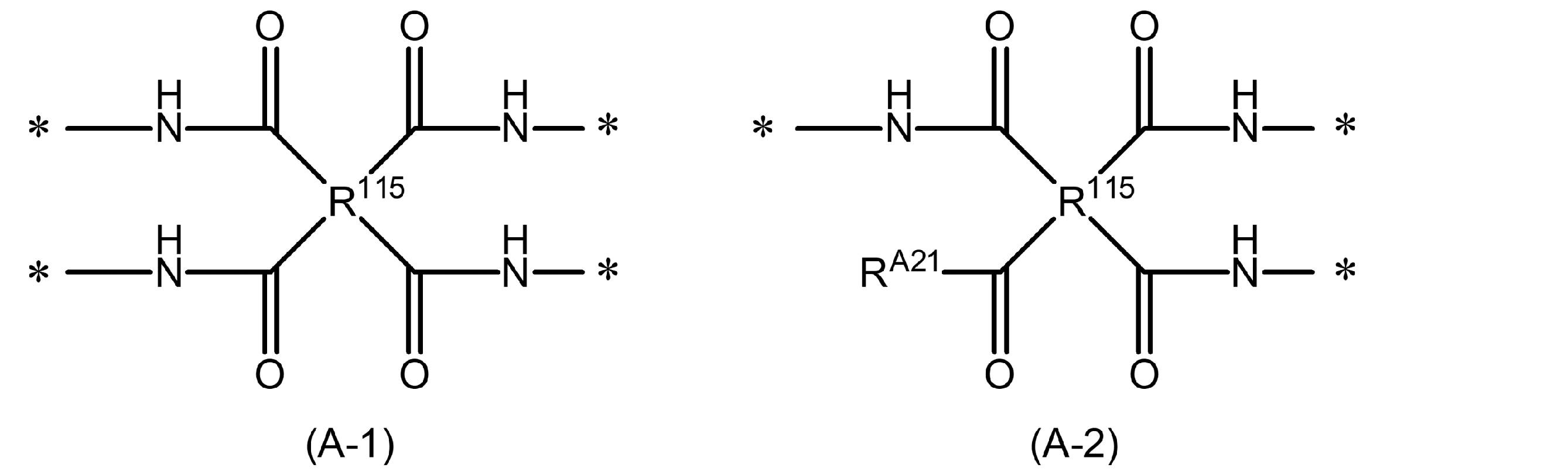
式(A-1)又は式(A-2)中、R115は4価の有機基を表し、RA21は水素原子又は1価の有機基を表し、*はそれぞれ独立に、他の構造との結合部位を表す。
<2> 上記ポリイミド前駆体に含まれる上記分岐型構造の含有量が、組成物の全固形分に対し、0.01~10μmol/gである、<1>に記載の硬化性樹脂組成物。
<3> 上記ポリイミド前駆体が下記式(1)で表される繰返し単位を有する、<1>又は<2>のいずれか1つに記載の硬化性樹脂組成物;

式(1)中、A1及びA2はそれぞれ独立に、酸素原子又は-NH-を表し、R111は、2価の有機基を表し、R115は、4価の有機基を表し、R113及びR114は、それぞれ独立に、水素原子又は1価の有機基を表し、*1及び*2はそれぞれ独立に、他の構造との結合部位を表す。
<4> 上記式(1)におけるR113及びR114の少なくとも一方がラジカル重合性基を含む、<3>に記載の硬化性樹脂組成物。
<5> 上記式(1)におけるR115が芳香環を含む基である、<3>又は<4>に記載の硬化性樹脂組成物。
<6> 上記式(1)におけるR111が-Ar0-L0-Ar0-で表される、<3>~<5>のいずれか1つに記載の硬化性樹脂組成物;
Ar0はそれぞれ独立に芳香族基を表し、L0は、単結合、フッ素原子で置換されていてもよい炭素数1~10の脂肪族炭化水素基、-O-、-C(=O)-、-S-、-S(=O)2-、-NHC(=O)-及び、これらを2以上組み合わせた基を表す。
<7> 上記式(1)におけるR111が、下記式(51)又は式(61)で表される、<3>~<6>のいずれか1つに記載の硬化性樹脂組成物;
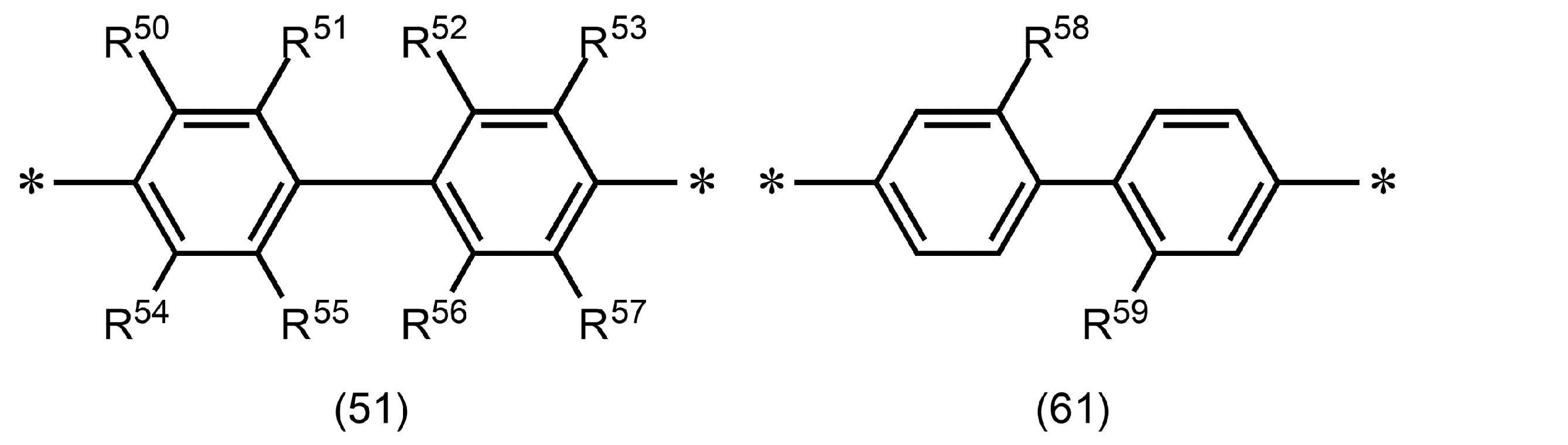
式(51)又は式(61)中、R50~R57は、それぞれ独立に水素原子、フッ素原子又は1価の有機基を表し、R50~R57の少なくとも1つはフッ素原子、メチル基、フルオロメチル基、ジフルオロメチル基又はトリフルオロメチル基を表し、R58及びR59は、それぞれ独立にフッ素原子、フルオロメチル基、ジフルオロメチル基又はトリフルオロメチル基を表し、*はそれぞれ独立に、他の構造との結合部位を表す。
<8> 上記分岐鎖に含まれる繰返し単位のうち少なくとも1種が、上記ポリイミド前駆体の主鎖に含まれる繰返し単位のうち少なくとも1種と同一である、<1>~<7>のいずれか1つに記載の硬化性樹脂組成物。
<9> ラジカル重合開始剤、ラジカル重合性化合物、シランカップリング剤及びオニウム塩を更に含む、<1>~<8>のいずれか1つに記載の硬化性樹脂組成物。
<10> 上記ポリイミド前駆体とは異なる他の複素環含有ポリマー前駆体を更に含む、<1>~<9>のいずれか1つに記載の硬化性樹脂組成物。
<11> 再配線層用層間絶縁膜の形成に用いられる、<1>~<10>のいずれか1つに記載の硬化性樹脂組成物。
<12> <1>~<11>のいずれか1つに記載の硬化性樹脂組成物を硬化してなる硬化膜。
<13> <12>に記載の硬化膜を2層以上含み、上記硬化膜同士のいずれかの間に金属層を含む積層体。
<14> <1>~<11>のいずれか1つに記載の硬化性樹脂組成物を基材に適用して膜を形成する膜形成工程を含む、硬化膜の製造方法。
<15> 上記膜を露光する露光工程及び上記膜を現像する現像工程を含む、<14>に記載の硬化膜の製造方法。
<16> 上記膜を80~450℃で加熱する加熱工程を含む、<14>又は<15>に記載の硬化膜の製造方法。
<17> <12>に記載の硬化膜又は<13>に記載の積層体を含む、半導体デバイス。
<1> 下記式(A-1)で表される分岐型構造、及び、下記式(A-2)により表される分岐型構造よりなる群から選ばれた少なくとも1種の分岐型構造を有し、かつ、上記分岐型構造に結合する分岐鎖として、繰返し単位を有する分岐鎖を有するポリイミド前駆体を含む
硬化性樹脂組成物;
<2> 上記ポリイミド前駆体に含まれる上記分岐型構造の含有量が、組成物の全固形分に対し、0.01~10μmol/gである、<1>に記載の硬化性樹脂組成物。
<3> 上記ポリイミド前駆体が下記式(1)で表される繰返し単位を有する、<1>又は<2>のいずれか1つに記載の硬化性樹脂組成物;
<4> 上記式(1)におけるR113及びR114の少なくとも一方がラジカル重合性基を含む、<3>に記載の硬化性樹脂組成物。
<5> 上記式(1)におけるR115が芳香環を含む基である、<3>又は<4>に記載の硬化性樹脂組成物。
<6> 上記式(1)におけるR111が-Ar0-L0-Ar0-で表される、<3>~<5>のいずれか1つに記載の硬化性樹脂組成物;
Ar0はそれぞれ独立に芳香族基を表し、L0は、単結合、フッ素原子で置換されていてもよい炭素数1~10の脂肪族炭化水素基、-O-、-C(=O)-、-S-、-S(=O)2-、-NHC(=O)-及び、これらを2以上組み合わせた基を表す。
<7> 上記式(1)におけるR111が、下記式(51)又は式(61)で表される、<3>~<6>のいずれか1つに記載の硬化性樹脂組成物;
<8> 上記分岐鎖に含まれる繰返し単位のうち少なくとも1種が、上記ポリイミド前駆体の主鎖に含まれる繰返し単位のうち少なくとも1種と同一である、<1>~<7>のいずれか1つに記載の硬化性樹脂組成物。
<9> ラジカル重合開始剤、ラジカル重合性化合物、シランカップリング剤及びオニウム塩を更に含む、<1>~<8>のいずれか1つに記載の硬化性樹脂組成物。
<10> 上記ポリイミド前駆体とは異なる他の複素環含有ポリマー前駆体を更に含む、<1>~<9>のいずれか1つに記載の硬化性樹脂組成物。
<11> 再配線層用層間絶縁膜の形成に用いられる、<1>~<10>のいずれか1つに記載の硬化性樹脂組成物。
<12> <1>~<11>のいずれか1つに記載の硬化性樹脂組成物を硬化してなる硬化膜。
<13> <12>に記載の硬化膜を2層以上含み、上記硬化膜同士のいずれかの間に金属層を含む積層体。
<14> <1>~<11>のいずれか1つに記載の硬化性樹脂組成物を基材に適用して膜を形成する膜形成工程を含む、硬化膜の製造方法。
<15> 上記膜を露光する露光工程及び上記膜を現像する現像工程を含む、<14>に記載の硬化膜の製造方法。
<16> 上記膜を80~450℃で加熱する加熱工程を含む、<14>又は<15>に記載の硬化膜の製造方法。
<17> <12>に記載の硬化膜又は<13>に記載の積層体を含む、半導体デバイス。
以下、本発明の主要な実施形態について説明する。しかしながら、本発明は、明示した実施形態に限られるものではない。
本明細書において「~」という記号を用いて表される数値範囲は、「~」の前後に記載される数値をそれぞれ下限値及び上限値として含む範囲を意味する。
本明細書において「工程」との語は、独立した工程だけではなく、その工程の所期の作用が達成できる限りにおいて、他の工程と明確に区別できない工程も含む意味である。
本明細書における基(原子団)の表記において、置換及び無置換を記していない表記は、置換基を有しない基(原子団)と共に置換基を有する基(原子団)をも包含する。例えば、「アルキル基」とは、置換基を有しないアルキル基(無置換アルキル基)のみならず、置換基を有するアルキル基(置換アルキル基)をも包含する。
本明細書において「露光」とは、特に断らない限り、光を用いた露光のみならず、電子線、イオンビーム等の粒子線を用いた露光も含む。また、露光に用いられる光としては、水銀灯の輝線スペクトル、エキシマレーザーに代表される遠紫外線、極紫外線(EUV光)、X線、電子線等の活性光線又は放射線が挙げられる。
本明細書において、「(メタ)アクリレート」は、「アクリレート」及び「メタクリレート」の両方、又は、いずれかを意味し、「(メタ)アクリル」は、「アクリル」及び「メタクリル」の両方、又は、いずれかを意味し、「(メタ)アクリロイル」は、「アクリロイル」及び「メタクリロイル」の両方、又は、いずれかを意味する。
本明細書において、構造式中のMeはメチル基を表し、Etはエチル基を表し、Buはブチル基を表し、Phはフェニル基を表す。
本明細書において、全固形分とは、組成物の全成分から溶剤を除いた成分の総質量をいう。また本明細書において、固形分濃度とは、組成物の総質量に対する、溶剤を除く他の成分の質量百分率である。
本明細書において、重量平均分子量(Mw)及び数平均分子量(Mn)は、特に述べない限り、ゲル浸透クロマトグラフィ(GPC測定)に従い、ポリスチレン換算値として定義される。本明細書において、重量平均分子量(Mw)及び数平均分子量(Mn)は、例えば、HLC-8220GPC(東ソー(株)製)を用い、カラムとしてガードカラムHZ-L、TSKgel Super HZM-M、TSKgel Super HZ4000、TSKgel Super HZ3000、TSKgel Super HZ2000(東ソー(株)製)を用いることによって求めることができる。それらの分子量は特に述べない限り、溶離液としてTHF(テトラヒドロフラン)を用いて測定したものとする。また、GPC測定における検出は特に述べない限り、UV線(紫外線)の波長254nm検出器を使用したものとする。
本明細書において、積層体を構成する各層の位置関係について、「上」又は「下」と記載したときには、注目している複数の層のうち基準となる層の上側又は下側に他の層があればよい。すなわち、基準となる層と上記他の層の間に、更に第3の層や要素が介在していてもよく、基準となる層と上記他の層は接している必要はない。また、特に断らない限り、基材に対し層が積み重なっていく方向を「上」と称し、又は、感光層がある場合には、基材から感光層へ向かう方向を「上」と称し、その反対方向を「下」と称する。なお、このような上下方向の設定は、本明細書中における便宜のためであり、実際の態様においては、本明細書における「上」方向は、鉛直上向きと異なることもありうる。
本明細書において、特段の記載がない限り、組成物は、組成物に含まれる各成分として、その成分に該当する2種以上の化合物を含んでもよい。また、特段の記載がない限り、組成物における各成分の含有量とは、その成分に該当する全ての化合物の合計含有量を意味する。
本明細書において、物性値は、特に述べない限り、温度23℃及び気圧101,325Pa(1気圧)の条件下での値である。
本明細書において、好ましい態様の組み合わせは、より好ましい態様である。
本明細書において「~」という記号を用いて表される数値範囲は、「~」の前後に記載される数値をそれぞれ下限値及び上限値として含む範囲を意味する。
本明細書において「工程」との語は、独立した工程だけではなく、その工程の所期の作用が達成できる限りにおいて、他の工程と明確に区別できない工程も含む意味である。
本明細書における基(原子団)の表記において、置換及び無置換を記していない表記は、置換基を有しない基(原子団)と共に置換基を有する基(原子団)をも包含する。例えば、「アルキル基」とは、置換基を有しないアルキル基(無置換アルキル基)のみならず、置換基を有するアルキル基(置換アルキル基)をも包含する。
本明細書において「露光」とは、特に断らない限り、光を用いた露光のみならず、電子線、イオンビーム等の粒子線を用いた露光も含む。また、露光に用いられる光としては、水銀灯の輝線スペクトル、エキシマレーザーに代表される遠紫外線、極紫外線(EUV光)、X線、電子線等の活性光線又は放射線が挙げられる。
本明細書において、「(メタ)アクリレート」は、「アクリレート」及び「メタクリレート」の両方、又は、いずれかを意味し、「(メタ)アクリル」は、「アクリル」及び「メタクリル」の両方、又は、いずれかを意味し、「(メタ)アクリロイル」は、「アクリロイル」及び「メタクリロイル」の両方、又は、いずれかを意味する。
本明細書において、構造式中のMeはメチル基を表し、Etはエチル基を表し、Buはブチル基を表し、Phはフェニル基を表す。
本明細書において、全固形分とは、組成物の全成分から溶剤を除いた成分の総質量をいう。また本明細書において、固形分濃度とは、組成物の総質量に対する、溶剤を除く他の成分の質量百分率である。
本明細書において、重量平均分子量(Mw)及び数平均分子量(Mn)は、特に述べない限り、ゲル浸透クロマトグラフィ(GPC測定)に従い、ポリスチレン換算値として定義される。本明細書において、重量平均分子量(Mw)及び数平均分子量(Mn)は、例えば、HLC-8220GPC(東ソー(株)製)を用い、カラムとしてガードカラムHZ-L、TSKgel Super HZM-M、TSKgel Super HZ4000、TSKgel Super HZ3000、TSKgel Super HZ2000(東ソー(株)製)を用いることによって求めることができる。それらの分子量は特に述べない限り、溶離液としてTHF(テトラヒドロフラン)を用いて測定したものとする。また、GPC測定における検出は特に述べない限り、UV線(紫外線)の波長254nm検出器を使用したものとする。
本明細書において、積層体を構成する各層の位置関係について、「上」又は「下」と記載したときには、注目している複数の層のうち基準となる層の上側又は下側に他の層があればよい。すなわち、基準となる層と上記他の層の間に、更に第3の層や要素が介在していてもよく、基準となる層と上記他の層は接している必要はない。また、特に断らない限り、基材に対し層が積み重なっていく方向を「上」と称し、又は、感光層がある場合には、基材から感光層へ向かう方向を「上」と称し、その反対方向を「下」と称する。なお、このような上下方向の設定は、本明細書中における便宜のためであり、実際の態様においては、本明細書における「上」方向は、鉛直上向きと異なることもありうる。
本明細書において、特段の記載がない限り、組成物は、組成物に含まれる各成分として、その成分に該当する2種以上の化合物を含んでもよい。また、特段の記載がない限り、組成物における各成分の含有量とは、その成分に該当する全ての化合物の合計含有量を意味する。
本明細書において、物性値は、特に述べない限り、温度23℃及び気圧101,325Pa(1気圧)の条件下での値である。
本明細書において、好ましい態様の組み合わせは、より好ましい態様である。
(硬化性樹脂組成物)
本発明の硬化性樹脂組成物(以下、単に、「本発明の組成物」ともいう。)は、式(A-1)で表される分岐型構造、及び、式(A-2)により表される分岐型構造よりなる群から選ばれた少なくとも1種の分岐型構造を有し、かつ、上記分岐型構造に結合する分岐鎖として、繰返し単位を有する分岐鎖を有するポリイミド前駆体(以下、「特定ポリマー前駆体」ともいう。)を含む。
また、本発明の硬化性樹脂組成物は、後述するラジカル重合開始剤、後述するラジカル重合性化合物、後述するシランカップリング剤、及び、後述するオニウム塩を更に含むことが好ましい。
本発明の硬化性樹脂組成物(以下、単に、「本発明の組成物」ともいう。)は、式(A-1)で表される分岐型構造、及び、式(A-2)により表される分岐型構造よりなる群から選ばれた少なくとも1種の分岐型構造を有し、かつ、上記分岐型構造に結合する分岐鎖として、繰返し単位を有する分岐鎖を有するポリイミド前駆体(以下、「特定ポリマー前駆体」ともいう。)を含む。
また、本発明の硬化性樹脂組成物は、後述するラジカル重合開始剤、後述するラジカル重合性化合物、後述するシランカップリング剤、及び、後述するオニウム塩を更に含むことが好ましい。
本発明の硬化性樹脂組成物は、得られる硬化膜の破断伸び率に優れる。
上記効果が得られるメカニズムは不明であるが、下記のように推測される。
特定の分岐型構造、及び、上記分岐型構造に結合する分子鎖として、繰返し単位を有する分岐鎖を有するポリイミド前駆体を用いることで、硬化後に形成されるポリマーにおける、ポリマー鎖同士の絡み合いが増加するため、破断伸び率が向上すると推測される。
また、上記分岐鎖を有することによる立体障害効果により、保管時の環化が抑制されるため、保存安定性が向上しやすいと考えられる。
更に、露光による硬化部でのポリマー鎖の絡み合いが増加し、露光部と未露光部との間で、現像液に対する溶解度の差が大きくなることにより、露光によるパターニングを行った際の解像性が向上しやすいと考えられる。
上記効果が得られるメカニズムは不明であるが、下記のように推測される。
特定の分岐型構造、及び、上記分岐型構造に結合する分子鎖として、繰返し単位を有する分岐鎖を有するポリイミド前駆体を用いることで、硬化後に形成されるポリマーにおける、ポリマー鎖同士の絡み合いが増加するため、破断伸び率が向上すると推測される。
また、上記分岐鎖を有することによる立体障害効果により、保管時の環化が抑制されるため、保存安定性が向上しやすいと考えられる。
更に、露光による硬化部でのポリマー鎖の絡み合いが増加し、露光部と未露光部との間で、現像液に対する溶解度の差が大きくなることにより、露光によるパターニングを行った際の解像性が向上しやすいと考えられる。
ここで、特許文献1~特許文献3には、特定ポリマー前駆体を含む組成物については記載も示唆もない。また、特許文献1~特許文献3における硬化性樹脂組成物を硬化してなる硬化膜においては、破断伸び率が低いという問題点があった。
以下、本発明の硬化性樹脂組成物に含まれる成分について詳細に説明する。
以下、本発明の硬化性樹脂組成物に含まれる成分について詳細に説明する。
<特定ポリマー前駆体>
本発明の硬化性樹脂組成物は、特定ポリマー前駆体を含む。
特定ポリマー前駆体は、式(A-1)で表される分岐型構造、及び、式(A-2)により表される分岐型構造よりなる群から選ばれた少なくとも1種の分岐型構造を有し、かつ、上記分岐型構造に結合する分岐鎖として、繰返し単位を有する分岐鎖を有するポリイミド前駆体を含む。
式(A-1)及び式(A-2)における*は、繰返し単位を有する分子鎖に結合することが好ましい。
本明細書において、繰返し単位を有し、かつ、最も長い分子鎖を主鎖といい、繰返し単位を有し、かつ、主鎖とは異なる分子鎖を分岐鎖という。
主鎖は分岐型構造を有し、分岐鎖は分岐型構造及び分岐鎖を更に有していてもよい。
分岐鎖は上記分岐型構造を介して主鎖又は分岐鎖に結合する。
ここで、例えば、本発明の硬化性樹脂組成物をテトラヒドロフランで希釈し、水:アセトン=30質量%:70質量%の混合溶媒を添加し、析出物をろ過により除去してろ液を乾燥させ、乾燥させたろ液に対してアセトン抽出を行なうことにより、硬化性樹脂組成物から特定ポリマー前駆体を選択的に得ることができる。
本発明の硬化性樹脂組成物は、特定ポリマー前駆体を含む。
特定ポリマー前駆体は、式(A-1)で表される分岐型構造、及び、式(A-2)により表される分岐型構造よりなる群から選ばれた少なくとも1種の分岐型構造を有し、かつ、上記分岐型構造に結合する分岐鎖として、繰返し単位を有する分岐鎖を有するポリイミド前駆体を含む。
式(A-1)及び式(A-2)における*は、繰返し単位を有する分子鎖に結合することが好ましい。
本明細書において、繰返し単位を有し、かつ、最も長い分子鎖を主鎖といい、繰返し単位を有し、かつ、主鎖とは異なる分子鎖を分岐鎖という。
主鎖は分岐型構造を有し、分岐鎖は分岐型構造及び分岐鎖を更に有していてもよい。
分岐鎖は上記分岐型構造を介して主鎖又は分岐鎖に結合する。
ここで、例えば、本発明の硬化性樹脂組成物をテトラヒドロフランで希釈し、水:アセトン=30質量%:70質量%の混合溶媒を添加し、析出物をろ過により除去してろ液を乾燥させ、乾燥させたろ液に対してアセトン抽出を行なうことにより、硬化性樹脂組成物から特定ポリマー前駆体を選択的に得ることができる。
〔分岐型構造〕
特定ポリマー前駆体は、分岐型構造として、下記式(A-1)で表される分岐型構造、式(A-2)で表される分岐型構造、及び、式(A-3)で表される分岐型構造よりなる群から選ばれた少なくとも1つの式により表される構造を含む。

式(A-1)~(A-2)中、R115は4価の有機基を表し、RA21は水素原子又は1価の有機基を表し、*はそれぞれ独立に、他の構造との結合部位を表す。
特定ポリマー前駆体は、分岐型構造として、下記式(A-1)で表される分岐型構造、式(A-2)で表される分岐型構造、及び、式(A-3)で表される分岐型構造よりなる群から選ばれた少なくとも1つの式により表される構造を含む。
-R115(式(A-1))-
式(A-1)中、R115は4価の有機基を表す。4価の有機基としては、芳香環を含む4価の有機基が好ましく、下記式(5)又は式(6)で表される基がより好ましい。
式(A-1)中、R115は4価の有機基を表す。4価の有機基としては、芳香環を含む4価の有機基が好ましく、下記式(5)又は式(6)で表される基がより好ましい。

R112は、単結合、若しくは、フッ素原子で置換されていてもよい炭素数1~10の脂肪族炭化水素基、-O-、-C(=O)-、-S-、-S(=O)2-、-NHC(=O)-、又は、これらを2以上組み合わせた基であることが好ましく、単結合、フッ素原子で置換されていてもよい炭素数1~3のアルキレン基、-O-、-C(=O)-、-S-及びS(=O)2-から選択される基であることがより好ましく、-CH2-、-O-、-S-、-S(=O)2-、-C(CF3)2-、及び、-C(CH3)2-よりなる群から選択される2価の基であることが更に好ましい。*はそれぞれ独立に、他の構造との結合部位を表す。
式(A-1)におけるR115が表す4価の有機基は、具体的には、テトラカルボン酸二無水物から酸二無水物基を除去した後に残存するテトラカルボン酸残基(テトラカルボン酸における4つのカルボキシ基の4つともがアミド化された構造)などが挙げられる。テトラカルボン酸二無水物は、1種のみ用いてもよいし、2種以上用いてもよい。テトラカルボン酸二無水物は、下記式(7)で表される化合物が好ましい。

R115は、4価の有機基を表す。R115は式(A-1)のR115と同義である。
テトラカルボン酸二無水物の具体例としては、ピロメリット酸、ピロメリット酸二無水物(PMDA)、3,3’,4,4’-ビフェニルテトラカルボン酸二無水物、3,3’,4,4’-ジフェニルスルフィドテトラカルボン酸二無水物、3,3’,4,4’-ジフェニルスルホンテトラカルボン酸二無水物、3,3’,4,4’-ベンゾフェノンテトラカルボン酸二無水物、3,3’,4,4’-ジフェニルメタンテトラカルボン酸二無水物、2,2’,3,3’-ジフェニルメタンテトラカルボン酸二無水物、2,3,3’,4’-ビフェニルテトラカルボン酸二無水物、2,3,3’,4’-ベンゾフェノンテトラカルボン酸二無水物、4,4’-オキシジフタル酸二無水物、2,3,6,7-ナフタレンテトラカルボン酸二無水物、1,4,5,7-ナフタレンテトラカルボン酸二無水物、2,2-ビス(3,4-ジカルボキシフェニル)プロパン二無水物、2,2-ビス(2,3-ジカルボキシフェニル)プロパン二無水物、2,2-ビス(3,4-ジカルボキシフェニル)ヘキサフルオロプロパン二無水物、1,3-ジフェニルヘキサフルオロプロパン-3,3,4,4-テトラカルボン酸二無水物、1,4,5,6-ナフタレンテトラカルボン酸二無水物、2,2’,3,3’-ジフェニルテトラカルボン酸二無水物、3,4,9,10-ペリレンテトラカルボン酸二無水物、1,2,4,5-ナフタレンテトラカルボン酸二無水物、1,4,5,8-ナフタレンテトラカルボン酸二無水物、1,8,9,10-フェナントレンテトラカルボン酸二無水物、1,1-ビス(2,3-ジカルボキシフェニル)エタン二無水物、1,1-ビス(3,4-ジカルボキシフェニル)エタン二無水物、1,2,3,4-ベンゼンテトラカルボン酸二無水物、並びに、これらの炭素数1~6のアルキル誘導体及び炭素数1~6のアルコキシ誘導体から選ばれる少なくとも1種が例示される。
-R115(式(A-2))-
式(A-2)中、R115は4価の有機基を表す。式(A-2)におけるR115は式(A-1)におけるR115と同義であり、好ましい態様も同様である。
式(A-2)中、R115は4価の有機基を表す。式(A-2)におけるR115は式(A-1)におけるR115と同義であり、好ましい態様も同様である。
-RA21-
式(A-2)中、RA21は水素原子又は1価の有機基を表し、水素原子又は-XA21-RA22で表される基が好ましい。
上記XA21は酸素原子又は-NH-を表し、酸素原子が好ましい。
上記RA22は1価の有機基を表し、ラジカル重合性基を含む1価の有機基が好ましい。
ラジカル重合性基とは、ラジカルの作用により架橋反応することが可能な基であればよく、好ましい例として、エチレン性不飽和結合を有する基が挙げられる。
式(A-2)中、RA21は水素原子又は1価の有機基を表し、水素原子又は-XA21-RA22で表される基が好ましい。
上記XA21は酸素原子又は-NH-を表し、酸素原子が好ましい。
上記RA22は1価の有機基を表し、ラジカル重合性基を含む1価の有機基が好ましい。
ラジカル重合性基とは、ラジカルの作用により架橋反応することが可能な基であればよく、好ましい例として、エチレン性不飽和結合を有する基が挙げられる。
エチレン性不飽和結合を有する基としては、ビニル基、アリル基、(メタ)アクリロイル基、下記式(III)で表される基などが挙げられる。

式(III)中、R200は、水素原子又はメチル基を表し、メチル基が好ましい。
式(III)中、R201は、炭素数2~12のアルキレン基、-CH2CH(OH)CH2-又は炭素数4~30の(ポリ)オキシアルキレン基(アルキレン基としては炭素数1~12が好ましく、1~6がより好ましく、1~3が特に好ましい;繰り返し数は1~12が好ましく、1~6がより好ましく、1~3が特に好ましい)を表す。なお、(ポリ)オキシアルキレン基とは、オキシアルキレン基又はポリオキシアルキレン基を意味する。
好適なR201の例は、エチレン基、プロピレン基、トリメチレン基、テトラメチレン基、1,2-ブタンジイル基、1,3-ブタンジイル基、ペンタメチレン基、ヘキサメチレン基、オクタメチレン基、ドデカメチレン基、-CH2CH(OH)CH2-が挙げられ、エチレン基、プロピレン基、トリメチレン基、-CH2CH(OH)CH2-がより好ましい。
特に好ましくは、R200がメチル基で、R201がエチレン基である。
式(III)中、*は他の構造との結合部位を表す。
本発明におけるポリイミド前駆体の好ましい実施形態として、RA22における1価の有機基として、1、2又は3つの、好ましくは1つの酸基を有する、脂肪族基、芳香族基及びアリールアルキル基などが挙げられる。具体的には、酸基を有する炭素数6~20の芳香族基、酸基を有する炭素数7~25のアリールアルキル基が挙げられる。より具体的には、酸基を有するフェニル基及び酸基を有するベンジル基が挙げられる。酸基は、ヒドロキシ基が好ましい。すなわち、RA22はヒドロキシ基を有する基であることが好ましい。
RA22が表す1価の有機基としては、現像液の溶解度を向上させる置換基が好ましく用いられる。
好適なR201の例は、エチレン基、プロピレン基、トリメチレン基、テトラメチレン基、1,2-ブタンジイル基、1,3-ブタンジイル基、ペンタメチレン基、ヘキサメチレン基、オクタメチレン基、ドデカメチレン基、-CH2CH(OH)CH2-が挙げられ、エチレン基、プロピレン基、トリメチレン基、-CH2CH(OH)CH2-がより好ましい。
特に好ましくは、R200がメチル基で、R201がエチレン基である。
式(III)中、*は他の構造との結合部位を表す。
本発明におけるポリイミド前駆体の好ましい実施形態として、RA22における1価の有機基として、1、2又は3つの、好ましくは1つの酸基を有する、脂肪族基、芳香族基及びアリールアルキル基などが挙げられる。具体的には、酸基を有する炭素数6~20の芳香族基、酸基を有する炭素数7~25のアリールアルキル基が挙げられる。より具体的には、酸基を有するフェニル基及び酸基を有するベンジル基が挙げられる。酸基は、ヒドロキシ基が好ましい。すなわち、RA22はヒドロキシ基を有する基であることが好ましい。
RA22が表す1価の有機基としては、現像液の溶解度を向上させる置換基が好ましく用いられる。
RA22が、水素原子、2-ヒドロキシベンジル、3-ヒドロキシベンジル及び4-ヒドロキシベンジルであることが、水性現像液に対する溶解性の点からは、より好ましい。
有機溶剤への溶解度の観点からは、RA22は、1価の有機基であることが好ましい。1価の有機基としては、直鎖又は分岐のアルキル基、環状アルキル基、芳香族基が好ましく、芳香族基で置換されたアルキル基がより好ましい。
アルキル基の炭素数は1~30が好ましい(環状の場合は3以上)。アルキル基は直鎖、分岐、環状のいずれであってもよい。直鎖又は分岐のアルキル基としては、例えば、メチル基、エチル基、プロピル基、ブチル基、ペンチル基、ヘキシル基、ヘプチル基、オクチル基、ノニル基、デシル基、ドデシル基、テトラデシル基、オクタデシル基、イソプロピル基、イソブチル基、sec-ブチル基、t-ブチル基、1-エチルペンチル基、及び2-エチルヘキシル基が挙げられる。環状のアルキル基は、単環の環状のアルキル基であってもよく、多環の環状のアルキル基であってもよい。単環の環状のアルキル基としては、例えば、シクロプロピル基、シクロブチル基、シクロペンチル基、シクロヘキシル基、シクロヘプチル基及びシクロオクチル基が挙げられる。多環の環状のアルキル基としては、例えば、アダマンチル基、ノルボルニル基、ボルニル基、カンフェニル基、デカヒドロナフチル基、トリシクロデカニル基、テトラシクロデカニル基、カンホロイル基、ジシクロヘキシル基及びピネニル基が挙げられる。また、芳香族基で置換されたアルキル基としては、次に述べる芳香族基で置換された直鎖アルキル基が好ましい。
芳香族基としては、具体的には、置換又は無置換の芳香族炭化水素基(基を構成する環状構造としては、ベンゼン環、ナフタレン環、ビフェニル環、フルオレン環、ペンタレン環、インデン環、アズレン環、ヘプタレン環、インダセン環、ペリレン環、ペンタセン環、アセナフテン環、フェナントレン環、アントラセン環、ナフタセン環、クリセン環、トリフェニレン環等が挙げられる)、又は、置換若しくは無置換の芳香族複素環基(基を構成する環状構造としては、フルオレン環、ピロール環、フラン環、チオフェン環、イミダゾール環、オキサゾール環、チアゾール環、ピリジン環、ピラジン環、ピリミジン環、ピリダジン環、インドリジン環、インドール環、ベンゾフラン環、ベンゾチオフェン環、イソベンゾフラン環、キノリジン環、キノリン環、フタラジン環、ナフチリジン環、キノキサリン環、キノキサゾリン環、イソキノリン環、カルバゾール環、フェナントリジン環、アクリジン環、フェナントロリン環、チアントレン環、クロメン環、キサンテン環、フェノキサチイン環、フェノチアジン環又はフェナジン環)である。
特定ポリマー前駆体に含まれる上記分岐型構造の含有量は、硬化物の破断伸び率を向上する観点から、組成物の全固形分に対し、0.01~10μmol/gであることが好ましく、0.01~8μmol/gであることが好ましく、0.02~5μmol/gであることが更に好ましい。
特定ポリマー前駆体は、分岐型構造として、式(A-1)又は式(A-2)で表される分岐型構造を1種のみ有していてもよいし、式(A-1)又は式(A-2)で表される分岐型構造を構造が異なる2種以上の分岐型構造として有していてもよい。特定ポリマー前駆体が2種以上の分岐型構造を有する場合、上記分岐型構造の含有量は、特定ポリマー前駆体における全ての式(A-1)又は式(A-2)で表される分岐型構造の合計含有量である。
特定ポリマー前駆体は、分岐型構造として、式(A-1)又は式(A-2)で表される分岐型構造を1種のみ有していてもよいし、式(A-1)又は式(A-2)で表される分岐型構造を構造が異なる2種以上の分岐型構造として有していてもよい。特定ポリマー前駆体が2種以上の分岐型構造を有する場合、上記分岐型構造の含有量は、特定ポリマー前駆体における全ての式(A-1)又は式(A-2)で表される分岐型構造の合計含有量である。
〔他の分岐型構造〕
特定ポリマー前駆体は、他の分岐型構造として、下記式(A-3)で表される分岐型構造を更に有していてもよい。

式(A-3)中、RA31はn価の連結基を表し、nは3以上の整数を表し、*はそれぞれ独立に、他の構造との結合部位を表す。
特定ポリマー前駆体は、他の分岐型構造として、下記式(A-3)で表される分岐型構造を更に有していてもよい。
-RA31-
式(A-3)中、RA31はn価の連結基を表し、直鎖状又は分岐鎖状の脂肪族基、環状の脂肪族基、及び芳香族基、複素芳香族基、又はこれらを2以上組み合わせた基が例示され、炭素数2~20の直鎖の脂肪族基、炭素数3~20の分岐の脂肪族基、炭素数3~20の環状の脂肪族基、炭素数6~20の芳香族基、又は、これらを2以上組み合わせた基が好ましく、炭素数6~20の芳香族基がより好ましい。
式(A-3)中、RA31はn価の連結基を表し、直鎖状又は分岐鎖状の脂肪族基、環状の脂肪族基、及び芳香族基、複素芳香族基、又はこれらを2以上組み合わせた基が例示され、炭素数2~20の直鎖の脂肪族基、炭素数3~20の分岐の脂肪族基、炭素数3~20の環状の脂肪族基、炭素数6~20の芳香族基、又は、これらを2以上組み合わせた基が好ましく、炭素数6~20の芳香族基がより好ましい。
式(A-3)におけるRA31は、n価のアミン化合物から誘導されることが好ましい。ポリイミド前駆体の製造に用いられるn価のアミン化合物としては、直鎖状又は分岐鎖状の脂肪族、環状の脂肪族又は芳香族n価のアミン化合物などが挙げられる。n価のアミン化合物は、1種のみ用いてもよいし、2種以上用いてもよい。
具体的には、n価のアミン化合物は、炭素数2~20の直鎖脂肪族基、炭素数3~20の分岐鎖状又は環状の脂肪族基、炭素数6~20の芳香族基、又は、これらを2以上組み合わせた基を含むn価のアミン化合物であることが好ましく、炭素数6~20の芳香族基を含むn価のアミン化合物であることがより好ましい。芳香族基の例としては、下記が挙げられる。

上記式中、nは3以上の整数を表し、aは1以上の整数を表し、bは1以上の整数を表し、a+bは3以上であり、Aはフッ素原子で置換されていてもよい炭素数1~10の脂肪族炭化水素基、-O-、-C(=O)-、-S-、-S(=O)2-、-NHC(=O)-、又は、これらを2以上組み合わせた基であり、*はそれぞれ独立に、他の構造との結合部位を表す。
nは3~10の整数が好ましく、3~6の整数がより好ましい。
aは1~10の整数が好ましく、1~4の整数がより好ましく、1又は2がより好ましい。
bは1~10の整数が好ましく、1~4の整数がより好ましく、1又は2がより好ましい。
a+bは3~10の整数が好ましく、3~6の整数がより好ましい。
Aは単結合、フッ素原子で置換されていてもよい炭素数1~3のアルキレン基、-O-、-C(=O)-、-S-及びS(=O)2-よりなる群から選択される基であることが好ましく、-CH2-、-O-、-S-、-S(=O)2-、-C(CF3)2-、及び、-C(CH3)2-よりなる群から選択される2価の基であることがより好ましい。
n個の*はそれぞれ、式中の同一の炭素原子に結合していてもよいが、異なる炭素原子に結合していることが好ましい。
a個の*はそれぞれ、式中の同一の炭素原子に結合していてもよいが、異なる炭素原子に結合していることが好ましい。
b個の*はそれぞれ、式中の同一の炭素原子に結合していてもよいが、異なる炭素原子に結合していることが好ましい。
nは3~10の整数が好ましく、3~6の整数がより好ましい。
aは1~10の整数が好ましく、1~4の整数がより好ましく、1又は2がより好ましい。
bは1~10の整数が好ましく、1~4の整数がより好ましく、1又は2がより好ましい。
a+bは3~10の整数が好ましく、3~6の整数がより好ましい。
Aは単結合、フッ素原子で置換されていてもよい炭素数1~3のアルキレン基、-O-、-C(=O)-、-S-及びS(=O)2-よりなる群から選択される基であることが好ましく、-CH2-、-O-、-S-、-S(=O)2-、-C(CF3)2-、及び、-C(CH3)2-よりなる群から選択される2価の基であることがより好ましい。
n個の*はそれぞれ、式中の同一の炭素原子に結合していてもよいが、異なる炭素原子に結合していることが好ましい。
a個の*はそれぞれ、式中の同一の炭素原子に結合していてもよいが、異なる炭素原子に結合していることが好ましい。
b個の*はそれぞれ、式中の同一の炭素原子に結合していてもよいが、異なる炭素原子に結合していることが好ましい。
n価のアミン化合物としては、例えば、下記構造の化合物が挙げられる。

-n-
式(A-3)中、nは3以上の整数を表し、3~10の整数が好ましく、3~6の整数がより好ましい。
式(A-3)中、nは3以上の整数を表し、3~10の整数が好ましく、3~6の整数がより好ましい。
〔分岐型構造を有する繰返し単位〕
特定ポリマー前駆体は、分岐型構造を有する繰返し単位として、下記式(B-1)で表される繰返し単位、及び、下記式(B-2)で表される繰返し単位よりなる群から選ばれた少なくとも1種を含むことが好ましい。
また、特定ポリマー前駆体は、更に下記式(B-3)で表される繰返し単位を有していてもよい。
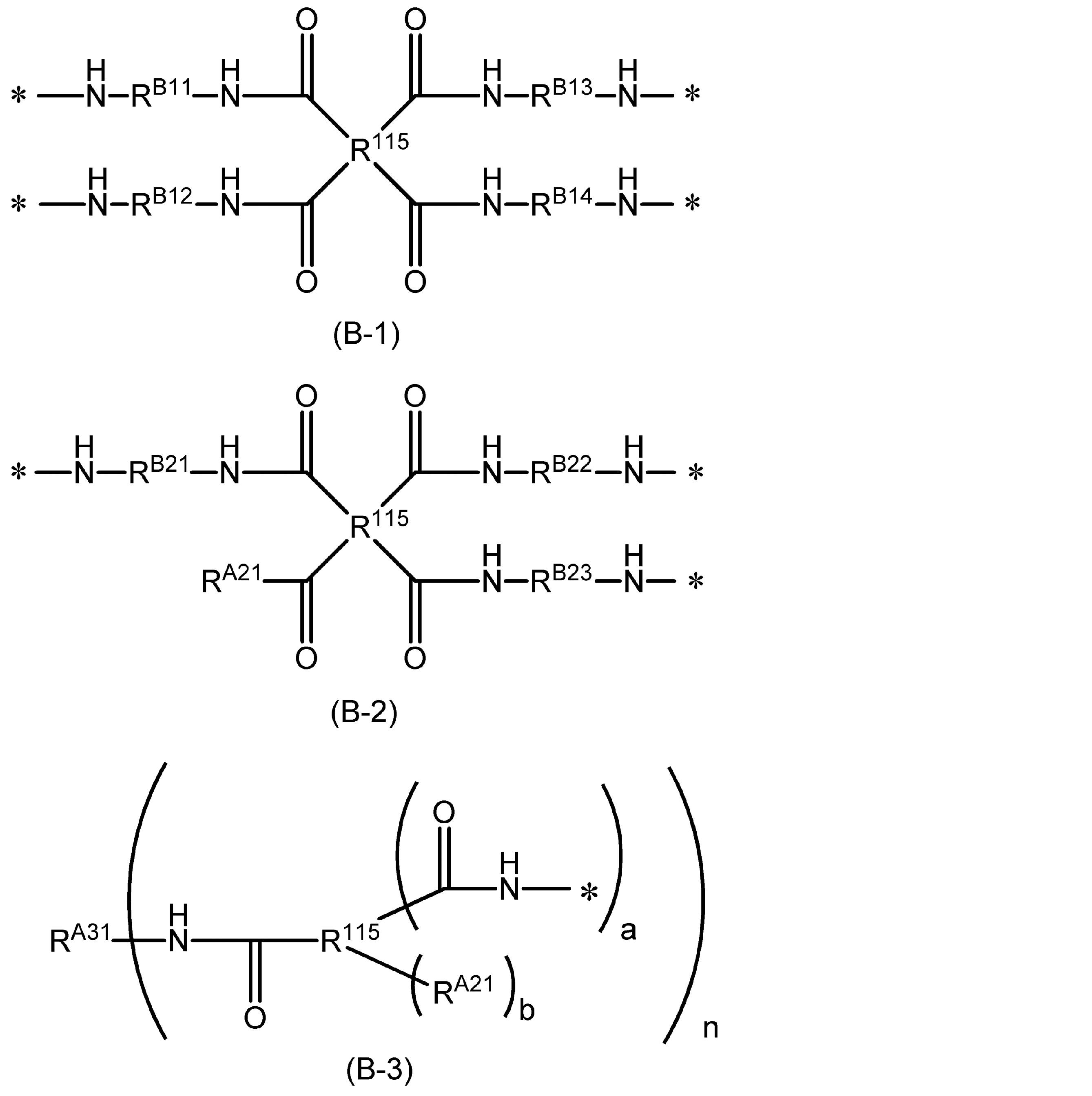
式(B-1)~式(B-3)中、R115は4価の有機基を表し、RA21は水素原子又は1価の有機基を表し、RB11、RB12、RB13、RB14、RB21、RB22及びRB23はそれぞれ独立に、2価の連結基を表し、RA31はn価の連結基を表し、nは3以上の整数を表し、aは1~3の整数を表し、bは0~2の整数を表し、a+bは3であり、*はそれぞれ独立に、他の構造との結合部位を表す。
特定ポリマー前駆体は、分岐型構造を有する繰返し単位として、下記式(B-1)で表される繰返し単位、及び、下記式(B-2)で表される繰返し単位よりなる群から選ばれた少なくとも1種を含むことが好ましい。
また、特定ポリマー前駆体は、更に下記式(B-3)で表される繰返し単位を有していてもよい。
-R115(式(B-1))-
式(B-1)中、R115は上述の式(A-1)におけるR115と同義であり、好ましい態様も同様である。
式(B-1)中、R115は上述の式(A-1)におけるR115と同義であり、好ましい態様も同様である。
-RB11、RB12、RB13及びRB14-
式(B-1)中、RB11、RB12、RB13及びRB14はそれぞれ独立に、2価の有機基を表す。2価の有機基としては、直鎖状又は分岐鎖状の脂肪族基、環状の脂肪族基、及び芳香族基、複素芳香族基、又はこれらを2以上組み合わせた基が例示され、炭素数2~20の直鎖の脂肪族基、炭素数3~20の分岐の脂肪族基、炭素数3~20の環状の脂肪族基、炭素数6~20の芳香族基、又は、これらを2以上組み合わせた基が好ましく、炭素数6~20の芳香族基がより好ましい。
式(B-1)中、RB11、RB12、RB13及びRB14はそれぞれ独立に、2価の有機基を表す。2価の有機基としては、直鎖状又は分岐鎖状の脂肪族基、環状の脂肪族基、及び芳香族基、複素芳香族基、又はこれらを2以上組み合わせた基が例示され、炭素数2~20の直鎖の脂肪族基、炭素数3~20の分岐の脂肪族基、炭素数3~20の環状の脂肪族基、炭素数6~20の芳香族基、又は、これらを2以上組み合わせた基が好ましく、炭素数6~20の芳香族基がより好ましい。
式(B-1)におけるRB11、RB12、RB13及びRB14はそれぞれ独立に、ジアミンから誘導されることが好ましい。ポリイミド前駆体の製造に用いられるジアミンとしては、直鎖状又は分岐鎖状の脂肪族、環状の脂肪族又は芳香族ジアミンなどが挙げられる。ジアミンは、1種のみ用いてもよいし、2種以上用いてもよい。
具体的には、ジアミンは、炭素数2~20の直鎖脂肪族基、炭素数3~20の分岐鎖状又は環状の脂肪族基、炭素数6~20の芳香族基、又は、これらを2以上組み合わせた基を含むジアミンであることが好ましく、炭素数6~20の芳香族基を含むジアミンであることがより好ましい。芳香族基の例としては、下記が挙げられる。

式中、Aは、単結合、若しくは、フッ素原子で置換されていてもよい炭素数1~10の脂肪族炭化水素基、-O-、-C(=O)-、-S-、-S(=O)2-、-NHC(=O)-、又は、これらを2以上組み合わせた基であることが好ましく、単結合、フッ素原子で置換されていてもよい炭素数1~3のアルキレン基、-O-、-C(=O)-、-S-及びS(=O)2-から選択される基であることがより好ましく、-CH2-、-O-、-S-、-S(=O)2-、-C(CF3)2-、及び、-C(CH3)2-よりなる群から選択される2価の基であることが更に好ましい。
ジアミンとしては、具体的には、1,2-ジアミノエタン、1,2-ジアミノプロパン、1,3-ジアミノプロパン、1,4-ジアミノブタン、1,6-ジアミノヘキサン;1,2-又は1,3-ジアミノシクロペンタン、1,2-、1,3-又は1,4-ジアミノシクロヘキサン、1,2-、1,3-又は1,4-ビス(アミノメチル)シクロヘキサン、ビス-(4-アミノシクロヘキシル)メタン、ビス-(3-アミノシクロヘキシル)メタン、4,4’-ジアミノ-3,3’-ジメチルシクロヘキシルメタン又はイソホロンジアミン;メタ又はパラフェニレンジアミン、ジアミノトルエン、4,4’-又は3,3’-ジアミノビフェニル、4,4’-ジアミノジフェニルエーテル、3,3-ジアミノジフェニルエーテル、4,4’-又は3,3’-ジアミノジフェニルメタン、4,4’-又は3,3’-ジアミノジフェニルスルホン、4,4’-又は3,3’-ジアミノジフェニルスルフィド、4,4’-又は3,3’-ジアミノベンゾフェノン、3,3’-ジメチル-4,4’-ジアミノビフェニル、2,2’-ジメチル-4,4’-ジアミノビフェニル(4,4’-ジアミノ-2,2’-ジメチルビフェニル)、3,3’-ジメトキシ-4,4’-ジアミノビフェニル、2,2-ビス(4-アミノフェニル)プロパン、2,2-ビス(4-アミノフェニル)ヘキサフルオロプロパン、2,2-ビス(3-ヒドロキシ-4-アミノフェニル)プロパン、2,2-ビス(3-ヒドロキシ-4-アミノフェニル)ヘキサフルオロプロパン、2,2-ビス(3-アミノ-4-ヒドロキシフェニル)プロパン、2,2-ビス(3-アミノ-4-ヒドロキシフェニル)ヘキサフルオロプロパン、ビス(3-アミノ-4-ヒドロキシフェニル)スルホン、ビス(4-アミノ-3-ヒドロキシフェニル)スルホン、4,4’-ジアミノパラテルフェニル、4,4’-ビス(4-アミノフェノキシ)ビフェニル、ビス[4-(4-アミノフェノキシ)フェニル]スルホン、ビス[4-(3-アミノフェノキシ)フェニル]スルホン、ビス[4-(2-アミノフェノキシ)フェニル]スルホン、1,4-ビス(4-アミノフェノキシ)ベンゼン、9,10-ビス(4-アミノフェニル)アントラセン、3,3’-ジメチル-4,4’-ジアミノジフェニルスルホン、1,3-ビス(4-アミノフェノキシ)ベンゼン、1,3-ビス(3-アミノフェノキシ)ベンゼン、1,3-ビス(4-アミノフェニル)ベンゼン、3,3’-ジエチル-4,4’-ジアミノジフェニルメタン、3,3’-ジメチル-4,4’-ジアミノジフェニルメタン、4,4’-ジアミノオクタフルオロビフェニル、2,2-ビス[4-(4-アミノフェノキシ)フェニル]プロパン、2,2-ビス[4-(4-アミノフェノキシ)フェニル]ヘキサフルオロプロパン、9,9-ビス(4-アミノフェニル)-10-ヒドロアントラセン、3,3’,4,4’-テトラアミノビフェニル、3,3’,4,4’-テトラアミノジフェニルエーテル、1,4-ジアミノアントラキノン、1,5-ジアミノアントラキノン、3,3-ジヒドロキシ-4,4’-ジアミノビフェニル、9,9’-ビス(4-アミノフェニル)フルオレン、4,4’-ジメチル-3,3’-ジアミノジフェニルスルホン、3,3’,5,5’-テトラメチル-4,4’-ジアミノジフェニルメタン、2-(3’,5’-ジアミノベンゾイルオキシ)エチルメタクリレート、2,4-又は2,5-ジアミノクメン、2,5-ジメチル-パラフェニレンジアミン、アセトグアナミン、2,3,5,6-テトラメチル-パラフェニレンジアミン、2,4,6-トリメチル-メタフェニレンジアミン、ビス(3-アミノプロピル)テトラメチルジシロキサン、2,7-ジアミノフルオレン、2,5-ジアミノピリジン、1,2-ビス(4-アミノフェニル)エタン、ジアミノベンズアニリド、ジアミノ安息香酸のエステル、1,5-ジアミノナフタレン、ジアミノベンゾトリフルオライド、1,3-ビス(4-アミノフェニル)ヘキサフルオロプロパン、1,4-ビス(4-アミノフェニル)オクタフルオロブタン、1,5-ビス(4-アミノフェニル)デカフルオロペンタン、1,7-ビス(4-アミノフェニル)テトラデカフルオロヘプタン、2,2-ビス[4-(3-アミノフェノキシ)フェニル]ヘキサフルオロプロパン、2,2-ビス[4-(2-アミノフェノキシ)フェニル]ヘキサフルオロプロパン、2,2-ビス[4-(4-アミノフェノキシ)-3,5-ジメチルフェニル]ヘキサフルオロプロパン、2,2-ビス[4-(4-アミノフェノキシ)-3,5-ビス(トリフルオロメチル)フェニル]ヘキサフルオロプロパン、パラビス(4-アミノ-2-トリフルオロメチルフェノキシ)ベンゼン、4,4’-ビス(4-アミノ-2-トリフルオロメチルフェノキシ)ビフェニル、4,4’-ビス(4-アミノ-3-トリフルオロメチルフェノキシ)ビフェニル、4,4’-ビス(4-アミノ-2-トリフルオロメチルフェノキシ)ジフェニルスルホン、4,4’-ビス(3-アミノ-5-トリフルオロメチルフェノキシ)ジフェニルスルホン、2,2-ビス[4-(4-アミノ-3-トリフルオロメチルフェノキシ)フェニル]ヘキサフルオロプロパン、3,3’,5,5’-テトラメチル-4,4’-ジアミノビフェニル、4,4’-ジアミノ-2,2’-ビス(トリフルオロメチル)ビフェニル、2,2’,5,5’,6,6’-ヘキサフルオロトリジン及び4,4’-ジアミノクアテルフェニルから選ばれる少なくとも1種のジアミンが挙げられる。
また、下記に示すジアミン(DA-1)~(DA-18)も好ましい。
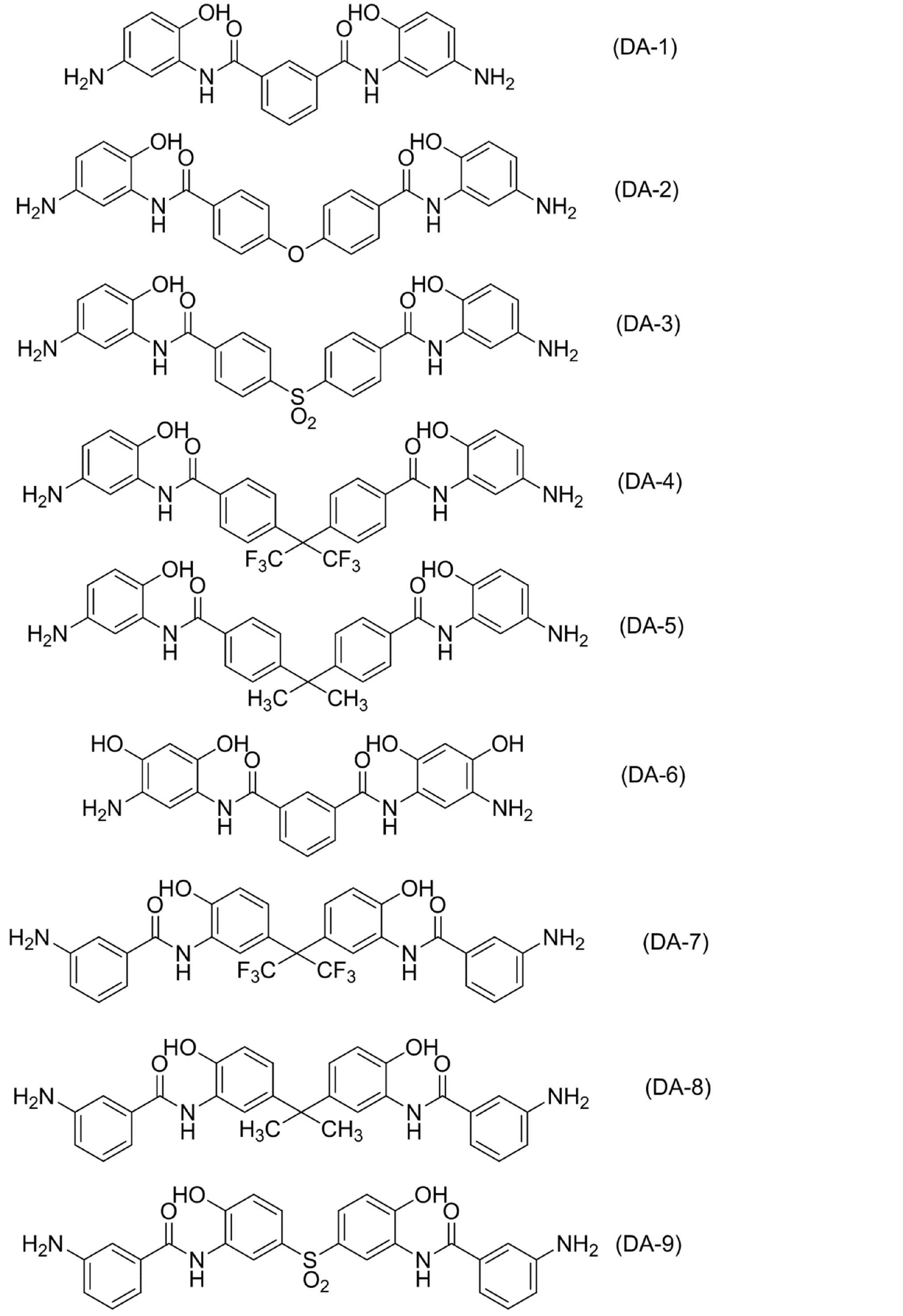

また、少なくとも2つのアルキレングリコール単位を主鎖にもつジアミンも好ましい例として挙げられる。好ましくは、エチレングリコール鎖、プロピレングリコール鎖のいずれか一方又は両方を一分子中にあわせて2つ以上含むジアミン、より好ましくは芳香環を含まないジアミンである。具体例としては、ジェファーミン(登録商標)KH-511、ジェファーミン(登録商標)ED-600、ジェファーミン(登録商標)ED-900、ジェファーミン(登録商標)ED-2003、ジェファーミン(登録商標)EDR-148、ジェファーミン(登録商標)EDR-176、D-200、D-400、D-2000、D-4000(以上商品名、HUNTSMAN社製)、1-(2-(2-(2-アミノプロポキシ)エトキシ)プロポキシ)プロパン-2-アミン、1-(1-(1-(2-アミノプロポキシ)プロパン-2-イル)オキシ)プロパン-2-アミンなどが挙げられるが、これらに限定されない。
ジェファーミン(登録商標)KH-511、ジェファーミン(登録商標)ED-600、ジェファーミン(登録商標)ED-900、ジェファーミン(登録商標)ED-2003、ジェファーミン(登録商標)EDR-148、ジェファーミン(登録商標)EDR-176の構造を以下に示す。
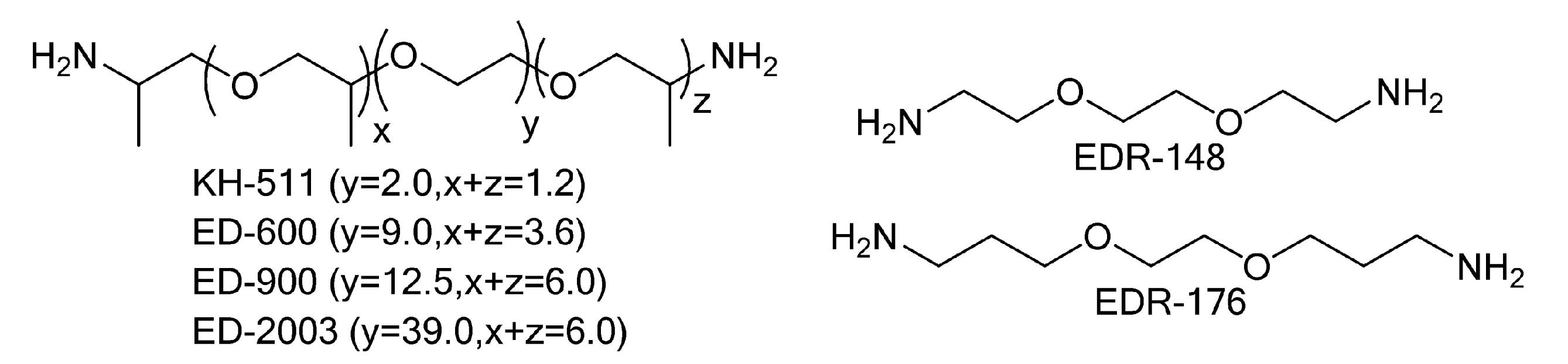
上記において、x、y、zは算術平均値である。
式(1)におけるRB11、RB12、RB13及びRB14はそれぞれ独立に、得られる硬化膜の柔軟性の観点から、-Ar0-L0-Ar0-で表されることが好ましい。Ar0は、それぞれ独立に、芳香族炭化水素基(炭素数6~22が好ましく、6~18がより好ましく、6~10が特に好ましい)であり、フェニレン基が好ましい。L0は、単結合、若しくは、フッ素原子で置換されていてもよい炭素数1~10の脂肪族炭化水素基、-O-、-C(=O)-、-S-、-S(=O)2-、-NHCO-、又は、これらを2以上組み合わせた基を表す。L0の好ましい範囲は、上述のAと同義である。
式(1)におけるRB11、RB12、RB13及びRB14はそれぞれ独立に、i線透過率の観点から下記式(51)又は式(61)で表される2価の有機基であることが好ましい。特に、i線透過率、入手のし易さの観点から式(61)で表される2価の有機基であることがより好ましい。

式(51)中、R50~R57はそれぞれ独立に、水素原子、フッ素原子又は1価の有機基であり、R50~R57の少なくとも1つはフッ素原子、メチル基、フルオロメチル基、ジフルオロメチル基、又は、トリフルオロメチル基であり、*はそれぞれ独立に、他の構造との結合部位を表す。
R50~R57の1価の有機基としては、炭素数1~10(好ましくは炭素数1~6)の無置換のアルキル基、炭素数1~10(好ましくは炭素数1~6)のフッ化アルキル基等が挙げられる。

式(61)中、R58及びR59は、それぞれ独立にフッ素原子、フルオロメチル基、ジフルオロメチル基、又は、トリフルオロメチル基である。
式(51)又は(61)の構造を与えるジアミン化合物としては、ジメチル-4,4’-ジアミノビフェニル、2,2’-ビス(トリフルオロメチル)-4,4’-ジアミノビフェニル、2,2’-ビス(フルオロ)-4,4’-ジアミノビフェニル、4,4’-ジアミノオクタフルオロビフェニル等が挙げられる。これらの1種を用いるか、2種以上を組み合わせて用いてもよい。
-R115(式(B-2))-
式(B-2)中、R115は上述の式(A-2)におけるR115と同義であり、好ましい態様も同様である。
式(B-2)中、R115は上述の式(A-2)におけるR115と同義であり、好ましい態様も同様である。
-RA21-
式(B-2)中、RA21は上述の式(A-2)におけるRA21と同義であり、好ましい態様も同様である。
式(B-2)中、RA21は上述の式(A-2)におけるRA21と同義であり、好ましい態様も同様である。
-RB21、RB22及びRB23-
式(B-2)中、RB21、RB22及びRB23はそれぞれ独立に、上述の式(B-1)におけるRB11、RB12、RB13及びRB14と同義であり、好ましい態様も同様である。
式(B-2)中、RB21、RB22及びRB23はそれぞれ独立に、上述の式(B-1)におけるRB11、RB12、RB13及びRB14と同義であり、好ましい態様も同様である。
-R115(式(B-3))-
式(B-3)中、R115は上述の式(A-1)におけるR115と同義であり、好ましい態様も同様である。
式(B-3)中、R115は上述の式(A-1)におけるR115と同義であり、好ましい態様も同様である。
-RA31-
式(B-3)中、RA31は上述の式(A-3)におけるRA31と同義であり、好ましい態様も同様である。
式(B-3)中、RA31は上述の式(A-3)におけるRA31と同義であり、好ましい態様も同様である。
-n-
式(B-3)中、nは上述の式(A-3)におけるnと同義であり、好ましい態様も同様である。
式(B-3)中、nは上述の式(A-3)におけるnと同義であり、好ましい態様も同様である。
-a-
式(B-3)中、aは1であることが好ましい。
式(B-3)中、aは1であることが好ましい。
-b-
式(B-3)中、bは2であることが好ましい。
式(B-3)中、bは2であることが好ましい。
特定ポリマー前駆体が式(B-1)で表される繰返し単位を含む場合、式(B-1)で表される繰返し単位は1種であってもよいが、2種以上であってもよい。また、式(B-1)で表される繰返し単位の構造異性体を含んでいてもよい。式(B-2)で表される繰返し単位を含む場合、及び、式(B-3)で表される繰返し単位を含む場合においても同様に、これらの繰り返し単位は1種であってもよいが、2種以上であってもよく、構造異性体を含んでいてもよい。
〔他の繰り返し単位〕
特定ポリマー前駆体は、上述の分岐型構造を有する繰返し単位以外の他の繰り返し単位を含むことが好ましい。
特定ポリマー前駆体は、上記他の繰り返し単位として、下記式(1)で表される繰返し単位を有することが好ましい。

特定ポリマー前駆体は、上述の分岐型構造を有する繰返し単位以外の他の繰り返し単位を含むことが好ましい。
特定ポリマー前駆体は、上記他の繰り返し単位として、下記式(1)で表される繰返し単位を有することが好ましい。
式(1)中、A1及びA2はそれぞれ独立に、酸素原子又は-NH-を表し、R111は、2価の有機基を表し、R115は、4価の有機基を表し、R113及びR114は、それぞれ独立に、水素原子又は1価の有機基を表し、*1及び*2はそれぞれ独立に、他の構造との結合部位を表す。
特定ポリマー前駆体が式(1)で表される繰返し単位と、式(B-1)で表される繰返し単位、及び、式(B-2)で表される繰返し単位よりなる群から選ばれた少なくとも一方の繰り返し単位と、を含む場合、式(1)で表される繰返し単位における*1と、式(B-1)で表される繰返し単位、又は、式(B-2)で表される繰返し単位における*とが結合することが好ましい。またこの場合、式(1)で表される繰返し単位における*2は、他の式(1)で表される繰返し単位における*1と結合することが好ましい。
また、特定ポリマー前駆体が式(1)で表される繰返し単位と、式(B-3)で表される繰返し単位と、を含む場合、式(1)で表される繰返し単位における*2と、式(B-3)で表される繰返し単位における*とが結合することが好ましい。またこの場合、式(1)で表される繰返し単位における*1は、他の式(1)で表される繰返し単位における*2と結合することが好ましい。
また、特定ポリマー前駆体が式(1)で表される繰返し単位と、式(B-3)で表される繰返し単位と、を含む場合、式(1)で表される繰返し単位における*2と、式(B-3)で表される繰返し単位における*とが結合することが好ましい。またこの場合、式(1)で表される繰返し単位における*1は、他の式(1)で表される繰返し単位における*2と結合することが好ましい。
また、本発明における特定ポリマー前駆体の一実施形態として、全繰返し単位に対する、式(B-1)で表される繰返し単位、式(B-2)で表される繰返し単位、式(B-3)で表される繰返し単位、及び、式(1)で表される繰返し単位の合計含有量が50モル%以上、更には70モル%以上、特には90モル%以上である特定ポリマー前駆体が例示される。上限としては100モル%以下が実際的である。
ただし、特定ポリマー前駆体が式(1)で表される繰返し単位を含む場合であっても、上述の分岐型構造と式(1)で表される繰返し単位とはいかなる構造により結合していてもよい。すなわち、特定ポリマー前駆体が式(1)で表される繰返し単位を含む場合であっても、上述の分岐型構造を有する限り、特定ポリマー前駆体の構造は特に限定されるものではない。
ただし、特定ポリマー前駆体が式(1)で表される繰返し単位を含む場合であっても、上述の分岐型構造と式(1)で表される繰返し単位とはいかなる構造により結合していてもよい。すなわち、特定ポリマー前駆体が式(1)で表される繰返し単位を含む場合であっても、上述の分岐型構造を有する限り、特定ポリマー前駆体の構造は特に限定されるものではない。
-A1及びA2-
式(1)におけるA1及びA2はそれぞれ独立に、酸素原子又は-NH-を表し、酸素原子が好ましい。
式(1)におけるA1及びA2はそれぞれ独立に、酸素原子又は-NH-を表し、酸素原子が好ましい。
-R111-
式(1)中、R111は上述の式(B-1)におけるRB11と同義であり、好ましい態様も同様である。
式(1)中、R111は上述の式(B-1)におけるRB11と同義であり、好ましい態様も同様である。
-R115-
式(1)中、R115は上述の式(A-1)におけるR115と同義であり、好ましい態様も同様である。
式(1)中、R115は上述の式(A-1)におけるR115と同義であり、好ましい態様も同様である。
-R113及びR114-
式(1)中、R113及びR114は、それぞれ独立に、上述の式(A-1)におけるRA21の好ましい態様に含まれるRA22と同義であり、好ましい態様も同様である。
式(1)中、R113及びR114は、それぞれ独立に、上述の式(A-1)におけるRA21の好ましい態様に含まれるRA22と同義であり、好ましい態様も同様である。
式(1)で表される繰返し単位は、式(1-A)又は式(1-B)で表される繰返し単位であることが好ましい。

A11及びA12は、酸素原子又は-NH-を表し、R111及びR112は、それぞれ独立に、2価の有機基を表し、R113及びR114は、それぞれ独立に、水素原子又は1価の有機基を表し、*1及び*2はそれぞれ独立に、他の構造との結合部位を表し、R113及びR114の少なくとも一方は、ラジカル重合性基を含む基であることが好ましく、ラジカル重合性基であることがより好ましい。
A11、A12、R111、R113、R114、*1及び*2の好ましい範囲は、それぞれ、式(1)におけるA1、A2、R111、R113、R114、*1及び*2の好ましい範囲と同義である。
R112の好ましい範囲は、式(5)におけるR112と同義であり、中でも酸素原子であることがより好ましい。
式中のカルボニル基のベンゼン環への結合位置は、式(1-A)において、4,5,3’,4’であることが好ましい。式(1-B)においては、1,2,4,5であることが好ましい。
特定ポリマー前駆体において、式(1)で表される繰返し単位は1種であってもよいが、2種以上であってもよい。また、式(1)で表される繰返し単位の構造異性体を含んでいてもよい。また、特定ポリマー前駆体は、上記の式(1)の繰返し単位のほかに、他の種類の繰返し単位も含んでもよい。
〔主鎖と分岐鎖の関係〕
特定ポリマー前駆体の分岐鎖に含まれる繰返し単位のうち少なくとも1種は、特定ポリマー前駆体の主鎖に含まれる繰返し単位のうち少なくとも1種と同一であることが好ましい。
主鎖に含まれる繰返し単位のうち少なくとも1種の繰り返し単位と同一の繰り返し単位を含む分岐鎖は、特定ポリマー前駆体に1つのみ含まれていてもよいし、2以上含まれていてもよい。また特定ポリマー前駆体は、主鎖に含まれる繰返し単位のうち少なくとも1種の繰り返し単位と同一の繰り返し単位を含まない分岐鎖を更に有していてもよいが、有しない態様も好ましい。
上記分岐鎖は上述の式(1)により表される繰返し単位を含むことが好ましい。
上記主鎖は(B-1)で表される繰返し単位、及び、式(B-2)で表される繰返し単位よりなる群から選ばれた少なくとも1種と、式(1)により表される繰返し単位と、を含むことが好ましい。
上記主鎖は、更に式(B-3)で表される繰返し単位を含んでもよい。
また、上記主鎖及び上記分岐鎖のいずれもが式(1)により表される繰返し単位を含むことが好ましく、上記主鎖及び上記分岐鎖のいずれもが式(1)により表される繰返し単位であって、同一の繰り返し単位を含むことがより好ましい。
特定ポリマー前駆体の分岐鎖に含まれる繰返し単位のうち少なくとも1種は、特定ポリマー前駆体の主鎖に含まれる繰返し単位のうち少なくとも1種と同一であることが好ましい。
主鎖に含まれる繰返し単位のうち少なくとも1種の繰り返し単位と同一の繰り返し単位を含む分岐鎖は、特定ポリマー前駆体に1つのみ含まれていてもよいし、2以上含まれていてもよい。また特定ポリマー前駆体は、主鎖に含まれる繰返し単位のうち少なくとも1種の繰り返し単位と同一の繰り返し単位を含まない分岐鎖を更に有していてもよいが、有しない態様も好ましい。
上記分岐鎖は上述の式(1)により表される繰返し単位を含むことが好ましい。
上記主鎖は(B-1)で表される繰返し単位、及び、式(B-2)で表される繰返し単位よりなる群から選ばれた少なくとも1種と、式(1)により表される繰返し単位と、を含むことが好ましい。
上記主鎖は、更に式(B-3)で表される繰返し単位を含んでもよい。
また、上記主鎖及び上記分岐鎖のいずれもが式(1)により表される繰返し単位を含むことが好ましく、上記主鎖及び上記分岐鎖のいずれもが式(1)により表される繰返し単位であって、同一の繰り返し単位を含むことがより好ましい。
〔分子量〕
特定ポリマー前駆体の重量平均分子量は、1,000~100,000であることが好ましく、3,000~90,000であることがより好ましく、5,000~75,000であることが更に好ましい。
ポリイミド前駆体の分子量の分散度は、1.2~3.5が好ましく、1.5~3がより好ましい。
本明細書において、分子量の分散度とは、重量平均分子量を数平均分子量により除した値(重量平均分子量/数平均分子量)をいう。
特定ポリマー前駆体の重量平均分子量は、1,000~100,000であることが好ましく、3,000~90,000であることがより好ましく、5,000~75,000であることが更に好ましい。
ポリイミド前駆体の分子量の分散度は、1.2~3.5が好ましく、1.5~3がより好ましい。
本明細書において、分子量の分散度とは、重量平均分子量を数平均分子量により除した値(重量平均分子量/数平均分子量)をいう。
〔具体例〕
特定ポリマー前駆体の具体例としては、後述の実施例において使用したPA-1~PA-4、及び、下記構造式で表される化合物等が挙げられる。
下記構造中、括弧内に含まれる2個又は3個の繰返し単位が結合して樹脂が構成される。また、各繰返し単位において*と波線部がそれぞれ結合する。更に、本発明において、これらの樹脂は、本発明の効果が得られる限りにおいて更に他の繰返し単位を有していてもよい。
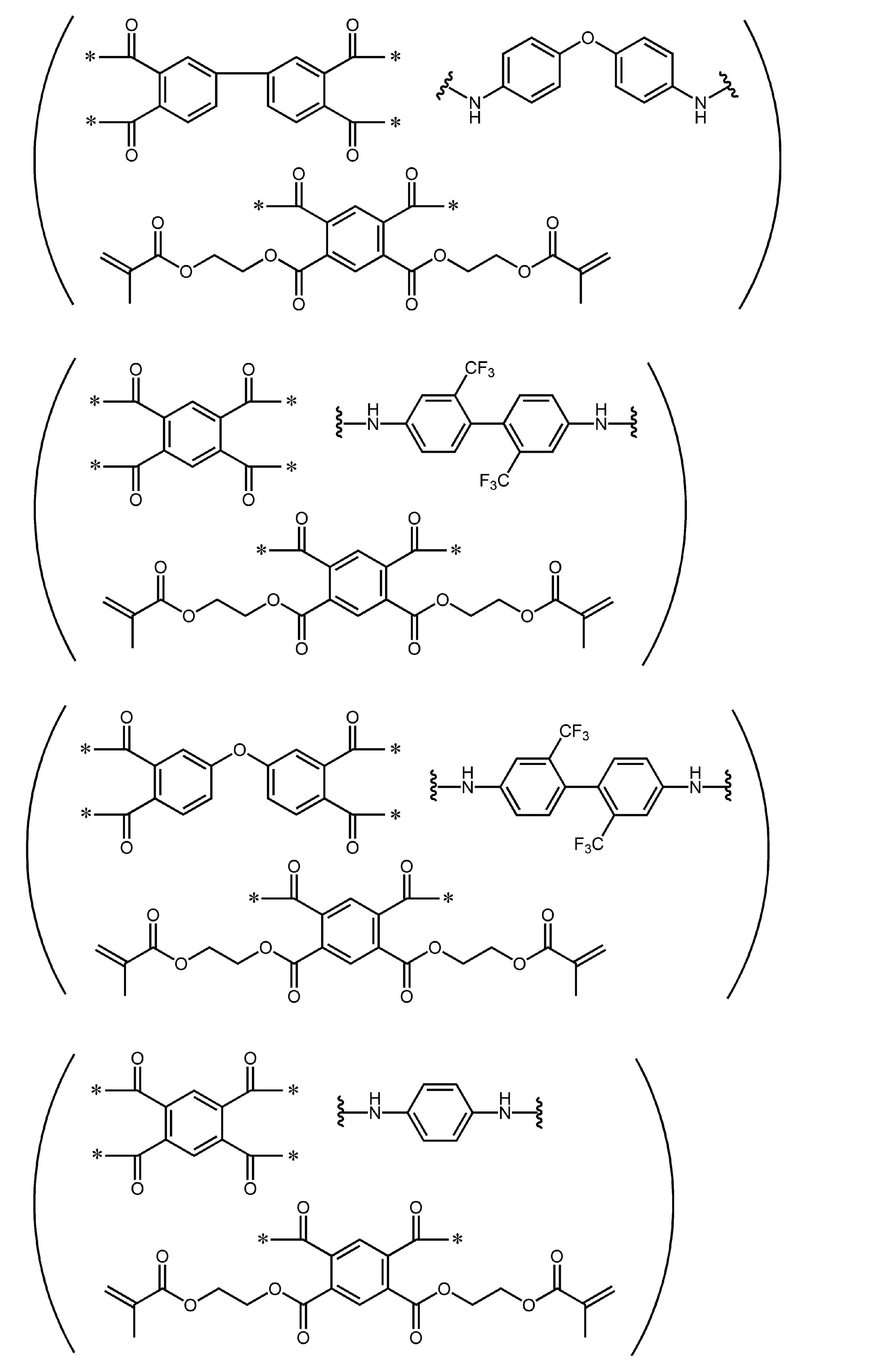
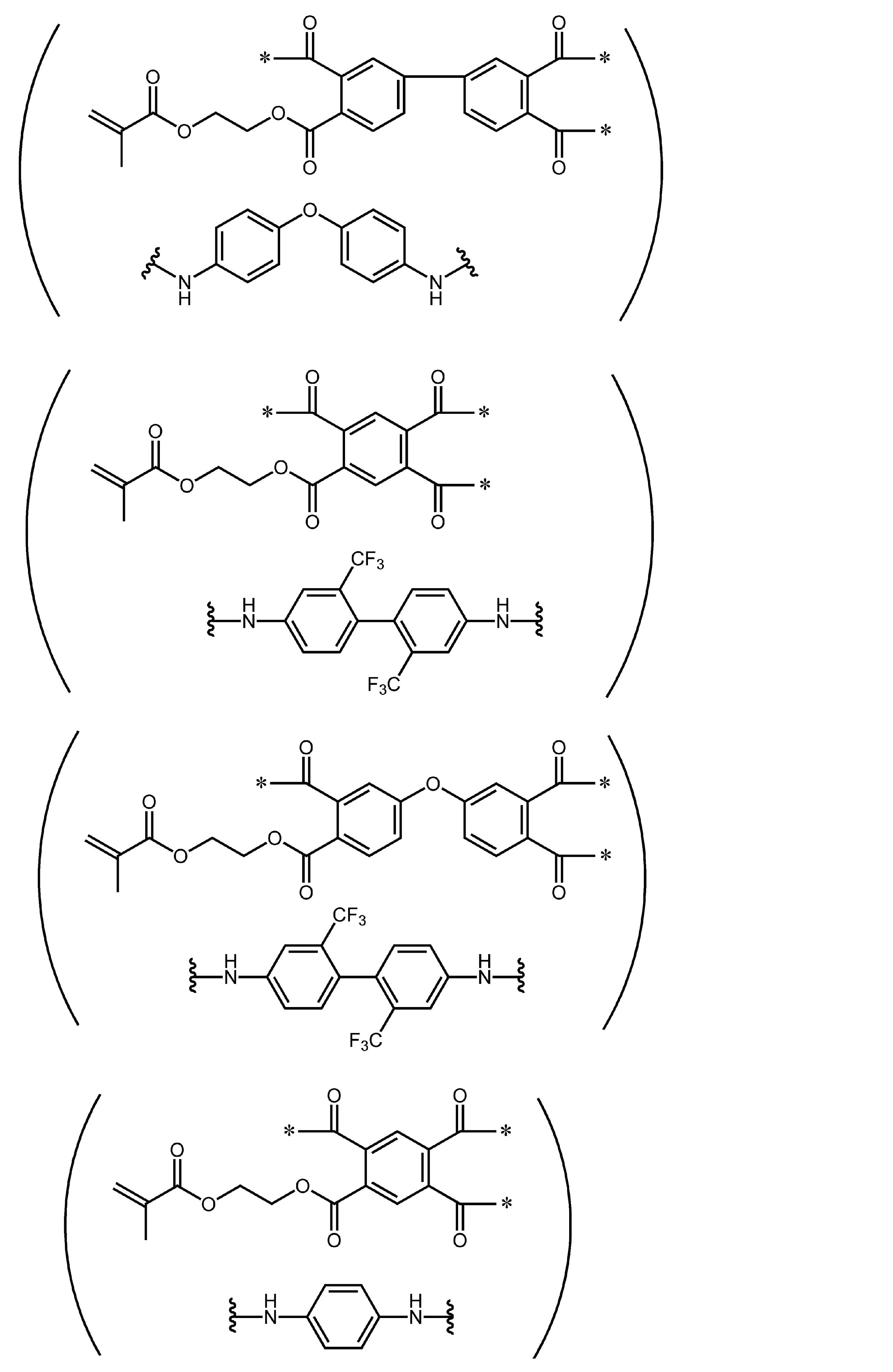

特定ポリマー前駆体の具体例としては、後述の実施例において使用したPA-1~PA-4、及び、下記構造式で表される化合物等が挙げられる。
下記構造中、括弧内に含まれる2個又は3個の繰返し単位が結合して樹脂が構成される。また、各繰返し単位において*と波線部がそれぞれ結合する。更に、本発明において、これらの樹脂は、本発明の効果が得られる限りにおいて更に他の繰返し単位を有していてもよい。
〔合成方法〕
特定ポリマー前駆体は、例えば、後述の実施例における合成例に示す合成方法により合成される。
具体的には、例えば、多価カルボン酸又は多価カルボン酸誘導体とジアミンとを反応させて得られる。上記多価カルボン酸又は多価カルボン酸誘導体としては、三価以上の多価カルボン酸又は三価以上の多価カルボン酸誘導体が少なくとも用いられ、三価又は四価の多価カルボン酸(トリカルボン酸又はテトラカルボン酸)又は三価又は四価の多価カルボン酸誘導体(トリカルボン酸誘導体又はテトラカルボン酸誘導体)を少なくとも用いることが好ましい。
また、上記三価以上の多価カルボン酸又は三価以上の多価カルボン酸誘導体に加えて、二価のカルボン酸(ジカルボン酸)又は二価のカルボン酸誘導体(ジカルボン酸誘導体)を更に用いてもよい。
好ましくは、上記多価カルボン酸又は多価カルボン酸誘導体を、ハロゲン化剤を用いてハロゲン化させた後、ジアミンと反応させて得られる。
他の合成方法として、ジカルボン酸又はジカルボン酸誘導体を三価以上の多価アミンと反応させる方法も挙げられる。この場合、ジカルボン酸又はジカルボン酸誘導体を、ハロゲン化剤を用いてハロゲン化させた後、三価以上の多価アミンと反応させることが好ましい。
特定ポリマー前駆体は、例えば、後述の実施例における合成例に示す合成方法により合成される。
具体的には、例えば、多価カルボン酸又は多価カルボン酸誘導体とジアミンとを反応させて得られる。上記多価カルボン酸又は多価カルボン酸誘導体としては、三価以上の多価カルボン酸又は三価以上の多価カルボン酸誘導体が少なくとも用いられ、三価又は四価の多価カルボン酸(トリカルボン酸又はテトラカルボン酸)又は三価又は四価の多価カルボン酸誘導体(トリカルボン酸誘導体又はテトラカルボン酸誘導体)を少なくとも用いることが好ましい。
また、上記三価以上の多価カルボン酸又は三価以上の多価カルボン酸誘導体に加えて、二価のカルボン酸(ジカルボン酸)又は二価のカルボン酸誘導体(ジカルボン酸誘導体)を更に用いてもよい。
好ましくは、上記多価カルボン酸又は多価カルボン酸誘導体を、ハロゲン化剤を用いてハロゲン化させた後、ジアミンと反応させて得られる。
他の合成方法として、ジカルボン酸又はジカルボン酸誘導体を三価以上の多価アミンと反応させる方法も挙げられる。この場合、ジカルボン酸又はジカルボン酸誘導体を、ハロゲン化剤を用いてハロゲン化させた後、三価以上の多価アミンと反応させることが好ましい。
特定ポリマー前駆体の製造方法では、反応に際し、有機溶剤を用いることが好ましい。有機溶剤は1種でもよいし、2種以上でもよい。
有機溶剤としては、原料に応じて適宜定めることができるが、ピリジン、ジエチレングリコールジメチルエーテル(ジグリム)、N-メチルピロリドン及びN-エチルピロリドンが例示される。
特定ポリマー前駆体の製造に際し、固体を析出する工程を含んでいることが好ましい。具体的には、反応液中の特定ポリマー前駆体を、水中に沈殿させ、テトラヒドロフラン等の特定ポリマー前駆体が可溶な溶剤に溶解させることによって、固体析出することができる。
〔含有量〕
本発明の硬化性樹脂組成物における、特定ポリマー前駆体の含有量は、得られる硬化膜の破断伸びを向上する観点からは、硬化性樹脂組成物の全固形分に対し、0.001質量%以上であることが好ましく、0.01質量%以上であることがより好ましく、0.5質量%以上であることが更に好ましい。
上記含有量の上限としては、硬化性樹脂組成物の解像性を向上する観点からは、30質量%以下であることが好ましく、20質量%以下であることがより好ましく、15質量%以下であることが更に好ましく、10質量%以下であることが一層好ましく、5質量%以下であることがより一層好ましい。
また、本発明の硬化性樹脂組成物が、後述する他の複素環含有ポリマー前駆体を含む場合、特定ポリマー前駆体の含有量は、得られる硬化膜の破断伸びを向上する観点からは、特定ポリマー前駆体及び他の複素環含有ポリマー前駆体の合計量に対し、0.01質量%以上であることが好ましく、0.02質量%以上であることがより好ましく、0.05質量%以上であることが更に好ましい。
上記含有量の上限としては、硬化性樹脂組成物の解像性を向上する観点からは、50質量%以下であることが好ましく、40質量%以下であることがより好ましく、30質量%以下であることが更に好ましく、25質量%以下であることが一層好ましく、10質量%以下であることがより一層好ましい。
本発明の硬化性樹脂組成物における、特定ポリマー前駆体の含有量は、得られる硬化膜の破断伸びを向上する観点からは、硬化性樹脂組成物の全固形分に対し、0.001質量%以上であることが好ましく、0.01質量%以上であることがより好ましく、0.5質量%以上であることが更に好ましい。
上記含有量の上限としては、硬化性樹脂組成物の解像性を向上する観点からは、30質量%以下であることが好ましく、20質量%以下であることがより好ましく、15質量%以下であることが更に好ましく、10質量%以下であることが一層好ましく、5質量%以下であることがより一層好ましい。
また、本発明の硬化性樹脂組成物が、後述する他の複素環含有ポリマー前駆体を含む場合、特定ポリマー前駆体の含有量は、得られる硬化膜の破断伸びを向上する観点からは、特定ポリマー前駆体及び他の複素環含有ポリマー前駆体の合計量に対し、0.01質量%以上であることが好ましく、0.02質量%以上であることがより好ましく、0.05質量%以上であることが更に好ましい。
上記含有量の上限としては、硬化性樹脂組成物の解像性を向上する観点からは、50質量%以下であることが好ましく、40質量%以下であることがより好ましく、30質量%以下であることが更に好ましく、25質量%以下であることが一層好ましく、10質量%以下であることがより一層好ましい。
本発明の硬化性樹脂組成物は、特定ポリマー前駆体を1種のみ含んでいてもよいし、2種以上含んでいてもよい。2種以上含む場合、合計量が上記範囲となることが好ましい。
<他の複素環含有ポリマー前駆体>
本発明の硬化性樹脂組成物は、上述した特定ポリマー前駆体以外の、他の複素環含有ポリマー前駆体(以下、単に「他のポリマー前駆体」ともいう。)を含むことが好ましい。
本発明の硬化性樹脂組成物は、上記他のポリマー前駆体として、ポリイミド前駆体及びポリベンゾオキサゾール前駆体よりなる群から選ばれた少なくとも1種の前駆体を含むことが好ましく、ポリイミド前駆体を含むことがより好ましい。
本発明の硬化性樹脂組成物は、上述した特定ポリマー前駆体以外の、他の複素環含有ポリマー前駆体(以下、単に「他のポリマー前駆体」ともいう。)を含むことが好ましい。
本発明の硬化性樹脂組成物は、上記他のポリマー前駆体として、ポリイミド前駆体及びポリベンゾオキサゾール前駆体よりなる群から選ばれた少なくとも1種の前駆体を含むことが好ましく、ポリイミド前駆体を含むことがより好ましい。
〔ポリイミド前駆体〕
得られる硬化膜の膜強度の観点からは、ポリイミド前駆体は、上述した特定ポリマー前駆体における、式(1)で表される繰返し単位を有することが好ましい。
得られる硬化膜の膜強度の観点からは、ポリイミド前駆体は、上述した特定ポリマー前駆体における、式(1)で表される繰返し単位を有することが好ましい。
ポリイミド前駆体において、式(1)で表される繰返し単位は1種であってもよいが、2種以上であってもよい。また、式(1)で表される繰返し単位の構造異性体を含んでいてもよい。また、ポリイミド前駆体は、上記の式(1)の繰返し単位のほかに、他の種類の繰返し単位も含んでもよい。
本発明におけるポリイミド前駆体の一実施形態として、全繰返し単位の50モル%以上、更には70モル%以上、特には90モル%以上が式(1)で表される繰返し単位であるポリイミド前駆体が例示される。上限としては100モル%以下が実際的である。
ポリイミド前駆体の重量平均分子量(Mw)は、好ましくは2,000~500,000であり、より好ましくは5,000~100,000であり、更に好ましくは10,000~50000である。また、数平均分子量(Mn)は、好ましくは800~250,000であり、より好ましくは、2,000~50,000であり、更に好ましくは、4,000~25,000である。
ポリイミド前駆体の分子量の分散度は、1.5~3.5が好ましく、2~3がより好ましい。
ポリイミド前駆体は、ジカルボン酸又はジカルボン酸誘導体とジアミンとを反応させて得られる。好ましくは、ジカルボン酸又はジカルボン酸誘導体を、ハロゲン化剤を用いてハロゲン化させた後、ジアミンと反応させて得られる。
ポリイミド前駆体の製造方法では、反応に際し、有機溶剤を用いることが好ましい。有機溶剤は1種でもよいし、2種以上でもよい。
有機溶剤としては、原料に応じて適宜定めることができるが、ピリジン、ジエチレングリコールジメチルエーテル(ジグリム)、N-メチルピロリドン及びN-エチルピロリドンが例示される。
ポリイミド前駆体の製造に際し、固体を析出する工程を含んでいることが好ましい。具体的には、反応液中のポリイミド前駆体を、水中に沈殿させ、テトラヒドロフラン等のポリイミド前駆体が可溶な溶剤に溶解させることによって、固体析出することができる。
〔ポリベンゾオキサゾール前駆体〕
ポリベンゾオキサゾール前駆体は、下記式(2)で表される繰返し単位を含むことが好ましい。
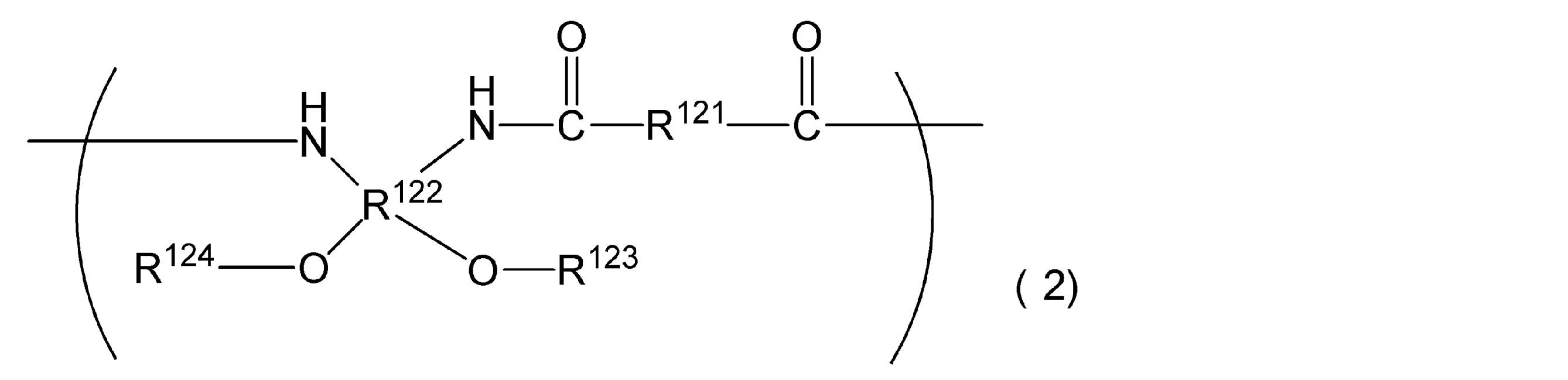
ポリベンゾオキサゾール前駆体は、下記式(2)で表される繰返し単位を含むことが好ましい。
式(2)中、R121は、2価の有機基を表し、R122は、4価の有機基を表し、R123及びR124は、それぞれ独立に、水素原子又は1価の有機基を表す。
-R121-
式(2)中、R121は、2価の有機基を表す。2価の有機基としては、脂肪族基(炭素数1~24が好ましく、1~12がより好ましく、1~6が特に好ましい)及び芳香族基(炭素数6~22が好ましく、6~14がより好ましく、6~12が特に好ましい)の少なくとも一方を含む基が好ましい。R121を構成する芳香族基としては、上記式(1)のR111の例が挙げられる。上記脂肪族基としては、直鎖の脂肪族基が好ましい。R121は、4,4’-オキシジベンゾイルクロリドに由来することが好ましい。
式(2)中、R121は、2価の有機基を表す。2価の有機基としては、脂肪族基(炭素数1~24が好ましく、1~12がより好ましく、1~6が特に好ましい)及び芳香族基(炭素数6~22が好ましく、6~14がより好ましく、6~12が特に好ましい)の少なくとも一方を含む基が好ましい。R121を構成する芳香族基としては、上記式(1)のR111の例が挙げられる。上記脂肪族基としては、直鎖の脂肪族基が好ましい。R121は、4,4’-オキシジベンゾイルクロリドに由来することが好ましい。
-R122-
式(2)中、R122は、4価の有機基を表す。4価の有機基としては、上記式(1)におけるR115と同義であり、好ましい範囲も同様である。R122は、2,2'-ビス(3-アミノ-4-ヒドロキシフェニル)ヘキサフルオロプロパンに由来することが好ましい。
式(2)中、R122は、4価の有機基を表す。4価の有機基としては、上記式(1)におけるR115と同義であり、好ましい範囲も同様である。R122は、2,2'-ビス(3-アミノ-4-ヒドロキシフェニル)ヘキサフルオロプロパンに由来することが好ましい。
-R123及びR124-
R123及びR124は、それぞれ独立に、水素原子又は1価の有機基を表し、上記式(1)におけるR113及びR114と同義であり、好ましい範囲も同様である。
R123及びR124は、それぞれ独立に、水素原子又は1価の有機基を表し、上記式(1)におけるR113及びR114と同義であり、好ましい範囲も同様である。
ポリベンゾオキサゾール前駆体は上記の式(2)の繰返し単位のほかに、他の種類の繰返し単位も含んでよい。
閉環に伴う硬化膜の反りの発生を抑制できる点で、ポリベンゾオキサゾール前駆体は、下記式(SL)で表されるジアミン残基を他の種類の繰返し単位として更に含むことが好ましい。
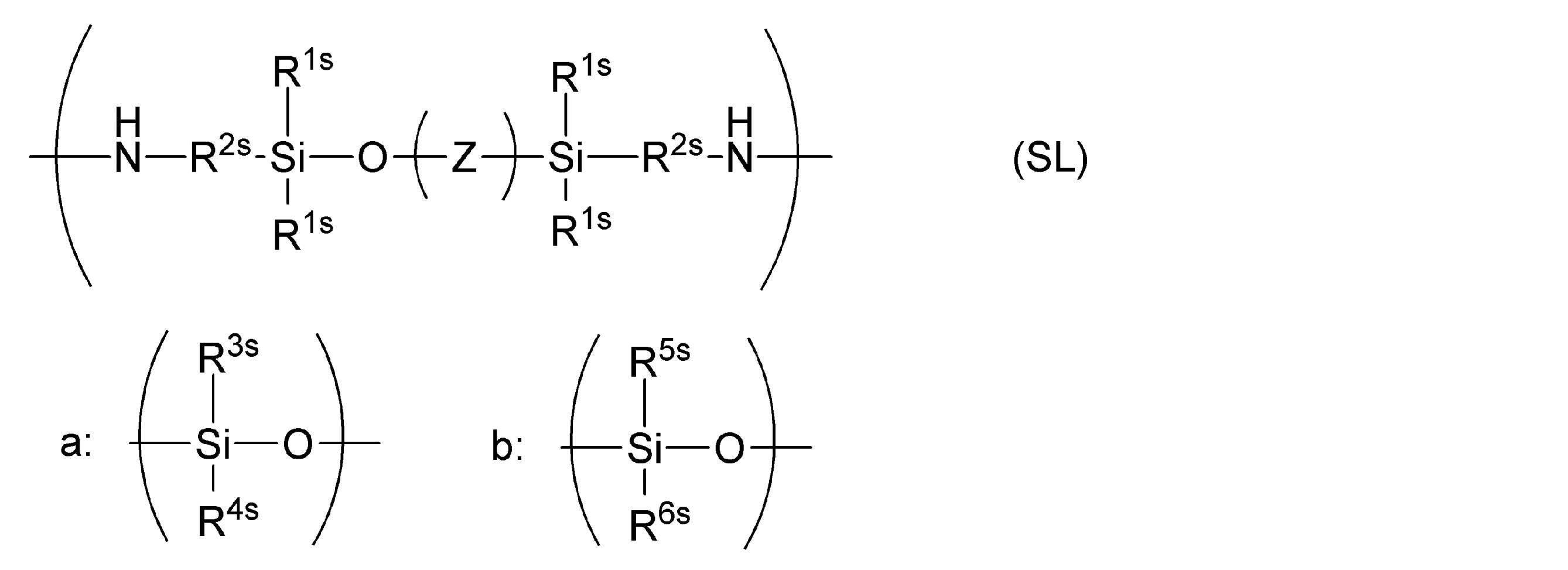
Zは、a構造とb構造を有し、R1sは水素原子又は炭素数1~10の炭化水素基(好ましくは炭素数1~6、より好ましくは炭素数1~3)であり、R2sは炭素数1~10の炭化水素基(好ましくは炭素数1~6、より好ましくは炭素数1~3)であり、R3s、R4s、R5s、R6sのうち少なくとも1つは芳香族基(好ましくは炭素数6~22、より好ましくは炭素数6~18、特に好ましくは炭素数6~10)で、残りは水素原子又は炭素数1~30(好ましくは炭素数1~18、より好ましくは炭素数1~12、特に好ましくは炭素数1~6)の有機基で、それぞれ同一でも異なっていてもよい。a構造及びb構造の重合は、ブロック重合でもランダム重合でもよい。Z部分において、好ましくは、a構造は5~95モル%、b構造は95~5モル%であり、a+bは100モル%である。
式(SL)中、好ましいZとしては、b構造中のR5s及びR6sがフェニル基であるものが挙げられる。また、式(SL)で示される構造の分子量は、400~4,000であることが好ましく、500~3,000がより好ましい。分子量は、一般的に用いられるゲル浸透クロマトグラフィによって求めることができる。上記分子量を上記範囲とすることで、ポリベンゾオキサゾール前駆体の脱水閉環後の弾性率を下げ、反りを抑制できる効果と溶解性を向上させる効果を両立することができる。
ポリベンゾオキサゾール前駆体が、他の種類の繰返し単位として式(SL)で表されるジアミン残基を含む場合、硬化性樹脂組成物のアルカリ可溶性を向上させる点で、更に、テトラカルボン酸二無水物から酸二無水物基の除去後に残存するテトラカルボン酸残基を繰返し単位として含むことが好ましい。このようなテトラカルボン酸残基の例としては、式(1)中のR115の例が挙げられる。
ポリベンゾオキサゾール前駆体の重量平均分子量(Mw)は、好ましくは2,000~500,000であり、より好ましくは5,000~100,000であり、更に好ましくは10,000~50,000である。また、数平均分子量(Mn)は、好ましくは800~250,000であり、より好ましくは、2,000~50,000であり、更に好ましくは、4,000~25,000である。
ポリベンゾオキサゾール前駆体の分子量の分散度は、1.5~3.5が好ましく、2~3がより好ましい。
本発明の硬化性樹脂組成物における、他のポリマー前駆体の含有量は、硬化性樹脂組成物の全固形分に対し20質量%以上であることが好ましく、30質量%以上であることがより好ましく、40質量%以上であることが更に好ましく、50質量%以上であることが一層好ましく、60質量%以上であることがより一層好ましく、70質量%以上であることが更に一層好ましい。また、本発明の硬化性樹脂組成物における、他のポリマー前駆体の含有量は、硬化性樹脂組成物の全固形分に対し、99.5質量%以下であることが好ましく、99質量%以下であることがより好ましく、98質量%以下であることが更に好ましく、97質量%以下であることが一層好ましく、95質量%以下であることがより一層好ましい。
本発明の硬化性樹脂組成物は、他のポリマー前駆体を1種のみ含んでいてもよいし、2種以上含んでいてもよい。2種以上含む場合、合計量が上記範囲となることが好ましい。
〔他の樹脂〕
本発明の硬化性樹脂組成物は、他の樹脂を更に含んでもよい。
他の樹脂としては、例えば、上述の式(A-1)で表される分岐型構造を有し、上記分岐型構造に結合する分岐鎖として、繰返し単位を有する分岐鎖を有し、かつ、加熱によりイミド構造を形成しない化合物が挙げられる。
他の樹脂は、加熱によりイミド構造を形成しないことから、ポリイミド前駆体ではない。
具体的には、上述の式(A-1)で表される分岐型構造を有し、かつ、上述の式(1)で表される繰返し単位を有しない樹脂等が挙げられる。
本発明の硬化性樹脂組成物は、他の樹脂を更に含んでもよい。
他の樹脂としては、例えば、上述の式(A-1)で表される分岐型構造を有し、上記分岐型構造に結合する分岐鎖として、繰返し単位を有する分岐鎖を有し、かつ、加熱によりイミド構造を形成しない化合物が挙げられる。
他の樹脂は、加熱によりイミド構造を形成しないことから、ポリイミド前駆体ではない。
具体的には、上述の式(A-1)で表される分岐型構造を有し、かつ、上述の式(1)で表される繰返し単位を有しない樹脂等が挙げられる。
他の樹脂の具体例としては、実施例において使用されたPA-5、又は、下記構造の樹脂等が挙げられるが、これに限定されるものではない。下記構造中、括弧内に含まれる2個の繰返し単位が結合して樹脂が構成される。また、各繰返し単位において*と波線部がそれぞれ結合する。更に、本発明において、これらの樹脂は、本発明の効果が得られる限りにおいて更に他の繰返し単位を有していてもよい。
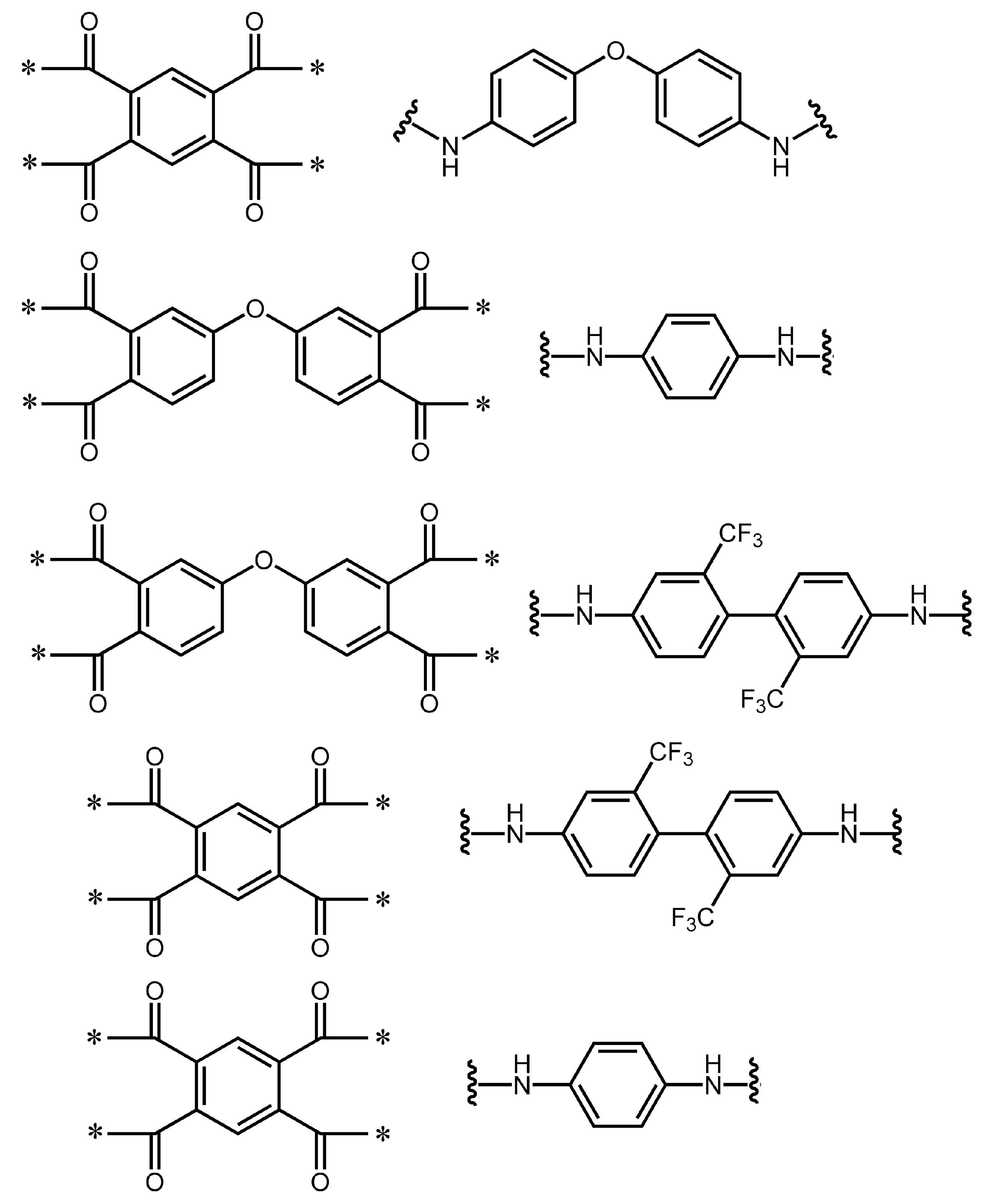
本発明の硬化性樹脂組成物が他の樹脂を含有する場合、他の樹脂の含有量は、硬化性樹脂組成物の全固形分に対し、0質量%を超え50質量%以下であることが好ましく、0質量%を超え30質量%以下であることがより好ましい。
<オニウム塩>
本発明の硬化性樹脂組成物は、オニウム塩を含むことが好ましい。
オニウム塩の種類等は特に定めるものではないが、アンモニウム塩、イミニウム塩、スルホニウム塩、ヨードニウム塩又はホスホニウム塩が好ましく挙げられる。
これらの中でも、熱安定性が高い観点からはアンモニウム塩又はイミニウム塩が好ましく、ポリマーとの相溶性の観点からはスルホニウム塩、ヨードニウム塩又はホスホニウム塩が好ましい。
本発明の硬化性樹脂組成物は、オニウム塩を含むことが好ましい。
オニウム塩の種類等は特に定めるものではないが、アンモニウム塩、イミニウム塩、スルホニウム塩、ヨードニウム塩又はホスホニウム塩が好ましく挙げられる。
これらの中でも、熱安定性が高い観点からはアンモニウム塩又はイミニウム塩が好ましく、ポリマーとの相溶性の観点からはスルホニウム塩、ヨードニウム塩又はホスホニウム塩が好ましい。
また、オニウム塩はオニウム構造を有するカチオンとアニオンとの塩であり、上記カチオンとアニオンとは、共有結合を介して結合していてもよいし、共有結合を介して結合していなくてもよい。
すなわち、オニウム塩は、同一の分子構造内に、カチオン部と、アニオン部と、を有する分子内塩であってもよいし、それぞれ別分子であるカチオン分子と、アニオン分子と、がイオン結合した分子間塩であってもよいが、分子間塩であることが好ましい。また、本発明の硬化性樹脂組成物において、上記カチオン部又はカチオン分子と、上記アニオン部又はアニオン分子と、はイオン結合により結合されていてもよいし、解離していてもよい。
オニウム塩におけるカチオンとしては、アンモニウムカチオン、ピリジニウムカチオン、スルホニウムカチオン、ヨードニウムカチオン又はホスホニウムカチオンが好ましく、テトラアルキルアンモニウムカチオン、スルホニウムカチオン及びヨードニウムカチオンよりなる群から選択される少なくとも1種のカチオンがより好ましい。
すなわち、オニウム塩は、同一の分子構造内に、カチオン部と、アニオン部と、を有する分子内塩であってもよいし、それぞれ別分子であるカチオン分子と、アニオン分子と、がイオン結合した分子間塩であってもよいが、分子間塩であることが好ましい。また、本発明の硬化性樹脂組成物において、上記カチオン部又はカチオン分子と、上記アニオン部又はアニオン分子と、はイオン結合により結合されていてもよいし、解離していてもよい。
オニウム塩におけるカチオンとしては、アンモニウムカチオン、ピリジニウムカチオン、スルホニウムカチオン、ヨードニウムカチオン又はホスホニウムカチオンが好ましく、テトラアルキルアンモニウムカチオン、スルホニウムカチオン及びヨードニウムカチオンよりなる群から選択される少なくとも1種のカチオンがより好ましい。
本発明において用いられるオニウム塩は、熱塩基発生剤であってもよい。
熱塩基発生剤とは、加熱により塩基を発生する化合物をいい、例えば、40℃以上に加熱すると塩基を発生する酸性化合物等が挙げられる。
熱塩基発生剤とは、加熱により塩基を発生する化合物をいい、例えば、40℃以上に加熱すると塩基を発生する酸性化合物等が挙げられる。
〔アンモニウム塩〕
本発明において、アンモニウム塩とは、アンモニウムカチオンと、アニオンとの塩を意味する。
本発明において、アンモニウム塩とは、アンモニウムカチオンと、アニオンとの塩を意味する。
-アンモニウムカチオン-
アンモニウムカチオンとしては、第四級アンモニウムカチオンが好ましい。
また、アンモニウムカチオンとしては、下記式(101)で表されるカチオンが好ましい。

式(101)中、R1~R4はそれぞれ独立に、水素原子又は炭化水素基を表し、R1~R4の少なくとも2つはそれぞれ結合して環を形成してもよい。
アンモニウムカチオンとしては、第四級アンモニウムカチオンが好ましい。
また、アンモニウムカチオンとしては、下記式(101)で表されるカチオンが好ましい。
式(101)中、R1~R4はそれぞれ独立に、炭化水素基であることが好ましく、アルキル基又はアリール基であることがより好ましく、炭素数1~10のアルキル基又は炭素数6~12のアリール基であることが更に好ましい。R1~R4は置換基を有していてもよく、置換基の例としては、ヒドロキシ基、アリール基、アルコキシ基、アリールオキシ基、アリールカルボニル基、アルキルカルボニル基、アルコキシカルボニル基、アリールオキシカルボニル基、アシルオキシ基等が挙げられる。
R1~R4の少なくとも2つはそれぞれ結合して環を形成する場合、上記環はヘテロ原子を含んでもよい。上記ヘテロ原子としては、窒素原子が挙げられる。
R1~R4の少なくとも2つはそれぞれ結合して環を形成する場合、上記環はヘテロ原子を含んでもよい。上記ヘテロ原子としては、窒素原子が挙げられる。
アンモニウムカチオンは、下記式(Y1-1)及び(Y1-2)のいずれかで表されることが好ましい。

式(Y1-1)及び(Y1-2)において、R101は、n価の有機基を表し、R1は式(101)におけるR1と同義であり、Ar101及びAr102はそれぞれ独立に、アリール基を表し、nは、1以上の整数を表す。
式(Y1-1)において、R101は、脂肪族炭化水素、芳香族炭化水素、又は、これらが結合した構造からn個の水素原子を除いた基であることが好ましく、炭素数2~30の飽和脂肪族炭化水素、ベンゼン又はナフタレンからn個の水素原子を除いた基であることがより好ましい。
式(Y1-1)において、nは1~4であることが好ましく、1又は2であることがより好ましく、1であることが更に好ましい。
式(Y1-2)において、Ar101及びAr102はそれぞれ独立に、フェニル基又はナフチル基であることが好ましく、フェニル基がより好ましい。
式(Y1-1)において、R101は、脂肪族炭化水素、芳香族炭化水素、又は、これらが結合した構造からn個の水素原子を除いた基であることが好ましく、炭素数2~30の飽和脂肪族炭化水素、ベンゼン又はナフタレンからn個の水素原子を除いた基であることがより好ましい。
式(Y1-1)において、nは1~4であることが好ましく、1又は2であることがより好ましく、1であることが更に好ましい。
式(Y1-2)において、Ar101及びAr102はそれぞれ独立に、フェニル基又はナフチル基であることが好ましく、フェニル基がより好ましい。
-アニオン-
アンモニウム塩におけるアニオンとしては、カルボン酸アニオン、フェノールアニオン、リン酸アニオン及び硫酸アニオンから選ばれる1種が好ましく、塩の安定性と熱分解性を両立させられるという理由からカルボン酸アニオンがより好ましい。すなわち、アンモニウム塩は、アンモニウムカチオンとカルボン酸アニオンとの塩がより好ましい。
カルボン酸アニオンは、2個以上のカルボキシ基を持つ2価以上のカルボン酸のアニオンが好ましく、2価のカルボン酸のアニオンがより好ましい。この態様によれば、硬化性樹脂組成物の安定性、硬化性及び現像性をより向上できる。特に、2価のカルボン酸のアニオンを用いることで、硬化性樹脂組成物の安定性、硬化性及び現像性を更に向上できる。
アンモニウム塩におけるアニオンとしては、カルボン酸アニオン、フェノールアニオン、リン酸アニオン及び硫酸アニオンから選ばれる1種が好ましく、塩の安定性と熱分解性を両立させられるという理由からカルボン酸アニオンがより好ましい。すなわち、アンモニウム塩は、アンモニウムカチオンとカルボン酸アニオンとの塩がより好ましい。
カルボン酸アニオンは、2個以上のカルボキシ基を持つ2価以上のカルボン酸のアニオンが好ましく、2価のカルボン酸のアニオンがより好ましい。この態様によれば、硬化性樹脂組成物の安定性、硬化性及び現像性をより向上できる。特に、2価のカルボン酸のアニオンを用いることで、硬化性樹脂組成物の安定性、硬化性及び現像性を更に向上できる。
カルボン酸アニオンは、下記式(X1)で表されることが好ましい。

式(X1)において、EWGは、電子求引性基を表す。
本実施形態において電子求引性基とは、ハメットの置換基定数σmが正の値を示すものを意味する。ここでσmは、都野雄甫総説、有機合成化学協会誌第23巻第8号(1965)p.631-642に詳しく説明されている。なお、本実施形態における電子求引性基は、上記文献に記載された置換基に限定されるものではない。
σmが正の値を示す置換基の例としては、CF3基(σm=0.43)、CF3C(=O)基(σm=0.63)、HC≡C基(σm=0.21)、CH2=CH基(σm=0.06)、Ac基(σm=0.38)、MeOC(=O)基(σm=0.37)、MeC(=O)CH=CH基(σm=0.21)、PhC(=O)基(σm=0.34)、H2NC(=O)CH2基(σm=0.06)などが挙げられる。なお、Meはメチル基を表し、Acはアセチル基を表し、Phはフェニル基を表す(以下、同じ)。
σmが正の値を示す置換基の例としては、CF3基(σm=0.43)、CF3C(=O)基(σm=0.63)、HC≡C基(σm=0.21)、CH2=CH基(σm=0.06)、Ac基(σm=0.38)、MeOC(=O)基(σm=0.37)、MeC(=O)CH=CH基(σm=0.21)、PhC(=O)基(σm=0.34)、H2NC(=O)CH2基(σm=0.06)などが挙げられる。なお、Meはメチル基を表し、Acはアセチル基を表し、Phはフェニル基を表す(以下、同じ)。
EWGは、下記式(EWG-1)~(EWG-6)で表される基であることが好ましい。
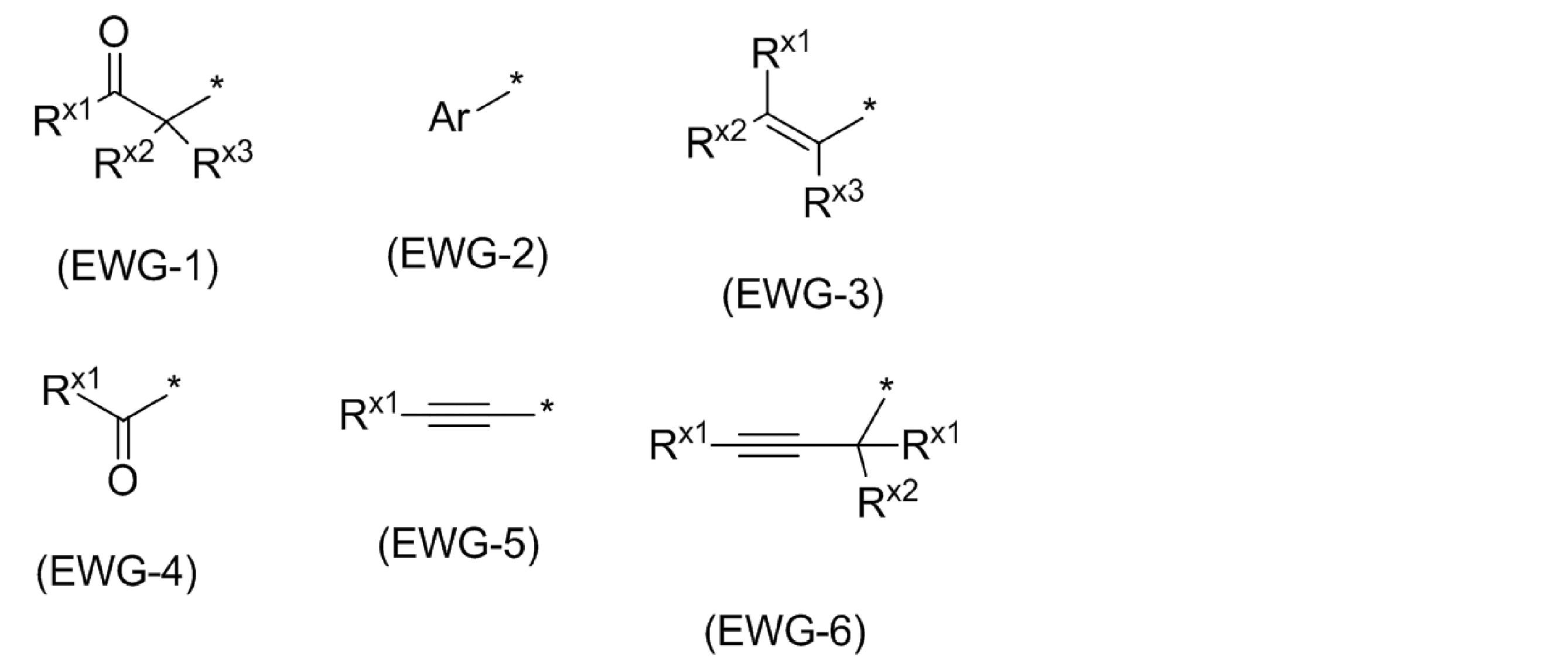
式(EWG-1)~(EWG-6)中、Rx1~Rx3は、それぞれ独立に、水素原子、アルキル基、アルケニル基、アリール基、ヒドロキシ基又はカルボキシ基を表し、Arは芳香族基を表す。
本発明において、カルボン酸アニオンは、下記式(XA)で表されることが好ましい。

式(XA)において、L10は、単結合、又は、アルキレン基、アルケニレン基、芳香族基、-NRX-及びこれらの組み合わせよりなる群から選ばれる2価の連結基を表し、RXは、水素原子、アルキル基、アルケニル基又はアリール基を表す。
カルボン酸アニオンの具体例としては、マレイン酸アニオン、フタル酸アニオン、N-フェニルイミノ二酢酸アニオン及びシュウ酸アニオンが挙げられる。
特定前駆体の環化が低温で行われやすく、また、硬化性樹脂組成物の保存安定性が向上しやすい観点から、本発明におけるオニウム塩は、カチオンとしてアンモニウムカチオンを含み、上記オニウム塩がアニオンとして、共役酸のpKa(pKaH)が2.5以下であるアニオンを含むことが好ましく、1.8以下であるアニオンを含むことがより好ましい。
上記pKaの下限は特に限定されないが、発生する塩基が中和されにくく、特定前駆体などの環化効率を良好にするという観点からは、-3以上であることが好ましく、-2以上であることがより好ましい。
上記pKaとしては、Determination of Organic Structures by Physical Methods(著者:Brown, H. C., McDaniel, D. H., Hafliger, O., Nachod, F. C.; 編纂:Braude, E. A., Nachod, F. C.; Academic Press, New York, 1955)や、Data for Biochemical Research(著者:Dawson, R.M.C.et al; Oxford, Clarendon Press, 1959)に記載の値を参照することができる。これらの文献に記載の無い化合物については、ACD/pKa(ACD/Labs製)のソフトを用いて構造式より算出した値を用いることとする。
上記pKaの下限は特に限定されないが、発生する塩基が中和されにくく、特定前駆体などの環化効率を良好にするという観点からは、-3以上であることが好ましく、-2以上であることがより好ましい。
上記pKaとしては、Determination of Organic Structures by Physical Methods(著者:Brown, H. C., McDaniel, D. H., Hafliger, O., Nachod, F. C.; 編纂:Braude, E. A., Nachod, F. C.; Academic Press, New York, 1955)や、Data for Biochemical Research(著者:Dawson, R.M.C.et al; Oxford, Clarendon Press, 1959)に記載の値を参照することができる。これらの文献に記載の無い化合物については、ACD/pKa(ACD/Labs製)のソフトを用いて構造式より算出した値を用いることとする。
アンモニウム塩の具体例としては、以下の化合物を挙げることができるが、本発明はこれらに限定されるものではない。
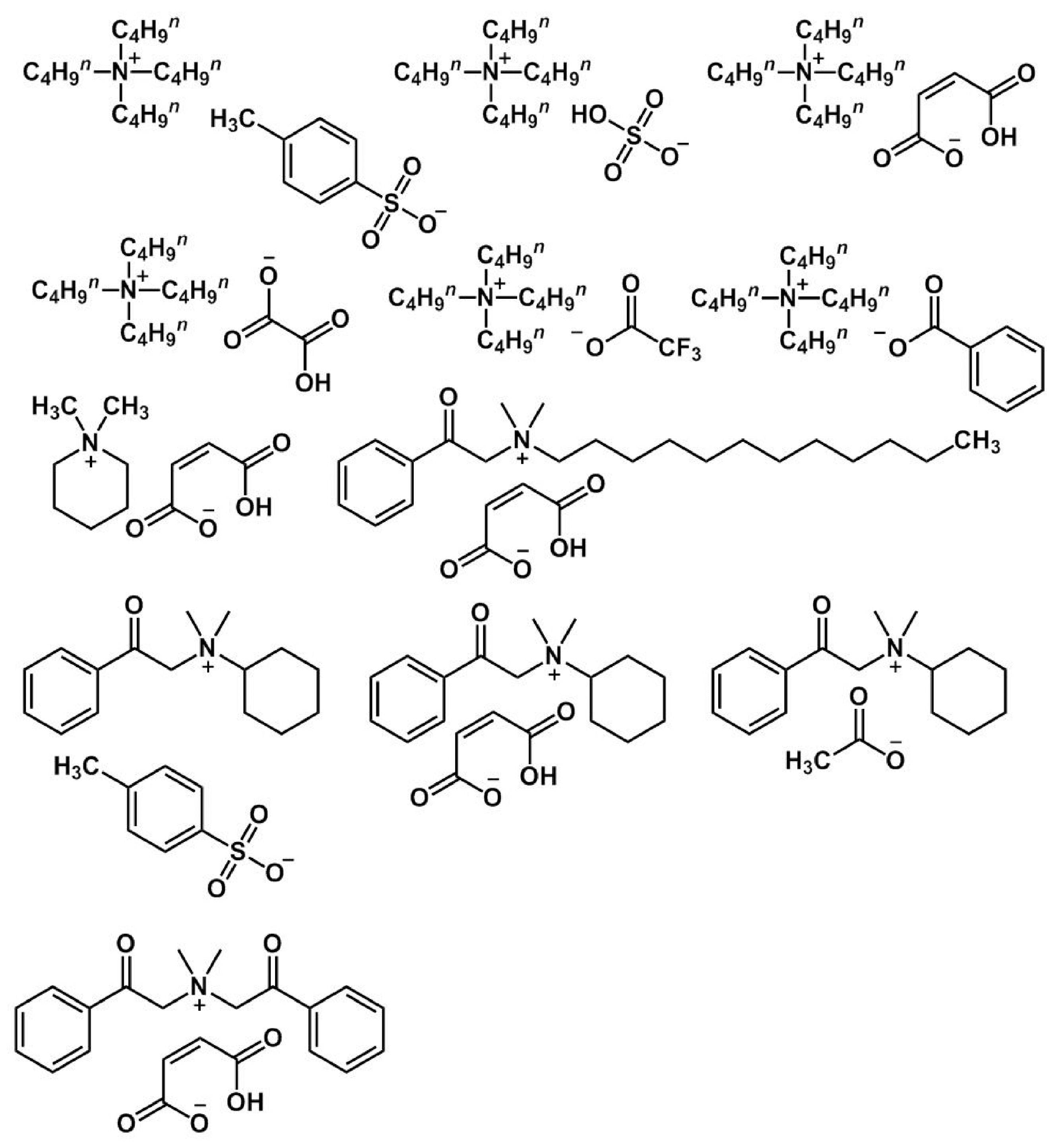
〔イミニウム塩〕
本発明において、イミニウム塩とは、イミニウムカチオンと、アニオンとの塩を意味する。アニオンとしては、上述のアンモニウム塩におけるアニオンと同様のものが例示され、好ましい態様も同様である。
本発明において、イミニウム塩とは、イミニウムカチオンと、アニオンとの塩を意味する。アニオンとしては、上述のアンモニウム塩におけるアニオンと同様のものが例示され、好ましい態様も同様である。
-イミニウムカチオン-
イミニウムカチオンとしては、ピリジニウムカチオンが好ましい。
また、イミニウムカチオンとしては、下記式(102)で表されるカチオンも好ましい。

イミニウムカチオンとしては、ピリジニウムカチオンが好ましい。
また、イミニウムカチオンとしては、下記式(102)で表されるカチオンも好ましい。
式(102)中、R5及びR6はそれぞれ独立に、水素原子又は炭化水素基を表し、R7は炭化水素基を表し、R5~R7の少なくとも2つはそれぞれ結合して環を形成してもよい。
式(102)中、R5及びR6は上述の式(101)におけるR1~R4と同義であり、好ましい態様も同様である。
式(102)中、R7はR5及びR6の少なくとも1つと結合して環を形成することが好ましい。上記環はヘテロ原子を含んでもよい。上記ヘテロ原子としては、窒素原子が挙げられる。また、上記環としてはピリジン環が好ましい。
式(102)中、R5及びR6は上述の式(101)におけるR1~R4と同義であり、好ましい態様も同様である。
式(102)中、R7はR5及びR6の少なくとも1つと結合して環を形成することが好ましい。上記環はヘテロ原子を含んでもよい。上記ヘテロ原子としては、窒素原子が挙げられる。また、上記環としてはピリジン環が好ましい。
イミニウムカチオンは、下記式(Y1-3)~(Y1-5)のいずれかで表されるものであることが好ましい。
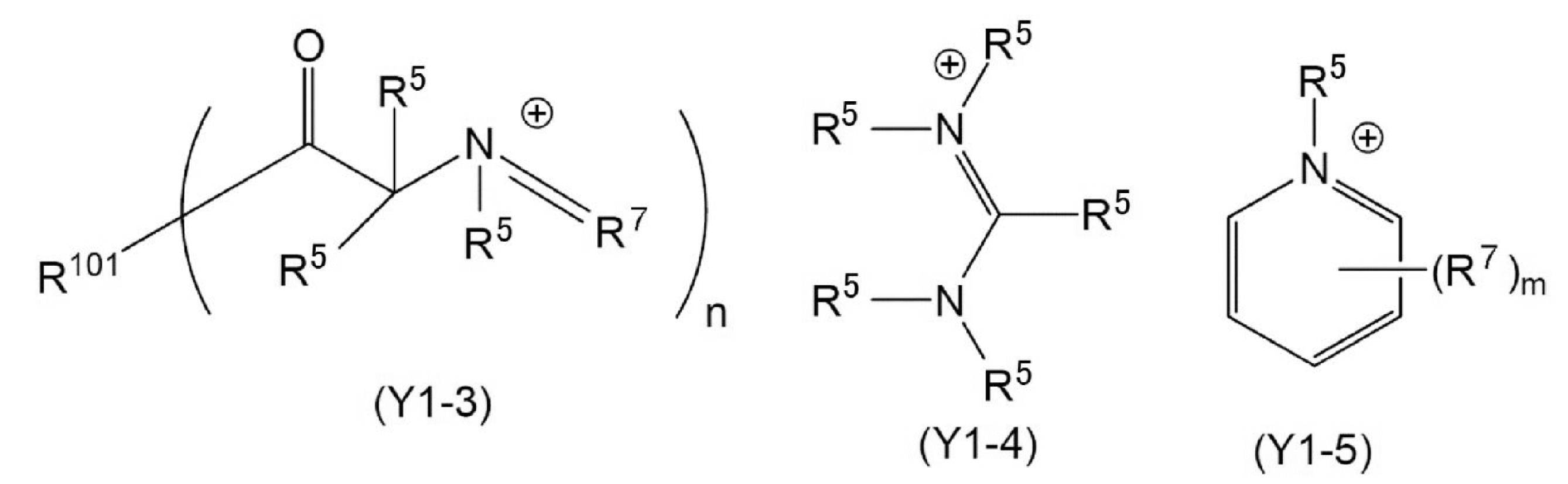
式(Y1-3)~(Y1-5)において、R101は、n価の有機基を表し、R5は式(102)におけるR5と同義であり、R7は式(102)におけるR7と同義であり、n及びmは、1以上の整数を表す。
式(Y1-3)において、R101は、脂肪族炭化水素、芳香族炭化水素、又は、これらが結合した構造からn個の水素原子を除いた基であることが好ましく、炭素数2~30の飽和脂肪族炭化水素、ベンゼン又はナフタレンからn個の水素原子を除いた基であることがより好ましい。
式(Y1-3)において、nは1~4であることが好ましく、1又は2であることがより好ましく、1であることが更に好ましい。
式(Y1-5)において、mは1~4であることが好ましく、1又は2であることがより好ましく、1であることが更に好ましい。
式(Y1-3)において、R101は、脂肪族炭化水素、芳香族炭化水素、又は、これらが結合した構造からn個の水素原子を除いた基であることが好ましく、炭素数2~30の飽和脂肪族炭化水素、ベンゼン又はナフタレンからn個の水素原子を除いた基であることがより好ましい。
式(Y1-3)において、nは1~4であることが好ましく、1又は2であることがより好ましく、1であることが更に好ましい。
式(Y1-5)において、mは1~4であることが好ましく、1又は2であることがより好ましく、1であることが更に好ましい。
イミニウム塩の具体例としては、以下の化合物を挙げることができるが、本発明はこれらに限定されるものではない。

〔スルホニウム塩〕
本発明において、スルホニウム塩とは、スルホニウムカチオンと、アニオンとの塩を意味する。アニオンとしては、上述のアンモニウム塩におけるアニオンと同様のものが例示され、好ましい態様も同様である。
本発明において、スルホニウム塩とは、スルホニウムカチオンと、アニオンとの塩を意味する。アニオンとしては、上述のアンモニウム塩におけるアニオンと同様のものが例示され、好ましい態様も同様である。
-スルホニウムカチオン-
スルホニウムカチオンとしては、第三級スルホニウムカチオンが好ましく、トリアリールスルホニウムカチオンがより好ましい。
また、スルホニウムカチオンとしては、下記式(103)で表されるカチオンが好ましい。

スルホニウムカチオンとしては、第三級スルホニウムカチオンが好ましく、トリアリールスルホニウムカチオンがより好ましい。
また、スルホニウムカチオンとしては、下記式(103)で表されるカチオンが好ましい。
式(103)中、R8~R10はそれぞれ独立に炭化水素基を表す。
R8~R10はそれぞれ独立に、アルキル基又はアリール基であることが好ましく、炭素数1~10のアルキル基又は炭素数6~12のアリール基であることがより好ましく、炭素数6~12のアリール基であることが更に好ましく、フェニル基であることが更に好ましい。
R8~R10は置換基を有していてもよく、置換基の例としては、ヒドロキシ基、アリール基、アルコキシ基、アリールオキシ基、アリールカルボニル基、アルキルカルボニル基、アルコキシカルボニル基、アリールオキシカルボニル基、アシルオキシ基等が挙げられる。これらの中でも、置換基として、アルキル基、又は、アルコキシ基を有することが好ましく、分岐アルキル基又はアルコキシ基を有することがより好ましく、炭素数3~10の分岐アルキル基、又は、炭素数1~10のアルコキシ基を有することが更に好ましい。
R8~R10は同一の基であっても、異なる基であってもよいが、合成適性上の観点からは、同一の基であることが好ましい。
R8~R10はそれぞれ独立に、アルキル基又はアリール基であることが好ましく、炭素数1~10のアルキル基又は炭素数6~12のアリール基であることがより好ましく、炭素数6~12のアリール基であることが更に好ましく、フェニル基であることが更に好ましい。
R8~R10は置換基を有していてもよく、置換基の例としては、ヒドロキシ基、アリール基、アルコキシ基、アリールオキシ基、アリールカルボニル基、アルキルカルボニル基、アルコキシカルボニル基、アリールオキシカルボニル基、アシルオキシ基等が挙げられる。これらの中でも、置換基として、アルキル基、又は、アルコキシ基を有することが好ましく、分岐アルキル基又はアルコキシ基を有することがより好ましく、炭素数3~10の分岐アルキル基、又は、炭素数1~10のアルコキシ基を有することが更に好ましい。
R8~R10は同一の基であっても、異なる基であってもよいが、合成適性上の観点からは、同一の基であることが好ましい。
スルホニウム塩の具体例としては、以下の化合物を挙げることができるが、本発明はこれらに限定されるものではない。
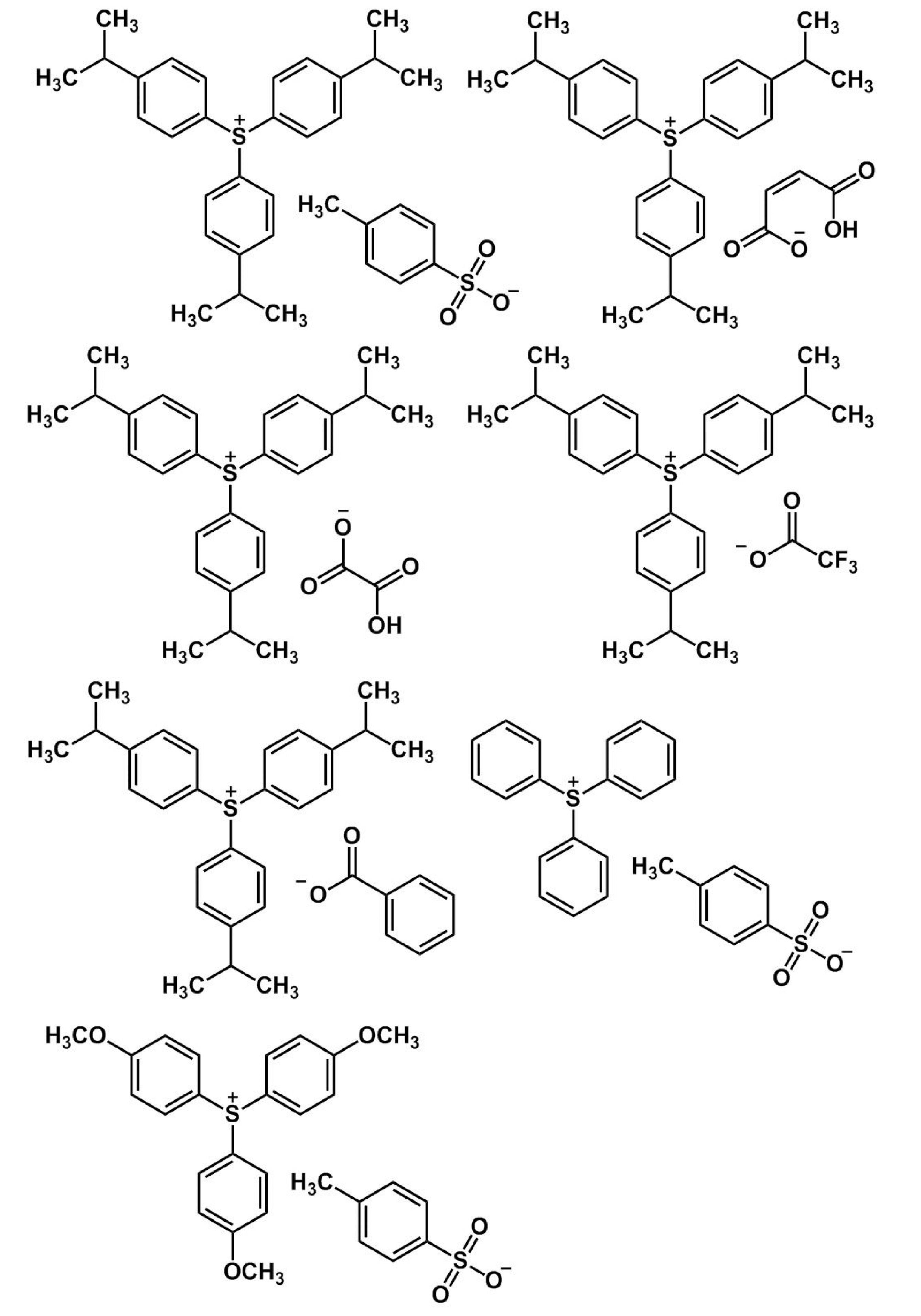
〔ヨードニウム塩〕
本発明において、ヨードニウム塩とは、ヨードニウムカチオンと、アニオンとの塩を意味する。アニオンとしては、上述のアンモニウム塩におけるアニオンと同様のものが例示され、好ましい態様も同様である。
本発明において、ヨードニウム塩とは、ヨードニウムカチオンと、アニオンとの塩を意味する。アニオンとしては、上述のアンモニウム塩におけるアニオンと同様のものが例示され、好ましい態様も同様である。
-ヨードニウムカチオン-
ヨードニウムカチオンとしては、ジアリールヨードニウムカチオンが好ましい。
また、ヨードニウムカチオンとしては、下記式(104)で表されるカチオンが好ましい。

ヨードニウムカチオンとしては、ジアリールヨードニウムカチオンが好ましい。
また、ヨードニウムカチオンとしては、下記式(104)で表されるカチオンが好ましい。
式(104)中、R11及びR12はそれぞれ独立に炭化水素基を表す。
R11及びR12はそれぞれ独立に、アルキル基又はアリール基であることが好ましく、炭素数1~10のアルキル基又は炭素数6~12のアリール基であることがより好ましく、炭素数6~12のアリール基であることが更に好ましく、フェニル基であることが更に好ましい。
R11及びR12は置換基を有していてもよく、置換基の例としては、ヒドロキシ基、アリール基、アルコキシ基、アリールオキシ基、アリールカルボニル基、アルキルカルボニル基、アルコキシカルボニル基、アリールオキシカルボニル基、アシルオキシ基等が挙げられる。これらの中でも、置換基として、アルキル基、又はアルコキシ基を有することが好ましく、分岐アルキル基又はアルコキシ基を有することがより好ましく、炭素数3~10の分岐アルキル基、又は、炭素数1~10のアルコキシ基を有することが更に好ましい。
R11及びR12は同一の基であっても、異なる基であってもよいが、合成適性上の観点からは、同一の基であることが好ましい。
R11及びR12はそれぞれ独立に、アルキル基又はアリール基であることが好ましく、炭素数1~10のアルキル基又は炭素数6~12のアリール基であることがより好ましく、炭素数6~12のアリール基であることが更に好ましく、フェニル基であることが更に好ましい。
R11及びR12は置換基を有していてもよく、置換基の例としては、ヒドロキシ基、アリール基、アルコキシ基、アリールオキシ基、アリールカルボニル基、アルキルカルボニル基、アルコキシカルボニル基、アリールオキシカルボニル基、アシルオキシ基等が挙げられる。これらの中でも、置換基として、アルキル基、又はアルコキシ基を有することが好ましく、分岐アルキル基又はアルコキシ基を有することがより好ましく、炭素数3~10の分岐アルキル基、又は、炭素数1~10のアルコキシ基を有することが更に好ましい。
R11及びR12は同一の基であっても、異なる基であってもよいが、合成適性上の観点からは、同一の基であることが好ましい。
ヨードニウム塩の具体例としては、以下の化合物を挙げることができるが、本発明はこれらに限定されるものではない。

〔ホスホニウム塩〕
本発明において、ホスホニウム塩とは、ホスホニウムカチオンと、アニオンとの塩を意味する。アニオンとしては、上述のアンモニウム塩におけるアニオンと同様のものが例示され、好ましい態様も同様である。
本発明において、ホスホニウム塩とは、ホスホニウムカチオンと、アニオンとの塩を意味する。アニオンとしては、上述のアンモニウム塩におけるアニオンと同様のものが例示され、好ましい態様も同様である。
-ホスホニウムカチオン-
ホスホニウムカチオンとしては、第四級ホスホニウムカチオンが好ましく、テトラアルキルホスホニウムカチオン、トリアリールモノアルキルホスホニウムカチオン等が挙げられる。
また、ホスホニウムカチオンとしては、下記式(105)で表されるカチオンが好ましい。
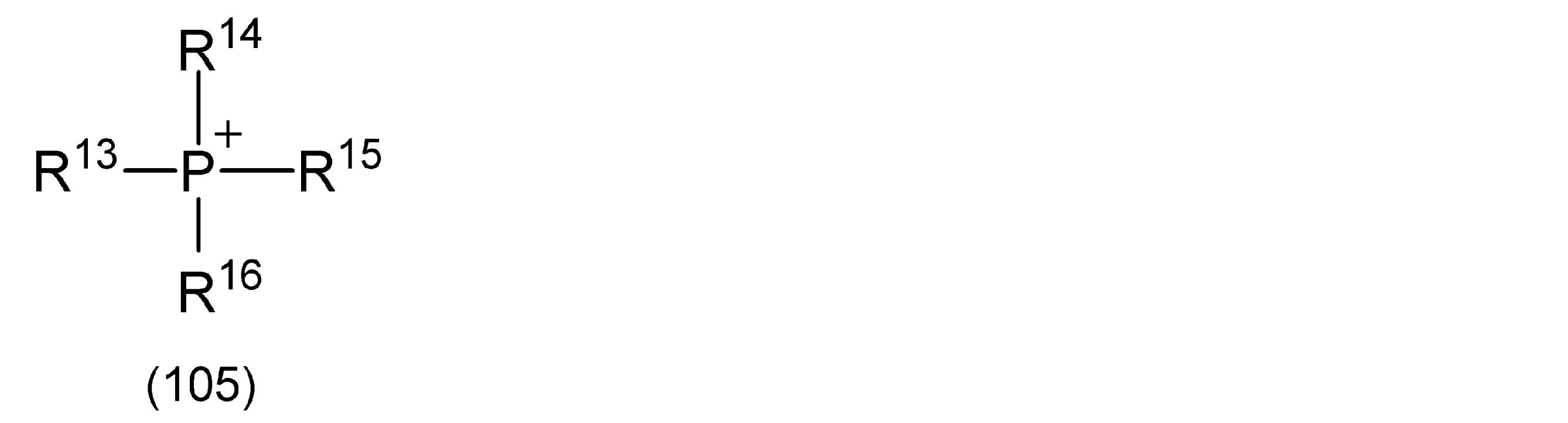
ホスホニウムカチオンとしては、第四級ホスホニウムカチオンが好ましく、テトラアルキルホスホニウムカチオン、トリアリールモノアルキルホスホニウムカチオン等が挙げられる。
また、ホスホニウムカチオンとしては、下記式(105)で表されるカチオンが好ましい。
式(105)中、R13~R16はそれぞれ独立に、水素原子又は炭化水素基を表す。
R13~R16はそれぞれ独立に、アルキル基又はアリール基であることが好ましく、炭素数1~10のアルキル基又は炭素数6~12のアリール基であることがより好ましく、炭素数6~12のアリール基であることが更に好ましく、フェニル基であることが更に好ましい。
R13~R16は置換基を有していてもよく、置換基の例としては、ヒドロキシ基、アリール基、アルコキシ基、アリールオキシ基、アリールカルボニル基、アルキルカルボニル基、アルコキシカルボニル基、アリールオキシカルボニル基、アシルオキシ基等が挙げられる。これらの中でも、置換基として、アルキル基、又はアルコキシ基を有することが好ましく、分岐アルキル基又はアルコキシ基を有することがより好ましく、炭素数3~10の分岐アルキル基、又は、炭素数1~10のアルコキシ基を有することが更に好ましい。
R13~R16は同一の基であっても、異なる基であってもよいが、合成適性上の観点からは、同一の基であることが好ましい。
R13~R16はそれぞれ独立に、アルキル基又はアリール基であることが好ましく、炭素数1~10のアルキル基又は炭素数6~12のアリール基であることがより好ましく、炭素数6~12のアリール基であることが更に好ましく、フェニル基であることが更に好ましい。
R13~R16は置換基を有していてもよく、置換基の例としては、ヒドロキシ基、アリール基、アルコキシ基、アリールオキシ基、アリールカルボニル基、アルキルカルボニル基、アルコキシカルボニル基、アリールオキシカルボニル基、アシルオキシ基等が挙げられる。これらの中でも、置換基として、アルキル基、又はアルコキシ基を有することが好ましく、分岐アルキル基又はアルコキシ基を有することがより好ましく、炭素数3~10の分岐アルキル基、又は、炭素数1~10のアルコキシ基を有することが更に好ましい。
R13~R16は同一の基であっても、異なる基であってもよいが、合成適性上の観点からは、同一の基であることが好ましい。
ホスホニウム塩の具体例としては、以下の化合物を挙げることができるが、本発明はこれらに限定されるものではない。
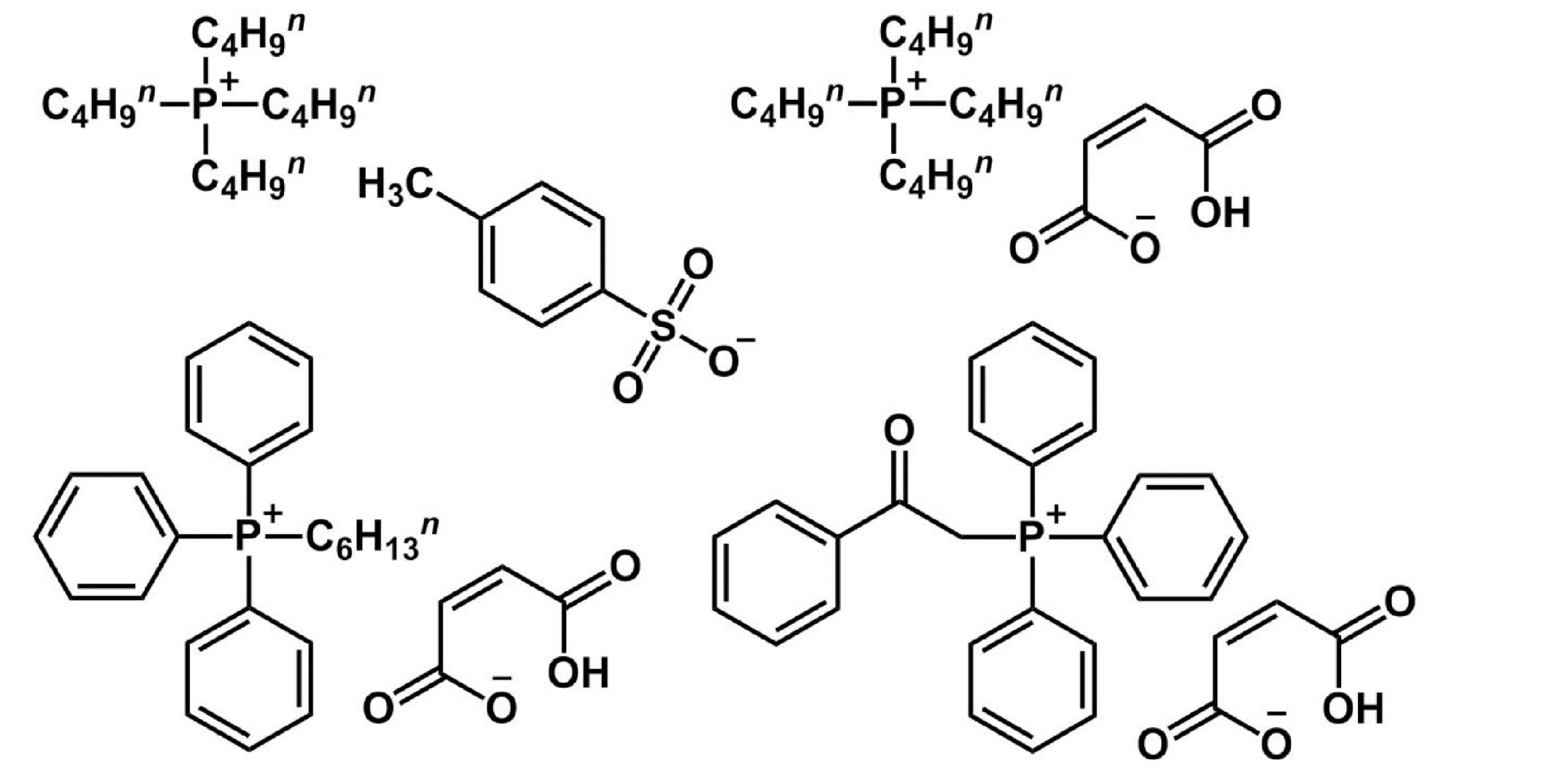
本発明の硬化性樹脂組成物がオニウム塩を含む場合、オニウム塩の含有量は、本発明の硬化性樹脂組成物の全固形分に対し、0.1~50質量%が好ましい。下限は、0.5質量%以上がより好ましく、0.85質量%以上が更に好ましく、1質量%以上が一層好ましい。上限は、30質量%以下がより好ましく、20質量%以下が更に好ましく、10質量%以下が一層好ましく、5質量%以下であってもよく、4質量%以下であってもよい。
オニウム塩は、1種又は2種以上を用いることができる。2種以上を用いる場合は、合計量が上記範囲であることが好ましい。
オニウム塩は、1種又は2種以上を用いることができる。2種以上を用いる場合は、合計量が上記範囲であることが好ましい。
<熱塩基発生剤>
本発明の硬化性樹脂組成物は、熱塩基発生剤を含んでもよい。
熱塩基発生剤は、上述のオニウム塩に該当する化合物であってもよいし、上述のオニウム塩以外の他の熱塩基発生剤であってもよい。
他の熱塩基発生剤には、上述のオニウム塩に該当する化合物は含まれないものとする。
他の熱塩基発生剤としては、ノニオン系熱塩基発生剤が挙げられる。
ノニオン系熱塩基発生剤としては、式(B1)又は式(B2)で表される化合物が挙げられる。

本発明の硬化性樹脂組成物は、熱塩基発生剤を含んでもよい。
熱塩基発生剤は、上述のオニウム塩に該当する化合物であってもよいし、上述のオニウム塩以外の他の熱塩基発生剤であってもよい。
他の熱塩基発生剤には、上述のオニウム塩に該当する化合物は含まれないものとする。
他の熱塩基発生剤としては、ノニオン系熱塩基発生剤が挙げられる。
ノニオン系熱塩基発生剤としては、式(B1)又は式(B2)で表される化合物が挙げられる。
式(B1)及び式(B2)中、Rb1、Rb2及びRb3はそれぞれ独立に、第3級アミン構造を有しない有機基、ハロゲン原子又は水素原子である。ただし、Rb1及びRb2が同時に水素原子となることはない。また、Rb1、Rb2及びRb3はいずれもカルボキシ基を有することはない。なお、本明細書で第3級アミン構造とは、3価の窒素原子の3つの結合手がいずれも炭化水素系の炭素原子と共有結合している構造を指す。したがって、結合した炭素原子がカルボニル基をなす炭素原子の場合、つまり窒素原子とともにアミド基を形成する場合はこの限りではない。
式(B1)、(B2)中、Rb1、Rb2及びRb3は、これらのうち少なくとも1つが環状構造を含むことが好ましく、少なくとも2つが環状構造を含むことがより好ましい。環状構造としては、単環及び縮合環のいずれであってもよく、単環又は単環が2つ縮合した縮合環が好ましい。単環は、5員環又は6員環が好ましく、6員環が好ましい。単環は、シクロヘキサン環及びベンゼン環が好ましく、シクロヘキサン環がより好ましい。
より具体的にRb1及びRb2は、水素原子、アルキル基(炭素数1~24が好ましく、2~18がより好ましく、3~12が更に好ましい)、アルケニル基(炭素数2~24が好ましく、2~18がより好ましく、3~12が更に好ましい)、アリール基(炭素数6~22が好ましく、6~18がより好ましく、6~10が更に好ましい)、又はアリールアルキル基(炭素数7~25が好ましく、7~19がより好ましく、7~12が更に好ましい)であることが好ましい。これらの基は、本発明の効果を奏する範囲で置換基を有していてもよい。Rb1とRb2とは互いに結合して環を形成していてもよい。形成される環としては、4~7員の含窒素複素環が好ましい。Rb1及びRb2は特に、置換基を有してもよい直鎖、分岐、又は環状のアルキル基(炭素数1~24が好ましく、2~18がより好ましく、3~12が更に好ましい)であることが好ましく、置換基を有してもよいシクロアルキル基(炭素数3~24が好ましく、3~18がより好ましく、3~12が更に好ましい)であることがより好ましく、置換基を有してもよいシクロヘキシル基が更に好ましい。
Rb3としては、アルキル基(炭素数1~24が好ましく、2~18がより好ましく、3~12が更に好ましい)、アリール基(炭素数6~22が好ましく、6~18がより好ましく、6~10が更に好ましい)、アルケニル基(炭素数2~24が好ましく、2~12がより好ましく、2~6が更に好ましい)、アリールアルキル基(炭素数7~23が好ましく、7~19がより好ましく、7~12が更に好ましい)、アリールアルケニル基(炭素数8~24が好ましく、8~20がより好ましく、8~16が更に好ましい)、アルコキシル基(炭素数1~24が好ましく、2~18がより好ましく、3~12が更に好ましい)、アリールオキシ基(炭素数6~22が好ましく、6~18がより好ましく、6~12が更に好ましい)、又はアリールアルキルオキシ基(炭素数7~23が好ましく、7~19がより好ましく、7~12が更に好ましい)が挙げられる。中でも、シクロアルキル基(炭素数3~24が好ましく、3~18がより好ましく、3~12が更に好ましい)、アリールアルケニル基、アリールアルキルオキシ基が好ましい。Rb3には更に本発明の効果を奏する範囲で置換基を有していてもよい。
式(B1)で表される化合物は、下記式(B1-1)又は下記式(B1-2)で表される化合物であることが好ましい。

式中、Rb11及びRb12、並びに、Rb31及びRb32は、それぞれ、式(B1)におけるRb1及びRb2と同じである。
Rb13はアルキル基(炭素数1~24が好ましく、2~18がより好ましく、3~12が更に好ましい)、アルケニル基(炭素数2~24が好ましく、2~18がより好ましく、3~12が更に好ましい)、アリール基(炭素数6~22が好ましく、6~18がより好ましく、6~12が更に好ましい)、アリールアルキル基(炭素数7~23が好ましく、7~19がより好ましく、7~12が更に好ましい)であり、本発明の効果を奏する範囲で置換基を有していてもよい。中でも、Rb13はアリールアルキル基が好ましい。
Rb13はアルキル基(炭素数1~24が好ましく、2~18がより好ましく、3~12が更に好ましい)、アルケニル基(炭素数2~24が好ましく、2~18がより好ましく、3~12が更に好ましい)、アリール基(炭素数6~22が好ましく、6~18がより好ましく、6~12が更に好ましい)、アリールアルキル基(炭素数7~23が好ましく、7~19がより好ましく、7~12が更に好ましい)であり、本発明の効果を奏する範囲で置換基を有していてもよい。中でも、Rb13はアリールアルキル基が好ましい。
Rb33及びRb34は、それぞれ独立に、水素原子、アルキル基(炭素数1~12が好ましく、1~8がより好ましく、1~3が更に好ましい)、アルケニル基(炭素数2~12が好ましく、2~8がより好ましく、2~3が更に好ましい)、アリール基(炭素数6~22が好ましく、6~18がより好ましく、6~10が更に好ましい)、アリールアルキル基(炭素数7~23が好ましく、7~19がより好ましく、7~11が更に好ましい)であり、水素原子が好ましい。
Rb35は、アルキル基(炭素数1~24が好ましく、1~12がより好ましく、3~8が更に好ましい)、アルケニル基(炭素数2~12が好ましく、2~12がより好ましく、3~8が更に好ましい)、アリール基(炭素数6~22が好ましく、6~18がより好ましく、6~12が更に好ましい)、アリールアルキル基(炭素数7~23が好ましく、7~19がより好ましく、7~12が更に好ましい)であり、アリール基が好ましい。
式(B1-1)で表される化合物は、式(B1-1a)で表される化合物もまた好ましい。

Rb11及びRb12は式(B1-1)におけるRb11及びRb12と同義である。
Rb15及びRb16は水素原子、アルキル基(炭素数1~12が好ましく、1~6がより好ましく、1~3が更に好ましい)、アルケニル基(炭素数2~12が好ましく、2~6がより好ましく、2~3が更に好ましい)、アリール基(炭素数6~22が好ましく、6~18がより好ましく、6~10が更に好ましい)、アリールアルキル基(炭素数7~23が好ましく、7~19がより好ましく、7~11が更に好ましい)であり、水素原子又はメチル基が好ましい。
Rb17はアルキル基(炭素数1~24が好ましく、1~12がより好ましく、3~8が更に好ましい)、アルケニル基(炭素数2~12が好ましく、2~12がより好ましく、3~8が更に好ましい)、アリール基(炭素数6~22が好ましく、6~18がより好ましく、6~12が更に好ましい)、アリールアルキル基(炭素数7~23が好ましく、7~19がより好ましく、7~12が更に好ましい)であり、中でもアリール基が好ましい。
Rb15及びRb16は水素原子、アルキル基(炭素数1~12が好ましく、1~6がより好ましく、1~3が更に好ましい)、アルケニル基(炭素数2~12が好ましく、2~6がより好ましく、2~3が更に好ましい)、アリール基(炭素数6~22が好ましく、6~18がより好ましく、6~10が更に好ましい)、アリールアルキル基(炭素数7~23が好ましく、7~19がより好ましく、7~11が更に好ましい)であり、水素原子又はメチル基が好ましい。
Rb17はアルキル基(炭素数1~24が好ましく、1~12がより好ましく、3~8が更に好ましい)、アルケニル基(炭素数2~12が好ましく、2~12がより好ましく、3~8が更に好ましい)、アリール基(炭素数6~22が好ましく、6~18がより好ましく、6~12が更に好ましい)、アリールアルキル基(炭素数7~23が好ましく、7~19がより好ましく、7~12が更に好ましい)であり、中でもアリール基が好ましい。
ノニオン系熱塩基発生剤の分子量は、800以下であることが好ましく、600以下であることがより好ましく、500以下であることが更に好ましい。下限としては、100以上であることが好ましく、200以上であることがより好ましく、300以上であることが更に好ましい。
上述のオニウム塩のうち、熱塩基発生剤である化合物の具体例、又は、他の熱塩基発生剤の具体例としては、以下の化合物を挙げることができる。
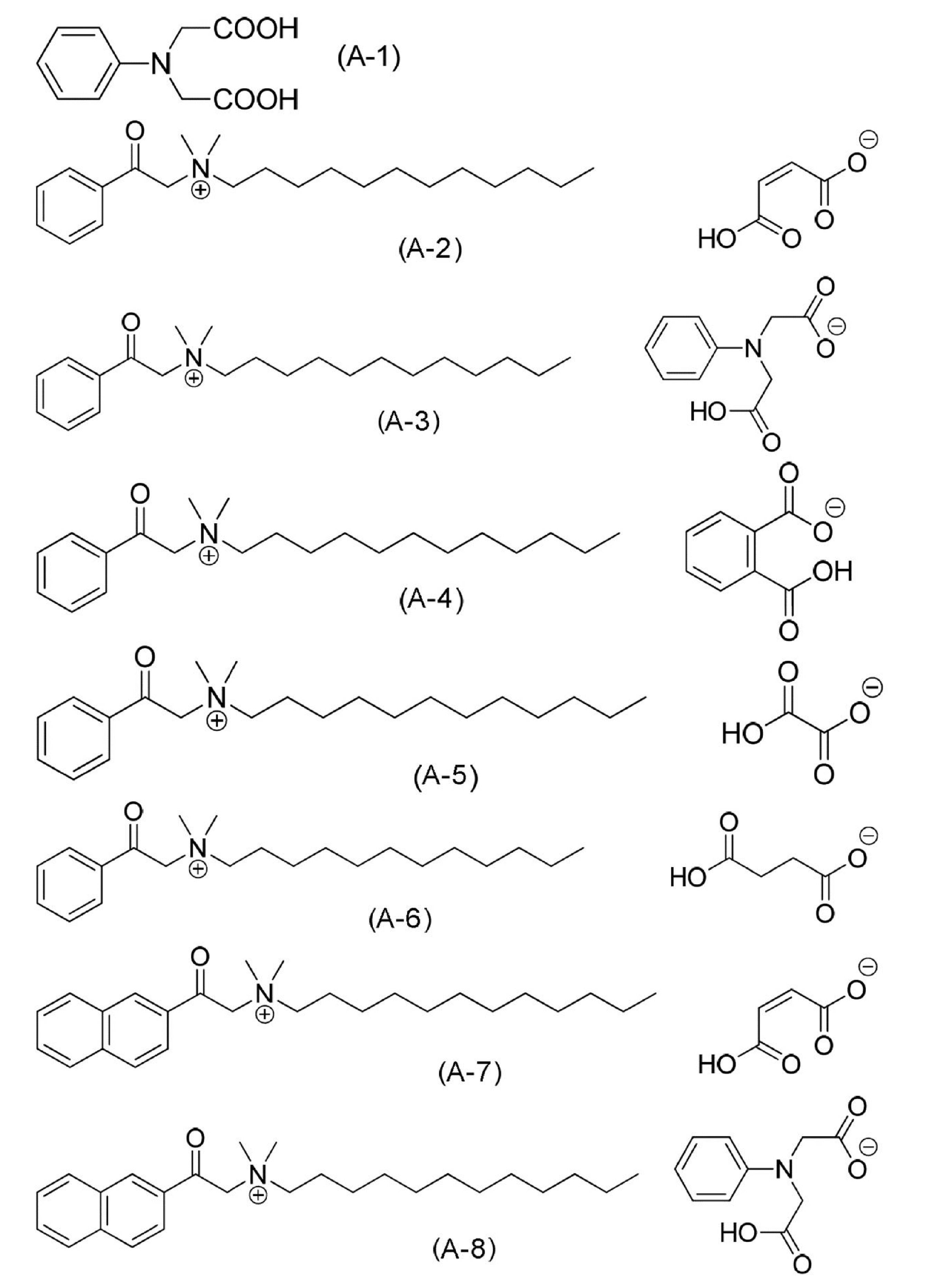
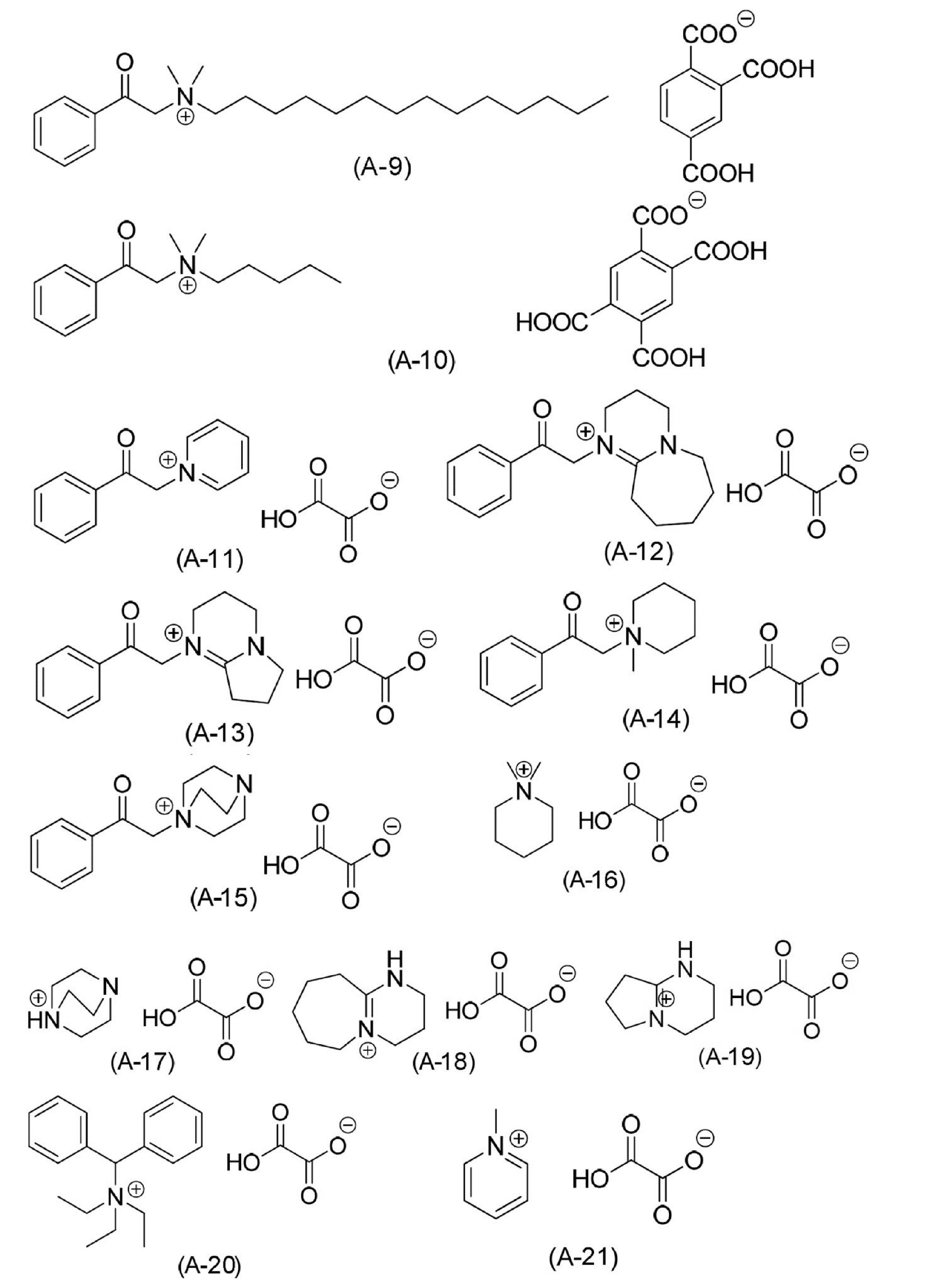
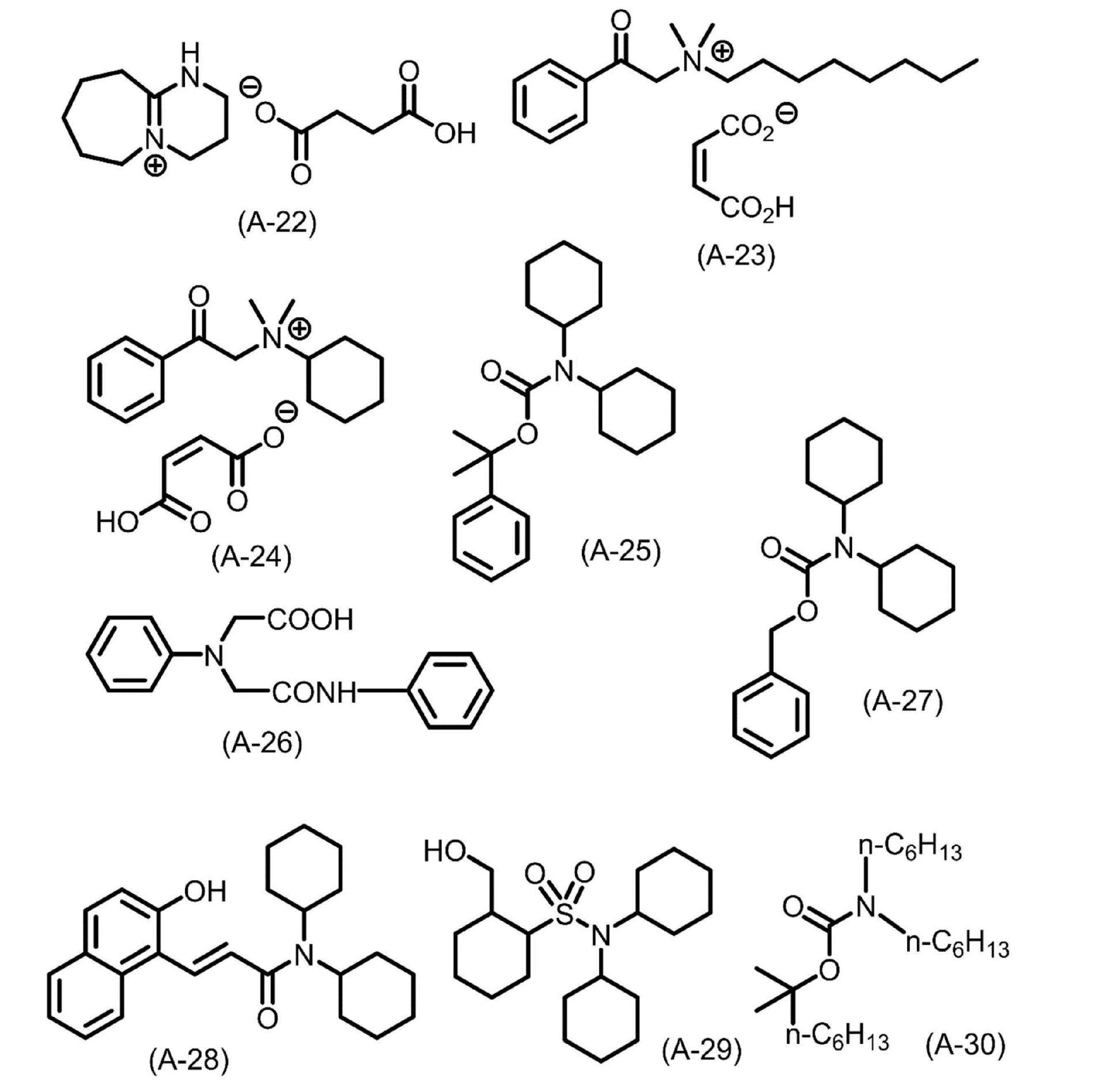
熱塩基発生剤の含有量は、本発明の硬化性樹脂組成物の全固形分に対し、0.1~50質量%が好ましい。下限は、0.5質量%以上がより好ましく、1質量%以上が更に好ましい。上限は、30質量%以下がより好ましく、20質量%以下が更に好ましい。熱塩基発生剤は、1種又は2種以上を用いることができる。2種以上を用いる場合は、合計量が上記範囲であることが好ましい。
<光重合開始剤>
本発明の硬化性樹脂組成物は、光重合開始剤を含むことが好ましい。
光重合開始剤は、光ラジカル重合開始剤であることが好ましい。光ラジカル重合開始剤としては、特に制限はなく、公知の光ラジカル重合開始剤の中から適宜選択することができる。例えば、紫外線領域から可視領域の光線に対して感光性を有する光ラジカル重合開始剤が好ましい。また、光励起された増感剤と何らかの作用を生じ、活性ラジカルを生成する活性剤であってもよい。
本発明の硬化性樹脂組成物は、光重合開始剤を含むことが好ましい。
光重合開始剤は、光ラジカル重合開始剤であることが好ましい。光ラジカル重合開始剤としては、特に制限はなく、公知の光ラジカル重合開始剤の中から適宜選択することができる。例えば、紫外線領域から可視領域の光線に対して感光性を有する光ラジカル重合開始剤が好ましい。また、光励起された増感剤と何らかの作用を生じ、活性ラジカルを生成する活性剤であってもよい。
光ラジカル重合開始剤は、約300~800nm(好ましくは330~500nm)の範囲内で少なくとも約50L・mol-1・cm-1のモル吸光係数を有する化合物を、少なくとも1種含有していることが好ましい。化合物のモル吸光係数は、公知の方法を用いて測定することができる。例えば、紫外可視分光光度計(Varian社製Cary-5 spectrophotometer)にて、酢酸エチル溶剤を用い、0.01g/Lの濃度で測定することが好ましい。
光ラジカル重合開始剤としては、公知の化合物を任意に使用できる。例えば、ハロゲン化炭化水素誘導体(例えば、トリアジン骨格を有する化合物、オキサジアゾール骨格を有する化合物、トリハロメチル基を有する化合物など)、アシルホスフィンオキサイド等のアシルホスフィン化合物、ヘキサアリールビイミダゾール、オキシム誘導体等のオキシム化合物、有機過酸化物、チオ化合物、ケトン化合物、芳香族オニウム塩、ケトオキシムエーテル、アミノアセトフェノン化合物、ヒドロキシアセトフェノン、アゾ系化合物、アジド化合物、メタロセン化合物、有機ホウ素化合物、鉄アレーン錯体などが挙げられる。これらの詳細については、特開2016-027357号公報の段落0165~0182、国際公開第2015/199219号の段落0138~0151の記載を参酌でき、この内容は本明細書に組み込まれる。
ケトン化合物としては、例えば、特開2015-087611号公報の段落0087に記載の化合物が例示され、この内容は本明細書に組み込まれる。市販品では、カヤキュアーDETX(日本化薬(株)製)も好適に用いられる。
光ラジカル重合開始剤としては、ヒドロキシアセトフェノン化合物、アミノアセトフェノン化合物、及び、アシルホスフィン化合物も好適に用いることができる。より具体的には、例えば、特開平10-291969号公報に記載のアミノアセトフェノン系開始剤、特許第4225898号に記載のアシルホスフィンオキシド系開始剤も用いることができる。
ヒドロキシアセトフェノン系開始剤としては、IRGACURE 184(IRGACUREは登録商標)、DAROCUR 1173、IRGACURE 500、IRGACURE-2959、IRGACURE 127(商品名:いずれもBASF社製)を用いることができる。
アミノアセトフェノン系開始剤としては、市販品であるIRGACURE 907、IRGACURE 369、及び、IRGACURE 379(商品名:いずれもBASF社製)を用いることができる。
アミノアセトフェノン系開始剤として、365nm又は405nm等の波長光源に吸収極大波長がマッチングされた特開2009-191179号公報に記載の化合物も用いることができる。
アシルホスフィン系開始剤としては、2,4,6-トリメチルベンゾイル-ジフェニル-ホスフィンオキサイドなどが挙げられる。また、市販品であるIRGACURE-819やIRGACURE-TPO(商品名:いずれもBASF社製)を用いることができる。
メタロセン化合物としては、IRGACURE-784(BASF社製)などが例示される。
光ラジカル重合開始剤として、より好ましくはオキシム化合物が挙げられる。オキシム化合物を用いることにより、露光ラチチュードをより効果的に向上させることが可能になる。オキシム化合物は、露光ラチチュード(露光マージン)が広く、かつ、光硬化促進剤としても働くため、特に好ましい。
オキシム化合物の具体例としては、特開2001-233842号公報に記載の化合物、特開2000-080068号公報に記載の化合物、特開2006-342166号公報に記載の化合物を用いることができる。
好ましいオキシム化合物としては、例えば、下記の構造の化合物や、3-ベンゾイルオキシイミノブタン-2-オン、3-アセトキシイミノブタン-2-オン、3-プロピオニルオキシイミノブタン-2-オン、2-アセトキシイミノペンタン-3-オン、2-アセトキシイミノ-1-フェニルプロパン-1-オン、2-ベンゾイルオキシイミノ-1-フェニルプロパン-1-オン、3-(4-トルエンスルホニルオキシ)イミノブタン-2-オン、及び2-エトキシカルボニルオキシイミノ-1-フェニルプロパン-1-オンなどが挙げられる。本発明の硬化性樹脂組成物においては、特に光ラジカル重合開始剤としてオキシム化合物(オキシム系の光重合開始剤)を用いることが好ましい。オキシム系の光重合開始剤は、分子内に >C=N-O-C(=O)- の連結基を有する。

市販品ではIRGACURE OXE 01、IRGACURE OXE 02、IRGACURE OXE 03、IRGACURE OXE 04(以上、BASF社製)、アデカオプトマーN-1919((株)ADEKA製、特開2012-014052号公報に記載の光ラジカル重合開始剤2)も好適に用いられる。また、TR-PBG-304(常州強力電子新材料有限公司製)、アデカアークルズNCI-831及びアデカアークルズNCI-930((株)ADEKA製)も用いることができる。また、DFI-091(ダイトーケミックス(株)製)を用いることができる。
また、フッ素原子を有するオキシム化合物を用いることも可能である。そのようなオキシム化合物の具体例としては、特開2010-262028号公報に記載されている化合物、特表2014-500852号公報の段落0345に記載されている化合物24、36~40、特開2013-164471号公報の段落0101に記載されている化合物(C-3)などが挙げられる。
最も好ましいオキシム化合物としては、特開2007-269779号公報に示される特定置換基を有するオキシム化合物や、特開2009-191061号公報に示されるチオアリール基を有するオキシム化合物などが挙げられる。
光ラジカル重合開始剤は、露光感度の観点から、トリハロメチルトリアジン化合物、ベンジルジメチルケタール化合物、α-ヒドロキシケトン化合物、α-アミノケトン化合物、アシルホスフィン化合物、ホスフィンオキサイド化合物、メタロセン化合物、オキシム化合物、トリアリールイミダゾールダイマー、オニウム塩化合物、ベンゾチアゾール化合物、ベンゾフェノン化合物、アセトフェノン化合物及びその誘導体、シクロペンタジエン-ベンゼン-鉄錯体及びその塩、ハロメチルオキサジアゾール化合物、3-アリール置換クマリン化合物よりなる群から選択される化合物が好ましい。
更に好ましい光ラジカル重合開始剤は、トリハロメチルトリアジン化合物、α-アミノケトン化合物、アシルホスフィン化合物、ホスフィンオキサイド化合物、メタロセン化合物、オキシム化合物、トリアリールイミダゾールダイマー、オニウム塩化合物、ベンゾフェノン化合物、アセトフェノン化合物であり、トリハロメチルトリアジン化合物、α-アミノケトン化合物、オキシム化合物、トリアリールイミダゾールダイマー、ベンゾフェノン化合物よりなる群から選ばれる少なくとも1種の化合物が一層好ましく、メタロセン化合物又はオキシム化合物を用いるのがより一層好ましく、オキシム化合物が更に一層好ましい。
また、光ラジカル重合開始剤は、ベンゾフェノン、N,N’-テトラメチル-4,4’-ジアミノベンゾフェノン(ミヒラーケトン)等のN,N’-テトラアルキル-4,4’-ジアミノベンゾフェノン、2-ベンジル-2-ジメチルアミノ-1-(4-モルホリノフェニル)-ブタノン-1,2-メチル-1-[4-(メチルチオ)フェニル]-2-モルホリノ-プロパノン-1等の芳香族ケトン、アルキルアントラキノン等の芳香環と縮環したキノン類、ベンゾインアルキルエーテル等のベンゾインエーテル化合物、ベンゾイン、アルキルベンゾイン等のベンゾイン化合物、ベンジルジメチルケタール等のベンジル誘導体などを用いることもできる。また、下記式(I)で表される化合物を用いることもできる。
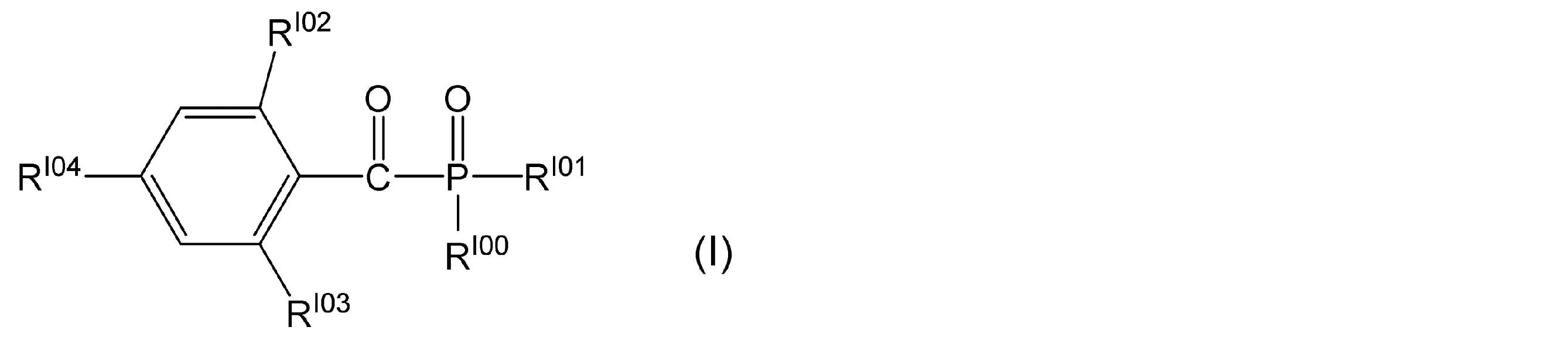
式(I)中、RI00は、炭素数1~20のアルキル基、1個以上の酸素原子によって中断された炭素数2~20のアルキル基、炭素数1~12のアルコキシ基、フェニル基、炭素数1~20のアルキル基、炭素数1~12のアルコキシ基、ハロゲン原子、シクロペンチル基、シクロヘキシル基、炭素数2~12のアルケニル基、1個以上の酸素原子によって中断された炭素数2~18のアルキル基及び炭素数1~4のアルキル基の少なくとも1つで置換されたフェニル基、又はビフェニルであり、RI01は、式(II)で表される基であるか、RI00と同じ基であり、RI02~RI04は各々独立に炭素数1~12のアルキル、炭素数1~12のアルコキシ基又はハロゲンである。

式中、RI05~RI07は、上記式(I)のRI02~RI04と同じである。
また、光ラジカル重合開始剤は、国際公開第2015/125469号の段落0048~0055に記載の化合物を用いることもできる。
光重合開始剤を含む場合、その含有量は、本発明の硬化性樹脂組成物の全固形分に対し0.1~30質量%であることが好ましく、より好ましくは0.1~20質量%であり、更に好ましくは0.5~15質量%であり、一層好ましくは1.0~10質量%である。光重合開始剤は1種のみ含有していてもよいし、2種以上含有していてもよい。光重合開始剤を2種以上含有する場合は、その合計が上記範囲であることが好ましい。
<熱重合開始剤>
本発明の硬化性樹脂組成物は、重合開始剤として熱重合開始剤を含んでもよく、とくに熱ラジカル重合開始剤を含んでもよい。熱ラジカル重合開始剤は、熱のエネルギーによってラジカルを発生し、重合性を有する化合物の重合反応を開始又は促進させる化合物である。熱ラジカル重合開始剤を添加することによって、複素環含有ポリマー前駆体の環化と共に、複素環含有ポリマー前駆体の重合反応を進行させることもできるので、より高度な耐熱化が達成できることとなる。
本発明の硬化性樹脂組成物は、重合開始剤として熱重合開始剤を含んでもよく、とくに熱ラジカル重合開始剤を含んでもよい。熱ラジカル重合開始剤は、熱のエネルギーによってラジカルを発生し、重合性を有する化合物の重合反応を開始又は促進させる化合物である。熱ラジカル重合開始剤を添加することによって、複素環含有ポリマー前駆体の環化と共に、複素環含有ポリマー前駆体の重合反応を進行させることもできるので、より高度な耐熱化が達成できることとなる。
熱ラジカル重合開始剤として、具体的には、特開2008-063554号公報の段落0074~0118に記載されている化合物が挙げられる。
熱ラジカル重合開始剤を含む場合、その含有量は、本発明の硬化性樹脂組成物の全固形分に対し0.1~30質量%であることが好ましく、より好ましくは0.1~20質量%であり、更に好ましくは5~15質量%である。熱ラジカル重合開始剤は1種のみ含有していてもよいし、2種以上含有していてもよい。熱ラジカル重合開始剤を2種以上含有する場合は、その合計が上記範囲であることが好ましい。
<重合性化合物>
〔ラジカル重合性化合物〕
本発明の硬化性樹脂組成物は重合性化合物を含むことが好ましい。
重合性化合物としては、ラジカル重合性化合物を用いることができる。ラジカル重合性化合物は、ラジカル重合性基を有する化合物である。ラジカル重合性基としては、ビニル基、アリル基、ビニルフェニル基、(メタ)アクリロイル基などのエチレン性不飽和結合を有する基が挙げられる。ラジカル重合性基は、(メタ)アクリロイル基が好ましく、反応性の観点からは、(メタ)アクリロキシ基がより好ましい。
〔ラジカル重合性化合物〕
本発明の硬化性樹脂組成物は重合性化合物を含むことが好ましい。
重合性化合物としては、ラジカル重合性化合物を用いることができる。ラジカル重合性化合物は、ラジカル重合性基を有する化合物である。ラジカル重合性基としては、ビニル基、アリル基、ビニルフェニル基、(メタ)アクリロイル基などのエチレン性不飽和結合を有する基が挙げられる。ラジカル重合性基は、(メタ)アクリロイル基が好ましく、反応性の観点からは、(メタ)アクリロキシ基がより好ましい。
ラジカル重合性化合物が有するラジカル重合性基の数は、1個でもよく、2個以上でもよいが、ラジカル重合性化合物はラジカル重合性基を2個以上有することが好ましく、3個以上有することがより好ましい。上限は、15個以下が好ましく、10個以下がより好ましく、8個以下が更に好ましい。
ラジカル重合性化合物の分子量は、2,000以下が好ましく、1,500以下がより好ましく、900以下が更に好ましい。ラジカル重合性化合物の分子量の下限は、100以上が好ましい。
本発明の硬化性樹脂組成物は、現像性の観点から、ラジカル重合性基を2個以上含む2官能以上のラジカル重合性化合物を少なくとも1種含むことが好ましく、3官能以上のラジカル重合性化合物を少なくとも1種含むことがより好ましい。また、2官能のラジカル重合性化合物と3官能以上のラジカル重合性化合物との混合物であってもよい。例えば2官能以上の重合性モノマーの官能基数とは、1分子中におけるラジカル重合性基の数が2個以上であることを意味する。
ラジカル重合性化合物の具体例としては、不飽和カルボン酸(例えば、アクリル酸、メタクリル酸、イタコン酸、クロトン酸、イソクロトン酸、マレイン酸など)やそのエステル類、アミド類が挙げられ、好ましくは、不飽和カルボン酸と多価アルコール化合物とのエステル、及び不飽和カルボン酸と多価アミン化合物とのアミド類である。また、ヒドロキシ基やアミノ基、スルファニル基等の求核性置換基を有する不飽和カルボン酸エステル又はアミド類と、単官能若しくは多官能イソシアネート類又はエポキシ類との付加反応物や、単官能若しくは多官能のカルボン酸との脱水縮合反応物等も好適に使用される。また、イソシアネート基やエポキシ基等の親電子性置換基を有する不飽和カルボン酸エステル又はアミド類と、単官能若しくは多官能のアルコール類、アミン類、チオール類との付加反応物、更に、ハロゲノ基やトシルオキシ基等の脱離性置換基を有する不飽和カルボン酸エステル又はアミド類と、単官能若しくは多官能のアルコール類、アミン類、チオール類との置換反応物も好適である。また、別の例として、上記の不飽和カルボン酸の代わりに、不飽和ホスホン酸、スチレン等のビニルベンゼン誘導体、ビニルエーテル、アリルエーテル等に置き換えた化合物群を使用することも可能である。具体例としては、特開2016-027357号公報の段落0113~0122の記載を参酌でき、これらの内容は本明細書に組み込まれる。
また、ラジカル重合性化合物は、常圧下で100℃以上の沸点を持つ化合物も好ましい。その例としては、ポリエチレングリコールジ(メタ)アクリレート、トリメチロールエタントリ(メタ)アクリレート、ネオペンチルグリコールジ(メタ)アクリレート、ペンタエリスリトールトリ(メタ)アクリレート、ペンタエリスリトールテトラ(メタ)アクリレート、ジペンタエリスリトールペンタ(メタ)アクリレート、ジペンタエリスリトールヘキサ(メタ)アクリレート、ヘキサンジオール(メタ)アクリレート、トリメチロールプロパントリ(アクリロイルオキシプロピル)エーテル、トリ(アクリロイルオキシエチル)イソシアヌレート、グリセリンやトリメチロールエタン等の多官能アルコールにエチレンオキサイドやプロピレンオキサイドを付加させた後、(メタ)アクリレート化した化合物、特公昭48-041708号公報、特公昭50-006034号公報、特開昭51-037193号各公報に記載されているようなウレタン(メタ)アクリレート類、特開昭48-064183号、特公昭49-043191号、特公昭52-030490号各公報に記載されているポリエステルアクリレート類、エポキシ樹脂と(メタ)アクリル酸との反応生成物であるエポキシアクリレート類等の多官能のアクリレートやメタクリレート及びこれらの混合物を挙げることができる。また、特開2008-292970号公報の段落0254~0257に記載の化合物も好適である。また、多官能カルボン酸にグリシジル(メタ)アクリレート等の環状エーテル基とエチレン性不飽和結合を有する化合物を反応させて得られる多官能(メタ)アクリレートなども挙げることができる。
また、上述以外の好ましいラジカル重合性化合物として、特開2010-160418号公報、特開2010-129825号公報、特許第4364216号公報等に記載される、フルオレン環を有し、エチレン性不飽和結合を有する基を2個以上有する化合物や、カルド樹脂も使用することが可能である。
更に、その他の例としては、特公昭46-043946号公報、特公平01-040337号公報、特公平01-040336号公報に記載の特定の不飽和化合物や、特開平02-025493号公報に記載のビニルホスホン酸系化合物等もあげることができる。また、特開昭61-022048号公報に記載のペルフルオロアルキル基を含む化合物を用いることもできる。更に日本接着協会誌 vol.20、No.7、300~308ページ(1984年)に光重合性モノマー及びオリゴマーとして紹介されているものも使用することができる。
上記のほか、特開2015-034964号公報の段落0048~0051に記載の化合物、国際公開第2015/199219号の段落0087~0131に記載の化合物も好ましく用いることができ、これらの内容は本明細書に組み込まれる。
また、特開平10-062986号公報において式(1)及び式(2)としてその具体例と共に記載の、多官能アルコールにエチレンオキサイドやプロピレンオキサイドを付加させた後に(メタ)アクリレート化した化合物も、ラジカル重合性化合物として用いることができる。
更に、特開2015-187211号公報の段落0104~0131に記載の化合物も他のラジカル重合性化合物として用いることができ、これらの内容は本明細書に組み込まれる。
ラジカル重合性化合物としては、ジペンタエリスリトールトリアクリレート(市販品としては KAYARAD D-330;日本化薬(株)製)、ジペンタエリスリトールテトラアクリレート(市販品としては KAYARAD D-320;日本化薬(株)製、A-TMMT:新中村化学工業(株)製)、ジペンタエリスリトールペンタ(メタ)アクリレート(市販品としては KAYARAD D-310;日本化薬(株)製)、ジペンタエリスリトールヘキサ(メタ)アクリレート(市販品としては KAYARAD DPHA;日本化薬(株)製、A-DPH;新中村化学工業社製)、及びこれらの(メタ)アクリロイル基がエチレングリコール残基又はプロピレングリコール残基を介して結合している構造が好ましい。これらのオリゴマータイプも使用できる。
ラジカル重合性化合物の市販品としては、例えばサートマー社製のエチレンオキシ鎖を4個有する4官能アクリレートであるSR-494、エチレンオキシ鎖を4個有する2官能メタクリレートであるサートマー社製のSR-209、231、239、日本化薬(株)製のペンチレンオキシ鎖を6個有する6官能アクリレートであるDPCA-60、イソブチレンオキシ鎖を3個有する3官能アクリレートであるTPA-330、ウレタンオリゴマーUAS-10、UAB-140(日本製紙社製)、NKエステルM-40G、NKエステル4G、NKエステルM-9300、NKエステルA-9300、UA-7200(新中村化学工業社製)、DPHA-40H(日本化薬(株)製)、UA-306H、UA-306T、UA-306I、AH-600、T-600、AI-600(共栄社化学社製)、ブレンマーPME400(日油(株)製)などが挙げられる。
ラジカル重合性化合物としては、特公昭48-041708号公報、特開昭51-037193号公報、特公平02-032293号公報、特公平02-016765号公報に記載されているようなウレタンアクリレート類や、特公昭58-049860号公報、特公昭56-017654号公報、特公昭62-039417号公報、特公昭62-039418号公報に記載のエチレンオキサイド系骨格を有するウレタン化合物類も好適である。更に、ラジカル重合性化合物として、特開昭63-277653号公報、特開昭63-260909号公報、特開平01-105238号公報に記載される、分子内にアミノ構造やスルフィド構造を有する化合物を用いることもできる。
ラジカル重合性化合物は、カルボキシ基、リン酸基等の酸基を有するラジカル重合性化合物であってもよい。酸基を有するラジカル重合性化合物は、脂肪族ポリヒドロキシ化合物と不飽和カルボン酸とのエステルが好ましく、脂肪族ポリヒドロキシ化合物の未反応のヒドロキシ基に非芳香族カルボン酸無水物を反応させて酸基を持たせたラジカル重合性化合物がより好ましい。特に好ましくは、脂肪族ポリヒドロキシ化合物の未反応のヒドロキシ基に非芳香族カルボン酸無水物を反応させて酸基を持たせたラジカル重合性化合物において、脂肪族ポリヒドロキシ化合物がペンタエリスリトール又はジペンタエリスリトールである化合物である。市販品としては、例えば、東亞合成株式会社製の多塩基酸変性アクリルオリゴマーとして、M-510、M-520などが挙げられる。
酸基を有するラジカル重合性化合物の好ましい酸価は、0.1~40mgKOH/gであり、特に好ましくは5~30mgKOH/gである。ラジカル重合性化合物の酸価が上記範囲であれば、製造上の取扱性に優れ、更には、現像性に優れる。また、重合性が良好である。上記酸価は、JIS K 0070:1992の記載に準拠して測定される。
本発明の硬化性樹脂組成物は、硬化膜の弾性率制御に伴う反り抑制の観点から、ラジカル重合性化合物として、単官能ラジカル重合性化合物を好ましく用いることができる。単官能ラジカル重合性化合物としては、n-ブチル(メタ)アクリレート、2-エチルヘキシル(メタ)アクリレート、2-ヒドロキシエチル(メタ)アクリレート、ブトキシエチル(メタ)アクリレート、カルビトール(メタ)アクリレート、シクロヘキシル(メタ)アクリレート、ベンジル(メタ)アクリレート、フェノキシエチル(メタ)アクリレート、N-メチロール(メタ)アクリルアミド、グリシジル(メタ)アクリレート、ポリエチレングリコールモノ(メタ)アクリレート、ポリプロピレングリコールモノ(メタ)アクリレート等の(メタ)アクリル酸誘導体、N-ビニルピロリドン、N-ビニルカプロラクタム等のN-ビニル化合物類、アリルグリシジルエーテル、ジアリルフタレート、トリアリルトリメリテート等のアリル化合物類等が好ましく用いられる。単官能ラジカル重合性化合物としては、露光前の揮発を抑制するため、常圧下で100℃以上の沸点を持つ化合物も好ましい。
〔上述したラジカル重合性化合物以外の重合性化合物〕
本発明の硬化性樹脂組成物は、上述したラジカル重合性化合物以外の重合性化合物を更に含むことができる。上述したラジカル重合性化合物以外の重合性化合物としては、ヒドロキシメチル基、アルコキシメチル基又はアシルオキシメチル基を有する化合物;エポキシ化合物;オキセタン化合物;ベンゾオキサジン化合物が挙げられる。
本発明の硬化性樹脂組成物は、上述したラジカル重合性化合物以外の重合性化合物を更に含むことができる。上述したラジカル重合性化合物以外の重合性化合物としては、ヒドロキシメチル基、アルコキシメチル基又はアシルオキシメチル基を有する化合物;エポキシ化合物;オキセタン化合物;ベンゾオキサジン化合物が挙げられる。
-ヒドロキシメチル基、アルコキシメチル基又はアシルオキシメチル基を有する化合物-
ヒドロキシメチル基、アルコキシメチル基又はアシルオキシメチル基を有する化合物としては、下記式(AM1)、(AM4)又は(AM5)で示される化合物が好ましい。
ヒドロキシメチル基、アルコキシメチル基又はアシルオキシメチル基を有する化合物としては、下記式(AM1)、(AM4)又は(AM5)で示される化合物が好ましい。


式(AM4)で示される化合物の具体例としては、46DMOC、46DMOEP(以上、商品名、旭有機材工業(株)製)、DML-MBPC、DML-MBOC、DML-OCHP、DML-PCHP、DML-PC、DML-PTBP、DML-34X、DML-EP、DML-POP、dimethylolBisOC-P、DML-PFP、DML-PSBP、DML-MTrisPC(以上、商品名、本州化学工業(株)製)、NIKALAC MX-290(商品名、(株)三和ケミカル製)、2,6-dimethoxymethyl-4-t-butylphenol、2,6-dimethoxymethyl-p-cresol、2,6-diacetoxymethyl-p-cresolなどが挙げられる。
また、式(AM5)で示される化合物の具体例としては、TriML-P、TriML-35XL、TML-HQ、TML-BP、TML-pp-BPF、TML-BPA、TMOM-BP、HML-TPPHBA、HML-TPHAP、HMOM-TPPHBA、HMOM-TPHAP(以上、商品名、本州化学工業(株)製)、TM-BIP-A(商品名、旭有機材工業(株)製)、NIKALAC MX-280、NIKALAC MX-270、NIKALAC MW-100LM(以上、商品名、(株)三和ケミカル製)が挙げられる。
-エポキシ化合物(エポキシ基を有する化合物)-
エポキシ化合物としては、一分子中にエポキシ基を2以上有する化合物であることが好ましい。エポキシ基は、200℃以下で架橋反応し、かつ、架橋に由来する脱水反応が起こらないため膜収縮が起きにくい。このため、エポキシ化合物を含有することは、硬化性樹脂組成物の低温硬化及び反りの抑制に効果的である。
エポキシ化合物としては、一分子中にエポキシ基を2以上有する化合物であることが好ましい。エポキシ基は、200℃以下で架橋反応し、かつ、架橋に由来する脱水反応が起こらないため膜収縮が起きにくい。このため、エポキシ化合物を含有することは、硬化性樹脂組成物の低温硬化及び反りの抑制に効果的である。
エポキシ化合物は、ポリエチレンオキサイド基を含有することが好ましい。これにより、より弾性率が低下し、また反りを抑制することができる。ポリエチレンオキサイド基は、エチレンオキサイドの繰返し単位数が2以上のものを意味し、繰返し単位数が2~15であることが好ましい。
エポキシ化合物の例としては、ビスフェノールA型エポキシ樹脂;ビスフェノールF型エポキシ樹脂;プロピレングリコールジグリシジルエーテル等のアルキレングリコール型エポキシ樹脂;ポリプロピレングリコールジグリシジルエーテル等のポリアルキレングリコール型エポキシ樹脂;ポリメチル(グリシジロキシプロピル)シロキサン等のエポキシ基含有シリコーンなどを挙げることができるが、これらに限定されない。具体的には、エピクロン(登録商標)850-S、エピクロン(登録商標)HP-4032、エピクロン(登録商標)HP-7200、エピクロン(登録商標)HP-820、エピクロン(登録商標)HP-4700、エピクロン(登録商標)EXA-4710、エピクロン(登録商標)HP-4770、エピクロン(登録商標)EXA-859CRP、エピクロン(登録商標)EXA-1514、エピクロン(登録商標)EXA-4880、エピクロン(登録商標)EXA-4850-150、エピクロンEXA-4850-1000、エピクロン(登録商標)EXA-4816、エピクロン(登録商標)EXA-4822(以上商品名、DIC(株)製)、リカレジン(登録商標)BEO-60E(商品名、新日本理化(株))、EP-4003S、EP-4000S(以上商品名、(株)ADEKA製)などが挙げられる。この中でも、ポリエチレンオキサイド基を含有するエポキシ樹脂が、反りの抑制及び耐熱性に優れる点で好ましい。例えば、エピクロン(登録商標)EXA-4880、エピクロン(登録商標)EXA-4822、リカレジン(登録商標)BEO-60Eは、ポリエチレンオキサイド基を含有するので好ましい。
-オキセタン化合物(オキセタニル基を有する化合物)-
オキセタン化合物としては、一分子中にオキセタン環を2つ以上有する化合物、3-エチル-3-ヒドロキシメチルオキセタン、1,4-ビス{[(3-エチル-3-オキセタニル)メトキシ]メチル}ベンゼン、3-エチル-3-(2-エチルヘキシルメチル)オキセタン、1,4-ベンゼンジカルボン酸-ビス[(3-エチル-3-オキセタニル)メチル]エステル等を挙げることができる。具体的な例としては、東亞合成株式会社製のアロンオキセタンシリーズ(例えば、OXT-121、OXT-221、OXT-191、OXT-223)が好適に使用することができ、これらは単独で、又は2種以上混合してもよい。
オキセタン化合物としては、一分子中にオキセタン環を2つ以上有する化合物、3-エチル-3-ヒドロキシメチルオキセタン、1,4-ビス{[(3-エチル-3-オキセタニル)メトキシ]メチル}ベンゼン、3-エチル-3-(2-エチルヘキシルメチル)オキセタン、1,4-ベンゼンジカルボン酸-ビス[(3-エチル-3-オキセタニル)メチル]エステル等を挙げることができる。具体的な例としては、東亞合成株式会社製のアロンオキセタンシリーズ(例えば、OXT-121、OXT-221、OXT-191、OXT-223)が好適に使用することができ、これらは単独で、又は2種以上混合してもよい。
-ベンゾオキサジン化合物(ベンゾオキサゾリル基を有する化合物)-
ベンゾオキサジン化合物は、開環付加反応に由来する架橋反応のため、硬化時に脱ガスが発生せず、更に熱収縮を小さくして反りの発生が抑えられることから好ましい。
ベンゾオキサジン化合物は、開環付加反応に由来する架橋反応のため、硬化時に脱ガスが発生せず、更に熱収縮を小さくして反りの発生が抑えられることから好ましい。
ベンゾオキサジン化合物の好ましい例としては、B-a型ベンゾオキサジン、B-m型ベンゾオキサジン(以上、商品名、四国化成工業社製)、ポリヒドロキシスチレン樹脂のベンゾオキサジン付加物、フェノールノボラック型ジヒドロベンゾオキサジン化合物が挙げられる。これらは単独で用いるか、又は2種以上混合してもよい。
重合性化合物を含有する場合、その含有量は、本発明の硬化性樹脂組成物の全固形分に対して、0質量%超60質量%以下であることが好ましい。下限は5質量%以上がより好ましい。上限は、50質量%以下であることがより好ましく、30質量%以下であることが更に好ましい。
重合性化合物は1種を単独で用いてもよいが、2種以上を混合して用いてもよい。2種以上を併用する場合にはその合計量が上記の範囲となることが好ましい。
<溶剤>
本発明の硬化性樹脂組成物は、溶剤を含有することが好ましい。溶剤は、公知の溶剤を任意に使用できる。溶剤は有機溶剤が好ましい。有機溶剤としては、エステル類、エーテル類、ケトン類、芳香族炭化水素類、スルホキシド類、アミド類などの化合物が挙げられる。
本発明の硬化性樹脂組成物は、溶剤を含有することが好ましい。溶剤は、公知の溶剤を任意に使用できる。溶剤は有機溶剤が好ましい。有機溶剤としては、エステル類、エーテル類、ケトン類、芳香族炭化水素類、スルホキシド類、アミド類などの化合物が挙げられる。
エステル類として、例えば、酢酸エチル、酢酸-n-ブチル、酢酸イソブチル、ギ酸アミル、酢酸イソアミル、プロピオン酸ブチル、酪酸イソプロピル、酪酸エチル、酪酸ブチル、乳酸メチル、乳酸エチル、γ-ブチロラクトン、ε-カプロラクトン、δ-バレロラクトン、アルキルオキシ酢酸アルキル(例えば、アルキルオキシ酢酸メチル、アルキルオキシ酢酸エチル、アルキルオキシ酢酸ブチル(例えば、メトキシ酢酸メチル、メトキシ酢酸エチル、メトキシ酢酸ブチル、エトキシ酢酸メチル、エトキシ酢酸エチル等))、3-アルキルオキシプロピオン酸アルキルエステル類(例えば、3-アルキルオキシプロピオン酸メチル、3-アルキルオキシプロピオン酸エチル等(例えば、3-メトキシプロピオン酸メチル、3-メトキシプロピオン酸エチル、3-エトキシプロピオン酸メチル、3-エトキシプロピオン酸エチル等))、2-アルキルオキシプロピオン酸アルキルエステル類(例えば、2-アルキルオキシプロピオン酸メチル、2-アルキルオキシプロピオン酸エチル、2-アルキルオキシプロピオン酸プロピル等(例えば、2-メトキシプロピオン酸メチル、2-メトキシプロピオン酸エチル、2-メトキシプロピオン酸プロピル、2-エトキシプロピオン酸メチル、2-エトキシプロピオン酸エチル))、2-アルキルオキシ-2-メチルプロピオン酸メチル及び2-アルキルオキシ-2-メチルプロピオン酸エチル(例えば、2-メトキシ-2-メチルプロピオン酸メチル、2-エトキシ-2-メチルプロピオン酸エチル等)、ピルビン酸メチル、ピルビン酸エチル、ピルビン酸プロピル、アセト酢酸メチル、アセト酢酸エチル、2-オキソブタン酸メチル、2-オキソブタン酸エチル等が好適なものとして挙げられる。
エーテル類として、例えば、ジエチレングリコールジメチルエーテル、テトラヒドロフラン、エチレングリコールモノメチルエーテル、エチレングリコールモノエチルエーテル、メチルセロソルブアセテート、エチルセロソルブアセテート、ジエチレングリコールモノメチルエーテル、ジエチレングリコールモノエチルエーテル、ジエチレングリコールモノブチルエーテル、プロピレングリコールモノメチルエーテル、プロピレングリコールモノメチルエーテルアセテート、プロピレングリコールモノエチルエーテルアセテート、プロピレングリコールモノプロピルエーテルアセテート等が好適なものとして挙げられる。
ケトン類として、例えば、メチルエチルケトン、シクロヘキサノン、シクロペンタノン、2-ヘプタノン、3-ヘプタノン等が好適なものとして挙げられる。
芳香族炭化水素類として、例えば、トルエン、キシレン、アニソール、リモネン等が好適なものとして挙げられる。
スルホキシド類として、例えば、ジメチルスルホキシドが好適なものとして挙げられる。
アミド類として、N-メチル-2-ピロリドン、N-エチル-2-ピロリドン、N,N-ジメチルアセトアミド、N,N-ジメチルホルムアミド等が好適なものとして挙げられる。
溶剤は、塗布面性状の改良などの観点から、2種以上を混合する形態も好ましい。
本発明では、3-エトキシプロピオン酸メチル、3-エトキシプロピオン酸エチル、エチルセロソルブアセテート、乳酸エチル、ジエチレングリコールジメチルエーテル、酢酸ブチル、3-メトキシプロピオン酸メチル、2-ヘプタノン、シクロヘキサノン、シクロペンタノン、γ-ブチロラクトン、ジメチルスルホキシド、エチルカルビトールアセテート、ブチルカルビトールアセテート、N-メチル-2-ピロリドン、プロピレングリコールメチルエーテル、及びプロピレングリコールメチルエーテルアセテートから選択される1種の溶剤、又は、2種以上で構成される混合溶剤が好ましい。ジメチルスルホキシドとγ-ブチロラクトンとの併用が特に好ましい。
溶剤の含有量は、塗布性の観点から、本発明の硬化性樹脂組成物の全固形分濃度が5~80質量%になる量とすることが好ましく、5~75質量%となる量にすることがより好ましく、10~70質量%となる量にすることが更に好ましく、40~70質量%となるようにすることが一層好ましい。溶剤含有量は、所望の厚さと塗布方法によって調節すればよい。
溶剤は1種のみ含有していてもよいし、2種以上含有していてもよい。溶剤を2種以上含有する場合は、その合計が上記範囲であることが好ましい。
<マイグレーション抑制剤>
本発明の硬化性樹脂組成物は、更にマイグレーション抑制剤を含むことが好ましい。マイグレーション抑制剤を含むことにより、金属層(金属配線)由来の金属イオンが硬化性樹脂組成物層内へ移動することを効果的に抑制可能となる。
本発明の硬化性樹脂組成物は、更にマイグレーション抑制剤を含むことが好ましい。マイグレーション抑制剤を含むことにより、金属層(金属配線)由来の金属イオンが硬化性樹脂組成物層内へ移動することを効果的に抑制可能となる。
マイグレーション抑制剤としては、特に制限はないが、複素環(ピロール環、フラン環、チオフェン環、イミダゾール環、オキサゾール環、チアゾール環、ピラゾール環、イソオキサゾール環、イソチアゾール環、テトラゾール環、ピリジン環、ピリダジン環、ピリミジン環、ピラジン環、ピペリジン環、ピペラジン環、モルホリン環、2H-ピラン環及び6H-ピラン環、トリアジン環)を有する化合物、チオ尿素類及びスルファニル基を有する化合物、ヒンダードフェノール系化合物、サリチル酸誘導体系化合物、ヒドラジド誘導体系化合物が挙げられる。特に、1,2,4-トリアゾール、ベンゾトリアゾール等のトリアゾール系化合物、1H-テトラゾール、5-フェニルテトラゾール等のテトラゾール系化合物が好ましく使用できる。
又はハロゲンイオンなどの陰イオンを捕捉するイオントラップ剤を使用することもできる。
その他のマイグレーション抑制剤としては、特開2013-015701号公報の段落0094に記載の防錆剤、特開2009-283711号公報の段落0073~0076に記載の化合物、特開2011-059656号公報の段落0052に記載の化合物、特開2012-194520号公報の段落0114、0116及び0118に記載の化合物、国際公開第2015/199219号の段落0166に記載の化合物などを使用することができる。
マイグレーション抑制剤の具体例としては、下記化合物を挙げることができる。
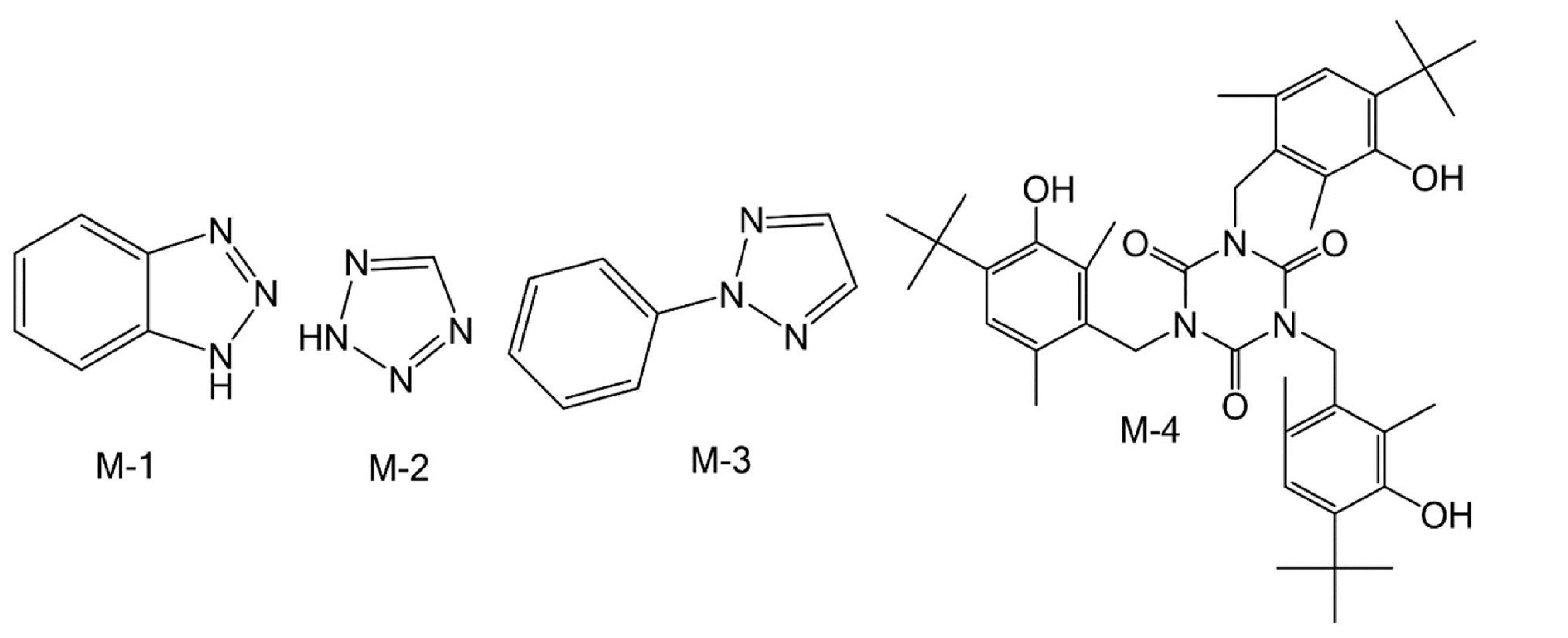
硬化性樹脂組成物がマイグレーション抑制剤を有する場合、マイグレーション抑制剤の含有量は、硬化性樹脂組成物の全固形分に対して、0.01~5.0質量%であることが好ましく、0.05~2.0質量%であることがより好ましく、0.1~1.0質量%であることが更に好ましい。
マイグレーション抑制剤は1種のみでもよいし、2種以上であってもよい。マイグレーション抑制剤が2種以上の場合は、その合計が上記範囲であることが好ましい。
<重合禁止剤>
本発明の硬化性樹脂組成物は、重合禁止剤を含むことが好ましい。
本発明の硬化性樹脂組成物は、重合禁止剤を含むことが好ましい。
重合禁止剤としては、例えば、ヒドロキノン、p-メトキシフェノール、ジ-tert-ブチル-p-クレゾール、ピロガロール、p-tert-ブチルカテコール、1,4-ベンゾキノン、ジフェニル-p-ベンゾキノン、4,4’-チオビス(3-メチル-6-tert-ブチルフェノール)、2,2′-メチレンビス(4-メチル-6-tert-ブチルフェノール)、N-ニトロソ-N-フェニルヒドロキシアミンアルミニウム塩、フェノチアジン、N-ニトロソジフェニルアミン、N-フェニルナフチルアミン、エチレンジアミン四酢酸、1,2-シクロヘキサンジアミン四酢酸、グリコールエーテルジアミン四酢酸、2,6-ジ-tert-ブチル-4-メチルフェノール、5-ニトロソ-8-ヒドロキシキノリン、1-ニトロソ-2-ナフトール、2-ニトロソ-1-ナフトール、2-ニトロソ-5-(N-エチル-N-スルホプロピルアミノ)フェノール、N-ニトロソ-N-(1-ナフチル)ヒドロキシアミンアンモニウム塩、ビス(4-ヒドロキシ-3,5-tert-ブチル)フェニルメタンなどが好適に用いられる。また、特開2015-127817号公報の段落0060に記載の重合禁止剤、及び、国際公開第2015/125469号の段落0031~0046に記載の化合物を用いることもできる。
また、下記化合物を用いることができる(Meはメチル基である)。
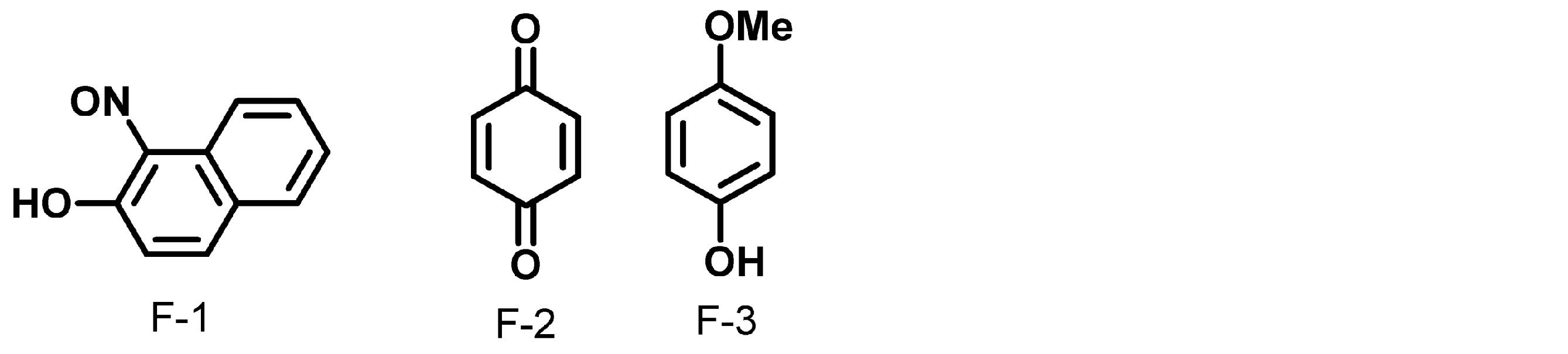
本発明の硬化性樹脂組成物が重合禁止剤を有する場合、重合禁止剤の含有量は、本発明の硬化性樹脂組成物の全固形分に対して、0.01~5質量%であることが好ましく、0.02~3質量%であることがより好ましく、0.05~2.5質量%であることが更に好ましい。
重合禁止剤は1種のみでもよいし、2種以上であってもよい。重合禁止剤が2種以上の場合は、その合計が上記範囲であることが好ましい。
<金属接着性改良剤>
本発明の硬化性樹脂組成物は、電極や配線などに用いられる金属材料との接着性を向上させるための金属接着性改良剤を含んでいることが好ましい。金属接着性改良剤としては、シランカップリング剤などが挙げられる。
本発明の硬化性樹脂組成物は、電極や配線などに用いられる金属材料との接着性を向上させるための金属接着性改良剤を含んでいることが好ましい。金属接着性改良剤としては、シランカップリング剤などが挙げられる。
シランカップリング剤の例としては、国際公開第2015/199219号の段落0167に記載の化合物、特開2014-191002号公報の段落0062~0073に記載の化合物、国際公開第2011/080992号の段落0063~0071に記載の化合物、特開2014-191252号公報の段落0060~0061に記載の化合物、特開2014-041264号公報の段落0045~0052に記載の化合物、国際公開第2014/097594号の段落0055に記載の化合物が挙げられる。また、特開2011-128358号公報の段落0050~0058に記載のように異なる2種以上のシランカップリング剤を用いることも好ましい。また、シランカップリング剤は、下記化合物を用いることも好ましい。以下の式中、Etはエチル基を表す。

また、金属接着性改良剤としては、特開2014-186186号公報の段落0046~0049に記載の化合物、特開2013-072935号公報の段落0032~0043に記載のスルフィド系化合物を用いることもできる。
金属接着性改良剤の含有量は複素環含有ポリマー前駆体100質量部に対して、好ましくは0.1~30質量部であり、より好ましくは0.5~15質量部の範囲であり、更に好ましくは0.5~5質量部の範囲である。上記下限値以上とすることで硬化工程後の硬化膜と金属層との接着性が良好となり、上記上限値以下とすることで硬化工程後の硬化膜の耐熱性、機械特性が良好となる。金属接着性改良剤は1種のみでもよいし、2種以上であってもよい。2種以上用いる場合は、その合計が上記範囲であることが好ましい。
<その他の添加剤>
本発明の硬化性樹脂組成物は、本発明の効果を損なわない範囲で、必要に応じて、各種の添加物、例えば、熱酸発生剤、N-フェニルジエタノールアミンなどの増感剤、連鎖移動剤、界面活性剤、高級脂肪酸誘導体、無機粒子、硬化剤、硬化触媒、充填剤、酸化防止剤、紫外線吸収剤、凝集防止剤等を配合することができる。これらの添加剤を配合する場合、その合計配合量は硬化性樹脂組成物の固形分の3質量%以下とすることが好ましい。
本発明の硬化性樹脂組成物は、本発明の効果を損なわない範囲で、必要に応じて、各種の添加物、例えば、熱酸発生剤、N-フェニルジエタノールアミンなどの増感剤、連鎖移動剤、界面活性剤、高級脂肪酸誘導体、無機粒子、硬化剤、硬化触媒、充填剤、酸化防止剤、紫外線吸収剤、凝集防止剤等を配合することができる。これらの添加剤を配合する場合、その合計配合量は硬化性樹脂組成物の固形分の3質量%以下とすることが好ましい。
〔増感剤〕
本発明の硬化性樹脂組成物は、増感剤を含んでいてもよい。増感剤は、特定の活性放射線を吸収して電子励起状態となる。電子励起状態となった増感剤は、熱硬化促進剤、熱ラジカル重合開始剤、光ラジカル重合開始剤などと接触して、電子移動、エネルギー移動、発熱などの作用が生じる。これにより、熱硬化促進剤、熱ラジカル重合開始剤、光ラジカル重合開始剤は化学変化を起こして分解し、ラジカル、酸又は塩基を生成する。
増感剤としては、N-フェニルジエタノールアミン等の増感剤が挙げられる。
また、増感剤としては、増感色素を用いてもよい。
増感色素の詳細については、特開2016-027357号公報の段落0161~0163の記載を参酌でき、この内容は本明細書に組み込まれる。
本発明の硬化性樹脂組成物は、増感剤を含んでいてもよい。増感剤は、特定の活性放射線を吸収して電子励起状態となる。電子励起状態となった増感剤は、熱硬化促進剤、熱ラジカル重合開始剤、光ラジカル重合開始剤などと接触して、電子移動、エネルギー移動、発熱などの作用が生じる。これにより、熱硬化促進剤、熱ラジカル重合開始剤、光ラジカル重合開始剤は化学変化を起こして分解し、ラジカル、酸又は塩基を生成する。
増感剤としては、N-フェニルジエタノールアミン等の増感剤が挙げられる。
また、増感剤としては、増感色素を用いてもよい。
増感色素の詳細については、特開2016-027357号公報の段落0161~0163の記載を参酌でき、この内容は本明細書に組み込まれる。
本発明の硬化性樹脂組成物が増感剤を含む場合、増感剤の含有量は、本発明の硬化性樹脂組成物の全固形分に対し、0.01~20質量%であることが好ましく、0.1~15質量%であることがより好ましく、0.5~10質量%であることが更に好ましい。増感剤は、1種単独で用いてもよいし、2種以上を併用してもよい。
〔連鎖移動剤〕
本発明の硬化性樹脂組成物は、連鎖移動剤を含有してもよい。連鎖移動剤は、例えば高分子辞典第三版(高分子学会編、2005年)683-684頁に定義されている。連鎖移動剤としては、例えば、分子内にSH、PH、SiH、及びGeHを有する化合物群が用いられる。これらは、低活性のラジカルに水素を供与して、ラジカルを生成するか、若しくは、酸化された後、脱プロトンすることによりラジカルを生成しうる。特に、チオール化合物を好ましく用いることができる。
本発明の硬化性樹脂組成物は、連鎖移動剤を含有してもよい。連鎖移動剤は、例えば高分子辞典第三版(高分子学会編、2005年)683-684頁に定義されている。連鎖移動剤としては、例えば、分子内にSH、PH、SiH、及びGeHを有する化合物群が用いられる。これらは、低活性のラジカルに水素を供与して、ラジカルを生成するか、若しくは、酸化された後、脱プロトンすることによりラジカルを生成しうる。特に、チオール化合物を好ましく用いることができる。
また、連鎖移動剤は、国際公開第2015/199219号の段落0152~0153に記載の化合物を用いることもできる。
本発明の硬化性樹脂組成物が連鎖移動剤を有する場合、連鎖移動剤の含有量は、本発明の硬化性樹脂組成物の全固形分100質量部に対し、0.01~20質量部が好ましく、1~10質量部がより好ましく、1~5質量部が更に好ましい。連鎖移動剤は1種のみでもよいし、2種以上であってもよい。連鎖移動剤が2種以上の場合は、その合計が上記範囲であることが好ましい。
〔界面活性剤〕
本発明の硬化性樹脂組成物には、塗布性をより向上させる観点から、各種類の界面活性剤を添加してもよい。界面活性剤としては、フッ素系界面活性剤、ノニオン系界面活性剤、カチオン系界面活性剤、アニオン系界面活性剤、シリコーン系界面活性剤などの各種類の界面活性剤を使用できる。また、下記界面活性剤も好ましい。下記式中、主鎖の構成単位を示す括弧は各構成単位の含有量(モル%)を、側鎖の構成単位を示す括弧は各構成単位の繰り返し数をそれぞれ表す。
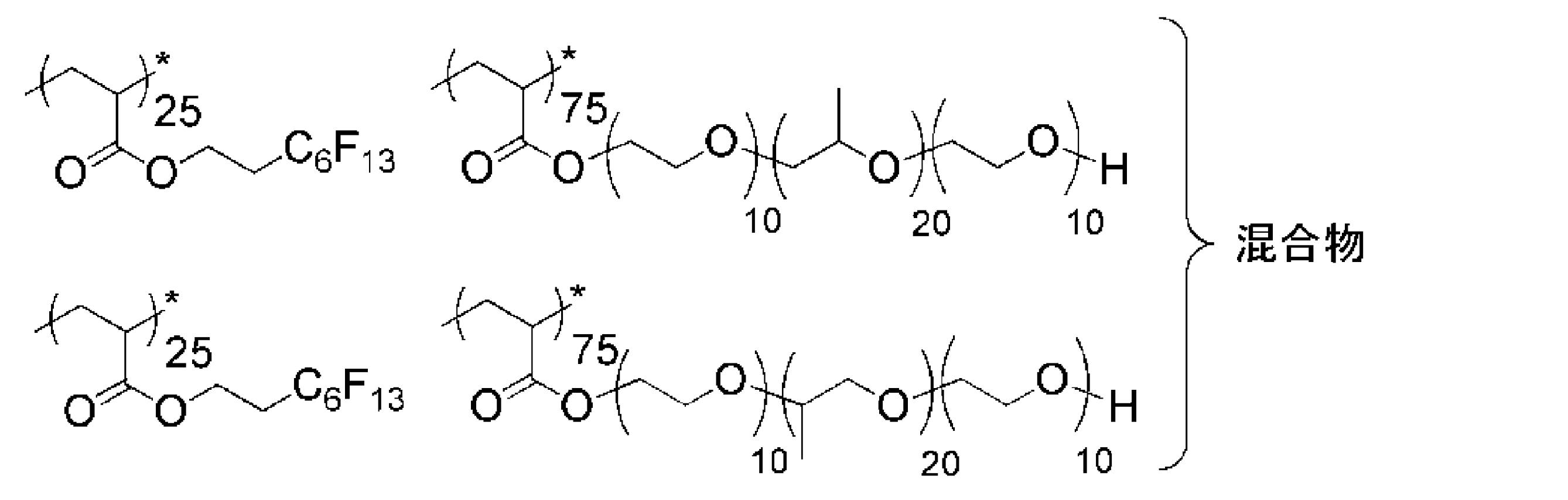
また、界面活性剤は、国際公開第2015/199219号の段落0159~0165に記載の化合物を用いることもできる。
本発明の硬化性樹脂組成物には、塗布性をより向上させる観点から、各種類の界面活性剤を添加してもよい。界面活性剤としては、フッ素系界面活性剤、ノニオン系界面活性剤、カチオン系界面活性剤、アニオン系界面活性剤、シリコーン系界面活性剤などの各種類の界面活性剤を使用できる。また、下記界面活性剤も好ましい。下記式中、主鎖の構成単位を示す括弧は各構成単位の含有量(モル%)を、側鎖の構成単位を示す括弧は各構成単位の繰り返し数をそれぞれ表す。
本発明の硬化性樹脂組成物が界面活性剤を有する場合、界面活性剤の含有量は、本発明の硬化性樹脂組成物の全固形分に対して、0.001~2.0質量%であることが好ましく、より好ましくは0.005~1.0質量%である。界面活性剤は1種のみでもよいし、2種以上であってもよい。界面活性剤が2種以上の場合は、その合計が上記範囲であることが好ましい。
〔高級脂肪酸誘導体〕
本発明の硬化性樹脂組成物は、酸素に起因する重合阻害を防止するために、ベヘン酸やベヘン酸アミドのような高級脂肪酸誘導体を添加して、塗布後の乾燥の過程で硬化性樹脂組成物の表面に偏在させてもよい。
本発明の硬化性樹脂組成物は、酸素に起因する重合阻害を防止するために、ベヘン酸やベヘン酸アミドのような高級脂肪酸誘導体を添加して、塗布後の乾燥の過程で硬化性樹脂組成物の表面に偏在させてもよい。
また、高級脂肪酸誘導体は、国際公開第2015/199219号の段落0155に記載の化合物を用いることもできる。
本発明の硬化性樹脂組成物が高級脂肪酸誘導体を有する場合、高級脂肪酸誘導体の含有量は、本発明の硬化性樹脂組成物の全固形分に対して、0.1~10質量%であることが好ましい。高級脂肪酸誘導体は1種のみでもよいし、2種以上であってもよい。高級脂肪酸誘導体が2種以上の場合は、その合計が上記範囲であることが好ましい。
<その他の含有物質についての制限>
本発明の硬化性樹脂組成物の水分含有量は、塗布面性状の観点から、5質量%未満が好ましく、1質量%未満がより好ましく、0.6質量%未満が更に好ましい。
本発明の硬化性樹脂組成物の水分含有量は、塗布面性状の観点から、5質量%未満が好ましく、1質量%未満がより好ましく、0.6質量%未満が更に好ましい。
本発明の硬化性樹脂組成物の金属含有量は、絶縁性の観点から、5質量ppm(parts per million)未満が好ましく、1質量ppm未満がより好ましく、0.5質量ppm未満が更に好ましい。金属としては、ナトリウム、カリウム、マグネシウム、カルシウム、鉄、クロム、ニッケルなどが挙げられる。金属を複数含む場合は、これらの金属の合計が上記範囲であることが好ましい。
また、本発明の硬化性樹脂組成物に意図せずに含まれる金属不純物を低減する方法としては、本発明の硬化性樹脂組成物を構成する原料として金属含有量が少ない原料を選択する、本発明の硬化性樹脂組成物を構成する原料に対してフィルターろ過を行う、装置内をポリテトラフルオロエチレン等でライニングしてコンタミネーションを可能な限り抑制した条件下で蒸留を行う等の方法を挙げることができる。
本発明の硬化性樹脂組成物は、半導体材料としての用途を考慮すると、ハロゲン原子の含有量が、配線腐食性の観点から、500質量ppm未満が好ましく、300質量ppm未満がより好ましく、200質量ppm未満が更に好ましい。中でも、ハロゲンイオンの状態で存在するものは、5質量ppm未満が好ましく、1質量ppm未満がより好ましく、0.5質量ppm未満が更に好ましい。ハロゲン原子としては、塩素原子及び臭素原子が挙げられる。塩素原子及び臭素原子、又は塩素イオン及び臭素イオンの合計がそれぞれ上記範囲であることが好ましい。
本発明の硬化性樹脂組成物の収容容器としては従来公知の収容容器を用いることができる。また、収容容器としては、原材料や硬化性樹脂組成物中への不純物混入を抑制することを目的に、容器内壁を6種6層の樹脂で構成された多層ボトルや、6種の樹脂を7層構造にしたボトルを使用することも好ましい。このような容器としては例えば特開2015-123351号公報に記載の容器が挙げられる。
<硬化性樹脂組成物の調製>
本発明の硬化性樹脂組成物は、上記各成分を混合して調製することができる。混合方法は特に限定はなく、従来公知の方法で行うことができる。
本発明の硬化性樹脂組成物は、上記各成分を混合して調製することができる。混合方法は特に限定はなく、従来公知の方法で行うことができる。
また、硬化性樹脂組成物中のゴミや微粒子等の異物を除去する目的で、フィルターを用いたろ過を行うことが好ましい。フィルター孔径は、1μm以下が好ましく、0.5μm以下がより好ましく、0.1μm以下が更に好ましい。フィルターの材質は、ポリテトラフロロエチレン、ポリエチレン又はナイロンが好ましい。フィルターは、有機溶剤であらかじめ洗浄したものを用いてもよい。フィルターろ過工程では、複数種のフィルターを直列又は並列に接続して用いてもよい。複数種のフィルターを使用する場合は、孔径又は材質が異なるフィルターを組み合わせて使用してもよい。また、各種材料を複数回ろ過してもよい。複数回ろ過する場合は、循環ろ過であってもよい。また、加圧してろ過を行ってもよい。加圧してろ過を行う場合、加圧する圧力は0.05MPa以上0.3MPa以下が好ましい。
フィルターを用いたろ過の他、吸着材を用いた不純物の除去処理を行ってもよい。フィルターろ過と吸着材を用いた不純物除去処理とを組み合わせてもよい。吸着材としては、公知の吸着材を用いることができる。例えば、シリカゲル、ゼオライトなどの無機系吸着材、活性炭などの有機系吸着材が挙げられる。
フィルターを用いたろ過の他、吸着材を用いた不純物の除去処理を行ってもよい。フィルターろ過と吸着材を用いた不純物除去処理とを組み合わせてもよい。吸着材としては、公知の吸着材を用いることができる。例えば、シリカゲル、ゼオライトなどの無機系吸着材、活性炭などの有機系吸着材が挙げられる。
<硬化性樹脂組成物の用途>
本発明の硬化性樹脂組成物は、再配線層用層間絶縁膜の形成に用いられることが好ましい。
また、その他、半導体デバイスの絶縁膜の形成、又は、ストレスバッファ膜の形成等にも用いることができる。
本発明の硬化性樹脂組成物は、再配線層用層間絶縁膜の形成に用いられることが好ましい。
また、その他、半導体デバイスの絶縁膜の形成、又は、ストレスバッファ膜の形成等にも用いることができる。
(硬化膜、積層体、半導体デバイス、及びそれらの製造方法)
次に、硬化膜、積層体、半導体デバイス、及びそれらの製造方法について説明する。
次に、硬化膜、積層体、半導体デバイス、及びそれらの製造方法について説明する。
本発明の硬化膜は、本発明の硬化性樹脂組成物を硬化してなる。本発明の硬化膜の膜厚は、例えば、0.5μm以上とすることができ、1μm以上とすることができる。また、上限値としては、100μm以下とすることができ、30μm以下とすることもできる。
本発明の硬化膜を2層以上、更には、3~7層積層して積層体としてもよい。本発明の積層体は、硬化膜を2層以上含み、上記硬化膜同士のいずれかの間に金属層を含む態様が好ましい。例えば、第一の硬化膜、金属層、第二の硬化膜の3つの層がこの順に積層された層構造を少なくとも含む積層体が好ましく挙げられる。上記第一の硬化膜及び上記第二の硬化膜は、いずれも本発明の硬化膜であり、例えば、上記第一の硬化膜及び上記第二の硬化膜のいずれもが、本発明の硬化性樹脂組成物を硬化してなる膜である態様が好ましく挙げられる。上記第一の硬化膜の形成に用いられる本発明の硬化性樹脂組成物と、上記第二の硬化膜の形成に用いられる本発明の硬化性樹脂組成物とは、組成が同一の組成物であってもよいし、組成が異なる組成物であってもよいが、製造適性上の観点からは、組成が同一の組成物であることが好ましい。このような金属層は、再配線層などの金属配線として好ましく用いられる。
本発明の硬化膜の適用可能な分野としては、半導体デバイスの絶縁膜、再配線層用層間絶縁膜、ストレスバッファ膜などが挙げられる。そのほか、封止フィルム、基板材料(フレキシブルプリント基板のベースフィルムやカバーレイ、層間絶縁膜)、又は上記のような実装用途の絶縁膜をエッチングでパターン形成することなどが挙げられる。これらの用途については、例えば、サイエンス&テクノロジー株式会社「ポリイミドの高機能化と応用技術」2008年4月、柿本雅明/監修、CMCテクニカルライブラリー「ポリイミド材料の基礎と開発」2011年11月発行、日本ポリイミド・芳香族系高分子研究会/編「最新ポリイミド 基礎と応用」エヌ・ティー・エス,2010年8月等を参照することができる。
また、本発明における硬化膜は、オフセット版面又はスクリーン版面などの版面の製造、成形部品のエッチングへの使用、エレクトロニクス、特に、マイクロエレクトロニクスにおける保護ラッカー及び誘電層の製造などにも用いることもできる。
本発明の硬化膜の製造方法(以下、単に「本発明の製造方法」ともいう。)は、本発明の硬化性樹脂組成物を基材に適用して膜を形成する膜形成工程を含むことが好ましい。
更に、本発明の硬化膜の製造方法は、上記膜形成工程を含み、かつ、上記膜を露光する露光工程及び上記膜を現像する(上記膜に対して現像処理を行う)現像工程を更に含むことがより好ましい。
更に、本発明の硬化膜の製造方法は、上記膜形成工程(及び、必要に応じて上記現像工程)を含み、かつ、上記膜を80~450℃で加熱する加熱工程を更に含むことがより好ましい。
具体的には、以下の(a)~(d)の工程を含むことも好ましい。
(a)硬化性樹脂組成物を基材に適用して膜(硬化性樹脂組成物層)を形成する膜形成工程
(b)膜形成工程の後、膜を露光する露光工程
(c)露光された上記膜に対して現像処理を行う現像工程
(d)現像された上記膜を80~450℃で加熱する加熱する加熱工程
上記加熱工程において加熱することにより、露光で硬化した樹脂層を更に硬化させることができる。この加熱工程で、例えば上述のオニウム塩又は他の熱塩基発生剤が分解する等により、十分な硬化性が得られる。
更に、本発明の硬化膜の製造方法は、上記膜形成工程を含み、かつ、上記膜を露光する露光工程及び上記膜を現像する(上記膜に対して現像処理を行う)現像工程を更に含むことがより好ましい。
更に、本発明の硬化膜の製造方法は、上記膜形成工程(及び、必要に応じて上記現像工程)を含み、かつ、上記膜を80~450℃で加熱する加熱工程を更に含むことがより好ましい。
具体的には、以下の(a)~(d)の工程を含むことも好ましい。
(a)硬化性樹脂組成物を基材に適用して膜(硬化性樹脂組成物層)を形成する膜形成工程
(b)膜形成工程の後、膜を露光する露光工程
(c)露光された上記膜に対して現像処理を行う現像工程
(d)現像された上記膜を80~450℃で加熱する加熱する加熱工程
上記加熱工程において加熱することにより、露光で硬化した樹脂層を更に硬化させることができる。この加熱工程で、例えば上述のオニウム塩又は他の熱塩基発生剤が分解する等により、十分な硬化性が得られる。
本発明の好ましい実施形態に係る積層体の製造方法は、本発明の硬化膜の製造方法を含む。本実施形態の積層体の製造方法は、上記の硬化膜の製造方法に従って、硬化膜を形成後、更に、再度、(a)の工程、又は(a)~(c)の工程、又は(a)~(d)の工程を行う。特に、上記各工程を順に、複数回、例えば、2~5回(すなわち、合計で3~6回)行うことが好ましい。このように硬化膜を積層することにより、積層体とすることができる。本発明では特に硬化膜を設けた部分の上又は硬化膜の間、又はその両者に金属層を設けることが好ましい。なお、積層体の製造においては、(a)~(d)の工程をすべて繰り返す必要はなく、上記のとおり、少なくとも(a)、好ましくは(a)~(c)又は(a)~(d)の工程を複数回行うことで硬化膜の積層体を得ることができる。
<膜形成工程(層形成工程)>
本発明の好ましい実施形態に係る製造方法は、硬化性樹脂組成物を基材に適用して膜(層状)にする、膜形成工程(層形成工程)を含む。
本発明の好ましい実施形態に係る製造方法は、硬化性樹脂組成物を基材に適用して膜(層状)にする、膜形成工程(層形成工程)を含む。
基材の種類は、用途に応じて適宜定めることができるが、シリコン、窒化シリコン、ポリシリコン、酸化シリコン、アモルファスシリコンなどの半導体作製基材、石英、ガラス、光学フィルム、セラミック材料、蒸着膜、磁性膜、反射膜、Ni、Cu、Cr、Feなどの金属基材、紙、SOG(Spin On Glass)、TFT(薄膜トランジスタ)アレイ基材、プラズマディスプレイパネル(PDP)の電極板など特に制約されない。本発明では、特に、半導体作製基材が好ましく、シリコン基材がより好ましい。
また、基材としては、例えば板状の基材(基板)が用いられる。
また、基材としては、例えば板状の基材(基板)が用いられる。
また、樹脂層の表面や金属層の表面に硬化性樹脂組成物層を形成する場合は、樹脂層や金属層が基材となる。
硬化性樹脂組成物を基材に適用する手段としては、塗布が好ましい。
具体的には、適用する手段としては、ディップコート法、エアーナイフコート法、カーテンコート法、ワイヤーバーコート法、グラビアコート法、エクストルージョンコート法、スプレーコート法、スピンコート法、スリットコート法、及びインクジェット法などが例示される。硬化性樹脂組成物層の厚さの均一性の観点から、より好ましくはスピンコート法、スリットコート法、スプレーコート法、インクジェット法である。方法に応じて適切な固形分濃度や塗布条件を調整することで、所望の厚さの樹脂層を得ることができる。また、基材の形状によっても塗布方法を適宜選択でき、ウェハ等の円形基材であればスピンコート法やスプレーコート法、インクジェット法等が好ましく、矩形基材であればスリットコート法やスプレーコート法、インクジェット法等が好ましい。スピンコート法の場合は、例えば、500~2,000rpmの回転数で、10秒~1分程度適用することができる。
また、あらかじめ仮支持体上に上記付与方法によって付与して形成した塗膜を、基材上に転写する方法を適用することもできる。
転写方法に関しては特開2006-023696号公報の段落0023、0036~0051や、特開2006-047592号公報の段落0096~0108に記載の作製方法を本発明においても好適に用いることができる。
また、あらかじめ仮支持体上に上記付与方法によって付与して形成した塗膜を、基材上に転写する方法を適用することもできる。
転写方法に関しては特開2006-023696号公報の段落0023、0036~0051や、特開2006-047592号公報の段落0096~0108に記載の作製方法を本発明においても好適に用いることができる。
<乾燥工程>
本発明の製造方法は、上記膜(硬化性樹脂組成物層)を形成後、膜形成工程(層形成工程)の後に、溶剤を除去するために乾燥する工程を含んでいてもよい。好ましい乾燥温度は50~150℃で、70℃~130℃がより好ましく、90℃~110℃が更に好ましい。乾燥時間としては、30秒~20分が例示され、1分~10分が好ましく、3分~7分がより好ましい。
本発明の製造方法は、上記膜(硬化性樹脂組成物層)を形成後、膜形成工程(層形成工程)の後に、溶剤を除去するために乾燥する工程を含んでいてもよい。好ましい乾燥温度は50~150℃で、70℃~130℃がより好ましく、90℃~110℃が更に好ましい。乾燥時間としては、30秒~20分が例示され、1分~10分が好ましく、3分~7分がより好ましい。
<露光工程>
本発明の製造方法は、上記膜(硬化性樹脂組成物層)を露光する露光工程を含んでもよい。露光量は、硬化性樹脂組成物を硬化できる限り特に定めるものではないが、例えば、波長365nmでの露光エネルギー換算で100~10,000mJ/cm2照射することが好ましく、200~8,000mJ/cm2照射することがより好ましい。
本発明の製造方法は、上記膜(硬化性樹脂組成物層)を露光する露光工程を含んでもよい。露光量は、硬化性樹脂組成物を硬化できる限り特に定めるものではないが、例えば、波長365nmでの露光エネルギー換算で100~10,000mJ/cm2照射することが好ましく、200~8,000mJ/cm2照射することがより好ましい。
露光波長は、190~1,000nmの範囲で適宜定めることができ、240~550nmが好ましい。
露光波長は、光源との関係でいうと、(1)半導体レーザー(波長 830nm、532nm、488nm、405nm etc.)、(2)メタルハライドランプ、(3)高圧水銀灯、g線(波長 436nm)、h線(波長 405nm)、i線(波長 365nm)、ブロード(g,h,i線の3波長)、(4)エキシマレーザー、KrFエキシマレーザー(波長 248nm)、ArFエキシマレーザー(波長 193nm)、F2エキシマレーザー(波長 157nm)、(5)極端紫外線;EUV(波長 13.6nm)、(6)電子線等が挙げられる。本発明の硬化性樹脂組成物については、特に高圧水銀灯による露光が好ましく、中でも、i線による露光が好ましい。これにより、特に高い露光感度が得られうる。
<現像工程>
本発明の製造方法は、露光された膜(硬化性樹脂組成物層)に対して、現像処理を行う現像工程を含んでもよい。現像を行うことにより、露光されていない部分(非露光部)が除去される。現像方法は、所望のパターンを形成できれば特に制限は無く、例えば、パドル、スプレー、浸漬、超音波等の現像方法が採用可能である。
本発明の製造方法は、露光された膜(硬化性樹脂組成物層)に対して、現像処理を行う現像工程を含んでもよい。現像を行うことにより、露光されていない部分(非露光部)が除去される。現像方法は、所望のパターンを形成できれば特に制限は無く、例えば、パドル、スプレー、浸漬、超音波等の現像方法が採用可能である。
現像は現像液を用いて行う。現像液は、露光されていない部分(非露光部)が除去されるのであれば、特に制限なく使用できる。現像液は、有機溶剤を含むことが好ましく、現像液が有機溶剤を90%以上含むことがより好ましい。本発明では、現像液は、ClogP値が-1~5の有機溶剤を含むことが好ましく、ClogP値が0~3の有機溶剤を含むことがより好ましい。ClogP値は、ChemBioDrawにて構造式を入力して計算値として求めることができる。
有機溶剤は、エステル類として、例えば、酢酸エチル、酢酸-n-ブチル、ギ酸アミル、酢酸イソアミル、酢酸イソブチル、プロピオン酸ブチル、酪酸イソプロピル、酪酸エチル、酪酸ブチル、乳酸メチル、乳酸エチル、γ-ブチロラクトン、ε-カプロラクトン、δ-バレロラクトン、アルキルオキシ酢酸アルキル(例:アルキルオキシ酢酸メチル、アルキルオキシ酢酸エチル、アルキルオキシ酢酸ブチル(例えば、メトキシ酢酸メチル、メトキシ酢酸エチル、メトキシ酢酸ブチル、エトキシ酢酸メチル、エトキシ酢酸エチル等))、3-アルキルオキシプロピオン酸アルキルエステル類(例:3-アルキルオキシプロピオン酸メチル、3-アルキルオキシプロピオン酸エチル等(例えば、3-メトキシプロピオン酸メチル、3-メトキシプロピオン酸エチル、3-エトキシプロピオン酸メチル、3-エトキシプロピオン酸エチル等))、2-アルキルオキシプロピオン酸アルキルエステル類(例:2-アルキルオキシプロピオン酸メチル、2-アルキルオキシプロピオン酸エチル、2-アルキルオキシプロピオン酸プロピル等(例えば、2-メトキシプロピオン酸メチル、2-メトキシプロピオン酸エチル、2-メトキシプロピオン酸プロピル、2-エトキシプロピオン酸メチル、2-エトキシプロピオン酸エチル))、2-アルキルオキシ-2-メチルプロピオン酸メチル及び2-アルキルオキシ-2-メチルプロピオン酸エチル(例えば、2-メトキシ-2-メチルプロピオン酸メチル、2-エトキシ-2-メチルプロピオン酸エチル等)、ピルビン酸メチル、ピルビン酸エチル、ピルビン酸プロピル、アセト酢酸メチル、アセト酢酸エチル、2-オキソブタン酸メチル、2-オキソブタン酸エチル等、並びに、エーテル類として、例えば、ジエチレングリコールジメチルエーテル、テトラヒドロフラン、エチレングリコールモノメチルエーテル、エチレングリコールモノエチルエーテル、メチルセロソルブアセテート、エチルセロソルブアセテート、ジエチレングリコールモノメチルエーテル、ジエチレングリコールモノエチルエーテル、ジエチレングリコールモノブチルエーテル、プロピレングリコールモノメチルエーテル、プロピレングリコールモノメチルエーテルアセテート、プロピレングリコールモノエチルエーテルアセテート、プロピレングリコールモノプロピルエーテルアセテート等、並びに、ケトン類として、例えば、メチルエチルケトン、シクロヘキサノン、シクロペンタノン、2-ヘプタノン、3-ヘプタノン、N-メチル-2-ピロリドン等、並びに、芳香族炭化水素類として、例えば、トルエン、キシレン、アニソール、リモネン等、スルホキシド類としてジメチルスルホキシドが好適に挙げられる。
本発明では、特にシクロペンタノン、γ-ブチロラクトンが好ましく、シクロペンタノンがより好ましい。
現像液は、50質量%以上が有機溶剤であることが好ましく、70質量%以上が有機溶剤であることがより好ましく、90質量%以上が有機溶剤であることが更に好ましい。また、現像液は、100質量%が有機溶剤であってもよい。
現像時間としては、10秒~5分が好ましい。現像時の現像液の温度は、特に定めるものではないが、通常、20~40℃で行うことができる。
現像液を用いた処理の後、更に、リンスを行ってもよい。リンスは、現像液とは異なる溶剤で行うことが好ましい。例えば、硬化性樹脂組成物に含まれる溶剤を用いてリンスすることができる。リンス時間は、5秒~1分が好ましい。
<加熱工程>
本発明の製造方法は、現像された上記膜を80~450℃で加熱する加熱する工程(加熱工程)を含むことが好ましい。
加熱工程は、膜形成工程(層形成工程)、乾燥工程、及び現像工程の後に含まれることが好ましい。加熱工程では、例えば上述のオニウム塩又は他の熱塩基発生剤が分解する等により塩基が発生し、複素環含有ポリマー前駆体の環化反応が進行する。また、本発明の硬化性樹脂組成物は複素環含有ポリマー前駆体以外のラジカル重合性化合物を含んでいてもよいが、未反応の複素環含有ポリマー前駆体以外のラジカル重合性化合物の硬化などもこの工程で進行させることができる。加熱工程における層の加熱温度(最高加熱温度)としては、80℃以上であることが好ましく、140℃以上であることがより好ましく、150℃以上であることが更に好ましく、160℃以上であることが特に好ましく、170℃以上であることが最も好ましい。上限としては、450℃以下であることが好ましく、350℃以下であることがより好ましく、250℃以下であることが更に好ましく、220℃以下であることが特に好ましい。
本発明の製造方法は、現像された上記膜を80~450℃で加熱する加熱する工程(加熱工程)を含むことが好ましい。
加熱工程は、膜形成工程(層形成工程)、乾燥工程、及び現像工程の後に含まれることが好ましい。加熱工程では、例えば上述のオニウム塩又は他の熱塩基発生剤が分解する等により塩基が発生し、複素環含有ポリマー前駆体の環化反応が進行する。また、本発明の硬化性樹脂組成物は複素環含有ポリマー前駆体以外のラジカル重合性化合物を含んでいてもよいが、未反応の複素環含有ポリマー前駆体以外のラジカル重合性化合物の硬化などもこの工程で進行させることができる。加熱工程における層の加熱温度(最高加熱温度)としては、80℃以上であることが好ましく、140℃以上であることがより好ましく、150℃以上であることが更に好ましく、160℃以上であることが特に好ましく、170℃以上であることが最も好ましい。上限としては、450℃以下であることが好ましく、350℃以下であることがより好ましく、250℃以下であることが更に好ましく、220℃以下であることが特に好ましい。
加熱は、加熱開始時の温度から最高加熱温度まで1~12℃/分の昇温速度で行うことが好ましく、2~10℃/分がより好ましく、3~10℃/分が更に好ましい。昇温速度を1℃/分以上とすることにより、生産性を確保しつつ、アミンの過剰な揮発を防止することができ、昇温速度を12℃/分以下とすることにより、硬化膜の残存応力を緩和することができる。
加熱開始時の温度は、20℃~150℃が好ましく、20℃~130℃がより好ましく、25℃~120℃が更に好ましい。加熱開始時の温度は、最高加熱温度まで加熱する工程を開始する際の温度のことをいう。例えば、硬化性樹脂組成物を基材の上に適用した後、乾燥させる場合、この乾燥後の膜(層)の温度であり、例えば、硬化性樹脂組成物に含まれる溶剤の沸点よりも、30~200℃低い温度から徐々に昇温させることが好ましい。
加熱時間(最高加熱温度での加熱時間)は、10~360分であることが好ましく、20~300分であることがより好ましく、30~240分であることが更に好ましい。
特に多層の積層体を形成する場合、硬化膜の層間の密着性の観点から、加熱温度は180℃~320℃で加熱することが好ましく、180℃~260℃で加熱することがより好ましい。その理由は定かではないが、この温度とすることで、層間の複素環含有ポリマー前駆体のエチニル基同士が架橋反応を進行しているためと考えられる。
加熱は段階的に行ってもよい。例として、25℃から180℃まで3℃/分で昇温し、180℃にて60分保持し、180℃から200℃まで2℃/分で昇温し、200℃にて120分保持する、といった前処理工程を行ってもよい。前処理工程としての加熱温度は100~200℃が好ましく、110~190℃であることがより好ましく、120~185℃であることが更に好ましい。この前処理工程においては、米国特許9159547号明細書に記載のように紫外線を照射しながら処理することも好ましい。このような前処理工程により膜の特性を向上させることが可能である。前処理工程は10秒間~2時間程度の短い時間で行うとよく、15秒~30分間がより好ましい。前処理は2段階以上のステップとしてもよく、例えば100~150℃の範囲で前処理工程1を行い、その後に150~200℃の範囲で前処理工程2を行ってもよい。
更に、加熱後冷却してもよく、この場合の冷却速度としては、1~5℃/分であることが好ましい。
加熱工程は、窒素、ヘリウム、アルゴンなどの不活性ガスを流す等により、低酸素濃度の雰囲気で行うことが複素環含有ポリマー前駆体の分解を防ぐ点で好ましい。酸素濃度は、50ppm(体積比)以下が好ましく、20ppm(体積比)以下がより好ましい。
<金属層形成工程>
本発明の製造方法は、現像処理後の膜(硬化性樹脂組成物層)の表面に金属層を形成する金属層形成工程を含んでいることが好ましい。
本発明の製造方法は、現像処理後の膜(硬化性樹脂組成物層)の表面に金属層を形成する金属層形成工程を含んでいることが好ましい。
金属層としては、特に限定なく、既存の金属種を使用することができ、銅、アルミニウム、ニッケル、バナジウム、チタン、クロム、コバルト、金及びタングステンが例示され、銅及びアルミニウムがより好ましく、銅が更に好ましい。
金属層の形成方法は、特に限定なく、既存の方法を適用することができる。例えば、特開2007-157879号公報、特表2001-521288号公報、特開2004-214501号公報、特開2004-101850号公報に記載された方法を使用することができる。例えば、フォトリソグラフィ、リフトオフ、電解メッキ、無電解メッキ、エッチング、印刷、及びこれらを組み合わせた方法などが考えられる。より具体的には、スパッタリング、フォトリソグラフィ及びエッチングを組み合わせたパターニング方法、フォトリソグラフィと電解メッキを組み合わせたパターニング方法が挙げられる。
金属層の厚さとしては、最も厚肉部で、0.1~50μmが好ましく、1~10μmがより好ましい。
<積層工程>
本発明の製造方法は、更に、積層工程を含むことが好ましい。
本発明の製造方法は、更に、積層工程を含むことが好ましい。
積層工程とは、硬化膜(樹脂層)又は金属層の表面に、再度、(a)膜形成工程(層形成工程)、(b)露光工程、(c)現像工程、(d)加熱工程を、この順に行うことを含む一連の工程である。ただし、(a)の膜形成工程のみを繰り返す態様であってもよい。また、(d)加熱工程は積層の最後又は中間に一括して行う態様としてもよい。すなわち、(a)~(c)の工程を所定の回数繰り返し行い、その後に(d)の加熱をすることで、積層された硬化性樹脂組成物層を一括で硬化する態様としてもよい。また、(c)現像工程の後には(e)金属層形成工程を含んでもよく、このときにも都度(d)の加熱を行っても、所定回数積層させた後に一括して(d)の加熱を行ってもよい。積層工程には、更に、上記乾燥工程や加熱工程等を適宜含んでいてもよいことは言うまでもない。
積層工程後、更に積層工程を行う場合には、上記加熱工程後、上記露光工程後、又は、上記金属層形成工程後に、更に、表面活性化処理工程を行ってもよい。表面活性化処理としては、プラズマ処理が例示される。
上記積層工程は、2~5回行うことが好ましく、3~5回行うことがより好ましい。
例えば、樹脂層/金属層/樹脂層/金属層/樹脂層/金属層のような、樹脂層が3層以上7層以下の構成が好ましく、3層以上5層以下が更に好ましい。
本発明では特に、金属層を設けた後、更に、上記金属層を覆うように、上記硬化性樹脂組成物の硬化膜(樹脂層)を形成する態様が好ましい。具体的には、(a)膜形成工程、(b)露光工程、(c)現像工程、(e)金属層形成工程、(d)加熱工程の順序で繰り返す態様、又は、(a)膜形成工程、(b)露光工程、(c)現像工程、(e)金属層形成工程の順序で繰り返し、最後又は中間に一括して(d)加熱工程を設ける態様が挙げられる。硬化性樹脂組成物層(樹脂層)を積層する積層工程と、金属層形成工程を交互に行うことにより、硬化性樹脂組成物層(樹脂層)と金属層を交互に積層することができる。
本発明は、本発明の硬化膜又は積層体を有する半導体デバイスも開示する。本発明の硬化性樹脂組成物を再配線層用層間絶縁膜の形成に用いた半導体デバイスの具体例としては、特開2016-027357号公報の段落0213~0218の記載及び図1の記載を参酌でき、これらの内容は本明細書に組み込まれる。
以下に実施例を挙げて本発明を更に具体的に説明する。以下の実施例に示す材料、使用量、割合、処理内容、処理手順等は、本発明の趣旨を逸脱しない限り、適宜、変更することができる。従って、本発明の範囲は以下に示す具体例に限定されるものではない。「部」、「%」は特に述べない限り、質量基準である。
(直鎖型ポリイミド前駆体(他のポリイミド前駆体)の合成)
<合成例1>
〔ピロメリット酸二無水物、4,4’-ジアミノジフェニルエーテル及びベンジルアルコールからのポリイミド前駆体(A-1:ラジカル重合性基を有さないポリイミド前駆体)の合成〕
14.06g(64.5ミリモル)のピロメリット酸二無水物(140℃で12時間乾燥)と、14.22g(131.58ミリモル)のベンジルアルコールを、50mLのN-メチルピロリドンに懸濁させ、モレキュラーシーブで乾燥させた。懸濁液(含水率76ppm)を100℃で3時間加熱した。反応混合物を室温に冷却し、21.43g(270.9ミリモル)のピリジン及び90mLのN-メチルピロリドンを加えた。次いで、反応混合物を-10℃に冷却し、温度を-10±4℃に保ちながら16.12g(135.5ミリモル)のSOCl2を10分かけて加えた。SOCl2を加えている間、粘度が増加した。50mLのN-メチルピロリドンで希釈した後、反応混合物を室温で2時間撹拌した。次いで、100mLのN-メチルピロリドンに11.08g(58.7ミリモル)の4,4’-ジアミノジフェニルエーテルを溶解させた溶液を、-5~0℃で20分かけて反応混合物に滴下した。次いで、反応混合物を0℃で1時間反応させたのち、エタノールを70g加えて、室温で1晩撹拌した。次いで、5リットルの水の中でポリイミド前駆体を沈殿させ、水-ポリイミド前駆体混合物を5,000rpm(revolutions per minute)の速度で15分間撹拌した。ポリイミド前駆体をろ過して除き、4リットルの水の中で再度30分間撹拌し再びろ過した。次いで、得られたポリイミド前駆体を減圧下で、45℃で3日間乾燥した。このポリイミド前駆体の重量平均分子量は、18,000であった。
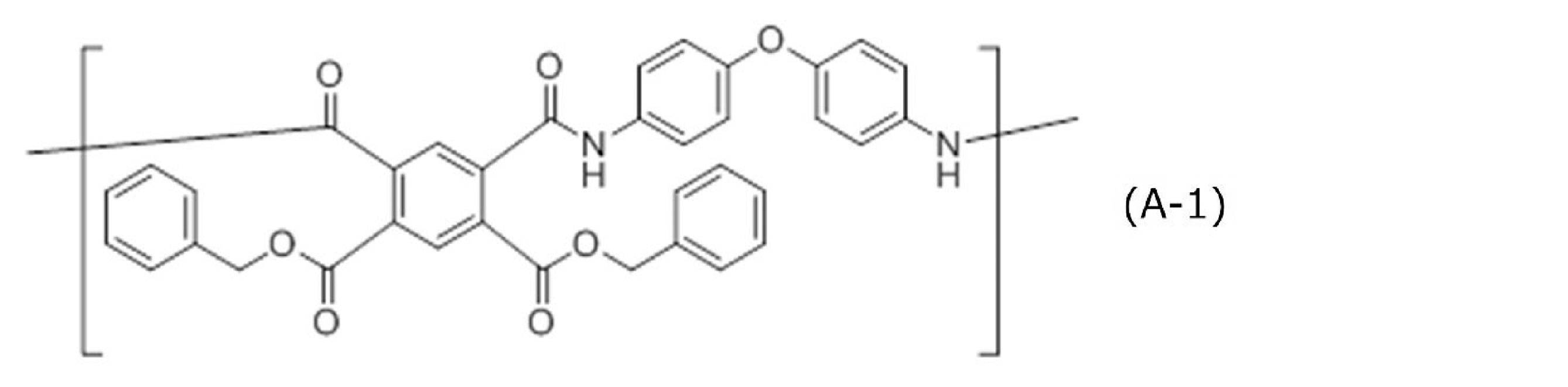
<合成例1>
〔ピロメリット酸二無水物、4,4’-ジアミノジフェニルエーテル及びベンジルアルコールからのポリイミド前駆体(A-1:ラジカル重合性基を有さないポリイミド前駆体)の合成〕
14.06g(64.5ミリモル)のピロメリット酸二無水物(140℃で12時間乾燥)と、14.22g(131.58ミリモル)のベンジルアルコールを、50mLのN-メチルピロリドンに懸濁させ、モレキュラーシーブで乾燥させた。懸濁液(含水率76ppm)を100℃で3時間加熱した。反応混合物を室温に冷却し、21.43g(270.9ミリモル)のピリジン及び90mLのN-メチルピロリドンを加えた。次いで、反応混合物を-10℃に冷却し、温度を-10±4℃に保ちながら16.12g(135.5ミリモル)のSOCl2を10分かけて加えた。SOCl2を加えている間、粘度が増加した。50mLのN-メチルピロリドンで希釈した後、反応混合物を室温で2時間撹拌した。次いで、100mLのN-メチルピロリドンに11.08g(58.7ミリモル)の4,4’-ジアミノジフェニルエーテルを溶解させた溶液を、-5~0℃で20分かけて反応混合物に滴下した。次いで、反応混合物を0℃で1時間反応させたのち、エタノールを70g加えて、室温で1晩撹拌した。次いで、5リットルの水の中でポリイミド前駆体を沈殿させ、水-ポリイミド前駆体混合物を5,000rpm(revolutions per minute)の速度で15分間撹拌した。ポリイミド前駆体をろ過して除き、4リットルの水の中で再度30分間撹拌し再びろ過した。次いで、得られたポリイミド前駆体を減圧下で、45℃で3日間乾燥した。このポリイミド前駆体の重量平均分子量は、18,000であった。
<合成例2>
〔ピロメリット酸二無水物、4,4’-ジアミノジフェニルエーテル及び2-ヒドロキシエチルメタクリレートからのポリイミド前駆体(A-2:ラジカル重合性基を有するポリイミド前駆体)の合成〕
14.06g(64.5ミリモル)のピロメリット酸二無水物(140℃で12時間乾燥した)と、16.8g(129ミリモル)の2-ヒドロキシエチルメタクリレートと、0.05gのハイドロキノンと、20.4g(258ミリモル)のピリジンと、100gのダイグライム(ジエチレングリコールジメチルエーテル)を混合し(含水率85ppm)、60℃の温度で18時間撹拌して、ピロメリット酸と2-ヒドロキシエチルメタクリレートのジエステルを製造した。次いで、得られたジエステルをSOCl2により塩素化した後、合成例1と同様の方法で4,4’-ジアミノジフェニルエーテルでポリイミド前駆体に変換し、合成例1と同様の方法でポリイミド前駆体を得た。このポリイミド前駆体の重量平均分子量は、19,000であった。
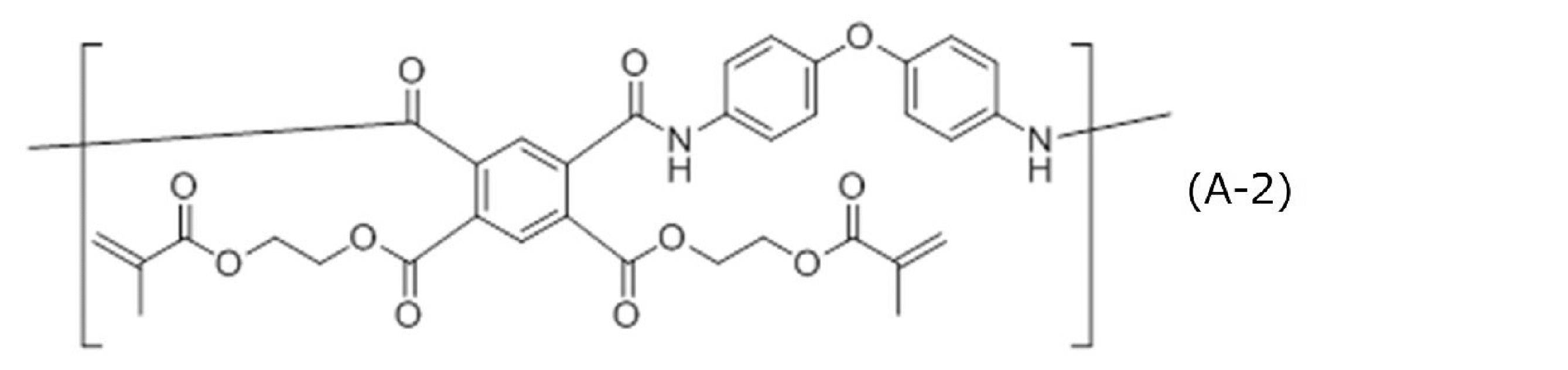
〔ピロメリット酸二無水物、4,4’-ジアミノジフェニルエーテル及び2-ヒドロキシエチルメタクリレートからのポリイミド前駆体(A-2:ラジカル重合性基を有するポリイミド前駆体)の合成〕
14.06g(64.5ミリモル)のピロメリット酸二無水物(140℃で12時間乾燥した)と、16.8g(129ミリモル)の2-ヒドロキシエチルメタクリレートと、0.05gのハイドロキノンと、20.4g(258ミリモル)のピリジンと、100gのダイグライム(ジエチレングリコールジメチルエーテル)を混合し(含水率85ppm)、60℃の温度で18時間撹拌して、ピロメリット酸と2-ヒドロキシエチルメタクリレートのジエステルを製造した。次いで、得られたジエステルをSOCl2により塩素化した後、合成例1と同様の方法で4,4’-ジアミノジフェニルエーテルでポリイミド前駆体に変換し、合成例1と同様の方法でポリイミド前駆体を得た。このポリイミド前駆体の重量平均分子量は、19,000であった。
<合成例3>
〔4,4’-オキシジフタル酸無水物、4,4’-ジアミノジフェニルエーテル及び2-ヒドロキシエチルメタクリレートからのポリイミド前駆体(A-3:ラジカル重合性基を有するポリイミド前駆体)の合成〕
20.0g(64.5ミリモル)の4,4’-オキシジフタル酸無水物(140℃で12時間乾燥した)と、16.8g(129ミリモル)の2-ヒドロキシエチルメタクリレートと、0.05gのハイドロキノンと、20.4g(258ミリモル)のピリジンと、100gのダイグライムとを混合し(含水率95ppm)、60℃の温度で18時間撹拌して、4,4’-オキシジフタル酸と2-ヒドロキシエチルメタクリレートのジエステルを製造した。次いで、得られたジエステルをSOCl2により塩素化した後、合成例1と同様の方法で4,4’-ジアミノジフェニルエーテルでポリイミド前駆体に変換し、合成例1と同様の方法でポリイミド前駆体を得た。このポリイミド前駆体の重量平均分子量は、18,000であった。
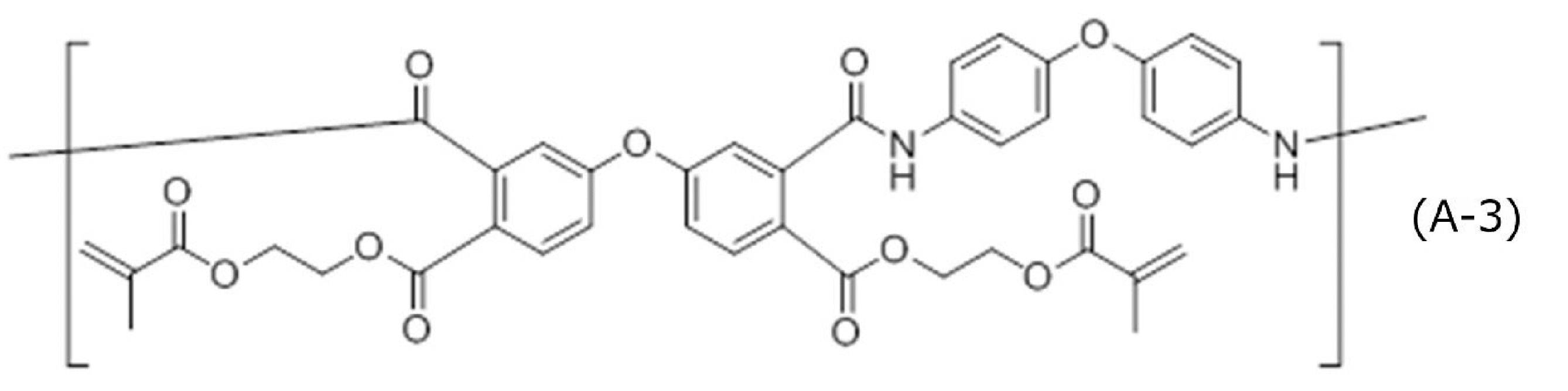
〔4,4’-オキシジフタル酸無水物、4,4’-ジアミノジフェニルエーテル及び2-ヒドロキシエチルメタクリレートからのポリイミド前駆体(A-3:ラジカル重合性基を有するポリイミド前駆体)の合成〕
20.0g(64.5ミリモル)の4,4’-オキシジフタル酸無水物(140℃で12時間乾燥した)と、16.8g(129ミリモル)の2-ヒドロキシエチルメタクリレートと、0.05gのハイドロキノンと、20.4g(258ミリモル)のピリジンと、100gのダイグライムとを混合し(含水率95ppm)、60℃の温度で18時間撹拌して、4,4’-オキシジフタル酸と2-ヒドロキシエチルメタクリレートのジエステルを製造した。次いで、得られたジエステルをSOCl2により塩素化した後、合成例1と同様の方法で4,4’-ジアミノジフェニルエーテルでポリイミド前駆体に変換し、合成例1と同様の方法でポリイミド前駆体を得た。このポリイミド前駆体の重量平均分子量は、18,000であった。
<合成例4>
〔3,3’,4,4’-ビフェニルテトラカルボン酸無水物、4,4’-ジアミノジフェニルエーテル及び2-ヒドロキシエチルメタクリレートからのポリイミド前駆体(A-4:ラジカル重合性基を有するポリイミド前駆体)の合成〕
20.0g(64.5ミリモル)の3,3’,4,4’-ビフェニルテトラカルボン酸無水物(140℃で12時間乾燥した)と、16.8g(129ミリモル)の2-ヒドロキシエチルメタクリレートと、0.05gのハイドロキノンと、20.4g(258ミリモル)のピリジンと、100gのダイグライムとを混合し(含水率88ppm)、60℃の温度で18時間撹拌して、3,3’,4,4’-ビフェニルテトラカルボン酸と2-ヒドロキシエチルメタクリレートのジエステルを製造した。次いで、得られたジエステルをSOCl2により塩素化した後、合成例1と同様の方法で4,4’-ジアミノジフェニルエーテルでポリイミド前駆体に変換し、合成例1と同様の方法でポリイミド前駆体を得た。このポリイミド前駆体の重量平均分子量は、20,000であった。
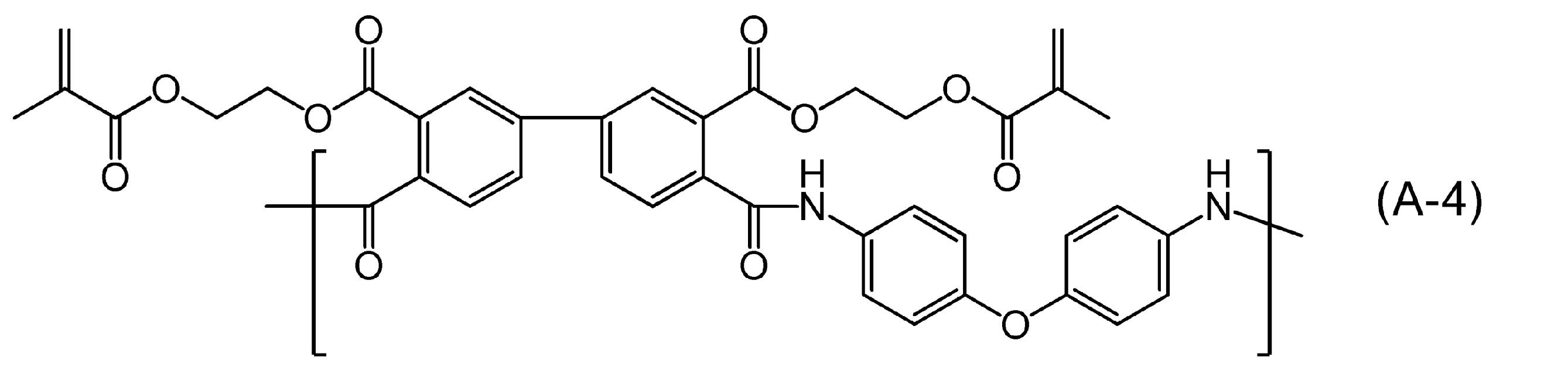
〔3,3’,4,4’-ビフェニルテトラカルボン酸無水物、4,4’-ジアミノジフェニルエーテル及び2-ヒドロキシエチルメタクリレートからのポリイミド前駆体(A-4:ラジカル重合性基を有するポリイミド前駆体)の合成〕
20.0g(64.5ミリモル)の3,3’,4,4’-ビフェニルテトラカルボン酸無水物(140℃で12時間乾燥した)と、16.8g(129ミリモル)の2-ヒドロキシエチルメタクリレートと、0.05gのハイドロキノンと、20.4g(258ミリモル)のピリジンと、100gのダイグライムとを混合し(含水率88ppm)、60℃の温度で18時間撹拌して、3,3’,4,4’-ビフェニルテトラカルボン酸と2-ヒドロキシエチルメタクリレートのジエステルを製造した。次いで、得られたジエステルをSOCl2により塩素化した後、合成例1と同様の方法で4,4’-ジアミノジフェニルエーテルでポリイミド前駆体に変換し、合成例1と同様の方法でポリイミド前駆体を得た。このポリイミド前駆体の重量平均分子量は、20,000であった。
<合成例5>
〔4,4’-オキシジフタル酸無水物、4,4’-ジアミノ-2,2’-ジメチルビフェニル(オルトトリジン)及び2-ヒドロキシエチルメタクリレートからのポリイミド前駆体(A-5:ラジカル重合性基を有するポリイミド前駆体)の合成〕
20.0g(64.5ミリモル)の4,4’-オキシジフタル酸無水物(140℃で12時間乾燥した)と、16.8g(129ミリモル)の2-ヒドロキシエチルメタクリレートと、0.05gのハイドロキノンと、20.4gのピリジン(258ミリモル)と、100gのダイグライムとを混合し(含水率67ppm)、60℃の温度で18時間撹拌して、4,4’-オキシジフタル酸と2-ヒドロキシエチルメタクリレートのジエステルを製造した。次いで、得られたジエステルをSOCl2により塩素化した後、合成例1と同様の方法で4,4’-ジアミノ-2,2’-ジメチルビフェニルでポリイミド前駆体に変換し、合成例1と同様の方法でポリイミド前駆体を得た。このポリイミド前駆体の重量平均分子量は、19,000であった。
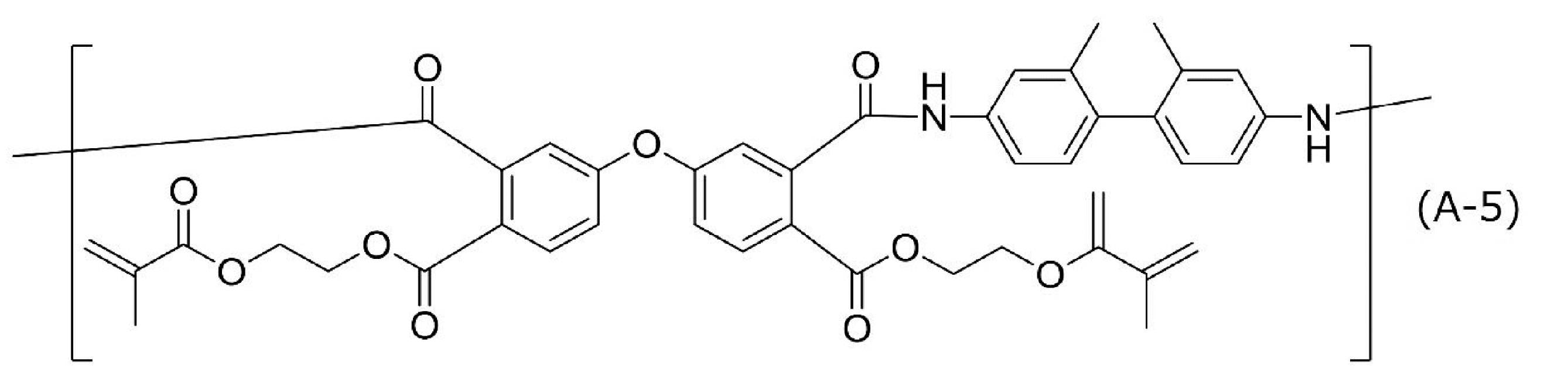
〔4,4’-オキシジフタル酸無水物、4,4’-ジアミノ-2,2’-ジメチルビフェニル(オルトトリジン)及び2-ヒドロキシエチルメタクリレートからのポリイミド前駆体(A-5:ラジカル重合性基を有するポリイミド前駆体)の合成〕
20.0g(64.5ミリモル)の4,4’-オキシジフタル酸無水物(140℃で12時間乾燥した)と、16.8g(129ミリモル)の2-ヒドロキシエチルメタクリレートと、0.05gのハイドロキノンと、20.4gのピリジン(258ミリモル)と、100gのダイグライムとを混合し(含水率67ppm)、60℃の温度で18時間撹拌して、4,4’-オキシジフタル酸と2-ヒドロキシエチルメタクリレートのジエステルを製造した。次いで、得られたジエステルをSOCl2により塩素化した後、合成例1と同様の方法で4,4’-ジアミノ-2,2’-ジメチルビフェニルでポリイミド前駆体に変換し、合成例1と同様の方法でポリイミド前駆体を得た。このポリイミド前駆体の重量平均分子量は、19,000であった。
(分岐型ポリイミド前駆体(特定ポリマー前駆体)の合成)
<合成例6>
〔ピロメリット酸、4,4’-ジアミノジフェニルエーテル及び2-ヒドロキシエチルメタクリレートからのポリイミド前駆体、PA-1〕
16.39g(64.5ミリモル)のピロメリット酸(東京化成工業(株)製、140℃で12時間乾燥した)と21.43g(270.9ミリモル)のピリジン及び150mLのN-メチルピロリドンを溶解した。次いで、合成例2の塩素化前に得られたピロメリット酸無水物/2-ヒドロキシエチルメタクリレートからなるジエステル体を2.80g(6.45ミリモル)加え溶解させた。得られた混合物を-10℃に冷却し、温度を-10±4℃に保ちながら33.84g(284.5ミリモル)のSOCl2を10分かけて加えた。SOCl2により塩素化した後、合成例1と同様の方法で4,4’-ジアミノジフェニルエーテルで分岐型ポリイミド前駆体に変換し、合成例1と同様の方法でポリイミド前駆体を得た。このポリイミド前駆体(PA-1)の重量平均分子量は、23,000であった。
PA-1は下記式(PA-1)により表される3つの繰返し単位が結合した樹脂であると推定される。

式(PA-1)中、各繰返し単位において*と波線部がそれぞれ結合する。
<合成例6>
〔ピロメリット酸、4,4’-ジアミノジフェニルエーテル及び2-ヒドロキシエチルメタクリレートからのポリイミド前駆体、PA-1〕
16.39g(64.5ミリモル)のピロメリット酸(東京化成工業(株)製、140℃で12時間乾燥した)と21.43g(270.9ミリモル)のピリジン及び150mLのN-メチルピロリドンを溶解した。次いで、合成例2の塩素化前に得られたピロメリット酸無水物/2-ヒドロキシエチルメタクリレートからなるジエステル体を2.80g(6.45ミリモル)加え溶解させた。得られた混合物を-10℃に冷却し、温度を-10±4℃に保ちながら33.84g(284.5ミリモル)のSOCl2を10分かけて加えた。SOCl2により塩素化した後、合成例1と同様の方法で4,4’-ジアミノジフェニルエーテルで分岐型ポリイミド前駆体に変換し、合成例1と同様の方法でポリイミド前駆体を得た。このポリイミド前駆体(PA-1)の重量平均分子量は、23,000であった。
PA-1は下記式(PA-1)により表される3つの繰返し単位が結合した樹脂であると推定される。
<合成例7>
〔ピロメリット酸、2-ヒドロキシエチルメタクリレートモノエステル、4,4’-ジアミノジフェニルエーテルからのポリイミド前駆体、PA-2〕
14.06g(64.5ミリモル)のピロメリット酸二無水物と、8.4g(64.5ミリモル)の2-ヒドロキシエチルメタクリレートと、0.05gのハイドロキノンと、20.4gのピリジン(258ミリモル)と、100gのダイグライム(ジエチレングリコールジメチルエーテル)と、水1.16g(64.5ミリモル)と、を混合し、60℃の温度で18時間撹拌した。室温まで冷却後、カラムクロマトグラフィ法(クロロホルム/メタノール)によりピロメリット酸/2-ヒドロキシエチルメタクリレートモノエステル体を単離した(モノエステル体の合成はJ.Org.Chem.2008,73,4929の方法でも合成することができる)。次いで、得られたモノエステル体をSOCl2により塩素化した後、合成例1と同様の方法で4,4’-ジアミノジフェニルエーテルでポリイミド前駆体に変換し、合成例1と同様の方法でポリイミド前駆体(PA-2)を得た。このポリイミド前駆体の重量平均分子量は、23,000であった。
PA-2は下記式(PA-2)により表される2つの繰返し単位が結合した樹脂であると推定される。
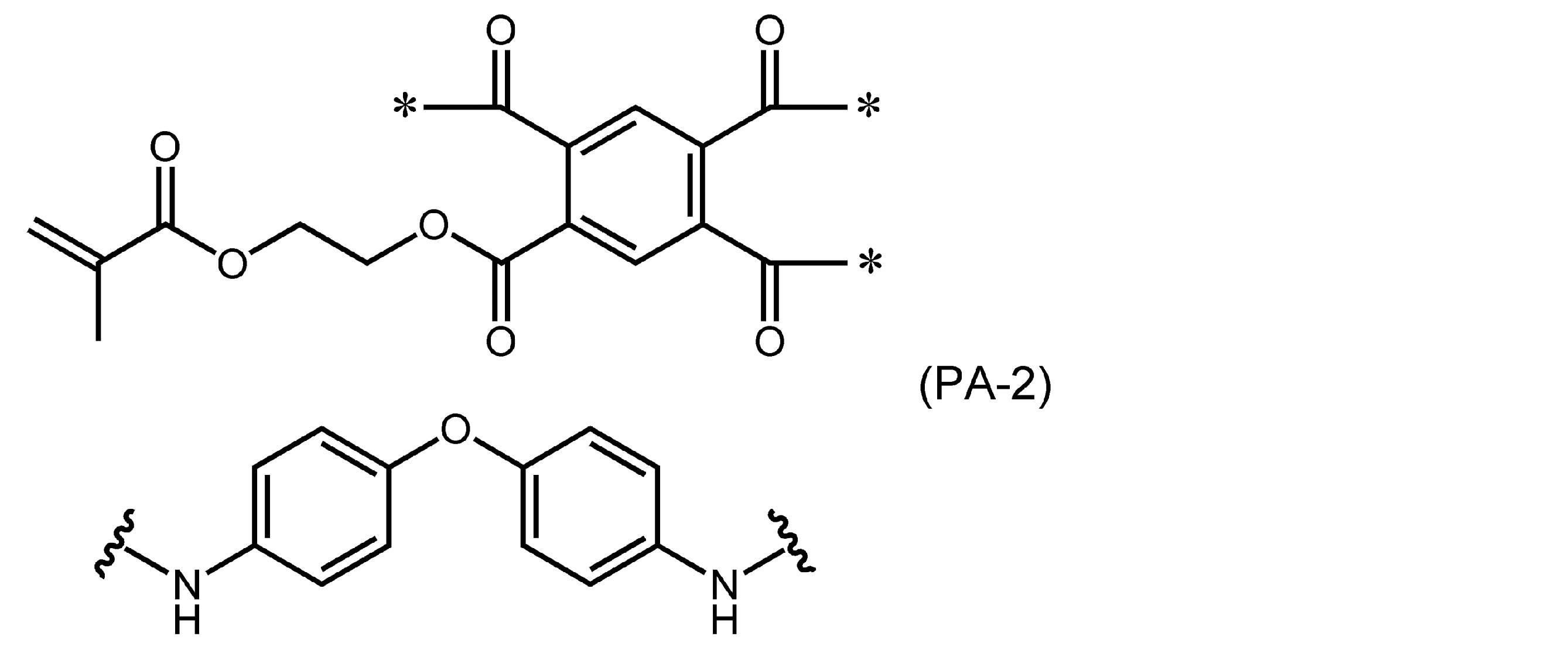
式(PA-2)中、各繰返し単位において*と波線部がそれぞれ結合する。
〔ピロメリット酸、2-ヒドロキシエチルメタクリレートモノエステル、4,4’-ジアミノジフェニルエーテルからのポリイミド前駆体、PA-2〕
14.06g(64.5ミリモル)のピロメリット酸二無水物と、8.4g(64.5ミリモル)の2-ヒドロキシエチルメタクリレートと、0.05gのハイドロキノンと、20.4gのピリジン(258ミリモル)と、100gのダイグライム(ジエチレングリコールジメチルエーテル)と、水1.16g(64.5ミリモル)と、を混合し、60℃の温度で18時間撹拌した。室温まで冷却後、カラムクロマトグラフィ法(クロロホルム/メタノール)によりピロメリット酸/2-ヒドロキシエチルメタクリレートモノエステル体を単離した(モノエステル体の合成はJ.Org.Chem.2008,73,4929の方法でも合成することができる)。次いで、得られたモノエステル体をSOCl2により塩素化した後、合成例1と同様の方法で4,4’-ジアミノジフェニルエーテルでポリイミド前駆体に変換し、合成例1と同様の方法でポリイミド前駆体(PA-2)を得た。このポリイミド前駆体の重量平均分子量は、23,000であった。
PA-2は下記式(PA-2)により表される2つの繰返し単位が結合した樹脂であると推定される。
<合成例8>
〔4,4’-オキシジフタル酸、4,4’-ジアミノジフェニルエーテル及び2-ヒドロキシエチルメタクリレートからのポリイミド前駆体、PA-3〕
20.0g(64.5ミリモル)の4,4’-オキシジフタル酸無水物と、100gのダイグライムと水2.32g(129ミリモル)と、を混合し、60℃の温度で18時間撹拌した。室温まで冷却後、カラムクロマトグラフィ法(クロロホルム/メタノール)により4,4’-オキシジフタル酸を単離した。
22.33g(64.5ミリモル)の4,4’-オキシジフタル酸と21.43g(270.9ミリモル)のピリジン及び150mLのN-メチルピロリドンを溶解した。次いで、合成例2の塩素化前に得られたピロメリット酸無水物/2-ヒドロキシエチルメタクリレートからなるジエステル体を2.80g(6.45ミリモル)加え溶解させた。得られた混合物を-10℃に冷却し、温度を-10±4℃に保ちながら33.84g(284.5ミリモル)のSOCl2を10分かけて加えた。SOCl2により塩素化した後、合成例1と同様の方法で4,4’-ジアミノジフェニルエーテルで分岐型ポリイミド前駆体に変換し、合成例1と同様の方法でポリイミド前駆体を得た。このポリイミド前駆体PA-3の重量平均分子量は、23,500であった。
PA-3は下記式(PA-3)により表される2つの繰返し単位が結合した樹脂であると推定される。
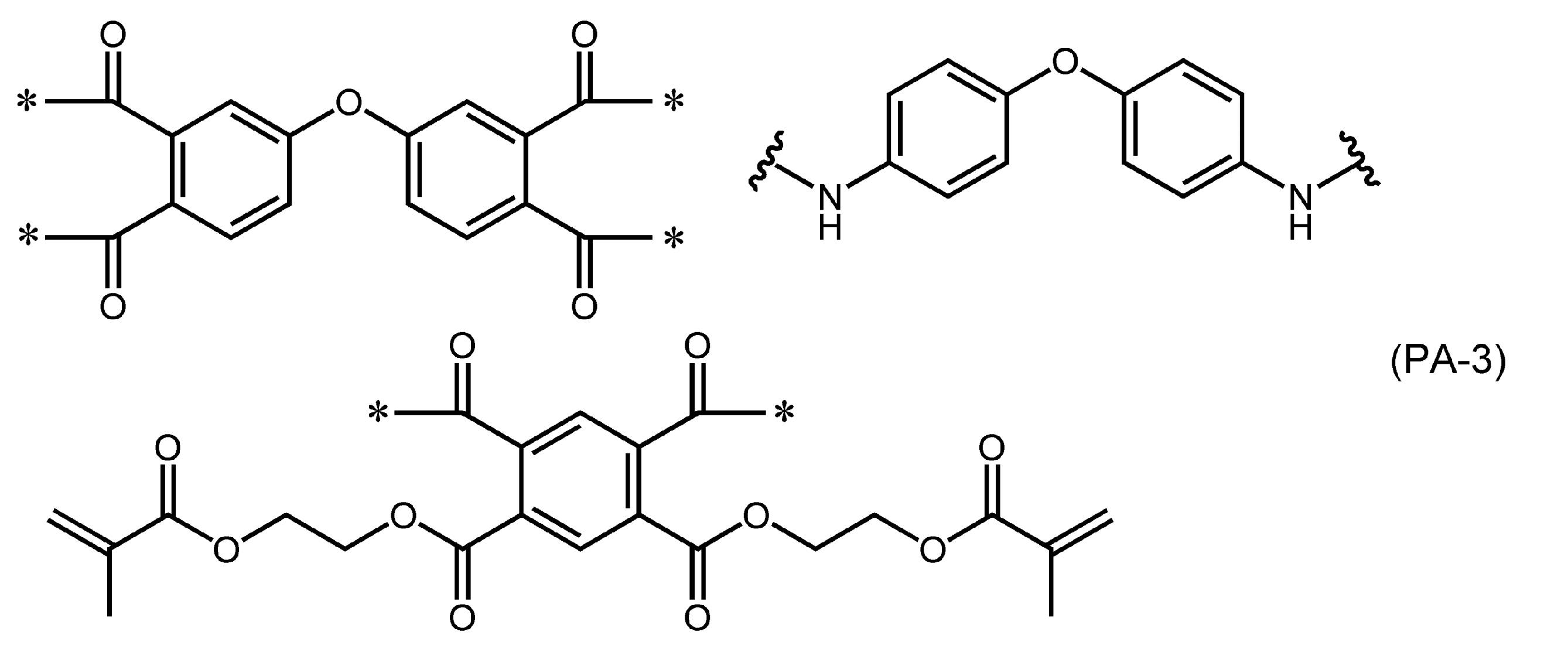
式(PA-3)中、各繰返し単位において*と波線部がそれぞれ結合する。
〔4,4’-オキシジフタル酸、4,4’-ジアミノジフェニルエーテル及び2-ヒドロキシエチルメタクリレートからのポリイミド前駆体、PA-3〕
20.0g(64.5ミリモル)の4,4’-オキシジフタル酸無水物と、100gのダイグライムと水2.32g(129ミリモル)と、を混合し、60℃の温度で18時間撹拌した。室温まで冷却後、カラムクロマトグラフィ法(クロロホルム/メタノール)により4,4’-オキシジフタル酸を単離した。
22.33g(64.5ミリモル)の4,4’-オキシジフタル酸と21.43g(270.9ミリモル)のピリジン及び150mLのN-メチルピロリドンを溶解した。次いで、合成例2の塩素化前に得られたピロメリット酸無水物/2-ヒドロキシエチルメタクリレートからなるジエステル体を2.80g(6.45ミリモル)加え溶解させた。得られた混合物を-10℃に冷却し、温度を-10±4℃に保ちながら33.84g(284.5ミリモル)のSOCl2を10分かけて加えた。SOCl2により塩素化した後、合成例1と同様の方法で4,4’-ジアミノジフェニルエーテルで分岐型ポリイミド前駆体に変換し、合成例1と同様の方法でポリイミド前駆体を得た。このポリイミド前駆体PA-3の重量平均分子量は、23,500であった。
PA-3は下記式(PA-3)により表される2つの繰返し単位が結合した樹脂であると推定される。
<合成例9>
〔4,4’-オキシジフタル酸無水物/2-ヒドロキシエチルメタクリレートモノエステル、及び、4,4’-ジアミノジフェニルエーテルからのポリイミド前駆体、PA-4〕
20.0g(64.5ミリモル)の4,4’-オキシジフタル酸無水物と、8.4g(64.5ミリモル)の2-ヒドロキシエチルメタクリレートと、0.05gのハイドロキノンと、20.4gのピリジン(258ミリモル)と、100gのダイグライムと水2.32g(129ミリモル)と、を混合し、60℃の温度で18時間撹拌した。室温まで冷却後、カラムクロマトグラフィ法(クロロホルム/メタノール)により4,4’-オキシジフタル酸/2-ヒドロキシエチルメタクリレートモノエステル体を単離した。次いで、得られたモノエステル体をSOCl2により塩素化した後、合成例1と同様の方法で4,4’-ジアミノジフェニルエーテルでポリイミド前駆体に変換し、合成例1と同様の方法でポリイミド前駆体を得た。このポリイミド前駆体PA-4の重量平均分子量は、23,000であった。
PA-4は下記式(PA-4)により表される2つの繰返し単位が結合した樹脂であると推定される。

式(PA-4)中、各繰返し単位において*と波線部がそれぞれ結合する。
〔4,4’-オキシジフタル酸無水物/2-ヒドロキシエチルメタクリレートモノエステル、及び、4,4’-ジアミノジフェニルエーテルからのポリイミド前駆体、PA-4〕
20.0g(64.5ミリモル)の4,4’-オキシジフタル酸無水物と、8.4g(64.5ミリモル)の2-ヒドロキシエチルメタクリレートと、0.05gのハイドロキノンと、20.4gのピリジン(258ミリモル)と、100gのダイグライムと水2.32g(129ミリモル)と、を混合し、60℃の温度で18時間撹拌した。室温まで冷却後、カラムクロマトグラフィ法(クロロホルム/メタノール)により4,4’-オキシジフタル酸/2-ヒドロキシエチルメタクリレートモノエステル体を単離した。次いで、得られたモノエステル体をSOCl2により塩素化した後、合成例1と同様の方法で4,4’-ジアミノジフェニルエーテルでポリイミド前駆体に変換し、合成例1と同様の方法でポリイミド前駆体を得た。このポリイミド前駆体PA-4の重量平均分子量は、23,000であった。
PA-4は下記式(PA-4)により表される2つの繰返し単位が結合した樹脂であると推定される。
<合成例10>
〔4,4’-オキシジフタル酸、及び、4,4’-ジアミノジフェニルエーテルからの分岐型ポリマー、PA-5〕
合成例8で単離した4,4’-オキシジフタル酸をSOCl2により塩素化した後、合成例1と同様の方法で4,4’-ジアミノジフェニルエーテルでアミド化後、合成例1と同様の方法で分岐型ポリマーを得た。この分岐型ポリマーPA-5の重量平均分子量は、18,000であった。
PA-5は下記式(PA-5)により表される2つの繰返し単位が結合した樹脂であると推定される。
なお、樹脂PA-5は加熱してもイミドが形成されず、ポリイミド前駆体ではない。
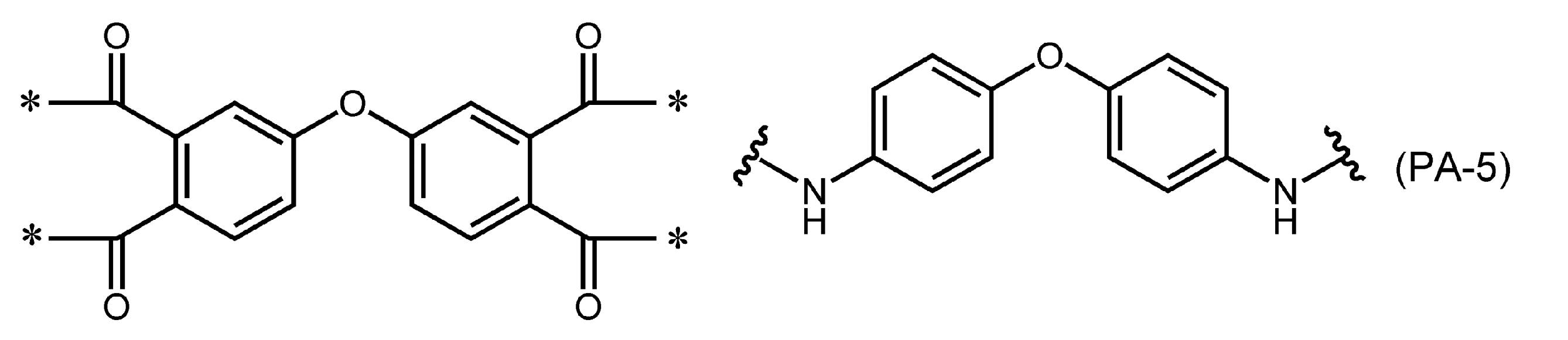
式(PA-5)中、各繰返し単位において*と波線部がそれぞれ結合する。
〔4,4’-オキシジフタル酸、及び、4,4’-ジアミノジフェニルエーテルからの分岐型ポリマー、PA-5〕
合成例8で単離した4,4’-オキシジフタル酸をSOCl2により塩素化した後、合成例1と同様の方法で4,4’-ジアミノジフェニルエーテルでアミド化後、合成例1と同様の方法で分岐型ポリマーを得た。この分岐型ポリマーPA-5の重量平均分子量は、18,000であった。
PA-5は下記式(PA-5)により表される2つの繰返し単位が結合した樹脂であると推定される。
なお、樹脂PA-5は加熱してもイミドが形成されず、ポリイミド前駆体ではない。
<実施例及び比較例>
各実施例及び比較例において、それぞれ、下記表1に記載の成分を混合し、各硬化性樹脂組成物及び比較用組成物を得た。得られた硬化性樹脂組成物及び比較用組成物を、細孔の幅が0.8μmのポリテトラフルオロエチレン製フィルターを通して加圧ろ過した。
表1中、「質量部」の欄の数値は各成分の含有量(質量部)を示している。
また、表1中、「-」の記載は該当する成分を含有していないことを示している。
表1中、「分岐型構造の含有量」の欄の記載は、「組成物の全固形分に対する、ポリイミド前駆体に含まれる分岐型構造の含有量(μmol/g)」を示している。
各実施例及び比較例において、それぞれ、下記表1に記載の成分を混合し、各硬化性樹脂組成物及び比較用組成物を得た。得られた硬化性樹脂組成物及び比較用組成物を、細孔の幅が0.8μmのポリテトラフルオロエチレン製フィルターを通して加圧ろ過した。
表1中、「質量部」の欄の数値は各成分の含有量(質量部)を示している。
また、表1中、「-」の記載は該当する成分を含有していないことを示している。
表1中、「分岐型構造の含有量」の欄の記載は、「組成物の全固形分に対する、ポリイミド前駆体に含まれる分岐型構造の含有量(μmol/g)」を示している。

表1に記載した各成分の詳細は下記の通りである。
〔他のポリマー前駆体〕
・A-1~A-5 :上記で合成したA-1~A-5
・A-1~A-5 :上記で合成したA-1~A-5
〔特定ポリマー前駆体〕
・PA-1~PA-5 :上記で合成したPA-1~PA-5
・PA-1~PA-5 :上記で合成したPA-1~PA-5
〔オニウム塩又は他の熱塩基発生剤〕
・B-1~B-5:下記構造の化合物
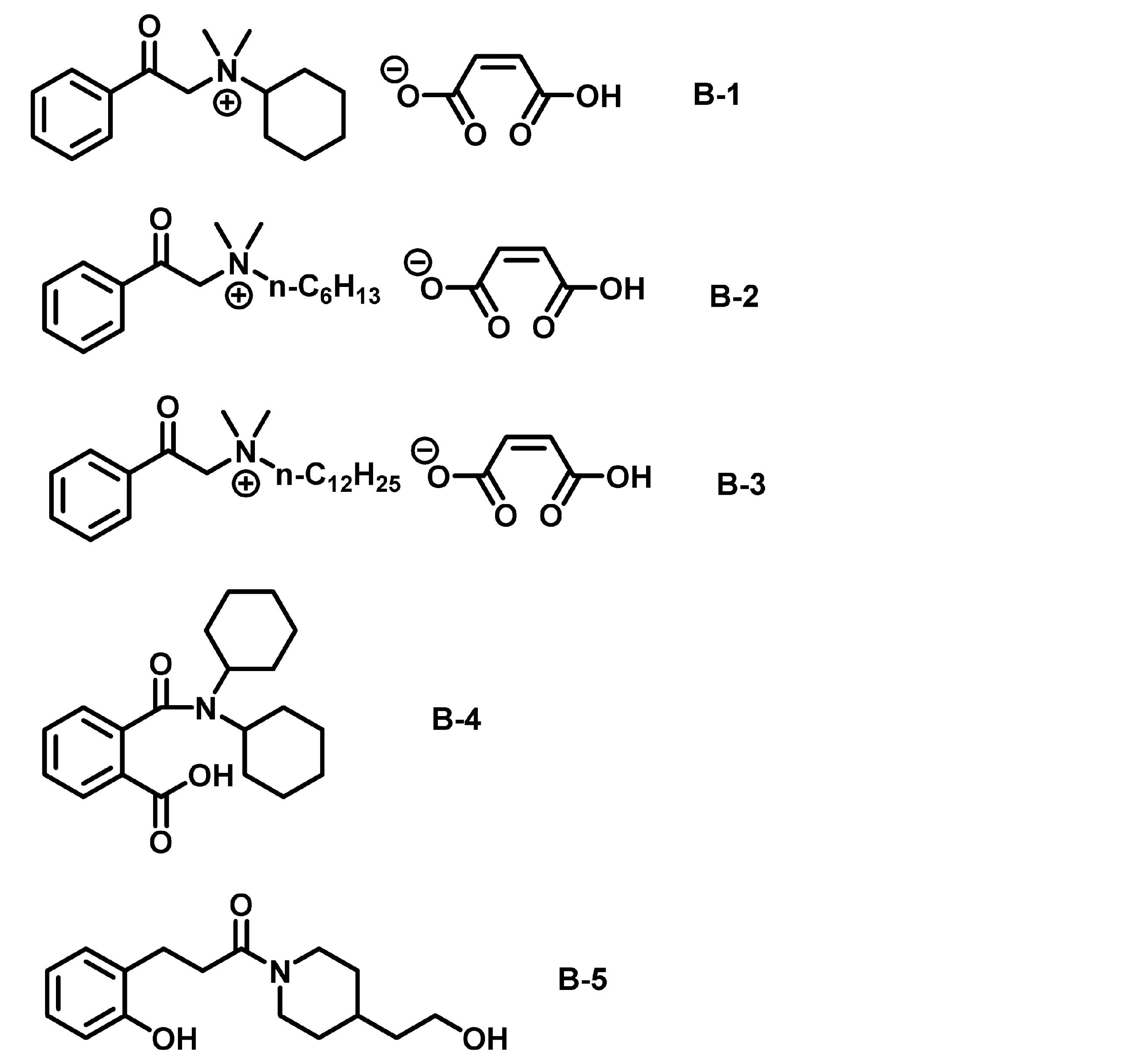
・B-1~B-5:下記構造の化合物
〔ラジカル重合開始剤〕
・C-1:IRGACURE OXE 01(BASF社製)
・C-2:IRGACURE OXE 02(BASF社製)
・C-3:IRGACURE 369(BASF社製)
・C-1:IRGACURE OXE 01(BASF社製)
・C-2:IRGACURE OXE 02(BASF社製)
・C-3:IRGACURE 369(BASF社製)
〔ラジカル重合性化合物〕
・D-1:A-DPH(新中村化学工業(株)製)
・D-2:SR-209(サートマー社製、下記構造の化合物)
・D-3:A-TMMT(新中村化学工業(株)製)

・D-1:A-DPH(新中村化学工業(株)製)
・D-2:SR-209(サートマー社製、下記構造の化合物)
・D-3:A-TMMT(新中村化学工業(株)製)
〔重合禁止剤〕
・E-1:2,6-ジ-tert-ブチル-4-メチルフェノール(東京化成工業(株)製)
・E-2:パラベンゾキノン(東京化成工業(株)製)
・E-3:パラメトキシフェノール(東京化成工業(株)製)
・E-4:2-ニトロソ-1-ナフト-ル(東京化成工業(株)製)
・E-1:2,6-ジ-tert-ブチル-4-メチルフェノール(東京化成工業(株)製)
・E-2:パラベンゾキノン(東京化成工業(株)製)
・E-3:パラメトキシフェノール(東京化成工業(株)製)
・E-4:2-ニトロソ-1-ナフト-ル(東京化成工業(株)製)
〔マイグレーション抑制剤〕
・F-1~F-4:下記構造の化合物

・F-1~F-4:下記構造の化合物
〔金属接着性改良剤〕
・G-1~G-4:下記構造の化合物。以下の構造式中、Etはエチル基を表す。

・G-1~G-4:下記構造の化合物。以下の構造式中、Etはエチル基を表す。
〔溶剤〕
・I-1:γ-ブチロラクトン(三和油化社製)
・I-2:ジメチルスルホキシド(和光純薬工業社製)
・I-3:N-メチル-2-ピロリドン(Ashland社製)
・I-1:γ-ブチロラクトン(三和油化社製)
・I-2:ジメチルスルホキシド(和光純薬工業社製)
・I-3:N-メチル-2-ピロリドン(Ashland社製)
〔添加剤〕
・J-1:N-フェニルジエタノールアミン
・J-1:N-フェニルジエタノールアミン
<評価>
各実施例及び比較例において、それぞれ、表2に記載の硬化性樹脂組成物及び比較用組成物を用いて、保存安定性、解像性、及び、破断伸び率の評価を行った。
各評価における評価方法の詳細を下記に記載する。
各実施例及び比較例において、それぞれ、表2に記載の硬化性樹脂組成物及び比較用組成物を用いて、保存安定性、解像性、及び、破断伸び率の評価を行った。
各評価における評価方法の詳細を下記に記載する。
〔保存安定性〕
各実施例及び比較例において、それぞれ、E型粘度計を用いて各硬化性樹脂組成物又は各比較用組成物の粘度(0日)を測定した。遮光の密閉容器中、25℃で14日間、硬化性樹脂組成物又は比較用組成物を静置した後、再度E型粘度計を用いて上記静置後の各硬化性樹脂組成物又は各比較用組成物の粘度(14日)を測定した。各実施例及び各比較例において、それぞれ、上記粘度(0日)及び上記粘度(14日)の値を用いて、以下の式から、粘度変動率を算出した。粘度変動率が低ければ低い程、保存安定性が高いことを表す。評価は下記評価基準に従い行った。評価結果は表2の「保存安定性」の欄に記載した。
各実施例及び比較例において、それぞれ、E型粘度計を用いて各硬化性樹脂組成物又は各比較用組成物の粘度(0日)を測定した。遮光の密閉容器中、25℃で14日間、硬化性樹脂組成物又は比較用組成物を静置した後、再度E型粘度計を用いて上記静置後の各硬化性樹脂組成物又は各比較用組成物の粘度(14日)を測定した。各実施例及び各比較例において、それぞれ、上記粘度(0日)及び上記粘度(14日)の値を用いて、以下の式から、粘度変動率を算出した。粘度変動率が低ければ低い程、保存安定性が高いことを表す。評価は下記評価基準に従い行った。評価結果は表2の「保存安定性」の欄に記載した。
粘度変動率(%)=100×{1-(粘度(14日)/粘度(0日))}
粘度の測定は25℃で行うこととし、その他はJIS Z 8803:2011に準拠することとした。
-評価基準-
A:粘度変動率が5%以下であった。
B:粘度変動率が5%を超えて10%以下であった。
C:粘度変動率が10%を超えて15%以下であった。
D:粘度変動率が15%を超えた。
粘度の測定は25℃で行うこととし、その他はJIS Z 8803:2011に準拠することとした。
-評価基準-
A:粘度変動率が5%以下であった。
B:粘度変動率が5%を超えて10%以下であった。
C:粘度変動率が10%を超えて15%以下であった。
D:粘度変動率が15%を超えた。
〔解像性〕
各実施例及び比較例において、それぞれ、細孔の幅が0.8μmのフィルターを通して、濾過した後、シリコンウェハ上にスピンコート法により、硬化性樹脂組成物又は比較用組成物を層状に適用して、硬化性樹脂組成物層又は比較用組成物層を形成した。膜厚(未露光部の現像前の膜厚(μm))は20μmとした。
得られた硬化性樹脂組成物層又は比較用組成物層を適用したシリコンウェハをホットプレート上で、100℃で5分間乾燥し、シリコンウェハ上に15μmの厚さの均一な硬化性樹脂組成物層又は比較用組成物層とした。これをシクロペンタノンで60秒間現像し、現像後の膜厚(未露光部の現像後の膜厚(μm))を測定し、下記式により未露光部残膜率を求めた。評価は下記評価基準に従い行った。未露光部残膜率が小さいほど、解像性に優れるといえる。評価結果は表2の「解像性」の欄に記載した。
未露光部残膜率(%)=(未露光部の現像後の膜厚(μm)/未露光部の現像前の膜厚(μm))×100
A: 未露光部残膜率が10%未満であった。
B: 未露光部残膜率が10%以上50%未満であった。
C: 未露光部残膜率が50%以上であった。
各実施例及び比較例において、それぞれ、細孔の幅が0.8μmのフィルターを通して、濾過した後、シリコンウェハ上にスピンコート法により、硬化性樹脂組成物又は比較用組成物を層状に適用して、硬化性樹脂組成物層又は比較用組成物層を形成した。膜厚(未露光部の現像前の膜厚(μm))は20μmとした。
得られた硬化性樹脂組成物層又は比較用組成物層を適用したシリコンウェハをホットプレート上で、100℃で5分間乾燥し、シリコンウェハ上に15μmの厚さの均一な硬化性樹脂組成物層又は比較用組成物層とした。これをシクロペンタノンで60秒間現像し、現像後の膜厚(未露光部の現像後の膜厚(μm))を測定し、下記式により未露光部残膜率を求めた。評価は下記評価基準に従い行った。未露光部残膜率が小さいほど、解像性に優れるといえる。評価結果は表2の「解像性」の欄に記載した。
未露光部残膜率(%)=(未露光部の現像後の膜厚(μm)/未露光部の現像前の膜厚(μm))×100
A: 未露光部残膜率が10%未満であった。
B: 未露光部残膜率が10%以上50%未満であった。
C: 未露光部残膜率が50%以上であった。
〔破断伸び率〕
各実施例及び比較例において、それぞれ、各硬化性樹脂組成物又は比較用組成物を、シリコンウェハ上にスピンコート法により層状に適用して、硬化性樹脂組成物層又は比較用組成物層を形成した。得られた硬化性樹脂組成物層又は比較用組成物層を適用したシリコンウェハをホットプレート上で、100℃で5分間乾燥し、シリコンウェハ上に20μmの厚さの均一な硬化性樹脂組成物層又は比較用組成物層とした。シリコンウェハ上の硬化性樹脂組成物層又は比較用組成物層を、ステッパー(Nikon NSR 2005 i9C)を用いて、500mJ/cm2の露光エネルギーで露光した。上記露光した硬化性樹脂組成物層又は比較用組成物層を、窒素雰囲気下で、10℃/分の昇温速度で昇温し、180℃に達した後、この温度を3時間維持し、硬化後の樹脂層を得た。上記硬化後の樹脂層を4.9%フッ化水素酸溶液に浸漬し、シリコンウェハから樹脂層を剥離し、樹脂膜1を得た。
各実施例及び比較例において、それぞれ、各硬化性樹脂組成物又は比較用組成物を、シリコンウェハ上にスピンコート法により層状に適用して、硬化性樹脂組成物層又は比較用組成物層を形成した。得られた硬化性樹脂組成物層又は比較用組成物層を適用したシリコンウェハをホットプレート上で、100℃で5分間乾燥し、シリコンウェハ上に20μmの厚さの均一な硬化性樹脂組成物層又は比較用組成物層とした。シリコンウェハ上の硬化性樹脂組成物層又は比較用組成物層を、ステッパー(Nikon NSR 2005 i9C)を用いて、500mJ/cm2の露光エネルギーで露光した。上記露光した硬化性樹脂組成物層又は比較用組成物層を、窒素雰囲気下で、10℃/分の昇温速度で昇温し、180℃に達した後、この温度を3時間維持し、硬化後の樹脂層を得た。上記硬化後の樹脂層を4.9%フッ化水素酸溶液に浸漬し、シリコンウェハから樹脂層を剥離し、樹脂膜1を得た。
樹脂膜1の破断伸び率を引張り試験機(テンシロン)を用いてクロスヘッドスピード300mm/分、試料幅10mm、試料長50mmとしてフィルムの長手方向、及び、幅方向について、25℃、65%相対湿度(RH)の環境下にてJIS-K6251:2017に準拠して破断伸び率を測定した。破断伸び率は、Eb(%)=(Lb-L0)/L0×100(Eb:切断時伸び、L0:試験前の試験片の長さ、Lb:試験片が切断した時の試験片の長さ)で算出した。評価は長手方向の破断伸び率を10回測定し、計10個の破断伸び率(Eb)の算術平均値を指標値として行った。評価は下記評価基準に従い行った。上記Ebの数値が大きいほど、破断伸び率に優れるといえる。評価結果は表2の「破断伸び率」の欄に記載した。
-評価基準-
A:上記指標値が60%を超えた。
B:上記指標値が50%を超えて60%以下であった。
C:上記指標値が40%を超えて50%以下であった。
D:上記指標値が40%以下であった。
-評価基準-
A:上記指標値が60%を超えた。
B:上記指標値が50%を超えて60%以下であった。
C:上記指標値が40%を超えて50%以下であった。
D:上記指標値が40%以下であった。
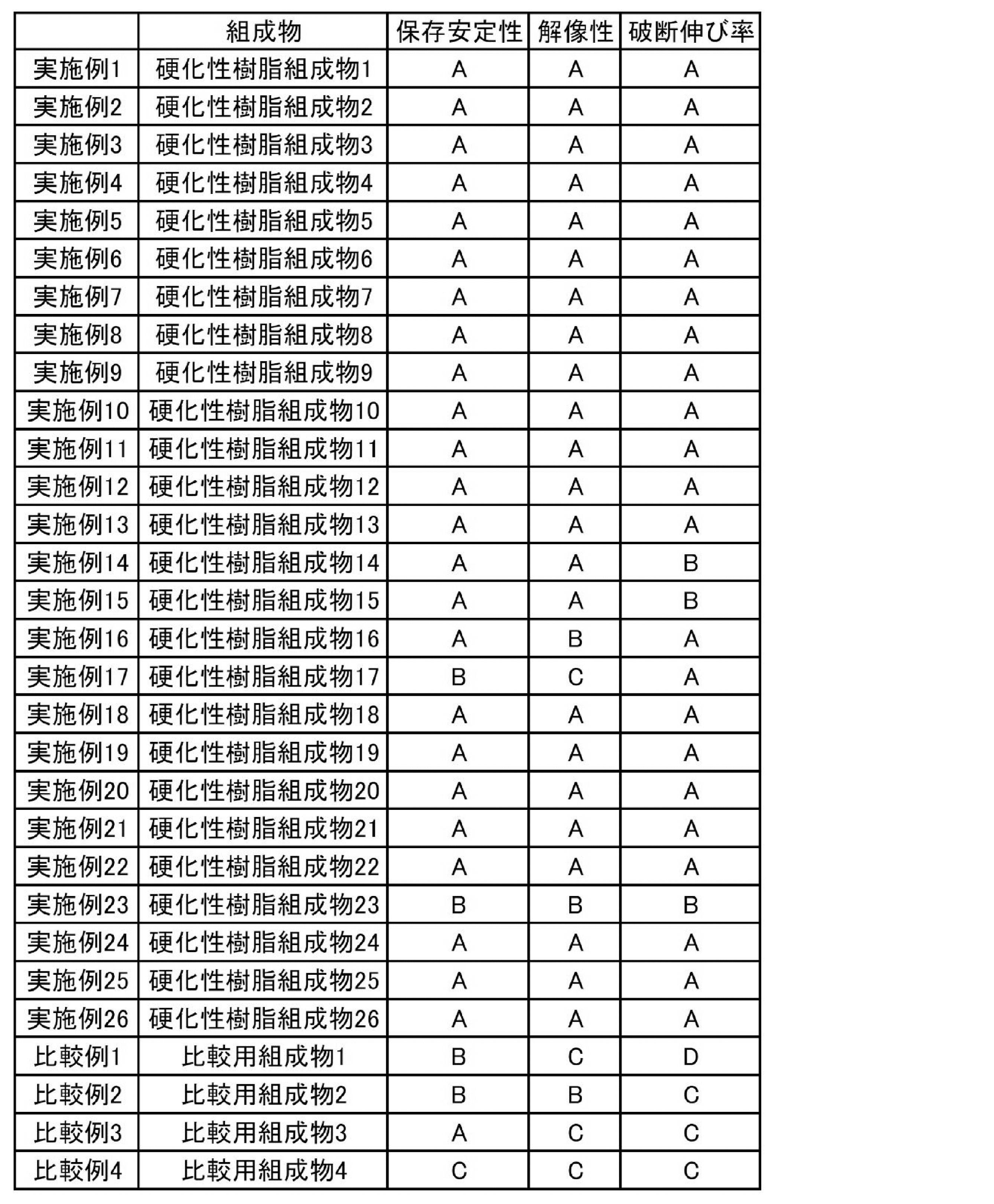
以上の結果から、本発明に係る、特定ポリマー前駆体を含む硬化性樹脂組成物は、得られる硬化膜の破断伸び率に優れることがわかる。
比較例1~4に係る比較用組成物は、特定ポリマー前駆体を含有しない。この比較例1~4に係る硬化性樹脂組成物は、破断伸び率に劣ることが分かる。
比較例1~4に係る比較用組成物は、特定ポリマー前駆体を含有しない。この比較例1~4に係る硬化性樹脂組成物は、破断伸び率に劣ることが分かる。
<実施例101>
実施例1に記載の硬化性樹脂組成物を、銅薄層が形成された樹脂基材の表面に膜厚が 20μmとなるようにスピニングして塗布した。樹脂基材に塗布した硬化性樹脂組成物を、100℃で2分間乾燥した後、ステッパー(ニコン製、NSR1505 i6)を用いて露光した。露光は正方形パターン(長さ100μm、幅100μmの正方形パターン、繰り返し数10、)のマスクを介して、波長365nmで400mJ/cm2の露光量で行い正方形残しパターンを作成した。露光の後、シクロペンタノンで30秒間現像し、PGMEAで20秒間リンスし、パターンを得た。
次いで、230℃で3時間加熱し、再配線層用層間絶縁膜を形成した。この再配線層用層間絶縁膜は、絶縁性に優れていた。また、これらの再配線層用層間絶縁膜を使用して半導体デバイスを製造したところ、問題なく動作することを確認した。
実施例1に記載の硬化性樹脂組成物を、銅薄層が形成された樹脂基材の表面に膜厚が 20μmとなるようにスピニングして塗布した。樹脂基材に塗布した硬化性樹脂組成物を、100℃で2分間乾燥した後、ステッパー(ニコン製、NSR1505 i6)を用いて露光した。露光は正方形パターン(長さ100μm、幅100μmの正方形パターン、繰り返し数10、)のマスクを介して、波長365nmで400mJ/cm2の露光量で行い正方形残しパターンを作成した。露光の後、シクロペンタノンで30秒間現像し、PGMEAで20秒間リンスし、パターンを得た。
次いで、230℃で3時間加熱し、再配線層用層間絶縁膜を形成した。この再配線層用層間絶縁膜は、絶縁性に優れていた。また、これらの再配線層用層間絶縁膜を使用して半導体デバイスを製造したところ、問題なく動作することを確認した。
Claims (17)
- 下記式(A-1)で表される分岐型構造、及び、下記式(A-2)により表される分岐型構造よりなる群から選ばれた少なくとも1種の分岐型構造を有し、かつ、前記分岐型構造に結合する分岐鎖として、繰返し単位を有する分岐鎖を有するポリイミド前駆体を含む
硬化性樹脂組成物;

- 前記ポリイミド前駆体に含まれる前記分岐型構造の含有量が、組成物の全固形分に対し、0.01~10μmol/gである、請求項1に記載の硬化性樹脂組成物。
- 前記ポリイミド前駆体が下記式(1)で表される繰返し単位を有する、請求項1又は2のいずれか1項に記載の硬化性樹脂組成物;
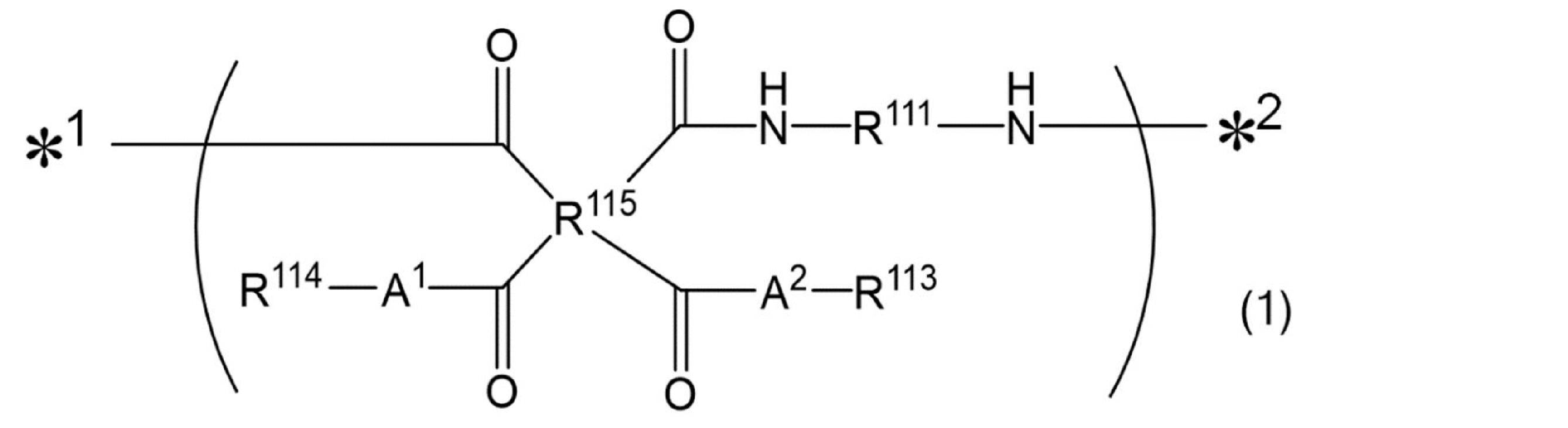
- 前記式(1)におけるR113及びR114の少なくとも一方がラジカル重合性基を含む、請求項3に記載の硬化性樹脂組成物。
- 前記式(1)におけるR115が芳香環を含む基である、請求項3又は4に記載の硬化性樹脂組成物。
- 前記式(1)におけるR111が-Ar0-L0-Ar0-で表される、請求項3~5のいずれか1項に記載の硬化性樹脂組成物;
Ar0はそれぞれ独立に芳香族基を表し、L0は、単結合、フッ素原子で置換されていてもよい炭素数1~10の脂肪族炭化水素基、-O-、-C(=O)-、-S-、-S(=O)2-、-NHC(=O)-及び、これらを2以上組み合わせた基を表す。 - 前記式(1)におけるR111が、下記式(51)又は式(61)で表される、請求項3~6のいずれか1項に記載の硬化性樹脂組成物;
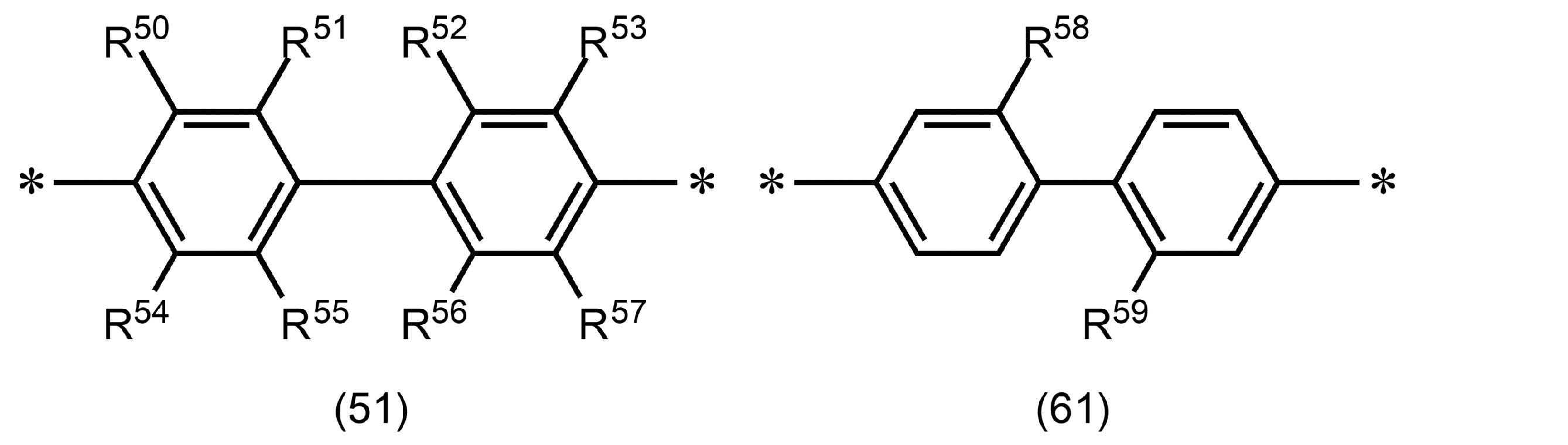
- 前記分岐鎖に含まれる繰返し単位のうち少なくとも1種が、前記ポリイミド前駆体の主鎖に含まれる繰返し単位のうち少なくとも1種と同一である、請求項1~7のいずれか1項に記載の硬化性樹脂組成物。
- ラジカル重合開始剤、ラジカル重合性化合物、シランカップリング剤及びオニウム塩を更に含む、請求項1~8のいずれか1項に記載の硬化性樹脂組成物。
- 前記ポリイミド前駆体とは異なる他の複素環含有ポリマー前駆体を更に含む、請求項1~9のいずれか1項に記載の硬化性樹脂組成物。
- 再配線層用層間絶縁膜の形成に用いられる、請求項1~10のいずれか1項に記載の硬化性樹脂組成物。
- 請求項1~11のいずれか1項に記載の硬化性樹脂組成物を硬化してなる硬化膜。
- 請求項12に記載の硬化膜を2層以上含み、前記硬化膜同士のいずれかの間に金属層を含む積層体。
- 請求項1~11のいずれか1項に記載の硬化性樹脂組成物を基材に適用して膜を形成する膜形成工程を含む、硬化膜の製造方法。
- 前記膜を露光する露光工程及び前記膜を現像する現像工程を含む、請求項14に記載の硬化膜の製造方法。
- 前記膜を80~450℃で加熱する加熱工程を含む、請求項14又は15に記載の硬化膜の製造方法。
- 請求項12に記載の硬化膜又は請求項13に記載の積層体を含む、半導体デバイス。
Priority Applications (1)
| Application Number | Priority Date | Filing Date | Title |
|---|---|---|---|
| JP2021507266A JP7281533B2 (ja) | 2019-03-19 | 2020-03-12 | 硬化性樹脂組成物、硬化膜、積層体、硬化膜の製造方法、及び、半導体デバイス |
Applications Claiming Priority (2)
| Application Number | Priority Date | Filing Date | Title |
|---|---|---|---|
| JP2019-051436 | 2019-03-19 | ||
| JP2019051436 | 2019-03-19 |
Publications (1)
| Publication Number | Publication Date |
|---|---|
| WO2020189481A1 true WO2020189481A1 (ja) | 2020-09-24 |
Family
ID=72519800
Family Applications (1)
| Application Number | Title | Priority Date | Filing Date |
|---|---|---|---|
| PCT/JP2020/010733 Ceased WO2020189481A1 (ja) | 2019-03-19 | 2020-03-12 | 硬化性樹脂組成物、硬化膜、積層体、硬化膜の製造方法、及び、半導体デバイス |
Country Status (3)
| Country | Link |
|---|---|
| JP (1) | JP7281533B2 (ja) |
| TW (1) | TWI882993B (ja) |
| WO (1) | WO2020189481A1 (ja) |
Cited By (6)
| Publication number | Priority date | Publication date | Assignee | Title |
|---|---|---|---|---|
| JP2021173787A (ja) * | 2020-04-20 | 2021-11-01 | 旭化成株式会社 | 感光性樹脂組成物、硬化レリーフパターンの製造方法、硬化レリーフパターン、半導体装置及び表示体装置 |
| WO2022270373A1 (ja) * | 2021-06-21 | 2022-12-29 | 住友化学株式会社 | 組成物 |
| WO2022270374A1 (ja) * | 2021-06-21 | 2022-12-29 | 住友化学株式会社 | 組成物 |
| WO2022270375A1 (ja) * | 2021-06-21 | 2022-12-29 | 住友化学株式会社 | 組成物 |
| WO2025013140A1 (ja) * | 2023-07-07 | 2025-01-16 | 株式会社レゾナック | ポリイミド系樹脂前駆体、感光性樹脂組成物、樹脂膜を製造する方法、及びアミド酸エステル化合物 |
| WO2025013141A1 (ja) * | 2023-07-07 | 2025-01-16 | 株式会社レゾナック | ポリイミド系樹脂前駆体、樹脂組成物、ポリイミド系樹脂を製造する方法、及び樹脂膜を製造する方法 |
Families Citing this family (1)
| Publication number | Priority date | Publication date | Assignee | Title |
|---|---|---|---|---|
| TWI884364B (zh) * | 2022-03-17 | 2025-05-21 | 新應材股份有限公司 | 聚醯亞胺前驅物、其製備方法、感光性樹脂組成物以及硬化物 |
Citations (3)
| Publication number | Priority date | Publication date | Assignee | Title |
|---|---|---|---|---|
| JPH11106509A (ja) * | 1997-10-07 | 1999-04-20 | Unitika Ltd | 感光性ポリイミド前駆体溶液、それから得られるポリイミド塗膜又はポリイミドフィルム、及びそれらの製造方法 |
| JP2016200643A (ja) * | 2015-04-07 | 2016-12-01 | 日立化成デュポンマイクロシステムズ株式会社 | 感光性樹脂組成物、パターン硬化膜の製造方法及び電子部品 |
| WO2017043474A1 (ja) * | 2015-09-11 | 2017-03-16 | 富士フイルム株式会社 | 複素環含有ポリマー前駆体材料の製造方法、および、その応用 |
-
2020
- 2020-03-12 WO PCT/JP2020/010733 patent/WO2020189481A1/ja not_active Ceased
- 2020-03-12 JP JP2021507266A patent/JP7281533B2/ja active Active
- 2020-03-17 TW TW109108819A patent/TWI882993B/zh active
Patent Citations (3)
| Publication number | Priority date | Publication date | Assignee | Title |
|---|---|---|---|---|
| JPH11106509A (ja) * | 1997-10-07 | 1999-04-20 | Unitika Ltd | 感光性ポリイミド前駆体溶液、それから得られるポリイミド塗膜又はポリイミドフィルム、及びそれらの製造方法 |
| JP2016200643A (ja) * | 2015-04-07 | 2016-12-01 | 日立化成デュポンマイクロシステムズ株式会社 | 感光性樹脂組成物、パターン硬化膜の製造方法及び電子部品 |
| WO2017043474A1 (ja) * | 2015-09-11 | 2017-03-16 | 富士フイルム株式会社 | 複素環含有ポリマー前駆体材料の製造方法、および、その応用 |
Cited By (8)
| Publication number | Priority date | Publication date | Assignee | Title |
|---|---|---|---|---|
| JP2021173787A (ja) * | 2020-04-20 | 2021-11-01 | 旭化成株式会社 | 感光性樹脂組成物、硬化レリーフパターンの製造方法、硬化レリーフパターン、半導体装置及び表示体装置 |
| JP7530736B2 (ja) | 2020-04-20 | 2024-08-08 | 旭化成株式会社 | 感光性樹脂組成物、硬化レリーフパターンの製造方法、硬化レリーフパターン、半導体装置及び表示体装置 |
| WO2022270373A1 (ja) * | 2021-06-21 | 2022-12-29 | 住友化学株式会社 | 組成物 |
| WO2022270374A1 (ja) * | 2021-06-21 | 2022-12-29 | 住友化学株式会社 | 組成物 |
| WO2022270375A1 (ja) * | 2021-06-21 | 2022-12-29 | 住友化学株式会社 | 組成物 |
| WO2025013140A1 (ja) * | 2023-07-07 | 2025-01-16 | 株式会社レゾナック | ポリイミド系樹脂前駆体、感光性樹脂組成物、樹脂膜を製造する方法、及びアミド酸エステル化合物 |
| WO2025013141A1 (ja) * | 2023-07-07 | 2025-01-16 | 株式会社レゾナック | ポリイミド系樹脂前駆体、樹脂組成物、ポリイミド系樹脂を製造する方法、及び樹脂膜を製造する方法 |
| WO2025013702A1 (ja) * | 2023-07-07 | 2025-01-16 | 株式会社レゾナック | ポリイミド系樹脂前駆体、樹脂組成物、ポリイミド系樹脂を製造する方法、及び樹脂膜を製造する方法 |
Also Published As
| Publication number | Publication date |
|---|---|
| JP7281533B2 (ja) | 2023-05-25 |
| TW202045590A (zh) | 2020-12-16 |
| JPWO2020189481A1 (ja) | 2021-12-16 |
| TWI882993B (zh) | 2025-05-11 |
Similar Documents
| Publication | Publication Date | Title |
|---|---|---|
| JP6808831B2 (ja) | 感光性樹脂組成物、硬化膜、積層体、硬化膜の製造方法、半導体デバイスおよび化合物 | |
| JP7333383B2 (ja) | 硬化性樹脂組成物、硬化膜、積層体、硬化膜の製造方法、及び、半導体デバイス | |
| JP7281533B2 (ja) | 硬化性樹脂組成物、硬化膜、積層体、硬化膜の製造方法、及び、半導体デバイス | |
| JP7086882B2 (ja) | 硬化性樹脂組成物、硬化膜、積層体、硬化膜の製造方法、及び、半導体デバイス | |
| JP7008732B2 (ja) | 感光性樹脂組成物、樹脂、硬化膜、積層体、硬化膜の製造方法、半導体デバイス | |
| WO2020255859A1 (ja) | 硬化性樹脂組成物、硬化膜、積層体、硬化膜の製造方法、半導体デバイス、及び、ポリイミド、又は、ポリイミド前駆体 | |
| WO2021002383A1 (ja) | 硬化性樹脂組成物、硬化性樹脂組成物の製造方法、硬化膜、積層体、硬化膜の製造方法、及び、半導体デバイス | |
| TWI845668B (zh) | 硬化性樹脂組成物、硬化膜、積層體、硬化膜的製造方法及半導體器件 | |
| JP7477579B2 (ja) | 硬化性樹脂組成物、硬化膜、積層体、硬化膜の製造方法、半導体デバイス、及び、ポリマー前駆体 | |
| JP7351896B2 (ja) | 硬化性樹脂組成物、硬化膜、積層体、硬化膜の製造方法、半導体デバイス、及び、熱塩基発生剤 | |
| JP7277572B2 (ja) | 硬化性樹脂組成物、硬化膜、積層体、硬化膜の製造方法、及び、半導体デバイス | |
| JP2020154205A (ja) | パターン形成方法、硬化性樹脂組成物、膜、硬化膜、積層体、及び、半導体デバイス | |
| JP7078744B2 (ja) | 樹脂組成物、硬化膜、積層体、硬化膜の製造方法、および半導体デバイス | |
| JPWO2020080216A1 (ja) | 硬化膜の製造方法、樹脂組成物、硬化膜、積層体の製造方法および半導体デバイスの製造方法 | |
| JPWO2020196363A1 (ja) | 硬化性樹脂組成物、硬化膜、積層体、硬化膜の製造方法、及び、半導体デバイス | |
| JP7023379B2 (ja) | 樹脂組成物、硬化膜、積層体、硬化膜の製造方法、および半導体デバイス | |
| WO2020255825A1 (ja) | 硬化性樹脂組成物、硬化膜、積層体、硬化膜の製造方法、半導体デバイス、及び、ポリイミド、ポリベンゾオキサゾール、ポリイミド前駆体、又は、ポリベンゾオキサゾール前駆体 | |
| WO2020262227A1 (ja) | 硬化性樹脂組成物、硬化膜、積層体、硬化膜の製造方法、及び、半導体デバイス | |
| JP7426375B2 (ja) | 硬化性樹脂組成物、硬化膜、積層体、硬化膜の製造方法、半導体デバイス、及び、熱塩基発生剤 | |
| JP7334248B2 (ja) | 硬化性樹脂組成物、硬化膜、積層体、硬化膜の製造方法、及び、半導体デバイス |
Legal Events
| Date | Code | Title | Description |
|---|---|---|---|
| 121 | Ep: the epo has been informed by wipo that ep was designated in this application |
Ref document number: 20773225 Country of ref document: EP Kind code of ref document: A1 |
|
| ENP | Entry into the national phase |
Ref document number: 2021507266 Country of ref document: JP Kind code of ref document: A |
|
| NENP | Non-entry into the national phase |
Ref country code: DE |
|
| 122 | Ep: pct application non-entry in european phase |
Ref document number: 20773225 Country of ref document: EP Kind code of ref document: A1 |