WO2020179655A1 - 防振ゴム用ゴム組成物及び防振ゴム製品 - Google Patents
防振ゴム用ゴム組成物及び防振ゴム製品 Download PDFInfo
- Publication number
- WO2020179655A1 WO2020179655A1 PCT/JP2020/008254 JP2020008254W WO2020179655A1 WO 2020179655 A1 WO2020179655 A1 WO 2020179655A1 JP 2020008254 W JP2020008254 W JP 2020008254W WO 2020179655 A1 WO2020179655 A1 WO 2020179655A1
- Authority
- WO
- WIPO (PCT)
- Prior art keywords
- rubber
- mass
- component
- vibration
- parts
- Prior art date
- Legal status (The legal status is an assumption and is not a legal conclusion. Google has not performed a legal analysis and makes no representation as to the accuracy of the status listed.)
- Ceased
Links
Classifications
-
- C—CHEMISTRY; METALLURGY
- C08—ORGANIC MACROMOLECULAR COMPOUNDS; THEIR PREPARATION OR CHEMICAL WORKING-UP; COMPOSITIONS BASED THEREON
- C08K—Use of inorganic or non-macromolecular organic substances as compounding ingredients
- C08K3/00—Use of inorganic substances as compounding ingredients
- C08K3/02—Elements
- C08K3/04—Carbon
-
- C—CHEMISTRY; METALLURGY
- C08—ORGANIC MACROMOLECULAR COMPOUNDS; THEIR PREPARATION OR CHEMICAL WORKING-UP; COMPOSITIONS BASED THEREON
- C08L—COMPOSITIONS OF MACROMOLECULAR COMPOUNDS
- C08L9/00—Compositions of homopolymers or copolymers of conjugated diene hydrocarbons
- C08L9/06—Copolymers with styrene
Definitions
- the present invention is a rubber composition for anti-vibration rubber used in anti-vibration rubber products for vehicles, anti-vibration rubber products for railways, air springs, and particularly anti-vibration rubber products for automobiles such as torsional dampers, engine mounts, and muffler hangers.
- Anti-vibration rubber products are placed in various vehicles, such as automobiles, at locations that generate vibration and noise in order to improve passenger comfort.
- anti-vibration rubber is used for components such as torsional dampers, engine mounts, and muffler hangers. This absorbs the vibration when the engine is driven, and reduces the intrusion of vibration and noise into the room and the diffusion of noise to the surrounding environment.
- the anti-vibration rubber used for such an application is interposed for a member constituting a vibration or shock transmission system, and has both excellent physical properties with excellent anti-vibration property and sufficient durability, and especially for vibration absorption. From the viewpoint, rubber loss (tan ⁇ ) is required to be high, that is, high loss property is required (for example, Patent Document 1).
- Patent Document 2 Another related prior art documents include tire rubber compositions described in Patent Document 2 below.
- the present invention has been made in view of the above circumstances, and it is possible to realize high durability not only in the low loss region but also in the high loss region, and to obtain a good low dynamic ratio.
- the purpose is to provide vibration rubber products.
- the present inventor contains at least styrene-butadiene rubber (I) having a polystyrene-equivalent weight average molecular weight (Mw) of 700,000 or more as a rubber component and is polystyrene-equivalent.
- a rubber composition containing liquid styrene-butadiene rubber (II) having a weight average molecular weight (Mw) of 12,000 or less and carbon black as a filler the total amount of vinyl bonds in the above components (I) and (II).
- the present invention provides the following rubber composition for vibration damping rubber and vibration damping rubber product.
- 1. Filled with liquid styrene-butadiene rubber (II) containing at least styrene-butadiene rubber (I) having a polystyrene-equivalent weight average molecular weight of 700,000 or more and having a polystyrene-equivalent weight average molecular weight of 12,000 or less as a rubber component.
- An anti-vibration rubber composition containing carbon black as an agent wherein the total amount of vinyl bond content in the above-mentioned component (I) and the above-mentioned (II) is 100 mass in total of the above-mentioned (I) component and the above (II) component.
- the rubber composition for vibration-proof rubber is 25% by mass or more with respect to%, and the blending amount of the carbon black exceeds 40 parts by mass and 110 parts by mass or less with respect to 100 parts by mass of the rubber component. Stuff. 2.
- the rubber composition for anti-vibration rubber according to 1 above wherein the polystyrene-equivalent number average molecular weight (Mn) of the liquid styrene-butadiene rubber (II) is 5,000 or less. 3.
- a vibration-proof rubber product containing a vibration-proof rubber member comprising the rubber composition for vibration-proof rubber according to any one of 1 to 5 above as a constituent element.
- the rubber composition for anti-vibration rubber of the present invention high durability can be realized not only in the low loss region but also in the high loss region, and a good low dynamic ratio can be obtained.
- the rubber component of the rubber composition for anti-vibration rubber of the present invention includes styrene-butadiene rubber (I) having a polystyrene-equivalent weight average molecular weight (Mw) of 700,000 or more.
- the "rubber component” refers to a rubber component having a polystyrene-equivalent weight average molecular weight (Mw) of 100,000 or more, and does not include liquid styrene-butadiene rubber. Unless otherwise specified, it means a solid state at 23°C.
- the above-mentioned styrene-butadiene rubber (I) can be a matrix of vibration-proof rubber.
- the polystyrene-equivalent weight average molecular weight (Mw) of the styrene-butadiene rubber (I) is 700,000 or more, preferably 800,000 or more, more preferably 850,000 or more, and the upper limit is not particularly limited. However, it is preferably 1,500,000 or less. If the average molecular weight is 700,000 or more, the entanglement of the molecules with the liquid styrene-butadiene rubber (II) described below occurs, and the durability such as crack growth resistance is increased.
- the above polystyrene-equivalent weight average molecular weight (Mw) means the polystyrene-equivalent weight average molecular weight obtained by gel permeation chromatography (GPC), and is the polystyrene-equivalent of the liquid styrene butadiene rubber (II) described later. The same applies to the weight average molecular weight (Mw).
- the styrene-butadiene rubber (I) is generally composed of a copolymerization of styrene and 1,3-butadiene, and can be prepared by solution polymerization or emulsion polymerization.
- the component ratio of "styrene / vinyl" (St / Vi) of the styrene-butadiene rubber (I) is a mass ratio, preferably 20 to 50/15 to 50, and more preferably 24 to 46/16 to 46.
- styrene / vinyl or “St / Vi”
- styrene (St) means the styrene content in the target styrene-butadiene rubber
- “vinyl (Vi)” is the target.
- the glass transition temperature (Tg) of the styrene-butadiene rubber (I) is preferably ⁇ 60 to ⁇ 20 ° C., more preferably ⁇ 55 to ⁇ 20 ° C.
- the glass transition temperature (Tg) of the styrene-butadiene rubber (I) is preferably lower than the glass transition temperature (Tg) of the styrene-butadiene rubber (II) described later.
- the rubber composition of the present invention contains liquid styrene-butadiene rubber (II) having a polystyrene-equivalent weight average molecular weight (Mw) of 12,000 or less.
- the liquid styrene-butadiene rubber (II) is dispersed in the matrix phase of the vibration-proof rubber.
- the polystyrene reduced weight average molecular weight (Mw) of the liquid styrene-butadiene rubber (II) is preferably 11,000 or less, more preferably 10,000 or less, and the lower limit is not particularly limited, but preferably 5, 000 or more, more preferably 7,000 or more, further preferably 8,000 or more, and most preferably 9,000 or more.
- the average molecular weight is 12,000 or less, the entanglement of molecules with the styrene-butadiene rubber (I) causes the vibration-proof rubber composition to have durability such as crack resistance. Growth is improved.
- the polystyrene equivalent number average molecular weight (Mn) of the liquid styrene-butadiene rubber (II) is preferably 5,000 or less, more preferably 4,500 or less, and the lower limit is preferably 1,000 or more. is there.
- the liquid styrene-butadiene rubber (II) can be prepared by solution polymerization or emulsion polymerization.
- the content ratio of “styrene/vinyl” (St/Vi) of the liquid styrene-butadiene rubber (II) is preferably 20 to 30/20 to 75, more preferably 25 to 30/50 to 70 in terms of mass ratio.
- the glass transition temperature (Tg) of the liquid styrene-butadiene rubber (II) is preferably ⁇ 70 to ⁇ 10° C., more preferably ⁇ 30 to ⁇ 15° C.
- the glass transition temperature (Tg) of the styrene-butadiene rubber (II) is preferably higher than the glass transition temperature (Tg) of the styrene-butadiene rubber (I).
- the difference between the Tg of the liquid styrene-butadiene rubber ((II)) and the Tg of the styrene-butadiene rubber (I) is preferably 30 ° C. or less, more preferably 25 ° C. or less, still more preferably 22 ° C. or less, still more preferably 18. It is within °C, most preferably within 15 °C.
- the components (I) and (II) are entangled with each other and the durability is improved.
- 100% by mass of the total components it is 25% by mass or more, preferably 27% by mass or more, and more preferably 30% by mass or more.
- the compounding amount of the liquid styrene-butadiene rubber (II) is preferably 20 parts by mass or more, and more preferably 25 parts by mass or more with respect to 100 parts by mass of the rubber component.
- the mixing ratio of the component (I) and the component (II) is preferably (I)/(II) (mass ratio) of 100/40 to 100/30, and more preferably 100/40. 40 to 100/35.
- a rubber component other than the above components (I) and (II) can be blended, and for example, a diene rubber may be contained.
- a diene rubber known rubbers can be used and are not particularly limited, but for example, natural rubber (NR); butadiene rubber (BR), isoprene rubber, styrene-isoprene copolymer, and chloroprene rubber. , Acrylonitrile-butadiene rubber, acrylate butadiene rubber, and other diene-based synthetic rubbers; natural rubber such as epoxidized natural rubber, and diene-based synthetic rubbers with modified molecular chain terminals.
- NR natural rubber
- BR butadiene rubber
- isoprene rubber isoprene rubber
- styrene-isoprene copolymer and chloroprene rubber.
- Acrylonitrile-butadiene rubber acrylate butadiene rubber, and other diene-based synthetic rubbers
- the anti-vibration rubber composition of the present invention preferably contains one type of the above-mentioned diene rubber (III) alone or two or more types.
- the above-mentioned diene rubber (III) it is preferable to contain at least one selected from the group consisting of natural rubber, butadiene rubber, and styrene-butadiene rubber, and it is more preferable to contain at least natural rubber.
- the anti-vibration rubber composition of the present invention may contain, as the diene rubber (III), natural rubber alone, or may contain natural rubber and butadiene rubber.
- the blending ratio (I) / (III) of the component (I) and the diene-based rubber (III) is
- the mass ratio is preferably 100/0 to 50/50, more preferably 90/10 to 60/40, and further preferably 90/10 to 70/30.
- the anti-vibration rubber composition of the present invention may contain a rubber (other rubber) other than the diene rubber (III), but from the viewpoint of not impairing the effect of the present invention, the styrene butadiene rubber (I) and the diene rubber are used.
- the content of the styrene-butadiene rubber (I) and the diene rubber in the total rubber of the rubber (III) and the other rubber is preferably 80% by mass or more, and 90% by mass based on the total mass of the rubber.
- the above content is more preferable, the content is more preferably 95% by mass or more, and particularly preferably 100% by mass.
- Examples of other rubbers include acrylic rubber, ethylene-propylene rubber (EPR, EPDM), fluororubber, silicone rubber, urethane rubber, butyl rubber, etc. Only one of these rubbers may be used, or two or more of them may be used. Can be used together.
- the content of the other rubber in the total rubber is preferably 20% by mass or less, more preferably 10% by mass or less, based on the total mass of the rubber, from the viewpoint of not impairing the effects of the present invention. It is more preferably 5% by mass or less, and particularly preferably 0% by mass.
- Carbon black can be added to the rubber composition of the present invention as a filler.
- the carbon black known ones can be used.
- Examples of the carbon black include carbon blacks of SRF class, GPF class, FEF class, HAF class, ISAF class, SAF class, FT class, MT class and the like, and in particular, high loss property and durability.
- SAF grade or ISAF grade can be preferably used from the viewpoint of compatibility with both.
- these carbon blacks may be used alone or in combination of two or more.
- the blending amount of these carbon blacks is appropriately selected according to the type of carbon black to be used, but from the viewpoint of achieving both high loss property and durability and maintaining a low dynamic ratio, 100 parts by mass of the rubber component is added. On the other hand, it is more than 40 parts by mass, preferably 45 parts by mass or more, and more preferably 50 parts by mass or more.
- the upper limit is 110 parts by mass or less, preferably 100 parts by mass or less.
- Sulfur can be added to the rubber composition of the present invention.
- the total amount of sulfur blended is preferably 0.1 to 5 parts by mass, preferably 0.3 to 3.0 parts by mass with respect to 100 parts by mass of the rubber component.
- a vulcanization accelerator may be added to the rubber composition of the present invention.
- the vulcanization accelerator include 2-mercaptobenzothiazole, dibenzothiazyl disulfide, N-cyclohexyl-2-benzothiazyl sulfenamide, Nt-butyl-2-benzothiazyl sulfenamide, N- Benzothiazole-based vulcanization accelerators such as t-butyl-2-benzothiazylsulfenamide; guanidine-based vulcanization accelerators such as diphenylguanidine; tetramethylthiuram disulfide, tetrabutylthiuram disulfide, tetradodecylthiuram disulfide, tetra Examples thereof include thiuram vulcanization accelerators such as octyl thiuram disulfide and tetrabenzyl thiuram disulfide; dithiocarbamate
- sulfenamide type thiuram type, thiazole type, guanidine type, dithiocarbamate type
- thiuram and / or thiazole with a relatively high vulcanization promoting capacity
- guanidine and / or sulfenamide with a relatively medium to low vulcanization promoting capacity.
- the combination with the vulcanization accelerator of is preferably adopted.
- a combination of tetramethylthiuram disulfide and N-cyclohexyl-2-benzothiadylsulfenamide, a combination of tetrabutylthiuram disulfide and Nt-butyl-2-benzothiadylsulfenamide, dibenzo Examples include a combination of thiazyl disulfide and diphenylguanidine.
- the compounding amount of the vulcanization accelerator is preferably 0.2 to 10 parts by mass with respect to 100 parts by mass of the rubber component.
- auxiliary agents such as zinc oxide (ZnO) and fatty acids can be blended.
- the fatty acid may be saturated, unsaturated, straight-chain, or branched fatty acid, and the carbon number of the fatty acid is not particularly limited, but may be, for example, 1 to 30 carbon atoms, preferably 15 to 30 fatty acids, more specifically cyclohexanoic acid (cyclohexanecarboxylic acid), naphthenic acid such as alkylcyclopentane having a side chain, hexanoic acid, octanoic acid, decanoic acid (including branched carboxylic acid such as neodecanoic acid), Saturated fatty acids such as dodecanoic acid, tetradecanoic acid, hexadecanoic acid and octadecanoic acid (stearic acid), unsaturated fatty acids such as methacrylic acid, oleic acid, linoleic acid and l
- zinc oxide and stearic acid can be preferably used.
- the amount of these auxiliaries compounded is preferably 1 to 10 parts by mass, more preferably 2 to 7 parts by mass, relative to 100 parts by mass of the rubber component. If the amount is more than 10 parts by mass, workability may be deteriorated and the dynamic ratio may be deteriorated. If it is less than 1 part by mass, vulcanization may be delayed.
- oils can be used and are not particularly limited, but specifically, process oils such as aromatic oil, naphthene oil, paraffin oil, vegetable oils such as coconut oil, synthetic oils such as alkylbenzene oil, and castor oil. Oil etc. can be used.
- naphthene oil can be preferably used. These may be used alone or in combination of two or more.
- the blending amount of oil is not particularly limited, but from the viewpoint of kneading workability, it is preferably 0.1 part by mass or more, more preferably 1 part by mass or more, and further preferably 10 parts by mass with respect to 100 parts by mass of the rubber component.
- Parts or more more preferably 15 parts by mass or more, most preferably 20 parts by mass or more, and the lower limit is preferably 50 parts by mass or less, more preferably 40 parts by mass or less, further preferably 35 parts by mass or less. is there.
- the total amount of the oil contained in the rubber and the oil added separately during the mixing may be within the above range.
- the resin examples include phenol resin, rosin resin, DCPD resin, C5 petroleum resin, C9 petroleum resin, alicyclic petroleum resin, resin obtained by copolymerizing C5 petroleum resin and C9 petroleum resin, xylene resin, and terpen.
- examples include at least one resin selected from the group consisting of resins, ketone resins, polyester polyol resins, and modified resins of these resins. These resins can be blended in a range of less than 10 parts by mass with respect to 100 parts by mass of the rubber component, and preferably 0 parts by mass with respect to 100 parts by mass of the rubber component. That is, it is preferable that the rubber composition does not need to include the resin.
- the antiaging agent known ones can be used and are not particularly limited, and examples thereof include a phenol antiaging agent, an imidazole antiaging agent, and an amine antiaging agent.
- the antiaging agent may be used alone or in combination of two or more kinds.
- the blending amount of the antiaging agent is preferably 0.1 to 10 parts by mass, and more preferably 0.3 to 5 parts by mass with respect to 100 parts by mass of the rubber component.
- waxes, antioxidants (aging inhibitors), fillers, foaming agents, plasticizers that are usually used in the rubber industry are added to the above rubber components, if necessary, within a range that does not impair the effects of the present invention.
- Additives such as agents, oils, lubricants, tackifiers, petroleum-based resins, ultraviolet absorbers, dispersants, compatibilizers, homogenizers, and vulcanization retarders can be appropriately added.
- the mixing method of the above-mentioned respective components there is no particular limitation on the mixing method of the above-mentioned respective components, and all raw materials of the components may be mixed at once and kneaded, or each component may be divided into two stages or three stages. You may mix and knead.
- a kneading machine such as a roll, an internal mixer, a Banbury rotor or the like can be used.
- a known molding machine such as an extrusion molding machine or a press machine may be used.
- the vulcanization conditions for curing the rubber composition are not particularly limited, but vulcanization conditions of usually 140 to 180° C. for 5 to 120 minutes can be adopted.
- the anti-vibration rubber product of the present invention includes an anti-vibration rubber member made of a rubber composition for anti-vibration rubber as a constituent element.
- the anti-vibration rubber product is usually a component in which a rubber material and another member such as metal or resin are brought into contact with each other, and the unvulcanized rubber composition and the above-mentioned separate member are bonded to each other by using an adhesive, if necessary.
- an adhesive if necessary.
- the rubber composition can be vulcanized, and at the same time, a vibration-proof rubber product can be obtained in which the vulcanized rubber and the separate member are bonded and integrated.
- Anti-vibration rubber products may have various adhesives interposed between the vulcanized rubber and the metal, or between the vulcanized rubber and the resin, or directly integrated by fitting without using the adhesive. Can be made.
- anti-vibration rubber products examples include anti-vibration rubber products for vehicles, anti-vibration rubber products for railroads, air springs, air sleeves and anti-vibration rubber products for automobiles.
- vibration-proof rubber products for automobiles specifically, torsional dampers, engine mounts, torque rods, liquid seal mounts, upper mounts, strut mounts, bumper stoppers, muffler hangers, inner and outer cylinder bushes, suspension bushes, dampers, etc. It is suitably applied to couplings, center supports, cabin mounts, member mounts, toe collect bushes, stabilizer bushes, and the like.
- Examples 1 and 3 The compounding composition shown in Table 1 was kneaded, and the rubber compositions for anti-vibration rubber of each of Examples 1 and 3 were vulcanized and cured into a predetermined shape under predetermined conditions to prepare a molded product.
- the obtained molded product was used as an evaluation body for the anti-vibration rubber of the present invention.
- the obtained molded product was evaluated for durability, high loss property and dynamic magnification (Kd/Ks) according to the following contents. The results are shown in Table 2.
- Example 2 Comparative Examples 1 to 4
- the compounding composition shown in Table 1 is kneaded, and the rubber compositions for anti-vibration rubber of Examples 2 and Comparative Examples 1 to 4 are vulcanized and cured into a predetermined shape under predetermined conditions to prepare a molded product.
- the obtained molded product is used as an evaluation body of the anti-vibration rubber of the present invention.
- the durability, high loss property, and dynamic magnification (Kd/Ks) of the obtained molded product are predicted and evaluated by the following contents. The results are shown in Table 2.
- Natural rubber (NR) Natural rubber (NR): “RSS#3"
- SBR Styrene butadiene rubber
- Carbon black ISAF grade carbon black product name "#80” manufactured by Asahi Carbon Co., Ltd. (average particle size: 22 nm, nitrogen absorption specific surface area: 115 m 2 /g, DBP oil supply amount (method A): 113 ml/100 g)
- Zinc Hua Mitsui Mining & Smelting Co., Ltd. zinc oxide type II
- Anti-aging agent RD 2,2,4-Trimethyl-1,2-dihydroquinoline polymer, "Nocrac 224" manufactured by Ouchi Shinko Chemical Industry Co., Ltd.
- Anti-aging agent 6C N- (1,3-dimethylbutyl) -N'-phenyl-p-phenylenediamine, "Ozonone 6C” manufactured by Seiko Kagaku Co., Ltd. Resin Sumitomo Bakelite Co., Ltd., "SUMILITERESIN 217” Oil process oil, "Diana Process NH-70S” manufactured by Idemitsu Kosan Co., Ltd.
- Sulfur oil Sulfur "HK200-5" manufactured by Hosoi Chemical Industry Co., Ltd.
- Vulcanization accelerator CZ N-cyclohexyl-2-benzothiazolylsulfenamide, "NOXCELLER CZ-G” manufactured by Ouchi Shinko Chemical Co., Ltd.
- Vulcanization accelerator DM Di-2-benzothiazolyl disulfide, "Noxeller DM-P” manufactured by Ouchi Shinko Kagaku Co., Ltd.
- Examples 1 to 3 have lower dynamic ratios and durability than Comparative Examples 1 and 2 using styrene-butadiene rubber (I) having a polystyrene-equivalent weight average molecular weight of less than 700,000. Are better. Further, Examples 1 to 3 are superior in low dynamic magnification and durability as compared with Comparative Example 3 using a resin. Further, Examples 1 to 3 are superior in durability in a high loss region as compared with Comparative Example 4 in which liquid SBR is not blended. Comparative Example 4 has a small rubber loss (tan ⁇ ).
Landscapes
- Chemical & Material Sciences (AREA)
- Health & Medical Sciences (AREA)
- Chemical Kinetics & Catalysis (AREA)
- Medicinal Chemistry (AREA)
- Polymers & Plastics (AREA)
- Organic Chemistry (AREA)
- Compositions Of Macromolecular Compounds (AREA)
Abstract
本発明は、ゴム成分として、ポリスチレン換算重量平均分子量(Mw)が700,000以上のスチレンブタジエンゴム(I)を少なくとも含み、かつ、ポリスチレン換算重量平均分子量が12,000以下の液状スチレンブタジエンゴム(II)と、充填剤としてカーボンブラックを含む防振ゴム組成物であって、上記(I)成分及び上記(II)成分中のビニル結合含量の総量が、上記(I)成分及び上記(II)成分の合計100質量%に対して25質量%以上であり、上記カーボンブラックの配合量が上記ゴム成分100質量部に対して40質量部を超え、110質量部以下である防振ゴム用ゴム組成物を提供する。本発明の防振ゴム用ゴム組成物は、低ロス領域のみならず高ロス領域においても高い耐久性を実現でき、良好な低動倍率を得ることができる。
Description
本発明は、車両用防振ゴム製品、鉄道用防振ゴム製品、空気ばね、特に、トーショナルダンパー、エンジンマウント、マフラーハンガー等の自動車用防振ゴム製品に用いられる防振ゴム用ゴム組成物に関する。
防振ゴム製品は、自動車等の各種車両において、搭乗者の快適性を向上させるため、振動や騒音の発生源となる部位に配置されるものである。室内への振動や騒音の侵入を低減するために、例えば、振動や騒音の主たる発生源であるエンジンに対しては、トーショナルダンパー、エンジンマウント、マフラーハンガー等の構成部材に防振ゴムを用いることでエンジン駆動時の振動を吸収し、室内への振動及び騒音の侵入や、周辺環境への騒音の拡散を低減している。
このような用途に使用される防振ゴムには、振動あるいは衝撃伝達系を構成する部材用に介装されて、防振性に優れた物性及び十分な耐久性の両立と、特に振動吸収の観点から、ゴムのロス(tanδ)が高いこと、即ち、高ロス性の付与が要求されている(例えば特許文献1)。
防振ゴムを高ロス化させる手法としては、例えば、ゴム組成物にフィラーや樹脂を高充填する技術が考えられる。しかし、フィラーや樹脂の高充填は高ロス性を達成できるものの、耐久性や耐へたり性が悪化してしまう傾向がある。このため、高ロス性と耐久性との両立は困難である。また、ゴム組成物にフィラーや樹脂を高充填すると、動倍率が大幅に悪化してしまう。
そのほかの関連する先行技術文献としては、以下の特許文献2に記載されたタイヤ用ゴム組成物が挙げられる。
本発明は、上記事情に鑑みなされたもので、低ロス領域のみならず高ロス領域においても高い耐久性を実現でき、良好な低動倍率を得ることができる防振ゴム用ゴム組成物及び防振ゴム製品を提供することを目的とする。
本発明者は、上記目的を達成するため鋭意検討を重ねた結果、ゴム成分として、ポリスチレン換算重量平均分子量(Mw)が700,000以上のスチレンブタジエンゴム(I)を少なくとも含み、かつ、ポリスチレン換算重量平均分子量(Mw)が12,000以下の液状スチレンブタジエンゴム(II)と、充填剤としてカーボンブラックを含むゴム組成物において、上記(I)成分及び(II)成分中のビニル結合含量の総量を特定範囲で用いると共に、充填材として用いるカーボンブラックを特定範囲の配合量で配合することにより、低ロス領域のみならず高ロス領域においても高い耐久性を実現でき、低動倍率も良好に維持できることを見出した。
即ち、防振ゴム用ゴム組成物において、フィラーのみでは達成できない高ロス性を得るために樹脂を大量に配合すると、耐久性(例えば、耐亀裂性)と動倍率とが大きく低下する。そこで、樹脂ではなく特定の液状ゴムを配合することで、分子鎖の絡み合いを増大させ、エネルギー散逸を高めることにより、高ロス性を維持しつつ、耐久性と動倍率とを両立し得ることが分かった。本発明は、かかる知見に基づいて完成したものである。
従って、本発明は、下記の防振ゴム用ゴム組成物及び防振ゴム製品を提供する。
1.ゴム成分として、ポリスチレン換算重量平均分子量が700,000以上のスチレンブタジエンゴム(I)を少なくとも含み、かつ、ポリスチレン換算重量平均分子量が12,000以下の液状スチレンブタジエンゴム(II)と、充填剤としてカーボンブラックを含む防振ゴム組成物であって、上記(I)成分及び上記(II)成分中のビニル結合含量の総量が、上記(I)成分及び上記(II)成分の合計100質量%に対して25質量%以上であり、上記カーボンブラックの配合量が上記ゴム成分100質量部に対して40質量部を超え、110質量部以下であることを特徴とする防振ゴム用ゴム組成物。
2.上記液状スチレンブタジエンゴム(II)のポリスチレン換算数平均分子量(Mn)が、5,000以下である上記1記載の防振ゴム用ゴム組成物。
3.上記液状スチレンブタジエンゴム(II)の配合量は、上記スチレンブタジエンゴム(I)100質量部に対して35質量部以上である上記1又は2記載の防振ゴム用ゴム組成物。
4.上記カーボンブラックは、JIS K 6217-2:2001に準拠した窒素吸着比表面積が90~150m2/gである上記1~3のいずれかに記載の防振ゴム用ゴム組成物。
5.上記カーボンブラックが、SAF級又はISAF級である上記1~4のいずれかに記載の防振ゴム用ゴム組成物。
6.上記1~5のいずれかに記載の防振ゴム用ゴム組成物からなる防振ゴム部材を構成要素として含む防振ゴム製品。
1.ゴム成分として、ポリスチレン換算重量平均分子量が700,000以上のスチレンブタジエンゴム(I)を少なくとも含み、かつ、ポリスチレン換算重量平均分子量が12,000以下の液状スチレンブタジエンゴム(II)と、充填剤としてカーボンブラックを含む防振ゴム組成物であって、上記(I)成分及び上記(II)成分中のビニル結合含量の総量が、上記(I)成分及び上記(II)成分の合計100質量%に対して25質量%以上であり、上記カーボンブラックの配合量が上記ゴム成分100質量部に対して40質量部を超え、110質量部以下であることを特徴とする防振ゴム用ゴム組成物。
2.上記液状スチレンブタジエンゴム(II)のポリスチレン換算数平均分子量(Mn)が、5,000以下である上記1記載の防振ゴム用ゴム組成物。
3.上記液状スチレンブタジエンゴム(II)の配合量は、上記スチレンブタジエンゴム(I)100質量部に対して35質量部以上である上記1又は2記載の防振ゴム用ゴム組成物。
4.上記カーボンブラックは、JIS K 6217-2:2001に準拠した窒素吸着比表面積が90~150m2/gである上記1~3のいずれかに記載の防振ゴム用ゴム組成物。
5.上記カーボンブラックが、SAF級又はISAF級である上記1~4のいずれかに記載の防振ゴム用ゴム組成物。
6.上記1~5のいずれかに記載の防振ゴム用ゴム組成物からなる防振ゴム部材を構成要素として含む防振ゴム製品。
本発明の防振ゴム用ゴム組成物によれば、低ロス領域のみならず高ロス領域においても高い耐久性を実現でき、良好な低動倍率を得ることができる。
以下、本発明につき、更に詳しく説明する。
本発明の防振ゴム用ゴム組成物のゴム成分には、ポリスチレン換算重量平均分子量(Mw)が700,000以上のスチレンブタジエンゴム(I)が含まれる。なお、本発明において、「ゴム成分」とは、ポリスチレン換算重量平均分子量(Mw)が100,000以上のゴム成分を指すものであり、液状スチレンブタジエンゴムは含まれない。特に性状の規定がない場合は、23℃で固体状のものを指す。
本発明の防振ゴム用ゴム組成物のゴム成分には、ポリスチレン換算重量平均分子量(Mw)が700,000以上のスチレンブタジエンゴム(I)が含まれる。なお、本発明において、「ゴム成分」とは、ポリスチレン換算重量平均分子量(Mw)が100,000以上のゴム成分を指すものであり、液状スチレンブタジエンゴムは含まれない。特に性状の規定がない場合は、23℃で固体状のものを指す。
上記スチレンブタジエンゴム(I)は、防振ゴムのマトリックスとなり得る。上記スチレンブタジエンゴム(I)のポリスチレン換算重量平均分子量(Mw)は、700,000以上であり、好ましくは800,000以上、より好ましくは850,000以上であり、上限値は、特に制限はないが、好ましくは1,500,000以下である。この平均分子量が700,000以上であれば下記の液状スチレンブタジエンゴム(II)との分子の絡み合いが生じることにより耐亀裂成長性等の耐久性が高くなる。なお、上記のポリスチレン換算重量平均分子量(Mw)は、ゲル浸透クロマトグラフィー(GPC:gel permeation chromatography)により得られたポリスチレン換算重量平均分子量を意味し、後述する液状スチレンブタジエンゴム(II)のポリスチレン換算重量平均分子量(Mw)についても同様である。
上記スチレンブタジエンゴム(I)は、一般に、スチレンと1,3-ブタジエンとの共重合からなり、溶液重合や乳化重合により調製することができる。
上記スチレンブタジエンゴム(I)の「スチレン/ビニル」(St/Vi)の成分比は質量比で、好ましくは20~50/15~50、より好ましくは24~46/16~46である。なお、上記の「スチレン/ビニル」または「St/Vi」において、「スチレン(St)」は、対象とするスチレンブタジエンゴム中のスチレン含有量を意味し、「ビニル(Vi)」は、対象とするスチレンブタジエンゴム中のビニル結合含量、即ち、スチレンブタジエンゴムのポリマー鎖中に、1、2の位置に組み込まれたブタジエンの質量を意味する。上記の「スチレン/ビニル」(St/Vi)の成分比は、厳密には、「スチレン(質量%)/ビニル(質量%)」または「St(質量%)/Vi(質量%)」である。以下の記載においても同様である。
上記スチレンブタジエンゴム(I)のガラス転移温度(Tg)は、好ましくは-60~-20℃、より好ましくは-55~-20℃である。また、上記スチレンブタジエンゴム(I)は、そのガラス転移温度(Tg)が後述するスチレンブタジエンゴム(II)のガラス転移温度(Tg)より低いことが好ましい。
本発明のゴム組成物には、ポリスチレン換算重量平均分子量(Mw)が12,000以下の液状スチレンブタジエンゴム(II)が含まれる。上記液状スチレンブタジエンゴム(II)は、防振ゴムのマトリックス相に分散するものである。上記液状スチレンブタジエンゴム(II)のポリスチレン換算重量平均分子量(Mw)は、好ましくは11,000以下、より好ましくは10,000以下であり、下限値は、特に制限はないが、好ましくは5,000以上、より好ましくは7,000以上、さらに好ましくは8,000以上、最も好ましくは9,000以上である。この平均分子量が12,000以下であれば、上記のスチレンブタジエンゴム(I)との分子の絡み合いが生じることで、防振ゴム組成物を硬化後の防振ゴムの耐久性、例えば、耐亀裂成長性が向上する。
また、上記液状スチレンブタジエンゴム(II)のポリスチレン換算数平均分子量(Mn)については、好ましくは5,000以下、より好ましくは4,500以下であり、下限値は、好ましくは1,000以上である。
上記液状スチレンブタジエンゴム(II)は、溶液重合や乳化重合により調製することができる。
上記液状スチレンブタジエンゴム(II)の「スチレン/ビニル」(St/Vi)の含量比は質量比で、好ましくは20~30/20~75、より好ましくは25~30/50~70である。
上記液状スチレンブタジエンゴム(II)のガラス転移温度(Tg)は、好ましくは-70~-10℃、より好ましくは-30~-15℃である。また、上記スチレンブタジエンゴム(II)は、そのガラス転移温度(Tg)が上記のスチレンブタジエンゴム(I)のガラス転移温度(Tg)より高いことが好ましい。上記液状スチレンブタジエンゴム((II)のTgと上記スチレンブタジエンゴム(I)のTgとの差は30℃以内が好ましく、より好ましくは25℃以内、さらに好ましくは22℃以内、より更に好ましくは18℃以内、最も好ましくは15℃以内である。
上記(I)成分及び上記(II)成分中のビニル結合含量の総量については、(I)及び(II)成分の分子の絡み合い及び耐久性向上の点から、上記(I)成分及び上記(II)成分の合計100質量%に対して25質量%以上であり、好ましくは27質量%以上であり、より好ましくは30質量%以上である。
また、液状スチレンブタジエンゴム(II)の配合量は、ゴム成分100質量部に対して、20質量部以上であることが好ましく、より好ましくは25質量部以上である。
また、上記(I)成分と上記(II)成分との配合割合は(I)/(II)(質量比)で100/40~100/30であることが好適であり、より好ましくは100/40~100/35である。
上記の(I)成分及び(II)成分以外のゴム成分を配合することができ、例えば、ジエン系ゴムを含有してもよい。ジエン系ゴムとしては、公知のものを用いることができ、特に制限されるものではないが、例えば、天然ゴム(NR);ブタジエンゴム(BR)、イソプレンゴム、スチレン-イソプレン共重合体、クロロプレンゴム、アクリロニトリル-ブタジエンゴム、アクリレートブタジエンゴム等のジエン系合成ゴム;エポキシ化天然ゴム等の天然ゴム又はジエン系合成ゴムの分子鎖末端が変性されたもの等が挙げられる。
本発明の防振ゴム組成物は、上記のジエン系ゴム(III)の1種単独又は2種以上を含むことが好適である。上記のジエン系ゴム(III)の中でも、天然ゴム、ブタジエンゴム、及びスチレン-ブタジエンゴムからなる群から選択される少なくとも1種を含むことが好ましく、少なくとも天然ゴムを含むことがより好ましい。例えば、本発明の防振ゴム組成物は、ジエン系ゴム(III)として、天然ゴムを単独で含んでいてもよいし、天然ゴム及びブタジエンゴムを含んでいてもよい。
本発明のゴム組成物において、天然ゴム等の上記ジエン系ゴム(III)を含む場合、上記(I)成分と該ジエン系ゴム(III)との配合割合(I)/(III)については、例えば、SBR/NRの場合、質量比で100/0~50/50が好ましく、90/10~60/40がより好ましく、90/10~70/30がさらに好ましい。
本発明の防振ゴム組成物はジエン系ゴム(III)以外のゴム(他のゴム)を含んでいてもよいが、本発明の効果を損なわない観点から、スチレンブタジエンゴム(I)とジエン系ゴム(III)と他のゴムとの全ゴム中における、スチレンブタジエンゴム(I)及びジエン系ゴムの含有量は、ゴム全質量に対して、80質量%以上であることが好ましく、90質量%以上であることがより好ましく、95質量%以上であることが更に好ましく、100質量%であることが特に好ましい。
他のゴムとしては、アクリルゴム、エチレン-プロピレンゴム(EPR、EPDM)、フッ素ゴム、シリコーンゴム、ウレタンゴム、ブチルゴム等が挙げられ、これらの1種のみを用いてもよいし、2種以上を併用することができる。他のゴムの全ゴム中の含有量は、本発明の効果を損なわない観点から、ゴム全質量に対して、20質量%以下であることが好ましく、10質量%以下であることがより好ましく、5質量%以下であることが更に好ましく、0質量%であることが特に好ましい。
本発明のゴム組成物には、充填材として、カーボンブラックを配合することができる。カーボンブラックとしては、公知のものを使用することができる。また、カーボンブラックの窒素吸着比表面積については、JIS K 6217-2:2001に準拠して、その窒素吸着比表面積が90~150m2/gであることが好ましく、より好ましくは110~150m2/g、さらに好ましくは130~150m2/gである。
上記カーボンブラックとしては、例えば、SRF級、GPF級、FEF級、HAF級、ISAF級、SAF級、FT級、MT級等のカーボンブラックを挙げることができるが、特に、高ロス性と耐久性との両立の点から、SAF級又はISAF級を好適に用いることができる。
また、これらのカーボンブラックは、1種を単独で用いてもよく、2種以上を併用してもよい。これらカーボンブラックの配合量は、用いるカーボンブラックの種類に応じて適宜選定されるが、高ロス性と耐久性との両立、更には低動倍率の維持の点から、上記ゴム成分100質量部に対して40質量部を超えるものであり、好ましくは45質量部以上、より好ましくは50質量部以上である。上限値としては、110質量部以下であり、好ましくは100質量部以下である。
本発明のゴム組成物には、硫黄を配合することができる。硫黄の総配合量は、ゴム成分100質量部に対して、好ましくは0.1~5質量部であり、好ましくは0.3~3.0質量部である。
本発明のゴム組成物には、加硫促進剤を配合することができる。加硫促進剤としては、例えば、2-メルカプトベンゾチアゾール、ジベンゾチアジルジスルフィド、N-シクロヘキシル-2-ベンゾチアジルスルフェンアミド、N-t-ブチル-2-ベンゾチアジルスルフェンアミド、N-t-ブチル-2-ベンゾチアジルスルフェンアミド等のベンゾチアゾール系加硫促進剤;ジフェニルグアニジン等のグアニジン系加硫促進剤;テトラメチルチウラムジスルフィド、テトラブチルチウラムジスルフィド、テトラドデシルチウラウムジスルフィド、テトラオクチルチウラウムジスルフィド、テトラベンジルチウラウムジスルフィド等のチウラウム系加硫促進剤;ジメチルジチオカルバミン酸亜鉛等のジチオカルバミン酸塩系;その他ジアルキルジチオリン酸亜鉛などを挙げることができる。
上記の加硫促進剤については、スルフェンアミド系、チウラム系、チアゾール系、グアニジン系、ジチオカルバミン酸塩系等の1種を単独で使用してもよく、2種以上を併用しておもよい。加硫挙動(速度)の調整等のため、加硫促進能力が比較的高いチウラム系及び/又はチアゾール系と、加硫促進能力が比較的中~低程度のグアニジン系及び/又はスルフェンアミド系の加硫促進剤とを組み合わせることが好適に採用される。具体的には、テトラメチルチウラムジスルフィドとN-シクロヘキシル-2-ベンゾチアジルスルフェンアミドとの組合せ、テトラブチルチウラムジスルフィドとN-t-ブチル-2-ベンゾチアジルスルフェンアミドとの組合せ、ジベンゾチアジルジスルフィドとジフェニルグアニジンとの組合せ等が挙げられる。加硫促進剤の配合量は、ゴム成分100質量部に対して、好ましくは0.2~10質量部である。
本発明においては、亜鉛華(ZnO)や脂肪酸等の助剤を配合することができる。脂肪酸としては飽和,不飽和あるいは直鎖状、分岐状のいずれの脂肪酸であってもよく、脂肪酸の炭素数としても特に制限されるものではないが、例えば炭素数1~30、好ましくは15~30の脂肪酸、より具体的にはシクロヘキサン酸(シクロヘキサンカルボン酸)、側鎖を有するアルキルシクロペンタン等のナフテン酸、ヘキサン酸、オクタン酸、デカン酸(ネオデカン酸等の分岐状カルボン酸を含む)、ドデカン酸、テトラデカン酸、ヘキサデカン酸、オクタデカン酸(ステアリン酸)等の飽和脂肪酸、メタクリル酸、オレイン酸、リノール酸、リノレン酸等の不飽和脂肪酸、ロジン、トール油酸、アビエチン酸等の樹脂酸などが挙げられる。これらは1種単独で用いてもよく、2種以上を併用してもよい。本発明においては、亜鉛華及びステアリン酸を好適に用いることができる。これらの助剤の配合量はゴム成分100質量部に対し、好ましくは1~10質量部、より好ましくは2~7質量部である。配合量が10質量部を超えると、作業性の悪化及び動倍率の悪化等を招くおそれがあり、1質量部未満になると、加硫遅延等のおそれがある。
オイルは、公知のものを使用でき、特に制限されないが、具体的には、アロマティック油、ナフテン油、パラフィン油等のプロセスオイルや、やし油等の植物油、アルキルベンゼンオイル等の合成油、ヒマシ油等を使用できる。本発明においては、ナフテン油を好適に用いることができる。これらは1種単独で又は2種以上を組み合わせて用いることができる。オイルの配合量は、特に制限されないが、混練作業性の点から、ゴム成分100質量部に対し、好ましくは0.1質量部以上であり、より好ましくは1質量部以上、さらに好ましくは10質量部以上、よりさらに好ましくは15質量部以上、最も好ましくは20質量部以上であり、下限値としては、好ましくは50質量部以下、より好ましくは40質量部以下、さらに好ましくは35質量部以下である。なお、油展されたゴムを上記ゴム成分に用いる場合は、該ゴムに含有されるオイルと、混合時に別途添加されるオイルとの合計量が上記範囲となればよい。
樹脂としては、フェノール樹脂、ロジン樹脂、DCPD樹脂、C5系石油樹脂、C9系石油樹脂、脂環系石油樹脂、C5系石油樹脂とC9系石油樹脂とを共重合させた樹脂、キシレン樹脂、テルペン樹脂、ケトン樹脂、ポリエステルポリオール樹脂およびこれらの樹脂の変性樹脂からなる群から選択される少なくとも1種の樹脂が例示される。これらの樹脂は、上記ゴム成分100質量部に対して樹脂を10質量部未満の範囲で配合することができ、好ましくは上記ゴム成分100質量部に対して0質量部である。即ち、上記ゴム組成物には上記樹脂を含まなくてもよいことが好ましい。
老化防止剤としては、公知のものを用いることができ、特に制限されないが、フェノール系老化防止剤、イミダゾール系老化防止剤、アミン系老化防止剤などを挙げることができる。老化防止剤は1種又は2種以上を併用することができる。老化防止剤の配合量はゴム成分100質量部に対し、好ましくは0.1~10質量部、より好ましくは0.3~5質量部である。
また、上記ゴム成分に対して、本発明の効果を損なわない範囲で必要に応じて、ゴム工業で通常使用されているワックス類、酸化防止剤(老化防止剤)、充填剤、発泡剤、可塑剤、オイル、滑剤、粘着付与剤、石油系樹脂、紫外線吸収剤、分散剤、相溶化剤、均質化剤、加硫遅延剤等の添加剤を適宜配合することができる。
本発明のゴム組成物を得る際、上記各成分の配合方法に特に制限はなく、全ての成分原料を一度に配合して混練しても良いし、2段階あるいは3段階に分けて各成分を配合して混練を行ってもよい。なお、混練に際してはロール、インターナルミキサー、バンバリーローター等の混練機を用いることができる。更に、シート状や帯状等に成形する際には、押出成型機、プレス機等の公知の成型機を用いればよい。
また、上記ゴム組成物を硬化させる際の加硫条件としては、特に限定されるものはないが、通常140~180℃で、5~120分間の加硫条件を採用することができる。
本発明の防振ゴム製品は、防振ゴム用ゴム組成物からなる防振ゴム部材を構成要素として含む。防振ゴム製品は、通常、ゴム材と金属・樹脂等の別部材とを接触させた構成部材であり、未加硫ゴム組成物と上記別部材とを、必要に応じて接着剤を用いて加熱加圧することにより、上記ゴム組成物を加硫すると同時に、この加硫ゴムと上記別部材とを接着・一体化させた防振ゴム製品を得ることができる。防振ゴム製品は、加硫ゴムと金属との間、或いは、加硫ゴムと樹脂との間に、各種接着剤を介在させてよいし、接着剤を用いずに嵌合等により直接一体化させることができる。
防振ゴム製品としては、例えば、車両用防振ゴム製品、鉄道用防振ゴム製品、空気ばね、エアスリーブ及び自動車用防振ゴム製品等のゴム製品が挙げられる。このうち自動車用防振ゴム製品として、具体的には、トーショナルダンパー、エンジンマウント、トルクロッド、液封マウント、アッパーマウント、ストラットマウント、バンパーストッパー、マフラーハンガー、内外筒ブッシュ、サスペンションブッシュ、ダンパー、カップリング、センターサポート、キャビンマウント、メンバーマウント、トーコレクトブッシュ及びスタビライザーブッシュなどに好適に適用される。
以下、実施例と比較例を示し、本発明を具体的に説明するが、本発明は下記の実施例に制限されるものではない。
〔実施例1,実施例3〕
表1に示す配合組成で混練し、実施例1及び実施例3の各例の防振ゴム用ゴム組成物を所定の条件で所定の形状に加硫硬化させ、成型物を作製した。得られた成型物を本発明の防振ゴムの評価体とした。得られた成型物について、耐久性、高ロス性及び動倍率(Kd/Ks)を下記内容により評価した。その結果を表2に記載する。
表1に示す配合組成で混練し、実施例1及び実施例3の各例の防振ゴム用ゴム組成物を所定の条件で所定の形状に加硫硬化させ、成型物を作製した。得られた成型物を本発明の防振ゴムの評価体とした。得られた成型物について、耐久性、高ロス性及び動倍率(Kd/Ks)を下記内容により評価した。その結果を表2に記載する。
〔実施例2、比較例1~4〕
表1に示す配合組成で混練し、実施例2及び比較例1~4の各例の防振ゴム用ゴム組成物を所定の条件で所定の形状に加硫硬化させ、成型物を作製する。得られた成型物を本発明の防振ゴムの評価体とする。得られた成型物について、耐久性、高ロス性及び動倍率(Kd/Ks)を下記内容により予測評価する。その結果を表2に記載する。
表1に示す配合組成で混練し、実施例2及び比較例1~4の各例の防振ゴム用ゴム組成物を所定の条件で所定の形状に加硫硬化させ、成型物を作製する。得られた成型物を本発明の防振ゴムの評価体とする。得られた成型物について、耐久性、高ロス性及び動倍率(Kd/Ks)を下記内容により予測評価する。その結果を表2に記載する。
[動倍率(Kd/Ks)]
試料となるゴム組成物を、プレス成形(加硫)して円筒状の試験片(直径8mm、高さ6mm)を作製し、この試験片について、動的粘弾性試験機(商品名「Eplexor500N」、GABO社製)を用い、試験温度35℃で下記の方法で、JIS K 6385:2012に準拠して、静バネ定数(Ks)、100Hzで測定した動バネ定数(Kd)及び動倍率(Kd/Ks)を測定した。比較例1で求められた動倍率(Kd/Ks)を100としてインデックス(指数)表示とした。このインデックスの数字が低い程、低動倍率性に優れていることを示す。
試料となるゴム組成物を、プレス成形(加硫)して円筒状の試験片(直径8mm、高さ6mm)を作製し、この試験片について、動的粘弾性試験機(商品名「Eplexor500N」、GABO社製)を用い、試験温度35℃で下記の方法で、JIS K 6385:2012に準拠して、静バネ定数(Ks)、100Hzで測定した動バネ定数(Kd)及び動倍率(Kd/Ks)を測定した。比較例1で求められた動倍率(Kd/Ks)を100としてインデックス(指数)表示とした。このインデックスの数字が低い程、低動倍率性に優れていることを示す。
[高ロス性(tanδ/ヒステリシスロス)]
上記動的粘弾性試験機により、JIS K 6385:2012に準拠して測定した。比較例1で求められたtanδを100としてインデックス(指数)表示とした。このインデックスの数字が高い程、高ロス性に優れていることを示す。
上記動的粘弾性試験機により、JIS K 6385:2012に準拠して測定した。比較例1で求められたtanδを100としてインデックス(指数)表示とした。このインデックスの数字が高い程、高ロス性に優れていることを示す。
[耐久性(伸長疲労耐久性)]
各実施例、比較例で得られたサンプルについて、ダンベル状試験片作成し、35℃で100~300%の一定歪で繰り返し疲労を与え、試験片が破断するまでの繰り返し回数を測定した。各試験ひずみで試験片に与えられた入力エネルギーと各試験ひずみでの破断回数からエネルギー―破断回数換算式を算出した。この換算式により入力エネルギーが1MPaの時の破断回数換算値を耐亀裂成長性として、各それぞれの実施例、比較例のサンプ
ルについて求めた。比較例1で求められた破断回数換算値を100としてインデックス(指数)表示とした。このインデックスの数字が高い程、耐伸張疲労性に優れていることを示す。
各実施例、比較例で得られたサンプルについて、ダンベル状試験片作成し、35℃で100~300%の一定歪で繰り返し疲労を与え、試験片が破断するまでの繰り返し回数を測定した。各試験ひずみで試験片に与えられた入力エネルギーと各試験ひずみでの破断回数からエネルギー―破断回数換算式を算出した。この換算式により入力エネルギーが1MPaの時の破断回数換算値を耐亀裂成長性として、各それぞれの実施例、比較例のサンプ
ルについて求めた。比較例1で求められた破断回数換算値を100としてインデックス(指数)表示とした。このインデックスの数字が高い程、耐伸張疲労性に優れていることを示す。
表2中のゴム配合についての詳細は下記の通りである。
天然ゴム(NR)
天然ゴム(NR):「RSS#3」
天然ゴム(NR):「RSS#3」
スチレンブタジエンゴム(SBR)
各例に用いたスチレンブタジエンゴムは下記表のとおりである。
各例に用いたスチレンブタジエンゴムは下記表のとおりである。

上記のNo.1~No.4の製品名は下記のとおりである。
「No.1」「No.2」:JSR製の乳化重合SBR
「No.3」:JSR製「#0202」
「No.4」:CRAY VALLEY 社製の「Ricon(登録商標) 100」
「No.1」「No.2」:JSR製の乳化重合SBR
「No.3」:JSR製「#0202」
「No.4」:CRAY VALLEY 社製の「Ricon(登録商標) 100」
カーボンブラック
ISAF級カーボンブラック:旭カーボン社製、商品名「#80」(平均粒径:22nm、窒素吸収比表面積:115m2/g、DBP給油量(A法):113ml/100g
ISAF級カーボンブラック:旭カーボン社製、商品名「#80」(平均粒径:22nm、窒素吸収比表面積:115m2/g、DBP給油量(A法):113ml/100g
亜鉛華
三井金属鉱業株式会社製、酸化亜鉛II種
老化防止剤:RD
2,2,4-トリメチル-1,2-ジヒドロキノリン重合体、大内新興化学工業社製「ノクラック224」
老化防止剤:6C
N-(1,3-ジメチルブチル)-N’-フェニル-p-フェニレンジアミン、精工化学(株)製「オゾノン6C」
樹脂
住友ベークライト社製「スミライトレジン217」
オイル
プロセスオイル、出光興産社製「ダイアナプロセスNH-70S」
硫黄
オイル硫黄:細井化学工業社製「HK200-5」
加硫促進剤:CZ
N-シクロヘキシル-2-ベンゾチアゾリルスルフェンアミド、大内新興化学社製「ノクセラーCZ-G」
加硫促進剤:DM
ジ-2-ベンゾチアゾリルジスルフィド、大内新興化学社製「ノクセラーDM-P」
三井金属鉱業株式会社製、酸化亜鉛II種
老化防止剤:RD
2,2,4-トリメチル-1,2-ジヒドロキノリン重合体、大内新興化学工業社製「ノクラック224」
老化防止剤:6C
N-(1,3-ジメチルブチル)-N’-フェニル-p-フェニレンジアミン、精工化学(株)製「オゾノン6C」
樹脂
住友ベークライト社製「スミライトレジン217」
オイル
プロセスオイル、出光興産社製「ダイアナプロセスNH-70S」
硫黄
オイル硫黄:細井化学工業社製「HK200-5」
加硫促進剤:CZ
N-シクロヘキシル-2-ベンゾチアゾリルスルフェンアミド、大内新興化学社製「ノクセラーCZ-G」
加硫促進剤:DM
ジ-2-ベンゾチアゾリルジスルフィド、大内新興化学社製「ノクセラーDM-P」
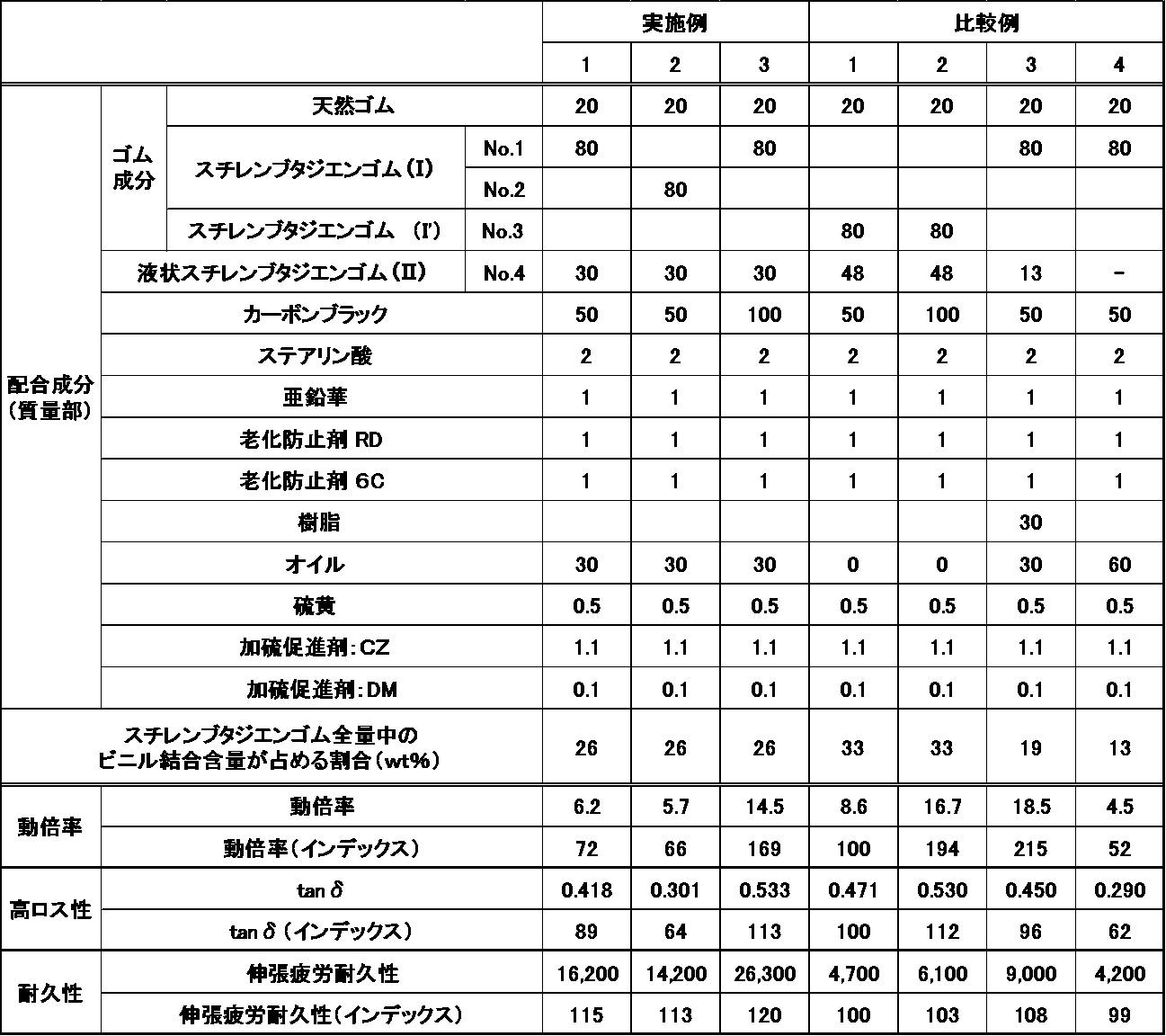
上記表2の結果より、実施例1~3は、スチレンブタジエンゴム(I)のポリスチレン換算重量平均分子量が70万より小さいものを用いた比較例1,2に比べて低動倍率及び耐久性に優れている。
また、実施例1~3は、樹脂を用いた比較例3に比べると、低動倍率及び耐久性に優れている。
さらに、実施例1~3は、液状SBRを配合しない比較例4に比べると、高ロス領域で耐久性に優れている。比較例4は、ゴムのロス(tanδ)が小さい。
また、実施例1~3は、樹脂を用いた比較例3に比べると、低動倍率及び耐久性に優れている。
さらに、実施例1~3は、液状SBRを配合しない比較例4に比べると、高ロス領域で耐久性に優れている。比較例4は、ゴムのロス(tanδ)が小さい。
Claims (6)
- ゴム成分として、ポリスチレン換算重量平均分子量(Mw)が700,000以上のスチレンブタジエンゴム(I)を少なくとも含み、かつ、ポリスチレン換算重量平均分子量(Mw)が12,000以下の液状スチレンブタジエンゴム(II)と、充填剤としてカーボンブラックを含む防振ゴム組成物であって、上記(I)成分及び上記(II)成分中のビニル結合含量の総量が、上記(I)成分及び上記(II)成分の合計100質量%に対して25質量%以上であり、上記カーボンブラックの配合量が上記ゴム成分100質量部に対して40質量部を超え、110質量部以下であることを特徴とする防振ゴム用ゴム組成物。
- 上記液状スチレンブタジエンゴム(II)のポリスチレン換算数平均分子量(Mn)が、5,000以下である請求項1記載の防振ゴム用ゴム組成物。
- 上記液状スチレンブタジエンゴム(II)の配合量は、上記スチレンブタジエンゴム(I)100質量部に対して35質量部以上である請求項1又は2記載の防振ゴム用ゴム組成物。
- 上記カーボンブラックは、JIS K 6217-2:2001に準拠した窒素吸着比表面積が90~150m2/gである請求項1~3のいずれか1項記載の防振ゴム用ゴム組成物。
- 上記カーボンブラックが、SAF級又はISAF級である請求項1~4のいずれか1項記載の防振ゴム用ゴム組成物。
- 請求項1~5のいずれか1項記載の防振ゴム用ゴム組成物からなる防振ゴム部材を構成要素として含む防振ゴム製品。
Applications Claiming Priority (2)
| Application Number | Priority Date | Filing Date | Title |
|---|---|---|---|
| JP2019037225 | 2019-03-01 | ||
| JP2019-037225 | 2019-03-01 |
Publications (1)
| Publication Number | Publication Date |
|---|---|
| WO2020179655A1 true WO2020179655A1 (ja) | 2020-09-10 |
Family
ID=72338660
Family Applications (1)
| Application Number | Title | Priority Date | Filing Date |
|---|---|---|---|
| PCT/JP2020/008254 Ceased WO2020179655A1 (ja) | 2019-03-01 | 2020-02-28 | 防振ゴム用ゴム組成物及び防振ゴム製品 |
Country Status (1)
| Country | Link |
|---|---|
| WO (1) | WO2020179655A1 (ja) |
Citations (3)
| Publication number | Priority date | Publication date | Assignee | Title |
|---|---|---|---|---|
| JP2003253056A (ja) * | 2001-12-28 | 2003-09-10 | Jsr Corp | ゴム組成物及び防振ゴム並びに防振用マウント |
| JP2005325311A (ja) * | 2004-05-17 | 2005-11-24 | Bridgestone Corp | ゴム組成物及びそれを用いた空気入りタイヤ |
| WO2019117155A1 (ja) * | 2017-12-13 | 2019-06-20 | 株式会社ブリヂストン | 防振ゴム組成物及び防振ゴム |
-
2020
- 2020-02-28 WO PCT/JP2020/008254 patent/WO2020179655A1/ja not_active Ceased
Patent Citations (3)
| Publication number | Priority date | Publication date | Assignee | Title |
|---|---|---|---|---|
| JP2003253056A (ja) * | 2001-12-28 | 2003-09-10 | Jsr Corp | ゴム組成物及び防振ゴム並びに防振用マウント |
| JP2005325311A (ja) * | 2004-05-17 | 2005-11-24 | Bridgestone Corp | ゴム組成物及びそれを用いた空気入りタイヤ |
| WO2019117155A1 (ja) * | 2017-12-13 | 2019-06-20 | 株式会社ブリヂストン | 防振ゴム組成物及び防振ゴム |
Similar Documents
| Publication | Publication Date | Title |
|---|---|---|
| CN102666705B (zh) | 防振橡胶组合物和防振橡胶 | |
| CN105264004B (zh) | 防振橡胶用橡胶组合物 | |
| JP6112755B2 (ja) | 防振ゴム組成物及び防振ゴム | |
| JP5949493B2 (ja) | 防振ゴム組成物及び防振ゴム | |
| JP6369576B2 (ja) | 防振ゴム組成物及び防振ゴム | |
| WO2018198647A1 (ja) | 防振ゴム用ゴム組成物及び車両用防振ゴム | |
| WO2015186482A1 (ja) | 防振ゴム組成物及び防振ゴム | |
| JP2008179722A (ja) | ゴム組成物の製法およびそれによって得られたゴム製品 | |
| WO2019117155A1 (ja) | 防振ゴム組成物及び防振ゴム | |
| JP6977420B2 (ja) | 防振ゴム用ゴム組成物及び防振ゴム製品 | |
| WO2020179655A1 (ja) | 防振ゴム用ゴム組成物及び防振ゴム製品 | |
| JP2011162585A (ja) | 防振ゴム用ゴム組成物および防振ゴム | |
| JPWO2016159257A1 (ja) | 防振ゴム組成物及び防振ゴム | |
| JP6105426B2 (ja) | 防振ゴム組成物及び防振ゴム | |
| JP5953776B2 (ja) | 防振ゴム組成物及び防振ゴム | |
| JP4296972B2 (ja) | 防振ゴムの製法およびそれにより得られる防振ゴム | |
| JP2018131475A (ja) | 車両用防振ゴム組成物及び車両用防振部材 | |
| CN107636057B (zh) | 橡胶组合物、防振橡胶组合物和防振橡胶 | |
| WO2020230393A1 (ja) | 高減衰性ゴム組成物 | |
| JP7682124B2 (ja) | 防振ゴム組成物及び防振ゴム | |
| JP6503641B2 (ja) | 自動車用防振ゴム用ゴム組成物及び自動車用防振ゴム | |
| JP2020090664A (ja) | 防振ゴム用ゴム組成物および防振ゴム | |
| JP2018178123A (ja) | 防振ゴム組成物及び防振ゴム | |
| JP2005113094A (ja) | 防振ゴム | |
| JP2005113093A (ja) | 耐熱性防振ゴム |
Legal Events
| Date | Code | Title | Description |
|---|---|---|---|
| 121 | Ep: the epo has been informed by wipo that ep was designated in this application |
Ref document number: 20765488 Country of ref document: EP Kind code of ref document: A1 |
|
| NENP | Non-entry into the national phase |
Ref country code: DE |
|
| 122 | Ep: pct application non-entry in european phase |
Ref document number: 20765488 Country of ref document: EP Kind code of ref document: A1 |
|
| NENP | Non-entry into the national phase |
Ref country code: JP |