WO2020179651A1 - 車両用バッテリの冷却モジュール - Google Patents
車両用バッテリの冷却モジュール Download PDFInfo
- Publication number
- WO2020179651A1 WO2020179651A1 PCT/JP2020/008229 JP2020008229W WO2020179651A1 WO 2020179651 A1 WO2020179651 A1 WO 2020179651A1 JP 2020008229 W JP2020008229 W JP 2020008229W WO 2020179651 A1 WO2020179651 A1 WO 2020179651A1
- Authority
- WO
- WIPO (PCT)
- Prior art keywords
- header
- refrigerant
- tubes
- battery
- tube
- Prior art date
- Legal status (The legal status is an assumption and is not a legal conclusion. Google has not performed a legal analysis and makes no representation as to the accuracy of the status listed.)
- Ceased
Links
Images




Classifications
-
- B—PERFORMING OPERATIONS; TRANSPORTING
- B60—VEHICLES IN GENERAL
- B60K—ARRANGEMENT OR MOUNTING OF PROPULSION UNITS OR OF TRANSMISSIONS IN VEHICLES; ARRANGEMENT OR MOUNTING OF PLURAL DIVERSE PRIME-MOVERS IN VEHICLES; AUXILIARY DRIVES FOR VEHICLES; INSTRUMENTATION OR DASHBOARDS FOR VEHICLES; ARRANGEMENTS IN CONNECTION WITH COOLING, AIR INTAKE, GAS EXHAUST OR FUEL SUPPLY OF PROPULSION UNITS IN VEHICLES
- B60K11/00—Arrangement in connection with cooling of propulsion units
- B60K11/02—Arrangement in connection with cooling of propulsion units with liquid cooling
- B60K11/04—Arrangement or mounting of radiators, radiator shutters, or radiator blinds
-
- F—MECHANICAL ENGINEERING; LIGHTING; HEATING; WEAPONS; BLASTING
- F28—HEAT EXCHANGE IN GENERAL
- F28D—HEAT-EXCHANGE APPARATUS, NOT PROVIDED FOR IN ANOTHER SUBCLASS, IN WHICH THE HEAT-EXCHANGE MEDIA DO NOT COME INTO DIRECT CONTACT
- F28D1/00—Heat-exchange apparatus having stationary conduit assemblies for one heat-exchange medium only, the media being in contact with different sides of the conduit wall, in which the other heat-exchange medium is a large body of fluid, e.g. domestic or motor car radiators
- F28D1/02—Heat-exchange apparatus having stationary conduit assemblies for one heat-exchange medium only, the media being in contact with different sides of the conduit wall, in which the other heat-exchange medium is a large body of fluid, e.g. domestic or motor car radiators with heat-exchange conduits immersed in the body of fluid
- F28D1/04—Heat-exchange apparatus having stationary conduit assemblies for one heat-exchange medium only, the media being in contact with different sides of the conduit wall, in which the other heat-exchange medium is a large body of fluid, e.g. domestic or motor car radiators with heat-exchange conduits immersed in the body of fluid with tubular conduits
- F28D1/053—Heat-exchange apparatus having stationary conduit assemblies for one heat-exchange medium only, the media being in contact with different sides of the conduit wall, in which the other heat-exchange medium is a large body of fluid, e.g. domestic or motor car radiators with heat-exchange conduits immersed in the body of fluid with tubular conduits the conduits being straight
-
- H—ELECTRICITY
- H01—ELECTRIC ELEMENTS
- H01M—PROCESSES OR MEANS, e.g. BATTERIES, FOR THE DIRECT CONVERSION OF CHEMICAL ENERGY INTO ELECTRICAL ENERGY
- H01M10/00—Secondary cells; Manufacture thereof
- H01M10/60—Heating or cooling; Temperature control
- H01M10/61—Types of temperature control
- H01M10/613—Cooling or keeping cold
-
- H—ELECTRICITY
- H01—ELECTRIC ELEMENTS
- H01M—PROCESSES OR MEANS, e.g. BATTERIES, FOR THE DIRECT CONVERSION OF CHEMICAL ENERGY INTO ELECTRICAL ENERGY
- H01M10/00—Secondary cells; Manufacture thereof
- H01M10/60—Heating or cooling; Temperature control
- H01M10/62—Heating or cooling; Temperature control specially adapted for specific applications
- H01M10/625—Vehicles
-
- H—ELECTRICITY
- H01—ELECTRIC ELEMENTS
- H01M—PROCESSES OR MEANS, e.g. BATTERIES, FOR THE DIRECT CONVERSION OF CHEMICAL ENERGY INTO ELECTRICAL ENERGY
- H01M10/00—Secondary cells; Manufacture thereof
- H01M10/60—Heating or cooling; Temperature control
- H01M10/65—Means for temperature control structurally associated with the cells
- H01M10/651—Means for temperature control structurally associated with the cells characterised by parameters specified by a numeric value or mathematical formula, e.g. ratios, sizes or concentrations
-
- H—ELECTRICITY
- H01—ELECTRIC ELEMENTS
- H01M—PROCESSES OR MEANS, e.g. BATTERIES, FOR THE DIRECT CONVERSION OF CHEMICAL ENERGY INTO ELECTRICAL ENERGY
- H01M10/00—Secondary cells; Manufacture thereof
- H01M10/60—Heating or cooling; Temperature control
- H01M10/65—Means for temperature control structurally associated with the cells
- H01M10/655—Solid structures for heat exchange or heat conduction
- H01M10/6556—Solid parts with flow channel passages or pipes for heat exchange
- H01M10/6557—Solid parts with flow channel passages or pipes for heat exchange arranged between the cells
-
- H—ELECTRICITY
- H01—ELECTRIC ELEMENTS
- H01M—PROCESSES OR MEANS, e.g. BATTERIES, FOR THE DIRECT CONVERSION OF CHEMICAL ENERGY INTO ELECTRICAL ENERGY
- H01M10/00—Secondary cells; Manufacture thereof
- H01M10/60—Heating or cooling; Temperature control
- H01M10/65—Means for temperature control structurally associated with the cells
- H01M10/656—Means for temperature control structurally associated with the cells characterised by the type of heat-exchange fluid
- H01M10/6567—Liquids
- H01M10/6568—Liquids characterised by flow circuits, e.g. loops, located externally to the cells or cell casings
-
- Y—GENERAL TAGGING OF NEW TECHNOLOGICAL DEVELOPMENTS; GENERAL TAGGING OF CROSS-SECTIONAL TECHNOLOGIES SPANNING OVER SEVERAL SECTIONS OF THE IPC; TECHNICAL SUBJECTS COVERED BY FORMER USPC CROSS-REFERENCE ART COLLECTIONS [XRACs] AND DIGESTS
- Y02—TECHNOLOGIES OR APPLICATIONS FOR MITIGATION OR ADAPTATION AGAINST CLIMATE CHANGE
- Y02E—REDUCTION OF GREENHOUSE GAS [GHG] EMISSIONS, RELATED TO ENERGY GENERATION, TRANSMISSION OR DISTRIBUTION
- Y02E60/00—Enabling technologies; Technologies with a potential or indirect contribution to GHG emissions mitigation
- Y02E60/10—Energy storage using batteries
Definitions
- the present invention relates to a vehicle battery cooling module.
- Patent Document 1 discloses a refrigerant-type cooling module for cooling a battery. ..
- the cooling module of Patent Document 1 has a plurality of flat tubes (refrigerant tubes) provided between two manifolds (headers) and in contact with the battery.
- the refrigerant flowing in the tube on the upstream side of the refrigerant flow path formed by the manifold and the tube is in a gas-liquid mixed state sufficiently containing a liquid, and has a sufficient cooling capacity of the battery.
- the refrigerant flows through the tube it is heated by the heat of the battery, whereby the proportion of the refrigerant in the liquid state decreases and the proportion of the refrigerant in the gas state increases. ..
- the refrigerant flowing in the tube on the downstream side of the refrigerant flow path is completely vaporized near the downstream end of the tube and has a degree of superheat (superheat). May become. In such a situation, the cooling capacity may be reduced and the temperature distribution of the battery may be uneven.
- a cooling module for cooling a battery for a vehicle, which has a refrigerant inflow portion into which a refrigerant for heat exchange with the battery flows, and a refrigerant outflow portion from which a refrigerant heat exchanged with the battery flows out.
- a first header having, a second header, and a plurality of tubes arranged between the first header and the second header for heat exchange with the battery, and the plurality of tubes are provided.
- the total area of the heat exchange surfaces of the one or more first tubes with the battery is larger than the total area of the heat exchange surfaces of the one or more second tubes.
- a cooling module is provided.
- deterioration of the battery due to heat generation can be suppressed even when the refrigerant has a superheat degree.
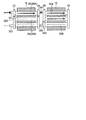
- the first embodiment will be described with reference to FIG. ..
- a plurality of cooling modules 20 are arranged between the first header (manifold) 22, the second header (manifold) 24, and the first header 22 and the second header 24 (four in the embodiment of FIG. 1).
- the plurality of tubes 26 preferably have the same shape and dimensions from each other due to manufacturing technology reasons (extrusion mold cost, brazing uniformity, etc.).
- the side surface of each tube 26 is in thermal contact with the surface of the vehicle battery 10 (battery module) directly or indirectly (preferably directly as shown in FIG. 4 ). ..
- the first header 22 has a refrigerant inflow portion (inlet port) 221 into which the refrigerant that exchanges heat with the battery 10 flows in, and a refrigerant outflow portion (outlet port) 222 in which the refrigerant that has exchanged heat with the battery 10 flows out.
- the interior of the first header 22 is divided by a partition wall 223 into an upper space on the refrigerant inflow portion 221 side and a lower space on the refrigerant outflow portion 222 side. ..
- the refrigerant used in each of the embodiments described in this specification is a heat medium used in the refrigeration cycle, and removes heat corresponding to heat of vaporization at the time of phase change from the liquid phase to the gas phase from the object to be cooled. It is a fluid that cools the object to be cooled by.
- a refrigerant for an air conditioner for vehicles for example, HFC-134a widely used conventionally, HFO-1234yf corresponding to recent EU regulations, and the like can be used. ..
- the plurality of tubes 26 are for one or more first tubes 26A for flowing the refrigerant from the first header 22 to the second header 24 and for flowing the refrigerant from the second header 24 to the first header 22.
- the number of first tubes 26A is larger than the number of second tubes 26B. In the embodiment of FIG. 1, three first tubes 26A and one second tube 26B are provided. ..
- the plurality of tubes 26 are arranged in the vertical direction, and each extends in the horizontal direction.
- the first tube 26A is above the second tube 26B.
- the refrigerant inflow section 221 is above the refrigerant outflow section 222.
- the first header 22 and the second header 24 are arranged parallel to each other and in the vertical direction. ..
- each tube 26 can be formed of an extruded frame member having a plurality of channels (refrigerant flow paths) 261 extending in parallel with each other.
- the end portion of the tube 26 is inserted into an elongated slit formed in the first header 22 configured as a hollow tubular member.
- a hollow tubular member forming the coolant inflow portion 221 is inserted into the circular hole formed in the first header 22.
- the tube 26 and the refrigerant inflow portion (hollow tubular member) 221 are brazed to the first header 22.
- reference numeral 40 indicates a brazing material. ..
- connection structure between the first header 22 and the refrigerant outflow portion 222 and the connection structure between the second header 24 and each tube 26 are the same as those shown in FIG.
- the tube 26, the first header 22 and the second header 24 can be formed of a high heat conductive material, for example, an aluminum alloy. ..
- FIG. 6 shows an example in which the cooling module 20 according to the first embodiment is incorporated in the refrigeration cycle device 1 of the vehicle air conditioner.
- the refrigeration cycle apparatus 1 has an outdoor heat exchanger 2 provided in the refrigerant circulation path 7, an indoor heat exchanger 3, a compressor 4, and an expansion valve 5.
- the outdoor heat exchanger 2 is installed, for example, behind a front grill of a vehicle.
- the indoor heat exchanger 3 is installed, for example, in the air passage of the air conditioner.
- the vehicle air conditioner air-conditions the interior of the vehicle by a method well known to those skilled in the art. ..
- the cooling module pipeline 9 (refrigerant circuit) is connected to the branch points 8a and 8b set on the refrigerant circulation path 7.
- the pipe 9 is provided with the expansion valve 6 and the cooling module 20 according to the first embodiment.
- the expansion valves 5 and 6 preferably have a function as a shutoff valve. ..
- the rapid charging of the battery 10 is usually performed while the vehicle is stopped (parked).
- the expansion valve 5 acts as a shutoff valve. Therefore, at this time, the refrigeration cycle device for cooling the battery 10 is configured from the outdoor heat exchanger 2, the expansion valve 6, the cooling module 20, and the compressor 4.
- the expansion valve 5 and the expansion valve 6 act as expansion valves.
- the refrigerant discharged from the compressor 4 passes through the outdoor heat exchanger 2 and branches at the branch point 8a, one of the refrigerants flows to the expansion valve 5 and the indoor heat exchanger 3, and the other refrigerant. Flows to the expansion valve 6 and the cooling module 20. After that, the two streams of the refrigerant merge at the branch point 8b and are sucked into the compressor 4. Therefore, also at this time, the refrigeration cycle device for cooling the battery 10 is configured. ..
- the cooling module according to the first embodiment (and the cooling modules according to second to fourth embodiments described later) act as an evaporator in the refrigeration cycle device for battery cooling shown in FIG.
- the low-temperature low-pressure gas-state refrigerant flows into (is sucked into) the compressor 4 and is compressed by the compressor 4 to become a high-temperature high-pressure gas state.
- the refrigerant is cooled by exchanging heat with ambient air (outside air) in the outdoor heat exchanger 2 acting as a condenser, and becomes a medium-temperature high-pressure liquid.
- the refrigerant expands as it passes through the expansion valve 6, and becomes a low temperature low pressure liquid or gas-liquid mixed fluid.
- the refrigerant is vaporized by exchanging heat with the battery 10 when passing through the cooling module 20 that functions as an evaporator, and the heat of vaporization removes heat from the battery 10 to become a low-temperature low-pressure gas. Then, the refrigerant is returned (compressed) to the compressor 4 and compressed. ..
- the refrigeration cycle device for battery cooling is integrated with the refrigeration cycle for air conditioning, but it is an independent refrigeration cycle device separated from the refrigeration cycle for air conditioning. It may be provided as. ..
- FIGS. 1 to 3 indicate the flow and state of the refrigerant, and the ratio of the refrigerant in the gaseous state contained in the refrigerant increases in the order of the thick solid line arrow, the thin solid line arrow, and the broken line arrow. I will go. ..
- a low-temperature low-pressure refrigerant (is this a liquid state?) That has flowed into the upper space of the first header 22 from the refrigerant inflow portion 221 after exiting the expansion valve (for example, the expansion valve 6 of FIG. 6).
- a gas-liquid mixed state including a sufficient amount of liquid A relatively low-temperature refrigerant flows into the first tubes 26A and flows in the three first tubes 26A in parallel.
- the refrigerant exchanges heat with the battery 10 to cool the battery 10.
- the liquid state refrigerant evaporates and the gas ratio increases. There is almost no change in temperature during the phase change from liquid to gas.
- the refrigerant flowing from the first tube 26A to the second header 24 flows into one second tube 26B. Even when passing through the second tube 26B, the refrigerant exchanges heat with the battery 10 to cool the battery 10. Almost all of the liquid state refrigerant is vaporized when passing through the second tube 26B.
- the refrigerant that has passed through the second tube 26B flows into the space below the first header 22, passes through the refrigerant outflow portion 222, and flows out from the first header 22. ..
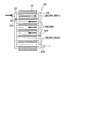
- FIG. 2 shows a second embodiment.
- members that are the same as or similar to those in FIG. 1 are designated by the same reference numerals, and duplicate description will be omitted. ..
- the cooling module 20 shown in FIG. 2 includes, in addition to the components of the cooling module 20 shown in FIG. 1, a third header 28, a fourth header 30, and a space between the third header 28 and the fourth header 30. It is provided with one or more (two in the illustrated example) third tubes 32A and one or more (one in the illustrated example) fourth tubes 32B arranged. In the embodiment of FIG. 2, the number of the first tubes 26A is two, which is the same as the number of the third tubes 32A.
- the interior of the second header 24 is divided by a partition wall 243 into an upper space and a lower space.
- the inside of the third header 28 is divided by a partition wall 283 into an upper space and a lower space.
- the upper space of the second header 24 and the upper space of the third header 28 are connected by an upper communication pipe 281.
- the lower space of the second header 24 and the lower space of the third header 28 are connected by a lower communication pipe 282.
- the third tube 32A and the fourth tube 32B are in contact with a battery 10 (battery module) different from the battery 10 (battery module) with which the first tube 26A and the second tube 26B are in contact.
- the refrigerant flows through the two first tubes 26A in parallel.
- the refrigerant exchanges heat with the battery 10 to cool the battery 10.
- the refrigerant flowing out from the first tube 26A into the upper space of the second header 24 flows into the upper space of the third header 28 through the upper communication pipe 281.
- the refrigerant flowing out from the upper space of the third header 28 flows in parallel inside the two upper third tubes 32A.
- the refrigerant exchanges heat with the battery 10 to cool the battery 10.
- the refrigerant that has flowed into the fourth header 30 from the third tube 32A flows into one lower fourth tube 32B.
- the refrigerant exchanges heat with the battery 10 to cool the battery 10.
- the refrigerant flowing out from the fourth tube 32B into the lower space of the third header 28 flows into the lower space of the second header 24 through the lower communication pipe 282.
- the refrigerant flowing out from the lower space of the second header 24 flows into one second tube 26B.
- the refrigerant exchanges heat with the battery 10 to cool the battery 10. ..
- the refrigerant flowing in the first tube 26A is in a low-temperature low-pressure liquid state or in a gas-liquid mixed state containing a sufficient amount of liquid. Further, the refrigerant flowing in the second tube 26B may be substantially in a gas state by the time it exits the second tube 26B. ..
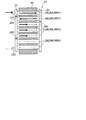
- the area of the portion where each tube 26 (26A, 26B) and the battery 10 overlap is the area of one tube 26 and the battery 10.
- the area of the heat exchange surface (hereinafter, also referred to as "heat exchange area").
- A is an appropriate positive number).
- the total heat exchange area of the two first tubes 26A is 2A.
- the total heat exchange area of one second tube 26B is A. ..
- the total heat exchange area of one first tube 26A is A
- the total heat exchange area of the two second tubes 26B is 2A. .. ..
- the volumetric flow rate of the refrigerant significantly increases.
- the ventilation resistance when passing through the refrigerant passage increases.
- the number of the second tube 26B (flowing of the refrigerant in the gaseous state) which becomes the bottleneck of the refrigerant flow is increased as shown in FIG. A sufficient mass flow rate of the refrigerant from the inflow section 221 to the refrigerant outflow section 222 is secured. ..
- the number of the second tubes 26B is reduced to increase the number of the first tubes 26A through which the refrigerant in a liquid state substantially flows (the total number of tubes 26 is determined due to the convenience of the installation space). Please note that.).
- the number of the second tubes 26B through which the refrigerant in the gas state substantially flows decreases, the ventilation resistance when the refrigerant in the gas state passes through the refrigerant passage increases, and as a result, the refrigerant outflow from the refrigerant inflow portion 221.
- the mass flow rate of the refrigerant to the portion 222 is reduced to some extent. ..
- the ratio of the liquid in the refrigerant flowing in the first tube 26A is sufficiently high, even if the flow rate of the refrigerant in the first tube 26A slightly decreases, the contact portion of the battery 10 with the first tube 26A and its contact portion. The vicinity can be sufficiently cooled. Further, since the number of the first tubes 26A is larger than that of the comparative example, it is possible to cool a wider range of one battery 10 (battery module). ..
- the temperature of the refrigerant rises due to heat exchange with the battery 10, and the cooling effect of the battery 10 decreases. That is, the region of the battery 10 that is in thermal contact with the second tube 26B may not be cooled to the intended temperature. ..
- the time when the refrigerant flows into the second tube 26A or the first The refrigerant may be completely vaporized while passing through the second tube 26, and the refrigerant may be in a superheat state until it flows out from the second tube 26. ..
- the cooling effect of the battery 10 by the second tube 26B is very low, and even if the number of the second tubes 26B is increased, the cooling effect of the battery 10 cannot be enhanced. That is, increasing the number of the first tubes 26A and increasing the total sum of the heat exchange areas between the first tubes 26A and the battery 10 is beneficial for cooling the entire battery 10.
- the cooling of the area of the battery 10 near the second tube 26B can be performed by transferring heat to the area of the battery 10 cooled by the first tube 26A. All the embodiments of the present invention (not only the first and second embodiments, but also the third and fourth embodiments) are based on the above technical idea. ..
- the embodiment of the present invention is not limited to the above-described first and second embodiments, and the following third and fourth embodiments are also possible. ..
- FIG. 7 shows the cooling module 20 of the third embodiment.
- members that are the same as or similar to those in FIGS. 1 and 2 are denoted by the same reference numerals, and redundant description is omitted. ..
- the cooling module 20 of the third embodiment has a plurality of cooling modules 20 for exchanging heat between the first header 22 and the second header 24 and the battery 10.
- the cooling module 20 of the third embodiment is one or more (in the illustrated example) for flowing the refrigerant from the first header 22 toward the second header 24, similarly to the first and second embodiments described above. It has a first tube 26A (three) and one or more (three in the illustrated example) second tube 26B for flowing the refrigerant from the second header 24 toward the first header 22. ..
- the cooling module 20 of the third embodiment is provided with a refrigerant outflow portion 242 in the second header 24.
- the refrigerant first flows from the first header 22 to the second header 24, then from the second header 24 to the first header 22, and then again from the first header 22 to the second header 24. It has become.
- the inside of the first header 22 is divided into an upper space on the refrigerant inflow portion 221 side and a lower space by the partition wall 224, and the inside of the second header 22 is divided into a space below.
- the partition wall 244 divides the space into a lower space on the refrigerant outlet 242 side and an upper space. ..
- the three first tubes 26A are one or more (one in the illustrated example) upstream first tube 26A1 arranged on the upstream side of the second tube 26B in the flow of the refrigerant, and the second tube 26B in the flow of the refrigerant. Are grouped into one or more (two in the illustrated example) downstream side first tubes 26A2 arranged on the downstream side. ..
- the tubes 26 have the same shape. Therefore, the total area of the heat exchange surfaces of the three second tubes 26B with the battery 10 is larger than the total area of the heat exchange surfaces of the two downstream first tubes 26A2 with the battery 10. ..
- a refrigerant having a higher liquid phase content rate than at least the refrigerant flowing in the downstream first tube 26A2 adjacent to the two downstream first tubes 26A2 located on the most downstream side of the refrigerant flow path is provided. Therefore, also in the third embodiment, it is possible to obtain the same effects as those of the first and second embodiments described above. ..
- FIG. 8 shows the cooling module 20 of the fourth embodiment.
- members that are the same as or similar to those in FIGS. 1 and 2 are denoted by the same reference numerals, and redundant description is omitted. ..
- the cooling module 20 of the fourth embodiment has a plurality of cooling modules 20 for exchanging heat between the first header 22 and the second header 24 and the battery 10.
- the first header 22 is provided with both the refrigerant inflow portion 221 and the refrigerant outflow portion 222.
- the cooling module 20 of the fourth embodiment is one or more (in the illustrated example) for flowing the refrigerant from the first header 22 toward the second header 24, similarly to the first and second embodiments described above. It has four) first tubes 26A and one or more (three in the illustrated example) second tubes 26B for flowing the refrigerant from the second header 24 toward the first header 22. ..
- the refrigerant first flows from the first header 22 to the second header 24, and then from the second header 24 to the first header 22. It flows from the first header 22 to the second header 24 again, and then flows from the second header 24 to the first header 22 again.
- the inside of the first header 22 is divided by the partition walls 225 and 226 into an upper space on the refrigerant inflow portion 221 side, a lower space on the refrigerant outflow portion 222 side, and a central space.
- the inside of the second header 22 is divided by a partition wall 245 into an upper space and a lower space. ..
- the four first tubes 26A are grouped into one or more (one in the illustrated example) upstream first tube 26A1 and one or more (three in the illustrated example) downstream first tube 26A2.
- the two second tubes 26B are grouped into one or more (one in the illustrated example) upstream second tube 26B1 and one or more (two in the illustrated example) downstream second tube 26B2.
- the tubes 26 In the flow direction of the refrigerant, the tubes 26 have, from the upstream side, one upstream side first tube 26A1, one upstream side second tube 26B1, three downstream side first tubes 26A2, and two downstream side second tubes 26B2. They are arranged in the order of. ..
- the tubes 26 have the same shape as each other. Therefore, the total area of the heat exchange surfaces of the three downstream first tubes 26A2 with the battery 10 is larger than the total area of the heat exchange surfaces of the two downstream second tubes 26B2 with the battery 10. .. Therefore, also in the fourth embodiment, it is possible to obtain the same effects as those of the above-described first to third embodiments.
- the first to fourth embodiments can be regarded as having the following common features (1) to (4). ..
- a first tube group in which the plurality of tubes 26 include at least one most downstream tube (26B; 26A2; 26B2) located on the most downstream side in the flow direction of the refrigerant, and a first tube on the battery 10. It constitutes a second tube group including at least one tube (26A; 26B; 26A2) provided adjacent to the group.
- the “downstream side tube” is a tube that constitutes the refrigerant flow path closest to the refrigerant outlet (222, 242) in the refrigerant flow direction among the plurality of tubes 26. ..
- the tube (26A; 26B; 26A2) belonging to the second tube group is provided immediately upstream of the most downstream tube (26B; 26A2; 26B2) belonging to the first tube group in the flow direction of the refrigerant. .. ..
- the refrigerant flows from one of the first header 22 and the second header 24 toward the other in the most downstream tube (26B; 26A2; 26B2) belonging to the first tube group, and the refrigerant is It flows from the other of the first header and the second header toward one of the tubes (26A; 26B; 26A2) belonging to the second tube group.
- the plurality of tubes 26 are arranged in parallel with each other between the first header 22 and the second header 24. ..
- the number of tubes (26A; 26B; 26A2) belonging to the second tube group is larger than the number of tubes (26B; 26A2; 26B2) belonging to the first tube group. That is, the sum of the areas of the heat exchange surfaces of the tubes (26A; 26B; 26A2) belonging to the second tube group with the battery (10) is the battery (10) of the tubes (26B; 26A2; 26B2) belonging to the first tube group. ) Is larger than the total area of the heat exchange surface with. ..
- the liquid phase content of the refrigerant flowing in the tube (26A; 26B; 26A2) belonging to the second tube group is in the tube (26B; 26A2; 26B2) belonging to the most downstream first tube group. It is larger than the liquid phase content of the refrigerant flowing through. Therefore, it is clear that the same effects as those of the first to fourth embodiments described above can be obtained by satisfying the conditions (1) to (4) above. ..
- the headers (22, 24, 28, 30) extend in the vertical direction, and a plurality of tubes (26A, 26B, 32A, 32B) extend in the horizontal direction and are arranged in the vertical direction. Is not limited.
- the headers (22, 24, 28, 30) extend in the first horizontal direction, and the plurality of tubes (26A, 26B, 32A, 32B) extend in the second horizontal direction orthogonal to the first horizontal direction and in the first horizontal direction. It may be arranged.
- Cooling module 22 1st header 221 Refrigerant inflow part 222,242 Refrigerant outflow part 24 2nd header 26 tube 26A 1st tube 26B 2nd tube
Landscapes
- Engineering & Computer Science (AREA)
- Chemical & Material Sciences (AREA)
- Manufacturing & Machinery (AREA)
- General Chemical & Material Sciences (AREA)
- Electrochemistry (AREA)
- Chemical Kinetics & Catalysis (AREA)
- Mechanical Engineering (AREA)
- Physics & Mathematics (AREA)
- General Engineering & Computer Science (AREA)
- Thermal Sciences (AREA)
- Transportation (AREA)
- Combustion & Propulsion (AREA)
- Algebra (AREA)
- General Physics & Mathematics (AREA)
- Mathematical Analysis (AREA)
- Mathematical Optimization (AREA)
- Pure & Applied Mathematics (AREA)
- Secondary Cells (AREA)
- Cooling, Air Intake And Gas Exhaust, And Fuel Tank Arrangements In Propulsion Units (AREA)
Abstract
【課題】冷却モジュールの冷媒流路の下流側のチューブ内で冷媒が過熱度を有する状況下においても、発熱によるバッテリの劣化を抑制する。【解決手段】バッテリ(10)を冷却する冷却モジュール(20)は、バッテリと熱交換させる冷媒が流入する冷媒流入部(221)と、バッテリと熱交換した冷媒が流出する冷媒流出部(222)と、を有する第1ヘッダ(22)と、第2ヘッダ(24)と、第1ヘッダと第2ヘッダとの間に配置され、バッテリとの間で熱交換を行うための複数のチューブ(26)とを備える。複数のチューブは、冷媒を第1ヘッダから第2ヘッダに向けて流すための1つ以上の第1チューブ(26A)と、冷媒を第2ヘッダから第1ヘッダに向けて流すための1つ以上の第2チューブ(26B)とからなり、第1チューブのバッテリとの熱交換面の面積の総和が、第2チューブのバッテリとの熱交換面の面積の総和よりも大きい。
Description
本発明は、車両用バッテリの冷却モジュールに関する。
電気自動車やハイブリッド車は、充電可能なバッテリに蓄積された電力により走行する。バッテリ充電時の発熱によるバッテリの劣化を抑制するため、バッテリの冷却が行われる。特許文献1には、バッテリを冷却するための冷媒式の冷却モジュールが開示されている。
特許文献1の冷却モジュールは、2本のマニホルド(ヘッダ)の間に設けられてバッテリと接触する複数の平坦なチューブ(冷媒管)を有している。バッテリの冷却を行うとき、マニホルドおよびチューブにより形成される冷媒流路の上流側のチューブ内を流れる冷媒は、液体を十分に含む気液混合状態であり、バッテリの冷却能力を十分に有している。冷媒はチューブの中を流れてゆくときにバッテリの熱により加熱され、これにより、液体状態の冷媒の割合が減少し、気体状態の冷媒の割合が増加してゆく。
冷媒流量が少ないとき、あるいはバッテリの発熱量が大きいときには、冷媒流路の下流側のチューブ内を流れる冷媒は、当該チューブの下流端付近で完全に気化しかつ過熱度(スーパーヒート)を有する状態となることがある。このような状況では、冷却能力が低下し、バッテリの温度分布が不均一となる恐れがある。
本発明は、冷却モジュールの冷媒流路の下流側のチューブ内で冷媒が過熱度を有するような状況になったとしても、発熱によるバッテリの劣化を抑制することができる技術を提供することを目的としている。
本発明の一実施形態によれば、車両用のバッテリを冷却する冷却モジュールであって、バッテリと熱交換させる冷媒が流入する冷媒流入部と、バッテリと熱交換した冷媒が流出する冷媒流出部と、を有する第1ヘッダと、第2ヘッダと、第1ヘッダと第2ヘッダとの間に配置され、バッテリとの間で熱交換を行うための複数のチューブと、を備え、複数のチューブは、冷媒を前記第1ヘッダから第2ヘッダに向けて流すための1つ以上の第1チューブと、冷媒を第2ヘッダから第1ヘッダに向けて流すための1つ以上の第2チューブと、からなり、上記の1つ以上の第1チューブのバッテリとの熱交換面の面積の総和が、上記の1つ以上の第2チューブの熱交換面の面積の総和よりも大きいことを特徴とする冷却モジュールが提供される。
上記の実施形態によれば、冷媒が過熱度を有する状態でも、発熱によるバッテリの劣化を抑制することができる。
以下に添付図面を参照して本発明の実施形態について説明する。
図1を参照して第1実施形態について説明する。
冷却モジュール20は、第1ヘッダ(マニホルド)22と、第2ヘッダ(マニホルド)24と、第1ヘッダ22と第2ヘッダ24との間に配置された複数(図1の実施形態では4つ)のチューブ26を有する。
複数のチューブ26は、製造技術上の理由(押出金型費用、ろう付けの均一性等)により、互いに同じ形状寸法を有することが好ましい。各チューブ26の側面には、車両用のバッテリ10(バッテリモジュール)の表面が、直接的または間接的に(好ましくは図4に示すように直接的に)熱的に接触している。
第1ヘッダ22は、バッテリ10と熱交換させる冷媒が流入する冷媒流入部(入口ポート)221と、バッテリ10と熱交換した冷媒が流出する冷媒流出部(出口ポート)222と、を有する。第1ヘッダ22の内部は、仕切壁223により、冷媒流入部221側の上側空間と冷媒流出部222側の下側空間とに分割されている。
この明細書に記載された各実施形態で用いられる冷媒は、冷凍サイクルで用いられる熱媒体であり、液相から気相への相変化時の気化熱に相当する熱を冷却対象物から奪うことにより冷却対象物を冷却する流体である。具体的には、冷媒として、車両用空気調和装置用の冷媒、例えば従来から広く用いられているHFC-134a、近年のEU規制に対応したHFO-1234yf等を用いることができる。
複数のチューブ26は、冷媒を前記第1ヘッダ22から第2ヘッダ24に向けて流すための1つ以上の第1チューブ26Aと、冷媒を第2ヘッダ24から第1ヘッダ22に向けて流すための1つ以上の第2チューブ26Bとに分類される。第1チューブ26Aの数は、第2チューブ26Bの数よりも多い。図1の実施形態では、3つの第1チューブ26Aと、1つの第2チューブ26Bが設けられている。
複数のチューブ26は、鉛直方向に配列されており、かつ各々は水平方向に延びている。好ましくは、第1チューブ26Aは、第2チューブ26Bよりも上方にある。この場合、冷媒流入部221は、冷媒流出部222よりも上方にある。第1ヘッダ22および第2ヘッダ24は、互いに平行に、かつ、鉛直方向に配置されている。
図4および図5に示すように、各チューブ26は、互いに平行に延びる複数のチャネル(冷媒流路)261を有する押し出し形材により形成することができる。図5に示すように、中空管状部材として構成された第1ヘッダ22に形成された細長いスリットに、チューブ26の端部が挿入されている。また、第1ヘッダ22に形成された円形の孔に、冷媒流入部221を構成する中空管状部材が挿入されている。チューブ26および冷媒流入部(中空管状部材)221は、第1ヘッダ22にろう付けされている。図5中において、参照符号40はろう材を示している。
第1ヘッダ22と冷媒流出部222との結合構造、および第2ヘッダ24と各チューブ26との結合構造も、図5に示したものと同一である。チューブ26、第1ヘッダ22および第2ヘッダ24は、高熱伝導性材料、例えばアルミニウム合金から形成することができる。
図6には、第1実施形態に係る冷却モジュール20を車両用空調装置の冷凍サイクル装置1に組み込んだ一例が示されている。冷凍サイクル装置1は、冷媒循環路7に設けられた室外熱交換器2と、室内熱交換器3と、圧縮機4と、膨張弁5とを有している。室外熱交換器2は、例えば車両のフロントグリルの背後に設置される。室内熱交換器3は、例えば空調装置の送風路内に設置される。車両用空調装置により、当業者において周知の方法により車両の室内の空調が行われる。
冷媒循環路7上に設定された分岐点8a,8bに冷却モジュール用の管路9(冷媒回路)が接続されている。管路9には、膨張弁6と、第1実施形態に係る冷却モジュール20とが介設されている。膨張弁5、6は遮断弁としての機能を有していることが好ましい。
バッテリ10の急速充電は、通常、車両の停止(駐車)中に行われる。バッテリ10の急速充電時に、室内熱交換器3へ冷媒を流す必要が無い場合には、膨張弁5は遮断弁として作用する。従って、このときには、室外熱交換器2、膨張弁6、冷却モジュール20および圧縮機4から、バッテリ10を冷却するための冷凍サイクル装置が構成される。バッテリ10の急速充電時に、室内熱交換器3へ冷媒を流す必要が有る場合には、膨張弁5と膨張弁6は膨張弁として作用する。従って、このときには、圧縮機4から吐出された冷媒は、室外熱交換器2を通過し、分岐点8aで分岐し、一方の冷媒が膨張弁5および室内熱交換器3へ流れ、他方の冷媒が膨張弁6および冷却モジュール20へと流れる。その後、2つの冷媒の流れは分岐点8bで合流し、圧縮機4に吸入される。従って、このときにも、バッテリ10を冷却するための冷凍サイクル装置が構成される。
第1実施形態に係る冷却モジュール(および後述する第2~第4実施形態に係る冷却モジュール)は、図6に示したバッテリ冷却用の冷凍サイクル装置における蒸発器として作用する。図6に示した冷凍サイクル装置において、低温低圧の気体状態の冷媒が、圧縮機4に流入し(吸入され)、圧縮機4で圧縮されることにより、高温高圧の気体状態となる。次いで、冷媒は、凝縮器として作用する室外熱交換器2において周囲空気(外気)と熱交換することにより冷却され、中温高圧の液体となる。次いで、冷媒は、膨張弁6を通過するときに膨張し、低温低圧の液体または気液混合流体となる。次いで、冷媒は、蒸発器として作用する冷却モジュール20を通過するときにバッテリ10と熱交換することにより気化し、気化熱によりバッテリ10から熱を奪い、低温低圧の気体となる。次いで、冷媒は再び圧縮機4に戻されて(吸入されて)圧縮される。
バッテリ冷却用の冷凍サイクル装置は、図6に示すように空調用の冷凍サイクルと一体化することが製品コストの観点から有利であるが、空調用の冷凍サイクルから分離された独立した冷凍サイクル装置として設けてもよい。
冷却モジュール20の作用について以下に詳細に説明する。なお、図1~図3中に記載された矢印は冷媒の流れおよび状態を示しており、太実線矢印、細実線矢印、破線矢印の順に、冷媒中に含まれる気体状態の冷媒の比率が増えてゆく。
図1に示す実施形態では、膨張弁(例えば図6の膨張弁6)を出た後に冷媒流入部221から第1ヘッダ22の上側空間に流入した低温低圧の冷媒(これは液体状態であるか、あるいは十分な量の液体を含む気液混合状態である)比較的低温の冷媒が、第1チューブ26A内に流出し、3つの第1チューブ26A内を並行して流れる。第1チューブ26Aを通過するときに、冷媒はバッテリ10と熱交換して、バッテリ10を冷却する。第1チューブ26Aを通過する過程で、液体状態の冷媒が蒸発し、気体の比率が増加してゆく。液体から気体へ相変化する過程では、温度の変化はほとんど無い。第1チューブ26Aから第2ヘッダ24に流出した冷媒は、1つの第2チューブ26B内に流入する。第2チューブ26Bを通過するときにも、冷媒はバッテリ10と熱交換して、バッテリ10を冷却する。第2チューブ26Bを通過するときに液体状態の冷媒のほぼ全てが気化する。第2チューブ26Bを通過した冷媒は第1ヘッダ22の下側空間に流入し、冷媒流出部222を通って第1ヘッダ22から流出する。
図2は第2実施形態を示している。図2において、図1と同一または類似の部材については同一符号を付けて重複説明は省略する。
図2に示した冷却モジュール20は、図1に示した冷却モジュール20の構成要素に加えて、第3ヘッダ28と、第4ヘッダ30と、第3ヘッダ28と第4ヘッダ30との間に配置された1つ以上(図示例では2つ)の第3チューブ32Aおよび1つ以上(図示例では1つ)の第4チューブ32Bとを備えている。図2の実施形態では、第1チューブ26Aの数は、第3チューブ32Aの数と同じ2つとなっている。第2ヘッダ24の内部は、仕切壁243により、上側空間と下側空間とに分割されている。第3ヘッダ28の内部は、仕切壁283により、上側空間と下側空間とに分割されている
。第2ヘッダ24の上側空間と第3ヘッダ28の上側空間とが上側連通管281により接続されている。第2ヘッダ24の下側空間と第3ヘッダ28の下側空間とが下側連通管282により接続されている。第3チューブ32Aおよび第4チューブ32Bは、第1チューブ26Aおよび第2チューブ26Bが接触しているバッテリ10(バッテリモジュール)とは別のバッテリ10(バッテリモジュール)に接触している。
。第2ヘッダ24の上側空間と第3ヘッダ28の上側空間とが上側連通管281により接続されている。第2ヘッダ24の下側空間と第3ヘッダ28の下側空間とが下側連通管282により接続されている。第3チューブ32Aおよび第4チューブ32Bは、第1チューブ26Aおよび第2チューブ26Bが接触しているバッテリ10(バッテリモジュール)とは別のバッテリ10(バッテリモジュール)に接触している。
第2実施形態では、冷媒流入部221から第1ヘッダ22の上側空間に流入した冷媒が、2つの第1チューブ26Aに流出する。冷媒は、2つの第1チューブ26Aを並行して流れる。第1チューブ26Aを通過するときに、冷媒はバッテリ10と熱交換して、バッテリ10を冷却する。第1チューブ26Aから第2ヘッダ24の上側空間に流出した冷媒は、上側連通管281を通って第3ヘッダ28の上側空間に流入する。第3ヘッダ28の上側空間から流出した冷媒は、上側の2つの第3チューブ32A内を並行して流れる。第3チューブ32Aを通過するときに冷媒はバッテリ10と熱交換して、バッテリ10を冷却する。第3チューブ32Aから第4ヘッダ30内に流入した冷媒は、下側の1つの第4チューブ32Bに流入する。第4チューブ32Bを通過するときに、冷媒はバッテリ10と熱交換して、バッテリ10を冷却する。第4チューブ32Bから第3ヘッダ28の下側空間に流出した冷媒は、下側連通管282を通って第2ヘッダ24の下側空間に流入する。第2ヘッダ24の下側空間から流出した冷媒は、1つの第2チューブ26B内に流入する。第2チューブ26Bを通過するときに、冷媒はバッテリ10と熱交換して、バッテリ10を冷却する。
第1実施形態と同様に、第2実施形態においても、第1チューブ26A内を流れる冷媒は低温低圧の液体状態であるか十分な量の液体を含む気液混合状態である。また、第2チューブ26B内を流れる冷媒は第2チューブ26Bを出るまでに実質的に全てが気体状態となることがある。
第1および第2実施形態の利点を、従来設計思想に基づき構成された図3に示す比較例と比較して説明する。以下においては、図2に示す第2実施形態と図3に示す比較例とを比較するが、図1に示す第1実施形態の利点も、図2に示す実施形態の利点と同じである。
図2および図3において、各チューブ26(26A,26B)とバッテリ10とが重なった部分(チューブ26の背後に隠れているバッテリ10の部分)の面積が、1つのチューブ26とバッテリ10との熱交換面の面積(以下「熱交換面積」とも称する)となる。図2および図3においては、チューブ26が互いに同じ形状寸法を有しているため、各チューブの熱交換面積は互いに等しい値A(「A」は適当な正数である)をとる。
第2実施形態では、図2中でバッテリ10と重なる第1チューブ26Aの数が2であるため、2つの第1チューブ26Aの熱交換面積の総和は2Aである。また、図2中でバッテリ10と重なる第2チューブ26Bの数が1であるため、1つの第2チューブ26Bの熱交換面積の総和はAである。
上記と同様の考え方によれば、図3に示す比較例では、1つの第1チューブ26Aの熱交換面積の総和はAであり、2つの第2チューブ26Bの熱交換面積の総和は2Aである。
冷媒の質量流量が一定であるとした場合、冷媒が加熱されることによりガス化して気体状態の冷媒の比率が増加すると、冷媒の体積流量は大幅に増加する。冷媒の体積流量の増加に伴い冷媒通路を通過する際の通気抵抗は増加する。このことを考慮して、従来の設計思想では、図3に示すように(質量流量に関して)冷媒流れのボトルネックとなる第2チューブ26B(気体状態の冷媒が流れる)の数を増やして、冷媒流入部221から冷媒流出部222への冷媒の十分な質量流量を確保している。
一方、第1実施形態では、第2チューブ26Bの数を減らして、実質的に液体状態の冷媒が流れる第1チューブ26Aの数を増やしている(設置スペースの都合で、チューブ26の総数が決まっていることに留意されたい。)。この場合、実質的に気体状態の冷媒が流れる第2チューブ26Bの数が減るので、気体状態の冷媒が冷媒通路を通過する際の通気抵抗が増加し、その結果として冷媒流入部221から冷媒流出部222への冷媒の質量流量がある程度減少することになる。
しかしながら、第1チューブ26A内を流れる冷媒中の液体の比率は十分に高いため、第1チューブ26A内の冷媒の流量が多少減少したとしても、バッテリ10の第1チューブ26Aとの接触部およびその近傍を十分に冷却することができる。また、第1チューブ26Aの数が比較例と比べて多いため、1つのバッテリ10(バッテリモジュール)のより広い範囲を冷却することができる。
第2チューブ26Bを流れる冷媒が完全に気化された後(あるいはスーパーヒート状態となった後)は、冷媒は、バッテリ10との熱交換により温度が上昇し、バッテリ10の冷却効果が低下する。すなわち第2チューブ26Bと熱的に接触したバッテリ10の領域は、意図する温度にまでは冷却されないおそれがある。
従って、バッテリ10の発熱が過大となった場合、あるいは、バッテリ10の発熱に見合うだけの流量で冷却モジュール20に冷媒が供給されなかった場合等には、第2チューブ26Aに流入する時点あるいは第2チューブ26を通過する途中で冷媒が完全に気化し、第2チューブ26から流出するまでの間に冷媒がスーパーヒート(過熱)状態となることがある。
このような状況下では、第2チューブ26Bによるバッテリ10の冷却効果は非常に低く、第2チューブ26Bの数を増やしても、バッテリ10の冷却効果を高めることはできない。つまり、第1チューブ26Aの数を増やして第1チューブ26Aとバッテリ10との間の熱交換面積の総和を増やした方が、バッテリ10全体の冷却にとって有益である。バッテリ10の第2チューブ26Bの近傍の領域の冷却は、バッテリ10の第1チューブ26Aにより冷却された領域への熱の移動により行うこともできる。本発明の全ての実施形態(第1および第2実施形態だけでなく、第3および第4実施形態も)は、上記の技術思想に基づいている。
冷媒流入部221から冷媒流出部222への冷媒の質量流量の確保と、液体を十分に含む冷媒が流れるチューブの数の確保とは、トレードオフの関係にある。発明者は、研究の結果、液体を十分に含む冷媒が流れる第1チューブ26Aの数を増やした方が1つのバッテリ10の全体としての冷却のために有益であることを見いだし、上述した実施形態の構成に至ったものである。つまり、上述した実施形態によれば、上述したような状況下においてもバッテリ10に必要とされる冷却レベルを維持し、バッテリ10の寿命低下を防止することができる。
本発明の実施形態は上述した第1実施形態および第2実施形態に限定されるものではなく、下記の第3実施形態と第4実施形態も可能である。
図7は、第3実施形態の冷却モジュール20を示している。図7において、図1および図2と同一または類似の部材については同一符号を付けて重複説明は省略する。
第3実施形態の冷却モジュール20は、前述した第1および第2実施形態と同様に、第1ヘッダ22と第2ヘッダ24との間に、バッテリ10との間で熱交換を行うための複数のチューブ26を有している。また、第3実施形態の冷却モジュール20は、前述した第1および第2実施形態と同様に、冷媒を第1ヘッダ22から前記第2ヘッダ24に向けて流すための1つ以上(図示例では3つ)の第1チューブ26Aと、冷媒を第2ヘッダ24から第1ヘッダ22に向けて流すための1つ以上(図示例では3つ)の第2チューブ26Bとを有している。
第3実施形態の冷却モジュール20は、前述した第1および第2実施形態と異なり、第2ヘッダ24に冷媒流出部242が設けられている。このことに伴い、冷媒は、最初に第1ヘッダ22から第2ヘッダ24に流れ、次いで第2ヘッダ24から第1ヘッダ22に流れ、その後再び第1ヘッダ22から第2ヘッダ24に流れるようになっている。この流れを実現するため、第1ヘッダ22の内部は、仕切壁224により、冷媒流入部221側の上側空間と、下側空間とに分割されており、また、第2ヘッダ22の内部は、仕切壁244により、冷媒流出部242側の下側空間と、上側空間とに分割されている。
3つの第1チューブ26Aは、冷媒の流れにおいて第2チューブ26Bの上流側に配置される1つ以上(図示例では1つ)の上流側第1チューブ26A1と、冷媒の流れにおいて第2チューブ26Bの下流側に配置される1つ以上(図示例では2つ)の下流側第1チューブ26A2にグループ分けされる。
第3実施形態においてもチューブ26は互いに同じ形状を有している。従って、3つの第2チューブ26Bのバッテリ10との熱交換面の面積の総和が、2つの下流側第1チューブ26A2のバッテリ10との熱交換面の面積の総和よりも大きくなっている。
第3実施形態においても、冷媒流れ経路の最下流側に位置する2つの下流側第1チューブ26A2に隣接して、少なくとも下流側第1チューブ26A2内を流れる冷媒よりも液相含有率の高い冷媒が並列に流れる3つの(つまり下流側第1チューブ26A2よりも多数の)第2チューブ26Bが設けられている。このため、第3実施形態においても、前述した第1および第2実施形態と同様の効果を得ることができる。
図8は、第4実施形態の冷却モジュール20を示している。図8において、図1および図2と同一または類似の部材については同一符号を付けて重複説明は省略する。
第4実施形態の冷却モジュール20は、前述した第1および第2実施形態と同様に、第1ヘッダ22と第2ヘッダ24との間に、バッテリ10との間で熱交換を行うための複数のチューブ26を有している。また、第1ヘッダ22に、冷媒流入部221および冷媒流出部222の両方が設けられている。また、第4実施形態の冷却モジュール20は、前述した第1および第2実施形態と同様に、冷媒を第1ヘッダ22から前記第2ヘッダ24に向けて流すための1つ以上(図示例では4つ)の第1チューブ26Aと、冷媒を第2ヘッダ24から第1ヘッダ22に向けて流すための1つ以上(図示例では3つ)の第2チューブ26Bとを有している。
第4実施形態の冷却モジュール20では、前述した第1および第2実施形態と異なり、冷媒は、最初に第1ヘッダ22から第2ヘッダ24に流れ、次いで第2ヘッダ24から第1ヘッダ22に流れ、その後再び第1ヘッダ22から第2ヘッダ24に流れ、さらにその後再び第2ヘッダ24から第1ヘッダ22に流れるようになっている。この流れを実現するため、第1ヘッダ22の内部は、仕切壁225、226により、冷媒流入部221側の上側空間と、冷媒流出部222側の下側空間と、中央空間とに分割されている。また、第2ヘッダ22の内部は、仕切壁245により、上側空間と下側空間とに分割されている。
4つの第1チューブ26Aは、1つ以上の(図示例では1つ)上流側第1チューブ26A1と1つ以上(図示例では3つ)の下流側第1チューブ26A2とにグループ分けされ、3つの第2チューブ26Bは、1つ以上(図示例では1つ)の上流側第2チューブ26B1と1つ以上(図示例では2つ)の下流側第2チューブ26B2とにグループ分けされている。冷媒の流れ方向において、チューブ26は、上流側から、1つの上流側第1チューブ26A1、1つの上流側第2チューブ26B1、3つの下流側第1チューブ26A2および2つの下流側第2チューブ26B2、の順に並んでいる。
第4実施形態においてもチューブ26は互いに同じ形状を有している。従って、3つの下流側第1チューブ26A2のバッテリ10との熱交換面の面積の総和が
、2つの下流側第2チューブ26B2のバッテリ10との熱交換面の面積の総和よりも大きくなっている。このため、第4実施形態においても、前述した第1~第3実施形態と同様の効果を得ることができる。
、2つの下流側第2チューブ26B2のバッテリ10との熱交換面の面積の総和よりも大きくなっている。このため、第4実施形態においても、前述した第1~第3実施形態と同様の効果を得ることができる。
別の視点から、上記第1~第4実施形態は下記の共通の特徴(1)~(4)を有しているものと見なすことができる。
(1)複数のチューブ26が、少なくとも、冷媒の流れ方向において最下流側にある少なくとも1つの最下流側チューブ(26B;26A2;26B2)を含む第1チューブグループと、バッテリ10上において第1チューブグループに隣接して設けられた少なくとも1つのチューブ(26A;26B;26A2)を含む第2チューブグループと、を構成している。なお、「最下流側チューブ」というのは、複数のチューブ26のうち、冷媒の流れ方向において冷媒流出部(222,242)に最も近い冷媒流路を構成するチューブである。
(2)第2チューブグループに属するチューブ(26A;26B;26A2)は、冷媒の流れ方向において第1チューブグループに属する最下流側チューブ(26B;26A2;26B2)の直ぐ上流側に設けられている。
(3)冷媒は、第1ヘッダ22および第2ヘッダ24のうちの一方から他方に向けて第1チューブグループに属する最下流側チューブ(26B;26A2;26B2)内を流れ、また、冷媒は、第1ヘッダおよび第2ヘッダのうちの他方から一方に向けて第2チューブグループに属するチューブ(26A;26B;26A2)内を流れる。なお、1つのチューブグループに属するチューブ26が複数ある場合には、その複数のチューブ26は、第1ヘッダ22と第2ヘッダ24との間に互いに並列に配置される。
(4)第2チューブグループに属するチューブ(26A;26B;26A2)の数が、第1チューブグループに属するチューブ(26B;26A2;26B2)の数よりも多い。つまり、第2チューブグループに属するチューブ(26A;26B;26A2)のバッテリ(10)との熱交換面の面積の総和が、第1チューブグループに属するチューブ(26B;26A2;26B2)のバッテリ(10)との熱交換面の面積の総和よりも大きい。
上記条件(1)により、第2チューブグループに属するチューブ(26A;26B;26A2)内を流れる冷媒の液相含有率は、最下流の第1チューブグループに属するチューブ(26B;26A2;26B2)内を流れる冷媒の液相含有率よりも大きい。このため、上記(1)~(4)の条件を満たすことにより、前述した第1~第4実施形態と同じ効果が得られることは明らかである。
上記実施形態では、ヘッダ(22,24,28,30)が鉛直方向に延び、複数のチューブ(26A,26B,32A,32B)が水平方向に延びるとともに鉛直方向に配列されていたが、これには限定されない。ヘッダ(22,24,28,30)が第1水平方向に延び、複数のチューブ(26A,26B,32A,32B)が第1水平方向と直交する第2水平方向に延びるとともに第1水平方向に配列されていてもよい。
10 バッテリ(バッテリモジュール) 20 冷却モジュール 22 第1ヘッダ 221 冷媒流入部 222,242 冷媒流出部 24 第2ヘッダ 26 チューブ 26A 第1チューブ 26B 第2チューブ
Claims (9)
- 車両用のバッテリ(10)を冷却する冷却モジュール(20)であって、 前記バッテリ(10)と熱交換させる冷媒が流入する冷媒流入部(221)と、前記バッテリと熱交換した冷媒が流出する冷媒流出部(222)と、を有する第1ヘッダ(22)と、 第2ヘッダ(24)と、 前記第1ヘッダ(22)と前記第2ヘッダ(24)との間に配置され、前記バッテリとの間で熱交換を行うための複数のチューブ(26)と、を備え、 前記複数のチューブ(26)は、冷媒を前記第1ヘッダ(22)から前記第2ヘッダ(24)に向けて流すための1つ以上の第1チューブ(26A)と、冷媒を前記第2ヘッダ(24)から前記第1ヘッダ(22)に向けて流すための1つ以上の第2チューブ(26B)と、からなり、前記1つ以上の前記第1チューブの前記バッテリ(10)との熱交換面の面積の総和が、前記1つ以上の前記第2チューブの前記バッテリ(10)との熱交換面の面積の総和よりも大きいことを特徴とする冷却モジュール。
- 前記複数のチューブ(26)として互いに同じ形状を有する3つ以上のチューブを有し、前記第1チューブ(26A)の数が前記第2チューブ(26B)の数よりも多い、請求項1記載の冷却モジュール。
- 第3ヘッダ(28)と、第4ヘッダ(30)と、前記第3ヘッダと前記第4ヘッダとの間に配置された1つ以上の第3チューブ(32A)および1つ以上の第4チューブ(32B)と、をさらに備え、冷媒は、前記1つ以上の前記第1チューブ(26A)から流出した後に、前記第2ヘッダ(24)、前記第3ヘッダ、前記1つ以上の前記第3チューブ(32A)、前記第4ヘッダ(30)、前記1つ以上の前記第4チューブ、前記第3ヘッダ(28)、および前記第2ヘッダを順次経て、前記1つ以上の前記第2チューブ(26B)に流入するように構成されている、請求項1または2に記載の冷却モジュール。
- 車両用のバッテリ(10)を冷却する冷却モジュール(20)であって、 前記バッテリ(10)と熱交換させる冷媒が流入する冷媒流入部(221)を有する第1ヘッダ(22)と、 前記バッテリと熱交換した冷媒が流出する冷媒流出部(242)を有する第2ヘッダ(24)と、 前記第1ヘッダ(22)と前記2ヘッダ(24)との間に配置され、前記バッテリとの間で熱交換を行うための複数のチューブ(26)と、を備え、 前記複数のチューブ(26)は、冷媒を前記第1ヘッダ(22)から前記第2ヘッダ(24)に向けて流すための1つ以上の第1チューブ(26A)と、冷媒を前記第2ヘッダ(24)から前記第1ヘッダ(22)に向けて流すための1つ以上の第2チューブ(26B)と、からなり、 前記第1チューブ(26A)は、前記冷媒の流れにおいて前記第2チューブの上流側に配置される1つ以上の上流側第1チューブと、前記冷媒の流れにおいて前記第2チューブの下流側に配置される1つ以上の下流側第1チューブと、を有し、 前記1つ以上の前記第2チューブの前記バッテリ(10)との熱交換面の面積の総和が、前記1つ以上の前記下流側第1チューブの前記バッテリ(10)との熱交換面の面積の総和よりも大きいことを特徴とする冷却モジュール。
- 車両用のバッテリ(10)を冷却する冷却モジュール(20)であって、 前記バッテリ(10)と熱交換させる冷媒が流入する冷媒流入部(221)と、前記バッテリと熱交換した冷媒が流出する冷媒流出部(222)と、を有する第1ヘッダ(22)と、 第2ヘッダ(24)と、 前記第1ヘッダ(22)と前記第2ヘッダ(24)との間に配置され、前記バッテリとの間で熱交換を行うための複数のチューブ(26)と、を備え、 前記複数のチューブ(26)は、冷媒を前記第1ヘッダ(22)から前記第2ヘッダ(24)に向けて流すための1つ以上の第1チューブ(26A)と、冷媒を前記第2ヘッダ(24)から前記第1ヘッダ(22)に向けて流すための1つ以上の第2チューブ(26B)と、からなり、 前記第1チューブは、1つ以上の上流側第1チューブと1つ以上の下流側第1チューブとを有し、前記第2チューブは、1つ以上の上流側第2チューブと1つ以上下流側第2チューブとを有し、前記冷媒の流れにおいて、前記1つ以上の上流側第1チューブ、前記1つ以上の上流側第2チューブ、前記1つ以上の下流側第1チューブおよび前記1つ以上の下流側第2チューブが前記冷媒の流れにおいてこの順で上流側から順に配置されており、 前記1つ以上の前記下流側第1チューブの前記バッテリ(10)との熱交換面の面積の総和が、前記1つ以上の前記下流側第2チューブの前記バッテリ(10)との熱交換面の面積の総和よりも大きいことを特徴とする冷却モジュール。
- 車両用のバッテリ(10)を冷却する冷却モジュール(20)であって、 前記バッテリ(10)と熱交換させる冷媒が流入する冷媒流入部(221)を有する第1ヘッダ(22)と、 第2ヘッダ(24)と、 前記第1ヘッダ(22)と前記第2ヘッダ(24)との間で冷媒を流すために前記第1ヘッダ(22)と前記第2ヘッダ(24)との間に配置され、前記バッテリとの間で熱交換を行うための複数のチューブ(26)と、を備え、 前記第1ヘッダ(22)または前記第2ヘッダ(24)のいずれかに前記バッテリと熱交換した冷媒が流出する冷媒流出部(222,242)が設けられており、 前記複数のチューブ(26)は、少なくとも、冷媒の流れ方向において最下流側にある少なくとも1つの最下流側チューブ(26B;26A2;26B2)を含む第1チューブグループと、前記バッテリ(10)上において前記第1チューブグループに隣接して設けられた少なくとも1つのチューブ(26A;26B;26A2)を含む第2チューブグループと、を構成し、 前記第2チューブグループに属する前記少なくとも1つのチューブ(26A;26B;26A2)は、冷媒の流れ方向において前記第1チューブグループに属する前記最下流側チューブ(26B;26A2;26B2)の直ぐ上流側に設けられ、 冷媒は、前記第1ヘッダおよび前記第2ヘッダのうちの一方から他方に向けて前記第1チューブグループに属する前記最下流側チューブ(26B;26A2;26B2)内を流れ、また、冷媒は、前記第1ヘッダおよび前記第2ヘッダのうちの前記他方から前記一方に向けて前記第2チューブグループに属する前記チューブ(26A;26B;26A2)内を流れ、 前記第2チューブグループに属するチューブ(26A;26B;26A2)の前記バッテリ(10)との熱交換面の面積の総和が、前記第1チューブグループに属するチューブ(26B;26A2;26B2)のの前記バッテリ(10)との熱交換面の面積の総和よりも大きいことを特徴とする冷却モジュール。
- 前記複数のチューブ(26)が上下方向に配列される、請求項1から6のうちのいずれか一項に記載の冷却モジュール。
- 前記複数のチューブ(26)が水平方向に配列される、請求項1から6のうちのいずれか一項に記載の冷却モジュール。
- 車両用空調装置の冷凍サイクル装置(1)の管路から分岐した管路(9)に設置される、請求項1から8のうちのいずれか一項に記載の冷却モジュール。
Priority Applications (2)
| Application Number | Priority Date | Filing Date | Title |
|---|---|---|---|
| CN202080004842.8A CN112640187A (zh) | 2019-03-01 | 2020-02-28 | 车辆用电池的冷却模组 |
| JP2021504040A JPWO2020179651A1 (ja) | 2019-03-01 | 2020-02-28 | 車両用バッテリの冷却モジュール |
Applications Claiming Priority (2)
| Application Number | Priority Date | Filing Date | Title |
|---|---|---|---|
| JP2019037731 | 2019-03-01 | ||
| JP2019-037731 | 2019-03-01 |
Publications (1)
| Publication Number | Publication Date |
|---|---|
| WO2020179651A1 true WO2020179651A1 (ja) | 2020-09-10 |
Family
ID=72338657
Family Applications (1)
| Application Number | Title | Priority Date | Filing Date |
|---|---|---|---|
| PCT/JP2020/008229 Ceased WO2020179651A1 (ja) | 2019-03-01 | 2020-02-28 | 車両用バッテリの冷却モジュール |
Country Status (3)
| Country | Link |
|---|---|
| JP (1) | JPWO2020179651A1 (ja) |
| CN (1) | CN112640187A (ja) |
| WO (1) | WO2020179651A1 (ja) |
Cited By (5)
| Publication number | Priority date | Publication date | Assignee | Title |
|---|---|---|---|---|
| WO2022124251A1 (ja) * | 2020-12-11 | 2022-06-16 | 株式会社ヴァレオジャパン | バッテリ冷却装置 |
| WO2023136350A1 (ja) | 2022-01-17 | 2023-07-20 | 株式会社日本クライメイトシステムズ | 車両用バッテリ冷却器 |
| JP2023104283A (ja) * | 2022-01-17 | 2023-07-28 | 株式会社日本クライメイトシステムズ | 熱交換器 |
| WO2024024211A1 (ja) * | 2022-07-28 | 2024-02-01 | 株式会社豊田自動織機 | バッテリの暖機システム |
| WO2025253462A1 (ja) * | 2024-06-03 | 2025-12-11 | 株式会社日本クライメイトシステムズ | バッテリ用温調熱交換器 |
Citations (4)
| Publication number | Priority date | Publication date | Assignee | Title |
|---|---|---|---|---|
| US20020083735A1 (en) * | 2000-12-23 | 2002-07-04 | Olaf Neumann | Refrigerant condenser |
| US20140054016A1 (en) * | 2011-04-20 | 2014-02-27 | Behr Gmbh & Co. Kg | Condenser |
| JP2016035378A (ja) * | 2014-08-04 | 2016-03-17 | ヴァレオ システム テルミク | 熱交換器及び対応する熱管理デバイス |
| US20170057320A1 (en) * | 2014-05-19 | 2017-03-02 | Hanon Systems | Outdoor heat exchanger |
Family Cites Families (6)
| Publication number | Priority date | Publication date | Assignee | Title |
|---|---|---|---|---|
| JP2006216303A (ja) * | 2005-02-02 | 2006-08-17 | Denso Corp | 発熱機器の冷却構造 |
| JP5078463B2 (ja) * | 2007-06-29 | 2012-11-21 | 三洋電機株式会社 | 車両用の電源装置 |
| JP2012190674A (ja) * | 2011-03-11 | 2012-10-04 | Sanyo Electric Co Ltd | バッテリー装置 |
| JP2013045578A (ja) * | 2011-08-23 | 2013-03-04 | Toyota Industries Corp | 電池パック |
| CN106505223B (zh) * | 2016-11-14 | 2019-03-05 | 扬州三丰新能源科技有限公司 | 一种锂电池冷却装置 |
| CN108987849A (zh) * | 2018-07-25 | 2018-12-11 | 扬州三丰新能源科技有限公司 | 一种冷媒直冷却板 |
-
2020
- 2020-02-28 JP JP2021504040A patent/JPWO2020179651A1/ja active Pending
- 2020-02-28 CN CN202080004842.8A patent/CN112640187A/zh not_active Withdrawn
- 2020-02-28 WO PCT/JP2020/008229 patent/WO2020179651A1/ja not_active Ceased
Patent Citations (4)
| Publication number | Priority date | Publication date | Assignee | Title |
|---|---|---|---|---|
| US20020083735A1 (en) * | 2000-12-23 | 2002-07-04 | Olaf Neumann | Refrigerant condenser |
| US20140054016A1 (en) * | 2011-04-20 | 2014-02-27 | Behr Gmbh & Co. Kg | Condenser |
| US20170057320A1 (en) * | 2014-05-19 | 2017-03-02 | Hanon Systems | Outdoor heat exchanger |
| JP2016035378A (ja) * | 2014-08-04 | 2016-03-17 | ヴァレオ システム テルミク | 熱交換器及び対応する熱管理デバイス |
Cited By (9)
| Publication number | Priority date | Publication date | Assignee | Title |
|---|---|---|---|---|
| WO2022124251A1 (ja) * | 2020-12-11 | 2022-06-16 | 株式会社ヴァレオジャパン | バッテリ冷却装置 |
| WO2023136350A1 (ja) | 2022-01-17 | 2023-07-20 | 株式会社日本クライメイトシステムズ | 車両用バッテリ冷却器 |
| JP2023104282A (ja) * | 2022-01-17 | 2023-07-28 | 株式会社日本クライメイトシステムズ | 車両用バッテリ冷却器 |
| JP2023104283A (ja) * | 2022-01-17 | 2023-07-28 | 株式会社日本クライメイトシステムズ | 熱交換器 |
| EP4451430A4 (en) * | 2022-01-17 | 2025-03-19 | Japan Climate Systems Corporation | COOLER FOR VEHICLE BATTERY |
| JP7755496B2 (ja) | 2022-01-17 | 2025-10-16 | 株式会社日本クライメイトシステムズ | 車両用バッテリ冷却器 |
| JP7755497B2 (ja) | 2022-01-17 | 2025-10-16 | 株式会社日本クライメイトシステムズ | 熱交換器 |
| WO2024024211A1 (ja) * | 2022-07-28 | 2024-02-01 | 株式会社豊田自動織機 | バッテリの暖機システム |
| WO2025253462A1 (ja) * | 2024-06-03 | 2025-12-11 | 株式会社日本クライメイトシステムズ | バッテリ用温調熱交換器 |
Also Published As
| Publication number | Publication date |
|---|---|
| CN112640187A (zh) | 2021-04-09 |
| JPWO2020179651A1 (ja) | 2021-11-04 |
Similar Documents
| Publication | Publication Date | Title |
|---|---|---|
| WO2020179651A1 (ja) | 車両用バッテリの冷却モジュール | |
| JP6097065B2 (ja) | ヒートポンプシステム | |
| US10612823B2 (en) | Condenser | |
| US20160138871A1 (en) | Duplex heat exchanger | |
| US7398820B2 (en) | Evaporator | |
| CN101900460A (zh) | 一种平行流蒸发器及热泵空调器 | |
| US10670311B2 (en) | Heat exchanger | |
| WO2014038335A1 (ja) | パラレルフロー型熱交換器及びそれを搭載した空気調和機 | |
| KR20120044851A (ko) | 열교환기 | |
| WO2021192903A1 (ja) | 熱交換器 | |
| KR101894440B1 (ko) | 차량용 히트펌프 시스템의 실외 열교환기 | |
| JP2014134311A (ja) | エバポレータ | |
| WO2020129496A1 (ja) | 凝縮器、車両用空気調和装置 | |
| CN113167512A (zh) | 热交换器及制冷循环装置 | |
| JP2016145676A (ja) | 空気調和機 | |
| CN220061932U (zh) | 换热器组件及空调室内机 | |
| US9834061B2 (en) | Assembly including a heat exchanger and a mounting on which said exchanger is mounted | |
| WO2021070808A1 (ja) | 冷却装置 | |
| US11384970B2 (en) | Heat exchanger and refrigeration cycle apparatus | |
| CN114322101B (zh) | 换热器组件和空调室内机 | |
| JP7301714B2 (ja) | 冷却装置 | |
| CN212618778U (zh) | 换热器组件和空调室内机 | |
| US7650934B2 (en) | Heat exchanger | |
| KR101919106B1 (ko) | 실외열교환기 | |
| CN219913250U (zh) | 换热器组件及空调室内机 |
Legal Events
| Date | Code | Title | Description |
|---|---|---|---|
| 121 | Ep: the epo has been informed by wipo that ep was designated in this application |
Ref document number: 20766239 Country of ref document: EP Kind code of ref document: A1 |
|
| ENP | Entry into the national phase |
Ref document number: 2021504040 Country of ref document: JP Kind code of ref document: A |
|
| NENP | Non-entry into the national phase |
Ref country code: DE |
|
| 122 | Ep: pct application non-entry in european phase |
Ref document number: 20766239 Country of ref document: EP Kind code of ref document: A1 |