WO2020179631A1 - 異方性色素膜形成用組成物、異方性色素膜、および光学素子 - Google Patents
異方性色素膜形成用組成物、異方性色素膜、および光学素子 Download PDFInfo
- Publication number
- WO2020179631A1 WO2020179631A1 PCT/JP2020/008088 JP2020008088W WO2020179631A1 WO 2020179631 A1 WO2020179631 A1 WO 2020179631A1 JP 2020008088 W JP2020008088 W JP 2020008088W WO 2020179631 A1 WO2020179631 A1 WO 2020179631A1
- Authority
- WO
- WIPO (PCT)
- Prior art keywords
- group
- ring
- anisotropic dye
- dye film
- composition
- Prior art date
- Legal status (The legal status is an assumption and is not a legal conclusion. Google has not performed a legal analysis and makes no representation as to the accuracy of the status listed.)
- Ceased
Links
- 0 COc(cc1)ccc1C(Oc(cc1)ccc1OC([C@](CC1)CC[C@@]1O*)=O)=O Chemical compound COc(cc1)ccc1C(Oc(cc1)ccc1OC([C@](CC1)CC[C@@]1O*)=O)=O 0.000 description 2
- VCAZSXZXLRVCCQ-UHFFFAOYSA-N CC(C=C1)=CCC1N Chemical compound CC(C=C1)=CCC1N VCAZSXZXLRVCCQ-UHFFFAOYSA-N 0.000 description 1
- OXHJCNSXYDSOFN-UHFFFAOYSA-N CCCCCCNc1ccccc1 Chemical compound CCCCCCNc1ccccc1 OXHJCNSXYDSOFN-UHFFFAOYSA-N 0.000 description 1
- UNVDIFNXNQAPTQ-TUCLXVEESA-N CCCCc1ccc(/C=C/c(cc2)ccc2/N=N/C(C=C2)=CCC2OC)cc1 Chemical compound CCCCc1ccc(/C=C/c(cc2)ccc2/N=N/C(C=C2)=CCC2OC)cc1 UNVDIFNXNQAPTQ-TUCLXVEESA-N 0.000 description 1
- BKWDMMLMVGYXNY-XMMUPMEPSA-N COc1ccc(/C=C/c(cc2)ccc2/N=N/c(cc2)ccc2N2CCCC2)cc1 Chemical compound COc1ccc(/C=C/c(cc2)ccc2/N=N/c(cc2)ccc2N2CCCC2)cc1 BKWDMMLMVGYXNY-XMMUPMEPSA-N 0.000 description 1
Classifications
-
- C—CHEMISTRY; METALLURGY
- C09—DYES; PAINTS; POLISHES; NATURAL RESINS; ADHESIVES; COMPOSITIONS NOT OTHERWISE PROVIDED FOR; APPLICATIONS OF MATERIALS NOT OTHERWISE PROVIDED FOR
- C09K—MATERIALS FOR MISCELLANEOUS APPLICATIONS, NOT PROVIDED FOR ELSEWHERE
- C09K19/00—Liquid crystal materials
- C09K19/04—Liquid crystal materials characterised by the chemical structure of the liquid crystal components, e.g. by a specific unit
- C09K19/06—Non-steroidal liquid crystal compounds
- C09K19/08—Non-steroidal liquid crystal compounds containing at least two non-condensed rings
- C09K19/10—Non-steroidal liquid crystal compounds containing at least two non-condensed rings containing at least two benzene rings
- C09K19/14—Non-steroidal liquid crystal compounds containing at least two non-condensed rings containing at least two benzene rings linked by a carbon chain
- C09K19/16—Non-steroidal liquid crystal compounds containing at least two non-condensed rings containing at least two benzene rings linked by a carbon chain the chain containing carbon-to-carbon double bonds, e.g. stilbenes
-
- C—CHEMISTRY; METALLURGY
- C09—DYES; PAINTS; POLISHES; NATURAL RESINS; ADHESIVES; COMPOSITIONS NOT OTHERWISE PROVIDED FOR; APPLICATIONS OF MATERIALS NOT OTHERWISE PROVIDED FOR
- C09B—ORGANIC DYES OR CLOSELY-RELATED COMPOUNDS FOR PRODUCING DYES, e.g. PIGMENTS; MORDANTS; LAKES
- C09B67/00—Influencing the physical, e.g. the dyeing or printing properties of dyestuffs without chemical reactions, e.g. by treating with solvents grinding or grinding assistants, coating of pigments or dyes; Process features in the making of dyestuff preparations; Dyestuff preparations of a special physical nature, e.g. tablets, films
-
- C—CHEMISTRY; METALLURGY
- C09—DYES; PAINTS; POLISHES; NATURAL RESINS; ADHESIVES; COMPOSITIONS NOT OTHERWISE PROVIDED FOR; APPLICATIONS OF MATERIALS NOT OTHERWISE PROVIDED FOR
- C09K—MATERIALS FOR MISCELLANEOUS APPLICATIONS, NOT PROVIDED FOR ELSEWHERE
- C09K19/00—Liquid crystal materials
- C09K19/04—Liquid crystal materials characterised by the chemical structure of the liquid crystal components, e.g. by a specific unit
- C09K19/06—Non-steroidal liquid crystal compounds
- C09K19/08—Non-steroidal liquid crystal compounds containing at least two non-condensed rings
- C09K19/10—Non-steroidal liquid crystal compounds containing at least two non-condensed rings containing at least two benzene rings
- C09K19/20—Non-steroidal liquid crystal compounds containing at least two non-condensed rings containing at least two benzene rings linked by a chain containing carbon and oxygen atoms as chain links, e.g. esters or ethers
- C09K19/2007—Non-steroidal liquid crystal compounds containing at least two non-condensed rings containing at least two benzene rings linked by a chain containing carbon and oxygen atoms as chain links, e.g. esters or ethers the chain containing -COO- or -OCO- groups
- C09K19/2014—Non-steroidal liquid crystal compounds containing at least two non-condensed rings containing at least two benzene rings linked by a chain containing carbon and oxygen atoms as chain links, e.g. esters or ethers the chain containing -COO- or -OCO- groups containing additionally a linking group other than -COO- or -OCO-, e.g. -CH2-CH2-, -CH=CH-, -C=C-; containing at least one additional carbon atom in the chain containing -COO- or -OCO- groups, e.g. -(CH2)m-COO-(CH2)n-
-
- G—PHYSICS
- G02—OPTICS
- G02B—OPTICAL ELEMENTS, SYSTEMS OR APPARATUS
- G02B1/00—Optical elements characterised by the material of which they are made; Optical coatings for optical elements
- G02B1/08—Optical elements characterised by the material of which they are made; Optical coatings for optical elements made of polarising materials
-
- G—PHYSICS
- G02—OPTICS
- G02B—OPTICAL ELEMENTS, SYSTEMS OR APPARATUS
- G02B5/00—Optical elements other than lenses
- G02B5/30—Polarising elements
-
- G—PHYSICS
- G02—OPTICS
- G02B—OPTICAL ELEMENTS, SYSTEMS OR APPARATUS
- G02B5/00—Optical elements other than lenses
- G02B5/30—Polarising elements
- G02B5/3016—Polarising elements involving passive liquid crystal elements
Definitions
- the present invention relates to an anisotropic dye film formed by applying a liquid crystal composition, in particular, a polarizing film included in a display device such as a light control device, a liquid crystal device (LCD), and an organic electroluminescence device (OLED).
- a liquid crystal composition in particular, a polarizing film included in a display device such as a light control device, a liquid crystal device (LCD), and an organic electroluminescence device (OLED).
- the present invention relates to a composition for forming an anisotropic dye film showing high dichroism, an anisotropic dye film, and an optical element, which are useful for the above.
- the present application claims priority based on Japanese Patent Application No. 2019-037800 filed on March 1, 2019 in Japan, the contents of which are incorporated herein by reference.
- a linear polarizing film and a circular polarizing film are used in order to control the optical rotation and birefringence in the display. Also in OLED, a circularly polarizing film is used to prevent reflection of external light in a bright place.
- a polarizing film for example, a polarizing film obtained by dyeing polyvinyl alcohol (PVA) with a low concentration of iodine (iodine-PVA polarizing film) is known (Patent Document 1). It is also known that an anisotropic dye film formed by applying a liquid crystal composition containing a dye functions as a polarizing film (Patent Document 2). However, a polarizing film containing a dichroic dye having a maximum absorption in a wavelength range of 380 nm to 520 nm and having a sufficient dichroic ratio is not disclosed.
- Non-Patent Document 1 an anisotropic dye film using a polymer liquid crystal having no polymerizability and a stilbene azo dye as a dichroic dye is also known (Non-Patent Document 1).
- a sufficient two-color ratio as a polarizing film has not been obtained in combination with a polymer liquid crystal.
- the iodine-PVA polarizing plate having such a low concentration has a problem that iodine is sublimated or deteriorated depending on the use environment to change the color, and stretching of the PVA is alleviated. There is a problem that warpage occurs due to.
- a polarizing film formed by applying a liquid crystal composition containing a dye has a problem that high light absorption selection performance cannot be obtained.
- the long axis of the dichroic dye contained in the anisotropic dye film forming composition is used. It is conceivable to increase the ratio of the minor axis, that is, to extend the ⁇ -conjugated system and increase the molecular length-minor axis ratio.
- the dichroic property increases, but the dye has absorption in the long-wavelength visible region.
- the yellow dichroic dye having absorption in the short wavelength visible light region has a small molecular long-short axis ratio and is dichroic.
- the sex was low. Therefore, it has been difficult to obtain a polarizing film having high light absorption selection performance especially in the short wavelength visible light region of 380 nm to 520 nm.
- a polarizing film that covers the entire visible light region since the dichroic ratio in the short-wavelength visible light region is low, the light in the blue region cannot be sufficiently shielded and is transmitted. It was being done.
- the dichroic ratio differs depending on the combination of the liquid crystal molecule and the dichroic dye, which is suitable for the liquid crystal molecule to be used. It is important to combine dichroic dyes. Under such circumstances, it is desired to develop a dichroic dye molecule in which the anisotropic dye film exhibits high dichroism and a composition for forming an anisotropic dye film containing the molecule.
- the present inventors have found that the above problem can be solved by using a compound having a specific structure as a dye in an anisotropic dye film-forming composition containing a dye and a polymerizable liquid crystal compound. That is, the present invention has the following aspects.
- a composition for forming an anisotropic dye film wherein the dye contains a compound represented by the formula (1).
- a 1 may have a monovalent group of an aromatic hydrocarbon ring which may have a substituent (excluding a sulfo group) or a substituent (excluding a sulfo group).
- a 2 and A 3 are each independently a divalent group of an aromatic hydrocarbon ring which may have a substituent (excluding a sulfo group) or a substituent (excluding a sulfo group).
- a 3 is a phenylene group which may have a substituent (excluding a sulfo group).
- a 2 is a substituted group (excluding a sulfo group.)
- a 1 is a substituted group (excluding.
- a sulfo group is a monovalent group of an aromatic hydrocarbon ring optionally having a anisotropy according to any one of [1] to [3] Composition for forming a dye film.
- X is -O- (R x ) or -N (-R x ) -R y ;
- R x and R y are each independently an alkyl group having 1 to 15 carbon atoms which may have a branch. Alternatively, it represents an aryl group having 5 to 14 atoms constituting a ring;
- R x and R y together may represent an optionally branched alkylene group having 2 to 15 carbon atoms.
- the above-mentioned optionally branched alkyl group having 1 to 15 carbon atoms and the aryl group having 5 to 14 atoms constituting the ring may each have a substituent;
- One or more methylene groups contained in the alkylene group having 2 to 15 carbon atoms which may have an etheric oxygen atom, a thioetheric sulfur atom, an aminic nitrogen atom, a carbonyl group, an ester bond, an amide
- the structure may be replaced by a bond, -CHF-, -CF 2- , -CHCl-, -CCl 2- ; the amine nitrogen atom is -NH- or -N ( Rz )-;
- the composition for forming an anisotropic dye film according to any one of [1] to [4], wherein R z represents a linear or branched alkyl group having 1 to 6 carbon atoms.
- the ratio (r n1 / r n2 ) of the number of ring structures ( rn1 ) of the polymerizable liquid crystal compound to the number of ring structures ( rn2 ) of the compound represented by the formula (1) is 0.
- the wavelength at which the dye further exhibits a maximum value in the absorption curve in the wavelength range of 380 nm to 780 nm is higher than the wavelength indicating the maximum value in the absorption curve in the wavelength range of 380 nm to 780 nm of the compound represented by the formula (1).
- the composition for forming an anisotropic dye film of the present invention can realize excellent optical performance, particularly a sufficient two-color ratio. Since the anisotropic dye film of the present invention is formed by using the composition for forming an anisotropic dye film of the present invention, excellent optical performance, particularly a sufficient two-color ratio can be realized. Since the optical element of the present invention contains the anisotropic dye film of the present invention, excellent optical performance, particularly a sufficient two-color ratio can be realized.
- the anisotropic dye film in the present invention means an electromagnetic property in any two directions selected from a total of three directions in a three-dimensional coordinate system of the thickness direction of the anisotropic dye film and two orthogonal in-plane directions. It is a dye film having anisotropy.
- the electromagnetic properties include optical properties such as absorption and refraction, and electrical properties such as resistance and capacitance.
- Examples of the film having optical anisotropy such as absorption and refraction include a polarization film such as a linear polarization film and a circular polarization film, a retardation film, and a conductive anisotropic dye film.
- the anisotropic dye film of the present invention is preferably used as a polarizing film or a conductive anisotropic dye film, and more preferably used as a polarizing film.
- composition for forming an anisotropic dye film of the present invention contains a dye and a polymerizable liquid crystal compound.
- the anisotropic dye film-forming composition of the present invention may be in the form of a solution, a liquid crystal, or a dispersed state as long as it does not cause phase separation.
- the composition for forming is preferably a solution from the viewpoint of easy application to the substrate.
- the solid content component obtained by removing the solvent from the anisotropic dye film-forming composition is preferably in a liquid crystal phase state at any temperature from the viewpoint of aligning on the substrate as described later.
- the state of the liquid crystal phase is specifically described on pages 1 to 16 of "Basics and Applications of Liquid Crystals” (Shoichi Matsumoto, Ryo Tsunoda; 1991). As described above, it is a liquid crystal state exhibiting both liquid and crystal properties or intermediate properties, and is a nematic phase, a smectic phase, a cholesteric phase, or a discotic phase.
- the dye is a substance or compound that absorbs at least part of the wavelength in the visible light region (380 nm to 780 nm).
- the dye that can be used in the present invention include dichroic dyes.
- the dichroic dye refers to a dye having a property that the absorbance in the major axis direction of a molecule and the absorbance in the minor axis direction of the molecule are different.
- the dye may or may not have liquid crystallinity. Note that having liquid crystallinity means expressing a liquid crystal phase at an arbitrary temperature.
- the dye contained in the composition for forming an anisotropic dye film of the present invention contains at least the compound represented by the formula (1).
- a 1 may have a monovalent group of an aromatic hydrocarbon ring which may have a substituent (excluding a sulfo group) or a substituent (excluding a sulfo group).
- a 2 and A 3 are each independently a divalent group of an aromatic hydrocarbon ring which may have a substituent (excluding a sulfo group) or a substituent (excluding a sulfo group).
- X represents a monovalent organic group;
- n represents 1, 2, or 3.
- the dye contained in the composition for forming an anisotropic dye film of the present invention has a structure represented by the formula (1), and thus has a sufficiently large molecular long/short axis ratio to obtain a good dichroic ratio.
- the structure represented by the formula (1) does not disturb the molecular orientation of the liquid crystal molecules because the combination with the liquid crystal molecules and the intermolecular interaction between the liquid crystal molecules and the dye molecules are good. It can show a higher dichroic ratio. From these effects, the dye having the structure represented by the formula (1) can achieve both a high two-color ratio and absorption in the short wavelength visible region, which have been problems in the past.
- a 1 is a monovalent group of an aromatic hydrocarbon ring which may have a substituent (excluding a sulfo group) or a monovalent group of an aromatic heterocycle which may have a substituent.
- the aromatic hydrocarbon ring in A 1 is a monocyclic or condensed aromatic hydrocarbon ring.
- the aromatic hydrocarbon ring preferably has 6 or more carbon atoms. Further, 20 or less is preferable, 16 or less is more preferable, and 10 or less is further preferable. Within these ranges, the combination with the liquid crystal tends to be good.
- the carbon number of the aromatic hydrocarbon ring is preferably 6 to 20, more preferably 6 to 16, and even more preferably 6 to 10. In the case of fused rings, the number of rings is not particularly limited, but 2 or more is preferable, and 5 or less is preferable because the combination with the liquid crystal tends to be good.
- aromatic hydrocarbon ring examples include a benzene ring, a naphthalene ring, an anthracene ring, a phenanthrene ring, a perylene ring, a tetracene ring, a pyrene ring, a benzpyrene ring, a chrysene ring, a triphenylene ring, an acenaphthene ring, a fluoranthene ring, and a fluorene ring. ..
- the monovalent group of the aromatic hydrocarbon ring of A 1 is preferably a monovalent group of a benzene ring (phenyl group) or a monovalent group of a naphthalene ring (naphthyl group), and the phenyl group has a molecular linearity. It is more preferable from the viewpoint of increasing the height.
- Aromatic heterocyclic ring in A 1 is a monocyclic or fused aromatic heterocyclic ring.
- the number of carbon atoms in the aromatic heterocycle is preferably 2 or more, more preferably 3 or more, and even more preferably 4 or more. Further, 20 or less is preferable, 13 or less is more preferable, and 9 or less is further preferable. Within these ranges, the combination with the liquid crystal tends to be good.
- the number of carbon atoms in the aromatic heterocycle is preferably 2 to 20, more preferably 3 to 13, and even more preferably 4 to 9.
- the number of rings is not particularly limited, but 2 or more is preferable, and 5 or less is preferable because the combination with the liquid crystal tends to be good.
- Aromatic heterocycles include furan ring, benzofuran ring, thiophene ring, benzothiophene ring, pyrrole ring, pyrazole ring, imidazole ring, oxadiazole ring, indole ring, carbazole ring, pyrroloimidazole ring, pyrrolopyrazole ring, pyrrolopyrrole.
- the aromatic heterocycle of A 1 is preferably a furan ring, a thiophene ring, a thienothiazole ring, a benzoxazole ring, a benzothiazole ring, or a benzimidazole ring, from the viewpoint of enhancing the molecular linearity, and particularly, thieno ring.
- a thiazole ring, a benzoxazole ring, a benzothiazole ring and a benzimidazole ring are preferable.
- R A and R B each independently represent a linear or branched alkyl group having 1 to 15 carbon atoms.
- One or more methylene groups contained in the linear or branched alkyl group having 1 to 15 carbon atoms are an ether oxygen atom, a thioether sulfur atom, an amine nitrogen atom, a carbonyl group, and an ester bond.
- An amide bond, —CHF—, —CF 2 —, —CHCl—, —CCl 2 — may be substituted. You may be doing it.
- -R A, -O-R A is preferably ,
- the amine nitrogen atom represents -NH-, -N (R z )-, and R z represents a linear or branched alkyl group having 1 to 6 carbon atoms.
- a 1 is preferably a monovalent group of an aromatic hydrocarbon ring from the viewpoint of exhibiting a high dichroic ratio, more preferably a phenyl group or a naphthyl group, and a phenyl group from the viewpoint of enhancing linearity. Is even more preferable.
- the substituent for A 1 is preferably a substituent selected from the group consisting of —R A , —O—R A and —C( ⁇ O)—O—R A , and —R A and —O at the 4-position. and more preferably has a substituent selected from the group consisting of -R a.
- a 2 and A 3 are each independently a divalent group of an aromatic hydrocarbon ring which may have a substituent (excluding a sulfo group) or an aromatic group which may have a substituent. It represents a divalent group of a heterocycle.
- the aromatic hydrocarbon ring in A 2 and A 3 is the same as the aromatic hydrocarbon ring in A 1 .
- the divalent aromatic hydrocarbon ring A 2 divalent (phenylene group) of the benzene ring, divalent naphthalene ring (naphthylene group) are preferred, 1,4-phenylene group, 1,4 A naphthylene group and a 2,6-naphthylene group are more preferable, and a 1,4-phenylene group is even more preferable.
- the divalent group of the aromatic hydrocarbon ring of A 3 is preferably a phenylene group or a naphthylene group, more preferably a phenylene group, and even more preferably a 1,4-phenylene group.
- the aromatic heterocycle in A 2 and A 3 is the same as the aromatic heterocycle in A 1 .
- a 2 is preferably a divalent group of an aromatic hydrocarbon ring which may have a substituent (excluding a sulfo group), and a substituent (however, A phenylene group or a naphthylene group, which may have a sulfo group), and a 1,4-phenylene group, which may have a substituent (excluding a sulfo group), 1, A 4-naphthylene group is more preferable, and a 1,4-phenylene group having no substituent is even more preferable from the viewpoint of increasing linearity.
- a 3 is preferably a divalent group of an aromatic hydrocarbon ring which may have a substituent (excluding a sulfo group).
- a phenylene group or a naphthylene group which may have a substituent (excluding a sulfo group) is more preferable, and a substituent (excluding a sulfo group) may be included.
- 1,4-phenylene group and 1,4-naphthylene group are more preferable.
- a 1,4-phenylene group having no substituent is particularly preferable from the viewpoint of enhancing linearity.
- a substituent other than the sulfo group is allowed as the substituent.
- the substituent is a sulfo group
- the compatibility with the liquid crystal and the solvent is lowered, so that the two-color ratio is lowered and the dye is precipitated, and the performance as an anisotropic dye film is significantly impaired. There is a fear.
- X represents a monovalent organic group.
- R x and R y each independently represent an optionally branched alkyl group having 1 to 15 carbon atoms or an aryl group having 5 to 14 atoms constituting a ring; R x and R y R y may together represent an optionally branched alkylene group having 2 to 15 carbon atoms.
- the optionally branched alkyl group having 1 to 15 carbon atoms and the aryl group having 5 to 14 atoms constituting the ring may each have a substituent.
- One or more methylene groups contained in the optionally branched alkyl group having 1 to 15 carbon atoms and the optionally branched alkylene group having 2 to 15 carbon atoms are ethereal oxygen atoms.
- Thioethery sulfur atom, amine nitrogen atom, carbonyl group, ester bond, amide bond, -CHF-, -CF 2- , -CHCl-, -CCl 2- may be a displace structure. ..
- the above-mentioned aminic nitrogen atom represents —NH—, —N(R z )—, and R z represents a linear or branched alkyl group having 1 to 6 carbon atoms.
- R A and R B each independently represent a linear or branched alkyl group having 1 to 15 carbon atoms.
- One or more methylene groups contained in the linear or branched alkyl group having 1 to 15 carbon atoms are an ether oxygen atom, a thioether sulfur atom, an amine nitrogen atom, a carbonyl group, an ester bond.
- one or more methylene groups contained in the linear or branched alkyl group having 1 to 15 carbon atoms are substituted with a polymerizable group such as an acryloyloxy group, a methacryloyloxy group or a glycidyloxy group. You may have.
- substituent acceptable for the alkyl group having 1 to 15 carbon atoms which may have a branch in R x there is a tendency that a good dye can be obtained in combination with a liquid crystal, and therefore —OR A is preferable, and examples thereof include methoxy, ethoxy, n-propoxy, n-butoxy, n-pentoxy, n-hexoxy, n-heptoxy, n-octoxy, acryloyloxy, methacryloyloxy, glycidyloxy and the like.
- the amine nitrogen atom is -NH- or -N (R z )-, and R z represents a linear or branched alkyl group having 1 to 6 carbon atoms.
- R A and R B each independently represent a linear or branched alkyl group having 1 to 10 carbon atoms.
- substituent that is acceptable for the aryl group having 5 to 14 ring-constituting atoms in R x are preferable, and examples thereof include methyl, ethyl and n— Propyl, n-butyl, n-pentyl, n-hexyl, n-heptyl, n-octyl, 2-ethylhexyl, methoxy, ethoxy, n-propoxy, n-butoxy, n-pentoxy, n-hexoxy, n-heptoxy, Examples thereof include n-octoxy, 2-ethylhexyloxy and 5,5-dimethyl-3-methylhexyloxy.
- the aryl groups containing from 5 to 14 atoms constituting the ring include a monovalent group of exemplified aromatic hydrocarbon rings in A 1 of formula (1), as the aromatic heterocyclic ring.
- a monovalent group (phenyl group) of the benzene ring and a monovalent group (naphthyl group) of the naphthalene ring are preferable.
- the monovalent group of the aromatic heterocycle includes a monovalent group of a furan ring, a monovalent group of a thiophene ring, a monovalent group of a thienothiazole ring, a monovalent group of a benzoxazole ring, a monovalent group of a benzothiazole ring, and a benzo.
- the monovalent group of the imidazole ring is preferable.
- the monovalent group of the aromatic hydrocarbon ring and the aromatic heterocycle tends to increase the molecular linearity. Among them, the phenyl group is more preferable from the viewpoint of expressing a high dichroic ratio.
- R x and R y are each an alkyl group having 1 to 15 carbon atoms which may have a branch, or R x and R y are the same because a dye having a good combination with a liquid crystal tends to be obtained. Together, it is preferably an optionally branched alkylene group having 2 to 15 carbon atoms; an optionally branched alkyl group having 1 to 6 carbon atoms, or R x And R y together are more preferably an optionally branched alkylene group having 2 to 10 carbon atoms; an optionally branched alkyl group having 1 to 3 carbon atoms. Alternatively, it is more preferable that R x and R y are united to form an optionally branched alkylene group having 2 to 6 carbon atoms.
- the monovalent organic group for X is preferably —O—R x , —NH—R x , or —N(—R y )—R x , because it tends to be favorably combined with liquid crystal.
- -R x , -N (-R y ) -R x is more preferable, and -N (-R y ) -R x is even more preferable.
- a group is more preferable, and a diethylamino group, a pyrrolidinyl group and a piperidinyl group are further preferable.
- n 1, 2, or 3.
- n is preferably 1 or 2 and more preferably 1 because n tends to be a dye having a sufficiently large molecular long/short axis ratio and having absorption in a short wavelength region.
- each A 3 may be be the same or different.
- -CH CH- in the formula (1) is preferably a trans type from the viewpoint of increasing the molecular length-minor axis ratio.
- -N N- in the formula (1) is preferably a trans type from the viewpoint of increasing the molecular length-minor axis ratio.
- the following compounds can be mentioned as the compounds represented by the formula (1), but the compounds are not limited thereto.
- the compound represented by the formula (1) contained in the composition for forming an anisotropic dye film of the present invention has maximum absorption ( ⁇ max 1) at any wavelength in the anisotropic dye film prepared by the method described later. ), But preferably has maximum absorption in the range of 350 to 550 nm, more preferably in the range of 410 to 530 nm, and even more preferably in the range of 430 to 520 nm. doing. Further, the compound represented by the formula (1) contained in the composition for forming an anisotropic dye film of the present invention is an anisotropic dye as compared with the maximum absorption ( ⁇ max 2 ) measured by dissolving in a solvent. It is preferable that the maximum absorption ( ⁇ max1 described above) in the film exists at a long wavelength.
- This long wavelength shift is a phenomenon that occurs when the compound represented by the formula (1) is dispersed in a polymerizable liquid crystal compound and / or a polymer having a unit based on the polymerizable liquid crystal compound, and is expressed by the formula (1). It is shown that the compound represented by) and the polymer having a unit based on the polymerizable liquid crystal compound and / or the polymerizable liquid crystal compound strongly interact with each other. It is considered that the compound represented by the formula (1) can express a high dichroic ratio by this strong intermolecular interaction.
- the long wavelength shift means that the difference of the absorption maximum ( ⁇ max1 ⁇ max2 ) becomes a positive value, and the difference is preferably 5 nm or more from the viewpoint of expressing high dichroism.
- the thickness is more preferably 10 nm or more, further preferably 15 nm or more. Further, the upper limit is not particularly limited, but for example, 50 nm or less can be mentioned.
- the anisotropic dye film-forming composition of the present invention may contain other dyes in addition to the compound represented by the formula (1).
- Other dyes include azo dyes, quinone dyes (including naphthoquinone dyes, anthraquinone dyes, etc.), stilben dyes, cyanine dyes, phthalocyanine dyes, indigo dyes, and condensed polycyclic dyes (perylene). System dyes, oxazine dyes, acridine dyes, etc.) and the like.
- azo dyes are preferable because they can have a high molecular arrangement in the anisotropic dye film.
- azo dyes examples include compounds represented by formula (A).
- D 1 , D 2 and D 3 independently have a phenylene group which may have a substituent, a naphthylene group which may have a substituent, or a divalent group which may have a substituent.
- D 1 , D 2 and D 3 independently have a phenylene group which may have a substituent, a naphthylene group which may have a substituent, or a divalent group which may have a substituent.
- the substitution position of the phenylene group is preferably a 1,4-phenylene group because the molecule has high linearity.
- the substitution position of the naphthylene group is preferably a 1,4-naphthylene group or a 2,6-naphthylene group because of the high linearity of the molecule.
- the number of carbon atoms forming the ring is preferably 3 or more and 14 or less, and more preferably from the viewpoint of solubility in a solvent, compatibility with a liquid crystal compound, color tone and easiness of production. It is 10 or less.
- a monocyclic or bicyclic heterocyclic group is preferable because the molecular length-minor axis ratio tends to increase.
- the atom other than carbon constituting the divalent heterocyclic group include at least one selected from a nitrogen atom, a sulfur atom and an oxygen atom.
- the heterocyclic group has a plurality of atoms constituting a ring other than carbon, these may be the same or different.
- Substituents optionally possessed by the phenylene group, naphthylene group, and divalent heterocyclic group in D 1 , D 2 and D 3 include an alkyl group having 1 to 4 carbon atoms; a methoxy group, an ethoxy group and a butoxy group. Alkoxy group having 1 to 4 carbon atoms; Fluoroalkyl group having 1 to 4 carbon atoms such as trifluoromethyl group; cyano group; nitro group; hydroxyl group; halogen atom; substitution such as amino group, diethylamino group and pyrrolidino group or An unsubstituted amino group can be mentioned.
- the substituted amino group means an amino group having one or two alkyl groups having 1 to 4 carbon atoms or two substituted alkyl groups bonded to each other to form an alkanediyl group having 2 to 8 carbon atoms. Means an amino group.
- the unsubstituted amino group is -NH 2 .
- Examples of the alkyl group having 1 to 4 carbon atoms include a methyl group, an ethyl group and a butyl group.
- Examples of the alkanediyl group having 2 to 8 carbon atoms include ethylene group, propane-1,3-diyl group, butane-1,3-diyl group, butane-1,4-diyl group, pentane-1,5-diyl group.
- P represents an integer from 0 to 4. From the viewpoints of solubility in a solvent, compatibility with a liquid crystal compound, color tone and ease of production, 1 or more is preferable, 4 or less is preferable, and 3 or less is more preferable.
- R 11 and R 12 represent the same or different monovalent organic groups.
- a hydrogen atom an optionally branched alkyl group having 1 to 15 carbon atoms; an alicyclic alkyl group having 1 to 15 carbon atoms; a methoxy group, An optionally branched branched alkoxy group having 1 to 15 carbon atoms such as an ethoxy group and a butoxy group; An optionally branched branched fluoroalkyl group having 1 to 15 carbon atoms such as a trifluoromethyl group; cyano A group; a nitro group; a hydroxyl group; a halogen atom; a substituted or unsubstituted amino group such as an amino group, a diethylamino group, and a pyrrolidino group; a carboxy group; an optionally branched carbon number of 1 to 15 Alkyloxycarbonyl group; Alkylphenylalkenyl group
- the substituted amino group means an amino group having 1 or 2 optionally branched alkyl groups having 1 to 15 carbon atoms, or two substituted alkyl groups bonded to each other to have 2 to 2 carbon atoms. It means an amino group forming 15 alkanediyl groups.
- the unsubstituted amino group is -NH 2 . Examples of the alkyl group having 1 to 15 carbon atoms include methyl group, ethyl group and butyl group.
- alkanediyl group having 2 to 15 carbon atoms ethylene group, propane-1,3-diyl group, butane-1,3-diyl group, butane-1,4-diyl group, pentane-1,5-diyl group , Hexane-1,6-diyl group, heptane-1,7-diyl group, octane-1,8-diyl group and the like.
- a hydrogen atom, a chain group, an aliphatic organic group (the “aliphatic organic group includes a chain group and a ring group”), a part of carbon is nitrogen and/or Examples thereof include an aliphatic organic group substituted with oxygen.
- a hydrogen atom and a chain group are preferable, in another aspect, a hydrogen atom and an aliphatic organic group are preferable, and in yet another aspect, a hydrogen atom, a part of carbon is nitrogen and/or oxygen.
- Aliphatic organic groups substituted by are preferred.
- Examples of the chain group include the above-mentioned optionally branched alkyl group having 1 to 15 carbon atoms; optionally branched branched alkoxy group having 1 to 15 carbon atoms; and optionally branched.
- Examples include a group; an optionally branched C1-15 acyloxy group; a sulfanyl group; and a C1-15 alkylsulfanyl group.
- Examples of the aliphatic organic group include the above-mentioned optionally branched alkyl group having 1 to 15 carbon atoms, alicyclic alkyl group having 1 to 15 carbon atoms, and the like.
- Examples of the aliphatic organic group in which a part of carbon is replaced by nitrogen and/or oxygen include the above-mentioned optionally branched alkoxy group having 1 to 15 carbon atoms; substituted or unsubstituted amino group; carboxy group An alkyloxycarbonyl group having 1 to 15 carbon atoms which may have a branch; a carbamoyl group; an alkylcarbamoyl group having 1 to 15 carbon atoms which may have a branch; a carbon which may have a branch Examples thereof include an acylamino group having 1 to 15 carbon atoms; and an acyloxy group having 1 to 15 carbon atoms, which may have a branch.
- the substituted amino group means an amino group having 1 or 2 optionally branched alkyl groups having 1 to 15 carbon atoms, or two substituted alkyl groups bonded to each other to have 2 to 2 carbon atoms. It means an amino group forming 15 alkanediyl groups.
- the unsubstituted amino group is -NH 2 . Examples of the alkyl group having 1 to 15 carbon atoms include methyl group, ethyl group and butyl group.
- alkanediyl group having 2 to 15 carbon atoms ethylene group, propane-1,3-diyl group, butane-1,3-diyl group, butane-1,4-diyl group, pentane-1,5-diyl group , Hexane-1,6-diyl group, heptane-1,7-diyl group, octane-1,8-diyl group and the like.
- R 11 and R 12 are each independently a hydrogen atom or an alkyl group having 1 to 10 carbon atoms such as a butyl group, a pentyl group, a hexyl group, a heptyl group, and an octyl group in view of high molecular linearity; It is preferably substituted with an alkoxy group having 1 to 10 carbon atoms such as butoxy group, pentyloxy group, hexyloxy group, heptyloxy group, octyloxy group, diethylamino group, pyrrolidino group and piperidinyl group.
- Q 1 in the polymerizable liquid crystal compound -R 1 - and Q 2 -R 2 - is preferable.
- the dye other than the compound represented by the formula (1) contained in the composition for forming an anisotropic dye film of the present invention is not particularly limited, and a known dye can be used.
- Known dyes include, for example, the dyes described in the above-mentioned Patent Document 1, Japanese Patent No. 5982762, Japanese Patent Application Publication No. 2017-025317, and Japanese Patent Application Publication No. 2014-095899 ( And dichroic dyes).
- the wavelength showing the maximum value in the absorption curve in the wavelength range of 380 nm to 780 nm is:
- the compound represented by the formula (1) contained in the composition for forming an anisotropic dye film is preferably a compound having a wavelength longer than the maximum value in the absorption curve in the wavelength range of 380 nm to 780 nm, preferably 380 nm to
- the wavelength showing the maximum value in the absorption curve in the wavelength range of 780 nm is the maximum value in the absorption curve in the wavelength range of 380 nm to 780 nm of the compound represented by the formula (1) contained in the composition for forming an anisotropic dye film.
- the compound is 5 nm or more longer than the wavelength showing the above, and the wavelength showing the maximum value in the absorption curve in the wavelength range of 380 nm to 780 nm is included in the composition for forming an anisotropic dye film, according to the formula (1). It is more preferable that the compound represented by is 10 nm or more longer than the wavelength showing the maximum value in the absorption curve in the wavelength range of 380 nm to 780 nm. When the wavelength of the dye other than the compound represented by the formula (1) that exhibits the maximum value in the absorption curve in the wavelength range of 380 nm to 780 nm is within the above range, the color tone adjustment tends to be easy.
- the molecular weight of the dye contained in the composition for forming an anisotropic dye film of the present invention is preferably 300 or more, more preferably 350 or more, and 380 The above is more preferable. Further, it is preferably 1500 or less, more preferably 1200 or less, still more preferably 1000 or less. Specifically, the molecular weight of the dye contained in the composition for forming an anisotropic dye film of the present invention is preferably 300 to 1500, more preferably 350 to 1200, still more preferably 380 to 1000. Within the above range, the molecular length/minor axis ratio tends to increase.
- the content of the dye (dichroic dye) in the composition for forming an anisotropic dye film is, for example, an anisotropic dye.
- an anisotropic dye With respect to the solid content (100 parts by mass) of the film-forming composition, 0.01 parts by mass or more is preferable, 0.05 parts by mass or more is more preferable, 30 parts by mass or less is preferable, and 10 parts by mass or less is more preferable. ..
- the content of the dye (dichroic dye) in the anisotropic dye film-forming composition is, for example, based on the solid content (100 parts by mass) of the anisotropic dye film-forming composition.
- the anisotropic dye of the present invention is not disturbed without disturbing the orientation of the liquid crystal compound contained in the composition for forming an anisotropic dye film of the present invention. There is a tendency that the compound contained in the film-forming composition can be polymerized. Further, when the content of the dye (dichroic dye) is at least the lower limit value described above, sufficient light absorption tends to be obtained, and sufficient polarization performance tends to be obtained. When the content of the dye (dichroic dye) is equal to or less than the upper limit value, the inhibition of the alignment of liquid crystal molecules tends to be suppressed.
- the dye dichroic dye
- the compound represented by the formula (1) may be used, or the compound represented by the formula (1) may be used in combination with other dyes, depending on the purpose. Good.
- the dye contained in the composition for forming an anisotropic dye film of the present invention includes the compound represented by the formula (1) and the wavelength exhibiting the maximum value in the absorption curve in the wavelength range of 380 nm to 780 nm.
- an anisotropic dye film is formed from a composition for forming an anisotropic dye film to form a polarizing element such as a display, it is preferable in that it exhibits polarization characteristics in a wide range of the visible region.
- the dye contained in the composition for forming an anisotropic dye film of the present invention is an alkylation reaction, an esterification reaction, an amidation reaction, an etherification reaction, an ipso substitution reaction, a diazo coupling reaction, or a coupling using a metal catalyst. It can be produced by combining known chemical reactions such as reactions.
- the dye contained in the composition for forming an anisotropic dye film of the present invention may be prepared by the method described in Examples or, for example, "New Dye Chemistry" (Yutaka Hosoda, December 21, 1973, Gihodo).
- the liquid crystal compound means a substance exhibiting a liquid crystal state, and specifically, it is described on pages 1 to 28 of “Liquid Crystal Handbook” (Maruzen Co., Ltd., issued October 30, 2000). As described above, it refers to a compound that does not directly transform from a crystal to a liquid and becomes a liquid through an intermediate state exhibiting both properties of the crystal and the liquid.
- the polymerizable liquid crystal compound contained in the composition for forming an anisotropic dye film of the present invention is a liquid crystal compound having a polymerizable group described later.
- the polymerizable group can be arranged at any position in the liquid crystal compound molecule, but substitution at the terminal of the liquid crystal compound molecule tends to facilitate intermolecular polymerization. It is preferable because it exists.
- one or more polymerizable groups can be present in the liquid crystal compound molecule, and when two or more are present, it is preferable that they are present at both ends of the liquid crystal compound molecule.
- the polymerizable liquid crystal compound is preferably a compound having a carbon-carbon triple bond in the liquid crystal compound molecule.
- the carbon-carbon triple bond can be a core of liquid crystal molecules while being capable of rotational movement, and has high molecular mobility, and liquid crystal molecules and dyes
- the intermolecular interaction with a compound having a ⁇ -conjugated system such as a molecule is strong, and the molecular orientation tends to be high.
- the polymerizable liquid crystal compound contained in the composition for forming an anisotropic dye film of the present invention is not particularly limited, and a liquid crystal compound having a polymerizable group can be used.
- the polymerizable liquid crystal compound contained in the composition for forming an anisotropic dye film of the present invention includes a compound represented by the formula (2).
- Q 1 represents a hydrogen atom or a polymerizable group
- Q 2 represents a polymerizable group
- R 1 and R 2 each independently represent a chain organic group
- a 11 and A 13 independently represent a partial structure represented by the following formula (3), a divalent organic group, or a single bond
- a 12 represents a partial structure or a divalent organic group represented by the following formula (3)
- a 11 and A 13 is a partial structure or a divalent organic group represented by the following formula (3); k is 1 or 2.
- Cy represents a hydrocarbon ring group or a heterocyclic group
- the formula (2) is Q 1 -R 1 -Cy-X 2 -C ⁇ C-X 1 -Y 1 -A 12 -(Y 2 -A 13 ) k -R 2 -Q 2 ...
- (2A) May be Q 1 -R 1 -X 1 -C ⁇ C-X 2 -Cy-Y 1 -A 12 -(Y 2 -A 13 ) k -R 2 -Q 2 ...
- formula (2) is Q 1 -R 1 -A 11 -Y 1 -Cy-X 2 -C ⁇ C-X 1 -(Y 2 -A 13 ) k -R 2 -Q 2 ...
- formula (3) is Q 1 -R 1 -A 11 -Y 1 -Cy-X 2 -C ⁇ C-X 1 -(Y 2 -A 13 ) k -R 2 -Q 2 ...
- a 11 , A 12 , and A 13 are the partial structures represented by the formula (1)
- the directions of the partial structures represented by the formula (1) are independent of each other. It may be inverted.
- a 11 , A 12 , and A 13 are each independently a partial structure represented by formula (1) or a divalent organic group; in addition, A 11 and A 13 are It may be a single bond, but neither A 11 nor A 13 is a single bond.
- the hydrocarbon ring group in Cy includes an aromatic hydrocarbon ring group and a non-aromatic hydrocarbon ring group.
- the aromatic hydrocarbon ring group includes a non-bonded aromatic hydrocarbon ring group and a linked aromatic hydrocarbon ring group.
- the non-linked aromatic hydrocarbon ring group is a monovalent or condensed aromatic hydrocarbon ring divalent group, and preferably has 6 to 20 carbon atoms.
- aromatic hydrocarbon ring examples include a benzene ring, a naphthalene ring, an anthracene ring, a phenanthrene ring, a perylene ring, a tetracene ring, a pyrene ring, a benzpyrene ring, a chrysene ring, a triphenylene ring, an acenaphthene ring, a fluoranthene ring, and a fluorene ring. ..
- the linked aromatic hydrocarbon ring group is a divalent group in which a single ring or a plurality of condensed aromatic hydrocarbon rings are bonded by a single bond and has a bond on an atom constituting the ring.
- the carbon number of the monocycle or the condensed ring is preferably 6 to 20.
- a first monocyclic or condensed aromatic hydrocarbon ring having 6 to 20 carbon atoms and a second monocyclic or condensed aromatic hydrocarbon ring having 6 to 20 carbon atoms are bonded by a single bond, 1st C6-20 monocyclic ring or condensed aromatic hydrocarbon ring having a first bond on the atom constituting the ring, and second C6-20 monocyclic or condensed aromatic It is a divalent group having a second bond on the atom constituting the ring of the group hydrocarbon ring.
- the linked aromatic hydrocarbon ring group include a biphenyl-4,4′-diyl group.
- the aromatic hydrocarbon ring group a non-linked aromatic hydrocarbon ring group is preferable.
- aromatic hydrocarbon ring group a divalent group of a benzene ring and a divalent group of a naphthalene ring are preferable, and a divalent group of a benzene ring (phenylene group) is more preferable.
- phenylene group a 1,4-phenylene group is preferable. The presence of the above group tends to improve the molecular orientation of the liquid crystal compound.
- the non-aromatic hydrocarbon ring group includes a non-linked non-aromatic hydrocarbon ring group and a linked non-aromatic hydrocarbon ring group.
- the non-linked non-aromatic hydrocarbon ring group is a monovalent or condensed non-aromatic hydrocarbon ring divalent group, and preferably has 3 to 20 carbon atoms.
- non-aromatic hydrocarbon rings examples include cyclopropane ring, cyclobutane ring, cyclopentane ring, cyclohexane ring, cycloheptane ring, cyclooctane ring, cyclohexene ring, norbornane ring, bornan ring, adamantane ring, tetrahydronaphthalene ring, and bicyclo [2]. .2.2] Octane ring and the like can be mentioned.
- the unlinked non-aromatic hydrocarbon ring groups are an alicyclic hydrocarbon ring group having no unsaturated bond as an interatomic bond constituting the ring of the non-aromatic hydrocarbon ring, and a ring of the non-aromatic hydrocarbon ring. It contains an unsaturated non-aromatic hydrocarbon ring group having an unsaturated bond as an interatomic bond constituting the above.
- an alicyclic hydrocarbon ring group is preferable.
- the linked non-aromatic hydrocarbon ring group is a divalent group in which a plurality of monocyclic or condensed non-aromatic hydrocarbon rings are bonded by a single bond and has a bond on the atom constituting the ring; or a monocyclic ring.
- the number of carbon atoms in the monocyclic or condensed ring is preferably 3 to 20.
- a first monocyclic or fused non-aromatic hydrocarbon ring having 3 to 20 carbon atoms and a second monocyclic ring or condensed non-aromatic hydrocarbon ring having 3 to 20 carbon atoms are bonded in a single bond.
- It is a divalent group having a second bond on the atom constituting the ring of the fused non-aromatic hydrocarbon ring, and is, for example, a monocyclic ring having 3 to 20 carbon atoms or a fused aromatic hydrocarbon ring and the number of carbon atoms.
- the first monocyclic ring or fused non-aromatic hydrocarbon ring of 3 to 20 is bonded by a single bond to form a ring of a monocyclic ring or fused aromatic hydrocarbon ring having 3 to 20 carbon atoms.
- Examples of the linked non-aromatic hydrocarbon ring group include a bis(cyclohexane)-4,4′-diyl group and a 1-cyclohexylbenzene-4,4′-diyl group.
- a non-linked non-aromatic hydrocarbon ring group is preferable from the viewpoint of molecular orientation of the liquid crystal compound.
- the divalent group of cyclohexane (cyclohexanediyl group) is preferable as the non-aromatic hydrocarbon ring group.
- cyclohexanediyl group a cyclohexane-1,4-diyl group is preferable. Having the above groups tends to improve the solubility and the molecular orientation of the liquid crystal compound.
- the heterocyclic group in Cy includes an aromatic heterocyclic group and a non-aromatic heterocyclic group.
- the aromatic heterocyclic group includes a non-linked aromatic heterocyclic group and a linked aromatic heterocyclic group.
- the non-linked aromatic heterocyclic group is a monocyclic or condensed aromatic heterocyclic divalent group, and preferably has 4 to 20 carbon atoms.
- Aromatic heterocycles include furan ring, benzofuran ring, thiophene ring, benzothiophene ring, pyrrole ring, pyrazole ring, imidazole ring, oxadiazole ring, indole ring, carbazole ring, pyrroloimidazole ring, pyrrolopyrazole ring, pyrrolopyrrole.
- the linked aromatic heterocyclic group is a divalent group in which a single ring or a plurality of condensed aromatic heterocycles are bonded by a single bond and a bond is present on an atom constituting the ring.
- the number of carbon atoms in the monocyclic or condensed ring is preferably 4 to 20.
- a first monocyclic or condensed aromatic heterocycle having 4 to 20 carbon atoms and a second monocyclic or condensed aromatic heterocycle having 4 to 20 carbon atoms are bonded by a single bond
- the non-aromatic heterocyclic group includes a non-linked non-aromatic heterocyclic group and a linked non-aromatic heterocyclic group.
- the non-linked non-aromatic heterocyclic group is a monocyclic or condensed non-aromatic heterocyclic divalent group, and preferably has 4 to 20 carbon atoms.
- non-aromatic heterocyclic divalent group having 4 to 20 carbon atoms It is a monovalent or condensed non-aromatic heterocyclic divalent group having 4 to 20 carbon atoms
- the non-aromatic heterocyclic ring includes a tetrahydrofuran ring, a tetrahydropyran ring, a dioxane ring, a tetrahydrothiophene ring, a tetrahydrothiopyran ring, Pyrrolidine ring, piperidine ring, dihydropyridine ring, piperazine ring, tetrahydrothiazole ring, tetrahydrooxazole ring, octahydroquinoline ring, tetrahydroquinoline ring, octahydroquinazoline ring, tetrahydrokyazoline ring, tetrahydroimidazole ring, tetrahydrobenzoimidazole
- the linked non-aromatic heterocyclic group is a divalent group in which a plurality of monocyclic or condensed non-aromatic heterocycles are bonded by a single bond and which has a bond on an atom constituting the ring.
- the number of carbon atoms in the monocyclic or condensed ring is preferably 4 to 20.
- the first monocyclic or condensed non-aromatic heterocycle having 4 to 20 carbon atoms and the second monocyclic or condensed nonaromatic heterocycle having 4 to 20 carbon atoms are bonded by a single bond
- 1 has a first bond on an atom that constitutes a monocyclic or condensed non-aromatic heterocyclic ring having 4 to 20 carbon atoms
- a second monocyclic or condensed non-aromatic ring having 4 to 20 carbon atoms It is a divalent group having a second bond on the atom constituting the ring of the aromatic heterocycle.
- the aromatic hydrocarbon ring group, the non-aromatic hydrocarbon ring group, the aromatic heterocyclic group and the non-aromatic heterocyclic group in Cy are R z , —OH, —O—R z and —O—C(respectively).
- R z and R z'independently represent a linear or branched alkyl group having 1 to 6 carbon atoms.
- the aromatic hydrocarbon ring group, the non-aromatic hydrocarbon ring group, the aromatic heterocyclic group, and the non-aromatic heterocyclic group in Cy have high linearity of the molecular structure, and the molecules represented by the formula (2) are From the viewpoint of easy association and easy development of a liquid crystal state, it is preferable that each is independently unsubstituted or substituted with a methyl group, a methoxy group, a fluorine atom, a chlorine atom or a bromine atom, and is unsubstituted. Is more preferable.
- the aromatic hydrocarbon ring group, the non-aromatic hydrocarbon ring group, the aromatic heterocyclic group, the substituents that the non-aromatic heterocyclic group may be the same or different, also, an aromatic hydrocarbon ring group, All of the non-aromatic hydrocarbon ring group, the aromatic heterocyclic group, and the non-aromatic heterocyclic group may be substituted, all may be unsubstituted, or some may be substituted and some may be substituted. It may be unsubstituted.
- Cy a hydrocarbon ring group is preferable, and a phenylene group or a cyclohexanediyl group is more preferable, from the viewpoint of solubility and molecular orientation of the liquid crystal compound. Further, since the linearity of the molecular structure of the liquid crystal compound can be increased, 1,4-phenylene group and cyclohexane-1,4-diyl group are more preferable as Cy, and 1,4-phenylene group is particularly preferable. ..
- —X 1 — is —C( ⁇ O)O— or —OC( ⁇ O)—
- —X 1 — is —CH 2 CH 2 —, —CH 2 It is O— or —OCH 2 —.
- the polymerizable group in the present invention is a group having a partial structure capable of being polymerized by light, heat, and/or radiation, and is a functional group or atomic group necessary for ensuring the function of polymerization.
- the polymerizable group is preferably a photopolymerizable group from the viewpoint of producing the anisotropic dye film.
- polymerizable group examples include, for example, acryloyl group, methacryloyl group, acryloyloxy group, methacryloyloxy group, acryloylamino group, methacryloylamino group, vinyl group, vinyloxy group, ethynyl group, ethynyloxy group, 1 , 3-butadienyl group, 1,3-butadienyloxy group, oxiranyl group, oxetanyl group, glycidyl group, glycidyloxy group, styryl group, styryloxy group and the like.
- acryloyl group, methacryloyl group, acryloyloxy group, methacryloyloxy group, acryloylamino group, methacryloylamino group, oxiranyl group, glycidyl group, glycidyloxy group are preferable, acryloyl group, methacryloyl group, acryloyloxy group.
- a group, a methacryloyloxy group, an acryloylamino group, a methacryloylamino group, a glycidyl group and a glycidyloxy group are more preferable, and an acryloyloxy group, a methacryloyloxy group and a glycidyloxy group are still more preferable.
- the presence of the polymerizable group tends to facilitate the control of polymerization.
- the chain organic groups in R 1 and R 2 are divalent organic groups that do not contain cyclic structures such as the above-mentioned aromatic hydrocarbon rings, non-aromatic hydrocarbon rings, aromatic heterocycles, and non-aromatic heterocycles. is there.
- the chain organic group for R 1 and R 2 is preferably —(alkylene group)— or —O—(alkylene group)—.
- the chain organic group in R 1 and R 2 is ⁇ (alkylene group) ⁇ , and in another embodiment, such a chain organic group is —O— (alkylene group) ⁇ . is there.
- alkylene group in these chain organic groups examples include a linear or branched alkylene group having 1 to 25 carbon atoms.
- the carbon-carbon bond of the alkylene group may be partially unsaturated, and one or more methylene groups contained in the alkylene group may be an ether oxygen atom, a thioether sulfur atom, or an amine. It may have a structure substituted with a sex nitrogen atom, a carbonyl group, an ester bond, an amide bond, -CHF-, -CF 2- , -CHCl-, -CCl 2- .
- Examples of the amine nitrogen atom include -NH- and -N (R z ), and R z represents a linear or branched alkyl group having 1 to 6 carbon atoms. Since the alkylene group in these chain organic groups has high molecular linearity, a part of the carbon of the alkylene group may have an unsaturated bond, and one or more contained in the alkylene group.
- the methylene group is preferably a linear alkylene group having 1 to 25 carbon atoms, which may have a structure in which the above-mentioned group is substituted (displace).
- the number of atoms in the main chain (meaning the longest chain portion of the chain organic group) in the chain organic group is preferably 3 to 25, more preferably 5 to 20, and even more preferably 6 to 20.
- Examples of the chain organic group include —(CH 2 ) n —CH 2 —, —O—(CH 2 ) n —CH 2 —, —(O) n 1 —(CH 2 CH 2 O) n 2 —(CH 2 ) n3 -,-(O) n1- (CH 2 ) n2- (CH 2 CH 2 O) n3 --are preferable from the viewpoint of enhancing the molecular orientation of the liquid crystal compound.
- n in these equations is an integer of 1 to 24, preferably an integer of 2 to 24, more preferably an integer of 4 to 19, and even more preferably an integer of 5 to 19.
- n1, n2, and n3 in these formulas each independently represent an integer, and the number of atoms of the main chain in the chain organic group (meaning the longest chain portion in the chain organic group) is It is appropriately adjusted to be preferably 3 to 25, more preferably 5 to 20, and still more preferably 6 to 20.
- R 1 and R 2 are preferably each independently -(alkylene group)- or -O-(alkylene group)-, and are -(alkylene group)- or -O-(alkylene group)-. Is more preferable. Due to the above molecular structure, the molecular orientation of the liquid crystal compound tends to increase.
- R 1 and R 1 or X 1 and R 2 are bonded to each other as in formula (2B) and formula (2E); for example, when A 13 is a single bond in formula (2B), or R 1 to to binds to X 1 or Y 1 or Y 2; as in a 11 in (2E) is a single bond, if R 1 or R 2 is bonded to Y 1 or Y 2 Alternatively, R 2 is preferably ⁇ (alkylene group) ⁇ from the viewpoint of enhancing the molecular orientation of the liquid crystal compound. Further, as described above, R 1 or R 2 which is not bonded to X 1 or Y 1 or Y 2 is preferably —O—(alkylene group)— from the viewpoint of enhancing the molecular orientation of the liquid crystal compound.
- the divalent organic group for A 11 , A 12 , and A 13 is preferably a group represented by the following formula (4).
- Q 3 are a hydrocarbon ring group or a heterocyclic group.
- Hydrocarbon ring group in Q 3 are containing an aromatic hydrocarbon ring group and a non-aromatic hydrocarbon ring group.
- the aromatic hydrocarbon ring group includes a non-bonded aromatic hydrocarbon ring group and a linked aromatic hydrocarbon ring group.
- the non-linked aromatic hydrocarbon ring group is a monovalent or condensed aromatic hydrocarbon ring divalent group, and preferably has 6 to 20 carbon atoms.
- aromatic hydrocarbon ring examples include a benzene ring, a naphthalene ring, an anthracene ring, a phenanthrene ring, a perylene ring, a tetracene ring, a pyrene ring, a benzpyrene ring, a chrysene ring, a triphenylene ring, an acenaphthene ring, a fluoranthene ring, and a fluorene ring. ..
- the linked aromatic hydrocarbon ring group is a divalent group in which a single ring or a plurality of condensed aromatic hydrocarbon rings are bonded by a single bond and has a bond on an atom constituting the ring.
- the carbon number of the monocycle or the condensed ring is preferably 6 to 20.
- a first monocyclic or condensed aromatic hydrocarbon ring having 6 to 20 carbon atoms and a second monocyclic or condensed aromatic hydrocarbon ring having 6 to 20 carbon atoms are bonded by a single bond, 1st C6-20 monocyclic ring or condensed aromatic hydrocarbon ring having a first bond on the atom constituting the ring, and second C6-20 monocyclic or condensed aromatic It is a divalent group having a second bond on the atom constituting the ring of the group hydrocarbon ring.
- the linked aromatic hydrocarbon ring group include a biphenyl-4,4′-diyl group.
- the aromatic hydrocarbon ring group a non-linked aromatic hydrocarbon ring group is preferable.
- aromatic hydrocarbon ring group a divalent group of a benzene ring and a divalent group of a naphthalene ring are preferable, and a divalent group of a benzene ring (phenylene group) is more preferable.
- phenylene group a 1,4-phenylene group is preferable. Having the above groups tends to improve the molecular orientation of the liquid crystal compound.
- the non-aromatic hydrocarbon ring group includes a non-linked non-aromatic hydrocarbon ring group and a linked non-aromatic hydrocarbon ring group.
- the non-linked non-aromatic hydrocarbon ring group is a monovalent or condensed non-aromatic hydrocarbon ring divalent group, and preferably has 3 to 20 carbon atoms.
- non-aromatic hydrocarbon rings examples include cyclopropane ring, cyclobutane ring, cyclopentane ring, cyclohexane ring, cycloheptane ring, cyclooctane ring, cyclohexene ring, norbornane ring, bornan ring, adamantane ring, tetrahydronaphthalene ring, and bicyclo [2]. .2.2] Octane ring and the like can be mentioned.
- the unlinked non-aromatic hydrocarbon ring groups are an alicyclic hydrocarbon ring group having no unsaturated bond as an interatomic bond constituting the ring of the non-aromatic hydrocarbon ring, and a ring of the non-aromatic hydrocarbon ring. It contains an unsaturated non-aromatic hydrocarbon ring group having an unsaturated bond as an interatomic bond constituting the above.
- an alicyclic hydrocarbon ring group is preferable.
- the linked non-aromatic hydrocarbon ring group is a divalent group in which a plurality of monocyclic or condensed non-aromatic hydrocarbon rings are bonded by a single bond and has a bond on the atom constituting the ring; or a monocyclic ring.
- the carbon number of the monocycle or the condensed ring is preferably 3 to 20.
- the first monocyclic or condensed non-aromatic hydrocarbon ring having 3 to 20 carbon atoms and the second monocyclic or condensed non-aromatic hydrocarbon ring having 3 to 20 carbon atoms are bonded by a single bond.
- the second monocyclic ring having 3 to 20 carbon atoms or It is a divalent group having a second bond on the atom constituting the ring of the condensed non-aromatic hydrocarbon ring.
- a monocyclic or condensed aromatic hydrocarbon ring having 3 to 20 carbon atoms and a monocyclic or condensed non-aromatic hydrocarbon ring having 3 to 20 carbon atoms are bonded by a single bond, and Having a first bond on the atom constituting the ring of 20 monocyclic or condensed aromatic hydrocarbon ring, and constituting a monocyclic or condensed non-aromatic hydrocarbon ring of 3 to 20 carbon atoms Is a divalent group having a second bond on the atom.
- Examples of the linked non-aromatic hydrocarbon ring group include a bis(cyclohexane)-4,4′-diyl group and a 1-cyclohexylbenzene-4,4′-diyl group.
- the non-aromatic hydrocarbon ring group is preferably a non-linked non-aromatic hydrocarbon ring group.
- the divalent group of cyclohexane (cyclohexanediyl group) is preferable as the non-aromatic hydrocarbon ring group.
- As the cyclohexanediyl group a cyclohexane-1,4-diyl group is preferable from the viewpoint of solubility and molecular orientation of the liquid crystal compound.
- the heterocyclic group for Q 3 includes an aromatic heterocyclic group and a non-aromatic heterocyclic group.
- the aromatic heterocyclic group includes a non-linked aromatic heterocyclic group and a linked aromatic heterocyclic group.
- the non-linked aromatic heterocyclic group is a monocyclic or condensed aromatic heterocyclic divalent group, and preferably has 4 to 20 carbon atoms.
- Aromatic heterocycles include furan ring, benzofuran ring, thiophene ring, benzothiophene ring, pyrrole ring, pyrazole ring, imidazole ring, oxadiazole ring, indole ring, carbazole ring, pyrroloimidazole ring, pyrrolopyrazole ring, pyrrolopyrrole.
- the linked aromatic heterocyclic group is a divalent group in which a single ring or a plurality of condensed aromatic heterocycles are bonded by a single bond and a bond is present on an atom constituting the ring.
- the number of carbon atoms in the monocyclic or condensed ring is preferably 4 to 20.
- a first monocyclic or condensed aromatic heterocycle having 4 to 20 carbon atoms and a second monocyclic or condensed aromatic heterocycle having 4 to 20 carbon atoms are bonded by a single bond
- the non-aromatic heterocyclic group includes a non-linked non-aromatic heterocyclic group and a linked non-aromatic heterocyclic group.
- the non-linked non-aromatic heterocyclic group is a monocyclic or condensed non-aromatic heterocyclic divalent group, and preferably has 4 to 20 carbon atoms.
- non-aromatic heterocyclic divalent group having 4 to 20 carbon atoms It is a monovalent or condensed non-aromatic heterocyclic divalent group having 4 to 20 carbon atoms
- the non-aromatic heterocyclic ring includes a tetrahydrofuran ring, a tetrahydropyran ring, a dioxane ring, a tetrahydrothiophene ring, a tetrahydrothiopyran ring, Pyrrolidine ring, piperidine ring, dihydropyridine ring, piperazine ring, tetrahydrothiazole ring, tetrahydrooxazole ring, octahydroquinoline ring, tetrahydroquinoline ring, octahydroquinazoline ring, tetrahydrokyazoline ring, tetrahydroimidazole ring, tetrahydrobenzoimidazole
- the linked non-aromatic heterocyclic group is a divalent group in which a plurality of monocyclic or condensed non-aromatic heterocycles are bonded by a single bond and which has a bond on an atom constituting the ring.
- the monocyclic or condensed ring preferably has 4 to 20 carbon atoms.
- the first monocyclic or condensed non-aromatic heterocycle having 4 to 20 carbon atoms and the second monocyclic or condensed nonaromatic heterocycle having 4 to 20 carbon atoms are bonded by a single bond, 1 having a first bond on an atom constituting a monocyclic ring having 4 to 20 carbon atoms or a condensed non-aromatic heterocyclic ring, and having a second monocyclic ring having 4 to 20 carbon atoms or a condensed non-aromatic ring It is a divalent group having a second bond on the atom constituting the ring of the aromatic heterocycle.
- R z and R z'independently represent a linear or branched alkyl group having 1 to 6 carbon atoms.
- Aromatic hydrocarbon ring group in Q 3 a non-aromatic hydrocarbon ring group, aromatic heterocyclic group, non-aromatic heterocyclic group has a high linearity of the molecular structure, molecules are represented by the formula (2) It is preferable that each of them is independently unsubstituted or substituted with a methyl group, a methoxy group, a fluorine atom, a chlorine atom, and a bromine atom, from the viewpoint that they are easily associated with each other and easily develop a liquid crystal state. Is more preferable.
- the aromatic hydrocarbon ring group, the non-aromatic hydrocarbon ring group, the aromatic heterocyclic group, the substituents that the non-aromatic heterocyclic group may be the same or different, also, an aromatic hydrocarbon ring group, All of the non-aromatic hydrocarbon ring group, the aromatic heterocyclic group, and the non-aromatic heterocyclic group may be substituted, all may be unsubstituted, or some may be substituted and some may be substituted. It may be unsubstituted. Further, the substituents of the divalent organic groups in A 11 , A 12 , and A 13 may be the same or different, and all of the divalent organic groups in A 11 , A 12 , and A 13 are substituted. Alternatively, all may be unsubstituted, or some may be substituted and some may be unsubstituted.
- Q 3 is more preferably a 1,4-phenylene group or a cyclohexane-1,4-diyl group because it can increase the linearity of the molecular structure of the liquid crystal compound.
- divalent organic group is a hydrocarbon ring group, i.e., it is preferable divalent organic group is a hydrocarbon ring group.
- divalent organic group a phenylene group and a cyclohexanediyl group are more preferable, and a 1,4-phenylene group and a cyclohexane-1,4-diyl group are preferable because the linearity of the molecular structure of the liquid crystal compound can be increased. Is even more preferable.
- one of A 11 , A 12 , and A 13 is a partial structure represented by formula (3), and the other two are independently divalent organic groups.
- the Cy of the partial structure represented by the formula (3) is preferably a hydrocarbon ring group, and the divalent organic group is a hydrocarbon ring group. It is particularly preferable that Further, the hydrocarbon ring group is preferably a 1,4-phenylene group or a cyclohexane-1,4-diyl group. Further, it is preferable that one of A 11 and A 13 is a cyclohexane-1,4-diyl group.
- one of A 11 and A 13 has a partial structure represented by the formula (3), and the other one and A 12 are divalent organic groups.
- one of A 11 and A 13 which is a divalent organic group is preferably a cyclohexane-1,4-diyl group, and A 12 is particularly preferably a 1,4-phenylene group.
- a single bond, —C( ⁇ O)O—, —OC( ⁇ O)—, —CH 2 CH 2 —, —CH 2 O—, and —OCH 2 — are more preferred.
- Formula (2A), the formula (2C), as in Equation (2D), the formula (2F), if X 1 and Y 1 or X 1 and Y 2 are attached form, Y 1 that binds X 1 Alternatively, Y 2 bonded to X 1 is preferably a single bond; and the other of —X 1 — and —Y 1 — and —Y 2 — is —C( ⁇ O)O— or —OC( O)-preferably.
- —X 1 — is —CH 2 CH 2 —, —CH 2 It is preferably O— or —OCH 2 —; both —Y 1 — and —Y 2 — are preferably —C( ⁇ O)O— or —OC( ⁇ O)—.
- one of A 11 , A 12 , and A 13 is a 1,4-phenylene group, and the other two are independently divalent. It is preferably an organic group, and particularly preferably the divalent organic group is a hydrocarbon ring group. Further, the hydrocarbon ring group is preferably a 1,4-phenylene group or a cyclohexane-1,4-diyl group. With the above structure, the molecular linearity tends to increase.
- k is 1 or 2. In some embodiments, k is preferably 1. In another aspect, k is preferably 2. When the above values are obtained, the molecular orientation of the liquid crystal compound tends to be improved. When k is 2, each Y 2 may be the same or different from each other, and each A 13 may be the same or different from each other.
- polymerizable liquid crystal compound contained in the composition for forming an anisotropic dye film of the present invention include, but are not limited to, the polymerizable liquid crystal compounds described below.
- C 5 H 11 means an n-pentyl group
- C 6 H 13 means an n-hexyl group.
- the polymerizable liquid crystal compound contained in the composition for forming an anisotropic dye film of the present invention may be used alone or in combination of two or more.
- the isotropic phase appearance temperature of the polymerizable liquid crystal compound contained in the composition for forming an anisotropic dye film of the present invention is preferably 160° C. or lower, more preferably 140° C. or lower, The temperature is preferably 115°C or lower, more preferably 110°C or lower, and particularly preferably 105°C or lower.
- the isotropic phase appearance temperature means the phase transition temperature from liquid crystal to liquid and the phase transition temperature from liquid to liquid crystal.
- at least one of these phase transition temperatures is preferably in the above range, and more preferably both of these phase transition temperatures are in the above range.
- the liquid crystal compound contained in the composition for forming an anisotropic dye film of the present invention is known to have an alkylation reaction, an esterification reaction, an amidation reaction, an etherification reaction, an ipso substitution reaction, a coupling reaction using a metal catalyst, and the like. It can be produced by combining the chemical reactions of.
- the liquid crystal compound contained in the composition for forming an anisotropic dye film of the present invention includes the method described in Examples and 449-in "Liquid Crystal Handbook" (Maruzen Co., Ltd., published on October 30, 2000). It can be synthesized according to the method described on page 468.
- the number of ring structures (r n1 ) of the polymerizable liquid crystal compound contained in the anisotropic dye film-forming composition and the anisotropic dye film are
- the ratio (r n1 /r n2 ) to the number of ring structures (r n2 ) of the compound represented by formula (1) contained in the composition for forming is preferably 0.7 to 1.5. ..
- a condensed ring in which two or more rings are condensed is counted as one as a ring structure.
- the number of ring structures (r n2 ) of the compound represented by the formula (1) is the total sum of A 1 , A 2 and A 3 in the formula, and specifically, n is 1 In the case of, rn2 is 3; when n is 2, rn2 is 4; when n is 3, rn2 is 5. Even if X is a cyclic functional group such as a pyrrolidinyl group or a piperidinyl group, the ring structure contained in X is included in the number of ring structures (r n2 ) of the compound represented by the formula (1). Absent.
- the polymerizable property contained in the anisotropic dye film-forming composition is The ratio (r) between the number of ring structures (r n1 ) of the liquid crystal compound and the number of ring structures (r n2 ) of the compound of the formula (1) contained in the composition for forming an anisotropic dye film. Since n1 /r n2 ) is 0.7 to 1.5, it is preferable.
- the number (r n1 ) of ring structures contained in the polymerizable liquid crystal compound contained in the composition for forming an anisotropic dye film indicates the ring structure contained in the polymerizable group in the polymerizable liquid crystal compound (for example, oxirane ring or Oxetan ring, etc.) is not included.
- the anisotropic dye film-forming composition of the present invention may contain a polymerization initiator, if necessary.
- the polymerization initiator is a compound capable of initiating the polymerization reaction of the polymerizable liquid crystal compound.
- a photopolymerization initiator that generates active radicals by the action of light is preferable.
- Examples of the polymerization initiator that can be used include titanosen derivatives; biimidazole derivatives; halomethylated oxadiazole derivatives; halomethyl-s-triazine derivatives; alkylphenone derivatives; oxime ester derivatives; benzoins; Examples include benzophenone derivatives; acylphosphine oxide derivatives; iodonium salts; sulfonium salts; anthraquinone derivatives; acetophenone derivatives; thioxanthone derivatives; benzoic acid ester derivatives; acridine derivatives; phenazine derivatives; anthrone derivatives.
- alkylphenone derivatives, oxime ester derivatives, biimidazole derivatives, acetophenone derivatives, and thioxanthone derivatives are more preferable.
- titanocene derivatives dicyclopentadienyltitanium dichloride, dicyclopentadienyltitanium bisphenyl, dicyclopentadienyltitanium bis (2,3,4,5,6-pentafluoropheni-) 1-yl), dicyclopentadienyl titanium bis(2,3,5,6-tetrafluorophen-1-yl), dicyclopentadienyl titanium bis(2,4,6-trifluorophenyl-1-) Ill), Dicyclopentadienyl Titanium Di (2,6-difluorophenyl-1-yl), Dicyclopentadienyl Titanium Di (2,4-difluorophenyl-1-yl), Di (Methylcyclopentadienyl) ) Titanium bis(2,3,4,5,6-pentafluorophen-1-yl), di(methylcyclopentadienyl)titanium bis
- biimidazole derivatives examples include 2- (2'-chlorophenyl) -4,5-diphenylimidazole dimer and 2- (2'-chlorophenyl) -4,5-bis (3'-methoxyphenyl) imidazole. Dimer, 2-(2'-fluorophenyl)-4,5-diphenylimidazole dimer, 2-(2'-methoxyphenyl)-4,5-diphenylimidazole dimer, (4'-methoxyphenyl) )-4,5-Diphenylimidazole dimer and the like.
- halomethylated oxadiazole derivatives include 2-trichloromethyl-5-(2'-benzofuryl)-1,3,4-oxadiazole and 2-trichloromethyl-5-[ ⁇ -(2'- Benzofuryl)vinyl]-1,3,4-oxadiazole, 2-trichloromethyl-5-[ ⁇ -(2′-(6′′-benzofuryl)vinyl)]-1,3,4-oxadiazole, 2-trichloromethyl-5-furyl-1,3,4-oxadiazole and the like can be mentioned.
- halomethyl-s-triazine derivatives include 2-(4-methoxyphenyl)-4,6-bis(trichloromethyl)-s-triazine and 2-(4-methoxynaphthyl)-4,6-bis( Trichloromethyl) -s-triazine, 2- (4-ethoxynaphthyl) -4,6-bis (trichloromethyl) -s-triazine, 2- (4-ethoxycarbonylnaphthyl) -4,6-bis (trichloromethyl) -S-Triazine and the like can be mentioned.
- alkylphenone derivatives are diethoxyacetophenone, 2-methyl-1-[4-(methylthio)phenyl]-2-morpholinopropan-1-one, 2-benzyl-2-dimethylamino-1-( 4-morpholinophenyl)-butanone-1,2-benzyl-2-dimethylamino-1-(4-morpholinophenyl)butan-1-one, 4-dimethylaminoethylbenzoate, 4-dimethylaminoisoamyl Benzoate, 4-diethylaminoacetophenone, 4-dimethylaminopropiophenone, 2-ethylhexyl-1,4-dimethylaminobenzoate, 2,5-bis (4-diethylaminobenzal) cyclohexanone, 7-diethylamino-3-3
- Examples include (4-diethylaminobenzoyl)coumarin and 4-(diethylamino)chalcone.
- the oxime ester derivatives include 2-(benzoyloxyimino)-1-[4-(phenylthio)phenyl]-1-octanone and O-acetyl-1-[6-(2-methylbenzoyl)-9. -Ethyl-9H-carbazol-3-yl] Oxime ester described in Japanese Patent Application Laid-Open No. 2000-80068, Japanese Patent Application Laid-Open No. 2006-36750, International Publication No. WO2009 / 131189, etc. Examples thereof include derivatives.
- benzoins examples include benzoin, benzoin methyl ether, benzoin phenyl ether, benzoin isobutyl ether, benzoin isopropyl ether and the like.
- benzophenone derivatives include benzophenone, Michler's ketone, 2-methylbenzophenone, 3-methylbenzophenone, 4-methylbenzophenone, 2-chlorobenzophenone, 4-bromobenzophenone, 2-carboxybenzophenone, methyl o-benzoylbenzoate, and 4 Examples thereof include -phenylbenzophenone, 4-benzoyl-4'-methyldiphenylsulfide, 3,3', 4,4'-tetra (tert-butylperoxycarbonyl) benzophenone, and 2,4,6-trimethylbenzophenone.
- acylphosphine oxide derivatives include 2,4,6-trimethylbenzoyldiphenylphosphine oxide, bis- (2,6-dimethoxybenzoyl) -2,4,4-trimethylpentylphosphine oxide and bis (2,4). 6-trimethylbenzoyl) phenylphosphine oxide and the like can be mentioned.
- iodonium salts include diphenyliodonium tetrakis(pentafluorophenyl)borate, diphenyliodonium hexafluorophosphate, diphenyliodonium hexafluoroantimonate, di(4-nonylphenyl)iodonium hexafluorophosphate, and the like.
- sulfonium salts include triphenylsulfonium / hexafluorophosphate, triphenylsulfonium / hexafluoroantimonate, triphenylsulfonium / tetrakis (pentafluorophenyl) borate, and diphenyl [4- (phenylthio) phenyl] sulfonium / hexafluorophosphate.
- anthraquinone derivatives include 2-methylanthraquinone, 2-ethylanthraquinone, 2-t-butylanthraquinone, 1-chloroanthraquinone and the like.
- acetophenone derivatives 2,2-dimethoxy-2-phenylacetophenone, 2,2-diethoxyacetophenone, 1-hydroxycyclohexylphenyl ketone, ⁇ -hydroxy-2-methylphenylpropanone, 1-hydroxy -1-Methylethyl-(p-isopropylphenyl)ketone, 1-hydroxy-1-(p-dodecylphenyl)ketone, 2-methyl-(4'-methylthiophenyl)-2-morpholino-1-propanone, 1, Examples thereof include 1,1-trichloromethyl-(p-butylphenyl)ketone.
- thioxanthone derivatives examples include thioxanthone, 2-ethylthioxanthone, 2-isopropylthioxanthone, 2-chlorothioxanthone, 2,4-dimethylthioxanthone, 2,4-diethylthioxanthone, 2,4-diisopropylthioxanthone and the like.
- benzoic acid ester derivatives ethyl p-dimethylaminobenzoate, ethyl p-diethylaminobenzoate and the like can be mentioned.
- acridine derivatives examples include 9-phenylacridine and 9- (p-methoxyphenyl) acridine.
- examples of the phenazine derivative include 9,10-dimethylbenzphenazine.
- examples of anthuron derivatives include benzanthrone.
- the polymerization initiator may be used alone or in combination of two or more.
- a commercially available product can also be used as the polymerization initiator.
- Examples of commercially available products include IRGACURE (registered trademark. The same applies hereinafter) 250, IRGACURE 651, IRGACURE 184, DAROCURE 1173, IRGACURE 2959, IRGACURE 127, IRGACURE 907, IRGACURE 369, IRGACURE 379, IRGACURE 379, IRGACURE 379, IRGACURE 379, ORGACURE 379 , OXE-02 (all manufactured by BASF); Sequol (registered trademark) BZ, Z, and BEE (manufactured by Seiko Chemical Co., Ltd.); kayacure (registered trademark) BP100, and UVI-6992.
- IRGACURE registered trademark. The same applies hereinafter
- the content of the polymerization initiator in the composition of the present invention is 100 parts by mass of the polymerizable liquid crystal compound from the viewpoint that it is difficult to disturb the alignment of the polymerizable liquid crystal compound.
- it is usually 0.1 to 30 parts by mass, preferably 0.5 to 10 parts by mass, and more preferably 0.5 to 8 parts by mass.
- a polymerization accelerator may be used in combination with the polymerization initiator.
- the polymerization accelerator used include N, N-dialkylaminobenzoic acid alkyl esters such as N, N-dimethylaminobenzoic acid ethyl ester; 2-mercaptobenzothiazole, 2-mercaptobenzoxazole, 2-mercaptobenzo.
- Examples thereof include mercapto compounds having a heterocycle such as imidazole; mercapto compounds such as aliphatic polyfunctional mercapto compounds.
- a sensitizing dye may be used together for the purpose of enhancing the sensitivity.
- the sensitizing dye an appropriate one is used depending on the wavelength of the exposure light source.
- Japanese Patent Application Laid-Open No. 54-15592 Japan Japanese Patent Application Laid-Open No. 45-373777, Japanese Patent Application Laid-Open No. 48-84183, Japanese Patent Application Laid-Open No. 52-112681, Japanese Patent Application Laid-Open No. 58-15503, Japanese Patent Application Laid-Open No. 60-88005 Japanese Patent Application Laid-Open No. 59-560403, Japanese Patent Application Laid-Open No. 2-69, Japanese Patent Application Laid-Open No. 57-168808, Japanese Patent Application Laid-Open No. 5-107761, Japanese Patent Application Laid-Open No.
- Examples thereof include dyes having a dialkylaminobenzene skeleton described in JP-A 210240, JP-A-4-288818, and the like.
- the sensitizing dyes may be used alone or in combination of two or more.
- the composition for forming an anisotropic dye film of the present invention may contain a solvent, if necessary.
- the solvent that can be used is not particularly limited as long as it can sufficiently disperse or dissolve the dye or other additives in the liquid crystal compound, and for example, methanol, ethanol, ethylene glycol, isopropyl alcohol, propylene glycol, ethylene.
- Alcohol solvents such as glycol methyl ether, ethylene glycol butyl ether and propylene glycol monomethyl ether; ester solvents such as ethyl acetate, butyl acetate, ethylene glycol methyl ether acetate, ⁇ -butyrolactone, propylene glycol methyl ether acetate and ethyl lactate; acetone, methyl ethyl ketone, Ketone solvents such as cyclopentanone, cyclohexanone, 2-heptanone, methylisobutylketone; aliphatic hydrocarbon solvents such as pentane, hexane and heptane; aromatic hydrocarbon solvents such as toluene and xylene; nitrile solvents such as acetonitrile; tetrahydrofuran, Ether solvents such as dimethoxyethane, ethylene glycol dimethyl ether, ethylene glycol diethyl ether; fluorine
- the solvent is preferably a solvent capable of dissolving the polymerizable liquid crystal compound and the dye, and more preferably a solvent in which the polymerizable liquid crystal compound and the dye are completely dissolved. Moreover, it is preferable that the solvent is inert to the polymerization reaction. Further, from the viewpoint of applying the composition for forming an anisotropic dye film of the present invention described later, a solvent having a boiling point in the range of 50 to 200 ° C. is preferable.
- the content ratio of the solvent in the anisotropic dye film-forming composition is relative to the total amount (100% by mass) of the composition of the present invention. Therefore, 50 to 98 mass% is preferable.
- the solid content in the composition for forming an anisotropic dye film of the present invention is preferably 2 to 50% by mass.
- the solid content can be determined in consideration of the thickness of the polarizing film to be produced.
- the viscosity of the composition for anisotropic dye film of the present invention is not particularly limited as long as a uniform film having no thickness unevenness can be produced by the coating method described below, but the thickness uniformity in a large area, the coating speed, etc. From the viewpoint of obtaining productivity and in-plane uniformity of optical properties, 0.1 mPa ⁇ s or more is preferable, 500 mPa ⁇ s or less is preferable, 100 mPa ⁇ s or less is more preferable, and 50 mPa ⁇ s or less is further preferable.
- the composition for forming an anisotropic dye film of the present invention further comprises a polymerization inhibitor, a polymerization aid, a polymerizable non-liquid crystal compound, a surfactant, a leveling agent, a coupling agent, a pH adjuster, and a dispersion, if necessary.
- Other additives such as agents, antioxidants, organic / inorganic fillers, organic / inorganic nanosheets, organic / inorganic nanofibers, metal oxides and the like may be included.
- the coating property and stability of the anisotropic dye film-forming composition can be improved, and the stability of the anisotropic dye film formed from the anisotropic dye film-forming composition can be improved. It may be improved.
- the method for producing the anisotropic dye film composition of the present invention is not particularly limited.
- a dye, a polymerizable liquid crystal compound, a solvent, if necessary, other additives and the like are mixed, and the dye is dissolved by stirring and shaking at 0 to 80°C.
- a homogenizer, a bead mill disperser or the like may be used.
- the method for producing the composition for anisotropic dye film of the present invention may have a filtration step for the purpose of removing foreign matters and the like in the composition.
- the anisotropic dye film-forming composition of the present invention may have a composition obtained by removing the solvent from the anisotropic dye film-forming composition at any temperature, although it may or may not be a liquid crystal. It is preferable to show liquid crystallinity.
- the composition obtained by removing the solvent from the anisotropic dye film-forming composition preferably has an isotropic phase appearance temperature of less than 160°C, more preferably less than 140°C from the viewpoint of the coating process described below. It is more preferably less than 115 ° C., even more preferably less than 110 ° C., and particularly preferably less than 105 ° C.
- the anisotropic dye film of the present invention is formed using the composition for forming an anisotropic dye film of the present invention. Therefore, the anisotropic dye film of the present invention contains a dye and one or both of a polymerizable liquid crystal compound and a polymer having a unit based on the polymerizable liquid crystal compound, and the dye is represented by the formula (1). Contains compounds.
- the anisotropic dye film of the present invention includes a non-polymerizable liquid crystal compound, a polymerization initiator, a polymerization inhibitor, a polymerization aid, a polymerizable non-liquid crystal compound, a non-polymerizable non-liquid crystal compound, a surfactant, a leveling agent, and a coupling.
- Agents, pH adjusters, dispersants, antioxidants, organic/inorganic fillers, organic/inorganic nanosheets, organic/inorganic nanofibers, metal oxides and the like may be included.
- the anisotropic dye film of the present invention can be formed by using the composition for forming an anisotropic dye film of the present invention.
- the anisotropic dye film in the present invention can function as a polarizing film for obtaining linearly polarized light, circularly polarized light, elliptically polarized light, etc. by utilizing the anisotropy of light absorption, as well as a film forming process, a substrate and an organic compound (dye By selecting a composition containing (or transparent material), it is possible to function as various anisotropic dye films such as refractive anisotropy and conduction anisotropy.
- the orientation property of the anisotropic dye film can be expressed by using a dichroic ratio. If the dichroic ratio is 8 or more, it functions as a polarizing element, but it is preferably 15 or more, more preferably 20 or more, further preferably 25 or more, particularly preferably 30 or more, and particularly preferably 40 or more. Further, the higher the two-color ratio, the more preferable. When the dichroic ratio is not less than the lower limit, it is useful as an optical element described later, particularly as a polarizing element.
- the polarizing element When used as a polarizing element of an antireflection film for an OLED, even if the performance of a peripheral material such as a retardation film is low, the characteristics of the antireflection film are improved if the performance of the polarizing element is high. Therefore, if the performance of the polarizing element is high, it is easy to simplify the layer structure, and it is easy to exhibit a sufficient function even in the thin film structure, and the polarizing element can be suitably used for deformation including folding and bending. In addition, the cost can be kept low.
- the two-color ratio (D) referred to in the present invention is expressed by the following formula when the dyes are uniformly oriented.
- D A z / A y
- a z is the absorbance observed when the polarization direction of the light incident on the anisotropic dye film is parallel to the orientation direction of the anisotropic dye
- a y is the light incident on the anisotropic dye film. It is the absorbance observed when the polarization direction of is perpendicular.
- the respective absorbances (A z , A y ) are not particularly limited as long as they have the same wavelength, and any wavelength may be selected according to the purpose.
- the value corrected by the luminosity factor in the specific wavelength range of 380 nm to 780 nm of the anisotropic dye film, or the value at the maximum absorption wavelength in the visible range.
- the transmittance of the anisotropic dye film of the present invention is preferably 25% or more, more preferably 35% or more, and particularly preferably 40% or more at the wavelength of the object to be used. Further, the transmittance may be an upper limit according to the application.
- the transmittance of the anisotropic dye film in the visible light wavelength range is preferably 25% or more. , 35% or more is more preferable, and 40% or more is particularly preferable.
- the transmittance may be an upper limit according to the application. For example, when the degree of polarization is increased, the transmittance is preferably 50% or less.
- the thickness of the anisotropic dye film is preferably 10 nm or more, more preferably 100 nm or more, and further preferably 500 nm or more as a dry film thickness. On the other hand, it is preferably 30 ⁇ m or less, more preferably 10 ⁇ m or less, still more preferably 5 ⁇ m or less, and particularly preferably 3 ⁇ m or less. When the thickness of the anisotropic dye film is within the above range, it tends to be possible to obtain a uniform orientation and a uniform film thickness of the dye in the film.
- the anisotropic dye film of the present invention is preferably produced by a wet film formation method using the composition for forming an anisotropic dye film of the present invention.
- the wet film forming method referred to in the present invention is a method of coating and orienting the composition for anisotropic dye film on a substrate by some method. Therefore, the composition for anisotropic dye film need only have fluidity and may or may not include a solvent. From the viewpoint of viscosity and film uniformity at the time of coating, it is more preferable to contain a solvent.
- the liquid crystal or dye in the anisotropic dye film may be aligned by shearing during the coating process, or may be aligned during the solvent drying process. Alternatively, the liquid crystal and the dye may be aligned and laminated on the substrate through a process of re-orienting the liquid crystal and the dye after coating and drying.
- the composition for anisotropic dye film when the composition for anisotropic dye film is applied onto the substrate, it is already in the composition for anisotropic dye film, or in the process of drying the solvent, or after the solvent is completely removed. Then, the dye or the liquid crystal compound self-associates (a molecular association state such as a liquid crystal state) to cause alignment in a minute area.
- the method differs from the method in which a polyvinyl alcohol (PVA) film or the like is dyed with a solution containing a dye, stretched, and the dye is oriented only by a stretching step.
- the external field includes the influence of the alignment treatment layer previously applied on the substrate, shearing force, magnetic field, electric field, heat, etc., and these may be used alone or in combination of two or more. Good. If necessary, a heating step may be performed.
- the process of applying the composition for an anisotropic dye film on a substrate to form a film, the process of applying an external field for orientation, and the process of drying a solvent may be performed sequentially or simultaneously.
- Examples of methods for applying the anisotropic dye film-forming composition to the substrate in the wet film forming method include a coating method, a dip coating method, an LB film forming method, and a known printing method. There is also a method of transferring the anisotropic dye film thus obtained to another substrate.
- the composition for forming an anisotropic dye film onto the substrate by using a coating method.
- the orientation direction of the anisotropic dye film may be different from the coating direction.
- the orientation direction of the anisotropic dye film is, for example, a polarization transmission axis (polarization axis) or an absorption axis in the case of a polarizing film, and a fast axis in the case of a retardation film. Or it is the slow axis.
- the method for applying the composition for an anisotropic dye film to obtain the anisotropic dye film is not particularly limited, but for example, Yuji Harazaki “Coating Engineering” (Asakura Shoten Co., Ltd., issued March 20, 1971) ), Pages 253 to 277, "Creation and application of molecularly coordinated materials" supervised by Kunihiro Ichimura (CMC Publishing Co., Ltd., published on March 3, 1998), methods described on pages 118 to 149, steps.
- the slot die coating method and the bar coating method are preferable because an anisotropic dye film having high uniformity can be obtained.
- the die coater used in the slot die coating method is generally equipped with a coating machine that discharges a coating liquid, a so-called slit die.
- the slit die is, for example, Japanese Patent Application Laid-Open No. 2-164480, Japanese Patent Application Laid-Open No. 6-154678, Japanese Patent Application Laid-Open No. 9-131559, "Basics and Applications of Dispersion / Coating / Drying” (2014). , Technosystem Co., Ltd., ISBN9784924728707 C305), "Wet coating technology for display/optical members” (2007, Information Organization, ISBN9784916777752), “Precision coating/drying technology in electronics field” (2007, Technical Information Institute, ISBN9786481041389). ) Etc.
- These known slit dies can be applied even to a flexible member such as a film or tape or a hard member such as a glass substrate.
- the substrate used for forming the anisotropic dye film of the present invention glass, triacetate, acrylic, polyester, polyimide, polyetherimide, polyetheretherketone, polycarbonate, cycloolefin polymer, polyolefin, polyvinyl chloride, triacetyl Examples thereof include cellulose or urethane films.
- a known method described on pages 226 to 239 of "LCD Handbook” (Maruzen Co., Ltd., published on October 30, 2000).
- the alignment treatment (alignment film) may be applied.
- an alignment treatment by a rubbing method or a photo-alignment method can be preferably mentioned.
- the material used in the rubbing method include polyvinyl alcohol (PVA), polyimide (PI), epoxy resin, acrylic resin and the like.
- the material used in the photoalignment method include polycinnamate type, polyamic acid / polyimide type, and azobenzene type.
- the supply method and the supply interval of the composition for the anisotropic dye film are not particularly limited. Since the coating liquid supply operation may become complicated or the coating film thickness may change when starting and stopping the coating liquid, the anisotropic dye film may be continuously anisotropic when the film thickness is thin. It is desirable to apply the composition for a sex dye film while supplying it.
- the rate of applying the composition for anisotropic dye film is usually 0.001 m/min or more, preferably 0.01 m/min or more, more preferably 0.1 m/min or more, and further preferably Is 1.0 m/min or more, particularly preferably 5.0 m/min or more. Further, it is usually 400 m/min or less, preferably 200 m/min or less, more preferably 100 m/min or less, and further preferably 50 m/min or less. When the coating speed is within the above range, anisotropy of the anisotropic dye film is obtained, and uniform coating tends to be possible.
- the coating temperature of the composition for an anisotropic dye film is usually 0 ° C. or higher and 100 ° C. or lower, preferably 80 ° C. or lower, and more preferably 60 ° C. or lower.
- the humidity at the time of coating the composition for an anisotropic dye film is preferably 10% RH or more, and preferably 80 RH or less.
- the anisotropic dye film may be insolubilized.
- the insolubilization means a treatment of controlling the elution of the compound from the anisotropic dye film by lowering the solubility of the compound in the anisotropic dye film and enhancing the stability of the film.
- film polymerization, overcoating, and the like are preferable from the viewpoints of easy post-process, durability of the anisotropic dye film, and the like.
- the film in which liquid crystal molecules and dye molecules are oriented is polymerized using light, heat, and / or radiation.
- the light source of the active energy ray having a wavelength of 190 to 450 nm is not particularly limited, but for example, a xenon lamp, a halogen lamp, a tungsten lamp, a high pressure mercury lamp, an ultrahigh pressure mercury lamp, a metal halide lamp, a medium pressure mercury lamp, a low pressure mercury lamp, and carbon.
- Lamp light sources such as arc and fluorescent lamps; laser light sources such as argon ion laser, YAG laser, excimer laser, nitrogen laser, helium cadmium laser, semiconductor laser and the like.
- An optical filter can also be used when irradiating light of a specific wavelength for use.
- the exposure amount of the active energy ray is preferably 10 to 10,000 J/m 2 .
- the polymerization is carried out using heat, it is preferably carried out in the range of 50 to 200 ° C., and more preferably carried out in the range of 60 to 150 ° C.
- Polymerization may be performed using light, heat, and/or radiation, but using photopolymerization or using photopolymerization and thermal polymerization together requires a short film formation process time and a simple apparatus. Is preferred.
- optical element of the present invention includes the anisotropic dye film of the present invention.
- the optical element in the present invention has a function such as a polarizing element that obtains linearly polarized light, circularly polarized light, elliptically polarized light, etc. by utilizing anisotropy of light absorption, a retardation element, refractive anisotropy, conduction anisotropy, etc. Represents an element.
- a polarizing element that obtains linearly polarized light, circularly polarized light, elliptically polarized light, etc. by utilizing anisotropy of light absorption, a retardation element, refractive anisotropy, conduction anisotropy, etc. Represents an element.
- These functions can be appropriately adjusted by the anisotropic dye film forming process and the selection of a composition containing a substrate or an organic compound (dye or transparent material).
- the optical element of the present invention is most preferably used as a polarizing element.
- the optical element of the present invention can be preferably used for applications such as flexible displays because a polarizing element can be obtained by forming an anisotropic dye film on a substrate by coating or the like.
- the optical element may be provided with another layer in order to maintain and improve the function of the anisotropic dye film.
- a layer having a function of blocking a specific wavelength used for improving durability such as light resistance, heat resistance, and water resistance, or a layer having a function of blocking a specific substance (oxygen blocking film, water vapor blocking film) Etc.); a layer containing a wavelength cut filter or a material that absorbs a specific wavelength, which is used for changing the color gamut or improving the optical characteristics.
- the polarizing element of the present invention may have any other film (layer) as long as it has the anisotropic dye film of the present invention.
- it can be manufactured by providing an alignment film on a substrate and forming the anisotropic dye film of the present invention on the surface of the alignment film.
- the polarizing element is not limited to an anisotropic dye film, but is an overcoat layer having functions such as improving polarization performance and mechanical strength; an adhesive layer or an antireflection layer; an alignment film; as a retardation film.
- the layers having various functions described above may be laminated to form a laminate by coating or laminating.
- These layers can be appropriately provided according to the manufacturing process, characteristics, and functions, and the stacking position, order, etc. are not particularly limited.
- the position where each layer is formed may be formed on the anisotropic dye film or on the opposite surface of the substrate provided with the anisotropic dye film.
- the order of forming each layer may be before or after forming the anisotropic dye film.
- the layers having these optical functions can be formed by the following methods.
- the layer having a function as a retardation film can be formed by applying or bonding the retardation film to other layers constituting the polarizing element.
- the retardation film is, for example, subjected to the stretching treatment described in Japanese Patent Application Laid-Open No. 2-59703, Japanese Patent Application Laid-Open No. 4-230704, etc., or described in Japanese Patent Application Laid-Open No. 7-230007. It can be formed by subjecting it to treatment.
- the layer having a function as a brightness enhancement film can be formed by applying or bonding the brightness enhancement film to other layers constituting the polarizing element.
- the brightness enhancement film can be formed, for example, by forming fine pores by a method described in Japanese Patent Laid-Open No. 2002-169025 and Japanese Patent Laid-Open No. 2003-29030, or having a central wavelength of selective reflection. It can be formed by overlapping two or more different cholesteric liquid crystal layers.
- the layer having a function as a reflective film or a semi-transmissive reflective film is formed, for example, by applying a metal thin film obtained by vapor deposition, sputtering, or the like to another layer constituting the polarizing element, applying or laminating the same. Can be done.
- the layer having a function as a diffusion film can be formed, for example, by coating another layer constituting the polarizing element with a resin solution containing fine particles.
- the layer having a function as a retardation film or an optical compensation film is composed of a liquid crystal compound such as a discotic liquid crystal compound, a nematic liquid crystal compound, a smectic liquid crystal compound, or a cholesteric liquid crystal compound, and another layer constituting the polarizing element. It can be formed by applying it to and orienting it. At that time, an alignment film may be provided on the substrate, and a retardation film or an optical compensation film may be formed on the surface of the alignment film.
- anisotropic dye film of the present invention When the anisotropic dye film of the present invention is used as an anisotropic dye film or the like in various display elements such as a liquid crystal element (LCD) and an organic electroluminescence element (OLED), electrodes constituting these display elements
- LCD liquid crystal element
- OLED organic electroluminescence element
- the anisotropic dye film of the present invention may be formed directly on the surface of a substrate or the like, or the substrate on which the anisotropic dye film of the present invention is formed may be used as a constituent member of these display elements.
- the liquid crystallinity of the obtained anisotropic dye film forming composition is as follows: differential scanning calorimetry (Seiko Instruments Co., Ltd. "DSC220CU”), X-ray structure analysis (Rigaku Co., Ltd. "NANO-Viewer”), hot stage (Co., Ltd.) Observe with a polarizing microscope (Nikon Instec Co., Ltd.
- the measurement light of linearly polarized light is incident on the anisotropic dye film, and the transmittance of the anisotropic dye film with respect to the polarized light in the absorption axis direction and the transmittance of the anisotropic dye film with respect to the polarized light in the polarization axis direction are measured.
- the two-color ratio (D) was calculated as described above.
- a sandwich cell (cell gap: 8.0 ⁇ m, 10.0 ⁇ m, film-deposited polyimide) in which a polyimide alignment film (LX1400, manufactured by Hitachi Kasei DuPont Microsystems) is formed on glass as a base material.
- the composition for anisotropic dye film is injected in an isotropic phase into a material which has been previously rubbed with a cloth) and cooled to 80° C. at 5° C./min to obtain an anisotropic dye film.
- the dichroic ratio was measured at each temperature while cooling to 0°C at a rate of °C/min.
- the two-color ratio at the temperature and wavelength showing the maximum two-color ratio was determined as the two-color ratio of the anisotropic dye film. Further, in the measurement at that temperature, the dichroic ratio at the wavelength at which the absorbance at the orthogonal position (in the absorption axis direction) showed the maximum value in the anisotropic dye film (the dichroic ratio at the wavelength at which the absorbance showed the maximum value in the film was measured). The color ratio) was also measured.
- Liquid crystal compound (I-2) was synthesized according to the synthesis method described below.
- isotropic phase appearance temperatures (liquid crystal to liquid phase transition temperature and liquid to liquid crystal phase transition temperature) were determined by differential scanning calorimetry.
- 0.2 part by weight of 4-methoxyphenol was added as a polymerization inhibitor to 100 parts by weight of the liquid crystal compound.
- Table 1 It was confirmed by polarization microscope observation and X-ray structural analysis that this temperature was an isotropic phase appearance temperature.
- (I-3-c) (I-3-b) (5.00 g, 8.33 mmol) was added to diisopropylamine (70 mL) to completely dissolve it, and then dichlorobis (triphenylphosphine) palladium (II) (58 mg, 0.08 mmol) was iodide. Copper (I) (48 mg, 0.25 mmol) was mixed and trimethylsilylacetylene (0.98 g, 9.99 mmol) was added. The mixture was stirred at room temperature for 30 minutes, extracted with water-ethyl acetate, and washed with saturated saline. The solution was concentrated and purified by silica gel column chromatography (hexane / ethyl acetate) to give 4.30 g of a white solid (I-3-c).
- the fact that the compound (I-3) exhibits liquid crystallinity means that a compound added with 0.2 parts by weight of 4-methoxyphenol as a polymerization inhibitor to 100 parts by weight of the liquid crystal compound is used as a polarized light with a hot stage. It was confirmed by observing birefringence at 70 ° C. with a microscope.
- the reaction solution was poured into water, extracted with ethyl acetate, washed with water and saturated saline, and the solvent was distilled off.
- the obtained crude product was dissolved in ethyl acetate (20 mL) with heating, hexane (50 mL) was added and cooled, and the deposited precipitate was separated by filtration, washed with hexane and dried under reduced pressure. 15.0 g of a) was obtained.
- the solution containing the above diazonium salt was added dropwise while maintaining the pH at 3 to 5 by adding an aqueous sodium hydroxide solution, and then the mixture was stirred at 15 ° C. for 3 hours.
- the resulting precipitate was filtered, washed with water and dried under reduced pressure.
- the obtained crude product was purified by silica gel column chromatography (hexane/methylene chloride) to obtain 3.06 g of a red solid (II-2).
- the maximum absorption wavelength ( ⁇ max ) of this compound in a 10 ppm chloroform solution was 459 nm, and the gram extinction coefficient was 107.6 Lg -1 cm -1 .
- the structure was confirmed by NMR. The results are shown below.
- a solution was prepared by dissolving 0.1% by weight of the dye (II-1) in tetrahydrofuran, and a calibration curve was prepared at an absorption wavelength of 254 nm. When the concentration of the cyclopentanone saturated solution was measured using this calibration curve, it was 1.0%.
- the maximum absorption wavelength ( ⁇ max ) of this compound in a 10 ppm chloroform solution was 458 nm, and the gram extinction coefficient was 105.7 Lg -1 cm -1 .
- the structure was confirmed by NMR. The results are shown below.
- the reaction solution was poured into water, extracted with ethyl acetate, washed with water and saturated saline, and the solvent was distilled off.
- the obtained crude product was dissolved in ethyl acetate (35 mL) with heating, hexane (80 mL) was added and cooled, and the deposited precipitate was separated by filtration, washed with hexane and dried under reduced pressure (II-3- 23.1 g of a) was obtained.
- the maximum absorption wavelength ( ⁇ max ) of this compound in a 10 ppm chloroform solution was 459 nm, and the gram extinction coefficient was 96.4 Lg -1 cm -1 .
- the structure was confirmed by NMR. The results are shown below.
- the maximum absorption wavelength ( ⁇ max ) of this compound in a 10 ppm chloroform solution was 431 nm, and the gram extinction coefficient was 94.3 Lg -1 cm -1 .
- the structure was confirmed by NMR. The results are shown below.
- the dye (II-5) was synthesized according to the method described in Coloring Material, 73, 221-226 (2000).
- the maximum absorption wavelength ( ⁇ max ) of this compound in a 10 ppm chloroform solution was 459 nm, and the gram extinction coefficient was 52.6 Lg -1 cm -1 .
- the structure was confirmed by NMR. The results are shown below.
- C 11 H 22 means that 11 methylene chains are linearly bonded.
- the solubility of dye (III-1) in cyclopentanone was measured by the same method as dye (II-1) (detection absorption wavelength: 254 nm), and it was 0.7%.
- the solubility of dye (III-2) in cyclopentanone was measured by the same method as dye (II-1) (detection absorption wavelength: 254 nm), and it was 0.8%.
- Example 1 By adding 20.00 parts of the liquid crystal compound (I-1) and 0.40 part of the dye (II-1) to 399.6 parts of chloroform, and stirring to make them compatible, the solvent was removed. Composition 1 for forming an anisotropic dye film was obtained. The fact that the anisotropic dye film-forming composition 1 exhibits liquid crystallinity was confirmed by observing birefringence at 40° C. with a polarizing microscope equipped with a hot stage. Using the obtained anisotropic dye film forming composition 1, in order to determine the two-color ratio by the above-mentioned method, an anisotropic dye film 1 was prepared using a sandwich cell having a cell gap of 8.0 ⁇ m. , The two-color ratio of the anisotropic dye film 1 was determined. The results are shown in Table 2.
- Example 2 Anisotropic dye film-forming composition 2 and anisotropic composition were prepared in the same manner as in Example 1 except that 0.30 part of the dye (II-2) was used instead of 0.40 part of the dye (II-1). A sex dye film 2 was obtained. The fact that the anisotropic dye film-forming composition 2 exhibits liquid crystallinity was confirmed by observing birefringence at 40° C. with a polarizing microscope equipped with a hot stage. For the anisotropic dye film 2, the dichroic ratio of the anisotropic dye film 2 was determined. The results are shown in Table 2.
- Example 3 The anisotropic dye film-forming composition 3 and the anisotropic composition were prepared in the same manner as in Example 1 except that 0.30 part of the dye (II-3) was used instead of 0.40 part of the dye (II-1). The dye film 3 was obtained. The fact that the anisotropic dye film-forming composition 3 exhibits liquid crystallinity was confirmed by observing birefringence at 40° C. with a polarizing microscope equipped with a hot stage. For the anisotropic dye film 3, the dichroic ratio of the anisotropic dye film 3 was determined. The results are shown in Table 2.
- Example 4 20.00 parts of liquid crystal compound (I-1) was used instead of 20.00 parts of liquid crystal compound (I-1), and dye (II-1) 0 was used instead of 0.40 part of dye (II-1).
- Anisotropic dye film forming composition 4 and anisotropic dye film 4 were obtained in the same manner as in Example 1 except that 0.28 part was used. It was confirmed that the anisotropic dye film-forming composition 4 exhibited liquid crystallinity by observing birefringence at 40° C. with a polarizing microscope equipped with a hot stage. For the anisotropic dye film 4, the dichroic ratio of the anisotropic dye film 4 was determined. The results are shown in Table 2.
- Example 5 20.00 parts of liquid crystal compound (I-1) was used instead of 20.00 parts of liquid crystal compound (I-1), and dye (II-4) 0 was used instead of 0.40 part of dye (II-1).
- Anisotropic dye film-forming composition 5 was prepared in the same manner as in Example 1 except that a sandwich cell having a cell gap of 10.0 ⁇ m was used instead of the sandwich cell having a cell gap of 8.0 ⁇ m.
- An anisotropic dye film 5 was obtained.
- the fact that the anisotropic dye film-forming composition 5 exhibits liquid crystallinity was confirmed by observing birefringence at 40° C. with a polarizing microscope equipped with a hot stage.
- the dichroic ratio of the anisotropic dye film 5 was determined. The results are shown in Table 2.
- Example 6 34.28 parts of liquid crystal compound (I-2), 0.34 part of azo dye of formula (III-1) (manufactured by Hayashihara Co., Ltd.), azo dye of formula (III-2) in 399.6 parts of chloroform. 0.84 parts of Showa Kako Co., Ltd., 0.28 parts of the azo dye of the formula (II-1) and 0.21 part of the azo dye of the color (II-4) are added and mixed by stirring. After that, the solvent was removed to obtain a composition 8 for forming an anisotropic dye film. The fact that the anisotropic dye film-forming composition 8 exhibits liquid crystallinity was confirmed by observing birefringence at 40° C. with a polarizing microscope equipped with a hot stage.
- an anisotropic dye film 8 was prepared in order to determine the dichroic ratio by the method described above, and the dichroic ratio of the anisotropic dye film 8 was measured. Decided. The maximum dichroic ratio of this anisotropic dye film 8 was 48.7 at 40° C. and a wavelength of 675 nm. The absorbance of the azo dye of the formula (II-1) showed the maximum value in the liquid crystal compound (I-2), and the dichroic ratio at a wavelength of 495 nm was 31.7.
- Example 7 717.9 parts of cyclopentanone, 243.6 parts of liquid crystal compound (I-2), 4.35 parts of azo dye of formula (II-1), IRGACURE® 369 (BASF product). 5.58 parts and 3.62 parts of BYK-361N (manufactured by BYK-Chemie) were added, and after heating and stirring at 80° C., a syringe equipped with a syringe filter (manufactured by Membrane Solutions, PTFE13045, diameter 0.45 ⁇ m) was added. The composition 9 for an anisotropic dye film was obtained by filtering using.
- the composition 9 for anisotropic dye film was formed by spin coating on a substrate on which a polyimide alignment film (LX1400, manufactured by Hitachi Chemical DuPont Micro Systems, forming an alignment film by a rubbing method) was formed on glass. After heating and drying at 120° C. for 2 minutes, the liquid crystal phase was cooled and polymerized at an exposure amount of 500 mj/cm 2 (365 nm standard) to obtain an anisotropic dye film 9. It was confirmed that when the obtained anisotropic dye film 9 was held over a commercially available polarizing plate and rotated, the film became bright and dark, and showed good performance that could be used as a polarizing film.
- a polyimide alignment film LX1400, manufactured by Hitachi Chemical DuPont Micro Systems, forming an alignment film by a rubbing method
- Example 8 In 2615.7 parts of chloroform, 19.65 parts of the liquid crystal compound (I-2), 0.06 part of the azo dye of the formula (III-1) (manufactured by Hayashihara Co., Ltd.), and the azo dye of the formula (III-2). For the formation of an anisotropic dye film by adding 0.15 part of Showa Kako Co., Ltd. and 0.05 part of the dye (II-2), stirring and compatibilizing them, and then removing the solvent. A composition 10 was obtained. The fact that the anisotropic dye film-forming composition 10 exhibits liquid crystallinity was confirmed by observing birefringence at 40° C. with a polarizing microscope equipped with a hot stage.
- the anisotropic dye film 10 was prepared, and the dichroic ratio of the anisotropic dye film 10 was determined. Decided.
- the maximum dichroic ratio of this anisotropic dye film 10 was 31.0 at 40° C. and a wavelength of 595 nm.
- Example 9 In 79.67 parts of chloroform, 20.00 parts of the liquid crystal compound (I-2), 0.18 part of the azo dye of the formula (III-2) (manufactured by Showa Kako Co., Ltd.), and 0 of the dye (II-1). After adding 14 parts and stirring to make them compatible, the solvent was removed to obtain an anisotropic dye film-forming composition 11. The fact that the anisotropic dye film forming composition 11 exhibits liquid crystallinity was confirmed by observing birefringence at 40 ° C. with a polarizing microscope attached to a hot stage.
- an anisotropic dye film 11 was prepared, and the dichroic ratio of the anisotropic dye film 11 was measured. Decided.
- the maximum two-color ratio of the anisotropic dye film 11 was 34.2 at 40 ° C. and a wavelength of 515 nm.
- Example 10 Anisotropic dye film-forming composition 12 was prepared in the same manner as in Example 9 except that 20.00 parts of liquid crystal compound (I-3) was used instead of 20.00 parts of liquid crystal compound (I-1). An anisotropic dye film 12 was obtained. The fact that the anisotropic dye film forming composition 12 exhibits liquid crystallinity was confirmed by observing birefringence at 70 ° C. with a polarizing microscope attached to a hot stage. Using the obtained composition 12 for forming an anisotropic dye film, in order to determine the dichroic ratio by the method described above, an anisotropic dye film 12 was prepared, and the dichroic ratio of the anisotropic dye film 12 was determined. Decided.
- the maximum dichroic ratio of this anisotropic dye film 12 was 28.8 at 70° C. and a wavelength of 515 nm.
- Anisotropic dye film-forming composition 13 was obtained in the same manner as in Example 1 except that 0.2 part of dye (II-6) was used instead of 0.40 part of dye (II-1). ..
- the solubility of dye (II-6) in cyclopentanone was measured by the same method as dye (II-1) (detection absorption wavelength: 254 nm), and it was 0.0%.
- dye (II-1) detection absorption wavelength: 254 nm
- a precipitate was observed at 60° C. with a polarizing microscope equipped with a hot stage. It is considered that the solubility of the dye (II-6) is low, and it is difficult to exhibit a sufficient dichroic ratio even when the anisotropic dye film is formed from the anisotropic dye film-forming composition 13. ..
- an anisotropic dye film 14 was prepared, and the dichroic ratio of the anisotropic dye film 14 was measured. Decided.
- the maximum dichroic ratio of the anisotropic dye film 14 was 6.6 at 40 ° C. and a wavelength of 485 nm.
- the dichroic ratio at a wavelength of 465 nm at which the absorbance of the dye (II-5) showed the maximum value in the liquid crystal compound (I-2) was 6.6.
- Anisotropic dye film-forming composition 15 and anisotropic composition were prepared in the same manner as in Example 10 except that 0.17 part of Dye (II-5) was used instead of 0.17 part of Dye (II-1).
- the dye film 15 was obtained. It was confirmed that the anisotropic dye film forming composition 15 exhibited liquid crystallinity by observing birefringence at 70 ° C. with a polarizing microscope attached to a hot stage.
- an anisotropic dye film 15 was prepared, and the dichroic ratio of the anisotropic dye film 15 was measured. Decided.
- the maximum dichroic ratio of this anisotropic dye film 15 was 4.3 at 70° C. and a wavelength of 485 nm.
- the results of Examples 6, 8 to 10 and Comparative Examples 3 to 4 are shown in Table 3.
- the composition for forming an anisotropic dye film of the present invention can realize excellent optical performance, particularly a sufficient two-color ratio.
- a sufficient two-color ratio can be realized in the wavelength region of 430 nm to 550 nm. Since the anisotropic dye film of the present invention is formed by using the composition for forming an anisotropic dye film of the present invention, excellent optical performance, particularly a sufficient two-color ratio can be realized. Since the optical element of the present invention contains the anisotropic dye film of the present invention, excellent optical performance, particularly a sufficient two-color ratio can be realized.
Landscapes
- Chemical & Material Sciences (AREA)
- Physics & Mathematics (AREA)
- Crystallography & Structural Chemistry (AREA)
- Organic Chemistry (AREA)
- General Physics & Mathematics (AREA)
- Optics & Photonics (AREA)
- Materials Engineering (AREA)
- Engineering & Computer Science (AREA)
- Chemical Kinetics & Catalysis (AREA)
- Polarising Elements (AREA)
- Liquid Crystal Substances (AREA)
- Liquid Crystal (AREA)
- Manufacture Of Macromolecular Shaped Articles (AREA)
- Optical Filters (AREA)
Abstract
Description
本願は、2019年3月1日に、日本出願された特願2019-037800号に基づき優先権を主張し、その内容をここに援用する。
また、色素を含有した液晶組成物を塗布して形成される異方性色素膜が偏光膜として機能することも知られている(特許文献2)。しかしながら、波長380nm~520nmの範囲に極大吸収を有する二色性色素を含み、かつ十分な二色比を有する偏光膜については開示されていない。
さらに、重合性を有しない高分子液晶と、二色性色素としてスチルベンアゾ色素とを用いた異方性色素膜についても知られている(非特許文献1)。しかしながら、高分子液晶との組み合わせでは偏光膜として十分な二色比は得られていない。
また、色素を含有した液晶組成物を塗布して形成される偏光膜においては、高い光吸収選択性能を得られないという問題がある。
異方性色素膜形成用組成物から形成される異方性色素膜の二色性を高くするためには、異方性色素膜形成用組成物に含有される二色性色素の長軸と短軸の比率を大きくする、すなわち、π共役系を伸張し、分子長短軸比を大きくすることが考えられる。
このような状況下、異方性色素膜が高い二色性を発現するような二色性色素分子とそれを含む異方性色素膜形成用組成物の開発が望まれている。
また、本発明は、優れた光学性能、特に十分な二色比を実現することが可能な異方性色素膜を提供することを目的とする。
また、本発明は、優れた光学性能、特に十分な二色比を実現することが可能な異方性色素膜を含む、光学素子を提供することを目的とする。
すなわち、本発明は、以下の態様を有する。
色素および重合性液晶化合物を含み、
前記色素が、式(1)で表される化合物を含む、異方性色素膜形成用組成物。
A1-CH=CH-A2-(N=N-A3)n-X ・・・(1)
(式中、
A1は、置換基(ただし、スルホ基を除く。)を有していてもよい芳香族炭化水素環の1価基または置換基(ただし、スルホ基を除く。)を有していてもよい芳香族複素環の1価基を表し;
A2およびA3は、それぞれ独立に、置換基(ただし、スルホ基を除く。)を有していてもよい芳香族炭化水素環の2価基または置換基(ただし、スルホ基を除く。)を有していてもよい芳香族複素環の2価基を表し;
Xは、1価の有機基を表し;
nは1、2、または3を表す。)
[2]
A3が、置換基(ただし、スルホ基を除く。)を有していてもよいフェニレン基である、[1]に記載の異方性色素膜形成用組成物。
[3]
A2が、置換基(ただし、スルホ基を除く。)を有していてもよい芳香族炭化水素環の2価基である、[1]又は[2]に記載の異方性色素膜形成用組成物。
[4]
A1が、置換基(ただし、スルホ基を除く。)を有していてもよい芳香族炭化水素環の1価基である、[1]~[3]のいずれかに記載の異方性色素膜形成用組成物。
[5]
Xが-O-(Rx)または-N(-Rx)-Ryであり;RxおよびRyは、それぞれ独立に、分岐を有していてもよい炭素数1~15のアルキル基または環を構成する原子の数が5~14のアリール基を表し;RxおよびRyは、一体となって、分岐を有していてもよい炭素数2~15のアルキレン基を表してもよく;前記分岐を有していてもよい炭素数1~15のアルキル基および前記環を構成する原子の数が5~14のアリール基は、それぞれ置換基を有していてもよく;前記分岐を有していてもよい炭素数2~15のアルキレン基に含まれる一つまたはそれ以上のメチレン基は、エーテル性酸素原子、チオエーテル性硫黄原子、アミン性窒素原子、カルボニル基、エステル結合、アミド結合、-CHF-、-CF2-、-CHCl-、-CCl2-によって置き換えられた構造であってもよく;前記アミン性窒素原子は-NH-または-N(Rz)-であり;Rzは、炭素数1~6の直鎖状もしくは分枝状のアルキル基を表す、[1]~[4]のいずれかに記載の異方性色素膜形成用組成物。
[6]
前記重合性液晶化合物が有する環構造の数(rn1)と、前記式(1)で表される化合物が有する環構造の数(rn2)との比(rn1/rn2)が0.7~1.5である、[1]~[5]のいずれかに記載の異方性色素膜形成用組成物。
[7]
前記重合性液晶化合物が、炭素-炭素三重結合を有する化合物である、[1]~[6]のいずれかに記載の異方性色素膜形成用組成物。
[8]
さらに、重合開始剤を含む、[1]~[7]のいずれかに記載の異方性色素膜形成用組成物。
[9]
前記色素が、さらに、380nm~780nmの波長域の吸収曲線における極大値を示す波長が、前記式(1)で表される化合物の380nm~780nmの波長域の吸収曲線における最大値を示す波長よりも長い化合物を1つ以上含む、[1]~[8]のいずれかに記載の異方性色素膜形成用組成物。
[10]
[1]~[9]のいずれかに記載の異方性色素膜形成用組成物を用いて形成された異方性色素膜。
[11]
[10]に記載の異方性色素膜を含む光学素子。
本発明の異方性色素膜は、本発明の異方性色素膜形成用組成物を用いて形成されるため、優れた光学性能、特に十分な二色比を実現できる。
本発明の光学素子は、本発明の異方性色素膜を含むため、優れた光学性能、特に十分な二色比を実現できる。
吸収、屈折等の光学的異方性を有する膜としては、たとえば、直線偏光膜、円偏光膜等の偏光膜、位相差膜、導電異方性色素膜が挙げられる。本発明の異方性色素膜は、偏光膜、または導電異方性色素膜として用いられることが好ましく、偏光膜に用いられることがより好ましい。
本発明の異方性色素膜形成用組成物は、色素および重合性液晶化合物を含む。
本発明の異方性色素膜形成用組成物は、相分離を引き起こさない状態であれば、溶液であっても、液晶であっても、分散状態であってもよいが、異方性色素膜形成用組成物としては、基材への塗布が容易である観点から、溶液であることが好ましい。一方、異方性色素膜形成用組成物から溶剤を除いた固形分成分は、後述のように基板上に配向させる観点から、任意の温度で液晶相の状態であることが好ましい。
なお、本発明において、液晶相の状態であるとは、具体的には、「液晶の基礎と応用」(松本正一、角田市良著;1991年)の1~16ページに記載されているように、液体と結晶の双方または中間の性質を示す液晶状態であり、ネマティック相、スメクチック相、コレステリック相、またはディスコティック相であることを言う。
本発明において色素とは、可視光領域(380nm~780nm)の波長の少なくとも一部を吸収する物質または化合物である。
本発明に用いることができる色素としては、二色性色素が挙げられる。なお、二色性色素とは、分子の長軸方向における吸光度と、短軸方向における吸光度とが異なる性質を有する色素を言う。また、色素は、液晶性を有する色素であってもよいし、液晶性を有さなくてもよい。なお、液晶性を有するとは、任意の温度で液晶相を発現することを言う。
A1は、置換基(ただし、スルホ基を除く。)を有していてもよい芳香族炭化水素環の1価基または置換基(ただし、スルホ基を除く。)を有していてもよい芳香族複素環の1価基を表し;
A2およびA3は、それぞれ独立に、置換基(ただし、スルホ基を除く。)を有していてもよい芳香族炭化水素環の2価基または置換基(ただし、スルホ基を除く。)を有していてもよい芳香族複素環の2価基を表し;
Xは、1価の有機基を表し;
nは1、2、または3を表す。
縮合環の場合の環の数も特に限定されないが、液晶との組合せが良好となる傾向にあるため、2以上が好ましく、また、5以下が好ましい。
芳香族炭化水素環としては、ベンゼン環、ナフタレン環、アントラセン環、フェナントレン環、ペリレン環、テトラセン環、ピレン環、ベンズピレン環、クリセン環、トリフェニレン環、アセナフテン環、フルオランテン環、フルオレン環等が挙げられる。
これらのうち、A1の芳香族炭化水素環の1価基としては、ベンゼン環の1価基(フェニル基)、ナフタレン環の1価基(ナフチル基)が好ましく、フェニル基が分子直線性を高くする観点からより好ましい。
縮合環の場合の環の数も特に限定されないが、液晶との組合せが良好となる傾向にあるため、2以上が好ましく、また、5以下が好ましい。
これらのうち、A1の芳香族複素環としては、分子直線性を高くする観点から、フラン環、チオフェン環、チエノチアゾール環、ベンゾオキサゾール環、ベンゾチアゾール環、ベンゾイミダゾール環が好ましく、特に、チエノチアゾール環、ベンゾオキサゾール環、ベンゾチアゾール環、ベンゾイミダゾール環が好ましい。
これらのうち、A1における芳香族炭化水素環の1価基または芳香族複素環の1価基に許容される、スルホ基を除く置換基としては、-RA、-O-RAが好ましく、たとえば、n-プロピル、n-ブチル、n-ペンチル、n-ヘキシル、n-ヘプチル、n-オクチル、n-プロポキシ、n-ブトキシ、n-ペントキシ、n-ヘキソキシ、n-ヘプトキシ、n-オクトキシ、5,5-ジメチル-3-メチルヘキシルオキシ、11-(アクリロイルオキシ)ウンデシルオキシ等が挙げられる。
なお、上記アミン性窒素原子は、-NH-、-N(Rz)-を表し、Rzは、炭素数1~6の、直鎖状又は分枝状のアルキル基を表す。
A2の芳香族炭化水素環の2価基としては、ベンゼン環の2価基(フェニレン基)、ナフタレン環の2価基(ナフチレン基)が好ましく、1,4-フェニレン基、1,4-ナフチレン基、2,6-ナフチレン基がより好ましく、1,4-フェニレン基がさらに好ましい。
A3の芳香族炭化水素環の2価基としては、フェニレン基、ナフチレン基が好ましく、フェニレン基がより好ましく、1,4-フェニレン基がさらに好ましい。
A2および/またはA3が上記基であることで、分子長短軸比が大きくなる効果が得られ、また、液晶との組合せが良好となる傾向にある。
A3としては、高い二色比を発現させる観点から、置換基(ただし、スルホ基を除く。)を有していてもよい芳香族炭化水素環の2価基が好ましい。これらの中でも、置換基(ただし、スルホ基を除く。)を有していてもよい、フェニレン基又はナフチレン基がより好ましく、置換基(ただし、スルホ基を除く。)を有していてもよい、1,4-フェニレン基、1,4-ナフチレン基がさらに好ましい。特に直線性を高くする観点から置換基を有さない1,4-フェニレン基が特に好ましい。
Xにおける1価の有機基としては、水素原子、ヒドロキシ基、アミノ基、シアノ基、カルバモイル基、ニトロ基、ハロゲン原子、-Rx、-O-Rx、-NH-Rx、-N(-Ry)-Rx、-C(=O)-Rx、-C(=O)-O-Rx、-C(=O)-NH-Rx、-C(=O)-N(-Ry)-Rx、-O-C(=O)-Rx、-NH-C(=O)-Rx、-N(-Ry)-C(=O)-Rx等が挙げられる。なお、RxおよびRyは、それぞれ独立に、分岐を有していてもよい炭素数1~15のアルキル基または環を構成する原子の数が5~14のアリール基を表し;RxおよびRyは、一体となって、分岐を有していてもよい炭素数2~15のアルキレン基を表してもよい。
分岐を有していてもよい炭素数1~15のアルキル基および環を構成する原子の数が5~14のアリール基は、それぞれ置換基を有していてもよい。分岐を有していてもよい炭素数1~15のアルキル基および分岐を有していてもよい炭素数2~15のアルキレン基に含まれる一つまたはそれ以上のメチレン基は、エーテル性酸素原子、チオエーテル性硫黄原子、アミン性窒素原子、カルボニル基、エステル結合、アミド結合、-CHF-、-CF2-、-CHCl-、-CCl2-によって置き換えられた(displace)構造であってもよい。なお、上記アミン性窒素原子とは、-NH-、-N(Rz)-を表し、Rzは、炭素数1~6の直鎖状または分枝状のアルキル基を表す。
これらのうち、Rxにおける分岐を有していてもよい炭素数1~15のアルキル基に許容される置換基としては、液晶との組合せ良好な色素が得られる傾向があるため-O-RAが好ましく、たとえば、メトキシ、エトキシ、n-プロポキシ、n-ブトキシ、n-ペントキシ、n-ヘキソキシ、n-ヘプトキシ、n-オクトキシ、アクリロイルオキシ、メタクリロイルオキシ、グリシジルオキシ等が挙げられる。
なお、上記アミン性窒素原子とは、-NH-、-N(Rz)-であり、Rzは、炭素数1~6の直鎖状もしくは分枝状のアルキル基を表す。
これらのうち、Rxにおける環を構成する原子の数が5~14のアリール基に許容される置換基としては、-RA、-O-RAが好ましく、たとえば、メチル、エチル、n-プロピル、n-ブチル、n-ペンチル、n-ヘキシル、n-ヘプチル、n-オクチル、2-エチルヘキシル、メトキシ、エトキシ、n-プロポキシ、n-ブトキシ、n-ペントキシ、n-ヘキソキシ、n-ヘプトキシ、n-オクトキシ、2-エチルヘキシルオキシ、5,5-ジメチル-3-メチルヘキシルオキシ等が挙げられる。
芳香族炭化水素環の1価基としては、ベンゼン環の1価基(フェニル基)、ナフタレン環の1価基(ナフチル基)が好ましい。芳香族複素環の1価基としては、フラン環の1価基、チオフェン環の1価基、チエノチアゾール環の1価基、ベンゾオキサゾール環の1価基、ベンゾチアゾール環の1価基、ベンゾイミダゾール環の1価基が好ましい。上記芳香族炭化水素環および芳香族複素環の1価基であることで、分子直線性が高くなる傾向がある。なかでも、フェニル基が高い二色比を発現させる観点からより好ましい。
nは分子長短軸比が十分に大きく、かつ短波長域に吸収をもつ色素になる傾向にあるため、1または2であることが好ましく、1であることがより好ましい。
nが2または3を表す場合、それぞれのA3は、同一であっても異なっていてもよい。
式(1)中の-N=N-は、分子長短軸比を大きくする観点から、トランス型であることが好ましい。
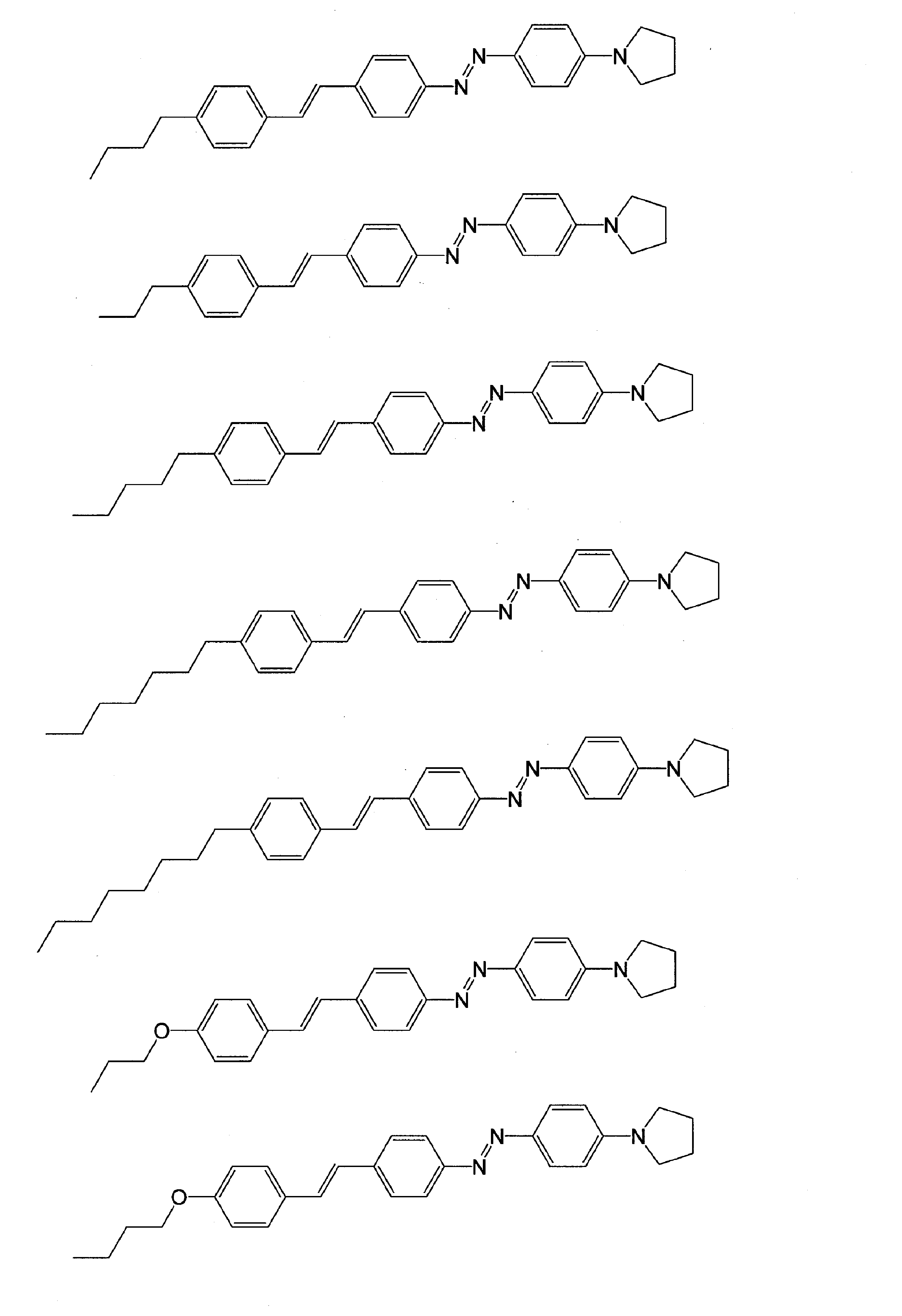
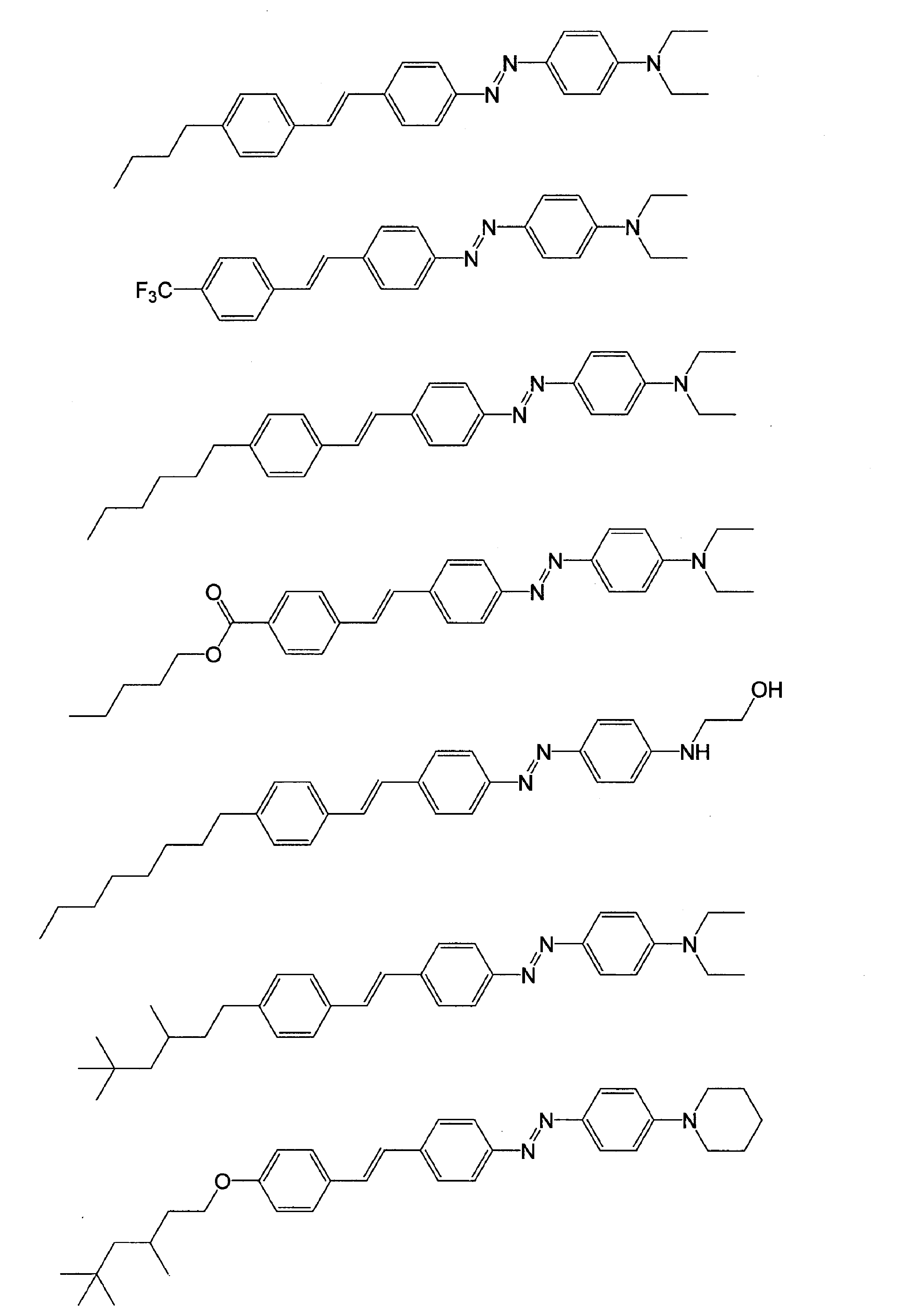
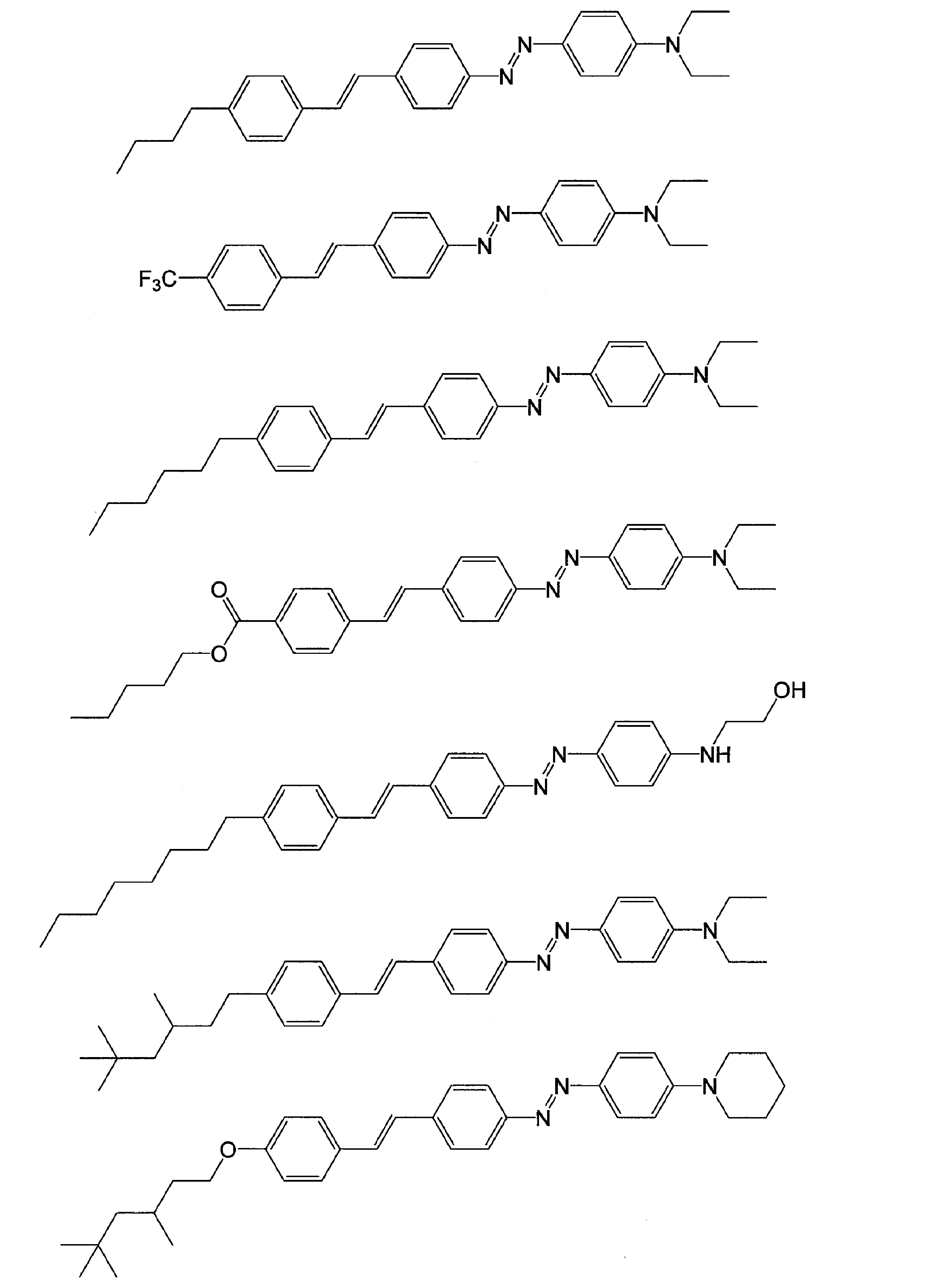
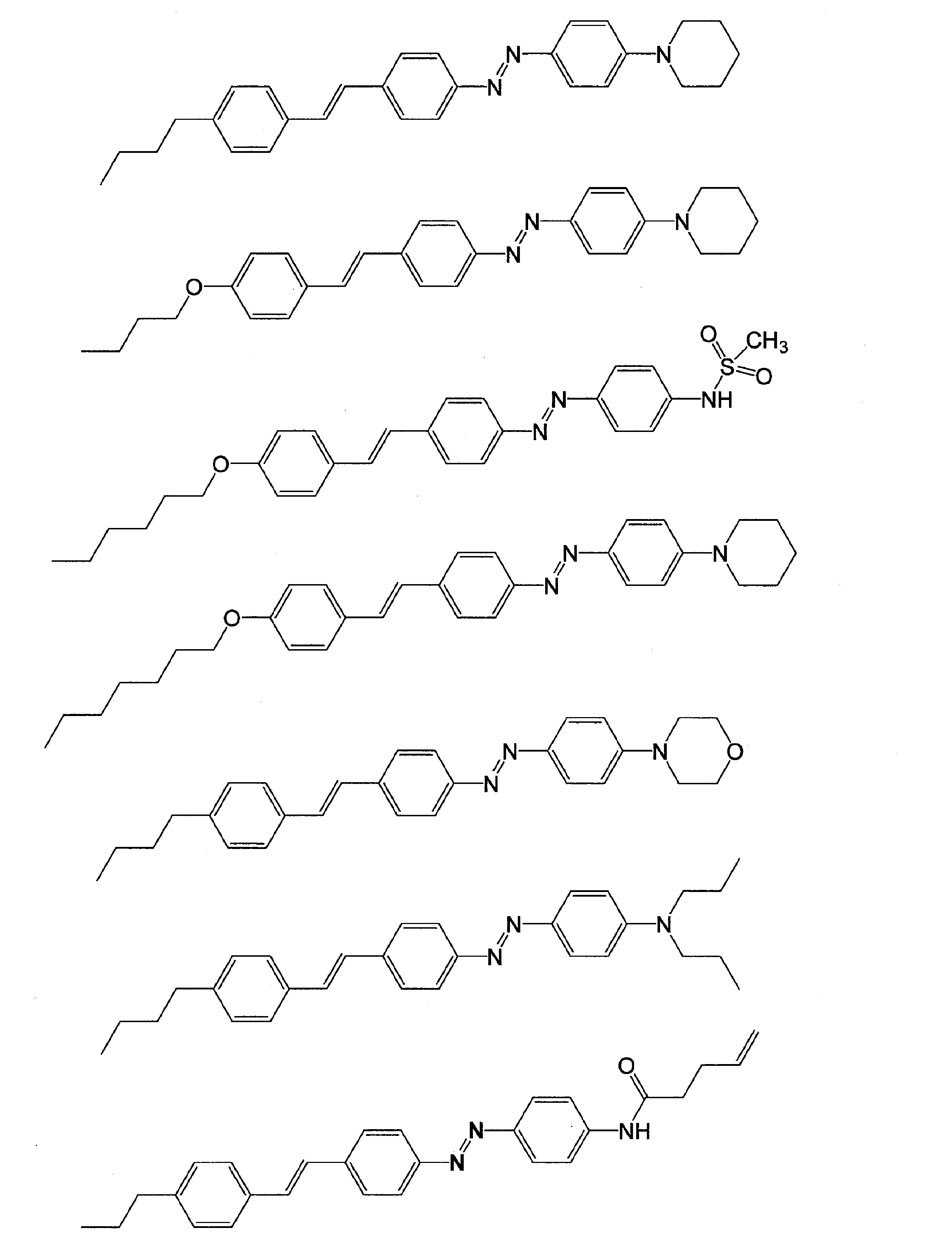
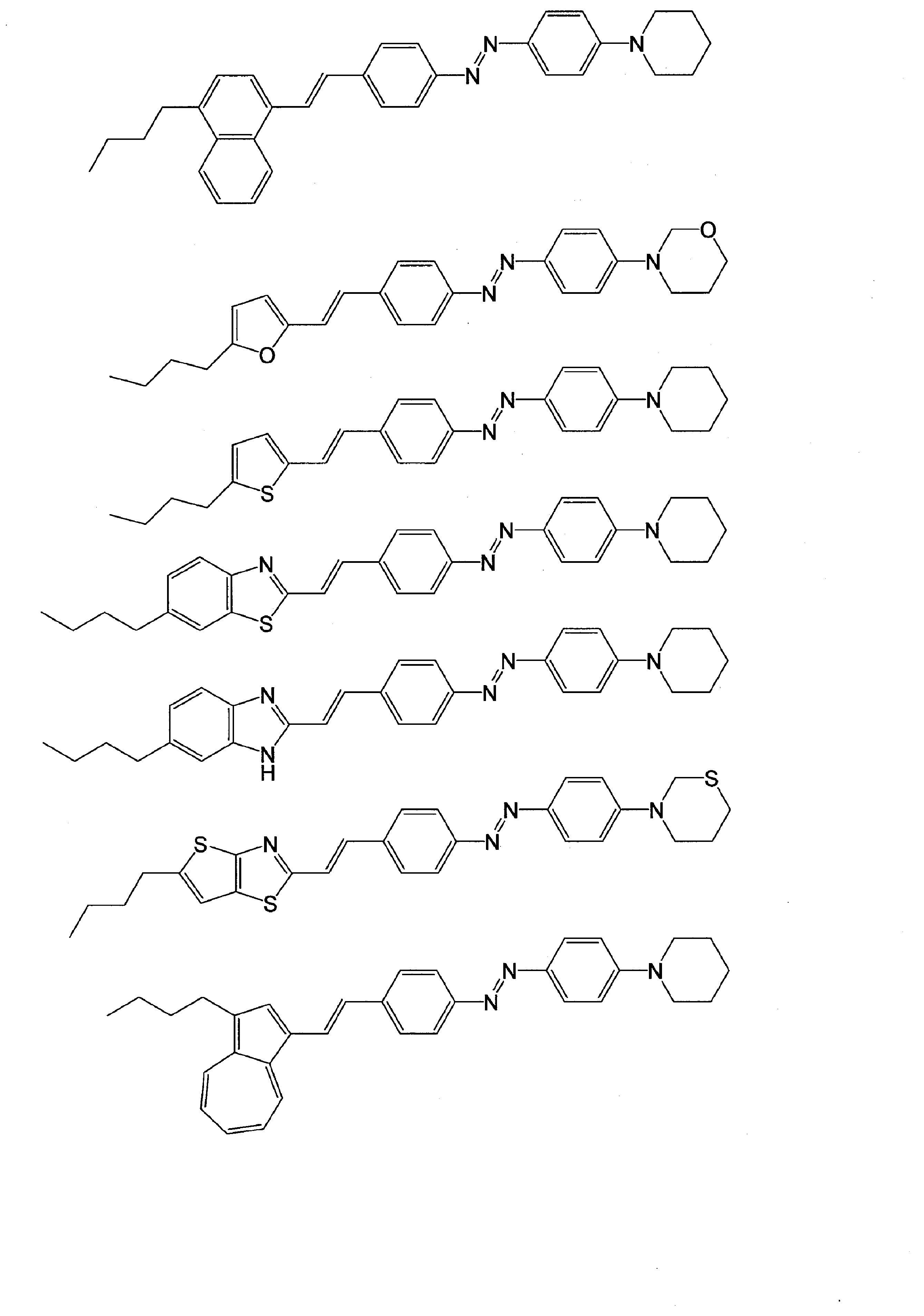
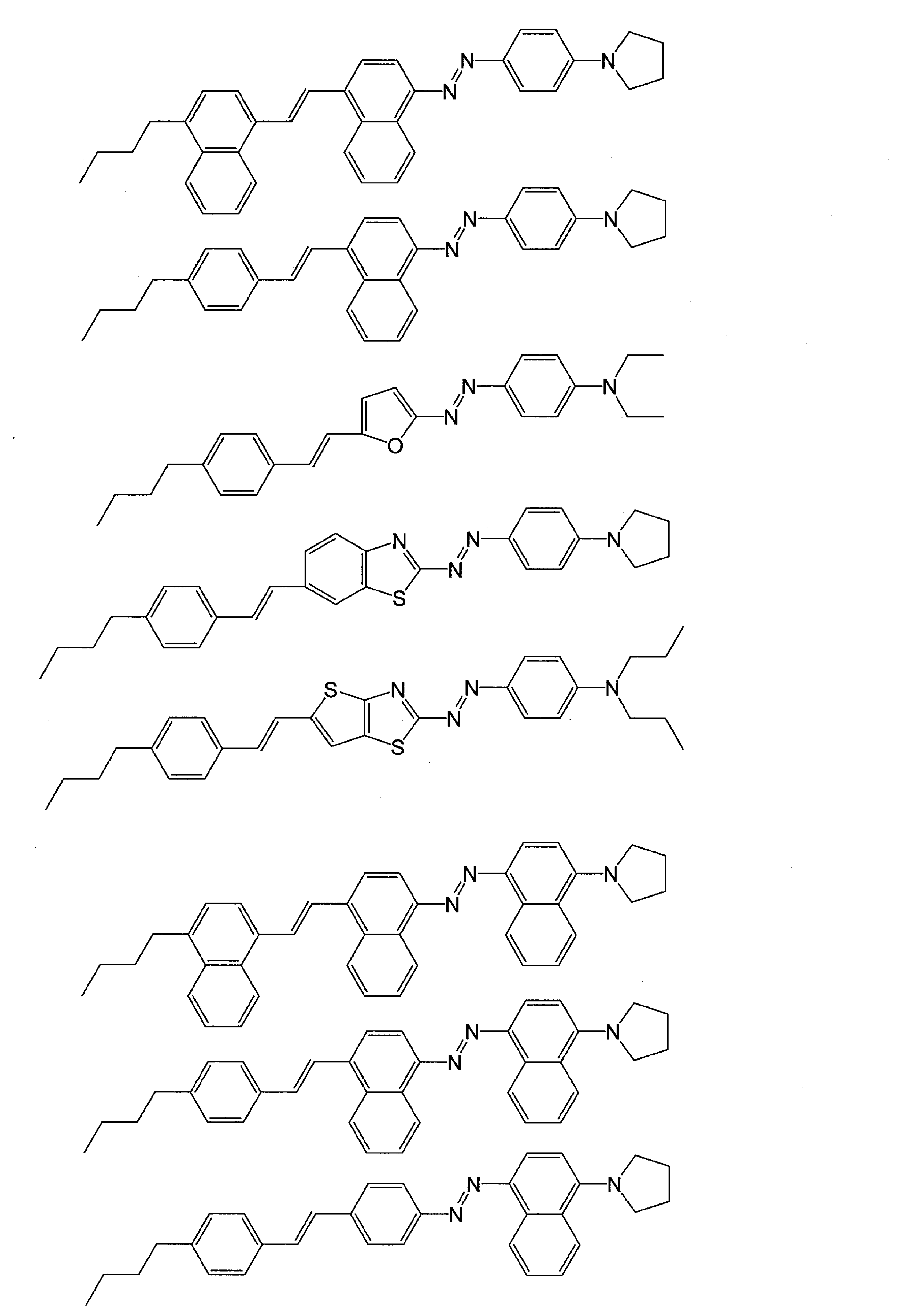
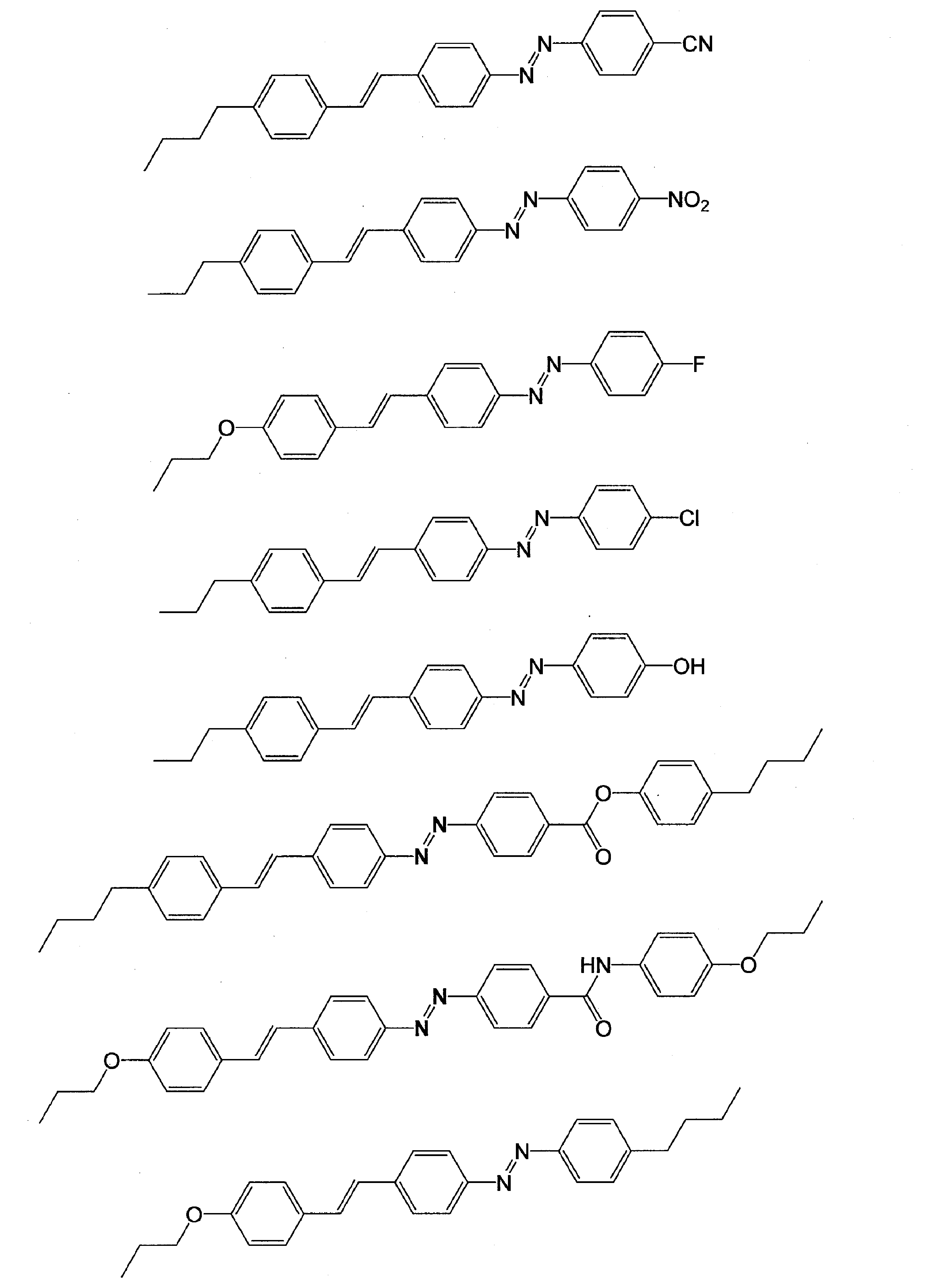

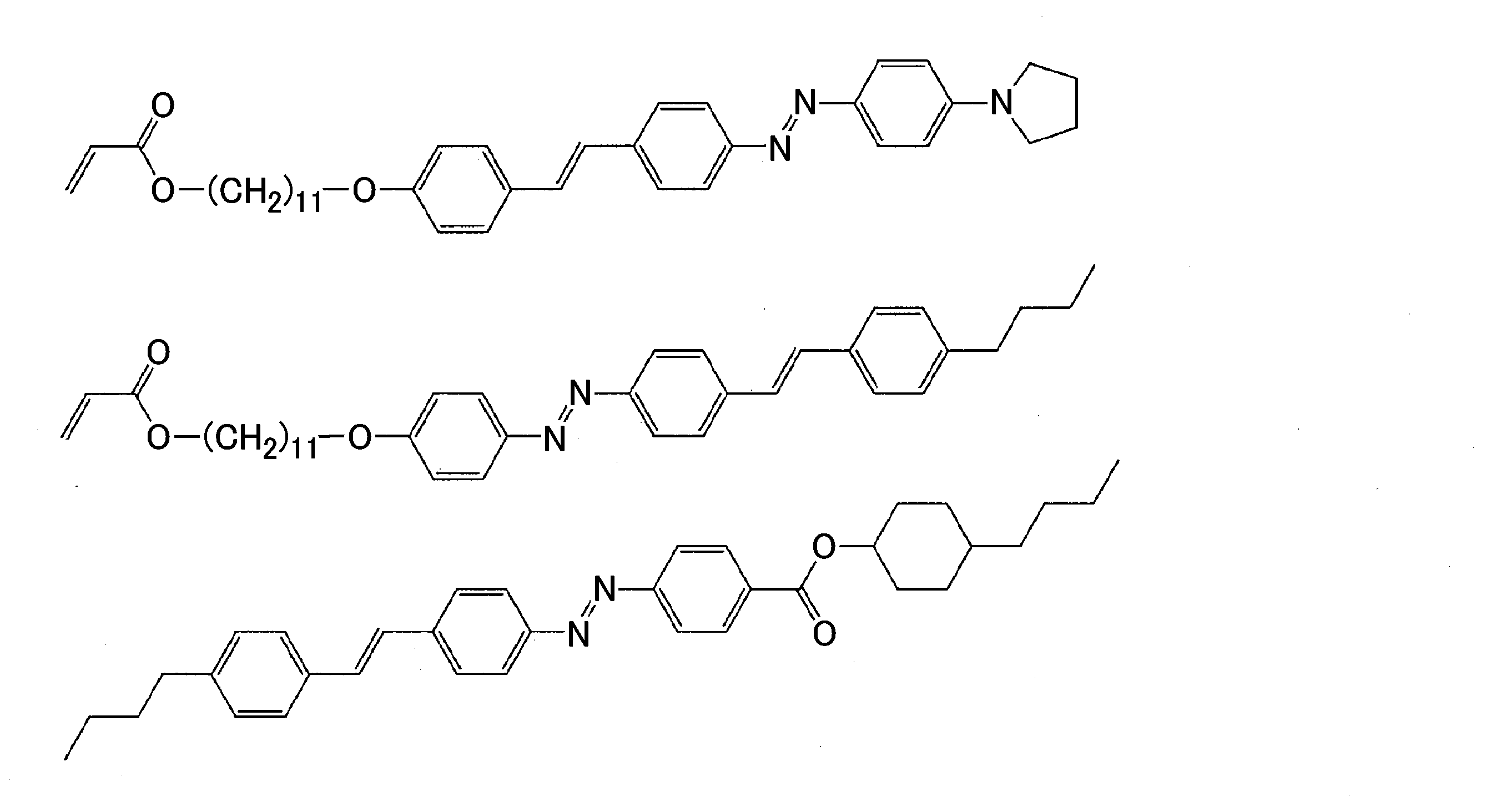
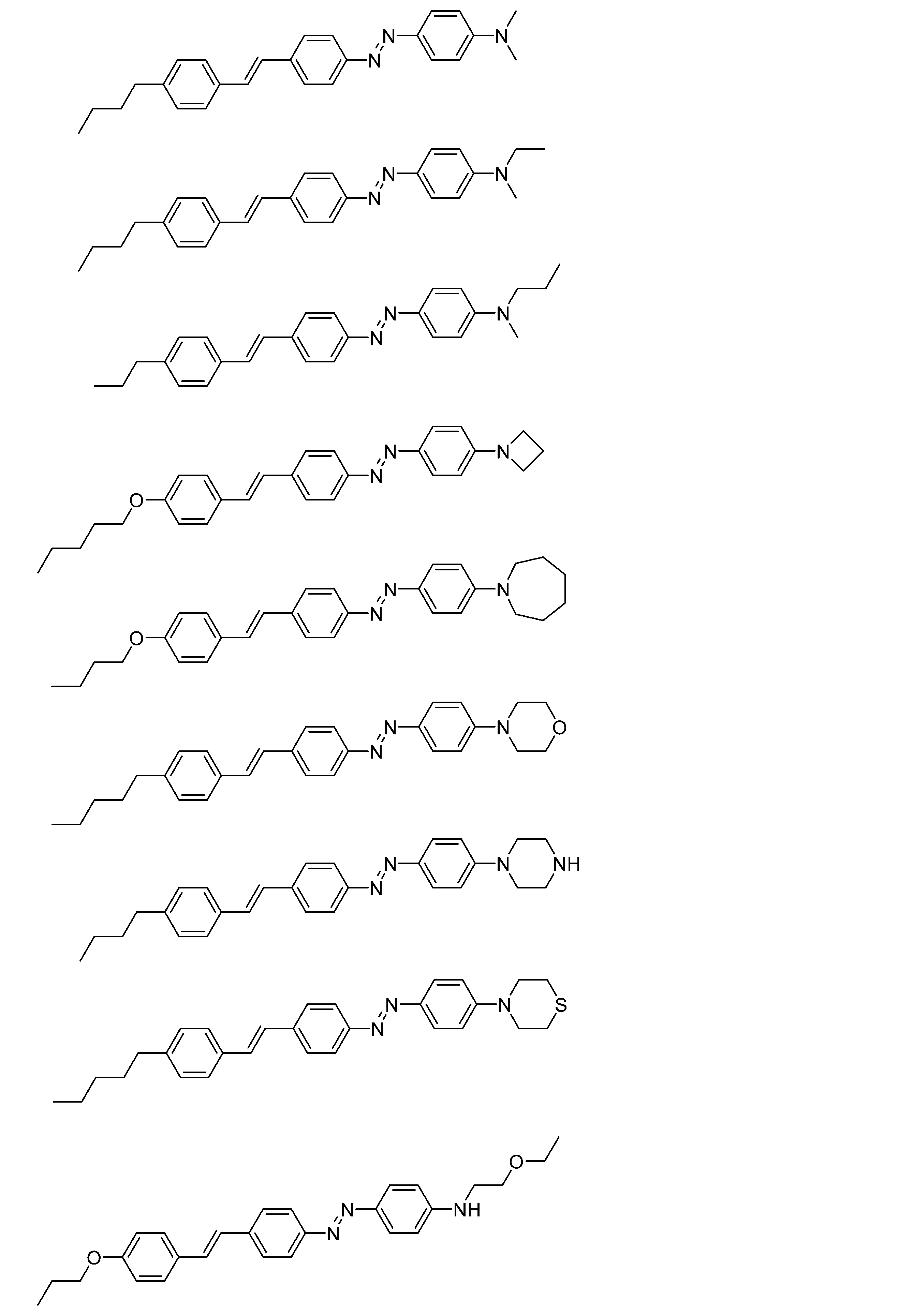
また、本発明の異方性色素膜形成用組成物に含まれる、式(1)で表される化合物は、溶媒に溶解して測定した極大吸収(λmax2)に比べて、異方性色素膜中における極大吸収(上述のλmax1)が長波長に存在していることが好ましい。この長波長シフトは、式(1)で表される化合物が、重合性液晶化合物および/または重合性液晶化合物に基づく単位を有する重合物中に分散することによって発現する現象であり、式(1)で表される化合物と、重合性液晶化合物および/または重合性液晶化合物に基づく単位を有する重合物とが強く分子間相互作用していることを示している。この強い分子間相互作用によって式(1)で表される化合物は高い二色比を発現できると考えられる。長波長シフトとは、吸収極大の差分(λmax1-λmax2)が正の値となることを意味し、その差は、高い二色性を発現させる観点から、5nm以上であることが好ましく、10nm以上であることがより好ましく、15nm以上であることがさらに好ましい。また、上限は特に限定されないが、例えば50nm以下が挙げられる。
アゾ系色素とは、アゾ基(-N=N-)を少なくとも1個以上有する色素を言い、その一分子中のアゾ基の数は、溶剤への溶解性、液晶化合物との相溶性、色調および製造容易性の観点から、1以上が好ましく、2以上がより好ましく、6以下が好ましく、4以下がより好ましく、3以下がさらに好ましい。
D1、D2およびD3は、それぞれ独立に、置換基を有していてもよいフェニレン基、置換基を有していてもよいナフチレン基、または置換基を有していてもよい2価の複素環基を表し;
pは0~4の整数を表し;
pが2以上の整数である場合、複数のD2は互いに同一でも異なっていてもよく;
R11およびR12は、それぞれ独立に、1価の有機基を表す。
フェニレン基の置換位置としては、分子の直線性が高いため、1,4-フェニレン基が好ましい。
ナフチレン基の置換位置としては、分子の直線性が高いため、1,4-ナフチレン基または2,6-ナフチレン基が好ましい。
2価の複素環基を構成する炭素以外の原子としては、窒素原子、硫黄原子および酸素原子から選択される少なくとも1つが挙げられる。複素環基が炭素以外の環を構成する原子を複数有する場合、これらは同一であっても異なっていてもよい。
具体的には、ピリジンジイル基、キノリンジイル基、イソキノリンジイル基、チアゾールジイル基、ベンゾチアゾールジイル基、チエノチアゾールジイル基、チエノチオフェンジイル基、ベンズイミダゾリジノンジイル基、ベンゾフランジイル基、フタルイミドジイル基、オキサゾールジイル基、ベンゾオキサゾールジイル基等が挙げられる。
なお、上記置換アミノ基とは、炭素数1~4のアルキル基を1つまたは2つ有するアミノ基、あるいは2つの置換アルキル基が互いに結合して炭素数2~8のアルカンジイル基を形成しているアミノ基を意味する。無置換アミノ基は、-NH2である。なお、炭素数1~4のアルキル基としては、メチル基、エチル基およびブチル基などが挙げられる。炭素数2~8のアルカンジイル基としては、エチレン基、プロパン-1,3-ジイル基、ブタン-1,3-ジイル基、ブタン-1,4-ジイル基、ペンタン-1,5-ジイル基、ヘキサン-1,6-ジイル基、ヘプタン-1,7-ジイル基、オクタン-1,8-ジイル基などが挙げられる。
分子直線性が高い点から、無置換、または、置換されている場合には、メチル基、メトキシ基、水酸基、フッ素原子、塩素原子、ジメチルアミノ基、ピロリジニル基、ピペリジニル基で置換されているのが好ましい。
R11およびR12における1価の有機基としては、水素原子、分岐を有していてもよい炭素数1~15のアルキル基;脂環式の炭素数1~15のアルキル基;メトキシ基、エトキシ基およびブトキシ基などの分岐を有していてもよい炭素数1~15のアルコキシ基;トリフルオロメチル基などの分岐を有していてもよい炭素数1~15のフッ化アルキル基;シアノ基;ニトロ基;水酸基;ハロゲン原子;アミノ基、ジエチルアミノ基、およびピロリジノ基などの置換または無置換アミノ基;カルボキシ基;ブトキシカルボニル基などの分岐を有していてもよい炭素数1~15のアルキルオキシカルボニル基;2-(4-ブチルフェニル)エテニル基などのアルキルフェニルアルケニル基;カルバモイル基;ブチルカルバモイル基などの分岐を有していてもよい炭素数1~15のアルキルカルバモイル基;スルファモイル基;ブチルスルファモイル基などの分岐を有していてもよい炭素数1~15のアルキルスルファモイル基;ブチルカルボニルアミノ基などの分岐を有していてもよい炭素数1~15のアシルアミノ基;ブチルカルボニルオキシ基などの分岐を有していてもよい炭素数1~15のアシルオキシ基;スルファニル基;ブチルスルファニル基などの炭素数1~15のアルキルスルファニル基;後述の、重合性液晶化合物におけるQ1-R1-およびQ2-R2-が挙げられる。
なお、上記置換アミノ基とは、分岐を有していてもよい炭素数1~15のアルキル基を1つまたは2つ有するアミノ基、あるいは2つの置換アルキル基が互いに結合して炭素数2~15のアルカンジイル基を形成しているアミノ基を意味する。無置換アミノ基は、-NH2である。なお、炭素数1~15のアルキル基としては、メチル基、エチル基およびブチル基などが挙げられる。炭素数2~15のアルカンジイル基としては、エチレン基、プロパン-1,3-ジイル基、ブタン-1,3-ジイル基、ブタン-1,4-ジイル基、ペンタン-1,5-ジイル基、ヘキサン-1,6-ジイル基、ヘプタン-1,7-ジイル基、オクタン-1,8-ジイル基などが挙げられる。
なお、上記炭素の一部が窒素および/または酸素で置き換えられた脂肪族有機基」は、鎖状のものおよび環状のものを含み、脂肪族有機基の一部のメチル基が水酸基、オキソ基(=O)、アミノ基、イミノ基等にそれぞれ置き換えられたものを含む。
なお、上記置換アミノ基は、分岐を有していてもよい炭素数1~15のアルキル基を1つまたは2つ有するアミノ基を意味する。無置換アミノ基は、-NH2である。
炭素の一部が窒素および/または酸素で置き換えられた脂肪族有機基としては、上記の、分岐を有していてもよい炭素数1~15のアルコキシ基;置換または無置換アミノ基;カルボキシ基;分岐を有していてもよい炭素数1~15のアルキルオキシカルボニル基;カルバモイル基;分岐を有していてもよい炭素数1~15のアルキルカルバモイル基;分岐を有していてもよい炭素数1~15のアシルアミノ基;分岐を有していてもよい炭素数1~15のアシルオキシ基等が挙げられる。
なお、上記置換アミノ基とは、分岐を有していてもよい炭素数1~15のアルキル基を1つまたは2つ有するアミノ基、あるいは2つの置換アルキル基が互いに結合して炭素数2~15のアルカンジイル基を形成しているアミノ基を意味する。無置換アミノ基は、-NH2である。なお、炭素数1~15のアルキル基としては、メチル基、エチル基およびブチル基などが挙げられる。炭素数2~15のアルカンジイル基としては、エチレン基、プロパン-1,3-ジイル基、ブタン-1,3-ジイル基、ブタン-1,4-ジイル基、ペンタン-1,5-ジイル基、ヘキサン-1,6-ジイル基、ヘプタン-1,7-ジイル基、オクタン-1,8-ジイル基などが挙げられる。
公知の色素としては、たとえば、上述の特許文献1、日本国特許第5982762号公報、日本国特許出願公開第2017-025317号公報、日本国特許出願公開第2014-095899号公報に記載の色素(二色性色素、二色性染料)が挙げられる。
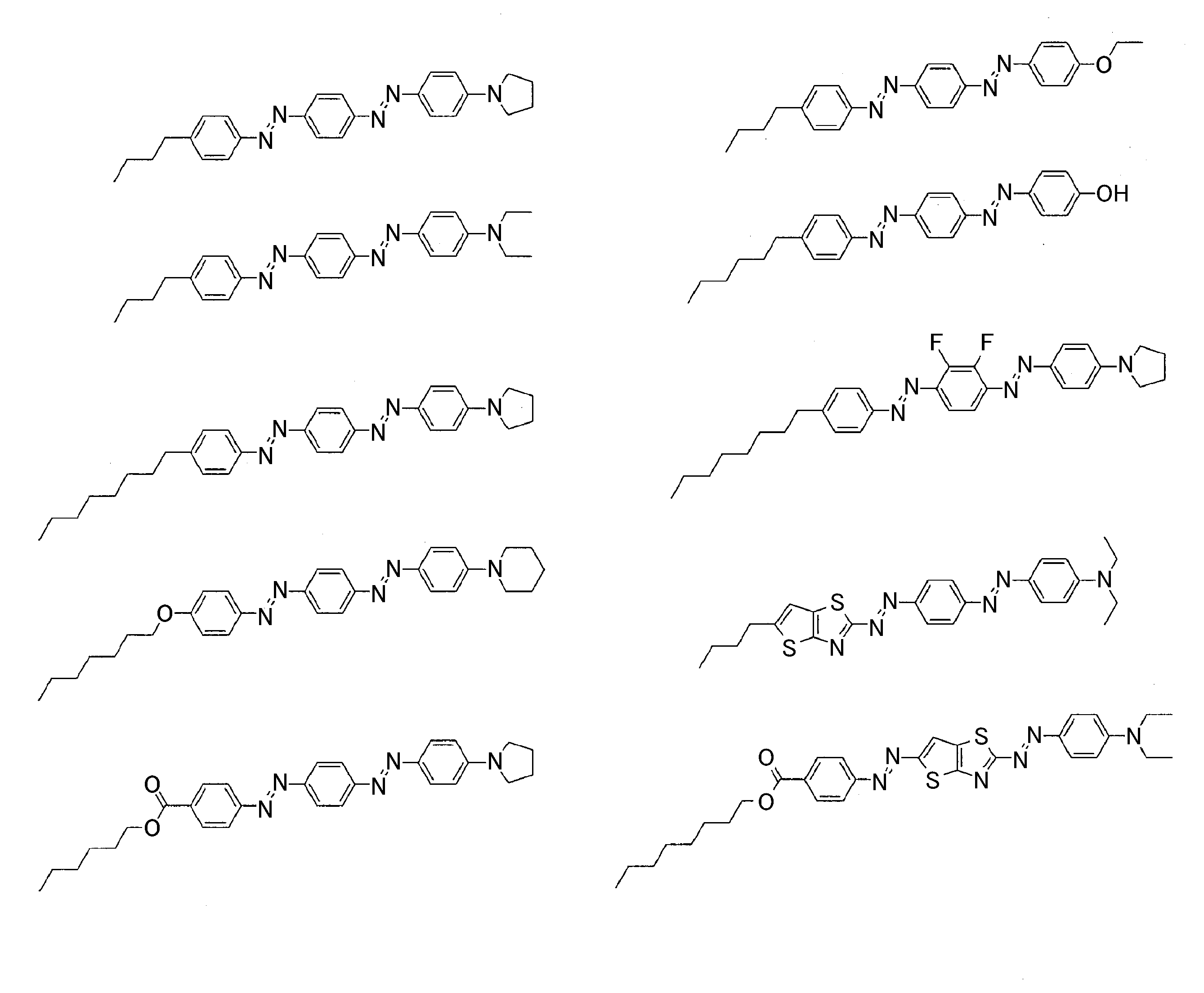
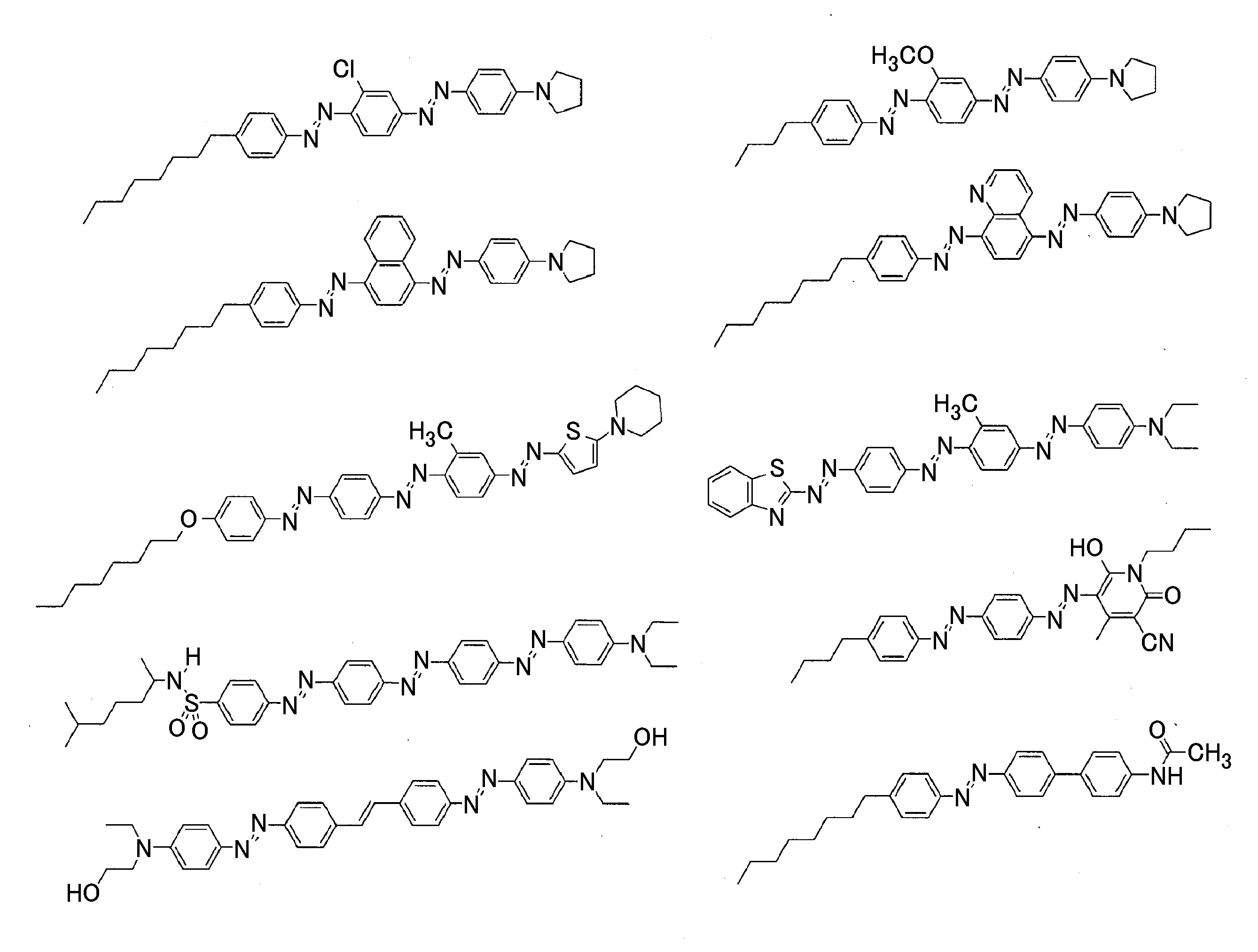

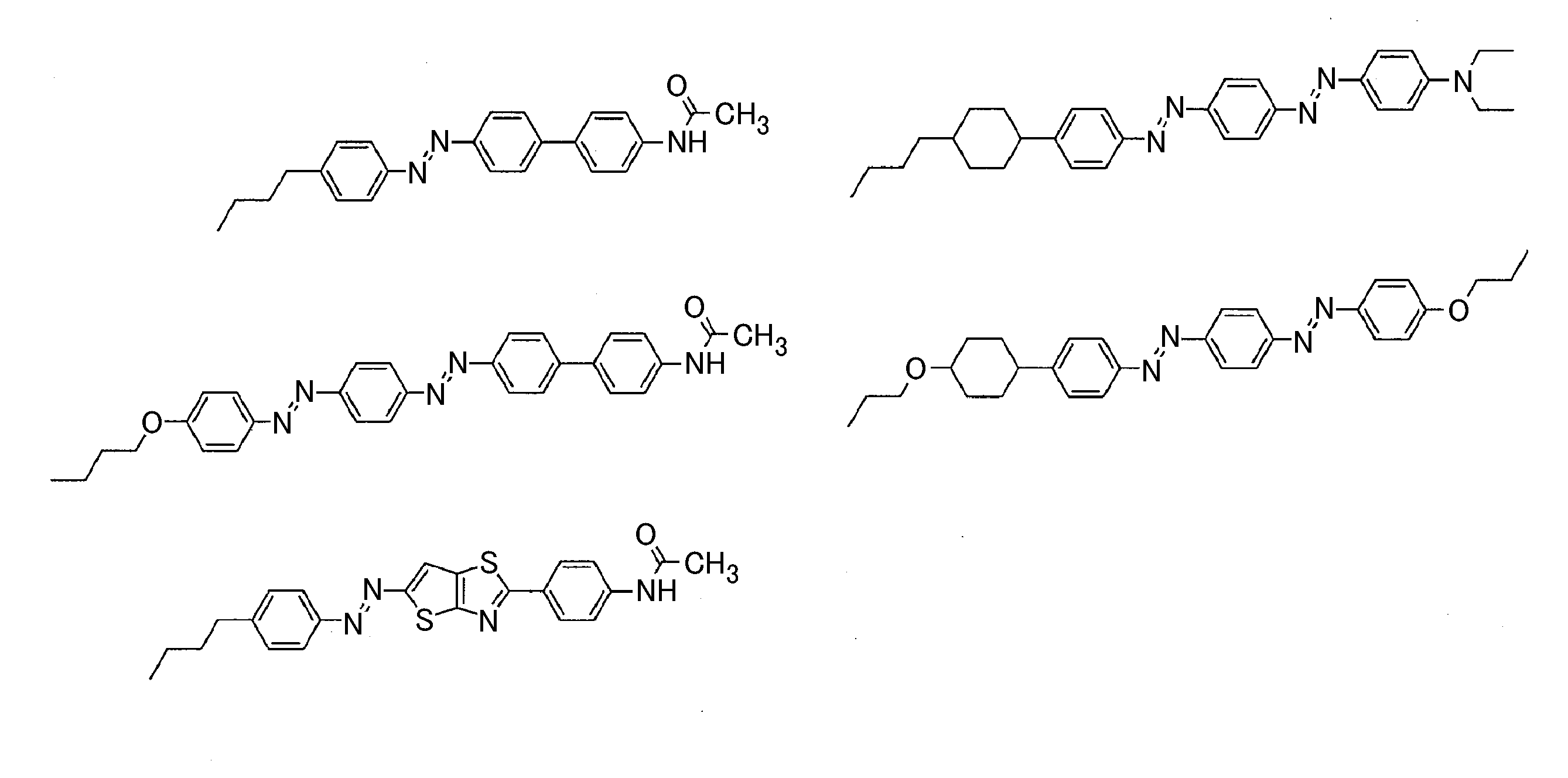
色素(二色性色素)が占める含有量が前記範囲内であれば、本発明の異方性色素膜形成用組成物に含まれる液晶化合物の配向を乱すことなく、本発明の異方性色素膜形成用組成物に含まれる化合物を重合させることができる傾向にある。また、色素(二色性色素)が占める含有量が前記下限値以上であれば、十分な光吸収が得られ、十分な偏光性能が得られる傾向にある。また、色素(二色性色素)が占める含有量が前記上限値以下であれば、液晶分子の配向の阻害が抑制されやすい傾向にある。
たとえば、本発明の異方性色素膜形成用組成物に含まれる色素は、実施例に記載の方法や、たとえば、「新染料化学」(細田豊著、昭和48年12月21日、技報堂)、「総説合成染料」(堀口博著、1968年、三共出版)、「理論製造 染料化学」(細田豊著、1957年、技報堂)に記載の方法にしたがって合成することができる。
本発明において、液晶化合物とは、液晶状態を示す物質を指し、具体的には、「液晶便覧」(丸善株式会社、平成12年10月30日発行)の1~28ページに記載されているように、結晶から液体には直接転移せず、結晶と液体の両方の性質を示す中間の状態を経て液体になる化合物をいう。
重合性液晶化合物において、重合性基は液晶化合物分子内に1つ以上存在することができ、2つ以上存在する場合は、液晶化合物分子の両末端にそれぞれ存在していることが好ましい。
たとえば、本発明の異方性色素膜形成用組成物に含まれる重合性液晶化合物としては、式(2)で表される化合物を挙げることができる。
Q1は、水素原子または重合性基を表し;
Q2は、重合性基を表し;
R1およびR2は、それぞれ独立に、鎖状有機基を表し;
A11およびA13は、それぞれ独立に、下記式(3)で表される部分構造、2価有機基、または単結合を表し;
A12は、下記式(3)で表される部分構造または2価有機基を表し;
-Y1-および-Y2-は、それぞれ独立に、単結合、-C(=O)O-、-OC(=O)-、-C(=S)O-、-OC(=S)-、-C(=O)S-、-SC(=O)-、-CH2CH2-、-CH=CH-、-C≡C-、-C(=O)NH-、-NHC(=O)-、-CH2O-、-OCH2-、-CH2S-、または-SCH2-を表し;
A11およびA13の一方は、下記式(3)で表される部分構造または2価有機基であり;
kは1または2である。)
Cyは、炭化水素環基または複素環基を表し;
-X1-は、-C(=O)O-、-OC(=O)-、-C(=S)O-、-OC(=S)-、-C(=O)S-、-SC(=O)-、-CH2CH2-、-CH=CH-、-C(=O)NH-、-NHC(=O)-、-CH2O-、-OCH2-、-CH2S-、または-SCH2-を表し;
-X2-は、単結合、-C(=O)O-、-OC(=O)-、-C(=S)O-、-OC(=S)-、-C(=O)S-、-SC(=O)-、-CH2CH2-、-CH=CH-、-C(=O)NH-、-NHC(=O)-、-CH2O-、-OCH2-、-CH2S-、または-SCH2-を表す。)
Q1-R1-Cy-X2-C≡C-X1-Y1-A12-(Y2-A13)k-R2-Q2 ・・・(2A)
であってもよく、
Q1-R1-X1-C≡C-X2-Cy-Y1-A12-(Y2-A13)k-R2-Q2 ・・・(2B)
であってもよい。
また、A12が、式(3)で表される部分構造である場合、式(2)は、
Q1-R1-A11-Y1-Cy-X2-C≡C-X1-(Y2-A13)k-R2-Q2 ・・・(2C)
であってもよく、
Q1-R1-A11-Y1-X1-C≡C-X2-Cy-(Y2-A13)k-R2-Q2 ・・・(2D)
であってもよい。
また、A13が、式(3)で表される部分構造である場合、式(2)は、
Q1-R1-A11-Y1-A12-(Y2-Cy-X2-C≡C-X1)k-R2-Q2 ・・・(2E)
であってもよく、
Q1-R1-A11-Y1-A12-(Y2-X1-C≡C-X2-Cy)k-R2-Q2 ・・・(2F)
であってもよい。
非連結芳香族炭化水素環基は、単環もしくは縮合した芳香族炭化水素環の2価基であり、炭素数は6~20が好ましい。芳香族炭化水素環としては、ベンゼン環、ナフタレン環、アントラセン環、フェナントレン環、ペリレン環、テトラセン環、ピレン環、ベンズピレン環、クリセン環、トリフェニレン環、アセナフテン環、フルオランテン環、フルオレン環等が挙げられる。
連結芳香族炭化水素環基は、単環もしくは縮合した芳香族炭化水素環の複数が単結合で結合し、環を構成する原子上に結合手を有する2価基である。単環もしくは縮合環の炭素数は6~20が好ましい。たとえば、第1の炭素数6~20の単環もしくは縮合した芳香族炭化水素環と第2の炭素数6~20の単環もしくは縮合した芳香族炭化水素環とが単結合で結合し、第1の炭素数6~20の単環もしくは縮合した芳香族炭化水素環の環を構成する原子上に第1の結合手を有し、第2の炭素数6~20の単環もしくは縮合した芳香族炭化水素環の環を構成する原子上に第2の結合手を有する2価基である。連結芳香族炭化水素環基としては、たとえば、ビフェニル-4,4’-ジイル基が挙げられる。
芳香族炭化水素環基としては、非連結芳香族炭化水素環基が好ましい。
これらのうち、芳香族炭化水素環基としては、ベンゼン環の2価基、ナフタレン環の2価基が好ましく、ベンゼン環の2価基(フェニレン基)がより好ましい。フェニレン基としては、1,4-フェニレン基が好ましい。上記基を有することで、液晶化合物の分子配向性が良好になる傾向がある。
非連結非芳香族炭化水素環基は、単環もしくは縮合した非芳香族炭化水素環の2価基であり、炭素数は3~20が好ましい。非芳香族炭化水素環としては、シクロプロパン環、シクロブタン環、シクロペンタン環、シクロヘキサン環、シクロヘプタン環、シクロオクタン環、シクロヘキセン環、ノルボルナン環、ボルナン環、アダマンタン環、テトラヒドロナフタレン環、ビシクロ[2.2.2]オクタン環等が挙げられる。
非連結非芳香族炭化水素環基は、非芳香族炭化水素環の環を構成する原子間結合として不飽和結合を有さない脂環式炭化水素環基と、非芳香族炭化水素環の環を構成する原子間結合として不飽和結合を有する不飽和非芳香族炭化水素環基とを含む。非連結非芳香族炭化水素環基としては、脂環式炭化水素環基が好ましい。
連結非芳香族炭化水素環基は、単環もしくは縮合した非芳香族炭化水素環の複数が単結合で結合し、環を構成する原子上に結合手を有する2価基;あるいは、単環の芳香族炭化水素環、縮合した芳香族炭化水素環、単環の非芳香族炭化水素環、および縮合した非芳香族炭化水素環からなる群より選択される1つ以上の環と、単環もしくは縮合した非芳香族炭化水素環とが単結合で結合し、環を構成する原子上に結合手を有する2価基である。単環もしくは縮合環の炭素数は3~20が好ましい。たとえば、第1の炭素数3~20の単環もしくは縮合した非芳香族炭化水素環と第2の炭素数3~20の単環もしくは縮合した非芳香族炭化水素環とが単結合で結合し、第1の炭素数3~20の単環もしくは縮合した非芳香族炭化水素環の環を構成する原子上に第1の結合手を有し、第2の炭素数3~20の単環もしくは縮合した非芳香族炭化水素環の環を構成する原子上に第2の結合手を有する2価基であり、たとえば、炭素数3~20の単環もしくは縮合した芳香族炭化水素環と炭素数3~20の単環もしくは縮合した非芳香族炭化水素環とが単結合で結合し、炭素数3~20の単環もしくは縮合した芳香族炭化水素環の環を構成する原子上に第1の結合手を有し、炭素数3~20の単環もしくは縮合した非芳香族炭化水素環の環を構成する原子上に第2の結合手を有する2価基である。連結非芳香族炭化水素環基としては、たとえば、ビス(シクロヘキサン)-4,4’-ジイル基、1-シクロヘキシルベンゼン-4,4’-ジイル基が挙げられる。
非芳香族炭化水素環基としては、液晶化合物の分子配向性の観点から非連結非芳香族炭化水素環基が好ましい。
これらのうち、非芳香族炭化水素環基としては、シクロヘキサンの2価基(シクロヘキサンジイル基)が好ましい。シクロヘキサンジイル基としては、シクロヘキサン-1,4-ジイル基が好ましい。上記基を有することで、溶解性および液晶化合物の分子配向性が良好になる傾向がある。
非連結芳香族複素環基は、単環もしくは縮合した芳香族複素環の2価基であり、炭素数は4~20が好ましい。芳香族複素環としては、フラン環、ベンゾフラン環、チオフェン環、ベンゾチオフェン環、ピロール環、ピラゾール環、イミダゾール環、オキサジアゾール環、インドール環、カルバゾール環、ピロロイミダゾール環、ピロロピラゾール環、ピロロピロール環、チエノピロール環、チエノチオフェン環、フロピロール環、フロフラン環、チエノフラン環、チエノチアゾール環、ベンゾイソオキサゾール環、ベンゾイソチアゾール環、ベンゾイミダゾール環、ピリジン環、ピラジン環、ピリダジン環、ピリミジン環、トリアジン環、キノリン環、イソキノリン環、シノリン環、キノキサリン環、フェナントリジン環、ベンゾイミダゾール環、キナゾリン環、キナゾリノン環、アズレン環等が挙げられる。
連結芳香族複素環基は、単環もしくは縮合した芳香族複素環の複数が単結合で結合し、環を構成する原子上に結合手を有する2価基である。単環もしくは縮合環の炭素数は4~20が好ましい。たとえば、第1の炭素数4~20の単環もしくは縮合した芳香族複素環と第2の炭素数4~20の単環もしくは縮合した芳香族複素環とが単結合で結合し、第1の炭素数4~20の単環もしくは縮合した芳香族複素環の環を構成する原子上に第1の結合手を有し、第2の炭素数4~20の単環もしくは縮合した芳香族複素環の環を構成する原子上に第2の結合手を有する2価基である。
非連結非芳香族複素環基は、単環もしくは縮合した非芳香族複素環の2価基であり、炭素数は4~20が好ましい。炭素数4~20の単環もしくは縮合した非芳香族複素環の2価基であり、非芳香族複素環としては、テトラヒドロフラン環、テトラヒドロピラン環、ジオキサン環、テトラヒドロチオフェン環、テトラヒドロチオピラン環、ピロリジン環、ピペリジン環、ジヒドロピリジン環、ピペラジン環、テトラヒドロチアゾール環、テトラヒドロオキサゾール環、オクタヒドロキノリン環、テトラヒドロキノリン環、オクタヒドロキナゾリン環、テトラヒドロキナゾリン環、テトラヒドロイミダゾール環、テトラヒドロベンゾイミダゾール環、キヌクリジン環等が挙げられる。
連結非芳香族複素環基は、単環もしくは縮合した非芳香族複素環の複数が単結合で結合し、環を構成する原子上に結合手を有する2価基である。単環もしくは縮合環の炭素数は4~20が好ましい。たとえば、第1の炭素数4~20の単環もしくは縮合した非芳香族複素環と第2の炭素数4~20の単環もしくは縮合した非芳香族複素環とが単結合で結合し、第1の炭素数4~20の単環もしくは縮合した非芳香族複素環の環を構成する原子上に第1の結合手を有し、第2の炭素数4~20の単環もしくは縮合した非芳香族複素環の環を構成する原子上に第2の結合手を有する2価基である。
Cyにおける芳香族炭化水素環基、非芳香族炭化水素環基、芳香族複素環基、非芳香族複素環基は、分子構造の直線性が高く、式(2)で表される分子同士が会合しやすく液晶状態を発現しやすい点から、それぞれ独立に、無置換であるか、メチル基、メトキシ基、フッ素原子、塩素原子、臭素原子が置換していることが好ましく、無置換であることがより好ましい。
芳香族炭化水素環基、非芳香族炭化水素環基、芳香族複素環基、非芳香族複素環基が有する置換基は、同一でも異なっていてもよく、また、芳香族炭化水素環基、非芳香族炭化水素環基、芳香族複素環基、非芳香族複素環基の全部が置換されていてもよく、全部が無置換であってもよく、一部が置換されていて一部が無置換であってもよい。
重合性基として具体的には、たとえば、アクリロイル基、メタアクリロイル基、アクリロイルオキシ基、メタアクリロイルオキシ基、アクリロイルアミノ基、メタアクリロイルアミノ基、ビニル基、ビニルオキシ基、エチニル基、エチニルオキシ基、1,3-ブタジエニル基、1,3-ブタジエニルオキシ基、オキシラニル基、オキセタニル基、グリシジル基、グリシジルオキシ基、スチリル基、スチリルオキシ基等が挙げられる。これらの中でも、アクリロイル基、メタアクリロイル基、アクリロイルオキシ基、メタアクリロイルオキシ基、アクリロイルアミノ基、メタアクリロイルアミノ基、オキシラニル基、グリシジル基、グリシジルオキシ基が好ましく、アクリロイル基、メタアクリロイル基、アクリロイルオキシ基、メタアクリロイルオキシ基、アクリロイルアミノ基、メタアクリロイルアミノ基、グリシジル基、グリシジルオキシ基がより好ましく、アクリロイルオキシ基、メタアクリロイルオキシ基、グリシジルオキシ基がさらに好ましい。上記重合性基を有することで、重合の制御が容易になる傾向にある。
このような鎖状有機基としては、-(アルキレン基)-、-O-(アルキレン基)-、-S-(アルキレン基)-、-NH-(アルキレン基)-、-N(アルキル基)-(アルキレン基)-、-OC(=O)-(アルキレン基)-、-C(=O)O-(アルキレン基)-が挙げられる。
R1およびR2における鎖状有機基としては、-(アルキレン基)-、-O-(アルキレン基)-が好ましい。ある態様として、R1およびR2における鎖状有機基としては、-(アルキレン基)-であり、別の態様として、このような鎖状有機基としては、-O-(アルキレン基)-である。
なお、アミン性窒素原子としては、-NH-、-N(Rz)が挙げられ、Rzは、炭素数1~6の直鎖状もしくは分枝状のアルキル基を表す。
これらの鎖状有機基におけるアルキレン基としては、分子直線性が高いことから、アルキレン基の炭素の一部が不飽和結合になっていてもよく、また、アルキレン基に含まれる一つまたはそれ以上のメチレン基が上述の基によって置き換えられた(displace)構造とされていてもよい、炭素数1~25の直鎖状のアルキレン基であることが好ましい。
鎖状有機基における主鎖(鎖状有機基におけるもっとも長い鎖状部分を意味する。)の原子の数は、3~25が好ましく、5~20がより好ましく、6~20がさらに好ましい。
式(2B)、式(2E)のように、X1とR1もしくはX1とR2が結合している場合や;たとえば、式(2B)においてA13が単結合である場合や、式(2E)においてA11が単結合である場合のように、R1もしくはR2がY1もしくはY2と結合している場合;には、X1もしくはY1もしくはY2と結合するR1もしくはR2は、液晶化合物の分子配向を高める観点から、-(アルキレン基)-であることが好ましい。
また、上記以外のように、X1もしくはY1もしくはY2と結合しないR1もしくはR2は、液晶化合物の分子配向を高める観点から、-O-(アルキレン基)-であることが好ましい。
Q3は、炭化水素環基または複素環基を表す。
非連結芳香族炭化水素環基は、単環もしくは縮合した芳香族炭化水素環の2価基であり、炭素数は6~20が好ましい。芳香族炭化水素環としては、ベンゼン環、ナフタレン環、アントラセン環、フェナントレン環、ペリレン環、テトラセン環、ピレン環、ベンズピレン環、クリセン環、トリフェニレン環、アセナフテン環、フルオランテン環、フルオレン環等が挙げられる。
連結芳香族炭化水素環基は、単環もしくは縮合した芳香族炭化水素環の複数が単結合で結合し、環を構成する原子上に結合手を有する2価基である。単環もしくは縮合環の炭素数は6~20が好ましい。たとえば、第1の炭素数6~20の単環もしくは縮合した芳香族炭化水素環と第2の炭素数6~20の単環もしくは縮合した芳香族炭化水素環とが単結合で結合し、第1の炭素数6~20の単環もしくは縮合した芳香族炭化水素環の環を構成する原子上に第1の結合手を有し、第2の炭素数6~20の単環もしくは縮合した芳香族炭化水素環の環を構成する原子上に第2の結合手を有する2価基である。連結芳香族炭化水素環基としては、たとえば、ビフェニル-4,4’-ジイル基が挙げられる。
芳香族炭化水素環基としては、非連結芳香族炭化水素環基が好ましい。
これらのうち、芳香族炭化水素環基としては、ベンゼン環の2価基、ナフタレン環の2価基が好ましく、ベンゼン環の2価基(フェニレン基)がより好ましい。フェニレン基としては、1,4-フェニレン基が好ましい。上記基を有することで液晶化合物の分子配向性が良好になる傾向がある。
非連結非芳香族炭化水素環基は、単環もしくは縮合した非芳香族炭化水素環の2価基であり、炭素数は3~20が好ましい。非芳香族炭化水素環としては、シクロプロパン環、シクロブタン環、シクロペンタン環、シクロヘキサン環、シクロヘプタン環、シクロオクタン環、シクロヘキセン環、ノルボルナン環、ボルナン環、アダマンタン環、テトラヒドロナフタレン環、ビシクロ[2.2.2]オクタン環等が挙げられる。
非連結非芳香族炭化水素環基は、非芳香族炭化水素環の環を構成する原子間結合として不飽和結合を有さない脂環式炭化水素環基と、非芳香族炭化水素環の環を構成する原子間結合として不飽和結合を有する不飽和非芳香族炭化水素環基とを含む。非連結非芳香族炭化水素環基としては、脂環式炭化水素環基が好ましい。
連結非芳香族炭化水素環基は、単環もしくは縮合した非芳香族炭化水素環の複数が単結合で結合し、環を構成する原子上に結合手を有する2価基;あるいは、単環の芳香族炭化水素環、縮合した芳香族炭化水素環、単環の非芳香族炭化水素環、および縮合した非芳香族炭化水素環からなる群より選択される1つ以上の環と、単環もしくは縮合した非芳香族炭化水素環とが単結合で結合し、環を構成する原子上に結合手を有する2価基である。単環又は縮合環の炭素数は、3~20が好ましい。たとえば、第1の炭素数3~20の単環もしくは縮合した非芳香族炭化水素環と第2の炭素数3~20の単環もしくは縮合した非芳香族炭化水素環とが単結合で結合し、第1の炭素数3~20の単環もしくは縮合した非芳香族炭化水素環の環を構成する原子上に第1の結合手を有し、第2の炭素数3~20の単環もしくは縮合した非芳香族炭化水素環の環を構成する原子上に第2の結合手を有する2価基である。また、たとえば、炭素数3~20の単環もしくは縮合した芳香族炭化水素環と炭素数3~20の単環もしくは縮合した非芳香族炭化水素環とが単結合で結合し、炭素数3~20の単環もしくは縮合した芳香族炭化水素環の環を構成する原子上に第1の結合手を有し、炭素数3~20の単環もしくは縮合した非芳香族炭化水素環の環を構成する原子上に第2の結合手を有する2価基である。
連結非芳香族炭化水素環基としては、たとえば、ビス(シクロヘキサン)-4,4’-ジイル基、1-シクロヘキシルベンゼン-4,4’-ジイル基が挙げられる。
非芳香族炭化水素環基としては、非連結非芳香族炭化水素環基が好ましい。
これらのうち、非芳香族炭化水素環基としては、シクロヘキサンの2価基(シクロヘキサンジイル基)が好ましい。シクロヘキサンジイル基としては、シクロヘキサン-1,4-ジイル基が溶解性および液晶化合物の分子配向性の観点から好ましい。
非連結芳香族複素環基は、単環もしくは縮合した芳香族複素環の2価基であり、炭素数は4~20が好ましい。芳香族複素環としては、フラン環、ベンゾフラン環、チオフェン環、ベンゾチオフェン環、ピロール環、ピラゾール環、イミダゾール環、オキサジアゾール環、インドール環、カルバゾール環、ピロロイミダゾール環、ピロロピラゾール環、ピロロピロール環、チエノピロール環、チエノチオフェン環、フロピロール環、フロフラン環、チエノフラン環、チエノチアゾール環、ベンゾイソオキサゾール環、ベンゾイソチアゾール環、ベンゾイミダゾール環、ピリジン環、ピラジン環、ピリダジン環、ピリミジン環、トリアジン環、キノリン環、イソキノリン環、シノリン環、キノキサリン環、フェナントリジン環、ベンゾイミダゾール環、キナゾリン環、キナゾリノン環、アズレン環等が挙げられる。
連結芳香族複素環基は、単環もしくは縮合した芳香族複素環の複数が単結合で結合し、環を構成する原子上に結合手を有する2価基である。単環もしくは縮合環の炭素数は4~20が好ましい。たとえば、第1の炭素数4~20の単環もしくは縮合した芳香族複素環と第2の炭素数4~20の単環もしくは縮合した芳香族複素環とが単結合で結合し、第1の炭素数4~20の単環もしくは縮合した芳香族複素環の環を構成する原子上に第1の結合手を有し、第2の炭素数4~20の単環もしくは縮合した芳香族複素環の環を構成する原子上に第2の結合手を有する2価基である。
非連結非芳香族複素環基は、単環又は縮合した非芳香族複素環の2価基であり、炭素数は4~20が好ましい。炭素数4~20の単環もしくは縮合した非芳香族複素環の2価基であり、非芳香族複素環としては、テトラヒドロフラン環、テトラヒドロピラン環、ジオキサン環、テトラヒドロチオフェン環、テトラヒドロチオピラン環、ピロリジン環、ピペリジン環、ジヒドロピリジン環、ピペラジン環、テトラヒドロチアゾール環、テトラヒドロオキサゾール環、オクタヒドロキノリン環、テトラヒドロキノリン環、オクタヒドロキナゾリン環、テトラヒドロキナゾリン環、テトラヒドロイミダゾール環、テトラヒドロベンゾイミダゾール環、キヌクリジン環等が挙げられる。
連結非芳香族複素環基は、単環又は縮合した非芳香族複素環の複数が単結合で結合し、環を構成する原子上に結合手を有する2価基である。単環又は縮合環の炭素数は4~20が好ましい。たとえば、第1の炭素数4~20の単環又は縮合した非芳香族複素環と第2の炭素数4~20の単環又は縮合した非芳香族複素環とが単結合で結合し、第1の炭素数4~20の単環又は縮合した非芳香族複素環の環を構成する原子上に第1の結合手を有し、第2の炭素数4~20の単環又は縮合した非芳香族複素環の環を構成する原子上に第2の結合手を有する2価基である。
Q3における芳香族炭化水素環基、非芳香族炭化水素環基、芳香族複素環基、非芳香族複素環基は、分子構造の直線性が高く、式(2)で表される分子同士が会合しやすく液晶状態を発現しやすい点から、それぞれ独立に、無置換であるか、メチル基、メトキシ基、フッ素原子、塩素原子、臭素原子が置換していることが好ましく、無置換であることがより好ましい。
芳香族炭化水素環基、非芳香族炭化水素環基、芳香族複素環基、非芳香族複素環基が有する置換基は、同一でも異なっていてもよく、また、芳香族炭化水素環基、非芳香族炭化水素環基、芳香族複素環基、非芳香族複素環基の全部が置換されていてもよく、全部が無置換であってもよく、一部が置換されていて一部が無置換であってもよい。
また、A11、A12、およびA13における2価有機基が有する置換基は、同一でも異なっていてもよく、A11、A12、およびA13における2価有機基の全部が置換されていてもよく、全部が無置換であってもよく、一部が置換されていて一部が無置換であってもよい。
また、A11およびA13のうち、一つが、式(3)で表される部分構造であり、それ以外の一つおよびA12が2価有機基であることがより好ましい。この場合、A11およびA13のうち、2価有機基である一方は、シクロヘキサン-1,4-ジイル基であることが好ましく、A12が1,4-フェニレン基であることが特に好ましい。上記の構造であることで、液晶化合物の分子配向性が良好となる傾向にある。
また、式(2B)、式(2E)のように、X1がY1およびY2のいずれとも結合していない場合には、-X1-は、-CH2CH2-、-CH2O-、または-OCH2-であることが好ましく;-Y1-および-Y2-はいずれも、-C(=O)O-または-OC(=O)-であることが好ましい。上記の構造であることで、液晶化合物の分子配向性が良好となる傾向にある。
また、別の様態として、式(2)としては、A11、A12、およびA13のうち、一つが、1,4-フェニレン基であり、それ以外の二つが、それぞれ独立に、2価有機基であることが好ましく、2価有機基が炭化水素環基であることが特に好ましい。さらに、炭化水素環基が、1,4-フェニレン基またはシクロヘキサン-1,4-ジイル基であることが好ましい。上記の構造であることで、分子直線性が高くなる傾向にある。
kが2である場合、それぞれのY2は互いに同一でも異なっていてもよく、それぞれのA13は互いに同一でも異なっていてもよい。

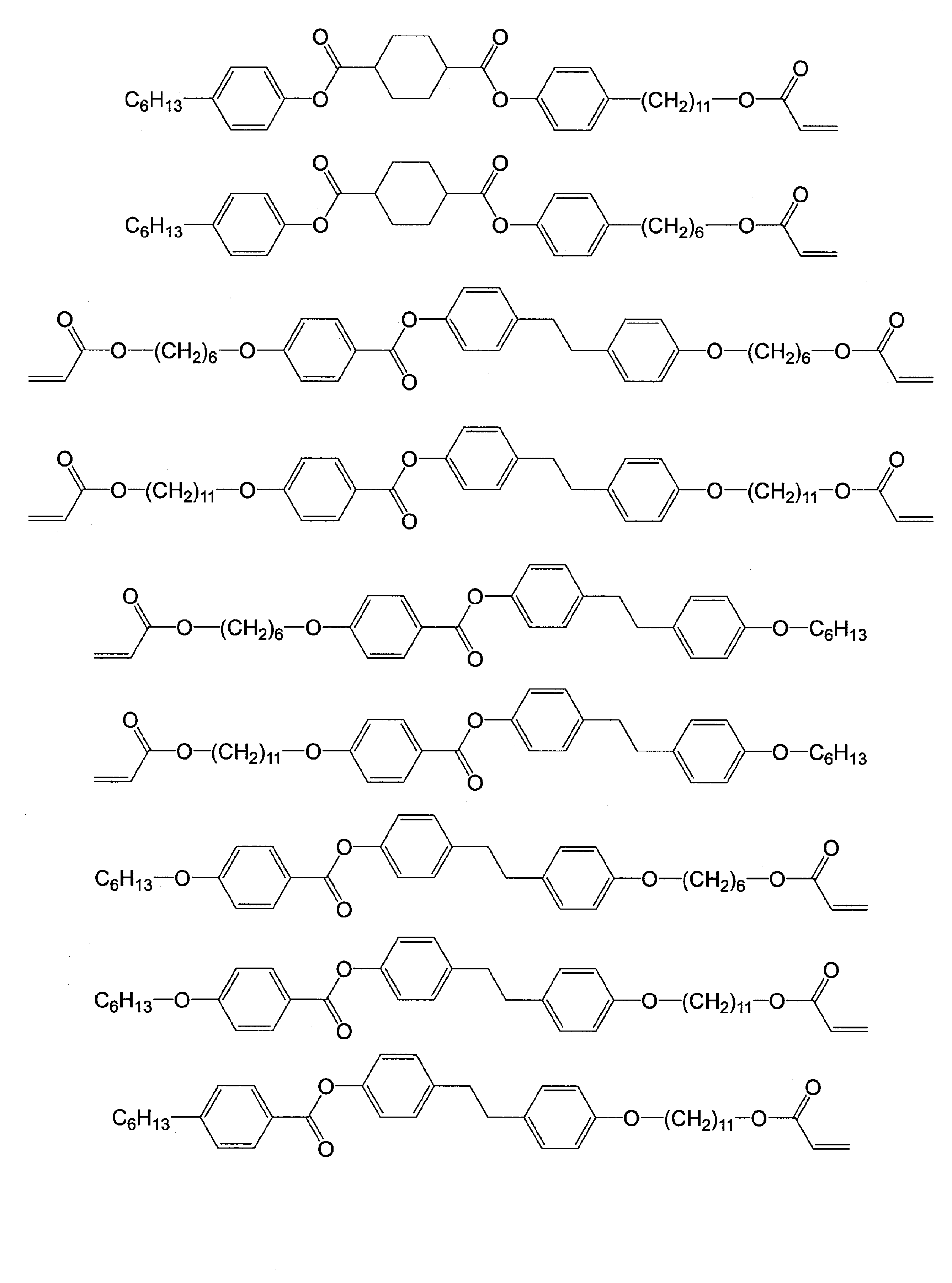
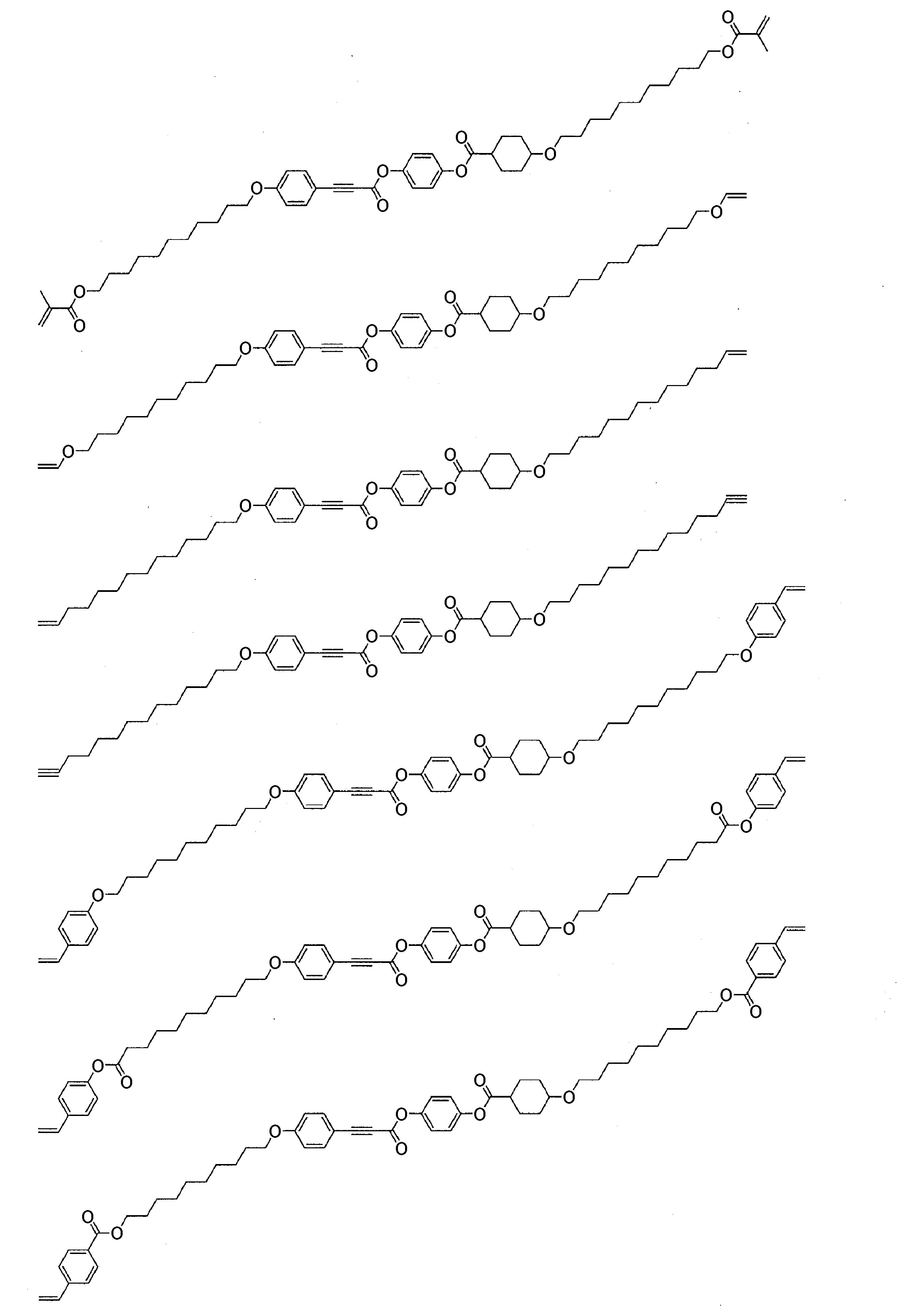
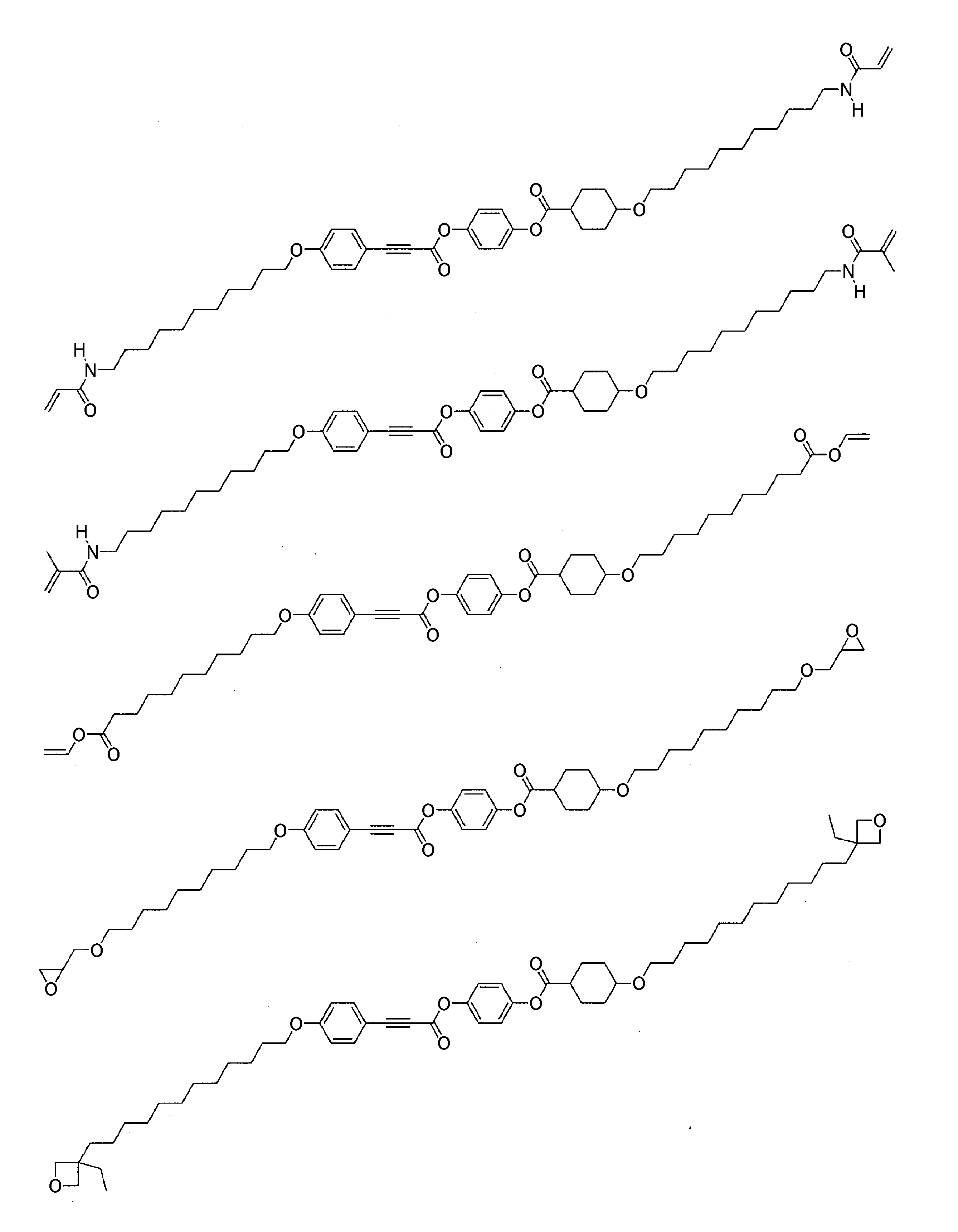
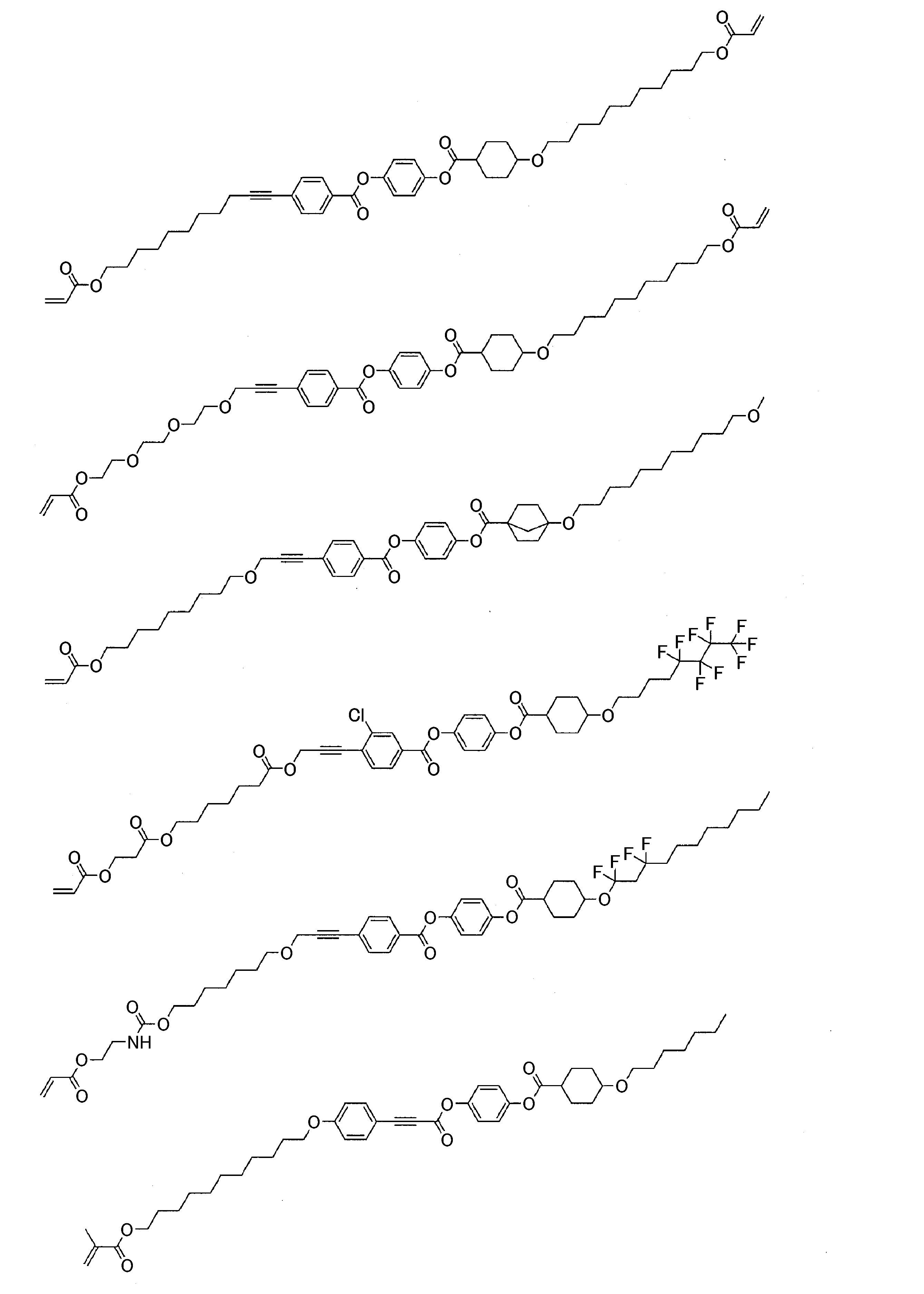
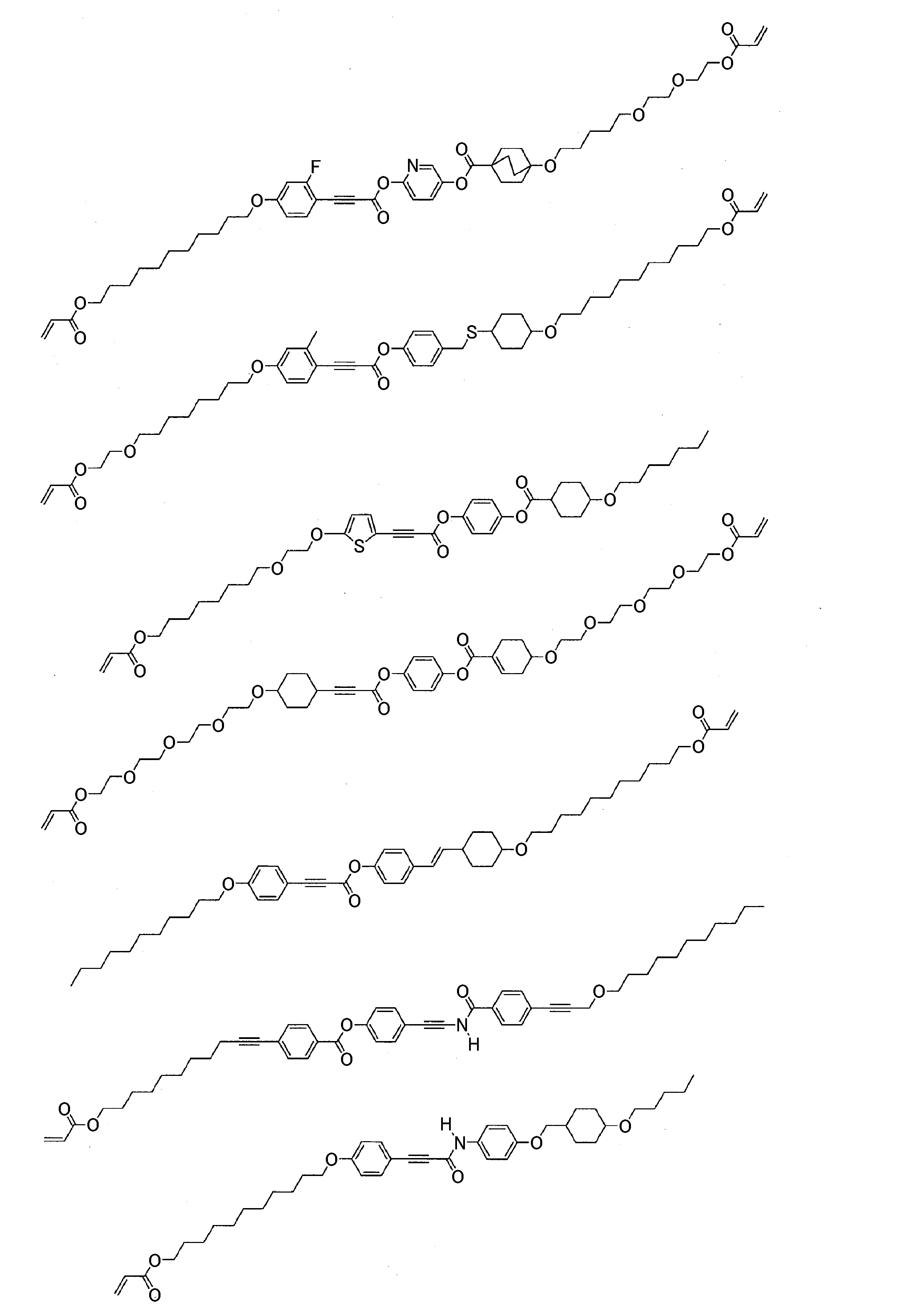
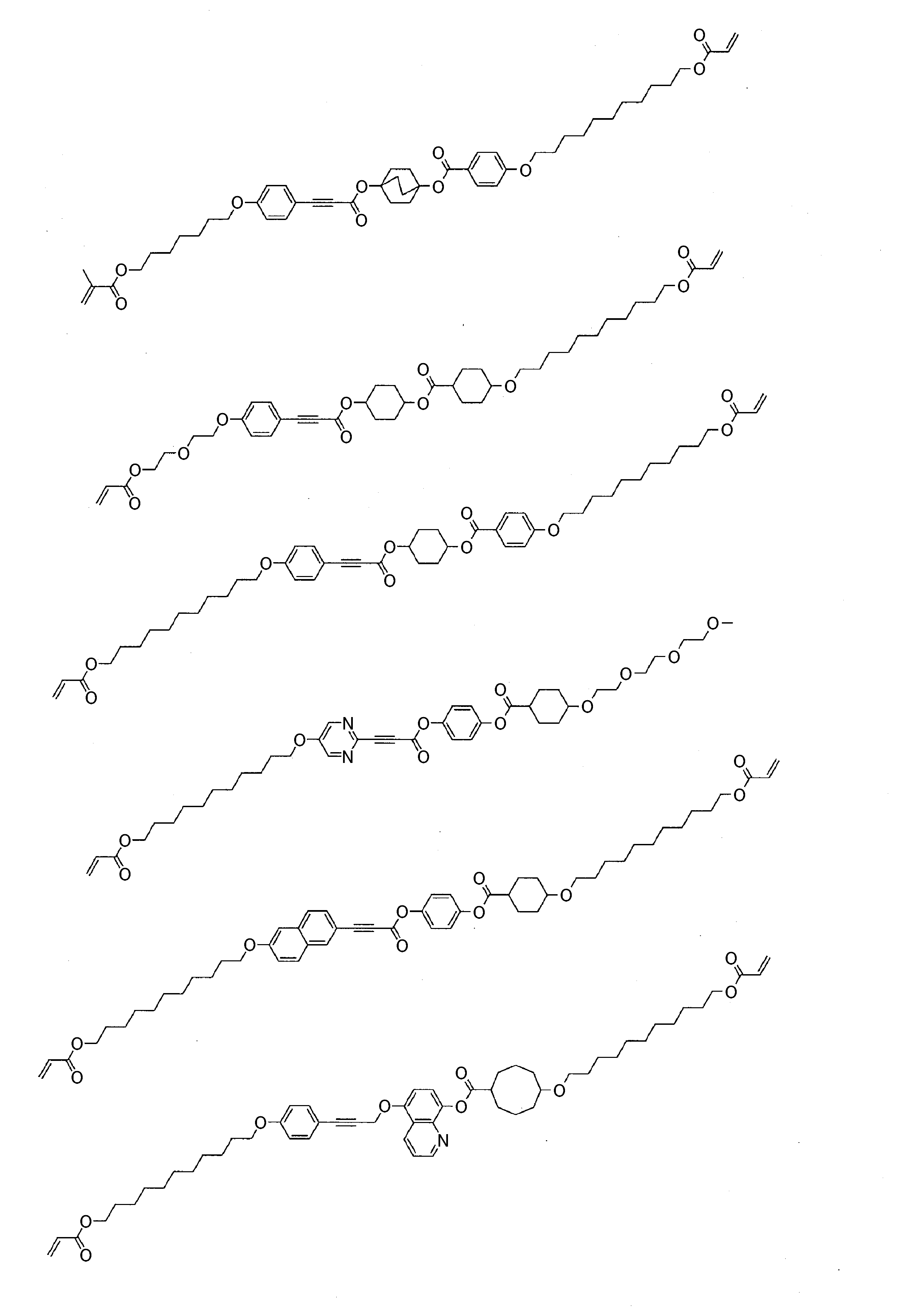


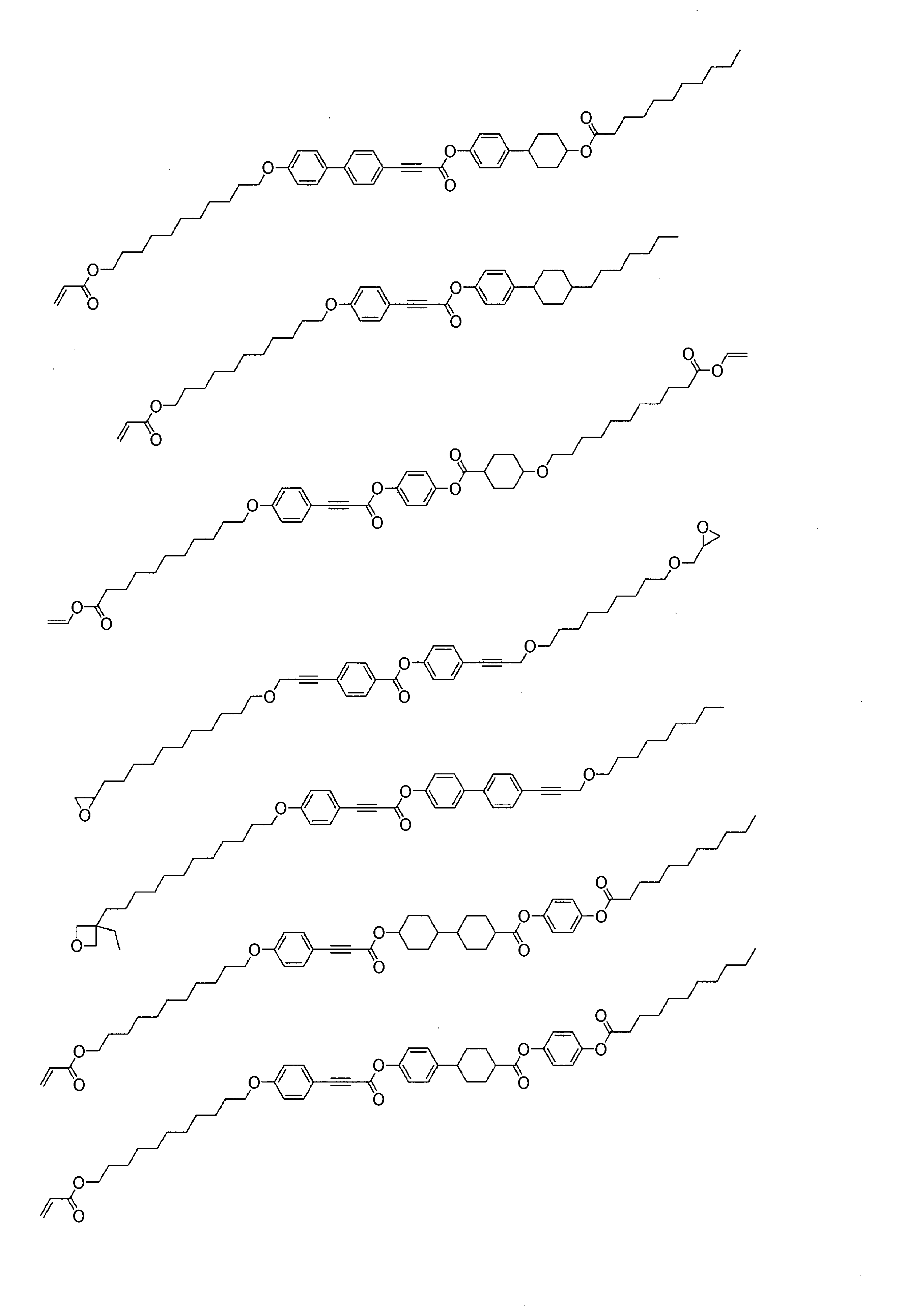
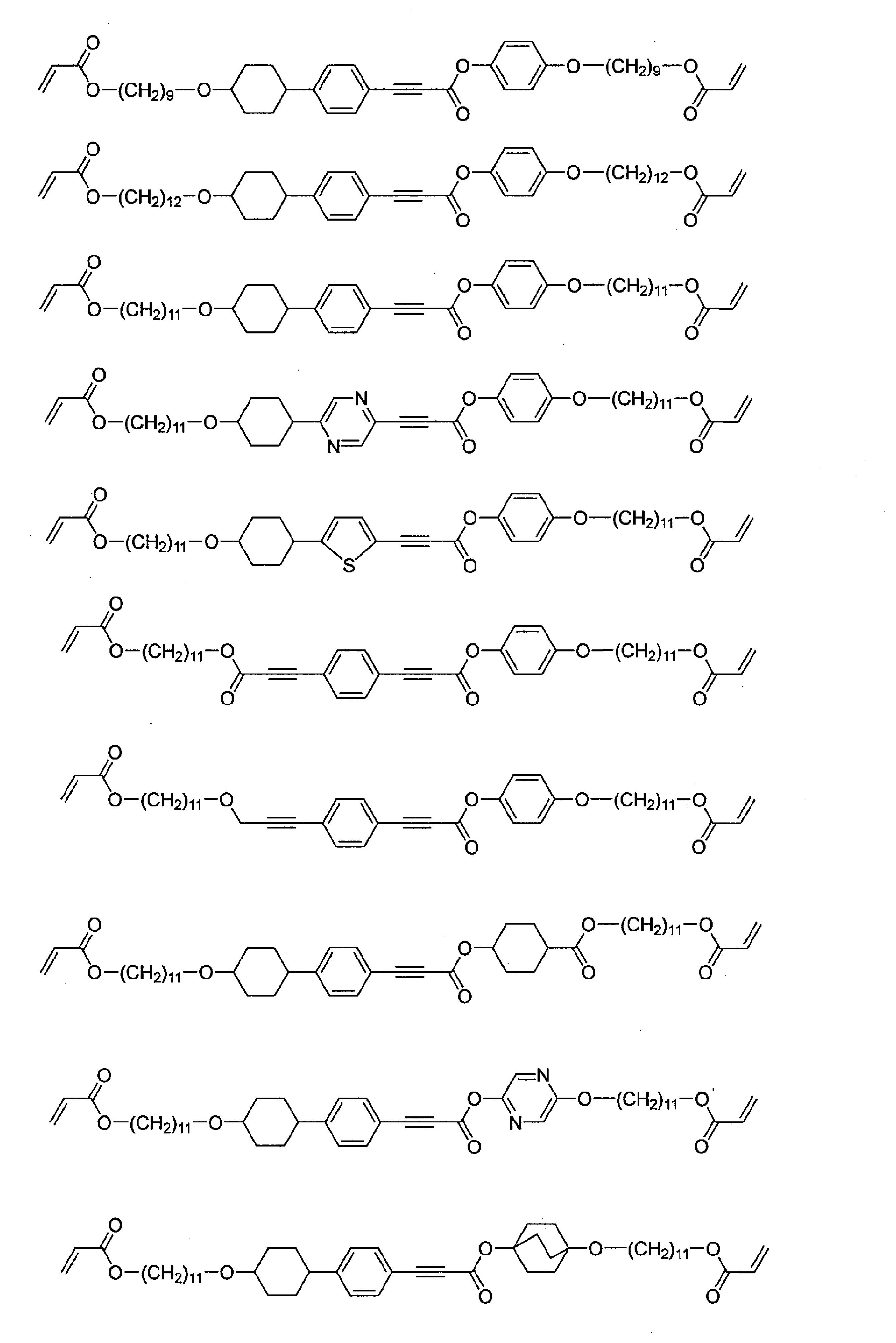
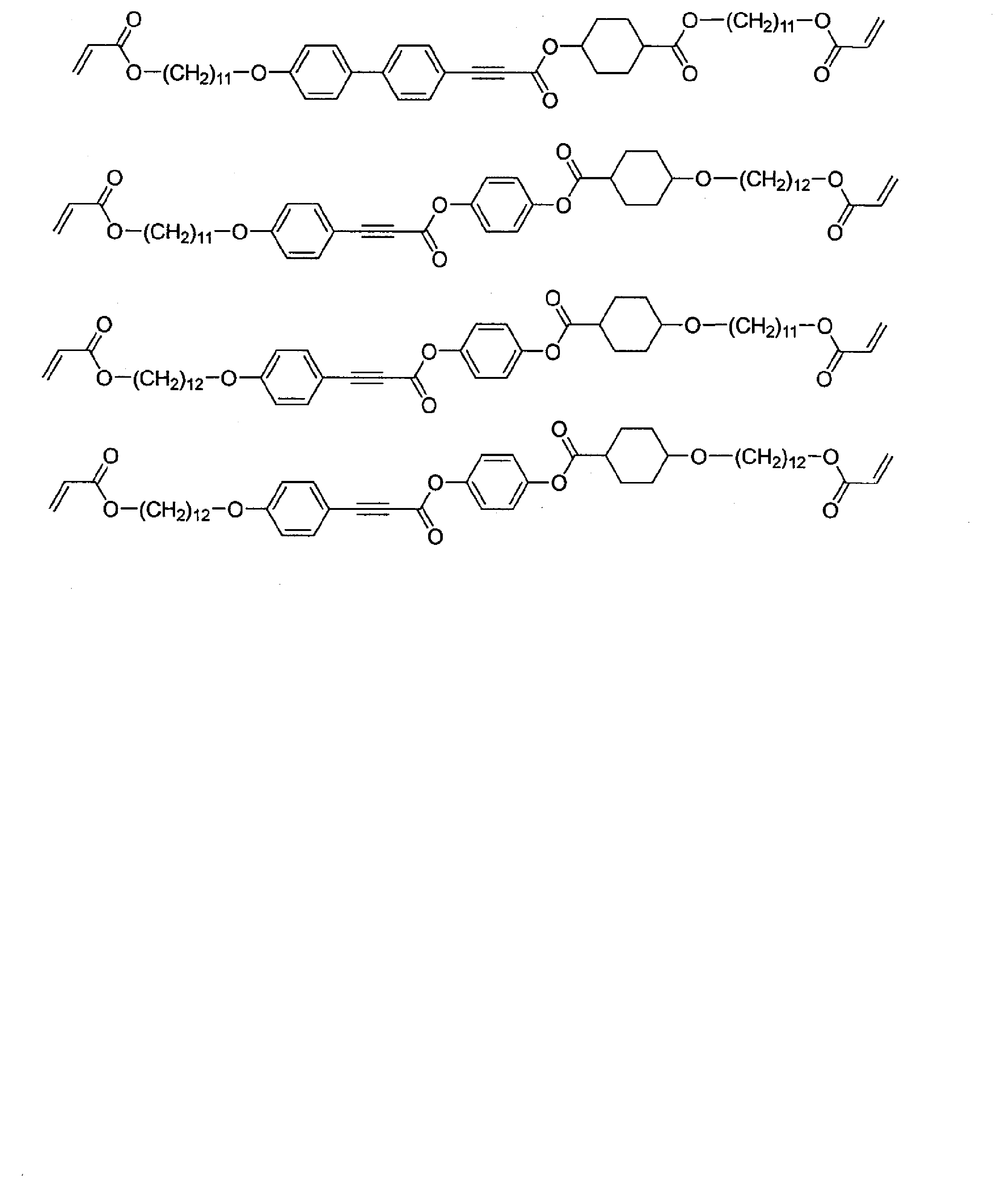

なお、ここで等方相出現温度とは、液晶から液体への相転移温度および液体から液晶への相転移温度を意味する。本発明においては、これらの相転移温度の少なくとも一方が前記範囲にあることが好ましく、これらの相転移温度の両方が前記範囲にあることがより好ましい。
たとえば、本発明の異方性色素膜形成用組成物に含まれる液晶化合物は、実施例に記載の方法や、「液晶便覧」(丸善株式会社、平成12年10月30日発行)の449~468ページに記載の方法にしたがって合成することができる。
異方性色素膜形成用組成物を用いて形成される異方性色素膜の配向性を向上させやすいとの観点で、異方性色素膜形成用組成物においては、液晶化合物の分子長と色素の分子長との差が小さいほうが液晶分子と色素分子の分子間相互作用が強く、色素分子が液晶分子同士の会合を阻害しづらいため好ましい。
なお、2つ以上の環が縮合する縮合環は、環構造としては1つとして数える。
なお、Xがピロリジニル基やピペリジニル基のような環状の官能基であっても、Xに含まれる環構造は式(1)で表される化合物が有する環構造の数(rn2)には含めない。
本発明の異方性色素膜形成用組成物は、必要に応じて、重合開始剤を含んでもよい。
重合開始剤は、重合性液晶化合物の重合反応を開始し得る化合物である。重合開始剤としては、光の作用により活性ラジカルを発生する光重合開始剤が好ましい。
これら光重合開始剤の中では、アルキルフェノン誘導体類、オキシムエステル系誘導体類、ビイミダゾール誘導体類、アセトフェノン誘導体類、およびチオキサントン誘導体類がより好ましい。
市販品としては、例えば、IRGACURE(登録商標。以下同様。) 250、IRGACURE 651、IRGACURE 184、DAROCURE 1173、IRGACURE 2959、IRGACURE 127、IRGACURE 907、IRGACURE 369、IRGACURE 379EG、LUCIRIN TPO、IRGACURE 819、IRGACURE 784、OXE-01、OXE―02(いずれも、BASF社製);セイクオール(登録商標)BZ、Z、およびBEE(精工化学株式会社製);カヤキュアー(kayacure)(登録商標)BP100、およびUVI-6992(ダウ・ケミカル株式会社製);アデカオプトマーSP-152、およびSP-170(株式会社ADEKA製);TAZ-A、およびTAZ-PP(日本シイベルヘグナー株式会社製);並びに、TAZ-104(株式会社三和ケミカル製);TRONLYTR-PBG-304、TRONLYTR-PBG-309、TRONLYTR-PBG-305、TRONLYTR-PBG-314(常州強力電子新材料有限公司社(CHANGZHOU TRONLY NEW ELECTRONIC MATERIALS CO.,LTD)製)が挙げられる。
増感色素もまた、1種を単独で用いてもよく、2種以上を併用してもよい。
本発明の異方性色素膜形成用組成物は、必要に応じて、溶剤を含んでもよい。
使用しうる溶剤としては、液晶化合物中に色素またはその他の添加剤を十分に分散または溶解させ得るものであれば特に限定されないが、たとえば、メタノール、エタノール、エチレングリコール、イソプロピルアルコール、プロピレングリコール、エチレングリコールメチルエーテル、エチレングリコールブチルエーテル、プロピレングリコールモノメチルエーテル等のアルコール溶剤;酢酸エチル、酢酸ブチル、エチレングリコールメチルエーテルアセテート、γ-ブチロラクトン、プロピレングリコールメチルエーテルアセテート、乳酸エチル等のエステル溶剤;アセトン、メチルエチルケトン、シクロペンタノン、シクロヘキサノン、2-ヘプタノン、メチルイソブチルケトン等のケトン溶剤;ペンタン、ヘキサン、ヘプタン等の脂肪族炭化水素溶剤;トルエン、キシレン等の芳香族炭化水素溶剤;アセトニトリル等のニトリル溶剤;テトラヒドロフラン、ジメトキシエタン、エチレングリコールジメチルエーテル、エチレングリコールジエチルエーテル等のエーテル溶剤;ペルフルオロベンゼン、ペルフルオロトルエン、ペルフルオロデカリン、ペルフルオロメチルシクロヘキサン、ヘキサフルオロ-2-プロパノール等のフッ素含有溶剤;および、クロロホルム、ジクロロメタン、クロロベンゼン、ジクロロベンゼン等の塩素含有溶剤;が挙げられる。
これら溶剤は、一種類のみを用いてもよく、二種類以上を組み合わせて用いてもよい。
異方性色素膜形成用組成物における固形分含有量が前記上限値以下であれば、異方性色素膜形成用組成物の粘度が高くなりすぎず、得られる偏光膜の厚みが均一になり、偏光膜にムラが生じにくくなる傾向がある。
かかる固形分含有量は、製造しようとする偏光膜の厚さを考慮して定めることができる。
本発明の異方性色素膜用組成物の粘度は、後述の塗布方法により、厚みムラのない均一な膜が作製されれば特に問わないが、大面積での厚み均一性、塗布速度などの生産性、光学特性の面内均一性を得る観点からは、0.1mPa・s以上が好ましく、500mPa・s以下が好ましく、100mPa・s以下がより好ましく、50mPa・s以下がさらに好ましい。
本発明の異方性色素膜形成用組成物は、さらに必要に応じて、重合禁止剤、重合助剤、重合性非液晶化合物、界面活性剤、レベリング剤、カップリング剤、pH調整剤、分散剤、酸化防止剤、有機・無機フィラー、有機・無機ナノシート、有機・無機ナノファイバー、金属酸化物等のその他の添加剤を含んでもよい。添加剤を含むことにより、異方性色素膜形成用組成物の塗布性や安定性等を向上させたり、異方性色素膜形成用組成物から形成される異方性色素膜の安定性を向上させたりし得る場合がある。
本発明の異方性色素膜用組成物を製造する方法は特に限定されない。たとえば、色素、重合性液晶化合物、必要に応じて溶剤、その他の添加剤等を混合し、0~80℃で撹拌、振盪して色素を溶解する。難溶性の場合は、ホモジナイザー、ビーズミル分散機等を用いてもよい。
本発明の異方性色素膜用組成物を製造する方法として、組成物中の異物等を除去する目的で、ろ過工程を有していてもよい。
本発明の異方性色素膜は、本発明の異方性色素膜形成用組成物を用いて形成される。したがって、本発明の異方性色素膜は、色素と、重合性液晶化合物および重合性液晶化合物に基づく単位を有する重合物の一方または両方とを含み、色素は、式(1)で表される化合物を含む。
本発明の異方性色素膜は、非重合性液晶化合物、重合開始剤、重合禁止剤、重合助剤、重合性非液晶化合物、非重合性非液晶化合物、界面活性剤、レベリング剤、カップリング剤、pH調整剤、分散剤、酸化防止剤、有機・無機フィラー、有機・無機ナノシート、有機・無機ナノファイバー、金属酸化物等を含んでもよい。
OLED用反射防止膜の偏光素子として用いる場合、位相差膜等の周辺材料の性能が低くても、偏光素子の性能が高ければ、反射防止膜としての特性は向上する。そのため、偏光素子の性能が高ければ、層構成を簡素化させやすく、薄膜構成でも十分な機能を発現しやすくなり、折る、曲げる、を含む変形させて使用する用途にも好適に使用できる。また、コストも低く抑えることが可能となる。
D=Az/Ay
ここで、Azは異方性色素膜に入射した光の偏光方向が異方性色素の配向方向に平行な場合に観測される吸光度であり、Ayは異方性色素膜に入射した光の偏光方向が垂直な場合に観測される吸光度である。
それぞれの吸光度(Az、Ay)は同じ波長のものを用いれば特に制限はなく、目的によっていずれの波長を選択してもよいが、異方性色素膜の配向の度合を表す場合は、異方性色素膜の380nm~780nmの特定波長域に視感度で補正した値や、可視域の極大吸収波長における値を用いることが好ましい。
本発明の異方性色素膜を可視光波長域全体において異方性を有する色素膜として用いる場合には、異方性色素膜の可視光波長域における透過率は、好ましくは25%以上であり、35%以上がさらに好ましく、40%以上が特に好ましい。また、透過率は用途に応じた上限であればよい。たとえば、偏光度を高くする場合には、透過率は50%以下であることが好ましい。透過率が上記範囲であることで、後述する光学素子として有用であり、特にカラー表示に用いる液晶ディスプレイ用や、異方性色素膜と位相差膜とを組み合わせた反射防止膜用の光学素子として有用である。
本発明の異方性色素膜は、本発明の異方性色素膜形成用組成物を用いて、湿式成膜法により作製することが好ましい。
本発明で言う湿式成膜法とは、異方性色素膜用組成物を基板上に何らかの手法により塗布、配向させる方法である。そのため、異方性色素膜用組成物は流動性を持てばよく、溶剤を含んでいても、含んでいなくてもよい。塗布する際の粘度や膜均一性の観点から、溶剤を含んでいることがより好ましい。
異方性色素膜用組成物を基板上に付与し成膜する過程、外場を与えて配向させる過程、溶剤を乾燥させる過程は、逐次行ってもよいし、同時に行ってもよい。
異方性色素膜の配向方向は塗布方向と異なっていてもよい。なお、本発明において異方性色素膜の配向方向とは、たとえば、偏光膜であれば、偏光の透過軸(偏光軸)または吸収軸のことであり、位相差膜であれば、進相軸または遅相軸のことである。
異方性色素膜用組成物の塗布温度としては、通常0℃以上100℃以下、好ましくは80℃以下、さらに好ましくは60℃以下である。
異方性色素膜用組成物の塗布時の湿度は、好ましくは10%RH以上であり、好ましくは80RH%以下である。
具体的には、膜の重合やオーバーコートなどが、後工程の容易さ、異方性色素膜の耐久性等の点から好ましい。
波長190~450nmの活性エネルギー線の光源は、特に限定されるものではないが、例えば、キセノンランプ、ハロゲンランプ、タングステンランプ、高圧水銀灯、超高圧水銀灯、メタルハライドランプ、中圧水銀灯、低圧水銀灯、カーボンアーク、蛍光ランプ等のランプ光源;アルゴンイオンレーザー、YAGレーザー、エキシマレーザー、窒素レーザー、ヘリウムカドミニウムレーザー、半導体レーザー等のレーザー光源等が挙げられる。特定の波長の光を照射して使用する場合には、光学フィルターを利用することもできる。 活性エネルギー線の露光量は、10~10,000J/m2が好ましい。
本発明の光学素子は、本発明の異方性色素膜を含む。
本発明の光学素子は、基板上に塗布等により異方性色素膜を形成することで偏光素子を得ることができるという点から、フレキシブルディスプレイ等の用途にも好適に使用することができる。
本発明の偏光素子は、本発明の異方性色素膜を有するものであれば他の如何なる膜(層)を有するものであってもよい。たとえば、基板上に配向膜を設け、配向膜の表面に、本発明の異方性色素膜を形成することにより製造することができる。
また、偏光素子は異方性色素膜だけに限らず、偏光性能を向上させる、機械的強度を向上させる等の機能を有するオーバーコート層;粘着層または反射防止層;配向膜;位相差フィルムとしての機能、輝度向上フィルムとしての機能、反射または反射防止フィルムとしての機能、半透過反射フィルムとしての機能、拡散フィルムとしての機能などの光学機能を有する層;等、と組み合わせて使用してもよい。具体的には、前述の様々な機能を有する層を塗布や貼合等により積層形成し、積層体として使用してもよい。
これらの層は、製造プロセス、特性および機能に合わせ適宜設けることができ、その積層の位置、順番等は特に限定されない。たとえば、各層を形成する位置は、異方性色素膜の上に形成してもよく、異方性色素膜を設けた基板の反対面に形成してもよい。また、各層を形成する順番は、異方性色素膜を形成する前でも形成した後でもよい。
拡散フィルムとしての機能を有する層は、たとえば、偏光素子を構成する他の層に微粒子を含む樹脂溶液をコーティングすることにより形成することができる。
以下の記載において、「部」は「重量部」を意味する。
得られた異方性色素膜形成用組成物の液晶性は、示差走査熱量測定(セイコーインスツルメンツ社「DSC220CU」)、X線構造解析(株式会社リガク「NANO-Viewer」)、ホットステージ(株式会社東陽テクニカ「HCS302-LN190」)が付属する偏光顕微鏡(株式会社ニコンインステック「ECLIPSE LV100N POL」)にて観察し、「液晶便覧」(丸善株式会社、平成12年10月30日発行)の9~50ページ、117~176ページ等に記載の方法にしたがって、液晶であることの同定を行った。
得られた異方性色素膜の吸収軸/偏光軸方向の偏光に対する透過率は、グラントムソン偏光子を備える分光光度計(大塚電子(株)製、製品名「RETS-100」)を用いて測定した。
異方性色素膜に直線偏光の測定光を入射し、異方性色素膜の吸収軸方向の偏光に対する透過率および異方性色素膜の偏光軸方向の偏光に対する透過率を測定し、次式により二色比(D)を算出した。
D=Az/Ay
(式中、
Ay=-log(Ty)であり;
Az=-log(Tz)であり;
Tzは、異方性色素膜の吸収軸方向の偏光に対する透過率であり;
Tyは、異方性色素膜の偏光軸方向の偏光に対する透過率である。)
Lub et al.,Recl.Trav.Chim.Pays-Bas,115,321-328(1996)に記載の化合物に準じた方法で、液晶化合物(I-1)を合成した。
1H NMR(CDCl3、400MHz)δ1.23-1.72(m,38H),1.76-1.86(m,2H),2.11-2.23(m,4H),2.48-2.60(m,1H),3.20-3.30(m,1H),3.47(t,2H,J=6.8Hz),4.04(t,2H,J=6.8Hz),4.15(t,2H,J=6.8Hz),5.82(d,2H,J=10.4Hz),6.12(dd,2H,J=10.4,17.4Hz),6.40(d,2H,J=17.4Hz),6.97(d,2H,J=9.2Hz),7.11(d,2H,J=9.2Hz),7.21(d,2H,J=9.0Hz),8.13(d,2H,J=9.0Hz)
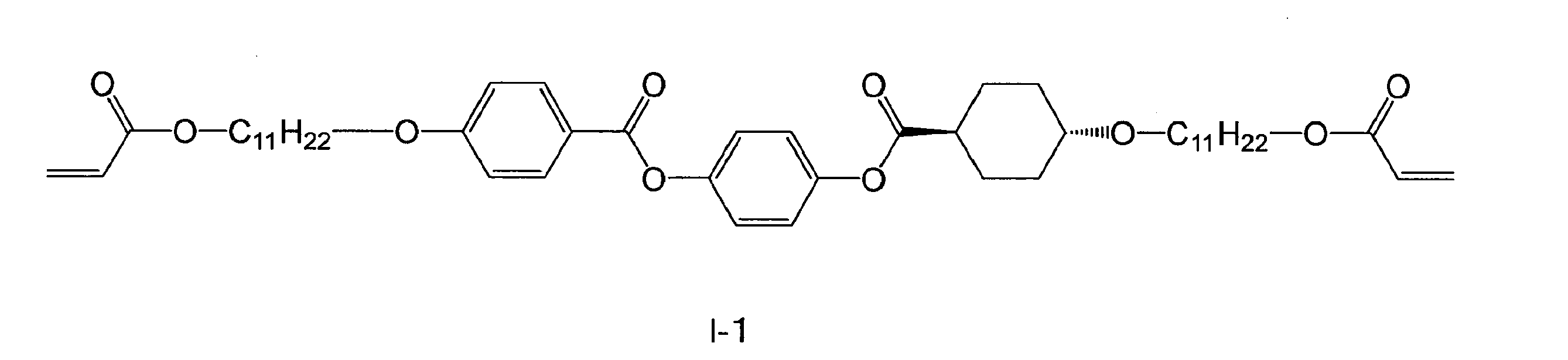
下記に記載の合成法に従い、液晶化合物(I-2)を合成した。
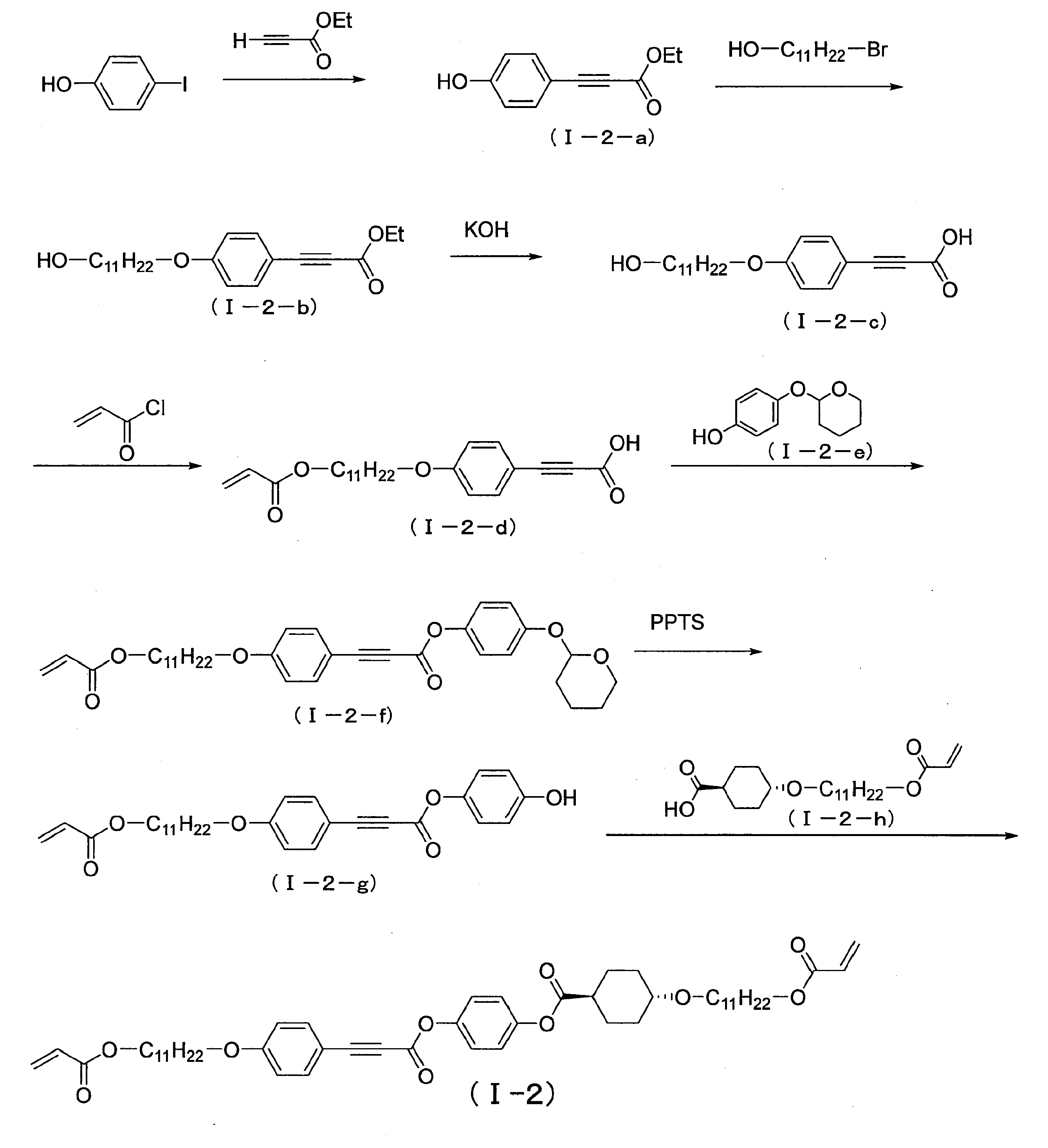
p-ヨードフェノール(11.0g,50mmol)のN,N-ジメチルホルムアミド溶液(150mL)に、プロピオル酸エチル(9.7g,99mmol)、酸化銅(I)(7.5g,94mmol)を添加し、110℃で9時間撹拌し、室温まで放冷した。沈殿を濾別したのち酢酸エチルを添加し、水、続いて飽和食塩水で洗浄した。シリカゲルカラムクロマトグラフィー(ヘキサン/酢酸エチル)で精製し、褐色結晶(I-2-a)を7.3g得た。
(I-2-a)(4.20g,22.1mmol)、11-ブロモ-1-ウンデカノール(5.55g,22.1mmol)、炭酸カリウム(6.10g,44.2mmol)、N,N-ジメチルホルムアミド(30mL)を混合し、80℃で4時間撹拌した。沈殿を濾別後、ジエチルエーテルを添加し、水、続いて飽和食塩水で洗浄した。シリカゲルカラムクロマトグラフィー(ヘキサン/酢酸エチル)で精製し、橙色固体(I-2-b)を5.5g得た。
(I-2-b)(3.6g,10mmol)、水酸化カリウム(1.7g,30mmol)、水(20mL)を混合し、100℃で2時間撹拌した。水(20mL)を加え、濃塩酸で酸性にしたのち、析出した沈殿を濾別した。得られた沈殿をアセトニトリルで懸洗し、乳白色固体(I-2-c)を3.2g得た。
(I-2-c)(2.33g,7.0mmol)、テトラヒドロフラン(20mL)を混合し、続いてN,N-ジメチルアニリン(1.02g,8.4mmol)、2,5-ジ-t-ブチルフェノール(54mg)を添加した。氷浴で冷却したのち、アクリロイルクロリド(0.76g,8.4mmol)をゆっくり添加した。氷浴下6時間撹拌したのち、塩化メチレンを添加し、1mol/L塩酸、飽和炭酸水素ナトリウム水、飽和食塩水の順に洗浄した。シリカゲルカラムクロマトグラフィー(クロロホルム/メタノール)で精製し、白色固体(I-2-d)を2.0g得た。
日本国特開2014-262884号公報に記載の合成法により(I-2-e)を合成した。
(I-2-d)(2.00g,5.17mmol)、(I-2-e)(1.01g,5.17mmol)、N,N-ジメチルアミノ-4-ピリジン(0.13g,1.03mmol)、2,5-ジ-t-ブチルフェノール(58mg)、塩化メチレン(30mL)を混合し、氷浴で冷却したのち、1-エチル-3-(3-ジメチルアミノプロピル)カルボジイミド塩酸塩(1.09g,5.69mmol)を添加した。一晩放置したのち、塩化アンモニウム飽和水溶液、続いて飽和食塩水で洗浄した。シリカゲルカラムクロマトグラフィー(ヘキサン/酢酸エチル)で精製し、白色固体(I-2-f)を1.9g得た。
(I-2-f)(2.6g,4.62mmol)、p-トルエンスルホン酸ピリジニウム塩(0.23g,0.92mmol)、2,5-ジ-t-ブチルフェノール(44mg)、エタノール(20mL)を混合し、50℃で2時間撹拌した。反応溶液を水に放出し、析出した沈殿を濾別、乾燥させ、白色固体(I-2-g)を2.0g得た。
下記に記載の合成法に従い、化合物(I-2-h)を合成した。
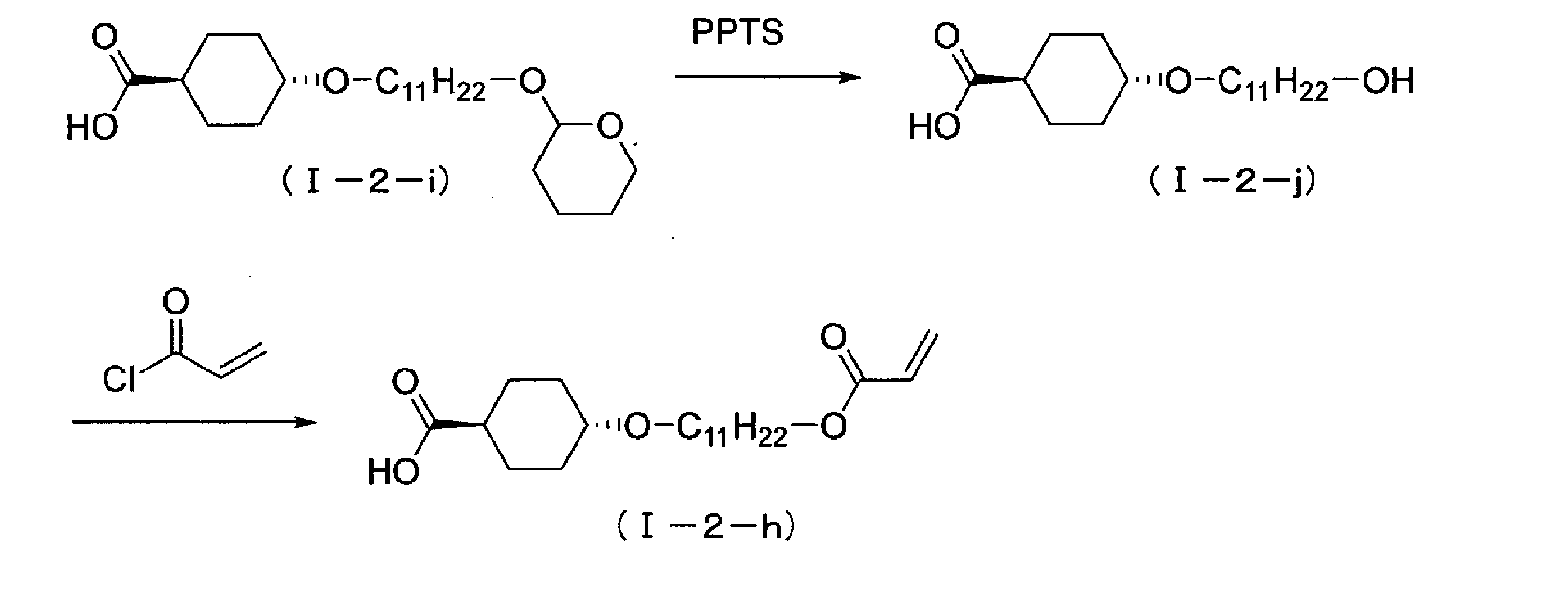
次に、(I-2-i)(トランス体のみ)(42.9g,107.6mmol)、p-トルエンスルホン酸ピリジニウム塩(2.6g,10.8mmol)、エタノール(430mL)を混合し、78℃で2時間撹拌した。溶媒を留去し、酢酸エチル(150mL)に溶解し、ヘキサン(750mL)を加え、冷却した。析出した沈殿を濾別、ヘキサンで洗浄後、乾燥させ、白色固体(I-2-j)を29.2g得た。
(I-2-j)(37.2g,118.3mmol)、N,N-ジメチルアニリン(21.5g,177.5mmol)、2,5-ジ-t-ブチルフェノール(0.24g)、テトラヒドロフラン(380mL)を混合した。氷浴で冷却したのち、アクリロイルクロリド(16.1g,177.5mmol)をゆっくり添加した。滴下後50℃で2時間撹拌したのち、液量が190mLになるまで溶媒を留去し、氷冷下の1mol/L塩酸に放出した。析出した沈殿を濾別、水、ヘキサンで洗浄した。シリカゲルカラムクロマトグラフィー(ヘキサン/酢酸エチル)で精製し、白色固体(I-2-h)を39.4g得た。
(I-2-g)(494mg,1.03mmol)、(I-2-h)(400mg,1.09mmol)、N,N-ジメチルアミノ-4-ピリジン(27mg,0.22mmol)、2,5-ジ-t-ブチルフェノール(2mg)、塩化メチレン(10mL)を混合し、氷浴で冷却したのち、1-エチル-3-(3-ジメチルアミノプロピル)カルボジイミド塩酸塩(230mg,1.19mmol)を添加した。氷浴下4時間撹拌したのち、塩化アンモニウム飽和水溶液、続いて飽和食塩水で洗浄した。シリカゲルカラムクロマトグラフィー(ヘキサン/酢酸エチル)で精製し、液晶化合物(I-2)を白色固体として530mg得た。
LC-MS(APCI)m/z 851.5(M+Na+)
また、NMRによる構造確認をおこなった。結果を以下に示す。
1H NMR(CDCl3,400MHz)δ1.20-1.70(m,38H),1.74-1.85(m,2H),2.05-2.25(m,4H),2.49-2.57(m,1H),3.21-3.29(m,1H),3.46(t,2H,J=6.8Hz),3.99(t,2H,J=6.8Hz),4.15(t,4H,J=6.8Hz),5.80(d,2H,J=10.4Hz),6.12(dd,2H,J=17.2,10.
4Hz),6.39(d,2H,J=17.2Hz),6.89(d,2H,J=6.8Hz),7.10(d,2H,J=6.8Hz),7.19(d,2H,J=6.8Hz),7.55(d,2H,J=6.8Hz)
その結果を、表1に示す。
なお、この温度が等方相出現温度であることは、偏光顕微鏡観察およびX線構造解析により確認した。

<液晶化合物(I-3)>
下記に記載の合成法に従い、液晶化合物(I-3)を合成した。
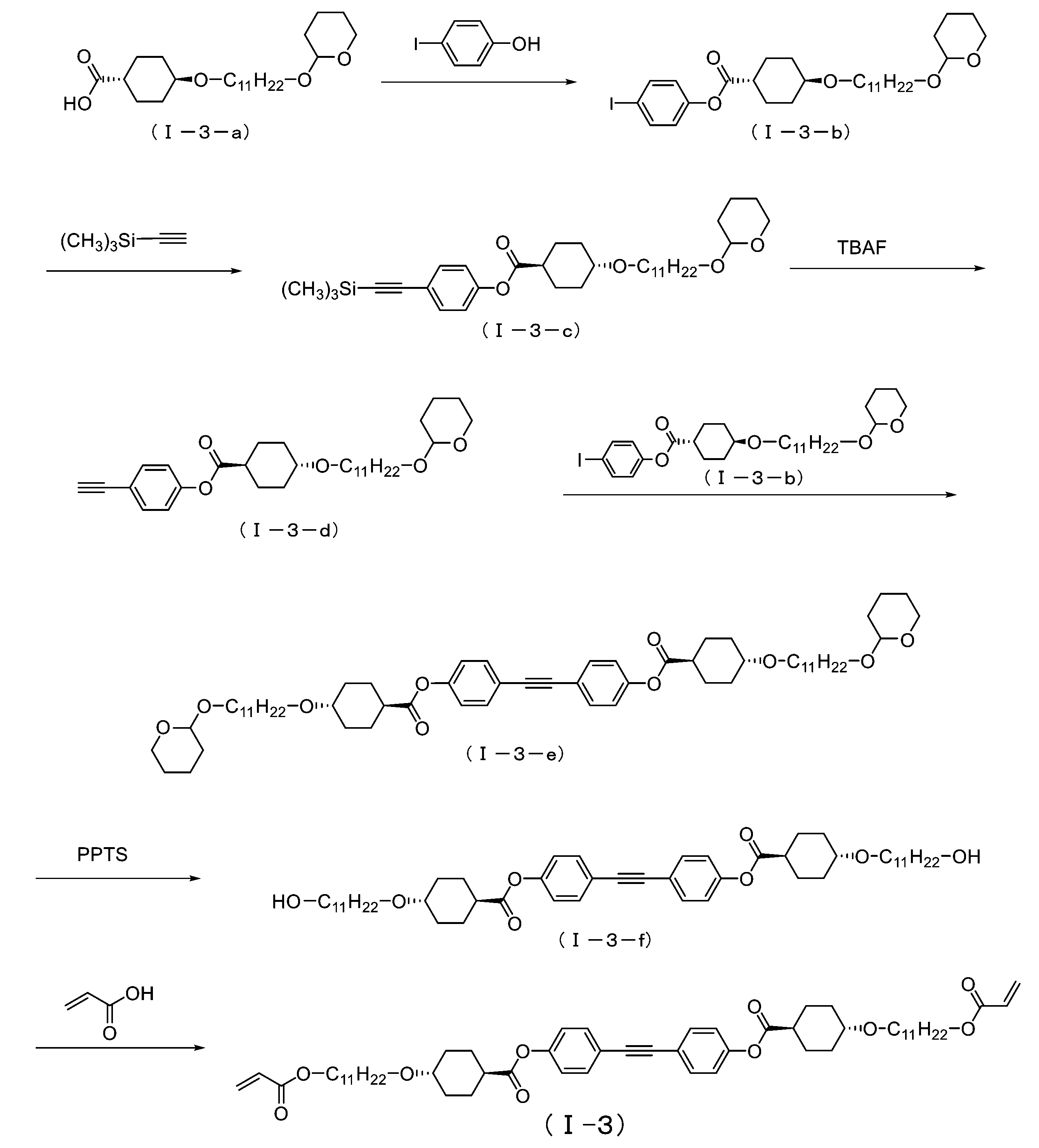
Lub et al.,Recl.Trav.Chim.Pays-Bas,115,321-328(1996)に記載の化合物に準じた方法で(I-3-a)を合成した。
4-ヨードフェノール(3.62g,16.5mmol)、(I-3-a)(6.43g,16.1mmol)、N,N-ジメチルアミノ-4-ピリジン(0.39g,3.20mmol)、塩化メチレン(80mL)を混合し、氷浴で冷却したのち、1-エチル-3-(3-ジメチルアミノプロピル)カルボジイミド塩酸塩(EDC)(3.39g,17.7mmol)を添加し、5分間撹拌した。その後、室温で2時間攪拌し、塩化アンモニウム飽和水溶液、続いて飽和食塩水で洗浄した。溶液を濃縮し、シリカゲルカラムクロマトグラフィー(ヘキサン/酢酸エチル)で精製し、白色固体(I-3-b)を8.49g得た。
ジイソプロピルアミン(70mL)に(I-3-b)(5.00g,8.33mmol)を入れ完溶させた後、ジクロロビス(トリフェニルホスフィン)パラジウム(II)(58mg,0.08mmol)、ヨウ化銅(I)(48mg,0.25mmol)を混合し、トリメチルシリルアセチレン(0.98g,9.99mmol)を添加した。室温で30分間撹拌した後、水-酢酸エチルで抽出した後、飽和食塩水で洗浄した。溶液を濃縮し、シリカゲルカラムクロマトグラフィー(ヘキサン/酢酸エチル)で精製し、白色固体(I-3-c)を4.30g得た。
(I-3-c)(4.30g,7.53mmol)、クロロホルム(100mL)を混合し、氷浴で冷却したのち、フッ化テトラ-n-ブチルアンモニウム(TBAF)テトラヒドロフラン溶液(1mol/L,9mL)を添加した。20分間撹拌後、水-クロロホルムで抽出し、飽和食塩水で洗浄した。溶液を濃縮し、シリカゲルカラムクロマトグラフィー(ヘキサン/酢酸エチル)で精製し、白色固体(I-3-d)を3.80g得た。
(I-3-b)(3.56g,5.93mmol)、テトラキストリフェニルホスフィンパラジウム(0)(68mg,0.06mmol)、ヨウ化銅(I)(34mg,0.18mmol)、ジイソプロピルアミン(120mL)を混合し、氷浴で冷却したのち、(I-3-d)(2.96g,5.93mmol)のジイソプロピルアミン(40mL)溶液を添加した。室温で1時間撹拌した後、水-クロロホルムで抽出した後、飽和食塩水で洗浄した。溶液を濃縮し、シリカゲルカラムクロマトグラフィー(クロロホルム)で精製し、白色固体(I-3-e)を得た。
上記操作で得られた(I-3-e)、テトラヒドロフラン(60mL)を混合し、50℃で完溶させた後、エタノール(60mL)を添加した。このスラリー溶液にp-トルエンスルホン酸ピリジニウム塩(PPTS)(0.54g,2.13mmol)を加え、60℃で2時間加熱した後、一晩放置した。翌日再び60℃に加熱し完溶させた後、氷水に反応液を加えた。クロロホルムで抽出、溶液を濃縮の後、得られた固体をヘキサンで懸洗し白色固体(I-3-f)を4.02g得た。
(I-3-f)(4.00g,4.98mmol)、アクリル酸(0.72g,9.96mmol、N,N-ジメチル-4-アミノピリジン(0.12g,0.10mmol)、ジクロロメタン(100mL)を混合し、氷浴で冷却したのち、1-(3-ジメチルアミノプロピル)-3-エチルカルボジイミド塩酸塩(EDC)(2.10g,11.0mmol)を添加した。2時間撹拌した後、アクリル酸(0.36g,4.98mmol)、EDC(1.05g,5.5mmol)を添加、18時間後さらにアクリル酸(0.36g,4.98mmol)、EDC(1.05g,5.5mmol)を添加し、5時間撹拌した。反応液を塩化アンモニウム飽和水溶液、続いて飽和食塩水で洗浄し、シリカゲルカラムクロマトグラフィー(ヘキサン/酢酸エチル)で精製し、白色固体(I-3)を2.30g得た。
1H NMR(CDCl3、400MHz)δ7.52(d,4H,J=8.8Hz),7.06(d,4H,J=8.8Hz),6.40(d,2H,J=17.2Hz),6.12(dd,2H,J=10.4,17.2Hz),5.81(d,2H,J=10.4Hz),4.15(t,4H,J=6.8Hz),3.46(t,4H,J=9.2Hz),3.30-3.20(m,2H),2.60-2.45(m,2H),2.22-2.10(m,8H),1.70-1.50(m,8H),1.45-1.25(m,36H)
<色素(II-1)>
下記に記載の合成法に従い、色素(II-1)を合成した。
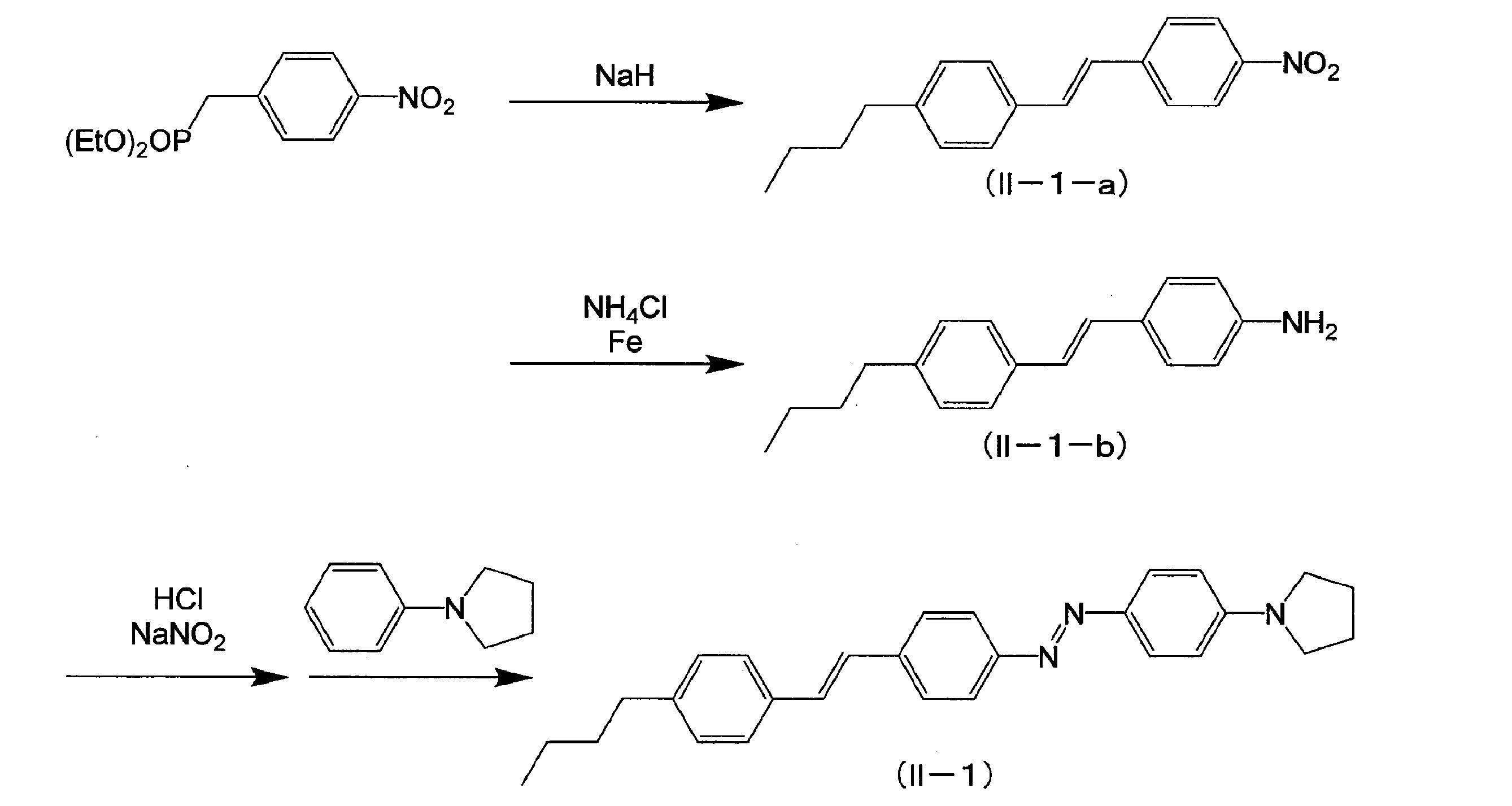
氷冷した反応器に、テトラヒドロフラン(100mL)、水素化ナトリウム(純度60%、6.7g,168.0mmol)を添加し、(4-ニトロベンジル)ホスホン酸ジエチル(18.0g,65.9mmol)、4-ブチルベンズアルデヒド(9.1g,56.1mmol)、テトラヒドロフラン(50mL)の混合物を10分かけて滴下し、テトラヒドロフラン(30mL)で洗いこんだ後、50℃で0.5時間撹拌した。反応液を水に注ぎこみ、酢酸エチルで抽出し、水、飽和食塩水で洗浄し、溶剤を留去した。得られた粗体を酢酸エチル(20mL)に加熱溶解後、ヘキサン(50mL)を加えて冷却し、析出した沈殿を濾別し、ヘキサンで洗浄後、減圧下で乾燥し、(II-1-a)を15.0g得た。
(II-1-a)(15.0g,53.3mmol)、テトラヒドロフラン(150mL)、鉄粉(13.9g,248.9mmol)を混合し、水(30mL)に溶解した塩化アンモニウム(13.3g,248.6mmol)を滴下し、50℃で3時間撹拌した。セライトを用いて濾過し、酢酸エチルで抽出し、水、飽和食塩水で洗浄し、溶媒を留去した。得られた粗体をヘキサンで懸濁し、沈殿物を濾別し、ヘキサンで洗浄後、乾燥し、(II-1-b)を10.9g得た。
(II-1-b)(2.51g,10.0mmol)、N-メチルピロリドン(40mL)、濃塩酸(2.2mL)、水(20mL)を混合し、3℃に冷却後、亜硝酸ナトリウム(789mg,11.4mmol)を加え、15℃で3.5時間撹拌した。
1-フェニルピロリジン(1.47g,10.0mmol)、メタノール(60mL)、水(30mL)を混合し、濃塩酸でpHを3.5にした。水酸化ナトリウム水溶液を加えてpHを3~5に保ちながら上記のジアゾニウム塩を含む液を滴下した後、15℃で3時間撹拌した。
得られた沈殿物をろ過して、水で洗浄し、減圧下で乾燥した。得られた粗体をシリカゲルカラムクロマトグラフィー(ヘキサン/塩化メチレン)で精製し、赤色固体(II-2)を3.06g得た。
また、NMRによる構造確認をおこなった。結果を以下に示す。
1H-NMR(CDCl3、400MHz)δ0.94(t,3H,J=7.2Hz),1.32-1.43(m,2H),1.55-1.68(m,2H),2.00-2.12(m,4H),2.62(t,2H,J=7.6Hz),3.41(t,4H,J=6.4Hz),6.63(d,2H,J=8.8Hz),7.14(d,2H,J=8.8Hz),7.19(d,2H,J=8.0Hz),7.45(d,2H,J=8.0Hz),7.60(d,2H,J=8.4Hz),7.84(d,2H,J=8.4Hz),7.88(d,2H,J=9.2Hz)
シクロペンタノン97mgに色素(II-1)3mgを加え、80℃で5分間攪拌した。その後、1時間室温で静置し、得られた混合液をシリンジフィルター(Membrane Solutions社製、PTFE13045、口径0.45μm)を備えたシリンジを用いて濾過することで色素(II-1)のシクロペンタノン飽和溶液を得た。この溶液をテトラヒドロフラン800mgにて希釈し、濃度をHPLC(日立ハイテクノロジーズ製L-2300シリーズ)を用いて決定した。色素(II-1)をテトラヒドロフランに0.1重量%溶解した溶液を作製し、吸収波長254nmにて検量線を作成した。この検量線を用いて、シクロペンタノン飽和溶液の濃度を測定したところ、1.0%であった。
下記に記載の合成法に従い、色素(II-2)を合成した。
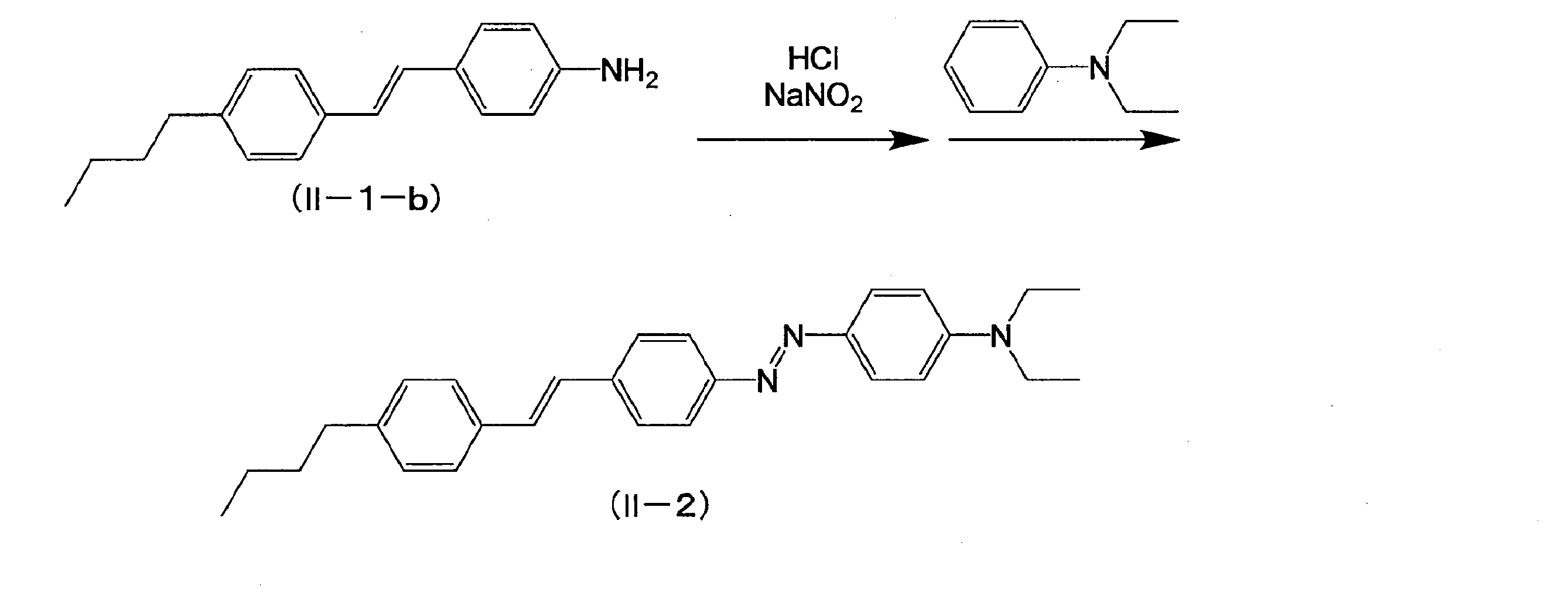
(II-1-b)(1.26g,5.0mmol)、N-メチルピロリドン(20mL)、濃塩酸(1.1mL)、水(20mL)の混合物を3℃に冷却し、亜硝酸ナトリウム(380mg,5.5mmol)を加え、15℃で3.5時間撹拌した。
N,N-ジエチルアニリン(751mg,5.0mmol)、メタノール(40mL)、水(20mL)を混合し、濃塩酸でpHを3.5にした。水酸化ナトリウム水溶液を加えてpHを3~6に保ちながら上記のジアゾニウム塩を含む液を滴下した後、15℃で1時間撹拌した。
得られた沈殿物をろ過して、水で洗浄し、減圧下で乾燥した。得られた粗体をシリカゲルカラムクロマトグラフィー(ヘキサン/塩化メチレン)で精製し、赤色固体(II-2)を1.15g得た。
また、NMRによる構造確認をおこなった。結果を以下に示す。
1H-NMR(CDCl3、400MHz)δ0.96(t,3H,J=7.2Hz),1.24(t,6H,J=7.2Hz),1.33-1.44(m,2H),1.57-1.67(m,2H),2.64(t,2H,J=7.2Hz),3.47(q,4H,J=7.2Hz),6.74(d,2H,J=9.2Hz),7.15(d,2H,J=8.0Hz),7.20(d,2H,J=8.0Hz),7.47(d,2H,J=8.0Hz),7.61(d,2H,J=8.8Hz),7.85(d,2H,J=8.0Hz),7.88(d,2H,J=8.8Hz)
この化合物のシクロペンタノンに対する溶解度を色素(II-1)と同様の方法で測定(検出吸収波長:254nm)したところ、3.0%以上であった。
下記に記載の合成法に従い、色素(II-3)を合成した。
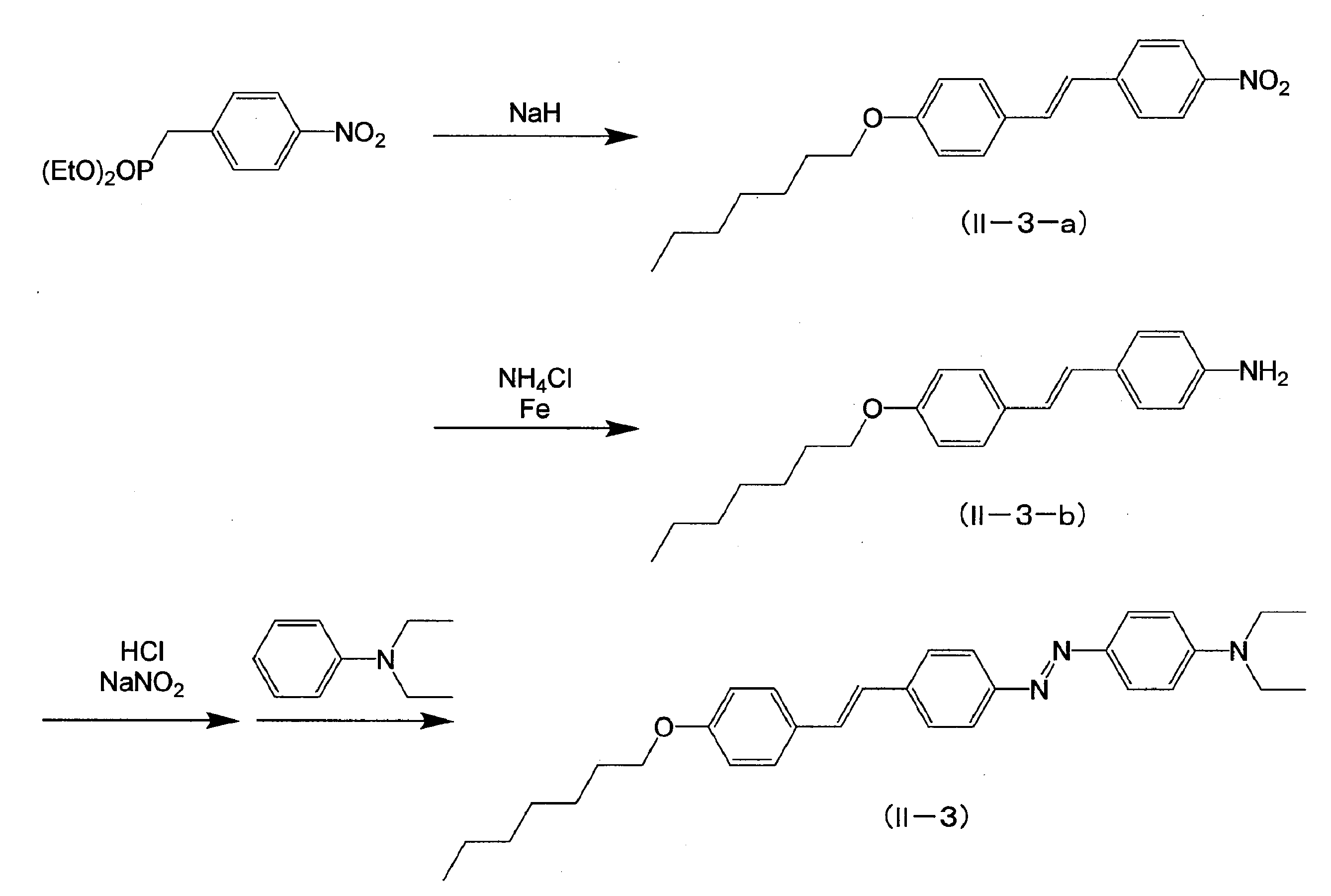
氷冷した反応器に、テトラヒドロフラン(200mL)、水素化ナトリウム(純度60%、10.1g,252.6mmol)を添加し、(4-ニトロベンジル)ホスホン酸ジエチル(23.0g,84.2mmol)、4-ヘプチルオキシベンズアルデヒド(18.6g,84.2mmol)、テトラヒドロフラン(200mL)の混合物を10分かけて滴下し、テトラヒドロフラン(30mL)で洗いこんだ後、50℃で2時間撹拌した。反応液を水に注ぎこみ、酢酸エチルで抽出し、水、飽和食塩水で洗浄し、溶剤を留去した。得られた粗体を酢酸エチル(35mL)に加熱溶解後、ヘキサン(80mL)を加えて冷却し、析出した沈殿を濾別し、ヘキサンで洗浄後、減圧下で乾燥し、(II-3-a)を23.1g得た。
(II-3-a)(23.1g,68.1mmol)、テトラヒドロフラン(200mL)、鉄粉(19.0g,340.5mmol)を混合し、水(50mL)に溶解した塩化アンモニウム(18.2g,340.5mmol)を滴下し、50℃で5時間撹拌した。セライトを用いて濾過し、酢酸エチルで抽出し、水、飽和食塩水で洗浄し、溶媒を留去した。得られた粗体をシリカゲルカラムクロマトグラフィー(ヘキサン/酢酸エチル)で精製後、ヘキサンで懸濁し、沈殿物を濾別し、ヘキサンで洗浄した。減圧乾燥し、(II-3-b)を10.7g得た。
(II-3-b)(1.6g,5.0mmol)、N-メチルピロリドン(20mL)、濃塩酸(1.1mL)、水(20mL)の混合物を3℃に冷却し、亜硝酸ナトリウム(380mg,5.5mmol)を加え、15℃で5時間撹拌した。
N,N-ジエチルアニリン(751mg,5.0mmol)、メタノール(40mL)、水(20mL)を混合し、濃塩酸でpHを3.5にした。水酸化ナトリウム水溶液を加えてpHを7に保ちながら上記のジアゾニウム塩を含む液を滴下した後、15℃で1時間撹拌した。
得られた沈殿物をろ過して、水で洗浄し、減圧下で乾燥した。得られた粗体をシリカゲルカラムクロマトグラフィー(ヘキサン/塩化メチレン)で精製し、オレンジ色固体(II-2)を152mg得た。
また、NMRによる構造確認をおこなった。結果を以下に示す。
1H-NMR(CDCl3、400MHz)δ0.90(t,3H,J=7.0Hz),1.30(t,6H,J=7.0Hz),1.28-1.41(m,6H),1.42-1.52(m,2H),1.74-1.86(m,2H),3.45(q,4H,J=7.2Hz),3.98(t,2H,J=6.6Hz),6.73(d,2H,J=9.6Hz),6.90(d,2H,J=8.8Hz),7.01(d,1H,J=16.4Hz),7.13(d,1H,J=16.4Hz),7.46(d,2H,J=8.8Hz),7.58(d,2H,J=8.4Hz),7.80-7.87(m,4H)
この化合物のシクロペンタノンに対する溶解度を色素(II-1)と同様の方法で測定(検出吸収波長:254nm)したところ、3.0%以上であった。
下記に記載の合成法に従い、色素(II-4)を合成した。

(II-1-b)(1.0g,4.0mmol)、N-メチルピロリドン(13mL)を混合し、濃塩酸(1,0g,10.0mmol)を添加し、氷浴で冷却した後に水(1.3mL)に溶解した亜硝酸ナトリウム(0.3g,4.4mmol)を加え、1時間撹拌した。反応液をメタノール(25mL)、水(6.5mL)に溶解した1-フェニルピペリジン(0.6g,4.0mnmol)とpH=7でカップリングを行った後、析出物を濾別し水で洗浄し、減圧下で乾燥した。得られた粗体をシリカゲルカラムクロマトグラフィー(ヘキサン/塩化メチレン)で精製し、オレンジ色固体(II-4)を760mg得た。
また、NMRによる構造確認をおこなった。結果を以下に示す。
1H-NMR(CDCl3、400MHz)δ0.94(t,3H,J=7.4Hz),1.30-1.44(m,2H),1.57-1.75(m,8H),2.62(t,2H,J=8.0Hz),3.37(t,4H,J=5.2Hz),6.96(d,2H,J=9.2Hz),7.13-7.20(m,4H),7.45(d,2H,J=8.0Hz),7.60(d,2H,J=8.4Hz),7.84-7.87(m,4H)
この化合物のシクロペンタノンに対する溶解度を色素(II-1)と同様の方法で測定(検出吸収波長:254nm)したところ、2.4%であった。
色材,73,221-226(2000)に記載の方法に準じて、色素(II-5)を合成した。
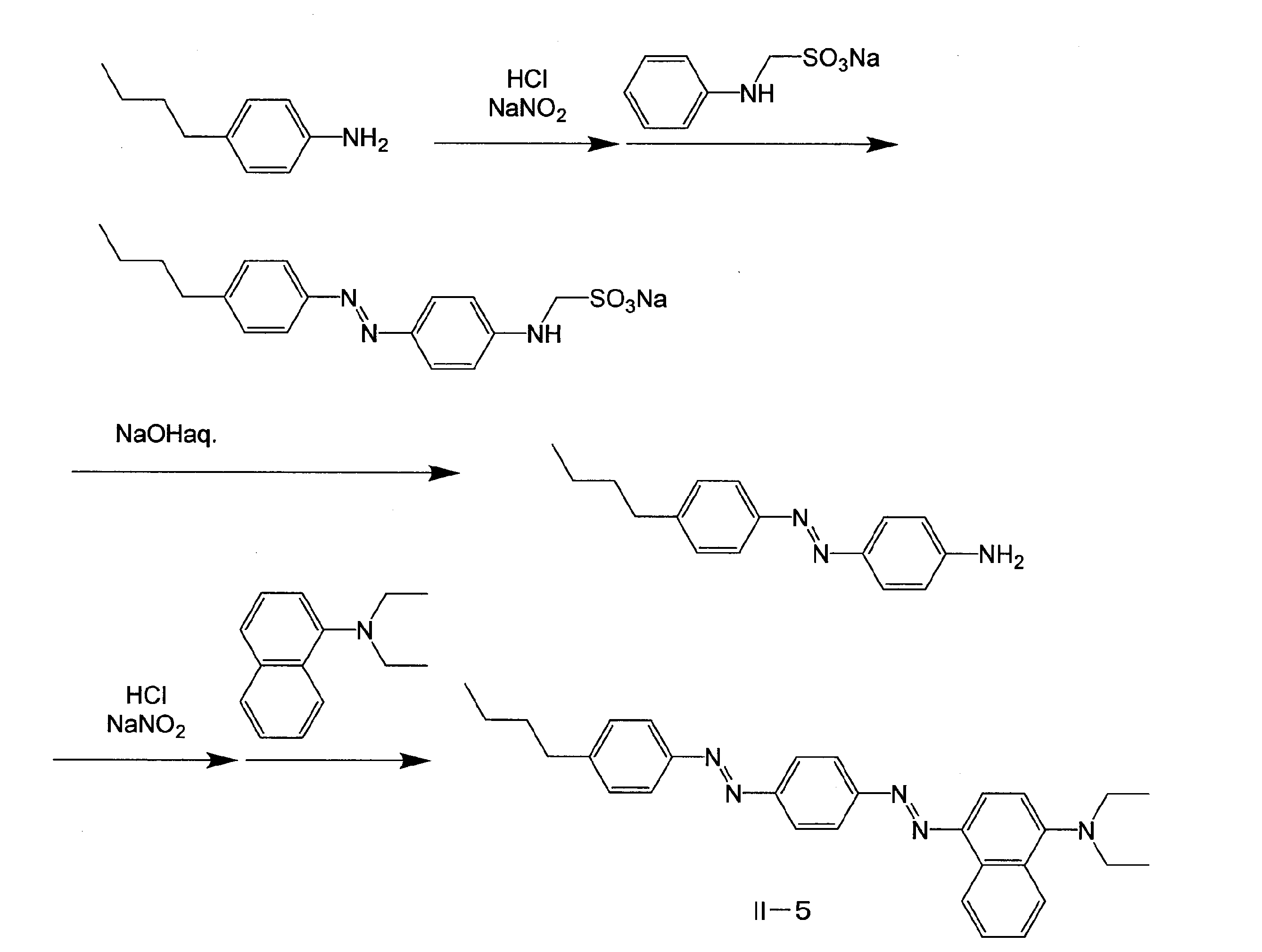
また、NMRによる構造確認をおこなった。結果を以下に示す。
1H-NMR(CDCl3、400MHz)δ0.98(t,3H,J=7.2Hz),1.16(t,6H,J=7.2Hz),1.39-1.45(m,2H),1.67-1.71(m,2H),2.74(t,2H,J=7.6Hz),3.38(q,4H,J=7.2Hz),7.20(d,1H,J=8.4Hz),7.37(d,2H,J=8.4Hz),7.57-7.61(m,1H),7.65-7.70(m,1H),7.90-7.95(m,3H),8.10(d,2H,J=8.8Hz),8.17(d,2H,J=8.8Hz),8.31(d,1H,J=8.4Hz),9.05(d,1H,J=8.0Hz)
この化合物のシクロペンタノンに対する溶解度を色素(II-1)と同様の方法で測定(検出吸収波長:254nm)したところ、2.2%であった。


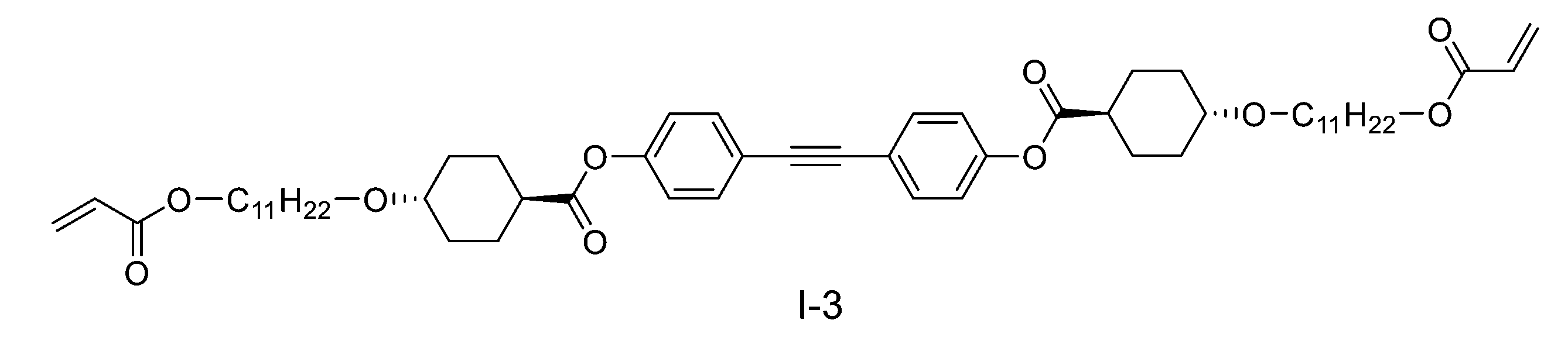
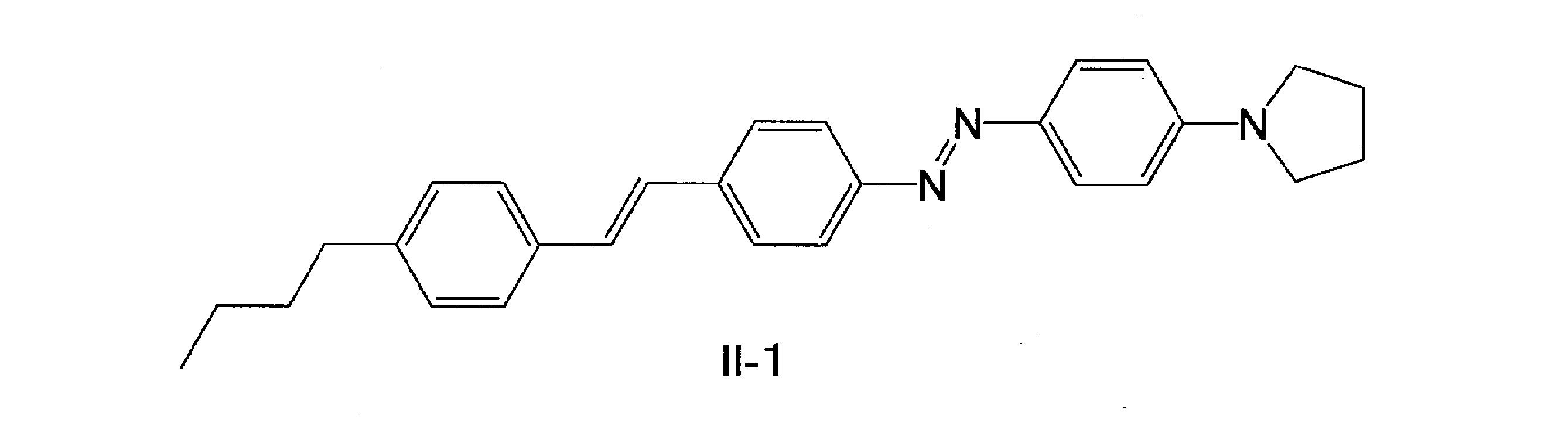
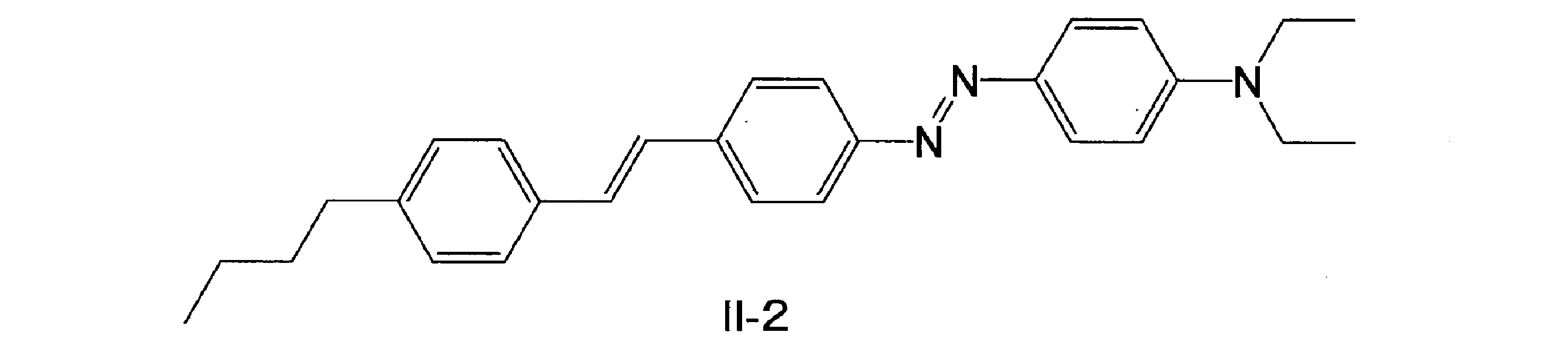

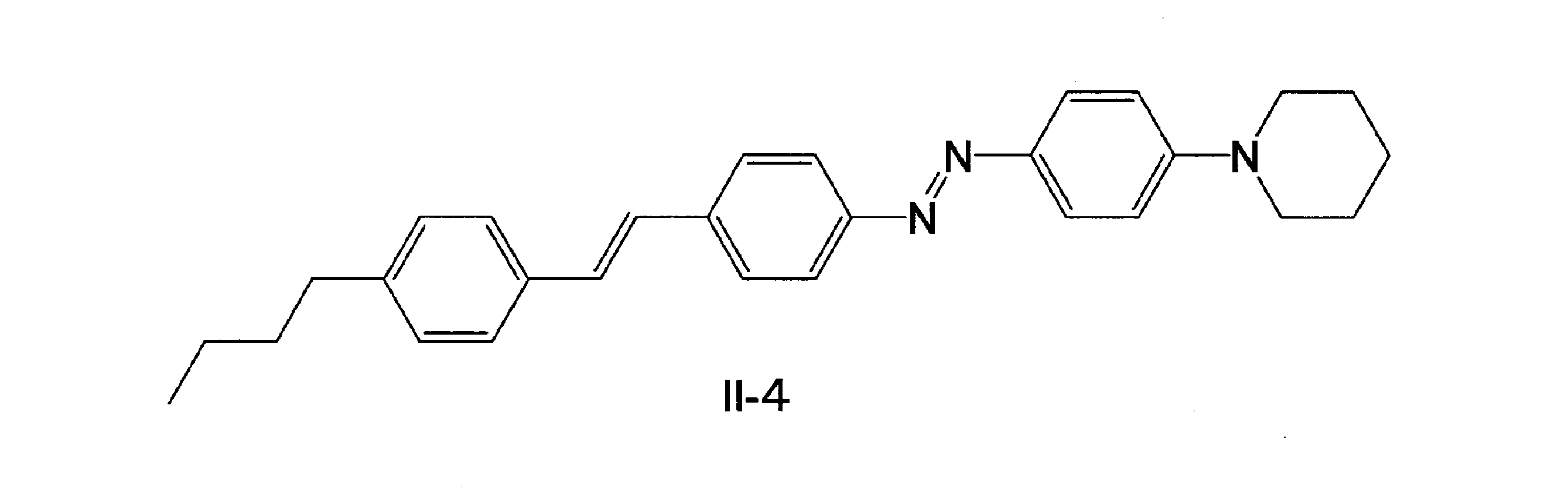


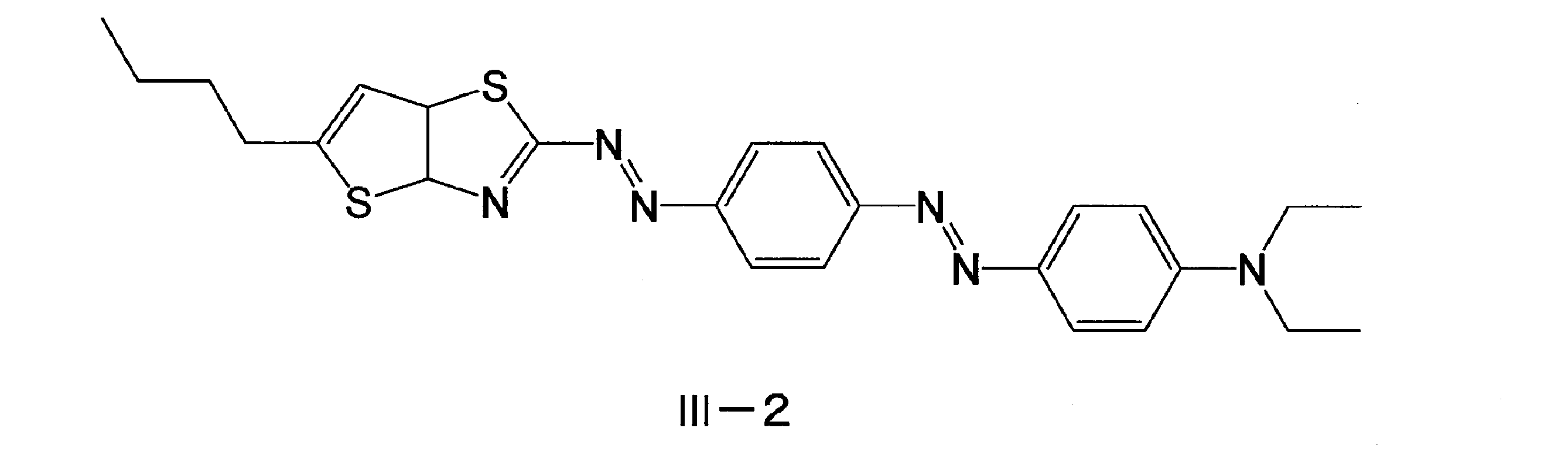
また、色素(III-2)のシクロペンタノンに対する溶解度を色素(II-1)と同様の方法で測定(検出吸収波長:254nm)したところ、0.8%であった。
クロロホルム399.6部に、液晶化合物(I-1)の20.00部、色素(II-1)の0.40部を加え、撹拌して相溶させた後、溶媒を除去することにより、異方性色素膜形成用組成物1を得た。
異方性色素膜形成用組成物1が液晶性を示すことは、ホットステージが付属する偏光顕微鏡にて、40℃で複屈折が観察されたことで確認した。
得られた異方性色素膜形成用組成物1を用いて、上述の方法で二色比を決定するため、セルギャップ8.0μmのサンドウィッチセルを使用して異方性色素膜1を作製し、異方性色素膜1の二色比を決定した。
その結果を、表2に示す。
色素(II-1)0.40部に代えて、色素(II-2)0.30部を用いたほかは実施例1と同様にして、異方性色素膜形成用組成物2および異方性色素膜2を得た。
異方性色素膜形成用組成物2が液晶性を示すことは、ホットステージが付属する偏光顕微鏡にて、40℃で複屈折が観察されたことで確認した。
異方性色素膜2について、異方性色素膜2の二色比を決定した。
その結果を、表2に示す。
色素(II-1)0.40部に代えて、色素(II-3)0.30部を用いたほかは実施例1と同様にして、異方性色素膜形成用組成物3および異方性色素膜3を得た。
異方性色素膜形成用組成物3が液晶性を示すことは、ホットステージが付属する偏光顕微鏡にて、40℃で複屈折が観察されたことで確認した。
異方性色素膜3について、異方性色素膜3の二色比を決定した。
その結果を、表2に示す。
液晶化合物(I-1)20.00部に代えて、液晶化合物(I-2)20.00部を用い、色素(II-1)0.40部に代えて、色素(II-1)0.28部を用いたほかは実施例1と同様にして、異方性色素膜形成用組成物4および異方性色素膜4を得た。
異方性色素膜形成用組成物4が液晶性を示すことは、ホットステージが付属する偏光顕微鏡にて、40℃で複屈折が観察されたことで確認した。
異方性色素膜4について、異方性色素膜4の二色比を決定した。
その結果を、表2に示す。
液晶化合物(I-1)20.00部に代えて、液晶化合物(I-2)20.00部を用い、色素(II-1)0.40部に代えて、色素(II-4)0.32部を用い、セルギャップ8.0μmのサンドウィッチセルに代えて、セルギャップ10.0μmのサンドウィッチセルを用いたほかは実施例1と同様にして、異方性色素膜形成用組成物5および異方性色素膜5を得た。
異方性色素膜形成用組成物5が液晶性を示すことは、ホットステージが付属する偏光顕微鏡にて、40℃で複屈折が観察されたことで確認した。
異方性色素膜5について、異方性色素膜5の二色比を決定した。
その結果を、表2に示す。
色素(II-1)0.40部に代えて、色素(II-5)0.2部を用いたほかは実施例1と同様にして、異方性色素膜形成用組成物7および異方性色素膜7を得た。
異方性色素膜形成用組成物7が液晶性を示すことは、ホットステージが付属する偏光顕微鏡にて、60℃で複屈折が観察されたことで確認した。
異方性色素膜7について、異方性色素膜7の二色比を決定した。
その結果を、表2に示す。
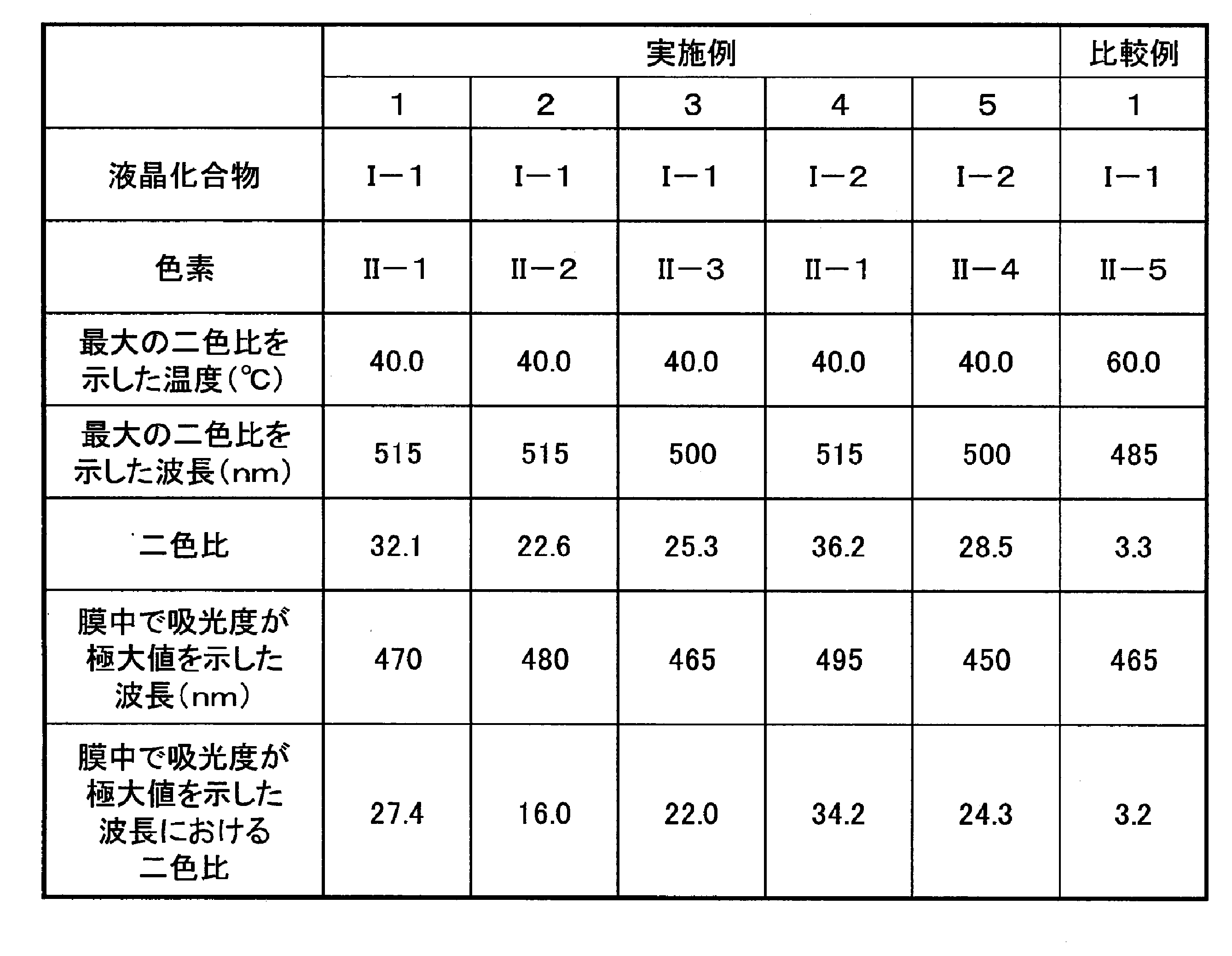
クロロホルム399.6部に、液晶化合物(I-2)の34.28部、式(III-1)のアゾ色素(株式会社林原製)の0.34部、式(III-2)のアゾ色素(昭和化工株式会社製)の0.84部、式(II-1)のアゾ色素の0.28部、色(II-4)のアゾ色素の0.21部を加え、撹拌して相溶させた後、溶媒を除去することにより、異方性色素膜形成用組成物8を得た。
異方性色素膜形成用組成物8が液晶性を示すことは、ホットステージが付属する偏光顕微鏡にて、40℃で複屈折が観察されたことで確認した。
得られた異方性色素膜形成用組成物8を用いて、上述の方法で二色比を決定するため、異方性色素膜8を作製し、異方性色素膜8の二色比を決定した。
この異方性色素膜8の最大二色比は40℃、波長675nmにて48.7であった。式(II-1)のアゾ色素の吸光度が液晶化合物(I-2)中で極大値を示した波長495nmにおける二色比は31.7であった。
シクロペンタノンの717.9部に、液晶化合物(I-2)の243.6部、式(II-1)のアゾ色素の4.35部、IRGACURE(登録商標)369(BASF社製品)の5.58部、BYK-361N(BYK-Chemie社製)の3.62部を加え、80℃で加熱撹拌後、シリンジフィルター(Membrane Solutions社製、PTFE13045、口径0.45μm)を備えたシリンジを用いて濾過することで異方性色素膜用組成物9を得た。
異方性色素膜用組成物9をスピンコート法により、ガラス上にポリイミドの配向膜(LX1400、日立化成デュポンマイクロシステムズ社製、ラビング法で配向膜を形成)が形成された基板に成膜し、120℃で2分間加熱乾燥した後、液晶相まで冷却し露光量500mj/cm2(365nm基準)で重合し異方性色素膜9を得た。得られた異方性色素膜9を市販の偏光板の上にかざし回転させると明暗し、偏光膜として利用ししうる良好な性能を示すことが確認できた。
クロロホルム2615.7部に、液晶化合物(I-2)の19.65部、式(III-1)のアゾ色素(株式会社林原製)の0.06部、式(III-2)のアゾ色素(昭和化工株式会社製)の0.15部、色素(II-2)の0.05部を加え、撹拌して相溶させた後、溶媒を除去することにより、異方性色素膜形成用組成物10を得た。
異方性色素膜形成用組成物10が液晶性を示すことは、ホットステージが付属する偏光顕微鏡にて、40℃で複屈折が観察されたことで確認した。
得られた異方性色素膜形成用組成物10を用いて、上述の方法で二色比を決定するため、異方性色素膜10を作製し、異方性色素膜10の二色比を決定した。
この異方性色素膜10の最大二色比は40℃、波長595nmにて31.0であった。色素(II-2)の吸光度が液晶化合物(I-2)中で極大値を示した波長485nmにおける二色比は20.4であった。
クロロホルム79.67部に、液晶化合物(I-2)の20.00部、式(III-2)のアゾ色素(昭和化工株式会社製)の0.18部、色素(II-1)の0.14部を加え、撹拌して相溶させた後、溶媒を除去することにより、異方性色素膜形成用組成物11を得た。
異方性色素膜形成用組成物11が液晶性を示すことは、ホットステージが付属する偏光顕微鏡にて、40℃で複屈折が観察されたことで確認した。
得られた異方性色素膜形成用組成物11を用いて、上述の方法で二色比を決定するため、異方性色素膜11を作製し、異方性色素膜11の二色比を決定した。
この異方性色素膜11の最大二色比は40℃、波長515nmにて34.2であった。色素(II-1)の吸光度が液晶化合物(I-2)中で極大値を示した波長470nmにおける二色比は28.7であった。
液晶化合物(I-1)20.00部に代えて、液晶化合物(I-3)20.00部を用いたほかは実施例9と同様にして、異方性色素膜形成用組成物12および異方性色素膜12を得た。
異方性色素膜形成用組成物12が液晶性を示すことは、ホットステージが付属する偏光顕微鏡にて、70℃で複屈折が観察されたことで確認した。
得られた異方性色素膜形成用組成物12を用いて、上述の方法で二色比を決定するため、異方性色素膜12を作製し、異方性色素膜12の二色比を決定した。
この異方性色素膜12の最大二色比は70℃、波長515nmにて28.8であった。色素(II-1)の吸光度が液晶化合物(I-3)中で極大値を示した波長470nmにおける二色比は25.5であった。
色素(II-1)0.40部に代えて、色素(II-6)0.2部を用いたほかは実施例1と同様にして、異方性色素膜形成用組成物13を得た。
色素(II-6)のシクロペンタノンに対する溶解度を色素(II-1)と同様の方法で測定(検出吸収波長:254nm)したところ、0.0%であった。
異方性色素膜形成用組成物13において、ホットステージが付属する偏光顕微鏡にて、60℃で析出物が観察された。色素(II-6)の溶解度が低いためと考えられ、異方性色素膜形成用組成物13から異方性色素膜を形成する際にも、十分な二色比を示すことが困難である。
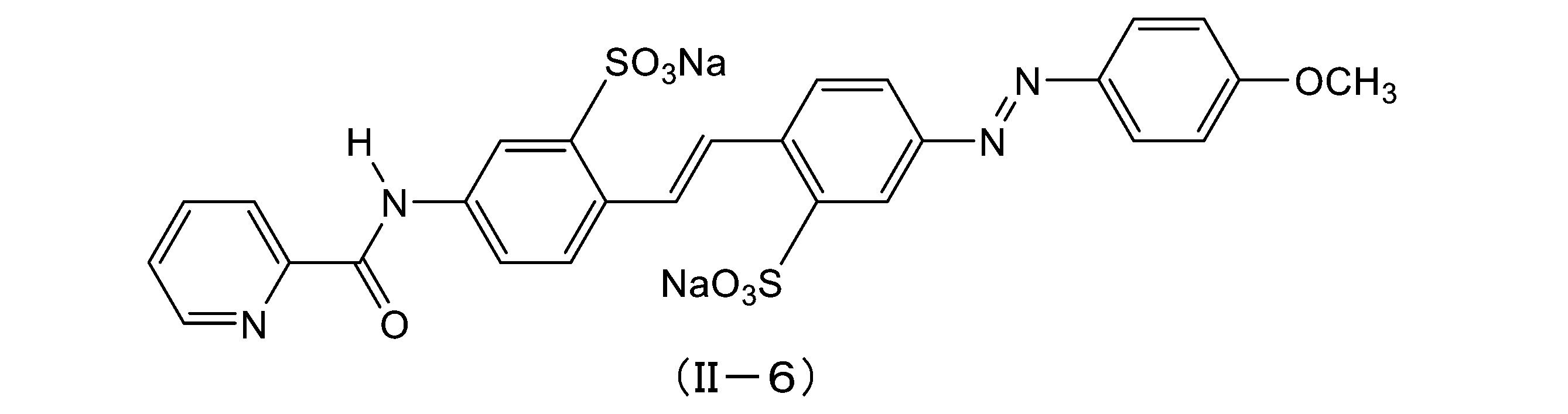
クロロホルム79.66部に、液晶化合物(I-2)の20.00部、式(III-2)のアゾ色素(昭和化工株式会社製)の0.18部、色素(II-5)の0.15部を加え、撹拌して相溶させた後、溶媒を除去することにより、異方性色素膜形成用組成物14を得た。
異方性色素膜形成用組成物14が液晶性を示すことは、ホットステージが付属する偏光顕微鏡にて、40℃で複屈折が観察されたことで確認した。
得られた異方性色素膜形成用組成物14を用いて、上述の方法で二色比を決定するため、異方性色素膜14を作製し、異方性色素膜14の二色比を決定した。
この異方性色素膜14の最大二色比は40℃、波長485nmにて6.6であった。色素(II-5)の吸光度が液晶化合物(I-2)中で極大値を示した波長465nmにおける二色比は6.6であった。
色素(II-1)0.17部に代えて、色素(II-5)0.17部を用いたほかは実施例10と同様にして、異方性色素膜形成用組成物15および異方性色素膜15を得た。
異方性色素膜形成用組成物15が液晶性を示すことは、ホットステージが付属する偏光顕微鏡にて、70℃で複屈折が観察されたことで確認した。
得られた異方性色素膜形成用組成物15を用いて、上述の方法で二色比を決定するため、異方性色素膜15を作製し、異方性色素膜15の二色比を決定した。
この異方性色素膜15の最大二色比は70℃、波長485nmにて4.3であった。色素(II-5)の吸光度が液晶化合物(I-3)中で極大値を示した波長465nmにおける二色比は3.5であった。
実施例6、8~10および比較例3~4の結果を、表3に示す。
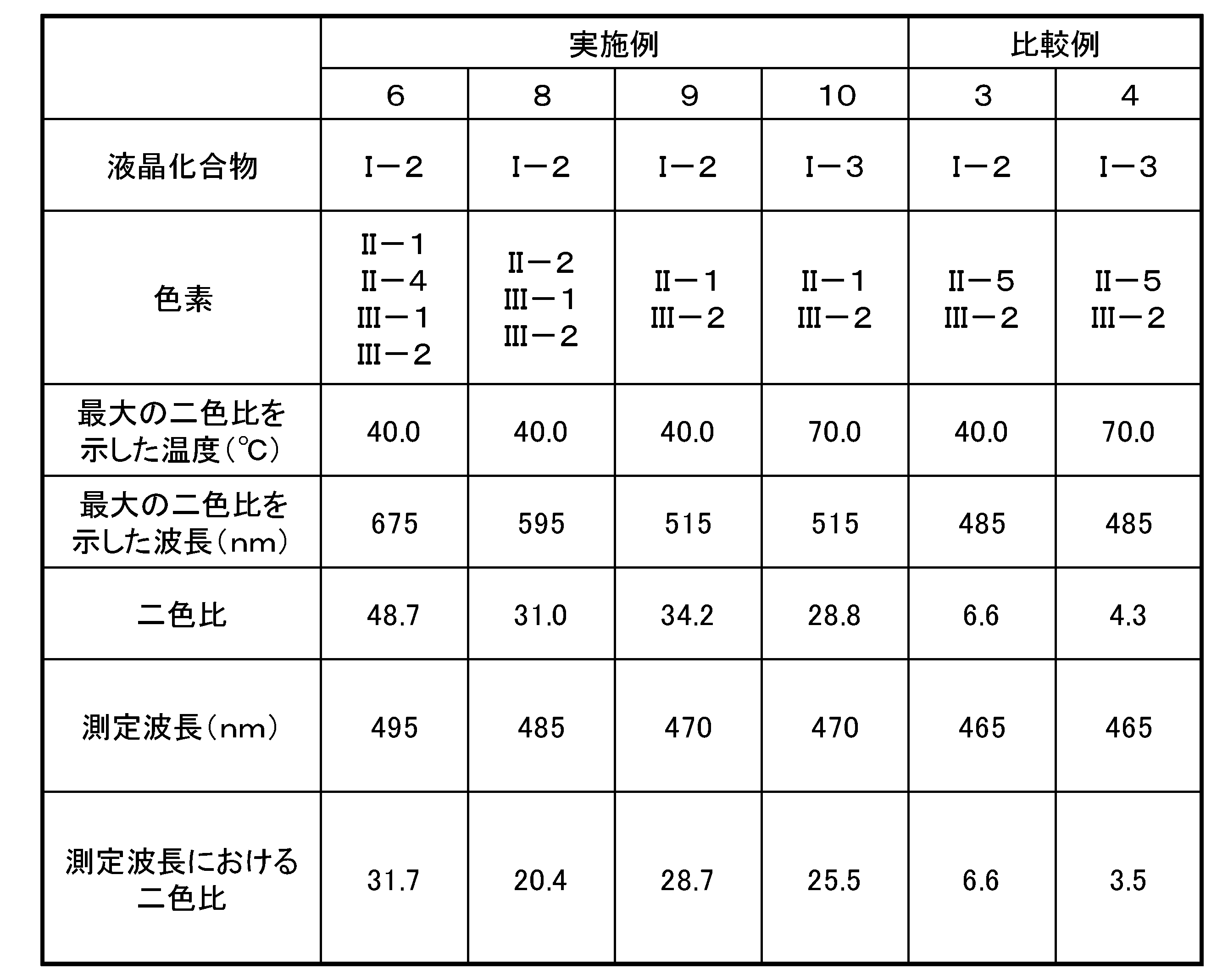
本発明の異方性色素膜は、本発明の異方性色素膜形成用組成物を用いて形成されるため、優れた光学性能、特に十分な二色比を実現できる。
本発明の光学素子は、本発明の異方性色素膜を含むため、優れた光学性能、特に十分な二色比を実現できる。
Claims (11)
- 色素および重合性液晶化合物を含み、
前記色素が、式(1)で表される化合物を含む、異方性色素膜形成用組成物。
A1-CH=CH-A2-(N=N-A3)n-X ・・・(1)
(式中、
A1は、置換基(ただし、スルホ基を除く。)を有していてもよい芳香族炭化水素環の1価基または置換基(ただし、スルホ基を除く。)を有していてもよい芳香族複素環の1価基を表し;
A2およびA3は、それぞれ独立に、置換基(ただし、スルホ基を除く。)を有していてもよい芳香族炭化水素環の2価基または置換基(ただし、スルホ基を除く。)を有していてもよい芳香族複素環の2価基を表し;
Xは、1価の有機基を表し;
nは1、2、または3を表す。) - A3が、置換基(ただし、スルホ基を除く。)を有していてもよいフェニレン基である、請求項1に記載の異方性色素膜形成用組成物。
- A2が、置換基(ただし、スルホ基を除く。)を有していてもよい芳香族炭化水素環の2価基である、請求項1又は2に記載の異方性色素膜形成用組成物。
- A1が、置換基(ただし、スルホ基を除く。)を有していてもよい芳香族炭化水素環の1価基である、請求項1~3のいずれか一項に記載の異方性色素膜形成用組成物。
- Xが-O-(Rx)または-N(-Rx)-Ryであり;RxおよびRyは、それぞれ独立に、分岐を有していてもよい炭素数1~15のアルキル基または環を構成する原子の数が5~14のアリール基を表し;RxおよびRyは、一体となって、分岐を有していてもよい炭素数2~15のアルキレン基を表してもよく;前記分岐を有していてもよい炭素数1~15のアルキル基および前記環を構成する原子の数が5~14のアリール基は、それぞれ置換基を有していてもよく;前記分岐を有していてもよい炭素数2~15のアルキレン基に含まれる一つまたはそれ以上のメチレン基は、エーテル性酸素原子、チオエーテル性硫黄原子、アミン性窒素原子、カルボニル基、エステル結合、アミド結合、-CHF-、-CF2-、-CHCl-、-CCl2-によって置き換えられた構造であってもよく;前記アミン性窒素原子は-NH-または-N(Rz)-であり;Rzは、炭素数1~6の直鎖状もしくは分枝状のアルキル基を表す、請求項1~4のいずれか一項に記載の異方性色素膜形成用組成物。
- 前記重合性液晶化合物が有する環構造の数(rn1)と、前記式(1)で表される化合物が有する環構造の数(rn2)との比(rn1/rn2)が0.7~1.5である、請求項1~5のいずれか一項に記載の異方性色素膜形成用組成物。
- 前記重合性液晶化合物が、炭素-炭素三重結合を有する化合物である、請求項1~6のいずれか一項に記載の異方性色素膜形成用組成物。
- さらに、重合開始剤を含む、請求項1~7のいずれか一項に記載の異方性色素膜形成用組成物。
- 前記色素が、さらに、380nm~780nmの波長域の吸収曲線における極大値を示す波長が、前記式(1)で表される化合物の380nm~780nmの波長域の吸収曲線における最大値を示す波長よりも長い化合物を1つ以上含む、請求項1~8のいずれか一項に記載の異方性色素膜形成用組成物。
- 請求項1~9のいずれか一項に記載の異方性色素膜形成用組成物を用いて形成された異方性色素膜。
- 請求項10に記載の異方性色素膜を含む光学素子。
Priority Applications (3)
| Application Number | Priority Date | Filing Date | Title |
|---|---|---|---|
| KR1020217024235A KR102790467B1 (ko) | 2019-03-01 | 2020-02-27 | 이방성 색소막 형성용 조성물, 이방성 색소막, 및 광학 소자 |
| CN202080017711.3A CN113490871B (zh) | 2019-03-01 | 2020-02-27 | 各向异性色素膜形成用组合物、各向异性色素膜、以及光学元件 |
| JP2021504027A JP7363887B2 (ja) | 2019-03-01 | 2020-02-27 | 異方性色素膜形成用組成物、異方性色素膜、および光学素子 |
Applications Claiming Priority (2)
| Application Number | Priority Date | Filing Date | Title |
|---|---|---|---|
| JP2019-037800 | 2019-03-01 | ||
| JP2019037800 | 2019-03-01 |
Publications (1)
| Publication Number | Publication Date |
|---|---|
| WO2020179631A1 true WO2020179631A1 (ja) | 2020-09-10 |
Family
ID=72338650
Family Applications (1)
| Application Number | Title | Priority Date | Filing Date |
|---|---|---|---|
| PCT/JP2020/008088 Ceased WO2020179631A1 (ja) | 2019-03-01 | 2020-02-27 | 異方性色素膜形成用組成物、異方性色素膜、および光学素子 |
Country Status (5)
| Country | Link |
|---|---|
| JP (1) | JP7363887B2 (ja) |
| KR (1) | KR102790467B1 (ja) |
| CN (1) | CN113490871B (ja) |
| TW (1) | TWI838473B (ja) |
| WO (1) | WO2020179631A1 (ja) |
Cited By (1)
| Publication number | Priority date | Publication date | Assignee | Title |
|---|---|---|---|---|
| CN118063976A (zh) * | 2024-01-03 | 2024-05-24 | 中国船舶集团有限公司第七一八研究所 | 一类双偶氮苯类二向色性化合物及其合成方法、染料液晶组合物和用途 |
Citations (4)
| Publication number | Priority date | Publication date | Assignee | Title |
|---|---|---|---|---|
| JPH11142647A (ja) * | 1997-11-12 | 1999-05-28 | Dainippon Ink & Chem Inc | 光学異方体の製造方法 |
| JP2011046904A (ja) * | 2009-08-28 | 2011-03-10 | Fujifilm Corp | 二色性色素組成物、偏光膜、液晶セル、及び表示装置 |
| JP2014205779A (ja) * | 2013-04-12 | 2014-10-30 | 三菱化学株式会社 | 異方性色素膜用色素、該色素を含む組成物、異方性色素膜及び偏光素子 |
| JP2016027387A (ja) * | 2014-06-25 | 2016-02-18 | 住友化学株式会社 | 光吸収異方性膜、3次元光吸収異方性膜及びその製造方法 |
Family Cites Families (5)
| Publication number | Priority date | Publication date | Assignee | Title |
|---|---|---|---|---|
| JP2001105204A (ja) | 1999-10-08 | 2001-04-17 | Mitsubishi Materials Corp | 切削工具 |
| US7763330B2 (en) | 2003-11-06 | 2010-07-27 | Sumitomo Chemical Co., Ltd. | Dichroic guest-host polarizer comprising an oriented polymer film |
| JP4622726B2 (ja) | 2005-07-28 | 2011-02-02 | Dic株式会社 | 光学異方体の製造方法 |
| JP5336206B2 (ja) * | 2009-01-16 | 2013-11-06 | 富士フイルム株式会社 | 液晶性組成物、これを用いた光吸収異方性膜、偏光素子及び液晶表示装置 |
| CN104755513B (zh) * | 2012-10-23 | 2016-05-18 | 日本瑞翁株式会社 | 聚合性化合物、聚合性组合物、高分子以及光学各向异性体 |
-
2020
- 2020-02-27 JP JP2021504027A patent/JP7363887B2/ja active Active
- 2020-02-27 KR KR1020217024235A patent/KR102790467B1/ko active Active
- 2020-02-27 TW TW109106474A patent/TWI838473B/zh active
- 2020-02-27 WO PCT/JP2020/008088 patent/WO2020179631A1/ja not_active Ceased
- 2020-02-27 CN CN202080017711.3A patent/CN113490871B/zh active Active
Patent Citations (4)
| Publication number | Priority date | Publication date | Assignee | Title |
|---|---|---|---|---|
| JPH11142647A (ja) * | 1997-11-12 | 1999-05-28 | Dainippon Ink & Chem Inc | 光学異方体の製造方法 |
| JP2011046904A (ja) * | 2009-08-28 | 2011-03-10 | Fujifilm Corp | 二色性色素組成物、偏光膜、液晶セル、及び表示装置 |
| JP2014205779A (ja) * | 2013-04-12 | 2014-10-30 | 三菱化学株式会社 | 異方性色素膜用色素、該色素を含む組成物、異方性色素膜及び偏光素子 |
| JP2016027387A (ja) * | 2014-06-25 | 2016-02-18 | 住友化学株式会社 | 光吸収異方性膜、3次元光吸収異方性膜及びその製造方法 |
Cited By (1)
| Publication number | Priority date | Publication date | Assignee | Title |
|---|---|---|---|---|
| CN118063976A (zh) * | 2024-01-03 | 2024-05-24 | 中国船舶集团有限公司第七一八研究所 | 一类双偶氮苯类二向色性化合物及其合成方法、染料液晶组合物和用途 |
Also Published As
| Publication number | Publication date |
|---|---|
| TW202039697A (zh) | 2020-11-01 |
| CN113490871A (zh) | 2021-10-08 |
| TWI838473B (zh) | 2024-04-11 |
| KR20210136981A (ko) | 2021-11-17 |
| JP7363887B2 (ja) | 2023-10-18 |
| CN113490871B (zh) | 2025-02-11 |
| KR102790467B1 (ko) | 2025-04-02 |
| JPWO2020179631A1 (ja) | 2020-09-10 |
Similar Documents
| Publication | Publication Date | Title |
|---|---|---|
| JP6622902B2 (ja) | 着色組成物、光吸収異方性膜、積層体および画像表示装置 | |
| JP6616489B2 (ja) | 着色組成物、光吸収異方性膜、積層体および画像表示装置 | |
| US12049583B2 (en) | Compound, composition for anisotropic dye films including the compound, anisotropic dye film, and optical element | |
| CN101501142A (zh) | 用于偏光膜的二色性染料、用于偏光膜的包含该二色性染料的组合物、形成偏光板的方法和由此制备的偏光板 | |
| KR102710150B1 (ko) | 이방성 색소막 형성용 조성물, 이방성 색소막, 및 광학 소자 | |
| US11768323B2 (en) | Polarizer and image display device | |
| JP6654540B2 (ja) | 二色性色素化合物、着色組成物、光吸収異方性膜、積層体および画像表示装置 | |
| JP6798600B2 (ja) | 異方性色素膜形成用組成物、異方性色素膜、および光学素子 | |
| WO2023063249A1 (ja) | 化合物、該化合物を含む異方性色素膜用組成物、異方性色素膜および光学素子 | |
| JP7363887B2 (ja) | 異方性色素膜形成用組成物、異方性色素膜、および光学素子 | |
| JP2022028423A (ja) | 異方性色素膜形成用組成物、異方性色素膜、および光学素子 | |
| JP7272021B2 (ja) | 異方性色素膜形成用組成物、異方性色素膜、および光学素子 | |
| JP7467850B2 (ja) | 異方性色素膜形成用組成物、異方性色素膜、および光学素子 | |
| JP7467851B2 (ja) | 異方性色素膜形成用組成物、異方性色素膜、および光学素子 | |
| JPWO2023181907A5 (ja) | ||
| WO2024075762A1 (ja) | 化合物、組成物、異方性色素膜及び光学素子 | |
| WO2023181907A1 (ja) | 化合物、異方性色素膜形成用組成物、異方性色素膜及び光学素子 | |
| JP2009249586A (ja) | 重合性化合物および光学フィルム | |
| JP2025115796A (ja) | 光学異方性体、光学フィルタ | |
| CN113979866A (zh) | 有反向波长色散性的化合物、含该化合物的组合物和光学膜 |
Legal Events
| Date | Code | Title | Description |
|---|---|---|---|
| 121 | Ep: the epo has been informed by wipo that ep was designated in this application |
Ref document number: 20767132 Country of ref document: EP Kind code of ref document: A1 |
|
| ENP | Entry into the national phase |
Ref document number: 2021504027 Country of ref document: JP Kind code of ref document: A |
|
| ENP | Entry into the national phase |
Ref document number: 20217024235 Country of ref document: KR Kind code of ref document: A |
|
| NENP | Non-entry into the national phase |
Ref country code: DE |
|
| 122 | Ep: pct application non-entry in european phase |
Ref document number: 20767132 Country of ref document: EP Kind code of ref document: A1 |
|
| WWG | Wipo information: grant in national office |
Ref document number: 202080017711.3 Country of ref document: CN |