WO2020177129A1 - 2,7-二氮杂-螺[4.4]壬烷类异羟肟酸嘧啶类化合物及其制备和应用 - Google Patents
2,7-二氮杂-螺[4.4]壬烷类异羟肟酸嘧啶类化合物及其制备和应用 Download PDFInfo
- Publication number
- WO2020177129A1 WO2020177129A1 PCT/CN2019/077357 CN2019077357W WO2020177129A1 WO 2020177129 A1 WO2020177129 A1 WO 2020177129A1 CN 2019077357 W CN2019077357 W CN 2019077357W WO 2020177129 A1 WO2020177129 A1 WO 2020177129A1
- Authority
- WO
- WIPO (PCT)
- Prior art keywords
- group
- compound
- substituted
- unsubstituted
- methyl
- Prior art date
- Legal status (The legal status is an assumption and is not a legal conclusion. Google has not performed a legal analysis and makes no representation as to the accuracy of the status listed.)
- Ceased
Links
- 0 *C(c1cnc(N(CC2)CC22CN(*)CC2)nc1)=O Chemical compound *C(c1cnc(N(CC2)CC22CN(*)CC2)nc1)=O 0.000 description 5
- DZBPJDFTTYNQQH-QHHAFSJGSA-N C/C=C1/NN=CC=C1 Chemical compound C/C=C1/NN=CC=C1 DZBPJDFTTYNQQH-QHHAFSJGSA-N 0.000 description 1
- DELZYXCWPBSAPS-UHFFFAOYSA-N CC(C)Cc1c[n](cccc2)c2n1 Chemical compound CC(C)Cc1c[n](cccc2)c2n1 DELZYXCWPBSAPS-UHFFFAOYSA-N 0.000 description 1
- ZTRBLDGFVYAFEK-UHFFFAOYSA-N CC(C)Cc1cncnc1 Chemical compound CC(C)Cc1cncnc1 ZTRBLDGFVYAFEK-UHFFFAOYSA-N 0.000 description 1
- KSLSRUFXFUBFIF-UHFFFAOYSA-N C[n]1c(ccc(Br)c2)c2c(CN(CC2)CC2(CC2)CN2c(nc2)ncc2C(NO)=O)c1 Chemical compound C[n]1c(ccc(Br)c2)c2c(CN(CC2)CC2(CC2)CN2c(nc2)ncc2C(NO)=O)c1 KSLSRUFXFUBFIF-UHFFFAOYSA-N 0.000 description 1
- UIXQMIIVPDYWHQ-UHFFFAOYSA-N ONC(c1cnc(N(CC2)CC22CN(Cc3ccc[s]3)CC2)nc1)=O Chemical compound ONC(c1cnc(N(CC2)CC22CN(Cc3ccc[s]3)CC2)nc1)=O UIXQMIIVPDYWHQ-UHFFFAOYSA-N 0.000 description 1
- WCCDMQYIWZRHID-UHFFFAOYSA-N ONC(c1cnc(N(CC2)CC22CN(Cc3cnc4[n]3cccc4)CC2)nc1)=O Chemical compound ONC(c1cnc(N(CC2)CC22CN(Cc3cnc4[n]3cccc4)CC2)nc1)=O WCCDMQYIWZRHID-UHFFFAOYSA-N 0.000 description 1
Images


Classifications
-
- A—HUMAN NECESSITIES
- A61—MEDICAL OR VETERINARY SCIENCE; HYGIENE
- A61K—PREPARATIONS FOR MEDICAL, DENTAL OR TOILETRY PURPOSES
- A61K31/00—Medicinal preparations containing organic active ingredients
- A61K31/33—Heterocyclic compounds
- A61K31/395—Heterocyclic compounds having nitrogen as a ring hetero atom, e.g. guanethidine or rifamycins
- A61K31/495—Heterocyclic compounds having nitrogen as a ring hetero atom, e.g. guanethidine or rifamycins having six-membered rings with two or more nitrogen atoms as the only ring heteroatoms, e.g. piperazine or tetrazines
- A61K31/505—Pyrimidines; Hydrogenated pyrimidines, e.g. trimethoprim
- A61K31/506—Pyrimidines; Hydrogenated pyrimidines, e.g. trimethoprim not condensed and containing further heterocyclic rings
-
- A—HUMAN NECESSITIES
- A61—MEDICAL OR VETERINARY SCIENCE; HYGIENE
- A61P—SPECIFIC THERAPEUTIC ACTIVITY OF CHEMICAL COMPOUNDS OR MEDICINAL PREPARATIONS
- A61P33/00—Antiparasitic agents
- A61P33/02—Antiprotozoals, e.g. for leishmaniasis, trichomoniasis, toxoplasmosis
- A61P33/06—Antimalarials
-
- C—CHEMISTRY; METALLURGY
- C07—ORGANIC CHEMISTRY
- C07D—HETEROCYCLIC COMPOUNDS
- C07D403/00—Heterocyclic compounds containing two or more hetero rings, having nitrogen atoms as the only ring hetero atoms, not provided for by group C07D401/00
- C07D403/14—Heterocyclic compounds containing two or more hetero rings, having nitrogen atoms as the only ring hetero atoms, not provided for by group C07D401/00 containing three or more hetero rings
-
- Y—GENERAL TAGGING OF NEW TECHNOLOGICAL DEVELOPMENTS; GENERAL TAGGING OF CROSS-SECTIONAL TECHNOLOGIES SPANNING OVER SEVERAL SECTIONS OF THE IPC; TECHNICAL SUBJECTS COVERED BY FORMER USPC CROSS-REFERENCE ART COLLECTIONS [XRACs] AND DIGESTS
- Y02—TECHNOLOGIES OR APPLICATIONS FOR MITIGATION OR ADAPTATION AGAINST CLIMATE CHANGE
- Y02A—TECHNOLOGIES FOR ADAPTATION TO CLIMATE CHANGE
- Y02A50/00—TECHNOLOGIES FOR ADAPTATION TO CLIMATE CHANGE in human health protection, e.g. against extreme weather
- Y02A50/30—Against vector-borne diseases, e.g. mosquito-borne, fly-borne, tick-borne or waterborne diseases whose impact is exacerbated by climate change
Definitions
- the present invention relates to the fields of medicinal chemistry and pharmacotherapy, in particular to a class of 2,7-diaza-spiro[4.4]nonane hydroxamic acid pyrimidine compounds, preparation methods and pharmacological uses thereof, which can act It is used for histone deacetylase, and then used to prepare pharmaceutical composition for treating malaria.
- Malaria is a parasitic disease transmitted by female Anopheles and caused by Plasmodium. Malaria is one of the most prominent problems in the field of public health in the world today. It is the most widespread and harmful parasitic disease in the world. According to the World Health Organization (WHO) 2017 World Malaria Report, there are 91 countries and regions in the world as malaria-endemic areas. A total of 216 million people are infected with malaria. 90% of cases are in Africa and 7% are in Southeast Asia Regions, 2% are located in the Eastern Mediterranean Region of the World Health Organization. Approximately 450,000 people die from malaria every year. The ravages of malaria have had a huge negative impact on local economic and social development. Malaria has become one of the main factors that make Africa’s economy in trouble.
- the symptoms of malaria are the onset of chills, fever, and night sweats that occur at certain intervals, depending on the time required for the new generation of malaria parasites to develop in the host.
- Malaria caused by Plasmodium falciparum is characterized by severe systemic symptoms, even leading to death of patients, and it is the cause of most deaths in malaria cases.
- Plasmodium falciparum can digest hemoglobin in red blood cells, and can change the adhesion characteristics of the parasitic cells, causing the cells to adhere to the blood vessel wall, causing blood flow to be blocked, leading to vascular embolism.
- Cerebral malaria caused by Plasmodium falciparum is a very dangerous form of malaria. In patients with cerebral malaria, the above-mentioned adhesion properties are changed by cells that block the blood vessels of the brain, causing the patient to lose consciousness. If not treated in time, it will directly lead to death.
- compound artemisinin is the most effective drug for the treatment of malaria, and has become the first-line antimalarial drug in most countries, such as 1) artemether + benzofluorenol; 2) dihydroartemisinin + piperquine; 3 ) Artesunate + mefloquine; 4) artesunate + amodiaquine; 5) artesunate + SP, etc.
- the purpose of the present invention is to provide a pharmaceutical compound that can effectively kill malaria parasites, especially drug-resistant malaria parasites.
- the first aspect of the present invention provides a 2,7-diaza-spiro[4.4]nonane hydroxamic acid pyrimidine compound represented by the following formula I, or a pharmaceutically acceptable salt thereof:
- R 1 is selected from the following group: NHOH, or OR 3 ;
- R 2 is selected from the following group: hydrogen, substituted or unsubstituted C1-C6 alkyl, substituted or unsubstituted C3-C8 cycloalkyl, substituted or unsubstituted C6-C15 monocyclic, bicyclic or tricyclic aryl group , Substituted or unsubstituted 5-15 membered monocyclic, bicyclic or tricyclic heterocyclic group (including saturated, partially unsaturated or aromatic heterocyclic group); wherein, the heteroaryl group includes one or more selected From the following group of heteroatoms as the ring skeleton: N, O or S;
- R 3 is selected from the following group: hydrogen, substituted or unsubstituted C1-C3 alkyl, substituted or unsubstituted C3-C8 cycloalkyl, substituted or unsubstituted 5-15 membered heterocyclic group;
- n 0 or 1;
- R 2 is selected from the following group: H, substituted or unsubstituted C1-C6 alkyl, substituted or unsubstituted C3-C8 cycloalkyl, or substituted or unsubstituted Groups of the following groups:
- X is selected from N, O, and S.
- R 2 is selected from the following group: hydrogen, substituted or unsubstituted C1-C6 alkyl, substituted or unsubstituted C3-C8 cycloalkyl, substituted or unsubstituted C6-C15 aryl, A substituted or unsubstituted 5-15 membered heteroaryl group; wherein, the C3-C8 cycloalkyl group is selected from the following group: cyclopentyl, cyclohexyl;
- the aryl group is selected from the following group: phenyl, naphthyl, phenanthryl;
- the 5-15 membered heteroaryl group is selected from the following group:
- R 3 is selected from the following group: hydrogen, C1-C3 linear alkyl, and C1-C6 saturated heterocyclic group.
- the linear alkyl group is methyl or ethyl.
- the heteroatom in the heterocyclic group is an oxygen atom.
- the R 1 is NHOH.
- the monocyclic heteroaryl group is selected from the following group: pyridyl, pyrrolyl, furyl, and thienyl.
- the bicyclic heteroaryl group is selected from the group consisting of quinolinyl, isoquinolinyl, benzothienyl, phenylpropanyl, indolyl, and azaindolyl.
- the compound of formula I can be selected from the following group:
- the second aspect of the present invention provides a pharmaceutical composition
- a pharmaceutical composition comprising (a) a therapeutically effective amount of the compound as described in the first aspect of the present invention, or a pharmaceutically acceptable salt thereof, Hydrate or solvate; and (b) a pharmaceutically acceptable carrier.
- the pharmaceutical composition is used for:
- the pharmaceutical composition is used to regulate the activity or expression of HDAC.
- the third aspect of the present invention provides a use of the compound of formula I as described in the first aspect of the present invention for preparing a pharmaceutical composition for treating or preventing diseases or disorders caused by malaria parasites.
- the disease or condition is malaria.
- the Plasmodium is resistant or non-drug resistant.
- the plasmodium is a plasmodium in a stage selected from the group consisting of hepatic stage, gametophyte stage, and intraerythrocytic stage.
- the drug-resistant plasmodium is a plasmodium that has developed resistance to drugs selected from the group consisting of artemisinin, dihydroartemisinin, artemether, artesunate, and fluorene Alcohol, sulfadoxine, pyrimethamine, pyronaridine, atovaquinone, quinine, chloroquine, piperquine, mefloquine, amodiaquine, primaquine, and tafenoquine.
- drugs selected from the group consisting of artemisinin, dihydroartemisinin, artemether, artesunate, and fluorene Alcohol, sulfadoxine, pyrimethamine, pyronaridine, atovaquinone, quinine, chloroquine, piperquine, mefloquine, amodiaquine, primaquine, and tafenoquine.
- the fourth aspect of the present invention provides a use of the compound of formula I as described in the first aspect of the present invention for preparing a pharmaceutical composition for treating or preventing diseases or disorders related to the activity or expression of HDAC.
- the disease or condition is a tumor.
- the tumor is selected from the group consisting of lung cancer, colon cancer, prostate cancer, breast cancer, ovarian cancer, and lymphatic system tumors.
- Figure 1 is a Western Blot experimental result diagram of the compound of the present invention.
- Figure 2 is a schematic diagram of the results of in vivo drug efficacy experiments in mice; among them, Figure 2A is the protozoan curve rate of mice treated with compound I-7 after infection, and Figure 2B is the survival rate of mice treated with compound I-7 after infection; Figure 2C Fig. 2D is the protozoan curve rate of mice treated with compound I-8 after infection, and Figure 2D is the survival rate of mice treated with compound I-8 after infection.
- the inventor prepared a compound with HDAC inhibitory activity, which can kill drug-resistant and non-drug-resistant plasmodium activity in various periods, and has low toxicity to human cells, so it can For the treatment of diseases caused by malaria parasites such as malaria. Based on the above findings, the inventor completed the present invention.
- C1-C6 alkyl refers to a straight or branched chain alkyl group having 1 to 6 carbon atoms, such as methyl, ethyl, propyl, isopropyl, butyl, isobutyl, Sec-butyl, tert-butyl, etc., or similar groups.
- the alkyl group is a straight or branched saturated chain having 1 to 3 carbon atoms, such as methyl, ethyl, n-propyl or isopropyl.
- C3-C8 cycloalkyl refers to a cyclic alkyl group having 1 to 8 carbon atoms, such as cyclopropyl, cyclobutyl, cyclopentyl, cyclohexyl, cycloheptyl, cyclooctyl .
- C1-C6 alkoxy refers to a C1-C6 alkyl group as defined above, which is attached to the remainder of the molecule through an oxygen atom.
- the C1-C6 alkoxy group may include methoxy, ethoxy and isopropoxy.
- halogen refers to F, Cl, Br and I.
- haloalkyl refers to a C1-C3 alkyl group substituted by halogen.
- the haloalkyl group is trifluoromethyl, difluoromethyl, or trifluoromethoxy.
- C1-C3 alkyl refers to a straight or branched chain alkyl group having 1 to 3 carbon atoms, such as methyl, ethyl, n-propyl, and isopropyl.
- aryl refers to a C6-C18 aromatic group, such as phenyl or naphthyl.
- heterocycle refers to a 5-15 membered non-aromatic group (including saturated, partially saturated or unsaturated groups), which contains one or more selected from nitrogen, oxygen and sulfur
- the heteroatoms have a single ring or a fused ring (including bridged ring systems and spiro ring systems. In a fused ring system, one or more rings can be cycloalkyl, aryl or heteroaryl.
- the nitrogen atom and/or sulfur atom of the heterocyclic group is optionally oxidized to provide N-oxide, sulfinyl and sulfonyl moieties.
- heterocyclic group examples include pyrrolidinyl , Piperidinyl, piperazinyl, imidazolidinyl, 2,3-dihydrofuran (2,3-b) pyridinyl, benzoxazinyl, tetrahydroquinolinyl, tetrahydroisoquinolinyl, Indolyl, etc.
- This term also includes non-aromatic, partially unsaturated monocyclic rings, such as 2- or 4-pyridone or N-substituted-(1H,3H)-pyrimidine-2 linked by a nitrogen atom ,4-Diketones (N-substituted uracil).
- the term “comprising”, “comprising” or “including” means that various ingredients can be used together in the mixture or composition of the present invention. Therefore, the terms “mainly consisting of” and “consisting of” are included in the term “containing”.
- the term "pharmaceutically acceptable” ingredients refers to substances that are suitable for humans and/or animals without excessive side effects (such as toxicity, irritation, and allergic reactions), that is, substances that have a reasonable benefit/risk ratio.
- the term "effective amount" refers to the amount of a therapeutic agent that treats, alleviates, or prevents the target disease or condition, or shows a detectable therapeutic or preventive effect.
- the precise effective amount for a subject depends on the size and health of the subject, the nature and extent of the disorder, and the therapeutic agent and/or combination of therapeutic agents selected for administration. Therefore, it is useless to specify an accurate effective amount in advance. However, for a given condition, routine experiments can be used to determine the effective amount, which can be judged by clinicians.
- the term "pharmaceutically acceptable salt” refers to a salt formed by a compound of the present invention and an acid or base suitable for use as a medicine.
- Pharmaceutically acceptable salts include inorganic salts and organic salts.
- a preferred class of salts are the salts of the compounds of this invention with acids.
- Acids suitable for salt formation include but are not limited to: hydrochloric acid, hydrobromic acid, hydrofluoric acid, sulfuric acid, nitric acid, phosphoric acid and other inorganic acids, formic acid, acetic acid, propionic acid, oxalic acid, malonic acid, succinic acid, fumaric acid, Organic acids such as maleic acid, lactic acid, malic acid, tartaric acid, citric acid, picric acid, methanesulfonic acid, toluenesulfonic acid, and benzenesulfonic acid; and acidic amino acids such as aspartic acid and glutamic acid.
- Some compounds in the present invention may be crystallized or recrystallized with water or various organic solvents, in which case various solvates may be formed.
- the solvates of the present invention include stoichiometric solvates such as hydrates, etc., as well as compounds containing variable amounts of water formed when they are prepared by a low-pressure sublimation drying method.
- the invention also includes all suitable isotopic variants of the compounds of the invention.
- Isotopic variants of the compounds of the present invention are defined as those in which at least one atom is replaced by an atom having the same atomic number but having an atomic mass different from the atomic mass commonly found in nature.
- isotopes that can be incorporated into the compounds of the present invention include isotopes of hydrogen, carbon, nitrogen, oxygen, phosphorus, sulfur, fluorine, and chlorine, such as 2 H, 3 H, 11 C, 13 C, 14 C, 15 N, and 17 respectively. O, 18 O, 35 S, 18 F and 36 Cl.
- isotopic variants of the present invention for example, those in which radioisotopes (such as 3 H or 14 C) are incorporated, are used in drug and/or substrate tissue distribution studies. Tritiated, i.e., 3 H, and carbon-14, i.e., 14 C, isotopes are particularly preferred because they are easy to prepare and detect.
- substitution with isotopes e.g., deuterium, ie, 2 H
- Isotopic variants of the compounds of the present invention can generally be prepared by conventional operations, for example, by using suitable reagents for appropriate isotopic variants, by an exemplary method or the preparation described in the experimental section below.
- the present invention provides 2,7-diaza-spiro[4.4]nonane hydroxamic acid pyrimidine derivatives represented by the following formula I in free form, salt form or solvate form:
- R 1 is NHOH, or OR 3 ;
- R 2 is hydrogen, C1-C6 linear, branched or cyclic alkyl, substituted or unsubstituted aryl.
- the present invention also includes pharmaceutically acceptable salts of the aforementioned compounds.
- Suitable pharmaceutically acceptable salts of substituted 2,7-diaza-spiro[4.4]nonane hydroxamic acid pyrimidine derivatives of the present invention are sufficiently basic substituted pyrimidine urea derivatives of the present invention to form salts with acids
- the acid may be hydrochloride, phosphate, sulfate, trifluoroacetate, hydrobromide, tartrate, fumaric acid Salt, maleate, citrate, p-toluenesulfonate, methanesulfonate; these salts can be prepared from compounds of formula I by known salt formation methods.
- Another object of the present invention is to disclose the above-mentioned substituted 2,7-diaza-spiro[4.4]nonane hydroxamic acid pyrimidine compounds (compounds of formula I, or pharmaceutically acceptable salts thereof)
- n 1
- R 1 is NHOH, or OR 3
- R 2 is hydrogen, C1-C6 cyclic alkyl, substituted or unsubstituted aryl
- R 3 is hydrogen, ethyl , Tetrahydropyranyl.
- n 0
- R 1 is NHOH
- R 2 is hydrogen, C3-C6 cyclic alkyl, substituted or unsubstituted aryl.
- n 0
- R 1 is NHOH
- R 2 is hydrogen, cyclopentyl, cyclohexyl, substituted or unsubstituted aryl, wherein aryl is selected from substituted or unsubstituted phenyl , Pyridine, pyrrole, furan, thiophene, naphthalene, quinoline, isoquinoline, benzothiophene, benzofuran, benzene ring with five-membered ring containing 1-2 oxygen atoms, substituted or unsubstituted on nitrogen, skeleton It contains 1-2 nitrogen atoms indole and anthracene, and the substituents are selected from: C1-C4 alkyl, alkoxy, halogen, cyano, phenyl.
- n 0
- R 1 is NHOH
- R 2 is hydrogen, cyclopentyl, cyclohexyl, substituted or unsubstituted aryl, wherein aryl is selected from substituted or unsubstituted phenyl , Pyridine, pyrrole, furan, thiophene, naphthalene, quinoline, isoquinoline, benzothiophene, benzofuran, benzene ring with five-membered ring containing 1-2 oxygen atoms, substituted or unsubstituted on nitrogen, skeleton It contains 1-2 nitrogen atoms indole and anthracene, and the substituents are methyl, methoxy, fluorine, chlorine, bromine, cyano, phenyl.
- the present invention also provides a method for preparing substituted 2,7-diaza-spiro[4.4]nonane hydroxamic acid pyrimidine compounds with the structure of general formula I and intermediates II to VI.
- the specific synthesis strategies are as follows:
- the compound of the present invention Since the compound of the present invention has excellent HDAC activation activity, the compound of the present invention and its various crystal forms, pharmaceutically acceptable inorganic or organic salts, hydrates or solvates, and containing the compound of the present invention as the main active ingredient
- the pharmaceutical composition can be used to treat, prevent and alleviate diseases caused by the activity or expression of HDAC.
- the compounds of the present invention can be used to treat the following diseases: lung cancer, colon cancer, prostate cancer, breast cancer, ovarian cancer, lymphatic system tumors, and diseases caused by malaria parasites (such as malaria).
- the pharmaceutical composition of the present invention contains the compound of the present invention or a pharmacologically acceptable salt thereof and a pharmacologically acceptable excipient or carrier within a safe and effective amount.
- the "safe and effective amount” refers to: the amount of the compound is sufficient to significantly improve the condition without causing serious side effects.
- the pharmaceutical composition contains 0.1-1000 mg of the compound of the present invention per agent, more preferably, 0.5-500 mg of the compound of the present invention per agent.
- the "one dose" is a capsule or tablet.
- “Pharmaceutically acceptable carrier” refers to: one or more compatible solid or liquid fillers or gel substances, which are suitable for human use, and must have sufficient purity and sufficiently low toxicity. "Compatibility” here means that the components in the composition can be blended with the compound of the present invention and between them without significantly reducing the efficacy of the compound.
- pharmaceutically acceptable carriers include cellulose and its derivatives (such as sodium carboxymethyl cellulose, sodium ethyl cellulose, cellulose acetate, etc.), gelatin, talc, and solid lubricants (such as stearic acid).
- Magnesium stearate calcium sulfate, vegetable oils (such as soybean oil, sesame oil, peanut oil, olive oil, etc.), polyols (such as propylene glycol, glycerin, mannitol, sorbitol, etc.), emulsifiers (such as Tween), wetting Agents (such as sodium lauryl sulfate), coloring agents, flavoring agents, stabilizers, antioxidants, preservatives, pyrogen-free water, etc.
- vegetable oils such as soybean oil, sesame oil, peanut oil, olive oil, etc.
- polyols such as propylene glycol, glycerin, mannitol, sorbitol, etc.
- emulsifiers such as Tween
- wetting Agents such as sodium lauryl sulfate
- coloring agents such as sodium lauryl sulfate
- flavoring agents such as pepperminophen, sorbitol, etc.
- the administration method of the compound or pharmaceutical composition of the present invention is not particularly limited.
- Representative administration methods include (but are not limited to): oral, rectal, parenteral (intravenous, intramuscular, or subcutaneous), and topical administration.
- a particularly preferred mode of administration is oral.
- Solid dosage forms for oral administration include capsules, tablets, pills, powders and granules.
- the active compound is mixed with at least one conventional inert excipient (or carrier), such as sodium citrate or dicalcium phosphate, or mixed with the following ingredients: (a) fillers or compatibilizers, for example, Starch, lactose, sucrose, glucose, mannitol and silicic acid; (b) binders, such as hydroxymethyl cellulose, alginate, gelatin, polyvinylpyrrolidone, sucrose and gum arabic; (c) humectant, For example, glycerin; (d) disintegrants, such as agar, calcium carbonate, potato starch or tapioca starch, alginic acid, certain complex silicates, and sodium carbonate; (e) slow solvents, such as paraffin; (f) Absorption accelerators, such as quaternary amine compounds; (g) wetting agents, such as cetyl alcohol and gly
- Solid dosage forms such as tablets, sugar pills, capsules, pills and granules can be prepared with coatings and shell materials, such as enteric coatings and other materials known in the art. They may contain opacifying agents, and the active compound or the release of the compound in such a composition may be released in a certain part of the digestive tract in a delayed manner. Examples of embedding components that can be used are polymeric substances and waxes. If necessary, the active compound can also be formed into microcapsules with one or more of the above-mentioned excipients.
- Liquid dosage forms for oral administration include pharmaceutically acceptable emulsions, solutions, suspensions, syrups or tinctures.
- the liquid dosage form may contain inert diluents conventionally used in the art, such as water or other solvents, solubilizers and emulsifiers, for example, ethanol, isopropanol, ethyl carbonate, ethyl acetate, propylene glycol, 1 , 3-Butanediol, dimethylformamide and oils, especially cottonseed oil, peanut oil, corn germ oil, olive oil, castor oil and sesame oil or mixtures of these substances.
- composition may also contain adjuvants such as wetting agents, emulsifying and suspending agents, sweetening agents, flavoring agents and perfumes.
- adjuvants such as wetting agents, emulsifying and suspending agents, sweetening agents, flavoring agents and perfumes.
- the suspension may contain suspending agents, for example, ethoxylated isostearyl alcohol, polyoxyethylene sorbitol and sorbitan esters, microcrystalline cellulose, aluminum methoxide and agar, or mixtures of these substances, and the like.
- suspending agents for example, ethoxylated isostearyl alcohol, polyoxyethylene sorbitol and sorbitan esters, microcrystalline cellulose, aluminum methoxide and agar, or mixtures of these substances, and the like.
- composition for parenteral injection may contain physiologically acceptable sterile aqueous or non-aqueous solutions, dispersions, suspensions or emulsions, and sterile powders for reconstitution into sterile injectable solutions or dispersions.
- Suitable aqueous and non-aqueous carriers, diluents, solvents or excipients include water, ethanol, polyols and suitable mixtures thereof.
- the dosage form of the compound of the present invention for topical administration includes ointment, powder, patch, spray and inhalant.
- the active ingredient is mixed under sterile conditions with a physiologically acceptable carrier and any preservatives, buffers, or propellants that may be required if necessary.
- the compound of the present invention can be administered alone or in combination with other pharmaceutically acceptable compounds.
- a safe and effective amount of the compound of the present invention is applied to a mammal (such as a human) in need of treatment, wherein the dosage is the pharmaceutically effective dosage considered to be administered.
- the daily dose administered is usually 0.2 to 1000 mg, preferably 0.5 to 500 mg.
- the specific dosage should also consider factors such as the route of administration, the patient's health status, etc., which are within the skill range of a skilled physician.
- Example 4 The specific implementation steps are the same as in Example 4.
- the required raw material is 2-(7-((1-methyl-6-chloro-1H-indol-3-yl)methyl)-2,7-diazaspiro[ 4.4]
- Nonan-2-yl)pyrimidine-5-carboxylic acid the target product is obtained as a colorless solid with a yield of 56%.
- Example 6 The specific implementation steps are the same as in Example 6.
- the required raw material is 2-(7-((1-methyl-1H-indol-3-yl)methyl)-2,7-diazaspiro[4.4]non- 2-yl)-N-((tetrahydro-2H-pyranpyridin-2-yl)oxy)pyrimidine-5-carboxamide, the target product was obtained as a white solid with a yield of 71%.
- Example 6 The specific implementation steps are the same as in Example 6.
- the required raw material is 2-(7-((1-methyl-6-chloro-1H-indol-3-yl)methyl)-2,7-diazaspiro[ 4.4]
- Non-2-yl)-N-((tetrahydro-2H-pyranpyridin-2-yl)oxy)pyrimidine-5-carboxamide the target product is obtained as a pale yellow solid with a yield of 67%.
- Example 6 The specific implementation steps are the same as in Example 6.
- the required raw material is 2-(7-((1-methyl-1H-indol-4-yl)methyl)-2,7-diazaspiro[4.4]non- 2-yl)-N-((tetrahydro-2H-pyranpyridin-2-yl)oxy)pyrimidine-5-carboxamide, the target product was obtained as a light green solid with a yield of 53%.
- the specific implementation steps are the same as in Example 6.
- the required raw material is 2-(7-((1-methyl-5-methoxy-1H-indol-3-yl)methyl)-2,7-diazepine Spiro[4.4]non-2-yl)-N-((tetrahydro-2H-pyranpyridin-2-yl)oxy)pyrimidine-5-carboxamide, the target product is a pale pink solid with a yield of 75% .
- the specific implementation steps are the same as in Example 6.
- the required raw material is 2-(7-benzyl-2,7-diazaspiro[4.4]non-2-yl)-N-((tetrahydro-2H-pyranpyridine) -2-yl)oxy)pyrimidine-5-carboxamide, the target product is obtained as a brown solid with a yield of 42%.
- Example 6 The specific implementation steps are the same as in Example 6.
- the required raw material is 2-(7-((1-methyl-6-fluoro-1H-indol-3-yl)methyl)-2,7-diazaspiro[ 4.4]
- Non-2-yl)-N-((tetrahydro-2H-pyranpyridin-2-yl)oxy)pyrimidine-5-carboxamide the target product is obtained as a white solid with a yield of 75%.
- Example 6 The specific implementation steps are the same as in Example 6.
- the required raw material is 2-(7-((1H-indol-3-yl)methyl)-2,7-diazaspiro[4.4]non-2-yl)- N-((Tetrahydro-2H-pyranpyridin-2-yl)oxy)pyrimidine-5-carboxamide, the target product was obtained as a white solid with a yield of 68%.
- Example 6 The specific implementation steps are the same as in Example 6.
- the required raw material is 2-(7-((1-methyl-5-cyano-1H-indol-3-yl)methyl)-2,7-diaza spiro [4.4]
- Non-2-yl)-N-((tetrahydro-2H-pyranpyridin-2-yl)oxy)pyrimidine-5-carboxamide the target product is obtained as a pale yellow solid with a yield of 70%.
- the specific implementation steps are the same as in Example 6.
- the required raw material is 2-(7-((2,3-dihydrobenzofuran-5-yl)methyl)-2,7-diazaspiro[4.4]non- 2-yl)-N-((tetrahydro-2H-pyranpyridin-2-yl)oxy)pyrimidine-5-carboxamide, the target product is obtained as a yellow oil, with a yield of 68%.
- the specific implementation steps are the same as in Example 6.
- the required raw material is 2-(7-((thiophen-2-yl)methyl)-2,7-diazaspiro[4.4]non-2-yl)-N-( (Tetrahydro-2H-pyranpyridin-2-yl)oxy)pyrimidine-5-carboxamide, the target product is obtained as a pale yellow solid with a yield of 55%.
- the specific implementation steps are the same as in Example 6.
- the required raw material is 2-(7-((furan-2-yl)methyl)-2,7-diazaspiro[4.4]non-2-yl)-N-( (Tetrahydro-2H-pyranpyridin-2-yl)oxy)pyrimidine-5-carboxamide, the target product is obtained as a brown solid with a yield of 48%.
- the specific implementation steps are the same as in Example 6.
- the required raw material is 2-(7-(cyclohexylmethyl)-2,7-diazaspiro[4.4]non-2-yl)-N-((tetrahydro-2H -Pyranpyridin-2-yl)oxy)pyrimidine-5-carboxamide, the target product is obtained as a yellow oil with a yield of 65%.
- the specific implementation steps are the same as in Example 6.
- the required raw material is 2-(7-((benzofuran-3-yl)methyl)-2,7-diazaspiro[4.4]non-2-yl)-N -((Tetrahydro-2H-pyranpyridin-2-yl)oxy)pyrimidine-5-carboxamide, the target product is obtained as a white solid with a yield of 72%.
- the specific implementation steps are the same as in Example 6.
- the required raw material is 2-(7-((quinolin-4-yl)methyl)-2,7-diazaspiro[4.4]non-2-yl)-N- ((Tetrahydro-2H-pyranpyridin-2-yl)oxy)pyrimidine-5-carboxamide, the target product is obtained as a pale yellow solid with a yield of 60%.
- the specific implementation steps are the same as in Example 6.
- the required raw material is 2-(7-((benzothiophen-3-yl)methyl)-2,7-diazaspiro[4.4]non-2-yl)-N -((Tetrahydro-2H-pyranpyridin-2-yl)oxy)pyrimidine-5-carboxamide, the target product is obtained as a white solid with a yield of 68%.
- the specific implementation steps are the same as in Example 6.
- the required raw material is 2-(7-(([1,1'-biphenyl]-4-yl)methyl)-2,7-diazaspiro[4.4]non -2-yl)-N-((tetrahydro-2H-pyranpyridin-2-yl)oxy)pyrimidine-5-carboxamide, the target product was obtained as a white solid with a yield of 71%.
- the specific implementation steps are the same as in Example 6.
- the required raw material is 2-(7-((benzofuran-2-yl)methyl)-2,7-diazaspiro[4.4]non-2-yl)-N -((Tetrahydro-2H-pyranpyridin-2-yl)oxy)pyrimidine-5-carboxamide, the target product is obtained as a white solid with a yield of 64%.
- the specific implementation steps are the same as in Example 6.
- the required raw material is 2-(7-((benzothiophen-2-yl)methyl)-2,7-diazaspiro[4.4]non-2-yl)-N -((Tetrahydro-2H-pyranpyridin-2-yl)oxy)pyrimidine-5-carboxamide, the target product is obtained as a pale yellow solid with a yield of 68%.
- the specific implementation steps are the same as in Example 6.
- the required raw material is 2-(7-((pyridin-3-yl)methyl)-2,7-diazaspiro[4.4]non-2-yl)-N-( (Tetrahydro-2H-pyranpyridin-2-yl)oxy)pyrimidine-5-carboxamide, the target product is obtained as a brown oil with a yield of 55%.
- the specific implementation steps are the same as in Example 6.
- the required raw material is 2-(7-((thiophen-3-yl)methyl)-2,7-diazaspiro[4.4]non-2-yl)-N-( (Tetrahydro-2H-pyranpyridin-2-yl)oxy)pyrimidine-5-carboxamide, the target product is obtained as a white solid with a yield of 72%.
- the specific implementation steps are the same as in Example 6.
- the required raw material is 2-(7-(cyclopentylmethyl)-2,7-diazaspiro[4.4]non-2-yl)-N-((tetrahydro- 2H-pyranpyridin-2-yl)oxy)pyrimidine-5-carboxamide, the target product is obtained as a brown oil with a yield of 63%.
- the specific implementation steps are the same as in Example 6.
- the required raw material is 2-(7-((imidazo[1,2-a]pyridin-3-yl)methyl)-2,7-diazaspiro[4.4]nonane -2-yl)-N-((tetrahydro-2H-pyranpyridin-2-yl)oxy)pyrimidine-5-carboxamide, the target product is obtained as a white solid with a yield of 66%.
- Example 6 The specific implementation steps are the same as in Example 6.
- the required raw material is 2-(7-((1-methyl-1H-indol-2-yl)methyl)-2,7-diazaspiro[4.4]non- 2-yl)-N-((tetrahydro-2H-pyranpyridin-2-yl)oxy)pyrimidine-5-carboxamide, the target product was obtained as a white solid with a yield of 73%.
- the specific implementation steps are the same as in Example 6.
- the required raw material is 2-(7-((1-methyl-1H-indazol-3-yl)methyl)-2,7-diazaspiro[4.4]non- 2-yl)-N-((tetrahydro-2H-pyranpyridin-2-yl)oxy)pyrimidine-5-carboxamide, the target product is obtained as a white solid with a yield of 67%.
- the specific implementation steps are the same as in Example 6.
- the required raw material is 2-(7-((naphthalene-1-yl)methyl)-2,7-diazaspiro[4.4]non-2-yl)-N-( (Tetrahydro-2H-pyranpyridin-2-yl)oxy)pyrimidine-5-carboxamide, the target product is obtained as a white solid with a yield of 70%.
- the specific implementation steps are the same as in Example 6.
- the required raw material is 2-(7-((1-methyl-1H-pyrrolo[3,2-b]pyridin-3-yl)methyl)-2,7-di Azaspiro[4.4]non-2-yl)-N-((tetrahydro-2H-pyranpyridin-2-yl)oxy)pyrimidine-5-carboxamide, the target product is obtained as a brown solid with a yield of 58 %.
- the specific implementation steps are the same as in Example 6.
- the required raw material is 2-(7-((1-methyl-1H-pyrrolo[2,3-c]pyridin-3-yl)methyl)-2,7-di Azaspiro[4.4]non-2-yl)-N-((tetrahydro-2H-pyranpyridin-2-yl)oxy)pyrimidine-5-carboxamide, the target product is obtained as a brown solid with a yield of 55 %.
- the specific implementation steps are the same as in Example 6.
- the required raw material is 2-(7-((1-methyl-1H-pyrrolo[2,3-b]pyridin-3-yl)methyl)-2,7-di Azaspiro[4.4]non-2-yl)-N-((tetrahydro-2H-pyranpyridin-2-yl)oxy)pyrimidine-5-carboxamide, the target product is obtained as a white solid with a yield of 70 %.
- Example 6 The specific implementation steps are the same as in Example 6.
- the required raw material is 2-(2,7-diazaspiro[4.4]non-2-yl)-N-((tetrahydro-2H-pyranpyridin-2-yl) (Oxy)pyrimidine-5-carboxamide, the target product was obtained as a white solid with a yield of 52%.
- Example 6 The specific implementation steps are the same as in Example 6.
- the required raw material is 2-(7-((1-methyl-1H-indol-7-yl)methyl)-2,7-diazaspiro[4.4]non- 2-yl)-N-((tetrahydro-2H-pyranpyridin-2-yl)oxy)pyrimidine-5-carboxamide, the target product was obtained as a pale pink solid with a yield of 63%.
- the specific implementation steps are the same as in Example 6.
- the required raw material is 2-(7-((1-methyl-1H-pyrrolo[3,2-c]pyridin-3-yl)methyl)-2,7-di Azaspiro[4.4]non-2-yl)-N-((tetrahydro-2H-pyranpyridin-2-yl)oxy)pyrimidine-5-carboxamide, the target product is obtained as a white solid with a yield of 69 %.
- Example 6 The specific implementation steps are the same as in Example 6.
- the required raw material is 2-(7-((1-methyl-1H-indol-6-yl)methyl)-2,7-diazaspiro[4.4]non- 2-yl)-N-((tetrahydro-2H-pyranpyridin-2-yl)oxy)pyrimidine-5-carboxamide, the target product was obtained as an orange solid with a yield of 70%.
- the specific implementation steps are the same as in Example 6.
- the required raw material is 2-(7-((furan-3-yl)methyl)-2,7-diazaspiro[4.4]non-2-yl)-N-( (Tetrahydro-2H-pyranpyridin-2-yl)oxy)pyrimidine-5-carboxamide, the target product is obtained as a brown oil with a yield of 48%.
- the specific implementation steps are the same as in Example 6.
- the required raw material is 2-(7-((quinolin-6-yl)methyl)-2,7-diazaspiro[4.4]non-2-yl)-N- ((Tetrahydro-2H-pyranpyridin-2-yl)oxy)pyrimidine-5-carboxamide, the target product is obtained as a white solid with a yield of 67%.
- the specific implementation steps are the same as in Example 6.
- the required raw material is 2-(7-((anthracene-9-yl)methyl)-2,7-diazaspiro[4.4]non-2-yl)-N-( (Tetrahydro-2H-pyranpyridin-2-yl)oxy)pyrimidine-5-carboxamide, the target product is obtained as a white solid with a yield of 73%.
- Example 6 The specific implementation steps are the same as in Example 6.
- the required raw material is 2-(7-((1-methyl-5-methyl-1H-indol-3-yl)methyl)-2,7-diaza spiro [4.4]
- Non-2-yl)-N-((tetrahydro-2H-pyranpyridin-2-yl)oxy)pyrimidine-5-carboxamide the target product is obtained as a white solid with a yield of 69%.
- the specific implementation steps are the same as in Example 6.
- the required raw material is 2-(7-((benzo[d][1,3]dioxol-5-yl)methyl)-2,7-diazepine Heterosspiro[4.4]non-2-yl)-N-((tetrahydro-2H-pyranpyridin-2-yl)oxy)pyrimidine-5-carboxamide, the target product is obtained as a white solid with a yield of 74% .
- Example 6 The specific implementation steps are the same as in Example 6.
- the required raw material is 2-(7-((1-methyl-5-bromo-1H-indol-3-yl)methyl)-2,7-diazaspiro[ 4.4]
- Non-2-yl)-N-((tetrahydro-2H-pyranpyridin-2-yl)oxy)pyrimidine-5-carboxamide the target product is obtained as a white solid with a yield of 68%.
- the specific implementation steps are the same as in Example 6.
- the required raw material is 2-(7-((1-methyl-6-methoxy-1H-indol-3-yl)methyl)-2,7-diazepine Spiro[4.4]non-2-yl)-N-((tetrahydro-2H-pyranpyridin-2-yl)oxy)pyrimidine-5-carboxamide, the target product is obtained as a white solid with a yield of 70%.
- the specific implementation steps are the same as in Example 6.
- the required raw material is 2-(7-((quinolin-2-yl)methyl)-2,7-diazaspiro[4.4]non-2-yl)-N- ((Tetrahydro-2H-pyranpyridin-2-yl)oxy)pyrimidine-5-carboxamide, the target product is obtained as a pale yellow solid with a yield of 69%.
- Plasmodium culture Use PRMI (containing NaHCO3, HEPES, Albumax I, Hypoxanthine, Genaotamicin) complete medium (complete medium) for plasmodium culture, in a 37°C incubator (5% CO 2 , 5% O 2 ) to cultivate.
- PRMI containing NaHCO3, HEPES, Albumax I, Hypoxanthine, Genaotamicin
- ⁇ L of the malaria parasite culture (4% hematocrit and 1% protozoan rate) was added to each well to make the final hematocrit 2% and the protozoan rate 1%.
- the 96-well plate is placed in a 37°C incubator (5% CO 2 , 5% O 2 ) for 72 hours.
- remove 100 ⁇ L of supernatant from each well add 100 ⁇ L of lysis buffer (10 ⁇ SYBR Green I, 0.5% v/v Triton X-100, 0.5 mg/mL saponin, 0.75% EDTA/Tris-Cl buffer), and mix Evenly, incubate for 2h in the dark at room temperature.
- 3D7 is a wild-type strain and has no obvious resistance to drugs; Dd2 is resistant to chloroquine, quinine, sulfadoxine, pyrimethamine, and amodiaquine.
- Table 1 shows that the compounds have strong in vitro insecticidal activity, and the IC 50 values of some compounds against 3D7 and Dd2 are comparable to DHA.
- Inhibition rate (%) [A(0)-A(dosing)]/[A(0)-A(blank)] ⁇ 100%
- Table 2 shows that the compounds inhibit the growth of normal cells weakly, and the selectivity of the better compounds can exceed 1000.
- GB4 is resistant to chloroquine; C2A is resistant to quinine; CP286 is resistant to sulfadoxine, pyrimethamine, and mefloquine; 6218 and 6320 have time-dependent resistance to artemisinin drugs, only in Display within 6 hours after the ring period is synchronized.
- Table 1 and Table 3 the 72-hour IC 50 values of the compounds are equivalent to DHA, indicating that the compounds have the potential to treat malaria that is resistant to current first-line and second-line antimalarial drugs and cope with malaria resistance.
- the experiment uses mouse liver microsomes (0.5mg/mL), purchased from Corning.
- the positive control is ketanserin.
- the test compound is first prepared into a 10 mM DMSO solution and diluted to 0.5 mM with acetonitrile; the above 0.5 mM solution is added to the buffer containing liver microsomes to make the compound concentration 1.5 ⁇ M; Take 30 ⁇ L of the 1.5 ⁇ M compound/liver microsome mixture and add 15 ⁇ L of 6 mM NADPH solution to make the final concentration of the compound 1.5 ⁇ M and the final concentration of NADPH 2 mM.
- the compound/liver microsome test solution was placed on the test plate, incubated in a 37°C water bath, and quenched by adding 135 ⁇ L of acetonitrile at each time point (0, 5, 15, 30, and 45 minutes). After all the samples are quenched, shake the samples with a shaker (IKA, MTS 2/4) for 10 minutes (600 rpm/min), and then centrifuge at 4495g for 15 minutes (Thermo Multifuge ⁇ 3R). Take the supernatant, dilute it with distilled water 1:1, and analyze by LC-MS. The peak area response ratio (PARR) of the compound at 5, 15, 30, and 45 minutes was compared with the PARR at time 0 to determine the percentage of test compound retained at each time point.
- PARR peak area response ratio
- the preferred compound inhibits the Plasmodium histone deacetylase (HDAC) activity verification test
- Plasmodium culture use RPMI (containing NaHCO 3 , HEPES, Albumax I, Hypoxanthine Genaotamicin) complete medium (Complete Medium), cultivate in 37°C incubator
- the drug was dissolved in DMSO to prepare an initial concentration of 200*20*IC 50 .
- SDS-PAGE gel electrophoresis Load 10 ⁇ L in each well of the precast gel, run at 80V for 30 minutes, adjust the voltage to 120V, and then run until the loading is close to the bottom edge of the separation gel.
- Transfer membrane Cut out the PVDF membrane with corresponding coverage area, adopt wet transfer method, fast transfer membrane buffer, 400mA constant current transfer for 35 minutes, and take out the PVDF membrane after finishing.
- Sealing Put the membrane in the sealing solution (add 5% skimmed milk powder in TBST), shake and seal for 2h on a shaker.
- Incubate the primary antibody use histone histone H3 antibody and H3K9 acetylated antibody, dilute with 5% skimmed milk powder at a ratio of 1:2000, incubate the PVDF membrane on a shaker for 2 hours, discard the incubation solution, add TBST to wash the membrane three times, each time for 10 minutes.
- Incubate the secondary antibody Dilute the secondary antibody at 1:5000, incubate the PVDF membrane on a shaker for 1 hour and discard the incubation solution.
- Color development and exposure Temporarily prepare color development solution and spread it evenly on the PVDF film. The exposure time can be adjusted according to the brightness of the strip.
- Protozoa rate number of red blood cells infected by plasmodium/total number of red blood cells ⁇ 100%
- (1) hHDAC1-3,6 test method add 250nL DMSO or compound solution to the OptiPlateTM-384F black assay plate via Echo, and add 15 ⁇ L enzyme solution and 10 ⁇ L GL-8 substrate solution to the assay plate in turn. Incubate at 25°C for 60 minutes and read the value using the setting of Ex350-360/Em450-465 (sensitive 60). Calculate the inhibition rate and use GraphPad Prism to calculate the IC50 value.
- (2) hHDAC8 test method add 250nL DMSO or compound solution to the OptiPlate TM-384F black assay plate via Echo, add 15 ⁇ L enzyme solution, 10 ⁇ L corresponding substrate solution, and react at 25°C for 4 hours. Add 10 ⁇ L stop solution to stop the reaction, and use the setting of Ex350-360/Em450-465 to read the value. The inhibition rate was calculated, and the IC 50 value was calculated with GraphPad Prism.
- (3) hSirt2 test method Add 800nL DMSO or compound solution to the OptiPlateTM-384F black assay plate via Echo, add 10 ⁇ L enzyme solution and 10 ⁇ L corresponding substrate solution in sequence, and react at 25°C for 4h. Add 20 ⁇ L stop solution to stop the reaction, and use the setting of Ex350-360/Em450-465 to read the value. Calculate the inhibition rate and use GraphPad Prism to calculate the IC50 value.
- the pyrimidine-hydroxamic acid compound of the present invention has relatively simple molecular structure, simple preparation process and low production cost. It is shown in the HDAC enzyme inhibition experiment which is closely related to the survival and reproduction of Plasmodium and the insecticidal efficacy experiment in vivo and in vitro It has stronger inhibitory activity, and its safety is better than that of existing HDAC inhibitors. Therefore, it is not only expected to be developed into a new type of single-drug anti-malarial drug, but also can be developed to be compatible with existing anti-malarial drugs. Combination of anti-malarial drugs.
Landscapes
- Health & Medical Sciences (AREA)
- Chemical & Material Sciences (AREA)
- Organic Chemistry (AREA)
- Veterinary Medicine (AREA)
- General Health & Medical Sciences (AREA)
- Medicinal Chemistry (AREA)
- Pharmacology & Pharmacy (AREA)
- Life Sciences & Earth Sciences (AREA)
- Animal Behavior & Ethology (AREA)
- Tropical Medicine & Parasitology (AREA)
- Public Health (AREA)
- Chemical Kinetics & Catalysis (AREA)
- General Chemical & Material Sciences (AREA)
- Nuclear Medicine, Radiotherapy & Molecular Imaging (AREA)
- Epidemiology (AREA)
- Pharmaceuticals Containing Other Organic And Inorganic Compounds (AREA)
Abstract
本发明公开了一种2,7-二氮杂-螺[4.4]壬烷类异羟肟酸嘧啶类化合物及其制备和应用。具体地,本发明涉及一种式I所示的化合物、或其药学上可接受的盐、或其立体异构体,及其制备方法,以及其在制备HDAC抑制剂类抗疟疾药物中的应用。
Description
本发明涉及药物化学和药物治疗学领域,具体涉及一类2,7-二氮杂-螺[4.4]壬烷类异羟肟酸嘧啶类化合物及其制备方法和药理用途,该类化合物可作用于组蛋白去乙酰化酶,进而用于制备治疗疟疾的药物组合物。
疟疾(malria)是一种由雌性按蚊传播、疟原虫导致的寄生虫类疾病。疟疾是当今世界公共卫生领域中最突出的问题之一,是全球流行最广、危害最大的寄生虫病。根据世界卫生组织(World health organization,WHO)2017年世界疟疾报告统计,全球共有91个国家和地区为疟疾流行区域,共有2.16亿人感染疟疾,90%的病例分布在非洲,7%分布在东南亚地区,2%分布在世界卫生组织东地中海区域。每年有约45万人因疟疾而死亡,疟疾的肆虐对当地的经济、社会发展都造成了巨大的负面影响,疟疾已成为使非洲经济陷入困境的主要因素之一。
疟疾的症状表现为以一定时间间隔发生的发冷、发热和盗汗的发作,所述的时间间隔取决于新一代疟原虫在宿主体内发育所需的时间。由恶性疟原虫引起的疟疾的特征在于严重的全身症状,甚至导致患者死亡,它是造成疟疾病例中大多数死亡的原因。恶性疟原虫能够消化红细胞中的血红蛋白,而且会改变所寄生细胞的粘附特性,使所述细胞粘附在血管壁上,造成血液流动被阻滞,导致血管栓塞。恶性疟原虫引发的脑型疟是一种非常凶险的疟疾,在脑型疟患者的体内,上述粘附特性被被改变细胞阻塞脑血管,致使患者丧失意识,若不及时治疗将直接导致死亡。
目前,复方青蒿素是治疗疟疾最为有效的药物,在大多数国家已成为抗疟的一线治疗药物,如1)蒿甲醚+苯芴醇;2)双氢青蒿素+哌喹;3)青蒿琥酯+甲氟喹;4)青蒿琥酯+阿莫地喹;5)青蒿琥酯+SP等。

然而,耐药问题一直是疟疾防治的重大威胁。早期广泛用于疟疾治疗的喹啉类药物(奎宁、氯喹、甲氟喹等)和作用于叶酸合成过程的药物(磺胺多辛和乙胺嘧啶等)由于耐药性的肆虐,疗效已大打折扣。因此,寻找能够用于疟疾治疗的新靶标,尤其是针对疟原虫生命周期中各个关键环节,开发出具有不同于现有抗疟药物的新作用机制的抗疟药物,对于解决日趋严重的耐药性问题意义重大。
因此,本领域迫切需要一种能够有效杀灭疟原虫,特别是耐药性疟原虫的药物化合物。
发明内容
本发明的目的是提供一种能够有效杀灭疟原虫,特别是耐药性疟原虫的药物化合物。
本发明的第一方面,提供了一种如下式I所示的2,7-二氮杂-螺[4.4]壬烷类异羟肟酸嘧啶类化合物,或其药学上可接受的盐:

其中,
R
1选自下组:NHOH,或OR
3;
R
2选自下组:氢,取代或未取代的C1~C6烷基、取代或未取代的C3~C8环烷基、取代或未取代的C6-C15单环、二环或三环芳基、取代或未取代的5-15元单环、二环或三环杂环基(包括饱和、部分不饱和或芳香性杂环基);其中,所述的杂芳基包括一个或多个选自下组的杂原子作为环骨架:N、O或S;
R
3选自下组:氢,取代或未取代的C1~C3烷基,取代或未取代的C3~C8环烷基、取代或未取代的5-15元杂环基;
n=0或1;
其中,所述的取代指基团上的氢原子被一个或者多个(例如2个、3个、4个等)选自下组的取代基所取代:卤素、氘代、C1-C6烷氧基、卤代的C1-C6烷氧基、卤代的C3-C8环烷基、甲基砜基、-S(=O)
2NH
2、氧代(=O)、-CN、羟基、-NH
2、羧基、或取代或未取代的选自下组的基团:C1-C6烷基、C3-C8环烷基、C1-C6胺基、C6-C10芳基、具有1-3个选自N、S和O的杂原子的5-10元杂芳基、具有1-3个选自N、S和O的杂原子的5-12元杂环基,且所述的取代基选自下组:卤素、C1-C6烷基、C1-C6烷氧基、氧代、-CN、-NH
2、-OH、C6-C10芳基、C1-C6胺基、C1-C6酰胺基、具有1-3个选自N、S和O的杂原子的5-10元杂芳基。
在另一优选例中,所述的R
2选自下组:H、取代或未取代的C1~C6烷基,取代或未取代的C3~C8环烷基,或取代或未取代的选自下组的基团:

上述各式中,X选自N、O、S。
在另一优选例中,R
2选自下组:氢,取代或未取代的C1~C6烷基、取代或未取代的C3~C8环烷基,取代或未取代的C6-C15芳基,取代或未取代的5-15元杂芳基;其中,所述的C3~C8环烷基选自下组:环戊基,环己基;
所述的芳基选自下组:苯基、萘基、菲基;
所述的5-15元杂芳基选自下组:


在另一优选例中,R
3选自下组:氢,C1~C3直链烷基,C1~C6饱和杂环基。
在另一优选例中,所述的直链烷基为甲基或乙基。
在另一优选例中,所述的杂环基中的杂原子为氧原子。
在另一优选例中,所述的R
1为NHOH。
在另一优选例中,所述的单环杂芳基选自下组:吡啶基、吡咯基、呋喃基、噻吩基。
在另一优选例中,所述的双环杂芳基选自下组:喹啉基、异喹啉基、苯并噻吩基、苯丙呋喃基、吲哚基、氮杂吲哚基。
在另一优选例中,所述的式I化合物可选自下组:


本发明的第二方面,提供了一种药物组合物,所述的药物组合物包括(a)治疗有效量的如本发明第一方面中所述的化合物、或其药学上可接受的盐、水合物或溶剂化物;和(b)药学上可接受的载体。
在另一优选例中,所述的药物组合物用于:
(a)治疗或预防疟原虫导致的疾病或病症;或
(b)治疗或预防与HDAC活性或表达量相关的疾病或病症。
在另一优选例中,所述的药物组合物用于调节HDAC活性或表达量。
本发明的第三方面,提供了一种如本发明第一方面所述的式I化合物的用途,其用于制备治疗或预防疟原虫导致的疾病或病症的药物组合物。
在另一优选例中,所述的疾病或病症为疟疾。
在另一优选例中,所述疟原虫为耐药疟原虫或非耐药疟原虫。
在另一优选例中,所述的疟原虫为处于选自下组时期的疟原虫:肝期、配子体期、 红细胞内期。
在另一优选例中,所述的耐药疟原虫为对选自下组的药物已经产生抗性的疟原虫:青蒿素、二氢青蒿素、蒿甲醚、蒿琥酯、本芴醇、磺胺多辛、乙胺嘧啶、咯萘啶、阿托伐醌、奎宁、氯喹、哌喹、甲氟喹、阿莫地喹、伯胺喹、和他非诺喹。
本发明的第四方面,提供了一种如本发明第一方面所述的式I化合物的用途,其用于制备治疗或预防HDAC活性或表达量相关的疾病或病症的药物组合物。
在另一优选例中,所述的疾病或病症为肿瘤,较佳地,所述的肿瘤选自下组:肺癌、结肠癌、前列腺癌、乳腺癌、卵巢癌、淋巴系统肿瘤。
应理解,在本发明范围内中,本发明的上述各技术特征和在下文(如实施例)中具体描述的各技术特征之间都可以互相组合,从而构成新的或优选的技术方案。限于篇幅,在此不再一一累述。
图1为本发明化合物的Western Blot实验结果图;
图2为小鼠体内药效实验结果示意图;其中,图2A为感染后化合物I-7治疗后小鼠原虫曲线率,图2B为为感染后化合物I-7治疗后小鼠存活率;图2C为感染后化合物I-8治疗后小鼠原虫曲线率,图2D为为感染后化合物I-8治疗后小鼠存活率。
本发明人经过长期而深入的研究,制备了一种具有HDAC抑制活性的化合物,其可以杀灭各个时期的耐药和非耐药疟原虫活性,且对人源细胞具有较低毒性,因此可以用于疟原虫导致的疾病例如疟疾的治疗。基于上述发现,发明人完成了本发明。
术语
除非明确另外指出,根据本发明和本文所用的术语具有以下含义:
如本文所用,术语“C1-C6烷基”指具有1~6个碳原子的直链或支链烷基,例如甲基、乙基、丙基、异丙基、丁基、异丁基、仲丁基、叔丁基等,或类似基团。优选地,烷基为具有1-3个碳原子的直链或支链的饱和链,例如甲基、乙基、正丙基或异丙基。
如本文所用,术语“C3-C8环烷基”指具有1~8个碳原子的环状烷基,例如环丙基、环丁基、环戊基、环己基、环庚基、环辛基。
如本文所用,术语“C1-C6烷氧基”指上文定义的C1-C6烷基,其通过氧原子连接至分子的剩余部分。优选地,C1-C6烷氧基可包括甲氧基、乙氧基和异丙氧基。
术语“卤素”指F、Cl、Br和I。
术语“卤代烷基”指被卤素取代的C1-C3的烷基。优选地,卤代烷基为三氟甲基、二氟甲基、三氟甲氧基。这里“C1-C3烷基”指具有1~3个碳原子的直链或支链烷基,例如甲基、乙基、正丙基、异丙基。
术语“芳基”指C6-C18芳族基团,例如苯基或萘基。
术语“杂环”或“杂环基”指5-15元非芳族基团(包括饱和的、部分饱和的或不饱和的基团),其包含一个或多个选自氮、氧和硫的杂原子,具有单环或稠环(包括桥环体系和螺环体系。在稠环体系中,一个或多个环可以是环烷基、芳基或杂芳基。在一实施例中,杂环基团的氮原子和/或硫原子任选地被氧化,以提供N-氧化物、亚磺酰基和磺 酰基部分。“杂环基”及其稠和类似物的例子包括吡咯烷基、哌啶基、哌嗪基、咪唑烷基、2,3-二氢呋喃(2,3-b)并吡啶基、苯并噁嗪基、四氢喹啉基、四氢异喹啉基、二氢吲哚基等。该术语也包括非芳香性的部分不饱和的单环,如通过氮原子连接的2-或4-吡啶酮或N-取代的-(1H,3H)-嘧啶-2,4-二酮类(N-取代的尿嘧啶)。
本发明中,术语“含有”、“包含”或“包括”表示各种成分可一起应用于本发明的混合物或组合物中。因此,术语“主要由...组成”和“由...组成”包含在术语“含有”中。
本发明中,术语“药学上可接受的”成分是指适用于人和/或动物而无过度不良副反应(如毒性、刺激和变态反应),即有合理的效益/风险比的物质。
本发明中,术语“有效量”指治疗剂治疗、缓解或预防目标疾病或状况的量,或是表现出可检测的治疗或预防效果的量。对于某一对象的精确有效量取决于该对象的体型和健康状况、病症的性质和程度、以及选择给予的治疗剂和/或治疗剂的组合。因此,预先指定准确的有效量是没用的。然而,对于某给定的状况而言,可以用常规实验来确定该有效量,临床医师是能够判断出来的。
如本文所用,术语“药学上可接受的盐”指本发明化合物与酸或碱所形成的适合用作药物的盐。药学上可接受的盐包括无机盐和有机盐。一类优选的盐是本发明化合物与酸形成的盐。适合形成盐的酸包括但并不限于:盐酸、氢溴酸、氢氟酸、硫酸、硝酸、磷酸等无机酸,甲酸、乙酸、丙酸、草酸、丙二酸、琥珀酸、富马酸、马来酸、乳酸、苹果酸、酒石酸、柠檬酸、苦味酸、甲磺酸、苯甲磺酸,苯磺酸等有机酸;以及天冬氨酸、谷氨酸等酸性氨基酸。
本发明中的一些化合物可能用水或各种有机溶剂结晶或重结晶,在这种情况下,可能形成各种溶剂化物。本发明的溶剂合物包括化学计量的溶剂化物如水合物等,也包括在用低压升华干燥法制备时形成的包含可变量水的化合物。
本发明还包括本发明化合物的所有合适的同位素变体。本发明化合物的同位素变体被定义为其中至少一个原子被具有相同原子数但原子质量不同于自然界中常见的原子质量的原子替代的那些。可并入本发明化合物的同位素的实例包括氢、碳、氮、氧、磷、硫、氟和氯的同位素,分别例如
2H、
3H、
11C、
13C、
14C、
15N、
17O、
18O、
35S、
18F和
36Cl。本发明的一些同位素变体,例如,其中并入放射性同位素(例如
3H或
14C)的那些,被用于药物和/或底物组织分布研究。氚代的,即,
3H,和碳-14,即,
14C,同位素是特别优选的,因为它们易于制备和检测。此外,用同位素(例如氘,即,
2H)的取代,可提供由增加的代谢稳定性引起的一些治疗优势,例如,增加的体内半衰期或降低的剂量需求并因此在一些情况下可能是优选的。本发明化合物的同位素变体通常可通过常规操作制备,例如使用适当的同位素变体的合适试剂,通过示例性的方法或下文实验部分中描述的制备。
式I化合物
本发明提供了游离形式、盐形式或溶剂化物形式的下列式I所示的2,7-二氮杂-螺[4.4]壬烷类异羟肟酸嘧啶类衍生物:

式I中:R
1为NHOH,或OR
3;R
2为氢,C1~C6的直链、支链或环状烷基,取代或未未取代芳基。
其中R
3为氢,C1~C3直链烷基,含有杂原子的C1~C6环状烷基;n=0或1,当n=0时,所述位置为直键。
本发明还包括上述化合物药学上可接受的盐。适宜的本发明取代2,7-二氮杂-螺[4.4]壬烷类异羟肟酸嘧啶类衍生物的药用盐为碱性足够强的本发明取代嘧啶脲类衍生物与酸成盐,例如,与无机酸或有机酸的单或二酸加成盐,所述酸可以是盐酸盐、磷酸盐、硫酸盐、三氟乙酸盐、氢溴酸盐、酒石酸盐、富马酸盐、马来酸盐、枸橼酸盐、对甲苯磺酸盐、甲磺酸盐;这些盐可通过公知的成盐方法由式I的化合物制备。
本发明另一个目的在于,揭示了上述取代2,7-二氮杂-螺[4.4]壬烷类异羟肟酸嘧啶类化合物(式I所示化合物、或其在药学上可接受的盐)的一种用途,即式I所示化合物或其在药学上可接受的盐在制备治疗和/或预防疟疾、杀灭各个时期耐药和非耐药疟原虫药物中的应用。
在本发明的一个优选实施方案中,n=1,R
1为NHOH,或OR
3;R
2为氢,C1~C6环状烷基,取代或未取代芳基;R
3为氢,乙基,四氢吡喃基。
在本发明的另一个优选方案中,n=0,R
1为NHOH,R
2为氢,C3~C6环状烷基,取代或未取代芳基。
在本发明的另一个优选方案中,n=0,R
1为NHOH,R
2为氢,环戊基,环己基,取代或未取代芳基,其中芳基选自取代或未取代的苯基、吡啶、吡咯、呋喃、噻吩、萘、喹啉、异喹啉、苯并噻吩、苯并呋喃、并有含有1-2个氧原子五元环的苯环、氮上取代或未取代、骨架上含有1-2个氮原子吲哚、蒽,其中取代基选自:C1~C4烷基,烷氧基,卤素,氰基,苯基。
在本发明的另一个优选方案中,n=0,R
1为NHOH,R
2为氢,环戊基,环己基,取代或未取代芳基,其中芳基选自取代或未取代的苯基、吡啶、吡咯、呋喃、噻吩、萘、喹啉、异喹啉、苯并噻吩、苯并呋喃、并有含有1-2个氧原子五元环的苯环、氮上取代或未取代、骨架上含有1-2个氮原子吲哚、蒽,其中取代基为甲基、甲氧基、氟、氯、溴、氰基、苯基。
式I化合物的制备
本发明还提供通式I结构的取代2,7-二氮杂-螺[4.4]壬烷类异羟肟酸嘧啶类化合物及其中间体II~VI的制备方法,具体合成策略分别如下:

1)将2-氯嘧啶-5-羧酸乙酯和2-BOC-2,7-二氮杂-螺[4.4]壬烷加入到烧瓶,加入二氯甲烷作溶剂,再加入N,N'-二异丙基乙胺,氮气氛围下搅拌反应3h。待反应完全后,减压蒸除溶剂,残留物用硅胶柱层析纯化,便得到中间体VI。
2)将中间体VI溶解在二氯甲烷中,加入4M氯化氢的二氧六环溶液,搅拌反应30分钟。待反应完全后,减压蒸除溶剂,加入碳酸氢钠的饱和水溶液,并用二氯甲烷萃取,无水硫酸钠干燥,过滤,减压蒸除溶剂,便得到中间体V。
3)将中间体V和相应的脂肪醛或取代或未取代的芳香醛加入到烧瓶,加入1,2-二氯乙烷作溶剂,氮气氛围下搅拌反应10h。继续加入三乙酰氧基硼氢化钠,冰醋酸,氮气氛围下搅拌反应8h。待反应较完全后,加入适量碳酸氢钠的饱和水溶液淬灭反应,并用二氯甲烷萃取,饱和食盐水洗,无水硫酸钠干燥,然后过滤,减压蒸除溶剂,残留物用硅胶柱层析纯化,便得到中间体IV。
4)将中间体IV加入到烧瓶,加入四氢呋喃作溶剂,加入1M氢氧化钠水溶液,升温至60℃,搅拌反应过夜。待反应完全后,加入2M氯化氢水溶液调节pH=2~3,减压浓缩反应液,并用二氯甲烷萃取,无水硫酸钠干燥,然后过滤,减压蒸除溶剂,便得中间体III。
5)将中间体III、EDCI、HOBt加入到烧瓶,加入N,N'-二甲基甲酰胺作溶剂,氮气保护下室温搅拌20分钟,再加入溶于N,N'-二甲基甲酰胺的O-(四氢吡喃-2-基)羟胺,加入三乙胺,氮气保护下搅拌64小时。待反应完全后,加入适量水,并用二氯甲烷萃取,饱和食盐水洗,无水硫酸钠干燥,减压蒸除溶剂,残留物用硅胶柱层析纯化,便得到中间体II。
6)将中间体II加入到烧瓶,加入二氯甲烷作溶剂,加入4M氯化氢的二氧六环溶液,搅拌反应30分钟。然后减压蒸除溶剂,残留物用乙醚洗涤,过滤得滤饼即为化合物I。
根据上述制备方法的教导,本领域普通技术人员无需创造性劳动,即可获得式I所包含的所有化合物。
药物组合物和施用方法
由于本发明化合物具有优异的对HDAC的激活活性,因此本发明化合物及其各种晶型,药学上可接受的无机或有机盐,水合物或溶剂合物,以及含有本发明化合物为主要活性成分的药物组合物可用于治疗、预防以及缓解由HDAC的活性或表达量所导致的疾病。根据现有技术,本发明化合物可用于治疗以下疾病:肺癌、结肠癌、前列腺癌、乳腺癌、卵巢癌、淋巴系统肿瘤、以及疟原虫导致的疾病(如疟疾)。
本发明的药物组合物包含安全有效量范围内的本发明化合物或其药理上可接受的盐及药理上可以接受的赋形剂或载体。其中“安全有效量”指的是:化合物的量足以明显改善病情,而不至于产生严重的副作用。通常,药物组合物含有0.1-1000mg本发明化合物/剂,更佳地,含有0.5-500mg本发明化合物/剂。较佳地,所述的“一剂”为一个胶囊或药片。
“药学上可以接受的载体”指的是:一种或多种相容性固体或液体填料或凝胶物质,它们适合于人使用,而且必须有足够的纯度和足够低的毒性。“相容性”在此指的是组合物中各组份能和本发明的化合物以及它们之间相互掺和,而不明显降低化合物的药效。药学上可以接受的载体部分例子有纤维素及其衍生物(如羧甲基纤维素钠、乙基纤维素钠、纤维素乙酸酯等)、明胶、滑石、固体润滑剂(如硬脂酸、硬脂酸镁)、硫酸钙、植物油(如豆油、芝麻油、花生油、橄榄油等)、多元醇(如丙二醇、甘油、甘露醇、山梨醇等)、乳化剂(如吐温)、润湿剂(如十二烷基硫酸钠)、着色剂、调味剂、稳定剂、抗氧化剂、防腐剂、无热原水等。
本发明化合物或药物组合物的施用方式没有特别限制,代表性的施用方式包括(但并不限于):口服、直肠、肠胃外(静脉内、肌肉内或皮下)、和局部给药。特别优选的施用方式是口服。
用于口服给药的固体剂型包括胶囊剂、片剂、丸剂、散剂和颗粒剂。在这些固体剂型中,活性化合物与至少一种常规惰性赋形剂(或载体)混合,如柠檬酸钠或磷酸二钙,或与下述成分混合:(a)填料或增容剂,例如,淀粉、乳糖、蔗糖、葡萄糖、甘露醇和硅酸;(b)粘合剂,例如,羟甲基纤维素、藻酸盐、明胶、聚乙烯基吡咯烷酮、蔗糖和阿拉伯胶;(c)保湿剂,例如,甘油;(d)崩解剂,例如,琼脂、碳酸钙、马铃薯淀粉或木薯淀粉、藻酸、某些复合硅酸盐、和碳酸钠;(e)缓溶剂,例如石蜡;(f)吸收加速剂,例如,季胺化合物;(g)润湿剂,例如鲸蜡醇和单硬脂酸甘油酯;(h)吸附剂,例如,高岭土;和(i)润滑剂,例如,滑石、硬脂酸钙、硬脂酸镁、固体聚乙二醇、十二烷基硫酸钠,或其混合物。胶囊剂、片剂和丸剂中,剂型也可包含缓冲剂。
固体剂型如片剂、糖丸、胶囊剂、丸剂和颗粒剂可采用包衣和壳材制备,如肠衣和其它本领域公知的材料。它们可包含不透明剂,并且,这种组合物中活性化合物或化合物的释放可以延迟的方式在消化道内的某一部分中释放。可采用的包埋组分的实例是聚合物质和蜡类物质。必要时,活性化合物也可与上述赋形剂中的一种或多种形成微胶囊形式。
用于口服给药的液体剂型包括药学上可接受的乳液、溶液、悬浮液、糖浆或酊剂。除了活性化合物外,液体剂型可包含本领域中常规采用的惰性稀释剂,如水或其它溶剂,增溶剂和乳化剂,例知,乙醇、异丙醇、碳酸乙酯、乙酸乙酯、丙二醇、1,3-丁二醇、二甲基甲酰胺以及油,特别是棉籽油、花生油、玉米胚油、橄榄油、蓖麻油和芝麻油或这些物质的混合物等。
除了这些惰性稀释剂外,组合物也可包含助剂,如润湿剂、乳化剂和悬浮剂、甜味剂、矫味剂和香料。
除了活性化合物外,悬浮液可包含悬浮剂,例如,乙氧基化异十八烷醇、聚氧乙烯山梨醇和脱水山梨醇酯、微晶纤维素、甲醇铝和琼脂或这些物质的混合物等。
用于肠胃外注射的组合物可包含生理上可接受的无菌含水或无水溶液、分散液、悬浮液或乳液,和用于重新溶解成无菌的可注射溶液或分散液的无菌粉末。适宜的含水和非水载体、稀释剂、溶剂或赋形剂包括水、乙醇、多元醇及其适宜的混合物。
用于局部给药的本发明化合物的剂型包括软膏剂、散剂、贴剂、喷射剂和吸入剂。活性成分在无菌条件下与生理上可接受的载体及任何防腐剂、缓冲剂,或必要时可能需要的推进剂一起混合。
本发明化合物可以单独给药,或者与其他药学上可接受的化合物联合给药。
使用药物组合物时,是将安全有效量的本发明化合物适用于需要治疗的哺乳动物(如人),其中施用时剂量为药学上认为的有效给药剂量,对于60kg体重的人而言,日给药剂量通常为0.2~1000mg,优选0.5~500mg。当然,具体剂量还应考虑给药途径、病人健康状况等因素,这些都是熟练医师技能范围之内的。
下面结合具体实施例,进一步阐述本发明。应理解,这些实施例仅用于说明本发明而不用于限制本发明的范围。下列实施例中未注明具体条件的实验方法,通常按照常规条件,或按照制造厂商所建议的条件。除非另外说明,否则百分比和份数按重量计算。实施例中的所有参数以及其余的说明,除另有说明外,都是以质量(毫克)为单位。
实施例1
2-(2,7-二氮杂螺[4.4]壬-2-基)嘧啶-5-羧酸乙酯(中间体V)的制备

将3765mg(10mmol)7-(5-(乙氧羰基)嘧啶-2-基)-2,7-二氮杂螺[4.4]壬烷-2-羧酸叔丁酯(中间体VI)加入烧瓶,加入20mL二氯甲烷作溶剂,加入20mL 4M氯化氢的二氧六环溶液,搅拌反应30分钟。待反应完全后,减压蒸除溶剂,加入碳酸氢钠的饱和水溶液,并用二氯甲烷萃取,无水硫酸钠干燥,过滤,减压蒸除溶剂,得到白色固体2460mg,产率89%。
1H NMR(400MHz,MeOD)δ8.70(dd,J=6.6,1.7Hz,2H),4.23(q,J=7.0Hz,2H),3.68–3.58(m,2H),3.58–3.49(m,2H),3.21(dt,J=3.3,1.6Hz,2H),3.09(t,J=7.2Hz,1H),2.94(d,J=5.2Hz,1H),2.03–1.92(m,2H),1.89–1.80(m,2H),1.26(t,J=7.2Hz,3H).
实施例2
2-(7-((1-甲基-1H-吲哚-3-基)甲基)-2,7-二氮杂螺[4.4]壬烷-2-基)嘧啶-5-羧酸乙酯(中间体IV)的制备

将1105mg(4mmol)2-(2,7-二氮杂螺[4.4]壬-2-基)嘧啶-5-羧酸乙酯(中间体V)和(4.4mmol)N-甲基吲哚-3-甲醛加入烧瓶,加入30mL 1,2-二氯乙烷作溶剂,氮气氛围下搅拌反应10h。继续加入1687mg(8mmol)三乙酰氧基硼氢化钠,473mg(8mmol)冰醋酸,氮气氛围下搅拌反应8h。待反应较完全后,加入适量碳酸氢钠的饱和水溶液淬灭反应,并用二氯甲烷萃取,饱和食盐水洗,无水硫酸钠干燥,然后过滤,减压蒸除溶剂,残留物用硅胶柱层析分离纯化,甲醇/二氯甲烷=1/20洗脱,得黄色油状物1287mg,产率77%。
1H NMR(400MHz,CDCl3)δ8.83(d,J=6.6Hz,2H),7.66(d,J=7.9Hz,1H),7.31(t,J=8.6Hz,1H),7.25(dd,J=8.2,7.0Hz,2H),7.14(t,J=7.4Hz,1H),4.33(q,J=7.1Hz,2H),4.13–4.00(m,2H),3.79(s,3H),3.67(qd,J=6.9,3.4Hz,2H),3.59(t,J=7.4Hz,2H),2.99–2.88(m,2H),2.16–2.02(m,2H),1.97(t,J=7.0Hz,2H),1.36(t,J=7.1Hz,3H).
实施例3
2-(7-((1-甲基-1H-吲哚-3-基)甲基)-2,7-二氮杂螺[4.4]壬烷-2-基)嘧啶-5-羧酸(中间体III)的制备

将1287mg(3.1mmol)2-(7-((1-甲基-1H-吲哚-3-基)甲基)-2,7-二氮杂螺[4.4]壬烷-2-基)嘧啶-5-羧酸乙酯(中间体IV)加入到烧瓶,加入20mL四氢呋喃作溶剂,加入20mL1M氢氧化钠水溶液,升温至60℃,搅拌反应过夜。待反应完全后,加入2M氯化氢水溶液调节pH=2~3,减压浓缩反应液,并用二氯甲烷萃取,无水硫酸钠干燥,然后过滤,减压蒸除溶剂,得黄色固体740mg,产率61%。
1H NMR(400MHz,MeOD)δ8.71(s,2H),7.67(d,J=7.9Hz,1H),7.42(s,1H),7.36(d,J=8.3Hz,1H),7.18(t,J=7.6Hz,1H),7.10(t,J=7.4Hz,1H),4.53(s,2H),3.78(d,J=13.5Hz,3H),3.62(td,J=3.9,1.9Hz,4H),2.06(dd,J=20.0,13.2Hz,4H),1.77(dd,J=6.7,3.3Hz,4H).
实施例4
2-(7-((1-甲基-5-氰基-1H-吲哚-3-基)甲基)-2,7-二氮杂螺[4.4]壬-2-基)-N-(四氢-2H-吡喃吡啶-2-基)氧基)嘧啶-5-甲酰胺(中间体II-1)的制备

将300mg(0.72mmol)2-(7-((1-甲基-5-氰基-1H-吲哚-3-基)甲基)-2,7-二氮杂螺[4.4]壬烷-2-基)嘧啶-5-羧酸、(2.0equiv)EDCI、(2.0equiv)HOBt加入到烧瓶,加入20mL N,N'-二甲基甲酰胺作溶剂,氮气保护下室温搅拌20分钟,再加入(5.0equiv)溶于N,N'-二甲基甲酰胺的O-(四氢吡喃-2-基)羟胺,加入(5.0equiv)三乙胺,氮气保护下搅拌64小 时。待反应完全后,加入适量水,并用二氯甲烷萃取,饱和食盐水洗,无水硫酸钠干燥,减压蒸除溶剂,残留物用硅胶柱层析分离纯化,甲醇/二氯甲烷=1/10洗脱,得无色固体146mg,产率39%。
1H NMR(400MHz,CDCl3)δ8.69(s,2H),8.09(s,1H),7.44(d,J=8.5Hz,1H),7.33(d,J=8.5Hz,1H),7.26(s,1H),5.05(s,1H),4.09–3.85(m,3H),3.80(s,3H),3.65(t,J=11.5Hz,3H),3.59–3.47(m,2H),2.81(s,2H),2.66(s,2H),2.04(d,J=6.0Hz,2H),1.86(dd,J=18.7,13.0Hz,4H),1.64(dd,J=21.7,4.8Hz,4H).
实施例5
2-(7-((1-甲基-6-氯-1H-吲哚-3-基)甲基)-2,7-二氮杂螺[4.4]壬-2-基)-N-(四氢-2H-吡喃吡啶-2-基)氧基)嘧啶-5-甲酰胺(中间体II-2)的制备

具体实施步骤同实施例4,所需原料为2-(7-((1-甲基-6-氯-1H-吲哚-3-基)甲基)-2,7-二氮杂螺[4.4]壬烷-2-基)嘧啶-5-羧酸,得目标产物为无色固体,收率56%。
1H NMR(400MHz,CDCl3)δ8.68(d,J=2.4Hz,2H),8.55(s,1H),7.62(d,J=8.4Hz,1H),7.27(dd,J=3.4,1.2Hz,1H),7.07(dd,J=8.5,1.8Hz,1H),5.04(s,1H),4.04–3.96(m,1H),3.83(d,J=15.7Hz,2H),3.70(d,J=18.5Hz,3H),3.66–3.50(m,4H),2.73(s,2H),2.59(s,2H),2.10–1.95(m,2H),1.84(d,J=12.7Hz,4H),1.61(s,8H).
实施例6
2-(7-((1-甲基-1H-吲哚-3-基)甲基)-2,7-二氮杂螺[4.4]壬烷-2-基)嘧啶-5-异羟肟酸盐酸盐(化合物I-0)的制备

将327mg 2-(7-((1-甲基-1H-吲哚-3-基)甲基)-2,7-二氮杂螺[4.4]壬-2-基)-N-((四氢
-2H-吡喃吡啶-2-基)氧基)嘧啶-5-甲酰胺加入到烧瓶,溶于5mL二氯甲烷,缓慢加入0.5mL氯化氢的二氧六环溶液,氮气保护下搅拌反应30分钟。减压蒸除溶剂,残留物用适量乙醚洗涤,抽滤,取滤饼,得目标产物为淡黄色固体,收率63%。
1H NMR(400MHz,DMSO)8.69(d,J=6.3Hz,2H),7.86(d,J=8.0Hz,1H),7.65(s,1H),7.49(d,J=8.2Hz,1H),7.22(td,J=7.3,2.6Hz,1H),7.14(dd,J=14.7,7.3Hz,1H),4.52(d,J=4.2Hz,2H),3.82(s,3H),3.64–3.27(m,8H),2.05(dqd,J=20.5,12.6,4.0Hz,4H).HRMS(ESI)m/z calcd C
22H
27N
6O
2[M+H]
+407.2195,found 407.2192.
实施例7
2-(7-((萘-2-基)甲基)-2,7-二氮杂螺[4.4]壬烷-2-基)嘧啶-5-异羟肟酸盐酸盐(化合物I-1)的制备

具体实施步骤同实施例6,所需原料为2-(7-((1-甲基-1H-吲哚-3-基)甲基)-2,7-二氮杂 螺[4.4]壬-2-基)-N-((四氢-2H-吡喃吡啶-2-基)氧基)嘧啶-5-甲酰胺,得目标产物为白色固体,收率71%。
1H NMR(400MHz,DMSO)δ8.77–8.63(m,2H),8.16(s,1H),8.02–7.91(m,3H),7.86(t,J=7.6Hz,1H),7.62–7.55(m,2H),4.56(ddd,J=18.0,12.7,6.0Hz,2H),3.59(ddd,J=18.8,12.4,7.6Hz,4H),3.50–3.08(m,4H),2.21–1.98(m,4H).HRMS(ESI)m/z calcd C
23H
26N
5O
2[M+H]
+404.2087,found 404.2084.
实施例8
2-(7-((1-甲基-6-氯-1H-吲哚-3-基)甲基)-2,7-二氮杂螺[4.4]壬烷-2-基)嘧啶-5-异羟肟酸盐酸盐(化合物I-2)的制备

具体实施步骤同实施例6,所需原料为2-(7-((1-甲基-6-氯-1H-吲哚-3-基)甲基)-2,7-二氮杂螺[4.4]壬-2-基)-N-((四氢-2H-吡喃吡啶-2-基)氧基)嘧啶-5-甲酰胺,得目标产物为淡黄色固体,收率67%。
1H NMR(400MHz,DMSO)δ8.70(d,J=7.4Hz,2H),7.91(d,J=8.5Hz,1H),7.70(s,1H),7.63(d,J=1.5Hz,1H),7.18–7.10(m,1H),4.56–4.47(m,2H),3.81(s,3H),3.68–3.53(m,4H),3.46–3.14(m,4H),2.14–1.94(m,4H).HRMS(ESI)m/z calcd C
22H
26ClN
6O
2[M+H]
+441.1806,found 441.1807.
实施例9
2-(7-((1-甲基-1H-吲哚-4-基)甲基)-2,7-二氮杂螺[4.4]壬烷-2-基)嘧啶-5-异羟肟酸盐酸盐(化合物I-3)的制备

具体实施步骤同实施例6,所需原料为2-(7-((1-甲基-1H-吲哚-4-基)甲基)-2,7-二氮杂螺[4.4]壬-2-基)-N-((四氢-2H-吡喃吡啶-2-基)氧基)嘧啶-5-甲酰胺,得目标产物为淡绿色固体,收率53%。
1H NMR(400MHz,DMSO)δ8.68(d,J=8.4Hz,2H),7.53(d,J=8.1Hz,1H),7.45(dd,J=7.0,3.2Hz,1H),7.43–7.35(m,1H),7.23(t,J=7.7Hz,1H),6.83(t,J=3.0Hz,1H),4.65(d,J=13.1Hz,2H),3.82(s,3H),3.67(s,8H),2.14–1.99(m,4H).HRMS(ESI)m/z calcd C
22H
27N
6O
2[M+H]
+407.2195,found 407.2194.
实施例10
2-(7-((1-甲基-5-甲氧基-1H-吲哚-3-基)甲基)-2,7-二氮杂螺[4.4]壬烷-2-基)嘧啶-5-异羟肟酸盐酸盐(化合物I-4)的制备

具体实施步骤同实施例6,所需原料为2-(7-((1-甲基-5-甲氧基-1H-吲哚-3-基)甲基)-2,7-二氮杂螺[4.4]壬-2-基)-N-((四氢-2H-吡喃吡啶-2-基)氧基)嘧啶-5-甲酰胺,得目标产物为淡粉色固体,收率75%。
1H NMR(400MHz,DMSO)δ8.72(d,J=6.9Hz,2H),7.59(s,1H),7.47(s,1H),7.37(d,J=8.9Hz,1H),6.92–6.75(m,1H),4.50(d,J=16.2Hz,2H),3.81(d,J=5.2Hz,3H),3.77(s,3H),3.69–3.24(m,8H),2.20–1.93(m,4H).HRMS(ESI)m/z calcd C
23H
29N
6O
3[M+H]
+437.2301,found 437.2300.
实施例11
2-(7-苄基-2,7-二氮杂螺[4.4]壬烷-2-基)嘧啶-5-异羟肟酸盐酸盐(化合物I-5)的制备

具体实施步骤同实施例6,所需原料为2-(7-苄基-2,7-二氮杂螺[4.4]壬-2-基)-N-((四氢-2H-吡喃吡啶-2-基)氧基)嘧啶-5-甲酰胺,得目标产物为棕色固体,收率42%。
1H NMR(400MHz,DMSO)δ(dd,J=13.3,6.7Hz,2H),7.66(d,J=3.4Hz,2H),7.42(t,J=16.4Hz,3H),4.37–4.31(m,2H),3.65–3.53(m,4H),3.46–3.10(m,4H),2.18–1.95(m,4H).HRMS(ESI)m/z calcd C
19H
24N
5O
2[M+H]
+354.1930,found 354.1932.
实施例12
2-(7-((1-甲基-6-氟-1H-吲哚-3-基)甲基)-2,7-二氮杂螺[4.4]壬烷-2-基)嘧啶-5-异羟肟酸盐酸盐(化合物I-6)的制备

具体实施步骤同实施例6,所需原料为2-(7-((1-甲基-6-氟-1H-吲哚-3-基)甲基)-2,7-二氮杂螺[4.4]壬-2-基)-N-((四氢-2H-吡喃吡啶-2-基)氧基)嘧啶-5-甲酰胺,得目标产物为白色固体,收率75%。
1H NMR(400MHz,DMSO)δ8.72(s,2H),7.98–7.83(m,1H),7.66(s,1H),7.36(d,J=8.1Hz,1H),6.98(s,1H),4.50(t,J=8.7Hz,2H),3.77(s,3H),3.65–3.15(m,8H),2.24–1.92(m,4H).HRMS(ESI)m/z calcd C
22H
26FN
6O
2[M+H]+425.2101,found 425.2102.
实施例13
2-(7-((1H-吲哚-3-基)甲基)-2,7-二氮杂螺[4.4]壬烷-2-基)嘧啶-5-异羟肟酸盐酸盐(化合物I-7)的制备

具体实施步骤同实施例6,所需原料为2-(7-((1H-吲哚-3-基)甲基)-2,7-二氮杂螺[4.4]壬-2-基)-N-((四氢-2H-吡喃吡啶-2-基)氧基)嘧啶-5-甲酰胺,得目标产物为白色固体,收率68%。
1H NMR(400MHz,DMSO)δ11.56(s,1H),8.71(s,2H),7.84(d,J=7.7Hz,1H),7.66 (d,J=28.9Hz,1H),7.46(t,J=15.0Hz,1H),7.10(dd,J=22.0,7.3Hz,2H),4.52(s,2H),3.70–3.18(m,8H),2.18–1.92(m,4H).HRMS(ESI)m/z calcd C
21H
25N
6O
2[M+H]
+393.2039,found 393.2041.
实施例14
2-(7-((1-甲基-5-氰基-1H-吲哚-3-基)甲基)-2,7-二氮杂螺[4.4]壬烷-2-基)嘧啶-5-异羟肟酸盐酸盐(化合物I-8)的制备

具体实施步骤同实施例6,所需原料为2-(7-((1-甲基-5-氰基-1H-吲哚-3-基)甲基)-2,7-二氮杂螺[4.4]壬-2-基)-N-((四氢-2H-吡喃吡啶-2-基)氧基)嘧啶-5-甲酰胺,得目标产物为淡黄色固体,收率70%。
1H NMR(400MHz,DMSO)δ11.07(s,1H),8.73–8.64(m,2H),8.50(s,1H),7.85(s,1H),7.70(d,J=8.6Hz,1H),7.58(d,J=8.5Hz,1H),4.56(d,J=5.9Hz,2H),3.89(d,J=12.6Hz,3H),3.71–3.44(m,6H),3.35–3.16(m,2H),2.16–1.92(m,4H).HRMS(ESI)m/z calcd C
23H
26N
7O
2[M+H]
+432.2148,found 432.2149.
实施例15
2-(7-((2,3-二氢苯并呋喃-5-基)甲基)-2,7-二氮杂螺[4.4]壬烷-2-基)嘧啶-5-异羟肟酸盐酸盐(化合物I-9)的制备

具体实施步骤同实施例6,所需原料为2-(7-((2,3-二氢苯并呋喃-5-基)甲基)-2,7-二氮杂螺[4.4]壬-2-基)-N-((四氢-2H-吡喃吡啶-2-基)氧基)嘧啶-5-甲酰胺,得目标产物为黄色油状物,收率68%。
1H NMR(400MHz,DMSO)δ8.71(dd,J=13.2,6.1Hz,2H),7.50(s,1H),7.34(d,J=4.4Hz,1H),6.81(t,J=10.1Hz,1H),4.56(t,J=8.7Hz,2H),4.33–4.21(m,2H),3.68–3.23(m,8H),3.18(d,J=8.4Hz,2H),2.17–1.95(m,4H).HRMS(ESI)m/z calcd C
21H
26N
5O
3[M+H]
+396.2036,found 396.2035.
实施例16
2-(7-((噻吩-2-基)甲基)-2,7-二氮杂螺[4.4]壬烷-2-基)嘧啶-5-异羟肟酸盐酸盐(化合物I-10)的制备

具体实施步骤同实施例6,所需原料为2-(7-((噻吩-2-基)甲基)-2,7-二氮杂螺[4.4]壬-2-基)-N-((四氢-2H-吡喃吡啶-2-基)氧基)嘧啶-5-甲酰胺,得目标产物为淡黄色固体,收率55%。
1H NMR(400MHz,DMSO)δ11.83(d,J=29.2Hz,1H),8.73(d,J=4.8Hz,2H),7.66 (d,J=4.7Hz,1H),7.44(d,J=16.2Hz,1H),7.12(d,J=3.6Hz,1H),4.62(s,2H),3.64–3.20(m,8H),2.17–1.96(m,4H).HRMS(ESI)m/z calcd C
17H
22N
5O
2S[M+H]
+360.1494,found 360.1495.
实施例17
2-(7-((呋喃-2-基)甲基)-2,7-二氮杂螺[4.4]壬烷-2-基)嘧啶-5-异羟肟酸盐酸盐(化合物I-11)的制备

具体实施步骤同实施例6,所需原料为2-(7-((呋喃-2-基)甲基)-2,7-二氮杂螺[4.4]壬-2-基)-N-((四氢-2H-吡喃吡啶-2-基)氧基)嘧啶-5-甲酰胺,得目标产物为棕色固体,收率48%。
1H NMR(400MHz,DMSO)δ11.77(s,1H),8.73(d,J=4.1Hz,2H),7.79(s,1H),6.75(d,J=2.8Hz,1H),6.55(s,1H),4.47(s,2H),3.64–3.16(m,8H),2.16–1.92(m,4H).HRMS(ESI)m/z calcd C
17H
22N
5O
3[M+H]
+344.1723,found 344.1724.
实施例18
2-(7-(环己基甲基)-2,7-二氮杂螺[4.4]壬烷-2-基)嘧啶-5-异羟肟酸盐酸盐(化合物I-12)的制备

具体实施步骤同实施例6,所需原料为2-(7-(环己基甲基)-2,7-二氮杂螺[4.4]壬-2-基)-N-((四氢-2H-吡喃吡啶-2-基)氧基)嘧啶-5-甲酰胺,得目标产物为黄色油状物,收率65%。
1H NMR(400MHz,DMSO)δ11.02(d,J=23.6Hz,1H),8.77(s,2H),5.77(s,2H),3.81–3.53(m,6H),3.14(ddd,J=17.7,16.2,8.7Hz,2H),3.01(s,2H),2.08(d,J=5.3Hz,2H),1.94–1.80(m,2H),1.64(dd,J=25.1,12.1Hz,4H),1.22(d,J=8.5Hz,1H),1.14–0.80(m,4H).HRMS(ESI)m/z calcd C
19H
30N
5O
2[M+H]
+360.2400,found 360.2401.
实施例19
2-(7-((苯并呋喃-3-基)甲基)-2,7-二氮杂螺[4.4]壬烷-2-基)嘧啶-5-异羟肟酸盐酸盐(化合物I-13)的制备

具体实施步骤同实施例6,所需原料为2-(7-((苯并呋喃-3-基)甲基)-2,7-二氮杂螺[4.4]壬-2-基)-N-((四氢-2H-吡喃吡啶-2-基)氧基)嘧啶-5-甲酰胺,得目标产物为白色固体,收率72%。
1H NMR(400MHz,DMSO)δ11.58(s,1H),8.70(s,2H),8.30(s,1H),7.99(d,J=6.4Hz,1H),7.65(d,J=7.8Hz,1H),7.38(dd,J=16.3,7.9Hz,2H),4.58(s,2H),3.53(dt,J=65.5,34.0Hz,8H),2.21–1.93(m,4H).HRMS(ESI)m/z calcd C
21H
24N
5O
3[M+H]
+ 394.1879,found 394.1880
实施例20
2-(7-((喹啉-4-基)甲基)-2,7-二氮杂螺[4.4]壬烷-2-基)嘧啶-5-异羟肟酸盐酸盐(化合物I-14)的制备

具体实施步骤同实施例6,所需原料为2-(7-((喹啉-4-基)甲基)-2,7-二氮杂螺[4.4]壬-2-基)-N-((四氢-2H-吡喃吡啶-2-基)氧基)嘧啶-5-甲酰胺,得目标产物为淡黄色固体,收率60%。
1H NMR(400MHz,DMSO)δ9.35–9.28(m,1H),8.69(s,2H),8.64(d,J=8.6Hz,1H),8.48(s,1H),8.40(d,J=8.4Hz,1H),8.15–8.08(m,1H),8.00–7.95(m,1H),5.22(d,J=20.8Hz,2H),3.75–3.50(m,8H),2.26–2.03(m,4H).HRMS(ESI)m/z calcd C
22H
25N
6O
2[M+H]
+405.2039,found 405.2040.
实施例21
2-(7-((苯并噻吩-3-基)甲基)-2,7-二氮杂螺[4.4]壬烷-2-基)嘧啶-5-异羟肟酸盐酸盐(化合物I-15)的制备

具体实施步骤同实施例6,所需原料为2-(7-((苯并噻吩-3-基)甲基)-2,7-二氮杂螺[4.4]壬-2-基)-N-((四氢-2H-吡喃吡啶-2-基)氧基)嘧啶-5-甲酰胺,得目标产物为白色固体,收率68%。
1H NMR(400MHz,DMSO)δ8.71(s,2H),8.28(d,J=4.9Hz,1H),8.19(d,J=7.6Hz,1H),8.06(d,J=7.7Hz,1H),7.52–7.40(m,2H),4.71(s,2H),3.72–3.33(m,8H),2.20–1.99(m,4H).HRMS(ESI)m/z calcd C
21H
24N
5O
2S[M+H]
+410.1651,found 410.1652.
实施例22
2-(7-(([1,1'-联苯基]-4-基)甲基)-2,7-二氮杂螺[4.4]壬烷-2-基)嘧啶-5-异羟肟酸盐酸盐(化合物I-16)的制备

具体实施步骤同实施例6,所需原料为2-(7-(([1,1'-联苯基]-4-基)甲基)-2,7-二氮杂螺[4.4]壬-2-基)-N-((四氢-2H-吡喃吡啶-2-基)氧基)嘧啶-5-甲酰胺,得目标产物为白色固体,收率71%。
1H NMR(400MHz,DMSO)δ8.70(dd,J=12.7,6.2Hz,2H),7.83–7.62(m,6H),7.49(t,J=7.5Hz,2H),7.39(t,J=7.3Hz,1H),4.47–4.36(m,2H),4.12–3.72(m,4H),3.47–3.17(m,4H),2.12(dd,J=13.8,7.4Hz,2H),2.04(dd,J=20.4,13.2Hz,2H).HRMS(ESI)m/z calcd C
25H
28N
5O
2[M+H]
+430.2243,found 430.2244.
实施例23
2-(7-((苯并呋喃-2-基)甲基)-2,7-二氮杂螺[4.4]壬烷-2-基)嘧啶-5-异羟肟酸盐酸盐(化合物I-17)的制备

具体实施步骤同实施例6,所需原料为2-(7-((苯并呋喃-2-基)甲基)-2,7-二氮杂螺[4.4]壬-2-基)-N-((四氢-2H-吡喃吡啶-2-基)氧基)嘧啶-5-甲酰胺,得目标产物为白色固体,收率64%。
1H NMR(400MHz,DMSO)δ8.71(d,J=3.5Hz,2H),7.71(t,J=6.6Hz,1H),7.62(d,J=8.2Hz,1H),7.42–7.36(m,1H),7.30(t,J=7.4Hz,1H),7.25(d,J=8.1Hz,1H),4.68(s,2H),3.65(ddd,J=24.6,20.8,10.8Hz,6H),3.47–3.30(m,2H),2.11(dddd,J=26.0,20.8,14.7,7.7Hz,4H).HRMS(ESI)m/z calcd C
21H
24N
5O
3[M+H]
+394.1879,found 394.1880.
实施例24
2-(7-((苯并噻吩-2-基)甲基)-2,7-二氮杂螺[4.4]壬烷-2-基)嘧啶-5-异羟肟酸盐酸盐(化合物I-18)的制备

具体实施步骤同实施例6,所需原料为2-(7-((苯并噻吩-2-基)甲基)-2,7-二氮杂螺[4.4]壬-2-基)-N-((四氢-2H-吡喃吡啶-2-基)氧基)嘧啶-5-甲酰胺,得目标产物为淡黄色固体,收率68%。
1H NMR(400MHz,DMSO)δ11.09(s,2H),8.68(s,2H),8.02(d,J=3.2Hz,1H),7.91(s,1H),7.73(d,J=10.7Hz,1H),7.43(dd,J=5.8,3.2Hz,2H),4.75(s,2H),3.47–3.23(m,5H),2.08(d,J=36.1Hz,4H),1.44(d,J=4.7Hz,4H).HRMS(ESI)m/z calcd C
21H
24N
5O
2S[M+H]
+410.1651,found 410.1652.
实施例25
2-(7-((吡啶-3-基)甲基)-2,7-二氮杂螺[4.4]壬烷-2-基)嘧啶-5-异羟肟酸盐酸盐(化合物I-19)的制备

具体实施步骤同实施例6,所需原料为2-(7-((吡啶-3-基)甲基)-2,7-二氮杂螺[4.4]壬-2-基)-N-((四氢-2H-吡喃吡啶-2-基)氧基)嘧啶-5-甲酰胺,得目标产物为棕色油状物,收率55%。
1H NMR(400MHz,DMSO)δ11.13(s,1H),9.06(s,1H),8.87(s,1H),8.79–8.49(m,3H),7.90(s,1H),4.66–4.53(m,2H),3.71–3.59(m,2H),3.57(s,2H),3.52–3.18(m,4H),2.22–1.92(m,4H).HRMS(ESI)m/z calcd C
18H
23N
6O
2[M+H]
+355.1882,found 355.1885.
实施例26
2-(7-((噻吩-3-基)甲基)-2,7-二氮杂螺[4.4]壬烷-2-基)嘧啶-5-异羟肟酸盐酸盐(化合物I-20)的制备

具体实施步骤同实施例6,所需原料为2-(7-((噻吩-3-基)甲基)-2,7-二氮杂螺[4.4]壬-2-基)-N-((四氢-2H-吡喃吡啶-2-基)氧基)嘧啶-5-甲酰胺,得目标产物为白色固体,收率72%。
1H NMR(400MHz,DMSO)δ8.71(d,J=5.5Hz,2H),7.82(s,1H),7.66–7.61(m,1H),7.44(t,J=5.1Hz,1H),4.38(s,2H),3.73–3.58(m,4H),3.44–3.11(m,4H),2.16–1.95(m,4H).HRMS(ESI)m/z calcd C
17H
22N
5O
2S[M+H]
+360.1494,found 360.1495.
实施例27
2-(7-(环戊基甲基)-2,7-二氮杂螺[4.4]壬烷-2-基)嘧啶-5-异羟肟酸盐酸盐(化合物I-21)的制备

具体实施步骤同实施例6,所需原料为2-(7-(环戊基甲基)-2,7-二氮杂螺[4.4]壬-2-基)-N-((四氢-2H-吡喃吡啶-2-基)氧基)嘧啶-5-甲酰胺,得目标产物为棕色油状物,收率63%。
1H NMR(400MHz,DMSO)δ10.90(s,1H),8.69(s,2H),4.36–4.28(m,4H),4.26–4.19(m,4H),3.10(t,J=6.7Hz,2H),1.99(dp,J=15.5,7.6Hz,1H),1.76(dd,J=11.2,6.9Hz,2H),1.63–1.55(m,2H),1.53–1.45(m,2H),1.22–1.14(m,2H).HRMS(ESI)m/z calcd C
18H
28N
5O
2[M+H]
+346.2243,found 346.2244.
实施例28
2-(7-((咪唑并[1,2-a]吡啶-3-基)甲基)-2,7-二氮杂螺[4.4]壬烷-2-基)嘧啶-5-异羟肟酸盐酸盐(化合物I-22)的制备

具体实施步骤同实施例6,所需原料为2-(7-((咪唑并[1,2-a]吡啶-3-基)甲基)-2,7-二氮杂螺[4.4]壬-2-基)-N-((四氢-2H-吡喃吡啶-2-基)氧基)嘧啶-5-甲酰胺,得目标产物为白色固体,收率66%。
1H NMR(400MHz,DMSO)δ11.60(s,1H),9.06(d,J=6.5Hz,1H),8.70(s,2H),8.13(s,1H),7.81(d,J=8.6Hz,1H),7.64(s,1H),7.28(s,1H),4.89(s,2H),3.74–3.44(m,8H),2.07(dd,J=38.8,17.8Hz,4H).HRMS(ESI)m/z calcd C
20H
24N
7O
2[M+H]
+394.1991,found 394.1992.
实施例29
2-(7-((1-甲基-1H-吲哚-2-基)甲基)-2,7-二氮杂螺[4.4]壬烷-2-基)嘧啶-5-异羟肟酸盐酸盐(化合物I-23)的制备

具体实施步骤同实施例6,所需原料为2-(7-((1-甲基-1H-吲哚-2-基)甲基)-2,7-二氮杂螺[4.4]壬-2-基)-N-((四氢-2H-吡喃吡啶-2-基)氧基)嘧啶-5-甲酰胺,得目标产物为白色固体,收率73%。
1H NMR(400MHz,DMSO)δ11.34(s,1H),8.69(dd,J=9.6,4.9Hz,2H),7.58(d,J=7.9Hz,1H),7.50(d,J=8.3Hz,1H),7.22(t,J=7.2Hz,1H),7.07(t,J=7.4Hz,1H),6.83(s,1H),4.67(dd,J=13.9,7.3Hz,2H),3.87(d,J=2.1Hz,3H),3.75–3.42(m,8H),2.20–2.01(m,4H).HRMS(ESI)m/z calcd C
22H
27N
6O
2[M+H]
+407.2195,found 407.2194.
实施例30
2-(7-((1-甲基-1H-吲唑-3-基)甲基)-2,7-二氮杂螺[4.4]壬烷-2-基)嘧啶-5-异羟肟酸盐酸盐(化合物I-24)的制备

具体实施步骤同实施例6,所需原料为2-(7-((1-甲基-1H-吲唑-3-基)甲基)-2,7-二氮杂螺[4.4]壬-2-基)-N-((四氢-2H-吡喃吡啶-2-基)氧基)嘧啶-5-甲酰胺,得目标产物为白色固体,收率67%。
1H NMR(400MHz,DMSO)δ8.71(d,J=7.8Hz,2H),8.07(d,J=8.1Hz,1H),7.71(d,J=8.4Hz,1H),7.47(t,J=6.9Hz,1H),7.24(dd,J=12.2,7.3Hz,1H),4.78(s,2H),4.10(s,3H),3.58–3.30(m,8H),2.05(ddd,J=27.7,17.0,9.0Hz,4H).HRMS(ESI)m/z calcd C
21H
26N
7O
2[M+H]
+408.2148,found 408.2149.
实施例31
2-(7-((萘-1-基)甲基)-2,7-二氮杂螺[4.4]壬烷-2-基)嘧啶-5-异羟肟酸盐酸盐(化合物I-25)的制备

具体实施步骤同实施例6,所需原料为2-(7-((萘-1-基)甲基)-2,7-二氮杂螺[4.4]壬-2-基)-N-((四氢-2H-吡喃吡啶-2-基)氧基)嘧啶-5-甲酰胺,得目标产物为白色固体,收率70%。
1H NMR(400MHz,DMSO)δ8.69(d,J=10.5Hz,2H),8.40(d,J=8.4Hz,1H),8.04(t,J=8.0Hz,2H),7.95(d,J=6.7Hz,1H),7.64(ddd,J=22.5,14.5,7.1Hz,3H),4.93(t,J=5.5Hz,2H),3.49(dddd,J=50.8,19.6,16.8,9.8Hz,8H),2.19–2.09(m,2H),2.02(d,J=6.3Hz,2H).HRMS(ESI)m/z calcd C
23H
26N
5O
2[M+H]
+404.2087,found 404.2088.
实施例32
2-(7-((1-甲基-1H-吡咯并[3,2-b]吡啶-3-基)甲基)-2,7-二氮杂螺[4.4]壬烷-2-基)嘧啶-5-异羟肟酸盐酸盐(化合物I-26)的制备

具体实施步骤同实施例6,所需原料为2-(7-((1-甲基-1H-吡咯并[3,2-b]吡啶-3-基)甲基)-2,7-二氮杂螺[4.4]壬-2-基)-N-((四氢-2H-吡喃吡啶-2-基)氧基)嘧啶-5-甲酰胺,得目标产物为棕色固体,收率58%。
1H NMR(400MHz,DMSO)δ8.79(dd,J=11.3,6.6Hz,2H),8.68(s,2H),8.45(d,J=9.4Hz,1H),7.82–7.73(m,1H),4.88(s,2H),4.04(s,3H),3.47(s,3H),3.25(d,J=28.0Hz,3H),3.07(s,2H),2.09(d,J=33.5Hz,4H).HRMS(ESI)m/z calcd C
21H
26N
7O
2[M+H]
+408.2148,found 408.2149.
实施例33
2-(7-((1-甲基-1H-吡咯并[2,3-c]吡啶-3-基)甲基)-2,7-二氮杂螺[4.4]壬烷-2-基)嘧啶-5-异羟肟酸盐酸盐(化合物I-27)的制备

具体实施步骤同实施例6,所需原料为2-(7-((1-甲基-1H-吡咯并[2,3-c]吡啶-3-基)甲基)-2,7-二氮杂螺[4.4]壬-2-基)-N-((四氢-2H-吡喃吡啶-2-基)氧基)嘧啶-5-甲酰胺,得目标产物为棕色固体,收率55%。
1H NMR(400MHz,DMSO)δ8.70(t,J=7.2Hz,2H),8.48(d,J=7.7Hz,1H),8.37(d,J=4.1Hz,1H),7.88(s,1H),7.31–7.23(m,1H),4.61–4.49(m,2H),3.87(d,J=13.8Hz,3H),3.69–3.47(m,6H),3.46–3.39(m,1H),3.33(dd,J=17.3,9.1Hz,1H),2.18–1.95(m,4H).HRMS(ESI)m/z calcd C
21H
26N
7O
2[M+H]
+408.2148,found 408.2149.
实施例34
2-(7-((1-甲基-1H-吡咯并[2,3-b]吡啶-3-基)甲基)-2,7-二氮杂螺[4.4]壬烷-2-基)嘧啶-5-异羟肟酸盐酸盐(化合物I-28)的制备

具体实施步骤同实施例6,所需原料为2-(7-((1-甲基-1H-吡咯并[2,3-b]吡啶-3-基)甲基)-2,7-二氮杂螺[4.4]壬-2-基)-N-((四氢-2H-吡喃吡啶-2-基)氧基)嘧啶-5-甲酰胺,得目标产物为白色固体,收率70%。
1H NMR(400MHz,DMSO)δ8.70(d,J=6.9Hz,2H),8.38(d,J=11.7Hz,1H),7.86(t,J=22.3Hz,1H),7.47–7.10(m,2H),4.66–4.48(m,2H),3.98–3.78(m,3H),3.64(d,J=11.4Hz,1H),3.54(t,J=22.3Hz,4H),3.47–3.38(m,1H),3.37–3.29(m,1H),3.23(dd,J=20.5,12.9Hz,1H),2.25–1.85(m,4H).HRMS(ESI)m/z calcd C
21H
26N
7O
2[M+H]
+408.2148,found 408.2149.
实施例35
2-(2,7-二氮杂螺[4.4]壬-2-基)嘧啶-5-异羟肟酸盐酸盐(化合物I-29)的制备

具体实施步骤同实施例6,所需原料为2-(2,7-二氮杂螺[4.4]壬-2-基)-N-((四氢-2H-吡喃吡啶-2-基)氧基)嘧啶-5-甲酰胺,得目标产物为白色固体,收率52%。
1H NMR(400MHz,DMSO)δ8.69(s,2H),3.63(d,J=8.1Hz,2H),3.60–3.52(m,2H),2.89(s,2H),2.70(d,J=23.0Hz,2H),2.13–1.93(m,4H).HRMS(ESI)m/z calcd C
12H
18N
5O
2[M+H]
+264.1460,found 264.1461.
实施例36
2-(7-((1-甲基-1H-吲哚-7-基)甲基)-2,7-二氮杂螺[4.4]壬烷-2-基)嘧啶-5-异羟肟酸盐酸盐(化合物I-30)的制备

具体实施步骤同实施例6,所需原料为2-(7-((1-甲基-1H-吲哚-7-基)甲基)-2,7-二氮杂螺[4.4]壬-2-基)-N-((四氢-2H-吡喃吡啶-2-基)氧基)嘧啶-5-甲酰胺,得目标产物为淡粉色固体,收率63%。
1H NMR(400MHz,DMSO)δ8.70(d,J=9.7Hz,2H),7.97(d,J=15.5Hz,1H),7.47–7.04(m,4H),4.65(dd,J=6.5,2.5Hz,2H),4.11(d,J=2.7Hz,3H),3.71–3.48(m,8H),2.18–2.01(m,4H).HRMS(ESI)m/z calcd C
22H
27N
6O
2[M+H]
+407.2195,found 407.2196.
实施例37
2-(7-((1-甲基-1H-吡咯并[3,2-c]吡啶-3-基)甲基)-2,7-二氮杂螺[4.4]壬烷-2-基)嘧啶-5-异羟肟酸盐酸盐(化合物I-31)的制备

具体实施步骤同实施例6,所需原料为2-(7-((1-甲基-1H-吡咯并[3,2-c]吡啶-3-基)甲基)-2,7-二氮杂螺[4.4]壬-2-基)-N-((四氢-2H-吡喃吡啶-2-基)氧基)嘧啶-5-甲酰胺,得目标产物为白色固体,收率69%。
1H NMR(400MHz,DMSO)δ11.66(s,1H),9.42(s,1H),8.71(s,2H),8.41(d,J=6.2Hz,1H),7.95(s,1H),7.81(t,J=12.6Hz,1H),4.61(s,2H),3.92(s,3H),3.44–3.37(m,3H),3.31(s,5H),2.10(ddd,J=26.3,12.4,6.5Hz,4H).HRMS(ESI)m/z calcd C
21H
26N
7O
2[M+H]
+408.2148,found 408.2150.
实施例38
2-(7-((1-甲基-1H-吲哚-6-基)甲基)-2,7-二氮杂螺[4.4]壬烷-2-基)嘧啶-5-异羟肟酸盐酸盐(化合物I-32)的制备

具体实施步骤同实施例6,所需原料为2-(7-((1-甲基-1H-吲哚-6-基)甲基)-2,7-二氮杂螺[4.4]壬-2-基)-N-((四氢-2H-吡喃吡啶-2-基)氧基)嘧啶-5-甲酰胺,得目标产物为橙色固体,收率70%。
1H NMR(400MHz,DMSO)δ8.68(d,J=7.8Hz,2H),7.83–7.68(m,2H),7.62–7.50(m,1H),7.33(d,J=13.7Hz,2H),7.18(s,1H),3.74(s,3H),3.63–3.53(m,4H),3.32(d,J=6.3Hz,4H),2.08(d,J=24.3Hz,4H).HRMS(ESI)m/z calcd C
22H
27N
6O
2[M+H]
+407.2195,found 407.2196.
实施例39
2-(7-((呋喃-3-基)甲基)-2,7-二氮杂螺[4.4]壬烷-2-基)嘧啶-5-异羟肟酸盐酸盐(化合物I-33)的制备

具体实施步骤同实施例6,所需原料为2-(7-((呋喃-3-基)甲基)-2,7-二氮杂螺[4.4]壬-2-基)-N-((四氢-2H-吡喃吡啶-2-基)氧基)嘧啶-5-甲酰胺,得目标产物为棕色油状物,收率48%。
1H NMR(400MHz,DMSO)δ8.86(s,1H),8.61(t,J=11.0Hz,2H),7.50(s,1H),5.76(s,1H),3.17(d,J=27.9Hz,8H),2.09(s,4H).HRMS(ESI)m/z calcd C
17H
22N
5O
3[M+H]
+344.1725,found 344.1725.
实施例40
2-(7-((喹啉-6-基)甲基)-2,7-二氮杂螺[4.4]壬烷-2-基)嘧啶-5-异羟肟酸盐酸盐(化合物I-34)的制备

具体实施步骤同实施例6,所需原料为2-(7-((喹啉-6-基)甲基)-2,7-二氮杂螺[4.4]壬-2-基)-N-((四氢-2H-吡喃吡啶-2-基)氧基)嘧啶-5-甲酰胺,得目标产物为白色固体,收率67%。
1H NMR(400MHz,DMSO)δ9.36–9.17(m,2H),8.69(d,J=9.5Hz,1H),8.63–8.16(m,4H),8.11(d,J=8.2Hz,1H),4.78(d,J=11.0Hz,1H),4.65(dd,J=6.5,2.4Hz,1H),3.98–3.63(m,2H),3.44–3.27(m,2H),2.27–1.94(m,3H),1.84–1.17(m,5H).HRMS(ESI)m/z calcd C
22H
25N
6O
2[M+H]
+405.2039,found 405.2040.
实施例41
2-(7-((蒽-9-基)甲基)-2,7-二氮杂螺[4.4]壬烷-2-基)嘧啶-5-异羟肟酸盐酸盐(化合物I-35)的制备
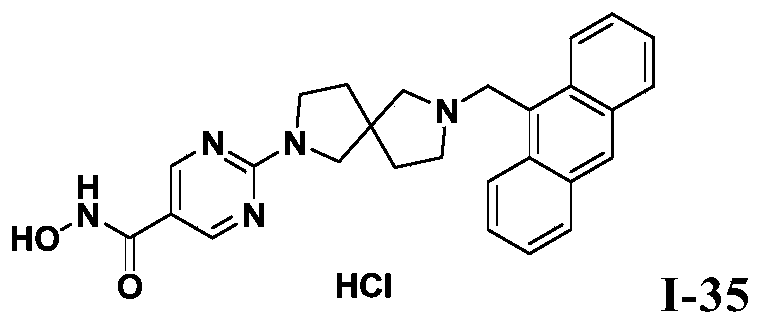
具体实施步骤同实施例6,所需原料为2-(7-((蒽-9-基)甲基)-2,7-二氮杂螺[4.4]壬-2-基)-N-((四氢-2H-吡喃吡啶-2-基)氧基)嘧啶-5-甲酰胺,得目标产物为白色固体,收率73%。
1H NMR(400MHz,DMSO)δ11.75(s,1H),8.86(d,J=14.3Hz,1H),8.82–8.59(m,4H),8.22(t,J=9.5Hz,2H),7.72(dd,J=14.4,6.2Hz,2H),7.62(dt,J=17.5,5.7Hz,2H),5.64–5.54(m,2H),4.07(dd,J=11.4,7.8Hz,1H),3.91–3.72(m,1H),3.70–3.62(m,2H),3.53–3.41(m,2H),2.22–2.07(m,2H),2.06–1.84(m,2H),1.71(d,J=9.0Hz,2H).HRMS(ESI)m/z calcd C
27H
28N
5O
2[M+H]
+454.2243,found 454.2244.
实施例42
2-(7-((1-甲基-5-甲基-1H-吲哚-3-基)甲基)-2,7-二氮杂螺[4.4]壬烷-2-基)嘧啶-5-异羟肟酸盐酸盐(化合物I-36)的制备

具体实施步骤同实施例6,所需原料为2-(7-((1-甲基-5-甲基-1H-吲哚-3-基)甲基)-2,7-二氮杂螺[4.4]壬-2-基)-N-((四氢-2H-吡喃吡啶-2-基)氧基)嘧啶-5-甲酰胺,得目标产物为白色固体,收率69%。
1H NMR(400MHz,DMSO)δ8.71(dd,J=13.6,6.2Hz,2H),7.64(s,1H),7.59(s,1H),7.37(d,J=8.4Hz,1H),7.04(dd,J=8.4,2.1Hz,1H),4.48(s,2H),3.80(d,J=11.7Hz,3H),3.67–3.41(m,6H),3.37–3.28(m,1H),3.27–3.17(m,1H),2.17–1.93(m,4H).HRMS(ESI)m/z calcd C
23H
29N
6O
2[M+H]
+421.2352,found 421.2353.
实施例43
2-(7-((苯并[d][1,3]二氧杂环戊烯-5-基)甲基)-2,7-二氮杂螺[4.4]壬烷-2-基)嘧啶-5-异羟肟酸盐酸盐(化合物I-37)的制备

具体实施步骤同实施例6,所需原料为2-(7-((苯并[d][1,3]二氧杂环戊烯-5-基)甲基)-2,7-二氮杂螺[4.4]壬-2-基)-N-((四氢-2H-吡喃吡啶-2-基)氧基)嘧啶-5-甲酰胺,得目标产物为白色固体,收率74%。
1H NMR(400MHz,DMSO)δ8.69(t,J=5.9Hz,2H),7.29–7.23(m,1H),7.06(d,J=7.9Hz,1H),6.98(dd,J=7.9,1.5Hz,1H),6.06(s,2H),4.34–4.22(m,2H),3.69–3.55(m,4H),3.42–3.09(m,4H),2.14–2.06(m,2H),2.04–1.93(m,2H).HRMS(ESI)m/z calcd C
20H
24N
5O
4[M+H]
+398.1828,found 398.1829.
实施例44
2-(7-((1-甲基-5-溴-1H-吲哚-3-基)甲基)-2,7-二氮杂螺[4.4]壬烷-2-基)嘧啶-5-异羟肟 酸盐酸盐(化合物I-38)的制备

具体实施步骤同实施例6,所需原料为2-(7-((1-甲基-5-溴-1H-吲哚-3-基)甲基)-2,7-二氮杂螺[4.4]壬-2-基)-N-((四氢-2H-吡喃吡啶-2-基)氧基)嘧啶-5-甲酰胺,得目标产物为白色固体,收率68%。
1H NMR(400MHz,DMSO)δ11.10(s,1H),8.72–8.63(m,2H),8.12(s,1H),7.68(s,1H),7.49(d,J=8.8Hz,1H),7.36–7.32(m,1H),4.53(d,J=4.7Hz,2H),3.82(s,3H),3.67–3.47(m,6H),3.45–3.17(m,4H),2.03–1.89(m,2H).HRMS(ESI)m/z calcd C
22H
26BrN
6O
2[M+H]
+485.1301,found 485.1302.
实施例45
2-(7-((1-甲基-6-甲氧基-1H-吲哚-3-基)甲基)-2,7-二氮杂螺[4.4]壬烷-2-基)嘧啶-5-异羟肟酸盐酸盐(化合物I-39)的制备

具体实施步骤同实施例6,所需原料为2-(7-((1-甲基-6-甲氧基-1H-吲哚-3-基)甲基)-2,7-二氮杂螺[4.4]壬-2-基)-N-((四氢-2H-吡喃吡啶-2-基)氧基)嘧啶-5-甲酰胺,得目标产物为白色固体,收率70%。
1H NMR(400MHz,DMSO)δ8.70(dd,J=13.1,6.2Hz,2H),7.72(d,J=8.7Hz,1H),7.49(s,1H),7.01(d,J=2.1Hz,1H),6.78(td,J=8.6,2.2Hz,1H),4.47(d,J=4.0Hz,2H),3.81(s,3H),3.77(s,3H),3.64–3.47(m,5H),3.45–3.37(m,1H),3.36–3.27(m,1H),3.26–3.16(m,1H),2.13–1.92(m,4H).HRMS(ESI)m/z calcd C
23H
29N
6O
3[M+H]
+437.2301,found 437.2302.
实施例46
2-(7-((喹啉-2-基)甲基)-2,7-二氮杂螺[4.4]壬烷-2-基)嘧啶-5-异羟肟酸盐酸盐(化合物I-40)的制备

具体实施步骤同实施例6,所需原料为2-(7-((喹啉-2-基)甲基)-2,7-二氮杂螺[4.4]壬-2-基)-N-((四氢-2H-吡喃吡啶-2-基)氧基)嘧啶-5-甲酰胺,得目标产物为淡黄色固体,收率69%。
1H NMR(400MHz,DMSO)δ11.16(s,2H),8.70(d,J=7.2Hz,2H),8.50(d,J=8.4Hz,1H),8.07(dd,J=13.8,8.3Hz,2H),7.88–7.81(m,1H),7.75–7.66(m,2H),4.83(s,2H),3.68(s,2H),3.66–3.45(m,6H),2.13(qd,J=12.2,5.5Hz,4H).HRMS(ESI)m/z calcd C
22H
25N
6O
2[M+H]
+405.2039,found 405.2040.
实施例47
(1)化合物对两株疟原虫抑制活性的测定
化合物对疟原虫3D7和Dd2的体外生长半数有效抑制浓度(EC
50)的测定
(1)疟原虫培养:疟原虫培养使用PRMI(含NaHCO3、HEPES、Albumax I、Hypoxanthine、Genaotamicin)完全培养基(complete medium),在37℃培养箱(5%CO
2、5%O
2)中培养。
(2)化合物对疟原虫的体外生长半数有效抑制浓度(IC50)的测定:100μL完全培养基加入到96孔板中,在第一孔加入适量的200μM的化合物并用完全培养基定容至200μL,使化合物终浓度为1000nM,然后按1/2的比例进行梯度稀释(11个浓度梯度),二氢青蒿素(DHA)作为阳性药,不加任何化合物作为阴性组,不加疟原虫和化合物作为空白组。之后每孔加入100μL的疟原虫培养物(红细胞压积4%,原虫率1%)使最终红细胞压积2%,原虫率1%。加样完成,96孔板置于37℃培养箱(5%CO
2、5%O
2)中培养72h。培养完成,每孔除去100μL上清液,加入100μL裂解液(10×SYBR Green I、0.5%v/v Triton X-100,0.5mg/mL saponin、0.75%EDTA/Tris-Cl缓冲液),混合均匀,室温下避光孵育2h。用孔板荧光读数机读取每孔数值(最大激发光/最大接受光:485nm/535nm)。根据荧光值计算每孔抑制率,抑制率%=(阴性组-实验组)/(阴性组-空白组)×100%,根据浓度-抑制率,在Graphpad Prism中绘制生长抑制曲线并计算IC50值。
(3)化合物活性测试结果
表1化合物对3D7和Dd2的EC
50值


3D7为野生型虫株,对药物无明显抗性;Dd2对氯喹、奎宁、磺胺多辛、乙胺嘧啶、阿莫地喹具有抗性。表1显示化合物具有较强的体外杀虫活性,部分化合物对3D7和Dd2的IC
50值与DHA相当。
实施例48
化合物对两株正常人细胞HepG-2和293-T半数有效抑制浓度(IC
50)的测定
(1)化合物对两株正常人细胞抑制活性的测定
准备HepG-2和293-T细胞,10cm dish中于37℃,5%CO
2细胞培养箱内培养
第一天
胰酶消化重悬细胞并计数,按100μL/孔的体系,7000细胞的量将细胞转接至96孔板中。37℃,5%CO
2细胞培养箱内培养24小时;
第二天
1、准备化合物梯度浓度体系,2倍稀释,体系为100μL/孔。(需根据药物的毒性来确定最高浓度,一般原则是使EC
50浓度处于浓度梯度的中间,一般第一次可选取高一些的浓度来进行梯度稀释,并根据结果来调整)。
2、去掉第一天中96孔板细胞培养体系中的上清,并将新配置好的药物浓度体系对应加入到培养细胞的培养板孔内(设置双复孔)。37℃,5%CO
2细胞培养箱内培养72h。
第五天
1、细胞培养结束之后,去掉96孔板细胞培养体系中的上清,每孔加入100μL检测溶液(含10%CCK-8的培养基),37℃,5%CO
2细胞培养箱内孵育1h,然后取出用酶标仪测定在450nm处的吸光度。
2、进行数据处理,计算不同浓度下化合物对细胞生长的抑制率,将抑制率输入GraphPad Prism,按照非线性回归方法,计算每个药物的EC
50读值。抑制率计算公式如下:
抑制率(%)=[A(0)-A(加药)]/[A(0)-A(空白)]×100%
A(加药):具有细胞、CCK-8溶液和药物溶液的孔的吸光度
A(空白):具有培养基和CCK-8溶液而没有细胞的孔的吸光度
A(0):具有细胞、CCK-8溶液而没有药物溶液的孔的吸光度
选择性指数SI的计算
SI=IC
50(细胞)/EC
50(3D7)
(2)化合物测试结果
表2化合物对HepG-2和293-T的IC
50及SI值


表2显示化合物对正常细胞的生长抑制较弱,较优化合物选择性可以超过1000。
实施例48
部分化合物对五株的半数有效抑制浓度(EC
50)的测定
选取杀虫活性及细胞毒性较优的化合物,按照实施例47的方法,测试它们对五株具有不同药物抗性的临床虫株的EC
50值,结果如下:
表3化合物对五株临床虫株的EC
50值

GB4对氯喹具有抗性;C2A对奎宁具有抗性;CP286对磺胺多辛、乙胺嘧啶、甲氟喹具有抗性;6218与6320对青蒿素类药物具有时间依赖的抗性,只在环期同步化后6小时以内显示。综合表1和表3,化合物的72小时IC
50值均与DHA相当,显示化合物具有治疗对目前抗疟一线和二线药物耐受的疟疾,应对疟疾耐药性的潜力。
实施例49
部分化合物对小鼠肝微粒体代谢稳定性实验
(1)化合物对小鼠肝微粒体代谢稳定性测试
实验选用小鼠肝微粒体(0.5mg/mL),采购自Corning公司。阳性对照选用酮舍林(ketanserin),待测化合物首先配成10mM的DMSO溶液,用乙腈稀释至0.5mM;取上述0.5mM溶液加入含肝微粒体的缓冲液中,使化合物浓度为1.5μM;取上述1.5μM化合物/肝微粒体混合液30μL,加入15μL 6mM的NADPH溶液,使化合物最终浓度为1.5μM,NADPH最终浓度为2mM。化合物/肝微粒体测试液置于测试板上,在37℃水浴孵育,在每个时间点(0、5、15、30、45分钟)各加入135μL乙腈淬灭。待全部样品淬灭完毕,用振荡器(IKA,MTS 2/4)振荡样品10分钟(600rpm/min),然后以4495g离心15分钟(Thermo Multifuge×3R)。取上层清液,按1:1加入蒸馏水稀释,用LC-MS进行分析。将化合物在5、15、30、45分钟的峰面积响应比率(PARR)与时间0的PARR进行比较,以确定在每个时间点保留的测试化合物的百分比。使用Excel软件拟合单相指数衰减方程计算半衰期。
(2)化合物测试结果
表3 化合物对小鼠肝微粒体代谢稳定性
| 序号 | 编号 | T 1/2(min) | CL int(mL/min/kg) |
| 1 | I-1 | 64.15 | 85.07 |
| 2 | I-2 | 105.02 | 51.97 |
| 3 | I-6 | 132.57 | 41.17 |
| 4 | I-7 | 400.96 | 13.61 |
| 5 | I-8 | 745.27 | 7.32 |
| 6 | I-23 | 53.73 | 101.58 |
| 7 | ketanserin | 23.25 | 234.74 |
实施例50
优选化合物抑制疟原虫组蛋白去乙酰化酶(HDAC)活性验证实验
(1)疟原虫培养
疟原虫培养使用RPMI(含NaHCO
3,HEPES,Albumax I,Hypoxanthine Genaotamicin)完全培养基(Complete Medium),在37℃培养箱中培养
(2)药物配制
根据药物前期测出的IC
50值,将药物溶于DMSO中,配制200*20*IC
50的初浓度。
药物处理(在生物安全柜中进行)
取44h左右的恶性疟原虫同完全培养基与红细胞在50mL管中配制混合物(红细胞含量为2%,原虫率为8%-10%),在6孔板的每孔中加入6mL混合物,再在每孔中加入30μL药物(工作浓度为20*IC
50),加好之后混匀板子,并放入三气培养箱孵育4h。
(3)收取蛋白样
取出6孔板,弃去4mL上清液,余下的2mL虫血混合物转入2mL EP管,离心(4000 r/2min,常温),去除上清,再将各孔用1mL PBS重悬残液并转移至原EP管以减少损失,再次离心去上清;
在各EP管中加入2mL裂解液,涡旋仪振荡混匀,冰上裂解10min,离心(12000r/1min,4℃),弃去上清液;
各EP管加入1mL PBS,涡旋仪振荡混匀,离心(12000r/1min,4℃),弃去上清液,再重复此步骤两次;
加入90μL 1×PBS重悬并转移至1.5mL超声管,再加入10μL 10%SDS,混匀后超声5min(30s on/30s off),离心(12000r/10min,4℃),取上清液,加入loading,振荡,100℃加热10min,样品可保存于-20℃。
(4)Western Blot
SDS-PAGE凝胶电泳:预制胶各孔上样10μL,电压80V跑30min后将电压调至120V再接着跑至loading接近分离胶下边缘。
转膜:切取相应覆盖面积的PVDF膜,采用湿转法,快速转膜buffer,400mA恒流转35min,结束后取出PVDF膜。
封闭:将膜放于封闭液(在TBST中加入5%脱脂奶粉)中,摇床摇晃封闭2h。
孵一抗:采用组蛋白histone H3抗体和H3K9乙酰化抗体,与5%脱脂奶粉按照1:2000稀释,于摇床孵育PVDF膜2h后弃去孵育液,加入TBST洗膜三次,每次10min。
孵二抗:二抗按照1:5000稀释,于摇床孵育PVDF膜1h后弃去孵育液。
显色曝光:临时配制显色液并均匀的铺在PVDF膜上,可根据条带亮度调节曝光时间。
(5)化合物Western Blot实验结果:结果如图1中所示。结果显示,与仅加入溶剂DMSO、不加入药物的空白对照组相比,加入化合物I-7,I-8处理的组蛋白H3乙酰化条带更深,表明乙酰化水平上调,去乙酰化酶活性被抑制,证明了化合物是泛pfHDAC抑制剂,具有HDAC抑制活性。
实施例51
优选化合物小鼠体内药效实验
(1)小鼠体内药效实验方法
体内药效实验选用balb-c小鼠感染P.yoelii模型进行。小鼠选用6-8周龄的雌性,每个剂量组设置5只。阳性药为磷酸哌喹(PPQ),给药方式为腹腔注射,给药前每组测量平均体重,按15μL/g注射相应体积的药液。化合物注射液的配置方法:先溶于5%v/v的二甲基亚砜,剧烈振荡,使固体部分部分或完全溶解,再加入95%v/v的20%wtβ-羟丙基环糊精水溶液,混匀即可。P.yoelii从-78℃解冻后经转接两只小鼠恢复毒力,取血,加入PBS稀释。每只小鼠接种10
5只疟原虫,感染后24小时开始给药,一共给药5次,每次间隔24小时。从感染后24h开始定期从小鼠尾静脉取血涂片观察,计算原虫率:
原虫率=被疟原虫感染的红细胞数/红细胞总数×100%
感染后观察30天血涂片,计算相应的原虫率。
(2)小鼠体内药效实验结果
结果如图2中所示。图2A和图2C中的原虫率曲线图显示与空白组相比,化合物I-7、I-8在60mg/kg下具有较好的杀虫活性,小鼠在第30天时原虫率均为0,显示体内疟原虫已被清除。空白组小鼠全部死亡,而给药组小鼠生存率为100%,原虫率曲线和 生存曲线(图2B、图2D)综合显示I-7、I-8在药效和毒性上具有较好的平衡。
实施例52
优选化合物对人源HDAC半数有效抑制浓度(IC
50)的测定
(1)hHDAC1-3,6测试方法:通过Echo将250nL DMSO或化合物溶液加入到OptiPlate TM-384F黑色测定板中,依次将15μL酶溶液、10μL GL-8底物溶液加入测定板中。在25℃下孵育60min,使用Ex350-360/Em450-465(敏感60)的设置读取值。计算抑制率,用GraphPad Prism算出IC50值。
(2)hHDAC8测试方法:通过Echo将250nL DMSO或化合物溶液加入到OptiPlate TM-384F黑色测定板中,依次加入15μL酶溶液,10μL对应底物溶液,在25℃反应4h。添加10μL终止液终止反应,使用Ex350-360/Em450-465的设置读取值。计算抑制率,用GraphPad Prism算出IC
50值。
(3)hSirt2测试方法:通过Echo将800nL DMSO或化合物溶液加入到OptiPlate TM-384F黑色测定板中,依次加入10μL酶溶液、10μL对应底物溶液,在25℃反应4h。添加20μL终止液终止反应,使用Ex350-360/Em450-465的设置读取值。计算抑制率,用GraphPad Prism算出IC50值。
(4)化合物测试结果

SAHA与suramin为阳性对照。实验结果表明,化合物I-7、I-8对hHDACs有一定抑制,其中对hHDAC1-3有较强抑制,对hSirt2几乎无抑制,化合物I-7、I-8具有对人源HDAC的抑制活性,提示其可以被用于制备治疗HDAC活性或表达量相关的疾病如肿瘤等。
本发明的嘧啶-异羟肟酸类化合物分子结构较为简单,制备工艺简洁,生产成本低,在对与疟原虫生存繁殖有密切关系的HDAC酶抑制实验和体内外杀虫药效实验中均显示出较强的抑制活性,且安全性较现有的HDAC抑制剂相比更优,因此,不但有望开发成新型的单一用药方式的抗疟疾药物,而且还可以开发成与现有抗疟疾药物进行组合给药方式的抗疟疾药物。
在本发明提及的所有文献都在本申请中引用作为参考,就如同每一篇文献被单独引用作为参考那样。此外应理解,在阅读了本发明的上述讲授内容之后,本领域技术人员可以对本发明作各种改动或修改,这些等价形式同样落于本申请所附权利要求书所限定的范围。
Claims (10)
- 一种如下式I所示的2,7-二氮杂-螺[4.4]壬烷类异羟肟酸嘧啶类化合物,或其药学上可接受的盐:
 其中,R 1选自下组:NHOH,或OR 3;R 2选自下组:氢,取代或未取代的C1~C6烷基、取代或未取代的C3~C8环烷基、取代或未取代的C6-C15单环、二环或三环芳基、取代或未取代的5-15元单环、二环或三环杂环基(包括饱和、部分不饱和或芳香性杂环基);其中,所述的杂芳基包括一个或多个选自下组的杂原子作为环骨架:N、O或S;R 3选自下组:氢,取代或未取代的C1~C3烷基,取代或未取代的C3~C8环烷基、取代或未取代的5-15元杂环基;n=0或1;其中,所述的取代指基团上的氢原子被一个或者多个(例如2个、3个、4个等)选自下组的取代基所取代:卤素、氘代、C1-C6烷氧基、卤代的C1-C6烷氧基、卤代的C3-C8环烷基、甲基砜基、-S(=O) 2NH 2、氧代(=O)、-CN、羟基、-NH 2、羧基、或取代或未取代的选自下组的基团:C1-C6烷基、C3-C8环烷基、C1-C6胺基、C6-C10芳基、具有1-3个选自N、S和O的杂原子的5-10元杂芳基、具有1-3个选自N、S和O的杂原子的5-12元杂环基,且所述的取代基选自下组:卤素、C1-C6烷基、C1-C6烷氧基、氧代、-CN、-NH 2、-OH、C6-C10芳基、C1-C6胺基、C1-C6酰胺基、具有1-3个选自N、S和O的杂原子的5-10元杂芳基。
 - 如权利要求1所述的化合物,其特征在于,所述的R 2选自下组:H、取代或未取代的C1~C6烷基,取代或未取代的C3~C8环烷基,或取代或未取代的选自下组的基团:
 上述各式中,X选自N、O、S。
 - 如权利要求1所述的化合物,其特征在于,R 2选自下组:氢,取代或未取代的C1~C6烷基、取代或未取代的C3~C8环烷基,取代或未取代的C6-C15芳基,取代或未取代的5-15元杂芳基;其中,所述的C3~C8环烷基选自下组:环戊基,环己基;所述的芳基选自下组:苯基、萘基、菲基;所述的5-15元杂芳基选自下组:


- 如权利要求1所述的化合物,其特征在于,R 3选自下组:氢,C1~C3直链烷基,C1~C6饱和杂环基。
- 如权利要求1所述的化合物,其特征在于,所述的式I化合物可选自下组:


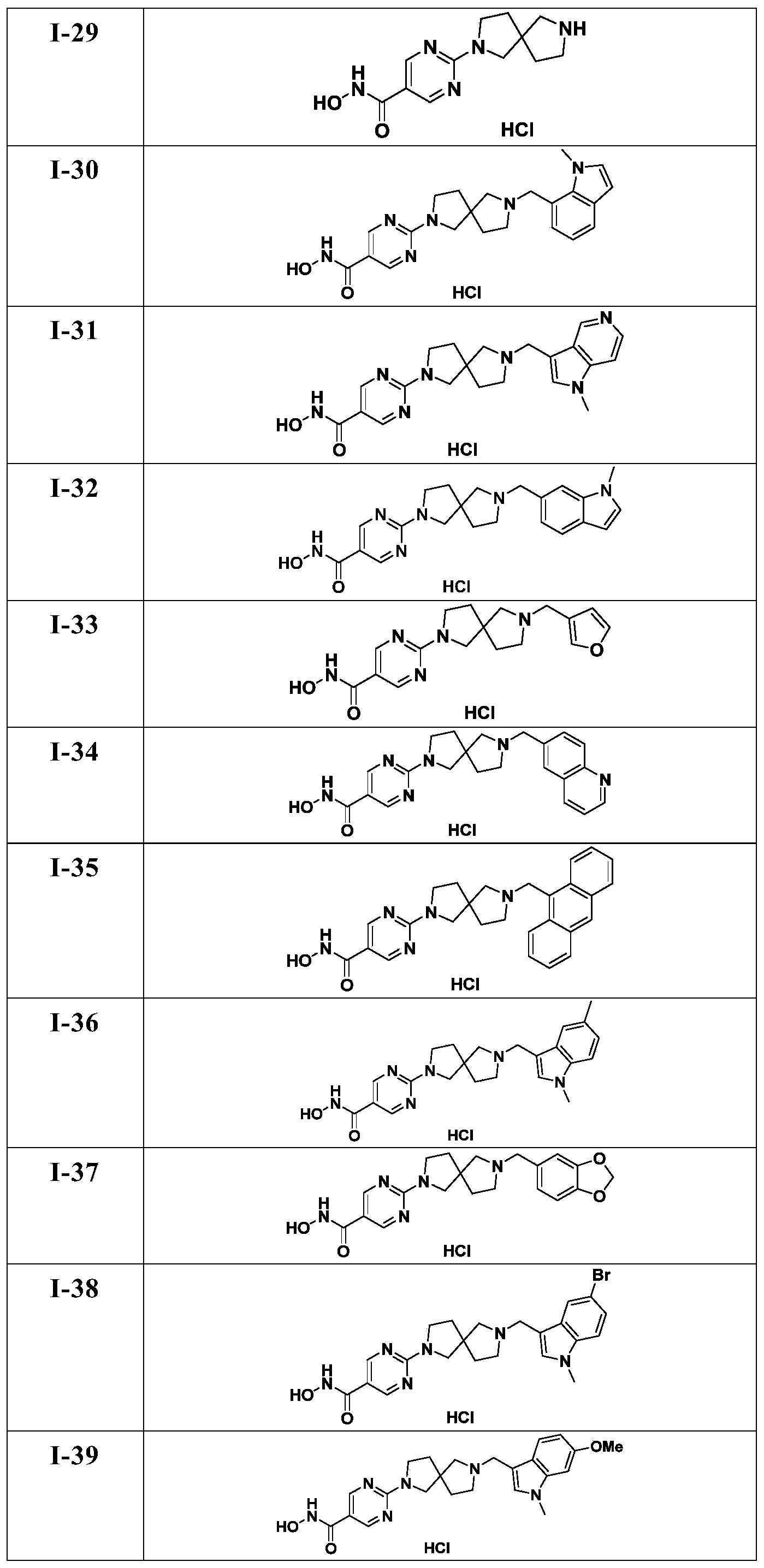

- 一种药物组合物,其特征在于,所述的药物组合物包括(a)治疗有效量的如权利要求1中所述的化合物、或其药学上可接受的盐、水合物或溶剂化物;和(b)药学上可接受的载体。
- 如权利要求6所述的药物组合物,其特征在于,所述的药物组合物用于:(a)治疗或预防疟原虫导致的疾病或病症;或(b)治疗或预防与HDAC活性或表达量相关的疾病或病症。
- 如权利要求1所述的式I化合物的用途,其特征在于,用于制备治疗或预防疟原虫导致的疾病或病症的药物组合物。
- 如权利要求8所述的用途,其特征在于,所述的疾病或病症为疟疾。
- 如权利要求1所述的式I化合物的用途,其特征在于,用于制备治疗或预防HDAC活性或表达量相关的疾病或病症的药物组合物。
Priority Applications (1)
| Application Number | Priority Date | Filing Date | Title |
|---|---|---|---|
| PCT/CN2019/077357 WO2020177129A1 (zh) | 2019-03-07 | 2019-03-07 | 2,7-二氮杂-螺[4.4]壬烷类异羟肟酸嘧啶类化合物及其制备和应用 |
Applications Claiming Priority (1)
| Application Number | Priority Date | Filing Date | Title |
|---|---|---|---|
| PCT/CN2019/077357 WO2020177129A1 (zh) | 2019-03-07 | 2019-03-07 | 2,7-二氮杂-螺[4.4]壬烷类异羟肟酸嘧啶类化合物及其制备和应用 |
Publications (1)
| Publication Number | Publication Date |
|---|---|
| WO2020177129A1 true WO2020177129A1 (zh) | 2020-09-10 |
Family
ID=72337226
Family Applications (1)
| Application Number | Title | Priority Date | Filing Date |
|---|---|---|---|
| PCT/CN2019/077357 Ceased WO2020177129A1 (zh) | 2019-03-07 | 2019-03-07 | 2,7-二氮杂-螺[4.4]壬烷类异羟肟酸嘧啶类化合物及其制备和应用 |
Country Status (1)
| Country | Link |
|---|---|
| WO (1) | WO2020177129A1 (zh) |
Citations (1)
| Publication number | Priority date | Publication date | Assignee | Title |
|---|---|---|---|---|
| WO2014026467A1 (zh) * | 2012-08-14 | 2014-02-20 | 山东轩竹医药科技有限公司 | 双环取代的嘧啶类化合物 |
-
2019
- 2019-03-07 WO PCT/CN2019/077357 patent/WO2020177129A1/zh not_active Ceased
Patent Citations (1)
| Publication number | Priority date | Publication date | Assignee | Title |
|---|---|---|---|---|
| WO2014026467A1 (zh) * | 2012-08-14 | 2014-02-20 | 山东轩竹医药科技有限公司 | 双环取代的嘧啶类化合物 |
Non-Patent Citations (1)
| Title |
|---|
| "XP55731336", STN REGISTRY, 21 March 2018 (2018-03-21), XP55731336, DOI: 20191121160047X * |
Similar Documents
| Publication | Publication Date | Title |
|---|---|---|
| CN114901661B (zh) | 新型K-Ras G12C抑制剂 | |
| CN113387938B (zh) | 一种取代嘧啶类化合物、其制备方法、中间体及应用 | |
| US10562912B2 (en) | Heterocyclic derivatives and use thereof | |
| WO2017114509A1 (zh) | 醛基类化合物及其制法和用途 | |
| TW201736372A (zh) | Pde1抑制劑 | |
| CN111712491B (zh) | 四氢异喹啉类化合物、其制备方法、包含此类化合物的药物组合物及其用途 | |
| KR102797796B1 (ko) | 이미다조퀴놀린 아민 유도체, 약제학적 조성물, 이의 용도 | |
| CN115141197B (zh) | 一种3-芳杂环取代苯基衍生物及其制备方法与用途 | |
| US9724331B2 (en) | Use of maleimide derivatives for preventing and treating leukemia | |
| US11932663B2 (en) | Phosphorus imidazoquinoline amine derivatives, pharmaceutical compositions and therapeutic methods thereof | |
| CN103189357B (zh) | 作为kcnq2/3调节剂的取代的2-氧代-和2-硫代-二氢喹啉-3-甲酰胺 | |
| CN107973788A (zh) | Bbi608衍生物及其制备与用途 | |
| CN105732624B (zh) | 吡咯[4,3,2-de]喹啉-2(1H)-酮类BRD4蛋白抑制剂的制备方法及其用途 | |
| CN115427407B (zh) | 一种新型n-杂环bet溴结构域抑制剂、其制备方法及医药用途 | |
| CN105037360B (zh) | 吡啶酮衍生物及其制备方法和用途 | |
| JPWO2004002484A1 (ja) | ホスホジエステラーゼ阻害剤 | |
| CN112105356A (zh) | 作为转运蛋白的调节剂的双环烯酮羧酸酯类化合物及其应用 | |
| CN109912576B (zh) | 环状或螺环二胺类嘧啶-异羟肟酸及其用途 | |
| WO2025180068A1 (zh) | 一种咪唑烷二酮类hdac抑制剂、制备方法及应用 | |
| WO2025039979A1 (zh) | 蛋白质精氨酸酶甲基转移酶-5抑制剂及其医药用途 | |
| CN109081818B (zh) | 新型吲哚胺2,3-双加氧化酶抑制剂 | |
| CN115073361B (zh) | 一种松香二萜类化合物及其制备方法和应用 | |
| WO2020177129A1 (zh) | 2,7-二氮杂-螺[4.4]壬烷类异羟肟酸嘧啶类化合物及其制备和应用 | |
| CN109384727B (zh) | 酞嗪酮类化合物、其制备方法、药物组合物及用途 | |
| CN107635991A (zh) | 作为tdp2的抑制剂的呋喃并喹啉二酮 |
Legal Events
| Date | Code | Title | Description |
|---|---|---|---|
| 121 | Ep: the epo has been informed by wipo that ep was designated in this application |
Ref document number: 19917777 Country of ref document: EP Kind code of ref document: A1 |
|
| NENP | Non-entry into the national phase |
Ref country code: DE |
|
| 122 | Ep: pct application non-entry in european phase |
Ref document number: 19917777 Country of ref document: EP Kind code of ref document: A1 |