WO2020175268A1 - 微生物の検出方法 - Google Patents
微生物の検出方法 Download PDFInfo
- Publication number
- WO2020175268A1 WO2020175268A1 PCT/JP2020/006507 JP2020006507W WO2020175268A1 WO 2020175268 A1 WO2020175268 A1 WO 2020175268A1 JP 2020006507 W JP2020006507 W JP 2020006507W WO 2020175268 A1 WO2020175268 A1 WO 2020175268A1
- Authority
- WO
- WIPO (PCT)
- Prior art keywords
- sample
- microorganism
- detection
- microorganisms
- treatment
- Prior art date
- Legal status (The legal status is an assumption and is not a legal conclusion. Google has not performed a legal analysis and makes no representation as to the accuracy of the status listed.)
- Ceased
Links
Classifications
-
- C—CHEMISTRY; METALLURGY
- C12—BIOCHEMISTRY; BEER; SPIRITS; WINE; VINEGAR; MICROBIOLOGY; ENZYMOLOGY; MUTATION OR GENETIC ENGINEERING
- C12N—MICROORGANISMS OR ENZYMES; COMPOSITIONS THEREOF; PROPAGATING, PRESERVING, OR MAINTAINING MICROORGANISMS; MUTATION OR GENETIC ENGINEERING; CULTURE MEDIA
- C12N15/00—Mutation or genetic engineering; DNA or RNA concerning genetic engineering, vectors, e.g. plasmids, or their isolation, preparation or purification; Use of hosts therefor
- C12N15/09—Recombinant DNA-technology
- C12N15/10—Processes for the isolation, preparation or purification of DNA or RNA
-
- C—CHEMISTRY; METALLURGY
- C12—BIOCHEMISTRY; BEER; SPIRITS; WINE; VINEGAR; MICROBIOLOGY; ENZYMOLOGY; MUTATION OR GENETIC ENGINEERING
- C12N—MICROORGANISMS OR ENZYMES; COMPOSITIONS THEREOF; PROPAGATING, PRESERVING, OR MAINTAINING MICROORGANISMS; MUTATION OR GENETIC ENGINEERING; CULTURE MEDIA
- C12N9/00—Enzymes; Proenzymes; Compositions thereof; Processes for preparing, activating, inhibiting, separating or purifying enzymes
- C12N9/10—Transferases (2.)
- C12N9/12—Transferases (2.) transferring phosphorus containing groups, e.g. kinases (2.7)
-
- C—CHEMISTRY; METALLURGY
- C12—BIOCHEMISTRY; BEER; SPIRITS; WINE; VINEGAR; MICROBIOLOGY; ENZYMOLOGY; MUTATION OR GENETIC ENGINEERING
- C12Q—MEASURING OR TESTING PROCESSES INVOLVING ENZYMES, NUCLEIC ACIDS OR MICROORGANISMS; COMPOSITIONS OR TEST PAPERS THEREFOR; PROCESSES OF PREPARING SUCH COMPOSITIONS; CONDITION-RESPONSIVE CONTROL IN MICROBIOLOGICAL OR ENZYMOLOGICAL PROCESSES
- C12Q1/00—Measuring or testing processes involving enzymes, nucleic acids or microorganisms; Compositions therefor; Processes of preparing such compositions
- C12Q1/02—Measuring or testing processes involving enzymes, nucleic acids or microorganisms; Compositions therefor; Processes of preparing such compositions involving viable microorganisms
- C12Q1/04—Determining presence or kind of microorganism; Use of selective media for testing antibiotics or bacteriocides; Compositions containing a chemical indicator therefor
-
- C—CHEMISTRY; METALLURGY
- C12—BIOCHEMISTRY; BEER; SPIRITS; WINE; VINEGAR; MICROBIOLOGY; ENZYMOLOGY; MUTATION OR GENETIC ENGINEERING
- C12Q—MEASURING OR TESTING PROCESSES INVOLVING ENZYMES, NUCLEIC ACIDS OR MICROORGANISMS; COMPOSITIONS OR TEST PAPERS THEREFOR; PROCESSES OF PREPARING SUCH COMPOSITIONS; CONDITION-RESPONSIVE CONTROL IN MICROBIOLOGICAL OR ENZYMOLOGICAL PROCESSES
- C12Q1/00—Measuring or testing processes involving enzymes, nucleic acids or microorganisms; Compositions therefor; Processes of preparing such compositions
- C12Q1/68—Measuring or testing processes involving enzymes, nucleic acids or microorganisms; Compositions therefor; Processes of preparing such compositions involving nucleic acids
- C12Q1/6806—Preparing nucleic acids for analysis, e.g. for polymerase chain reaction [PCR] assay
-
- C—CHEMISTRY; METALLURGY
- C12—BIOCHEMISTRY; BEER; SPIRITS; WINE; VINEGAR; MICROBIOLOGY; ENZYMOLOGY; MUTATION OR GENETIC ENGINEERING
- C12Q—MEASURING OR TESTING PROCESSES INVOLVING ENZYMES, NUCLEIC ACIDS OR MICROORGANISMS; COMPOSITIONS OR TEST PAPERS THEREFOR; PROCESSES OF PREPARING SUCH COMPOSITIONS; CONDITION-RESPONSIVE CONTROL IN MICROBIOLOGICAL OR ENZYMOLOGICAL PROCESSES
- C12Q1/00—Measuring or testing processes involving enzymes, nucleic acids or microorganisms; Compositions therefor; Processes of preparing such compositions
- C12Q1/68—Measuring or testing processes involving enzymes, nucleic acids or microorganisms; Compositions therefor; Processes of preparing such compositions involving nucleic acids
- C12Q1/6844—Nucleic acid amplification reactions
-
- C—CHEMISTRY; METALLURGY
- C12—BIOCHEMISTRY; BEER; SPIRITS; WINE; VINEGAR; MICROBIOLOGY; ENZYMOLOGY; MUTATION OR GENETIC ENGINEERING
- C12Q—MEASURING OR TESTING PROCESSES INVOLVING ENZYMES, NUCLEIC ACIDS OR MICROORGANISMS; COMPOSITIONS OR TEST PAPERS THEREFOR; PROCESSES OF PREPARING SUCH COMPOSITIONS; CONDITION-RESPONSIVE CONTROL IN MICROBIOLOGICAL OR ENZYMOLOGICAL PROCESSES
- C12Q1/00—Measuring or testing processes involving enzymes, nucleic acids or microorganisms; Compositions therefor; Processes of preparing such compositions
- C12Q1/68—Measuring or testing processes involving enzymes, nucleic acids or microorganisms; Compositions therefor; Processes of preparing such compositions involving nucleic acids
- C12Q1/6844—Nucleic acid amplification reactions
- C12Q1/686—Polymerase chain reaction [PCR]
-
- C—CHEMISTRY; METALLURGY
- C12—BIOCHEMISTRY; BEER; SPIRITS; WINE; VINEGAR; MICROBIOLOGY; ENZYMOLOGY; MUTATION OR GENETIC ENGINEERING
- C12Q—MEASURING OR TESTING PROCESSES INVOLVING ENZYMES, NUCLEIC ACIDS OR MICROORGANISMS; COMPOSITIONS OR TEST PAPERS THEREFOR; PROCESSES OF PREPARING SUCH COMPOSITIONS; CONDITION-RESPONSIVE CONTROL IN MICROBIOLOGICAL OR ENZYMOLOGICAL PROCESSES
- C12Q1/00—Measuring or testing processes involving enzymes, nucleic acids or microorganisms; Compositions therefor; Processes of preparing such compositions
- C12Q1/68—Measuring or testing processes involving enzymes, nucleic acids or microorganisms; Compositions therefor; Processes of preparing such compositions involving nucleic acids
- C12Q1/6844—Nucleic acid amplification reactions
- C12Q1/6862—Ligase chain reaction [LCR]
-
- C—CHEMISTRY; METALLURGY
- C12—BIOCHEMISTRY; BEER; SPIRITS; WINE; VINEGAR; MICROBIOLOGY; ENZYMOLOGY; MUTATION OR GENETIC ENGINEERING
- C12Q—MEASURING OR TESTING PROCESSES INVOLVING ENZYMES, NUCLEIC ACIDS OR MICROORGANISMS; COMPOSITIONS OR TEST PAPERS THEREFOR; PROCESSES OF PREPARING SUCH COMPOSITIONS; CONDITION-RESPONSIVE CONTROL IN MICROBIOLOGICAL OR ENZYMOLOGICAL PROCESSES
- C12Q1/00—Measuring or testing processes involving enzymes, nucleic acids or microorganisms; Compositions therefor; Processes of preparing such compositions
- C12Q1/68—Measuring or testing processes involving enzymes, nucleic acids or microorganisms; Compositions therefor; Processes of preparing such compositions involving nucleic acids
- C12Q1/6844—Nucleic acid amplification reactions
- C12Q1/6865—Promoter-based amplification, e.g. nucleic acid sequence amplification [NASBA], self-sustained sequence replication [3SR] or transcription-based amplification system [TAS]
-
- C—CHEMISTRY; METALLURGY
- C12—BIOCHEMISTRY; BEER; SPIRITS; WINE; VINEGAR; MICROBIOLOGY; ENZYMOLOGY; MUTATION OR GENETIC ENGINEERING
- C12Q—MEASURING OR TESTING PROCESSES INVOLVING ENZYMES, NUCLEIC ACIDS OR MICROORGANISMS; COMPOSITIONS OR TEST PAPERS THEREFOR; PROCESSES OF PREPARING SUCH COMPOSITIONS; CONDITION-RESPONSIVE CONTROL IN MICROBIOLOGICAL OR ENZYMOLOGICAL PROCESSES
- C12Q1/00—Measuring or testing processes involving enzymes, nucleic acids or microorganisms; Compositions therefor; Processes of preparing such compositions
- C12Q1/68—Measuring or testing processes involving enzymes, nucleic acids or microorganisms; Compositions therefor; Processes of preparing such compositions involving nucleic acids
- C12Q1/6876—Nucleic acid products used in the analysis of nucleic acids, e.g. primers or probes
- C12Q1/6888—Nucleic acid products used in the analysis of nucleic acids, e.g. primers or probes for detection or identification of organisms
- C12Q1/689—Nucleic acid products used in the analysis of nucleic acids, e.g. primers or probes for detection or identification of organisms for bacteria
-
- Y—GENERAL TAGGING OF NEW TECHNOLOGICAL DEVELOPMENTS; GENERAL TAGGING OF CROSS-SECTIONAL TECHNOLOGIES SPANNING OVER SEVERAL SECTIONS OF THE IPC; TECHNICAL SUBJECTS COVERED BY FORMER USPC CROSS-REFERENCE ART COLLECTIONS [XRACs] AND DIGESTS
- Y02—TECHNOLOGIES OR APPLICATIONS FOR MITIGATION OR ADAPTATION AGAINST CLIMATE CHANGE
- Y02A—TECHNOLOGIES FOR ADAPTATION TO CLIMATE CHANGE
- Y02A50/00—TECHNOLOGIES FOR ADAPTATION TO CLIMATE CHANGE in human health protection, e.g. against extreme weather
- Y02A50/30—Against vector-borne diseases, e.g. mosquito-borne, fly-borne, tick-borne or waterborne diseases whose impact is exacerbated by climate change
Definitions
- the present invention relates to a method for detecting microorganisms that may be contained in a sample.
- Detecting microorganisms contained in a sample is important in clinical diagnosis, food hygiene, and the like. However, if the sample is directly subjected to detection, reaction inhibition may occur during amplification or detection of nucleic acid, and correct measurement results may not be obtained. This point is a big problem especially in the method of detecting a microorganism in a biological sample containing a large amount of impurities. Therefore, when detecting microorganisms contained in a sample, it is common to perform some kind of pretreatment, rather than directly subjecting the sample to detection. The pretreatment is intended for the purpose of removing contaminants contained in the sample and labeling for use in measurement, and is considered to be an operation necessary for more accurate detection of microorganisms in the sample.
- the method for detecting a microorganism is a method for detecting a nucleic acid derived from a microorganism
- purification of the nucleic acid in a sample is generally performed as a pretreatment (eg, Patent Document 1, Patent Document 1, Non-Patent Document 1).
- the reason for carrying out the purification is to prevent the reaction from being inhibited by contaminants in the sample when it is subjected to a nucleic acid amplification reaction such as ⁇ [3 ⁇ 4 for detecting the nucleic acid.
- a nucleic acid extraction method there is a method that is based on the principle of the method of "Minichi".
- nucleic acid extraction has problems that the operation is very complicated, the operation time is long, an organic solvent is used, and the reagent cost is high.
- nucleic acid extraction is complicated in operation and may require a highly toxic reagent having a protein denaturing action.
- nucleic acid extraction sometimes involves moving the reaction vessel depending on the operation, the operability was poor and there was a risk of contamination.
- Patent Document 1 Japanese Patent Laid-Open No. 201 6-06729 1
- Patent Document 2 JP201 0-233503
- Non-Patent Document 1 R. Boom et al, Rapid and Simple Method for Purification of Nucleic Acids, Journal of Clinical Microbiology, 1990, vol.28, no. 3, p.495-503.
- the present invention is a method for detecting a microorganism that can be contained in a sample, comprising a step of pretreating the sample without the need for a general nucleic acid extraction method using an organic solvent such as phenol.
- Another object is to provide a method for detecting a microorganism, which can be used for a method for detecting a microorganism, using a sample liquid for detection prepared by the pretreatment.
- Another purpose is to provide reagents or kits for pretreatment, preparation of sample liquid for detection, or detection of microorganisms.
- the present inventors have conducted extensive studies in view of the above problems, and as a result, after suspending a sample (biological sample, food sample, etc.) with water or an alkaline solution, the microorganisms contained in the suspension were concentrated, and It has been found that it is possible to detect microorganisms in a sample by a simple method of lysing or crushing the microorganisms in the suspension after adding an alkaline solution, which does not require an organic solvent, and a sample pretreatment method. Was completed.
- Representative inventions are as follows.
- a method for detecting a microorganism that may be contained in a sample comprising the steps of:
- Item 3 The method according to Item 1, wherein the volume of the reaction container is 50 1_ or less.
- Item 4 The method according to Item 3, wherein the beads are zirconia beads.
- the alkaline solution is at least selected from the group consisting of potassium hydroxide aqueous solution, sodium hydroxide aqueous solution, calcium hydroxide aqueous solution, potassium carbonate aqueous solution, sodium carbonate aqueous solution, and calcium carbonate aqueous solution.
- Item 6 The method according to any one of Items 1 to 5, wherein in the step and/or step (3, 1 to 1 of the alkaline solution is 8.0 or more.
- Item 7 The method according to any one of Items 1 to 6, wherein the step of concentrating the microorganism in the step includes a centrifugal separation treatment. 020/175268 4 ⁇ (: 171? 2020 /006507
- the process of lysing or crushing in the process mouth includes at least one treatment selected from the group consisting of a stirring treatment, a bead crushing treatment, an ultrasonic treatment, a heat treatment, and an alkali treatment.
- a stirring treatment a bead crushing treatment
- an ultrasonic treatment a heat treatment
- an alkali treatment a treatment selected from the group consisting of a stirring treatment, a bead crushing treatment, an ultrasonic treatment, a heat treatment, and an alkali treatment.
- Item 9 The method according to any one of Items 1 to 8, wherein the step of lysing or crushing at the step mouth includes heat treatment.
- Item 18 The method according to any one of Item 18, wherein the step of lysing or crushing at the process port includes bead crushing treatment.
- Item 13 The method according to any one of Items 1 to 12, wherein the detection of the microorganism is the detection of a nucleic acid derived from the microorganism.
- Item 13 The method according to Item 13, wherein the detection of the nucleic acid derived from the microorganism further comprises amplification of the nucleic acid derived from the microorganism.
- Amplification of the nucleic acid comprises Ding IV! Method, 308 Method, [3 ⁇ 4Ding 1 0 [3 ⁇ 4 Method, [3 ⁇ 4Ding 1 !_ 8 1 ⁇ /1? Method, 8 3 M 8 Method, and Ding [From 3 ⁇ 4 0 Method Item 14.
- the detection target microorganism is at least one of the microorganisms classified into the genus 1 ⁇ 00 3( ⁇ 6"_1 1 ⁇ The method according to any one of Items 1 to 15.
- the microorganisms to be detected are M. abscessus, M. africanum, M. agri, M. aichiense, M. alger icum N M. alve ' u M. arabiense, M. aromatici vorans N M. arosiens e N M. arupense, M. asiat icum N M. aubagnense, M. aurum N M. austroaf r ic anum N M. av i um N M. bacteremicum N M. boenicke 'u M. bohemicum N M. bo Lie ti i, M. botn i ense N M. ceremonidurhonense, M. bourge Lat ii N M.
- stomatepiae N M. szu Lga' u M .ter rae N M. thermoresistibi le N M. t imonense N M. tokaien se, M. triplex, M. triviaLe, M. tuberculosis, M. tusciae, M. u Lcerans, M. vaccae, M. vanbaaleni i N M vulner is N M. woUnskyi, M. xenopi, and at least one selected from the group consisting of M. yongonense, The method according to Item 16.
- a method for preparing a sample liquid to be detected which is used in a sample pretreatment method or a microorganism detection method, comprising the following steps A to E:
- (E) A method comprising a step of purifying the lysate or disrupted solution obtained in the step D as necessary, wherein the steps A to E are performed in the same reaction vessel.
- Primer mix and/or DNA polymer for use in step F ⁇ 2020/175 268 7 ⁇ (:171? 2020/006507
- Item 20 The kit according to Item 20, further comprising a reaction container for use in any of the steps:-, the steps:-, or.
- a liquid (sample liquid to be detected) suitable for detection of microorganisms, particularly detection of microorganisms based on nucleic acid detection can be obtained by a simple sample pretreatment, without requiring an organic solvent. Can be prepared. This sample liquid for detection can be directly used for detection of microorganisms. Also, in the process of pretreatment of the sample and the process of preparing the sample liquid for detection, an effective protein denaturant, which was required in the conventional method, is not essential, so there is no risk of chemical injury. In addition, pretreatment of the sample and preparation of the sample liquid to be detected are performed in the same reaction vessel, so improvement of operability, reduction of material cost, and avoidance of contamination risk can be expected.
- One embodiment of the present invention is a method for detecting a microorganism that can be contained in a sample, comprising the steps of:
- the sample that can be used in the present invention is not particularly limited as long as it may contain a microorganism to be detected.
- the sample is suspended in the process.
- examples of the sample include biological samples, foods, environmental samples, and the like.
- microorganism as used in the present invention means a small organism in a broad sense, and includes, but is not limited to, bacteria, fungi, viruses, parasites, nematodes, and the like.
- the detection of microorganisms includes not only the presence or absence of the microorganisms themselves, but also the detection of microbial constituents (proteins, nucleic acids, lipids, etc.) and the genes encoding them.
- the microorganism to be detected may be a living microorganism or a dead microorganism, but the living microorganism is preferable.
- biological samples include, but are not limited to, animal and plant tissues, body fluids, excrements, cells, bacteria, viruses and the like.
- the present invention enables highly sensitive detection of microorganisms even when a biological sample containing a large amount of impurities is targeted.
- the biological sample to which the present invention is applicable is, for example, excrement, vomiting, feces, pharyngeal swab, nasal swab, nasopharyngeal swab, sputum, and feces, pharyngeal swab.
- liquid ⁇ 2020/175 268 9 ⁇ (:171? 2020/006507
- Nasal swabs, sputum are more preferred, pharyngeal swabs, nasal swabs, sputum are even more preferred, sputum is particularly preferred, of these, of mammalian origin, especially of human origin. It is more preferable.
- Examples of foods include water, alcoholic beverages, soft drinks, processed foods, vegetables, livestock products, marine products, eggs, dairy products, raw meat, raw fish, prepared foods, and the like.
- a food contact part or a human contact part such as a cooking utensil, a human contact part such as a doorknob, or a cleaning solution obtained by washing them can be used as a sample.
- a sample obtained by drying, ultrafiltration, distillation, etc. to remove some or all of the liquid components may be used.
- Examples of environmental samples include water, ice, soil, and the like.
- Examples of water as used herein include tap water, seawater, and water collected from rivers, waterfalls, lakes, ponds, and the like.
- the walls and floors of facilities, equipment and fixtures, toilet bowls, etc., or cleaning liquids used to clean them can also be used as samples.
- a sample containing a large amount of liquid components a sample obtained by drying, ultrafiltration, distillation or the like to remove a part or all of the liquid components may be used.
- the method of collecting the sample is not particularly limited, and a known method can be used depending on the type, size, and purpose of the sample. For example, a sampling method using a swab, swab, platinum loop, spoiler, spatula, spoon, etc.
- the sample may be subjected to a pretreatment, if necessary, before being subjected to the step of the present invention.
- a sample obtained by performing drying, ultrafiltration, distillation or the like to remove some or all of the liquid components may be used.
- highly viscous samples such as sputum
- the sample as it is or a part of the sample is collected and Resuspend in an aqueous solution.
- an alkaline solution can be appropriately selected depending on the sample.
- an alkaline solution can be selected for the purpose of adjusting pH and removing impurities.
- the use of an alkaline solution facilitates the decomposition or dissolution of impurities other than the desired microorganisms. If the collected sample or pretreated sample contains microorganisms in the sample in water or an alkaline solution and can be used in the next step B, this step may be omitted.
- Examples of water include purified water, sterilized water, tap water, and the like, and purified water or sterilized water is preferable from the viewpoint of less impurities.
- the sample When the sample is water, it can be diluted with purified water or sterilized water as needed, and step A can be omitted, but it is preferably diluted with an alkaline solution.
- Examples of the alkaline solution include at least one selected from the group consisting of an aqueous potassium hydroxide solution, an aqueous sodium hydroxide solution, an aqueous calcium hydroxide solution, an aqueous potassium carbonate solution, an aqueous sodium carbonate solution, and an aqueous calcium carbonate solution.
- An aqueous solution of potassium hydroxide and/or an aqueous solution of sodium hydroxide is preferred.
- a buffer solution having a buffering action may be used as the alkaline solution.
- buffer solutions include Tris, BES, MO PS, TES, HEP ES, DI PSO, TA PSO, P ⁇ PS ⁇ , HEPPS ⁇ , EPPS, Tricine, Bicine, TAPS well known in the art. , CH ES, CAPS 0, CA PS, PBS, amino acid buffer, phosphate buffer and the like, but are not limited to these.
- the pH of the alkaline solution is 7.0 or more, 8.0 or more, 9.0 or more, 10 or more.
- the pH of the alkaline solution referred to here is the pH of the alkaline solution before suspending the sample. ⁇ 2020/175268 11 11 (:171? 2020/006507
- 1 to 1 of the suspension obtained by adding the alkaline solution obtained in the step is also in the above range.
- the amount of the sample with respect to the water or the alkaline solution is not limited as long as the subsequent steps can be performed. For example, 80% ( ⁇ / ⁇ ) or less with respect to the water or the alkaline solution is preferable. , 50% (/) or less is more preferable, 40% ( ⁇ / ⁇ ) or less is further preferable, and the lower limit is 0.1% (/) or more, 0.5% ( ⁇ / ⁇ ) or more, 1% (/ ) The above is enough. The amount of the sample is 0. 1% (/) for water or alkaline solution.
- additives and the like may be further added.
- the additive include, but are not limited to, Mincho 0, polyvinylpyrrolidone, polyvinylpolypyrrolidone, ethanol, isopropanol, dimethyl sulfoxide, lithium salt, sodium salt, potassium salt and the like.
- the amount of the additive added is not particularly limited as long as each additive functions effectively.
- the suspension in the step can be carried out by a known method.
- a method of manually vibrating a sample and a tube containing water or an alkaline solution to suspend them eg tapping
- pipetting with a pipetman, etc. e.g., inversion mixing
- suspension with a vortex mixer etc.
- the microorganisms contained in the suspension obtained in the process are concentrated.
- Concentration means collecting the microorganisms contained in the suspension or increasing the concentration of the microorganisms. After concentration, a part or all of unnecessary components for obtaining a concentrate, for example, a supernatant when a microorganism precipitates due to concentration by centrifugation, may be removed.
- the concentration method is not particularly limited as long as the target microorganism can be concentrated. ⁇ 2020/175 268 12 (:171? 2020/006507
- the treatment can be performed by, for example, centrifugation, magnetic bead separation, heat drying, freeze drying, etc., but is not limited thereto.
- Centrifugation is a method in which substances having different specific gravities are separated or fractionated by applying a centrifugal force to a suspension. If the target microorganisms are subjected to a centrifugal force such that they do not form a sediment, the microorganisms of interest remain in the supernatant, and impurities and the like are separated as a sediment. On the other hand, if centrifugal force is applied to the target microorganisms to form a sediment, the target microorganisms are separated as a sediment, and impurities that do not become a sediment remain in the supernatant. Centrifugation in which the microorganism of interest becomes a precipitate is preferable.
- the centrifugal force in centrifugation can be appropriately selected depending on the target microorganism and the substance in the suspension.
- Centrifugal force can be, for example, 2,0009 or more, 5,0009 or more, 7,0009 or more, 8000 09 or more, 9, 0009 or more, 10 0009 or more, 1 3, 0009 or more, and the like. preferably 5, 0009 or in the case of the sediment, and more preferably from 8, 000 9 or more, 1 0, 0009 or more, and 1 3, 0009 or more highly preferred, but not limited to.
- the upper limit of the centrifugal force is not particularly limited as long as the effects of the present invention are exhibited, but as an example, it can be 50,0009 or less, and preferably 20, 0009 or less.
- Centrifugal force is 2,000 9 to 50, 0009, 5, 00 ⁇ 9 to 50, 0009, 7, 0009 to 50, 000, 8, 0009 to 50, 0009, 9, 0009 to 50, 0009, 10 , 0009 to 50, 0 009, 1 3, 0009 to 50, 0009, 2, 0009 to 20, 0009, 5, 0009 to 20, 0009, 7, 0009 to 20, 000, 8, 0 009 to 20, 0009, It can be set to 9, 0009 to 20, 000, 1 0, 0009 to 20, 0009, 1 3, 000 9 to 20, 0009, and the like.
- the time for centrifugation can also be appropriately selected depending on the target microorganism and the substance in the suspension. Generally, if the centrifugation is performed for a long time, precipitates are likely to be formed, but it takes time. Therefore, it is preferable that the centrifugation is performed for a short time, for example, within 10 minutes, within 5 minutes, within 3 minutes, but not limited thereto. ⁇ 2020/175 268 13 ⁇ (:171? 2020/006507
- the target microorganisms are concentrated by centrifuging with a centrifugal force that causes the target microorganisms to form a precipitate and removing part or all of the supernatant.
- the alkaline solution is added to the concentrate obtained in the step.
- the concentrate is obtained by concentrating microorganisms by the process step, and may be solid and/or liquid. If it is a solid, add an alkaline solution and suspend to prepare a suspension. If it is a liquid, the solution may be homogenized by suspending it after adding an alkaline solution.
- step ⁇ 3 the same alkaline solution as described in step 8 above can be used. Further, in step ⁇ 3, additives and the like may be further added to the suspension in the same manner as described in step 8.
- the amount of the alkaline solution added to the concentrate in the step (3) is not particularly limited, but in the step of lysing or crushing the microorganisms contained in the suspension at the step mouth, which will be described later, an alkaline treatment is performed.
- the amount of the alkaline solution added in the step ⁇ to the concentrate 150 is, for example, 150 Or less, preferably 100 or less, more preferably 75 or less, and the lower limit value is, for example, 1 or more, preferably 5 or more, more preferably 10 or more.
- the amount of the alkaline solution added in the step ⁇ 3 is 1 to 150 I-, 1 I-to 100 I-based on the concentrate of 150 obtained in the process step. , 1 I-to 75 I -, 5 I-to 150 0! _, 5 I-to 100 I -, 5 I-to 75 I -, 10 I-to 150 I -, Ten
- 1 to 1 of the alkaline solution used in the step ⁇ for example, 1 to 1 of the suspension after adding the alkaline solution is preferably 8.0 to 14.0, and 9.0 to 13.0. Is more preferable.
- step ⁇ 3 it is preferable that the concentrate obtained in the step A is added with an alkaline solution and then suspended (mixed).
- the suspension in step ⁇ 3 is performed by a known method. ⁇ 2020/175 268 14 ⁇ (:171? 2020 /006507
- a method of suspending a tube containing a concentrate and an alkaline solution by manually shaking it (eg tapping), pipetting with a pipetman, inversion mixing, suspension with a vortex mixer, etc. ..
- the microorganisms contained in the suspension obtained in step (3) are lysed or crushed.
- nucleic acids, proteins, lipids, etc. contained in the microorganisms can be released into the liquid.
- the subsequent detection of microorganisms can be carried out sensitively and efficiently.
- Step 0 can be preferably carried out by a method including at least one treatment of stirring treatment, bead crushing treatment, ultrasonic treatment, heat treatment, and alkaline treatment.
- the stirring treatment is a method of stirring the suspension to crush the microorganisms.
- Stirring treatment can be performed by inversion mixing, a vortex mixer, a stirrer, or the like.
- the bead crushing treatment is a method of crushing microorganisms by adding beads to a suspension and stirring.
- the type of beads used is not particularly limited, and any beads for disrupting microorganisms can be used, and examples thereof include zirconia beads and glass beads, and zirconia beads are more preferable.
- the size of the beads is preferably, for example, 5 or less, and beads of a plurality of sizes may be used in combination. By using beads of multiple sizes, improvement of crushing efficiency can be expected.
- the treatment time is, for example, 10 seconds to 10 minutes, preferably 20 seconds to 5 minutes, and more preferably 30 seconds to 3 minutes.
- the beads used for the bead crushing treatment may be added to the reaction vessel at any of Steps 8 to 0, but before the step of performing the step, especially before adding the sample, water, or alkaline solution to the reaction vessel, Therefore, it is preferable to include it in the reaction vessel because the operation of introducing beads is not required in the subsequent steps. Pretreatment is possible even when the reaction vessel contains beads in steps 8 to 9.
- the ultrasonic treatment is a method of crushing microorganisms by applying ultrasonic waves to the suspension.
- an ultrasonic homogenizer can easily break the cell wall, and microbes are easily broken.
- the processing time is, for example, 10 seconds to 2 minutes, preferably 1 ⁇ 2020/175 268 15 ⁇ (:171? 2020/006507
- Seconds to 1 minute may be repeated only once or multiple times (for example, 2 to 6 times, 2 to 4 times, etc.).
- the heat treatment is a method of lysing microorganisms by applying heat to the suspension.
- the heating temperature is not particularly limited, but as an example, it can be set to 75 ° or higher, preferably 80 ° or higher.
- the heating time is, for example, 10 seconds to 30 minutes, preferably 20 seconds to 20 minutes, more preferably 30 seconds to 10 minutes.
- the alkali treatment is a method of lysing a microorganism by adding an alkaline substance to the suspension.
- An alkaline substance is alkaline enough to lyse the microorganisms in the suspension and does not inhibit the detection of the microorganisms, or if it can inhibit the microorganisms, it can be easily removed before the detection.
- the alkaline substance may be, for example, potassium hydroxide, sodium hydroxide, calcium hydroxide, potassium carbonate, sodium carbonate or calcium carbonate, which may be used alone or in combination of two or more kinds, and Is an aqueous solution (alkaline solution) of these.
- 1 to 1 of the alkaline solution is 7.0 or more, 8.0 or more, 9.0 or more, 10.0 or more, 11.0 or more, etc. it can be, also, 1 4.0 or less, 1 3.0 or less, 1 2.5 or less, 1 2.0 or less, 1 1. can be 0 or less, such as, 1-18.
- ⁇ _ ⁇ 1 It is preferably 4.0, more preferably 1 to 19. ⁇ to 13.0.
- the suspension obtained in step ⁇ has a bacteriolytic action
- the suspension is left as it is, or other treatment such as stirring treatment is used in combination.
- other treatment such as stirring treatment is used in combination.
- the alkaline treatment in this step can be omitted or simplified.
- the suspension obtained in step ⁇ 3 is alkaline suitable for lysis (eg 1 to 18. ⁇ to 14.0, 1 to 19. ⁇ to 13.0 etc.)
- the operation of can be omitted.
- one or a plurality of treatments may be continuously performed, or if possible, a plurality of treatments may be combined and simultaneously performed. Combine multiple processes ⁇ 2020/175 268 16 ⁇ (:171? 2020/006507
- step ⁇ 3 the cells are suspended in an alkaline solution suitable for lysis, and other treatments such as stirring treatment, bead crushing treatment, ultrasonic treatment, and heat treatment are performed at the mouth of the process.
- the suspension obtained in step ⁇ is subjected to stirring treatment and bead crushing treatment.
- the suspension obtained in step ⁇ 3 is subjected to bead breaking treatment.
- a step of purifying the lysate or lysate obtained at the mouth of the step may be provided as the step.
- Purification means increasing the purity of nucleic acids, proteins, lipids, etc. in the lysate or lysate obtained at the mouth of the process. That is, the amount of contaminants other than nucleic acids, proteins, lipids, etc. released in the liquid is reduced, and the purity of nucleic acids, proteins, lipids, etc. in the purified liquid obtained in the process step is more than that obtained in the process mouth. It means raising.
- the purification method is not particularly limited, and examples thereof include ultrafiltration treatment and separation treatment, and these treatments may be used alone or in combination. From the viewpoint of reducing the number of steps and simplifying the pretreatment, it is also possible to provide no step.
- Ultrafiltration is a method of separating a target product and other contaminants using a filter having a pore size suitable for the purpose.
- a filter having a pore size suitable for the purpose for example, in order to selectively separate nucleic acids, proteins, lipids and the like derived from microbes released in the solution, it is preferable to use a filter having pores having a size through which they pass.
- small molecules such as nucleic acids, proteins and lipids can be passed through as a filtrate, and impurities larger than the pores can be removed.
- centrifuge Chromatography including the above, magnetic separation, electric separation and the like, but not limited thereto.
- selective separation by centrifugation it is preferable to apply a centrifugal force to the extent that nucleic acids, proteins, lipids, etc. do not form a precipitate.
- the target substances such as nucleic acids, proteins, and lipids remain in the supernatant by applying the centrifugal force, and the supernatant can be used for subsequent detection.
- the centrifugal force is preferably 5,000 or more, more preferably 8,000 or more, even more preferably 10,900 or more, and further preferably 13,900 or more, but is not limited thereto.
- the upper limit of the centrifugal force is not particularly limited as long as the effects of the present invention are exhibited, but as an example, it can be 50,0009 or less, and preferably 20,000 or less.
- Centrifugal force is 5, 0009 to 50, 0 009, 8, 0009 to 50, 0009, 1 0, 0009 to 50, 0009, 1 3, 0009 to 50, 0009, 5, 0009 to 20, 000, 8, 0009 ⁇ 20, 0009, 1 0, 0009 ⁇ 20, 0009, 1 3, 00 0 9 ⁇ 20, 0009, etc.
- the centrifugation time is preferably 10 minutes or less, more preferably 5 minutes or less, and further preferably 3 minutes or less, but is not limited thereto.
- steps 8 to 9 are performed in the same reaction vessel.
- steps 1 to 3 may be performed in the same reaction vessel.
- the reaction vessel is not particularly limited as long as it can carry out Steps 8 to 9 or Steps 8 to, and the material, shape, color, volume and the like can be selected according to the purpose.
- the reaction vessel is preferably adaptable to a centrifuge. Therefore, the capacity of the reaction vessel is, for example, 5 1-or less, preferably More preferably More preferably Even more preferably
- the suspension ⁇ 2020/175 268 18 ⁇ (: 171? 2020 /006507
- beads may be contained in the reaction vessel.
- the process of the invention can be carried out with the beads filled in the reaction vessel from the initial process step.
- a good detection result can be obtained even if the step is performed in a state where the reaction vessel contains beads, and then the concentration step (eg, centrifugation treatment) and the subsequent steps in the same reaction vessel are performed. It has been obtained (Test Examples 1 to 3). Therefore, even if it is desired to avoid the bead supply operation after the process step due to the fear of contamination when the beads are supplied to the reaction container, the reaction container containing the beads should be used from the stage of the process in the present invention.
- the type of beads to be used is not particularly limited, and any beads can be used as long as they are for disrupting microorganisms, and examples thereof include zirconia beads and glass beads, with zirconia beads being more preferable.
- the size of the beads is, for example, 5 The following is preferable, and multiple size
- a part or all of the lysate or lysate obtained at the mouth of the process or the purified liquid obtained on the day of the process is used for the detection of microorganisms.
- the liquid may be directly used as a sample liquid to be detected for detection of microorganisms.
- Microorganisms can be detected by adding various labels, reagents for nucleic acid amplification, detection of nucleic acids, etc., to the liquid, if necessary.
- such reagents and the like may be added to the same reaction vessel as in Steps 8 to 9 containing the liquid.
- the process is the same as process 8 ⁇ It may be carried out in the reaction container of.
- the liquid may be added to a detection container containing such a reagent in advance.
- other components and other treatments can be added as appropriate.
- Microorganisms can be detected by, for example, a nucleic acid detection method, an antigen test method, an antibody test method, a culture identification method, a mass spectrometry method, a biochemical property test, etc., but in terms of detection accuracy and time required for detection. Nuclear S love detection is preferred.
- the method for detecting a nucleic acid preferably further includes amplification of a nucleic acid derived from a microorganism.
- the nucleic acid derived from the target microorganism can be detected with higher sensitivity.
- the nucleic acid amplification method include PCR method, LAMP method, LCR method, TMA method, SDA method, RT-PCR method, RT-LAMP method, NAS BA method, TRC method, etc. Or they are used in combination. These techniques have already been established in the relevant technical field, and can be appropriately selected according to the purpose.
- the preferred nucleic acid amplification is the PCR method.
- the PCR method is a reaction mainly catalyzed by DN A polymerase
- DNA polymerases include T aq, T th, B st, K ⁇ D, P fu, Pwo, T br, T fi, T fl, Tm a, T ne, Ve nt, DEE PVE NT, and these Examples include mutants.
- the microorganisms to be detected are not particularly limited, but for example, microorganisms classified into the genus Mycobacterium (Mycobacterium tuberculosis complex, non-tuberculous mycobacteria, etc.), Clostridium Clostridium difficile (Clostridium difficile), Norovirus, Oral virus, Sapovirus, Influenza virus, RS virus, Ade Roh virus, Mycoplasma pneumoniae (Mycoplasma pneumoniae), pertussis (Bo rdete L La pertussis), Hara pertussis ⁇ (BordeteLLa parapertussis), month City flame Chlamydia (Chlamydophi La pneumoniae), Chlamydia trachomatis (ChL amyd ia trachomatis) N Ou ⁇ Diseases Chlamydia psittaci N ureaplasma, HIV, HPV, etc., and the microorganisms to be detected may be one kind
- the Mycobacterium tuberculosis group which is one of the microorganisms belonging to the genus Mycobacterium, contains a large amount of mycolic acid in the cell wall and exhibits high resistance to external factors. It is preferable to perform a plurality of types of treatments in the step (among others, to perform the heat treatment and the bead crushing treatment before, after, or in parallel), but it is not particularly limited.
- the microorganisms classified into the genus Mycobacterium are not particularly limited, but examples thereof include M. abscessus, M. arricanum N M. agr i N M. aichiense, M. alger icum N M. alve ' u M. arabiense, M. aromat ici vorans N M. arosiense, M. arupense N M. asiat icum N M. aubagnense, M. aurum N M. austroaf r icanum N M. avium, M. bacteremicum N M. boenickei, M. bohemicum, M ⁇ bo L Let ii N M. botnie nse N M.
- M. paratubercu L os is N M. parmense, M. peregr i num N M . phle 'u M. phocaicum, M. pinniped II, M. pore i num N M. poriferae, M. pseudoshotts iu M. psychroto Lerans N M. puLveris, M. pyren i vorans, M.
- the detection method of the present invention can detect any of these microorganisms of the genus Mycobacterium, among which M. avium, M. intracel LuLare, M. africanum, M. bovis, M. microti, and M. tuberculosis. It is preferable that at least one selected from the group consisting of can be detected with high sensitivity.
- One embodiment of the present invention is a sample pretreatment method for the detection of microorganisms, comprising the following steps A-E:
- the method comprises a step of purifying the lysate or lysate obtained in the step mouth, if necessary, wherein steps 8 to 9 are performed in the same reaction vessel.
- steps 8 to 9 are performed in the same reaction vessel.
- One embodiment of the present invention is a method for preparing a sample liquid for detection to be used in a method for detecting a microorganism, comprising the following steps 8 to:
- the method comprises a step of purifying the lysate or lysate obtained in the step mouth, if necessary, wherein steps 8 to 9 are performed in the same reaction vessel.
- the sample liquid to be detected prepared by this method can be used as the lysate, disruption liquid, or purified liquid described in the above step.
- the details of this method are the same as the details of the detection method of the present invention.
- One embodiment of the present invention is a reagent for the sample pretreatment method, the sample liquid preparation method for detection, or the microorganism detection method of the present invention.
- the type and number of reagents are not particularly limited as long as these methods can be performed. ⁇ 2020/175 268 23 ⁇ (:171? 2020 /006507
- reagent for example, process step or process Reaction container for use in step and/or step (alkaline solution for use in step 3; beads for use in step mouth; nucleic acid amplification enzyme for use in step, oligonucleotide primer, deoxyribonucleoside triphosphate Acid (1 ⁇ 1 to 3), one or more kinds of magnesium salt, etc., etc.
- nucleic acid amplification enzyme Eight polymerase, Examples thereof include limerase, reverse transcriptase ([0.8-dependent 0.8 polymerase), 0.8 ligase, and helicase.
- Known reagents can be appropriately used as long as the effects of the present invention can be obtained.
- the details of the reagent of the present invention are the same as those of the reagent corresponding to the reagent in the detection method of the present invention.
- One embodiment of the present invention is a kit for the pretreatment method for a sample of the present invention, the method for preparing a sample liquid for detection, or the method for detecting a microorganism, which comprises the above-mentioned reagent.
- the structure of the kit is not particularly limited as long as it includes at least one of the above reagents and can carry out the method of the present invention.
- the sample pretreatment method of the present invention which contains at least one of the step and/or step (alkaline solution for use in step 3, beads for use in the step mouth, sample liquid to be detected)
- a kit for a method for detecting a microorganism and includes at least one of a primer mix and/or an oral polymerase for use in the above step
- Kits for the method for detecting a microorganism according to the present invention may be mentioned, and these kits may further include a reaction vessel for use in the above Steps 8 to 0, Steps 8 to 9, or Steps 8 to.
- the details of the constituent elements of the kit of the present invention are the same as the details of those corresponding to the constituent elements in the detection method of the present invention.
- the results of microorganism detection were compared between the case of performing the steps to the same reaction vessel and the case of performing them in multiple reaction vessels.
- Process 8 GeneCube ([3 ⁇ 4) dedicated Easy beads were used as the reaction vessel.
- the container contains zirconia beads (also in the following test examples)
- the container was used from step to step. Sterile water 2400 ⁇ 1- and about 160 samples were dispensed and suspended in the container.
- Process step The suspension was centrifuged for 13, 900, 3 minutes, a part of the supernatant was discarded and about 100 was left in the container.
- Process 0 About 100 to about 100 ⁇ 1000 of potassium hydroxide aqueous solution was added to the sediment and supernatant remaining in the container and mixed.
- Process port After heating the obtained mixed solution at 80 ° for 10 minutes, stirring was performed with a vortex mixer for 1 minute to crush the beads.
- Process step The obtained crushed liquid was centrifuged for 13, 900, 3 minutes.
- Step 8 As the first reaction vessel, a 1.5 !_ micro tube (Salstat) was used. The container was used from step to step (3. Sterilized water 240 and a sample of about 160 were dispensed and suspended in the container.
- Process step The suspension was centrifuged for 13, 900, 3 minutes, a part of the supernatant was discarded and about 100 was left in the container.
- Process 0 About 100 to about 100 ⁇ 1000 of potassium hydroxide aqueous solution was added to the sediment and supernatant remaining in the container and mixed.
- Process mouth Transfer the whole amount of the obtained mixture to the second reaction vessel, the GeneCube ([3 ⁇ 4) dedicated image-beads, heat it at 80°C for 10 minutes, and stir it with a vortex mixer. The beads were crushed for 1 minute.
- Process step The obtained crushed liquid was centrifuged for 13, 900, 3 minutes.
- the 1 3 _1 detection results were compared when each step was performed in the same reaction vessel (1_3) and when each step was performed in multiple reaction vessels (1-4).
- Table 1 shows the positive rates when each step is performed in the same reaction vessel and when each step is performed in a plurality of reaction vessels.
- the positive rate was as low as about 43.8%, while when each process was performed in the same reaction vessel, the positive rate was 100%. This may be partly due to the fact that the loss during transfer of the suspension from the container could be suppressed, but a higher positive rate than expected from the suppression of such loss could be achieved. It was confirmed that the detection method of the present invention can achieve a higher than expected positive rate. ⁇ 2020/175 268 26 ⁇ (: 171? 2020 /006507
- the sample pretreatment method in the detection method of the present invention was compared with the sample pretreatment method in the prior art (nucleic acid extraction method).
- the Gene Cube ([3 ⁇ 4) dedicated pretreatment set Toyobo Co., Ltd.
- ⁇ (311 ⁇ [3 ⁇ 4
- Process 8 GeneCube ([3 ⁇ 4) dedicated Easy beads were used as the reaction vessel. The container was used from step to step. Approximately 1 000 1-of potassium hydroxide having 1 to 1 of 11 was dispensed into the container. About 400 ⁇ 1-sample was suspended in the solution.
- Process step The suspension was centrifuged at 13, 0009 for 3 minutes, and a part of the supernatant was discarded and left in the container for about 150.
- Step 0 About 50 ⁇ JiL of potassium hydroxide aqueous solution with about 12 to 13 was added to the sediment and supernatant remaining in the container and mixed.
- Process step The obtained crushed liquid was centrifuged for 13, 0,09, 3 minutes.
- Nucleic acid was extracted from the sample using the GeneCube ([3 ⁇ 4) dedicated pretreatment set. The operation and handling of each reagent were performed according to the respective instruction manuals.
- the cleaning liquid which is a constituent reagent, is an ethanol solution (60 to 100% ( ⁇ / ⁇
- the dissolved adsorbent which is a constituent reagent, contained a guanidine salt.
- the supernatant obtained in the process step is used as the sample liquid to be detected, and a portion of it is dispensed into 0.51_ tubes in 20 minute increments.
- Table 2 shows the results obtained by pre-treating the sample containing 1) ⁇ 3 cells (process-Minami or nucleic acid extraction) and detecting the sample liquid to be detected with GeneCube ([3 ⁇ 4) IV! It Table 3 is I This is the result of detecting the sample liquid to be detected, which was obtained by pretreating the sample containing the bacterial cells (process-Minami or nucleic acid extraction) with GeneCube ([3 ⁇ 4) 1 ⁇ /1 I.
- the sample liquid to be detected prepared by the pretreatment (steps to Mami) of the present invention and the sample liquid to be detected (nucleic acid extract) prepared by the pretreatment with the Gene Cube ([3 ⁇ 4) dedicated pretreatment set were measured. It was confirmed that the detection results (positive rate) of each reagent were the same.
- the dedicated pretreatment set for Gene Cube ([3 ⁇ 4]) contains ethanol and guanidine salt, while the pretreatment ( ⁇ 2020/175 268 28 ⁇ (: 171? 2020/006507
- Steps to days) do not require those organic solvents or reagents of which toxicity is a concern. Therefore, it has been confirmed that the present invention can be expected to improve operability and safety while obtaining the same performance as the conventional technique.
- steps- The method for detecting microorganisms of the present invention (steps-) and the method for detecting microorganisms in the prior art were compared.
- the amplicon mycobacterium sample treatment reagent set ⁇ (Roche Diagnostics KK) and cobas ([3 ⁇ 4) T a qMan ([3 ⁇ 4) ! ⁇ /1 8 ⁇ (Roche Diagnostics) Status Co., Ltd.)
- Process 8 GeneCube ([3 ⁇ 4) dedicated Easy beads are used as a reaction container. I used it. The container was used from Step A to Step E. About 1,000 ML of potassium hydroxide having a pH of about 11 was dispensed into the container. A sample of about 400 ML was suspended in the solution.
- Step B The suspension was centrifuged at 13,000 g for 3 minutes, a part of the supernatant was discarded, and about 150 mL was left in the container.
- Step C About 50 mL of an aqueous potassium hydroxide solution having a pH of about 12 to 13 was added to and mixed with the sediment and the supernatant remaining in the container.
- Step D The obtained mixed solution was heated at 80 ° C for 10 minutes, and then stirred by a vortex mixer for 3 minutes to crush the beads.
- Step E The obtained disrupted liquid was centrifuged at 13,000 g for 3 minutes.
- Process F The supernatant obtained in Process E is used as the sample liquid for detection, and part of it is Each L was dispensed into a 0.5 mL tube.
- the tube was set in GE N ECU BE (R), and M. intrace Uulare was detected using GeneKyub (R) MA I (Toyobo Co., Ltd.). The operation and handling of the equipment and reagents were performed according to the respective attachment documents.
- Amplicon Mycobacterium Specimen treatment Reagent sets were used to treat the samples, and the resulting sample liquids to be detected were Cobas (R) T a qMan (R) 48 and Cobas (R) T a qMan (R). ) M. I ntrace 11 u la re was detected using MA I. The operation and handling of the equipment and each reagent were performed according to their respective package inserts. In addition, it was confirmed by SDS that the amplicon mycobacterium sample treatment reagent set ⁇ contains highly toxic reagents. In addition, sample processing with the amplicon mycobacterium sample processing reagent set ⁇ took more than one hour.
- Results of the method of the present invention and the method of the prior art (positive rate) for each sample liquid to be detected obtained by pretreatment of samples with different bacterial cell concentrations ⁇ 2020/175 268 30 ⁇ (:171? 2020 /006507
- Table 4 shows the results (positive rate) in the sample liquid to be detected, which was obtained by pretreating the sample of the present invention or the conventional technique at each bacterial cell concentration.
- the positive rate was 100% at a bacterial cell concentration of 750 000 li/!_ or higher.
- the prior art method The positive rate was 100%. Therefore, it was confirmed that the present invention can detect microorganisms with higher sensitivity than the prior art.
- the preparation method (steps to M) in the detection method of the present invention is about 30 minutes, while the conventional method is 1 hour or more. It was Therefore, it was confirmed that the present invention is superior in terms of operation time.
- Steps in the detection method of the present invention When the solution (sample solution to be detected) prepared in the step (3) was directly applied to the nucleic acid amplification reaction (step), surprisingly, excellent results were obtained (Test Example) 13) .
- This result shows that the sample pretreatment method (step to day) in the detection method of the present invention can highly remove impurities and the like which adversely affect the subsequent detection reaction, and as a result, the impurities in the nucleic acid amplification and detection reaction. This suggests that the inhibition of the reaction due to the reaction was suppressed.
- the microorganism Since the microorganism has the above-mentioned characteristic cell wall, the nucleic acid extraction and the like are complicated compared with other microorganisms. According to the present invention, the microorganism can be easily extracted by a simple method. ⁇ 2020/175 268 31 ⁇ (:171? 2020/006507
- the present invention can detect various other types of microorganisms, and is extremely useful in clinical diagnosis and the like.
- nucleic acid derived from a microorganism contained in a sample can be detected without purifying the nucleic acid, which can be greatly contributed to the field of clinical diagnosis.
Landscapes
- Chemical & Material Sciences (AREA)
- Life Sciences & Earth Sciences (AREA)
- Organic Chemistry (AREA)
- Health & Medical Sciences (AREA)
- Engineering & Computer Science (AREA)
- Wood Science & Technology (AREA)
- Zoology (AREA)
- Proteomics, Peptides & Aminoacids (AREA)
- Genetics & Genomics (AREA)
- Bioinformatics & Cheminformatics (AREA)
- Analytical Chemistry (AREA)
- General Engineering & Computer Science (AREA)
- Biotechnology (AREA)
- Biochemistry (AREA)
- General Health & Medical Sciences (AREA)
- Molecular Biology (AREA)
- Microbiology (AREA)
- Biophysics (AREA)
- Physics & Mathematics (AREA)
- Immunology (AREA)
- Chemical Kinetics & Catalysis (AREA)
- Biomedical Technology (AREA)
- Toxicology (AREA)
- Medicinal Chemistry (AREA)
- Crystallography & Structural Chemistry (AREA)
- Plant Pathology (AREA)
- Measuring Or Testing Involving Enzymes Or Micro-Organisms (AREA)
- Enzymes And Modification Thereof (AREA)
Abstract
本発明は、試料に含まれ得る微生物の検出方法であって、フェノール等の有機溶媒を使用する一般的な核酸抽出方法を必要とすることなく試料を調製する工程を含み、該調製が同一の反応容器で行われるとともに、該調製によって得られた調製液を直接、微生物の検出方法に供することができる微生物の検出方法を提供することを目的とする。 試料に含まれ得る微生物の検出方法であって、以下の工程A~F: (A)試料を水又はアルカリ性溶液に懸濁する工程、 (B)前記工程Aで得られた懸濁液に含まれる微生物を濃縮する工程、 (C)前記工程Bで得られた濃縮物にアルカリ性溶液を添加する工程、 (D)前記工程Cで得られた懸濁液に含まれる微生物を溶菌又は破砕する工程、 (E)前記工程Dで得られた溶菌液又は破砕液を必要に応じて精製する工程、 (F)前記工程Dで得られた溶菌液又は破砕液、或いは前記工程Eで得られた精製液の一部又は全部を微生物の検出に供する工程、 を包含するとともに、少なくとも前記工程A~Eが同一の反応容器内で行われる方法。
Description
\¥0 2020/175268 1 卩(:17 2020 /006507 明 細 書
発明の名称 : 微生物の検出方法
技術分野
[0001] 本発明は、 試料に含まれ得る微生物の検出方法等に関する。
背景技術
[0002] 試料中に含まれる微生物を検出することは臨床診断、 食品衛生などにおい て重要である。 しかしながら、 試料を直接検出に供すると核酸の増幅又は検 出中に反応阻害などが起こり、 正しい測定結果が得られないことがある。 こ の点はとりわけ、 夾雑物を多く含む生体試料を対象として微生物を検出する 方法において大きな問題である。 そこで、 試料中に含まれる微生物を検出す る際に、 試料を直接検出に供するのではなく、 何らかの前処理を行うことが 一般的である。 前処理は、 試料中に含まれる夾雑物の除去や測定に供するた めの標識作業などを目的としており、 試料中の微生物をより正確に検出する ために必要な操作と考えられている。
[0003] 特に、 微生物を検出する方法が微生物由来の核酸を検出する方法である場 合、 前処理として、 試料中の核酸を精製することが一般的に行われる (例え ば、 特許文献 1、 非特許文献 1) 。 精製を行う理由は、 核酸を検出するため に、 例えば、 〇[¾などの核酸増幅反応に供する場合、 試料中の夾雑物によ り反応が阻害されることを抑制するためである。 精製法の一つとして核酸抽 出法があり、 核酸抽出法としては巳〇〇1\/1法を原理とした方法等がある。
[0004] しかしながら、 核酸抽出は、 操作が非常に複雑、 操作時間が長い、 有機溶 媒を使用する、 試薬コストが高いといった課題があった。 特に、 核酸抽出は 操作が煩雑であるとともに、 タンパク質変性作用がある毒性の高い試薬を必 要とすることがある。 また、 核酸抽出は、 操作によって反応容器を移して行 うことがあるため、 操作性が悪いとともにコンタミリスクがあった。
[0005] ところで、 抗酸菌等の一部の細菌は、 ミコール酸を含む脂質層を有した強 固な細胞壁を持つことが知られており、 通常、 他の微生物よりも検出精度が
低い。 これまでにも、 このような強固な細胞壁を有する抗酸菌の検査を行う 手法の検討がなされているが (例えば、 特許文献 2) 、 より高感度に検査を 行うための更なる前処理法の検討が求められている。
先行技術文献
特許文献
[0006] 特許文献 1 :特開 201 6-06729 1
特許文献 2 :特開 201 0-233503
非特許文献
[0007] 非特許文献 1 : R· Boom et al, Rapid and Simple Method for Purification of Nucleic Acids, Journal of Clinical Microbiology, 1990, vol.28, no. 3, p.495-503.
発明の概要
発明が解決しようとする課題
[0008] 本発明は、 試料に含まれ得る微生物の検出方法であって、 フエノール等の 有機溶媒を使用する一般的な核酸抽出方法を必要とすることなく、 試料を前 処理する工程を含み、 該前処理によって調製された検出対象試料液を微生物 の検出方法に供することができる微生物の検出方法の提供を一つの目的とす る。 また、 その前処理、 検出対象試料液の調製、 又は微生物の検出を実施す るための試薬又はキッ トの提供を一つの目的とする。
課題を解決するための手段
[0009] 本発明者らは、 上記課題に鑑み鋭意検討した結果、 試料 (生体試料、 食品 試料等) を水又はアルカリ性溶液で懸濁した後、 懸濁液に含まれる微生物を 濃縮し、 さらにアルカリ性溶液を添加後、 懸濁液中の微生物を溶菌又は破砕 する、 簡便な、 有機溶媒を必須としない、 試料の前処理方法によって、 試料 中の微生物の検出が可能であることを見出し本発明を完成させた。 代表的な 本発明は以下のとおりである。
[0010] [項 1 ]
20/175268 3 卩(:171? 2020 /006507
試料に含まれ得る微生物の検出方法であって、 以下の工程 〜 :
(八) 試料を水又はアルカリ性溶液に懸濁する工程、
(巳) 前記工程 で得られた懸濁液に含まれる微生物を濃縮する工程、
(〇) 前記工程巳で得られた濃縮物にアルカリ性溶液を添加する工程、
(〇) 前記工程(3で得られた懸濁液に含まれる微生物を溶菌又は破砕するエ 程、
(º) 前記工程口で得られた溶菌液又は破砕液を必要に応じて精製する工程
( ) 前記工程口で得られた溶菌液又は破砕液、 或いは前記工程日で得られ た精製液の一部又は全部を微生物の検出に供する工程、
を包含し、 少なくとも前記工程八〜巳が同一の反応容器内で行われる方法。
[項 2 ]
前記反応容器の容量が、 5 0 1_以下である、 項 1 に記載の方法。
[項 3 ]
前記反応容器中にビーズが含まれている、 項 1又は 2に記載の方法。
[項 4 ]
前記ビーズがジルコニアビーズである項 3に記載の方法。
[項 5 ]
前記工程八及び/又は工程(3において、 アルカリ性溶液が、 水酸化カリウム 水溶液、 水酸化ナトリウム水溶液、 水酸化カルシウム水溶液、 炭酸カリウム 水溶液、 炭酸ナトリウム水溶液、 及び炭酸カルシウム水溶液からなる群より 選択される少なくとも一つである、 項 1〜 4のいずれかに記載の方法。
[項 6 ]
前記工程 及び/又は工程(3において、 アルカリ性溶液の 1~1が 8 . 0以上 である、 項 1〜 5のいずれかに記載の方法。
[項 7 ]
前記工程巳において微生物を濃縮する工程が、 遠心分離処理を含む、 項 1〜 6のいずれかに記載の方法。
020/175268 4 卩(:171? 2020 /006507
[項 8]
前記工程口において溶菌又は破砕する工程が、 撹拌処理、 ビーズ破砕処理、 超音波処理、 加熱処理、 及びアルカリ処理からなる群より選択される少なく とも一つの処理を含む、 項 1〜 7のいずれかに記載の方法。
[項 9]
前記工程口において溶菌又は破砕する工程が、 加熱処理を含む、 項 1〜 8の いずれかに記載の方法。
[項 1 〇]
前記工程口において溶菌又は破砕する工程が、 ビーズ破砕処理を含む、 項 1 8のいずれかに記載の方法。
[項 1 1]
前記工程〇において溶菌又は破砕する工程が、 加熱処理及びビーズ破砕処理 を含む、 項 1〜 8のいずれかに記載の方法。
[項 1 2]
前記工程日において溶菌液又は破砕液を精製する工程が、 遠心分離処理を含 む、 項 1〜 1 1のいずれかに記載の方法。
[項 1 3]
微生物の検出が、 微生物由来の核酸の検出である、 項 1〜 1 2のいずれかに 記載の方法。
[項 1 4]
微生物由来の核酸の検出が、 微生物由来の核酸の増幅をさらに含む項 1 3に 記載の方法。
[項 1 5]
前記核酸の増幅が、
 丁 IV! 法、 3 0八法 、 [¾丁一 〇[¾法、 [¾丁一 !_八1\/1 ?法、 八3巳八法、 及び丁[¾〇法からな る群より選択される少なくとも一つを含む、 項 1 4に記載の方法。
[項 1 6]
検出対象微生物が、 1^00 3(^6「_1 1^属に分類される微生物の少なくとも一つで
ある、 項 1〜 1 5のいずれかに記載の方法。
[II 1 7 ]
検出対象微生物が、 M. abscessus、 M. africanum、 M. agri、 M. aichiense、 M. alger icumN M. alve'u M. arabiense、 M. aromat ici voransN M. arosiens eN M. arupense、 M. asiat icumN M. aubagnense、 M. aurumN M. austroaf r ic anumN M. av i umN M. bacteremicumN M. boenicke'u M. bohemicumN M. bo Lie ti i、 M. botn i enseN M. bouchedurhonense、 M. bourge Lat i iN M. bov i sN M. brander iN M. brisbanense、 M. brumaeN M. canar i asense、 M. caprae、 M. c e latumN M. cheLonae、 M. chimaera、 M. ch i taeN M. ch Loropheno L i cumN M. chubuense、 M. coLombiense、 M. concept i onenseN M. conf Luent i sN M. cons picuumN M. cooki iN M. cosmet i cumN M. croc i numN M. diernhofer iN M. dor i cumN M. duval i iN M. e Lephant i sN M. europaeum、 M. fa L laxN M. fare i nog enesN M. f lavescensN M. f Lorent i numN M. f Luo rant hen i voransN M. fortu i turn、 M. f reder i ksbergense、 M. gad i umN M. gastr iN M. genavense、 M. g i L vumN M. good i iN M. gordonae、 M. haemoph i lumN M. hass i acumN M. heckesh ornense、 M. heideLbergense、 M. hiberniae、 M. hippocampi、 M. hod Ler iN M. ho Lsat i cumN M. houstonense、 M. immunogenumN M. i nsubr i cumN M. i nte r jectumN M. intermedium、 M. i ntrace L Lu lareN M. i ran i cumN M. kansasi i N M. komossense、 M. koreense、 M. kubicae、 M. kumamotonenseN M. kyorin enseN M. lacusN M. Lent i f lavumN M. Leprae、 M. Lepraemur i umN M. L i tora leN M. LLatzerense、 M. madagascar ienseN M. mageri tense、 M. malmoense N M. manten i iN M. mar i numN M. marse i L lenseN M. mass i L i enseN M. micro† iN M. mi nnesotenseN M. monacense、 M. montef i orenseN M. mor i okaenseN M . mucogen i cumN M. mura leN M. neoaurum、 M. nebraskense、 M. newor Leanse nseN M. nonchromogen i cum、 M. nov i omagenseN M. novocastrenseN M. obuen seN M. pal lensN M. palustreN M. paraf f in i cum、 M. parafortui tumN M. pa ragordonae、 M. parakoreense、 M. parascrof u laceumN M. paraseou Lense、 M . paratubercuLosis、 M. parmense、 M. peregr i numN M. phle'u M. phocaicu
mN M. pinnipedi iN M. pore i numN M. poriferae、 M. pseudoshotts i u M. ps ychroto Lerans、 M. puLveris、 M. pyren i vorans、 M. rhodes i aeN M. riyadhe nseN M. ruf umN M. rut i lumN M. sa Lmon i ph i lumN M. saskatchewanense、 M. scrof u laceumN M. sediminis、 M. senega lenseN M. senuense、 M. seouLense N M. sept i cumN M. setense、 M. sherr isi u M. shimoide'u M. shinjukuens eN M. shotts I u M. s i m i aeN M. smegmat isN M. sphagni、 M. stomatepiaeN M. szu Lga'u M. ter raeN M. thermoresistibi leN M. t imonenseN M. tokaien se、 M. triplex、 M. triviaLe、 M· tuberculosis、 M. tusciae、 M. u Lcerans 、 M. vaccae、 M. vanbaaleni iN M. vulner isN M. woUnskyi、 M. xenopi、 及 び M. yongonenseからなる群より選択される少なくとも一つである、 項 1 6に 記載の方法。
[項 1 8 ]
試料の前処理方法、 又は、 微生物の検出方法に供される検出対象試料液の調 製方法であって、 以下の工程 A〜 E :
(A) 試料を水又はアルカリ性溶液に懸濁する工程、
(B) 前記工程 Aで得られた懸濁液に含まれる微生物を濃縮する工程、
(C) 前記工程 Bで得られた濃縮物にアルカリ性溶液を添加する工程、
(D) 前記工程 Cで得られた懸濁液に含まれる微生物を溶菌又は破砕するエ 程、
(E) 前記工程 Dで得られた溶菌液又は破砕液を必要に応じて精製する工程 を包含し、 前記工程 A〜 Eが同一の反応容器内で行われる方法。
[項 1 9 ]
項 1 8に記載の試料の前処理方法又は検出対象試料液の調製方法、 或いは項 1〜 1 7のいずれかに記載の微生物の検出方法のための試薬であって、 前記工程 A及び/又は工程 Cに使用するためのアルカリ性溶液、
前記工程 Dに使用するためのビーズ、 或いは
前記工程 Fに使用するためのプライマーミックス及び/又は D N Aポリメラ
〇 2020/175268 7 卩(:171? 2020 /006507
-ゼ、
を含む、 試薬。
[項 2 0 ]
項 1 9に記載の試薬の少なくとも一つを含む、 項 1 8に記載の試料の前処理 方法又は検出対象試料液の調製方法、 或いは項 1〜 1 7のいずれかに記載の 微生物の検出方法のためのキッ ト。
[項 2 1 ]
前記工程 〜〇、 工程 〜巳、 又は工程 で使用するための反応容器を さらに含む、 項 2 0に記載のキッ ト。
発明の効果
[001 1 ] 本発明によれば、 簡便な試料の前処理によって、 微生物の検出、 特に核酸 検出に基づく微生物の検出、 に適した液 (検出対象試料液) を、 有機溶媒を 必須とせずに調製できる。 この検出対象試料液は、 直接、 微生物の検出に供 することができる。 また、 試料の前処理の過程及び検出対象試料液を調製す る過程において、 従来法では必要であった実効的なタンパク質変性剤が必須 ではないため、 薬傷の危険性もない。 また、 試料の前処理及び検出対象試料 液の調製は、 同一の反応容器内で行われるので、 操作性の向上、 資材コスト の削減、 コンタミリスクの回避も期待できる。
発明を実施するための形態
[0012] 以下、 上述の代表的な発明を中心に説明する。
[0013] [微生物の検出方法]
生体試料、 食品、 環境試料等の一部を採取し、 採取試料に微生物の検出が 可能になる程度にまで各種の前処理を施し、 得られた前処理物に含まれる微 生物を検出することが一般的に行われている。 本発明の一実施形態は、 試料 に含まれ得る微生物の検出方法であって、 以下の工程 〜 :
(八) 試料を水又はアルカリ性溶液に懸濁する工程、
(B) 前記工程 で得られた懸濁液に含まれる微生物を濃縮する工程、
(〇) 前記工程巳で得られた濃縮物にアルカリ性溶液を添加する工程、
\¥0 2020/175268 8 卩(:17 2020 /006507
(〇) 前記工程 0で得られた懸濁液に含まれる微生物を溶菌又は破砕するェ 程、
(º) 前記工程〇で得られた溶菌液又は破砕液を必要に応じて精製する工程
( ) 前記工程口で得られた溶菌液又は破砕液、 或いは前記工程日で得られ た精製液の一部又は全部を微生物の検出に供する工程、
を包含し、 少なくとも前記工程八〜巳が同一の反応容器内で行われる方法、 である。
[0014] [試料]
本発明において使用できる試料は、 検出目的の微生物を含む可能性のある ものであれば特に限定されない。 試料は工程 において懸濁される。 試料と しては、 例えば、 生体試料や食品、 環境試料等が挙げられる。 なお、 本発明 でいう微生物とは、 広義の意味で小さな生物を示し、 バクテリア、 真菌、 ウ イルス、 寄生虫、 線虫等を含むがこれらに限定されない。 また、 微生物の検 出とは、 微生物そのものの有無だけでなく、 微生物構成成分 (タンパク質、 核酸、 脂質等) 及びそれらをコードする遺伝子等を検出することも含む。 検 出の対象となる微生物は生きた微生物、 死んだ微生物のいずれであってもよ いが、 生きた微生物が好ましい。
[0015] 生体試料の例として、 特に制限されないが、 動植物組織、 体液、 排泄物、 細胞、 細菌、 ウイルス等が挙げられる。 さらに挙げると、 血液、 血槳、 血清 、 血液培養液、 尿、 唾液、 羊水、 膿、 髄液、 胸水、 咽頭拭い液、 鼻腔拭い液 、 鼻咽頭拭い液、 直腸拭い液、 喀痰、 組織切片、 皮膚、 吐瀉物、 糞便、 鼓膜 切開液、 肺胞洗浄液、 胃洗浄液、 腸洗浄液、 子宮頸管拭い液、 尿道擦過物、 臓器抽出液、 組織抽出液分離培養コロニー、 気管支洗浄液、 カテーテル洗浄 液等が挙げられる。 本発明は、 夾雑物を多く含む生体試料を対象とする場合 であっても、 感度のよい微生物検出が可能である。 このような観点から、 本 発明が対象とする生体試料としては、 例えば、 排泄物、 吐瀉物、 糞便、 咽頭 拭い液、 鼻腔拭い液、 鼻咽頭拭い液、 喀痰が好適であり、 糞便、 咽頭拭い液
〇 2020/175268 9 卩(:171? 2020 /006507
、 鼻腔拭い液、 喀痰がより好適であり、 咽頭拭い液、 鼻腔拭い液、 喀痰が更 に好適であり、 喀痰がとりわけ好適であり、 これらの中でも哺乳動物由来、 殊にヒト由来のものがより一層好適である。
[0016] 食品の例として、 水、 アルコール飲料、 清涼飲料水、 加工食品、 野菜、 畜 産物、 海産物、 卵、 乳製品、 生肉、 生魚、 惣菜等が挙げられる。 また、 食品 を試料とする場合、 その食品の一部あるいは全部を使用できるだけでなく、 食品表面を拭き取ったものも使用できる。 さらに、 調理器具等の食品接触部 若しくは人接触部、 又はドアノブ等の人接触部を拭き取ったものあるいはそ れらを洗浄した洗浄液も試料として用いることができる。 液体成分が多い試 料については、 必要に応じて、 乾燥、 限外ろ過、 蒸留等を行い、 液体成分の 一部あるいは全部を除去した試料を用いてもよい。
[0017] 環境試料の例として、 水、 氷、 土壌等が挙げられる。 ここでいう水とは、 例として、 水道水、 海水あるいは川、 滝、 湖、 池等から採取した水等が挙げ られる。 また、 施設の壁面、 床面、 設備や備品、 便器等を拭き取ったものあ るいはそれらを洗浄した洗浄液も試料として用いることができる。 液体成分 が多い試料については、 必要に応じて、 乾燥、 限外ろ過、 蒸留等を行い、 液 体成分の一部あるいは全部を除去した試料を用いてもよい。
[0018] 試料の採取方法は、 特に制限されず、 試料の種類、 大きさ、 目的に応じて 公知の方法を用いることができる。 例えば、 綿棒、 スワブ、 白金耳、 スポイ 卜、 へら、 さじなどの採取具を用いた採取方法である。
[0019] 試料は、 本発明の工程 に供する前に、 必要に応じて前処理を実施しても よい。 例えば、 液体成分が多い試料については、 乾燥、 限外ろ過、 蒸留等を 行い、 液体成分の一部あるいは全部を除去した試料を用いてもよい。 例えば 、 粘性の高い試料 (喀痰など) については、 セミアルカリプロテアーゼ (3 A P) 処理や
 これらの処理を行っ た検体も試料として、 本発明に使用することができる。
[0020] [工程八]
工程 では、 試料をそのまま、 又は試料の一部を採取して、 水又はアルカ
リ性溶液に懸濁する。 水、 アルカリ性溶液のどちらを使用するかは、 試料に よって適宜選択することができる。 例えば、 P H調整や夾雑物除去を目的と して、 アルカリ性溶液を選択できる。 アルカリ性溶液を使用することで、 目 的の微生物以外の夾雑物を分解又は溶解しやすくなる。 なお、 採取された試 料又は前処理された試料において試料中の微生物が水又はアルカリ性溶液に 含有され、 次の工程 Bに供することができる場合、 本工程を省略してもよい
[0021] 水としては、 例えば精製水、 滅菌水、 水道水等が挙げられるが、 不純物が 少ない点で精製水又は滅菌水が好ましい。 また、 試料が水の場合は、 必要に 応じて精製水又は滅菌水で希釈することもできるし、 工程 Aを省略すること もできるが、 アルカリ性溶液で希釈することが好ましい。
[0022] アルカリ性溶液としては、 例えば水酸化カリウム水溶液、 水酸化ナトリウ ム水溶液、 水酸化カルシウム水溶液、 炭酸カリウム水溶液、 炭酸ナトリウム 水溶液、 及び炭酸カルシウム水溶液からなる群より選択される少なくとも一 つが挙げられ、 水酸化カリウム水溶液及び/又は水酸化ナトリウム水溶液が 好ましい。 これらのアルカリ性溶液は、 微生物の検出に不適切な大きな影響 を与えない。
[0023] また、 アルカリ性溶液として緩衝作用を持つ緩衝液を使用してもよい。 緩 衝液として、 例えば、 当該分野で周知の T r i s、 B ES、 MO PS、 T E S、 H E P ES、 D I PSO、 TA PSO、 P〇 P S〇、 H E P P S〇、 E P PS、 T r i c i n e、 B i c i n e、 TA PS、 CH ES、 C A P S 0 、 CA PS、 P BS、 アミノ酸緩衝液、 リン酸緩衝液等が挙げられるが、 こ れらに限定されない。
[0024] アルカリ性溶液の p Hは、 7. 0以上、 8. 0以上、 9. 0以上、 1 0.
0以上、 1 1. 0以上等とすることができ、 また、 1 4. 0以下、 1 3. 0 以下、 1 2. 5以下、 1 2. 0以下、 1 1. 0以下等とすることができ、 8 . 〇〜 1 4. 0が好ましく、 9. 〇〜 1 3. 0がより好ましい。 なお、 ここ でいうアルカリ性溶液の p Hとは、 試料を懸濁する前のアルカリ性溶液の p
〇 2020/175268 11 卩(:171? 2020 /006507
1~1をいうが、 工程 で得られるアルカリ性溶液添加後の懸濁液の 1~1も上記 範囲にあることが好ましい。
[0025] 水又はアルカリ性溶液に対する試料の量は、 以降の工程を行うことができ る量であれば制限されず、 例えば、 水又はアルカリ性溶液に対して、 80% (▽/▽) 以下が好ましく、 50% ( / ) 以下がより好ましく、 40% (▽/▽) 以下がさらに好ましく、 下限としては 0. 1 % ( / ) 以上、 〇. 5% (▽/▽) 以上、 1 % ( / ) 以上とすればよい。 当該試料の量 は、 水又はアルカリ性溶液に対して、 〇. 1 % ( / )

) 、 〇. 1 % ( V / V ) 〜 50 % ( V / V ) 、 〇. 1 % ( V / V ) 〜 40 % ( V / V ) % 〇. 5% ( V / V ) 〜 80% ( V / V ) % 〇. 5% ( V / V ) 〜 50% / ) 、 〇. 5% / ) 〜40% / ) 、 1 % ( V / ) 〜80% / ) 、 1 % / ) 〜50% / ) 、 1 % ( V / V) 〜 40% ( V / V ) 等とできる。
[0026] 工程 において、 必要に応じてさらに添加剤等を加えてもよい。 添加剤と して、 巳 0丁八、 ポリビニルピロリ ドン、 ポリビニルポリピロリ ドン、 エタ ノール、 イソプロパノール、 ジメチルスルホキシド、 リチウム塩、 ナトリウ ム塩、 カリウム塩等が挙げられるが、 これらに限定されない。 添加剤の添加 量は、 各添加剤が有効に機能する範囲内であれば、 特に制限されない。
[0027] 工程 における懸濁は、 公知の方法で実施できる。 例えば、 試料、 及び水 又はアルカリ性溶液を含んだチューブを手動で振動させて懸濁する方法 (例 :タッピング) 、 ピペッ トマン等によるピペッティング、 転倒混和、 ボルテ ックスミキサー等による懸濁などである。
[0028] [工程巳]
工程巳では、 工程 で得られた懸濁液に含まれる微生物を濃縮する。 濃縮 とは、 懸濁液中に含まれる微生物を集菌するあるいはその微生物の濃度を上 げることである。 濃縮後、 濃縮物を得るために不要な成分、 例えば遠心分離 による濃縮により微生物が沈降する場合における上清、 の一部若しくは全部 の除去を行ってもよい。 濃縮方法は、 目的の微生物を濃縮できれば特に制限
〇 2020/175268 12 卩(:171? 2020 /006507
はなく、 例えば、 遠心分離、 磁性ビーズ分離、 加熱乾燥、 凍結乾燥等による 処理で実施できるがこれらに限定されない。
[0029] 遠心分離は、 懸濁液に遠心力をかけることで、 比重の異なる物質を分離あ るいは分画する方法である。 目的の微生物が沈降物にならないほどの遠心力 をかければ、 目的の微生物は上清に残り、 夾雑物等は沈降物として分離され る。 一方で、 目的の微生物が沈降物になるほどの遠心力をかければ、 目的の 微生物は沈降物として分離され、 沈降物にならない夾雑物等は上清に残る。 好ましくは目的の微生物が沈降物となる遠心分離である。 遠心分離での遠心 力は、 目的の微生物や懸濁液中の物質に応じて適宜選択できる。 遠心力は、 例えば 2, 0009以上、 5, 0009以上、 7, 0009以上、 8, 00 09以上、 9 , 0009以上、 1 0, 0009以上、 1 3, 0009以上等 とでき、 目的の微生物を沈降物とする場合には 5, 0009以上が好ましく 、 8 , 0009以上がより好ましく、 1 0, 0009以上がさらに好ましく 、 1 3, 0009以上がより一層好ましいが、 これらに限定されない。 遠心 力の上限値は、 本発明の効果を奏する限り、 特に限定されないが、 一例とし て、 50, 0009以下とすることができ、 好ましくは 20, 0009以下 とすることができる。 遠心力は、 2, 0009~50, 0009、 5, 00 〇 9〜 50, 0009、 7, 0009〜 50, 000 、 8, 0009〜 5 0, 0009、 9, 0009 ~ 50 , 0009、 1 0, 0009~50, 0 009、 1 3, 0009 ~ 50 , 0009、 2, 0009 ~ 20 , 0009 、 5, 0009 ~ 20 , 0009、 7, 0009 ~ 20 , 000 、 8, 0 009 ~ 20 , 0009、 9, 0009 ~ 20 , 000 、 1 0, 0009 〜 20, 0009、 1 3, 0009~20, 0009等とできる。
また、 遠心分離を行う時間も目的の微生物や懸濁液中の物質に応じて適宜 選択できる。 一般的に遠心分離を行う時間を長くすれば、 沈降物は形成され やすくなるが、 時間を要する。 したがって、 遠心分離を行う時間は短いほう が好ましく、 例えば 1 0分以内、 5分以内、 3分以内等とすることができる が、 これらに限定されない。
〇 2020/175268 13 卩(:171? 2020 /006507
例えば、 目的の微生物が沈降物となる遠心力で遠心分離を行い、 その上清の 一部又は全部を除くことで、 目的の微生物が濃縮される。
[0030] [工程〇]
工程<3では、 工程巳で得られた濃縮物にアルカリ性溶液を添加する。 濃縮 物は、 工程巳によって微生物が濃縮されたものであり、 固形物及び/又は液 体物であり得る。 固形物であれば、 アルカリ性溶液を添加した後、 懸濁する ことで懸濁液を調製する。 液体物であれば、 アルカリ性溶液を添加した後、 懸濁することで溶液を均一化してもよい。
[0031 ] 工程<3においてアルカリ性溶液としては、 前記工程八で説明したと同様の アルカリ性溶液を使用できる。 また、 工程<3では、 工程八で説明したと同様 に、 添加剤等を懸濁液に更に加えてもよい。
[0032] また、 工程(3において、 濃縮物に対して添加するアルカリ性溶液の量は特 に制限されないが、 後述する工程口における懸濁液に含まれる微生物を溶菌 又は破砕する工程で、 アルカリ処理として機能する量が好ましい。 例えば、 工程巳において得られる濃縮物が液体物の場合、 その濃縮物 1 5 0 しに対 して、 工程〇で添加するアルカリ性溶液の量は、 一例として 1 5 0 し以下 、 好ましくは 1 〇〇 し以下、 より好ましくは 7 5 し以下とすることがで きる。 下限値としては、 例えば、 1 し以上、 好ましくは 5 し以上、 より 好ましくは 1 〇 し以上とすることができる。 工程<3で添加するアルカリ性 溶液の量は、 工程巳において得られる濃縮物 1 5 0 しに対して、 1 し〜 1 5 0 I -、 1 I -〜 1 0 0 I -、 1 I -〜 7 5 I -、 5 I -〜 1 5 0 !_ 、 5 I -〜 1 0 0 I -、 5 I -〜 7 5 I -、 1 0 I -〜 1 5 0 I -、 1 0

工程〇で用いるアルカリ性溶液の 1~1としては、 例えば、 アルカリ性溶液 を添加した後の懸濁液の 1~1が、 8 . 〇〜 1 4 . 0が好ましく、 9 . 〇〜 1 3 . 0がより好ましい。
[0033] 工程<3では、 工程巳で得られた濃縮物にアルカリ性溶液を添加した後、 懸 濁 (混合) させることが好ましい。 工程<3における懸濁は、 公知の方法で実
〇 2020/175268 14 卩(:171? 2020 /006507
施できる。 例えば、 濃縮物とアルカリ性溶液を含んだチューブを手動で振動 させて懸濁する方法 (例:タッピング) 、 ピぺッ トマン等によるピぺッテイ ング、 転倒混和、 ボルテックスミキサー等による懸濁などである。
[0034] [工程 0 ]
工程口では、 工程(3で得られた懸濁液に含まれる微生物を溶菌又は破砕す る。 この工程では、 微生物に含まれる核酸、 タンパク質、 脂質等が液中に放 出されうる。 放出された核酸、 タンパク質、 脂質等をターゲッ トにすること で、 後の、 微生物の検出が感度よく効率的に実施できる。
[0035] 工程 0は、 撹拌処理、 ビーズ破砕処理、 超音波処理、 加熱処理、 及びアル カリ処理の少なくとも一つの処理を含む方法により好ましく実施できる。
[0036] 撹拌処理は懸濁液を撹拌して微生物を破砕する方法である。 撹拌処理は、 転倒混和、 ボルテックスミキサー、 撹拌機などにより行うことができる。
[0037] ビーズ破砕処理は、 懸濁液にビーズを加えて撹拌することで微生物を破砕 する方法である。 用いるビーズの種類は特に制限はなく微生物破砕用のもの であれば使用でき、 例えば、 ジルコニアビーズ、 ガラスビーズ等が挙げられ るが、 ジルコニアビーズがより好ましい。 また、 ビーズのサイズは例えば 5 以下が好ましく、 複数のサイズのビーズを組み合わせて使用してもよい 。 複数のサイズのビーズを用いることで、 破砕効率の向上が期待できる。 処 理時間は例えば 1 0秒間〜 1 0分間、 好ましくは 2 0秒間〜 5分間、 より好 ましくは 3 0秒〜 3分間である。
なお、 ビーズ破砕処理に用いるビーズは、 工程八〜〇のいずれの段階で反 応容器に加えてもよいが、 工程 を行う段階、 特に試料、 水、 又はアルカリ 性溶液を反応容器に加える前、 から反応容器に含めておくと、 以降の工程で ビーズを導入する操作を要しないため好ましい。 工程八〜巳において反応容 器にビーズが含まれていても前処理が可能である。
[0038] 超音波処理は、 懸濁液に超音波を当てることで、 微生物を破砕する方法で ある。 例えば、 超音波ホモジナイザーは簡便に細胞壁を壊すことができ、 微 生物が破砕されやすい。 処理時間は例えば 1 0秒間〜 2分間、 好ましくは 1
〇 2020/175268 15 卩(:171? 2020 /006507
〇秒間〜 1分間であり、 1回のみでも複数回 (例えば 2〜 6回、 2〜 4回等 ) 繰り返してもよい。
[0039] 加熱処理は、 懸濁液に熱を加えることで微生物を溶菌させる方法である。
加熱温度は特に制限されないが、 一例として 75°〇以上とすることができ、 80°〇以上が好ましい。 加熱時間は例えば 1 0秒間〜 30分間、 好ましくは 20秒間〜 20分間、 より好ましくは 30秒間〜 1 0分間である。
[0040] アルカリ処理は、 懸濁液にアルカリ性物質を加えて微生物を溶菌する方法 である。 アルカリ性物質は、 懸濁液中の微生物を溶菌できる程度のアルカリ 性であり、 微生物の検出を阻害しないもの、 あるいは阻害しうるとしても検 出に供される前に簡便に除去できるものであれば、 特に制限されない。 アル カリ性物質は、 例えば、 水酸化カリウム、 水酸化ナトリウム、 水酸化カルシ ウム、 炭酸カリウム、 炭酸ナトリウム又は炭酸カルシウムであってもよく、 これらを単独で又は複数種を組み合わせて使用でき、 好適にはこれらの水溶 液 (アルカリ性溶液) である。 懸濁液にアルカリ性溶液が添加される場合ア ルカリ性溶液の 1~1は、 7. 0以上、 8. 0以上、 9. 0以上、 1 0. 〇以 上、 1 1. 0以上等とすることができ、 また、 1 4. 0以下、 1 3. 0以下 、 1 2. 5以下、 1 2. 0以下、 1 1. 0以下等とすることができ、 1~18 . 〇〜 1 4. 0であることが好ましく、 1~19. 〇〜 1 3. 0であることが より好ましい。
[0041] また、 工程〇で得られた懸濁液中のアルカリ性溶液が溶菌作用を有すると きは、 当該懸濁液をそのまま、 静置等する、 或いは撹拌処理等の他の処理を 併用することによって溶菌することができ、 このような態様は本工程のアル カリ処理を省略又は簡便にできるため好ましい。 例えば、 工程 <3において得 られる懸濁液が溶菌に適したアルカリ性 (例えば 1~18. 〇〜 1 4. 0、 1~19. 〇〜 1 3. 0等) であるときは、 工程口としての操作を省略すること もできる。
[0042] 工程 0では、 一つ又は複数の処理を連続して行ってもよいし、 可能であれ ば複数の処理を組み合わせて同時に行ってもよい。 複数の処理を組み合わせ
〇 2020/175268 16 卩(:171? 2020 /006507
ることは、 より溶菌又は破砕されやすくなるので好ましい。 一実施形態にお いて、 工程 <3で溶菌に適したアルカリ性溶液に懸濁し、 工程口において他の 処理、 例えば撹拌処理、 ビーズ破砕処理、 超音波処理、 加熱処理等を行う。 また、 他の実施形態では、 工程〇で得られた懸濁液に撹拌処理及びビーズ破 砕処理を行う。 さらに別の実施形態では、 工程 <3で得られた懸濁液にビーズ 破碎処理を行う。 なかでも、 強固な細胞壁を有する 1^00 3(^6「_1 11111属の微生物 を検出する場合には、 工程口において、 加熱処理 (例えば、 約 8 0 °〇以上で 1 〇分間程度) とビーズ破砕処理を組み合わせて行うことが好ましく、 上記 のような加熱処理を先に行い、 次いでビーズ破砕処理を行うことがより好ま しい。
[0043] [工程巳]
本発明では工程巳として、 工程口で得られた溶菌液又は破砕液を精製する 工程を設けてもよい。 工程巳で該液が精製されることによって、 微生物の検 出をより高感度に行うことができる。 ここでいう精製とは、 工程口で得られ た溶菌液又は破砕液中の核酸、 タンパク質、 脂質等の純度を上げることをい う。 すなわち、 該液中に放出された核酸、 タンパク質、 脂質等以外の夾雑物 の量を低減し、 工程巳で得られる精製液における核酸、 タンパク質、 脂質等 の純度を工程口で得られた液より上げることをいう。 精製する方法は特に制 限されないが、 限外ろ過処理、 分離処理等が挙げられ、 これらの処理は単独 でも複数組み合わせてもよい。 工程数を小さく、 前処理を簡便にする観点か らは工程巳を設けないこともできる。
[0044] 限外ろ過とは、 目的に応じた孔径を有するフィルター等を用いて目的物と それ以外の夾雑物を分離する方法である。 例えば、 溶液中に放出された微生 物由来の核酸、 タンパク質、 脂質等を選択的に分離するため、 それらが通過 する大きさの孔を有するフィルターを用いることが好ましい。 該フィルター を用いることで、 核酸、 タンパク質、 脂質等の小分子はろ液として通過し、 孔よりも大きい夾雑物を除去することができる。
[0045] 分離とは、 物理的あるいは化学的な方法で核酸、 タンパク質、 脂質等を選
〇 2020/175268 17 卩(:171? 2020 /006507
択的に収集することをいう。 例えば、 遠心分離、
 等をはじめとする クロマトグラフィー、 磁気分離、 電気分離等が挙げられるが、 これらに限定 されない。 一例として遠心分離にて選択的に分離する場合、 核酸、 タンパク 質、 脂質等が沈降物にならない程度の遠心力を加えることが好ましい。 該遠 心力を加えて処理することで、 核酸、 タンパク質、 脂質等の目的物は上清に 残るため、 上清をのちの検出に使用することができる。 遠心力は、 5, 00 09以上が好ましく、 8, 0009以上がより好ましく、 1 0, 0009以 上がさらに好ましく、 1 3, 0009以上がより一層好ましいが、 これらに 限定されない。 遠心力の上限値は、 本発明の効果を奏する限り、 特に限定さ れないが、 一例として、 50, 0009以下とすることができ、 好ましくは 20, 000以下とすることができる。 遠心力は、 5, 0009〜 50, 0 009、 8, 0009 ~ 50 , 0009、 1 0, 0009 ~ 50 , 0009 、 1 3, 0009 ~ 50 , 0009、 5, 0009 ~ 20 , 000 、 8, 0009〜 20, 0009、 1 0, 0009〜 20, 0009、 1 3, 00 09~20, 0009等とできる。
また、 遠心分離を行う時間は 1 〇分以内が好ましく、 5分以内がより好ま しく、 3分以内がさらに好ましいが、 これらに限定されない。
[0046] [反応容器]
本発明では、 少なくとも工程八〜巳を同一の反応容器内で行う。 本発明で は、 工程 〜 を同一の反応容器内で行ってもよい。 反応容器は、 工程八〜 巳又は工程八〜 を実施できる形態であれば、 特に制限されず、 材質、 形、 色、 容量等は目的に合わせて選択することができる。 例えば、 工程巳あるい は工程日において遠心分離を行う場合、 該反応容器は遠心分離機に適応可能 であることが好ましい。 したがって、 該反応容器の容量は、 例えば、 5
 1-以下、 好ましくは
 より好ましくは
 更に好ま しくは
 更により好ましくは

る。
本発明の方法では、 少なくとも工程八〜巳を同一容器で行うことで、 懸濁
〇 2020/175268 18 卩(:171? 2020 /006507
操作の不足、 溶液の分注ロス等の発生を抑制することができる。 これに対し 、 複数の反応容器を用いて溶液等を移す操作をすると、 操作回数が 1回以上 増えるとともに、 資材コストの増加、 コンタミリスクの増加、 試料からの感 染リスクの増加等のデメリッ トがある。 一方、 本発明ではこれらのデメリッ 卜が小さい。 したがって、 同一の反応容器内で各工程を行う本発明は、 操作 性、 安全性等の観点からも非常に優れている。
[0047] また、 反応容器中にビーズが含まれていてもよい。 特定の好ましい実施形 態では、 最初の工程 の段階から反応容器中にビーズが充填された状態で本 発明の方法を実施することができる。 本発明では、 反応容器がビーズを含む 状態で工程 を行い、 次いで、 その同じ反応容器内で工程巳の濃縮工程 (例 えば、 遠心分離処理) 以降の工程を行っても、 良好な検出結果が得られてい る (試験例 1〜 3) 。 このため、 ビーズを反応容器に供給すると汚染が懸念 される等の理由により工程巳以降におけるビーズ供給操作を回避したい場合 でも、 本発明において工程 の段階からビーズを含んだ反応容器を使用して おけば、 ビーズ供給による汚染の心配がなく、 そのため、 工程口においてビ -ズ破砕処理を容易に実施することができる。 用いるビーズの種類は特に制 限はなく微生物破砕用のものであれば使用でき、 例えば、 ジルコニアビーズ 、 ガラスビーズ等が挙げられるが、 ジルコニアビーズがより好ましい。 また 、 ビーズのサイズは例えば粒子径 5
 以下が好ましく、 複数のサイズのビ
—ズを組み合わせて使用してもよい。 複数のサイズのビーズを用いることで 、 破砕効率の向上が期待できる。
[0048] [工程 ]
工程 では、 工程口で得られた溶菌液又は破砕液、 或いは工程日で得られ た精製液の一部又は全部を微生物の検出に供し、 微生物を検出する。 該液を 検出対象試料液として直接、 微生物の検出に供してもよい。 該液に必要に応 じて各種標識、 核酸増幅、 核酸検出等のための、 微生物検出用試薬等を添加 することで微生物を検出できる。 また、 該液を含む工程八〜巳と同一の反応 容器にこのような試薬等を添加してもよい。 つまり工程 も工程八〜巳と同
—の反応容器で行ってもよい。 あるいは、 該液をこのような試薬等を予め含 んだ検出用容器に添加してもよい。 なお、 工程 では、 微生物の検出を阻害 しない限りにおいて、 適宜の、 他の成分を加えたり、 他の処理を加えたりで きる。
[0049] 微生物の検出は、 例えば核酸検出法、 抗原検査法、 抗体検査法、 培養同定 法、 質量分析法、 生化学的性状試験等により行えるが、 検出の精度及び検出 に要する時間の点で核 S愛検出法が好ましい。
[0050] 核酸を検出する方法は、 さらに、 微生物由来の核酸の増幅を含むことが好 ましい。 核酸増幅を行うことで、 より高感度に目的の微生物由来の核酸を検 出することができる。 核酸増幅の方法としては、 PCR法、 LAMP法、 L CR法、 TMA法、 S DA法、 RT— PCR法、 RT— LAMP法、 N A S BA法、 T RC法等が挙げられ、 これらは単独で又は組み合わせて利用され る。 これらの技術は既に当該技術分野において確立されており、 目的に合わ せて適宜選択できる。 好ましい核酸増幅は PC R法である。
[0051] PCR法は、 主に DN Aポリメラーゼによって触媒される反応であり、 (
1) 熱処理による DN A変性 (2本鎖 D N Aから 1本鎖 D N Aへの乖離) 、 (2) 錶型 1本鎖 D N Aへのプライマーのァニーリング、 (3) DNAポリ メラーゼを用いた前記プライマーの伸長、 という 3ステップを 1サイクルと し、 このサイクルを繰り返すことによって標的核酸を増幅する。 DNAポリ メラーゼとしては、 T a q、 T t h、 B s t、 K〇D、 P f u、 Pwo、 T b r、 T f i、 T f l、 Tm a、 T n e、 Ve n t、 D E E PVE NT、 こ れらの変異体等が挙げられる。
[0052] [検出対象の微生物 (検出対象微生物) ]
本発明において、 検出の対象となる微生物は、 特に制限されないが、 例え ば、 Mycobacter i um属に分類される微生物 (結核菌群 (Mycobacterium tuberc ulosis complex) 、 非結核性抗酸菌等) 、 クロストリジゥム ディフィシル (Clostridium difficile、 C lost r id io ides difficile) 、 ノロウイルス、 口 タウイルス、 サポウイルス、 インフルエンザウイルス、 RSウイルス、 アデ
ノウイルス、 肺炎マイコプラズマ (Mycoplasma pneumoniae) 、 百日咳菌 (Bo rdete L La pertussis) 、 ハラ百日咳囷 (BordeteLLa parapertussis) 、 月市炎 クラミジア (Chlamydophi La pneumoniae) 、 クラミジア · トラコマチス (ChL amyd i a trachomatis) N オウ厶病クラミジア (Chlamydia psittaci) N ウレ ァプラズマ、 H I V、 H P V等であり、 検出対象微生物は 1種単独でも複数 種組み合わせてもよい。 なお、 目的の微生物の形態、 性状、 性質等に合わせ て、 各工程を本発明の範囲内で適宜変更してもよい。
[0053] 例えば、 Mycobacterium属に分類される微生物の一つである、 結核菌群は、 ミコール酸を細胞壁に多く含み、 外的因子に対して高い抵抗性を示すため、 工程 Dの溶菌又は破砕する工程において複数種の処理を行うこと (なかでも 、 加熱処理とビーズ破砕処理を相前後又は並行して行うこと) が好ましいが 、 特に限定されない。
[0054] Mycobacterium属に分類される微生物としては、 特に限定されないが、 例え は、 M. abscessus、 M. arr icanumN M. agr iN M. aichiense、 M. alger icumN M. alve'u M. arabiense、 M. aromat ici voransN M. arosiense、 M. arupense N M. asiat icumN M. aubagnense、 M. aurumN M. austroaf r icanumN M. avium 、 M· bacteremicumN M. boenickei、 M· bohemicum、 M· bo L Let i iN M. botnie nseN M. bouchedurhonense、 M. bourge Lat i iN M. bov i sN M. brander iN M. b risbanense、 M. brumaeN M. canar i asense、 M. caprae、 M. ce Latum、 M. che Lonae、 M. chimaera、 M. ch i taeN M. ch Loropheno L i cumN M. chubuense、 M. coLombiense、 M. concept i onenseN M. conf Luent i sN M. conspicuum、 M. coo ki u M. cosmet i cumN M. croc i numN M. diernhofer iN M. dor i cumN M. duva L i i、 M. elephant isN M. europaeum、 M. faLLax、 M. fare inogenes、 M. f Lave scens、 M. f Lorent i numN M. f Luo rant hen i voransN M. fortu i tumN M. freder iksbergense、 M. gad i umN M. gastr iN M. genavense、 M. g i lvumN M. good i i N M. gordonae、 M. haemoph i lumN M. hass i acumN M. heckeshornense、 M. he ide Lbergense、 M. hiberniae、 M. hippocampi、 M. hod Leri、 M. ho Lsat i cum N M. houstonense、 M. immunogenumN M. i nsubr i cumN M. inter jectum、 M. i
ntermed i umN M. intrace L Lu Lare、 M. i ran i cumN M. kansas i u M. komossens eN M. koreense、 M. kubicae、 M. kumamotonenseN M. kyorinense、 M. Lacus 、 M· Lent i f lavumN M. Leprae、 M· Lepraemur i umN M. L i tora leN M. L Latzer enseN M. madagascar ienseN M. mager i tenseN M. malmoenseN M. manten i iN M. mar i numN M. marse i L lenseN M. mass i L i enseN M. micro† iN M. mi nnesote nseN M. monacense、 M. montef i orenseN M. mor i okaenseN M. mucogen i cumN M. mura leN M. neoaurum、 M. nebraskense、 M. newor Leansense、 M. nonchro mogen i cumN M. nov i omagenseN M. novocastrenseN M. obuense、 M. pa L Lens N M. palustreN M. paraf f in i cum、 M. parafortui tumN M. paragordonae、 M. parakoreense、 M. parascrof u laceumN M. paraseou Lense、 M. paratubercu L os i sN M. parmense、 M. peregr i numN M. phle'u M. phocaicum、 M. pinniped I I、 M. pore i numN M. poriferae、 M. pseudoshotts i u M. psychroto Lerans N M. puLveris、 M. pyren i vorans、 M. rhodes i aeN M. riyadhense、 M. ruf um 、 M. rut i lumN M. sa Lmon i ph i lumN M. saskatchewanense、 M. scrof u Laceum N M. sediminis、 M. senegaLense、 M. senuense、 M. seouLense、 M. sept icu mN M. setense、 M. sherr isi u M. shimoide'u M. sh inj ukuense、 M. shotts I u M. s i m i aeN M. smegmat isN M. sphagn'u M. stomatepiaeN M. szu Lga'u M. ter raeN M. thermoresistibi leN M. t imonenseN M. tokaiense、 M. tripL ex、 M. tr i vialeN M. tubercu Los i sN M. tusciae、 M. uLcerans、 M. vaccae 、 M. vanbaaleni iN M. vu Lner i sN M. woUnskyi、 M. xenop'u M. yongonense 等を挙げることができる。 本発明の検出方法では、 これらの Mycobacterium属 の任意の微生物を検出することができるが、 なかでも M. avium、 M. intracel LuLare、 M· africanum、 M· bovis、 M· microti、 及び M· tuberculosisからな る群より選択される少なくとも一つが高感度に検出できるので好ましい。
[0055] [試料の前処理方法]
本発明の一実施形態は、 微生物の検出ための試料の前処理方法であって、 以下の工程 A〜 E :
(A) 試料を水又はアルカリ性溶液に懸濁する工程、
〇 2020/175268 22 卩(:171? 2020 /006507
(巳) 前記工程 で得られた懸濁液に含まれる微生物を濃縮する工程、
(〇) 前記工程巳で得られた濃縮物にアルカリ性溶液を添加する工程、
(〇) 前記工程(3で得られた懸濁液に含まれる微生物を溶菌又は破砕するエ 程、
(º) 前記工程口で得られた溶菌液又は破砕液を必要に応じて精製する工程 を包含し、 前記工程八〜巳が同一の反応容器内で行われる方法、 である。 この方法によって、 微生物の検出に適した検出対象試料液を簡便に得るこ とができる。 この方法の詳細は、 本発明の検出方法における詳細と同様であ る。
[0056] [検出対象試料液の調製方法]
本発明の一実施形態は、 微生物の検出方法に供される検出対象試料液の調 製方法であって、 以下の工程八~巳 :
(八) 試料を水又はアルカリ性溶液に懸濁する工程、
(巳) 前記工程 で得られた懸濁液に含まれる微生物を濃縮する工程、
(〇) 前記工程巳で得られた濃縮物にアルカリ性溶液を添加する工程、
(〇) 前記工程(3で得られた懸濁液に含まれる微生物を溶菌又は破砕するエ 程、
(º) 前記工程口で得られた溶菌液又は破砕液を必要に応じて精製する工程 を包含し、 前記工程八〜巳が同一の反応容器内で行われる方法、 である。 この方法によって調製される検出対象試料液は、 上記工程 に記載された 溶菌液、 破砕液、 又は精製液として利用できる。 この方法の詳細は、 本発明 の検出方法における詳細と同様である。
[0057] [試薬]
本発明の一実施形態は、 本発明の試料の前処理方法、 検出対象試料液の調 製方法、 又は微生物の検出方法のための試薬である。 試薬の種類、 個数につ いては、 これらの方法が実施できれば特に制限されない。
〇 2020/175268 23 卩(:171? 2020 /006507
試薬としては、 例えば、 工程 巳又は工程
 に使用するための反応 容器;工程 及び/又は工程(3に使用するためのアルカリ性溶液;工程口に 使用するためのビーズ;工程 に使用するための核酸増幅酵素、 オリゴヌク レオチドプライマー、 デオキシリボヌクレオシド三リン酸 ( 1\1丁? 3) 、 マグネシウム塩等の 1種又は 2種以上;等が挙げられる。 核酸増幅酵素とし ては、
 八ポリメラーゼ、
 リメラーゼ、 逆転写酵素 ([¾ 八依存 性 0 八ポリメラーゼ) 、 0 八リガーゼ、 ヘリカーゼが挙げられる。 これ らの試薬は本発明の効果が得られる限りにおいて公知のものを適宜使用でき る。 また、 本発明の試薬の詳細は、 本発明の検出方法における前記試薬に相 当するものの詳細と同様である。
[0058] [キッ ト]
本発明の一実施形態は、 前記試薬を含む、 本発明の試料の前処理方法、 検 出対象試料液の調製方法、 又は微生物の検出方法のためのキッ トである。 キ ッ トの構成について、 前記試薬の少なくとも一つを含み、 本発明の方法が実 施できれば特に制限されない。
例えば、 前記工程 及び/又は工程(3に使用するためのアルカリ性溶液、 前記工程口に使用するためのビーズ、 のいずれか一つを少なくとも含む、 本 発明の試料の前処理方法、 検出対象試料液の調製方法、 又は微生物の検出方 法のためのキッ トが挙げられる。 また、 例えば、 前記工程 に使用するため のプライマーミックス及び/又は口 八ポリメラーゼ、 のいずれか一つを少 なくとも含む、 本発明の微生物の検出方法のためのキッ トが挙げられる。 これらのキッ トはさらに、 前記工程八〜〇、 工程八〜巳、 又は工程八〜 で使用するための反応容器を含んでもよい。 本発明のキッ トの構成要素の詳 細は、 本発明の検出方法における前記構成要素に相当するものの詳細と同様 である。
実施例
[0059] 以下に試験例を示して本発明を具体的に説明するが、 本発明は試験例に限 定されるものではない。
〇 2020/175268 24 卩(:171? 2020 /006507
[0060] 〔試験例 1 :反応容器の検討〕
( 1 一 1) 概要
工程 〜日を同一の反応容器で行う場合と、 複数の反応容器で行う場合に おける微生物検出結果を比較した。
[0061] (1 _ 2) 試料

[0062] ( 1 — 3) 同 _の反応容器を用いた方法
同一の反応容器で以下に示す工程八〜 を行った。
工程八 :反応容器としてジーンキューブ ([¾) 専用イージー · ビーズを使 用した。 該容器はジルコニアビーズを含む (以下の試験例においても同様)
。 該容器を工程 から工程巳まで使用した。 該容器に滅菌水 2 4 0 ^ 1-、 試 料約 1 6 0 しを分注、 懸濁した。
工程巳 :懸濁液について 1 3 , 0 0 0 9、 3分間の遠心分離を行い、 上清 の一部を廃棄して容器に約 1 〇〇 し残した。
工程 0 :容器内に残った沈渣及び上清に ! !が約 1 2〜 1 3の水酸化カリ ウム水溶液を約 1 〇〇 し添加して混合した。
工程口 :得られた混合液を 8 0 °〇、 1 0分間加熱後、 ボルテックスミキサ —による撹拌を 1分間行い、 ビーズ破砕を行った。
工程巳 :得られた破砕液について 1 3 , 0 0 0 9、 3分間の遠心分離を行 った。
工程 :工程巳で得られた上清を検出対象試料液とし、 その一部を 2〇 !_ずつ 0 . 5 1_チューブに分注した。 該チューブを
 ([¾
([¾
) にセッ トし、 ジーンキューブ ([¾) 1\/1八 丨 (東洋紡社) を使用して 1 3 111の検出を行った。 装置及び試薬の操作、 取扱いは、 それぞれの添付文書にし たがって行った。
[0063] (1 - 4) 複数の反応容器を用いた方法
〇 2020/175268 25 卩(:171? 2020 /006507
複数の反応容器を用いて以下に示す工程 〜 を行った。
工程八 :一つ目の反応容器として 1 . 5 !_マイクロチューブ (ザルスタ ッ ト社) を使用した。 該容器を工程 から工程(3まで使用した。 該容器に滅 菌水 2 4 0 し、 試料約 1 6 0 しを分注、 懸濁した。
工程巳 :懸濁液について 1 3 , 0 0 0 9、 3分間の遠心分離を行い、 上清 の一部を廃棄して容器に約 1 〇〇 し残した。
工程 0 :容器内に残った沈渣及び上清に ! !が約 1 2〜 1 3の水酸化カリ ウム水溶液を約 1 〇〇 し添加して混合した。
工程口 :得られた混合液の全量を二つ目の反応容器であるジーンキューブ ([¾) 専用イ—ジ— · ビーズに移し、 8 0 °〇、 1 0分間加熱後、 ボルテック スミキサーによる撹拌を 1分間行い、 ビーズ破砕を行った。
工程巳 :得られた破砕液について 1 3 , 0 0 0 9、 3分間の遠心分離を行 った。
工程 :工程巳で得られた上清を検出対象試料液とし、 その一部を 2〇 !_ずつ 0 . 5 1_チューブに分注した。 該チューブを
 ([¾
([¾
) にセッ トし、 ジーンキューブ ([¾) 1\/1八 丨 (東洋紡社) を使用して 1 3 111の検出を行った。 装置及び試薬の操作、 取扱いは、 それぞれの添付文書にし たがって行った。
[0064] (1 - 5) 結果
同一の反応容器で各工程を行った場合 (1 _ 3) と、 複数の反応容器で各 工程を行った場合 (1 —4) での 1 3 _1 検出結果(陽性率)を比較した。
[0065] 表 1が同一の反応容器で各工程を行った場合と、 複数の反応容器で各工程 を行った場合での陽性率である。 複数の反応容器を使用した場合、 陽性率は 4 3 . 8 %程度と低かった一方、 同一の反応容器で各工程を行った場合、 陽 性率は 1 0 0 %であった。 これは容器から懸濁液を移す際のロスを抑制でき たことが一因であると考えられるが、 そのようなロスの抑制から予想される 以上に高い陽性率を達成することができた。 本発明の検出方法により予想以 上に高い陽性率を達成できることが確認できた。
〇 2020/175268 26 卩(:171? 2020 /006507
[0066] [表 1]

[0067] 〔試験例 2 :従来方法との比較 1〕
(2- 1) 概要
本発明の検出方法における試料の前処理方法 (工程 〜巳) と従来技術に おける試料の前処理方法 (核酸抽出法) を比較した。 従来方法として、 ジー ンキューブ ([¾) 専用前処理セッ ト (東洋紡社) 及び〇巳 巳(311巳巳 ([¾
) (東洋紡社) による核酸抽出を用いた。
[0068] (2-2) 試料

1_あるいは 11/1· 丨门1;「3〇6111|13「6菌体を 1 500〇 II /〇! !_となるように添 加した液を試料とした。
[0069] (2-3) 本発明の検出方法における検出対象試料液の調製 (試料の前処理
)
同一の反応容器で以下に示す工程八〜巳を行った。
工程八 :反応容器としてジーンキューブ ([¾) 専用イージー · ビーズを使 用した。 該容器を工程 から工程巳まで使用した。 該容器に 1~1が約 1 1の 水酸化カリウム約 1 000 1-を分注した。 該溶液に試料約 400^1-を懸 濁した。
工程巳 :懸濁液について 1 3, 0009、 3分間の遠心分離を行い、 上清 の一部を廃棄して容器に約 1 50 し残した。
工程 0 :容器内に残った沈渣及び上清に !!が約 1 2〜 1 3の水酸化カリ ウム水溶液を約 50^JiL添加して混合した。
工程口 :得られた混合液を 80°〇、 1 0分間加熱後、 ボルテックスミキサ —による撹拌を 3分間行い、 ビーズ破砕を行った。
〇 2020/175268 27 卩(:171? 2020 /006507
工程巳 :得られた破砕液について 1 3 , 0 0 0 9、 3分間の遠心分離を行 つた。
[0070] (2 - 4) 従来技術の検出対象試料液の調製 (核酸抽出法)
ジーンキューブ ([¾) 専用前処理セツ トを用いて試料から核酸抽出を行っ た。 各試薬の操作、 取扱いは、 それぞれの取扱説明書にしたがって行った。 なお、 構成試薬である洗浄液は、 エタノール溶液 (6 0〜 1 0 0 % (▽/▽
) ) であった。 さらに、 構成試薬である溶解吸着液はグァニジン塩を含んで いた。
[0071] (2 - 5) 微生物の検出
工程巳で得られた上清を検出対象試料液とし、 その一部を 2〇 しずつ 0 . 5 1_チューブに分注し、 該チューブを
 ([¾) にセツ ト し、 ジーンキューブ ([¾) 1\/1丁巳 (東洋紡社) あるいはジーンキューブ ([¾
) 1\/1 丨 (東洋紡社) を使用して、
 13(^ 4又は _ 1;「306 1 11| 13「6の検出を 行った (工程 ) 。 従来技術の方法でも同様にして、 得られた核酸抽出液を 検出対象試料液とし、 ジーンキューブ ([¾) 1\/1丁巳 (東洋紡社) あるいはジ —ンキューブ ([¾) 1\/1 丨 (東洋紡社) を使用して、

6 の検出を行った。 装置及び各試薬の操作、 取扱いは、 それぞれの添 付文書にしたがって行った。
[0072] (2 - 6) 結果
表 2が 1 1)〇 3菌体を含む試料を前処理 (工程 〜巳又は核酸抽出) して 得られた検出対象試料液をジーンキューブ ([¾) IV!丁巳で検出した結果であ る。 表 3が I
 菌体を含む試料を前処理 (工程 〜巳又は核酸 抽出) して得られた検出対象試料液をジーンキューブ ([¾) 1\/1 Iで検出し た結果である。 本発明における前処理 (工程 〜巳) で調製された検出対象 試料液と、 ジーンキューブ ([¾) 専用前処理セツ トによる前処理で調製され た検出対象試料液 (核酸抽出液) を測定した際の各試薬の検出結果 (陽性率 ) は同等であることを確認した。 なお、 ジーンキューブ ([¾) 専用前処理セ ツ トは、 エタノールやグアニジン塩を含む一方で、 本発明における前処理 (
〇 2020/175268 28 卩(:171? 2020 /006507
菌体を含む試料を前処理 (工程 〜巳又は核酸 抽出) して得られた検出対象試料液をジーンキューブ ([¾) 1\/1 Iで検出し た結果である。 本発明における前処理 (工程 〜巳) で調製された検出対象 試料液と、 ジーンキューブ ([¾) 専用前処理セツ トによる前処理で調製され た検出対象試料液 (核酸抽出液) を測定した際の各試薬の検出結果 (陽性率 ) は同等であることを確認した。 なお、 ジーンキューブ ([¾) 専用前処理セ ツ トは、 エタノールやグアニジン塩を含む一方で、 本発明における前処理 (
〇 2020/175268 28 卩(:171? 2020 /006507
工程 〜日) はそれらの有機溶媒や毒性が懸念される試薬は必要としない。 したがって、 本発明は、 従来技術と同等の性能を得ながら、 操作性の向上、 安全性の向上が期待できることを確認した。
[0073] [表 2]

[0074] [表 3]
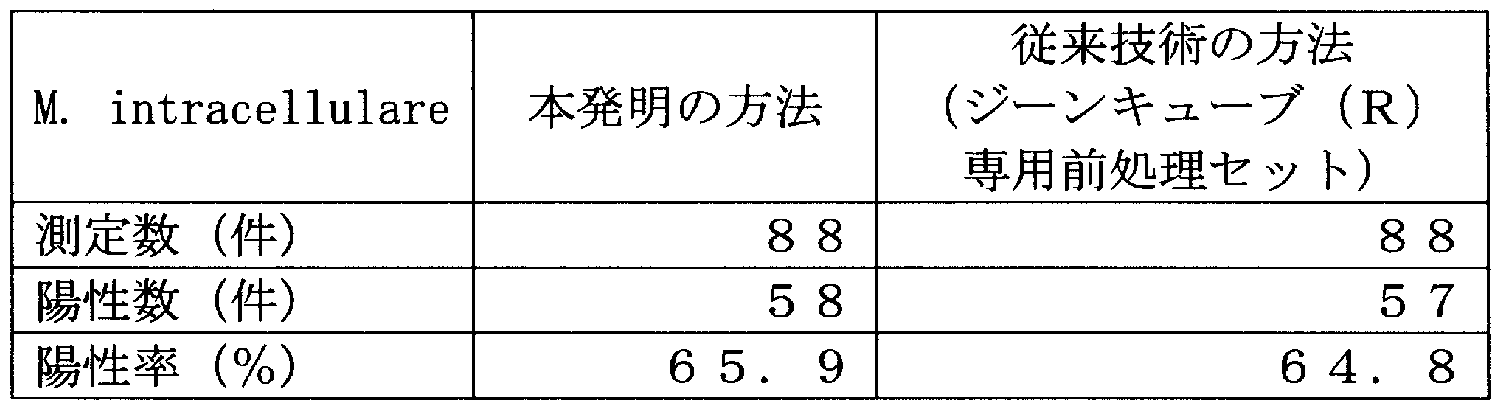
[0075] 〔試験例 3 :従来方法との比較 2〕
(3_ 1) 概要
本発明の微生物検出方法 (工程 〜 ) と従来技術における微生物検出方 法を比較した。 従来方法として、 アンプリコア マイコバクテリウム 検体処 理 試薬セツ ト 丨 丨 (ロシュ ·ダイアグノステイツクス社) 及びコバス ([¾) T a qMa n ([¾) !\/1八 丨 (ロシュ ·ダイアグノステイツクス社) を用いた
[0076] (3-2) 試料
結核菌群、

を 1_(3— 8〇 1~1処理し、 該処理液に 11/1. 丨门1;「3〇6111|13「6菌体を 1 50〜
 となるように添加した液を試料とした。
[0077] (3-3) 本発明の方法
同一の反応容器で以下に示す工程八〜 を行った。
工程八 :反応容器としてジーンキューブ ([¾) 専用イージー · ビーズを使
用した。 該容器を工程 Aから工程 Eまで使用した。 該容器に p Hが約 1 1の 水酸化カリウム約 1 000 M Lを分注した。 該溶液に試料約 400 M Lを懸 濁した。
工程 B :懸濁液について 1 3, 000 g、 3分間の遠心分離を行い、 上清 の一部を廃棄して容器に約 1 5〇M L残した。
工程 C :容器内に残った沈渣及び上清に p Hが約 1 2〜 1 3の水酸化カリ ウム水溶液を約 50 M L添加して混合した。
工程 D :得られた混合液を 80°C、 1 0分間加熱後、 ボルテックスミキサ —による撹拌を 3分間行い、 ビーズ破砕を行った。
工程 E :得られた破砕液について 1 3, 000 g、 3分間の遠心分離を行 った。
工程 F :工程 Eで得られた上清を検出対象試料液とし、 その一部を 2
 Lずつ 0. 5 mLチユーブに分注した。 該チユーブを GE N ECU B E (R ) にセッ トし、 ジーンキユーブ (R) MA I (東洋紡社) を使用して M. intr aceUulareの検出を行った。 装置及び試薬の操作、 取扱いは、 それぞれの添 付文書にしたがって行った。
[0078] (3-4) 従来技術の方法
アンプリコア マイコバクテリウム 検体処理 試薬セッ ト 丨 丨 を用いて試料 を処理し、 得られた検出対象試料液をコバス (R) T a qMa n (R) 48 及びコバス (R) T a qMa n ( R ) MA I を使用して M. i ntrace 11 u la reの 検出を行った。 装置及び各試薬の操作、 取扱いは、 それぞれの添付文書にし たがって行った。 なお、 アンプリコア マイコバクテリウム 検体処理 試薬セ ッ ト 丨 丨 は毒性の高い試薬を含むことを S D Sで確認した。 また、 アンプリ コア マイコバクテリウム 検体処理 試薬セッ ト 丨 丨 による検体処理は、 1時 間以上を要した。
[0079] (3-5) 結果
M. intracellular e菌体濃度が異なる試料を前処理して得られた各検出対象 試料液について、 本発明の方法及び従来技術の方法における結果 (陽性率)
〇 2020/175268 30 卩(:171? 2020 /006507
を比較した。
表 4が本発明あるいは従来技術での各菌体濃度の試料を前処理して得られ た検出対象試料液における結果 (陽性率) である。 本発明の方法では、 菌体 濃度 7 5〇〇 リ/ !_以上で陽性率 1 0 0 %であった。 一方で、 従来技術 の方法では
 以上で陽性率 1 0 0 %であった。 したがっ て、 本発明は、 従来技術よりも感度よく微生物の検出が可能であることを確 認できた。 また、 検出対象試料液調製 (前処理) の時間について、 本発明の 検出方法における調製法 (工程 〜巳) が約 3 0分であるのに対して従来技 術の方法が 1時間以上であった。 したがって、 操作時間の観点からも本発明 のほうが優位であることを確認した。
[0080] [表 4]

[0081 ] 本発明の検出方法における工程 〜巳で調製した液 (検出対象試料液) を 核酸増幅反応に直接供したところ (工程 ) 、 驚くべきことに、 優れた結果 が得られた (試験例 1〜 3) 。 この結果は、 本発明の検出方法における検体 の前処理方法 (工程 〜日) で後の検出反応に悪影響を及ぼす夾雑物等を高 度に除去でき、 その結果、 核酸増幅及び検出反応において夾雑物による反応 阻害が抑制されたことを示唆する。
[0082] また、 試験例 1〜 3では、 ミコール酸を細胞壁に多く含み、 外的因子に対 して高い抵抗性を示す

該微生物は、 上記の特徴的な細胞壁を有するため、 他の微生物と比較して核 酸抽出等が煩雑とされているが、 本発明によれば、 簡便な方法で該微生物を
〇 2020/175268 31 卩(:171? 2020 /006507
核酸抽出法と同程度に検出できた。 したがって、 本発明は他の様々な種類の 微生物でも検出を行うことが可能であり、 臨床診断等の場面で非常に有益で ある。
産業上の利用可能性
[0083] 本発明の方法を用いることで、 核酸精製することなく、 試料中に含まれる 微生物由来の核酸を検出することができるため、 臨床診断の分野に大きく貢 献できる。
Claims
\¥0 2020/175268 32 卩(:17 2020 /006507
請求の範囲
[請求項 1 ] 試料に含まれ得る微生物の検出方法であって、 以下の工程 〜 :
(八) 試料を水又はアルカリ性溶液に懸濁する工程、
(巳) 前記工程 で得られた懸濁液に含まれる微生物を濃縮する工程
(〇) 前記工程巳で得られた濃縮物にアルカリ性溶液を添加する工程
(〇) 前記工程 0で得られた懸濁液に含まれる微生物を溶菌又は破砕 する工程、
(º) 前記工程口で得られた溶菌液又は破砕液を必要に応じて精製す る工程、
( ) 前記工程口で得られた溶菌液又は破砕液、 或いは前記工程巳で 得られた精製液の一部又は全部を微生物の検出に供する工程、 を包含し、 少なくとも前記工程八〜巳が同一の反応容器内で行われる 方法。
[請求項 2] 前記反応容器の容量が、 5 0〇1 1_以下である、 請求項 1 に記載の方法
[請求項 3] 前記反応容器中にビーズが含まれている、 請求項 1又は 2に記載の方 法。
[請求項 4] 前記ビーズがジルコニアビーズである請求項 3に記載の方法。
[請求項 5] 前記工程 及び/又は工程(3において、 アルカリ性溶液が、 水酸化力 リウム水溶液、 水酸化ナトリウム水溶液、 水酸化カルシウム水溶液、 炭酸カリウム水溶液、 炭酸ナトリウム水溶液、 及び炭酸カルシウム水 溶液からなる群より選択される少なくとも一つである、 請求項 1〜 4 のいずれかに記載の方法。
[請求項 6] 前記工程 及び/又は工程 0において、 アルカリ性溶液の 1~1が 8 .
0以上である、 請求項 1〜 5のいずれかに記載の方法。
[請求項 7] 前記工程巳において微生物を濃縮する工程が、 遠心分離処理を含む、
〇 2020/175268 33 卩(:171? 2020 /006507
請求項 1〜 6のいずれかに記載の方法。
[請求項 8] 前記工程口において溶菌又は破砕する工程が、 撹拌処理、 ビーズ破砕 処理、 超音波処理、 加熱処理、 及びアルカリ処理からなる群より選択 される少なくとも一つの処理を含む、 請求項 1〜 7のいずれかに記載 の方法。
[請求項 9] 前記工程口において溶菌又は破砕する工程が、 加熱処理を含む、 請求 項 1〜 8のいずれかに記載の方法。
[請求項 10] 前記工程口において溶菌又は破砕する工程が、 ビーズ破砕処理を含む 、 請求項 1〜 8のいずれかに記載の方法。
[請求項 1 1] 前記工程口において溶菌又は破砕する工程が、 加熱処理及びビーズ破 砕処理を含む、 請求項 1〜 8のいずれかに記載の方法。
[請求項 12] 前記工程日を含み、 前記工程日において溶菌液又は破砕液を精製する 工程が、 遠心分離処理を含む、 請求項 1〜 1 1のいずれかに記載の方 法。
[請求項 13] 微生物の検出が、 微生物由来の核酸の検出である、 請求項 1〜 1 2の いずれかに記載の方法。
[請求項 14] 微生物由来の核酸の検出が、 微生物由来の核酸の増幅をさらに含む請 求項 1 3に記載の方法。
[請求項 15] 前記核酸の増幅が、
 丁 IV! 法、 3 口八法、 [¾丁一 〇[¾法、 [¾丁一 !_ 1\/1 ?法、
 及び丁 [¾〇法からなる群より選択される少なくとも一つを含む、 請求項 1 4 に記載の方法。
[請求項 16] 検出対象微生物が、
 に分類される微生物の少なくと も一つである、 請求項 1〜 1 5のいずれかに記載の方法。
[請求項 17] 検出対象微生物が、


[請求項 18] 試料の前処理方法、 又は、 微生物の検出方法に供される検出対象試料 液の調製方法であって、 以下の工程 A〜 E :
(A) 試料を水又はアルカリ性溶液に懸濁する工程、
(B) 前記工程 Aで得られた懸濁液に含まれる微生物を濃縮する工程
(C) 前記工程 Bで得られた濃縮物にアルカリ性溶液を添加する工程
(D) 前記工程 Cで得られた懸濁液に含まれる微生物を溶菌又は破砕 する工程、
(E) 前記工程 Dで得られた溶菌液又は破砕液を必要に応じて精製す る工程、
を包含し、 前記工程 A〜 Eが同一の反応容器内で行われる方法。
[請求項 19] 請求項 1 8に記載の試料の前処理方法又は検出対象試料液の調製方法 、 或いは請求項 1〜 1 7のいずれかに記載の微生物の検出方法のため の試薬であって、
前記工程 A及び/又は工程 Cに使用するためのアルカリ性溶液、 前記工程 Dに使用するためのビーズ、 或いは
前記工程 Fに使用するためのプライマーミックス及び/又は D N Aポ リメラーゼ、
〇 2020/175268 36 卩(:171? 2020 /006507
を含む、 試薬。
[請求項 20] 請求項 1 9に記載の試薬の少なくとも一つを含む、 請求項 1 8に記載 の試料の前処理方法又は検出対象試料液の調製方法、 或いは請求項 1 〜 1 7のいずれかに記載の微生物の検出方法のためのキッ ト。
[請求項 21 ] 前記工程 〜〇、 工程 〜巳、 又は工程 で使用するための反応 容器をさらに含む、 請求項 2 0に記載のキッ ト。
Applications Claiming Priority (2)
| Application Number | Priority Date | Filing Date | Title |
|---|---|---|---|
| JP2019031668A JP7395254B2 (ja) | 2019-02-25 | 2019-02-25 | 微生物の検出方法 |
| JP2019-031668 | 2019-02-25 |
Publications (1)
| Publication Number | Publication Date |
|---|---|
| WO2020175268A1 true WO2020175268A1 (ja) | 2020-09-03 |
Family
ID=72239510
Family Applications (1)
| Application Number | Title | Priority Date | Filing Date |
|---|---|---|---|
| PCT/JP2020/006507 Ceased WO2020175268A1 (ja) | 2019-02-25 | 2020-02-19 | 微生物の検出方法 |
Country Status (2)
| Country | Link |
|---|---|
| JP (1) | JP7395254B2 (ja) |
| WO (1) | WO2020175268A1 (ja) |
Cited By (1)
| Publication number | Priority date | Publication date | Assignee | Title |
|---|---|---|---|---|
| EP4703481A1 (en) * | 2024-08-30 | 2026-03-04 | Tsiamis, Georgios | Method for detecting mycobacterium species in fish |
Families Citing this family (2)
| Publication number | Priority date | Publication date | Assignee | Title |
|---|---|---|---|---|
| US20220084636A1 (en) * | 2020-09-14 | 2022-03-17 | The Board Of Trustees Of The Leland Stanford Junior University | Machine learning analysis for metabolomics classification and biomarker discovery |
| KR102675730B1 (ko) * | 2023-12-27 | 2024-06-17 | 고려대학교 산학협력단 | 일회용 식품 용기용 친환경 코팅 종이 |
Citations (1)
| Publication number | Priority date | Publication date | Assignee | Title |
|---|---|---|---|---|
| JPS62236478A (ja) * | 1986-03-20 | 1987-10-16 | ジエン−プロ−ブ・インコ−ポレイテツド | 未精製試料中に存在する微生物の検出方法 |
Family Cites Families (4)
| Publication number | Priority date | Publication date | Assignee | Title |
|---|---|---|---|---|
| JP5150829B2 (ja) * | 2005-11-25 | 2013-02-27 | 株式会社ダナフォーム | 核酸検出及び増幅方法 |
| CN103123354B (zh) * | 2007-12-28 | 2014-11-12 | 株式会社比尔生命 | 结核分歧杆菌复合群的免疫检出方法 |
| CN103911365A (zh) * | 2014-03-13 | 2014-07-09 | 南京爱必梦生物材料有限公司 | 提取结核杆菌dna的方法及检测其多重耐药性的试剂盒 |
| JP6728608B2 (ja) * | 2015-09-24 | 2020-07-22 | 東洋紡株式会社 | 核酸分析用のサンプル調製方法 |
-
2019
- 2019-02-25 JP JP2019031668A patent/JP7395254B2/ja active Active
-
2020
- 2020-02-19 WO PCT/JP2020/006507 patent/WO2020175268A1/ja not_active Ceased
Patent Citations (1)
| Publication number | Priority date | Publication date | Assignee | Title |
|---|---|---|---|---|
| JPS62236478A (ja) * | 1986-03-20 | 1987-10-16 | ジエン−プロ−ブ・インコ−ポレイテツド | 未精製試料中に存在する微生物の検出方法 |
Non-Patent Citations (1)
| Title |
|---|
| KULSKI, J.K. ET AL.: "Preparation of Mycobacterial DNA from Blood Culture Fluids by Simple Alkali Wash and Heat Lysis Method for PCR Detection", JOURNAL OF CLINICAL MICROBIOLOGY, vol. 34, no. 8, 1996, pages 1985 - 1991, XP002671697 * |
Cited By (1)
| Publication number | Priority date | Publication date | Assignee | Title |
|---|---|---|---|---|
| EP4703481A1 (en) * | 2024-08-30 | 2026-03-04 | Tsiamis, Georgios | Method for detecting mycobacterium species in fish |
Also Published As
| Publication number | Publication date |
|---|---|
| JP7395254B2 (ja) | 2023-12-11 |
| JP2020130131A (ja) | 2020-08-31 |
Similar Documents
| Publication | Publication Date | Title |
|---|---|---|
| US20240060113A1 (en) | Preservation of fetal nucleic acids in maternal plasma | |
| EP2925891B1 (en) | Apparatus and method for extracting microbial cells | |
| ES3026543T3 (en) | Sample nucleic acid measurement test kit, reagent, and application thereof | |
| Shin | Nucleic acid extraction techniques | |
| EP1992689B1 (en) | Method for extraction of nucleic acid from biological material | |
| US20120021407A1 (en) | Methods and Devices for Rapid Urine Concentration | |
| US20230416722A1 (en) | Apparatus and method for pretreatment of microbial samples | |
| JP7395254B2 (ja) | 微生物の検出方法 | |
| JP2023521783A (ja) | Rt-pcrを用いたウイルス感染の迅速な検出 | |
| JP2024026545A (ja) | 改良された核酸検出方法 | |
| US9707555B2 (en) | Method for pretreatment of microbial samples | |
| CA2862523A1 (en) | Improved methods for determining cell viability using molecular nucleic acid-based techniques | |
| JP2024501497A (ja) | 血液からの微生物の濃縮及び同定のためのシステム、方法、及び装置 | |
| Najomtien et al. | PCR combined with lateral flow dipstick assay (PCR-LFD) for a rapid diagnosis of melioidosis | |
| JP7403948B2 (ja) | 試料の前処理方法 | |
| US20140120546A1 (en) | Method of processing a sample for analysis | |
| JP2024050211A (ja) | 液状試料の簡易的な前処理方法 | |
| JP2018166410A (ja) | 生体試料中の核酸の長期保存方法 | |
| WO2020075696A1 (ja) | 試料の前処理方法 | |
| JP2011115122A (ja) | 試料の前処理方法及び遺伝子の検出方法 | |
| CA2938275C (en) | Compositions for the preservation of fetal nucleic acids in maternal blood samples | |
| RU2511029C2 (ru) | РЕКОМБИНАНТНЫЙ ШТАММ Escherichia coli TG1(pRVMoscow3253G-L) ДЛЯ ПОЛУЧЕНИЯ НАБОРА ПЦР-СТАНДАРТОВ И НАБОР ПЦР-СТАНДАРТОВ ДЛЯ ОПРЕДЕЛЕНИЯ КОНЦЕНТРАЦИИ ШТАММА ВИРУСА БЕШЕНСТВА "Москва 3253" В РАБИЧЕСКОМ АНТИГЕНЕ | |
| US10487321B2 (en) | Method of extraction of genomic DNA for molecular diagnostics and application | |
| HK40037395B (en) | Preservation of fetal nucleic acids in maternal plasma | |
| CN110358809A (zh) | 大肠杆菌检测试剂盒 |
Legal Events
| Date | Code | Title | Description |
|---|---|---|---|
| 121 | Ep: the epo has been informed by wipo that ep was designated in this application |
Ref document number: 20762334 Country of ref document: EP Kind code of ref document: A1 |
|
| NENP | Non-entry into the national phase |
Ref country code: DE |
|
| 122 | Ep: pct application non-entry in european phase |
Ref document number: 20762334 Country of ref document: EP Kind code of ref document: A1 |