WO2020162485A1 - 抗ウイルス剤及びウイルスの除去方法 - Google Patents
抗ウイルス剤及びウイルスの除去方法 Download PDFInfo
- Publication number
- WO2020162485A1 WO2020162485A1 PCT/JP2020/004291 JP2020004291W WO2020162485A1 WO 2020162485 A1 WO2020162485 A1 WO 2020162485A1 JP 2020004291 W JP2020004291 W JP 2020004291W WO 2020162485 A1 WO2020162485 A1 WO 2020162485A1
- Authority
- WO
- WIPO (PCT)
- Prior art keywords
- particles
- platinum
- virus
- silver
- antiviral agent
- Prior art date
- Legal status (The legal status is an assumption and is not a legal conclusion. Google has not performed a legal analysis and makes no representation as to the accuracy of the status listed.)
- Ceased
Links
Classifications
-
- A—HUMAN NECESSITIES
- A01—AGRICULTURE; FORESTRY; ANIMAL HUSBANDRY; HUNTING; TRAPPING; FISHING
- A01N—PRESERVATION OF BODIES OF HUMANS OR ANIMALS OR PLANTS OR PARTS THEREOF; BIOCIDES, e.g. AS DISINFECTANTS, AS PESTICIDES OR AS HERBICIDES; PEST REPELLANTS OR ATTRACTANTS; PLANT GROWTH REGULATORS
- A01N25/00—Biocides, pest repellants or attractants, or plant growth regulators, characterised by their forms, or by their non-active ingredients or by their methods of application, e.g. seed treatment or sequential application; Substances for reducing the noxious effect of the active ingredients to organisms other than pests
- A01N25/02—Biocides, pest repellants or attractants, or plant growth regulators, characterised by their forms, or by their non-active ingredients or by their methods of application, e.g. seed treatment or sequential application; Substances for reducing the noxious effect of the active ingredients to organisms other than pests containing liquids as carriers, diluents or solvents
- A01N25/04—Dispersions, emulsions, suspoemulsions, suspension concentrates or gels
-
- A—HUMAN NECESSITIES
- A01—AGRICULTURE; FORESTRY; ANIMAL HUSBANDRY; HUNTING; TRAPPING; FISHING
- A01N—PRESERVATION OF BODIES OF HUMANS OR ANIMALS OR PLANTS OR PARTS THEREOF; BIOCIDES, e.g. AS DISINFECTANTS, AS PESTICIDES OR AS HERBICIDES; PEST REPELLANTS OR ATTRACTANTS; PLANT GROWTH REGULATORS
- A01N59/00—Biocides, pest repellants or attractants, or plant growth regulators containing elements or inorganic compounds
- A01N59/16—Heavy metals; Compounds thereof
Definitions
- the present invention relates to an antiviral agent and a method for removing a virus.
- Patent Document 1 discloses a technique of incorporating nanosized platinum particles into a wet tissue to impart an antiviral effect to the wet tissue.
- the present invention has been made in view of the above, and an object of the present invention is to provide an antiviral agent and a method for inactivating viruses, which can rapidly inactivate various viruses.
- the present inventors have found that the above object can be achieved by employing platinum particles as an active ingredient, and have completed the present invention.
- Item 1 An antiviral agent containing metal particles, An antiviral agent, wherein the metal particles contain platinum particles.
- Item 2 Item 2.
- the antiviral agent according to Item 1, wherein the metal particles further contain silver particles.
- Item 3 Item 3.
- Item 4 Item 4.
- Item 5 Item 5.
- the antiviral agent according to Item 4 wherein the total amount of the metal particles is 0.01 to 1000 mass ppm with respect to the total mass of the aqueous solvent.
- Item 6 Item 6.
- Item 7 Item 6.
- Item 8 Item 8.
- Item 8-1 Item 10. Use of the antiviral agent according to any one of items 1 to 7 for a medical device.
- Item 9 Item 9.
- Item 9-1 Item 9. Use of the antiviral agent according to any one of items 1 to 8 for an ophthalmic medical device.
- Item 10 Item 10. A method for inactivating a virus, which uses the antiviral agent according to any one of Items 1 to 9.
- various viruses can be rapidly inactivated. Moreover, according to the virus inactivation method of the present invention, various viruses can be rapidly inactivated.
- the antiviral agent of the present invention contains metal particles. Particularly in the antiviral agent of the present invention, the metal particles contain at least platinum particles. Metal particles including platinum particles are active ingredients in antiviral agents. Below, the antiviral agent containing the said metal particle is only described as an "antiviral agent.”
- the "antiviral action” includes, for example, the action of inactivating a virus. More specifically, the “antiviral effect” includes an effect of suppressing the growth of the virus, an effect of killing the virus, and an effect of reducing the infectivity of the virus.
- the platinum particles have platinum (Pt) as a constituent component.
- the platinum particles are usually formed of a simple element of platinum, but may contain a platinum compound such as platinum oxide. In addition, the platinum particles may contain an alloy of platinum and another metal element.
- an antiviral agent is likely to inactivate a virus such as adenovirus, and thus can bring a particularly excellent antiviral action against adenovirus.
- the content of platinum particles in the metal particles is not particularly limited, and for example, the platinum particles can be 10 parts by mass or more and 100 parts by mass or more with respect to 100 parts by mass of the metal particles. Is preferred. In particular, when the metal particles do not include the silver particles described later, the platinum particles can be 70 parts by mass or more based on 100 parts by mass of the metal particles, more preferably 80 parts by mass or more, and 90 parts by mass. It is more preferable that the amount is not less than 99 parts by weight, and particularly preferably not less than 99 parts by mass.
- the metal particles may be composed only of platinum particles.
- the average particle size of the platinum particles is not particularly limited and can be 10 to 200 nm.
- the average particle diameter of the platinum particles referred to in the present specification means a value measured by a zeta potential measuring device (Zetasizer Nano ZS90, manufactured by Malvern).
- the metal particles may further contain silver particles in addition to platinum particles. Although silver particles alone do not show an antiviral effect, when combined with platinum particles, silver particles can also be an active ingredient in an antiviral agent. When the metal particles include platinum particles and silver particles, the antiviral agent can provide a markedly high antiviral effect against various viruses including adenovirus.
- the silver particles have silver (Ag) as a constituent component.
- the silver particles are usually formed of a simple element of silver, but may contain a silver compound such as a silver oxide. In addition, the silver particles may contain an alloy of silver and another metal element.
- the content ratio of platinum particles and silver particles constituting the metal particles is not particularly limited.
- the silver particles may be included in an amount of 0.01 to 1000 parts by mass per 100 parts by mass of platinum particles.
- the lower limit of the content of the silver particles per 100 parts by mass of platinum particles is 0.05 parts by mass, 0.1 parts by mass, 0.2 parts by mass, 0.5 parts by mass, 1 part by mass, and 3 parts by mass. Preferred in order.
- the upper limit of the content of the silver particles is preferably 700 parts by mass, more preferably 100 parts by mass, further preferably 50 parts by mass, and 30 parts by mass based on 100 parts by mass of the platinum particles. It is particularly preferable that the amount is parts by mass.
- the antiviral agent is preferably 10 to 99.99 parts by mass, more preferably 30 to 95 parts by mass, and further preferably 30 to 95 parts by mass with respect to 100 parts by mass in total of the platinum particles and the silver particles. It is preferably contained in an amount of 50 to 90 parts by mass.
- the average particle diameter of silver particles is not particularly limited, and can be 10 to 200 nm.
- the average particle diameter of the silver particles in the present specification means a value measured by a zeta potential measuring device (Zetasizer Nano ZS90, manufactured by Malvern).
- the metal particles can be formed of only platinum particles and silver particles, or can contain other metal components as necessary.
- the total amount of platinum particles and silver particles is preferably 80% by mass or more, more preferably 90% by mass or more, and particularly preferably 95% by mass or more.
- the metal particles include platinum particles and silver particles
- the platinum particles and the silver particles can exist independently of each other, or the platinum particles and the silver particles form composite particles due to aggregation or the like. It can also be formed.
- the platinum particles and the silver particles may coagulate and exist. The presence or absence of formation of composite particles can be confirmed by a transmission electron microscope (TEM).
- TEM transmission electron microscope
- the form of the composite particle is not particularly limited.
- the composite particles may include particles formed by aggregating a large number of platinum particles and silver particles. More specifically, a large number of particles (primary particles) are regularly or irregularly aggregated to form so-called secondary particles, whereby composite particles containing platinum particles and silver particles can be formed. ..
- the antiviral agent is likely to exert an excellent antiviral effect.
- the composite particles may be formed, for example, by aggregating particles having similar shapes with each other, or may have a so-called core-shell structure having a structure in which other particles cover the surface of core particles. it can.
- the core particles may be formed of only one particle or may be an aggregate of a plurality of particles. It is preferable that the composite particles have a core-shell structure because they are easy to produce and can easily exhibit an excellent antiviral effect.
- the particles forming the core may be either platinum particles or silver particles, and the core particles may include both platinum particles and silver particles.
- the particles forming the shell (shell particles) may be either platinum particles or silver particles, and the shell particles may include both platinum particles and silver particles.
- the size of the core particles is usually larger than the size of the shell particles.
- the core particles can be silver particles and the shell particles can be platinum particles.
- the reverse is also possible.
- the average particle size of the composite particles is not particularly limited.
- the average particle size of the composite particles is preferably 10 to 500 nm from the viewpoint that the composite particles are easily dispersed in an aqueous solvent and that a more excellent antiviral effect is easily exhibited.
- the lower limit of the average particle size of the composite particles is more preferably 20 nm, and particularly preferably 30 nm.
- the upper limit of the average particle size of the composite particles is more preferably 300 nm, and particularly preferably 200 nm.
- the average particle size of the composite particles in the present specification refers to a value measured by a zeta potential measuring device (Zetasizer Nano ZS90, manufactured by Malvern).
- the average particle size of platinum particles and silver particles forming the composite particles is not particularly limited.
- the platinum particles can have an average particle diameter of 10 to 200 nm
- the silver particles can have an average particle diameter of 20 to 480 nm.
- the average particle size of the platinum particles and the silver particles forming the composite particles referred to in the present specification is determined by energy dispersive X-ray spectroscopy (EDS) after the composition of each particle shown in the TEM image is specified.
- EDS energy dispersive X-ray spectroscopy
- 50 particles are randomly selected by direct observation with a transmission electron microscope (TEM), and the equivalent circle diameters of these particles are measured and arithmetically averaged.
- the shape (planar shape) of the composite particles is not particularly limited, and examples thereof include spherical particles, elliptic spherical particles, amorphous particles, polygonal particles, fibrous particles, needle-like particles, flake-like particles, and porous particles. It
- the shapes of platinum particles and silver particles contained in the composite particles are not particularly limited.
- Examples of the platinum particles and silver particles include spherical particles, elliptic spherical particles, irregular particles, polygonal particles, fibrous particles, needle particles, flake particles, and porous particles. Even when the platinum particles and the silver particles do not form a composite particle size, the shapes of the platinum particles and the silver particles can be the same as above.
- -Composite particles can be formed only of platinum particles and silver particles, and can also contain components such as other metals as necessary.
- the total amount of platinum particles and silver particles in the total mass of the composite particles is preferably 80% by mass or more, more preferably 90% by mass or more, and particularly preferably 95% by mass or more.
- the antiviral agent may include an aqueous solvent in addition to the metal particles.
- the metal particles in the antiviral agent, can be present dispersed in an aqueous solvent. The same applies when the metal particles form composite particles containing platinum particles and silver particles.
- the aqueous solvent is not particularly limited, and examples thereof include water, a lower alcohol having 1 to 3 carbon atoms, etc., or a mixed solvent thereof.
- water various kinds of water such as distilled water, tap water, industrial water, ion-exchanged water, deionized water, pure water, and electrolyzed water can be used.
- the aqueous solvent can contain 90% by mass or more of water, and 99% by mass or more of water. Is particularly preferable.
- the content of the metal particles in the aqueous solvent is not particularly limited and can be arbitrarily adjusted within a range in which desired antiviral performance is exhibited.
- the total amount of the metal particles can be 0.01 to 1000 mass ppm with respect to the total mass of the aqueous solvent. In this case, the antiviral agent is likely to exert an excellent antiviral effect.
- the total amount of the metal particles is more preferably 0.1 to 500 mass ppm with respect to the total mass of the aqueous solvent.
- the antiviral effect is not sufficiently exerted when the concentration becomes low, but in the antiviral agent of the present invention, the active ingredient, that is, the concentration of the metal particles is lower than in the conventional case. Both have the advantage that the antiviral effect is unlikely to decrease. Therefore, by using a dispersion liquid in which the metal particles are dispersed in an aqueous solvent as an antiviral agent, it is possible to exhibit an unprecedented excellent antiviral effect.
- the pH of the antiviral agent is not particularly limited. From the viewpoint that the dispersion stability of platinum particles and silver particles tends to be good, the pH of the antiviral agent is preferably 3 to 7, more preferably 3.5 to 6, and 3.5 to 4. 5 is particularly preferable.
- the dosage form of the antiviral agent is not particularly limited, and can be appropriately selected according to its application.
- the dosage form for example, when it contains the above-mentioned aqueous solvent, it is a liquid agent such as an emulsion, a suspension agent, a dispersant, an aerosol agent, etc. It is also possible to use a solid agent or a semi-solid agent.
- the antiviral agent may contain other components in addition to the aqueous solvent or in place of the aqueous solvent.
- various additives can be mentioned as long as the effects of the present invention are not impaired.
- additives examples include other antiviral agents other than the antiviral agent of the present invention, microbial control agents (specifically, antibacterial agents, bactericides, preservatives, algae agents, antifungal agents, etc.), pH adjusters, antioxidants, solvents, binders, carriers, dispersants, emulsifiers, buffers, stabilizers, excipients, binders, disintegrants, lubricants, thickeners, humectants, colorants, fragrances.
- microbial control agents specifically, antibacterial agents, bactericides, preservatives, algae agents, antifungal agents, etc.
- pH adjusters specifically, antioxidants, solvents, binders, carriers, dispersants, emulsifiers, buffers, stabilizers, excipients, binders, disintegrants, lubricants, thickeners, humectants, colorants, fragrances.
- antiviral agents such as a chelating agent, a light stabilizer, and an antif
- examples of the pH adjuster include acids such as hydrochloric acid, nitric acid, sulfuric acid, lactic acid, acetic acid, and citric acid, and alkali metal salts, alkaline earth metal salts, and ammonium salts of these acids.
- the pH adjustor may be a base such as sodium hydroxide, potassium hydroxide, sodium carbonate, triethylamine, trimethylamine, or ammonia. These pH adjusters can be used alone or in combination of two or more as needed.
- the content of the additive is 5% by mass or less, preferably 1% by mass or less, more preferably 0.1% by mass or less with respect to the total mass of the platinum particles, the silver particles and the aqueous solvent.
- the amount can be less than or equal to mass%, particularly preferably less than or equal to 0.05% by mass.
- the virus that can be inactivated by an antiviral agent is not particularly limited.
- the antiviral agent can target, for example, known enveloped viruses (viruses having an envelope) and non-enveloped viruses (viruses not having an envelope) as target viruses.
- influenza virus eg, A type, B type, etc.
- rubella virus e.g., Ebola virus, coronavirus, measles virus, varicella-zoster virus, herpes virus, mumps virus, arbovirus, RS virus, SARS.
- Virus hepatitis virus (eg, hepatitis A virus, hepatitis B virus, hepatitis C virus, hepatitis D virus, hepatitis E virus, etc.), yellow fever virus, AIDS virus, rabies virus, hantavirus, dengue virus, nipah virus , Lyssa virus and the like.
- non-enveloped viruses examples include adenovirus, norovirus, rotavirus, human papillomavirus, poliovirus, enterovirus, coxsackievirus, human parvovirus, encephalomyocarditis virus, polyomavirus, BK virus, rhinovirus and the like.
- anti-herpes virus for example, herpes simplex virus
- influenza virus for example, A type, B type, etc., preferably A type
- herpes virus for example, herpes simplex virus
- Viral agents can exert excellent antiviral effects.
- the antiviral agent can exert an excellent antiviral action, especially against adenovirus. Even when the target virus contains one or more selected from the group consisting of herpes simplex virus and adenovirus, the antiviral effect of the antiviral agent is effectively exerted.
- the antiviral agent can exert a particularly excellent antiviral activity against one or more selected from the group consisting of herpes simplex virus, adenovirus and influenza virus, and the antiviral agent contains silver particles. Even if it does not exist, the effect can be exhibited.
- the antiviral agent when the target virus is adenovirus, the antiviral agent can exert an excellent antiviral effect without containing silver particles. Therefore, the antiviral agent containing platinum particles or the antiviral agent containing platinum particles but not silver particles can be particularly preferably used for adenovirus.
- the metal particles include silver particles in addition to platinum particles, it can bring outstanding antiviral action against adenovirus, and also against viruses such as herpes virus, only platinum particles can be obtained. It has a remarkably superior antiviral effect as compared with the case of using an antiviral agent containing Therefore, an antiviral agent containing both platinum particles and silver particles can be particularly preferably used for viruses such as adenovirus and herpes virus.
- the antiviral agent can be widely used in various fields requiring antiviral properties, and can be used in various fields such as medical care, industry, cleaning, food and household use.
- the antiviral agent can be used in various articles used in each of these fields.
- the virus can be inactivated, and for example, the virus can have a growth inhibitory effect, a killing effect and an infection spread preventing effect.
- Targets to be treated or treated with antiviral agents include skin surfaces such as fingers, medical devices, industrial products used in various fields, and raw materials thereof.
- the medical device is not particularly limited, and various medical devices used in various medical settings can be exemplified.
- medical devices for ophthalmology medical devices for dental treatment, medical devices for internal medicine, surgical instruments
- various medical instruments used in hospital rooms and the like can be widely cited.
- ophthalmic medical instruments include a scissor, a scissor, an eyelid opener, a needle holder, a cannula handpiece, a spatula, a cataract surgery instrument, a retina/vitreous surgery instrument, a glaucoma surgery instrument, and a corneal surgery instrument.
- ophthalmic medical instruments include a scissor, a scissor, an eyelid opener, a needle holder, a cannula handpiece, a spatula, a cataract surgery instrument, a retina/vitreous surgery instrument, a glaucoma surgery instrument, and a corneal surgery instrument.
- examples thereof include instruments, instruments for external ocular surgery, surgical knives, cannulas, needles, and the like.
- Other articles treated with antiviral agents include clothes such as white coats, masks, glasses, gloves, doorknobs, walls and floors of stairs such as indoors and corridors, handrails such as stairs and elevators, toilet walls, and toilet bowls. And toilet seats, bath tubs and floors, kitchen chopping boards and knives, gas stoves, tableware, ticket vending machine panels, hangers, computer mice and keyboards, mobile phones and smartphones, writing instruments, air purifiers and air conditioner filters. , Filters for water purifiers, filters and nozzles for vacuum cleaners, mops, carpets, curtains, windows and the like.
- the antiviral agent for medical equipment, especially for ophthalmic medical equipment (that is, for ophthalmic medical equipment). It is known that 90% or more of viral conjunctivitis can be caused by adenovirus, and as described above, the antiviral agent of the present invention can bring an excellent antiviral action against adenovirus. is there.
- Examples of the usage mode in which the article is treated with the antiviral agent include a mode in which the antiviral agent is attached to the surface of the article for use. This allows the article to be treated with an antiviral agent to inactivate the virus already attached to the article, or to inactivate the virus attached to the article treated with the antiviral agent. it can. Furthermore, it is possible to inactivate viruses already attached to other articles with which the article is to come into contact.
- the method of attaching the antiviral agent to the article surface can be appropriately selected according to the type of article.
- the antiviral agent can be attached to the article by a method of spraying the article with the antiviral agent, a method of applying the antiviral agent to the article, a method of dipping or contacting the article with the antiviral agent, and the like. After treating the article with an antiviral agent, volatile components such as aqueous solvents may volatilize.
- the antiviral agent of the present invention can be used as a disinfecting solution in various fields such as medical, industrial, cleaning, food and household use, or can be combined with other agents to prepare a disinfecting solution.
- the method for producing the antiviral agent is not particularly limited.
- platinum particles and optionally added silver particles may be produced by a known method to obtain an aqueous dispersion of metal particles, and an antiviral agent may be produced using this aqueous dispersion of metal particles. it can.
- the metal particles include platinum particles and silver particles
- the antiviral agent can be obtained by producing and mixing dispersions of the both.
- the aqueous dispersion of platinum particles and the aqueous dispersion of silver particles can be obtained, for example, by a known production method, or can be obtained from a commercially available product.
- the antiviral agent can also be produced by a method of mixing a precursor of platinum particles and a precursor of silver particles (hereinafter, referred to as "production method A"). ..
- the platinum particle precursor is, for example, a compound containing platinum and means a compound capable of forming platinum particles by chemical treatment.
- the precursor of silver particles is, for example, a compound containing silver, and means a compound capable of forming silver particles by chemical treatment.
- platinum particle precursor for example, a platinum complex can be mentioned.
- the platinum complex can be obtained, for example, by complexing a platinum source.
- the platinum source include platinum oxides, hydroxides, chlorides, carbonates, acetates, nitrates, oxalates, phosphates, chloride complexes and the like.
- the platinum source complexing treatment can be carried out, for example, by using various organic salts and reacting the organic salts with the platinum source. Above all, it is preferable to use trisodium citrate as the organic salt. Trisodium citrate may be a hydrate. Complexation of the platinum source can be carried out, for example, in water.
- the ratio of platinum source and organic salt used in complexing the platinum source is not particularly limited.
- the platinum source can be complexed with 1 to 5 mol of an organic salt based on 1 mol of platinum contained in the platinum source.
- a silver complex As a precursor of silver particles, for example, a silver complex can be mentioned.
- the silver complex can be obtained, for example, by complexing a silver source.
- the silver source include silver oxide, hydroxide, chloride, carbonate, acetate, nitrate, oxalate, and phosphate.
- the complexing treatment of the silver source can be performed, for example, by using various organic salts and reacting the organic salts with the silver source. Above all, it is preferable to use trisodium citrate as the organic salt. Trisodium citrate may be a hydrate.
- Complexation of the silver source can be performed in water, for example.
- the ratio of the silver source and the organic salt used for complexing the silver source is not particularly limited.
- the silver source can be complexed with 1 to 5 mol of organic salt based on 1 mol of platinum contained in the silver source.
- the method of mixing the platinum particle precursor and the silver particle precursor is not particularly limited.
- a method of mixing a solution (for example, an aqueous solution) of the precursor of platinum particles with the aqueous solvent and a solution (for example, an aqueous solution) of the precursor of the silver particles with the aqueous solvent When the solutions are mixed with each other, for example, a dropping method in which one solution is dropped into the other solution can be adopted. In the case of this dropping method, for example, aggregated particles having the above-mentioned core-shell structure are likely to be formed.
- the dropping method is not particularly limited, and for example, a commercially available dropping device, a dropping pump, or the like can be used.
- the temperature at the time of mixing is not particularly limited, and may be, for example, room temperature, specifically 15 to 35° C.
- the mixing ratio of both is not particularly limited, either, so that the platinum particles and the silver particles in the antiviral agent have a desired content ratio.
- the amount of the precursor used and the amount of the silver particle precursor used can be appropriately adjusted.
- the platinum particle precursor and the silver particle precursor may be mixed to obtain a mixed solution, and then an acid may be added to the mixed solution.
- an acid By adding this acid, the pH of the mixed solution is appropriately adjusted, whereby generation of particles is promoted, and a dispersion containing platinum particles and silver particles can be easily and quickly obtained.
- Examples of the acid added to the mixed solution include inorganic acids such as hydrochloric acid, nitric acid and sulfuric acid; organic acids such as acetic acid, citric acid and succinic acid. Among these, it is preferable to use an organic acid, and it is particularly preferable to use citric acid, from the viewpoint that the dispersion stability of the produced composite particles is good.
- the dispersion containing the produced platinum particles and silver particles also has excellent dispersion stability.
- the method of adding the acid is not particularly limited, and for example, the acid can be made into an aqueous solution and added to the mixed solution.
- an aqueous solvent can be mixed if necessary to adjust the concentration of the antiviral agent to a desired range. Accordingly, the above-mentioned additives can be added to obtain an antiviral agent.
- the entire amount of the aqueous solution containing the platinum complex was added dropwise to the aqueous solution containing the silver complex with stirring over 60 minutes, and after the completion of the dropping, the stirring was continued for further 60 minutes to obtain a mixed solution.
- About 0.6 mL of 50% aqueous citric acid solution was added dropwise to the obtained mixed solution to adjust the pH of the mixed solution to 4, and the mixture was further stirred for 60 minutes to obtain an aqueous dispersion containing platinum particles and silver particles.
- the average particle size of the metal particles in the obtained dispersion was measured with a zeta potential measuring device (Zetasizer Nano ZS90, manufactured by Malvern Co.), and was 100 nm, and the mass ratio of platinum particles and silver particles was 6:4. there were.
- the content of metal particles in water in the aqueous dispersion was 166 mass ppm as confirmed by ICP-MS (ElanDRCII manufactured by Perkin Elmer Co.), of which platinum was 100 mass ppm and silver was 66 mass ppm. there were.
- ICP-MS ElanDRCII manufactured by Perkin Elmer Co.
- the composite particles were particles having a core-shell structure.
- Component analysis of each particle shown in the TEM image was performed by energy dispersive X-ray spectroscopy (EDS), and it was also found that in the core-shell structure, the core was formed of silver particles and the shell was formed of platinum particles. ..
- TEM/EDS HITACHI H-7100, acceleration voltage 100 kV was used.
- Example 1 An aqueous dispersion containing platinum particles and silver particles obtained in Synthesis Example 1-1 was prepared.
- the sample solutions at the respective dilution ratios which were diluted 4 times, 16 times, 64 times and 256 times by adding the sodium citrate aqueous solution prepared in Synthesis Example 3-1, as required. Prepared.
- Example 2 An aqueous dispersion containing platinum particles and silver particles obtained in Synthesis Example 1-2 was prepared.
- the sample solutions at the respective dilution ratios which were diluted 4 times, 16 times, 64 times and 256 times by adding the sodium citrate aqueous solution prepared in Synthesis Example 3-1, as required. Prepared.
- Example 3 An aqueous dispersion containing the platinum particles obtained in Synthesis Example 2-1 was prepared.
- the sample solutions at the respective dilution ratios which were diluted 4 times, 16 times, 64 times and 256 times by adding the sodium citrate aqueous solution prepared in Synthesis Example 3-1, as required. Prepared.
- ⁇ Evaluation method> Antiviral test against herpes simplex virus
- An antiviral test against herpes simplex virus was carried out as follows using the sample solutions obtained in the respective Examples and Comparative Examples. In this test, herpes simplex virus type 1 VR-3 strain was used. The virus solution (4.4 ⁇ 10 7 pfu/mL) was stored at ⁇ 80° C. and thawed and used in the assay.
- a reaction solution was prepared by mixing 10 ⁇ L of the virus solution and 190 ⁇ L of the sample solution, allowed to stand at room temperature for a predetermined period of time, and then Dulbecco's modified Eagle MEM medium (MEM-CS2; Nissui) supplemented with 2% of newborn calf serum. The reaction was stopped by diluting with (Pharmaceutical). The virus titer in this reaction solution was measured by a plaque assay using Vero cells (African green monkey kidney cells, RIKEN Cell Bank) precultured in a 24-well culture plate. Specifically, 0.2 mL of each diluted solution of the reaction solution was added to the cells, and the virus was adsorbed to the cells in a CO 2 incubator at 37° C.
- Vero cells African green monkey kidney cells, RIKEN Cell Bank
- the virus solution was removed, and MEM-CS2 containing 0.5% methyl cellulose was overlaid.
- the plate was incubated in an incubator at 37° C. in 5% CO 2 and 100% humidity for 5 days. After culturing, the cells were fixed with 10% formalin solution, stained with 0.25% crystal violet staining solution, and the number of plaques was visually measured.
- Antiviral test against adenovirus Using the sample solutions obtained in the respective examples and comparative examples, an antiviral test against adenovirus was conducted as follows. In this test, serotype 5 adenovirus was used. The virus solution (2.6 ⁇ 10 8 TCID 50 /mL) was stored at ⁇ 80° C. and thawed and used in the assay.
- a reaction solution was prepared by mixing 10 ⁇ L of the virus solution and 190 ⁇ L of the sample solution, allowed to stand at room temperature for a predetermined time, and then 10% fetal bovine serum was added to Dulbecco's modified Eagle MEM medium (MEM-FCS10; Nissui). The reaction was stopped by diluting with (Pharmaceutical).
- MEM-FCS10 Dulbecco's modified Eagle MEM medium
- the reaction was stopped by diluting with (Pharmaceutical).
- the virus titer in this reaction solution the cytopathic effect after infection of A549 cells (human tracheal epithelial cells, RIKEN Cell Bank) precultured in a 96-well culture plate was used as a TCID 50 value (50% tissue culture infectious titer). I asked.
- the cells were cultured in an incubator at 37° C. in 5% CO 2 and 100% humidity for 7 days. After culturing, the cells were fixed with 10% formalin solution and stained with 0.25% crystal violet staining solution. It was observed whether or not the cytopathic effect due to virus infection appeared in each well, and the virus concentration (TCID 50 value) in which virus infection occurred in 50% of the wells was calculated by the Behrens-Karber method.
- influenza test against influenza A virus was conducted as follows. In this test, influenza A virus A/Aichi/2/68 (H3N2) strain was used. The virus solution (2.8 ⁇ 10 4 pfu/mL) was stored at ⁇ 80° C. and thawed and used in the assay.
- a reaction solution was prepared by combining 10 ⁇ L of the virus solution and 190 ⁇ L of the sample solution, allowed to stand at room temperature for a predetermined period of time, and then Dulbecco's modified Eagle MEM medium (MEM-FCS10; Nissui) containing 10% fetal bovine serum. The reaction was stopped by diluting with (Pharmaceutical). The virus titer in this reaction solution was measured by a plaque assay using MDCK cells (canine tubular epithelial cells, distributed from Sendai Medical Center/Virus Center) precultured in a 12-well culture plate.
- MDCK cells canine tubular epithelial cells, distributed from Sendai Medical Center/Virus Center
- each diluted solution of the reaction solution was added to the cells, and the virus was adsorbed to the cells in a CO 2 incubator at 37° C. for 1 hour. After adsorption, the virus solution was removed, and Dulbecco's modified Eagle MEM medium containing 1% agarose heated and dissolved, 10% bovine albumin, and 5 ⁇ g/mL trypsin was overlaid. The plate was allowed to stand at room temperature for about 10 minutes to solidify the agar, and then cultured for 2 days in an incubator at 37°C in 5% CO 2 and 100% humidity. After culturing, the cells were fixed with 10% formalin solution, stained with 0.25% crystal violet staining solution, and the number of plaques was visually measured.
- Example 1 Reaction time for Example 1 (platinum particles and silver particles), Example 3 (platinum particles), Comparative Example 1 (pure water), Comparative Example 2 (blank; sodium citrate aqueous solution) and Comparative Example 3 (silver particles) was confirmed and the virus inactivating effect was confirmed.
- Table 1 and Table 2 show Example 1 (platinum particles and silver particles), Example 3 (platinum particles), Comparative Example 1 (pure water), Comparative Example 2 (blank; sodium citrate aqueous solution) and Comparative Example, respectively.
- 3 shows the results of antiviral test against herpes simplex virus (Table 1), adenovirus (Table 2) and influenza virus (Table 3) in 3 (silver particles).
- Example 3 and Example 1 showed an inactivating effect on herpes simplex virus, adenovirus and influenza virus by exposure for 1 minute.
- Comparative Example 3 did not show an inactivating effect against herpes simplex virus even after 30 minutes of exposure, and did not show an inactivating effect against adenovirus even after 1 hour of exposure.
- influenza virus was inactivated to about 1% with the blank sodium citrate solution (Comparative Example 2), and a slight enhancement of inactivation was observed in Comparative Example 3.
- Example 2 Next, targeting herpes simplex virus and adenovirus that are not inactivated at all by the blank solution, the reaction time was set to 10 minutes for Example 3 and Example 1, and the stock solutions (water dispersion) prepared in Example 3 and Example 1 were used. The solution) was diluted with an aqueous solution of sodium citrate (Comparative Example 2) to examine the virus inactivating effect at a lower concentration.
- the antiviral test method is the same as in Experiment 1.
- Table 4 and Table 4 show the virus titer when Comparative Example 1 (pure water) was used instead of the sample solution as a control (100%), and as a percentage (average of three or more assays) relative to the control. It is 5.
- Table 4 shows the results of antiviral test against herpes simplex virus
- Table 5 shows the results of antiviral test against adenovirus.
- Example 1 since the content of platinum particles in each sample solution of Example 1 is smaller than the content of platinum particles in the sample solution of Example 3 having the same dilution ratio, as described above, the silver particles are antiviral. Considering that it showed no effect, Example 1 was expected to show a lower antiviral effect than Example 3 (for example, considering the platinum content ratios of Example 1 and Example 3, It was thought that there would be a difference of about 1.5 times). However, it was found that the addition of silver, which does not show an antiviral effect, improves the antiviral effect by several times or more in all cases.
- the present inventors have found that the antiviral effect is improved several times or more (synergistic effect) by combining platinum particles expressing antiviral property and silver particles not exhibiting antiviral property. Can be said to be the first to be found.
- Example 3 Next, for Example 1 (dispersion liquid containing 100 mass ppm of platinum and 66 mass ppm of silver) and Example 2 (dispersion liquid containing 100 mass ppm of platinum and 20 mass ppm of silver), the reaction time was 10 minutes and the virus was used. The inactivating effect was examined. The dilution ratio was 16 times for herpes simplex virus and 256 times for adenovirus. The antiviral test method is the same as in Experiment 1.
- Table 6 shows the inactivating effect on herpes simplex virus as a virus titer and a percentage of the control
- Table 7 shows the inactivating effect on adenovirus as a virus titer and a percentage of the control (as a control). Comparative Example 1 is also listed in the table).
- Example 1 and Example 2 had a good inactivating effect on both herpes simplex virus and adenovirus.
- the antiviral agent containing platinum particles and the antiviral agent containing platinum particles and silver particles can rapidly inactivate viruses such as herpes simplex virus, adenovirus and influenza virus. .. It was found that the dispersion liquids containing the platinum particles and the silver particles of Example 1 and Example 2 can exert the antiviral effect even when the concentration is low (the concentration of the active ingredient is low). Further, it was found that the antiviral agent containing the platinum particles of Example 3 can exert an excellent antiviral effect against adenovirus without containing silver particles.
Landscapes
- Life Sciences & Earth Sciences (AREA)
- Health & Medical Sciences (AREA)
- General Health & Medical Sciences (AREA)
- Dentistry (AREA)
- Wood Science & Technology (AREA)
- Plant Pathology (AREA)
- Environmental Sciences (AREA)
- Engineering & Computer Science (AREA)
- Agronomy & Crop Science (AREA)
- Chemical & Material Sciences (AREA)
- Pest Control & Pesticides (AREA)
- Zoology (AREA)
- Inorganic Chemistry (AREA)
- Dispersion Chemistry (AREA)
- Toxicology (AREA)
- Agricultural Chemicals And Associated Chemicals (AREA)
- Pharmaceuticals Containing Other Organic And Inorganic Compounds (AREA)
Abstract
種々のウイルスを速やかに不活性化することができる抗ウイルス剤及びウイルスの不活性化方法を提供する。 本発明に係る抗ウイルス剤は、金属粒子を含有する。前記金属粒子が白金粒子を含有する。また、抗ウイルス剤は白金粒子及び銀粒子を含有することも好ましい。本発明に係る抗ウイルス剤は、好ましくは前記白金粒子及び前記銀粒子の合計100質量部に対し、前記白金粒子が10~99.99質量部含まれる。本発明に係る抗ウイルス剤によれば、種々のウイルスを速やかに不活性化することができる。
Description
本発明は、抗ウイルス剤及びウイルスの除去方法に関する。
従来から人体の健康に悪影響をおよぼすウイルスは多様に存在することが知られており、また、近年においても新種のウイルスが発見されていることから、ウイルス感染の拡大による人や動物への被害の増大が懸念されている。この観点から、ウイルスを速やかに不活性化することが可能な抗ウイルス剤が強く求められている。現在では、特定の分子構造を有する有機化合物、貴金属等の金属単体、金属化合物及び無機材料等がウイルスを不活性化させる効能を有していることが知られており、これらの物質や材料を利用した抗ウイルス剤が種々提案されている。
例えば、特許文献1には、ウェットティッシュにナノサイズの白金の粒子を含有させて当該ウェットティッシュに抗ウイルス作用を付与させる技術が開示されている。
しかしながら、従来の抗ウイルス剤では、不活性化対象のウイルスの種類が限定されており、わずかな種類のウイルスにしかその効能を発揮することができないものであった。特に昨今ではアデノウイルスを速やかに不活性化することが求められているところ、現状ではアデノウイルスを速やかに不活化できる抗ウイルス剤は見出されていない。
本発明は、上記に鑑みてなされたものであり、種々のウイルスを速やかに不活性化することができる抗ウイルス剤及びウイルスの不活性化方法を提供することを目的とする。
本発明者らは、上記目的を達成すべく鋭意研究を重ねた結果、有効成分として白金粒子を採用することにより上記目的を達成できることを見出し、本発明を完成するに至った。
すなわち、本発明は、例えば、以下の項に記載の主題を包含する。
項1
金属粒子を含有する抗ウイルス剤であって、
前記金属粒子が白金粒子を含有する、抗ウイルス剤。
項2
前記金属粒子は、さらに銀粒子を含有する、項1に記載の抗ウイルス剤。
項3
前記白金粒子100質量部あたり、前記銀粒子が0.01~1000質量部含まれる、項2に記載の抗ウイルス剤。
項4
前記金属粒子が水系溶媒に分散している、項1~3のいずれか1項に記載の抗ウイルス剤。
項5
前記金属粒子の総量は、前記水系溶媒の全質量に対して0.01~1000質量ppmである、項4に記載の抗ウイルス剤。
項6
対象ウイルスがノンエンベロープウイルスである、項1~5のいずれか1項に記載の抗ウイルス剤。
項7
対象ウイルスが単純ヘルペスウイルス、アデノウイルス及びインフルエンザウイルスからなる群より選ばれる1種以上を含む、項1~5のいずれか1項に記載の抗ウイルス剤。
項8
医療器具に使用される、項1~7のいずれか1項に記載の抗ウイルス剤。
項8-1
項1~7のいずれか1項に記載の抗ウイルス剤の医療器具への使用。
項9
前記医療器具が眼科用である、項1~8のいずれか1項に記載の抗ウイルス剤。
項9-1
項1~8のいずれか1項に記載の抗ウイルス剤の眼科用医療器具への使用。
項10
項1~9のいずれか1項に記載の抗ウイルス剤を使用する、ウイルスの不活性化方法。
項1
金属粒子を含有する抗ウイルス剤であって、
前記金属粒子が白金粒子を含有する、抗ウイルス剤。
項2
前記金属粒子は、さらに銀粒子を含有する、項1に記載の抗ウイルス剤。
項3
前記白金粒子100質量部あたり、前記銀粒子が0.01~1000質量部含まれる、項2に記載の抗ウイルス剤。
項4
前記金属粒子が水系溶媒に分散している、項1~3のいずれか1項に記載の抗ウイルス剤。
項5
前記金属粒子の総量は、前記水系溶媒の全質量に対して0.01~1000質量ppmである、項4に記載の抗ウイルス剤。
項6
対象ウイルスがノンエンベロープウイルスである、項1~5のいずれか1項に記載の抗ウイルス剤。
項7
対象ウイルスが単純ヘルペスウイルス、アデノウイルス及びインフルエンザウイルスからなる群より選ばれる1種以上を含む、項1~5のいずれか1項に記載の抗ウイルス剤。
項8
医療器具に使用される、項1~7のいずれか1項に記載の抗ウイルス剤。
項8-1
項1~7のいずれか1項に記載の抗ウイルス剤の医療器具への使用。
項9
前記医療器具が眼科用である、項1~8のいずれか1項に記載の抗ウイルス剤。
項9-1
項1~8のいずれか1項に記載の抗ウイルス剤の眼科用医療器具への使用。
項10
項1~9のいずれか1項に記載の抗ウイルス剤を使用する、ウイルスの不活性化方法。
本発明の抗ウイルス剤によれば、種々のウイルスを速やかに不活性化することができる。また、本発明のウイルスの不活性化方法によれば、種々のウイルスを速やかに不活性化することができる。
以下、本発明の実施形態について詳細に説明する。なお、本明細書中において、「含有」及び「含む」なる表現については、「含有」、「含む」、「実質的にからなる」及び「のみからなる」という概念を含む。
本発明の抗ウイルス剤は、金属粒子を含有する。特に本発明の抗ウイルス剤において、前記金属粒子は白金粒子を少なくとも含有する。白金粒子を含む金属粒子は抗ウイルス剤における有効成分である。以下では前記金属粒子を含有する抗ウイルス剤を単に「抗ウイルス剤」と表記する。
なお、本明細書において、「抗ウイルス作用」には、例えば、ウイルスを不活性化させる作用が包含される。より具体的に「抗ウイルス作用」には、ウイルスの増殖を抑制する作用、ウイルスを死滅させる作用、及びウイルスの感染性を低減する作用が包含される。
前記白金粒子は、白金(Pt)を構成成分とする。白金粒子としては、通常は、白金元素単体で形成されるが、白金の酸化物等の白金化合物が含まれていてもよい。その他、白金粒子は、白金と他の金属元素との合金が含まれていてもよい。
金属粒子が白金粒子を含むことで、例えば、抗ウイルス剤は、アデノウイルス等のウイルスを不活性化しやすいため、アデノウイルスに対して特に優れた抗ウイルス作用をもたらすことができる。
抗ウイルス剤において、金属粒子中の白金粒子の含有量は特に限定されず、例えば、金属粒子100質量部に対して白金粒子を10質量部以上とすることができ、50質量部以上とすることが好ましい。特に、金属粒子が後記する銀粒子を含まない場合は、金属粒子100質量部に対して白金粒子を70質量部以上とすることができ、80質量部以上とすることがより好ましく、90質量部以上とすることがさらに好ましく、99質量部以上とすることが特に好ましい。金属粒子は、白金粒子のみで構成することもできる。
白金粒子の平均粒子径は特に限定されず、10~200nmとすることができる。なお、本明細書でいう白金粒子の平均粒子径とは、ゼータ電位測定装置(ゼータサイザーナノZS90、Malvern社製)で測定した値をいう。
抗ウイルス剤において、前記金属粒子は、白金粒子に加えて、さらに銀粒子を含有することもできる。銀粒子は単独では抗ウイルス効果を示さないものの、白金粒子と組み合わせた場合、銀粒子も抗ウイルス剤における有効成分となりうる。前記金属粒子が白金粒子及び銀粒子を含む場合、抗ウイルス剤は、アデノウイルスも含め、種々のウイルスに対して際立った高い抗ウイルス作用をもたらすことができる。
前記銀粒子は、銀(Ag)を構成成分とする。銀粒子としては、通常は、銀元素単体で形成されるが、銀の酸化物等の銀化合物が含まれていてもよい。その他、銀粒子は、銀と他の金属元素との合金が含まれていてもよい。
抗ウイルス剤において、前記金属粒子がさらに銀粒子を含有する場合、金属粒子を構成する白金粒子及び銀粒子の含有割合は特に限定されない。例えば、白金粒子100質量部あたり、前記銀粒子が0.01~1000質量部含まれ得る。白金粒子100質量部あたり、前記銀粒子の含有量の下限値は、0.05重量部、0.1質量部、0.2質量部、0.5質量部、1質量部、3質量部の順に好ましい。また、白金粒子100質量部あたり、前記銀粒子の含有量の上限値は、700質量部であることが好ましく、100質量部であることがより好ましく、50質量部であることがさらに好ましく、30質量部であることが特に好ましい。別の観点、また、抗ウイルス剤は、前記白金粒子及び前記銀粒子の合計100質量部に対し、前記白金粒子が好ましくは10~99.99質量部、より好ましくは30~95質量部、さらに好ましくは50~90質量部含まれる。
銀粒子の平均粒子径は特に限定されず、10~200nmとすることができる。なお、本明細書でいう銀粒子の平均粒子径とは、ゼータ電位測定装置(ゼータサイザーナノZS90、Malvern社製)で測定した値をいう。
金属粒子は、白金粒子及び銀粒子のみで形成することがき、あるいは、必要に応じて他の金属等の成分を含むこともできる。金属粒子の全質量のうち白金粒子及び銀粒子の総量が80質量%以上であることが好ましく、90質量%以上であることがより好ましく、95質量%以上であることが特に好ましい。
抗ウイルス剤において、前記金属粒子が白金粒子及び銀粒子を含む場合、白金粒子と銀粒子とは互いに独立して存在することができ、あるいは、白金粒子と銀粒子とが凝集等によって複合粒子を形成することもできる。白金粒子と銀粒子とは互いに独立して存在している場合は、白金粒子どうし、及び、銀粒子どうしが凝集して存在していてもよい。複合粒子の形成の有無は、透過型電子顕微鏡(TEM)によって確認することができる。
白金粒子と銀粒子とが複合粒子を形成している場合(つまり、金属粒子が複合粒子である場合)、複合粒子の形態等は特に限定されない。例えば、複合粒子としては、多数の白金粒子及び銀粒子が凝集して形成される粒子を挙げることができる。より具体的には、多数の粒子(一次粒子)それぞれが規則的又は不規則的に凝集して、いわゆる二次粒子を形成することで、白金粒子と銀粒子とを含む複合粒子が形成され得る。白金粒子と銀粒子とが複合粒子を形成している場合、抗ウイルス剤は優れた抗ウイルス作用を発揮しやすい。
複合粒子は、例えば、同じような形状の粒子どうしが互いに凝集することで形成されてもよいし、あるいは、コア粒子の表面を他の粒子が覆った構造を有する、いわゆるコアシェル構造を有することもできる。この場合、コア粒子は一つの粒子のみで形成されてもよいし、あるいは、複数の粒子の集合体であってよい。製造が容易で、かつ、優れた抗ウイルス作用を発揮しやすいという点で、複合粒子は、コアシェル構造を有していることが好ましい。
複合粒子がコアシェル構造を有する場合、コアを形成する粒子(コア粒子)は、白金粒子及び銀粒子のいずれであってもよいし、コア粒子は白金粒子及び銀粒子の両方を含むこともできる。シェルを形成する粒子(シェル粒子)も、白金粒子及び銀粒子のいずれであってもよいし、シェル粒子は白金粒子及び銀粒子の両方を含むこともできる。凝集粒子がコアシェル構造を有する場合においてコア粒子が一つの粒子のみで形成される場合は、通常、コア粒子のサイズの方がシェル粒子のサイズよりも大きい。
コアシェル構造を有する複合粒子の一態様として、コア粒子を銀粒子、シェル粒子を白金粒子とすることができる。もちろん、この逆とすることも可能である。
複合粒子の平均粒子径は特に限定されない。例えば、複合粒子が水系溶媒に分散しやすく、また、より優れた抗ウイルス作用を発揮しやすくなるという点で、複合粒子の平均粒子径は10~500nmであることが好ましい。複合粒子の平均粒子径の下限は20nmであることがより好ましく、30nmであることが特に好ましい。また、複合粒子の平均粒子径の上限は300nmであることがより好ましく、200nmであることが特に好ましい。なお、本明細書でいう複合粒子の平均粒子径とは、ゼータ電位測定装置(ゼータサイザーナノZS90、Malvern社製)で測定した値をいう。
複合粒子を形成する白金粒子と銀粒子それぞれの平均粒子径も特に限定されない。例えば、白金粒子の平均粒子径は、10~200nmとすることができ、銀粒子の平均粒子径は、20~480nmとすることができる。なお、本明細書でいう複合粒子を形成する白金粒子と銀粒子の平均粒子径とは、TEM画像に示されている各粒子の組成をエネルギー分散形X線分光法(EDS)で特定した上で、透過型電子顕微鏡(TEM)による直接観察によって無作為に50個の粒子を選択し、これらの円相当径を計測して算術平均した値をいう。
複合粒子の形状(平面視形状)は特に限定的ではなく、球状粒子、楕円球状粒子、不定形粒子、多角状粒子、繊維状粒子、針状粒子、フレーク状粒子、多孔質粒子等が例示される。
複合粒子に含まれる白金粒子と銀粒子の形状も特に限定されない。例えば、白金粒子及び銀粒子は、球状粒子、楕円球状粒子、不定形粒子、多角状粒子、繊維状粒子、針状粒子、フレーク状粒子、多孔質粒子等が例示される。白金粒子と銀粒子とが複合粒子径を形成していない場合であっても、白金粒子及び銀粒子の形状はいずれも上記同様とすることができる。
複合粒子は、白金粒子及び銀粒子のみで形成することがき、必要に応じて他の金属等の成分を含むこともできる。複合粒子の全質量のうち白金粒子及び銀粒子の総量が80質量%以上であることが好ましく、90質量%以上であることがより好ましく、95質量%以上であることが特に好ましい。
抗ウイルス剤は、前記金属粒子に加えて水系溶媒を含むことができる。この場合、抗ウイルス剤において、前記金属粒子が水系溶媒に分散して存在することができる。前記金属粒子が白金粒子及び銀粒子を含む複合粒子を形成している場合も同様である。
水系溶媒としては特に限定されず、例えば、水、炭素数1~3等の低級アルコール、あるいは、これらの混合溶媒が挙げられる。水は、蒸留水、水道水、工業用水、イオン交換水、脱イオン水、純水、電解水などの各種の水を用いることができる。白金粒子及び銀粒子の分散安定性が良好であり、抗ウイルス剤としての人体等への安全性も高いという観点から、水系溶媒は水を90質量%以上含むことができ、99質量%以上含むことが特に好ましい。
抗ウイルス剤が水系溶媒を含む場合、水系溶媒中の前記金属粒子の含有量は特に限定されず、所望の抗ウイルス性能が発揮される範囲で任意に調節することができる。例えば、抗ウイルス剤において、前記金属粒子の総量は、水系溶媒の全質量に対して0.01~1000質量ppmとすることができる。この場合、抗ウイルス剤は、優れた抗ウイルス効果を発揮しやすくなる。前記金属粒子の総量は、水系溶媒の全質量に対して0.1~500質量ppmであることがより好ましい。
従来の抗ウイルス剤においては、濃度が低くなると抗ウイルス効果は十分に発揮されないという問題点があったが、本発明の抗ウイルス剤では、有効成分、つまり前記金属粒子の濃度が従来よりも低くとも、抗ウイルス効果が低下しにくいという利点がある。従って、前記金属粒子が水系溶媒に分散してなる分散液を抗ウイルス剤に使用することで、従来にない優れた抗ウイルス作用を発揮することが可能である。
抗ウイルス剤が水系溶媒を含む場合、抗ウイルス剤のpHは特に限定されない。白金粒子及び銀粒子の分散安定性が良好となりやすいという点で、抗ウイルス剤のpHは3~7であることが好ましく、3.5~6であることがさらに好ましく、3.5~4.5であることが特に好ましい。
抗ウイルス剤の剤形は特に制限されず、その用途に応じて適宜選択することができる。剤形としては、例えば、前述の水系溶媒を含む場合は、乳剤、懸濁剤、分散剤、エアゾール剤等の液剤であり、その他、水和剤、粉剤、粒剤、微粒剤、フロアブル剤等の固形剤又は半固形剤とすることもできる。
抗ウイルス剤は、水系溶媒に加えて、あるいは、水系溶媒に替えて他の成分を含むこともできる。他の成分は、本発明の効果が阻害されない限りは、種々の添加剤を挙げることができる。
添加剤としては、本発明の抗ウイルス剤以外の他の抗ウイルス剤が挙げられるほか、微生物防除剤(具体的には抗菌剤、殺菌剤、防腐剤、防藻剤、防カビ剤等)、pH調整剤、酸化防止剤、溶媒、バインダー、担体、分散剤、乳化剤、緩衝剤、安定剤、賦形剤、結合剤、崩壊剤、滑沢剤、増粘剤、保湿剤、着色料、香料、キレート剤、光安定剤、消泡剤等の、広く一般に抗ウイルス剤に含まれ得る成分が例示される。
上記添加剤のうち、pH調整剤としては、例えば、塩酸、硝酸、硫酸、乳酸、酢酸、クエン酸等の酸、及び、これらの酸のアルカリ金属塩、アルカリ土類金属塩、アンモニウム塩等を挙げることができる。また、pH調整剤としては、例えば、水酸化ナトリウム、水酸化カリウム、炭酸ナトリウム、トリエチルアミン、トリメチルアミン、アンモニア等の塩基であってもよい。これらのpH調整剤は、1種を単独で使用でき、又は必要に応じて2種以上を混合して使用することができる。
抗ウイルス剤が添加剤を含む場合、添加剤の含有量は、白金粒子、銀粒子及び水系溶媒の全質量に対して5質量%以下、好ましくは1質量%以下、より好ましくは、0.1質量%以下、特に好ましくは0.05質量%以下とすることができる。
抗ウイルス剤によって不活性化できるウイルス(対象ウイルス)としては、特に制限されない。抗ウイルス剤は、例えば、公知のエンベロープウイルス(エンベロープを有するウイルス)及びノンエンベロープウイルス(エンベロープを有さないウイルス)を対象ウイルスとすることができる。
エンベロープウイルスとしては、例えば、インフルエンザウイルス(例えばA型、B型等)、風疹ウイルス、エボラウイルス、コロナウイルス、麻疹ウイルス、水痘・帯状疱疹ウイルス、ヘルペスウイルス、ムンプスウイルス、アルボウイルス、RSウイルス、SARSウイルス、肝炎ウイルス(例えば、A型肝炎ウイルス、B型肝炎ウイルス、C型肝炎ウイルス、D型肝炎ウイルス、E型肝炎ウイルス等)、黄熱ウイルス、エイズウイルス、狂犬病ウイルス、ハンタウイルス、デングウイルス、ニパウイルス、リッサウイルス等が挙げられる。
ノンエンベロープウイルスとしては、例えば、アデノウイルス、ノロウイルス、ロタウイルス、ヒトパピローマウイルス、ポリオウイルス、エンテロウイルス、コクサッキーウイルス、ヒトパルボウイルス、脳心筋炎ウイルス、ポリオーマウイルス、BKウイルス、ライノウイルス等が挙げられる。
エンベロープウイルスの中でも、ヘルペスウイルス(例えば、単純ヘルペスウイルス)及びインフルエンザウイルス(例えばA型、B型等、好ましくはA型)に対して、特にはヘルペスウイルス(例えば、単純ヘルペスウイルス)に対し、抗ウイルス剤は優れた抗ウイルス作用を発揮することができる。また、ノンエンベロープウイルスの中でも、特にアデノウイルスに対して、抗ウイルス剤は優れた抗ウイルス作用を発揮することができる。対象ウイルスが、単純ヘルペスウイルス及びアデノウイルスからなる群より選ばれる1種以上を含む場合であっても、抗ウイルス剤による抗ウイルス作用が効果的に発揮される。
抗ウイルス剤は、単純ヘルペスウイルス、アデノウイルス及びインフルエンザウイルスからなる群より選ばれる1種または2種以上に対して特に優れた抗ウイルス作用を発揮することができ、抗ウイルス剤が銀粒子を含まない場合であっても、その効果を発揮することができる。特に、対象ウイルスがアデノウイルスである場合は、抗ウイルス剤は銀粒子を含まずとも優れた抗ウイルス作用を発揮することができる。従って、白金粒子を含有する抗ウイルス剤、あるいは、白金粒子を含有して銀粒子を含まない抗ウイルス剤は、アデノウイルス用として特に好適に使用することができる。
一方、金属粒子が白金粒子に加えて銀粒子を含む場合は、アデノウイルスに対しても際立って優れた抗ウイルス作用をもたらすことができる他、ヘルペスウイルス等のウイルスに対しても、白金粒子のみを含む抗ウイルス剤を用いた場合よりも際立って優れた抗ウイルス作用を有すること。従って、白金粒子及び銀粒子の両方を含む抗ウイルス剤は、アデノウイルス及びヘルペスウイルス等のウイルス用に特に好適に使用することができる。
抗ウイルス剤は、抗ウイルス性を要する各種分野において広く使用することができ、例えば、医療、工業、洗浄、食品、家庭用等の各種分野において使用することができる。これらの各分野において使用されている各種物品に抗ウイルス剤を使用することができる。本発明の抗ウイルス剤を使用することで、ウイルスを不活性化することができ、例えば、ウイルスを増殖抑制効果、死滅効果及び感染拡大防止効果等をもたらすことができる。
抗ウイルス剤で処置または処理される対象としては、手指などの皮膚表面、医療器具のほか、各種分野において用いられている工業製品及びその原材料が挙げられる。
医療器具としては、特に制限はなく、各種医療現場で使用されている種々の医療器具を挙げることができ、例えば、眼科用の医療器具、歯科用の医療器具、内科用の医療器具、外科用の医療器具等の他、病室等で使用する各種医療器具を広く挙げることができる。
眼科用医療器具の具体例としては、鑷子、剪刀、開瞼器、持針器、カニューラ・ハンドピース、スパーテル、白内障手術用器具、網膜・硝子体手術用器具、緑内障手術用器具、角膜手術用器具、外眼部手術用器具、サージカルナイフ、カニューラ・ニードル、眼帯等を挙げることができる。
その他、抗ウイルス剤で処理される物品としては、白衣等の衣服、マスク、眼鏡、手袋、ドアノブ、室内及び廊下等の階段の壁又は床等、階段及びエレベーター等の手摺、トイレの壁、便器及び便座等、お風呂のバスタブ及び床、台所のまな板及び包丁、ガスコンロ、食器、券売機のパネル、つり革、パソコンのマウス及びキーボード、携帯電話及びスマートフォン、筆記用具、空気清浄機及びエアコンのフィルター、浄水器のフィルター、掃除機のフィルター及びノズル、モップ、絨毯、カーテン、窓等が挙げられる。
抗ウイルス剤は、医療器具用、中でも眼科用医療器具に使用すること(つまり、眼科用医療器具用であること)が特に好ましい。ウイルス性結膜炎の90%以上はアデノウイルスによって起こりうることが知られているところ、前述のように本発明の抗ウイルス剤はアデノウイルスに対しても優れた抗ウイルス作用をもたらすことができるからである。
抗ウイルス剤で物品が処理される使用態様としては、例えば、物品表面に抗ウイルス剤を付着させて使用する態様等が挙げられる。これにより、物品が抗ウイルス剤で処理され、物品に既に付着しているウイルスを不活性化させることができ、あるいは、抗ウイルス剤で処理された物品に付着するウイルスを不活性化させることができる。さらには、該物品が接触する予定の他の物品に既に付着しているウイルスを不活性化させることができる。
物品表面に抗ウイルス剤を付着させる方法に特に制限はなく、物品の種類に応じて適宜選択することができる。例えば、物品に抗ウイルス剤を噴射させる方法、物品に抗ウイルス剤を塗布する方法、物品を抗ウイルス剤に浸漬又は接触させる方法等によって、物品に抗ウイルス剤を付着させることができる。抗ウイルス剤で物品を処理した後、水系溶媒等の揮発成分は揮発してもよい。
本発明の抗ウイルス剤は、例えば、医療、工業、洗浄、食品、家庭用等の各種分野において消毒液として使用することができ、あるいは、他の薬剤等と組み合わせて、消毒液を調製することもできる。
抗ウイルス剤の製造方法は特に限定されない。例えば、白金粒子及び必要に応じて添加される銀粒子を公知の方法で製造して金属粒子の水系分散液を得て、この金属粒子の水系分散液を用いて抗ウイルス剤を製造することができる。金属粒子が白金粒子及び銀粒子を含む場合は、両者の分散液をそれぞれ製造して、混合することで抗ウイルス剤を得ることができる。白金粒子の水系溶媒の分散液及び銀粒子の水系溶媒の分散液は、例えば、公知の製造方法で得ることができ、あるいは、市販品から入手することができる。
抗ウイルス剤の製造方法の他例として、白金粒子の前駆体と銀粒子の前駆体とを混合する方法により、抗ウイルス剤を製造することもできる(以下、「製造方法A」と表記する)。
製造方法Aにおいて、白金粒子の前駆体とは、例えば、白金を含む化合物であり、化学処理をすることで、白金粒子を形成することができる化合物を意味する。同様に、銀粒子の前駆体とは、例えば、銀を含む化合物であり、化学処理をすることで、銀粒子を形成することができる化合物を意味する。
白金粒子の前駆体としては、例えば、白金錯体を挙げることができる。
白金錯体は、例えば、白金源を錯化することで得ることができる。白金源としては、例えば、白金の酸化物、水酸化物、塩化物、炭酸塩、酢酸塩、硝酸塩、シュウ酸塩、リン酸塩、クロリド錯体等が例示される。白金源の錯化処理は、例えば、各種有機塩を使用し、該有機塩を白金源と反応させることで行うことができる。中でも、有機塩としてはクエン酸三ナトリウムを使用することが好ましい。クエン酸三ナトリウムは水和物であってもよい。白金源の錯化は、例えば、水中で行うことができる。
白金源を錯化処理するにあたり、白金源と有機塩との使用割合は特に限定されない。例えば、白金源に含まれる白金1モルに対し、有機塩1~5モル用いて白金源を錯化処理することができる。
銀粒子の前駆体としては、例えば、銀錯体を挙げることができる。
銀錯体は、例えば、銀源を錯化することで得ることができる。銀源としては、例えば、銀の酸化物、水酸化物、塩化物、炭酸塩、酢酸塩、硝酸塩、シュウ酸塩、リン酸塩等が例示される。銀源の錯化処理は、例えば、各種有機塩を使用し、該有機塩を銀源と反応させることで行うことができる。中でも、有機塩としてはクエン酸三ナトリウムを使用することが好ましい。クエン酸三ナトリウムは水和物であってもよい。銀源の錯化は、例えば、水中で行うことができる。
銀源を錯化処理するにあたり、銀源と有機塩との使用割合は特に限定されない。例えば、銀源に含まれる白金1モルに対し、有機塩1~5モル用いて銀源を錯化処理することができる。
製造方法Aにおいて、白金粒子の前駆体と銀粒子の前駆体とを混合する方法は特に限定されない。例えば、白金粒子の前駆体の前記水系溶媒の溶液(例えば、水溶液)と、銀粒子の前駆体の前記水系溶媒の溶液(例えば、水溶液)とを混合する方法を挙げることができる。溶液どうしを混合する場合、例えば、一方の溶液に他方の溶液を滴下する滴下方式を採用することができる。この滴下方式の場合、例えば、前述のコアシェル構造を有する凝集粒子が形成されやすい。滴下の方法は特に限定されず、例えば、市販の滴下用器具、滴下ポンプ等を使用することができる。
白金粒子の前駆体と銀粒子の前駆体とを混合するにあたって、混合時の温度も特に限定されず、例えば、室温、具体的には15~35℃とすることができる。
白金粒子の前駆体と銀粒子の前駆体とを混合するにあたって、両者の混合割合も特に限定されず、抗ウイルス剤において白金粒子と銀粒子とが所望の含有割合になるように、白金粒子の前駆体の使用量と銀粒子の前駆体の使用量を適宜調節することができる。
製造方法Aにおいて、白金粒子の前駆体と銀粒子の前駆体とを混合することで、白金粒子と銀粒子がそれぞれ生成し、互いの粒子が凝集して凝集粒子が形成され、白金粒子と銀粒子を構成要素とする複合粒子が得られうる。
また、白金粒子の前駆体と銀粒子の前駆体とを混合して混合液を得た後、さらに該混合液に酸を添加することもできる。この酸の添加によって、混合液のpHが適切に調節され、これにより粒子の生成が促進されて白金粒子と銀粒子を含む分散液を容易、かつ、速やかに得ることができる。
前記混合液に加える酸としては、塩酸、硝酸、硫酸等の無機酸;酢酸、クエン酸、コハク酸等の有機酸等を挙げることができる。これらの中でも、生成後の複合粒子の分散安定性が良好であるという観点から、有機酸を使用することが好ましく、クエン酸を使用することが特に好ましい。
酸を添加することにより、混合液のpHを4.5以下に調節することが好ましい。この場合、生成後の白金粒子と銀粒子を含む分散液は分散安定性にも優れる。酸の添加方法は特に制限されず、例えば、酸を水溶液にして前記混合液に添加することができる。
以上の製造方法Aによって白金粒子と銀粒子を含む分散液を得た後、必要に応じて水系溶媒を混合して、抗ウイルス剤の濃度を所望の範囲に調節することができ、さらに必要に応じて、前記添加剤を加えて抗ウイルス剤を得ることができる。
以下、実施例により本発明をより具体的に説明するが、本発明はこれら実施例の態様に限定されるものではない。
(合成例1-1;白金粒子及び銀粒子を含むサンプル)
硝酸銀0.104gと、クエン酸三ナトリウム二水和物0.130gとを980mLのイオン交換水(25℃)に溶解させ、30分間撹拌し、銀錯体を含む水溶液を調製した。このように得られた銀錯体を銀粒子の前駆体とした。
硝酸銀0.104gと、クエン酸三ナトリウム二水和物0.130gとを980mLのイオン交換水(25℃)に溶解させ、30分間撹拌し、銀錯体を含む水溶液を調製した。このように得られた銀錯体を銀粒子の前駆体とした。
また、塩化白金(II)酸カリウム0.213gと、クエン酸三ナトリウム二水和物0.130gとを、20mLのイオン交換水(25℃)に溶解させ、30分間撹拌し、白金錯体を含む水溶液を調製した。このように得られた白金錯体を白金粒子の前駆体とした。
次いで、白金錯体を含む水溶液の全量を、60分かけて銀錯体を含む水溶液に攪拌しながら滴下し、滴下終了後、さらに60分間撹拌を続け、混合液を得た。得られた混合液に、50%クエン酸水溶液を約0.6mL滴下することで混合液のpHを4に調整し、さらに60分間撹拌することで、白金粒子と銀粒子とを含む水分散液を得た。得られた分散液中の金属粒子の平均粒子径をゼータ電位測定装置(ゼータサイザーナノZS90、Malvern社製)で測定したところ、100nmであり、白金粒子と銀粒子の質量比率は6:4であった。また、水分散液において、水に対する金属粒子の含有量は、ICP-MS(パーキンエルマー社製ElanDRCII)で確認したところ、166質量ppmであり、そのうち白金が100質量ppm、銀が66質量ppmであった。
合成例1-1で得られた分散液中の粒子のTEMを測定したところ、白金粒子と銀粒子が複合化した粒子の存在が確認された。また、当該複合粒子は、コアシェル構造を有する粒子であることがわかった。TEM画像に示されている各粒子の成分分析をエネルギー分散形X線分光法(EDS)によって行ったところ、コアシェル構造において、コアが銀粒子、シェルが白金粒子で形成されていることもわかった。なお、この成分分析では、TEM/EDS(HITACHI H-7100、加速電圧100kV)を使用した。
合成例1-1で得られた分散液中の粒子のTEMを測定したところ、白金粒子と銀粒子が複合化した粒子の存在が確認された。また、当該複合粒子は、コアシェル構造を有する粒子であることがわかった。TEM画像に示されている各粒子の成分分析をエネルギー分散形X線分光法(EDS)によって行ったところ、コアシェル構造において、コアが銀粒子、シェルが白金粒子で形成されていることもわかった。なお、この成分分析では、TEM/EDS(HITACHI H-7100、加速電圧100kV)を使用した。
(合成例1-2;白金粒子及び銀粒子を含むサンプル)
白金粒子と銀粒子を含む分散液中の金属粒子の含有量が120質量ppmであって、そのうち白金が100質量ppm、銀が20質量ppmとなるようにしたこと以外は、実施例1と同様の方法で水分散液を調製した。
白金粒子と銀粒子を含む分散液中の金属粒子の含有量が120質量ppmであって、そのうち白金が100質量ppm、銀が20質量ppmとなるようにしたこと以外は、実施例1と同様の方法で水分散液を調製した。
(合成例2-1:白金粒子を含むサンプル)
0.354gの塩化白金酸カリウム(K2PtCl4)を50mLの純水に溶解して、塩化白金酸カリウム水溶液を調製した。別途、0.215gのクエン酸ナトリウムを50mLの純水に溶解し、クエン酸ナトリウム水溶液を調製した。上記の塩化白金酸カリウム水溶液50mLを900mLの純水に加えた後、上記のクエン酸ナトリウム水溶液50mLを加え、約5分間100rpmで撹拌して反応させた。その後、50%クエン酸水溶液約1.0mL滴下することで液のpHを4に調整し、さらに60分間撹拌することで、白金粒子を含む水分散液を得た。ゼータ電位測定装置で測定した白金粒子の粒子径は100nmであった。また、TEM/EDS(HITACHI H-7100、加速電圧100kV)にて測定した白金粒子中の白金の純度は100%であった。上記方法で得られた分散液の白金濃度をICP-MSで確認したところ、白金粒子濃度は166質量ppmであった。
0.354gの塩化白金酸カリウム(K2PtCl4)を50mLの純水に溶解して、塩化白金酸カリウム水溶液を調製した。別途、0.215gのクエン酸ナトリウムを50mLの純水に溶解し、クエン酸ナトリウム水溶液を調製した。上記の塩化白金酸カリウム水溶液50mLを900mLの純水に加えた後、上記のクエン酸ナトリウム水溶液50mLを加え、約5分間100rpmで撹拌して反応させた。その後、50%クエン酸水溶液約1.0mL滴下することで液のpHを4に調整し、さらに60分間撹拌することで、白金粒子を含む水分散液を得た。ゼータ電位測定装置で測定した白金粒子の粒子径は100nmであった。また、TEM/EDS(HITACHI H-7100、加速電圧100kV)にて測定した白金粒子中の白金の純度は100%であった。上記方法で得られた分散液の白金濃度をICP-MSで確認したところ、白金粒子濃度は166質量ppmであった。
(合成例2-2:銀粒子を含むサンプル)
0.262gの硝酸銀(AgNO3)を50mLの純水に溶解して硝酸銀水溶液を調製した。別途、0.215gのクエン酸ナトリウムを50mLの純水に溶解し、クエン酸ナトリウム水溶液を調製した。上記の硝酸銀水溶液50mLを900mLの純水に加えた後、上記のクエン酸ナトリウム水溶液を50mL加え、約5分間100rpmで撹拌して反応させた。その後、50%クエン酸水溶液約1.0mL滴下することで液のpHを4に調整し、さらに60分間撹拌することで、銀粒子を含む水分散液を得た。ゼータ電位測定装置で測定した粒子径は100nmであった。また、TEM/EDSにて測定した銀粒子中の銀の純度は100%であった。上記方法で得られた分散液の銀粒子濃度をICP-MSで確認したところ、銀粒子濃度は166質量ppmであった。
0.262gの硝酸銀(AgNO3)を50mLの純水に溶解して硝酸銀水溶液を調製した。別途、0.215gのクエン酸ナトリウムを50mLの純水に溶解し、クエン酸ナトリウム水溶液を調製した。上記の硝酸銀水溶液50mLを900mLの純水に加えた後、上記のクエン酸ナトリウム水溶液を50mL加え、約5分間100rpmで撹拌して反応させた。その後、50%クエン酸水溶液約1.0mL滴下することで液のpHを4に調整し、さらに60分間撹拌することで、銀粒子を含む水分散液を得た。ゼータ電位測定装置で測定した粒子径は100nmであった。また、TEM/EDSにて測定した銀粒子中の銀の純度は100%であった。上記方法で得られた分散液の銀粒子濃度をICP-MSで確認したところ、銀粒子濃度は166質量ppmであった。
(合成例3-1:クエン酸を含むサンプル)
100mLの純水に0.026gのクエン酸ナトリウム・2水和物を溶解させ、50%クエン酸水溶液約0.6mL滴下することで液のpHを4に調整し、クエン酸ナトリウムの濃度が260質量ppmである水溶液を調製した。
100mLの純水に0.026gのクエン酸ナトリウム・2水和物を溶解させ、50%クエン酸水溶液約0.6mL滴下することで液のpHを4に調整し、クエン酸ナトリウムの濃度が260質量ppmである水溶液を調製した。
(実施例1)
合成例1-1で得た白金粒子と銀粒子を含む水分散液を準備した。なお、後記する抗ウイルス性試験では、必要に応じ、合成例3-1で調製したクエン酸ナトリウム水溶液を加えて4倍、16倍、64倍及び256倍に希釈した各希釈倍率のサンプル液を調製した。
合成例1-1で得た白金粒子と銀粒子を含む水分散液を準備した。なお、後記する抗ウイルス性試験では、必要に応じ、合成例3-1で調製したクエン酸ナトリウム水溶液を加えて4倍、16倍、64倍及び256倍に希釈した各希釈倍率のサンプル液を調製した。
(実施例2)
合成例1-2で得た白金粒子と銀粒子を含む水分散液を準備した。なお、後記する抗ウイルス性試験では、必要に応じ、合成例3-1で調製したクエン酸ナトリウム水溶液を加えて4倍、16倍、64倍及び256倍に希釈した各希釈倍率のサンプル液を調製した。
合成例1-2で得た白金粒子と銀粒子を含む水分散液を準備した。なお、後記する抗ウイルス性試験では、必要に応じ、合成例3-1で調製したクエン酸ナトリウム水溶液を加えて4倍、16倍、64倍及び256倍に希釈した各希釈倍率のサンプル液を調製した。
(実施例3)
合成例2-1で得た白金粒子を含む水分散液を準備した。なお、後記する抗ウイルス性試験では、必要に応じ、合成例3-1で調製したクエン酸ナトリウム水溶液を加えて4倍、16倍、64倍及び256倍に希釈した各希釈倍率のサンプル液を調製した。
合成例2-1で得た白金粒子を含む水分散液を準備した。なお、後記する抗ウイルス性試験では、必要に応じ、合成例3-1で調製したクエン酸ナトリウム水溶液を加えて4倍、16倍、64倍及び256倍に希釈した各希釈倍率のサンプル液を調製した。
(比較例1)
純水を用いて、後記する抗ウイルス性試験を行った。
純水を用いて、後記する抗ウイルス性試験を行った。
(比較例2)
合成例3-1で調製したクエン酸ナトリウム水溶液を「ブランク」として用いて、後記する抗ウイルス性試験を行った。
合成例3-1で調製したクエン酸ナトリウム水溶液を「ブランク」として用いて、後記する抗ウイルス性試験を行った。
(比較例3)
合成例2-2で調製した銀粒子を含む水分散液をサンプル液として用いて、後記する抗ウイルス性試験を行った。
合成例2-2で調製した銀粒子を含む水分散液をサンプル液として用いて、後記する抗ウイルス性試験を行った。
<評価方法>
(単純ヘルペスウイルスに対する抗ウイルス性試験)
各実施例及び比較例で得たサンプル液を用いて、単純ヘルペスウイルスに対する抗ウイルス性試験を以下のように行った。この試験では、単純ヘルペスウイルス1型・VR-3株を使用した。ウイルス液(4.4×10⁷pfu/mL)は-80℃で保存し、アッセイの際に溶かして使用した。
(単純ヘルペスウイルスに対する抗ウイルス性試験)
各実施例及び比較例で得たサンプル液を用いて、単純ヘルペスウイルスに対する抗ウイルス性試験を以下のように行った。この試験では、単純ヘルペスウイルス1型・VR-3株を使用した。ウイルス液(4.4×10⁷pfu/mL)は-80℃で保存し、アッセイの際に溶かして使用した。
ウイルス液10μLとサンプル液190μLとを混合して反応液を調製し、これを室温で所定時間静置した後、新生児牛血清を2%添加したダルベッコー変法イーグルMEM培地(MEM-CS2;日水製薬)で希釈することにより反応を停止した。
この反応液中のウイルス力価は、24穴培養プレートにて前培養したVero細胞(アフリカミドリザル腎細胞、理研セルバンク)を用いたプラークアッセイにて測定した。具体的には、前記細胞に前記反応液の希釈液を0.2mLずつ添加し、1時間、37℃のCO2インキュベータ内でウイルスを前記細胞に吸着させた。吸着後ウイルス液を除き、0.5%メチルセルロースを加えたMEM-CS2を重層した。このプレートを5%CO2、湿度100%、37℃のインキュベータで5日間培養した。培養後、10%ホルマリン液で固定し、0.25%クリスタルバイオレット染色液で染色、プラーク数を肉眼で計測した。
この反応液中のウイルス力価は、24穴培養プレートにて前培養したVero細胞(アフリカミドリザル腎細胞、理研セルバンク)を用いたプラークアッセイにて測定した。具体的には、前記細胞に前記反応液の希釈液を0.2mLずつ添加し、1時間、37℃のCO2インキュベータ内でウイルスを前記細胞に吸着させた。吸着後ウイルス液を除き、0.5%メチルセルロースを加えたMEM-CS2を重層した。このプレートを5%CO2、湿度100%、37℃のインキュベータで5日間培養した。培養後、10%ホルマリン液で固定し、0.25%クリスタルバイオレット染色液で染色、プラーク数を肉眼で計測した。
(アデノウイルスに対する抗ウイルス性試験)
各実施例及び比較例で得たサンプル液を用いて、アデノウイルスに対する抗ウイルス性試験を以下のように行った。この試験では、血清型5型のアデノウイルスを使用した。ウイルス液(2.6×10⁸TCID50/mL)は-80℃で保存し、アッセイの際に溶かして使用した。
各実施例及び比較例で得たサンプル液を用いて、アデノウイルスに対する抗ウイルス性試験を以下のように行った。この試験では、血清型5型のアデノウイルスを使用した。ウイルス液(2.6×10⁸TCID50/mL)は-80℃で保存し、アッセイの際に溶かして使用した。
ウイルス液10μLとサンプル液190μLとを混合して反応液を調製し、これを室温で所定時間静置した後、牛胎児血清を10%添加したダルベッコー変法イーグルMEM培地(MEM-FCS10;日水製薬)で希釈することにより反応を停止した。
この反応液中のウイルス力価は、96穴培養プレートにて前培養したA549細胞(ヒト気管上皮細胞、理研セルバンク)の感染後の細胞変性効果をTCID50値(50%組織培養感染価)として求めた。具体的には、前記細胞に前記反応液の希釈液を20μL添加し、5%CO2、湿度100%、37℃のインキュベータで7日間培養した。培養後、10%ホルマリン液で固定、0.25%クリスタルバイオレット染色液で染色した。各ウェルにウイルス感染による細胞変性効果が出現しているか否かを観察し、Behrens-Karber法により、50%のウェルでウイルス感染が起こったウイルス濃度(TCID50値)を計算した。
この反応液中のウイルス力価は、96穴培養プレートにて前培養したA549細胞(ヒト気管上皮細胞、理研セルバンク)の感染後の細胞変性効果をTCID50値(50%組織培養感染価)として求めた。具体的には、前記細胞に前記反応液の希釈液を20μL添加し、5%CO2、湿度100%、37℃のインキュベータで7日間培養した。培養後、10%ホルマリン液で固定、0.25%クリスタルバイオレット染色液で染色した。各ウェルにウイルス感染による細胞変性効果が出現しているか否かを観察し、Behrens-Karber法により、50%のウェルでウイルス感染が起こったウイルス濃度(TCID50値)を計算した。
(A型インフルエンザウイルスに対する抗ウイルス性試験)
各実施例及び比較例で得たサンプル液を用いて、A型インフルエンザウイルスに対する抗ウイルス性試験を以下のように行った。この試験では、A型インフルエンザウイルス A/Aichi/2/68 (H3N2)株を使用した。ウイルス液(2.8×10⁴pfu/mL)は-80℃で保存し、アッセイの際に溶かして使用した。
各実施例及び比較例で得たサンプル液を用いて、A型インフルエンザウイルスに対する抗ウイルス性試験を以下のように行った。この試験では、A型インフルエンザウイルス A/Aichi/2/68 (H3N2)株を使用した。ウイルス液(2.8×10⁴pfu/mL)は-80℃で保存し、アッセイの際に溶かして使用した。
ウイルス液10μLとサンプル液190μLとを合して反応液を調製し、これを室温で所定時間静置した後、牛胎児血清を10%添加したダルベッコー変法イーグルMEM培地(MEM-FCS10;日水製薬)で希釈することにより反応を停止した。この反応液中のウイルス力価は、12穴培養プレートにて前培養したMDCK細胞(イヌ尿細管上皮細胞、仙台医療センター・ウイルスセンターより分与)を用いたプラークアッセイにて測定した。具体的には、前記細胞に前記反応液の希釈液を0.5mLずつ添加し、1時間、37℃のCO2インキュベータ内でウイルスを細胞に吸着させた。吸着後ウイルス液を除き、加熱して溶解した1%アガロースと、10%ウシアルブミンと、5μg/mLトリプシンとを加えたダルベッコー変法イーグルMEM培地を重層した。このプレートを室温で10分程度静置し、寒天を固化させてから5%CO2、湿度100%、37℃のインキュベータで2日間培養した。培養後、10%ホルマリン液で固定し、0.25%クリスタルバイオレット染色液で染色、プラーク数を肉眼で計測した。
(実験1)
実施例1(白金粒子と銀粒子)、実施例3(白金粒子)、比較例1(純水)、比較例2(ブランク;クエン酸ナトリウム水溶液)及び比較例3(銀粒子)について、反応時間を変化させてウイルス不活化効果を確認した。
表1及び表2にはそれぞれ、実施例1(白金粒子と銀粒子)、実施例3(白金粒子)、比較例1(純水)、比較例2(ブランク;クエン酸ナトリウム水溶液)及び比較例3(銀粒子)における単純ヘルペスウイルス(表1)、アデノウイルス(表2)及びインフルエンザウイルス(表3)に対する抗ウイルス性試験の結果を示している。
実施例1(白金粒子と銀粒子)、実施例3(白金粒子)、比較例1(純水)、比較例2(ブランク;クエン酸ナトリウム水溶液)及び比較例3(銀粒子)について、反応時間を変化させてウイルス不活化効果を確認した。
表1及び表2にはそれぞれ、実施例1(白金粒子と銀粒子)、実施例3(白金粒子)、比較例1(純水)、比較例2(ブランク;クエン酸ナトリウム水溶液)及び比較例3(銀粒子)における単純ヘルペスウイルス(表1)、アデノウイルス(表2)及びインフルエンザウイルス(表3)に対する抗ウイルス性試験の結果を示している。


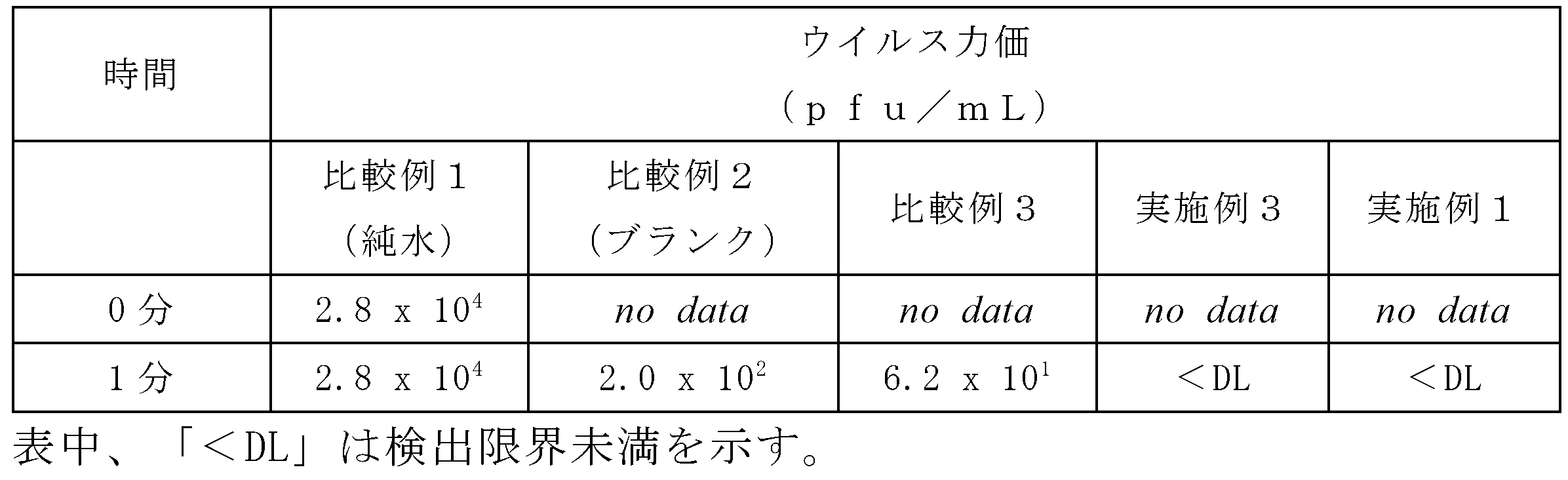
表1、表2及び表3の結果からわかるように、実施例3及び実施例1はどちらも1分間の暴露で単純ヘルペスウイルス、アデノウイルス及びインフルエンザウイルスに対する不活化効果を示した。一方、比較例3は、単純ヘルペスウイルスに対しては30分間の暴露でも不活化効果を示さず、アデノウイルスに対しては1時間の暴露でも不活化効果を示さなかった。一方、インフルエンザウイルスはブランクのクエン酸ナトリウム液(比較例2)でおよそ1%にまでウイルスが不活化され、比較例3でわずかな不活化の増強が認められた。
白金及び銀は共に貴な金属に分類され、かつ、金属のイオン化傾向の序列において両者は隣接することから、白金と銀は性質の類似性が極めて高い金属であることが知られている。これにもかかわらず、実施例1及び3のような白金粒子を含むサンプル液が非常に高い抗ウイルス効果を示す一方、銀粒子単独(比較例3)では全く効果を示さないことは、予想外の結果であるといえる。従来、白金、銀、銅等の貴な金属が一定の抗菌効果を示すことは知られているところ、表1、表2及び表3の結果は、貴な金属の中でも白金粒子を含む場合のみが極めて特異的に抗ウイルス効果を発現することを本発明者らが見出したことを実証している。
(実験2)
次に、ブランク液では全く不活化されない単純ヘルペスウイルスとアデノウイルスを対象に、実施例3と実施例1について、反応時間を10分とし、実施例3と実施例1で準備した原液(水分散液)をクエン酸ナトリウム水溶液(比較例2)で希釈して、より低濃度におけるウイルス不活化効果を検討した。抗ウイルス性試験方法は実験1と同じである。
サンプル液の代わりに比較例1(純水)を用いた場合のウイルス力価をコントロール(100%)とし、コントロールに対するパーセンテージ(3回以上のアッセイの平均値)で示したのが表4及び表5である。表4が単純ヘルペスウイルス、表5がアデノウイルスに対する抗ウイルス性試験の結果を示している。
次に、ブランク液では全く不活化されない単純ヘルペスウイルスとアデノウイルスを対象に、実施例3と実施例1について、反応時間を10分とし、実施例3と実施例1で準備した原液(水分散液)をクエン酸ナトリウム水溶液(比較例2)で希釈して、より低濃度におけるウイルス不活化効果を検討した。抗ウイルス性試験方法は実験1と同じである。
サンプル液の代わりに比較例1(純水)を用いた場合のウイルス力価をコントロール(100%)とし、コントロールに対するパーセンテージ(3回以上のアッセイの平均値)で示したのが表4及び表5である。表4が単純ヘルペスウイルス、表5がアデノウイルスに対する抗ウイルス性試験の結果を示している。


表4及び表5を参照し、ヘルペスウイルス及びアデノウイルスに対する抗ウイルス効果を比較した場合、白金粒子を含むサンプル液(銀粒子は含まない;実施例3)は、アデノウイルスに対し、16倍希釈でも検出限界以下であり、256倍希釈でさえも十分な抗ウイルス効果が示されていることがわかる。この結果は、本発明の抗ウイルス剤が特にアデノウイルスに対して優れた抗ウイルス効果を発揮することを本発明者らが見出したことを実証しているといえる。
また、実施例1の各サンプル液中の白金粒子の含有量は、同じ希釈倍率の実施例3のサンプル液中の白金粒子の含有量よりも少ないことから、前述のように銀粒子が抗ウイルス効果を全く示さないことを考慮すれば、実施例1は実施例3よりも低い抗ウイルス効果を示すと予測された(例えば、実施例1及び実施例3の白金含有量の比を考えれば、1.5倍程度の差が生じると考えられた)。しかしながら、むしろ抗ウイルス効果を示さない銀を加えることによって、全ての場合に抗ウイルス効果が数倍以上向上することがわかった。以上の結果から、抗ウイルス性を発現する白金粒子と、抗ウイルス性を示さない銀粒子とを組み合わせることによって、むしろ抗ウイルス効果が数倍以上向上をすること(相乗効果)を本発明者らが初めて見出したものであるといえる。
白金は銀に比べて50~100倍の市場価格であることを考えれば、白金を銀に代替することで抗ウイルス効果が数倍向上することを見出したことの経済的意味も大きいといえる。
(実験3)
次に、実施例1(白金を100質量ppm、銀を66質量ppm含む分散液)と実施例2(白金を100質量ppm、銀を20質量ppm含む分散液)について、反応時間10分としてウイルス不活化効果を検討した。希釈倍率は単純ヘルペスウイルスでは16倍、アデノウイルスでは256倍とした。抗ウイルス性試験方法は実験1と同じである。
次に、実施例1(白金を100質量ppm、銀を66質量ppm含む分散液)と実施例2(白金を100質量ppm、銀を20質量ppm含む分散液)について、反応時間10分としてウイルス不活化効果を検討した。希釈倍率は単純ヘルペスウイルスでは16倍、アデノウイルスでは256倍とした。抗ウイルス性試験方法は実験1と同じである。
表6には、単純ヘルペスウイルスに対する不活化効果をウイルス力価とコントロールに対するパーセンテージとで示し、表7には、アデノウイルスに対する不活化効果をウイルス力価とコントロールに対するパーセンテージとで示した(対照として比較例1も同表に掲載)。
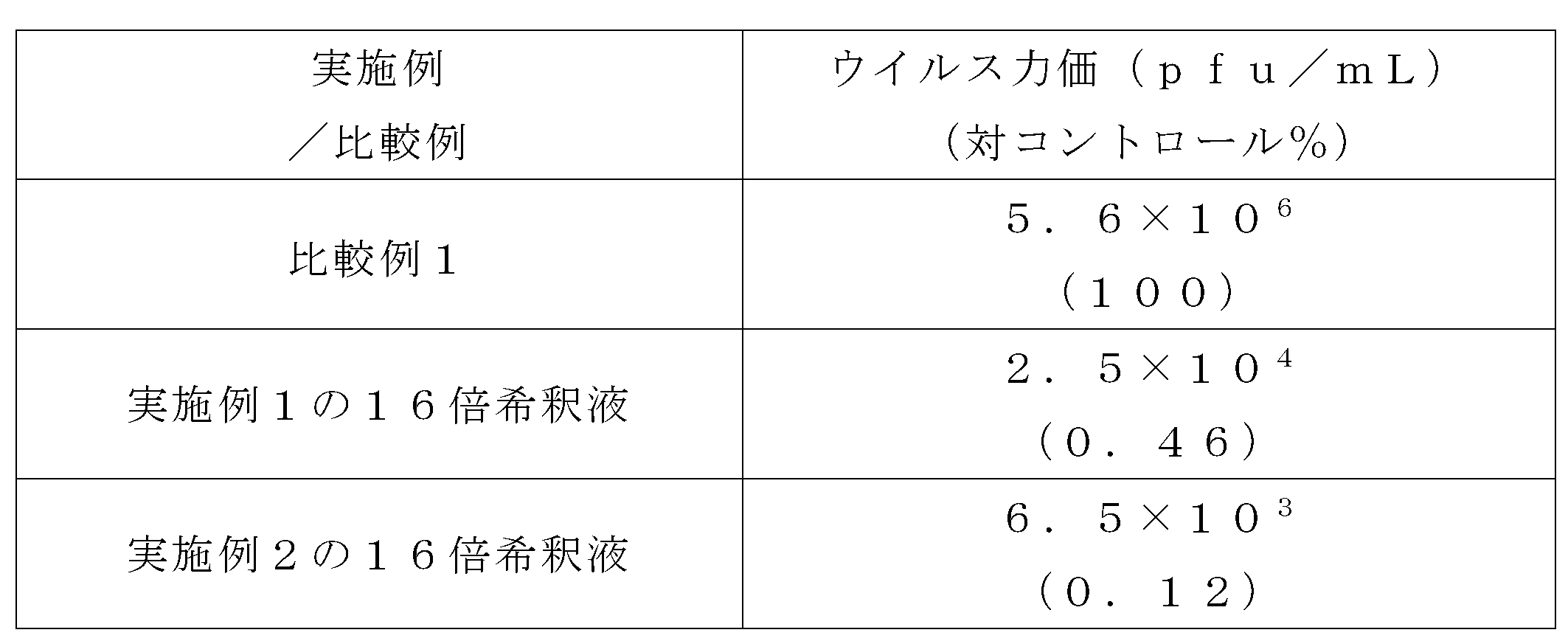
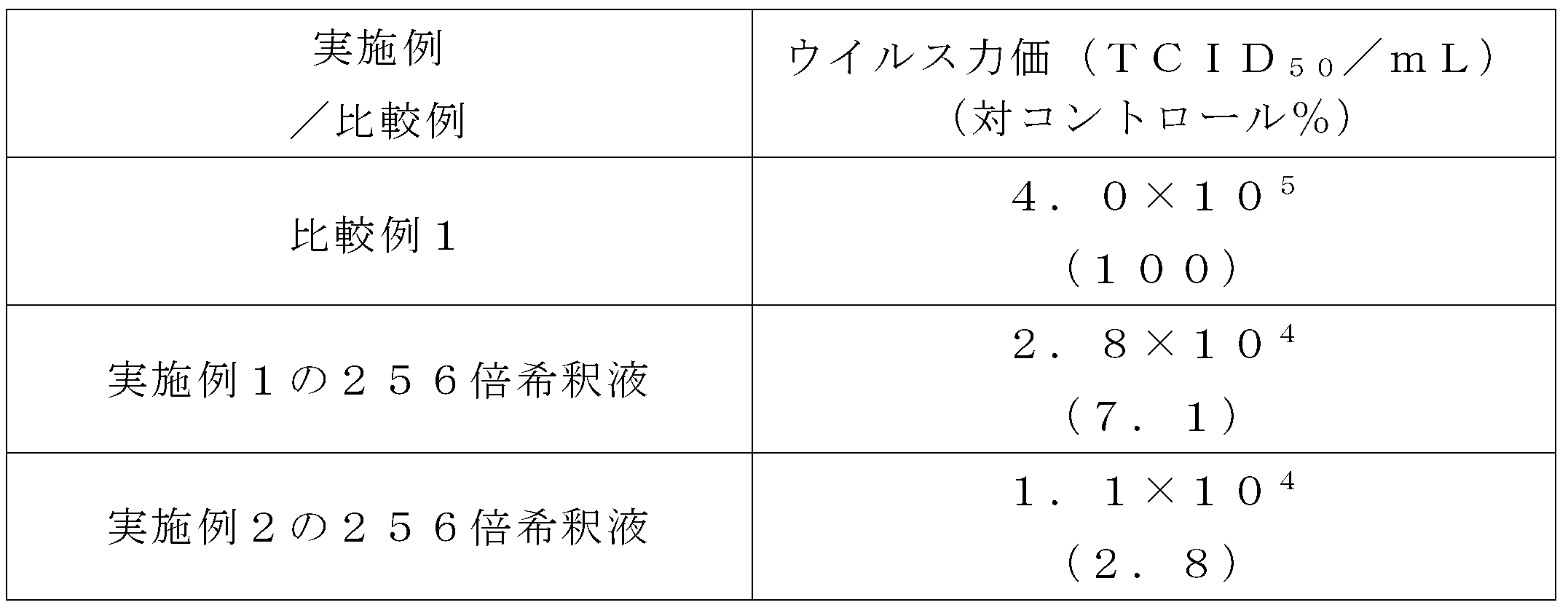
表6及び表7に示した結果から、実施例1と実施例2はどちらも単純ヘルペスウイルスとアデノウイルスの両者に対して良好な不活化効果を有することがわかった。
以上の結果から、白金粒子を含有する抗ウイルス剤、並びに白金粒子及び銀粒子を含有する抗ウイルス剤は、単純ヘルペスウイルス、アデノウイルス及びインフルエンザウイルス等のウイルスを速やかに不活性化できることがわかった。実施例1及び実施例2の白金粒子及び銀粒子を含む分散液では、濃度が低くとも(有効成分の濃度が低くとも)、抗ウイルス効果を発揮できることがわかった。また、実施例3の白金粒子を含有する抗ウイルス剤では、銀粒子を含まずともアデノウイルスに対して優れた抗ウイルス効果を発揮できることがわかった。
Claims (10)
- 金属粒子を含有する抗ウイルス剤であって、
前記金属粒子が白金粒子を含有する、抗ウイルス剤。 - 前記金属粒子は、さらに銀粒子を含有する、請求項1に記載の抗ウイルス剤。
- 前記白金粒子100質量部あたり、前記銀粒子が0.01~1000質量部含まれる、請求項2に記載の抗ウイルス剤。
- 前記金属粒子が水系溶媒に分散している、請求項1~3のいずれか1項に記載の抗ウイルス剤。
- 前記金属粒子の総量は、前記水系溶媒の全質量に対して0.01~1000質量ppmである、請求項4に記載の抗ウイルス剤。
- 対象ウイルスがノンエンベロープウイルスである、請求項1~5のいずれか1項に記載の抗ウイルス剤。
- 対象ウイルスが単純ヘルペスウイルス、アデノウイルス及びインフルエンザウイルスからなる群より選ばれる1種以上を含む、請求項1~5のいずれか1項に記載の抗ウイルス剤。
- 医療器具に使用される、請求項1~7のいずれか1項に記載の抗ウイルス剤。
- 前記医療器具が眼科用である、請求項1~8のいずれか1項に記載の抗ウイルス剤。
- 請求項1~9のいずれか1項に記載の抗ウイルス剤を使用する、ウイルスの不活性化方法。
Priority Applications (2)
| Application Number | Priority Date | Filing Date | Title |
|---|---|---|---|
| CN202080012642.7A CN113395901A (zh) | 2019-02-06 | 2020-02-05 | 抗病毒剂以及病毒的去除方法 |
| JP2020542332A JP6820579B2 (ja) | 2019-02-06 | 2020-02-05 | 抗ウイルス剤及びウイルスの除去方法 |
Applications Claiming Priority (2)
| Application Number | Priority Date | Filing Date | Title |
|---|---|---|---|
| JP2019-020116 | 2019-02-06 | ||
| JP2019020116 | 2019-02-06 |
Publications (1)
| Publication Number | Publication Date |
|---|---|
| WO2020162485A1 true WO2020162485A1 (ja) | 2020-08-13 |
Family
ID=71947967
Family Applications (1)
| Application Number | Title | Priority Date | Filing Date |
|---|---|---|---|
| PCT/JP2020/004291 Ceased WO2020162485A1 (ja) | 2019-02-06 | 2020-02-05 | 抗ウイルス剤及びウイルスの除去方法 |
Country Status (3)
| Country | Link |
|---|---|
| JP (2) | JP6820579B2 (ja) |
| CN (1) | CN113395901A (ja) |
| WO (1) | WO2020162485A1 (ja) |
Cited By (4)
| Publication number | Priority date | Publication date | Assignee | Title |
|---|---|---|---|---|
| WO2021261467A1 (ja) * | 2020-06-23 | 2021-12-30 | 佐々木化学工業株式会社 | クエン酸水素二銀含有組成物及びその製造方法、並びにこれを用いた抗菌剤又は抗ウイルス剤及びその製造方法 |
| JP2022164635A (ja) * | 2021-04-16 | 2022-10-27 | 佐々木化学工業株式会社 | クエン酸水素二銀含有組成物及びその製造方法、並びにこれを用いた抗菌剤又は抗ウイルス剤及びその製造方法 |
| JPWO2023234239A1 (ja) * | 2022-05-30 | 2023-12-07 | ||
| WO2023234242A1 (ja) | 2022-05-30 | 2023-12-07 | 信越化学工業株式会社 | 抗ウイルス性組成物及び該組成物を表面に有する部材 |
Citations (5)
| Publication number | Priority date | Publication date | Assignee | Title |
|---|---|---|---|---|
| JP2005272307A (ja) * | 2004-03-23 | 2005-10-06 | Dd Planning Kk | 抗菌・防カビ・消臭剤の噴霧方法及びその噴霧装置 |
| JP2013241368A (ja) * | 2012-05-21 | 2013-12-05 | Bio Epoch Kk | 白金水溶液及び水溶性切削液浄化装置 |
| JP2014098546A (ja) * | 2010-12-24 | 2014-05-29 | Bioface Co Ltd Tokyo Research Laboratory | プラチナシールド技術、プラチナ触媒化学技術、プラチナ固定技術のいずれかを用いた家電製品、及び加湿器 |
| JP2018035427A (ja) * | 2016-09-02 | 2018-03-08 | 株式会社サンテック | 白金ナノコロイドの製造方法と粒度分布幅の狭く安定性の高いシングルナノ白金コロイド水溶液 |
| JP2018135347A (ja) * | 2015-11-09 | 2018-08-30 | 大阪ガスケミカル株式会社 | 微生物防除剤及び殺ダニ組成物 |
Family Cites Families (6)
| Publication number | Priority date | Publication date | Assignee | Title |
|---|---|---|---|---|
| CN1552205A (zh) | 2003-05-30 | 2004-12-08 | 中国科学院大连化学物理研究所 | 具有吸附和杀灭病毒活性的纳米催化剂 |
| DE102008039072A1 (de) * | 2008-08-21 | 2010-02-25 | Bayer Materialscience Ag | Elektrodenmaterial, Elektrode und ein Verfahren zur Chlorwasserstoffelektrolyse |
| US20120294923A1 (en) | 2009-12-01 | 2012-11-22 | Sumitomo Chemical Company, Limited | Antiviral agent and antiviral agent functional product using the same |
| CN107180665A (zh) * | 2016-03-11 | 2017-09-19 | 上海卡翱投资管理合伙企业(有限合伙) | 应用于低温共烧陶瓷的灌孔过渡金铂银孔浆及其制备方法 |
| WO2017170878A1 (ja) * | 2016-03-30 | 2017-10-05 | 大阪ガスケミカル株式会社 | 養蜂部材及びその製造方法 |
| TWI702051B (zh) * | 2019-01-09 | 2020-08-21 | 張文禮 | 高效奈米淡斑、亮白、保濕活化劑及其製法 |
-
2020
- 2020-02-05 WO PCT/JP2020/004291 patent/WO2020162485A1/ja not_active Ceased
- 2020-02-05 CN CN202080012642.7A patent/CN113395901A/zh active Pending
- 2020-02-05 JP JP2020542332A patent/JP6820579B2/ja active Active
- 2020-12-18 JP JP2020210826A patent/JP7509370B2/ja active Active
Patent Citations (5)
| Publication number | Priority date | Publication date | Assignee | Title |
|---|---|---|---|---|
| JP2005272307A (ja) * | 2004-03-23 | 2005-10-06 | Dd Planning Kk | 抗菌・防カビ・消臭剤の噴霧方法及びその噴霧装置 |
| JP2014098546A (ja) * | 2010-12-24 | 2014-05-29 | Bioface Co Ltd Tokyo Research Laboratory | プラチナシールド技術、プラチナ触媒化学技術、プラチナ固定技術のいずれかを用いた家電製品、及び加湿器 |
| JP2013241368A (ja) * | 2012-05-21 | 2013-12-05 | Bio Epoch Kk | 白金水溶液及び水溶性切削液浄化装置 |
| JP2018135347A (ja) * | 2015-11-09 | 2018-08-30 | 大阪ガスケミカル株式会社 | 微生物防除剤及び殺ダニ組成物 |
| JP2018035427A (ja) * | 2016-09-02 | 2018-03-08 | 株式会社サンテック | 白金ナノコロイドの製造方法と粒度分布幅の狭く安定性の高いシングルナノ白金コロイド水溶液 |
Cited By (9)
| Publication number | Priority date | Publication date | Assignee | Title |
|---|---|---|---|---|
| WO2021261467A1 (ja) * | 2020-06-23 | 2021-12-30 | 佐々木化学工業株式会社 | クエン酸水素二銀含有組成物及びその製造方法、並びにこれを用いた抗菌剤又は抗ウイルス剤及びその製造方法 |
| US12604898B2 (en) | 2020-06-23 | 2026-04-21 | Sasaki Chemical Industry Co., Ltd. | Disilver hydrogen citrate-containing composition, method for producing same, antibacterial agent or antiviral agent using same, and method for producing same |
| JP2022164635A (ja) * | 2021-04-16 | 2022-10-27 | 佐々木化学工業株式会社 | クエン酸水素二銀含有組成物及びその製造方法、並びにこれを用いた抗菌剤又は抗ウイルス剤及びその製造方法 |
| JP7710732B2 (ja) | 2021-04-16 | 2025-07-22 | 佐々木化学工業株式会社 | クエン酸水素二銀含有組成物及びその製造方法、並びにこれを用いた抗菌剤又は抗ウイルス剤及びその製造方法 |
| JPWO2023234239A1 (ja) * | 2022-05-30 | 2023-12-07 | ||
| WO2023234239A1 (ja) | 2022-05-30 | 2023-12-07 | 信越化学工業株式会社 | 抗ウイルス性組成物及び該組成物を表面に有する部材 |
| WO2023234242A1 (ja) | 2022-05-30 | 2023-12-07 | 信越化学工業株式会社 | 抗ウイルス性組成物及び該組成物を表面に有する部材 |
| KR20250016271A (ko) | 2022-05-30 | 2025-02-03 | 신에쓰 가가꾸 고교 가부시끼가이샤 | 항바이러스성 조성물 및 해당 조성물을 표면에 갖는 부재 |
| KR20250016272A (ko) | 2022-05-30 | 2025-02-03 | 신에쓰 가가꾸 고교 가부시끼가이샤 | 항바이러스성 조성물 및 해당 조성물을 표면에 갖는 부재 |
Also Published As
| Publication number | Publication date |
|---|---|
| CN113395901A (zh) | 2021-09-14 |
| JPWO2020162485A1 (ja) | 2021-02-18 |
| JP2021050234A (ja) | 2021-04-01 |
| JP7509370B2 (ja) | 2024-07-02 |
| JP6820579B2 (ja) | 2021-01-27 |
Similar Documents
| Publication | Publication Date | Title |
|---|---|---|
| JP7509370B2 (ja) | 抗ウイルス剤及びウイルスの除去方法 | |
| US4828912A (en) | Virucidal product having virucidal and/or germicidal properties | |
| US4897304A (en) | Virucidal composition, the method of use and the product therefor | |
| KR870002047B1 (ko) | 비루스 박멸용 조성물 및 제품 | |
| TWI407906B (zh) | 消毒劑 | |
| BR112021002911A2 (pt) | composições antipatogênicas e métodos das mesmas | |
| EP3012225A1 (en) | Nanoparticulate titanium dioxide nanomaterial modified with functional groups and with citric extracts adsorbed on the surface, for the removal of a wide range of microorganisms | |
| CN110917196B (zh) | 一种氯喹抑菌消毒液及其应用 | |
| WO2013012007A1 (ja) | 抗ウイルス剤組成物 | |
| JP7794814B2 (ja) | グラフェン-銀ナノコンポジット及び抗微生物組成物としてのその使用 | |
| JP5361533B2 (ja) | 環境物質処理剤 | |
| Pereira et al. | Inactivation of SARS-CoV-2 by a chitosan/α-Ag2WO4 composite generated by femtosecond laser irradiation | |
| JP5837346B2 (ja) | ウイルス不活化組成物 | |
| JP5189291B2 (ja) | 塩化セチルピリジニウムの殺ウイルス活性 | |
| JP2017105723A (ja) | カリシウイルス不活化効果を有する組成物 | |
| US12604898B2 (en) | Disilver hydrogen citrate-containing composition, method for producing same, antibacterial agent or antiviral agent using same, and method for producing same | |
| JP3187328U (ja) | 抗菌・抗ウイルス性病院用寝具及び衣類 | |
| JP5377098B2 (ja) | ノロウイルス不活性化剤 | |
| JP2015078132A (ja) | 抗ウイルス性組成物 | |
| CN110876684A (zh) | 一种免洗聚六亚甲基胍盐酸盐消毒剂的制备方法 | |
| WO2021256540A1 (ja) | ウイルス不活化製剤 | |
| JP2006188499A (ja) | 除ウイルス剤又は除真菌剤 | |
| JP2023079139A (ja) | 抗ウイルス剤 | |
| JP2022167716A (ja) | 抗菌及び抗ウイルス剤 | |
| Zinn et al. | Rapidly self-sterilizing PPE capable of destroying 100% of microbes in 30-60 seconds |
Legal Events
| Date | Code | Title | Description |
|---|---|---|---|
| ENP | Entry into the national phase |
Ref document number: 2020542332 Country of ref document: JP Kind code of ref document: A |
|
| 121 | Ep: the epo has been informed by wipo that ep was designated in this application |
Ref document number: 20752109 Country of ref document: EP Kind code of ref document: A1 |
|
| NENP | Non-entry into the national phase |
Ref country code: DE |
|
| 122 | Ep: pct application non-entry in european phase |
Ref document number: 20752109 Country of ref document: EP Kind code of ref document: A1 |