WO2020162335A1 - キサンテン化合物 - Google Patents
キサンテン化合物 Download PDFInfo
- Publication number
- WO2020162335A1 WO2020162335A1 PCT/JP2020/003567 JP2020003567W WO2020162335A1 WO 2020162335 A1 WO2020162335 A1 WO 2020162335A1 JP 2020003567 W JP2020003567 W JP 2020003567W WO 2020162335 A1 WO2020162335 A1 WO 2020162335A1
- Authority
- WO
- WIPO (PCT)
- Prior art keywords
- group
- xanthene compound
- compound according
- groups
- carbon atoms
- Prior art date
- Legal status (The legal status is an assumption and is not a legal conclusion. Google has not performed a legal analysis and makes no representation as to the accuracy of the status listed.)
- Ceased
Links
Classifications
-
- C—CHEMISTRY; METALLURGY
- C09—DYES; PAINTS; POLISHES; NATURAL RESINS; ADHESIVES; COMPOSITIONS NOT OTHERWISE PROVIDED FOR; APPLICATIONS OF MATERIALS NOT OTHERWISE PROVIDED FOR
- C09B—ORGANIC DYES OR CLOSELY-RELATED COMPOUNDS FOR PRODUCING DYES, e.g. PIGMENTS; MORDANTS; LAKES
- C09B11/00—Diaryl- or thriarylmethane dyes
- C09B11/28—Pyronines ; Xanthon, thioxanthon, selenoxanthan, telluroxanthon dyes
-
- C—CHEMISTRY; METALLURGY
- C07—ORGANIC CHEMISTRY
- C07C—ACYCLIC OR CARBOCYCLIC COMPOUNDS
- C07C209/00—Preparation of compounds containing amino groups bound to a carbon skeleton
- C07C209/68—Preparation of compounds containing amino groups bound to a carbon skeleton from amines, by reactions not involving amino groups, e.g. reduction of unsaturated amines, aromatisation, or substitution of the carbon skeleton
-
- C—CHEMISTRY; METALLURGY
- C07—ORGANIC CHEMISTRY
- C07C—ACYCLIC OR CARBOCYCLIC COMPOUNDS
- C07C211/00—Compounds containing amino groups bound to a carbon skeleton
- C07C211/01—Compounds containing amino groups bound to a carbon skeleton having amino groups bound to acyclic carbon atoms
- C07C211/25—Compounds containing amino groups bound to a carbon skeleton having amino groups bound to acyclic carbon atoms of an unsaturated carbon skeleton containing rings other than six-membered aromatic rings
-
- C—CHEMISTRY; METALLURGY
- C07—ORGANIC CHEMISTRY
- C07D—HETEROCYCLIC COMPOUNDS
- C07D311/00—Heterocyclic compounds containing six-membered rings having one oxygen atom as the only hetero atom, condensed with other rings
- C07D311/02—Heterocyclic compounds containing six-membered rings having one oxygen atom as the only hetero atom, condensed with other rings ortho- or peri-condensed with carbocyclic rings or ring systems
- C07D311/78—Ring systems having three or more relevant rings
- C07D311/80—Dibenzopyrans; Hydrogenated dibenzopyrans
- C07D311/82—Xanthenes
-
- C—CHEMISTRY; METALLURGY
- C09—DYES; PAINTS; POLISHES; NATURAL RESINS; ADHESIVES; COMPOSITIONS NOT OTHERWISE PROVIDED FOR; APPLICATIONS OF MATERIALS NOT OTHERWISE PROVIDED FOR
- C09B—ORGANIC DYES OR CLOSELY-RELATED COMPOUNDS FOR PRODUCING DYES, e.g. PIGMENTS; MORDANTS; LAKES
- C09B67/00—Influencing the physical, e.g. the dyeing or printing properties of dyestuffs without chemical reactions, e.g. by treating with solvents grinding or grinding assistants, coating of pigments or dyes; Process features in the making of dyestuff preparations; Dyestuff preparations of a special physical nature, e.g. tablets, films
- C09B67/006—Preparation of organic pigments
Definitions
- the present invention relates to a xanthene compound.
- Xanthene compounds are used as light absorbers, sensitizers, dyes, etc. as photosensitive photographic materials, dyes, paints, inks, electrophotographic photoreceptors, toners, thermal recording papers, transfer ribbons, optical recording dyes, solar cells, photoelectric conversion elements. Widely used in semiconductor materials, clinical test reagents, dyes for laser therapy, and dyeing.
- Patent Document 1 discloses a xanthene compound having a specific structure.
- the xanthene compound is described in the same literature as being excellent in heat resistance and useful as a dye for a coloring composition.
- the present invention provides the following [1] to [16].
- R 1 , R 2 , R 3 , R 4 , R 5 , R 6 , R 7 , R 8 , R 9 and R 10 are each independently a hydrogen atom, a hydroxy group, a nitro group, a cyano group, One or two or more of a halogen atom, a carboxy group, a sulfo group, a sulfamoyl group, a metallocenyl group, a hydrocarbon group having 1 to 30 carbon atoms, or a methylene group in the hydrocarbon group is a divalent group selected from Group I below.
- the hydrogen atom contained in the above hydrocarbon group is substituted with a halogen atom, a nitro group, a cyano group, a hydroxy group, an amino group, a carboxy group, a sulfo group, a phosphono group, a sulfamoyl group, an isocyanato group, or a heterocyclic group.
- R 11 , R 12 , R 13 , R 14 , R 15 and R 16 are each independently a hydrogen atom, a heterocyclic group, a hydrocarbon group having 1 to 30 carbon atoms, or a methylene group in the hydrocarbon group.
- One or two or more represent a group substituted with a divalent group selected from the following group I, provided that two or more methylene groups are replaced with a divalent group selected from the following group I , The divalent groups are not next to each other,
- the hydrogen atom contained in the hydrocarbon group may be substituted with a heterocyclic group or a polar group,
- One or more of R 11 , R 12 , R 13 , R 14 , R 15 and R 16 is a group having a polar group as a substituent, n represents an integer of 1 to 3,
- a q ⁇ represents a q-valent anion, q represents an integer of 1 to 3, and p represents a coefficient for keeping the charge neutral.
- Group I —O—, —S—, —CO—, —COO—, —OCO—, —COS—, —OCS—, —SO 2 —, —SO 3 —, —NH—, —CONH—, — NHCO—, —SO 2 NH—, —NH—SO 2 — or —N ⁇ CH—.
- At least one group selected from the group consisting of R 7 and R 9 is independently a hydroxy group, a nitro group, a cyano group, a halogen atom, a carboxy group, a sulfo group, a sulfamoyl group, a hydrocarbon having 1 to 30 carbon atoms.
- At least one of R 11 , R 12 , R 13 , R 14 , R 15 and R 16 is a hydrocarbon group having 1 to 30 carbon atoms and substituted with a carboxy group, [1] to [5] The xanthene compound according to any one of claims.
- R 11 , R 12 , R 13 and R 14 are groups having a polar group, and R 15 and R 16 are unsubstituted hydrocarbon groups having 1 to 30 carbon atoms, [1 ] The xanthene compound as described in any one of [7].
- R 11 , R 12 , R 13 and R 14 are unsubstituted hydrocarbon groups having 1 to 30 carbon atoms, and R 15 and R 16 are groups having a polar group, [1] to [7]
- R 11 , R 12 , R 13 , R 14 , R 15 and R 16 are each independently a C 1-10 alkyl group having a polar group or having no polar group, [1] to [ 13] The xanthene compound according to any one of [13].
- a xanthene compound having high resistance to an organic solvent can be provided.
- the xanthene compound of the present invention has a structure represented by the above formula (I).
- halogen atoms represented by R 1 , R 2 , R 3 , R 4 , R 5 , R 6 , R 7 , R 8 , R 9 and R 10 and R 1 , R 2 , R 3 , R 4 , R 5 , R 6 , R 7 , R 8 , R 9 and R 10 may be substituted with a hydrogen atom contained in the hydrocarbon group, and examples of the halogen atom include fluorine, chlorine, bromine and Examples include iodine.
- the halogen atoms represented by R 1 , R 2 , R 3 , R 4 , R 5 , R 7 , R 8 , R 9 and R 10 may be the same or different.
- the halogen atom is preferably chlorine because the wavelength range of the ultraviolet/visible absorption spectrum of the compound is narrowed.
- the carbon number of the group defined in the present invention includes the carbon number of the substituent unless otherwise specified.
- the hydrocarbon group having 1 to 30 carbon atoms represented by R 16 is not particularly limited, and examples thereof include an alkyl group having 1 to 20 carbon atoms, an alkenyl group having 2 to 20 carbon atoms, and a carbon number. Examples thereof include a cycloalkyl group having 3 to 20 carbon atoms, a cycloalkylalkyl group having 4 to 20 carbon atoms, an aryl group having 6 to 30 carbon atoms, an arylalkyl group having 7 to 30 carbon atoms, and an arylalkenyl group having 8 to 30 carbon atoms. ..
- the hydrocarbon groups having 1 to 30 carbon atoms represented by R 1 , R 2 , R 3 , R 4 , R 5 , R 7 , R 8 , R 9 and R 10 may be the same or different. Good. In the present invention, the wavelength range of the ultraviolet/visible absorption spectrum of the compound is narrowed and the extinction coefficient per weight of the compound is increased. Therefore, the hydrocarbon group having 1 to 30 carbon atoms has 1 to 20 carbon atoms. Is preferably an alkyl group of
- the alkyl group having 1 to 20 carbon atoms may be linear or branched.
- linear alkyl groups include methyl, ethyl, propyl, butyl, amyl, hexyl, heptyl, octyl, nonyl, decyl, undecyl, dodecyl, tetradecyl, hexadecyl, octadecyl and icosyl.
- branched alkyl groups include isopropyl, isobutyl, s-butyl, t-butyl, isoamyl, t-amyl, isooctyl, 2-ethylhexyl, t-octyl, isononyl and isodecyl.
- a straight chain compound is preferable because the compound can be synthesized more easily.
- an alkyl group having 1 to 10 carbon atoms is preferable, and an alkyl group having 1 to 4 carbon atoms is more preferable, because the extinction coefficient per weight of the compound becomes high.
- the alkenyl group having 2 to 20 carbon atoms may be chain-shaped or cyclic. When the alkenyl group is chain-like, it may be a terminal alkenyl group having an unsaturated bond at the terminal or an internal alkenyl group having an unsaturated bond inside. Examples of the terminal alkenyl group having 2 to 20 carbon atoms include vinyl, 2-propenyl, 3-butenyl, 4-pentenyl, 5-hexenyl and the like.
- Examples of the internal alkenyl group include 2-butenyl, 3-pentenyl, 2-hexenyl, 3-hexenyl, 2-heptenyl, 3-heptenyl, 4-heptenyl, 3-octenyl, 3-nonenyl, 4-decenyl, 3- Undecenyl, 4-dodecenyl and the like can be mentioned.
- Examples of the cyclic alkenyl group include 3-cyclohexenyl, 2,5-cyclohexadienyl-1-methyl, 4,8,12-tetradecatrienylallyl and the like.
- an alkenyl group having 2 to 10 carbon atoms is preferable because it facilitates the synthesis of the compound.
- the number of —C ⁇ C— is preferably 1 or 2 from the viewpoint of producing isomers.
- the cycloalkyl group having 3 to 20 carbon atoms means a saturated monocyclic or saturated polycyclic alkyl group having 3 to 20 carbon atoms in total.
- saturated monocyclic alkyl group include cyclopropyl, cyclobutyl, cyclopentyl, cyclohexyl, cycloheptyl, cyclooctyl, cyclononyl and cyclodecyl.
- Examples of the saturated polycyclic alkyl group include adamantyl, decahydronaphthyl, octahydropentalene, bicyclo[1.1.1]pentanyl, tetradecahydroanthracenyl and the like.
- a cycloalkyl group having 3 to 10 carbon atoms is preferable because it has a high extinction coefficient per weight of the compound.
- a monocyclic alkyl group is preferable because the width of the wavelength range of the ultraviolet/visible absorption spectrum of the compound is narrowed.
- the cycloalkylalkyl group having 4 to 20 carbon atoms means a group in which a hydrogen atom of an alkyl group is replaced with a cycloalkyl group and which has 4 to 20 carbon atoms in total.
- the cycloalkyl group in the cycloalkylalkyl group may be monocyclic or polycyclic.
- Examples of the cycloalkyl group having 4 to 20 carbon atoms in which the cycloalkyl group is a monocycle include, for example, cyclopropylmethyl, cyclobutylmethyl, cyclopentylmethyl, cyclohexylmethyl, cycloheptylmethyl, cyclooctylmethyl, cyclononylmethyl and cyclo Cycloalkylmethyl such as decylmethyl; cyclo such as 2-cyclobutylethyl, 2-cyclopentylethyl, 2-cyclohexylethyl, 2-cycloheptylethyl, 2-cyclooctylethyl, 2-cyclononylethyl and 2-cyclodecylethyl Alkylethyl; Cycloalkylpropyl such as 3-cyclobutylpropyl, 3-cyclopentylpropyl, 3-cyclohexylpropyl, 3-cycloheptylpropyl, 3-
- Examples of the cycloalkyl group having 4 to 20 carbon atoms in which the cycloalkyl group is polycyclic include bicyclo[1.1.0]butyl, bicyclo[1.1.1]pentyl and bicyclo[2.1.0]pentyl.
- a cycloalkylalkyl group having 4 to 10 carbon atoms is preferable because it has a high extinction coefficient per weight of the compound.
- the cycloalkyl group in the cycloalkylalkyl group having 4 to 10 carbon atoms is preferably a monocyclic ring because compound synthesis becomes easier.
- the aryl group having 6 to 30 carbon atoms may have a monocyclic structure or a condensed ring structure. Further, the aryl group may be a combination of a monocyclic aryl group and a monocyclic aryl group, and is a combination of a monocyclic aryl group and a condensed aryl group. Alternatively, the condensed aryl group may be linked to the condensed aryl group. Examples of the aryl group having a monocyclic structure include phenyl and biphenylyl. Examples of the aryl group having a condensed ring structure include naphthyl, anthryl and phenanthrenyl.
- the aryl group having 6 to 30 carbon atoms may have one or two or more substituents.
- substituents include the above alkyl group, the above alkenyl group, a carboxy group, and a halogen atom.
- aryl group having 6 to 30 carbon atoms having a substituent include tolyl, xylyl, ethylphenyl, 4-chlorophenyl, 4-carboxylphenyl, 4-vinylphenyl, 4-methylphenyl, 2,4,6-trimethyl. Examples thereof include substituted aryl groups having a monocyclic structure such as phenyl.
- an aryl group having 6 to 10 carbon atoms is preferable because it has a high extinction coefficient per weight of the compound.
- the aryl group preferably has a monocyclic structure because the wavelength range of the ultraviolet/visible absorption spectrum of the compound is narrowed.
- the above-mentioned arylalkyl group having 7 to 30 carbon atoms means a group in which one or more hydrogen atoms of the alkyl group are substituted with the above aryl group and which has a total of 7 to 30 carbon atoms.
- Examples of the arylalkyl group having 7 to 30 carbon atoms include benzyl, ⁇ -methylbenzyl, ⁇ , ⁇ -dimethylbenzyl, 2-phenylethyl, 2-phenylpropyl, 3-phenylpropyl, diphenylmethyl, triphenylmethyl and And phenylalkyl such as triphenylpropyl; and naphthylalkyl such as naphthylpropyl.
- an arylalkyl group having 7 to 20 carbon atoms is preferable because it has a high extinction coefficient per weight of the compound.
- the aryl group in the arylalkyl group is preferably a phenyl group or a naphthyl group because the width of the wavelength range of the ultraviolet/visible absorption spectrum of the compound is narrowed.
- the number of aryl groups in the arylalkyl group is preferably 1 to 3 because the extinction coefficient per weight of the compound is high.
- the aryl group in the arylalkyl group is preferably an alkyl group having 1 to 4 carbon atoms, and a straight chain alkyl group having 1 to 4 carbon atoms, because the width of the wavelength range of the ultraviolet/visible absorption spectrum of the compound is narrowed. Is preferred.
- the aryl group in the arylalkyl group is preferably located at the terminal of the alkyl group, because the compound is easier to synthesize. ..
- the above-mentioned arylalkenyl group having 8 to 30 carbon atoms means a group in which the hydrogen atom of the alkenyl group is substituted with an aryl group and has 8 to 30 carbon atoms in total.
- Examples of the arylalkenyl group having 8 to 30 carbon atoms include styrenyl, cinnamyl, 2-phenyl-2-propenyl, 3-phenyl-2-propenyl, 2-phenyl-4-pentenyl, 2-phenyl-4-hexenyl.
- 2,2-diphenylethylenyl, 3,3-phenyl-2-propenyl, 2-naphthyl-2-propenyl, 3-naphthyl-2-propenyl, 3-naphthyl-2-phenyl-2-propenyl, 5-anthracenyl -2-Phenyl-4-hexenyl, 5-anthracenyl-2-naphthyl-4-hexenyl and the like can be mentioned.
- an arylalkenyl group having 8 to 20 carbon atoms is preferable because it has a high extinction coefficient per weight of the compound.
- the aryl group in the arylalkenyl group is preferably a phenyl group or a naphthyl group because the width of the wavelength band of the ultraviolet/visible absorption spectrum of the compound is narrowed.
- the number of aryl groups in the arylalkenyl group is preferably 1 or 2 because the extinction coefficient per weight of the compound is high.
- the aryl group in the arylalkenyl group is preferably an alkyl group having 1 to 6 carbon atoms because the absorption coefficient per weight of the compound is high.
- the aryl group in the arylalkenyl group is preferably located at the terminal of the alkyl group, because the compound is easier to synthesize.
- the alkenyl group in the arylalkenyl group is preferably a chain because the width of the wavelength region of the ultraviolet/visible absorption spectrum of the compound is narrowed.
- the alkenyl group may be a terminal alkenyl group having an unsaturated bond at the terminal or an internal alkenyl group having an unsaturated bond inside.
- the heterocyclic group represented by R 11 , R 12 , R 13 , R 14 , R 15 and R 16 may be a monocyclic ring or a condensed ring structure. Further, the above-mentioned heterocyclic group may be a monocyclic heterocyclic group and a monocyclic heterocyclic group linked together, or a monocyclic heterocyclic group and a fused heterocyclic group linked together. Or a fused heterocyclic group and a fused heterocyclic group may be linked together.
- Examples of the monocyclic heterocyclic group include pyridyl, pyrimidyl, pyridazyl, piperazyl, piperidyl, pyranyl, pyrazolyl, triazyl, pyrrolidyl, imidazolyl, triazolyl, furyl, furanyl, thienyl, thiophenyl, thiadiazolyl, thiazolyl, oxazolyl, isothiazolyl, isoxazolyl.
- heterocyclic group having a condensed ring structure examples include heterocyclic groups having a condensed ring structure such as quinolyl, isoquinolyl, benzimidazolyl, benzofuranyl, benzothiophenyl, benzothiazolyl, benzoxazolyl and indolyl.
- Examples of the metallocenyl group represented by R 1 , R 2 , R 3 , R 4 , R 5 , R 6 , R 7 , R 8 , R 9 and R 10 include, for example, ferrocenyl, nickelocenyl, cobaltnyl, ferrocenealkyl, ferrocene. Examples thereof include alkoxy.
- one or more of the groups represented by R 11 , R 12 , R 13 , R 14 , R 15 and R 16 in the formula (I) is a group having a polar group as a substituent.
- the polar group means a polar atomic group.
- Specific examples of the polar group include a carboxy group, a hydroxy group, an amino group and a sulfonyl group. Of these, a carboxy group is preferable because the compound has high resistance to an organic solvent.
- a xanthene compound in which n in the formula (I) is 1 is preferable from the viewpoint of ease of synthesis.
- the anion represented by A q- in formula (I) may be a monovalent, divalent or trivalent anion depending on the value of q.
- a q ⁇ is a monovalent anion A ⁇
- examples of the A ⁇ include chloride ion (Cl ⁇ ), bromide ion (Br ⁇ ), iodide ion (I ⁇ ), and fluoride ion ( F -) halide ions such as; perchlorate ion (ClO 4 -), chlorate ion (ClO 3 -), nitrate ion (NO 3 -), nitrate ion (NO 3 -), thiocyanate ion (SCN - ), hexafluorophosphate ion (PF 6 ⁇ ), antimony hexafluoride ion (SbF 6 ⁇ ), aluminate tetrachloride ion (AlCl 4 ⁇
- carboxylate ion such as acetate ion (CH 3 CO 2 ⁇ ) and trifluoroacetate ion (CF 3 CO 2 ⁇ ); methanesulfonate ion (CH 3 SO 3 ⁇ ), benzenesulfonate ion, toluenesulfonate ion , Sulfonate ion of trifluoromethanesulfonate ion and vinylsulfonate ion; Alkylsulfate ion such as methylsulfate ion, ethylsulfate ion, butylsulfate ion; Alkylphosphate ion such as methylphosphate ion, ethylphosphate ion, butylphosphate ion Bis(trifluoromethanesulfonyl)imide ion ((CF 3 SO 2 ) 2 N ⁇ ), bis(perfluorobutanesulf
- the monovalent anion is particularly preferably a halide ion, an imide ion or a sulfonate ion.
- a halide ion a chloride ion is preferable because of ease of synthesis.
- the imide ion bis(trifluoromethanesulfonyl)imide ion is preferable because it has high resistance to an organic solvent.
- a benzenesulfonate ion such as 3-sulfobenzoate ion is preferable because it has high resistance to an organic solvent.
- a q ⁇ is a divalent anion A 2 ⁇
- examples of the A 2 ⁇ include tungstate ion, molybdate ion (MoO 4 2 ⁇ ) and chromate ion.
- examples of the A 3 ⁇ include phosphomolybdate ion, phosphotungstate ion, phosphotungstomolybdate ion and vanadate ion.
- the xanthene compound of the present invention has a narrow wavelength range of the ultraviolet/visible absorption spectrum of the compound, and therefore at least one group selected from the group consisting of R 7 and R 9 in the formula (I), particularly R 7 And R 9 is preferably a hydroxy group, a nitro group, a cyano group, a halogen atom, a carboxy group, a sulfo group, a sulfamoyl group, a hydrocarbon group having 1 to 30 carbon atoms or a metallocenyl group, and a halogen atom, a nitro group or A cyano group is more preferable, a halogen atom is further preferable, and a chlorine atom is particularly preferable.
- At least one group selected from the group consisting of R 1 , R 2 , R 3 , R 4 , R 5 , R 6 , R 8 and R 10 is preferably a hydrogen atom, and R 1 , It is preferable that all of R 2 , R 3 , R 4 , R 5 , R 6 , R 8 and R 10 are hydrogen atoms.
- the xanthene compound of the present invention has high resistance to an organic solvent, one or more of R 11 , R 12 , R 13 , R 14 , R 15 and R 16 in formula (I), preferably Two or more hydrogen atoms are preferably a hydrocarbon group having 1 to 30 carbon atoms, which is substituted with a carboxy group. Since the xanthene compound of the present invention has high resistance to an organic solvent, two or more of R 11 , R 12 , R 13 , R 14 , R 15 and R 16 in the formula (I) are polar. A group having a group is preferable.
- R 11 or R 12 in the formula (I) is a group having a polar group
- R 13 or R 14 is a polar group. It is preferably a group. From the same viewpoint, it is preferable that R 15 and R 16 are groups having a polar group. Since the xanthene compound of the present invention has high resistance to an organic solvent, two or more of R 11 , R 12 , R 13 and R 14 in the formula (I) are groups having a polar group. It is preferable that R 15 and R 16 are unsubstituted hydrocarbon groups having 1 to 30 carbon atoms.
- R 11 and R 13 in the formula (I) are groups having a polar group, and R 12 , R 14 , R 15 and R 16 are unsubstituted hydrocarbons having 1 to 30 carbon atoms. It is preferably a group. From the same viewpoint, R 11 , R 12 , R 13 and R 14 in the formula (I) are unsubstituted hydrocarbon groups having 1 to 30 carbon atoms, and R 15 and R 16 have polar groups. It is preferably a group.
- R 11 , R 12 , R 13 , R 14 , R 15 and R 16 in the formula (I) are: Independently, it is preferably a hydrocarbon group having 1 to 30 carbon atoms, more preferably an alkyl group having 1 to 20 carbon atoms, further preferably an alkyl group having 1 to 10 carbon atoms, An alkyl group of the number 1 to 4 is particularly preferable.
- n and q in the formula (I) are 1, that is, A q- is a monovalent anion because the compound can be easily synthesized.
- a q- is a monovalent anion
- a q- is preferably a halide ion, an imide ion or a sulfonate ion. Chloride ions are preferred as the halide ions.
- the imide ion a bis(trifluoromethanesulfonyl)imide ion is preferable.
- sulfonate ion benzene sulfonate ion such as 3-sulfobenzoate ion is preferable.
- xanthene compound of the present invention examples include compounds (I-1) to (I-30).
- the xanthene compound of the present invention is highly resistant to organic solvents such as chloroform, acetone, and toluene, that is, the xanthene compound of the present invention is insoluble in organic solvents.
- High resistance to an organic solvent means that it is not substantially dissolved in the organic solvent, or even if it is dissolved, the dissolved amount is a small amount of less than 0.5% by mass.
- the xanthene compound of the present invention is not substantially dissolved in chloroform, or even if it is dissolved, the dissolved amount is preferably less than 0.5% by mass, more preferably 0 to 0.4% by mass.
- the xanthene compound of the present invention is not substantially dissolved in acetone, or even if it is dissolved, the dissolved amount is preferably less than 0.5% by mass, more preferably 0 to 0.2% by mass, It is more preferably 0 to 0.1% by mass. Further, the xanthene compound of the present invention is not substantially dissolved in toluene, or even if it is dissolved, the dissolved amount thereof is preferably less than 0.5% by mass, more preferably 0 to 0.2% by mass, More preferably, it is insoluble in toluene. In the present specification, insoluble in an organic solvent means that the amount dissolved in the organic solvent is 0.01% by mass or less. The solubility of the xanthene compound in the organic solvent can be measured by the method described in Examples.
- the xanthene compound represented by the above formula (I) can be suitably produced, for example, by the following method.
- the xanthene compound of the present invention is used as a light absorber, a sensitizer, etc., as a photosensitive photographic material, dye, paint, ink, electrophotographic photoreceptor, toner, thermal recording paper, transfer ribbon, optical recording dye, solar cell, photoelectric conversion. It can be used for applications such as devices, semiconductor materials, clinical test reagents, dyes for laser treatment, and dyeing.
- Example 1 Synthesis of xanthene compound (I-1) 15.0 parts of 3-aminophenol and 187 parts of methanol were mixed and stirred at -5°C to obtain a reaction solution. After adding 8.8 parts of propyl aldehyde to the obtained reaction liquid and stirring for 10 minutes, 11.4 parts of sodium borohydride was added little by little, and it stirred for 4 hours. 2N hydrochloric acid was added to the reaction solution until the pH reached 4, and the precipitated solid was filtered off. The solvent of the filtrate was distilled off, ethyl acetate was added to the residue and the mixture was washed 3 times with water, and then the solvent was distilled off from the organic layer. The obtained liquid was dried in a vacuum oven at 60° C. to obtain 11.24 parts (54%) of compound S-2. LC/MS: 150 [M + ].
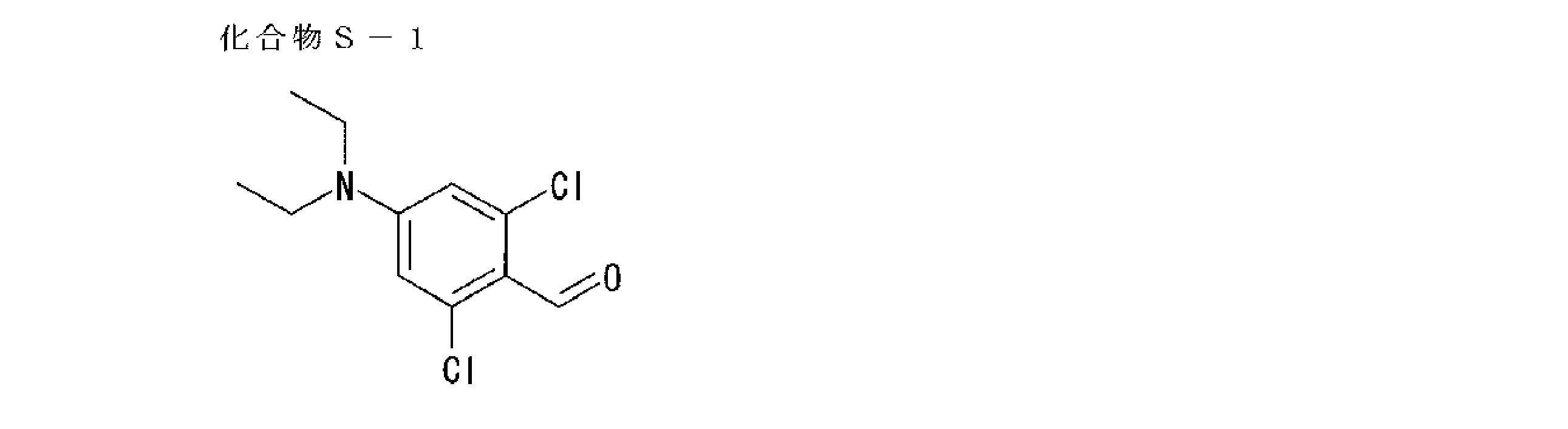
- reaction solution 4.3 parts of compound S-3, 2.0 parts of compound S-1 and 49.1 parts of trifluorosulfonic acid were mixed and stirred at 100° C. for 3 hours to obtain a reaction solution.
- the compound S-1 is represented by the following formula. After the reaction solution was cooled to room temperature, 100 parts of water was added to the reaction solution and then extracted with chloroform and ethyl acetate, and each organic layer was washed with water. The organic layers washed with water were combined and the solvent was distilled off. 3.5 parts of p-chloranil and 100 parts of acetonitrile were added to the residue, and the mixture was stirred at room temperature for 12 hours.
- Example 2 Synthesis of Xanthene Compound (I-2) 0.44 parts of xanthene compound (I-1), 0.35 parts of bis(trifluoromethanesulfonyl)lithium, and 6.7 parts of N,N. -Dimethyl sulfoxide was mixed and stirred at 50°C for 3 hours to obtain a reaction solution.
- the resulting reaction solution was added dropwise to 40 parts of 20% saline, and the precipitated solid was collected by filtration. The solid was dissolved in chloroform, the organic layer was washed with water, sodium sulfate was added and dried, the solvent was distilled off, and the residue was dried in a vacuum oven at 60° C., and the xanthene compound of the formula (I-2) 0. 43 parts (yield 74%) were obtained.
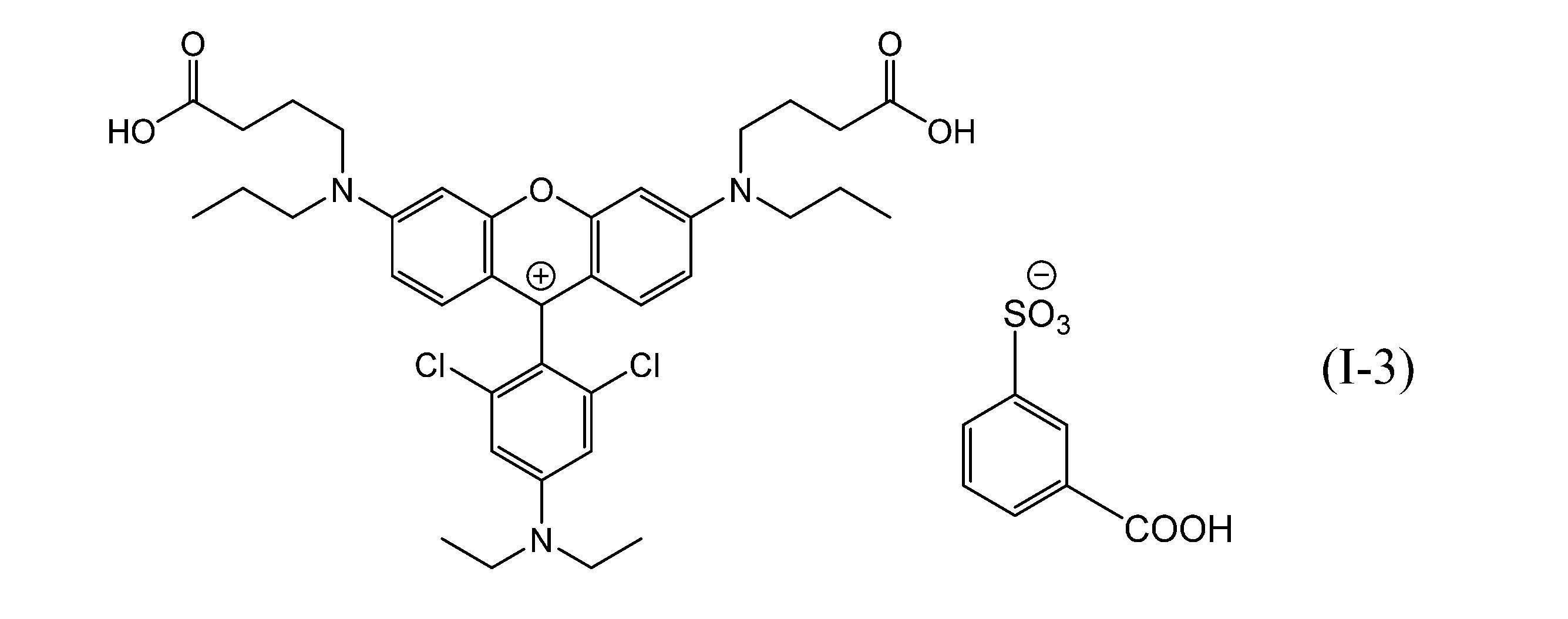
- Example 3 Synthesis of Xanthene Compound (I-3) A compound represented by the formula (I-3) in the same manner as in Example 2 except that bis(trifluoromethanesulfonyl)lithium was changed to sodium 3-sulfobenzoate. Xanthene compound (0.50 parts, yield 72%) was obtained.
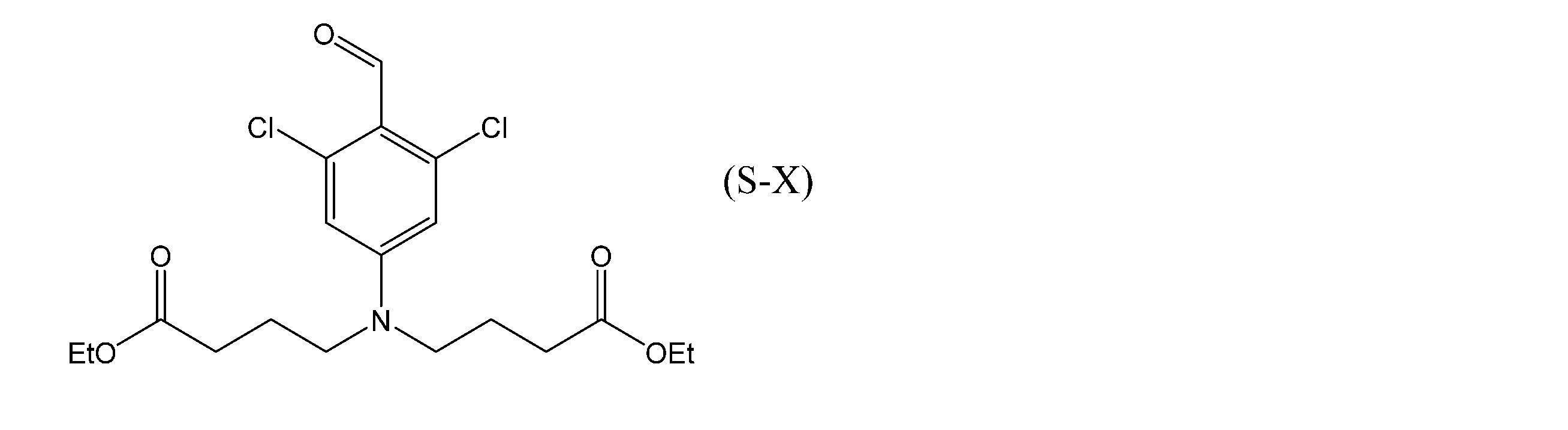
- Example 4 Synthesis of Xanthene Compound (I-4) 0.4 parts of N,N-diethylamino-3-phenol, 0.5 parts of compound SX, and 7.4 parts of trifluorosulfonic acid were added. The mixture was mixed and stirred at 100° C. for 3 hours to obtain a reaction liquid.
- the compound SX is represented by the following formula. After cooling the reaction solution to room temperature, the reaction solution was added to 50 parts of water, extracted with chloroform and ethyl acetate, and each organic layer was washed with water. The organic layers washed with water were combined and the solvent was distilled off.
- the obtained solid was dispersed and washed with a mixed solution of ethyl acetate-hexane (3:1) for 3 hours, dried and then dissolved in 5 parts of concentrated hydrochloric acid to obtain a solution.
- the obtained solution was filtered with a filter, the filtrate was crystallized with 20% saline, and the solution was neutralized with a 25% aqueous sodium hydroxide solution until the pH became 4.
- the precipitated solid was collected by filtration and dried in a vacuum oven at 60° C. to obtain 0.21 part (yield 24%) of the xanthene compound represented by the formula (I-4).
- Example 5 Synthesis of Xanthene Compound (I-5) A compound represented by the formula (I-5) was prepared in the same manner as in Example 2 except that the xanthene compound (I-1) was changed to the xanthene compound (I-4). 0.55 parts (yield 67%) of the obtained xanthene compound was obtained.
- Example 6 Synthesis of Xanthene Compound (I-6) A compound represented by the formula (I-6) was prepared in the same manner as in Example 3 except that the xanthene compound (I-1) was changed to the xanthene compound (I-4). 0.51 part (yield 76%) of the xanthene compound to be obtained was obtained.
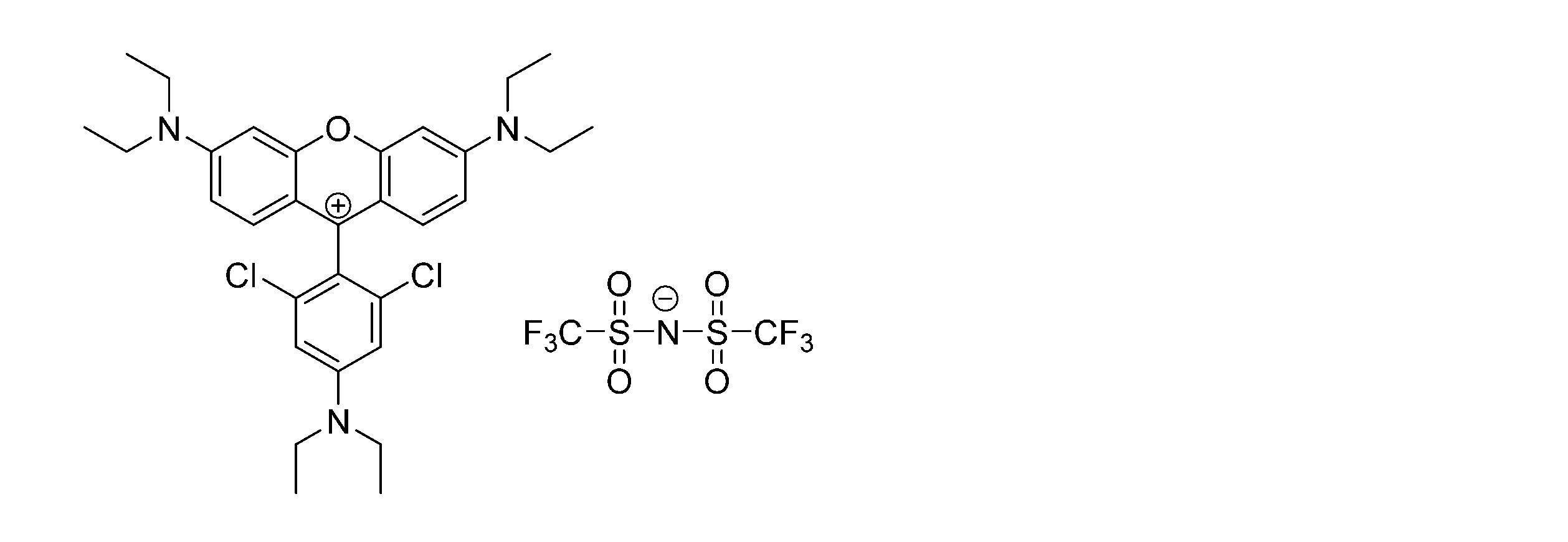
- Comparative xanthene compound 1 The following compounds were used as comparative xanthene compound 1.
- Solubility of the xanthene compound (I-1) of Example 1 and the comparative xanthene compound 1 of Comparative Example 1 in an organic solvent was measured by the following method. 0.10 g of each of the xanthene compound (I-1) and the comparative xanthene compound 1 was measured in a 50 mL sample tube. Chloroform was added to the sample tube, shaken for 3 minutes, and allowed to stand for 1 minute. The concentration at which crystals did not precipitate was determined and used as the solubility of the xanthene compound in chloroform. The measurement was carried out by continuing the addition of chloroform to the solution containing 10% by mass of the xanthene compound until crystals did not precipitate. The measurement was performed at room temperature (23° C.). The results are shown in Table 1. The solubility of the xanthene compound in acetone and toluene was measured by the same procedure. The results are shown in Table 1.
- the xanthene compound (I-1) of Example 1 has a solubility of 0.5% or less in an organic solvent such as chloroform, acetone, and toluene, and the resistance to the organic solvent is Therefore, it can be seen that it can be suitably used as a dye.
- the comparative xanthene compound 1 has a solubility in an organic solvent of more than 0.5%, which means that it is less suitable as a dye than the xanthene compound (I-1) of Example 1.
Landscapes
- Chemical & Material Sciences (AREA)
- Organic Chemistry (AREA)
- Chemical Kinetics & Catalysis (AREA)
- Pyrane Compounds (AREA)
- Organic Low-Molecular-Weight Compounds And Preparation Thereof (AREA)
- Compositions Of Macromolecular Compounds (AREA)
Abstract
有機溶媒に対する耐性が高いキサンテン化合物を提供すること。 式(I)で表されるキサンテン化合物。式(I)中のR11、R12、R13、R14、R15及びR16のうちの1つ以上が、置換基として極性基を有する基である。R7及びR9からなる群から選ばれる少なくとも1つの基が、ヒドロキシ基、ニトロ基、シアノ基、ハロゲン原子、カルボキシ基、スルホ基、スルファモイル基、メタロセニル基又は炭素数1~30の炭化水素基であることが好ましい。R11、R12、R13、R14、R15及びR16のうち1つ以上が、置換基としてカルボキシ基を有する基であることが好ましい。
Description
本発明はキサンテン化合物に関する。
キサンテン化合物は、光吸収剤、増感剤、染料等として、感光写真材料、染物、塗料、インク、電子写真感光体、トナー、感熱記録紙、転写リボン、光学記録色素、太陽電池、光電変換素子、半導体材料、臨床検査試薬、レーザー治療用色素、染色等に広く用いられている。
特許文献1には、特定の構造を有するキサンテン化合物が開示されている。該キサンテン化合物は、耐熱性に優れ、着色組成物の色素として有用なものであると同文献には記載されている。
ところでキサンテン化合物を染料として用いる場合、クロロホルム、アセトン及びトルエン等の有機溶媒に対して0.5質量%を超えて溶解しないことが要求されている。換言すれば有機溶媒に対する高い耐性がキサンテン化合物に要求されている。しかし、本発明者が追試したところ、特許文献1に記載のキサンテン化合物は有機溶媒に対する耐性が十分ではなかった。
本発明者は、鋭意検討を重ねた結果、特定の構造を有するキサンテン化合物が上記課題を解決しうることを知見し、本発明に到達した。
本発明は、下記〔1〕~〔16〕を提供するものである。
本発明は、下記〔1〕~〔16〕を提供するものである。
[1]
式(I)で表されるキサンテン化合物。
式(I)で表されるキサンテン化合物。
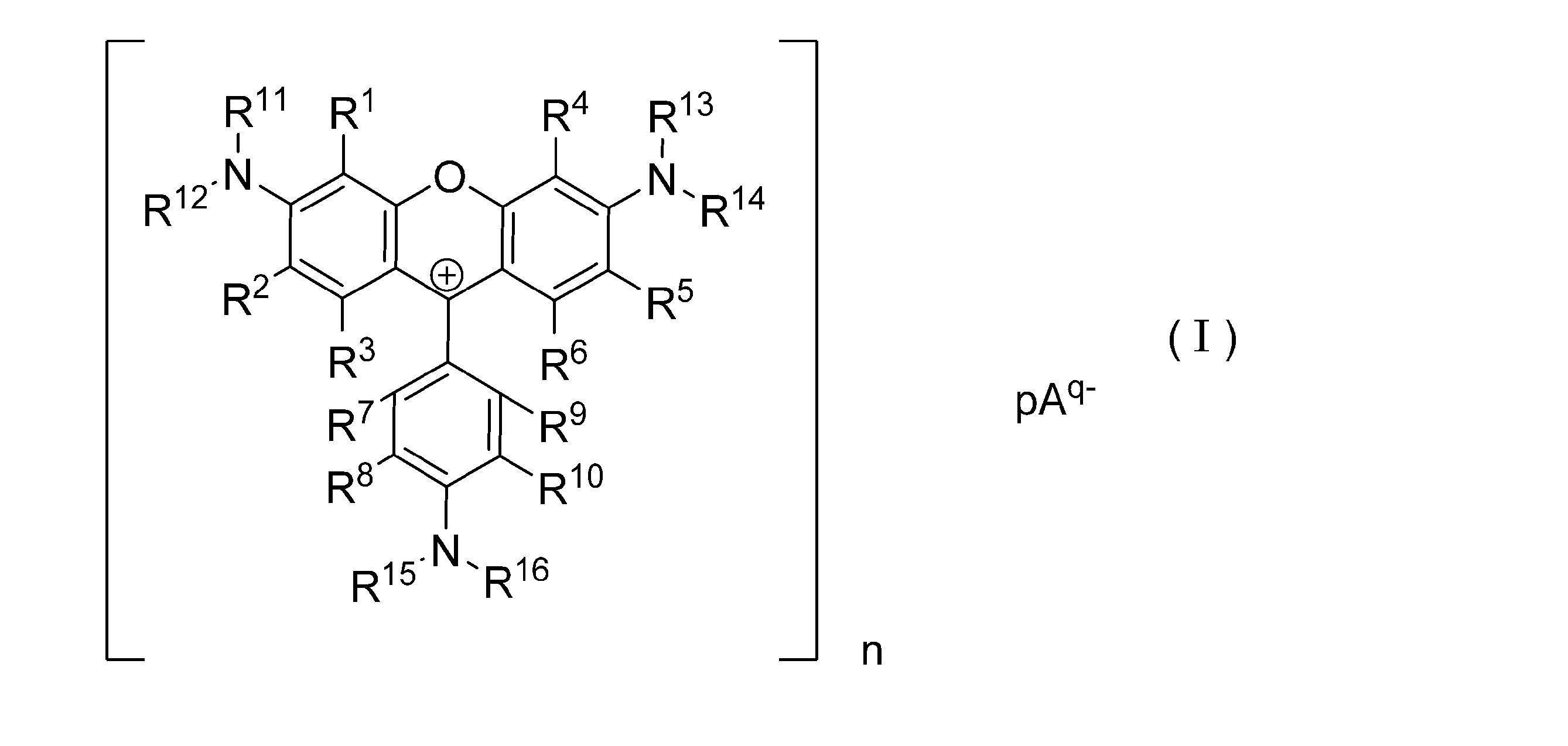
式中、R1、R2、R3、R4、R5、R6、R7、R8、R9及びR10は、それぞれ独立に、水素原子、ヒドロキシ基、ニトロ基、シアノ基、ハロゲン原子、カルボキシ基、スルホ基、スルファモイル基、メタロセニル基、炭素数1~30の炭化水素基、又は該炭化水素基中のメチレン基の1つ又は2つ以上が下記群Iから選ばれる二価の基で置き換えられた基を表し、ただし、2つ以上のメチレン基が下記群Iから選ばれる二価の基で置き換えられている場合、該二価の基は隣り合わず、
上記炭化水素基に含まれる水素原子は、ハロゲン原子、ニトロ基、シアノ基、ヒドロキシ基、アミノ基、カルボキシ基、スルホ基、ホスホノ基、スルファモイル基、イソシアナト基、複素環基で置換されている場合があり、
R11、R12、R13、R14、R15及びR16は、それぞれ独立に、水素原子、複素環基、炭素数1~30の炭化水素基、又は該炭化水素基中のメチレン基の1つ又は2つ以上が下記群Iから選ばれる二価の基で置き換えられた基を表し、ただし、2つ以上のメチレン基が下記群Iから選ばれる二価の基で置き換えられている場合、該二価の基は隣り合わず、
上記炭化水素基に含まれる水素原子は、複素環基又は極性基で置換されている場合があり、
R11、R12、R13、R14、R15及びR16のうちの1つ以上が、置換基として極性基を有する基であり、
nは、1~3の整数を表し、
Aq-は、q価の陰イオンを表し、qは1~3の整数を表し、pは電荷を中性に保つ係数を表す。
群I:-O-、-S-、-CO-、-COO-、-OCO-、-COS-、-OCS-、-SO2-、-SO3-、-NH-、-CONH-、-NHCO-、-SO2NH-、-NH-SO2-又は-N=CH-。
上記炭化水素基に含まれる水素原子は、ハロゲン原子、ニトロ基、シアノ基、ヒドロキシ基、アミノ基、カルボキシ基、スルホ基、ホスホノ基、スルファモイル基、イソシアナト基、複素環基で置換されている場合があり、
R11、R12、R13、R14、R15及びR16は、それぞれ独立に、水素原子、複素環基、炭素数1~30の炭化水素基、又は該炭化水素基中のメチレン基の1つ又は2つ以上が下記群Iから選ばれる二価の基で置き換えられた基を表し、ただし、2つ以上のメチレン基が下記群Iから選ばれる二価の基で置き換えられている場合、該二価の基は隣り合わず、
上記炭化水素基に含まれる水素原子は、複素環基又は極性基で置換されている場合があり、
R11、R12、R13、R14、R15及びR16のうちの1つ以上が、置換基として極性基を有する基であり、
nは、1~3の整数を表し、
Aq-は、q価の陰イオンを表し、qは1~3の整数を表し、pは電荷を中性に保つ係数を表す。
群I:-O-、-S-、-CO-、-COO-、-OCO-、-COS-、-OCS-、-SO2-、-SO3-、-NH-、-CONH-、-NHCO-、-SO2NH-、-NH-SO2-又は-N=CH-。
[2]
R7及びR9からなる群から選ばれる少なくとも1つの基が、それぞれ独立に、ヒドロキシ基、ニトロ基、シアノ基、ハロゲン原子、カルボキシ基、スルホ基、スルファモイル基、炭素数1~30の炭化水素基又はメタロセニル基である、[1]に記載のキサンテン化合物。
R7及びR9からなる群から選ばれる少なくとも1つの基が、それぞれ独立に、ヒドロキシ基、ニトロ基、シアノ基、ハロゲン原子、カルボキシ基、スルホ基、スルファモイル基、炭素数1~30の炭化水素基又はメタロセニル基である、[1]に記載のキサンテン化合物。
[3]
R7及びR9からなる群から選ばれる少なくとも1つの基が、それぞれ独立に、ハロゲン原子、ニトロ基又はシアノ基である、[1]又は[2]に記載のキサンテン化合物。
R7及びR9からなる群から選ばれる少なくとも1つの基が、それぞれ独立に、ハロゲン原子、ニトロ基又はシアノ基である、[1]又は[2]に記載のキサンテン化合物。
[4]
R7又はR9がハロゲン原子である、[1]~[3]の何れか一に記載のキサンテン化合物。
R7又はR9がハロゲン原子である、[1]~[3]の何れか一に記載のキサンテン化合物。
[5]
R7及びR9がハロゲン原子である、[1]~[4]の何れか一に記載のキサンテン化合物。
R7及びR9がハロゲン原子である、[1]~[4]の何れか一に記載のキサンテン化合物。
[6]
R11、R12、R13、R14、R15及びR16のうち1つ以上が、カルボキシ基で置換された炭素数1~30の炭化水素基である、[1]~[5]の何れか一に記載のキサンテン化合物。
R11、R12、R13、R14、R15及びR16のうち1つ以上が、カルボキシ基で置換された炭素数1~30の炭化水素基である、[1]~[5]の何れか一に記載のキサンテン化合物。
[7]
R11、R12、R13、R14、R15及びR16のうちの2つ以上が、極性基を有する基である、[1]~[6]の何れか一に記載のキサンテン化合物。
R11、R12、R13、R14、R15及びR16のうちの2つ以上が、極性基を有する基である、[1]~[6]の何れか一に記載のキサンテン化合物。
[8]
R11又はR12が極性基を有する基であり、且つR13又はR14が極性基を有する基である、[1]~[7]の何れか一に記載のキサンテン化合物。
R11又はR12が極性基を有する基であり、且つR13又はR14が極性基を有する基である、[1]~[7]の何れか一に記載のキサンテン化合物。
[9]
R11及びR13が極性基を有する基であり、R12、R14、R15及びR16が炭素数1~30である無置換の炭化水素基である、[8]に記載のキサンテン化合物。
R11及びR13が極性基を有する基であり、R12、R14、R15及びR16が炭素数1~30である無置換の炭化水素基である、[8]に記載のキサンテン化合物。
[10]
R15及びR16が極性基を有する基である、[1]~[8]の何れか一に記載のキサンテン化合物。
R15及びR16が極性基を有する基である、[1]~[8]の何れか一に記載のキサンテン化合物。
[11]
R11、R12、R13及びR14が炭素数1~30である無置換の炭化水素基である、[10]に記載のキサンテン化合物。
R11、R12、R13及びR14が炭素数1~30である無置換の炭化水素基である、[10]に記載のキサンテン化合物。
[12]
R11、R12、R13及びR14のうちの2つ以上が極性基を有する基であり、且つR15及びR16が無置換の炭素数1~30の炭化水素基である、[1]~[7]の何れか一に記載のキサンテン化合物。
R11、R12、R13及びR14のうちの2つ以上が極性基を有する基であり、且つR15及びR16が無置換の炭素数1~30の炭化水素基である、[1]~[7]の何れか一に記載のキサンテン化合物。
[13]
R11、R12、R13及びR14が無置換の炭素数1~30の炭化水素基であり、且つR15及びR16が極性基を有する基である、[1]~[7]の何れか一に記載のキサンテン化合物。
R11、R12、R13及びR14が無置換の炭素数1~30の炭化水素基であり、且つR15及びR16が極性基を有する基である、[1]~[7]の何れか一に記載のキサンテン化合物。
[14]
R11、R12、R13、R14、R15及びR16が、それぞれ独立に、極性基を有する又は極性基を有さない炭素数1~10のアルキル基である、[1]~[13]の何れか一に記載のキサンテン化合物。
R11、R12、R13、R14、R15及びR16が、それぞれ独立に、極性基を有する又は極性基を有さない炭素数1~10のアルキル基である、[1]~[13]の何れか一に記載のキサンテン化合物。
[15]
nが1であり、qが1であり、Aq-がハロゲン化物イオン、イミドイオン又はスルホン酸イオンである、[1]~[14]の何れか一に記載のキサンテン化合物。
nが1であり、qが1であり、Aq-がハロゲン化物イオン、イミドイオン又はスルホン酸イオンである、[1]~[14]の何れか一に記載のキサンテン化合物。
[16]
極性基がカルボキシ基である、[1]~[15]の何れか一に記載のキサンテン化合物。
極性基がカルボキシ基である、[1]~[15]の何れか一に記載のキサンテン化合物。
本発明によれば、有機溶媒に対する耐性が高いキサンテン化合物を提供することができる。
以下、本発明のキサンテン化合物について、好ましい実施形態に基づき説明する。本発明のキサンテン化合物は、上記式(I)で表される構造を有する。
式(I)中、R1、R2、R3、R4、R5、R6、R7、R8、R9及びR10で表されるハロゲン原子並びにR1、R2、R3、R4、R5、R6、R7、R8、R9及びR10で表される炭化水素基に含まれる水素原子を置換する場合があるハロゲン原子としては、フッ素、塩素、臭素及びヨウ素が挙げられる。R1、R2、R3、R4、R5、R7、R8、R9及びR10で表されるハロゲン原子は同一であってもよく、異なっていてもよい。本発明においては、化合物の紫外・可視吸収スペクトルの波長域の幅が狭くなるため、ハロゲン原子は塩素であることが好ましい。
本発明において炭化水素基等の基が置換基を有する場合、本発明において定義する基の炭素数は、特に断りがない限り、置換基の炭素数を含めたものとする。
式(I)中、R1、R2、R3、R4、R5、R6、R7、R8、R9、R10、R11、R12、R13、R14、R15及びR16で表される炭素数1~30の炭化水素基としては、特に限定されるものではないが、例えば、炭素数1~20のアルキル基、炭素数2~20のアルケニル基、炭素数3~20のシクロアルキル基、炭素数4~20のシクロアルキルアルキル基、炭素数6~30のアリール基、炭素数7~30のアリールアルキル基、炭素数8~30のアリールアルケニル基が挙げられる。R1、R2、R3、R4、R5、R7、R8、R9及びR10で表される炭素数1~30の炭化水素基は同一であってもよく、異なっていてもよい。本発明においては、化合物の紫外・可視吸収スペクトルの波長域の幅が狭くなり、且つ化合物の重量当たりの吸光係数が高くなることから、炭素数1~30の炭化水素基は炭素数1~20のアルキル基であることが好ましい。
上記炭素数1~20のアルキル基は直鎖状であってもよく、分岐状であってもよい。直鎖のアルキル基としては、例えば、メチル、エチル、プロピル、ブチル、アミル、ヘキシル、ヘプチル、オクチル、ノニル、デシル、ウンデシル、ドデシル、テトラデシル、ヘキサデシル、オクタデシル及びイコシルが挙げられる。分岐のアルキル基としては、イソプロピル、イソブチル、s-ブチル、t-ブチル、イソアミル、t-アミル、イソオクチル、2-エチルヘキシル、t-オクチル、イソノニル及びイソデシル等が挙げられる。本発明においては、化合物の合成がより容易になることから、直鎖のものが好ましい。また、化合物の重量当たりの吸光係数が高くなることから、炭素数1~10のアルキル基が好ましく、炭素数1~4のアルキル基がより好ましい。
上記炭素数2~20のアルケニル基は、鎖状であってもよく、環状であってもよい。該アルケニル基が鎖状である場合、末端に不飽和結合を有する末端アルケニル基であってもよく、内部に不飽和結合を有する内部アルケニル基であってもよい。炭素数が2~20である末端アルケニル基としては、例えば、ビニル、2-プロペニル、3-ブテニル、4-ペンテニル及び5-ヘキセニル等が挙げられる。内部アルケニル基としては、例えば、2-ブテニル、3-ペンテニル、2-ヘキセニル、3-ヘキセニル、2-ヘプテニル、3-ヘプテニル、4-ヘプテニル、3-オクテニル、3-ノネニル、4-デセニル、3-ウンデセニル及び4-ドデセニル等が挙げられる。環状アルケニル基としては、3-シクロヘキセニル、2,5-シクロヘキサジエニル-1-メチル及び4,8,12-テトラデカトリエニルアリル等が挙げられる。本発明においては、化合物の合成がより容易になることから、炭素数2~10のアルケニル基が好ましい。また、アルケニル基の-C=C-の位置は、化合物の紫外・可視吸収スペクトルの波長域の幅が狭くなることから、末端部であることが好ましい。-C=C-の数は、異性体の生成の観点から、1~2が好ましい。
上記炭素数3~20のシクロアルキル基とは、全体で3~20個の炭素原子を有する、飽和単環式又は飽和多環式アルキル基を意味する。飽和単環式アルキル基としては、例えば、シクロプロピル、シクロブチル、シクロペンチル、シクロヘキシル、シクロヘプチル、シクロオクチル、シクロノニル及びシクロデシル等が挙げられる。飽和多環式アルキル基としては、例えば、アダマンチル、デカハイドロナフチル、オクタヒドロペンタレン、ビシクロ[1.1.1]ペンタニル及びテトラデカヒドロアントラセニル等が挙げられる。本発明においては、化合物の重量当たりの吸光係数が高くなることから、炭素数3~10のシクロアルキル基が好ましい。また、化合物の紫外・可視吸収スペクトルの波長域の幅が狭くなることから、単環式アルキル基が好ましい。
上記炭素数4~20のシクロアルキルアルキル基とは、アルキル基の水素原子がシクロアルキル基で置換され、且つ全体で4~20個の炭素原子を有する基を意味する。該シクロアルキルアルキル基中のシクロアルキル基は単環であってもよく、多環であってもよい。また、シクロアルキルアルキル基中のアルキル基のメチレン基は-CH=CH-で置き換わっていてもよい。
シクロアルキル基が単環である炭素数4~20のシクロアルキルアルキル基としては、例えば、シクロプロピルメチル、シクロブチルメチル、シクロペンチルメチル、シクロヘキシルメチル、シクロヘプチルメチル、シクロオクチルメチル、シクロノニルメチル及びシクロデシルメチル等のシクロアルキルメチル;2-シクロブチルエチル、2-シクロペンチルエチル、2-シクロヘキシルエチル、2-シクロヘプチルエチル、2-シクロオクチルエチル、2-シクロノニルエチル及び2-シクロデシルエチル等のシクロアルキルエチル;3-シクロブチルプロピル、3-シクロペンチルプロピル、3-シクロヘキシルプロピル、3-シクロヘプチルプロピル、3-シクロオクチルプロピル、3-シクロノニルプロピル及び3-シクロデシルプロピル等のシクロアルキルプロピル;4-シクロブチルブチル、4-シクロペンチルブチル、4-シクロヘキシルブチル、4-シクロヘプチルブチル、4-シクロオクチルブチル、4-シクロノニルブチル、4-シクロデシルブチル等のシクロアルキルブチルが挙げられる。シクロアルキル基が多環である炭素数4~20のシクロアルキルアルキル基としては、ビシクロ[1.1.0]ブチル、ビシクロ[1.1.1]ペンチル、ビシクロ[2.1.0]ペンチル、ビシクロ[3.1.0]ヘキシル、ビシクロ[2.1.1]ヘキシル、ビシクロ[2.2.0]ヘキシル、ビシクロ[4.1.0]ヘプチル、ビシクロ[3.2.0]ヘプチル、ビシクロ[3.1.1]ヘプチル、ビシクロ[2.2.1]ヘプチル、ビシクロ[5.1.0]オクチル、ビシクロ[4.2.0]オクチル、ビシクロ[4.1.1]オクチル、ビシクロ[3.3.0]オクチル、ビシクロ[3.2.1]オクチル、ビシクロ[2.2.2]オクチル、スピロ〔4,4〕ノナニル、スピロ〔4,5〕デカニル、デカリン、トリシクロデカニル、テトラシクロドデカニル及びセドロール、シクロドデカニル3-3-アダマンチルプロピル及びデカハイドロナフチルプロピル等が挙げられる。
本発明においては、化合物の重量当たりの吸光係数が高くなることから、炭素数4~10のシクロアルキルアルキル基が好ましい。該炭素数4~10のシクロアルキルアルキル基中のシクロアルキル基は、化合物の合成がより容易になることから、単環であることが好ましい。
シクロアルキル基が単環である炭素数4~20のシクロアルキルアルキル基としては、例えば、シクロプロピルメチル、シクロブチルメチル、シクロペンチルメチル、シクロヘキシルメチル、シクロヘプチルメチル、シクロオクチルメチル、シクロノニルメチル及びシクロデシルメチル等のシクロアルキルメチル;2-シクロブチルエチル、2-シクロペンチルエチル、2-シクロヘキシルエチル、2-シクロヘプチルエチル、2-シクロオクチルエチル、2-シクロノニルエチル及び2-シクロデシルエチル等のシクロアルキルエチル;3-シクロブチルプロピル、3-シクロペンチルプロピル、3-シクロヘキシルプロピル、3-シクロヘプチルプロピル、3-シクロオクチルプロピル、3-シクロノニルプロピル及び3-シクロデシルプロピル等のシクロアルキルプロピル;4-シクロブチルブチル、4-シクロペンチルブチル、4-シクロヘキシルブチル、4-シクロヘプチルブチル、4-シクロオクチルブチル、4-シクロノニルブチル、4-シクロデシルブチル等のシクロアルキルブチルが挙げられる。シクロアルキル基が多環である炭素数4~20のシクロアルキルアルキル基としては、ビシクロ[1.1.0]ブチル、ビシクロ[1.1.1]ペンチル、ビシクロ[2.1.0]ペンチル、ビシクロ[3.1.0]ヘキシル、ビシクロ[2.1.1]ヘキシル、ビシクロ[2.2.0]ヘキシル、ビシクロ[4.1.0]ヘプチル、ビシクロ[3.2.0]ヘプチル、ビシクロ[3.1.1]ヘプチル、ビシクロ[2.2.1]ヘプチル、ビシクロ[5.1.0]オクチル、ビシクロ[4.2.0]オクチル、ビシクロ[4.1.1]オクチル、ビシクロ[3.3.0]オクチル、ビシクロ[3.2.1]オクチル、ビシクロ[2.2.2]オクチル、スピロ〔4,4〕ノナニル、スピロ〔4,5〕デカニル、デカリン、トリシクロデカニル、テトラシクロドデカニル及びセドロール、シクロドデカニル3-3-アダマンチルプロピル及びデカハイドロナフチルプロピル等が挙げられる。
本発明においては、化合物の重量当たりの吸光係数が高くなることから、炭素数4~10のシクロアルキルアルキル基が好ましい。該炭素数4~10のシクロアルキルアルキル基中のシクロアルキル基は、化合物の合成がより容易になることから、単環であることが好ましい。
上記炭素数6~30のアリール基は、単環構造を有するものであってもよく、縮環構造を有するものであってもよい。更に、上記アリール基は、単環構造のアリール基と単環構造のアリール基とを連結したものであってもよく、単環構造のアリール基と縮合構造のアリール基とを連結したものであってもよく、或いは縮合構造のアリール基と縮合構造のアリール基とを連結したものであってもよい。単環構造を有するアリール基としては、例えば、フェニル、及びビフェニリル等が挙げられる。縮環構造を有するアリール基としては、例えば、ナフチル、アンスリル及びフェナントレニル等が挙げられる。炭素数6~30のアリール基は1又は2以上の置換基を有していてもよい。置換基としては、上記アルキル基、上記アルケニル基、カルボキシ基及びハロゲン原子等が挙げられる。置換基を有する炭素数6~30のアリール基としては、例えば、トリル、キシリル、エチルフェニル、4-クロロフェニル、4-カルボキシルフェニル、4-ビニルフェニル、4-メチルフェニル、2,4,6-トリメチルフェニル等の単環構造の置換アリール基が挙げられる。本発明においては、化合物の重量当たりの吸光係数が高くなることから、炭素数6~10のアリール基が好ましい。また、化合物の紫外・可視吸収スペクトルの波長域の幅が狭くなることから、アリール基は単環構造であることが好ましい。
上記炭素数7~30のアリールアルキル基とは、アルキル基の1又は2以上の水素原子が上記アリール基で置換され、且つ全体で7~30個の炭素原子を有する基を意味する。炭素数7~30のアリールアルキル基としては、例えば、ベンジル、α-メチルベンジル、α、α-ジメチルベンジル、2-フェニルエチル、2-フェニルプロピル、3-フェニルプロピル、ジフェニルメチル、トリフェニルメチル及びトリフェニルプロピル等のフェニルアルキル;並びにナフチルプロピル等のナフチルアルキルが挙げられる。本発明においては、化合物の重量当たりの吸光係数が高くなることから、炭素数7~20のアリールアルキル基が好ましい。また、アリールアルキル基中のアリール基は、化合物の紫外・可視吸収スペクトルの波長域の幅が狭くなることから、フェニル基及びナフチル基が好ましい。アリールアルキル基中のアリール基の数は、化合物の重量当たりの吸光係数が高くなることから、1~3が好ましい。アリールアルキル基中のアリール基は、化合物の紫外・可視吸収スペクトルの波長域の幅が狭くなることから、炭素数1~4のアルキル基が好ましく、炭素数1~4である直鎖のアルキル基が好ましい。アリールアルキル基中のアリール基は、化合物の合成がより容易になることから、アルキル基の末端に位置していることが好ましい。
上記炭素数8~30のアリールアルケニル基とは、アルケニル基の水素原子がアリール基で置換され、且つ全体で8~30個の炭素原子を有する基を意味する。該炭素数8~30のアリールアルケニル基としては、例えば、スチレニル、シンナミル、2-フェニル-2-プロペニル、3-フェニル-2-プロペニル、2-フェニル-4-ペンテニル、2-フェニル-4-ヘキセニル、2,2-ジフェニルエチレニル、3,3-フェニル-2-プロペニル、2-ナフチル-2-プロペニル、3-ナフチル-2-プロペニル、3-ナフチル-2-フェニル-2-プロペニル、5-アントラセニル-2-フェニル-4-ヘキセニル及び5-アントラセニル-2-ナフチル-4-ヘキセニル等が挙げられる。本発明においては、化合物の重量当たりの吸光係数が高くなることから、炭素数8~20のアリールアルケニル基が好ましい。アリールアルケニル基中のアリール基は、化合物の紫外・可視吸収スペクトルの波長域の幅が狭くなることから、フェニル基及びナフチル基が好ましい。アリールアルケニル基中のアリール基の数は、化合物の重量当たりの吸光係数が高くなることから、1又は2が好ましい。アリールアルケニル基中のアリール基は、化合物の重量当たりの吸光係数が高くなることから、炭素数1~6のアルキル基が好ましい。アリールアルケニル基中のアリール基は、化合物の合成がより容易になることから、アルキル基の末端に位置していることが好ましい。アリールアルケニル基中のアルケニル基は、化合物の紫外・可視吸収スペクトルの波長域の幅が狭くなることから、鎖状であることが好ましい。アルケニル基は鎖状である場合、末端に不飽和結合を有する末端アルケニル基であってもよく、内部に不飽和結合を有する内部アルケニル基であってもよい。
R11、R12、R13、R14、R15及びR16で表される複素環基は単環であってもよく、縮環構造であってもよい。更に、上記複素環基は、単環の複素環基と単環の複素環基とを連結したものであってもよく、単環の複素環基と縮合構造の複素環基とを連結したものであってもよく、或いは縮合構造の複素環基と縮合構造の複素環基とを連結したものであってもよい。単環の複素環基としては、例えば、ピリジル、ピリミジル、ピリダジル、ピペラジル、ピペリジル、ピラニル、ピラゾリル、トリアジル、ピロリジル、イミダゾリル、トリアゾリル、フリル、フラニル、チエニル、チオフェニル、チアジアゾリル、チアゾリル、オキサゾリル、イソチアゾリル、イソオキサゾリル、ユロリジル、モルフォリニル、チオモルフォリニル、2-ピロリジノン-1-イル、2-ピペリドン-1-イル、2,4-ジオキシイミダゾリジン-3-イル及び2,4-ジオキシオキサゾリジン-3-イル等が挙げられる。縮環構造の複素環基としては、例えば、キノリル、イソキノリル、ベンゾイミダゾリル、ベンゾフラニル、ベンゾチオフェニル、ベンゾチアゾリル、ベンゾオキサゾリル及びインドリル等の縮環構造の複素環基が挙げられる。R1、R2、R3、R4、R5、R6、R7、R8、R9、R10、R11、R12、R13、R14、R15及びR16で表される炭化水素基中の水素原子と置換可能な複素環基についても同様の説明が適用される。
R1、R2、R3、R4、R5、R6、R7、R8、R9及びR10で表されるメタロセニル基としては、例えば、フェロセニル、ニッケロセニル、コバルトニル、フェロセンアルキル、フェロセンアルコキシ等が挙げられる。
本発明のキサンテン化合物は、式(I)中のR11、R12、R13、R14、R15及びR16で表される基の1つ以上が、置換基として極性基を有する基である。本発明において極性基とは、極性のある原子団を意味する。極性基の具体例としては、例えば、カルボキシ基、ヒドロキシ基、アミノ基、スルホニル基などが挙げられる。これらのうち、化合物の有機溶媒に対する耐性が高くなることから、カルボキシ基が好ましい。
式(I)中のnが1であるキサンテン化合物は、合成のしやすさの点から好ましい。
式(I)中のAq-で表される陰イオンは、qの値に応じ、一価、二価又は三価の陰イオンをとり得る。Aq-が一価の陰イオンA-である場合、該A-としては、例えば、塩化物イオン(Cl-)、臭化物イオン(Br-)、ヨウ化物イオン(I-)及びフッ化物イオン(F-)等のハロゲン化物イオン;過塩素酸イオン(ClO4
-)、塩素酸イオン(ClO3
-)、硝酸イオン(NO3
-)、硝酸イオン(NO3
-)、チオシアン酸イオン(SCN-)、六フッ化リン酸イオン(PF6
-)、六フッ化アンチモンイオン(SbF6
-)、四塩化アルミン酸イオン(AlCl4
-)及び四フッ化ホウ素イオン(BF4
-)等の無機系イオン;酢酸イオン(CH3CO2
-)及びトリフルオロ酢酸イオン(CF3CO2
-)等のカルボン酸イオン;メタンスルホン酸イオン(CH3SO3
-)、ベンゼンスルホン酸イオン、トルエンスルホン酸イオン、トリフルオロメタンスルホン酸イオン及びビニルスルホン酸イオンのスルホン酸イオン;メチル硫酸イオン、エチル硫酸イオン、ブチル硫酸イオン等のアルキル硫酸イオン;メチルリン酸イオン、エチルリン酸イオン、ブチルリン酸イオン等のアルキルリン酸イオン;ビス(トリフルオロメタンスルホニル)イミドイオン((CF3SO2)2N-)、ビス(パーフルオロブタンスルホニル)イミドイオン((C4F9SO2)2N-)及びジシアンイミドイオン((CN)2N-)等のイミドイオン等が挙げられる。一価の陰イオンは、特にハロゲン化物イオン、イミドイオン又はスルホン酸イオンであることが好ましい。ハロゲン化物イオンとしては、塩化物イオンが合成のしやすさから好ましい。イミドイオンとしては、ビス(トリフルオロメタンスルホニル)イミドイオンが有機溶媒に対する耐性が高くなることから好ましい。スルホン酸イオンとしては、3-スルホ安息香酸イオン等のベンゼンスルホン酸イオンが有機溶媒に対する耐性が高くなることから好ましい。
Aq-が二価の陰イオンA2-である場合、該A2-としては、タングステン酸イオン、モリブデン酸イオン(MoO4 2-)及びクロム酸イオン等が挙げられる。
Aq-が三価の陰イオンA3-である場合、該A3-としては、例えば、リンモリブデン酸イオン、リンタングステン酸イオン、リンタングストモリブデン酸イオン及びバナジン酸イオン等が挙げられる。
Aq-が二価の陰イオンA2-である場合、該A2-としては、タングステン酸イオン、モリブデン酸イオン(MoO4 2-)及びクロム酸イオン等が挙げられる。
Aq-が三価の陰イオンA3-である場合、該A3-としては、例えば、リンモリブデン酸イオン、リンタングステン酸イオン、リンタングストモリブデン酸イオン及びバナジン酸イオン等が挙げられる。
本発明のキサンテン化合物は、化合物の紫外・可視吸収スペクトルの波長域の幅が狭くなることから、式(I)中のR7及びR9からなる群から選ばれる少なくとも1つの基、特にR7及びR9が、ヒドロキシ基、ニトロ基、シアノ基、ハロゲン原子、カルボキシ基、スルホ基、スルファモイル基、炭素数1~30の炭化水素基又はメタロセニル基であることが好ましく、ハロゲン原子、ニトロ基又はシアノ基であることがより好ましく、ハロゲン原子であることが更に好ましく、塩素原子であることが特に好ましい。
同様の観点から、R1、R2、R3、R4、R5、R6、R8及びR10からなる群から選ばれる少なくとも1つの基が水素原子であることが好ましく、R1、R2、R3、R4、R5、R6、R8及びR10の全てが水素原子であることが好ましい。
同様の観点から、R1、R2、R3、R4、R5、R6、R8及びR10からなる群から選ばれる少なくとも1つの基が水素原子であることが好ましく、R1、R2、R3、R4、R5、R6、R8及びR10の全てが水素原子であることが好ましい。
本発明のキサンテン化合物は、化合物の有機溶媒に対する耐性が高くなることから、式(I)中のR11、R12、R13、R14、R15及びR16のうち1つ以上、好ましくは2以上の水素原子が、カルボキシ基で置換された炭素数1~30の炭化水素基であることが好ましい。
本発明のキサンテン化合物は、化合物の有機溶媒に対する耐性が高くなることから、式(I)中のR11、R12、R13、R14、R15及びR16のうちの2つ以上が極性基を有する基であることが好ましい。
本発明のキサンテン化合物は、化合物の有機溶媒に対する耐性が高くなることから、式(I)中のR11又はR12が極性基を有する基であり、且つR13又はR14が極性基を有する基であることが好ましい。同様の観点から、R15及びR16が極性基を有する基であることが好ましい。
本発明のキサンテン化合物は、化合物の有機溶媒に対する耐性が高くなることから、式(I)中のR11、R12、R13及びR14のうちの2つ以上が極性基を有する基であり、且つR15及びR16が炭素数1~30である無置換の炭化水素基であることが好ましい。同様の観点から、式(I)中のR11及びR13が極性基を有する基であり、且つR12、R14、R15及びR16が炭素数1~30である無置換の炭化水素基であることが好ましい。同様の観点から、式(I)中のR11、R12、R13及びR14が炭素数1~30である無置換の炭化水素基であり、且つR15及びR16が極性基を有する基であることが好ましい。
本発明のキサンテン化合物は、化合物の紫外・可視吸収スペクトルの波長域の幅が狭くなることから、式(I)中のR11、R12、R13、R14、R15及びR16が、それぞれ独立に、炭素数1~30の炭化水素基であることが好ましく、炭素数1~20のアルキル基であることがより好ましく、炭素数1~10のアルキル基であることが更に好ましく、炭素数1~4のアルキル基であることが特に好ましい。
本発明のキサンテン化合物は、化合物の有機溶媒に対する耐性が高くなることから、式(I)中のR11、R12、R13、R14、R15及びR16のうちの2つ以上が極性基を有する基であることが好ましい。
本発明のキサンテン化合物は、化合物の有機溶媒に対する耐性が高くなることから、式(I)中のR11又はR12が極性基を有する基であり、且つR13又はR14が極性基を有する基であることが好ましい。同様の観点から、R15及びR16が極性基を有する基であることが好ましい。
本発明のキサンテン化合物は、化合物の有機溶媒に対する耐性が高くなることから、式(I)中のR11、R12、R13及びR14のうちの2つ以上が極性基を有する基であり、且つR15及びR16が炭素数1~30である無置換の炭化水素基であることが好ましい。同様の観点から、式(I)中のR11及びR13が極性基を有する基であり、且つR12、R14、R15及びR16が炭素数1~30である無置換の炭化水素基であることが好ましい。同様の観点から、式(I)中のR11、R12、R13及びR14が炭素数1~30である無置換の炭化水素基であり、且つR15及びR16が極性基を有する基であることが好ましい。
本発明のキサンテン化合物は、化合物の紫外・可視吸収スペクトルの波長域の幅が狭くなることから、式(I)中のR11、R12、R13、R14、R15及びR16が、それぞれ独立に、炭素数1~30の炭化水素基であることが好ましく、炭素数1~20のアルキル基であることがより好ましく、炭素数1~10のアルキル基であることが更に好ましく、炭素数1~4のアルキル基であることが特に好ましい。
本発明のキサンテン化合物は、化合物の合成が容易となることから、式(I)中のn及びqが1であること、即ちAq-が一価の陰イオンであることが好ましい。Aq-が一価の陰イオンである場合、Aq-がハロゲン化物イオン、イミドイオン又はスルホン酸イオンであることが好ましい。ハロゲン化物イオンとしては、塩化物イオンが好ましい。イミドイオンとしては、ビス(トリフルオロメタンスルホニル)イミドイオンが好ましい。スルホン酸イオンとしては、3-スルホ安息香酸イオン等のベンゼンスルホン酸イオンが好ましい。
本発明のキサンテン化合物の具体例としては、例えば、化合物(I-1)~(I-30)が挙げられる。
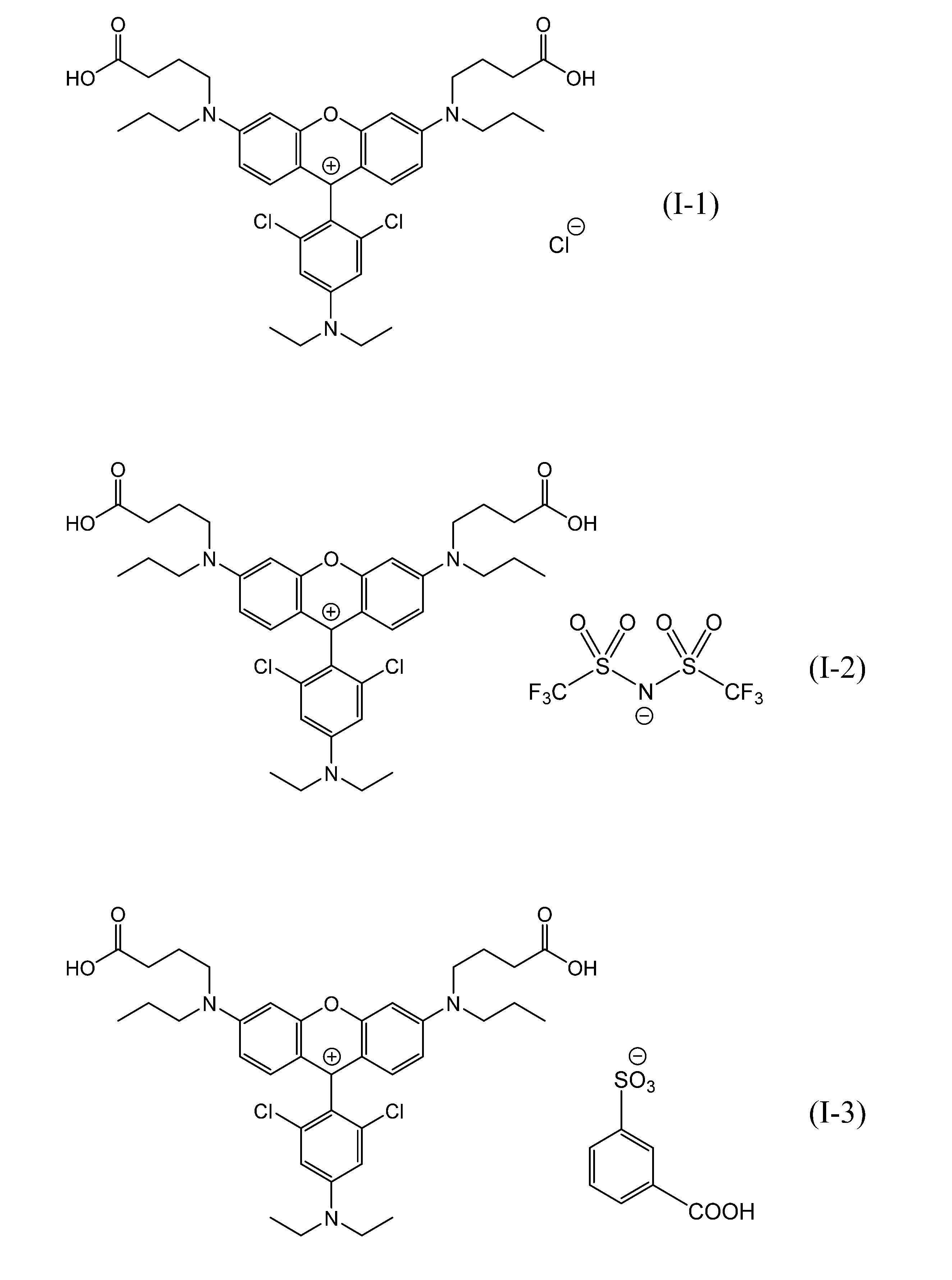
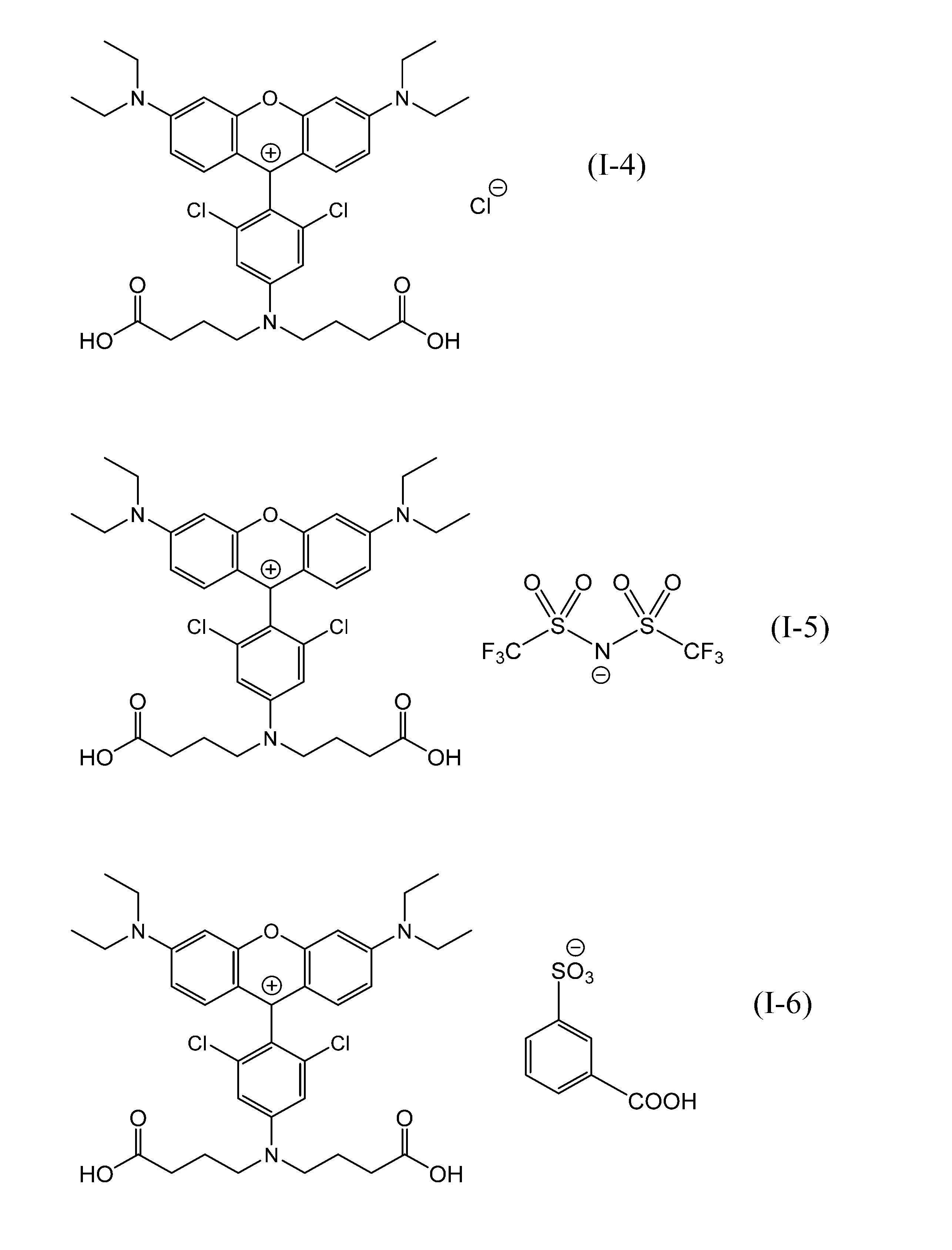

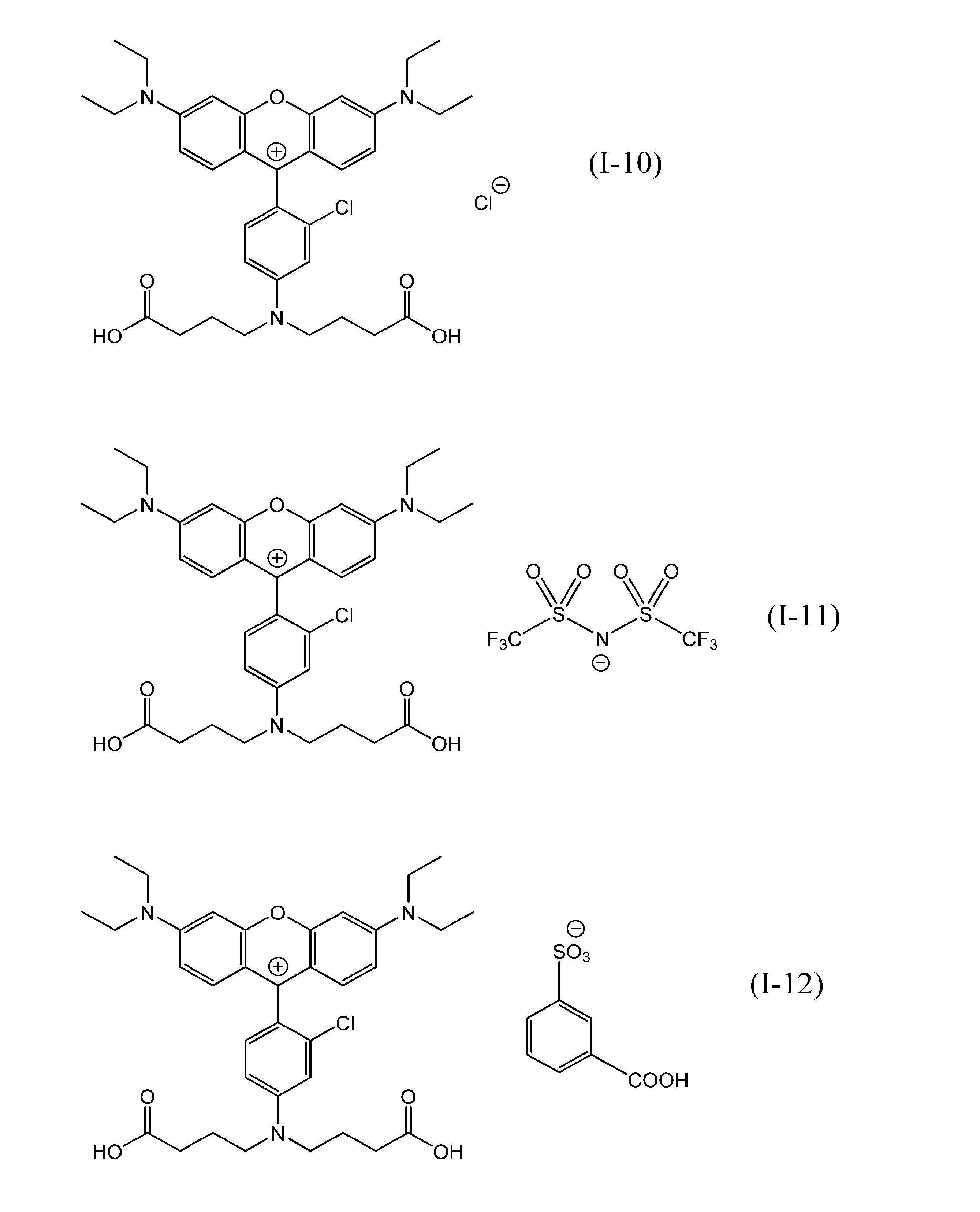

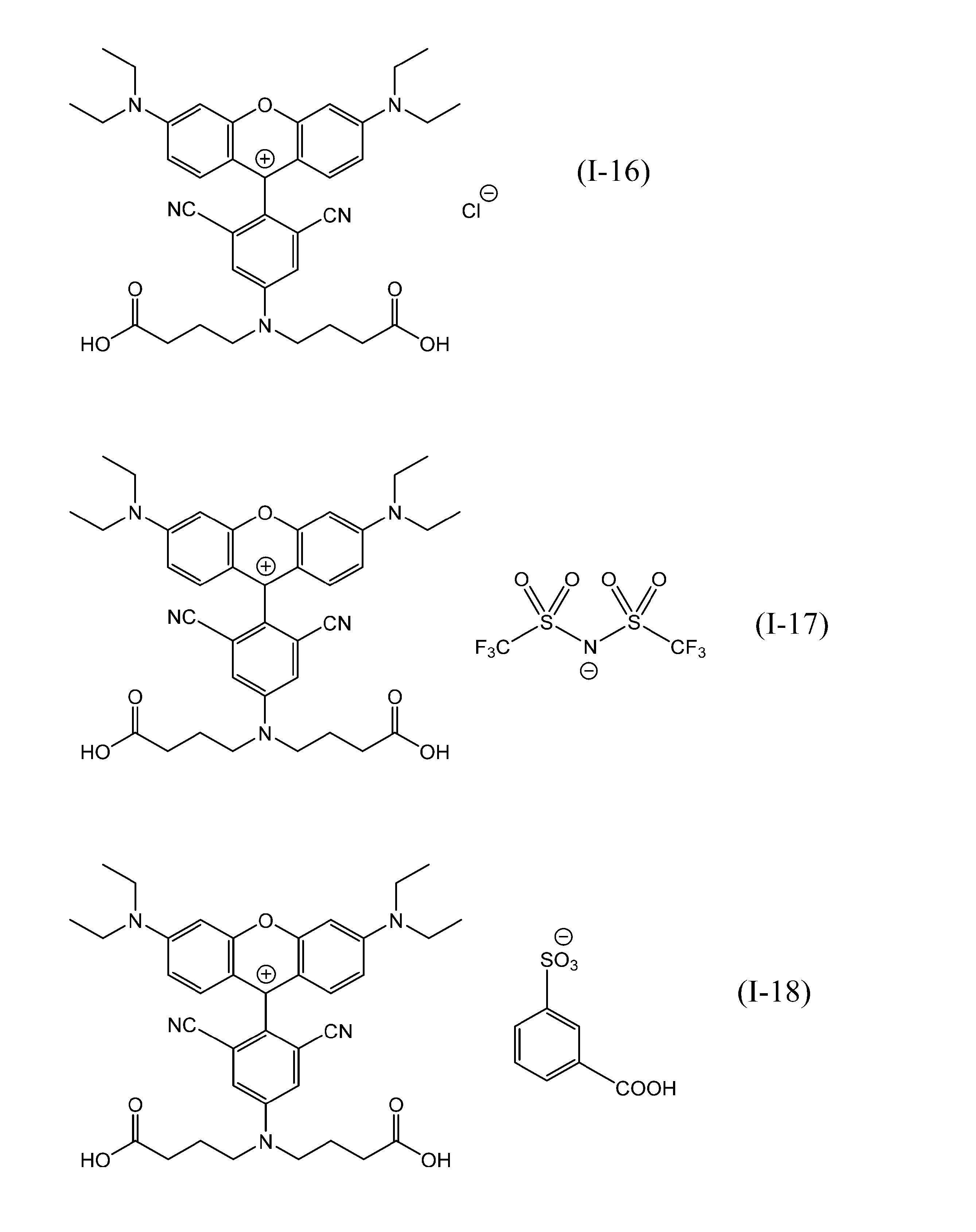


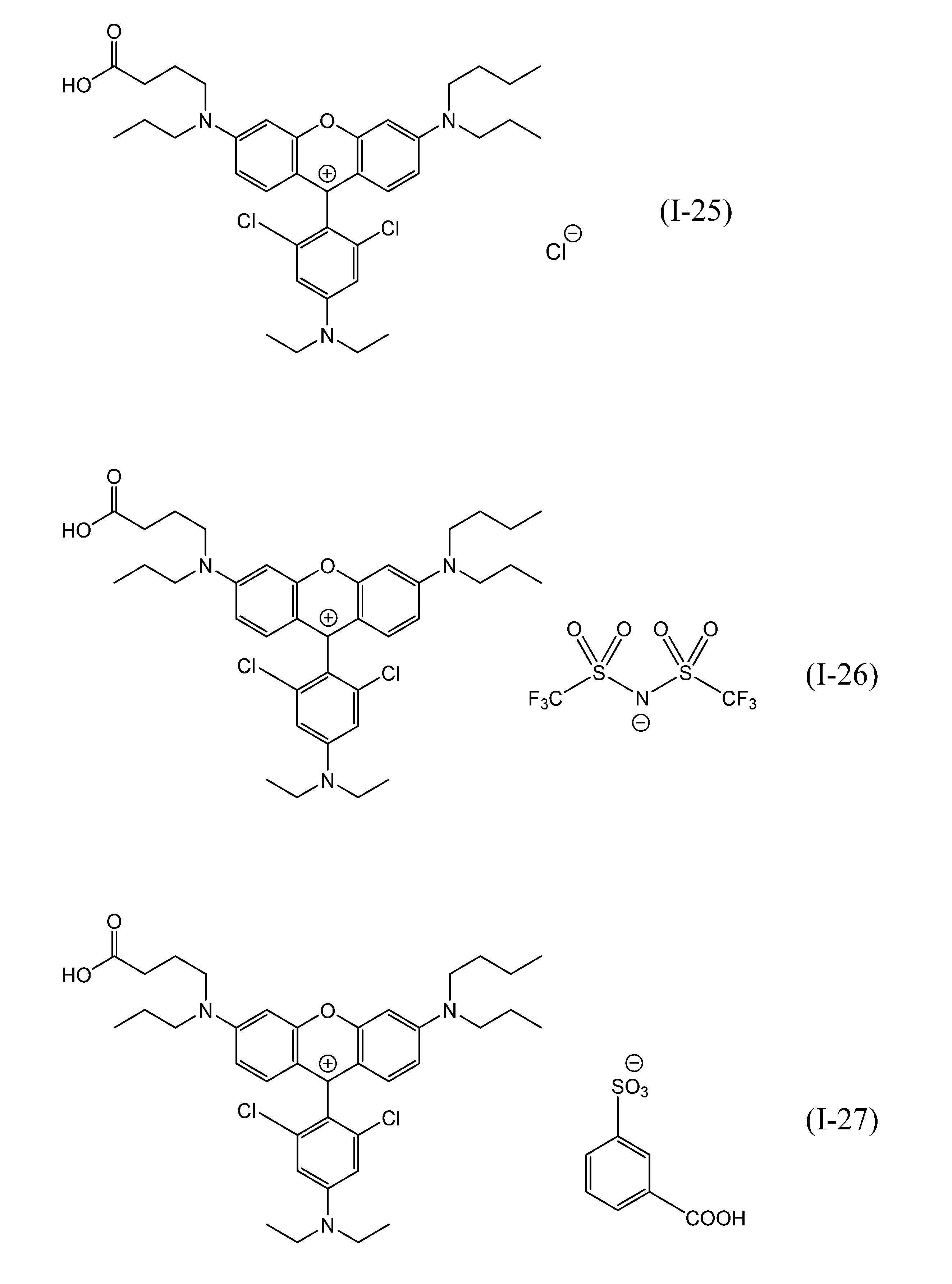
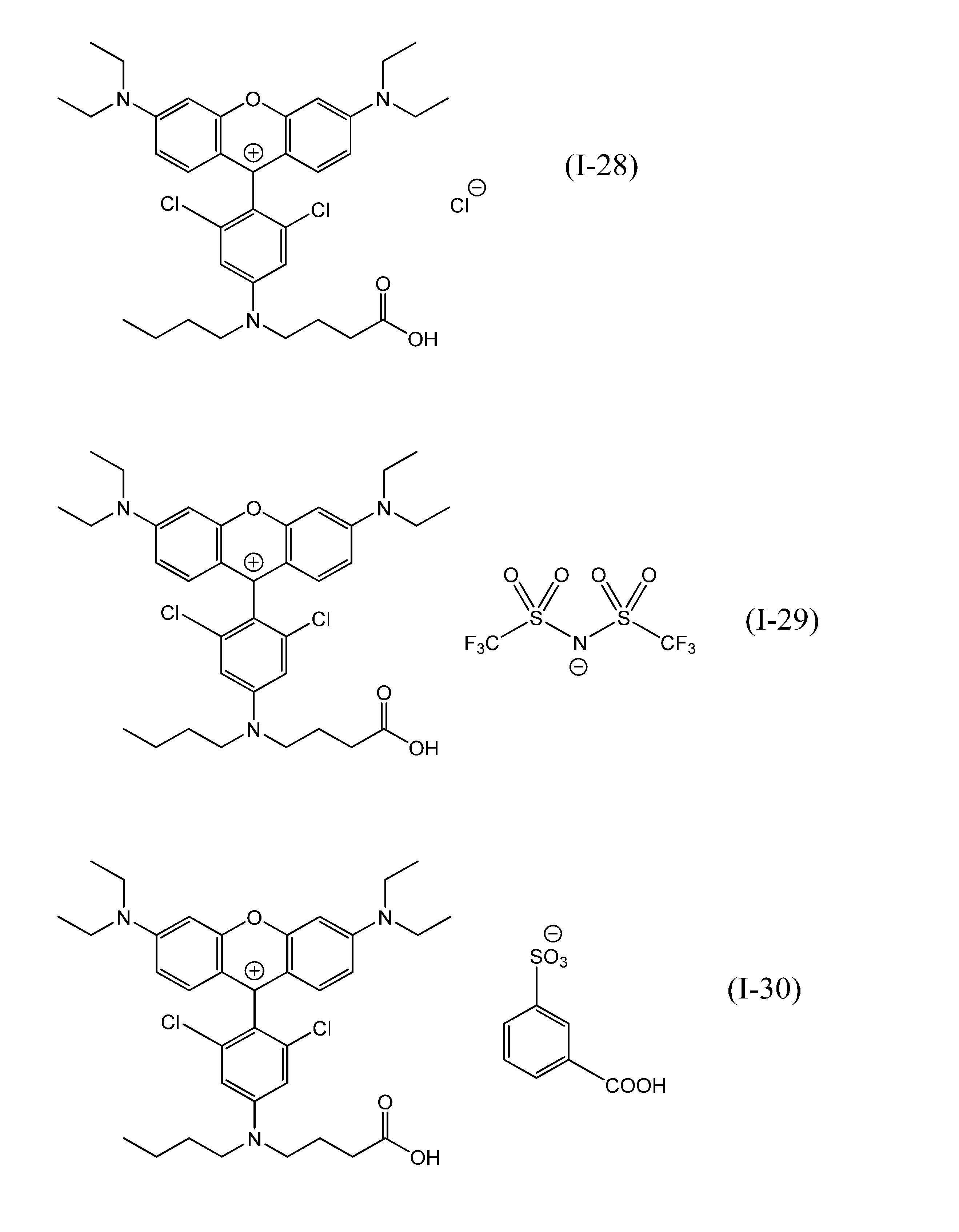
本発明のキサンテン化合物は、クロロホルム、アセトン及びトルエン等の有機溶媒へ耐性が高いもの、即ち本発明のキサンテン化合物は有機溶媒に溶けにくいものである。有機溶媒への耐性が高いとは、有機溶媒に実質的に溶解しないか、溶解するとしても溶解量は0.5質量%未満という少量であることを意味する。
特に、本発明のキサンテン化合物はクロロホルムに実質的に溶解しないか、溶解するとしても溶解量は0.5質量%未満であることが好ましく、0~0.4質量%であることがより好ましい。
また、本発明のキサンテン化合物はアセトンに実質的に溶解しないか、溶解するとしても溶解量は0.5質量%未満であることが好ましく、0~0.2質量%であることがより好ましく、0~0.1質量%であることが更に好ましい。
また、本発明のキサンテン化合物はトルエンに実質的に溶解しないか、溶解するとしても溶解量は0.5質量%未満であることが好ましく、0~0.2質量%であることがより好ましく、トルエンに不溶であることが更に好ましい。本明細書において有機溶媒に不溶とは、有機溶媒に対する溶解量が0.01質量%以下のことを意味する。
有機溶媒に対するキサンテン化合物の溶解度は、実施例に記載の方法で測定することができる。
特に、本発明のキサンテン化合物はクロロホルムに実質的に溶解しないか、溶解するとしても溶解量は0.5質量%未満であることが好ましく、0~0.4質量%であることがより好ましい。
また、本発明のキサンテン化合物はアセトンに実質的に溶解しないか、溶解するとしても溶解量は0.5質量%未満であることが好ましく、0~0.2質量%であることがより好ましく、0~0.1質量%であることが更に好ましい。
また、本発明のキサンテン化合物はトルエンに実質的に溶解しないか、溶解するとしても溶解量は0.5質量%未満であることが好ましく、0~0.2質量%であることがより好ましく、トルエンに不溶であることが更に好ましい。本明細書において有機溶媒に不溶とは、有機溶媒に対する溶解量が0.01質量%以下のことを意味する。
有機溶媒に対するキサンテン化合物の溶解度は、実施例に記載の方法で測定することができる。
上記式(I)で表されるキサンテン化合物は、例えば、下記の方法で好適に製造することができる。
まず極性基を有するアニリン誘導体をホルミル化し、その後、アミノフェノール誘導体と脱水縮合を行い、ロイコ体を得る。得られたロイコ体を酸化反応し、種々のアニオンと塩交換することで目的とするキサンテン化合物を得ることができる。反応条件等は公知の条件を採用することができる。
本発明のキサンテン化合物は、光吸収剤、増感剤等として、感光写真材料、染物、塗料、インク、電子写真感光体、トナー、感熱記録紙、転写リボン、光学記録色素、太陽電池、光電変換素子、半導体材料、臨床検査試薬、レーザー治療用色素、染色等の用途に用いることができる。
以下、実施例及び比較例を挙げて本発明を更に詳細に説明するが、本発明はこれらの実施例等に限定されるものではない。特に断らない限り、実施例中の「部」及び「%」はそれぞれ、「質量部」及び「質量%」を意味する。
[実施例1]キサンテン化合物(I-1)の合成
15.0部の3-アミノフェノールと、187部のメタノールとを混合し、-5℃で攪拌し、反応液を得た。得られた反応液に8.8部のプロピルアルデヒドを加え10分間攪拌した後、11.4部の水素化ホウ素ナトリウムを少しずつ加え、4時間攪拌した。2N塩酸をpHが4になるまで反応液に加えた後、析出した固体を濾別した。ろ液のメタノールを溶媒溜去し、残渣に酢酸エチルを加え3回水洗した後、有機層から溶媒を溜去した。得られた液体を60℃減圧オーブンで乾燥し、化合物S-2を11.24部(54%)得た。LC/MS:150[M+]。
15.0部の3-アミノフェノールと、187部のメタノールとを混合し、-5℃で攪拌し、反応液を得た。得られた反応液に8.8部のプロピルアルデヒドを加え10分間攪拌した後、11.4部の水素化ホウ素ナトリウムを少しずつ加え、4時間攪拌した。2N塩酸をpHが4になるまで反応液に加えた後、析出した固体を濾別した。ろ液のメタノールを溶媒溜去し、残渣に酢酸エチルを加え3回水洗した後、有機層から溶媒を溜去した。得られた液体を60℃減圧オーブンで乾燥し、化合物S-2を11.24部(54%)得た。LC/MS:150[M+]。

10.0部の化合物S-2、19.4部の4-ブロモ酪酸エチル、及び66.2部のテトラブチルアンモニウムブロミドを混合し、95℃で2時間加熱攪拌した。室温まで冷却後、反応物をトルエンで抽出した後、抽出した反応物を50部の水で3回水洗した。有機層を溶媒溜去し、残渣をシリカゲルカラムクロマトグラフィ(展開溶媒:クロロホルム:ヘキサン=1:1)で精製し、化合物S-3を8.1部(収率23%)得た。LC/MS:264[M+]。

4.3部の化合物S-3と、2.0部の化合物S-1と、49.1部のトリフルオロスルホン酸とを混合し、100℃で3時間攪拌し、反応液を得た。化合物S-1は下記式で表されるものである。反応液を室温まで冷却した後、反応液に水100部を加えた後、クロロホルム及び酢酸エチルで抽出し、それぞれの有機層を水洗した。水洗した各有機層を合わせて溶媒溜去した。残渣に3.5部のp-クロラニル、及び100部のアセトニトリルを加え、室温で12時間攪拌した。反応液を溶媒溜去後、クロロホルム100部を加え析出した固体を濾別した。ろ液を濃縮後、4%水酸化ナトリウム水溶液100部を加え室温で12時間攪拌した。2N塩酸で液をpH4まで中和し、析出した固体をろ取した。得られた固体を酢酸エチル-ヘキサン(3:1)混合溶液で3時間分散洗浄し、その後、乾燥させた。乾燥させた固体を濃塩酸20部に溶解させ、溶解液を得た。得られた溶解液をフィルタろ過し、ろ液を20%食塩水にて晶析し、pH4になるまで25%水酸化ナトリウム水溶液で中和した。析出固体をろ取し、60℃減圧オーブンにて乾燥し、式(I-1)で表されるキサンテン化合物2.3部(収率39%)を得た。LC/MS:683[M+]。

[実施例2]キサンテン化合物(I-2)の合成
0.44部のキサンテン化合物(I-1)と、0.35部のビス(トリフルオロメタンスルホニル)リチウムと、6.7部のN,N-ジメチルスルホキシドとを混合し、50℃で3時間攪拌し、反応液を得た。得られた反応液を40部の20%食塩水に滴下し、析出した固体をろ取した。固体をクロロホルムに溶解させ、有機層を水で洗浄したのち硫酸ナトリウムを加えて乾燥後溶媒留去し、60℃減圧オーブンにて乾燥し、式(I-2)で表されるキサンテン化合物0.43部(収率74%)を得た。
0.44部のキサンテン化合物(I-1)と、0.35部のビス(トリフルオロメタンスルホニル)リチウムと、6.7部のN,N-ジメチルスルホキシドとを混合し、50℃で3時間攪拌し、反応液を得た。得られた反応液を40部の20%食塩水に滴下し、析出した固体をろ取した。固体をクロロホルムに溶解させ、有機層を水で洗浄したのち硫酸ナトリウムを加えて乾燥後溶媒留去し、60℃減圧オーブンにて乾燥し、式(I-2)で表されるキサンテン化合物0.43部(収率74%)を得た。

[実施例3]キサンテン化合物(I-3)の合成
ビス(トリフルオロメタンスルホニル)リチウムを3-スルホ安息香酸ナトリウムに変更した以外は実施例2と同様にして、式(I-3)で表されるキサンテン化合物0.50部(収率72%)を得た。
ビス(トリフルオロメタンスルホニル)リチウムを3-スルホ安息香酸ナトリウムに変更した以外は実施例2と同様にして、式(I-3)で表されるキサンテン化合物0.50部(収率72%)を得た。
[実施例4]キサンテン化合物(I-4)の合成
0.4部のN,N-ジエチルアミノ-3-フェノール、0.5部の化合物S-X、及び7.4部のトリフルオロスルホン酸を混合し、100℃で3時間攪拌して反応液を得た。化合物S-Xは下記式で表されるものである。反応液を室温まで冷却後、反応液を50部の水に加え、クロロホルム及び酢酸エチルで抽出し、それぞれの有機層を水洗した。水洗した各有機層を合わせて溶媒溜去した。残渣に0.9部のp-クロラニル、50部のアセトニトリルを加え、室温で12時間攪拌した。反応液を溶媒溜去後、50部のクロロホルムを加え、析出した固体を濾別した。ろ液を濃縮後、濃縮したろ液に50部の4%水酸化ナトリウム水溶液を加え室温で12時間攪拌した。2N塩酸で反応液をpH4まで中和し、析出した固体をろ取した。得られた固体を酢酸エチル-ヘキサン(3:1)混合溶液で3時間分散洗浄し、乾燥後、5部の濃塩酸に溶解させ、溶解液を得た。得られた溶解液をフィルタろ過し、ろ液を20%食塩水にて晶析し、25%水酸化ナトリウム水溶液でpHが4になるまで中和した。析出固体をろ取し、60℃減圧オーブンにて乾燥し、式(I-4)で表されるキサンテン化合物0.21部(収率24%)を得た。LC/MS:655[M+]。
0.4部のN,N-ジエチルアミノ-3-フェノール、0.5部の化合物S-X、及び7.4部のトリフルオロスルホン酸を混合し、100℃で3時間攪拌して反応液を得た。化合物S-Xは下記式で表されるものである。反応液を室温まで冷却後、反応液を50部の水に加え、クロロホルム及び酢酸エチルで抽出し、それぞれの有機層を水洗した。水洗した各有機層を合わせて溶媒溜去した。残渣に0.9部のp-クロラニル、50部のアセトニトリルを加え、室温で12時間攪拌した。反応液を溶媒溜去後、50部のクロロホルムを加え、析出した固体を濾別した。ろ液を濃縮後、濃縮したろ液に50部の4%水酸化ナトリウム水溶液を加え室温で12時間攪拌した。2N塩酸で反応液をpH4まで中和し、析出した固体をろ取した。得られた固体を酢酸エチル-ヘキサン(3:1)混合溶液で3時間分散洗浄し、乾燥後、5部の濃塩酸に溶解させ、溶解液を得た。得られた溶解液をフィルタろ過し、ろ液を20%食塩水にて晶析し、25%水酸化ナトリウム水溶液でpHが4になるまで中和した。析出固体をろ取し、60℃減圧オーブンにて乾燥し、式(I-4)で表されるキサンテン化合物0.21部(収率24%)を得た。LC/MS:655[M+]。

[実施例5]キサンテン化合物(I-5)の合成
キサンテン化合物(I-1)をキサンテン化合物(I-4)に変更した以外は実施例2と同様にして、式(I-5)で表されるキサンテン化合物0.55部(収率67%)を得た。
キサンテン化合物(I-1)をキサンテン化合物(I-4)に変更した以外は実施例2と同様にして、式(I-5)で表されるキサンテン化合物0.55部(収率67%)を得た。

[実施例6]キサンテン化合物(I-6)の合成
キサンテン化合物(I-1)をキサンテン化合物(I-4)に変更した以外は実施例3と同様にして、式(I-6)で表されるキサンテン化合物0.51部(収率76%)を得た。
キサンテン化合物(I-1)をキサンテン化合物(I-4)に変更した以外は実施例3と同様にして、式(I-6)で表されるキサンテン化合物0.51部(収率76%)を得た。

[比較例1]比較キサンテン化合物1
比較キサンテン化合物1として、下記の化合物を用いた。
比較キサンテン化合物1として、下記の化合物を用いた。
実施例1のキサンテン化合物(I-1)及び比較例1の比較キサンテン化合物1の有機溶媒に対する溶解性を下記の方法により測定した。
50mLのサンプル管にキサンテン化合物(I-1)及び比較キサンテン化合物1をそれぞれ0.10g測り取った。該サンプル管にクロロホルムを加え、3分間振盪後、1分間静置し、結晶が析出しない濃度を求め、クロロホルムに対するキサンテン化合物の溶解度とした。キサンテン化合物の含有量が10質量%の溶液に対して結晶が析出しなくなるまでクロロホルムの添加を続けることによって測定を行った。測定は、常温(23℃)で行った。結果を表1に示す。
同様の手順により、アセトン及びトルエンに対するキサンテン化合物の溶解度を測定した。結果を表1に示す。
50mLのサンプル管にキサンテン化合物(I-1)及び比較キサンテン化合物1をそれぞれ0.10g測り取った。該サンプル管にクロロホルムを加え、3分間振盪後、1分間静置し、結晶が析出しない濃度を求め、クロロホルムに対するキサンテン化合物の溶解度とした。キサンテン化合物の含有量が10質量%の溶液に対して結晶が析出しなくなるまでクロロホルムの添加を続けることによって測定を行った。測定は、常温(23℃)で行った。結果を表1に示す。
同様の手順により、アセトン及びトルエンに対するキサンテン化合物の溶解度を測定した。結果を表1に示す。

表1に示す結果から明らかなように、実施例1のキサンテン化合物(I-1)はクロロホルム、アセトン及びトルエン等の有機溶媒に対する溶解度が0.5%以下であり、有機溶媒に対する耐性が向上していることから、染料として好適に使用できることが判る。これに対し、比較キサンテン化合物1は有機溶媒に対する溶解度が0.5%超であり、実施例1のキサンテン化合物(I-1)に比べて染料として不適であることが判る。
Claims (16)
- 式(I)で表されるキサンテン化合物。

上記炭化水素基に含まれる水素原子は、ハロゲン原子、ニトロ基、シアノ基、ヒドロキシ基、アミノ基、カルボキシ基、スルホ基、ホスホノ基、スルファモイル基、イソシアナト基、複素環基で置換されている場合があり、
R11、R12、R13、R14、R15及びR16は、それぞれ独立に、水素原子、複素環基、炭素数1~30の炭化水素基、又は該炭化水素基中のメチレン基の1つ又は2つ以上が下記群Iから選ばれる二価の基で置き換えられた基を表し、ただし、2つ以上のメチレン基が下記群Iから選ばれる二価の基で置き換えられている場合、該二価の基は隣り合わず、
上記炭化水素基に含まれる水素原子は、複素環基又は極性基で置換されている場合があり、
R11、R12、R13、R14、R15及びR16のうちの1つ以上が、置換基として極性基を有する基であり、
nは、1~3の整数を表し、
Aq-は、q価の陰イオンを表し、qは1~3の整数を表し、pは電荷を中性に保つ係数を表す。
群I:-O-、-S-、-CO-、-COO-、-OCO-、-COS-、-OCS-、-SO2-、-SO3-、-NH-、-CONH-、-NHCO-、-SO2NH-、-NH-SO2-又は-N=CH-。 - R7及びR9からなる群から選ばれる少なくとも1つの基が、それぞれ独立に、ヒドロキシ基、ニトロ基、シアノ基、ハロゲン原子、カルボキシ基、スルホ基、スルファモイル基、メタロセニル基、又は炭素数1~30の炭化水素基である、請求項1に記載のキサンテン化合物。
- R7及びR9からなる群から選ばれる少なくとも1つの基が、それぞれ独立に、ハロゲン原子、ニトロ基又はシアノ基である、請求項1又は2に記載のキサンテン化合物。
- R7又はR9がハロゲン原子である、請求項1~3の何れか一項に記載のキサンテン化合物。
- R7及びR9がハロゲン原子である、請求項1~3の何れか一項に記載のキサンテン化合物。
- R11、R12、R13、R14、R15及びR16のうちの1つ以上が、カルボキシ基で置換された炭素数1~30の炭化水素基である、請求項1~5の何れか一項に記載のキサンテン化合物。
- R11、R12、R13、R14、R15及びR16のうちの2つ以上が、極性基を有する基である、請求項1~6の何れか一項に記載のキサンテン化合物。
- R11又はR12が極性基を有する基であり、且つR13又はR14が極性基を有する基である、請求項1~7の何れか一項に記載のキサンテン化合物。
- R11及びR13が極性基を有する基であり、R12、R14、R15及びR16が炭素数1~30である無置換の炭化水素基である、請求項8に記載のキサンテン化合物。
- R15及びR16が極性基を有する基である、請求項1~8の何れか一項に記載のキサンテン化合物。
- R11、R12、R13及びR14が炭素数1~30である無置換の炭化水素基である、請求項10に記載のキサンテン化合物。
- R11、R12、R13及びR14のうちの2つ以上が極性基を有する基であり、且つR15及びR16が炭素数1~30である無置換の炭化水素基である、請求項1~7の何れか一項に記載のキサンテン化合物。
- R11、R12、R13及びR14が炭素数1~30である無置換の炭化水素基であり、且つR15及びR16が極性基を有する基である、請求項1~7の何れか一項に記載のキサンテン化合物。
- R11、R12、R13、R14、R15及びR16が、それぞれ独立に、極性基を有する又は極性基を有さない炭素数1~10のアルキル基である、請求項1~13の何れか一項に記載のキサンテン化合物。
- nが1であり、qが1であり、Aq-がハロゲン化物イオン、イミドイオン又はスルホン酸イオンである、請求項1~14の何れか一項に記載のキサンテン化合物。
- 極性基がカルボキシ基である、請求項1~15の何れか一項に記載のキサンテン化合物。
Priority Applications (3)
| Application Number | Priority Date | Filing Date | Title |
|---|---|---|---|
| KR1020217015570A KR20210123287A (ko) | 2019-02-05 | 2020-01-30 | 크산텐 화합물 |
| JP2020571150A JP7519921B2 (ja) | 2019-02-05 | 2020-01-30 | キサンテン化合物 |
| CN202080006885.XA CN113166554B (zh) | 2019-02-05 | 2020-01-30 | 呫吨化合物 |
Applications Claiming Priority (2)
| Application Number | Priority Date | Filing Date | Title |
|---|---|---|---|
| JP2019018485 | 2019-02-05 | ||
| JP2019-018485 | 2019-02-05 |
Publications (1)
| Publication Number | Publication Date |
|---|---|
| WO2020162335A1 true WO2020162335A1 (ja) | 2020-08-13 |
Family
ID=71947515
Family Applications (1)
| Application Number | Title | Priority Date | Filing Date |
|---|---|---|---|
| PCT/JP2020/003567 Ceased WO2020162335A1 (ja) | 2019-02-05 | 2020-01-30 | キサンテン化合物 |
Country Status (4)
| Country | Link |
|---|---|
| JP (1) | JP7519921B2 (ja) |
| KR (1) | KR20210123287A (ja) |
| CN (1) | CN113166554B (ja) |
| WO (1) | WO2020162335A1 (ja) |
Citations (4)
| Publication number | Priority date | Publication date | Assignee | Title |
|---|---|---|---|---|
| WO2005098437A2 (en) * | 2004-04-06 | 2005-10-20 | Cambridge University Technical Services Ltd | Fluorescent dyes and complexes |
| US20080254498A1 (en) * | 2007-04-13 | 2008-10-16 | Abd Bioquest, Inc. | Fluorescent ion indicators and their applications |
| JP2010508295A (ja) * | 2006-10-27 | 2010-03-18 | ライフ テクノロジーズ コーポレーション | 蛍光発生性pH感受性色素およびその使用方法 |
| JP2017057235A (ja) * | 2014-03-06 | 2017-03-23 | 株式会社Adeka | 新規化合物及び着色感光性組成物 |
Family Cites Families (1)
| Publication number | Priority date | Publication date | Assignee | Title |
|---|---|---|---|---|
| JP2018053154A (ja) | 2016-09-30 | 2018-04-05 | 日本化薬株式会社 | キサンテン化合物、着色組成物 |
-
2020
- 2020-01-30 WO PCT/JP2020/003567 patent/WO2020162335A1/ja not_active Ceased
- 2020-01-30 CN CN202080006885.XA patent/CN113166554B/zh active Active
- 2020-01-30 KR KR1020217015570A patent/KR20210123287A/ko not_active Withdrawn
- 2020-01-30 JP JP2020571150A patent/JP7519921B2/ja active Active
Patent Citations (4)
| Publication number | Priority date | Publication date | Assignee | Title |
|---|---|---|---|---|
| WO2005098437A2 (en) * | 2004-04-06 | 2005-10-20 | Cambridge University Technical Services Ltd | Fluorescent dyes and complexes |
| JP2010508295A (ja) * | 2006-10-27 | 2010-03-18 | ライフ テクノロジーズ コーポレーション | 蛍光発生性pH感受性色素およびその使用方法 |
| US20080254498A1 (en) * | 2007-04-13 | 2008-10-16 | Abd Bioquest, Inc. | Fluorescent ion indicators and their applications |
| JP2017057235A (ja) * | 2014-03-06 | 2017-03-23 | 株式会社Adeka | 新規化合物及び着色感光性組成物 |
Non-Patent Citations (1)
| Title |
|---|
| SORENSEN, THOMAS JUST ET AL.: "Tetramethoxy-Aminorhodamine (TMARh): A Bichromophore, an Improved Fluorophore, and a pH Switch", CHEMISTRY - A EUROPEAN JOURNAL, vol. 22, 2016, pages 7046 - 7049, XP055452162, DOI: 10.1002/chem.201600496 * |
Also Published As
| Publication number | Publication date |
|---|---|
| CN113166554B (zh) | 2023-12-12 |
| KR20210123287A (ko) | 2021-10-13 |
| CN113166554A (zh) | 2021-07-23 |
| JP7519921B2 (ja) | 2024-07-22 |
| JPWO2020162335A1 (ja) | 2021-12-16 |
Similar Documents
| Publication | Publication Date | Title |
|---|---|---|
| Kang et al. | [26](1, 2, 4, 5) Cyclophane (deltaphane) and related compounds. Simultaneous. pi.-electron interaction among three benzene rings | |
| DE3031595C2 (ja) | ||
| JPWO2006028285A1 (ja) | 顔料結晶製造段階における中間化学物質、それを用いた顔料結晶製造方法、顔料結晶体 | |
| Krause et al. | Chemistry of bipyridyl-like ligands. 3. Complexes of ruthenium (II) with 2-((4-nitrophenyl) azo) pyridine | |
| Akiba et al. | Transannular bond formation between the amino and the sulfonio groups in 6, 7-dihydro-6-methyl-5H-dibenzo [b, g][1, 5] thiazocinium salts. The first example of a sulfurane with an apical alkyl group | |
| Prathap et al. | Synthesis, characterization, crystal structure and quantum chemical investigations of three novel coumarin-benzenesulfonohydrazide derivatives | |
| Knight et al. | Synthesis of 3-aminoBODIPY dyes via copper-catalyzed vicarious nucleophilic substitution of 2-halogeno derivatives | |
| Reis et al. | The synthesis and characterization of novel, aza-substituted squarylium cyanine dyes | |
| JP7519921B2 (ja) | キサンテン化合物 | |
| Benbellat et al. | Synthesis, characterization and X-ray structures of tetrathiafulvalene-type electron donors bearing one pyridine group | |
| TW201809237A (zh) | 用以合成功能性材料之中間物及程序 | |
| Sheremetev et al. | Chromophoric macrocycles from the oxidation of bis (aminofurazanylic) ethers of 1, 2‐diols | |
| DE3011279C2 (ja) | ||
| Nakayama et al. | Heterofulvalenes. I. 5-Aza-and 6-aza-1, 4-dithiafulvalenes. | |
| EP0394846A2 (en) | Organic photochromic compound | |
| WO2020218297A1 (ja) | ポリメチン化合物 | |
| JPS62111984A (ja) | アルキルシアノフタロシアニン化合物 | |
| Le Gal et al. | Chiral 1, 2-dithiine as a sulfur rich electron acceptor | |
| Ziyaei et al. | One-pot three-component route for the synthesis of S-trifluoromethyl dithiocarbamates using Togni’s reagent | |
| WO2019229134A1 (de) | Mehrfachfunktionalisierte [cd,lm]-annellierte perylene und deren homologe | |
| Jaskólski et al. | Synthesis and crystal and molecular structure of 1, 2-Di (N-piperidyl) ethane-bis-N-oxide tetrahydrate | |
| JP4426779B2 (ja) | 新規ロダシアニン中間体およびそれを用いた色素合成法 | |
| Le Gal et al. | Diselenolene proligands: reactivity and comparison with their dithiolene congeners | |
| US3221024A (en) | Cyanopyrroles and their preparation | |
| Mukaiyama et al. | Reactions of Sulfonium and Pyridinium Salts with Alkyl Nitrite |
Legal Events
| Date | Code | Title | Description |
|---|---|---|---|
| 121 | Ep: the epo has been informed by wipo that ep was designated in this application |
Ref document number: 20752901 Country of ref document: EP Kind code of ref document: A1 |
|
| ENP | Entry into the national phase |
Ref document number: 2020571150 Country of ref document: JP Kind code of ref document: A |
|
| NENP | Non-entry into the national phase |
Ref country code: DE |
|
| 122 | Ep: pct application non-entry in european phase |
Ref document number: 20752901 Country of ref document: EP Kind code of ref document: A1 |