WO2020151135A1 - 一种多目标跟踪方法及系统 - Google Patents
一种多目标跟踪方法及系统 Download PDFInfo
- Publication number
- WO2020151135A1 WO2020151135A1 PCT/CN2019/087202 CN2019087202W WO2020151135A1 WO 2020151135 A1 WO2020151135 A1 WO 2020151135A1 CN 2019087202 W CN2019087202 W CN 2019087202W WO 2020151135 A1 WO2020151135 A1 WO 2020151135A1
- Authority
- WO
- WIPO (PCT)
- Prior art keywords
- target
- existence probability
- moment
- distribution
- marginal distribution
- Prior art date
- Legal status (The legal status is an assumption and is not a legal conclusion. Google has not performed a legal analysis and makes no representation as to the accuracy of the status listed.)
- Ceased
Links
Classifications
-
- G—PHYSICS
- G06—COMPUTING OR CALCULATING; COUNTING
- G06T—IMAGE DATA PROCESSING OR GENERATION, IN GENERAL
- G06T7/00—Image analysis
- G06T7/20—Analysis of motion
Definitions
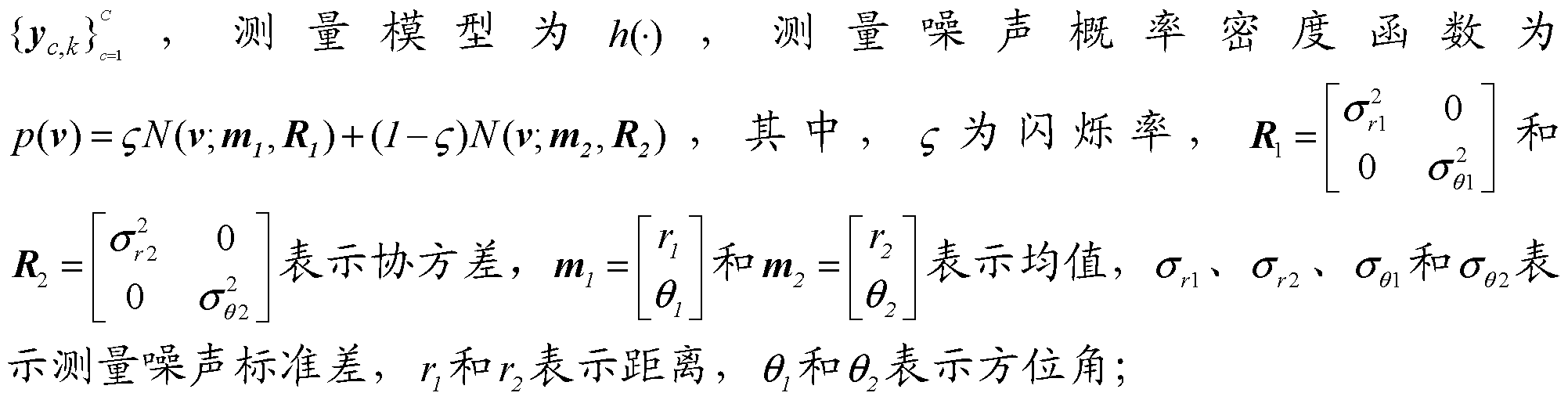
- the present invention belongs to the technical field of multi-sensor information fusion, and particularly relates to a multi-target tracking method and system. Background technique
- the present invention provides a multi-target tracking method and system, which aims to solve the problem of multi-target tracking in a nonlinear non-Gaussian system.
- the first aspect of the embodiments of the present invention provides a multi-target tracking method, and the method includes:
- the steps of generating and expanding the newborn target are to first generate the marginal distribution of the newborn target at the previous moment from the measurement data at the previous moment, and specify the existence probability for the newborn target, and then expand the marginal distribution and the existence probability of the newborn target to the previous From the marginal distribution and the existence probability of each target at a time, the expanded marginal distribution and the expanded existence probability of the target at the previous time are obtained;
- Prediction step according to the extended marginal distribution and extended existence probability of each target at the previous moment, use the particle method to predict the predicted marginal distribution and predicted existence probability of each target at the previous moment at the current moment; update step, according to each target at the previous moment The predicted marginal distribution and predicted existence probability at the current moment, as well as the measurement data at the current moment, using a particle filter method to determine the updated marginal distribution and the updated existence probability of each target at the current moment;
- a second aspect of the embodiments of the present invention provides a multi-target tracking system, and the system includes:
- the newborn target generation and expansion module is used to generate the marginal distribution of the newborn target at the previous moment from the measurement data of the previous moment, and specify the existence probability for the newborn target, and then respectively expand the marginal distribution and the existence probability of the newborn target to the previous From the marginal distribution and the existence probability of each target at a time, the expanded marginal distribution and the expanded existence probability of the target at the previous time are obtained;
- the prediction module is used to predict the predicted marginal distribution and predicted existence probability of each target at the current moment by using the particle method according to the expanded marginal distribution and expanded existence probability of each target at the previous moment;
- the update module is used to determine the updated marginal distribution and the predicted existence probability of each target at the current moment by the particle filter method based on the predicted edge distribution and predicted existence probability of each target at the current moment, and the measurement data at the current moment. Update the probability of existence;
- the extraction module is used to distribute and predict the prediction edge distribution and prediction of each target at the previous moment at the current moment
- the present invention has the following beneficial effects:
- the present invention provides a multi-target tracking method and system.
- a Bayesian filtering method based on particle edge distribution is used, through the steps of new target generation and expansion, prediction, update, and extraction,
- Fig. 1 is a method flowchart of a multi-target tracking method provided by the first embodiment of the present invention
- Fig. 2 is a system structure diagram of a multi-target tracking system provided by the second embodiment of the present invention
- Fig. 3 is the first embodiment of the present invention
- FIG. 4 is a schematic diagram of processing the measurement data of FIG. 3 by using the existing multi-target Gaussian mixture particle PHD filtering method based on unscented transform to obtain the position estimation and true trajectory of each target;
- FIG. 5 is a schematic diagram of using the multi-target tracking method provided by the first embodiment of the present invention to process the measurement data in FIG. 3 to obtain the position estimation and true trajectory of each target;
- Fig. 6 is an average OSPA (Optical Subpattern Assignment, OSPA) obtained through 100 experiments using the multi-target Gaussian mixture particle PHD filtering method based on unscented transformation in the prior art and the multi-target tracking method in the first embodiment of the present invention.
- OSPA Optical Subpattern Assignment
- the first embodiment of the present application proposes a multi-target tracking method.
- the multi-target tracking method includes:
- Step 101 First generate the marginal distribution of the newborn target at the previous moment from the measurement data at the previous moment, and specify the existence probability for the newborn target, and then expand the marginal distribution and the existence probability of the newborn target to the respective targets of the previous moment. In the marginal distribution and the existence probability, get the extended edge of the target at the previous moment
- the measurement data is acquired through the scanning of the sensor.
- the sensor has a scanning period.
- the value of the scanning period can be fixed. In different scanning periods, the sensor scans it. The space is scanned to obtain measurement data. It is understandable that there are not only targets but also obstacles in the scanning space of the sensor. Both targets and obstacles may be scanned by the sensor as the object to be measured, thereby generating measurement data.
- the previous moment in this embodiment can be understood as the previous scan period between the current moments, and the current moment can be understood as the current
- step 101 specifically includes the following steps a-C:
- Step 102 According to the expanded marginal distribution and expanded existence probability of each target at the previous moment, the particle method is used to predict the predicted marginal distribution and predicted existence probability of each target at the previous moment at the current moment; optionally, d is used to denote one extraction of particles The total number, /( ⁇ ) represents the system model;
- step 102 includes the following steps c-e:
- Step C From the mean m iM_Ak_x and the covariance P M_Ak_x of the target/extended edge distribution at time k-1, among them,
- Step e Predict the target at time A-l through the updated particles/predict edge distribution at time
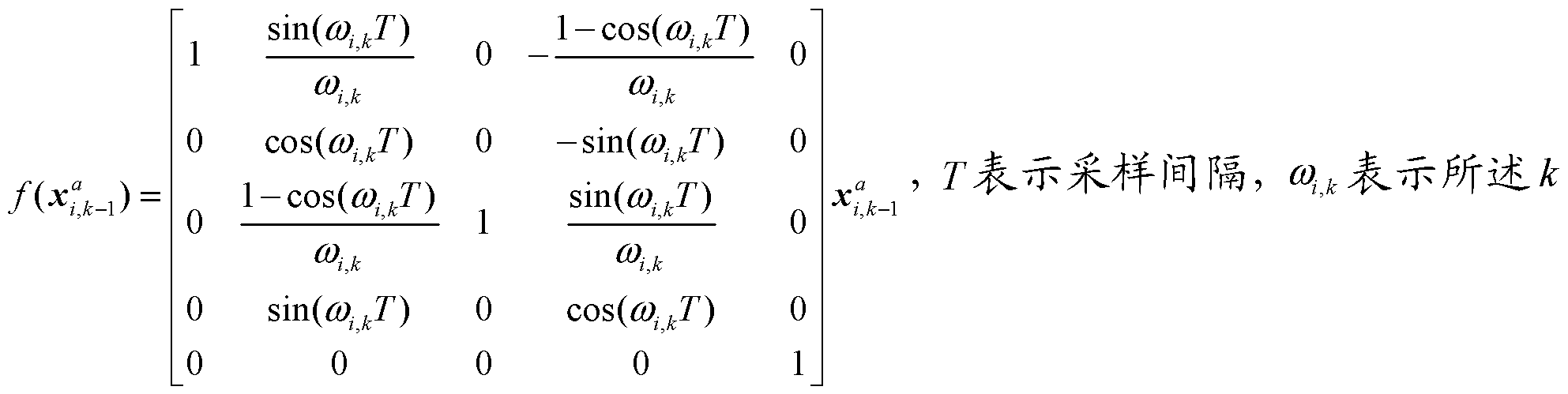
- the sampling interval, /V represents the survival probability; in this example, the survival probability can be obtained according to the solution method in the prior art, which is not limited in this embodiment.
- Step 103 According to the predicted edge distribution and predicted existence probability of each target at the current moment at the previous moment, and the measurement data at the current moment, the particle filter method is used to determine the updated edge distribution and update existence of each target at the previous moment at the current moment. Probability
- step 103 includes the following steps f-h:
- Step h Extract a total of d particles from the two importance density functions and calculate each particle
- Step 104 The prediction edge distribution and prediction existence of each target at the previous moment at the current moment
- step 104 the marginal distribution and the existence probability of each target remaining after clipping at the current moment are transferred to the next moment, as the input of the target tracking process at the next moment, which can be understood as cutting the remaining targets after clipping in step 104
- the edge distribution and existence probability of the current time (that is, time k) are used as the input at time k+1, that is, as the “margin distribution and existence probability of each target at the previous time” used in step 101 at time k+1.
- the "marginal distribution and existence probability of each target at the previous moment" used in step 101 at time k refers to the "marginal distribution and existence of each target remaining after trimming at the current time" in step 104 at time k-1 Probability".
- the marginal distribution whose existence probability is greater than the second threshold is extracted as the output of the target tracking process at the current moment, and the output is the target tracking result at the current moment (that is, moment k) .
- the Bayesian filtering method based on particle edge distribution is used to effectively solve the problem of non-discrimination through the steps of new target generation and expansion, prediction, update, and extraction.
- the second embodiment of the present application provides a multi-target tracking system.
- the multi-target tracking system includes:
- the newborn target generation and expansion module 201 is used to generate the marginal distribution of the newborn target at the previous moment from the measurement data of the previous moment, and specify the existence probability for the newborn target, and then expand the marginal distribution and the existence probability of the newborn target to From the marginal distribution and the existence probability of each target at the previous moment, the expanded marginal distribution and the expanded existence probability of the target at the previous moment are obtained;
- the prediction module 202 is configured to use the particle method to predict the predicted edge distribution and predicted existence probability of each target at the previous moment at the current moment according to the expanded marginal distribution and expanded existence probability of each target at the previous moment;
- d represents the total number of particles extracted at one time, and /( ⁇ ) represents the system model;
- T represents the sampling interval
- / ⁇ represents the probability of survival
- the update module 203 is used to determine the updated edge distribution of each target at the previous time at the current time based on the predicted edge distribution and predicted existence probability of each target at the current time, and the measurement data at the current time using a particle filter method And update the existence probability;
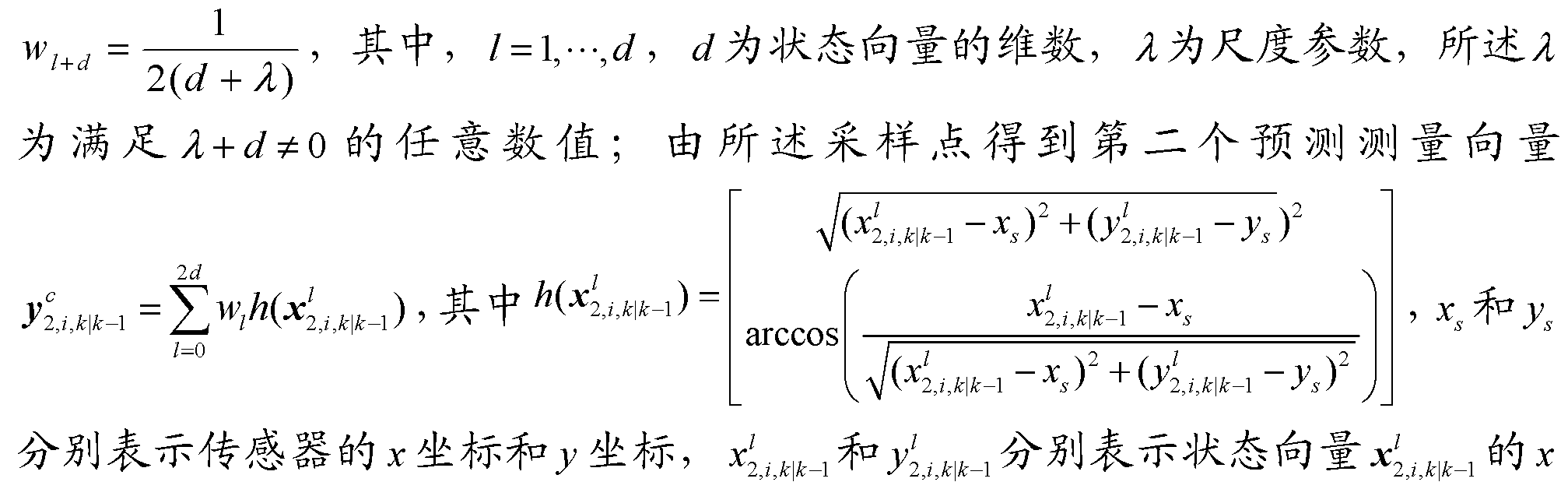
- the update module 203 is specifically configured to determine the target/predicted edge distribution at the current moment
- the dimension of, 2 is the scale parameter, 2 is any value satisfying / L + d/0;
- the filtering process is as follows:
- the extraction module 204 is configured to extend the predicted edge distribution and predicted existence probability of each target at the current moment to the updated edge distribution and updated existence probability of each target at the current moment, respectively, to obtain the expanded edge of each target at the current moment Distributed as
- the generation and expansion module 201 is used as the edge distribution and the existence probability of the target at the previous time used in the target tracking process at the next time); extracting the existence probability of the remaining targets from the edge distribution at the current time after trimming is greater than the second threshold
- the edge distribution of is used as the output of the target tracking process at the current moment.
- a Bayesian filtering method based on particle edge distribution is used to effectively solve the multi-target in a nonlinear non-Gaussian system through the steps of new target generation and expansion, prediction, update, and extraction.
- the tracking problem can be used in the field of multi-target tracking and has strong practicability.
- this embodiment illustrates the multi-target tracking method in a two-dimensional space with reference to FIGS. 3-6.
- the sensor is a radar, but it is understandable Yes, the sensor can also be other types of sensors in practice.
- the two-dimensional space in this embodiment is [-20000), 20000)]x[-2000(>), 20000)].
- this embodiment can Track moving targets in space.
- the state vector of the target is composed of position, speed, and turning rate.
- the state vector of target/ represents the turn rate in the state vector of target 1 at the current time (ie , time k in the first embodiment), and T represents
- the measurement data detected by the radar includes clutter and noise due to obstacles.
- the simulated measurement data of the radar during 70 scan periods in an experiment is shown in Fig. 3.
- the simulated measurement data in Figure 3 can be considered as the radar measurement data in 70 cycles
- the first threshold is 10 _4
- the new target weight of the multi-target Gaussian mixture particle PHD filter with no trace transformation 0.01
- the existence probability of the new target in this application p r 0.0 ⁇
- the covariance of the new target (diag ([50, 25,50,25,0. l])) ⁇
- Fig. 4 is a graph of the results obtained by processing the simulation measurement data in Fig. 3 using the existing multi-target Gaussian mixture particle PHD filter based on unscented transform.
- the trajectory formed by the position estimation in Fig. 4 is the multi-target tracking result obtained by the multi-target Gaussian mixture particle PHD filter based on the unscented transform.
- Fig. 5 is a diagram of the result obtained after processing the simulation measurement data in Fig. 3 using the multi-target tracking method of the first embodiment.
- the trajectory formed by the position estimation in Fig. 5 is a multi-target tracking result obtained by the multi-target tracking method based on the first embodiment.
- Fig. 6 is a schematic diagram of the comparison of the average OSPA distance obtained by using the existing multi-target Gaussian mixture particle PHD filter based on the unscented transform and the multi-target tracking method of the first embodiment of this application to perform 100 Monte Carlo experiments respectively.
- the comparison between the existing multi-target Gaussian mixture particle PHD filter based on unscented transform and the experimental results of the present invention shows that under the flicker noise model, clutter interference, target number uncertainty and detection uncertainty, the method of the present invention can To obtain a more accurate and reliable target state estimation, the OSPA distance is smaller than that obtained by the existing multi-target Gaussian mixture particle PHD filter based on unscented transform.
Landscapes
- Engineering & Computer Science (AREA)
- Multimedia (AREA)
- Computer Vision & Pattern Recognition (AREA)
- Physics & Mathematics (AREA)
- General Physics & Mathematics (AREA)
- Theoretical Computer Science (AREA)
- Radar Systems Or Details Thereof (AREA)
- Image Analysis (AREA)
Abstract
Description




Claims






Applications Claiming Priority (2)
| Application Number | Priority Date | Filing Date | Title |
|---|---|---|---|
| CN201910066671.0 | 2019-01-24 | ||
| CN201910066671.0A CN109800721B (zh) | 2019-01-24 | 2019-01-24 | 一种多目标跟踪方法及系统 |
Publications (1)
| Publication Number | Publication Date |
|---|---|
| WO2020151135A1 true WO2020151135A1 (zh) | 2020-07-30 |
Family
ID=66560165
Family Applications (1)
| Application Number | Title | Priority Date | Filing Date |
|---|---|---|---|
| PCT/CN2019/087202 Ceased WO2020151135A1 (zh) | 2019-01-24 | 2019-05-16 | 一种多目标跟踪方法及系统 |
Country Status (2)
| Country | Link |
|---|---|
| CN (1) | CN109800721B (zh) |
| WO (1) | WO2020151135A1 (zh) |
Cited By (1)
| Publication number | Priority date | Publication date | Assignee | Title |
|---|---|---|---|---|
| CN116068547A (zh) * | 2023-01-13 | 2023-05-05 | 河海大学 | 特征辅助时间匹配phd的雷达非线性多目标跟踪方法 |
Families Citing this family (1)
| Publication number | Priority date | Publication date | Assignee | Title |
|---|---|---|---|---|
| CN112883331B (zh) * | 2021-02-24 | 2024-03-01 | 东南大学 | 一种基于多输出高斯过程的目标跟踪方法 |
Citations (5)
| Publication number | Priority date | Publication date | Assignee | Title |
|---|---|---|---|---|
| US6226409B1 (en) * | 1998-11-03 | 2001-05-01 | Compaq Computer Corporation | Multiple mode probability density estimation with application to sequential markovian decision processes |
| CN103390107A (zh) * | 2013-07-24 | 2013-11-13 | 深圳大学 | 一种基于狄拉克加权和的目标跟踪方法与目标跟踪系统 |
| CN105719312A (zh) * | 2016-01-19 | 2016-06-29 | 深圳大学 | 基于序贯贝叶斯滤波的多目标跟踪方法及跟踪系统 |
| CN106405538A (zh) * | 2016-09-13 | 2017-02-15 | 深圳大学 | 一种适用于杂波环境的多目标跟踪方法及跟踪系统 |
| CN106772353A (zh) * | 2016-11-29 | 2017-05-31 | 深圳大学 | 一种适用于闪烁噪声的多目标跟踪方法及系统 |
Family Cites Families (6)
| Publication number | Priority date | Publication date | Assignee | Title |
|---|---|---|---|---|
| JP2005165688A (ja) * | 2003-12-02 | 2005-06-23 | Fuji Xerox Co Ltd | 複数対象物追跡方法及びシステム |
| CN102184541B (zh) * | 2011-05-04 | 2012-09-05 | 西安电子科技大学 | 多目标优化人体运动跟踪方法 |
| CN104050686B (zh) * | 2014-06-24 | 2017-12-26 | 重庆硕奥科技有限公司 | 一种密集空间目标跟踪方法 |
| CN104318059B (zh) * | 2014-09-24 | 2018-02-02 | 深圳大学 | 用于非线性高斯系统的目标跟踪方法和跟踪系统 |
| AU2014240213B2 (en) * | 2014-09-30 | 2016-12-08 | Canon Kabushiki Kaisha | System and Method for object re-identification |
| CN106952290B (zh) * | 2017-04-07 | 2019-05-10 | 深圳大学 | 一种用于三维空间跟踪转弯机动目标的方法及系统 |
-
2019
- 2019-01-24 CN CN201910066671.0A patent/CN109800721B/zh not_active Expired - Fee Related
- 2019-05-16 WO PCT/CN2019/087202 patent/WO2020151135A1/zh not_active Ceased
Patent Citations (5)
| Publication number | Priority date | Publication date | Assignee | Title |
|---|---|---|---|---|
| US6226409B1 (en) * | 1998-11-03 | 2001-05-01 | Compaq Computer Corporation | Multiple mode probability density estimation with application to sequential markovian decision processes |
| CN103390107A (zh) * | 2013-07-24 | 2013-11-13 | 深圳大学 | 一种基于狄拉克加权和的目标跟踪方法与目标跟踪系统 |
| CN105719312A (zh) * | 2016-01-19 | 2016-06-29 | 深圳大学 | 基于序贯贝叶斯滤波的多目标跟踪方法及跟踪系统 |
| CN106405538A (zh) * | 2016-09-13 | 2017-02-15 | 深圳大学 | 一种适用于杂波环境的多目标跟踪方法及跟踪系统 |
| CN106772353A (zh) * | 2016-11-29 | 2017-05-31 | 深圳大学 | 一种适用于闪烁噪声的多目标跟踪方法及系统 |
Non-Patent Citations (1)
| Title |
|---|
| FAN, EN; XIE, WEIXIN; LIU, ZONGXIANG; CHEN, FEI; LI, LIJUAN: "Multiple Target Tracking in Sensor Network Based on Fuzzy Information Processing", COMMAND INFORMATION SYSTEM AND TECHNOLOGY, vol. 5, no. 6, 31 December 2014 (2014-12-31), CN, pages 15 - 21,77, XP009522363, ISSN: 1674-909X, DOI: 10.15908/j.cnki.cist.2014.06.003 * |
Cited By (1)
| Publication number | Priority date | Publication date | Assignee | Title |
|---|---|---|---|---|
| CN116068547A (zh) * | 2023-01-13 | 2023-05-05 | 河海大学 | 特征辅助时间匹配phd的雷达非线性多目标跟踪方法 |
Also Published As
| Publication number | Publication date |
|---|---|
| CN109800721B (zh) | 2020-10-23 |
| CN109800721A (zh) | 2019-05-24 |
Similar Documents
| Publication | Publication Date | Title |
|---|---|---|
| Bilik et al. | Maneuvering target tracking in the presence of glint using the nonlinear Gaussian mixture Kalman filter | |
| CN106842165B (zh) | 一种基于不同距离角度分辨率雷达集中式异步融合方法 | |
| CN108802722B (zh) | 一种基于虚拟谱的弱目标检测前跟踪方法 | |
| CN109633599B (zh) | 一种机载预警雷达多目标跟踪方法 | |
| CN110231620B (zh) | 一种噪声相关系统跟踪滤波方法 | |
| CN110376582B (zh) | 自适应gm-phd的机动目标跟踪方法 | |
| Taghavi et al. | Multisensor-multitarget bearing-only sensor registration | |
| CN106405510B (zh) | 一种基于伪滑窗l判决准则的航迹删除方法 | |
| CN106405538B (zh) | 一种适用于杂波环境的多目标跟踪方法及跟踪系统 | |
| JP4116898B2 (ja) | 目標追尾装置 | |
| WO2018049602A1 (zh) | 一种适用于杂波环境的多目标跟踪方法及跟踪系统 | |
| Guo et al. | Passive tracking in heavy clutter with sensor location uncertainty | |
| Wang et al. | Laplace ℓ 1 robust Kalman filter based on majorization minimization | |
| WO2018010099A1 (zh) | 一种用于跟踪转弯机动目标的方法及其系统 | |
| WO2020151135A1 (zh) | 一种多目标跟踪方法及系统 | |
| CN106952290B (zh) | 一种用于三维空间跟踪转弯机动目标的方法及系统 | |
| CN105301593B (zh) | 一种基于双频rcs信息融合的飞行目标高度估计方法 | |
| Sithiravel et al. | Multiple model spline probability hypothesis density filter | |
| CN107783111A (zh) | 一种基于最大熵准则的雷达前视超分辨成像方法 | |
| CN108983190A (zh) | 基于干涉相位获取转动目标不同散射中心微动轨迹的方法 | |
| CN116520310B (zh) | 一种多普勒盲区下的机动多目标跟踪方法 | |
| Tan et al. | Joint range ambiguity resolving and multiple maneuvering targets tracking in clutter via MMPHDF-DA | |
| Fu et al. | Multiple hypothesis tracking based on the Shiryayev sequential probability ratio test | |
| Liu et al. | The sequential Monte Carlo multi-Bernoulli filter for extended targets | |
| CN110673132B (zh) | 一种用于多帧联合检测与跟踪的点迹序列实时滤波方法 |
Legal Events
| Date | Code | Title | Description |
|---|---|---|---|
| 121 | Ep: the epo has been informed by wipo that ep was designated in this application |
Ref document number: 19911038 Country of ref document: EP Kind code of ref document: A1 |
|
| NENP | Non-entry into the national phase |
Ref country code: DE |
|
| 122 | Ep: pct application non-entry in european phase |
Ref document number: 19911038 Country of ref document: EP Kind code of ref document: A1 |
|
| 32PN | Ep: public notification in the ep bulletin as address of the adressee cannot be established |
Free format text: NOTING OF LOSS OF RIGHTS PURSUANT TO RULE 112(1) EPC (EPO FORM 1205A DATED 09.11.2021) |
|
| 122 | Ep: pct application non-entry in european phase |
Ref document number: 19911038 Country of ref document: EP Kind code of ref document: A1 |