WO2020148964A1 - 細胞生成支援装置、方法、及びプログラム - Google Patents
細胞生成支援装置、方法、及びプログラム Download PDFInfo
- Publication number
- WO2020148964A1 WO2020148964A1 PCT/JP2019/042067 JP2019042067W WO2020148964A1 WO 2020148964 A1 WO2020148964 A1 WO 2020148964A1 JP 2019042067 W JP2019042067 W JP 2019042067W WO 2020148964 A1 WO2020148964 A1 WO 2020148964A1
- Authority
- WO
- WIPO (PCT)
- Prior art keywords
- information
- cell
- cells
- measurement
- generated
- Prior art date
- Legal status (The legal status is an assumption and is not a legal conclusion. Google has not performed a legal analysis and makes no representation as to the accuracy of the status listed.)
- Ceased
Links
Images





Classifications
-
- G—PHYSICS
- G06—COMPUTING OR CALCULATING; COUNTING
- G06N—COMPUTING ARRANGEMENTS BASED ON SPECIFIC COMPUTATIONAL MODELS
- G06N3/00—Computing arrangements based on biological models
- G06N3/02—Neural networks
- G06N3/04—Architecture, e.g. interconnection topology
- G06N3/0464—Convolutional networks [CNN, ConvNet]
-
- C—CHEMISTRY; METALLURGY
- C12—BIOCHEMISTRY; BEER; SPIRITS; WINE; VINEGAR; MICROBIOLOGY; ENZYMOLOGY; MUTATION OR GENETIC ENGINEERING
- C12M—APPARATUS FOR ENZYMOLOGY OR MICROBIOLOGY; APPARATUS FOR CULTURING MICROORGANISMS FOR PRODUCING BIOMASS, FOR GROWING CELLS OR FOR OBTAINING FERMENTATION OR METABOLIC PRODUCTS, i.e. BIOREACTORS OR FERMENTERS
- C12M1/00—Apparatus for enzymology or microbiology
-
- C—CHEMISTRY; METALLURGY
- C12—BIOCHEMISTRY; BEER; SPIRITS; WINE; VINEGAR; MICROBIOLOGY; ENZYMOLOGY; MUTATION OR GENETIC ENGINEERING
- C12M—APPARATUS FOR ENZYMOLOGY OR MICROBIOLOGY; APPARATUS FOR CULTURING MICROORGANISMS FOR PRODUCING BIOMASS, FOR GROWING CELLS OR FOR OBTAINING FERMENTATION OR METABOLIC PRODUCTS, i.e. BIOREACTORS OR FERMENTERS
- C12M1/00—Apparatus for enzymology or microbiology
- C12M1/34—Measuring or testing with condition measuring or sensing means, e.g. colony counters
-
- G—PHYSICS
- G06—COMPUTING OR CALCULATING; COUNTING
- G06N—COMPUTING ARRANGEMENTS BASED ON SPECIFIC COMPUTATIONAL MODELS
- G06N20/00—Machine learning
-
- G—PHYSICS
- G06—COMPUTING OR CALCULATING; COUNTING
- G06N—COMPUTING ARRANGEMENTS BASED ON SPECIFIC COMPUTATIONAL MODELS
- G06N3/00—Computing arrangements based on biological models
- G06N3/02—Neural networks
- G06N3/08—Learning methods
- G06N3/09—Supervised learning
-
- G—PHYSICS
- G06—COMPUTING OR CALCULATING; COUNTING
- G06T—IMAGE DATA PROCESSING OR GENERATION, IN GENERAL
- G06T7/00—Image analysis
-
- G—PHYSICS
- G06—COMPUTING OR CALCULATING; COUNTING
- G06N—COMPUTING ARRANGEMENTS BASED ON SPECIFIC COMPUTATIONAL MODELS
- G06N3/00—Computing arrangements based on biological models
- G06N3/02—Neural networks
- G06N3/08—Learning methods
Definitions
- the technology of the present disclosure relates to a cell generation support device, method, and program.
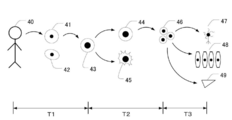
- pluripotent stem cells such as ES (Embryonic Stem) cells and iPS (Induced Pluripotent Stem) cells have the ability to differentiate into cells of various tissues, and are useful in regenerative medicine, drug development, disease elucidation, etc. It is attracting attention as a cell that can be applied. For example, when it is desired to generate a desired number of desired cells by differentiating iPS cells, cells such as blood cells 41 or skin cells 42 are collected from a cell donor 40 as shown in FIG.
- ES Embryonic Stem
- iPS Induced Pluripotent Stem
- expansion culture culturing the generated iPS cells 43
- the initialization process T1 and the culture process T2 require a total of about 2 months
- the differentiation process T3 requires a period of about 2 to 3 months.
- the culturing step T2 there is an operation called "passage" in which the medium is removed from the culture container containing the iPS cells 43 and the iPS cells 43 are transferred to a new medium.
- the proliferated iPS cells 43 are uniformly seeded in a plurality of culture vessels at a predetermined size and density, and cell division is performed.
- the person in charge of the work should visually observe cells that may proliferate while maintaining the undifferentiated state. Have been selected by.
- the person in charge selects cells, for example, by continuously culturing iPS cells 44 having a well-shaped cell line and removing iPS cells 45 having a non-well-shaped cell line.
- iPS cells 44 having a well-shaped cell line
- iPS cells 45 having a non-well-shaped cell line.
- differentiation induction from iPS cells is not successful. If differentiation induction is not successful, it will be difficult to generate the target number of cells to be differentiated, which is an obstacle to industrialization.
- the differentiation induction is always successful and the target cells are generated.
- the number of cells that can possibly become the cells to be generated is determined at the end of the culture step T2. For example, when it is found that the number of cells that can possibly become the cells to be generated is smaller than the target number of cells after entering the differentiation step T3, new cells are generated from scratch due to the insufficient amount. This is time consuming and costly. For example, when using cells collected from a healthy person as a drug discovery tool, it is desired to generate the target number of cells to be generated in the shortest possible time.
- the present disclosure has been made in view of the above circumstances, and an object of the present disclosure is to enable acquisition of information as to whether or not a desired number of cells can be generated.
- the cell generation support device includes an information acquisition unit that acquires history information indicating a history of cells to be used and cell information of cells to be generated, and history information, cell information, and cells acquired by the information acquisition unit. Generated for each cell measurement based on the measurement information related to the measurement when measuring the cell in any of the initialization step, the cell culture step, and the cell differentiation induction step.
- a generation possibility information acquisition unit for acquiring information on whether or not a desired cell can be generated.
- the generative information acquisition unit derives information about whether or not a desired cell can be generated based on the history information and the cell information acquired by the information acquisition unit, and the measurement information. It may include a first derivation unit that does.
- the first derivation unit, the history information indicating the history of the cells to be used, the cell information of the cells to be generated, the initialization step of initializing the cells, and the cells are cultured.
- a first set of information including measurement information related to measurement when measuring cells and a set of the first information are provided.
- the first learned model that has been machine-learned by using the learning information including a plurality of information sets including the information indicating whether the corresponding cells to be generated can be generated may be included.
- the measurement information may be at least one of information related to the measurement unit and information indicating the measurement result obtained by the measurement by the measurement unit.
- the information related to the measurement means includes information indicating one of the method used for measurement and the person in charge of measurement, and the information indicating the measurement result is measured.
- the information may include any one or more of a cell state, a medium state, and the presence or absence of bacteria.
- the measured cell state includes cell shape, cell color, cell number, cell size, cell odor, cell gene expression, cell metabolite.
- the information of any one or more of the type and the protein of the cell may be included.
- the history information is the name of the cell donor who is the holder of the cells to be used, the sex of the cell donor, the blood type of the cell donor, the race of the cell donor,
- the information may include any one or more of the age of the cell donor, the disease history of the cell donor, the immune information of the cell donor, and the disease history of the relatives of the cell donor.
- the cell information is any one or more of the types of cells to be generated, the number of cells to be generated, the state of cells to be generated, and the number of days to be completed. May be included.
- the cell generation support device may include a notification unit that notifies information about whether or not a cell to be generated can be generated.
- the generative information acquisition unit acquires generative information, culture conditions for culturing cells based on the history information and the cell information acquired by the information acquisition unit. It may further include a culture condition acquisition unit for acquiring.
- the culture condition acquisition unit may be used in any one of an initialization step of initializing cells, a culture step of culturing cells, and a differentiation step of inducing differentiation of cells.
- the updated culture condition updated based on the measurement information related to the measurement when measuring cells may be acquired as the culture condition.
- the culture condition acquisition unit updates the culture condition acquisition unit based on the measurement information and the second derivation unit that derives the culture condition based on the history information and the cell information acquired by the information acquisition unit.
- a third derivation unit that derives the updated culture condition as the culture condition may be included.
- the second derivation unit includes a second information set including history information indicating the history of cells to be used and cell information of cells to be generated, and the second information.
- the second derivation model includes a second trained model machine-learned using learning information including a plurality of information sets with culture conditions corresponding to the set, and the third derivation unit initializes the cell, In any one of the culturing step of culturing and the differentiating step of inducing differentiation of cells, a third set of information including measurement information and culturing conditions related to measurement when measuring cells, and this third set
- the third learned model machine-learned using learning information including a plurality of information sets with updated culture conditions corresponding to the information set of
- the second learned model and the third learned model may be configured by one learned model.
- the culture conditions include the type of cells used, the number of cells used, the type of container used, the type of medium used, the type of additive used, the timing of treatment, Also, any one or more of the information regarding the person in charge may be included.
- the processing timing is any one of seeding timing, passage timing, medium replacement timing, additive addition timing, and cell inspection timing. It may include one or more timings.
- history information indicating the history of cells to be used and cell information of cells to be generated are acquired, and history information, cell information, and an initialization step of initializing cells, and culturing cells Whether or not the desired cell can be generated for each cell measurement, based on the measurement information related to the measurement when measuring the cell in any one of the culture step and the differentiation step of inducing the differentiation of cells Get information.
- the cell generation support method according to the present disclosure may be provided as a program that causes a computer to execute the method.
- Another cell generation support device includes a memory that stores instructions to be executed by a computer, and a processor configured to execute the stored instructions, the processor indicating a history of cells to be used. Acquiring history information and cell information of cells to be generated, history information, cell information, and any one of an initialization step of initializing cells, a culture step of culturing cells, and a differentiation step of inducing differentiation of cells Based on the measurement information related to the measurement when measuring the cells in the process, a process of acquiring information on whether or not the desired cell can be generated is executed for each measurement of the cell.
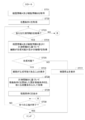
- the flowchart which shows the process performed in the cell production assistance apparatus of the 1st Embodiment of this indication.
- the figure for demonstrating the trained model by 1st Embodiment of this indication The figure which shows the schematic structure of the cell production assistance apparatus by 2nd Embodiment of this indication.
- the figure for demonstrating the trained model by 2nd Embodiment of this indication The figure for demonstrating the 2nd derivation
- the flowchart which shows the process performed in the cell production assistance apparatus of the 2nd Embodiment of this indication.
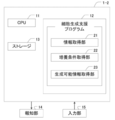
- FIG. 1 is a diagram showing a schematic configuration of a cell generation support device according to the first embodiment of the present disclosure.
- FIG. 1 shows that the cell generation support program is installed in the non-volatile memory 12.
- the cell generation support program may be installed in the storage 13.
- the memory 12 may be a volatile memory such as a DRAM (Dynamic Random Access Memory) or an SRAM (Static Random Access Memory).
- the cell generation support program called from the CPU 12 is temporarily stored in the memory 12 May be stored and executed.
- the cell generation support device includes the learned model. Therefore, only the cell generation support device is shown in FIG. As shown in FIG.
- the cell generation support device 1 includes a CPU (Central Processing Unit) 11, a memory 12, and a storage 13 as a standard computer configuration. Further, the cell generation support device 1 is connected to a notification unit 14 for notifying a culture condition C, which will be described later, and an input device (hereinafter referred to as an input unit) 15 such as a keyboard and a mouse.
- a CPU Central Processing Unit
- a memory 12 for storing data
- a storage 13 as a standard computer configuration
- the cell generation support device 1 is connected to a notification unit 14 for notifying a culture condition C, which will be described later, and an input device (hereinafter referred to as an input unit) 15 such as a keyboard and a mouse.
- an input unit 15 such as a keyboard and a mouse.
- the notification unit 14 includes, for example, a display that visually displays the culture condition C and the information F indicating whether or not a desired cell can be generated.
- the notification unit 14 includes a display for visually displaying a message and the like, a sound reproducing device for audibly displaying when a sound is output, a printer for recording on a recording medium such as paper and the like for permanent visual display, a communication means such as an email or a telephone, and the like. It means an indicator light or the like, and may be a combination of at least two or more of the display, the audio reproducing device, the printer, the communication means, and the display light.
- the notification unit 14 is an external device of the cell generation support device 1, but the technology of the present disclosure is not limited to this, and the notification unit 14 is included in a part of the cell generation support device 1. It may be.
- the storage 13 comprises a storage device such as a hard disk or SSD (Solid State Drive).
- the storage 13 stores various information including history information A indicating the history of cells to be used and information necessary for the process of the cell generation support device 1, acquired from an external data server (not shown) via the network.
- the memory 12 stores a cell generation support program and a learned model.
- the cell generation support program as processing to be executed by the CPU 11, information acquisition processing for acquiring history information indicating the history of cells to be used and cell information of cells to be generated, and history information, cell information, and an initial stage of initializing cells.
- Cells to be generated for each cell measurement based on measurement information related to measurement when measuring cells in any one of the process of culturing cells, the step of culturing cells, and the step of differentiating cells Defines a generation possibility information acquisition process for acquiring information on whether or not generation is possible.
- the computer functions as the information acquisition unit 21 and the creatable information acquisition unit 23 by the CPU 11 executing these processes according to the cell generation support program.
- the CPU 11 executes the function of each unit by the cell generation support program.
- a programmable logic device which is a processor whose circuit configuration can be changed after manufacture of an FPGA (Field Programmable Gate Array) or the like, can be used.
- the processing of each unit may be executed by a dedicated electric circuit or the like, which is a processor having a circuit configuration specifically designed for executing a specific processing such as an ASIC (Application Specific Integrated Circuit).
- the memory 12 is a volatile memory
- the cell generation support program called by the CPU 12 and the learned model may be temporarily stored in the memory 12 and executed.
- One processing unit may be configured by one of these various processors, or may be a combination of two or more processors of the same type or different types (for example, a plurality of FPGAs or a combination of CPU and FPGA). It may be configured. Further, the plurality of processing units may be configured by one processor. As an example of configuring a plurality of processing units by one processor, firstly, as represented by a computer such as a client and a server, one processor is configured by a combination of one or more CPUs and software. There is a form in which the processor functions as a plurality of processing units.
- SoC system on chip
- a processor that realizes the function of the entire system including a plurality of processing units by one IC (Integrated Circuit) chip is used.
- IC Integrated Circuit
- the various processing units are configured by using one or more of the above various processors as a hardware structure.
- the information acquisition unit 21 acquires history information A indicating the history of cells to be used and cell information B of cells to be generated. As an example, when the identification information written on the container in which the cells to be used are stored is input from the input unit 15, the information acquisition unit 21 outputs the history information A of the cell provider corresponding to the input identification information. , Get from external server.
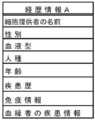
- FIG. 2 is a diagram showing an example of the history information A according to the first embodiment of the present disclosure.
- the history information A is information indicating the history of the cells used.
- the history information A is, for example, as shown in FIG. 2, the name of the cell donor who is the holder of the cells to be used, the sex of the cell donor, the blood type of the cell donor, the race of the cell donor, and the cell donor.
- the relatives of the cell donor are, for example, relatives within the third degree of relatives of the cell provider himself.
- the technology of the present disclosure is not limited to this, and may include, for example, a blood relative farther than the third degree relative.
- the history information A indicates the information illustrated in FIG. 2.
- the technology of the present disclosure is not limited to this, and any one or more of the information illustrated in FIG. The information may be included.
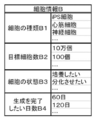
- FIG. 3 is a diagram showing an example of the cell information B according to the first embodiment of the present disclosure.
- the cell information B is information on cells to be generated.
- the cell information B includes information on the type B1 of cells to be generated, the target cell number B2, and the state B3 of cells to be generated.
- the cell type B1 is information on the types of cells to be generated, such as iPS cells, cardiomyocytes, and nerve cells.
- the target cell number B2 is information indicating the number of cells to be generated, such as 100,000 cells and 100 cells.
- the cell state B3 is information indicating what one wants to do with the cell, such as wanting to culture and differentiating.
- the cell type B1 and the target cell number B2 are set in advance, they are not changed until the initialization step T1, the culture step T2, and the differentiation step T3 shown in FIG. 19 are all completed.
- the cell state B3 is "I want to initialize” in the initial step T1, "I want to expand culture” and “I want to sort” in the culture step T2, and "I want to differentiate” in the differentiation step T3. It is changed by the person in charge for each process.
- the cell information B is information indicating the cell type B1, the target cell number B2, the cell state B3, and the number of days B4 at which generation is desired to be completed.
- the technology of the present disclosure is not limited to this, and the cell information B may be information including any one or more of these pieces of information.
- the generable information acquiring unit 23 includes the history information A acquired by the information acquiring unit 21, the cell information B, an initialization step T1 for initializing the cells, a culturing step T2 for culturing the cells, and a differentiation step for inducing differentiation of the cells. Based on the measurement information D related to the measurement when measuring the cell in any step of T3, the information F indicating whether or not the desired cell can be generated is acquired for each measurement of the cell.
- FIG. 4 is a diagram showing an example of the measurement information D according to the first embodiment of the present disclosure.
- the measurement information D is information related to the measurement when measuring the cells in the inspection of the cells.
- the measurement information D1 is information D1 and the information D2 indicating the measurement result obtained by the measurement by the measurement means. is there.
- the information D1 on the measuring means includes information on the method used for the measurement and information on the person in charge of the measurement.
- the method used for the measurement there is information on the type of the measuring device and the presence/absence of use of the measuring device, and there are a phase contrast microscope, a bright field microscope, visual inspection, and the like.
- the information of the person in charge of measurement there are information such as the names of the respective measurers such as the measurer A and the measurer B and the mature years of the measurement.
- the information D2 indicating the measurement result obtained by the measurement includes information on the measured cell state, medium state, and presence/absence of bacteria.
- the measured cell state is the inspection value of the cell, and the shape of the cell, the color of the cell, the number of cells, the size of the cell, the odor of the cell, the gene expression of the cell, the kind of the metabolite of the cell, the type of the cell.
- cell protein information is information on whether or not a protein is synthesized, and cell gene expression refers to a process in which gene information is converted into structure and function in the cell.
- a protein is measured using a fluorescent probe, and gene expression is measured using a gene amplification agent of a target obtained by grinding cells. Note that the present disclosure is not limited to this, and a known measurement method can be used.
- the state of the medium includes information such as the color of the medium, metabolites of cells contained in the medium, and the concentration of gas dissolved in the medium.
- the color of the medium By measuring the color of the medium, the amount of carbon dioxide dissolved in the medium can be measured.
- the gas concentration for example, the carbon concentration and nitrogen concentration in the medium are measured. This makes it possible to detect whether or not the cells have been normally cultured.
- the presence/absence of the bacterium is information such as whether the cell has the bacterium, the medium has the bacterium, the cells and the medium have the bacterium, and the bacterium does not have the bacterium.
- the information illustrated in FIG. 4 is the measurement information D as one embodiment, but the technology of the present disclosure is not limited to this, and the measurement information D includes any one or more of the information illustrated in FIG. 4. Any information can be included.
- a method used for the measurement is, for example, a phase contrast microscope. That is, in the initialization step T1, blood cells 41 and skin cells 42 are perforated, and a drug is introduced into the perforated holes. In this case, the cells may not be successfully initialized unless the holes are formed in the size, shape, and depth necessary for containing the drug. Therefore, for example, the size of the hole is measured from the image obtained by imaging the perforated cell 41 and the skin cell 42 with a phase contrast microscope.
- the method used for measurement in the initialization step T1 is not limited to the phase-contrast microscope, and any method may be used as long as it can measure holes.
- a method used for the measurement performed when selecting the iPS cells there is, for example, a method using a phase contrast microscope.
- An iPS cell 43 is imaged using a phase-contrast microscope to acquire a captured image, and the size and shape of the iPS cell 43 in the acquired captured image are measured to form an iPS having a well-shaped shape, that is, a differentiation-inducible shape.
- the iPS cell 44 is the cell 44, the iPS cell 44 is expanded and continuously cultivated.
- the iPS cell 44 has an irregular shape, that is, the iPS cell 44 has a shape that cannot induce differentiation
- the cells are sorted.
- the method of using the iPS cells 43 for measurement is not limited to the phase contrast microscope, and may be the visual observation of the measurer or any other method.
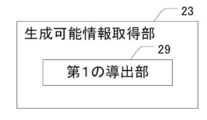
- FIG. 5 is a diagram showing a schematic configuration of the createable information acquisition unit 23 according to the first embodiment of the present disclosure.
- the generable information acquisition unit 23 includes a first derivation unit 29, as shown in FIG.
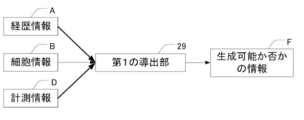
- the first derivation unit 29 derives, based on the history information A and the cell information B, and the measurement information D, the information F indicating whether or not a desired cell can be generated for each cell measurement.
- the first derivation unit 29 includes a learned model M that has been machine-learned using learning information.
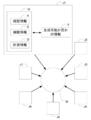
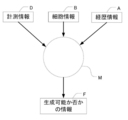
- FIG. 6 is a diagram for explaining the learned model M according to the first embodiment of the present disclosure.
- the learned model M corresponds to the history information A indicating the history of the cells to be used, the cell information B of the cells to be generated, the information set Q of the measurement information D, and the information set Q.
- Machine learning is performed using learning information including a plurality of information sets J with the information F indicating whether or not cells to be generated can be generated. That is, the learned model M is machine-learned so as to output information F indicating whether or not a desired cell can be generated based on the history information A and the cell information B, and the measurement information D.
- the learned model M is, for example, a target number of cells to be generated when generating cells of the cell information B from cells of the cell provider X having the information set Q of the cell provider X, that is, the history information A.
- the model for obtaining the trained model M is also trained together with the result of whether or not it has been generated.
- the history information A and the cell information B and the measurement information D are input to the learned model M, the cells to be generated can be generated for the history information A and the cell information B and the measurement information D. Learning is performed so that the information F indicating whether or not it is output.
- a machine learning algorithm in the learned model M can use, for example, a neural network (NN (Neural Network)) on which deep learning (deep learning) is performed.
- NN Neurological Network
- the technology of the present disclosure is not limited to this, and examples thereof include a support vector machine (SVM), a convolutional neural network (CNN), a convolutional neural network (CNN), and a recurrent.
- SVM support vector machine
- CNN convolutional neural network
- CNN convolutional neural network
- CNN convolutional neural network
- RNN Recurrent Neural Network
- FIG. 7 is a diagram for explaining the first derivation unit 29 according to the first embodiment of the present disclosure.
- the first derivation unit 29 has, as an example, the learned model M described above.
- the learned model M described above.
- the learned model M may output the probability that a desired cell can be generated for each number of cells.
- the number of cells that exceeds a threshold of a predetermined probability is output as the number of cells that can be generated, and the number of cells that is less than or equal to the threshold of the probability is a cell that is insufficient to reach the target number of cells. May be output as the number of
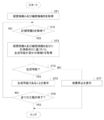
- FIG. 8 is a diagram for explaining processing performed in the cell generation supporting apparatus 1 according to the first embodiment of the present disclosure
- FIG. 9 shows processing performed in the cell generation supporting apparatus 1 according to the first embodiment of the present disclosure. It is a flowchart shown.
- the information acquisition unit 21 acquires history information A indicating the history of cells to be used and cell information B of cells to be generated (step ST1).
- the measurement of cells is determined in advance in each step of an initialization step T1 for initializing cells, a culture step T2 for culturing cells, and a differentiation step T3 for inducing differentiation of cells.
- Timing that is, cell inspection timing.
- the CPU 11 determines a predetermined timing in each step of the initialization step T1 for initializing cells, the culture step T2 for culturing cells, and the differentiation step T3 for inducing differentiation of cells, that is, the determination.
- the determination timing can be set based on the cell inspection timing, and the determination timing can be set between a certain cell inspection timing and the next cell inspection timing.
- step ST2 When it is determined in step ST2 that the generable information acquisition unit 23 has not acquired new measurement information D (step ST2; NO), the CPU 11 shifts the processing to step ST6, and all steps are completed. It is determined whether or not (step ST6).
- step ST3 when the CPU 11 determines in step ST2 that the new measurement information D has been acquired (step ST2; YES), the producible information acquisition unit 23 acquires the new measurement information D as shown in FIG. Based on the history information A, the cell information B, and the measurement information D output by inputting to the learned model M, the information F indicating whether or not the desired cell can be generated is acquired (step ST3).
- the CPU 11 determines whether or not the cells to be generated can be generated (step ST4). If it can be generated (step ST4; YES), the notification unit 14 notifies that it can be generated, and the cell culture is continued. Specifically, the notification unit 14 displays on the display that cells can be generated (step ST5). The notification unit 14 may display the number of cells that are still insufficient.
- step ST6 determines whether or not all steps have been completed.
- step ST6; NO the CPU 11 shifts the processing to step ST2 and performs the subsequent processing. That is, based on the timing determined in advance, it is determined whether or not the generatable information acquisition unit 23 has acquired new measurement information D related to measurement when measuring cells (step ST2).
- step ST6; YES the cell generation support device 1 ends the series of processes.
- step ST4 when the generation is not possible (step ST4; NO), the notification unit 14 notifies the culture stop and stops the cell culture. Specifically, the notification unit 14 displays the culture stop on the display (step ST7). Then, the cell generation support device 1 ends the series of processes.
- the history information A indicating the history of the cells to be used and the cell information B of the cells to be generated are acquired, and the history information A and the cell information are acquired.
- B based on measurement information D related to measurement when measuring cells in any one of an initialization step of initializing cells, a culture step of culturing cells, and a differentiation step of inducing differentiation of cells.
- the information F indicating whether or not the cells to be generated can be generated is acquired for each cell measurement, it is possible to acquire the information regarding whether or not the desired number of cells can be generated.
- the person in charge of generating the cell is notified of the fact that the cell can be generated when the cell is notified that the cell can be generated.
- the culture can be continued, and when it is notified that the cells cannot be generated, the cell culture can be stopped and restarted from the beginning, or the generation of an insufficient number of cells can be started.
- unnecessary time can be shortened and unnecessary culture and differentiation induction can be eliminated as compared with the conventional case, so that cost loss can be prevented.
- the creatable information acquisition unit 23 acquires the information F indicating whether or not the desired cell can be created, based on the history information A, the cell information B, and the new measurement information D.
- the generative information acquisition unit 23 wants to generate based on the history information A, the cell information B, and all the measurement information D acquired from the start of the culture until the new measurement information D is acquired.
- the information F indicating whether or not cells can be generated may be acquired.
- FIG. 10 is a diagram showing a schematic configuration of a cell generation support device 1-2 according to the second embodiment of the present disclosure.
- FIG. 10 is realized by installing a cell generation support program.
- the cell generation support apparatus 1-2 according to the second embodiment of the present disclosure is the cell generation support apparatus 1 according to the first embodiment described above.
- the same components as those of the above are given the same reference numerals, and the description thereof will be omitted. Only different points will be described in detail.
- the cell generation support device 1-2 further includes a culture condition acquisition unit 22 in addition to the cell generation support device 1 of FIG.
- the culture condition acquisition unit 22 acquires a culture condition C for culturing cells based on the history information A and the cell information B.
- FIG. 11 is a diagram showing an example of the culture condition C according to the second embodiment of the present disclosure.
- the culture condition C is a culture condition for producing a desired number of cells to be produced.
- the "cells to be generated" are cells having a target quality. Therefore, in the present embodiment, the culturing condition C is a culturing condition for producing the desired number of cells to be produced with a desired quality.
- the culture condition C indicates which cells are used, how many cells are used, which medium is used, which medium is used, which additive is added to generate the cells, and the desired number of cells can be generated. .. Specifically, the culture condition C is, as shown in FIG. 11 as an example, the type of cells used, the number of cells used, the type of container used, the type of medium used, the type of additive used, and the treatment. Includes information about the timing of, and the person in charge.
- culture condition C includes the use of liver cells as cells A and vascular cells as cells B. Also, cell number, 10 5 cells A, 10 6 cells of cell B, and cell 10 5 A and a cell B 10 6 cells, etc., the number of specific uses for the cells contained in the culture condition C Be done.
- the type of container used is, for example, a petri dish, n well plates having 6 wells, m well plates having 24 wells, and 1 T75 flask. And are included in culture condition C.
- the culture conditions C include, as an example, the type of medium to be used, such as medium M1, medium M2, or a mixture of medium M1 and medium M2.
- the culture condition C is set including the mixing ratio.
- the type of the additive to be used includes, for example, the additive C1, the additive C2, or the mixture of the additive C1 and the additive C2 in the culture condition C.
- the culture condition C is set including the mixing ratio.
- the timing of the treatment is, for example, the timing of seeding, the timing of subculture, the timing of exchanging the medium, the timing of adding additives, and the timing of inspecting cells.
- the culture condition C includes which treatment should be performed at which timing.
- the culture condition C includes information about the person in charge, such as who is in charge of the person A and person B. For example, the person A who is good at fine work and the person B who is not good at fine work may have different effects on cell generation even if the same process is performed. Therefore, the culture condition C includes which person in charge and which process should be performed.
- the condition shown in FIG. 11 as the embodiment is the culture condition C, but the technique of the present disclosure is not limited to this, and the culture condition C includes any one or more of the information shown in FIG. 11. Any information will do.
- FIG. 12 is a diagram showing a schematic configuration of the culture condition acquisition unit 22 according to the second embodiment of the present disclosure.
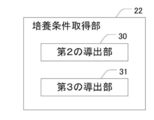
- the culture condition acquisition unit 22 includes a second derivation unit 30 and a third derivation unit 31.
- the second derivation unit 30 derives the culture condition C based on the history information A and the cell information B.
- the second derivation unit 30 includes a learned model M that has been machine-learned using learning information.
- FIG. 13 is a diagram for explaining the learned model M according to the second embodiment of the present disclosure.
- the learned model M includes a history information A indicating the history of cells to be used and an information set P of cell information B of cells to be generated, and a culture condition C corresponding to the information set P.
- Machine learning is performed using learning information including a plurality of information sets S. That is, the learned model M is machine-learned so as to output the culture condition C based on the history information A and the cell information B.
- the learned model M is cultured under the culture condition C when the cells of the cell information B are generated from the cells of the cell provider X having the history information A, that is, the information set P of the cell provider X.
- the model for obtaining the learned model M is also trained with the result of success or failure.
- the learned model M outputs the culture condition C capable of generating the cell indicated by the cell information B, with respect to the history information A and the cell information B. Learning is done to do.
- FIG. 14 is a diagram for explaining the second derivation unit 30 according to the second embodiment of the present disclosure.
- the second derivation unit 30 has the learned model M shown in FIG. 13 described above as an example.
- the culture condition exceeding the threshold value is output as the culture condition C suitable for the cells to be generated.
- the culture condition C is, as shown in FIG. 11, the type of cells used, the number of cells used, the type of container used, the type of medium used, the type of additive used, the timing of treatment, and the charge. It includes at least one of the information about the person.
- the learned model M has the target quality for each number of cells to be used. , And outputs the probability that a target number of cells can be generated, and the culture condition acquisition unit 22 uses a cell number that has the target quality and the highest probability that the target number of cells can be produced. It may be obtained as the number, that is, as the culture condition C most suitable for the cells to be generated.
- the culture condition acquisition unit 22 further performs measurement when measuring cells in any one of the initialization step T1, the culture step T2, and the differentiation step T3 shown in FIG.
- the updated culture condition E which is an update of the culture condition C at the time when the measurement information D is acquired, is acquired as a new culture condition C based on the measurement information D related to.
- FIG. 15 is a diagram for further explaining the learned model M according to the second embodiment of the present disclosure shown in FIG. 13.
- the learned model M includes a set G of measurement information D and a culture condition C related to measurement when measuring cells, and an updated culture condition E corresponding to the set G of information.
- Machine learning is performed using learning information including a plurality of information sets R. That is, the learned model M is machine-learned so as to output the updated culture condition E based on the measurement information D and the culture condition C at the time when the measurement information D was acquired.
- the learned model M has already been learned together with the result of whether or not the culture was successful when the cell of the cell information B was generated from the cell of the cell provider X and the culture was performed under the updated culture condition E.
- the model to obtain model M.
- the cell information B indicates the new measurement information D.
- Learning is performed so as to output the updated culture condition E capable of generating cells.
- the learned model M illustrated in FIG. 13 and the learned model M illustrated in FIG. 15 are the same model, but the technique of the present disclosure is not limited to this, and the technique illustrated in FIG.
- the learned model M shown may be a second learned model and the learned model M shown in FIG. 15 may be a third learned model.
- the learned model M shown in FIG. 6 the learned model M shown in FIG. 13 and the learned model M shown in FIG. 15 may be the same model, or the learned model shown in FIG.
- the model may be a trained model and may be different from the above model.
- a machine learning algorithm in the learned model M can use, for example, a deep learning (NN) neural network (NN (Neural Network)).
- NN deep learning
- the technology of the present disclosure is not limited to this, and examples thereof include a support vector machine (SVM), a convolutional neural network (CNN), a convolutional neural network (CNN), and a recurrent.
- SVM support vector machine
- CNN convolutional neural network
- CNN convolutional neural network
- CNN convolutional neural network
- RNN Recurrent Neural Network
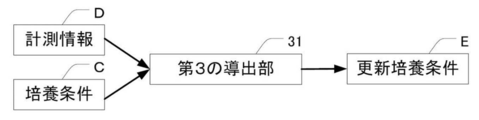
- FIG. 16 is a diagram for explaining the third derivation unit 31 according to the second embodiment of the present disclosure.
- the third derivation unit 31 has the learned model M shown in FIG. 15 described above as an example.
- the measurement information D measured at each measurement of the cells and the measurement information D are obtained.
- the culture condition C at the time of acquisition is input, the culture condition exceeding a predetermined threshold value is output as the renewed culture condition E suitable for the cells to be generated.
- the updated culture condition E is, for example, when the number of cells to be used is the updated culture condition E, the measurement information D and the culture condition C at the time when the measurement information D is acquired are input to the learned model M.
- the learned model M outputs the probability that a target number of cells can be generated for each number of cells to be used, and the culture condition acquisition unit 22 outputs the target quality with the target quality.
- the number of cells having the highest probability of generating the number of cells may be acquired as the number of cells to be used, that is, the updated culture condition E most suitable for the cells to be generated.
- FIG. 17 is a flowchart showing a process performed by the cell generation support device 1-2 of the second embodiment of the present disclosure
- FIG. 18 is a process performed by the cell generation support device 1-2 of the second embodiment of the present disclosure. It is a figure for explaining.
- the information acquisition unit 21 acquires history information A indicating the history of cells to be used and cell information B of cells to be generated (step ST21).
- the culture condition acquisition unit 22 inputs the history information A and the cell information B acquired by the information acquisition unit 21 to the learned model M to set the culture condition C for culturing the cells, as shown in FIG. It is acquired (step ST22).
- the person in charge starts the work of generating cells.
- the person in charge collects cells based on the culture condition C from the cell donor 40, and the initialization step T1 of the collected cells is started.
- the CPU 11 sets a predetermined timing in each step of an initialization step T1 for initializing cells, a culture step T2 for culturing cells, and a differentiation step T3 for inducing differentiation of cells, That is, based on the determination timing, it is determined whether or not the culture condition acquisition unit 22 has acquired new measurement information D related to measurement when measuring cells (step ST23).
- the determination timing can be set based on the cell inspection timing, and the determination timing can be set between a certain cell inspection timing and the next cell inspection timing.
- step ST23 determines in step ST23 that the new measurement information D has not been acquired (step ST23; NO)
- the CPU 11 shifts the processing to step ST30 and completes all the steps. It is determined whether or not (step ST30).
- step ST23 when it is determined in step ST23 that the culture condition acquisition unit 22 has acquired the new measurement information D (step ST23; YES), the creatable information acquisition unit 23 acquires the newly acquired information as shown in FIG. Based on the history information A and the cell information B and the measurement information D, which is output by inputting various measurement information D into the learned model M, the information F indicating whether or not the desired cell can be generated is acquired ( Step ST24).
- the CPU 11 determines whether or not the cells to be generated can be generated (step ST25).
- the notification unit 14 notifies that it can be generated, and the cell culture is continued.
- the notification unit 14 displays on the display that cells can be generated (step ST26).
- the notification unit 14 may display the number of cells that are still insufficient.
- step ST25 when the generation is not possible (step ST25; NO), the notification unit 14 notifies the stop of the culture and stops the culture of the cells. Specifically, the notification unit 14 displays the culture stop on the display (step ST27). Then, the cell generation support device 1 ends the series of processes.
- step ST26 when it is displayed on the display that cells can be generated, the culture condition acquisition unit 22 then acquires the new measurement information D and the new measurement information as shown in FIG.
- the updated culture condition E output from the learned model M is acquired as a new culture condition C by inputting the culture condition C at the time when D is acquired to the learned model M (step ST28).
- the notification unit 14 notifies the culture condition C newly acquired by the culture condition acquisition unit 22. Specifically, the culture condition C is displayed on the display (step ST29).
- step ST30 determines whether or not all steps have been completed.
- step ST30 determines whether or not all steps have been completed.
- step ST30 determines whether or not all steps have been completed.
- step ST30 determines whether or not the steps are not completed (step ST30; NO)
- the CPU 11 shifts the processing to step ST23 and performs the subsequent processing. That is, based on the cell inspection timing of the updated culture condition C, it is determined whether or not the culture condition acquisition unit 22 has acquired new measurement information D related to measurement when measuring cells (step ST23). ..
- step ST30 YES
- the cell generation support device 1 ends the series of processes.
- the history information A indicating the history of the cell to be used and the cell information of the cell to be generated.
- B is acquired, and a culture condition C for culturing cells is acquired based on the acquired history information A and cell information B, and further initialization step T1 for initializing cells, culture step T2 for culturing cells,
- the culture condition C at the time when the measurement information D is acquired is updated based on the measurement information D related to the measurement when measuring the cells. Since the updated culture condition E is acquired as the culture condition C, it is possible to acquire a more optimal culture condition C for generating the target number of cells to be generated each time the cells are measured.
- the optimum culture condition C can be acquired for each measurement at the cell inspection timing based on the culture condition C. Therefore, the person in charge of generating the cell generates the cell based on the optimum culture condition C. It is possible to improve the possibility that the desired number of cells to be generated can be generated as compared with the conventional method.
- the first derivation unit 29, the second derivation unit 30, and the third derivation unit 31 include the learned model M, but the technique of the present disclosure is not limited to this. Not limited. If the first derivation unit 29 can derive the information F indicating whether or not the desired cell can be generated based on the history information A, the cell information B, and the measurement information D, the first derivation unit 29 uses machine learning. Alternatively, a correspondence table between the history information A and the cell information B, the measurement information D, and the information F indicating whether or not the information can be generated, and a calculation formula may be used.
- the second derivation unit 30 can derive the culture condition C based on the history information A and the cell information B, the history information A and the cell information B and the culture condition can be obtained without using machine learning. You may use the correspondence table with C, a calculation formula, etc.
- the third derivation unit 31 also derives the updated culture condition E based on the measurement information D and the culture condition C acquired when the measurement information D was acquired. If possible, any one of the correspondence table and the calculation formula may be used.
- the culture condition acquisition unit 22 of the above-described embodiment may further acquire, as the culture condition C, the updated culture condition E that is updated by adding weighting based on the information D1 regarding the measuring means.
- the person A who is good at fine work and the person B who is not good at fine work may have different effects on cell generation even if the same process is performed.
- the influence on the generation of cells may differ between the visual inspection by the person in charge and the measurement using the measuring device. Therefore, the weighting based on the information D1 regarding the measuring means, that is, the weighting based on the information D1 regarding the measuring means, which is more accurate in the measurement result, is added to the updated renewed culture condition E.
- the more optimal culture condition C can be obtained as compared with the above-described embodiment.
- the learned model M of the second embodiment described above has new measurement information D and the updated culture condition E derived from the culture condition C acquired at the time of acquisition of this measurement information D, and the target.
- the learning is performed so as to output the probability that a target number of cells can be generated and the output, but the present invention is not limited to this, and instead of the culture condition C, the history information A and the cell information B are included.
- the updated culture condition E may be derived from the information obtained.
- the notification unit 14 of the above-described embodiment displays that cells can be generated in the first embodiment, displays that cells can be generated, and culture condition C in the second embodiment.
- the probability that the cell indicated by the cell information B can be generated, the history information A, the cell information B, the acquired measurement information D, that is, the information D1 regarding the measurement means and the measurement information are obtained. You may make it display the information D2 which shows a measurement result, and the successive change etc. of the information D2 which shows the measurement result obtained by measurement.
- cell generation support device 1 which is an embodiment of the technique of the present disclosure can be appropriately modified in design without departing from the gist of the technique of the present disclosure.
Landscapes
- Engineering & Computer Science (AREA)
- Health & Medical Sciences (AREA)
- Life Sciences & Earth Sciences (AREA)
- Chemical & Material Sciences (AREA)
- Theoretical Computer Science (AREA)
- Physics & Mathematics (AREA)
- Bioinformatics & Cheminformatics (AREA)
- General Engineering & Computer Science (AREA)
- Zoology (AREA)
- Wood Science & Technology (AREA)
- Software Systems (AREA)
- Biotechnology (AREA)
- General Health & Medical Sciences (AREA)
- Biomedical Technology (AREA)
- General Physics & Mathematics (AREA)
- Organic Chemistry (AREA)
- Data Mining & Analysis (AREA)
- Artificial Intelligence (AREA)
- Computing Systems (AREA)
- Mathematical Physics (AREA)
- Evolutionary Computation (AREA)
- Biochemistry (AREA)
- Medicinal Chemistry (AREA)
- Microbiology (AREA)
- Sustainable Development (AREA)
- Computational Linguistics (AREA)
- Biophysics (AREA)
- Molecular Biology (AREA)
- Genetics & Genomics (AREA)
- Computer Vision & Pattern Recognition (AREA)
- Analytical Chemistry (AREA)
- Medical Informatics (AREA)
- Apparatus Associated With Microorganisms And Enzymes (AREA)
- Measuring Or Testing Involving Enzymes Or Micro-Organisms (AREA)
Abstract
細胞生成支援装置、方法、及びプログラムにおいて、生成したい細胞を目標とする数だけ生成可能か否かの情報を取得する。使用する細胞の経歴を示す経歴情報及び生成したい細胞の細胞情報を取得し、経歴情報、細胞情報、及び細胞を初期化する初期化工程、細胞を培養する培養工程、及び細胞を分化誘導させる分化工程のうちの何れかの工程において細胞を計測する際の計測に関連する計測情報に基づいて、細胞の計測毎に生成したい細胞が生成可能か否かの情報を取得する。
Description
本開示の技術は、細胞生成支援装置、方法、及びプログラムに関する。
近年、ES(Embryonic Stem)細胞及びiPS(Induced Pluripotent Stem)細胞等の多能性幹細胞は、種々の組織の細胞に分化する能力を備えており、再生医療、薬の開発、病気の解明等において応用が可能な細胞として注目されている。例えばiPS細胞を分化させることにより、所望する細胞を所望する個数生成したい場合には、図19に示すように、細胞提供者40から血球細胞41又は皮膚細胞42等の細胞を採取して、採取した細胞に複数の遺伝子を導入することでiPS細胞43を生成する初期化工程T1、生成されたiPS細胞43を培養(以下、拡大培養ともいう)して所望する個数のiPS細胞46を生成する培養工程T2、生成された個数のiPS細胞46を神経細胞47、心筋細胞48、及び肝臓細胞49等を分化誘導する分化工程T3を経る必要がある。一般的には初期化工程T1と培養工程T2を合わせて2か月程度、分化工程T3は2から3か月程度の期間を要する。
培養工程T2においては、iPS細胞43を収容した培養容器から培地を除去し、iPS細胞43を新しい培地に移す「継代」と称する操作がある。継代操作においては、増殖したiPS細胞43を、複数の培養容器に予め定められた大きさ及び密度で均一に播種し、細胞の株分けが行われる。培養細胞を継代する際に、特に初期化されたiPS細胞の場合は、一般的に、未分化状態を維持して増殖する可能性がある細胞を、作業の担当者が目視で観察することにより選択している。担当者は、例えば形が整っているiPS細胞44は継続して培養し、形が整っていないiPS細胞45は取り除くといった細胞の選別を行う。しかしながら、担当者による細胞の選別が行われた場合であっても、iPS細胞からの分化誘導が上手くいかないケースが発生している。分化誘導が上手くいかないと、分化させたい細胞を目標とする個数生成することが困難となり、このことが、産業化への障害となっている。
そこで、画像からiPS細胞の良悪を選択する方法、代謝物を計測する方法、及び遺伝子を計測する方法等、個々に細胞を計測することにより、培養及び分化に適した細胞を選別することが行われている。特許文献1には、培養時間が異なる二つ以上の時点(予測時)において各サンプルの細胞を撮影して取得した各画像を解析することにより生成した細胞の形態に関する2つ以上の指標と、サンプル毎に取得した予測目標の実測データとを用いて、細胞の品質を予測する予測モデルが開示されている。
一方、培養工程T2において、未分化状態を維持して増殖する可能性がある細胞を選んで分化誘導させた場合であっても、分化誘導が必ず成功して目標とする細胞が生成されるとは限らず、失敗する場合もある。生成したい細胞に成り得る可能性のある細胞の数は、培養工程T2の終了時に決定される。例えば、分化工程T3に入ってから、生成したい細胞に成り得る可能性のある細胞の数が目標とする細胞の数よりも少ないことが判明すると、足りない分だけ新たに一から細胞を生成しなければならず、時間及びコストがかかってしまう。例えば、健常者から採取した細胞を創薬ツールとして使用する場合には、生成したい細胞を目標とする数だけ可能な限り短時間で生成することが望まれている。そこで、生成したい細胞を目標とする数だけ生成可能か否かの情報を取得して、生成不可能である場合には、できるだけ早い時期に新たに細胞を生成できるようにすることが望まれる。上記特許文献1に記載の技術では、実測データから細胞の品質を予測することは可能であるが、生成したい細胞を目標とする数だけ生成可能か否かの情報を取得することはできない。
本開示は上記事情に鑑みなされたものであり、生成したい細胞を目標とする数だけ生成可能か否かの情報を取得できるようにすることを目的とする。
本開示による細胞生成支援装置は、使用する細胞の経歴を示す経歴情報及び生成したい細胞の細胞情報を取得する情報取得部と、情報取得部で取得した経歴情報、細胞情報、及び細胞を初期化する初期化工程、細胞を培養する培養工程、及び細胞を分化誘導させる分化工程のうちの何れかの工程において細胞を計測する際の計測に関連する計測情報に基づいて、細胞の計測毎に生成したい細胞が生成可能か否かの情報を取得する生成可能情報取得部とを含む。
なお、本開示による細胞生成支援装置においては、生成可能情報取得部が、情報取得部で取得した経歴情報及び細胞情報、並びに計測情報に基づいて生成したい細胞が生成可能か否かの情報を導出する第1の導出部を含んでもよい。
また、本開示による細胞生成支援装置においては、第1の導出部は、使用する細胞の経歴を示す経歴情報及び生成したい細胞の細胞情報、並びに細胞を初期化する初期化工程、細胞を培養する培養工程、及び細胞を分化誘導させる分化工程のうちの何れかの工程において、細胞を計測する際の計測に関連する計測情報を含む第1の情報の組と、この第1の情報の組に対応する生成したい細胞が生成可能か否かの情報との情報セットを複数含む学習情報を用いて機械学習された第1の学習済みモデルを含んでもよい。
また、本開示による細胞生成支援装置においては、計測情報は、計測手段に関連する情報及び計測手段による計測で得られた計測結果を示す情報の少なくとも一方の情報であってもよい。
また、本開示による細胞生成支援装置においては、計測手段に関連する情報は、計測に用いた方法及び計測した担当者の何れか一方を示す情報を含み、計測結果を示す情報は、計測された細胞の状態、培地の状態、及び菌の有無のうち、何れか1以上の情報を含んでもよい。
また、本開示による細胞生成支援装置においては、計測された細胞の状態は、細胞の形状、細胞の色、細胞の数、細胞の大きさ、細胞の匂い、細胞の遺伝子発現、細胞の代謝物の種類、及び細胞のタンパク質のうち、何れか1以上の情報を含んでもよい。
また、本開示による細胞生成支援装置においては、経歴情報は、使用する細胞の保有者である細胞提供者の名前、細胞提供者の性別、細胞提供者の血液型、細胞提供者の人種、細胞提供者の年齢、細胞提供者の疾患歴、細胞提供者の免疫情報、及び細胞提供者の血縁者の疾患歴のうち、何れか1以上の情報を含んでもよい。
また、本開示による細胞生成支援装置においては、細胞情報は、生成したい細胞の種類、生成したい細胞の数、生成したい細胞の状態、及び生成を完了したい日数のうち、何れか1以上の情報を含んでもよい。
また、本開示による細胞生成支援装置においては、生成したい細胞が生成可能か否かの情報を報知する報知部を含んでもよい。
また、本開示による細胞生成支援装置においては、生成可能情報取得部が生成可能の情報を取得した場合に、情報取得部で取得した経歴情報及び細胞情報に基づいて細胞を培養するための培養条件を取得する培養条件取得部をさらに含んでもよい。
また、本開示による細胞生成支援装置においては、培養条件取得部は、細胞を初期化する初期化工程、細胞を培養する培養工程、及び細胞を分化誘導させる分化工程のうちの何れかの工程において、細胞を計測する際の計測に関係する計測情報に基づいて更新した更新培養条件を培養条件として取得してもよい。
また、本開示による細胞生成支援装置においては、培養条件取得部は、情報取得部で取得した経歴情報及び細胞情報に基づいて培養条件を導出する第2の導出部と、計測情報に基づいて更新した更新培養条件を培養条件として導出する第3の導出部とを含んでもよい。
また、本開示による細胞生成支援装置においては、第2の導出部は、使用する細胞の経歴を示す経歴情報及び生成したい細胞の細胞情報を含む第2の情報の組と、この第2の情報の組に対応する培養条件との情報セットを複数含む学習情報を用いて機械学習された第2の学習済みモデルを含み、第3の導出部は、細胞を初期化する初期化工程、細胞を培養する培養工程、及び細胞を分化誘導させる分化工程のうちの何れかの工程において、細胞を計測する際の計測に関連する計測情報及び培養条件を含む第3の情報の組と、この第3の情報の組に対応する更新培養条件との情報セットを複数含む学習情報を用いて機械学習された第3の学習済みモデルを含んでもよい。
また、本開示による細胞生成支援装置においては、第2の学習済みモデルと第3の学習済みモデルとは1つの学習済みモデルで構成されていてもよい。
また、本開示による細胞生成支援装置においては、培養条件は、使用する細胞の種類、使用する細胞数、使用する容器の種類、使用する培地の種類、使用する添加物の種類、処理のタイミング、及び担当者に関する情報のうち、何れか1以上を含んでもよい。
また、本開示による細胞生成支援装置においては、処理のタイミングは、播種のタイミング、継代のタイミング、培地を交換するタイミング、添加物を添加するタイミング、及び細胞を検査するタイミングのうち、何れか1以上のタイミングを含んでもよい。
本開示による細胞生成支援方法においては、使用する細胞の経歴を示す経歴情報及び生成したい細胞の細胞情報を取得し、経歴情報、細胞情報、及び細胞を初期化する初期化工程、細胞を培養する培養工程、及び細胞を分化誘導させる分化工程のうちの何れかの工程において細胞を計測する際の計測に関連する計測情報に基づいて、細胞の計測毎に生成したい細胞が生成可能か否かの情報を取得する。
なお、本開示による細胞生成支援方法をコンピュータに実行させるためのプログラムとして提供してもよい。
本開示による他の細胞生成支援装置は、コンピュータに実行させるための命令を記憶するメモリと、記憶された命令を実行するよう構成されたプロセッサとを備え、プロセッサは、使用する細胞の経歴を示す経歴情報及び生成したい細胞の細胞情報を取得し、経歴情報、細胞情報、及び細胞を初期化する初期化工程、細胞を培養する培養工程、及び細胞を分化誘導させる分化工程のうちの何れかの工程において細胞を計測する際の計測に関連する計測情報に基づいて、細胞の計測毎に生成したい細胞が生成可能か否かの情報を取得する処理を実行する。
本開示の一実施形態によれば、生成したい細胞を目標とする数だけ生成可能か否かの情報を取得することができる。
以下、図面を参照して本開示の第1の実施形態について説明する。図1は本開示の第1の実施形態による細胞生成支援装置の概略構成を示す図である。図1は、細胞生成支援プログラムが不揮発性のメモリ12にインストールされたことを示している。なお、胞生成支援プログラムはストレージ13にインストールされてもよい。また、メモリ12はDRAM(Dynamic Random Access Memory)、SRAM(Static Random Access Memory)等の揮発性のメモリであってもよく、その場合、CPU12から呼び出された細胞生成支援プログラムが一時的にメモリ12へ記憶され、実行されてもよい。なお、本開示の第1の実施形態においては、細胞生成支援装置が、学習済みモデルを内包するものとする。このため、図1には細胞生成支援装置のみを示す。図1に示すように、細胞生成支援装置1は、標準的なコンピュータの構成として、CPU(Central Processing Unit)11、メモリ12及びストレージ13を備えている。また、細胞生成支援装置1には、後述する培養条件Cを報知する報知部14、並びにキーボード及びマウス等の入力装置(以下、入力部とする)15が接続されている。
本開示の一実施形態における報知部14は、一例として培養条件C及び生成したい細胞が生成可能か否かの情報Fを可視表示させるディスプレイで構成される。なお報知部14はメッセージ等を可視表示させるディスプレイ、音声が出力されることにより可聴表示させる音声再生装置、用紙等の記録媒体に記録して永久可視表示させるプリンタ、メールや電話等の通信手段及び表示灯等を意味し、上記ディスプレイ、上記音声再生装置、上記プリンタ、上記通信手段及び上記表示光のうちの少なくとも2つ以上を組み合わせてもよい。なお、本開示の一実施形態は、報知部14が細胞生成支援装置1の外部装置としているが、本開示の技術はこれに限られず、報知部14が細胞生成支援装置1の一部に含まれていてもよい。
ストレージ13は、ハードディスクまたはSSD(Solid State Drive)等のストレージデバイスからなる。ストレージ13には、ネットワークを経由して外部のデータサーバ(図示せず)から取得した、使用する細胞の経歴を示す経歴情報A及び細胞生成支援装置1の処理に必要な情報を含む各種情報が記憶されている。
また、メモリ12には、細胞生成支援プログラム、及び学習済みモデルが記憶されている。細胞生成支援プログラムは、CPU11に実行させる処理として、使用する細胞の経歴を示す経歴情報及び生成したい細胞の細胞情報を取得する情報取得処理、並びに経歴情報、細胞情報、及び細胞を初期化する初期化工程、細胞を培養する培養工程、及び細胞を分化誘導させる分化工程のうちの何れかの工程において細胞を計測する際の計測に関連する計測情報に基づいて、細胞の計測毎に生成したい細胞が生成可能か否かの情報を取得する生成可能情報取得処理を規定する。
そして、CPU11が細胞生成支援プログラムに従いこれらの処理を実行することで、コンピュータは、情報取得部21及び生成可能情報取得部23として機能する。なお、本実施形態においては、CPU11が細胞生成支援プログラムによって、各部の機能を実行するようにしたが、ソフトウェアを実行して各種の処理部として機能する汎用的なプロセッサとしては、CPU11の他、FPGA (Field Programmable Gate Array)等の製造後に回路構成を変更可能なプロセッサであるプログラマブルロジックデバイス(Programmable Logic Device:PLD)を用いることができる。また、ASIC(Application Specific Integrated Circuit)等の特定の処理を実行させるために専用に設計された回路構成を有するプロセッサである専用電気回路等により、各部の処理を実行するようにしてもよい。また、メモリ12が揮発性のメモリの場合、CPU12から呼び出された細胞生成支援プログラム、及び学習済みモデルが一時的にメモリ12へ記憶され、実行されてもよい。
1つの処理部は、これら各種のプロセッサのうちの1つで構成されてもよいし、同種または異種の2つ以上のプロセッサの組み合わせ(例えば、複数のFPGA、またはCPUとFPGAの組み合わせ等)で構成されてもよい。また、複数の処理部を1つのプロセッサで構成してもよい。複数の処理部を1つのプロセッサで構成する例としては、第1に、クライアント及びサーバ等のコンピュータに代表されるように、1つ以上のCPUとソフトウェアの組み合わせで1つのプロセッサを構成し、このプロセッサが複数の処理部として機能する形態がある。第2に、システムオンチップ(System On Chip:SoC)等に代表されるように、複数の処理部を含むシステム全体の機能を1つのIC(Integrated Circuit)チップで実現するプロセッサを使用する形態がある。このように、各種の処理部は、ハードウェア的な構造として、上記各種のプロセッサを1つ以上用いて構成される。
さらに、これらの各種のプロセッサのハードウェア的な構造は、より具体的には、半導体素子等の回路素子を組み合わせた電気回路(circuitry)である。
情報取得部21は、使用する細胞の経歴を示す経歴情報A及び生成したい細胞の細胞情報Bを取得する。情報取得部21は、一例として、使用する細胞が収容された容器に記された識別情報が入力部15から入力された場合に、入力された識別情報に対応する細胞提供者の経歴情報Aを、外部サーバから取得する。
図2は本開示の第1の実施形態による経歴情報Aの一例を示す図である。経歴情報Aは、使用する細胞の経歴を示す情報である。経歴情報Aは、一例として図2に示すように、使用する細胞の保有者である細胞提供者の名前、細胞提供者の性別、細胞提供者の血液型、細胞提供者の人種、細胞提供者の年齢、細胞提供者の疾患歴、細胞提供者の免疫情報、及び細胞提供者の血縁者の疾患歴の情報である。本開示の一実施形態として、細胞提供者の血縁者は、例えば細胞提供者本人からみて3親等以内の血縁者とする。なお、本開示の技術はこれに限られず、例えば3親等よりも遠い血縁者を含んでもよい。また、本開示においては、一例として経歴情報Aは図2に示す情報を示すものとしたが、本開示の技術はこれに限られず、図2に示す情報のうち、何れか1以上の情報を含む情報であってもよい。
図3は本開示の第1の実施形態による細胞情報Bの一例を示す図である。細胞情報Bは、生成したい細胞の情報である。細胞情報Bは、一例として図3に示すように、生成したい細胞の種類B1、目標細胞数B2、及び生成したい細胞の状態B3の情報を含む。細胞の種類B1は、iPS細胞、心筋細胞、及び神経細胞等の生成したい細胞の種類の情報である。目標細胞数B2は、10万個及び100個等の生成したい細胞の数を示す情報である。細胞の状態B3は、培養したい、及び分化させたい等、細胞に対して何をしたいのかを示す情報である。
なお、細胞の種類B1及び目標細胞数B2は、予め設定されると、図19に示す初期化工程T1、培養工程T2、及び分化工程T3の全てが終了するまで変更されない。細胞の状態B3は、初期工程T1であれば「初期化したい」、培養工程T2であれば「拡大培養したい」及び「選別したい」、分化工程T3であれば「分化させたい」のように、各工程毎に担当者によって変更される。本開示の技術においては、一例として図3に示すように、細胞情報Bは細胞の種類B1、目標細胞数B2、細胞の状態B3、及び生成を完了したい日数B4の情報を示すものとしたが、本開示の技術はこれに限られず、細胞情報Bはこれらの情報のうち、何れか1以上の情報を含む情報であってもよい。
生成可能情報取得部23は、情報取得部21で取得した経歴情報A、細胞情報B、及び細胞を初期化する初期化工程T1、細胞を培養する培養工程T2、及び細胞を分化誘導させる分化工程T3のうちの何れかの工程において細胞を計測する際の計測に関連する計測情報Dに基づいて、細胞の計測毎に生成したい細胞が生成可能か否かの情報Fを取得する。
ここで、計測情報Dについて説明する。図4は本開示の第1の実施形態による計測情報Dの一例を示す図である。計測情報Dは細胞の検査で細胞を計測する際の計測に関連する情報であり、図4に示すように、計測手段に関する情報D1及び計測手段による計測で得られた計測結果を示す情報D2である。
計測手段に関する情報D1は、計測に用いた方法の情報及び計測した担当者の情報を含む。計測に用いた方法としては、計測装置の種類や計測装置の使用の有無の情報があり、位相差顕微鏡、明視野顕微鏡、及び目視等がある。また計測した担当者の情報としては、計測者A、及び計測者B等、各計測者の名前や計測の熟年度等の情報がある。
計測で得られた計測結果を示す情報D2は、計測された細胞の状態、培地の状態、及び菌の有無の情報を含む。計測された細胞の状態は、細胞の検査値であり、細胞の形状、細胞の色、細胞の数、細胞の大きさ、細胞の匂い、細胞の遺伝子発現、細胞の代謝物の種類、細胞のタンパク質の情報、及び細胞にあけた穴の大きさ等である。なお、本開示においては、細胞のタンパク質の情報は、タンパク質が合成されているか否かの情報であり、細胞の遺伝子発現は、遺伝子の情報が細胞における構造及び機能に変換される過程をいう。本開示の技術においては、一例としてタンパク質は蛍光プローブを使用して計測し、遺伝子発現は、細胞をすりつぶして対象とする遺伝子の増幅剤を用いて計測する。なお、本開示はこれに限られず、公知の計測方法を使用することができる。
また、培地の状態は、培地の色、培地に含まれる細胞の代謝物、培地に溶けている気体濃度等の情報を含む。培地の色を計測することにより、培地に溶けている二酸化炭素の量を計測することができる。気体濃度は、一例として培地中の炭素濃度及び窒素濃度を計測する。これにより、細胞が正常に培養できているか否かを検出することができる。
また、菌の有無は、細胞に菌がいるのか、培地に菌がいるのか、細胞及び培地に菌がいるのか、及び菌がいないのか等の情報である。
なお、本開示においては、一実施形態として図4に示す情報を計測情報Dとしたが、本開示の技術はこれに限られず、計測情報Dは、図4に示す情報を何れか1つ以上含む情報であればよい。
なお、一例として図19に示す初期化工程T1において、初期化中に計測が行われる場合、計測に用いる方法としては、例えば位相差顕微鏡がある。すなわち、初期化工程T1においては、血球細胞41及び皮膚細胞42に穴をあけ、あけられた穴に薬剤が導入される。この場合、穴が薬剤を入れるために必要な大きさ、形、及び深さにあけられていないと、細胞の初期化が成功しない場合がある。そこで、例えば穴があいた細胞41及び皮膚細胞42を位相差顕微鏡により撮像して取得した画像から穴の大きさを計測する。なお、初期化工程T1において計測に用いた方法としては、位相差顕微鏡に限られず、穴を計測可能な方法であれば何れの方法を用いてもよい。
また、一例として図19に示す培養工程T2において、iPS細胞の選別する際に行われる計測に用いる方法としては、例えば位相差顕微鏡を使用する方法がある。位相差顕微鏡を用いてiPS細胞43を撮像して撮像画像を取得し、取得した撮像画像におけるiPS細胞43の大きさ及び形等を計測し、形が整った、つまり分化誘導可能な形状のiPS細胞44である場合には、培養を継続してiPS細胞44を拡大培養し、例えば形が整っていない形状である、つまり分化誘導不可能な形状のiPS細胞44である場合には、iPS細胞44を除去することにより、細胞の選別が行われる。なお、iPS細胞43を計測に用いる方法は、位相差顕微鏡に限られず、計測者の目視であってもよいし、その他何れの方法であってもよい。
図5は本開示の第1の実施形態による生成可能情報取得部23の概略構成を示す図である。生成可能情報取得部23は、図5に示すように、第1の導出部29を含む。第1の導出部29は、経歴情報A及び細胞情報B、並びに計測情報Dに基づいて細胞の計測毎に生成したい細胞が生成可能か否かの情報Fを導出する。本実施形態においては、一例として、第1の導出部29は学習情報を用いて機械学習された学習済みモデルMを含む。
図6は本開示の第1の実施形態による学習済みモデルMを説明するための図である。学習済みモデルMは、図6に示すように、使用する細胞の経歴を示す経歴情報A及び生成したい細胞の細胞情報B、並びに計測情報Dの情報の組Qと、情報の組Qに対応する生成したい細胞が生成可能か否かの情報Fとの情報セットJを複数含む学習情報を用いて機械学習される。すなわち、学習済みモデルMは、経歴情報A及び細胞情報B、並びに計測情報Dに基づいて生成したい細胞が生成可能か否かの情報Fを出力するように機械学習がなされている。なお、学習済みモデルMは、例えば細胞提供者Xの情報の組Qすなわち経歴情報Aを有する細胞提供者Xの細胞から細胞情報Bの細胞を生成する際に、生成したい細胞が目標とする個数生成できたか否かの結果も合わせて学習済みモデルMを得るためのモデルに学習させる。これにより、学習済みモデルMは、経歴情報A及び細胞情報B、並びに計測情報Dが入力されると、経歴情報A及び細胞情報B、並びに計測情報Dに対して、生成したい細胞が生成可能か否かの情報Fを出力するように学習がなされる。
本開示の一実施形態として、学習済みモデルMにおける機械学習のアルゴリズムは、例えばディープラーニング(深層学習)がなされたニューラルネットワーク(NN(Neural Network))を使用することができる。ただし、本開示の技術はこれに限られず、例えばサポートベクタマシン(SVM(Support Vector Machine))、畳み込みニューラルネットワーク(CNN(Convolutional Neural Network))、畳み込みニューラルネットワーク(CNN(Convolutional Neural Network))及びリカレントニューラルネットワーク(RNN(Recurrent Neural Network))等、公知の機械学習のアルゴリズムを適宜使用することができる。
図7は本開示の第1の実施形態による第1の導出部29を説明するための図である。第1の導出部29は一例として上述した学習済みモデルMを有している。これにより、図7に示すように、経歴情報Aを有する細胞提供者Xの細胞から細胞情報Bの細胞を生成する場合に、経歴情報A及び細胞情報B、並びに計測情報Dが入力されると、予め定められた閾値を超えた培養が継続できるか否かの情報、すなわち生成したい細胞が生成可能か否か情報Fが出力される。なお、学習済みモデルMに経歴情報A及び細胞情報B、並びに計測情報Dが入力された場合、学習済みモデルMは目標とする品質で、かつ目標とする数の細胞が生成できる確率を出力し、予め定められた確率の閾値を超えた場合に、生成したい細胞が生成可能であり、上記確率の閾値以下である場合に生成したい細胞が生成不可能であるとして出力する。なお、学習済みモデルMは、細胞の数毎に、生成したい細胞が生成できる確率を出力するようにしてもよい。この場合、予め定められた確率の閾値を超えた細胞数を生成可能な細胞数として出力し、上記確率の閾値以下である細胞数は、目標とする細胞数まで足りない細胞数を足りない細胞の個数として出力するようにしてもよい。
次いで、本開示の第1の実施形態の細胞生成支援装置1において行われる処理について説明する。図8は本開示の第1の実施形態の細胞生成支援装置1において行われる処理を説明するための図、図9は本開示の第1の実施形態の細胞生成支援装置1において行われる処理を示すフローチャートである。まず、情報取得部21は、使用する細胞の経歴を示す経歴情報A及び生成したい細胞の細胞情報Bを取得する(ステップST1)。
次に、計測手段に関する情報D1に基づいて、細胞の計測が細胞を初期化する初期化工程T1、細胞を培養する培養工程T2、及び細胞を分化誘導させる分化工程T3の各工程の予め定められたタイミング、すなわち細胞検査タイミングで行われる。細胞生成支援装置1において、CPU11は、細胞を初期化する初期化工程T1、細胞を培養する培養工程T2、及び細胞を分化誘導させる分化工程T3の各工程において、予め定められたタイミング、すなわち判断タイミングに基づいて、生成可能情報取得部23が細胞を計測する際の計測に関連する新たな計測情報Dを取得したか否かを判別する(ステップST2)。一例として判断タイミングは、細胞検査タイミングに基づいて設定することができ、ある細胞検査タイミングとその次の細胞検査タイミングとの間に判断タイミングを設定することができる。
ステップST2において生成可能情報取得部23が新たな計測情報Dを取得していないと判別した場合(ステップST2;NO)には、CPU11は、ステップST6に処理を移行し、全ての工程が終了したか否かを判別する(ステップST6)。
一方、ステップST2においてCPU11が新たな計測情報Dを取得したと判別した場合(ステップST2;YES)には、生成可能情報取得部23は、図8に示すように、取得した新たな計測情報Dを学習済みモデルMに入力することにより出力された、経歴情報A及び細胞情報B、並びに計測情報Dに基づいた、生成したい細胞が生成可能か否かの情報Fを取得する(ステップST3)。
次にCPU11は、生成したい細胞が生成可能か否かを判別する(ステップST4)。生成可能である場合には(ステップST4;YES)、報知部14は、生成可能であることを報知し、細胞の培養が継続される。報知部14は、具体的にはディスプレイに細胞が生成可能であることを表示する(ステップST5)。報知部14は、さらに足りない細胞の個数を表示してもよい。
次にCPU11は、全ての工程が終了したか否かを判別する(ステップST6)。全ての工程が終了していない場合には(ステップST6;NO)、CPU11はステップST2に処理を移行して、以降の処理を行う。すなわち、予め定められたタイミングに基づいて、生成可能情報取得部23が細胞を計測する際の計測に関連する新たな計測情報Dを取得したか否かを判別する(ステップST2)。一方、全ての工程が終了した場合には(ステップST6;YES)、細胞生成支援装置1は一連の処理を終了する。
一方、ステップST4において、生成可能でない場合には(ステップST4;NO)、報知部14は、培養停止を報知し、細胞の培養を停止する。報知部14は、具体的にはディスプレイに培養停止を表示する(ステップST7)。そして、細胞生成支援装置1は一連の処理を終了する。
以上のように本開示の第1の実施形態の細胞生成支援装置1によれば、使用する細胞の経歴を示す経歴情報A及び生成したい細胞の細胞情報Bを取得し、経歴情報A、細胞情報B、及び細胞を初期化する初期化工程、細胞を培養する培養工程、及び細胞を分化誘導させる分化工程のうちの何れかの工程において細胞を計測する際の計測に関連する計測情報Dに基づいて、細胞の計測毎に生成したい細胞が生成可能か否かの情報Fを取得するので、生成したい細胞を目標とする数だけ生成可能か否かの情報を取得できる。
このように細胞の計測毎に生成したい細胞が生成可能か否かの情報Fを取得することができるので、細胞を生成する担当者は、細胞が生成可能であると報知された場合は細胞の培養を継続し、一方、細胞が生成可能ではないと報知された時点で、細胞の培養を停止して、最初からやり直したり、足りない個数の細胞の生成を開始したりすることができる。これにより、従来と比較して、不要な時間を短縮することができ、かつ不要な培養や分化誘導を行なわずに済むので、コストの損失を防止することができる。なお、本実施形態では、生成可能情報取得部23は、経歴情報Aと細胞情報Bと新たな計測情報Dに基づいて、生成したい細胞が生成可能か否かの情報Fを取得したが、これに限定されず、生成可能情報取得部23は、経歴情報Aと細胞情報Bと、培養開始時から新たな計測情報Dを取得するまでに得られた全ての計測情報Dに基づいて、生成したい細胞が生成可能か否かの情報Fを取得してもよい。
次に、本開示の第2の実施形態について説明する。図10は本開示の第2の実施形態による細胞生成支援装置1-2の概略構成を示す図である。図10は、細胞生成支援プログラムをインストールすることにより実現される、なお、本開示の第2の実施形態による細胞生成支援装置1-2は、上述した第1の実施形態による細胞生成支援装置1と同じ構成には同符号を付与してここでの説明は省略し、異なる箇所についてのみ詳細に説明する。
細胞生成支援装置1-2は、図10に示すように、図1の細胞生成支援装置1にさらに、培養条件取得部22を備えている。培養条件取得部22は、経歴情報A及び細胞情報Bに基づいて細胞を培養するための培養条件Cを取得する。図11は本開示の第2の実施形態による培養条件Cの一例を示す図である。培養条件Cは、生成したい細胞を目標とする数だけ生成するための培養条件である。なお、ここで「生成したい細胞」は目標とする品質を備えた細胞であることが望ましい。従って、本実施形態において、培養条件Cは、生成したい細胞を目標とする品質で、かつ目標とする数だけ生成するための培養条件である。培養条件Cは、どの細胞をどのくらいの数、どの容器で、どの培地を使用して、どの添加物を添加して細胞を生成すれば、生成したい細胞を目標数生成することができるのかを示す。培養条件Cは、具体的には、一例として図11に示すように、使用する細胞の種類、使用する細胞数、使用する容器の種類、使用する培地の種類、使用する添加物の種類、処理のタイミング、及び担当者に関する情報を含む。
使用する細胞の種類は、一例として、細胞A、細胞B、又は細胞Aと細胞B等である。例えば細胞Aとして肝臓細胞、細胞Bとして血管細胞をそれぞれ使用することが培養条件Cに含まれる。また、細胞数は、細胞Aを105個、細胞Bを106個、及び細胞Aを105個と細胞Bを106個等、具体的に使用する細胞の個数が培養条件Cに含まれる。また、使用する容器の種類は、一例としてシャーレ、6つのウェルを有するウェルプレートをn個、24つのウェルを有するウェルプレートをm個、及びT75フラスコをl個等、使用する容器の種類と個数とが培養条件Cに含まれる。また、使用する培地の種類は、一例として、培地M1、培地M2、又は培地M1と培地M2との混合等が培養条件Cに含まれる。なお、培地が混合である場合には、混合する割合を含めて培養条件Cとする。また、使用する添加物の種類は、一例として、添加物C1、添加物C2、又は添加物C1と添加物C2との混合等が培養条件Cに含まれる。なお、添加物が混合である場合には、混合する割合を含めて培養条件Cとする。
処理のタイミングは、一例として、播種のタイミング、継代のタイミング、培地を交換するタイミング、添加物を添加するタイミング、及び細胞を検査するタイミングである。どの処理をどのタイミングで行えばよいのかが培養条件Cに含まれる。また、担当者に関する情報は、担当者A、担当者Bなど、どの処理を誰に担当させるかが培養条件Cに含まれる。例えば、細かい作業が得意な担当者Aと、細かい作業が苦手な担当者Bとでは、同じ処理を行った場合であっても、細胞の生成に与える影響が異なる場合がある。そのため、どの担当者が、どの処理を行うべきなのかが培養条件Cに含まれる。
なお、本開示においては、一実施形態として図11に示す条件を培養条件Cとしたが、本開示の技術はこれに限られず、培養条件Cは図11に示す情報を何れか1つ以上含む情報であればよい。
図12は本開示の第2の実施形態による培養条件取得部22の概略構成を示す図である。培養条件取得部22は、図12に示すように、第2の導出部30と第3の導出部31とを含む。第2の導出部30は、経歴情報A及び細胞情報Bに基づいて培養条件Cを導出する。本実施形態においては、一例として、第2の導出部30は学習情報を用いて機械学習された学習済みモデルMを含む。
図13は本開示の第2の実施形態による学習済みモデルMを説明するための図である。学習済みモデルMは、図13に示すように、使用する細胞の経歴を示す経歴情報A及び生成したい細胞の細胞情報Bの情報の組Pと、情報の組Pに対応する培養条件Cとの情報セットSを複数含む学習情報を用いて機械学習される。すなわち、学習済みモデルMは、経歴情報A及び細胞情報Bに基づいて培養条件Cを出力するように機械学習がなされている。なお、学習済みモデルMは、例えば細胞提供者Xの情報の組Pすなわち経歴情報Aを有する細胞提供者Xの細胞から細胞情報Bの細胞を生成する際に、培養条件Cで培養を行った場合に成功したか否かの結果も合わせて学習済みモデルMを得るためのモデルに学習させる。これにより、学習済みモデルMは、経歴情報A及び細胞情報Bが入力されると、経歴情報A及び細胞情報Bに対して、細胞情報Bが示す細胞を生成することができる培養条件Cを出力するように学習がなされる。
図14は本開示の第2の実施形態による第2の導出部30を説明するための図である。第2の導出部30は一例として上述した図13に示す学習済みモデルMを有している。これにより、図14に示すように、経歴情報Aを有する細胞提供者Xの細胞から細胞情報Bの細胞を生成する場合に、経歴情報A及び細胞情報Bが入力されると、予め定められた閾値を超えた培養条件が、生成したい細胞に適した培養条件Cとして出力される。なお、培養条件Cは、図11に示すように、使用する細胞の種類、使用する細胞数、使用する容器の種類、使用する培地の種類、使用する添加物の種類、処理のタイミング、及び担当者に関する情報の少なくとも1つを含む。従って、例えば使用する細胞数を培養条件Cとする場合に、学習済みモデルMに経歴情報A及び細胞情報Bが入力された場合、学習済みモデルMは使用する細胞数毎に、目標とする品質で、かつ目標とする数の細胞が生成できる確率を出力し、培養条件取得部22が、目標とする品質で、かつ目標とする数の細胞が生産できる確率が最も高い細胞数を使用する細胞数として、すなわち、生成したい細胞に最も適した培養条件Cとして取得するようにしてもよい。
本開示の第2の実施形態による培養条件取得部22はさらに、図19に示す初期化工程T1、培養工程T2、及び分化工程T3のうちの何れかの工程において、細胞を計測する際の計測に関連する計測情報Dに基づいて、計測情報Dが取得された時点での培養条件Cを更新した更新培養条件Eを、新たな培養条件Cとして取得する。
図15は、図13に示す本開示の第2の実施形態による学習済みモデルMをさらに説明するための図である。学習済みモデルMは、図15に示すように、細胞を計測する際の計測に関連する計測情報D及び培養条件Cの情報の組Gと、情報の組Gに対応する更新培養条件Eとの情報セットRを複数含む学習情報を用いて機械学習される。すなわち、学習済みモデルMは、計測情報Dと計測情報Dが取得された時点での培養条件Cに基づいて更新培養条件Eを出力するように機械学習がなされている。なお、学習済みモデルMは、例えば細胞提供者Xの細胞から細胞情報Bの細胞を生成する際に、更新培養条件Eで培養を行った場合に成功したか否かの結果も合わせて学習済みモデルMを得るためのモデルに学習させる。これにより、学習済みモデルMは、新たな計測情報Dと新たな計測情報Dが取得された時点での培養条件Cが入力されると、新たな計測情報Dに対して、細胞情報Bが示す細胞を生成することができる更新培養条件Eを出力するように学習がなされる。
なお、本開示の一実施形態として、図13に示す学習済みモデルMと図15に示す学習済みモデルMとは、同一のモデルとするが、本開示の技術はこれに限らず、図13に示す学習済みモデルMを第2の学習済みモデルとし、図15に示す学習済みモデルMを第3の学習済みモデルとする等、異なるモデルで構成してもよい。また、図6に示す学習済みモデルも、図13に示す学習済みモデルMと図15に示す学習済みモデルMとは、同一のモデルとしてもよいし、図6に示す学習済みモデルを第1の学習済みモデルとし、上記モデルとは異なるモデルで構成してもよい。
本開示の第2の実施形態として、学習済みモデルMにおける機械学習のアルゴリズムは、例えばディープラーニング(深層学習)がなされたニューラルネットワーク(NN(Neural Network))を使用することができる。ただし、本開示の技術はこれに限られず、例えばサポートベクタマシン(SVM(Support Vector Machine))、畳み込みニューラルネットワーク(CNN(Convolutional Neural Network))、畳み込みニューラルネットワーク(CNN(Convolutional Neural Network))及びリカレントニューラルネットワーク(RNN(Recurrent Neural Network))等、公知の機械学習のアルゴリズムを適宜使用することができる。
図16は本開示の第2の実施形態による第3の導出部31を説明するための図である。第3の導出部31は一例として上述した図15に示す学習済みモデルMを有している。これにより、図16に示すように、経歴情報Aを有する細胞提供者Xの細胞から細胞情報Bの細胞を生成する場合に、細胞の計測毎に計測された計測情報Dとこの計測情報Dが取得された時点での培養条件Cが入力されると、予め定められた閾値を超えた培養条件が、生成したい細胞に適した更新培養条件Eとして出力される。なお、更新培養条件Eは、例えば使用する細胞数を更新培養条件Eとする場合に、学習済みモデルMに計測情報Dとこの計測情報Dが取得された時点での培養条件Cが入力された場合、学習済みモデルMは使用する細胞数毎に、目標とする品質で、かつ目標とする数の細胞が生成できる確率を出力し、培養条件取得部22が、目標とする品質で、かつ目標とする数の細胞が生成できる確率が最も高い細胞数を使用する細胞数として、すなわち、生成したい細胞に最も適した更新培養条件Eとして取得するようにしてもよい。
次いで、本開示の第2の実施形態の細胞生成支援装置1-2において行われる処理について説明する。図17は本開示の第2の実施形態の細胞生成支援装置1-2において行われる処理を示すフローチャート、図18は本開示の第2の実施形態の細胞生成支援装置1-2において行われる処理を説明するための図である。まず、情報取得部21は、使用する細胞の経歴を示す経歴情報A及び生成したい細胞の細胞情報Bを取得する(ステップST21)。
次に、培養条件取得部22は、情報取得部21で取得した経歴情報A及び細胞情報Bを図18に示すように、学習済みモデルMに入力して細胞を培養するための培養条件Cを取得する(ステップST22)。
そして、培養条件取得部22により取得された培養条件Cに基づいて、すなわち図11に示される、使用する細胞の種類、使用する細胞数、使用する容器の種類、使用する培地の種類、使用する添加物の種類、処理のタイミング、及び担当者に関する情報に基づいて、担当者により細胞を生成する作業が開始される。まずは図19に示すように担当者が細胞提供者40から培養条件Cに基づいた細胞を採取し、採取された細胞の初期化工程T1が開始される。
次に、培養条件Cの計測手段に関する情報D1に基づいて、細胞の計測が細胞を初期化する初期化工程T1、細胞を培養する培養工程T2、及び細胞を分化誘導させる分化工程T3の各工程の予め定められたタイミング、すなわち細胞検査タイミングで行われる。細胞生成支援装置1-2において、CPU11は、細胞を初期化する初期化工程T1、細胞を培養する培養工程T2、及び細胞を分化誘導させる分化工程T3の各工程において、予め定められたタイミング、すなわち判断タイミングに基づいて、培養条件取得部22が細胞を計測する際の計測に関連する新たな計測情報Dを取得したか否かを判別する(ステップST23)。一例として判断タイミングは、細胞検査タイミングに基づいて設定することができ、ある細胞検査タイミングとその次の細胞検査タイミングとの間に判断タイミングを設定することができる。
ステップST23において培養条件取得部22が新たな計測情報Dを取得していないと判別した場合(ステップST23;NO)には、CPU11は、ステップST30に処理を移行し、全ての工程が終了したか否かを判別する(ステップST30)。
一方、ステップST23において培養条件取得部22が新たな計測情報Dを取得したと判別した場合(ステップST23;YES)には、生成可能情報取得部23は、図8に示すように、取得した新たな計測情報Dを学習済みモデルMに入力することにより出力された、経歴情報A及び細胞情報B、並びに計測情報Dに基づいた、生成したい細胞が生成可能か否かの情報Fを取得する(ステップST24)。
次にCPU11は、生成したい細胞が生成可能か否かを判別する(ステップST25)。生成可能である場合には(ステップST25;YES)、報知部14は、生成可能であることを報知し、細胞の培養が継続される。報知部14は、具体的にはディスプレイに細胞が生成可能であることを表示する(ステップST26)。報知部14は、さらに足りない細胞の個数を表示してもよい。
一方、ステップST25において、生成可能でない場合には(ステップST25;NO)、報知部14は、培養停止を報知し、細胞の培養を停止する。報知部14は、具体的にはディスプレイに培養停止を表示する(ステップST27)。そして、細胞生成支援装置1は一連の処理を終了する。
次に、ステップST26において、ディスプレイに細胞が生成可能であることが表示されると、次に培養条件取得部22は、図18に示すように、取得した新たな計測情報Dと新たな計測情報Dが取得された時点での培養条件Cとを学習済みモデルMに入力することにより学習済みモデルMから出力された更新培養条件Eを新たな培養条件Cとして取得する(ステップST28)。
次に報知部14は、培養条件取得部22が新たに取得した培養条件Cを報知する。具体的にはディスプレイに培養条件Cを表示する(ステップST29)。
以降の工程においては、更新された培養条件Cに基づいて、細胞の生成が行われる。次にCPU11は、全ての工程が終了したか否かを判別する(ステップST30)。全ての工程が終了していない場合には(ステップST30;NO)、CPU11はステップST23に処理を移行して、以降の処理を行う。すなわち、更新された培養条件Cの細胞検査タイミングに基づいて、培養条件取得部22が細胞を計測する際の計測に関連する新たな計測情報Dを取得したか否かを判別する(ステップST23)。一方、全ての工程が終了した場合には(ステップST30;YES)、細胞生成支援装置1は一連の処理を終了する。
以上のように本開示の第2の実施形態の細胞生成支援装置1によれば、生成したい細胞が生成可能である場合に、使用する細胞の経歴を示す経歴情報A及び生成したい細胞の細胞情報Bを取得し、取得した経歴情報A及び細胞情報Bに基づいて細胞を培養するための培養条件Cを取得して、さらに細胞を初期化する初期化工程T1、細胞を培養する培養工程T2、及び細胞を分化誘導させる分化工程T3のうちの何れかの工程において、細胞を計測する際の計測に関連する計測情報Dに基づいて、計測情報Dが取得された時点での培養条件Cを更新した更新培養条件Eを、培養条件Cとして取得するので、細胞を計測する毎に生成したい細胞を目標とする数だけ生成するためのより最適な培養条件Cを取得することができる。
このように培養条件Cに基づいた細胞検査タイミングでの計測毎に、最適な培養条件Cを取得することができるので、細胞を生成する担当者は、最適な培養条件Cに基づいて細胞を生成することができ、従来と比較して、生成したい細胞を目標とする数だけ生成できる可能性を向上させることができる。
なお、上述した実施形態においては、第1の導出部29、第2の導出部30、及び第3の導出部31は、学習済みモデルMを含むものとしたが、本開示の技術はこれに限られない。第1の導出部29は、経歴情報A及び細胞情報B、並びに計測情報Dに基づいて、生成したい細胞が生成可能であるか否かの情報Fを導出することができれば、機械学習を使用しなくても、経歴情報A及び細胞情報B、並びに計測情報Dと、生成可能であるか否かの情報Fとの対応テーブル、及び計算式等を使用してもよい。また、第2の導出部30は、経歴情報A及び細胞情報Bに基づいて培養条件Cを導出することができれば、機械学習を使用しなくても、経歴情報A及び細胞情報Bと、培養条件Cとの対応テーブル、及び計算式等を使用してもよい。また、第3の導出部31についても第2の導出部30と同様に、計測情報D及びこの計測情報Dを取得した時点で取得された培養条件Cに基づいて更新培養条件Eを導出することができれば、対応テーブル、及び計算式等のうちの何れを使用してもよい。
また、上述した実施形態の培養条件取得部22は、さらに、計測手段に関する情報D1に基づいた重み付けを付加して更新した更新培養条件Eを、培養条件Cとして取得してもよい。例えば、細かい作業が得意な担当者Aと、細かい作業が苦手な担当者Bとでは、同じ処理を行った場合であっても、細胞の生成に与える影響が異なる場合がある。また、計測に用いた方法においても、担当者の目視と、計測装置を用いた計測とでは、細胞の生成に与える影響が異なる場合がある。そのため、更新した更新培養条件Eに計測手段に関する情報D1に基づいた重み付け、すなわち、計測手段に関する情報D1において、計測結果がより正確になる方に重み付けをより重く付加することにより、培養条件Cは、上述した実施形態と比較してより最適な培養条件Cを取得することができる。
また、上記の第2の実施形態の学習済みモデルMは、新たな計測情報D及びこの計測情報Dを取得した時点で取得された培養条件Cから導出される更新培養条件Eと、目標とする品質で、かつ目標とする数の細胞が生成できる確率を出力とを出力するように学習がなされるが、これに限定されず、培養条件Cのかわりに、経歴情報Aと細胞情報Bを含めた情報から更新培養条件Eを導出するようにしてもよい。
また、上述した実施形態の報知部14は、第1の実施形態では細胞が生成可能であることを表示し、第2の実施形態では細胞が生成可能であること、及び培養条件Cを表示するようにしたが、これらに加えて、細胞情報Bが示す細胞を生成することができる確率、経歴情報A、細胞情報B、取得した計測情報D、すなわち計測手段に関する情報D1や計測で得られた計測結果を示す情報D2、また計測で得られた計測結果を示す情報D2の継時的変化等を表示するようにしてもよい。
なお、上記実施形態で説明した処理はあくまでも一例である。従って、本開示の技術の主旨を逸脱しない範囲内において不要なステップを削除したり、新たなステップを追加したり、処理順序を入れ替えたりしてもよいことは言うまでもない。
また、本開示の技術の一実施形態である細胞生成支援装置1は、本開示の技術の主旨を逸脱しない範囲内において適宜設計変更可能である。
1 細胞作成支援装置
11 CPU
12 メモリ
13 ストレージ
14 報知部
15 入力部
21 情報取得部
22 培養条件取得部
23 生成可能情報取得部
29 第1の導出部
30 第2の導出部
31 第3の導出部
40 細胞提供者
41 血球細胞
42 皮膚細胞
43,44,45,46 iPS細胞
47 神経細胞
48 心筋細胞
49 肝臓細胞
A 経歴情報
B 細胞情報
B1 細胞の種類
B2 目標細胞数
B3 細胞の状態
B4 生成を完了したい日数
C 培養条件
D 計測情報
D1 計測手段に関する情報
D2 計測で得られた計測結果を示す情報
E 更新培養条件
M 学習済みモデル(第1の学習済みモデル,第2の学習済みモデル,第3の学習済みモデル)
P 情報の組(第2の情報の組)
Q 情報の組(第1の情報の組)
G 情報の組(第3の情報の組)
R 情報セット
S 情報セット
T1 初期化工程
T1 初期工程
T2 培養工程
T3 分化工程
X 細胞提供者
Claims (18)
-
使用する細胞の経歴を示す経歴情報及び生成したい細胞の細胞情報を取得する情報取得部と、
前記情報取得部で取得した前記経歴情報、前記細胞情報、及び細胞を初期化する初期化工程、細胞を培養する培養工程、及び細胞を分化誘導させる分化工程のうちの何れかの工程において細胞を計測する際の計測に関連する計測情報に基づいて、細胞の計測毎に前記生成したい細胞が生成可能か否かの情報を取得する生成可能情報取得部とを含む細胞生成支援装置。
-
生成可能情報取得部は、前記情報取得部で取得した前記経歴情報及び前記細胞情報、並びに前記計測情報に基づいて前記生成可能か否かの情報を導出する第1の導出部を含む請求項1に記載の細胞生成支援装置。
-
前記第1の導出部は、使用する細胞の経歴を示す経歴情報及び生成したい細胞の細胞情報、並びに細胞を初期化する初期化工程、細胞を培養する培養工程、及び細胞を分化誘導させる分化工程のうちの何れかの工程において、細胞を計測する際の計測に関連する計測情報を含む第1の情報の組と、前記第1の情報の組に対応する生成したい細胞が生成可能か否かの情報との情報セットを複数含む学習情報を用いて機械学習された第1の学習済みモデルを含む請求項2に記載の細胞生成支援装置。
-
前記計測情報は、計測手段に関連する情報及び前記計測手段による計測で得られた計測結果を示す情報の少なくとも一方の情報である請求項1から4のいずれに記載の細胞生成支援装置。
-
前記計測手段に関連する情報は、計測に用いた方法及び計測した担当者の何れか一方を示す情報を含み、
前記計測結果を示す情報は、計測された細胞の状態、培地の状態、及び菌の有無のうち、何れか1以上の情報を含む請求項4に記載の細胞生成支援装置。
-
前記計測された細胞の状態は、細胞の形状、細胞の色、細胞の数、細胞の大きさ、細胞の匂い、細胞の遺伝子発現、細胞の代謝物の種類、及び細胞のタンパク質のうち、何れか1以上の情報を含む請求項5に記載の細胞生成支援装置。
-
前記経歴情報は、使用する細胞の保有者である細胞提供者の名前、前記細胞提供者の性別、前記細胞提供者の血液型、前記細胞提供者の人種、前記細胞提供者の年齢、前記細胞提供者の疾患歴、前記細胞提供者の免疫情報、及び前記細胞提供者の血縁者の疾患歴のうち、何れか1以上の情報を含む請求項1から6の何れか1項に記載の細胞生成支援装置。
-
前記細胞情報は、生成したい細胞の種類、生成したい細胞の数、生成したい細胞の状態、及び生成を完了したい日数のうち、何れか1以上の情報を含む請求項1から7の何れか1項に記載の細胞生成支援装置。
-
前記生成したい細胞が生成可能か否かの情報を報知する報知部を含む請求項1から8の何れか1項に記載の細胞生成支援装置。
-
前記生成可能情報取得部が前記生成可能の情報を取得した場合に、前記情報取得部で取得した前記経歴情報及び前記細胞情報に基づいて細胞を培養するための培養条件を取得する培養条件取得部をさらに含む請求項1から9の何れか1項に記載の細胞生成支援装置。
-
前記培養条件取得部は、細胞を初期化する初期化工程、細胞を培養する培養工程、及び細胞を分化誘導させる分化工程のうちの何れかの工程において、細胞を計測する際の計測に関係する計測情報に基づいて更新した更新培養条件を前記培養条件として取得する請求項10に記載の細胞生成支援装置。
-
前記培養条件取得部は、
前記情報取得部で取得した前記経歴情報及び前記細胞情報に基づいて前記培養条件を導出する第2の導出部と、前記計測情報に基づいて更新した前記更新培養条件を前記培養条件として導出する第3の導出部とを含む請求項11に記載の細胞生成支援装置。
-
前記第2の導出部は、使用する細胞の経歴を示す経歴情報及び生成したい細胞の細胞情報を含む第2の情報の組と、前記第2の情報の組に対応する培養条件との情報セットを複数含む学習情報を用いて機械学習された第2の学習済みモデルを含み、
前記第3の導出部は、細胞を初期化する初期化工程、細胞を培養する培養工程、及び細胞を分化誘導させる分化工程のうちの何れかの工程において、細胞を計測する際の計測に関連する計測情報及び培養条件を含む第3の情報の組と、前記第3の情報の組に対応する更新培養条件との情報セットを複数含む学習情報を用いて機械学習された第3の学習済みモデルを含む請求項12に記載の細胞生成支援装置。
-
前記第2の学習済みモデルと前記第3の学習済みモデルとは1つの学習済みモデルで構成されている請求項13に記載の細胞生成支援装置。
-
前記培養条件は、使用する細胞の種類、使用する細胞数、使用する容器の種類、使用する培地の種類、使用する添加物の種類、処理のタイミング、及び担当者に関する情報のうち、何れか1以上を含む請求項10から14の何れか1項に記載の細胞生成支援装置。
-
前記処理のタイミングは、播種のタイミング、継代のタイミング、培地を交換するタイミング、添加物を添加するタイミング、及び細胞を検査するタイミングのうち、何れか1以上のタイミングを含む請求項15に記載の細胞生成支援装置。
-
使用する細胞の経歴を示す経歴情報及び生成したい細胞の細胞情報を取得し、
前記経歴情報、前記細胞情報、及び細胞を初期化する初期化工程、細胞を培養する培養工程、及び細胞を分化誘導させる分化工程のうちの何れかの工程において細胞を計測する際の計測に関連する計測情報に基づいて、細胞の計測毎に前記生成したい細胞が生成可能か否かの情報を取得する細胞生成支援方法。
-
使用する細胞の経歴を示す経歴情報及び生成したい細胞の細胞情報を取得する手順と、
前記経歴情報、前記細胞情報、及び細胞を初期化する初期化工程、細胞を培養する培養工程、及び細胞を分化誘導させる分化工程のうちの何れかの工程において細胞を計測する際の計測に関連する計測情報に基づいて、細胞の計測毎に前記生成したい細胞が生成可能か否かの情報を取得する手順とをコンピュータに実行させる細胞生成支援プログラム。
Priority Applications (1)
| Application Number | Priority Date | Filing Date | Title |
|---|---|---|---|
| JP2020566110A JP7289854B2 (ja) | 2019-01-18 | 2019-10-25 | 細胞生成支援装置、方法、及びプログラム |
Applications Claiming Priority (2)
| Application Number | Priority Date | Filing Date | Title |
|---|---|---|---|
| JP2019007373 | 2019-01-18 | ||
| JP2019-007373 | 2019-01-18 |
Publications (1)
| Publication Number | Publication Date |
|---|---|
| WO2020148964A1 true WO2020148964A1 (ja) | 2020-07-23 |
Family
ID=71613596
Family Applications (1)
| Application Number | Title | Priority Date | Filing Date |
|---|---|---|---|
| PCT/JP2019/042067 Ceased WO2020148964A1 (ja) | 2019-01-18 | 2019-10-25 | 細胞生成支援装置、方法、及びプログラム |
Country Status (2)
| Country | Link |
|---|---|
| JP (1) | JP7289854B2 (ja) |
| WO (1) | WO2020148964A1 (ja) |
Cited By (2)
| Publication number | Priority date | Publication date | Assignee | Title |
|---|---|---|---|---|
| JP2024523057A (ja) * | 2021-10-25 | 2024-06-26 | コリア ユニバーシティ リサーチ アンド ビジネス ファウンデーション | 人工知能を利用した細胞判別方法および装置 |
| WO2024210652A1 (ko) * | 2023-04-07 | 2024-10-10 | (주)그래디언트 바이오컨버전스 | 배양배지 조건 출력 장치, 종양세포의 배양배지 조건을 출력하는 방법, 및 컴퓨터 프로그램 |
Citations (6)
| Publication number | Priority date | Publication date | Assignee | Title |
|---|---|---|---|---|
| JP2004013278A (ja) * | 2002-06-04 | 2004-01-15 | Olympus Corp | 手術日決定支援装置及びその方法並びにプログラム |
| JP2011229412A (ja) * | 2010-04-23 | 2011-11-17 | Nagoya Univ | 細胞評価装置、インキュベータ、プログラム、培養方法、手技評価装置、および、細胞評価モデル構築装置 |
| JP2016189702A (ja) * | 2015-03-30 | 2016-11-10 | 国立大学法人名古屋大学 | 細胞分析モデル生成装置及び細胞分析モデル生成方法、細胞分析装置及び細胞分析方法、並びにプログラム |
| JP2018019685A (ja) * | 2016-08-04 | 2018-02-08 | ファナック株式会社 | 幹細胞製造システム、幹細胞情報管理システム、細胞輸送設備、及び幹細胞冷凍保存設備 |
| WO2018101004A1 (ja) * | 2016-12-01 | 2018-06-07 | 富士フイルム株式会社 | 細胞画像評価装置および細胞画像評価制御プログラム |
| WO2018142702A1 (ja) * | 2017-01-31 | 2018-08-09 | 株式会社ニコン | 培養支援装置、観察装置、及びプログラム |
-
2019
- 2019-10-25 JP JP2020566110A patent/JP7289854B2/ja active Active
- 2019-10-25 WO PCT/JP2019/042067 patent/WO2020148964A1/ja not_active Ceased
Patent Citations (6)
| Publication number | Priority date | Publication date | Assignee | Title |
|---|---|---|---|---|
| JP2004013278A (ja) * | 2002-06-04 | 2004-01-15 | Olympus Corp | 手術日決定支援装置及びその方法並びにプログラム |
| JP2011229412A (ja) * | 2010-04-23 | 2011-11-17 | Nagoya Univ | 細胞評価装置、インキュベータ、プログラム、培養方法、手技評価装置、および、細胞評価モデル構築装置 |
| JP2016189702A (ja) * | 2015-03-30 | 2016-11-10 | 国立大学法人名古屋大学 | 細胞分析モデル生成装置及び細胞分析モデル生成方法、細胞分析装置及び細胞分析方法、並びにプログラム |
| JP2018019685A (ja) * | 2016-08-04 | 2018-02-08 | ファナック株式会社 | 幹細胞製造システム、幹細胞情報管理システム、細胞輸送設備、及び幹細胞冷凍保存設備 |
| WO2018101004A1 (ja) * | 2016-12-01 | 2018-06-07 | 富士フイルム株式会社 | 細胞画像評価装置および細胞画像評価制御プログラム |
| WO2018142702A1 (ja) * | 2017-01-31 | 2018-08-09 | 株式会社ニコン | 培養支援装置、観察装置、及びプログラム |
Non-Patent Citations (1)
| Title |
|---|
| SATO KAZUKI: "A machine learning algorithm for the automatic and non invasive quality assessment of confluent cells", IEICE TECHNICAL REPORT, vol. 116, no. 393 (MI2016-98), 11 January 2017 (2017-01-11), JP, pages 101 - 106, XP009522563, ISSN: 0913-5685 * |
Cited By (3)
| Publication number | Priority date | Publication date | Assignee | Title |
|---|---|---|---|---|
| JP2024523057A (ja) * | 2021-10-25 | 2024-06-26 | コリア ユニバーシティ リサーチ アンド ビジネス ファウンデーション | 人工知能を利用した細胞判別方法および装置 |
| JP7612952B2 (ja) | 2021-10-25 | 2025-01-15 | コリア ユニバーシティ リサーチ アンド ビジネス ファウンデーション | 人工知能を利用した細胞判別方法および装置 |
| WO2024210652A1 (ko) * | 2023-04-07 | 2024-10-10 | (주)그래디언트 바이오컨버전스 | 배양배지 조건 출력 장치, 종양세포의 배양배지 조건을 출력하는 방법, 및 컴퓨터 프로그램 |
Also Published As
| Publication number | Publication date |
|---|---|
| JPWO2020148964A1 (ja) | 2021-10-21 |
| JP7289854B2 (ja) | 2023-06-12 |
Similar Documents
| Publication | Publication Date | Title |
|---|---|---|
| Burova et al. | Mathematical and computational models for bone tissue engineering in bioreactor systems | |
| US12141963B2 (en) | Systems and methods for identifying bioactive agents utilizing unbiased machine learning | |
| JP5181385B2 (ja) | 細胞の品質を予測する予測モデルの構築法、予測モデルの構築用ブログラム、該プログラムを記録した記録媒体、予測モデルの構築用装置 | |
| JP7034354B2 (ja) | 生存細胞の画像解析のための解析方法 | |
| EP2682455A1 (en) | Display control apparatus and method, image processing apparatus and method, and program | |
| Wu et al. | Particle tracking microrheology of cancer cells in living subjects | |
| Tan et al. | A cost-minimization analysis of tissue-engineered constructs for corneal endothelial transplantation | |
| Jernigan et al. | Toward an integrative science of the developing human mind and brain: focus on the developing cortex | |
| Bao et al. | Automated detection and growth tracking of 3D bio-printed organoid clusters using optical coherence tomography with deep convolutional neural networks | |
| JP2013039113A (ja) | 細胞品質管理方法及び細胞の生産方法 | |
| WO2020148964A1 (ja) | 細胞生成支援装置、方法、及びプログラム | |
| WO2022168774A1 (ja) | 推定装置、学習装置、最適化装置、推定方法、学習方法、および最適化方法 | |
| JP7282809B2 (ja) | 細胞生成支援装置、方法、及びプログラム | |
| CN110688985A (zh) | 体外培养胚胎的自动化监控 | |
| WO2016088243A1 (ja) | 判定装置、観察システム、観察方法、そのプログラム、細胞の製造方法、および細胞 | |
| Aura‐Tormos et al. | Educational Applications of ChatGPT in University‐Based Dental Education. A Systematic Review | |
| EP3808834A1 (en) | Information processing device, derivation method, and derivation program | |
| EP4371083A1 (en) | Quantifying and analyzing organoids from digital images | |
| WO2022270179A1 (ja) | 情報処理装置、情報処理方法、及びプログラム | |
| JP2020166711A (ja) | 計数装置、計数方法、計数プログラムおよび記録媒体 | |
| Chen et al. | Artificial intelligence-assisted organoid construction in congenital heart disease: current applications and future prospects | |
| Chalkley et al. | A robust method for the large-scale production of spheroids for high-content screening and analysis applications | |
| Jagiella | Parameterization of Lattice-Based Tumor Models from Data. | |
| Izadifar et al. | Speckle‐Tracking Strain Analysis for Mapping Spatiotemporal Contractility of Induced Pluripotent Stem Cell (iPSC)‐Derived Cardiomyocytes | |
| Elschner et al. | Assessing agreement between preclinical magnetic resonance imaging and histology: An evaluation of their image qualities and quantitative results |
Legal Events
| Date | Code | Title | Description |
|---|---|---|---|
| 121 | Ep: the epo has been informed by wipo that ep was designated in this application |
Ref document number: 19909896 Country of ref document: EP Kind code of ref document: A1 |
|
| ENP | Entry into the national phase |
Ref document number: 2020566110 Country of ref document: JP Kind code of ref document: A |
|
| NENP | Non-entry into the national phase |
Ref country code: DE |
|
| 122 | Ep: pct application non-entry in european phase |
Ref document number: 19909896 Country of ref document: EP Kind code of ref document: A1 |