WO2020145137A1 - 仕切開閉システム - Google Patents
仕切開閉システム Download PDFInfo
- Publication number
- WO2020145137A1 WO2020145137A1 PCT/JP2019/050731 JP2019050731W WO2020145137A1 WO 2020145137 A1 WO2020145137 A1 WO 2020145137A1 JP 2019050731 W JP2019050731 W JP 2019050731W WO 2020145137 A1 WO2020145137 A1 WO 2020145137A1
- Authority
- WO
- WIPO (PCT)
- Prior art keywords
- partition
- seat
- occupant
- vehicle
- closing
- Prior art date
- Legal status (The legal status is an assumption and is not a legal conclusion. Google has not performed a legal analysis and makes no representation as to the accuracy of the status listed.)
- Ceased
Links
Images




















Classifications
-
- B—PERFORMING OPERATIONS; TRANSPORTING
- B60—VEHICLES IN GENERAL
- B60N—SEATS SPECIALLY ADAPTED FOR VEHICLES; VEHICLE PASSENGER ACCOMMODATION NOT OTHERWISE PROVIDED FOR
- B60N2/00—Seats specially adapted for vehicles; Arrangement or mounting of seats in vehicles
- B60N2/90—Details or parts not otherwise provided for
- B60N2/91—Panels between front seats
-
- B—PERFORMING OPERATIONS; TRANSPORTING
- B60—VEHICLES IN GENERAL
- B60N—SEATS SPECIALLY ADAPTED FOR VEHICLES; VEHICLE PASSENGER ACCOMMODATION NOT OTHERWISE PROVIDED FOR
- B60N2/00—Seats specially adapted for vehicles; Arrangement or mounting of seats in vehicles
- B60N2/90—Details or parts not otherwise provided for
-
- B—PERFORMING OPERATIONS; TRANSPORTING
- B60—VEHICLES IN GENERAL
- B60N—SEATS SPECIALLY ADAPTED FOR VEHICLES; VEHICLE PASSENGER ACCOMMODATION NOT OTHERWISE PROVIDED FOR
- B60N3/00—Arrangements or adaptations of other passenger fittings, not otherwise provided for
-
- B—PERFORMING OPERATIONS; TRANSPORTING
- B60—VEHICLES IN GENERAL
- B60N—SEATS SPECIALLY ADAPTED FOR VEHICLES; VEHICLE PASSENGER ACCOMMODATION NOT OTHERWISE PROVIDED FOR
- B60N5/00—Arrangements or devices on vehicles for entrance or exit control of passengers, e.g. turnstiles
-
- B—PERFORMING OPERATIONS; TRANSPORTING
- B60—VEHICLES IN GENERAL
- B60R—VEHICLES, VEHICLE FITTINGS, OR VEHICLE PARTS, NOT OTHERWISE PROVIDED FOR
- B60R5/00—Compartments within vehicle body primarily intended or sufficiently spacious for trunks, suit-cases, or the like
Definitions
- the present disclosure relates to a partition opening/closing system.
- Patent Document 1 proposes an automatic door that can be opened and closed only when the vehicle is parked or stopped.
- not providing a partition between the seats that are not seated and the seats that are seated is advantageous from the perspective of expanding the occupied area of the seated occupants and improving comfort when seated.
- the present disclosure aims to provide a technology in which whether or not a partition is provided corresponding to the presence or absence of an occupant in a vehicle is variable.
- a partition opening/closing system includes a drive device and a control device.
- the drive device drives opening and closing of a partition between a plurality of seats provided in the vehicle.
- the control device determines whether or not the opening/closing is necessary by using information indicating at least one of the schedule for the passenger to get on the vehicle and the schedule for the passenger to get off.
- the present disclosure can be realized not only as a partition opening/closing system including such a characteristic control device, but also as a partition opening/closing method having such a characteristic process as a step, and such a step (step). It can be realized as a program to be executed by a computer. Further, it can be realized as a semiconductor integrated circuit that realizes a part or all of the partition opening/closing system.
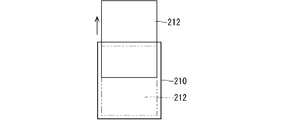
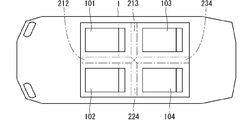
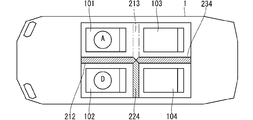
- FIG. 1 is a diagram conceptually showing a partition of a vehicle.
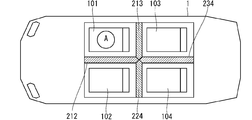
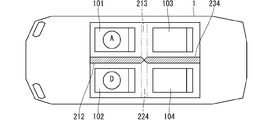
- FIG. 2 is a diagram conceptually showing a partition of a vehicle.
- FIG. 3 is a diagram conceptually illustrating a configuration in which the partition can be opened and closed.
- FIG. 4 is a diagram conceptually illustrating a configuration in which the partition can be opened and closed.
- FIG. 5 is a diagram conceptually illustrating a configuration in which the partition can be opened and closed.
- FIG. 6 is a diagram schematically showing opening and closing of a door when an occupant gets on a vehicle.
- FIG. 7 is a diagram schematically showing opening and closing of a door when an occupant gets on a vehicle.
- FIG. 8 is a diagram schematically showing opening and closing of a door when an occupant gets on a vehicle.
- FIG. 1 is a diagram conceptually showing a partition of a vehicle.
- FIG. 2 is a diagram conceptually showing a partition of a vehicle.
- FIG. 3 is a diagram conceptually
- FIG. 9 is a diagram conceptually showing a state immediately after an occupant gets on a vehicle.
- FIG. 10 is a diagram conceptually showing a state in which a partition is opened according to a request from an occupant.
- FIG. 11 is a diagram illustrating the transmission of information from the request of the passenger to the opening of the partition.
- FIG. 12 is a diagram illustrating the configuration of the partition opening/closing system.
- FIG. 13 is a diagram showing a state in which an occupant gets on or off the vehicle.
- FIG. 14 is a diagram showing a state in which an occupant gets on or off the vehicle.
- FIG. 15 is a diagram showing a state in which an occupant gets on or off the vehicle.
- FIG. 16 is a diagram showing a state in which an occupant gets on or off the vehicle.
- FIG. 17 is a diagram showing a state in which an occupant gets on or off the vehicle.
- FIG. 18 is a diagram showing a state in which an occupant gets on or off the vehicle.
- FIG. 19 is a diagram showing a state in which an occupant gets on or off the vehicle.
- FIG. 20 is a diagram showing a state in which an occupant gets on or off the vehicle.
- FIG. 21 is a diagram showing a state in which an occupant gets on or off the vehicle.
- FIG. 22 is a diagram showing a state in which an occupant gets on or off the vehicle.
- FIG. 23 is a diagram illustrating the layout determination process.
- FIG. 24 is a diagram illustrating a layout determination process.
- FIG. 25 is a diagram illustrating the layout determination process.
- FIG. 24 is a diagram illustrating a layout determination process.
- FIG. 26 is a diagram illustrating a layout determination process.
- FIG. 27 is a diagram illustrating a layout determination process.
- FIG. 28 is a diagram illustrating a layout determination process.
- FIG. 29 is a diagram illustrating the layout determination process.
- FIG. 30 is a diagram illustrating a layout determination process.
- FIG. 31 is a diagram illustrating a layout determination process.
- FIG. 32 is a diagram illustrating a layout determination process.
- FIG. 33 is a diagram illustrating a layout determination process.
- FIG. 34 is a diagram illustrating a layout determination process.
- FIG. 35 is a diagram illustrating the layout determination process.
- FIG. 36 is a diagram illustrating a layout determination process.
- FIG. 37 is a diagram illustrating a layout determination process.
- FIG. 38 is a diagram illustrating the layout determination process.
- FIG. 39 is a diagram illustrating a layout determination process.
- FIG. 40 is a diagram illustrating a layout determination process.
- FIG. 41 is a diagram illustrating a layout determination process.
- FIG. 42 is a flowchart showing the layout determination process.
- FIG. 43 is a flowchart showing the reservationable classification process.
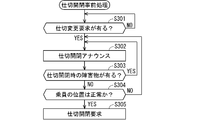
- FIG. 44 is a flowchart showing the partition opening/closing preprocessing.
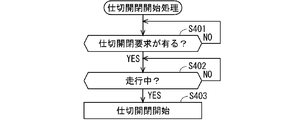
- FIG. 45 is a flowchart showing the partition opening/closing start processing.
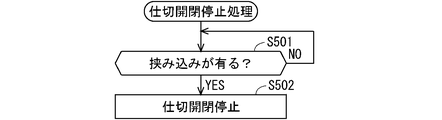
- FIG. 46 is a flowchart showing the partition opening/closing stop processing.
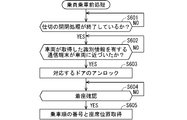
- FIG. 47 is a flowchart showing a passenger pre-boarding process.
- FIG. 48 is a flowchart showing the processing after the passenger dismounts.
- FIG. 40 is a diagram illustrating a layout determination process.
- FIG. 41 is a diagram illustrating a layout determination process.
- FIG. 42 is a flowchart showing the layout determination process.
- FIG. 43 is a flowchart
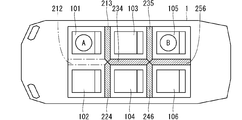
- FIG. 49 is a diagram conceptually showing a partition of a vehicle when six seats are provided inside.
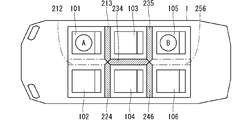
- FIG. 50 is a diagram conceptually showing the state of a virtually separated vehicle.
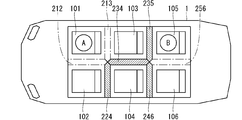
- FIG. 51 is a diagram showing a virtual state of the vehicle.
- FIG. 52 is a diagram showing a virtual state of the vehicle.
- FIG. 53 is a diagram showing a virtual state of the vehicle.
- FIG. 54 is a diagram showing a virtual state of the vehicle.
- the partition opening/closing system of the present disclosure includes a drive device and a control device.
- the drive device drives opening and closing of a partition between a plurality of seats provided in the vehicle.
- the control device determines whether or not the opening/closing is necessary by using information indicating at least one of the schedule for the passenger to get on the vehicle and the schedule for the passenger to get off.
- control device uses the information to determine the seat on which the occupant is seated. This is because the partition corresponding to the seating position of the vehicle occupant is realized.
- the first said Preferably the partition between a seat and the second said seat is not closed. This is because the occupant's occupying area is expanded and the comfort when sitting is improved.
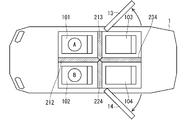
- FIG. 1 and 2 conceptually show a partition of a vehicle.
- Seats 101, 102, 103, 104 are provided inside the vehicle 1.
- the left side of the drawing is the forward direction of the vehicle 1.
- These drawings are views taken along the direction from the roof of the vehicle 1 toward the floor. In order to avoid the inconvenience of illustration, neither the floor itself nor the roof itself is shown. The same applies to the other drawings in which all of the seats 101, 102, 103, 104 are shown.
- the seat 101 is provided on the right side in the forward direction, and the seat 102 is provided on the left side in the forward direction. Since the seat 103 is provided behind the seat 101, it can be said that the seat 103 is provided on the right side opposite to the forward direction. Since the seat 104 is provided behind the seat 102, it can be said that the seat 104 is provided on the left side opposite to the forward direction.
- a partition 212 is provided between the seats 101 and 102, a partition 213 is provided between the seats 101 and 103, a partition 224 is provided between the seats 102 and 104, and a partition 103 is provided between the seats 103 and 104.
- the case where the partition 234 exists between each is illustrated.
- the presence of partitions 212, 213, 224, 234 is indicated by hatching.
- FIG. 2 it is exemplified that a partition 212 exists between the seats 101 and 102, a partition 213 exists between the seats 101 and 103, and a partition 224 exists between the seats 102 and 104. To be done. A virtual line indicates that there is no partition 234 between the seats 103 and 104.
- the presence of a partition is also expressed as “closed”, and the absence of a partition is also expressed as “open”.
- the transition from the state in which there is no partition to the state in which there is a partition is also expressed as "closing the partition” or “closing the partition”.
- the transition from the state in which the partition exists to the state in which the partition does not exist is also expressed as “open the partition” or “open the partition”.
- All of the partitions 212, 213, 224, 234 can be opened or closed. This possibility is also expressed as “openable and closable”.
- FIG. 3 conceptually illustrates a configuration in which the partition 212 can be opened and closed.
- FIG. 3 is a view seen from a direction parallel to the direction from the seat 101 to the seat 102.
- a virtual line indicates that the partition 212 does not exist between the seats 101 and 102, that is, the state where the partition 212 is opened.
- the partition 212 in such a state is housed in the door pocket 210.
- the door pocket 210 is provided between the seats 101 and 102 below the seating surface of the seats 101 and 102 (specifically, on the floor side).
- the door pocket 210 has a configuration in which a partition 212 is inserted and removed above the door pocket 210 (on the side opposite to the above lower side). For example, the door pocket 210 opens at the top.
- the partition 212 moves upward as illustrated by the arrow. As a result of this movement, the partition 212 exists between the seats 101 and 102 (the partition 212 is closed). When the partition 212 is opened, the partition 212 moves downward and is stored in the door pocket 210. Such a combination of the door pocket 210 and the partition 212 is realized by a known technique for forming a power window.
- FIG. 4 conceptually illustrates a configuration in which the partitions 212 and 213 can be opened and closed.
- FIG. 4 is a view seen from a direction parallel to the direction from the seat 101 to the seat 103.
- seats 101 and 102 are illustrated as seat backs.
- one plate-shaped member functions as one of the partitions 212 and 213.
- a state in which the member functions as the partition 213 is indicated by a virtual line, and a state in which the member functions as the partition 212 is indicated by a solid line.
- the member is attached to the shaft 200 and can rotate around the shaft 200.
- the shaft 200 extends in the vertical direction of the vehicle.
- the partition 212 is open (the state of the partition 212 at this time is not shown).
- the partition 213 is opened and the partition 212 is closed by rotating and moving the member in the direction indicated by the arrow.
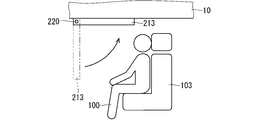
- FIG. 5 conceptually illustrates a configuration in which the partition 213 can be opened and closed.
- FIG. 5 is a view seen from a direction parallel to the direction from the seat 104 to the seat 103.
- the open state of the partition 213 is shown by a solid line, and the closed state of the partition 213 is shown by a virtual line.
- a state in which the occupant 100 is seated on the seat 103 is illustrated.
- the partition 213 is attached to the shaft 220 and can rotate around the shaft 220.
- the shaft 220 extends from the seat 104 toward the seat 103.
- the partition 213 rotates and moves in the direction indicated by the arrow, the partition 213 is closed and the partition 213 is opened (the partition 213 is opened).
- FIGS. 3 to 5 may be applied to the partitions 212, 213, 224, and 234 that are not illustrated in FIGS. 3 to 5.
- FIG. 6 shows a case where one passenger who is scheduled to sit on the seat 103 is greeted.
- the operation of opening the rear right door 13 closest to the seat 103 is indicated by an arrow.
- the occupant carries a communication terminal (for example, a smartphone (smart phone)), and the vehicle obtains information for identifying the communication terminal from the communication terminal (hereinafter referred to as “identification information”) and communicates from the vehicle. Measure the distance to the terminal. Since such acquisition of identification information and measurement of distance are known techniques, detailed description will be omitted.
- a Near Field Communication (NFC) method that conforms to the ISO/IEC18092 standard may be adopted, or a method that conforms to the IEEE802.15 standard ( For example, Bluetooth (registered trademark) may be adopted.
- Point information Information indicating the point where the occupant gets on (tentatively referred to as “point information” below) is recognized on the vehicle side prior to getting on the occupant together with the identification information of the communication terminal carried by the occupant.
- the seat on which the passenger is seated is determined based on the spot information and the identification information. Seat determination will be described in detail later in the description of “group reservation”.
- the door associated with the seat determined for the passenger carrying the communication terminal opens.
- FIG. 6 a case where the seat is the seat 103 and the door is the door 13 is illustrated.
- FIG. 7 and FIG. 8 show a case where two passengers who are scheduled to be seated on the seats 103 and 104 respectively are welcomed.
- the operation of opening the rear right door 13 closest to the seat 103 and the rear left door 14 closest to the seat 104 is indicated by the arrow.
- partition 234 is closed between the seats 103 and 104 in FIG. 7 and the case where the partition 234 is opened in FIG. 8 are illustrated. Whether to close or open the partition 234 is determined based on the setting associated with the information obtained from the communication terminals carried by the two passengers who are scheduled to sit. This setting will be described in detail later in ⁇ Configuration example of partition opening/closing system ⁇ .
- the doors 13 and 14 are opened even when the passenger gets off.
- the doors 13 and 14 are closed after the distance between the vehicle and the communication terminal carried by the passenger getting off the vehicle becomes equal to or greater than the threshold value.
- the processing before and after the passenger gets off the vehicle will be described in detail later in ⁇ Processing before getting on the passenger ⁇ and ⁇ Processing after getting off the passenger ⁇ .
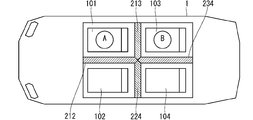
- FIG. 9 conceptually shows a state immediately after the occupants C and D board the vehicle 1.
- One passenger A, B, C, D is seated on each of the seats 101, 102, 103, 104.
- the partitions 212, 213, 224 and 234 are all closed.
- FIG. 10 conceptually shows the state in which the partition 234 is opened at the request of the occupant C from the state of FIG. Since the partition 234 exists between the seats 103 and 104, the occupant D's consent to open the partition 234 is confirmed.
- FIG. 11 exemplifies the transmission of information from the request of the occupant C to the opening of the partition 234.
- Symbols C and D indicate communication terminals of passengers C and D, respectively.
- a communication device Z mounted on the vehicle 1 and a communication facility X installed outside the vehicle 1 are also shown. The passage of time is indicated by the direction toward the bottom of the drawing.
- Request R1 is transmitted from the occupant C to the communication facility X.
- Request R1 conveys a request to open the closed partition 234.
- the communication facility X transmits the notification R2 to the occupant D due to the reception of the request R1.
- the notification R2 informs that the occupant C has requested to open the partition 234, and requests an answer as to whether or not the partition 234 can be opened.
- the occupant D sends a reply R3 to the communication facility X in response to the notification R2.
- the answer R3 indicates whether or not the closed partition 234 can be opened.
- the communication facility X transmits the signal R4 to the communication device Z due to having received the reply R3.
- Signal R4 includes an indication as to whether divider 234 remains closed or is opened.
- the partition 234 remains closed or the partition 234 is opened according to the instruction of the signal R4.
- the request R1 is a request to close the open partition 234, and the notification R2 informs that the occupant C has requested to close the partition 234 and requests an answer as to whether or not the partition 234 can be closed.
- .. Answer R3 indicates whether or not the open partition 234 can be closed.
- the signal R4 includes an instruction as to whether the partition 234 remains open or the partition 234 is closed. A specific processing flow for opening and closing the partition will be described in detail below.
- FIG. 12 illustrates the configuration of the partition opening/closing system 9 used for opening/closing the partitions 212, 213, 224, 234.
- the partition opening/closing system 9 includes a partition opening/closing determining unit 91, a partition driving unit 92, and a door opening/closing control unit 93, and is mounted on the vehicle 1.
- the partition drive unit 92 is a drive device that drives opening and closing of the partitions 212, 213, 224, and 234, and is specifically realized by an actuator (actuator) exemplified by a motor (motor).
- the partition drive unit 92 stores the partition 212 in the door pocket 210 and sends out the partition 212 from the door pocket 210.
- the partition driving unit 92 rotates the members that also serve as the partitions 212 and 213 around the shaft 200.
- the partition drive unit 92 moves the partition 213 around the shaft 220.
- the door opening/closing control unit 93 controls opening/closing of the door of the vehicle 1. According to the examples of FIGS. 6, 7, and 8, the door opening/closing control unit 93 controls opening/closing of the doors 13 and 14. Since such a function and a technique necessary for realizing the function are known, detailed description thereof will be omitted.
- the partition opening/closing determination unit 91 is realized by an electronic control unit (Electronic Control Unit: hereinafter also referred to as “ECU”) exemplified by a body control module (Body Control Module: hereinafter also referred to as “BCM”).
- ECU Electronic Control Unit
- BCM Body Control Module
- the partition opening/closing determining unit 91 determines whether or not the partitions 212, 213, 224, and 234 need to be opened or closed using various information, causes the partition driving unit 92 to perform the opening/closing, and causes the door opening/closing control unit 93 to open/close the door. It is a control device.
- vehicle information J1 smartphone information J2, personal authentication information J3 that authenticates an individual, information J4 from a data center, and pressure sensor (sensor) information J5 are provided to the partition opening/closing determination unit 91.
- the case of inputting is exemplified.
- the vehicle information J1 includes, for example, whether the vehicle 1 is running or stopped and information indicating the position of the vehicle 1 (hereinafter referred to as “own vehicle position information”).
- the vehicle information J1 can be obtained from the vehicle information section 801.
- the vehicle information unit 801 is a functional block that collectively shows a known device that acquires the vehicle position information and a known device that acquires the traveling speed of the vehicle 1.
- the smartphone information J2 includes the above-mentioned identification information.
- the personal authentication information J3 is used to determine whether or not a proper occupant carries the communication terminal identified by the smartphone information J2.
- the information J4 from the data center includes reservation data described later in addition to the above-mentioned signal R4.
- Well-known communication devices are used for the smartphone information unit 802 that acquires the smartphone information J2, the personal authentication information unit 803 that acquires the personal authentication information J3, and the center information unit 804 that acquires the information J4.
- FIG. 12 the case where the communication device is included in the communication device Z (see FIG. 11) is illustrated.
- the pressure sensor information J5 indicates the pressure applied to the seat surfaces of the seats 101, 102, 103, 104 and the pressure applied to the partitions 212, 213, 224, 234 during the opening/closing operation. Whether or not the occupant is seated is determined by the pressure applied to the seat surface. For example, when the pressure applied to the partition 212 exceeds a predetermined threshold value, it is determined that an event that interferes with the opening/closing operation of the partition 212 has occurred, for example, an obstacle is present.
- the pressure sensor information J5 is acquired from a known pressure sensor 805.
- ⁇ Example of opening and closing the partition ⁇ 13 to 22 show time-sequential states in which the occupants A, B, C, and D get in or out of the vehicle 1.
- the occupant A gets on the vehicle 1 in which no one is getting on, then the occupants B, C, and D get on in this order, the occupant B gets off, and the occupant C gets off, then The case where both A and D are scheduled to get off is shown.
- partitions that are open are shown in phantom.
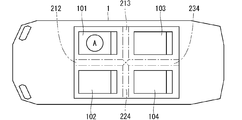
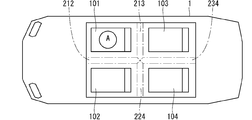
- FIG. 13 shows a state of the vehicle 1 before the occupant A gets on the vehicle. The occupant A is scheduled to sit on the seat 101.
- FIG. 14 shows the state of the vehicle 1 immediately after the occupant A is seated on the seat 101. In any state, none of the partitions 212, 213, 224, 234 exists between the seats.
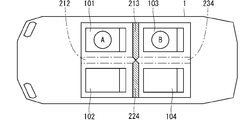
- FIG. 15 shows a state of the vehicle 1 immediately after the occupant B gets on the seat 103. Since the partitions 213 and 224 are closed, it is unlikely that the occupants A and B will face each other. On the other hand, since the partitions 212 and 234 are open, the occupation area of the occupant A is wider than the seat 101 by the seat 102, and the occupation area of the occupant B is wider than the seat 103 by the seat 104.
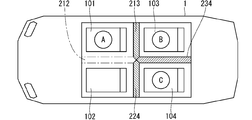
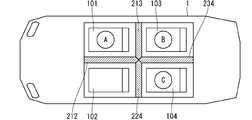
- FIG. 16 shows a state of the vehicle 1 immediately after the occupant C gets on and sits on the seat 104. Since the partitions 213, 224, 234 are closed, the occupants A, B, C are unlikely to face each other. On the other hand, since the partition 212 is open, the occupation area of the occupant A is wider than the seat 101 by the seat 102.
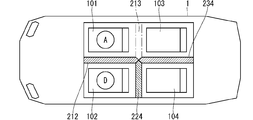
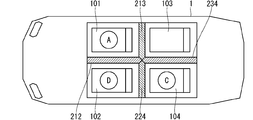
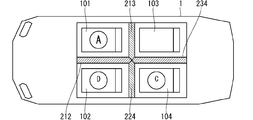
- FIG. 17 shows the state of the vehicle 1 immediately after the occupant D gets on the seat 102. Since the partitions 212, 213, 224, 234 are closed, it is unlikely that the occupants A, B, C, D will face each other.
- the partition 234 may be opened by a request from the occupant B.
- the explanation of the opening and closing of the partition after getting on the vehicle is understood as an explanation in which the occupants C and D are read as the occupants B and C, respectively, in the explanation using FIGS. 10 and 11.
- FIG. 18 shows the state of the vehicle 1 immediately after the occupant B gets off the vehicle.
- FIG. 19 shows the state of the vehicle 1 immediately after the occupant B gets off the vehicle and immediately before the occupant C gets off the vehicle. After occupant B gets off, before occupant C gets off, there is no plan for a new occupant to get on or off. Therefore, the partition 213 is opened from the state of FIG. 18, and the occupied area of the occupant A is expanded as shown in FIG.
- FIG. 20 shows the state of the vehicle 1 immediately after the occupant C gets off the vehicle.
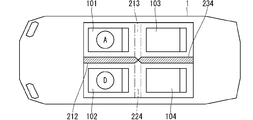
- FIG. 21 shows the state of the vehicle 1 immediately after the occupants C get off and the occupants A and D get off. There is no plan to newly get on or off the occupant after the occupant C gets off and before the occupants A and B get off. Therefore, the partition 224 is opened from the state shown in FIG. 20, and the occupation area of the occupant D is expanded as shown in FIG.
- FIG. 22 shows a state of the vehicle 1 after the occupants A and D get off. After this, there are no plans for passengers to board or disembark. Therefore, both the partitions 212 and 234 are opened, and the vehicle 1 returns to the state shown in FIG.
- the partition opening/closing determination unit 91 uses the information J4 (specifically, reservation data) to determine whether the partition needs to be opened/closed, and causes the partition driving unit 92 to open/close the partitions 212, 213, 224, 234.
- the partition corresponding to the occupant of the vehicle 1 is realized. This brings about an effect that whether or not a partition is provided corresponding to the presence or absence of an occupant in the vehicle 1 is variable.
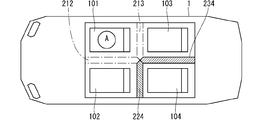
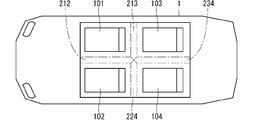
- FIG. 23 to 26 exemplify the layout determination processing when the vehicle 1 transits from the state shown in FIG. 13 to the state shown in FIG. 23, FIG. 24, FIG. 25, and FIG. 26 show the progress of the processing in this order.
- 27 to 29 exemplify a layout determination process when the vehicle 1 transits from the state shown in FIG. 14 to the state shown in FIG. 27, 28, and 29 show the progress of the processing in this order.
- FIGS. 30 and 31 exemplify the layout determination process when the vehicle 1 transits from the state shown in FIG. 15 to the state shown in FIG.
- the figures shown in FIGS. 30 and 31 show the progress of the processing in this order.
- FIG. 32 illustrates the layout determination process when the vehicle 1 transits from the state shown in FIG. 16 to the state shown in FIG.
- FIG. 33 to 34 exemplify the layout determination process when the vehicle 1 transits from the state shown in FIG. 18 to the state shown in FIG.
- Each drawing shown in FIG. 33 and FIG. 34 shows the progress of the processing in this order.
- FIGS. 35 to 37 exemplify a layout determination process when the vehicle 1 transits from the state shown in FIG. 20 to the state shown in FIG.
- the figures shown in FIGS. 35, 36, and 37 show the progress of the processing in this order.
- 38 to 41 exemplify layout determination processing when the vehicle 1 transits from the state shown in FIG. 21 to the state shown in FIG. 38, 39, 40, and 41 show the progress of the processing in this order.
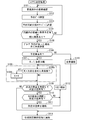
- FIG. 42 is a flow chart showing the layout determination process.
- the layout determination processing is executed by the partition opening/closing determination unit 91 unless otherwise specified.
- Step S101 is executed at the beginning of the layout determination process.
- step S101 seated seats are confirmed.
- the seated seat is confirmed from the pressure sensor information J5. Specifically, the presence/absence of seating is determined from the pressure applied to the seat surfaces of the seats 101, 102, 103, 104.
- step S102 is executed.
- the reservation data is confirmed in step S102.
- the reservation data is data indicating at least one of the schedule for the passenger to get on and the schedule for the passenger to get off, and is included in the information J4, for example.
- step S103 is executed.
- the reservable classification is transmitted to the server.
- the server is provided in the communication facility X, or is connected to the communication facility X so that information can be exchanged.
- the server accepts requests from passengers for getting on and off, arbitrates the requests, and generates reservation data. Since such desired reception and reservation data generation are known techniques, detailed description thereof will be omitted.
- Reservable classification refers to information that classifies whether or not it is possible to board the vehicle 1 equipped with the partition opening/closing determination unit 91.
- the classification of availability of group reservation is also included in the reservation possible classification.
- group reservation refers to a reservation in which multiple passengers are assigned to adjacent seats with open partitions.
- adjacent seats does not include seats that are lined up only on a diagonal line.
- the seats 101 and 104 are not adjacent seats, and the seats 102 and 103 are not adjacent seats.
- the seats 101, 102, 104 and the seats 101, 102, 103 are arranged in an L shape, they are included in the adjacent seats.
- FIG. 43 is a flowchart showing a process for obtaining the reservable classification (hereinafter referred to as “reservable classification processing”).
- reservable classification processing a process for obtaining the reservable classification (hereinafter referred to as “reservable classification processing”).
- step S201 it is determined from the result of step S101 whether or not there are adjacent vacant seats. If there are adjacent vacant seats, multiple occupants can be seated in multiple open seats.
- step S201 determines whether group reservation is possible (indicated as "group reservation possible” in the figure). If the determination in step S201 is negative, step S203 is executed and it is determined that the group reservation cannot be made (indicated as "group reservation not possible” in the figure).
- FIG. 43 a simple flowchart is shown in order to avoid complication of the drawing, but if there are two adjacent empty seats, it is not possible to allocate three or more passengers to the adjacent seats with open partitions. .. Therefore, in detail, in the processes of steps S201, S202, and S203, it is determined that group reservations of less than the number of adjacent vacant seats are possible, and group reservations exceeding the number cannot be made.
- step S204 the availability of the group reservation determined in steps S202 and S203 and the vacant seat information indicating the vacant seat are targets for transmission. It is shown that the reservable classification is given to the center information unit 804 as the information M4 in FIG.
- the information M4 is transmitted from the center information unit 804 to the communication equipment X, and the communication equipment X gives a reservationable classification to a server (not shown). In this way, step S103 is executed.
- step S104 it is determined whether an occupant is scheduled to board the vehicle within a threshold distance, or whether the passenger has already exited the vehicle after the layout determination process was started.
- the distance within the threshold is a distance corresponding to a predetermined period, and is determined by multiplying the average speed of the vehicle 1 at the time when step S103 is executed by the predetermined period.
- the average speed of the vehicle 1 is obtained from the vehicle information J1.
- the “predetermined period” is set to the sum of the required drive time and the drive standby time.
- the “required driving time” is set to be equal to or longer than the time required for driving to open/close the partition, for example, three times the time.
- the “drive standby time” is an average value of the time from the announcement to the occupant of the opening and closing of the partition until the opening and closing of the partition.
- the required drive time and the drive standby time are both set from past performance values and stored in the partition opening/closing determination unit 91.
- step S104 determines whether the occupant is planning to get on the distance within the threshold value but the occupant has already got off. If the occupant is planning to get on the distance within the threshold value but the occupant has already got off, the determination in step S104 becomes negative, and step S101 is executed again.
- step S104 it may be necessary to newly close the partition if the occupant is planning to board within the threshold distance, and may need to open a new partition if the occupant has already exited. is there. Therefore, if the determination in step S104 is affirmative, step S105 is executed.
- step S105 if there is a group reservation, seats are reserved first. For example, as shown in FIG. 14, the case where the occupant A is seated on the seat 101 and the seats 102, 103, 104 are vacant will be described.
- step S105 in such a case, the seats 102 and 104 or the seats 103 and 104 are assigned to the occupants B and C.
- step S105 may be replaced with the process of "when there is a group reservation in which the passengers ride with other passengers for the same period, the seat of the passenger corresponding to the group reservation is reserved first".
- the partition opening/closing determination unit 91 uses the information J4 (more specifically, the reservation data) to determine the seat on which the occupant is seated, so that the partition corresponding to the seating position of the occupant of the vehicle 1 is realized. It is advantageous in terms of
- step S106 is executed.
- step S106 it is determined whether or not there is an occupant scheduled to be seated within a threshold value (hereinafter, “tentative occupant”).
- tentative occupant a threshold value
- the result of the determination in step S104 is affirmative.
- step S106 no new occupants are scheduled to board, and the determination in step S106 is negative, and step S113 is executed.
- step S113 all seats, that is, all seats 101, 102, 103, 104 are connected.
- connecting means virtually opening a partition that is virtually closed between seats (regardless of whether they are actually closed or not).
- FIGS. 38 to 41 This processing is illustrated in FIGS. 38 to 41.
- all the partitions 212, 213, 224, 234 are once closed.
- the partitions 212 and 213 are virtually opened in this order, and further the partitions 224 and 234 are virtually opened.
- step S113 After execution of step S113, a notice is sent to the partition opening/closing preprocessing in step S114.
- the “partition opening/closing preliminary process” is a process prior to the drive for actually opening/closing the partition.
- the notification will be referred to as a "partition change request" later.
- step S107 is executed.
- the boarding order number K indicates the order in which the occupants boarded, and is assigned to the seats by the occupant boarding pre-processing and the passenger unloading post-processing described later.
- step S107 the partition to be actually opened/closed is determined based on the state in which the partition is virtually opened/closed. Then, in step S107, a state in which all the partitions 212, 213, 224, and 234 are temporarily closed is assumed as the initial state of this virtual opening and closing. In FIG. 42, this virtual initial state setting is described as "virtual separation". This is because virtually all seats are divided by partitions.
- step S109 is executed through execution of step S108.
- the total number of seats is 4, and in this case, step S108 has no substantial meaning and may be omitted.
- Step S108 has a substantial meaning when the total number of seats is 5 or more, for example, when the total number is 6, so step S108 will be described later.
- step S109 it is determined whether or not there is a predetermined vacant seat in consideration of the runner-up passenger.
- "Second runner” means at least one of the time when the passenger is scheduled to board the vehicle and the time when the passenger is scheduled to get off, or the point where the passenger is scheduled to board and the passenger getting off. It corresponds to at least one of the planned points. If there is no passenger who has already exited, but if a positive determination is obtained in step S104, the point corresponding to the runner-up is within the threshold value distance from the current vehicle 1.
- the "predetermined vacant seat” means a vacant seat that is not connected to a seat that has already been seated. However, the presence or absence of this connection is determined from the open/closed state of the virtual partition.
- step S104 becomes affirmative when the occupant B gets off, and the determination of S106 becomes affirmative because the occupants A, C, and D are on board, and the boarding order number K is initialized to 1 in step S107. Virtual separation is also done.
- step S109 since there is no second occupant, the seat 103 in which the occupant B is seated is present as a predetermined vacant seat. Therefore, the determination result of step S109 is affirmative, and step S110 is executed.
- step S110 it is determined whether or not there is a predetermined vacant seat around the seat (in the figure, referred to as "K seat” in order to avoid notation of the notation) in which the occupant corresponding to the boarding order number K is seated.
- the “surroundings” include not only the front and rear, the left and right, but also the case where they are arranged diagonally.
- step S110 is affirmative, and step S111 is executed.
- step S111 the predetermined vacant seat that was the basis for making the determination in step S110 affirmative is linked to the "K seat". This processing is illustrated in FIGS. 33 and 34, and the partition 213 is virtually opened.
- step S111 the boarding order number K is incremented by 1 in step S112. Then, step S109 is executed again via step S108.
- the seat 103 is vacant, since it is already connected to the seat 101 that has already been seated, it does not correspond to the “predetermined vacant seat” and the process proceeds to step S114.
- step S114 the notification for determining the partition to be opened/closed is performed.
- the content of the notification is a request to open the partition 213 or a request to further close the partitions 212, 224 and 234 in the above example.
- step S112 is repeatedly executed, and step S110 is determined for different occupants. If there is a predetermined vacant seat, it is a target for connection, and the execution of step S111 eliminates the vacant seat as the “predetermined vacant seat”. Therefore, steps S112 and S110 or steps S112 and S111 are repeatedly executed until the determination result of step S109 becomes negative. If a negative determination result is obtained in step S109, step S114 is executed.
- step S104 becomes affirmative when the occupant C gets off, and the determination in S106 becomes affirmative because the occupants A and D are in the vehicle.
- step S107 the boarding order number K is initialized to 1 and the virtual separation is performed. Is also done.
- step S110 is executed. Since the seat 103 is located behind the seat 101 on which the occupant A corresponding to the boarding order number 1 is seated, the determination result of step S110 is affirmative, and the seat 103 which is the basis of the determination result is connected to the seat 101. (See FIG. 36).
- step S110 is executed via steps S112 and S109. Since the seat 104 is located behind the seat 102 on which the occupant D corresponding to the boarding order number 2 is seated, the determination result of step S110 is affirmative, and the seat 104 which is the basis of the determination result is the seat 102. Are connected (see FIG. 37).
- step S109 executed via step S112 is negative (see FIG. 37: the seats 103 and 104 are connected to the seats 101 and 102, respectively, so they do not correspond to predetermined vacant seats). ), and step S114 is executed.
- the content notified in step S114 is a request to open the partitions 213 and 224, or a request to further close the partitions 212 and 234.
- step S104 becomes affirmative because the point where the occupant A is scheduled to board is within the threshold value from the current position of the vehicle 1. Since the occupant A is the scheduled occupant, the determination result in step S106 is affirmative, the number K in the boarding order is initialized to 1 in step S107, and virtual separation is also performed.
- FIG. 23 shows a state in which the seat 102 is connected to the seat 101
- FIG. 25 shows a state in which the seat 103 is connected to the seat 101
- FIG. 26 shows a state in which the seat 104 is connected to the seat 101.
- step S109 executed via step S112 is negative and step S114 is executed.
- the content notified in step S114 is a request to open the partitions 212, 213, 224, 234.
- step S104 An example will be described from when the occupant B gets on from the state shown in FIG. 14 until the vehicle 1 transitions to the state shown in FIG.
- the determination result of step S104 is negative until the point where the occupant B is scheduled to board is within the threshold value from the current position of the vehicle 1.
- the second seat here, seats 102 and 104 adjacent to the first seat (here, seat 101) on which the first occupant (here, occupant A) is seated, within a predetermined period.
- the partition between the first seat and the second seat (partitions 212 and 213 here) is not closed unless the second passenger (here, passenger B) is scheduled to sit. Therefore, the occupation area of the occupant A becomes wider than that of the seat 101, and the comfort when sitting is improved.
- step S104 If the determination result of step S104 becomes affirmative later, since the occupants A and B are the planned occupants, the determination result of step S106 becomes affirmative, and the boarding order number K is initialized to 1 in step S107. Separation also takes place. The case where the occupants A and B are seated on the seats 101 and 103 is illustrated (see FIG. 27).
- Crew members A and B correspond to numbers 1 and 2 in the order of boarding, respectively.
- the seat 102 is connected to the seat 101 by steps S109, S110, and S111 that are executed when the boarding order number K is 1 (see FIG. 28).
- the seat 104 is connected to the seat 103 by steps S109, S110, and S111 that are executed when the boarding order number K is 2 (see FIG. 29). By the processing up to this point, there is no seat corresponding to a predetermined vacant seat.
- step S109 executed when the boarding order number K is 3 is negative, and step S114 is executed.
- the content notified in step S114 is a request to close the partitions 213 and 224, or a request to further open the partitions 212 and 213.
- step S104 is negative until the point where the occupant C is scheduled to board is a distance within the threshold from the current position of the vehicle 1.
- the second seat (here, seat 104) adjacent to the first seat (here, seat 103) on which the first occupant (here, occupant B) sits If the occupant (here, occupant C) is not scheduled to sit, the partition (the partition 234 here) between the first seat and the second seat is not closed. Therefore, the occupied area of the occupant B becomes wider than the seat 103, and the comfort when sitting is improved.
- step S104 If the determination result of step S104 becomes affirmative later, since the occupants A, B, and C are scheduled occupants, the determination result of step S106 becomes affirmative, and the boarding order number K is initialized to 1 in step S107. , Virtual separation is also performed. The case where the occupants A, B, and C are seated on the seats 101, 103, and 104 is illustrated (see FIG. 30).
- step S109 executed when the boarding order number K is 1.
- step S110 executed when the boarding order number K is 2.
- the content notified in step S114 is a request to open the partition 212 or a request to further close the partitions 213 and 234. In this way, the state shown in FIG. 16 is obtained.
- step S104 An example will be described from the state shown in FIG. 16 to the passenger D getting on and the vehicle 1 transiting to the state shown in FIG.
- the determination result of step S104 is negative until the point where the occupant D is scheduled to board is within the threshold value from the current position of the vehicle 1.
- the second seat (here, seat 102) adjacent to the first seat (here, seat 101) on which the first occupant (here, occupant A) is seated, the second seat within the predetermined period. If the occupant (occupant D here) is not scheduled to sit, the partition (the partition 212 here) between the first seat and the second seat is not closed. Therefore, the occupation area of the occupant A becomes wider than that of the seat 101, and the comfort when sitting is improved.
- step S104 If the result of the determination in step S104 is later affirmative, the occupants A, B, C, and D are scheduled occupants, and therefore the result of the determination in step S106 is affirmative, and the number K in the boarding sequence is initially set to 1 in step S107. And virtual separation is also performed (see FIG. 32). Since there is no predetermined vacant seat, the determination in step S109 is negative and step S114 is executed.
- the content notified in step S114 is a request for closing the partition 212 or a request for further closing the partitions 213, 224, 234.
- FIG. 44 is a flowchart showing the partition opening/closing preprocessing.
- the partition opening/closing preliminary process is a process performed after the partition opening/closing state is determined by the layout determining process and before the partition driving unit 92 drives the opening/closing of the partition, and is executed by the partition opening/closing determining unit 91.
- Step S301 is executed at the beginning of the partition opening/closing preprocessing.
- step S301 it is determined whether there is a partition change request.
- the partition change request is a request to change the opening/closing of the partition determined by the layout determination process.
- the partition change request corresponds to the notification in step S114 of the flowchart shown in FIG.
- step S301 is repeated until the determination result is positive. If the determination result of step S301 is affirmative, specifically, for example, if step S114 is executed, step S302 is executed.
- a partition opening/closing announcement is made in step S302.
- the partition opening/closing announcement is, for example, a notification informing an occupant of the start of partitioning. Since such an announcement in the vehicle 1 can be easily realized by diverting a known technique, for example, a technique for promoting the wearing of a seat belt, detailed description thereof will be omitted. Since step S302 is a process executed by the partition opening/closing determination unit 91, more accurately, it is control to make a partition opening/closing announcement.
- step S303 is executed.
- step S303 it is determined whether or not there is an obstacle that obstructs the opening and closing of the partition (indicated as "obstacle when opening and closing the partition" in the figure).
- Such determination is realized by a known technique using the pressure sensor information J5 (more specifically, information on pressure applied to the partitions 212, 213, 224, 234).
- step S302 is executed again. It is expected that the occupant will eliminate the obstacle by executing steps S302 and S303.
- step S304 it is determined whether or not the position of the occupant is normal, for example, the sitting state is normal.
- the determination itself in step S304 is realized by a known technique using the pressure sensor information J5 (more specifically, information on the pressure applied to the seat surfaces of the seats 101, 102, 103, 104).
- step S304 becomes negative and step S302 is executed again.
- step S305 a partition opening/closing request is issued.
- the partition opening/closing request is a notification requesting drive of the partition opening/closing.
- the partition opening/closing request and the partition change request are illustrated in FIG. 12 as a request D1 to the partition driving unit 92.
- the partition is opened and closed with the obstacle removed.
- FIG. 45 is a flowchart showing the partition opening/closing start processing.
- the partition opening/closing start process is a process in which the partition driving unit 92 starts driving the opening/closing of the partition after a partition opening/closing request is generated by the partition opening/closing preprocessing.
- Step S401 is executed at the beginning of the partition opening/closing start processing. In step S401, it is determined whether there is a partition opening/closing request. If the determination result of step S401 is negative, step S401 is repeated until the determination result is affirmative. If the determination result of step S401 is affirmative, specifically, for example, if step S305 is executed, step S402 is executed.
- step S402 it is determined whether the vehicle 1 is running.
- the opening and closing of the partition is started before the passenger newly gets on and/or before the passenger gets off the vehicle, which means that the passenger can smoothly get on and/or the passenger can get off smoothly.
- step S402 it is advantageous. Therefore, if the determination result of step S402 is negative, step S402 is repeated, and if the determination result of step S402 is positive, opening and closing of the partition is started in step S403.
- FIG. 46 is a flowchart showing the partition opening/closing stop processing.
- the partition opening/closing stop process functions as an interrupt process for the state in which the opening/closing of the partition is driven.
- step S501 is executed.
- step S501 it is determined whether or not the partition has a foreign object in between when the partition is opened and closed. Such a determination is made based on the pressure sensor information J5, for example.
- step S501 can be easily realized by diverting the determination of the entrapment in the operation of the known power window.
- step S501 is repeated until the determination result becomes positive. If the determination result of step S501 is affirmative, the start of partitioning is stopped in step S502. By executing steps S501 and S502, opening and closing of the partition is stopped when there is a pinch.
- step S502 is more accurately a notification for stopping the drive for opening/closing the partition.
- a notification is also included in the request D1 to the partition drive unit 92 and is illustrated in FIG.
- FIG. 47 is a flowchart showing a passenger pre-boarding process.
- the occupant boarding process is a process executed after step S403 of the partition opening/closing start process (FIG. 45) is executed and the opening/closing of the partition is started and before the occupant newly boards.
- the passenger opening/closing process is performed by the partition opening/closing determining unit 91.
- Step S601 is executed at the beginning of the passenger pre-processing. In step S601, it is determined whether the partition opening/closing process is completed. If the determination result of step S601 is negative, step S601 is repeated until the determination result becomes positive. If the determination result of step S601 is affirmative, step S602 is executed.
- step S602 it is determined whether or not the communication terminal that has the identification information that the vehicle 1 has acquired in advance, that is, the identification information that has already been recognized, approaches the vehicle 1. Such a determination is realized by a known technique.
- step S602 is repeated until the determination result becomes positive. If the determination result of step S602 is affirmative, step S603 is executed.
- step S603 the door corresponding to the newly boarded passenger is unlocked (unlocked) from the reservation data included in the information J4.
- the door is a door (associated with the seat determined for the occupant) corresponding to the occupant carrying the communication terminal that is the basis for making the determination result of step S602 affirmative.
- the door may be opened as described in ⁇ Example of opening and closing the door ⁇ above.
- step S603 is, more accurately, a control for causing the door opening/closing control unit 93 to unlock the door.
- control is illustrated in FIG. 12 as a request D2 to the door opening/closing control unit 93.
- step S403 of the partition opening/closing start processing (FIG. 45) is executed to start opening/closing of the partition on the assumption that the vehicle 1 is traveling. However, the vehicle 1 may stop before the opening and closing of the partition is completed.
- Step S603 is executed when any of the determination results of steps S601 and S602 is affirmative. Therefore, when the passenger who is scheduled to board the vehicle actually boards, the corresponding partition has already been arranged and the other passengers The possibility of meeting with is reduced.
- step S604 is executed.
- step S604 it is confirmed whether or not the occupant is seated. The confirmation is performed based on the pressure exerted on the seat surfaces of the seats 101, 102, 103, 104 obtained by the pressure sensor information J5.
- step S604 is repeated until the determination result becomes positive. If the determination result of step S604 is affirmative, step S605 is executed.
- step S605 the number of the occupant in the order of getting in (see FIG. 42 and the description of FIG. 42) and the position of the seat on which the occupant is seated are acquired.
- the position of the seat to be seated is specified as one of the seats 101, 102, 103, 104.
- the occupant A is seated on the seat 101, and the occupant A has a boarding order number of 1.
- the occupants A and B are seated on the seats 101 and 103, respectively, and the numbers in the order of boarding are 1 and 2, respectively.
- the occupants A, B, and C are seated on the seats 101, 103, and 104, respectively, and the numbers in the order of boarding are 1, 2, and 3, respectively. is there.
- the occupants A, B, C and D are seated on the seats 101, 103, 104 and 102, respectively, and the numbers in the order of boarding are 1, respectively. 2, 3 and 4.
- FIG. 48 is a flowchart showing the processing after the passenger dismounts.
- the post-passenger dismounting process is a process executed after the occupant dismounts.
- the post-passenger dismounting process is performed by the partition opening/closing determination unit 91.
- Step S701 is executed at the beginning of the processing after the passenger disembarkation.
- step S701 it is determined whether or not the communication terminal having the identification information that the vehicle 1 previously acquired, in other words, the acknowledged identification information, has left the vehicle 1. Such a determination is realized by a known technique.
- step S701 is repeated until the determination result becomes positive. If the determination result of step S701 is affirmative, step S702 is executed.
- step S702 the door corresponding to the occupant who gets off is locked (locked) from the reservation data included in the information J4.
- the door is a door (associated with the seat determined for the occupant) corresponding to the occupant carrying the communication terminal that is the basis for making the determination result of step S701 affirmative. Since the passenger opening/closing process is executed by the partition opening/closing determining unit 91, step S702 is, more accurately, a control for causing the door opening/closing control unit 93 to lock the door. Such control is also illustrated in FIG. 12 as a request D2 to the door opening/closing control unit 93.
- step S703 the number of the occupant in the boarding order (see FIGS. 42 and 42) and the position of the seat on which the occupant sits are discarded.
- the occupants A, C, and D are seated on the seats 101, 104, and 102, respectively, and the numbers in the order of boarding are 1, 2, and 3. is there.
- the occupants A and D are seated on the seats 101 and 102, respectively, and the numbers in the order of boarding are 1 and 2, respectively.
- step S108 has a substantial meaning when the total number of seats is 5 or more, as described above.
- the total number of seats is 6 will be described as an example.
- FIG. 49 conceptually shows a partition of the vehicle 1 in the case where the six seats 101, 102, 103, 104, 105 and 106 are provided inside.
- the seat 101 is provided on the right side in the forward direction, and the seat 102 is provided on the left side in the forward direction.
- the seat 103 is provided behind the seat 101, and the seat 105 is provided behind the seat 103.
- the seat 104 is provided behind the seat 102, and the seat 106 is provided behind the seat 104.
- a partition 212 is provided between the seats 101 and 102, a partition 234 is provided between the seats 103 and 104, a partition 256 is provided between the seats 105 and 106, and a partition 213 is provided between the seats 101 and 103.
- a partition 235 is provided between the seats 103 and 105
- a partition 224 is provided between the seats 102 and 104
- a partition 246 is provided between the seats 104 and 106.
- FIG. 49 the occupant A is actually seated on the seat 101, and a state in which all the partitions 212, 234, 256, 213, 235, 224 and 246 are open is shown similarly to FIG. There is.
- step S107 is executed.
- FIG. 50 conceptually shows the state of the vehicle 1 virtually separated by the execution of step S107.
- step S108 is executed.
- step S108a is first executed.
- step S108a it is determined whether or not the number K in the boarding order exceeds the number of passengers including the runner-up points.
- step S108a If the determination result in step S108a is negative, specifically, if the number K in the boarding order is less than or equal to the number of passengers including the runner-up, execution of step S108 ends and step S109 is executed. If the determination result in step S108a is affirmative, specifically, if the number K in the boarding order exceeds the number of passengers including the runner-up, step S108b is executed. In step S108b, the boarding order number K is initialized to 1.
- step S108 immediately after step S107 is executed maintains the number K in the boarding order at 1.
- step S111 is executed.
- Seats 102, 103, and 104 exist as predetermined vacant seats for the seat 101 on which the occupant A corresponding to the boarding order number 1 is seated.
- the seat 102 is connected to the seat 101 in step S111. With such a connection, the virtual state of the vehicle 1 transits from the state shown in FIG. 50 to the state shown in FIG.
- step S111 the boarding order number K is increased from 1 to 2 by step S112.
- the determinations in steps S109 and S110 are both affirmative, and step S111 is executed.
- Seats 103, 104, and 106 exist as predetermined vacant seats with respect to the seat 105 on which the occupant B corresponding to the boarding order number 2 is seated.
- the seat 106 is connected to the seat 105 in step S111. With such a connection, the virtual state of the vehicle 1 transits from the state shown in FIG. 51 to the state shown in FIG.
- step S112 the boarding order number K increases from 2 to 3. If step S108 is not provided, even if step S109 is executed immediately after execution of step S112, there is no occupant corresponding to number 3 in the boarding order, so the determination result of step S109 is negative and step S114 is executed. It is not always executed. Even if the determination result of step S109 is negative and step S114 is executed, the seats 103 and 104 are not connected even though they are predetermined vacant seats.
- step S108 the boarding order number K is increased from 2 to 3, and then the boarding order number K is set to 1 again by step S108b. Therefore, a process of newly connecting a predetermined vacant seat to the seat 101 on which the occupant A corresponding to the seating order number 1 is seated is performed.
- step S111 is executed via steps S109 and S110.
- step S110 the seats 103 and 104 are determined to be predetermined vacant seats for the seat 101, and in step S111, the seat 103 is connected to the seat 101, for example. With such a connection, the virtual state of the vehicle 1 transits from the state shown in FIG. 52 to the state shown in FIG.
- step S112 the boarding order number K is increased from 1 to 2.
- step S108 step S108b is not executed, but step S111 is executed via steps S109 and S110.
- step S110 the seat 104 is determined to be a predetermined vacant seat for the seat 105, and in step S111, the seat 104 is connected to the seat 105. With such connection, the virtual state of the vehicle 1 transits from the state shown in FIG. 53 to the state shown in FIG. 54.
- step S112 is executed to increase the boarding order number K from 2 to 3.
- step S108b the boarding order number K is set to 1 again.
- step S109 executed after the setting of step S108b is negative, and step S114 is executed.
- the content notified in step S114 is a request for closing the partitions 224, 234, 235, or further a request for opening the partitions 212, 213, 246, 256.
- step S108 the occupation area of the occupant A is wider than the seat 101 not only for the seat 102 but also for the seat 103.
- the occupied area of the occupant B is wider than the seat 105 not only for the seat 106 but also for the seat 104. That is, the occupation area of the occupant is expanded by providing step S108.
- step S108 may be omitted.
- step S107 may be divided into a first step of performing virtual separation and a second step performed after the first step.
- the number K in the boarding sequence is initialized.
- step S108b may be omitted and the process may return to the second step of step S107 when the determination result of step S108a is affirmative. This is because the virtual separation has already been completed in the second stage by the first stage, and the second stage is equivalent to step S108b.
- Each device in the partition opening/closing system includes a computer including a microprocessor (micro processor), ROM (Read Only Memory), RAM (Random Access Memory), and the like.
- microprocessor micro processor
- ROM Read Only Memory
- RAM Random Access Memory
- An arithmetic processing unit such as a microprocessor reads out a computer program (computer program) including some or all of the steps of the flowcharts shown in FIGS. 42 to 48 from a storage unit such as a ROM or a RAM and executes the computer program.
- a computer program computer program
- the computer programs of these multiple devices can be installed from an external server device or the like.
- Such computer programs are in a state of being respectively stored in a recording medium such as a CD-ROM (Compact Disc Read Only Memory), a DVD-ROM (Digital Versatile Disk Only Memory), and a semiconductor memory (memory). Be distributed.
- a recording medium such as a CD-ROM (Compact Disc Read Only Memory), a DVD-ROM (Digital Versatile Disk Only Memory), and a semiconductor memory (memory).
Landscapes
- Engineering & Computer Science (AREA)
- Mechanical Engineering (AREA)
- Transportation (AREA)
- Aviation & Aerospace Engineering (AREA)
- Power-Operated Mechanisms For Wings (AREA)
- Vehicle Step Arrangements And Article Storage (AREA)
- Passenger Equipment (AREA)
- Seats For Vehicles (AREA)
Abstract
車両における乗員の存否に対応して仕切を設けるか否かが可変である。仕切開閉システムは、仕切開閉判定部と仕切駆動部とを備える。仕切駆動部は、仕切を開閉する駆動を行う駆動装置である。仕切は、車両に設けられた複数の座席同士の間において開閉される。仕切開閉判定部は仕切の開閉の要否を判定する制御部である。当該判定には、車両へ乗員が乗車する予定および乗員が降車する予定の少なくとも何れか一方を示す情報が用いられる。
Description
本開示は、仕切開閉システムに関する。
車両内において荷室と運転席とを区画するための仕切が、自動ドアによって開閉される技術が提案されている。例えば下記の特許文献1では、駐停車時にのみ開閉可能な自動ドアが提案されている。
車両に複数の乗員が乗車する場合、乗員同士の対面が好まれない状況もあり得る。このような場合、乗員が着座する座席の間に仕切を設けることは、対面の可能性を低下する観点で有利である。
他方、着座されていない座席と、着座されている座席との間に仕切を設けないことは、着座している乗員の占有領域を拡げ、着座時の快適性を向上する観点で有利である。
しかしながら乗員の全員が、必ずしも同時に乗車するとは限らず、同時に降車するとも限らない。
そこで本開示は、車両における乗員の存否に対応して仕切を設けるか否かが可変である技術を提供することを目的とする。
本開示にかかる仕切開閉システム(system)は、駆動装置と、制御装置とを備える。駆動装置は、車両に設けられた複数の座席同士の間における仕切の開閉を駆動する。制御装置は、前記車両へ乗員が乗車する予定および前記乗員が降車する予定の少なくとも何れか一方を示す情報を用いて、前記開閉の要否を判定する。
本開示は、このような特徴的な制御装置を備える仕切開閉システムとして実現することができるのみならず、かかる特徴的な処理をステップとする仕切開閉方法として実現したり、かかるステップ(step)をコンピュータ(computer)に実行させるためのプログラム(program)として実現したりすることができる。また、仕切開閉システムの一部又は全部を実現する半導体集積回路として実現することができる。
本開示にかかる仕切開閉システムによれば、車両における乗員の存否に対応して仕切を設けるか否かが可変である。
(1)本開示の仕切開閉システムは、駆動装置と制御装置とを備える。駆動装置は、車両に設けられた複数の座席同士の間における仕切の開閉を駆動する。制御装置は、前記車両へ乗員が乗車する予定および前記乗員が降車する予定の少なくとも何れか一方を示す情報を用いて、前記開閉の要否を判定する。
制御装置が備えられることによって、乗員の存否に対応して仕切を設けるか否かが可変である。
(2)前記制御装置は、前記情報を用いて、前記乗員が着座する前記座席を決定することが好ましい。車両の乗員の着座位置に対応した仕切が実現されるからである。
(3)第1の前記乗員が着座する第1の前記座席に隣り合った第2の前記座席に対し、所定期間内に第2の前記乗員が着座する予定がなければ、前記第1の前記座席と前記第2の前記座席との間の前記仕切は閉じられないことが好ましい。乗員の占有領域が拡がり、着座時の快適性が向上するからである。
(4)乗車が予定される前記乗員が乗車する前に、前記乗車が予定される前記乗員が着座した状況に対応した前記仕切の前記開閉が終了することが好ましい。乗車が予定される乗員が実際に乗車する時には既に対応した仕切が配置されており、他の乗員と対面する可能性が低減されるからである。
[本開示の実施形態の詳細]
本開示にかかる仕切開閉システムにおける具体例が、以下に図面を参照して説明される。なお、本開示はこれらによる例示には限定されず、請求の範囲によって示され、請求の範囲と均等の意味および範囲内における変更が全て含まれることが意図される。
本開示にかかる仕切開閉システムにおける具体例が、以下に図面を参照して説明される。なお、本開示はこれらによる例示には限定されず、請求の範囲によって示され、請求の範囲と均等の意味および範囲内における変更が全て含まれることが意図される。
{車両における仕切の例示}
図1および図2は、車両の仕切を概念的に示す。車両1の内部には座席101,102,103,104が設けられる。これらの図において図面左側が車両1の前進方向である。これらの図は車両1のルーフ(roof)からフロア(floor)に向う方向に沿って見た図である。図示の煩瑣を避けるため、フロア自体もルーフ自体も図示が省略される。座席101,102,103,104の全てが図示された他の図についても同様である。
図1および図2は、車両の仕切を概念的に示す。車両1の内部には座席101,102,103,104が設けられる。これらの図において図面左側が車両1の前進方向である。これらの図は車両1のルーフ(roof)からフロア(floor)に向う方向に沿って見た図である。図示の煩瑣を避けるため、フロア自体もルーフ自体も図示が省略される。座席101,102,103,104の全てが図示された他の図についても同様である。
座席101は前進方向右側に、座席102は前進方向左側に、それぞれ設けられる。座席103は座席101の後方に設けられるので、前進方向とは反対側の右側に設けられると言える。座席104は座席102の後方に設けられるので、前進方向とは反対側の左側に設けられると言える。
図1においては、座席101,102同士の間には仕切212が、座席101,103同士の間には仕切213が、座席102,104同士の間には仕切224が、座席103,104同士の間には仕切234が、それぞれ存在する場合が例示される。仕切212,213,224,234が存在することがハッチングによって示される。
図2においては、座席101,102同士の間には仕切212が、座席101,103同士の間には仕切213が、座席102,104同士の間には仕切224が、それぞれ存在する場合が例示される。座席103,104同士の間には仕切234が存在しないことが仮想線によって示される。
本実施形態の説明において、仕切が存在することは仕切が「閉じられている」とも表現され、仕切が存在しないことは仕切が「開いている」とも表現される。そして仕切が存在しない状態から仕切が存在する状態へ遷移することは「仕切を閉じる」、もしくは「仕切が閉じられる」とも表現される。仕切が存在する状態から仕切が存在しない状態へ遷移することは「仕切を開く」、もしくは「仕切が開かれる」とも表現される。
仕切212,213,224,234のいずれもが、開くことも閉じることも可能である。この可能性は「開閉可能」とも表現される。
図3は仕切212が開閉可能となる構成を概念的に例示する。図3は座席101から座席102に向う方向に平行な方向から見た図である。仕切212が座席101,102の間に存在しない場合、つまり仕切212が開かれている状態が仮想線によって示される。このような状態の仕切212は、戸袋210に収納される。
戸袋210は、座席101,102の間でそれらの座面よりも車両の下方(具体的にはフロア側)に設けられる。戸袋210は戸袋210の上方(上記下方とは反対側)において仕切212が出入する構成を有する。例えば戸袋210は上方において開口する。
仕切212は矢印で例示されるように上方へ移動する。この移動の結果、座席101,102の間に仕切212が存在する(仕切212が閉じられる)。仕切212が開くときには、仕切212が下方に移動し、戸袋210に収納される。このような戸袋210と仕切212との組合せは、パワーウィンドウを構成する公知の技術で実現される。
図4は仕切212,213が開閉可能となる構成を概念的に例示する。図4は座席101から座席103に向う方向に平行な方向から見た図である。図4において座席101,102はそれぞれのシートバック(seet back)が例示される。図4の例示においては、一つの板状の部材が仕切212,213のいずれか一方として機能する。当該部材が仕切213として機能する状態が仮想線によって示され、当該部材が仕切212として機能する状態が実線によって示される。
当該部材はシャフト200に取り付けられ、シャフト200の周りで回転することができる。シャフト200は車両の上下方向に延びる。仮想線によって示されたように仕切213が閉められたときには、仕切212は開いている(このときの仕切212の状態は不図示)。矢印によって示される方向に当該部材が回転して移動することにより、仕切213は開き、仕切212が閉められる。
図5は仕切213が開閉可能となる構成を概念的に例示する。図5は座席104から座席103に向う方向に平行な方向から見た図である。仕切213が開いている状態が実線によって示され、仕切213が閉じている状態が仮想線によって示される。座席103に乗員100が着座している状態が例示される。
仕切213はシャフト220に取り付けられ、シャフト220の周りで回転することができる。シャフト220は座席104から座席103に向う方向に延びる。矢印によって示される方向に仕切213が回転して移動することにより、仕切213が閉じている状態から仕切213が開いている状態に遷移する(仕切213が開く)。
図3から図5で例示された開閉は、仕切212,213,224,234のうち、図3から図5で例示されていないものについて適用されてもよい。
{ドアの開閉の例示}
図6、図7、図8は、いずれも車両1へ乗員が乗車する際のドアの開閉を模式的に示す。図6は座席103に着座することが予定されている一人の乗員を迎える場合を示す。座席103に最も近い後部右側のドア13を開く動作が矢印によって示される。
図6、図7、図8は、いずれも車両1へ乗員が乗車する際のドアの開閉を模式的に示す。図6は座席103に着座することが予定されている一人の乗員を迎える場合を示す。座席103に最も近い後部右側のドア13を開く動作が矢印によって示される。
当該乗員は通信端末(例えばスマートフォン(smart phone))を携帯しており、車両は当該通信端末から当該通信端末を識別する情報(以下「識別情報」と仮称される)を取得し、車両から通信端末までの距離を測定する。このような識別情報の取得、距離の測定は公知技術であるので詳細な説明は省略される。通信端末と車両との間の通信にはISO/IEC18092の規格に則った近距離無線通信(Near Field Communication:NFC)の方式が採用されてもよいし、IEEE802.15の規格に則った方式(例えばブルートゥース(Bluetooth)(登録商標))が採用されてもよい。
乗員が乗車する地点を示す情報(以下「地点情報」と仮称される)は、当該乗員が携帯する通信端末の識別情報と共に、当該乗員の乗車に先だって車両側で了知される。地点情報と識別情報とに基づいて、当該乗員が着座する座席が決定される。座席の決定については後に「グループ予約」の説明において詳述される。
車両と、了知済みの識別情報を有する通信端末とが接近すると、当該通信端末を携帯する乗員に対して決定された座席に関連づけられたドアが開く。図6においては当該座席が座席103であり、当該ドアがドア13である場合が例示される。
図7および図8はいずれも、座席103,104にそれぞれ着座することが予定されている二人の乗員を迎える場合を示す。座席103に最も近い後部右側のドア13と、座席104に最も近い後部左側のドア14とを開く動作が矢印によって示される。
図7においては座席103,104の間で仕切234が閉じられる場合が、図8においては仕切234が開かれる場合が、それぞれ例示される。仕切234を閉じるか、開くかについては、着座する予定の二人の乗員が携帯する通信端末から得られる情報と結びついた設定に基づいて決定される。この設定については後で{仕切開閉システムの構成例}において詳述される。
乗員が降車する場合にもドア13,14が開かれる。降車した乗員が携帯する通信端末と車両との距離が閾値以上となってから、ドア13,14が閉じられる。乗員が降車する前後の処理については後で{乗員が乗車する前の処理}、{乗員が降車した後の処理}において詳述される。
{仕切の事後的な開閉}
図9は車両1へ乗員C,Dが乗車した直後の状態を概念的に示す。座席101,102,103,104にそれぞれ一人ずつの乗員A,B,C,Dが着座している。仕切212,213,224,234はいずれも閉じられている。
図9は車両1へ乗員C,Dが乗車した直後の状態を概念的に示す。座席101,102,103,104にそれぞれ一人ずつの乗員A,B,C,Dが着座している。仕切212,213,224,234はいずれも閉じられている。
図10は、図9の状態から、乗員Cの要求によって仕切234が開いた状態を概念的に示す。仕切234は座席103,104の間に存在しているので、仕切234を開けることについて乗員Dの了解が確認される。
図11は乗員Cの要求から仕切234を開くまでの情報の伝達を例示する。記号C,Dはそれぞれ乗員C,Dの通信端末を示す。車両1に搭載される通信装置Z、車両1の外部に設備される通信設備Xも併記される。時間の経過は図面下方に向う方向によって示される。
乗員Cから通信設備Xに対して要求R1が送信される。要求R1は閉じられている仕切234を開く要求を伝える。通信設備Xは要求R1を受けたことを起因として、乗員Dへ通知R2を送信する。通知R2は、乗員Cから仕切234を開くことが要求されたことを伝え、仕切234を開くことの可否についての回答を要求する。乗員Dは通知R2に対して回答R3を通信設備Xに送信する。回答R3は閉じられている仕切234を開くことの可否を示す。通信設備Xは回答R3を受けたことを起因として、通信装置Zに対して信号R4を送信する。信号R4は仕切234が閉じた状態を維持するか、仕切234を開くかについての指示を含む。信号R4の指示に従って、仕切234は閉じた状態が維持されるか、または仕切234は開かれる。
図10および図11で例示された場合とは逆に、乗員C,Dがそれぞれ座席103,104に着座している状態で既に開いている仕切234が、乗員Cからの要求で閉じられる。この場合、要求R1は開いている仕切234を閉じる要求であり、通知R2は、乗員Cから仕切234を閉じることが要求されたことを伝え、仕切234を閉じることの可否についての回答を要求する。回答R3は開いている仕切234を閉じることの可否を示す。信号R4は仕切234が開いている状態を維持するか、仕切234を閉じるかについての指示を含む。仕切の開閉についての具体的な処理の流れについて次に詳述される。
{仕切開閉システムの構成例}
図12は仕切212,213,224,234の開閉に用いられる仕切開閉システム9の構成を例示する。仕切開閉システム9は仕切開閉判定部91と、仕切駆動部92と、ドア開閉制御部93とを備え、車両1に搭載される。
図12は仕切212,213,224,234の開閉に用いられる仕切開閉システム9の構成を例示する。仕切開閉システム9は仕切開閉判定部91と、仕切駆動部92と、ドア開閉制御部93とを備え、車両1に搭載される。
仕切駆動部92は、仕切212,213,224,234の開閉を駆動する駆動装置であり、具体的にはモータ(motor)で例示されるアクチュエータ(actuator)で実現される。図3による例示に即して言えば、戸袋210へ仕切212を収納することや、戸袋210から仕切212を送出することが、仕切駆動部92によって行われる。図4による例示に即して言えば、仕切212,213に兼用される部材がシャフト200周りに回転することが、仕切駆動部92によって行われる。図5による例示に即して言えば、仕切213がシャフト220周りに移動することが、仕切駆動部92によって行われる。
ドア開閉制御部93は車両1のドアの開閉を制御する。図6、図7、図8の例示に即して言えば、ドア開閉制御部93はドア13,14の開閉を制御する。このような機能および当該機能の実現に必要な技術は公知であるので、詳細な説明は省略される。
仕切開閉判定部91は、ボディ・コントロール・モジュール(Body Control Module:以下「BCM」とも称す)で例示されるエレクトロニック・コントロール・ユニット(Electronic Control Unit:以下「ECU」とも称す)で実現される。仕切開閉判定部91は、種々の情報を用いて仕切212,213,224,234の開閉の要否を判定し、仕切駆動部92に当該開閉を行わせ、ドア開閉制御部93にドアを開閉させる制御装置である。
図12においては、仕切開閉判定部91に対して、車両情報J1、スマートフォン情報J2、個人を認証する個人認証情報J3、データセンタ(data center)からの情報J4、圧力センサ(sensor)情報J5が入力する場合が、例示される。
車両情報J1は、例えば車両1が走行中か停車中かの区別と、車両1の位置を示す情報(以下「自車位置情報」と仮称される)とを含む。車両情報J1は車両情報部801から得ることができる。車両情報部801は、自車位置情報を取得する公知の装置や、車両1の走行速度を取得する公知の装置を纏めて示した機能ブロックである。
スマートフォン情報J2は、上述の識別情報を含む。個人認証情報J3はスマートフォン情報J2で識別される通信端末を適正な乗員が携帯しているか否かの判断に供される。データセンタからの情報J4は、上述の信号R4の他、後述する予約データを含む。スマートフォン情報J2を取得するスマートフォン情報部802、個人認証情報J3を取得する個人認証情報部803、および情報J4を取得するセンタ情報部804は、いずれも公知の通信装置が採用される。図12においては当該通信装置が通信装置Z(図11参照)に含まれる場合が例示される。
圧力センサ情報J5は座席101,102,103,104の座面に掛かる圧力と開閉動作において仕切212,213,224,234に掛かる圧力を示す。座面に掛かる圧力によって乗員が着座しているか否かが判定される。例えば仕切212に掛かる圧力が所定の閾値を超えているときには、仕切212の開閉動作に障害となる事象が発生している、例えば障害物が存在していると判定される。圧力センサ情報J5は、公知の圧力センサ805から取得される。
{仕切の開閉の例示}
図13から図22は乗員A,B,C,Dが車両1に乗車または降車する状態を時系列的に示す。ここにおいては誰も乗車していない車両1に対して、まず乗員Aが乗車し、次いで乗員B,C,Dがこの順に乗車し、乗員Bが降車し、乗員Cが降車してから、乗員A,Dが共に降車する予定である場合を示す。これらの図において、開いている(座席間に存在しない)仕切は仮想線で図示される。
図13から図22は乗員A,B,C,Dが車両1に乗車または降車する状態を時系列的に示す。ここにおいては誰も乗車していない車両1に対して、まず乗員Aが乗車し、次いで乗員B,C,Dがこの順に乗車し、乗員Bが降車し、乗員Cが降車してから、乗員A,Dが共に降車する予定である場合を示す。これらの図において、開いている(座席間に存在しない)仕切は仮想線で図示される。
図13は乗員Aが乗車する前の車両1の状態を示す。乗員Aは座席101に着座する予定である。図14は乗員Aが座席101に着座した直後の車両1の状態を示す。いずれの状態でも仕切212,213,224,234のいずれも座席間には存在しない。
乗員Aが座席101に着座した後、乗員Bが乗車して座席103に着座する予定である。乗員Bが乗車する前に、仕切213,224が閉じられる。図15は乗員Bが乗車して座席103に着座した直後の車両1の状態を示す。仕切213,224が閉じられているので、乗員A,Bが対面する可能性は低い。他方、仕切212,234は開いているので、乗員Aの占有領域は座席102の分で座席101より広く、乗員Bの占有領域は座席104の分で座席103より広い。
乗員Bが乗車して座席103に着座した後、乗員Cが乗車して座席104に着座する予定である。乗員Cが乗車する前に、仕切234が閉じられる。図16は乗員Cが乗車して座席104に着座した直後の車両1の状態を示す。仕切213,224,234が閉じられているので、乗員A,B,Cが互いに対面する可能性は低い。他方、仕切212は開いているので、乗員Aの占有領域は座席102の分で座席101より広い。
乗員Cが乗車して座席104に着座した後、乗員Dが乗車して座席102に着座する予定である。乗員Dが乗車する前に、仕切212が閉じられる。図17は乗員Dが乗車して座席102に着座した直後の車両1の状態を示す。仕切212,213,224,234が閉じられているので、乗員A,B,C,Dが互いに対面する可能性は低い。
但し、図17で例示された状態において、乗員Bからの要求によって仕切234を開くこともあり得る。このような乗車後の仕切の開閉の説明は、図10および図11を用いた説明で乗員C,Dをそれぞれ乗員B,Cに読みかえた説明として、理解される。
図18は乗員Bが降車した直後の車両1の状態を示す。図19は乗員Bが降車した後、乗員Cが降車する直前の車両1の状態を示す。乗員Bが降車した後、乗員Cが降車するまでの間に、乗員が新たに乗車または降車する予定はない。よって図18の状態から、仕切213が開かれ、図19に示されるように乗員Aの占有領域が拡がる。
図20は乗員Cが降車した直後の車両1の状態を示す。図21は乗員Cが降車した後、乗員A,Dが降車する直前の車両1の状態を示す。乗員Cが降車した後、乗員A,Bが降車するまでの間に、乗員が新たに乗車または降車する予定はない。よって図20の状態から、仕切224が開かれ、図21に示されるように乗員Dの占有領域が拡がる。
図22は乗員A,Dが降車した後の車両1の状態を示す。この後、乗員が新たに乗車または降車する予定はない。よって仕切212,234のいずれもが開かれ、車両1は図13において示された状態に戻る。
このように仕切開閉判定部91が情報J4(具体的には予約データ)を用いて仕切の開閉の要否を判定し、仕切駆動部92に仕切212,213,224,234の開閉を行わせることで、車両1の乗員に対応した仕切が実現される。これは車両1における乗員の存否に対応して仕切を設けるか否かが可変である効果を招来する。
{開閉される仕切を決定する処理の例示}
開閉される仕切が決定されることにより、乗員に割り当てられる占有領域が決定される。よって以下、開閉される仕切が決定される処理をレイアウト決定処理とも称す。
開閉される仕切が決定されることにより、乗員に割り当てられる占有領域が決定される。よって以下、開閉される仕切が決定される処理をレイアウト決定処理とも称す。
図23から図26は、車両1が図13に示された状態から図14に示された状態に遷移するときの、レイアウト決定処理を例示する。図23、図24、図25、図26において示された各図は、この順で当該処理の進行を示す。
図27から図29は、車両1が図14に示された状態から図15に示された状態に遷移するときの、レイアウト決定処理を例示する。図27、図28、図29において示された各図は、この順で当該処理の進行を示す。
図30、図31は、車両1が図15に示された状態から図16に示された状態に遷移するときの、レイアウト決定処理を例示する。図30、図31において示された各図は、この順で当該処理の進行を示す。
図32は、車両1が図16に示された状態から図17に示された状態に遷移するときの、レイアウト決定処理を例示する。
図33から図34は、車両1が図18に示された状態から図19に示された状態に遷移するときの、レイアウト決定処理を例示する。図33、図34において示された各図は、この順で当該処理の進行を示す。
図35から図37は、車両1が図20に示された状態から図21に示された状態に遷移するときの、レイアウト決定処理を例示する。図35、図36、図37において示された各図は、この順で当該処理の進行を示す。
図38から図41は、車両1が図21に示された状態から図22に示された状態に遷移するときの、レイアウト決定処理を例示する。図38、図39、図40、図41において示された各図は、この順で当該処理の進行を示す。
但し図23から図41において示された処理の進行は、仮想的な仕切の開閉として行われるものであり、実際上の仕切の開閉については後述される。
図42はレイアウト決定処理を示すフローチャート(flow chart)である。レイアウト決定処理は特に断らない限り、仕切開閉判定部91が実行する。
レイアウト決定処理の当初にはステップS101が実行される。ステップS101においては着座済みの座席が確認される。着座された座席は圧力センサ情報J5から確認される。具体的には座席101,102,103,104の座面に掛かる圧力から着座の有無が判定される。
ステップS101の実行後、ステップS102が実行される。ステップS102においては予約データが確認される。予約データは、乗員が乗車する予定および乗員が降車する予定の少なくとも何れか一方を示すデータであり、例えば情報J4に含まれる。
ステップS102の実行後、ステップS103が実行される。ステップS103においては予約可能分類がサーバーに送信される。サーバーは通信設備Xにおいて設けられ、もしくは通信設備Xとの間で情報の授受が可能に接続される。当該サーバーは乗員からの乗車および降車についての希望を受け付け、希望を調停して予約データを生成する。このような希望の受付および予約データの生成は公知の技術であるので詳細な説明は省略される。
予約可能分類とは、仕切開閉判定部91が搭載される車両1への乗車が可能であるか否かを分類する情報を指す。この実施形態においてはグループ予約の可否の分類も、予約可能分類に含められる。
ここで「グループ予約」とは、仕切が開いている隣り合った座席に複数の乗員が割り当てられる予約を指す。この場合の「隣り合った座席」には、対角線上でのみ並ぶ座席が含まれない。例えば座席101,104は隣り合った座席ではなく、座席102,103は隣り合った座席ではない。座席101,102,104や座席101,102,103のようにL字形で並ぶ場合は隣り合った座席に含まれる。
図43は予約可能分類が得られるための処理(以下「予約可能分類処理」と仮称される)を示すフローチャートである。予約可能分類処理の当初にはステップS201が実行される。ステップS201においてはステップS101の結果から、隣り合った空席が有るか否かが判断される。隣り合った空席が有れば、複数の乗員が、仕切が開いた複数の座席に着座することができる。
よってステップS201の判断が肯定的であれば、ステップS202が実行され、グループ予約が可能である(図中「グループ予約可」と表記)と決定される。ステップS201の判断が否定的であれば、ステップS203が実行され、グループ予約ができない(図中「グループ予約不可」と表記)と決定される。
図43においては図面の煩瑣を避けるために簡略にフローチャートを示したが、隣り合った空席が二席であれば、仕切が開いている隣り合った座席に三名以上の乗員を割り当てることはできない。よって詳細にはステップS201,S202,S203の処理においては、隣り合った空席の数以下のグループ予約は可能であり、当該数を超えるグループ予約はできない、と決定される。
ステップS202,S203による決定の後、ステップS204において、ステップS202,S203で決定されたグループ予約の可否と、空席である座席を示す空席情報とが送信の対象となる。予約可能分類は、図12において情報M4としてセンタ情報部804に与えられることが示される。情報M4はセンタ情報部804から通信設備Xへ送信され、通信設備Xから不図示のサーバーに予約可能分類が与えられる。このようにしてステップS103が実行される。
ステップS103の実行後、ステップS104が実行される。ステップS104においては閾値内の距離に乗員が乗車する予定が有るか、またはレイアウト決定処理が開始してから既に降車があったかが判断される。
「閾値内の距離」とは、所定期間に対応する距離であり、ステップS103が実行される時点での車両1の平均速度と所定期間との乗算で決定される。車両1の平均速度は車両情報J1から得られる。
「所定期間」は駆動必要時間と駆動待機時間との和に設定される。「駆動必要時間」は、仕切の開閉を行う駆動に要する時間以上、例えば当該時間の3倍に設定される。「駆動待機時間」は、乗員に対して仕切の開閉を開始する旨のアナウンスを行ってから仕切の開閉を行うまでの時間の平均値である。駆動必要時間および駆動待機時間は、いずれも過去の実績値から設定して仕切開閉判定部91に記憶される。
仕切の開閉を行う駆動が開始するまでの時間に余裕が有れば、仕切を閉じる駆動を保留することで、現状の乗員の占有領域は狭まらない。また、レイアウト決定処理の開始後、乗員が降車していなければ、空席となった座席が新たに発生してはいない。
よって閾値内の距離に乗員が乗車する予定も、乗員が既に降車してもなければ、ステップS104の判断は否定的となり、再びステップS101が実行される。
他方、閾値内の距離に乗員が乗車する予定が有れば新たに仕切を閉じる必要がある可能性があるし、乗員が既に降車していれば、新たに仕切を開く必要がある可能性がある。よってステップS104の判断が肯定的であれば、ステップS105が実行される。
ステップS105においてはグループ予約が有った場合に、先に座席が確保される。例えば図14に示されるように乗員Aが座席101に着座し、座席102,103,104が空席である場合が説明される。
予約データに二名の乗員B,Cについてのグループ予約が有り、乗員Dが乗車する予定が含まれているときが想定される。乗員Dに座席104を割り当てる事態が生じれば、二名の乗員B,Cに対して座席102,103が割り当てられることとなって、隣り合った座席に乗員B,Cを割り当てることができない。
よってステップS105においてはこのような場合、乗員B,Cに対して座席102,104もしくは座席103、104が割り当てられる。
もちろん、乗員B,Cと乗員Dとが同席する期間が全くなければ、このような座席の割当ては不要である。よってステップS105は「他の乗員と乗車する期間が重なるグループ予約が有った場合、グループ予約に対応する乗員の座席を先に確保する」との処理に代えられてもよい。
乗員が着座する座席の、地点情報と識別情報とに基づいた決定は、上述のように例示される。このように仕切開閉判定部91が、情報J4(より具体的には予約データ)を用いて、乗員が着座する座席を決定することは、車両1の乗員の着座位置に対応した仕切が実現される観点で有利である。
ステップS105の実行後、ステップS106が実行される。ステップS106においては閾値内の距離で着座が予定されている乗員(以下「予定乗員」と仮称)が有るか否かが判断される。図21において示された乗員A,Dが乗車している状況から乗員A,Dが降車した場合、ステップS104の判断の結果は肯定的である。そして乗員A,Dが降車した後は新たな乗員が乗車する予定がなく、ステップS106の判断は否定的となり、ステップS113が実行される。
ステップS113においては全席、つまり座席101,102,103,104の全てが連結される。ここで座席の「連結」とは、座席同士の間で(実際に閉じられているか否かを問わず)仮想的に閉じられていた仕切を仮想的に開けることを指す。
この処理が図38から図41において例示される。仮想的に、一旦全ての仕切212,213,224,234が閉じられる。そして仕切212,213がこの順に仮想的に開かれ、更に仕切224,234が仮想的に開かれる。
ステップS113の実行後、ステップS114において仕切開閉事前処理への通知が行われる。「仕切開閉事前処理」は後述するように、実際に仕切の開閉を行う駆動に先だった処理である。また当該通知は、後に「仕切変更要求」として言及される。
ステップS106において判断が肯定的であった場合、ステップS107が実行される。ステップS107においては乗車順の番号Kの初期化(K=1)が行われる。乗車順の番号Kは乗員が乗車した順序を示し、後に説明される乗員乗車前処理、乗員降車後処理によって、座席に割り当てられる。
ステップS107,S108,S109,S110,S111の処理においては、仕切が仮想的に開閉される状態に基づいて、実際に開閉される仕切が決定される。そしてステップS107においてはこの仮想的な開閉の初期状態として、一旦全ての仕切212,213,224,234が閉じられる状態が想定される。図42においてはこの仮想的な初期状態の設定が「仮想分離」と表記される。仮想的に全ての座席が仕切によって分断されるからである。
ステップS107の後、ステップS108の実行を介してステップS109が実行される。図13から図22において例示した車両1においては座席の総数が4であり、この場合にはステップS108は実質的な意味はなく、省略されてもよい。
ステップS108は座席の総数が5以上の場合、例えば総数が6の場合に実質的な意味を有するので、ステップS108は後に説明される。
ステップS109においては次点の乗員を考慮して所定の空席が有るか否かが判断される。「次点」とは直近で乗員の乗車が予定されている時点および乗員の降車が予定されている時点の少なくとも何れか一方、あるいは直近で乗員の乗車が予定されている地点および乗員の降車が予定されている地点の少なくとも何れか一方に相当する。既に降車した乗客はないが、ステップS104で肯定的な判断が得られる場合には、当該次点に相当する地点は、現状の車両1から閾値内の距離にある。「所定の空席」とは着座済みの座席とは連結されていない空席を指す。但しこの連結の有無は、仮想的な仕切の開閉状態から判断される。
図17に示された状態から乗員Bが降車して、図18に示された状態に車両1が遷移した後が例として説明される。図18に示された状態においては、図13から図17において示された乗車順により、乗車順の番号1,2,3にはそれぞれ乗員A,C,Dが対応する。
乗員Bの降車によりステップS104の判断は肯定的となり、乗員A,C,Dが乗車していることによりS106の判断は肯定的となり、ステップS107において乗車順の番号Kが1に初期化され,仮想分離も行われる。
図18から図22に示されるように、乗員Bが降車した後に新たな乗車はない。よってステップS109において次点の乗員はいないことから、乗員Bが着座していた座席103が所定の空席として存在する。よってステップS109の判断結果は肯定的であり、ステップS110が実行される。
ステップS110においては乗車順の番号Kに対応する乗員が着座する座席(図においては表記の煩瑣を避けるため「Kの座席」と表記される)の、周囲に所定の空席が有るか否かが判断される。この「周囲」とは、前後、左右のみならず、対角線上で並ぶ場合も含む。
図18に示された状態においては乗車順の番号1に対応する乗員Aが着座する座席101の、後方にのみ所定の空席として座席103が有る。よってステップS110の判断は肯定的であり、ステップS111が実行される。
ステップS111においては、ステップS110での判断を肯定的とする根拠となった所定の空席が、「Kの座席」に連結される。この処理が図33、図34において例示され、仕切213が仮想的に開かれる。
ステップS111の実行後、ステップS112において乗車順の番号Kが1増加する。そしてステップS108を経由してステップS109が再び実行される。座席103は空席ではあるが、着座済みの座席101と既に連結されているので、「所定の空席」には相当せず、ステップS114へと進む。ステップS114においては開閉される仕切を決定する通知が行われる。当該通知の内容は、上述の例においては仕切213を開く要求、あるいは更に仕切212,224,234を閉じる要求である。
このようにして、ステップS109で肯定的な判断結果が得られる場合にはステップS112が繰り返し実行され、異なる乗員についてステップS110が判断される。そして所定の空席が存在すればそれは連結の対象となり、ステップS111の実行によって当該空席は「所定の空席」ではなくなる。よってステップS109の判断結果が否定的となるまでステップS112,S110あるいはステップS112,S111が繰り返し実行される。ステップS109で否定的な判断結果が得られると、ステップS114が実行される。
図19に示された状態から乗員Cが降車して、図20に示された状態に車両1が遷移した後が例として説明される。図20に示された状態においては、図13から図17において示された乗車順により、乗車順の番号1,2にはそれぞれ乗員A,Dが対応する。
乗員Cの降車によりステップS104の判断は肯定的となり、乗員A,Dが乗車していることによりS106の判断は肯定的となり、ステップS107において乗車順の番号Kが1に初期化され、仮想分離も行われる。
ステップS109においては所定の空席として座席103,104が該当するので(図35)、ステップS110が実行される。乗車順の番号1に対応する乗員Aが着座する座席101の後方に座席103が位置するので、ステップS110の判断結果は肯定的となり、当該判断結果の根拠となった座席103が座席101と連結される(図36参照)。
まだ所定の空席として座席104が存在するので、ステップS112、S109を経由してステップS110が実行される。乗車順の番号2に対応する乗員Dが着座する座席102の後方に座席104が位置するので、ステップS110の判断結果は肯定的であり、当該判断結果の根拠となった座席104が座席102と連結される(図37参照)。
この後、ステップS112を経由して実行されるステップS109の判断結果は否定的となり(図37参照:座席103,104はそれぞれ座席101,102と連結されているので、所定の空席には該当しない)、ステップS114が実行される。この場合、ステップS114が通知する内容は仕切213,224を開く要求、あるいは更に仕切212,234を閉じる要求である。
図13に示された状態から乗員Aが乗車して、図14に示された状態に車両1が遷移するまでが例として説明される。乗員Aの乗車が予定される地点が、車両1の現在位置から閾値内の距離となることで、ステップS104の判断結果は肯定的となる。そして乗員Aが予定乗員であるので、ステップS106の判断結果は肯定的となり、ステップS107において乗車順の番号Kが1に初期化され、仮想分離も行われる。
乗員Aは車両1に最初に乗車するので、乗車順の番号1に対応する。ここにおいては乗員Aが座席101に着座する場合が例示される(図23参照)。座席101に対する所定の空席として座席102,103,104が存在するので、ステップS109,S110の判断結果はいずれも肯定的であり、ステップS111が実行される。座席102が座席101と連結された状態が図24で、座席103が座席101と連結された状態が図25で、座席104が座席101と連結された状態が図26で、それぞれ示される。
座席102,103,104が座席101と連結されたので、ステップS112を経由して実行されるステップS109の判断結果は否定的となり、ステップS114が実行される。この場合、ステップS114が通知する内容は仕切212,213,224,234を開く要求である。
図14に示された状態から乗員Bが乗車して、図15に示された状態に車両1が遷移するまでを例に採って説明する。乗員Bの乗車が予定される地点が、車両1の現在位置から閾値内の距離となるまでは、ステップS104の判断結果は否定的となる。
よって第1の乗員(ここにおいては乗員A)が着座する第1の座席(ここにおいては座席101)に隣り合った第2の座席(ここにおいては座席102,104)に対し、所定期間内に第2の乗員(ここにおいては乗員B)が着座する予定がなければ、第1の座席と第2の座席との間の仕切(ここにおいては仕切212,213)は閉じられない。よって乗員Aの占有領域が、座席101よりも拡がり、着座時の快適性が向上する。
後にステップS104の判断結果が肯定的となれば、乗員A,Bが予定乗員であるので、ステップS106の判断結果は肯定的となり、ステップS107において乗車順の番号Kが1に初期化され、仮想分離も行われる。乗員A,Bがそれぞれ座席101,103に着座する場合が例示される(図27参照)。
乗車順の番号1,2にそれぞれ乗員A,Bが対応する。乗車順の番号Kが1のときに実行されるステップS109,S110,S111によって座席102が座席101に連結される(図28参照)。乗車順の番号Kが2のときに実行されるステップS109,S110,S111によって座席104が座席103に連結される(図29参照)。ここまでの処理により、所定の空席に相当する座席はなくなる。
乗車順の番号Kが3のときに実行されるステップS109の判断結果は否定的となって、ステップS114が実行される。この場合、ステップS114が通知する内容は仕切213、224を閉じる要求、あるいは更に仕切212、213を開く要求である。
図15に示された状態から乗員Cが乗車するまでを例に採って説明する。乗員Cの乗車が予定される地点が、車両1の現在位置から閾値内の距離となるまでは、ステップS104の判断結果は否定的となる。
よって第1の乗員(ここにおいては乗員B)が着座する第1の座席(ここにおいては座席103)に隣り合った第2の座席(ここにおいては座席104)に対し、所定期間内に第2の乗員(ここにおいては乗員C)が着座する予定がなければ、第1の座席と第2の座席との間の仕切(ここにおいては仕切234)は閉じられない。よって乗員Bの占有領域が、座席103よりも拡がり、着座時の快適性が向上する。
後にステップS104の判断結果が肯定的となれば、乗員A,B,Cが予定乗員であるので、ステップS106の判断結果は肯定的となり、ステップS107において乗車順の番号Kが1に初期化され、仮想分離も行われる。乗員A,B,Cがそれぞれ座席101,103,104に着座する場合が例示される(図30参照)。
乗車順の番号1に乗員Aが対応し、乗車順の番号Kが1のときに実行されるステップS109,S110,S111によって座席102が座席101に連結される(図31参照)。乗車順の番号Kが2のときに実行されるステップS109の判断結果は否定的となって、ステップS114が実行される。
この場合、ステップS114が通知する内容は仕切212を開く要求、あるいは更に仕切213,234を閉じる要求である。このようにして図16に示された状態が得られる。
図16に示された状態から乗員Dが乗車して、図17に示された状態に車両1が遷移するまでが例として説明される。乗員Dの乗車が予定される地点が、車両1の現在位置から閾値内の距離となるまでは、ステップS104の判断結果は否定的となる。
よって第1の乗員(ここにおいては乗員A)が着座する第1の座席(ここにおいては座席101)に隣り合った第2の座席(ここにおいては座席102)に対し、所定期間内に第2の乗員(ここにおいては乗員D)が着座する予定がなければ、第1の座席と第2の座席との間の仕切(ここにおいては仕切212)は閉じられない。よって乗員Aの占有領域が、座席101よりも拡がり、着座時の快適性が向上する。
後にステップS104の判断結果が肯定的となれば、乗員A,B,C,Dが予定乗員であるので、ステップS106の判断結果は肯定的となり、ステップS107において乗車順の番号Kが1に初期化され、仮想分離も行われる(図32参照)。所定の空席はないので、ステップS109の判断は否定的となって、ステップS114が実行される。
この場合、ステップS114が通知する内容は仕切212を閉じる要求、あるいは更に仕切213,224,234を閉じる要求である。
{仕切を開閉する前の処理の例示}
図44は仕切開閉事前処理を示すフローチャートである。仕切開閉事前処理はレイアウト決定処理によって仕切の開閉状態が決定された後、仕切駆動部92が仕切の開閉を駆動する前に行われる処理であり、仕切開閉判定部91によって実行される。
図44は仕切開閉事前処理を示すフローチャートである。仕切開閉事前処理はレイアウト決定処理によって仕切の開閉状態が決定された後、仕切駆動部92が仕切の開閉を駆動する前に行われる処理であり、仕切開閉判定部91によって実行される。
仕切開閉事前処理の当初においてステップS301が実行される。ステップS301においては仕切変更要求の有無が判断される。仕切変更要求は、レイアウト決定処理によって決定された仕切の開閉を変更する要求である。例えば仕切変更要求は図42において示されたフローチャートのステップS114による通知に相当する。
ステップS301の判断結果が否定的であれば、当該判断結果が肯定的となるまでステップS301が繰り返される。ステップS301の判断結果が肯定的であれば、具体的には例えばステップS114が実行されれば、ステップS302が実行される。
ステップS302においては仕切開閉アナウンスが行われる。仕切開閉アナウンスは、例えば仕切を開始することを乗員に了知させる通報である。このような車両1内でのアナウンスは公知の技術、例えばシートベルト着用を促す技術を転用することで容易に実現されるので、詳細な説明は省略される。ステップS302は、仕切開閉判定部91によって実行される処理であるので、より正確には、仕切開閉アナウンスを行わせる制御である。
ステップS302が実行された後、ステップS303が実行される。ステップS303においては仕切を開閉する際に障害となる物(図中においては「仕切開閉時の障害物」と表記)の有無が判断される。このような判断は、圧力センサ情報J5(より具体的には仕切212,213,224,234に掛かる圧力の情報)を用いた公知の技術で実現される。
当該障害物が存在すれば(ステップS303の判断結果が肯定的であれば)ステップS302が再び実行される。ステップS302,S303の実行により、乗員によって当該障害物が排除されることが期待される。
ステップS303の判断結果が否定的であれば、ステップS304が実行される。ステップS304は乗員の位置が正常であるか否か、例えば着座の状態が正常か否かが判断される。ステップS304の判断それ自体は、圧力センサ情報J5(より具体的には座席101,102,103,104の座面に掛かる圧力の情報)を用いた公知の技術で実現される。
例えば図15に示されるように仕切213,224が閉じ、仕切212,234が開いている状態においては、乗員Bが座席103,104に跨がって着座している可能性がある。このような状況においては乗員Bが、仕切234を閉じるときの障害物となる。よってこのような状況においてはステップS304の判断結果が否定的となって、ステップS302が再び実行される。
ステップS304の判断結果が肯定的であれば、ステップS305が実行される。ステップS305においては仕切開閉要求が発生する。仕切開閉要求は、仕切開閉の駆動を要求する通知である。仕切開閉要求および仕切変更要求(レイアウト決定処理で得られたステップS114からの通知)は、仕切駆動部92への要求D1として図12に例示される。
ステップS302,S303,S304の実行により、障害物が排除された状態で仕切が開閉される。
{仕切の開閉を駆動する処理の例示}
図45は仕切開閉開始処理を示すフローチャートである。仕切開閉開始処理は仕切開閉事前処理によって仕切開閉要求が発生した後、仕切駆動部92が仕切の開閉を駆動し始める処理である。
図45は仕切開閉開始処理を示すフローチャートである。仕切開閉開始処理は仕切開閉事前処理によって仕切開閉要求が発生した後、仕切駆動部92が仕切の開閉を駆動し始める処理である。
仕切開閉開始処理の当初においてステップS401が実行される。ステップS401においては仕切開閉要求の有無が判断される。ステップS401の判断結果が否定的であれば、当該判断結果が肯定的となるまでステップS401が繰り返される。ステップS401の判断結果が肯定的であれば、具体的には例えばステップS305が実行されれば、ステップS402が実行される。
ステップS402においては、車両1が走行中であるか否かが判断される。仕切の開閉が、乗員が新たに乗車する前および乗員が降車する前の少なくとも何れか一方において開始されておくことは、乗員が円滑に乗車できる観点および乗員が円滑に降車できる観点の少なくとも何れか一方において有利である。よって、ステップS402の判断結果が否定的であればステップS402が繰り返され、ステップS402の判断結果が肯定的であればステップS403において仕切の開閉が開始される。
図46は仕切開閉停止処理を示すフローチャートである。仕切開閉停止処理は仕切の開閉が駆動されている状態に対する割り込み処理として機能する。仕切開閉停止処理においてはステップS501が実行される。ステップS501においては仕切の開閉の際に仕切が異物を挟み込んだか否かが判断される。このような判断は例えば圧力センサ情報J5に基づいて行われる。例えば公知のパワーウィンドウの動作における、挟み込みの判断を転用することで、ステップS501が容易に実現される。
ステップS501の判断結果が否定的であれば、当該判断結果が肯定的となるまでステップS501が繰り返される。ステップS501の判断結果が肯定的であれば、ステップS502において仕切の開始が停止される。ステップS501,S502の実行により、挟み込みが有るときに仕切の開閉が停止される。
仕切開閉停止処理は仕切開閉判定部91によって実行されるので、ステップS502は、より正確には、仕切を開閉する駆動を停止させる通知である。このような通知も、仕切駆動部92への要求D1に含めて図12に例示される。
{乗員が乗車する前の処理}
図47は乗員乗車前処理を示すフローチャートである。乗員乗車前処理は、仕切開閉開始処理(図45)のステップS403が実行されて仕切の開閉が開始した後、乗員が新たに乗車する前に実行される処理である。乗員乗車前処理は仕切開閉判定部91によって行われる。
図47は乗員乗車前処理を示すフローチャートである。乗員乗車前処理は、仕切開閉開始処理(図45)のステップS403が実行されて仕切の開閉が開始した後、乗員が新たに乗車する前に実行される処理である。乗員乗車前処理は仕切開閉判定部91によって行われる。
乗員乗車前処理の当初においてステップS601が実行される。ステップS601においては仕切の開閉処理が終了しているか否かが判断される。ステップS601の判断結果が否定的であれば、当該判断結果が肯定的となるまでステップS601が繰り返される。ステップS601の判断結果が肯定的であれば、ステップS602が実行される。
ステップS602においては、車両1が予め取得した、換言すれば了知済みの識別情報を有している通信端末が車両1に近づいたか否かが判断される。このような判断は公知の技術で実現される。
ステップS602の判断結果が否定的であれば、当該判断結果が肯定的となるまでステップS602が繰り返される。ステップS602の判断結果が肯定的であれば、ステップS603が実行される。
ステップS603においては、情報J4に含まれる予約データから、新たに乗車する乗員に対応するドアの解錠(アンロック(unlock))が行われる。当該ドアは、ステップS602の判断結果を肯定的とする根拠となった通信端末を携帯する乗員に対応する(当該乗員に対して決定された座席に関連づけられた)ドアである。このとき、上記の{ドアの開閉の例示}で説明したように、当該ドアが開いてもよい。
乗員乗車前処理は仕切開閉判定部91によって実行されるので、ステップS603は、より正確には、ドア開閉制御部93に対してドアをアンロックさせる制御である。このような制御は、ドア開閉制御部93への要求D2として図12に例示される。
仕切開閉開始処理(図45)のステップS403が実行されて仕切の開閉が開始するのは、車両1が走行中であることが前提である。しかしながら仕切の開閉が終了するまでに車両1が停車することもありえる。ステップS603は、ステップS601,S602のいずれの判断結果も肯定的であるときに実行されるので、乗車が予定される乗員が実際に乗車する時には既に対応した仕切が配置されており、他の乗員と対面する可能性が低減される。
ステップS603が実行された後、ステップS604が実行される。ステップS604においては乗車した乗員が着座したか否かが確認される。当該確認は圧力センサ情報J5によって得られる、座席101,102,103,104の座面に掛かる圧力に基づいて行われる。
ステップS604の判断結果が否定的であれば、当該判断結果が肯定的となるまでステップS604が繰り返される。ステップS604の判断結果が肯定的であれば、ステップS605が実行される。
ステップS605においては、乗員の乗車順の番号(図42および図42の説明を参照)と、乗員が着座した座席の位置とが取得される。着座する座席の位置は座席101,102,103,104のいずれかとして特定される。
図14において示された車両1の状態に即して言えば、乗員Aのみが座席101に着座しており、乗員Aの乗車順の番号は1である。図15において示された車両1の状態に即して言えば、乗員A,Bがそれぞれ座席101,103に着座しており、それぞれの乗車順の番号は1,2である。図16において示された車両1の状態に即して言えば、乗員A,B,Cがそれぞれ座席101,103,104に着座しており、それぞれの乗車順の番号は1,2,3である。図17において示された車両1の状態に即して言えば、乗員A,B,C,Dがそれぞれ座席101,103,104,102に着座しており、それぞれの乗車順の番号は1,2,3,4である。
{乗員が降車した後の処理}
図48は乗員降車後処理を示すフローチャートである。乗員降車後処理は、乗員が降車した後に、実行される処理である。乗員降車後処理は仕切開閉判定部91によって行われる。
図48は乗員降車後処理を示すフローチャートである。乗員降車後処理は、乗員が降車した後に、実行される処理である。乗員降車後処理は仕切開閉判定部91によって行われる。
乗員降車後処理の当初においてステップS701が実行される。ステップS701においては、車両1が予め取得した、換言すれば了知済みの識別情報を有している通信端末が車両1から離れたか否かが判断される。このような判断は公知の技術で実現される。
ステップS701の判断結果が否定的であれば、当該判断結果が肯定的となるまでステップS701が繰り返される。ステップS701の判断結果が肯定的であれば、ステップS702が実行される。
ステップS702においては、情報J4に含まれる予約データから、降車した乗員に対応するドアの施錠(ロック(lock))が行われる。当該ドアは、ステップS701の判断結果を肯定的とする根拠となった通信端末を携帯する乗員に対応する(当該乗員に対して決定された座席に関連づけられた)ドアである。乗員降車後処理は仕切開閉判定部91によって実行されるので、ステップS702は、より正確には、ドア開閉制御部93に対してドアをロックさせる制御である。このような制御も、ドア開閉制御部93への要求D2として図12に例示される。
ステップS703においては、乗員の乗車順の番号(図42および図42の説明を参照)と、乗員が着座する座席の位置とが破棄される。
図18において示された車両1の状態に即して言えば、乗員A,C,Dがそれぞれ座席101,104,102に着座しており、それぞれの乗車順の番号は1,2,3である。
図20において示された車両1の状態に即して言えば、乗員A,Dがそれぞれ座席101,102に着座しており、それぞれの乗車順の番号は1,2である。
{座席の総数が5以上の場合}
レイアウト決定処理においてステップS108(図42参照)は、上述のように、座席の総数が5以上の場合に実質的な意味を有する。以下、座席の総数が6の場合を例に採って説明する。
レイアウト決定処理においてステップS108(図42参照)は、上述のように、座席の総数が5以上の場合に実質的な意味を有する。以下、座席の総数が6の場合を例に採って説明する。
図49は、6つの座席101,102,103,104,105,106を内部に備える場合の車両1の仕切を概念的に示す。座席101は前進方向右側に、座席102は前進方向左側に、それぞれ設けられる。座席103は座席101の後方に設けられ、座席105は座席103の後方に設けられる。座席104は座席102の後方に設けられ、座席106は座席104の後方に設けられる。
座席101,102同士の間には仕切212が、座席103,104同士の間には仕切234が、座席105,106同士の間には仕切256が、座席101,103同士の間には仕切213が、座席103,105同士の間には仕切235が、座席102,104同士の間には仕切224が、座席104,106同士の間には仕切246が、それぞれ設けられる。但し、図49においては実際に乗員Aが座席101に着座しており、図14と類似して全ての仕切212,234,256,213,235,224,246が開いている状態が示されている。
このような状態の車両1において次点で乗員Bが乗車して座席105へ着座する予定である場合が説明される。ステップS104,S106の判断結果はいずれも肯定的となって、ステップS107が実行される。図50はステップS107の実行によって仮想分離された車両1の状態を概念的に示す。
ステップS107の実行後、ステップS108が実行される。ステップS108においてはまずステップS108aが実行される。ステップS108aにおいては、乗車順の番号Kが次点を含めた乗員数を超えるか否かが判断される。
ステップS108aの判断結果が否定的であれば、具体的には乗車順の番号Kが次点を含めた乗員数以下であれば、ステップS108の実行は終了し、ステップS109が実行される。ステップS108aの判断結果が肯定的であれば、具体的には乗車順の番号Kが次点を含めた乗員数を超えていれば、ステップS108bが実行される。ステップS108bにおいては乗車順の番号Kが1に初期化される。
ステップS107が実行された直後のステップS108の実行は、乗車順の番号Kを1に維持する。
ステップS109,S110の判断結果はいずれも肯定的となって、ステップS111が実行される。乗車順の番号1に対応する乗員Aが着座する座席101に対する所定の空席としては座席102,103,104が存在する。ここにおいてはステップS111において座席102が座席101に連結される場合を想定する。このような連結により、車両1の仮想的な状態は、図50に示される状態から図51に示される状態へ遷移する。
ステップS111が実行された後、ステップS112によって乗車順の番号Kが1から2へ増加する。ステップS109,S110の判断はいずれも肯定的となってステップS111が実行される。乗車順の番号2に対応する乗員Bが着座する座席105に対する所定の空席としては座席103,104,106が存在する。ここにおいてはステップS111において座席106が座席105に連結される場合を想定する。このような連結により、車両1の仮想的な状態は、図51に示される状態から図52に示される状態へ遷移する。
後にステップS112の実行によって乗車順の番号Kが2から3へ増加する。もしステップS108が設けられなければ、ステップS112の実行後に直ちにステップS109が実行されても、乗車順の番号3に対応する乗員はいないため、ステップS109の判断結果が否定的になってステップS114が実行されるとは限らない。またステップS109の判断結果が否定的になってステップS114が実行されても、座席103,104は所定の空席でありながら連結されない。
ステップS108が設けられることにより、乗車順の番号Kが2から3へ増加した後、ステップS108bによって再び乗車順の番号Kが1に設定される。よって乗車順の番号1に対応する乗員Aが着座する座席101へ新たに所定の空席を連結する処理が行われる。
ステップS107の実行後、最初にステップS108bが実行されると、ステップS109,S110を経由してステップS111が実行される。ステップS110において座席103,104が座席101に対する所定の空席と判断され、ステップS111においては例えば座席103が座席101に連結される。このような連結により、車両1の仮想的な状態は、図52に示される状態から図53に示される状態へ遷移する。
後にステップS112の実行によって乗車順の番号Kが1から2へ増加する。ステップS108においてはステップS108bは実行されず、ステップS109,S110を経由してステップS111が実行される。ステップS110において座席104が座席105に対する所定の空席と判断され、ステップS111においては座席104が座席105に連結される。このような連結により、車両1の仮想的な状態は、図53に示される状態から図54に示される状態へ遷移する。
後にステップS112の実行によって乗車順の番号Kが2から3へ増加する。ステップS108bによって再び乗車順の番号Kが1に設定される。ステップS108bによる設定の後に実行されるステップS109の判断結果は否定的となり、ステップS114が実行される。この場合、ステップS114が通知する内容は仕切224,234,235を閉じる要求であり、あるいは更に、仕切212,213、246,256を開く要求である。
このようにしてステップS108が設けられることにより、乗員Aの占有領域は座席102の分のみならず座席103の分でも座席101より広い。乗員Bの占有領域は座席106の分のみならず座席104の分でも座席105より広い。つまりステップS108が設けられることにより、乗員の占有領域が拡がる。
車両1の座席数が4であれば、乗員が複数のときには必ず、一の乗員の周囲に他の乗員が着座するので、所定の空席が有りながらも連結されないという事象は生じない。よってステップS108は省略されてもよい。
{変形例}
ステップS107の処理は、仮想分離を行う第1段階と、第1段階の後で実行される第2段階とに別けられてもよい。第2段階は乗車順の番号Kを初期化する。この場合には、ステップS108bが省略され、ステップS108aの判断結果が肯定的なときには処理がステップS107の第2段階に戻ってもよい。第2段階においては既に第1段階によって仮想分離が終了しており、第2段階はステップS108bと等価だからである。
ステップS107の処理は、仮想分離を行う第1段階と、第1段階の後で実行される第2段階とに別けられてもよい。第2段階は乗車順の番号Kを初期化する。この場合には、ステップS108bが省略され、ステップS108aの判断結果が肯定的なときには処理がステップS107の第2段階に戻ってもよい。第2段階においては既に第1段階によって仮想分離が終了しており、第2段階はステップS108bと等価だからである。
なお、上記実施形態および変形例で説明した各構成は、相互に矛盾しない限り適宜に組み合わせられてもよい。
仕切開閉システムにおける各装置は、マイクロプロセッサ(micro processor)、ROM(Read Only Memory)、RAM(Random Access Memory)等を含み構成されるコンピュータを備える。
マイクロプロセッサ等の演算処理部は、図42から図48に示されるフローチャートの各ステップの一部または全部を含むコンピュータプログラム(computer program)を、ROM、RAM等の記憶部からそれぞれ読み出して実行する。
これら複数の装置のコンピュータプログラムは、それぞれ、外部のサーバ(server)装置等からインストール(install)することができる。
また、このようなコンピュータプログラムは、それぞれ、CD-ROM(Compact Disc Read Only Memory)、DVD-ROM(Digital Versatile Disk Read Only Memory)、半導体メモリ(memory)等の記録媒体に格納された状態にあって流通する。
以上のように本開示は詳細に説明されたが、上記した説明は、全ての局面において、例示であって、本開示がそれに限定されるものではない。例示されていない無数の変形例が、本開示の範囲から外れることなく想定され得るものと解される。
1 車両
9 仕切開閉システム
13,14 ドア
91 仕切開閉判定部(制御装置)
92 仕切駆動部(駆動装置)
93 ドア開閉制御部
100,A,B,C,D 乗員
101~106 座席
200,220 シャフト
210 戸袋
212,213,224,234,235,246,256 仕切
801 車両情報部
802 スマートフォン情報部
803 個人認証情報部
804 センタ情報部
805 圧力センサ
D1,D2,R1 要求
J1 車両情報
J2 スマートフォン情報
J3 個人認証情報
J4,M4 情報
J5 圧力センサ情報
R2 通知
R3 回答
R4 信号
S101~S114,S108a,S108b,S201~S204,S301~S305,S401~S403,S501,S502,S601~S605,S701~S703 ステップ
X 通信設備
Z 通信装置
9 仕切開閉システム
13,14 ドア
91 仕切開閉判定部(制御装置)
92 仕切駆動部(駆動装置)
93 ドア開閉制御部
100,A,B,C,D 乗員
101~106 座席
200,220 シャフト
210 戸袋
212,213,224,234,235,246,256 仕切
801 車両情報部
802 スマートフォン情報部
803 個人認証情報部
804 センタ情報部
805 圧力センサ
D1,D2,R1 要求
J1 車両情報
J2 スマートフォン情報
J3 個人認証情報
J4,M4 情報
J5 圧力センサ情報
R2 通知
R3 回答
R4 信号
S101~S114,S108a,S108b,S201~S204,S301~S305,S401~S403,S501,S502,S601~S605,S701~S703 ステップ
X 通信設備
Z 通信装置
Claims (4)
- 駆動装置と制御装置とを備え、
前記駆動装置は車両に設けられた複数の座席同士の間における仕切の開閉を駆動し、
前記制御装置は前記車両へ乗員が乗車する予定および前記乗員が降車する予定の少なくとも何れか一方を示す情報を用いて、前記開閉の要否を判定する、仕切開閉システム。 - 請求項1に記載の仕切開閉システムであって、
前記制御装置は、前記情報を用いて、前記乗員が着座する前記座席を決定する、仕切開閉システム。 - 請求項2に記載の仕切開閉システムであって、
第1の前記乗員が着座する第1の前記座席に隣り合った第2の前記座席に対し、所定期間内に第2の前記乗員が着座する予定がなければ、前記第1の前記座席と前記第2の前記座席との間の前記仕切は閉じられない、仕切開閉システム。 - 請求項2または請求項3に記載の仕切開閉システムであって、
乗車が予定される前記乗員が乗車する前に、前記乗車が予定される前記乗員が着座した状況に対応した前記仕切の前記開閉が終了する、仕切開閉システム。
Priority Applications (2)
| Application Number | Priority Date | Filing Date | Title |
|---|---|---|---|
| CN201980087472.6A CN113302085B (zh) | 2019-01-11 | 2019-12-25 | 间壁开闭系统 |
| US17/421,866 US11932151B2 (en) | 2019-01-11 | 2019-12-25 | Partition opening/closing system |
Applications Claiming Priority (2)
| Application Number | Priority Date | Filing Date | Title |
|---|---|---|---|
| JP2019-003410 | 2019-01-11 | ||
| JP2019003410A JP7092042B2 (ja) | 2019-01-11 | 2019-01-11 | 仕切開閉システム |
Publications (1)
| Publication Number | Publication Date |
|---|---|
| WO2020145137A1 true WO2020145137A1 (ja) | 2020-07-16 |
Family
ID=71520416
Family Applications (1)
| Application Number | Title | Priority Date | Filing Date |
|---|---|---|---|
| PCT/JP2019/050731 Ceased WO2020145137A1 (ja) | 2019-01-11 | 2019-12-25 | 仕切開閉システム |
Country Status (4)
| Country | Link |
|---|---|
| US (1) | US11932151B2 (ja) |
| JP (1) | JP7092042B2 (ja) |
| CN (1) | CN113302085B (ja) |
| WO (1) | WO2020145137A1 (ja) |
Cited By (1)
| Publication number | Priority date | Publication date | Assignee | Title |
|---|---|---|---|---|
| JP2022042324A (ja) * | 2020-09-02 | 2022-03-14 | トヨタ自動車株式会社 | 自動運転車両 |
Families Citing this family (2)
| Publication number | Priority date | Publication date | Assignee | Title |
|---|---|---|---|---|
| KR102817594B1 (ko) * | 2020-05-25 | 2025-06-10 | 현대자동차주식회사 | 차량 공간 제어 장치, 시스템 및 방법 |
| DE102024204630B4 (de) * | 2024-05-17 | 2026-01-22 | Volkswagen Aktiengesellschaft | Kraftfahrzeug zum Transportieren von Personen und/der Gegenständen sowie Verfahren |
Citations (3)
| Publication number | Priority date | Publication date | Assignee | Title |
|---|---|---|---|---|
| US9956898B1 (en) * | 2017-05-30 | 2018-05-01 | Ford Global Technologies, Llc | Vehicle seating assembly |
| WO2018225472A1 (ja) * | 2017-06-05 | 2018-12-13 | 株式会社デンソー | 車室内区画システム |
| US20190106021A1 (en) * | 2017-10-05 | 2019-04-11 | GM Global Technology Operations LLC | Dynamically configurable passenger section for passenger transport |
Family Cites Families (18)
| Publication number | Priority date | Publication date | Assignee | Title |
|---|---|---|---|---|
| JPS58157856U (ja) * | 1982-04-16 | 1983-10-21 | 愛知機械工業株式会社 | 自動車の車室内仕切装置 |
| JPH04997Y2 (ja) * | 1985-03-07 | 1992-01-14 | ||
| JPH04119738U (ja) | 1991-04-11 | 1992-10-27 | トヨタ車体株式会社 | 車両用間仕切自動ドア |
| US5848817A (en) * | 1997-08-27 | 1998-12-15 | Niehaus; John H. | Vehicle security cage |
| US20040262940A1 (en) * | 2003-01-10 | 2004-12-30 | Johnson Robert E. | Small driverless passenger vehicles and systems, and methods for using such vehicles |
| JP2011148414A (ja) * | 2010-01-22 | 2011-08-04 | Toyota Auto Body Co Ltd | 車両の仕切板 |
| US8272674B2 (en) * | 2010-09-22 | 2012-09-25 | Techcognic Llc | Seat partition and method for partitioning passengers in a vehicle |
| JP2012236447A (ja) * | 2011-05-10 | 2012-12-06 | Toyota Motor Corp | 車室内仕切装置 |
| JP2017202767A (ja) * | 2016-05-12 | 2017-11-16 | トヨタ自動車株式会社 | 車両制御装置 |
| DE102016215405A1 (de) * | 2016-08-17 | 2018-02-22 | Ford Global Technologies, Llc | Vorrichtung und Verfahren zum Unterteilen von Kabinen und/oder Laderäumen, insbesondere von Fahrzeugen, in eine Anzahl von Unterabschnitten |
| US10800532B2 (en) * | 2016-10-11 | 2020-10-13 | The Boeing Company | Privacy partition, system and method |
| US20200086764A1 (en) | 2016-12-22 | 2020-03-19 | Honda Motor Co., Ltd. | Vehicle control system, vehicle control method, and vehicle control program |
| FR3065681B1 (fr) * | 2017-04-27 | 2021-01-08 | Faurecia Interieur Ind | Habitacle de vehicule |
| FR3065680B1 (fr) * | 2017-04-27 | 2021-01-08 | Faurecia Interieur Ind | Habitacle et vehicule autonome ou semi-autonome associe |
| US10059238B1 (en) * | 2017-05-30 | 2018-08-28 | Ford Global Technologies, Llc | Vehicle seating assembly |
| JP2018203227A (ja) | 2017-06-05 | 2018-12-27 | 株式会社デンソー | 車室内区画システム |
| JP6984410B2 (ja) | 2017-12-28 | 2021-12-22 | トヨタ自動車株式会社 | 車室構造 |
| US10479506B1 (en) * | 2018-05-25 | 2019-11-19 | The Boeing Company | Deployable partition systems and methods for seat assemblies |
-
2019
- 2019-01-11 JP JP2019003410A patent/JP7092042B2/ja active Active
- 2019-12-25 US US17/421,866 patent/US11932151B2/en active Active
- 2019-12-25 CN CN201980087472.6A patent/CN113302085B/zh active Active
- 2019-12-25 WO PCT/JP2019/050731 patent/WO2020145137A1/ja not_active Ceased
Patent Citations (3)
| Publication number | Priority date | Publication date | Assignee | Title |
|---|---|---|---|---|
| US9956898B1 (en) * | 2017-05-30 | 2018-05-01 | Ford Global Technologies, Llc | Vehicle seating assembly |
| WO2018225472A1 (ja) * | 2017-06-05 | 2018-12-13 | 株式会社デンソー | 車室内区画システム |
| US20190106021A1 (en) * | 2017-10-05 | 2019-04-11 | GM Global Technology Operations LLC | Dynamically configurable passenger section for passenger transport |
Cited By (2)
| Publication number | Priority date | Publication date | Assignee | Title |
|---|---|---|---|---|
| JP2022042324A (ja) * | 2020-09-02 | 2022-03-14 | トヨタ自動車株式会社 | 自動運転車両 |
| CN114194208A (zh) * | 2020-09-02 | 2022-03-18 | 丰田自动车株式会社 | 自动驾驶车辆 |
Also Published As
| Publication number | Publication date |
|---|---|
| CN113302085B (zh) | 2023-03-24 |
| JP2020111186A (ja) | 2020-07-27 |
| US20220105847A1 (en) | 2022-04-07 |
| JP7092042B2 (ja) | 2022-06-28 |
| CN113302085A (zh) | 2021-08-24 |
| US11932151B2 (en) | 2024-03-19 |
Similar Documents
| Publication | Publication Date | Title |
|---|---|---|
| JP7026136B2 (ja) | オンデマンド既定ルート自動走行車両フリートコントロール装置 | |
| WO2020145137A1 (ja) | 仕切開閉システム | |
| CN113496590B (zh) | 交通系统、运行管理装置以及运行管理方法 | |
| CN112446288A (zh) | 用于车辆解锁情境的人脸识别和对象检测 | |
| US11904732B2 (en) | Vehicular system capable of adjusting a passenger compartment from a first arrangement to a child care arrangement | |
| CN110400483A (zh) | 一种基于人脸识别和gis平台的高校校车管理方法及装置 | |
| EP2423014A1 (en) | Track-bound vehicle, in particular rail vehicle, and method of operating the same | |
| CN109074072A (zh) | 自动运输系统 | |
| US11731535B2 (en) | Vehicular system capable of adjusting a passenger compartment from a child care arrangement to a second arrangement | |
| US11772519B2 (en) | Vehicular system capable of adjusting a passenger compartment from a first arrangement to a child seat arrangement | |
| US20240185658A1 (en) | Method and cloud service for allowing remote access to specific vehicle functions | |
| JP2021018578A (ja) | 自動運転バスに用いられる制御装置 | |
| US20250178488A1 (en) | Exterior imager utilized in adjusting a passenger compartment arrangement | |
| CN115547091B (zh) | 合乘车辆以及运行管理系统 | |
| US12077068B2 (en) | Authorization-based adjustment of passenger compartment arrangement | |
| US20220144141A1 (en) | Vehicular system capable of adjusting a passenger compartment arrangement | |
| JP2020126541A (ja) | 情報処理装置および移動体 | |
| CN110650864B (zh) | 车辆座椅操作系统和方法 | |
| CN115520116A (zh) | 使用多功能车辆的运输系统和运输方法 | |
| US20220379916A1 (en) | Method and apparatus for vehicle sharing | |
| US20230305578A1 (en) | Method and system for controlling a fleet of autonomous vehicles for ridesharing | |
| CN118004152B (zh) | 泊车方法、装置、电子设备及可读存储介质 | |
| JP2001080508A (ja) | 列車ドア装置 | |
| CN112238751A (zh) | 被配置为发出反馈提示的外部车辆显示器的方法和系统 | |
| CN112141173A (zh) | 轨道交通客流疏导方法和系统 |
Legal Events
| Date | Code | Title | Description |
|---|---|---|---|
| 121 | Ep: the epo has been informed by wipo that ep was designated in this application |
Ref document number: 19908291 Country of ref document: EP Kind code of ref document: A1 |
|
| NENP | Non-entry into the national phase |
Ref country code: DE |
|
| 122 | Ep: pct application non-entry in european phase |
Ref document number: 19908291 Country of ref document: EP Kind code of ref document: A1 |