WO2020137433A1 - 使い捨ておむつ - Google Patents
使い捨ておむつ Download PDFInfo
- Publication number
- WO2020137433A1 WO2020137433A1 PCT/JP2019/047707 JP2019047707W WO2020137433A1 WO 2020137433 A1 WO2020137433 A1 WO 2020137433A1 JP 2019047707 W JP2019047707 W JP 2019047707W WO 2020137433 A1 WO2020137433 A1 WO 2020137433A1
- Authority
- WO
- WIPO (PCT)
- Prior art keywords
- region
- longitudinal direction
- basis weight
- disposable diaper
- edge
- Prior art date
- Legal status (The legal status is an assumption and is not a legal conclusion. Google has not performed a legal analysis and makes no representation as to the accuracy of the status listed.)
- Ceased
Links
Images


Classifications
-
- A—HUMAN NECESSITIES
- A61—MEDICAL OR VETERINARY SCIENCE; HYGIENE
- A61F—FILTERS IMPLANTABLE INTO BLOOD VESSELS; PROSTHESES; DEVICES PROVIDING PATENCY TO, OR PREVENTING COLLAPSING OF, TUBULAR STRUCTURES OF THE BODY, e.g. STENTS; ORTHOPAEDIC, NURSING OR CONTRACEPTIVE DEVICES; FOMENTATION; TREATMENT OR PROTECTION OF EYES OR EARS; BANDAGES, DRESSINGS OR ABSORBENT PADS; FIRST-AID KITS
- A61F13/00—Bandages or dressings; Absorbent pads
- A61F13/15—Absorbent pads, e.g. sanitary towels, swabs or tampons for external or internal application to the body; Supporting or fastening means therefor; Tampon applicators
- A61F13/45—Absorbent pads, e.g. sanitary towels, swabs or tampons for external or internal application to the body; Supporting or fastening means therefor; Tampon applicators characterised by the shape
- A61F13/49—Absorbent pads, e.g. sanitary towels, swabs or tampons for external or internal application to the body; Supporting or fastening means therefor; Tampon applicators characterised by the shape specially adapted to be worn around the waist, e.g. diapers or nappies
- A61F13/496—Absorbent pads, e.g. sanitary towels, swabs or tampons for external or internal application to the body; Supporting or fastening means therefor; Tampon applicators characterised by the shape specially adapted to be worn around the waist, e.g. diapers or nappies in the form of pants or briefs
-
- A—HUMAN NECESSITIES
- A61—MEDICAL OR VETERINARY SCIENCE; HYGIENE
- A61F—FILTERS IMPLANTABLE INTO BLOOD VESSELS; PROSTHESES; DEVICES PROVIDING PATENCY TO, OR PREVENTING COLLAPSING OF, TUBULAR STRUCTURES OF THE BODY, e.g. STENTS; ORTHOPAEDIC, NURSING OR CONTRACEPTIVE DEVICES; FOMENTATION; TREATMENT OR PROTECTION OF EYES OR EARS; BANDAGES, DRESSINGS OR ABSORBENT PADS; FIRST-AID KITS
- A61F13/00—Bandages or dressings; Absorbent pads
- A61F13/15—Absorbent pads, e.g. sanitary towels, swabs or tampons for external or internal application to the body; Supporting or fastening means therefor; Tampon applicators
- A61F13/45—Absorbent pads, e.g. sanitary towels, swabs or tampons for external or internal application to the body; Supporting or fastening means therefor; Tampon applicators characterised by the shape
- A61F13/49—Absorbent pads, e.g. sanitary towels, swabs or tampons for external or internal application to the body; Supporting or fastening means therefor; Tampon applicators characterised by the shape specially adapted to be worn around the waist, e.g. diapers or nappies
- A61F13/494—Absorbent pads, e.g. sanitary towels, swabs or tampons for external or internal application to the body; Supporting or fastening means therefor; Tampon applicators characterised by the shape specially adapted to be worn around the waist, e.g. diapers or nappies characterised by edge leakage prevention means
- A61F13/49406—Absorbent pads, e.g. sanitary towels, swabs or tampons for external or internal application to the body; Supporting or fastening means therefor; Tampon applicators characterised by the shape specially adapted to be worn around the waist, e.g. diapers or nappies characterised by edge leakage prevention means the edge leakage prevention means being at the crotch region
- A61F13/49413—Absorbent pads, e.g. sanitary towels, swabs or tampons for external or internal application to the body; Supporting or fastening means therefor; Tampon applicators characterised by the shape specially adapted to be worn around the waist, e.g. diapers or nappies characterised by edge leakage prevention means the edge leakage prevention means being at the crotch region the edge leakage prevention means being an upstanding barrier
- A61F13/4942—Absorbent pads, e.g. sanitary towels, swabs or tampons for external or internal application to the body; Supporting or fastening means therefor; Tampon applicators characterised by the shape specially adapted to be worn around the waist, e.g. diapers or nappies characterised by edge leakage prevention means the edge leakage prevention means being at the crotch region the edge leakage prevention means being an upstanding barrier the barrier not being integral with the top- or back-sheet
-
- A—HUMAN NECESSITIES
- A61—MEDICAL OR VETERINARY SCIENCE; HYGIENE
- A61F—FILTERS IMPLANTABLE INTO BLOOD VESSELS; PROSTHESES; DEVICES PROVIDING PATENCY TO, OR PREVENTING COLLAPSING OF, TUBULAR STRUCTURES OF THE BODY, e.g. STENTS; ORTHOPAEDIC, NURSING OR CONTRACEPTIVE DEVICES; FOMENTATION; TREATMENT OR PROTECTION OF EYES OR EARS; BANDAGES, DRESSINGS OR ABSORBENT PADS; FIRST-AID KITS
- A61F13/00—Bandages or dressings; Absorbent pads
- A61F13/15—Absorbent pads, e.g. sanitary towels, swabs or tampons for external or internal application to the body; Supporting or fastening means therefor; Tampon applicators
- A61F13/53—Absorbent pads, e.g. sanitary towels, swabs or tampons for external or internal application to the body; Supporting or fastening means therefor; Tampon applicators characterised by the absorbing medium
- A61F13/531—Absorbent pads, e.g. sanitary towels, swabs or tampons for external or internal application to the body; Supporting or fastening means therefor; Tampon applicators characterised by the absorbing medium having a homogeneous composition through the thickness of the pad
- A61F13/532—Absorbent pads, e.g. sanitary towels, swabs or tampons for external or internal application to the body; Supporting or fastening means therefor; Tampon applicators characterised by the absorbing medium having a homogeneous composition through the thickness of the pad inhomogeneous in the plane of the pad
-
- A—HUMAN NECESSITIES
- A61—MEDICAL OR VETERINARY SCIENCE; HYGIENE
- A61F—FILTERS IMPLANTABLE INTO BLOOD VESSELS; PROSTHESES; DEVICES PROVIDING PATENCY TO, OR PREVENTING COLLAPSING OF, TUBULAR STRUCTURES OF THE BODY, e.g. STENTS; ORTHOPAEDIC, NURSING OR CONTRACEPTIVE DEVICES; FOMENTATION; TREATMENT OR PROTECTION OF EYES OR EARS; BANDAGES, DRESSINGS OR ABSORBENT PADS; FIRST-AID KITS
- A61F13/00—Bandages or dressings; Absorbent pads
- A61F13/15—Absorbent pads, e.g. sanitary towels, swabs or tampons for external or internal application to the body; Supporting or fastening means therefor; Tampon applicators
- A61F13/53—Absorbent pads, e.g. sanitary towels, swabs or tampons for external or internal application to the body; Supporting or fastening means therefor; Tampon applicators characterised by the absorbing medium
- A61F13/534—Absorbent pads, e.g. sanitary towels, swabs or tampons for external or internal application to the body; Supporting or fastening means therefor; Tampon applicators characterised by the absorbing medium having an inhomogeneous composition through the thickness of the pad
- A61F13/535—Absorbent pads, e.g. sanitary towels, swabs or tampons for external or internal application to the body; Supporting or fastening means therefor; Tampon applicators characterised by the absorbing medium having an inhomogeneous composition through the thickness of the pad inhomogeneous in the plane of the pad, e.g. core absorbent layers being of different sizes
-
- A—HUMAN NECESSITIES
- A61—MEDICAL OR VETERINARY SCIENCE; HYGIENE
- A61F—FILTERS IMPLANTABLE INTO BLOOD VESSELS; PROSTHESES; DEVICES PROVIDING PATENCY TO, OR PREVENTING COLLAPSING OF, TUBULAR STRUCTURES OF THE BODY, e.g. STENTS; ORTHOPAEDIC, NURSING OR CONTRACEPTIVE DEVICES; FOMENTATION; TREATMENT OR PROTECTION OF EYES OR EARS; BANDAGES, DRESSINGS OR ABSORBENT PADS; FIRST-AID KITS
- A61F13/00—Bandages or dressings; Absorbent pads
- A61F13/15—Absorbent pads, e.g. sanitary towels, swabs or tampons for external or internal application to the body; Supporting or fastening means therefor; Tampon applicators
- A61F13/45—Absorbent pads, e.g. sanitary towels, swabs or tampons for external or internal application to the body; Supporting or fastening means therefor; Tampon applicators characterised by the shape
- A61F13/49—Absorbent pads, e.g. sanitary towels, swabs or tampons for external or internal application to the body; Supporting or fastening means therefor; Tampon applicators characterised by the shape specially adapted to be worn around the waist, e.g. diapers or nappies
- A61F13/494—Absorbent pads, e.g. sanitary towels, swabs or tampons for external or internal application to the body; Supporting or fastening means therefor; Tampon applicators characterised by the shape specially adapted to be worn around the waist, e.g. diapers or nappies characterised by edge leakage prevention means
- A61F2013/49493—Absorbent pads, e.g. sanitary towels, swabs or tampons for external or internal application to the body; Supporting or fastening means therefor; Tampon applicators characterised by the shape specially adapted to be worn around the waist, e.g. diapers or nappies characterised by edge leakage prevention means the edge leakage prevention means being or forming three-dimensional barrier with raised lateral side-or end-wall
-
- A—HUMAN NECESSITIES
- A61—MEDICAL OR VETERINARY SCIENCE; HYGIENE
- A61F—FILTERS IMPLANTABLE INTO BLOOD VESSELS; PROSTHESES; DEVICES PROVIDING PATENCY TO, OR PREVENTING COLLAPSING OF, TUBULAR STRUCTURES OF THE BODY, e.g. STENTS; ORTHOPAEDIC, NURSING OR CONTRACEPTIVE DEVICES; FOMENTATION; TREATMENT OR PROTECTION OF EYES OR EARS; BANDAGES, DRESSINGS OR ABSORBENT PADS; FIRST-AID KITS
- A61F13/00—Bandages or dressings; Absorbent pads
- A61F13/15—Absorbent pads, e.g. sanitary towels, swabs or tampons for external or internal application to the body; Supporting or fastening means therefor; Tampon applicators
- A61F13/53—Absorbent pads, e.g. sanitary towels, swabs or tampons for external or internal application to the body; Supporting or fastening means therefor; Tampon applicators characterised by the absorbing medium
- A61F13/534—Absorbent pads, e.g. sanitary towels, swabs or tampons for external or internal application to the body; Supporting or fastening means therefor; Tampon applicators characterised by the absorbing medium having an inhomogeneous composition through the thickness of the pad
- A61F13/535—Absorbent pads, e.g. sanitary towels, swabs or tampons for external or internal application to the body; Supporting or fastening means therefor; Tampon applicators characterised by the absorbing medium having an inhomogeneous composition through the thickness of the pad inhomogeneous in the plane of the pad, e.g. core absorbent layers being of different sizes
- A61F2013/5355—Absorbent pads, e.g. sanitary towels, swabs or tampons for external or internal application to the body; Supporting or fastening means therefor; Tampon applicators characterised by the absorbing medium having an inhomogeneous composition through the thickness of the pad inhomogeneous in the plane of the pad, e.g. core absorbent layers being of different sizes with terraced core
Definitions
- the present invention relates to a disposable diaper.
- Patent Document 1 discloses an absorbent core containing an absorbent material.
- the absorbent core is used in absorbent articles such that the absorbent material is substantially free of cellulosic fibers and forms a pattern of discrete areas of absorbent material.
- the pattern includes a dot formation region and at least one of a region extending in the width direction and a region extending in the longitudinal direction.
- an absorbent body containing a relatively large amount of superabsorbent polymer When applying an absorbent body containing a relatively large amount of superabsorbent polymer to a disposable diaper, it is possible to use an absorbent body in which the superabsorbent polymer is arranged approximately uniformly in a plane.
- the superabsorbent polymer absorbs a liquid (example: urine) and swells after being worn, the rigidity of the absorbent body is increased, and the absorbent body becomes relatively straight in the longitudinal direction. Become. Then, on both sides in the width direction of the absorbent body, the pair of leak-proof walls extending in the longitudinal direction along the absorbent body are pulled so as to be stretched from both sides in the longitudinal direction, and toward the wearer's skin surface. It becomes difficult to stand up. As a result, the height of the leak preventive wall becomes low, and there is a risk that the liquid may leak across the pair of leak preventive walls in the width direction.
- the absorber (absorbent core) of Patent Document 1 is divided into a plurality of regions in a plan view in order to improve wearing comfort.
- the absorbent body may absorb liquid and have a shape that pops out.
- An object of the present invention is to provide a disposable diaper that can suppress leakage of liquid in the width direction in a disposable diaper containing a super absorbent polymer.
- the disposable diaper of the present invention is as follows. (1) Absorption that has a longitudinal direction, a width direction, and a thickness direction that are orthogonal to each other, is located between a ventral side portion, a back side portion, the abdominal side portion and the back side portion, and includes an absorber A disposable diaper, comprising: an absorbent body, wherein the absorbent body contains a superabsorbent polymer, is adjacent to a crotch region and a rear side in the longitudinal direction of the crotch region, the back side portion and the thickness.
- the absorbent main body is located on both sides in the width direction on the skin side surface, and A pair of side sheets extending in a direction, each of the pair of side sheets being located at the front and rear ends of the side sheet in the longitudinal direction, and being fixed to the surface of the absorbent main body.
- an elastic member extending along the longitudinal direction, located between the fixing regions on the front side and the rear side of the side sheet in the longitudinal direction, and on the surface of the absorbent main body, the outer end in the width direction.
- An edge is fixed, and a leak preventive wall that does not fix the inner edge in the width direction is provided, and the edge on the central side in the longitudinal direction in the fixed area has the low basis weight area and the thickness. Disposable diapers that overlap in the vertical direction.
- the absorbent body since the absorbent body has a low basis weight region having a low basis weight of the superabsorbent polymer in the ventral region and/or the dorsal region in the longitudinal direction, the low basis weight region and the high absorbency are provided.
- a starting point for changing the basis weight can be formed at a position between the crotch region where the basis weight of the polymer is high. That is, in the absorbent body, a starting point where the rigidity is changed can be formed at a position between the low basic weight region having low rigidity and the crotch region having high rigidity in the longitudinal direction.
- Such a starting point becomes a folding starting point at which the end of the absorbent body is broken when the contracting force in the longitudinal direction of the leak preventive wall is applied to the end of the absorbent body as a force toward the center side in the longitudinal direction.
- the folding starting point that is, the edge on the crotch region side in the low basis weight region is located in the center side rather than the edge on the center side in the longitudinal direction of the fixed region in plan view. ..
- the super absorbent polymer absorbs liquid and swells after mounting, the rigidity of the absorbent body increases and the shape becomes relatively straight in the longitudinal direction. Is pulled to increase the contraction force in the longitudinal direction of the leak preventive wall.
- the contraction force in the longitudinal direction of the leak-proof wall causes the longitudinal center edge of the fixing region to be strongly pulled toward the central side, and the folding start point is set as described above. Therefore, the absorber can be folded at the folding start point so that the end portion in the longitudinal direction of the absorber stands up toward the skin surface of the wearer. As a result, it is possible to reduce the degree to which the leakproof wall is pulled toward both sides in the longitudinal direction by the longitudinal ends of the standing absorber, and to make the leakproof wall stand up toward the wearer's skin surface. You can That is, it is possible to prevent the height of the leakproof wall from being lowered, and to prevent the liquid from leaking in the width direction beyond the leakproof wall.
- the disposable diaper of the present invention has the above (1), in which (2) the edge of the effective region of the elastic member on the fixing region side in the effective portion that overlaps the low basis weight region in the thickness direction.
- the disposable diaper described in 1. may be used.
- the edge of the effective portion of the elastic member on the side of the fixed region overlaps the low basis weight region in the thickness direction. That is, the distance between the fixed region and the effective portion can be reduced in plan view. This makes it possible to easily pull the fixed region at the effective portion, so that the absorbent body can be more easily folded at the folding start point so that the longitudinal end of the absorbent body stands up toward the skin surface of the wearer.
- the position of the edge on the central side in the longitudinal direction in the fixing region is opposite to the crotch region side than the edge on the crotch region side in the low basis weight region.
- the disposable diaper according to (1) or (2) above, which is close to the side edge, may be used.
- the position of the edge on the center side in the longitudinal direction in the fixed region is on the opposite side (dorsal region or ventral region side) from the crotch region side edge in the low basis weight region. Near the edge.
- the position of the edge on the central side in the longitudinal direction in the fixed region is the position where the contraction force of the leak preventive wall acts.
- the edge on the crotch region side in the low grammage region is the position where the folding starts. Therefore, in the present disposable diaper, the position where the contraction force acts is configured to be farther from the position of the folding start point. That is, in the present disposable diaper, the distance between the fixing region where the contracting force acts and the folding start point is made larger.
- a force F in a direction perpendicular to the arm member is applied to the object fixed to the rotation axis by the arm member to rotate the object around the rotation axis, when the forces F are equal, The longer the length r, the larger the torque N for rotating the object.
- the folding start point corresponds to the rotation axis
- the member between the fixed region and the folding start point corresponds to the arm member
- the distance between the fixed region and the folding start point corresponds to the length r of the arm member
- the end of the absorber including the fixing member corresponds to an object
- the contraction force of the leak preventive wall corresponds to force F. Therefore, in the present disposable diaper, the end portion of the absorbent body is rotated by the contraction force of the leak preventive wall around the folding start point, that is, when the absorbent core is folded, the contraction force of the leak preventive wall is the same and the fixed region and the folding start point are the same. By increasing the distance, it is possible to increase the force for breaking the end portion of the absorbent body.
- the leak preventive wall can be made to stand up toward the wearer's skin surface. That is, it is possible to further suppress the height of the leakproof wall from being lowered, and it is possible to further suppress liquid from leaking in the width direction beyond the leakproof wall.
- the disposable diaper of the present invention further comprises (4) at least one of the back side region and the ventral side region, wherein the region including the low basis weight region further includes a non-arrangement region that does not include the superabsorbent polymer. Including, the non-arranged region is adjacent to the side opposite to the crotch region side in the low basis weight region in the longitudinal direction, and in the longitudinal direction, at least a part of the fixed region is the non-arranged region.
- the disposable diaper according to any one of (1) to (3) above, which overlaps in the thickness direction, may be used.
- the fixing region extends to the non-arrangement region in the longitudinal direction, and at least a part of the fixing region overlaps in the thickness direction.
- the leak-proof wall pulls the fixed region by contraction, the portion outside the low basis weight region in the longitudinal direction can be pulled together with the fixed region. Therefore, it is possible to prevent the absorbent body from being broken at a place other than (the starting point of the folding) of the low basis weight region. This makes it easier to fold the absorbent body at the folding start point in the low basis weight region, and makes it easier for the leak preventive wall to stand up toward the wearer's skin surface. As a result, it is possible to further suppress the height of the leakproof wall from being lowered, and it is possible to further suppress liquid from leaking in the width direction beyond the leakproof wall.
- an edge of the fixed region on the side opposite to the leak-proof wall side is an end on the side opposite to the low basis weight region in the non-arranged region.
- the disposable diaper according to (4) above, which is located outside the edge may be used.
- the fixing region extends outside the non-disposition region to the outside of the absorbent body in the longitudinal direction. Therefore, when the leak-proof wall pulls the fixed region by contraction, the region outside the low basis weight region in the longitudinal direction and including the outer portion of the absorber can be pulled together with the fixed region. Therefore, it is possible to prevent the absorbent body from being broken at a place other than (the starting point of the folding) of the low basis weight region.
- the leak preventive wall has a first wall portion whose outer edge is fixed to a surface of the absorbent main body in the width direction, and an inner edge of the first wall portion.
- the disposable diaper according to any one of (1) to (5) above, further comprising: a second wall portion having an inner edge connected to the edge and an outer edge not fixed. May be.
- the leak-proof wall has a V-shaped (convex inward) shape which is lateral when viewed in the longitudinal direction. Therefore, the leak preventive wall can be made to stand higher toward the wearer's skin surface. As a result, it is possible to further suppress the height of the leakproof wall from being lowered, and it is possible to further suppress liquid from leaking in the width direction beyond the leakproof wall.
- the back side region has a back side low basis weight region as the low basis weight region, and the ventral side region is adjacent to the crotch region in the longitudinal direction
- the superabsorbent polymer has a basal high grammage region equivalent to that of the crotch region, and the longitudinal center edge of the fixed region on the rear side of the longitudinal direction is the back side.
- the low basis weight area overlaps with the thickness direction, and the edge of the fixing area on the front side in the longitudinal direction on the center side in the longitudinal direction overlaps with the abdominal high basis weight area in the thickness direction.
- the disposable diaper described in 1) to (6) may be used.
- the starting point where the weighing is changed to a position between the back side low basis weight region and the crotch region. That is, it is possible to form a starting point where the rigidity changes.
- a starting point is a folding starting point at which the end of the absorbent body is broken when a force toward the center in the longitudinal direction, which is a contracting force in the longitudinal direction of the leak preventive wall, is applied to the end of the absorbent body.
- the folding starting point that is, the edge on the crotch region side in the back side low basis weight region is located in the center side rather than the center side edge of the back side fixing region in plan view. ing.
- the central edge of the dorsal fixing region is strongly pulled toward the central side by the contracting force in the longitudinal direction of the leak preventive wall, and the longitudinal end portion of the absorbent body is The absorber can be folded at the folding start point so that the person stands up toward the wearer's skin surface.
- the abdominal region of the absorbent body does not have a low basis weight region, but has an abdominal high basis weight region, so that it is between the abdominal high basis weight region and the crotch region.
- the position does not have a starting point where the weighing changes, that is, a starting point where the rigidity changes. Therefore, the end portion of the absorbent body does not break near the center-side end edge in the longitudinal direction in the abdominal fixed region, the abdominal side fit can be improved, and transmission leakage from the abdominal region can be suppressed. .. In this way, it is possible to suppress the height of the leak preventive wall from decreasing, to prevent the liquid from leaking in the width direction beyond the leak preventive wall, to suppress the transmission leak from the ventral side, and to improve the fit. Can be improved.
- the present invention it is possible to provide a disposable diaper that can suppress leakage of liquid in the width direction in the disposable diaper containing a super absorbent polymer.
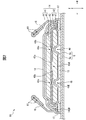
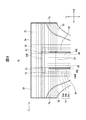
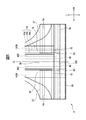
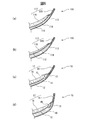
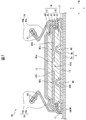
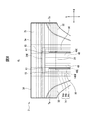
- FIG. 2 is a sectional view taken along line II-II in FIG. 1. It is a top view and a sectional view showing an example of composition of an absorber concerning an embodiment. It is the top view which expanded a part of back side part of the disposable diaper which concerns on embodiment. It is the top view which expanded a part of ventral side part of the disposable diaper which concerns on embodiment. It is a schematic diagram explaining the effect of the disposable diaper which concerns on embodiment.
- FIG. 11 is a sectional view taken along line II-II of FIG. 1 according to another embodiment. It is the top view which expanded a part of back side part of the disposable diaper which concerns on another embodiment.
- the disposable diaper according to the embodiment will be described by taking a pants-type disposable diaper as an example.
- the type of disposable diaper is not limited to this example, and other types of disposable diapers may be used without departing from the scope of the present invention. Examples of such disposable diapers include tape-type disposable diapers.
- FIG. 1 and 2 are diagrams showing a configuration example of a disposable diaper 1 according to an embodiment.
- FIG. 1 is a plan view showing a state where the disposable diaper 1 is unfolded
- FIG. 2 is a sectional view taken along line II-II of FIG.
- the disposable diaper 1 has a longitudinal direction L, a width direction W, and a thickness direction T that are orthogonal to each other, and a longitudinal center line CL that passes through the center of the width direction W and extends in the longitudinal direction L, It has a width direction center line CW extending in the width direction W through the center of the longitudinal direction L.
- the direction and the side approaching the longitudinal centerline CL are respectively inward and inward in the width direction W, and the direction and the side away are respectively outward and outward in the width direction W.
- the direction and the side approaching the width direction center line CW are defined as the inner direction and the inner side in the longitudinal direction L, and the direction and the side facing away are the outer direction and the outer side in the longitudinal direction L, respectively.
- the side of the disposable diaper 1 corresponding to the abdomen of the wearer in the longitudinal direction L is also referred to as the front side in the longitudinal direction L of the disposable diaper 1 that corresponds to the wearer's back.
- the side toward the edge (the edge on the back side) is also referred to as the rear side of the longitudinal direction L.
- the “plan view” means that the disposable diaper 1 in a state of being developed on a plane including the longitudinal direction L and the width direction W is viewed from above in the thickness direction T, and the “planar shape” is grasped in the plan view.
- the “planar direction” is an arbitrary direction parallel to the plane including the width direction W and the longitudinal direction L.
- the “skin side” and “non-skin side” mean the side relatively closer to the wearer's skin surface and the side farther away in the thickness direction T when the disposable diaper 1 is worn by the wearer, respectively. .. These definitions are commonly used not only for the disposable diaper 1 but also for the absorbent body of the disposable diaper 1 and each material arranged therein.
- a member or the like being parallel to the longitudinal direction L means that a member, a structure, a shape or the like is along the longitudinal direction L, but a component Dx of the member or the like in the longitudinal direction L is a component of the member or the like in the width direction W.
- Dy Dy
- the member and the like extending in the width direction W are not limited to the case where the member and the like are parallel to the width direction W, and the component Dy of the member and the like in the width direction W is greater than the component Dx of the member and the like in the longitudinal direction L. It also includes a large value (Dy>Dx).
- the member or the like is evaluated as described above with respect to the tangent line of each point on the curve or the like.
- the disposable diaper 1 has a ventral side portion (ventral waist belt) 2, a back side portion (dorsal waist belt) 3, a ventral side portion 2 and a back side portion 3 in the longitudinal direction L. And an absorbent body 10 located between and.
- the disposable diaper 1 further includes a crotch portion 4 located between the abdominal side portion 2 and the back side portion 3.
- the abdominal part 2 is a part that comes into contact with the abdomen of the wearer.
- the back side portion 3 is a portion that contacts the wearer's hip or back.
- the absorbent main body 10 is a portion that comes into contact with the wearer's crotch, and one end portion in the longitudinal direction L is laminated on the abdominal side portion 2 and the other end portion is laminated on the back side portion 3.
- the crotch portion 4 is a portion that supports the absorbent main body 10 from the non-skin side. Both ends 2a, 2a of the abdominal part 2 in the width direction W and both ends 3a, 3a of the back part 3 in the width direction W overlap in the thickness direction T and are joined along the longitudinal direction L. Thus, the disposable diaper 1 is formed.
- the waist opening through which the wearer's waist passes is defined by the outer end 2e of the abdominal part 2 in the longitudinal direction L and the outer end 3e of the dorsal part 3 in the longitudinal direction L.
- the pair of leg openings through which the wearer's legs pass is defined by the side portions 5e and 5e on both sides of the crotch portion 4 in the width direction W.
- the abdominal part (abdominal waist belt) 2 and the dorsal part (dorsal waist belt) 3 are defined in the range of the longitudinal direction L where both ends 2a, 2a and both ends 3a, 3a are joined. Can be said.
- the abdominal part 2 and the dorsal part 3 each have a rectangular shape that extends substantially in the width direction W and are separated from each other in the longitudinal direction L.
- the crotch portion 4 is located between the ventral side portion 2 and the back side portion 3, and both side edges in the width direction W are recessed inward in the width direction W.
- the abdominal part 2, the crotch part 4, and the back part 3 are integrally formed with each other.
- the ventral portion 2, crotch portion 4 and dorsal portion 3 are formed separately from each other.
- the disposable diaper 1 comprises an abdominal part 2 and a dorsal part 3 and no crotch part 4.
- the abdominal part 2, the dorsal part 3 and the crotch part 4 are provided with a liquid-impermeable cover sheet (sheet member) 5.
- the cover sheet 5 includes a cover sheet 5a located on the skin side and a cover sheet 5b located on the non-skin side.
- the cover sheet 5a and the cover sheet 5b are laminated in the thickness direction T and are bonded to each other with an adhesive or the like. Both ends in the longitudinal direction L of the cover sheet 5b are folded back to the skin side so as to cover both ends in the longitudinal direction L of the cover sheet 5a.
- the cover sheets 5b at the folding positions on the abdominal part 2 and the back part 3 form the end 2e of the abdominal part 2 and the end 3e of the back part 3, respectively.
- cover sheet 5 examples include any liquid-impermeable sheet such as a liquid-impermeable nonwoven fabric, a synthetic resin film, a composite sheet of these, an SB nonwoven fabric, and an SMS nonwoven fabric.
- material of the cover sheet 5 include polyolefin-based materials such as polypropylene and polyethylene.
- the basis weight of the cover sheet 5 is, for example, 5 to 100 g/m 2 , and preferably 10 to 50 g/m 2 .
- the dimension (thickness) of the cover sheet 5 in the thickness direction T is, for example, 0.1 to 5 mm, preferably 0.1 to 2 mm.
- the number of cover sheets 5 is one, or three or more (not shown).
- the cover sheet 5b is not folded back (not shown).
- the abdomen 2 and the back 3 are provided with a plurality of elastic members 6a and 6b for waist gather and a plurality of elastic members 7a and 7b between the cover sheet 5a and the cover sheet 5b, respectively. ..
- the plurality of elastic members 6a and 6b are arranged on the outside and inside of the abdominal side portion 2 in the longitudinal direction L, respectively.
- the plurality of elastic members 6a are arranged along the width direction W at intervals in the longitudinal direction L in the respective predetermined regions on both sides of the longitudinal center line CL.
- the predetermined region is a region from the end portion 2a to a portion inside the end edge of the absorbent main body 10 facing the end portion 2a in the width direction W.
- the plurality of elastic members 6b extend from one end 2a to the other end 2a along the width direction W, and are arranged at intervals in the longitudinal direction L.
- the plurality of elastic members 7 a and 7 b are arranged on the outer side and the inner side of the back side portion 3 in the longitudinal direction L, respectively.
- the plurality of elastic members 7a are arranged along the width direction W in the respective predetermined regions on both sides of the longitudinal centerline CL so as to be spaced from each other in the longitudinal direction L.
- the predetermined region is a region from the end portion 3a to a portion inside the end edge of the absorbent main body 10 facing the end portion 3a in the width direction W.
- the plurality of elastic members 7b extend from one end 3a to the other end 3a along the width direction W, and are arranged at intervals in the longitudinal direction L.
- the plurality of elastic members 6a, 6b, 7a, 7b expand and contract the waist opening, and are exemplified by rubber thread. It can be said that the abdominal part (abdominal waist belt) 2 and the dorsal part (dorsal waist belt) 3 are defined in the range of the longitudinal direction L in which the plurality of elastic members 6a, 6b, 7a, 7b are arranged. ..
- the disposable diaper 1 includes a plurality of elastic members 8 for leg gathers from the crotch portion 4 to the back side portion 3 and the abdominal side portion 2.
- the plurality of elastic members 8 mainly extend along both ends of the crotch portion 4 in the width direction W along the longitudinal direction L.
- the plurality of elastic members 8 respectively expand and contract the pair of leg openings, and are exemplified by a rubber thread.
- the absorbent main body 10 has a substantially rectangular shape, and is positioned between the liquid-permeable topsheet 12, the liquid-impermeable backsheet 13, and the topsheet 12 and the backsheet 13. And an absorber 14 that absorbs and retains the liquid.
- the surface sheet 12 include a liquid-permeable nonwoven fabric or woven fabric, a synthetic resin film having liquid-permeable holes formed therein, and a composite sheet of these.
- the back sheet 13 include liquid impermeable nonwoven fabrics, synthetic resin films, composite sheets of these, SMS nonwoven fabrics, and the like.
- the absorbent body 14 includes an absorbent core that absorbs and holds the liquid, and a core wrap that contains the absorbent core. Details of the absorber 14 will be described later.
- the absorber 14 and the topsheet 12 and the backsheet 13 are bonded with an adhesive, respectively, and the topsheet 12 and the backsheet 13 are bonded with an adhesive at their peripheral portions.
- the adhesive include materials known for disposable diapers, for example, hot melt adhesive.
- the shape of the absorbent main body 10 is not limited to the above example as long as it is a shape that is long in the longitudinal direction L, and may be, for example, a rectangle with rounded corners, a rectangle with a convex curve outward on the short side, or an hourglass shape.
- the back sheet 13 is omitted, and the non-skin side surface of the absorber 14 and the non-skin side surface of the peripheral portion of the top sheet 12 are joined to the cover sheet 5.
- the absorbent main body 10 includes a pair of side sheets 17, 17 located on both sides in the width direction W on the skin side surface and extending in the longitudinal direction L.
- Each side sheet 17 has a leak preventive wall 16 and fixing regions 15 and 15.
- the fixing regions 15 and 15 are located at the front and rear ends of the side seat 17 in the longitudinal direction L, and are fixed to the skin-side surface of the absorbent main body 10.
- the leak preventive wall 16 is located between and adjacent to the front and rear fixing regions 15 in the longitudinal direction L of the side sheet 17, is adjacent to the fixing regions 15, and is provided on the skin side surface of the absorbent main body 10 in the width direction W.
- the outer edge is fixed, and the inner edge in the width direction W is not fixed.
- the leak-proof wall 16 and the fixing regions 15 and 15 are formed, for example, at the inner side portion of the side seat 17 in the width direction W, and the outer side portion of the side seat 17 in the width direction W is fixed to the absorbent main body 10.
- the absorbent main body 10 includes the pair of leak-proof walls 16, 16.
- the pair of leak preventive walls 16 and 16 are arranged at both ends in the width direction W on the skin side of the absorbent main body 10 so as to face each other, and continuously extend along the longitudinal direction L.
- Each leak preventive wall 16 includes two elastic members 61 extending in the longitudinal direction L at the inner end in the width direction W.
- the elastic member 61 is exemplified by rubber thread.
- each of the pair of leak preventive walls 16 and 16 has an inner end in the width direction W folded back to the outer side in the width direction W (described later).
- the number of elastic members 61 is one or three or more.
- Each of the pair of leakproof walls 16 and 16 is formed of a hydrophobic sheet, for example, a hydrophobic nonwoven fabric. In another embodiment, it is formed of a hydrophilic sheet, such as a hydrophilic nonwoven.
- FIG. 3 is a diagram showing a configuration example of the absorber 14 according to the embodiment, (a) is a plan view, and (b) is a cross-sectional view taken along line IIIb-IIIb in (a).
- the absorber 14 is a layer having a liquid absorption performance and a liquid retention performance, and in the present embodiment, the first absorption layer 41 located on the skin side, the second absorption layer 42 located on the non-skin side, and the first And an intermediate layer 43 located between the absorption layer 41 and the second absorption layer 42.
- the absorber 14 has a two-layer structure in which the first absorption layer 41, the intermediate layer 43, and the second absorption layer 42 are laminated in this order in the thickness direction T.
- the absorber 14 has a single-layer structure in which the intermediate layer 43 does not exist and the first absorption layer 41 and the second absorption layer 42 are integrated in the thickness direction.
- the absorber 14 has a multilayer structure of three or more layers in which another intermediate layer and another absorbing layer are further laminated between the first absorbing layer 41 and the second absorbing layer 42.
- the first absorbent layer 41 is located on the skin side and the second absorbent layer 42 is located on the non-skin side.
- the absorber 14 has a substantially rectangular planar shape extending in the longitudinal direction L.
- the absorber 14 can be regarded as having a first water absorbent material 45 and a second water absorbent material 47 as an absorbent core and a first base material 44 and a second base material 46 as core wraps.
- the shape is not particularly limited, and examples thereof include a rectangle with a short side protruding in an arc shape, a rounded rectangle, an ellipse, and an hourglass.
- the thickness of the absorber 14 is, for example, 0.5 to 20 mm, and preferably 1 to 10 mm.
- the basis weight of the absorbent body 14 can be appropriately adjusted depending on the absorption performance required for the pants-type diaper 1, and is, for example, 60 to 1600 g/m 2 .
- the first absorbent layer 41 is disposed on the intermediate layer 43 side of the first base material 44 and the first base material 44, which is formed of a sheet having liquid permeability, and absorbs water containing a water-absorbing polymer.
- the first absorbent layer 41 can be regarded as having the first water absorbent material 45 as the absorbent core and the first base material 44 (and the intermediate layer 43) as the core wrap.
- a core wrap sheet made of, for example, a tissue is provided that wraps the first water absorbing material 45 inside them.
- the first water-absorbing material 45 is formed by applying an adhesive to at least one of the surface of the first base material 44 on the side of the intermediate layer 43 and the surface of the intermediate layer 43 on the side of the first base material 44. It is fixed to at least one of the layers 43.
- the water absorbent material of the first water absorbent material 45 is arranged in the first absorbent layer 41 with a substantially uniform basis weight.
- the basis weight of the end portion in the longitudinal direction L and/or the width direction W may be gradually reduced toward the edge.
- the end portions are areas within 10% of the maximum dimension in the longitudinal direction L and/or the width direction W at both ends in the longitudinal direction L and/or the width direction W, for example.
- the water absorbent material of the first water absorbent material 45 is arranged in the first absorbent layer 41 in a predetermined distribution having a portion having a large basis weight and a portion having a small basis weight.
- the first water absorbent material 45 has a substantially rectangular planar shape.
- the first base material 44 has a substantially rectangular planar shape and covers the first water absorbent material 45 from the skin side in a plan view, and the peripheral portion of the first base material 44 is slightly around the first water absorbent material 45. Extend outwards.
- the outer dimension (outer edge) of the first absorbent layer 41 in the plane direction is, for example, the outer dimension (outer edge) of the first water absorbent material 45 in the plane direction.
- the outer dimension (outer edge) is measured, for example, at a half position in the thickness direction T of the first water absorbent material 45.
- the second absorbent layer 42 is disposed on the second base material 46 formed of a sheet having water retention and liquid diffusibility and on the intermediate layer 43 side with respect to the second base material 46, and the water absorbent polymer.
- the second absorbent layer 42 can be regarded as having the second water absorbent material 47 as an absorbent core and the second base material 46 (and the intermediate layer 43) as a core wrap.
- a core wrap sheet made of, for example, a tissue that wraps the second water absorbing material 47 inside them is provided.
- the second water-absorbing material 47 is formed on the intermediate layer 43 side of the second base material 46 and the adhesive applied to at least one of the surface of the intermediate layer 43 on the second base material 46 side. It is fixed to at least one of the layers 43.
- the water absorbing material of the second water absorbing material 47 is arranged in the second absorbing layer 42 with a substantially uniform basis weight except for the pair of channels 48, 48 (described later). However, the basis weight of the end portion in the longitudinal direction L and/or the width direction W may be gradually reduced toward the edge. In this case, the ends are as described above.
- the water absorbing materials of the second water absorbing material 47 are arranged in the second absorbing layer 42 in a predetermined distribution having a portion having a large basis weight and a portion having a small basis weight.
- the second water absorbent material 47 has a substantially rectangular planar shape that is slightly larger than the first water absorbent material 45 in the width direction W and the longitudinal direction L.
- the second base material 46 has a substantially rectangular planar shape and covers the second water absorbent material 47 from the non-skin side in a plan view, and the peripheral edge portion of the second base material 46 is surrounded by the second water absorbent material 47. It extends slightly outside.
- both ends of the second base material 46 in the width direction W cover both side surfaces of the second water absorbent material 47, and also cover the skin-side surface of both ends of the first base material 44 in the width direction W. That is, on the skin-side surface of the end portion of the first absorbent layer 41 in the width direction W, the end portion of the second base material 46 in the width direction W and the end portion of the first base material 44 in the width direction W overlap each other. Are joined together.
- the outer dimension (outer edge) of the second absorbent layer 42 in the plane direction is, for example, the outer dimension (outer edge) of the second water absorbent material 47 in the plane direction.
- the outer size (outer edge) is measured at, for example, a half position in the thickness direction T of the second water absorbent material 47.
- both ends of the second base material 46 in the width direction W cover the side surfaces of the second water absorbent material 47 in the width direction W, and further cover the side surfaces of the first base material 44 in the width direction W.
- the second water absorbent material 47 is sealed in the second absorbent layer 42 in the width direction W
- the first water absorbent material 45 is sealed in the first absorbent layer 41 in the width direction W.
- both ends of the first base material 44 in the width direction W cover both ends of the second base material 46 in the width direction W.
- the first base material 44, the intermediate layer 43, and the second base material 46 are stacked in the thickness direction T and joined.
- the first base material 44, the intermediate layer 43, and the second base material 46 are laminated and joined in the thickness direction T at both ends in the longitudinal direction L of the absorber 14.
- the second water absorbent material 47 is enclosed in the second absorbent layer 42 by the first base material 44 and the intermediate layer 43 in the longitudinal direction L
- the first water absorbent material 45 is intermediate with the second base material 46 in the longitudinal direction L. It is enclosed by the layer 43 in the second absorption layer 42.
- both ends of the absorbent body 14 in the longitudinal direction L are not covered with the first base material 44 and the second base material 46.
- the intermediate layer 43 is a liquid-permeable sheet and has a substantially rectangular planar shape.
- the intermediate layer 43 includes an upper layer 43a and a pair of lower layers 43b and 43b adjacent to both sides in the width direction W on the non-skin side surface of the upper layer 43a.
- the intermediate layer 43 is formed by folding a pair of side portions located on both sides of the central portion in the width direction W back to the non-skin side of the central portion and stacking them on a sheet member having a substantially rectangular planar shape. At that time, the central portion of the sheet member becomes the upper layer 43a, and the pair of side portions of the sheet member becomes the pair of lower layers 43b, 43b.
- the portions on both sides of the intermediate layer 43 in the width direction W each have a two-layer structure in which the upper layer 43a and the lower layer 43b are stacked, and have a substantially rectangular shape extending in the longitudinal direction L.
- a portion 43d of the intermediate layer 43 near the center in the width direction W has a single-layer structure including only the upper layer 43a and has a substantially rectangular shape extending along the longitudinal direction L.
- the upper layer 43a and the lower layer 43b of the two-layer structure are joined by a pair of heat seal portions 43c, 43c extending along the longitudinal direction L on both sides in the width direction W of the portion 43d.
- the heat seal portion 43c is formed by squeezing while heating.
- the upper layer 43a and the lower layer 43b having a two-layer structure are joined by embossed portions extending along the longitudinal direction L on both sides in the width direction W of the portion 43d.
- the embossed portion is formed by pressing.
- the heat-sealing portion and the embossing portion have a plurality of points, a plurality of curved lines or a pattern.
- the intermediate layer 43 is sandwiched between both end edges in the width direction W by both end portions in the width direction W of the first base material 44 and the second base material 46, and both end edges in the longitudinal direction L are connected to the first base material 44 and the first base material 44.
- the two base materials 46 are sandwiched between both ends in the longitudinal direction L and are joined to each other.
- both end edges in the longitudinal direction L are not sandwiched between the ends of the first base material 44 and the second base material 46 in the longitudinal direction L, and are not joined.
- the absorber 14 has a pair of channels 48, 48 extending along the longitudinal direction L.
- the pair of channels 48, 48 are band-shaped regions that are located in the second absorption layer 42, extend in the longitudinal direction L, and are arranged at predetermined intervals on both sides in the width direction W with the longitudinal centerline CL interposed therebetween.
- the channel 48 is formed in at least the central portion in the longitudinal direction L so as to straddle the width-direction center line CW.
- the channel 48 is formed so as to reach at least one of both edges in the longitudinal direction L.
- the pattern of the pair of channels 48 in the plan view is, for example, a pattern formed such that the interval between the two is constant along the longitudinal direction L.
- the pattern of the pair of channels 48, 48 is, for example, a pattern formed to be narrow near the center in the longitudinal direction L and expand toward both outer sides in the longitudinal direction L.
- the channel 48 is an area in which the basis weight of the water absorbing material is smaller than the area around the channel in the absorber 14, and, for example, compared with the area around the channel 48 in the second absorbent layer 42. , A region where the basis weight of the water-absorbent material is small, including a case where the basis weight is zero.
- the channel 48 is formed such that the second base material 46 is recessed toward the intermediate layer 43 side, that is, the second water absorbing material 47 is recessed toward the intermediate layer 43 side.
- the second water absorbing material 47 is formed so as to be recessed toward the second base material 46 side.
- the pair of channels 48, 48 overlaps the pair of heat seal portions 43c, 43c in the thickness direction T.
- at least a part of the channel 48 does not overlap the heat seal portion 43c in the thickness direction T.
- the channel 48 extends not only in the longitudinal direction L but also in the width direction W as well as in the longitudinal direction L.
- the channels 48 are one or more than two.
- the channel 48 is formed in the first absorbent layer 41 instead of, or in addition to, the second absorbent layer 42.
- the channel 48 is not formed.
- the first water absorbent material 45 and the second water absorbent material 47 include a super absorbent polymer (SAP).
- SAP super absorbent polymer
- the super absorbent polymer is not particularly limited as long as it is a polymer capable of absorbing and retaining water, and examples thereof include particulate or fibrous super absorbent polymers.
- the basis weight of the superabsorbent polymer of the first water absorbent material 45 and the second water absorbent material 47 can be appropriately adjusted according to the absorption performance required for the disposable diaper 1, and for example, each is 10 to 500 g/m 2. , Preferably 100 to 400 g/m 2 .
- One of the basis weights of the first water absorbent material 45 and the second water absorbent material 47 may be larger than the other, or may be the same.
- the first water absorbent material 45 and the second water absorbent material 47 may further include hydrophilic fibers such as pulp fibers and water absorbent fibers.
- the ratio of the super absorbent polymer to the first water absorbent material 45 and the second water absorbent material 47 is, for example, 80 to 100% by mass, preferably 90 to 100% by mass, and more preferably 95 to 100% by mass. .. Therefore, it can be said that the first water absorbent material 45 and the second water absorbent material 47 contain the super absorbent polymer as a main component, and the absorber 14 can be called a so-called SAP sheet.
- the first water absorbent material 45 and the second water absorbent material 47 are made of only a super absorbent polymer and do not contain hydrophilic fibers.
- the first water absorbent material 45 and the second water absorbent material 47 include pulp fibers and/or water absorbent fibers in addition to the super absorbent polymer.
- superabsorbent polymers examples include starch-based, cellulose-based, and synthetic polymer-based polymer absorbents.
- examples of the starch-based or cellulose-based superabsorbent polymer include starch-acrylic acid (salt) graft copolymer, saponified starch-acrylonitrile copolymer, and crosslinked sodium carboxymethyl cellulose.
- examples of synthetic polymer-based superabsorbent polymers include polyacrylic acid salt-based, polysulfonic acid salt-based, maleic acid anhydride-based, polyacrylamide-based, polyvinyl alcohol-based, polyethylene oxide-based, polyaspartate-based, polyglutamic acid.
- Examples thereof include salt-based, polyalginate-based, starch-based, cellulose-based and the like.
- a polyacrylic acid salt-based (particularly, sodium polyacrylate-based) superabsorbent polymer is preferable.
- 90 to 100% by mass of the superabsorbent polymer in the absorber 14 is composed of superabsorbent polymer particles having a particle diameter of 150 to 500 ⁇ m.
- the superabsorbent polymer particles having such a particle size distribution have a small particle size and are uniform, so that they are easily held by the adhesive.
- the particle size of the super absorbent polymer particles is measured according to the sieving test method described in JIS R 6002:1998.
- the adhesive is not particularly limited as long as it can fix the superabsorbent polymer, and examples thereof include hot melt adhesives.
- the application pattern of the adhesive is not particularly limited, and examples thereof include a continuous or intermittent omega pattern, a spiral pattern, and a line pattern.
- the basis weight of the adhesive can be appropriately adjusted so that the liquid absorbency of the absorbent body 14 is not significantly lowered, and for example, 3 to 50 g/m 2 for each layer can be mentioned.
- each layer means an adhesive layer between the first water absorbent material 45 and the first base material 44, an adhesive layer between the first water absorbent material 45 and the intermediate layer 43, and a second water absorbent material 47.
- the adhesive layer is between the second base material 46 and the second water absorbing material 47 and the intermediate layer 43.
- the first base material 44 is not particularly limited as long as it is a sheet having liquid permeability.
- the first base material 44 include liquid-permeable nonwoven fabrics, hydrophilic nonwoven fabrics, and laminated nonwoven fabrics thereof. Among them, nonwoven fabrics having high water permeability are preferable.
- it is formed from polyolefin fibers such as polyethylene (PE), polypropylene (PP), polyester fibers such as polyethylene terephthalate (PET), polytrimethylene terephthalate (PTT), polyethylene naphthalate (PEN), or a combination thereof. Spunbonded non-woven fabric and air-through non-woven fabric. These fibers are preferably hydrophilized by a known method.
- an air-laid nonwoven fabric in which hydrophilic fibers such as pulp fibers and rayon fibers are coated with a hydrophilic binder, and a spunlace nonwoven fabric in which the above hydrophilic fibers and the above synthetic fibers are combined are included.
- an air-laid non-woven fabric having liquid permeability and liquid retention property, in which pulp fibers are coated with a hydrophilic binder is used.
- the first base material 44 one or a plurality of types of non-woven fabrics may be laminated in multiple layers.
- the basis weight of the first base material 44 is, for example, 10 to 100 g/m 2 , and preferably 20 to 80 g/m 2 .
- the thickness of the first base material 44 is, for example, 0.1 to 5 mm, and preferably 0.15 to 3 mm.
- the second base material 46 is not particularly limited as long as it is a sheet having water retention and liquid diffusion properties.
- the second base material 46 include synthetic fibers such as polyamide fibers, recycled fibers such as rayon fibers and acetate fibers, natural fibers such as cotton, silk, hemp, and pulp (cellulose) fibers, or a combination thereof.
- the spunlace nonwoven fabric containing rayon fibers and/or pulp fibers may contain polyolefin fibers and/or polyester fibers.
- a spunlace nonwoven fabric containing rayon fibers and pulp fibers, which has liquid retaining properties and liquid diffusing properties is used.
- the second base material 46 one or a plurality of types of non-woven fabrics may be laminated in a plurality of layers.
- the basis weight of the second base material 46 is, for example, 10 to 200 g/m 2 , and preferably 35 to 150 g/m 2 .
- the thickness of the second base material 46 is, for example, 0.1 to 5 mm, and preferably 0.15 to 3 mm.
- the intermediate layer 43 is not particularly limited as long as it is a sheet having liquid permeability.
- As the intermediate layer 43 for example, a sheet similar to the first base material 44 can be used.
- the basis weight of the intermediate layer 43 is, for example, 10 to 100 g/m 2 , and preferably 15 to 80 g/m 2 .
- the thickness of the intermediate layer 43 is, for example, 0.1 to 5 mm, and preferably 0.15 to 3 mm.
- the absorbent body 14 includes a dorsal region BA, a ventral region FA, and a crotch region MA, which are arranged along the longitudinal direction L.
- the back side region BA is a region overlapping the back side portion 3 of the absorber 14 in the thickness direction T.
- the abdominal area FA is an area that overlaps the abdominal portion 2 of the absorber 14 in the thickness direction T.
- the crotch region MA is a region located between the back region BA and the abdominal region FA of the absorber 14, that is, a region overlapping the crotch portion 4 in the thickness direction T.
- the absorbent body 14 is divided along the longitudinal direction L into a dorsal region BA overlapping the dorsal part 3, an abdominal region FA overlapping the abdominal part 2, and a crotch region MA overlapping the crotch part 4. To be done.
- the absorber 14 also includes a high basis weight area 14a, a low basis weight area 14b, and a non-arranged area 14c.
- the high basis weight region 14a is a region in which the basis weight of the superabsorbent polymer is high, and is a region in which the first absorbent layer 41 and the second absorbent layer 42 overlap in the thickness direction T.
- the boundary between the high grammage region 14a and the low grammage region 14b is, for example, the outer edge of the first absorption layer 41.
- the low basis weight region 14b is a region in which the basis weight of the superabsorbent polymer is low, and the first absorbent layer 41 does not exist in the thickness direction T and only the second absorbent layer 42 exists.
- the boundary between the low basis weight area 14b and the non-arranged area 14c is, for example, the outer edge of the second absorbent layer.
- the non-arranged region 14c is a region that does not contain the superabsorbent polymer, and is a region in which the first absorption layer 41 and the second absorption layer 42 do not exist in the thickness direction T.
- not including the super absorbent polymer includes a case where the super absorbent polymer exists but its basis weight is very small. “Very low” means that the basis weight of the superabsorbent polymer is 5% or less of the basis weight of the superabsorbent polymer in the high basis weight region 14a.
- the high basis weight area 14a, the low basis weight area 14b, and the non-arrangement area 14c have a substantially rectangular shape.
- the shape is not particularly limited, and examples thereof include a rectangle with a short side protruding in an arc shape, a rounded rectangle, an ellipse, and an hourglass.
- the low basis weight region 14b is a region that surrounds the high basis weight region 14a in a substantially frame shape (encloses at least three sides), and the low basis weight region 14b.
- the outer size is, for example, 5 to 25% larger than the outer size of the high basis weight region 14a.
- the non-arrangement area 14c is an area that surrounds the low basis weight area 14b in a substantially frame shape, and the outer dimension of the non-arrangement area 14c is, for example, 3 to 15% larger than the outer dimension of the low basis weight area 14b.
- the basic weight of the low basic weight area 14b is, for example, 40 to 60% of the basic weight of the high basic weight area 14a
- the basic weight of the non-arranged area 14c is, for example, 0% of the basic weight of the high basic weight area 14a. -5% is included.
- the high basis weight region is a water absorbing material (including an adhesive). Is the region of the maximum value to 50% of the maximum value.
- the low basis weight part is a region where the thickness of the water absorbing material (including the adhesive) is in the range of 50% to 5% of the maximum value, and the non-arranged region is the thickness of the water absorbing material (including the adhesive). Is the range of 5% to 0% of the maximum value.
- the thickness is the arithmetic average height (Ra: JIS B 0601-2001).
- the back side area BA is the back side high basis weight area BAa as the high basis weight area 14a, the back side low basis weight area BAb as the low basis weight area 14b, and the non-arrangement area 14c.
- the abdominal area FA includes an abdominal high basis weight area FAa as the high grammage area 14a and an abdominal non-arrangement area FAc as the non-arrangement area 14c.
- the crotch region MA has only the high basis weight region 14a. Therefore, the basis weight of the super absorbent polymer in the back side high basis weight region BAa and the abdominal side high basis weight region FAa is equivalent to the basis weight of the super absorbent polymer in the crotch region MA.
- the abdominal area FA includes the abdominal low basis weight area FAb as the low basis weight area 14b in addition to the abdominal high basis weight area FAa and the abdominal non-arrangement area FAc.
- the second absorption layer 42 includes, at a rear end in the longitudinal direction L, a protrusion that protrudes outward from the edge of the first absorption layer 41 in a plan view.
- the protrusion includes the back side low basis weight region BAb, and in the present embodiment, the protrusion is the same as the back side low basis weight region BAb.
- the second absorbent layer 42 is covered with the intermediate layer 43, and thus the protruding portion, that is, the back side low basis weight region BAb is covered with the intermediate layer 43 and the first base material 44 on the skin side.
- the second absorbent layer 42 includes, in a plan view, the width-direction protrusions that protrude outward from the end edges of the first absorption layer 41 at both ends in the width direction W.
- the width direction protrusion is covered with the intermediate layer 43 and the first base material 44 on the skin side.
- the second absorbent layer 42 includes, at a front end in the longitudinal direction L, another protruding portion that protrudes outward from the edge of the first absorbent layer 41 in a plan view.
- Other protrusions include the ventral low basis weight area.
- the protruding portion that is, the back low-basis-weight area BAb is covered on the skin side by one of the intermediate layer 43 and the first base material 44 and not by the other.
- the second absorbent layer 42 does not include a widthwise protruding portion that protrudes outward from the end edge of the first absorbent layer 41 at both end portions in the width direction W in a plan view.
- the disposable diaper 1 of the present embodiment has a low basis weight region (example: back side low) in which the basis weight of the superabsorbent polymer is low in the ventral side area FA and/or the back side area BA in the longitudinal direction L.
- the basis weight area BAb is provided. Therefore, a starting point where the weighing is changed can be formed between the low grammage region and the crotch region MA where the grammage of the superabsorbent polymer is high. That is, in the absorbent body 14, the starting point where the rigidity changes can be formed in the longitudinal direction L at a position between the low basic weight region having low rigidity and the crotch region having high rigidity.
- the starting point where the weighing is changed can be formed at the boundary between the back side low basis weight area BAb and the back side high basis weight area BAa.
- the starting point is the end portion of the absorbent body 14 when a force directed substantially inward in the substantially longitudinal direction L is applied to the end portion (low grammage area; portion including the back side low grammage area BAb) of the absorber 14.
- the basis weight of the superabsorbent polymer in the crotch region MA is relatively high, and the low basis weight region of at least one of the back side region BA and the abdominal side region FA (example. : The basis weight of the water-absorbent polymer in the back side low basis weight region BAb) is relatively low. Therefore, since a relatively large amount of the super absorbent polymer is arranged in the crotch region MA that needs to absorb the liquid, the absorber 14 ensures the absorption performance and does not leak the liquid (example: urine) without fail. Can be absorbed.
- the region becomes thin, so that it corresponds to the region.
- the absorber can be less likely to bite into the skin surface. This makes it difficult for the wearer to feel uncomfortable and improves the fit of the disposable diaper 1. Therefore, in the disposable diaper 1 containing the super absorbent polymer, it is possible to improve the fit while ensuring the absorption performance.
- FIG. 4 is an enlarged plan view of a part including the back side portion 3 of the disposable diaper according to the embodiment.
- the back portion 3 has a low back elastic region 31 having low elasticity in the width direction W and a pair of high elastic regions 32, 32 having high elasticity in the width direction W.
- the back side low expansion/contraction region 31 is located in the center portion of the back side portion 3 in the width direction W and extends from the front edge in the longitudinal direction L to the rear side.
- the pair of back side high expansion/contraction regions 32, 32 are adjacent to both sides of the back side low expansion/contraction region 31 in the width direction W.
- the elongation ratio ((length after expansion-original length)/(original length)) for a predetermined tensile force in the width direction W is the width of the back side high expansion/contraction region 32. It is a region of 1/3 or less of the elongation in the direction W, preferably 1/5 or less, and more preferably 1/10 or less.
- the back low expansion/contraction region 31 is a region in which there is no elastic member that expands/contracts in the width direction W, or a region in which an elastic member exists but the elastic member does not function as an elastic member (does not expand or contract much). ..
- the back side high expansion/contraction region 32 is a region where the elastic member 7a that expands/contracts in the width direction W exists. Therefore, the back high expansion/contraction area 32 and the back low expansion/contraction area 31 are defined by the area where the elastic member 7a that can function as the elastic member exists and the area where the elastic member that can function as the elastic member does not exist. ..
- the term “low elasticity” includes the case where elasticity does not occur. The elasticity of each elastic area is determined by the elasticity of the elastic member.
- the back side part 3 further has another back side high expansion/contraction region 34 that exhibits high elasticity in the width direction W.
- the other back high-elasticity region 34 is adjacent to the rear side of the pair of back high-elasticity regions 32, 32 and the back low-elasticity region 31 in the longitudinal direction L in plan view.
- the stretch ratio in the width direction W of the other back-side high stretch regions 34 is substantially the same as the stretch ratio in the width direction W of the back-side high stretch regions 32.
- Another back side high expansion/contraction region 34 is defined as a region where the elastic member 7b exists. Therefore, the rear end portion of the back side portion 3 in the longitudinal direction L is easily pressed against the wearer's back by the other back side high elasticity region 34.
- the rear portion of the channel 48 in the longitudinal direction L overlaps with the back low-elasticity region 31 in the thickness direction T.
- the inner edge K1 in the width direction W of each of the pair of back side high-elasticity regions 32, 32 is an edge of the absorber 14 facing the back side high-elasticity region 32 in the width direction W. 14 EW and the channel 48 (the edge 48E in the width direction W thereof).
- the edge K1 is an inner edge in the width direction W of the elastic member 7a. Therefore, of the absorbent body 14 including the portion on the rear side of the longitudinal direction L of the channel 48, the central portion in the width direction W is hardly expanded in the width direction W by the back side low elastic region 31, and both end portions in the width direction W are formed. Is extended in the width direction W by the pair of back side high elastic regions 32, 32.
- FIG. 5 is an enlarged plan view of a part including the ventral side portion 2 of the disposable diaper according to the embodiment.
- the ventral side portion 2 is substantially the same as the back side portion 3. That is, the abdominal part 2 has a low abdominal expansion/contraction region 36 in which the elasticity in the width direction W is low, and a pair of abdominal high expansion/contraction regions 37, 37 in which the elasticity in the width direction W is high.
- the belly-side low expansion/contraction region 36 is located at the center of the belly-side portion 2 in the width direction W, and extends from the rear edge of the longitudinal direction L to the front side.
- the pair of belly-side high stretch regions 37, 37 are adjacent to both sides of the belly-side low stretch region 36 in the width direction W.
- the abdominal side low expansion/contraction region 36 has an elongation rate ((length after expansion-original length)/(original length)) with respect to a predetermined tensile force in the width direction W, and is a width of the abdominal side high expansion/contraction region 37. It is a region of 1/3 or less of the elongation in the direction W, preferably 1/5 or less, and more preferably 1/10 or less.
- the belly-side low expansion/contraction region 36 is a region in which there is no elastic member that expands/contracts in the width direction W, or a region in which an elastic member exists but the elastic member does not function as an elastic member (does not expand or contract very much). ..
- the abdominal high expansion/contraction region 37 is a region where the elastic member 6a that expands/contracts in the width direction W exists. Therefore, the region in which the elastic member 6a that can function as the elastic member exists and the region in which the elastic member that can function as the elastic member does not exist define the belly-side high expansion/contraction region 37 and the belly-side low expansion/contraction region 36.
- the elasticity of each elastic area is determined by the elasticity of the elastic member.
- the abdominal side portion 2 further has another abdominal side high elastic region 39 that exhibits high elasticity in the width direction W.
- the other abdominal high-elasticity region 39 is adjacent to the front side in the longitudinal direction L of the pair of abdominal high-elasticity regions 37, 37 and the abdominal low-elasticity region 36.
- the expansion ratio in the width direction W of the other abdominal high expansion/contraction region 39 is substantially the same as the expansion ratio of the abdominal high expansion/contraction region 37 in the width direction W.
- the other high-side elastic region 39 is defined as a region where the elastic member 6b exists. Therefore, the front end of the abdominal part 2 in the longitudinal direction L is easily pressed against the abdomen of the wearer by the other abdominal high elastic region 39.
- the end edge 61e of the elastic member 61 on the fixed region 15 side overlaps with the low grammage region (example: back side low grammage region BAb) in the thickness direction T.
- the edge 61e of the elastic member 61 is an edge of an effective portion of the elastic member 61 that can exert an elastic force.
- a portion that cannot exert an elastic force for example, a portion that does not substantially expand and contract (elongation rate with respect to a predetermined tensile force ((length after extension-original length)/(original length))) Is less than or equal to 1 ⁇ 5 of the original elongation, preferably less than or equal to 1/10) at the end of the elastic member 61, the effective portion does not include that portion. Therefore, the distance between the fixed region 15 and the elastic member 61 (effective portion thereof) can be reduced in a plan view.
- the portion of the channel 48 on the front side in the longitudinal direction L overlaps with the abdominal low expansion/contraction region 36 in the thickness direction T.
- the inner edge K2 in the width direction W of each of the pair of ventral high-elasticity regions 37, 37 is an edge of the absorber 14 facing the ventral high-elasticity region 37 in the width direction W. 14 EW and the channel 48 (the edge 48E in the width direction W thereof).
- the edge K2 is an inner edge in the width direction W of the elastic member 6a.
- the central portion in the width direction W is hardly expanded or contracted in the width direction W by the belly-side low expansion/contraction region 36, and both end portions in the width direction W are It is extended in the width direction W by the pair of ventral high-stretch regions 37, 37.
- the channel 48 of the absorbent body 14 reaches at least one of the back side part 3 (back side waist belt) and the abdominal side part 2 (abdominal waist belt) in the longitudinal direction L.
- the liquid example: urine
- the liquid can be transported and distributed to the dorsal side (rear side of the longitudinal direction L) and/or the ventral side (front side of the longitudinal direction L) of the absorbent body 14.
- the liquid can be absorbed by the superabsorbent polymer at the rear end or front end of the longitudinal direction L of the absorbent body 14 that hardly contributes to the absorption, and the superabsorbent polymer can be effectively utilized.
- this disposable diaper 1 WHEREIN The inner side edge part of the width direction W in the high expansion/contraction area (back side high expansion/contraction area 32, abdominal side high expansion/contraction area 37) of at least one of the back side part 3 and the abdominal side part 2, It is located between the end edge 14WE and the channel 48 that face the high expansion/contraction region in the width direction W of the absorber 14. That is, the central portion of the absorbent body 14 in the width direction W overlaps with the low elasticity region (back low elasticity region 31, abdominal low elasticity region 36) in the thickness direction T.
- the contraction force for contracting the absorbent body 14 in the width direction W is not too strong, so that the back-side end of the absorbent body 14 in the longitudinal direction L contracts in the width direction W and becomes a convex shape before mounting. Can be suppressed. Further, the portions on both sides of the absorbent body 14 in the width direction W overlap the high elasticity region in the thickness direction T. Therefore, the absorber 14 can be pulled from both sides of the channel 48 in the width direction W by the contraction force in the high expansion/contraction region. As a result, it is possible to suppress the phenomenon that the end portion of the absorbent body 14 in the longitudinal direction L has a convex shape and the end portion of the absorbent main body 10 in the longitudinal direction L jumps out of the wearer's body.
- the flatness of at least one of the back side portion 3 and the abdominal side portion 2 can be maintained before and after the attachment. As a result, it is possible to prevent the liquid from leaking from the gap between at least one of the back side portion 3 and the abdominal side portion 2 and the skin surface. As a result, it is possible to suppress the leakage of the liquid while suppressing the deterioration of the fitting property of the disposable diaper 1.
- the hot-melt adhesive is applied onto the sheet for the second base material 46 while moving the sheet for the second base material 46 in the longitudinal direction L.
- the super absorbent polymer is supplied from the super absorbent polymer supply device along the longitudinal direction L on both end portions and the central portion in the width direction W of the sheet for the second base material 46 coated with the hot melt adhesive. And spray. At this time, a small amount of superabsorbent polymer migrates to a region (corresponding to a channel) between both end portions and the central portion.
- the sheet for the intermediate layer 43, the hot melt adhesive of which is applied on both sides is laminated on the super absorbent polymer on the sheet for the second base material 46.
- a superabsorbent polymer is supplied from another superabsorbent polymer supply device to the central portion in the width direction W of the intermediate layer 43 sheet coated with the hot melt adhesive. Spray along the longitudinal direction L.
- the sheet for the first base material 44 in which the hot melt adhesive is applied is laminated on the super absorbent polymer on the sheet for the intermediate layer 43, with the hot melt adhesive being on the super absorbent polymer side.
- both sides of the sheet for the second base material 46 in the width direction W are folded back to both sides of the sheet for the first base material 44 in the width direction W to obtain a laminate.
- the thickness of the laminate is adjusted by passing the laminate through a pair of press rolls, that is, by pressing, and the absorber 14 is obtained.
- the liquid-permeable surface sheet 12 is attached to the upper surface (the surface of the first base material 44) of the absorbent body 14 manufactured as described above, and the liquid is not applied to the lower surface of the absorbent body 14 (the surface of the second base material 46).
- the transparent back sheet 13 is attached to obtain a laminated body.
- the side sheets 17 with the leak preventive wall 16 are attached to both sides of the laminate in the width direction W to obtain the absorbent main body 10.
- the absorptive main body 10 is pasted on the cover sheet 5 (including the elastic members 6, 7, and 8), and the abdominal portion 2 in the width direction W at both ends 2a, 2a and the back side portion 3 in the width direction W is attached.
- the both ends 3a, 3a are joined. Thereby, the disposable diaper 1 is manufactured.
- FIG. 6 is a schematic diagram for explaining one effect of the disposable diaper according to the embodiment.
- 6A and 6B show a conventional pants-type diaper
- FIGS. 6C and 6D show the pants-type diaper of the present embodiment (the cover sheet is not shown).
- the topsheet 112, the absorber 114, and the backsheet 113 are laminated in this order in the thickness direction.
- a pair of leakproof walls 116, 116 extending in the longitudinal direction along the absorber 114 are arranged on both sides of the absorber 114 in the width direction. It is fixed at 112.
- the absorbent body 114 When an absorbent body containing a relatively large amount of superabsorbent polymer is applied to such a disposable diaper, it is usual to use the absorbent body 114 in which the superabsorbent polymer is arranged substantially uniformly in a plane. Immediately after mounting the disposable diaper, that is, before the superabsorbent polymer absorbs a liquid (eg, urine), the rigidity of the absorbent body 114 is low. Therefore, as shown in FIG. 6A, the absorbent body 114 bends relatively gently, and the leak preventive wall 116 can stand up toward the wearer's skin surface relatively easily. However, when the super absorbent polymer absorbs the liquid and swells after mounting, the rigidity of the absorbent body 114 increases. Therefore, as shown in FIG.
- the absorber has a relatively straight shape in the longitudinal direction, and the leak-proof wall 116 is pulled so as to be stretched from both sides in the longitudinal direction, so that the wearer's It becomes difficult to stand up toward the skin. As a result, the height of the leakproof wall 116 becomes low, and there is a possibility that the liquid may leak in the width direction beyond the pair of leakproof walls 116.
- the rigidity of the absorber 14 is low before the superabsorbent polymer absorbs the liquid (example: urine), as in the conventional pants-type diaper. Therefore, as shown in FIG. 6(c), the absorber 14 bends relatively gently, and the leak preventive wall 16 can stand up toward the wearer's skin surface relatively easily.
- the rigidity of the absorber 14 is increased, and the absorbent body 14 has a relatively straight shape in the longitudinal direction L. Therefore, the contraction force of the leakproof wall 16 in the longitudinal direction L is increased by being pulled so as to be stretched from both sides in the longitudinal direction L.
- the contraction force of the leak preventive wall 16 in the longitudinal direction L causes the end of the fixed region 15 on the central side in the longitudinal direction L to be strongly pulled toward the central side. Therefore, even in the disposable diaper 1, it may be difficult for the leak-proof wall 16 to stand up toward the wearer's skin surface, as shown in FIG. 6B, like the conventional disposable diaper.
- the absorbent body 14 has the folding start point FL at which the end of the absorbent body 14 is bent toward the central portion of the absorbent body 14.
- the folding start point FL is the starting point at which the weighing amount changes at the boundary between the back-side low basis weight area BAb and the back-side high basis weight area BAa. Therefore, as shown in FIG.
- the end portion in the longitudinal direction L of the absorbent body 14 stands up toward the wearer's skin surface.
- the absorber 14 can be folded at the folding start point FL.
- the edge 61e of the elastic member 61 on the fixed region 15 side in the effective portion has a low basic weight region (eg, back low basic weight region BAb) and a thickness direction T. Overlap with. That is, the distance between the fixed region 15 and the effective portion can be reduced in a plan view. As a result, the fixing region 15 can be easily pulled at the effective portion, so that the absorbent body 14 is more easily folded at the folding starting point so that the end portion of the absorbent body 14 in the longitudinal direction L stands up toward the wearer's skin surface. be able to.
- a low basic weight region eg, back low basic weight region BAb
- T thickness direction
- the position of the end edge 15E on the center side in the longitudinal direction L in the fixed area 15 is closer to that of the edge on the crotch area MA side in the low grammage area (example: back side low grammage area BAb). Is close to the edge on the side opposite to the crotch region MA side (eg, the back side region BA side).
- the position of the end edge 15E on the center side in the longitudinal direction L in the fixed region 15 is the position where the contracting force of the leak prevention wall 16 acts.
- the edge on the crotch region side in the low basis weight region is a position that becomes the folding start point FL.
- the disposable diaper 1 is configured such that the position where the contracting force acts is farther away from the position of the folding start point FL. That is, in the disposable diaper 1, the distance between the fixed region 15 on which the contracting force acts and the folding starting point FL is made larger.
- the force F in a direction perpendicular to the arm member is applied to the object fixed to the rotation axis by the arm member to rotate the object around the rotation axis, when the forces F are equal, The longer the member length r, the larger the torque N for rotating the object.
- the folding start point FL corresponds to the rotation axis
- the member between the fixed region 15 and the folding start point FL corresponds to the arm member
- the distance between the fixed region 15 and the folding start point FL is the length of the arm member.
- the end portion of the absorber 14 including the fixed region 15 corresponds to the object r
- the contracting force of the leak preventive wall 16 corresponds to the force F.
- the contraction force of the leak preventive wall 16 is the same and the fixing region 15
- the force for folding the end of the absorber 14 can be increased.
- the leak preventive wall 16 can be further raised toward the wearer's skin surface.
- the fixing region 15 extends to the non-arrangement region (eg, back non-arrangement region BAc) in the longitudinal direction L, and at least a part of the fixing region 15 overlaps in the thickness direction T. Therefore, when the leak preventive wall 15 pulls the fixed region 15 due to contraction, a portion outside the low grammage region (example: back side low grammage region BAb) in the longitudinal direction L can be pulled together with the fixed region 15. .. Therefore, it is possible to prevent the absorber 14 from being broken at a place other than (the folding start point FL) of the low basis weight region. Thereby, the absorber 14 can be more easily folded at the folding start point FL in the low basis weight region, and the leak preventive wall 16 can be more easily raised toward the wearer's skin surface.
- the non-arrangement region eg, back non-arrangement region BAc
- the fixing region 15 overlaps in the thickness direction T. Therefore, when the leak preventive wall 15 pulls the fixed region 15 due to contraction, a portion outside the
- the fixed region 15 extends to the outside of the absorbent body 14 in the longitudinal direction L beyond the non-arrangement region (exemplification: back non-arrangement region BAc). Therefore, when the leak-proof wall 16 pulls the fixed region 15 by contraction, it is an outer side portion in the longitudinal direction L with respect to the low basis weight region (example: back side low basis weight region BAb) and outside the absorber 14.
- the region including the portion of can be pulled together with the fixing region 15. Therefore, it is possible to suppress the absorber 14 from being folded at a location other than (the fold starting point FL) of the low basis weight region. Thereby, the absorber 14 can be more easily folded at the folding starting point FL in the low basis weight region, and the leak preventive wall 16 can be more easily erected toward the wearer's skin surface.
- FIG. 7 is a sectional view taken along line II-II of FIG. 1 according to another embodiment.
- the leak preventive wall 16 has a V-shaped (convex inward) shape which is lateral when viewed in the longitudinal direction L.
- the leak preventive wall 16 includes a first wall portion 16a and a second wall portion 16b located between the front and rear fixing regions 15 and 15 of the side seat 17 in the longitudinal direction L.
- the outer edge of the first wall portion 16a in the width direction W is fixed to the surface of the absorbent main body 10.
- the second wall portion 16b has an inner edge in the width direction W connected to an inner edge in the width direction W of the first wall portion 16a, and an outer edge in the width direction W is not fixed.
- At least the second wall portion 16b of the first wall portion 16a and the second wall portion 16b includes an elastic member 61 extending along the longitudinal direction. Due to the first wall portion 16a and the second wall portion 16b, it can be said that the leak preventive wall 16 has a V-shaped (convex inward) shape which is laterally inclined when viewed in the longitudinal direction L. In this case, the leak preventive wall 16 can be raised in the thickness direction T. Therefore, the leak preventive wall 16 can be made to stand higher toward the wearer's skin surface. As a result, it is possible to further suppress the height of the leak preventive wall 16 from decreasing.
- FIG. 8 is the top view which expanded a part of back side part of the disposable diaper which concerns on another embodiment.
- the edge 15E (see FIG. 1) on the center side (inside) in the longitudinal direction L in the fixed region 15 on the rear side (dorsal portion 3 side) in the longitudinal direction L is the back side low basis weight region. It overlaps with BAb in the thickness direction T.
- the edge 15E on the central side (inner side) in the longitudinal direction L in the fixed region 15 on the front side (the ventral side portion 2 side) in the longitudinal direction L is the abdominal side high basis weight area FAa.
- the thickness direction T is the thickness direction T.
- the longitudinal direction L of the absorber 14 is increased.
- the absorber 14 can be folded at the folding start point FL so that the end portion of the absorber stands up toward the wearer's skin surface.
- the abdominal region of the absorbent body 14 since the abdominal region of the absorbent body 14 does not have the low basis weight region but the abdominal high basis weight region FAa, it is between the abdominal high basis weight region FAa and the crotch region MA. Does not have a starting point where the weighing changes, that is, a starting point where the rigidity changes. Therefore, the end portion of the absorbent body 14 does not break near the end edge 15E on the central side in the longitudinal direction L in the abdominal side fixed region 15, the fit of the abdominal side portion 2 is enhanced, and the abdominal region FA is removed. Can be suppressed.
- the disposable diaper 1 is a tape type diaper.
- the tape-type diaper includes a pair of locking members located on both outer sides in the width direction W of the back side portion of the absorbent main body 10.
- the tape-type diaper preferably further comprises an elastic member so as to straddle the longitudinal centerline CL at the center of the back side portion of the absorbent main body 10 in the width direction W, and more preferably between the pair of locking members.
- Prepare The structure of the absorbent main body 10 is as described above. Also in this case, the above-mentioned effects can be obtained.
- the disposable diaper and the absorbent body of the present invention are not limited to the above-described embodiments, and the object and the purpose of the present invention are combined and the known techniques are applied within a range not departing from the gist of the present invention. It is possible.
- Disposable diaper 1
- Ventral region 3
- Dorsal part (dorsal waist belt) 10
- Absorbent body 14
- Fixing area 15E
- Leakage prevention wall 17
- Side sheet BA
- Dorsal area FA
- Abdominal area MA Crotch area
Landscapes
- Health & Medical Sciences (AREA)
- Epidemiology (AREA)
- Engineering & Computer Science (AREA)
- Biomedical Technology (AREA)
- Heart & Thoracic Surgery (AREA)
- Vascular Medicine (AREA)
- Life Sciences & Earth Sciences (AREA)
- Animal Behavior & Ethology (AREA)
- General Health & Medical Sciences (AREA)
- Public Health (AREA)
- Veterinary Medicine (AREA)
- Absorbent Articles And Supports Therefor (AREA)
Abstract
液体の幅方向の漏れを抑制可能な使い捨ておむつを提供する。使い捨ておむつは腹側部(2)と、背側部(3)と、吸収体(14)を含む吸収性本体(10)と、を備える。吸収体は、高吸水性ポリマーを含み、股間領域(MA)と、背側部と厚さ方向に重なる背側領域(BA)と、腹側部と厚さ方向に重なる腹側領域(FA)と、を備える。背側領域及び腹側領域の少なくとも一方は、股間領域よりも高吸水性ポリマーの坪量が低い低坪量域を含む。吸収性本体は、一対のサイドシート(17、17)を含む。一対のサイドシートの各々は、吸収性本体の表面に固定された固定領域(15)と、吸収性本体の表面に幅方向の外側の端縁を固定され、幅方向の内側の端縁を非固定とする防漏壁(16)と、を有する。固定領域における長手方向の中央側の端縁(15E)は、低坪量域と厚さ方向に重なる。
Description
本発明は、使い捨ておむつに関する。
吸収性材料として高吸水性ポリマー(Super Absorbent Polymer;SAP)を相対的に多く含む吸収体を用いた吸収性物品が知られている。高吸水性ポリマーを相対的に多く含む吸収体(いわゆるSAPシート)は、厚さが薄いので、装着性やフィット性などを向上することができ、好ましい吸収体といえる。そのような吸収体として、例えば、特許文献1に、吸収性材料を含む吸収性コアが開示されている。その吸収性コアは、吸収性物品に用いられ、吸収性材料がセルロース繊維を実質的に含まず、別個の吸収性材料領域のパターンを形成する。そのパターンは、ドット形成領域と、幅方向に延びる領域及び長手方向に延びる領域の少なくとも一つと、を含んでいる。
高吸水性ポリマーを相対的に多く含む吸収体を使い捨ておむつに適用するとき、高吸水性ポリマーを平面状に概ね一様に配置した吸収体を用いる場合が考えられる。このような使い捨ておむつでは、装着後に高吸水性ポリマーが液体(例示:尿)を吸収して膨潤が進んだとき、吸収体の剛性が高まって、吸収体は長手方向に比較的真っ直ぐな形状になる。そうなると、吸収体の幅方向の両側に、吸収体に沿って長手方向に延びる一対の防漏壁は、長手方向に両側から伸張されるように引っ張られてしまい、装着者の肌面へ向かって起立することが困難になる。その結果、防漏壁の高さが低くなってしまい、一対の防漏壁を越えて幅方向に液体が漏れるおそれがある。
ここで、特許文献1の吸収体(吸収性コア)は、装着快適性の改善などのため、平面視で、複数の領域に分割されている。しかし、使い捨ておむつの装着後、吸収体が液体を吸収して外側に飛び出したような形状になり得ることについては考慮されていない。
本発明の目的は、高吸水性ポリマーを含む使い捨ておむつにおいて、液体の幅方向の漏れを抑制可能な使い捨ておむつを提供することにある。
本発明の使い捨ておむつは次のとおりである。(1)互いに直交する長手方向、幅方向及び厚さ方向を有し、腹側部と、背側部と、前記腹側部と前記背側部との間に位置し、吸収体を含む吸収性本体と、を備える、使い捨ておむつであって、前記吸収体は、高吸水性ポリマーを含み、股間領域と、前記股間領域の前記長手方向の後ろ側に隣接し、前記背側部と前記厚さ方向に重なる背側領域と、前記股間領域の前記長手方向の前側に隣接し、前記腹側部と前記厚さ方向に重なる腹側領域と、を備え、前記背側領域及び前記腹側領域の少なくとも一方は、前記股間領域よりも前記高吸水性ポリマーの坪量が低い低坪量域を含み、前記吸収性本体は、肌側の表面において、前記幅方向の両側に位置し、前記長手方向に延びる一対のサイドシートを含み、前記一対のサイドシートの各々は、前記サイドシートにおける前記長手方向の前側及び後側の端部に位置し、前記吸収性本体の表面に固定された固定領域と、前記長手方向に沿って延びる弾性部材を含み、前記サイドシートにおける前記長手方向の前側及び後側の前記固定領域の間に位置し、前記吸収性本体の表面に前記幅方向の外側の端縁を固定され、前記幅方向の内側の端縁を非固定とする防漏壁と、を有し、前記固定領域における前記長手方向の中央側の端縁は、前記低坪量域と前記厚さ方向に重なる、使い捨ておむつ。
本使い捨ておむつでは、吸収体において、長手方向の腹側領域及び/又は背側領域に、高吸水性ポリマーの坪量が低い低坪量域を備えるので、その低坪量域と、高吸水性ポリマーの坪量が高い股間領域と、の間の位置に、秤量が変わる起点を形成できる。すなわち、吸収体において、長手方向に、剛性の低い低坪量域と、剛性の高い股間領域と、の間の位置に剛性の変わる起点を形成できる。そのような起点は、防漏壁の長手方向の収縮力が長手方向の中央側に向かう力として、吸収体の端部に加わったとき、吸収体の端部が折れる折れ起点となる。そして、本使い捨ておむつでは、その折れ起点、すなわち、低坪量域における股間領域側の端縁が、平面視で、固定領域の長手方向の中央側の端縁よりも中央側に位置している。
ここで、装着後に高吸水性ポリマーが液体を吸収して膨潤が進んだときには、吸収体の剛性が高まって、長手方向に比較的真っ直ぐな形状になり、したがって、防漏壁が長手方向の両側から伸張されるように引っ張られることで、防漏壁の長手方向の収縮力が増加する。
このとき、本使い捨ておむつでは、その防漏壁の長手方向の収縮力により、固定領域の長手方向の中央側の端縁が、中央側に強く引っ張られると、上記のように折れ起点を設定しているので、吸収体の長手方向の端部が装着者の肌面へ向かって起立するように、吸収体を折れ起点で折ることができる。それにより、起立した吸収体の長手方向の端部によって防漏壁が長手方向の両側へ向かって引っ張られる程度を低下させることができ、防漏壁を装着者の肌面へ向かって起立させることができる。すなわち、防漏壁の高さが低くなることを抑制でき、防漏壁を越えて幅方向に液体が漏れることを抑制できる。
本発明の使い捨ておむつは、(2)前記弾性部材における弾性力を発揮し得る有効部分における前記固定領域の側の端縁は、前記低坪量域と前記厚さ方向に重なる、上記(1)に記載の使い捨ておむつ、でもよい。
本使い捨ておむつでは、弾性部材の有効部分における固定領域の側の端縁が低坪量域と厚さ方向に重なる。すなわち、平面視で、固定領域と有効部分との距離を接近させることができる。それにより、有効部分で固定領域を引っ張り易くできるので、吸収体の長手方向の端部が装着者の肌面へ向かって起立するように、吸収体を折れ起点でより容易に折ることができる。それにより、起立した吸収体の長手方向の端部によって防漏壁が長手方向の両側へ向かって引っ張られる程度をより低下させることができ、防漏壁を装着者の肌面へ向かってより起立させることができる。すなわち、防漏壁の高さが低くなることをより抑制でき、防漏壁を越えて幅方向に液体が漏れることをより抑制できる。
本使い捨ておむつでは、弾性部材の有効部分における固定領域の側の端縁が低坪量域と厚さ方向に重なる。すなわち、平面視で、固定領域と有効部分との距離を接近させることができる。それにより、有効部分で固定領域を引っ張り易くできるので、吸収体の長手方向の端部が装着者の肌面へ向かって起立するように、吸収体を折れ起点でより容易に折ることができる。それにより、起立した吸収体の長手方向の端部によって防漏壁が長手方向の両側へ向かって引っ張られる程度をより低下させることができ、防漏壁を装着者の肌面へ向かってより起立させることができる。すなわち、防漏壁の高さが低くなることをより抑制でき、防漏壁を越えて幅方向に液体が漏れることをより抑制できる。
本発明の使い捨ておむつは、(3)前記固定領域における前記長手方向の中央側の端縁の位置は、前記低坪量域における前記股間領域の側の端縁よりも、前記股間領域側と反対側の端縁に近い、上記(1)又は(2)に記載の使い捨ておむつ、でもよい。
本使い捨ておむつでは、固定領域における長手方向の中央側の端縁の位置は、低坪量域における股間領域側の端縁よりも股間領域側と反対側(背側領域又は腹側領域側)の端縁に近い。ただし、固定領域における長手方向の中央側の端縁の位置は、防漏壁の収縮力が作用する位置である。そして、低坪量域における股間領域側の端縁は折れ起点になる位置である。したがって、本使い捨ておむつでは、収縮力が作用する位置を、折れ起点の位置からより遠くに離れるように構成している。すなわち、本使い捨ておむつでは、収縮力が作用する固定領域と折れ起点との距離を、より大きくするように構成している。
ここで、回転軸に腕部材で固定された物体に、腕部材に対して垂直な方向の力Fを加えて、物体を回転軸の周りに回転させる場合、力Fが等しいときには、腕部材の長さrが長いほうが、物体を回転させるためのトルクNが大きくなる。
本使い捨ておむつでは、折れ起点が回転軸に相当し、固定領域と折れ起点との間の部材が腕部材相当し、よって固定領域と折れ起点との距離が腕部材の長さrに相当し、固定部材を含む吸収体の端部が物体に相当し、防漏壁の収縮力が力Fに相当する。したがって、本使い捨ておむつでは、折れ起点を軸として、防漏壁の収縮力により吸収体の端部を回転させる、すなわち折るとき、防漏壁の収縮力を同じとして、固定領域と折れ起点との距離をより大きくすることで、吸収体の端部を折るための力をより大きくすることができる。それにより、防漏壁を装着者の肌面へ向かってより起立させることができる。すなわち、防漏壁の高さが低くなることをより抑制でき、防漏壁を越えて幅方向に液体が漏れることをより抑制できる。
本発明の使い捨ておむつは、(4)前記背側領域及び前記腹側領域の少なくとも一方であって、前記低坪量域を含む領域は、前記高吸水性ポリマーを含まない非配置域、を更に含み、前記非配置域は、前記長手方向において、前記低坪量域における前記股間領域の側と反対側に隣接し、前記長手方向において、前記固定領域の少なくとも一部は、前記非配置域と前記厚さ方向に重なる、上記(1)乃至(3)のいずれか一項に記載の使い捨ておむつ、でもよい。
本使い捨ておむつでは、長手方向において、固定領域が非配置域へ延び、固定領域の少なくとも一部が厚さ方向に重なっている。それゆえ、防漏壁が収縮により固定領域を引っ張るとき、低坪量域よりも長手方向の外側の部分を固定領域と共に引っ張ることができる。それゆえ、低坪量域(の折れ起点)以外の箇所で吸収体が折ることを抑制できる。それにより、低坪量域の折れ起点で吸収体をより折り易くすることができ、防漏壁を装着者の肌面へ向かってより起立させ易くすることができる。その結果、防漏壁の高さが低くなることをより抑制でき、防漏壁を越えて幅方向に液体が漏れることをより抑制できる。
本使い捨ておむつでは、長手方向において、固定領域が非配置域へ延び、固定領域の少なくとも一部が厚さ方向に重なっている。それゆえ、防漏壁が収縮により固定領域を引っ張るとき、低坪量域よりも長手方向の外側の部分を固定領域と共に引っ張ることができる。それゆえ、低坪量域(の折れ起点)以外の箇所で吸収体が折ることを抑制できる。それにより、低坪量域の折れ起点で吸収体をより折り易くすることができ、防漏壁を装着者の肌面へ向かってより起立させ易くすることができる。その結果、防漏壁の高さが低くなることをより抑制でき、防漏壁を越えて幅方向に液体が漏れることをより抑制できる。
本発明の使い捨ておむつは、(5)前記長手方向において、前記固定領域における前記防漏壁の側と反対側の端縁は、前記非配置域における前記低坪量域の側と反対側の端縁よりも外側に位置する、上記(4)に記載の使い捨ておむつ、であってもよい。
本使い捨ておむつでは、長手方向において、固定領域が非配置域を超えて、吸収体の外側へ延びている。それゆえ、防漏壁が収縮により固定領域を引っ張るとき、低坪量域よりも長手方向の外側の部分であって、吸収体の外側の部分を含む領域を、固定領域と共に引っ張ることができる。それゆえ、低坪量域(の折れ起点)以外の箇所で吸収体が折ることを抑制できる。それにより、低坪量域の折れ起点で吸収体をより折り易くすることができ、防漏壁を装着者の肌面へ向かってより起立させ易くすることができる。その結果、防漏壁の高さが低くなることをより抑制でき、防漏壁を越えて幅方向に液体が漏れることをより抑制できる。
本使い捨ておむつでは、長手方向において、固定領域が非配置域を超えて、吸収体の外側へ延びている。それゆえ、防漏壁が収縮により固定領域を引っ張るとき、低坪量域よりも長手方向の外側の部分であって、吸収体の外側の部分を含む領域を、固定領域と共に引っ張ることができる。それゆえ、低坪量域(の折れ起点)以外の箇所で吸収体が折ることを抑制できる。それにより、低坪量域の折れ起点で吸収体をより折り易くすることができ、防漏壁を装着者の肌面へ向かってより起立させ易くすることができる。その結果、防漏壁の高さが低くなることをより抑制でき、防漏壁を越えて幅方向に液体が漏れることをより抑制できる。
本発明の使い捨ておむつは、(6)前記防漏壁は、前記幅方向において、前記吸収性本体の表面に外側の端縁を固定された第1壁部と、前記第1壁部の内側の端縁に内側の端縁を連結され、外側の端縁を非固定とする第2壁部と、を含む、上記(1)乃至(5)のいずれか一項に記載の使い捨ておむつ、であってもよい。
本使い捨ておむつでは、防漏壁が長手方向から見て横倒しのV字(内側に凸)型の形状を有している。そのため、防漏壁を装着者の肌面へ向かってより高く起立させ易くすることができる。その結果、防漏壁の高さが低くなることをより抑制でき、防漏壁を越えて幅方向に液体が漏れることをより抑制できる。
本使い捨ておむつでは、防漏壁が長手方向から見て横倒しのV字(内側に凸)型の形状を有している。そのため、防漏壁を装着者の肌面へ向かってより高く起立させ易くすることができる。その結果、防漏壁の高さが低くなることをより抑制でき、防漏壁を越えて幅方向に液体が漏れることをより抑制できる。
本発明の使い捨ておむつは、(7)前記背側領域は、前記低坪量域としての背側低坪量域を有し、前記腹側領域は、前記長手方向において前記股間領域に隣接し、前記高吸水性ポリマーの坪量が前記股間領域と同等の腹側高坪量域を有し、前記長手方向の後側の前記固定領域における前記長手方向の中央側の端縁は、前記背側低坪量域と前記厚さ方向に重なり、前記長手方向の前側の前記固定領域における前記長手方向の中央側の端縁は、前記腹側高坪量域と前記厚さ方向に重なる、上記(1)乃至(6)に記載の使い捨ておむつ、でもよい。
本請求項7に記載の使い捨ておむつでは、吸収体の背側領域に、背側低坪量域を備えるので、その背側低坪量域と股間領域との間の位置に、秤量が変わる起点、すなわち、剛性の変わる起点を形成できる。そのような起点は、防漏壁の長手方向の収縮力である長手方向の中央側に向かう力が、吸収体の端部に加わったとき、吸収体の端部が折れる折れ起点となる。そして、本使い捨ておむつでは、その折れ起点、すなわち、背側低坪量域における股間領域側の端縁が、平面視で、背側の固定領域の中央側の端縁よりも中央側に位置している。その結果、本使い捨ておむつでは、その防漏壁の長手方向の収縮力により、背側の固定領域の中央側の端縁が、中央側に強く引っ張られたとき、吸収体の長手方向の端部が装着者の肌面へ向かって起立するように、吸収体を折れ起点で折ることができる。それにより、起立した吸収体の長手方向の端部によって防漏壁が長手方向の両側へ向かって引っ張られる程度を低下させることができ、防漏壁を装着者の肌面へ向かって起立させることができる。
また、本使い捨ておむつでは、吸収体の腹側領域に、低坪量域を有さず、腹側高坪量域を有しているので、腹側高坪量域と股間領域との間の位置に、秤量が変わる起点、すなわち、剛性の変わる起点を有さない。そのため、腹側の固定領域における長手方向の中央側の端縁近傍で、吸収体の端部が折れることが無く、腹側部のフィット性を高めて、腹側領域からの伝え漏れを抑制できる。
このようにして、防漏壁の高さが低くなることを抑制でき、防漏壁を越えて幅方向に液体が漏れることを抑制できると共に、腹側からの伝え漏れを抑制でき、フィット性も向上できる。
本発明によれば、高吸水性ポリマーを含む使い捨ておむつにおいて、液体の幅方向の漏れを抑制可能な使い捨ておむつを提供することができる。
以下、実施形態に係る使い捨ておむつを、パンツ型の使い捨ておむつを例に説明する。ただし、使い捨ておむつの種類はこの例に限定されるものではなく、本発明の趣旨の範囲を逸脱しない限り、他の種類の使い捨ておむつでもよい。そのような使い捨ておむつとして、例えば、テープ型の使い捨ておむつが挙げられる。
図1及び図2は実施形態に係る使い捨ておむつ1の構成例を示す図である。図1は使い捨ておむつ1を展開した状態を示す平面図であり、図2は図1のII-II線に沿った断面図である。使い捨ておむつ1は、図1に示す状態において、互いに直交する長手方向L、幅方向W及び厚さ方向Tを有し、幅方向Wの中心を通り長手方向Lに延びる長手方向中心線CLと、長手方向Lの中心を通り幅方向Wに延びる幅方向中心線CWとを有する。長手方向中心線CLに近づく向き及び側をそれぞれ幅方向Wの内向き及び内側とし、遠ざかる向き及び側をそれぞれ幅方向Wの外向き及び外側とする。幅方向中心線CWに近づく向き及び側をそれぞれ長手方向Lの内向き及び内側とし、遠ざかる向き及び側をそれぞれ長手方向Lの外向き及び外側とする。また、長手方向Lにおける、装着者の腹部に対応する使い捨ておむつ1の端縁(腹側の端縁)に向かう側を長手方向Lの前側ともいい、装着者の背中に対応する使い捨ておむつ1の端縁(背側の端縁)に向かう側を長手方向Lの後側ともいう。「平面視」とは長手方向L及び幅方向Wを含む平面に展開した状態の使い捨ておむつ1を厚さ方向Tの上方側から見ることをいい、「平面形状」とは平面視で把握される形状をいう。「平面方向」とは幅方向W及び長手方向Lを含む面と平行な任意の方向である。「肌側」及び「非肌側」とは使い捨ておむつ1が装着者に装着されたときに、厚さ方向Tにおいて相対的に装着者の肌面に近くなる側及び遠くなる側をそれぞれ意味する。これら定義は使い捨ておむつ1だけでなく、使い捨ておむつ1の吸収体やそれらに配置された各資材にも共通に用いる。
なお、部材や構造や形状などが長手方向Lに沿うとは、部材等が長手方向Lに平行な場合だけでなく、部材等の長手方向Lの成分Dxが、部材等の幅方向Wの成分Dyよりも大きい場合(Dx>Dy)も含んでいる。同様に、部材等が幅方向Wに沿うとは、部材等が幅方向Wに平行な場合だけでなく、部材等の幅方向Wの成分Dyが、部材等の長手方向Lの成分Dxよりも大きい場合(Dy>Dx)も含んでいる。曲線状や曲面状の部材等に関しては、曲線等上の各点の接線について、部材等を上記のように評価する。
図1に示すように、使い捨ておむつ1は、長手方向Lにおいて、腹側部(腹側ウエストベルト)2と、背側部(背側ウエストベルト)3と、腹側部2と背側部3との間に位置する吸収性本体10と、を備える。本実施形態では、使い捨ておむつ1は、腹側部2と背側部3との間に位置する股間部4を更に備える。腹側部2は、装着者の腹部に当接する部分である。背側部3は、装着者の尻部又は背部に当接する部分である。吸収性本体10は装着者の股間に当接する部分であり、長手方向Lの一端部が腹側部2に、他端部が背側部3にそれぞれ積層される。股間部4は、吸収性本体10を非肌側から支持する部分である。腹側部2の幅方向Wの両端部2a、2aと、背側部3の幅方向Wの両端部3a、3aとが、それぞれ厚さ方向Tに重なり、長手方向Lに沿って接合されることで、使い捨ておむつ1が形成される。この場合、使い捨ておむつ1では、腹側部2における長手方向Lの外側の端部2eと背側部3における長手方向Lの外側の端部3eとにより装着者の腰が通るウエスト開口部が画定される。また、使い捨ておむつ1では、股間部4における幅方向Wの両側の側部5e、5eにより装着者の脚が通る一対のレッグ開口部が画定される。なお、腹側部(腹側ウエストベルト)2及び背側部(背側ウエストベルト)3は、両端部2a、2aと両端部3a、3aとが接合する長手方向Lの範囲で画定される部分といえる。
本実施形態では、図1に示す状態で、腹側部2及び背側部3はそれぞれ概ね幅方向Wに拡がる矩形形状を有し、長手方向Lに互いに離間している。股間部4は、腹側部2と背側部3との間に位置し、幅方向Wの両側縁が幅方向Wの内向きに窪んでいる。腹側部2、股間部4及び背側部3は互いに一体的に形成される。別の実施形態では、腹側部2、股間部4及び背側部3は互いに別個に形成される。更に、別の実施形態(図示されず)では、使い捨ておむつ1は、腹側部2及び背側部3を備え、股間部4を備えない。
本実施形態では、腹側部2、背側部3及び股間部4は、液不透過性のカバーシート(シート部材)5を備える。カバーシート5は、肌側に位置するカバーシート5aと非肌側に位置するカバーシート5bとを含む。カバーシート5aとカバーシート5bとは厚さ方向Tに積層され、接着剤等で互いに接合される。カバーシート5bの長手方向Lの両端部は、カバーシート5aの長手方向Lの両端部を覆うように、肌側に折り返される。その場合、腹側部2及び背側部3における折り返しの位置のカバーシート5bが、それぞれ腹側部2の端部2e及び背側部3の端部3eを構成する。
カバーシート5としては、例えば液不透過性の不織布や合成樹脂フィルム、これらの複合シート、SB不織布、SMS不織布など、任意の液不透過性シートが挙げられる。カバーシート5の材料としては、例えばポリプロピレンやポリエチレンなどのポリオレフィン系材料が挙げられる。カバーシート5の坪量は、例えば5~100g/m2であり、好ましくは10~50g/m2である。カバーシート5の厚さ方向Tの寸法(厚さ)としては、例えば0.1~5mmであり、好ましくは0.1~2mmである。別の実施形態ではカバーシート5は一枚、又は、三枚以上である(図示されず)。更に別の実施形態ではカバーシート5bは折り返されていない(図示されず)。
本実施形態では、腹側部2及び背側部3は、カバーシート5aとカバーシート5bとの間に、それぞれウェストギャザー用の複数の弾性部材6a、6b及び複数の弾性部材7a、7bを備える。複数の弾性部材6a、6bは、それぞれ腹側部2の長手方向Lの外側及び内側に配置される。複数の弾性部材6aは、長手方向中心線CLを挟んで両側のそれぞれの所定領域において、幅方向Wに沿って、長手方向Lに互いに間隔を空けて配置される。所定領域は、端部2aから吸収性本体10における端部2aに対向する幅方向Wの端縁の内側の部分までの領域である。複数の弾性部材6bは、幅方向Wに沿って、一方の端部2aから他方の端部2aまで延びており、長手方向Lに互いに間隔を空けて配置される。同様に、複数の弾性部材7a、7bは、それぞれ背側部3の長手方向Lの外側及び内側に配置される。複数の弾性部材7aは、長手方向中心線CLを挟んで両側のそれぞれの所定領域において、幅方向Wに沿って、長手方向Lに互いに間隔を空けて配置される。所定領域は、端部3aから吸収性本体10における端部3aに対向する幅方向Wの端縁の内側の部分までの領域である。複数の弾性部材7bは、幅方向Wに沿って、一方の端部3aから他方の端部3aまで延びており、長手方向Lに互いに間隔を空けて配置される。複数の弾性部材6a、6b、7a、7bは、ウエスト開口部を伸縮させるものであり、糸ゴムに例示される。腹側部(腹側ウエストベルト)2及び背側部(背側ウエストベルト)3は、複数の弾性部材6a、6b、7a、7bが配置された長手方向Lの範囲で画定される部分ともいえる。
本実施形態では、使い捨ておむつ1は、股間部4から背側部3及び腹側部2にレッグギャザー用の複数の弾性部材8を備える。複数の弾性部材8は、主に股間部4における幅方向Wの両端部を長手方向Lに沿って延設されている。複数の弾性部材8は、一対のレッグ開口部をそれぞれ伸縮させるものであり、糸ゴムに例示される。
本実施形態では、吸収性本体10は、略矩形の形状を有し、液透過性の表面シート12と、液不透過性の裏面シート13と、表面シート12と裏面シート13との間に位置し、液を吸収・保持する吸収体14と、を含む。表面シート12として、例えば液透過性の不織布や織布、液透過孔が形成された合成樹脂フィルム、これらの複合シートなどが挙げられる。裏面シート13として、例えば液不透過性の不織布や合成樹脂フィルム、これらの複合シート、SMS不織布などが挙げられる。吸収体14は、本実施形態では液を吸収し保持する吸収コアと吸収コアを内包するコアラップとを含む。吸収体14の詳細は後述される。吸収体14と表面シート12及び裏面シート13とはそれぞれ接着剤により接合され、表面シート12と裏面シート13とはそれらの周縁部分において接着剤により接合される。接着剤は使い捨ておむつで公知の材料、例えばホットメルト接着剤が挙げられる。吸収性本体10の形状は、長手方向Lに長い形状ならば上記例に限定されず、例えば角が丸い矩形や、短辺が外側に凸曲線の矩形や砂時計型が挙げられる。また、別の実施形態では、裏面シート13が省略され、吸収体14の非肌側の面及び表面シート12の周縁部分の非肌側の面がカバーシート5に接合される。
本実施形態では、吸収性本体10は、肌側の表面において、幅方向Wの両側に位置し、長手方向Lに延びる一対のサイドシート17、17を含む。各サイドシート17は、防漏壁16と、固定領域15、15とを有する。固定領域15、15は、サイドシート17における長手方向Lの前側及び後側の端部に位置し、吸収性本体10の肌側の表面に固定される。防漏壁16は、サイドシート17における長手方向Lの前側及び後側の固定領域15、15の間に位置し、それらに隣接しており、吸収性本体10の肌側の表面に幅方向Wの外側の端縁を固定され、幅方向Wの内側の端縁を非固定とされている。この場合、防漏壁16及び固定領域15、15は、例えばサイドシート17の幅方向Wの内側の部分で形成され、サイドシート17の幅方向Wの外側の部分は吸収性本体10に固定される。このように、吸収性本体10は、一対の防漏壁16、16を備える。一対の防漏壁16、16は、吸収性本体10における肌側の幅方向Wの両端部に、互いに向かい合うように配置され、長手方向Lに沿って連続的に延在する。各防漏壁16は、幅方向Wの内側の端部に、長手方向Lに沿って延びる二本の弾性部材61を含む。弾性部材61は糸ゴムに例示される。別の実施形態では、一対の防漏壁16、16の各々は、幅方向Wの内側の端部を、更に幅方向Wの外側へ折り返される(後述)。別の実施形態では弾性部材61は一本、又は、三本以上である。一対の防漏壁16、16の各々は疎水性シート、例えば疎水性不織布で形成される。別の実施形態では、親水性シート、例えば親水性不織布で形成される。
次に、図1~図3を参照して、吸収体14について説明する。ただし、図3は実施形態に係る吸収体14の構成例を示す図であり、(a)は平面図であり、(b)は(a)におけるIIIb-IIIb線に沿った断面図である。吸収体14は、液吸収性能及び液保持性能を有する層であり、本実施形態では、肌側に位置する第1吸収層41と、非肌側に位置する第2吸収層42と、第1吸収層41と第2吸収層42との間に位置する中間層43と、を備える。吸収体14は、第1吸収層41と中間層43と第2吸収層42とが厚さ方向Tにこの順に積層された二層構造を有する。なお、別の実施形態では、吸収体14は、中間層43が存在せず、第1吸収層41と第2吸収層42とが厚さ方向に一体化した一層構造を有する。更に別の実施形態では、吸収体14は、第1吸収層41と第2吸収層42との間に他の中間層及び他の吸収層を更に積層した三層以上の多層構造である。別の実施形態では、第1吸収層41は肌側に位置し、第2吸収層42は非肌側に位置する。
本実施形態では、吸収体14は、長手方向Lに延びる略矩形の平面形状を有する。吸収体14は、吸収コアとして第1吸水材45及び第2吸水材47を有し、コアラップとして第1基材44及び第2基材46を有すると見ることができる。ただし、その形状は特に限定されるものではなく、例えば、短辺が円弧状に突出した長方形、角丸長方形、楕円、砂時計が挙げられる。吸収体14の厚さは、例えば0.5~20mmが挙げられ、好ましくは1~10mmである。吸収体14の坪量は、パンツ型おむつ1に要求される吸収性能に応じて適宜調整され得るが、例えば60~1600g/m2が挙げられる。
本実施形態では、第1吸収層41は、液透過性を有するシートで形成された第1基材44と、第1基材44よりも中間層43側に配置され、吸水性ポリマーを含む吸水材を有する第1吸水材45と、を含む。第1吸収層41は、吸収コアとして第1吸水材45を有し、コアラップとして第1基材44(及び中間層43)を有すると見ることができる。なお、別の実施形態では、コアラップとして、第1基材44(及び中間層43)とは別に、それらの内側に第1吸水材45を包み込む、例えばティッシュ製のコアラップシートを有する。第1吸水材45は、第1基材44の中間層43側の表面及び中間層43の第1基材44側の表面の少なくとも一方に塗布された接着剤により、第1基材44及び中間層43の少なくとも一方に固定される。第1吸水材45の吸水材は、第1吸収層41内に概ね均一の坪量で配置される。ただし、長手方向L及び/幅方向Wの端部の坪量は端縁に向かって緩やかに減少してもよい。この場合、端部は例えば長手方向L及び/幅方向Wの両端における、長手方向L及び/幅方向Wの最大寸法の10%以内の領域である。別の実施形態では、第1吸水材45の吸水材は、第1吸収層41内に坪量の多い箇所と少ない箇所を有する所定の分布で配置される。第1吸水材45は、略矩形の平面形状を有する。第1基材44は、略矩形の平面形状を有し、平面視で第1吸水材45を肌側から覆っており、第1基材44の周縁部分は第1吸水材45の周囲からやや外側に延在する。第1吸収層41の平面方向の外寸(外縁)は、例えば第1吸水材45の平面方向の外寸(外縁)とする。その外寸(外縁)は、例えば第1吸水材45の厚さ方向Tの半分の位置で測定される。
本実施形態では、第2吸収層42は、保水性及び液拡散性を有するシートで形成された第2基材46と、第2基材46よりも中間層43側に配置され、吸水性ポリマーを含む吸水材を有する第2吸水材47と、を含む。第2吸収層42は、吸収コアとして第2吸水材47を有し、コアラップとして第2基材46(及び中間層43)を有すると見ることができる。なお、別の実施形態では、コアラップとして、第2基材46(及び中間層43)とは別に、それらの内側に第2吸水材47を包み込む、例えばティッシュ製のコアラップシートを有する。第2吸水材47は、第2基材46の中間層43側の表面及び中間層43の第2基材46側の表面の少なくとも一方に塗布された接着剤により、第2基材46及び中間層43の少なくとも一方に固定される。第2吸水材47の吸水材は、一対のチャネル48、48(後述)を除き、第2吸収層42内に概ね均一の坪量で配置される。ただし、長手方向L及び/幅方向Wの端部の坪量は端縁に向かって緩やかに減少してもよい。この場合、端部は上記のとおりである。別の実施形態では、第2吸水材47の吸水材は、第2吸収層42内に坪量の多い箇所と少ない箇所を有する所定の分布で配置される。第2吸水材47は、第1吸水材45よりも幅方向W及び長手方向Lに一回り大きい略矩形の平面形状を有する。第2基材46は、略矩形の平面形状を有し、平面視で第2吸水材47を非肌側から覆っており、第2基材46の周縁部分は第2吸水材47の周囲からやや外側に延在する。そのとき、第2基材46の幅方向Wの両端部は、第2吸水材47の両側面を覆いつつ、第1基材44の幅方向Wの両端部における肌側の表面を覆う。すなわち、第1吸収層41の幅方向Wの端部における肌側の表面において、第2基材46の幅方向Wの端部と、第1基材44の幅方向Wの端部とが重ね合わされて接合される。第2吸収層42の平面方向の外寸(外縁)は、例えば第2吸水材47の平面方向の外寸(外縁)とする。その外寸(外縁)は、例えば第2吸水材47の厚さ方向Tの半分の位置で測定される。
このように、第2基材46の幅方向Wの両端部が、第2吸水材47の幅方向Wの側面を覆い、第1基材44の幅方向Wの側面を更に覆うことにより、第2吸水材47が幅方向Wにおいて第2吸収層42に封入され、第1吸水材45が幅方向Wにおいて第1吸収層41に封入される。別の実施形態では、第1基材44の幅方向Wの両端部が、第2基材46の幅方向Wの両端部を覆う。更に別の実施形態では、幅方向Wの両端部では、第1基材44、中間層43及び第2基材46が厚さ方向Tに積層され、接合される。
本実施形態では、吸収体14の長手方向Lの両端部では、第1基材44、中間層43及び第2基材46が厚さ方向Tに積層され、接合される。それにより、第2吸水材47が長手方向Lにおいて第1基材44と中間層43とにより第2吸収層42に封入され、第1吸水材45が長手方向Lにおいて第2基材46と中間層43とにより第2吸収層42に封入される。別の実施形態では、吸収体14の長手方向Lの両端部は第1基材44及び第2基材46では覆われない。
本実施形態では、中間層43は、液透過性を有するシートであり、略矩形の平面形状を有する。中間層43は、上部層43aと、上部層43aの非肌側の面における幅方向Wの両側に隣接する一対の下部層43b、43bと、を備える。中間層43は、略矩形の平面形状を有するシート部材において、幅方向Wの中央部分の両側に位置する一対の側部分を、中央部分の非肌側に折り返して重ね合わせることで形成される。そのとき、シート部材の中央部分が上部層43aとなり、シート部材の一対の側部分が一対の下部層43b、43bとなる。したがって、中間層43における幅方向Wの両側の部分は、いずれも、上部層43aと下部層43bとが積層された二層構造となり、長手方向Lに延びる略矩形の形状を有する。中間層43における幅方向Wの中心の近傍の部分43dは、上部層43aのみの一層構造となり、長手方向Lに沿って延びる略矩形を有する。二層構造の上部層43aと下部層43bとは、部分43dの幅方向Wの両側で長手方向Lに沿って延びる一対の熱シール部43c、43cにより接合される。加熱しつつ圧搾することにより熱シール部43cが形成される。別の実施形態では、二層構造の上部層43aと下部層43bとは、部分43dの幅方向Wの両側で長手方向Lに沿って延びるエンボス部により接合される。圧搾によりエンボス部が形成される。また、更に別の実施形態では、熱シール部やエンボス部は複数の点や複数の曲線や模様の形状を有する。中間層43は、幅方向Wの両端縁を、第1基材44及び第2基材46の幅方向Wの両端部に挟持され、長手方向Lの両端縁を、第1基材44及び第2基材46の長手方向Lの両端部に挟持されて、それぞれ接合される。別の実施形態では、長手方向Lの両端縁を、第1基材44及び第2基材46の長手方向Lの両端部に挟持されず、接合されない。二層構造にすることで液体を一時的に貯蔵でき、高吸水性ポリマーの吸収に要する時間を確保し易くできる。
本実施形態では、吸収体14は、長手方向Lに沿って延びる一対のチャネル48、48を有する。一対のチャネル48、48は、第2吸収層42に位置し、長手方向Lに延設され、長手方向中心線CLを挟んで幅方向Wの両側に所定間隔で並んだ帯状の領域である。チャネル48は、長手方向Lの少なくとも中央部に、幅方向中心線CWを跨ぐように形成される。別の実施形態では、チャネル48は、長手方向Lの両端縁の少なくとも一方に達するように形成される。一対のチャネル48、48の平面視でのパターンは、例えば両者の間隔が、長手方向Lに沿って一定であるように形成されたパターンである。別の実施形態では、一対のチャネル48、48のパターンが、例えば長手方向Lの中央付近において狭く、長手方向Lの両外側に向かうに連れて拡がるように形成されたパターンである。ここで、チャネル48は、吸収体14におけるチャネルの周囲の領域と比較して、吸水材の坪量が少ない領域であり、例えば、第2吸収層42におけるチャネル48の周囲の領域と比較して、吸水材の坪量が少ない領域であり、坪量がゼロの場合を含む。チャネル48は、第2基材46が中間層43側へ窪むように、すなわち第2吸水材47が中間層43側へ窪むように形成される。別の実施形態では、第2吸水材47が第2基材46側へ窪むように形成される。また、一対のチャネル48、48は、一対の熱シール部43c、43cと厚さ方向Tに重なる。別の実施形態では、チャネル48の少なくとも一部は、熱シール部43cと厚さ方向Tに重ならない。なお、別の実施形態では、チャネル48は、長手方向Lではなく又は長手方向Lだけでなく、幅方向Wに沿って延びる。更に別の実施形態では、チャネル48は、一本又は三本以上の複数本である。更に別の実施形態では、チャネル48は、第2吸収層42ではなく、又は、第2吸収層42に加えて、第1吸収層41に形成される。更に別の実施形態では、チャネル48は、形成されない。
第1吸水材45及び第2吸水材47は、上記のように、高吸水性ポリマー(Super Absorbent Polymer;SAP)を含む。高吸水性ポリマーとしては、水分を吸収し保持できるポリマーであれば特に制限はなく、例えば粒子状又は繊維状の高吸水性ポリマーが挙げられる。第1吸水材45及び第2吸水材47の高吸水性ポリマーの坪量は、使い捨ておむつ1に要求される吸収性能に応じて適宜調整され得るが、例えばそれぞれ10~500g/m2が挙げられ、好ましくは100~400g/m2である。第1吸水材45及び第2吸水材47の坪量は、一方が他方よりも多くてもよく、同等でもよい。ただし、同等とは、一方が他方の±30%の範囲をいう。第1吸水材45及び第2吸水材47は、パルプ繊維や吸水性繊維のような親水性繊維を更に有してもよい。第1吸水材45及び第2吸水材47に対する高吸水性ポリマーの割合は、例えば80~100質量%が挙げられ、好ましくは90~100質量%であり、より好ましくは95~100質量%である。したがって、第1吸水材45及び第2吸水材47は高吸水性ポリマーを主成分として含むということができ、吸収体14はいわゆるSAPシートということができる。ただし、吸収体14(第1吸水材45及び第2吸水材47だけでなく、接着剤、第1基材44、中間層43及び第2基材46を含む)に対する高吸水性ポリマーの割合としては、例えば40~80質量%が挙げられ、好ましくは50~80質量%であり、より好ましくは60~80質量%である。本実施形態では、第1吸水材45及び第2吸水材47は、高吸水性ポリマーのみで構成され、親水性繊維を含まない。別の実施の形態では、第1吸水材45及び第2吸水材47は、高吸水性ポリマーの他に、パルプ繊維及び/又は吸水性繊維を含む。
高吸水性ポリマーとしては、例えば、デンプン系、セルロース系、合成ポリマー系の高分子吸収剤が挙げられる。デンプン系又はセルロース系の高吸水性ポリマーとしては、例えば、デンプン-アクリル酸(塩)グラフト共重合体、デンプン-アクリロニトリル共重合体のケン化物、ナトリウムカルボキシメチルセルロースの架橋物が挙げられる。合成ポリマー系の高吸水性ポリマーとしては、例えば、ポリアクリル酸塩系、ポリスルホン酸塩系、無水マレイン酸塩系、ポリアクリルアミド系、ポリビニルアルコール系、ポリエチレンオキシド系、ポリアスパラギン酸塩系、ポリグルタミン酸塩系、ポリアルギン酸塩系、デンプン系、セルロース系等が挙げられる。本実施の形態では、ポリアクリル酸塩系(特に、ポリアクリル酸ナトリウム系)の高吸水性ポリマーが好ましい。また、本実施の形態では、吸収体14において、高吸水性ポリマーの90~100質量%が150~500μmの粒径を有する高吸水性ポリマー粒子から構成されることが好ましい。このような粒径分布を有する高吸水性ポリマー粒子は、粒径が小さく均一であるので、接着剤に保持されやすい。高吸水性ポリマー粒子の粒径は、JIS R 6002:1998に記載のふるい分け試験方法に準拠して測定される。
接着剤としては、高吸水性ポリマーを固定できる接着剤であれば特に限定はなく、例えばホットメルト接着剤が挙げられる。接着剤の塗布のパターンとしては、特に制限はないが、例えば連続的又は間欠的なオメガパターン、スパイラルパターン、ラインパターンが挙げられる。接着剤の坪量は、吸収体14の液体吸収性が著しく低下しないように適宜調整され得るが、例えば各層ごとに3~50g/m2が挙げられる。ただし、各層とは、第1吸水材45と第1基材44との間の接着剤の層、第1吸水材45と中間層43との間の接着剤の層、第2吸水材47と第2基材46との間の接着剤の層、第2吸水材47と中間層43との間の接着剤の層である。
第1基材44としては、液透過性を有するシートであれば特に制限はない。第1基材44としては、例えば液透過性の不織布、親水性の不織布、それらの積層不織布が挙げられ、中でも透水性が高い不織布が好ましい。例えば、ポリエチレン(PE)、ポリプロピレン(PP)のようなポリオレフィン繊維、ポリエチレンテレフタレート(PET)、ポリトリメチレンテレフタレート(PTT)、ポリエチレンナフタレート(PEN)のようなポリエステル繊維、又はそれらの組み合わせから形成されるスパンボンド不織布やエアスルー不織布が挙げられる。これらの繊維は公知の方法で親水化処理されていることが好ましい。あるいは、例えば、パルプ繊維やレーヨン繊維のような親水性繊維を親水性バインダで被覆したエアレイド不織布や、上記の親水性繊維と上記の合成繊維とを組み合わせたスパンレース不織布が挙げられる。本実施の形態では、液透過性、液保持性を有する、パルプ繊維を親水性バインダで被覆したエアレイド不織布を用いる。なお、第1基材44として、上記の不織布のうちの一種類又は複数の種類の不織布を複数層、積層してもよい。第1基材44の坪量は、例えば10~100g/m2が挙げられ、好ましくは20~80g/m2である。第1基材44の厚さは、例えば0.1~5mmが挙げられ、好ましくは0.15~3mmである。
第2基材46としては、保水性及び液拡散性を有するシートであれば特に制限はない。第2基材46としては、例えば、ポリアミド繊維のような合成繊維、レーヨン繊維やアセテート繊維のような再生繊維、綿、絹、麻、パルプ(セルロース)繊維のような天然繊維、又はそれらの組み合わせから形成される不織布が挙げられる。具体的には、例えば、ナイロンを含むスパンボンド不織布や、レーヨン繊維及び/又はパルプ繊維を含むスパンレース不織布が挙げられる。レーヨン繊維及び/又はパルプ繊維を含むスパンレース不織布には、ポリオレフィン繊維及び/又はポリエステル繊維を含んでいてもよい。本実施の形態では、液保持性、液拡散性を有する、レーヨン繊維及びパルプ繊維を含むスパンレース不織布を用いる。なお、第2基材46として、上記の不織布のうちの一種類又は複数の種類の不織布を複数層、積層してもよい。第2基材46の坪量は、例えば10~200g/m2が挙げられ、好ましくは35~150g/m2である。第2基材46の厚さは、例えば0.1~5mmが挙げられ、好ましくは0.15~3mmである。
中間層43としては液透過性を有するシートであれば特に制限はない。中間層43としては、例えば第1基材44と同様のシートを用いることができる。中間層43の坪量は、例えば10~100g/m2が挙げられ、好ましくは15~80g/m2である。中間層43の厚さは、例えば0.1~5mmが挙げられ、好ましくは0.15~3mmである。
本実施形態では、図3に示すように、吸収体14は、長手方向Lに沿って並んだ、背側領域BAと、腹側領域FAと、股間領域MAと、を備える。ただし、背側領域BAは、吸収体14における背側部3と厚さ方向Tに重なる領域である。また、腹側領域FAは、吸収体14における腹側部2と厚さ方向Tに重なる領域である。股間領域MAは、吸収体14における背側領域BAと腹側領域FAとの間に位置する領域、すなわち股間部4と厚さ方向Tに重なる領域である。したがって、吸収体14は、長手方向Lに沿って、背側部3と重なる背側領域BAと、腹側部2と重なる腹側領域FAと、股間部4と重なる股間領域MAと、に区画される。
本実施形態では、また、吸収体14は、高坪量域14aと、低坪量域14b、非配置域14cと、を含む。高坪量域14aは、高吸水性ポリマーの坪量が高い領域であり、第1吸収層41と第2吸収層42とが厚さ方向Tに重なった領域である。高坪量域14aと低坪量域14bとの境界は、例えば第1吸収層41の外縁とする。低坪量域14bは、高吸水性ポリマーの坪量が低い領域であり、厚さ方向Tに第1吸収層41が存在せず、第2吸収層42のみ存在する領域である。低坪量域14bと非配置域14cとの境界は、例えば第2吸収層の外縁とする。非配置域14cは、高吸水性ポリマーを含まない領域であり、厚さ方向Tに第1吸収層41及び第2吸収層42が存在しない領域である。ただし、高吸水性ポリマーを含まないとは、高吸水性ポリマーは存在するがその坪量が非常に少ない場合を含む。「非常に少ない」とは、高吸水性ポリマーの坪量が高坪量域14aの高吸水性ポリマーの坪量の5%以下の場合をいう。高坪量域14a、低坪量域14b及び非配置域14cは、略矩形形状を有する。ただし、その形状は特に限定されるものではなく、例えば、短辺が円弧状に突出した長方形、角丸長方形、楕円、砂時計が挙げられる。また、平面視で、長手方向L及び幅方向Wにおいて、低坪量域14bは高坪量域14aの周囲を略枠状に囲む(少なくとも三方を囲む)領域であり、低坪量域14bの外寸は例えば高坪量域14aの外寸より5~25%大きい。非配置域14cは低坪量域14bの周囲を略枠状に囲む領域であり、非配置域14cの外寸は例えば低坪量域14bの外寸のより3~15%大きい。また、低坪量域14bの坪量は高坪量域14aの坪量の、例えば40~60%が挙げられ、非配置域14cの坪量は高坪量域14aの坪量の、例えば0~5%が挙げられる。なお、吸収体14が第1吸収層41と第2吸収層42とを有さない一層の場合など、二つの領域に区別し難い場合、高坪量域は、吸水材(接着剤を含む)の厚さが、最高値から最高値の50%までの範囲の領域とする。低坪量部は、吸水材(接着剤を含む)の厚さが、最高値の50%から5%までの範囲の領域とし、非配置域は、吸水材(接着剤を含む)の厚さが、最高値の5%から0%までの範囲の領域とする。なお、厚さは、算術平均高さ(Ra:JIS B 0601-2001)とする。
したがって、吸収体14では、背側領域BAは、高坪量域14aとしての背側高坪量域BAaと、低坪量域14bとしての背側低坪量域BAbと、非配置域14cとしての背側非配置域BAcと、を含む。また、吸収体14では、腹側領域FAは、高坪量域14aとしての腹側高坪量域FAaと、非配置域14cとしての腹側非配置域FAcと、を含む。なお、股間領域MAは、高坪量域14aのみを有している。したがって、背側高坪量域BAa及び腹側高坪量域FAaの高吸水性ポリマーの坪量は、股間領域MAの高吸水性ポリマーの坪量と同等である。なお、「同等」とは、一方が他方の0.7~1.3倍(±30%)の範囲にあることをいう。別の実施形態では、腹側領域FAは、腹側高坪量域FAa及び腹側非配置域FAcの他に、低坪量域14bとしての腹側低坪量域FAbを含む。
ここで、第2吸収層42は、平面視で、長手方向Lの後側の端部に、第1吸収層41の端縁よりも外側に突出した突出部を含む。その突出部は背側低坪量域BAbを含んでおり、本実施形態では、突出部は背側低坪量域BAbと同じである。第2吸収層42は、中間層43に覆われており、したがって、突出部、すなわち背側低坪量域BAbは、肌側を中間層43及び第1基材44で覆われている。更に、本実施形態では、第2吸収層42は、平面視で、幅方向Wの両側の端部に、第1吸収層41の端縁よりも外側に突出した幅方向突出部を含む。その幅方向突出部は、肌側を中間層43及び第1基材44で覆われている。別の実施形態では、第2吸収層42は、平面視で、長手方向Lの前側の端部に、第1吸収層41の端縁よりも外側に突出した他の突出部を含む。その他の突出部は腹側低坪量域を含む。更に別の実施形態では、突出部、すなわち背側低坪量域BAbは、肌側を中間層43及び第1基材44のいずれか一方で覆われ、他方で覆われない。更に別の実施形態では、第2吸収層42は、平面視で、幅方向Wの両側の端部に、第1吸収層41の端縁よりも外側に突出した幅方向突出部を含まない。
本実施形態の使い捨ておむつ1は、吸収体14において、長手方向Lの腹側領域FA及び/又は背側領域BAに、高吸水性ポリマーの坪量が低い低坪量域(例示:背側低坪量域BAb)を備える。そのため、その低坪量域と、高吸水性ポリマーの坪量が高い股間領域MAと、の間の位置に、秤量が変わる起点を形成できる。すなわち、吸収体14において、長手方向Lに、剛性の低い低坪量域と、剛性の高い股間領域と、の間の位置に剛性の変わる起点を形成できる。本実施形態では、背側低坪量域BAbと背側高坪量域BAaとの境界に秤量が変わる起点を形成できる。その起点は、略長手方向Lの略内側に向かう力が吸収体14の端部(低坪量域;背側低坪量域BAbを含む部分)に加わったとき、その吸収体14の端部が、吸収体14の中央側の部分(股間領域MA;背側高坪量域BAaを含む部分)へ向かって折れ曲がる折れ起点となり得る。
本実施形態の使い捨ておむつ1では、吸収体14において、股間領域MAの高吸水性ポリマーの坪量が相対的に高く、背側領域BA及び腹側領域FAの少なくとも一方の低坪量域(例示:背側低坪量域BAb)の吸水性ポリマーの坪量が相対的に低い。したがって、液体の吸収が必要な股間領域MAには高吸水性ポリマーが相対的に多く配置されているので、吸収体14が吸収性能を確保して液体(例示:尿)を漏らすことなく確実に吸収することができる。一方、液体の吸収がそれほど必要でない背側領域BA及び腹側領域FAの少なくとも一方の低坪量域には高吸水性ポリマーを少なく配置することで、当該領域が薄くなるため、当該領域に対応する腹側部2又は背側部3が装着者の肌面に密着されるとき、吸収体が肌面に食い込み難くできる。それにより、装着者が違和感を覚え難くなり、使い捨ておむつ1のフィット性を改善することができる。したがって、高吸水性ポリマーを含む使い捨ておむつ1において、吸収性能を確保しながら、フィット性を改善することが可能となる。
図4は、実施形態に係る使い捨ておむつの背側部3を含む一部を拡大した平面図である。本実施形態では、背側部3は、幅方向Wの伸縮性が低い背側低伸縮域31と、幅方向Wの伸縮性が高い一対の背側高伸縮域32、32と、を有する。背側低伸縮域31は、背側部3における、幅方向Wの中央部に位置し、長手方向Lの前側の端縁から後側に延設される。一対の背側高伸縮域32、32は、背側低伸縮域31の幅方向Wの両側に隣接する。背側低伸縮域31は、幅方向Wの所定の引張力に対する伸び率((伸長後の長さ-元の長さ)/(元の長さ))が、背側高伸縮域32の幅方向Wの伸び率の1/3以下の領域であり、好ましくは1/5以下の領域であり、より好ましくは1/10以下の領域である。例えば、背側低伸縮域31は、幅方向Wに伸縮する弾性部材が存在しない領域、又は、弾性部材は存在するがその弾性部材は弾性部材としてあまり機能しない(あまり伸縮しない)領域、である。一方、背側高伸縮域32は、幅方向Wに伸縮する弾性部材7aが存在する領域である。したがって、弾性部材として機能し得る弾性部材7aが存在する領域と、弾性部材として機能し得る弾性部材が存在しない領域とにより、背側高伸縮域32と背側低伸縮域31とが画定される。なお、伸縮性が「低い」とは、伸縮しない場合を含む。なお、各伸縮域の伸縮性は、弾性部材の伸縮性により判断する。背側部3は、幅方向Wに高い伸縮性を示す他の背側高伸縮域34を更に有する。他の背側高伸縮域34は、平面視で、一対の背側高伸縮域32、32及び背側低伸縮域31の長手方向Lの後側に隣接する。他の背側高伸縮域34は、幅方向Wの伸び率が、背側高伸縮域32の幅方向Wの伸び率と概ね同じ領域である。他の背側高伸縮域34は、弾性部材7bが存在する領域として画定される。したがって、背側部3の長手方向Lの後側の端部は、他の背側高伸縮域34により装着者の背中に押し付けられ易くなる。
本実施形態では、チャネル48の長手方向Lの後側の部分は、背側低伸縮域31と厚さ方向Tに重なる。そして、平面視で、一対の背側高伸縮域32、32の各々における幅方向Wの内側の端縁K1は、吸収体14における幅方向Wの当該背側高伸縮域32に対向する端縁14EWとチャネル48(の幅方向Wの端縁48E)との間に位置する。端縁K1は、概ね弾性部材7aの幅方向Wの内側の端縁である。したがって、チャネル48の長手方向Lの後側の部分を含む吸収体14のうち、幅方向Wの中央部は背側低伸縮域31により幅方向Wにほとんど伸長されず、幅方向Wの両端部分は一対の背側高伸縮域32、32により幅方向Wに伸長される。
図5は、実施形態に係る使い捨ておむつの腹側部2を含む一部を拡大した平面図である。本実施形態では、腹側部2は背側部3と概ね同じである。すなわち、腹側部2は、幅方向Wの伸縮性が低い腹側低伸縮域36と、幅方向Wの伸縮性が高い一対の腹側高伸縮域37、37と、を有する。腹側低伸縮域36は、腹側部2における、幅方向Wの中央部に位置し、長手方向Lの後側の端縁から前側に延設される。一対の腹側高伸縮域37、37は、腹側低伸縮域36の幅方向Wの両側に隣接する。腹側低伸縮域36は、幅方向Wの所定の引張力に対する伸び率((伸長後の長さ-元の長さ)/(元の長さ))が、腹側高伸縮域37の幅方向Wの伸び率の1/3以下の領域であり、好ましくは1/5以下の領域であり、より好ましくは1/10以下の領域である。例えば、腹側低伸縮域36は、幅方向Wに伸縮する弾性部材が存在しない領域、又は、弾性部材は存在するがその弾性部材は弾性部材としてあまり機能しない(あまり伸縮しない)領域、である。一方、腹側高伸縮域37は、幅方向Wに伸縮する弾性部材6aが存在する領域である。したがって、弾性部材として機能し得る弾性部材6aが存在する領域と、弾性部材として機能し得る弾性部材が存在しない領域とにより、腹側高伸縮域37と腹側低伸縮域36とが画定される。なお、各伸縮域の伸縮性は、弾性部材の伸縮性により判断する。腹側部2は、幅方向Wに高い伸縮性を示す他の腹側高伸縮域39を更に有する。他の腹側高伸縮域39は、一対の腹側高伸縮域37、37及び腹側低伸縮域36の長手方向Lの前側に隣接する。他の腹側高伸縮域39は、幅方向Wの伸び率が、腹側高伸縮域37の幅方向Wの伸び率と概ね同じ領域である。他の腹側高伸縮域39は、弾性部材6bが存在する領域として画定される。したがって、腹側部2の長手方向Lの前側の端部は、他の腹側高伸縮域39により、装着者の腹部に押し付けられ易くなる。
本実施形態では、弾性部材61における固定領域15側の端縁61eは、低坪量域(例示:背側低坪量域BAb)と厚さ方向Tに重なる。ここで、弾性部材61の端縁61eとは、弾性部材61における弾性力を発揮し得る有効部分における端縁である。したがって、弾性部材61において、弾性力を発揮できない部分、例えば実質的に伸縮しない部分(所定の引張力に対する伸び率((伸長後の長さ-元の長さ)/(元の長さ))が、本来の伸び率の1/5以下であり、好ましくは1/10以下)が、弾性部材61の端部に存在する場合、有効部分は、その部分を含まない。したがって、平面視で、固定領域15と弾性部材61(の有効部分)との距離を接近させることができる。
本実施形態では、チャネル48の長手方向Lの前側の部分は、腹側低伸縮域36と厚さ方向Tに重なる。そして、平面視で、一対の腹側高伸縮域37、37の各々における幅方向Wの内側の端縁K2は、吸収体14における幅方向Wの当該腹側高伸縮域37に対向する端縁14EWとチャネル48(の幅方向Wの端縁48E)との間に位置する。端縁K2は、概ね弾性部材6aの幅方向Wの内側の端縁である。したがって、チャネル48の長手方向Lの前側の部分を含む吸収体14のうち、幅方向Wの中央部は腹側低伸縮域36により幅方向Wにほとんど伸縮されず、幅方向Wの両端部分は一対の腹側高伸縮域37、37により幅方向Wに伸長される。
本実施形態の使い捨ておむつ1では、吸収体14のチャネル48が、長手方向Lにおいて、背側部3(背側ウエストベルト)及び腹側部2(腹側ウエストベルト)の少なくとも一方にまで達している。そのため、液体(例示:尿)を吸収体14の背側(長手方向Lの後側)及び/又は腹側(長手方向Lの前側)の端部へ輸送、分配できる。それにより、吸収に寄与し難い吸収体14における長手方向Lの後側や前側の端部の高吸水性ポリマーに液体を吸収させることができ、当該高吸水性ポリマーを有効に活用できる。そして、この使い捨ておむつ1は、背側部3及び腹側部2の少なくとも一方の高伸縮域(背側高伸縮域32、腹側高伸縮域37)における幅方向Wの内側の端部が、吸収体14における幅方向Wの当該高伸縮域に対向する端縁14WEとチャネル48との間に位置している。すなわち、吸収体14の幅方向Wの中央部は、低伸縮域(背側低伸縮域31、腹側低伸縮域36)と厚さ方向Tに重なっている。そのため、吸収体14を幅方向Wに収縮させる収縮力が強過ぎないため、装着前に吸収体14の長手方向Lの背側の端部が幅方向Wに収縮して凸な形状になる事象を抑制できる。また、吸収体14の幅方向Wの両側の部分は、高伸縮域と厚さ方向Tに重なっている。そのため、高伸縮域の収縮力により、吸収体14を幅方向Wにチャネル48の両側から引っ張ることができる。それにより、吸収体14の長手方向Lの端部が凸な形状となり吸収性本体10の長手方向Lの端部が装着者の身体から飛び出す、という事象を抑制できる。すなわち、装着前や装着後において、背側部3及び腹側部2の少なくとも一方における平面性を維持することができる。それにより、背側部3及び腹側部2の少なくとも一方と肌面との間に生じた隙間から液体が漏れる事態を抑制できる。これらにより、使い捨ておむつ1のフィット性の低下を抑制しつつ、液体の漏れを抑制することが可能となる。
次に、吸収体14の製造方法について説明する。
まず、第2基材46用シートを長手方向Lに移動させつつ、ホットメルト接着剤を第2基材46用シートの上に塗布する。次いで、高吸水性ポリマー供給装置から高吸水性ポリマーを、ホットメルト接着剤を塗布された第2基材46用シートにおける幅方向Wの両端部分及び中央部分の上に、それぞれ長手方向Lに沿って散布する。このとき、両端部分と中央部分との間の領域(チャネルに相当)には少量の高吸水性ポリマーが移行する。次いで、両面にホットメルト接着剤が塗布された中間層43用シートを、第2基材46用シート上の高吸水性ポリマーの上に積層する。次いで、その積層物を長手方向Lに移動させつつ、他の高吸水性ポリマー供給装置から高吸水性ポリマーを、ホットメルト接着剤を塗布された中間層43用シートにおける幅方向Wの中央部分の上に長手方向Lに沿って散布する。次いで、中間層43用シート上の高吸水性ポリマーの上に、ホットメルト接着剤を塗布した第1基材44用シートを、ホットメルト接着剤を高吸水性ポリマー側にして積層する。そして、第2基材46用シートにおける幅方向Wの両側部を、第1基材44用シートにおける幅方向Wの両側部の上に折り返して、積層物を得る。その後、一対のプレスロールに積層物を通過させる、すなわちプレスすることにより、積層物の厚さを調整して、吸収体14を得る。
まず、第2基材46用シートを長手方向Lに移動させつつ、ホットメルト接着剤を第2基材46用シートの上に塗布する。次いで、高吸水性ポリマー供給装置から高吸水性ポリマーを、ホットメルト接着剤を塗布された第2基材46用シートにおける幅方向Wの両端部分及び中央部分の上に、それぞれ長手方向Lに沿って散布する。このとき、両端部分と中央部分との間の領域(チャネルに相当)には少量の高吸水性ポリマーが移行する。次いで、両面にホットメルト接着剤が塗布された中間層43用シートを、第2基材46用シート上の高吸水性ポリマーの上に積層する。次いで、その積層物を長手方向Lに移動させつつ、他の高吸水性ポリマー供給装置から高吸水性ポリマーを、ホットメルト接着剤を塗布された中間層43用シートにおける幅方向Wの中央部分の上に長手方向Lに沿って散布する。次いで、中間層43用シート上の高吸水性ポリマーの上に、ホットメルト接着剤を塗布した第1基材44用シートを、ホットメルト接着剤を高吸水性ポリマー側にして積層する。そして、第2基材46用シートにおける幅方向Wの両側部を、第1基材44用シートにおける幅方向Wの両側部の上に折り返して、積層物を得る。その後、一対のプレスロールに積層物を通過させる、すなわちプレスすることにより、積層物の厚さを調整して、吸収体14を得る。
次に、上記吸収体14を用いた使い捨ておむつの製造方法について説明する。
上記のように作製した吸収体14の上面(第1基材44の表面)に、液透過性の表面シート12を貼り付け、吸収体14の下面(第2基材46の表面)に液不透過性の裏面シート13を貼り付けて、積層体を得る。次いで、防漏壁16付きサイドシート17を、積層体の幅方向Wの両側に取り付け、吸収性本体10を得る。その後、吸収性本体10をカバーシート5(弾性部材6、7、8を含む)上に貼り付け、腹側部2の幅方向Wの両端部2a、2aと背側部3の幅方向Wの両端部3a、3aとを接合する。それにより、使い捨ておむつ1が製造される。
上記のように作製した吸収体14の上面(第1基材44の表面)に、液透過性の表面シート12を貼り付け、吸収体14の下面(第2基材46の表面)に液不透過性の裏面シート13を貼り付けて、積層体を得る。次いで、防漏壁16付きサイドシート17を、積層体の幅方向Wの両側に取り付け、吸収性本体10を得る。その後、吸収性本体10をカバーシート5(弾性部材6、7、8を含む)上に貼り付け、腹側部2の幅方向Wの両端部2a、2aと背側部3の幅方向Wの両端部3a、3aとを接合する。それにより、使い捨ておむつ1が製造される。
図6は、実施形態に係る使い捨ておむ1つの効果を説明する模式図である。図6(a)、(b)は従来技術のパンツ型おむつを示し、図6(c)、(d)は本実施形態のパンツ型おむつを示す(カバーシートは記載を省略)。まず、一般的な、使い捨ておむつでは、表面シート112、吸収体114及び裏面シート113がこの順に厚さ方向に積層される。そして、吸収体114の幅方向の両側には、吸収体114に沿って長手方向に延びる一対の防漏壁116、116が配置され、各防漏壁116の両端部は固定領域115により表面シート112に固定される。このような使い捨ておむつに、高吸水性ポリマーを相対的に多く含む吸収体を適用するとき、高吸水性ポリマーを平面状に概ね一様に配置した吸収体114を用いることが通常である。その使い捨ておむつの装着直後、すなわち、高吸水性ポリマーが液体(例示:尿)を吸収する前には、吸収体114の剛性は低い。そのため、図6(a)に示すように、吸収体114は比較的緩やかに曲がり、防漏壁116は比較的容易に装着者の肌面へ向かって起立できる。しかし、装着後に高吸水性ポリマーが液体を吸収して膨潤が進んだときには、吸収体114の剛性が高まる。そのため、図6(b)に示すように、吸収体は長手方向に比較的真っ直ぐな形状になり、防漏壁116は、長手方向に両側から伸張されるように引っ張られてしまい、装着者の肌面へ向かって起立することが困難になる。その結果、防漏壁116の高さが低くなってしまい、一対の防漏壁116、116を越えて幅方向に液体が漏れるおそれがある。
一方、本実施形態の使い捨ておむつ1では、従来技術のパンツ型おむつと同様に、高吸水性ポリマーが液体(例示:尿)を吸収する前には、吸収体14の剛性は低い。そのため、図6(c)に示すように、吸収体14は比較的緩やかに曲がり、防漏壁16は比較的容易に装着者の肌面へ向かって起立できる。
一方、装着後に高吸水性ポリマーが液体を吸収して膨潤が進んだときには、吸収体14の剛性が高まって、長手方向Lに比較的真っ直ぐな形状になる。そのため、防漏壁16が長手方向Lの両側から伸張されるように引っ張られることで、防漏壁16の長手方向Lの収縮力が増加する。このとき、使い捨ておむつ1では、その防漏壁16の長手方向Lの収縮力により、固定領域15の長手方向Lの中央側の端縁が、中央側に強く引っ張られる。それゆえ、使い捨ておむつ1でも、従来技術の使い捨ておむつと同様に図6(b)のように、防漏壁16が装着者の肌面へ向かって起立することが困難になることが考え得る。
しかし、使い捨ておむつ1では、吸収体14では、上記のように、吸収体14の端部が吸収体14の中央側の部分へ向かって折れ曲がる折れ起点FLが形成される。具体的には、背側低坪量域BAbと背側高坪量域BAaとの境界において秤量が変わる起点が折れ起点FLとなる。それゆえ、図6(d)に示すように、吸収体14の長手方向Lの端部(低坪量域;背側低坪量域BAbを含む部分)が装着者の肌面へ向かって起立するように、吸収体14を折れ起点FLで折ることができる。それにより、起立した吸収体14の長手方向Lの端部によって防漏壁16が長手方向Lの両側へ向かって引っ張られる程度を低下させることができ、防漏壁16を装着者の肌面へ向かって起立させることができる。すなわち、防漏壁16の高さが低くなることを抑制でき、防漏壁16を越えて幅方向Wに液体が漏れることを抑制できる。
本実施形態では好ましい態様として、使い捨ておむつ1では、弾性部材61の有効部分における固定領域15の側の端縁61eが低坪量域(例示:背側低坪量域BAb)と厚さ方向Tに重なる。すなわち、平面視で、固定領域15と有効部分との距離を接近させることができる。それにより、有効部分で固定領域15を引っ張り易くできるので、吸収体14の長手方向Lの端部が装着者の肌面へ向かって起立するように、吸収体14を折れ起点でより容易に折ることができる。それにより、起立した吸収体14の長手方向Lの端部によって防漏壁16が長手方向Lの両側へ向かって引っ張られる程度をより低下させることができ、防漏壁16を装着者の肌面へ向かってより起立させることができる。
本実施形態では好ましい態様として、固定領域15における長手方向Lの中央側の端縁15Eの位置は、低坪量域(例示:背側低坪量域BAb)における股間領域MA側の端縁よりも股間領域MA側と反対側(例示:背側領域BA側)の端縁に近い。ただし、固定領域15における長手方向Lの中央側の端縁15Eの位置は、防漏壁16の収縮力が作用する位置である。そして、低坪量域における股間領域側の端縁は折れ起点FLになる位置である。したがって、使い捨ておむつ1では、収縮力が作用する位置を、折れ起点FLの位置からより遠くに離れるように構成している。すなわち、使い捨ておむつ1では、収縮力が作用する固定領域15と折れ起点FLとの距離を、より大きくするように構成する。
ここで、一般に、回転軸に腕部材で固定された物体に、腕部材に対して垂直な方向の力Fを加えて、物体を回転軸の周りに回転させる場合、力Fが等しいときには、腕部材の長さrが長いほうが、物体を回転させるためのトルクNが大きくなる。
使い捨ておむつ1では、折れ起点FLが回転軸に相当し、固定領域15と折れ起点FLとの間の部材が腕部材に相当し、よって固定領域15と折れ起点FLとの距離が腕部材の長さrに相当し、固定領域15を含む吸収体14の端部が物体に相当し、防漏壁16の収縮力が力Fに相当する。したがって、使い捨ておむつ1では、折れ起点FLを軸として、防漏壁16の収縮力により吸収体14の端部を回転させる、すなわち折るとき、防漏壁16の収縮力を同じとして、固定領域15と折れ起点FLとの距離をより大きくすることで、吸収体14の端部を折るための力をより大きくすることができる。それにより、防漏壁16を装着者の肌面へ向かってより起立させることができる。
本実施形態では好ましい態様として、長手方向Lにおいて、固定領域15が非配置域(例示:背側非配置域BAc)へ延び、固定領域15の少なくとも一部が厚さ方向Tに重なる。それゆえ、防漏壁15が収縮により固定領域15を引っ張るとき、低坪量域(例示:背側低坪量域BAb)よりも長手方向Lの外側の部分を固定領域15と共に引っ張ることができる。それゆえ、低坪量域(の折れ起点FL)以外の箇所で吸収体14が折れることを抑制できる。それにより、低坪量域の折れ起点FLで吸収体14をより折り易くすることができ、防漏壁16を装着者の肌面へ向かってより起立させ易くすることができる。
本実施形態では好ましい態様として、長手方向Lにおいて、固定領域15が非配置域(例示:背側非配置域BAc)を超えて、吸収体14の外側へ延びている。それゆえ、防漏壁16が収縮により固定領域15を引っ張るとき、低坪量域(例示:背側低坪量域BAb)よりも長手方向Lの外側の部分であって、吸収体14の外側の部分を含む領域を、固定領域15と共に引っ張ることができる。それゆえ、低坪量域(の折れ起点FL)以外の箇所で吸収体14が折ることを抑制できる。それにより、低坪量域の折れ起点FLで吸収体14をより折り易くすることができ、防漏壁16を装着者の肌面へ向かってより起立させ易くすることができる。
別の実施形態について説明する。図7は、別の実施形態に係る図1のII-II線に沿う断面図である。図示されるように、防漏壁16が長手方向Lから見て横倒しのV字(内側に凸)型の形状を有する。具体的には、防漏壁16は、サイドシート17における長手方向Lの前側及び後側の固定領域15、15の間に位置する第1壁部16a及び第2壁部16bを備える。第1壁部16aは、吸収性本体10の表面に幅方向Wの外側の端縁を固定される。第2壁部16bは、幅方向Wの内側の端縁を、第1壁部16aの幅方向Wの内側の端縁に連結され、幅方向Wの外側の端縁を非固定とされる。第1壁部16a及び第2壁部16bのうちの少なくとも第2壁部16bは、長手方向に沿って延びる弾性部材61を含む。それら第1壁部16a及び第2壁部16bにより、防漏壁16は長手方向Lから見て横倒しのV字(内側に凸)型の形状を有するということができる。この場合、防漏壁16は厚さ方向Tに高くすることができる。したがって、防漏壁16を装着者の肌面へ向かってより高く起立させ易くすることができる。その結果、防漏壁16の高さが低くなることをより抑制できる。
別の実施形態について説明する。図8は、別の実施形態に係る使い捨ておむつの背側部の一部を拡大した平面図である。図示されるように、長手方向Lの後側(背側部3側)の固定領域15における長手方向Lの中央側(内側)の端縁15E(図1参照)は、背側低坪量域BAbと厚さ方向Tに重なる。同様に、図1に示されるように、長手方向Lの前側(腹側部2側)の固定領域15における長手方向Lの中央側(内側)の端縁15Eは、腹側高坪量域FAaと厚さ方向Tに重なる。
この使い捨ておむつ1では、防漏壁16の長手方向Lの収縮力により、背側の固定領域15の中央側の端縁15Eが、中央側に強く引っ張られたとき、吸収体14の長手方向Lの端部が装着者の肌面へ向かって起立するように、吸収体14を折れ起点FLで折ることができる。それにより、起立した吸収体14の長手方向Lの端部によって防漏壁16が長手方向Lの両側へ向かって引っ張られる程度を低下させることができ、防漏壁16を装着者の肌面へ向かって起立させることができる。
また、使い捨ておむつ1では、吸収体14の腹側領域に、低坪量域を有さず、腹側高坪量域FAaを有するので、腹側高坪量域FAaと股間領域MAとの間の位置に、秤量が変わる起点、すなわち、剛性の変わる起点を有さない。そのため、腹側の固定領域15における長手方向Lの中央側の端縁15E近傍で、吸収体14の端部が折れることが無く、腹側部2のフィット性を高めて、腹側領域FAからの伝え漏れを抑制できる。
別の実施形態として、図示しないが、使い捨ておむつ1は、テープ型おむつである。そのテープ型おむつは、吸収性本体10の背側の部分における幅方向Wの両外側に位置する一対の係止部材を備える。そのテープ型おむつは、好ましくは吸収性本体10の背側の部分の幅方向Wの中央に長手方向中心線CLを跨ぐように、より好ましくは一対の係止部材の間に、伸縮部材を更に備える。吸収性本体10の構成は上記のとおりである。この場合にも、上記した各効果を奏することができる。
本発明の使い捨ておむつやその吸収体は、上述した各実施形態に制限されることなく、本発明の目的、趣旨を逸脱しない範囲内において、各実施形態同士を組合せることや公知技術を適用すること等が可能である。
1 使い捨ておむつ
2 腹側部(腹側ウエストベルト)
3 背側部(背側ウエストベルト)
10 吸収性本体
14 吸収体
15 固定領域
15E 端縁
16 防漏壁
17 サイドシート
BA 背側領域
FA 腹側領域
MA 股間領域
2 腹側部(腹側ウエストベルト)
3 背側部(背側ウエストベルト)
10 吸収性本体
14 吸収体
15 固定領域
15E 端縁
16 防漏壁
17 サイドシート
BA 背側領域
FA 腹側領域
MA 股間領域
Claims (7)
- 互いに直交する長手方向、幅方向及び厚さ方向を有し、腹側部と、背側部と、前記腹側部と前記背側部との間に位置し、吸収体を含む吸収性本体と、を備える、使い捨ておむつであって、
前記吸収体は、
高吸水性ポリマーを含み、
股間領域と、
前記股間領域の前記長手方向の後側に隣接し、前記背側部と前記厚さ方向に重なる背側領域と、
前記股間領域の前記長手方向の前側に隣接し、前記腹側部と前記厚さ方向に重なる腹側領域と、
を備え、
前記背側領域及び前記腹側領域の少なくとも一方は、前記股間領域よりも前記高吸水性ポリマーの坪量が低い低坪量域を含み、
前記吸収性本体は、肌側の表面において、前記幅方向の両側に位置し、前記長手方向に延びる一対のサイドシートを含み、
前記一対のサイドシートの各々は、
前記サイドシートにおける前記長手方向の前側及び後側の端部に位置し、前記吸収性本体の表面に固定された固定領域と、
前記長手方向に沿って延びる弾性部材を含み、前記サイドシートにおける前記長手方向の前側及び後側の前記固定領域の間に位置し、前記吸収性本体の表面に前記幅方向の外側の端縁を固定され、前記幅方向の内側の端縁を非固定とする防漏壁と、
を有し、
前記固定領域における前記長手方向の中央側の端縁は、前記低坪量域と前記厚さ方向に重なる、
使い捨ておむつ。 - 前記弾性部材における弾性力を発揮し得る有効部分における前記固定領域の側の端縁は、前記低坪量域と前記厚さ方向に重なる、
請求項1に記載の使い捨ておむつ。 - 前記固定領域における前記長手方向の中央側の端縁の位置は、前記低坪量域における前記股間領域の側の端縁よりも、前記股間領域側と反対側の端縁に近い、
請求項1又は2に記載の使い捨ておむつ。 - 前記背側領域及び前記腹側領域の少なくとも一方であって、前記低坪量域を含む領域は、前記高吸水性ポリマーを含まない非配置域、を更に含み、
前記非配置域は、前記長手方向において、前記低坪量域における前記股間領域の側と反対側に隣接し、
前記長手方向において、前記固定領域の少なくとも一部は、前記非配置域と前記厚さ方向に重なる、
請求項1乃至3のいずれか一項に記載の使い捨ておむつ。 - 前記長手方向において、前記固定領域における前記防漏壁の側と反対側の端縁は、前記非配置域における前記低坪量域の側と反対側の端縁よりも外側に位置する、
請求項4に記載の使い捨ておむつ。 - 前記防漏壁は、前記幅方向において、
前記吸収性本体の表面に外側の端縁を固定された第1壁部と、
前記第1壁部の内側の端縁に内側の端縁を連結され、外側の端縁を非固定とする第2壁部と、
を含む、
請求項1乃至5のいずれか一項に記載の使い捨ておむつ。 - 前記背側領域は、前記低坪量域としての背側低坪量域を有し、
前記腹側領域は、前記長手方向において前記股間領域に隣接し、前記高吸水性ポリマーの坪量が前記股間領域と同等の腹側高坪量域を有し、
前記長手方向の後側の前記固定領域における前記長手方向の中央側の端縁は、前記背側低坪量域と前記厚さ方向に重なり、
前記長手方向の前側の前記固定領域における前記長手方向の中央側の端縁は、前記腹側高坪量域と前記厚さ方向に重なる、
請求項1乃至6のいずれか一項に記載の使い捨ておむつ。
Applications Claiming Priority (2)
| Application Number | Priority Date | Filing Date | Title |
|---|---|---|---|
| CN201811630673 | 2018-12-29 | ||
| CN201811630673.X | 2018-12-29 |
Publications (1)
| Publication Number | Publication Date |
|---|---|
| WO2020137433A1 true WO2020137433A1 (ja) | 2020-07-02 |
Family
ID=71129070
Family Applications (1)
| Application Number | Title | Priority Date | Filing Date |
|---|---|---|---|
| PCT/JP2019/047707 Ceased WO2020137433A1 (ja) | 2018-12-29 | 2019-12-05 | 使い捨ておむつ |
Country Status (3)
| Country | Link |
|---|---|
| JP (1) | JP6818119B2 (ja) |
| CN (2) | CN111374831B (ja) |
| WO (1) | WO2020137433A1 (ja) |
Families Citing this family (3)
| Publication number | Priority date | Publication date | Assignee | Title |
|---|---|---|---|---|
| CN111374831B (zh) * | 2018-12-29 | 2022-10-28 | 尤妮佳股份有限公司 | 一次性尿布 |
| JP7409996B2 (ja) * | 2020-08-18 | 2024-01-09 | 花王株式会社 | 吸収性物品 |
| JP2024048693A (ja) * | 2022-09-28 | 2024-04-09 | 大王製紙株式会社 | ペット用の吸収性物品 |
Citations (3)
| Publication number | Priority date | Publication date | Assignee | Title |
|---|---|---|---|---|
| JP2012016435A (ja) * | 2010-07-07 | 2012-01-26 | Kao Corp | 使い捨ておむつ |
| JP2013188437A (ja) * | 2012-03-15 | 2013-09-26 | Daio Paper Corp | パンツタイプ使い捨ておむつ |
| JP2016112208A (ja) * | 2014-12-15 | 2016-06-23 | 花王株式会社 | 使い捨ておむつ |
Family Cites Families (10)
| Publication number | Priority date | Publication date | Assignee | Title |
|---|---|---|---|---|
| JP3737725B2 (ja) * | 2001-08-31 | 2006-01-25 | ユニ・チャーム株式会社 | 開放型の使い捨て着用物品 |
| US20040078017A1 (en) * | 2001-09-21 | 2004-04-22 | Takao Koyama | Disposable diaper |
| JP3769545B2 (ja) * | 2003-02-10 | 2006-04-26 | 大王製紙株式会社 | 使い捨て紙おむつ |
| DE10326022A1 (de) * | 2003-06-02 | 2004-12-23 | Paul Hartmann Ag | Hygieneartikel zum einmaligen Gebrauch |
| US20070208319A1 (en) * | 2006-03-06 | 2007-09-06 | Kao Corporation | Flat type disposable diaper |
| JP5997944B2 (ja) * | 2012-06-11 | 2016-09-28 | 花王株式会社 | 吸収性物品 |
| JP6278434B2 (ja) * | 2013-03-28 | 2018-02-14 | 大王製紙株式会社 | 使い捨ておむつ |
| JP6371152B2 (ja) * | 2014-07-22 | 2018-08-08 | 花王株式会社 | パンツ型使い捨ておむつ |
| JP6412899B2 (ja) * | 2016-06-06 | 2018-10-24 | ユニ・チャーム株式会社 | 吸収性物品 |
| CN111374831B (zh) * | 2018-12-29 | 2022-10-28 | 尤妮佳股份有限公司 | 一次性尿布 |
-
2019
- 2019-12-02 CN CN201911216046.6A patent/CN111374831B/zh active Active
- 2019-12-02 CN CN201922125791.1U patent/CN212166012U/zh not_active Withdrawn - After Issue
- 2019-12-05 WO PCT/JP2019/047707 patent/WO2020137433A1/ja not_active Ceased
- 2019-12-10 JP JP2019223233A patent/JP6818119B2/ja active Active
Patent Citations (3)
| Publication number | Priority date | Publication date | Assignee | Title |
|---|---|---|---|---|
| JP2012016435A (ja) * | 2010-07-07 | 2012-01-26 | Kao Corp | 使い捨ておむつ |
| JP2013188437A (ja) * | 2012-03-15 | 2013-09-26 | Daio Paper Corp | パンツタイプ使い捨ておむつ |
| JP2016112208A (ja) * | 2014-12-15 | 2016-06-23 | 花王株式会社 | 使い捨ておむつ |
Also Published As
| Publication number | Publication date |
|---|---|
| CN111374831B (zh) | 2022-10-28 |
| JP6818119B2 (ja) | 2021-01-20 |
| CN212166012U (zh) | 2020-12-18 |
| CN111374831A (zh) | 2020-07-07 |
| JP2020108742A (ja) | 2020-07-16 |
Similar Documents
| Publication | Publication Date | Title |
|---|---|---|
| JP7170622B2 (ja) | 吸収性物品 | |
| JP2020108751A (ja) | テープ型おむつ | |
| WO2020137424A1 (ja) | パンツ型おむつ | |
| JP6818119B2 (ja) | 使い捨ておむつ | |
| JP7304800B2 (ja) | 吸収性物品 | |
| CN212166011U (zh) | 短裤型尿布 | |
| JP7733972B2 (ja) | パンツ型おむつ | |
| JP7213789B2 (ja) | 吸収性物品用の吸収体、及び吸収性物品 | |
| CN116234522A (zh) | 吸收性物品 | |
| JP6847188B2 (ja) | 吸収性物品 | |
| CN111374835B (zh) | 吸收性物品用的吸收体以及吸收性物品 | |
| JP7580192B2 (ja) | 吸収体と吸収性物品 |
Legal Events
| Date | Code | Title | Description |
|---|---|---|---|
| 121 | Ep: the epo has been informed by wipo that ep was designated in this application |
Ref document number: 19903391 Country of ref document: EP Kind code of ref document: A1 |
|
| NENP | Non-entry into the national phase |
Ref country code: DE |
|
| 122 | Ep: pct application non-entry in european phase |
Ref document number: 19903391 Country of ref document: EP Kind code of ref document: A1 |
|
| NENP | Non-entry into the national phase |
Ref country code: JP |