WO2020136882A1 - 移動状況ネットワーク情報生成システム、移動状況ネットワーク情報生成装置及び移動状況ネットワーク情報生成方法 - Google Patents
移動状況ネットワーク情報生成システム、移動状況ネットワーク情報生成装置及び移動状況ネットワーク情報生成方法 Download PDFInfo
- Publication number
- WO2020136882A1 WO2020136882A1 PCT/JP2018/048513 JP2018048513W WO2020136882A1 WO 2020136882 A1 WO2020136882 A1 WO 2020136882A1 JP 2018048513 W JP2018048513 W JP 2018048513W WO 2020136882 A1 WO2020136882 A1 WO 2020136882A1
- Authority
- WO
- WIPO (PCT)
- Prior art keywords
- movement status
- movement
- network information
- information
- divided
- Prior art date
- Legal status (The legal status is an assumption and is not a legal conclusion. Google has not performed a legal analysis and makes no representation as to the accuracy of the status listed.)
- Ceased
Links
Images



Classifications
-
- B—PERFORMING OPERATIONS; TRANSPORTING
- B61—RAILWAYS
- B61L—GUIDING RAILWAY TRAFFIC; ENSURING THE SAFETY OF RAILWAY TRAFFIC
- B61L25/00—Recording or indicating positions or identities of vehicles or trains or setting of track apparatus
-
- B—PERFORMING OPERATIONS; TRANSPORTING
- B61—RAILWAYS
- B61L—GUIDING RAILWAY TRAFFIC; ENSURING THE SAFETY OF RAILWAY TRAFFIC
- B61L25/00—Recording or indicating positions or identities of vehicles or trains or setting of track apparatus
- B61L25/02—Indicating or recording positions or identities of vehicles or trains
- B61L25/025—Absolute localisation, e.g. providing geodetic coordinates
-
- B—PERFORMING OPERATIONS; TRANSPORTING
- B61—RAILWAYS
- B61L—GUIDING RAILWAY TRAFFIC; ENSURING THE SAFETY OF RAILWAY TRAFFIC
- B61L27/00—Central railway traffic control systems; Trackside control; Communication systems specially adapted therefor
- B61L27/40—Handling position reports or trackside vehicle data
-
- B—PERFORMING OPERATIONS; TRANSPORTING
- B61—RAILWAYS
- B61L—GUIDING RAILWAY TRAFFIC; ENSURING THE SAFETY OF RAILWAY TRAFFIC
- B61L27/00—Central railway traffic control systems; Trackside control; Communication systems specially adapted therefor
- B61L27/50—Trackside diagnosis or maintenance, e.g. software upgrades
- B61L27/53—Trackside diagnosis or maintenance, e.g. software upgrades for trackside elements or systems, e.g. trackside supervision of trackside control system conditions
-
- B—PERFORMING OPERATIONS; TRANSPORTING
- B61—RAILWAYS
- B61L—GUIDING RAILWAY TRAFFIC; ENSURING THE SAFETY OF RAILWAY TRAFFIC
- B61L27/00—Central railway traffic control systems; Trackside control; Communication systems specially adapted therefor
- B61L27/50—Trackside diagnosis or maintenance, e.g. software upgrades
- B61L27/57—Trackside diagnosis or maintenance, e.g. software upgrades for vehicles or trains, e.g. trackside supervision of train conditions
Definitions
- the present invention relates to a technique for generating movement status network information of a transportation device such as a railway.
- Patent Document 1 uses reference data for generating reference data based on known data about a track on which a train travels and for calculating train position route information from a positioning result based on a received satellite signal. Is disclosed.
- an operator inputs a track circuit object, a trolley device object, and a connection line object via an input means, and each attribute of the track circuit object and the trolley device object is represented by a connection line object.
- Disclosed is to analyze the connection relationship between the track circuit object and the switch device object to generate the line wiring XML data representing the line wiring.
- Patent Document 1 it is necessary to have data about the track on which the train runs as known information.
- an object of the present invention is to make it possible to easily generate movement status network information according to a movement route network of a transportation machine.
- the movement status network information generation system is provided in a transportation machine, and based on a plurality of movement status data, a movement status output unit that outputs movement status data according to the movement status of the transportation machine. , Generating a plurality of divided movement status information corresponding to the divided movement paths obtained by dividing the plurality of movement paths, and generating movement status network information corresponding to the movement path network of the transportation machine based on the plurality of divided movement status information And a control unit for controlling.
- the movement status network information generation device includes a movement status data input unit for inputting a plurality of movement status data according to the movement status of a transport aircraft, and a plurality of movement status data based on a plurality of movement status data.
- a control unit that generates a plurality of pieces of divided movement status information corresponding to the divided movement paths obtained by dividing the movement path, and generates movement status network information corresponding to the movement path network of the transportation machine based on the plurality of pieces of divided movement status information.
- a movement status network information generation method is based on (a) a step of outputting a plurality of movement status data according to the movement status of a transport machine, and (b) a plurality of movement status data, A step of generating a plurality of divided movement status information corresponding to a divided movement path obtained by dividing a plurality of movement paths; and (c) a movement status corresponding to a movement path network of a transportation machine based on the plurality of divided movement status information. Generating network information.
- the movement status network information generation device According to the movement status network information generation system, the movement status network information generation device, or the movement status network information generation method, a plurality of divided routes are divided based on the movement state data of the transport aircraft. It is possible to generate movement status information and easily generate movement status network information corresponding to the movement route network based on the plurality of divided movement status information.
- FIG. 1 is a block diagram showing a movement status network information generation system.
- the transport machine 10 is a machine that transports at least one of a person and an object.
- the movement status network information generation system includes a movement status output unit 30 and a control unit 40.
- a plurality of movement status output units 30 are provided for each of the plurality of transport aircraft 10.
- the plurality of transport planes 10 are railway vehicles 10.
- the plurality of rail vehicles 10 are vehicles that travel on a rail route network 19 (see FIG. 4) that is a movement route network.
- the plurality of railway vehicles 10 travel on any route of the railway route network 19.
- Each rail car 10 is. You may run only on a fixed route, or you may run on a different route each time you run.
- the entire plurality of railway vehicles 10 may travel over the entire railway route network 19.
- the movement status output unit 30 may be provided only in one transport aircraft 10.
- one transportation machine 10 provided with the movement status output unit 30 travels on different routes along the railway route network 19 and the movement status output unit 30 outputs data a plurality of times for each route, one transportation machine.
- the travel status output unit 30 provided in 10 can also obtain travel status data along different routes. That is, if it is possible to obtain a plurality of pieces of movement status data along different routes, regardless of whether there is one or a plurality of movement status output units 30 or one or a plurality of transport aircraft 10. Good.
- the track 18 is a linear road that guides a rail car along a route.
- the track 18 includes two rails 18a, 18a.
- the two rails 18a, 18a are laid in parallel on the ground with sleepers or the like.
- the rail may be one rail that guides a rail car, such as a monorail.
- the track may be provided at a position above the ground due to a viaduct or the like.
- the track may be provided in a tunnel dug underground.
- the railroad vehicle 10 includes a vehicle body 12 and a carriage 14.
- the bogie 14 includes a bogie frame 15 and a plurality of wheels 16.
- the plurality of wheels 16 are rotatably supported by the bogie frame 15 on the left and right portions of the bogie frame 15 via axles.
- the part that supports the axle is sometimes called an axle box.
- the left and right refer to the left and right when the traveling direction is viewed from the railway vehicle 10.
- the left and right wheels 16 travel on the track 18 while being guided by the two rails 18 a of the track 18.
- the dolly 14 is supported on the lower portion of the vehicle body 12. As the carriage 14 travels on the track 18, the railway vehicle 10 including the vehicle body 12 travels along the track 18.
- the railway vehicle 10 may be any vehicle that travels on the track 18, and may be a locomotive of a freight train, a freight car, a locomotive of a passenger train, or a passenger car.
- the freight car or the passenger car may be a trailer vehicle towed by a locomotive, or may be a power vehicle having its own power.
- the locomotive may be an electric locomotive or an internal combustion locomotive such as a diesel locomotive.
- the railway vehicle 10 is provided with at least one movement status output unit 30.
- FIG. 1 shows an example in which the rail vehicle 10 is provided with two movement status output units 30.
- the railway vehicle 10 may be provided with one movement status output unit 30 or may be provided with three or more movement status output units 30.
- the movement status output unit 30 outputs movement status data according to the movement status of the railway vehicle 10.
- the movement status output unit 30 As an example of the movement status output unit 30, it is assumed that the position information regarding the position of the rail vehicle 10 is output. More specifically, it is assumed that the movement status output unit 30 is a GNSS (Global Navigation Satellite System) receiver.
- GNSS Global Navigation Satellite System
- the movement status output unit 30 outputs at least one of information about the behavior of the railway vehicle 10 and information about a moving route.
- the former outputs information about the physical behavior of the railway vehicle 10 itself, and includes, for example, a wheel speed sensor that detects the speed of the railway vehicle 10, an acceleration sensor that detects acceleration in the traveling direction of the railway vehicle 10, and a railway vehicle. It is assumed to be an acceleration sensor that detects the vertical acceleration and the horizontal acceleration of 10.
- the latter is for outputting information according to the route on which the vehicle is moving, here the surface condition of the rail 18a or the relative relationship between the two rails 18a.
- an acceleration sensor or a gyro sensor that outputs a signal according to the displacement of the trajectory is assumed. That is, when the rail 18a, which is the route, is displaced, the displacement is transmitted to the railway vehicle 10 via the wheels 16 traveling on the rail 18a. Therefore, the signal that detects the physical behavior (for example, vibration) of the railway vehicle 10 based on the displacement of the rail 18a can be used as the information regarding the route.
- Such an acceleration sensor or a gyro sensor can be grasped by outputting information regarding behavior of the railway vehicle 10 or by outputting information regarding a moving route.
- the acceleration sensor may be provided on the vehicle body 12, the dolly 14, or the axle box.
- an optical position sensor, an ultrasonic position sensor, an eddy current displacement sensor, or the like is provided on the railway vehicle as the movement status output unit 30, and the sensor or the like detects the displacement of the track and detects the displacement. The result may be output as a signal according to the route.
- an imaging unit that images the pair of rails 18a is provided in the railway vehicle 10, and the pair of rails 18a is image-recognized by the imaging unit to detect the rail width.
- the signal may be output as a signal according to the route.
- the movement status output unit 30 is connected to the communication device 34.
- the communication device 34 is configured to be communicable with the control unit 40 described below via the communication network 20.
- the movement status data output from the movement status output unit 30 is transmitted to the control unit 40 side via the communication device 34 and the communication network 20.
- the processing by the control unit 40 may be performed as a batch process after the movement status data from the movement status output unit 30 is accumulated in the first storage unit 46 described below. In this case, the movement status output unit 30 and the communication device 34 do not need to be communicably connected at the stage where the processing by the control unit 40 is performed. Further, the processing by the control unit 40 may be performed each time the movement status data is transmitted from the movement status output unit 30. In this case, it is possible to generate the movement status network information with immediacy.
- the control unit 40 is configured by a computer including a CPU (Central Processing Unit), a ROM (read only memory), a RAM (Random access memory), and the like.
- the control unit 40 constitutes a network information generation device together with a movement status data input unit which is an interface to which a signal from the movement status output unit 30 is input.
- the computer includes a storage unit including a rewritable flash memory, a magnetic storage device, or the like. A program for causing the computer to function as a control unit that performs the following processing is stored in the storage unit.
- the CPU performs arithmetic processing according to the processing procedure described in the program, so that the computer divides and divides the movement routes of the plurality of railway vehicles 10 based on the movement status data of each of the plurality of railway vehicles 10.
- a process of generating a plurality of pieces of divided movement status information according to the movement route and generating pieces of movement status network information corresponding to the railroad route network 19 based on the plurality of pieces of divided movement status information is executed.
- the control unit 40 includes a calculation unit 42 including a CPU, a first storage unit 46, and a second storage unit 48.
- the control unit 40 is connected to the communication device 41 as a movement status data input unit.
- the control unit 40 is configured to be able to communicate with the plurality of rail vehicles 10 via the communication device 41, the communication network 20, and the communication device 34.
- the communication network 20 may be a wired system, a wireless system, or a composite system thereof.
- the communication network 20 may be a public communication network or a communication network with a dedicated line.
- the calculation unit 42 includes a division processing unit 43, a collation processing unit 44, and a classification processing unit 45.
- the division processing unit 43 divides the movement status data to generate a plurality of pieces of divided movement status information.
- the collation processing unit 44 collates a plurality of pieces of divided movement status information.
- the classification processing unit 45 classifies the plurality of pieces of divided movement status information according to the route according to the result of the matching.
- the first storage unit 46 is composed of a rewritable flash memory, a magnetic storage device, or the like, and stores a plurality of movement status data transmitted from a plurality of railway vehicles 10 as a movement status database.
- the second storage unit 48 is composed of a rewritable flash memory, a magnetic storage device, or the like, and stores movement status network information generated and updated based on a plurality of movement status data.
- the first storage unit 46 and the second storage unit 48 may be configured as separate devices or may be configured as the same device. At least one of these databases may be built in a server other than the control unit 40.
- FIG. 2 is a flowchart showing an example of processing of the control unit 40.
- travel status data from a plurality of rail vehicles 10 is stored in the first storage unit 46 as a travel status database.
- step S1 the control unit 40 reads a plurality of movement status data from the first storage unit 46.
- step S2 the control unit 40 performs a division point search process from the movement status data.
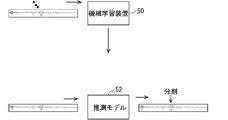
- the dividing points may be searched from the movement situation data by a machine-learned inference model, or conditions for becoming the dividing points may be defined for the movement situation data.
- the division points may be searched by calculating whether or not the definition is satisfied.
- a feature amount suitable for learning the division is extracted from the movement situation data including the change at the division point.
- the division point is a branch point of the route.
- the route may be divided at a point other than the branch point.
- a characteristic amount indicating information about a moving route for example, an acceleration sensor that outputs a signal according to the displacement of the track is used. Acceleration, trajectory displacement data, and the like may be used as the characteristic amount.
- the speed of the railway vehicle 10 is slowed down at the branch point, the speed, the acceleration, etc.
- the estimation model 52 suitable for estimating the branch point is generated.
- the division points can be extracted by applying the estimation model 52 to the movement situation data.
- various classifiers applicable for pattern recognition such as a neural network, SVM (support vector machine), HMM (Hidden Markov Model), can be used.
- ⁇ Learning may be done by supervised learning based on data that separately prepares branch points in advance. Alternatively, it may be unsupervised learning that performs clustering or the like that distinguishes a branch point from a non-branch point from movement status data including data corresponding to a plurality of branch points.
- a waveform of a feature amount that should be the division point For example, the acceleration waveform
- the waveform and the feature amount waveform for example, the acceleration waveform
- a branch point that is, a division point may be determined by capturing an image of the rail 18a with an image capturing unit provided in the railway vehicle 10 and recognizing a break in the rail 18a from the captured image.
- the points of coincidence and non-coincidence may be determined as the division points by comparing the coincidence and non-coincidence of the movement status data from each rail vehicle 10.
- connection information of the connected nodes is held in the nodes (start point and end point) at both ends of the divided movement status information so that it can be reconstructed later as movement status network information.
- the matching process is a process of matching the divided pieces of divided movement status information and checking whether they match.
- the matching may be performed by matching the divided movement status information obtained by dividing the movement status data with other divided movement status information using a machine-learned inference model, or by matching the divided movement status information. It may be a process of collating by defining a condition for evaluating the degree and determining whether or not the definition is satisfied.
- the machine learning device extracts a feature amount suitable for collating the divided pieces of divided movement status information. Since the divided movement status information that is divided depends on the position and distance on which the railway vehicle 10 travels, position information (latitude route column data) such as latitude and longitude and distance information may be used as the characteristic amount. Also, because the divided movement status information that has been divided depends on the state of the route, track displacement information (rail displacement, rail passage displacement, left and right rail gage up/down, etc.), a signal corresponding to the track displacement The characteristic amount may be data corresponding to the state of the trajectory, such as acceleration by an acceleration sensor that outputs. Further, since it is considered that the railway vehicle 10 travels at the same speed and acceleration on the same route, the speed and acceleration of the railway vehicle 10 may be used as the characteristic amount.
- the feature quantity may be one or more.
- an inference model suitable for collating the divided movement status information is generated.
- the classifier various classifiers applicable for pattern recognition, such as a neural network, SVM (support vector machine), HMM (Hidden Markov Model), can be used.
- the HMM can learn the feature amount from the movement situation data, and use the learning data in which the division points are labeled manually or by a machine-learned inference model.
- the learning of the HMM is performed by estimating the parameter that maximizes the likelihood of the movement situation data that is the learning data, using the initial state probability, the state transition probability, and the output probability of the data corresponding to each divided movement situation information as parameters. be able to.
- the matching accuracy is excellent because the matching is performed in consideration of the state transition probability in the data corresponding to the input movement situation data.
- the learning may be performed by supervised learning prepared separately in advance based on the divided movement status information to which each route identification information is added, or may be unsupervised learning that clusters a plurality of divided movement status information.
- a waveform included in each division movement status information may be subjected to cross-correlation calculation, and if the conditions satisfying a predetermined similarity range are satisfied, they correspond to matching routes, and if they do not satisfy, they may be different routes.
- the movement status data from each rail vehicle 10 includes position information, it may be determined whether or not the route is a corresponding route based on the similarity of the position information.
- the pieces of divided movement status information are classified by a unit obtained by dividing the railroad route network of the plurality of railway vehicles 10 at division points.
- a plurality of pieces of divided movement status information belong to any of the division units, they are integrated into one piece of data.
- a plurality of pieces of divided movement status information may be averaged, or any one of them may be used as division movement status information.
- the nodes of the divided movement status information are linked by referring to the node information at both ends of the division movement status information, and the movement status corresponding to the rail route network of the plurality of rail vehicles 10 is linked.
- Generate network information The generated movement status network information is stored in the second storage unit 48. If the movement status network information generated in the past is stored in the second storage unit 48, the movement status network information is updated.
- the division point search process of step S2, the collation process of step S3, and the classification process of step S4 are sequentially processed, but a plurality of them may be collectively executed.
- the plurality of divided movement status information pieces are collated and classified into the units obtained by dividing the railroad route network of the plurality of railcars 10 at the division points.
- the processing and the classification processing in step S4 may be collectively executed.
- the division point search process, the collation process, and the classification process for the movement situation data may be collectively processed at the same time by the discriminator to which the HMM that learned the movement situation data including the division points is applied.
- Each of the above processes or a process in which a plurality of them are combined may be performed by a neural network, a discriminator to which an SVM is applied, a neural network, an HMM incorporating the SVM, or a GMM (Gaussian Mixture). Model)-HMM.
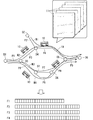
- FIGS. 4 and 5 are explanatory diagrams showing an example of data processing. The examples shown in FIGS. 4 and 5 will be described on the assumption that the movement status data does not include position information.
- the railway route network 19 has nodes D1, D2, D3, D4, D5, D6, D7, D8 which are starting points, starting points or dividing points, and these are divided routes P1, P2, P3, P4, P5, It is assumed that it has a network structure connected through P6, P7, P8, and P9.
- the moving route M1 of the first railway vehicle 10 passes through the divided routes P2, P4, and P5.
- the moving route M2 of the second railway vehicle 10 passes through the divided routes P1, P3, P4, and P5.
- the moving route M3 of the third railway vehicle 10 passes through the divided routes P1, P6, P7, P9, and P5.
- the moving route M3 of the fourth railway vehicle 10 passes through the divided routes P1, P6, P8, P9, and P5. It should be noted that if the moving route of the railroad vehicle 10 is divided into divided route units, it becomes a divided moving route.
- the travel status data 11 is output from each of the plurality of rail vehicles 10 traveling on the rail route network 19 and stored in the first storage unit 46.
- the movement status data 11 from each rail vehicle 10 is accumulated as temporally discrete data F1, F2, F3, and F4, for example.
- the data F1, F2, F3, and F4 include, for example, at least one of information about the behavior of the railway vehicle 10 and information about a moving route.
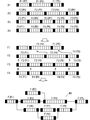
- the data F1, F2, F3, and F4 become as shown in FIG. In FIG. 5, the division points are painted black.
- reference numerals F1, F2, F3, and F4 may be shown with parentheses indicating a corresponding divided route. ..
- the divided movement status information corresponding to the divided path P3 is the divided movement status information F1(P3).
- step S4 the divided movement status information F1(P4) and the divided movement status information F2(P4) are the same, and the divided movement status information F1(P5) and the divided movement status information F2. It is verified that (P5), the divided movement status information F3 (P5) and the divided movement status information F4 (P5) are the same.
- step S5 classification processing is performed, and the divided movement status information belonging to the same classification is integrated into one.
- step S6 the movement status network information N1 can be generated by linking the nodes of the division movement status information based on the node information at both ends of the division movement status information. It should be noted that, in the drawing, the integrated divided movement status information after collation and classification is shown by adding a symbol F in parentheses to indicate a corresponding divided route.
- the generated movement status network information N1 is network information in which a plurality of pieces of divided movement status information are connected with the content corresponding to the railway route network 19.
- the movement status network information may be a graph-weighted graph, that is, information to which time information of divided movement status information between each division point is added.
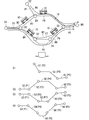
- FIGS. 6 and 7 are explanatory views showing other processing examples of data. The examples shown in FIGS. 6 and 7 will be described on the assumption that the movement status data includes position information.
- the travel status data is output from each of the plurality of rail vehicles 10 traveling on the rail route network 19 and stored in the first storage unit 46. It is assumed that the movement status data including the respective position information from each railroad vehicle 10 is accumulated as, for example, temporally discrete position data G1, G2, G3, G4.
- the position data G1, G2, G3 and G4 are data including plane alignment.
- the position data G1, G2, G3, and G4 are, for example, data in which latitude and longitude indicating the position of the railway vehicle 10 are arranged on the time axis.
- the data G1, G2, G3, and G4 become as shown in FIG.
- the data G1, G2, G3, G4 may be shown in parentheses with a symbol indicating the corresponding divided route. ..
- the divided movement status information corresponding to the divided path P3 is the divided movement status information G1(P3).
- the divided movement status information is data including plane alignment.
- step S4 the divided movement status information G1(P4) and the divided movement status information G2(P4) are the same, and the divided movement status information G1(P5) and the divided movement status information G2. It is verified that (P5) is the same as the divided movement status information G3 (P5) and the divided movement status information G4 (P5).
- step S5 classification processing is performed to integrate the divided movement status information for each classification.
- step S6 the movement status network information N2 can be generated by linking the nodes of the division movement status information with each other based on the node information at both ends of the division movement status information.
- the integrated divided movement status information is shown by adding a symbol G in parentheses to indicate a corresponding divided route.
- the generated movement status network information is network information in which a plurality of divided movement status information are linked with the content corresponding to the railway route network 19.
- the movement status network information since the movement status network information includes the position information, it becomes the network information including the plane alignment of the railway route network 19.
- the movement status network information including at least one of information regarding the behavior of the transport aircraft and information regarding the route along which the movement has occurred is the position information. It may be associated with movement status network information including information. Since both have similar network structures, they can be associated even if they are generated separately.
- the movement status data may include position data
- a plurality of divided movement status information corresponding to the divided movement paths obtained by dividing the plurality of movement paths is generated, and movement is performed based on the plurality of divided movement status information. It is possible to easily generate movement status network information corresponding to the route network.
- the movement status network information can be generated as the railroad route network 19 itself, or various data corresponding to the movement status can be generated as data linked by the network configuration according to the railroad route network 19.
- the data can be used to monitor the condition of the orbit.
- the railroad vehicle 10 is provided with sensors and the like, and by collecting data from the respective sensors and the like, the movement status network information can be generated, and the generation thereof is relatively easy.
- the railway vehicle 10 travels along a certain route along the railway route network 19 laid in advance, and branches at a certain branch point. Based on the output from the travel status output unit 30 provided in the rail vehicle 10 traveling along the rail route network 19, the travel status network information corresponding to the rail route network 19 can be easily generated.
- the movement status network information can be easily connected by associating the plural pieces of divided movement status information with each other.
- the movement status data includes the position information (position data G1, G2, G3, G4) related to the position of the transportation device, and the movement status network information includes the position related to the position of the railway route network 19 which is the movement route network. Information may be included. In this case, the movement status network information can be grasped as position information according to the railway route network 19.
- the movement status data includes at least one of the information regarding the behavior of the transportation machine and the information regarding the route during movement (data F1, F2, F3, F4)
- the movement status network information includes the transportation status network information.
- the information may include at least one of information on behavior and a situation on a moving route.
- the movement status data includes at least position information (position data G1, G2, G3, G4) regarding the position of the transportation device, information regarding the behavior of the transportation device, and information regarding the moving route.
- position data G1, G2, G3, G4 regarding the position of the transportation device
- information regarding the behavior of the transportation device includes information regarding the behavior of the transportation device, and information regarding the moving route.
- the travel status network information includes one (data F1, F2, F3, F4)
- the travel status network information is at least one of location information, behavior information of a transport aircraft, and a situation related to a traveling route
- the travel position and transportation Since it is possible to correlate the information on the behavior of the aircraft and the information on the route on the move, it is easier to use for monitoring the trajectory.
- the information regarding the behavior of the transport aircraft and the information regarding the moving route can be converted into the information associated with the distance from the position information, which is useful for monitoring.
- the movement status network information is generated, based on the movement status data of the transport device after that, by updating the generated movement status network information, information about the addition of routes, the addition of division points, and the behavior of the transportation equipment. Also, it can be updated when there is a change in the information regarding the route being moved. In this case, regarding the divided movement status information corresponding to the same divided route, old data may be updated to new data, or new weighted average data may be updated. You may Further, data that is statistically determined to be abnormal in view of past data may be excluded from this processing.
- control unit 40 applies the inference model 52 generated by machine learning to the movement state data of the transportation machine to divide a plurality of movement routes into a plurality of divided movement states according to divided movement routes. Information can be generated.
- the transport plane may be a ship, an airplane, a delivery drone, or the like. Since ships and airplanes travel on a predetermined route, a route defined by the port, division point, etc. defined by the route can be used as a divided movement route.
- the delivery drone assuming that the drone base is set as a starting point or a transit point to travel on a fixed air route, the drone base will divide the route delimited by the division point defined by the air route. It can be a travel route. Whether it is a ship, an airplane, or a delivery drone, staying for a certain amount of time, changing the direction, and knowing the route can be performed at the dividing points. Therefore, similarly to the above, it is possible to generate a divided movement route from a plurality of movement routes.
- a first aspect is a division that divides a plurality of movement routes based on a plurality of movement situation data, which is provided in a transportation machine and outputs movement situation data according to the movement situation of the transportation machine.
- a control unit that generates a plurality of pieces of divided movement status information according to a movement route and generates movement status network information corresponding to the movement route network of the transportation device based on the plurality of pieces of divided movement status information. It is a network information generation system.
- a plurality of divided movement status information corresponding to the divided movement paths obtained by dividing the plurality of movement paths is generated, and based on the plurality of divided movement status information, the movement path
- the movement status network information corresponding to the network can be easily generated.
- a second aspect is the first aspect, wherein the transport device is a railroad vehicle, and the control unit is a railroad vehicle of a railroad vehicle as processing for generating travel status network information corresponding to the travel route network. It is a movement condition network information generation system that executes a process of generating movement condition network information corresponding to a route network.
- Rail cars run along a fixed route along a pre-laid railway route network and also branch at a fixed branch point. Based on the output from the travel status output unit provided in the railway vehicle traveling along such a rail route network, the travel status network information corresponding to the rail route network can be easily generated.
- the third aspect is the first or second aspect, and is a movement status network information generation system in which the plurality of divided movement status information are information divided at branch points of a plurality of movement routes.
- the movement status network information can be easily connected by associating the pieces of divided movement status information with each other.
- a fourth aspect is any one of the first to third aspects, wherein the movement status data includes position information regarding a position of a transportation machine, and the movement status network information includes a position of the movement route network. It is a movement situation network information generation system including the position information regarding.
- a fifth aspect is any one of the first to fourth aspects, wherein the travel status data includes at least one of information regarding behavior of a transport aircraft and information regarding a route during travel, and the travel status network
- the information is a movement status network information generation system that includes at least one of information regarding behavior of a transport aircraft and information regarding a route during movement.
- -Movement status Network information can include at least one of information related to behavior of transport aircraft and status related to moving routes. As a result, it is possible to grasp at least one of the behavior status of the transport plane between the nodes of the movement status network information and the route status during movement.
- a sixth aspect is any one of the first to fifth aspects, in which the control unit, after generating the movement status network information, generates the movement status network based on the movement status data of the transport aircraft. It is a movement status network information generation system that updates information.
- a seventh aspect is any one of the first to sixth aspects, in which the control unit applies the inference model generated by machine learning to the movement situation data of the transport aircraft, It is a movement situation network information generation system that generates a plurality of divided movement situation information according to divided movement routes obtained by dividing a plurality of movement routes.
- An eighth aspect is a movement status data input unit for inputting a plurality of movement status data according to a movement status of a transport aircraft, and a divided movement path obtained by dividing a plurality of movement paths based on the plurality of movement status data.
- a ninth aspect is the eighth aspect, in which the transportation device is a railway vehicle, and the control unit is a railway vehicle of the railway vehicle as a process of generating travel status network information corresponding to the travel route network.
- the movement status network information generation device executes a process of generating movement status network information corresponding to a route network.
- a tenth aspect is the eighth or ninth aspect, and is a movement state network information generation device in which the plurality of divided movement state information are information divided at branch points of a plurality of movement routes.
- the movement status network information can be easily connected by associating the plurality of pieces of divided movement status information with each other. it can.
- An eleventh aspect is any one of the eighth to tenth aspects, in which the movement status data includes position information regarding a position of a transportation machine, and the movement state network information relates regarding a position of the movement route network. It is a movement situation network information generation device including position information.
- a twelfth aspect is any one of the eighth to eleventh aspects, wherein the movement status data includes at least one of information regarding behavior of a transport aircraft and information regarding a route during movement, and the movement situation network
- the information is a movement status network information generation device that includes at least one of information regarding behavior of a transport aircraft and information regarding a route during movement.
- the movement status network information can include at least one of the information regarding the behavior of the transport aircraft and the status regarding the route being moved. As a result, it is possible to grasp at least one of the behavior status of the transport plane between the nodes of the movement status network information and the route status during movement.
- a thirteenth aspect is any one of the eighth to twelfth aspects, in which the control unit, after generating the movement situation network information, generates a movement situation network based on the movement situation data of the transport aircraft. It is a movement status network information generation device for updating information.
- a fourteenth aspect is any one of the eighth to thirteenth aspects, in which the control unit applies the inference model generated by machine learning to the movement status data of the transport aircraft,
- the movement status network information generation device generates a plurality of pieces of divided movement status information according to divided movement paths obtained by dividing a plurality of movement paths.
- a fifteenth aspect is: (a) a step of outputting a plurality of movement status data according to the movement status of the transport machine; and (b) a division movement in which a plurality of movement routes are divided based on the plurality of movement status data.
- a plurality of divided movement status information corresponding to the divided movement paths obtained by dividing the plurality of movement paths is generated, and based on the plurality of divided movement status information, the movement path
- the movement status network information corresponding to the network can be easily generated.
- a sixteenth aspect is the fifteenth aspect, wherein the step (a) is a step in which travel status data corresponding to the travel status of a railway vehicle serving as a transport machine is output, and the step (c) includes It is a method of generating movement condition network information, which is a step of generating movement condition network information corresponding to a railway route network of a railway vehicle.
- a seventeenth aspect is the fifteenth or sixteenth aspect, and is a movement status network information generation method, wherein the plurality of divided movement status information are information divided at branch points of a plurality of movement routes.
- the movement status network information can be easily connected by associating the plurality of pieces of divided movement status information with each other. it can.
- An eighteenth aspect is the method according to any one of the fifteenth to seventeenth aspects, wherein the movement status data includes position information regarding a position of a transport aircraft, and the movement status network information includes a position of the movement route network.
- a method of generating network information on a moving situation including position information regarding
- a nineteenth aspect is any one of the fifteenth to eighteenth aspects, wherein the movement status data includes at least one of information regarding behavior of a transport aircraft and information regarding a route during movement, and the movement situation network
- the information is a movement status network information generation method including at least one of information regarding behavior of a transport aircraft and information regarding a route during movement.
- the movement status network information can include at least one of the information regarding the behavior of the transport aircraft and the status regarding the route being moved. As a result, it is possible to grasp at least one of the behavior status of the transport plane between the nodes of the movement status network information and the route status during movement.
- a twentieth aspect is any one of the fifteenth to nineteenth aspects, wherein the step (c) is based on the movement status data of the transport aircraft and the generated movement status network information.
- Transport aircraft (rail vehicles) 11 movement status data 18 track 19 railroad route network 20 communication network 30 movement status output unit 34 communication device 40 control unit 41 communication device 42 arithmetic unit 43 division processing unit 44 collation processing unit 45 classification processing unit 46 first storage unit 48 second Storage unit 52
- Estimated model F1, F2, F2, F3 data (movement status information) F1 (P2), F1 (P4), F1 (P5), F2 (P1), F2 (P3)... Data (divided movement status information) G1, G2, G3, G4 data (movement status information) G1(P2), G1(P4), G1(P5), G2(P1), G2(P3)... Position data (divided movement status information) M1, M2, M3, M4 Moving route N1, N2 Moving status network information P1, P2, P3... Divided route
Landscapes
- Engineering & Computer Science (AREA)
- Mechanical Engineering (AREA)
- Health & Medical Sciences (AREA)
- Biomedical Technology (AREA)
- General Health & Medical Sciences (AREA)
- Train Traffic Observation, Control, And Security (AREA)
- Management, Administration, Business Operations System, And Electronic Commerce (AREA)
- Navigation (AREA)
- Electric Propulsion And Braking For Vehicles (AREA)
Abstract
Description
11 移動状況データ
18 軌道
19 鉄道経路網
20 通信網
30 移動状況出力部
34 通信装置
40 制御部
41 通信装置
42 演算部
43 分割処理部
44 照合処理部
45 分類処理部
46 第1記憶部
48 第2記憶部
52 推測モデル
F1、F2、F2、F3 データ(移動状況情報)
F1(P2)、F1(P4)、F1(P5)、F2(P1)、F2(P3)・・・ データ(分割移動状況情報)
G1、G2、G3、G4 データ(移動状況情報)
G1(P2)、G1(P4)、G1(P5)、G2(P1)、G2(P3)・・・ 位置データ(分割移動状況情報)
M1、M2、M3、M4 移動経路
N1、N2 移動状況ネットワーク情報
P1、P2、P3・・・ 分割経路
Claims (20)
- 輸送機に設けられ、その輸送機の移動状況に応じた移動状況データを出力する移動状況出力部と、
複数の移動状況データに基づいて、複数の移動経路を分割した分割移動経路に応じた複数の分割移動状況情報を生成し、前記複数の分割移動状況情報に基づいて、輸送機の移動経路ネットワークに対応する移動状況ネットワーク情報を生成する制御部と、
を備える移動状況ネットワーク情報生成システム。 - 請求項1記載の移動状況ネットワーク情報生成システムであって、
前記輸送機は、鉄道車両であり、
前記制御部は、前記移動経路ネットワークに対応する移動状況ネットワーク情報を生成する処理として、鉄道車両の鉄道経路網に対応する移動状況ネットワーク情報を生成する処理を実行する、移動状況ネットワーク情報生成システム。 - 請求項1又は請求項2に記載の移動状況ネットワーク情報生成システムであって、
前記複数の分割移動状況情報は、複数の移動経路の分岐点で分割された情報である、移動状況ネットワーク情報生成システム。 - 請求項1から請求項3のいずれか1つに記載の移動状況ネットワーク情報生成システムであって、
前記移動状況データは、輸送機の位置に関する位置情報を含み、
前記移動状況ネットワーク情報は、前記移動経路ネットワークの位置に関する位置情報を含む、移動状況ネットワーク情報生成システム。 - 請求項1から請求項4のいずれか1つに記載の移動状況ネットワーク情報生成システムであって、
前記移動状況データは、輸送機の挙動に関する情報及び移動中の経路に関する情報の少なくとも一方を含み、
前記移動状況ネットワーク情報は、輸送機の挙動に関する情報及び移動中の経路に関する情報の少なくとも一方を含む、移動状況ネットワーク情報生成システム。 - 請求項1から請求項5のいずれか1つに記載の移動状況ネットワーク情報生成システムであって、
前記制御部は、移動状況ネットワーク情報の生成後に、輸送機の移動状況データに基づいて、生成済の移動状況ネットワーク情報を更新する、移動状況ネットワーク情報生成システム。 - 請求項1から請求項6のいずれか1つに記載の移動状況ネットワーク情報生成システムであって、
前記制御部は、輸送機の移動状況データに対して、機械学習により生成された推測モデルを適用することで、複数の移動経路を分割した分割移動経路に応じた複数の分割移動状況情報を生成する、移動状況ネットワーク情報生成システム。 - 輸送機の移動状況に応じた複数の移動状況データが入力される移動状況データ入力部と、
複数の移動状況データに基づいて、複数の移動経路を分割した分割移動経路に応じた複数の分割移動状況情報を生成し、前記複数の分割移動状況情報に基づいて、輸送機の移動経路ネットワークに対応する移動状況ネットワーク情報を生成する制御部と、
を備える移動状況ネットワーク情報生成装置。 - 請求項8記載の移動状況ネットワーク情報生成装置であって、
前記輸送機は、鉄道車両であり、
前記制御部は、前記移動経路ネットワークに対応する移動状況ネットワーク情報を生成する処理として、鉄道車両の鉄道経路網に対応する移動状況ネットワーク情報を生成する処理を実行する、移動状況ネットワーク情報生成装置。 - 請求項8又は請求項9に記載の移動状況ネットワーク情報生成装置であって、
前記複数の分割移動状況情報は、複数の移動経路の分岐点で分割された情報である、移動状況ネットワーク情報生成装置。 - 請求項8から請求項10のいずれか1つに記載の移動状況ネットワーク情報生成装置であって、
前記移動状況データは、輸送機の位置に関する位置情報を含み、
前記移動状況ネットワーク情報は、前記移動経路ネットワークの位置に関する位置情報を含む、移動状況ネットワーク情報生成装置。 - 請求項8から請求項11のいずれか1つに記載の移動状況ネットワーク情報生成装置であって、
前記移動状況データは、輸送機の挙動に関する情報及び移動中の経路に関する情報の少なくとも一方を含み、
前記移動状況ネットワーク情報は、輸送機の挙動に関する情報及び移動中の経路に関する情報の少なくとも一方を含む、移動状況ネットワーク情報生成装置。 - 請求項8から請求項12のいずれか1つに記載の移動状況ネットワーク情報生成装置であって、
前記制御部は、移動状況ネットワーク情報の生成後に、輸送機の移動状況データに基づいて、生成済の移動状況ネットワーク情報を更新する、移動状況ネットワーク情報生成装置。 - 請求項8から請求項13のいずれか1つに記載の移動状況ネットワーク情報生成装置であって、
前記制御部は、輸送機の移動状況データに対して、機械学習により生成された推測モデルを適用することで、複数の移動経路を分割した分割移動経路に応じた複数の分割移動状況情報を生成する、移動状況ネットワーク情報生成装置。 - (a)輸送機の移動状況に応じた複数の移動状況データが出力されるステップと、
(b)複数の移動状況データに基づいて、複数の移動経路を分割した分割移動経路に応じた複数の分割移動状況情報を生成するステップと、
(c)前記複数の分割移動状況情報に基づいて、輸送機の移動経路ネットワークに対応する移動状況ネットワーク情報を生成するステップと、
を備える移動状況ネットワーク情報生成方法。 - 請求項15記載の移動状況ネットワーク情報生成方法であって、
前記ステップ(a)は、前記輸送機として鉄道車両の移動状況に応じた移動状況データが出力されるステップであり、
前記ステップ(c)は、鉄道車両の鉄道経路網に対応する移動状況ネットワーク情報を生成するステップである、移動状況ネットワーク情報生成方法。 - 請求項15又は請求項16に記載の移動状況ネットワーク情報生成方法であって、
前記複数の分割移動状況情報は、複数の移動経路の分岐点で分割された情報である、移動状況ネットワーク情報生成方法。 - 請求項15から請求項17のいずれか1つに記載の移動状況ネットワーク情報生成方法であって、
前記移動状況データは、輸送機の位置に関する位置情報を含み、
前記移動状況ネットワーク情報は、前記移動経路ネットワークの位置に関する位置情報を含む、移動状況ネットワーク情報生成方法。 - 請求項15から請求項18のいずれか1つに記載の移動状況ネットワーク情報生成方法であって、
前記移動状況データは、輸送機の挙動に関する情報及び移動中の経路に関する情報の少なくとも一方を含み、
前記移動状況ネットワーク情報は、輸送機の挙動に関する情報及び移動中の経路に関する情報の少なくとも一方を含む、移動状況ネットワーク情報生成方法。 - 請求項15から請求項19のいずれか1つに記載の移動状況ネットワーク情報生成方法であって、
前記ステップ(c)は、輸送機の移動状況データ及び生成された移動状況ネットワーク情報に基づいて、生成済の移動状況ネットワーク情報を更新する、移動状況ネットワーク情報生成方法。
Priority Applications (4)
| Application Number | Priority Date | Filing Date | Title |
|---|---|---|---|
| JP2020562278A JP7295143B2 (ja) | 2018-12-28 | 2018-12-28 | 移動状況ネットワーク情報生成システム、移動状況ネットワーク情報生成装置及び移動状況ネットワーク情報生成方法 |
| US17/309,842 US12233922B2 (en) | 2018-12-28 | 2018-12-28 | Travel condition network information generation system, travel condition network information generation apparatus, and travel condition network information generation method |
| CA3124327A CA3124327C (en) | 2018-12-28 | 2018-12-28 | Travel condition network information generation system, travel condition network information generation apparatus, and travel condition network information generation method |
| PCT/JP2018/048513 WO2020136882A1 (ja) | 2018-12-28 | 2018-12-28 | 移動状況ネットワーク情報生成システム、移動状況ネットワーク情報生成装置及び移動状況ネットワーク情報生成方法 |
Applications Claiming Priority (1)
| Application Number | Priority Date | Filing Date | Title |
|---|---|---|---|
| PCT/JP2018/048513 WO2020136882A1 (ja) | 2018-12-28 | 2018-12-28 | 移動状況ネットワーク情報生成システム、移動状況ネットワーク情報生成装置及び移動状況ネットワーク情報生成方法 |
Publications (1)
| Publication Number | Publication Date |
|---|---|
| WO2020136882A1 true WO2020136882A1 (ja) | 2020-07-02 |
Family
ID=71126000
Family Applications (1)
| Application Number | Title | Priority Date | Filing Date |
|---|---|---|---|
| PCT/JP2018/048513 Ceased WO2020136882A1 (ja) | 2018-12-28 | 2018-12-28 | 移動状況ネットワーク情報生成システム、移動状況ネットワーク情報生成装置及び移動状況ネットワーク情報生成方法 |
Country Status (4)
| Country | Link |
|---|---|
| US (1) | US12233922B2 (ja) |
| JP (1) | JP7295143B2 (ja) |
| CA (1) | CA3124327C (ja) |
| WO (1) | WO2020136882A1 (ja) |
Cited By (1)
| Publication number | Priority date | Publication date | Assignee | Title |
|---|---|---|---|---|
| EP3938265B1 (de) * | 2019-04-30 | 2025-02-12 | Siemens Mobility GmbH | Verfahren zum bestimmen einer gleisbelegung sowie achszähleinrichtung |
Citations (4)
| Publication number | Priority date | Publication date | Assignee | Title |
|---|---|---|---|---|
| JPH10181603A (ja) * | 1996-12-25 | 1998-07-07 | Toshiba Corp | 乗車列車選択支援情報作成装置 |
| JP2005041431A (ja) * | 2003-07-25 | 2005-02-17 | Kyosan Electric Mfg Co Ltd | データ作成装置、データ作成方法及びデータ作成プログラム |
| JP2016037070A (ja) * | 2014-08-05 | 2016-03-22 | 公益財団法人鉄道総合技術研究所 | プログラム及びデータ生成装置 |
| JP2016222114A (ja) * | 2015-05-29 | 2016-12-28 | 株式会社日立製作所 | データ処理システム、及び、データ処理方法 |
Family Cites Families (5)
| Publication number | Priority date | Publication date | Assignee | Title |
|---|---|---|---|---|
| US9233696B2 (en) * | 2006-03-20 | 2016-01-12 | General Electric Company | Trip optimizer method, system and computer software code for operating a railroad train to minimize wheel and track wear |
| JP4941276B2 (ja) | 2007-12-21 | 2012-05-30 | 株式会社Jvcケンウッド | ナビゲーション装置、その地図情報アップデート方法および地図情報アップデートプログラム |
| JP2017097088A (ja) | 2015-11-20 | 2017-06-01 | 株式会社日立製作所 | 地図生成装置及び地図生成方法、ナビゲーション管理システム |
| US20180222504A1 (en) * | 2017-02-08 | 2018-08-09 | Intel Corporation | Location based railway anomaly detection |
| EP3668773A1 (en) * | 2017-09-19 | 2020-06-24 | Siemens Mobility GmbH | Bogie track monitoring |
-
2018
- 2018-12-28 WO PCT/JP2018/048513 patent/WO2020136882A1/ja not_active Ceased
- 2018-12-28 CA CA3124327A patent/CA3124327C/en active Active
- 2018-12-28 US US17/309,842 patent/US12233922B2/en active Active
- 2018-12-28 JP JP2020562278A patent/JP7295143B2/ja active Active
Patent Citations (4)
| Publication number | Priority date | Publication date | Assignee | Title |
|---|---|---|---|---|
| JPH10181603A (ja) * | 1996-12-25 | 1998-07-07 | Toshiba Corp | 乗車列車選択支援情報作成装置 |
| JP2005041431A (ja) * | 2003-07-25 | 2005-02-17 | Kyosan Electric Mfg Co Ltd | データ作成装置、データ作成方法及びデータ作成プログラム |
| JP2016037070A (ja) * | 2014-08-05 | 2016-03-22 | 公益財団法人鉄道総合技術研究所 | プログラム及びデータ生成装置 |
| JP2016222114A (ja) * | 2015-05-29 | 2016-12-28 | 株式会社日立製作所 | データ処理システム、及び、データ処理方法 |
Cited By (1)
| Publication number | Priority date | Publication date | Assignee | Title |
|---|---|---|---|---|
| EP3938265B1 (de) * | 2019-04-30 | 2025-02-12 | Siemens Mobility GmbH | Verfahren zum bestimmen einer gleisbelegung sowie achszähleinrichtung |
Also Published As
| Publication number | Publication date |
|---|---|
| US12233922B2 (en) | 2025-02-25 |
| JP7295143B2 (ja) | 2023-06-20 |
| CA3124327C (en) | 2023-10-17 |
| CA3124327A1 (en) | 2020-07-02 |
| US20220024502A1 (en) | 2022-01-27 |
| JPWO2020136882A1 (ja) | 2021-10-21 |
Similar Documents
| Publication | Publication Date | Title |
|---|---|---|
| Alvarez et al. | Modeling the driving behavior of electric vehicles using smartphones and neural networks | |
| Weston et al. | Perspectives on railway track geometry condition monitoring from in-service railway vehicles | |
| JP6889059B2 (ja) | 情報処理装置、情報処理方法及びコンピュータプログラム | |
| Saab | A map matching approach for train positioning. I. Development and analysis | |
| Valera et al. | Driving cycle and road grade on-board predictions for the optimal energy management in EV-PHEVs | |
| CN115545266A (zh) | 用于估计车辆系统的到达时间的系统和方法 | |
| BRPI0706036A2 (pt) | sistema, método e código de programa de computador para otimizar as operações ferroviárias levando-se em consideração os parámetros dos vagões ferroviários | |
| JP2013148486A (ja) | ユーザが搭乗している移動車両を推定する移動車両推定方法、移動端末及びプログラム | |
| Xu et al. | Dynamic-time-warping-based measurement data alignment model for condition-based railroad track maintenance | |
| CN110831835A (zh) | 铁道车辆的行驶位置确定系统、行驶位置确定装置以及行驶位置确定方法 | |
| US12365375B2 (en) | Vehicle and route monitoring system | |
| JP7295143B2 (ja) | 移動状況ネットワーク情報生成システム、移動状況ネットワーク情報生成装置及び移動状況ネットワーク情報生成方法 | |
| JP2022129116A (ja) | 消費電力予測装置 | |
| CN115455675B (zh) | 气动载荷计算方法、装置、设备及介质 | |
| KR20220072125A (ko) | 돌발상황 발생 시 자율주행 자동차의 운행경로를 생성하는 방법 및 이를 이용한 장치 | |
| CN115817587A (zh) | 用于解决列车运行延时的实时重调度方法和装置 | |
| CN114663992A (zh) | 一种多源数据融合高速公路门架定位方法 | |
| CN110704996B (zh) | 一种移动闭塞制式下货运车站接发车能力的分析方法 | |
| KR101433731B1 (ko) | 가상 운행 노선 및 차량과 연동 운행하는 소형 궤도차량 시스템의 운용제어시스템 | |
| JP6037793B2 (ja) | 鉄道車両の位置検出装置および位置検出方法 | |
| Sandidzadeh et al. | Optimization of balise placement in a railway track using a vehicle, an odometer and genetic algorithm | |
| JP2020075663A (ja) | 位置推定装置、位置推定方法、位置推定プログラム | |
| EP4171079A1 (en) | System and method for identifying candidate vehicle systems | |
| JP2013013261A (ja) | 鉄道車両の位置検出装置および位置検出方法 | |
| Zheng et al. | Empowering high-speed train positioning: Innovative paradigm for generating universal virtual positioning big data |
Legal Events
| Date | Code | Title | Description |
|---|---|---|---|
| 121 | Ep: the epo has been informed by wipo that ep was designated in this application |
Ref document number: 18945345 Country of ref document: EP Kind code of ref document: A1 |
|
| ENP | Entry into the national phase |
Ref document number: 2020562278 Country of ref document: JP Kind code of ref document: A |
|
| ENP | Entry into the national phase |
Ref document number: 3124327 Country of ref document: CA |
|
| NENP | Non-entry into the national phase |
Ref country code: DE |
|
| 122 | Ep: pct application non-entry in european phase |
Ref document number: 18945345 Country of ref document: EP Kind code of ref document: A1 |
|
| WWG | Wipo information: grant in national office |
Ref document number: 17309842 Country of ref document: US |