WO2020125486A1 - 数据传输方法、装置、设备及存储介质 - Google Patents
数据传输方法、装置、设备及存储介质 Download PDFInfo
- Publication number
- WO2020125486A1 WO2020125486A1 PCT/CN2019/124231 CN2019124231W WO2020125486A1 WO 2020125486 A1 WO2020125486 A1 WO 2020125486A1 CN 2019124231 W CN2019124231 W CN 2019124231W WO 2020125486 A1 WO2020125486 A1 WO 2020125486A1
- Authority
- WO
- WIPO (PCT)
- Prior art keywords
- downlink
- message
- time
- base station
- node
- Prior art date
- Legal status (The legal status is an assumption and is not a legal conclusion. Google has not performed a legal analysis and makes no representation as to the accuracy of the status listed.)
- Ceased
Links
Images




Classifications
-
- H—ELECTRICITY
- H04—ELECTRIC COMMUNICATION TECHNIQUE
- H04W—WIRELESS COMMUNICATION NETWORKS
- H04W28/00—Network traffic management; Network resource management
- H04W28/02—Traffic management, e.g. flow control or congestion control
- H04W28/04—Error control
-
- H—ELECTRICITY
- H04—ELECTRIC COMMUNICATION TECHNIQUE
- H04B—TRANSMISSION
- H04B17/00—Monitoring; Testing
- H04B17/30—Monitoring; Testing of propagation channels
- H04B17/309—Measuring or estimating channel quality parameters
- H04B17/364—Delay profiles
-
- H—ELECTRICITY
- H04—ELECTRIC COMMUNICATION TECHNIQUE
- H04W—WIRELESS COMMUNICATION NETWORKS
- H04W24/00—Supervisory, monitoring or testing arrangements
- H04W24/02—Arrangements for optimising operational condition
-
- H—ELECTRICITY
- H04—ELECTRIC COMMUNICATION TECHNIQUE
- H04W—WIRELESS COMMUNICATION NETWORKS
- H04W28/00—Network traffic management; Network resource management
- H04W28/02—Traffic management, e.g. flow control or congestion control
- H04W28/06—Optimizing the usage of the radio link, e.g. header compression, information sizing, discarding information
-
- H—ELECTRICITY
- H04—ELECTRIC COMMUNICATION TECHNIQUE
- H04W—WIRELESS COMMUNICATION NETWORKS
- H04W88/00—Devices specially adapted for wireless communication networks, e.g. terminals, base stations or access point devices
- H04W88/02—Terminal devices
- H04W88/06—Terminal devices adapted for operation in multiple networks or having at least two operational modes, e.g. multi-mode terminals
-
- H—ELECTRICITY
- H04—ELECTRIC COMMUNICATION TECHNIQUE
- H04W—WIRELESS COMMUNICATION NETWORKS
- H04W24/00—Supervisory, monitoring or testing arrangements
- H04W24/08—Testing, supervising or monitoring using real traffic
Definitions
- the invention relates to the field of data transmission, and in particular to a data transmission method, device, equipment and storage medium.
- the working mode of the terminal is divided into three types: ClassA, ClassB and ClassC.
- ClassA mode after the terminal sends the upstream data, it will open the Rx1 receiving window at intervals of Rxdelay seconds. If the downstream data is received in the Rx1 receiving window, the Rx2 window will not open again. If the downlink data is not received in the Rx1 window, the Rx2 reception window is generally opened after 1s. Because the Rx2 window uses a fixed spreading factor and frequency, if all devices use the Rx2 window for downstream, it will inevitably cause the network packet collision rate to increase, thereby reducing the success rate of downstream data packets.
- the existing solution is that the NS issues the same command to the Rx1 and Rx2 windows at the same time. If the terminal receives a downlink command in the Rx1 window, the Rx2 window will not open and the terminal will not receive duplicate data. If the terminal does not receive data in the Rx1 window, it will open the Rx2 receiving window after 1s.
- the NS sends the same commands to the two windows Rx1 and Rx2 at the same time to ensure that the terminal can receive downlink commands in at least one window.
- the disadvantage of this method is that the base station sends a lot of useless data packets, which reduces the throughput of the base station.
- An object of the present invention is to provide a data transmission solution to solve the above problems.
- a data transmission method which includes: before a selected downlink base station sends a downlink message for an uplink message to a node, based on the link transmission delay between the downlink base station and the network server and The network server selects the receiving window of the node for the processing delay of the upstream message; and sends the downstream message for the selected receiving window.
- the step of selecting the receiving window of the node includes: based on the link transmission delay between the downlink base station and the network server and the processing delay of the network server for the upstream message, determining that the node can receive the receiving window of the downstream message; As a result, the reception window is selected.
- the step of selecting the receiving window according to the judgment result includes: selecting the first receiving window when it is determined that the first receiving window of the node can receive the downlink message, where the first receiving window is that the node has sent the upstream report The receiving window opened for the first time after the text; when it is determined that the first receiving window cannot receive the downlink message and the node's second receiving window can receive the downlink message, the second receiving window is selected, where the second The receiving window is the receiving window that is opened for the second time after the node sends the upstream message.
- the first receiving window can receive the uplink message, or in the case of tp+2 ⁇ delta ⁇ Rxdelay-T1, it is determined that the first receiving window can receive To the upstream message, in the case of tp+2 ⁇ delta ⁇ Rxdelay+T2, it is determined that the second receiving window can receive the upstream message, or in the case of tp+2 ⁇ delta ⁇ Rxdelay+T2-T1, the first Two receiving windows can receive upstream packets, where tp is the processing delay, delta is the link transmission delay, Rxdelay is the delay time for the node to open the first receiving window after sending the upstream packet, and T1 is the network delay jitter factor, T2 is the delay time for the node to open the second receive window after the first receive window ends, the first receive window is the receive window that is opened for the first time after the node sends the uplink message, and the second receive window is the node after
- the method further includes not sending a downlink message if it is determined that the node does not have a receiving window capable of receiving the downlink message.
- the processing delay is equal to the time period between the network server receiving the uplink message and preparing to send the downlink message to the node through the downlink base station.
- the link transmission delay is obtained by statistically calculating the transmission time of one or more links between the downlink base station and the network server determined before the predetermined time.
- the link transmission delay is obtained by processing the link transmission time between the last determined downlink base station and the network server based on the moving average algorithm.
- the method further includes: in response to sending a downlink message to the downstream base station, recording the first time; in response to receiving a response message from the downlink base station for the downlink message, recording the second time; comparing the second time with the first time One-half of the time difference is determined to be the link transmission time between the downlink base station and the network server.
- the method further includes: counting the transmission time of one or more links between the downlink base station and the network server determined within a predetermined time to obtain the link transmission delay between the downlink base station and the network server.
- a data transmission method comprising: before a selected downlink base station sends a downlink message for an uplink message to a node, selecting a receiving window of the node; sending for a selected receiving window Downstream message.
- a data transmission method including: in response to receiving a downlink message sent by a network server, determining whether the reception time of the downlink message is greater than the transmission time in the downlink message; If it is determined that the receiving time is greater than the sending time, a notification is sent to the network server, and/or if it is determined that the receiving time is less than or equal to the sending time, the downlink message is sent at the sending time.
- a data transmission method comprising: sending a downlink message directed to the first receiving window to the downstream base station; in response to receiving the notification sent by the downlink base station, Two downlink messages in the receiving window, where the notification is sent by the base station when the receiving time of the received downlink message is greater than the sending time in the downlink message, and the first receiving window is the first The receiving window that is opened once, and the second receiving window is the receiving window that is opened for the second time after the node sends the uplink message.
- the step of sending the downlink message for the second reception window to the downstream base station includes: determining whether the node can receive the downlink message in the second reception window; and determining whether the node can receive the downlink message in the second reception window In the case of, sending a downlink message for the second receiving window to the downstream base station.
- a data transmission device comprising: a receiving window selection module, which is used to select a downlink base station to send a downlink message for an uplink message to a node, based on the downlink base station and the network The link transmission delay between the servers and the processing delay of the network server for the upstream message select the receiving window of the node; the sending module is used to send the downstream message for the selected receiving window.
- a data transmission device comprising: a receiving window selection module for selecting a receiving window of a node before the selected downlink base station sends a downlink message for the uplink message to the node ;
- the sending module is used to send a downlink message for the selected receiving window.
- a data transmission device comprising: a judgment module, configured to judge whether a reception time of a downlink message is longer than a downlink message in response to receiving a downlink message sent by a network server Sending time; the sending module is used to send a notification to the network server when it is determined that the receiving time is greater than the sending time, and/or to send a downlink message at the sending time if it is determined that the receiving time is less than or equal to the sending time.
- a data transmission device comprising: a first sending module for sending a downlink message directed to a first receiving window to a downstream base station; a second sending module for responding to Upon receiving the notification sent by the downlink base station, the downlink base station sends a downlink message for the second reception window, where the notification is sent by the base station when the reception time of the received downlink message is greater than the transmission time in the downlink message
- the first receiving window is the receiving window that is opened for the first time after the node sends the upstream message
- the second receiving window is the receiving window that is opened for the second time after the node sends the upstream message.
- a computing device including: a processor; and a memory, on which executable code is stored, and when the executable code is executed by the processor, the processor is executed as in the present invention.
- a non-transitory machine-readable storage medium on which executable code is stored, and when the executable code is executed by the processor of the electronic device, the processor is executed as The method described in any one of the first aspect to the fourth aspect of the invention.
- the present invention can adaptively select a suitable receiving window for the downlink data of a node working in ClassA mode, thereby maximizing the success rate of downlink data packets.
- Figure 1 shows a timing diagram of a node sending upstream data in ClassA mode, NS processing upstream data packets, and sending downstream commands.
- FIG. 2 shows a schematic flowchart of a data transmission method according to an embodiment of the present invention
- FIG. 3 shows a schematic flowchart of a data transmission method according to another embodiment of the present invention.
- FIG. 4 shows a schematic flowchart of a data transmission method according to another embodiment of the present invention.
- FIG. 5 shows a schematic flowchart of a data transmission method according to another embodiment of the present invention.
- FIG. 6 shows a schematic block diagram of a structure of a data transmission device according to another embodiment of the present invention.
- FIG. 7 shows a schematic block diagram of a structure of a data transmission device according to another embodiment of the present invention.
- FIG. 8 shows a schematic block diagram of a structure of a data transmission device according to another embodiment of the present invention.
- FIG. 9 shows a schematic structural diagram of a computing device according to an embodiment of the present invention.
- LoRa A low-power long-distance wireless transmission scheme based on spread spectrum technology.
- LoRaWAN A low-power wide area network (LPWAN) standard based on the open source MAC layer protocol launched by the LoRa Alliance. This technology can provide a low-power, scalable long-distance wireless network for battery-powered wireless devices.
- LPWAN low-power wide area network
- NS Network Server, network server, is the core part of the Internet of Things solution-core network.
- Base station also known as a gateway, transparently transmits the wireless network signal of a node (that is, terminal) to the equipment of the NS through the backhaul network.
- Downlink base station a base station used to send downlink packets to a node, designated by the NS.
- Rx1 the first receiving window opened after the terminal uplinks data, that is, the first receiving window mentioned in the present invention.
- Rx2 The second receiving window opened after the terminal uplinks data, that is, the second receiving window mentioned in the present invention.
- Rxdelay The delay time for the terminal to open the Rx1 window after sending the upstream data packet.
- Rxpk uplink message, that is, the data message uploaded by the base station to the NS.
- Txpk downlink message, that is, the data message that the NS downlinks to the base station.
- the present invention proposes that before selecting a downlink base station to send a downlink message for an uplink message to a node, the receiving window of the node can be selected. For example, according to the link transmission delay between the base station and the network server and the processing delay of the network server for the upstream message, it can be determined which receiving window of the node can receive the downstream message.
- Rx1 may be preferred, and the downlink message may be sent for Rx1.
- Rx2 can receive the downlink message, select Rx2 and send the downlink message for Rx2.
- the invention also proposes that when the network server sends the downlink message, it can send the downlink message for Rx1 by default.
- the base station After receiving the downlink message, the base station can determine whether the reception time of the downlink message is greater than the transmission time in the downlink message. If it is determined that the reception time is less than or equal to the transmission time, it can send the downlink message at the transmission time. If it is determined that the reception time is greater than the transmission time, a notification can be sent to the network server.
- the network server After receiving the notification, if the network server finds that the notification is sent by the downlink base station for the Rx1 downlink message, it can send the downlink message for the Rx2 to the downstream base station, if it is found that the downlink base station sends the downlink message for the Rx2 , Then discard. In this way, it can also ensure that the base station will only send the downlink message once, and at the same time, it can avoid the heavy use of Rx2, improve the success rate of the downlink data packet, and can reduce the collision rate of the downlink data packet.
- Figure 1 shows a timing diagram of a node sending upstream data in ClassA mode, NS processing upstream data packets, and sending downstream commands. According to the timing diagram, the selection basis of the Rx1 window or the Rx2 window can be analyzed.
- the node starts to send uplink data at time t (ref1), the wireless data frame reaches the base station after a time delay t1, and the base station starts to receive data packets.
- the node sends the upstream data packet at time t(ref2), and starts timing from time t(ref2).
- the base station receives the entire uplink data packet at time t(ref2)+t1, and records the current time as tmst1.
- the base station After receiving the data packet, the base station assembles the upstream data packet into rxpk and sends it to the NS. rxpk reaches NS via link transmission delay t2.
- the NS After receiving the uplink data packet, the NS replies to the base station with an ack response, and then starts processing the uplink data packet.
- the NS After the processing of the uplink data packet is completed, if there is a downlink command, the NS assembles the downlink txpk, and specifies the time tmst2 at which the base station needs to send the downlink data packet to the node in txpk. Then send txpk to the base station.
- the selection basis of Rx1 and Rx2 is only related to the link transmission time between the base station and the NS and the processing time of the NS, and is not related to the spreading factor of the downlink signal and the length of the data packet.
- FIG. 2 is a schematic flowchart illustrating a data transmission method according to an embodiment of the present invention. Among them, the method shown in FIG. 2 may be performed by a network server (NS).
- NS network server
- step S210 before the selected downlink base station sends a downlink message for the uplink message to the node, based on the link transmission delay between the downlink base station and the network server and the processing delay of the network server for the uplink message, select The receiving window of the node.
- the node mentioned in the present invention mainly refers to a node working in ClassA mode.
- the network server can process the uplink message based on specific processing logic (such as the rearrangement processing logic of the uplink message), and send the downlink message to the node when necessary
- specific processing logic such as the rearrangement processing logic of the uplink message
- the base station ie, the downlink base station
- the selection logic of the downlink base station it is not within the scope of the present invention and will not be repeated here.
- the node's receiving window can be selected according to the link transmission delay between the downlink base station and the network server and the processing delay of the network server for the uplink message.
- the processing delay may represent the time taken by the network server to process the uplink message.
- the processing delay may be equal to the time period between the network server receiving the uplink message and preparing to send the downlink message to the node through the downlink base station.
- the link transmission delay can characterize the link transmission time between the base station and the NS.
- the link transmission time between the last determined downlink base station and the network server (that is, t2 in FIG. 1) may be used as the link transmission delay.
- the link transmission delay can also be obtained by statistically calculating the transmission time of one or more links between the downlink base station and the network server determined before the predetermined time. For example, it can be determined by averaging, weighted average, tp99, tp999 and other methods.
- the link transmission delay may be obtained by processing the link transmission time between the last determined downlink base station and the network server based on the moving average algorithm.
- the node can receive the reception window of the uplink message, and then the reception window is selected according to the judgment result. For example, in a case where it is determined that the first receiving window (Rx1) of the node can receive the downlink message, the first receiving window may be selected. When it is determined that the first reception window cannot receive the downlink message, and the second reception window (Rx2) of the node can receive the downlink message, the second reception window may be selected.
- the first receiving window may be preferred when it is determined that the first receiving window is available, and then the second receiving window may be selected when the first receiving window may not be able to receive the downlink message.
- the downlink data will only be sent once.
- a large number of second receiving windows are avoided, and the collision rate of downstream data packets is reduced.
- the first receiving window can receive the upstream message when tp+2 ⁇ delta ⁇ Rxdelay, and if tp+2 ⁇ delta>Rxdelay The first receiving window cannot receive the upstream message. It is also possible to determine that the second reception window can receive the uplink message when tp+2 ⁇ delta ⁇ Rxdelay+T 2 and to determine that the second reception window cannot be used when tp+2 ⁇ delta ⁇ Rxdelay+T 2 Received upstream message.
- T 2 is 1s.
- the judging formula is an equation, can the receiving window receive the downlink message
- the judgment can be set according to the actual situation.
- the equation of the judgment formula it can be judged that the receiving window can receive the downlink message, and it can also be judged that the receiving window cannot receive the downlink message. limited.
- T 1 is the jitter factor, which can be set to a constant, or can be set according to the network delay jitter.
- T 2 is the jitter factor, which can be set to a constant, or can be set according to the network delay jitter.
- step S220 a downlink message is sent for the selected receiving window.
- the present invention can adaptively select an appropriate receiving window for the downlink data that needs to be sent to the ClassA mode node in real time, thereby maximizing the success rate of downlink data packets.
- the current time may be recorded (for convenience of distinction, it may be referred to as "first time”).
- the downlink base station After receiving the downlink message, the downlink base station sends a response message to the network server to notify the network server that it has successfully received the downlink message.
- the time at this time may be recorded (for convenience of distinction, it may be referred to as "second time”). According to the above description in conjunction with FIG. 1, it can be known that the half of the difference between the second time and the first time is time-consuming for link transmission between the downlink base station and the network server.
- the link transmission time can be used as the link transmission delay between the base station and the network server, or the link can be based on the moving average algorithm.
- the transmission takes time to process to obtain the link transmission delay between the base station and the network server.
- the link transmission delay obtained this time can be used to select the node's receiving window next time.
- FIG. 3 is a schematic flowchart illustrating a data transmission method according to an embodiment of the present invention. Among them, the method shown in FIG. 3 may be performed by a network server (NS).
- NS network server
- step S311 an uplink message sent by the base station is received.
- step S312 the current time t_start is recorded.
- the current time t_start is used as the start time for the subsequent calculation of the processing delay of the network server.
- the uplink message sent by the node can be received by one or more base stations and uploaded to the network server through the one or more base stations. Therefore, for the same uplink message sent by the node, the network server can receive multiple repeated uplink messages from multiple base stations. If the time difference of receiving repeated uplink messages from different base stations is not taken into consideration, the current time may be recorded in response to receiving the uplink message sent by the base station for the first time.
- the time accuracy is high, each time an uplink message sent by the base station is received, the time can be recorded once, and after the downlink base station is selected, the time corresponding to the uplink message sent by the selected downlink base station will be received As the current time t_start.
- step S313 an ack response is returned. This is mainly to reply the ack confirmation message to the base station sending the uplink message.
- step S314 the upstream message is processed.
- it is mainly to select one upstream message from multiple repeated upstream messages for processing.
- the specific processing logic of the upstream message is not limited by the present invention and will not be described here.
- step S315 it is determined whether a downlink message needs to be sent.
- judgment can be made based on the processing result of step S314. For example, when there is a downlink command or an uplink message needs to send an ack response, it can be determined that a downlink message needs to be sent.
- step S316 a downlink base station is selected. This is mainly to select the base station used to send downlink packets to the node.
- the selection logic of the downlink base station is not limited in the present invention and will not be repeated here.
- step S317 the link transmission delay delta is acquired. This is mainly to obtain the link transmission delay of the selected downlink base station.
- the link transmission delay delta may be pre-calculated.
- step S318 the current time t_end is recorded.
- the current time t_end is used to calculate the end time of the processing delay of the network server.
- (t_end-t_start) is the processing delay of the web server.
- step S319 the reception window is selected.
- the processing delay (t_end-t_start) of the network server and the link transmission delay delta of the downlink base station it can be judged that the node can receive the reception window of the downlink packet.
- the processing delay (t_end-t_start) of the network server and the link transmission delay delta of the downlink base station it can be judged that the node can receive the reception window of the downlink packet.
- step S320 the downstream message is assembled.
- the logic of assembling downstream packets will not be described in detail.
- step S321 the current time t_send is recorded, and a downlink message is sent.
- step S322 a response from the downlink base station is received, and the current time t_recv is recorded.
- step S323 the current link transmission time is calculated.
- the link transmission time of this downlink base station can be written as:
- step S324 all link transmission time of the base station within a predetermined time is acquired, and statistical processing is performed to obtain the link transmission delay of the base station.
- statistical processing please refer to the above description, and no more details will be given here.
- step S325 the calculation result is saved.
- the saved link transmission delay can be used the next time the base station is used as the downlink base station to select the receiving window of the node.
- FIG. 4 shows a schematic flowchart of a data transmission method according to another embodiment of the present invention. Among them, the method shown in FIG. 4 may be executed by the base station.
- step S410 in response to receiving the downlink message sent by the network server, it is determined whether the reception time of the downlink message is greater than the transmission time in the downlink message.
- step S420 if it is determined that the reception time is greater than the transmission time, a notification is sent to the network server, and/or if it is determined that the reception time is less than or equal to the transmission time, the downlink message is transmitted at the transmission time.
- the node mentioned in the present invention mainly refers to a node working in ClassA mode.
- the network server can process the uplink message based on specific processing logic (such as the rearrangement processing logic of the uplink message), and send the downlink message to the node when necessary
- specific processing logic such as the rearrangement processing logic of the uplink message
- the base station ie, the downlink base station used to send the downlink message to the node is selected.
- the selection logic of the downlink base station is beyond the scope of the present invention and will not be described in detail.
- the network server may send a downlink message for the first receiving window by default, and the sent downlink message includes the time required for the downlink base station to send the downlink message (ie, the present invention) The sending time mentioned).
- the sending time in the downlink message for the first receiving window may be set by the network server according to the delay time of opening the Rx1 window after the node sends the uplink data packet, and the sending time in the downlink message for the second receiving window It may be set by the network server according to the delay time for the node to open the Rx2 window after sending the uplink data packet.
- the base station can determine whether the time when the downlink message is received (that is, the reception time described in the present invention) is greater than the transmission time in the downlink message.
- the receiving time is greater than the sending time, it indicates that the downlink packet cannot be received normally by the node, and a notification can be sent to the network server.
- the receiving time is less than or equal to the sending time, it indicates that the downlink message can be received normally by the node.
- the downlink message can be sent according to the sending time. For example, the downlink message can be sent at the sending time.
- FIG. 5 shows a schematic flowchart of a data transmission method according to another embodiment of the present invention. Among them, the method shown in FIG. 5 may be executed by a network server.
- step S510 a downlink message for the first receiving window is sent to the downstream base station.
- the node mentioned in the present invention mainly refers to a node working in ClassA mode.
- the network server can process the uplink message based on specific processing logic (such as the rearrangement processing logic of the uplink message), and send the downlink message to the node when necessary
- specific processing logic such as the rearrangement processing logic of the uplink message
- the base station ie, the downlink base station
- the selection logic of the downlink base station it is not within the scope of the present invention and will not be repeated here.
- the network server may send a downlink message for the first receiving window by default.
- step S520 in response to receiving the notification sent by the downlink base station, the downlink base station sends a downlink message for the second reception window.
- the downlink base station may execute the method shown in FIG. 4 to determine whether to send the notification to the network server or to send the downlink message.
- it can be determined whether the downlink message corresponding to the notification is for Rx1 or Rx2. If the downlink message corresponding to the notification is for Rx1, the network server may send the downlink message for Rx2 to the downstream base station. If the downstream message corresponding to the notification is for Rx2, the network server can discard it, that is, no more downstream message is sent.
- the network server may also determine whether the node can receive the downlink message in the second receiving window. For example, the network server can make a judgment based on the link transmission delay of the downlink base station and the processing delay of the network server.
- the processing delay mentioned here refers to the time taken from receiving the upstream message to preparing to send the downstream message for the second receiving window.
- the specific judgment formula can refer to the relevant description above, and will not be repeated here.
- the base station will only send the downlink message once, and at the same time, it can avoid the massive use of Rx2, improve the success rate of the downlink data packet, and can reduce the collision rate of the downlink data packet.
- FIGS. 6 to 8 show schematic block diagrams of structures of data transmission devices according to different embodiments of the present invention.
- the functional modules of the data transmission device may be implemented by hardware, software, or a combination of hardware and software that implements the principles of the present invention.
- Those skilled in the art may understand that the functional modules described in the various drawings in FIGS. 6 to 8 may be combined or divided into sub-modules, so as to implement the principles of the above invention. Therefore, the description herein can support any possible combination, division, or further definition of the functional modules described herein.
- the data transmission device 700 includes a receiving window selection module 710 and a sending module 720. Among them, the data transmission device 700 may be provided on the network server side.
- the receiving window selection module 710 is used to select the receiving window of the node before the selected downlink base station sends the downlink message for the uplink message to the node. For example, the receiving window selection module 710 may select a node's receiving window based on the link transmission delay between the downlink base station and the network server and the processing delay of the network server for the uplink message.
- the receiving window selection module 710 may include a judgment module and a selection submodule.
- the judging module may judge, based on the link transmission delay between the downlink base station and the network server and the processing delay of the network server for the uplink message, that the node can receive the receiving window of the downlink message.
- the selection sub-module can select the receiving window according to the judgment result. For example, the selection sub-module may select the first reception window when the determination module determines that the first reception window of the node can receive the downlink message.
- the selection submodule may select the second receiving window.
- the specific judgment basis please refer to the relevant description above, which will not be repeated here.
- the sending module 720 is used to send a downlink message for the selected receiving window. Optionally, in a case where it is determined that the node does not have a receiving window capable of receiving the downlink message, the sending module 720 does not send the downlink message.
- the data transmission device 700 may further include a first recording module, a second recording module, and a calculation module.
- the first recording module is used to record the first time in response to sending a downlink message to the downstream base station.
- the second recording module is used to record the second time in response to receiving the response message of the downlink base station for the downlink message.
- the calculation module is used to determine the half of the difference between the second time and the first time as the link transmission time between the downlink base station and the network server.
- the data transmission device 700 may further include a statistics module, configured to perform statistics on the transmission time of one or more links between the downlink base station and the network server determined within a predetermined time to obtain the downlink base station and Link transmission delay between network servers.
- a statistics module configured to perform statistics on the transmission time of one or more links between the downlink base station and the network server determined within a predetermined time to obtain the downlink base station and Link transmission delay between network servers.
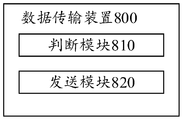
- the data transmission device 800 includes a judgment module 810 and a transmission module 820. Among them, the data transmission device 800 may be provided at the base station side.
- the network server may send a downlink message to the first receiving window by default.
- the determining module 810 may be configured to determine whether the receiving time of the downlink message is greater than the sending time in the downlink message in response to receiving the downlink message sent by the network server.
- the module 820 may be used to send a notification to the network server when the judgment module 810 determines that the reception time is greater than the transmission time. And/or the module 820 may also be used to send the downlink message according to the sending time when the determining module 810 determines that the receiving time is less than or equal to the sending time, for example, the sending of the downlink message at the sending time.
- the data transmission device 900 includes a first sending module 910 and a second sending module 920. Among them, the data transmission device 900 may be provided on the network server side.
- the first sending module 910 may first send the downlink message for the first receiving window to the downstream base station.
- the second sending module 920 may be configured to send a downlink message for the second receiving window to the downstream base station in response to receiving the notification sent by the downlink base station, where the notification is that the base station receives the downlink message for a longer time than the downlink report It is sent in the case of sending time in the text.
- the data transmission device 900 may determine whether the downlink message corresponding to the notification is for Rx1 or Rx2. If the downlink message corresponding to the notification is for Rx1, the data transmission device 900 may send the downlink message for Rx2 to the downstream base station. If the downlink message corresponding to the notification is for Rx2, the data transmission device 900 may discard, that is, no further downlink message is sent.
- the data transmission device 900 may also determine whether the node can receive the downlink message in the second reception window. For example, the data transmission device 900 may make a judgment based on the link transmission delay of the downlink base station and the processing delay of the network server. Wherein, the processing delay mentioned here refers to the time taken from receiving the upstream message to preparing to send the downstream message for the second receiving window.
- the specific judgment formula can refer to the relevant description above, and will not be repeated here.
- the base station will only send the downlink message once, and at the same time, it can avoid the massive use of Rx2, improve the success rate of the downlink data packet, and can reduce the collision rate of the downlink data packet.
- FIG. 9 shows a schematic structural diagram of a computing device that can be used to implement the above data transmission method according to an embodiment of the present invention.
- the computing device 1000 includes a memory 1010 and a processor 1020.
- the processor 1020 may be a multi-core processor, or may include multiple processors.
- the processor 1020 may include a general-purpose main processor and one or more special coprocessors, such as a graphics processor (GPU), a digital signal processor (DSP), and so on.
- the processor 1020 may be implemented using a customized circuit, such as an application specific integrated circuit (ASIC, Application Integrated Circuit) or field programmable logic gate array (FPGA, Field Programmable Gate Arrays).
- ASIC application specific integrated circuit
- FPGA Field Programmable Gate Arrays
- the memory 1010 may include various types of storage units, such as system memory, read-only memory (ROM), and permanent storage devices.
- the ROM may store static data or instructions required by the processor 1020 or other modules of the computer.
- the permanent storage device may be a readable and writable storage device.
- the permanent storage device may be a non-volatile storage device that does not lose stored instructions and data even after the computer is powered off.
- the permanent storage device uses a mass storage device (eg, magnetic or optical disk, flash memory) as the permanent storage device.
- the permanent storage device may be a removable storage device (for example, a floppy disk or an optical drive).
- the system memory may be a readable and writable storage device or a volatile readable and writable storage device, such as dynamic random access memory.
- the system memory can store some or all instructions and data required by the processor during operation.
- the memory 1010 may include any combination of computer-readable storage media, including various types of semiconductor memory chips (DRAM, SRAM, SDRAM, flash memory, programmable read-only memory), magnetic disks, and/or optical disks.
- the memory 1010 may include readable and/or writeable removable storage devices, such as compact discs (CDs), read-only digital versatile discs (eg, DVD-ROM, dual-layer DVD-ROM), Read-only Blu-ray discs, ultra-density discs, flash memory cards (such as SD cards, min SD cards, Micro-SD cards, etc.), magnetic floppy disks, etc.
- CDs compact discs
- DVD-ROM read-only digital versatile discs
- dual-layer DVD-ROM Read-only Blu-ray discs
- ultra-density discs such as SD cards, min SD cards, Micro-SD cards, etc.
- flash memory cards such as SD cards, min SD cards, Micro-SD cards, etc.
- magnetic floppy disks etc.
- the computer-readable storage medium does not contain carrier waves and instantaneous electronic signals transmitted through wireless or wired.
- Executable code is stored on the memory 1010.
- the processor 1020 can be caused to execute the data transmission method mentioned above.
- the method according to the present disclosure may also be implemented as a computer program or computer program product including computer program code instructions for performing the above steps defined in the above-described method of the present disclosure.
- the present disclosure may also be implemented as a non-transitory machine-readable storage medium (or computer-readable storage medium, or machine-readable storage medium) on which executable code (or computer program, or computer instruction code) is stored ), when the executable code (or computer program, or computer instruction code) is executed by the processor of the electronic device (or computing device, server, etc.), the processor is caused to perform each step of the above method according to the present invention .
- each block in the flowchart or block diagram may represent a module, program segment, or part of code that contains one or more of the Executable instructions.
- the functions noted in the block may occur out of the order noted in the figures. For example, two consecutive blocks can actually be executed substantially in parallel, and sometimes they can also be executed in reverse order, depending on the functions involved.
- each block in the block diagrams and/or flowcharts, and combinations of blocks in the block diagrams and/or flowcharts can be implemented with dedicated hardware-based systems that perform specified functions or operations Or, it can be realized by a combination of dedicated hardware and computer instructions.
Landscapes
- Engineering & Computer Science (AREA)
- Computer Networks & Wireless Communication (AREA)
- Signal Processing (AREA)
- Quality & Reliability (AREA)
- Physics & Mathematics (AREA)
- Electromagnetism (AREA)
- Mobile Radio Communication Systems (AREA)
Abstract
本发明提出了一种数据传输方法、装置、设备及存储介质。在选定下行基站向节点发送针对上行报文的下行报文前,基于下行基站与网络服务器间的链路传输延迟和网络服务器针对上行报文的处理延迟,选择节点的接收窗口,并针对选择的接收窗口发送下行报文。由此,对于工作在ClassA模式的节点,能够自适应地为其下行数据选择合适的接收窗口,从而最大化下行数据包的成功率。
Description
本申请要求2018年12月20日递交的申请号为201811565108.X、发明名称为“数据传输方法、装置、设备及存储介质”的中国专利申请的优先权,其全部内容通过引用结合在本申请中。
本发明涉及数据传输领域,特别是涉及一种数据传输方法、装置、设备及存储介质。
在LoRaWAN中,终端的工作模式分为三种:ClassA、ClassB和ClassC。在ClassA模式中,终端发送完上行数据后,会间隔Rxdelay秒打开Rx1接收窗口,如果在Rx1接收窗口接收到了下行数据,Rx2窗口不会再打开。如果在Rx1窗口未接收到下行数据,一般会在1s后打开Rx2接收窗口。因为Rx2窗口使用固定的扩频因子和频率,如果所有设备的下行都选用Rx2窗口,势必会导致网络的包碰撞率上升,从而降低了下行数据包的成功率。
现有的方案是NS同时给Rx1和Rx2窗口下发相同的指令,如果终端在Rx1窗口接收到了下行指令,Rx2窗口就不会打开,终端不会接收到重复的数据。如果终端在Rx1窗口没有接收到数据,会在1s后开启Rx2接收窗口。NS通过同时给Rx1和Rx2这两个窗口下发相同的指令,保证终端至少在一个窗口能接收到下行指令。这种方式的缺点是基站发送了很多无用的数据包,降低了基站的吞吐率。
发明内容
本发明的一个目的在于提供一种数据传输方案,以解决上述问题。
根据本发明的第一个方面,提供了一种数据传输方法,包括:在选定下行基站向节点发送针对上行报文的下行报文前,基于下行基站与网络服务器间的链路传输延迟和网络服务器针对上行报文的处理延迟,选择节点的接收窗口;针对选择的接收窗口发送下行报文。
可选地,选择节点的接收窗口的步骤包括:基于下行基站与网络服务器间的链路传输延迟和网络服务器针对上行报文的处理延迟,判断节点能够接收到下行报文的接收窗口;根据判断结果,选择接收窗口。
可选地,根据判断结果选择接收窗口的步骤包括:在判定节点的第一接收窗口能够接收到下行报文的情况下,选择第一接收窗口,其中,第一接收窗口为节点发送完上行报文后第一次开启的接收窗口;在判定第一接收窗口无法接收到下行报文,且节点的第二接收窗口能够接收到下行报文的情况下,选择第二接收窗口,其中,第二接收窗口为节点发送完上行报文后第二次开启的接收窗口。
可选地,在tp+2×delta≤Rxdelay的情况下,判定第一接收窗口能够接收到上行报文,或者在tp+2×delta≤Rxdelay-T1的情况下,判定第一接收窗口能够接收到上行报文,在tp+2×delta<Rxdelay+T2的情况下,判定第二接收窗口能够接收到上行报文,或者在tp+2×delta<Rxdelay+T2-T1的情况下,判定第二接收窗口能够接收到上行报文,其中,tp为处理延迟,delta为链路传输延迟,Rxdelay为节点发送完上行报文后开启第一接收窗口的延迟时间,T1为网络延时抖动因子,T2为节点在第一接收窗口结束后开启第二接收窗口的延迟时间,第一接收窗口为节点发送完上行报文后第一次开启的接收窗口,第二接收窗口为节点发送完上行报文后第二次开启的接收窗口。
可选地,该方法还包括:在判定节点没有能够接收到下行报文的接收窗口的情况下,不发送下行报文。
可选地,处理延迟等于网络服务器接收到上行报文到准备通过下行基站向节点发送下行报文之间的时长。
可选地,链路传输延迟是对之前预定时间内确定的下行基站与网络服务器之间的一个或多个链路传输耗时进行统计得到的。
可选地,链路传输延迟是基于滑动平均算法对最近一次确定的下行基站与网络服务器之间的链路传输耗时进行处理得到的。
可选地,该方法还包括:响应于向下行基站发送下行报文,记录第一时间;响应于接收到下行基站针对下行报文的响应消息,记录第二时间;将第二时间与第一时间的差值的二分之一,确定为下行基站与网络服务器之间的链路传输耗时。
可选地,该方法还包括:对预定时间内确定的下行基站与网络服务器之间的一个或多个链路传输耗时进行统计,以得到下行基站与网络服务器之间的链路传输延迟。
根据本发明的第二个方面,还提供了一种数据传输方法,包括:在选定下行基站向节点发送针对上行报文的下行报文前,选择节点的接收窗口;针对选择的接收窗口发送下行报文。
根据本发明的第三个方面,还提供了一种数据传输方法,包括:响应于接收到网络 服务器发送的下行报文,判断下行报文的接收时间是否大于下行报文中的发送时间;在判定接收时间大于发送时间的情况下,向网络服务器发出通知,并且/或者在判定接收时间小于或等于发送时间的情况下,在发送时间发送下行报文。
根据本发明的第四个方面,还提供了一种数据传输方法,包括:向下行基站发送针对第一接收窗口的下行报文;响应于接收到下行基站发送的通知,向下行基站发送针对第二接收窗口的下行报文,其中,通知是基站在接收到下行报文的接收时间大于该下行报文中的发送时间的情况下发出的,第一接收窗口为节点发送完上行报文后第一次开启的接收窗口,第二接收窗口为节点发送完上行报文后第二次开启的接收窗口。
可选地,向下行基站发送针对第二接收窗口的下行报文的步骤包括:判断节点能否在第二接收窗口接收到下行报文;在判定节点能够在第二接收窗口接收到下行报文的情况下,向下行基站发送针对第二接收窗口的下行报文。
根据本发明的第五个方面,还提供了一种数据传输装置,包括:接收窗口选择模块,用于在选定下行基站向节点发送针对上行报文的下行报文前,基于下行基站与网络服务器间的链路传输延迟和网络服务器针对上行报文的处理延迟,选择节点的接收窗口;发送模块,用于针对选择的接收窗口发送下行报文。
根据本发明的第六个方面,还提供了一种数据传输装置,包括:接收窗口选择模块,用于在选定下行基站向节点发送针对上行报文的下行报文前,选择节点的接收窗口;发送模块,用于针对选择的接收窗口发送下行报文。
根据本发明的第七个方面,还提供了一种数据传输装置,包括:判断模块,用于响应于接收到网络服务器发送的下行报文,判断下行报文的接收时间是否大于下行报文中的发送时间;发送模块,用于在判定接收时间大于发送时间的情况下,向网络服务器发出通知,并且/或者在判定接收时间小于或等于发送时间的情况下,在发送时间发送下行报文。
根据本发明的第八个方面,还提供了一种数据传输装置,包括:第一发送模块,用于向下行基站发送针对第一接收窗口的下行报文;第二发送模块,用于响应于接收到下行基站发送的通知,向下行基站发送针对第二接收窗口的下行报文,其中,通知是基站在接收到下行报文的接收时间大于该下行报文中的发送时间的情况下发出的,第一接收窗口为节点发送完上行报文后第一次开启的接收窗口,第二接收窗口为节点发送完上行报文后第二次开启的接收窗口。
根据本发明的第九个方面,还提供了一种计算设备,包括:处理器;以及存储器, 其上存储有可执行代码,当可执行代码被处理器执行时,使处理器执行如本发明第一个方面至第四个方面中任一个方面述及的方法。
根据本发明的第十个方面,还提供了一种非暂时性机器可读存储介质,其上存储有可执行代码,当可执行代码被电子设备的处理器执行时,使处理器执行如本发明第一个方面至第四个方面中任一个方面述及的方法。
本发明能够自适应地为工作在ClassA模式的节点的下行数据选择合适的接收窗口,从而最大化下行数据包的成功率。
通过结合附图对本公开示例性实施方式进行更详细的描述,本公开的上述以及其它目的、特征和优势将变得更加明显,其中,在本公开示例性实施方式中,相同的参考标号通常代表相同部件。
图1示出了节点在ClassA模式下发送上行数据、NS处理上行数据包以及发送下行指令的时序图。
图2示出了根据本发明一实施例的数据传输方法的示意性流程图;
图3示出了根据本发明另一实施例的数据传输方法的示意性流程图;
图4示出了根据本发明另一实施例的数据传输方法的示意性流程图;
图5示出了根据本发明另一实施例的数据传输方法的示意性流程图;
图6示出了根据本发明另一实施例的数据传输装置的结构的示意性方框图;
图7示出了根据本发明另一实施例的数据传输装置的结构的示意性方框图;
图8示出了根据本发明另一实施例的数据传输装置的结构的示意性方框图;
图9示出了根据本发明一实施例的计算设备的结构示意图。
下面将参照附图更详细地描述本公开的优选实施方式。虽然附图中显示了本公开的优选实施方式,然而应该理解,可以以各种形式实现本公开而不应被这里阐述的实施方式所限制。相反,提供这些实施方式是为了使本公开更加透彻和完整,并且能够将本公开的范围完整地传达给本领域的技术人员。
【术语解释】
LoRa:一种基于扩频技术的低功耗远距离无线传输方案。
LoRaWAN:LoRa联盟推出的一个基于开源的MAC层协议的低功耗广域网(Low Power Wide Area Network,LPWAN)标准。这一技术可以为电池供电的无线设备提供一个低功耗、可扩展的长距离无线网络。
NS:Network Server,网络服务器,是物联网解决方案中的核心部分-核心网。
基站:也即网关,将节点(也即终端)的无线网络信号通过回传网络,透传到NS的设备。
下行基站:用于向节点发送下行报文的基站,由NS指定。
Rx1:终端上行数据后开启的第一个接收窗口,也即本发明述及的第一接收窗口。
Rx2:终端上行数据后开启的第二个接收窗口,也即本发明述及的第二接收窗口。
Rxdelay:终端发送完上行数据包后,开启Rx1窗口的延迟时间。
Rxpk:上行报文,即基站上传给NS的数据报文。
Txpk:下行报文,即NS下行给基站的数据报文。
在现有的方案中,对于工作在ClassA模式中的节点,NS在向其发送下行数据包时,会无差别地针对Rx1和Rx2下发相同的指令,使得基站发送了很多无用的数据包,降低了基站的吞吐率。
有鉴于此,本发明提出,在选定下行基站向节点发送针对上行报文的下行报文前,可以选择节点的接收窗口。例如,可以根据基站与网络服务器间的链路传输延迟和网络服务器针对上行报文的处理延迟,判断节点的哪个接收窗口能够接收到下行报文。在Rx1和Rx2均能够接收到下行报文时,可以优选Rx1,针对Rx1发送下行报文。在Rx1可能会错过,但Rx2能够接收到下行报文时,选择Rx2,针对Rx2发送下行报文。由此,可以保证下行报文只会发送一次,同时可以避免Rx2的大量使用,提高下行数据包的成功率,并可以降低下行数据包的碰撞率。
本发明还提出,网络服务器在发送下行报文时,可以默认发送针对Rx1的下行报文。基站在接收到下行报文后,可以判断下行报文的接收时间是否大于下行报文中的发送时间,在判定接收时间小于或等于发送时间的情况下,可以在发送时间发送下行报文,在判定接收时间大于发送时间的情况下,可以向网络服务器发出通知。网络服务器在接收到通知后,如果发现该通知是下行基站针对Rx1的下行报文发出的,可以向下行基站发送针对Rx2的下行报文,如果发现该通知是下行基站针对Rx2的下行报文发出的,则丢弃。如此,也可以保证基站只会发送一次下行报文,同时可以避免Rx2的大量使用,提高下行数据包的成功率,并可以降低下行数据包的碰 撞率。
下面就本发明涉及的各方面做进一步说明。
图1示出了节点在ClassA模式下发送上行数据、NS处理上行数据包以及发送下行指令的时序图。根据时序图可以对Rx1窗口或者Rx2窗口的选择依据进行分析。
1、节点在t(ref1)时刻开始发送上行数据,无线数据帧经过时延t1到达基站,基站开始接收数据包。
2、节点在t(ref2)时刻发送完上行数据包,并从t(ref2)时刻开始计时。
3、基站在t(ref2)+t1时刻接收完整个上行数据包,并记录下当前时刻为tmst1。
4、基站接收完数据包后,将上行数据包组装成rxpk,发送给NS。rxpk经链路传输延迟t2到达NS。
5、NS接收到上行数据包后,回复基站一个ack响应,然后开始处理上行数据包。
6、上行数据包处理完成之后,如果有下行指令,NS组装下行的txpk,在txpk中指定基站需要发送下行数据包给节点的时刻tmst2。然后把txpk发送给基站。
7、假定基站在t(ref3)时刻接收到txpk,回复NS一个ack响应,然后在tmst2时刻将下行数据包发送给终端。为了数据包正常发送,要求t(ref3)<tmst2。
8、节点从t(ref2)时刻开始计时,延迟Rxdelay后开启Rx1窗口,如果期间未接收到下行数据,1s后开启Rx2接收窗口。假定节点开启窗口的时间为t(ref4),那么在开启Rx1接收窗口时,t(ref4)=t(ref2)+Rxdelay,在开启Rx2接收窗口时,t(ref4)=t(ref2)+Rxdelay+1。
9、假定节点需要在Rx1窗口接收到下行数据,为了保证基站发送的数据报文能够被节点接收到,tmst2=t(ref4)-t1。因此可以得到tmst2=tmst1-2*t1+Rxdelay。
10、由于无线帧以光速传输,t1可以忽略不计。比如假定基站与节点之间的距离是5公里,那么t1只有16.6ns,而窗口的开启误差在+/-20ms,因此可以忽略。最终tmst2=tsmt1+Rxdelay。
11、最终可以分析出:t(ref3)-tmst1<tmst2-tmst1=Rxdelay。而t(ref3)-tmst1=2*t2+t3,即2*t2+t3<Rxdelay。
通过以上分析可以得到如下结论:Rx1和Rx2的选择依据,只与基站和NS间的链路传输耗时以及NS的处理耗时有关,与下行信号的扩频因子、数据包长度等因素无关。
【数据传输方法】
图2是示出了根据本发明一实施例的数据传输方法的示意性流程图。其中,图2所示的方法可以由网络服务器(NS)执行。
参见图2,在步骤S210,在选定下行基站向节点发送针对上行报文的下行报文前,基于下行基站与网络服务器间的链路传输延迟和网络服务器针对上行报文的处理延迟,选择节点的接收窗口。
本发明述及的节点主要是指工作在ClassA模式的节点。网络服务器在接收到节点通过一个或多个基站发送的上行报文后,可以基于特定的处理逻辑(如上行报文的排重处理逻辑)对上行报文进行处理,并在需要向节点发送下行报文时,选择用于向节点发送下行报文的基站(即下行基站)。关于下行基站的选取逻辑,不在本发明的考虑范围内,不再赘述。
在网络服务器选定下行基站向节点发送针对上行报文的下行报文前,可以根据下行基站与网络服务器间的链路传输延迟和网络服务器针对上行报文的处理延迟,选择节点的接收窗口。
在本发明中,处理延迟可以表征网络服务器针对上行报文的处理耗时,例如,处理延迟可以等于网络服务器接收到上行报文到准备通过下行基站向节点发送下行报文之间的时长。
链路传输延迟可以表征基站和NS间的链路传输耗时。可选地,可以将最近一次确定的下行基站与网络服务器之间的链路传输耗时(也即图1中的t2)作为链路传输延迟。另外,链路传输延迟也可以是对之前预定时间内确定的下行基站与网络服务器之间的一个或多个链路传输耗时进行统计得到的。例如,可以是通过平均、加权平均、tp99、tp999等方法确定的。
作为示例,链路传输延迟可以是基于滑动平均算法对最近一次确定的下行基站与网络服务器之间的链路传输耗时进行处理得到的。计算公式如下:delta′(t)=alpha*delta+(1-alpha)*delta′(t-1),其中alpha是系数,取值范围0~1,delta是最近一次确定的基站与网络服务器之间的链路传输耗时,delta′(t)是当前计算得到的链路传输耗时的预测值,delta′(t-1)是上一次计算得到的链路传输耗时的预测值。
可以根据下行基站与网络服务器间的链路传输延迟和网络服务器针对上行报文的处理延迟,判断节点能够接收到上行报文的接收窗口,然后根据判断结果,选择接收窗口。例如,在判定节点的第一接收窗口(Rx1)能够接收到下行报文的情况下, 可以选择第一接收窗口。在判定第一接收窗口无法接收到下行报文,且节点的第二接收窗口(Rx2)能够接收到下行报文的情况下,可以选择第二接收窗口。换言之,可以在判定第一接收窗口可用的情况下,优选第一接收窗口,在第一接收窗口可能无法接收到下行报文的情况下,再选择第二接收窗口。由此,可以保证下行数据只会发送一次。同时避免了大量使用第二接收窗口,降低了下行数据包的碰撞率。
如上文结合图1进行分析得到的结论可知,可以在tp+2×delta≤Rxdelay的情况下,判定第一接收窗口能够接收到上行报文,在tp+2×delta>Rxdelay的情况下,判定第一接收窗口不能接收到上行报文。也可以在tp+2×delta<Rxdelay+T
2的情况下,判定第二接收窗口能够接收到上行报文,在tp+2×delta≥Rxdelay+T
2的情况下,判定第二接收窗口不能接收到上行报文。其中,tp为处理延迟,delta为链路传输延迟,Rxdelay为节点发送完上行报文后开启第一接收窗口的延迟时间,T
2为节点在第一接收窗口结束后开启第二接收窗口的延迟时间,一般情况下T
2为1s。
需要说明的是,对于本发明述及的各种用于判断接收窗口(Rx1、Rx2)能否接收到下行报文的判断公式,在判断公式为等式时接收窗口能否接收到下行报文的判定,可以根据实际情况设定,在判断公式的等式情形成立时,可以判定接收窗口能够接收到下行报文,也可以判定接收窗口不能接收到下行报文,对此本发明不做严格限定。
另外,在判断节点能够接收到下行报文的接收窗口时,也可以将网络抖动等因素考虑在内。例如,可以在tp+2×delta≤Rxdelay-T
1的情况下,判定第一接收窗口能够接收到上行报文,在tp+2×delta>Rxdelay-T
1的情况下,判定第一接收窗口不能接收到上行报文。其中,T
1是抖动因子,可以设置成常数,也可以根据网络延时抖动情况设置。再例如,也可以在tp+2×delta<Rxdelay+T
2-T
1的情况下,判定第二接收窗口能够接收到上行报文,在tp+2×delta≥Rxdelay+T
2-T
1的情况下,判定第二接收窗口不能接收到上行报文。
在步骤S220,针对选择的接收窗口发送下行报文。
由此,本发明可以实时地根据网络运行环境,自适应地为需要向ClassA模式的节点发送的下行数据选择合适的接收窗口,从而最大化下行数据包的成功率。
进一步地,在向下行基站发送下行报文后,可以记录当前时间(为了便于区分,可以称为“第一时间”)。下行基站在接收到下行报文后,会向网络服务器发送一个响应消息,以通知网络服务器其已经成功接收到下行报文。响应于接收到下行基 站针对所述下行报文的响应消息,可以记录此时的时间(为了便于区分,可以称为“第二时间”)。根据上文结合图1的描述可知,第二时间与第一时间的差值的二分之一,即为本次下行基站与所述网络服务器之间的链路传输耗时。
在得到本次下行基站与网络服务器之间的链路传输耗时后,可以将该链路传输耗时作为基站与网络服务器之间的链路传输延迟,也可以基于滑动平均算法来对链路传输耗时进行处理,以得到基站与网络服务器之间的链路传输延迟。本次得到的链路传输延迟可以用于在下次选择节点的接收窗口时使用。
图3是示出了根据本发明一实施例的数据传输方法的示意性流程图。其中,图3所示的方法可以由网络服务器(NS)执行。
参见图3,在步骤S311,接收到基站发送的上行报文。
在步骤S312,记录当前时间t_start。
当前时间t_start用于作为后续计算网络服务器的处理延时的开始时间。节点发送的上行报文可以被一个或多个基站接收到,并通过这一个或多个基站上传到网络服务器。因此,针对节点发送的同一上行报文,网络服务器可以接收到来自多个基站的多个重复上行报文。如果不考虑接收到来自不同基站的重复上行报文的时间差,可以响应于首次接收到基站发送的上行报文,记录当前时间。如果对时间精度要求较高,每次接收到基站发送的上行报文时,都可以记录一次时间,并在选定下行基站后,将接收到选定的下行基站发送的上行报文对应的时间作为当前时间t_start。
在步骤S313,回复ack响应。这里主要是向发送上行报文的基站回复ack确认消息。
在步骤S314,处理上行报文。这里主要是从多个重复上行报文中选择一个上行报文进行处理,关于上行报文的具体处理逻辑,本发明不做限定,此处不再赘述。
在步骤S315,判断是否需要发送下行报文。这里可以根据步骤S314的处理结果,进行判断。例如,在存在下行指令或者上行报文需要发送ack响应的情况下,可以判定需要发送下行报文。
在不需要发送下行报文的情况下,本次处理流程结束。在需要发送下行报文的情况下,在步骤S316,选择下行基站。这里主要是选择用于向节点发送下行报文的基站。关于下行基站的选取逻辑,本发明不做限定,此处不再赘述。
在步骤S317,获取链路传输延迟delta。这里主要是获取所选定的下行基站的 链路传输延迟。其中,链路传输延迟delta可以是预先计算好的。
在步骤S318,记录当前时间t_end。
当前时间t_end用于作为计算网络服务器的处理延时的结束时间。(t_end-t_start)即为网络服务器的处理延时。
在步骤S319,选择接收窗口。
这里可以根据网络服务器的处理延时(t_end-t_start)和下行基站的链路传输延迟delta,判断节点能够接收到下行报文的接收窗口。具体的判断方式可以参见上文相关描述,此处不再赘述。
在步骤S320,组装下行报文。关于下行报文的组装逻辑不再赘述。
在步骤S321,记录当前时间t_send,并发送下行报文。
在步骤S322,接收到来自下行基站的响应,并记录当前时间t_recv。
在步骤S323,计算本次链路传输耗时。本次下行基站的链路传输耗时可以记为:

在步骤S324,获取基站在预定时间内的所有链路传输耗时,并进行统计处理,以得到基站的链路传输延时。关于统计处理的实现过程,可以参见上文描述,此处不再赘述。
在步骤S325,保存计算结果。所保存的链路传输延迟可以在下次该基站作为下行基站的情况下选择节点的接收窗口时使用。
图4示出了根据本发明另一实施例的数据传输方法的示意性流程图。其中,图4所示的方法可以由基站执行。
参见图4,在步骤S410,响应于接收到网络服务器发送的下行报文,判断下行报文的接收时间是否大于下行报文中的发送时间。
在步骤S420,在判定接收时间大于发送时间的情况下,向网络服务器发出通知,并且/或者在判定接收时间小于或等于发送时间的情况下,在发送时间发送下行报文。
本发明述及的节点主要是指工作在ClassA模式的节点。网络服务器在接收到节点通过一个或多个基站发送的上行报文后,可以基于特定的处理逻辑(如上行报文的排重处理逻辑)对上行报文进行处理,并在需要向节点发送下行报文时,选择用于向节点发送下行报文的基站(即下行基站)。关于下行基站的选取逻辑,不在本 发明的考虑范围内,不再赘述。
在本实施例中,网络服务器在发送下行报文时,可以默认发送针对第一接收窗口的下行报文,所发送的下行报文中包括需要下行基站发送该下行报文的时间(即本发明述及的发送时间)。其中,针对第一接收窗口的下行报文中的发送时间可以是网络服务器根据节点发送完上行数据包后开启Rx1窗口的延迟时间设定的,针对第二接收窗口的下行报文中的发送时间可以是网络服务器根据节点发送完上行数据包后开启Rx2窗口的延迟时间设定的。
响应于接收到网络服务器发送的下行报文后,基站可以判断接收到下行报文时的时间(即本发明述及的接收时间)是否大于该下行报文中的发送时间。在接收时间大于发送时间的情况下,表明该下行报文无法被节点正常接收,可以向网络服务器发出通知。在接收时间小于或等于发送时间的情况下,表明该下行报文可以被节点正常接收,此时可以依据发送时间发送下行报文,如可以在发送时间发送下行报文。
图5示出了根据本发明另一实施例的数据传输方法的示意性流程图。其中,图5所示的方法可以由网络服务器执行。
参见图5,在步骤S510,向下行基站发送针对第一接收窗口的下行报文。
本发明述及的节点主要是指工作在ClassA模式的节点。网络服务器在接收到节点通过一个或多个基站发送的上行报文后,可以基于特定的处理逻辑(如上行报文的排重处理逻辑)对上行报文进行处理,并在需要向节点发送下行报文时,选择用于向节点发送下行报文的基站(即下行基站)。关于下行基站的选取逻辑,不在本发明的考虑范围内,不再赘述。
在本实施例中,网络服务器在发送下行报文时,可以默认发送针对第一接收窗口的下行报文。
在步骤S520,响应于接收到下行基站发送的通知,向下行基站发送针对第二接收窗口的下行报文。
下行基站在接收到网络服务器发送的下行报文后,可以执行图4所示的方法来判断是向网络服务器发送通知,还是发送下行报文。可选地,在接收到下行基站发送的通知后,可以判断该通知对应的下行报文是针对Rx1的,还是针对Rx2的。如果该通知对应的下行报文是针对Rx1的,网络服务器可以向下行基站发送针对Rx2的下行报文。如果该通知对应的下行报文是针对Rx2的,网络服务器可以丢弃,即 不再发送下行报文。
作为示例,响应于接收到通知,网络服务器还可以判断节点能否在第二接收窗口接收到下行报文。例如,网络服务器可以根据下行基站的链路传输延迟和网络服务器的处理延迟进行判断。其中,此处述及的处理延迟是指从接收到上行报文到准备发送针对第二接收窗口的下行报文之间的耗时。具体的判断公式可以参见上文相关描述,此处不再赘述。
由此,也可以保证基站只会发送一次下行报文,同时可以避免Rx2的大量使用,提高下行数据包的成功率,并可以降低下行数据包的碰撞率。
【数据传输装置】
图6至图8示出了根据本发明在不同实施例的数据传输装置的结构的示意性方框图。其中,数据传输装置的功能模块可以由实现本发明原理的硬件、软件或硬件和软件的结合来实现。本领域技术人员可以理解的是,图6至图8中各个附图所描述的功能模块可以组合起来或者划分成子模块,从而实现上述发明的原理。因此,本文的描述可以支持对本文描述的功能模块的任何可能的组合、或者划分、或者更进一步的限定。
下行数据传输装置可以具有的功能模块以及各功能模块可以执行的操作做简要说明,对于其中涉及的细节部分可以参见上文描述,这里不再赘述。
参见图6,数据传输装置700包括接收窗口选择模块710和发送模块720。其中,数据传输装置700可以设置在网络服务器端。
接收窗口选择模块710用于在选定下行基站向节点发送针对上行报文的下行报文前,选择节点的接收窗口。例如,接收窗口选择模块710可以基于下行基站与网络服务器间的链路传输延迟和网络服务器针对上行报文的处理延迟,选择节点的接收窗口。
作为本发明的一个示例,接收窗口选择模块710可以包括判断模块和选择子模块。判断模块可以基于下行基站与网络服务器间的链路传输延迟和网络服务器针对上行报文的处理延迟,判断节点能够接收到下行报文的接收窗口。选择子模块可以根据判断结果,选择接收窗口。例如,选择子模块可以在判断模块判定节点的第一接收窗口能够接收到下行报文的情况下,选择第一接收窗口。在判断模块判定第一接收窗口无法接收到下行报文,且节点的第二接收窗口能够接收到下行报文的情况下,选择子模块可以选择第二接收窗口。关于具体的判断依据,可以参见上文相关 描述,此处不再赘述。
发送模块720用于针对选择的接收窗口发送下行报文。可选地,在判定节点没有能够接收到下行报文的接收窗口的情况下,发送模块720不发送下行报文。
作为本发明的一个示例,数据传输装置700还可以包括第一记录模块、第二记录模块以及计算模块。第一记录模块用于响应于向下行基站发送下行报文,记录第一时间。第二记录模块用于响应于接收到下行基站针对下行报文的响应消息,记录第二时间。计算模块用于将第二时间与第一时间的差值的二分之一,确定为下行基站与网络服务器之间的链路传输耗时。
作为本发明的一个示例,数据传输装置700还可以包括统计模块,用于对预定时间内确定的下行基站与网络服务器之间的一个或多个链路传输耗时进行统计,以得到下行基站与网络服务器之间的链路传输延迟。
参见图7,数据传输装置800包括判断模块810和发送模块820。其中,数据传输装置800可以设置在基站端。
在本实施例中,网络服务器在需要向节点发送下行报文时,可以默认针对第一接收窗口发送下行报文。判断模块810可以用于响应于接收到网络服务器发送的下行报文,判断所述下行报文的接收时间是否大于所述下行报文中的发送时间。模块820可以用于在判断模块810判定接收时间大于发送时间的情况下,向网络服务器发出通知。并且/或者模块820也可以用于在判断模块810判定接收时间小于或等于发送时间的情况下,根据发送时间发送下行报文,如可以在发送时间发送下行报文。
参见图8,数据传输装置900包括第一发送模块910和第二发送模块920。其中,数据传输装置900可以设置在网络服务器端。
在本实施例中,在需要向节点发送下行报文时,可以首先由第一发送模块910向下行基站发送针对第一接收窗口的下行报文。第二发送模块920可以用于响应于接收到下行基站发送的通知,向下行基站发送针对第二接收窗口的下行报文,其中,通知是基站在接收到下行报文的接收时间大于该下行报文中的发送时间的情况下发出的。
作为示例,在接收到下行基站发送的通知后,数据传输装置900可以判断该通知对应的下行报文是针对Rx1的,还是针对Rx2的。如果该通知对应的下行报文是针对Rx1的,数据传输装置900可以向下行基站发送针对Rx2的下行报文。如果该通知对应的下行报文是针对Rx2的,数据传输装置900可以丢弃,即不再发送下行 报文。
作为示例,响应于接收到通知,数据传输装置900还可以判断节点能否在第二接收窗口接收到下行报文。例如,数据传输装置900可以根据下行基站的链路传输延迟和网络服务器的处理延迟进行判断。其中,此处述及的处理延迟是指从接收到上行报文到准备发送针对第二接收窗口的下行报文之间的耗时。具体的判断公式可以参见上文相关描述,此处不再赘述。
由此,也可以保证基站只会发送一次下行报文,同时可以避免Rx2的大量使用,提高下行数据包的成功率,并可以降低下行数据包的碰撞率。
【计算设备】
图9示出了根据本发明一实施例可用于实现上述数据传输方法的计算设备的结构示意图。
参见图9,计算设备1000包括存储器1010和处理器1020。
处理器1020可以是一个多核的处理器,也可以包含多个处理器。在一些实施例中,处理器1020可以包含一个通用的主处理器以及一个或多个特殊的协处理器,例如图形处理器(GPU)、数字信号处理器(DSP)等等。在一些实施例中,处理器1020可以使用定制的电路实现,例如特定用途集成电路(ASIC,Application Specific Integrated Circuit)或者现场可编程逻辑门阵列(FPGA,Field Programmable Gate Arrays)。
存储器1010可以包括各种类型的存储单元,例如系统内存、只读存储器(ROM),和永久存储装置。其中,ROM可以存储处理器1020或者计算机的其他模块需要的静态数据或者指令。永久存储装置可以是可读写的存储装置。永久存储装置可以是即使计算机断电后也不会失去存储的指令和数据的非易失性存储设备。在一些实施方式中,永久性存储装置采用大容量存储装置(例如磁或光盘、闪存)作为永久存储装置。另外一些实施方式中,永久性存储装置可以是可移除的存储设备(例如软盘、光驱)。系统内存可以是可读写存储设备或者易失性可读写存储设备,例如动态随机访问内存。系统内存可以存储一些或者所有处理器在运行时需要的指令和数据。此外,存储器1010可以包括任意计算机可读存储媒介的组合,包括各种类型的半导体存储芯片(DRAM,SRAM,SDRAM,闪存,可编程只读存储器),磁盘和/或光盘也可以采用。在一些实施方式中,存储器1010可以包括可读和/或写的可移除的存储设备,例如激光唱片(CD)、只读数字多功能光盘(例如DVD-ROM,双层DVD-ROM)、 只读蓝光光盘、超密度光盘、闪存卡(例如SD卡、min SD卡、Micro-SD卡等等)、磁性软盘等等。计算机可读存储媒介不包含载波和通过无线或有线传输的瞬间电子信号。
存储器1010上存储有可执行代码,当可执行代码被处理器1020处理时,可以使处理器1020执行上文述及的数据传输方法。
上文中已经参考附图详细描述了根据本公开的数据传输方法、装置及计算设备。
此外,根据本公开的方法还可以实现为一种计算机程序或计算机程序产品,该计算机程序或计算机程序产品包括用于执行本公开的上述方法中限定的上述各步骤的计算机程序代码指令。
或者,本公开还可以实施为一种非暂时性机器可读存储介质(或计算机可读存储介质、或机器可读存储介质),其上存储有可执行代码(或计算机程序、或计算机指令代码),当所述可执行代码(或计算机程序、或计算机指令代码)被电子设备(或计算设备、服务器等)的处理器执行时,使所述处理器执行根据本发明的上述方法的各个步骤。
本领域技术人员还将明白的是,结合这里的公开所描述的各种示例性逻辑块、模块、电路和算法步骤可以被实现为电子硬件、计算机软件或两者的组合。
附图中的流程图和框图显示了根据本公开的多个实施例的系统和方法的可能实现的体系架构、功能和操作。在这点上,流程图或框图中的每个方框可以代表一个模块、程序段或代码的一部分,所述模块、程序段或代码的一部分包含一个或多个用于实现规定的逻辑功能的可执行指令。也应当注意,在有些作为替换的实现中,方框中所标记的功能也可以以不同于附图中所标记的顺序发生。例如,两个连续的方框实际上可以基本并行地执行,它们有时也可以按相反的顺序执行,这依所涉及的功能而定。也要注意的是,框图和/或流程图中的每个方框、以及框图和/或流程图中的方框的组合,可以用执行规定的功能或操作的专用的基于硬件的系统来实现,或者可以用专用硬件与计算机指令的组合来实现。
以上已经描述了本公开的各实施例,上述说明是示例性的,并非穷尽性的,并且也不限于所披露的各实施例。在不偏离所说明的各实施例的范围和精神的情况下,对于本技术领域的普通技术人员来说许多修改和变更都是显而易见的。本文中所用术语的选择,旨在最好地解释各实施例的原理、实际应用或对市场中的技术的改进,或者使本技术领域的其它普通技术人员能理解本文披露的各实施例。
Claims (20)
- 一种数据传输方法,其特征在于,包括:在选定下行基站向节点发送针对上行报文的下行报文前,基于所述下行基站与网络服务器间的链路传输延迟和所述网络服务器针对所述上行报文的处理延迟,选择所述节点的接收窗口;针对选择的接收窗口发送所述下行报文。
- 根据权利要求1所述的数据传输方法,其特征在于,所述选择所述节点的接收窗口的步骤包括:基于所述下行基站与网络服务器间的链路传输延迟和所述网络服务器针对所述上行报文的处理延迟,判断所述节点能够接收到所述下行报文的接收窗口;根据判断结果,选择接收窗口。
- 根据权利要求2所述的数据传输方法,其特征在于,所述根据判断结果选择接收窗口的步骤包括:在判定所述节点的第一接收窗口能够接收到所述下行报文的情况下,选择所述第一接收窗口,其中,所述第一接收窗口为所述节点发送完所述上行报文后第一次开启的接收窗口;在判定所述第一接收窗口无法接收到所述下行报文,且所述节点的第二接收窗口能够接收到所述下行报文的情况下,选择所述第二接收窗口,其中,所述第二接收窗口为所述节点发送完所述上行报文后第二次开启的接收窗口。
- 根据权利要求2所述的数据传输方法,其特征在于,在tp+2×delta≤Rxdelay的情况下,判定第一接收窗口能够接收到上行报文,或者在tp+2×delta≤Rxdelay-T1的情况下,判定第一接收窗口能够接收到上行报文,在tp+2×delta<Rxdelay+T2的情况下,判定第二接收窗口能够接收到上行报文,或者在tp+2×delta<Rxdelay+T2-T1的情况下,判定第二接收窗口能够接收到上行报文,其中,tp为所述处理延迟,delta为所述链路传输延迟,Rxdelay为所述节点发送完所述上行报文后开启所述第一接收窗口的延迟时间,T1为网络延时抖动因子,T2为所述节点在所述第一接收窗口结束后开启所述第二接收窗口的延迟时间,所述第一接收窗 口为所述节点发送完所述上行报文后第一次开启的接收窗口,所述第二接收窗口为所述节点发送完所述上行报文后第二次开启的接收窗口。
- 根据权利要求2所述的数据传输方法,其特征在于,还包括:在判定所述节点没有能够接收到所述下行报文的接收窗口的情况下,不发送所述下行报文。
- 根据权利要求1所述的数据传输方法,其特征在于,所述处理延迟等于所述网络服务器接收到所述上行报文到准备通过所述下行基站向节点发送所述下行报文之间的时长。
- 根据权利要求1所述的数据传输方法,其特征在于,所述链路传输延迟是对之前预定时间内确定的所述下行基站与所述网络服务器之间的一个或多个链路传输耗时进行统计得到的。
- 根据权利要求1所述的数据传输方法,其特征在于,所述链路传输延迟是基于滑动平均算法对最近一次确定的所述下行基站与所述网络服务器之间的链路传输耗时进行处理得到的。
- 根据权利要求1所述的数据传输方法,其特征在于,还包括:响应于向所述下行基站发送所述下行报文,记录第一时间;响应于接收到所述下行基站针对所述下行报文的响应消息,记录第二时间;将所述第二时间与所述第一时间的差值的二分之一,确定为所述下行基站与所述网络服务器之间的链路传输耗时。
- 根据权利要求9所述的数据传输方法,其特征在于,还包括:对预定时间内确定的所述下行基站与所述网络服务器之间的一个或多个链路传输耗时进行统计,以得到所述下行基站与网络服务器之间的链路传输延迟。
- 一种数据传输方法,其特征在于,包括:在选定下行基站向节点发送针对上行报文的下行报文前,选择所述节点的接收窗 口;针对选择的接收窗口发送所述下行报文。
- 一种数据传输方法,其特征在于,包括:响应于接收到网络服务器发送的下行报文,判断所述下行报文的接收时间是否大于所述下行报文中的发送时间;在判定所述接收时间大于所述发送时间的情况下,向所述网络服务器发出通知,并且/或者在判定所述接收时间小于或等于所述发送时间的情况下,在所述发送时间发送所述下行报文。
- 一种数据传输方法,其特征在于,包括:向下行基站发送针对第一接收窗口的下行报文;响应于接收到所述下行基站发送的通知,向所述下行基站发送针对第二接收窗口的下行报文,其中,所述通知是所述基站在接收到下行报文的接收时间大于该下行报文中的发送时间的情况下发出的,所述第一接收窗口为节点发送完上行报文后第一次开启的接收窗口,所述第二接收窗口为所述节点发送完上行报文后第二次开启的接收窗口。
- 根据权利要求13所述的数据传输方法,其特征在于,所述向所述下行基站发送针对第二接收窗口的下行报文的步骤包括:判断所述节点能否在第二接收窗口接收到下行报文;在判定所述节点能够在所述第二接收窗口接收到下行报文的情况下,向所述下行基站发送针对所述第二接收窗口的下行报文。
- 一种数据传输装置,其特征在于,包括:接收窗口选择模块,用于在选定下行基站向节点发送针对上行报文的下行报文前,基于所述下行基站与网络服务器间的链路传输延迟和所述网络服务器针对所述上行报文的处理延迟,选择所述节点的接收窗口;发送模块,用于针对选择的接收窗口发送所述下行报文。
- 一种数据传输装置,其特征在于,包括:接收窗口选择模块,用于在选定下行基站向节点发送针对上行报文的下行报文前,选择所述节点的接收窗口;发送模块,用于针对选择的接收窗口发送所述下行报文。
- 一种数据传输装置,其特征在于,包括:判断模块,用于响应于接收到网络服务器发送的下行报文,判断所述下行报文的接收时间是否大于所述下行报文中的发送时间;发送模块,用于在判定所述接收时间大于所述发送时间的情况下,向所述网络服务器发出通知,并且/或者在判定所述接收时间小于或等于所述发送时间的情况下,在所述发送时间发送所述下行报文。
- 一种数据传输装置,其特征在于,包括:第一发送模块,用于向下行基站发送针对第一接收窗口的下行报文;第二发送模块,用于响应于接收到所述下行基站发送的通知,向所述下行基站发送针对第二接收窗口的下行报文,其中,所述通知是所述基站在接收到下行报文的接收时间大于该下行报文中的发送时间的情况下发出的,所述第一接收窗口为节点发送完上行报文后第一次开启的接收窗口,所述第二接收窗口为所述节点发送完上行报文后第二次开启的接收窗口。
- 一种计算设备,包括:处理器;以及存储器,其上存储有可执行代码,当所述可执行代码被所述处理器执行时,使所述处理器执行如权利要求1至14中任何一项所述的方法。
- 一种非暂时性机器可读存储介质,其上存储有可执行代码,当所述可执行代码被电子设备的处理器执行时,使所述处理器执行如权利要求1至14中任一项所述的方法。
Applications Claiming Priority (2)
| Application Number | Priority Date | Filing Date | Title |
|---|---|---|---|
| CN201811565108.X | 2018-12-20 | ||
| CN201811565108.XA CN111356175B (zh) | 2018-12-20 | 2018-12-20 | 数据传输方法、装置、设备及存储介质 |
Publications (1)
| Publication Number | Publication Date |
|---|---|
| WO2020125486A1 true WO2020125486A1 (zh) | 2020-06-25 |
Family
ID=71101046
Family Applications (1)
| Application Number | Title | Priority Date | Filing Date |
|---|---|---|---|
| PCT/CN2019/124231 Ceased WO2020125486A1 (zh) | 2018-12-20 | 2019-12-10 | 数据传输方法、装置、设备及存储介质 |
Country Status (3)
| Country | Link |
|---|---|
| CN (1) | CN111356175B (zh) |
| TW (1) | TW202107931A (zh) |
| WO (1) | WO2020125486A1 (zh) |
Citations (3)
| Publication number | Priority date | Publication date | Assignee | Title |
|---|---|---|---|---|
| WO2018069284A1 (fr) * | 2016-10-13 | 2018-04-19 | Sagemcom Energy & Telecom Sas | Relais dans un systeme de communication de type lpwan |
| CN108235404A (zh) * | 2016-12-22 | 2018-06-29 | 上海未来宽带技术股份有限公司 | 一种无线网络中继的实现方法及系统 |
| WO2018184681A1 (en) * | 2017-04-06 | 2018-10-11 | Nokia Technologies Oy | Controller, device and method for controlling battery-powered device |
Family Cites Families (4)
| Publication number | Priority date | Publication date | Assignee | Title |
|---|---|---|---|---|
| WO2016149924A1 (zh) * | 2015-03-26 | 2016-09-29 | 华为技术有限公司 | Tcp网络代理配置方法和装置 |
| US20170310601A1 (en) * | 2016-04-21 | 2017-10-26 | Qualcomm Incorporated | Radio-aware transmission control protocol rate control |
| US10397821B2 (en) * | 2017-03-07 | 2019-08-27 | Itron Networked Solutions, Inc. | Reduced latency operating modes for wireless mesh networks |
| CN107708199B (zh) * | 2017-09-26 | 2021-01-26 | 南京哈卢信息科技有限公司 | 一种提高低功耗无线蜂窝网下行可靠性的方法 |
-
2018
- 2018-12-20 CN CN201811565108.XA patent/CN111356175B/zh active Active
-
2019
- 2019-08-28 TW TW108130768A patent/TW202107931A/zh unknown
- 2019-12-10 WO PCT/CN2019/124231 patent/WO2020125486A1/zh not_active Ceased
Patent Citations (3)
| Publication number | Priority date | Publication date | Assignee | Title |
|---|---|---|---|---|
| WO2018069284A1 (fr) * | 2016-10-13 | 2018-04-19 | Sagemcom Energy & Telecom Sas | Relais dans un systeme de communication de type lpwan |
| CN108235404A (zh) * | 2016-12-22 | 2018-06-29 | 上海未来宽带技术股份有限公司 | 一种无线网络中继的实现方法及系统 |
| WO2018184681A1 (en) * | 2017-04-06 | 2018-10-11 | Nokia Technologies Oy | Controller, device and method for controlling battery-powered device |
Non-Patent Citations (1)
| Title |
|---|
| EMILIANO SISINNI ET AL.: "Enhanced Flexible LoRaWAN Node for Industrial IoT", 2018 14TH IEEE INTERNATIONAL WORKSHOP ON FACTORY COMMUNICATION SYSTEMS (WFCS), 5 July 2018 (2018-07-05), XP033369586, DOI: 20200115091748A * |
Also Published As
| Publication number | Publication date |
|---|---|
| CN111356175B (zh) | 2022-11-29 |
| TW202107931A (zh) | 2021-02-16 |
| CN111356175A (zh) | 2020-06-30 |
Similar Documents
| Publication | Publication Date | Title |
|---|---|---|
| WO2020108355A1 (zh) | 一种选择prach资源的方法及装置 | |
| US10193779B2 (en) | Apparatus and method for controlling downlink throughput in communication system | |
| CN111200821B (zh) | 一种容量规划方法及装置 | |
| US11832124B2 (en) | Controlling performance of a wireless device in a heterogeneous network | |
| WO2014161268A1 (zh) | 测量信息的保存方法、装置和终端 | |
| US12149423B2 (en) | Methods and arrangements for supporting estimation of latency over a communication path in a communication network | |
| CN106888461B (zh) | 一种弱网络环境的构建方法和设备 | |
| US11175397B2 (en) | Wireless fidelity Wi-Fi ranging method and system, and related device | |
| CN103856303B (zh) | 根据重传次数动态设置节点最小竞争窗口值的方法 | |
| WO2020125485A1 (zh) | 下行基站选择方法、装置、设备及存储介质 | |
| CN110876158A (zh) | LoRa网络状况监测方法、装置、系统、设备及存储介质 | |
| WO2018201318A1 (zh) | 一种信号测量方法及相关设备 | |
| US11611973B2 (en) | User equipment uplink latency in wireless communications | |
| Liu et al. | Towards high performance modeling of the 802.11 wireless protocol | |
| CN112087399B (zh) | LoRa数据传输方法、装置、设备及存储介质 | |
| WO2016058363A1 (zh) | 流量控制方法、装置及基站 | |
| WO2020125486A1 (zh) | 数据传输方法、装置、设备及存储介质 | |
| CN103401792A (zh) | 一种针对移动终端的自适应上传加速装置 | |
| CN114650606A (zh) | 通信设备、媒体接入控制层架构及其实现方法 | |
| CN107484228B (zh) | 一种基于数据流量的大量ap同时上线处理方法 | |
| CN115988517A (zh) | 一种基于5g通讯的自适应网络构建方法 | |
| US20150181456A1 (en) | Frame transmission method and apparatus for controlling one-way delay | |
| CN111356212B (zh) | 数据传输方法、装置、设备及存储介质 | |
| CN114339980A (zh) | 下行数据的同步方法、装置、单元、设备及存储介质 | |
| Zhong et al. | BE-DCF: Barring-enhanced distributed coordination function for machine type communications in IEEE 802.11 networks |
Legal Events
| Date | Code | Title | Description |
|---|---|---|---|
| 121 | Ep: the epo has been informed by wipo that ep was designated in this application |
Ref document number: 19900840 Country of ref document: EP Kind code of ref document: A1 |
|
| NENP | Non-entry into the national phase |
Ref country code: DE |
|
| 122 | Ep: pct application non-entry in european phase |
Ref document number: 19900840 Country of ref document: EP Kind code of ref document: A1 |