WO2020095564A1 - 吸収性物品用の透液性シート - Google Patents
吸収性物品用の透液性シート Download PDFInfo
- Publication number
- WO2020095564A1 WO2020095564A1 PCT/JP2019/038013 JP2019038013W WO2020095564A1 WO 2020095564 A1 WO2020095564 A1 WO 2020095564A1 JP 2019038013 W JP2019038013 W JP 2019038013W WO 2020095564 A1 WO2020095564 A1 WO 2020095564A1
- Authority
- WO
- WIPO (PCT)
- Prior art keywords
- liquid
- fiber
- permeable sheet
- fiber assembly
- woven fabric
- Prior art date
- Legal status (The legal status is an assumption and is not a legal conclusion. Google has not performed a legal analysis and makes no representation as to the accuracy of the status listed.)
- Ceased
Links
Images



Classifications
-
- A—HUMAN NECESSITIES
- A61—MEDICAL OR VETERINARY SCIENCE; HYGIENE
- A61F—FILTERS IMPLANTABLE INTO BLOOD VESSELS; PROSTHESES; DEVICES PROVIDING PATENCY TO, OR PREVENTING COLLAPSING OF, TUBULAR STRUCTURES OF THE BODY, e.g. STENTS; ORTHOPAEDIC, NURSING OR CONTRACEPTIVE DEVICES; FOMENTATION; TREATMENT OR PROTECTION OF EYES OR EARS; BANDAGES, DRESSINGS OR ABSORBENT PADS; FIRST-AID KITS
- A61F13/00—Bandages or dressings; Absorbent pads
- A61F13/15—Absorbent pads, e.g. sanitary towels, swabs or tampons for external or internal application to the body; Supporting or fastening means therefor; Tampon applicators
- A61F13/45—Absorbent pads, e.g. sanitary towels, swabs or tampons for external or internal application to the body; Supporting or fastening means therefor; Tampon applicators characterised by the shape
- A61F13/47—Sanitary towels, incontinence pads or napkins
- A61F13/472—Sanitary towels, incontinence pads or napkins specially adapted for female use
-
- A—HUMAN NECESSITIES
- A61—MEDICAL OR VETERINARY SCIENCE; HYGIENE
- A61F—FILTERS IMPLANTABLE INTO BLOOD VESSELS; PROSTHESES; DEVICES PROVIDING PATENCY TO, OR PREVENTING COLLAPSING OF, TUBULAR STRUCTURES OF THE BODY, e.g. STENTS; ORTHOPAEDIC, NURSING OR CONTRACEPTIVE DEVICES; FOMENTATION; TREATMENT OR PROTECTION OF EYES OR EARS; BANDAGES, DRESSINGS OR ABSORBENT PADS; FIRST-AID KITS
- A61F13/00—Bandages or dressings; Absorbent pads
- A61F13/15—Absorbent pads, e.g. sanitary towels, swabs or tampons for external or internal application to the body; Supporting or fastening means therefor; Tampon applicators
- A61F13/51—Absorbent pads, e.g. sanitary towels, swabs or tampons for external or internal application to the body; Supporting or fastening means therefor; Tampon applicators characterised by the outer layers of the pads
- A61F13/511—Topsheet, i.e. the permeable cover or layer facing the skin
Definitions
- the present invention relates to a liquid permeable sheet for absorbent articles.
- Liquid-permeable topsheets for absorbent articles such as sanitary napkins and disposable diapers allow smooth transfer of discharges such as menstrual blood and urine to the absorbent body, and reversal of liquid once absorbed by the absorbent body. It is required to prevent (rewet).
- Patent Document 1 discloses a low-density fabric having sufficient strength and excellent morphological stability by interlacing a woven fabric and a nonwoven fabric. Further, the low-density fabric of Patent Document 1 has a soft texture and is easy to handle and has an excellent liquid absorbing property due to the fiber material constituting the fabric.
- such a woven and non-woven composite sheet is excellent in liquid permeability, but when a certain amount of liquid permeates the sheet, it becomes difficult for the liquid to be drawn into the sheet, and the liquid is smoothly absorbed. There is a possibility that it will not be transferred to the body and will be diffused to the surface of the sheet. When the liquid is diffused on the surface of the sheet, the user may feel stickiness and the usability may be deteriorated. Further, due to the excellent liquid absorbing property of the sheet, when the liquid tries to return due to body pressure or the like, the sheet tries to draw in the liquid, which may cause the liquid to return to the surface of the sheet.
- the present invention has been made in view of the conventional problems as described above, and an object thereof is to reduce the diffusion of the liquid when the fabric absorbs the liquid, and to absorb and hold the fabric or the absorbent body. Another object of the present invention is to provide a liquid-permeable sheet for absorbent articles that suppresses liquid return of the liquid.
- the main invention for achieving the above-mentioned object is a woven fabric having hydrophobicity, and a non-woven fiber aggregate provided with hydrophilic fibers, wherein some fibers are entangled with the woven fabric.
- the hydrophobicity of the woven fabric causes the liquid to be drawn into the fiber aggregate that is entangled with the fabric without being retained by the fabric, and further propagates through the fiber aggregate. It is quickly transferred to the underlying absorber. Thereby, the liquid is prevented from diffusing on the surface of the fabric.
- the body pressure is applied during wearing and the liquid tries to return, it is difficult to draw in the liquid because the fabric on the most skin side has hydrophobicity, and the liquid return (rewet) can be suppressed.
- a liquid-permeable sheet for a flexible article can be provided.
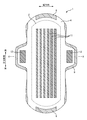
- FIG. 1 is a plan view of the sanitary napkin 1 viewed from the skin side.
- FIG. 2 is a plan view of the sanitary napkin 1 viewed from the non-skin side.
- FIG. 3 is a sectional view taken along line XX of FIG.
- FIG. 4 is a partially enlarged view of the topsheet 3.
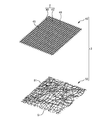
- FIG. 5 is a diagram showing a state in which the topsheet 3 is separated into the woven fabric 40 and the fiber assembly 50.
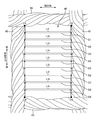
- FIG. 6 is an enlarged view of the portion including the twisted yarns C1 to C4 shown in FIG.
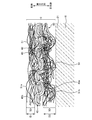
- FIG. 5 is a sectional view taken along the line YY of FIG. 4.
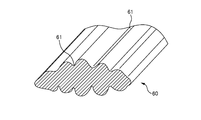
- FIG. 6 is an enlarged view of a fiber 60 in an example of the fiber 51 of the fiber assembly 50.
- Liquid permeability for absorbent articles having a hydrophobic woven fabric and a non-woven fiber aggregate having hydrophilic fibers, in which some of the fibers are entangled with the woven fabric It is a sheet.
- liquid-permeable sheet for absorbent articles since the fabric has hydrophobicity, it becomes difficult to draw in the liquid, and the liquid is guided between the constituent yarns of the fabric. Since the fiber assembly that is entangled with the woven fabric has hydrophilic fibers, the liquid is drawn and held, the liquid is more easily guided to the lower layer, and diffusion of the liquid onto the woven fabric surface is suppressed. Further, even if the body pressure is applied during wearing and the liquid tries to return, since the fabric on the most skin side has hydrophobicity, it is difficult to draw in the liquid and liquid return (rewet) can be suppressed.
- a liquid-permeable sheet for such an absorbent article which has a thickness direction, the fiber assembly is arranged on the non-skin side of the woven fabric in the thickness direction, and the hydrophilic property of the fiber assembly.
- the degree is preferably higher than the hydrophilicity of the woven fabric.
- the liquid aggregate has a hydrophilicity that is higher than that of the woven fabric because the fiber assembly is disposed on the non-skin side of the woven fabric.
- the liquid aggregate is drawn into the high fiber aggregate, and the liquid can be prevented from diffusing on the surface of the fabric.
- a liquid-permeable sheet for such an absorbent article having a thickness direction, wherein the constituent yarns of the fabric are a plurality of continuously extending warp yarns, and the warp yarns cross each other in the thickness direction.
- a plurality of wefts extending continuously, and in the fiber assembly, the fiber length of the longest fiber is the maximum distance between adjacent wefts of the woven fabric and the maximum distance between adjacent wefts. Longer than at least one of the maximum separation distance, in the fiber assembly, the fiber length of the shortest fiber, the maximum separation distance between the weft yarns adjacent to each other and the maximum separation distance between the weft yarns adjacent to each other. Is preferably longer than the maximum separation distance of at least one of the following.
- the fiber length of the fiber of the fiber assembly is longer than the maximum distance between the adjacent warp threads or weft threads of the woven fabric, so that the fiber of the fiber assembly is It is well entangled with the constituent yarns of the woven fabric, and the fibers of the fiber assembly can extend toward the absorbent body.
- the liquid in contact with the fabric easily propagates through the fibers of the entangled fiber assembly to be guided to the absorber, and the diffusion of the liquid can be suppressed.
- a liquid-permeable sheet for such absorbent articles wherein the fiber assembly has a skin-side extending portion provided on the skin side of the woven fabric and a non-skin provided on the non-skin side of the woven fabric. It is desirable that the maximum thickness of the non-skin side extending portion is larger than the maximum thickness of the skin side extending portion including the side extending portion.
- a liquid-permeable sheet for such absorbent articles wherein the fiber assembly includes hydrophobic fibers, and in the fiber assembly, the weight of the hydrophobic fibers contained per unit volume is contained per the unit volume. It is desirable that the weight is larger than the weight of the hydrophilic fiber.
- the average thickness of the twisted yarns of the woven fabric is larger than the average thickness of the fibers of the fiber assembly.
- the hydrophilic fibers included in the fiber assembly have a plurality of grooves along the extending direction.
- the fibers of the fiber assembly have a plurality of grooves, the fibers are in contact with the liquid as compared with the case where the outer peripheral surface of the fibers is flat. Since the surface area is large and the liquid easily flows due to the capillary force of the groove, the drawability of the liquid of the fiber assembly is improved.
- the fiber assembly be present in a space surrounded by the constituent threads of the woven fabric.
- liquid-permeable sheet for absorbent articles since the fiber assembly is present in the space surrounded by the constituent yarns of the fabric, the liquid guided between the constituent yarns becomes the fiber aggregate. The liquid is easily drawn in, and the liquid is further guided to the absorber side along the fiber assembly, so that the liquid drawability can be improved.
- a region where fibers of the fiber assembly are present is smaller than a region where fibers of the fiber assembly are not present in a plan view of the space.
- the region where the fibers of the fiber assembly do not exist is larger, so that a gap can be secured in the space, The air permeability between the fiber assembly and the fiber assembly can be maintained.
- an absorbent article comprising the liquid-permeable sheet described above, an absorbent core that absorbs liquid, and a sheet portion provided between the liquid-permeable sheet and the absorbent core, wherein: In the absorbent article, the hydrophilicity of the sheet portion is higher than that of the fiber assembly contained in the liquid permeable sheet.
- the absorbent article of the present invention an embodiment will be described by taking a sanitary napkin as an example.
- the present invention is not limited to this, and the present invention can also be applied to other absorbent articles such as a vaginal discharge sheet and a urine absorbing pad.
- FIG. 1 is a plan view of a sanitary napkin 1 (hereinafter also referred to as “napkin 1”) as viewed from the skin side.
- FIG. 2 is a plan view of the sanitary napkin 1 viewed from the non-skin side.
- FIG. 3 is a sectional view taken along line XX of FIG.
- the napkin 1 has a front-back direction, a width direction, and a thickness direction that are orthogonal to each other.
- front side the side in contact with the wearer's lower abdomen
- rear side the side in contact with the wearer's buttocks
- the thickness direction the side in contact with the wearer is called the skin side
- the opposite side is called the non-skin side.
- a pair of side sheets 5, a top sheet (liquid permeable sheet) 3, an absorber 2, and a back sheet 4 are laminated in this order from the skin side in the thickness direction. ing.
- the topsheet 3 and the absorber 2 are joined to each other by a known joining means such as a hot melt adhesive.
- the top sheet 3 and the back sheet 4 have a plane size larger than that of the absorber 2 and cover the entire plane of the absorber 2.
- the topsheet 3, the backsheet 4, and the sidesheet 5 that are stacked on each other are joined to each other via an outer peripheral seal portion 8 located along the outer peripheral edge of the napkin 1.
- the pair of side sheets 5 are provided on both sides in the width direction, and are arranged on the skin side of the surface sheet 3 along the front-rear direction.
- the pair of side sheets 5 are joined to the top sheet 3 via side joining portions (not shown) formed of known adhesive means or welding means.
- the side joint portion for fixing the side seat 5 may be a seal line along the front-rear direction having a design element such as a floral pattern or a geometric pattern.
- the napkin 1 has a pair of wing portions 6 extending from the central region in the front-rear direction of the napkin 1 to both outer sides in the width direction.
- the wing portion 6 is formed by the side sheet 5 extending outward from both widthwise side portions of the top sheet 3, and the back sheet 4.
- the napkin 1 may not have the wing portion 6.
- a leak-proof sheet preferably made of a liquid-impermeable plastic film or a non-woven fabric may be arranged between the absorbent body 2 and the back sheet 4 in order to suppress leakage of body fluid.
- the non-skin side surface of the napkin 1 (non-skin side surface of the back sheet 4) is provided with an adhesive region 11 to which an adhesive is applied.
- the adhesive region 11 is attached to the skin side surface of underwear or the like, whereby the napkin 1 is fixed to the underwear or the like.
- six rectangular adhesive regions 11 having long sides in the front-rear direction are arranged at intervals in the width direction, but the shape and number of the adhesive regions 11 are not limited to this.
- each wing portion 6 is provided with a wing portion adhesive region 12.
- the wing portion adhesive region 12 is attached to a non-skin side surface of underwear or the like, whereby the napkin 1 is fixed to the underwear or the like.
- a rectangular wing portion adhesive region 12 having a long side in the front-rear direction is provided for each wing portion 6, but the shape and number of the wing portion adhesive regions 12 are not limited to this.
- the adhesive area 11 and the wing adhesive area 12 are each covered with a plastic film separator (not shown).
- At least one of the absorber 2 and the surface sheet 3 has a compression recess 7 (recess) that is recessed in the thickness direction.
- the topsheet 3 and the absorber 2 are compressed in the thickness direction from the skin side surface of the topsheet 3, and the topsheet 3 and the absorber 2 are joined and integrated.
- the compression recesses 7 prevent the topsheet 3 from floating, and when menstrual blood or the like flows into the compression recesses 7, the compression recesses 7 can promote the permeation of the absorbent body 2 and suppress the diffusion.
- the topsheet 3 is liquid-permeable, has a skin side surface (upper surface) 3a and a non-skin side surface (lower surface) 3b located on the opposite side in the thickness direction, and is composed of a fabric 40 and a fiber assembly 50.
- the back sheet 4 can be formed of a liquid-impermeable and moisture-permeable plastic film, a liquid-impermeable non-woven fabric, a laminated sheet thereof, or the like.
- a known nonwoven fabric can be used for the side sheet 5, but it is preferable to use a sheet material having hydrophobicity or water repellency in order to effectively prevent lateral leakage of body fluid.
- the absorbent body 2 is a member that absorbs excrement such as menstrual blood and retains it inside. As shown in FIG. 3, the absorbent core 10 absorbs liquid, and the shape retention and liquidity of the absorbent core 10 are maintained. It has a liquid-permeable core wrap sheet 20 that covers the entire absorbent core 10 to improve the diffusivity.
- the core wrap sheet 20 includes a sheet portion 21 (a part of the core wrap sheet 20) located on the non-skin side of the topsheet 3.
- the absorbent core 10 is formed into a predetermined shape by adding a liquid-absorbent granular material such as a super-absorbent polymer (so-called SAP) to a liquid-absorbent fiber such as pulp fiber or cellulose-based absorbent fiber. It is a thing.
- the core wrap sheet 20 is a liquid permeable sheet, and examples thereof include tissue paper and airlaid.
- the core wrap sheet 20 is arrange
- the core wrap sheet 20 is formed from one continuous sheet, but a sheet portion that covers the skin side surface of the absorbent core 10 and a sheet that covers the non-skin side surface that is separate from the sheet portion. It may be divided into parts.
- FIG. 4 is a partially enlarged view of the topsheet 3 when viewed from the skin side
- FIG. 5 is a view showing a state where the topsheet 3 is separated into a fabric 40 and a fiber assembly 50.
- the topsheet 3 includes a fabric 40 located on the skin side surface and a fiber assembly 50 located on the non-skin side surface.
- the woven fabric 40 has a lower surface 40a facing the fiber assembly 50 and an opposite upper surface 40b which is a surface in contact with the skin.
- the woven fabric 40 and the fiber assembly 50 are integrated by being entangled (entangled) with each other. A method for intertwining the woven fabric 40 and the fiber assembly will be described later.
- the fabric 40 is composed of constituent threads 41 woven in a lattice pattern.
- the constituent yarn 41 has a plurality of warp yarns 42 and a plurality of weft yarns 43 that intersect the warp yarns 42, and a plurality of weaves 45 are formed by intersecting each other in the thickness direction.
- the constituent yarn 41 of the woven fabric 40 is a twisted yarn formed by twisting a raw yarn made of cotton yarn (cotton fiber).
- cotton fibers natural cellulose fibers such as hemp and pulp fibers, regenerated cellulose fibers such as rayon, and cellulosic fibers such as semi-synthetic cellulose fibers such as acetate are preferably used as the raw yarn material.
- the cotton yarn used for the raw yarn is preferably a cotton yarn having a thickness of 10 to 100.
- the weave of the woven fabric 40 is not limited to the plain weave woven in the lattice shape as described above, and a well-known weave such as twill weave, satin weave, and entangled weave can be appropriately adopted.
- the water repellent is applied to the fabric 40.
- a method of applying the water repellent for example, a method of dipping in a water-based treatment bath containing 0.1% of a paraffinic water repellent can be mentioned. By imparting water repellency to the fabric 40 in this manner, the fabric 40 is rendered hydrophobic.
- the water repellent is not limited to the paraffin type, and among known water repellents such as fluorine type and silicon type, those having less irritation to the skin can be appropriately selected and used.
- the above “hydrophobic” means that the liquid does not spread on the surface of the woven fabric 40 and the surface of the woven fabric 40 has a contact angle larger than 90 °.
- the contact angle is the contour curve at the intersection of the liquid contour curve and the horizontal plane in a state where the woven fabric 40 having the horizontal plane (horizontal surface) and the water (droplets) dropped on the horizontal plane are in contact with each other. Is an angle formed by the tangent line of and the horizontal plane.
- the contact angle of the woven fabric 40 coated with the water repellent is larger than 90 ° and has a hydrophobic surface.
- the fiber assembly 50 is formed by a known manufacturing method such as a spunbond method using long fibers or a short method in which short fibers are carded in a certain direction by a carding machine to prepare fibers to form a web. It is a fiber assembly at a stage before being formed into a nonwoven fabric. Further, the fiber assembly 50 is formed from the constituent fibers 51 containing hydrophilic fibers. Examples of hydrophilic fibers include regenerated cellulose fibers such as rayon and fibril rayon, natural cellulose fibers such as cotton and crushed pulp, and semisynthetic cellulose such as acetate.
- a known hydroentanglement method can be used as a method for intertwining the woven fabric 40 and the fiber aggregate 50 with each other.
- a continuous laminated body formed by laminating a continuous fiber aggregate, which is a material of the fiber aggregate 50, on the upper surface of a continuous lattice-shaped fabric that is a material of the fabric 40.
- the high-pressure water stream is jetted from a plurality of nozzles arranged at intervals in the direction intersecting the transport direction of the continuous laminated body.
- the constituent fibers 51 of the fiber assembly 50 and the constituent threads 41 of the woven fabric 40 can be entangled and integrated. It is also possible to give a handle to the integrated sheet by the pressure of water.
- the above-mentioned continuous laminated body in which a continuous woven fabric and a continuous fiber assembly are laminated is conveyed by a conveying means composed of a metal mesh belt, and a high-pressure water stream is jetted from the nozzle onto the upper surface of the continuous laminated body.
- a conveying means composed of a metal mesh belt
- a high-pressure water stream is jetted from the nozzle onto the upper surface of the continuous laminated body.
- the fibers of the fiber assembly and the constituent yarns of the woven fabric are entangled on the upper surface side, and also entangled by the water flow that bounces off the transportation means on the lower surface side facing the transportation means.
- the surface sheet 3 having desired sheet characteristics such as thickness, mass, absorption rate, sheet strength, etc. can be obtained by appropriately changing the configuration of the mesh belt of the conveying means. ..
- the woven fabric 40 has a hydrophobic property.
- the surface of the fabric 40 is less likely to draw in the liquid, and the liquid is guided between the constituent threads 41 of the fabric 40 (that is, the weave 45). Since the fiber assembly 50 entangled with the woven fabric 40 has hydrophilicity, each of the constituent fibers 51 draws and holds the liquid guided between the constituent threads 41. Further, since the constituent fibers 51 extend toward the absorbent body 2, the liquid easily propagates through the constituent fibers 51 and is guided to the absorbent body 2 located in a lower layer.
- the liquid can be suppressed from diffusing on the surface of the fabric 40. Further, even if body pressure is applied while wearing the napkin 1 and the liquid tries to return, the fabric 40 on the most skin side has hydrophobicity, and thus the liquid is difficult to be drawn in, and liquid return (rewet) is prevented. You can
- the fiber assembly 50 includes the hydrophilic fiber as described above, it may include not only the hydrophilic fiber but also the hydrophobic fiber.
- a polyester-based thermoplastic resin fiber containing polyethylene terephthalate (PET) is preferable, but a polypropylene-based thermoplastic fiber containing polypropylene (PP) or polyethylene (PE), or PP and PE.
- PP polypropylene
- PE polyethylene
- the mixing ratio of the hydrophilic fibers and the hydrophobic fibers is such that the weight of the hydrophobic fibers contained in a unit volume is the weight of the hydrophilic fibers contained in a unit volume. Is preferably larger than. As an example, it is preferable that 70% by weight of the hydrophobic fiber and 30% by weight of the hydrophilic fiber are mixed. Since the fiber assembly 50 includes the hydrophobic fibers, the fiber assembly 50 itself does not easily hold the liquid, and the liquid easily travels along the constituent fibers 51 of the fiber assembly 50 and is guided to the absorber 2 side. Further, even if the liquid tries to return due to body pressure while wearing the napkin 1, since the weight of the hydrophobic fiber contained in the unit volume of the fiber assembly 50 is larger, the liquid tried to return. Difficult to draw in liquid and suppress liquid return.
- the hydrophilic fibers contained in the fiber assembly 50 are those obtained by coating the surface of the PET fiber with a surfactant to reduce the contact angle of the PET fiber surface and modify it to be hydrophilic. May be used.
- a surfactant to reduce the contact angle of the PET fiber surface and modify it to be hydrophilic. May be used.
- preferable surfactants used include nonionic surfactants such as hydrophilic silicone oil, anionic surfactants, cationic surfactants and amphoteric surfactants.
- the fiber assembly 50 is arranged on the non-skin side of the woven fabric 40 in the thickness direction, and in order to quickly draw the liquid (body fluid) in contact with the woven fabric 40 to the non-skin side, the fiber assembly 50. Also, it is desirable that the sheet portion 21 that covers the absorbent core 10 arranged on the non-skin side has a higher liquid absorbency than the woven fabric 40.
- the liquid is quickly drawn into the highly hydrophilic fiber aggregate 50. Will be done. This can prevent the liquid from diffusing on the surface of the fabric 40.
- the liquid is a sheet portion provided on the non-skin side of the fiber assembly 50. 21 is more likely to be drawn in, and is further guided to the absorbent core 10. The liquid is smoothly transferred to the absorbent core 10, so that the diffusion of the liquid can be suppressed.
- the fiber assembly 50 is integrated with the woven fabric 40 by entanglement without using an adhesive or the like, the fiber assembly 50 is excellent in flexibility as compared with the case where the fiber assembly 50 is bonded to each other via an adhesive or the like. Further, as shown in FIG. 4, a part of the constituent fiber 51 is entwined with the warp yarn 42 and the weft yarn 43 of the woven fabric 40, or is wound so as to cling, and further, a part of the constituent fiber 51. However, the warp yarns 42 and the weft yarns 43 made of twisted yarns may be entangled so as to be inserted between the original yarns. Thereby, the fiber assembly 50 and the fabric 40 are stably integrated.
- the constituent fibers 51 of the fiber assembly 50 are short fibers having a fiber length of 25 to 64 mm, preferably 32 to 58 mm, more preferably 38 to 51 mm.
- the length relationship between the constituent fibers 51 having the respective fiber lengths and the constituent threads 41 of the woven fabric 40 will be described with reference to FIGS. 4 and 6.
- the intersections of the adjacent warp yarns 42 and the adjacent weft yarns 43 are shown as C1 to C4.
- FIG. 6 is an enlarged view of a portion of the weave 45 shown in FIG. 4 including C1 to C4.
- FIG. 6 is an enlarged view of a portion of the weave 45 shown in FIG. 4 including C1 to C4.
- intersection points C1 and C4 and the intersection points C2 and C3 are connected by a straight line, and the C1-C4 line and the C2-C3 line are divided into 10 equal parts, respectively. To do. Then, among the 10 equally divided points on the C1-C4 line and the C2-C3 line, the points facing each other in the width direction are connected by straight lines (broken lines) S1 to S9 in order from the front in the front-rear direction.
- the respective lines S1 to S9 are set to the inner end in the width direction of the warp yarns 42. Extend until it touches. Then, the each line S1 ⁇ S9, the distance between the intersections of the inner end of each of the width direction of the adjacent warp yarns 42 shown in L1 1 ⁇ L1 9, measures the length of the L1 1 ⁇ L1 9 respectively.
- L1 5 is located respectively on the outside of the width direction with respect to each of the width direction of the inner end line C1-C4 and C2-C3 line of adjacent warps 42, warp 42 distance between the comparison It is getting longer.
- L1 9 is positioned inside in the width direction for each of the width direction of the inner end line C1-C4 and C2-C3 line of adjacent warps 42, warp 42 distance between the relatively It's getting shorter.
- Such measurement is performed by selecting four adjacent weaves 45, and the longest length L1 among them is set as the maximum separation distance L1 between the adjacent warp yarns 42 (see FIG. 4). Then, by the same method, the intersection points C1 and C2 and the intersection points C3 and C4 of FIG. 6 are connected to divide the C1-C2 line and the C3-C4 line into 10 equal parts (points facing each other in the front-back direction). By measuring the distance between the line connecting the wefts or the line extending the line and the inner end of each adjacent weft 43 in the front-rear direction, the distance between the adjacent wefts 43 can be measured. It is possible.
- the length of the longest L2 measured in this way is set as the maximum separation distance L2 between the wefts 43 adjacent to each other (see FIG. 4).
- the longest fiber length of the constituent fibers 51 is the maximum distance L1 between the adjacent warps 42 and the maximum distance L2 between the adjacent wefts 43. Is greater than the maximum separation distance of at least one of Further, even if the fiber length is the shortest among the constituent fibers 51, similarly, at least one of the maximum separation distance L1 between the adjacent warp threads 42 and the maximum separation distance L2 between the adjacent weft threads 43 is the maximum separation distance. Is longer than.
- the constituent fibers 51 of the fiber aggregate 50 are the constituent yarns of the woven fabric 40. Since the fibers 51 of the fiber assembly 50 are well entangled with each other and the fibers 51 of the fiber assembly 50 extend toward the absorbent body 2, the liquid contacting the fabric 40 is drawn into the absorbent body 2 along the constituent fibers 51 of the entangled fiber assembly 50. It becomes easier to prevent the liquid from diffusing and the diffusion of liquid can be suppressed.
- FIG. 7 is a cross-sectional view taken along the line YY of FIG. 4, showing the sheet portion 21 and the absorbent core 10 located on the non-skin side of the topsheet 3 in phantom lines.
- the fiber assembly 50 includes a skin-side extension portion 52 provided on the skin side of the upper surface 40b of the woven fabric 40 and a non-skin side extension portion 52 provided on the non-skin side of the lower surface 40a of the woven fabric 40. And a projecting portion 53.
- the non-skin side extending portion 53 is a portion to which the high-pressure water stream is directly jetted when it is formed by the hydroentangling method.
- the skin-side extending portion 52 penetrates between the lattice-shaped constituent yarns 41 and the constituent yarns 41 of the woven fabric 40 located below when the high-pressure water stream is jetted, and extends to the mesh belt side which is the conveying means. This is the extended part.
- the thickness from the upper surface 40b of the woven fabric 40 to the point 51a extending most to the skin side of the skin-side extending portion 52 is set as the maximum thickness D1 of the skin-side extending portion 52, and the woven fabric 40
- the maximum thickness D2 of the non-skin side extending portion 53 is the maximum thickness D2 of the non-skin side extending portion 53 from the lower surface 40a of the non-skin side extending portion 53 to the most non-skin side extending portion 51b.
- the thickness D2 is preferably larger than the maximum thickness D1 of the skin-side extending portion 52.
- the maximum thickness D1 and the maximum thickness D2 are apparent thicknesses, and the thickness dimension is measured by first cutting the topsheet 3 preferably along the thickness direction of the fiber assembly 50 as shown in FIG. Then, an enlarged photograph of the cut surface is taken using a digital microscope VHX-1000 manufactured by Keyence Corporation. Based on this enlarged photograph, the distance (D1) from the upper surface 40b of the woven fabric 40 to the point 51a of the skin-side extending portion 52 extending to the most skin side is measured, and the lower surface 40a of the woven fabric 40 is measured to the non-skin side. The separation dimension (D2) up to the point 51b that extends to the most non-skin side of the extended portion 53 is measured.
- the maximum thickness D2 of the non-skin side extending portion 53 of the fiber assembly 50 is larger, more liquid is drawn to the non-skin side along the fibers 51 of the fiber assembly 50, The liquid can be rapidly transferred to the absorbent body 2 arranged on the non-skin side of the aggregate 50.
- the thickness of the twisted yarn of the fabric 40 is randomly measured, for example, at 30 points, and the average value of the measured values is obtained.
- the fineness at 30 points is measured at random, and the average value of the measured values is obtained.
- the average value of the thickness (fineness) of the twisted yarn is about 19.68 tex (about 197 dtex).
- the average value of the thickness (fineness) of the fiber 51 is about 3.4 dtex (0.34 tex), and therefore the average value of the thickness of the twisted yarn is the thickness of the fiber 51 of the fiber assembly 50. Is larger than the average value of.
- the twisted yarn is thick, the lattice-shaped skeleton structure formed by the twisted yarns of the woven fabric 40 becomes stable, and it is hard to be crushed even when body pressure is applied while wearing the napkin 1, and the space (distance) to the absorbent body 2 is increased. Since this can be ensured, liquid return (rewet) of the liquid to the fabric 40 can be suppressed.
- FIG. 8 is an enlarged view of the hydrophilic fiber 60, which is an example of the hydrophilic fiber forming the fiber assembly 50.
- the hydrophilic fiber 60 is a thermoplastic resin fiber that has been subjected to a hydrophilic treatment, for example, a hydrophilic PET fiber, and has a plurality of grooves 61 along the extending direction thereof.
- a hydrophilic treatment for example, a hydrophilic PET fiber
- the surface area in contact with the liquid is larger than in the case where the outer peripheral surface is flat, and the capillary force of the grooves 61 makes it easier for the liquid to flow. improves.
- the fiber assembly 50 preferably exists in a space surrounded by the warp yarns 42 and the weft yarns 43, which are the constituent yarns 41 of the woven fabric 40, that is, the weave 45. Since the fiber assembly 50 is present in the space surrounded by the constituent threads 41 of the woven fabric 40 while being entangled with the woven fabric 40, the liquid guided between the constituent threads 41 is smoothly drawn into the fiber assembly 50, The liquid is further guided to the absorbent body 2 side along the fiber assembly 50. This can improve the liquid draw-in property.
- a region where the constituent fibers 51 of the fiber assembly 50 are present in the space is more than a region where the constituent fibers 51 are not present in the space. May be smaller. That is, although the constituent fibers 51 intertwined with the woven fabric 40 are present in the space surrounded by the constituent yarns 41 of the woven fabric 40, the non-existing region may be larger.
- the texture 45 shown in FIG. 4 has a larger area in which the constituent fibers 51 do not exist, but it is not necessary that all the spaces (texture 45) be the same, and at least such a space is required. You only need one.
- the cotton yarn is used as the raw yarn of the woven fabric 40, but the cotton yarn may be a so-called produced cotton yarn that is not bleached.
- the unbleached unbleached fabric contains natural pigments, cotton dregs (cotton leaves and stem fragments), and some oil and fat, so the surface sheet 3 has a light brown natural hue. It is possible to give the impression of a warm product that is gentle to the skin using natural materials.
- the reddishness of menstrual blood absorbed in the absorbent body 2 is suppressed, so that it is suitable for wearers such as minors who have just started menstruation.
- the sheet portion 21 that covers the absorbent core 10 may include unbleached pulp fibers.
- the light brown color derived from the natural material of the unbleached pulp fiber not only gives a more natural skin-friendly impression, but also of menstrual blood. It may contribute to hiding and antibacterial properties.
- the surface sheet 3 arranged on the skin side of the absorbent body 2 is described as the liquid-permeable sheet for the absorbent article 1 according to the present invention, but it is used for the absorbent article 1. It can also be used as a sheet, for example, an intermediate sheet located on the inner surface side of a top sheet, a core cover sheet, or the like.
Landscapes
- Health & Medical Sciences (AREA)
- Epidemiology (AREA)
- Engineering & Computer Science (AREA)
- Biomedical Technology (AREA)
- Heart & Thoracic Surgery (AREA)
- Vascular Medicine (AREA)
- Life Sciences & Earth Sciences (AREA)
- Animal Behavior & Ethology (AREA)
- General Health & Medical Sciences (AREA)
- Public Health (AREA)
- Veterinary Medicine (AREA)
- Absorbent Articles And Supports Therefor (AREA)
Abstract
疎水性を有する織物(40)と、親水性繊維を備えた不織の繊維集合体(50)であって、一部の繊維が前記織物(40)と交絡している繊維集合体(50)と、を有する吸収性物品用の透液性シート。
Description
本発明は、吸収性物品用の透液性シートに関する。
生理用ナプキンや使い捨ておむつ等の吸収性物品用の透液性表面シートには、経血や尿等の排出物をスムーズに吸収体に移行させることや、吸収体に一旦吸収された液の逆戻り(リウェット)を防止することが要求される。
吸液性の優れたシートとして、例えば、特許文献1には、目の粗い織物と不織布とを交絡させて、充分な強度と優れた形態安定性を備える低密度織物が開示されている。また、特許文献1の低密度織物は、織物を構成する繊維素材によって、柔らかい風合いをもち、取り扱いやすく優れた吸液性を併せて備えている。
しかし、そのような織物と不織布とを交絡させた複合シートは、透液性に優れているものの、ある程度の量の液体がシートを透過すると、シート中に液体が引き込まれにくくなり、スムーズに吸収体に移行されずに、シート表面に拡散されてしまう可能性がある。シート表面に液体が拡散されると、使用者にべたつきを感じさせてしまい、使用感が低下する虞がある。また、シートが有する優れた吸液性により、体圧等によって液が逆戻りしようとする際にシートが液体を引き込もうとするため、シート表面に液戻りが発生する可能性がある。
本発明は、上記のような従来の問題に鑑みてなされたものであって、その目的は、織物が液体を吸収する際に液体が拡散するのを軽減し、織物や吸収体に吸収保持された液体の液戻りを抑制する吸収性物品用の透液性シートを提供することにある。
上記目的を達成するための主たる発明は、疎水性を有する織物と、親水性繊維を備えた不織の繊維集合体であって、一部の繊維が前記織物と交絡している繊維集合体と、を有する吸収性物品用の透液性シートである。
本発明の他の特徴については、本明細書及び添付図面の記載により明らかにする。
本発明の他の特徴については、本明細書及び添付図面の記載により明らかにする。
本発明によれば、織物の素材による風合いを保ちつつ、織物が有する疎水性によって、液体は織物に保持されずに織物と交絡している繊維集合体に引き込まれ、繊維集合体を伝ってさらにその下層の吸収体に素早く移行される。それにより、織物表面に液体が拡散されるのを抑制する。また、着用中に体圧が加わって液体が逆戻りしようとしても、最も肌側にある織物が疎水性を有していることから液体を引き込みにくく、液戻り(リウェット)を抑制することができる吸収性物品用の透液性シートを提供できる。
本明細書及び添付図面の記載により、少なくとも以下の事項が明らかとなる。
疎水性を有する織物と、親水性繊維を備えた不織の繊維集合体であって、一部の繊維が前記織物と交絡している繊維集合体と、を有する吸収性物品用の透液性シートである。
疎水性を有する織物と、親水性繊維を備えた不織の繊維集合体であって、一部の繊維が前記織物と交絡している繊維集合体と、を有する吸収性物品用の透液性シートである。
このような吸収性物品用の透液性シートによれば、織物が疎水性を有することで液体を引き込みにくくなり、織物の構成糸間に液体が誘導される。織物と交絡している繊維集合体が親水性繊維を有していることから液体を引き込んで保持し、液体がより下層に誘導され易くなり、織物表面に液体が拡散されるのを抑制する。また、着用中に体圧が加わって液体が逆戻りしようとしても、最も肌側にある織物が疎水性を有していることから液体を引き込みにくく、液戻り(リウェット)を抑制することができる。
かかる吸収性物品用の透液性シートであって、厚さ方向を有し、前記繊維集合体は、前記厚さ方向において、前記織物よりも非肌側に配置され、前記繊維集合体の親水度は、前記織物の親水度よりも高いことが望ましい。
このような吸収性物品用の透液性シートによれば、織物の親水度よりも高い親水度を有する繊維集合体が織物に対して非肌側に配置されていることで、液体は親水度の高い繊維集合体に引き込まれることとなり、織物の表面で液体が拡散するのを抑制できる。
かかる吸収性物品用の透液性シートであって、厚さ方向を有し、前記織物の構成糸は、連続的に延びる複数の経糸と、前記経糸と前記厚さ方向において互いに交差するように連続的に延びる複数の緯糸とを有し、前記繊維集合体のうち、最も長い繊維の繊維長は、前記織物の互いに隣り合う経糸同士の最大離間距離と互いに隣り合う緯糸同士の最大離間距離とのうちの少なくとも一方の最大離間距離よりも長く、前記繊維集合体のうち、最も短い繊維の繊維長は、前記織物の互いに隣り合う経糸同士の最大離間距離と互いに隣り合う緯糸同士の最大離間距離とのうちの少なくとも一方の最大離間距離よりも長いことが望ましい。
このような吸収性物品用の透液性シートによれば、織物の隣り合う経糸又は緯糸の最大離間距離よりも繊維集合体の繊維の繊維長の方が長いことで、繊維集合体の繊維が織物の構成糸によく絡み、なおかつ繊維集合体の繊維が吸収体側へ延びていくことができる。そうすることで、織物に接触した液体が、絡んだ繊維集合体の繊維を伝って液体が吸収体に誘導され易くなり、液体の拡散を抑制できる。
かかる吸収性物品用の透液性シートであって、前記繊維集合体は、前記織物よりも肌側に設けられた肌側延出部分と、前記織物よりも非肌側に設けられた非肌側延出部分とを含み、前記非肌側延出部分の最大厚みは、前記肌側延出部分の最大厚みよりも大きいことが望ましい。
このような吸収性物品用の透液性シートによれば、繊維集合体の非肌側延出部分の最大厚みの方が大きいことによって、繊維集合体の繊維を伝ってより多くの液体が、繊維集合体よりも下側に配置されている吸収体に入り込み易くなる。
かかる吸収性物品用の透液性シートであって、前記繊維集合体は疎水性繊維を含み、前記繊維集合体において、単位体積当たりに含まれる前記疎水性繊維の重量が前記単位体積当たりに含まれる前記親水性繊維の重量よりも大きいことが望ましい。
このような吸収性物品用の透液性シートによれば、繊維集合体が疎水性繊維を含むことにより、繊維集合体が液体を保持しにくくなり、液体は繊維集合体の繊維を伝って吸収体側に誘導されるようになる。また、着用中に体圧で液体が逆戻りしようとしても、繊維集合体においては、単位体積当たりに含まれる疎水性繊維の重量の方が大きいため、逆戻りしようとした液体を引き込みにくく、液戻りを抑制する。
かかる吸収性物品用の透液性シートであって、前記織物の撚糸の太さの平均値は、前記繊維集合体の繊維の太さの平均値よりも大きいことが望ましい。
このような吸収性物品用の透液性シートによれば、織物の撚糸が太いことで、織物の撚糸同士が形成する格子状の骨格構造が安定し、体圧がかかっても潰れにくく、吸収体までの空間(距離)を確保できることから、織物への液体の液戻りを抑制できる。
かかる吸収性物品用の透液性シートであって、前記繊維集合体が備える前記親水性繊維は、延在方向に沿って複数の溝を有することが望ましい。
このような吸収性物品用の透液性シートによれば、繊維集合体の繊維が複数の溝を有していることから、繊維の外周面が平坦状である場合と比較して液体に接する表面積が大きくなり、また、溝の毛管力で液体が流れやすくなることから、繊維集合体の液体の引き込み性が向上する。
かかる吸収性物品用の透液性シートであって、前記織物の前記構成糸で囲まれる空間内に前記繊維集合体が存在していることが望ましい。
このような吸収性物品用の透液性シートによれば、織物の構成糸で囲まれる空間内に繊維集合体が存在していることで、構成糸間に誘導された液体が繊維集合体に引き込まれ易く、その繊維集合体を伝って液体がさらに吸収体側に誘導されるため、液体の引き込み性を向上させることができる。
かかる吸収性物品用の透液性シートであって、前記空間の平面視において、前記繊維集合体の繊維が存在する領域は、前記繊維集合体の繊維が存在しない領域よりも小さいことが望ましい。
このような吸収性物品用の透液性シートによれば、織物の構成糸で囲まれる空間において、繊維集合体の繊維が存在しない領域の方が大きいことで空間内に隙間も確保でき、織物と繊維集合体の間の通気性を保つことができる。
さらに、上記記載の透液性シートと、液体を吸収する吸収性コアと、前記透液性シートと前記吸収性コアとの間に設けられたシート部とを備える吸収性物品であって、前記シート部の親水度は、前記透液性シートに含まれる繊維集合体の親水度よりも高いことを特徴とする吸収性物品である。
このような吸収性物品によれば、吸収性コアを被覆するシート部の親水度が繊維集合体の親水度よりも高いことで、繊維集合体よりも非肌側に配置されている吸収性コアに液体が引き込まれ易くなり、透液性シートに液体が拡散されるのを抑制する。
===実施形態===
以下、本発明の吸収性物品として、生理用ナプキンを例に挙げて実施形態を説明する。但しこれに限定されず、本発明は、例えば、おりものシートや尿取りパッド等のその他の吸収性物品に対しても適用可能である。
図1は、生理用ナプキン1(以下「ナプキン1」ともいう)を肌側から見た平面図である。図2は、生理用ナプキン1を非肌側から見た平面図である。図3は、図1のX-X線に沿う断面図である。
ナプキン1は、互いに直交する前後方向と幅方向と厚さ方向とを有する。前後方向において、着用者の下腹部に当接する側を前側といい、着用者の臀部に当接する側を後側という。厚さ方向において、着用者に接する側を肌側といい、その反対側を非肌側という。
図3に示すように、ナプキン1では、厚さ方向の肌側から順に、一対のサイドシート5と、表面シート(透液性シート)3と、吸収体2と、裏面シート4とが積層されている。表面シート3と吸収体2とは、ホットメルト接着剤等の公知の接合手段によって互いに接合されている。表面シート3と裏面シート4とは、平面サイズが吸収体2よりも大きく、吸収体2の平面全体を覆っている。また、互いに積層された表面シート3、裏面シート4及びサイドシート5は、ナプキン1の外周縁に沿って位置する外周シール部8を介して互いに接合されている。
一対のサイドシート5は、図1に示すように、幅方向の両側に設けられ、表面シート3の肌側に前後方向に沿って配置されている。一対のサイドシート5は、表面シート3に公知の接着手段又は溶着手段からなるサイド接合部(図示せず)を介して接合される。サイドシート5を固定するためのサイド接合部は、花柄や幾何学模様等の意匠要素を有する前後方向に沿ったシールラインであってもよい。
また、ナプキン1は、ナプキン1の前後方向の中央領域から幅方向の両外側に延出する一対のウィング部6を有する。ウィング部6は、表面シート3の幅方向の両側部から外側に延出しているサイドシート5、及び、裏面シート4によって形成されている。なお、ナプキン1は、ウィング部6を有さない形態であってもよい。
なお、図示していないが、ナプキン1の柔軟性を向上させるために、表面シート(透液性シート)3と吸収体2との間に比較的繊維密度の高い不織布等から形成された中間シートを配置しても良い。また、吸収体2と裏面シート4との間において、体液の漏れを抑制するために、好ましくは通気性を有する、液不透過性のプラスチックフィルムや不織布等からなる防漏シートを配置してもよい。
図2に示すように、ナプキン1の非肌側面(裏面シート4の非肌側面)には、接着剤が塗布される等した粘着領域11が設けられている。ナプキン1の使用時に、粘着領域11は、下着等の肌側面に貼り付けられ、これによりナプキン1は下着等に固定される。図2では、前後方向に長辺を有する長方形状の6個の粘着領域11が幅方向に間隔を空けて並んでいるが、粘着領域11の形状や数はこれに限定されない。
同様に、各ウィング部6の非肌側面(裏面シート4の非肌側面)には、ウィング部用粘着領域12が設けられている。ナプキン1の使用時に、ウィング部用粘着領域12は、下着等の非肌側面に貼り付けられ、これによりナプキン1は下着等に固定される。図2では、前後方向に長辺を有する長方形状のウィング部用粘着領域12を各ウィング部6に一つずつ設けているが、ウィング部用粘着領域12の形状や数はこれに限定されない。また、粘着領域11及びウィング部用粘着領域12は、それぞれ、プラスチックフィルム製のセパレータ(図示せず)によって被覆される。
また、ナプキン1は、吸収体2と表面シート3とのうちの少なくとも一方が、その厚さ方向に窪んだ圧縮凹部7(凹部)を有している。本実施形態では、表面シート3の肌側面から表面シート3及び吸収体2が厚さ方向に圧縮され、表面シート3及び吸収体2が接合一体化されている。圧縮凹部7によって、表面シート3の浮き上がりを防止し、経血等が圧縮凹部7に流入した場合には、吸収体2への浸透を促して、拡散を抑えることができる。
表面シート3は透液性であって、厚さ方向において肌側面(上面)3aとその反対側に位置する非肌側面(下面)3bとを有し、織物40と繊維集合体50とによって構成される。裏面シート4は、不透液性及び透湿性のプラスチックフィルム、不透液性の不織布、それらのラミネートシート等から形成することができる。サイドシート5は、公知の不織布を用いることができるが、体液の横漏れを効果的に防止するために、疎水性若しくは撥水性を有するシート材を用いることが好ましい。
吸収体2は、経血等の排泄物を吸収して内部に保持する部材であり、図3に示すように、液体を吸収する吸収性コア10と、吸収性コア10の保形性及び液拡散性の向上のために吸収性コア10全体を包被する透液性のコアラップシート20とを有している。コアラップシート20には、表面シート3の非肌側に位置するシート部21(コアラップシート20の一部分)が含まれる。
吸収性コア10は、液体吸収性繊維であるパルプ繊維やセルロール系吸収性繊維等に、液体吸収性粒状物である高吸収性ポリマー(所謂SAP)等が加えられ、所定の形状に成形されたものである。コアラップシート20は、液透過性のシートであり、ティッシュペーパーやエアレイド等を例示できる
コアラップシート20は、吸収性コア10の全体を覆うように配置され、コアラップシート20のうち、前後方向に沿った両側縁部20a、20b同士が吸収性コア10の幅方向の中央部分における非肌側において互いに積層されている。本実施形態において、コアラップシート20は一枚の連続するシートから形成されているが、吸収性コア10の肌側面を覆うシート部と、該シート部とは別体の非肌側面を覆うシート部とに分かれて構成されてもよい。
図4は、表面シート3を肌側から見た場合の一部拡大図であり、図5は、表面シート3を織物40と繊維集合体50とに分離した状態を示す図である。図3、図4及び図5に示すように、表面シート3は、肌側面に位置する織物40と、非肌側面に位置する繊維集合体50とを含む。織物40は、図3における部分拡大図及び図5に示すように、繊維集合体50と対向する下面40aと、その反対の肌と接触する面となる上面40bとを有する。織物40と繊維集合体50とは、互いに絡み合う(交絡する)ことによって一体化されている。織物40と繊維集合体を交絡させる方法については、後述する。
織物40は、図4に示すように、格子状に織り込まれた構成糸41から構成される。構成糸41は、複数の経糸42と、経糸42と互いに交差する複数の緯糸43とを有し、厚さ方向において互いに交差することによって複数の織目45が形成される。織物40の構成糸41は、綿糸(コットン繊維)からなる原糸を撚って形成された撚糸である。原糸の材料には、コットン繊維のほかに、麻やパルプ繊維等の天然セルロース繊維、レーヨン等の再生セルロース繊維、アセテート等の半合成セルロース繊維等のセルロース系繊維が好適に使用される。原糸に使用される綿糸としては、太さ10~100綿番手のものが好ましい。このように、主に綿素材等からなる織物40が表面シート3の肌側に位置していることで、使用者は心地よい肌触りを得られ、肌トラブルも起こりにくくなる。また、織物40の織り方は、上述のように格子状に織り込まれた平織りに限定されず、綾織り、朱子織り、絡み織りなどの公知の織り方を適宜採用することができる。
上述のように、織物40の原糸が綿糸等から構成される場合は、織物自体の吸液性は優れているものの、その吸液性故に液体がスムーズに吸収体に移行されずに、織物からなるシート表面に液体が拡散されて、着用者にベタつき感を与えてしまう虞があった。これに対し、本実施形態では、織物40に対して撥水剤の塗布を行っている。撥水剤の塗布方法としては、一例として、パラフィン系撥水剤0.1%を含有する水系処理浴中にディッピングさせる方法が挙げられる。そのように織物40に撥水加工を施すことで、織物40に疎水性が付与される。撥水剤については、パラフィン系に限らず、フッ素系やシリコン系等の既知の撥水剤のうち、肌への刺激が少ないものを適宜選択して使用することもできる。
ここで、上記の「疎水性」とは、織物40の表面において液体が拡がらず、そして織物40の表面が90°よりも大きい接触角を有することを意味する。接触角とは、水平面(水平な表面)を有する織物40と当該水平面上に滴下された水(液滴)とを接触させた状態において、液体の輪郭曲線と当該水平面との交点における当該輪郭曲線の接線と、当該水平面とがなす角度である。撥水剤を塗布した織物40の接触角は、90°よりも大きく、疎水性の表面を有している。
繊維集合体50は、長繊維を使用したスパンボンド法や短繊維をカード機で一定方向へカーディングを行い、繊維を整えてウェッブを形成する乾式法等の公知の製法によって形成された、フォーミングされて不織布となる前の段階の繊維集合体である。また、繊維集合体50は、親水性繊維を含む構成繊維51から形成される。親水性繊維としては、例えば、レーヨン、フィブリルレーヨン等の再生セルロース繊維、コットン、粉砕パルプ等の天然セルロース繊維、アセテート等の半合成セルロースなどが挙げられる。
織物40と繊維集合体50とを交絡一体化する方法としては、例えば公知の水流交絡法を用いることができる。水流交絡法による透液性シートの製造工程では、織物40の資材である連続した格子状の織物の上面に繊維集合体50の資材である連続した繊維の集合体を積層してなる連続積層体に対して、連続積層体の搬送方向と交差する方向に間隔を空けて配置された複数のノズルから高圧水流を噴射する。それにより、繊維集合体50の構成繊維51と織物40の構成糸41とが絡み合い、一体化させることができる。また、水の圧力によって、一体化したシートに柄を付与することもできる。
水流交絡を施す際、連続した織物と連続した繊維集合体が積層された上述の連続積層体が金属製のメッシュベルトからなる搬送手段によって搬送され、ノズルから連続積層体の上面に高圧水流を噴射したときに、上面側において繊維集合体の繊維と織物の構成糸とが交絡するとともに、搬送手段と対向する下面側においても搬送手段に当たって跳ね返る水流によって交絡される。また、水流交絡法によれば、搬送手段のメッシュベルトの構成を適宜変更することによって、厚さ、質量、吸収速度、シート強度等について所望のシート特性を備えた表面シート3を得ることができる。
上述したように、疎水性を有した織物40と、親水性繊維を有する繊維集合体50とを交絡させた表面シート3をナプキン1の肌側に配置することにより、織物40が有する疎水性によって織物40の表面が液体を引き込みにくくなり、液体は、織物40の構成糸41間(すなわち、織目45)に誘導される。そして、織物40と交絡している繊維集合体50が親水性を有することから、構成糸41間に誘導された液体を各構成繊維51が引き込んで保持する。また、構成繊維51は吸収体2に向かって延びているため、液体が構成繊維51を伝って、より下層に位置する吸収体2に誘導され易くなる。その結果、織物40の表面に液体が拡散されるのを抑制できる。また、ナプキン1を着用中に体圧が加わって液体が逆戻りしようとしても、最も肌側にある織物40が疎水性を有していることで液体を引き込みにくく、液戻り(リウェット)を防ぐことができる。
また、繊維集合体50は、上述のように親水性繊維を含んでいるが、親水性繊維だけでなく、疎水性繊維を含んでいてもよい。疎水性繊維としては、ポリエチレンテレフタレート(PET)を含むポリエステル系の熱可塑性樹脂繊維が好適であるが、ポリプロピレン(PP)、ポリエチレン(PE)を含むポリオレフィン系の熱可塑性繊維や、PPとPEとからなる芯鞘構造の複合繊維、サイド・バイ・サイド型複合繊維等の複合繊維を用いることもできる。
また、繊維集合体50が疎水性繊維を含む場合の親水性繊維と疎水性繊維の配合割合は、単位体積当たりに含まれる疎水性繊維の重量が、単位体積当たりに含まれる親水性繊維の重量よりも大きいことが好ましい。一例として、疎水性繊維が70重量%、親水性繊維が30重量%の割合で配合されることが好ましい。繊維集合体50に疎水性繊維が含まれることにより、繊維集合体50自体が液体を保持しにくくなり、液体は繊維集合体50の構成繊維51を伝って吸収体2側に誘導され易くなる。また、ナプキン1を着用中に体圧で液体が逆戻りしようとしても、繊維集合体50の繊維の構成割合として、単位体積当たりに含まれる疎水性繊維の重量の方が大きいため、逆戻りしようとした液体を引き込みにくく、液戻りを抑制する。
また、例として、繊維集合体50に含まれる親水性繊維は、PET繊維の表面に界面活性剤を塗工することにより、PET繊維表面の接触角を低下させて親水性に改質したものを使用してもよい。この際、用いられる好ましい界面活性剤としては、親水性シリコーンオイル等の非イオン界面活性剤、アニオン界面活性剤、カチオン界面活性剤、両性界面活性剤等が挙げられる。
また、繊維集合体50は、厚さ方向において織物40よりも非肌側に配置されており、織物40に接触した液体(体液)を速やかに非肌側に引き込むためには、繊維集合体50及びその非肌側に配置された吸収性コア10を覆うシート部21の吸液性が、織物40の吸液性よりも高いことが望ましい。
<親水度評価>
この点につき、織物40、繊維集合体50及びシート部21の親水度の評価を沈降試験にて実施した。評価に用いた資材及び試験手順を以下に説明する。
この点につき、織物40、繊維集合体50及びシート部21の親水度の評価を沈降試験にて実施した。評価に用いた資材及び試験手順を以下に説明する。
(評価用資材)
A:無漂白であり、且つ事前にフッ素系撥水剤0.1%の濃度によるディッピングを施したガーゼ
B:レーヨン繊維と、ポリエチレンテレフタレート(PET)繊維(東洋紡株式会社製の70W)とを、レーヨン繊維:PET繊維=70:30の質量比で混合した繊維集合体
C:無漂白のティッシュペーパー
D:エアレイドパルプ(合繊なし、合繊あり)
(測定方法)
(1)各資材A~Dを5gずつ採取して試験片を用意する
(2)円筒型カゴ(銅線径0.4mm(26番線)、径50mm、深さ80mm、線と線との距離20mm、全体重量3g)に試験片を均一に詰める
(3)ビーカーに水を約水深200mmまで溜める
(4)円筒型カゴを横にして、水面上10mmの高さから静かに落とす
(5)円筒型カゴが水面に接してから水面下に沈むまでの時間を測定する(カゴが斜めに傾いていた場合は最後端が水面下に沈んだ時を終点とする)
測定時には、水を1回毎に交換し、1回毎にカゴの水分は拭き取ることとする。上述の方法で各資材A~Dを水中に落下させ、沈む速度(沈降速度(秒))を測定したところ、Aのガーゼは180秒、Bの繊維集合体は4.5秒、シート部21の一例であるCは3.3秒、シート部21の別の一例であるDは、合繊なしが1.6秒、合繊ありが2.7秒であった。このことから、親水度が高いのは、シート部21の資材として使用されるC又はDであり、次に親水度が高いのは繊維集合体であることが確認できた。
本実施形態では、織物40の親水度よりも高い親水度を有する繊維集合体50を織物40に対して非肌側に配置することにより、液体は親水度の高い繊維集合体50に速やかに引き込まれることとなる。それにより、織物40の表面で液体が拡散するのを抑制できる。
また、吸収性コア10の肌側に位置するシート部21の親水度が繊維集合体50の親水度よりも高いことで、液体は、繊維集合体50よりも非肌側に設けられたシート部21に引き込まれ易くなり、さらに吸収性コア10へと誘導される。液体がスムーズに吸収性コア10に移行されることで、液体の拡散を抑制できる。
繊維集合体50は、接着剤等を介さずに交絡によって織物40と一体化されているので、接着剤等を介して互いに接合する場合に比べて柔軟性に優れている。また、構成繊維51の一部が、図4に示すように、織物40の経糸42と緯糸43とに絡んだり、まとわり付くように巻回していたり、さらには、構成繊維51の一部が、撚糸からなる経糸42と緯糸43との原糸間に入り込むようにして交絡していることがある。これにより、繊維集合体50と織物40とは、安定して一体化される。
繊維集合体50の構成繊維51は、繊維長が25~64mm、好ましくは、32~58mm、さらに好ましくは38~51mmの短繊維である。この各繊維長を有する構成繊維51と織物40の構成糸41間との長さの関係について、図4及び図6を用いて説明する。先ず、図4に示す織物40の織目45のうち、1つの織目45において、隣り合う経糸42同士と隣り合う緯糸43同士のそれぞれの交点をC1~C4として示している。図6は、図4に示す織目45のC1~C4を含む部分の拡大図である。図6では、隣り合う経糸42同士の離間距離を計るために、先ず、交点C1とC4、及び、交点C2とC3とを直線で結び、C1-C4線及びC2-C3線をそれぞれ10等分する。そして、C1-C4線及びC2-C3線上の10等分した各点のうち幅方向に対向する点同士を、前後方向の前から順に、直線(破線)S1~S9で結んでいく。隣り合う経糸42のそれぞれの幅方向の内側端が、C1-C4線或いはC2-C3線よりも幅方向の外側に位置している場合は、各線S1~S9を経糸42の幅方向の内側端に接するまで延在させる。そして、各線S1~S9と、隣り合う経糸42のそれぞれの幅方向の内側端との交点間の距離をL11~L19で示し、L11~L19の長さをそれぞれ計測する。例えば、L15は、隣り合う経糸42のそれぞれの幅方向の内側端がC1-C4線及びC2-C3線に対して幅方向の外側にそれぞれ位置しており、経糸42同士の離間距離は比較的長くなっている。一方、L19は、隣り合う経糸42のそれぞれの幅方向の内側端がC1-C4線及びC2-C3線に対して幅方向の内側に位置しており、経糸42同士の離間距離は比較的短くなっている。
このような計測を、隣接する4つの織目45を選択してそれぞれ行い、そのうち最も長いL1の長さを、互いに隣り合う経糸42同士の最大離間距離L1(図4参照)とする。そして、同様の方法により、図6の交点C1とC2、及び、交点C3とC4を結び、C1-C2線及びC3-C4線をそれぞれ10等分する点同士(前後方向に対向する点同士)を結んだ線、或いはそれを延在させた線と、隣り合う緯糸43のそれぞれの前後方向の内側端との交点の距離を計測すれば、隣り合う緯糸43同士の離間距離を計測することが可能である。そのようにして計測された最も長いL2の長さを、互いに隣り合う緯糸43同士の最大離間距離L2(図4参照)とする。繊維集合体50の構成繊維51の繊維長と比較すると、構成繊維51のうち最も長い繊維長は、隣り合う経糸42同士の最大離間距離L1と隣り合う緯糸43同士の最大離間距離L2とのうちの少なくとも一方の最大離間距離よりも長い。また、構成繊維51のうち最も短い繊維長であっても、同様に、隣り合う経糸42同士の最大離間距離L1と隣り合う緯糸43同士の最大離間距離L2とのうちの少なくとも一方の最大離間距離よりも長くなっている。
すなわち、織物40の隣り合う経糸42又は緯糸43の最大離間距離よりも繊維集合体50の構成繊維51の繊維長の方が長いことで、繊維集合体50の構成繊維51が織物40の構成糸41によく絡み合い、なおかつ繊維集合体50の繊維51が吸収体2側へ延びているため、織物40に接触した液体が、絡んだ繊維集合体50の構成繊維51を伝って吸収体2に引き込まれ易くなり、液体の拡散を抑制できる。
図7は、図4のY-Y線に沿う断面図であり、表面シート3の非肌側に位置するシート部21及び吸収性コア10を仮想線で示している。図7を参照すると、表面シート3において、繊維集合体50の一部の構成繊維51は、織物40よりも厚さ方向において肌側若しくは非肌側に延出している。具体的には、繊維集合体50は、織物40の上面40bよりも肌側に設けられた肌側延出部分52と、織物40の下面40aよりも非肌側に設けられた非肌側延出部分53とを含んでいる。非肌側延出部分53は、水流交絡法によって形成される時に、高圧水流が直接噴射された部分である。一方で肌側延出部分52は、高圧水流が噴射された際に下方に位置していた織物40の格子状の構成糸41及び構成糸41間を貫通して搬送手段であるメッシュベルト側に延出した部分である。
また、図7に示すように、織物40の上面40bから肌側延出部分52の最も肌側に延出している点51aまでの厚みを肌側延出部分52の最大厚みD1とし、織物40の下面40aから非肌側延出部分53の最も非肌側に延出している点51bまでの厚みを非肌側延出部分53の最大厚みD2とすると、非肌側延出部分53の最大厚みD2は、肌側延出部分52の最大厚みD1よりも大きいことが好ましい。
最大厚みD1及び最大厚みD2は見掛けの厚さであり、その厚さ寸法の測定は、図7に示すように、まず表面シート3を好ましくは繊維集合体50の厚さ方向に沿って切断して、切断面の拡大写真をキーエンス社製のデジタルマイクロスコープVHX-1000等を用いて撮影する。この拡大写真に基づいて、織物40の上面40bから肌側延出部分52の最も肌側に延出している点51aまでの離間寸法(D1)を測定し、織物40の下面40aから非肌側延出部分53の最も非肌側に延出している点51bまでの離間寸法(D2)を測定する。
このように、繊維集合体50の非肌側延出部分53の最大厚みD2の方が大きいことによって、繊維集合体50の繊維51を伝ってより多くの液体が非肌側に引き込まれ、繊維集合体50よりも非肌側に配置されている吸収体2に液体を速やかに移行できる。
また、そのような非肌側部分の厚みを確保するためには、ナプキン1の着用中に体圧がかかっても潰れにくい安定した骨格を有する織物40を形成する必要がある。この点につき、織物40の撚糸の太さと、繊維集合体50の繊維51の太さとの関係について説明する。織物40の撚糸の太さは、まず、撚糸の繊度を不作為に、例えば30箇所計測し、計測した値の平均値を求める。次に、繊維51も同様に、無作為に30箇所繊度を計測し、計測した値の平均値を求める。本実施形態の撚糸である構成糸41を、例として、30綿番手のものを使用した場合、撚糸の太さ(繊度)の平均値は、約19.68tex(約197dtex)である。これに対し、繊維51の太さ(繊度)の平均値は、約3.4dtex(0.34tex)であり、従って、撚糸の太さの平均値は、繊維集合体50の繊維51の太さの平均値よりも大きい。
撚糸が太いことで、織物40の撚糸同士が形成する格子状の骨格構造が安定したものとなり、ナプキン1の着用中に体圧がかかっても潰れにくく、吸収体2までの空間(距離)を確保できることから、織物40への液体の液戻り(リウェット)を抑制できる。
尚、原糸に使用される綿糸としては、太さ10~100綿番手のものを使用することが好適であるが、一番細い100綿番手の撚糸であっても、その太さの平均値は、構成繊維51の太さの平均値よりも大きい。
図8は、繊維集合体50を構成する親水性繊維の一例である、親水性繊維60の拡大図である。かかる親水性繊維60は、親水化処理を施した熱可塑性樹脂繊維、例えば親水性PET繊維であり、その延在方向に沿って複数の溝61を有する。複数の溝61を有することによって、外周面が平坦状である場合と比較して液体に接する表面積が大きくなり、また、溝61の毛管力で液体が流れやすくなることから、液体の引き込み性が向上する。
繊維集合体50は、図4に示すように、織物40の構成糸41である経糸42と緯糸43とに囲まれる空間内、つまり織目45に存在していることが好ましい。織物40の構成糸41で囲まれる空間内に、織物40と絡み合いながら繊維集合体50が存在していることで、構成糸41間に誘導された液体がスムーズに繊維集合体50に引き込まれ、その繊維集合体50を伝って液体がさらに吸収体2側に誘導される。これにより、液体の引き込み性を向上できる。
また、織物40の構成糸41で囲まれる空間(織目45)の平面視において、繊維集合体50の構成繊維51が、当該空間内に存在する領域は、同空間内に存在しない領域よりも小さくなっていてもよい。つまり、織物40の構成糸41で囲まれる空間内には、織物40と絡み合っている構成繊維51が存在するものの、存在していない領域の方が大きくてもよい。尚、図4に示す織目45は、いずれも構成繊維51が存在していない領域の方が大きいが、全ての空間(織目45)が同様である必要はなく、そのような空間が少なくとも1つあればよい。
繊維集合体50の構成繊維51が存在しない領域の方が大きいことで、織物40の構成糸41で囲まれる空間内に隙間も確保でき、織物40と繊維集合体50との間の通気性を保つことができる。
===その他の実施の形態===
以上、本発明の実施形態について説明したが、上記の実施形態は、本発明の理解を容易にするためのものであり、本発明を限定して解釈するためのものではない。また、本発明は、その趣旨を逸脱することなく、変更や改良され得るとともに、本発明にはその等価物が含まれるのはいうまでもない。
上述の実施形態において、織物40の原糸として綿糸を使用しているが、綿糸は、漂白を施していない、いわゆる生成りの綿糸を使用してもよい。無漂白である生成りの生地には、天然の色素、綿カス(綿の葉や茎の破片)及び若干の油脂分等が含まれるため、表面シート3の色は薄茶色のナチュラルな色合いになり、天然材料を使用した肌に優しい温かみのある製品の印象を与えることができる。また、漂白処理された白色のシートを使用する場合に比べて、吸収体2に吸収された経血の赤味が抑えられるため、月経が始まって間もない未成年者等の着用者に対しても、経血を直接視認することによる不安感を軽減することができる。
また、吸収性コア10を被覆するシート部21は、未漂白のパルプ繊維を含んでいてもよい。例えば、上述の無漂白の織物40を含む表面シート3と共に使用した場合、未漂白パルプ繊維の天然材料由来の薄茶色により、よりナチュラルな肌に優しい印象を与えることができるだけでなく、経血の隠蔽性及び抗菌性に寄与しうる。
上述の実施形態においては、本発明に係る吸収性物品1用の透液性シートとして、吸収体2よりも肌側に配置された表面シート3について説明したが、吸収性物品1に使用されるシート、例えば、表面シートの内面側に位置する中間シート、コアカバーシート等として使用することもできる。
1 生理用ナプキン(吸収性物品)
2 吸収体
3 表面シート(透液性シート)
3a 肌側面
3b 非肌側面
4 裏面シート
5 サイドシート
6 ウィング部
7 圧縮凹部
8 外周シール部
10 吸収性コア
11 粘着領域
12 ウィング部用粘着領域
20 コアラップシート
20a、20b 両側縁部
21 シート部
40 織物
40a 下面
40b 上面
41 構成糸
42 経糸
43 緯糸
45 織目
50 繊維集合体
51 構成繊維
52 肌側延出部分
53 非肌側延出部分
60 親水性繊維
61 溝
L1、L2 最大離間距離
D1、D2 最大厚み
C1~C4 交点
2 吸収体
3 表面シート(透液性シート)
3a 肌側面
3b 非肌側面
4 裏面シート
5 サイドシート
6 ウィング部
7 圧縮凹部
8 外周シール部
10 吸収性コア
11 粘着領域
12 ウィング部用粘着領域
20 コアラップシート
20a、20b 両側縁部
21 シート部
40 織物
40a 下面
40b 上面
41 構成糸
42 経糸
43 緯糸
45 織目
50 繊維集合体
51 構成繊維
52 肌側延出部分
53 非肌側延出部分
60 親水性繊維
61 溝
L1、L2 最大離間距離
D1、D2 最大厚み
C1~C4 交点
Claims (10)
- 疎水性を有する織物と、
親水性繊維を備えた不織の繊維集合体であって、一部の繊維が前記織物と交絡している繊維集合体と、
を有する吸収性物品用の透液性シート。 - 請求項1に記載の吸収性物品用の透液性シートであって、
厚さ方向を有し、
前記繊維集合体は、前記厚さ方向において、前記織物よりも非肌側に配置され、
前記繊維集合体の親水度は、前記織物の親水度よりも高い
ことを特徴とする吸収性物品用の透液性シート。 - 請求項1又は2に記載の吸収性物品用の透液性シートであって、
厚さ方向を有し、
前記織物の構成糸は、連続的に延びる複数の経糸と、前記経糸と前記厚さ方向において互いに交差するように連続的に延びる複数の緯糸とを有し、
前記繊維集合体のうち、最も長い繊維の繊維長は、前記織物の互いに隣り合う経糸同士の最大離間距離と互いに隣り合う緯糸同士の最大離間距離とのうちの少なくとも一方の最大離間距離よりも長く、
前記繊維集合体のうち、最も短い繊維の繊維長は、前記織物の互いに隣り合う経糸同士の最大離間距離と互いに隣り合う緯糸同士の最大離間距離とのうちの少なくとも一方の最大離間距離よりも長い
ことを特徴とする吸収性物品用の透液性シート。 - 請求項1から3のいずれか1項に記載の吸収性物品用の透液性シートであって、
前記繊維集合体は、前記織物よりも肌側に設けられた肌側延出部分と、前記織物よりも非肌側に設けられた非肌側延出部分とを含み、前記非肌側延出部分の最大厚みは、前記肌側延出部分の最大厚みよりも大きい
ことを特徴とする吸収性物品用の透液性シート。 - 請求項1に記載の吸収性物品用の透液性シートであって、
前記繊維集合体は疎水性繊維を含み、
前記繊維集合体において、単位体積当たりに含まれる前記疎水性繊維の重量が前記単位体積当たりに含まれる前記親水性繊維の重量よりも大きい
ことを特徴とする吸収性物品用の透液性シート。 - 請求項1から5のいずれか1項に記載の吸収性物品用の透液性シートであって、
前記織物の撚糸の太さの平均値は、前記繊維集合体の繊維の太さの平均値よりも大きい
ことを特徴とする吸収性物品用の透液性シート。 - 請求項1に記載の吸収性物品用の透液性シートであって、
前記繊維集合体が備える前記親水性繊維は、延在方向に沿って複数の溝を有する
ことを特徴とする吸収性物品用の透液性シート。 - 請求項3に記載の吸収性物品用の透液性シートであって、
前記織物の前記構成糸で囲まれる空間内に前記繊維集合体が存在している
ことを特徴とする吸収性物品用の透液性シート。 - 請求項8に記載の吸収性物品用の透液性シートであって、
前記空間の平面視において、前記繊維集合体の繊維が存在する領域は、前記繊維集合体の繊維が存在しない領域よりも小さい
ことを特徴とする吸収性物品用の透液性シート。 - 請求項1ないし請求項9のいずれか1項に記載の透液性シートと、
液体を吸収する吸収性コアと、
前記透液性シートと前記吸収性コアとの間に設けられたシート部と
を備える吸収性物品であって、
前記シート部の親水度は、前記透液性シートに含まれる繊維集合体の親水度よりも高い
ことを特徴とする吸収性物品。
Applications Claiming Priority (2)
| Application Number | Priority Date | Filing Date | Title |
|---|---|---|---|
| JP2018211367A JP7337494B2 (ja) | 2018-11-09 | 2018-11-09 | 吸収性物品用の透液性シート |
| JP2018-211367 | 2018-11-09 |
Publications (1)
| Publication Number | Publication Date |
|---|---|
| WO2020095564A1 true WO2020095564A1 (ja) | 2020-05-14 |
Family
ID=70611924
Family Applications (1)
| Application Number | Title | Priority Date | Filing Date |
|---|---|---|---|
| PCT/JP2019/038013 Ceased WO2020095564A1 (ja) | 2018-11-09 | 2019-09-26 | 吸収性物品用の透液性シート |
Country Status (2)
| Country | Link |
|---|---|
| JP (1) | JP7337494B2 (ja) |
| WO (1) | WO2020095564A1 (ja) |
Families Citing this family (2)
| Publication number | Priority date | Publication date | Assignee | Title |
|---|---|---|---|---|
| TWI859399B (zh) | 2020-01-28 | 2024-10-21 | 日商歐普同股份有限公司 | 動作控制裝置、動作控制方法、程式 |
| EP4099107B1 (en) | 2020-01-28 | 2024-07-17 | Opton Co., Ltd. | Control program generation device, control program generation method, and program |
Citations (5)
| Publication number | Priority date | Publication date | Assignee | Title |
|---|---|---|---|---|
| JPH05318637A (ja) * | 1992-05-22 | 1993-12-03 | Toray Ind Inc | 潜在撥水性不織布およびその製造法 |
| JP2005525132A (ja) * | 2001-08-03 | 2005-08-25 | 旭化成ライフ&リビング株式会社 | 女性生理用パッドその他類似品に使用するカラーマスキングコンポーネント |
| JP2009263842A (ja) * | 2008-03-31 | 2009-11-12 | Uni Charm Corp | 吸汗性不織布とその製造方法 |
| JP3194069U (ja) * | 2014-08-22 | 2014-10-30 | 有限会社カタギリ武道具 | 防具用吸汗シート |
| JP3195231U (ja) * | 2014-10-23 | 2015-01-08 | 花王株式会社 | 吸収性物品 |
Family Cites Families (1)
| Publication number | Priority date | Publication date | Assignee | Title |
|---|---|---|---|---|
| JPS646159A (en) * | 1987-03-23 | 1989-01-10 | Toray Industries | Sheet-form matter and manufacture |
-
2018
- 2018-11-09 JP JP2018211367A patent/JP7337494B2/ja active Active
-
2019
- 2019-09-26 WO PCT/JP2019/038013 patent/WO2020095564A1/ja not_active Ceased
Patent Citations (5)
| Publication number | Priority date | Publication date | Assignee | Title |
|---|---|---|---|---|
| JPH05318637A (ja) * | 1992-05-22 | 1993-12-03 | Toray Ind Inc | 潜在撥水性不織布およびその製造法 |
| JP2005525132A (ja) * | 2001-08-03 | 2005-08-25 | 旭化成ライフ&リビング株式会社 | 女性生理用パッドその他類似品に使用するカラーマスキングコンポーネント |
| JP2009263842A (ja) * | 2008-03-31 | 2009-11-12 | Uni Charm Corp | 吸汗性不織布とその製造方法 |
| JP3194069U (ja) * | 2014-08-22 | 2014-10-30 | 有限会社カタギリ武道具 | 防具用吸汗シート |
| JP3195231U (ja) * | 2014-10-23 | 2015-01-08 | 花王株式会社 | 吸収性物品 |
Also Published As
| Publication number | Publication date |
|---|---|
| JP2020075017A (ja) | 2020-05-21 |
| JP7337494B2 (ja) | 2023-09-04 |
Similar Documents
| Publication | Publication Date | Title |
|---|---|---|
| US12156797B2 (en) | Absorbent article with dual core | |
| AU2015260605B2 (en) | Absorbent article containing non-woven fabric sheet for absorbent, and method for producing non-woven fabric sheet for use in said absorbent article | |
| CN101327156B (zh) | 吸收性产品 | |
| TWI816817B (zh) | 吸收性物品 | |
| CN109310554B (zh) | 具有带开口的吸收系统的吸收制品 | |
| CN107072851B (zh) | 具有带环形开口的吸收系统的吸收制品 | |
| CA2143738C (en) | Absorbent article with controlled distribution of liquid | |
| JPH1094558A (ja) | 吸収性物品 | |
| CN112912045B (zh) | 吸收性物品 | |
| KR102606001B1 (ko) | 흡수성 물품용의 투액성 시트 | |
| ITTO940180A1 (it) | Articolo assorbente migliorato con distribuzione controllata del liquido | |
| CN112839616B (zh) | 吸收性物品 | |
| JP7337494B2 (ja) | 吸収性物品用の透液性シート | |
| EP3437600B1 (en) | Absorbent article | |
| JP7190883B2 (ja) | 吸収性物品 | |
| TWI763882B (zh) | 吸收性物品的透液性薄片用不織布及不織布卷 | |
| JP7085921B2 (ja) | 吸収性物品用の透液性シート | |
| KR102949271B1 (ko) | 흡수성 물품 | |
| JP2023176164A (ja) | 吸収性物品、及び吸収性物品用の吸収体の製造方法 | |
| JP2021083950A (ja) | 吸収性物品 | |
| JP2021083939A (ja) | 吸収性物品 | |
| HK1186651A (en) | Absorbent article including an absorbent core layer having a material free zone and a transfer layer arranged below the absorbent core layer |
Legal Events
| Date | Code | Title | Description |
|---|---|---|---|
| 121 | Ep: the epo has been informed by wipo that ep was designated in this application |
Ref document number: 19882067 Country of ref document: EP Kind code of ref document: A1 |
|
| NENP | Non-entry into the national phase |
Ref country code: DE |
|
| 122 | Ep: pct application non-entry in european phase |
Ref document number: 19882067 Country of ref document: EP Kind code of ref document: A1 |