WO2020059656A1 - 無線通信システム、集約装置、干渉源エアタイム取得方法および干渉源エアタイム取得プログラム - Google Patents
無線通信システム、集約装置、干渉源エアタイム取得方法および干渉源エアタイム取得プログラム Download PDFInfo
- Publication number
- WO2020059656A1 WO2020059656A1 PCT/JP2019/036095 JP2019036095W WO2020059656A1 WO 2020059656 A1 WO2020059656 A1 WO 2020059656A1 JP 2019036095 W JP2019036095 W JP 2019036095W WO 2020059656 A1 WO2020059656 A1 WO 2020059656A1
- Authority
- WO
- WIPO (PCT)
- Prior art keywords
- interference source
- wireless
- air time
- communication system
- information
- Prior art date
- Legal status (The legal status is an assumption and is not a legal conclusion. Google has not performed a legal analysis and makes no representation as to the accuracy of the status listed.)
- Ceased
Links
Images


Classifications
-
- H—ELECTRICITY
- H04—ELECTRIC COMMUNICATION TECHNIQUE
- H04W—WIRELESS COMMUNICATION NETWORKS
- H04W28/00—Network traffic management; Network resource management
- H04W28/02—Traffic management, e.g. flow control or congestion control
- H04W28/0231—Traffic management, e.g. flow control or congestion control based on communication conditions
- H04W28/0236—Traffic management, e.g. flow control or congestion control based on communication conditions radio quality, e.g. interference, losses or delay
-
- H—ELECTRICITY
- H04—ELECTRIC COMMUNICATION TECHNIQUE
- H04B—TRANSMISSION
- H04B17/00—Monitoring; Testing
- H04B17/30—Monitoring; Testing of propagation channels
- H04B17/309—Measuring or estimating channel quality parameters
- H04B17/345—Interference values
-
- H—ELECTRICITY
- H04—ELECTRIC COMMUNICATION TECHNIQUE
- H04W—WIRELESS COMMUNICATION NETWORKS
- H04W24/00—Supervisory, monitoring or testing arrangements
- H04W24/10—Scheduling measurement reports ; Arrangements for measurement reports
-
- H—ELECTRICITY
- H04—ELECTRIC COMMUNICATION TECHNIQUE
- H04W—WIRELESS COMMUNICATION NETWORKS
- H04W28/00—Network traffic management; Network resource management
- H04W28/16—Central resource management; Negotiation of resources or communication parameters, e.g. negotiating bandwidth or QoS [Quality of Service]
- H04W28/18—Negotiating wireless communication parameters
- H04W28/22—Negotiating communication rate
-
- H—ELECTRICITY
- H04—ELECTRIC COMMUNICATION TECHNIQUE
- H04W—WIRELESS COMMUNICATION NETWORKS
- H04W16/00—Network planning, e.g. coverage or traffic planning tools; Network deployment, e.g. resource partitioning or cells structures
- H04W16/14—Spectrum sharing arrangements between different networks
-
- H—ELECTRICITY
- H04—ELECTRIC COMMUNICATION TECHNIQUE
- H04W—WIRELESS COMMUNICATION NETWORKS
- H04W16/00—Network planning, e.g. coverage or traffic planning tools; Network deployment, e.g. resource partitioning or cells structures
- H04W16/18—Network planning tools
-
- Y—GENERAL TAGGING OF NEW TECHNOLOGICAL DEVELOPMENTS; GENERAL TAGGING OF CROSS-SECTIONAL TECHNOLOGIES SPANNING OVER SEVERAL SECTIONS OF THE IPC; TECHNICAL SUBJECTS COVERED BY FORMER USPC CROSS-REFERENCE ART COLLECTIONS [XRACs] AND DIGESTS
- Y02—TECHNOLOGIES OR APPLICATIONS FOR MITIGATION OR ADAPTATION AGAINST CLIMATE CHANGE
- Y02D—CLIMATE CHANGE MITIGATION TECHNOLOGIES IN INFORMATION AND COMMUNICATION TECHNOLOGIES [ICT], I.E. INFORMATION AND COMMUNICATION TECHNOLOGIES AIMING AT THE REDUCTION OF THEIR OWN ENERGY USE
- Y02D30/00—Reducing energy consumption in communication networks
- Y02D30/70—Reducing energy consumption in communication networks in wireless communication networks
Definitions
- a wireless signal transmission status (air time) of a peripheral interference source (in particular, a wireless device that is not managed) is determined.
- the present invention relates to a wireless communication system, an aggregation device, an interference source air time acquisition method, and an interference source air time acquisition program to be acquired.
- the radio base stations (APs) 10 and 20 of the radio communication system shown in FIG. 5 cannot detect the interference source signal transmitted by the interference source 51 while the signal of the own station is being transmitted and received. This is because the radio signal transmission status (air time) of the interference source 51 can only be grasped fragmentarily in the non-transmitting / receiving radio base station. Furthermore, since only the information of the wireless base stations 10 and 20 connected to the aggregation device (server) 100 via the network, in particular, a part of the wireless devices to be managed is referred to, the amount of information is small.
- Non-Patent Document 1 only the influence levels of the surrounding interference access points are displayed in three stages, and detailed numerical values are not shown, and only the interference source is not displayed as the channel usage rate. .
- the present invention relates to a radio communication system capable of detecting an interference source signal in a radio device to be managed, aggregating and integrating respective detection information, and acquiring a radio signal transmission status (air time) of the interference source, and an aggregation device. It is an object of the present invention to provide an interference source airtime aggregation method and an interference source airtime aggregation program.
- a wireless communication system includes: a plurality of wireless devices each detecting an interference source signal transmitted by an interference source and generating air time information indicating presence or absence of the interference source signal for each predetermined time unit; An aggregating device is provided that obtains airtime information from a plurality of wireless devices and integrates and integrates the obtained airtime information at predetermined unit time intervals to estimate the airtime of the interference source.
- the aggregation device manages the reference time T and the time unit D so as to match the timing at which the plurality of wireless devices detect the interference source signal, and manages the plurality of wireless devices as airtime management information. It may be configured to notify the device.
- the plurality of wireless devices are at least one wireless base station connected to the aggregation device and at least one wireless terminal under the control of the wireless base station, and the airtime management information is notified from the aggregation device to the wireless base station.
- the wireless base station may notify the subordinate wireless terminals.
- the plurality of wireless devices transmit the airtime information to the aggregation device, including the detection level of the interference source signal and the position information of each wireless device.
- the configuration may be such that the position of the interference source is estimated from the detection levels of the interference source signals in the plurality of wireless devices and the respective position information.
- the aggregation device analyzes the estimated air time trend pattern of the interference source, predicts the future air time of the interference source according to the trend pattern, and is advantageous for the wireless device.
- the transmission timing may be determined and notified to each wireless device.
- a second invention is an aggregation device connected to a plurality of wireless devices each detecting an interference source signal transmitted by an interference source and generating air time information indicating the presence or absence of the interference source signal for each predetermined time unit And a processing unit for estimating the air time of the interference source by acquiring the air time information from each of the plurality of wireless devices, and integrating and integrating the acquired air time information at predetermined unit time intervals.
- An interference source air time acquisition method is characterized in that a plurality of wireless devices each detect an interference source signal transmitted by the interference source and generate air time information indicating the presence or absence of the interference source signal at predetermined time units.
- a step of generating each, and an aggregation device connected to a plurality of wireless devices obtains airtime information from each of the plurality of wireless devices, and aggregates and integrates the obtained airtime information at predetermined unit time intervals. And estimating the air time of the interference source.
- An interference source air time acquisition program causes a computer to execute processing executed by the aggregation device of the second invention, acquires air time information from a plurality of wireless devices, and stores the acquired air time information in a predetermined manner.
- the airtime of the interference source is estimated by integrating and integrating the timings at unit time intervals.
- the present invention clarifies the radio signal transmission status (air time) of an interference source by detecting an interference source signal in a wireless device (a wireless base station and a wireless terminal) to be managed and aggregating and integrating the detected information. Therefore, it is possible to grasp the degree of influence of the interference source.
- the position of the interference source can be estimated by referring to the position information of the wireless device to be managed and the detection level of the interference source signal. Further, by predicting the future air time from the past air time, appropriate transmission timing control for the wireless device to be managed can be performed.
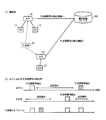
- FIG. 3 is a diagram illustrating a first embodiment of aggregation of interference source air time information in the wireless communication system according to the present invention.
- 5 is a flowchart illustrating an example of a processing procedure for collecting interference source air time information according to the first embodiment of the present invention.
- FIG. 11 is a diagram illustrating an example of estimating the position of an interference source according to the second embodiment of the present invention.
- FIG. 14 is a diagram illustrating an example of using the air time of the interference source according to the third embodiment of the present invention.
- FIG. 11 is a diagram illustrating an example of airtime detection of an interference source in a conventional wireless communication system.
- FIG. 1 shows Embodiment 1 of aggregation of interference source air time information in the wireless communication system of the present invention.
- wireless devices to be managed there are wireless base stations (APs) 10 and 20, and wireless terminals (STAs) 11, 12, and 21 under their control.
- APs wireless base stations
- STAs wireless terminals
- the wireless base stations 10 and 20 communicate with an aggregation device (server) 100 via a network (not shown), and the wireless terminals 11, 12, and 21 are connected to the wireless base stations to which they belong.
- the interference source signal transmitted by the interference source 51 is detected by the radio base station 10 and the radio terminals 11 and 12, and the radio base station 20 and the radio terminal 21, respectively.
- the identification information of the interference source device is included in the interference source signal transmitted from the interference source 51, and the wireless device to be managed (the wireless base station 10 and the wireless terminals 11, 12, the wireless base station 20, and the wireless base station 20) By detecting this at the terminal 21), it is possible to identify the interference source 51 and to grasp the transmission time of the interference source signal transmitted by the interference source 51.
- the feature of the present invention is that the managed wireless device cannot individually detect the interference source signal transmitted by the interference source 51 during transmission / reception of the wireless signal, but the interference source detected by the managed wireless device during the non-transmission / reception.
- the signal detection information (air time information) is gathered and integrated by the aggregating device 100 at the same timing, so that the air time of the interference source 51 can be estimated.
- FIG. 2 shows an example of a processing procedure for collecting interference source air time information in the first embodiment of the present invention.
- 2 (1) 1 shows an example of a processing procedure of the aggregation device (server)
- FIG. 2 (2) shows an example of a processing procedure of the wireless base station (AP)
- FIG. 2 (3) shows a processing of the wireless terminal (STA).
- STA wireless terminal
- the radio base station When the radio base station is notified of the airtime management information (T, D) from the aggregation device, the radio base station updates the previous airtime management information and starts managing the airtime information of the interference source (S11).
- the own station if the own station is not transmitting or receiving radio signals or preparing for transmission / reception (S12, No) ⁇ ⁇ , it detects an interference source signal and updates airtime information (S13). If the own station is transmitting or receiving a radio signal or preparing for transmission / reception (S12, Yes) and has transmitted a data signal to a subordinate wireless terminal (S14, Yes), the subordinate wireless terminal transmits the air signal together with the data signal.
- the time management information is transmitted (S15).
- the air frequency of the interference source is determined for each wireless terminal.
- the time information is accumulated (S17).
- the wireless base station performs the above-described processing at regular time intervals, and transmits airtime information of the interference source of the wireless base station and its own wireless terminal to the aggregation device (S18).
- the wireless terminal When the wireless terminal is notified of the airtime management information (T, D) from the wireless base station to which it belongs, it updates the previous airtime management information and starts managing the airtime information of the interference source (S21). .
- the own station if the own station is not transmitting or receiving a radio signal or preparing for transmission / reception (S22, No) ⁇ ⁇ , it detects the interference source signal and updates the air time information (S23).
- the wireless terminal transmits the updated air time information to the wireless base station at regular intervals or every time data is transmitted to the wireless base station (S24).
- the aggregation device receives the air time information of the interference source in the wireless base station and the wireless terminals under the control of the aggregation device (S2), integrates the information for each time unit D after a predetermined time has elapsed, derives the air time of the interference source, and displays the screen. Are updated (S3). If the airtime management information (T, D) needs to be updated, the process returns to step S1. If the airtime management information (T, D) does not need to be updated, the process returns to step S2 (S4).
- the airtime information of the interference source transmitted from the wireless base station and the wireless terminal to the aggregation device includes the reference time T, the time unit D, the identification information of the interference source, and the interference source signal for each time unit D from the reference time T. Is included.
- the reference time T and the time unit D that the aggregation device notifies the wireless base station and the wireless terminal as airtime management information and the reference time T and the reference time T that are transmitted as airtime information from the wireless base station and the wireless terminal to the aggregation device.
- the time units D usually coincide. However, when the reference time T and the time unit D are not updated in the wireless base station and the wireless terminal due to a failure to receive the airtime management information, a mismatch occurs. In this case, aggregation and integration are performed based on airtime information transmitted from the wireless base station and the wireless terminal to derive the airtime of the interference source.
- the radio base station (AP) 10 detects the interference source signal in the time slots 1 and 2 as the time unit D starting from the reference time T. It is time slots 1, 2, 5, and 11 that the wireless terminal (STA) 11 detects the interference source signal. It is time slots 1, 2, 4, 9, and 10 that the wireless terminal (STA) 12 detects the interference source signal. It is in time slots 11 and 12 that the radio base station (AP) 20 detects the interference source signal. It is in time slots 2, 3, 11, and 12 that the wireless terminal (STA) 21 detects the interference source signal.
- the AP 10, the STA 11, and the STA 12 are not transmitting and receiving, and thus the interference source signal is detected. Since the AP 20 and the STA 21 are transmitting and receiving, the interference source signal cannot be detected.
- the AP 10 and the STA 11 and the AP 20 and the STA 21 cannot transmit and receive the interference source signal and cannot detect the interference source signal because only the STA 12 is not transmitting and receiving.
- the interference source signal cannot be detected because the interference source signal is not transmitted or the AP 10, STA 11, 12, AP 20, and STA 21 are all transmitting and receiving.
- the detection of the interference source signal in the AP and the STA is performed on the assumption that the interference source signal is transmitted from the interference source and that the interference source signal can be detected when the AP and the STA are not transmitting and receiving.
- the air time of the interference source is grasped by aggregating and integrating (ORing) the air time information of each wireless device for each time slot (time unit D).
- the wireless device to be managed includes, as airtime information, the reference time T, the time unit D, the identification information of the interference source, the presence or absence of the detection of the interference source signal for each time unit D from the reference time T, and the wireless device to be managed.
- the level of detection of the interference source signal may be added. For example, in step S13 of FIG. 2 (2), when the radio base station detects an interference source signal, the airtime information including the detection level is updated. In step S23 of FIG. 2 (3), when the wireless terminal detects an interference source signal, the wireless terminal updates the airtime information including the detection level. Then, in step S18 of FIG. 2 (2), when transmitting the air time information of the interference source in the wireless base station and the wireless terminal to the aggregation device, the position information of the wireless base station and the wireless terminal is also included.
- the ratio of the distance to the interference source 51 (a: b: c) from the detection level of the interference source signal in the wireless base station 10 and the wireless terminals 11 and 12 under the control thereof. Can be calculated. From the position information of the wireless base station 10 and the wireless terminals 11 and 12 and the ratio of the distance to the interference source 51 (a: b: c), the position of the interference source 51 can be estimated by three-point positioning.
- the position of the interference source 51 can be estimated more accurately.
- the aggregating apparatus 100 can also take a countermeasure by displaying the airtime information of the interference source 51 on a screen and visualizing the information. For example, a specific measure can be taken if the tendency of the air time of the interference source 51 is analyzed and a pattern such as a concentrated use in a specific time zone or an unused state after a certain period of use is known.
- the aggregation device 100 predicts a future air time from the past air time of the interference source 51 as shown in FIG. 4A, and avoids the transmission timing of the predicted interference source 51 so as to avoid the predicted transmission timing of the interference source 51.
- a transmission start time that avoids the transmission timing of the interference source 51 is notified as shown in FIG.
- transmission start time preceding the transmission timing of the interference source 51 is notifying the transmission start time preceding the transmission timing of the interference source 51 as shown in FIG. 4C, transmission becomes possible without being affected by the interference source 51. At this time, the interference source 51 becomes unable to transmit a signal due to carrier sense.
- the aggregation device 100 described above can be realized by a computer and a computer program.
- This computer program can be stored in a computer-readable storage medium or can be provided via a network.
Landscapes
- Engineering & Computer Science (AREA)
- Computer Networks & Wireless Communication (AREA)
- Signal Processing (AREA)
- Quality & Reliability (AREA)
- Physics & Mathematics (AREA)
- Electromagnetism (AREA)
- Mobile Radio Communication Systems (AREA)
Abstract
干渉源が送信する干渉源信号をそれぞれ検出し、所定の時間単位ごとに該干渉源信号の有無を示すエアタイム情報をそれぞれ生成する複数の無線装置と、複数の無線装置からそれぞれエアタイム情報を取得し、取得したエアタイム情報を所定の単位時間ごとにタイミングを合わせて集約・統合することで、干渉源のエアタイムを推定する集約装置とを備える。
Description
本発明は、無線を用いてデータ通信を行う無線通信システムを構成する管理対象の無線装置において、その周辺の干渉源(特に、管理対象外の無線装置)の無線信号送信状況(エアタイム)を取得する無線通信システム、集約装置、干渉源エアタイム取得方法および干渉源エアタイム取得プログラムに関する。
従来は、管理対象の無線装置の周辺に干渉源がある場合、その影響度を正確に把握することが困難だった。その理由は、図5に示す無線通信システムの無線基地局(AP)10,20では、自局の信号の送受信中であれば、干渉源51が送信する干渉源信号を検出することができず、非送受信中の無線基地局で干渉源51の無線信号送信状況(エアタイム)を断片的にしか把握できないためである。さらに、管理対象の無線装置の一部、特にネットワークを介して集約装置(サーバ)100に接続された無線基地局10,20の情報のみを参照するため、情報量も少ないことが挙げられる。
例えば、非特許文献1に記載の事例では、周辺の干渉アクセスポイントの影響度を3段階で表示しているだけで、詳細な数値は示されず、またチャンネル使用率として干渉源のみの表示はされない。
「無線LAN見える化ツール機能」,http://www.rtpro.yamaha.co.jp/RT/docs/visualization/index.html
従来技術の課題を解決するには、管理対象の無線装置ごとに、干渉源が送信する干渉源信号の検出可能なタイミングにばらつきがある中で、それぞれの検出情報を集約・統合することが必要になる。さらに、ネットワークに接続された無線基地局のみで監視するのではなく、無線基地局の配下の無線端末で検出される干渉源信号も参照することなど、参照情報を増やす手段が必要となる。
本発明は、管理対象の無線装置で干渉源信号を検出し、それぞれの検出情報を集約・統合し、干渉源の無線信号送信状況(エアタイム)を取得することができる無線通信システム、集約装置、干渉源エアタイム集約方法および干渉源エアタイム集約プログラムを提供することを目的とする。
第1の発明の無線通信システムは、干渉源が送信する干渉源信号をそれぞれ検出し、所定の時間単位ごとに該干渉源信号の有無を示すエアタイム情報をそれぞれ生成する複数の無線装置と、複数の無線装置からそれぞれエアタイム情報を取得し、取得したエアタイム情報を所定の単位時間ごとにタイミングを合わせて集約・統合することで、干渉源のエアタイムを推定する集約装置とを備える。
第1の発明の無線通信システムにおいて、集約装置は、複数の無線装置が干渉源信号を検出するタイミングを合わせるために、基準時刻Tと時間単位Dを管理し、エアタイム管理情報として複数の無線装置に通知する構成としてもよい。複数の無線装置は、集約装置に接続される少なくとも1つの無線基地局と、該無線基地局の配下の少なくとも1つの無線端末であり、エアタイム管理情報は、集約装置から該無線基地局に通知され、さらに該無線基地局から配下の無線端末に通知される構成としてよい。
第1の発明の無線通信システムにおいて、複数の無線装置は、エアタイム情報として、干渉源信号の検出レベルと各無線装置の位置情報を含めて、集約装置に送信する構成であり、集約装置は、複数の無線装置における干渉源信号の検出レベルとそれぞれの位置情報から、干渉源の位置を推定する構成としてもよい。
第1の発明の無線通信システムにおいて、集約装置は、推定した干渉源のエアタイムの傾向パターンを分析し、その傾向パターンに応じて干渉源の今後のエアタイムを予測し、無線装置に有利な送信タイミングを決定して各無線装置に通知する構成としてもよい。
第2の発明は、干渉源が送信する干渉源信号をそれぞれ検出し、所定の時間単位ごとに該干渉源信号の有無を示すエアタイム情報をそれぞれ生成する複数の無線装置に接続される集約装置において、複数の無線装置からそれぞれエアタイム情報を取得し、取得したエアタイム情報を所定の単位時間ごとにタイミングを合わせて集約・統合することで、干渉源のエアタイムを推定する処理手段を備える。
第3の発明の干渉源エアタイム取得方法は、複数の無線装置で、干渉源が送信する干渉源信号をそれぞれ検出し、所定の時間単位ごとに該干渉源信号の有無を示すエアタイム情報をそれぞれ生成するステップと、複数の無線装置に接続される集約装置で、複数の無線装置からそれぞれエアタイム情報を取得し、取得したエアタイム情報を所定の単位時間ごとにタイミングを合わせて集約・統合することで、干渉源のエアタイムを推定するステップとを有する。
第4の発明の干渉源エアタイム取得プログラムは、第2の発明の集約装置が実行する処理をコンピュータに実行させ、複数の無線装置からそれぞれエアタイム情報を取得し、取得したエアタイム情報を所定の単位時間ごとにタイミングを合わせて集約・統合することで、干渉源のエアタイムを推定する。
本発明は、管理対象の無線装置(無線基地局および無線端末)で干渉源信号を検出し、その検出情報を集約・統合することで、干渉源の無線信号送信状況(エアタイム)を明確化できるため、干渉源の影響度を把握することが可能となる。
また、管理対象の無線装置の位置情報および干渉源信号の検出レベルを参照することで、干渉源の位置も推定可能となる。さらに、過去のエアタイムから今後のエアタイムを予測することで、管理対象の無線装置に対する適切な送信タイミング制御も可能となる。
(実施例1)
図1は、本発明の無線通信システムにおける干渉源エアタイム情報集約の実施例1を示す。
図1において、管理対象の無線装置として、無線基地局(AP)10,20と、それぞれ配下の無線端末(STA)11,12,21がある。ここでは簡単のために、2台の無線基地局と3台の無線端末のみを示すが、それ以上あってもよい。無線基地局10,20は、図示しないネットワークを介して集約装置(サーバ)100と通信し、無線端末11,12,21はそれぞれ帰属する無線基地局に接続される。干渉源51が送信する干渉源信号は、無線基地局10および無線端末11,12、無線基地局20および無線端末21でそれぞれ検出されるものとする。
図1は、本発明の無線通信システムにおける干渉源エアタイム情報集約の実施例1を示す。
図1において、管理対象の無線装置として、無線基地局(AP)10,20と、それぞれ配下の無線端末(STA)11,12,21がある。ここでは簡単のために、2台の無線基地局と3台の無線端末のみを示すが、それ以上あってもよい。無線基地局10,20は、図示しないネットワークを介して集約装置(サーバ)100と通信し、無線端末11,12,21はそれぞれ帰属する無線基地局に接続される。干渉源51が送信する干渉源信号は、無線基地局10および無線端末11,12、無線基地局20および無線端末21でそれぞれ検出されるものとする。
ここで、干渉源51から送信される干渉源信号内に干渉源装置の識別情報が含まれており、管理対象の無線装置(無線基地局10および無線端末11,12、無線基地局20および無線端末21)でそれを検出することで、干渉源51の識別、および干渉源51が送信する干渉源信号の送信時間の把握を可能とする。
本発明の特徴は、管理対象の無線装置では、個々に無線信号の送受信中に干渉源51が送信する干渉源信号を検出できないが、管理対象の無線装置がそれぞれ非送受信中に検出した干渉源信号の検出情報(エアタイム情報)を、集約装置100でタイミングを合わせて集約・統合することで、干渉源51のエアタイムの推定を可能とするところにある。
図2は、本発明の実施例1における干渉源エアタイム情報集約の処理手順例を示す。図2(1) は集約装置(サーバ)の処理手順例を示し、図2(2) は無線基地局(AP)の処理手順例を示し、図2(3) は無線端末(STA)の処理手順例を示す。
図2において、管理対象の無線装置で干渉源信号をそれぞれ検出したエアタイム情報を集約・統合するため、管理対象の無線装置間でタイミングを合わせる必要があり、集約装置はそのエアタイム管理情報として基準時刻Tと時間単位Dを管理し、各無線基地局に通知する(S1)。なお、干渉源ごとにエアタイム情報を集約・統合するために、対象とする干渉源を特定する識別情報も必要であるが、ここでは省略する。
無線基地局は、集約装置からエアタイム管理情報(T,D)が通知されると、それ以前のエアタイム管理情報を更新し、干渉源のエアタイム情報の管理を開始する(S11)。ここで、自局が無線信号の送受信中または送受信準備中でなければ(S12,No) 、干渉源信号を検出してエアタイム情報を更新する(S13)。また、自局が無線信号の送受信中または送受信準備中であり(S12,Yes)、配下の無線端末宛にデータ信号の送信があれば(S14,Yes)、配下の無線端末にデータ信号とともにエアタイム管理情報を送信する(S15)。また、配下の無線端末宛にデータ信号の送信がなく(S14,No) 、配下の無線端末から干渉源のエアタイム情報の受信があれば(S16,Yes)、無線端末ごとに干渉源のエアタイム情報を蓄積する(S17)。無線基地局は、以上の処理を一定時間ごとに行い、自局と、配下の無線端末における干渉源のエアタイム情報を集約装置に送信する(S18)。
無線端末では、帰属する無線基地局からエアタイム管理情報(T,D)が通知されると、それ以前のエアタイム管理情報を更新し、干渉源のエアタイム情報の管理を開始する(S21)。ここで、自局が無線信号の送受信中または送受信準備中でなければ(S22,No) 、干渉源信号を検出してエアタイム情報を更新する(S23)。無線端末は、一定時間ごとに、もしくは無線基地局へのデータ送信の機会ごとに、更新したエアタイム情報を無線基地局に送信する(S24)。
集約装置は、無線基地局およびその配下の無線端末における干渉源のエアタイム情報を受信し(S2)、一定時間経過後に時間単位Dごとに統合し、干渉源のエアタイムを導出して画面表示等を更新する(S3)。ここで、エアタイム管理情報(T,D)の更新が必要な場合はステップS1にもどり、エアタイム管理情報(T,D)の更新が不要の場合はステップS2に戻る(S4)。
なお、無線基地局および無線端末から集約装置に送信される干渉源のエアタイム情報には、基準時刻T、時間単位D、干渉源の識別情報、基準時刻Tから時間単位Dごとの干渉源信号の検出有無が含まれる。ここで、集約装置が無線基地局および無線端末にエアタイム管理情報として通知する基準時刻Tおよび時間単位Dと、無線基地局および無線端末から集約装置にエアタイム情報として送信される基準時刻Tおよび時間単位Dは、通常は一致している。しかし、エアタイム管理情報の不達などにより、無線基地局および無線端末で基準時刻Tおよび時間単位Dの更新が行われていない場合は不一致が生じる。この場合には、無線基地局および無線端末から送信されたエアタイム情報に基づいて集約・統合し、干渉源のエアタイムの導出を行う。
以下、図1を参照して、実施例1における干渉源のエアタイム情報の集約・統合例を示す。
無線基地局(AP)10が干渉源信号を検出するのは、基準時刻Tを起点にした時間単位Dとしてタイムスロット1,2である。無線端末(STA)11が干渉源信号を検出するのは、タイムスロット1,2,5,11である。無線端末(STA)12が干渉源信号を検出するのは、タイムスロット1,2,4,9,10である。無線基地局(AP)20が干渉源信号を検出するのは、タイムスロット11,12である。無線端末(STA)21が干渉源信号を検出するのは、タイムスロット2,3,11,12である。
無線基地局(AP)10が干渉源信号を検出するのは、基準時刻Tを起点にした時間単位Dとしてタイムスロット1,2である。無線端末(STA)11が干渉源信号を検出するのは、タイムスロット1,2,5,11である。無線端末(STA)12が干渉源信号を検出するのは、タイムスロット1,2,4,9,10である。無線基地局(AP)20が干渉源信号を検出するのは、タイムスロット11,12である。無線端末(STA)21が干渉源信号を検出するのは、タイムスロット2,3,11,12である。
例えば、タイムスロット1では、AP10,STA11,12が非送受信中であるために干渉源信号を検出し、AP20とSTA21が送受信中であるために干渉源信号を検出できない。タイムスロット4では、AP10とSTA11およびAP20とSTA21が送受信中で干渉源信号を検出できず、STA12のみが非送受信中であるために干渉源信号を検出できる。タイムスロット6~8では、干渉源信号が送信されていないか、AP10、STA11,12、AP20、STA21がいずれも送受信中であるために干渉源信号を検出できない。
このように、APおよびSTAにおける干渉源信号の検出は、まず干渉源から干渉源信号が送信されていること、さらにAPおよびSTAが非送受信中のときに干渉源信号を検出できることを前提に、各無線装置のエアタイム情報をタイムスロット(時間単位D)ごとに集約・統合する(論理和をとる)ことにより、干渉源のエアタイムを把握する。
(実施例2)
管理対象の無線装置は、エアタイム情報として、基準時刻T、時間単位D、干渉源の識別情報、基準時刻Tから時間単位Dごとの干渉源信号の検出有無に加えて、管理対象の無線装置の位置情報および干渉源信号の検出レベルを追加してもよい。例えば、図2(2) のステップS13において、無線基地局が干渉源信号を検出したときにその検出レベルも含めてエアタイム情報の更新を行う。また、図2(3) のステップS23において、無線端末が干渉源信号を検出したときにその検出レベルも含めてエアタイム情報の更新を行う。そして、図2(2) のステップS18において、無線基地局および無線端末における干渉源のエアタイム情報を集約装置に送信するとき、無線基地局および無線端末の位置情報も含めるようにする。
管理対象の無線装置は、エアタイム情報として、基準時刻T、時間単位D、干渉源の識別情報、基準時刻Tから時間単位Dごとの干渉源信号の検出有無に加えて、管理対象の無線装置の位置情報および干渉源信号の検出レベルを追加してもよい。例えば、図2(2) のステップS13において、無線基地局が干渉源信号を検出したときにその検出レベルも含めてエアタイム情報の更新を行う。また、図2(3) のステップS23において、無線端末が干渉源信号を検出したときにその検出レベルも含めてエアタイム情報の更新を行う。そして、図2(2) のステップS18において、無線基地局および無線端末における干渉源のエアタイム情報を集約装置に送信するとき、無線基地局および無線端末の位置情報も含めるようにする。
これにより、集約装置では図3に示すように、無線基地局10およびその配下の無線端末11,12における干渉源信号の検出レベルから、干渉源51までの距離の比(a:b:c)を算出できる。無線基地局10および無線端末11,12の位置情報と、この干渉源51までの距離の比(a:b:c)から、三点測位により干渉源51の位置を推定することができる。
また、図1に示す無線基地局20およびその配下の無線端末21における干渉源信号の検出レベルと、それぞれの位置情報を加えることにより、干渉源51の位置をさらに精度よく推定することができる。
(実施例3)
集約装置100は、干渉源51のエアタイムの情報を画面表示し、視覚化することにより対処策を講じることも可能である。例えば、干渉源51のエアタイムの傾向を分析し、特定の時間帯での集中利用や、一定時間使用後に不使用状態になるなどのパターンが分かれば、具体的な対処も可能となる。
集約装置100は、干渉源51のエアタイムの情報を画面表示し、視覚化することにより対処策を講じることも可能である。例えば、干渉源51のエアタイムの傾向を分析し、特定の時間帯での集中利用や、一定時間使用後に不使用状態になるなどのパターンが分かれば、具体的な対処も可能となる。
さらに、集約装置100は、図4(1) に示すように干渉源51の過去のエアタイムから今後のエアタイムを予測し、予測される干渉源51の送信タイミングを避けるように、管理対象の無線装置に有利な送信タイミングとして、図4(2) に示すように干渉源51の送信タイミングを避ける送信開始時刻を通知する。あるいは、図4(3) に示すように、干渉源51の送信タイミングに先行する送信開始時刻を通知することにより、干渉源51の影響を受けずに送信が可能になる。このとき、干渉源51は、キャリアセンスにより信号送信不可となる。
以上説明した集約装置100は、コンピュータとコンピュータプログラムにより実現することができる。このコンピュータプログラムは、コンピュータが読み取り可能な記憶媒体に記憶することも、ネットワークを介して提供することも可能である。
10,20 無線基地局(AP)
11,12,21 無線端末(STA)
51 干渉源
100 集約装置(サーバ)
11,12,21 無線端末(STA)
51 干渉源
100 集約装置(サーバ)
Claims (8)
- 干渉源が送信する干渉源信号をそれぞれ検出し、所定の時間単位ごとに該干渉源信号の有無を示すエアタイム情報をそれぞれ生成する複数の無線装置と、
前記複数の無線装置からそれぞれ前記エアタイム情報を取得し、取得した前記エアタイム情報を前記所定の単位時間ごとにタイミングを合わせて集約・統合することで、前記干渉源のエアタイムを推定する集約装置と
を備えたことを特徴とする無線通信システム。 - 請求項1に記載の無線通信システムにおいて、
前記集約装置は、前記複数の無線装置が前記干渉源信号を検出するタイミングを合わせるために、基準時刻Tと時間単位Dを管理し、エアタイム管理情報として前記複数の無線装置に通知する構成である
ことを特徴とする無線通信システム。 - 請求項2に記載の無線通信システムにおいて、
前記複数の無線装置は、前記集約装置に接続される少なくとも1つの無線基地局と、該無線基地局の配下の少なくとも1つの無線端末であり、前記エアタイム管理情報は、前記集約装置から該無線基地局に通知され、さらに該無線基地局から配下の無線端末に通知される構成である
ことを特徴とする無線通信システム。 - 請求項1に記載の無線通信システムにおいて、
前記複数の無線装置は、前記エアタイム情報として、前記干渉源信号の検出レベルと各無線装置の位置情報を含めて、前記集約装置に送信する構成であり、
前記集約装置は、前記複数の無線装置における前記干渉源信号の検出レベルとそれぞれの位置情報から、前記干渉源の位置を推定する構成である
ことを特徴とする無線通信システム。 - 請求項1に記載の無線通信システムにおいて、
前記集約装置は、推定した前記干渉源のエアタイムの傾向パターンを分析し、その傾向パターンに応じて前記干渉源の今後のエアタイムを予測し、前記無線装置に有利な送信タイミングを決定して各無線装置に通知する構成である
ことを特徴とする無線通信システム。 - 干渉源が送信する干渉源信号をそれぞれ検出し、所定の時間単位ごとに該干渉源信号の有無を示すエアタイム情報をそれぞれ生成する複数の無線装置に接続される集約装置において、
前記複数の無線装置からそれぞれ前記エアタイム情報を取得し、取得した前記エアタイム情報を前記所定の単位時間ごとにタイミングを合わせて集約・統合することで、前記干渉源のエアタイムを推定する処理手段を備えた
ことを特徴とする集約装置。 - 複数の無線装置で、干渉源が送信する干渉源信号をそれぞれ検出し、所定の時間単位ごとに該干渉源信号の有無を示すエアタイム情報をそれぞれ生成するステップと、
前記複数の無線装置に接続される集約装置で、前記複数の無線装置からそれぞれ前記エアタイム情報を取得し、取得した前記エアタイム情報を前記所定の単位時間ごとにタイミングを合わせて集約・統合することで、前記干渉源のエアタイムを推定するステップと
を有することを特徴とする干渉源エアタイム取得方法。 - 請求項6に記載の集約装置が実行する処理をコンピュータに実行させ、前記複数の無線装置からそれぞれ前記エアタイム情報を取得し、取得した前記エアタイム情報を前記所定の単位時間ごとにタイミングを合わせて集約・統合することで、前記干渉源のエアタイムを推定する
ことを特徴とする干渉源エアタイム取得プログラム。
Priority Applications (2)
| Application Number | Priority Date | Filing Date | Title |
|---|---|---|---|
| US17/272,709 US11985533B2 (en) | 2018-09-20 | 2019-09-13 | Wireless communication system, aggregation device, interference source air time acquisition method, and interference source air time acquisition program |
| US18/627,643 US20240292266A1 (en) | 2018-09-20 | 2024-04-05 | Wireless communication system, aggregation device, interference source air time acquisition method, and interference source air time acquisition program |
Applications Claiming Priority (2)
| Application Number | Priority Date | Filing Date | Title |
|---|---|---|---|
| JP2018-176643 | 2018-09-20 | ||
| JP2018176643A JP7155796B2 (ja) | 2018-09-20 | 2018-09-20 | 無線通信システム、集約装置、干渉源エアタイム取得方法および干渉源エアタイム取得プログラム |
Related Child Applications (2)
| Application Number | Title | Priority Date | Filing Date |
|---|---|---|---|
| US17/272,709 A-371-Of-International US11985533B2 (en) | 2018-09-20 | 2019-09-13 | Wireless communication system, aggregation device, interference source air time acquisition method, and interference source air time acquisition program |
| US18/627,643 Continuation US20240292266A1 (en) | 2018-09-20 | 2024-04-05 | Wireless communication system, aggregation device, interference source air time acquisition method, and interference source air time acquisition program |
Publications (1)
| Publication Number | Publication Date |
|---|---|
| WO2020059656A1 true WO2020059656A1 (ja) | 2020-03-26 |
Family
ID=69888511
Family Applications (1)
| Application Number | Title | Priority Date | Filing Date |
|---|---|---|---|
| PCT/JP2019/036095 Ceased WO2020059656A1 (ja) | 2018-09-20 | 2019-09-13 | 無線通信システム、集約装置、干渉源エアタイム取得方法および干渉源エアタイム取得プログラム |
Country Status (3)
| Country | Link |
|---|---|
| US (2) | US11985533B2 (ja) |
| JP (1) | JP7155796B2 (ja) |
| WO (1) | WO2020059656A1 (ja) |
Families Citing this family (1)
| Publication number | Priority date | Publication date | Assignee | Title |
|---|---|---|---|---|
| CN112152651B (zh) * | 2020-08-17 | 2021-08-13 | 西安交通大学 | 5g系统面向gnss接收机的干扰源定位方法、存储介质及设备 |
Citations (4)
| Publication number | Priority date | Publication date | Assignee | Title |
|---|---|---|---|---|
| JP2000308123A (ja) * | 1999-04-23 | 2000-11-02 | Ntt Docomo Inc | 移動通信システムおよび移動通信システムにおける同期方法 |
| US20060128311A1 (en) * | 2004-12-13 | 2006-06-15 | Yohannes Tesfai | Matching receive signal strenth data associated with radio emission sources for positioning applications |
| JP2014175784A (ja) * | 2013-03-07 | 2014-09-22 | Hitachi Industry & Control Solutions Ltd | 無線通信システム及び無線通信方法 |
| JP2018503996A (ja) * | 2014-11-20 | 2018-02-08 | フィリップス ライティング ホールディング ビー ヴィ | 干渉のモデル化 |
Family Cites Families (9)
| Publication number | Priority date | Publication date | Assignee | Title |
|---|---|---|---|---|
| US8606187B2 (en) * | 2007-08-31 | 2013-12-10 | Tropos Networks, Inc. | Mitigation of uncoordinated interference of a wireless access node |
| US8559407B2 (en) * | 2007-08-31 | 2013-10-15 | Tropos Networks, Inc. | Characterizing uncoordinated interference of a wireless network |
| WO2010139843A1 (en) * | 2009-06-05 | 2010-12-09 | Nokia Corporation | Cognitive radio transmission |
| EP2894894B1 (en) * | 2012-10-30 | 2017-08-23 | Huawei Technologies Co., Ltd. | Method, device and system for collecting and identifying interference |
| US9559795B2 (en) * | 2013-01-23 | 2017-01-31 | Telefonaktiebolaget L M Ericsson (Publ) | Method and network node for mitigation of interference |
| US9420530B1 (en) * | 2013-07-22 | 2016-08-16 | Quantenna Communications, Inc. | WAP with context sensitive energy management |
| CN105338531B (zh) * | 2014-05-27 | 2020-06-12 | 索尼公司 | 基站控制方法、基站控制装置、无线通信系统及电子设备 |
| US9942775B2 (en) * | 2014-08-14 | 2018-04-10 | Spectrum Effect Inc. | Signal localization and mapping |
| WO2018220962A1 (ja) * | 2017-06-02 | 2018-12-06 | ソニー株式会社 | 通信装置および通信システム |
-
2018
- 2018-09-20 JP JP2018176643A patent/JP7155796B2/ja active Active
-
2019
- 2019-09-13 US US17/272,709 patent/US11985533B2/en active Active
- 2019-09-13 WO PCT/JP2019/036095 patent/WO2020059656A1/ja not_active Ceased
-
2024
- 2024-04-05 US US18/627,643 patent/US20240292266A1/en active Pending
Patent Citations (4)
| Publication number | Priority date | Publication date | Assignee | Title |
|---|---|---|---|---|
| JP2000308123A (ja) * | 1999-04-23 | 2000-11-02 | Ntt Docomo Inc | 移動通信システムおよび移動通信システムにおける同期方法 |
| US20060128311A1 (en) * | 2004-12-13 | 2006-06-15 | Yohannes Tesfai | Matching receive signal strenth data associated with radio emission sources for positioning applications |
| JP2014175784A (ja) * | 2013-03-07 | 2014-09-22 | Hitachi Industry & Control Solutions Ltd | 無線通信システム及び無線通信方法 |
| JP2018503996A (ja) * | 2014-11-20 | 2018-02-08 | フィリップス ライティング ホールディング ビー ヴィ | 干渉のモデル化 |
Also Published As
| Publication number | Publication date |
|---|---|
| JP2020048129A (ja) | 2020-03-26 |
| JP7155796B2 (ja) | 2022-10-19 |
| US11985533B2 (en) | 2024-05-14 |
| US20210377776A1 (en) | 2021-12-02 |
| US20240292266A1 (en) | 2024-08-29 |
Similar Documents
| Publication | Publication Date | Title |
|---|---|---|
| TW595140B (en) | System and method for spectrum management of a shared frequency band | |
| US7039017B2 (en) | System and method for detecting and locating interferers in a wireless communication system | |
| US9479954B2 (en) | Correlating data from multiple spectrum monitors | |
| EP2677335B1 (en) | Improving positioning accuracy of location tracking system | |
| RU2013129000A (ru) | Система и способ анализа радиочастотного спектра точки доступа и устройства беспроводной сенсорной сети | |
| US20200196272A1 (en) | Position detection of user equipment within a wireless telecommunication network | |
| JP7140267B2 (ja) | 無線通信品質可視化装置および無線通信品質可視化システム | |
| JP2018152843A5 (ja) | ||
| CN110786042A (zh) | 配置测量间隔的方法、终端设备和网络设备 | |
| CN106550395A (zh) | 一种检测信号强度的方法及装置 | |
| US20240292266A1 (en) | Wireless communication system, aggregation device, interference source air time acquisition method, and interference source air time acquisition program | |
| EP3772828B1 (en) | Systems and methods for time coordinating a plurality of rf data collection devices at disparate locations | |
| EP3424172B1 (en) | Adaptive reference signal patterns | |
| JP6370824B2 (ja) | 無線通信方法および無線通信装置 | |
| CN105578600A (zh) | 一种lte系统在免许可频段上通信的方法及装置 | |
| JP2014175784A (ja) | 無線通信システム及び無線通信方法 | |
| KR101954784B1 (ko) | 데이터 프레임을 전송하는 방법 및 장치 | |
| US12137400B1 (en) | Concurrent multichannel processing of bluetooth low energy advertising channels | |
| JP2013207523A (ja) | 無線lan通信装置、無線lanステーション、無線lanアクセスポイント、通信方法およびプログラム | |
| KR101227056B1 (ko) | 이동 통신 시스템에서 위치 정보 제공 방법 | |
| JP2013150145A (ja) | 無線システム、電波モニタ及び情報収集装置 | |
| JP5316777B2 (ja) | 無線チャネル測定システム、その方法及びプログラム | |
| US11832197B2 (en) | Neighborhood management between WiFi and unlicensed spectrum radios | |
| JP5534911B2 (ja) | 電波検出装置、管理装置及び干渉回避ネットワークシステム | |
| KR101897536B1 (ko) | 수신확인 타임슬롯을 이용한 무선통신 시스템 |
Legal Events
| Date | Code | Title | Description |
|---|---|---|---|
| 121 | Ep: the epo has been informed by wipo that ep was designated in this application |
Ref document number: 19863648 Country of ref document: EP Kind code of ref document: A1 |
|
| NENP | Non-entry into the national phase |
Ref country code: DE |
|
| 122 | Ep: pct application non-entry in european phase |
Ref document number: 19863648 Country of ref document: EP Kind code of ref document: A1 |