WO2020056564A1 - 基于金属氢化物/钯化合物体系制备1,3-二羰基化合物的方法 - Google Patents
基于金属氢化物/钯化合物体系制备1,3-二羰基化合物的方法 Download PDFInfo
- Publication number
- WO2020056564A1 WO2020056564A1 PCT/CN2018/106060 CN2018106060W WO2020056564A1 WO 2020056564 A1 WO2020056564 A1 WO 2020056564A1 CN 2018106060 W CN2018106060 W CN 2018106060W WO 2020056564 A1 WO2020056564 A1 WO 2020056564A1
- Authority
- WO
- WIPO (PCT)
- Prior art keywords
- compound
- palladium
- hydride
- reaction
- metal hydride
- Prior art date
- Legal status (The legal status is an assumption and is not a legal conclusion. Google has not performed a legal analysis and makes no representation as to the accuracy of the status listed.)
- Ceased
Links
Classifications
-
- C—CHEMISTRY; METALLURGY
- C07—ORGANIC CHEMISTRY
- C07C—ACYCLIC OR CARBOCYCLIC COMPOUNDS
- C07C45/00—Preparation of compounds having >C = O groups bound only to carbon or hydrogen atoms; Preparation of chelates of such compounds
- C07C45/41—Preparation of compounds having >C = O groups bound only to carbon or hydrogen atoms; Preparation of chelates of such compounds by hydrogenolysis or reduction of carboxylic groups or functional derivatives thereof
-
- B—PERFORMING OPERATIONS; TRANSPORTING
- B01—PHYSICAL OR CHEMICAL PROCESSES OR APPARATUS IN GENERAL
- B01J—CHEMICAL OR PHYSICAL PROCESSES, e.g. CATALYSIS OR COLLOID CHEMISTRY; THEIR RELEVANT APPARATUS
- B01J31/00—Catalysts comprising hydrides, coordination complexes or organic compounds
- B01J31/16—Catalysts comprising hydrides, coordination complexes or organic compounds containing coordination complexes
- B01J31/22—Organic complexes
- B01J31/2204—Organic complexes the ligands containing oxygen or sulfur as complexing atoms
- B01J31/2208—Oxygen, e.g. acetylacetonates
- B01J31/2226—Anionic ligands, i.e. the overall ligand carries at least one formal negative charge
- B01J31/223—At least two oxygen atoms present in one at least bidentate or bridging ligand
- B01J31/2239—Bridging ligands, e.g. OAc in Cr2(OAc)4, Pt4(OAc)8 or dicarboxylate ligands
-
- B—PERFORMING OPERATIONS; TRANSPORTING
- B01—PHYSICAL OR CHEMICAL PROCESSES OR APPARATUS IN GENERAL
- B01J—CHEMICAL OR PHYSICAL PROCESSES, e.g. CATALYSIS OR COLLOID CHEMISTRY; THEIR RELEVANT APPARATUS
- B01J23/00—Catalysts comprising metals or metal oxides or hydroxides, not provided for in group B01J21/00
- B01J23/38—Catalysts comprising metals or metal oxides or hydroxides, not provided for in group B01J21/00 of noble metals
- B01J23/40—Catalysts comprising metals or metal oxides or hydroxides, not provided for in group B01J21/00 of noble metals of the platinum group metals
- B01J23/44—Palladium
-
- B—PERFORMING OPERATIONS; TRANSPORTING
- B01—PHYSICAL OR CHEMICAL PROCESSES OR APPARATUS IN GENERAL
- B01J—CHEMICAL OR PHYSICAL PROCESSES, e.g. CATALYSIS OR COLLOID CHEMISTRY; THEIR RELEVANT APPARATUS
- B01J31/00—Catalysts comprising hydrides, coordination complexes or organic compounds
- B01J31/02—Catalysts comprising hydrides, coordination complexes or organic compounds containing organic compounds or metal hydrides
- B01J31/12—Catalysts comprising hydrides, coordination complexes or organic compounds containing organic compounds or metal hydrides containing organo-metallic compounds or metal hydrides
- B01J31/121—Metal hydrides
-
- B—PERFORMING OPERATIONS; TRANSPORTING
- B01—PHYSICAL OR CHEMICAL PROCESSES OR APPARATUS IN GENERAL
- B01J—CHEMICAL OR PHYSICAL PROCESSES, e.g. CATALYSIS OR COLLOID CHEMISTRY; THEIR RELEVANT APPARATUS
- B01J31/00—Catalysts comprising hydrides, coordination complexes or organic compounds
- B01J31/16—Catalysts comprising hydrides, coordination complexes or organic compounds containing coordination complexes
- B01J31/18—Catalysts comprising hydrides, coordination complexes or organic compounds containing coordination complexes containing nitrogen, phosphorus, arsenic or antimony as complexing atoms, e.g. in pyridine ligands, or in resonance therewith, e.g. in isocyanide ligands C=N-R or as complexed central atoms
- B01J31/1805—Catalysts comprising hydrides, coordination complexes or organic compounds containing coordination complexes containing nitrogen, phosphorus, arsenic or antimony as complexing atoms, e.g. in pyridine ligands, or in resonance therewith, e.g. in isocyanide ligands C=N-R or as complexed central atoms the ligands containing nitrogen
-
- C—CHEMISTRY; METALLURGY
- C07—ORGANIC CHEMISTRY
- C07C—ACYCLIC OR CARBOCYCLIC COMPOUNDS
- C07C231/00—Preparation of carboxylic acid amides
- C07C231/12—Preparation of carboxylic acid amides by reactions not involving the formation of carboxamide groups
-
- C—CHEMISTRY; METALLURGY
- C07—ORGANIC CHEMISTRY
- C07C—ACYCLIC OR CARBOCYCLIC COMPOUNDS
- C07C45/00—Preparation of compounds having >C = O groups bound only to carbon or hydrogen atoms; Preparation of chelates of such compounds
- C07C45/51—Preparation of compounds having >C = O groups bound only to carbon or hydrogen atoms; Preparation of chelates of such compounds by pyrolysis, rearrangement or decomposition
- C07C45/54—Preparation of compounds having >C = O groups bound only to carbon or hydrogen atoms; Preparation of chelates of such compounds by pyrolysis, rearrangement or decomposition of compounds containing doubly bound oxygen atoms, e.g. esters
-
- C—CHEMISTRY; METALLURGY
- C07—ORGANIC CHEMISTRY
- C07C—ACYCLIC OR CARBOCYCLIC COMPOUNDS
- C07C67/00—Preparation of carboxylic acid esters
- C07C67/30—Preparation of carboxylic acid esters by modifying the acid moiety of the ester, such modification not being an introduction of an ester group
- C07C67/317—Preparation of carboxylic acid esters by modifying the acid moiety of the ester, such modification not being an introduction of an ester group by splitting-off hydrogen or functional groups; by hydrogenolysis of functional groups
- C07C67/327—Preparation of carboxylic acid esters by modifying the acid moiety of the ester, such modification not being an introduction of an ester group by splitting-off hydrogen or functional groups; by hydrogenolysis of functional groups by elimination of functional groups containing oxygen only in singly bound form
-
- B—PERFORMING OPERATIONS; TRANSPORTING
- B01—PHYSICAL OR CHEMICAL PROCESSES OR APPARATUS IN GENERAL
- B01J—CHEMICAL OR PHYSICAL PROCESSES, e.g. CATALYSIS OR COLLOID CHEMISTRY; THEIR RELEVANT APPARATUS
- B01J2231/00—Catalytic reactions performed with catalysts classified in B01J31/00
- B01J2231/30—Addition reactions at carbon centres, i.e. to either C-C or C-X multiple bonds
- B01J2231/32—Addition reactions to C=C or C-C triple bonds
- B01J2231/324—Cyclisations via conversion of C-C multiple to single or less multiple bonds, e.g. cycloadditions
-
- B—PERFORMING OPERATIONS; TRANSPORTING
- B01—PHYSICAL OR CHEMICAL PROCESSES OR APPARATUS IN GENERAL
- B01J—CHEMICAL OR PHYSICAL PROCESSES, e.g. CATALYSIS OR COLLOID CHEMISTRY; THEIR RELEVANT APPARATUS
- B01J2231/00—Catalytic reactions performed with catalysts classified in B01J31/00
- B01J2231/30—Addition reactions at carbon centres, i.e. to either C-C or C-X multiple bonds
- B01J2231/34—Other additions, e.g. Monsanto-type carbonylations, addition to 1,2-C=X or 1,2-C-X triplebonds, additions to 1,4-C=C-C=X or 1,4-C=-C-X triple bonds with X, e.g. O, S, NH/N
- B01J2231/341—1,2-additions, e.g. aldol or Knoevenagel condensations
- B01J2231/342—Aldol type reactions, i.e. nucleophilic addition of C-H acidic compounds, their R3Si- or metal complex analogues, to aldehydes or ketones
- B01J2231/345—Aldol type reactions, i.e. nucleophilic addition of C-H acidic compounds, their R3Si- or metal complex analogues, to aldehydes or ketones with organometallic complexes, e.g. by adding ZnR2
-
- B—PERFORMING OPERATIONS; TRANSPORTING
- B01—PHYSICAL OR CHEMICAL PROCESSES OR APPARATUS IN GENERAL
- B01J—CHEMICAL OR PHYSICAL PROCESSES, e.g. CATALYSIS OR COLLOID CHEMISTRY; THEIR RELEVANT APPARATUS
- B01J2531/00—Additional information regarding catalytic systems classified in B01J31/00
- B01J2531/80—Complexes comprising metals of Group VIII as the central metal
- B01J2531/82—Metals of the platinum group
- B01J2531/824—Palladium
-
- B—PERFORMING OPERATIONS; TRANSPORTING
- B01—PHYSICAL OR CHEMICAL PROCESSES OR APPARATUS IN GENERAL
- B01J—CHEMICAL OR PHYSICAL PROCESSES, e.g. CATALYSIS OR COLLOID CHEMISTRY; THEIR RELEVANT APPARATUS
- B01J31/00—Catalysts comprising hydrides, coordination complexes or organic compounds
- B01J31/02—Catalysts comprising hydrides, coordination complexes or organic compounds containing organic compounds or metal hydrides
- B01J31/0234—Nitrogen-, phosphorus-, arsenic- or antimony-containing compounds
- B01J31/0235—Nitrogen containing compounds
- B01J31/0245—Nitrogen containing compounds being derivatives of carboxylic or carbonic acids
- B01J31/0247—Imides, amides or imidates (R-C=NR(OR))
-
- C—CHEMISTRY; METALLURGY
- C07—ORGANIC CHEMISTRY
- C07C—ACYCLIC OR CARBOCYCLIC COMPOUNDS
- C07C2602/00—Systems containing two condensed rings
- C07C2602/02—Systems containing two condensed rings the rings having only two atoms in common
- C07C2602/04—One of the condensed rings being a six-membered aromatic ring
- C07C2602/10—One of the condensed rings being a six-membered aromatic ring the other ring being six-membered, e.g. tetraline
-
- C—CHEMISTRY; METALLURGY
- C07—ORGANIC CHEMISTRY
- C07C—ACYCLIC OR CARBOCYCLIC COMPOUNDS
- C07C49/00—Ketones; Ketenes; Dimeric ketenes; Ketonic chelates
- C07C49/527—Unsaturated compounds containing keto groups bound to rings other than six-membered aromatic rings
- C07C49/553—Unsaturated compounds containing keto groups bound to rings other than six-membered aromatic rings polycyclic
-
- Y—GENERAL TAGGING OF NEW TECHNOLOGICAL DEVELOPMENTS; GENERAL TAGGING OF CROSS-SECTIONAL TECHNOLOGIES SPANNING OVER SEVERAL SECTIONS OF THE IPC; TECHNICAL SUBJECTS COVERED BY FORMER USPC CROSS-REFERENCE ART COLLECTIONS [XRACs] AND DIGESTS
- Y02—TECHNOLOGIES OR APPLICATIONS FOR MITIGATION OR ADAPTATION AGAINST CLIMATE CHANGE
- Y02P—CLIMATE CHANGE MITIGATION TECHNOLOGIES IN THE PRODUCTION OR PROCESSING OF GOODS
- Y02P20/00—Technologies relating to chemical industry
- Y02P20/50—Improvements relating to the production of bulk chemicals
- Y02P20/582—Recycling of unreacted starting or intermediate materials
Definitions
- the present invention belongs to the technical field of organic synthesis, and particularly relates to the application of a metal hydride / palladium compound system in an electron-deficient dilute compound Michael-Dieckmann tandem reaction, and particularly relates to the preparation of a metal hydride / target compound system based on a 1,3--2 Method for carbonyl compounds.
- Sodium hydride is a strong base often used in laboratories and industries. For a long time, there have been few reports about its use as a reducing agent. 5 See that the technology using sodium hydride requires a large excess of sodium hydride (more than 5 equivalents), and requires at least 2 equivalents of sodium iodide as a promoter.
- the technical problem to be solved by the present invention is to provide an application of a catalytic reduction system of a metal hydride / palladium compound, thereby providing an ortho-ester-substituted electron-deficient olefin compound 1 for a Michael-Dieckmann tandem reaction to generate , 3-dicarbonyl compound 3.
- a method for preparing a 1,3-dicarbonyl compound based on a metal hydride / palladium compound system including the following steps, Under the protection of nitrogen, the palladium compound and the metal hydride are suspended in a solvent, and then an electron-deficient olefin compound is added, and the reaction is performed at 0 ° C to 100 ° C for 0.3 to 10 hours to obtain a 1,3-dicarbonyl compound.
- the technical means for achieving the above-mentioned tandem reaction (Michael-Dieckmann) in the present invention is to use a metal hydride as a reducing agent, palladium and its salts as a catalyst, and an electron-deficient olefin compound as a substrate to react in a solvent.
- the tandem product 3 -dicarbonyl was obtained.
- the metal hydride is sodium hydride, lithium hydride, potassium hydride, and calcium hydride, preferably sodium hydride and lithium hydride, and more preferably sodium hydride.
- the palladium compound is palladium chloride, palladium acetate, Pd 2 (dba) 3 , Pd (TFA) 2 , [( ⁇ 3 -C 3 H 5 ) PdCl] 2 , Pd (dppp) Cl 2 and Pd (C 6 H 5 CN) 2 Cl 2 and Pd (OH) 2 are preferably palladium chloride and palladium acetate, and more preferably palladium chloride.
- the Michael-Dieckmann tandem reaction of sodium hydride / palladium has the following advantages: 1) Compared with other reducing agents, sodium hydride is very cheap; compared to hydrogen reduction, the sodium hydride method is more safe. 2) Sodium hydride has a small molecular weight, simple composition, and small amount used in the reaction, so using sodium hydride as a reducing agent is an atomic economic method; besides the harmless sodium salt, no other waste is produced as a by-product. 3) Sodium hydride and palladium catalysts are reagents commonly used in the laboratory and are very convenient to use. 4) Compared with Stryker reagents, the combination of sodium hydride / palladium is much cheaper, and the palladium reagent can be recycled, so it is more suitable for laboratory and industrial applications.
- the chemical structural formula of the electron-deficient olefin compound is as follows:
- R is an aryl group, an alkyl group, an alkoxy group, an amino group, and the like.
- the molar ratio of the palladium compound, metal hydride, and electron-deficient olefin compound is (0.01 to 1): (1 to 5)
- the molar ratio of the palladium compound, metal hydride, and electron-deficient olefin compound is (0.05 ⁇ 0. 15): (! ⁇ 3): 1, more preferably, the palladium compound, metal hydride Molecules, electron-deficient olefin compounds The ratio is 0.1: (1.5 to 2.5): 1. Most preferably, the molar ratio of the palladium compound, metal hydride, and electron-deficient olefin compound is 0.1: 2: 1.
- R is an aryl group, an alkyl group, an alkoxy group, an amine group, and the like; M is a metal such as lithium, sodium, potassium, and calcium.
- [0016] 5 see the conversion from compounds 1 to 3, can be completed step by step, such as first reducing the double bond with hydrogen, and then treating with alkali to get 3; can also be completed in one pot using Stryker reagent, that is, first The electron-deficient dilute in 1 performs Michael-type co-reduction and Dieckmann reaction to obtain 3; Among them, the stepwise reaction operation is complicated, the cost is high, and the waste is generated. Although the one-pot series reaction is simple, the Stryker reagent is very expensive (lg > 500 yuan), so the overall cost is actually higher than the step-by-step method.
- the solvent is DMA (N, N-dimethylacetamide), DMF, THF, DME or dioxane.
- the temperature of the reaction is preferably 25 to 60 ° C; and the time of the reaction is preferably 0.3 to 2 hours.
- 1,3-dicarbonyl compound 3 from an ortho-ester-substituted electron-deficient olefinic compound 1
- two types of methods are generally used: one is the hydrogenation / reduction of double bonds using hydrogen / palladium carbon, and then under basicity Dieckmann condensation occurs.
- the use of hydrogen is a potential risk factor, and improper operation will cause fire and explosion; the other is the direct series reaction using the very expensive Stryker reagent. Therefore, it is of great significance to use relatively safe and inexpensive metal hydride for the Michael-Dieckmann tandem reaction; more importantly, this method makes full use of the reducibility and alkalinity of sodium hydride, and is very atomic economic Methods.
- the hydride and palladium compound catalysts used in the present invention are easily available reagents in the laboratory. Compared with the commonly used hydrogen hydrogenation method, this method is easier to operate, has higher safety, mild conditions, and high reaction yield.
- Invention Examples are easily available reagents in the laboratory. Compared with the commonly used hydrogen hydrogenation method, this method is easier to operate, has higher safety, mild conditions, and high reaction yield.
- Pd 2 (dba) 3 (2.7 mg, 0.003 mmol, 1 mol%) and potassium hydride (30% in oil, 200 mg, 1.5 mmol, 5 equiv) were suspended in THF (1.5 mL) under a nitrogen atmosphere, Stir for 5 minutes at 25 ° C, add a solution of compound la (0.3 mmol) in THF (0.5 mL), and then react at 0 ° C for 10 hours.
- Pd (dppp) Cl 2 (18 mg, 0.03 mmol, 10 mol%) and sodium hydride (60% in oil, 24 mg, 0.6 mmol, 2 equiv) were suspended in DMA (1.5 mL) under the protection of nitrogen, Stir at 25 ° C for 5 minutes, add a solution of compound la (0.3 mmol) in DMA (0.5 mL), and then react at 25 ° C for 2 hours.
Landscapes
- Chemical & Material Sciences (AREA)
- Organic Chemistry (AREA)
- Chemical Kinetics & Catalysis (AREA)
- Engineering & Computer Science (AREA)
- Materials Engineering (AREA)
- Inorganic Chemistry (AREA)
- Organic Low-Molecular-Weight Compounds And Preparation Thereof (AREA)
Abstract
本发明公开了基于金属氢化物/钯化合物体系制备1,3-二羰基化合物的方法,包括以下步骤,氮气保护下,把钯化合物和金属氢化物悬浮于溶剂中,然后加入缺电子烯化合物,在0℃~100℃下反应0.3~10小时,然后加入饱和氯化铵水溶液中止反应,然后萃取、蒸干、柱层析纯化,得到产物1,3-二羰基化合物。本发明所用的氢化物和钯化合物催化剂都是实验室中容易获得的试剂,相比于常用的氢气氢化方法,此方法更易操作,安全性更高,条件温和,反应收率高。
Description
基于金属氢化物 /钮化合物体系制备 1,3 -二羰基化合物的 方法 技术领域
[0001] 本发明属于有机合成技术领域, 具体涉及金属氢化物 /钯化合物体系在缺电子 稀化合物 Michael-Dieckmann串联反应中的应用, 尤其涉及基于金属氢化物 /祀化 合物体系制备 1 ,3 -二羰基化合物的方法。
背景技术
[0002] 氢化钠是一种实验室及工业上经常使用的强碱, 长期以来, 很少有做为还原剂 被使用的相关报道。 5见有利用氢化钠的技术都需要大大过量的氢化钠 (超过 5当量 ), 而且需要至少 2当量的碘化钠做为促进剂。
[0003] 缺电子烯化合物的还原是一种常见的化学转化, 生成相应的饱和的羰基化合物 。 这类反应一般是使用氢气 /钯碳条件进行还原; 另外, 一些氢负试剂, 比如 [(P h 3P)CUH] 6 (Stryker试剂)、 R 3SiH、 Hantzsch酯等也可以完成这种缺电子双键的 还原。 但是, 这些还原条件要么具有一定的危险性, 比如易爆炸的氢气; 要么 试剂较贵、 反应缺乏原子经济性并且反应后需要处理较多的废弃物, 比如 [(Ph 3 P)CuH] 6 (Strykerii^lJ)、 R 3SiH、 Hantzsch酯等。
发明概述
技术问题
[0004] 本发明要解决的技术问题是提供一种金属氢化物 /钯化合物催化还原体系的应 用, 从而提供一种邻位酯基取代的缺电子烯化合物 1进行 Michael-Dieckmann串联 反应, 生成 1,3 -二羰基化合物 3的方法。
问题的解决方案
技术解决方案
[0005] 本发明采用如下技术方案:
[0006] 基于金属氢化物 /钯化合物体系制备 1,3 -二羰基化合物的方法, 包括以下步骤,
氮气保护下, 把钯化合物和金属氢化物悬浮于溶剂中, 然后加入缺电子烯化合 物, 在 0°C〜 100°C下反应 0.3〜 10小时, 得到 1,3 -二羰基化合物。
[0007] 本发明实现以上提及的串联反应 (Michael-Dieckmann) 的技术手段是以金属氢 化物为还原剂, 钯及其盐类为催化剂, 以缺电子烯化合物为底物, 在溶剂中反 应得到串联产物 3 -二羰基化合物。
[0008] 本发明中, 所述金属氢化物为氢化钠、 氢化锂、 氢化钾和氢化钙, 优选氢化钠 和氢化锂, 更优选氢化钠。
[0009] 本发明中, 所述钯化合物为氯化钯、 醋酸钯、 Pd 2(dba) 3、 Pd(TFA) 2、 [(^ 3-C 3 H 5)PdCl] 2、 Pd(dppp)Cl 2、 Pd(C 6H 5CN) 2Cl 2、 Pd(OH) 2 优选氯化钯和醋酸钯 , 更优选氯化钯。
发明的有益效果
有益效果
[0010] 氢化钠 /钯进行 Michael-Dieckmann串联反应有以下几点优势: 1) 相比于其它还 原剂, 氢化钠价格非常便宜; 相比于氢气还原, 氢化钠方法的安全性更高。 2) 氢化钠分子量小而且组成简单, 反应中使用量少, 所以用氢化钠做为还原剂是 一种原子经济的方法; 副产物除了无害的钠盐, 没有其它废物产生。 3) 氢化钠 和钯催化剂都是实验室常用的试剂, 使用起来非常方便。 4) 相比于 Stryker试剂 , 氢化钠 /钯的组合价格要低廉很多, 而且钯试剂可以回收利用, 所以更适用于 实验室和工业应用。
[0011] 本发明中, 缺电子烯化合物的化学结构式如下:

[0012] R为芳基、 烷基、 烷氧基、 胺基等。
[0013] 本发明中, 所述钯化合物、 金属氢化物、 缺电子烯化合物的摩尔比为 (0.01〜 1) :(1 5)
: 1, 优选的, 所述钯化合物、 金属氢化物、 缺电子烯化合物的摩尔比为 (0.05〜 0. 15) :(!〜 3) :1, 更优选的, 所述钯化合物、 金属氢化物、 缺电子烯化合物的摩尔
比为 0.1:(1.5〜 2.5): 1, 最更优选的, 所述钯化合物、 金属氢化物、 缺电子烯化合 物的摩尔比为 0.1:2: 1。
[0014] 上述技术方案可表示如下:
[]

[0015] 其中的 R为芳基、 烷基、 烷氧基、 胺基等; M为锂、 钠、 钾、 钙等金属。
[0016] 5见有技术从化合物 1到 3的转化, 可以分步完成, 比如先用氢气还原双键, 再 用碱处理从而得到 3; 也可以使用 Stryker试剂一锅串联完成, 也就是先把 1中的 缺电子稀进行 Michael类型的共辆还原、 Dieckmann反应得到 3; 其中, 分步反应 操作复杂, 成本较高, 产生的废物多, 一锅串联反应虽然简单, 但是 Stryker试剂 非常昂贵 (lg>500元) , 所以综合成本其实比分步法还要高。
[0017] 上述技术方案中, 反应结束后加入饱和氯化铵水溶液中止反应, 用溶剂萃取, 蒸干, 柱层析纯化, 得到产物 1,3 -二羰基化合物。
[0018] 上述技术方案中, 所述溶剂为 DMA(N,N-二甲基乙酰胺)、 DMF、 THF、 DME 或者二氧六环。
[0019] 上述技术方案中, 所述反应的温度优选 25〜 60°C; 所述反应的时间优选 0.3〜 2 小时。
[0020] 从邻位酯基取代的缺电子烯化合物 1制备 1,3 -二羰基化合物 3, 一般采用两类方 法: 一类是使用氢气 /钯碳进行氢化还原双键, 然后在碱性下发生 Dieckmann缩合 , 在这个过程中, 氢气的使用是一个潜在的危险因素, 操作不当就会引起着火 、 爆炸; 另一类是使用价格非常昂贵的 Stryker试剂直接串联反应。 所以本发明使 用相对比较安全且价格低廉的金属氢化物用于 Michael-Dieckmann串联反应具有 重要的意义; 而且更重要的是, 此方法充分利用了氢化钠的还原性和碱性, 是 非常原子经济的方法。
[0021] 本发明所用的氢化物和钯化合物催化剂都是实验室中容易获得的试剂, 相比于 常用的氢气氢化方法, 此方法更易操作, 安全性更高, 条件温和, 反应收率高
发明实施例
本发明的实施方式
[0022] 实施例 1

[0023] 氮气保护下, 氯化祀 (5.3 mg, 0.03 mmol, 10 mol%)和氢化钠 (60% in oil, 24 mg, 0.6 mmol, 2 equiv)悬浮于 DMA (1.5 mL) , 25°C搅拌 5分钟, 加入化合物 la (0.3 mmol)在 DMA (0.5 mL)的溶液, 然后在 25°C反应 2小时, 加入饱和氯化铵水 溶液中止反应, 用乙酸乙酯萃取, 合并萃取液, 用硫酸钠干燥, 旋蒸蒸干, 柱 层析纯化, 得到产物 3a, 收率>99%。 The mixture of enol and keto form, enol/keto
= 16/84. >H NMR (400 MHz, CDC1 3): 6 10.37 (br, 1H, enol), 7.78 (d, / = 7.6 Hz, 1H), 7.63 (t, / = 7.2 Hz, 1H), 7.53-7.35 (m, 2H), 3.86 (s, 3H, enol), 3.79 (s, 3H, keto), 3.74 (dd, / = 8.1, 3.9 Hz, 1H, keto), 3.57 (dd, / = 17.3, 3.4 Hz, 1H, keto), 3.52 (s, 2H, enol), 3.38 (dd, / = 17.2, 8.2 Hz, 1H, keto). 13C NMR (151 MHz, CDC1 3): 6 199.58, 169.68, 153.73, 143.33 (enol), 135.61, 135.32 (enol), 129.54 (enol), 127.97, 126.97 (enol), 126.68, 124.86, 120.89, 102.30 (enol), 53.27, 52.95, 51.39 (enol), 32.65 (enol), 30.40. LR-MS (ESI): m/z 191.2 [M+H]+。
[0024] 实施例 2

[0025] 氮气保护下, 醋酸祀 (2.7 mg, 0.015 mmol, 5 mol%)和氢化锂 (7.2 mg, 0.9 mmol, 3.0 equiv)悬浮于 DMF( 1.5 mL), 25°C搅拌 5分钟, 加入化合物 la (0.3 mmol)在
DMF (0.5 mL)的溶液, 然后在 100°C反应 0.3小时, 加入饱和氯化铵水溶液中止反
应, 用乙酸乙酯萃取, 合并萃取液, 用硫酸钠干燥, 旋蒸蒸干, 柱层析纯化, 得到产物 3a, 收率 91 %。
[0026] 实施例 3
[]

[0027] 氮气保护下, Pd 2(dba) 3 (2.7 mg, 0.003 mmol, 1 mol%)和氢化钾 (30% in oil, 200 mg, 1.5 mmol, 5 equiv)悬浮于 THF (1.5 mL), 25°C搅拌 5分钟, 加入化合物 la (0.3 mmol)在 THF (0.5 mL)的溶液, 然后在 0°C反应 10小时, 加入饱和氯化铵水溶液 中止反应, 用乙酸乙酯萃取, 合并萃取液, 用硫酸钠干燥, 旋蒸蒸干, 柱层析 纯化, 得到产物 3a, 收率 82%。
[0028] 实施例 4
[]

[0029] 氮气保护下, Pd(TFA) 2 (100 mg, 0.3 mmol, 100 mol%)和氢化钙 (24 mg, 0.6 mmol, 2.0 equiv)悬浮于 DME (1.5 mL), 25°C搅拌 5分钟, 加入化合物 la (0.3 mmol)在 DME (0.5 mL)的溶液, 然后在 90°C反应 0.3小时, 加入饱和氯化铵水溶 液中止反应, 用乙酸乙酯萃取, 合并萃取液, 用硫酸钠干燥, 旋蒸蒸干, 柱层 析纯化, 得到产物 3a, 收率 83%。
[0030] 实施例 5

[0031] 氮气保护下, [(ri 3-C 3H 5)PdCl] 2 (2.1 mg, 0.006 mmol, 2 mol%)和氢化钠 (60% in
oil, 12 mg, 0.30 mmol, 1.0 equiv)悬浮于二氧六环 (1.5 mL), 25°C搅拌 5分钟, 加入 化合物 la (0.3 mmol)在二氧六环 (0.5 mL)的溶液, 然后在 30°C反应 2小时, 加入 饱和氯化铵水溶液中止反应, 用乙酸乙酯萃取, 合并萃取液, 用硫酸钠干燥, 旋蒸蒸干, 柱层析纯化, 得到产物 3a, 收率 65%。
[0032] 实施例 6
[]


[0033] 氮气保护下, Pd(dppp)Cl 2 (18 mg, 0.03 mmol, 10 mol%)和氢化钠 (60% in oil, 24 mg, 0.6 mmol, 2 equiv)悬浮于 DMA (1.5 mL), 25°C搅拌 5分钟, 加入化合物 la (0.3 mmol)在 DMA (0.5 mL)的溶液, 然后在 25°C反应 2小时, 加入饱和氯化铵水 溶液中止反应, 用乙酸乙酯萃取, 合并萃取液, 用硫酸钠干燥, 旋蒸蒸干, 柱 层析纯化, 得到产物 3a, 收率 63%。
[0034] 实施例 7

[0035] 氮气保护下, Pd(C 6H 5CN) 2C1 2 (11.4 mg, 0.03 mmol, 10 mol%)和氢化钠 (60% in oil, 24 mg, 0.6 mmol, 2 equiv)悬浮于 DMA (1.5 mL), 25°C搅拌 5分钟, 加入化合物 la (0.3 mmol)在 DMA (0.5 mL)的溶液, 然后在 25°C反应 2小时, 加入饱和氯化铵 水溶液中止反应, 用乙酸乙酯萃取, 合并萃取液, 用硫酸钠干燥, 旋蒸蒸干, 柱层析纯化, 得到产物 3a, 收率 77%。
[0036] 实施例 8
[]

[0037] 氮气保护下, Pd(OH) 2 (4.2 mg, 0.03 mmol, 10 mol%)和氢化钠 (60% in oil, 24 mg, 0.6 mmol, 2 equiv)悬浮于 DMA (1.5 mL), 25°C搅拌 5分钟, 加入化合物 la (0.3 mmol)在 DMA (0.5 mL)的溶液, 然后在 25°C反应 2小时, 加入饱和氯化铵水 溶液中止反应, 用乙酸乙酯萃取, 合并萃取液, 用硫酸钠干燥, 旋蒸蒸干, 柱 层析纯化, 得到产物 3a, 收率 69%。
[0038] 实施例 9

[0039] 氮气保护下, 氯化祀 (5.3 mg, 0.03 mmol, 10 mol%)和氢化钠 (60% in oil, 24 mg, 0.6 mmol, 2 equiv)悬浮于 DMA (1.5 mL), 25°C搅拌 5分钟, 加入化合物 lb (0.3 mmol)在 DMA (0.5 mL)的溶液, 然后在 25°C反应 2小时, 加入饱和氯化铵水 溶液中止反应, 用乙酸乙酯萃取, 合并萃取液, 用硫酸钠干燥, 旋蒸蒸干, 柱 层析纯化, 得到产物 3b, 收率 98%。 iH NMR GOO Mf^ CDCl xU V^ ^ / s 7.6 Hz, 1H), 7.59-7.40 (m, 6H), 7.38-7.29 (m, 2H), 3.74 (dd, / = 8.0, 4.3 Hz, 1H), 3.56 (dd, / = 16.9, 3.9 Hz, 1H), 3.37 (s, 3H), 3.13 (dd, / = 16.8, 8.1 Hz, 1H). 13C NMR (151 MHz, CDC1 3): 6 202.19, 169.67, 154.41, 143.94, 135.80, 135.10, 129.94, 128.24, 127.95, 127.61, 126.46, 124.42, 51.10, 37.92, 31.80. LR-MS (ESI): m/z 266.1 [M+H]+
[0040] 实施例 10
[]
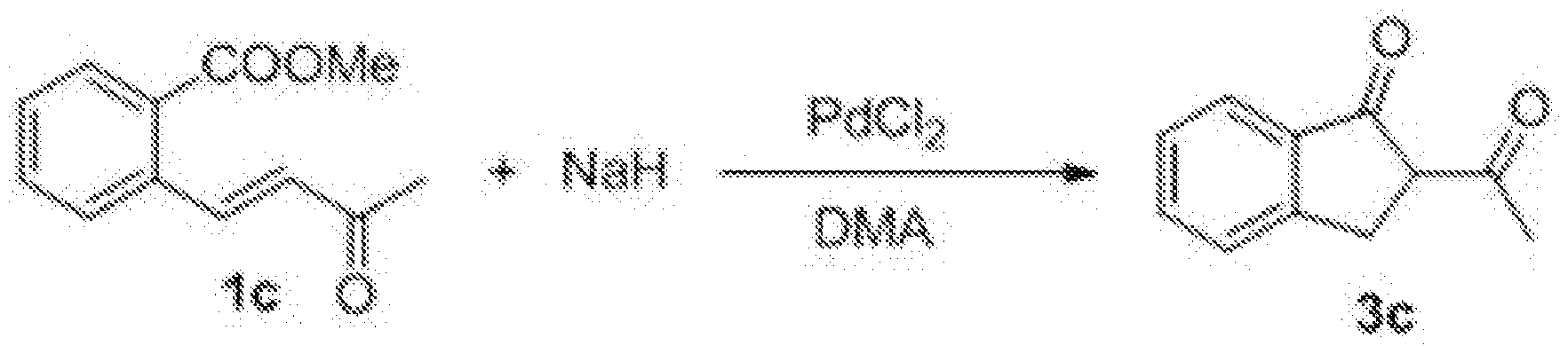
[0041] 氮气保护下, 氯化祀 (5.3 mg, 0.03 mmol, 10 mol%)和氢化钠 (60% in oil, 24 mg, 0.6 mmol, 2 equiv)悬浮于 DMA (1.5 mL), 25°C搅拌 5分钟, 加入化合物 lc (0.3 mmol)在 DMA (0.5 mL)的溶液, 然后在 25°C反应 2小时, 加入饱和氯化铵水 溶液中止反应, 用乙酸乙酯萃取, 合并萃取液, 用硫酸钠干燥, 旋蒸蒸干, 柱 层析纯化, 得到产物 3c, 收率 98%。 The mixture of enol and keto form, enol/keto = 84/16. 'H NMR (400 MHz, CDC1 3): 6 7.81 (d, /= 7.6 Hz, 1H, enol), 7.72 (d, / = 7.6 Hz, 1H, keto), 7.63-7.46 (m, 2H, enol and keto), 7.44-7.33 (m, 1H, enol and keto), 4.11-3.92 (m, 1H, keto), 3.77-3.68 (m, 1H, keto), 3.58 (s, 2H, enol), 3.12 (dd, / = 17.4, 7.7 Hz, 1H, keto), 2.49 (s, 3H, keto), 2.17 (s, 3H, enol). 13C NMR (151 MHz, CDC1 3): 6 201.52 (keto), 199.85 (keto), 191.56, 177.60, 154.24 (keto), 147.63, 138.31, 135.52 (keto), 135.14 (keto), 132.88, 127.76 (keto), 127.43, 126.73 (keto), 125.85, 124.61 (keto), 123.28, 110.56, 62.07 (keto), 30.38, 29.82 (keto), 28.00 (keto), 21.18. LR-MS (ESI): m/z 175.1 [M+H]+。
[0042] 实施例 11

[0043] 氮气保护下, 氯化祀 (5.3 mg, 0.03 mmol, 10 mol%)和氢化钠 (60% in oil, 24 mg, 0.6 mmol, 2 equiv)悬浮于 DMA (1.5 mL), 25°C搅拌 5分钟, 加入化合物 Id (0.3 mmol)在 DMA (0.5 mL)的溶液, 然后在 25°C反应 2小时, 加入饱和氯化铵水 溶液中止反应, 用乙酸乙酯萃取, 合并萃取液, 用硫酸钠干燥, 旋蒸蒸干, 柱 层析纯化, 得到产物 3d, 收率 99%。 The mixture of enol and keto form, enol/keto = 87/13. 'H NMR (400 MHz, CDC1 3): 6 15.08 (br, 1H, enol), 8.14 (d, / = 7.6 Hz, 2H,
keto), 8.00-7.92 (m, 2H, enol), 7.89 (d, /= 7.6 Hz, 1H, enol), 7.73 (d, /= 7.6 Hz, 1H, keto), 7.62-7.48 (m, 5H, enol and keto), 7.44 (t, J = 7.2 Hz, 1H, enol), 7.40-7.35 (m, 1H, keto), 4.87 (dd, /= 7.4, 2.6 Hz, 1H, keto), 3.94 (s, 2H, enol), 3.90-3.75 (m, 1H, keto), 3.34 (dd, /= 17.1, 7.7 Hz, 1H, keto). 13C NMR (151 MHz, CDC1 3): 6 200.12 (keto), 195.95, 194.40 (keto), 170.91, 154.47 (keto), 148.70, 145.81 (keto), 138.03, 136.43 (keto), 135.41 (keto), 134.94 (keto), 133.68 (keto), 133.47, 131.40, 129.96, 128.74, 128.25, 127.83 (keto), 127.59, 126.65 (keto), 125.73, 124.77(keto), 123.57, 109.58, 56.69 (keto), 32.37, 30.20 (keto). LR-MS (ESI): m/z 237.0 [M+H]+。
Claims
[权利要求 1] 基于金属氢化物 /钯化合物体系制备 1,3 -二羰基化合物的方法, 包括以 下步骤, 氮气保护下, 把钯化合物和金属氢化物悬浮于溶剂中, 然后 加入缺电子烯化合物, 在 0°C〜 100°C下反应 0.3〜 10小时, 得到 1,3 -二 羰基化合物。
[权利要求 2] 根据权利要求 1所述的方法, 其特征在于, 所述金属氢化物包括氢化 钠、 氢化锂、 氢化钾、 氢化钙; 所述钯化合物包括氯化钯、 醋酸钯、
Pd 2(dba) 3、 Pd(TFA) 2、 3-C 3H 5)PdCl] 2、 Pd(dppp)Cl 2、 Pd(C 6H 5 CN) 2C1 2、 Pd(OH) 2。
[权利要求 3] 根据权利要求 2所述的方法, 其特征在于, 所述金属氢化物为氢化钠 或者氢化锂; 所述钯化合物为氯化钯或者醋酸钯。
[权利要求 4] 根据权利要求 3所述的方法, 其特征在于, 所述金属氢化物为氢化钠
; 所述钯化合物为氯化钯。
[权利要求 5] 根据权利要求 1所述的方法, 其特征在于, 所述缺电子烯化合物的化 学结构式如下:

R选自芳基、 烷基、 烷氧基、 胺基。
[权利要求 6] 根据权利要求 1所述的方法, 其特征在于, 所述钯化合物、 金属氢化 物、 缺电子烯化合物的摩尔比为 (0.01〜 1) :(1〜 5) : 1。
[权利要求 7] 根据权利要求 6所述的方法, 其特征在于, 所述钯化合物、 金属氢化 物、 缺电子烯化合物的摩尔比为 (0.05〜 0.15) :(1〜 3) :1。
[权利要求 8] 根据权利要求 1所述的方法, 其特征在于, 反应结束后, 加入饱和氯 化铵水溶液中止反应, 然后萃取、 蒸干、 柱层析纯化, 得到产物 1,3- 二羰基化合物。
[权利要求 9] 根据权利要求 1所述的方法, 其特征在于, 所述溶剂为 DMA、 DMF、
THF、 DME或者二氧六环。
[权利要求 10] 根据权利要求 1所述的方法, 其特征在于, 所述反应的温度为 25〜 60 °C; 所述反应的时间为 0.3〜 2小时。
Priority Applications (2)
| Application Number | Priority Date | Filing Date | Title |
|---|---|---|---|
| PCT/CN2018/106060 WO2020056564A1 (zh) | 2018-09-17 | 2018-09-17 | 基于金属氢化物/钯化合物体系制备1,3-二羰基化合物的方法 |
| US17/203,097 US11180437B2 (en) | 2018-09-17 | 2021-03-16 | Method for preparing 1,3-dicarbonyl compound based on metal hydride/palladium compound system |
Applications Claiming Priority (1)
| Application Number | Priority Date | Filing Date | Title |
|---|---|---|---|
| PCT/CN2018/106060 WO2020056564A1 (zh) | 2018-09-17 | 2018-09-17 | 基于金属氢化物/钯化合物体系制备1,3-二羰基化合物的方法 |
Related Child Applications (1)
| Application Number | Title | Priority Date | Filing Date |
|---|---|---|---|
| US17/203,097 Continuation US11180437B2 (en) | 2018-09-17 | 2021-03-16 | Method for preparing 1,3-dicarbonyl compound based on metal hydride/palladium compound system |
Publications (1)
| Publication Number | Publication Date |
|---|---|
| WO2020056564A1 true WO2020056564A1 (zh) | 2020-03-26 |
Family
ID=69888017
Family Applications (1)
| Application Number | Title | Priority Date | Filing Date |
|---|---|---|---|
| PCT/CN2018/106060 Ceased WO2020056564A1 (zh) | 2018-09-17 | 2018-09-17 | 基于金属氢化物/钯化合物体系制备1,3-二羰基化合物的方法 |
Country Status (2)
| Country | Link |
|---|---|
| US (1) | US11180437B2 (zh) |
| WO (1) | WO2020056564A1 (zh) |
Families Citing this family (1)
| Publication number | Priority date | Publication date | Assignee | Title |
|---|---|---|---|---|
| WO2020056565A1 (zh) * | 2018-09-17 | 2020-03-26 | 南通纺织丝绸产业技术研究院 | 金属氢化物 / 钯化合物体系在缺电子烯化合物串联反应制备 1,3- 二羰基化合物中的应用 |
Citations (5)
| Publication number | Priority date | Publication date | Assignee | Title |
|---|---|---|---|---|
| US20060020012A1 (en) * | 2001-01-10 | 2006-01-26 | Pfizer Inc | Pyrazole derivatives |
| CN102491886A (zh) * | 2011-12-01 | 2012-06-13 | 上海化工研究院 | 一种茚酮类化合物的合成方法 |
| CN102863376A (zh) * | 2012-09-27 | 2013-01-09 | 上海师范大学 | N-取代甲基-3,5-双取代苄叉基-4-哌啶酮及制备和应用 |
| CN108976122A (zh) * | 2018-09-13 | 2018-12-11 | 南通纺织丝绸产业技术研究院 | 基于金属氢化物/钯化合物体系制备1,3-二羰基化合物的方法 |
| CN109053446A (zh) * | 2018-09-13 | 2018-12-21 | 苏州大学张家港工业技术研究院 | 金属氢化物/钯化合物体系在缺电子烯化合物串联反应制备1,3-二羰基化合物中的应用 |
-
2018
- 2018-09-17 WO PCT/CN2018/106060 patent/WO2020056564A1/zh not_active Ceased
-
2021
- 2021-03-16 US US17/203,097 patent/US11180437B2/en not_active Expired - Fee Related
Patent Citations (5)
| Publication number | Priority date | Publication date | Assignee | Title |
|---|---|---|---|---|
| US20060020012A1 (en) * | 2001-01-10 | 2006-01-26 | Pfizer Inc | Pyrazole derivatives |
| CN102491886A (zh) * | 2011-12-01 | 2012-06-13 | 上海化工研究院 | 一种茚酮类化合物的合成方法 |
| CN102863376A (zh) * | 2012-09-27 | 2013-01-09 | 上海师范大学 | N-取代甲基-3,5-双取代苄叉基-4-哌啶酮及制备和应用 |
| CN108976122A (zh) * | 2018-09-13 | 2018-12-11 | 南通纺织丝绸产业技术研究院 | 基于金属氢化物/钯化合物体系制备1,3-二羰基化合物的方法 |
| CN109053446A (zh) * | 2018-09-13 | 2018-12-21 | 苏州大学张家港工业技术研究院 | 金属氢化物/钯化合物体系在缺电子烯化合物串联反应制备1,3-二羰基化合物中的应用 |
Non-Patent Citations (1)
| Title |
|---|
| DING, GANG ET AL.: "Progress in Palladium-Catalyzed Tandem Reaction of Constructing Benzo-Five-Membered Heterocycles", CHINESE JOURNAL OF ORGANIC CHEMISTRY, 31 December 2016 (2016-12-31), pages 43 - 59, ISSN: 0253-2786 * |
Also Published As
| Publication number | Publication date |
|---|---|
| US20210206708A1 (en) | 2021-07-08 |
| US11180437B2 (en) | 2021-11-23 |
Similar Documents
| Publication | Publication Date | Title |
|---|---|---|
| CN112174782B (zh) | 金属氘化物/钯化合物催化还原体系在氘代反应中的应用 | |
| JP2004527577A5 (zh) | ||
| FI3765440T3 (fi) | Menetelmä n-alkyylinitratoetyylinitramiinien valmistamiseksi | |
| CN108358760B (zh) | 金属化物/钯化合物催化还原体系在脱苄基反应及氘代反应中的应用 | |
| CN109053446B (zh) | 金属氢化物/钯化合物体系在缺电子烯化合物串联反应制备1,3-二羰基化合物中的应用 | |
| CN108976122B (zh) | 基于金属氢化物/钯化合物体系制备1,3-二羰基化合物的方法 | |
| WO2020056564A1 (zh) | 基于金属氢化物/钯化合物体系制备1,3-二羰基化合物的方法 | |
| US11420925B2 (en) | Reduction method and reduction product of alkenyl active methylene compound | |
| CN111320587A (zh) | 一种1h-1,2,3-三氮唑的制备方法 | |
| CN109020864B (zh) | 金属氢化物/钯化合物催化还原体系在烯基活泼亚甲基化合物还原中的应用及还原方法 | |
| KR100574350B1 (ko) | 2-아미노피리딘 유도체의 제조방법 | |
| TWI551592B (zh) | 以兩步驟來製備3,5-二側氧己酸酯 | |
| CN109096105B (zh) | 烯基活泼亚甲基化合物的还原方法及还原产物 | |
| US11795132B2 (en) | Application of metal hydride/palladium compound system in preparation of 1,3-dicarbonyl compound in cascade reaction of electron-deficient alkene compound | |
| US10851068B2 (en) | Method for preparing pyrimidone compound | |
| CN109020865B (zh) | 3,3-二取代氧化吲哚及其制备方法 | |
| WO2020051853A1 (zh) | 3,3-二取代氧化吲哚及其制备方法 | |
| CN114507180A (zh) | 甲基取代的氮杂环化合物C(sp3)-H键自身脱氢烯基化的方法 | |
| CN108516622B (zh) | 一种端羧基超支化聚合物阻垢剂及其制备方法和应用 | |
| DE1543873A1 (de) | 5-Sulfamoylanthranilsaeureverbindungen und Verfahren zu ihrer Herstellung | |
| CN115960008B (zh) | 一种酰亚胺衍生物的合成方法 | |
| CN117658936B (zh) | 一种3,5,6-三氯-[1,2,4]-三嗪的合成方法 | |
| CN114805218B (zh) | 一种瑞舒伐他汀钙中间体的制备方法 | |
| WO2020051854A1 (zh) | 金属氢化物/钯化合物催化还原体系在烯基活泼亚甲基化合物还原中的应用及还原方法 | |
| CN121494775A (zh) | 一种n-氯乙基咔唑的制备方法 |
Legal Events
| Date | Code | Title | Description |
|---|---|---|---|
| 121 | Ep: the epo has been informed by wipo that ep was designated in this application |
Ref document number: 18933942 Country of ref document: EP Kind code of ref document: A1 |
|
| NENP | Non-entry into the national phase |
Ref country code: DE |
|
| 122 | Ep: pct application non-entry in european phase |
Ref document number: 18933942 Country of ref document: EP Kind code of ref document: A1 |