WO2020054598A1 - 3-ヒドロキシ-4-アミノ安息香酸類の製造方法 - Google Patents
3-ヒドロキシ-4-アミノ安息香酸類の製造方法 Download PDFInfo
- Publication number
- WO2020054598A1 WO2020054598A1 PCT/JP2019/035142 JP2019035142W WO2020054598A1 WO 2020054598 A1 WO2020054598 A1 WO 2020054598A1 JP 2019035142 W JP2019035142 W JP 2019035142W WO 2020054598 A1 WO2020054598 A1 WO 2020054598A1
- Authority
- WO
- WIPO (PCT)
- Prior art keywords
- hydroxy
- group
- seq
- aminobenzoic
- amino acid
- Prior art date
- Legal status (The legal status is an assumption and is not a legal conclusion. Google has not performed a legal analysis and makes no representation as to the accuracy of the status listed.)
- Ceased
Links
- 0 *c1cc(N)cc(*)c1C(O)=O Chemical compound *c1cc(N)cc(*)c1C(O)=O 0.000 description 1
Classifications
-
- C—CHEMISTRY; METALLURGY
- C12—BIOCHEMISTRY; BEER; SPIRITS; WINE; VINEGAR; MICROBIOLOGY; ENZYMOLOGY; MUTATION OR GENETIC ENGINEERING
- C12P—FERMENTATION OR ENZYME-USING PROCESSES TO SYNTHESISE A DESIRED CHEMICAL COMPOUND OR COMPOSITION OR TO SEPARATE OPTICAL ISOMERS FROM A RACEMIC MIXTURE
- C12P13/00—Preparation of nitrogen-containing organic compounds
- C12P13/001—Amines; Imines
-
- C—CHEMISTRY; METALLURGY
- C12—BIOCHEMISTRY; BEER; SPIRITS; WINE; VINEGAR; MICROBIOLOGY; ENZYMOLOGY; MUTATION OR GENETIC ENGINEERING
- C12P—FERMENTATION OR ENZYME-USING PROCESSES TO SYNTHESISE A DESIRED CHEMICAL COMPOUND OR COMPOSITION OR TO SEPARATE OPTICAL ISOMERS FROM A RACEMIC MIXTURE
- C12P13/00—Preparation of nitrogen-containing organic compounds
- C12P13/005—Amino acids other than alpha- or beta amino acids, e.g. gamma amino acids
-
- C—CHEMISTRY; METALLURGY
- C12—BIOCHEMISTRY; BEER; SPIRITS; WINE; VINEGAR; MICROBIOLOGY; ENZYMOLOGY; MUTATION OR GENETIC ENGINEERING
- C12N—MICROORGANISMS OR ENZYMES; COMPOSITIONS THEREOF; PROPAGATING, PRESERVING, OR MAINTAINING MICROORGANISMS; MUTATION OR GENETIC ENGINEERING; CULTURE MEDIA
- C12N15/00—Mutation or genetic engineering; DNA or RNA concerning genetic engineering, vectors, e.g. plasmids, or their isolation, preparation or purification; Use of hosts therefor
- C12N15/09—Recombinant DNA-technology
-
- C—CHEMISTRY; METALLURGY
- C12—BIOCHEMISTRY; BEER; SPIRITS; WINE; VINEGAR; MICROBIOLOGY; ENZYMOLOGY; MUTATION OR GENETIC ENGINEERING
- C12N—MICROORGANISMS OR ENZYMES; COMPOSITIONS THEREOF; PROPAGATING, PRESERVING, OR MAINTAINING MICROORGANISMS; MUTATION OR GENETIC ENGINEERING; CULTURE MEDIA
- C12N9/00—Enzymes; Proenzymes; Compositions thereof; Processes for preparing, activating, inhibiting, separating or purifying enzymes
- C12N9/0004—Oxidoreductases (1.)
- C12N9/0071—Oxidoreductases (1.) acting on paired donors with incorporation of molecular oxygen (1.14)
- C12N9/0073—Oxidoreductases (1.) acting on paired donors with incorporation of molecular oxygen (1.14) with NADH or NADPH as one donor, and incorporation of one atom of oxygen 1.14.13
-
- C—CHEMISTRY; METALLURGY
- C12—BIOCHEMISTRY; BEER; SPIRITS; WINE; VINEGAR; MICROBIOLOGY; ENZYMOLOGY; MUTATION OR GENETIC ENGINEERING
- C12P—FERMENTATION OR ENZYME-USING PROCESSES TO SYNTHESISE A DESIRED CHEMICAL COMPOUND OR COMPOSITION OR TO SEPARATE OPTICAL ISOMERS FROM A RACEMIC MIXTURE
- C12P13/00—Preparation of nitrogen-containing organic compounds
- C12P13/008—Preparation of nitrogen-containing organic compounds containing a N-O bond, e.g. nitro (-NO2), nitroso (-NO)
-
- C—CHEMISTRY; METALLURGY
- C12—BIOCHEMISTRY; BEER; SPIRITS; WINE; VINEGAR; MICROBIOLOGY; ENZYMOLOGY; MUTATION OR GENETIC ENGINEERING
- C12Y—ENZYMES
- C12Y114/00—Oxidoreductases acting on paired donors, with incorporation or reduction of molecular oxygen (1.14)
- C12Y114/13—Oxidoreductases acting on paired donors, with incorporation or reduction of molecular oxygen (1.14) with NADH or NADPH as one donor, and incorporation of one atom of oxygen (1.14.13)
- C12Y114/13002—4-Hydroxybenzoate 3-monooxygenase (1.14.13.2)
Definitions
- the present invention relates to a method for producing 3-hydroxy-4-aminobenzoic acids using a microorganism.
- Polybenzoxazole is known as an engineering plastic having excellent heat resistance and mechanical strength, and is used for a fiber material, an insulating film of a semiconductor element, and the like (Non-Patent Document 1).
- the benzoxazole skeleton is formed by condensation of an o-aminophenol skeleton with a carboxylic acid. Therefore, 3-hydroxy-4-aminobenzoic acids (HABA) having these functional groups in the molecule are expected to be useful as PBO monomers. Actually, synthesis of polybenzoxazole using HABA and evaluation of physical properties have been studied (Non-Patent Document 2).
- Patent Document 2 a method of chemically reducing nitroaromatics and synthesizing it has been known.
- ABA 4-aminobenzoic acid
- Patent Document 1 Japanese Patent No. 5445453
- Patent Document 2 Japanese Patent No. 3821350
- Non-Patent Document 1 Hiroki Murase, SENI GAKKAISHI (Fiber and Industry), Vol. 66, No. 6 (2010)
- Non-Patent Document 2 Lon J. Mathias et al., Macromolecules, Vol. 18, No. 4, pp. 616-622 (1985)
- Non-Patent Document 3 Barrie Entsch et al., The Journal of Biological Chemistry, Vol.262, No.13, pp.6060-6068 (1987)
- Non-Patent Document 4 Domenico L. Gatti et al., Biochemistry, Vol. 35, No. 2, pp. 567-578 (1996)
- a method for producing 3-hydroxy-4-aminobenzoic acids comprising a step of contacting 4-aminobenzoic acids with a microorganism producing the following polypeptide (A) or (B).
- the present invention relates to providing a method for producing 3-hydroxy-4-aminobenzoic acids using a microorganism.
- the present inventors have found that the use of a microorganism that produces a specific 4-hydroxybenzoic acid hydroxylase can efficiently hydroxylate the 3-position of 4-aminobenzoic acids (ABA).
- ABA 4-aminobenzoic acids
- 3-hydroxy-4-aminobenzoic acids can be efficiently produced.
- “at least 90% identity” with respect to an amino acid sequence or a nucleotide sequence refers to 90% or more, preferably 95% or more, more preferably 96% or more, still more preferably 97% or more, and even more preferably. 98% or more, more preferably 99% or more identity.
- amino acid sequence in which one or more amino acids have been deleted, substituted, added, or inserted refers to one or more and ten or less, preferably one or more and eight or less, and more preferably one or more. This refers to an amino acid sequence in which at least 5 or less, more preferably 1 to 3 amino acids have been deleted, substituted, added, or inserted.
- nucleotide sequence in which one or more nucleotides have been deleted, substituted, added, or inserted refers to 1 to 30 nucleotides, preferably 1 to 24 nucleotides, more preferably 1 to 24 nucleotides.
- the nucleotide sequence refers to a nucleotide sequence in which not less than 15 and more preferably not more than 1 and not more than 9 nucleotides have been deleted, substituted, added or inserted.
- addition of an amino acid or nucleotide includes addition of an amino acid or nucleotide to one end and both ends of the sequence.
- operably linked between a regulatory region and a gene means that the gene and the regulatory region are linked so that the gene can be expressed under the control of the regulatory region.
- Procedures for "operably linking" a gene and a control region are well known to those skilled in the art.
- the term “originally” used for the function, property, or trait of a cell is used to indicate that the function, property, or trait exists in a wild type of the cell.
- the term “foreign” is used to describe a function, property, or trait that is not originally present in the cell but is introduced from outside.
- a “foreign” gene or polynucleotide is a gene or polynucleotide that has been introduced into a cell from outside.
- the foreign gene or polynucleotide may be from the same organism as the cell into which it has been introduced, or may be from a different organism (ie, a heterologous gene or polynucleotide).
- the method of the present invention is a method for producing 3-hydroxy-4-aminobenzoic acids from 4-aminobenzoic acids using a microorganism.
- the 4-aminobenzoic acids are specifically represented by the following general formula (1):
- R 1 represents a hydrogen atom, a hydroxy group (—OH), a methoxy group (—OCH 3 ), an amino group (—NH 2 ), a fluorine atom (—F), a chlorine atom (—Cl), a bromine atom ( -Br), iodine (-I), a carboxy group (-COOH), a methyl group (-CH 3), shows an ethyl group (-CH 2 CH 3), R 2 is a hydrogen atom, a hydroxy group (-OH) , a methoxy group (-OCH 3), amino group (-NH 2), a fluorine atom (-F), chlorine atom (-Cl), bromine (-Br), iodine (-I), a carboxy group (-COOH ), A methyl group (—CH 3 ) or an ethyl group (—CH 2 CH 3 ).
- 4-hydroxy-4-aminobenzoic acids represented by the following general formula (2):
- R 1 and R 2 represent the same as described above, and one of X represents a hydrogen atom and the other represents a hydroxy group.
- a 3-hydroxy-4-aminobenzoic acid derivative represented by the following formula:
- the functional group represented by R 2 a hydrogen atom, hydroxy (-OH), an methoxy group (-OCH 3), a fluorine atom (-F) or a methyl group (-CH 3) is preferable.
- R 1 and R 2 are both hydrogen atoms.
- the microorganism used in the present invention is a microorganism that produces the following polypeptide (A) or (B) (hereinafter, also referred to as “the polypeptide of the present invention”).
- A a polypeptide comprising the amino acid sequence represented by SEQ ID NO: 2 or an amino acid sequence having at least 90% identity to the amino acid sequence represented by SEQ ID NO: 2, and having 4-hydroxybenzoic acid hydroxylase activity
- B a polypeptide comprising the amino acid sequence represented by SEQ ID NO: 6, or an amino acid sequence having at least 90% identity with the amino acid sequence represented by SEQ ID NO: 2, and 4-hydroxybenzoic acid hydroxylation Polypeptide having enzymatic activity
- a polypeptide consisting of the amino acid sequence represented by SEQ ID NO: 2 (also referred to as “HFM122”) and a polypeptide consisting of the amino acid sequence represented by SEQ ID NO: 6 (also referred to as “HFM689”) are 4-hydroxybenzoic acid- Known as 3-monooxygenase (EC 1.14.13.2).
- Examples of the amino acid sequence having at least 90% identity to the amino acid sequence represented by SEQ ID NO: 2 or 6 include deletion or substitution of one or more amino acids with respect to the amino acid sequence represented by SEQ ID NO: 2 or 6. , Added, or inserted amino acid sequences.
- 4-Hydroxybenzoic acid hydroxylase activity means the catalytic activity of 4-hydroxybenzoic acid hydroxylase, and 4-hydroxybenzoic acid hydroxylase catalyzes the hydroxylation of 4-hydroxybenzoic acid.
- 4-hydroxybenzoic acid-3-mono having a catalytic activity to promote the hydroxylation of 3-position of 4-hydroxybenzoic acid to generate protocatechuic acid and / or the reverse reaction thereof Means oxygenase.
- the activity of 4-hydroxybenzoic acid hydroxylase can be determined by, for example, a known method (Yan Huang et al., Appl. Microbiol. Biotechnol., 78, 75-83 (2008)).
- Methods for introducing mutations such as amino acid deletion, substitution, addition, or insertion into the amino acid sequence include, for example, deletion, substitution, addition, or insertion of nucleotides into the nucleotide sequence encoding the amino acid sequence. And the like.
- Techniques for introducing mutations into nucleotide sequences include, for example, chemical mutagens such as ethyl methanesulfonate, N-methyl-N-nitrosoguanidine, nitrous acid, and physical mutagens such as ultraviolet rays, X-rays, gamma rays, and ion beams. Mutagenesis, site-directed mutagenesis, and the method described in Dieffenbach et al.
- Methods for site-directed mutagenesis include a method using Splitting overwrap extension (SOE) PCR (Horton et al., Gene 77, 61-68, 1989) and an ODA method (Hashimoto-Gotoh et al., Gene, 152). , 271-276, 1995) and the Kunkel method (Kunkel, TA, Proc. Natl. Acad. Sci. USA, 1985, 82, 488).
- SOE Splitting overwrap extension
- Site-Directed Mutagenesis System Mutan- SuperExpress Km kit (Takara Bio Inc.), Transformer TM Site-Directed Mutagenesis Kit (Clonetech Inc.), KOD-Plus-Mutagenesis Kit ( Toyobo) for commercial site-directed mutagenesis, such as Kits can also be used.
- the polypeptide is not limited to a foreign one, and includes those originally possessed by the microorganism, but can express a polynucleotide necessary for expression of the polypeptide. Any microorganism may be used as long as it is contained in such a state.
- the microorganism is a microorganism into which the polynucleotide can be expressed, or a microorganism with enhanced expression of the polynucleotide, that is, a genetically modified microorganism.
- examples of the polynucleotide include the following polynucleotides (a) and (b) (hereinafter, also referred to as “polynucleotides of the present invention”).
- A a polynucleotide comprising the nucleotide sequence represented by SEQ ID NO: 1 or a nucleotide sequence having at least 90% identity to the nucleotide sequence represented by SEQ ID NO: 1 and having 4-hydroxybenzoic acid hydroxylase activity
- B a polynucleotide comprising the nucleotide sequence of SEQ ID NO: 5, or a nucleotide sequence having at least 90% identity to the nucleotide sequence of SEQ ID NO: 5, comprising 4-hydroxybenzoic acid
- nucleotide sequences having at least 90% identity to the nucleotide sequence shown in SEQ ID NO: 1 or 5 include deletion or substitution of one or more nucleotides in the nucleotide sequence shown in SEQ ID NO: 1 or 5. , Added, or inserted nucleotide sequences.
- the method for introducing a mutation such as deletion, substitution, addition or insertion of a nucleotide into a nucleotide sequence is as described above.
- the polynucleotide may be in single-stranded or double-stranded form, or may be DNA or RNA.
- the DNA may be an artificial DNA such as a cDNA or a chemically synthesized DNA.
- the polynucleotide may be incorporated in a vector.
- the vector containing the polynucleotide of the present invention is an expression vector.
- the vector is an expression vector capable of introducing the polynucleotide of the present invention into a host microorganism and expressing the polynucleotide in the host microorganism.
- the vector comprises a polynucleotide of the invention and a control region operably linked thereto.
- the vector may be a vector such as a plasmid capable of autonomous propagation and replication outside a chromosome, or may be a vector integrated into a chromosome.
- the vector include, for example, pBluescript II II SK (-) (Stratagene), pUC18 / 19, pUC118 / 119, and other pUC-based vectors (Takara Bio), pET-based vectors (Takara Bio), pGEX-based vectors (Takara Bio). GE Healthcare), pCold vector (Takara Bio), pHY300PLK (Takara Bio), pUB110 (Mckenzie, T. et al., 1986, Plasmid @ 15 (2): 93-103), pBR322 (Takara Bio), pRS403 (Takara Bio).
- pMW218 / 219 (Nippon Gene), pRI-based vectors such as pRI909 / 910 (Takara Bio), pBI-based vectors (Clontech), IN3-based vectors (Implantai Nove) ), PPTR1 / 2 (Takara Bio), pDJB2 (DJ Ballance et al., Gene, 36, 321-331, 1985), pAB4-1 (van Hartingsveldt W et al., Mol Gen Genet, 206, 71-75, 1987), pLeu4 (MIG Roncero et al., Gene, 84, 335-343, 1989), pPyr225 (CD Skory et al., Mol Genet Genomics, 268, 397-). 406, 2002), and pFG1 (Gruber, F. et al., Curr Genet, 18, 447-451, 1990).
- pRI-based vectors such as pRI90
- the polynucleotide may be constructed as a DNA fragment containing the polynucleotide.
- the DNA fragment include a PCR amplified DNA fragment and a restriction enzyme digested DNA fragment.
- the DNA fragment may be an expression cassette comprising a polynucleotide of the present invention and a control region operably linked thereto.
- the control region contained in the vector or the DNA fragment is a sequence for expressing the polynucleotide of the present invention in a host cell into which the vector or the DNA fragment has been introduced.
- an expression control region such as a promoter or a terminator, The starting point is exemplified.
- the type of the control region can be appropriately selected according to the type of the host microorganism into which the vector or the DNA fragment is introduced. If necessary, the vector or the DNA fragment may further have a selection marker such as an antibiotic resistance gene and a gene related to amino acid synthesis.
- Means for introducing the polynucleotide of the present invention into a host cell so that it can be expressed or enhancing the expression of the polynucleotide of the present invention include, for example, a control region, preferably a strong control region (compared to a wild type). Introducing a vector or DNA fragment containing the polynucleotide of the present invention operably linked to a control region capable of enhancing the expression into the host microorganism, or, on the genome of the host microorganism, a strong control region and the polynucleotide of the present invention. And operably linked nucleotides (eg, replacing the regulatory region sequence of the polynucleotide of the present invention on the genome of the parent cell with a strong regulatory region).
- a control region preferably a strong control region (compared to a wild type).
- any of fungi, yeast, actinomycetes, Escherichia coli, Bacillus subtilis and the like may be used, but Escherichia coli and actinomycetes are preferred.
- Actinomycetes include Corynebacterium, Mycobacterium, Rhodococcus, Streptomyces, Propionibacterium and the like, preferably Corynebacterium, more preferably Is Corynebacterium glutamicum.
- the microorganism into which the desired vector or DNA fragment has been introduced can be selected using a selection marker.
- the selectable marker is an antibiotic resistance gene
- the microorganism (transformant) into which the target vector or DNA fragment has been introduced can be selected by culturing in a medium containing the antibiotic.
- the selectable marker is an amino acid synthesis-related gene
- the microorganism into which the target vector or DNA fragment has been introduced is selected based on the presence or absence of the amino acid requirement. can do.
- the introduction of the target vector or DNA fragment can be confirmed by examining the DNA sequence of the transformant by PCR or the like.
- examples of the strong control region include, but are not particularly limited to, known high expression promoters such as T7 promoter, lac promoter, tac promoter, and trp promoter.
- a DNA fragment containing the strong control region and the polynucleotide sequence of the selectable marker is introduced into a host cell, and homologous recombination or A method for selecting a microorganism transformed by non-homologous recombination or the like can be mentioned.
- the method for producing 3-hydroxy-4-aminobenzoic acids of the present invention is carried out by contacting 4-aminobenzoic acids with a microorganism that produces the above-mentioned polypeptide.
- the contact conditions between the microorganism and the 4-aminobenzoic acids can be appropriately designed according to the microorganism used. That is, the medium for culturing the microorganism of the present invention includes a carbon source, a nitrogen source, an inorganic salt, and the like, as long as the medium can efficiently culture the microorganism, any of a natural medium and a synthetic medium. May be used.
- the carbon source for example, sugars such as glucose, polyols such as glycerin, alcohols such as ethanol, and organic acids such as pyruvic acid, succinic acid, or citric acid can be used.
- the nitrogen source for example, peptone, meat extract, yeast extract, casein hydrolyzate, alkali extract of soybean meal, alkylamines such as methylamine, or ammonia or a salt thereof can be used.
- salts such as phosphate, carbonate, sulfate, magnesium, calcium, potassium, iron, manganese, and zinc, specific amino acids, specific vitamins, antifoaming agents, and the like may be used as necessary.
- Cultivation can be performed usually at 10 ° C. to 40 ° C. for 6 hours to 72 hours, preferably 9 hours to 60 hours, more preferably 12 hours to 48 hours, with stirring or shaking as necessary.
- an antibiotic such as ampicillin or kanamycin may be added to the medium as needed.
- the method of contacting a culture including a culture solution, a culture supernatant, a cultured cell, a crushed cell, and the like) with 4-aminobenzoic acids is not particularly limited, and the contact may be carried out during the culture of the microorganism. Alternatively, the cells may be separately contacted after culturing. In addition, the 4-aminobenzoic acids may be biosynthesized in the cells during the culture, or may be added from the outside.
- the contact condition is not particularly limited, but is usually 20 ° C. to 50 ° C., for 5 minutes to 72 hours, preferably 1 hour to 60 hours, more preferably 1 hour to 24 hours, with stirring or shaking as necessary. Can be.
- 3-hydroxy-4-aminobenzoic acids are produced in the cells after contacting the culture with 4-aminobenzoic acids, a method known in the art, for example, the cells are subjected to a mechanical method, lysozyme 3-hydroxy-4-aminobenzoic acids can be extracted by destruction by an enzymatic method using the above method or a chemical treatment using a surfactant or the like.
- the cells may be removed by using the culture solution as it is or by centrifugation.
- the method of collecting and isolating 3-hydroxy-4-aminobenzoic acids from the culture is not particularly limited. That is, it can be carried out by combining known ion exchange resin methods, precipitation methods, crystallization methods, recrystallization methods, concentration methods and other methods.
- 3-hydroxy-4-aminobenzoic acids can be obtained by removing the cells by centrifugation or the like, removing ionic substances with a cation and anion exchange resin, and concentrating.
- the 3-hydroxy-4-aminobenzoic acids accumulated in the culture may be used without isolation.
- a method for producing 3-hydroxy-4-aminobenzoic acids comprising a step of contacting 4-aminobenzoic acids with a microorganism producing the following polypeptide (A) or (B).
- A a polypeptide comprising the amino acid sequence represented by SEQ ID NO: 2 or an amino acid sequence having at least 90% identity to the amino acid sequence represented by SEQ ID NO: 2, and having 4-hydroxybenzoic acid hydroxylase activity
- B a polypeptide comprising the amino acid sequence represented by SEQ ID NO: 6, or an amino acid sequence having at least 90% identity with the amino acid sequence represented by SEQ ID NO: 2, and 4-hydroxybenzoic acid hydroxylation ⁇ 1>
- the method according to ⁇ 1>, wherein the polypeptide ⁇ 2> microorganism having an enzymatic activity contains the following polynucleotide (a) or (b) in an expressible state.
- A a polynucleotide comprising the nucleotide sequence represented by SEQ ID NO: 1 or a nucleotide sequence having at least 90% identity to the nucleotide sequence represented by SEQ ID NO: 1 and having 4-hydroxybenzoic acid hydroxylase activity
- B a polynucleotide comprising the nucleotide sequence of SEQ ID NO: 5, or a nucleotide sequence having at least 90% identity to the nucleotide sequence of SEQ ID NO: 5, comprising 4-hydroxybenzoic acid
- 4-aminobenzoic acids are represented by the following general formula (1):
- R 1 represents a hydrogen atom, a hydroxy group (—OH), a methoxy group (—OCH 3 ), an amino group (—NH 2 ), a fluorine atom (—F), a chlorine atom (—Cl), a bromine atom ( -Br), iodine (-I), a carboxy group (-COOH), a methyl group (-CH 3), shows an ethyl group (-CH 2 CH 3), R 2 is a hydrogen atom, a hydroxy group (-OH) , a methoxy group (-OCH 3), amino group (-NH 2), a fluorine atom (-F), chlorine atom (-Cl), bromine (-Br), iodine (-I), a carboxy group (-COOH ), A methyl group (—CH 3 ), or an ethyl group (—CH 2 CH 3 ).
- a 3-amino-4-aminobenzoic acid derivative represented by the following general formula (2):
- R 1 and R 2 represent the same as described above, and one of X represents a hydrogen atom and the other represents a hydroxy group.
- R 1 is preferably a hydrogen atom, a hydroxy group (—OH ), A methoxy group (—OCH 3 ), a fluorine atom (—F) or a methyl group (—CH 3 ).
- R 2 is preferably a hydrogen atom, a hydroxy group (—OH ), A methoxy group (—OCH 3 ), a fluorine atom (—F), or a methyl group (—CH 3 ).
- R 1 and R 2 are both hydrogen atoms. >.
- ⁇ 8> Contact between 4-aminobenzoic acid and a microorganism is performed by contacting the lysate of the microorganism with 4-aminobenzoic acid at 20 ° C. to 50 ° C. for 5 minutes to 72 hours, preferably 1 hour to 60 hours, more preferably The method according to any one of ⁇ 1> to ⁇ 7>, wherein the contact is for 1 hour to 24 hours.
- Example 1 Preparation of Transformed Strain Table 1 shows PCR primers used in this example.
- Plasmids containing genes (SEQ ID NOs: 1, 3, and 5) encoding three types of 4-hydroxybenzoic acid hydroxylases (HFM122, HFM300 and HFM689) selected from flavin monooxygenase were prepared by artificial gene synthesis.
- primers pET HFM122F (SEQ ID NO: 7), pET HFM122R (SEQ ID NO: 8), pET PHHYart_Pa F (SEQ ID NO: 9), pET PHHYart_Pa R (SEQ ID NO: 10), pET HFM689art F (SEQ ID NO: 11) , PET HFM689art R (SEQ ID NO: 12) was used to synthesize a DNA fragment for insertion.
- a vector DNA fragment was amplified by PCR using the plasmid pET21a as a template and the primers pET21avecR (SEQ ID NO: 13) and pET21avecF (SEQ ID NO: 14). The above fragments were ligated using In-Fusion HD Cloning Kit (Clontech) to construct plasmid vectors pET-HFM122, pET-HFM300 and pET-HFM689.
- Escherichia coli DH5 ⁇ (Nippon Gene) was transformed by a competent cell transformation method.
- the resulting transformed cell solution was applied to an LBamp agar medium (Bacto Trypton 1%, Yeast Extract 0.5%, NaCl 1%, ampicillin sodium 50 ⁇ g / mL, agar 1.5%) and then allowed to stand at 37 ° C. overnight.
- the resulting colonies were subjected to PCR using Sapphire Amp (TAKARA), primers forCPCR pET21a F (SEQ ID NO: 15), and forCPCR pET21a R (SEQ ID NO: 16), and the introduction of the target DNA fragment was confirmed.
- the strain was selected as a transformant.
- the transformed strain was inoculated into 1 mL of LBamp liquid medium (Bacto Trypton 1%, Yeast Extract 0.5%, NaCl 1%, ampicillin sodium 50 ⁇ g / mL) and cultured at 37 ° C. overnight. Each plasmid vector was purified from this culture using a High Pure Plasmid Isolation Kit (Roche Life Science).
- Example 2 Production of 3-hydroxy-4-aminobenzoic acid using transformed strain ⁇ Culture of transformed strain>
- the HFM122 strain, HFM300 strain, and HFM689 strain obtained above were each inoculated into 1 mL of LBamp liquid medium (Bacto Trypton 1%, Yeast Extract 0.5%, NaCl 1%, Ampicillin sodium 50 ⁇ g / mL), and incubated at 37 ° C. for 1 hour. Cultured overnight. 100 ⁇ L of the obtained culture was inoculated into 10 mL of Overnight Express medium (Merck), cultured at 37 ° C. for about 24 hours, and then the cells were collected by centrifugation.
- the total protein amount of the cell lysate was quantified using a Bio-Rad protein assay (Bio-rad), and the production ability of 3-hydroxy-4-aminobenzoic acid in the HFM122 strain and the HFM689 strain according to the following formula and the improvement rate thereof was calculated.
- 3-hydroxy-4-aminobenzoic acid-producing ability (concentration of 3-hydroxy-4-aminobenzoic acid after reaction / total amount of protein)
- Production capacity improvement rate (%) (3-hydroxy-4-aminobenzoic acid-producing ability of HFM122 strain and HFM689 strain / 3-hydroxy-4-aminobenzoic acid-producing ability of HFM300 strain) ⁇ 100-100
- the apparatus used for @HPLC was LaChrom @ Elite (Hitachi High-Technologies).
- the analytical column used was an L-column @ ODS (4.6 mm@ID.times.50 cm, Chemical Research Institute), eluent A was 0.1% phosphoric acid, eluent B was 70% methanol, and the flow rate was Gradient elution was performed under the conditions of 1.0 mL / min and a column temperature of 40 ° C.
- a UV detector detection wavelength: 280 nm
- a concentration calibration curve was prepared using a standard sample [3-hydroxy-4-aminobenzoic acid (seller code A1194, Tokyo Chemical Industry)], and the amount of 3-hydroxy-4-aminobenzoic acid was determined based on the concentration calibration curve. Was performed.
Landscapes
- Chemical & Material Sciences (AREA)
- Organic Chemistry (AREA)
- Life Sciences & Earth Sciences (AREA)
- Engineering & Computer Science (AREA)
- Wood Science & Technology (AREA)
- Zoology (AREA)
- Health & Medical Sciences (AREA)
- Genetics & Genomics (AREA)
- Bioinformatics & Cheminformatics (AREA)
- General Engineering & Computer Science (AREA)
- Biotechnology (AREA)
- General Health & Medical Sciences (AREA)
- Biochemistry (AREA)
- Microbiology (AREA)
- Biomedical Technology (AREA)
- Chemical Kinetics & Catalysis (AREA)
- General Chemical & Material Sciences (AREA)
- Molecular Biology (AREA)
- Medicinal Chemistry (AREA)
- Proteomics, Peptides & Aminoacids (AREA)
- Physics & Mathematics (AREA)
- Biophysics (AREA)
- Plant Pathology (AREA)
- Preparation Of Compounds By Using Micro-Organisms (AREA)
- Micro-Organisms Or Cultivation Processes Thereof (AREA)
Abstract
微生物を用いた3-ヒドロキシ-4-アミノ安息香酸類の製造方法を提供する。 4-アミノ安息香酸類を、下記の(A)又は(B)のポリペプチドを産生する微生物と接触させる工程を含む、3-ヒドロキシ-4-アミノ安息香酸類の製造方法。 (A)配列番号2で示されるアミノ酸配列からなるポリペプチド、又は配列番号2で示されるアミノ酸配列と少なくとも90%の同一性を有するアミノ酸配列からなり、且つ4-ヒドロキシ安息香酸水酸化酵素活性を有するポリペプチド (B)配列番号6で示されるアミノ酸配列からなるポリペプチド、又は配列番号2で示されるアミノ酸配列と少なくとも90%の同一性を有するアミノ酸配列からなり、且つ4-ヒドロキシ安息香酸水酸化酵素活性を有するポリペプチド
Description
本発明は微生物を用いた3-ヒドロキシ-4-アミノ安息香酸類の製造方法に関する。
ポリベンズオキサゾール(PBO)は耐熱性や力学強度に優れたエンジニアリングプラスチックとして知られており、繊維材料及び半導体素子の絶縁膜等に利用される(非特許文献1)。
ベンズオキサゾール骨格はo-アミノフェノール骨格とカルボン酸との縮合により生成される。そのため、これらの官能基を分子内に有する3-ヒドロキシ-4-アミノ安息香酸(HABA)類はPBOモノマーとして有用であると期待される。実際に、HABAを用いたポリベンズオキサゾールの合成と物性評価が検討されている(非特許文献2)。
近年、地球環境負荷軽減等に向けて再生可能資源を原料とした微生物発酵による化合物の製造方法が注目されている。例えば、HABAと類似した構造を有する3-アミノ-4-ヒドロキシ安息香酸(AHBA)の微生物による生産とポリマー化の検討が行われている(特許文献1)。
HABAの製造に関してはこれまで化学的にニトロ芳香族を還元し合成する方法等が知られている(特許文献2)。微生物法によるHABA発酵生産を可能にする方策としては、微生物内での生合成が可能な4-アミノ安息香酸(ABA)の3位を水酸化することが考えられるが、このような反応に関しては、一部の4-ヒドロキシ安息香酸水酸化酵素がわずかに活性を有することが報告されているのみであった(非特許文献3,4)。
〔特許文献1〕特許第5445453号公報
〔特許文献2〕特許第3821350号公報
〔非特許文献1〕村瀬浩貴,SENI GAKKAISHI(繊維と工業), Vol.66, No.6 (2010)
〔非特許文献2〕Lon J. Mathias et al., Macromolecules, Vol.18, No.4, pp.616-622 (1985)
〔非特許文献3〕Barrie Entsch et al., The Journal of Biological Chemistry, Vol.262, No.13, pp.6060-6068 (1987)
〔非特許文献4〕Domenico L. Gatti et al., Biochemistry, Vol.35, No.2, pp.567-578 (1996)
〔特許文献2〕特許第3821350号公報
〔非特許文献1〕村瀬浩貴,SENI GAKKAISHI(繊維と工業), Vol.66, No.6 (2010)
〔非特許文献2〕Lon J. Mathias et al., Macromolecules, Vol.18, No.4, pp.616-622 (1985)
〔非特許文献3〕Barrie Entsch et al., The Journal of Biological Chemistry, Vol.262, No.13, pp.6060-6068 (1987)
〔非特許文献4〕Domenico L. Gatti et al., Biochemistry, Vol.35, No.2, pp.567-578 (1996)
本発明は以下に係るものである。
4-アミノ安息香酸類を、下記の(A)又は(B)のポリペプチドを産生する微生物と接触させる工程を含む、3-ヒドロキシ-4-アミノ安息香酸類の製造方法。
(A)配列番号2で示されるアミノ酸配列からなるポリペプチド、又は配列番号2で示されるアミノ酸配列と少なくとも90%の同一性を有するアミノ酸配列からなり、且つ4-ヒドロキシ安息香酸水酸化酵素活性を有するポリペプチド
(B)配列番号6で示されるアミノ酸配列からなるポリペプチド、又は配列番号2で示されるアミノ酸配列と少なくとも90%の同一性を有するアミノ酸配列からなり、且つ4-ヒドロキシ安息香酸水酸化酵素活性を有するポリペプチド
4-アミノ安息香酸類を、下記の(A)又は(B)のポリペプチドを産生する微生物と接触させる工程を含む、3-ヒドロキシ-4-アミノ安息香酸類の製造方法。
(A)配列番号2で示されるアミノ酸配列からなるポリペプチド、又は配列番号2で示されるアミノ酸配列と少なくとも90%の同一性を有するアミノ酸配列からなり、且つ4-ヒドロキシ安息香酸水酸化酵素活性を有するポリペプチド
(B)配列番号6で示されるアミノ酸配列からなるポリペプチド、又は配列番号2で示されるアミノ酸配列と少なくとも90%の同一性を有するアミノ酸配列からなり、且つ4-ヒドロキシ安息香酸水酸化酵素活性を有するポリペプチド
本発明は、微生物を用いた3-ヒドロキシ-4-アミノ安息香酸類の製造方法を提供することに関する。
本発明者らは、特定の4-ヒドロキシ安息香酸水酸化酵素を産生する微生物を用いることにより、4-アミノ安息香酸(ABA)類の3位を効率よく水酸化できることを見出した。
本発明によれば、3-ヒドロキシ-4-アミノ安息香酸類を効率よく製造することができる。
(1)定義
本明細書において、アミノ酸配列又はヌクレオチド配列の同一性は、Lipman-Pearson法(Science,1985,227:1435-1441)によって計算される。具体的には、遺伝情報処理ソフトウェアGENETYX Ver.12のホモロジー解析(Search homology)プログラムを用いて、Unit size to compare(ktup)を2として解析を行うことにより算出される。
本明細書において、アミノ酸配列又はヌクレオチド配列の同一性は、Lipman-Pearson法(Science,1985,227:1435-1441)によって計算される。具体的には、遺伝情報処理ソフトウェアGENETYX Ver.12のホモロジー解析(Search homology)プログラムを用いて、Unit size to compare(ktup)を2として解析を行うことにより算出される。
本明細書において、アミノ酸配列又はヌクレオチド配列に関する「少なくとも90%の同一性」とは、90%以上、好ましくは95%以上、より好ましくは96%以上、さらに好ましくは97%以上、さらにより好ましくは98%以上、なお好ましくは99%以上の同一性をいう。
本明細書における「1又は複数個のアミノ酸が欠失、置換、付加、又は挿入されたアミノ酸配列」とは、1個以上10個以下、好ましくは1個以上8個以下、より好ましくは1個以上5個以下、さらに好ましくは1個以上3個以下のアミノ酸が欠失、置換、付加、又は挿入されたアミノ酸配列をいう。また本明細書における「1又は複数個のヌクレオチドが欠失、置換、付加、又は挿入されたヌクレオチド配列」とは、1個以上30個以下、好ましくは1個以上24個以下、より好ましくは1個以上15個以下、さらにより好ましくは1個以上9個以下のヌクレオチドが欠失、置換、付加、又は挿入されたヌクレオチド配列をいう。本明細書において、アミノ酸又はヌクレオチドの「付加」には、配列の一末端及び両末端へのアミノ酸又はヌクレオチドの付加が含まれる。
本明細書において、制御領域と遺伝子との「作動可能な連結」とは、遺伝子と制御領域とが、該遺伝子が該制御領域の制御の下で発現し得るように連結されていることをいう。遺伝子と制御領域との「作動可能な連結」の手順は当業者に周知である。
本明細書において、細胞の機能や性状、形質に対して使用する用語「本来」とは、当該機能や性状、形質が当該細胞の野生型に存在していることを表すために使用される。対照的に、用語「外来」とは、当該細胞に元から存在するのではなく、外部から導入された機能や性状、形質を表すために使用される。例えば、「外来」遺伝子又はポリヌクレオチドとは、細胞に外部から導入された遺伝子又はポリヌクレオチドである。外来遺伝子又はポリヌクレオチドは、それが導入された細胞と同種の生物由来であっても、異種の生物由来(すなわち異種遺伝子又はポリヌクレオチド)であってもよい。
(2)3-ヒドロキシ-4-アミノ安息香酸類の製造
本発明の方法は、微生物を用いて、4-アミノ安息香酸類から3-ヒドロキシ-4-アミノ安息香酸類を製造する方法である。
本発明の方法は、微生物を用いて、4-アミノ安息香酸類から3-ヒドロキシ-4-アミノ安息香酸類を製造する方法である。
4-アミノ安息香酸類としては、具体的には下記の一般式(1):

〔式中、R1は水素原子、ヒドロキシ基(-OH)、メトキシ基(-OCH3)、アミノ基(-NH2)、フッ素原子(-F)、塩素原子(-Cl)、臭素原子(-Br)、ヨウ素原子(-I)、カルボキシ基(-COOH)、メチル基(-CH3)、エチル基(-CH2CH3)を示し、R2は水素原子、ヒドロキシ基(-OH)、メトキシ基(-OCH3)、アミノ基(-NH2)、フッ素原子(-F)、塩素原子(-Cl)、臭素原子(-Br)、ヨウ素原子(-I)、カルボキシ基(-COOH)、メチル基(-CH3)又はエチル基(-CH2CH3)を示す。〕
で示される4-アミノ安息香酸誘導体が挙げられ、3-ヒドロキシ-4-アミノ安息香酸類としては、下記の一般式(2):
で示される4-アミノ安息香酸誘導体が挙げられ、3-ヒドロキシ-4-アミノ安息香酸類としては、下記の一般式(2):

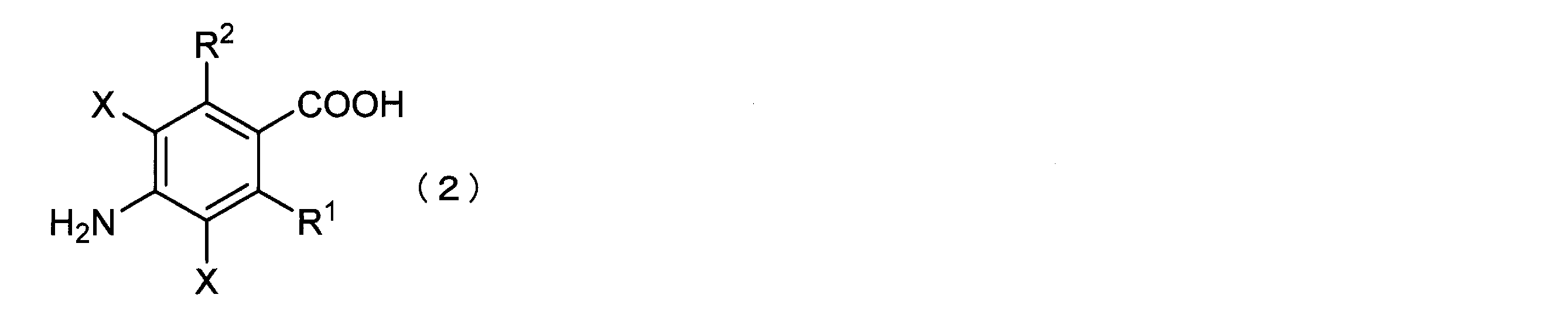
〔式中、R1及びR2は前記と同じものを示し、Xは、一方が水素原子で他方がヒドロキシ基を示す。〕
で示される3-ヒドロキシ-4-アミノ安息香酸誘導体が挙げられる。
で示される3-ヒドロキシ-4-アミノ安息香酸誘導体が挙げられる。
R1で示される官能基としては、水素原子、ヒドロキシ基(-OH)、メトキシ基(-OCH3)、フッ素原子(-F)又はメチル基(-CH3)が好ましい。
R2で示される官能基としては、水素原子、ヒドロキシ基(-OH)、メトキシ基(-OCH3)、フッ素原子(-F)又はメチル基(-CH3)が好ましい。
R1及びR2は、共に水素原子であるのがより好ましい。
本発明において用いられる微生物は、下記の(A)又は(B)のポリペプチド(以下、「本発明のポリペプチド」とも称する)を産生する微生物である。
(A)配列番号2で示されるアミノ酸配列からなるポリペプチド、又は配列番号2で示されるアミノ酸配列と少なくとも90%の同一性を有するアミノ酸配列からなり、且つ4-ヒドロキシ安息香酸水酸化酵素活性を有するポリペプチド
(B)配列番号6で示されるアミノ酸配列からなるポリペプチド、又は配列番号2で示されるアミノ酸配列と少なくとも90%の同一性を有するアミノ酸配列からなり、且つ4-ヒドロキシ安息香酸水酸化酵素活性を有するポリペプチド
(A)配列番号2で示されるアミノ酸配列からなるポリペプチド、又は配列番号2で示されるアミノ酸配列と少なくとも90%の同一性を有するアミノ酸配列からなり、且つ4-ヒドロキシ安息香酸水酸化酵素活性を有するポリペプチド
(B)配列番号6で示されるアミノ酸配列からなるポリペプチド、又は配列番号2で示されるアミノ酸配列と少なくとも90%の同一性を有するアミノ酸配列からなり、且つ4-ヒドロキシ安息香酸水酸化酵素活性を有するポリペプチド
ここで、配列番号2で示されるアミノ酸配列からなるポリペプチド(「HFM122」とも称する)、配列番号6で示されるアミノ酸配列からなるポリペプチド(「HFM689」とも称する)は、4-ヒドロキシ安息香酸-3-モノオキシゲナーゼ(EC1.14.13.2)として知られている。
配列番号2又は6で示されるアミノ酸配列と少なくとも90%の同一性を有するアミノ酸配列の例としては、配列番号2又は6で示されるアミノ酸配列に対して1又は複数個のアミノ酸が欠失、置換、付加、又は挿入されたアミノ酸配列が挙げられる。
配列番号2又は6で示されるアミノ酸配列と少なくとも90%の同一性を有するアミノ酸配列の例としては、配列番号2又は6で示されるアミノ酸配列に対して1又は複数個のアミノ酸が欠失、置換、付加、又は挿入されたアミノ酸配列が挙げられる。
「4-ヒドロキシ安息香酸水酸化酵素活性」とは、4-ヒドロキシ安息香酸水酸化酵素が示す触媒活性を意味し、4-ヒドロキシ安息香酸水酸化酵素とは4-ヒドロキシ安息香酸の水酸化を触媒する酵素、好ましくは4-ヒドロキシ安息香酸の3位を水酸化して、プロトカテク酸を生成する反応とその逆反応のいずれかまたは両方を促進する触媒活性を有する4-ヒドロキシ安息香酸-3-モノオキシゲナーゼを意味する。
4-ヒドロキシ安息香酸水酸化酵素活性は、たとえば公知の方法(Yan Huang et al.,Appl.Microbiol.Biotechnol.,78,75-83(2008).)等により決定することができる。
4-ヒドロキシ安息香酸水酸化酵素活性は、たとえば公知の方法(Yan Huang et al.,Appl.Microbiol.Biotechnol.,78,75-83(2008).)等により決定することができる。
アミノ酸配列に対してアミノ酸の欠失、置換、付加、又は挿入等の変異を導入する方法としては、例えば、該アミノ酸配列をコードするヌクレオチド配列に対してヌクレオチドの欠失、置換、付加、又は挿入等の変異を導入する方法が挙げられる。ヌクレオチド配列への変異導入の手法としては、例えば、エチルメタンスルホネート、N-メチル-N-ニトロソグアニジン、亜硝酸等の化学的変異原又は紫外線、X線、ガンマ線、イオンビーム等の物理的変異原による突然変異誘発、部位特異的変異導入法、Dieffenbachら(Cold Spring Harbar Laboratory Press,New York,581-621,1995)に記載の方法、等が挙げられる。部位特異的変異導入の手法としては、Splicing overlap extension(SOE)PCR(Horton et al.,Gene 77,61-68,1989)を利用した方法、ODA法(Hashimoto-Gotoh et al.,Gene,152,271-276,1995)、Kunkel法(Kunkel,T.A.,Proc.Natl.Acad.Sci.USA,1985,82,488)等が挙げられる。あるいは、Site-Directed Mutagenesis System Mutan-SuperExpress Kmキット(タカラバイオ社)、TransformerTM Site-Directed Mutagenesisキット(Clonetech社)、KOD-Plus-Mutagenesis Kit(東洋紡社)等の市販の部位特異的変異導入用キットを利用することもできる。
本発明の「ポリペプチドを産生する微生物」において、そのポリペプチドは外来のものに限られず、当該微生物が本来有しているものも含むが、当該ポリペプチドの発現に必要なポリヌクレオチドを発現可能な状態で含むものであればよく、好ましくは、当該ポリヌクレオチドが発現可能なように導入された微生物、当該ポリヌクレオチドの発現が強化された微生物、すなわち遺伝子組換え微生物である。
ここで、ポリヌクレオチドとしては、下記の(a)又は(b)のポリヌクレオチド(以下、「本発明のポリヌクレオチド」とも称する)が挙げられる。
(a)配列番号1で示されるヌクレオチド配列からなるポリヌクレオチド、又は配列番号1で示されるヌクレオチド配列と少なくとも90%の同一性を有するヌクレオチド配列からなり、4-ヒドロキシ安息香酸水酸化酵素活性を有するポリペプチドをコードするポリヌクレオチド
(b)配列番号5で示されるヌクレオチド配列からなるポリヌクレオチド、又は配列番号5で示されるヌクレオチド配列と少なくとも90%の同一性を有するヌクレオチド配列からなり、4-ヒドロキシ安息香酸水酸化酵素活性を有するポリペプチドをコードするポリヌクレオチド
ここで、ポリヌクレオチドとしては、下記の(a)又は(b)のポリヌクレオチド(以下、「本発明のポリヌクレオチド」とも称する)が挙げられる。
(a)配列番号1で示されるヌクレオチド配列からなるポリヌクレオチド、又は配列番号1で示されるヌクレオチド配列と少なくとも90%の同一性を有するヌクレオチド配列からなり、4-ヒドロキシ安息香酸水酸化酵素活性を有するポリペプチドをコードするポリヌクレオチド
(b)配列番号5で示されるヌクレオチド配列からなるポリヌクレオチド、又は配列番号5で示されるヌクレオチド配列と少なくとも90%の同一性を有するヌクレオチド配列からなり、4-ヒドロキシ安息香酸水酸化酵素活性を有するポリペプチドをコードするポリヌクレオチド
配列番号1又は5で示されるヌクレオチド配列と少なくとも90%の同一性を有するヌクレオチド配列の例としては、配列番号1又は5で示されるヌクレオチド配列に対して1又は複数個のヌクレオチドが欠失、置換、付加、又は挿入されたヌクレオチド配列が挙げられる。ヌクレオチド配列にヌクレオチドの欠失、置換、付加、又は挿入等の変異を導入する方法は、上述したとおりである。上記ポリヌクレオチドは、1本鎖若しくは2本鎖の形態であり得、又はDNAであってもRNAであってもよい。該DNAは、cDNA、化学合成DNA等の人工DNAであり得る。
上記ポリヌクレオチドは、ベクターに組み込まれていてもよい。好ましくは、本発明のポリヌクレオチドを含有するベクターは、発現ベクターである。また好ましくは、該ベクターは、本発明のポリヌクレオチドを宿主微生物に導入することができ、かつ宿主微生物内で該ポリヌクレオチドを発現することができる発現ベクターである。好ましくは、該ベクターは、本発明のポリヌクレオチド、及びこれと作動可能に連結された制御領域を含む。該ベクターは、プラスミド等の染色体外で自立増殖及び複製可能なベクターであってもよく、又は染色体内に組み込まれるベクターであってもよい。
具体的なベクターの例としては、例えば、pBluescript II SK(-)(Stratagene)、pUC18/19、pUC118/119等のpUC系ベクター(タカラバイオ)、pET系ベクター(タカラバイオ)、pGEX系ベクター(GEヘルスケア)、pCold系ベクター(タカラバイオ)、pHY300PLK(タカラバイオ)、pUB110(Mckenzie,T.et al.,1986,Plasmid 15(2):93-103)、pBR322(タカラバイオ)、pRS403(Stratagene)、pMW218/219(ニッポンジーン)、pRI909/910等のpRI系ベクター(タカラバイオ)、pBI系ベクター(クロンテック)、IN3系ベクター(インプランタイノベーションズ)、pPTR1/2(タカラバイオ)、pDJB2(D.J.Ballance et al.,Gene,36,321-331,1985)、pAB4-1(van Hartingsveldt W et al.,Mol Gen Genet,206,71-75,1987)、pLeu4(M.I.G.Roncero et al.,Gene,84,335-343,1989)、pPyr225(C.D.Skory et al.,Mol Genet Genomics,268,397-406,2002)、pFG1(Gruber,F.et al.,Curr Genet,18,447-451,1990)等が挙げられる。
また、上記ポリヌクレオチドは、これを含むDNA断片として構築されていてもよい。該DNA断片としては、例えば、PCR増幅DNA断片及び制限酵素切断DNA断片が挙げられる。好ましくは、該DNA断片は、本発明のポリヌクレオチド、及びこれと作動可能に連結された制御領域を含む発現カセットであり得る。
上記ベクター又はDNA断片に含まれる制御領域は、該ベクター又はDNA断片が導入された宿主細胞内で本発明のポリヌクレオチドを発現させるための配列であり、例えばプロモーターやターミネーター等の発現調節領域、複製開始点等が挙げられる。該制御領域の種類は、ベクター又はDNA断片を導入する宿主微生物の種類に応じて適宜選択することができる。必要に応じて、該ベクター又はDNA断片はさらに、抗生物質耐性遺伝子、アミノ酸合成関連遺伝子等の選択マーカーを有していてもよい。
宿主細胞に対して本発明のポリヌクレオチドを発現可能なように導入する、又は本発明のポリヌクレオチドの発現を強化する手段としては、例えば、制御領域、好ましくは強制御領域(野生型に比較し発現を強化できる制御領域)と作動可能に連結された本発明のポリヌクレオチドを含有するベクター又はDNA断片を宿主微生物に導入すること、或いは宿主微生物のゲノム上で、強制御領域と本発明のポリヌクレオチドとを作動可能に連結して配置すること(例えば、親細胞のゲノム上の本発明のポリヌクレオチドの制御領域配列を強制御領域に置換すること)、等が挙げられる。
宿主細胞としては、真菌、酵母、放線菌、大腸菌、枯草菌等、いずれを用いてもよいが、大腸菌、放線菌が好ましい。放線菌としては、コリネバクテリウム属菌、マイコバクテリウム属菌、ロドコッカス属菌、ストレプトマイセス属菌、プロピオニバクテリウム属菌等が挙げられ、好ましくはコリネバクテリウム属菌であり、より好ましくはコリネバクテリウム・グルタミカムである。
上記微生物へのベクター又はDNA断片の導入には、一般的な形質転換法、例えばエレクトロポレーション法、トランスフォーメーション法、トランスフェクション法、接合法、プロトプラスト法、パーティクル・ガン法、アグロバクテリウム法等を用いることができる。
目的のベクター又はDNA断片が導入された微生物は、選択マーカーを利用して選択することができる。例えば、選択マーカーが抗生物質耐性遺伝子である場合、該抗生物質添加培地で培養することで、目的のベクター又はDNA断片が導入された微生物(形質転換体)を選択することができる。また例えば、選択マーカーがアミノ酸合成関連遺伝子である場合、該アミノ酸要求性の宿主微生物に遺伝子導入した後、該アミノ酸要求性の有無を指標に、目的のベクター又はDNA断片が導入された微生物を選択することができる。あるいは、PCR等によって形質転換体のDNA配列を調べることで目的のベクター又はDNA断片の導入を確認することもできる。
また、強制御領域としては、公知の高発現プロモーターであるT7プロモーター、lacプロモーター、tacプロモーター、trpプロモーター等が例示されるが、これらに特に限定されない。
宿主微生物のゲノム上に存在する前記ポリヌクレオチドの制御領域を強制御領域に置換する方法としては、強制御領域と選択マーカーのポリヌクレオチド配列を含むDNA断片を宿主細胞に導入し、相同組換え又は非相同組換え等により形質転換された微生物を選択する方法等があげられる。
このようにして調製した本発明のポリペプチドを産生する微生物を培養し、3-ヒドロキシ-4-アミノ安息香酸類の生産性を評価し、適切な組換体を選択することにより、有用な3-ヒドロキシ-4-アミノ安息香酸類の生産株を得ることができる。生産物の測定方法は、後記参考例に記載の方法にしたがって行うことができる。
本発明の3-ヒドロキシ-4-アミノ安息香酸類の製造方法は、4-アミノ安息香酸類を、上記のポリペプチドを産生する微生物と接触させることにより実施される。微生物と4-アミノ安息香酸類との接触条件は、用いる微生物に応じ、適宜設計することができる。
すなわち、本発明の微生物を培養する培地は、炭素源、窒素源、無機塩類等を含有し、当該微生物の培養を効率的に行うことができる培地であれば、天然培地、合成培地のいずれを用いてもよい。炭素源としては、例えば、グルコース等の糖類、グリセリン等のポリオール類、エタノール等のアルコール類、またはピルビン酸、コハク酸もしくはクエン酸等の有機酸類を使用することができる。また、窒素源としては、例えば、ペプトン、肉エキス、酵母エキス、カゼイン加水分解物、大豆粕アルカリ抽出物、メチルアミン等のアルキルアミン類、またはアンモニアもしくはその塩等を使用することができる。その他、リン酸塩、炭酸塩、硫酸塩、マグネシウム、カルシウム、カリウム、鉄、マンガン、亜鉛等の塩類、特定のアミノ酸、特定のビタミン、消泡剤等も必要に応じて使用してもよい。
すなわち、本発明の微生物を培養する培地は、炭素源、窒素源、無機塩類等を含有し、当該微生物の培養を効率的に行うことができる培地であれば、天然培地、合成培地のいずれを用いてもよい。炭素源としては、例えば、グルコース等の糖類、グリセリン等のポリオール類、エタノール等のアルコール類、またはピルビン酸、コハク酸もしくはクエン酸等の有機酸類を使用することができる。また、窒素源としては、例えば、ペプトン、肉エキス、酵母エキス、カゼイン加水分解物、大豆粕アルカリ抽出物、メチルアミン等のアルキルアミン類、またはアンモニアもしくはその塩等を使用することができる。その他、リン酸塩、炭酸塩、硫酸塩、マグネシウム、カルシウム、カリウム、鉄、マンガン、亜鉛等の塩類、特定のアミノ酸、特定のビタミン、消泡剤等も必要に応じて使用してもよい。
培養は、通常、10℃~40℃で、6時間~72時間、好ましくは9時間~60時間、より好ましくは12時間~48時間、必要に応じ撹拌又は振とうしながら行うことができる。また、培養中は必要に応じてアンピシリンやカナマイシン等の抗生物質を培地に添加してもよい。
培養物(培養液、培養上清、培養菌体、菌体の破砕物等が包含される)と4-アミノ安息香酸類との接触方法は、特に制限されず、微生物の培養中に接触させてもよく、培養後に別途接触させても良い。また4-アミノ安息香酸類は、培養中に菌体内で生合成されたものであってもよく、外部から添加されたものであってもよい。接触条件は特に制限されないが、通常20℃~50℃で、5分~72時間、好ましくは1時間~60時間、より好ましくは1時間~24時間、必要に応じ撹拌又は振とうしながら行うことができる。
培養物と4-アミノ安息香酸類との接触後、3-ヒドロキシ-4-アミノ安息香酸類が菌体内に生産される場合には、通常知られている方法、例えば、菌体を機械的方法、リゾチーム等を用いた酵素的方法または界面活性剤等を用いた化学的処理によって破壊することにより3-ヒドロキシ-4-アミノ安息香酸類を抽出できる。また、3-ヒドロキシ-4-アミノ安息香酸類が菌体外に生産される場合には、培養液をそのまま使用するか、遠心分離等により菌体が除去される。
培養物と4-アミノ安息香酸類との接触後、3-ヒドロキシ-4-アミノ安息香酸類が菌体内に生産される場合には、通常知られている方法、例えば、菌体を機械的方法、リゾチーム等を用いた酵素的方法または界面活性剤等を用いた化学的処理によって破壊することにより3-ヒドロキシ-4-アミノ安息香酸類を抽出できる。また、3-ヒドロキシ-4-アミノ安息香酸類が菌体外に生産される場合には、培養液をそのまま使用するか、遠心分離等により菌体が除去される。
培養物からの3-ヒドロキシ-4-アミノ安息香酸類の採取及び単離方法は特に制限されない。すなわち、周知のイオン交換樹脂法、沈澱法、晶析法、再結晶法、濃縮法その他の方法を組み合わせることにより実施できる。例えば、菌体を遠心分離等で除去した後、カチオン及びアニオン交換樹脂でイオン性の物質を除き、濃縮すれば3-ヒドロキシ-4-アミノ安息香酸類を取得することができる。培養物中に蓄積された3-ヒドロキシ-4-アミノ安息香酸類は、そのまま単離することなく用いてもよい。
上述した実施形態に関し、本発明においては更に以下の態様が開示される。
<1>4-アミノ安息香酸類を、下記の(A)又は(B)のポリペプチドを産生する微生物と接触させる工程を含む、3-ヒドロキシ-4-アミノ安息香酸類の製造方法。
(A)配列番号2で示されるアミノ酸配列からなるポリペプチド、又は配列番号2で示されるアミノ酸配列と少なくとも90%の同一性を有するアミノ酸配列からなり、且つ4-ヒドロキシ安息香酸水酸化酵素活性を有するポリペプチド
(B)配列番号6で示されるアミノ酸配列からなるポリペプチド、又は配列番号2で示されるアミノ酸配列と少なくとも90%の同一性を有するアミノ酸配列からなり、且つ4-ヒドロキシ安息香酸水酸化酵素活性を有するポリペプチド
<2>微生物が、下記の(a)又は(b)のポリヌクレオチドを発現可能な状態で含む、<1>に記載の方法。
(a)配列番号1で示されるヌクレオチド配列からなるポリヌクレオチド、又は配列番号1で示されるヌクレオチド配列と少なくとも90%の同一性を有するヌクレオチド配列からなり、4-ヒドロキシ安息香酸水酸化酵素活性を有するポリペプチドをコードするポリヌクレオチド
(b)配列番号5で示されるヌクレオチド配列からなるポリヌクレオチド、又は配列番号5で示されるヌクレオチド配列と少なくとも90%の同一性を有するヌクレオチド配列からなり、4-ヒドロキシ安息香酸水酸化酵素活性を有するポリペプチドをコードするポリヌクレオチド
<3>微生物が、大腸菌又はコリネバクテリウム属菌である<1>又は<2>に記載の方法。
<4>4-アミノ安息香酸類が、下記の一般式(1):
<1>4-アミノ安息香酸類を、下記の(A)又は(B)のポリペプチドを産生する微生物と接触させる工程を含む、3-ヒドロキシ-4-アミノ安息香酸類の製造方法。
(A)配列番号2で示されるアミノ酸配列からなるポリペプチド、又は配列番号2で示されるアミノ酸配列と少なくとも90%の同一性を有するアミノ酸配列からなり、且つ4-ヒドロキシ安息香酸水酸化酵素活性を有するポリペプチド
(B)配列番号6で示されるアミノ酸配列からなるポリペプチド、又は配列番号2で示されるアミノ酸配列と少なくとも90%の同一性を有するアミノ酸配列からなり、且つ4-ヒドロキシ安息香酸水酸化酵素活性を有するポリペプチド
<2>微生物が、下記の(a)又は(b)のポリヌクレオチドを発現可能な状態で含む、<1>に記載の方法。
(a)配列番号1で示されるヌクレオチド配列からなるポリヌクレオチド、又は配列番号1で示されるヌクレオチド配列と少なくとも90%の同一性を有するヌクレオチド配列からなり、4-ヒドロキシ安息香酸水酸化酵素活性を有するポリペプチドをコードするポリヌクレオチド
(b)配列番号5で示されるヌクレオチド配列からなるポリヌクレオチド、又は配列番号5で示されるヌクレオチド配列と少なくとも90%の同一性を有するヌクレオチド配列からなり、4-ヒドロキシ安息香酸水酸化酵素活性を有するポリペプチドをコードするポリヌクレオチド
<3>微生物が、大腸菌又はコリネバクテリウム属菌である<1>又は<2>に記載の方法。
<4>4-アミノ安息香酸類が、下記の一般式(1):

〔式中、R1は水素原子、ヒドロキシ基(-OH)、メトキシ基(-OCH3)、アミノ基(-NH2)、フッ素原子(-F)、塩素原子(-Cl)、臭素原子(-Br)、ヨウ素原子(-I)、カルボキシ基(-COOH)、メチル基(-CH3)、エチル基(-CH2CH3)を示し、R2は水素原子、ヒドロキシ基(-OH)、メトキシ基(-OCH3)、アミノ基(-NH2)、フッ素原子(-F)、塩素原子(-Cl)、臭素原子(-Br)、ヨウ素原子(-I)、カルボキシ基(-COOH)、メチル基(-CH3)、又はエチル基(-CH2CH3)を示す。〕で示される4-アミノ安息香酸誘導体であり、3-ヒドロキシ-4-アミノ安息香酸類が下記の一般式(2):

〔式中、R1及びR2は前記と同じものを示し、Xは、一方が水素原子で他方がヒドロキシ基を示す。〕
で示される3-ヒドロキシ-4-アミノ安息香酸誘導体である<1>~<3>のいずれかに記載の方法。
<5>式(1)で示される4-アミノ安息香酸誘導体及び式(2)で示される3-ヒドロキシ-4-アミノ安息香酸誘導体において、R1が、好ましくは水素原子、ヒドロキシ基(-OH)、メトキシ基(-OCH3)、フッ素原子(-F)又はメチル基(-CH3)である<4>に記載の方法。
<6>式(1)で示される4-アミノ安息香酸誘導体及び式(2)で示される3-ヒドロキシ-4-アミノ安息香酸誘導体において、R2が、好ましくは水素原子、ヒドロキシ基(-OH)、メトキシ基(-OCH3)、フッ素原子(-F)、又はメチル基(-CH3)である<4>又は<5>に記載の方法。
<7>式(1)で示される4-アミノ安息香酸誘導体及び式(2)で示される3-ヒドロキシ-4-アミノ安息香酸誘導体において、R1及びR2が、共に水素原子である<4>に記載の方法。
<8>4-アミノ安息香酸類と微生物の接触が、微生物の菌体破砕液と4-アミノ安息香酸類を20℃~50℃で、5分~72時間、好ましくは1時間~60時間、より好ましくは1時間~24時間接触させる、<1>~<7>のいずれかに記載の方法。
で示される3-ヒドロキシ-4-アミノ安息香酸誘導体である<1>~<3>のいずれかに記載の方法。
<5>式(1)で示される4-アミノ安息香酸誘導体及び式(2)で示される3-ヒドロキシ-4-アミノ安息香酸誘導体において、R1が、好ましくは水素原子、ヒドロキシ基(-OH)、メトキシ基(-OCH3)、フッ素原子(-F)又はメチル基(-CH3)である<4>に記載の方法。
<6>式(1)で示される4-アミノ安息香酸誘導体及び式(2)で示される3-ヒドロキシ-4-アミノ安息香酸誘導体において、R2が、好ましくは水素原子、ヒドロキシ基(-OH)、メトキシ基(-OCH3)、フッ素原子(-F)、又はメチル基(-CH3)である<4>又は<5>に記載の方法。
<7>式(1)で示される4-アミノ安息香酸誘導体及び式(2)で示される3-ヒドロキシ-4-アミノ安息香酸誘導体において、R1及びR2が、共に水素原子である<4>に記載の方法。
<8>4-アミノ安息香酸類と微生物の接触が、微生物の菌体破砕液と4-アミノ安息香酸類を20℃~50℃で、5分~72時間、好ましくは1時間~60時間、より好ましくは1時間~24時間接触させる、<1>~<7>のいずれかに記載の方法。
以下、実施例に基づき本発明をさらに詳細に説明するが、本発明はこれに限定されるものではない。
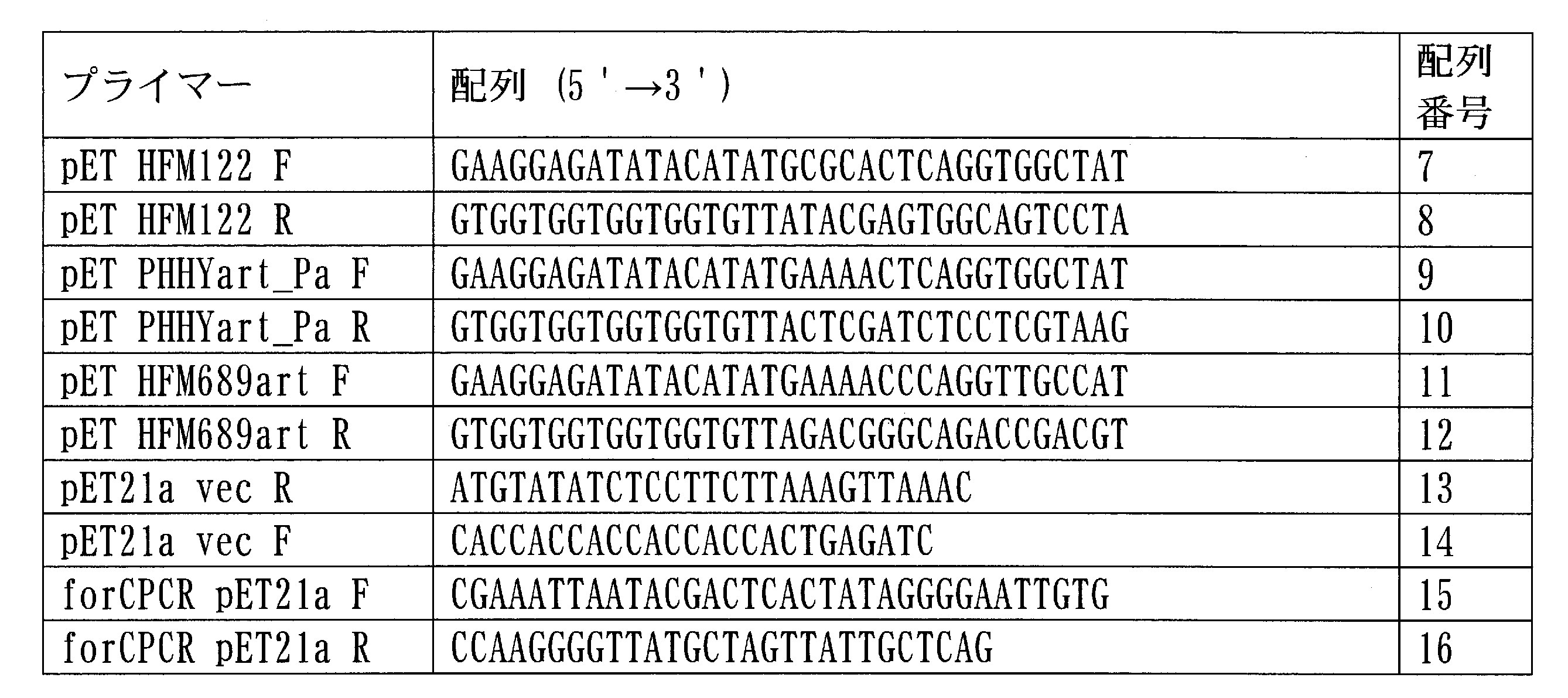
実施例1 形質転換株の作製
本実施例で用いたPCRプライマーを表1に示す。
実施例1 形質転換株の作製
本実施例で用いたPCRプライマーを表1に示す。
<プラスミドベクターの作製>
フラビンモノオキシゲナーゼの中から選択された3種の4-ヒドロキシ安息香酸水酸化酵素(HFM122,HFM300及びHFM689)をコードする遺伝子(配列番号1,3,5)を含むプラスミドを人工遺伝子合成により作製し、これを鋳型としてプライマーpET HFM122 F(配列番号7),pET HFM122 R(配列番号8),pET PHHYart_Pa F(配列番号9),pET PHHYart_Pa R(配列番号10),pET HFM689art F(配列番号11),pET HFM689art R(配列番号12)を用いたPCRにてインサート用DNA断片を合成した。次に、プラスミドpET21aを鋳型に、プライマーpET21a vec R(配列番号13)及びpET21a vec F(配列番号14)を用いたPCRにてベクター用DNA断片を増幅した。以上の断片をIn-Fusion HD Cloning Kit(Clontech)を用いてそれぞれ連結しプラスミドベクターpET-HFM122,pET-HFM300,pET-HFM689を構築した。
フラビンモノオキシゲナーゼの中から選択された3種の4-ヒドロキシ安息香酸水酸化酵素(HFM122,HFM300及びHFM689)をコードする遺伝子(配列番号1,3,5)を含むプラスミドを人工遺伝子合成により作製し、これを鋳型としてプライマーpET HFM122 F(配列番号7),pET HFM122 R(配列番号8),pET PHHYart_Pa F(配列番号9),pET PHHYart_Pa R(配列番号10),pET HFM689art F(配列番号11),pET HFM689art R(配列番号12)を用いたPCRにてインサート用DNA断片を合成した。次に、プラスミドpET21aを鋳型に、プライマーpET21a vec R(配列番号13)及びpET21a vec F(配列番号14)を用いたPCRにてベクター用DNA断片を増幅した。以上の断片をIn-Fusion HD Cloning Kit(Clontech)を用いてそれぞれ連結しプラスミドベクターpET-HFM122,pET-HFM300,pET-HFM689を構築した。
<プラスミドベクターの増幅>
上記で作製したプラスミドベクターpET-HFM122,pET-HFM300,pET-HFM689を用いて、大腸菌DH5α株(ニッポンジーン)をコンピテントセル形質転換法により形質転換した。得られた形質転換細胞液をLBamp寒天培地(Bacto Trypton 1%、Yeast Extract 0.5%、NaCl 1%,アンピシリンナトリウム50μg/mL、寒天 1.5%)に塗布した後37℃で一晩静置し、得られたコロニーに対しSapphire Amp(TAKARA)及びプライマーforCPCR pET21a F(配列番号15)、forCPCR pET21a R(配列番号16)を用いたPCR反応を行い、目的DNA断片の導入が確認された菌株を形質転換株として選抜した。形質転換株をLBamp液体培地(Bacto Trypton 1%、Yeast Extract 0.5%、NaCl 1%,アンピシリンナトリウム50μg/mL)1mLに接種し、37℃で一晩培養した。この培養液よりハイピュアプラスミドアイソレーションキット(ロシュライフサイエンス)を用いて各プラスミドベクターの精製を行った。
上記で作製したプラスミドベクターpET-HFM122,pET-HFM300,pET-HFM689を用いて、大腸菌DH5α株(ニッポンジーン)をコンピテントセル形質転換法により形質転換した。得られた形質転換細胞液をLBamp寒天培地(Bacto Trypton 1%、Yeast Extract 0.5%、NaCl 1%,アンピシリンナトリウム50μg/mL、寒天 1.5%)に塗布した後37℃で一晩静置し、得られたコロニーに対しSapphire Amp(TAKARA)及びプライマーforCPCR pET21a F(配列番号15)、forCPCR pET21a R(配列番号16)を用いたPCR反応を行い、目的DNA断片の導入が確認された菌株を形質転換株として選抜した。形質転換株をLBamp液体培地(Bacto Trypton 1%、Yeast Extract 0.5%、NaCl 1%,アンピシリンナトリウム50μg/mL)1mLに接種し、37℃で一晩培養した。この培養液よりハイピュアプラスミドアイソレーションキット(ロシュライフサイエンス)を用いて各プラスミドベクターの精製を行った。
<プラスミドベクターの宿主細胞への導入>
上記で得られたプラスミドベクターpET-HFM122,pET-HFM300,pET-HFM689を用いて、大腸菌BL21(DE3)株(ニッポンジーン)をコンピテントセル形質転換法により形質転換した。得られた形質転換細胞液をLBamp寒天培地に塗布した後37℃で一晩静置し、得られたコロニーを形質転換株(HFM122株、HFM300株、HFM689株)とした。
上記で得られたプラスミドベクターpET-HFM122,pET-HFM300,pET-HFM689を用いて、大腸菌BL21(DE3)株(ニッポンジーン)をコンピテントセル形質転換法により形質転換した。得られた形質転換細胞液をLBamp寒天培地に塗布した後37℃で一晩静置し、得られたコロニーを形質転換株(HFM122株、HFM300株、HFM689株)とした。
実施例2 形質転換株を用いた3-ヒドロキシ-4-アミノ安息香酸の生産
<形質転換株の培養>
上記で得られたHFM122株、HFM300株、HFM689株をそれぞれLBamp液体培地(Bacto Trypton 1%、Yeast Extract 0.5%、NaCl 1%,アンピシリンナトリウム50μg/mL)1mLに接種し、37℃で一晩培養した。得られた培養液100μLをOvernight Express培地(Merck)10mLに接種し、37℃で約24時間培養した後、遠心分離により菌体を回収した。
<形質転換株の培養>
上記で得られたHFM122株、HFM300株、HFM689株をそれぞれLBamp液体培地(Bacto Trypton 1%、Yeast Extract 0.5%、NaCl 1%,アンピシリンナトリウム50μg/mL)1mLに接種し、37℃で一晩培養した。得られた培養液100μLをOvernight Express培地(Merck)10mLに接種し、37℃で約24時間培養した後、遠心分離により菌体を回収した。
<菌体破砕液の調製>
上記で得られたHFM122株、HFM300株、HFM689株の菌体をBugbuster Protein Extraction Reagent(Merck)1mLを用いて懸濁し30℃で20分間振盪した後、遠心分離により不溶分を除去したものを菌体破砕液とした。
上記で得られたHFM122株、HFM300株、HFM689株の菌体をBugbuster Protein Extraction Reagent(Merck)1mLを用いて懸濁し30℃で20分間振盪した後、遠心分離により不溶分を除去したものを菌体破砕液とした。
<3-ヒドロキシ-4-アミノ安息香酸の生産能>
上記で得られたHFM122株、HFM300株、HFM689株の菌体破砕液を80μL添加した96穴アッセイプレート(イワキ)に、100mM リン酸バッファー(pH7.0)80μL,100mM NADPH 20μL,20mM 4-アミノ安息香酸 20μLを加え、1時間静置した後、後述する参考例1に記載の手順にて3-ヒドロキシ-4-アミノ安息香酸の定量を行った。
菌体破砕液の総タンパク量をバイオ・ラッドプロテインアッセイ(Bio-rad)を用いて定量し、下記式に従いHFM122株及びHFM689株における3-ヒドロキシ-4-アミノ安息香酸の生産能とその向上率を算出した。
上記で得られたHFM122株、HFM300株、HFM689株の菌体破砕液を80μL添加した96穴アッセイプレート(イワキ)に、100mM リン酸バッファー(pH7.0)80μL,100mM NADPH 20μL,20mM 4-アミノ安息香酸 20μLを加え、1時間静置した後、後述する参考例1に記載の手順にて3-ヒドロキシ-4-アミノ安息香酸の定量を行った。
菌体破砕液の総タンパク量をバイオ・ラッドプロテインアッセイ(Bio-rad)を用いて定量し、下記式に従いHFM122株及びHFM689株における3-ヒドロキシ-4-アミノ安息香酸の生産能とその向上率を算出した。
3-ヒドロキシ-4-アミノ安息香酸生産能=(反応後の3-ヒドロキシ-4-アミノ安息香酸濃度/総タンパク量)
生産能向上率(%)=(HFM122株及びHFM689株の3-ヒドロキシ-4-アミノ安息香酸生産能/HFM300株の3-ヒドロキシ-4-アミノ安息香酸生産能)×100-100
結果を表2に示す。非特許文献3、4に示唆のあるHFM300株と比較して、HFM122株及びHFM689株では、それぞれ46%及び114%の生産能の向上が観察された。

参考例1 3-ヒドロキシ-4-アミノ安息香酸の定量
反応後の3-ヒドロキシ-4-アミノ安息香酸の定量はHPLCにより行った。HPLC分析に供する反応液を0.1%リン酸にて適宜希釈した後、アクロプレップ96フィルタープレート(0.2μmGHP膜、日本ポール)を用いて不溶物の除去を行なった。
反応後の3-ヒドロキシ-4-アミノ安息香酸の定量はHPLCにより行った。HPLC分析に供する反応液を0.1%リン酸にて適宜希釈した後、アクロプレップ96フィルタープレート(0.2μmGHP膜、日本ポール)を用いて不溶物の除去を行なった。
HPLCの装置は、LaChrom Elite(日立ハイテクノロジーズ)を用いた。分析カラムには、L-カラム ODS(4.6mm I.D.×50cm、化学物質評価研究機構)を用い、溶離液Aを0.1%リン酸、溶離液Bを70%メタノールとし、流速1.0mL/分、カラム温度40℃の条件にてグラジエント溶出を行なった。3-ヒドロキシ-4-アミノ安息香酸の検出には、UV検出器(検出波長280nm)を用いた。標準試料〔3-ヒドロキシ-4-アミノ安息香酸(販売元コードA1194、東京化成工業)〕を用いて濃度検量線を作成し、濃度検量線に基づいて3-ヒドロキシ-4-アミノ安息香酸の定量を行なった。
Claims (8)
- 4-アミノ安息香酸類を、下記の(A)又は(B)のポリペプチドを産生する微生物と接触させる工程を含む、3-ヒドロキシ-4-アミノ安息香酸類の製造方法。
(A)配列番号2で示されるアミノ酸配列からなるポリペプチド、又は配列番号2で示されるアミノ酸配列と少なくとも90%の同一性を有するアミノ酸配列からなり、且つ4-ヒドロキシ安息香酸水酸化酵素活性を有するポリペプチド
(B)配列番号6で示されるアミノ酸配列からなるポリペプチド、又は配列番号2で示されるアミノ酸配列と少なくとも90%の同一性を有するアミノ酸配列からなり、且つ4-ヒドロキシ安息香酸水酸化酵素活性を有するポリペプチド - 微生物が、下記の(a)又は(b)のポリヌクレオチドを発現可能な状態で含む、請求項1記載の方法。
(a)配列番号1で示されるヌクレオチド配列からなるポリヌクレオチド、又は配列番号1で示されるヌクレオチド配列と少なくとも90%の同一性を有するヌクレオチド配列からなり、4-ヒドロキシ安息香酸水酸化酵素活性を有するポリペプチドをコードするポリヌクレオチド
(b)配列番号5で示されるヌクレオチド配列からなるポリヌクレオチド、又は配列番号5で示されるヌクレオチド配列と少なくとも90%の同一性を有するヌクレオチド配列からなり、4-ヒドロキシ安息香酸水酸化酵素活性を有するポリペプチドをコードするポリヌクレオチド - 微生物が、大腸菌又はコリネバクテリウム属菌である請求項1又は2記載の方法。
- 4-アミノ安息香酸類が、下記の一般式(1):

- 式(1)で示される4-アミノ安息香酸誘導体及び式(2)で示される3-ヒドロキシ-4-アミノ安息香酸誘導体において、R1が水素原子、ヒドロキシ基、メトキシ基、フッ素原子又はメチル基である請求項4記載の方法。
- 式(1)で示される4-アミノ安息香酸誘導体及び式(2)で示される3-ヒドロキシ-4-アミノ安息香酸誘導体において、R2が水素原子、ヒドロキシ基、メトキシ基、フッ素原子又はメチル基である請求項4又は5記載の方法。
- 式(1)で示される4-アミノ安息香酸誘導体及び式(2)で示される3-ヒドロキシ-4-アミノ安息香酸誘導体において、R1及びR2が共に水素原子である請求項4記載の方法。
- 4-アミノ安息香酸類と微生物の接触が、微生物の菌体破砕液と4-アミノ安息香酸類を20℃~50℃で5分~72時間接触させる、請求項1~7のいずれか1項記載の方法。
Priority Applications (2)
| Application Number | Priority Date | Filing Date | Title |
|---|---|---|---|
| US17/269,689 US11312980B2 (en) | 2018-09-13 | 2019-09-06 | Method for producing 3-hydroxy-4-aminobenzoic acid compound |
| CN201980059483.3A CN112673108B (zh) | 2018-09-13 | 2019-09-06 | 3-羟基-4-氨基苯甲酸类的制造方法 |
Applications Claiming Priority (2)
| Application Number | Priority Date | Filing Date | Title |
|---|---|---|---|
| JP2018-171849 | 2018-09-13 | ||
| JP2018171849A JP7197313B2 (ja) | 2018-09-13 | 2018-09-13 | 3-ヒドロキシ-4-アミノ安息香酸類の製造方法 |
Publications (1)
| Publication Number | Publication Date |
|---|---|
| WO2020054598A1 true WO2020054598A1 (ja) | 2020-03-19 |
Family
ID=69777054
Family Applications (1)
| Application Number | Title | Priority Date | Filing Date |
|---|---|---|---|
| PCT/JP2019/035142 Ceased WO2020054598A1 (ja) | 2018-09-13 | 2019-09-06 | 3-ヒドロキシ-4-アミノ安息香酸類の製造方法 |
Country Status (4)
| Country | Link |
|---|---|
| US (1) | US11312980B2 (ja) |
| JP (1) | JP7197313B2 (ja) |
| CN (1) | CN112673108B (ja) |
| WO (1) | WO2020054598A1 (ja) |
Cited By (2)
| Publication number | Priority date | Publication date | Assignee | Title |
|---|---|---|---|---|
| WO2021140980A1 (ja) * | 2020-01-08 | 2021-07-15 | 花王株式会社 | 2,5-ピリジンジカルボン酸類生産能を有する形質転換細胞 |
| CN116113703A (zh) * | 2020-09-14 | 2023-05-12 | 花王株式会社 | 具有4-氨基苯甲酸羟基化活性的多肽及其利用 |
Families Citing this family (4)
| Publication number | Priority date | Publication date | Assignee | Title |
|---|---|---|---|---|
| CN114651066B (zh) * | 2019-11-08 | 2025-08-08 | 花王株式会社 | 具有4-氨基苯甲酸羟化活性的多肽及其用途 |
| CN115505579B (zh) * | 2021-06-22 | 2024-08-23 | 中国科学院青岛生物能源与过程研究所 | 一种对氨基苯甲酸羟化酶及其应用 |
| CN115838741B (zh) * | 2022-10-14 | 2025-05-23 | 武汉轻工大学 | 3-羟基苯甲酸2-羟化酶的基因、重组表达载体、菌株及羟基苯甲酸的羟化方法 |
| CN115894264B (zh) * | 2022-12-09 | 2024-07-16 | 西安宇特邦医药科技有限公司 | 一种4-氨基-3羟基甲苯酸的合成方法 |
Citations (1)
| Publication number | Priority date | Publication date | Assignee | Title |
|---|---|---|---|---|
| JP2001316340A (ja) * | 2000-05-08 | 2001-11-13 | Toyobo Co Ltd | アミノヒドロキシ芳香族カルボン酸及び/又はその誘導体の製造方法 |
Family Cites Families (2)
| Publication number | Priority date | Publication date | Assignee | Title |
|---|---|---|---|---|
| JP3704077B2 (ja) * | 2001-01-24 | 2005-10-05 | 花王株式会社 | アスファルト乳剤組成物 |
| JP5445453B2 (ja) | 2008-07-09 | 2014-03-19 | 味の素株式会社 | アミノヒドロキシ安息香酸類の製造方法 |
-
2018
- 2018-09-13 JP JP2018171849A patent/JP7197313B2/ja active Active
-
2019
- 2019-09-06 CN CN201980059483.3A patent/CN112673108B/zh active Active
- 2019-09-06 US US17/269,689 patent/US11312980B2/en active Active
- 2019-09-06 WO PCT/JP2019/035142 patent/WO2020054598A1/ja not_active Ceased
Patent Citations (1)
| Publication number | Priority date | Publication date | Assignee | Title |
|---|---|---|---|---|
| JP2001316340A (ja) * | 2000-05-08 | 2001-11-13 | Toyobo Co Ltd | アミノヒドロキシ芳香族カルボン酸及び/又はその誘導体の製造方法 |
Non-Patent Citations (5)
| Title |
|---|
| DATABASE Protein [online] 28 January 2014 (2014-01-28), "4-hydroxybenzoate 3-monooxygenase [Novosphingobium aromaticivorans DSM 12444]", XP055694359, retrieved from ncbi Database accession no. ABD26872.1 * |
| DATABASE Protein [online] 31 January 2014 (2014-01-31), "p-hydroxybenzoate hydroxylase [Caulobacter vibrioides CB15]", XP055694362, retrieved from ncbi Database accession no. AAK24375.1 * |
| ENTSCH, BARRIE ET AL.: "para-Hydroxybenzoate hydroxylase containing 6-hydroxy-FAD is an effective enzyme with modified reaction mechanisms", THE JOURNAL OF BIOLOGICAL CHEMISTRY, vol. 262, no. 13, 5 May 1987 (1987-05-05), pages 6060 - 6068, XP055694381 * |
| MATHIAS, LON J. ET AL.: "Two-step synthesis of alkyl- and alkenylbenzoxazole polymers", MACROMOLECULES, vol. 18, no. 4, 1985, pages 616 - 622, XP055694374 * |
| OHTA, YOSHIHIRO ET AL.: "Chain-growth condensation polymerization approach to synthesis of well-defined polybezoxazole: Importance of higher reactivity of 3-amino-4-hydroxybenzoic acid ester compared to 4-amino-3-hydroxybenzoic acid ester", JOURNAL OF POLYMER SCIENCE , PART A: POLYMER CHEMISTRY, vol. 52, no. 12, 15 June 2014 (2014-06-15), pages 1730 - 1736, XP055694376 * |
Cited By (3)
| Publication number | Priority date | Publication date | Assignee | Title |
|---|---|---|---|---|
| WO2021140980A1 (ja) * | 2020-01-08 | 2021-07-15 | 花王株式会社 | 2,5-ピリジンジカルボン酸類生産能を有する形質転換細胞 |
| CN116113703A (zh) * | 2020-09-14 | 2023-05-12 | 花王株式会社 | 具有4-氨基苯甲酸羟基化活性的多肽及其利用 |
| EP4212625A4 (en) * | 2020-09-14 | 2024-12-18 | Kao Corporation | POLYPEPTIDE HAVING 4-AMINOBENZOIC ACID HYDROXYLATION ACTIVITY AND ITS USE |
Also Published As
| Publication number | Publication date |
|---|---|
| JP7197313B2 (ja) | 2022-12-27 |
| CN112673108A (zh) | 2021-04-16 |
| US11312980B2 (en) | 2022-04-26 |
| US20210317484A1 (en) | 2021-10-14 |
| CN112673108B (zh) | 2025-11-11 |
| JP2020039330A (ja) | 2020-03-19 |
Similar Documents
| Publication | Publication Date | Title |
|---|---|---|
| JP7197313B2 (ja) | 3-ヒドロキシ-4-アミノ安息香酸類の製造方法 | |
| Seok et al. | Directed evolution of the 3-hydroxypropionic acid production pathway by engineering aldehyde dehydrogenase using a synthetic selection device | |
| JP7588969B2 (ja) | 没食子酸生産能を有する形質転換体 | |
| JP5142268B2 (ja) | 改良型没食子酸合成酵素および没食子酸の製造法 | |
| JP7502852B2 (ja) | 4-アミノ安息香酸水酸化活性を有するポリペプチド及びその利用 | |
| WO2021090925A1 (ja) | 4-アミノ安息香酸水酸化活性を有するポリペプチド及びその利用 | |
| JP7531311B2 (ja) | 没食子酸合成酵素 | |
| JP7488649B2 (ja) | 4-アミノ安息香酸水酸化活性を有するポリペプチド及びその利用 | |
| JP2024014569A (ja) | 4-アミノ安息香酸水酸化活性を有するポリペプチド及びその利用 | |
| JP7223480B2 (ja) | 4-アミノ安息香酸水酸化活性を有するポリペプチド及びその利用 | |
| Joo et al. | ToxB encodes a canonical GTP cyclohydrolase II in toxoflavin biosynthesis and ribA expression restored toxoflavin production in a Δ toxB mutant | |
| JP7475866B2 (ja) | 2,5-ピリジンジカルボン酸類生産能を有する形質転換細胞 | |
| JP7502858B2 (ja) | 4-アミノ安息香酸水酸化活性を有するポリペプチド及びその利用 | |
| KR101785150B1 (ko) | 모듈식 스캐폴드를 이용한 감마 아미노부티르산의 생산방법 | |
| JP7753182B2 (ja) | 2-インドールカルボン酸脱炭酸活性を有するポリペプチド及びその利用 | |
| Ekimova et al. | AcdR protein is an activator of transcription of 1-aminocyclopropane-1-carboxylate deaminase in Methylobacterium radiotolerans JCM 2831 | |
| JP2025071664A (ja) | 4-ヒドロキシ安息香酸類の製造方法 | |
| WO2015049335A1 (en) | Non-ribosomal protein synthesis pigment fusion peptides | |
| JP2024104204A (ja) | 2,4-ピリジンジカルボン酸類の製造方法 | |
| JP2025071663A (ja) | 3-ヒドロキシ安息香酸類の製造方法 | |
| CN115948367B (zh) | 一种亚麻苦苷酶突变体及其应用 | |
| JP7839081B2 (ja) | 芳香族化合物の製造方法 | |
| JP2026005227A (ja) | 4-アミノ-3-ヒドロキシ安息香酸又はその塩の製造方法 | |
| WO2024161513A1 (ja) | 4-アセチルアミノ-3-ヒドロキシ安息香酸の製造方法 | |
| WO2019194236A1 (ja) | 遺伝子発現を制御するための核酸 |
Legal Events
| Date | Code | Title | Description |
|---|---|---|---|
| 121 | Ep: the epo has been informed by wipo that ep was designated in this application |
Ref document number: 19859809 Country of ref document: EP Kind code of ref document: A1 |
|
| NENP | Non-entry into the national phase |
Ref country code: DE |
|
| 122 | Ep: pct application non-entry in european phase |
Ref document number: 19859809 Country of ref document: EP Kind code of ref document: A1 |