WO2020054343A1 - 生体情報検出装置 - Google Patents
生体情報検出装置 Download PDFInfo
- Publication number
- WO2020054343A1 WO2020054343A1 PCT/JP2019/032801 JP2019032801W WO2020054343A1 WO 2020054343 A1 WO2020054343 A1 WO 2020054343A1 JP 2019032801 W JP2019032801 W JP 2019032801W WO 2020054343 A1 WO2020054343 A1 WO 2020054343A1
- Authority
- WO
- WIPO (PCT)
- Prior art keywords
- biological information
- signal
- frequency characteristics
- noise
- frequency
- Prior art date
- Legal status (The legal status is an assumption and is not a legal conclusion. Google has not performed a legal analysis and makes no representation as to the accuracy of the status listed.)
- Ceased
Links
- QNPXWYYNTQEXPC-UHFFFAOYSA-N CC#CC(CN)I Chemical compound CC#CC(CN)I QNPXWYYNTQEXPC-UHFFFAOYSA-N 0.000 description 1
Images


Classifications
-
- A—HUMAN NECESSITIES
- A61—MEDICAL OR VETERINARY SCIENCE; HYGIENE
- A61B—DIAGNOSIS; SURGERY; IDENTIFICATION
- A61B5/00—Measuring for diagnostic purposes; Identification of persons
- A61B5/02—Detecting, measuring or recording for evaluating the cardiovascular system, e.g. pulse, heart rate, blood pressure or blood flow
- A61B5/024—Measuring pulse rate or heart rate
- A61B5/0245—Measuring pulse rate or heart rate by using sensing means generating electric signals, i.e. ECG signals
-
- A—HUMAN NECESSITIES
- A61—MEDICAL OR VETERINARY SCIENCE; HYGIENE
- A61B—DIAGNOSIS; SURGERY; IDENTIFICATION
- A61B5/00—Measuring for diagnostic purposes; Identification of persons
- A61B5/08—Measuring devices for evaluating the respiratory organs
-
- A—HUMAN NECESSITIES
- A61—MEDICAL OR VETERINARY SCIENCE; HYGIENE
- A61B—DIAGNOSIS; SURGERY; IDENTIFICATION
- A61B5/00—Measuring for diagnostic purposes; Identification of persons
- A61B5/08—Measuring devices for evaluating the respiratory organs
- A61B5/087—Measuring breath flow
-
- A—HUMAN NECESSITIES
- A61—MEDICAL OR VETERINARY SCIENCE; HYGIENE
- A61B—DIAGNOSIS; SURGERY; IDENTIFICATION
- A61B5/00—Measuring for diagnostic purposes; Identification of persons
- A61B5/16—Devices for psychotechnics; Testing reaction times ; Devices for evaluating the psychological state
- A61B5/18—Devices for psychotechnics; Testing reaction times ; Devices for evaluating the psychological state for vehicle drivers or machine operators
Definitions
- the present disclosure relates to a biological information detecting device that detects biological information such as a heartbeat.
- Non-contact methods generally include an ultrasonic method, a radio wave method, and a piezoelectric sensor method, but all have the problem that the SN (signal-to-noise) ratio decreases due to external noise components. is there.
- Patent Literature 1 describes a technique of designing a filter circuit using a statistical value related to a heartbeat as a technique for removing a noise component included in an original signal detected from a human body. This technology detects a biological information included in an original signal by removing a noise component in a higher frequency region and a lower frequency region than a frequency band near a heartbeat included in an original signal detected from a human body by a filter circuit. .
- Patent Literature 1 has a problem in that since the heart rate varies for each driver, it is not possible to narrow down a high-frequency region and a low-frequency region for removing a noise component. Therefore, in this technique, it is difficult to remove noise in the frequency band near the heart rate by the filter circuit, and the detection accuracy of the biological information may be deteriorated.
- An object of the present disclosure is to provide a biological information detection device capable of improving detection accuracy of biological information.
- a signal acquisition unit that acquires an original signal including biological information from a human body
- An arithmetic unit that calculates biological information from the original signal acquired by the signal acquiring unit
- the operation unit is Convert the original signal to frequency characteristics
- Biological information is calculated based on frequency characteristics after noise removal obtained by removing the frequency characteristics of noise from the frequency characteristics of the original signal.
- the biological information detecting device obtains a frequency characteristic having a frequency corresponding to the biological information by converting the original signal into a frequency characteristic and removing the noise frequency characteristic from the frequency characteristic of the original signal.
- the biological information is, for example, a heart rate or a respiratory rate
- the biological information detecting device can improve the detection accuracy of the biological information by calculating the biological information based on the difference between the frequency characteristic of the original signal and the frequency characteristic of the noise.
- the frequency characteristic of the noise may be calculated from the original signal using the periodicity of the biological information as described later, or may be stored in a memory in advance according to the vehicle speed or the like.
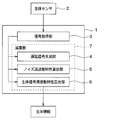
- FIG. 3 is an explanatory diagram for explaining functions of the biological information detection device according to the first embodiment.
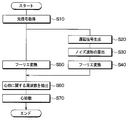
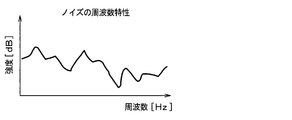
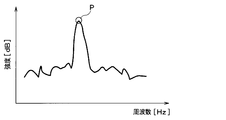
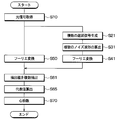
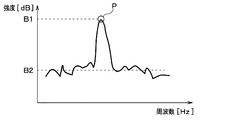
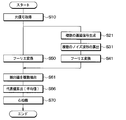
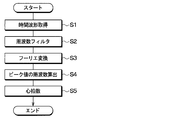
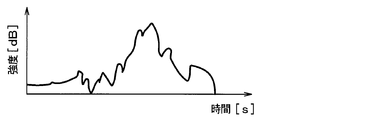
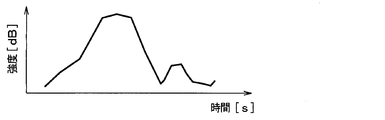
- It is a flowchart which shows the algorithm of the biological information detection of 1st Embodiment. 6 is a graph for explaining an original signal, a delayed signal, and a difference signal thereof. 6 is a graph for explaining frequency characteristics of noise. 5 is a graph for explaining a frequency characteristic of an original signal. 5 is a graph for explaining frequency characteristics after noise removal. It is a flowchart which shows the algorithm of the biological information detection of 2nd Embodiment. 5 is a graph for explaining frequency characteristics after noise removal.
- FIG. 16 is an explanatory diagram for describing a method of calculating a heart rate from the frequency characteristics in FIG. 15.
- the biological information detecting device is configured to process a biological signal (hereinafter, referred to as an original signal) output from a biological sensor provided on a human body and detect biological information such as a heart rate or a respiratory rate.
- a biological signal hereinafter, referred to as an original signal
- the biological information detection device is configured by a known microcomputer including a CPU, a ROM, a RAM, an I / O, and the like.
- the detection device acquires an original signal output from the biological sensor.
- the original signal is a time waveform including a heartbeat and noise.
- step S2 the detecting device passes the original signal through a predetermined filter circuit.
- This filter circuit is a so-called frequency filter that removes noise components in a higher frequency region and a lower frequency region than a frequency band near the frequency of the biological information and passes only a frequency band near the frequency of the biological information.
- the original signal is narrowed down to a frequency band near the frequency of the biological information.
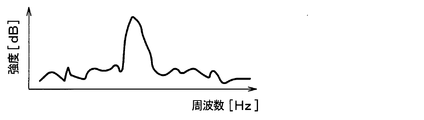
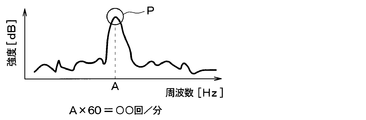
- step S3 the detection device performs a process such as Fourier transform on the time waveform that has passed through the above-described filter circuit, and converts the time waveform into a frequency characteristic. Thereby, as shown in FIG. 15, it is converted into a frequency characteristic.
- the frequency characteristics indicate the intensity for each of a plurality of frequencies included in the time waveform.
- step S4 the detection device extracts a frequency at a location where the intensity (dB) is the highest in the frequency characteristics.
- the portion is denoted by reference numeral P.
- step S5 the detection device calculates the heart rate, that is, the number of beats per minute, by multiplying the frequency (Hz) at the location indicated by the symbol P by 60.
- step S4 corresponds to the heart rate. It will be.
- the time waveform that has passed through the filter circuit in the process of step S2 may include noise in a frequency band near a heartbeat. Therefore, a frequency different from the frequency corresponding to the heart rate may be extracted from the frequency characteristics after the processing in step S3. In that case, the frequency extracted in the process of step S4 is different from the frequency corresponding to the heart rate, and the accuracy of the heart rate calculated in step S5 may be deteriorated.
- the general algorithm for detecting biological information has been described above.
- the biological information detection devices according to a plurality of embodiments of the present disclosure described below can improve the detection accuracy of biological information.
- the biological information detection device 1 is mounted on, for example, an autonomous vehicle, and is used for detecting biological information such as the heartbeat of a driver.
- the biological information detecting device 1 is configured to acquire an original signal output from the biological sensor 2 and process the original signal to detect biological information.
- the biological information detecting device 1 is described as detecting a heartbeat as an example of biological information.
- the heartbeat is a periodic signal that changes in a predetermined frequency range.
- the living body sensor 2 is a sensor that is provided in contact or non-contact with the human body and outputs an original signal including biological information such as a heartbeat.
- a biological sensor 2 include an ultrasonic sensor, a radio wave sensor, and a piezoelectric sensor.
- the biological information detection device 1 is configured by a known microcomputer including a CPU, a ROM, a RAM, an I / O, and the like, and configured to perform signal processing according to a program stored in the ROM or the like.
- the biological information detection device 1 includes a signal acquisition unit 3, a delay signal generation unit 4, a noise frequency characteristic calculation unit 5, a biological signal frequency characteristic calculation unit 6, and the like as functional units that process signals.
- the signal acquiring unit 3 has a function of acquiring an original signal output from the biological sensor 2.
- the delay signal generation unit 4, the noise frequency characteristic calculation unit 5, and the biological signal frequency characteristic calculation unit 6 constitute a calculation unit 7 for calculating biological information from the original signal acquired by the signal acquisition unit 3.
- the functions of the delay signal generator 4, the noise frequency characteristic calculator 5, and the biological signal frequency characteristic calculator 6 that constitute the calculator 7 will be described.
- the original signal acquired by the signal acquisition unit 3 is represented as a “time waveform”.
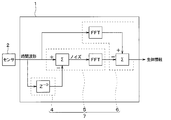
- the delay signal generator 4 has a function of generating a delay signal in which the phase of the original signal is shifted. Note that the delay signal generation unit 4 preferably sets the delay time to a time obtained by multiplying one cycle of the heartbeat by a natural number, or a time close thereto.
- the noise frequency characteristic calculation unit 5 has a function of generating a time waveform of noise by subtracting the original signal and the delayed signal. Further, the noise frequency characteristic calculation unit 5 has a function of calculating the frequency characteristics of the noise by performing a process such as Fourier transform on the time waveform of the noise.
- the biological signal frequency characteristic calculation unit 6 has a function of calculating the frequency characteristics of the original signal by performing a process such as Fourier transform on the original signal.
- the biological signal frequency characteristic calculation unit 6 has a function of calculating biological information from an extracted value of the frequency characteristic after noise removal obtained by removing the frequency characteristic of noise from the frequency characteristic of the original signal.
- the signal acquisition unit 3 acquires an original signal output from the biological sensor 2.
- This original signal is a time waveform including a heartbeat and noise.
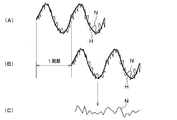
- FIG. 4 (A) shows the time waveform of the original signal, for the sake of explanation, separately showing a heartbeat signal and a noise signal included in the original signal. That is, the heartbeat signal included in the original signal is indicated by a thick line H, and the noise signal is indicated by a thin line N.
- the original signal acquired by the signal acquiring unit 3 is one time waveform including a heartbeat signal and a noise signal. Is obtained as
- step S20 the delay signal generation unit 4 generates a delay signal in which the phase of the original signal is shifted.
- This original signal is also a time waveform including a heartbeat signal and a noise signal.
- FIG. 4B shows a delayed signal shifted by one cycle of the heartbeat included in the original signal.
- the delay time for shifting the phase of the original signal is preferably one cycle of the heartbeat, or a time obtained by multiplying one cycle of the heartbeat by a natural number, or a time close thereto.
- the delay signal generator 4 sets the plurality of delay times between 0.5 and 1 second.
- a person's heart rate during normal times is likely to be between 120 beats / minute (ie, 2 Hz) and 60 beats / minute (ie, 1 Hz). This range is within the range of the standard deviation 3 ⁇ in terms of statistics regarding the heart rate. Therefore, by setting a plurality of delay times between 0.5 and 1 second, the delay signal generation unit 4 can set the phase shift between the delay signal and the original signal to be equal to or close to the cycle of the heartbeat. It is possible.
- step S30 the arithmetic unit 7 generates a signal obtained by subtracting the original signal and the delayed signal.
- FIG. 4C shows a signal obtained by subtracting the original signal shown in FIG. 4A from the delayed signal shown in FIG. 4B, that is, a time waveform of noise. If the phase difference between the delayed signal and the original signal is the same as the period of the heartbeat, the time waveform of the noise is a time waveform of only the noise. If the phase difference between the delayed signal and the original signal is different from the period of the heartbeat, a frequency due to the difference between the heartbeat signals is added to the frequency characteristic of only noise. However, when the phase shift between the delayed signal and the original signal is close to the cycle of the heartbeat, the signal strength of the frequency added due to the shift between the heartbeat signals becomes small with respect to the frequency characteristic of only noise.
- the noise frequency characteristic calculation unit 5 calculates the frequency characteristics of the noise by performing processing such as Fourier transform on the signal obtained by subtracting the original signal and the delayed signal, that is, the time waveform of the noise.
- FIG. 5 shows frequency characteristics of noise calculated by performing processing such as Fourier transform on the time waveform of the noise shown in FIG. 4C.
- step S50 the arithmetic unit 7 calculates the frequency characteristics of the original signal by performing a process such as Fourier transform on the original signal.
- FIG. 6 shows the frequency characteristics of the original signal calculated by performing a process such as Fourier transform on the time waveform of the original signal shown in FIG.
- step S60 the biological signal frequency characteristic calculation unit 6 calculates a frequency characteristic obtained by removing the frequency characteristic of noise from the frequency characteristic of the original signal.
- FIG. 7 shows frequency characteristics calculated by removing the frequency characteristics of the noise shown in FIG. 5 from the frequency characteristics of the original signal shown in FIG. This frequency characteristic is referred to as a frequency characteristic after noise removal.
- the biological signal frequency characteristic calculation unit 6 extracts a frequency at a location having the highest intensity from the frequency characteristics after the noise removal. In FIG. 7, the portion is denoted by reference numeral P.
- step S70 the calculation unit 7 calculates the heart rate, that is, the number of beats per minute, by multiplying the frequency (Hz) at the location indicated by the symbol P by 60.
- the biological information detecting device 1 has the following operational effects.
- the biological information detection device 1 converts the original signal acquired by the signal acquisition unit 3 into frequency characteristics, and removes noise frequency characteristics from the frequency characteristics of the original signal. That is, after converting both the time waveform of the original signal and the time waveform of the noise into frequency characteristics, the difference between the two frequency characteristics is calculated to obtain the frequency characteristics after the noise removal having the frequency of the biological information. is there.
- the biological information is, for example, a heartbeat, it is possible to calculate the heart rate for one minute by multiplying the frequency (Hz) of the biological information by 60.
- the biological information detecting device 1 can improve the detection accuracy of the biological information by calculating the biological information based on the difference between the frequency characteristic of the original signal and the frequency characteristic of the noise.
- the calculation unit 7 generates a delayed signal in which the phase of the original signal is shifted by a predetermined delay time, converts a signal obtained by subtracting the delayed signal from the original signal into a frequency characteristic, and Frequency characteristics.
- biological information such as a heartbeat has a predetermined periodicity. Therefore, by setting the delay time for generating the delay signal to a value obtained by multiplying the period of the biological information by a natural number, or a value close thereto, the signal obtained by subtracting the delay signal from the original signal has a time waveform of noise. Become. Therefore, if the frequency characteristic of the noise obtained by converting the time waveform of the noise into the frequency characteristic is removed from the frequency characteristic of the original signal, it is possible to obtain the frequency characteristic of the biological information after removing the noise.
- the biological information calculated by the calculation unit 7 is a periodic signal that changes within a predetermined frequency range.
- the biological information detected by the biological information detection device 1 is described as a heartbeat, but other periodic biological information includes, for example, a respiratory rate, a pulse, and the like.
- the delay time for generating the delay signal is set within the range of a general cycle related to the biological information.
- the range of the general cycle of the biological information can be, for example, within the range of the standard deviation 3 ⁇ on the statistical basis of the cycle of the biological information.
- the second embodiment is different from the first embodiment in that a part of the algorithm for detecting biological information is changed, and the other is the same as the first embodiment. Will be described only.
- the signal acquisition unit 3 acquires the original signal output from the biosensor 2 as in the first embodiment.
- This original signal is a time waveform including a heartbeat and noise.
- step S21 the delay signal generation unit 4 generates a plurality of delay signals in which the phases of the original signals are shifted.
- the delay signal generator 4 sets a delay time for shifting the phase of the original signal to a plurality of times, and generates a plurality of delay signals.
- the delay signal generation unit 4 sets the plurality of delay times between 0.5 and 1 second as in the first embodiment. This makes it possible to make the phase difference between the delayed signal and the original signal equal to or close to the cycle of the heartbeat.
- step S31 the calculation unit 7 generates a signal obtained by subtracting the original signal and the delayed signal, that is, a time waveform of noise. Since the delay signal generator 4 generates a plurality of delay signals in step S21 described above, the calculator 7 generates a plurality of noise time waveforms in step S31.
- the noise frequency characteristic calculation unit 5 calculates a plurality of noise frequency characteristics by performing processing such as Fourier transform on each of the plurality of noise time waveforms.
- step S50 the calculation unit 7 calculates the frequency characteristics of the original signal by performing a process such as Fourier transform on the original signal as in the first embodiment.
- step S61 the biological signal frequency characteristic calculation unit 6 removes each of the plurality of noise frequency characteristics calculated in step S41 from the frequency characteristics of the original signal, and calculates a plurality of frequency characteristics after noise removal. Then, in each of the plurality of frequency characteristics after noise removal, a frequency related to a heartbeat is extracted. In this process, a value extracted from the frequency characteristics after noise removal is referred to as an extracted value.
- the extracted value may be a peak frequency having the largest intensity (dB) among the frequency characteristics after noise removal, or may be a frequency band slightly shifted from the peak.
- step S65 the calculation unit 7 calculates a representative value from among a plurality of extracted values extracted for each of the plurality of frequency characteristics after noise removal.
- the ratio of “the intensity of the extracted value” to “the average value of the intensity of each frequency excluding the extracted value” among the plurality of frequency characteristics after noise removal is the most. Calculate from the largest one.
- the intensity of the extracted value is indicated by a symbol B1
- the average value of the intensity of each frequency excluding the extracted value is indicated by a symbol B2.
- the calculation unit 7 calculates the values of B1 / B2 in a plurality of frequency characteristics after noise removal, and extracts the one with the largest value of B1 / B2 among them. Then, the extracted value of the frequency characteristic after the noise removal is set as a representative value.
- step S70 the calculation unit 7 calculates the heart rate by multiplying the frequency of the extracted value set as the representative value by 60.
- the biological information detecting device 1 has the following operational effects.
- the calculation unit 7 sets the delay time for shifting the phase of the original signal to a plurality of times, generates a plurality of delay signals, and calculates the frequency characteristics of the plurality of noises. I do. Then, the calculation unit 7 calculates the biological information from the representative value of the extracted values of the plurality of noise-removed frequency characteristics obtained by removing the frequency characteristics of the plurality of noises from the frequency characteristics of the original signal.
- the biological information detecting device 1 can improve the robustness against the change in the periodicity of the biological information for each individual or the change in the periodicity of the biological information due to the change in the physical condition of the individual.
- the calculation unit 7 extracts a representative value for calculating biological information from each of the extracted values of the frequency characteristics after noise removal.
- the representative value is the extracted value of the noise-removed frequency characteristic having the largest ratio of “the intensity of the extracted value” to “the average value of the intensity of each frequency excluding the extracted value” among the plurality of frequency characteristics after the noise removal. It is said.
- the representative value for calculating the biological information is the value with the highest reliability among the extracted values of the plurality of frequency characteristics after noise removal. Therefore, according to this method, the detection accuracy of the biological information can be improved even when the extracted values of the plurality of frequency characteristics after noise removal vary.
- the calculation unit 7 sets a plurality of delay times between 0.5 and 1 second. This makes it possible to set the delay time to a plurality of times within the range of the cycle of the heartbeat of a general person, thereby making the phase shift between the delayed signal and the original signal equal to or closer to the cycle of the heartbeat. is there. Therefore, the signal strength of the frequency added due to the deviation between the heartbeat signals is smaller than the frequency characteristic of only the noise. Therefore, the biological information detecting device 1 can obtain the extracted value of the frequency characteristic after the noise removal as the value relating to the heartbeat, so that the detection accuracy can be improved.
- FIG. 10 shows a flowchart of the biological information detection algorithm according to the third embodiment.
- the calculation unit 7 calculates a representative value from a plurality of extracted values extracted from each of the plurality of frequency characteristics after noise removal.
- an average value of a plurality of extracted values extracted from each of a plurality of frequency characteristics after noise removal is determined as a representative value for calculating biological information. I do.
- the detection accuracy of the biological information can be improved. Can be enhanced.
- the algorithm for detecting biological information according to the fourth embodiment is shown in the flowchart of FIG.
- the original signal is passed through a predetermined filter circuit in step S15.
- This filter circuit is a band-pass filter that attenuates noise components in a higher frequency region and a lower frequency region than a frequency band near the frequency of biological information, and passes only a frequency band near the frequency of biological information. As a result, the original signal is narrowed down to a frequency band near the frequency of the biological information.
- step S20 the delay signal generator 4 generates a delay signal in which the phase of the signal passed through the original signal through the filter circuit is shifted by a predetermined delay time.
- step S30 the noise frequency characteristic calculator 5 generates a signal obtained by subtracting the delayed signal from the signal that has passed the original signal through the filter circuit.
- step S40 a frequency characteristic of noise is calculated by performing a process such as Fourier transform on the signal.
- step S50 the calculation unit 7 calculates the frequency characteristics of the original signal by performing a process such as Fourier transform on the signal that has passed the original signal through the filter circuit.
- the detection accuracy of the biological information can be improved by narrowing the frequency band of the original signal to a frequency band near the frequency of the biological information by the filter circuit.
- the biological information detecting device 1 has been described as detecting the heartbeat as an example of the biological information.
- the biological information detecting device 1 detects a respiratory rate as an example of biological information.
- the respiration rate is also a periodic signal that changes in a predetermined frequency range.
- the delayed signal generation unit 4 of the biological information detecting device 1 has a function of generating a delayed signal in which the phase of the original signal is shifted.
- the delay signal generation unit 4 preferably sets the delay time for shifting the phase of the original signal to a time obtained by multiplying one cycle of breathing by a natural number or a time close thereto.
- the delay signal generator 4 sets the plurality of delay times between 5 and 3 seconds.
- the normal human breathing rate is likely to be between 12 and 20 breaths / minute. This range is within a standard deviation of 3 ⁇ on the statistical basis regarding the respiratory rate. Therefore, by setting the plurality of delay times between 5 and 3 seconds, the delay signal generator 4 can make the phase shift between the delay signal and the original signal equal to or close to the respiratory cycle. is there. Therefore, the signal intensity of the frequency added due to the difference between the respiration signals with respect to the frequency characteristic of only noise is small. Therefore, the biological information detecting device 1 can obtain the extracted value of the frequency characteristic after the noise removal as the value related to the respiration, so that the detection accuracy can be improved.
- the delay signal generator 4 included in the biological information detection device 1 generates a delay signal based on a delay time stored in a memory in advance.
- the calculation unit 7 sets the delay time based on the delay time set in the past and stored in the memory. Thereby, the biological information detection device 1 can reduce the amount of calculation of the calculation unit 7 and shorten the processing time.
- the biological information detecting device 1 is described as calculating the frequency characteristics of noise from the original signal acquired by the signal acquiring unit 3 using the periodicity of the biological information.
- the biological information detecting device 1 detects biological information using a statistical value of frequency characteristics of noise stored in a memory in advance.
- the calculation unit 7 of the biological information detection device 1 converts the statistical value of the frequency characteristic of the noise calculated in the past and stored in the memory into the frequency characteristic of the noise for calculating the biological information. Used as Thereby, the biological information detection device 1 can reduce the amount of calculation of the calculation unit 7 and shorten the processing time.
- the biological information detecting device 1 calculates the frequency characteristics of a plurality of noises by setting the delay time for shifting the phase of the original signal to a plurality of times. Then, the arithmetic unit 7 calculates the biological information from the representative values of the extracted values of the plurality of noise-removed frequency characteristics obtained by removing the frequency characteristics of the plurality of noises from the frequency characteristics of the original signal.
- the reliability of the biological information calculated from the representative value may be low.
- step S65 of the flowchart in FIG. 8 referred to in the description of the second embodiment. That is, if the ratio of “the intensity of the extracted value” to “the average value of the intensity of each frequency excluding the extracted value” is lower than the predetermined threshold in each of the plurality of frequency characteristics after noise removal, The biological information calculated based on the value is determined to be an abnormal value.
- the arithmetic unit 7 calculates the values of B1 / B2 in a plurality of frequency characteristics after noise removal, and among them, B1 / B2 is calculated. The one with the largest value of B2 is extracted. At this time, when the values of B1 / B2 calculated in the plurality of frequency characteristics after noise removal are all lower than a predetermined threshold, the calculation unit 7 determines that the biological information calculated by the representative value is an abnormal value. I do.
- the predetermined threshold is appropriately set by an experiment or the like so that the biological information output from the biological information detecting device 1 has reliability. Thus, the biological information detection device 1 can prevent the output of biological information with low reliability.
- control device and the method according to the present disclosure are realized by a dedicated computer provided by configuring a processor and a memory programmed to execute one or a plurality of functions embodied by a computer program. May be done.
- control device and the technique described in the present disclosure may be implemented by a dedicated computer provided by configuring a processor with one or more dedicated hardware logic circuits.
- control device and the method described in the present disclosure may be implemented by a combination of a processor and a memory programmed to perform one or more functions and a processor configured by one or more hardware logic circuits. It may be realized by one or more dedicated computers configured.
- the computer program may be stored in a computer-readable non-transitional tangible recording medium as instructions to be executed by a computer.
- the biological information detecting device 1 has been described as being mounted on a vehicle, but the present invention is not limited to this.
- the biological information detecting device 1 may be used for medical purposes, for example.
Landscapes
- Health & Medical Sciences (AREA)
- Life Sciences & Earth Sciences (AREA)
- Engineering & Computer Science (AREA)
- General Health & Medical Sciences (AREA)
- Veterinary Medicine (AREA)
- Biophysics (AREA)
- Pathology (AREA)
- Physics & Mathematics (AREA)
- Biomedical Technology (AREA)
- Heart & Thoracic Surgery (AREA)
- Medical Informatics (AREA)
- Molecular Biology (AREA)
- Surgery (AREA)
- Animal Behavior & Ethology (AREA)
- Public Health (AREA)
- Physiology (AREA)
- Cardiology (AREA)
- Pulmonology (AREA)
- Hospice & Palliative Care (AREA)
- Developmental Disabilities (AREA)
- Educational Technology (AREA)
- Child & Adolescent Psychology (AREA)
- Psychiatry (AREA)
- Psychology (AREA)
- Social Psychology (AREA)
- Signal Processing (AREA)
- Measuring Pulse, Heart Rate, Blood Pressure Or Blood Flow (AREA)
- Measurement Of The Respiration, Hearing Ability, Form, And Blood Characteristics Of Living Organisms (AREA)
Applications Claiming Priority (2)
| Application Number | Priority Date | Filing Date | Title |
|---|---|---|---|
| JP2018171654A JP7230385B2 (ja) | 2018-09-13 | 2018-09-13 | 生体情報検出装置 |
| JP2018-171654 | 2018-09-13 |
Publications (1)
| Publication Number | Publication Date |
|---|---|
| WO2020054343A1 true WO2020054343A1 (ja) | 2020-03-19 |
Family
ID=69776733
Family Applications (1)
| Application Number | Title | Priority Date | Filing Date |
|---|---|---|---|
| PCT/JP2019/032801 Ceased WO2020054343A1 (ja) | 2018-09-13 | 2019-08-22 | 生体情報検出装置 |
Country Status (2)
| Country | Link |
|---|---|
| JP (1) | JP7230385B2 (enExample) |
| WO (1) | WO2020054343A1 (enExample) |
Families Citing this family (1)
| Publication number | Priority date | Publication date | Assignee | Title |
|---|---|---|---|---|
| JP2024073061A (ja) * | 2022-11-17 | 2024-05-29 | Fclコンポーネント株式会社 | 検出装置および検出システム |
Citations (3)
| Publication number | Priority date | Publication date | Assignee | Title |
|---|---|---|---|---|
| US20120221310A1 (en) * | 2011-02-28 | 2012-08-30 | The Regents Of The University Of California | System for analyzing physiological signals to predict medical conditions |
| JP2013153782A (ja) * | 2012-01-26 | 2013-08-15 | Toyota Infotechnology Center Co Ltd | 心拍信号処理装置および心拍信号処理方法 |
| JP2017169868A (ja) * | 2016-03-24 | 2017-09-28 | 新日本無線株式会社 | 心肺機能測定装置 |
Family Cites Families (4)
| Publication number | Priority date | Publication date | Assignee | Title |
|---|---|---|---|---|
| US6594512B2 (en) * | 2000-11-21 | 2003-07-15 | Siemens Medical Solutions Usa, Inc. | Method and apparatus for estimating a physiological parameter from a physiological signal |
| JP2007054471A (ja) * | 2005-08-26 | 2007-03-08 | Nippon Koden Corp | 脈拍数測定装置及び脈拍数測定方法 |
| US20140073952A1 (en) * | 2012-09-11 | 2014-03-13 | Nellcor Puritan Bennett Llc | Methods and systems for conditioning a physiological signal using an adjustable bandpass filter |
| JP6418998B2 (ja) * | 2015-03-23 | 2018-11-07 | 国立大学法人九州工業大学 | 生体情報の突発信号処理装置及び生体情報の突発信号処理方法 |
-
2018
- 2018-09-13 JP JP2018171654A patent/JP7230385B2/ja active Active
-
2019
- 2019-08-22 WO PCT/JP2019/032801 patent/WO2020054343A1/ja not_active Ceased
Patent Citations (3)
| Publication number | Priority date | Publication date | Assignee | Title |
|---|---|---|---|---|
| US20120221310A1 (en) * | 2011-02-28 | 2012-08-30 | The Regents Of The University Of California | System for analyzing physiological signals to predict medical conditions |
| JP2013153782A (ja) * | 2012-01-26 | 2013-08-15 | Toyota Infotechnology Center Co Ltd | 心拍信号処理装置および心拍信号処理方法 |
| JP2017169868A (ja) * | 2016-03-24 | 2017-09-28 | 新日本無線株式会社 | 心肺機能測定装置 |
Also Published As
| Publication number | Publication date |
|---|---|
| JP2020039799A (ja) | 2020-03-19 |
| JP7230385B2 (ja) | 2023-03-01 |
Similar Documents
| Publication | Publication Date | Title |
|---|---|---|
| JP5369726B2 (ja) | 拍動検出装置、および拍動検出方法 | |
| US11026632B2 (en) | Determining respiratory rate via impedance pneumography | |
| EP3773157B1 (en) | Apparatus for use with a wearable cuff | |
| JP2017519548A (ja) | マルチチャネルppg信号を使用するモーションアーチファクト低減 | |
| JP2014510545A (ja) | 対象者のサーカディアンリズムの特徴を決定するための方法 | |
| KR20160094318A (ko) | 생리적 레이트 추정 장치 및 그것의 방법 | |
| JP6747344B2 (ja) | 血圧データ処理装置、血圧データ処理方法および血圧データ処理プログラム | |
| JP6129166B2 (ja) | 動脈の閉塞/再開を検出するための方法及び装置並びに収縮期血圧を測定するためのシステム | |
| CN101632588A (zh) | 消除运动干扰的血氧饱和度测量方法 | |
| JP2015217143A (ja) | 心拍計測装置 | |
| EP3735893A1 (en) | Method for generating heart rate variability information related to external object by using plurality of filters, and device therefor | |
| JP2001198094A (ja) | 脈拍数検出装置 | |
| KR101276973B1 (ko) | 맥박수 측정 방법 및 장치 | |
| US8897864B2 (en) | Heart rate meter and method for removing noise of heart beat waveform | |
| Shin et al. | Noise‐Robust Heart Rate Estimation Algorithm from Photoplethysmography Signal with Low Computational Complexity | |
| WO2019049667A1 (ja) | 心拍検出装置、心拍検出方法及びプログラム | |
| TWI609671B (zh) | 訊號偵測方法 | |
| JP7230385B2 (ja) | 生体情報検出装置 | |
| JP4952162B2 (ja) | データ処理装置,データ処理方法及びデータ処理プログラム | |
| JP5800776B2 (ja) | 生体動情報検出装置 | |
| JP2013183845A (ja) | 拍動検出装置、電子機器及びプログラム | |
| US20170332978A1 (en) | Signal processing method and apparatus | |
| JP2016168149A (ja) | 脈拍測定装置 | |
| JP2016047305A (ja) | 意識状態推定装置及びプログラム | |
| JP2022161798A (ja) | 睡眠状態検出方法及び睡眠状態検出システム |
Legal Events
| Date | Code | Title | Description |
|---|---|---|---|
| 121 | Ep: the epo has been informed by wipo that ep was designated in this application |
Ref document number: 19860470 Country of ref document: EP Kind code of ref document: A1 |
|
| NENP | Non-entry into the national phase |
Ref country code: DE |
|
| 122 | Ep: pct application non-entry in european phase |
Ref document number: 19860470 Country of ref document: EP Kind code of ref document: A1 |