WO2020022410A1 - 透明導電膜用保護膜形成組成物 - Google Patents
透明導電膜用保護膜形成組成物 Download PDFInfo
- Publication number
- WO2020022410A1 WO2020022410A1 PCT/JP2019/029115 JP2019029115W WO2020022410A1 WO 2020022410 A1 WO2020022410 A1 WO 2020022410A1 JP 2019029115 W JP2019029115 W JP 2019029115W WO 2020022410 A1 WO2020022410 A1 WO 2020022410A1
- Authority
- WO
- WIPO (PCT)
- Prior art keywords
- transparent conductive
- group
- conductive film
- protective film
- composition
- Prior art date
- Legal status (The legal status is an assumption and is not a legal conclusion. Google has not performed a legal analysis and makes no representation as to the accuracy of the status listed.)
- Ceased
Links
- 0 CNc1ccc(*)cc1 Chemical compound CNc1ccc(*)cc1 0.000 description 3
Images

Classifications
-
- H—ELECTRICITY
- H10—SEMICONDUCTOR DEVICES; ELECTRIC SOLID-STATE DEVICES NOT OTHERWISE PROVIDED FOR
- H10K—ORGANIC ELECTRIC SOLID-STATE DEVICES
- H10K59/00—Integrated devices, or assemblies of multiple devices, comprising at least one organic light-emitting element covered by group H10K50/00
- H10K59/80—Constructional details
- H10K59/805—Electrodes
- H10K59/8052—Cathodes
- H10K59/80524—Transparent cathodes, e.g. comprising thin metal layers
-
- C—CHEMISTRY; METALLURGY
- C08—ORGANIC MACROMOLECULAR COMPOUNDS; THEIR PREPARATION OR CHEMICAL WORKING-UP; COMPOSITIONS BASED THEREON
- C08G—MACROMOLECULAR COMPOUNDS OBTAINED OTHERWISE THAN BY REACTIONS ONLY INVOLVING UNSATURATED CARBON-TO-CARBON BONDS
- C08G73/00—Macromolecular compounds obtained by reactions forming a linkage containing nitrogen with or without oxygen or carbon in the main chain of the macromolecule, not provided for in groups C08G12/00 - C08G71/00
- C08G73/06—Polycondensates having nitrogen-containing heterocyclic rings in the main chain of the macromolecule
-
- C—CHEMISTRY; METALLURGY
- C08—ORGANIC MACROMOLECULAR COMPOUNDS; THEIR PREPARATION OR CHEMICAL WORKING-UP; COMPOSITIONS BASED THEREON
- C08K—Use of inorganic or non-macromolecular organic substances as compounding ingredients
- C08K5/00—Use of organic ingredients
-
- C—CHEMISTRY; METALLURGY
- C08—ORGANIC MACROMOLECULAR COMPOUNDS; THEIR PREPARATION OR CHEMICAL WORKING-UP; COMPOSITIONS BASED THEREON
- C08L—COMPOSITIONS OF MACROMOLECULAR COMPOUNDS
- C08L79/00—Compositions of macromolecular compounds obtained by reactions forming in the main chain of the macromolecule a linkage containing nitrogen with or without oxygen or carbon only, not provided for in groups C08L61/00 - C08L77/00
- C08L79/04—Polycondensates having nitrogen-containing heterocyclic rings in the main chain; Polyhydrazides; Polyamide acids or similar polyimide precursors
-
- C—CHEMISTRY; METALLURGY
- C09—DYES; PAINTS; POLISHES; NATURAL RESINS; ADHESIVES; COMPOSITIONS NOT OTHERWISE PROVIDED FOR; APPLICATIONS OF MATERIALS NOT OTHERWISE PROVIDED FOR
- C09D—COATING COMPOSITIONS, e.g. PAINTS, VARNISHES OR LACQUERS; FILLING PASTES; CHEMICAL PAINT OR INK REMOVERS; INKS; CORRECTING FLUIDS; WOODSTAINS; PASTES OR SOLIDS FOR COLOURING OR PRINTING; USE OF MATERIALS THEREFOR
- C09D179/00—Coating compositions based on macromolecular compounds obtained by reactions forming in the main chain of the macromolecule a linkage containing nitrogen, with or without oxygen, or carbon only, not provided for in groups C09D161/00 - C09D177/00
- C09D179/04—Polycondensates having nitrogen-containing heterocyclic rings in the main chain; Polyhydrazides; Polyamide acids or similar polyimide precursors
-
- C—CHEMISTRY; METALLURGY
- C09—DYES; PAINTS; POLISHES; NATURAL RESINS; ADHESIVES; COMPOSITIONS NOT OTHERWISE PROVIDED FOR; APPLICATIONS OF MATERIALS NOT OTHERWISE PROVIDED FOR
- C09D—COATING COMPOSITIONS, e.g. PAINTS, VARNISHES OR LACQUERS; FILLING PASTES; CHEMICAL PAINT OR INK REMOVERS; INKS; CORRECTING FLUIDS; WOODSTAINS; PASTES OR SOLIDS FOR COLOURING OR PRINTING; USE OF MATERIALS THEREFOR
- C09D7/00—Features of coating compositions, not provided for in group C09D5/00; Processes for incorporating ingredients in coating compositions
- C09D7/40—Additives
- C09D7/48—Stabilisers against degradation by oxygen, light or heat
-
- G—PHYSICS
- G06—COMPUTING OR CALCULATING; COUNTING
- G06F—ELECTRIC DIGITAL DATA PROCESSING
- G06F3/00—Input arrangements for transferring data to be processed into a form capable of being handled by the computer; Output arrangements for transferring data from processing unit to output unit, e.g. interface arrangements
- G06F3/01—Input arrangements or combined input and output arrangements for interaction between user and computer
- G06F3/03—Arrangements for converting the position or the displacement of a member into a coded form
- G06F3/041—Digitisers, e.g. for touch screens or touch pads, characterised by the transducing means
-
- H—ELECTRICITY
- H01—ELECTRIC ELEMENTS
- H01B—CABLES; CONDUCTORS; INSULATORS; SELECTION OF MATERIALS FOR THEIR CONDUCTIVE, INSULATING OR DIELECTRIC PROPERTIES
- H01B5/00—Non-insulated conductors or conductive bodies characterised by their form
- H01B5/14—Non-insulated conductors or conductive bodies characterised by their form comprising conductive layers or films on insulating-supports
-
- H—ELECTRICITY
- H05—ELECTRIC TECHNIQUES NOT OTHERWISE PROVIDED FOR
- H05B—ELECTRIC HEATING; ELECTRIC LIGHT SOURCES NOT OTHERWISE PROVIDED FOR; CIRCUIT ARRANGEMENTS FOR ELECTRIC LIGHT SOURCES, IN GENERAL
- H05B33/00—Electroluminescent light sources
- H05B33/02—Details
-
- H—ELECTRICITY
- H05—ELECTRIC TECHNIQUES NOT OTHERWISE PROVIDED FOR
- H05B—ELECTRIC HEATING; ELECTRIC LIGHT SOURCES NOT OTHERWISE PROVIDED FOR; CIRCUIT ARRANGEMENTS FOR ELECTRIC LIGHT SOURCES, IN GENERAL
- H05B33/00—Electroluminescent light sources
- H05B33/12—Light sources with substantially two-dimensional [2D] radiating surfaces
- H05B33/26—Light sources with substantially two-dimensional [2D] radiating surfaces characterised by the composition or arrangement of the conductive material used as an electrode
- H05B33/28—Light sources with substantially two-dimensional [2D] radiating surfaces characterised by the composition or arrangement of the conductive material used as an electrode of translucent electrodes
Definitions
- the present invention relates to a composition for forming a protective film for a transparent conductive film.
- a polymer containing a repeating unit having a triazine ring and an aromatic ring has a high refractive index, and the polymer alone has high heat resistance, high transparency, high refractive index, and high solubility. It has already been found that it can achieve low volume shrinkage and is suitable as a film-forming composition for producing an electronic device (Patent Document 1).
- ITO indium tin oxide
- IZO indium zinc oxide
- the transparent conductive film material By the way, indium tin oxide (ITO), indium zinc oxide (IZO), and the like have been mainly used as the transparent conductive film material, and these are standard materials showing good optical transparency and conductivity. It has become.
- complicated processes such as sputtering, high vacuum, and high temperature annealing are required. Therefore, there is a problem that a special device is required and the cost is high.
- electronic devices are becoming more flexible and lighter by using plastic substrates and the like, and are required to have durability against physical stress such as bending. Techniques for forming ITO and IZO films on flexible substrates are also being studied, but the fragility and fragility of inorganic oxides has not been improved.
- a transparent conductive film having a conductive nanostructure (percolation structure of metal nanoparticles or metal nanowires, metal mesh structure, etc.) has been developed as a material having excellent durability against physical stress.
- These transparent conductive films have the advantage that, in addition to flexibility, they can be prepared by a wet process using metal nanoparticles or metal nanowire dispersions (Patent Documents 1 to 3), and only increase the amount of metal contained. It has the advantage that its electrical resistance can be reduced.
- the film becomes cloudy due to irregular reflection of light, not only loses its optical transparency, but also deteriorates the surface due to the metal and deteriorates the structure. There is a problem that the conductivity is reduced by the destruction.
- the present invention has been made in view of the above circumstances, and has an object to provide a protective film forming composition for a transparent conductive film which is excellent in light resistance and provides a film capable of improving the visibility of the transparent conductive film. I do.
- compositions containing a triazine ring-containing hyperbranched polymer and providing a film capable of improving the visibility of a transparent conductive film Patent Document 5
- Patent Document 5 a composition comprising a predetermined triazine ring-containing hyperbranched polymer blocked with a fluorine atom-containing arylamino group, a crosslinking agent having a molecular weight of 1,000 or more, and an ultraviolet absorber
- they have found that they provide a film having excellent light resistance and capable of improving the visibility of a transparent conductive film, and completed the present invention.
- a triazine ring-containing hyper having a repeating unit structure represented by the following formula (1), having at least one triazine ring terminal, and at least a part of the triazine ring terminal being blocked with a fluorine atom-containing arylamino group.
- a protective film forming composition for a transparent conductive film comprising: a branch polymer; a crosslinking agent A having a molecular weight of 1,000 or more; and an ultraviolet absorber.
- R and R ′ each independently represent a hydrogen atom, an alkyl group, an alkoxy group, an aryl group or an aralkyl group
- Ar is selected from the group consisting of groups represented by formulas (2) to (13).
- R 1 to R 92 independently represent a hydrogen atom, a halogen atom, a carboxyl group, a sulfone group, an alkyl group having 1 to 10 carbon atoms or an alkoxy group having 1 to 10 carbon atoms
- R 93 and R 92 94 represents a hydrogen atom or an alkyl group having 1 to 10 carbon atoms
- W 1 and W 2 are each independently a single bond
- R 97 is a hydrogen atom or carbon atom 1 represents an alkyl group of 1-10.
- X 1 and X 2 are each independently a single bond, one carbon atom It represents a 10 alkylene group or a group represented by the formula (14) of.
- R 98 to R 101 each independently represent a hydrogen atom, a halogen atom, a carboxyl group, a sulfone group, an alkyl group having 1 to 10 carbon atoms or an alkoxy group having 1 to 10 carbon atoms, Y 1 and Y 1 2 independently represent a single bond or an alkylene group having 1 to 10 carbon atoms.
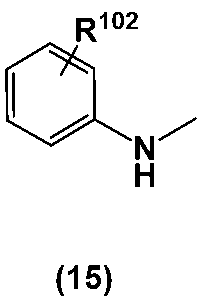
- the fluorine atom-containing arylamino group is a protective film forming composition for a transparent conductive film represented by the formula (15): (In the formula, R 102 represents a fluorine atom or a fluoroalkyl group having 1 to 10 carbon atoms.) 3.
- the fluorine atom-containing arylamino group is a protective film forming composition for a transparent conductive film represented by the formula (16): (In the formula, R 102 represents the same meaning as described above.) 4.
- R 2 is a perfluoroalkyl group having 1 to 10 carbon atoms, wherein the composition for forming a protective film for a transparent conductive film is 2 or 3; 5.
- Ar is a protective film forming composition for a transparent conductive film according to any one of 1 to 4, represented by formula (17): 6.
- a protective film for a transparent conductive film which is for a transparent conductive film having a conductive nanostructure
- the conductive nanostructure is a protective film for a transparent conductive film of 12, which is a silver nanowire, 14.
- a transparent electrode comprising a transparent conductive film, and 11 transparent conductive film protective films formed on the transparent conductive film;
- An electronic device comprising: a transparent conductive film; and 11 transparent conductive film protective films formed on the transparent conductive film. 16.
- the protective film formed by using the composition for forming a protective film for a transparent conductive film of the present invention is excellent in light resistance, and has high transparency and refractive index. Therefore, the protective film is used as a protective film for a transparent conductive film such as ITO and silver nanowires. By using, the visibility can be improved and the deterioration can be suppressed.
- the protective film forming composition for a transparent conductive film according to the present invention contains a triazine ring-containing hyperbranched polymer containing a repeating unit represented by the following formula (1).
- R and R ′ each independently represent a hydrogen atom, an alkyl group, an alkoxy group, an aryl group, or an aralkyl group, but from the viewpoint of further increasing the refractive index, both are preferably hydrogen atoms.
- the number of carbon atoms of the alkyl group is not particularly limited, but is preferably 1 to 20, and more preferably 1 to 10 in consideration of further increasing the heat resistance of the polymer. Is even more preferred.
- the structure may be any of a chain, a branch, and a ring.
- alkyl group examples include methyl, ethyl, n-propyl, isopropyl, cyclopropyl, n-butyl, isobutyl, s-butyl, t-butyl, cyclobutyl, 1-methyl-cyclopropyl, 2-methyl-cyclopropyl , N-pentyl, 1-methyl-n-butyl, 2-methyl-n-butyl, 3-methyl-n-butyl, 1,1-dimethyl-n-propyl, 1,2-dimethyl-n-propyl, , 2-Dimethyl-n-propyl, 1-ethyl-n-propyl, cyclopentyl, 1-methyl-cyclobutyl, 2-methyl-cyclobutyl, 3-methyl-cyclobutyl, 1,2-dimethyl-cyclopropyl, 2,3- Dimethyl-cyclopropyl, 1-ethyl-cyclopropyl, 2-ethyl-cyclopropyl,
- the carbon number of the alkoxy group is not particularly limited, but is preferably 1 to 20, and more preferably 1 to 10 and more preferably 1 to 3 in consideration of further increasing the heat resistance of the polymer.
- the structure of the alkyl moiety may be any of a chain, a branch, and a ring.
- alkoxy group examples include methoxy, ethoxy, n-propoxy, isopropoxy, n-butoxy, isobutoxy, s-butoxy, t-butoxy, n-pentoxy, 1-methyl-n-butoxy, 2-methyl-n -Butoxy, 3-methyl-n-butoxy, 1,1-dimethyl-n-propoxy, 1,2-dimethyl-n-propoxy, 2,2-dimethyl-n-propoxy, 1-ethyl-n-propoxy, n -Hexyloxy, 1-methyl-n-pentyloxy, 2-methyl-n-pentyloxy, 3-methyl-n-pentyloxy, 4-methyl-n-pentyloxy, 1,1-dimethyl-n-butoxy, 1,2-dimethyl-n-butoxy, 1,3-dimethyl-n-butoxy, 2,2-dimethyl-n-butoxy, 2,3-dimethyl-n-butoxy 3,3-dimethyl-n-butoxy, 1-ethoxy,
- the carbon number of the aryl group is not particularly limited, it is preferably 6 to 40, and more preferably 6 to 16 carbon atoms, and still more preferably 6 to 13 in consideration of further increasing the heat resistance of the polymer.
- Specific examples of the aryl group include phenyl, o-chlorophenyl, m-chlorophenyl, p-chlorophenyl, o-fluorophenyl, p-fluorophenyl, o-methoxyphenyl, p-methoxyphenyl, p-nitrophenyl, p-cyanophenyl, ⁇ -naphthyl, ⁇ -naphthyl, o-biphenylyl, m-biphenylyl, p-biphenylyl, 1-anthryl, 2-anthryl, 9-anthryl, 1-phenanthryl, 2-phenanthryl, 3-phenanthryl, 4 -Phenanthryl, 9
- the number of carbon atoms in the aralkyl group is not particularly limited, but is preferably 7 to 20 carbon atoms, and the alkyl portion thereof may be any of straight-chain, branched and cyclic. Specific examples thereof include benzyl, p-methylphenylmethyl, m-methylphenylmethyl, o-ethylphenylmethyl, m-ethylphenylmethyl, p-ethylphenylmethyl, 2-propylphenylmethyl, 4-isopropylphenylmethyl, 4-isobutylphenylmethyl, ⁇ -naphthylmethyl group and the like.
- Ar represents at least one selected from the group represented by formulas (2) to (13).
- R 1 to R 92 each independently represent a hydrogen atom, a halogen atom, a carboxyl group, a sulfo group, an alkyl group which may have a branched structure having 1 to 10 carbon atoms, or a branched chain having 1 to 10 carbon atoms.
- R 93 and R 94 represent a hydrogen atom or an alkyl group having 1 to 10 carbon atoms which may have a branched structure
- W 1 and W 2 represent Each independently represents a single bond
- CR 95 R 96 R 95 and R 96 each independently represent a hydrogen atom or an alkyl group which may have a branched structure having 1 to 10 carbon atoms (provided that these are taken together;
- C O, O, S, SO, SO 2 , or NR 97
- R 97 is a hydrogen atom or a branched structure having 1 to 10 carbon atoms. Represents an alkyl group which may be possessed).
- halogen atom examples include a fluorine atom, a chlorine atom, a bromine atom, and an iodine atom.
- X 1 and X 2 each independently represent a single bond, an alkylene group having 1 to 10 carbon atoms which may have a branched structure, or a group represented by the formula (14).
- R 98 to R 101 each independently represent a hydrogen atom, a halogen atom, a carboxyl group, a sulfo group, an alkyl group which may have a branched structure having 1 to 10 carbon atoms, or a branched chain having 1 to 10 carbon atoms.
- Y 1 and Y 2 each independently represent a single bond or an alkylene group which may have a branched structure having 1 to 10 carbon atoms.
- the halogen atom, alkyl group, and alkoxy group include the same as those described above.
- Examples of the alkylene group which may have a branched structure having 1 to 10 carbon atoms include methylene, ethylene, propylene, trimethylene, tetramethylene, pentamethylene, and the like.
- R 1 to R 92 and R 98 to R 101 each represent a hydrogen atom, a halogen atom, a sulfo group, an alkyl group which may have a branched structure having 1 to 5 carbon atoms, or a 1 to 5 carbon atom.
- An alkoxy group which may have a branched structure of 5 is preferable, and a hydrogen atom is more preferable.
- Ar is preferably at least one of formulas (2) and (5) to (13), and is preferably of formulas (2), (5), (7), (8), and (11) to (13). ) Is more preferable.
- Specific examples of the aryl groups represented by the above formulas (2) to (13) include, but are not limited to, those represented by the following formulas.
- an aryl group represented by the following formula is more preferable because a polymer having a higher refractive index can be obtained.
- Ar is preferably an m-phenylene group represented by the formula (17).
- the triazine ring-containing hyperbranched polymer used in the present invention has at least one triazine ring terminal, and at least a part of the triazine ring terminal is blocked with a fluorine atom-containing arylamino group.
- a fluorine atom-containing arylamino group examples include the same as described above, and a phenyl group is particularly preferable.
- the fluorine atom-containing group include a fluorine atom-containing hydrocarbon group such as a fluorine atom and a fluoroalkyl group, and a fluorine atom and a fluoroalkyl group having 1 to 10 carbon atoms are preferable.
- the fluoroalkyl group having 1 to 10 carbon atoms may be linear, branched or cyclic, and includes, for example, a trifluoromethyl group, a pentafluoroethyl group, a 2,2,2-trifluoroethyl group, a heptafluoropropyl group 2,2,3,3,3-pentafluoropropyl group, 2,2,3,3-tetrafluoropropyl group, 2,2,2-trifluoro-1- (trifluoromethyl) ethyl group, nonafluoro Butyl group, 4,4,4-trifluorobutyl group, undecafluoropentyl group, 2,2,3,3,4,4,5,5,5-nonafluoropentyl group, 2,2,3,3 , 4,4,5,5-octafluoropentyl group, tridecafluorohexyl group, 2,2,3,3,4,4,5,5,6,6,6-undecafluorohexyl group,
- a perfluoroalkyl group having 1 to 10 carbon atoms is preferable, and particularly a perfluoroalkyl group having 1 to 5 carbon atoms is preferable.
- Perfluoroalkyl groups are more preferred, and trifluoromethyl groups are most preferred.
- the number of fluorine atom-containing groups is not particularly limited, and may be any number that can be substituted on the aryl group. However, considering the balance between the maintenance of the refractive index and the solubility in a solvent, 1 to 4 Are preferred, 1-2 are more preferred, and 1 is even more preferred.
- Suitable examples of the fluorine atom-containing arylamino group include those represented by the formula (15), and particularly preferred are those represented by the formula (16) having a fluorine atom-containing group at the para-position to the amino group.
- R 102 represents a fluorine atom or a fluoroalkyl group having 1 to 10 carbon atoms.
- fluorine atom-containing arylamino group examples include those represented by the following formula, but are not limited thereto.
- the fluorine atom-containing arylamino group can be introduced by using a corresponding fluorine atom-containing arylamino compound in the production method described below.
- Specific examples of the fluorine atom-containing arylamino compound include 4-fluoroaniline, 4-trifluoromethylaniline, 4-pentafluoroethylaniline and the like.
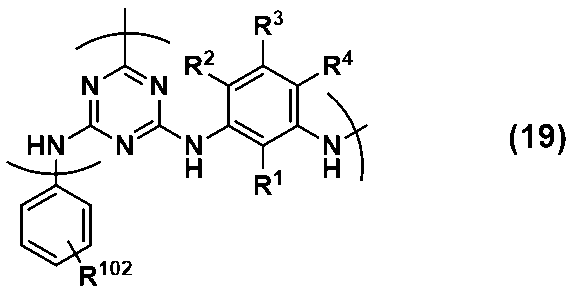
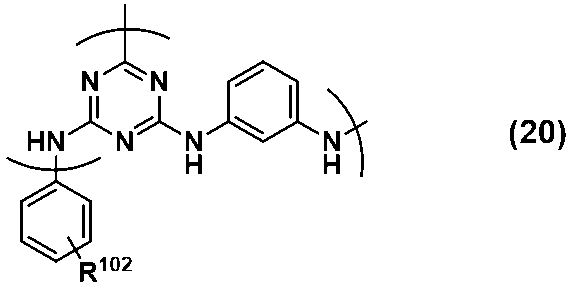
- particularly preferred triazine ring-containing hyperbranched polymers include those represented by formulas (18) to (21).
- the weight average molecular weight of the triazine ring-containing hyperbranched polymer is not particularly limited, but is preferably from 500 to 500,000, more preferably from 500 to 100,000. 2,000 or more is preferred, and 50,000 or less is preferred, 30,000 or less is more preferred, and 10,000 or less is preferred from the viewpoint of increasing solubility and decreasing the viscosity of the obtained solution. Is even more preferred.
- the weight average molecular weight in the present invention is an average molecular weight obtained by gel permeation chromatography (hereinafter, referred to as GPC) analysis in terms of standard polystyrene.
- the triazine ring-containing hyperbranched polymer of the present invention can be produced according to the method disclosed in Patent Document 1 described above.
- a triazine ring-containing hyperbranched polymer (20) is obtained by reacting a triazine compound (22) and an aryldiamino compound (23) in an appropriate organic solvent, And a fluorine atom-containing aniline compound (24).
- the charge ratio of the aryldiamino compound (23) is arbitrary as long as the desired polymer can be obtained.
- 0.01 to 10 equivalents of the aryldiamino compound (23) is added to 1 equivalent of the triazine compound (22). Is preferred, and 1 to 5 equivalents is more preferred.
- the aryldiamino compound (23) may be added neat or in a solution dissolved in an organic solvent, but the latter method is preferable in consideration of easiness of operation and control of the reaction. .
- the reaction temperature may be appropriately set in the range from the melting point of the solvent used to the boiling point of the solvent, but is preferably about -30 to 150 ° C, more preferably -10 to 100 ° C.
- organic solvent various solvents usually used in this type of reaction can be used, and examples thereof include tetrahydrofuran, dioxane, dimethyl sulfoxide; N, N-dimethylformamide, N-methyl-2-pyrrolidone, tetramethylurea, Hexamethylphosphoramide, N, N-dimethylacetamide, N-methyl-2-piperidone, N, N-dimethylethyleneurea, N, N, N ′, N′-tetramethylmalonamide, N-methylcaprolactam, N-acetylpyrrolidine, N, N-diethylacetamide, N-ethyl-2-pyrrolidone, N, N-dimethylpropionamide, N, N-dimethylisobutylamide, N-methylformamide, N, N'-dimethylpropyleneurea Amide solvents, and mixtures thereof.
- N, N-dimethylformamide, dimethylsulfoxide, N-methyl-2-pyrrolidone, N, N-dimethylacetamide, and a mixture thereof are preferable, and particularly, N, N-dimethylacetamide, N-methyl-2-pyrrolidone Is preferred.
- various bases usually used during or after the polymerization may be added.
- the base include potassium carbonate, potassium hydroxide, sodium carbonate, sodium hydroxide, sodium hydrogen carbonate, sodium ethoxide, sodium acetate, lithium carbonate, lithium hydroxide, lithium oxide, potassium acetate, magnesium oxide, oxide Calcium, barium hydroxide, trilithium phosphate, trisodium phosphate, tripotassium phosphate, cesium fluoride, aluminum oxide, ammonia, n-propylamine, trimethylamine, triethylamine, diisopropylamine, diisopropylethylamine, N-methylpiperidine, 2,2,6,6-tetramethyl-N-methylpiperidine, pyridine, 4-dimethylaminopyridine, N-methylmorpholine and the like.
- the amount of the base to be added is preferably 1 to 100 equivalents, more preferably 1 to 10 equivalents, per 1 equivalent of the triazine compound (22).
- These bases may be used in the form of an aqueous solution. It is preferable that no raw material components remain in the obtained polymer, but some raw materials may remain as long as the effects of the present invention are not impaired. After completion of the reaction, the product can be easily purified by a reprecipitation method or the like.
- the amount of the terminal blocking agent used is preferably about 0.05 to 10 equivalents, more preferably 0.1 to 5 equivalents, per equivalent of the halogen atom derived from the excess triazine compound not used in the polymerization reaction. Preferably, 0.5 to 2 equivalents are even more preferred.
- the reaction solvent and the reaction temperature the same conditions as described in the first-stage reaction of the above scheme 1 can be mentioned, and the terminal blocking agent may be charged at the same time as the aryl diamino compound (23). Note that an end-capping may be performed with two or more kinds of groups using an arylamino compound having no fluorine atom. Examples of the aryl group of the arylamino compound having no substituent include the same ones as described above.
- the composition of the present invention contains a crosslinking agent A having a molecular weight of 1,000 or more, preferably 1,200 or more, more preferably 1,500 or more. Thereby, the film density of the protective film can be increased, and the resistance to high temperature and high humidity can be improved.
- the composition of the present invention preferably contains a crosslinking agent B having a molecular weight of less than 1,000 together with the crosslinking agent A. By adding the crosslinking agent B, the film density of the protective film can be further increased, and the resistance to high temperature and high humidity can be further improved.
- the molecular weight of the crosslinking agent B is preferably 900 or less, more preferably 800 or less.
- cross-linking agents A and B examples include a melamine compound having a cross-linking group such as a methylol group or a methoxymethyl group as a cross-linking group, a substituted urea compound, a compound containing a cross-linking group such as an epoxy group or an oxetane group, and a block.
- a melamine compound having a cross-linking group such as a methylol group or a methoxymethyl group as a cross-linking group
- a substituted urea compound such as an epoxy group or an oxetane group
- a compound containing a cross-linking group such as an epoxy group or an oxetane group
- a block examples include a melamine compound having a cross-linking group such as a methylol group or a methoxymethyl group as a cross-linking group, a substituted urea compound, a compound containing a cross-linking
- compounds containing an epoxy group, a blocked isocyanate group, and a (meth) acryl group are preferable from the viewpoint of heat resistance and storage stability, and in particular, a compound having a blocked isocyanate group and photocuring without using an initiator.
- Polyfunctional epoxy compounds and / or polyfunctional (meth) acrylic compounds which give possible compositions are preferred. Note that these polyfunctional compounds need to have at least two cross-linking groups, but preferably have three or more cross-linking groups.
- the polyfunctional epoxy compound is not particularly limited as long as it has two or more epoxy groups in one molecule. Specific examples thereof include tris (2,3-epoxypropyl) isocyanurate, 1,4-butanediol diglycidyl ether, 1,2-epoxy-4- (epoxyethyl) cyclohexane, glycerol triglycidyl ether, diethylene glycol diglycidyl.
- epoxy resins YH-434 and YH434L manufactured by Toto Kasei Co., Ltd. having at least two epoxy groups, Epolide GT-401 and GT-403 which are epoxy resins having a cyclohexene oxide structure are available.
- the polyfunctional (meth) acrylic compound is not particularly limited as long as it has two or more (meth) acrylic groups in one molecule. Specific examples thereof include ethylene glycol di (meth) acrylate, polyethylene glycol di (meth) acrylate, ethoxylated bisphenol A di (meth) acrylate, ethoxylated trimethylolpropane tri (meth) acrylate, and ethoxylated glycerin tri (meth) acrylate.
- the polyfunctional (meth) acrylic compound can be obtained as a commercial product, and specific examples thereof include NK esters A-200, A-400, A-600, A-1000, and A-9300.
- UV-1700B, UV-6300B, UV-7 10B, UV-7550V, UV-7550B, UV-7600B, UV-7605B, UV-7610B, UV-7620EA, UV-7630B, UV-7640B, UV-7650B all manufactured by Nippon Synthetic Chemical Industry Co., Ltd.
- EBECRYL600, 605, 645, 648, 860, 1606, 3500, 3603, and 3608 which are epoxy acrylates.
- 3700, 3701, 3702, 3703, 708, the 6040 can also be used like.
- the acid anhydride compound is not particularly limited as long as it is a carboxylic anhydride obtained by dehydrating and condensing two molecules of carboxylic acid.
- Specific examples thereof include phthalic anhydride, tetrahydrophthalic anhydride, hexahydrophthalic anhydride, methyltetrahydrophthalic anhydride, methylhexahydrophthalic anhydride, nadic anhydride, methylnadic anhydride, maleic anhydride, succinic anhydride, Octyl succinic anhydride, dodecenyl succinic anhydride, etc.
- a compound containing a blocked isocyanate has two or more blocked isocyanate groups in one molecule in which an isocyanate group (—NCO) is blocked by an appropriate protecting group, and when exposed to a high temperature during thermosetting, There is no particular limitation as long as the protecting group (block portion) is thermally dissociated and comes off, and the generated isocyanate group causes a cross-linking reaction with the resin.
- an isocyanate group (—NCO)
- the protecting group block portion
- the generated isocyanate group causes a cross-linking reaction with the resin.
- two of the groups represented by the following formula per molecule may be used. Compounds having the above (these groups may be the same or different) may be mentioned.
- R b represents an organic group in the block portion.
- Such a compound can be obtained, for example, by reacting a compound having two or more isocyanate groups per molecule with a suitable blocking agent.
- Examples of the compound having two or more isocyanate groups in one molecule include polyisocyanates such as isophorone diisocyanate, 1,6-hexamethylene diisocyanate, methylene bis (4-cyclohexyl isocyanate), and trimethylhexamethylene diisocyanate, and dimers thereof. And trimers, and reaction products thereof with diols, triols, diamines or triamines.
- the blocking agent examples include alcohols such as methanol, ethanol, isopropanol, n-butanol, 2-ethoxyhexanol, 2-N, N-dimethylaminoethanol, 2-ethoxyethanol and cyclohexanol; phenol, o-nitrophenol Phenols such as p-chlorophenol, o-, m- or p-cresol; lactams such as ⁇ -caprolactam; oximes such as acetone oxime, methyl ethyl ketone oxime, methyl isobutyl ketone oxime, cyclohexanone oxime, acetophenone oxime and benzophenone oxime.
- Pyrazoles such as pyrazole, 3,5-dimethylpyrazole and 3-methylpyrazole; and thiols such as dodecanethiol and benzenethiol.
- the compound containing the blocked isocyanate is also available as a commercial product, and specific examples thereof include B-830, B-815N, B-842N, B-870N, B-874N, B-882N, and B-882N. 7005, B-7030, B-7075, B-5010 (all manufactured by Mitsui Chemicals Polyurethanes Inc.), Duranate (registered trademark) 17B-60PX, TPA-B80E, MF-B60X, MF-K60X, E402-B80T (above, manufactured by Asahi Kasei Chemicals Corporation), Karenz MOI-BM (registered trademark) (above, manufactured by Showa Denko KK) and the like.
- the aminoplast compound is not particularly limited as long as it has two or more methoxymethylene groups in one molecule.
- Cymel series such as hexamethoxymethyl melamine ⁇ CYMEL (registered trademark) 303, tetrabutoxymethyl glycoluril ⁇ 1170, tetramethoxymethyl benzoguanamine ⁇ 1123 (all manufactured by Nippon Cytec Industries Co., Ltd.), and methylated melamine resins.
- Nikarac registered trademark
- MW-30HM MW-390
- MW-100LM MX-750LM
- methylated urea resins MX-270, MX-280, MX-290 And melamine-based compounds
- Nikalac series manufactured by Sanwa Chemical Co., Ltd.
- the oxetane compound is not particularly limited as long as it has two or more oxetanyl groups in one molecule.
- OXT-221, OX-SQ-H, and OX-SC containing oxetane group (these are Toa Gosei Co., Ltd. )).
- the phenoplast compound has two or more hydroxymethylene groups in one molecule, and when exposed to a high temperature during thermosetting, a crosslinking reaction proceeds with a hyperbranched polymer used in the present invention by a dehydration condensation reaction. Is what you do.
- phenoplast compound examples include 2,6-dihydroxymethyl-4-methylphenol, 2,4-dihydroxymethyl-6-methylphenol, bis (2-hydroxy-3-hydroxymethyl-5-methylphenyl) methane, Bis (4-hydroxy-3-hydroxymethyl-5-methylphenyl) methane, 2,2-bis (4-hydroxy-3,5-dihydroxymethylphenyl) propane, bis (3-formyl-4-hydroxyphenyl) methane And bis (4-hydroxy-2,5-dimethylphenyl) formylmethane, ⁇ , ⁇ -bis (4-hydroxy-2,5-dimethylphenyl) -4-formyltoluene and the like.
- the phenoplast compound is also available as a commercial product, and specific examples thereof include 26DMPC, 46DMOC, DM-BIPC-F, DM-BIOC-F, TM-BIP-A, BISA-F, BI25X-DF, BI25X-TPA (all manufactured by Asahi Organic Materials Industry Co., Ltd.) and the like.
- the crosslinking agent A preferably has a molecular weight of 1,000 or more due to a long chain length between crosslinking groups, and specifically has a polyether structure, a polyester structure, a polyurethane structure, or the like. It is preferred that the length of the chain between the cross-linking groups becomes longer.
- examples of the crosslinking agent A include NK esters A-GLY-20E, ATM-35E, AT-20E, 23G, A-BPE-20, BPE-900, and BPE-1300N ( Above, Shin Nakamura Chemical Industry Co., Ltd.), EBECRYL 204, 205, 210, 215, 230, 244, 245, 270, 284, 285, 264, 265, 294 / 25HD, 1259, 1290, 4820, 8254, 8301R, 8405, 8465, 8296, 8307, 8411, 8701, 8800, 8804, 9260, 9277EA, KRM8200, 8452, 8528, 8667, 8904, 436, 438, 446, 450, 525, 183 , 846, 1870, 884, 885, 860, 3708 (all manufactured by Daicel Ornex), UV-1700B, UV-6300B, UV-7510B,
- Alonix M-303, M-305, M-305, M-306, M-400, and M-402 are examples of the crosslinking agent B having a molecular weight of less than 1,000.
- M-403, M-404, M-405, M-406, M-450, M-452 (all manufactured by Toagosei Co., Ltd.), NK ester A-9300, and A- 9300-1CL, A-TMM-3, A-TMM-3L, A-TMPT, A-TMP, A-TMMT, A-DPH, 1G, 2G, 3G, 4G, 9G, 14G, ABE-300, A-BPE-4, A-BPE-6, A-BPE-10, A-BPE-20, A-BPE-30, BPE-80N , BPE-100N, BPE-200, BPE-500 (or more, EBECRYL # 11, 40, 135, 140, 145, 150, 180, 800, 853, 860, 1142, 4858, 5129
- Aronix M-303, M-305, M-305, M-306, M-400, M-402, M-403, M-404, M-405, M-406, M-450, M-452 (all manufactured by Toagosei Co., Ltd.), NK ester A-9300, A-9300-1CL (all manufactured by Shin-Nakamura Chemical Co., Ltd.), KAYARAD DN-0075 (manufactured by Nippon Kayaku Co., Ltd.) and the like are preferable.
- cross-linking agents A and B polyfunctional (meth) acrylic compounds are preferred because they can suppress a decrease in the refractive index due to the blending of the cross-linking agent, and the curing reaction proceeds rapidly.
- the crosslinking agents A and B may be used alone or in combination of two or more.
- the amount of the crosslinking agent A to be used is preferably 0.1 to 30 parts by mass with respect to 100 parts by mass of the triazine ring-containing hyperbranched polymer, but considering solvent resistance, the lower limit is preferably 1 part by mass, more preferably The upper limit is preferably 5 parts by mass, and more preferably 20 parts by mass in consideration of controlling the refractive index.
- the amount of the crosslinking agent B to be used is preferably from 100 to 3,000 parts by mass, more preferably from 1,000 to 2,000 parts by mass, based on 100 parts by mass of the crosslinking agent A from the viewpoint of further improving the optical properties of the transparent conductive film and preventing a remarkable decrease in the refractive index. Parts by mass are more preferred.
- the composition of the present invention contains an ultraviolet absorber in addition to the above-described triazine ring-containing hyperbranched polymer and a crosslinking agent. Thereby, the deterioration of the triazine ring-containing hyperbranched polymer in the cured film due to the influence of ultraviolet rays or the like can be suppressed, and the light resistance can be improved.
- the ultraviolet absorber for example, organic compounds such as benzotriazole-based compounds, benzophenone-based compounds, triazine-based compounds, cyclic iminoester-based compounds, cyanoacrylate-based compounds, malonic ester compounds, and salicylic acid phenylester-based compounds, and titanium oxide
- organic compounds such as benzotriazole-based compounds, benzophenone-based compounds, triazine-based compounds, cyclic iminoester-based compounds, cyanoacrylate-based compounds, malonic ester compounds, and salicylic acid phenylester-based compounds, and titanium oxide
- examples include inorganic particles that absorb ultraviolet light, such as fine particles, zinc oxide fine particles, and tin oxide fine particles.
- a benzotriazole-based compound and a triazine-based compound are preferred, and a hydroxyphenylbenzotriazole-based compound is more preferred, from the viewpoint of improving the weather resistance of the obtained cured film and also preventing coloring of the cured
- the ultraviolet absorber examples include 2- (5-methyl-2-hydroxyphenyl) benzotriazole and 2- [2-hydroxy-3,5-bis ( ⁇ , ⁇ -dimethylbenzyl) phenyl] -2H-benzo.
- Triazoles such as triazole and 2- (3,5-di-t-butyl-2-hydroxyphenyl) benzotriazole; 2-hydroxy-4-methoxybenzophenone, 2-hydroxy-4-octoxybenzophenone, 2,2 ′ Benzophenones such as -dihydroxy-4-methoxybenzophenone; [2- (4,6-diphenyl-1,3,5-triazin-2,2-yl) -5-[(hexyl) oxy] -phenol, 2- [4-[(2-hydroxy-3-dodecyloxypropyl) oxy] -2-hydroxyphenyl] -4,6-bis (2, 4-dimethylphenyl) -1,3,5-triazine, 2- [4-[(2-hydroxy
- UV absorbers may be used. Specific examples thereof include TINUVIN (registered trademark) PS, 99-2, 99-DW, 109, 328, 329, 384-2, and 384-2. 400, 400-DW, 405, 460, 477, 477-DW, 479, 900, 928, 1130, 111FDL (all manufactured by BASF Japan Ltd.), ADK STAB LA-29 LA-31, LA-31RG, LA-31G, LA-32, LA-36RG, LA-46, 1413, LA-F70 (all manufactured by ADEKA Corporation), Newcoat UVA-101, UVA-102, UVA-103, UVA-104, Vanaresin UVA-5080, UVA-5080 (OHV20), UVA-55T, UV -5MHB, the UVA-7075, the UVA-7075 (OHV20), the UVA-73T (Shin-Nakamura Chemical Co., Ltd.), RUVA-93 (manufactured by Otsuka Chemical
- the UV absorbers may be used alone or in combination of two or more.
- the amount of the ultraviolet absorber to be used is preferably 0.1 to 100 parts by mass with respect to 100 parts by mass of the triazine ring-containing hyperbranched polymer.
- the lower limit thereof is as follows. It is preferably 1 part by mass, more preferably 5 parts by mass, and further from the viewpoint of preventing the refractive index of the cured film from lowering and preventing coloring, the upper limit is preferably 30 parts by mass, more preferably 20 parts by mass. .
- composition of the present invention is preferably used by adding various solvents to dissolve the triazine ring-containing hyperbranched polymer.
- the solvent may be the same as or different from the solvent used during the polymerization. This solvent is not particularly limited as long as compatibility with the polymer is not impaired.
- usable solvents include toluene, p-xylene, o-xylene, m-xylene, ethylbenzene, styrene, ethylene glycol dimethyl ether, propylene glycol monomethyl ether, ethylene glycol monomethyl ether, propylene glycol, propylene glycol monoethyl ether , Ethylene glycol monoethyl ether, ethylene glycol monoisopropyl ether, ethylene glycol methyl ether acetate, propylene glycol monomethyl ether acetate, ethylene glycol ethyl ether acetate, diethylene glycol dimethyl ether, propylene glycol monobutyl ether, ethylene glycol monobutyl ether, diethylene glycol diethyl ether, dip Pyrene glycol monomethyl ether, diethylene glycol monomethyl ether, dipropylene glycol monoethyl ether, diethylene glycol monoethyl ether, diethylene
- the solid content concentration in the composition is not particularly limited as long as it does not affect storage stability, and may be appropriately set according to the thickness of the target film. Specifically, from the viewpoint of solubility and storage stability, the solid concentration is preferably 0.1 to 50% by mass, more preferably 0.2 to 40% by mass.
- an initiator corresponding to each crosslinking agent may be blended.
- a polyfunctional epoxy compound and / or a polyfunctional (meth) acrylic compound is used as a crosslinking agent, photocuring proceeds without using an initiator to give a cured film.
- an initiator may be used.
- a photoacid generator or a photobase generator can be used.
- the photoacid generator may be appropriately selected from known ones and used, and for example, onium salt derivatives such as diazonium salts, sulfonium salts and iodonium salts can be used.
- aryldiazonium salts such as phenyldiazonium hexafluorophosphate, 4-methoxyphenyldiazonium hexafluoroantimonate, and 4-methylphenyldiazonium hexafluorophosphate; diphenyliodonium hexafluoroantimonate, di (4-methylphenyl) Diaryliodonium salts such as iodonium hexafluorophosphate and di (4-tert-butylphenyl) iodonium hexafluorophosphate; triphenylsulfonium hexafluoroantimonate, tris (4-methoxyphenyl) sulfonium hexafluorophosphate, diphenyl-4-thiophenoxy Phenylsulfonium hexafluoroantimonate, diphenyl-4-thiophenoxy Phenylsulfonium hex
- onium salts commercially available products may be used, and specific examples thereof include San-Aid SI-60, SI-80, SI-100, SI-60L, SI-80L, SI-100L, SI-L145, SI-L. L150, SI-L160, SI-L110, SI-L147 (above, manufactured by Sanshin Chemical Industry Co., Ltd.), UVI-6950, UVI-6970, UVI-6974, UVI-6990, UVI-6992 (above, union carbide) Co., Ltd.), CPI-100P, CPI-100A, CPI-200K, CPI-200S (manufactured by Sun Apro Co., Ltd.), Adeka Optomer SP-150, SP-151, SP-170, SP-171 (manufactured by Asahi Denka Kogyo Co., Ltd.), Irgacure 261 (BASF), CI-2481, CI-2624, CI-26 9, CI-2064 (all manufactured by Nippo
- the photobase generator may be appropriately selected from known ones and used.
- a Co-amine complex oxime carboxylate ester, carbamate ester type, quaternary ammonium salt type photobase generator, or the like may be used. it can. Specific examples thereof include 2-nitrobenzylcyclohexylcarbamate, triphenylmethanol, O-carbamoylhydroxylamide, O-carbamoyloxime, [[(2,6-dinitrobenzyl) oxy] carbonyl] cyclohexylamine, bis [[(2 -Nitrobenzyl) oxy] carbonyl] hexane 1,6-diamine, 4- (methylthiobenzoyl) -1-methyl-1-morpholinoethane, (4-morpholinobenzoyl) -1-benzyl-1-dimethylaminopropane, N- (2-nitrobenzyloxycarbonyl) pyrrolidine, hexaamminecobalt (III) tri
- a photoacid generator or a photobase generator When a photoacid generator or a photobase generator is used, it is preferably used in an amount of 0.1 to 15 parts by mass, more preferably 1 to 10 parts by mass, per 100 parts by mass of the polyfunctional epoxy compound. It is. If necessary, the epoxy resin curing agent may be blended in an amount of 1 to 100 parts by mass with respect to 100 parts by mass of the polyfunctional epoxy compound.
- a photoradical polymerization initiator when a polyfunctional (meth) acrylic compound is used, a photoradical polymerization initiator can be used.
- the photo-radical polymerization initiator may be appropriately selected and used from known ones, and examples thereof include acetophenones, benzophenones, benzoylbenzoate of Michler, amiloxime ester, tetramethylthiuram monosulfide, and thioxanthone.
- a photo-cleavable photo-radical polymerization initiator is preferable.
- the photo-cleavable photo-radical polymerization initiator is described in the latest UV curing technology (p. 159, publisher: Kazuhiro Takasu, publisher: Technical Information Association, 1991).
- photo-radical polymerization initiators include, for example, trade names: Irgacure 127, 184, 369, 379, 651, 500, 819, 907, 784, 2959, OXE01, OXE02, CGI1700, CGI1750, CGI1850, CG24 manufactured by BASF. -61, Darocure 1116, 1173, manufactured by BASF.
- a photoradical polymerization initiator When a photoradical polymerization initiator is used, it is preferably used in an amount of 0.1 to 15 parts by mass, more preferably 0.1 to 10 parts by mass, based on 100 parts by mass of the polyfunctional (meth) acrylate compound. Range.
- a polyfunctional thiol compound having two or more mercapto groups in the molecule is added. Is also good. Specifically, a polyfunctional thiol compound represented by the following formula is preferable.
- the above L represents a divalent to tetravalent organic group, preferably a divalent to tetravalent aliphatic group having 2 to 12 carbon atoms or a divalent to tetravalent heterocyclic group, And a trivalent group having an isocyanuric acid skeleton (1,3,5-triazine-2,4,6 (1H, 3H, 5H) -trione ring) represented by the following formula: .
- N represents an integer of 2 to 4 corresponding to the valence of L.
- Specific compounds include 1,4-bis (3-mercaptobutyryloxy) butane and 1,3,5-tris (3-mercaptobutyryloxyethyl) -1,3,5-triazine-2,4 , 6- (1H, 3H, 5H) -trione, pentaerythritol tetrakis (3-mercaptobutyrate), trimethylolpropane tris (3-mercaptobutyrate), trimethylolethanetris (3-mercaptobutyrate) and the like.
- polyfunctional thiol compounds can also be obtained as commercial products, and examples thereof include Karenz MT-BD1, Karenz MT NR1, Karenz MT PE1, TPMB, and TEMB (all manufactured by Showa Denko KK). These polyfunctional thiol compounds may be used alone or in combination of two or more.
- a polyfunctional thiol compound When a polyfunctional thiol compound is used, its addition amount is not particularly limited as long as it does not adversely affect the obtained protective film. % By mass, more preferably 0.1 to 6% by mass.
- the film-forming composition of the present invention may contain other components, such as a leveling agent and a surfactant, as long as the effects of the present invention are not impaired.
- a leveling agent or the surfactant include polyoxyethylene lauryl ether, polyoxyethylene stearyl ether, polyoxyethylene cetyl ether, polyoxyethylene alkyl ethers such as polyoxyethylene oleyl ether, polyoxyethylene octyl phenol ether, and polyoxyethylene octyl phenol ether.
- Polyoxyethylene alkyl allyl ethers such as oxyethylene nonylphenol ether, polyoxyethylene / polyoxypropylene block copolymers, sorbitan monolaurate, sorbitan monopalmitate, sorbitan monostearate, sorbitan monooleate, sorbitan trioleate, sorbitan Sorbitan fatty acid esters such as tristearate, polyoxyethylene sorbitan monolaurate, Nonionic surfactants such as polyoxyethylene sorbitan fatty acid esters such as oxyethylene sorbitan monopalmitate, polyoxyethylene sorbitan monostearate, polyoxyethylene sorbitan trioleate, and polyoxyethylene sorbitan tristearate; EF301, EF303, EF352 (manufactured by Mitsubishi Materials Denka Kasei Co., Ltd.
- the amount of the surfactant to be used is preferably 0.001 to 5 parts by mass, more preferably 0.01 to 5 parts by mass, and more preferably 0.1 to 2 parts by mass based on 100 parts by mass of the triazine ring-containing hyperbranched polymer. More preferred.
- the above-mentioned other components can be added at any step when preparing the composition of the present invention.
- the protective film for a transparent conductive film of the present invention is obtained by applying the above-mentioned composition for forming a protective film for a transparent conductive film to a transparent conductive film, heating and evaporating the solvent if necessary, and then heating or irradiating with light.
- the thickness of the protective film is preferably from 10 to 1,000 nm, more preferably from 50 to 200 nm.
- the lower limit of the range of the refractive index of the protective film is preferably 1.45, more preferably 1.50, and even more preferably 1.55.
- the upper limit is not particularly limited, but is about 1.95 to 2.00.
- the haze value of the transparent conductive film on which the protective film of the present invention is formed is preferably 1.5% or less, more preferably 1.0% or less.
- the method of applying the composition is arbitrary, and examples thereof include a spin coating method, a dip method, a flow coating method, an ink jet method, a spray method, a bar coating method, a gravure coating method, a slit coating method, a roll coating method, a transfer printing method, and a brush. Coating, a blade coating method, an air knife coating method and the like can be employed.
- the transparent conductive film examples include a transparent conductive film having a conductive nanostructure such as an ITO film, an IZO film, a metal nanoparticle, a metal nanowire, and a metal nanomesh.
- a transparent conductive film having a conductive nanostructure is preferred.
- the metal constituting the conductive nanostructure is not particularly limited, and examples thereof include silver, gold, copper, nickel, platinum, cobalt, iron, zinc, ruthenium, rhodium, palladium, cadmium, osmium, iridium, and alloys thereof.
- a transparent conductive film having silver nanoparticles, silver nanowires, silver nanomesh, gold nanoparticle, gold nanowire, gold nanomesh, copper nanoparticle, copper nanowire, copper nanomesh, or the like is preferable, and in particular, a transparent conductive film having silver nanowires is preferable.
- Membranes are preferred.
- the heating temperature is not particularly limited for the purpose of evaporating the solvent, and the heating can be performed, for example, at 40 to 400 ° C.
- the heating method is not particularly limited, and for example, the solvent may be evaporated using a hot plate or an oven under an appropriate atmosphere such as an atmosphere, an inert gas such as nitrogen, or a vacuum.
- the sintering temperature and the sintering time may be selected under conditions suitable for the target electronic device process step, and the sintering conditions may be selected so that the physical properties of the obtained film conform to the required characteristics of the electronic device.
- the conditions for light irradiation are not particularly limited, and appropriate irradiation energy and time may be employed depending on the triazine ring-containing hyperbranched polymer and the crosslinking agent to be used. For example, it can be performed at 50 to 1,000 mJ / cm 2 . Light irradiation is preferably performed in the atmosphere or in an atmosphere of an inert gas such as nitrogen.
- the protective film of the present invention is particularly suitable as a protective film for a transparent conductive film having a conductive nanostructure.
- a transparent conductive film having a conductive nanostructure is liable to be clouded due to irregular reflection of light due to the conductive nanostructure, and may have poor visibility.
- the protective film of the present invention has high transparency and a high refractive index, it is possible to prevent clouding due to irregular reflection of light of the transparent conductive film using the conductive nanostructure, and improve visibility. Furthermore, since it has light resistance, high heat resistance, and high temperature and humidity resistance, it can contribute to prevention of deterioration of the transparent conductive film.
- DPHA dipentaerythritol penta and hexaacrylate
- ATM35E ethoxylated pentaerythritol tetraacrylate
- I2959 1- [4- (2-hydroxyethoxy) phenyl] -2-hydroxy-2-methyl-1-propan-1-one (Irgacure 2959, manufactured by BASF Japan K.K.)
- NR1 1,3,5-tris (3-mercaptobutyloxyethyl) -1,3,5-triazine-2,4,6 (1H, 3H, 5H) -trione (Karenz MT NR1 manufactured by Showa Denko KK) )
- F559 Surfactant (megafax F-559, manufactured by DIC Corporation)
- T900 UV absorb
- m-phenylenediamine [2] (6.00 g, 0.055 mol, manufactured by AminoChem) and 78.88 g of dimethylacetamide (DMAc, manufactured by Junsei Chemical Co., Ltd.), and the atmosphere was replaced with nitrogen.
- DMAc dimethylacetamide
- M-phenylenediamine [2] was dissolved in DMAc.
- the mixture was cooled to ⁇ 10 ° C. with an ethanol-dry ice bath, and 2,4,6-trichloro-1,3,5-triazine [1] (9.22 g, 0.05 mol, manufactured by Eponic Degussa) was cooled to a bath temperature.
- FIG. 1 shows the measurement result of the 1 H-NMR spectrum of TDF111.
- the weight average molecular weight Mw of TDF111 measured by GPC in terms of polystyrene was 3,300, and the polydispersity Mw / Mn was 4.4.
- Example 2-1 and Comparative Examples 2-1 and 2-2 Each composition obtained in Example 1-1, Comparative Example 2-1 and Comparative Example 2-2 was stirred at room temperature (about 25 ° C.) for 30 minutes, and then coated with the silver nanowire obtained in Production Example 2. The film was spin-coated at 200 rpm for 5 seconds and 1,500 rpm for 30 seconds using a spin coater, and dried at 80 ° C. for 1 minute using a hot plate. Thereafter, the coating film was irradiated with UV light having an exposure amount of 400 mJ / cm 2 in the atmosphere to be light-cured, thereby producing a protective film. Subsequently, a substrate for a light resistance test was manufactured by attaching the protective film surface and the glass via an adhesive sheet of 3M Optically Clear Adhesive 8146-2 (manufactured by 3M Company).
- 3M Optically Clear Adhesive 8146-2 manufactured by attaching the protective film surface and the glass via an adhesive sheet of 3M Optically Clear Adhesive 814
- the protective film produced in Example 2-1 has a low rate of increase in b * after long-time light irradiation and is excellent in light resistance.
Landscapes
- Chemical & Material Sciences (AREA)
- Engineering & Computer Science (AREA)
- Organic Chemistry (AREA)
- Chemical Kinetics & Catalysis (AREA)
- Polymers & Plastics (AREA)
- Medicinal Chemistry (AREA)
- Health & Medical Sciences (AREA)
- Materials Engineering (AREA)
- Life Sciences & Earth Sciences (AREA)
- Wood Science & Technology (AREA)
- Theoretical Computer Science (AREA)
- General Engineering & Computer Science (AREA)
- General Physics & Mathematics (AREA)
- Physics & Mathematics (AREA)
- Human Computer Interaction (AREA)
- Macromolecular Compounds Obtained By Forming Nitrogen-Containing Linkages In General (AREA)
- Compositions Of Macromolecular Compounds (AREA)
- Paints Or Removers (AREA)
Abstract
例えば下記式[4]で示されるような、フッ素原子含有アリールアミノ基で封止されているトリアジン環含有ハイパーブランチポリマー、分子量1,000以上の架橋剤A、および紫外線吸収剤を含む組成物は、耐光性に優れるとともに、透明導電膜の視認性を改善し得る膜を与え、透明導電膜用保護膜形成組成物として好適である。
Description
本発明は、透明導電膜用保護膜形成組成物に関する。
近年、液晶ディスプレイ、有機エレクトロルミネッセンス(EL)ディスプレイ、タッチパネル、光半導体(LED)素子、固体撮像素子、有機薄膜太陽電池、色素増感太陽電池、および有機薄膜トランジスタ(TFT)等の電子デバイスを開発する際に、高機能な高分子材料が要求されるようになってきた。
求められる具体的な特性としては、1)耐熱性、2)透明性、3)高屈折率、4)高溶解性、5)低体積収縮率、6)高温高湿耐性、7)高膜硬度などが挙げられる。
この点に鑑み、本発明者らは、トリアジン環および芳香環を有する繰り返し単位を含む重合体が高屈折率を有し、ポリマー単独で高耐熱性、高透明性、高屈折率、高溶解性、低体積収縮を達成でき、電子デバイスを作製する際の膜形成用組成物として好適であることを既に見出している(特許文献1)。
求められる具体的な特性としては、1)耐熱性、2)透明性、3)高屈折率、4)高溶解性、5)低体積収縮率、6)高温高湿耐性、7)高膜硬度などが挙げられる。
この点に鑑み、本発明者らは、トリアジン環および芳香環を有する繰り返し単位を含む重合体が高屈折率を有し、ポリマー単独で高耐熱性、高透明性、高屈折率、高溶解性、低体積収縮を達成でき、電子デバイスを作製する際の膜形成用組成物として好適であることを既に見出している(特許文献1)。
ところで、透明導電膜材料としては、従来、インジウムスズ酸化物(ITO)、インジウム亜鉛酸化物(IZO)等が主に用いられており、これらは良好な光学的透明性および導電性を示す標準材料となっている。しかし、これらの無機酸化物膜を得るためには、スパッタリング、高真空下、高温アニール等の複雑なプロセスを必要とする。そのため特殊な機器が必要であり、コストがかかるという問題がある。
近年、電子デバイスは、プラスチック基板等の使用によるフレキシブル化、軽量化が進行しつつあり、曲げ等の物理的応力への耐久性が必要とされている。フレキシブル基板へのITOやIZOの製膜技術も検討されつつあるが、無機酸化物の脆弱性かつ損傷しやすいという性質は改善されていない。
近年、電子デバイスは、プラスチック基板等の使用によるフレキシブル化、軽量化が進行しつつあり、曲げ等の物理的応力への耐久性が必要とされている。フレキシブル基板へのITOやIZOの製膜技術も検討されつつあるが、無機酸化物の脆弱性かつ損傷しやすいという性質は改善されていない。
上述したフレキシブル化の進行とともに、物理的応力への耐久性に優れた材料として、導電性ナノ構造(金属ナノ粒子や金属ナノワイヤのパーコレーション構造、金属メッシュ構造等)を有する透明導電膜が開発されている。
これらの透明導電膜は、フレキシブル性に加え、金属ナノ粒子や金属ナノワイヤ分散液を用いてウェットプロセスで作製できるという利点を有するとともに(特許文献1~3)、含有する金属量を増加するのみでその電気抵抗を低くすることが可能であるという利点を有している。
その反面、低抵抗化のために膜中の金属量を増加させると、光の乱反射によって膜が白濁化してその光学的透明性を失うのみならず、金属に起因する表面の劣化や構造体の破壊によって導電性が低下するという問題がある。
これらの透明導電膜は、フレキシブル性に加え、金属ナノ粒子や金属ナノワイヤ分散液を用いてウェットプロセスで作製できるという利点を有するとともに(特許文献1~3)、含有する金属量を増加するのみでその電気抵抗を低くすることが可能であるという利点を有している。
その反面、低抵抗化のために膜中の金属量を増加させると、光の乱反射によって膜が白濁化してその光学的透明性を失うのみならず、金属に起因する表面の劣化や構造体の破壊によって導電性が低下するという問題がある。
本発明は、上記事情に鑑みてなされたものであり、耐光性に優れるとともに、透明導電膜の視認性を改善し得る膜を与える透明導電膜用保護膜形成組成物を提供することを目的とする。
本発明者らは、トリアジン環含有ハイパーブランチポリマーを含み、透明導電膜の視認性を改善し得る膜を与える組成物を既に報告しており(特許文献5)、その知見を基に、耐光性向上等の観点から鋭意検討を重ねた結果、フッ素原子含有アリールアミノ基で封止されている所定のトリアジン環含有ハイパーブランチポリマー、分子量1,000以上の架橋剤、および紫外線吸収剤を含む組成物が、耐光性に優れるとともに、透明導電膜の視認性を改善し得る膜を与えることを見出し、本発明を完成した。
すなわち、本発明は、
1. 下記式(1)で表される繰り返し単位構造を含み、少なくとも1つのトリアジン環末端を有し、このトリアジン環末端の少なくとも一部がフッ素原子含有アリールアミノ基で封止されているトリアジン環含有ハイパーブランチポリマー、分子量1,000以上の架橋剤A、および紫外線吸収剤を含むことを特徴とする透明導電膜用保護膜形成組成物、
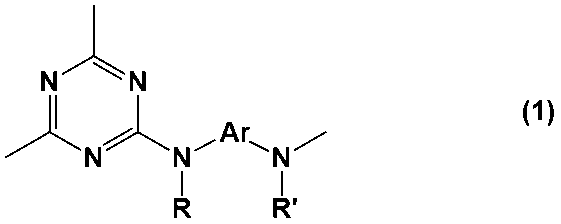
{式中、RおよびR'は、それぞれ独立に水素原子、アルキル基、アルコキシ基、アリール基またはアラルキル基を表し、Arは、式(2)~(13)で示される基からなる群から選ばれる少なくとも1種の基を表す。
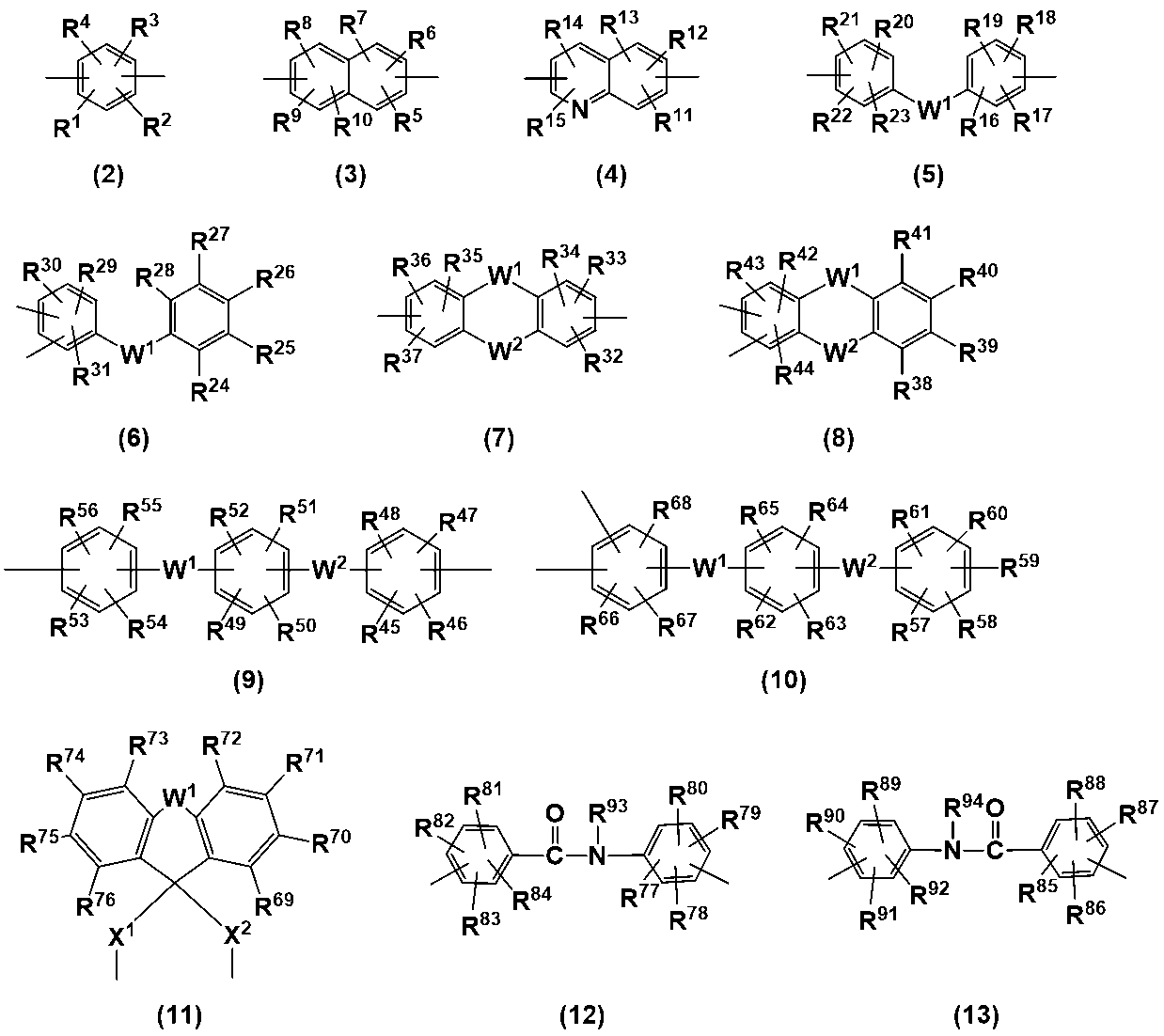
[式中、R1~R92は、それぞれ独立に水素原子、ハロゲン原子、カルボキシル基、スルホン基、炭素数1~10のアルキル基または炭素数1~10のアルコキシ基を表し、R93およびR94は、水素原子または炭素数1~10のアルキル基を表し、W1およびW2は、それぞれ独立に単結合、-C(R95)(R96)-(R95およびR96は、それぞれ独立に水素原子または炭素数1~10のアルキル基を表し、R95およびR96がともにアルキル基である場合、これらは互いに結合してこれらが結合する炭素原子とともに環を形成してもよい。)、-C(O)-、-O-、-S-、-S(O)-、-S(O)2-または-N(R97)-(R97は、水素原子または炭素数1~10のアルキル基を表す。)を表し、X1およびX2は、それぞれ独立に単結合、炭素数1~10のアルキレン基または式(14)で表される基を表す。

(式中、R98~R101は、それぞれ独立に水素原子、ハロゲン原子、カルボキシル基、スルホン基、炭素数1~10のアルキル基または炭素数1~10のアルコキシ基を表し、Y1およびY2は、それぞれ独立に単結合または炭素数1~10のアルキレン基を表す。)]}
2. 前記フッ素原子含有アリールアミノ基が、式(15)で示される1の透明導電膜用保護膜形成組成物、
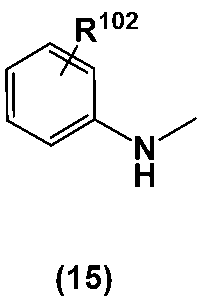
(式中、R102は、フッ素原子または炭素数1~10のフルオロアルキル基を表す。)
3. 前記フッ素原子含有アリールアミノ基が、式(16)で示される2の透明導電膜用保護膜形成組成物、

(式中、R102は、前記と同じ意味を表す。)
4. 前記R102が、炭素数1~10のパーフルオロアルキル基である2または3の透明導電膜用保護膜形成組成物、
5. 前記Arが、式(17)で示される1~4のいずれかの透明導電膜用保護膜形成組成物、
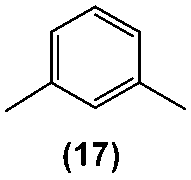
6. 前記紫外線吸収剤が、トリアジン系またはベンゾトリアゾール系紫外線吸収剤である1~5のいずれかの透明導電膜用保護膜形成組成物、
7. 前記架橋剤Aが、多官能(メタ)アクリル化合物を含む1~6のいずれかの透明導電膜用保護膜形成組成物、
8. 分子量1,000未満の架橋剤Bを含む1~7のいずれかの透明導電膜用保護膜形成組成物、
9. 前記架橋剤Bが、多官能(メタ)アクリル化合物を含む8の透明導電膜用保護膜形成組成物、
10. 溶媒を含む1~9のいずれかの透明導電膜用保護膜形成組成物、
11. 1~10のいずれかの透明導電膜用保護膜形成組成物から得られる透明導電膜用保護膜、
12. 導電性ナノ構造を有する透明導電膜用である11の透明導電膜用保護膜、
13. 前記導電性ナノ構造が、銀ナノワイヤである12の透明導電膜用保護膜、
14. 透明導電膜と、この透明導電膜上に形成された11の透明導電膜用保護膜とを備える透明電極、
15. 透明導電膜と、この透明導電膜上に形成された11の透明導電膜用保護膜とを備える電子デバイス、
16. 有機エレクトロルミネッセンスディスプレイである15の電子デバイス
を提供する。
1. 下記式(1)で表される繰り返し単位構造を含み、少なくとも1つのトリアジン環末端を有し、このトリアジン環末端の少なくとも一部がフッ素原子含有アリールアミノ基で封止されているトリアジン環含有ハイパーブランチポリマー、分子量1,000以上の架橋剤A、および紫外線吸収剤を含むことを特徴とする透明導電膜用保護膜形成組成物、
2. 前記フッ素原子含有アリールアミノ基が、式(15)で示される1の透明導電膜用保護膜形成組成物、
3. 前記フッ素原子含有アリールアミノ基が、式(16)で示される2の透明導電膜用保護膜形成組成物、
4. 前記R102が、炭素数1~10のパーフルオロアルキル基である2または3の透明導電膜用保護膜形成組成物、
5. 前記Arが、式(17)で示される1~4のいずれかの透明導電膜用保護膜形成組成物、
7. 前記架橋剤Aが、多官能(メタ)アクリル化合物を含む1~6のいずれかの透明導電膜用保護膜形成組成物、
8. 分子量1,000未満の架橋剤Bを含む1~7のいずれかの透明導電膜用保護膜形成組成物、
9. 前記架橋剤Bが、多官能(メタ)アクリル化合物を含む8の透明導電膜用保護膜形成組成物、
10. 溶媒を含む1~9のいずれかの透明導電膜用保護膜形成組成物、
11. 1~10のいずれかの透明導電膜用保護膜形成組成物から得られる透明導電膜用保護膜、
12. 導電性ナノ構造を有する透明導電膜用である11の透明導電膜用保護膜、
13. 前記導電性ナノ構造が、銀ナノワイヤである12の透明導電膜用保護膜、
14. 透明導電膜と、この透明導電膜上に形成された11の透明導電膜用保護膜とを備える透明電極、
15. 透明導電膜と、この透明導電膜上に形成された11の透明導電膜用保護膜とを備える電子デバイス、
16. 有機エレクトロルミネッセンスディスプレイである15の電子デバイス
を提供する。
本発明の透明導電膜用保護膜形成組成物を用いて形成される保護膜は、耐光性に優れるとともに、透明性および屈折率が高いため、ITOや銀ナノワイヤ等の透明導電膜の保護膜として使用することで、視認性を改善することができるとともに、その劣化を抑制することができる。
[トリアジン環含有ハイパーブランチポリマー]
本発明に係る透明導電膜用保護膜形成組成物は、下記式(1)で表される繰り返し単位を含むトリアジン環含有ハイパーブランチポリマーを含有する。
本発明に係る透明導電膜用保護膜形成組成物は、下記式(1)で表される繰り返し単位を含むトリアジン環含有ハイパーブランチポリマーを含有する。
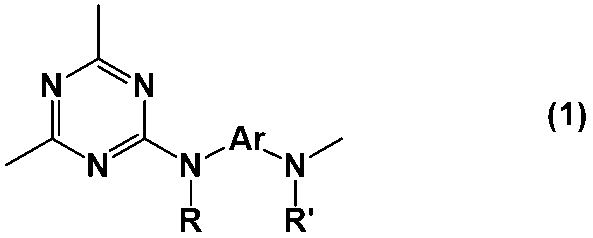
上記式中、RおよびR′は、それぞれ独立に、水素原子、アルキル基、アルコキシ基、アリール基、またはアラルキル基を表すが、屈折率をより高めるという観点から、ともに水素原子であることが好ましい。
本発明において、アルキル基の炭素数としては特に限定されるものではないが、1~20が好ましく、ポリマーの耐熱性をより高めることを考慮すると、炭素数1~10がより好ましく、1~3がより一層好ましい。また、その構造は、鎖状、分岐状、環状のいずれでもよい。
本発明において、アルキル基の炭素数としては特に限定されるものではないが、1~20が好ましく、ポリマーの耐熱性をより高めることを考慮すると、炭素数1~10がより好ましく、1~3がより一層好ましい。また、その構造は、鎖状、分岐状、環状のいずれでもよい。
アルキル基の具体例としては、メチル、エチル、n-プロピル、イソプロピル、シクロプロピル、n-ブチル、イソブチル、s-ブチル、t-ブチル、シクロブチル、1-メチル-シクロプロピル、2-メチル-シクロプロピル、n-ペンチル、1-メチル-n-ブチル、2-メチル-n-ブチル、3-メチル-n-ブチル、1,1-ジメチル-n-プロピル、1,2-ジメチル-n-プロピル、2,2-ジメチル-n-プロピル、1-エチル-n-プロピル、シクロペンチル、1-メチル-シクロブチル、2-メチル-シクロブチル、3-メチル-シクロブチル、1,2-ジメチル-シクロプロピル、2,3-ジメチル-シクロプロピル、1-エチル-シクロプロピル、2-エチル-シクロプロピル、n-ヘキシル、1-メチル-n-ペンチル、2-メチル-n-ペンチル、3-メチル-n-ペンチル、4-メチル-n-ペンチル、1,1-ジメチル-n-ブチル、1,2-ジメチル-n-ブチル、1,3-ジメチル-n-ブチル、2,2-ジメチル-n-ブチル、2,3-ジメチル-n-ブチル、3,3-ジメチル-n-ブチル、1-エチル-n-ブチル、2-エチル-n-ブチル、1,1,2-トリメチル-n-プロピル、1,2,2-トリメチル-n-プロピル、1-エチル-1-メチル-n-プロピル、1-エチル-2-メチル-n-プロピル、シクロヘキシル、1-メチル-シクロペンチル、2-メチル-シクロペンチル、3-メチル-シクロペンチル、1-エチル-シクロブチル、2-エチル-シクロブチル、3-エチル-シクロブチル、1,2-ジメチル-シクロブチル、1,3-ジメチル-シクロブチル、2,2-ジメチル-シクロブチル、2,3-ジメチル-シクロブチル、2,4-ジメチル-シクロブチル、3,3-ジメチル-シクロブチル、1-n-プロピル-シクロプロピル、2-n-プロピル-シクロプロピル、1-イソプロピル-シクロプロピル、2-イソプロピル-シクロプロピル、1,2,2-トリメチル-シクロプロピル、1,2,3-トリメチル-シクロプロピル、2,2,3-トリメチル-シクロプロピル、1-エチル-2-メチル-シクロプロピル、2-エチル-1-メチル-シクロプロピル、2-エチル-2-メチル-シクロプロピル、2-エチル-3-メチル-シクロプロピル基等が挙げられる。
上記アルコキシ基の炭素数は特に限定されるものではないが、1~20が好ましく、ポリマーの耐熱性をより高めることを考慮すると、炭素数1~10がより好ましく、1~3がより一層好ましい。また、そのアルキル部分の構造は、鎖状、分岐状、環状のいずれでもよい。
アルコキシ基の具体例としては、メトキシ、エトキシ、n-プロポキシ、イソプロポキシ、n-ブトキシ、イソブトキシ、s-ブトキシ、t-ブトキシ、n-ペントキシ、1-メチル-n-ブトキシ、2-メチル-n-ブトキシ、3-メチル-n-ブトキシ、1,1-ジメチル-n-プロポキシ、1,2-ジメチル-n-プロポキシ、2,2-ジメチル-n-プロポキシ、1-エチル-n-プロポキシ、n-ヘキシルオキシ、1-メチル-n-ペンチルオキシ、2-メチル-n-ペンチルオキシ、3-メチル-n-ペンチルオキシ、4-メチル-n-ペンチルオキシ、1,1-ジメチル-n-ブトキシ、1,2-ジメチル-n-ブトキシ、1,3-ジメチル-n-ブトキシ、2,2-ジメチル-n-ブトキシ、2,3-ジメチル-n-ブトキシ、3,3-ジメチル-n-ブトキシ、1-エチル-n-ブトキシ、2-エチル-n-ブトキシ、1,1,2-トリメチル-n-プロポキシ、1,2,2-トリメチル-n-プロポキシ、1-エチル-1-メチル-n-プロポキシ、1-エチル-2-メチル-n-プロポキシ基等が挙げられる。
上記アリール基の炭素数は特に限定されるものではないが、6~40が好ましく、ポリマーの耐熱性をより高めることを考慮すると、炭素数6~16がより好ましく、6~13がより一層好ましい。
アリール基の具体例としては、フェニル、o-クロルフェニル、m-クロルフェニル、p-クロルフェニル、o-フルオロフェニル、p-フルオロフェニル、o-メトキシフェニル、p-メトキシフェニル、p-ニトロフェニル、p-シアノフェニル、α-ナフチル、β-ナフチル、o-ビフェニリル、m-ビフェニリル、p-ビフェニリル、1-アントリル、2-アントリル、9-アントリル、1-フェナントリル、2-フェナントリル、3-フェナントリル、4-フェナントリル、9-フェナントリル基等が挙げられる。
アリール基の具体例としては、フェニル、o-クロルフェニル、m-クロルフェニル、p-クロルフェニル、o-フルオロフェニル、p-フルオロフェニル、o-メトキシフェニル、p-メトキシフェニル、p-ニトロフェニル、p-シアノフェニル、α-ナフチル、β-ナフチル、o-ビフェニリル、m-ビフェニリル、p-ビフェニリル、1-アントリル、2-アントリル、9-アントリル、1-フェナントリル、2-フェナントリル、3-フェナントリル、4-フェナントリル、9-フェナントリル基等が挙げられる。
アラルキル基の炭素数は特に限定されるものではないが、炭素数7~20が好ましく、そのアルキル部分は、直鎖、分岐、環状のいずれでもよい。
その具体例としては、ベンジル、p-メチルフェニルメチル、m-メチルフェニルメチル、o-エチルフェニルメチル、m-エチルフェニルメチル、p-エチルフェニルメチル、2-プロピルフェニルメチル、4-イソプロピルフェニルメチル、4-イソブチルフェニルメチル、α-ナフチルメチル基等が挙げられる。
その具体例としては、ベンジル、p-メチルフェニルメチル、m-メチルフェニルメチル、o-エチルフェニルメチル、m-エチルフェニルメチル、p-エチルフェニルメチル、2-プロピルフェニルメチル、4-イソプロピルフェニルメチル、4-イソブチルフェニルメチル、α-ナフチルメチル基等が挙げられる。
上記Arは、式(2)~(13)で示される群から選ばれる少なくとも1種を表す。

上記R1~R92は、それぞれ独立に、水素原子、ハロゲン原子、カルボキシル基、スルホ基、炭素数1~10の分岐構造を有していてもよいアルキル基、または炭素数1~10の分岐構造を有していてもよいアルコキシ基を表し、R93およびR94は、水素原子または炭素数1~10の分岐構造を有していてもよいアルキル基を表し、W1およびW2は、それぞれ独立に、単結合、CR95R96(R95およびR96は、それぞれ独立に、水素原子または炭素数1~10の分岐構造を有していてもよいアルキル基(ただし、これらは一緒になって環を形成していてもよい。)を表す。)、C=O、O、S、SO、SO2、またはNR97(R97は、水素原子または炭素数1~10の分岐構造を有していてもよいアルキル基を表す。)を表す。
ハロゲン原子としては、フッ素原子、塩素原子、臭素原子、ヨウ素原子が挙げられる。
なお、アルキル基、アルコキシ基としては上記と同様のものが挙げられる。
また、X1およびX2は、それぞれ独立に、単結合、炭素数1~10の分岐構造を有していてもよいアルキレン基、または式(14)で示される基を表す。
ハロゲン原子としては、フッ素原子、塩素原子、臭素原子、ヨウ素原子が挙げられる。
なお、アルキル基、アルコキシ基としては上記と同様のものが挙げられる。
また、X1およびX2は、それぞれ独立に、単結合、炭素数1~10の分岐構造を有していてもよいアルキレン基、または式(14)で示される基を表す。

上記R98~R101は、それぞれ独立に、水素原子、ハロゲン原子、カルボキシル基、スルホ基、炭素数1~10の分岐構造を有していてもよいアルキル基、または炭素数1~10の分岐構造を有していてもよいアルコキシ基を表し、Y1およびY2は、それぞれ独立に、単結合または炭素数1~10の分岐構造を有していてもよいアルキレン基を表す。これらハロゲン原子、アルキル基、アルコキシ基としては上記と同様のものが挙げられる。
炭素数1~10の分岐構造を有していてもよいアルキレン基としては、メチレン、エチレン、プロピレン、トリメチレン、テトラメチレン、ペンタメチレン基等が挙げられる。
炭素数1~10の分岐構造を有していてもよいアルキレン基としては、メチレン、エチレン、プロピレン、トリメチレン、テトラメチレン、ペンタメチレン基等が挙げられる。
これらの中でも、R1~R92およびR98~R101としては、水素原子、ハロゲン原子、スルホ基、炭素数1~5の分岐構造を有していてもよいアルキル基、または炭素数1~5の分岐構造を有していてもよいアルコキシ基が好ましく、水素原子がより好ましい。
特に、Arとしては、式(2)、(5)~(13)で示される少なくとも1種が好ましく、式(2)、(5)、(7)、(8)、(11)~(13)で示される少なくとも1種がより好ましい。上記式(2)~(13)で表されるアリール基の具体例としては、下記式で示されるものが挙げられるが、これらに限定されるものではない。

これらの中でも、より高い屈折率のポリマーが得られることから、下記式で示されるアリール基がより好ましい。

特に、低極性溶剤等の有機溶媒に対するポリマーの溶解性をより高めることを考慮すると、Arとしては、式(17)で示されるm-フェニレン基が好ましい。

また、本発明で用いるトリアジン環含有ハイパーブランチポリマーは、少なくとも1つのトリアジン環末端を有し、このトリアジン環末端の少なくとも一部がフッ素原子含有アリールアミノ基で封止されている。
アリール基としては、上記と同様のものが挙げられるが、特に、フェニル基が好ましい。
フッ素原子含有基としては、フッ素原子、フルオロアルキル基等のフッ素原子含有炭化水素基などが挙げられるが、フッ素原子、炭素数1~10のフルオロアルキル基が好ましい。
炭素数1~10のフルオロアルキル基としては、直鎖、分岐、環状のいずれでもよく、例えば、トリフルオロメチル基、ペンタフルオロエチル基、2,2,2-トリフルオロエチル基、ヘプタフルオロプロピル基、2,2,3,3,3-ペンタフルオロプロピル基、2,2,3,3-テトラフルオロプロピル基、2,2,2-トリフルオロ-1-(トリフルオロメチル)エチル基、ノナフルオロブチル基、4,4,4-トリフルオロブチル基、ウンデカフルオロペンチル基、2,2,3,3,4,4,5,5,5-ノナフルオロペンチル基、2,2,3,3,4,4,5,5-オクタフルオロペンチル基、トリデカフルオロヘキシル基、2,2,3,3,4,4,5,5,6,6,6-ウンデカフルオロヘキシル基、2,2,3,3,4,4,5,5,6,6-デカフルオロヘキシル基、3,3,4,4,5,5,6,6,6-ノナフルオロヘキシル基等が挙げられる。
アリール基としては、上記と同様のものが挙げられるが、特に、フェニル基が好ましい。
フッ素原子含有基としては、フッ素原子、フルオロアルキル基等のフッ素原子含有炭化水素基などが挙げられるが、フッ素原子、炭素数1~10のフルオロアルキル基が好ましい。
炭素数1~10のフルオロアルキル基としては、直鎖、分岐、環状のいずれでもよく、例えば、トリフルオロメチル基、ペンタフルオロエチル基、2,2,2-トリフルオロエチル基、ヘプタフルオロプロピル基、2,2,3,3,3-ペンタフルオロプロピル基、2,2,3,3-テトラフルオロプロピル基、2,2,2-トリフルオロ-1-(トリフルオロメチル)エチル基、ノナフルオロブチル基、4,4,4-トリフルオロブチル基、ウンデカフルオロペンチル基、2,2,3,3,4,4,5,5,5-ノナフルオロペンチル基、2,2,3,3,4,4,5,5-オクタフルオロペンチル基、トリデカフルオロヘキシル基、2,2,3,3,4,4,5,5,6,6,6-ウンデカフルオロヘキシル基、2,2,3,3,4,4,5,5,6,6-デカフルオロヘキシル基、3,3,4,4,5,5,6,6,6-ノナフルオロヘキシル基等が挙げられる。
特に、屈折率を維持しつつトリアジン環含有ハイパーブランチポリマーの低極性溶媒等に対する溶解性を高めることを考慮すると、炭素数1~10のパーフルオロアルキル基が好ましく、特に、炭素数1~5のパーフルオロアルキル基がより好ましく、トリフルオロメチル基が最適である。
フッ素原子含有基の数は特に限定されるものではなく、アリール基上に置換可能な任意の数とすることができるが、屈折率維持と溶媒に対する溶解性とのバランスを考慮すると、1~4個が好ましく、1~2個がより好ましく、1個がより一層好ましい。
好適なフッ素原子含有アリールアミノ基としては、式(15)で示されるものが挙げられ、特に、アミノ基に対してパラ位にフッ素原子含有基を有する式(16)で示されるものが好ましい。

具体的なフッ素原子含有アリールアミノ基としては、下記式で示されるものが挙げられるが、これらに限定されるものではない。

なお、フッ素原子含有アリールアミノ基は、後述の製造法において、対応するフッ素原子含有アリールアミノ化合物を用いて導入することができる。
フッ素原子含有アリールアミノ化合物の具体例としては、4-フルオロアニリン、4-トリフルオロメチルアニリン、4-ペンタフルオロエチルアニリン等が挙げられる。
フッ素原子含有アリールアミノ化合物の具体例としては、4-フルオロアニリン、4-トリフルオロメチルアニリン、4-ペンタフルオロエチルアニリン等が挙げられる。
本発明において、特に好適なトリアジン環含有ハイパーブランチポリマーとしては、式(18)~(21)で示されるものが挙げられる。

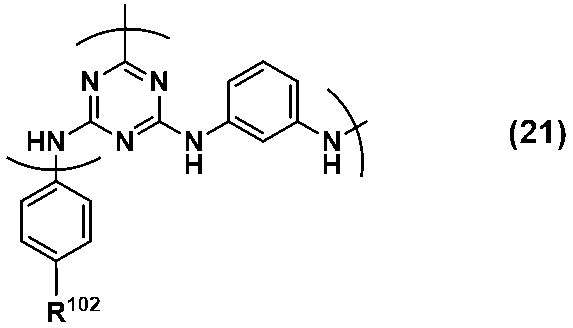
トリアジン環含有ハイパーブランチポリマーの重量平均分子量は、特に限定されるものではないが、500~500,000が好ましく、500~100,000がより好ましく、より耐熱性を向上させるとともに、収縮率を低くするという点から、2,000以上が好ましく、より溶解性を高め、得られた溶液の粘度を低下させるという点から、50,000以下が好ましく、30,000以下がより好ましく、10,000以下がより一層好ましい。
なお、本発明における重量平均分子量は、ゲルパーミエーションクロマトグラフィー(以下、GPCという)分析による標準ポリスチレン換算で得られる平均分子量である。
なお、本発明における重量平均分子量は、ゲルパーミエーションクロマトグラフィー(以下、GPCという)分析による標準ポリスチレン換算で得られる平均分子量である。
本発明のトリアジン環含有ハイパーブランチポリマーは、上述した特許文献1に開示された手法に準じて製造することができる。
例えば、下記スキーム1に示されるように、トリアジン環含有ハイパーブランチポリマー(20)は、トリアジン化合物(22)およびアリールジアミノ化合物(23)を適当な有機溶媒中で反応させた後、末端封止剤であるフッ素原子含有アニリン化合物(24)と反応させて得ることができる。
例えば、下記スキーム1に示されるように、トリアジン環含有ハイパーブランチポリマー(20)は、トリアジン化合物(22)およびアリールジアミノ化合物(23)を適当な有機溶媒中で反応させた後、末端封止剤であるフッ素原子含有アニリン化合物(24)と反応させて得ることができる。
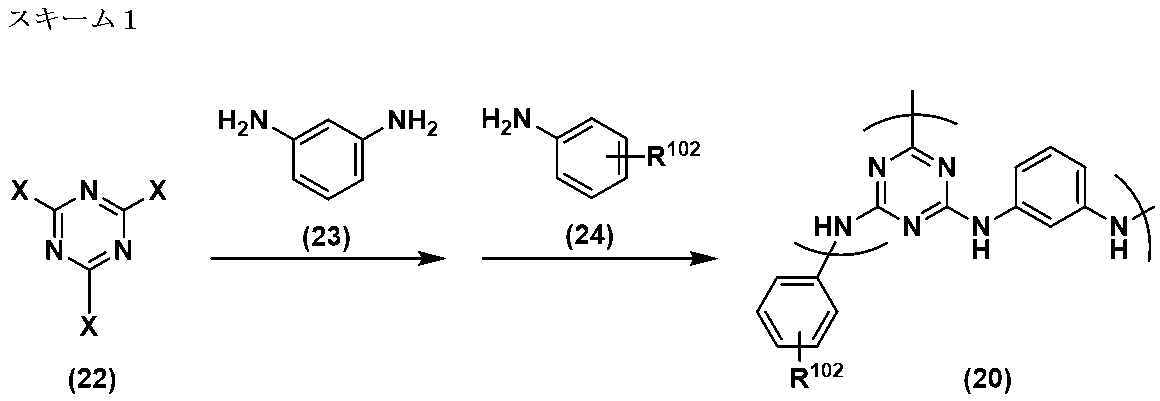
上記反応において、アリールジアミノ化合物(23)の仕込み比は、目的とするポリマーが得られる限り任意であるが、トリアジン化合物(22)1当量に対し、アリールジアミノ化合物(23)0.01~10当量が好ましく、1~5当量がより好ましい。
アリールジアミノ化合物(23)は、ニートで加えても、有機溶媒に溶かした溶液で加えてもよいが、操作の容易さや反応のコントロールのし易さなどを考慮すると、後者の手法が好適である。
反応温度は、用いる溶媒の融点から溶媒の沸点までの範囲で適宜設定すればよいが、特に、-30~150℃程度が好ましく、-10~100℃がより好ましい。
アリールジアミノ化合物(23)は、ニートで加えても、有機溶媒に溶かした溶液で加えてもよいが、操作の容易さや反応のコントロールのし易さなどを考慮すると、後者の手法が好適である。
反応温度は、用いる溶媒の融点から溶媒の沸点までの範囲で適宜設定すればよいが、特に、-30~150℃程度が好ましく、-10~100℃がより好ましい。
有機溶媒としては、この種の反応において通常用いられる種々の溶媒を用いることができ、例えば、テトラヒドロフラン、ジオキサン、ジメチルスルホキシド;N,N-ジメチルホルムアミド、N-メチル-2-ピロリドン、テトラメチル尿素、ヘキサメチルホスホルアミド、N,N-ジメチルアセトアミド、N-メチル-2-ピペリドン、N,N-ジメチルエチレン尿素、N,N,N’,N’-テトラメチルマロン酸アミド、N-メチルカプロラクタム、N-アセチルピロリジン、N,N-ジエチルアセトアミド、N-エチル-2-ピロリドン、N,N-ジメチルプロピオン酸アミド、N,N-ジメチルイソブチルアミド、N-メチルホルムアミド、N,N’-ジメチルプロピレン尿素等のアミド系溶媒、およびそれらの混合溶媒が挙げられる。
中でもN,N-ジメチルホルムアミド、ジメチルスルホキシド、N-メチル-2-ピロリドン、N,N-ジメチルアセトアミド、およびそれらの混合系が好ましく、特に、N,N-ジメチルアセトアミド、N-メチル-2-ピロリドンが好適である。
中でもN,N-ジメチルホルムアミド、ジメチルスルホキシド、N-メチル-2-ピロリドン、N,N-ジメチルアセトアミド、およびそれらの混合系が好ましく、特に、N,N-ジメチルアセトアミド、N-メチル-2-ピロリドンが好適である。
また、上記スキーム1の1段階目の反応では、重合時または重合後に通常用いられる種々の塩基を添加してもよい。
この塩基の具体例としては、炭酸カリウム、水酸化カリウム、炭酸ナトリウム、水酸化ナトリウム、炭酸水素ナトリウム、ナトリウムエトキシド、酢酸ナトリウム、炭酸リチウム、水酸化リチウム、酸化リチウム、酢酸カリウム、酸化マグネシウム、酸化カルシウム、水酸化バリウム、リン酸三リチウム、リン酸三ナトリウム、リン酸三カリウム、フッ化セシウム、酸化アルミニウム、アンモニア、n-プロピルアミン、トリメチルアミン、トリエチルアミン、ジイソプロピルアミン、ジイソプロピルエチルアミン、N-メチルピペリジン、2,2,6,6-テトラメチル-N-メチルピペリジン、ピリジン、4-ジメチルアミノピリジン、N-メチルモルホリン等が挙げられる。
塩基の添加量は、トリアジン化合物(22)1当量に対して1~100当量が好ましく、1~10当量がより好ましい。なお、これらの塩基は水溶液にして用いてもよい。
得られる重合体には、原料成分が残存していないことが好ましいが、本発明の効果を損なわなければ一部の原料が残存していてもよい。
反応終了後、生成物は再沈法等によって容易に精製できる。
この塩基の具体例としては、炭酸カリウム、水酸化カリウム、炭酸ナトリウム、水酸化ナトリウム、炭酸水素ナトリウム、ナトリウムエトキシド、酢酸ナトリウム、炭酸リチウム、水酸化リチウム、酸化リチウム、酢酸カリウム、酸化マグネシウム、酸化カルシウム、水酸化バリウム、リン酸三リチウム、リン酸三ナトリウム、リン酸三カリウム、フッ化セシウム、酸化アルミニウム、アンモニア、n-プロピルアミン、トリメチルアミン、トリエチルアミン、ジイソプロピルアミン、ジイソプロピルエチルアミン、N-メチルピペリジン、2,2,6,6-テトラメチル-N-メチルピペリジン、ピリジン、4-ジメチルアミノピリジン、N-メチルモルホリン等が挙げられる。
塩基の添加量は、トリアジン化合物(22)1当量に対して1~100当量が好ましく、1~10当量がより好ましい。なお、これらの塩基は水溶液にして用いてもよい。
得られる重合体には、原料成分が残存していないことが好ましいが、本発明の効果を損なわなければ一部の原料が残存していてもよい。
反応終了後、生成物は再沈法等によって容易に精製できる。
フッ素原子含有アニリン化合物(24)を用いた末端封止方法としては、公知の方法を採用すればよい。
この場合、末端封止剤の使用量は、重合反応に使われなかった余剰のトリアジン化合物由来のハロゲン原子1当量に対し、0.05~10当量程度が好ましく、0.1~5当量がより好ましく、0.5~2当量がより一層好ましい。
反応溶媒や反応温度としては、上記スキーム1の1段階目の反応で述べたのと同様の条件が挙げられ、また、末端封止剤は、アリールジアミノ化合物(23)と同時に仕込んでもよい。
なお、フッ素原子を有しないアリールアミノ化合物を用い、2種類以上の基で末端封止を行ってもよい。この置換基を有しないアリールアミノ化合物のアリール基としては上記と同様のものが挙げられる。
この場合、末端封止剤の使用量は、重合反応に使われなかった余剰のトリアジン化合物由来のハロゲン原子1当量に対し、0.05~10当量程度が好ましく、0.1~5当量がより好ましく、0.5~2当量がより一層好ましい。
反応溶媒や反応温度としては、上記スキーム1の1段階目の反応で述べたのと同様の条件が挙げられ、また、末端封止剤は、アリールジアミノ化合物(23)と同時に仕込んでもよい。
なお、フッ素原子を有しないアリールアミノ化合物を用い、2種類以上の基で末端封止を行ってもよい。この置換基を有しないアリールアミノ化合物のアリール基としては上記と同様のものが挙げられる。
[架橋剤]
本発明の組成物は、分子量1,000以上、好ましくは分子量1,200以上、より好ましくは分子量1,500以上の架橋剤Aを含有する。これによって、保護膜の膜密度を高め、高温高湿耐性を向上させることができる。
また、本発明の組成物は、上記架橋剤Aとともに、分子量1,000未満の架橋剤Bを含有することが好ましい。架橋剤Bを加えることによって、保護膜の膜密度をより高め、高温高湿耐性をさらに向上させることができる。架橋剤Bの分子量は、900以下が好ましく、800以下がより好ましい。
本発明の組成物は、分子量1,000以上、好ましくは分子量1,200以上、より好ましくは分子量1,500以上の架橋剤Aを含有する。これによって、保護膜の膜密度を高め、高温高湿耐性を向上させることができる。
また、本発明の組成物は、上記架橋剤Aとともに、分子量1,000未満の架橋剤Bを含有することが好ましい。架橋剤Bを加えることによって、保護膜の膜密度をより高め、高温高湿耐性をさらに向上させることができる。架橋剤Bの分子量は、900以下が好ましく、800以下がより好ましい。
架橋剤AおよびBとしては、架橋形成基としてメチロール基、メトキシメチル基等の架橋形成基を有するメラミン系化合物、置換尿素系化合物、エポキシ基またはオキセタン基等の架橋形成基を含有する化合物、ブロック化イソシアナートを含有する化合物、酸無水物を有する化合物、(メタ)アクリロイル基を有する化合物、アミノプラスト化合物、フェノプラスト化合物等が挙げられる。これらのうち、耐熱性や保存安定性の観点からエポキシ基、ブロックイソシアネート基、(メタ)アクリル基を含有する化合物が好ましく、特に、ブロックイソシアネート基を有する化合物や、開始剤を用いなくとも光硬化可能な組成物を与える多官能エポキシ化合物および/または多官能(メタ)アクリル化合物が好ましい。
なお、これらの多官能化合物は少なくとも2個の架橋形成基を有する必要があるが、3個以上の架橋形成基を有することが好ましい。
なお、これらの多官能化合物は少なくとも2個の架橋形成基を有する必要があるが、3個以上の架橋形成基を有することが好ましい。
多官能エポキシ化合物は、エポキシ基を1分子中2個以上有するものであれば特に限定されない。その具体例としては、トリス(2,3-エポキシプロピル)イソシアヌレート、1,4-ブタンジオールジグリシジルエーテル、1,2-エポキシ-4-(エポキシエチル)シクロヘキサン、グリセロールトリグリシジルエーテル、ジエチレングリコールジグリシジルエーテル、2,6-ジグリシジルフェニルグリシジルエーテル、1,1,3-トリス[p-(2,3-エポキシプロポキシ)フェニル]プロパン、1,2-シクロヘキサンジカルボン酸ジグリシジルエステル、4,4'-メチレンビス(N,N-ジグリシジルアニリン)、3,4-エポキシシクロヘキシルメチル-3,4-エポキシシクロヘキサンカルボキシレート、トリメチロールエタントリグリシジルエーテル、ビスフェノール-A-ジグリシジルエーテル、ペンタエリスリトールポリグリシジルエーテル等が挙げられる。
また、市販品として、少なくとも2個のエポキシ基を有するエポキシ樹脂であるYH-434、YH434L(東都化成(株)製)、シクロヘキセンオキサイド構造を有するエポキシ樹脂であるエポリードGT-401、同GT-403、同GT-301、同GT-302、セロキサイド2021、同3000(ダイセル化学工業(株)製)、ビスフェノールA型エポキシ樹脂であるエピコート(現、jER)1001、同1002、同1003、同1004、同1007、同1009、同1010、同828(以上、ジャパンエポキシレジン(株)製)、ビスフェノールF型エポキシ樹脂であるエピコート(現、jER)807(ジャパンエポキシレジン(株)製)、フェノールノボラック型エポキシ樹脂であるエピコート(現、jER)152、同154(以上、ジャパンエポキシレジン(株)製)、EPPN201、同202(以上、日本化薬(株)製)、クレゾールノボラック型エポキシ樹脂であるEOCN-102、同103S、同104S、同1020、同1025、同1027(以上、日本化薬(株)製)、エピコート(現、jER)180S75(ジャパンエポキシレジン(株)製)、脂環式エポキシ樹脂であるデナコールEX-252(ナガセケムテックス(株)製)、CY175、CY177、CY179(以上、CIBA-GEIGY A.G製)、アラルダイトCY-182、同CY-192、同CY-184(以上、CIBA-GEIGY A.G製)、エピクロン200、同400(以上、DIC(株)製)、エピコート(現、jER)871、同872(以上、ジャパンエポキシレジン(株)製)、ED-5661、ED-5662(以上、セラニーズコーティング(株)製)、脂肪族ポリグリシジルエーテルであるデナコールEX-611、同EX-612、同EX-614、同EX-622、同EX-411、同EX-512、同EX-522、同EX-421、同EX-313、同EX-314、同EX-321(ナガセケムテックス(株)製)等を用いることもできる。
多官能(メタ)アクリル化合物は、(メタ)アクリル基を1分子中2個以上有するものであれば特に限定されない。その具体例としては、エチレングリコールジ(メタ)アクリレート、ポリエチレングリコールジ(メタ)アクリレート、エトキシ化ビスフェノールAジ(メタ)アクリレート、エトキシ化トリメチロールプロパントリ(メタ)アクリレート、エトキシ化グリセリントリ(メタ)アクリレート、エトキシ化ペンタエリスリトールテトラ(メタ)アクリレート、エトキシ化ジペンタエリスリトールヘキサ(メタ)アクリレート、エトキシ化イソシアヌル酸トリ(メタ)アクリレート、トリス(2-(メタ)アクリロイルオキシエチル)イソシアヌレート、ε-カプロラクトン変性トリス-(2-(メタ)アクリロキシエチル)イソシアヌレート、ポリグリセリンモノエチレンオキサイドポリ(メタ)アクリレート、ポリグリセリンポリエチレングリコールポリ(メタ)アクリレート、ジペンタエリスリトールヘキサ(メタ)アクリレート、ネオペンチルグリコールジ(メタ)アクリレート、ペンタエリスリトールトリ(メタ)アクリレート、トリメチロールプロパントリ(メタ)アクリレート、トリシクロデカンジメタノールジ(メタ)アクリレート、1,6-ヘキサンジオールジ(メタ)アクリレート等が挙げられる。
また、多官能(メタ)アクリル化合物は市販品として入手が可能であり、その具体例としては、NKエステルA-200、同A-400、同A-600、同A-1000、同A-9300、同A-9300-1CL、同A-TMPT、同A-TMM-3、同A-TMM-3L、同A-TMP、同A-TMMT、同A-DPH、同UA-53H、同1G、同2G、同3G、同4G、同9G、同14G、同23G、同ABE-300、同A-BPE-4、同A-BPE-6、同A-BPE-10、同A-BPE-20、同A-BPE-30、同BPE-80N、同BPE-100N、同BPE-200、同BPE-500、同BPE-900、同BPE-1300N、同A-GLY-3E、同A-GLY-9E、同A-GLY-20E、同A-TMPT-3EO、同A-TMPT-9EO、同ATM-4E、同ATM-35E、同AT-20E(以上、新中村化学工業(株)製)、KAYARAD(登録商標)DPEA-12、同PEG400DA、同THE-330、同RP-1040(以上、日本化薬(株)製)、アロニックスM-210、同M-303、同M-305、同M-306、同M-309、同M-306、同M-310、同M-313、同M-315、同M-321、同M-350、同M-360、同M-400、同M-402、同M-403、同M-404、同M-405、同M-406、同M-408、同M-450、同M-452、同M-460(以上、東亞合成(株)製)、KAYARAD(登録商標)DPHA、同NPGDA、同PET30(以上、日本化薬(株)製)、NKエステル A-DPH、同A-TMPT、同A-DCP、同A-HD-N、同TMPT、同DCP、同NPG、同HD-N(以上、新中村化学工業(株)製)、NKオリゴ U-15HA(新中村化学工業(株)製)、NKポリマー バナレジンGH-1203(新中村化学工業(株)製)、EBECRYL11、同40、同135、同140、同145、同150、同180、同1142、OTA480、IRR214-K、PEG400DA-D(以上、ダイセル・オルネクス(株)製)等が挙げられる。
また、多官能(メタ)アクリル化合物として、多官能ウレタンアクリレートであるEBECRYL204、同205、同210、同215、同220、同230、同244、同245、同270、同284、同285、同264、同265、同294/25HD、同1259、同1290、同4820、同4858、同5120、同8210、同8254、同8301R、同8405、同8465、同8296、同8307、同8402、同8311、同8411、同8701、同8800、同8804、同8807、同9260、同9270、同9277EA、KRM7735、同8200、同8452、同8528、同8667、同8904(以上、ダイセル・オルネクス(株)製)、UV-1700B,UV-6300B、UV-7510B、UV-7550V、UV-7550B、UV-7600B、UV-7605B、UV-7610B、UV-7620EA、UV-7630B、UV-7640B、UV-7650B、(以上、日本合成化学工業(株)製);多官能ポリエステルアクリレートであるEBECRYL436、同438、同446、同450、同524、同525、同800、同810、同811、同812、同1830、同846、同851、同852、同853、同1870、同884、同885(以上、ダイセル・オルネクス(株)製);エポキシアクリレートであるEBECRYL600、同605、同645、同648、同860、同1606、同3500、同3603、同3608、同3700、同3701、同3702、同3703、同3708、同6040(以上、ダイセル・オルネクス(株)製)等を使用することもできる。
酸無水物化合物は、2分子のカルボン酸を脱水縮合させたカルボン酸無水物であれば特に限定されない。その具体例としては、無水フタル酸、テトラヒドロ無水フタル酸、ヘキサヒドロ無水フタル酸、メチルテトラヒドロ無水フタル酸、メチルヘキサヒドロ無水フタル酸、無水ナジック酸、無水メチルナジック酸、無水マレイン酸、無水コハク酸、オクチル無水コハク酸、ドデセニル無水コハク酸等の分子内に1個の酸無水物基を有するもの;1,2,3,4-シクロブタンテトラカルボン酸二無水物、ピロメリット酸無水物、3,4-ジカルボキシ-1,2,3,4-テトラヒドロ-1-ナフタレンコハク酸二無水物、ビシクロ[3.3.0]オクタン-2,4,6,8-テトラカルボン酸二無水物、5-(2,5-ジオキソテトラヒドロ-3-フラニル)-3-メチル-3-シクロヘキセン-1,2-ジカルボン酸無水物、1,2,3,4-ブタンテトラカルボン酸二無水物、3,3',4,4'-ベンゾフェノンテトラカルボン酸二無水物、3,3',4,4'-ビフェニルテトラカルボン酸二無水物、2,2-ビス(3,4-ジカルボキシフェニル)ヘキサフルオロプロパン二無水物、1,3-ジメチル-1,2,3,4-シクロブタンテトラカルボン酸二無水物等の分子内に2個の酸無水物基を有するものなどが挙げられる。
ブロック化イソシアネートを含有する化合物は、イソシアネート基(-NCO)が適当な保護基によりブロックされたブロック化イソシアネート基を1分子中2個以上有し、熱硬化の際の高温に曝されると、保護基(ブロック部分)が熱解離して外れ、生じたイソシアネート基が樹脂との間で架橋反応を起こすものであれば特に限定されず、例えば、下記式で示される基を1分子中2個以上(なお、これらの基は同一のものでも、また各々異なっているものでもよい。)有する化合物が挙げられる。

このような化合物は、例えば、1分子中2個以上のイソシアネート基を有する化合物に対して適当なブロック剤を反応させて得ることができる。
1分子中2個以上のイソシアネート基を有する化合物としては、例えば、イソホロンジイソシアネート、1,6-ヘキサメチレンジイソシアネート、メチレンビス(4-シクロヘキシルイソシアネート)、トリメチルヘキサメチレンジイソシアネート等のポリイソシアネート、これらの二量体および三量体、並びにこれらとジオール類、トリオール類、ジアミン類またはトリアミン類との反応物等が挙げられる。
ブロック剤としては、例えば、メタノール、エタノール、イソプロパノール、n-ブタノール、2-エトキシヘキサノール、2-N,N-ジメチルアミノエタノール、2-エトキシエタノール、シクロヘキサノール等のアルコール類;フェノール、o-ニトロフェノール、p-クロロフェノール、o-、m-またはp-クレゾール等のフェノール類;ε-カプロラクタム等のラクタム類;アセトンオキシム、メチルエチルケトンオキシム、メチルイソブチルケトンオキシム、シクロヘキサノンオキシム、アセトフェノンオキシム、ベンゾフェノンオキシム等のオキシム類;ピラゾール、3,5-ジメチルピラゾール、3-メチルピラゾール等のピラゾール類;ドデカンチオール、ベンゼンチオール等のチオール類等が挙げられる。
ブロック化イソシアネートを含有する化合物は市販品としても入手が可能であり、その具体例としては、B-830、B-815N、B-842N、B-870N、B-874N、B-882N、B-7005、B-7030、B-7075、B-5010(以上、三井化学ポリウレタン(株)製)、デュラネート(登録商標)17B-60PX、同TPA-B80E、同MF-B60X、同MF-K60X、同E402-B80T(以上、旭化成ケミカルズ(株)製)、カレンズMOI-BM(登録商標)(以上、昭和電工(株)製)等が挙げられる。
アミノプラスト化合物は、メトキシメチレン基を1分子中2個以上有するものであれば特に限定されない。例えば、ヘキサメトキシメチルメラミン CYMEL(登録商標)303、テトラブトキシメチルグリコールウリル 同1170、テトラメトキシメチルベンゾグアナミン 同1123(以上、日本サイテックインダストリーズ(株)製)等のサイメルシリーズ、メチル化メラミン樹脂であるニカラック(登録商標)MW-30HM、同MW-390、同MW-100LM、同MX-750LM、メチル化尿素樹脂である同MX-270、同MX-280、同MX-290(以上、(株)三和ケミカル製)等のニカラックシリーズ等のメラミン系化合物が挙げられる。
オキセタン化合物は、オキセタニル基を1分子中2個以上有するものであれば特に限定されず、例えば、オキセタン基を含有するOXT-221、OX-SQ-H、OX-SC(以上、東亜合成(株)製)等が挙げられる。
フェノプラスト化合物は、ヒドロキシメチレン基を1分子中2個以上有し、そして熱硬化の際の高温に曝されると、本発明で用いるハイパーブランチポリマーとの間で脱水縮合反応により架橋反応が進行するものである。フェノプラスト化合物としては、例えば、2,6-ジヒドロキシメチル-4-メチルフェノール、2,4-ジヒドロキシメチル-6-メチルフェノール、ビス(2-ヒドロキシ-3-ヒドロキシメチル-5-メチルフェニル)メタン、ビス(4-ヒドロキシ-3-ヒドロキシメチル-5-メチルフェニル)メタン、2,2-ビス(4-ヒドロキシ-3,5-ジヒドロキシメチルフェニル)プロパン、ビス(3-ホルミル-4-ヒドロキシフェニル)メタン、ビス(4-ヒドロキシ-2,5-ジメチルフェニル)ホルミルメタン、α,α-ビス(4-ヒドロキシ-2,5-ジメチルフェニル)-4-ホルミルトルエン等が挙げられる。
フェノプラスト化合物は市販品としても入手が可能であり、その具体例としては、26DMPC、46DMOC、DM-BIPC-F、DM-BIOC-F、TM-BIP-A、BISA-F、BI25X-DF、BI25X-TPA(以上、旭有機材工業(株)製)等が挙げられる。
架橋剤Aは、架橋形成基間の鎖長が長いことにより分子量が1,000以上となっているものが好ましく、具体的にはポリエーテル構造、ポリエステル構造、ポリウレタン構造等を有していることにより架橋形成基間の鎖長が長くなっているものが好ましい。上述した架橋剤のうち、架橋剤Aとしては、NKエステルA-GLY-20E、同ATM-35E、同AT-20E、同23G、同A-BPE-20同BPE-900、同BPE-1300N(以上、新中村化学工業(株)製)、EBECRYL204、同205、同210、同215、同230、同244、同245、同270、同284、同285、同264、同265、同294/25HD、同1259、同1290、同4820、同8254、同8301R、同8405、同8465、同8296、同8307、同8411、同8701、同8800、同8804、同9260、同9277EA、KRM8200、同8452、同8528、同8667、同8904、同436、同438、同446、同450、同525、同1830、同846、同1870、同884、同885、同860、同3708(以上、ダイセル・オルネクス(株)製)、UV-1700B,UV-6300B、UV-7510B、UV-7550V、UV-7550B、UV-7600B、UV-7605B、UV-7610B、UV-7620EA、UV-7630B、UV-7640B、UV-7650B、(以上、日本合成化学(株)製)等が挙げられる。これらのうち、NKエステルA-GLY-20E、同ATM-35E等が好ましい。
また、上述した架橋剤のうち、分子量1,000未満の架橋剤Bとしては、アロニックスM-303,同M-305、同M-305、同M-306、同M-400、同M-402、同M-403、同M-404、同M-405、同M-406、同M-450、同M-452(以上、東亞合成(株)製)、NKエステルA-9300、同A-9300-1CL、同A-TMM-3、同A-TMM-3L、同A-TMPT、同A-TMP、同A-TMMT、同A-DPH、同1G、同2G、同3G、同4G、同9G、同14G、同ABE-300、同A-BPE-4、同A-BPE-6、同A-BPE-10、同A-BPE-20、同A-BPE-30、同BPE-80N、同BPE-100N、同BPE-200、同BPE-500(以上、新中村化学工業(株)製)、EBECRYL 11、同40、同135、同140、同145、同150、同180、同800、同853、同860、同1142、同4858、同5129、同8210、同600、同605、同645、同648、同1606、同3500、同3603、同3608、同3700、同3701、同3702、同3703、同6040OTA 480(以上、ダイセル・オルネクス(株)製)、KAYARAD DN-0075(日本化薬(株)製)等が挙げられる。これらのうち、アロニックスM-303、同M-305、同M-305、同M-306、同M-400、同M-402、同M-403、同M-404、同M-405、同M-406、同M-450、同M-452(以上、東亞合成(株)製)、NKエステルA-9300、同A-9300-1CL(以上、新中村化学工業(株)製)、KAYARAD DN-0075(日本化薬(株)製)等が好ましい。
架橋剤AおよびBとしては、架橋剤配合による屈折率低下を抑制し得るとともに、硬化反応が速やかに進行するという点から、多官能(メタ)アクリル化合物が好適である。
架橋剤AおよびBは、それぞれ単独で用いても、2種以上組み合わせて用いてもよい。
架橋剤Aの使用量は、トリアジン環含有ハイパーブランチポリマー100質量部に対して0.1~30質量部が好ましいが、溶剤耐性を考慮すると、その下限は、好ましくは1質量部、より好ましくは5質量部であり、屈折率をコントロールすることを考慮すると、その上限は好ましくは25質量部、より好ましくは20質量部である。
架橋剤Bの使用量は、透明導電膜の光学特性をより高めるとともに、屈折率の著しい低下を防止するという観点から、架橋剤A100質量部に対して100~3000質量部が好ましく、1000~2000質量部がより好ましい。
架橋剤Aの使用量は、トリアジン環含有ハイパーブランチポリマー100質量部に対して0.1~30質量部が好ましいが、溶剤耐性を考慮すると、その下限は、好ましくは1質量部、より好ましくは5質量部であり、屈折率をコントロールすることを考慮すると、その上限は好ましくは25質量部、より好ましくは20質量部である。
架橋剤Bの使用量は、透明導電膜の光学特性をより高めるとともに、屈折率の著しい低下を防止するという観点から、架橋剤A100質量部に対して100~3000質量部が好ましく、1000~2000質量部がより好ましい。
[紫外線吸収剤]
本発明の組成物は、上述したトリアジン環含有ハイパーブランチポリマーおよび架橋剤に加え、紫外線吸収剤を含む。これにより、紫外線などの影響による硬化膜中のトリアジン環含有ハイパーブランチポリマーの劣化を抑制し、耐光性を向上させることができる。
紫外線吸収剤としては、例えば、ベンゾトリアゾール系化合物、ベンゾフェノン系化合物、トリアジン系化合物、環状イミノエステル系化合物、シアノアクリレート系化合物、マロン酸エステル化合物、サリチル酸フェニルエステル系化合物等の有機化合物や、酸化チタン微粒子、酸化亜鉛微粒子、酸化錫微粒子等の紫外線を吸収する無機微粒子などが挙げられる。
これらの中でも、得られる硬化膜の耐候性を向上させるとともに、硬化膜の着色をも防止するという点から、ベンゾトリアゾール系化合物、トリアジン系化合物が好ましく、ヒドロキシフェニルベンゾトリアゾール系化合物がより好ましい。
本発明の組成物は、上述したトリアジン環含有ハイパーブランチポリマーおよび架橋剤に加え、紫外線吸収剤を含む。これにより、紫外線などの影響による硬化膜中のトリアジン環含有ハイパーブランチポリマーの劣化を抑制し、耐光性を向上させることができる。
紫外線吸収剤としては、例えば、ベンゾトリアゾール系化合物、ベンゾフェノン系化合物、トリアジン系化合物、環状イミノエステル系化合物、シアノアクリレート系化合物、マロン酸エステル化合物、サリチル酸フェニルエステル系化合物等の有機化合物や、酸化チタン微粒子、酸化亜鉛微粒子、酸化錫微粒子等の紫外線を吸収する無機微粒子などが挙げられる。
これらの中でも、得られる硬化膜の耐候性を向上させるとともに、硬化膜の着色をも防止するという点から、ベンゾトリアゾール系化合物、トリアジン系化合物が好ましく、ヒドロキシフェニルベンゾトリアゾール系化合物がより好ましい。
紫外線吸収剤の具体例としては、2-(5-メチル-2-ヒドロキシフェニル)ベンゾトリアゾール、2-[2-ヒドロキシ-3,5-ビス(α,α-ジメチルベンジル)フェニル]-2H-ベンゾトリアゾール、2-(3,5-ジ-t-ブチル-2-ヒドロキシフェニル)ベンゾトリアゾール等のトリアゾール類;2-ヒドロキシ-4-メトキシベンゾフェノン、2-ヒドロキシ-4-オクトキシベンゾフェノン、2,2’-ジヒドロキシ-4-メトキシベンゾフェノン等のベンゾフェノン類;[2-(4,6-ジフェニル-1,3,5-トリアジン-2,2-イル)-5-[(ヘキシル)オキシ]-フェノール、2-[4-[(2-ヒドロキシ-3-ドデシルオキシプロピル)オキシ]-2-ヒドロキシフェニル]-4,6-ビス(2,4-ジメチルフェニル)-1,3,5-トリアジン、2-[4-[(2-ヒドロキシ-3-トリデシルオキシプロピル)オキシ]-2-ヒドロキシフェニル]-4,6-ビス(2,4-ジメチルフェニル)-1,3,5-トリアジン、2-[4-[(2-ヒドロキシ-3-(2’-エチル)ヘキシル)オキシ]-2-ヒドロキシフェニル]-4,6-ビス(2,4-ジメチルフェニル)-1,3,5-トリアジン、2-(2-ヒドロキシ-4-[1-オクチルオキシカルボニルエトキシ]フェニル)-4,6-ビス(4-フェニルフェニル)-1,3,5-トリアジン等のヒドロキシフェニルトリアジン類;(2-エトキシ-2’-エチルオキサリック酸ビスアニリド等のシュウ酸アニリド類;フェニルサリシレート、p-t-ブチルフェニルサリシレート、p-オクチルフェニルサリシレート等のサリチル酸類;2,2’-p-フェニレンビス(3,1-ベンゾオキサジン-4-オン)等の環状イミノエステル類;1,3-ビス[(2-シアノ-3,3-ジフェニルアクリロイル)オキシ]-2,2-ビス[[(2-シアノ-3,3-ジフェニルアクリロイル)オキシ]メチル]プロパン等のシアノアクリレート類;テトラエチル-2,2’-(1,4-フェニレンジメチリジン)ビスマロネート等のマロン酸エステル類などが挙げられる。
紫外線吸収剤は市販品を用いてもよく、その具体例としては、TINUVIN(登録商標)PS、同99-2、同99-DW、同109、同328、同329、同384-2、同400、同400-DW、同405、同460、同477、同477-DW、同479、同900、同928、同1130、同111FDL(以上、BASFジャパン(株)製)、アデカスタブLA-29、同LA-31、同LA-31RG、同LA-31G、同LA-32、同LA-36RG、同LA-46、同1413、同LA-F70(以上、(株)ADEKA製)、ニューコートUVA-101、同UVA-102、同UVA-103、同UVA-104、バナレジンUVA-5080、同UVA-5080(OHV20)、同UVA-55T、同UVA-5MHB、同UVA-7075、同UVA-7075(OHV20)、同UVA-73T(以上、新中村化学工業(株)製)、RUVA-93(大塚化学(株)製)等が挙げられる。
上記紫外線吸収剤は単独で用いても、2種以上組み合わせて用いてもよい。
紫外線吸収剤の使用量は、トリアジン環含有ハイパーブランチポリマー100質量部に対して、0.1~100質量部が好ましいが、得られる硬化膜の耐光性をより高めることを考慮すると、その下限は、好ましくは1質量部、より好ましくは5質量部であり、さらには、硬化膜の屈折率低下防止や着色防止という点から、その上限は好ましくは30質量部、より好ましくは20質量部である。
紫外線吸収剤の使用量は、トリアジン環含有ハイパーブランチポリマー100質量部に対して、0.1~100質量部が好ましいが、得られる硬化膜の耐光性をより高めることを考慮すると、その下限は、好ましくは1質量部、より好ましくは5質量部であり、さらには、硬化膜の屈折率低下防止や着色防止という点から、その上限は好ましくは30質量部、より好ましくは20質量部である。
[溶媒]
本発明の組成物には、各種の溶媒を添加し、トリアジン環含有ハイパーブランチポリマーを溶解させて使用することが好ましい。この場合、溶媒は重合時に用いた溶媒と同じものでも別のものでもよい。この溶媒は、ポリマーとの相溶性を損なわなければ特に限定されない。
本発明の組成物には、各種の溶媒を添加し、トリアジン環含有ハイパーブランチポリマーを溶解させて使用することが好ましい。この場合、溶媒は重合時に用いた溶媒と同じものでも別のものでもよい。この溶媒は、ポリマーとの相溶性を損なわなければ特に限定されない。
使用可能な溶媒の具体例としては、トルエン、p-キシレン、o-キシレン、m-キシレン、エチルベンゼン、スチレン、エチレングリコールジメチルエーテル、プロピレングリコールモノメチルエーテル、エチレングリコールモノメチルエーテル、プロピレングリコール、プロピレングリコールモノエチルエーテル、エチレングリコールモノエチルエーテル、エチレングリコールモノイソプロピルエーテル、エチレングリコールメチルエーテルアセテート、プロピレングリコールモノメチルエーテルアセテート、エチレングリコールエチルエーテルアセテート、ジエチレングリコールジメチルエーテル、プロピレングリコールモノブチルエーテル、エチレングリコ-ルモノブチルエーテル、ジエチレングリコールジエチルエーテル、ジプロピレングリコールモノメチルエーテル、ジエチレングリコールモノメチルエーテル、ジプロピレングリコールモノエチルエーテル、ジエチレングリコールモノエチルエーテル、トリエチレングリコールジメチルエーテル、ジエチレングリコールモノエチルエーテルアセテート、ジエチレングリコール、1-オクタノール、エチレングリコール、ヘキシレングリコール、トリメチレングリコール、1-メトキシ-2-ブタノール、シクロヘキサノール、ジアセトンアルコール、フルフリルアルコール、テトラヒドロフルフリルアルコール、プロピレングリコール、ベンジルアルコール、1,3-ブタンジオール、1,4-ブタンジオール、2,3-ブタンジオール、γ-ブチロラクトン、アセトン、メチルエチルケトン、メチルイソプロピルケトン、ジエチルケトン、メチルイソブチルケトン、メチルn-ブチルケトン、シクロヘキサノン、酢酸エチル、酢酸イソプロピル、酢酸n-プロピル、酢酸イソブチル、酢酸n-ブチル、乳酸エチル、メタノール、エタノール、イソプロパノール、tert-ブタノール、アリルアルコール、n-プロパノール、2-メチル-2-ブタノール、イソブタノール、n-ブタノール、2-メチル-1-ブタノール、1-ペンタノール、2-メチル-1-ペンタノール、2-エチルヘキサノール、1-メトキシ-2-プロパノール、テトラヒドロフラン、1,4-ジオキサン、N,N-ジメチルホルムアミド、N,N-ジメチルアセトアミド、N-メチルピロリドン、1,3-ジメチル-2-イミダゾリジノン、ジメチルスルホキシド、N-シクロヘキシル-2-ピロリジノン等が挙げられる。これらは1種単独で用いても、2種以上混合して用いてもよい。
この際、組成物中の固形分濃度は、保存安定性に影響を与えない範囲であれば特に限定されず、目的とする膜の厚みに応じて適宜設定すればよい。具体的には、溶解性および保存安定性の観点から、固形分濃度0.1~50質量%が好ましく、より好ましくは0.2~40質量%である。
[開始剤]
本発明の組成物には、それぞれの架橋剤に応じた開始剤を配合することもできる。なお、上述のとおり、架橋剤として多官能エポキシ化合物および/または多官能(メタ)アクリル化合物を用いる場合、開始剤を使用せずとも光硬化が進行して硬化膜を与えるものであるが、その場合に開始剤を使用しても差し支えない。
本発明の組成物には、それぞれの架橋剤に応じた開始剤を配合することもできる。なお、上述のとおり、架橋剤として多官能エポキシ化合物および/または多官能(メタ)アクリル化合物を用いる場合、開始剤を使用せずとも光硬化が進行して硬化膜を与えるものであるが、その場合に開始剤を使用しても差し支えない。
多官能エポキシ化合物を架橋剤として用いる場合には、光酸発生剤や光塩基発生剤を用いることができる。
光酸発生剤は公知のものから適宜選択して用いればよく、例えば、ジアゾニウム塩、スルホニウム塩、ヨードニウム塩等のオニウム塩誘導体を用いることができる。その具体例としては、フェニルジアゾニウムヘキサフルオロホスフェート、4-メトキシフェニルジアゾニウムヘキサフルオロアンチモネート、4-メチルフェニルジアゾニウムヘキサフルオロホスフェート等のアリールジアゾニウム塩;ジフェニルヨードニウムヘキサフルオロアンチモネート、ジ(4-メチルフェニル)ヨードニウムヘキサフルオロホスフェート、ジ(4-tert-ブチルフェニル)ヨードニウムヘキサフルオロホスフェート等のジアリールヨードニウム塩;トリフェニルスルホニウムヘキサフルオロアンチモネート、トリス(4-メトキシフェニル)スルホニウムヘキサフルオロホスフェート、ジフェニル-4-チオフェノキシフェニルスルホニウムヘキサフルオロアンチモネート、ジフェニル-4-チオフェノキシフェニルスルホニウムヘキサフルオロホスフェート、4,4'-ビス(ジフェニルスルフォニオ)フェニルスルフィド-ビスヘキサフルオロアンチモネート、4,4'-ビス(ジフェニルスルフォニオ)フェニルスルフィド-ビスヘキサフルオロホスフェート、4,4'-ビス[ジ(β-ヒドロキシエトキシ)フェニルスルホニオ]フェニルスルフィド-ビスヘキサフルオロアンチモネート、4,4'-ビス[ジ(β-ヒドロキシエトキシ)フェニルスルホニオ]フェニルスルフィド-ビス-ヘキサフルオロホスフェート、4-[4'-(ベンゾイル)フェニルチオ]フェニル-ジ(4-フルオロフェニル)スルホニウムヘキサフルオロアンチモネート、4-[4'-(ベンゾイル)フェニルチオ]フェニル-ジ(4-フルオロフェニル)スルホニウムヘキサフルオロホスフェート等のトリアリールスルホニウム塩などが挙げられる。
光酸発生剤は公知のものから適宜選択して用いればよく、例えば、ジアゾニウム塩、スルホニウム塩、ヨードニウム塩等のオニウム塩誘導体を用いることができる。その具体例としては、フェニルジアゾニウムヘキサフルオロホスフェート、4-メトキシフェニルジアゾニウムヘキサフルオロアンチモネート、4-メチルフェニルジアゾニウムヘキサフルオロホスフェート等のアリールジアゾニウム塩;ジフェニルヨードニウムヘキサフルオロアンチモネート、ジ(4-メチルフェニル)ヨードニウムヘキサフルオロホスフェート、ジ(4-tert-ブチルフェニル)ヨードニウムヘキサフルオロホスフェート等のジアリールヨードニウム塩;トリフェニルスルホニウムヘキサフルオロアンチモネート、トリス(4-メトキシフェニル)スルホニウムヘキサフルオロホスフェート、ジフェニル-4-チオフェノキシフェニルスルホニウムヘキサフルオロアンチモネート、ジフェニル-4-チオフェノキシフェニルスルホニウムヘキサフルオロホスフェート、4,4'-ビス(ジフェニルスルフォニオ)フェニルスルフィド-ビスヘキサフルオロアンチモネート、4,4'-ビス(ジフェニルスルフォニオ)フェニルスルフィド-ビスヘキサフルオロホスフェート、4,4'-ビス[ジ(β-ヒドロキシエトキシ)フェニルスルホニオ]フェニルスルフィド-ビスヘキサフルオロアンチモネート、4,4'-ビス[ジ(β-ヒドロキシエトキシ)フェニルスルホニオ]フェニルスルフィド-ビス-ヘキサフルオロホスフェート、4-[4'-(ベンゾイル)フェニルチオ]フェニル-ジ(4-フルオロフェニル)スルホニウムヘキサフルオロアンチモネート、4-[4'-(ベンゾイル)フェニルチオ]フェニル-ジ(4-フルオロフェニル)スルホニウムヘキサフルオロホスフェート等のトリアリールスルホニウム塩などが挙げられる。
これらのオニウム塩は市販品を用いてもよく、その具体例としては、サンエイドSI-60、SI-80、SI-100、SI-60L、SI-80L、SI-100L、SI-L145、SI-L150、SI-L160、SI-L110、SI-L147(以上、三新化学工業(株)製)、UVI-6950、UVI-6970、UVI-6974、UVI-6990、UVI-6992(以上、ユニオンカーバイド社製)、CPI-100P、CPI-100A、CPI-200K、CPI-200S(以上、サンアプロ(株)製)、アデカオプトマーSP-150、SP-151、SP-170、SP-171(以上、旭電化工業(株)製)、イルガキュア261(BASF社製)、CI-2481、CI-2624、CI-2639、CI-2064(以上、日本曹達(株)製)、CD-1010、CD-1011、CD-1012(以上、サートマー社製)、DS-100、DS-101、DAM-101、DAM-102、DAM-105、DAM-201、DSM-301、NAI-100、NAI-101、NAI-105、NAI-106、SI-100、SI-101、SI-105、SI-106、PI-105、NDI-105、BENZOIN TOSYLATE、MBZ-101、MBZ-301、PYR-100、PYR-200、DNB-101、NB-101、NB-201、BBI-101、BBI-102、BBI-103、BBI-109(以上、みどり化学(株)製)、PCI-061T、PCI-062T、PCI-020T、PCI-022T(以上、日本化薬(株)製)、IBPF、IBCF(三和ケミカル(株)製)等が挙げられる。
光塩基発生剤も公知のものから適宜選択して用いればよく、例えば、Co-アミン錯体系、オキシムカルボン酸エステル系、カルバミン酸エステル系、四級アンモニウム塩系光塩基発生剤等を用いることができる。その具体例としては、2-ニトロベンジルシクロヘキシルカルバメート、トリフェニルメタノール、O-カルバモイルヒドロキシルアミド、O-カルバモイルオキシム、[[(2,6-ジニトロベンジル)オキシ]カルボニル]シクロヘキシルアミン、ビス[[(2-ニトロベンジル)オキシ]カルボニル]ヘキサン1,6-ジアミン、4-(メチルチオベンゾイル)-1-メチル-1-モルホリノエタン、(4-モルホリノベンゾイル)-1-ベンジル-1-ジメチルアミノプロパン、N-(2-ニトロベンジルオキシカルボニル)ピロリジン、ヘキサアンミンコバルト(III)トリス(トリフェニルメチルボレート)、2-ベンジル-2-ジメチルアミノ-1-(4-モルホリノフェニル)-ブタノン、2,6-ジメチル-3,5-ジアセチル-4-(2’-ニトロフェニル)-1,4-ジヒドロピリジン、2,6-ジメチル-3,5-ジアセチル-4-(2',4'-ジニトロフェニル)-1,4-ジヒドロピリジン等が挙げられる。
また、光塩基発生剤は市販品を用いてもよく、その具体例としては、TPS-OH、NBC-101、ANC-101(以上、みどり化学(株)製)等が挙げられる。
また、光塩基発生剤は市販品を用いてもよく、その具体例としては、TPS-OH、NBC-101、ANC-101(以上、みどり化学(株)製)等が挙げられる。
光酸発生剤または光塩基発生剤を用いる場合、多官能エポキシ化合物100質量部に対して、0.1~15質量部の範囲で使用することが好ましく、より好ましくは1~10質量部の範囲である。
なお、必要に応じてエポキシ樹脂硬化剤を、多官能エポキシ化合物100質量部に対して1~100質量部の量で配合してもよい。
なお、必要に応じてエポキシ樹脂硬化剤を、多官能エポキシ化合物100質量部に対して1~100質量部の量で配合してもよい。
一方、多官能(メタ)アクリル化合物を用いる場合には、光ラジカル重合開始剤を用いることができる。光ラジカル重合開始剤は、公知のものから適宜選択して用いればよく、例えば、アセトフェノン類、ベンゾフェノン類、ミヒラーのベンゾイルベンゾエート、アミロキシムエステル、テトラメチルチウラムモノサルファイドおよびチオキサントン類等が挙げられる。
特に、光開裂型の光ラジカル重合開始剤が好ましい。光開裂型の光ラジカル重合開始剤については、最新UV硬化技術(第159頁、発行人:高薄一弘、発行所:(株)技術情報協会、1991年発行)に記載されている。
市販の光ラジカル重合開始剤としては、例えば、BASF社製 商品名:イルガキュア127、184、369、379、651、500、819、907、784、2959、OXE01、OXE02、CGI1700、CGI1750、CGI1850、CG24-61、ダロキュア1116、1173、BASF社製 商品名:ルシリンTPO、UCB社製 商品名:ユベクリルP36、フラテツリ・ランベルティ社製 商品名:エザキュアーKIP150、KIP65LT、KIP100F、KT37、KT55、KTO46、KIP75/B等が挙げられる。
光ラジカル重合開始剤を用いる場合、多官能(メタ)アクリレート化合物100質量部に対して、0.1~15質量部の範囲で使用することが好ましく、より好ましくは0.1~10質量部の範囲である。
[架橋促進剤]
さらに、本発明の組成物には、トリアジン環含有ハイパーブランチポリマーと架橋剤との反応を促進させることなどを目的として、分子内に2個以上のメルカプト基を有する多官能チオール化合物を添加してもよい。
具体的には、下記式で示される多官能チオール化合物が好ましい。
さらに、本発明の組成物には、トリアジン環含有ハイパーブランチポリマーと架橋剤との反応を促進させることなどを目的として、分子内に2個以上のメルカプト基を有する多官能チオール化合物を添加してもよい。
具体的には、下記式で示される多官能チオール化合物が好ましい。
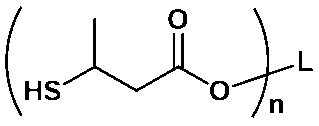
上記Lは、2~4価の有機基を表すが、2~4価の炭素数2~12の脂肪族基または2~4価のヘテロ環含有基が好ましく、2~4価の炭素数2~8の脂肪族基、または下記式で示されるイソシアヌル酸骨格(1,3,5-トリアジン-2,4,6(1H,3H,5H)-トリオン環)を有する3価の基がより好ましい。
上記nは、Lの価数に対応して2~4の整数を表す。
上記nは、Lの価数に対応して2~4の整数を表す。

具体的な化合物としては、1,4-ビス(3-メルカプトブチリルオキシ)ブタン、1,3,5-トリス(3-メルカプトブチリルオキシエチル)-1,3,5-トリアジン-2,4,6-(1H,3H,5H)-トリオン、ペンタエリスリトールテトラキス(3-メルカプトブチレート)、トリメチロールプロパントリス(3-メルカプトブチレート)、トリメチロールエタントリス(3-メルカプトブチレート)等が挙げられる。
これらの多官能チオール化合物は、市販品として入手することもでき、例えば、カレンズMT-BD1、カレンズMT NR1、カレンズMT PE1、TPMB、TEMB(以上、昭和電工(株)製)等が挙げられる。
これらの多官能チオール化合物は、1種単独で用いても、2種以上組み合わせて用いてもよい。
これらの多官能チオール化合物は、市販品として入手することもでき、例えば、カレンズMT-BD1、カレンズMT NR1、カレンズMT PE1、TPMB、TEMB(以上、昭和電工(株)製)等が挙げられる。
これらの多官能チオール化合物は、1種単独で用いても、2種以上組み合わせて用いてもよい。
多官能チオール化合物を用いる場合、その添加量としては、得られる保護膜に悪影響を及ぼさない限り特に限定されるものではないが、本発明では、固形分100質量%中に、0.01~10質量%が好ましく、0.1~6質量%がより好ましい。
[その他の成分]
本発明の膜形成用組成物は、本発明の効果を損なわない限りにおいて、その他の成分、例えば、レベリング剤、界面活性剤等を含んでもよい。
レベリング剤または界面活性剤としては、例えば、ポリオキシエチレンラウリルエーテル、ポリオキシエチレンステアリルエーテル、ポリオキシエチレンセチルエーテル、ポリオキシエチレンオレイルエーテル等のポリオキシエチレンアルキルエーテル類、ポリオキシエチレンオクチルフェノールエーテル、ポリオキシエチレンノニルフェノールエーテル等のポリオキシエチレンアルキルアリルエーテル類、ポリオキシエチレン・ポリオキシプロピレンブロックコポリマー類、ソルビタンモノラウレート、ソルビタンモノパルミテート、ソルビタンモノステアレート、ソルビタンモノオレエート、ソルビタントリオレエート、ソルビタントリステアレート等のソルビタン脂肪酸エステル類、ポリオキシエチレンソルビタンモノラウレート、ポリオキシエチレンソルビタンモノパルミテート、ポリオキシエチレンソルビタンモノステアレート、ポリオキシエチレンソルビタントリオレエート、ポリオキシエチレンソルビタントリステアレート等のポリオキシエチレンソルビタン脂肪酸エステル類等のノニオン系界面活性剤;商品名エフトップEF301、EF303、EF352(三菱マテリアル電子化成(株)製(旧(株)ジェムコ製))、商品名メガファックF171、F173、R-08、R-30、R-40、R-43、F-553、F-554、F-556、F-559、RS-75、RS-72-K(DIC(株)製)、フロラードFC430、FC431(住友スリーエム(株)製)、商品名アサヒガードAG710、サーフロンS-382、SC101、SC102、SC103、SC104、SC105、SC106(旭硝子(株)製)等のフッ素系界面活性剤;オルガノシロキサンポリマーKP341(信越化学工業(株)製)、BYK-302、BYK-307、BYK-322、BYK-323、BYK-330、BYK-333、BYK-370、BYK-375、BYK-378(ビックケミー・ジャパン(株)製)等が挙げられる。
本発明の膜形成用組成物は、本発明の効果を損なわない限りにおいて、その他の成分、例えば、レベリング剤、界面活性剤等を含んでもよい。
レベリング剤または界面活性剤としては、例えば、ポリオキシエチレンラウリルエーテル、ポリオキシエチレンステアリルエーテル、ポリオキシエチレンセチルエーテル、ポリオキシエチレンオレイルエーテル等のポリオキシエチレンアルキルエーテル類、ポリオキシエチレンオクチルフェノールエーテル、ポリオキシエチレンノニルフェノールエーテル等のポリオキシエチレンアルキルアリルエーテル類、ポリオキシエチレン・ポリオキシプロピレンブロックコポリマー類、ソルビタンモノラウレート、ソルビタンモノパルミテート、ソルビタンモノステアレート、ソルビタンモノオレエート、ソルビタントリオレエート、ソルビタントリステアレート等のソルビタン脂肪酸エステル類、ポリオキシエチレンソルビタンモノラウレート、ポリオキシエチレンソルビタンモノパルミテート、ポリオキシエチレンソルビタンモノステアレート、ポリオキシエチレンソルビタントリオレエート、ポリオキシエチレンソルビタントリステアレート等のポリオキシエチレンソルビタン脂肪酸エステル類等のノニオン系界面活性剤;商品名エフトップEF301、EF303、EF352(三菱マテリアル電子化成(株)製(旧(株)ジェムコ製))、商品名メガファックF171、F173、R-08、R-30、R-40、R-43、F-553、F-554、F-556、F-559、RS-75、RS-72-K(DIC(株)製)、フロラードFC430、FC431(住友スリーエム(株)製)、商品名アサヒガードAG710、サーフロンS-382、SC101、SC102、SC103、SC104、SC105、SC106(旭硝子(株)製)等のフッ素系界面活性剤;オルガノシロキサンポリマーKP341(信越化学工業(株)製)、BYK-302、BYK-307、BYK-322、BYK-323、BYK-330、BYK-333、BYK-370、BYK-375、BYK-378(ビックケミー・ジャパン(株)製)等が挙げられる。
これらは1種単独で、または2種以上組み合わせて使用してもよい。界面活性剤の使用量は、トリアジン環含有ハイパーブランチポリマー100質量部に対して0.001~5質量部が好ましく、0.01~5質量部がより好ましく、0.1~2質量部がより一層好ましい。
なお、上記その他の成分は、本発明の組成物を調製する際の任意の工程で添加することができる。
なお、上記その他の成分は、本発明の組成物を調製する際の任意の工程で添加することができる。
[透明導電膜用保護膜]
本発明の透明導電膜用保護膜は、上述した透明導電膜用保護膜形成組成物を透明導電膜に塗布し、必要に応じて加熱して溶媒を蒸発させた後、加熱または光照射することによって形成することができる。
この場合、保護膜の膜厚は、10~1,000nmが好ましく、50~200nmがより好ましい。
保護膜の屈折率の範囲は、下限値は、好ましくは1.45、より好ましくは1.50、より一層好ましくは1.55である。上限値は、特に限定されないが、1.95~2.00程度である。
本発明の透明導電膜用保護膜は、上述した透明導電膜用保護膜形成組成物を透明導電膜に塗布し、必要に応じて加熱して溶媒を蒸発させた後、加熱または光照射することによって形成することができる。
この場合、保護膜の膜厚は、10~1,000nmが好ましく、50~200nmがより好ましい。
保護膜の屈折率の範囲は、下限値は、好ましくは1.45、より好ましくは1.50、より一層好ましくは1.55である。上限値は、特に限定されないが、1.95~2.00程度である。
また、本発明の保護膜を形成した透明導電膜のヘイズ値は、1.5%以下が好ましく、1.0%以下がより好ましい。
組成物の塗布方法は任意であり、例えば、スピンコート法、ディップ法、フローコート法、インクジェット法、スプレー法、バーコート法、グラビアコート法、スリットコート法、ロールコート法、転写印刷法、刷毛塗り、ブレードコート法、エアーナイフコート法等の方法を採用できる。
透明導電膜としては、ITOフィルム、IZOフィルム、金属ナノ粒子,金属ナノワイヤ,金属ナノメッシュ等の導電性ナノ構造を有する透明導電膜が挙げられるが、金属ナノ粒子,金属ナノワイヤ,金属ナノメッシュ等の導電性ナノ構造を有する透明導電膜が好ましい。導電性ナノ構造を構成する金属は特に限定されないが、銀、金、銅、ニッケル、白金、コバルト、鉄、亜鉛、ルテニウム、ロジウム、パラジウム、カドミウム、オスミウム、イリジウム、これらの合金等が挙げられる。すなわち、銀ナノ粒子、銀ナノワイヤ、銀ナノメッシュ、金ナノ粒子、金ナノワイヤ、金ナノメッシュ、銅ナノ粒子、銅ナノワイヤ、銅ナノメッシュ等を有する透明導電膜が好ましく、特に銀ナノワイヤを有する透明導電膜が好ましい。
加熱温度は、溶媒を蒸発させる目的では特に限定されず、例えば40~400℃で行うことができる。加熱方法は特に限定されず、例えば、ホットプレートやオーブンを用いて、大気、窒素等の不活性ガス、真空中等の適切な雰囲気下で溶媒を蒸発させればよい。焼成温度および焼成時間は、目的とする電子デバイスのプロセス工程に適合した条件を選択すればよく、得られる膜の物性値が電子デバイスの要求特性に適合するような焼成条件を選択すればよい。
光照射する場合の条件も特に限定されず、用いるトリアジン環含有ハイパーブランチポリマーおよび架橋剤に応じて、適宜な照射エネルギーおよび時間を採用すればよい。例えば、50~1,000mJ/cm2で行うことができる。また、光照射は大気または窒素等の不活性ガス雰囲気下で行うのが好ましい。
本発明の保護膜は、特に、導電性ナノ構造を有する透明導電膜の保護膜として好適である。導電性ナノ構造を有する透明導電膜は、導電性ナノ構造によって光の乱反射が起こるため白濁化しやすく、視認性が劣ることがある。本発明の保護膜は透明性および屈折率が高いため、導電性ナノ構造を使用した透明導電膜の光の乱反射に起因する白濁化を防止して、視認性を改善することができる。さらに、耐光性や、高耐熱性、高温高湿耐性を有しているため、透明導電膜の劣化防止にも貢献することができる。
以下、合成例、製造例、実施例および比較例を挙げて、本発明をより具体的に説明するが、本発明は下記の実施例に限定されるものではない。なお、実施例で用いた各測定装置は以下のとおりである。
[1H-NMR]
装置:Varian NMR System 400NB(400MHz)
JEOL-ECA700(700MHz)
測定溶媒:DMSO-d6
基準物質:テトラメチルシラン(TMS)(δ0.0ppm)
[GPC]
装置:東ソー(株)製 HLC-8200 GPC
カラム:Shodex KF-804L+KF-805L
カラム温度:40℃
溶媒:テトラヒドロフラン(THF)
検出器:UV(254nm)
検量線:標準ポリスチレン
[エリプソメーター]
装置:ジェー・エー・ウーラム・ジャパン(株)製 多入射角分光エリプソメーターVASE
[キセノン耐光性試験機]
装置:Q-Lab Corporation製 Q-SUN Xe-1-B
[分光測色計]
装置:コニカミノルタジャパン(株)製 CM-3700A
装置:Varian NMR System 400NB(400MHz)
JEOL-ECA700(700MHz)
測定溶媒:DMSO-d6
基準物質:テトラメチルシラン(TMS)(δ0.0ppm)
[GPC]
装置:東ソー(株)製 HLC-8200 GPC
カラム:Shodex KF-804L+KF-805L
カラム温度:40℃
溶媒:テトラヒドロフラン(THF)
検出器:UV(254nm)
検量線:標準ポリスチレン
[エリプソメーター]
装置:ジェー・エー・ウーラム・ジャパン(株)製 多入射角分光エリプソメーターVASE
[キセノン耐光性試験機]
装置:Q-Lab Corporation製 Q-SUN Xe-1-B
[分光測色計]
装置:コニカミノルタジャパン(株)製 CM-3700A
下記例で使用した化合物は、以下のとおりである。
DPHA:ジペンタエリスリトールペンタおよびヘキサアクリレート(日本化薬(株)製 KAYARAD DN-0075)
ATM35E:エトキシ化ペンタエリスリトールテトラアクリレート(新中村化学工業(株)製 NKエステル ATM-35E)
I2959:1-[4-(2-ヒドロキシエトキシ)フェニル]-2-ヒドロキシ-2-メチル-1-プロパン-1-オン(BASFジャパン(株)製 Irgacure 2959)
NR1:1,3,5-トリス(3-メルカプトブチルオキシエチル)-1,3,5-トリアジン-2,4,6(1H,3H,5H)-トリオン(昭和電工(株)製 カレンズMT NR1)
F559:界面活性剤(DIC(株)製 メガファック F-559)
T900:紫外線吸収剤(BASFジャパン(株)製Tinuvin 900)
DPHA:ジペンタエリスリトールペンタおよびヘキサアクリレート(日本化薬(株)製 KAYARAD DN-0075)
ATM35E:エトキシ化ペンタエリスリトールテトラアクリレート(新中村化学工業(株)製 NKエステル ATM-35E)
I2959:1-[4-(2-ヒドロキシエトキシ)フェニル]-2-ヒドロキシ-2-メチル-1-プロパン-1-オン(BASFジャパン(株)製 Irgacure 2959)
NR1:1,3,5-トリス(3-メルカプトブチルオキシエチル)-1,3,5-トリアジン-2,4,6(1H,3H,5H)-トリオン(昭和電工(株)製 カレンズMT NR1)
F559:界面活性剤(DIC(株)製 メガファック F-559)
T900:紫外線吸収剤(BASFジャパン(株)製Tinuvin 900)
[1]トリアジン環含有ハイパーブランチポリマーの合成
[合成例1]高分子化合物[4]の合成

[合成例1]高分子化合物[4]の合成
200mL四口フラスコに、m-フェニレンジアミン[2](6.00g,0.055mol、AminoChem社製)、およびジメチルアセトアミド78.88g(DMAc,純正化学(株)製)を加え、窒素置換した後、m-フェニレンジアミン[2]をDMAcに溶解させた。その後、エタノール-ドライアイス浴により-10℃まで冷却し、2,4,6-トリクロロ-1,3,5-トリアジン[1](9.22g,0.05mol、エポニックデグザ社製)をバス温が0℃以上にならないよう確認しながら投入した。1時間撹拌後、反応溶液を、予めDMAc64.16gを加え、窒素置換後、オイルバスで85℃に設定した500mL四口フラスコに滴下した。1時間撹拌後、4-トリフルオロメチルアニリン[3](23.90g,0.15mol、Tianjin Jiahan Chemical社製)を滴下し、3時間撹拌した。その後、室温まで降温し、n-プロピルアミン(13.0g、東京化成工業(株)製)を滴下し、1時間撹拌後、撹拌を停止した。反応溶液をイオン交換水(910g)に滴下して再沈殿させた。沈殿物をろ過し、THF(73.75g)に再溶解させ、その溶液を、メタノール(300g)およびイオン交換水(200g)の混合溶液中に滴下し、再度、再沈殿させた。得られた沈殿物をろ過し、減圧乾燥機で120℃、6時間乾燥し、目的とする高分子化合物[4](以下、TDF111という)16.7gを得た。TDF111の1H-NMRスペクトルの測定結果を図1に示す。
TDF111のGPCによるポリスチレン換算で測定される重量平均分子量Mwは3,300、多分散度Mw/Mnは4.4であった。
TDF111のGPCによるポリスチレン換算で測定される重量平均分子量Mwは3,300、多分散度Mw/Mnは4.4であった。
[2]銀ナノワイヤ液の調製
[製造例1]
ClearOhm INK-N G4-01(Cambrios Technologies Corporation製)、ClearOhm Diluent-N 02(Cambrios Technologies Corporation製)、ClearOhm SFT-E 02(Cambrios Technologies Corporation製)を質量比37.6/37.6/24.8で配合し、1晩撹拌して銀ナノワイヤ液を調製した。
[製造例1]
ClearOhm INK-N G4-01(Cambrios Technologies Corporation製)、ClearOhm Diluent-N 02(Cambrios Technologies Corporation製)、ClearOhm SFT-E 02(Cambrios Technologies Corporation製)を質量比37.6/37.6/24.8で配合し、1晩撹拌して銀ナノワイヤ液を調製した。
[3]銀ナノワイヤ塗布フィルムの作製
[製造例2]
製造例1で得られた銀ナノワイヤ液を、100×100mmのPET基板(ルミラー T60(TORAY(株)製))上にスピンコーターを用いて200rpmで5秒、800rpmで60秒スピンコートし、ホットプレートを用いて120℃で5分間乾燥し、銀ナノワイヤ塗布フィルムを作製した。
[製造例2]
製造例1で得られた銀ナノワイヤ液を、100×100mmのPET基板(ルミラー T60(TORAY(株)製))上にスピンコーターを用いて200rpmで5秒、800rpmで60秒スピンコートし、ホットプレートを用いて120℃で5分間乾燥し、銀ナノワイヤ塗布フィルムを作製した。
[4]透明導電膜用保護膜形成組成物の調製
[実施例1-1および比較例1-1,1-2]
下記表1に示した配合で各成分を酢酸ノルマルプロピル(NPAC)/プロピレングリコールモノメチルエーテル(PGME)混合溶媒(質量比70/30)に溶解し、固形分(組成物中の溶媒成分以外の全成分)濃度5質量%の組成物を調製した。なお、表1中の各配合量は質量部を表す。
[実施例1-1および比較例1-1,1-2]
下記表1に示した配合で各成分を酢酸ノルマルプロピル(NPAC)/プロピレングリコールモノメチルエーテル(PGME)混合溶媒(質量比70/30)に溶解し、固形分(組成物中の溶媒成分以外の全成分)濃度5質量%の組成物を調製した。なお、表1中の各配合量は質量部を表す。

[5]透明導電膜用保護膜の作製
[実施例2-1および比較例2-1,2-2]
上記実施例1-1、比較例2-1および比較例2-2で得られた各組成物を、室温(およそ25℃)で30分間撹拌した後、製造例2で得られた銀ナノワイヤ塗布フィルム上にスピンコーターを用いて200rpmで5秒、1,500rpmで30秒スピンコートし、ホットプレートを用いて80℃で1分間乾燥した。その後、この塗膜を大気下、露光量400mJ/cm2のUV光を照射して光硬化させ、保護膜を作製した。
続いて3M Optically Clear Adhesive 8146-2(3M Company製)の接着シートを介して保護膜面とガラスとを貼り付けることで、耐光性試験用の基板を作製した。
[実施例2-1および比較例2-1,2-2]
上記実施例1-1、比較例2-1および比較例2-2で得られた各組成物を、室温(およそ25℃)で30分間撹拌した後、製造例2で得られた銀ナノワイヤ塗布フィルム上にスピンコーターを用いて200rpmで5秒、1,500rpmで30秒スピンコートし、ホットプレートを用いて80℃で1分間乾燥した。その後、この塗膜を大気下、露光量400mJ/cm2のUV光を照射して光硬化させ、保護膜を作製した。
続いて3M Optically Clear Adhesive 8146-2(3M Company製)の接着シートを介して保護膜面とガラスとを貼り付けることで、耐光性試験用の基板を作製した。
[耐光性試験の評価]
上記で得られた各保護膜について、キセノン耐光性試験を行った。ガラス面から光を入光させ、照度0.55W/m2、温度60℃の条件で光照射し、分光測色計の透過測定にて照射時間におけるb*を評価した。結果を表2に示す。
上記で得られた各保護膜について、キセノン耐光性試験を行った。ガラス面から光を入光させ、照度0.55W/m2、温度60℃の条件で光照射し、分光測色計の透過測定にて照射時間におけるb*を評価した。結果を表2に示す。
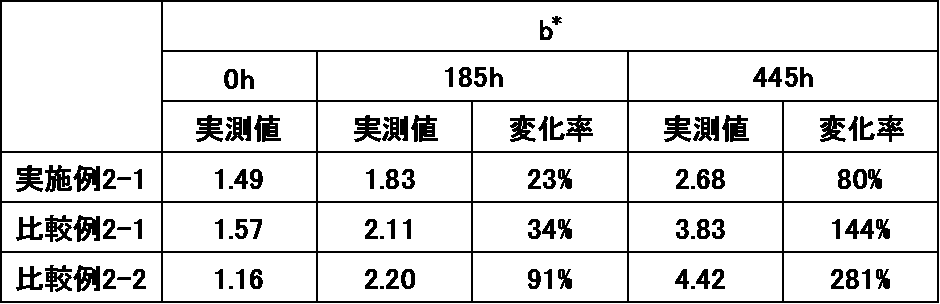
表2に示されるように、実施例2-1で作製した保護膜は、長時間光照射後のb*の上昇率が低く、耐光性に優れていることがわかる。
Claims (16)
- 下記式(1)で表される繰り返し単位構造を含み、少なくとも1つのトリアジン環末端を有し、このトリアジン環末端の少なくとも一部がフッ素原子含有アリールアミノ基で封止されているトリアジン環含有ハイパーブランチポリマー、分子量1,000以上の架橋剤A、および紫外線吸収剤を含むことを特徴とする透明導電膜用保護膜形成組成物。

Arは、式(2)~(13)で示される基からなる群から選ばれる少なくとも1種の基を表す。
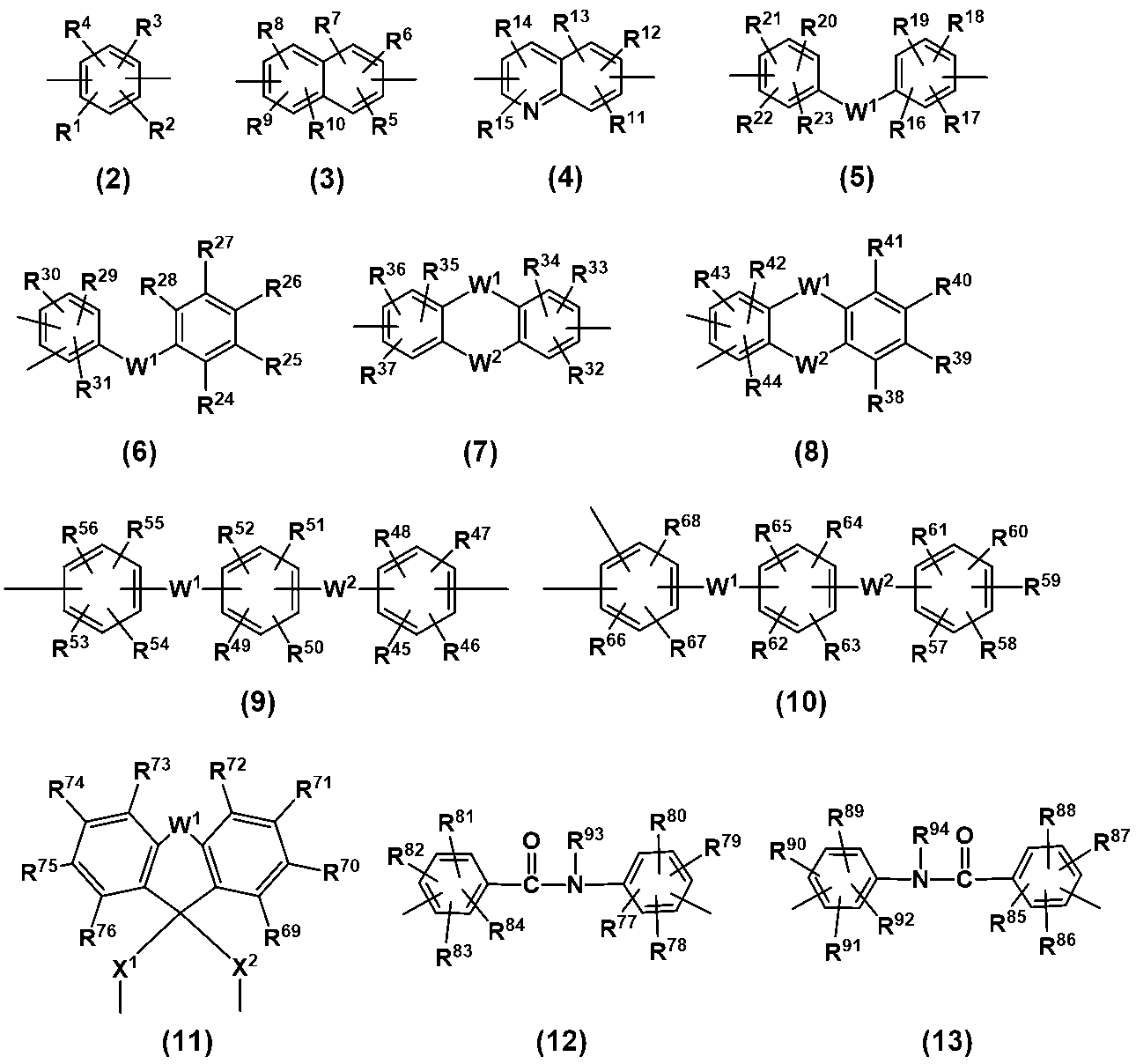
R93およびR94は、水素原子または炭素数1~10のアルキル基を表し、
W1およびW2は、それぞれ独立に単結合、-C(R95)(R96)-(R95およびR96は、それぞれ独立に水素原子または炭素数1~10のアルキル基を表し、R95およびR96がともにアルキル基である場合、これらは互いに結合してこれらが結合する炭素原子とともに環を形成してもよい。)、-C(O)-、-O-、-S-、-S(O)-、-S(O)2-または-N(R97)-(R97は、水素原子または炭素数1~10のアルキル基を表す。)を表し、
X1およびX2は、それぞれ独立に単結合、炭素数1~10のアルキレン基または式(14)で表される基を表す。
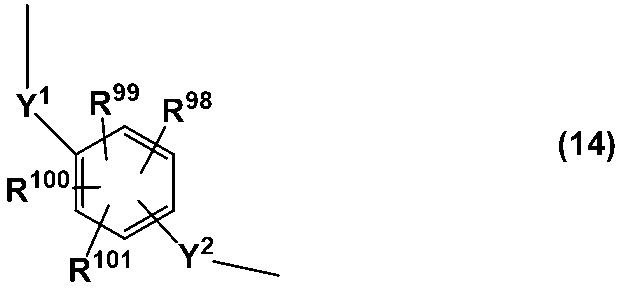
Y1およびY2は、それぞれ独立に単結合または炭素数1~10のアルキレン基を表す。)]} - 前記フッ素原子含有アリールアミノ基が、式(15)で示される請求項1記載の透明導電膜用保護膜形成組成物。

- 前記フッ素原子含有アリールアミノ基が、式(16)で示される請求項2記載の透明導電膜用保護膜形成組成物。
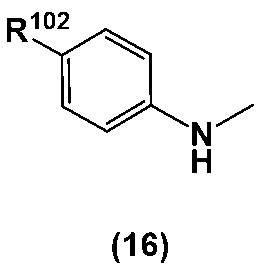
- 前記R102が、炭素数1~10のパーフルオロアルキル基である請求項2または3記載の透明導電膜用保護膜形成組成物。
- 前記Arが、式(17)で示される請求項1~4のいずれか1項記載の透明導電膜用保護膜形成組成物。

- 前記紫外線吸収剤が、トリアジン系またはベンゾトリアゾール系紫外線吸収剤である請求項1~5のいずれか1項記載の透明導電膜用保護膜形成組成物。
- 前記架橋剤Aが、多官能(メタ)アクリル化合物を含む請求項1~6のいずれか1項記載の透明導電膜用保護膜形成組成物。
- 分子量1,000未満の架橋剤Bを含む請求項1~7のいずれか1項記載の透明導電膜用保護膜形成組成物。
- 前記架橋剤Bが、多官能(メタ)アクリル化合物を含む請求項8記載の透明導電膜用保護膜形成組成物。
- 溶媒を含む請求項1~9のいずれか1項記載の透明導電膜用保護膜形成組成物。
- 請求項1~10のいずれか1項記載の透明導電膜用保護膜形成組成物から得られる透明導電膜用保護膜。
- 導電性ナノ構造を有する透明導電膜用である請求項11記載の透明導電膜用保護膜。
- 前記導電性ナノ構造が、銀ナノワイヤである請求項12記載の透明導電膜用保護膜。
- 透明導電膜と、この透明導電膜上に形成された請求項11記載の透明導電膜用保護膜とを備える透明電極。
- 透明導電膜と、この透明導電膜上に形成された請求項11記載の透明導電膜用保護膜とを備える電子デバイス。
- 有機エレクトロルミネッセンスディスプレイである請求項15記載の電子デバイス。
Priority Applications (1)
| Application Number | Priority Date | Filing Date | Title |
|---|---|---|---|
| JP2020532454A JP7764130B2 (ja) | 2018-07-26 | 2019-07-25 | 透明導電膜用保護膜形成組成物 |
Applications Claiming Priority (2)
| Application Number | Priority Date | Filing Date | Title |
|---|---|---|---|
| JP2018-139996 | 2018-07-26 | ||
| JP2018139996 | 2018-07-26 |
Publications (1)
| Publication Number | Publication Date |
|---|---|
| WO2020022410A1 true WO2020022410A1 (ja) | 2020-01-30 |
Family
ID=69180508
Family Applications (1)
| Application Number | Title | Priority Date | Filing Date |
|---|---|---|---|
| PCT/JP2019/029115 Ceased WO2020022410A1 (ja) | 2018-07-26 | 2019-07-25 | 透明導電膜用保護膜形成組成物 |
Country Status (3)
| Country | Link |
|---|---|
| JP (1) | JP7764130B2 (ja) |
| TW (1) | TW202020019A (ja) |
| WO (1) | WO2020022410A1 (ja) |
Cited By (1)
| Publication number | Priority date | Publication date | Assignee | Title |
|---|---|---|---|---|
| WO2022228449A1 (zh) * | 2021-04-29 | 2022-11-03 | 上海瑞暨新材料科技有限公司 | 一种聚酰亚胺树脂的制备方法及其薄膜 |
Citations (5)
| Publication number | Priority date | Publication date | Assignee | Title |
|---|---|---|---|---|
| JP2006352073A (ja) * | 2005-05-20 | 2006-12-28 | Fujifilm Holdings Corp | 導電性パターン材料、透光性導電性膜、透光性電磁波シールド膜、光学フィルター、透明導電性シート、エレクトロルミネッセンス素子、及び平面光源システム |
| JP2008155387A (ja) * | 2006-12-21 | 2008-07-10 | Nippon Synthetic Chem Ind Co Ltd:The | 積層体 |
| WO2016194926A1 (ja) * | 2015-06-03 | 2016-12-08 | 日産化学工業株式会社 | トリアジン環含有重合体およびそれを含む膜形成用組成物 |
| WO2017094643A1 (ja) * | 2015-11-30 | 2017-06-08 | 日産化学工業株式会社 | トリアジン環含有重合体およびそれを含む膜形成用組成物 |
| JP2017187775A (ja) * | 2016-04-05 | 2017-10-12 | 凸版印刷株式会社 | 調光シート |
Family Cites Families (1)
| Publication number | Priority date | Publication date | Assignee | Title |
|---|---|---|---|---|
| JP2017141444A (ja) | 2016-02-09 | 2017-08-17 | 大日本印刷株式会社 | 電離放射線硬化性樹脂組成物、これを用いた光学積層体、前面板、及び画像表示装置 |
-
2019
- 2019-07-25 JP JP2020532454A patent/JP7764130B2/ja active Active
- 2019-07-25 WO PCT/JP2019/029115 patent/WO2020022410A1/ja not_active Ceased
- 2019-07-26 TW TW108126459A patent/TW202020019A/zh unknown
Patent Citations (5)
| Publication number | Priority date | Publication date | Assignee | Title |
|---|---|---|---|---|
| JP2006352073A (ja) * | 2005-05-20 | 2006-12-28 | Fujifilm Holdings Corp | 導電性パターン材料、透光性導電性膜、透光性電磁波シールド膜、光学フィルター、透明導電性シート、エレクトロルミネッセンス素子、及び平面光源システム |
| JP2008155387A (ja) * | 2006-12-21 | 2008-07-10 | Nippon Synthetic Chem Ind Co Ltd:The | 積層体 |
| WO2016194926A1 (ja) * | 2015-06-03 | 2016-12-08 | 日産化学工業株式会社 | トリアジン環含有重合体およびそれを含む膜形成用組成物 |
| WO2017094643A1 (ja) * | 2015-11-30 | 2017-06-08 | 日産化学工業株式会社 | トリアジン環含有重合体およびそれを含む膜形成用組成物 |
| JP2017187775A (ja) * | 2016-04-05 | 2017-10-12 | 凸版印刷株式会社 | 調光シート |
Cited By (1)
| Publication number | Priority date | Publication date | Assignee | Title |
|---|---|---|---|---|
| WO2022228449A1 (zh) * | 2021-04-29 | 2022-11-03 | 上海瑞暨新材料科技有限公司 | 一种聚酰亚胺树脂的制备方法及其薄膜 |
Also Published As
| Publication number | Publication date |
|---|---|
| JP7764130B2 (ja) | 2025-11-05 |
| TW202020019A (zh) | 2020-06-01 |
| JPWO2020022410A1 (ja) | 2021-08-05 |
Similar Documents
| Publication | Publication Date | Title |
|---|---|---|
| JP6515811B2 (ja) | トリアジン系重合体含有組成物 | |
| JP6468198B2 (ja) | トリアジン環含有重合体およびそれを含む組成物 | |
| JP6804047B2 (ja) | トリアジン環含有重合体およびそれを含む膜形成用組成物 | |
| JP6672793B2 (ja) | 膜形成用組成物 | |
| KR102647609B1 (ko) | 트라이아진환 함유 중합체 및 그것을 포함하는 막 형성용 조성물 | |
| JPWO2016114337A1 (ja) | トリアジン環含有重合体およびそれを含む組成物 | |
| JPWO2016024613A1 (ja) | トリアジン環含有重合体およびそれを含む組成物 | |
| JPWO2017138547A1 (ja) | トリアジン環含有重合体およびそれを含む組成物 | |
| JP6645188B2 (ja) | 透明導電膜用保護膜形成組成物 | |
| US12479960B2 (en) | Triazine ring-containing polymer and film forming composition containing same | |
| JP7845355B2 (ja) | トリアジン環含有重合体、及びそれを含む膜形成用組成物 | |
| US11795270B2 (en) | Triazine ring-containing polymer and film forming composition containing same | |
| JP7077622B2 (ja) | トリアジン環含有重合体およびそれを含む膜形成用組成物 | |
| JP7764130B2 (ja) | 透明導電膜用保護膜形成組成物 | |
| JP6702319B2 (ja) | インクジェット塗布用膜形成用組成物 | |
| JP2020164868A (ja) | トリアジン環含有重合体およびそれを含む膜形成用組成物 | |
| CN117222691A (zh) | 含三嗪环的聚合物以及含有该聚合物的膜形成用组合物 |
Legal Events
| Date | Code | Title | Description |
|---|---|---|---|
| 121 | Ep: the epo has been informed by wipo that ep was designated in this application |
Ref document number: 19839855 Country of ref document: EP Kind code of ref document: A1 |
|
| WWE | Wipo information: entry into national phase |
Ref document number: 2020532454 Country of ref document: JP |
|
| NENP | Non-entry into the national phase |
Ref country code: DE |
|
| 122 | Ep: pct application non-entry in european phase |
Ref document number: 19839855 Country of ref document: EP Kind code of ref document: A1 |