WO2020013239A1 - D-プシコース応答性増殖能を有する腸内細菌 - Google Patents
D-プシコース応答性増殖能を有する腸内細菌 Download PDFInfo
- Publication number
- WO2020013239A1 WO2020013239A1 PCT/JP2019/027371 JP2019027371W WO2020013239A1 WO 2020013239 A1 WO2020013239 A1 WO 2020013239A1 JP 2019027371 W JP2019027371 W JP 2019027371W WO 2020013239 A1 WO2020013239 A1 WO 2020013239A1
- Authority
- WO
- WIPO (PCT)
- Prior art keywords
- psicose
- intestinal bacteria
- intestinal
- agent
- biological function
- Prior art date
- Legal status (The legal status is an assumption and is not a legal conclusion. Google has not performed a legal analysis and makes no representation as to the accuracy of the status listed.)
- Ceased
Links
Images


Classifications
-
- A—HUMAN NECESSITIES
- A61—MEDICAL OR VETERINARY SCIENCE; HYGIENE
- A61K—PREPARATIONS FOR MEDICAL, DENTAL OR TOILETRY PURPOSES
- A61K35/00—Medicinal preparations containing materials or reaction products thereof with undetermined constitution
- A61K35/66—Microorganisms or materials therefrom
- A61K35/74—Bacteria
- A61K35/741—Probiotics
-
- A—HUMAN NECESSITIES
- A23—FOODS OR FOODSTUFFS; TREATMENT THEREOF, NOT COVERED BY OTHER CLASSES
- A23L—FOODS, FOODSTUFFS OR NON-ALCOHOLIC BEVERAGES, NOT OTHERWISE PROVIDED FOR; PREPARATION OR TREATMENT THEREOF
- A23L33/00—Modifying nutritive qualities of foods; Dietetic products; Preparation or treatment thereof
- A23L33/10—Modifying nutritive qualities of foods; Dietetic products; Preparation or treatment thereof using additives
- A23L33/125—Modifying nutritive qualities of foods; Dietetic products; Preparation or treatment thereof using additives containing carbohydrate syrups; containing sugars; containing sugar alcohols; containing starch hydrolysates
-
- A—HUMAN NECESSITIES
- A23—FOODS OR FOODSTUFFS; TREATMENT THEREOF, NOT COVERED BY OTHER CLASSES
- A23L—FOODS, FOODSTUFFS OR NON-ALCOHOLIC BEVERAGES, NOT OTHERWISE PROVIDED FOR; PREPARATION OR TREATMENT THEREOF
- A23L33/00—Modifying nutritive qualities of foods; Dietetic products; Preparation or treatment thereof
- A23L33/10—Modifying nutritive qualities of foods; Dietetic products; Preparation or treatment thereof using additives
- A23L33/135—Bacteria or derivatives thereof, e.g. probiotics
-
- A—HUMAN NECESSITIES
- A61—MEDICAL OR VETERINARY SCIENCE; HYGIENE
- A61K—PREPARATIONS FOR MEDICAL, DENTAL OR TOILETRY PURPOSES
- A61K31/00—Medicinal preparations containing organic active ingredients
- A61K31/70—Carbohydrates; Sugars; Derivatives thereof
- A61K31/7004—Monosaccharides having only carbon, hydrogen and oxygen atoms
-
- A—HUMAN NECESSITIES
- A61—MEDICAL OR VETERINARY SCIENCE; HYGIENE
- A61P—SPECIFIC THERAPEUTIC ACTIVITY OF CHEMICAL COMPOUNDS OR MEDICINAL PREPARATIONS
- A61P1/00—Drugs for disorders of the alimentary tract or the digestive system
-
- A—HUMAN NECESSITIES
- A61—MEDICAL OR VETERINARY SCIENCE; HYGIENE
- A61P—SPECIFIC THERAPEUTIC ACTIVITY OF CHEMICAL COMPOUNDS OR MEDICINAL PREPARATIONS
- A61P3/00—Drugs for disorders of the metabolism
-
- A—HUMAN NECESSITIES
- A61—MEDICAL OR VETERINARY SCIENCE; HYGIENE
- A61P—SPECIFIC THERAPEUTIC ACTIVITY OF CHEMICAL COMPOUNDS OR MEDICINAL PREPARATIONS
- A61P3/00—Drugs for disorders of the metabolism
- A61P3/04—Anorexiants; Antiobesity agents
-
- A—HUMAN NECESSITIES
- A61—MEDICAL OR VETERINARY SCIENCE; HYGIENE
- A61P—SPECIFIC THERAPEUTIC ACTIVITY OF CHEMICAL COMPOUNDS OR MEDICINAL PREPARATIONS
- A61P3/00—Drugs for disorders of the metabolism
- A61P3/08—Drugs for disorders of the metabolism for glucose homeostasis
- A61P3/10—Drugs for disorders of the metabolism for glucose homeostasis for hyperglycaemia, e.g. antidiabetics
-
- C—CHEMISTRY; METALLURGY
- C12—BIOCHEMISTRY; BEER; SPIRITS; WINE; VINEGAR; MICROBIOLOGY; ENZYMOLOGY; MUTATION OR GENETIC ENGINEERING
- C12N—MICROORGANISMS OR ENZYMES; COMPOSITIONS THEREOF; PROPAGATING, PRESERVING, OR MAINTAINING MICROORGANISMS; MUTATION OR GENETIC ENGINEERING; CULTURE MEDIA
- C12N1/00—Microorganisms; Compositions thereof; Processes of propagating, maintaining or preserving microorganisms or compositions thereof; Processes of preparing or isolating a composition containing a microorganism; Culture media therefor
- C12N1/20—Bacteria; Culture media therefor
-
- C—CHEMISTRY; METALLURGY
- C12—BIOCHEMISTRY; BEER; SPIRITS; WINE; VINEGAR; MICROBIOLOGY; ENZYMOLOGY; MUTATION OR GENETIC ENGINEERING
- C12Q—MEASURING OR TESTING PROCESSES INVOLVING ENZYMES, NUCLEIC ACIDS OR MICROORGANISMS; COMPOSITIONS OR TEST PAPERS THEREFOR; PROCESSES OF PREPARING SUCH COMPOSITIONS; CONDITION-RESPONSIVE CONTROL IN MICROBIOLOGICAL OR ENZYMOLOGICAL PROCESSES
- C12Q1/00—Measuring or testing processes involving enzymes, nucleic acids or microorganisms; Compositions therefor; Processes of preparing such compositions
- C12Q1/02—Measuring or testing processes involving enzymes, nucleic acids or microorganisms; Compositions therefor; Processes of preparing such compositions involving viable microorganisms
-
- A—HUMAN NECESSITIES
- A23—FOODS OR FOODSTUFFS; TREATMENT THEREOF, NOT COVERED BY OTHER CLASSES
- A23V—INDEXING SCHEME RELATING TO FOODS, FOODSTUFFS OR NON-ALCOHOLIC BEVERAGES AND LACTIC OR PROPIONIC ACID BACTERIA USED IN FOODSTUFFS OR FOOD PREPARATION
- A23V2002/00—Food compositions, function of food ingredients or processes for food or foodstuffs
-
- A—HUMAN NECESSITIES
- A61—MEDICAL OR VETERINARY SCIENCE; HYGIENE
- A61K—PREPARATIONS FOR MEDICAL, DENTAL OR TOILETRY PURPOSES
- A61K35/00—Medicinal preparations containing materials or reaction products thereof with undetermined constitution
- A61K2035/11—Medicinal preparations comprising living procariotic cells
- A61K2035/115—Probiotics
Definitions
- Non-Patent Document 1 a functional sweetener that replaces the artificial sweetener.
- D-psicose also known as D-allulose
- D-allulose one of the rare sugars
- An object of the present invention is to provide a novel medicine or food capable of exerting a desired action.
- the present invention is as follows.
- the agent of [7] or [8], wherein the biological function improving agent is an antiobesity agent.
- the agent of [7] or [8], wherein the biological function improving agent is an antidiabetic agent.
- a method for culturing enteric bacteria which comprises culturing enteric bacteria in a medium containing D-psicose.
- a method for screening a substance having a biological function improving action including: (1) contacting the test substance with intestinal bacteria having a D-psicose-responsive growth ability; (2) evaluating the number of intestinal bacteria having D-psicose-responsive growth ability; and (3) using a test substance that increases the number of intestinal bacteria having D-psicose-responsive growth ability as a biological function-improving agent. To be selected as a substance.
- the intestinal bacterium of the present invention is useful, for example, as a medicine or food, or as a biofunction improving agent (eg, an antiobesity agent, an antidiabetic agent).
- the culture method of the present invention is useful, for example, for growing or maintaining intestinal bacteria having D-psicose-responsive growth ability.
- the screening method of the present invention provides, for example, the development of a novel drug or food having a D-psicose-like biological function improving effect, and a combined effect further having a D-psicose-like biological function improving effect in addition to the existing effect. It is useful for the development of medicines or foods that can exert the above.
- FIG. 2 is a graph showing suppression of body weight gain by ingestion of D-psicose and reduction of the suppression effect by antibiotic treatment.
- the average (g) of the increase in body weight at week 5 (13 weeks old) from the start of breeding (8 weeks old) was shown (n 7). Standard deviation (SD) was used for error bars.
- Antibiotics are 0.1% ampicillin sodium, 0.1% neomycin sulfate, 0.05% vancomycin hydrochloride. The significance test was performed using the Student's t-test.
- FIG. 3 is a graph showing suppression of an increase in fasting blood glucose due to ingestion of D-psicose and a decrease in the suppression effect due to antibiotic treatment.
- the blood sugar level (mg / dl) at the time of 15-hour fasting on week 9 from the start of breeding was shown (n 7). Standard deviation (SD) was used for error bars.
- Control white: high-fat meal + tap water, D-psicose (black): high-fat meal + 5.0% D-psicose, Abx-: no antibiotic treatment, Abx +: antibiotic treatment.
- FIG. 4 is a diagram showing an increase in Atopobium spp. Due to ingestion of D-psicose. The relative abundance of Atopobium spp. In fecal samples 5 weeks after the start of breeding was shown. The relative abundance was calculated as a ratio of Atopobium spp. To the total number of reads.
- FIG. 6 is a figure which shows suppression of weight gain by Atopobium parvulum fixation.
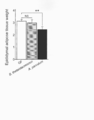
- FIG. 7 is a diagram showing suppression of epididymal adipose tissue mass due to Atopobium parvulum colonization.
- the average (g) of epididymal adipose tissue weight for 9 weeks from the start of breeding (8 weeks of age) was shown (n 5). Error bars indicate standard deviation (SD).
- GF white
- B. thetaiotamicron gray
- A. et al. parvulum black
- the present invention provides intestinal bacteria having D-psicose-responsive growth ability.
- Intestinal bacteria having D-psicose-responsive growth ability refer to intestinal bacteria whose number in the intestine of a mammal that has taken D-psicose significantly increases with ingestion of D-psicose.
- the enterobacteria of the present invention may be enterobacteria belonging to the family Atopobiaceae.
- Intestinal bacteria belonging to the family Atopobiaceae include, for example, bacteria belonging to the genus Atopobium (eg, Atopobium parvulum), bacteria belonging to the genus Orsenella (eg, Orsenella umna ena bon abena) It has been known.
- the intestinal bacterium of the present invention can also be characterized by having a 16S rRNA gene containing a nucleotide sequence having 90% or more identity to the nucleotide sequence of SEQ ID NO: 1.
- the nucleotide sequence identity is 91% or more, 92% or more, 93% or more, 94% or more, 95% or more, 96% or more, 97% or more, 98% or more, 99% or more, or 100%. However, it is preferably 97% or more, 98% or more, 99% or more, or 100%.
- enterobacteria having a 16S ⁇ rRNA gene containing a nucleotide sequence having 97% or more identity to the nucleotide sequence of SEQ ID NO: 1 can be considered to be the same bacterial species.
- the intestinal bacteria of the present invention can further exhibit a biological function improving effect.
- the biological function improving action of the intestinal bacteria of the present invention is the same as that of D-psicose.
- Examples of the biological function improving effect of D-psicose include a preventive or therapeutic effect on metabolic disorders (eg, an anti-obesity effect, a promoting effect on glucose tolerance), and an anti-atherosclerotic effect. Therefore, the intestinal bacteria of the present invention can also be characterized by such effects.
- the intestinal bacteria of the present invention can be obtained, for example, from mammalian feces. Mammals include, for example, primates (eg, humans, monkeys), rodents (eg, mice, rats, guinea pigs, rabbits), dogs, cats, cows, horses, and pigs. As mammals, primates or rodents are preferred, and humans or mice are more preferred. From the viewpoint of ease of clinical application, humans are even more preferable.
- the intestinal bacteria of the present invention can be said to be bacteria present in the intestine of such mammals. Methods for recovering intestinal bacteria from mammalian feces are well known [eg, (i) Fukuda ⁇ S ⁇ et al. , J ⁇ Vet ⁇ Med ⁇ Sci.
- the intestinal bacteria of the present invention can be obtained, for example, from feces of mammals that have taken (or administered) D-psicose.
- the intake of D-psicose is not particularly limited as long as it is an amount capable of growing the intestinal bacteria of the present invention (in other words, an amount capable of exerting the action of D-psicose).
- the daily intake is, for example, 0.05 to 100 g / kg (body weight), preferably 0.1 to 50 g / kg (body weight). Weight), more preferably 0.2 to 50 g / kg (body weight).
- the present invention relates to a pharmaceutical or food and a biological function improving agent (hereinafter referred to as the product of the present invention and ) Is provided.
- the product of the present invention contains enteric bacteria having a D-psicose-responsive growth ability.
- the number of intestinal bacteria having D-psicose-responsive growth ability contained in the product of the present invention is not particularly limited as long as it can bring a beneficial effect to the ingested mammal.
- Intestinal bacteria having D-psicose-responsive growth ability are bacteria that originally existed in the intestine. Therefore, even if the amount of mammal intake is small, it may be affected by factors such as intestinal environment and individual differences. However, it can colonize and proliferate in the intestine and exert its effect. Therefore, the intestinal bacteria having D-psicose-responsive growth ability contained in the product of the present invention can exert its action even in a small amount.
- the intestinal bacteria having D-psicose-responsive growth ability contained in the product of the present invention is at least a certain amount. Is preferred.
- the intestinal bacterium having D-psicose-responsive growth ability has a dose of, for example, 1 ⁇ 10 5 to 1 ⁇ 10 9 cells / kg (body weight), preferably 5 ⁇ 10 5 to 5 ⁇ 5.
- such a number of intestinal bacteria can be contained in one or more (eg, 2 to 6) solid substances (eg, capsules, tablets).
- the product of the present invention may be provided in the form of a composition.
- the composition of the present invention containing intestinal bacteria having D-psicose-responsive growth ability may further contain D-psicose.
- the product of the present invention when it is provided in the form of a pharmaceutical composition, it may contain a pharmaceutically acceptable carrier in addition to enteric bacteria having D-psicose-responsive growth ability.
- Pharmaceutically acceptable carriers include, for example, excipients such as sucrose, starch, mannitol, sorbitol, lactose, glucose, cellulose, talc, calcium phosphate, calcium carbonate, cellulose, methylcellulose, hydroxypropylcellulose, polypropylpyrrolidone , Gelatin, gum arabic, polyethylene glycol, sucrose, starch and other binders, starch, carboxymethylcellulose, hydroxypropyl starch, sodium-glycol-starch, sodium bicarbonate, calcium phosphate, calcium citrate and other disintegrants, magnesium stearate , Aerosil, talc, lubricants such as sodium lauryl sulfate, citric acid, menthol, glycyrrhizin ammonium salt, gly
- the medicament of the present invention may also contain other biological function improving agents in addition to intestinal bacteria having D-psicose-responsive growth ability.
- a biological function improving agent include a prophylactic or therapeutic agent for a metabolic disorder (eg, an antiobesity agent, an agent for promoting glucose tolerance), and an antiatherosclerotic agent.
- the enterobacteria having D-psicose-responsive growth ability may be provided in a form added to a food, or may be provided mainly as a supplement. It may be used as a component.
- Foods include, for example, liquids (eg, drinks, alcohols), semi-solids (eg, yogurt, jelly), and solids (eg, snacks, chocolate).
- the product of the present invention may also be an oral composition or a composition for rectal administration.
- the oral composition include capsules, tablets, powders, and liquids.
- the composition for rectal administration include a liquid preparation.
- Oral compositions may preferably be formulated for superior intestinal delivery.
- the oral composition can preferably be provided in an enteric form (eg, an enteric-positive capsule).
- the product of the present invention is an agent for preventing or treating a metabolic disorder.
- metabolic disorders in which intestinal bacteria having D-psicose-responsive growth ability can effectively act include obesity, diabetes, arteriosclerosis, and heart failure. Therefore, the biological function improving agent of the present invention is useful, for example, as an antiobesity agent, an antidiabetic agent, an antiatherosclerotic agent, and an antiheart failure agent.
- the present invention provides a method for culturing intestinal bacteria.
- the culture method of the present invention includes culturing intestinal bacteria in a medium containing D-psicose.
- Enterobacteria having D-psicose-responsive growth ability can be cultured in the form of a mixture with other enterobacteria or in a non-mixture with other enterobacteria. For example, if enterobacteria having D-psicose-responsive growth potential are cultured in the form of a mixture with other enterobacteria, such a mixture may be obtained by recovery from mammalian feces as described above. can do.
- the culturing method of the present invention is carried out under the general culture conditions for enteric bacteria using a medium similar to the general medium used for culturing enteric bacteria except that it contains D-psicose. Can be.
- the concentration of D-psicose used in the culture method of the present invention is, for example, 0.01 to 10% (w / v), preferably 0.05 to 5% (w / v), and more preferably 0 to 5% (w / v). .1 to 1% (w / v).
- General media and culture conditions for intestinal bacteria are well known (eg, (i) Fukuda S. et. Al., J. Vet. Med.
- the medium can contain components such as a carbon source, a nitrogen source, an organic micronutrient, vitamins, and inorganic ions.
- a carbon source include carbohydrates such as monosaccharides (eg, glucose), disaccharides, oligosaccharides, and polysaccharides; invert sugars obtained by hydrolyzing sucrose; glycerol; methanol, formaldehyde, formate, carbon monoxide, and carbon dioxide.
- Compounds having 1 carbon atom such as carbon; oils such as corn oil, palm oil and soybean oil; short-chain fatty acids such as acetic acid, propionic acid and butyric acid; organic acids such as succinic acid and lactic acid; animal oils and fats; Fatty acids such as fatty acids and unsaturated fatty acids; lipids; phospholipids; glycerolipids; glycerin fatty acid esters such as monoglyceride, diglyceride, and triglyceride; Possible carbon sources; yeast extract; horse serum; fecal extract; meat extract; vegetable extract; Include those in which a combination of these.
- the nitrogen source examples include inorganic ammonium salts such as ammonium sulfate, ammonium chloride, and ammonium phosphate; organic nitrogen such as soybean hydrolysate; ammonia gas; and aqueous ammonia.
- inorganic ammonium salts such as ammonium sulfate, ammonium chloride, and ammonium phosphate
- organic nitrogen such as soybean hydrolysate
- ammonia gas such as soybean hydrolysate
- aqueous ammonia aqueous ammonia.
- a required substance such as L-homoserine or a yeast extract is preferably contained in an appropriate amount.
- vitamins include vitamins B1, B2, B3, B6, B12, C, and K1.
- the inorganic ions include potassium phosphate, magnesium sulfate, iron ions, and manganese ions.
- the intestinal bacterial density in the medium is, for example, 1 ⁇ 10 6 to 1 ⁇ 10 11 cells / mL, preferably 1 ⁇ 10 7 to 1 ⁇ 10 10 cells / mL. Preferably, it is 1 ⁇ 10 8 to 1 ⁇ 10 9 cells / mL.
- the culture temperature is, for example, 30 to 40 ° C.
- the culture period is, for example, 1 to 7 days. Either anaerobic culture conditions or aerobic culture conditions can be used, but anaerobic culture conditions are preferred.
- the oxygen concentration under anaerobic culture conditions is, for example, 0 to 5%, preferably 0 to 3%, more preferably 0 to 2%, and still more preferably 0 to 1%.
- the culture method of the present invention is useful, for example, for growing or maintaining intestinal bacteria having D-psicose-responsive growth ability.
- the present invention also provides a medium that can be suitably used in the culture method of the present invention.
- the medium of the present invention is a medium containing D-psicose.
- the concentration of D-psicose is as described above.
- the components that may be contained in such a culture medium in addition to D-psicose are the same as the components of the above-described culture medium.
- the present invention further provides an intestinal bacterial culture that can be suitably used in the culturing method of the present invention or obtained by the culturing method of the present invention.
- the enterobacterial culture of the present invention contains D-psicose and enterobacteria.
- the concentration of D-psicose is the same as described above.
- the enterobacterial density is similar to the enterobacterial density described above in the medium.
- the components that the enterobacterial culture of the present invention may contain in addition to D-psicose and enterobacteria are the same as the components of the above-described medium.
- the present invention provides a method for screening a substance having a biological function improving action.
- the screening method of the present invention includes: (1) contacting the test substance with intestinal bacteria having a D-psicose-responsive growth ability; (2) evaluating the number of intestinal bacteria having D-psicose-responsive growth ability; and (3) using a test substance that increases the number of intestinal bacteria having D-psicose-responsive growth ability as a biological function-improving agent. To be selected as a substance.
- the test substance is any substance including a known substance and a novel substance.
- test substances include, for example, organic low molecular weight compounds, compound libraries prepared using combinatorial chemistry techniques, nucleic acids (eg, nucleosides, oligonucleotides, polynucleotides), carbohydrates (eg, monosaccharides, disaccharides, etc.) Sugars, oligosaccharides, polysaccharides), lipids (eg, saturated or unsaturated linear, branched and / or cyclic fatty acids), amino acids, proteins (eg, oligopeptides, polypeptides, antibodies or fragments thereof), solids Examples include a random peptide library prepared by phase synthesis or phage display, or a natural component derived from a microorganism, animal, plant, or marine organism.
- the contact between the test substance and intestinal bacteria having D-psicose-responsive growth ability can be performed by any method such as an in vitro method or an in vivo method.
- contact of a test substance with intestinal bacteria having D-psicose-responsive growth ability in an in vitro method is achieved by culturing intestinal bacteria having D-psicose-responsive growth ability in a medium containing the test substance. be able to.
- the concentration of the test substance in the medium can be appropriately adjusted.
- the concentration of the test substance in the medium can be set to a low concentration (eg, 1 nM to 10 ⁇ M).
- the concentration of the test substance in the medium may be set to a higher concentration (eg, 100 nM to 10 mM).
- the density of intestinal bacteria in the medium can be appropriately set (eg, 1 ⁇ 10 5 to 1 ⁇ 10 8 cells / mL).
- the culture medium and culture conditions for intestinal bacteria can be the same as those described above in the culture method of the present invention.
- contact of the test substance with intestinal bacteria having D-psicose-responsive growth ability in an in vivo method can be achieved by administering the test substance to a mammal.
- administration of the test substance to the mammal causes the test substance to come into contact with intestinal bacteria having D-psicose-responsive growth ability in the intestine of the mammal.
- the amount of the test substance to be administered can be appropriately adjusted. For example, if it is particularly desired to screen for a potent biofunction improving agent, the amount of the test substance to be administered can be set to a low amount (eg, 0.05 to 10 g / kg).
- the amount of the test substance to be administered may be set to a higher amount (eg, 10 to 100 g / kg).
- a higher amount eg, 10 to 100 g / kg.
- those described above can be used, but primates or rodents are preferred, and humans or mice are more preferred. From the viewpoint of ease of clinical application, humans are even more preferable.
- step (2) the number of intestinal bacteria having D-psicose-responsive growth ability is evaluated.
- evaluation of the number of intestinal bacteria can be performed, for example, by directly counting the number of intestinal bacteria, or by measuring another index reflecting the number of intestinal bacteria.
- a marker specific to such enterobacteria eg, the 16s ⁇ rRNA gene or a specific substance produced by the same
- a quantitative method such as quantitative PCR
- a test substance that increases the number of intestinal bacteria having D-psicose-responsive growth ability is selected as a substance having a biological function improving action.
- the selected test substance can exhibit a D-psicose-like action for improving biological functions.
- Such a biological function improving action is the same as that described above for the biological function improving agent.
- the screening methods of the invention may be in vitro methods, including: (1) contacting a test substance with intestinal bacteria having a D-psicose-responsive growth ability in a medium; (2) evaluating the number of intestinal bacteria having D-psicose-responsive growth ability; and (3) using a test substance that increases the number of intestinal bacteria having D-psicose-responsive growth ability as a biological function-improving agent. To be selected as a substance.
- the screening method of the invention may be an in vivo method comprising: (1) Evaluating the number of intestinal bacteria having D-psicose-responsive growth ability contained in feces of a mammal to which the test substance was administered; and (2) intestine having D-psicose-responsive growth ability To select a test substance that increases the number of bacteria as a substance having a biological function improving effect.
- the screening method of the invention may be an in vivo method comprising: (1 ′) administering a test substance to a mammal (eg, a non-human mammal); (2 ′) collecting feces of the mammal to which the test substance has been administered; (3 ′) Estimating the number of intestinal bacteria having D-psicose-responsive growth ability contained in feces; and (4 ′) increasing the number of intestinal bacteria having D-psicose-responsive growth ability Is selected as a substance having a biological function improving action.
- a mammal eg, a non-human mammal
- the screening method of the present invention provides, for example, the development of a novel drug or food having a D-psicose-like biological function improving effect, and a combined effect further having a D-psicose-like biological function improving effect in addition to the existing effect. It is useful for the development of medicines or foods that can exert the above.
- Example 1 Discovery of unique intestinal bacteria having D-psicose-responsive growth ability
- Experimental method (a) Animal experiment 28 6-week-old male C57BL / 6J mice (CLEA Japan) were prepared and 28 After ingesting the diet of CE-2 (Clear Japan) and tap water for 2 weeks and acclimatizing, 4 groups of 7 animals ((i) tap water administration group, (ii) D-psicose water administration group, (iii) The group was divided into tap water and antibiotic administration group, and (iv) D-psicose water and antibiotic administration group), and the experiment was started at 8 weeks of age. In all groups, food was given HFD32 (CLEA Japan), a high fat diet, freely.
- D-psicose water administration group was laboratory tap water, and D-psicose water administration group was obtained by adding 5.0% (w / v) of D-psicose (Matsuya Chemical Industry) to laboratory tap water.
- D-psicose Matsuya Chemical Industry
- 0.1% (w / v) sodium ampicillin, 0.1% (w / v) neomycin sulfate, 0.05% (w / v) vancomycin hydrochloride (Isuzumo Wako Pure Chemical Industries, Ltd.) (Drug) was mixed with drinking water and administered.
- the body weight, water consumption, and food consumption of the mice were measured every week, and feces were collected.
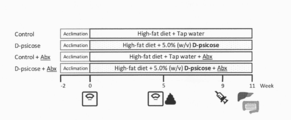
- mice After fasting for 15 hours, the side of the tail was injured with a syringe needle (TERMO), and the blood glucose level was measured using a blood glucose meter (Nipro Statstrip XP3). The mice were dissected 11 weeks after the start of the experiment (19 weeks old). The outline of the animal experiment was illustrated (FIG. 1).
- Phenol / chloroform / isoamyl alcohol (25: 24: 1) was again added to the supernatant, and the mixture was stirred for 1 minute using a Micro mixer E-36 (TAITEC), and then at 17,800 ⁇ g for 5 minutes at room temperature. Centrifugation was performed. After adding 40 ⁇ L of 3M sodium acetate and 800 ⁇ L of 100% EtOH to the supernatant, the supernatant was allowed to stand at ⁇ 80 ° C. for 1 hour. After centrifugation at 17,800 ⁇ g for 10 minutes at 4 ° C., EtOH was removed and 500 ⁇ L of 70% EtOH was added.
- TITEC Micro mixer E-36
- Tks Gflex DNA Polymerase (Takara Bio) was used as the polymerase. Thereafter, 81 ⁇ L of Agencourt AMPure XP (Beckman Coulter) was added to 45 ⁇ L of the PCR product for purification, and the DNA concentration was measured using Picogreen (Thermo Fisher Scientific).
- Primers were used 5'-AATGATACGGCGACCACCGAGATCTACAC-NNNNNN-TATGGTAATTGTAGRGTTTGATYMTGGCTCAG-3 '(SEQ ID NO: 4) and 5'-CAAGCAGAAGACGGCATACGAGAT-NNNNNN-AGTCAGTCAGCCTGCTGCCTCCC GTAGGAGT-3' (SEQ ID NO: 5).
- the base sequence described by N is an index sequence, and a different sequence was used for each sample.
- the index PCR conditions were as follows: the initial denaturation reaction was performed at 98 ° C. for 1 minute, then 98 ° C. for 10 seconds, 55 ° C. for 15 seconds, and 68 ° C. for 30 seconds. Was.
- Tks Gflex DNA Polymerase As the polymerase, Tks Gflex DNA Polymerase was used. Thereafter, 90 ⁇ L of Agencourt AMPure XP was added to 50 ⁇ L of the PCR product for purification, and the DNA concentration was measured using Picogreen. From this result, each sample was diluted to 4 nM. Thereafter, the samples having undergone the pretreatment step were mixed in equal amounts and sequenced according to the standard protocol of MiSeq (Illumina).
- the species is “homogeneous” with an identity of 97% or more, but the intestinal bacteria found this time have the highest identity of 89%. This suggests that the intestinal bacterial species obtained in this study may be an unregistered enteric bacterial species belonging to the family Atopobiaceae.
- Example 2 Culture of specific enterobacteria having D-psicose-responsive growth ability
- Specific intestinal bacteria including specific enterobacteria having D-psicose-responsive growth ability were identified by reference (Fukuda S., J Vet Med Sci., 2002 Nov; 64 (11): 987-92), and collected from feces of D-psicose-administered mice (Example 1).
- the collected intestinal bacteria were cultured in a D-psicose-containing medium under anaerobic conditions (oxygen concentration: 0%) at 37 ° C. for 2 days.
- the intestinal bacterial density in the medium at the start of the culture was about 1 ⁇ 10 6 cells / mL.
- the concentration of D-psicose in the medium was 0.3% (w / v).
- As the medium components other than D-psicose Fukuda S.P. et al. , J Gen Appl Microbiol. 2005 Apr; 51 (2): 105-13, and the basic components of the medium described in Ohkawara S. et al. et al. , J Nutr. 2005 Dec; 135 (12): 2878-83, using short chain fatty acids and vitamins (pH 7.0).
- metagenome analysis using the nucleotide sequence of SEQ ID NO: 1 confirmed the presence of a unique intestinal bacterium having D-psicose-responsive growth ability. Therefore, it was shown that a specific intestinal bacterium having a D-psicose-responsive growth ability can be cultured in a D-psicose-containing medium.
- Example 3 Cultivation of unique enteric bacteria having D-psicose-responsive growth ability (1) Outline From the results of Examples 1 and 2, suppression of weight gain due to ingestion of rare sugars and characteristics of Atopobium-related bacteria A significant increase has been found. Therefore, by preparing gnotobiotic mice in which germs of the genus Atopobium are orally administered to germ-free mice and colonized them, the detailed examination of the anti-obesity effect of intestinal bacteria, which was characteristically increased in the D-psicose administration test, was carried out. Tried.
- the bacterial solution prepared immediately before was orally administered by 200 ⁇ L each.
- the feed was D12492, a gamma-sterilized high fat diet (Research Diet: 60 kcal% fat content, lard use, (High Fat Diet High Fat Diet)), drinking water free of sterile tap water Ingested.
- mice During the experimental period, the body weight, water consumption, and food consumption of the mice were measured every week, and fecal samples were collected. On days 3, 5, 7, 14, and 21 after administration of the bacterial solution, the fecal sample was cultured in a GAM plate medium, and it was confirmed that the bacteria had settled.
- the animals were dissected under isoflurane anesthesia.
Landscapes
- Health & Medical Sciences (AREA)
- Life Sciences & Earth Sciences (AREA)
- Chemical & Material Sciences (AREA)
- Engineering & Computer Science (AREA)
- Organic Chemistry (AREA)
- General Health & Medical Sciences (AREA)
- Bioinformatics & Cheminformatics (AREA)
- Medicinal Chemistry (AREA)
- Pharmacology & Pharmacy (AREA)
- Animal Behavior & Ethology (AREA)
- Public Health (AREA)
- Veterinary Medicine (AREA)
- Zoology (AREA)
- Wood Science & Technology (AREA)
- Diabetes (AREA)
- Microbiology (AREA)
- Biotechnology (AREA)
- Genetics & Genomics (AREA)
- General Chemical & Material Sciences (AREA)
- Nuclear Medicine, Radiotherapy & Molecular Imaging (AREA)
- Chemical Kinetics & Catalysis (AREA)
- Mycology (AREA)
- Obesity (AREA)
- Molecular Biology (AREA)
- Hematology (AREA)
- General Engineering & Computer Science (AREA)
- Biochemistry (AREA)
- Biomedical Technology (AREA)
- Tropical Medicine & Parasitology (AREA)
- Virology (AREA)
- Epidemiology (AREA)
- Child & Adolescent Psychology (AREA)
- Nutrition Science (AREA)
- Polymers & Plastics (AREA)
- Proteomics, Peptides & Aminoacids (AREA)
- Food Science & Technology (AREA)
- Biophysics (AREA)
- Physics & Mathematics (AREA)
- Analytical Chemistry (AREA)
- Emergency Medicine (AREA)
Abstract
本発明は、所望の作用を発揮することができる新規な医薬や食品を提供する。より具体的には、本発明は、D-プシコース応答性増殖能を有する腸内細菌;D-プシコース応答性増殖能を有する腸内細菌を含む、医薬または食品;D-プシコース応答性増殖能を有する腸内細菌を含む、生体機能改善剤;D-プシコースを含有する培地中で腸内細菌を培養することを含む、腸内細菌の培養方法;D-プシコース応答性増殖能を有する腸内細菌を用いる、生体機能改善剤のスクリーニング方法などを提供する。
Description
人工甘味料は多くの飲料に含まれ、ゼロカロリーなどのフレーズから消費者は健康効果を期待している。しかし、人工甘味料は腸内細菌叢の組成と機能を変化させ耐糖能異常を引き起こす可能性が示唆されるなど、その安全性や効果が懸念されている(非特許文献1)。したがって、人工甘味料に代わる機能的な甘味料が求められている。
希少糖の一つであるD-プシコース(別名 D-アルロース)は、スクロースの7割程度の甘味を持ちながらもカロリー量はゼロに近く、耐糖能の改善や抗肥満効果等の生体機能の改善作用をもたらすことなどが報告されている(非特許文献2、3)。また、D-プシコースは一部が吸収されずに消化管を通過し大腸に到達することが報告されている(非特許文献4、5)。
Suez J, Korem T, Zeevi D, Zilberman-Schapira G, Thaiss CA, Maza O, et al. Artificial sweeteners induce glucose intolerance by altering the gut microbiota. Nature. 2014;514(7521):181-6.
Iwasaki Y, Sendo M, Dezaki K, Hira T, Sato T, Nakata M, et al. GLP-1 release and vagal afferent activation mediate the beneficial metabolic and chronotherapeutic effects of D-allulose. Nat Commun. 2018;9(1):113.
Hossain A, Yamaguchi F, Hirose K, Matsunaga T, Sui L, Hirata Y, et al. Rare sugar D-psicose prevents progression and development of diabetes in T2DM model Otsuka Long-Evans Tokushima Fatty rats. Drug Des Devel Ther. 2015;9:525-35.
Matsuo T, Tanaka T, Hashiguchi M, Izumori K, Suzuki H. Metabolic effects of D-psicose in rats: Studies on faecal and urinary excretion and caecal fermentation. Asia Pac J Clin Nutr. 2003;12(2):225-31.
Iida T, Hayashi N, Yamada T, Yoshikawa Y, Miyazato S, Kishimoto Y, et al. Failure of d-psicose absorbed in the small intestine to metabolize into energy and its low large intestinal fermentability in humans. Metabolism. 2010;59(2):206-14.
本発明は、所望の作用を発揮することができる新規な医薬や食品を提供することを目的とする。
本発明者らは、鋭意検討した結果、腸内に存在する特定の細菌がD-プシコースによる生体機能の改善作用を担い得ることなどを見出し、本発明を完成するに至った。
すなわち、本発明は、以下のとおりである。
〔1〕D-プシコース応答性増殖能を有する腸内細菌。
〔2〕アトポビアセア(Atopobiaceae)科に属する腸内細菌である、〔1〕の腸内細菌。
〔3〕配列番号1の塩基配列に対して90%以上の同一性を有する塩基配列を含む16S rRNA遺伝子を有する、〔1〕または〔2〕の腸内細菌。
〔4〕前記腸内細菌が、D-プシコースを投与された哺乳動物の糞便から回収される腸内細菌である、〔1〕~〔3〕のいずれかの腸内細菌。
〔5〕アトポビアセア(Atopobiaceae)科に属する腸内細菌が、アトポビアセア・パルブラム(Atopobium parvulum)である、〔2〕の腸内細菌。
〔6〕D-プシコース応答性増殖能を有する腸内細菌を含む、医薬または食品。
〔7〕D-プシコース応答性増殖能を有する腸内細菌を含む、生体機能改善剤。
〔8〕生体機能改善剤が代謝障害の予防または治療剤である、〔7〕の剤。
〔9〕生体機能改善剤が抗肥満剤である、〔7〕または〔8〕の剤。
〔10〕生体機能改善剤が抗糖尿病剤である、〔7〕または〔8〕の剤。
〔11〕生体機能改善剤が経口用組成物または経直腸投与用組成物である、〔7〕~〔10〕のいずれかの剤。
〔12〕D-プシコースを含有する培地中で腸内細菌を培養することを含む、腸内細菌の培養方法。
〔13〕D-プシコースを含有する培地。
〔14〕D-プシコース、および腸内細菌を含有する腸内細菌培養物。
〔15〕以下を含む、生体機能改善作用を有する物質のスクリーニング方法:
(1)被験物質を、D-プシコース応答性増殖能を有する腸内細菌に接触させること;
(2)D-プシコース応答性増殖能を有する腸内細菌数を評価すること;および
(3)D-プシコース応答性増殖能を有する腸内細菌数を増加させる被験物質を、生体機能改善作用を有する物質として選択すること。
〔1〕D-プシコース応答性増殖能を有する腸内細菌。
〔2〕アトポビアセア(Atopobiaceae)科に属する腸内細菌である、〔1〕の腸内細菌。
〔3〕配列番号1の塩基配列に対して90%以上の同一性を有する塩基配列を含む16S rRNA遺伝子を有する、〔1〕または〔2〕の腸内細菌。
〔4〕前記腸内細菌が、D-プシコースを投与された哺乳動物の糞便から回収される腸内細菌である、〔1〕~〔3〕のいずれかの腸内細菌。
〔5〕アトポビアセア(Atopobiaceae)科に属する腸内細菌が、アトポビアセア・パルブラム(Atopobium parvulum)である、〔2〕の腸内細菌。
〔6〕D-プシコース応答性増殖能を有する腸内細菌を含む、医薬または食品。
〔7〕D-プシコース応答性増殖能を有する腸内細菌を含む、生体機能改善剤。
〔8〕生体機能改善剤が代謝障害の予防または治療剤である、〔7〕の剤。
〔9〕生体機能改善剤が抗肥満剤である、〔7〕または〔8〕の剤。
〔10〕生体機能改善剤が抗糖尿病剤である、〔7〕または〔8〕の剤。
〔11〕生体機能改善剤が経口用組成物または経直腸投与用組成物である、〔7〕~〔10〕のいずれかの剤。
〔12〕D-プシコースを含有する培地中で腸内細菌を培養することを含む、腸内細菌の培養方法。
〔13〕D-プシコースを含有する培地。
〔14〕D-プシコース、および腸内細菌を含有する腸内細菌培養物。
〔15〕以下を含む、生体機能改善作用を有する物質のスクリーニング方法:
(1)被験物質を、D-プシコース応答性増殖能を有する腸内細菌に接触させること;
(2)D-プシコース応答性増殖能を有する腸内細菌数を評価すること;および
(3)D-プシコース応答性増殖能を有する腸内細菌数を増加させる被験物質を、生体機能改善作用を有する物質として選択すること。
本発明の腸内細菌は、例えば、医薬または食品として、あるいは生体機能改善剤(例、抗肥満剤、抗糖尿病剤)として有用である。
本発明の培養方法は、例えば、D-プシコース応答性増殖能を有する腸内細菌の増殖または維持に有用である。
本発明のスクリーニング方法は、例えば、D-プシコース様の生体機能改善作用を有する新規医薬または食品の開発、ならびに既存の作用に加え、D-プシコース様の生体機能改善作用をさらに有する複合的な作用を発揮できる医薬または食品の開発のために有用である。
本発明の培養方法は、例えば、D-プシコース応答性増殖能を有する腸内細菌の増殖または維持に有用である。
本発明のスクリーニング方法は、例えば、D-プシコース様の生体機能改善作用を有する新規医薬または食品の開発、ならびに既存の作用に加え、D-プシコース様の生体機能改善作用をさらに有する複合的な作用を発揮できる医薬または食品の開発のために有用である。
1.D-プシコース応答性増殖能を有する腸内細菌
本発明は、D-プシコース応答性増殖能を有する腸内細菌を提供する。
本発明は、D-プシコース応答性増殖能を有する腸内細菌を提供する。
D-プシコース応答性増殖能を有する腸内細菌とは、D-プシコースを摂取した哺乳動物の腸内において、D-プシコースの摂取に伴い有意に数が増加する腸内細菌をいう。
本発明の腸内細菌は、アトポビアセア(Atopobiaceae)科に属する腸内細菌であり得る。アトポビアセア(Atopobiaceae)科に属する腸内細菌としては、例えば、アトポビウム(Atopobium)属細菌〔例、アポトビウム・パルブラム(Atopobium parvulum)〕、オルセネラ属(Olsenella)細菌〔例、オルセネラ・ウムボナタ(Olsenella umbonata)〕が知られている。
本発明の腸内細菌はまた、配列番号1の塩基配列に対して90%以上の同一性を有する塩基配列を含む16S rRNA遺伝子を有することにより特徴付けることができる。好ましくは、塩基配列の同一性は、91%以上、92%以上、93%以上、94%以上、95%以上、96%以上、97%以上、98%以上、99%以上または100%であってもよいが、好ましくは97%以上、98%以上、99%以上または100%である。OTU(例、16S rRNA遺伝子の塩基配列)が97%以上の同一性を示す場合、OTUは進化的に同一の菌種から構成されるといわれている。したがって、配列番号1の塩基配列に対して97%以上の同一性を有する塩基配列を含む16S rRNA遺伝子を有する腸内細菌は、同一の菌種であると考えることができる。
ポリヌクレオチド(遺伝子)の同一性%の算出は、アルゴリズムblastnにより行うことができる。より具体的には、ポリヌクレオチドの同一性%の算定は、NCBIにおいて提供されているアルゴリズムblastnにおいて、デフォルト設定のScoring Parameters(Match/Mismatch Scores=1,-2;Gap Costs=Linear)を用いて行うことができる。
本発明の腸内細菌はさらに、生体機能改善作用を示すことができる。本発明の腸内細菌が示す生体機能改善作用は、D-プシコースの生体機能改善作用と同様である。D-プシコースの生体機能改善作用としては、例えば、代謝障害の予防または治療作用(例、抗肥満作用、グルコース耐性の促進作用)、抗動脈硬化作用が挙げられる。したがって、本発明の腸内細菌は、このような作用からも特徴付けることができる。
本発明の腸内細菌は、例えば、哺乳動物の糞便から得ることができる。哺乳動物としては、例えば、霊長類(例、ヒト、サル)、齧歯類(例、マウス、ラット、モルモット、ウサギ)、イヌ、ネコ、ウシ、ウマ、ブタが挙げられる。哺乳動物としては、霊長類または齧歯類が好ましく、ヒトまたはマウスがより好ましい。臨床応用のし易さの観点からは、ヒトがさらにより好ましい。本発明の腸内細菌は、このような哺乳動物の腸内に存在する細菌であるということができる。哺乳動物の糞便からの腸内細菌の回収方法は、周知である〔例、(i)Fukuda S et al.,J Vet Med Sci.,2002 Nov;64(11):987-92、(ii)Fukuda S et al.,J Gen Appl Microbiol.,2005 Apr;51(2):105-13、(iii)Sasaki D et al.,Sci Rep.,2018 Jan 11;8(1):435〕。
また、本発明の腸内細菌を効率的に入手する観点からは、本発明の腸内細菌は、例えば、D-プシコースを摂取(または投与)した哺乳動物の糞便から得ることができる。D-プシコースの摂取量は、本発明の腸内細菌を増殖させることができる量(換言すれば、D-プシコースの作用を発揮することができる量)である限り特に限定されず、対象となる哺乳動物種、摂取頻度および摂取期間などの因子によって変動し得るが、一日あたりの摂取量として、例えば0.05~100g/kg(体重)であり、好ましくは0.1~50g/kg(体重)であり、より好ましくは0.2~50g/kg(体重)である。
2.D-プシコース応答性増殖能を有する腸内細菌を含む、医薬または食品、および生体機能改善剤
本発明は、医薬または食品、および生体機能改善剤(以下、必要に応じて、本発明の製品と称する)を提供する。本発明の製品は、D-プシコース応答性増殖能を有する腸内細菌を含む。
本発明は、医薬または食品、および生体機能改善剤(以下、必要に応じて、本発明の製品と称する)を提供する。本発明の製品は、D-プシコース応答性増殖能を有する腸内細菌を含む。
本発明の製品に含まれる、D-プシコース応答性増殖能を有する腸内細菌数は、摂取した哺乳動物に有益な作用をもたらし得る限り、特に限定されない。D-プシコース応答性増殖能を有する腸内細菌は元々腸内に存在していた細菌であるので、たとえ哺乳動物の摂取量が少量であったとしても、腸内環境や個人差等の因子にもよるが、腸内で定着し増殖することができ、その作用を発揮することができる。したがって、本発明の製品に含まれる、D-プシコース応答性増殖能を有する腸内細菌は、少量でもその作用を発揮することができる。しかし、腸内への定着可能性の向上や速やかな作用の発現等の観点からは、本発明の製品に含まれる、D-プシコース応答性増殖能を有する腸内細菌は、一定量以上であることが好ましい。D-プシコース応答性増殖能を有する腸内細菌について、1回単位あたりの摂取数は、例えば1×10⁵~1×10⁹細胞/kg(体重)であり、好ましくは5×105~5×108細胞/kg(体重)であり、より好ましくは1×106~1×108細胞/kg(体重)である。本発明の製品では、このような数の腸内細菌を、1個または複数個(例、2~6個)の固形物(例、カプセル、錠剤)に含有することができる。
本発明の製品は、組成物の形態で提供されてもよい。D-プシコース応答性増殖能を有する腸内細菌を含む本発明の組成物は、さらにD-プシコースを含んでいてもよい。
例えば、本発明の製品は、医薬組成物の形態で提供される場合、D-プシコース応答性増殖能を有する腸内細菌に加えて、医薬上許容され得る担体を含んでいてもよい。医薬上許容され得る担体としては、例えば、ショ糖、デンプン、マンニット、ソルビット、乳糖、グルコース、セルロース、タルク、リン酸カルシウム、炭酸カルシウム等の賦形剤、セルロース、メチルセルロース、ヒドロキシプロピルセルロース、ポリプロピルピロリドン、ゼラチン、アラビアゴム、ポリエチレングリコール、ショ糖、デンプン等の結合剤、デンプン、カルボキシメチルセルロース、ヒドロキシプロピルスターチ、ナトリウム-グリコール-スターチ、炭酸水素ナトリウム、リン酸カルシウム、クエン酸カルシウム等の崩壊剤、ステアリン酸マグネシウム、エアロジル、タルク、ラウリル硫酸ナトリウム等の滑剤、クエン酸、メントール、グリシルリシン・アンモニウム塩、グリシン、オレンジ粉等の芳香剤、安息香酸ナトリウム、亜硫酸水素ナトリウム、メチルパラベン、プロピルパラベン等の保存剤、クエン酸、クエン酸ナトリウム、酢酸等の安定剤、メチルセルロース、ポリビニルピロリドン、ステアリン酸アルミニウム等の懸濁剤、界面活性剤等の分散剤、水、生理食塩水、オレンジジュース等の希釈剤、カカオ脂、ポリエチレングリコール、白灯油等のベースワックスなどが挙げられるが、それらに限定されるものではない。本発明の医薬はまた、D-プシコース応答性増殖能を有する腸内細菌に加えて、他の生体機能改善剤を含んでいてもよい。このような生体機能改善剤としては、代謝障害の予防または治療剤(例、抗肥満剤、グルコース耐性の促進作用剤)、抗動脈硬化剤が挙げられる。
本発明の製品が食品組成物の形態で提供される場合、D-プシコース応答性増殖能を有する腸内細菌は、食品に添加された形態で提供されてもよく、あるいは、サプリメントのように主成分として用いられてもよい。食品としては、例えば、液状物(例、飲料、アルコール類)、半固形物(例、ヨーグルト、ゼリー)、固形物(例、スナック、チョコレート)が挙げられる。
本発明の製品はまた、経口用組成物または経直腸投与用組成物であってもよい。経口用組成物としては、例えば、カプセル剤、錠剤、散剤、液剤が挙げられる。経直腸投与用組成物としては、例えば、液体製剤が挙げられる。経口用組成物は、好ましくは、腸への送達性に優れるように処方されてもよい。したがって、経口用組成物は、好ましくは、腸溶性の形態(例、腸陽性カプセル)において提供することができる。
好ましくは、本発明の製品は、代謝障害の予防または治療剤である。D-プシコース応答性増殖能を有する腸内細菌が有効に作用し得る代謝障害としては、例えば、肥満、糖尿病、動脈硬化、心不全が挙げられる。したがって、本発明の生体機能改善剤は、例えば、抗肥満剤、抗糖尿病剤、抗動脈硬化剤、抗心不全剤として有用である。
3.腸内細菌の培養方法
本発明は、腸内細菌の培養方法を提供する。本発明の培養方法は、D-プシコースを含有する培地中で腸内細菌を培養することを含む。
本発明は、腸内細菌の培養方法を提供する。本発明の培養方法は、D-プシコースを含有する培地中で腸内細菌を培養することを含む。
腸内細菌としては、D-プシコース応答性増殖能を有する腸内細菌を含むものが好ましい。D-プシコース応答性増殖能を有する腸内細菌は、他の腸内細菌との混合物の形態において、または他の腸内細菌との非混合物の形態において、培養することができる。例えば、D-プシコース応答性増殖能を有する腸内細菌が他の腸内細菌との混合物の形態において培養される場合、このような混合物は、哺乳動物の糞便から上述のとおり回収することにより入手することができる。
本発明の培養方法は、D-プシコースを含有することを除き、腸内細菌の培養に用いられる一般的な培地と同様の培地を用いて、腸内細菌の一般的な培養条件下で行うことができる。本発明の培養方法に用いられるD-プシコースの濃度は、例えば0.01~10%(w/v)であり、好ましくは0.05~5%(w/v)であり、より好ましくは0.1~1%(w/v)である。腸内細菌の一般的な培地および培養条件は、周知である(例、(i)Fukuda S. et al.,J Vet Med Sci.,2002 Nov;64(11):987-92、(ii)Fukuda S. et al.,J Gen Appl Microbiol.,2005 Apr;51(2):105-13、(iii)Fukuda S. et al.,Sci Rep.,2018 Jan 11;8(1):435)。
例えば、培地は、炭素源、窒素源、有機微量栄養源、ビタミン、無機イオン等の成分を含むことができる。炭素源としては、例えば、単糖類(例、グルコース)、二糖類、オリゴ糖類、多糖類等の炭水化物;ショ糖を加水分解した転化糖;グリセロール;メタノール、ホルムアルデヒド、ギ酸塩、一酸化炭素、二酸化炭素等の炭素数が1の化合物;コーン油、パーム油、大豆油等のオイル;酢酸、プロピオン酸、酪酸等の短鎖脂肪酸;コハク酸、乳酸などの有機酸;動物油脂;動物オイル;飽和脂肪酸、不飽和脂肪酸等の脂肪酸;脂質;リン脂質;グリセロ脂質;モノグリセライド、ジグリセライド、トリグリセライド等のグリセリン脂肪酸エステル;微生物性タンパク質、植物性タンパク質等のポリペプチド;加水分解されたバイオマス炭素源等の再生可能な炭素源;酵母エキス;馬血清;糞便抽出物;肉エキス;野菜エキス;胃内容物抽出物;又はこれらを組み合わせたものが挙げられる。窒素源としては、例えば、硫酸アンモニウム、塩化アンモニウム、リン酸アンモニウム等の無機アンモニウム塩、大豆加水分解物などの有機窒素、アンモニアガス、アンモニア水が挙げられる。有機微量栄養源としては、例えば、L-ホモセリンなどの要求物質または酵母エキス等を適量含有させることが望ましい。ビタミンとしては、例えば、ビタミンB1、B2、B3、B6、B12、C、K1が挙げられる。無機イオンとしては、例えば、リン酸カリウム、硫酸マグネシウム、鉄イオン、マンガンイオンが挙げられる。
培養条件について説明すると、例えば、培地における腸内細菌密度は、例えば1×10⁶~1×10¹¹細胞/mLであり、好ましくは1×107~1×1010細胞/mLであり、より好ましくは1×108~1×109細胞/mLである。培養温度は、例えば30~40℃である。培養期間は、例えば1~7日である。嫌気的培養条件または好気的培養条件のいずれも利用することができるが、嫌気的培養条件が好ましい。嫌気的培養条件下の酸素濃度は、例えば0~5%、好ましくは0~3%、より好ましくは0~2%、さらにより好ましくは0~1%である。
本発明の培養方法は、例えば、D-プシコース応答性増殖能を有する腸内細菌の増殖または維持に有用である。
本発明はまた、本発明の培養方法に好適に用いることができる培地を提供する。本発明の培地は、D-プシコースを含有する培地である。D-プシコースの濃度は、上述したとおりである。また、このような培養培地がD-プシコースの他に含んでいてもよい成分については、上述の培地の成分と同様である。
本発明はさらに、本発明の培養方法に好適に用いることができる、または本発明の培養方法により得られる腸内細菌培養物を提供する。本発明の腸内細菌培養物は、D-プシコース、および腸内細菌を含有する。D-プシコースの濃度は、上述したものと同様である。腸内細菌の密度は、培地における上述の腸内細菌密度と同様である。本発明の腸内細菌培養物がD-プシコース、および腸内細菌の他に含んでいてもよい成分については、上述の培地の成分と同様である。
4.生体機能改善作用を有する物質のスクリーニング方法
本発明は、生体機能改善作用を有する物質のスクリーニング方法を提供する。本発明のスクリーニング方法は、以下を含む:
(1)被験物質を、D-プシコース応答性増殖能を有する腸内細菌に接触させること;
(2)D-プシコース応答性増殖能を有する腸内細菌数を評価すること;および
(3)D-プシコース応答性増殖能を有する腸内細菌数を増加させる被験物質を、生体機能改善作用を有する物質として選択すること。
本発明は、生体機能改善作用を有する物質のスクリーニング方法を提供する。本発明のスクリーニング方法は、以下を含む:
(1)被験物質を、D-プシコース応答性増殖能を有する腸内細菌に接触させること;
(2)D-プシコース応答性増殖能を有する腸内細菌数を評価すること;および
(3)D-プシコース応答性増殖能を有する腸内細菌数を増加させる被験物質を、生体機能改善作用を有する物質として選択すること。
工程(1)では、被験物質は、公知物質および新規物質を含む任意の物質である。このような被験物質としては、例えば、有機低分子化合物、コンビナトリアルケミストリー技術を用いて作製された化合物ライブラリー、核酸(例、ヌクレオシド、オリゴヌクレオチド、ポリヌクレオチド)、糖質(例、単糖、二糖、オリゴ糖、多糖)、脂質(例、飽和または不飽和の直鎖、分岐鎖および/または環を含む脂肪酸)、アミノ酸、蛋白質(例、オリゴペプチド、ポリペプチド、抗体またはその断片)、固相合成やファージディスプレイ法により作製されたランダムペプチドライブラリー、あるいは微生物、動植物、海洋生物等由来の天然成分等が挙げられる。
被験物質とD-プシコース応答性増殖能を有する腸内細菌との接触は、インビトロ方法またはインビボ方法等の任意の様式で行うことができる。
例えば、インビトロ方法における被験物質とD-プシコース応答性増殖能を有する腸内細菌との接触は、被験物質を含有する培地中におけるD-プシコース応答性増殖能を有する腸内細菌の培養により達成することができる。培地中の被験物質の濃度は、適宜調整することができる。例えば、効力が強い生体機能改善剤のスクリーニングが特に所望される場合、培地中の被験物質の濃度は、低濃度(例、1nM~10μM)に設定することができる。あるいは、特に効力が強い生体機能改善剤のスクリーニングが所望されない場合には、培地中の被験物質の濃度は、より高濃度(例、100nM~10mM)に設定されてもよい。培地中の腸内細菌の密度は、適宜設定することができる(例、1×10⁵~1×10⁸細胞/mL)。腸内細菌の培養培地および培養条件は、本発明の培養方法において上述したものと同様にして行うことができる。
また、インビボ方法における被験物質とD-プシコース応答性増殖能を有する腸内細菌との接触は、被験物質の哺乳動物への投与により達成することができる。被験物質の哺乳動物への投与により、哺乳動物の腸内において被験物質がD-プシコース応答性増殖能を有する腸内細菌と接触するためである。投与されるべき被験物質の量は、適宜調整することができる。例えば、効力が強い生体機能改善剤のスクリーニングが特に所望される場合、投与されるべき被験物質の量は、低量(例、0.05~10g/kg)に設定することができる。あるいは、特に効力が強い生体機能改善剤のスクリーニングが所望されない場合には、投与されるべき被験物質の量は、より高量(例、10~100g/kg)に設定されてもよい。哺乳動物としては、上述したものを用いることができるが、霊長類または齧歯類が好ましく、ヒトまたはマウスがより好ましい。臨床応用のし易さの観点からは、ヒトがさらにより好ましい。
工程(2)では、D-プシコース応答性増殖能を有する腸内細菌数が評価される。このような腸内細菌数の評価は、例えば、腸内細菌数を直接カウントすることにより、または腸内細菌数を反映する別の指標を測定することにより、行うことができる。別の指標としては、このような腸内細菌に特異的なマーカー(例、16s rRNA遺伝子、またはそれが産生する特異的な物質)を利用することができる。例えば、16s rRNA遺伝子量を定量的PCR等の定量方法で解析することにより、このような腸内細菌数を評価することができる。
工程(3)では、D-プシコース応答性増殖能を有する腸内細菌数を増加させる被験物質が、生体機能改善作用を有する物質として選択される。選択された被験物質は、D-プシコース様の生体機能改善作用を示すことができる。このような生体機能改善作用としては、上述の生体機能改善剤について述べたものと同様である。
特定の実施形態は、本発明のスクリーニング方法は、以下を含むインビトロ方法であってもよい:
(1)被験物質を、培地中において、D-プシコース応答性増殖能を有する腸内細菌に接触させること;
(2)D-プシコース応答性増殖能を有する腸内細菌数を評価すること;および
(3)D-プシコース応答性増殖能を有する腸内細菌数を増加させる被験物質を、生体機能改善作用を有する物質として選択すること。
(1)被験物質を、培地中において、D-プシコース応答性増殖能を有する腸内細菌に接触させること;
(2)D-プシコース応答性増殖能を有する腸内細菌数を評価すること;および
(3)D-プシコース応答性増殖能を有する腸内細菌数を増加させる被験物質を、生体機能改善作用を有する物質として選択すること。
別の特定の実施形態は、本発明のスクリーニング方法は、以下を含むインビボ方法であってもよい:
(1)被験物質を投与された哺乳動物の糞便中に含まれるD-プシコース応答性増殖能を有する腸内細菌数を評価すること;および
(2)D-プシコース応答性増殖能を有する腸内細菌数を増加させる被験物質を、生体機能改善作用を有する物質として選択すること。
(1)被験物質を投与された哺乳動物の糞便中に含まれるD-プシコース応答性増殖能を有する腸内細菌数を評価すること;および
(2)D-プシコース応答性増殖能を有する腸内細菌数を増加させる被験物質を、生体機能改善作用を有する物質として選択すること。
さらに別の特定の実施形態は、本発明のスクリーニング方法は、以下を含むインビボ方法であってもよい:
(1’)被験物質を哺乳動物(例、非ヒト哺乳動物)に投与すること;
(2’)被験物質を投与された哺乳動物の糞便を回収すること;
(3’)糞便中に含まれるD-プシコース応答性増殖能を有する腸内細菌数を評価すること;および
(4’)D-プシコース応答性増殖能を有する腸内細菌数を増加させる被験物質を、生体機能改善作用を有する物質として選択すること。
(1’)被験物質を哺乳動物(例、非ヒト哺乳動物)に投与すること;
(2’)被験物質を投与された哺乳動物の糞便を回収すること;
(3’)糞便中に含まれるD-プシコース応答性増殖能を有する腸内細菌数を評価すること;および
(4’)D-プシコース応答性増殖能を有する腸内細菌数を増加させる被験物質を、生体機能改善作用を有する物質として選択すること。
本発明のスクリーニング方法は、例えば、D-プシコース様の生体機能改善作用を有する新規医薬または食品の開発、ならびに既存の作用に加え、D-プシコース様の生体機能改善作用をさらに有する複合的な作用を発揮できる医薬または食品の開発のために有用である。
次に実施例を示して本発明をさらに詳細に説明するが、本発明は以下の実施例に限定されるものではない。
実施例1:D-プシコース応答性増殖能を有する特異な腸内細菌の発見
(1)実験手法
(a)動物実験
6週齢の雄性C57BL/6Jマウス(日本クレア)を28匹用意し、通常食であるCE-2(日本クレア)と水道水を2週間摂取させ順化したのち、7匹ずつ4群((i)水道水投与群、(ii)D-プシコース水投与群、(iii)水道水および抗生物質投与群、(iv)D-プシコース水および抗生物質投与群)に分け、8週齢で実験を開始した。エサは、全ての群において高脂肪食であるHFD32(日本クレア)を自由摂取させた。飲水は、水道水投与群は実験室の水道水とし、D-プシコース水投与群は実験室の水道水にD-プシコース(松谷化学工業)を5.0%(w/v)添加したものを用いた。抗生物質投与群には、0.1%(w/v) アンピシリンナトリウム、0.1%(w/v) ネオマイシン硫酸塩、0.05%(w/v) バンコマイシン塩酸塩(いすれも和光純薬)を飲水に混合して投与した。実験期間中は毎週、マウスの体重、摂水量、摂食量を測定し、糞便を採取した。抗生物質の効果により腸内細菌を除去できていることを確認するため、抗生物質投与群から採取した糞便をPBSに懸濁してGAM培地(ニッスイ)に塗布し、アネロパックを使用した嫌気条件において37℃で一晩静置し、培地上にコロニーが観察されないことを確認した。このことから、抗生物質の効果により腸内細菌を除去できていたと考えられる。実験開始から9週目(17週齢)において、糖尿病の指標となる空腹時血糖値の測定を行った。15時間の絶食後、尾の側面にシリンジ用のニードル(テルモ)で傷をつけ、血糖値測定器(ニプロ スタットストリップXP3)を用いて血糖値を測定した。実験開始から11週間後(19週齢)には、マウスを解剖した。動物実験の概要を図示した(図1)。
(1)実験手法
(a)動物実験
6週齢の雄性C57BL/6Jマウス(日本クレア)を28匹用意し、通常食であるCE-2(日本クレア)と水道水を2週間摂取させ順化したのち、7匹ずつ4群((i)水道水投与群、(ii)D-プシコース水投与群、(iii)水道水および抗生物質投与群、(iv)D-プシコース水および抗生物質投与群)に分け、8週齢で実験を開始した。エサは、全ての群において高脂肪食であるHFD32(日本クレア)を自由摂取させた。飲水は、水道水投与群は実験室の水道水とし、D-プシコース水投与群は実験室の水道水にD-プシコース(松谷化学工業)を5.0%(w/v)添加したものを用いた。抗生物質投与群には、0.1%(w/v) アンピシリンナトリウム、0.1%(w/v) ネオマイシン硫酸塩、0.05%(w/v) バンコマイシン塩酸塩(いすれも和光純薬)を飲水に混合して投与した。実験期間中は毎週、マウスの体重、摂水量、摂食量を測定し、糞便を採取した。抗生物質の効果により腸内細菌を除去できていることを確認するため、抗生物質投与群から採取した糞便をPBSに懸濁してGAM培地(ニッスイ)に塗布し、アネロパックを使用した嫌気条件において37℃で一晩静置し、培地上にコロニーが観察されないことを確認した。このことから、抗生物質の効果により腸内細菌を除去できていたと考えられる。実験開始から9週目(17週齢)において、糖尿病の指標となる空腹時血糖値の測定を行った。15時間の絶食後、尾の側面にシリンジ用のニードル(テルモ)で傷をつけ、血糖値測定器(ニプロ スタットストリップXP3)を用いて血糖値を測定した。実験開始から11週間後(19週齢)には、マウスを解剖した。動物実験の概要を図示した(図1)。
(b)DNA抽出
糞便サンプルを24時間以上凍結乾燥し、4個のφ3mmジルコニアビーズ(TOMY)を2mL破砕チューブに加え、Shake master Neo(バイオメディカルサイエンス)を用いて1500rpm、10分間の条件で破砕した。そこから10mgの糞便サンプルを計り取り、φ0.1mmジルコニアビーズ(TOMY)をおよそ100mg、400μLの1% SDSと400μLのフェノール/クロロホルム/イソアミルアルコール(25:24:1)を加え、Shake master Neoを用いて、1500rpm、5分間の条件で攪拌した後に、17,800×g、5分間、室温の条件で遠心分離を行った。上清に再びフェノール/クロロホルム/イソアミルアルコール(25:24:1)を加え、Micro mixer E-36(TAITEC)を用いて1分間攪拌した後に、17,800×g、5分間、室温の条件で遠心分離を行った。上清に40μLの3M sodium acetateと800μLの100% EtOHを加えた後に、-80℃で1時間静置した。17,800×g、10分間、4℃の条件で遠心分離した後に、EtOHを除き500μLの70% EtOHを加えた。再度17,800×g、10分間、4℃の条件で遠心分離した後に、Micro Vac(トミー精工)を用いて乾燥させ、TE10を100μL加えて攪拌した。そのうち80μLのDNA溶液にRnase(10mg/ml)を1μL加え、37℃の条件でオーバーナイトインキュベートした。その後、120μLのPure Water、200μLのフェノール/クロロホルム/イソアミルアルコールを加え、Micro mixer E-36で1分間攪拌し、17,800×g、5分間、室温の条件で遠心分離を行った。上清に20μLの3M sodium acetate(pH5.2)と400μLの100% EtOHを加えて氷上で15分静置した後に、17,800×g、10分間、4℃の条件で遠心分離を行った。上清を除いた後に70% EtOHを500μL加え、17,800×g、10分間、4℃の条件で遠心分離を2度行い、上清を除いた後に50μLの1×TE Bufferを加え、Micro mixer E-36を用いて1分間攪拌し、DNAを溶解した。
糞便サンプルを24時間以上凍結乾燥し、4個のφ3mmジルコニアビーズ(TOMY)を2mL破砕チューブに加え、Shake master Neo(バイオメディカルサイエンス)を用いて1500rpm、10分間の条件で破砕した。そこから10mgの糞便サンプルを計り取り、φ0.1mmジルコニアビーズ(TOMY)をおよそ100mg、400μLの1% SDSと400μLのフェノール/クロロホルム/イソアミルアルコール(25:24:1)を加え、Shake master Neoを用いて、1500rpm、5分間の条件で攪拌した後に、17,800×g、5分間、室温の条件で遠心分離を行った。上清に再びフェノール/クロロホルム/イソアミルアルコール(25:24:1)を加え、Micro mixer E-36(TAITEC)を用いて1分間攪拌した後に、17,800×g、5分間、室温の条件で遠心分離を行った。上清に40μLの3M sodium acetateと800μLの100% EtOHを加えた後に、-80℃で1時間静置した。17,800×g、10分間、4℃の条件で遠心分離した後に、EtOHを除き500μLの70% EtOHを加えた。再度17,800×g、10分間、4℃の条件で遠心分離した後に、Micro Vac(トミー精工)を用いて乾燥させ、TE10を100μL加えて攪拌した。そのうち80μLのDNA溶液にRnase(10mg/ml)を1μL加え、37℃の条件でオーバーナイトインキュベートした。その後、120μLのPure Water、200μLのフェノール/クロロホルム/イソアミルアルコールを加え、Micro mixer E-36で1分間攪拌し、17,800×g、5分間、室温の条件で遠心分離を行った。上清に20μLの3M sodium acetate(pH5.2)と400μLの100% EtOHを加えて氷上で15分静置した後に、17,800×g、10分間、4℃の条件で遠心分離を行った。上清を除いた後に70% EtOHを500μL加え、17,800×g、10分間、4℃の条件で遠心分離を2度行い、上清を除いた後に50μLの1×TE Bufferを加え、Micro mixer E-36を用いて1分間攪拌し、DNAを溶解した。
(c)ユニバーサルプライマーを用いたPCRおよびPCR産物の精製、濃度定量
10ng/μLに希釈したDNA溶液サンプル1μLをテンプレートとして、細菌の16S rRNA遺伝子のV1領域からV2領域を特異的に増幅するユニバーサルプライマー27Fmod:5’-AGRGTTTGATYMTGGCTCAG-3’(配列番号2)および338R:5’-TGCTGCCTCCCGTAGGAGT-3’(配列番号3)を用いてPCRを行った。初期変性反応を98℃で1分間、その後98℃を10秒間、55℃を15秒間、68℃を30秒間の3ステップを20回繰り返し、最終伸張反応を68℃で3分間行った。ポリメラーゼはTks Gflex DNA Polymerase(タカラバイオ)を用いた。その後、PCR産物45μLに対して81μLのAgencourt AMPure XP(ベックマン・コールター)を加えて精製を行い、Picogreen(サーモフィッシャーサイエンティフィック)を用いてDNA濃度を測定した。
10ng/μLに希釈したDNA溶液サンプル1μLをテンプレートとして、細菌の16S rRNA遺伝子のV1領域からV2領域を特異的に増幅するユニバーサルプライマー27Fmod:5’-AGRGTTTGATYMTGGCTCAG-3’(配列番号2)および338R:5’-TGCTGCCTCCCGTAGGAGT-3’(配列番号3)を用いてPCRを行った。初期変性反応を98℃で1分間、その後98℃を10秒間、55℃を15秒間、68℃を30秒間の3ステップを20回繰り返し、最終伸張反応を68℃で3分間行った。ポリメラーゼはTks Gflex DNA Polymerase(タカラバイオ)を用いた。その後、PCR産物45μLに対して81μLのAgencourt AMPure XP(ベックマン・コールター)を加えて精製を行い、Picogreen(サーモフィッシャーサイエンティフィック)を用いてDNA濃度を測定した。
(d)インデックスPCRおよびPCR産物の精製、濃度定量、およびシークエンス
(3)の結果からPCR産物のモル濃度を算出した。インデックスPCRで用いるテンプレートの濃度が1nMになるよう、各サンプルを希釈した。MiSeq(Illumina)でのシークエンスに必要なアダプター配列およびインデックス配列を付加するため、インデックスPCRを行った。プライマーは、5’-AATGATACGGCGACCACCGAGATCTACAC-NNNNNNNN-TATGGTAATTGTAGRGTTTGATYMTGGCTCAG-3’(配列番号4)および5’-CAAGCAGAAGACGGCATACGAGAT-NNNNNNNN-AGTCAGTCAGCCTGCTGCCTCCC GTAGGAGT-3’(配列番号5)を用いた。なお、Nで記載した塩基配列がインデックス配列であり、サンプルごとに異なる配列を用いた。インデックスPCR条件は初期変性反応を98℃で1分間、その後98℃を10秒間、55℃を15秒間、68℃を30秒間の3ステップを8回繰り返し、最終伸張反応を68℃で3分間行った。ポリメラーゼはTks Gflex DNA Polymeraseを用いた。その後、PCR産物50μLに対して90μLのAgencourt AMPure XPを加えて精製を行い、Picogreenを用いてDNA濃度を測定した。この結果から、各サンプルを4nMに希釈した。その後、前処理行程を終えたサンプルを等量ずつ混合し、MiSeq(Illumina)の標準プロトコルに従いシークエンスを実施した。
(3)の結果からPCR産物のモル濃度を算出した。インデックスPCRで用いるテンプレートの濃度が1nMになるよう、各サンプルを希釈した。MiSeq(Illumina)でのシークエンスに必要なアダプター配列およびインデックス配列を付加するため、インデックスPCRを行った。プライマーは、5’-AATGATACGGCGACCACCGAGATCTACAC-NNNNNNNN-TATGGTAATTGTAGRGTTTGATYMTGGCTCAG-3’(配列番号4)および5’-CAAGCAGAAGACGGCATACGAGAT-NNNNNNNN-AGTCAGTCAGCCTGCTGCCTCCC GTAGGAGT-3’(配列番号5)を用いた。なお、Nで記載した塩基配列がインデックス配列であり、サンプルごとに異なる配列を用いた。インデックスPCR条件は初期変性反応を98℃で1分間、その後98℃を10秒間、55℃を15秒間、68℃を30秒間の3ステップを8回繰り返し、最終伸張反応を68℃で3分間行った。ポリメラーゼはTks Gflex DNA Polymeraseを用いた。その後、PCR産物50μLに対して90μLのAgencourt AMPure XPを加えて精製を行い、Picogreenを用いてDNA濃度を測定した。この結果から、各サンプルを4nMに希釈した。その後、前処理行程を終えたサンプルを等量ずつ混合し、MiSeq(Illumina)の標準プロトコルに従いシークエンスを実施した。
(e)データ解析
まず、ペアエンドでシークエンスされた塩基配列をFLASH(version 1.2.11)によってアセンブルした。平均Q-valueが25以下の塩基配列は解析の対象から除外した。得られたデータは、Quantitative Insights into Microbial Ecology(Qiime)(version 1.9.1)を用いて解析した。その塩基配列のうち、相同性が97%以上でOperational Taxonomic Units(OTUs)を作成しRibosomal Database Project(RDP)のデータベースおよびNCBIのデータベース(16S ribosomal RNA sequences(Bacteria and Archaea))と比較し、各OTUの近縁種を推定した。
まず、ペアエンドでシークエンスされた塩基配列をFLASH(version 1.2.11)によってアセンブルした。平均Q-valueが25以下の塩基配列は解析の対象から除外した。得られたデータは、Quantitative Insights into Microbial Ecology(Qiime)(version 1.9.1)を用いて解析した。その塩基配列のうち、相同性が97%以上でOperational Taxonomic Units(OTUs)を作成しRibosomal Database Project(RDP)のデータベースおよびNCBIのデータベース(16S ribosomal RNA sequences(Bacteria and Archaea))と比較し、各OTUの近縁種を推定した。
(f)統計
統計解析は統計ソフトウェアのR(version 3.4.1)を用いた。まず、データが正規分布に従うことを確かめた後、2群間に等分散性が仮定できる場合にはスチューデントのt検定、できない場合にはウェルチのt検定を行った。正規分布に従わない場合には、マンホイットニーのU検定(ウィルコクソンの順位和検定)を行った。いずれもP値が0.05以下の場合に有意とした。
統計解析は統計ソフトウェアのR(version 3.4.1)を用いた。まず、データが正規分布に従うことを確かめた後、2群間に等分散性が仮定できる場合にはスチューデントのt検定、できない場合にはウェルチのt検定を行った。正規分布に従わない場合には、マンホイットニーのU検定(ウィルコクソンの順位和検定)を行った。いずれもP値が0.05以下の場合に有意とした。
(2)結果
体重測定の結果から、高脂肪食の摂取による体重増加がD-プシコースによって有意に抑制されることを明らかにした。3種混合の抗生物質を用いて腸内細菌を全て除去した2群においては、D-プシコースによる体重増加の抑制が見られなかった(図2)。また、糖尿病の指標となる空腹時血糖値の結果でも同様に、高脂肪食の摂取によって増加した血糖値が、D-プシコースの摂取によって有意に低下することが明らかになった。抗生物質を用いた群では、体重の結果と同様に有意差が見られなかった(図3)。以上から、D-プシコースの抗肥満効果は腸内細菌を介してもたらされている可能性が示唆された。さらに、次世代シーケンサーであるMiSeqを用いて糞便サンプル中の腸内細菌叢を解析した結果、D-プシコースの摂取によって今回見出された腸内細菌が有意に増加することが認められた(図4)。
体重測定の結果から、高脂肪食の摂取による体重増加がD-プシコースによって有意に抑制されることを明らかにした。3種混合の抗生物質を用いて腸内細菌を全て除去した2群においては、D-プシコースによる体重増加の抑制が見られなかった(図2)。また、糖尿病の指標となる空腹時血糖値の結果でも同様に、高脂肪食の摂取によって増加した血糖値が、D-プシコースの摂取によって有意に低下することが明らかになった。抗生物質を用いた群では、体重の結果と同様に有意差が見られなかった(図3)。以上から、D-プシコースの抗肥満効果は腸内細菌を介してもたらされている可能性が示唆された。さらに、次世代シーケンサーであるMiSeqを用いて糞便サンプル中の腸内細菌叢を解析した結果、D-プシコースの摂取によって今回見出された腸内細菌が有意に増加することが認められた(図4)。
今回見出された腸内細菌は、OTUとして16S rRNA遺伝子の塩基配列(配列番号1)を有していた。そこで、この塩基配列をNCBIのblastnにより、「16S ribosomal RNA sequences (Bacteria and Archaea)」データベースを対象として解析したところ、最も類似性が高い細菌種はAtopobium parvulumであった(同一性:89%)。また、Olsenella umbonataも同スコアであった(同一性:89%)。Olsenella属菌は、Atopobium属菌と同じ科に属する近縁種であり、また、Atopobium属菌およびOlsenella属菌はいずれもAtopobiaceae科に属する腸内細菌である。本解析手法においては一般的に97%以上の同一性をもって「同種」と判断するが、今回見出された腸内細菌はいずれも同一性が最高で89%であった。このことは、今回の研究で得られた腸内細菌種がAtopobiaceae科に属する未登録の腸内細菌種である可能性を示唆する。
実施例2:D-プシコース応答性増殖能を有する特異な腸内細菌の培養
D-プシコース応答性増殖能を有する特異な腸内細菌を含む腸内細菌群を、参考文献(Fukuda S.,J Vet Med Sci.,2002 Nov;64(11):987-92)にしたがい、D-プシコース投与マウス(実施例1)の糞便から回収した。回収した腸内細菌群を、D-プシコース含有培地中において嫌気的条件(酸素濃度:0%)下で37℃、2日間培養した。培養開始時の培地における腸内細菌密度は約1×10⁶細胞/mLであった。培地中のD-プシコースの濃度は、0.3%(w/v)であった。D-プシコース以外の培地成分としては、Fukuda S. et al.,J Gen Appl Microbiol. 2005 Apr;51(2):105-13に記載される培地の基礎成分、およびOhkawara S. et al.,J Nutr. 2005 Dec;135(12):2878-83に記載される短鎖脂肪酸およびビタミンを用いた(pH7.0)。
その結果、配列番号1の塩基配列を利用したメタゲノム解析により、D-プシコース応答性増殖能を有する特異な腸内細菌の存在が確認された。
したがって、D-プシコース含有培地において、D-プシコース応答性増殖能を有する特異な腸内細菌を培養できることが示された。
D-プシコース応答性増殖能を有する特異な腸内細菌を含む腸内細菌群を、参考文献(Fukuda S.,J Vet Med Sci.,2002 Nov;64(11):987-92)にしたがい、D-プシコース投与マウス(実施例1)の糞便から回収した。回収した腸内細菌群を、D-プシコース含有培地中において嫌気的条件(酸素濃度:0%)下で37℃、2日間培養した。培養開始時の培地における腸内細菌密度は約1×10⁶細胞/mLであった。培地中のD-プシコースの濃度は、0.3%(w/v)であった。D-プシコース以外の培地成分としては、Fukuda S. et al.,J Gen Appl Microbiol. 2005 Apr;51(2):105-13に記載される培地の基礎成分、およびOhkawara S. et al.,J Nutr. 2005 Dec;135(12):2878-83に記載される短鎖脂肪酸およびビタミンを用いた(pH7.0)。
その結果、配列番号1の塩基配列を利用したメタゲノム解析により、D-プシコース応答性増殖能を有する特異な腸内細菌の存在が確認された。
したがって、D-プシコース含有培地において、D-プシコース応答性増殖能を有する特異な腸内細菌を培養できることが示された。
実施例3:D-プシコース応答性増殖能を有する特異な腸内細菌の培養
(1)概要
実施例1、2の結果から、希少糖摂取による体重増加の抑制、及びAtopobium属近縁菌の特徴的な増加が見出されている。そこで、無菌マウスにAtopobium属近縁菌を経口投与し定着させたノトバイオートマウスを作製することにより、D-プシコース投与試験で特徴的に増加した腸内細菌による抗肥満効果の詳細な検討を試みた。
(1)概要
実施例1、2の結果から、希少糖摂取による体重増加の抑制、及びAtopobium属近縁菌の特徴的な増加が見出されている。そこで、無菌マウスにAtopobium属近縁菌を経口投与し定着させたノトバイオートマウスを作製することにより、D-プシコース投与試験で特徴的に増加した腸内細菌による抗肥満効果の詳細な検討を試みた。
(2)手法
(a)菌液
本試験では、D-プシコース投与で増加した腸内細菌に近縁であるAtopobium parvulum(JCM10300)を用いた。また、比較対照群として無投与群とBacteroidetes thetaiotaomicron(JCM5827)投与群を用いた。GAM液体培地10mLを用いて、Bacteroidetes thetaiotaomicronは1日、Atopobium parvulumは2日、嫌気条件下で培養した。
(a)菌液
本試験では、D-プシコース投与で増加した腸内細菌に近縁であるAtopobium parvulum(JCM10300)を用いた。また、比較対照群として無投与群とBacteroidetes thetaiotaomicron(JCM5827)投与群を用いた。GAM液体培地10mLを用いて、Bacteroidetes thetaiotaomicronは1日、Atopobium parvulumは2日、嫌気条件下で培養した。
(b)動物試験
8週齢の雄性C57BL/6J系統・無菌マウスを5匹ずつ3群に分けた〔i)無菌群,ii)Bacteroides thetaiotaomicron定着群,iii)Atopobium parvulum定着群〕。直前に用意した菌液を200μLずつ経口投与した。全ての群において、エサはγ線滅菌された高脂肪食であるD12492(リサーチダイエット社:60kcal%脂肪含有量、ラード使用、(高脂肪食 High Fat Diet))、飲水は滅菌した水道水を自由摂取させた。実験期間中は毎週、マウスの体重、摂水量、摂食量を測定し、糞便サンプルを採取した。菌液投与3、5、7、14、21日後には,糞便サンプルをGAMプレート培地で培養し、菌が定着したことを確認した。試験開始9週後(17週齢)には、イソフルラン麻酔下で解剖した。
8週齢の雄性C57BL/6J系統・無菌マウスを5匹ずつ3群に分けた〔i)無菌群,ii)Bacteroides thetaiotaomicron定着群,iii)Atopobium parvulum定着群〕。直前に用意した菌液を200μLずつ経口投与した。全ての群において、エサはγ線滅菌された高脂肪食であるD12492(リサーチダイエット社:60kcal%脂肪含有量、ラード使用、(高脂肪食 High Fat Diet))、飲水は滅菌した水道水を自由摂取させた。実験期間中は毎週、マウスの体重、摂水量、摂食量を測定し、糞便サンプルを採取した。菌液投与3、5、7、14、21日後には,糞便サンプルをGAMプレート培地で培養し、菌が定着したことを確認した。試験開始9週後(17週齢)には、イソフルラン麻酔下で解剖した。
(c)統計
統計解析は統計ソフトウェアのR(version 3.4.1)を用いた。二元配置分散分析(two-way ANOVA)でP<0.05の有意差が認められた場合、Tukey法による多重比較検定を行った。
統計解析は統計ソフトウェアのR(version 3.4.1)を用いた。二元配置分散分析(two-way ANOVA)でP<0.05の有意差が認められた場合、Tukey法による多重比較検定を行った。
(3)結果
体重測定の結果から、高脂肪食の摂取による体重増加量は、無菌群やBacteroidetes thetaiotaomicron定着マウスと比較して、Atopobium parvulum定着マウスで有意に抑制されることが明らかとなった(図6)。また、解剖時の精巣上体脂肪組織の重量においても、同様の傾向が認められた(図7)。このことから、プシコース摂取によって腸内で増加するAtopobium属近縁菌が、抗肥満効果を有することが明らかとなった。
体重測定の結果から、高脂肪食の摂取による体重増加量は、無菌群やBacteroidetes thetaiotaomicron定着マウスと比較して、Atopobium parvulum定着マウスで有意に抑制されることが明らかとなった(図6)。また、解剖時の精巣上体脂肪組織の重量においても、同様の傾向が認められた(図7)。このことから、プシコース摂取によって腸内で増加するAtopobium属近縁菌が、抗肥満効果を有することが明らかとなった。
Claims (15)
- D-プシコース応答性増殖能を有する腸内細菌。
- アトポビアセア(Atopobiaceae)科に属する腸内細菌である、請求項1記載の腸内細菌。
- 配列番号1の塩基配列に対して90%以上の同一性を有する塩基配列を含む16S rRNA遺伝子を有する、請求項1または2記載の腸内細菌。
- 前記腸内細菌が、D-プシコースを投与された哺乳動物の糞便から回収される腸内細菌である、請求項1~3のいずれか一項記載の腸内細菌。
- アトポビアセア(Atopobiaceae)科に属する腸内細菌が、アトポビアセア・パルブラム(Atopobium parvulum)である、請求項2記載の腸内細菌。
- D-プシコース応答性増殖能を有する腸内細菌を含む、医薬または食品。
- D-プシコース応答性増殖能を有する腸内細菌を含む、生体機能改善剤。
- 生体機能改善剤が代謝障害の予防または治療剤である、請求項7記載の剤。
- 生体機能改善剤が抗肥満剤である、請求項7または8記載の剤。
- 生体機能改善剤が抗糖尿病剤である、請求項7または8記載の剤。
- 生体機能改善剤が経口用組成物または経直腸投与用組成物である、請求項7~10のいずれか一項記載の剤。
- D-プシコースを含有する培地中で腸内細菌を培養することを含む、腸内細菌の培養方法。
- D-プシコースを含有する培地。
- D-プシコース、および腸内細菌を含有する腸内細菌培養物。
- 以下を含む、生体機能改善作用を有する物質のスクリーニング方法:
(1)被験物質を、D-プシコース応答性増殖能を有する腸内細菌に接触させること;
(2)D-プシコース応答性増殖能を有する腸内細菌数を評価すること;および
(3)D-プシコース応答性増殖能を有する腸内細菌数を増加させる被験物質を、生体機能改善作用を有する物質として選択すること。
Priority Applications (3)
| Application Number | Priority Date | Filing Date | Title |
|---|---|---|---|
| SG11202013008UA SG11202013008UA (en) | 2018-07-10 | 2019-07-10 | Intestinal microbe having d-psicose-responsive proliferation |
| JP2020530234A JPWO2020013239A1 (ja) | 2018-07-10 | 2019-07-10 | D−プシコース応答性増殖能を有する腸内細菌 |
| US17/144,868 US20210128645A1 (en) | 2018-07-10 | 2021-01-08 | Intestinal microbe having d-psicose-responsive proliferation |
Applications Claiming Priority (2)
| Application Number | Priority Date | Filing Date | Title |
|---|---|---|---|
| JP2018-131052 | 2018-07-10 | ||
| JP2018131052 | 2018-07-10 |
Related Child Applications (1)
| Application Number | Title | Priority Date | Filing Date |
|---|---|---|---|
| US17/144,868 Continuation US20210128645A1 (en) | 2018-07-10 | 2021-01-08 | Intestinal microbe having d-psicose-responsive proliferation |
Publications (1)
| Publication Number | Publication Date |
|---|---|
| WO2020013239A1 true WO2020013239A1 (ja) | 2020-01-16 |
Family
ID=69141999
Family Applications (1)
| Application Number | Title | Priority Date | Filing Date |
|---|---|---|---|
| PCT/JP2019/027371 Ceased WO2020013239A1 (ja) | 2018-07-10 | 2019-07-10 | D-プシコース応答性増殖能を有する腸内細菌 |
Country Status (4)
| Country | Link |
|---|---|
| US (1) | US20210128645A1 (ja) |
| JP (1) | JPWO2020013239A1 (ja) |
| SG (1) | SG11202013008UA (ja) |
| WO (1) | WO2020013239A1 (ja) |
Cited By (1)
| Publication number | Priority date | Publication date | Assignee | Title |
|---|---|---|---|---|
| WO2022050374A1 (ja) * | 2020-09-05 | 2022-03-10 | 株式会社メタジェン | 評価方法、評価用培地 |
Families Citing this family (3)
| Publication number | Priority date | Publication date | Assignee | Title |
|---|---|---|---|---|
| KR20240108016A (ko) * | 2022-12-30 | 2024-07-09 | 주식회사 삼양사 | 알룰로스를 이용한 장 질환의 개선 |
| GB202316101D0 (en) * | 2023-10-20 | 2023-12-06 | Tate & Lyle Solutions Usa Llc | Compositions and uses |
| WO2025083419A1 (en) * | 2023-10-20 | 2025-04-24 | Tate & Lyle Solutions Usa Llc | Allulose or erythritol for use in improving gut microbiota population and medical treatment |
Citations (5)
| Publication number | Priority date | Publication date | Assignee | Title |
|---|---|---|---|---|
| JP2008514582A (ja) * | 2004-09-27 | 2008-05-08 | マルティジャーム ユーケイ エンタープライズィズ リミテッド | 代謝活性を有する微生物及びその製造方法 |
| WO2012077038A1 (en) * | 2010-12-06 | 2012-06-14 | Degama Berrier Ltd. | Composition and method for improving stability and extending shelf life of probiotic bacteria and food products thereof |
| JP2015500802A (ja) * | 2011-11-30 | 2015-01-08 | シージェイ チェルジェダン コーポレイション | サイコースを有効成分とするエクオール濃度上昇剤 |
| WO2017029245A1 (en) * | 2015-08-14 | 2017-02-23 | Pfeifer & Langen GmbH & Co. KG | Use of allulose as prebiotic |
| US20180169153A1 (en) * | 2014-11-25 | 2018-06-21 | Evelo Biosciences, Inc. | Probiotic and prebiotic compositions, and methods of use thereof for treatment and prevention of graft verses host disease |
Family Cites Families (1)
| Publication number | Priority date | Publication date | Assignee | Title |
|---|---|---|---|---|
| WO2017073753A1 (ja) * | 2015-10-29 | 2017-05-04 | 株式会社ヤクルト本社 | エコール産生能の測定方法 |
-
2019
- 2019-07-10 SG SG11202013008UA patent/SG11202013008UA/en unknown
- 2019-07-10 WO PCT/JP2019/027371 patent/WO2020013239A1/ja not_active Ceased
- 2019-07-10 JP JP2020530234A patent/JPWO2020013239A1/ja active Pending
-
2021
- 2021-01-08 US US17/144,868 patent/US20210128645A1/en not_active Abandoned
Patent Citations (5)
| Publication number | Priority date | Publication date | Assignee | Title |
|---|---|---|---|---|
| JP2008514582A (ja) * | 2004-09-27 | 2008-05-08 | マルティジャーム ユーケイ エンタープライズィズ リミテッド | 代謝活性を有する微生物及びその製造方法 |
| WO2012077038A1 (en) * | 2010-12-06 | 2012-06-14 | Degama Berrier Ltd. | Composition and method for improving stability and extending shelf life of probiotic bacteria and food products thereof |
| JP2015500802A (ja) * | 2011-11-30 | 2015-01-08 | シージェイ チェルジェダン コーポレイション | サイコースを有効成分とするエクオール濃度上昇剤 |
| US20180169153A1 (en) * | 2014-11-25 | 2018-06-21 | Evelo Biosciences, Inc. | Probiotic and prebiotic compositions, and methods of use thereof for treatment and prevention of graft verses host disease |
| WO2017029245A1 (en) * | 2015-08-14 | 2017-02-23 | Pfeifer & Langen GmbH & Co. KG | Use of allulose as prebiotic |
Non-Patent Citations (2)
| Title |
|---|
| DATABASE Genbank [online] 27 June 2012 (2012-06-27), BUTION, M. L. ET AL.: "Definition: Uncultured bacterium clone o18_ PL 15_1015D11 16S ribosomal RNA gene", Database accession no. JX013092 * |
| TAKEUCHI, NAO ET AL.: "(1P-0099) Rare Sugar, D-psicose suppresses high-fat diet-induced obesity through gut microbiota alteration", THE 41ST ANNUAL MEETING OF THE MOLECULAR BIOLOGY SOCIETY OF JAPAN, 9 November 2018 (2018-11-09) * |
Cited By (2)
| Publication number | Priority date | Publication date | Assignee | Title |
|---|---|---|---|---|
| WO2022050374A1 (ja) * | 2020-09-05 | 2022-03-10 | 株式会社メタジェン | 評価方法、評価用培地 |
| JP7051175B1 (ja) * | 2020-09-05 | 2022-04-11 | 株式会社メタジェン | 評価方法 |
Also Published As
| Publication number | Publication date |
|---|---|
| US20210128645A1 (en) | 2021-05-06 |
| JPWO2020013239A1 (ja) | 2021-05-13 |
| SG11202013008UA (en) | 2021-02-25 |
Similar Documents
| Publication | Publication Date | Title |
|---|---|---|
| Li et al. | SCFAs improve disease resistance via modulate gut microbiota, enhance immune response and increase antioxidative capacity in the host | |
| Alessandri et al. | Catching a glimpse of the bacterial gut community of companion animals: a canine and feline perspective | |
| Wang et al. | Lactobacillus plantarum PFM 105 promotes intestinal development through modulation of gut microbiota in weaning piglets | |
| Feng et al. | A human stool-derived Bilophila wadsworthia strain caused systemic inflammation in specific-pathogen-free mice | |
| Yang et al. | Compound Lactobacillus sp. administration ameliorates stress and body growth through gut microbiota optimization on weaning piglets | |
| Munoz-Garach et al. | Gut microbiota and type 2 diabetes mellitus | |
| DiBaise et al. | Gut microbiota and its possible relationship with obesity | |
| AU2024203621A1 (en) | A transient commensal microorganism for improving gut health | |
| Luise et al. | Long-term administration of formic acid to weaners: Influence on intestinal microbiota, immunity parameters and growth performance | |
| US20210128645A1 (en) | Intestinal microbe having d-psicose-responsive proliferation | |
| RU2644204C2 (ru) | Способ получения модели ожирения животного | |
| Poulsen et al. | The microbial community of the gut differs between piglets fed sow milk, milk replacer or bovine colostrum | |
| KR20140128936A (ko) | 인슐린 저항 예방 및/또는 치료 방법 | |
| Mori et al. | Comparison of the effects of four commercially available prescription diet regimens on the fecal microbiome in healthy dogs | |
| JPWO2019017389A1 (ja) | Th1細胞誘導性細菌に対する抗菌組成物 | |
| Yang et al. | Supplementing mannan oligosaccharide reduces the passive transfer of immunoglobulin g and improves antioxidative capacity, immunity, and intestinal microbiota in neonatal goats | |
| JP7399400B2 (ja) | Paraprevotella属に属する細菌を有効成分として含有する、トリプシン活性を抑制するための組成物 | |
| Lee et al. | The animal protein hydrolysate attenuates sarcopenia via the muscle-gut axis in aged mice | |
| US20220117265A1 (en) | Methods and compositions for treating intestinal dysbiosis | |
| Xing et al. | Bacillus subtilis BSH has a protective effect on Salmonella infection by regulating the intestinal flora structure in chickens | |
| Bai et al. | Folic acid absorption characteristics and effect on cecal microbiota of laying hens | |
| JP2022184424A (ja) | 内臓脂肪低減剤 | |
| WO2025131132A1 (zh) | 一种后生元及其在调节脂代谢方向的应用 | |
| Wang et al. | A comparison of production performance, egg quality, and cecal microbiota in laying hens receiving graded levels of vitamin B12 | |
| US20250295626A1 (en) | Carbon monoxide-releasing molecule (corm) or composition thereof for use in the treatment or the prevention of an intestinal dysbiosis in a subject |
Legal Events
| Date | Code | Title | Description |
|---|---|---|---|
| 121 | Ep: the epo has been informed by wipo that ep was designated in this application |
Ref document number: 19833185 Country of ref document: EP Kind code of ref document: A1 |
|
| ENP | Entry into the national phase |
Ref document number: 2020530234 Country of ref document: JP Kind code of ref document: A |
|
| NENP | Non-entry into the national phase |
Ref country code: DE |
|
| 122 | Ep: pct application non-entry in european phase |
Ref document number: 19833185 Country of ref document: EP Kind code of ref document: A1 |