WO2020004557A1 - 閉塞性肺疾患バイオマーカー - Google Patents
閉塞性肺疾患バイオマーカー Download PDFInfo
- Publication number
- WO2020004557A1 WO2020004557A1 PCT/JP2019/025632 JP2019025632W WO2020004557A1 WO 2020004557 A1 WO2020004557 A1 WO 2020004557A1 JP 2019025632 W JP2019025632 W JP 2019025632W WO 2020004557 A1 WO2020004557 A1 WO 2020004557A1
- Authority
- WO
- WIPO (PCT)
- Prior art keywords
- protein
- subunit
- ribosomal
- factor
- ribosomal protein
- Prior art date
- Legal status (The legal status is an assumption and is not a legal conclusion. Google has not performed a legal analysis and makes no representation as to the accuracy of the status listed.)
- Ceased
Links
Images


Classifications
-
- A—HUMAN NECESSITIES
- A61—MEDICAL OR VETERINARY SCIENCE; HYGIENE
- A61K—PREPARATIONS FOR MEDICAL, DENTAL OR TOILETRY PURPOSES
- A61K45/00—Medicinal preparations containing active ingredients not provided for in groups A61K31/00 - A61K41/00
-
- A—HUMAN NECESSITIES
- A61—MEDICAL OR VETERINARY SCIENCE; HYGIENE
- A61P—SPECIFIC THERAPEUTIC ACTIVITY OF CHEMICAL COMPOUNDS OR MEDICINAL PREPARATIONS
- A61P11/00—Drugs for disorders of the respiratory system
-
- A—HUMAN NECESSITIES
- A61—MEDICAL OR VETERINARY SCIENCE; HYGIENE
- A61P—SPECIFIC THERAPEUTIC ACTIVITY OF CHEMICAL COMPOUNDS OR MEDICINAL PREPARATIONS
- A61P43/00—Drugs for specific purposes, not provided for in groups A61P1/00-A61P41/00
-
- G—PHYSICS
- G01—MEASURING; TESTING
- G01N—INVESTIGATING OR ANALYSING MATERIALS BY DETERMINING THEIR CHEMICAL OR PHYSICAL PROPERTIES
- G01N33/00—Investigating or analysing materials by specific methods not covered by groups G01N1/00 - G01N31/00
- G01N33/15—Medicinal preparations ; Physical properties thereof, e.g. dissolubility
-
- G—PHYSICS
- G01—MEASURING; TESTING
- G01N—INVESTIGATING OR ANALYSING MATERIALS BY DETERMINING THEIR CHEMICAL OR PHYSICAL PROPERTIES
- G01N33/00—Investigating or analysing materials by specific methods not covered by groups G01N1/00 - G01N31/00
- G01N33/48—Biological material, e.g. blood, urine; Haemocytometers
- G01N33/50—Chemical analysis of biological material, e.g. blood, urine; Testing involving biospecific ligand binding methods; Immunological testing
-
- G—PHYSICS
- G01—MEASURING; TESTING
- G01N—INVESTIGATING OR ANALYSING MATERIALS BY DETERMINING THEIR CHEMICAL OR PHYSICAL PROPERTIES
- G01N33/00—Investigating or analysing materials by specific methods not covered by groups G01N1/00 - G01N31/00
- G01N33/48—Biological material, e.g. blood, urine; Haemocytometers
- G01N33/50—Chemical analysis of biological material, e.g. blood, urine; Testing involving biospecific ligand binding methods; Immunological testing
- G01N33/68—Chemical analysis of biological material, e.g. blood, urine; Testing involving biospecific ligand binding methods; Immunological testing involving proteins, peptides or amino acids
Definitions
- the present invention relates to a biomarker for obstructive pulmonary disease, its use, and the like.
- Bronchial asthma (BA) is estimated to reach 300 million patients, and its increasing prevalence is a social and economic burden.
- the nature of bronchial asthma is chronic airway inflammation, but the key molecules controlling inflammation and airway remodeling are not fully understood.
- Chronic obstructive pulmonary disease COPD
- COPD chronic obstructive pulmonary disease
- Obstructive pulmonary diseases such as bronchial asthma and COPD, develop on the basis of dysregulation of the cell molecular network formed by the interaction of individual genes and proteins, rather than the mutation itself forming a pathological condition. It is thought that. In fact, there are various phenotypes of asthma and COPD, which are characterized by airflow obstruction and inflammation, which may make it more difficult to elucidate the pathology of these diseases. Furthermore, although there is a high rate of overlap syndrome in which both diseases coexist, the identification method and detailed pathological condition are unknown.
- PD COPD is estimated at 200 million patients worldwide and 5.3 million in Japan, of which only 5% are receiving treatment.
- asthma which has an estimated 200 million patients worldwide, has been declining due to the spread of inhaled steroids, but the morbidity has continued to increase with aging.
- ACOs with COPD and asthma have attracted attention because of their poor prognosis and an estimated 20% of COPD patients.
- asthma has various phenotypes (phenotypes) and end types, so that individualized medical treatment is required.
- therapeutic agents targeting molecules such as IL-5, ⁇ IL-13, and ⁇ IgE that induce Th2 type inflammation have been developed one after another.
- therapeutic agents targeting Th2 type inflammation are being developed one after another overseas, almost no index (companion biomarker) for judging treatment selection or efficacy has been developed at present.
- Serum is considered to be an ideal test sample because it can be collected repeatedly non-invasively, but more than 99% of the protein contained in it is a large amount of protein (such as albumin) that is considered a contaminant from the viewpoint of biomarkers. Therefore, its usefulness as a test data is low from the viewpoint of proteomics.
- a recent paper on biomarkers that can distinguish between COPD and asthma attempted to analyze dozens of patients, but it was based on old mass spectrometry (MS) technology using two-dimensional electrophoresis.
- MS mass spectrometry
- serum containing a large amount of contaminants was used, the only biomarker found was serum contaminants containing prothrombin, and it was hard to say that it was a COPD-specific biomarker.
- Extracellular vesicles are membrane vesicles secreted from cells. By transporting intracellular proteins, lipids, nucleic acids (mRNA, microRNA, etc.) to the outside of cells, local and systemic communication between cells is achieved. I am carrying it.
- extracellular vesicles (exosomes) have attracted attention as a test sample for cancer. However, they have been used as test samples for obstructive pulmonary diseases such as inflammatory respiratory diseases, particularly bronchial asthma, which is a major obstructive pulmonary disease. The usefulness of is not known.
- An object of the present invention is to provide a biomarker for obstructive pulmonary disease such as bronchial asthma and a method for using the same.
- an object of the present invention is to provide a biomarker capable of distinguishing between bronchial asthma and chronic obstructive pulmonary disease (COPD) and a complication thereof, and a method of using the same.
- COPD chronic obstructive pulmonary disease
- the present inventors have conducted intensive studies in view of the above problems, and found that a specific protein group in extracellular vesicles or a blood sample of a body fluid collected from a subject is useful as a biomarker for obstructive pulmonary disease.
- these biomarkers can also differentiate between bronchial asthma and chronic obstructive pulmonary disease (COPD) and their complications.
- COPD chronic obstructive pulmonary disease
- COPD chronic obstructive pulmonary disease
- some biomarkers reflect the pathology of obstructive pulmonary disease.
- the present invention includes the following embodiments.
- Item 1 A method for testing for obstructive pulmonary disease, (1) At least one protein selected from the group consisting of protein group (A), protein group (B), and protein group (C) in an extracellular vesicle or blood sample of a body fluid collected from a subject An inspection method including a step of detecting
- step (2) (2a) the subject suffers from bronchial asthma when the amount or concentration of at least one protein selected from the group consisting of the protein group (A) and the protein group (C) is not less than a cutoff value;
- the cut-off value is 2.5 to 6 times the value of the amount or concentration of the corresponding protein in an extracellular vesicle or blood sample of a body fluid collected from a subject not suffering from obstructive pulmonary disease, Item 4.
- Item 5 The test method according to any one of Items 1 to 4, wherein the body fluid is at least one selected from the group consisting of whole blood, plasma, and serum.
- Item 6. ⁇ The method according to any one of Items 1 to 5, wherein the subject is a human.
- Item 7 A method for testing for obstructive pulmonary disease, (1) A test method comprising a step of detecting one or more proteins including Tripeptidyl-peptidase 2 in an extracellular vesicle or a blood sample of a body fluid collected from a subject.
- a test agent for obstructive pulmonary disease comprising an agent for detecting at least one protein selected from the group consisting of the protein group (A), the protein group (B), and the protein group (C).
- a preventive or therapeutic agent for obstructive pulmonary disease comprising an inhibitor of at least one protein selected from the group consisting of protein group (A), protein group (B), and protein group (C).
- Item 10 At least one selected from the group consisting of a protein group (A), a protein group (B), and a protein group (C) in an extracellular vesicle or a blood sample of a body fluid collected from an animal treated with a test substance; A method for screening an active ingredient of a preventive or therapeutic agent for obstructive pulmonary disease, using the amount or concentration of a species protein as an index.
- Item 11 When the value of the index is lower than the amount or concentration of the corresponding protein in the extracellular vesicles or blood sample of a body fluid collected from an animal that has not been treated with the test substance, the test substance is treated as an obstructive pulmonary disease.
- Item 11 The screening method according to Item 10, comprising a step of selecting as an active ingredient of a prophylactic or therapeutic agent.
- Item 12 At least one selected from the group consisting of a protein group (A), a protein group (B), and a protein group (C) in an extracellular vesicle or a blood sample of a body fluid collected from an animal treated with a test substance; A method for evaluating the induction or malignancy of obstructive pulmonary disease using the amount or concentration of a species protein as an index.
- a biomarker for obstructive pulmonary disease can be provided.
- examination of obstructive pulmonary disease, determination of the degree of eosinophil infiltration, screening of an obstructive pulmonary disease model animal, and the like can be performed more easily, more efficiently, and at lower cost.
- COPD chronic obstructive pulmonary disease
- the use of the biomarkers may also enable prevention or treatment of obstructive pulmonary disease, screening of active ingredients of preventive or therapeutic agents for obstructive pulmonary disease, and the like.
- 9 is a graph comparing the TPP2 concentration in serum (vertical axis) between a COPD subject and a healthy subject in Test Example 3. Each plot shows data for each subject. 9 is a graph comparing the TPP2 concentration in serum (vertical axis) between a COPD specimen and a healthy specimen for each stage in Test Example 3. Each plot shows data for each subject.
- Test method of obstructive pulmonary disease is a method of testing obstructive pulmonary disease, (1) At least one protein selected from the group consisting of protein group (A), protein group (B), and protein group (C) in an extracellular vesicle or blood sample of a body fluid collected from a subject (Step 1) of the present invention, which is also referred to as “the method of the present invention for testing pulmonary obstructive pulmonary disease” in some cases.
- Step 1 the method of the present invention for testing pulmonary obstructive pulmonary disease
- the “obstructive pulmonary disease” to be tested is not particularly limited, but specific examples include bronchial asthma, COPD, diffuse panbronchiolitis, obstructive bronchiolitis, and the like.
- the subject is a target organism of the test method of the present invention, and the species is not particularly limited.
- the species of the subject include various mammals such as humans, monkeys, mice, rats, dogs, cats and rabbits, and preferably mice.
- the state of the subject is not particularly limited.
- a subject for example, a sample that is unknown whether or not suffering from obstructive pulmonary disease, a sample that has already been determined to be suffering from bronchial asthma, but is unknown whether or not suffering from COPD, Specimens that have already been determined to have COPD by another method, but are not known to have bronchial asthma, or have already been determined to have bronchial asthma and COPD by another method And specimens already determined to be free of obstructive pulmonary disease by another method, and specimens during treatment for obstructive pulmonary disease.
- the detection sample in step (1) is preferably an extracellular vesicle of a body fluid.
- the body fluid is not particularly limited.
- the body fluid include whole blood, serum, plasma, cerebrospinal fluid, saliva, synovial fluid, urine, tissue fluid (including bronchoalveolar lavage fluid), sweat, tears, sputum, nasal discharge, and the like, and preferably whole blood, serum , Plasma and cerebrospinal fluid, and more preferably whole blood, serum and plasma.
- the body fluid may be used alone or in a combination of two or more.
- Body fluid can be collected from a subject by a method known to those skilled in the art.
- whole blood can be collected by collecting blood using a syringe or the like.
- Serum is a part obtained by removing blood cells and specific blood coagulation factors from whole blood, and can be obtained, for example, as a supernatant after coagulating whole blood.
- Plasma is a portion of whole blood from which blood cells have been removed, and can be obtained, for example, as a supernatant when subjected to centrifugation under conditions that do not allow whole blood to coagulate.
- blood sample blood itself such as whole blood, serum, and plasma or a sample derived from blood is referred to as “blood sample”.
- Extracellular vesicles are not particularly limited as long as they are membrane vesicles secreted and released from cells. Extracellular vesicles are usually defined as membrane vesicles that transport intracellular proteins and genetic information (mRNA, microRNA, etc.) extracellularly, thereby transmitting information between cells in the local and whole body. You. Examples of extracellular vesicles include exosomes, micro vesicles, apoptotic bodies, ectosomes, microparticles, secretory microvesicles, and the like.
- Extracellular vesicles can be purified, separated, concentrated, etc. from body fluids according to or according to known methods.
- Methods for purifying, separating, concentrating, etc. extracellular vesicles include, for example, ultracentrifugation (eg, pellet down, sucrose cushion, density gradient centrifugation, etc.), methods using immunoaffinity carriers, gel filtration, and field filtration. Flow fractionation, FACS and the like can be mentioned. Purification, separation, concentration, etc. of extracellular vesicles can also be performed using a commercially available kit. These methods may be employed alone or in combination of two or more.
- the detection target in the step (1) is at least one protein selected from the group consisting of a protein group (A), a protein group (B), and a protein group (C) (in this specification, these are collectively referred to as “ Sometimes referred to as "target protein").
- Protein group (A) is (A) (A1) Putative high mobility group protein B1-like 1, Dynamin-1-like protein, Reticulon-3, Ig kappa chain VI region region Gal, Arginase-1, Guaneine nucleotide-binding protein G (k) subunit alpha, Keratin, type I ⁇ cytoskeletal 16, C-1-tetrahydrofolate synthase, cytoplasmic, Dynamin-2, P2X purinoceptor 1, Rho GDP-dissociation inhibitor 1, Brain acid soluble protein 1, 60S ribosomal protein, Solute carrier family 43 member 3, Reticulon-4, and (A2) D-3-phosphoglycerate dehydrogenase, vesicle-associated membrane membrane protein 5, Ig kappa chain V-III region NG9 Fragment, Dolichyl-diphosphooligosaccharide--protein glycosyltransferase subunit , Adenine ylphosphoribosyltransferase
- Protein group (A) is a bronchial asthma-specific biomarker, and can be used as an index to distinguish bronchial asthma without chronic obstructive pulmonary disease.
- the protein group (A1) is a protein extracted as a marker by a t-test.
- Protein group (A2) is a protein extracted as a marker by Absent / Present search.
- the protein group (A1) from the viewpoint that the ratio of the amount to the normal sample is higher, preferably Putative high mobility group protein B1-like 1, Ig kappa chain VI, region Gal, Arginase-1, Keratin, type I cytoskeletal 16 And C-1-tetrahydrofolate synthase, cytoplasmic, Dynamin-2, brain acid soluble protein 1, solute carrier family 43 member 3, etc., and more preferably C-1-tetrahydrofolate synthase, cytoplasmic.
- Putative high mobility group protein B1-like 1, Ig kappa chain VI, region Gal, Arginase-1, Keratin, type I cytoskeletal 16 And C-1-tetrahydrofolate synthase, cytoplasmic, Dynamin-2, brain acid soluble protein 1, solute carrier family 43 member 3, etc. preferably C-1-tetrahydrofolate synthase, cytoplasmic.
- the proteins (A2) from the viewpoint that the expression in normal samples tends to be lower, preferably D-3-phosphoglycerate dehydrogenase, Vesicle-associated membrane protein 5, Ig kappa chain V-III region NG9 (Fragment) , Dolichyl-diphosphooligosaccharide--protein glycosyltransferase subunit 1, Adenine phosphoribosyltransferase, ATP-dependent 6-phosphofructokinase, muscle type, Alcohol dehydrogenase 4, Glutathione peroxidase 2, Liver carboxylesterase, ligase, germinase, ligase, ligase, germinalase, germinalase, germinalase, germline, germline, germinal, germinal, germinal, germinal, germ, and L15, 60S ribosomal protein L27, 60S ribosomal protein L32, T-complex protein 1 subunit beta
- Protein group (B) is (B) (B1) Chloride intracellular channel protein 1, Tripeptidyl-peptidase 1, Nuclear factor of activated T-cells, cytoplasmic 1, Coagulation factor IX, Coagulation factor X, Ig kappa chain VI, region WEA, Fibrinogen beta chain, von Willebrand factor, Heat shock protein beta-1, Guineine nucleotide-binding protein G (i) subunit alpha-2, Sodium / potassium-transporting ATPase subunit alpha-1, Annexin A2, Receptor-type tyrosine-protein phosphatase C, Histone H2A.Z, Ras-related protein R-Ras, Heat shock cognate 71 kDa protein, Ras-related protein Ral-A, Coagulation factor V, Elongation factor 2, Ras-related C3 botulinum toxin substrate 2, Ezrin, Receptor -type tyrosine-protein phosphatase alpha, Peptidy
- Protein group (B) is a biomarker specific to chronic obstructive pulmonary disease, and can be used as an indicator to distinguish chronic obstructive pulmonary disease without bronchial asthma.
- the protein group (B1) is a protein extracted as a marker by a t-test.
- Protein group (B2) is a protein extracted as a marker by Absent / Present search.
- Tripeptidyl-peptidaseNucle1 Nuclear factor of activated T-cells, cytoplasmicag1, Coagulation factor IX, Ig kappa chain VI region WEA, Fibrinogen beta chain, von Willebrand factor, Heat shock protein beta-1, Sodium / potassium-transporting ATPase subunit alpha-1, Histone H2A.Z, Ras-related protein R-Ras, Elongation factor 2, Ezrin, Receptor-type tyrosine- protein phosphatase alpha, Peptidyl-prolyl cis-trans isomerase B, 40S ribosomal protein S3, Tripeptidyl-peptidase 2, Transgelin-2, 60S ribosomal protein L21, 40S ribosomal protein S9, F-actin-capping protein subunit acid-2Fatt synthase, CD81 antigen, 60S
- proteins (B2) from the viewpoint that the expression in normal samples tends to be lower, preferably AP-3 complex subunit beta-1, 26S proteasome non-ATPase regulator regulator subunit 12, NADH-cytochrome b5 reductase 3, Adenine phosphoribosyltransferase, ATP-dependentphosph6-phosphofructokinase, muscle type, X-ray repairogencross-complementing protein 6, Heterogeneous nuclear ribonucleoprotein L, Eukaryotic peptide chain release factor GTP-binding subunit ERF3ACar, Carbonyl proteinasetic adenosine-3, Valine--tRNA ligase, Matrin-3, T-complex protein 1 subunit epsilon, Arginine--tRNA ligase, cytoplasmic, Methionine--tRNA ligase, cytoplasmic, 60S ribosomal protein L32, T-complex protein 1 subunit
- AP-3 complex subunit beta-1 26S proteasome non-ATPase regulator subunit 12, NADH-cytochrome b5 reductase 3, Adenine phosphoribosyltransferase, ATP-dependent 6-phosphofructokinase, muscle type, X-ray repair cross-complementing Heterogeneous nuclear ribonucleoprotein L, Eukaryotic peptide chain release factor GTP-binding subunit ERF3A, Carbonyl reductase [NADPH] 1, Trifunctional purine biosynthetic protein adenosine-3, Valine-tRNA ligase, Matrin-3, T-complexArprotein --tRNA ligase, cytoplasmic, Methionine--tRNA ligase, cytoplasmic, 60S60ribosomal protein L32, T-complex protein 1 subunit beta, Eukaryotic translation initiation factor 3 subunit I, Eukaryotic translation initiation factor 3 subunit A, Phospho
- the present invention relates to a method for examining obstructive pulmonary disease, comprising (1) Tripeptidyl-peptidase 2 in an extracellular vesicle or a blood sample of a body fluid collected from a subject.
- An inspection method comprising a step of detecting one or more types of proteins.
- the protein group (C) includes (C) Ferritin light chain, Ferritin heavy chain, Cathespin D, Trypsin-1, Neprilysin, X-ray repair cross-complementing protein 5, Pyruvate kinase PKM, NAD (P) H dehydrogenase quinone 1, Elongation factor 1-gamma, Keratin, type II cytoskeletal 2 epipidermal, Rho GDP-dissociation inhibitor 2, Eukaryotic initiation factor 4A-I, 40S ribosomal protein S16, 40S ribosomal protein S4, X isoform, GTP-binding Tubulin beta-4B chain, Heterogeneous nuclear nuclear ribonucleoprotein U, 60S ribosomal protein L18, ELAV-like protein 1, POTE ankyrin domain domain family member E, Synaptic vesicle membrane membrane protein VAT-1 homolog, and a protein group consisting of Retinoic acid receptors from protein groups. is there.
- the protein group (C) is a biomarker specific to both bronchial asthma and chronic obstructive pulmonary disease, and by using this as an index, bronchial asthma with chronic obstructive pulmonary disease (or Chronic obstructive pulmonary disease).
- the protein group (C) preferably Ferritin light chain, Ferritin heavy chain, Cathepsin D, Trypsin-1, Neprilysin, X-ray repair cross-complementing protein 5, NAD (P) H dehydrogenase [quinone] 1, Elongation factor 1-gamma, Rho GDP-dissociation inhibitor 2, Eukaryotic initiation factor 4A-I, 40S ribosomal protein S16, 40S ribosomal protein S4, X isoform, GTP-protein nuclear , Tubulin beta-4B chain, Heterogeneous nuclear ribonucleoprotein U, 60S ribosomal protein L18, ELAV-like protein 1, POTE ankyrin domain family member E, Synaptic vesicle membrane protein VAT-1 homolog, Retinoic acid receptor, etc.
- NAD (P) H dehydrogenase [quinone] 1 1, Elongation factor 1-gamma, Rho GDP-dissociation inhibitor 2
- Ferritin light chain More preferably Ferritin light chain, Ferritin heavy chain, Trypsin-1, X-ray repair cross-complementing protein 5, NAD (P) H dehydrogenase [quinone] 1, Elongatio n factor 1-gamma, Eukaryotic initiation factor 4A-I, 40S ribosomal protein S16, 40S ribosomal protein S4, X isoform, Tubulin beta-4B chain, Heterogeneous nuclear ribonucleoprotein U, 60S ribosomal protein L18 and the like.
- NAD NAD
- Proteins of the protein groups (A) to (C) are proteins identified by UniProtKB accession numbers shown in Tables 1 to 10 in the examples described later in the case of humans. In the case of other species, it is the ortholog of the protein identified by the UniProtKB accession number shown in Tables 1-10.
- the number of target proteins in step (1) may be only one, or may be a combination of two or more. By combining more (eg, 2, 5, 10, 20, 40, 80, and 120 or more) targets for detection of obstructive pulmonary disease, bronchial asthma and chronic obstructive pulmonary disease , And the complications and the like can be more accurately performed.
- Detection is usually performed by measuring the amount or concentration of the target protein.
- concentration is not limited to the absolute concentration, but may be a relative concentration, a weight per unit volume, or raw data measured to know the absolute concentration.
- the method for detecting the target protein is not particularly limited as long as it can specifically detect a part or all of the target protein.
- Specific examples of the detection method include, for example, mass spectrometry for detecting a peptide constituting the target protein, and immunological measurement using an antibody that specifically recognizes the target protein.
- the amino acid sequence information of the target protein can be obtained by searching the EBI (http://www.ebi.ac.uk/IPI/IPIhelp.html) database based on the UniProtKB accession number.
- immunological assay examples include immunohistochemical staining, ELISA, EIA, RIA, Western blotting, and the like.
- Mass spectrometry is a method in which a peptide sample is converted into gaseous ions using an ion source (ionization).
- the peptide sample is ionized by moving it in a vacuum and using electromagnetic force or by a time difference of flight.
- a measurement method using a mass spectrometer that can be separated and detected according to the ratio, and ionization using an ion source includes EI method, CI method, FD method, FAB method, MALDI method, ESI method
- the method of separating the ionized peptide sample in the analysis unit can be selected from magnetic field deflection type, quadrupole type, ion trap type, time-of-flight (TOF) type, Fourier transform
- a separation method such as an ion cyclotron resonance type can be appropriately selected.
- tandem mass spectrometry (MS / MS) or triple quadrupole mass spectrometry combining two or more mass spectrometry methods can be used.
- the sample When the sample is a sample containing a phosphorylated peptide, the sample can be concentrated using iron ion-immobilized affinity chromatography (Fe-IMAC) before introducing the sample into the mass spectrometer. Further, peptides constituting the target protein can be separated and purified by liquid chromatography (LC) or HPLC to obtain a sample. Further, the detection unit and the data processing method can be appropriately selected.
- a peptide constituting the target protein is detected and quantified by mass spectrometry using mass spectrometry, a peptide having the same amino acid sequence as the peptide and labeled with a stable isotope at a known concentration is used as an internal standard. can do.
- Such a stable isotope-labeled peptide is a stable isotope-labeled peptide in which one or more of the amino acids in the peptide constituting the target protein to be detected contains one or more of 15 N, 13 C, 18 O, and 2 H. If so, the type, position, number, etc. of the amino acids can be appropriately selected.
- Such a stable isotope-labeled peptide can be obtained by the F-moc method (Amblard., Et al. Methods) using an amino acid labeled with a stable isotope. Mol Biol.
- the amount and / or concentration of the target protein which is a detection index for obstructive pulmonary disease
- the test method of the present invention including the step (1) it is possible to provide the amount and / or concentration of the target protein as a detection index, thereby assisting the evaluation of the degree of eosinophil infiltration. You can also. Eosinophil infiltration is involved in the activity of bronchial asthma (sensitivity, reversibility, etc.) and acute exacerbation of COPD. It can be used for discrimination etc.
- eosinophil infiltration is an important factor involved in obstructive disease, but how to evaluate it?
- the use of the biomarker of the present invention makes it possible to evaluate eosinophil infiltration more simply and efficiently than in the past, without requiring such complicated work.
- the test results of the test method of the present invention including the step (1) include elucidating the pathology of obstructive pulmonary disease, predicting the prognosis of obstructive disease (respiratory decline group, acute aggravation), stratifying subjects, treating It can be used for selection (individualized medicine, treatment responsiveness), refractory disease in obstructive pulmonary disease (particularly bronchial asthma), evaluation of remodeling, differentiation of histological type, phenotype, etc. of obstructive pulmonary disease.
- the BMs that correlate with various eosinophil infiltration found by the present invention can be used to identify various phenotypes (clustering) and companion BMs of various molecular targeting drugs (Th2 targeting) currently under development. It can be.
- the inspection method of the present invention further includes, as an aspect, (2) a step (step 2) of determining that the subject has obstructive pulmonary disease when the amount or concentration of the protein detected in the step (1) is not less than a cutoff value Is preferred. According to the test method of the present invention including the step 2, it is possible to determine an obstructive pulmonary disease.
- Step 2 is more specifically divided into, for example, the following (2a) to (2e).
- (2a) the subject suffers from bronchial asthma when the amount or concentration of at least one protein selected from the group consisting of the protein group (A) and the protein group (C) is not less than a cutoff value;
- Step (2) is more preferably at least one step selected from the group consisting of the above steps 2a to 2e.
- Cut-off value, sensitivity, specificity, positive predictive value can be appropriately set by those skilled in the art from the viewpoint of negative predictive value, for example, collected from a subject not suffering from obstructive pulmonary disease
- the value can be set to a predetermined value or a predetermined value in each case.
- the cut-off value may be, for example, the amount and / or concentration of the protein of interest in extracellular vesicles or a blood sample of a bodily fluid collected from a subject not suffering from obstructive pulmonary disease. Value, median, etc.), for example, 1 to 10 times, preferably 2 to 8 times, more preferably 2.5 to 6 times.
- the amount or concentration of the protein detected in the step (1) is equal to or higher than the cutoff value by using a biomarker reflecting the pathology of the obstructive pulmonary disease.
- a biomarker reflecting the pathology of the obstructive pulmonary disease it can be determined that the subject is suffering from a more severe obstructive pulmonary disease.
- the cutoff value is set to a value based on the amount and / or concentration of the target protein in an extracellular vesicle or a blood sample of a body fluid collected from a subject suffering from obstructive pulmonary disease, for example. , It is possible to evaluate whether the disease is over a certain level.
- the treatment is performed by setting the cutoff value to a value based on the amount and / or concentration of the target protein in a past sample of the same sample, for example.
- the effect can be determined.
- the amount or concentration of the protein detected in the step (1) can be used as an index.
- the degree of acid sphere infiltration can be determined. More specifically, for example, a calibration curve is created in advance based on the correlation between the degree of eosinophil infiltration (the number of eosinophil infiltration in a certain area) and the amount or concentration of the biomarker. From the amount or concentration of eosinophils and the calibration curve, the degree of eosinophil infiltration can be determined.
- the test method of the present invention further includes: By combining the steps of applying a diagnosis by a doctor for obstructive pulmonary disease, obstructive pulmonary disease can be diagnosed with higher accuracy.
- the test method of the present invention can more accurately detect obstructive pulmonary disease, by combining the above-described steps with the test method of the present invention, it is possible to more efficiently and more accurately detect “obstructive pulmonary disease. Can be diagnosed.
- test method of the present invention may further be used, or If the diagnosis of obstructive pulmonary disease is made as described in “Diagnosis of obstructive pulmonary disease with higher accuracy”, the combination of the test method of the present invention and the step of applying a diagnosis by a physician On the other hand, (3) treating a subject determined or diagnosed as suffering from obstructive pulmonary disease by performing a step of treating the disease, thereby treating the subject in the disease. It becomes possible.
- test method of the present invention can more accurately detect obstructive pulmonary disease
- the test method of the present invention or the combination of the test method of the present invention and the step of applying a diagnosis by a doctor can be used. By combining the three, a subject suffering from obstructive pulmonary disease can be treated more efficiently and more reliably.
- the method for treating obstructive pulmonary disease is not particularly limited, but typically includes medication.
- the medicament used for the drug treatment is not particularly limited.
- anticholinergic agents such as Spiriva, Seebri, Enclasse, Ecrila, Atrovent, and Telshigan
- ⁇ 2 stimulants such as Celevent, Ombres, Auxis, Saltanol, and Meptin
- Ultibulo, Anoro And cholesterol / ⁇ 2 stimulants such as Spiolt
- ⁇ ⁇ ⁇ ⁇ ⁇ steroid drugs such as Cuvar, Flutide, Pulmicort, Orbesco, Azmanex
- steroid / ⁇ 2 stimulants such as Adair, Symbicort, Lervea and the like.
- One, two, or three or more pharmaceuticals can be used in combination.
- test method of the present invention it is possible to select an appropriate medicine to be used for drug treatment from medicines, for example, the medicines exemplified above.
- test agent for obstructive pulmonary disease provides a reagent for detecting at least one protein selected from the group consisting of protein group (A), protein group (B), and protein group (C).
- the present invention also relates to a test agent for obstructive pulmonary disease (hereinafter, also referred to as “test agent of the present invention”). Hereinafter, this will be described.
- the protein group (A), the protein group (B), the protein group (C), the obstructive pulmonary disease and the like are the same as defined in the above “1.
- the detection agent is not particularly limited as long as it can specifically detect the target protein.
- the detection agent include an antibody against the target protein.
- the detection agent may be labeled. Labels include, for example, fluorescent substances, luminescent substances, dyes, enzymes, colloidal gold, radioisotopes, and the like. Further, the detection agent (particularly, antibody) may be in a state of being adsorbed on a substrate (for example, a plastic substrate such as a microwell plate).
- the antibody is not particularly limited as long as it selectively (specifically) recognizes the target protein.
- “selectively (specifically) recognizes” means that a target protein can be specifically detected by, for example, a Western blotting method or an ELISA method. Any substance can be used as long as the substance can be determined to be derived from the target protein.
- Antibodies include polyclonal antibodies, monoclonal antibodies, chimeric antibodies, single-chain antibodies, and some of the above-mentioned antibodies having antigen-binding properties, such as Fab fragments and fragments produced by Fab expression libraries.
- Antibodies of the present invention also include an antibody having an antigen-binding property to a polypeptide that is at least contiguous, usually 8 amino acids, preferably 15 amino acids, and more preferably 20 amino acids in the amino acid sequence of the target protein.
- the antibodies of the present invention can also be produced according to these conventional methods (Current Protocols in Molecular Biology, Chapters 11.12 to 11.13 (2000)).
- the antibody of the present invention is a polyclonal antibody
- an oligopeptide having a partial amino acid sequence of the target protein is synthesized using a target protein expressed and purified in Escherichia coli or the like according to a conventional method.
- a non-human animal such as a rabbit can be immunized and obtained from the serum of the immunized animal according to a conventional method.
- a target protein expressed and purified in E in the case of a monoclonal antibody, a target protein expressed and purified in E.
- an oligopeptide having a partial amino acid sequence of the target protein is immunized to a non-human animal such as a mouse, and the obtained spleen cells and It can be obtained from hybridoma cells prepared by cell fusion with myeloma cells (Current Protocols in Molecular Biology edit. Ausubel et al. (1987) Publish. John Wiley and Sons. Section 11.1.4 to 11.11).
- the target protein used as an immunizing antigen for the production of an antibody is based on known gene sequence information, DNA cloning, construction of each plasmid, transfection into a host, culture of a transformant, and recovery of the protein from the culture. Can be obtained. These operations are performed according to methods known to those skilled in the art, or methods described in the literature (Molecular Cloning, T. Maniatis et al., CSH Laboratory (1983), DNA Cloning, DM. Glover, IRL Press (1985)), and the like. Can be done.
- a recombinant DNA capable of expressing a gene encoding a target protein in a desired host cell is prepared, and this is introduced into a host cell, transformed, and the transformant is cultured.
- a protein as an immunizing antigen for producing the antibody of the present invention can be obtained.
- the partial peptide of the target protein can also be produced by a general chemical synthesis method (peptide synthesis) according to known gene sequence information.
- the antibody of the present invention may be prepared using an oligopeptide having a partial amino acid sequence of the target protein.
- the oligo (poly) peptide used for the production of such an antibody does not need to have a functional biological activity, but desirably has the same immunogenic properties as the target protein.
- An oligo (poly) peptide preferably having this immunogenic property and comprising at least 8 amino acids, preferably 15 amino acids, more preferably 20 amino acids in the amino acid sequence of the target protein can be exemplified.
- Production of an antibody against such an oligo (poly) peptide can also be carried out by increasing the immunological reaction using various adjuvants depending on the host.
- adjuvants include, but are not limited to, Freund's adjuvant, mineral gels such as aluminum hydroxide, and surfaces such as lysolecithin, pluronic polyols, polyanions, peptides, oil emulsions, keyhole limpet hemocyanin and dinitrophenol.
- Active substances include human adjuvants such as BCG (Bacillus Calmette-Guerin) and Corynebacterium-Parvum.
- the test agent of the present invention may be in the form of a composition.
- the composition may contain other components as necessary.
- Other components include, for example, bases, carriers, solvents, dispersants, emulsifiers, buffers, stabilizers, excipients, binders, disintegrants, lubricants, thickeners, humectants, colorants, and fragrances. And chelating agents.
- the test agent of the present invention may be in the form of a kit.
- the kit may contain, besides the above-mentioned detection agent or the above-mentioned composition containing the same, those which can be used for detection of a target protein in extracellular vesicles of a body fluid of a subject or a blood sample.
- Specific examples of such substances include various reagents (eg, secondary antibodies, buffers, etc.), instruments (eg, instruments for purification, separation, and concentration of extracellular vesicles (eg, columns)).
- the present invention relates to suppression of at least one protein selected from the group consisting of protein group (A), protein group (B), and protein group (C).
- the present invention relates to a prophylactic or therapeutic agent for obstructive pulmonary disease, which comprises an agent (hereinafter, may be referred to as "the agent of the present invention”). Hereinafter, this will be described.
- the protein group (A), the protein group (B), the protein group (C), etc. are the same as defined in the above “1. Method for testing obstructive pulmonary disease”.
- the inhibitor preferably includes an expression inhibitor of the target protein.
- the expression inhibitor of the target protein is not particularly limited as long as it can suppress the expression level of the target protein, its mRNA, and the like.
- the gene-specific small interfering RNA (siRNA) of the target protein the gene specificity of the target protein MicroRNAs (miRNA), gene-specific antisense nucleic acids of the target protein, their expression vectors; ⁇ ⁇ ⁇ gene-specific ribozymes of the target protein; ⁇ gene gene editing agents for the target protein by the CRISPR / Cas system.
- expression suppression refers to the target protein, its mRNA expression level, for example, 1/2, 1/3, 1/5, 1/10, 1/20, 1/30, 1/50, 1/100 , 1/200, 1/300, 1/500, 1/1000, 1 / 10,000 or less, including setting the expression level to 0.
- the gene siRNA of the target protein is not particularly limited as long as it is a double-stranded RNA molecule that specifically suppresses the expression of the gene encoding the target protein.
- the siRNA preferably has a length of, for example, 18 bases or more, 19 bases or more, 20 bases or more, or 21 bases or more.
- the siRNA preferably has a length of, for example, 25 bases or less, 24 bases or less, 23 bases or less, or 22 bases or less. It is assumed that the upper limit and the lower limit of the length of the siRNA described here are arbitrarily combined.
- the lower limit is 18 bases
- the upper limit is 25 bases, 24 bases, 23 bases, or 22 bases
- the lower limit is 19 bases
- the upper limit is 25 bases, 24 bases, 23 bases, or 22 bases.
- a length with a lower limit of 20 bases and an upper limit of 25 bases, 24 bases, 23 bases, or 22 bases; a lower limit of 21 bases, and an upper limit of 25 bases, 24 bases, 23 bases, or 22 bases A combination of lengths that are bases is envisioned.
- SiRNA may be shRNA (small hairpin RNA).
- shRNAs can be designed such that a portion forms a stem-loop structure. For example, in shRNA, if the sequence of a certain region is sequence a and the complementary strand to sequence a is sequence b, these sequences are present in one RNA strand such that sequence a, spacer, sequence b And can be designed to have a total length of 45 to 60 bases.
- the sequence a is a sequence of a partial region of a base sequence encoding a target protein to be targeted.
- the target region is not particularly limited, and any region can be a candidate.
- the length of sequence a is 19 to 25 bases, preferably 19 to 21 bases.
- the gene-specific siRNA of the target protein may have an additional base at the 5 'or 3' end.
- the length of the additional base is usually about 2 to 4 bases.
- the additional base may be DNA or RNA, but using DNA may improve the stability of the nucleic acid in some cases.
- Such additional base sequences include, for example, ug-3 ', uu-3', tg-3 ', tt-3', ggg-3 ', guuu-3', gttt-3 ', ttttt-3 ', Uuuuu-3' and the like, but are not limited thereto.
- the siRNA may have a protruding portion sequence (overhang) at the 3 ′ end, and specific examples include those to which dTdT (dT represents deoxythymidine) has been added. In addition, blunt ends without addition of terminals (blunt ends) may be used.
- the sense strand and the antisense strand may have different numbers of bases. For example, “asymmetrical interfering RNA” in which the antisense strand has a protruding portion sequence (overhang) at the 3 ′ end and the 5 ′ end. aiRNA)].
- a typical aiRNA has an antisense strand consisting of 21 bases, a sense strand consisting of 15 bases, and an overhang structure of 3 bases at each end of the antisense strand.
- the position of the target sequence of the gene-specific siRNA of the protein of interest is not particularly limited, in one embodiment, up to about 50 bases from the 5′-UTR and the start codon, and from a region other than the 3′-UTR, It is desirable to select a sequence.
- BLAST http://www.ncbi.nlm.nih.gov/BLAST/ )
- a sense strand having a TT or UU 3 ′ terminal overhang at 19-21 bases after AA (or NA), a sequence complementary to the 19-21 base and TT or A double-stranded RNA consisting of an antisense strand having an overhang at the 3 'end of UU may be designed as siRNA.
- shRNA which is a precursor of siRNA, appropriately selects an arbitrary linker sequence (for example, about 5 to 25 bases) capable of forming a loop structure, and connects the sense strand and the antisense strand via the linker sequence. It can be designed by connecting.
- siRNA and / or shRNA can be searched using search software provided free of charge on various websites.
- Such sites include, for example, the following. Ambion's siRNA Target Finder (http://www.ambion.com/jp/techlib/misc/siRNA_finder.html) pSilencer (registered trademark) Insert Vector Insert Design Tool (http://www.ambion.com/ jp / techlib / misc / psilencer_converter.html) GeneSeer (http://codex.cshl.edu/scripts/newsearchhairpin.cgi) provided by RNAi Codex.
- the siRNA is obtained by synthesizing the sense strand and the antisense strand of the target sequence on the mRNA with a DNA / RNA automatic synthesizer and denaturing them in a suitable annealing buffer at about 90 to about 95 ° C. for about 1 minute. It can be prepared by annealing at about 30 to about 70 ° C. for about 1 to about 8 hours. Alternatively, it can be prepared by synthesizing shRNA which is a precursor of siRNA and cleaving it using an RNA-cleaving protein dicer.
- the gene-specific miRNA of the target protein is optional as long as it inhibits the translation of the gene encoding the target protein.
- the miRNA may pair with the 3 'untranslated region (UTR) of the target and inhibit its translation.
- the miRNA may be any of pri-miRNA (primary miRNA), pre-miRNA (precursor miRNA), and mature miRNA.
- the length of the miRNA is not particularly limited, the length of the pri-miRNA is usually several hundred to several thousand bases, the length of the pre-miRNA is usually 50 to 80 bases, and the length of the mature miRNA is usually 18 ⁇ 30 bases.
- the gene-specific miRNA of the protein of interest is preferably a pre-miRNA or a mature miRNA, more preferably a mature miRNA.
- a gene-specific miRNA of the target protein may be synthesized by a known technique, or may be purchased from a company that provides synthetic RNA.
- the gene-specific antisense nucleic acid of the target protein is a nucleic acid containing a base sequence complementary to or substantially complementary to the base sequence of the mRNA of the gene encoding the target protein or a part thereof, and is specific to the mRNA. It is a nucleic acid having a function of suppressing target protein synthesis by forming a target and stable double strand and binding.
- the antisense nucleic acid may be any of DNA, RNA, and DNA / RNA chimera.
- the antisense nucleic acid is DNA
- an RNA DNA hybrid formed by the target RNA and the antisense DNA is recognized by endogenous ribonuclease H (RNase H) and causes selective degradation of the target RNA.
- the target sequence may be not only the sequence in the mRNA but also the sequence of the intron region in the initial translation product of the gene of the target protein.
- the intron sequence can be determined by comparing the genomic sequence with the cDNA base sequence of the gene of the target protein using a homology search program such as BLAST or FASTA.
- the length of the target region of the gene-specific antisense nucleic acid of the target protein is not limited as long as the hybridization of the antisense nucleic acid results in the inhibition of translation into the target protein.
- the gene-specific antisense nucleic acid of the target protein may be the entire sequence or a partial sequence of mRNA encoding the target protein.
- oligonucleotides consisting of about 10 to about 40 bases, particularly about 15 to about 30 bases, are preferred, but not limited thereto.
- a 3′-end hairpin loop or the like may be selected as a preferable target region of the antisense nucleic acid, but is not limited thereto.
- the gene-specific antisense nucleic acid of the target protein not only hybridizes to the mRNA and early transcript of the gene of the target protein and inhibits translation into the protein, but also binds to these double-stranded DNA genes. Those which can form a triplex (tripplex) and inhibit transcription to RNA (antigene) may be used.
- the nucleotide molecules constituting the gene-specific siRNA of the target protein, the gene-specific miRNA of the target protein, and the gene-specific antisense nucleic acid of the target protein have stability (chemical and / or counterpart enzyme) and specific activity ( In order to improve the affinity for RNA), various chemical modifications may be included.
- a phosphate residue (phosphate) of each nucleotide constituting the antisense nucleic acid is replaced with, for example, phosphorothioate (PS), methylphosphonate (methylphosphonate), phosphorodithioate. It can be substituted with a chemically modified phosphate residue such as a phosphorodithioate.
- the base moiety pyrimidine, purine
- some of the nucleotide molecules constituting the siRNA and the miRNA may be replaced with a natural type DNA.
- the gene-specific siRNA of the target protein, the gene-specific miRNA of the target protein, and the gene-specific antisense nucleic acid of the target protein are targets of mRNA or early transcript based on the cDNA sequence or genomic DNA sequence of the target protein gene. It can be prepared by determining the sequence and synthesizing a sequence complementary thereto using a commercially available automatic DNA / RNA synthesizer. In addition, antisense nucleic acids containing the various modifications described above can be chemically synthesized by any known method.
- the expression vector comprises a promoter sequence and a gene-specific siRNA of the protein of interest, a gene-specific miRNA of the protein of interest, or a coding sequence of a gene-specific antisense nucleic acid of the protein of interest (optionally, (A transcription termination signal sequence), and other sequences as necessary.
- the promoter is not particularly limited, for example, CMV promoter, EF1 promoter, SV40 promoter, MSCV promoter, hTERT promoter, ⁇ actin promoter, RNA polymerase II (polII) promoter such as CAG promoter; mouse and human U6-snRNA promoter, Human H1-RNase P RNA promoter, human valine-tRNA promoter and other RNA polymerase III (polIII) promoters and the like. Of these, from the viewpoint that short RNA can be accurately transcribed, the polIII promoter is preferable.
- the other sequence is not particularly limited, and various known sequences that can be contained in the expression vector can be employed. Examples of such a sequence include, for example, an origin of replication, a drug resistance gene, and the like. The types of drug resistance genes and types of vectors can be those described above.
- RNA-specific ribozyme of the target protein includes a gene-specific ribozyme of the target protein.
- "Ribozyme” in a narrow sense means RNA having an enzymatic activity for cleaving a nucleic acid, but in the present application, it includes DNA as long as it has a sequence-specific nucleic acid cleaving activity.
- the most versatile ribozyme nucleic acids include self-splicing RNAs found in infectious RNAs such as viroids and viruses, and hammerhead and hairpin types are known.
- the hammerhead type exhibits enzymatic activity at about 40 bases, and the bases at both ends adjacent to the hammerhead structure (about 10 bases in total) are converted into a sequence complementary to the desired cleavage site of mRNA. By doing so, it is possible to specifically cleave only the target mRNA. Since this type of ribozyme nucleic acid uses only RNA as a substrate, it has the advantage that it does not attack genomic DNA. When the mRNA of the gene of the target protein has a double-stranded structure by itself, the target sequence can be single-stranded by using a hybrid ribozyme linked to an RNA motif derived from a viral nucleic acid that can specifically bind to RNA helicase. [Proc. Natl.
- ribozyme when used in the form of an expression vector containing the DNA encoding the ribozyme, a hybrid ribozyme in which a tRNA-modified sequence is further linked in order to promote the transfer of the transcript to the cytoplasm. [Nucleic Acids Res., 29 (13): 2780-2788 (2001)].
- the application target of the agent of the present invention is not particularly limited, and includes, for example, various mammals such as human, monkey, mouse, rat, dog, cat, rabbit, pig, horse, cow, sheep, goat, deer and the like. .
- the form of the agent of the present invention is not particularly limited, and may take a form usually used in each application depending on the use of the agent of the present invention.
- the form is a drug, a health enhancer, a nutritional supplement (such as a supplement), and the like, for example, a tablet (including an intraorally disintegrating tablet, a chewable tablet, an effervescent tablet, a troche, a jelly-like drop, etc.) ), Pills, granules, fine granules, powders, hard capsules, soft capsules, dry syrups, liquids (including drinks, suspensions and syrups), and preparations suitable for oral ingestion such as jellies Dosage forms (oral dosage forms), nasal drops, inhalants, rectal suppositories, inserts, enemas, jellies, injections, patches, lotions, creams, etc. Oral formulation).
- a tablet including an intraorally disintegrating tablet, a chewable tablet, an effervescent tablet, a troche, a jelly-like drop, etc.
- Pills granules, fine granules, powders, hard capsules, soft capsules
- a liquid, gel or solid food for example, juice, soft drink, tea, soup, soy milk, salad oil, dressing, yogurt, jelly, pudding, sprinkle, powdered milk for childcare , Cake mixes, powdered or liquid dairy products, breads, cookies and the like.
- liquids for example, liquids (solutions, emulsions, suspensions, etc.), semi-solids (gels, creams, pastes, etc.), solids (tablets, particulates, capsules, Films, kneaded materials, molten solids, waxy solids, elastic solids, etc.), more specifically, dentifrices (toothpaste, liquid dentifrice, liquid dentifrice, powder dentifrice, etc.), mouthwashes, Coating agents, patches, mouth fresheners, foods (eg, chewing gum, tablet confectionery, candy, gummy, film, troche, etc.) and the like can be mentioned.
- liquids solutions, emulsions, suspensions, etc.
- semi-solids gels, creams, pastes, etc.
- solids tablets, particulates, capsules, Films, kneaded materials, molten solids, waxy solids, elastic solids, etc.
- dentifrices teethpaste
- the agent of the present invention may further contain other components as necessary.
- Other components are not particularly limited as long as they can be blended in, for example, a medicine, a food composition, an oral composition, a health enhancer, a nutritional supplement (such as a supplement), and the like.
- a carrier a solvent, a dispersant, an emulsifier, a buffer, a stabilizer, an excipient, a binder, a disintegrant, a lubricant, a thickener, a humectant, a colorant, a flavor, and a chelating agent.
- the content of the inhibitor of the target protein in the agent of the present invention depends on the type, use, use mode, application object, state of the application object, and the like of the inhibitor, and is not limited. For example, 0.0001 to 100 % By weight, preferably 0.001 to 50% by weight.
- the amount of application (eg, administration, ingestion, inoculation, etc.) of the composition of the present invention is not particularly limited as long as it is an effective amount that exhibits a medicinal effect, and is generally 0.1 to 1000 per day as the weight of the active ingredient. mg / kg body weight. It is preferable to administer the above dose once or twice or three times a day, and it can be appropriately increased or decreased according to age, disease state and symptoms.
- the present invention relates to a method for screening an active ingredient of an agent for preventing or treating obstructive pulmonary disease.
- the present invention provides a method for screening a protein group ( Screening for an active ingredient of a preventive or therapeutic agent for obstructive pulmonary disease using as an index the amount or concentration of at least one protein selected from the group consisting of A), protein group (B), and protein group (C)
- the present invention also relates to a method (hereinafter, also referred to as “the active ingredient screening method of the present invention”). Hereinafter, this will be described.
- Animal species are not particularly limited. Examples of animal species include various mammals such as humans, monkeys, mice, rats, dogs, cats and rabbits.
- any of naturally occurring compounds or artificially produced compounds can be widely used.
- a purified compound but also a composition in which various kinds of compounds are mixed, or an extract of animals and plants can be used.
- the compound is not limited to a low molecular compound, but also includes a high molecular compound such as a protein, a nucleic acid, and a polysaccharide.
- the active ingredient screening method of the present invention is characterized in that the value of the index is the amount or concentration of the corresponding protein in an extracellular vesicle or blood sample of a body fluid collected from an animal not treated with the test substance. Selecting the test substance as an active ingredient of a preventive or therapeutic agent for obstructive pulmonary disease (or a candidate substance of an active ingredient of a preventive or therapeutic agent for obstructive pulmonary disease) when the value is lower than (control value) including.
- the corresponding protein means the same protein as the target protein used as an index.
- Low means, for example, that the index value is 1/2, 1/5, 1/10, 1/20, 1/50, 1/100 of the control value.
- the present invention relates to a protein group (A) in an extracellular vesicle or a blood sample of a body fluid collected from an animal treated with a test substance.
- a protein group (B), and a protein group (C) the method of evaluating the induction or malignancy of obstructive pulmonary disease using the amount or concentration of at least one protein selected from the group consisting of
- the method may be referred to as “toxicity evaluation method of the present invention”.
- this will be described.
- obstructive pulmonary disease About body fluid, extracellular vesicle, protein group (A), protein group (B), protein group (C), obstructive pulmonary disease, measurement of target protein amount or concentration, animal species, test substance, etc. This is the same as the definition in “1. Method for testing obstructive pulmonary disease” and “7. Method for screening active ingredient of preventive or therapeutic agent for obstructive pulmonary disease”.
- the value of the above-mentioned index is the amount or concentration of the corresponding protein in the extracellular vesicles of a body fluid collected from an animal not treated with the test substance (control value). If the test substance is higher than the threshold, the test substance is determined to be inducible or malignant in obstructive pulmonary disease.
- the corresponding protein means the same protein as the target protein used as an index.
- “High” means that, for example, the index value is twice, five times, ten times, twenty times, fifty times, and one hundred times the control value.
- Test example 1 Preparation of extracellular vesicle fraction Serum of each of human subjects (8) diagnosed with bronchial asthma, each of the human subjects (7) diagnosed with chronic obstructive pulmonary disease (COPD) Extracellular vesicle fractions were prepared from serum and serum from each of healthy human subjects (8 subjects). The preparation of the extracellular vesicle fraction was performed using an extracellular vesicle purification column (EV-Second, manufactured by GL Sciences) with the serum volume of each specimen being equalized.
- E-Second extracellular vesicle purification column
- Test example 2 Proteomics analysis (non-label, LC-MS / MS) The protein in the extracellular vesicle fraction was quantified by LC-MS / MS analysis (non-label method). Specifically, it was performed as follows.
- sample preparation The extracellular vesicle fraction was reduced with 5 mM TCEP for 30 minutes at 37 ° C. and alkylated with 25 mM iodoacetamide for 45 minutes at room temperature. Thereafter, the sample was diluted 7-fold with 50 mM ammonium bicarbonate, placed in a 96-well filter plate, and digested by shaking with 5 ⁇ L of immobilized trypsin (Thermo Fisher Scientific) at 37 ° C. for 6 hours. The trypsin digest was desalted using an Oasis HLB 96-well ⁇ Elution Plate (Waters Corporation, USA) and subjected to LC-MS / MS analysis.
- Oasis HLB 96-well ⁇ Elution Plate Waters Corporation, USA
- the eluted peptide was ionized at a spray voltage of 2000 V, and MS data was obtained by a data-dependent fragmentation method.
- the measurement scan (survey scan) was performed at m / z 400 to 1600, resolution 60,000, and AGC target value 1.0 ⁇ 10 6 ion count.
- the top 20 intensities of precursor ions in each measurement scan were subjected to low-resolution MS / MS acquisition using a normal CID scan mode with an AGC target value of 5000 ion counts in a linear ion trap.
- the proteins significantly higher than the control group only in the bronchial asthma group were Putative high mobility group protein B1-like 1, Dynamin-1-like protein, Reticulon-3, Ig kappa chain, VI region gal, and arginase.
- bronchial asthma group has more than twice the protein of the control group Putative high mobility group protein B1-like 1 and Ig kappa chain VI region Gal, Arginase-1, Keratin, type I cytoskeletal 16, C-1-tetrahydrofolate synthase, cytoplasmic, Dynamin-2, Brain acid soluble protein 1, Solute carrier family 43 member 3 Of these five times more protein bronchial asthma group control group C-1-tetrahydrofolate synthase, it was cytoplasmic.
- the proteins significantly higher in the chronic obstructive pulmonary disease group alone than in the control group were Chloride intracellular channel protein 1, Tripeptidyl-peptidase 1, Nuclear factor of activated T-cells, cytoplasmic factor 1, Coagulation factor IX, Coagulation factor X, Ig kappa chain VI region WEA, Fibrinogen beta chain, von Willebrand factor, Heat shock protein beta-1, Guanine nucleotide-binding protein G (i) subunit alpha-2, Sodium / potassium-transporting ATPase subunit alpha -1, Annexin A2, Receptor-type tyrosine-protein phosphatase C, Histone H2A.Z, Ras-related protein R-Ras, Heat shock cognate 71 kDa protein, Ras-related protein Ral-A, Coagulation factor V, Elongation factor 2 , Ras-related C3 botulinum toxin substrate 2, Ezrin, Receptor
- the proteins significantly higher in both the bronchial asthma group and the chronic obstructive pulmonary disease group than in the control group were Ferritin light chain, Ferritin heavy chain, Cathepsin D, Trypsin-1, Trypsin-1, Neprilysin, and X-.
- Test example 3 Analysis of usefulness as a serum biomarker Human subjects diagnosed as stage 1-2 by GOLD stage classification (25 subjects), human subjects diagnosed as stage 3-4 by GOLD stage classification (13 subjects), and Blood was collected from each of the healthy human specimens (24) to obtain serum. Using serum as a sample, Tripeptidyl-peptidase 2 (TPP2) was detected by ELISA. Specifically, a sandwich ELISA was performed using a Human tripeptidyl peptidase II ELISA Kit (manufactured by MyBioSource, MBS9337216).
- AUC was calculated from the results of ELISA. Specifically, it is as follows. JMP v. 8.0 (SAS Institute, Cary, NC, USA) was used. Sensitivity is plotted on the vertical axis, and (1-specificity) is plotted on the horizontal axis. For the ROC curve of the multi-marker, a logistic regression analysis was performed on TPP2 to calculate a prediction probability, and an ROC curve was similarly drawn from the prediction probability.
- TPP2 was found to be also useful as a serum marker.
- AUC was 0.82.
Landscapes
- Health & Medical Sciences (AREA)
- Life Sciences & Earth Sciences (AREA)
- Engineering & Computer Science (AREA)
- Chemical & Material Sciences (AREA)
- General Health & Medical Sciences (AREA)
- Medicinal Chemistry (AREA)
- Molecular Biology (AREA)
- Immunology (AREA)
- Urology & Nephrology (AREA)
- Hematology (AREA)
- Pharmacology & Pharmacy (AREA)
- Biomedical Technology (AREA)
- Biochemistry (AREA)
- Food Science & Technology (AREA)
- Veterinary Medicine (AREA)
- Pathology (AREA)
- Animal Behavior & Ethology (AREA)
- General Physics & Mathematics (AREA)
- Public Health (AREA)
- Bioinformatics & Cheminformatics (AREA)
- Analytical Chemistry (AREA)
- Physics & Mathematics (AREA)
- Cell Biology (AREA)
- Chemical Kinetics & Catalysis (AREA)
- General Chemical & Material Sciences (AREA)
- Microbiology (AREA)
- Nuclear Medicine, Radiotherapy & Molecular Imaging (AREA)
- Organic Chemistry (AREA)
- Biotechnology (AREA)
- Pulmonology (AREA)
- Epidemiology (AREA)
- Proteomics, Peptides & Aminoacids (AREA)
- Biophysics (AREA)
- Measuring Or Testing Involving Enzymes Or Micro-Organisms (AREA)
- Investigating Or Analysing Biological Materials (AREA)
- Medicines That Contain Protein Lipid Enzymes And Other Medicines (AREA)
Abstract
気管支喘息等の閉塞性肺疾患のバイオマーカー及びその利用方法を提供すること。 被検体から採取された体液の細胞外小胞又は血液試料におけるタンパク質群(A)~(C)。
Description
本発明は、閉塞性肺疾患バイオマーカー、その利用等に関する。
気管支喘息(BA)は患者数が3億人に及ぶと推測されており、その有病率の増加が社会的・経済的負担となっている。気管支喘息の本態は、慢性の気道炎症であるが、炎症を制御する鍵分子や気道リモデリングの解明は不十分である。一方、慢性閉塞性肺疾患(COPD)は、2020年には世界死因の第3位と推定されているものの、その診断は呼吸機能の評価のみに依存しているために、多くの患者は未診断のまま放置され、病態解明が不十分である。
気管支喘息、COPD等の閉塞性肺疾患は、個々の遺伝子やタンパク質の変異そのものが病態を形成するというよりも、それらが相互作用して形成された細胞分子ネットワークの調節不全が基礎となって発症すると考えられる。実際、気流閉塞と炎症を特徴とする喘息とCOPDには種々の表現型があり、このことがこれらの疾患の病態解明をより困難にしていると考えられる。さらに両疾患が混在するオーバーラップ症候群も高率に存在するものの、鑑別方法や詳細な病態は不明である。
COPDは、世界に2億人の患者が推定され、日本では530万人、そのうち治療を受けている患者はわずか5%に過ぎない。一方、世界2億人の患者が推定されている喘息は、吸入ステロイドの普及により死亡者数は減少しているものの、罹患数は高齢化とともに増加し続けている。最近、COPDと喘息を合併するACOは、予後不良であることやCOPD患者の20%とも推定されているため注目されている。さらに、喘息は種々の表現型(フェノタイプ)やエンドタイプが存在するため、個別化医療が求められている。このような現状のなかで、Th2 typeの炎症を誘導するIL-5, IL-13, IgEなどの分子を標的とした治療薬が次々に開発されてきた。海外でも次々にTh2タイプの炎症を標的とした治療薬が開発されているものの、治療選択や有効性を判断する指標(コンパニオンバイオマーカー)はほとんど開発されていないのが現状である。
血清は、非侵襲的に繰り返し採取可能であるので理想的な検査試料と考えられるものの、そこに含まれる99%以上のタンパク質はバイオマーカーの観点から夾雑物とされる多量タンパク(アルブミン等)であるため、プロテオミクスの観点からは、検査資料としての有用性は低い。例えば、COPDと喘息を鑑別可能なバイオマーカーに関する最近の論文(非特許文献1)では、患者数十人の解析を試みるも、2次元電気泳動法による古い質量分析(MS)技術によるものであっただけでなく、大量夾雑物を含む血清を活用したため、見出されたバイオマーカーはプロトロンビンを含む血清夾雑物のみで、COPD特異的バイオマーカーとは言い難い。
細胞外小胞は、細胞から分泌される膜小胞であり、細胞内のタンパク質、脂質、核酸(mRNA, microRNA等)を細胞外に運搬することにより、局所や全身における細胞間の情報伝達を担っている。近年、がんの検査試料として細胞外小胞(エクソソーム)が注目を集めているものの、炎症性呼吸器疾患、特に二大閉塞性肺疾患である気管支喘息等の閉塞性肺疾患の検査試料としての有用性については知られていない。
Am J Respir Crit Care Med. 2011 Jun 15;183(12):1633-43.
本発明は、気管支喘息等の閉塞性肺疾患のバイオマーカー及びその利用方法を提供することを課題とする。好ましくは、本発明は、気管支喘息と慢性閉塞性肺疾患(COPD)との鑑別やこれらの合併症の鑑別が可能なバイオマーカー及びその利用方法を提供することを課題とする。
本発明者は上記課題に鑑みて鋭意研究した結果、被検体から採取された体液の細胞外小胞又は血液試料における特定のタンパク質群が、閉塞性肺疾患のバイオマーカーとして有用であることを見出した。さらに研究を進めた結果、これらのバイオマーカーにより、気管支喘息と慢性閉塞性肺疾患(COPD)との鑑別やこれらの合併症の鑑別も可能であることを見出した。また、一部のバイオマーカーは、閉塞性肺疾患の病態を反映することをも見出した。これらの知見に基づいてさらに研究を進めた結果、本発明が完成した。即ち、本発明は、下記の態様を包含する。
項1. 閉塞性肺疾患を検査する方法であって、
(1)被検体から採取された体液の細胞外小胞又は血液試料における、タンパク質群(A)、タンパク質群(B)、及びタンパク質群(C)からなる群より選択される少なくとも1種のタンパク質を検出する工程を含む、検査方法。
(1)被検体から採取された体液の細胞外小胞又は血液試料における、タンパク質群(A)、タンパク質群(B)、及びタンパク質群(C)からなる群より選択される少なくとも1種のタンパク質を検出する工程を含む、検査方法。
項2. さらに、(2)前記工程(1)で検出されたタンパク質の量又は濃度がカットオフ値以上である場合に、前記被検体が閉塞性肺疾患に罹患していると判定する工程を含む、項1に記載の検査方法。
項3. 前記工程(2)が、
(2a)前記タンパク質群(A)及び前記タンパク質群(C)からなる群より選択される少なくとも1種のタンパク質の量又は濃度がカットオフ値以上である場合に、前記被検体が気管支喘息に罹患していると判定する工程、
(2b)前記タンパク質群(B)及び前記タンパク質群(C)からなる群より選択される少なくとも1種のタンパク質の量又は濃度がカットオフ値以上である場合に、前記被検体が慢性閉塞性肺疾患に罹患していると判定する工程、
(2c)前記タンパク質群(A)から選択される少なくとも1種のタンパク質の量又は濃度がカットオフ値以上である場合に、前記被検体が慢性閉塞性肺疾患非合併型の気管支喘息に罹患していると判定する工程、
(2d)前記タンパク質群(B)から選択される少なくとも1種のタンパク質の量又は濃度がカットオフ値以上である場合に、前記被検体が気管支喘息非合併型の慢性閉塞性肺疾患に罹患していると判定する工程、並びに
(2e)前記タンパク質群(C)から選択される少なくとも1種のタンパク質の量又は濃度がカットオフ値以上である場合に、前記被検体が気管支喘息及び慢性閉塞性肺疾患の両方に罹患していると判定する工程
からなる群より選択される少なくとも1種の工程である、項2に記載の検査方法。
(2a)前記タンパク質群(A)及び前記タンパク質群(C)からなる群より選択される少なくとも1種のタンパク質の量又は濃度がカットオフ値以上である場合に、前記被検体が気管支喘息に罹患していると判定する工程、
(2b)前記タンパク質群(B)及び前記タンパク質群(C)からなる群より選択される少なくとも1種のタンパク質の量又は濃度がカットオフ値以上である場合に、前記被検体が慢性閉塞性肺疾患に罹患していると判定する工程、
(2c)前記タンパク質群(A)から選択される少なくとも1種のタンパク質の量又は濃度がカットオフ値以上である場合に、前記被検体が慢性閉塞性肺疾患非合併型の気管支喘息に罹患していると判定する工程、
(2d)前記タンパク質群(B)から選択される少なくとも1種のタンパク質の量又は濃度がカットオフ値以上である場合に、前記被検体が気管支喘息非合併型の慢性閉塞性肺疾患に罹患していると判定する工程、並びに
(2e)前記タンパク質群(C)から選択される少なくとも1種のタンパク質の量又は濃度がカットオフ値以上である場合に、前記被検体が気管支喘息及び慢性閉塞性肺疾患の両方に罹患していると判定する工程
からなる群より選択される少なくとも1種の工程である、項2に記載の検査方法。
項4. 前記カットオフ値が、閉塞性肺疾患に罹患していない被検体から採取された体液の細胞外小胞又は血液試料における対応タンパク質の量又は濃度の値の、2.5~6倍の値である、項2又は3に記載の検査方法。
項5. 前記体液が全血、血漿、及び血清からなる群より選択される少なくとも1種である、項1~4のいずれかに記載の検査方法。
項6. 前記被検体がヒトである、項1~5のいずれかに記載の検査方法。
項7. 閉塞性肺疾患を検査する方法であって、
(1)被検体から採取された体液の細胞外小胞又は血液試料における、Tripeptidyl-peptidase 2を含む1種又は複数種のタンパク質を検出する工程を含む、検査方法。
(1)被検体から採取された体液の細胞外小胞又は血液試料における、Tripeptidyl-peptidase 2を含む1種又は複数種のタンパク質を検出する工程を含む、検査方法。
項8. タンパク質群(A)、タンパク質群(B)、及びタンパク質群(C)からなる群より選択される少なくとも1種のタンパク質の検出剤を含む、閉塞性肺疾患の検査薬。
項9. タンパク質群(A)、タンパク質群(B)、及びタンパク質群(C)からなる群より選択される少なくとも1種のタンパク質の抑制剤を含有する、閉塞性肺疾患の予防又は治療剤。
項10. 被検物質で処理された動物から採取された体液の細胞外小胞又は血液試料における、タンパク質群(A)、タンパク質群(B)、及びタンパク質群(C)からなる群より選択される少なくとも1種のタンパク質の量又は濃度を指標とする、閉塞性肺疾患の予防又は治療剤の有効成分のスクリーニング方法。
項11. 前記指標の値が、被検物質で処理されていない動物から採取された体液の細胞外小胞又は血液試料における対応タンパク質の量又は濃度よりも低い場合に、前記被検物質を閉塞性肺疾患の予防又は治療剤の有効成分として選択する工程を含む、項10に記載のスクリーニング方法。
項12. 被検物質で処理された動物から採取された体液の細胞外小胞又は血液試料における、タンパク質群(A)、タンパク質群(B)、及びタンパク質群(C)からなる群より選択される少なくとも1種のタンパク質の量又は濃度を指標とする、閉塞性肺疾患の誘発性又は増悪性の評価方法。
本発明によれば、閉塞性肺疾患のバイオマーカーを提供することができる。該バイオマーカーを利用することにより、閉塞性肺疾患の検査、好酸球浸潤の程度の判定、閉塞性肺疾患モデル動物のスクリーニング等を、より簡便、より効率的、且つより低コストで行うことができる。また、該バイオマーカーを利用することにより、気管支喘息と慢性閉塞性肺疾患(COPD)との鑑別やこれらの合併症の鑑別も可能である。さらに、該バイオマーカーを利用することにより、閉塞性肺疾患の予防又は治療、閉塞性肺疾患の予防又は治療剤の有効成分のスクリーニング等も可能になり得る。
本明細書中において、「含有」及び「含む」なる表現については、「含有」、「含む」、「実質的にからなる」及び「のみからなる」という概念を含む。
1.閉塞性肺疾患の検査方法
本発明は、その一態様において、閉塞性肺疾患を検査する方法であって、
(1)被検体から採取された体液の細胞外小胞又は血液試料における、タンパク質群(A)、タンパク質群(B)、及びタンパク質群(C)からなる群より選択される少なくとも1種のタンパク質を検出する工程(工程1)を含む、検査方法(本明細書において、「本発明の肺閉塞性肺疾患検査方法」と示すこともある。)に関する。以下、これについて説明する。
本発明は、その一態様において、閉塞性肺疾患を検査する方法であって、
(1)被検体から採取された体液の細胞外小胞又は血液試料における、タンパク質群(A)、タンパク質群(B)、及びタンパク質群(C)からなる群より選択される少なくとも1種のタンパク質を検出する工程(工程1)を含む、検査方法(本明細書において、「本発明の肺閉塞性肺疾患検査方法」と示すこともある。)に関する。以下、これについて説明する。
1-1.工程(1)
検査対象である「閉塞性肺疾患」は、特に制限されないが、具体的には、例えば気管支喘息、COPD、びまん性汎細気管支炎、閉塞性細気管支炎等が挙げられる。
検査対象である「閉塞性肺疾患」は、特に制限されないが、具体的には、例えば気管支喘息、COPD、びまん性汎細気管支炎、閉塞性細気管支炎等が挙げられる。
被検体は、本発明の検査方法の対象生物であり、その生物種は特に制限されない。被検体の生物種としては、例えばヒト、サル、マウス、ラット、イヌ、ネコ、ウサギなどの種々の哺乳類動物が挙げられ、好ましくはマウスが挙げられる。
被検体の状態は、特に制限されない。被検体としては、例えば閉塞性肺疾患に罹患しているかどうか不明な検体、気管支喘息に罹患していると既に別の方法により判定されているが、COPDに罹患しているかどうか不明な検体、COPDに罹患していると既に別の方法により判定されているが、気管支喘息に罹患しているかどうか不明な検体、気管支喘息及びCOPDに罹患していると既に別の方法により判定されている検体、閉塞性肺疾患に罹患していないと既に別の方法により判定されている検体、閉塞性肺疾患の治療中の検体等が挙げられる。
工程(1)における検出試料は、好ましくは体液の細胞外小胞である。
体液は、特に制限されない。体液としては、例えば全血、血清、血漿、髄液、唾液、関節液、尿、組織液(気管支肺胞洗浄液を含む)、汗、涙、喀痰、鼻汁などが挙げられ、好ましくは全血、血清、血漿、髄液が挙げられ、より好ましくは全血、血清、血漿が挙げられる。体液は、1種単独で採用してもよいし、2種以上を組み合わせて採用してもよい。
体液は、当業者に公知の方法で被検体から採取することができる。例えば、全血は、注射器などを用いた採血によって採取することができる。血清は、全血から血球及び特定の血液凝固因子を除去した部分であり、例えば、全血を凝固させた後の上澄みとして得ることができる。血漿は、全血から血球を除去した部分であり、例えば、全血を凝固させない条件下で遠心分離に供した際の上澄みとして得ることができる。
本明細書においては、全血、血清、血漿等の血液そのもの又は血液由来の試料を「血液試料」と示す。
細胞外小胞は、細胞から分泌、放出等される膜小胞である限り特に制限されない。細胞外小胞は、通常は、細胞内のタンパク質や遺伝情報(mRNA, microRNA等)を細胞外に運搬することにより、局所や全身における細胞間の情報伝達を担っている膜小胞として定義される。細胞外小胞としては、例えばエクソソーム、微小小胞体、アポトーシス小体、エクトソーム、マイクロパーティクル、分泌マイクロベシクル等が挙げられる。
細胞外小胞は、体液から、公知の方法に従って又は準じて、精製、分離、濃縮等することができる。細胞外小胞を精製、分離、濃縮等する方法としては、例えば超遠心法(例えばペレットダウン法、スクロースクッション法、密度勾配遠心法等)、イムノアフィニティー担体を用いる方法、ゲルろ過法、フィールド・フロー分画法、FACS法等が挙げられる。また、細胞外小胞の精製、分離、濃縮等は、市販のキットを用いて行うことも可能である。これらの方法は、1種単独で採用してもよいし、2種以上を組み合わせて採用してもよい。
工程(1)の検出対象は、タンパク質群(A)、タンパク質群(B)、及びタンパク質群(C)からなる群より選択される少なくとも1種のタンパク質(本明細書において、これらをまとめて「対象タンパク質」と示すこともある。)である。
タンパク質群(A)は、(A)(A1)Putative high mobility group protein B1-like 1、Dynamin-1-like protein、Reticulon-3、Ig kappa chain V-I region Gal、Arginase-1、Guanine nucleotide-binding protein G(k) subunit alpha、Keratin, type I cytoskeletal 16、C-1-tetrahydrofolate synthase, cytoplasmic、Dynamin-2、P2X purinoceptor 1、Rho GDP-dissociation inhibitor 1、Brain acid soluble protein 1、60S ribosomal protein L18a、及びSolute carrier family 43 member 3、Reticulon-4、及び(A2)D-3-phosphoglycerate dehydrogenase、Vesicle-associated membrane protein 5、Ig kappa chain V-III region NG9 (Fragment)、Dolichyl-diphosphooligosaccharide--protein glycosyltransferase subunit 1、Adenine phosphoribosyltransferase、ATP-dependent 6-phosphofructokinase, muscle type、Alcohol dehydrogenase 4、Glutathione peroxidase 2、Liver carboxylesterase 1、Sulfotransferase 1A2、Arginine--tRNA ligase, cytoplasmic、60S ribosomal protein L15、60S ribosomal protein L27、60S ribosomal protein L32、T-complex protein 1 subunit beta、TAR DNA-binding protein 43、Eukaryotic translation initiation factor 3 subunit I、Eukaryotic translation initiation factor 3 subunit A、Phosphoribosyl pyrophosphate synthase-associated protein 1、Proteasome subunit beta type-7、Glyoxylate reductase/hydroxypyruvate reductase、Deoxynucleoside triphosphate triphosphohydrolase SAMHD1、ATP-dependent RNA helicase DDX39A、26S proteasome non-ATPase regulatory subunit 3、Aflatoxin B1 aldehyde reductase member 3、Epoxide hydrolase 1、40S ribosomal protein SA、Glutathione S-transferase P、Tyrosine-protein kinase Fgr、Ribose-phosphate pyrophosphokinase 2、6-phosphofructokinase, liver type、ADP-ribosylation factor 4、60S ribosomal protein L7、S-adenosylmethionine synthase isoform type-2、60S ribosomal protein L13a、26S protease regulatory subunit 6B、Glutamine--tRNA ligase、60S ribosomal protein L14、Coatomer subunit alpha、Eukaryotic translation initiation factor 3 subunit B、Ribose-phosphate pyrophosphokinase 1、Cell division control protein 42 homolog、ATP-binding cassette sub-family E member 1、Serine/threonine-protein phosphatase PP1-alpha catalytic subunit、26S protease regulatory subunit 8、40S ribosomal protein S15a、40S ribosomal protein S18、26S protease regulatory subunit 10B、60S ribosomal protein L31、Neutrophil gelatinase-associated lipocalin、60S ribosomal protein L24、Aminoacyl tRNA synthase complex-interacting multifunctional protein 2、Putative uncharacterized protein C9orf62、26S proteasome non-ATPase regulatory subunit 1、Phenylalanine--tRNA ligase beta subunit、RNA-binding protein Raly、26S proteasome non-ATPase regulatory subunit 11、Transcription elongation factor SPT5、Secretory carrier-associated membrane protein 1、Beta-1,4-galactosyltransferase 5、Synaptogyrin-2、Ig lambda chain V region 4A、Villin-1、40S ribosomal protein S2、Ubiquitin-like modifier-activating enzyme 1、N-formyl peptide receptor 2、Proteasome subunit alpha type-3、DnaJ homolog subfamily A member 1、Bifunctional purine biosynthesis protein PURH、Isoleucine--tRNA ligase, cytoplasmic、T-complex protein 1 subunit delta、Prolargin、ATP-citrate synthase、Calcium/calmodulin-dependent 3,5-cyclic nucleotide phosphodiesterase 1A、Galectin-4、40S ribosomal protein S7、40S ribosomal protein S13、40S ribosomal protein S11、Transcription intermediary factor 1-beta、Desmocollin-3、Poly(rC)-binding protein 2、Transforming growth factor-beta-induced protein ig-h3、Putative 40S ribosomal protein S26-like 1、Keratin, type II cytoskeletal 80、Polyamine-modulated factor 1、Spindle assembly abnormal protein 6 homolog、Spermatid-associated protein、Sarcoplasmic/endoplasmic reticulum calcium ATPase 3、Dynein heavy chain 6, axonemal、Polyadenylate-binding protein 3、及びTubulin gamma-2 chainからなるタンパク質群である。
タンパク質群(A)は、気管支喘息特異的なバイオマーカーであり、これを指標とすることにより慢性閉塞性肺疾患非合併型の気管支喘息を鑑別可能である。
タンパク質群(A1)は、t-検定によりマーカーとして抽出されたタンパク質である。
タンパク質群(A2)は、Absent/Present searchによりマーカーとして抽出されたタンパク質である。
タンパク質群(A1)の中でも、正常検体に対する量比がより高いという観点からは、好ましくはPutative high mobility group protein B1-like 1、Ig kappa chain V-I region Gal、Arginase-1、Keratin, type I cytoskeletal 16、C-1-tetrahydrofolate synthase, cytoplasmic、Dynamin-2、Brain acid soluble protein 1、Solute carrier family 43 member 3等が挙げられ、より好ましくはC-1-tetrahydrofolate synthase, cytoplasmic等が挙げられる。
タンパク質群(A2)の中でも、正常検体における発現がより低い傾向にあるという観点からは、好ましくはD-3-phosphoglycerate dehydrogenase、Vesicle-associated membrane protein 5、Ig kappa chain V-III region NG9 (Fragment)、Dolichyl-diphosphooligosaccharide--protein glycosyltransferase subunit 1、Adenine phosphoribosyltransferase、ATP-dependent 6-phosphofructokinase, muscle type、Alcohol dehydrogenase 4、Glutathione peroxidase 2、Liver carboxylesterase 1、Sulfotransferase 1A2、Arginine--tRNA ligase, cytoplasmic、60S ribosomal protein L15、60S ribosomal protein L27、60S ribosomal protein L32、T-complex protein 1 subunit beta、TAR DNA-binding protein 43、Eukaryotic translation initiation factor 3 subunit I、Eukaryotic translation initiation factor 3 subunit A、Phosphoribosyl pyrophosphate synthase-associated protein 1、Proteasome subunit beta type-7、Glyoxylate reductase/hydroxypyruvate reductase、Deoxynucleoside triphosphate triphosphohydrolase SAMHD1、ATP-dependent RNA helicase DDX39A、26S proteasome non-ATPase regulatory subunit 3、Aflatoxin B1 aldehyde reductase member 3、Epoxide hydrolase 1、40S ribosomal protein SA、Glutathione S-transferase P、Tyrosine-protein kinase Fgr、Ribose-phosphate pyrophosphokinase 2、6-phosphofructokinase, liver type、ADP-ribosylation factor 4、60S ribosomal protein L7、S-adenosylmethionine synthase isoform type-2、60S ribosomal protein L13a、26S protease regulatory subunit 6B、Glutamine--tRNA ligase、60S ribosomal protein L14、Coatomer subunit alpha、Eukaryotic translation initiation factor 3 subunit B、Ribose-phosphate pyrophosphokinase 1、Cell division control protein 42 homolog、ATP-binding cassette sub-family E member 1、Serine/threonine-protein phosphatase PP1-alpha catalytic subunit、26S protease regulatory subunit 8、40S ribosomal protein S15a、40S ribosomal protein S18、26S protease regulatory subunit 10B、60S ribosomal protein L31、Neutrophil gelatinase-associated lipocalin、60S ribosomal protein L24、Aminoacyl tRNA synthase complex-interacting multifunctional protein 2、Putative uncharacterized protein C9orf62、26S proteasome non-ATPase regulatory subunit 1、Phenylalanine--tRNA ligase beta subunit、RNA-binding protein Raly等が挙げられ、より好ましくはD-3-phosphoglycerate dehydrogenase、Vesicle-associated membrane protein 5、Ig kappa chain V-III region NG9 (Fragment)、Dolichyl-diphosphooligosaccharide--protein glycosyltransferase subunit 1、Adenine phosphoribosyltransferase、ATP-dependent 6-phosphofructokinase, muscle type、Alcohol dehydrogenase 4、Glutathione peroxidase 2、Liver carboxylesterase 1、Sulfotransferase 1A2、Arginine--tRNA ligase, cytoplasmic、60S ribosomal protein L15、60S ribosomal protein L27、60S ribosomal protein L32、T-complex protein 1 subunit beta、TAR DNA-binding protein 43、Eukaryotic translation initiation factor 3 subunit I、Eukaryotic translation initiation factor 3 subunit A、Phosphoribosyl pyrophosphate synthase-associated protein 1、Proteasome subunit beta type-7、Glyoxylate reductase/hydroxypyruvate reductase、Deoxynucleoside triphosphate triphosphohydrolase SAMHD1等が挙げられる。
タンパク質群(B)は、(B)(B1)Chloride intracellular channel protein 1、Tripeptidyl-peptidase 1、Nuclear factor of activated T-cells, cytoplasmic 1、Coagulation factor IX、Coagulation factor X、Ig kappa chain V-I region WEA、Fibrinogen beta chain、von Willebrand factor、Heat shock protein beta-1、Guanine nucleotide-binding protein G(i) subunit alpha-2、Sodium/potassium-transporting ATPase subunit alpha-1、Annexin A2、Receptor-type tyrosine-protein phosphatase C、Histone H2A.Z、Ras-related protein R-Ras、Heat shock cognate 71 kDa protein、Ras-related protein Ral-A、Coagulation factor V、Elongation factor 2、Ras-related C3 botulinum toxin substrate 2、Ezrin、Receptor-type tyrosine-protein phosphatase alpha、Peptidyl-prolyl cis-trans isomerase B、40S ribosomal protein S3、Moesin、Tripeptidyl-peptidase 2、Transgelin-2、60S ribosomal protein L21、40S ribosomal protein S9、F-actin-capping protein subunit alpha-2、Fatty acid synthase、Ras-related protein Rab-13、F-actin-capping protein subunit alpha-1、CD81 antigen、Ras-related protein Rab-14、Transforming protein RhoA、60S ribosomal protein L7a、Peptidyl-prolyl cis-trans isomerase A、Tubulin alpha-1B chain、Clathrin heavy chain 1、Lactadherin、EGF-containing fibulin-like extracellular matrix protein 1、Dihydropyrimidinase-related protein 1、Cytoplasmic dynein 1 heavy chain 1、Guanine nucleotide-binding protein subunit alpha-13、Major vault protein、Neutral amino acid transporter B(0)、Synaptophysin-like protein 1、Anoctamin-6、Myosin-14、Aldehyde dehydrogenase family 16 member A1、Oncoprotein-induced transcript 3 protein、V-type proton ATPase 116 kDa subunit a isoform 1、Vacuolar protein sorting-associated protein 35、Charged multivesicular body protein 4a、Rab3 GTPase-activating protein non-catalytic subunit、Methionine adenosyltransferase 2 subunit beta、Leucine--tRNA ligase, cytoplasmic、Histone deacetylase 5、Nck-associated protein 1、及びRING finger protein 11、及び(B2)AP-3 complex subunit beta-1、26S proteasome non-ATPase regulatory subunit 12、NADH-cytochrome b5 reductase 3、Adenine phosphoribosyltransferase、ATP-dependent 6-phosphofructokinase, muscle type、X-ray repair cross-complementing protein 6、Heterogeneous nuclear ribonucleoprotein L、Eukaryotic peptide chain release factor GTP-binding subunit ERF3A、Carbonyl reductase [NADPH] 1、Trifunctional purine biosynthetic protein adenosine-3、Valine--tRNA ligase、Matrin-3、T-complex protein 1 subunit epsilon、Arginine--tRNA ligase, cytoplasmic、Methionine--tRNA ligase, cytoplasmic、60S ribosomal protein L32、T-complex protein 1 subunit beta、Eukaryotic translation initiation factor 3 subunit I、Eukaryotic translation initiation factor 3 subunit A、Phosphoribosyl pyrophosphate synthase-associated protein 1、E3 ubiquitin-protein ligase UBR4、Keratin, type I cytoskeletal 25、Zinc finger protein 573、Keratin, type II cytoskeletal 78、AP-2 complex subunit mu、Proteasome subunit beta type-7、Prenylcysteine oxidase 1、Phenylalanine--tRNA ligase alpha subunit、Deoxynucleoside triphosphate triphosphohydrolase SAMHD1、Unconventional myosin-Ig、ATP-dependent RNA helicase DDX39A、Galectin-9、Putative pre-mRNA-splicing factor ATP-dependent RNA helicase DHX15、26S proteasome non-ATPase regulatory subunit 3、Catenin delta-1、Zymogen granule membrane protein 16、U5 small nuclear ribonucleoprotein 200 kDa helicase、Epoxide hydrolase 1、Bifunctional glutamate/proline--tRNA ligase、40S ribosomal protein SA、Glutathione S-transferase P、Tyrosine-protein kinase Fgr、Ribose-phosphate pyrophosphokinase 2、Inosine-5-monophosphate dehydrogenase 2、NADPH--cytochrome P450 reductase、6-phosphofructokinase, liver type、26S protease regulatory subunit 6A、60S ribosomal protein L35a、ADP-ribosylation factor 4、60S ribosomal protein L7、rRNA 2-O-methyltransferase fibrillarin、Nucleoside diphosphate kinase B、Splicing factor, proline- and glutamine-rich、60S ribosomal protein L13、CAD protein、Proteasome subunit beta type-5、60S ribosomal protein L12、HLA class I histocompatibility antigen, B-48 alpha chain、S-adenosylmethionine synthase isoform type-2、Protein DEK、60S ribosomal protein L13a、Glycine--tRNA ligase、26S protease regulatory subunit 6B、40S ribosomal protein S10、Glutamine--tRNA ligase、60S ribosomal protein L14、Coatomer subunit beta、Coatomer subunit alpha、Sodium/potassium-transporting ATPase subunit beta-3、Eukaryotic translation initiation factor 3 subunit B、Ribose-phosphate pyrophosphokinase 1、ATP-binding cassette sub-family E member 1、Serine/threonine-protein phosphatase PP1-alpha catalytic subunit、26S protease regulatory subunit 8、40S ribosomal protein S15a、40S ribosomal protein S18、26S protease regulatory subunit 10B、40S ribosomal protein S6、60S ribosomal protein L31、60S ribosomal protein L24、Serine/arginine-rich splicing factor 3、Vesicular integral-membrane protein VIP36、Aminoacyl tRNA synthase complex-interacting multifunctional protein 2、26S proteasome non-ATPase regulatory subunit 6、Non-POU domain-containing octamer-binding protein、Splicing factor 3B subunit 3、Staphylococcal nuclease domain-containing protein 1、Putative uncharacterized protein C9orf62、Aflatoxin B1 aldehyde reductase member 4、Translational activator GCN1、26S proteasome non-ATPase regulatory subunit 1、Extended synaptotagmin-1、Phenylalanine--tRNA ligase beta subunit、RNA-binding protein Raly、Syntaxin-8、26S proteasome non-ATPase regulatory subunit 11、Secretory carrier-associated membrane protein 1、Beta-1,4-galactosyltransferase 5、Synaptogyrin-2、Ig lambda chain V region 4A、Villin-1、40S ribosomal protein S2、60S ribosomal protein L17、Ras-related protein Rab-5A、N-formyl peptide receptor 2、Proteasome subunit alpha type-3、CD82 antigen、Proteasome subunit alpha type-5、HLA class I histocompatibility antigen, A-23 alpha chain、DnaJ homolog subfamily A member 1、Bifunctional purine biosynthesis protein PURH、Guanine nucleotide-binding protein G(olf) subunit alpha、Isoleucine--tRNA ligase, cytoplasmic、T-complex protein 1 subunit delta、Prolargin、ATP-citrate synthase、Calcium/calmodulin-dependent 3,5-cyclic nucleotide phosphodiesterase 1A、Galectin-4、40S ribosomal protein S7、40S ribosomal protein S13、40S ribosomal protein S11、FACT complex subunit SSRP1、Interleukin enhancer-binding factor 3、Transcription intermediary factor 1-beta、Acid ceramidase、Desmocollin-3、Poly(rC)-binding protein 2、GTP-binding protein Rheb、Transforming growth factor-beta-induced protein ig-h3、Putative 40S ribosomal protein S26-like 1、E3 ubiquitin-protein ligase MARCH8、Polyamine-modulated factor 1、Spermatid-associated protein、Lipoma-preferred partner、Protein FAM65C、Dynein heavy chain 6, axonemal、Polyadenylate-binding protein 3、Tubulin gamma-2 chain、及びADP-ribosylation factor-like protein 8Bからなるタンパク質群である。
タンパク質群(B)は、慢性閉塞性肺疾患特異的なバイオマーカーであり、これを指標とすることにより気管支喘息非合併型の慢性閉塞性肺疾患を鑑別可能である。
タンパク質群(B1)は、t-検定によりマーカーとして抽出されたタンパク質である。
タンパク質群(B2)は、Absent/Present searchによりマーカーとして抽出されたタンパク質である。
タンパク質群(B1)の中でも、正常検体に対する量比がより高いという観点からは、好ましくはTripeptidyl-peptidase 1、Nuclear factor of activated T-cells, cytoplasmic 1、Coagulation factor IX、Ig kappa chain V-I region WEA、Fibrinogen beta chain、von Willebrand factor、Heat shock protein beta-1、Sodium/potassium-transporting ATPase subunit alpha-1、Histone H2A.Z、Ras-related protein R-Ras、Elongation factor 2、Ezrin、Receptor-type tyrosine-protein phosphatase alpha、Peptidyl-prolyl cis-trans isomerase B、40S ribosomal protein S3、Tripeptidyl-peptidase 2、Transgelin-2、60S ribosomal protein L21、40S ribosomal protein S9、F-actin-capping protein subunit alpha-2、Fatty acid synthase、CD81 antigen、60S ribosomal protein L7a、Tubulin alpha-1B chain、Clathrin heavy chain 1、Lactadherin、EGF-containing fibulin-like extracellular matrix protein 1、Dihydropyrimidinase-related protein 1、Cytoplasmic dynein 1 heavy chain 1、Major vault protein、Neutral amino acid transporter B(0)、Synaptophysin-like protein 1、Myosin-14、Aldehyde dehydrogenase family 16 member A1、Oncoprotein-induced transcript 3 protein、V-type proton ATPase 116 kDa subunit a isoform 1、Vacuolar protein sorting-associated protein 35、Rab3 GTPase-activating protein non-catalytic subunit、Methionine adenosyltransferase 2 subunit beta、Leucine--tRNA ligase, cytoplasmic、Histone deacetylase 5、Nck-associated protein 1等が挙げられ、より好ましくはHeat shock protein beta-1、Elongation factor 2、40S ribosomal protein S3、Tripeptidyl-peptidase 2、60S ribosomal protein L21、Clathrin heavy chain 1、Cytoplasmic dynein 1 heavy chain 1、Synaptophysin-like protein 1、Myosin-14等が挙げられる。
タンパク質群(B2)の中でも、正常検体における発現がより低い傾向にあるという観点からは、好ましくはAP-3 complex subunit beta-1、26S proteasome non-ATPase regulatory subunit 12、NADH-cytochrome b5 reductase 3、Adenine phosphoribosyltransferase、ATP-dependent 6-phosphofructokinase, muscle type、X-ray repair cross-complementing protein 6、Heterogeneous nuclear ribonucleoprotein L、Eukaryotic peptide chain release factor GTP-binding subunit ERF3A、Carbonyl reductase [NADPH] 1、Trifunctional purine biosynthetic protein adenosine-3、Valine--tRNA ligase、Matrin-3、T-complex protein 1 subunit epsilon、Arginine--tRNA ligase, cytoplasmic、Methionine--tRNA ligase, cytoplasmic、60S ribosomal protein L32、T-complex protein 1 subunit beta、Eukaryotic translation initiation factor 3 subunit I、Eukaryotic translation initiation factor 3 subunit A、Phosphoribosyl pyrophosphate synthase-associated protein 1、E3 ubiquitin-protein ligase UBR4、Keratin, type I cytoskeletal 25、Zinc finger protein 573、Keratin, type II cytoskeletal 78、AP-2 complex subunit mu、Proteasome subunit beta type-7、Prenylcysteine oxidase 1、Phenylalanine--tRNA ligase alpha subunit、Deoxynucleoside triphosphate triphosphohydrolase SAMHD1、Unconventional myosin-Ig、ATP-dependent RNA helicase DDX39A、Galectin-9、Putative pre-mRNA-splicing factor ATP-dependent RNA helicase DHX15、26S proteasome non-ATPase regulatory subunit 3、Catenin delta-1、Zymogen granule membrane protein 16、U5 small nuclear ribonucleoprotein 200 kDa helicase、Epoxide hydrolase 1、Bifunctional glutamate/proline--tRNA ligase、40S ribosomal protein SA、Glutathione S-transferase P、Tyrosine-protein kinase Fgr、Ribose-phosphate pyrophosphokinase 2、Inosine-5-monophosphate dehydrogenase 2、NADPH--cytochrome P450 reductase、6-phosphofructokinase, liver type、26S protease regulatory subunit 6A、60S ribosomal protein L35a、ADP-ribosylation factor 4、60S ribosomal protein L7、rRNA 2-O-methyltransferase fibrillarin、Nucleoside diphosphate kinase B、Splicing factor, proline- and glutamine-rich、60S ribosomal protein L13、CAD protein、Proteasome subunit beta type-5、60S ribosomal protein L12、HLA class I histocompatibility antigen, B-48 alpha chain、S-adenosylmethionine synthase isoform type-2、Protein DEK、60S ribosomal protein L13a、Glycine--tRNA ligase、26S protease regulatory subunit 6B、40S ribosomal protein S10、Glutamine--tRNA ligase、60S ribosomal protein L14、Coatomer subunit beta、Coatomer subunit alpha、Sodium/potassium-transporting ATPase subunit beta-3、Eukaryotic translation initiation factor 3 subunit B、Ribose-phosphate pyrophosphokinase 1、ATP-binding cassette sub-family E member 1、Serine/threonine-protein phosphatase PP1-alpha catalytic subunit、26S protease regulatory subunit 8、40S ribosomal protein S15a、40S ribosomal protein S18、26S protease regulatory subunit 10B、40S ribosomal protein S6、60S ribosomal protein L31、60S ribosomal protein L24、Serine/arginine-rich splicing factor 3、Vesicular integral-membrane protein VIP36、Aminoacyl tRNA synthase complex-interacting multifunctional protein 2、26S proteasome non-ATPase regulatory subunit 6、Non-POU domain-containing octamer-binding protein、Splicing factor 3B subunit 3、Staphylococcal nuclease domain-containing protein 1、Putative uncharacterized protein C9orf62、Aflatoxin B1 aldehyde reductase member 4、Translational activator GCN1、26S proteasome non-ATPase regulatory subunit 1、Extended synaptotagmin-1、Phenylalanine--tRNA ligase beta subunit、RNA-binding protein Raly、Syntaxin-8等が挙げられ、より好ましくはAP-3 complex subunit beta-1、26S proteasome non-ATPase regulatory subunit 12、NADH-cytochrome b5 reductase 3、Adenine phosphoribosyltransferase、ATP-dependent 6-phosphofructokinase, muscle type、X-ray repair cross-complementing protein 6、Heterogeneous nuclear ribonucleoprotein L、Eukaryotic peptide chain release factor GTP-binding subunit ERF3A、Carbonyl reductase [NADPH] 1、Trifunctional purine biosynthetic protein adenosine-3、Valine--tRNA ligase、Matrin-3、T-complex protein 1 subunit epsilon、Arginine--tRNA ligase, cytoplasmic、Methionine--tRNA ligase, cytoplasmic、60S ribosomal protein L32、T-complex protein 1 subunit beta、Eukaryotic translation initiation factor 3 subunit I、Eukaryotic translation initiation factor 3 subunit A、Phosphoribosyl pyrophosphate synthase-associated protein 1、E3 ubiquitin-protein ligase UBR4、Keratin, type I cytoskeletal 25、Zinc finger protein 573、Keratin, type II cytoskeletal 78、AP-2 complex subunit mu、Proteasome subunit beta type-7、Prenylcysteine oxidase 1、Phenylalanine--tRNA ligase alpha subunit、Deoxynucleoside triphosphate triphosphohydrolase SAMHD1等が挙げられる。
タンパク質群(B)の中でも、血清マーカーとしての有用性の観点からは、Tripeptidyl-peptidase 2が挙げられる。このため、本発明は、その一態様において、閉塞性肺疾患を検査する方法であって、(1)被検体から採取された体液の細胞外小胞又は血液試料における、Tripeptidyl-peptidase 2を含む1種又は複数種のタンパク質を検出する工程を含む、検査方法、に関する。
タンパク質群(C)は、(C)Ferritin light chain、Ferritin heavy chain、Cathepsin D、Trypsin-1、Neprilysin、X-ray repair cross-complementing protein 5、Pyruvate kinase PKM、NAD(P)H dehydrogenase [quinone] 1、Elongation factor 1-gamma、Keratin, type II cytoskeletal 2 epidermal、Rho GDP-dissociation inhibitor 2、Eukaryotic initiation factor 4A-I、40S ribosomal protein S16、40S ribosomal protein S4, X isoform、GTP-binding nuclear protein Ran、Tubulin beta-4B chain、Heterogeneous nuclear ribonucleoprotein U、60S ribosomal protein L18、ELAV-like protein 1、POTE ankyrin domain family member E、Synaptic vesicle membrane protein VAT-1 homolog、及びRetinoic acid receptor responder protein 2からなるタンパク質群である。
タンパク質群(C)は、気管支喘息及び慢性閉塞性肺疾患の両方に特異的なバイオマーカーであり、これを指標とすることにより慢性閉塞性肺疾患合併型の気管支喘息(或いは気管支喘息合併型の慢性閉塞性肺疾患)を鑑別可能である。
タンパク質群(C)の中でも、正常検体に対する量比がより高いという観点からは、好ましくはFerritin light chain、Ferritin heavy chain、Cathepsin D、Trypsin-1、Neprilysin、X-ray repair cross-complementing protein 5、NAD(P)H dehydrogenase [quinone] 1、Elongation factor 1-gamma、Rho GDP-dissociation inhibitor 2、Eukaryotic initiation factor 4A-I、40S ribosomal protein S16、40S ribosomal protein S4, X isoform、GTP-binding nuclear protein Ran、Tubulin beta-4B chain、Heterogeneous nuclear ribonucleoprotein U、60S ribosomal protein L18、ELAV-like protein 1、POTE ankyrin domain family member E、Synaptic vesicle membrane protein VAT-1 homolog、Retinoic acid receptor responder protein 2等が挙げられ、より好ましくはFerritin light chain、Ferritin heavy chain、Trypsin-1、X-ray repair cross-complementing protein 5、NAD(P)H dehydrogenase [quinone] 1、Elongation factor 1-gamma、Eukaryotic initiation factor 4A-I、40S ribosomal protein S16、40S ribosomal protein S4, X isoform、Tubulin beta-4B chain、Heterogeneous nuclear ribonucleoprotein U、60S ribosomal protein L18等が挙げられる。
タンパク質群(A)~(C)のタンパク質は、ヒトの場合であれば、後述の実施例における表1~10に示されるUniProtKBアクセッション番号によって特定されるタンパク質である。他の生物種の場合であれば、表1~10に示されるUniProtKBアクセッション番号によって特定されるタンパク質のオーソログである。
工程(1)における対象タンパク質の数は、1種のみでもよいが、2種以上の組み合わせであってもよい。より多く(例えば2種、5種、10種、20種、40種、80種、120種以上)の検出対象を組み合わせることにより、閉塞性肺疾患の検査、気管支喘息と慢性閉塞性肺疾患との鑑別、これらの合併症の鑑別等を、より性格に行うことが可能になる。
検出は、通常は、対象タンパク質の量又は濃度を測定することによって行われる。「濃度」とは、絶対濃度に限らず、相対濃度や、単位体積辺りの重量や、絶対濃度を知るために測定した生データなどでもよい。
対象タンパク質を検出する方法としては、対象タンパク質の一部又は全部を特異的に検出できる方法であれば特に制限されない。検出方法としては、具体的には、例えば、対象タンパク質を構成するペプチドを検出する質量分析法、対象タンパク質を特異的に認識する抗体を用いた免疫学的測定法等を挙げることができる。なお、対象タンパク質のアミノ酸配列情報は、UniProtKBアクセッション番号を基に、EBI(http://www.ebi.ac.uk/IPI/IPIhelp.html)のデータベースで検索することにより得ることができる。
免疫学的測定法としては、免疫組織化学染色法、ELISA法、EIA法、RIA法、ウェスタンブロッティング法等を好適に例示することができる。
質量分析法とは、ペプチド試料を、イオン源を用いて気体状のイオンとし(イオン化)、分析部において、真空中で運動させ電磁気力を用いて、あるいは飛行時間差によりイオン化したペプチド試料を質量電荷比に応じて分離し、検出できる質量分析計を用いた測定方法のことをいい、イオン源を用いてイオン化する方法としては、EI法、CI法、FD法、FAB法、MALDI法、ESI法などの方法を適宜選択することができ、また、分析部において、イオン化したペプチド試料を分離する方法としては、磁場偏向型、四重極型、イオントラップ型、飛行時間(TOF)型、フーリエ変換イオンサイクロトロン共鳴型などの分離方法を適宜選択することができる。また、2以上の質量分析法を組み合わせたタンデム型質量分析(MS/MS)やトリプル四重極型質量分析を利用することができる。また、サンプルがリン酸化したペプチドを含む試料の場合、質量分析計へのサンプル導入前に、サンプルを鉄イオン固定化アフィニティークロマトグラフィー(Fe-IMAC)を用いて濃縮することができる。また、液体クロマトグラフ(LC)やHPLCにより、対象タンパク質を構成するペプチドを分離・精製してサンプルとすることができる。また、検出部やデータ処理方法も適宜選択することができる。なお、質量分析法を用いて対象タンパク質を構成するペプチドを質量分析法で検出・定量する場合、かかるペプチドと同一のアミノ酸配列からなる、濃度が既知の安定同位体で標識したペプチドを内部標準とすることができる。かかる安定同位体標識ペプチドとしては、検出する対象タンパク質を構成するペプチドにおけるアミノ酸の1個以上が、15N,13C,18O,及び2Hのいずれか1以上を含む安定同位体標識ペプチドであれば、アミノ酸の種類、位置、数などは適宜選択することができ、かかる安定同位体標識ペプチドは、安定同位元素により標識されたアミノ酸を用いてF-moc法(Amblard., et al. Methods Mol Biol.298:3-24(2005))等の適当な手段で化学合成することができるが、iTRAQ(登録商標)試薬、ICAT(登録商標)試薬、ICPL(登録商標)試薬、NBS(登録商標)試薬などの標識試薬を用いて作製することもできる。
工程(1)を含む本発明の検査方法によれば、閉塞性肺疾患の検出指標である対象タンパク質の量及び/又は濃度を提供することができ、これにより閉塞性肺疾患の検出などを補助することができる。また、工程(1)を含む本発明の検査方法によれば、検出指標である対象タンパク質の量及び/又は濃度を提供することができ、これにより好酸球浸潤の程度の評価を補助することもできる。好酸球浸潤は、気管支喘息の活動性(過敏性、可逆性等)、COPDの急性増悪等に関与するので、好酸球浸潤の評価は、急性憎悪の可能性の判断や、予後不良群の鑑別等に利用し得る。また、このように、好酸球浸潤は閉塞性疾患に関与する重要なファクターであるものの、それを評価する方法は。呼気NO (FeNO)の測定という煩雑な検査を要する方法以外は知られていなかった。本発明のバイオマーカーを用いれば、このような煩雑な作業を要せず、従来より簡便且つ効率的に好酸球浸潤を評価することができる。
工程(1)を含む本発明の検査方法による検査結果は、閉塞性肺疾患の病態解明、閉塞性疾患の予後予測(呼吸機能低下群、急性憎悪)、被検体の層別化、治療方法の選択(個別化医療、治療反応性)、閉塞性肺疾患(特に、気管支喘息)における難治化や、リモデリングの評価、閉塞性肺疾患の組織型や表現型等の鑑別等に利用し得る。さらに、本発明により見出された種々の好酸球浸潤と相関するBMは、種々の表現型の鑑別(クラスタリング)や現在開発中の種々の分子標的薬(Th2を標的とした)のコンパニオンBMにもなりうる。
1-2.工程(2)
本発明の検査方法は、一態様として、さらに、
(2)前記工程(1)で検出されたタンパク質の量又は濃度がカットオフ値以上である場合に、前記被検体が閉塞性肺疾患に罹患していると判定する工程(工程2)を含むことが好ましい。該工程2を含む本発明の検査方法によれば、閉塞性肺疾患を判定することが可能となる。
本発明の検査方法は、一態様として、さらに、
(2)前記工程(1)で検出されたタンパク質の量又は濃度がカットオフ値以上である場合に、前記被検体が閉塞性肺疾患に罹患していると判定する工程(工程2)を含むことが好ましい。該工程2を含む本発明の検査方法によれば、閉塞性肺疾患を判定することが可能となる。
工程2は、より具体的には、例えば以下の(2a)~(2e)に分けられる。
(2a)前記タンパク質群(A)及び前記タンパク質群(C)からなる群より選択される少なくとも1種のタンパク質の量又は濃度がカットオフ値以上である場合に、前記被検体が気管支喘息に罹患していると判定する工程、
(2b)前記タンパク質群(B)及び前記タンパク質群(C)からなる群より選択される少なくとも1種のタンパク質の量又は濃度がカットオフ値以上である場合に、前記被検体が慢性閉塞性肺疾患に罹患していると判定する工程、
(2c)前記タンパク質群(A)から選択される少なくとも1種のタンパク質の量又は濃度がカットオフ値以上である場合に、前記被検体が慢性閉塞性肺疾患非合併型の気管支喘息に罹患していると判定する工程、
(2d)前記タンパク質群(B)から選択される少なくとも1種のタンパク質の量又は濃度がカットオフ値以上である場合に、前記被検体が気管支喘息非合併型の慢性閉塞性肺疾患に罹患していると判定する工程、並びに
(2e)前記タンパク質群(C)から選択される少なくとも1種のタンパク質の量又は濃度がカットオフ値以上である場合に、前記被検体が気管支喘息及び慢性閉塞性肺疾患の両方に罹患していると判定する工程。
(2a)前記タンパク質群(A)及び前記タンパク質群(C)からなる群より選択される少なくとも1種のタンパク質の量又は濃度がカットオフ値以上である場合に、前記被検体が気管支喘息に罹患していると判定する工程、
(2b)前記タンパク質群(B)及び前記タンパク質群(C)からなる群より選択される少なくとも1種のタンパク質の量又は濃度がカットオフ値以上である場合に、前記被検体が慢性閉塞性肺疾患に罹患していると判定する工程、
(2c)前記タンパク質群(A)から選択される少なくとも1種のタンパク質の量又は濃度がカットオフ値以上である場合に、前記被検体が慢性閉塞性肺疾患非合併型の気管支喘息に罹患していると判定する工程、
(2d)前記タンパク質群(B)から選択される少なくとも1種のタンパク質の量又は濃度がカットオフ値以上である場合に、前記被検体が気管支喘息非合併型の慢性閉塞性肺疾患に罹患していると判定する工程、並びに
(2e)前記タンパク質群(C)から選択される少なくとも1種のタンパク質の量又は濃度がカットオフ値以上である場合に、前記被検体が気管支喘息及び慢性閉塞性肺疾患の両方に罹患していると判定する工程。
工程(2)は、より好ましくは上記工程2a~2eからなる群より選択される少なくとも1種の工程である。
カットオフ値は、感度、特異度、陽性的中率、陰性的中率などの観点から当業者が適宜設定することができ、例えば、閉塞性肺疾患に罹患していない被検体から採取された体液の細胞外小胞又は血液試料における対象タンパク質の量及び/又は濃度に基づいて、その都度定められた値、或いは予め定められた値とすることができる。カットオフ値は、例えば、閉塞性肺疾患に罹患していない被検体から採取された体液の細胞外小胞又は血液試料における対象タンパク質の量及び/又は濃度(被検体が複数の場合は、平均値、中央値など)の、例えば1~10倍、好ましくは2~8倍、より好ましくは2.5~6倍の値とすることができる。
工程(2)のより好ましい態様においては、閉塞性肺疾患の病勢を反映しているバイオマーカーを用いることにより、前記工程(1)で検出されたタンパク質の量又は濃度がカットオフ値以上である場合に、前記被検体がより病勢の強い閉塞性肺疾患に罹患していると判定することができる。この場合、カットオフ値を、例えば閉塞性肺疾患に罹患している被検体から採取された体液の細胞外小胞又は血液試料における対象タンパク質の量及び/又は濃度に基づいた値とすることにより、一定以上の病勢であるかどうかを評価できる。或いは、被検体が閉塞性肺疾患の治療中の検体である場合、カットオフ値を、例えば同一検体についての過去の試料における対象タンパク質の量及び/又は濃度に基づいた値とすることにより、治療効果を判定することができる。
さらに、工程(2)のより好ましい態様においては、好酸球浸潤の程度と相関しているバイオマーカーを用いることにより、前記工程(1)で検出されたタンパク質の量又は濃度を指標として、好酸球浸潤の程度を判定することができる。より具体的には、例えば、予め好酸球浸潤の程度(一定面積内の好酸球浸潤数)とバイオマーカーの量又は濃度との相関に基づいた検量線を作成し、測定されたバイオマーカーの量又は濃度と検量線から、好酸球浸潤の程度を判定することができる。
2.閉塞性肺疾患のより高い精度での診断
工程(2)を含む本発明の検査方法により、被検体が閉塞性肺疾患に罹患していると判定された場合、本発明の検査方法に、さらに閉塞性肺疾患の医師による診断を適用する工程を組み合わせることによって、より高い精度で閉塞性肺疾患を診断することができる。また、本発明の検査方法はより正確に閉塞性肺疾患を検出できるので、本発明の検査方法に上記工程を組み合わせることによって、より効率的且つより正確に「閉塞性肺疾患に罹患している」と診断できる。
工程(2)を含む本発明の検査方法により、被検体が閉塞性肺疾患に罹患していると判定された場合、本発明の検査方法に、さらに閉塞性肺疾患の医師による診断を適用する工程を組み合わせることによって、より高い精度で閉塞性肺疾患を診断することができる。また、本発明の検査方法はより正確に閉塞性肺疾患を検出できるので、本発明の検査方法に上記工程を組み合わせることによって、より効率的且つより正確に「閉塞性肺疾患に罹患している」と診断できる。
3.閉塞性肺疾患の治療
工程(2)を含む本発明の検査方法により被検体が閉塞性肺疾患に罹患していると判定された場合は本発明の検査方法に対してさらに、或いは上記「2.閉塞性肺疾患のより高い精度での診断」に記載の様に閉塞性肺疾患に罹患していると診断された場合は本発明の検査方法と医師による診断を適用する工程との組合せに対してさらに、(3)閉塞性肺疾患に罹患していると判定又は診断された被検体に対して、該疾患の治療を行う工程を行うことによって、被検体の該疾患を治療することが可能となる。また、本発明の検査方法はより正確に閉塞性肺疾患を検出できるので、本発明の検査方法に対して、或いは本発明の検査方法と医師による診断を適用する工程との組合せに対して工程3を組み合わせることによって、閉塞性肺疾患に罹患している被検体をより効率的に、より確実に治療できる。
工程(2)を含む本発明の検査方法により被検体が閉塞性肺疾患に罹患していると判定された場合は本発明の検査方法に対してさらに、或いは上記「2.閉塞性肺疾患のより高い精度での診断」に記載の様に閉塞性肺疾患に罹患していると診断された場合は本発明の検査方法と医師による診断を適用する工程との組合せに対してさらに、(3)閉塞性肺疾患に罹患していると判定又は診断された被検体に対して、該疾患の治療を行う工程を行うことによって、被検体の該疾患を治療することが可能となる。また、本発明の検査方法はより正確に閉塞性肺疾患を検出できるので、本発明の検査方法に対して、或いは本発明の検査方法と医師による診断を適用する工程との組合せに対して工程3を組み合わせることによって、閉塞性肺疾患に罹患している被検体をより効率的に、より確実に治療できる。
閉塞性肺疾患の治療方法は、特に制限されないが、代表的には投薬治療が挙げられる。投薬治療に用いる医薬としては、特に制限されないが、例えばスピリーバ、シーブリ、エンクラッセ、エクリラ、アトロベント、テルシガン等の抗コリン薬; セレベント、オンブレス、オーキシス、サルタノール、メプチン等のβ2刺激薬; ウルティブロ、アノーロ、スピオルト等の抗コリン薬・β2刺激薬配合剤; キュバール、フルタイド、パルミコート、オルベスコ、アズマネックス等のステロイド薬; アドエア、シムビコート、レルベア等のステロイド薬・β2刺激薬配合剤等が挙げられる。医薬は、1種、2種、又は3種以上を組み合わせて用いることができる。
また、本発明の検査方法を利用することにより、医薬、例えば上記で例示された医薬の中から、投薬治療に用いる適切な医薬を選択することもできる。
4.閉塞性肺疾患の検査薬
本発明は、その一態様において、タンパク質群(A)、タンパク質群(B)、及びタンパク質群(C)からなる群より選択される少なくとも1種のタンパク質の検出剤を含む、閉塞性肺疾患の検査薬(本明細書において、「本発明の検査薬」と示すこともある。)に関する。以下、これについて説明する。
本発明は、その一態様において、タンパク質群(A)、タンパク質群(B)、及びタンパク質群(C)からなる群より選択される少なくとも1種のタンパク質の検出剤を含む、閉塞性肺疾患の検査薬(本明細書において、「本発明の検査薬」と示すこともある。)に関する。以下、これについて説明する。
タンパク質群(A)、タンパク質群(B)、タンパク質群(C)、閉塞性肺疾患等については、上記「1.閉塞性肺疾患の検査方法」における定義と同様である。
検出剤は、対象タンパク質を特異的に検出できるものである限り特に制限されない。該検出剤としては、例えば対象タンパク質に対する抗体が挙げられる。検出剤は、標識されたものであってもよい。標識としては、例えば蛍光物質、発光物質、色素、酵素、金コロイド、放射性同位体などが挙げられる。また、検出剤(特に抗体)は、基材(例えばマイクロウェルプレート等のプラスチック基材)に吸着した状態であってもよい。
抗体は、対象タンパク質を選択的に(特異的に)認識するものであれば、特に限定されない。ここで、「選択的に(特異的に)認識する」とは、例えばウェスタンブロット法やELISA法において、対象タンパク質が特異的に検出できることを意味するが、それに限定されることなく、当業者が上記検出物が対象タンパク質に由来するものであると判断できるものであればよい。
抗体には、ポリクローナル抗体、モノクローナル抗体、キメラ抗体、一本鎖抗体、またはFabフラグメントやFab発現ライブラリーによって生成されるフラグメントなどのように抗原結合性を有する上記抗体の一部が包含される。対象タンパク質のアミノ酸配列のうち少なくとも連続する、通常8アミノ酸、好ましくは15アミノ酸、より好ましくは20アミノ酸からなるポリペプチドに対して抗原結合性を有する抗体も、本発明の抗体に含まれる。
これらの抗体の製造方法は、すでに周知であり、本発明の抗体もこれらの常法に従って製造することができる(Current protocols in Molecular Biology , Chapter 11.12~11.13(2000))。具体的には、本発明の抗体がポリクローナル抗体の場合には、常法に従って大腸菌等で発現し精製した対象タンパク質を用いて、あるいは常法に従って当該対象タンパク質の部分アミノ酸配列を有するオリゴペプチドを合成して、家兎等の非ヒト動物に免疫し、該免疫動物の血清から常法に従って得ることが可能である。一方、モノクローナル抗体の場合には、常法に従って大腸菌等で発現し精製した対象タンパク質、あるいは対象タンパク質の部分アミノ酸配列を有するオリゴペプチドをマウス等の非ヒト動物に免疫し、得られた脾臓細胞と骨髄腫細胞とを細胞融合させて調製したハイブリドーマ細胞の中から得ることができる(Current protocols in Molecular Biology edit. Ausubel et al. (1987) Publish. John Wiley and Sons. Section 11.4~11.11)。
抗体の作製に免疫抗原として使用される対象タンパク質は、公知の遺伝子配列情報に基づいて、DNAクローニング、各プラスミドの構築、宿主へのトランスフェクション、形質転換体の培養および培養物からのタンパク質の回収の操作により得ることができる。これらの操作は、当業者に既知の方法、あるいは文献記載の方法(Molecular Cloning, T.Maniatis et al., CSH Laboratory (1983), DNA Cloning, DM. Glover, IRL PRESS (1985))などに準じて行うことができる。
具体的には、対象タンパク質をコードする遺伝子が所望の宿主細胞中で発現できる組み換えDNA(発現ベクター)を作製し、これを宿主細胞に導入して形質転換し、該形質転換体を培養して、得られる培養物から、目的タンパク質を回収することによって、本発明抗体の製造のための免疫抗原としてのタンパク質を得ることができる。また対象タンパク質の部分ペプチドは、公知の遺伝子配列情報に従って、一般的な化学合成法(ペプチド合成)によって製造することもできる。
また本発明の抗体は、対象タンパク質の部分アミノ酸配列を有するオリゴペプチドを用いて調製されるものであってよい。かかる抗体の製造のために用いられるオリゴ(ポリ)ペプチドは、機能的な生物活性を有することは要しないが、対象タンパク質と同様な免疫原特性を有するものであることが望ましい。好ましくはこの免疫原特性を有し、且つ対象タンパク質のアミノ酸配列において少なくとも連続する8アミノ酸、好ましくは15アミノ酸、より好ましくは20アミノ酸からなるオリゴ(ポリ)ペプチドを例示することができる。
かかるオリゴ(ポリ)ペプチドに対する抗体の製造は、宿主に応じて種々のアジュバントを用いて免疫学的反応を高めることによって行うこともできる。限定はされないが、そのようなアジュバントには、フロイントアジュバント、水酸化アルミニウムのようなミネラルゲル、並びにリゾレシチン、プルロニックポリオル、ポリアニオン、ペプチド、油乳剤、キーホールリンペットヘモシアニン及びジニトロフェノールのような表面活性物質、BCG(カルメット-ゲラン桿菌)やコリネバクテリウム-パルヴムなどのヒトアジュバントが含まれる。
本発明の検査薬は、組成物の形態であってもよい。該組成物には、必要に応じて他の成分が含まれていてもよい。他の成分としては、例えば基剤、担体、溶剤、分散剤、乳化剤、緩衝剤、安定剤、賦形剤、結合剤、崩壊剤、滑沢剤、増粘剤、保湿剤、着色料、香料、キレート剤等が挙げられる。
本発明の検査薬は、キットの形態であってもよい。該キットには、上記検出剤或いはこれを含む上記組成物のほかに、被検体の体液の細胞外小胞又は血液試料における対象タンパク質の検出に使用し得るものを含んでいてもよい。このようなものの具体例としては、各種試薬(例えば二次抗体、緩衝液等)、器具(例えば細胞外小胞の精製、分離、濃縮用器具(例えばカラム等))等が挙げられる。
5.閉塞性肺疾患の予防又は治療剤
本発明は、その一態様において、タンパク質群(A)、タンパク質群(B)、及びタンパク質群(C)からなる群より選択される少なくとも1種のタンパク質の抑制剤を含有する、閉塞性肺疾患の予防又は治療剤(本明細書において、「本発明の剤」と示すこともある。)に関する。以下、これについて説明する。
本発明は、その一態様において、タンパク質群(A)、タンパク質群(B)、及びタンパク質群(C)からなる群より選択される少なくとも1種のタンパク質の抑制剤を含有する、閉塞性肺疾患の予防又は治療剤(本明細書において、「本発明の剤」と示すこともある。)に関する。以下、これについて説明する。
タンパク質群(A)、タンパク質群(B)、タンパク質群(C)等については、上記「1.閉塞性肺疾患の検査方法」における定義と同様である。
抑制剤としては、好ましくは対象タンパク質の発現抑制剤が挙げられる。
対象タンパク質の発現抑制剤としては、対象タンパク質、そのmRNAなどの発現量を抑制し得るものである限り特に制限されず、例えば対象タンパク質の遺伝子特異的small interfering RNA(siRNA)、対象タンパク質の遺伝子特異的microRNA(miRNA)、対象タンパク質の遺伝子特異的アンチセンス核酸、これらの発現ベクター; 対象タンパク質の遺伝子特異的リボザイム; CRISPR/Casシステムによる対象タンパク質の遺伝子遺伝子編集剤などが挙げられる。
なお、発現抑制とは、対象タンパク質、そのmRNAなどの発現量を、例えば1/2、1/3、1/5、1/10、1/20、1/30、1/50、1/100、1/200、1/300、1/500、1/1000、1/10000以下に抑制することを意味し、これらの発現量を0とすることをも包含する。
対象タンパク質の遺伝子siRNAは、対象タンパク質をコードする遺伝子の発現を特異的に抑制する二本鎖RNA分子である限り特に制限されない。一実施形態において、siRNAは、例えば、18塩基以上、19塩基以上、20塩基以上、又は21塩基以上の長さであることが好ましい。また、siRNAは、例えば、25塩基以下、24塩基以下、23塩基以下、又は22塩基以下の長さであることが好ましい。ここに記載するsiRNAの長さの上限値及び下限値は任意に組み合わせることが想定される。例えば、下限が18塩基であり、上限が25塩基、24塩基、23塩基、又は22塩基である長さ;下限が19塩基であり、上限が25塩基、24塩基、23塩基、又は22塩基である長さ;下限が20塩基であり、上限が25塩基、24塩基、23塩基、又は22塩基である長さ;下限が21塩基であり、上限が25塩基、24塩基、23塩基、又は22塩基である長さの組み合わせが想定される。
siRNAは、shRNA(small hairpin RNA)であっても良い。shRNAは、その一部がステムループ構造を形成するように設計することができる。例えば、shRNAは、ある領域の配列を配列aとし、配列aに対する相補鎖を配列bとすると、配列a、スペーサー、配列bの順になるようにこれらの配列が一本のRNA鎖に存在するようにし、全体で45~60塩基の長さとなるように設計することができる。配列aは、標的となる対象タンパク質をコードする塩基配列の一部の領域の配列であり、標的領域は特に限定されず、任意の領域を候補にすることが可能である。そして配列aの長さは19~25塩基、好ましくは19~21塩基である。
対象タンパク質の遺伝子特異的siRNAは、5’又は3’末端に、付加的な塩基を有していてもよい。該付加的塩基の長さは、通常2~4塩基程度である。該付加的塩基は、DNAでもRNAでもよいが、DNAを用いると核酸の安定性を向上させることができる場合がある。このような付加的塩基の配列としては、例えばug-3’、uu-3’、tg-3’、tt-3’、ggg-3’、guuu-3’、gttt-3’、ttttt-3’、uuuuu-3’などの配列が挙げられるが、これらに限定されるものではない。
siRNAは、3'末端に突出部配列(オーバーハング)を有していてもよく、具体的には、dTdT(dTはデオキシチミジンを表わす)を付加したものが挙げられる。また、末端付加がない平滑末端(ブラントエンド)であってもよい。siRNAは、センス鎖とアンチセンス鎖が異なる塩基数であってもよく、例えば、アンチセンス鎖が3'末端及び5'末端に突出部配列(オーバーハング)を有している「asymmetrical interfering RNA(aiRNA)」を挙げることができる。典型的なaiRNAは、アンチセンス鎖が21塩基からなり、センス鎖が15塩基からなり、アンチセンス鎖の両端で各々3塩基のオーバーハング構造をとる。
対象タンパク質の遺伝子特異的siRNAの標的配列の位置は特に制限されるわけではないが、一実施形態において、5’-UTR及び開始コドンから約50塩基まで、並びに3’-UTR以外の領域から標的配列を選択することが望ましい。選択された標的配列の候補群について、標的以外のmRNAにおいて16-17塩基の連続した配列に相同性がないかどうかを、BLAST(http://www.ncbi.nlm.nih.gov/BLAST/)などのホモロジー検索ソフトを用いて調べ、選択した標的配列の特異性を確認することが好ましい。特異性が確認された標的配列について、AA(もしくはNA)以降の19-21塩基にTTもしくはUUの3’末端オーバーハングを有するセンス鎖と、該19-21塩基に相補的な配列及びTTもしくはUUの3’末端オーバーハングを有するアンチセンス鎖とからなる2本鎖RNAをsiRNAとして設計してもよい。また、siRNAの前駆体であるshRNAは、ループ構造を形成しうる任意のリンカー配列(例えば、5-25塩基程度)を適宜選択し、上記センス鎖とアンチセンス鎖とを該リンカー配列を介して連結することにより設計することができる。
siRNA及び/又はshRNAの配列は、種々のwebサイト上に無料で提供される検索ソフトを用いて検索が可能である。このようなサイトとしては、例えば、以下を挙げることができる。
Ambionが提供するsiRNA Target Finder(http://www.ambion.com/jp/techlib/misc/siRNA_finder.html)pSilencer(登録商標)Expression Vector用インサートデザインツール(http://www.ambion.com/jp/techlib/misc/psilencer_converter.html)RNAi Codexが提供するGeneSeer(http://codex.cshl.edu/scripts/newsearchhairpin.cgi)。
Ambionが提供するsiRNA Target Finder(http://www.ambion.com/jp/techlib/misc/siRNA_finder.html)pSilencer(登録商標)Expression Vector用インサートデザインツール(http://www.ambion.com/jp/techlib/misc/psilencer_converter.html)RNAi Codexが提供するGeneSeer(http://codex.cshl.edu/scripts/newsearchhairpin.cgi)。
siRNAは、mRNA上の標的配列のセンス鎖及びアンチセンス鎖をDNA/RNA自動合成機でそれぞれ合成し、適当なアニーリング緩衝液中、約90~約95℃で約1分程度変性させた後、約30~約70℃で約1~約8時間アニーリングさせることにより調製することができる。また、siRNAの前駆体となるshRNAを合成し、これを、RNA切断タンパク質ダイサー(dicer)を用いて切断することにより調製することもできる。
対象タンパク質の遺伝子特異的miRNAは、対象タンパク質をコードする遺伝子の翻訳を阻害する限り任意である。例えば、miRNAは、siRNAのように標的mRNAを切断するのではなく、標的の3’非翻訳領域(UTR)に対合してその翻訳を阻害してもよい。miRNAは、pri-miRNA(primary miRNA)、pre-miRNA(precursor miRNA)、及び成熟miRNAのいずれでもよい。miRNAの長さは特に制限されず、pri-miRNAの長さは通常数百~数千塩基であり、pre-miRNAの長さは通常50~80塩基であり、成熟miRNAの長さは通常18~30塩基である。一実施形態において、対象タンパク質の遺伝子特異的miRNAは、好ましくはpre-miRNA又は成熟miRNAであり、より好ましくは成熟miRNAである。このような対象タンパク質の遺伝子特異的miRNAは、公知の手法で合成してもよく、合成RNAを提供する会社から購入してもよい。
対象タンパク質の遺伝子特異的アンチセンス核酸とは、対象タンパク質をコードする遺伝子のmRNAの塩基配列と相補的もしくは実質的に相補的な塩基配列又はその一部を含む核酸であって、該mRNAと特異的かつ安定した二重鎖を形成して結合することにより、対象タンパク質合成を抑制する機能を有する核酸である。アンチセンス核酸はDNA、RNA、DNA/RNAキメラのいずれでもよい。アンチセンス核酸がDNAの場合、標的RNAとアンチセンスDNAとによって形成されるRNA:DNAハイブリッドは、内在性リボヌクレアーゼH(RNase H)に認識されて標的RNAの選択的な分解を引き起こす。したがって、RNase Hによる分解を指向するアンチセンスDNAの場合、標的配列は、mRNA中の配列だけでなく、対象タンパク質の遺伝子の初期翻訳産物におけるイントロン領域の配列であってもよい。イントロン配列は、ゲノム配列と、対象タンパク質の遺伝子のcDNA塩基配列とをBLAST、FASTAなどのホモロジー検索プログラムを用いて比較することにより、決定することができる。
対象タンパク質の遺伝子特異的アンチセンス核酸の標的領域は、該アンチセンス核酸がハイブリダイズすることにより、結果として対象タンパク質への翻訳が阻害されるものであればその長さは制限されない。対象タンパク質の遺伝子特異的アンチセンス核酸は、対象タンパク質をコードするmRNAの全配列であっても部分配列であってもよい。合成の容易さや抗原性、細胞内移行性の問題などを考慮すれば、約10~約40塩基、特に約15~約30塩基からなるオリゴヌクレオチドが好ましいが、これらに限定されるものではない。より具体的には、対象タンパク質の遺伝子の5’端ヘアピンループ、5’端非翻訳領域、翻訳開始コドン、タンパク質コード領域、ORF翻訳終止コドン、3’端非翻訳領域、3’端パリンドローム領域又は3’端ヘアピンループなどをアンチセンス核酸の好ましい標的領域として選択しうるが、それらに限定されるものではない。
対象タンパク質の遺伝子特異的アンチセンス核酸は、対象タンパク質の遺伝子のmRNAや初期転写産物とハイブリダイズしてタンパク質への翻訳を阻害するだけでなく、二本鎖DNAであるこれらの遺伝子と結合して三重鎖(トリプレックス)を形成し、RNAへの転写を阻害し得るもの(アンチジーン(antigene))であってもよい。
上記した対象タンパク質の遺伝子特異的siRNA、対象タンパク質の遺伝子特異的miRNA、及び対象タンパク質の遺伝子特異的アンチセンス核酸を構成するヌクレオチド分子は、安定性(化学的及び/又は対酵素)や比活性(RNAとの親和性)を向上させるために、種々の化学修飾を含んでもよい。例えば、ヌクレアーゼなどの加水分解酵素による分解を防ぐために、アンチセンス核酸を構成する各ヌクレオチドのリン酸残基(ホスフェート)を、例えば、ホスホロチオエート(phosphorothioate; PS)、メチルホスホネート(methylphosphonate)、ホスホロジチオネート(phosphorodithioate)などの化学修飾リン酸残基に置換することができる。また、各ヌクレオチドの糖(リボース)の2’位の水酸基を、-OR(R=CH3(2’-O-Me)、CH2CH2OCH3(2’-O-MOE)、CH2CH2NHC(NH)NH2、CH2CONHCH3、又はCH2CH2CNなど)に置換してもよい。さらに、塩基部分(ピリミジン、プリン)に化学修飾を施してもよく、例えば、ピリミジン塩基の5位へのメチル基やカチオン性官能基の導入、あるいは2位のカルボニル基のチオカルボニルへの置換などを施してもよい。また、siRNAやmiRNAを構成するヌクレオチド分子の一部は、天然型のDNAに置換されていてもよい。
対象タンパク質の遺伝子特異的siRNA、対象タンパク質の遺伝子特異的miRNA、及び対象タンパク質の遺伝子特異的アンチセンス核酸などは、対象タンパク質の遺伝子のcDNA配列もしくはゲノミックDNA配列に基づいてmRNAもしくは初期転写産物の標的配列を決定し、市販のDNA/RNA自動合成機を用いて、これに相補的な配列を合成することにより調製することができる。また、上記した各種修飾を含むアンチセンス核酸も、いずれも公知の手法により、化学的に合成することができる。
対象タンパク質の遺伝子特異的siRNA、対象タンパク質の遺伝子特異的miRNA、又は対象タンパク質の遺伝子特異的アンチセンス核酸の発現ベクターについては、対象タンパク質の遺伝子特異的siRNA、対象タンパク質の遺伝子特異的miRNA、又は対象タンパク質の遺伝子特異的アンチセンス核酸が発現可能な状態で組み込まれている限りにおいて特に限定されない。典型的には、該発現ベクターは、プロモーター配列、及び対象タンパク質の遺伝子特異的siRNA、対象タンパク質の遺伝子特異的miRNA、又は対象タンパク質の遺伝子特異的アンチセンス核酸のコード配列(必要に応じて、さらに転写終結シグナル配列)を含むポリヌクレオチド、必要に応じて他の配列を含む。プロモーターは、特に制限されず、例えばCMVプロモーター、EF1プロモーター、SV40プロモーター、MSCVプロモーター、hTERTプロモーター、βアクチンプロモーター、CAGプロモーターなどのRNA polymerase II(polII)系プロモーター; マウス及びヒトのU6-snRNAプロモーター、ヒトH1-RNase P RNAプロモーター、ヒトバリン-tRNAプロモーターなどのRNA polymerase III(polIII)系プロモーターなどが挙げられ、これらの中でも、短いRNAの転写を正確に行うことができるという観点から、polIII系プロモーターが好ましい。他の配列としては、特に制限されず、発現ベクターが含み得る公知の配列を各種採用することができる。このような配列の一例としては、例えば複製起点、薬剤耐性遺伝子などが挙げられる。また、薬剤耐性遺伝子の種類及びベクターの種類は上述のものを例示できる。
対象タンパク質の遺伝子発現抑制剤の別の例としては、対象タンパク質の遺伝子特異的リボザイムなどが挙げられる。「リボザイム」とは、狭義には、核酸を切断する酵素活性を有するRNAを意味するが、本願では配列特異的な核酸切断活性を有する限りDNAをも包含する。リボザイム核酸として最も汎用性の高いものは、ウイロイドやウイルソイドなどの感染性RNAに見られるセルフスプライシングRNAがあり、ハンマーヘッド型やヘアピン型などが知られている。ハンマーヘッド型は約40塩基程度で酵素活性を発揮し、ハンマーヘッド構造をとる部分に隣接する両端の数塩基ずつ(合わせて約10塩基程度)をmRNAの所望の切断部位と相補的な配列にすることにより、標的mRNAのみを特異的に切断することが可能である。このタイプのリボザイム核酸は、RNAのみを基質とするので、ゲノムDNAを攻撃することがないという利点を有する。対象タンパク質の遺伝子のmRNAが自身で二本鎖構造をとる場合には、RNAヘリカーゼと特異的に結合し得るウイルス核酸由来のRNAモチーフを連結したハイブリッドリボザイムを用いることにより、標的配列を一本鎖にすることができる[Proc. Natl. Acad. Sci. USA, 98(10): 5572-5577 (2001)]。さらに、リボザイムを、それをコードするDNAを含む発現ベクターの形態で使用する場合には、転写産物の細胞質への移行を促進するために、tRNAを改変した配列をさらに連結したハイブリッドリボザイムとすることもできる[Nucleic Acids Res., 29(13): 2780-2788 (2001)]。
本発明の剤の適用対象は特に限定されず、例えば、ヒト、サル、マウス、ラット、イヌ、ネコ、ウサギ、ブタ、ウマ、ウシ、ヒツジ、ヤギ、シカなどの種々の哺乳類動物などが挙げられる。
本発明の剤の形態は、特に限定されず、本発明の剤の用途に応じて、各用途において通常使用される形態をとることができる。
形態としては、用途が医薬、健康増進剤、栄養補助剤(サプリメントなど)などである場合は、例えば錠剤(口腔内側崩壊錠、咀嚼可能錠、発泡錠、トローチ剤、ゼリー状ドロップ剤などを含む)、丸剤、顆粒剤、細粒剤、散剤、硬カプセル剤、軟カプセル剤、ドライシロップ剤、液剤(ドリンク剤、懸濁剤、シロップ剤を含む)、ゼリー剤などの経口摂取に適した製剤形態(経口製剤形態)、点鼻剤、吸入剤、肛門坐剤、挿入剤、浣腸剤、ゼリー剤、注射剤、貼付剤、ローション剤、クリーム剤などの非経口摂取に適した製剤形態(非経口製剤形態)が挙げられる。
形態としては、用途が食品組成物の場合は、液状、ゲル状あるいは固形状の食品、例えばジュース、清涼飲料、茶、スープ、豆乳、サラダ油、ドレッシング、ヨーグルト、ゼリー、プリン、ふりかけ、育児用粉乳、ケーキミックス、粉末状または液状の乳製品、パン、クッキーなどが挙げられる。
形態としては、用途が口腔用組成物である場合は、例えば液体(溶液、乳液、懸濁液など)、半固体(ゲル、クリーム、ペーストなど)、固体(錠剤、粒子状剤、カプセル剤、フィルム剤、混練物、溶融固体、ロウ状固体、弾性固体など)などの任意の形態、より具体的には、歯磨剤(練歯磨、液体歯磨、液状歯磨、粉歯磨など)、洗口剤、塗布剤、貼付剤、口中清涼剤、食品(例えば、チューインガム、錠菓、キャンディ、グミ、フィルム、トローチなど)などが挙げられる。
本発明の剤は、必要に応じてさらに他の成分を含んでいてもよい。他の成分としては、例えば医薬、食品組成物、口腔用組成物、健康増進剤、栄養補助剤(サプリメントなど)などに配合され得る成分である限り特に限定されるものではないが、例えば基剤、担体、溶剤、分散剤、乳化剤、緩衝剤、安定剤、賦形剤、結合剤、崩壊剤、滑沢剤、増粘剤、保湿剤、着色料、香料、キレート剤などが挙げられる。
本発明の剤の対象タンパク質の抑制剤の含有量は、抑制剤の種類、用途、使用態様、適用対象、適用対象の状態などに左右されるものであり、限定はされないが、例えば0.0001~100重量%、好ましくは0.001~50重量%とすることができる。
本発明の組成物の適用(例えば、投与、摂取、接種など)量は、薬効を発現する有効量であれば特に限定されず、通常は、有効成分の重量として、一般に一日あたり0.1~1000 mg/kg体重である。上記投与量は1日1回又は2~3回に分けて投与するのが好ましく、年齢、病態、症状により適宜増減することもできる。
6.閉塞性肺疾患の予防又は治療剤の有効成分のスクリーニング方法
本発明は、その一態様において、被検物質で処理された動物から採取された体液の細胞外小胞又は血液試料における、タンパク質群(A)、タンパク質群(B)、及びタンパク質群(C)からなる群より選択される少なくとも1種のタンパク質の量又は濃度を指標とする、閉塞性肺疾患の予防又は治療剤の有効成分のスクリーニング方法(本明細書において、「本発明の有効成分スクリーニング方法」と示すこともある。)に関する。以下、これについて説明する。
本発明は、その一態様において、被検物質で処理された動物から採取された体液の細胞外小胞又は血液試料における、タンパク質群(A)、タンパク質群(B)、及びタンパク質群(C)からなる群より選択される少なくとも1種のタンパク質の量又は濃度を指標とする、閉塞性肺疾患の予防又は治療剤の有効成分のスクリーニング方法(本明細書において、「本発明の有効成分スクリーニング方法」と示すこともある。)に関する。以下、これについて説明する。
体液、細胞外小胞、タンパク質群(A)、タンパク質群(B)、タンパク質群(C)、閉塞性肺疾患、対象タンパク質の量又は濃度の測定等については、上記「1.閉塞性肺疾患の検査方法」における定義と同様である。
動物の生物種は特に制限されない。動物の生物種としては、例えばヒト、サル、マウス、ラット、イヌ、ネコ、ウサギなどの種々の哺乳類動物が挙げられる。
被検物質としては、天然に存在する化合物又は人工に作られた化合物を問わず広く使用することができる。また、精製された化合物に限らず、多種の化合物を混合した組成物や、動植物の抽出液も使用することができる。化合物には、低分子化合物に限らず、タンパク質、核酸、多糖類等の高分子化合物も包含される。
本発明の有効成分スクリーニング方法は、より具体的には、上記指標の値が、被検物質で処理されていない動物から採取された体液の細胞外小胞又は血液試料における対応タンパク質の量又は濃度(対照値)よりも低い場合に、前記被検物質を閉塞性肺疾患の予防又は治療剤の有効成分(或いは、閉塞性肺疾患の予防又は治療剤の有効成分の候補物質)として選択する工程を含む。
対応タンパク質とは、指標としている対象タンパク質と同じタンパク質を意味する。
「低い」とは、例えば指標の値が、対照値の1/2、1/5、1/10、1/20、1/50、1/100であることを意味する。
7.閉塞性肺疾患の誘発性又は増悪性の評価方法
本発明は、その一態様において、被検物質で処理された動物から採取された体液の細胞外小胞又は血液試料における、タンパク質群(A)、タンパク質群(B)、及びタンパク質群(C)からなる群より選択される少なくとも1種のタンパク質の量又は濃度を指標とする、閉塞性肺疾患の誘発性又は増悪性の評価方法(本明細書において、「本発明の毒性評価方法」と示すこともある。)に関する。以下、これについて説明する。
本発明は、その一態様において、被検物質で処理された動物から採取された体液の細胞外小胞又は血液試料における、タンパク質群(A)、タンパク質群(B)、及びタンパク質群(C)からなる群より選択される少なくとも1種のタンパク質の量又は濃度を指標とする、閉塞性肺疾患の誘発性又は増悪性の評価方法(本明細書において、「本発明の毒性評価方法」と示すこともある。)に関する。以下、これについて説明する。
体液、細胞外小胞、タンパク質群(A)、タンパク質群(B)、タンパク質群(C)、閉塞性肺疾患、対象タンパク質の量又は濃度の測定、動物の生物種、被検物質等については、上記「1.閉塞性肺疾患の検査方法」及び「7.閉塞性肺疾患の予防又は治療剤の有効成分のスクリーニング方法」における定義と同様である。
本発明の毒性評価方法は、より具体的には、上記指標の値が、被検物質で処理されていない動物から採取された体液の細胞外小胞における対応タンパク質の量又は濃度(対照値)よりも高い場合に、前記被検物質を閉塞性肺疾患の誘発性又は増悪性があると判定する工程を含む。
対応タンパク質とは、指標としている対象タンパク質と同じタンパク質を意味する。
「高い」とは、例えば指標の値が、対照値の2倍、5倍、10倍、20倍、50倍、100倍であることを意味する。
以下に、実施例に基づいて本発明を詳細に説明するが、本発明はこれらの実施例によって限定されるものではない。
試験例1.細胞外小胞画分の調製
気管支喘息であると診断されたヒト被検体(8名)それぞれの血清、慢性閉塞性肺疾患(COPD)であると診断されたヒト被検体(7名)それぞれの血清、及び健常ヒト被検体(8名)それぞれの血清から細胞外小胞画分を調製した。細胞外小胞画分の調製は、各検体の血清の容量を揃えて、細胞外小胞精製カラム(EV-Second、ジーエルサイエンス社製)を用いて行った。
気管支喘息であると診断されたヒト被検体(8名)それぞれの血清、慢性閉塞性肺疾患(COPD)であると診断されたヒト被検体(7名)それぞれの血清、及び健常ヒト被検体(8名)それぞれの血清から細胞外小胞画分を調製した。細胞外小胞画分の調製は、各検体の血清の容量を揃えて、細胞外小胞精製カラム(EV-Second、ジーエルサイエンス社製)を用いて行った。
試験例2.プロテオミクス解析(ノンラベル、LC-MS/MS)
細胞外小胞画分中のタンパク質の定量を、LC-MS/MS分析(ノンラベル法)により行った。具体的には以下のようにして行った。
細胞外小胞画分中のタンパク質の定量を、LC-MS/MS分析(ノンラベル法)により行った。具体的には以下のようにして行った。
(サンプル調製)
細胞外小胞画分を、5mMのTCEPを用いて37℃で30分間還元し、25mMのヨードアセトアミドを用いて室温で45分間アルキル化した。その後、サンプルを50mM重炭酸アンモニウムで7倍希釈し、96ウェルフィルタープレートに入れ、5μLの固定化トリプシン(Thermo Fisher Scientific社製)と共に37℃で6時間振とうして、消化させた。トリプシン消化物を、Oasis HLB 96-well μElution Plate(Waters Corporation社製、米国)を用いて脱塩し、LC-MS/MS分析に供した。
細胞外小胞画分を、5mMのTCEPを用いて37℃で30分間還元し、25mMのヨードアセトアミドを用いて室温で45分間アルキル化した。その後、サンプルを50mM重炭酸アンモニウムで7倍希釈し、96ウェルフィルタープレートに入れ、5μLの固定化トリプシン(Thermo Fisher Scientific社製)と共に37℃で6時間振とうして、消化させた。トリプシン消化物を、Oasis HLB 96-well μElution Plate(Waters Corporation社製、米国)を用いて脱塩し、LC-MS/MS分析に供した。
(LC/MS/MS分析)
乾燥したペプチドサンプルを、0.1%のトリフルオロ酢酸を含む、2%のアセトニトリル溶液に再懸濁し、Ultimate 3000 RSLC nano-flow HPLC system(DIONEX社製、米国)を備えるLTQ-Orbitrap-Velos mass spectrometer(Thermo Fisher Scientific社製)を用いて分析した。75μm × 150 mm C18 tip-column(日京テクノス社製)において、溶媒A(0.1%のギ酸)および溶媒B(アセトニトリル中の0.1%ギ酸)を用い、流速250nL/分において、95分間で溶媒Bを6.4~30%、その後10分間で溶媒Bを30~95%とする多段階直線勾配で、サンプルを分離した。
乾燥したペプチドサンプルを、0.1%のトリフルオロ酢酸を含む、2%のアセトニトリル溶液に再懸濁し、Ultimate 3000 RSLC nano-flow HPLC system(DIONEX社製、米国)を備えるLTQ-Orbitrap-Velos mass spectrometer(Thermo Fisher Scientific社製)を用いて分析した。75μm × 150 mm C18 tip-column(日京テクノス社製)において、溶媒A(0.1%のギ酸)および溶媒B(アセトニトリル中の0.1%ギ酸)を用い、流速250nL/分において、95分間で溶媒Bを6.4~30%、その後10分間で溶媒Bを30~95%とする多段階直線勾配で、サンプルを分離した。
溶出したペプチドを、2000 Vのスプレー電圧でイオン化し、MSデータをデータ依存型フラグメント法で取得した。測定スキャン(survey scan)は、m/z 400~1600、分解度60000、AGCターゲット値1.0×10⁶イオンカウントで行った。各測定スキャンにおける上位20の強度の前駆イオンを、リニアイオントラップでAGCターゲット値5000イオンカウントのノーマルCIDスキャンモードを用いた低分解能MS/MS取得に供した。
Proteome Discoverer 1.3 software(Thermo Fischer Scientific社製)を用いてSEQUESTデータベースサーチを行い、タンパク質の同定を試みた。MS/MSスペクトルをマウスタンパク質データベースUniProtに対して検索した。検索パラメーターは次のとおりである:Enzyme Name = Semitrypsin、Precursor Mass Tolerance = 3 ppm、Fragment Mass Tolerance = 0.8 Da、Dynamic Modification = Oxidation (Met)、Static Modification = Carbamidomethyl (Cys)。SEQUEST Decoy Database SearchにおけるPeptide Validator activityによるFDR(false discovery rate)が1%未満である場合に、そのペプチドと同定した。
(Expressionistサーバーにおけるラベルフリー定量分析)
LC-MS/MSのデータセットを、Expressionist RefinerMS module(Genedata AG社製、スイス)にロードし、データ処理およびフリー定量分析を行った。RefinerMS softwareの全体的なワークフローを図2に示す。2D MSクロマトグラム面(x = m/z 、y =RT)上の10個のデータポイント毎にSpectrum Gridをセッティングした。次いで、第1および第2のChemical Noise Subtractionにおいて、RT = 2 scansおよびm/z = 6 pointsで、Structure Removalを順次行った。続いて、第3のChemical Noise Subtractionにおいて、RT Window = 500 scansおよびQuantile = 90%でStructure Removalを行った。第4のChemical Noise Subtractionにおいて、RT = 2 scansでStructure Removalを行った。その後、2000未満の強度のシグナルを、Intensity Thresholdingを用いて排除した。最後に、第5および第6のChemical Noise Subtractionにおいて、ぞれぞれRT = 2 scansおよびm/z = 5 pointsでStructure Removal行った。
LC-MS/MSのデータセットを、Expressionist RefinerMS module(Genedata AG社製、スイス)にロードし、データ処理およびフリー定量分析を行った。RefinerMS softwareの全体的なワークフローを図2に示す。2D MSクロマトグラム面(x = m/z 、y =RT)上の10個のデータポイント毎にSpectrum Gridをセッティングした。次いで、第1および第2のChemical Noise Subtractionにおいて、RT = 2 scansおよびm/z = 6 pointsで、Structure Removalを順次行った。続いて、第3のChemical Noise Subtractionにおいて、RT Window = 500 scansおよびQuantile = 90%でStructure Removalを行った。第4のChemical Noise Subtractionにおいて、RT = 2 scansでStructure Removalを行った。その後、2000未満の強度のシグナルを、Intensity Thresholdingを用いて排除した。最後に、第5および第6のChemical Noise Subtractionにおいて、ぞれぞれRT = 2 scansおよびm/z = 5 pointsでStructure Removal行った。
次いで、Chromatogram Gridをノイズ減算データ上の10スキャン毎にセットし、次のパラメーターを用いてChromatogram RT Alignmentを行った:m/z Window = 11 points、RT Window = 11 scans、Gap Penalty = 1、RT Search Interval = 2 minutes、Alignment Scheme = pairwise alignment based tree。
続いて、一時的平均化クロマトグラムにおけるピークを、次のパラメーターを用いて、Summed Peak Detection Activityによって検出した:Summation Window = 20 scans、Overlap = 10、Minimum Peak Size = 6 scans、Maximum Merge Distance = 1 data points、Gap/Peak Ratio = 5、Method = curvature-based peak detection、Peak Refinement Threshold = 5、Consistency Filter Threshold = 1。最後に、Summed Isotope Clustering Activityを用いて、1つの分子に由来する同位体ピークを同位体クラスターにグループ化した。このときのパラメーターは次のとおりである:Minimum Charge = 1、Maximum Charge = 6、Maximum Missing Peaks = 0、First Allowed Gap Position = 10、Ionization =protonation、RT Tolerance = 0.1 minute、m/z Tolerance = 0.01 Da、Minimum Cluster Size Ratio = 0.5。
(Expressionist Analystにおける統計学的解析)
気管支喘息検体と健常検体とを比較し、t-検定により、2つの群間で有意に(P<0.05)離れた発現レベルを示す候補を抽出した。同様に、慢性閉塞性肺疾患検体と健常検体とを比較し、t-検定により、2つの群間で有意に(P<0.05)離れた発現レベルを示す候補を抽出した。
気管支喘息検体と健常検体とを比較し、t-検定により、2つの群間で有意に(P<0.05)離れた発現レベルを示す候補を抽出した。同様に、慢性閉塞性肺疾患検体と健常検体とを比較し、t-検定により、2つの群間で有意に(P<0.05)離れた発現レベルを示す候補を抽出した。
また、Absent/Present searchにより、気管支喘息検体では4/8検体以上で検出され、健常検体では0, 1, 2検体しか検出されていない候補を抽出した。同様に、慢性閉塞性肺疾患検体では4/7検体以上で検出され、健常検体では0, 1, 2検体しか検出されていない候補を抽出した。
(結果)
(1)気管支喘息検体の細胞外小胞画分における量の平均値(気管支喘息群)が、健常検体の細胞外小胞画分における量の平均値(コントロール群)よりも有意に高かったタンパク質(表1)、
(2)慢性閉塞性肺疾患検体の細胞外小胞画分における量の平均値(慢性閉塞性肺疾患群)が、健常検体の細胞外小胞画分における量の平均値(コントロール群)よりも有意に高かったタンパク質(表2~3)、
(3)気管支喘息群では4/8検体以上で検出され、健常群では0検体しか検出されていないタンパク質(表4)、
(4)気管支喘息群では4/8検体以上で検出され、健常群では1検体しか検出されていないタンパク質(表5)、
(5)気管支喘息群では4/8検体以上で検出され、健常群では2検体しか検出されていないタンパク質(表6)、
(6)慢性閉塞性肺疾患群では4/7検体以上で検出され、健常群では0検体しか検出されていないタンパク質(表7)、
(7)慢性閉塞性肺疾患群では4/7検体以上で検出され、健常群では1検体しか検出されていないタンパク質(表8~9)、及び
(8)慢性閉塞性肺疾患群では4/7検体以上で検出され、健常群では2検体しか検出されていないタンパク質(表10)、
を、閉塞性肺疾患バイオマーカーとして一定程度の有効性があると判定し、選択した。
(1)気管支喘息検体の細胞外小胞画分における量の平均値(気管支喘息群)が、健常検体の細胞外小胞画分における量の平均値(コントロール群)よりも有意に高かったタンパク質(表1)、
(2)慢性閉塞性肺疾患検体の細胞外小胞画分における量の平均値(慢性閉塞性肺疾患群)が、健常検体の細胞外小胞画分における量の平均値(コントロール群)よりも有意に高かったタンパク質(表2~3)、
(3)気管支喘息群では4/8検体以上で検出され、健常群では0検体しか検出されていないタンパク質(表4)、
(4)気管支喘息群では4/8検体以上で検出され、健常群では1検体しか検出されていないタンパク質(表5)、
(5)気管支喘息群では4/8検体以上で検出され、健常群では2検体しか検出されていないタンパク質(表6)、
(6)慢性閉塞性肺疾患群では4/7検体以上で検出され、健常群では0検体しか検出されていないタンパク質(表7)、
(7)慢性閉塞性肺疾患群では4/7検体以上で検出され、健常群では1検体しか検出されていないタンパク質(表8~9)、及び
(8)慢性閉塞性肺疾患群では4/7検体以上で検出され、健常群では2検体しか検出されていないタンパク質(表10)、
を、閉塞性肺疾患バイオマーカーとして一定程度の有効性があると判定し、選択した。

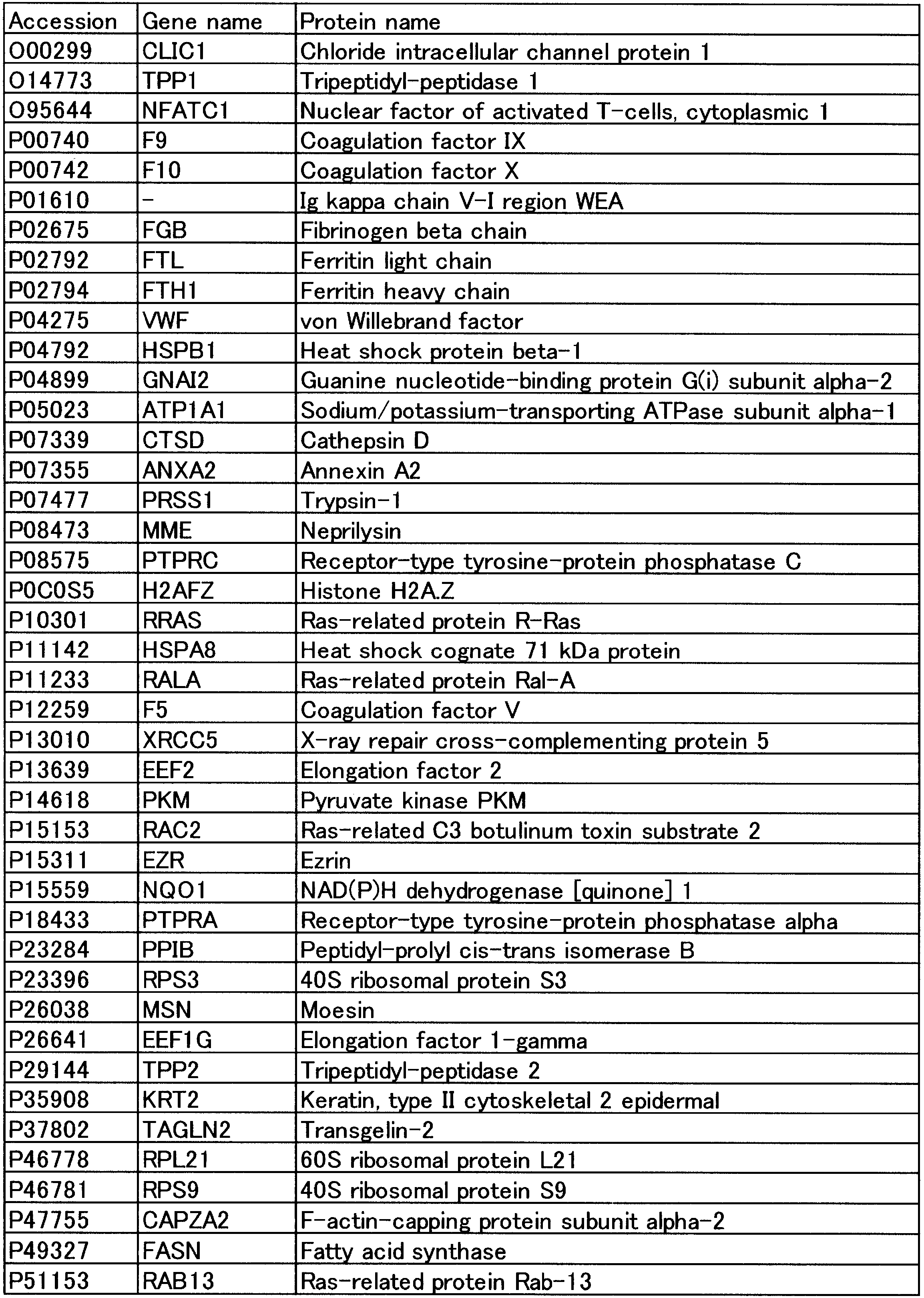

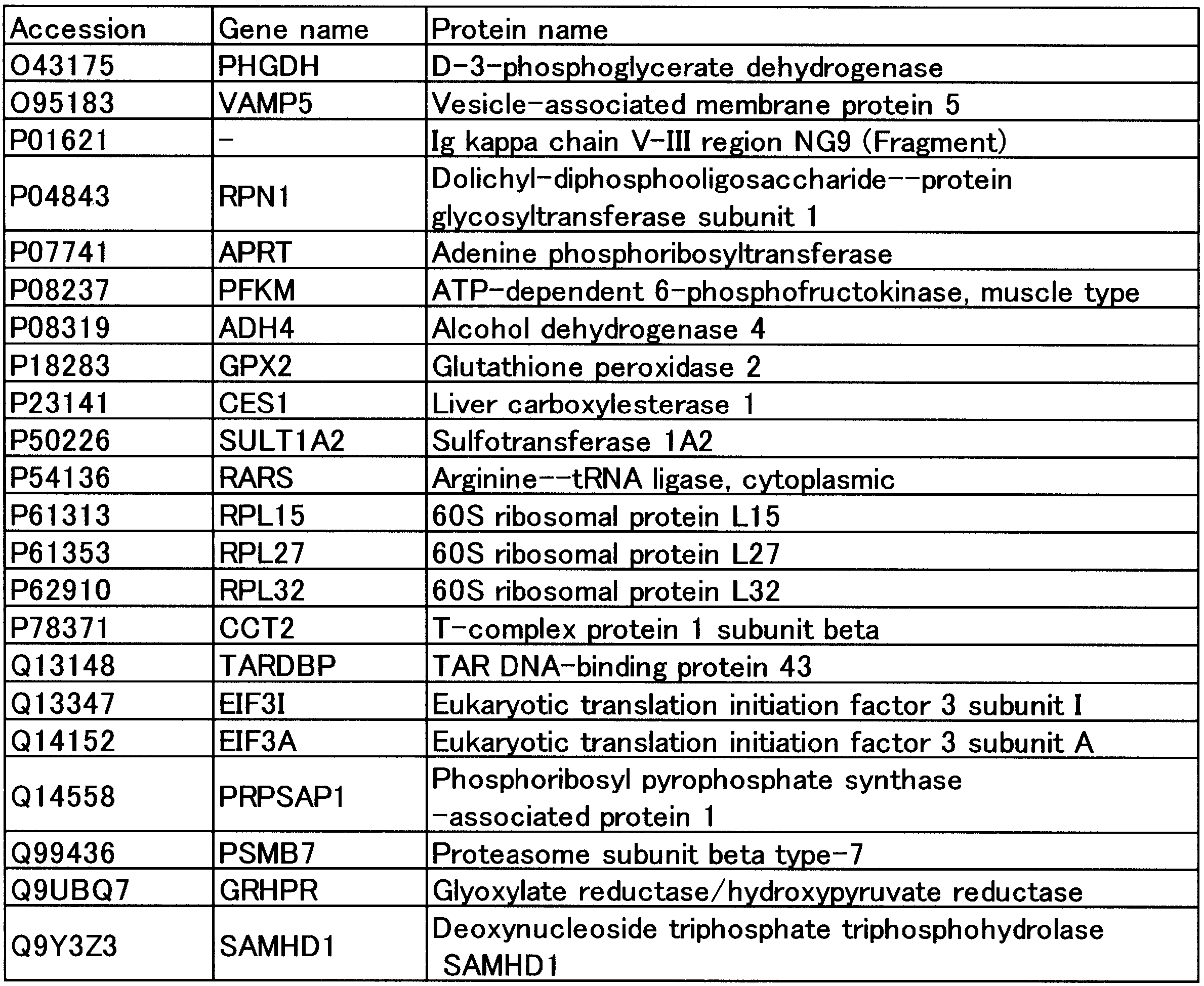

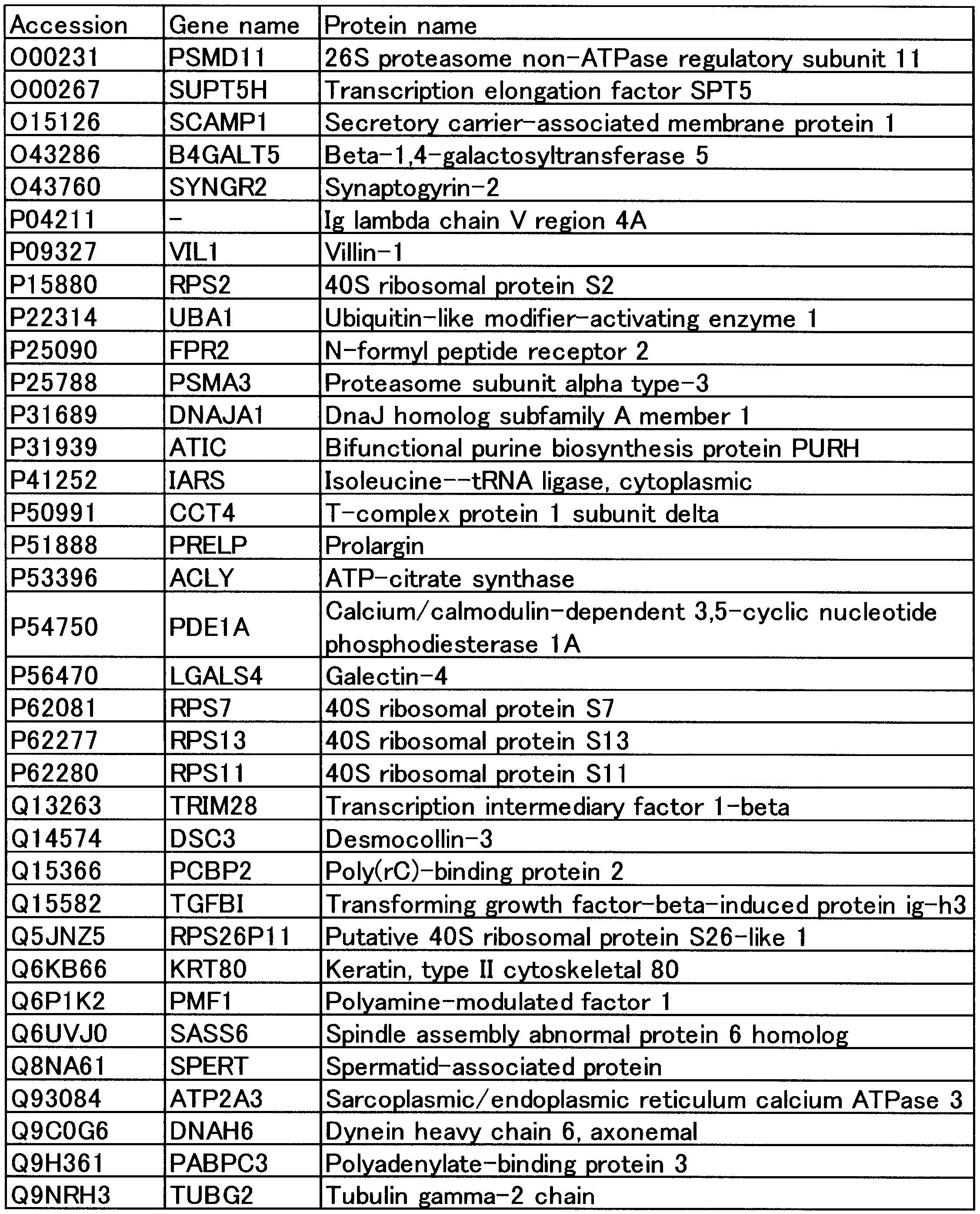
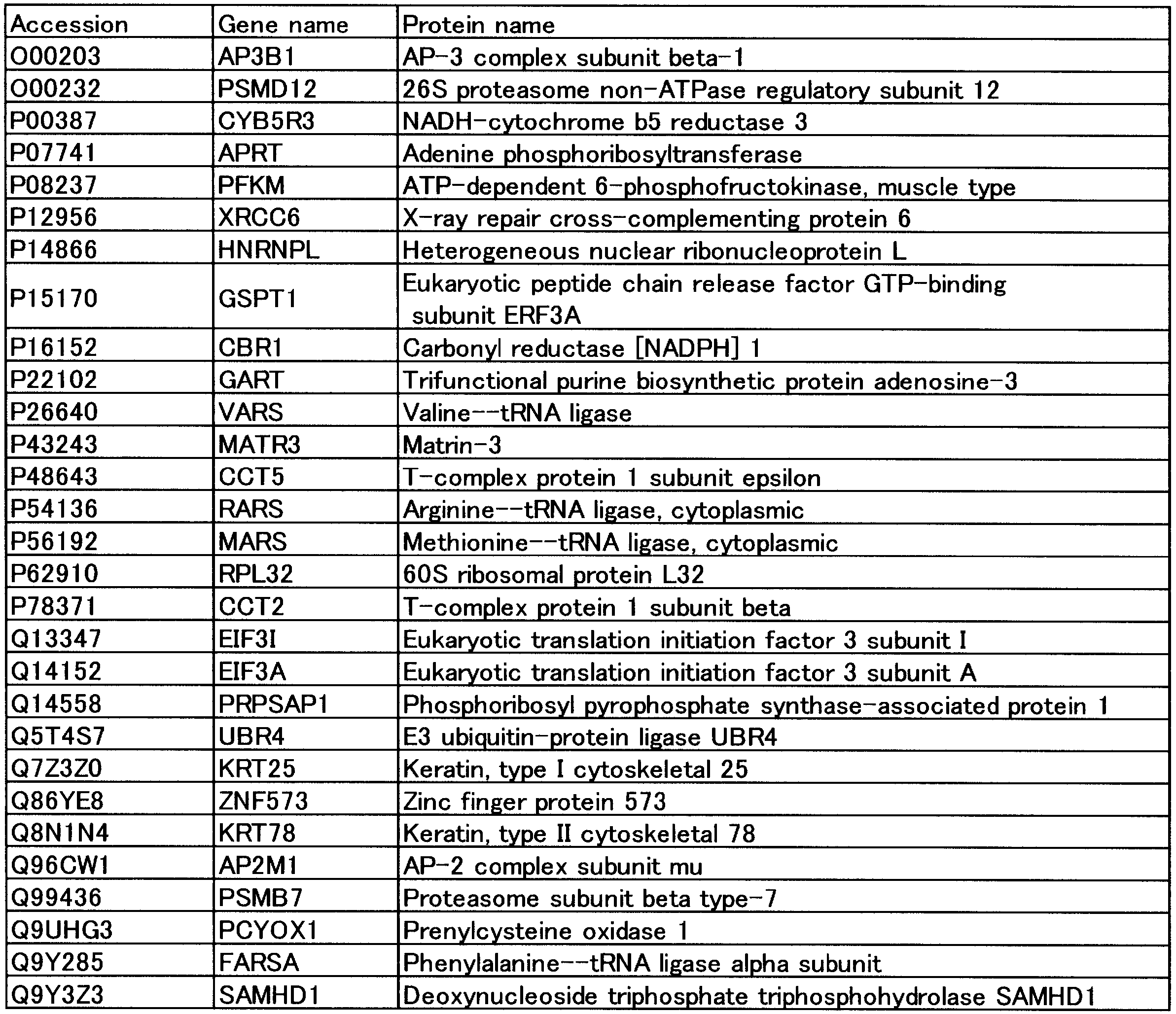
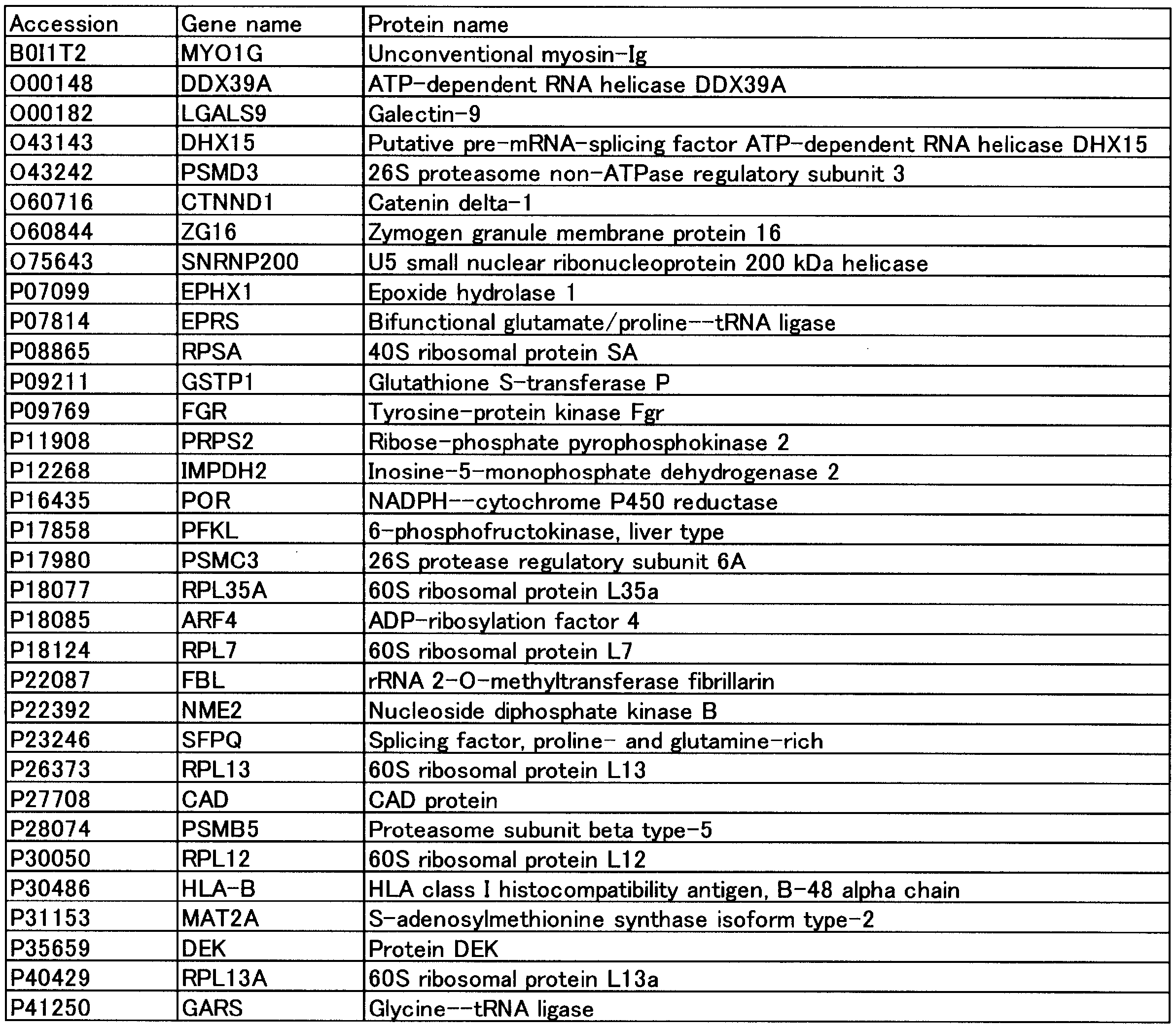
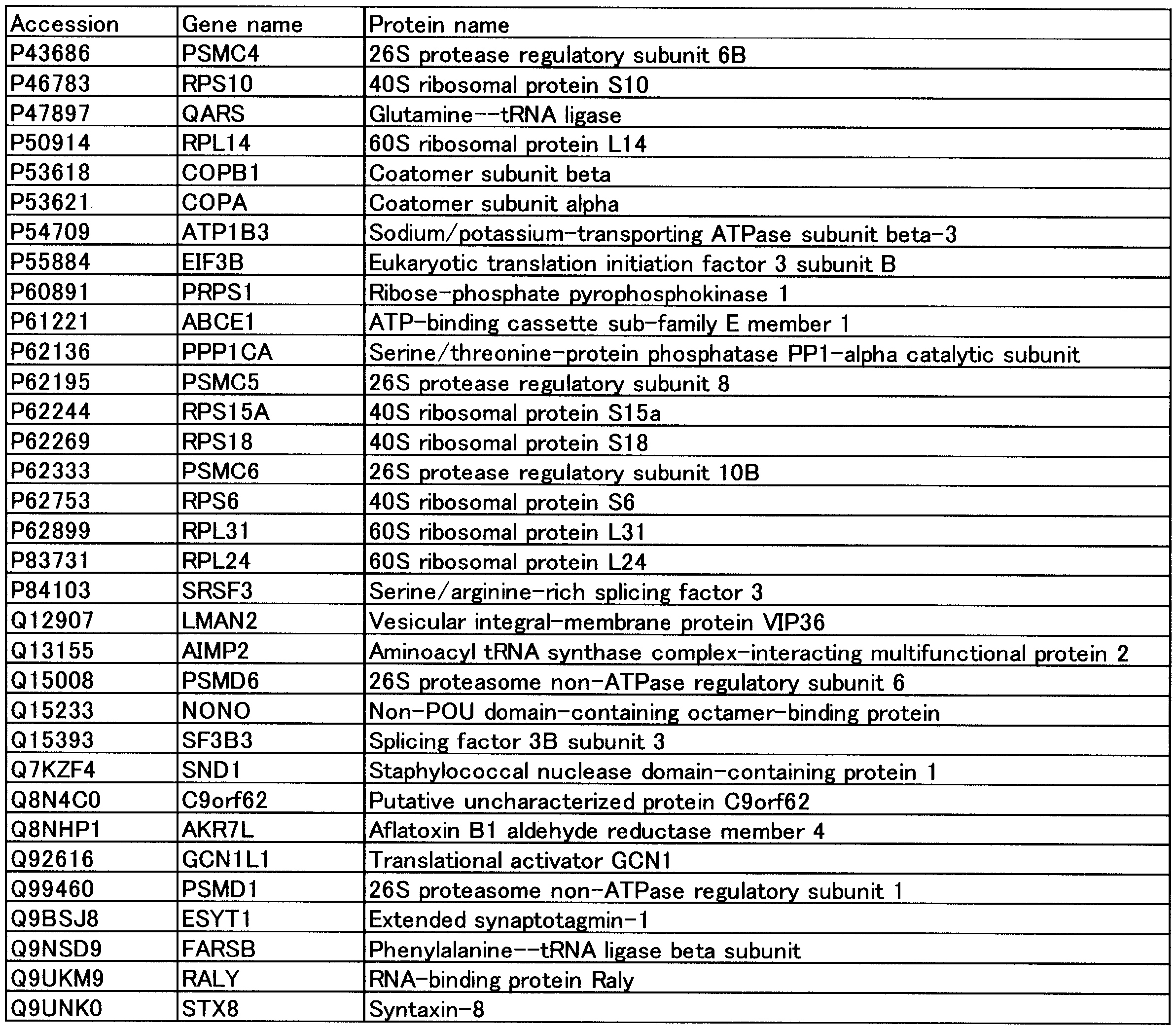

表1のタンパク質中、気管支喘息群のみでコントロール群よりも有意に高かったタンパク質はPutative high mobility group protein B1-like 1、Dynamin-1-like protein、Reticulon-3、Ig kappa chain V-I region Gal、Arginase-1、Guanine nucleotide-binding protein G(k) subunit alpha、Keratin, type I cytoskeletal 16、C-1-tetrahydrofolate synthase, cytoplasmic、Dynamin-2、P2X purinoceptor 1、Rho GDP-dissociation inhibitor 1、Brain acid soluble protein 1、60S ribosomal protein L18a、Solute carrier family 43 member 3、及びReticulon-4であり、中でも気管支喘息群がコントロール群の2倍以上のタンパク質がPutative high mobility group protein B1-like 1、Ig kappa chain V-I region Gal、Arginase-1、Keratin, type I cytoskeletal 16、C-1-tetrahydrofolate synthase, cytoplasmic、Dynamin-2、Brain acid soluble protein 1、Solute carrier family 43 member 3であり、中でも気管支喘息群がコントロール群の5倍以上のタンパク質がC-1-tetrahydrofolate synthase, cytoplasmicであった。
表2~3のタンパク質中、慢性閉塞性肺疾患群のみでコントロール群よりも有意に高かったタンパク質はChloride intracellular channel protein 1、Tripeptidyl-peptidase 1、Nuclear factor of activated T-cells, cytoplasmic 1、Coagulation factor IX、Coagulation factor X、Ig kappa chain V-I region WEA、Fibrinogen beta chain、von Willebrand factor、Heat shock protein beta-1、Guanine nucleotide-binding protein G(i) subunit alpha-2、Sodium/potassium-transporting ATPase subunit alpha-1、Annexin A2、Receptor-type tyrosine-protein phosphatase C、Histone H2A.Z、Ras-related protein R-Ras、Heat shock cognate 71 kDa protein、Ras-related protein Ral-A、Coagulation factor V、Elongation factor 2、Ras-related C3 botulinum toxin substrate 2、Ezrin、Receptor-type tyrosine-protein phosphatase alpha、Peptidyl-prolyl cis-trans isomerase B、40S ribosomal protein S3、Moesin、Tripeptidyl-peptidase 2、Transgelin-2、60S ribosomal protein L21、40S ribosomal protein S9、F-actin-capping protein subunit alpha-2、Fatty acid synthase、Ras-related protein Rab-13、F-actin-capping protein subunit alpha-1、CD81 antigen、Ras-related protein Rab-14、Transforming protein RhoA、60S ribosomal protein L7a、Peptidyl-prolyl cis-trans isomerase A、Tubulin alpha-1B chain、Clathrin heavy chain 1、Lactadherin、EGF-containing fibulin-like extracellular matrix protein 1、Dihydropyrimidinase-related protein 1、Cytoplasmic dynein 1 heavy chain 1、Guanine nucleotide-binding protein subunit alpha-13、Major vault protein、Neutral amino acid transporter B(0)、Synaptophysin-like protein 1、Anoctamin-6、Myosin-14、Aldehyde dehydrogenase family 16 member A1、Oncoprotein-induced transcript 3 protein、V-type proton ATPase 116 kDa subunit a isoform 1、Vacuolar protein sorting-associated protein 35、Charged multivesicular body protein 4a、Rab3 GTPase-activating protein non-catalytic subunit、Methionine adenosyltransferase 2 subunit beta、Leucine--tRNA ligase, cytoplasmic、Histone deacetylase 5、Nck-associated protein 1、RING finger protein 11であり、中でも慢性閉塞性肺疾患群がコントロール群の2倍以上のタンパク質がTripeptidyl-peptidase 1、Nuclear factor of activated T-cells, cytoplasmic 1、Coagulation factor IX、Ig kappa chain V-I region WEA、Fibrinogen beta chain、von Willebrand factor、Heat shock protein beta-1、Sodium/potassium-transporting ATPase subunit alpha-1、Histone H2A.Z、Ras-related protein R-Ras、Elongation factor 2、Ezrin、Receptor-type tyrosine-protein phosphatase alpha、Peptidyl-prolyl cis-trans isomerase B、40S ribosomal protein S3、Tripeptidyl-peptidase 2、Transgelin-2、60S ribosomal protein L21、40S ribosomal protein S9、F-actin-capping protein subunit alpha-2、Fatty acid synthase、CD81 antigen、60S ribosomal protein L7a、Tubulin alpha-1B chain、Clathrin heavy chain 1、Lactadherin、EGF-containing fibulin-like extracellular matrix protein 1、Dihydropyrimidinase-related protein 1、Cytoplasmic dynein 1 heavy chain 1、Major vault protein、Neutral amino acid transporter B(0)、Synaptophysin-like protein 1、Myosin-14、Aldehyde dehydrogenase family 16 member A1、Oncoprotein-induced transcript 3 protein、V-type proton ATPase 116 kDa subunit a isoform 1、Vacuolar protein sorting-associated protein 35、Rab3 GTPase-activating protein non-catalytic subunit、Methionine adenosyltransferase 2 subunit beta、Leucine--tRNA ligase, cytoplasmic、Histone deacetylase 5、Nck-associated protein 1であり、中でも慢性閉塞性肺疾患群がコントロール群の5倍以上のタンパク質がHeat shock protein beta-1、Elongation factor 2、40S ribosomal protein S3、Tripeptidyl-peptidase 2、60S ribosomal protein L21、Clathrin heavy chain 1、Cytoplasmic dynein 1 heavy chain 1、Synaptophysin-like protein 1、Myosin-14であった。
表1~3のタンパク質中、気管支喘息群及び慢性閉塞性肺疾患群の両方でコントロール群よりも有意に高かったタンパク質はFerritin light chain、Ferritin heavy chain、Cathepsin D、Trypsin-1、Neprilysin、X-ray repair cross-complementing protein 5、Pyruvate kinase PKM、NAD(P)H dehydrogenase [quinone] 1、Elongation factor 1-gamma、Keratin, type II cytoskeletal 2 epidermal、Rho GDP-dissociation inhibitor 2、Eukaryotic initiation factor 4A-I、40S ribosomal protein S16、40S ribosomal protein S4, X isoform、GTP-binding nuclear protein Ran、Tubulin beta-4B chain、Heterogeneous nuclear ribonucleoprotein U、60S ribosomal protein L18、ELAV-like protein 1、POTE ankyrin domain family member E、Synaptic vesicle membrane protein VAT-1 homolog、Retinoic acid receptor responder protein 2であり、中でも気管支喘息群及び/又は慢性閉塞性肺疾患群がコントロール群の2倍以上のタンパク質がFerritin light chain、Ferritin heavy chain、Cathepsin D、Trypsin-1、Neprilysin、X-ray repair cross-complementing protein 5、NAD(P)H dehydrogenase [quinone] 1、Elongation factor 1-gamma、Rho GDP-dissociation inhibitor 2、Eukaryotic initiation factor 4A-I、40S ribosomal protein S16、40S ribosomal protein S4, X isoform、GTP-binding nuclear protein Ran、Tubulin beta-4B chain、Heterogeneous nuclear ribonucleoprotein U、60S ribosomal protein L18、ELAV-like protein 1、POTE ankyrin domain family member E、Synaptic vesicle membrane protein VAT-1 homolog、Retinoic acid receptor responder protein 2であり、中でも気管支喘息群及び/又は慢性閉塞性肺疾患群がコントロール群の5倍以上のタンパク質がFerritin light chain、Ferritin heavy chain、Trypsin-1、X-ray repair cross-complementing protein 5、NAD(P)H dehydrogenase [quinone] 1、Elongation factor 1-gamma、Eukaryotic initiation factor 4A-I、40S ribosomal protein S16、40S ribosomal protein S4, X isoform、Tubulin beta-4B chain、Heterogeneous nuclear ribonucleoprotein U、60S ribosomal protein L18であった。
試験例3.血清バイオマーカーとしての有用性の解析
GOLDステージ分類でステージ1-2と診断されたヒト被検体(25名)、GOLDステージ分類でステージ3-4と診断されたヒト被検体(13名)、及び健常ヒト検体(24名)それぞれから採血し、血清を得た。血清を試料として、Tripeptidyl-peptidase 2(TPP2)をELISAで検出した。具体的には、Human tripeptidyl peptidase II ELISA Kit(MyBioSource社製、MBS9337216)を使用して、サンドイッチELISAを行った。
GOLDステージ分類でステージ1-2と診断されたヒト被検体(25名)、GOLDステージ分類でステージ3-4と診断されたヒト被検体(13名)、及び健常ヒト検体(24名)それぞれから採血し、血清を得た。血清を試料として、Tripeptidyl-peptidase 2(TPP2)をELISAで検出した。具体的には、Human tripeptidyl peptidase II ELISA Kit(MyBioSource社製、MBS9337216)を使用して、サンドイッチELISAを行った。
また、ELISAの結果から、AUCを算出した。具体的には、次のとおりである。JMP v. 8.0 (SAS Institute, Cary, NC, USA) を用いた。感度を縦軸、(1-特異度)を横軸にプロットした。マルチマーカーのROCカーブは、TPP2に関してロジスティック回帰分析を行い、予測確率を算出し、その予測確率から同様にROC曲線を描画した。
結果を図1~2に示す。図1~2に示されるように、TPP2は、血清マーカーとしても有用であることが分かった。また、AUCは0.82であった。
Claims (12)
- 閉塞性肺疾患を検査する方法であって、
(1)被検体から採取された体液の細胞外小胞又は血液試料における、タンパク質群(A)、タンパク質群(B)、及びタンパク質群(C):(A)(A1)Putative high mobility group protein B1-like 1、Dynamin-1-like protein、Reticulon-3、Ig kappa chain V-I region Gal、Arginase-1、Guanine nucleotide-binding protein G(k) subunit alpha、Keratin, type I cytoskeletal 16、C-1-tetrahydrofolate synthase, cytoplasmic、Dynamin-2、P2X purinoceptor 1、Rho GDP-dissociation inhibitor 1、Brain acid soluble protein 1、60S ribosomal protein L18a、及びSolute carrier family 43 member 3、Reticulon-4、及び(A2)D-3-phosphoglycerate dehydrogenase、Vesicle-associated membrane protein 5、Ig kappa chain V-III region NG9 (Fragment)、Dolichyl-diphosphooligosaccharide--protein glycosyltransferase subunit 1、Adenine phosphoribosyltransferase、ATP-dependent 6-phosphofructokinase, muscle type、Alcohol dehydrogenase 4、Glutathione peroxidase 2、Liver carboxylesterase 1、Sulfotransferase 1A2、Arginine--tRNA ligase, cytoplasmic、60S ribosomal protein L15、60S ribosomal protein L27、60S ribosomal protein L32、T-complex protein 1 subunit beta、TAR DNA-binding protein 43、Eukaryotic translation initiation factor 3 subunit I、Eukaryotic translation initiation factor 3 subunit A、Phosphoribosyl pyrophosphate synthase-associated protein 1、Proteasome subunit beta type-7、Glyoxylate reductase/hydroxypyruvate reductase、Deoxynucleoside triphosphate triphosphohydrolase SAMHD1、ATP-dependent RNA helicase DDX39A、26S proteasome non-ATPase regulatory subunit 3、Aflatoxin B1 aldehyde reductase member 3、Epoxide hydrolase 1、40S ribosomal protein SA、Glutathione S-transferase P、Tyrosine-protein kinase Fgr、Ribose-phosphate pyrophosphokinase 2、6-phosphofructokinase, liver type、ADP-ribosylation factor 4、60S ribosomal protein L7、S-adenosylmethionine synthase isoform type-2、60S ribosomal protein L13a、26S protease regulatory subunit 6B、Glutamine--tRNA ligase、60S ribosomal protein L14、Coatomer subunit alpha、Eukaryotic translation initiation factor 3 subunit B、Ribose-phosphate pyrophosphokinase 1、Cell division control protein 42 homolog、ATP-binding cassette sub-family E member 1、Serine/threonine-protein phosphatase PP1-alpha catalytic subunit、26S protease regulatory subunit 8、40S ribosomal protein S15a、40S ribosomal protein S18、26S protease regulatory subunit 10B、60S ribosomal protein L31、Neutrophil gelatinase-associated lipocalin、60S ribosomal protein L24、Aminoacyl tRNA synthase complex-interacting multifunctional protein 2、Putative uncharacterized protein C9orf62、26S proteasome non-ATPase regulatory subunit 1、Phenylalanine--tRNA ligase beta subunit、RNA-binding protein Raly、26S proteasome non-ATPase regulatory subunit 11、Transcription elongation factor SPT5、Secretory carrier-associated membrane protein 1、Beta-1,4-galactosyltransferase 5、Synaptogyrin-2、Ig lambda chain V region 4A、Villin-1、40S ribosomal protein S2、Ubiquitin-like modifier-activating enzyme 1、N-formyl peptide receptor 2、Proteasome subunit alpha type-3、DnaJ homolog subfamily A member 1、Bifunctional purine biosynthesis protein PURH、Isoleucine--tRNA ligase, cytoplasmic、T-complex protein 1 subunit delta、Prolargin、ATP-citrate synthase、Calcium/calmodulin-dependent 3,5-cyclic nucleotide phosphodiesterase 1A、Galectin-4、40S ribosomal protein S7、40S ribosomal protein S13、40S ribosomal protein S11、Transcription intermediary factor 1-beta、Desmocollin-3、Poly(rC)-binding protein 2、Transforming growth factor-beta-induced protein ig-h3、Putative 40S ribosomal protein S26-like 1、Keratin, type II cytoskeletal 80、Polyamine-modulated factor 1、Spindle assembly abnormal protein 6 homolog、Spermatid-associated protein、Sarcoplasmic/endoplasmic reticulum calcium ATPase 3、Dynein heavy chain 6, axonemal、Polyadenylate-binding protein 3、及びTubulin gamma-2 chainからなるタンパク質群、
(B)(B1)Chloride intracellular channel protein 1、Tripeptidyl-peptidase 1、Nuclear factor of activated T-cells, cytoplasmic 1、Coagulation factor IX、Coagulation factor X、Ig kappa chain V-I region WEA、Fibrinogen beta chain、von Willebrand factor、Heat shock protein beta-1、Guanine nucleotide-binding protein G(i) subunit alpha-2、Sodium/potassium-transporting ATPase subunit alpha-1、Annexin A2、Receptor-type tyrosine-protein phosphatase C、Histone H2A.Z、Ras-related protein R-Ras、Heat shock cognate 71 kDa protein、Ras-related protein Ral-A、Coagulation factor V、Elongation factor 2、Ras-related C3 botulinum toxin substrate 2、Ezrin、Receptor-type tyrosine-protein phosphatase alpha、Peptidyl-prolyl cis-trans isomerase B、40S ribosomal protein S3、Moesin、Tripeptidyl-peptidase 2、Transgelin-2、60S ribosomal protein L21、40S ribosomal protein S9、F-actin-capping protein subunit alpha-2、Fatty acid synthase、Ras-related protein Rab-13、F-actin-capping protein subunit alpha-1、CD81 antigen、Ras-related protein Rab-14、Transforming protein RhoA、60S ribosomal protein L7a、Peptidyl-prolyl cis-trans isomerase A、Tubulin alpha-1B chain、Clathrin heavy chain 1、Lactadherin、EGF-containing fibulin-like extracellular matrix protein 1、Dihydropyrimidinase-related protein 1、Cytoplasmic dynein 1 heavy chain 1、Guanine nucleotide-binding protein subunit alpha-13、Major vault protein、Neutral amino acid transporter B(0)、Synaptophysin-like protein 1、Anoctamin-6、Myosin-14、Aldehyde dehydrogenase family 16 member A1、Oncoprotein-induced transcript 3 protein、V-type proton ATPase 116 kDa subunit a isoform 1、Vacuolar protein sorting-associated protein 35、Charged multivesicular body protein 4a、Rab3 GTPase-activating protein non-catalytic subunit、Methionine adenosyltransferase 2 subunit beta、Leucine--tRNA ligase, cytoplasmic、Histone deacetylase 5、Nck-associated protein 1、及びRING finger protein 11、及び(B2)AP-3 complex subunit beta-1、26S proteasome non-ATPase regulatory subunit 12、NADH-cytochrome b5 reductase 3、Adenine phosphoribosyltransferase、ATP-dependent 6-phosphofructokinase, muscle type、X-ray repair cross-complementing protein 6、Heterogeneous nuclear ribonucleoprotein L、Eukaryotic peptide chain release factor GTP-binding subunit ERF3A、Carbonyl reductase [NADPH] 1、Trifunctional purine biosynthetic protein adenosine-3、Valine--tRNA ligase、Matrin-3、T-complex protein 1 subunit epsilon、Arginine--tRNA ligase, cytoplasmic、Methionine--tRNA ligase, cytoplasmic、60S ribosomal protein L32、T-complex protein 1 subunit beta、Eukaryotic translation initiation factor 3 subunit I、Eukaryotic translation initiation factor 3 subunit A、Phosphoribosyl pyrophosphate synthase-associated protein 1、E3 ubiquitin-protein ligase UBR4、Keratin, type I cytoskeletal 25、Zinc finger protein 573、Keratin, type II cytoskeletal 78、AP-2 complex subunit mu、Proteasome subunit beta type-7、Prenylcysteine oxidase 1、Phenylalanine--tRNA ligase alpha subunit、Deoxynucleoside triphosphate triphosphohydrolase SAMHD1、Unconventional myosin-Ig、ATP-dependent RNA helicase DDX39A、Galectin-9、Putative pre-mRNA-splicing factor ATP-dependent RNA helicase DHX15、26S proteasome non-ATPase regulatory subunit 3、Catenin delta-1、Zymogen granule membrane protein 16、U5 small nuclear ribonucleoprotein 200 kDa helicase、Epoxide hydrolase 1、Bifunctional glutamate/proline--tRNA ligase、40S ribosomal protein SA、Glutathione S-transferase P、Tyrosine-protein kinase Fgr、Ribose-phosphate pyrophosphokinase 2、Inosine-5-monophosphate dehydrogenase 2、NADPH--cytochrome P450 reductase、6-phosphofructokinase, liver type、26S protease regulatory subunit 6A、60S ribosomal protein L35a、ADP-ribosylation factor 4、60S ribosomal protein L7、rRNA 2-O-methyltransferase fibrillarin、Nucleoside diphosphate kinase B、Splicing factor, proline- and glutamine-rich、60S ribosomal protein L13、CAD protein、Proteasome subunit beta type-5、60S ribosomal protein L12、HLA class I histocompatibility antigen, B-48 alpha chain、S-adenosylmethionine synthase isoform type-2、Protein DEK、60S ribosomal protein L13a、Glycine--tRNA ligase、26S protease regulatory subunit 6B、40S ribosomal protein S10、Glutamine--tRNA ligase、60S ribosomal protein L14、Coatomer subunit beta、Coatomer subunit alpha、Sodium/potassium-transporting ATPase subunit beta-3、Eukaryotic translation initiation factor 3 subunit B、Ribose-phosphate pyrophosphokinase 1、ATP-binding cassette sub-family E member 1、Serine/threonine-protein phosphatase PP1-alpha catalytic subunit、26S protease regulatory subunit 8、40S ribosomal protein S15a、40S ribosomal protein S18、26S protease regulatory subunit 10B、40S ribosomal protein S6、60S ribosomal protein L31、60S ribosomal protein L24、Serine/arginine-rich splicing factor 3、Vesicular integral-membrane protein VIP36、Aminoacyl tRNA synthase complex-interacting multifunctional protein 2、26S proteasome non-ATPase regulatory subunit 6、Non-POU domain-containing octamer-binding protein、Splicing factor 3B subunit 3、Staphylococcal nuclease domain-containing protein 1、Putative uncharacterized protein C9orf62、Aflatoxin B1 aldehyde reductase member 4、Translational activator GCN1、26S proteasome non-ATPase regulatory subunit 1、Extended synaptotagmin-1、Phenylalanine--tRNA ligase beta subunit、RNA-binding protein Raly、Syntaxin-8、26S proteasome non-ATPase regulatory subunit 11、Secretory carrier-associated membrane protein 1、Beta-1,4-galactosyltransferase 5、Synaptogyrin-2、Ig lambda chain V region 4A、Villin-1、40S ribosomal protein S2、60S ribosomal protein L17、Ras-related protein Rab-5A、N-formyl peptide receptor 2、Proteasome subunit alpha type-3、CD82 antigen、Proteasome subunit alpha type-5、HLA class I histocompatibility antigen, A-23 alpha chain、DnaJ homolog subfamily A member 1、Bifunctional purine biosynthesis protein PURH、Guanine nucleotide-binding protein G(olf) subunit alpha、Isoleucine--tRNA ligase, cytoplasmic、T-complex protein 1 subunit delta、Prolargin、ATP-citrate synthase、Calcium/calmodulin-dependent 3,5-cyclic nucleotide phosphodiesterase 1A、Galectin-4、40S ribosomal protein S7、40S ribosomal protein S13、40S ribosomal protein S11、FACT complex subunit SSRP1、Interleukin enhancer-binding factor 3、Transcription intermediary factor 1-beta、Acid ceramidase、Desmocollin-3、Poly(rC)-binding protein 2、GTP-binding protein Rheb、Transforming growth factor-beta-induced protein ig-h3、Putative 40S ribosomal protein S26-like 1、E3 ubiquitin-protein ligase MARCH8、Polyamine-modulated factor 1、Spermatid-associated protein、Lipoma-preferred partner、Protein FAM65C、Dynein heavy chain 6, axonemal、Polyadenylate-binding protein 3、Tubulin gamma-2 chain、及びADP-ribosylation factor-like protein 8Bからなるタンパク質群、並びに
(C)Ferritin light chain、Ferritin heavy chain、Cathepsin D、Trypsin-1、Neprilysin、X-ray repair cross-complementing protein 5、Pyruvate kinase PKM、NAD(P)H dehydrogenase [quinone] 1、Elongation factor 1-gamma、Keratin, type II cytoskeletal 2 epidermal、Rho GDP-dissociation inhibitor 2、Eukaryotic initiation factor 4A-I、40S ribosomal protein S16、40S ribosomal protein S4, X isoform、GTP-binding nuclear protein Ran、Tubulin beta-4B chain、Heterogeneous nuclear ribonucleoprotein U、60S ribosomal protein L18、ELAV-like protein 1、POTE ankyrin domain family member E、Synaptic vesicle membrane protein VAT-1 homolog、及びRetinoic acid receptor responder protein 2からなるタンパク質群からなる群より選択される少なくとも1種のタンパク質を検出する工程を含む、検査方法。 - さらに、(2)前記工程(1)で検出されたタンパク質の量又は濃度がカットオフ値以上である場合に、前記被検体が閉塞性肺疾患に罹患していると判定する工程を含む、請求項1に記載の検査方法。
- 前記工程(2)が、
(2a)前記タンパク質群(A)及び前記タンパク質群(C)からなる群より選択される少なくとも1種のタンパク質の量又は濃度がカットオフ値以上である場合に、前記被検体が気管支喘息に罹患していると判定する工程、
(2b)前記タンパク質群(B)及び前記タンパク質群(C)からなる群より選択される少なくとも1種のタンパク質の量又は濃度がカットオフ値以上である場合に、前記被検体が慢性閉塞性肺疾患に罹患していると判定する工程、
(2c)前記タンパク質群(A)から選択される少なくとも1種のタンパク質の量又は濃度がカットオフ値以上である場合に、前記被検体が慢性閉塞性肺疾患非合併型の気管支喘息に罹患していると判定する工程、
(2d)前記タンパク質群(B)から選択される少なくとも1種のタンパク質の量又は濃度がカットオフ値以上である場合に、前記被検体が気管支喘息非合併型の慢性閉塞性肺疾患に罹患していると判定する工程、並びに
(2e)前記タンパク質群(C)から選択される少なくとも1種のタンパク質の量又は濃度がカットオフ値以上である場合に、前記被検体が気管支喘息及び慢性閉塞性肺疾患の両方に罹患していると判定する工程
からなる群より選択される少なくとも1種の工程である、請求項2に記載の検査方法。 - 前記カットオフ値が、閉塞性肺疾患に罹患していない被検体から採取された体液の細胞外小胞又は血液試料における対応タンパク質の量又は濃度の値の、2.5~6倍の値である、請求項2又は3に記載の検査方法。
- 前記体液が全血、血漿、及び血清からなる群より選択される少なくとも1種である、請求項1~4のいずれかに記載の検査方法。
- 前記被検体がヒトである、請求項1~5のいずれかに記載の検査方法。
- 閉塞性肺疾患を検査する方法であって、
(1)被検体から採取された体液の細胞外小胞又は血液試料における、Tripeptidyl-peptidase 2を含む1種又は複数種のタンパク質を検出する工程を含む、検査方法。 - タンパク質群(A)、タンパク質群(B)、及びタンパク質群(C):
(A)(A1)Putative high mobility group protein B1-like 1、Dynamin-1-like protein、Reticulon-3、Ig kappa chain V-I region Gal、Arginase-1、Guanine nucleotide-binding protein G(k) subunit alpha、Keratin, type I cytoskeletal 16、C-1-tetrahydrofolate synthase, cytoplasmic、Dynamin-2、P2X purinoceptor 1、Rho GDP-dissociation inhibitor 1、Brain acid soluble protein 1、60S ribosomal protein L18a、及びSolute carrier family 43 member 3、Reticulon-4、及び(A2)D-3-phosphoglycerate dehydrogenase、Vesicle-associated membrane protein 5、Ig kappa chain V-III region NG9 (Fragment)、Dolichyl-diphosphooligosaccharide--protein glycosyltransferase subunit 1、Adenine phosphoribosyltransferase、ATP-dependent 6-phosphofructokinase, muscle type、Alcohol dehydrogenase 4、Glutathione peroxidase 2、Liver carboxylesterase 1、Sulfotransferase 1A2、Arginine--tRNA ligase, cytoplasmic、60S ribosomal protein L15、60S ribosomal protein L27、60S ribosomal protein L32、T-complex protein 1 subunit beta、TAR DNA-binding protein 43、Eukaryotic translation initiation factor 3 subunit I、Eukaryotic translation initiation factor 3 subunit A、Phosphoribosyl pyrophosphate synthase-associated protein 1、Proteasome subunit beta type-7、Glyoxylate reductase/hydroxypyruvate reductase、Deoxynucleoside triphosphate triphosphohydrolase SAMHD1、ATP-dependent RNA helicase DDX39A、26S proteasome non-ATPase regulatory subunit 3、Aflatoxin B1 aldehyde reductase member 3、Epoxide hydrolase 1、40S ribosomal protein SA、Glutathione S-transferase P、Tyrosine-protein kinase Fgr、Ribose-phosphate pyrophosphokinase 2、6-phosphofructokinase, liver type、ADP-ribosylation factor 4、60S ribosomal protein L7、S-adenosylmethionine synthase isoform type-2、60S ribosomal protein L13a、26S protease regulatory subunit 6B、Glutamine--tRNA ligase、60S ribosomal protein L14、Coatomer subunit alpha、Eukaryotic translation initiation factor 3 subunit B、Ribose-phosphate pyrophosphokinase 1、Cell division control protein 42 homolog、ATP-binding cassette sub-family E member 1、Serine/threonine-protein phosphatase PP1-alpha catalytic subunit、26S protease regulatory subunit 8、40S ribosomal protein S15a、40S ribosomal protein S18、26S protease regulatory subunit 10B、60S ribosomal protein L31、Neutrophil gelatinase-associated lipocalin、60S ribosomal protein L24、Aminoacyl tRNA synthase complex-interacting multifunctional protein 2、Putative uncharacterized protein C9orf62、26S proteasome non-ATPase regulatory subunit 1、Phenylalanine--tRNA ligase beta subunit、RNA-binding protein Raly、26S proteasome non-ATPase regulatory subunit 11、Transcription elongation factor SPT5、Secretory carrier-associated membrane protein 1、Beta-1,4-galactosyltransferase 5、Synaptogyrin-2、Ig lambda chain V region 4A、Villin-1、40S ribosomal protein S2、Ubiquitin-like modifier-activating enzyme 1、N-formyl peptide receptor 2、Proteasome subunit alpha type-3、DnaJ homolog subfamily A member 1、Bifunctional purine biosynthesis protein PURH、Isoleucine--tRNA ligase, cytoplasmic、T-complex protein 1 subunit delta、Prolargin、ATP-citrate synthase、Calcium/calmodulin-dependent 3,5-cyclic nucleotide phosphodiesterase 1A、Galectin-4、40S ribosomal protein S7、40S ribosomal protein S13、40S ribosomal protein S11、Transcription intermediary factor 1-beta、Desmocollin-3、Poly(rC)-binding protein 2、Transforming growth factor-beta-induced protein ig-h3、Putative 40S ribosomal protein S26-like 1、Keratin, type II cytoskeletal 80、Polyamine-modulated factor 1、Spindle assembly abnormal protein 6 homolog、Spermatid-associated protein、Sarcoplasmic/endoplasmic reticulum calcium ATPase 3、Dynein heavy chain 6, axonemal、Polyadenylate-binding protein 3、及びTubulin gamma-2 chainからなるタンパク質群、
(B)(B1)Chloride intracellular channel protein 1、Tripeptidyl-peptidase 1、Nuclear factor of activated T-cells, cytoplasmic 1、Coagulation factor IX、Coagulation factor X、Ig kappa chain V-I region WEA、Fibrinogen beta chain、von Willebrand factor、Heat shock protein beta-1、Guanine nucleotide-binding protein G(i) subunit alpha-2、Sodium/potassium-transporting ATPase subunit alpha-1、Annexin A2、Receptor-type tyrosine-protein phosphatase C、Histone H2A.Z、Ras-related protein R-Ras、Heat shock cognate 71 kDa protein、Ras-related protein Ral-A、Coagulation factor V、Elongation factor 2、Ras-related C3 botulinum toxin substrate 2、Ezrin、Receptor-type tyrosine-protein phosphatase alpha、Peptidyl-prolyl cis-trans isomerase B、40S ribosomal protein S3、Moesin、Tripeptidyl-peptidase 2、Transgelin-2、60S ribosomal protein L21、40S ribosomal protein S9、F-actin-capping protein subunit alpha-2、Fatty acid synthase、Ras-related protein Rab-13、F-actin-capping protein subunit alpha-1、CD81 antigen、Ras-related protein Rab-14、Transforming protein RhoA、60S ribosomal protein L7a、Peptidyl-prolyl cis-trans isomerase A、Tubulin alpha-1B chain、Clathrin heavy chain 1、Lactadherin、EGF-containing fibulin-like extracellular matrix protein 1、Dihydropyrimidinase-related protein 1、Cytoplasmic dynein 1 heavy chain 1、Guanine nucleotide-binding protein subunit alpha-13、Major vault protein、Neutral amino acid transporter B(0)、Synaptophysin-like protein 1、Anoctamin-6、Myosin-14、Aldehyde dehydrogenase family 16 member A1、Oncoprotein-induced transcript 3 protein、V-type proton ATPase 116 kDa subunit a isoform 1、Vacuolar protein sorting-associated protein 35、Charged multivesicular body protein 4a、Rab3 GTPase-activating protein non-catalytic subunit、Methionine adenosyltransferase 2 subunit beta、Leucine--tRNA ligase, cytoplasmic、Histone deacetylase 5、Nck-associated protein 1、及びRING finger protein 11、及び(B2)AP-3 complex subunit beta-1、26S proteasome non-ATPase regulatory subunit 12、NADH-cytochrome b5 reductase 3、Adenine phosphoribosyltransferase、ATP-dependent 6-phosphofructokinase, muscle type、X-ray repair cross-complementing protein 6、Heterogeneous nuclear ribonucleoprotein L、Eukaryotic peptide chain release factor GTP-binding subunit ERF3A、Carbonyl reductase [NADPH] 1、Trifunctional purine biosynthetic protein adenosine-3、Valine--tRNA ligase、Matrin-3、T-complex protein 1 subunit epsilon、Arginine--tRNA ligase, cytoplasmic、Methionine--tRNA ligase, cytoplasmic、60S ribosomal protein L32、T-complex protein 1 subunit beta、Eukaryotic translation initiation factor 3 subunit I、Eukaryotic translation initiation factor 3 subunit A、Phosphoribosyl pyrophosphate synthase-associated protein 1、E3 ubiquitin-protein ligase UBR4、Keratin, type I cytoskeletal 25、Zinc finger protein 573、Keratin, type II cytoskeletal 78、AP-2 complex subunit mu、Proteasome subunit beta type-7、Prenylcysteine oxidase 1、Phenylalanine--tRNA ligase alpha subunit、Deoxynucleoside triphosphate triphosphohydrolase SAMHD1、Unconventional myosin-Ig、ATP-dependent RNA helicase DDX39A、Galectin-9、Putative pre-mRNA-splicing factor ATP-dependent RNA helicase DHX15、26S proteasome non-ATPase regulatory subunit 3、Catenin delta-1、Zymogen granule membrane protein 16、U5 small nuclear ribonucleoprotein 200 kDa helicase、Epoxide hydrolase 1、Bifunctional glutamate/proline--tRNA ligase、40S ribosomal protein SA、Glutathione S-transferase P、Tyrosine-protein kinase Fgr、Ribose-phosphate pyrophosphokinase 2、Inosine-5-monophosphate dehydrogenase 2、NADPH--cytochrome P450 reductase、6-phosphofructokinase, liver type、26S protease regulatory subunit 6A、60S ribosomal protein L35a、ADP-ribosylation factor 4、60S ribosomal protein L7、rRNA 2-O-methyltransferase fibrillarin、Nucleoside diphosphate kinase B、Splicing factor, proline- and glutamine-rich、60S ribosomal protein L13、CAD protein、Proteasome subunit beta type-5、60S ribosomal protein L12、HLA class I histocompatibility antigen, B-48 alpha chain、S-adenosylmethionine synthase isoform type-2、Protein DEK、60S ribosomal protein L13a、Glycine--tRNA ligase、26S protease regulatory subunit 6B、40S ribosomal protein S10、Glutamine--tRNA ligase、60S ribosomal protein L14、Coatomer subunit beta、Coatomer subunit alpha、Sodium/potassium-transporting ATPase subunit beta-3、Eukaryotic translation initiation factor 3 subunit B、Ribose-phosphate pyrophosphokinase 1、ATP-binding cassette sub-family E member 1、Serine/threonine-protein phosphatase PP1-alpha catalytic subunit、26S protease regulatory subunit 8、40S ribosomal protein S15a、40S ribosomal protein S18、26S protease regulatory subunit 10B、40S ribosomal protein S6、60S ribosomal protein L31、60S ribosomal protein L24、Serine/arginine-rich splicing factor 3、Vesicular integral-membrane protein VIP36、Aminoacyl tRNA synthase complex-interacting multifunctional protein 2、26S proteasome non-ATPase regulatory subunit 6、Non-POU domain-containing octamer-binding protein、Splicing factor 3B subunit 3、Staphylococcal nuclease domain-containing protein 1、Putative uncharacterized protein C9orf62、Aflatoxin B1 aldehyde reductase member 4、Translational activator GCN1、26S proteasome non-ATPase regulatory subunit 1、Extended synaptotagmin-1、Phenylalanine--tRNA ligase beta subunit、RNA-binding protein Raly、Syntaxin-8、26S proteasome non-ATPase regulatory subunit 11、Secretory carrier-associated membrane protein 1、Beta-1,4-galactosyltransferase 5、Synaptogyrin-2、Ig lambda chain V region 4A、Villin-1、40S ribosomal protein S2、60S ribosomal protein L17、Ras-related protein Rab-5A、N-formyl peptide receptor 2、Proteasome subunit alpha type-3、CD82 antigen、Proteasome subunit alpha type-5、HLA class I histocompatibility antigen, A-23 alpha chain、DnaJ homolog subfamily A member 1、Bifunctional purine biosynthesis protein PURH、Guanine nucleotide-binding protein G(olf) subunit alpha、Isoleucine--tRNA ligase, cytoplasmic、T-complex protein 1 subunit delta、Prolargin、ATP-citrate synthase、Calcium/calmodulin-dependent 3,5-cyclic nucleotide phosphodiesterase 1A、Galectin-4、40S ribosomal protein S7、40S ribosomal protein S13、40S ribosomal protein S11、FACT complex subunit SSRP1、Interleukin enhancer-binding factor 3、Transcription intermediary factor 1-beta、Acid ceramidase、Desmocollin-3、Poly(rC)-binding protein 2、GTP-binding protein Rheb、Transforming growth factor-beta-induced protein ig-h3、Putative 40S ribosomal protein S26-like 1、E3 ubiquitin-protein ligase MARCH8、Polyamine-modulated factor 1、Spermatid-associated protein、Lipoma-preferred partner、Protein FAM65C、Dynein heavy chain 6, axonemal、Polyadenylate-binding protein 3、Tubulin gamma-2 chain、及びADP-ribosylation factor-like protein 8Bからなるタンパク質群、並びに
(C)Ferritin light chain、Ferritin heavy chain、Cathepsin D、Trypsin-1、Neprilysin、X-ray repair cross-complementing protein 5、Pyruvate kinase PKM、NAD(P)H dehydrogenase [quinone] 1、Elongation factor 1-gamma、Keratin, type II cytoskeletal 2 epidermal、Rho GDP-dissociation inhibitor 2、Eukaryotic initiation factor 4A-I、40S ribosomal protein S16、40S ribosomal protein S4, X isoform、GTP-binding nuclear protein Ran、Tubulin beta-4B chain、Heterogeneous nuclear ribonucleoprotein U、60S ribosomal protein L18、ELAV-like protein 1、POTE ankyrin domain family member E、Synaptic vesicle membrane protein VAT-1 homolog、及びRetinoic acid receptor responder protein 2からなるタンパク質群
からなる群より選択される少なくとも1種のタンパク質の検出剤を含む、閉塞性肺疾患の検査薬。 - タンパク質群(A)、タンパク質群(B)、及びタンパク質群(C):
(A)(A1)Putative high mobility group protein B1-like 1、Dynamin-1-like protein、Reticulon-3、Ig kappa chain V-I region Gal、Arginase-1、Guanine nucleotide-binding protein G(k) subunit alpha、Keratin, type I cytoskeletal 16、C-1-tetrahydrofolate synthase, cytoplasmic、Dynamin-2、P2X purinoceptor 1、Rho GDP-dissociation inhibitor 1、Brain acid soluble protein 1、60S ribosomal protein L18a、及びSolute carrier family 43 member 3、Reticulon-4、及び(A2)D-3-phosphoglycerate dehydrogenase、Vesicle-associated membrane protein 5、Ig kappa chain V-III region NG9 (Fragment)、Dolichyl-diphosphooligosaccharide--protein glycosyltransferase subunit 1、Adenine phosphoribosyltransferase、ATP-dependent 6-phosphofructokinase, muscle type、Alcohol dehydrogenase 4、Glutathione peroxidase 2、Liver carboxylesterase 1、Sulfotransferase 1A2、Arginine--tRNA ligase, cytoplasmic、60S ribosomal protein L15、60S ribosomal protein L27、60S ribosomal protein L32、T-complex protein 1 subunit beta、TAR DNA-binding protein 43、Eukaryotic translation initiation factor 3 subunit I、Eukaryotic translation initiation factor 3 subunit A、Phosphoribosyl pyrophosphate synthase-associated protein 1、Proteasome subunit beta type-7、Glyoxylate reductase/hydroxypyruvate reductase、Deoxynucleoside triphosphate triphosphohydrolase SAMHD1、ATP-dependent RNA helicase DDX39A、26S proteasome non-ATPase regulatory subunit 3、Aflatoxin B1 aldehyde reductase member 3、Epoxide hydrolase 1、40S ribosomal protein SA、Glutathione S-transferase P、Tyrosine-protein kinase Fgr、Ribose-phosphate pyrophosphokinase 2、6-phosphofructokinase, liver type、ADP-ribosylation factor 4、60S ribosomal protein L7、S-adenosylmethionine synthase isoform type-2、60S ribosomal protein L13a、26S protease regulatory subunit 6B、Glutamine--tRNA ligase、60S ribosomal protein L14、Coatomer subunit alpha、Eukaryotic translation initiation factor 3 subunit B、Ribose-phosphate pyrophosphokinase 1、Cell division control protein 42 homolog、ATP-binding cassette sub-family E member 1、Serine/threonine-protein phosphatase PP1-alpha catalytic subunit、26S protease regulatory subunit 8、40S ribosomal protein S15a、40S ribosomal protein S18、26S protease regulatory subunit 10B、60S ribosomal protein L31、Neutrophil gelatinase-associated lipocalin、60S ribosomal protein L24、Aminoacyl tRNA synthase complex-interacting multifunctional protein 2、Putative uncharacterized protein C9orf62、26S proteasome non-ATPase regulatory subunit 1、Phenylalanine--tRNA ligase beta subunit、RNA-binding protein Raly、26S proteasome non-ATPase regulatory subunit 11、Transcription elongation factor SPT5、Secretory carrier-associated membrane protein 1、Beta-1,4-galactosyltransferase 5、Synaptogyrin-2、Ig lambda chain V region 4A、Villin-1、40S ribosomal protein S2、Ubiquitin-like modifier-activating enzyme 1、N-formyl peptide receptor 2、Proteasome subunit alpha type-3、DnaJ homolog subfamily A member 1、Bifunctional purine biosynthesis protein PURH、Isoleucine--tRNA ligase, cytoplasmic、T-complex protein 1 subunit delta、Prolargin、ATP-citrate synthase、Calcium/calmodulin-dependent 3,5-cyclic nucleotide phosphodiesterase 1A、Galectin-4、40S ribosomal protein S7、40S ribosomal protein S13、40S ribosomal protein S11、Transcription intermediary factor 1-beta、Desmocollin-3、Poly(rC)-binding protein 2、Transforming growth factor-beta-induced protein ig-h3、Putative 40S ribosomal protein S26-like 1、Keratin, type II cytoskeletal 80、Polyamine-modulated factor 1、Spindle assembly abnormal protein 6 homolog、Spermatid-associated protein、Sarcoplasmic/endoplasmic reticulum calcium ATPase 3、Dynein heavy chain 6, axonemal、Polyadenylate-binding protein 3、及びTubulin gamma-2 chainからなるタンパク質群、
(B)(B1)Chloride intracellular channel protein 1、Tripeptidyl-peptidase 1、Nuclear factor of activated T-cells, cytoplasmic 1、Coagulation factor IX、Coagulation factor X、Ig kappa chain V-I region WEA、Fibrinogen beta chain、von Willebrand factor、Heat shock protein beta-1、Guanine nucleotide-binding protein G(i) subunit alpha-2、Sodium/potassium-transporting ATPase subunit alpha-1、Annexin A2、Receptor-type tyrosine-protein phosphatase C、Histone H2A.Z、Ras-related protein R-Ras、Heat shock cognate 71 kDa protein、Ras-related protein Ral-A、Coagulation factor V、Elongation factor 2、Ras-related C3 botulinum toxin substrate 2、Ezrin、Receptor-type tyrosine-protein phosphatase alpha、Peptidyl-prolyl cis-trans isomerase B、40S ribosomal protein S3、Moesin、Tripeptidyl-peptidase 2、Transgelin-2、60S ribosomal protein L21、40S ribosomal protein S9、F-actin-capping protein subunit alpha-2、Fatty acid synthase、Ras-related protein Rab-13、F-actin-capping protein subunit alpha-1、CD81 antigen、Ras-related protein Rab-14、Transforming protein RhoA、60S ribosomal protein L7a、Peptidyl-prolyl cis-trans isomerase A、Tubulin alpha-1B chain、Clathrin heavy chain 1、Lactadherin、EGF-containing fibulin-like extracellular matrix protein 1、Dihydropyrimidinase-related protein 1、Cytoplasmic dynein 1 heavy chain 1、Guanine nucleotide-binding protein subunit alpha-13、Major vault protein、Neutral amino acid transporter B(0)、Synaptophysin-like protein 1、Anoctamin-6、Myosin-14、Aldehyde dehydrogenase family 16 member A1、Oncoprotein-induced transcript 3 protein、V-type proton ATPase 116 kDa subunit a isoform 1、Vacuolar protein sorting-associated protein 35、Charged multivesicular body protein 4a、Rab3 GTPase-activating protein non-catalytic subunit、Methionine adenosyltransferase 2 subunit beta、Leucine--tRNA ligase, cytoplasmic、Histone deacetylase 5、Nck-associated protein 1、及びRING finger protein 11、及び(B2)AP-3 complex subunit beta-1、26S proteasome non-ATPase regulatory subunit 12、NADH-cytochrome b5 reductase 3、Adenine phosphoribosyltransferase、ATP-dependent 6-phosphofructokinase, muscle type、X-ray repair cross-complementing protein 6、Heterogeneous nuclear ribonucleoprotein L、Eukaryotic peptide chain release factor GTP-binding subunit ERF3A、Carbonyl reductase [NADPH] 1、Trifunctional purine biosynthetic protein adenosine-3、Valine--tRNA ligase、Matrin-3、T-complex protein 1 subunit epsilon、Arginine--tRNA ligase, cytoplasmic、Methionine--tRNA ligase, cytoplasmic、60S ribosomal protein L32、T-complex protein 1 subunit beta、Eukaryotic translation initiation factor 3 subunit I、Eukaryotic translation initiation factor 3 subunit A、Phosphoribosyl pyrophosphate synthase-associated protein 1、E3 ubiquitin-protein ligase UBR4、Keratin, type I cytoskeletal 25、Zinc finger protein 573、Keratin, type II cytoskeletal 78、AP-2 complex subunit mu、Proteasome subunit beta type-7、Prenylcysteine oxidase 1、Phenylalanine--tRNA ligase alpha subunit、Deoxynucleoside triphosphate triphosphohydrolase SAMHD1、Unconventional myosin-Ig、ATP-dependent RNA helicase DDX39A、Galectin-9、Putative pre-mRNA-splicing factor ATP-dependent RNA helicase DHX15、26S proteasome non-ATPase regulatory subunit 3、Catenin delta-1、Zymogen granule membrane protein 16、U5 small nuclear ribonucleoprotein 200 kDa helicase、Epoxide hydrolase 1、Bifunctional glutamate/proline--tRNA ligase、40S ribosomal protein SA、Glutathione S-transferase P、Tyrosine-protein kinase Fgr、Ribose-phosphate pyrophosphokinase 2、Inosine-5-monophosphate dehydrogenase 2、NADPH--cytochrome P450 reductase、6-phosphofructokinase, liver type、26S protease regulatory subunit 6A、60S ribosomal protein L35a、ADP-ribosylation factor 4、60S ribosomal protein L7、rRNA 2-O-methyltransferase fibrillarin、Nucleoside diphosphate kinase B、Splicing factor, proline- and glutamine-rich、60S ribosomal protein L13、CAD protein、Proteasome subunit beta type-5、60S ribosomal protein L12、HLA class I histocompatibility antigen, B-48 alpha chain、S-adenosylmethionine synthase isoform type-2、Protein DEK、60S ribosomal protein L13a、Glycine--tRNA ligase、26S protease regulatory subunit 6B、40S ribosomal protein S10、Glutamine--tRNA ligase、60S ribosomal protein L14、Coatomer subunit beta、Coatomer subunit alpha、Sodium/potassium-transporting ATPase subunit beta-3、Eukaryotic translation initiation factor 3 subunit B、Ribose-phosphate pyrophosphokinase 1、ATP-binding cassette sub-family E member 1、Serine/threonine-protein phosphatase PP1-alpha catalytic subunit、26S protease regulatory subunit 8、40S ribosomal protein S15a、40S ribosomal protein S18、26S protease regulatory subunit 10B、40S ribosomal protein S6、60S ribosomal protein L31、60S ribosomal protein L24、Serine/arginine-rich splicing factor 3、Vesicular integral-membrane protein VIP36、Aminoacyl tRNA synthase complex-interacting multifunctional protein 2、26S proteasome non-ATPase regulatory subunit 6、Non-POU domain-containing octamer-binding protein、Splicing factor 3B subunit 3、Staphylococcal nuclease domain-containing protein 1、Putative uncharacterized protein C9orf62、Aflatoxin B1 aldehyde reductase member 4、Translational activator GCN1、26S proteasome non-ATPase regulatory subunit 1、Extended synaptotagmin-1、Phenylalanine--tRNA ligase beta subunit、RNA-binding protein Raly、Syntaxin-8、26S proteasome non-ATPase regulatory subunit 11、Secretory carrier-associated membrane protein 1、Beta-1,4-galactosyltransferase 5、Synaptogyrin-2、Ig lambda chain V region 4A、Villin-1、40S ribosomal protein S2、60S ribosomal protein L17、Ras-related protein Rab-5A、N-formyl peptide receptor 2、Proteasome subunit alpha type-3、CD82 antigen、Proteasome subunit alpha type-5、HLA class I histocompatibility antigen, A-23 alpha chain、DnaJ homolog subfamily A member 1、Bifunctional purine biosynthesis protein PURH、Guanine nucleotide-binding protein G(olf) subunit alpha、Isoleucine--tRNA ligase, cytoplasmic、T-complex protein 1 subunit delta、Prolargin、ATP-citrate synthase、Calcium/calmodulin-dependent 3,5-cyclic nucleotide phosphodiesterase 1A、Galectin-4、40S ribosomal protein S7、40S ribosomal protein S13、40S ribosomal protein S11、FACT complex subunit SSRP1、Interleukin enhancer-binding factor 3、Transcription intermediary factor 1-beta、Acid ceramidase、Desmocollin-3、Poly(rC)-binding protein 2、GTP-binding protein Rheb、Transforming growth factor-beta-induced protein ig-h3、Putative 40S ribosomal protein S26-like 1、E3 ubiquitin-protein ligase MARCH8、Polyamine-modulated factor 1、Spermatid-associated protein、Lipoma-preferred partner、Protein FAM65C、Dynein heavy chain 6, axonemal、Polyadenylate-binding protein 3、Tubulin gamma-2 chain、及びADP-ribosylation factor-like protein 8Bからなるタンパク質群、並びに
(C)Ferritin light chain、Ferritin heavy chain、Cathepsin D、Trypsin-1、Neprilysin、X-ray repair cross-complementing protein 5、Pyruvate kinase PKM、NAD(P)H dehydrogenase [quinone] 1、Elongation factor 1-gamma、Keratin, type II cytoskeletal 2 epidermal、Rho GDP-dissociation inhibitor 2、Eukaryotic initiation factor 4A-I、40S ribosomal protein S16、40S ribosomal protein S4, X isoform、GTP-binding nuclear protein Ran、Tubulin beta-4B chain、Heterogeneous nuclear ribonucleoprotein U、60S ribosomal protein L18、ELAV-like protein 1、POTE ankyrin domain family member E、Synaptic vesicle membrane protein VAT-1 homolog、及びRetinoic acid receptor responder protein 2からなるタンパク質群
からなる群より選択される少なくとも1種のタンパク質の抑制剤を含有する、閉塞性肺疾患の予防又は治療剤。 - 被検物質で処理された動物から採取された体液の細胞外小胞又は血液試料における、タンパク質群(A)、タンパク質群(B)、及びタンパク質群(C):
(A)(A1)Putative high mobility group protein B1-like 1、Dynamin-1-like protein、Reticulon-3、Ig kappa chain V-I region Gal、Arginase-1、Guanine nucleotide-binding protein G(k) subunit alpha、Keratin, type I cytoskeletal 16、C-1-tetrahydrofolate synthase, cytoplasmic、Dynamin-2、P2X purinoceptor 1、Rho GDP-dissociation inhibitor 1、Brain acid soluble protein 1、60S ribosomal protein L18a、及びSolute carrier family 43 member 3、Reticulon-4、及び(A2)D-3-phosphoglycerate dehydrogenase、Vesicle-associated membrane protein 5、Ig kappa chain V-III region NG9 (Fragment)、Dolichyl-diphosphooligosaccharide--protein glycosyltransferase subunit 1、Adenine phosphoribosyltransferase、ATP-dependent 6-phosphofructokinase, muscle type、Alcohol dehydrogenase 4、Glutathione peroxidase 2、Liver carboxylesterase 1、Sulfotransferase 1A2、Arginine--tRNA ligase, cytoplasmic、60S ribosomal protein L15、60S ribosomal protein L27、60S ribosomal protein L32、T-complex protein 1 subunit beta、TAR DNA-binding protein 43、Eukaryotic translation initiation factor 3 subunit I、Eukaryotic translation initiation factor 3 subunit A、Phosphoribosyl pyrophosphate synthase-associated protein 1、Proteasome subunit beta type-7、Glyoxylate reductase/hydroxypyruvate reductase、Deoxynucleoside triphosphate triphosphohydrolase SAMHD1、ATP-dependent RNA helicase DDX39A、26S proteasome non-ATPase regulatory subunit 3、Aflatoxin B1 aldehyde reductase member 3、Epoxide hydrolase 1、40S ribosomal protein SA、Glutathione S-transferase P、Tyrosine-protein kinase Fgr、Ribose-phosphate pyrophosphokinase 2、6-phosphofructokinase, liver type、ADP-ribosylation factor 4、60S ribosomal protein L7、S-adenosylmethionine synthase isoform type-2、60S ribosomal protein L13a、26S protease regulatory subunit 6B、Glutamine--tRNA ligase、60S ribosomal protein L14、Coatomer subunit alpha、Eukaryotic translation initiation factor 3 subunit B、Ribose-phosphate pyrophosphokinase 1、Cell division control protein 42 homolog、ATP-binding cassette sub-family E member 1、Serine/threonine-protein phosphatase PP1-alpha catalytic subunit、26S protease regulatory subunit 8、40S ribosomal protein S15a、40S ribosomal protein S18、26S protease regulatory subunit 10B、60S ribosomal protein L31、Neutrophil gelatinase-associated lipocalin、60S ribosomal protein L24、Aminoacyl tRNA synthase complex-interacting multifunctional protein 2、Putative uncharacterized protein C9orf62、26S proteasome non-ATPase regulatory subunit 1、Phenylalanine--tRNA ligase beta subunit、RNA-binding protein Raly、26S proteasome non-ATPase regulatory subunit 11、Transcription elongation factor SPT5、Secretory carrier-associated membrane protein 1、Beta-1,4-galactosyltransferase 5、Synaptogyrin-2、Ig lambda chain V region 4A、Villin-1、40S ribosomal protein S2、Ubiquitin-like modifier-activating enzyme 1、N-formyl peptide receptor 2、Proteasome subunit alpha type-3、DnaJ homolog subfamily A member 1、Bifunctional purine biosynthesis protein PURH、Isoleucine--tRNA ligase, cytoplasmic、T-complex protein 1 subunit delta、Prolargin、ATP-citrate synthase、Calcium/calmodulin-dependent 3,5-cyclic nucleotide phosphodiesterase 1A、Galectin-4、40S ribosomal protein S7、40S ribosomal protein S13、40S ribosomal protein S11、Transcription intermediary factor 1-beta、Desmocollin-3、Poly(rC)-binding protein 2、Transforming growth factor-beta-induced protein ig-h3、Putative 40S ribosomal protein S26-like 1、Keratin, type II cytoskeletal 80、Polyamine-modulated factor 1、Spindle assembly abnormal protein 6 homolog、Spermatid-associated protein、Sarcoplasmic/endoplasmic reticulum calcium ATPase 3、Dynein heavy chain 6, axonemal、Polyadenylate-binding protein 3、及びTubulin gamma-2 chainからなるタンパク質群、
(B)(B1)Chloride intracellular channel protein 1、Tripeptidyl-peptidase 1、Nuclear factor of activated T-cells, cytoplasmic 1、Coagulation factor IX、Coagulation factor X、Ig kappa chain V-I region WEA、Fibrinogen beta chain、von Willebrand factor、Heat shock protein beta-1、Guanine nucleotide-binding protein G(i) subunit alpha-2、Sodium/potassium-transporting ATPase subunit alpha-1、Annexin A2、Receptor-type tyrosine-protein phosphatase C、Histone H2A.Z、Ras-related protein R-Ras、Heat shock cognate 71 kDa protein、Ras-related protein Ral-A、Coagulation factor V、Elongation factor 2、Ras-related C3 botulinum toxin substrate 2、Ezrin、Receptor-type tyrosine-protein phosphatase alpha、Peptidyl-prolyl cis-trans isomerase B、40S ribosomal protein S3、Moesin、Tripeptidyl-peptidase 2、Transgelin-2、60S ribosomal protein L21、40S ribosomal protein S9、F-actin-capping protein subunit alpha-2、Fatty acid synthase、Ras-related protein Rab-13、F-actin-capping protein subunit alpha-1、CD81 antigen、Ras-related protein Rab-14、Transforming protein RhoA、60S ribosomal protein L7a、Peptidyl-prolyl cis-trans isomerase A、Tubulin alpha-1B chain、Clathrin heavy chain 1、Lactadherin、EGF-containing fibulin-like extracellular matrix protein 1、Dihydropyrimidinase-related protein 1、Cytoplasmic dynein 1 heavy chain 1、Guanine nucleotide-binding protein subunit alpha-13、Major vault protein、Neutral amino acid transporter B(0)、Synaptophysin-like protein 1、Anoctamin-6、Myosin-14、Aldehyde dehydrogenase family 16 member A1、Oncoprotein-induced transcript 3 protein、V-type proton ATPase 116 kDa subunit a isoform 1、Vacuolar protein sorting-associated protein 35、Charged multivesicular body protein 4a、Rab3 GTPase-activating protein non-catalytic subunit、Methionine adenosyltransferase 2 subunit beta、Leucine--tRNA ligase, cytoplasmic、Histone deacetylase 5、Nck-associated protein 1、及びRING finger protein 11、及び(B2)AP-3 complex subunit beta-1、26S proteasome non-ATPase regulatory subunit 12、NADH-cytochrome b5 reductase 3、Adenine phosphoribosyltransferase、ATP-dependent 6-phosphofructokinase, muscle type、X-ray repair cross-complementing protein 6、Heterogeneous nuclear ribonucleoprotein L、Eukaryotic peptide chain release factor GTP-binding subunit ERF3A、Carbonyl reductase [NADPH] 1、Trifunctional purine biosynthetic protein adenosine-3、Valine--tRNA ligase、Matrin-3、T-complex protein 1 subunit epsilon、Arginine--tRNA ligase, cytoplasmic、Methionine--tRNA ligase, cytoplasmic、60S ribosomal protein L32、T-complex protein 1 subunit beta、Eukaryotic translation initiation factor 3 subunit I、Eukaryotic translation initiation factor 3 subunit A、Phosphoribosyl pyrophosphate synthase-associated protein 1、E3 ubiquitin-protein ligase UBR4、Keratin, type I cytoskeletal 25、Zinc finger protein 573、Keratin, type II cytoskeletal 78、AP-2 complex subunit mu、Proteasome subunit beta type-7、Prenylcysteine oxidase 1、Phenylalanine--tRNA ligase alpha subunit、Deoxynucleoside triphosphate triphosphohydrolase SAMHD1、Unconventional myosin-Ig、ATP-dependent RNA helicase DDX39A、Galectin-9、Putative pre-mRNA-splicing factor ATP-dependent RNA helicase DHX15、26S proteasome non-ATPase regulatory subunit 3、Catenin delta-1、Zymogen granule membrane protein 16、U5 small nuclear ribonucleoprotein 200 kDa helicase、Epoxide hydrolase 1、Bifunctional glutamate/proline--tRNA ligase、40S ribosomal protein SA、Glutathione S-transferase P、Tyrosine-protein kinase Fgr、Ribose-phosphate pyrophosphokinase 2、Inosine-5-monophosphate dehydrogenase 2、NADPH--cytochrome P450 reductase、6-phosphofructokinase, liver type、26S protease regulatory subunit 6A、60S ribosomal protein L35a、ADP-ribosylation factor 4、60S ribosomal protein L7、rRNA 2-O-methyltransferase fibrillarin、Nucleoside diphosphate kinase B、Splicing factor, proline- and glutamine-rich、60S ribosomal protein L13、CAD protein、Proteasome subunit beta type-5、60S ribosomal protein L12、HLA class I histocompatibility antigen, B-48 alpha chain、S-adenosylmethionine synthase isoform type-2、Protein DEK、60S ribosomal protein L13a、Glycine--tRNA ligase、26S protease regulatory subunit 6B、40S ribosomal protein S10、Glutamine--tRNA ligase、60S ribosomal protein L14、Coatomer subunit beta、Coatomer subunit alpha、Sodium/potassium-transporting ATPase subunit beta-3、Eukaryotic translation initiation factor 3 subunit B、Ribose-phosphate pyrophosphokinase 1、ATP-binding cassette sub-family E member 1、Serine/threonine-protein phosphatase PP1-alpha catalytic subunit、26S protease regulatory subunit 8、40S ribosomal protein S15a、40S ribosomal protein S18、26S protease regulatory subunit 10B、40S ribosomal protein S6、60S ribosomal protein L31、60S ribosomal protein L24、Serine/arginine-rich splicing factor 3、Vesicular integral-membrane protein VIP36、Aminoacyl tRNA synthase complex-interacting multifunctional protein 2、26S proteasome non-ATPase regulatory subunit 6、Non-POU domain-containing octamer-binding protein、Splicing factor 3B subunit 3、Staphylococcal nuclease domain-containing protein 1、Putative uncharacterized protein C9orf62、Aflatoxin B1 aldehyde reductase member 4、Translational activator GCN1、26S proteasome non-ATPase regulatory subunit 1、Extended synaptotagmin-1、Phenylalanine--tRNA ligase beta subunit、RNA-binding protein Raly、Syntaxin-8、26S proteasome non-ATPase regulatory subunit 11、Secretory carrier-associated membrane protein 1、Beta-1,4-galactosyltransferase 5、Synaptogyrin-2、Ig lambda chain V region 4A、Villin-1、40S ribosomal protein S2、60S ribosomal protein L17、Ras-related protein Rab-5A、N-formyl peptide receptor 2、Proteasome subunit alpha type-3、CD82 antigen、Proteasome subunit alpha type-5、HLA class I histocompatibility antigen, A-23 alpha chain、DnaJ homolog subfamily A member 1、Bifunctional purine biosynthesis protein PURH、Guanine nucleotide-binding protein G(olf) subunit alpha、Isoleucine--tRNA ligase, cytoplasmic、T-complex protein 1 subunit delta、Prolargin、ATP-citrate synthase、Calcium/calmodulin-dependent 3,5-cyclic nucleotide phosphodiesterase 1A、Galectin-4、40S ribosomal protein S7、40S ribosomal protein S13、40S ribosomal protein S11、FACT complex subunit SSRP1、Interleukin enhancer-binding factor 3、Transcription intermediary factor 1-beta、Acid ceramidase、Desmocollin-3、Poly(rC)-binding protein 2、GTP-binding protein Rheb、Transforming growth factor-beta-induced protein ig-h3、Putative 40S ribosomal protein S26-like 1、E3 ubiquitin-protein ligase MARCH8、Polyamine-modulated factor 1、Spermatid-associated protein、Lipoma-preferred partner、Protein FAM65C、Dynein heavy chain 6, axonemal、Polyadenylate-binding protein 3、Tubulin gamma-2 chain、及びADP-ribosylation factor-like protein 8Bからなるタンパク質群、並びに
(C)Ferritin light chain、Ferritin heavy chain、Cathepsin D、Trypsin-1、Neprilysin、X-ray repair cross-complementing protein 5、Pyruvate kinase PKM、NAD(P)H dehydrogenase [quinone] 1、Elongation factor 1-gamma、Keratin, type II cytoskeletal 2 epidermal、Rho GDP-dissociation inhibitor 2、Eukaryotic initiation factor 4A-I、40S ribosomal protein S16、40S ribosomal protein S4, X isoform、GTP-binding nuclear protein Ran、Tubulin beta-4B chain、Heterogeneous nuclear ribonucleoprotein U、60S ribosomal protein L18、ELAV-like protein 1、POTE ankyrin domain family member E、Synaptic vesicle membrane protein VAT-1 homolog、及びRetinoic acid receptor responder protein 2からなるタンパク質群
からなる群より選択される少なくとも1種のタンパク質の量又は濃度を指標とする、閉塞性肺疾患の予防又は治療剤の有効成分のスクリーニング方法。 - 前記指標の値が、被検物質で処理されていない動物から採取された体液の細胞外小胞又は血液試料における対応タンパク質の量又は濃度よりも低い場合に、前記被検物質を閉塞性肺疾患の予防又は治療剤の有効成分として選択する工程を含む、請求項10に記載のスクリーニング方法。
- 被検物質で処理された動物から採取された体液の細胞外小胞又は血液試料における、タンパク質群(A)、タンパク質群(B)、及びタンパク質群(C):
(A)(A1)Putative high mobility group protein B1-like 1、Dynamin-1-like protein、Reticulon-3、Ig kappa chain V-I region Gal、Arginase-1、Guanine nucleotide-binding protein G(k) subunit alpha、Keratin, type I cytoskeletal 16、C-1-tetrahydrofolate synthase, cytoplasmic、Dynamin-2、P2X purinoceptor 1、Rho GDP-dissociation inhibitor 1、Brain acid soluble protein 1、60S ribosomal protein L18a、及びSolute carrier family 43 member 3、Reticulon-4、及び(A2)D-3-phosphoglycerate dehydrogenase、Vesicle-associated membrane protein 5、Ig kappa chain V-III region NG9 (Fragment)、Dolichyl-diphosphooligosaccharide--protein glycosyltransferase subunit 1、Adenine phosphoribosyltransferase、ATP-dependent 6-phosphofructokinase, muscle type、Alcohol dehydrogenase 4、Glutathione peroxidase 2、Liver carboxylesterase 1、Sulfotransferase 1A2、Arginine--tRNA ligase, cytoplasmic、60S ribosomal protein L15、60S ribosomal protein L27、60S ribosomal protein L32、T-complex protein 1 subunit beta、TAR DNA-binding protein 43、Eukaryotic translation initiation factor 3 subunit I、Eukaryotic translation initiation factor 3 subunit A、Phosphoribosyl pyrophosphate synthase-associated protein 1、Proteasome subunit beta type-7、Glyoxylate reductase/hydroxypyruvate reductase、Deoxynucleoside triphosphate triphosphohydrolase SAMHD1、ATP-dependent RNA helicase DDX39A、26S proteasome non-ATPase regulatory subunit 3、Aflatoxin B1 aldehyde reductase member 3、Epoxide hydrolase 1、40S ribosomal protein SA、Glutathione S-transferase P、Tyrosine-protein kinase Fgr、Ribose-phosphate pyrophosphokinase 2、6-phosphofructokinase, liver type、ADP-ribosylation factor 4、60S ribosomal protein L7、S-adenosylmethionine synthase isoform type-2、60S ribosomal protein L13a、26S protease regulatory subunit 6B、Glutamine--tRNA ligase、60S ribosomal protein L14、Coatomer subunit alpha、Eukaryotic translation initiation factor 3 subunit B、Ribose-phosphate pyrophosphokinase 1、Cell division control protein 42 homolog、ATP-binding cassette sub-family E member 1、Serine/threonine-protein phosphatase PP1-alpha catalytic subunit、26S protease regulatory subunit 8、40S ribosomal protein S15a、40S ribosomal protein S18、26S protease regulatory subunit 10B、60S ribosomal protein L31、Neutrophil gelatinase-associated lipocalin、60S ribosomal protein L24、Aminoacyl tRNA synthase complex-interacting multifunctional protein 2、Putative uncharacterized protein C9orf62、26S proteasome non-ATPase regulatory subunit 1、Phenylalanine--tRNA ligase beta subunit、RNA-binding protein Raly、26S proteasome non-ATPase regulatory subunit 11、Transcription elongation factor SPT5、Secretory carrier-associated membrane protein 1、Beta-1,4-galactosyltransferase 5、Synaptogyrin-2、Ig lambda chain V region 4A、Villin-1、40S ribosomal protein S2、Ubiquitin-like modifier-activating enzyme 1、N-formyl peptide receptor 2、Proteasome subunit alpha type-3、DnaJ homolog subfamily A member 1、Bifunctional purine biosynthesis protein PURH、Isoleucine--tRNA ligase, cytoplasmic、T-complex protein 1 subunit delta、Prolargin、ATP-citrate synthase、Calcium/calmodulin-dependent 3,5-cyclic nucleotide phosphodiesterase 1A、Galectin-4、40S ribosomal protein S7、40S ribosomal protein S13、40S ribosomal protein S11、Transcription intermediary factor 1-beta、Desmocollin-3、Poly(rC)-binding protein 2、Transforming growth factor-beta-induced protein ig-h3、Putative 40S ribosomal protein S26-like 1、Keratin, type II cytoskeletal 80、Polyamine-modulated factor 1、Spindle assembly abnormal protein 6 homolog、Spermatid-associated protein、Sarcoplasmic/endoplasmic reticulum calcium ATPase 3、Dynein heavy chain 6, axonemal、Polyadenylate-binding protein 3、及びTubulin gamma-2 chainからなるタンパク質群、
(B)(B1)Chloride intracellular channel protein 1、Tripeptidyl-peptidase 1、Nuclear factor of activated T-cells, cytoplasmic 1、Coagulation factor IX、Coagulation factor X、Ig kappa chain V-I region WEA、Fibrinogen beta chain、von Willebrand factor、Heat shock protein beta-1、Guanine nucleotide-binding protein G(i) subunit alpha-2、Sodium/potassium-transporting ATPase subunit alpha-1、Annexin A2、Receptor-type tyrosine-protein phosphatase C、Histone H2A.Z、Ras-related protein R-Ras、Heat shock cognate 71 kDa protein、Ras-related protein Ral-A、Coagulation factor V、Elongation factor 2、Ras-related C3 botulinum toxin substrate 2、Ezrin、Receptor-type tyrosine-protein phosphatase alpha、Peptidyl-prolyl cis-trans isomerase B、40S ribosomal protein S3、Moesin、Tripeptidyl-peptidase 2、Transgelin-2、60S ribosomal protein L21、40S ribosomal protein S9、F-actin-capping protein subunit alpha-2、Fatty acid synthase、Ras-related protein Rab-13、F-actin-capping protein subunit alpha-1、CD81 antigen、Ras-related protein Rab-14、Transforming protein RhoA、60S ribosomal protein L7a、Peptidyl-prolyl cis-trans isomerase A、Tubulin alpha-1B chain、Clathrin heavy chain 1、Lactadherin、EGF-containing fibulin-like extracellular matrix protein 1、Dihydropyrimidinase-related protein 1、Cytoplasmic dynein 1 heavy chain 1、Guanine nucleotide-binding protein subunit alpha-13、Major vault protein、Neutral amino acid transporter B(0)、Synaptophysin-like protein 1、Anoctamin-6、Myosin-14、Aldehyde dehydrogenase family 16 member A1、Oncoprotein-induced transcript 3 protein、V-type proton ATPase 116 kDa subunit a isoform 1、Vacuolar protein sorting-associated protein 35、Charged multivesicular body protein 4a、Rab3 GTPase-activating protein non-catalytic subunit、Methionine adenosyltransferase 2 subunit beta、Leucine--tRNA ligase, cytoplasmic、Histone deacetylase 5、Nck-associated protein 1、及びRING finger protein 11、及び(B2)AP-3 complex subunit beta-1、26S proteasome non-ATPase regulatory subunit 12、NADH-cytochrome b5 reductase 3、Adenine phosphoribosyltransferase、ATP-dependent 6-phosphofructokinase, muscle type、X-ray repair cross-complementing protein 6、Heterogeneous nuclear ribonucleoprotein L、Eukaryotic peptide chain release factor GTP-binding subunit ERF3A、Carbonyl reductase [NADPH] 1、Trifunctional purine biosynthetic protein adenosine-3、Valine--tRNA ligase、Matrin-3、T-complex protein 1 subunit epsilon、Arginine--tRNA ligase, cytoplasmic、Methionine--tRNA ligase, cytoplasmic、60S ribosomal protein L32、T-complex protein 1 subunit beta、Eukaryotic translation initiation factor 3 subunit I、Eukaryotic translation initiation factor 3 subunit A、Phosphoribosyl pyrophosphate synthase-associated protein 1、E3 ubiquitin-protein ligase UBR4、Keratin, type I cytoskeletal 25、Zinc finger protein 573、Keratin, type II cytoskeletal 78、AP-2 complex subunit mu、Proteasome subunit beta type-7、Prenylcysteine oxidase 1、Phenylalanine--tRNA ligase alpha subunit、Deoxynucleoside triphosphate triphosphohydrolase SAMHD1、Unconventional myosin-Ig、ATP-dependent RNA helicase DDX39A、Galectin-9、Putative pre-mRNA-splicing factor ATP-dependent RNA helicase DHX15、26S proteasome non-ATPase regulatory subunit 3、Catenin delta-1、Zymogen granule membrane protein 16、U5 small nuclear ribonucleoprotein 200 kDa helicase、Epoxide hydrolase 1、Bifunctional glutamate/proline--tRNA ligase、40S ribosomal protein SA、Glutathione S-transferase P、Tyrosine-protein kinase Fgr、Ribose-phosphate pyrophosphokinase 2、Inosine-5-monophosphate dehydrogenase 2、NADPH--cytochrome P450 reductase、6-phosphofructokinase, liver type、26S protease regulatory subunit 6A、60S ribosomal protein L35a、ADP-ribosylation factor 4、60S ribosomal protein L7、rRNA 2-O-methyltransferase fibrillarin、Nucleoside diphosphate kinase B、Splicing factor, proline- and glutamine-rich、60S ribosomal protein L13、CAD protein、Proteasome subunit beta type-5、60S ribosomal protein L12、HLA class I histocompatibility antigen, B-48 alpha chain、S-adenosylmethionine synthase isoform type-2、Protein DEK、60S ribosomal protein L13a、Glycine--tRNA ligase、26S protease regulatory subunit 6B、40S ribosomal protein S10、Glutamine--tRNA ligase、60S ribosomal protein L14、Coatomer subunit beta、Coatomer subunit alpha、Sodium/potassium-transporting ATPase subunit beta-3、Eukaryotic translation initiation factor 3 subunit B、Ribose-phosphate pyrophosphokinase 1、ATP-binding cassette sub-family E member 1、Serine/threonine-protein phosphatase PP1-alpha catalytic subunit、26S protease regulatory subunit 8、40S ribosomal protein S15a、40S ribosomal protein S18、26S protease regulatory subunit 10B、40S ribosomal protein S6、60S ribosomal protein L31、60S ribosomal protein L24、Serine/arginine-rich splicing factor 3、Vesicular integral-membrane protein VIP36、Aminoacyl tRNA synthase complex-interacting multifunctional protein 2、26S proteasome non-ATPase regulatory subunit 6、Non-POU domain-containing octamer-binding protein、Splicing factor 3B subunit 3、Staphylococcal nuclease domain-containing protein 1、Putative uncharacterized protein C9orf62、Aflatoxin B1 aldehyde reductase member 4、Translational activator GCN1、26S proteasome non-ATPase regulatory subunit 1、Extended synaptotagmin-1、Phenylalanine--tRNA ligase beta subunit、RNA-binding protein Raly、Syntaxin-8、26S proteasome non-ATPase regulatory subunit 11、Secretory carrier-associated membrane protein 1、Beta-1,4-galactosyltransferase 5、Synaptogyrin-2、Ig lambda chain V region 4A、Villin-1、40S ribosomal protein S2、60S ribosomal protein L17、Ras-related protein Rab-5A、N-formyl peptide receptor 2、Proteasome subunit alpha type-3、CD82 antigen、Proteasome subunit alpha type-5、HLA class I histocompatibility antigen, A-23 alpha chain、DnaJ homolog subfamily A member 1、Bifunctional purine biosynthesis protein PURH、Guanine nucleotide-binding protein G(olf) subunit alpha、Isoleucine--tRNA ligase, cytoplasmic、T-complex protein 1 subunit delta、Prolargin、ATP-citrate synthase、Calcium/calmodulin-dependent 3,5-cyclic nucleotide phosphodiesterase 1A、Galectin-4、40S ribosomal protein S7、40S ribosomal protein S13、40S ribosomal protein S11、FACT complex subunit SSRP1、Interleukin enhancer-binding factor 3、Transcription intermediary factor 1-beta、Acid ceramidase、Desmocollin-3、Poly(rC)-binding protein 2、GTP-binding protein Rheb、Transforming growth factor-beta-induced protein ig-h3、Putative 40S ribosomal protein S26-like 1、E3 ubiquitin-protein ligase MARCH8、Polyamine-modulated factor 1、Spermatid-associated protein、Lipoma-preferred partner、Protein FAM65C、Dynein heavy chain 6, axonemal、Polyadenylate-binding protein 3、Tubulin gamma-2 chain、及びADP-ribosylation factor-like protein 8Bからなるタンパク質群、並びに
(C)Ferritin light chain、Ferritin heavy chain、Cathepsin D、Trypsin-1、Neprilysin、X-ray repair cross-complementing protein 5、Pyruvate kinase PKM、NAD(P)H dehydrogenase [quinone] 1、Elongation factor 1-gamma、Keratin, type II cytoskeletal 2 epidermal、Rho GDP-dissociation inhibitor 2、Eukaryotic initiation factor 4A-I、40S ribosomal protein S16、40S ribosomal protein S4, X isoform、GTP-binding nuclear protein Ran、Tubulin beta-4B chain、Heterogeneous nuclear ribonucleoprotein U、60S ribosomal protein L18、ELAV-like protein 1、POTE ankyrin domain family member E、Synaptic vesicle membrane protein VAT-1 homolog、及びRetinoic acid receptor responder protein 2からなるタンパク質群
からなる群より選択される少なくとも1種のタンパク質の量又は濃度を指標とする、閉塞性肺疾患の誘発性又は増悪性の評価方法。
Applications Claiming Priority (2)
| Application Number | Priority Date | Filing Date | Title |
|---|---|---|---|
| JP2018-121888 | 2018-06-27 | ||
| JP2018121888A JP2021156577A (ja) | 2018-06-27 | 2018-06-27 | 閉塞性肺疾患バイオマーカー |
Publications (1)
| Publication Number | Publication Date |
|---|---|
| WO2020004557A1 true WO2020004557A1 (ja) | 2020-01-02 |
Family
ID=68984543
Family Applications (1)
| Application Number | Title | Priority Date | Filing Date |
|---|---|---|---|
| PCT/JP2019/025632 Ceased WO2020004557A1 (ja) | 2018-06-27 | 2019-06-27 | 閉塞性肺疾患バイオマーカー |
Country Status (2)
| Country | Link |
|---|---|
| JP (1) | JP2021156577A (ja) |
| WO (1) | WO2020004557A1 (ja) |
Cited By (2)
| Publication number | Priority date | Publication date | Assignee | Title |
|---|---|---|---|---|
| WO2023153496A1 (ja) * | 2022-02-10 | 2023-08-17 | 国立大学法人大阪大学 | 好酸球増多症又は気管支喘息バイオマーカー |
| CN118294662A (zh) * | 2024-02-28 | 2024-07-05 | 深圳市润凡生物技术有限公司 | 血清mmp-7蛋白作为血清标志物在制备用于确定慢性阻塞性肺疾病合并肌肉减少症中使用的试剂盒中的应用 |
Citations (4)
| Publication number | Priority date | Publication date | Assignee | Title |
|---|---|---|---|---|
| JP2008520552A (ja) * | 2004-10-22 | 2008-06-19 | メディミューン,インコーポレーテッド | Hmgb1に対する高親和性の抗体およびその使用法 |
| JP2012508577A (ja) * | 2008-11-12 | 2012-04-12 | カリス ライフ サイエンシズ ルクセンブルク ホールディングス | 表現型を決定するためのエキソソームの使用方法およびそのシステム |
| US20160033516A1 (en) * | 2014-07-31 | 2016-02-04 | Salk Institute For Biological Studies | Use of polyclonal and monoclonal antibodies specific for 3-phosphohistidine |
| WO2016130543A1 (en) * | 2015-02-09 | 2016-08-18 | Abogen, Inc. | Devices, solutions and methods for sample collection related applications, analysis and diagnosis |
-
2018
- 2018-06-27 JP JP2018121888A patent/JP2021156577A/ja active Pending
-
2019
- 2019-06-27 WO PCT/JP2019/025632 patent/WO2020004557A1/ja not_active Ceased
Patent Citations (4)
| Publication number | Priority date | Publication date | Assignee | Title |
|---|---|---|---|---|
| JP2008520552A (ja) * | 2004-10-22 | 2008-06-19 | メディミューン,インコーポレーテッド | Hmgb1に対する高親和性の抗体およびその使用法 |
| JP2012508577A (ja) * | 2008-11-12 | 2012-04-12 | カリス ライフ サイエンシズ ルクセンブルク ホールディングス | 表現型を決定するためのエキソソームの使用方法およびそのシステム |
| US20160033516A1 (en) * | 2014-07-31 | 2016-02-04 | Salk Institute For Biological Studies | Use of polyclonal and monoclonal antibodies specific for 3-phosphohistidine |
| WO2016130543A1 (en) * | 2015-02-09 | 2016-08-18 | Abogen, Inc. | Devices, solutions and methods for sample collection related applications, analysis and diagnosis |
Non-Patent Citations (3)
| Title |
|---|
| KO, H. K.: "High expression of high-mobility group box 1 in the blood and lungs is associated with the development of chronic obstructive pulmonary disease in smokers", RESPIROLOGY, vol. 19, no. 2, February 2014 (2014-02-01), pages 253 - 261 * |
| KOBA, TARO ET AL.: "Proteomic profiling of peripheral exosomes to identify novel biomarker candidates for emphysema), non-official translation", PROGRAM AND ABSTRACT OF ANNUAL MEETING OF JAPANESE PROTEOMICS SOCIETY, 2017, pages 202 * |
| POUWELS, S. D.: "Increased serum levels of LL37, HMGB1 and S 100A9 during exacerbation in COPD patients", EUR RESPIR J., vol. 45, no. 5, May 2015 (2015-05-01), pages 1482 - 1485 * |
Cited By (2)
| Publication number | Priority date | Publication date | Assignee | Title |
|---|---|---|---|---|
| WO2023153496A1 (ja) * | 2022-02-10 | 2023-08-17 | 国立大学法人大阪大学 | 好酸球増多症又は気管支喘息バイオマーカー |
| CN118294662A (zh) * | 2024-02-28 | 2024-07-05 | 深圳市润凡生物技术有限公司 | 血清mmp-7蛋白作为血清标志物在制备用于确定慢性阻塞性肺疾病合并肌肉减少症中使用的试剂盒中的应用 |
Also Published As
| Publication number | Publication date |
|---|---|
| JP2021156577A (ja) | 2021-10-07 |
Similar Documents
| Publication | Publication Date | Title |
|---|---|---|
| US20220334120A1 (en) | Tissue-Derived Extracellular Vesicles and Their Use as Diagnostics | |
| AU2020200114B2 (en) | Methods and assays relating to circulating tumor cells | |
| WO2019173799A1 (en) | Oligonucleotide probes and uses thereof | |
| Burgy et al. | Fibroblast-derived extracellular vesicles contain SFRP1 and mediate pulmonary fibrosis | |
| Schwartz et al. | Insights into epithelial cell senescence from transcriptome and secretome analysis of human oral keratinocytes | |
| US20260016476A1 (en) | Systems and methods for barrett’s esophagus pathogenesis and esophageal adenocarcinoma progression revealing markers | |
| WO2020004557A1 (ja) | 閉塞性肺疾患バイオマーカー | |
| Zhang et al. | The XPO1 inhibitor selinexor ameliorates bleomycin-induced pulmonary fibrosis in mice via GBP5/NLRP3 inflammasome signaling | |
| JP2019158753A (ja) | リンパ脈管筋腫症バイオマーカー | |
| JP7677664B2 (ja) | 尿路上皮がんを検査する方法 | |
| KR102015982B1 (ko) | 고밀도 지단백 기능과 관련된 심혈관 질환 치료 표적 및 이를 이용하여 심혈관 질환을 진단하는 방법 | |
| EP3390669B1 (en) | Biomarkers of chronic lymphocytic leukemia and use thereof | |
| WO2018168769A1 (ja) | 組織線維化バイオマーカー | |
| WO2023027186A1 (ja) | 肺線維化疾患バイオマーカー | |
| JP2018151276A (ja) | 老化バイオマーカー | |
| CN115825438B (zh) | Crabp2作为铂类抗肿瘤药物耐药标志物或胃癌预后标志物的应用 | |
| Cinque et al. | The generation of cancer-specific ribosomes by the lncRNA LISR suppresses melanoma anti-tumour immunity | |
| WO2025028453A1 (ja) | 肺がんバイオマーカー | |
| WO2018168779A1 (ja) | 慢性閉塞性肺疾患バイオマーカー | |
| Cinque et al. | The cancer-specific lncRNA LISR customizes ribosomes to suppress anti-tumour immunity | |
| WO2020162441A1 (ja) | 肉芽腫性疾患バイオマーカー | |
| JP2023000812A (ja) | 悪性胸膜中皮腫バイオマーカー | |
| WO2023153496A1 (ja) | 好酸球増多症又は気管支喘息バイオマーカー | |
| EP3133400B1 (en) | Use of ak6 and gpx5 male fertility related proteins or combination thereof | |
| WO2018168768A1 (ja) | 閉塞性肺疾患バイオマーカー |
Legal Events
| Date | Code | Title | Description |
|---|---|---|---|
| 121 | Ep: the epo has been informed by wipo that ep was designated in this application |
Ref document number: 19825183 Country of ref document: EP Kind code of ref document: A1 |
|
| NENP | Non-entry into the national phase |
Ref country code: DE |
|
| 122 | Ep: pct application non-entry in european phase |
Ref document number: 19825183 Country of ref document: EP Kind code of ref document: A1 |
|
| NENP | Non-entry into the national phase |
Ref country code: JP |