WO2019181748A1 - 敷料、堆肥及び堆肥の製造方法 - Google Patents
敷料、堆肥及び堆肥の製造方法 Download PDFInfo
- Publication number
- WO2019181748A1 WO2019181748A1 PCT/JP2019/010643 JP2019010643W WO2019181748A1 WO 2019181748 A1 WO2019181748 A1 WO 2019181748A1 JP 2019010643 W JP2019010643 W JP 2019010643W WO 2019181748 A1 WO2019181748 A1 WO 2019181748A1
- Authority
- WO
- WIPO (PCT)
- Prior art keywords
- livestock
- elianthus
- compost
- litter
- bedding
- Prior art date
- Legal status (The legal status is an assumption and is not a legal conclusion. Google has not performed a legal analysis and makes no representation as to the accuracy of the status listed.)
- Ceased
Links
Images







Classifications
-
- A—HUMAN NECESSITIES
- A01—AGRICULTURE; FORESTRY; ANIMAL HUSBANDRY; HUNTING; TRAPPING; FISHING
- A01K—ANIMAL HUSBANDRY; AVICULTURE; APICULTURE; PISCICULTURE; FISHING; REARING OR BREEDING ANIMALS, NOT OTHERWISE PROVIDED FOR; NEW BREEDS OF ANIMALS
- A01K1/00—Housing animals; Equipment therefor
- A01K1/015—Floor coverings, e.g. bedding-down sheets ; Stable floors
- A01K1/0152—Litter
- A01K1/0155—Litter comprising organic material
-
- A—HUMAN NECESSITIES
- A01—AGRICULTURE; FORESTRY; ANIMAL HUSBANDRY; HUNTING; TRAPPING; FISHING
- A01K—ANIMAL HUSBANDRY; AVICULTURE; APICULTURE; PISCICULTURE; FISHING; REARING OR BREEDING ANIMALS, NOT OTHERWISE PROVIDED FOR; NEW BREEDS OF ANIMALS
- A01K1/00—Housing animals; Equipment therefor
- A01K1/015—Floor coverings, e.g. bedding-down sheets ; Stable floors
-
- C—CHEMISTRY; METALLURGY
- C05—FERTILISERS; MANUFACTURE THEREOF
- C05F—ORGANIC FERTILISERS NOT COVERED BY SUBCLASSES C05B, C05C, e.g. FERTILISERS FROM WASTE OR REFUSE
- C05F11/00—Other organic fertilisers
-
- C—CHEMISTRY; METALLURGY
- C05—FERTILISERS; MANUFACTURE THEREOF
- C05F—ORGANIC FERTILISERS NOT COVERED BY SUBCLASSES C05B, C05C, e.g. FERTILISERS FROM WASTE OR REFUSE
- C05F17/00—Preparation of fertilisers characterised by biological or biochemical treatment steps, e.g. composting or fermentation
- C05F17/10—Addition or removal of substances other than water or air to or from the material during the treatment
-
- C—CHEMISTRY; METALLURGY
- C05—FERTILISERS; MANUFACTURE THEREOF
- C05F—ORGANIC FERTILISERS NOT COVERED BY SUBCLASSES C05B, C05C, e.g. FERTILISERS FROM WASTE OR REFUSE
- C05F3/00—Fertilisers from human or animal excrements, e.g. manure
-
- Y—GENERAL TAGGING OF NEW TECHNOLOGICAL DEVELOPMENTS; GENERAL TAGGING OF CROSS-SECTIONAL TECHNOLOGIES SPANNING OVER SEVERAL SECTIONS OF THE IPC; TECHNICAL SUBJECTS COVERED BY FORMER USPC CROSS-REFERENCE ART COLLECTIONS [XRACs] AND DIGESTS
- Y02—TECHNOLOGIES OR APPLICATIONS FOR MITIGATION OR ADAPTATION AGAINST CLIMATE CHANGE
- Y02P—CLIMATE CHANGE MITIGATION TECHNOLOGIES IN THE PRODUCTION OR PROCESSING OF GOODS
- Y02P20/00—Technologies relating to chemical industry
- Y02P20/141—Feedstock
- Y02P20/145—Feedstock the feedstock being materials of biological origin
Definitions
- the present invention relates to a litter, and more particularly to a litter for livestock used for raising livestock.
- waste paper has high cushioning properties and absorbability, but has low water retention, so that when it is loaded, the water that has been absorbed oozes out and solidifies when left after being absorbed.
- Patent Document 1 discloses a litter in which rice straw (Poaceae) is added to coffee candy.
- Patent Document 2 discloses an organic fermented fertilizer using rice husk obtained from a grass family plant.
- Patent Document 3 discloses fermented organic compost using rice straw (grass family) rice husk and coffee extract.
- Patent Document 4 discloses a fermented organic fertilizer using straw obtained from rice (Poaceae).
- Patent Document 5 discloses an organic fermented fertilizer obtained by fermenting rice straw (Poaceae) with two specific bacterial species.
- the gramineous plants are classified into about 700 genera, and the gramineous plants classified into each genus have different forms and properties.
- Elianthus plants are included.
- Elianthus plants include pellet fuel (Non-patent Document 1) and cellulosic biomass raw materials (Patent Document 6). ).
- Patent Document 7 the method etc. which purify soil by planting an Elianthus genus plant in oil-contaminated soil are also known (patent document 7).
- Patent Documents 1 to 7 and Non-Patent Document 1 do not disclose any livestock bedding or compost using a particular genus Gramineae plant.
- the object of the present invention is to provide a new livestock bedding and a new compost.
- the gist of the present invention is as follows.
- [1] A livestock bedding used for raising livestock, including a crushed material of an Elianthus plant.
- [2] The livestock bedding according to [1], wherein the livestock bedding has a bulk density of 50 kg / m 3 or more and 200 kg / m 3 or less.
- [3] A compost containing a fermented product of a crushed material of the genus Elianthus.
- [4] The compost according to [3], wherein the fermented product is a fermented product of the crushed material to which manure is attached.
- [5] A method for producing compost, comprising fermenting a crushed material of an Elianthus plant.
- [6] The method for producing compost according to [5], wherein manure is attached to the crushed material and fermented.
- [7] The method for producing compost according to [6], wherein the livestock manure is bred using the crushed material, and the livestock manure is attached to the crushed material.
- a new livestock bedding and a new compost can be provided.
- the livestock bedding of this embodiment is a bedding used for raising livestock.
- the livestock litter of the present embodiment is used, for example, in a livestock breeding area, and livestock is raised in a breeding area where the livestock litter is spread.
- livestock means an animal raised by a human, and examples thereof include chickens, pigs, and cows.
- the livestock litter of this embodiment includes a crushed material (hereinafter, also simply referred to as “crushed material”) of an Erianthus spp.
- Elianthus plants are perennials of the family Gramineae, and have excellent drought tolerance, regenerative properties (emergent properties), and low fertilizer requirements. Examples of Erianthus plants include Erianthus arundinaceus, Erianthus erprocerus, Erianthus longesetosus, and Erianthus) ravennae. it can. The Elianthus plant can be used for the livestock litter of this embodiment regardless of the growing region.
- Elianthus arundinaceus is a plant belonging to the genus Elianthus.
- Elianthus arundinaseus can be produced with a higher biomass amount (total amount that can be produced in a specific area during a specific period) compared to Gramineae plants classified as other genera other than the Elianthus genus. These are also preferably used from the viewpoint of suppressing price increases and supply shortages.
- the crushed material contained in the livestock bedding according to the present embodiment is obtained by subjecting the Elianthus plant to physical treatment such as cutting and pulverization to make the Elianthus plant fine (crushed).
- the crushed material can be obtained, for example, by finely crushing (crushing) Elianthus plants using a sawdust making machine, a cutting device, or a crusher.
- the crushing conditions for the genus Elianthus plant are not particularly limited and can be appropriately selected. However, it is preferable that the crushed material has a bulk density of, for example, 50 kg / m 3 or more and 200 kg / m 3 or less. .
- the livestock litter of the present embodiment is compared to the case where the bulk density of the crushed material is outside the range. It makes it easier to create a more suitable environment.
- the bulk density of the crushed material is increased, the surface area is increased and the water absorption rate is improved.
- the bulk density is preferably set to an appropriate range such as the range described above (50 kg / m 3 or more and 200 kg / m 3 or less).
- the bulk density is a mass per unit volume and is a value obtained by dividing the mass of the crushed material by the volume including the voids between the crushed materials.
- the Elianthus plant to be crushed may be harvested at any growth stage. For example, it may be harvested during the vegetative growth period in which the stem and leaves are stretched and grown, or it may be harvested during the reproductive growth period in which the vegetative activity is carried out to leave offspring, and the stem and leaves die off. It may be harvested during the period (dormant period).
- the Elianthus plant may be dried before or after crushing. The moisture content of the crushed material is not particularly limited, and can be set as appropriate.
- the livestock bedding of this embodiment may be composed of crushed materials only, but may contain other materials in addition to the crushed materials.
- Other materials include, for example, wood raw materials such as sawdust and bark, straw (rice straw, wheat straw, etc. (excluding Elianthus plants)), rice husks, mushroom waste beds, tea leaves, etc. , Pruned branches, bagasse, coffee cake, water-absorbing polymer, fully-ripened compost, waste paper, gypsum board, porous materials (activated carbon, zeolite, etc.), and the like.
- the content ratio of the crushed material and other materials in the livestock litter of the present embodiment is not particularly limited and can be set as appropriate.
- the form of the livestock litter of the present embodiment is not particularly limited as long as it can be laid in a livestock breeding area.
- the livestock bedding of this embodiment may be a collection of crushed materials (or crushed materials and other materials), compressing crushed materials (or crushed materials and other materials), etc. May be formed into a predetermined shape.
- the livestock litter of this embodiment can be manufactured by crushing the Elianthus plant to obtain a crushed material.
- the livestock bedding of this embodiment contains other materials than the crushed material, the crushed material and other materials are mixed by stirring or the like, or the crushed material and other materials are stacked.
- the livestock litter of this embodiment can be obtained.
- the livestock litter of this embodiment is used as a compression molded body, the livestock litter of this embodiment is obtained by compressing the crushed material (or crushed material and other materials) with a predetermined pressure. Can do.
- Elianthus arundinaceus is used because it can be produced with a higher biomass amount (for example, 30 t / ha / year) compared to Gramineae plants classified into other genera other than the Elianthus genus. Livestock litter is less likely to increase costs and supply shortages are less likely to occur.
- the livestock litter of this embodiment is easier to create an environment suitable for livestock breeding than conventional livestock litters using woody materials and the like.
- ammonia is less likely to remain on the surface of the litter (crushed material) compared to conventional livestock litter, and the onset and progression of aneurysm can be suppressed.
- Aneurysm is inflammation of the skin and subcutaneous tissue that occurs on the back of chicken pox, and is caused by bacterial infection caused by ammonia and excessive water in the litter.
- livestock (chicken) develops aneurysm, it causes the profitability of the company that collects the buttocks for sale, and the livestock (chicken) with lesions shows breakthrough and grows due to reduced exercise It may cause stagnation and deteriorate the growth rate.
- the livestock bedding of this embodiment is less likely to die of livestock raised in the breeding area where the bedding is laid compared to conventional livestock bedding.
- livestock bedding is preferred as the water absorption is higher.
- the livestock bedding has high water absorbency because the water will accumulate in the livestock bedding.
- water retention is high.
- the livestock litter of this embodiment has a water absorption equivalent to or higher than that of conventional livestock litter, and has higher water retention than conventional livestock litter. Therefore, the livestock litter of the present embodiment is easy to create an environment suitable for raising livestock.
- the compost of the present embodiment includes a fermented material obtained by fermenting a crushed material of an Elianthus plant.
- the crushed material used for the compost of this embodiment is the same structure as the crushed material used for the livestock bedding mentioned above, detailed description is abbreviate
- the fermented product contained in the compost of this embodiment is a fermented crushed material.
- fermentation means decomposing organic matter to a state that can be reduced to soil (substances that can be reduced to soil (for example, nitrogen, phosphoric acid, potassium)), and organic matter can be reduced to soil. Decomposing to a state is also called composting.
- Fermentation of the crushed material may be performed by microorganisms attached to the harvested Elianthus plant (that is, microorganisms that have continued to adhere after crushing), or by microorganisms added separately to the crushed material. Good. Moreover, fermentation of a crushed material may be performed by an aerobic microorganism and may be performed by an anaerobic microorganism. Examples of microorganisms that adhere to the plant of the genus Elianthus include actinomycetes, yeasts, Bacillus subtilis, and lactic acid bacteria. Examples of microorganisms added separately include bacteria such as Bacillus subtilis and lactic acid bacteria, filamentous fungi, actinomycetes, and yeast.
- the compost of the present embodiment may be composed only of a fermented material obtained by fermenting a crushed material, but may contain other materials in addition to the fermented material. Examples of other materials include soil improvement products such as charcoal and diatomaceous earth. In the compost of this embodiment, the content ratio of the fermented material and other materials is not particularly limited and can be set as appropriate.
- the fermented product contained in the compost of the present embodiment may be a fermented crushed material to which manure is attached.
- Manure is rich in organic matter containing components (nitrogen, phosphoric acid, potassium, etc.) that can be used for crop growth, and microorganisms (such as E. coli) that perform fermentation. For this reason, by using the crushed material to which manure is attached as a raw material for compost, fermentation of the crushed material is promoted and compost containing abundant components that can be used for growing the crop can be obtained.
- organic matter for example, ammonia
- harmful to crops contained in livestock manure can be decomposed by fermenting the crushed material. As manure adhering to the crushed material, man or animal manure can be used.
- the compost of this embodiment can be used, for example, by sown on the soil where the crop is grown or mixed with the soil where the crop is grown. Moreover, it can also be used by extracting the compost of this embodiment with water or hot water, and applying the extracted extract to the soil where the crop is grown. Furthermore, the compost of the present embodiment can be reused as a livestock bedding as a return compost.
- the compost of this embodiment can be produced by fermenting crushed material.
- the fermenting method of the crushed material may be any method that can decompose the organic matter contained in the crushed material to a state that can be reduced to soil, and can be performed using a conventionally known method.
- the conditions of fermentation of a crushed material are not specifically limited, It is preferable that it is aerobic conditions rather than anaerobic conditions.
- a fermented product obtained by fermentation under an aerobic condition is more easily used for growing a crop than a fermented product obtained by fermenting under an anaerobic condition.
- the anaerobic condition refers to a condition in which substantially no free oxygen exists
- the aerobic condition refers to a condition in which free oxygen exists.
- the compost of this embodiment can be produced by attaching manure to the crushed material and fermenting the crushed material to which the manure is attached.
- methods for attaching manure to the crushed material include, for example, mixing manure into the crushed material, using the crushed material as a livestock bedding, raising livestock in the breeding area where the crushed material is spread, The method of attaching manure can be mentioned.
- the amount of manure attached to the livestock litter is not particularly limited, and can be set as appropriate.
- the compost according to the present embodiment can be used for growing crops in the same manner as conventional compost obtained using a wood raw material or the like. Moreover, since the Elianthus plant used for the compost of this embodiment is easy to grow and excellent in the efficiency of growth as described above, the compost of this embodiment is unlikely to increase in cost and supply. Insufficient quantity is unlikely to occur. In particular, since Elianthus arundinaseus can be produced with a high amount of biomass, the compost of this embodiment in which these are used is less likely to increase the cost and the supply shortage is less likely to occur.
- Example 1 The aerial parts (stems and leaves) of Elianthus arundinaseus in the dead season were harvested. The harvested Elianthus arundinaseus was dried and crushed using a sawdust making machine. The obtained crushed material was used as the litter of Example 1. The bulk density of the crushed material was 132.1 kg / m 3 . The bulk density was measured twice using a bulk density measuring device MT-1000 (manufactured by Seishin Enterprise Co., Ltd.), and the average value was obtained. The bulk density was measured in accordance with ASTM standard D6393 (TEST-DCar loose bulk density).
- Comparative Example 1 Cedar-derived wood was prepared. This wood was crushed using a sawdust making machine. The obtained crushed material (sawdust) was used as the bedding of Comparative Example 1. The bulk density of the crushed material was 261.1 kg / m 3 . The bulk density was measured under the same conditions as in Example 1.
- Example 1 [Livestock breeding] The litter of Example 1 was laid in a 200 tsubo breeding area (hereinafter referred to as “first Elianthus ward”) in the poultry farm, and a 212 tsubo breeding area (hereinafter referred to as “first control ward”) in the chicken farm.
- the laying material of Comparative Example 1 was laid.
- 9696 broiler (variety: Cobb) chicks were placed in the first Elianthus district, and 10898 broiler (variety: Cobb) chicks were placed in the first control zone.
- Broilers in the first Eliansus area and the first control area were bred for 50 days using a commercially available broiler diet (crude protein 18.5%, metabolic energy 3,200 kcal / kg). 50 days later, broilers grown in the 1st Elianthus and 1st control zones were shipped.
- the litter in the first Elianthas ward (the litter in Example 1) is 4 weeks after entering the chick compared to the litter in the first control ward (the litter in Comparative Example 1). Throughout the period, the surface ammonia concentration was low. In particular, two weeks after entering the chick, the litter in the first Elianthus ward has a significantly lower surface ammonia concentration by 5% than that in the first control ward. The litter in the 1 Elianthus district had a significantly lower surface ammonia concentration by 1% than the litter in the first control zone.
- the broilers in the 1st Elianthus ward had a lower average score throughout the 2 weeks after entering the broiler compared to the broilers in the 1st control ward.
- broilers in the 1st Elianthus ward did not show any aneurysm throughout the 2 weeks after entering the chick, and as shown in FIG. For the broilers, the average score was significantly lower by 1%.
- aneurysm is caused by bacterial infection caused by ammonia contained in the litter and excessive water content
- evaluation 2 aneurysm evaluation
- evaluation 1 ammonia concentration evaluation
- the broiler breeding rate in the first Elianthus ward becomes higher than the broiler breeding rate in the first control ward, and until 50 days after the entering chick, The broiler breeding rate in the 1st Elianthus district was higher than the broiler breeding rate in the 1st control zone. 50 days after entry (when broilers are shipped), the broiler breeding rate in the 1st Elianthus District is 1% or more higher than the broiler breeding rate in the 1st Control Zone, and the percentage of broilers that could be shipped A big difference occurred.
- the germination rate 6 days after sowing was calculated from the following formula (2). The results are shown in FIG. Moreover, the photograph of the germination condition 6 days after sowing is shown in FIG. In the above formula (2), C represents the number of germinated seeds, and D represents the number of seeds sowed.
- Example 2 The above-ground parts (stems and leaves) of the dead Elianthus arundinaseus were harvested and stored in a roll bale immediately after harvesting. After a predetermined period of time, the harvest (the above-ground part of Elianthus arundinaseus) was collected from the roll bale, and this was used as the bedding of Example 2.
- the bulk density of the harvested product was 96.1 kg / m 3 .
- the bulk density was measured twice using a bulk density measuring device MT-1000 (manufactured by Seishin Enterprise Co., Ltd.), and the average value was obtained.
- the bulk density was measured in accordance with ASTM standard D6393 (TEST-D Carr loose bulk density).
- Comparative Example 2 Cedar-derived wood was prepared. This wood was crushed using a sawdust making machine. The obtained crushed material (sawdust) was used as the bedding of Comparative Example 2. The bulk density of the crushed material was 199.9 kg / m 3 . The bulk density was measured under the same conditions as in Example 2.
- Second Elianthus ward In the breeding area of 200 tsubo in the poultry farm (hereinafter referred to as “second Elianthus ward”), the laying material of Example 2 was laid, and the breeding area of 229 tsubo in the chicken farm (hereinafter referred to as “second control ward”).
- the laying material of Comparative Example 2 was laid.
- 9510 broiler (breed: Cobb) chicks were placed in the second Elianthus district
- 10810 broiler (breed: Cobb) chicks were placed in the second control zone.
- Broilers in the second Eliansus area and the second control area were bred for 48 days using a commercially available broiler diet (crude protein 18.5%, metabolic energy 3,200 kcal / kg). 48 days later, broilers grown in the second Elianthus district and the second control district were shipped.
- the laying material in the second Elianthus ward (the laying material in Example 2) is three weeks after entering the chick compared with the laying material in the second control ward (the laying material in Comparative Example 2).
- the surface ammonia concentration was low.
- 2 weeks after entering the chick the bedding in the second Elianthus ward has a significantly lower surface ammonia concentration by 5% than that in the second control ward.
- the bedding in the 2 Elianthus district had a significantly lower ammonia concentration on the bedding surface by 1% than the bedding in the second control zone.
- the laying material in the second Elianthus ward (the laying material of Example 2) is 6 weeks after the nesting compared with the laying material in the second control ward (the laying material of Comparative Example 2). Over the week, the hardness was kept low, and the hardness could be kept low for a longer period.
- the broiler breeding rate in the second Elianthus ward becomes higher than the broiler breeding rate in the second control ward until 48 days after the entering chick, The broiler breeding rate in the second Elianthus district was higher than the broiler breeding rate in the second control zone.
- the feed demand rate of broilers in the second Elianthus ward was lower than the feed demand rate of broilers in the second control ward.
- the broiler production index in the second Elianthus ward was higher than the broiler production index in the second control ward.
- each sample whose bulk density was measured was dried at 105 ° C. for 5 hours. About 5 g of each dried sample was added to each Erlenmeyer flask, and about 200 g (about 200 ml) of Milli Q water was added to each Erlenmeyer flask. After adding Milli-Q water, the mouth of the Erlenmeyer flask was covered with parafilm so that the water did not evaporate. Thereafter, the Erlenmeyer flask was placed in a shaking incubator (TAITEC B • GR-200) and stored at 4 ° C. and 100 rpm for 24 hours. Thereafter, the contents of the Erlenmeyer flask were sieved with a stainless steel sieve (aperture 90 ⁇ m, diameter 20 cm ⁇ ), and the sieved liquid was collected.
- TITEC B • GR-200 shaking incubator
- K represents the amount (g) of milli-Q water added to the Erlenmeyer flask
- L represents the amount (g) of the collected sieved liquid
- M was added to the Erlenmeyer flask. The amount (g) of the sample is shown.
- the water absorption (404.4) of the rice husk sample having the lowest water absorption among the samples shown in Table 1 is substituted.
- the bulk density (x) of the pulverized Elianthus plant necessary for obtaining the water absorption (404.4) was calculated to be 54.3 kg / m 3 . From this bulk density, the bulk density of the pulverized erianthus genus plants 50 kg / m 3 or more, preferably if 55.0 kg / m 3 or more, chaff about by weight of the water that is commonly used as bedding The degree was found to be feasible.
- the platen was pushed down at a speed of 5 mm / min, and the distance from the 0 point to the platen (sinking distance) when the pressure applied to the platen reached 30 N (3 kg) was measured. This operation was repeated 10 times, and the distance measured at the 10th time was defined as a cushion degree representing cushioning properties.
- the measurement results from the first to the tenth time are shown in FIG.
- each sample whose bulk density was measured was dried at 105 ° C. for 5 hours. About 5 g of each dried sample was added to each Erlenmeyer flask, and about 200 g (about 200 ml) of Milli Q water was added to each Erlenmeyer flask. After adding Milli-Q water, the mouth of the Erlenmeyer flask was covered with parafilm so that the water did not evaporate. Thereafter, the Erlenmeyer flask was placed in a shaking incubator (TAITEC B • GR-200) and stored at 4 ° C. and 100 rpm for 24 hours. Thereafter, the contents of the Erlenmeyer flask were sieved with a stainless steel sieve (aperture 90 ⁇ m, diameter 20 cm ⁇ ), and the residue on the sieve was collected.
- TITEC B • GR-200 shaking incubator
- the collected residue on the sieve was centrifuged at 3000 g for 15 minutes to partially remove water contained in the residue on the sieve. Residue on the sieve from which a part of moisture was removed (hereinafter also referred to as “wet residue”) was collected, and the amount (g) was measured. Using the measured amount of wet residue, the water retention of each sample was determined from the following formula (6). The results are shown in Table 3. In the above formula (6), N indicates the amount (g) of the wet residue, and M indicates the amount (g) of the sample added to the Erlenmeyer flask.
- each sample according to the Elianthus plant had a higher water retention level than the other samples. From this result, it was understood that the sample related to the Elianthus plant has higher water retention than other samples regardless of the bulk density.
Landscapes
- Life Sciences & Earth Sciences (AREA)
- Environmental Sciences (AREA)
- Chemical & Material Sciences (AREA)
- Zoology (AREA)
- Animal Husbandry (AREA)
- Biodiversity & Conservation Biology (AREA)
- Organic Chemistry (AREA)
- Biochemistry (AREA)
- Engineering & Computer Science (AREA)
- Biotechnology (AREA)
- Chemical Kinetics & Catalysis (AREA)
- General Chemical & Material Sciences (AREA)
- Microbiology (AREA)
- Molecular Biology (AREA)
- Health & Medical Sciences (AREA)
- Housing For Livestock And Birds (AREA)
- Fertilizers (AREA)
Abstract
【課題】新規な家畜用敷料及び新規な堆肥を提供することを目的とする。 【解決手段】家畜の飼育に用いられる家畜用敷料であって、エリアンサス属植物の破砕物を含む家畜用敷料。
Description
本発明は敷料に関し、特に、家畜の飼育に用いられる家畜用敷料に関する。
家畜の飼育場では、家畜の飼育領域に敷料を敷いて家畜が飼育されている。この家畜用敷料には、主に、オガクズやバーク等の木質原料が用いられていた。しかしながら、近年、木質ペレット(燃料)等との用途競合によって、木質原料の価格高騰や供給量不足が生じ、敷料としては、古紙や石膏ボードまで利用されるようになってきている。古紙は、クッション性や吸収性は高い一方で保水性が低いため、荷重がかかると吸水した水がしみ出し、吸水後放置されると固化してしまう。このため、敷料として古紙を使うにはその欠点を補うため木質原料と古紙を混合する必要があり、古紙のみでは木質原料の完全な代替とはなりにくい。また、石膏ボードは、生物分解されないため、敷料としての使用後に堆肥等として再利用しにくい。
イネ科植物は、被子植物の単子葉植物であり、これまで様々な用途で使用することが検討されている。例えば、特許文献1には、コーヒー粕に稲わら(イネ科植物)を添加した敷料が開示されている。また、特許文献2には、イネ科植物から得られる籾殻を用いた有機発酵肥料が開示されている。また、特許文献3には、稲ワラ(イネ科植物)の籾殻とコーヒー抽出粕を用いた発酵有機質堆肥が開示されている。また、特許文献4には、イネ(イネ科植物)から得られる糠を用いた発酵有機質肥料が開示されている。また、特許文献5には、稲藁(イネ科植物)を特異な2種の細菌種で発酵した有機質発酵肥料が開示されている。
イネ科植物は、約700の属に分類され、それぞれの属に分類されるイネ科植物は、互いに異なる形態や性質を有している。イネ科植物に含まれる約700の属の中には、エリアンサス属植物が含まれており、エリアンサス属植物は、例えば、ペレット燃料(非特許文献1)やセルロース系バイオマス原料(特許文献6)として用いられている。また、エリアンサス属植物を油汚染土壌に植栽することにより、土壌を浄化する方法なども知られている(特許文献7)。
「畑で育つエコ燃料エリアンサス「JES1」育成放棄地活用→ペレット化→CO2抑制」,日本農業新聞,2017年11月11日
特許文献1~7及び非特許文献1には、特定の属のイネ科植物を用いた家畜用敷料や堆肥について一切開示されていない。
本発明は、新規な家畜用敷料及び新規な堆肥を提供することを目的とする。
本発明の要旨は以下のとおりである。
[1]家畜の飼育に用いられる家畜用敷料であって、エリアンサス属植物の破砕物を含む家畜用敷料。
[2]前記家畜用敷料の嵩密度が、50kg/m3以上200kg/m3以下である[1]に記載の家畜用敷料。
[3]エリアンサス属植物の破砕物の発酵物を含む堆肥。
[4]前記発酵物が、糞尿が付着した前記破砕物の発酵物である[3]に記載の堆肥。
[5]エリアンサス属植物の破砕物を発酵させることを含む堆肥の製造方法。
[6]前記破砕物に糞尿を付着させて発酵させる[5]に記載の堆肥の製造方法。
[7]前記破砕物を用いての家畜の飼育により前記破砕物に前記家畜の糞尿を付着させる[6]に記載の堆肥の製造方法。
[1]家畜の飼育に用いられる家畜用敷料であって、エリアンサス属植物の破砕物を含む家畜用敷料。
[2]前記家畜用敷料の嵩密度が、50kg/m3以上200kg/m3以下である[1]に記載の家畜用敷料。
[3]エリアンサス属植物の破砕物の発酵物を含む堆肥。
[4]前記発酵物が、糞尿が付着した前記破砕物の発酵物である[3]に記載の堆肥。
[5]エリアンサス属植物の破砕物を発酵させることを含む堆肥の製造方法。
[6]前記破砕物に糞尿を付着させて発酵させる[5]に記載の堆肥の製造方法。
[7]前記破砕物を用いての家畜の飼育により前記破砕物に前記家畜の糞尿を付着させる[6]に記載の堆肥の製造方法。
本発明によれば、新規な家畜用敷料及び新規な堆肥を提供することができる。
以下、本発明の実施形態について、詳細に説明する。
まず、本実施形態の家畜用敷料について説明する。
本実施形態の家畜用敷料は、家畜の飼育に用いられる敷料である。本実施形態の家畜用敷料は、例えば、家畜の飼育領域に敷いて使用され、家畜用敷料が敷かれた飼育領域で家畜が飼育される。なお、本実施形態において家畜とは、人間に飼育されている動物を意味し、例えば、鶏、豚、牛を挙げることができる。
本実施形態の家畜用敷料は、エリアンサス属植物(Erianthus spp.)の破砕物(以下、単に「破砕物」ともいう)を含む。
エリアンサス属植物は、イネ科の多年生植物であり、優れた乾燥耐性、再生性(萌芽性)、低肥料要求性を有する。エリアンサス属植物としては、例えば、エリアンサスアルンディナセウス(Erianthus arundinaceus)、エリアンサスプロセルス(Erianthus procerus)、エリアンサスロンゲセトーサス(Erianthus longesetosus)、エリアンサスレベナエ(Erianthus ravennae)を挙げることができる。エリアンサス属植物は、生育地域にかかわらず本実施形態の家畜用敷料に用いることができる。
家畜の飼育に適した環境を作りやすくする観点からは、エリアンサス属植物としてエリアンサスアルンディナセウス(Erianthus arundinaceus)を用いることが好ましい。また、エリアンサスアルンディナセウスは、エリアンサス属以外の他の属に分類されるイネ科植物と比較して高いバイオマス量(特定の期間に特定面積で生産できる総量)で生産できるため、敷料の価格高騰や供給量不足を抑制する観点からもこれらを用いることが好ましい。
本実施形態の家畜用敷料に含まれる破砕物は、エリアンサス属植物に裁断や粉砕などの物理的な処理を施して、エリアンサス属植物を細かくした(破砕した)ものである。破砕物は、例えば、おが粉製造機、裁断装置、破砕機を用いてエリアンサス属植物を細かく(破砕)することで得ることができる。
エリアンサス属植物の破砕条件は、特に限定されず、適宜選択することができるが、破砕物の嵩密度が、例えば、50kg/m3以上200kg/m3以下となるように破砕することが好ましい。破砕物の嵩密度が50kg/m3以上200kg/m3以下の範囲内にあることにより、破砕物の嵩密度が当該範囲外にある場合と比較して、本実施形態の家畜用敷料が家畜の生育により適した環境を作りやすくなる。破砕物の嵩密度が高くなることにより表面積が上がり吸水率が向上する一方、嵩密度が高すぎると通気性が低くなるためクッション性等が悪化すると考えられている。このため、嵩密度は、前述した範囲(50kg/m3以上200kg/m3以下)などの適切な範囲にすることが好ましい。なお、嵩密度とは、単位体積あたりの質量であり、破砕物間の空隙を含めた体積で破砕物の質量を除した値である。
破砕物には、エリアンサス属植物の茎、葉、根の何れの部位を用いてもよいが、根を残して収穫すれば茎や葉が再び伸びるため、繰り返し収穫することを考慮すると、地表から露出する地上部(茎と葉)のみを用いることが好ましい。また、破砕されるエリアンサス属植物は、いずれの生育ステージで収穫したものであってもよい。例えば、茎や葉を伸ばして生長する栄養生長期に収穫したものであってもよく、子孫を残す生長活動を行う生殖生長期に収穫したものであってもよく、茎や葉が枯死する枯死期(休眠期)に収穫したものであってもよい。また、エリアンサス属植物は、破砕の前や後に乾燥されてもよい。破砕物の含水率は、特に限定されるものではなく、適宜設定することができる。
本実施形態の家畜用敷料は、破砕物のみにより構成されていてもよいが、破砕物の他にも、他の材料を含んでいてもよい。他の材料としては、例えば、オガクズ(おが粉)やバークなどの木質原料の他、わら類(稲わら、麦わら等(エリアンサス属植物を除く))、もみ殻、キノコ廃菌床、茶がら、剪定枝葉、バガス、コーヒー粕、吸水性ポリマー、完熟堆肥、古紙、石膏ボード、多孔質物(活性炭、ゼオライト等)等を挙げることができる。本実施形態の家畜用敷料における、破砕物と他の材料との含有比率は、特に限定されるものではなく、適宜設定することができる。
本実施形態の家畜用敷料は、家畜の飼育領域に敷くことができれば、その形態について特に限定されない。例えば、本実施形態の家畜用敷料は、破砕物(又は破砕物と他の材料)を集めただけのものであってもよく、破砕物(又は破砕物と他の材料)を圧縮することなどにより所定の形状に成形したものであってもよい。
本実施形態の家畜用敷料は、エリアンサス属植物を破砕して破砕物を得ることで製造することができる。また、本実施形態の家畜用敷料に破砕物以外の他の材料を含有する場合には、破砕物と他の材料とを撹拌などにより混合したり、破砕物と他の材料とを積み重ねたりすることで、本実施形態の家畜用敷料を得ることができる。さらに、本実施形態の家畜用敷料を圧縮成形体とする場合には、破砕物(又は破砕物と他の材料)を所定の圧力で圧縮することで、本実施形態の家畜用敷料を得ることができる。
従来の家畜用敷料には、主に、オガクズや、バーク等の木質原料が用いられていた。しかしながら、木質原料は、建材等から得られる副産物であるため、供給量に限りがあり、また、木質ペレット(燃料)等との用途競合によって、価格高騰や供給量不足が生じている。一方、本実施形態の家畜用敷料には、エリアンサス属植物の破砕物が用いられる。エリアンサス属植物は、優れた乾燥耐性、再生性(萌芽性)、低肥料要求性を備えるため、栽培しやすく生長の効率にも優れている。このため、エリアンサス属植物は、安定して大量に入手することができる。従って、本実施形態の家畜用敷料は、コストが上昇しにくく、供給量不足が生じにくい。特に、エリアンサスアルンディナセウスは、エリアンサス属以外の他の属に分類されるイネ科植物と比較して、高いバイオマス量(例えば、30t/ha/年)で生産できるため、これらが用いられる家畜用敷料は、コストがさらに上昇しにくく、供給量不足がさらに生じにくい。
また、本実施形態の家畜用敷料は、木質原料などが用いられる従来の家畜用敷料と比較して、家畜の飼育に適した環境を作りやすい。具体的には、本実施形態の家畜用敷料は、従来の家畜用敷料と比較して、敷料(破砕物)表面にアンモニアが残存しにくく、趾瘤症の発症や進行を抑制することができる。趾瘤症は、鶏の趾の裏に生じる皮膚や皮下の組織の炎症であり、敷料に含まれるアンモニアや水分過多に起因する細菌感染によって引き起こされる。家畜(鶏)が趾瘤症を発症した場合、趾部を販売用に集めている企業の収益性を低下させる原因となり、また病変を持つ家畜(鶏)は破行を示し、運動の減少から生育停滞の原因となり生育率を悪化させることがある。加えて、本実施形態の家畜用敷料は、従来の家畜用敷料と比較して、敷料が敷かれた飼育領域で飼育される家畜が死亡しにくい。
また、家畜を飼育する環境では、趾瘤症を発生させたり、畜体を濡らして体温を低下させたりしないため、家畜の糞尿や飲水の飲みこぼし、雨水などに起因する水分が溜まらないことが望まれており、家畜用敷料は、吸水性が高いほど好ましい。一方で、吸水した家畜用敷料に家畜の体圧が加わったときに、吸水した水分が放出されてしまうと、家畜用敷料に水分が溜まってしまうため、家畜用敷料は、吸水性が高いことに加え、保水性が高いことが好ましい。本実施形態の家畜用敷料は、従来の家畜用敷料と比較して同等程度以上の吸水性を有し、従来の家畜用敷料よりも高い保水性を有している。従って、本実施形態の家畜用敷料は、家畜の飼育に適した環境を作りやすい。
次に、本実施形態の堆肥について説明する。
本実施形態の堆肥は、エリアンサス属植物の破砕物を発酵した発酵物を含む。なお、本実施形態の堆肥に用いられる破砕物は、上述した家畜用敷料に用いられる破砕物と同じ構成であるため、詳細な説明は省略する。
本実施形態の堆肥に含まれる発酵物は、破砕物を発酵したものである。本実施形態において、発酵とは、有機物を土壌に還元可能な状態(土壌に還元可能な物質(例えば、窒素、リン酸、カリウム))まで分解することを意味し、有機物を土壌に還元可能な状態まで分解することは、堆肥化とも呼ばれている。
破砕物の発酵は、収穫したエリアンサス属植物に付着していた微生物(つまり、破砕後も付着し続けた微生物)により行われてもよく、破砕物に別途添加される微生物により行われてもよい。また、破砕物の発酵は、好気性微生物により行われてもよく、嫌気性微生物により行われてもよい。エリアンサス属植物に付着する微生物としては、例えば、放線菌、酵母菌、枯草菌、乳酸菌などを挙げることができる。別途添加される微生物としては、例えば、枯草菌や乳酸菌等の細菌、糸状菌、放線菌、酵母菌等を挙げることができる。
本実施形態の堆肥は、破砕物を発酵した発酵物のみにより構成されてもよいが、発酵物の他にも、他の材料を含んでいてもよい。他の材料としては、例えば、炭や珪藻土などの土壌改良物を挙げることができる。本実施形態の堆肥において、発酵物と他の材料の含有比率は、特に限定されるものではなく、適宜設定することができる。
本実施形態の堆肥に含まれる発酵物は、糞尿が付着した破砕物を発酵したものであってもよい。糞尿には、作物の生育に利用可能な成分(窒素、リン酸、カリウム等)を含む有機物や、発酵を行う微生物(大腸菌など)が豊富に含まれている。このため、糞尿が付着した破砕物を堆肥の原料に用いることで、破砕物の発酵が促進されるとともに、作物の生育に利用可能な成分を豊富に含む堆肥を得ることができる。また、家畜の糞尿に含まれる作物に有害な有機物(例えば、アンモニア)は、破砕物が発酵されることで分解することができる。破砕物に付着する糞尿としては、人間や動物の糞尿を用いることができる。
本実施形態の堆肥は、例えば、作物を生育する土壌に蒔いたり、作物を生育する土壌に混合したりして使用することができる。また、本実施形態の堆肥を水や熱水で抽出して、抽出した抽出液を、作物を生育する土壌にかけることで使用することもできる。さらに本実施形態の堆肥を、戻し堆肥として家畜用敷料に再利用することもできる。
本実施形態の堆肥は、破砕物を発酵することで製造することができる。破砕物の発酵方法は、破砕物に含まれる有機物を土壌に還元可能な状態まで分解できる方法であればよく、従来公知の方法を用いて行うことができる。また、破砕物の発酵の条件は、特に限定されるものではないが、嫌気的条件よりも好気的条件であることが好ましい。好気的条件で発酵して得られる発酵物は、嫌気的条件で発酵して得られる発酵物と比較して、作物の生育に利用されやすい。なお、本実施形態において嫌気的条件とは、実質的に遊離酸素が存在しない条件を指し、好気的条件とは、遊離酸素が存在する条件を指す。
また、糞尿が付着した破砕物を用いて堆肥を製造する場合には、破砕物に糞尿を付着させ、糞尿が付着した破砕物を発酵することで本実施形態の堆肥を製造することができる。破砕物に糞尿を付着させる方法としては、例えば、破砕物に糞尿を混合する方法や、破砕物を家畜用敷料として使用し、破砕物が敷かれた飼育領域で家畜を飼育して破砕物に糞尿を付着させる方法を挙げることができる。なお、家畜用敷料に付着させる糞尿の量は、特に限定されるものではなく、適宜設定することができる。
本実施形態の堆肥は、木質原料などを用いて得た従来の堆肥と同様に、作物の生育に用いることができる。また、本実施形態の堆肥に用いられるエリアンサス属植物は、上述したように、栽培しやすく生長の効率にも優れているため、本実施形態の堆肥は、コストが上昇しにくく、また、供給量不足が生じにくい。特に、エリアンサスアルンディナセウスは、高いバイオマス量で生産できるため、これらが用いられる本実施形態の堆肥は、コストがさらに上昇しにくく、供給量不足がさらに生じにくい。
以下の実施例により本発明を更に具体的に説明するが、本発明はこれらに限定されない。
(実施例1)
枯死期のエリアンサスアルンディナセウスの地上部(茎及び葉)を収穫した。収穫したエリアンサスアルンディナセウスを乾燥し、おが粉製造機を用いて破砕した。得られた破砕物を実施例1の敷料とした。なお、破砕物の嵩密度は、132.1kg/m3であった。嵩密度は、嵩密度測定装置MT-1000(セイシン企業社製)を用いて2回測定し、その加算平均値とした。なお、嵩密度の測定は、ASTM規格 D6393(TEST-DCarr loose bulk density)に従い行った。
枯死期のエリアンサスアルンディナセウスの地上部(茎及び葉)を収穫した。収穫したエリアンサスアルンディナセウスを乾燥し、おが粉製造機を用いて破砕した。得られた破砕物を実施例1の敷料とした。なお、破砕物の嵩密度は、132.1kg/m3であった。嵩密度は、嵩密度測定装置MT-1000(セイシン企業社製)を用いて2回測定し、その加算平均値とした。なお、嵩密度の測定は、ASTM規格 D6393(TEST-DCarr loose bulk density)に従い行った。
(比較例1)
杉由来の木材を用意した。この木材を、おが粉製造機を用いて破砕した。得られた破砕物(おが粉)を比較例1の敷料とした。なお、破砕物の嵩密度は、261.1kg/m3であった。嵩密度は、実施例1と同じ条件で測定した。
杉由来の木材を用意した。この木材を、おが粉製造機を用いて破砕した。得られた破砕物(おが粉)を比較例1の敷料とした。なお、破砕物の嵩密度は、261.1kg/m3であった。嵩密度は、実施例1と同じ条件で測定した。
[家畜の飼育]
養鶏場における200坪の飼育領域(以下、「第1エリアンサス区」という)に、実施例1の敷料を敷き、同養鶏場における212坪の飼育領域(以下、「第1対照区」という)に、比較例1の敷料を敷いた。第1エリアンサス区に、ブロイラー(品種:Cobb)の雛9696羽を入雛するとともに、第1対照区に、ブロイラー(品種:Cobb)の雛10898羽を入雛した。第1エリアンサス区内と第1対照区内のブロイラーを、市販のブロイラー飼料(粗タンパク質18.5%、代謝エネルギー3,200kcal/kg)を用いて50日間飼育した。50日後、第1エリアンサス区内と第1対照区内で成長したブロイラーを出荷した。
養鶏場における200坪の飼育領域(以下、「第1エリアンサス区」という)に、実施例1の敷料を敷き、同養鶏場における212坪の飼育領域(以下、「第1対照区」という)に、比較例1の敷料を敷いた。第1エリアンサス区に、ブロイラー(品種:Cobb)の雛9696羽を入雛するとともに、第1対照区に、ブロイラー(品種:Cobb)の雛10898羽を入雛した。第1エリアンサス区内と第1対照区内のブロイラーを、市販のブロイラー飼料(粗タンパク質18.5%、代謝エネルギー3,200kcal/kg)を用いて50日間飼育した。50日後、第1エリアンサス区内と第1対照区内で成長したブロイラーを出荷した。
[評価1(アンモニア濃度評価)]
入雛後4週間、第1エリアンサス区内と第1対照区内の敷料を1週間おきに回収し、敷料表面のアンモニア濃度を測定した。敷料表面のアンモニア濃度は、ガス検知管(GASTEC、(株)ガステック社製)を用いて測定し、異なる場所で採取した3つのサンプル(敷料)の加算平均値とした。結果を図1に示す。
入雛後4週間、第1エリアンサス区内と第1対照区内の敷料を1週間おきに回収し、敷料表面のアンモニア濃度を測定した。敷料表面のアンモニア濃度は、ガス検知管(GASTEC、(株)ガステック社製)を用いて測定し、異なる場所で採取した3つのサンプル(敷料)の加算平均値とした。結果を図1に示す。
図1に示すように、第1エリアンサス区内の敷料(実施例1の敷料)は、第1対照区内の敷料(比較例1の敷料)と比較して、入雛後4週間の全期間を通して、表面のアンモニア濃度が低かった。特に、入雛の2週間後では、第1エリアンサス区内の敷料は、第1対照区内の敷料に対して5%有意に表面のアンモニア濃度が低く、入雛の3週間後では、第1エリアンサス区内の敷料は、第1対照区内の敷料に対して1%有意に表面のアンモニア濃度が低かった。
[評価2(趾瘤症評価)]
入雛後2週間、第1エリアンサス区内と第1対照区内のブロイラーを5羽ずつ1週間おきに回収し、趾瘤症について評価した。趾瘤症の評価は、ブロイラーの足裏を目視で確認し、以下の評価基準に基づいて得られたスコアを加算平均することで行った。入雛の2週間後の結果を図2に示す。
<評価基準>
0:病変がなかった
1:限局的な趾部の退色、表面のみに黒くなった病変が見られた
2:全体的に趾部の退色や黒くなった病変が見られた
3:出血、腫れ、潰瘍や瘡蓋が見られた
入雛後2週間、第1エリアンサス区内と第1対照区内のブロイラーを5羽ずつ1週間おきに回収し、趾瘤症について評価した。趾瘤症の評価は、ブロイラーの足裏を目視で確認し、以下の評価基準に基づいて得られたスコアを加算平均することで行った。入雛の2週間後の結果を図2に示す。
<評価基準>
0:病変がなかった
1:限局的な趾部の退色、表面のみに黒くなった病変が見られた
2:全体的に趾部の退色や黒くなった病変が見られた
3:出血、腫れ、潰瘍や瘡蓋が見られた
第1エリアンサス区内のブロイラーは、第1対照区内のブロイラーと比較して、入雛後2週間の全期間を通して、スコアの平均値が低かった。特に、第1エリアンサス区内のブロイラーは、入雛後2週間の全期間を通して、趾瘤症が全く見られず、図2に示すように、入雛の2週間後では、第1対照区内のブロイラーに対し、スコアの平均値が1%有意に低かった。
趾瘤症は、敷料に含まれるアンモニアや水分過多に起因する細菌感染によって引き起こされるため、評価2(趾瘤症評価)の結果は、評価1(アンモニア濃度評価)の結果と整合するものであった。
[評価3(育成率評価)]
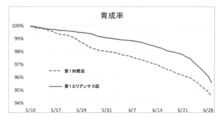
入雛後50日間、第1エリアンサス区内と第1対照区内のブロイラーの育成率を算出した。育成率は、下記(1)式から算出した。結果を図3に示す。
 上記(1)式において、Aは、入雛したブロイラーの数を示し、Bは、死亡したブロイラーの数を示す。
入雛後50日間、第1エリアンサス区内と第1対照区内のブロイラーの育成率を算出した。育成率は、下記(1)式から算出した。結果を図3に示す。
図3に示すように、入雛の1週間後には、第1エリアンサス区内のブロイラーの育成率が、第1対照区内のブロイラーの育成率よりも高くなり、入雛の50日後まで、第1エリアンサス区内のブロイラーの育成率が第1対照区内のブロイラーの育成率よりも高かった。入雛の50日後(ブロイラーの出荷時)では、第1エリアンサス区内のブロイラーの育成率が第1対照区内のブロイラーの育成率よりも1%以上も高く、出荷できたブロイラーの割合に大きな差が生じた。
評価1~評価2の結果から、実施例1の敷料は、比較例1の敷料と比較して、敷料表面にアンモニアが残存しにくく、趾瘤症の発症や進行を抑制できることが理解できた。また、評価3の結果から、実施例1の敷料は、比較例1の敷料と比較して、敷料が敷かれた飼育領域で飼育されるブロイラーが死亡しにくいことが理解できた。つまり、実施例1の敷料は、比較例1の敷料と比較して、家畜の生育に適した環境を作ることが理解できた。
[堆肥の製造]
ブロイラーの出荷後、第1エリアンサス区内の敷料(実施例1の敷料)と第1対照区内の敷料(比較例1の敷料)をそれぞれ回収した。実施例1及び比較例1の敷料には、ブロイラーの糞尿が付着していた。回収した実施例1と比較例1の敷料を発酵して堆肥を製造した。堆肥の製造は、堆肥製造装置(かぐや姫、富士平工業(株)社製)に回収した敷料をそれぞれ投入し、2日又は3日おきに敷料を撹拌し、約1か月半に渡り、敷料を好気的条件で発酵することにより行った。
ブロイラーの出荷後、第1エリアンサス区内の敷料(実施例1の敷料)と第1対照区内の敷料(比較例1の敷料)をそれぞれ回収した。実施例1及び比較例1の敷料には、ブロイラーの糞尿が付着していた。回収した実施例1と比較例1の敷料を発酵して堆肥を製造した。堆肥の製造は、堆肥製造装置(かぐや姫、富士平工業(株)社製)に回収した敷料をそれぞれ投入し、2日又は3日おきに敷料を撹拌し、約1か月半に渡り、敷料を好気的条件で発酵することにより行った。
[評価4(発芽評価)]
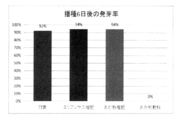
実施例1の敷料を発酵して得た堆肥(以下、「エリアンサス堆肥」という)と、比較例1の敷料を発酵して得た堆肥(以下、「おが粉堆肥」という)と、ブロイラーを出荷した後に回収した比較例1の敷料(以下、「おが粉敷料」という)を、それぞれ熱水抽出し、抽出液を取得した。取得した抽出液をそれぞれスポンジに吸収させ、スポンジにコマツナ種子を播種した。また、対象として、熱水抽出に使用しなかった熱水を冷まして得た水を、スポンジに吸収させ、スポンジにコマツナ種子を播種した。播種してから6日後の発芽率を、下記(2)式から算出した。結果を図4に示す。また、播種してから6日後の発芽状況の写真を、図5に示す。
 上記(2)式において、Cは、発芽した種の数を示し、Dは、播種した種の数を示す。
実施例1の敷料を発酵して得た堆肥(以下、「エリアンサス堆肥」という)と、比較例1の敷料を発酵して得た堆肥(以下、「おが粉堆肥」という)と、ブロイラーを出荷した後に回収した比較例1の敷料(以下、「おが粉敷料」という)を、それぞれ熱水抽出し、抽出液を取得した。取得した抽出液をそれぞれスポンジに吸収させ、スポンジにコマツナ種子を播種した。また、対象として、熱水抽出に使用しなかった熱水を冷まして得た水を、スポンジに吸収させ、スポンジにコマツナ種子を播種した。播種してから6日後の発芽率を、下記(2)式から算出した。結果を図4に示す。また、播種してから6日後の発芽状況の写真を、図5に示す。
図4や図5に示すように、エリアンサス堆肥の抽出液とおが粉堆肥の抽出液が用いられるコマツナ種子は、水が用いられるコマツナ種子と比較して高い発芽率であった。また、エリアンサス堆肥とおが粉堆肥の抽出液が用いられるコマツナ種子は、同じ発芽率であった。この結果から、実施例1の敷料を用いた堆肥は、比較例1の敷料を用いた堆肥と同様に、堆肥として使用できることが理解できた。
また、おが粉敷料の抽出液が用いられるコマツナ種子の発芽率が0%であったのに対し、エリアンサス堆肥の抽出液とおが粉堆肥の抽出液が用いられるコマツナ種子の発芽率は94%であった。この結果から、敷料に糞尿が付着していたとしても、糞尿に含まれる作物の生育を阻害する有害な物質は、敷料が発酵されることで分解されることが理解できた。
(実施例2)
枯死期のエリアンサスアルンディナセウスの地上部(茎及び葉)を収穫し、収穫直後にロールベールにて保管した。所定期間経過後、ロールベールから収穫物(エリアンサスアルンディナセウスの地上部)を回収し、これを実施例2の敷料とした。なお、収穫物の嵩密度は、96.1kg/m3であった。嵩密度は、嵩密度測定装置MT-1000(セイシン企業社製)を用いて2回測定し、その加算平均値とした。なお、嵩密度の測定は、ASTM規格 D6393(TEST-D Carr loose bulk density)に従い行った。
枯死期のエリアンサスアルンディナセウスの地上部(茎及び葉)を収穫し、収穫直後にロールベールにて保管した。所定期間経過後、ロールベールから収穫物(エリアンサスアルンディナセウスの地上部)を回収し、これを実施例2の敷料とした。なお、収穫物の嵩密度は、96.1kg/m3であった。嵩密度は、嵩密度測定装置MT-1000(セイシン企業社製)を用いて2回測定し、その加算平均値とした。なお、嵩密度の測定は、ASTM規格 D6393(TEST-D Carr loose bulk density)に従い行った。
(比較例2)
杉由来の木材を用意した。この木材を、おが粉製造機を用いて破砕した。得られた破砕物(おが粉)を比較例2の敷料とした。なお、破砕物の嵩密度は、199.9kg/m3であった。嵩密度は、実施例2と同じ条件で測定した。
杉由来の木材を用意した。この木材を、おが粉製造機を用いて破砕した。得られた破砕物(おが粉)を比較例2の敷料とした。なお、破砕物の嵩密度は、199.9kg/m3であった。嵩密度は、実施例2と同じ条件で測定した。
養鶏場における200坪の飼育領域(以下、「第2エリアンサス区」という)に、実施例2の敷料を敷き、同養鶏場における229坪の飼育領域(以下、「第2対照区」という)に、比較例2の敷料を敷いた。第2エリアンサス区に、ブロイラー(品種:Cobb)の雛9510羽を入雛するとともに、第2対照区に、ブロイラー(品種:Cobb)の雛10810羽を入雛した。第2エリアンサス区内と第2対照区内のブロイラーを、市販のブロイラー飼料(粗タンパク質18.5%、代謝エネルギー3,200kcal/kg)を用いて48日間飼育した。48日後、第2エリアンサス区内と第2対照区内で成長したブロイラーを出荷した。
[評価5(アンモニア濃度評価)]
入雛後3週間、第2エリアンサス区内と第2対照区内の敷料を1週間おきに回収し、敷料表面のアンモニア濃度を測定した。敷料表面のアンモニア濃度は、ガス検知管(GASTEC、(株)ガステック社製)を用いて測定し、異なる場所で採取した3つのサンプル(敷料)の加算平均値とした。結果を図6に示す。
入雛後3週間、第2エリアンサス区内と第2対照区内の敷料を1週間おきに回収し、敷料表面のアンモニア濃度を測定した。敷料表面のアンモニア濃度は、ガス検知管(GASTEC、(株)ガステック社製)を用いて測定し、異なる場所で採取した3つのサンプル(敷料)の加算平均値とした。結果を図6に示す。
図6に示すように、第2エリアンサス区内の敷料(実施例2の敷料)は、第2対照区内の敷料(比較例2の敷料)と比較して、入雛後3週間、敷料表面のアンモニア濃度が低かった。特に、入雛の2週間後では、第2エリアンサス区内の敷料は、第2対照区内の敷料に対して5%有意に表面のアンモニア濃度が低く、入雛の3週間後では、第2エリアンサス区内の敷料は、第2対照区内の敷料に対して1%有意に敷料表面のアンモニア濃度が低かった。
[評価6(硬度)]
入雛後6週間、第2エリアンサス区内と第2対照区内の敷料について、果実硬度計(KM型、(株)藤原製作所製)により硬度を測定した。硬度は、果実高度計を敷料に対して鉛直方向に押し当てることで測定し、異なる3ヶ所で測定した加算平均値とした。結果を図7に示す。
入雛後6週間、第2エリアンサス区内と第2対照区内の敷料について、果実硬度計(KM型、(株)藤原製作所製)により硬度を測定した。硬度は、果実高度計を敷料に対して鉛直方向に押し当てることで測定し、異なる3ヶ所で測定した加算平均値とした。結果を図7に示す。
図7に示すように、第2エリアンサス区内の敷料(実施例2の敷料)は、第2対照区内の敷料(比較例2の敷料)と比較して、入雛後2週から6週にかけて、硬度が低く維持されており、より長期間硬度を低く維持することができていた。
[評価7(育成率評価)]
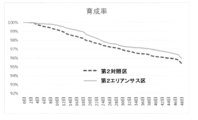
入雛後48日間、第2エリアンサス区内と第2対照区内のブロイラーの育成率を算出した。育成率は、上記(1)式から算出した。結果を図8に示す。
入雛後48日間、第2エリアンサス区内と第2対照区内のブロイラーの育成率を算出した。育成率は、上記(1)式から算出した。結果を図8に示す。
図8に示すように、入雛の4日後には、第2エリアンサス区内のブロイラーの育成率が、第2対照区内のブロイラーの育成率よりも高くなり、入雛の48日後まで、第2エリアンサス区内のブロイラーの育成率が第2対照区内のブロイラーの育成率よりも高かった。
[評価8(飼料要求率)]
ブロイラーを出荷後、第2エリアンサス区内と第2対照区内のブロイラーの飼料要求率(FCR:Feed Conversion Rate)を算出した。飼料要求率は、下記(3)式から算出した。なお、飼料要求率が低いほど少ない飼料で家畜が成長しやすいことを示す。結果を図9に示す。
 上記(3)式において、Eは、飼料使用量(kg)を示し、Fは、出荷重量(kg)を示す。
ブロイラーを出荷後、第2エリアンサス区内と第2対照区内のブロイラーの飼料要求率(FCR:Feed Conversion Rate)を算出した。飼料要求率は、下記(3)式から算出した。なお、飼料要求率が低いほど少ない飼料で家畜が成長しやすいことを示す。結果を図9に示す。
図9に示すように、第2エリアンサス区内のブロイラーの飼料要求率は、第2対照区内のブロイラーの飼料要求率よりも低くなっていた。
[評価9(生産指数)]
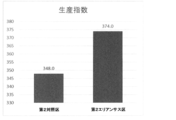
ブロイラーを出荷後、第2エリアンサス区内と第2対照区内のブロイラーの生産指数(PS:Production Score)を算出した。生産指数は、下記(4)式から算出した。なお、生産指数が高いほど生産性が高い(つまり、経済性に優れている)ことを指す。結果を図10に示す。
 上記(4)式において、Gは、出荷時の平均体重(kg)を示し、Hは、育成率(%)を示し、Iは、飼料要求率(%)を示し、Jは、出荷日数(Day)を示す。
ブロイラーを出荷後、第2エリアンサス区内と第2対照区内のブロイラーの生産指数(PS:Production Score)を算出した。生産指数は、下記(4)式から算出した。なお、生産指数が高いほど生産性が高い(つまり、経済性に優れている)ことを指す。結果を図10に示す。
図10に示すように、第2エリアンサス区内のブロイラーの生産指数は、第2対照区内のブロイラーの生産指数よりも高くなっていた。
評価5~評価6の結果から、実施例2の敷料は、比較例2の敷料と比較して、敷料表面にアンモニアが残存しにくく、硬度も低いことから、ブロイラーがより生育しやすいことが理解できた。また、その結果として、評価7~9のとおり、実施例2の敷料は、比較例2の敷料と比較して、育成率、飼料効率及び生産指数を改善した。つまり、実施例2の敷料は、比較例2の敷料と比較して、家畜の生育に適した環境を作れることが理解できた。
[参考評価1(吸水度)]
粉砕条件が互いに異なるエリアンサス属植物の粉砕物16ロットと、スギ由来のオガクズ3ロット、籾殻1ロット、サトウキビバガス1ロット及び裁断古紙1ロット(以下、「サンプル」ともいう)、それぞれについて嵩密度を測定した。なお、嵩密度の測定は、実施例1と同じ条件で測定した。また、エリアンサス属植物の粉砕物には、地上部(茎及び葉)を用いた。
粉砕条件が互いに異なるエリアンサス属植物の粉砕物16ロットと、スギ由来のオガクズ3ロット、籾殻1ロット、サトウキビバガス1ロット及び裁断古紙1ロット(以下、「サンプル」ともいう)、それぞれについて嵩密度を測定した。なお、嵩密度の測定は、実施例1と同じ条件で測定した。また、エリアンサス属植物の粉砕物には、地上部(茎及び葉)を用いた。
嵩密度を測定した各サンプルを105℃にて5時間乾燥した。乾燥した各サンプルをそれぞれ約5gずつ三角フラスコに添加し、各三角フラスコに約200g(約200ml)のミリQ水を添加した。ミリQ水添加後、水分が蒸発しないようパラフィルムで三角フラスコの口を覆った。その後三角フラスコを振とう培養機(TAITEC B・GR-200)に設置し、4℃、100rpmの条件下にて24時間保管した。その後、三角フラスコの内容物をステンレス製の篩(目開き90μm,直径20cmφ)にて篩過し、篩過液を採取した。
採取した篩過液の量(g)を測定し、下記(5)式から、各サンプルの吸水度を求めた。結果を表1に示す。
 上記(5)式において、Kは、三角フラスコに添加したミリQ水の量(g)を示し、Lは、採取した篩過液の量(g)を示し、Mは、三角フラスコに添加したサンプルの量(g)を示す。
[表1]
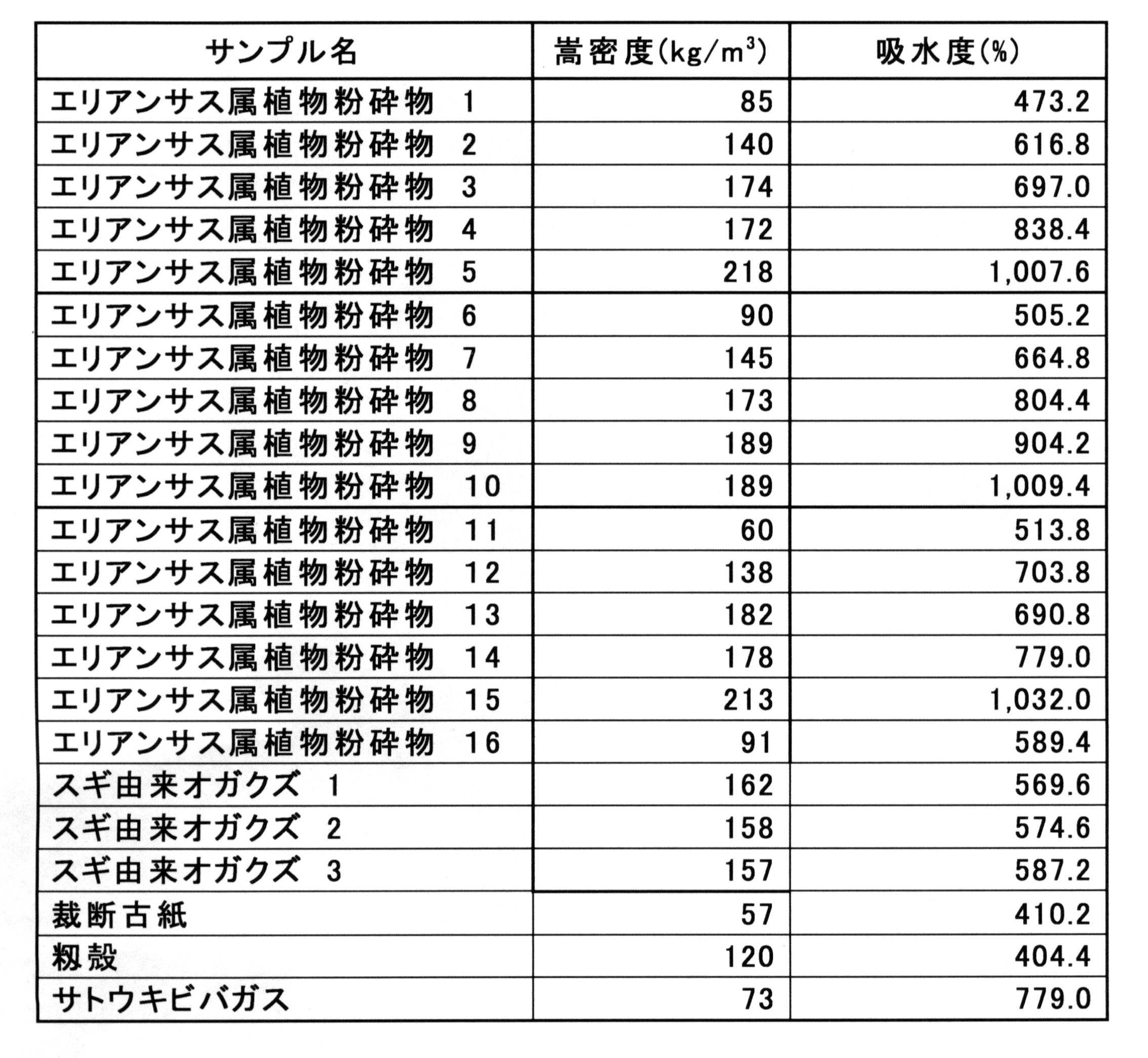
エリアンサス属植物に係る各サンプルについて、嵩密度と吸水度の関係を図11に示す。図11に示す各サンプルの嵩密度と吸水度の関係を回帰分析すると、y=3.4191x+218.59で示される第1回帰式(x=嵩密度(kg/m3)、y=吸水度(%))が得られ、決定係数R2は、0.8122であった。この結果から、エリアンサス属植物に係る各サンプルについては、嵩密度と吸水度が相関性を示していることが理解できた。
第1回帰式(y=3.4191x+218.59)のyに、表1に示すサンプルの中で最も吸水度が低かった籾殻のサンプルの吸水度(404.4)を代入し、籾殻のサンプルの吸水度(404.4)を得るために必要なエリアンサス属植物の粉砕物の嵩密度(x)を算出しところ、54.3kg/m3であった。この嵩密度から、エリアンサス属植物の粉砕物の嵩密度を50kg/m3以上に、好ましくは55.0kg/m3以上とすれば、敷料として一般的に使用されている籾殻程度以上の吸水度が実現可能であることが分かった。
[参考評価2(クッション性)]
参考評価1で嵩密度を測定した各サンプルを、それぞれ10.0gずつガラス製トールビーカー(PYREX(登録商標) 1060-200WS外径56mm,高さ102mm)に採取した。SHIMADZU卓上精密万能試験機(AUTOGRAPHAGS-X10kN)にロードセル(AGS-XCL-1100N)を設置し、ロードセルに圧盤(厚さ10mm,直径47mmφ,軸の長さ200mm)を接続した。トールビーカーを圧盤の下方に配置して圧盤を下降させ、圧盤がトールビーカー内のサンプル界面に接触したことを目視で確認し、その位置を0点とした。その後圧盤を5mm/minの速度で押し下げ,圧盤にかかる圧力が30N(3kg)に達した時点における0点から圧盤までの距離(沈み込み距離)を測定した。本操作を10回繰り返し、10回目に計測された距離を、クッション性を表すクッション度とした。第1回から第10回の測定結果を図12に、クッション度を表2に示す。
参考評価1で嵩密度を測定した各サンプルを、それぞれ10.0gずつガラス製トールビーカー(PYREX(登録商標) 1060-200WS外径56mm,高さ102mm)に採取した。SHIMADZU卓上精密万能試験機(AUTOGRAPHAGS-X10kN)にロードセル(AGS-XCL-1100N)を設置し、ロードセルに圧盤(厚さ10mm,直径47mmφ,軸の長さ200mm)を接続した。トールビーカーを圧盤の下方に配置して圧盤を下降させ、圧盤がトールビーカー内のサンプル界面に接触したことを目視で確認し、その位置を0点とした。その後圧盤を5mm/minの速度で押し下げ,圧盤にかかる圧力が30N(3kg)に達した時点における0点から圧盤までの距離(沈み込み距離)を測定した。本操作を10回繰り返し、10回目に計測された距離を、クッション性を表すクッション度とした。第1回から第10回の測定結果を図12に、クッション度を表2に示す。
[表2]
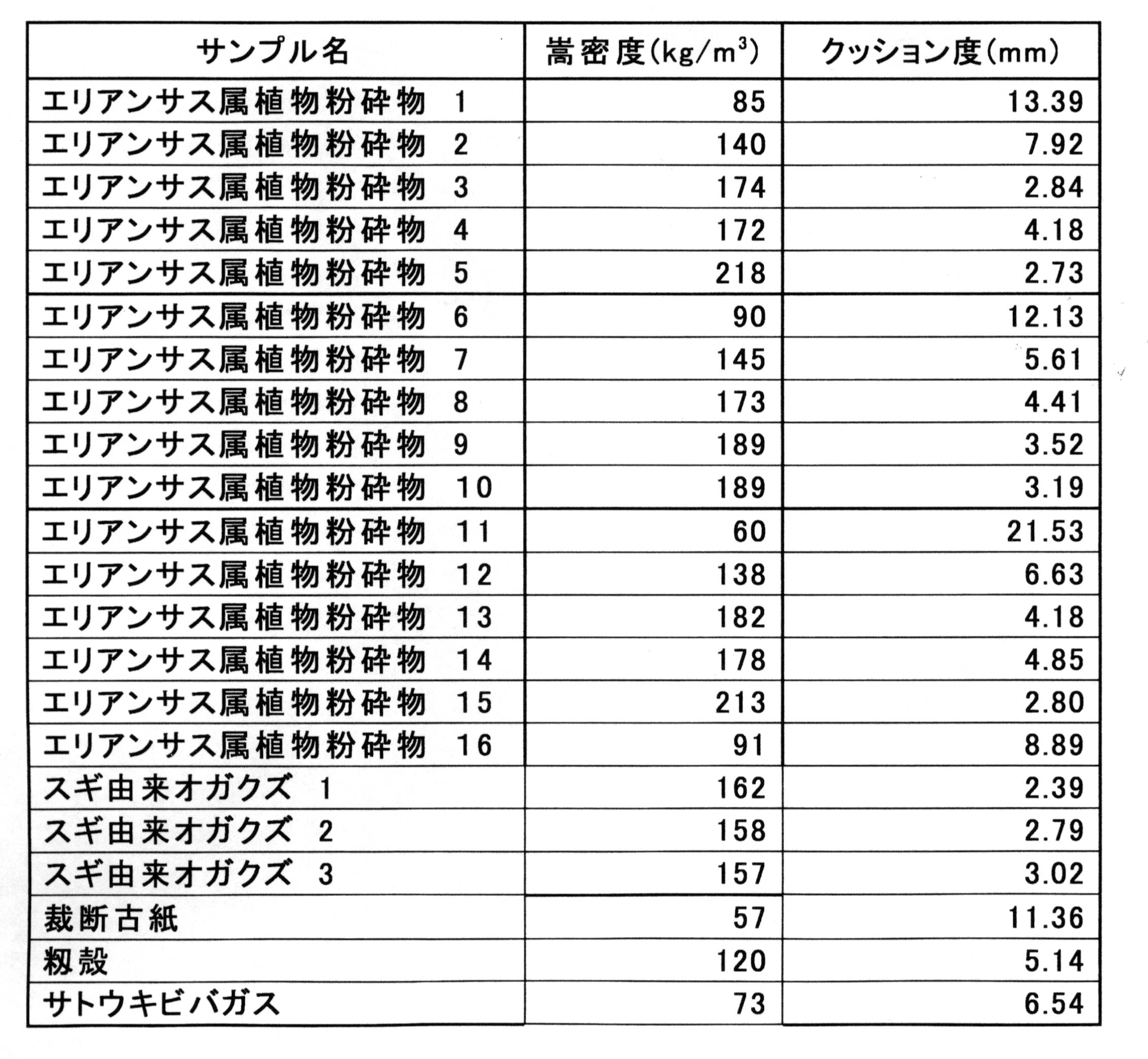
エリアンサス属植物に係る各サンプルについて、嵩密度とクッション度の関係を図13に示す。図13に示す各サンプルの嵩密度とクッション度の関係を回帰分析すると、y=-0.0966x+21.509で示される第2回帰式(x=嵩密度(kg/m3)、y=クッション度(mm))が得られ、決定係数R2は、0.8256であった。この結果から、エリアンサス属植物については、嵩密度とクッション度が相関性を示していることが理解できた。
第2回帰式(y=-0.0966x+21.509)のyに、表1に示すサンプルの中で最もクッション度が低かったスギ由来オガクズ1のサンプルのクッション度(2.39)を代入し、スギ由来オガクズ1のサンプルのクッション度(2.39)を得るために必要なエリアンサス属植物の粉砕物の嵩密度(x)を算出しところ、197.9kg/m3であった。この嵩密度から、エリアンサス属植物の粉砕物の嵩密度を200kg/m3以下に、好ましくは195.0kg/m3以下とすれば、敷料として一般的に使用されているオガクズ程度以上のクッション度が実現可能であることが分かった。
なお、上記参考評価1及び2の試験は、静岡県富士工業技術センター報告 第11号 (2001年)、P17-24に基づいて行った試験である。
[参考評価3(保水性)]
粉砕条件が互いに異なるエリアンサス属植物の粉砕物8ロットと、スギ由来のオガクズ3ロット、籾殻1ロット、サトウキビバガス1ロット及び裁断古紙1ロット(以下、「サンプル」ともいう)、それぞれについて嵩密度を測定した。なお、嵩密度の測定は、実施例1と同じ条件で測定した。また、エリアンサス属植物の粉砕物には、地上部(茎及び葉)を用いた。
粉砕条件が互いに異なるエリアンサス属植物の粉砕物8ロットと、スギ由来のオガクズ3ロット、籾殻1ロット、サトウキビバガス1ロット及び裁断古紙1ロット(以下、「サンプル」ともいう)、それぞれについて嵩密度を測定した。なお、嵩密度の測定は、実施例1と同じ条件で測定した。また、エリアンサス属植物の粉砕物には、地上部(茎及び葉)を用いた。
嵩密度を測定した各サンプルを105℃にて5時間乾燥した。乾燥した各サンプルをそれぞれ約5gずつ三角フラスコに添加し、各三角フラスコに約200g(約200ml)のミリQ水を添加した。ミリQ水添加後、水分が蒸発しないようパラフィルムで三角フラスコの口を覆った。その後三角フラスコを振とう培養機(TAITEC B・GR-200)に設置し、4℃、100rpmの条件下にて24時間保管した。その後、三角フラスコの内容物をステンレス製の篩(目開き90μm,直径20cmφ)にて篩過し、篩上残渣を回収した。
回収した篩上残渣を、3000gで15分間遠心分離し、篩上残渣に含まれる水分を一部除去した。水分の一部が除去された篩上残渣(以下、「湿潤残渣」ともいう)を回収し、その量(g)を測定した。測定した湿潤残渣の量を用いて、下記(6)式から、各サンプルの保水度を求めた。結果を表3に示す。
 上記(6)式において、Nは、湿潤残渣の量(g)を示し、Mは、三角フラスコに添加したサンプルの量(g)を示す。
[表3]
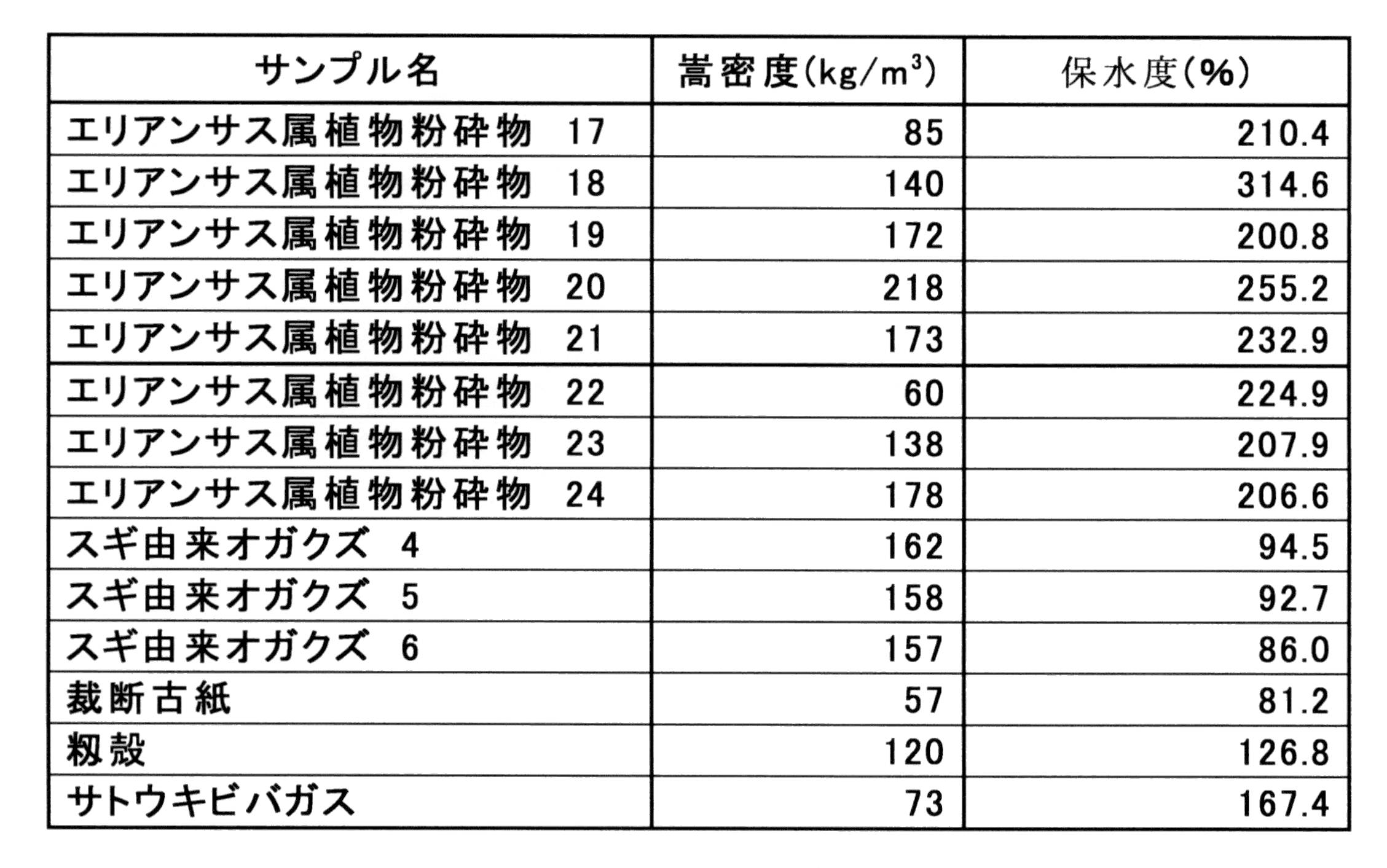
表3に示すように、エリアンサス属植物に係る各サンプルは、他のサンプルと比較して保水度が高かった。この結果から、エリアンサス属植物に係るサンプルは、嵩密度にかかわらず、他のサンプルと比較して、保水性が高いことが理解できた。
Claims (7)
- 家畜の飼育に用いられる家畜用敷料であって、
エリアンサス属植物の破砕物を含む家畜用敷料。 - 前記家畜用敷料の嵩密度が、50kg/m3以上200kg/m3以下である請求項1に記載の家畜用敷料。
- エリアンサス属植物の破砕物の発酵物を含む堆肥。
- 前記発酵物が、糞尿が付着した前記破砕物の発酵物である請求項3に記載の堆肥。
- エリアンサス属植物の破砕物を発酵させることを含む堆肥の製造方法。
- 前記破砕物に糞尿を付着させて発酵させる請求項5に記載の堆肥の製造方法。
- 前記破砕物を用いての家畜の飼育により前記破砕物に前記家畜の糞尿を付着させる請求項6に記載の堆肥の製造方法。
Priority Applications (4)
| Application Number | Priority Date | Filing Date | Title |
|---|---|---|---|
| CN201980012704.1A CN111698902B (zh) | 2018-03-23 | 2019-03-14 | 垫料、堆肥以及堆肥的制造方法 |
| JP2020508297A JP6889804B2 (ja) | 2018-03-23 | 2019-03-14 | 敷料、堆肥及び堆肥の製造方法 |
| US16/960,623 US20200329662A1 (en) | 2018-03-23 | 2019-03-14 | Bedding, compost and method for producing compost |
| US19/018,184 US20250143254A1 (en) | 2018-03-23 | 2025-01-13 | Bedding, compost and method for producing compost |
Applications Claiming Priority (2)
| Application Number | Priority Date | Filing Date | Title |
|---|---|---|---|
| JP2018056371 | 2018-03-23 | ||
| JP2018-056371 | 2018-03-23 |
Related Child Applications (2)
| Application Number | Title | Priority Date | Filing Date |
|---|---|---|---|
| US16/960,623 A-371-Of-International US20200329662A1 (en) | 2018-03-23 | 2019-03-14 | Bedding, compost and method for producing compost |
| US19/018,184 Continuation US20250143254A1 (en) | 2018-03-23 | 2025-01-13 | Bedding, compost and method for producing compost |
Publications (1)
| Publication Number | Publication Date |
|---|---|
| WO2019181748A1 true WO2019181748A1 (ja) | 2019-09-26 |
Family
ID=67987228
Family Applications (1)
| Application Number | Title | Priority Date | Filing Date |
|---|---|---|---|
| PCT/JP2019/010643 Ceased WO2019181748A1 (ja) | 2018-03-23 | 2019-03-14 | 敷料、堆肥及び堆肥の製造方法 |
Country Status (5)
| Country | Link |
|---|---|
| US (2) | US20200329662A1 (ja) |
| JP (1) | JP6889804B2 (ja) |
| CN (1) | CN111698902B (ja) |
| TW (1) | TWI828665B (ja) |
| WO (1) | WO2019181748A1 (ja) |
Cited By (2)
| Publication number | Priority date | Publication date | Assignee | Title |
|---|---|---|---|---|
| JP7134533B1 (ja) | 2022-01-17 | 2022-09-12 | 純一 北ノ坊 | 低密度土壌 |
| WO2024172097A1 (ja) * | 2023-02-17 | 2024-08-22 | 株式会社森羊土 | きのこ廃培地発酵乾燥資材の使用方法 |
Families Citing this family (1)
| Publication number | Priority date | Publication date | Assignee | Title |
|---|---|---|---|---|
| CN114403016A (zh) * | 2022-03-17 | 2022-04-29 | 浙江大学 | 一种猪舍发酵床垫料基质及其制备方法 |
Citations (4)
| Publication number | Priority date | Publication date | Assignee | Title |
|---|---|---|---|---|
| JP2009148304A (ja) * | 2009-04-10 | 2009-07-09 | Pokka Corp | 家畜飼育用敷料を製造する方法 |
| JP2015044190A (ja) * | 2013-08-02 | 2015-03-12 | Jx日鉱日石エネルギー株式会社 | 油汚染土壌の浄化方法 |
| JP2017019702A (ja) * | 2015-07-14 | 2017-01-26 | 三井造船株式会社 | 液肥の製造方法 |
| WO2017179566A1 (ja) * | 2016-04-11 | 2017-10-19 | 花王株式会社 | 植物の育成方法 |
Family Cites Families (11)
| Publication number | Priority date | Publication date | Assignee | Title |
|---|---|---|---|---|
| US2179591A (en) * | 1938-06-14 | 1939-11-14 | Godchaux Sugars Inc | Poultry litter and animal bedding |
| US2708418A (en) * | 1950-04-12 | 1955-05-17 | Carr E Johnston | Animal bedding |
| DE2902109C2 (de) * | 1979-01-19 | 1984-02-16 | Mars Inc., 22102 McLean, Va. | Verwendung von, gegebenenfalls zerkleinerten, Leichtbauplatten auf der Grundlage von faserverstärkten Calciumsilikatmassen |
| US5189987A (en) * | 1989-06-23 | 1993-03-02 | The Clorox Company | Odor controlling animal litter with pine oil |
| DE4401279C1 (de) * | 1994-01-18 | 1995-04-13 | Allplant Entw & Marketing Gmbh | Kultursubstrat und Verfahren zu dessen Herstellung |
| DE4401278C2 (de) * | 1994-01-18 | 1996-02-29 | Allplant Entw & Marketing Gmbh | Verfahren und Vorrichtung zur Herstellung von Kultursubstrat |
| US6485774B1 (en) * | 1999-08-27 | 2002-11-26 | David I. Bransby | Method of preparing and handling chopped plant materials |
| CN1262674C (zh) * | 2003-07-10 | 2006-07-05 | 福建农林大学 | 甘蔗斑茅杂种的dna鉴定方法 |
| JP2010136705A (ja) * | 2008-12-15 | 2010-06-24 | Hoei Bussan Kk | 豚舎における敷料のリサイクルシステム |
| US20160219829A1 (en) * | 2013-09-06 | 2016-08-04 | 7905122 Canada Inc. | Anti-odor material for animal litters using phosphorotriamides in powder form |
| CN104690067B (zh) * | 2015-02-09 | 2016-10-05 | 福建农林大学 | 一种能源草和禽畜粪便的资源化利用方法 |
-
2019
- 2019-03-14 CN CN201980012704.1A patent/CN111698902B/zh active Active
- 2019-03-14 JP JP2020508297A patent/JP6889804B2/ja active Active
- 2019-03-14 US US16/960,623 patent/US20200329662A1/en not_active Abandoned
- 2019-03-14 WO PCT/JP2019/010643 patent/WO2019181748A1/ja not_active Ceased
- 2019-03-19 TW TW108109218A patent/TWI828665B/zh active
-
2025
- 2025-01-13 US US19/018,184 patent/US20250143254A1/en active Pending
Patent Citations (4)
| Publication number | Priority date | Publication date | Assignee | Title |
|---|---|---|---|---|
| JP2009148304A (ja) * | 2009-04-10 | 2009-07-09 | Pokka Corp | 家畜飼育用敷料を製造する方法 |
| JP2015044190A (ja) * | 2013-08-02 | 2015-03-12 | Jx日鉱日石エネルギー株式会社 | 油汚染土壌の浄化方法 |
| JP2017019702A (ja) * | 2015-07-14 | 2017-01-26 | 三井造船株式会社 | 液肥の製造方法 |
| WO2017179566A1 (ja) * | 2016-04-11 | 2017-10-19 | 花王株式会社 | 植物の育成方法 |
Cited By (5)
| Publication number | Priority date | Publication date | Assignee | Title |
|---|---|---|---|---|
| JP7134533B1 (ja) | 2022-01-17 | 2022-09-12 | 純一 北ノ坊 | 低密度土壌 |
| JP7195679B1 (ja) | 2022-01-17 | 2022-12-26 | 純一 北ノ坊 | 低密度熟成土壌の製造方法、低密度熟成土壌の再生方法、再生装置及び低密度熟成土壌の利用方法 |
| JP2023104817A (ja) * | 2022-01-17 | 2023-07-28 | 純一 北ノ坊 | 低密度土壌 |
| JP2023104850A (ja) * | 2022-01-17 | 2023-07-28 | 純一 北ノ坊 | 低密度熟成土壌の製造方法、低密度熟成土壌の再生方法、再生装置及び低密度熟成土壌の利用方法 |
| WO2024172097A1 (ja) * | 2023-02-17 | 2024-08-22 | 株式会社森羊土 | きのこ廃培地発酵乾燥資材の使用方法 |
Also Published As
| Publication number | Publication date |
|---|---|
| CN111698902B (zh) | 2022-07-05 |
| CN111698902A (zh) | 2020-09-22 |
| JP6889804B2 (ja) | 2021-06-18 |
| TWI828665B (zh) | 2024-01-11 |
| US20250143254A1 (en) | 2025-05-08 |
| US20200329662A1 (en) | 2020-10-22 |
| JPWO2019181748A1 (ja) | 2021-03-18 |
| TW201942096A (zh) | 2019-11-01 |
Similar Documents
| Publication | Publication Date | Title |
|---|---|---|
| CN109160859B (zh) | 一种利用蚯蚓处理畜禽粪便废弃物生产生物有机肥的方法 | |
| CN101536638B (zh) | 一种种植与养殖的轮作方法 | |
| US20250143254A1 (en) | Bedding, compost and method for producing compost | |
| JP2010208893A (ja) | 有機肥料及び有機肥料の製造方法 | |
| CN102180744A (zh) | 土壤改良剂的制备方法 | |
| CN111742814A (zh) | 一种低成本的番茄栽培基质及其制备方法和应用 | |
| KR101559136B1 (ko) | 유기질 비료 제조방법 및 이에 의해 제조된 유기질 비료 | |
| JP5044261B2 (ja) | 動物用飼料 | |
| Quatrin et al. | Response of dual-purpose wheat to nitrogen fertilization and seed inoculation with Azospirillum brasilense | |
| JP6249536B2 (ja) | 天然アミノ酸肥料の製造方法 | |
| DE69420411T2 (de) | Bakterielle Mittel zur Landwirtschaftlichen Verwendung | |
| Verma et al. | Performance evaluation of tractor drawn round straw baler for paddy | |
| KR102301162B1 (ko) | 바이오매스를 포함하는 압축성형상토를 이용한 채소재배 방법 | |
| KR20140052591A (ko) | 팜번치(efb)를 유효성분으로 포함하는 토양개량제 조성물과 퇴비 조성물 | |
| RU2233056C2 (ru) | Способ борьбы с сорной растительностью в биологическом земледелии | |
| Chirinos-Peinado et al. | Biofortification of the Ryegrass (Lolium multiflorum L.) with chicken manure compost in the central sierra of Peru | |
| CN110915767B (zh) | 一种牛粪加洋葱肉和洋葱皮室外大田饲养蚯蚓的方法 | |
| Singh | Studies on integrated nutrient management in sweet sorghum and phillipesara intercropping system | |
| Naveed et al. | Winter Fodder: Opportunities and Challenges in Livestock | |
| CN109158079A (zh) | 用于菜地土壤Cu/Zn污染的蚓粪基阻控剂及其制备方法与应用 | |
| Popova | Advantages and directions of use of goat manure | |
| Longhurst et al. | LONG-TERM MAIZE GRAIN GROWING IN WAIKATO-FACTORS AFFECTING SUSTAINABILITY | |
| Conaghan et al. | Red Clover—Agronomy and Management | |
| Idowu et al. | Short Term Influence of Swine Manure Application, Sowing Methods and Stage of Harvest on Agronomic Performance and Yield of Panicum maximum | |
| Paul et al. | Improving forage productivity for increased livestock production using biochar and green manure amendments |
Legal Events
| Date | Code | Title | Description |
|---|---|---|---|
| 121 | Ep: the epo has been informed by wipo that ep was designated in this application |
Ref document number: 19771653 Country of ref document: EP Kind code of ref document: A1 |
|
| ENP | Entry into the national phase |
Ref document number: 2020508297 Country of ref document: JP Kind code of ref document: A |
|
| NENP | Non-entry into the national phase |
Ref country code: DE |
|
| 122 | Ep: pct application non-entry in european phase |
Ref document number: 19771653 Country of ref document: EP Kind code of ref document: A1 |