WO2019012832A1 - 交通管理装置、交通管理システムおよび交通管理方法 - Google Patents
交通管理装置、交通管理システムおよび交通管理方法 Download PDFInfo
- Publication number
- WO2019012832A1 WO2019012832A1 PCT/JP2018/020685 JP2018020685W WO2019012832A1 WO 2019012832 A1 WO2019012832 A1 WO 2019012832A1 JP 2018020685 W JP2018020685 W JP 2018020685W WO 2019012832 A1 WO2019012832 A1 WO 2019012832A1
- Authority
- WO
- WIPO (PCT)
- Prior art keywords
- vehicle sensor
- information
- traffic
- unit
- unit area
- Prior art date
- Legal status (The legal status is an assumption and is not a legal conclusion. Google has not performed a legal analysis and makes no representation as to the accuracy of the status listed.)
- Ceased
Links
Images






Classifications
-
- G—PHYSICS
- G08—SIGNALLING
- G08G—TRAFFIC CONTROL SYSTEMS
- G08G1/00—Traffic control systems for road vehicles
-
- G—PHYSICS
- G08—SIGNALLING
- G08G—TRAFFIC CONTROL SYSTEMS
- G08G1/00—Traffic control systems for road vehicles
- G08G1/07—Controlling traffic signals
- G08G1/08—Controlling traffic signals according to detected number or speed of vehicles
Definitions
- the present invention relates to a traffic management apparatus, a traffic management system, and a traffic management method for managing traffic in a target area based on vehicle sensor information acquired by a vehicle sensor installed in the target area.
- the traffic management system (traffic control system) carries out traffic management to properly distribute and guide traffic flows for the purpose of alleviating traffic congestion, reducing traffic accidents, and controlling traffic pollution.
- Traffic signal control for controlling the signal controller installed at the intersection based on the traffic condition of the road network, traffic information representing the traffic condition, and the like. For example, traffic information is provided to a driver of a vehicle by displaying information on traffic congestion, travel time, etc. on a traffic information board installed on a road.
- Such traffic management relies on information collected by the vehicle sensors, and for proper traffic management, it is necessary to install the vehicle sensors at a certain density on the road network.
- the number of vehicle detectors that have been developed to date has reached a huge number, and the operation and maintenance of the vehicle detectors has become a very expensive situation, and under the recent severe financial conditions in the country and prefectures. Is becoming a serious problem. Therefore, there is a need for a technology capable of performing traffic management with practically sufficient accuracy even in a state where the number of installed vehicle detectors is reduced by reducing the number of installed vehicle detectors.
- a unit area is set in a target area, and estimation processing using a traffic flow model is performed on the unit area based on vehicle sensor information and signal control result information.
- estimation processing using a traffic flow model is performed on the unit area based on vehicle sensor information and signal control result information.
- There is known a technology for performing traffic management based on information on traffic conditions in each unit area by estimating the traffic conditions in the unit area see Patent Document 1).
- the unit area is set so that the vehicle sensor is arranged at the boundary position, and the traffic condition in the unit area is estimated, whereby the vehicle in the unit area is Detectors can be eliminated.
- traffic management such as signal control is performed using vehicle sensor information from an existing vehicle sensor as input information. For this reason, when the existing vehicle detector is abolished, it is necessary to change the control contents of traffic management significantly, and there is a problem that the cost becomes enormous.
- the present invention mainly provides a traffic management apparatus, a traffic management system, and a traffic management method capable of reducing vehicle detectors without significantly changing traffic management control contents such as signal control. To aim.
- the traffic management apparatus is a traffic management apparatus that performs traffic management in a target area based on vehicle sensor information acquired by a vehicle sensor installed in the target area, and A communication unit that receives vehicle sensor information; and a control unit that performs information processing related to traffic management in the target area based on the vehicle sensor information, the control unit being in the target area A unit area is set, and an estimation process using a traffic flow model is performed on the unit area based on the vehicle sensor information and signal control result information on a signal controller installed in the target area.
- a vehicle sensor is installed at a predetermined position in the unit area
- a traffic management system comprises a vehicle sensor installed in a target area, and a traffic management device that performs traffic management in the target area based on vehicle sensor information acquired by the vehicle sensor.
- a traffic management system including: a communication unit for receiving the vehicle sensor information from the vehicle sensor; and the traffic management in the target area based on the vehicle sensor information.
- a control unit that performs information processing, the control unit sets a unit area in the target area, the vehicle sensor information, and signal control result information on a signal controller installed in the target area And performing estimation processing using the traffic flow model on the basis of the unit area to obtain information on the traffic condition in the unit area, and Based on the information, a configuration for generating a virtual vehicle detectors information handled as acquired by the virtual vehicle detectors regarded as vehicle detector is installed at a predetermined position of the unit area.
- the traffic management method is a traffic management method for performing traffic management in a target area based on vehicle sensor information acquired by a vehicle sensor installed in the target area in the traffic management device. And setting a unit area in the target area, using a traffic flow model for the unit area based on the vehicle sensor information and signal control result information on a signal controller installed in the target area. Performing an estimation process to obtain information on traffic conditions in the unit area, and based on the information on traffic conditions in the unit area, assuming that a vehicle sensor is installed at a predetermined position in the unit area Generate virtual vehicle sensor information to be handled as acquired by a vehicle sensor, and based on the vehicle sensor information and the virtual vehicle sensor information A configuration for generating a signal control information for controlling the signal controller.
- virtual vehicle sensor information to be handled as collected by a virtual vehicle sensor set at a predetermined position in a unit area is generated.
- FIG. 1 is an overall configuration diagram of a traffic management system according to the present embodiment.
- FIG. 2 is a block diagram showing a schematic configuration of the traffic management device 3.
- FIG. 3 is a flowchart showing the procedure of processing performed by the traffic management device 3.
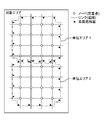
- FIG. 4 is an explanatory view showing an example of a unit area set by the unit area setting unit 52.
- FIG. 5A is an explanatory view showing an example of the arrangement of the vehicle sensor 1 and the virtual vehicle sensor.
- FIG. 5B is an explanatory view showing an example of the arrangement of the vehicle sensor 1 and the virtual vehicle sensor.
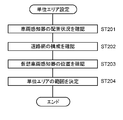
- FIG. 6 is a flowchart showing the procedure of the process performed by the unit area setting unit 52.
- FIG. 5A is an explanatory view showing an example of the arrangement of the vehicle sensor 1 and the virtual vehicle sensor.
- FIG. 5B is an explanatory view showing an example of the arrangement of the vehicle sensor 1 and the virtual vehicle sensor.
- FIG. 6 is a flowchart showing the procedure of the process performed by the
- FIG. 7A is an explanatory diagram for explaining an example of a traffic flow model used by the traffic condition estimation unit 53.
- FIG. 7B is an explanatory diagram for explaining an example of a traffic flow model used by the traffic condition estimation unit 53.
- FIG. 7C is an explanatory diagram for explaining an example of a traffic flow model used by the traffic condition estimation unit 53.
- FIG. 8 is a flowchart showing the procedure of processing performed by the traffic condition estimation unit 53.
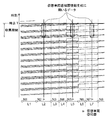
- FIG. 9 is an explanatory view showing the traffic situation detailed information acquired by the traffic situation estimation unit 53. As shown in FIG.
- a first invention made to solve the above-mentioned problems is a traffic management device for performing traffic management in a target area based on vehicle sensor information acquired by a vehicle sensor installed in the target area,
- a communication unit that receives the vehicle sensor information from the vehicle sensor; and a control unit that performs information processing related to traffic management in the target area based on the vehicle sensor information;
- the estimation process used is performed to obtain information on the traffic condition in the unit area, and a car is placed at a predetermined position in the unit area based on the information on the traffic condition in the unit area.
- Sensor is configured to generate a virtual vehicle detectors information handled as acquired by the virtual vehicle detectors considered to have been installed.
- virtual vehicle sensor information to be treated as collected by a virtual vehicle sensor set at a predetermined position in the unit area is generated.
- control unit acquires, as the virtual vehicle sensor information, the traffic volume and the occupancy rate at the position where the virtual vehicle sensor is set.
- traffic management such as signal control can be appropriately performed.
- control unit may be arranged such that the vehicle sensor is disposed at a boundary position, and information on traffic flowing into the unit area can be acquired by the vehicle sensor. Is set up.
- control unit sets the virtual vehicle sensor at a position of a vehicle sensor to be discontinued installed in the unit area.
- Vehicle sensors can be reduced.
- control unit generates signal control information for controlling the signal controller based on the virtual vehicle sensor information, and the communication unit performs the signal control information. It is configured to transmit to the signal controller.
- control unit determines the unit area based on information on an installation state of the vehicle sensor in the target area and information on a configuration of a road network in the target area. I assume.
- an appropriate unit area can be determined. Then, since the traffic management device itself determines the unit area, it is possible to save time and effort for the user to determine the unit area, and the convenience of the user can be enhanced.
- the process of setting the unit area based on the information on the unit area input by the user after the user determines the unit area may be performed by the unit area setting unit.
- control unit estimates the traffic situation in the unit area based on the vehicle sensor information, the signal control result information, and information on the configuration of the road network in the unit area. Configuration.
- An eighth invention comprises a vehicle sensor installed in a target area, and a traffic management device for managing traffic in the target area based on vehicle sensor information acquired by the vehicle sensor.
- a traffic management system wherein the traffic management device is a communication unit that receives the vehicle sensor information from the vehicle sensor, and information processing related to traffic management in the target area based on the vehicle sensor information.
- Control unit configured to set a unit area in the target area, and based on the vehicle sensor information and signal control result information on a signal controller installed in the target area. And performing an estimation process using a traffic flow model for the unit area to obtain information on the traffic situation in the unit area, and based on the information on the traffic situation in the unit area.
- a configuration for generating a virtual vehicle detectors information handled as acquired by the virtual vehicle detectors regarded as vehicle detector is installed at a predetermined position of the unit area.
- a ninth invention is a traffic management method for traffic management in a target area, based on vehicle sensor information acquired by a vehicle sensor installed in the target area, in the traffic management apparatus, A unit area is set in a target area, and an estimation using a traffic flow model is performed on the unit area based on the vehicle sensor information and signal control result information on a signal controller installed in the target area.
- a virtual vehicle sensing process is performed to obtain information on traffic conditions in the unit area, and based on the information on traffic conditions in the unit area, a vehicle sensor is considered to be installed at a predetermined position in the unit area Generating virtual vehicle sensor information to be handled as acquired by the device, and based on the vehicle sensor information and the virtual vehicle sensor information, A configuration for generating a signal control information for controlling the control machine.
- FIG. 1 is an overall configuration diagram of a traffic management system according to the present embodiment.
- the traffic management system (traffic control system) includes a vehicle sensor 1, a signal controller 2, and a traffic management device 3.
- the vehicle sensor 1 is, for example, an ultrasonic vehicle sensor and an optical vehicle sensor (light beacon), etc., and senses a vehicle on a road to indicate vehicle traffic on the road. Generate the amount and the occupancy rate).
- the vehicle sensor information is transmitted from the vehicle sensor 1 to the traffic management device 3.
- the signal controller 2 controls the operation of the signal light based on the signal control information transmitted from the traffic management device 3.
- the traffic management device 3 is a central device of the traffic control system, and generates signal control information for controlling the signal controller 2 based on the vehicle sensor information transmitted from the vehicle sensor 1, and Generate traffic information in the area.
- FIG. 2 is a block diagram showing a schematic configuration of the traffic management device 3.
- the traffic management device 3 includes a first traffic management unit 11 and a second traffic management unit 12.
- the first traffic management unit 11 realizes an existing function related to traffic management
- the second traffic management unit 12 realizes a new function related to traffic management. With such a configuration, it is possible to add a new function to the traffic management device 3 without modifying the existing components of the traffic management device 3.
- the first traffic management unit 11 includes a communication unit 21, a control unit 22, and a storage unit 23.
- the communication unit 21 communicates with the vehicle sensor 1 and the signal controller 2, receives vehicle sensor information transmitted from the vehicle sensor 1, and transmits signal control information to the signal controller 2.
- the storage unit 23 stores vehicle sensor information, signal control result information, vehicle sensor arrangement information, and road network configuration information. In addition, the storage unit 23 stores a program executed by a processor that configures the control unit 22.
- the vehicle sensor information is information representing the traffic condition of the vehicle collected by the vehicle sensor 1. Specifically, the traffic volume, that is, the position of the vehicle sensor 1 every unit time (for example, 5 minutes) It is the number of vehicles that have passed, the occupancy rate (time occupancy rate), that is, the ratio of the time during which the vehicle is present at the position of the vehicle sensor 1 within a unit time.
- the traffic volume that is, the position of the vehicle sensor 1 every unit time (for example, 5 minutes) It is the number of vehicles that have passed, the occupancy rate (time occupancy rate), that is, the ratio of the time during which the vehicle is present at the position of the vehicle sensor 1 within a unit time.
- the signal control result information is signal control information (signal control parameter and actual value of each step (step)) used in signal control in the past and present operation.
- the signal control information is information of signal control parameters which is an element determining the display timing of the traffic signal, and specifically, a control command having a cycle length, a split, an offset, an intersection number as a reference of the offset, and the like.
- It is control execution information configured of information, the number of seconds executed for each step (step), the number of an intersection, and the like.
- the vehicle sensor arrangement information is information on the position at which the vehicle sensor 1 is installed. Specifically, the number of the link at which the vehicle sensor 1 is installed, the distance from the end of the link to the vehicle sensor 1, etc. It is.
- the road network configuration information is information on the connection form of nodes and links constituting the road network, the number of lanes of each link, etc. Specifically, as information on links (roads), link number, number of lanes, link The length, presence or absence of additional lanes by direction (right-turning lanes, etc.), length, etc. In addition, information on nodes (intersections) includes node numbers, information on the relationship between signal appearance and passing right inflow path, etc. .
- the control unit 22 includes a signal control information generation unit 31.
- the control unit 22 is configured of a single or a plurality of processors, and the signal control information generation unit 31 is realized by causing the processor to execute a program stored in the storage unit 23.
- the signal control information generation unit 31 controls the signal controller 2 based on the vehicle sensor information acquired from the vehicle sensor 1 and the virtual vehicle sensor information acquired by the second traffic management unit 12. Generate signal control information. Specifically, signal control parameters (cycle length, split and offset) are calculated.
- the second traffic management unit 12 includes a control unit 41 and a storage unit 42.
- the storage unit 42 includes vehicle sensor information, signal control result information, vehicle sensor arrangement information, road network configuration information, traffic condition estimation setting information, unit area definition information, virtual vehicle sensor information generation setting information, traffic condition Store detailed information, virtual vehicle sensor information, and signal control information.
- the storage unit 42 stores a program executed by a processor that configures the control unit 41.
- the setting information for traffic condition estimation is information on various conditions required when estimating the traffic condition. Specifically, it is an estimation period when estimating the traffic condition, that is, a period of information (vehicle sensor information and signal control result information) input when estimating the traffic condition.
- the setting information for traffic condition estimation is a parameter of the traffic flow model, for example, traffic flow rate of links and nodes (number of vehicles passing per unit time), legal speed of each link, and number of lanes in each link , Lane width and right turn lane information.
- the unit area definition information is information on a unit area serving as a unit for estimating the traffic situation. Specifically, the unit area number (identification information), the link number included in the unit area, the intersection included in the unit area And the like.
- the setting information for virtual vehicle sensor information generation is information regarding various conditions required when generating virtual vehicle sensor information.
- This information is position information of the virtual vehicle sensor, specifically, a link number (identification information) on which the virtual vehicle sensor is set, a position from the end of the link, and the like.
- this information is a collection period when generating virtual vehicle sensor information, that is, a period used to generate virtual vehicle sensor information among traffic condition detailed information output as a result of traffic condition estimation. is there.
- the traffic condition detailed information is information on the estimation result of the traffic condition, and is information indicating the traveling locus of each vehicle, that is, the temporal transition condition of the position of each vehicle (the position of each vehicle at each time) Specifically, for example, the vehicle ID for each vehicle, the passing time, the passing position (link number, distance from the link end, etc.), and the like.
- the virtual vehicle sensor information is information handled as collected by the virtual vehicle sensor set at a predetermined position, and specifically, like the vehicle sensor information, the traffic volume and occupancy rate, etc. .
- the signal control information is signal control parameters (cycle length, split and offset) for controlling the signal controller 2.
- the control unit 41 includes an input information acquisition unit 51, a unit area setting unit 52, a traffic condition estimation unit 53, and a virtual vehicle sensor information generation unit 54.
- the control unit 41 is configured of a single or a plurality of processors, and each unit of the control unit 41 is realized by executing a program stored in the storage unit 42 by the processor.
- the input information acquisition unit 51 collects necessary information from the first traffic management unit 11, and in the present embodiment, vehicle sensor information, signal control result information, and vehicles from the first traffic management unit 11 The sensor arrangement information and the road network configuration information are acquired, and the information is stored in the storage unit 42.
- Unit area setting unit 52 is a unit area serving as a unit when traffic condition estimation unit 53 estimates the traffic condition in the target area based on the vehicle sensor arrangement information and road network configuration information of storage unit 42 (see FIG. Set 4).
- the traffic situation estimation unit 53 performs an estimation process using a traffic flow model based on the traffic situation estimation setting information of the storage unit 42, estimates the traffic situation in the unit area, and provides detailed traffic situation information (see FIG. 9). ), Specifically, information indicating the traveling track of each vehicle, that is, the temporal transition of the position of each vehicle is generated.
- the virtual vehicle sensor information generation unit 54 is virtual vehicle sensor information to be treated as collected by a virtual vehicle sensor set at a predetermined position based on the traffic condition detailed information acquired by the traffic condition estimation unit 53 ( Generate traffic and occupancy).
- FIG. 3 is a flowchart showing the procedure of processing performed by the traffic management device 3.
- the traffic management device 3 first, in the input information acquisition unit 51 of the second traffic management unit 12, vehicle sensor information, signal control result information, vehicle sensor arrangement information, and roads from the first traffic management unit 11 The network configuration information is acquired, and the information is stored in the storage unit 42 (ST101).
- the unit area setting unit 52 sets a unit area in the target area based on the vehicle sensor arrangement information and the road network configuration information of the storage unit 42 (ST102).
- the traffic condition estimation unit 53 estimates the traffic condition in the unit area using the traffic flow model based on the traffic condition estimation setting information of the storage unit 42, and generates traffic condition detailed information (ST103) ).
- virtual vehicle sensor information generation unit 54 generates virtual vehicle sensor information based on the traffic condition detail information acquired by traffic condition estimation unit 53 (ST104).
- FIG. 4 is an explanatory view showing an example of a unit area set by the unit area setting unit 52. As shown in FIG. 4
- Unit area setting unit 52 sets a unit area serving as a unit when traffic condition estimation unit 53 estimates a traffic condition in the target area, and traffic condition estimation unit 53 sets a traffic area for this unit area. Traffic conditions are estimated using a model.
- the road network is composed of nodes (intersections) and links (roads) connecting the nodes, and a vehicle sensor 1 is installed on the links. Moreover, the signal controller 2 which is not shown in figure is installed in the node as needed.
- the unit area is set so that the traffic condition in the unit area can be estimated.
- the vehicle sensor 1 is disposed at the boundary position of the unit area, and the unit area is set so that the traffic volume flowing into the unit area can be measured. That is, the vehicle sensor 1 is disposed at the link located at the boundary of the unit area, and the unit area is set so that the inflow amount (inward traffic volume) can be measured for each link located at the boundary Ru.
- the traffic condition in the unit area can be estimated by the estimation process using the traffic flow model. It becomes possible, and the outflow from the unit area can be obtained as an estimation result by estimation processing using a traffic flow model.
- the inflow volume may be given by a constant based on the actual traffic volume value acquired in the field survey, and it should be adjusted with the parameters of the traffic flow model Even in this case, the traffic situation in the unit area can be estimated with sufficient accuracy for practical use.
- 5A and 5B are explanatory diagrams showing an example of the arrangement of the vehicle sensor 1 and the virtual vehicle sensor.
- a unit area is set so that the vehicle sensor 1 is arranged at the boundary position, and the traffic condition in the unit area is estimated. This makes it possible to acquire the traffic situation at any position in the unit area. Therefore, although the vehicle sensor 1 at the boundary position is necessary, the vehicle sensor 1 located inside the unit area is not necessary. For this reason, when there is no existing vehicle sensor 1 at the boundary position, the vehicle sensor 1 can be newly installed at that position, and the vehicle sensor 1 located inside the unit area can be eliminated.
- a virtual vehicle sensor is set at a position where the vehicle sensor 1 to be discontinued is installed, and virtual vehicle sensor information that can be handled as collected by the virtual vehicle sensor is , Based on the estimated traffic conditions. As a result, the number of vehicle sensors 1 can be reduced without significantly changing the control content of signal control.
- the vehicle sensor 1 when the existing vehicle sensor 1 exists, as shown to FIG. 5B, if a unit area is set, the vehicle sensor 1 of a boundary position will be left among the existing vehicle sensors 1, The vehicle sensor 1 located inside the unit area is abolished and the virtual vehicle sensor is set at that position. Also, if there is no vehicle sensor 1 at the boundary position, the vehicle sensor 1 is newly installed at that position.
- intersections shown in FIGS. 5A and 5B are intersections where traffic communication occurs between the horizontal (east-west) inflow path and the vertical (north-south) inflow path, and the minimum unit for generating signal control parameters One is set in the sub area.
- the vehicle sensor 1 is installed also in the vertical inflow path which becomes a secondary road other than the horizontal inflow path which becomes a main road in this important intersection.
- the vehicle sensors 1 located inside the unit area may leave the vehicle sensors 1 related to the important intersection.
- FIG. 6 is a flowchart showing the procedure of the process performed by the unit area setting unit 52.
- the arrangement situation of the existing vehicle sensor 1 is confirmed (ST201). Further, based on the road network configuration information of the storage unit 42, the configuration of the road network is confirmed (ST202).
- the range of the unit area which is a unit for estimating the traffic situation is determined, and the unit area related to the range of the unit area Definition information is generated (ST 204).
- the vehicle sensor 1 is disposed at the boundary position of the unit area, and the unit area is set such that the traffic volume flowing into the unit area can be obtained by the vehicle sensor 1.
- FIG. 7A, FIG. 7B, and FIG. 7C are explanatory drawings explaining an example of the traffic flow model used by the traffic condition estimation part 53.
- FIG. 7A illustrates blocks set as links (roads)
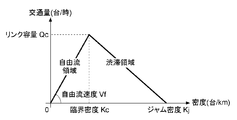
- FIG. 7B is a graph showing a traffic volume-density curve
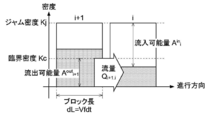
- FIG. 7C shows movement of traffic density between adjacent blocks. The situation is schematically represented.
- the traffic situation estimation unit 53 estimates the traffic situation in the unit area by estimation processing using a traffic flow model for the unit area.
- AVENUE an Advanced & Visual Evaluator for Road Networks in Urban arEas
- AVENUE an Advanced & Visual Evaluator for Road Networks in Urban arEas
- FIGS. 7A, 7B, and 7C illustrate block density methods used in AVENUE.
- this block density method as shown in FIG. 7A, blocks are set at equal intervals in links (roads), Express the traffic situation with the number of vehicles present in each block.
- a link connecting two intersections has two lanes, and blocks are set in each lane.
- a traffic volume-density curve determined by the traffic volume (link volume) Qc of the link, jam density Kj and free flow velocity Vf is set, and this traffic volume-density curve is set.
- the flow rate (moving traffic volume) Q i + 1, i between the adjacent upstream block i + 1 and the downstream block i is determined.
- the possible outflow amount A out i + 1 and the inflowable amount A in i of each block are determined from the density of each block, and the minimum value is determined between the blocks It is assumed that the flow rate Q i + 1, i .
- the calculation of the flow rate between adjacent blocks is performed for all blocks.
- the block density method can calculate the traffic volume on each link, but in addition, the hybrid block density method combining discrete queuing models with this block density method allows the travel situation of the vehicle to be calculated. Can be reproduced one by one, and also the route selection behavior of the driver can be taken in, whereby the traffic situation of each link can be estimated in detail.
- FIG. 8 is a flowchart showing the procedure of processing performed by the traffic condition estimation unit 53. As shown in FIG. 8
- estimate input information that is, vehicle sensor information in the estimation period and signal control result information
- the traffic flow model is applied to estimate the traffic situation in the unit area in the estimation period (ST 304).
- the estimation input information is sequentially applied to the traffic flow model from the estimation time T1, and the estimation result in the estimation period N1 is acquired. This estimation process is performed for each unit area, the estimation result for each unit area is obtained, and the estimation results for all target unit areas are stored in the storage unit 42 as traffic condition detailed information.
- FIG. 9 is an explanatory view showing the traffic situation detailed information acquired by the traffic situation estimation unit 53. As shown in FIG. 9
- the traffic situation estimation unit 53 estimates the traffic situation by estimation processing using a traffic flow model, and as a result, detailed traffic situation information as shown in FIG. 9 can be obtained.
- the traffic condition detailed information represents the traveling trajectory of each vehicle, that is, the temporal transition of the position of each vehicle.
- the virtual vehicle sensor information generation unit 54 generates virtual vehicle sensor information based on the traffic condition detailed information shown in FIG. In the present embodiment, the traffic volume and occupancy rate of the position where the virtual vehicle sensor is set are acquired as virtual vehicle sensor information.
- virtual vehicle detectors are set to the links L2, L5 and L7, and the virtual vehicle detectors are Virtual vehicle sensor information (traffic volume and occupancy rate) corresponding to each virtual vehicle sensor is generated from the traffic condition detail information of the set position.
- virtual vehicle sensor information at time T is generated from traffic condition detailed information in a collection period based on the time T, specifically, a period retroactive to a predetermined time from the time T.
- the collection period may be a unit time of traffic management (for example, 5 minutes) or an integral multiple thereof.
- the traffic condition detailed information shown in FIG. 9 is a reproduction of the traveling condition of each vehicle, and it is possible to grasp the behavior of each vehicle, and in particular, pay attention to the position where the virtual vehicle sensor is set. Thus, it is possible to grasp how the vehicle has passed the position of the virtual vehicle sensor. As a result, it is possible to acquire the traffic volume at the position of the virtual vehicle sensor, that is, the number of vehicles having passed within the unit time. In addition, it is possible to obtain an occupancy rate (time occupancy rate) at the position of the virtual vehicle sensor, that is, a ratio of time during which a vehicle is present in unit time.
- the embodiment has been described as an example of the technology disclosed in the present application.
- the technology in the present disclosure is not limited to this, and can be applied to embodiments in which changes, replacements, additions, omissions, and the like have been made.
- signal control is performed using virtual vehicle sensor information acquired from the estimation result of traffic conditions, but traffic provided to the driver of a vehicle using virtual vehicle sensor information Information may be generated. Also in this case, as in the case of signal control, it is possible to reduce the number of vehicle sensors without significantly changing the current control content for generating traffic information.
- the virtual vehicle sensor information regarding the virtual vehicle sensor is set by setting the virtual vehicle sensor to be substituted for the existing vehicle sensor.
- the virtual vehicle sensor is set at a position different from the existing vehicle detectors, and the virtual vehicle is generated. Control may be performed based on virtual vehicle sensor information on a sensor and vehicle sensor information from an existing vehicle sensor.
- the traffic management apparatus is divided into a first traffic management unit that realizes an existing function related to traffic management and a second traffic management unit that realizes a new function related to traffic management. It is configured to add a new function to the existing function, but the function of the first traffic management unit and the function of the second traffic management unit are put together into one existing device (first traffic management).
- the traffic management device may be configured to replace the traffic management device.
- the traffic management apparatus itself determines the range of the unit area, but the user determines the range of the unit area, and the unit area is determined based on the information on the unit area input by the user.
- the process of setting the may be performed by the traffic management device.
- a traffic management apparatus, a traffic management system, and a traffic management method according to the present invention have the effect of being able to reduce the number of vehicle detectors without significantly changing the control content of traffic management such as signal control, and a target area It is useful as a traffic management apparatus, a traffic management system, a traffic management method, etc. that performs traffic management in a target area based on vehicle sensor information acquired by a vehicle sensor installed inside.
Landscapes
- Physics & Mathematics (AREA)
- General Physics & Mathematics (AREA)
- Traffic Control Systems (AREA)
Applications Claiming Priority (2)
| Application Number | Priority Date | Filing Date | Title |
|---|---|---|---|
| JP2017136000A JP6899528B2 (ja) | 2017-07-12 | 2017-07-12 | 交通管理装置、交通管理システムおよび交通管理方法 |
| JP2017-136000 | 2017-07-12 |
Publications (1)
| Publication Number | Publication Date |
|---|---|
| WO2019012832A1 true WO2019012832A1 (ja) | 2019-01-17 |
Family
ID=65002117
Family Applications (1)
| Application Number | Title | Priority Date | Filing Date |
|---|---|---|---|
| PCT/JP2018/020685 Ceased WO2019012832A1 (ja) | 2017-07-12 | 2018-05-30 | 交通管理装置、交通管理システムおよび交通管理方法 |
Country Status (2)
| Country | Link |
|---|---|
| JP (1) | JP6899528B2 (https=) |
| WO (1) | WO2019012832A1 (https=) |
Cited By (2)
| Publication number | Priority date | Publication date | Assignee | Title |
|---|---|---|---|---|
| CN114077238A (zh) * | 2020-08-11 | 2022-02-22 | 丰田自动车株式会社 | 能源供给系统、信息处理装置以及方法 |
| CN114287023A (zh) * | 2019-09-25 | 2022-04-05 | 华为云计算技术有限公司 | 用于交通预测的多传感器学习系统 |
Families Citing this family (1)
| Publication number | Priority date | Publication date | Assignee | Title |
|---|---|---|---|---|
| CN110969871B (zh) * | 2019-12-18 | 2020-11-24 | 浙江大学 | 一种智能交通灯控制系统和控制方法 |
Citations (5)
| Publication number | Priority date | Publication date | Assignee | Title |
|---|---|---|---|---|
| JP2006343814A (ja) * | 2005-06-07 | 2006-12-21 | Sumitomo Electric Ind Ltd | 交通管制システム及び交通管制システムに情報を送信するための車載器 |
| JP2015148871A (ja) * | 2014-02-05 | 2015-08-20 | パナソニック株式会社 | 信号制御装置、信号制御システムおよび信号制御方法 |
| JP2016062484A (ja) * | 2014-09-19 | 2016-04-25 | パナソニックIpマネジメント株式会社 | 交通管理装置、交通管理システムおよび交通管理方法 |
| JP2016062483A (ja) * | 2014-09-19 | 2016-04-25 | パナソニックIpマネジメント株式会社 | 交通情報生成装置および交通情報生成方法 |
| WO2016136616A1 (ja) * | 2015-02-23 | 2016-09-01 | 住友電気工業株式会社 | 交通指標生成装置、交通指標生成方法及びコンピュータプログラム |
-
2017
- 2017-07-12 JP JP2017136000A patent/JP6899528B2/ja active Active
-
2018
- 2018-05-30 WO PCT/JP2018/020685 patent/WO2019012832A1/ja not_active Ceased
Patent Citations (5)
| Publication number | Priority date | Publication date | Assignee | Title |
|---|---|---|---|---|
| JP2006343814A (ja) * | 2005-06-07 | 2006-12-21 | Sumitomo Electric Ind Ltd | 交通管制システム及び交通管制システムに情報を送信するための車載器 |
| JP2015148871A (ja) * | 2014-02-05 | 2015-08-20 | パナソニック株式会社 | 信号制御装置、信号制御システムおよび信号制御方法 |
| JP2016062484A (ja) * | 2014-09-19 | 2016-04-25 | パナソニックIpマネジメント株式会社 | 交通管理装置、交通管理システムおよび交通管理方法 |
| JP2016062483A (ja) * | 2014-09-19 | 2016-04-25 | パナソニックIpマネジメント株式会社 | 交通情報生成装置および交通情報生成方法 |
| WO2016136616A1 (ja) * | 2015-02-23 | 2016-09-01 | 住友電気工業株式会社 | 交通指標生成装置、交通指標生成方法及びコンピュータプログラム |
Cited By (4)
| Publication number | Priority date | Publication date | Assignee | Title |
|---|---|---|---|---|
| CN114287023A (zh) * | 2019-09-25 | 2022-04-05 | 华为云计算技术有限公司 | 用于交通预测的多传感器学习系统 |
| CN114287023B (zh) * | 2019-09-25 | 2023-12-15 | 华为云计算技术有限公司 | 用于交通预测的多传感器学习系统 |
| CN114077238A (zh) * | 2020-08-11 | 2022-02-22 | 丰田自动车株式会社 | 能源供给系统、信息处理装置以及方法 |
| CN114077238B (zh) * | 2020-08-11 | 2024-05-24 | 丰田自动车株式会社 | 能源供给系统、信息处理装置以及方法 |
Also Published As
| Publication number | Publication date |
|---|---|
| JP6899528B2 (ja) | 2021-07-07 |
| JP2019020799A (ja) | 2019-02-07 |
Similar Documents
| Publication | Publication Date | Title |
|---|---|---|
| Luo et al. | A multisource data approach for estimating vehicle queue length at metered on-ramps | |
| KR102329826B1 (ko) | 인공지능 기반 교통신호 제어 장치 및 방법 | |
| US8755991B2 (en) | Method and structure for vehicular traffic prediction with link interactions and missing real-time data | |
| CN104464310B (zh) | 城市区域多交叉口信号协同优化控制方法及系统 | |
| Chang et al. | A study on traffic signal control at signalized intersections in vehicular ad hoc networks | |
| Goodall et al. | Microscopic estimation of arterial vehicle positions in a low-penetration-rate connected vehicle environment | |
| Aljamal et al. | Real-time estimation of vehicle counts on signalized intersection approaches using probe vehicle data | |
| CN112185124B (zh) | 一种全路网交通状态预测方法及装置 | |
| CN114730522A (zh) | 交通推理器 | |
| CN111798659A (zh) | 用于在预先确定区域内的机动车的交通控制的方法和设备 | |
| WO2019012832A1 (ja) | 交通管理装置、交通管理システムおよび交通管理方法 | |
| Hans et al. | Clustering approach for assessing the travel time variability of arterials | |
| Li et al. | POINT: Partially observable imitation network for traffic signal control | |
| Ye et al. | Deep learning-based queue-aware eco-approach and departure system for plug-in hybrid electric buses at signalized intersections: A simulation study | |
| JP7296567B2 (ja) | 交通信号制御装置、交通信号制御システムおよび交通信号制御方法 | |
| Hoogendoorn et al. | Integrated network management amsterdam: control approach and test results | |
| JP6292555B2 (ja) | 交通管理装置、交通管理システムおよび交通管理方法 | |
| CN116343468B (zh) | 预测通过时间的装置和方法以及预测行驶时间的方法 | |
| JP6226300B2 (ja) | 交通情報生成装置および交通情報生成方法 | |
| Verghese et al. | Development and implementation of a model-based road traffic-control scheme | |
| Knoop et al. | Relationship between application scale and maximum time latency in intelligent transport solutions | |
| JP2000242884A (ja) | 交通流シミュレーションシステム | |
| Nicoleta Mocofan et al. | Comparative assessment of traffic control parameters within an UTC-distributed system | |
| JP2021184172A (ja) | 情報生成システム、情報生成装置、情報生成方法、および情報生成プログラム | |
| JP2018198026A (ja) | 事故予報システム、および、事故予報方法 |
Legal Events
| Date | Code | Title | Description |
|---|---|---|---|
| 121 | Ep: the epo has been informed by wipo that ep was designated in this application |
Ref document number: 18831244 Country of ref document: EP Kind code of ref document: A1 |
|
| NENP | Non-entry into the national phase |
Ref country code: DE |
|
| 122 | Ep: pct application non-entry in european phase |
Ref document number: 18831244 Country of ref document: EP Kind code of ref document: A1 |