WO2019004372A1 - 金属酸化物ナノ結晶膜固定化基板、金属酸化物ナノ結晶の製造方法、金属酸化物ナノ結晶膜固定化基板の製造方法 - Google Patents
金属酸化物ナノ結晶膜固定化基板、金属酸化物ナノ結晶の製造方法、金属酸化物ナノ結晶膜固定化基板の製造方法 Download PDFInfo
- Publication number
- WO2019004372A1 WO2019004372A1 PCT/JP2018/024651 JP2018024651W WO2019004372A1 WO 2019004372 A1 WO2019004372 A1 WO 2019004372A1 JP 2018024651 W JP2018024651 W JP 2018024651W WO 2019004372 A1 WO2019004372 A1 WO 2019004372A1
- Authority
- WO
- WIPO (PCT)
- Prior art keywords
- metal oxide
- nanocrystals
- substrate
- nanocrystal
- lead
- Prior art date
- Legal status (The legal status is an assumption and is not a legal conclusion. Google has not performed a legal analysis and makes no representation as to the accuracy of the status listed.)
- Ceased
Links
Images









Classifications
-
- C—CHEMISTRY; METALLURGY
- C01—INORGANIC CHEMISTRY
- C01G—COMPOUNDS CONTAINING METALS NOT COVERED BY SUBCLASSES C01D OR C01F
- C01G23/00—Compounds of titanium
-
- C—CHEMISTRY; METALLURGY
- C01—INORGANIC CHEMISTRY
- C01G—COMPOUNDS CONTAINING METALS NOT COVERED BY SUBCLASSES C01D OR C01F
- C01G25/00—Compounds of zirconium
-
- H—ELECTRICITY
- H10—SEMICONDUCTOR DEVICES; ELECTRIC SOLID-STATE DEVICES NOT OTHERWISE PROVIDED FOR
- H10N—ELECTRIC SOLID-STATE DEVICES NOT OTHERWISE PROVIDED FOR
- H10N30/00—Piezoelectric or electrostrictive devices
- H10N30/01—Manufacture or treatment
- H10N30/07—Forming of piezoelectric or electrostrictive parts or bodies on an electrical element or another base
- H10N30/074—Forming of piezoelectric or electrostrictive parts or bodies on an electrical element or another base by depositing piezoelectric or electrostrictive layers, e.g. aerosol or screen printing
- H10N30/077—Forming of piezoelectric or electrostrictive parts or bodies on an electrical element or another base by depositing piezoelectric or electrostrictive layers, e.g. aerosol or screen printing by liquid phase deposition
-
- H—ELECTRICITY
- H10—SEMICONDUCTOR DEVICES; ELECTRIC SOLID-STATE DEVICES NOT OTHERWISE PROVIDED FOR
- H10N—ELECTRIC SOLID-STATE DEVICES NOT OTHERWISE PROVIDED FOR
- H10N30/00—Piezoelectric or electrostrictive devices
- H10N30/80—Constructional details
- H10N30/85—Piezoelectric or electrostrictive active materials
- H10N30/853—Ceramic compositions
Definitions
- the present invention relates to a metal oxide nanocrystal film-immobilized substrate, a method of producing a metal oxide nanocrystal, and a method of producing a metal oxide nanocrystal film-immobilized substrate.
- Lead oxide (PT) and lead zirconate titanate (PZT), which are metal oxides, are known as piezoelectrics exhibiting an excellent piezoelectric effect.
- Such lead titanate and lead zirconate titanate nanocrystals (nanocubes) exhibit characteristic physical properties due to size, and are expected to be applied as novel materials.
- Non-Patent Document 1 As a conventional method for producing lead zirconate titanate, for example, according to Non-Patent Document 1, lead acetate powder and EDTA are dispersed in water, to which is added raw material powder in which titanium oxide powder and zirconium oxychloride are dispersed in water. It is described that lead zirconate titanate powder is produced by hydrothermal synthesis using an autoclave. According to the method for producing lead zirconate titanate described in Non-Patent Document 1, it is believed that fine particles of lead zirconate titanate having a cubic shape and a uniform size of about several ⁇ m can be produced.
- Patent Document 1 a lead compound, a titanium compound, and a zirconium compound are mixed at a mixing ratio in a specific range, this mixed raw material is aged in a specific pH range, and then a basic substance is added to hydrothermally synthesize. It is described that lead zirconate titanate particles of micron size such as 0.5 to 10 ⁇ m can be obtained.
- Non-Patent Document 1 and Patent Document 1 the development of characteristic physical properties attributed to its size is expected, for example, from several tens of nm in size It is difficult to stably produce lead titanate and lead zirconate titanate nanocrystals (nanocubes) on the order of several hundred nm.
- a film in which fine particles of lead titanate or lead zirconate titanate are arrayed and accumulated on the surface of the substrate, or separately dispersed on the substrate In forming the film (hereinafter referred to as immobilization), complicated processes such as baking of the substrate after forming the film and etching for forming irregularities on the substrate are required. For this reason, a method of easily producing a substrate on which a film containing fine particles of lead titanate or lead zirconate titanate is formed at low cost is desired.
- the present invention has been made in view of the above situation, and is a metal oxide nanocrystal film immobilized substrate using nanocrystals of lead titanate and lead zirconate titanate which are metal oxides Intended to provide.
- the present invention also provides a method for producing metal oxide nanocrystals capable of producing nanocrystals (nanocubes) of lead titanate and lead zirconate titanate, which are metal oxides, and metal oxidation in a simple process. It is an object of the present invention to provide a method for producing a metal oxide nanocrystal film-immobilized substrate capable of immobilizing a nanocrystalline film on the surface of the substrate.
- the present inventor found that an aqueous solution of lead acetate, an aqueous solution of a water-soluble titanium complex, or an aqueous solution of a water-soluble titanium complex and an aqueous solution of a water-soluble zirconium complex, and a quaternary ammonium compound And a mixed solution to obtain a mixed solution, and heating and synthesizing this mixed solution to obtain nano-sized lead titanate nanocrystals and lead zirconate titanate nanocrystals having a hexahedral structure.
- the present invention was conceived.
- a metal oxide nanocrystal film immobilized substrate comprises a substrate and a nanocrystal film composed of metal oxide nanocrystals arrayed or immobilized on the substrate, the metal The metal oxide constituting the oxide nanocrystal is lead titanate or lead zirconate titanate.
- the metal oxide has a general formula PbZr x Ti (1-x) O 3 (0 ⁇ x ⁇ 0.7). It is preferred that
- the crystal shape of the metal oxide nanocrystal is a hexahedron, and the metal oxide nanocrystal Is preferably 10 nm or more and 1500 nm or less.
- the center line average roughness in the diagonal of each face constituting the hexahedron of the metal oxide nanocrystal is 5 nm or less, and It is preferable to have surface smoothness such that the average surface roughness in the region of 40% or more of each surface constituting the hexahedron is 30 nm or less.
- a piezoelectric constant (d 33 -PFM ) obtained by a piezoelectric response microscope measurement of the metal oxide nanocrystal It is preferable that the average of the absolute value of the saturated value of is 25 pm / V or more.
- the substrate is provided with irregularities on the surface, and a plane from the thickness direction of the substrate It is preferable that the asperities have a pattern shape of any one of linear, curvilinear, and circular when viewed, and the asperities are formed so as to be removable by etching.
- a method of producing metal oxide nanocrystals is a method of producing metal oxide nanocrystals containing a metal oxide composed of lead titanate or lead zirconate titanate, which is lead acetate
- the ligand of the water-soluble titanium complex is preferably a hydroxycarboxylic acid.
- the ligand of the water-soluble zirconium complex is preferably a hydroxycarboxylic acid.
- the quaternary ammonium compound is preferably tetramethyl ammonium hydroxide.
- the molar ratio of titanium to zirconium in the mixed solution is 100: 0 to 30:70. It is preferable to be in the range of
- the molar ratio of lead to titanium or titanium and zirconium is 1: It is preferable that it is 1 or more and 2: 1 or less.
- the mixed solution contains 2 to 100 moles of a quaternary ammonium compound per 1 mole of lead. Is preferred.
- the heating step is performed in a temperature range of 140 ° C. or more and 240 ° C. or less and 120 hours or more. It is preferable to carry out in the time range of time or less.
- the separation step separates and recovers the metal oxide nanocrystals from the residual solution by centrifugation.
- a method for producing a metal oxide nanocrystal film-immobilized substrate according to an aspect of the present invention is a method for producing a metal oxide nanocrystal film-immobilized substrate according to any one of the above [1] to [6]. It is a manufacturing method, Comprising: The metal oxide nanocrystal obtained by the manufacturing method of the metal oxide nanocrystal as described in any one of said [7]-[15] description of said each clause is alcohol solvent or pH 3 or less Dispersion in an acidic solvent, followed by centrifugation, and a supernatant liquid is recovered to obtain a nanocrystal dispersion, and the nanocrystal dispersion is coated on the substrate and then dried to obtain the nanocrystal film. And immobilizing the substrate on the substrate.
- a metal oxide nanocrystal film-immobilized substrate using nanocrystals of lead titanate and lead zirconate titanate which are metal oxides. Further, according to the present invention, a method for producing metal oxide nanocrystals capable of producing nanocrystals (nanocubes) of lead titanate and lead zirconate titanate, and metal oxide nanocrystals by a simple process. It is possible to provide a method for producing a metal oxide nanocrystal film-immobilized substrate capable of immobilizing the film of the present invention on the surface of the substrate.
- FIG. 15 is a graph showing the results of powder XRD measurement of the lead titanate nanocrystals prepared in Examples 4 to 6 using an X-ray diffractometer.
- nanocubes which are hexahedral crystals in the present specification
- “nanocrystals” are incomplete hexahedrons having beveled apexes of the hexahedron simultaneously synthesized in the synthesis or fabrication process of nanocubes. Crystals also in the form of crystals. The incomplete hexahedral crystal in which the apexes of this hexahedron are chamfered is in the process of becoming a hexahedral crystal.
- the size of the crystal is not limited as long as lead titanate and lead zirconate titanate have a nanometer size that can be hexahedral, but, for example, a range of 10 nm or more and 1500 nm or less is assumed. be able to.
- the size is preferably 100 nm or more and 1500 nm or less, and more preferably 800 nm or more and 1500 nm or less.
- the size here means the length of the largest one side at the time of planarly viewing each surface of each nanocrystal.
- the lead acetate aqueous solution, the water-soluble titanium complex aqueous solution, and the quaternary ammonium solution are used as the raw materials.
- a compound is prepared, and they are mixed to form a mixed solution which is a synthetic raw material of nanocrystals (mixed solution forming step).
- an aqueous solution of lead acetate, an aqueous solution of a water-soluble titanium complex and an aqueous solution of a water-soluble zirconium complex, and a quaternary ammonium compound are prepared as raw materials. Then, they are mixed to form a mixed solution which is a synthetic raw material of nanocrystals (mixed solution forming step).
- the water-soluble titanium complex used in the present invention a compound which is dissolved in water and from which a ligand is removed from a titanium atom to form a bond between a titanium atom and an oxygen atom can be used.
- the ligand of the water-soluble titanium complex is preferably a hydroxycarboxylic acid.
- titanium bis (ammonium lactate) dihydroxy (titanium bis (ammonium lactate) dihydroxide, hereinafter "TALH") whose ligand is lactic acid, and the ligand is glycolic acid (HOCH 2 COOH) (NH 4 ) 6 [Ti 4 (C 2 H 2 O 3 ) 4 (C 2 H 3 O 3 ) 2 (O 2 ) 4 O 2 ] ⁇ 6 H 2 O
- the ligand is citric acid ((CH 2 COOH) 2 C (OH) COOH) (NH 4 ) 8 [Ti 4 (C 6 H 4 O 7 ) 4 (O 2 ) 4 ].
- 8 H 2 O which is a ligand, or the ligand is malic acid (CH 2 CHOH
- titanium complexes which are (COOH) 2 ) or tartaric acid ((CHOH) 2 (COOH) 2 ).
- TAHL is used as the water-soluble titanium complex.
- TAHL is a precursor of a water-soluble oxide containing titanium, and the reaction of forming an oxide using TAHL proceeds under mild conditions as compared with other methods, and TAHL is soluble in water. Therefore, the reaction in an aqueous solution is possible.
- the water-soluble zirconium complex used in the present invention a compound which is dissolved in water and from which a ligand is removed from a zirconium atom to form a bond between a zirconium atom and an oxygen atom can be used.
- the ligand of the water-soluble zirconium complex is a hydroxycarboxylic acid.
- water-soluble zirconium complex examples include zirconium lactate ammonium salt and the like.
- a zirconium lactate ammonium salt (Zr (OH) [(OCH (CH 3 ) COO ⁇ ] 3 (NH 4 + ) 3 ) is used as the water-soluble zirconium complex.
- Zr (OH) [(OCH (CH 3 ) COO ⁇ ] 3 (NH 4 + ) 3
- Organix ZC -300 (trade name, manufactured by Matsumoto Fine Chemical Co., Ltd.)
- zirconate titanate having a controlled nanometer-sized hexahedral structure Contributing to the synthesis of lead nanocrystals.
- the water-soluble titanium complex and the water-soluble zirconium complex are mixed such that the molar ratio of titanium to zirconium is in the range of 100: 0 to 30:70 in the above-mentioned mixed solution. That is, the water-soluble titanium complex and the water-soluble zirconium complex such that the molar ratio of titanium is 30 or more and 100 or less, the mole of zirconium is 0 or more and 70 or less, and the total of the molar ratio of titanium and zirconium is 100. And mix.
- the case where the molar ratio of zirconium is 0 corresponds to the case of synthesizing lead titanate nanocrystals.
- the total number of moles of titanium and zirconium is lead so that the number of moles of titanium is 0.3 times or more and 1 or less times the number of moles of lead.
- the lead acetate is mixed with the water-soluble titanium complex and the water-soluble zirconium complex so as to have the same number of moles. Therefore, in the mixed solution described above, lead acetate and lead acetate so that the molar ratio of lead to titanium and zirconium (Pb: Ti + Zr) is in the range of 1: 1 to 2: 1.
- Water-soluble titanium complex and water-soluble zirconium complex That is, at the start of mixing, the amount of lead is set to 1 mole or more and 2 moles or less with respect to 1 mole of titanium or 1 mole of a mixture of titanium and zirconium.
- TMAH tetramethyl ammonium hydroxide
- TMAH tetramethyl ammonium hydroxide
- TMAH exists in the form of a relatively stable solid pentahydrate, and when dissolved in water, the aqueous solution exhibits strong basicity.
- lead acetate and the quaternary ammonium compound are mixed such that the number of moles of the quaternary ammonium compound with respect to 1 mol of lead is in the range of 2 or more and 100 or less in the mixed solution described above.
- Heating of the reaction solution used in the present invention is preferably performed at a temperature of 140 ° C. or more and 240 ° C. or less. Moreover, it is more preferable to implement at a temperature of 200 ° C. or more and 230 ° C. or less. If the heating temperature is less than 140 ° C., there is a problem that the synthesis reaction of nanocrystals does not proceed sufficiently. In addition, when the heating temperature exceeds 240 ° C., there is a problem that a controlled hexahedral structure can not be finally obtained.
- the heating of the reaction solution used in the present invention is preferably performed for 1 hour or more and 120 hours or less, more preferably 70 hours or more and 100 hours or less. If the heating time is less than one hour, there is a problem that the synthesis reaction of nanocrystals does not proceed sufficiently. In addition, since the shape of the nanocrystals does not change so much even if the heating time exceeds 120 hours, it is considered that no further heating is necessary.
- the synthesis reaction of the nanocrystals is sufficiently carried out by carrying out the heating step at a temperature of 140 ° C. or more and 240 ° C. or less and for 1 hour or more and 120 hours or less. It is possible to obtain nanometer-sized lead titanate nanocrystals and lead zirconate titanate nanocrystals having a controlled hexahedral structure without advancing and performing wasteful heating.
- the mixed solution after synthesizing the metal oxide nanocrystals is centrifuged. Then, the metal oxide nanocrystals are precipitated, and separated from the remaining solution (separation and recovery) by filtration or the like (separation step). By such separation step, unnecessary small crystals and the like can be removed, and lead titanate nanocrystals and lead zirconate titanate nanocrystals having a hexahedral structure whose size is controlled can be obtained.
- the metal oxide nanocrystals (lead titanate nanocrystals, lead zirconate titanate nanocrystals) obtained by the above method for producing metal oxide nanocrystals of the present invention have the following characteristics.
- the crystal shape is a hexahedron (shape), and the crystal size is 10 nm or more and 1500 nm or less. Moreover, Preferably they are 100 nm or more and 1500 nm or less. Furthermore, more preferably, they are 800 nm or more and 1500 nm or less. In addition, this size means the length of the largest one side when planar view of each nanocrystal.
- the average absolute value of the saturation value of the piezoelectric constant (d 33 -PFM) determined by the piezoelectric response microscope (PFM) measurement is 25 pm / V or more.
- the d constant is an amount representing the ease of deformation when a voltage is applied, and d 33 indicates expansion and contraction perpendicular to the electrode surface (in the thickness direction).
- the center line average roughness on the diagonal of any one face of the hexahedron is 5 nm or less, and any face of the hexahedron
- the surface smoothness is such that the average surface roughness in a region of 40% or more of the area is 30 nm or less. The smoothness is basically maintained on the entire surface of the hexahedron, as estimated from the observation image of the nanocrystals by SEM.
- the metal oxide nanocrystal film-immobilized substrate obtained by the method for producing a metal oxide nanocrystal film-immobilized substrate according to the present invention is a nanocrystal comprising a substrate and metal oxide nanocrystals arranged or immobilized on the substrate. And a membrane.
- the metal oxide constituting the metal oxide nanocrystal is lead titanate or lead zirconate titanate.
- any substrate which is stable to a solvent and not hygroscopic can be used, and one having a flat surface is preferable.
- FTO, ITO, glass, silicon, metal, ceramics, polymer, paper , And rubber and low heat resistant substrates selected from the group of can be used.
- the surface of the substrate it is possible to form an unevenness which can be removed by etching. Such unevenness can form the nanocrystal film in any shape on the substrate.
- the shape of the asperities in plan view from the thickness direction of the substrate may be, for example, any one of linear, curved, and circular shapes.
- a silicon wafer on which a platinum thin film is formed is used as such a substrate. Then, in order to form the nanocrystal film in a large number of linear shapes on this substrate, a mold made of polyimide, for example, was formed in advance in a stripe shape with a width of several microns as irregularities on the surface of the substrate.
- the lead titanate nanocrystals or lead zirconate titanate nanocrystals obtained by the method for producing metal oxide nanocrystals of the present invention described above are dispersed in an alcohol solvent or an acidic solvent having a pH of 3 or less, and then centrifuged. And collect the supernatant to obtain a nanocrystal dispersion (dispersion step).
- the nanocrystal dispersion obtained in this dispersion step is coated on a substrate and dried. Thereby, the nanocrystal film from which the nanocrystal dispersion liquid has been dried is immobilized on the substrate (immobilization step). After this, as in the present embodiment, if the mold formed in the stripe shape is removed, the nano-crystal film fixed and embedded in the groove between the linear molds remains, and the nano pattern of stripe pattern is formed on the substrate. A metal oxide nanocrystal film-immobilized substrate provided with a crystal film can be obtained.
- the nanocrystal dispersion is performed. Since the nanocrystal film is immobilized on the substrate only by applying the liquid to the substrate and drying, it is necessary to perform heat treatment such as baking to form a fine crystal film on the substrate as in the prior art. There is not.
- a nanocrystal film in which lead titanate nanocrystals and lead zirconate titanate nanocrystals are dispersed is immobilized. be able to.
- the metal oxide nanocrystal film-immobilized substrate can be easily obtained at low cost by a simple process of applying the nanocrystal dispersion to the substrate and drying it. Furthermore, if irregularities having an easy removal such as a mold of an arbitrary pattern are formed in advance on the substrate, lead titanate nanocrystals or lead zirconate titanate nano particles in an arbitrary pattern without etching the substrate beforehand. It is possible to easily form a metal oxide nanocrystal film immobilized substrate on which a nanocrystal film in which crystals are dispersed is immobilized.
- the molar ratio (Pb: Ti) of lead to titanium contained in the mixed solution was adjusted to 2: 1.
- the resulting mixed solution was placed in an autoclave, sealed, heated for 24 hours, and cooled to room temperature.
- the heating temperature at this time was 180 ° C. and the heating temperature was 200 ° C., respectively.
- the samples for identification of lead titanate nanocrystals of Example 1 and Example 2 are drip-dried at room temperature onto a silicon wafer substrate using a colloidal solution obtained by redispersing powder collected by centrifugation in isopropyl alcohol. Made by After subjecting the sample to UV irradiation for 2 hours, the surface was cleaned by holding it at 200 ° C. for 1.5 hours in an incubator.
- substrate at room temperature is shown. From the SEM image, it was confirmed that in Example 1, nanocrystals having a substantially hexahedral shape and a size of approximately 100 nm could be synthesized. The size of the nanocrystals and their distribution depend on the synthesis conditions, but in Example 1, the nanocrystals with a size of 100 nm were about 90% of the whole.
- substrate at room temperature is shown. From the SEM image, it can be confirmed in Example 2 that nanocrystals having a substantially hexahedral shape and a size of approximately 100 nm could be synthesized. Although the size of the nanocrystals and their distribution depend on the synthesis conditions, in Example 2, the nanocrystals of 100 nm size were about 80% of the whole.
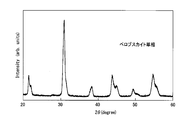
- FIG. 3 shows the results of powder XRD measurement of the lead titanate nanocrystals prepared in Example 2 using an X-ray diffractometer.
- the lead titanate nanocrystals prepared in Example 1 have a peak at approximately the same position as PbTiO 3 , and the crystal structure and the lattice constant thereof are close. From this result, it can be confirmed that the molar ratio (Pb: Ti) of lead to titanium in the prepared (synthesized) lead titanate nanocrystals is 1: 1.
- TMAH aqueous solution in which 1.6815 g of TMAH was dissolved in 15 ml of water was added to this aqueous solution to prepare a mixed solution (reaction solution).
- the molar ratio (Pb: Zr + Ti) of lead to zirconium and titanium contained in the mixed solution was made to be 2: 1.
- the resulting mixed solution was placed in an autoclave, sealed and heated, and then cooled to room temperature.
- the heating temperature at this time is 180 ° C., and the heating time is 24 hours for Example 3, the heating temperature is 180 ° C., and the heating time is 6 hours for Example 4, the heating temperature is 200 ° C., and the heating time is 6 hours
- the product of Example 5 was used, and the product of a heating temperature of 220 ° C. and a heating time of 6 hours was used as Example 6.
- the samples for identification of lead zirconate titanate nanocrystals of Examples 3 to 6 are dropped and dried on a silicon wafer substrate at room temperature using a colloidal solution obtained by redispersing powder collected by centrifugation and re-dispersed in isopropyl alcohol. Made by After subjecting the sample to UV irradiation for 2 hours, the surface was cleaned by holding it at 200 ° C. for 1.5 hours in an incubator.
- Example 3 the dispersion containing the lead zirconate titanate nanocrystals prepared in Example 3 (heating temperature 180 ° C., heating time 24 hours) was dropped onto a silicon wafer substrate at room temperature by the above sample preparation method.
- the SEM image of the surface of the sample produced by performing is shown. From the SEM image, it was confirmed that in Example 3, nanocrystals having a size of approximately 800 nm to 1000 nm were able to be synthesized.
- the size of the nanocrystals and their distribution depend on the synthesis conditions, but in Example 3, the nanocrystals with a size of 800 nm to 1000 nm were about 90% of the whole.
- the dispersion containing the lead zirconate titanate nanocrystals prepared in Example 4 was dropped onto the silicon wafer substrate at room temperature by the above sample preparation method.
- the SEM image of the surface of the sample produced by performing is shown. From the SEM image, it was confirmed that in Example 4 a nanocrystal substantially in the shape of a hexahedron and having a size of 1000 nm could be synthesized.
- the size of the nanocrystals and their distribution depend on the synthesis conditions, but in Example 4, the nanocrystals with a size of 1000 nm were about 90% of the whole.
- Example 6 the dispersion containing the lead zirconate titanate nanocrystals (heating temperature 200 ° C., heating time 6 hours) prepared in Example 5 is dropped onto a silicon wafer substrate at room temperature by the above sample preparation method.
- the SEM image of the surface of the sample produced by performing is shown. From the SEM image, it was confirmed that Example 6 was able to synthesize nanocrystals having a substantially hexahedral shape and a size of 1200 nm to 1300 nm.
- the size of the nanocrystals and their distribution depend on the synthesis conditions, but in Example 5, the nanocrystals with a size of 1200 nm to 1300 nm were about 90% of the whole.
- Example 7 the dispersion containing the lead zirconate titanate nanocrystals (heating temperature 220 ° C., heating time 6 hours) prepared in Example 6 is dropped onto a silicon wafer substrate at room temperature by the above sample preparation method.
- the SEM image of the surface of the sample produced by performing is shown. From the SEM image, it was confirmed that in Example 6, it was possible to synthesize nanocrystals having a substantially square pole shape and a size of 1 ⁇ m in width and 5 to 10 ⁇ m in length.
- the size of the nanocrystals and the distribution thereof depend on the synthesis conditions, but in Example 6, the nanocrystals having a square pillar shape and a size of 1 ⁇ m in width and 5 to 10 ⁇ m in length were about 90% of the whole.
- FIG. 8 shows the result of powder XRD measurement of the lead zirconate titanate nanocrystal prepared in Example 3 using an X-ray diffractometer.
- the lead titanate nanocrystal prepared in Example 3 has a peak at almost the same position as Pb (Zr 0.52 Ti 0.48 ) O 3 , and the crystal structure and the lattice constant thereof are close. From this result, it can be confirmed that the molar ratio (Pb: Zr + Ti) of lead to zirconium and titanium among the prepared (synthesized) lead zirconate titanate nanocrystals is 1: 1. .
- FIG. 9 shows the results of powder XRD measurement of the lead titanate nanocrystals prepared in Examples 4 to 6 using an X-ray diffractometer.
- Example 6 heating temperature: 220 ° C., heating time: 6 hours
- a perovskite structure was obtained.
- TMAH aqueous solution in which 1.6815 g of TMAH was dissolved in 15 ml of water was added to this aqueous solution to prepare a mixed solution (reaction solution).
- the molar ratio (Pb: Zr + Ti) of lead to zirconium and titanium contained in the mixed solution was made to be 2: 1.
- the obtained mixed solution was put into an autoclave, sealed, heated under the conditions of heating temperature 180 ° C., heating time 6 hours, and cooled to room temperature to obtain Example 7.
- a sample for identification of lead zirconate titanate nanocrystals of Example 7 was prepared by dropping and drying a powder collected by centrifugation on a silicon wafer substrate using a colloidal solution obtained by redispersing in isopropyl alcohol. . After subjecting the sample to UV irradiation for 2 hours, the surface was cleaned by holding it at 200 ° C. for 1.5 hours in an incubator.
- Example 7 the dispersion containing the lead zirconate titanate nanocrystals prepared in Example 7 (heating temperature 180 ° C., heating time 6 hours) was dropped onto a silicon wafer substrate at room temperature by the above sample preparation method.
- the SEM image of the surface of the sample produced by performing is shown. From the SEM image, it was confirmed that Example 6 was able to synthesize a substantially hexahedral nanocrystal having a size of 1000 nm.
- the size of the nanocrystals and their distribution depend on the synthesis conditions, but in Example 7, the nanocrystals with a size of 1000 nm were about 90% of the whole.
- FIG. 11 shows the results of powder XRD measurement of the lead zirconate titanate nanocrystals prepared in Example 7 using an X-ray diffractometer.
- the lead titanate nanocrystals prepared in Example 7 have a peak at almost the same position as Pb (Zr 0.7 Ti 0.3 ) O 3 , and the crystal structure and its lattice constant are close, and the perovskite structure is It is obtained. From this result, it can be confirmed that the molar ratio (Pb: Zr + Ti) of lead to zirconium and titanium among the prepared (synthesized) lead zirconate titanate nanocrystals is 1: 1. .
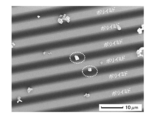
- FIG. 12 The SEM image of the sample in which the nanocrystal film was immobilized on the substrate with the dried mold attached is shown in FIG. According to FIG. 12, a place where the lead zirconate titanate nanocrystals are accumulated in the groove of the mold (the dotted line portion with a circle) was observed.
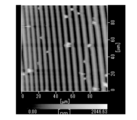
- FIG. 13 an SPM (scanning probe microscope, NanoNaviReal manufactured by Hitachi High-Tech Science) image of the above-described sample is shown in FIG. According to FIG. 13, since the nanocrystalline film of lead zirconate titanate is immobilized on the substrate by dropping and drying the nanocrystal dispersion liquid, shape measurement becomes possible by SPM (scanning probe microscope) ing.
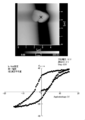
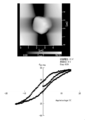
- the average absolute value of the saturation value of the piezoelectric constant (d 33 -PFM) determined by the piezoelectric response microscope measurement of the lead zirconate titanate nanocrystals of the present invention is 25 pm / It was confirmed to be V or more.
- FIG. 18 shows an SEM image of a sample produced by dripping and drying a supernatant liquid after pH adjustment with hydrochloric acid on a silicon wafer substrate at room temperature after standing for 1 day.
- a regular hexahedron with a size of about 800 nm to 1500 nm could be observed.
- a mold (concave and convex) having a stripe-like micropattern (2 to 3 mm in width) made of polyimide is formed on a silicon wafer on which a platinum film is formed, and the supernatant liquid (nanocrystal dispersion) after pH adjustment with hydrochloric acid. Solution) was dropped, and then dried.
- a mold (concave and convex) having a stripe-like micropattern (2 to 3 mm in width) made of silicon is formed on a silicon wafer on which a platinum film is formed, and the pH is adjusted with hydrochloric acid. ) was dropped and dried.
- FIG. 19 The SEM image of the sample in which the nanocrystal film was immobilized on the substrate with the polyimide mold attached is shown in FIG. 19 and FIG.
- FIG. 19 an SEM image of a sample in which a nanocrystal film is immobilized on a substrate with a silicon mold attached is shown in FIG. According to FIGS. 19 to 21, even in the case of any of the polyimide and silicon molds, locations where lead zirconate titanate nanocrystals were accumulated in the grooves of the mold were observed.
- FIGS. 22 and 23 The results of the two measurements are shown in FIGS. 22 and 23, respectively.
- the centerline average roughness of the diagonal of any one face of the hexahedron of lead zirconate titanate nanocrystals (Pb (Zr 0.52 Ti 0.48 ) O 3 : heating temperature 180 ° C., heating time 6 hours) is 4.7 nm (FIG. 22) and 3.9 nm (FIG. 23).
- the average surface roughness of any one face of the hexahedron of lead zirconate titanate nanocrystals was 27 nm (FIG. 22) and 28 nm (44%) (FIG. 23).
- the average surface roughness is 5 nm or less on the diagonal of any one face of the hexahedron and 40% or more of the arbitrary face of the hexahedron.
- the present PZT cube is suitably used for piezoelectric device elements and ferroelectric memory elements.
Landscapes
- Chemical & Material Sciences (AREA)
- Organic Chemistry (AREA)
- Inorganic Chemistry (AREA)
- Engineering & Computer Science (AREA)
- Inorganic Compounds Of Heavy Metals (AREA)
- Life Sciences & Earth Sciences (AREA)
- Environmental & Geological Engineering (AREA)
- General Life Sciences & Earth Sciences (AREA)
- Geology (AREA)
- Ceramic Engineering (AREA)
- Manufacturing & Machinery (AREA)
Abstract
この金属酸化物ナノ結晶の製造方法は、チタン酸鉛またはチタン酸ジルコン酸鉛からなる金属酸化物を含む金属酸化物ナノ結晶の製造方法であって、酢酸鉛水溶液と、水溶性チタン錯体水溶液、または水溶性チタン錯体水溶液および水溶性ジルコニウム錯体水溶液と、四級アンモニウム化合物と、を混合して混合溶液を形成する混合溶液形成工程と、前記混合溶液を加熱して金属酸化物ナノ結晶を合成する加熱工程と、前記金属酸化物ナノ結晶と残液とを分離する分離工程と、を備えている。
Description
この発明は、金属酸化物ナノ結晶膜固定化基板、金属酸化物ナノ結晶の製造方法、金属酸化物ナノ結晶膜固定化基板の製造方法に関する。
本願は、2017年6月30日に、日本に出願された特願2017-129716号に基づき優先権を主張し、その内容をここに援用する。
本願は、2017年6月30日に、日本に出願された特願2017-129716号に基づき優先権を主張し、その内容をここに援用する。
金属酸化物であるチタン酸鉛(PT)やチタン酸ジルコン酸鉛(PZT)は、優れた圧電効果を示す圧電体として知られている。こうしたチタン酸鉛やチタン酸ジルコン酸鉛のナノ結晶(ナノキューブ)は、サイズに起因した特徴的な物性を発現し、新規材料としての応用が期待されている。
従来のチタン酸ジルコン酸鉛の製造方法として、例えば、非特許文献1には、酢酸鉛粉末およびEDTAを水に分散し、これに酸化チタン粉末およびオキシ塩化ジルコニウムを水に分散した原料粉末を加えて、オートクレーブを用いて水熱合成することにより、チタン酸ジルコン酸鉛の粉末を製造することが記載されている。
非特許文献1に記載されたチタン酸ジルコン酸鉛の製造方法によれば、立方体形状であり、サイズが数μm程度に揃ったチタン酸ジルコン酸鉛の微粒子を製造できるとされている。
非特許文献1に記載されたチタン酸ジルコン酸鉛の製造方法によれば、立方体形状であり、サイズが数μm程度に揃ったチタン酸ジルコン酸鉛の微粒子を製造できるとされている。
また、特許文献1には、鉛化合物、チタン化合物、およびジルコニウム化合物を特定範囲の混合比率で混合し、この混合原料を特定のpH範囲で熟成してから塩基性物質を加えて水熱合成することにより、0.5~10μmなどのミクロンサイズの粒子のチタン酸ジルコン酸鉛が得られることが記載されている。
R.E.Riman et al., Langmuir 2005,21,3207-3212
しかしながら、非特許文献1や特許文献1に記載されているチタン酸ジルコン酸鉛の微粒子の製造方法では、そのサイズに起因した特徴的な物性の発現が期待される、例えばサイズが数十nmから数百nm程度のチタン酸鉛およびチタン酸ジルコン酸鉛のナノ結晶(ナノキューブ)を安定して製造することが困難である。
また、従来、こうしたチタン酸鉛やチタン酸ジルコン酸鉛の微粒子を用いて、基板の表面にチタン酸鉛やチタン酸ジルコン酸鉛の微粒子を配列集積させた膜や、単独で基板上に分散させた膜の形成(以下、固定化という)の際には、膜を形成した後の基板の焼成や、基板に凹凸を形成するためにエッチングを行うなどの複雑な工程が必要であった。このため、チタン酸鉛やチタン酸ジルコン酸鉛の微粒子を含む膜が形成された基板を低コストで簡易に製造する方法が望まれている。
本発明は、前述した状況に鑑みてなされたものであって、金属酸化物であるチタン酸鉛およびチタン酸ジルコン酸鉛のナノ結晶(ナノキューブ)を用いた金属酸化物ナノ結晶膜固定化基板を提供することを目的とする。
また、本発明は、金属酸化物であるチタン酸鉛やチタン酸ジルコン酸鉛のナノ結晶(ナノキューブ)を製造することが可能な金属酸化物ナノ結晶の製造方法、および簡易な工程で金属酸化物ナノ結晶の膜を基板の表面に固定化することが可能な金属酸化物ナノ結晶膜固定化基板の製造方法を提供することを目的とする。
また、本発明は、金属酸化物であるチタン酸鉛やチタン酸ジルコン酸鉛のナノ結晶(ナノキューブ)を製造することが可能な金属酸化物ナノ結晶の製造方法、および簡易な工程で金属酸化物ナノ結晶の膜を基板の表面に固定化することが可能な金属酸化物ナノ結晶膜固定化基板の製造方法を提供することを目的とする。
本発明者は、上記目的を達成するべく鋭意検討を行なった結果、酢酸鉛水溶液と、水溶性チタン錯体の水溶液、または水溶性チタン錯体の水溶液および水溶性ジルコニウム錯体の水溶液と、四級アンモニウム化合物とを混合して混合溶液を得て、この混合溶液を加熱して合成することによって、六面体状の構造を有するナノサイズのチタン酸鉛ナノ結晶、チタン酸ジルコン酸鉛ナノ結晶が得られることを見出し、本発明に想到した。
[1]本発明の一態様に係る金属酸化物ナノ結晶膜固定化基板は、基板と、該基板上に配列あるいは固定化した金属酸化物ナノ結晶からなるナノ結晶膜と、を備え、前記金属酸化物ナノ結晶を構成する金属酸化物は、チタン酸鉛またはチタン酸ジルコン酸鉛である。
上記態様によれば、チタン酸鉛およびチタン酸ジルコン酸鉛のナノ結晶(ナノキューブ)を用いた金属酸化物ナノ結晶膜固定化基板を提供することが可能になる。
[2]上記[1]に記載の金属酸化物ナノ結晶膜固定化基板において、前記金属酸化物は、一般式PbZrxTi(1-x)O3(0≦x≦0.7)で表されるものであることが好ましい。
[3]上記[1]または[2]のいずれかに記載の金属酸化物ナノ結晶膜固定化基板において、前記金属酸化物ナノ結晶の結晶形状が六面体であり、かつ、前記金属酸化物ナノ結晶の結晶サイズが10nm以上、1500nm以下であることが好ましい。
[4]上記[3]に記載の金属酸化物ナノ結晶膜固定化基板において、前記金属酸化物ナノ結晶の前記六面体を構成する各面の対角線における中心線平均粗さが5nm以下となり、かつ前記六面体を構成する各面の40%以上の領域における平均面粗さが30nm以下となるような表面平滑性を有することが好ましい。
[5]上記[1]~[3]のいずれか一つに記載の金属酸化物ナノ結晶膜固定化基板において、前記金属酸化物ナノ結晶の圧電応答顕微鏡測定によって求まる圧電定数(d33-PFM)の飽和値の絶対値の平均が、25pm/V以上であることが好ましい。
[6]上記[1]~[5]のいずれか一つに記載の金属酸化物ナノ結晶膜固定化基板において、前記基板は、表面に凹凸が形成され、前記基板の厚さ方向からの平面視において、該凹凸は、直線状、曲線状、円形状のうち、いずれか1つのパターン形状を成し、前記凹凸はエッチングによって除去可能に形成されていることが好ましい。
[7]本発明の一態様に係る金属酸化物ナノ結晶の製造方法は、チタン酸鉛またはチタン酸ジルコン酸鉛からなる金属酸化物を含む金属酸化物ナノ結晶の製造方法であって、酢酸鉛水溶液と、水溶性チタン錯体水溶液、または水溶性チタン錯体水溶液および水溶性ジルコニウム錯体水溶液と、四級アンモニウム化合物と、を混合して混合溶液を形成する混合溶液形成工程と、前記混合溶液を加熱して金属酸化物ナノ結晶を合成する加熱工程と、前記金属酸化物ナノ結晶と残液とを分離する分離工程と、を備えている。
上記態様によれば、簡易な方法で、チタン酸鉛およびチタン酸ジルコン酸鉛のナノ結晶(ナノキューブ)を安定して合成することが可能になる。
[8]上記[7]に記載の金属酸化物ナノ結晶の製造方法において、前記水溶性チタン錯体の配位子がヒドロキシカルボン酸であることが好ましい。
[9]上記[7]または[8]のいずれかに記載の金属酸化物ナノ結晶の製造方法において、前記水溶性ジルコニウム錯体の配位子がヒドロキシカルボン酸であることが好ましい。
[10]上記[7]~[9]のいずれか一つに記載の金属酸化物ナノ結晶の製造方法において、前記四級アンモニウム化合物がテトラメチルアンモニウムヒドロキシドであることが好ましい。
[11]上記[7]~[10]のいずれか一つに記載の金属酸化物ナノ結晶の製造方法において、前記混合溶液において、チタンとジルコニウムとのモル比が、100:0~30:70の範囲であることが好ましい。
[12]上記[7]~[11]のいずれか一つに記載の金属酸化物ナノ結晶の製造方法において、前記混合溶液において、鉛と、チタンまたはチタンおよびジルコニウムと、のモル比が1:1以上、2:1以下であることが好ましい。
[13]上記[7]~[12]のいずれか一つに記載の金属酸化物ナノ結晶の製造方法において、前記混合溶液は、鉛1モルに対する四級アンモニウム化合物のモル数が2以上100以下であることが好ましい。
[14]上記[7]~[13]のいずれか一つに記載の金属酸化物ナノ結晶の製造方法において、前記加熱工程は、140℃以上240℃以下の温度範囲で、かつ1時間以上120時間以下の時間範囲で実施することが好ましい。
[15]上記[7]~[14]のいずれか一つに記載の金属酸化物ナノ結晶の製造方法において、前記分離工程は、前記残液から遠心分離によって前記金属酸化物ナノ結晶を分離回収する工程であることが好ましい。
[16]本発明の一態様に係る金属酸化物ナノ結晶膜固定化基板の製造方法は、上記[1]~[6]のいずれか一つに記載の金属酸化物ナノ結晶膜固定化基板の製造方法であって、前記各項記載の上記[7]~[15]のいずれか一つに記載の金属酸化物ナノ結晶の製造方法で得た金属酸化物ナノ結晶を、アルコール溶媒またはpH3以下の酸性溶媒に分散させてから遠心分離を行い、上澄みを回収してナノ結晶分散液を得る分散工程と、前記ナノ結晶分散液を前記基板上に塗布した後に乾燥させることによって、前記ナノ結晶膜を前記基板上に固定化させる固定化工程と、を有する。
本発明によれば、金属酸化物であるチタン酸鉛およびチタン酸ジルコン酸鉛のナノ結晶(ナノキューブ)を用いた金属酸化物ナノ結晶膜固定化基板を提供することが可能になる。また、本発明によれば、チタン酸鉛やチタン酸ジルコン酸鉛のナノ結晶(ナノキューブ)を製造することが可能な金属酸化物ナノ結晶の製造方法、および簡易な工程で金属酸化物ナノ結晶の膜を基板の表面に固定化することが可能な、金属酸化物ナノ結晶膜固定化基板の製造方法を提供することが可能になる。
以下、図面を参照して、本発明の一実施形態の金属酸化物ナノ結晶膜固定化基板、金属酸化物ナノ結晶の製造方法、金属酸化物ナノ結晶膜固定化基板の製造方法について説明する。なお、以下に示す各実施形態は、発明の趣旨をより良く理解させるために具体的に説明するものであり、特に指定のない限り、本発明を限定するものではない。また、以下の説明で用いる図面は、本発明の特徴をわかりやすくするために、便宜上、要部となる部分を拡大して示している場合があり、各構成要素の寸法比率などが実際と同じであるとは限らない。なお、本明細書において、「~」を用いて数値範囲を示す時、両端の数値を含む。
まず、本発明の金属酸化物ナノ結晶の製造方法と、それによって得られる金属酸化物ナノ結晶について説明する。
なお、本明細書において「ナノ結晶」とは、六面体状の結晶である、いわゆるナノキューブの他、ナノキューブの合成若しくは作製工程において同時に合成される、六面体の頂点が面取りされた不完全な六面体状の結晶をも含む。なお、この六面体の頂点が面取りされた不完全な六面体状の結晶は六面体状の結晶になる途上のものである。また、そのサイズとしては、チタン酸鉛やチタン酸ジルコン酸鉛が六面体状になりえるナノメートルサイズであれば、結晶のサイズに制限はないが、例えば、10nm以上、1500nm以下の範囲を想定することができる。また、このサイズは、100nm以上、1500nm以下であることが好ましく、800nm以上、1500nm以下であればより好ましい。なお、ここでのサイズは、各ナノ結晶の各面を平面視した際の最大の一辺の長さを意味している。
なお、本明細書において「ナノ結晶」とは、六面体状の結晶である、いわゆるナノキューブの他、ナノキューブの合成若しくは作製工程において同時に合成される、六面体の頂点が面取りされた不完全な六面体状の結晶をも含む。なお、この六面体の頂点が面取りされた不完全な六面体状の結晶は六面体状の結晶になる途上のものである。また、そのサイズとしては、チタン酸鉛やチタン酸ジルコン酸鉛が六面体状になりえるナノメートルサイズであれば、結晶のサイズに制限はないが、例えば、10nm以上、1500nm以下の範囲を想定することができる。また、このサイズは、100nm以上、1500nm以下であることが好ましく、800nm以上、1500nm以下であればより好ましい。なお、ここでのサイズは、各ナノ結晶の各面を平面視した際の最大の一辺の長さを意味している。
また、本明細書において「チタン酸ジルコン酸鉛」は、一般式PbZrxTi(1-x)O3(0≦x≦0.7)で表わされる。そして、この一般式においてx=0の場合がチタン酸鉛である。
本発明の金属酸化物ナノ結晶の製造方法において、結晶サイズがナノメートルサイズであるチタン酸鉛ナノ結晶を製造する場合、その原料として、酢酸鉛水溶液と、水溶性チタン錯体水溶液と、四級アンモニウム化合物と、を用意し、それらを混合して、ナノ結晶の合成原料である混合溶液を形成する(混合溶液形成工程)。
また、結晶サイズがナノメートルサイズであるチタン酸ジルコン酸鉛を製造する場合、その原料として、酢酸鉛水溶液と、水溶性チタン錯体水溶液および水溶性ジルコニウム錯体水溶液と、四級アンモニウム化合物と、を用意し、それらを混合して、ナノ結晶の合成原料である混合溶液を形成する(混合溶液形成工程)。
また、結晶サイズがナノメートルサイズであるチタン酸ジルコン酸鉛を製造する場合、その原料として、酢酸鉛水溶液と、水溶性チタン錯体水溶液および水溶性ジルコニウム錯体水溶液と、四級アンモニウム化合物と、を用意し、それらを混合して、ナノ結晶の合成原料である混合溶液を形成する(混合溶液形成工程)。
本発明で用いる水溶性チタン錯体としては、水に溶解された後チタン原子から配位子がはずれてチタン原子と酸素原子との結合が形成されるような化合物を用いることができる。そのような化合物としては、水溶性チタン錯体の配位子がヒドロキシカルボン酸であることが好ましい。
ヒドロキシカルボン酸の具体例としては、乳酸、リンゴ酸、クエン酸、酒石酸、グリセリン酸、2-ヒドロキシ酪酸、ロイシン酸(=2-ヒドロキシ-4-メチルペンタン酸)、キナ酸、マンデル酸(=2-ヒドロキシ-2-フェニル酢酸)、グリコール酸等を挙げることができる。水溶性チタン錯体としては例えば、配位子が乳酸であるチタニウムビス(アンモニウムラクテート)ジヒドロキシド(Titanium bis(ammonium lactate) dihydroxide、以下「TALH」)、配位子がグリコール酸(HOCH2COOH)である(NH4)6[Ti4(C2H2O3)4(C2H3O3)2(O2)4O2]・6H2O、配位子がクエン酸((CH2COOH)2C(OH)COOH)である(NH4)8[Ti4(C6H4O7)4(O2)4]・8H2O、又は配位子がリンゴ酸(CH2CHOH(COOH)2)若しくは酒石酸((CHOH)2(COOH)2)であるチタン錯体などが挙げられる。
本実施形態では、水溶性チタン錯体としてTALHを用いている。TALHは水に可溶なチタンを含む酸化物の前駆体であり、TALHを用いた酸化物の形成反応は、他の方法と比べて穏やかな条件で反応が進行し、TALHが水に可溶であるため水溶液中での反応が可能である。こうした配位子がヒドロキシカルボン酸である水溶性チタン錯体を用いることにより、制御されたナノメートルサイズの六面体状の構造を有するチタン酸鉛ナノ結晶やチタン酸ジルコン酸鉛ナノ結晶の合成に寄与する。
本発明で用いる水溶性ジルコニウム錯体としては、水に溶解された後ジルコニウム原子から配位子がはずれてジルコニウム原子と酸素原子との結合が形成されるような化合物を用いることができる。そのような化合物としては、水溶性ジルコニウム錯体の配位子がヒドロキシカルボン酸であることが好ましい。
ヒドロキシカルボン酸の具体例としては、乳酸、リンゴ酸、クエン酸、酒石酸、グリセリン酸、2-ヒドロキシ酪酸、ロイシン酸(=2-ヒドロキシ-4-メチルペンタン酸)、キナ酸、マンデル酸(=2-ヒドロキシ-2-フェニル酢酸)、グリコール酸等を挙げることができる。水溶性ジルコニウム錯体としては例えば、ジルコニウムラクテートアンモニウム塩などが挙げられる。
本実施形態では、水溶性ジルコニウム錯体としてジルコニウムラクテートアンモニウム塩(Zr(OH)[(OCH(CH3)COO-]3(NH4
+)3)を用いている。具体的には、オルガチックスZC-300(商品名、マツモトファインケミカル製)が挙げられる。こうした配位子がヒドロキシカルボン酸である水溶性ジルコニウム錯体を用いることにより、制御されたナノメートルサイズの六面体状の構造を有するチタン酸ジルコン酸鉛ナノ結晶の合成に寄与する。
本発明では、上述した混合溶液において、チタンとジルコニウムとのモル比が、100:0~30:70の範囲になるように、水溶性チタン錯体と水溶性ジルコニウム錯体とを混合する。すなわち、チタンのモル比が30以上100以下、ジルコニウムのモルが0以上70以下であり、かつチタンとジルコニウムのモル比の合計が100の範囲になるように、水溶性チタン錯体と水溶性ジルコニウム錯体とを混合する。なお、ジルコニウムのモル比が0の場合は、チタン酸鉛ナノ結晶を合成する場合に相当する。
また、本発明では、製造後(合成後)に、チタンのモル数が、鉛のモル数の0.3倍以上1倍以下となるように、かつチタンおよびジルコニウムのモル数の合計が、鉛のモル数と同じになるように、酢酸鉛と、水溶性チタン錯体、水溶性ジルコニウム錯体とを混合する。そのために、上述した混合溶液において、鉛とチタン、または、鉛とチタンおよびジルコニウムとのモル比(Pb:Ti+Zr)が、1:1以上、2:1以下の範囲となるように、酢酸鉛と、水溶性チタン錯体、水溶性ジルコニウム錯体とを混合する。すなわち、混合開始時おいては、チタン1モル、または、チタンおよびジルコニウムの混合物1モルに対して、鉛を1モル以上2モル以下とする。
本発明で用いる四級アンモニウム化合物としては、例えば、テトラメチルアンモニウムヒドロキシド(Tetramethylammonium hydroxide)以下「TMAH」)が挙げられる。TMAHは比較的安定した固体の五水和物の形で存在し、水に溶解すると水溶液は強塩基性を示す。
本発明では、上述した混合溶液において、鉛1モルに対する四級アンモニウム化合物のモル数が2以上100以下の範囲になるように、酢酸鉛と、四級アンモニウム化合物とを混合する。これにより、後述する加熱工程においてナノ結晶の合成反応を十分に進行させることができ、かつ合成するナノ結晶の凝集を十分に抑制して、ナノメートルサイズにすることができる。
鉛1モルに対する四級アンモニウム化合物のモル数が2未満の場合には、後述する加熱工程において合成反応が十分に進行せず、また、ナノ結晶の形状が十分に制御されず、きれいな六面体にならないという問題点がある。また、鉛1モルに対する四級アンモニウム化合物のモル数が100を超える場合、加熱工程での合成反応終了後に残渣を完全に取り除くのが困難になるという問題点がある。
次に、上述した混合溶液を加熱して、金属酸化物ナノ結晶を合成する(加熱工程)。
本発明で用いる反応溶液の加熱は、140℃以上、240℃以下の温度で実施されることが好ましい。また、200℃以上230℃以下の温度で実施されることがより好ましい。加熱温度が140℃未満の場合には、ナノ結晶の合成反応が十分に進行しないという問題点がある。また、加熱温度が240℃を超える場合には、制御された六面体状の構造が最終的に得られないという問題点がある。
本発明で用いる反応溶液の加熱は、140℃以上、240℃以下の温度で実施されることが好ましい。また、200℃以上230℃以下の温度で実施されることがより好ましい。加熱温度が140℃未満の場合には、ナノ結晶の合成反応が十分に進行しないという問題点がある。また、加熱温度が240℃を超える場合には、制御された六面体状の構造が最終的に得られないという問題点がある。
本発明で用いる反応溶液の加熱は、1時間以上120時間以下の間実施されることが好ましく、70時間以上100時間以下の間実施されることがより好ましい。加熱時間が1時間未満の場合には、ナノ結晶の合成反応が十分に進行しないという問題点がある。また、加熱時間が120時間を超えてもナノ結晶の形状はさほど変化しないため、これ以上の加熱は必要ではないと考えられる。
本発明の反応溶液を加熱して反応を進行させるには既に知られている様々な方法を適宜使用することができるが、水熱合成を用いることが好ましい。
本発明の金属酸化物ナノ結晶の製造方法によれば、加熱工程を140℃以上240℃以下の温度で、かつ1時間以上120時間以下の間実施することにより、ナノ結晶の合成反応を十分に進行させかつ無駄な加熱を実施することなく、制御された六面体状の構造を成すナノメートルサイズのチタン酸鉛ナノ結晶、チタン酸ジルコン酸鉛ナノ結晶を得ることができる。
この後、金属酸化物ナノ結晶を合成した後の混合溶液の遠心分離を行う。そして、金属酸化物ナノ結晶を沈殿させ、濾過などによって残液と分離(分離回収)する(分離工程)。こうした分離工程によって、不要な小さな結晶などを取り除き、サイズが制御された六面体状の構造を持つチタン酸鉛ナノ結晶、チタン酸ジルコン酸鉛ナノ結晶を得ることができる。
以上の本発明の金属酸化物ナノ結晶の製造方法によって得られた、金属酸化物ナノ結晶(チタン酸鉛ナノ結晶、チタン酸ジルコン酸鉛ナノ結晶)は、以下の特性を備えている。
(1)結晶形状が六面体(状)であり、かつ、結晶サイズが10nm以上、1500nm以下である。また、好ましくは100nm以上、1500nm以下である。更に、より好ましくは800nm以上、1500nm以下である。なお、このサイズとは、各ナノ結晶を平面視した際の最大の一辺の長さを意味する。
(2)圧電応答顕微鏡(PFM)測定によって求まる圧電定数(d33-PFM)の飽和値の絶対値の平均が25pm/V以上である。d定数は電圧を印加した際の変形のし易さを表す量であり、d33は電極面に垂直(厚み方向)の伸縮を示す。
(3)SPM(走査型プローブ顕微鏡)により測定した形状像において、六面体の任意の一面(六面体を構成する各面)の対角線における中心線平均粗さが5nm以下となり、かつ六面体の任意の一面の面積の40%以上の領域における平均面粗さが30nm以下となるような表面平滑性を有している。なお、SEMによるナノ結晶の観察像から推察すると基本的に平滑性は六面体の全面で保たれている。
(1)結晶形状が六面体(状)であり、かつ、結晶サイズが10nm以上、1500nm以下である。また、好ましくは100nm以上、1500nm以下である。更に、より好ましくは800nm以上、1500nm以下である。なお、このサイズとは、各ナノ結晶を平面視した際の最大の一辺の長さを意味する。
(2)圧電応答顕微鏡(PFM)測定によって求まる圧電定数(d33-PFM)の飽和値の絶対値の平均が25pm/V以上である。d定数は電圧を印加した際の変形のし易さを表す量であり、d33は電極面に垂直(厚み方向)の伸縮を示す。
(3)SPM(走査型プローブ顕微鏡)により測定した形状像において、六面体の任意の一面(六面体を構成する各面)の対角線における中心線平均粗さが5nm以下となり、かつ六面体の任意の一面の面積の40%以上の領域における平均面粗さが30nm以下となるような表面平滑性を有している。なお、SEMによるナノ結晶の観察像から推察すると基本的に平滑性は六面体の全面で保たれている。
次に、本発明の金属酸化物ナノ結晶膜固定化基板の製造方法について説明する。
本発明の金属酸化物ナノ結晶膜固定化基板の製造方法によって得られる金属酸化物ナノ結晶膜固定化基板は、基板と、この基板上に配列あるいは固定化した金属酸化物ナノ結晶からなるナノ結晶膜と、を備えたものである。金属酸化物ナノ結晶を構成する金属酸化物は、チタン酸鉛またはチタン酸ジルコン酸鉛である。
本発明の金属酸化物ナノ結晶膜固定化基板の製造方法によって得られる金属酸化物ナノ結晶膜固定化基板は、基板と、この基板上に配列あるいは固定化した金属酸化物ナノ結晶からなるナノ結晶膜と、を備えたものである。金属酸化物ナノ結晶を構成する金属酸化物は、チタン酸鉛またはチタン酸ジルコン酸鉛である。
基板としては、溶媒に対して安定でかつ吸湿性がないものであれば適用可能であり、平坦な表面を有するものが好ましく、例えば、FTO、ITO、ガラス、シリコン、金属、セラミックス、ポリマー、紙、ゴム、及び、低耐熱性基材の群から選択されたものを用いることができる。
また、基板の表面には、エッチングによって除去可能な凹凸を形成しておくことができる。こうした凹凸によって、ナノ結晶膜を基板上で任意の形状に形成することができる。基板の厚さ方向からの平面視における凹凸の形状としては、例えば、直線状、曲線状、円形状のうち、いずれか1つのパターン形状にすることができる。
本実施形態では、こうした基板として、シリコンウェハに白金薄膜を形成したものを用いた。そして、ナノ結晶膜をこの基板上に多数の線状に形成するために、基板の表面に凹凸として、例えば、ポリイミドからなるモールドを幅数ミクロンのストライプ状に予め形成した。
次に、前述した本発明の金属酸化物ナノ結晶の製造方法によって得られたチタン酸鉛ナノ結晶またはチタン酸ジルコン酸鉛ナノ結晶を、アルコール溶媒またはpH3以下の酸性溶媒に分散させてから遠心分離を行い、上澄みを回収してナノ結晶分散液を得る(分散工程)。
そして、この分散工程で得られたナノ結晶分散液を基板上に塗布し、乾燥させる。これにより、ナノ結晶分散液が乾燥したナノ結晶膜が、基板上に固定化される(固定化工程)。この後、本実施形態のように、ストライプ状に形成したモールドを除去すれば、線状のモールド同士の間の溝に入り込んで固定化されたナノ結晶膜が残り、基板上にストライプパターンのナノ結晶膜を備えた金属酸化物ナノ結晶膜固定化基板を得ることができる。
本発明の金属酸化物ナノ結晶膜固定化基板の製造方法によれば、チタン酸鉛ナノ結晶やチタン酸ジルコン酸鉛ナノ結晶を分散したナノ結晶膜を基板上に形成する際に、ナノ結晶分散液を基板に塗布して乾燥させるだけで、ナノ結晶膜が基板上に固定化されるので、従来のように、微細な結晶膜を基板上に形成するために焼成などの熱処理を行う必要が無い。これにより、例えばポリマー、紙、ゴム、などの低耐熱性基材で形成された基板であっても、チタン酸鉛ナノ結晶やチタン酸ジルコン酸鉛ナノ結晶を分散したナノ結晶膜を固定化させることができる。
また、ナノ結晶分散液を基板に塗布して乾燥させるといった簡易な工程で、低コストに、かつ容易に金属酸化物ナノ結晶膜固定化基板を得ることができる。
更に、基板上に予め任意のパターンのモールドなど、除去が容易な凹凸を形成しておけば、基板を予めエッチングしなくても、任意のパターンでチタン酸鉛ナノ結晶やチタン酸ジルコン酸鉛ナノ結晶を分散したナノ結晶膜を固定化させた金属酸化物ナノ結晶膜固定化基板を容易に形成することができる。
更に、基板上に予め任意のパターンのモールドなど、除去が容易な凹凸を形成しておけば、基板を予めエッチングしなくても、任意のパターンでチタン酸鉛ナノ結晶やチタン酸ジルコン酸鉛ナノ結晶を分散したナノ結晶膜を固定化させた金属酸化物ナノ結晶膜固定化基板を容易に形成することができる。
以上、本発明の実施形態を説明したが、これらの実施形態は、例として提示したものであり、発明の範囲を限定することは意図していない。これら実施形態は、その他の様々な形態で実施されることが可能であり、発明の要旨を逸脱しない範囲で、種々の省略、置き換え、変更を行うことができる。これら実施形態やその変形は、発明の範囲や要旨に含まれると同様に、特許請求の範囲に記載された発明とその均等の範囲に含まれるものである。
〔チタン酸鉛ナノ結晶の合成及び同定〕
(1)チタン酸鉛ナノ結晶の合成(製造)
以下の手順に従ってチタン酸鉛ナノ結晶を合成した。酢酸鉛(Pb(CH3COO)2・3H2O)6mmolを水15mlに溶解した。この酢酸鉛水溶液に濃度6mmolのTALH水溶液を攪拌しながら添加し、次いでTMAH6.726gを水15mlに溶解したTMAH水溶液を添加して混合溶液(反応液)を調製した。この段階において、混合溶液に含まれる鉛とチタンとのモル比(Pb:Ti)を、2:1となるようにした。得られた混合溶液をオートクレーブに入れて密閉し、24時間加熱した後に室温まで冷却した。この時の加熱温度が180℃のものを実施例1、加熱温度が200℃のものを実施例2とした。
(1)チタン酸鉛ナノ結晶の合成(製造)
以下の手順に従ってチタン酸鉛ナノ結晶を合成した。酢酸鉛(Pb(CH3COO)2・3H2O)6mmolを水15mlに溶解した。この酢酸鉛水溶液に濃度6mmolのTALH水溶液を攪拌しながら添加し、次いでTMAH6.726gを水15mlに溶解したTMAH水溶液を添加して混合溶液(反応液)を調製した。この段階において、混合溶液に含まれる鉛とチタンとのモル比(Pb:Ti)を、2:1となるようにした。得られた混合溶液をオートクレーブに入れて密閉し、24時間加熱した後に室温まで冷却した。この時の加熱温度が180℃のものを実施例1、加熱温度が200℃のものを実施例2とした。
(2)チタン酸鉛ナノ結晶の同定
チタン酸鉛ナノ結晶は、走査電子顕微鏡(日本電子株式会社製JEOL、JSM-6335FM、10kV)を用いて解析した。結晶相の同定をX線回折装置(株式会社リガク製、SmartLab、40kV/30mA)を用いて同定した。
チタン酸鉛ナノ結晶は、走査電子顕微鏡(日本電子株式会社製JEOL、JSM-6335FM、10kV)を用いて解析した。結晶相の同定をX線回折装置(株式会社リガク製、SmartLab、40kV/30mA)を用いて同定した。
実施例1および実施例2のチタン酸鉛ナノ結晶の各種同定用サンプルは、遠心分離により回収した粉末をイソプロピルアルコールに再分散させたコロイド溶液を用い、シリコンウェハ基板へ室温にて滴下乾燥することにより作製した。サンプルに紫外線照射2時間を行った後、インキュベータ内において200℃で1.5時間保持して、表面の清浄化を行った。
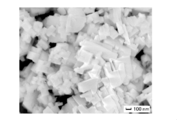
図1に、上記のサンプル作製方法によって、実施例1で作製したチタン酸鉛ナノ結晶(混合開始時のモル比Pb:Ti=2:1、加熱温度180℃)を含む分散液を、シリコンウェハ基板上に室温にて滴下乾燥することにより作製した、サンプルの表面のSEM像を示す。
SEM像から、実施例1において、ほぼ六面体状でかつ、ほぼ100nmのサイズのナノ結晶を合成できたことが確認できた。ナノ結晶のサイズ及びその分布は合成条件に依存するが、実施例1においては、100nmのサイズのナノ結晶は全体の90%程度であった。
SEM像から、実施例1において、ほぼ六面体状でかつ、ほぼ100nmのサイズのナノ結晶を合成できたことが確認できた。ナノ結晶のサイズ及びその分布は合成条件に依存するが、実施例1においては、100nmのサイズのナノ結晶は全体の90%程度であった。
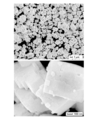
図2に、上記のサンプル作製方法によって、実施例2で作製したチタン酸鉛ナノ結晶(混合開始時のモル比Pb:Ti=2:1、加熱温度200℃)を含む分散液を、シリコンウェハ基板上に室温にて滴下乾燥することにより作製した、サンプルの表面のSEM像を示す。
SEM像から、実施例2において、ほぼ六面体状でかつほぼ100nmのサイズのナノ結晶を合成できたことが確認できた。ナノ結晶のサイズ及びその分布は合成条件に依存するが、実施例2においては、100nmサイズのナノ結晶は全体の80%程度であった。
SEM像から、実施例2において、ほぼ六面体状でかつほぼ100nmのサイズのナノ結晶を合成できたことが確認できた。ナノ結晶のサイズ及びその分布は合成条件に依存するが、実施例2においては、100nmサイズのナノ結晶は全体の80%程度であった。
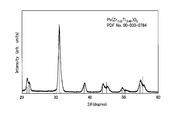
図3に、実施例2で作製したチタン酸鉛ナノ結晶について、X線回折装置を用いて粉末XRD測定を行った結果を示す。実施例1で作製したチタン酸鉛ナノ結晶は、PbTiO3とほぼ同じ位置にピークを有しており、結晶構造及びその格子定数が近い。この結果から、作製(合成)されたチタン酸鉛ナノ結晶のうち、鉛とチタンとのモル比(Pb:Ti)が、1:1となっていることを確認することができる。
〔チタン酸ジルコン酸鉛ナノ結晶(Pb(Zr0.52Ti0.48)O3)の合成及び同定:組成1〕
(1)チタン酸ジルコン酸鉛ナノ結晶(Zr:Ti=52:48)の合成(製造)
以下の手順に従ってチタン酸ジルコン酸鉛ナノ結晶(組成1)を合成した。酢酸鉛(Pb(CH3COO)2・3H2O)0.3mmol、TALH0.072mmol、ジルコニウムラクテートアンモニウム塩(マツモトファインケミカル株式会社製、ZC-300(商品名))0.078mmolを水15mlに溶解した。この水溶液にTMAH1.6815gを水15mlに溶解したTMAH水溶液を添加して混合溶液(反応液)を調製した。この段階において、混合溶液に含まれる鉛とジルコニウムおよびチタンとのモル比(Pb:Zr+Ti)を、2:1となるようにした。得られた混合溶液をオートクレーブに入れて密閉し加熱した後に室温まで冷却した。この時の加熱温度が180℃、加熱時間が24時間のものを実施例3、加熱温度が180℃、加熱時間が6時間のものを実施例4、加熱温度が200℃、加熱時間が6時間のものを実施例5、加熱温度が220℃、加熱時間が6時間のものを実施例6とした。
(1)チタン酸ジルコン酸鉛ナノ結晶(Zr:Ti=52:48)の合成(製造)
以下の手順に従ってチタン酸ジルコン酸鉛ナノ結晶(組成1)を合成した。酢酸鉛(Pb(CH3COO)2・3H2O)0.3mmol、TALH0.072mmol、ジルコニウムラクテートアンモニウム塩(マツモトファインケミカル株式会社製、ZC-300(商品名))0.078mmolを水15mlに溶解した。この水溶液にTMAH1.6815gを水15mlに溶解したTMAH水溶液を添加して混合溶液(反応液)を調製した。この段階において、混合溶液に含まれる鉛とジルコニウムおよびチタンとのモル比(Pb:Zr+Ti)を、2:1となるようにした。得られた混合溶液をオートクレーブに入れて密閉し加熱した後に室温まで冷却した。この時の加熱温度が180℃、加熱時間が24時間のものを実施例3、加熱温度が180℃、加熱時間が6時間のものを実施例4、加熱温度が200℃、加熱時間が6時間のものを実施例5、加熱温度が220℃、加熱時間が6時間のものを実施例6とした。
(2)チタン酸ジルコン酸鉛ナノ結晶(Zr:Ti=52:48)の同定
チタン酸ジルコン酸鉛ナノ結晶は、走査電子顕微鏡(日本電子株式会社製JEOL、JSM-6335FM、10kV)を用いて解析した。結晶相の同定をX線回折装置(株式会社リガク製、SmartLab、40kV/30mA)を用いて同定した。
チタン酸ジルコン酸鉛ナノ結晶は、走査電子顕微鏡(日本電子株式会社製JEOL、JSM-6335FM、10kV)を用いて解析した。結晶相の同定をX線回折装置(株式会社リガク製、SmartLab、40kV/30mA)を用いて同定した。
実施例3~6のチタン酸ジルコン酸鉛ナノ結晶の各種同定用サンプルは、遠心分離により回収した粉末を、イソプロピルアルコールに再分散させたコロイド溶液を用い、シリコンウェハ基板へ室温にて滴下乾燥することにより作製した。サンプルに紫外線照射2時間を行った後、インキュベータ内において200℃で1.5時間保持して、表面の清浄化を行った。
図4に、上記のサンプル作製方法によって、実施例3で作製したチタン酸ジルコン酸鉛ナノ結晶(加熱温度180℃、加熱時間24時間)を含む分散液をシリコンウェハ基板上に室温にて滴下乾燥することにより作製したサンプルの表面のSEM像を示す。
SEM像から、実施例3において、ほぼ六面体状でかつ、800nm~1000nmのサイズのナノ結晶を合成できたことが確認できた。ナノ結晶のサイズ及びその分布は合成条件に依存するが、実施例3においては、800nm~1000nmのサイズのナノ結晶は全体の90%程度であった。
SEM像から、実施例3において、ほぼ六面体状でかつ、800nm~1000nmのサイズのナノ結晶を合成できたことが確認できた。ナノ結晶のサイズ及びその分布は合成条件に依存するが、実施例3においては、800nm~1000nmのサイズのナノ結晶は全体の90%程度であった。
図5に、上記のサンプル作製方法によって、実施例4で作製したチタン酸ジルコン酸鉛ナノ結晶(加熱温度180℃、加熱時間6時間)を含む分散液をシリコンウェハ基板上に室温にて滴下乾燥することにより作製したサンプルの表面のSEM像を示す。
SEM像から、実施例4において、ほぼ六面体状でかつ、1000nmのサイズのナノ結晶を合成できたことが確認できた。ナノ結晶のサイズ及びその分布は合成条件に依存するが、実施例4においては、1000nmのサイズのナノ結晶は全体の90%程度であった。
SEM像から、実施例4において、ほぼ六面体状でかつ、1000nmのサイズのナノ結晶を合成できたことが確認できた。ナノ結晶のサイズ及びその分布は合成条件に依存するが、実施例4においては、1000nmのサイズのナノ結晶は全体の90%程度であった。
図6に、上記のサンプル作製方法によって、実施例5で作製したチタン酸ジルコン酸鉛ナノ結晶(加熱温度200℃、加熱時間6時間)を含む分散液をシリコンウェハ基板上に室温にて滴下乾燥することにより作製したサンプルの表面のSEM像を示す。
SEM像から、実施例5において、ほぼ六面体状でかつ、1200nm~1300nmのサイズのナノ結晶を合成できたことが確認できた。ナノ結晶のサイズ及びその分布は合成条件に依存するが、実施例5においては、1200nm~1300nmのサイズのナノ結晶は全体の90%程度であった。
SEM像から、実施例5において、ほぼ六面体状でかつ、1200nm~1300nmのサイズのナノ結晶を合成できたことが確認できた。ナノ結晶のサイズ及びその分布は合成条件に依存するが、実施例5においては、1200nm~1300nmのサイズのナノ結晶は全体の90%程度であった。
図7に、上記のサンプル作製方法によって、実施例6で作製したチタン酸ジルコン酸鉛ナノ結晶(加熱温度220℃、加熱時間6時間)を含む分散液をシリコンウェハ基板上に室温にて滴下乾燥することにより作製したサンプルの表面のSEM像を示す。
SEM像から、実施例6において、ほぼ四角柱状でかつ、幅1μm、長さ5~10μmのサイズのナノ結晶を合成できたことが確認できた。ナノ結晶のサイズ及びその分布は合成条件に依存するが、実施例6においては、四角柱状でかつ、幅1μm、長さ5~10μmのサイズのナノ結晶は全体の90%程度であった。
SEM像から、実施例6において、ほぼ四角柱状でかつ、幅1μm、長さ5~10μmのサイズのナノ結晶を合成できたことが確認できた。ナノ結晶のサイズ及びその分布は合成条件に依存するが、実施例6においては、四角柱状でかつ、幅1μm、長さ5~10μmのサイズのナノ結晶は全体の90%程度であった。
図8に、実施例3で作製したチタン酸ジルコン酸鉛ナノ結晶についてX線回折装置を用いて粉末XRD測定を行った結果を示す。実施例3で作製したチタン酸鉛ナノ結晶は、Pb(Zr0.52Ti0.48)O3とほぼ同じ位置にピークを有しており、結晶構造及びその格子定数が近い。この結果から、作製(合成)されたチタン酸ジルコン酸鉛ナノ結晶のうち、鉛とジルコニウムおよびチタンとのモル比(Pb:Zr+Ti)が、1:1となっていることを確認することができる。
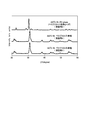
図9に、実施例4~6で作製したチタン酸鉛ナノ結晶についてX線回折装置を用いて粉末XRD測定を行った結果を示す。実施例4~6で作製したチタン酸鉛ナノ結晶のうち、実施例6(加熱温度220℃、加熱時間6時間)は、3元系遷移金属酸化物を示すペロブスカイト構造が得られなかった。一方、実施例4、5は、ペロブスカイト構造が得られた。
〔チタン酸ジルコン酸鉛ナノ結晶(Pb(Zr0.7Ti0.3)O3)の合成及び同定:組成2〕
(1)チタン酸ジルコン酸鉛ナノ結晶(Zr:Ti=70:30)の合成(製造)
以下の手順に従ってチタン酸ジルコン酸鉛ナノ結晶(組成2)を合成した。酢酸鉛(Pb(CH3COO)2・3H2O)0.3mmol、TALH0.045mmol、ジルコニウムラクテートアンモニウム塩(マツモトファインケミカル株式会社製、ZC-300(商品名))0.105mmolを水15mlに溶解した。この水溶液にTMAH1.6815gを水15mlに溶解したTMAH水溶液を添加して混合溶液(反応液)を調製した。この段階において、混合溶液に含まれる鉛とジルコニウムおよびチタンとのモル比(Pb:Zr+Ti)を、2:1となるようにした。得られた混合溶液をオートクレーブに入れて密閉し、加熱温度180℃、加熱時間6時間の条件で加熱した後に室温まで冷却したものを実施例7とした。
(1)チタン酸ジルコン酸鉛ナノ結晶(Zr:Ti=70:30)の合成(製造)
以下の手順に従ってチタン酸ジルコン酸鉛ナノ結晶(組成2)を合成した。酢酸鉛(Pb(CH3COO)2・3H2O)0.3mmol、TALH0.045mmol、ジルコニウムラクテートアンモニウム塩(マツモトファインケミカル株式会社製、ZC-300(商品名))0.105mmolを水15mlに溶解した。この水溶液にTMAH1.6815gを水15mlに溶解したTMAH水溶液を添加して混合溶液(反応液)を調製した。この段階において、混合溶液に含まれる鉛とジルコニウムおよびチタンとのモル比(Pb:Zr+Ti)を、2:1となるようにした。得られた混合溶液をオートクレーブに入れて密閉し、加熱温度180℃、加熱時間6時間の条件で加熱した後に室温まで冷却したものを実施例7とした。
(2)チタン酸ジルコン酸鉛ナノ結晶(Zr:Ti=70:30)の同定
チタン酸ジルコン酸鉛ナノ結晶は、走査電子顕微鏡(日本電子株式会社製JEOL、JSM-6335FM、10kV)を用いて解析した。結晶相の同定をX線回折装置(株式会社リガク製、SmartLab、40kV/30mA)を用いて同定した。
チタン酸ジルコン酸鉛ナノ結晶は、走査電子顕微鏡(日本電子株式会社製JEOL、JSM-6335FM、10kV)を用いて解析した。結晶相の同定をX線回折装置(株式会社リガク製、SmartLab、40kV/30mA)を用いて同定した。
実施例7のチタン酸ジルコン酸鉛ナノ結晶の同定用サンプルは、遠心分離により回収した粉末をイソプロピルアルコールに再分散させたコロイド溶液を用い、シリコンウェハ基板へ室温にて滴下乾燥することにより作製した。サンプルに紫外線照射2時間を行った後、インキュベータ内において200℃で1.5時間保持して、表面の清浄化を行った。
図10に、上記のサンプル作製方法によって、実施例7で作製したチタン酸ジルコン酸鉛ナノ結晶(加熱温度180℃、加熱時間6時間)を含む分散液をシリコンウェハ基板上に室温にて滴下乾燥することにより作製したサンプルの表面のSEM像を示す。
SEM像から、実施例7において、ほぼ六面体状でかつ、1000nmのサイズのナノ結晶を合成できたことが確認できた。ナノ結晶のサイズ及びその分布は合成条件に依存するが、実施例7においては、1000nmのサイズのナノ結晶は全体の90%程度であった。
SEM像から、実施例7において、ほぼ六面体状でかつ、1000nmのサイズのナノ結晶を合成できたことが確認できた。ナノ結晶のサイズ及びその分布は合成条件に依存するが、実施例7においては、1000nmのサイズのナノ結晶は全体の90%程度であった。
図11に、実施例7で作製したチタン酸ジルコン酸鉛ナノ結晶についてX線回折装置を用いて粉末XRD測定を行った結果を示す。実施例7で作製したチタン酸鉛ナノ結晶は、Pb(Zr0.7Ti0.3)O3とほぼ同じ位置にピークを有しており、結晶構造及びその格子定数が近く、ペロブスカイト構造が得られている。この結果から、作製(合成)されたチタン酸ジルコン酸鉛ナノ結晶のうち、鉛とジルコニウムおよびチタンとのモル比(Pb:Zr+Ti)が、1:1となっていることを確認することができる。
〔金属酸化物ナノ結晶膜固定化基板の作製〕
上述した実施例3で得られたチタン酸ジルコン酸鉛ナノ結晶(Pb(Zr0.52Ti0.48)O3)の粉末0.1gをイソプロピルアルコール(2-プロパノール)に加えて超音波によって分散させ、ナノ結晶分散液を得た。次に、シリコンウェハに白金膜を形成した基板を用意し、この基板に、ポリイミドからなるストライプ状のマイクロパターン(幅2~3mm)をもつモールド(凹凸)を形成した。そして、このモールドを備えた基板にナノ結晶分散液を滴下した後、乾燥させた。
上述した実施例3で得られたチタン酸ジルコン酸鉛ナノ結晶(Pb(Zr0.52Ti0.48)O3)の粉末0.1gをイソプロピルアルコール(2-プロパノール)に加えて超音波によって分散させ、ナノ結晶分散液を得た。次に、シリコンウェハに白金膜を形成した基板を用意し、この基板に、ポリイミドからなるストライプ状のマイクロパターン(幅2~3mm)をもつモールド(凹凸)を形成した。そして、このモールドを備えた基板にナノ結晶分散液を滴下した後、乾燥させた。
この乾燥後のモールドが付いた状態でナノ結晶膜が基板上に固定化されたサンプルのSEM像を図12に示す。図12によれば、モールドの溝の中にチタン酸ジルコン酸鉛ナノ結晶が集積している個所(丸囲い点線部)が見られた。
次に、上述したサンプルのSPM(走査型プローブ顕微鏡、日立ハイテクサイエンス社製NanoNaviReal)像を図13に示す。図13によれば、ナノ結晶分散液を滴下して乾燥させることでチタン酸ジルコン酸鉛のナノ結晶膜が基板上に固定化されたため、SPM(走査型プローブ顕微鏡)によって形状測定が可能になっている。
〔圧電応答顕微鏡を用いたチタン酸ジルコン酸鉛ナノ結晶の圧電特性の測定〕
上述した金属酸化物ナノ結晶膜固定化基板をサンプルとして、圧電応答顕微鏡(PFM)を用いてチタン酸ジルコン酸鉛ナノ結晶の圧電特性の測定を行った。
圧電応答顕微鏡としては、日立ハイテクサイエンス社製NanoNaviReal圧電応答顕微鏡を用いて解析した。それぞれ基板上で測定位置を4か所設定し、それぞれ複数回の測定を行った。
それぞれの測定位置のSPM像と、圧電特性の測定結果(1)~(4)を図14~図17に示す。
上述した金属酸化物ナノ結晶膜固定化基板をサンプルとして、圧電応答顕微鏡(PFM)を用いてチタン酸ジルコン酸鉛ナノ結晶の圧電特性の測定を行った。
圧電応答顕微鏡としては、日立ハイテクサイエンス社製NanoNaviReal圧電応答顕微鏡を用いて解析した。それぞれ基板上で測定位置を4か所設定し、それぞれ複数回の測定を行った。
それぞれの測定位置のSPM像と、圧電特性の測定結果(1)~(4)を図14~図17に示す。
図14~図17に示す圧電特性の測定結果から、本発明のチタン酸ジルコン酸鉛ナノ結晶の圧電応答顕微鏡測定によって求まる圧電定数(d33-PFM)の飽和値の絶対値の平均が25pm/V以上であることが確認された。
〔ナノ結晶分散液の調整と、ナノ結晶膜の基板への固定化手法と、基板表面の微細構造の観察〕
上述した実施例4のチタン酸ジルコン酸鉛ナノ結晶(Pb(Zr0.52Ti0.48)O3:加熱温度180℃、加熱時間6時間)の粉末0.1gをイソプロピルアルコール(2-プロパノール)に加えて洗浄し、塩酸(10mmol)を15ml添加してpH調整を行い、チタン酸ジルコン酸鉛ナノ結晶の分散を試みた。そして、5800rpmの回転数で5分間撹拌し、上澄み液を採取した。この上澄み液のpHは1.9であった。なお、pH調整を行わない上澄み液のpHは12.53であった。
上述した実施例4のチタン酸ジルコン酸鉛ナノ結晶(Pb(Zr0.52Ti0.48)O3:加熱温度180℃、加熱時間6時間)の粉末0.1gをイソプロピルアルコール(2-プロパノール)に加えて洗浄し、塩酸(10mmol)を15ml添加してpH調整を行い、チタン酸ジルコン酸鉛ナノ結晶の分散を試みた。そして、5800rpmの回転数で5分間撹拌し、上澄み液を採取した。この上澄み液のpHは1.9であった。なお、pH調整を行わない上澄み液のpHは12.53であった。
図18に、塩酸によるpH調整後の上澄み液を1日静置したものをシリコンウェハ基板上に室温にて滴下乾燥することにより作製したサンプルのSEM像を示す。
図18のSEM像では、サイズが800nm~1500nm程度の整った六面体が観察できた。
図18のSEM像では、サイズが800nm~1500nm程度の整った六面体が観察できた。
次に、シリコンウェハに白金膜を形成した基板に、ポリイミドからなるストライプ状のマイクロパターン(幅2~3mm)をもつモールド(凹凸)を形成し、塩酸によるpH調整後の上澄み液(ナノ結晶分散液)を滴下した後、乾燥させた。
また、シリコンウェハに白金膜を形成した基板に、シリコンからなるストライプ状のマイクロパターン(幅2~3mm)をもつモールド(凹凸)を形成し、塩酸によるpH調整後の上澄み液(ナノ結晶分散液)を滴下した後、乾燥させた。
また、シリコンウェハに白金膜を形成した基板に、シリコンからなるストライプ状のマイクロパターン(幅2~3mm)をもつモールド(凹凸)を形成し、塩酸によるpH調整後の上澄み液(ナノ結晶分散液)を滴下した後、乾燥させた。
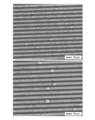
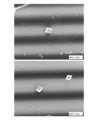
上述したポリイミドのモールドが付いた状態でナノ結晶膜が基板上に固定化されたサンプルのSEM像を図19および図20に示す。また、シリコンモールドが付いた状態でナノ結晶膜が基板上に固定化されたサンプルのSEM像を図21に示す。
図19~図21によれば、ポリイミドおよびシリコンのいずれのモールドであっても、モールドの溝の中にチタン酸ジルコン酸鉛ナノ結晶が集積している個所が観察された。
図19~図21によれば、ポリイミドおよびシリコンのいずれのモールドであっても、モールドの溝の中にチタン酸ジルコン酸鉛ナノ結晶が集積している個所が観察された。
〔金属酸化物ナノ結晶の中心線平均粗さおよび平均面粗さの観察〕
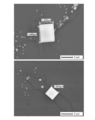
上述した塩酸によるpH調整後の上澄み液(ナノ結晶分散液)を、シリコンからなるストライプ状のマイクロパターン(幅2~3μm)をもつモールド(凹凸)を形成した2つの基板(シリコンウェハに白金膜を形成)に、それぞれ滴下して乾燥させた。これらの金属酸化物ナノ結晶膜固定化基板を用いて、チタン酸ジルコン酸鉛ナノ結晶(Pb(Zr0.52Ti0.48)O3:加熱温度180℃、加熱時間6時間)の中心線平均粗さおよび平均面粗さを測定した。
上述した塩酸によるpH調整後の上澄み液(ナノ結晶分散液)を、シリコンからなるストライプ状のマイクロパターン(幅2~3μm)をもつモールド(凹凸)を形成した2つの基板(シリコンウェハに白金膜を形成)に、それぞれ滴下して乾燥させた。これらの金属酸化物ナノ結晶膜固定化基板を用いて、チタン酸ジルコン酸鉛ナノ結晶(Pb(Zr0.52Ti0.48)O3:加熱温度180℃、加熱時間6時間)の中心線平均粗さおよび平均面粗さを測定した。
2つの測定の結果を、それぞれ図22、23に示す。チタン酸ジルコン酸鉛ナノ結晶(Pb(Zr0.52Ti0.48)O3:加熱温度180℃、加熱時間6時間)の六面体の任意の一面の対角線における中心線平均粗さは4.7nm(図22)、3.9nm(図23)であった。また、チタン酸ジルコン酸鉛ナノ結晶の六面体の任意の一面の平均面粗さは27nm(図22)、28nm(44%)(図23)であった。これらの結果から、本発明のチタン酸ジルコン酸鉛ナノ結晶は、六面体の任意の一面の対角線における中心線平均粗さが5nm以下、かつ六面体の任意の一面の40%以上の領域における平均面粗さが30nm以下であることが確認された。
本PZTキューブは、圧電デバイス素子および強誘電体メモリ素子に、好適に利用される。
Claims (16)
- 基板と、該基板上に配列あるいは固定化した金属酸化物ナノ結晶からなるナノ結晶膜と、を備え、前記金属酸化物ナノ結晶を構成する金属酸化物は、チタン酸鉛またはチタン酸ジルコン酸鉛であることを特徴とする金属酸化物ナノ結晶膜固定化基板。
- 前記金属酸化物は、一般式PbZrxTi(1-x)O3(0≦x≦0.7)で表されるものであることを特徴とする請求項1に記載の金属酸化物ナノ結晶膜固定化基板。
- 前記金属酸化物ナノ結晶の結晶形状が六面体であり、かつ、前記金属酸化物ナノ結晶の結晶サイズが10nm以上、1500nm以下であることを特徴とする請求項1または2に記載の金属酸化物ナノ結晶膜固定化基板。
- 前記金属酸化物ナノ結晶の前記六面体を構成する各面の対角線における中心線平均粗さが5nm以下となり、かつ前記六面体の各面の40%以上の領域における平均面粗さが30nm以下となるような、表面平滑性を有することを特徴とする請求項3に記載の金属酸化物ナノ結晶膜固定化基板。
- 前記金属酸化物ナノ結晶は、圧電応答顕微鏡測定によって求まる圧電定数(d33-PFM)の飽和値の絶対値の平均が、25pm/V以上であることを特徴とする請求項1ないし3いずれか一項に記載の金属酸化物ナノ結晶膜固定化基板。
- 前記基板は、表面に凹凸が形成され、前記基板の厚さ方向からの平面視において、該凹凸は、直線状、曲線状、円形状のうち、いずれか1つのパターン形状を成し、前記凹凸はエッチングによって除去可能に形成されていることを特徴とする請求項1ないし5いずれか一項に記載の金属酸化物ナノ結晶膜固定化基板。
- チタン酸鉛またはチタン酸ジルコン酸鉛からなる金属酸化物を含む金属酸化物ナノ結晶の製造方法であって、
酢酸鉛水溶液と、水溶性チタン錯体水溶液、または水溶性チタン錯体水溶液および水溶性ジルコニウム錯体水溶液と、四級アンモニウム化合物と、を混合して混合溶液を形成する混合溶液形成工程と、前記混合溶液を加熱して金属酸化物ナノ結晶を合成する加熱工程と、前記金属酸化物ナノ結晶と残液とを分離する分離工程と、を備えたことを特徴とする金属酸化物ナノ結晶の製造方法。 - 前記水溶性チタン錯体の配位子がヒドロキシカルボン酸であることを特徴とする請求項7に記載の金属酸化物ナノ結晶の製造方法。
- 前記水溶性ジルコニウム錯体の配位子がヒドロキシカルボン酸であることを特徴とする請求項7または8に記載の金属酸化物ナノ結晶の製造方法。
- 前記四級アンモニウム化合物がテトラメチルアンモニウムヒドロキシドであることを特徴とする請求項7ないし9いずれか一項に記載の金属酸化物ナノ結晶の製造方法。
- 前記混合溶液において、チタンとジルコニウムとのモル比が、100:0~30:70の範囲であることを特徴とする請求項7ないし10いずれか一項に記載の金属酸化物ナノ結晶の製造方法。
- 前記混合溶液において、鉛と、チタン、またはチタンおよびジルコニウムと、のモル比が1:1以上、2:1以下であることを特徴とする請求項7ないし11いずれか一項に記載の金属酸化物ナノ結晶の製造方法。
- 前記混合溶液は、鉛1モルに対する四級アンモニウム化合物のモル数が2以上100以下であることを特徴とする請求項7ないし12いずれか一項に記載の金属酸化物ナノ結晶の製造方法。
- 前記加熱工程は、140℃以上240℃以下の温度範囲で、かつ1時間以上120時間以下の時間範囲で実施することを特徴とする請求項7ないし13いずれか一項に記載の金属酸化物ナノ結晶の製造方法。
- 前記分離工程は、前記残液から遠心分離によって前記金属酸化物ナノ結晶を分離回収する工程であることを特徴とする請求項7ないし14いずれか一項に記載の金属酸化物ナノ結晶の製造方法。
- 請求項1ないし6いずれか一項に記載の金属酸化物ナノ結晶膜固定化基板の製造方法であって、
請求項7ないし15いずれか一項に記載の金属酸化物ナノ結晶の製造方法で得た金属酸化物ナノ結晶を、アルコール溶媒またはpH3以下の酸性溶媒に分散させてから遠心分離を行い、上澄みを回収してナノ結晶分散液を得る分散工程と、前記ナノ結晶分散液を前記基板上に塗布した後に乾燥させることによって、前記ナノ結晶膜を前記基板上に固定化させる固定化工程と、を有することを特徴とする金属酸化物ナノ結晶膜固定化基板の製造方法。
Priority Applications (1)
| Application Number | Priority Date | Filing Date | Title |
|---|---|---|---|
| JP2019527029A JP6800450B2 (ja) | 2017-06-30 | 2018-06-28 | 金属酸化物ナノ結晶の製造方法、金属酸化物ナノ結晶膜固定化基板の製造方法 |
Applications Claiming Priority (2)
| Application Number | Priority Date | Filing Date | Title |
|---|---|---|---|
| JP2017-129716 | 2017-06-30 | ||
| JP2017129716 | 2017-06-30 |
Publications (1)
| Publication Number | Publication Date |
|---|---|
| WO2019004372A1 true WO2019004372A1 (ja) | 2019-01-03 |
Family
ID=64742135
Family Applications (1)
| Application Number | Title | Priority Date | Filing Date |
|---|---|---|---|
| PCT/JP2018/024651 Ceased WO2019004372A1 (ja) | 2017-06-30 | 2018-06-28 | 金属酸化物ナノ結晶膜固定化基板、金属酸化物ナノ結晶の製造方法、金属酸化物ナノ結晶膜固定化基板の製造方法 |
Country Status (2)
| Country | Link |
|---|---|
| JP (1) | JP6800450B2 (ja) |
| WO (1) | WO2019004372A1 (ja) |
Citations (5)
| Publication number | Priority date | Publication date | Assignee | Title |
|---|---|---|---|---|
| JPH11135495A (ja) * | 1997-10-27 | 1999-05-21 | Ube Ind Ltd | 強誘電体薄膜素子およびその製造方法 |
| JP2012096962A (ja) * | 2010-11-02 | 2012-05-24 | Ngk Insulators Ltd | 鉛系圧電材料及びその製造方法 |
| JP2014162685A (ja) * | 2013-02-26 | 2014-09-08 | Fujifilm Corp | 酸化物粒子、圧電素子および酸化物粒子の製造方法 |
| US20140374642A1 (en) * | 2011-08-17 | 2014-12-25 | University Of Washington Through Its Center For Commercialization | Methods for forming lead zirconate titanate nanoparticles |
| WO2016060042A1 (ja) * | 2014-10-17 | 2016-04-21 | 国立研究開発法人産業技術総合研究所 | ナノ結晶の配列方法、ナノ結晶構造体の作製方法、ナノ結晶構造体形成基板及びナノ結晶構造体形成基板の製造方法 |
-
2018
- 2018-06-28 WO PCT/JP2018/024651 patent/WO2019004372A1/ja not_active Ceased
- 2018-06-28 JP JP2019527029A patent/JP6800450B2/ja active Active
Patent Citations (5)
| Publication number | Priority date | Publication date | Assignee | Title |
|---|---|---|---|---|
| JPH11135495A (ja) * | 1997-10-27 | 1999-05-21 | Ube Ind Ltd | 強誘電体薄膜素子およびその製造方法 |
| JP2012096962A (ja) * | 2010-11-02 | 2012-05-24 | Ngk Insulators Ltd | 鉛系圧電材料及びその製造方法 |
| US20140374642A1 (en) * | 2011-08-17 | 2014-12-25 | University Of Washington Through Its Center For Commercialization | Methods for forming lead zirconate titanate nanoparticles |
| JP2014162685A (ja) * | 2013-02-26 | 2014-09-08 | Fujifilm Corp | 酸化物粒子、圧電素子および酸化物粒子の製造方法 |
| WO2016060042A1 (ja) * | 2014-10-17 | 2016-04-21 | 国立研究開発法人産業技術総合研究所 | ナノ結晶の配列方法、ナノ結晶構造体の作製方法、ナノ結晶構造体形成基板及びナノ結晶構造体形成基板の製造方法 |
Non-Patent Citations (2)
| Title |
|---|
| CHO, SEUNG-BEOM ET AL.: "Low temperature hydrothermal synthesis and formation mechanisms of lead titanate (PbTiO3) particles using tetramethylammonium hydroxide: thermodynamic modelling and experimental verification", JOURNAL OF THE EUROPEAN CERAMIC SOCIETY, vol. 23, 2003, pages 2323 - 2335, XP004434380, DOI: 10.1016/S0955-2219(03)00085-2 * |
| ZHANG, YONG ET AL.: "A microcube-based hybrid piezocomposite as a flexible energy generator", RSC ADVANCES, vol. 7, 26 June 2017 (2017-06-26), pages 32502 - 32507, XP055677703 * |
Also Published As
| Publication number | Publication date |
|---|---|
| JP6800450B2 (ja) | 2020-12-16 |
| JPWO2019004372A1 (ja) | 2020-02-06 |
Similar Documents
| Publication | Publication Date | Title |
|---|---|---|
| Hu et al. | Ferroelectric mesocrystalline BaTiO3/SrTiO3 nanocomposites with enhanced dielectric and piezoelectric responses | |
| Nuraje et al. | Perovskite ferroelectric nanomaterials | |
| Gao et al. | Bioinspired ceramic thin film processing: present status and future perspectives | |
| US20100135937A1 (en) | Metal oxide nanocrystals: preparation and uses | |
| Zhou et al. | Morphology control and piezoelectric response of Na 0.5 Bi 0.5 TiO 3 synthesized via a hydrothermal method | |
| WO2008118422A1 (en) | Metal oxide nanocrystals: preparation and uses | |
| US5993541A (en) | Process for nucleation of ceramics and product thereof | |
| US9005465B2 (en) | Methods for forming lead zirconate titanate nanoparticles | |
| Garnweitner et al. | Nonaqueous synthesis of amorphous powder precursors for nanocrystalline PbTiO3, Pb (Zr, Ti) O3, and PbZrO3 | |
| Kato et al. | BaTiO3 nanocube and assembly to ferroelectricsupracrystals | |
| US10050191B2 (en) | Oxide particles, piezoelectric element, and method for producing oxide particles | |
| Lee et al. | Sol-gel processing and nanoscale characterization of (Bi0. 5Na0. 5) TiO3-SrTiO3 lead-free piezoelectric thin films | |
| Wang et al. | Shape-controlled hydrothermal synthesis of ferroelectric Bi 4 Ti 3 O 12 nanostructures | |
| Wang et al. | Mechanism of hydrothermal growth of ferroelectric PZT nanowires | |
| CN103820850A (zh) | 一种金属有机骨架mof-2多晶膜的制备方法 | |
| JP2012188334A (ja) | チタン酸バリウムナノ結晶の製造方法 | |
| Hector et al. | Chemical synthesis of β-Ga2O3 microrods on silicon and its dependence on the gallium nitrate concentration | |
| Zhao et al. | Large-scale template-assisted growth of LiNbO3 one-dimensional nanostructures for nano-sensors | |
| CN102923766A (zh) | 钛酸铅陶瓷单晶纳米片的制备方法 | |
| Liang et al. | Malate-assisted synthesis of ZnO hexagonal architectures with porous characteristics and photoluminescence properties investigation | |
| KR101906219B1 (ko) | 나노 결정의 배열 방법, 나노 결정 구조체의 제작 방법, 나노 결정 구조체 형성 기판 및 나노 결정 구조체 형성 기판의 제조 방법 | |
| JP6800450B2 (ja) | 金属酸化物ナノ結晶の製造方法、金属酸化物ナノ結晶膜固定化基板の製造方法 | |
| Chao et al. | Hydrothermal synthesis of ferroelectric PbTiO 3 nanoparticles with dominant {001} facets by titanate nanostructure | |
| Zhang et al. | Preparation and characterization of sol–gel derived sodium–potassium bismuth titanate powders and thick films deposited by screen printing | |
| US10438744B2 (en) | Nanocrystal film-coated substrate, manufacturing method of same, and manufacturing method of barium zirconate titanate nanocrystal |
Legal Events
| Date | Code | Title | Description |
|---|---|---|---|
| 121 | Ep: the epo has been informed by wipo that ep was designated in this application |
Ref document number: 18824119 Country of ref document: EP Kind code of ref document: A1 |
|
| ENP | Entry into the national phase |
Ref document number: 2019527029 Country of ref document: JP Kind code of ref document: A |
|
| NENP | Non-entry into the national phase |
Ref country code: DE |
|
| 122 | Ep: pct application non-entry in european phase |
Ref document number: 18824119 Country of ref document: EP Kind code of ref document: A1 |