WO2018207549A1 - 合成潤滑油 - Google Patents
合成潤滑油 Download PDFInfo
- Publication number
- WO2018207549A1 WO2018207549A1 PCT/JP2018/015482 JP2018015482W WO2018207549A1 WO 2018207549 A1 WO2018207549 A1 WO 2018207549A1 JP 2018015482 W JP2018015482 W JP 2018015482W WO 2018207549 A1 WO2018207549 A1 WO 2018207549A1
- Authority
- WO
- WIPO (PCT)
- Prior art keywords
- lubricating oil
- synthetic lubricating
- formula
- synthetic
- silane
- Prior art date
- Legal status (The legal status is an assumption and is not a legal conclusion. Google has not performed a legal analysis and makes no representation as to the accuracy of the status listed.)
- Ceased
Links
Classifications
-
- C—CHEMISTRY; METALLURGY
- C07—ORGANIC CHEMISTRY
- C07F—ACYCLIC, CARBOCYCLIC OR HETEROCYCLIC COMPOUNDS CONTAINING ELEMENTS OTHER THAN CARBON, HYDROGEN, HALOGEN, OXYGEN, NITROGEN, SULFUR, SELENIUM OR TELLURIUM
- C07F7/00—Compounds containing elements of Groups 4 or 14 of the Periodic Table
- C07F7/02—Silicon compounds
- C07F7/08—Compounds having one or more C—Si linkages
- C07F7/18—Compounds having one or more C—Si linkages as well as one or more C—O—Si linkages
-
- C—CHEMISTRY; METALLURGY
- C10—PETROLEUM, GAS OR COKE INDUSTRIES; TECHNICAL GASES CONTAINING CARBON MONOXIDE; FUELS; LUBRICANTS; PEAT
- C10M—LUBRICATING COMPOSITIONS; USE OF CHEMICAL SUBSTANCES EITHER ALONE OR AS LUBRICATING INGREDIENTS IN A LUBRICATING COMPOSITION
- C10M105/00—Lubricating compositions characterised by the base-material being a non-macromolecular organic compound
- C10M105/76—Lubricating compositions characterised by the base-material being a non-macromolecular organic compound containing silicon
Definitions
- the present invention relates to a synthetic lubricating oil or lubricating oil composition useful as a main component of various lubricating oils or lubricating oil compositions.
- the present invention relates to a synthetic lubricating oil having relatively good lubricity at a high temperature from room temperature to about 100 ° C. and having a viscosity index of 200 or more, and a lubricating oil composition containing the synthetic lubricating oil.
- Lubricating oil usually consists of a base oil (base oil) and additives depending on the application.
- Base oils are base materials that govern the basic characteristics of lubricating oils, such as mineral oils and synthetic oils.
- Mineral oil is obtained by refining a lubricating oil fraction of petroleum, is generally inexpensive, and has been widely used up to now (see Non-Patent Document 1).
- mineral oil is inferior in heat resistance, easily oxidized and deteriorated, and has a surface inferior in durability.
- due to variations in the molecular structure it has become difficult to obtain lubrication performance that is highly compatible with each device and machine.
- various additives are sometimes blended, but depending on the type and use of the apparatus or machine, there are cases where the blending of additives is restricted.
- Patent Document 1 describes a method for preparing a branched siloxane such as methyltris (trimethylsiloxy) silane useful as an industrial siloxane lubricant, a cosmetic fluid, a cleaning agent, or the like.
- Non-Patent Documents 3 and 4 describe the preparation method and viscosity of tetrakis (trimethylsilyloxy) silane and phenyltris (trimethylsilyloxy) silane.
- the synthetic oil has a relatively high heat resistance and a lubricating performance with little variation.
- PAO poly- ⁇ -olefin
- PAO poly- ⁇ -olefin
- Patent Document 1 and Non-Patent Documents 3 and 4 do not describe any synthetic oil having a high viscosity index.
- the present invention has been made against the background of the above-described conventional technology and its problems, and has a kinematic viscosity at 100 ° C. of 2.0 to 7.0 mm 2 / sec and a viscosity index of 200 or more. It is an object to provide a lubricating oil.
- a synthetic oil composed of a compound represented by the following formula (I) or a mixture of compounds has a kinematic viscosity of 2 ° C. at 100 ° C. It has been found that it exhibits a lubricating performance of about 0.0 to 7.0 mm 2 / sec and a viscosity index of 200 or more.
- a synthetic lubricating oil comprising a compound represented by the following formula (I) or a mixture of compounds.
- R 0 n Si (OSiMe 2 R 1 ) 4-n (I) (In the formula, R 0 is a phenyl group and Me is a methyl group. (4-n) R 1 s are linear or branched hydrocarbon groups having 6 to 15 carbon atoms and are identical to each other. And may be different or n is 0 or 1.)
- a lubricating oil composition comprising the synthetic lubricating oil according to ⁇ 1> or ⁇ 2>.
- a lubricating oil composition comprising the synthetic lubricating oil according to ⁇ 1> or ⁇ 2> as a base oil.
- the present invention can include the following aspects.
- a synthetic lubricating oil comprising a compound represented by the following formula (II) or a mixture of compounds.
- Si (OSiMe 2 R 1 ) 4 (II) In the formula, Me is a methyl group.
- R 1 in each molecule of the compound are linear or branched alkyl groups having 6 to 15 carbon atoms, and may be the same or different. May be.
- a synthetic lubricating oil comprising a compound represented by the following formula (III) or a mixture of compounds.
- R 0 1 Si (OSiMe 2 R 1 ) 3 (III) In the formula, R 0 is a phenyl group and Me is a methyl group.
- R 1 in each molecule of the compound are linear or branched alkyl groups having 6 to 15 carbon atoms, and are identical to each other. May be different or different.
- a lubricating oil composition comprising the synthetic lubricating oil according to ⁇ 5> or ⁇ 6>.
- “ ⁇ ” indicating a numerical range is used as a meaning including numerical values described before and after the numerical value as a lower limit value and an upper limit value.
- the synthetic lubricating oil of the present invention has a lubricating performance with a kinematic viscosity at 100 ° C. of 2.0 to 7.0 mm 2 / sec and a viscosity index of 200 or more, and is at an ambient temperature from room temperature to at least slightly higher than 100 ° C. Can be suitably used.
- the synthetic lubricating oil of the present invention comprises a compound represented by the general formula (I) or a mixture of compounds, has a kinematic viscosity at 100 ° C. of 2.0 to 7.0 mm 2 / sec, and a viscosity index. It shows a lubricating performance of 200 or more.
- R 0 n Si (OSiMe 2 R 1 ) 4-n (I) (In the formula, R 0 is a phenyl group and Me is a methyl group. (4-n) R 1 s are linear or branched hydrocarbon groups having 6 to 15 carbon atoms and are identical to each other. And may be different or n is 0 or 1.)
- R 0 is a phenyl group which may have a substituent such as an alkyl group having 1 to 3 carbon atoms or a halogen atom.
- R 1 is a linear or branched hydrocarbon group having 6 to 15 carbon atoms, and may have a substituent such as an aryl group or a halogen atom.
- a linear or branched alkyl group having 6 to 15 carbon atoms is preferable, and a linear alkyl group having 6 to 10 carbon atoms is more preferable.
- Specific examples include hexyl group, heptyl group, octyl group, nonyl group, decyl group, dodecyl group, tridecyl group, tetradecyl group and the like.
- the synthetic lubricating oil of the present invention may be produced by any method.
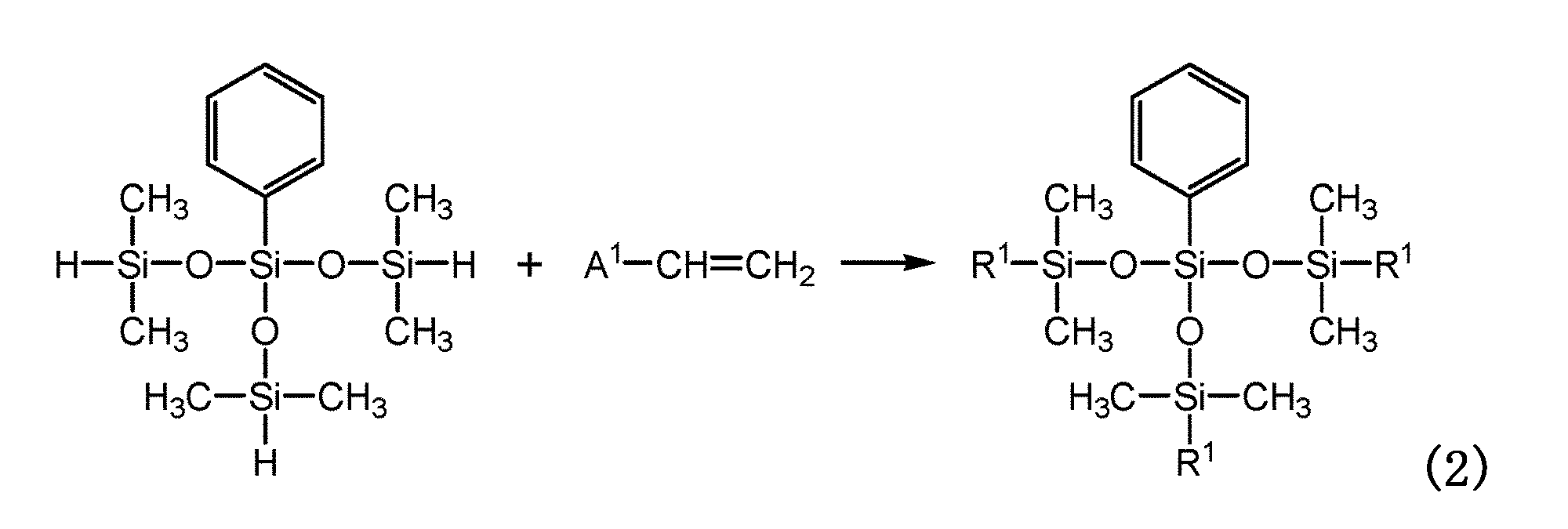
- tetrakis can be represented by the following formula (1) or (2). It can be produced by reacting (dimethylsilyloxy) silane or phenyltris (dimethylsilyloxy) silane with 1-alkene.
- a 1 is a linear or branched hydrocarbon group having 4 to 13 carbon atoms
- R 1 is a linear or branched hydrocarbon group having 6 to 15 carbon atoms.
- a 1 is a linear or branched hydrocarbon group having 4 to 13 carbon atoms
- R 1 is a linear or branched hydrocarbon group having 6 to 15 carbon atoms.
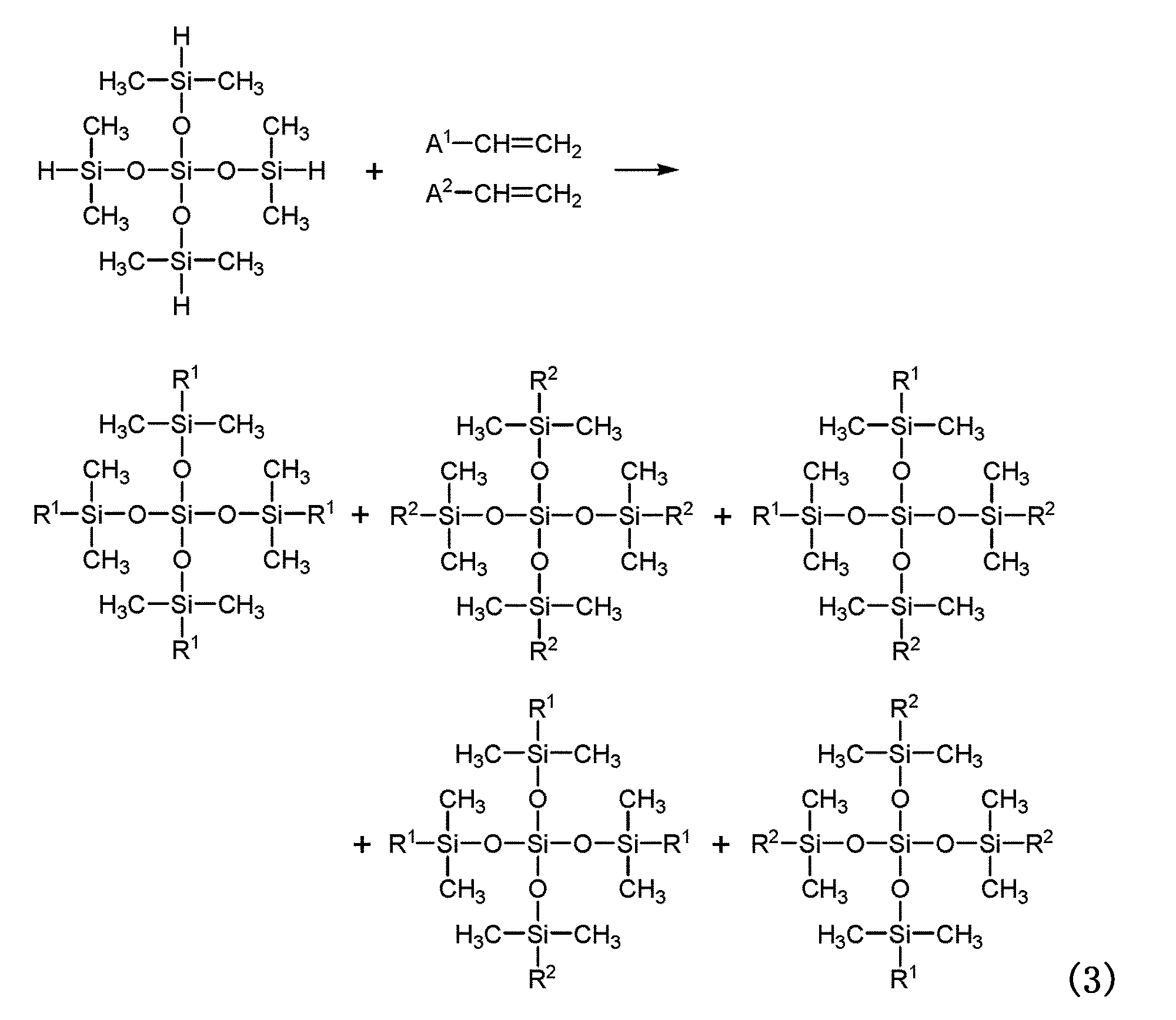
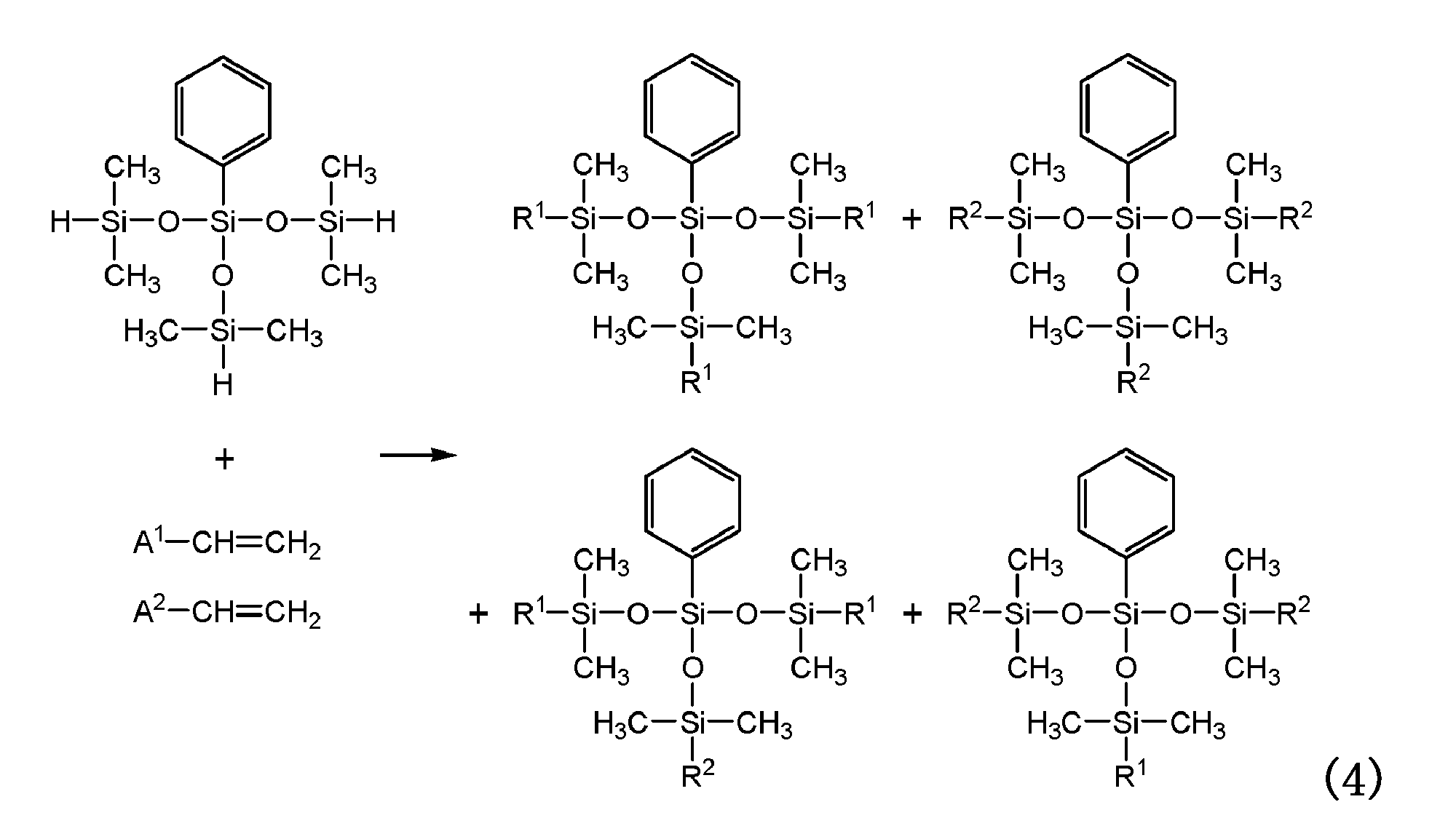
- the synthetic lubricating oil of the present invention reacts tetrakis (dimethylsilyloxy) silane or phenyltris (dimethylsilyloxy) silane with two types of 1-alkene as shown in the following formula (3) or (4). By making it, it can also manufacture as a mixture containing the compound from which the hydrocarbon group differs in the molecular structure of a synthetic lubricating oil.
- a 1 ⁇ A 2 , and A 1 and A 2 are linear or branched hydrocarbon groups having 4 to 13 carbon atoms.
- R 1 ⁇ R 2 , R 1 and R 2 is a linear or branched hydrocarbon group having 6 to 15 carbon atoms.
- a 1 ⁇ A 2 , and A 1 and A 2 are linear or branched hydrocarbon groups having 4 to 13 carbon atoms.
- R 1 ⁇ R 2 , R 1 and R 2 is a linear or branched hydrocarbon group having 6 to 15 carbon atoms.
- the synthetic lubricating oil of the present invention may be used as it is as a lubricating oil or as a base oil of a lubricating oil composition (50 wt% or more of the composition). Further, it can also be used as an additive component (for example, 1 to 40 wt% of the lubricating oil composition) for the purpose of improving the high-temperature lubrication characteristics of mineral oil and other synthetic oils.
- Example 10 ⁇ Kinematic viscosity and viscosity index of compounds 1a to 1c, 2a to 2d, and mixtures A and B> With respect to the compounds 1a to 1c, 2a to 2d and the mixtures A and B produced in Examples 1 to 9, the kinematic viscosity was measured by the method of JIS K 2283. The viscosity index was calculated by the method of JIS K 2283. Table 1 shows the kinematic viscosities and viscosity indices of compounds 1a to 1c, 2a to 2d, and mixtures A and B at 40 ° C and 100 ° C.
- the synthetic lubricating oil of the present invention has an alkyl chain of a hexyl group or higher, it exceeds 2.0 mm 2 / sec even at 100 ° C. For this reason, it can be suitably used even in a high temperature environment at least slightly higher than room temperature to 100 ° C.
- the viscosity index (200 or more, preferably 220 or more) of the synthetic lubricating oil of the present invention is much larger than the refined mineral oil or synthetic oil PAO (viscosity index 120 to 140) currently used. For this reason, it is thought that it can contribute to the further performance improvement and lifetime improvement of an apparatus, and the further energy saving of an apparatus operation.
- the synthetic lubricating oil of the present invention has a kinematic viscosity at 100 ° C. of 2.0 to 7.0 mm 2 / sec and a viscosity index of 200 or more, it can be used as it is or as a base oil of a lubricating oil composition from room temperature to 100 ° C. Can be suitably used in a high-temperature environment at least slightly above.
Landscapes
- Chemical & Material Sciences (AREA)
- Organic Chemistry (AREA)
- Chemical Kinetics & Catalysis (AREA)
- General Chemical & Material Sciences (AREA)
- Oil, Petroleum & Natural Gas (AREA)
- Lubricants (AREA)
Abstract
100℃の動粘度が2.0~7.0mm2/secであり、粘度指数が200以上の合成潤滑油を提供することを課題とし、その合成潤滑油は、下記式(I)で表される化合物又は化合物の混合物からなることを特徴とする。また、100℃の動粘度が2.0~7.0mm2/secであり、粘度指数が200以上であることを特徴とする。 R0
nSi(OSiMe2R1)4-n (I) (式中、R0はフェニル基であり、Meはメチル基である。(4-n)個のR1は、炭素数6~15の直鎖状又は分岐状炭化水素基であり、互いに同一であっても良いし、異なっていてもよい。nは0又は1である。)
Description
本発明は、各種潤滑油や潤滑油組成物の主要成分などとして有用な合成潤滑油や潤滑油組成物に関する。特に、常温から100℃程度までの高温での潤滑性が比較的良好で、かつ、粘度指数が200以上の合成潤滑油や該合成潤滑油を含む潤滑油組成物に関する。
近年、自動車、家電、電子機器、工業用機械等の様々な産業分野で使用されている装置や機械では、潤滑油の性能向上や適切に調整された潤滑性能が求められている。すなわち、装置や機械の高速化、小型化等の従来装置等の改良だけでなく、様々な分野において新規に開発されたそれぞれの装置や機械に応じて、より過酷な使用条件に耐えうる潤滑性能だけでなく、装置や機械により適切に調整された潤滑性能が必要とされるようになってきている。
潤滑油は、通常、基油(ベースオイル)と用途に応じた添加剤からなる。基油は、潤滑油の基本的な特性を支配する基材で、鉱物油と合成油等である。
鉱物油は、石油の潤滑油留分を精製したもので、一般に安価なものであり、従来から現在に至るまで幅広く使用されている(非特許文献1参照)。しかしながら、鉱物油は、耐熱性に劣り、また、酸化、劣化しやすく、耐久性に劣る面が存在する。さらに、分子構造にばらつきがあるため、各々の装置や機械に高度に適合した潤滑性能を得るのが困難化してきている。耐熱性や耐久性を改善するため、各種添加物を配合することもなされているが、装置や機械の種類、用途によっては、添加剤の配合が制約される場合も存在する。
鉱物油は、石油の潤滑油留分を精製したもので、一般に安価なものであり、従来から現在に至るまで幅広く使用されている(非特許文献1参照)。しかしながら、鉱物油は、耐熱性に劣り、また、酸化、劣化しやすく、耐久性に劣る面が存在する。さらに、分子構造にばらつきがあるため、各々の装置や機械に高度に適合した潤滑性能を得るのが困難化してきている。耐熱性や耐久性を改善するため、各種添加物を配合することもなされているが、装置や機械の種類、用途によっては、添加剤の配合が制約される場合も存在する。
これに対し、合成油は、高度で複雑な過程を経て生成され、不純物が可能な限り排除されており、比較的耐熱性が高くばらつきの少ない潤滑性能が得られるとされている。合成油は、鉱物油に較べコスト高になるものの、今日まで用途や使用態様等に応じて、炭化水素系、エステル系、エーテル系、シリコン系、フッ素系などのものが開発、使用されてきている(非特許文献1参照)。
また、特許文献1には、工業用シロキサン潤滑剤や化粧用流体、洗浄剤などとして有用なメチルトリス(トリメチルシロキシ)シラン等の分岐シロキサンの調製法が記載されている。
また、非特許文献3,4には、テトラキス(トリメチルシリルオキシ)シランやフェニルトリス(トリメチルシリルオキシ)シランの調製法や粘度について記載されている。
また、特許文献1には、工業用シロキサン潤滑剤や化粧用流体、洗浄剤などとして有用なメチルトリス(トリメチルシロキシ)シラン等の分岐シロキサンの調製法が記載されている。
また、非特許文献3,4には、テトラキス(トリメチルシリルオキシ)シランやフェニルトリス(トリメチルシリルオキシ)シランの調製法や粘度について記載されている。
http://www.juntsu.co.jp/qa/qa0111.html
J.Am.Chem.Soc.,1999,121(15),pp.3693-3703.
J.Am.Chem.Soc.,1949,71(9),pp.3235-3254.
Silicon Compounds:Silanes and Silicones,Gelest,Inc.,2008,p.344.
合成油は、上述のとおり、比較的耐熱性が高くばらつきの少ない潤滑性能が得られる。しかしながら、例えば、自動車等に使用されているPAO(ポリ-α-オレフィン)合成油は、粘度指数が120~140程度のものに止まっている。また、上記特許文献1や非特許文献3,4にも、高粘度指数の合成油とすることについて全く記載されていない。このように、高温潤滑用途に利用し得る潤滑性能としての、100℃の動粘度が2.0以上mm2/secであり、粘度指数が200以上となる合成油については知られていない。
本発明は、上述のような従来技術やその問題点を背景としてなされたものであり、100℃の動粘度が2.0~7.0mm2/secであり、粘度指数が200以上となる合成潤滑油を提供することを課題とする。
本発明者は、各種の試験、研究過程において、前記課題を解決するために鋭意研究の結果、下記式(I)で表される化合物又は化合物の混合物からなる合成油が100℃の動粘度2.0~7.0mm2/sec程度、粘度指数200以上の潤滑性能を発揮することなどを知見した。
本発明は、上述の課題の下での前記のような知見に基づいて完成に至ったものであり、本件では、次のような発明が提供される。
<1>下記式(I)で表される化合物又は化合物の混合物からなる合成潤滑油。
R0 nSi(OSiMe2R1)4-n (I)
(式中、R0はフェニル基であり、Meはメチル基である。(4-n)個のR1は、炭素数6~15の直鎖状又は分岐状炭化水素基であり、互いに同一であっても良いし、異なっていてもよい。nは0又は1である。)
<2>100℃の動粘度が2.0~7.0mm2/secであり、粘度指数が200以上である請求項1に記載の合成潤滑油。
<3><1>又は<2>に記載の合成潤滑油を含む潤滑油組成物。
<4><1>又は<2>に記載の合成潤滑油を基油とする潤滑油組成物。
<1>下記式(I)で表される化合物又は化合物の混合物からなる合成潤滑油。
R0 nSi(OSiMe2R1)4-n (I)
(式中、R0はフェニル基であり、Meはメチル基である。(4-n)個のR1は、炭素数6~15の直鎖状又は分岐状炭化水素基であり、互いに同一であっても良いし、異なっていてもよい。nは0又は1である。)
<2>100℃の動粘度が2.0~7.0mm2/secであり、粘度指数が200以上である請求項1に記載の合成潤滑油。
<3><1>又は<2>に記載の合成潤滑油を含む潤滑油組成物。
<4><1>又は<2>に記載の合成潤滑油を基油とする潤滑油組成物。
本発明は、次のような態様を含むことができる。
<5>下記式(II)で表される化合物又は化合物の混合物からなる合成潤滑油。
Si(OSiMe2R1)4 (II)
(式中、Meはメチル基である。化合物各分子における4個のR1は、炭素数6~15の直鎖状又は分岐状アルキル基であり、互いに同一であっても良いし、異なっていてもよい。)
<6>下記式(III)で表される化合物又は化合物の混合物からなる合成潤滑油。
R0 1Si(OSiMe2R1)3 (III)
(式中、R0はフェニル基であり、Meはメチル基である。化合物各分子における3個のR1は、炭素数6~15の直鎖状又は分岐状アルキル基であり、互いに同一であっても良いし、異なっていてもよい。)
<7><5>又は<6>に記載の合成潤滑油を含む潤滑油組成物。
なお、本明細書において数値範囲を示す「~」は、その前後に記載される数値を下限値及び上限値として含む意味として使用される。
<5>下記式(II)で表される化合物又は化合物の混合物からなる合成潤滑油。
Si(OSiMe2R1)4 (II)
(式中、Meはメチル基である。化合物各分子における4個のR1は、炭素数6~15の直鎖状又は分岐状アルキル基であり、互いに同一であっても良いし、異なっていてもよい。)
<6>下記式(III)で表される化合物又は化合物の混合物からなる合成潤滑油。
R0 1Si(OSiMe2R1)3 (III)
(式中、R0はフェニル基であり、Meはメチル基である。化合物各分子における3個のR1は、炭素数6~15の直鎖状又は分岐状アルキル基であり、互いに同一であっても良いし、異なっていてもよい。)
<7><5>又は<6>に記載の合成潤滑油を含む潤滑油組成物。
なお、本明細書において数値範囲を示す「~」は、その前後に記載される数値を下限値及び上限値として含む意味として使用される。
本発明の合成潤滑油は、100℃の動粘度が2.0~7.0mm2/sec、粘度指数が200以上の潤滑性能を有するものであり、常温から100℃を少なくとも多少超える高温の環境において好適に使用することができる。
本発明の合成潤滑油は、一般式(I)で表される化合物又は化合物の混合物からなるものであり、100℃の動粘度が2.0~7.0mm2/secであり、粘度指数が200以上の潤滑性能を示す。
R0 nSi(OSiMe2R1)4-n (I)
(式中、R0はフェニル基であり、Meはメチル基である。(4-n)個のR1は、炭素数6~15の直鎖状又は分岐状炭化水素基であり、互いに同一であっても良いし、異なっていてもよい。nは0又は1である。)
R0 nSi(OSiMe2R1)4-n (I)
(式中、R0はフェニル基であり、Meはメチル基である。(4-n)個のR1は、炭素数6~15の直鎖状又は分岐状炭化水素基であり、互いに同一であっても良いし、異なっていてもよい。nは0又は1である。)
上記R0はフェニル基であり、炭素数1~3のアルキル基、ハロゲン原子などの置換基を有していても良い。
上記R1は、炭素数6~15の直鎖状又は分岐状炭化水素基であり、アリール基、ハロゲン原子などの置換基を有していても良い。好ましくは炭素数6~15の直鎖状又は分岐状アルキル基であり、より好ましくは炭素数6~10の直鎖状アルキル基である。具体的には、ヘキシル基、ヘプチル基、オクチル基、ノニル基、デシル基、ドデシル基、トリデシル基、テトラデシル基等を挙げることができる。
上記R1は、炭素数6~15の直鎖状又は分岐状炭化水素基であり、アリール基、ハロゲン原子などの置換基を有していても良い。好ましくは炭素数6~15の直鎖状又は分岐状アルキル基であり、より好ましくは炭素数6~10の直鎖状アルキル基である。具体的には、ヘキシル基、ヘプチル基、オクチル基、ノニル基、デシル基、ドデシル基、トリデシル基、テトラデシル基等を挙げることができる。
本発明の合成潤滑油は、どのような方法で製造しても良いが、例えば、非特許文献2に開示された合成法に準じて、下記式(1)又は(2)のように、テトラキス(ジメチルシリルオキシ)シラン又はフェニルトリス(ジメチルシリルオキシ)シランと1-アルケンを反応させることにより製造することができる。

本発明の合成潤滑油は、上述の他、下記式(3)又は(4)のように、テトラキス(ジメチルシリルオキシ)シラン又はフェニルトリス(ジメチルシリルオキシ)シランと2種類の1-アルケンを反応させることにより、合成潤滑油の分子構造において炭化水素基が異なる化合物を含む混合物として製造することもできる。
本発明の合成潤滑油は、そのままで潤滑油として使用してもよいし、潤滑油組成物の基油(組成物の50wt%以上)としても使用できる。また、鉱物油や他の合成油の高温潤滑特性等の改善を目的とした添加成分(潤滑油組成物の例えば1~40wt%)として使用することもできる。
以下、実施例に基づいて本発明をさらに詳細に説明するが、本発明は、これらの実施例に何ら限定されるものではない。
[実施例1]
<テトラキス(ヘキシルジメチルシリルオキシ)シラン(化合物1a:R1=ヘキシル)の合成(式1)>
窒素雰囲気下、テトラキス(ジメチルシリルオキシ)シラン(9.25g,28.1mmol)及びKarstedt触媒(94mg,Ptとして19.0~21.5%)を含むトルエン(80mL)溶液に1-ヘキセン(11.1g,132mmol)のトルエン(50mL)溶液を加え、室温で6時間撹拌した。反応混合物を減圧下で濃縮した後、残留物をシリカゲルカラムグラフィー(溶出:ヘキサン)により精製し、化合物1a(無色液体)を16.3g(収率80%)得た。
1H NMR(CDCl3,500MHz):δ=0.06(s,24H),0.50-0.56(m,8H),0.88(t,J=7.0Hz,12H),1.22-1.37(m,32H).
13C NMR(CDCl3,125MHz):δ=-0.07,14.14,18.19,22.65,23.12,31.69,33.27.
<テトラキス(ヘキシルジメチルシリルオキシ)シラン(化合物1a:R1=ヘキシル)の合成(式1)>
窒素雰囲気下、テトラキス(ジメチルシリルオキシ)シラン(9.25g,28.1mmol)及びKarstedt触媒(94mg,Ptとして19.0~21.5%)を含むトルエン(80mL)溶液に1-ヘキセン(11.1g,132mmol)のトルエン(50mL)溶液を加え、室温で6時間撹拌した。反応混合物を減圧下で濃縮した後、残留物をシリカゲルカラムグラフィー(溶出:ヘキサン)により精製し、化合物1a(無色液体)を16.3g(収率80%)得た。
1H NMR(CDCl3,500MHz):δ=0.06(s,24H),0.50-0.56(m,8H),0.88(t,J=7.0Hz,12H),1.22-1.37(m,32H).
13C NMR(CDCl3,125MHz):δ=-0.07,14.14,18.19,22.65,23.12,31.69,33.27.
[実施例2]
<テトラキス(デシルジメチルシリルオキシ)シラン(化合物1b:R1=デシル)の合成(式1)>
窒素雰囲気下、テトラキス(ジメチルシリルオキシ)シラン(7.42g,22.6mmol)及びKarstedt触媒(72mg,Ptとして19.0~21.5%)を含むトルエン(80mL)溶液に1-デセン(14.6g,104mmol)のトルエン(50mL)溶液を加え、室温で6時間撹拌した。反応混合物を減圧下で濃縮した後、残留物をシリカゲルカラムグラフィー(溶出:ヘキサン)により精製し、化合物1b(無色液体)を16.8g(収率84%)得た。
1H NMR(CDCl3,500MHz):δ=0.06(s,24H),0.50-0.56(m,8H),0.88(t,J=7.0Hz,12H),1.21-1.37(m,64H).
13C NMR(CDCl3,125MHz):δ=-0.06,14.12,18.20,22.71,23.19,29.40,29.51,29.71,29.75,31.96,33.65.
<テトラキス(デシルジメチルシリルオキシ)シラン(化合物1b:R1=デシル)の合成(式1)>
窒素雰囲気下、テトラキス(ジメチルシリルオキシ)シラン(7.42g,22.6mmol)及びKarstedt触媒(72mg,Ptとして19.0~21.5%)を含むトルエン(80mL)溶液に1-デセン(14.6g,104mmol)のトルエン(50mL)溶液を加え、室温で6時間撹拌した。反応混合物を減圧下で濃縮した後、残留物をシリカゲルカラムグラフィー(溶出:ヘキサン)により精製し、化合物1b(無色液体)を16.8g(収率84%)得た。
1H NMR(CDCl3,500MHz):δ=0.06(s,24H),0.50-0.56(m,8H),0.88(t,J=7.0Hz,12H),1.21-1.37(m,64H).
13C NMR(CDCl3,125MHz):δ=-0.06,14.12,18.20,22.71,23.19,29.40,29.51,29.71,29.75,31.96,33.65.
[実施例3]
<テトラキス(トリデシルジメチルシリルオキシ)シラン(化合物1c:R1=トリデシル)の合成(式1)>
窒素雰囲気下、テトラキス(ジメチルシリルオキシ)シラン(7.47g,22.7mmol)及びKarstedt触媒(72mg,Ptとして19.0~21.5%)を含むトルエン(80mL)溶液に1-トリデセン(19.2g,105mmol)のトルエン(50mL)溶液を加え、室温で6時間撹拌した。反応混合物を減圧下で濃縮した後、残留物をシリカゲルカラムグラフィー(溶出:ヘキサン)により精製し、化合物1c(無色液体)を17.3g(収率72%)得た。
1H NMR(CDCl3,500MHz):δ=0.06(s,24H),0.50-0.56(m,8H),0.88(t,J=7.0Hz,12H),1.19-1.37(m,88H).
13C NMR(CDCl3,125MHz):δ=-0.05,14.12,18.20,22.71,23.19,29.40,29.52,29.71(2C),29.75(2C),29.81,31.95,33.65.
<テトラキス(トリデシルジメチルシリルオキシ)シラン(化合物1c:R1=トリデシル)の合成(式1)>
窒素雰囲気下、テトラキス(ジメチルシリルオキシ)シラン(7.47g,22.7mmol)及びKarstedt触媒(72mg,Ptとして19.0~21.5%)を含むトルエン(80mL)溶液に1-トリデセン(19.2g,105mmol)のトルエン(50mL)溶液を加え、室温で6時間撹拌した。反応混合物を減圧下で濃縮した後、残留物をシリカゲルカラムグラフィー(溶出:ヘキサン)により精製し、化合物1c(無色液体)を17.3g(収率72%)得た。
1H NMR(CDCl3,500MHz):δ=0.06(s,24H),0.50-0.56(m,8H),0.88(t,J=7.0Hz,12H),1.19-1.37(m,88H).
13C NMR(CDCl3,125MHz):δ=-0.05,14.12,18.20,22.71,23.19,29.40,29.52,29.71(2C),29.75(2C),29.81,31.95,33.65.
[実施例4]
<フェニルトリス(ヘキシルジメチルシリルオキシ)シラン(化合物2a:R1=ヘキシル)の合成(式2)>
窒素雰囲気下、フェニルトリス(ジメチルシリルオキシ)シラン(11.6g,35.2mmol)及びKarstedt触媒(48mg,Ptとして19.0~21.5%)を含むトルエン(80mL)溶液に1-ヘキセン(11.0g,131mmol)のトルエン(50mL)溶液を加え、室温で4時間撹拌した。反応混合物を減圧下で濃縮した後、残留物をシリカゲルカラムグラフィー(溶出:ヘキサン)により精製し、化合物2a(無色液体)を19.5g(収率95%)得た。
1H NMR(CDCl3,500MHz):δ=0.08(s,18H),0.50-0.58(m,6H),0.87(t,J=7.0Hz,9H),1.18-1.36(m,24H),7.26-7.39(m,3H),7.52-7.56(m,2H).
13C NMR(CDCl3,125MHz):δ=0.15,14.13,18.28,22.61,23.14,31.64,33.19,127.42,129.37,133.84,135.68.
<フェニルトリス(ヘキシルジメチルシリルオキシ)シラン(化合物2a:R1=ヘキシル)の合成(式2)>
窒素雰囲気下、フェニルトリス(ジメチルシリルオキシ)シラン(11.6g,35.2mmol)及びKarstedt触媒(48mg,Ptとして19.0~21.5%)を含むトルエン(80mL)溶液に1-ヘキセン(11.0g,131mmol)のトルエン(50mL)溶液を加え、室温で4時間撹拌した。反応混合物を減圧下で濃縮した後、残留物をシリカゲルカラムグラフィー(溶出:ヘキサン)により精製し、化合物2a(無色液体)を19.5g(収率95%)得た。
1H NMR(CDCl3,500MHz):δ=0.08(s,18H),0.50-0.58(m,6H),0.87(t,J=7.0Hz,9H),1.18-1.36(m,24H),7.26-7.39(m,3H),7.52-7.56(m,2H).
13C NMR(CDCl3,125MHz):δ=0.15,14.13,18.28,22.61,23.14,31.64,33.19,127.42,129.37,133.84,135.68.
[実施例5]
<フェニルトリス(デシルジメチルシリルオキシ)シラン(化合物2b:R1=デシル)の合成(式2)>
窒素雰囲気下、フェニルトリス(ジメチルシリルオキシ)シラン(12.6g,38.2mmol)及びKarstedt触媒(67mg,Ptとして19.0~21.5%)を含むトルエン(80mL)溶液に1-デセン(18.6g,133mmol)のトルエン(50mL)溶液を加え、室温で4時間撹拌した。反応混合物を減圧下で濃縮した後、残留物をシリカゲルカラムグラフィー(溶出:ヘキサン)により精製し、化合物2b(無色液体)を25.7g(収率89%)得た。
1H NMR(CDCl3,500MHz):δ=0.08(s,18H),0.51-0.58(m,6H),0.88(t,J=7.0Hz,9H),1.18-1.36(m,48H),7.29-7.39(m,3H),7.52-7.56(m,2H).
13C NMR(CDCl3,125MHz):δ=0.16,14.12,18.28,22.71,23.20,29.38,29.44,29.66,29.72,31.95,33.56,127.42,129.36,133.84,135.68.
<フェニルトリス(デシルジメチルシリルオキシ)シラン(化合物2b:R1=デシル)の合成(式2)>
窒素雰囲気下、フェニルトリス(ジメチルシリルオキシ)シラン(12.6g,38.2mmol)及びKarstedt触媒(67mg,Ptとして19.0~21.5%)を含むトルエン(80mL)溶液に1-デセン(18.6g,133mmol)のトルエン(50mL)溶液を加え、室温で4時間撹拌した。反応混合物を減圧下で濃縮した後、残留物をシリカゲルカラムグラフィー(溶出:ヘキサン)により精製し、化合物2b(無色液体)を25.7g(収率89%)得た。
1H NMR(CDCl3,500MHz):δ=0.08(s,18H),0.51-0.58(m,6H),0.88(t,J=7.0Hz,9H),1.18-1.36(m,48H),7.29-7.39(m,3H),7.52-7.56(m,2H).
13C NMR(CDCl3,125MHz):δ=0.16,14.12,18.28,22.71,23.20,29.38,29.44,29.66,29.72,31.95,33.56,127.42,129.36,133.84,135.68.
[実施例6]
<フェニルトリス(ウンデシルジメチルシリルオキシ)シラン(化合物2c:R1=ウンデシル)の合成(式2)>
窒素雰囲気下、フェニルトリス(ジメチルシリルオキシ)シラン(11.8g,35.6mmol)及びKarstedt触媒(78mg,Ptとして19.0~21.5%)を含むトルエン(80mL)溶液に1-ウンデセン(19.1g,124mmol)のトルエン(50mL)溶液を加え、室温で4時間撹拌した。反応混合物を減圧下で濃縮した後、残留物をシリカゲルカラムグラフィー(溶出:ヘキサン)により精製し、化合物2c(無色液体)を25.6g(収率91%)得た。
1H NMR(CDCl3,500MHz):δ=0.08(s,18H),0.51-0.58(m,6H),0.88(t,J=7.0Hz,9H),1.18-1.36(m,54H),7.29-7.39(m,3H),7.52-7.56(m,2H).
13C NMR(CDCl3,125MHz):δ=0.16,14.13,18.29,22.71,23.20,29.40,29.45,29.66,29.69,29.78,31.96,33.57,127.42,129.36,133.84,135.68.
<フェニルトリス(ウンデシルジメチルシリルオキシ)シラン(化合物2c:R1=ウンデシル)の合成(式2)>
窒素雰囲気下、フェニルトリス(ジメチルシリルオキシ)シラン(11.8g,35.6mmol)及びKarstedt触媒(78mg,Ptとして19.0~21.5%)を含むトルエン(80mL)溶液に1-ウンデセン(19.1g,124mmol)のトルエン(50mL)溶液を加え、室温で4時間撹拌した。反応混合物を減圧下で濃縮した後、残留物をシリカゲルカラムグラフィー(溶出:ヘキサン)により精製し、化合物2c(無色液体)を25.6g(収率91%)得た。
1H NMR(CDCl3,500MHz):δ=0.08(s,18H),0.51-0.58(m,6H),0.88(t,J=7.0Hz,9H),1.18-1.36(m,54H),7.29-7.39(m,3H),7.52-7.56(m,2H).
13C NMR(CDCl3,125MHz):δ=0.16,14.13,18.29,22.71,23.20,29.40,29.45,29.66,29.69,29.78,31.96,33.57,127.42,129.36,133.84,135.68.
[実施例7]
<フェニルトリス(ペンタデシルジメチルシリルオキシ)シラン(化合物2d:R1=ペンタデシル)の合成(式2)>
窒素雰囲気下、フェニルトリス(ジメチルシリルオキシ)シラン(9.09g,27.5mmol)及びKarstedt触媒(68mg,Ptとして19.0~21.5%)を含むトルエン(80mL)溶液に1-ペンタデセン(19.6g,93.3mmol)のトルエン(50mL)溶液を加え、室温で4時間撹拌した。反応混合物を減圧下で濃縮した後、残留物をシリカゲルカラムグラフィー(溶出:ヘキサン)により精製し、化合物2d(無色液体)を20.9g(収率79%)得た。
1H NMR(CDCl3,500MHz):δ=0.08(s,18H),0.51-0.58(m,6H),0.88(t,J=7.0Hz,9H),1.18-1.36(m,78H),7.29-7.39(m,3H),7.52-7.56(m,2H).
13C NMR(CDCl3,125MHz):δ=0.17,14.13,18.30,22.72,23.21,29.41,29.47,29.68,29.71,29.76(4C),29.79,31.97,33.58,127.43,129.37,133.85,135.69.
<フェニルトリス(ペンタデシルジメチルシリルオキシ)シラン(化合物2d:R1=ペンタデシル)の合成(式2)>
窒素雰囲気下、フェニルトリス(ジメチルシリルオキシ)シラン(9.09g,27.5mmol)及びKarstedt触媒(68mg,Ptとして19.0~21.5%)を含むトルエン(80mL)溶液に1-ペンタデセン(19.6g,93.3mmol)のトルエン(50mL)溶液を加え、室温で4時間撹拌した。反応混合物を減圧下で濃縮した後、残留物をシリカゲルカラムグラフィー(溶出:ヘキサン)により精製し、化合物2d(無色液体)を20.9g(収率79%)得た。
1H NMR(CDCl3,500MHz):δ=0.08(s,18H),0.51-0.58(m,6H),0.88(t,J=7.0Hz,9H),1.18-1.36(m,78H),7.29-7.39(m,3H),7.52-7.56(m,2H).
13C NMR(CDCl3,125MHz):δ=0.17,14.13,18.30,22.72,23.21,29.41,29.47,29.68,29.71,29.76(4C),29.79,31.97,33.58,127.43,129.37,133.85,135.69.
[実施例8]
<混合物A(R1=ヘキシル、R2=オクチル)の合成(式3)>
窒素雰囲気下、テトラキス(ジメチルシリルオキシ)シラン(10.4g,31.6mmol)及びKarstedt触媒(94mg,Ptとして19.0~21.5%)を含むトルエン(62mL)溶液に1-ヘキセン(7.10g,64.3mmol)のトルエン(15mL)溶液を加え、室温で2時間撹拌後、1-オクテン(6.95g,82.6mmol)のトルエン(15mL)溶液を加え、室温で2時間撹拌した。反応混合物を減圧下で濃縮した後、残留物をシリカゲルカラムグラフィー(溶出:ヘキサン)により精製し、混合物A(無色液体)を21.3g得た。
<混合物A(R1=ヘキシル、R2=オクチル)の合成(式3)>
窒素雰囲気下、テトラキス(ジメチルシリルオキシ)シラン(10.4g,31.6mmol)及びKarstedt触媒(94mg,Ptとして19.0~21.5%)を含むトルエン(62mL)溶液に1-ヘキセン(7.10g,64.3mmol)のトルエン(15mL)溶液を加え、室温で2時間撹拌後、1-オクテン(6.95g,82.6mmol)のトルエン(15mL)溶液を加え、室温で2時間撹拌した。反応混合物を減圧下で濃縮した後、残留物をシリカゲルカラムグラフィー(溶出:ヘキサン)により精製し、混合物A(無色液体)を21.3g得た。
[実施例9]
<混合物B(R1=ヘキシル、R2=トリデシル)の合成(式4)>
窒素雰囲気下、フェニルトリス(ジメチルシリルオキシ)シラン(13.3g,40.2mmol)及びKarstedt触媒(56mg,Ptとして19.0~21.5%)を含むトルエン(62mL)溶液に1-トリデセン(14.7g,64.3mmol)のトルエン(20mL)溶液を加え、室温で2時間撹拌後、1-ヘキセン(4.43g,52.6mmol)のトルエン(10mL)溶液を加え、室温で2時間撹拌した。反応混合物を減圧下で濃縮した後、残留物をシリカゲルカラムグラフィー(溶出:ヘキサン)により精製し、混合物B(無色液体)を25.9g得た。
<混合物B(R1=ヘキシル、R2=トリデシル)の合成(式4)>
窒素雰囲気下、フェニルトリス(ジメチルシリルオキシ)シラン(13.3g,40.2mmol)及びKarstedt触媒(56mg,Ptとして19.0~21.5%)を含むトルエン(62mL)溶液に1-トリデセン(14.7g,64.3mmol)のトルエン(20mL)溶液を加え、室温で2時間撹拌後、1-ヘキセン(4.43g,52.6mmol)のトルエン(10mL)溶液を加え、室温で2時間撹拌した。反応混合物を減圧下で濃縮した後、残留物をシリカゲルカラムグラフィー(溶出:ヘキサン)により精製し、混合物B(無色液体)を25.9g得た。
[実施例10]
<化合物1a~1c、2a~2d、混合物A、Bの動粘度、粘度指数>
実施例1~9で製造した化合物1a~1c、2a~2d、混合物A、Bについて、動粘度をJIS K 2283の方法により測定した。また、粘度指数をJIS K 2283の方法により算出した。化合物1a~1c、2a~2d、混合物A、Bの40℃と100℃の動粘度と、粘度指数を表1に示す。
<化合物1a~1c、2a~2d、混合物A、Bの動粘度、粘度指数>
実施例1~9で製造した化合物1a~1c、2a~2d、混合物A、Bについて、動粘度をJIS K 2283の方法により測定した。また、粘度指数をJIS K 2283の方法により算出した。化合物1a~1c、2a~2d、混合物A、Bの40℃と100℃の動粘度と、粘度指数を表1に示す。

[比較例]
<化合物1d、2eの動粘度>
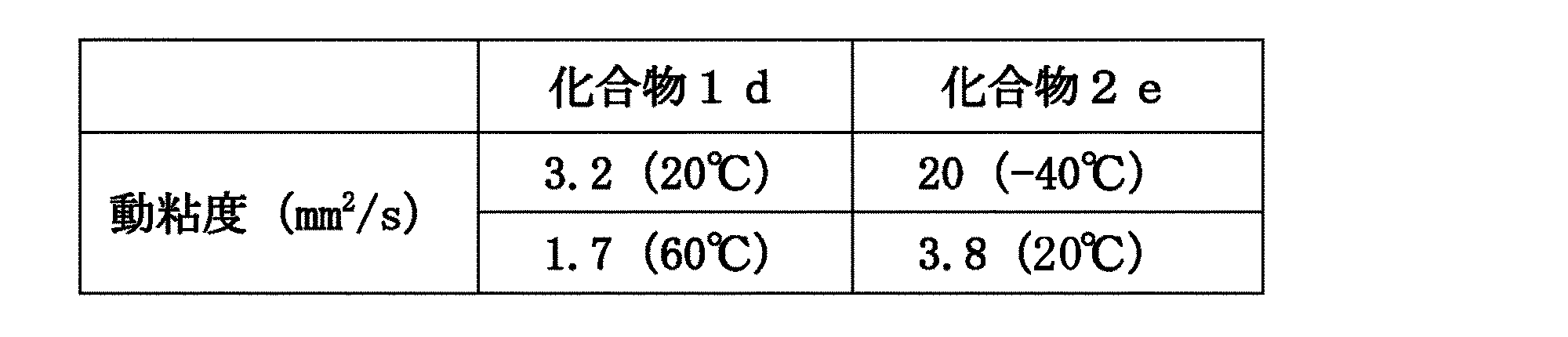
[化5]に示されるテトラキス(トリメチルシリルオキシ)シラン(1d)及びフェニルトリス(トリメチルシリルオキシ)シラン(2e)の動粘度を表2に示す(非特許文献3、4)。化合物1dの動粘度は、密度0.9として文献値より計算した。100℃で粘度は測定されていないが、1dの60℃の値は2.0mm2/sec未満であり、2eの100℃の動粘度は2.0mm2/sec未満と予想される。このため、これらの化合物では粘度指数を算出することはできない。これらの化合物は100℃で動粘度が2.0mm2/sec未満と小さいため、100℃のような高温では使用することはできない。
<化合物1d、2eの動粘度>
[化5]に示されるテトラキス(トリメチルシリルオキシ)シラン(1d)及びフェニルトリス(トリメチルシリルオキシ)シラン(2e)の動粘度を表2に示す(非特許文献3、4)。化合物1dの動粘度は、密度0.9として文献値より計算した。100℃で粘度は測定されていないが、1dの60℃の値は2.0mm2/sec未満であり、2eの100℃の動粘度は2.0mm2/sec未満と予想される。このため、これらの化合物では粘度指数を算出することはできない。これらの化合物は100℃で動粘度が2.0mm2/sec未満と小さいため、100℃のような高温では使用することはできない。

本発明の合成潤滑油は、ヘキシル基以上のアルキル鎖を有するため、100℃においても2.0mm2/secを超える。このため、常温から100℃を少なくとも多少超える高温の環境においても好適に使用することができる。また、本発明の合成潤滑油の粘度指数(200以上、好ましくは220以上)は、現在使用されている精製等の鉱油や合成油PAO(粘度指数120~140)よりも格段に大きい。このため、機器の更なる高性能化・長寿命化や機器運転の更なる省エネ化に貢献できるものと考えられる。
本発明の合成潤滑油は、100℃の動粘度が2.0~7.0mm2/sec、粘度指数が200以上であるので、そのまま又は潤滑油組成物の基油などとして、常温から100℃を少なくとも多少超える高温の環境において好適に使用することができる。
Claims (4)
- 下記式(I)で表される化合物又は化合物の混合物からなる合成潤滑油。
R0 nSi(OSiMe2R1)4-n (I)
(式中、R0はフェニル基であり、Meはメチル基である。(4-n)個のR1は、炭素数6~15の直鎖状又は分岐状炭化水素基であり、互いに同一であっても良いし、異なっていてもよい。nは0又は1である。) - 100℃の動粘度が2.0~7.0mm2/secであり、粘度指数が200以上である請求項1に記載の合成潤滑油。
- 請求項1又は2に記載の合成潤滑油を含む潤滑油組成物。
- 請求項1又は2に記載の合成潤滑油を基油とする潤滑油組成物。
Priority Applications (1)
| Application Number | Priority Date | Filing Date | Title |
|---|---|---|---|
| JP2019517520A JP6826350B2 (ja) | 2017-05-10 | 2018-04-13 | 合成潤滑油 |
Applications Claiming Priority (2)
| Application Number | Priority Date | Filing Date | Title |
|---|---|---|---|
| JP2017-093735 | 2017-05-10 | ||
| JP2017093735 | 2017-05-10 |
Publications (1)
| Publication Number | Publication Date |
|---|---|
| WO2018207549A1 true WO2018207549A1 (ja) | 2018-11-15 |
Family
ID=64104460
Family Applications (1)
| Application Number | Title | Priority Date | Filing Date |
|---|---|---|---|
| PCT/JP2018/015482 Ceased WO2018207549A1 (ja) | 2017-05-10 | 2018-04-13 | 合成潤滑油 |
Country Status (2)
| Country | Link |
|---|---|
| JP (1) | JP6826350B2 (ja) |
| WO (1) | WO2018207549A1 (ja) |
Cited By (1)
| Publication number | Priority date | Publication date | Assignee | Title |
|---|---|---|---|---|
| JP2022175687A (ja) * | 2021-05-14 | 2022-11-25 | 国立研究開発法人産業技術総合研究所 | 合成潤滑油 |
Citations (3)
| Publication number | Priority date | Publication date | Assignee | Title |
|---|---|---|---|---|
| JP2001262168A (ja) * | 2000-03-14 | 2001-09-26 | Shin Etsu Chem Co Ltd | シリコーン系冷凍油 |
| JP4755824B2 (ja) * | 2002-05-01 | 2011-08-24 | ダウ・コーニング・コーポレイション | オルガノハイドロジェンシリコン化合物 |
| JP2012520367A (ja) * | 2009-03-13 | 2012-09-06 | モーメンテイブ・パーフオーマンス・マテリアルズ・ゲゼルシヤフト・ミツト・ベシユレンクテル・ハフツング | 新規なポリオルガノシロキサン類およびそれらの使用 |
-
2018
- 2018-04-13 WO PCT/JP2018/015482 patent/WO2018207549A1/ja not_active Ceased
- 2018-04-13 JP JP2019517520A patent/JP6826350B2/ja active Active
Patent Citations (3)
| Publication number | Priority date | Publication date | Assignee | Title |
|---|---|---|---|---|
| JP2001262168A (ja) * | 2000-03-14 | 2001-09-26 | Shin Etsu Chem Co Ltd | シリコーン系冷凍油 |
| JP4755824B2 (ja) * | 2002-05-01 | 2011-08-24 | ダウ・コーニング・コーポレイション | オルガノハイドロジェンシリコン化合物 |
| JP2012520367A (ja) * | 2009-03-13 | 2012-09-06 | モーメンテイブ・パーフオーマンス・マテリアルズ・ゲゼルシヤフト・ミツト・ベシユレンクテル・ハフツング | 新規なポリオルガノシロキサン類およびそれらの使用 |
Non-Patent Citations (1)
| Title |
|---|
| YATABE, TETSUO ET AL.: "Development of lubricating-base oil having viscosity index of 200 or more", JAPANESE SOCIETY OF TRIBOLOGISTS, PROCEEDINGS OF JAST TRIBOLOGY CONFERENCE, 15 May 2017 (2017-05-15) * |
Cited By (2)
| Publication number | Priority date | Publication date | Assignee | Title |
|---|---|---|---|---|
| JP2022175687A (ja) * | 2021-05-14 | 2022-11-25 | 国立研究開発法人産業技術総合研究所 | 合成潤滑油 |
| JP7699368B2 (ja) | 2021-05-14 | 2025-06-27 | 国立研究開発法人産業技術総合研究所 | 合成潤滑油 |
Also Published As
| Publication number | Publication date |
|---|---|
| JP6826350B2 (ja) | 2021-02-03 |
| JPWO2018207549A1 (ja) | 2020-02-06 |
Similar Documents
| Publication | Publication Date | Title |
|---|---|---|
| JP5283553B2 (ja) | 熱伝導性シリコーングリース組成物 | |
| KR102448206B1 (ko) | 신규 비스(알콕시실릴-비닐렌)기 함유 규소 화합물 및 그의 제조 방법 | |
| JP2007332104A (ja) | 有機ケイ素化合物 | |
| JP7712924B2 (ja) | 低異性体ヒドロシリル化 | |
| US2469890A (en) | Linear methylpolysiloxanes | |
| CA1097368A (en) | Alkoxysilane double cluster compounds with silicone bridges and their preparation and use | |
| WO2017141796A1 (ja) | シロキサン及びその製造方法 | |
| CN106661493A (zh) | 润滑剂组合物及其利用、以及脂肪族醚化合物 | |
| JP6826350B2 (ja) | 合成潤滑油 | |
| JP7153323B2 (ja) | 合成潤滑油 | |
| US2561178A (en) | Organopolysiloxanes | |
| US2947772A (en) | Alkoxysilanes and their use as lubricants | |
| CN108676604A (zh) | 一种苯基氟硅润滑油及其制备方法 | |
| JP6005648B2 (ja) | シリコーン系潤滑油組成物及びそれを含浸させた焼結含油軸受 | |
| JP4905674B2 (ja) | 有機ケイ素化合物 | |
| CN105085567B (zh) | 多官能团共取代的环硅氧烷、环硅氧烷混合物及其制备方法和应用 | |
| JP2017218512A (ja) | 合成潤滑油 | |
| JP7699368B2 (ja) | 合成潤滑油 | |
| KR20190137916A (ko) | 하이드리도실록산과 실리콘(ii) 화합물의 가교 | |
| WO2024214485A1 (ja) | オルガノポリシロキサン化合物 | |
| Snyder Jr et al. | Synthesis and characterization of silahydrocarbons—a class of thermally stable wide-liquid-range functional fluids | |
| EP0613941A2 (en) | Fluorosilicone lubricant compositions | |
| CN109337729A (zh) | 一种含氟有机硅滑油基础油及其制备方法 | |
| JP2015183184A (ja) | 室温湿気増粘型熱伝導性シリコーングリース組成物 | |
| JP2000080277A (ja) | シリコーンオイルコンパウンド組成物 |
Legal Events
| Date | Code | Title | Description |
|---|---|---|---|
| 121 | Ep: the epo has been informed by wipo that ep was designated in this application |
Ref document number: 18799113 Country of ref document: EP Kind code of ref document: A1 |
|
| ENP | Entry into the national phase |
Ref document number: 2019517520 Country of ref document: JP Kind code of ref document: A |
|
| NENP | Non-entry into the national phase |
Ref country code: DE |
|
| 122 | Ep: pct application non-entry in european phase |
Ref document number: 18799113 Country of ref document: EP Kind code of ref document: A1 |