WO2018194092A1 - エキソ-β-1,2-グルカナーゼ及びソホロースの製造方法 - Google Patents
エキソ-β-1,2-グルカナーゼ及びソホロースの製造方法 Download PDFInfo
- Publication number
- WO2018194092A1 WO2018194092A1 PCT/JP2018/016001 JP2018016001W WO2018194092A1 WO 2018194092 A1 WO2018194092 A1 WO 2018194092A1 JP 2018016001 W JP2018016001 W JP 2018016001W WO 2018194092 A1 WO2018194092 A1 WO 2018194092A1
- Authority
- WO
- WIPO (PCT)
- Prior art keywords
- exo
- glucanase
- protein
- amino acid
- acid sequence
- Prior art date
- Legal status (The legal status is an assumption and is not a legal conclusion. Google has not performed a legal analysis and makes no representation as to the accuracy of the status listed.)
- Ceased
Links
Images







Classifications
-
- C—CHEMISTRY; METALLURGY
- C12—BIOCHEMISTRY; BEER; SPIRITS; WINE; VINEGAR; MICROBIOLOGY; ENZYMOLOGY; MUTATION OR GENETIC ENGINEERING
- C12N—MICROORGANISMS OR ENZYMES; COMPOSITIONS THEREOF; PROPAGATING, PRESERVING, OR MAINTAINING MICROORGANISMS; MUTATION OR GENETIC ENGINEERING; CULTURE MEDIA
- C12N15/00—Mutation or genetic engineering; DNA or RNA concerning genetic engineering, vectors, e.g. plasmids, or their isolation, preparation or purification; Use of hosts therefor
- C12N15/09—Recombinant DNA-technology
- C12N15/11—DNA or RNA fragments; Modified forms thereof; Non-coding nucleic acids having a biological activity
- C12N15/52—Genes encoding for enzymes or proenzymes
-
- C—CHEMISTRY; METALLURGY
- C12—BIOCHEMISTRY; BEER; SPIRITS; WINE; VINEGAR; MICROBIOLOGY; ENZYMOLOGY; MUTATION OR GENETIC ENGINEERING
- C12N—MICROORGANISMS OR ENZYMES; COMPOSITIONS THEREOF; PROPAGATING, PRESERVING, OR MAINTAINING MICROORGANISMS; MUTATION OR GENETIC ENGINEERING; CULTURE MEDIA
- C12N15/00—Mutation or genetic engineering; DNA or RNA concerning genetic engineering, vectors, e.g. plasmids, or their isolation, preparation or purification; Use of hosts therefor
- C12N15/09—Recombinant DNA-technology
- C12N15/63—Introduction of foreign genetic material using vectors; Vectors; Use of hosts therefor; Regulation of expression
-
- C—CHEMISTRY; METALLURGY
- C12—BIOCHEMISTRY; BEER; SPIRITS; WINE; VINEGAR; MICROBIOLOGY; ENZYMOLOGY; MUTATION OR GENETIC ENGINEERING
- C12N—MICROORGANISMS OR ENZYMES; COMPOSITIONS THEREOF; PROPAGATING, PRESERVING, OR MAINTAINING MICROORGANISMS; MUTATION OR GENETIC ENGINEERING; CULTURE MEDIA
- C12N5/00—Undifferentiated human, animal or plant cells, e.g. cell lines; Tissues; Cultivation or maintenance thereof; Culture media therefor
- C12N5/10—Cells modified by introduction of foreign genetic material
-
- C—CHEMISTRY; METALLURGY
- C12—BIOCHEMISTRY; BEER; SPIRITS; WINE; VINEGAR; MICROBIOLOGY; ENZYMOLOGY; MUTATION OR GENETIC ENGINEERING
- C12N—MICROORGANISMS OR ENZYMES; COMPOSITIONS THEREOF; PROPAGATING, PRESERVING, OR MAINTAINING MICROORGANISMS; MUTATION OR GENETIC ENGINEERING; CULTURE MEDIA
- C12N9/00—Enzymes; Proenzymes; Compositions thereof; Processes for preparing, activating, inhibiting, separating or purifying enzymes
- C12N9/14—Hydrolases (3)
- C12N9/24—Hydrolases (3) acting on glycosyl compounds (3.2)
-
- C—CHEMISTRY; METALLURGY
- C12—BIOCHEMISTRY; BEER; SPIRITS; WINE; VINEGAR; MICROBIOLOGY; ENZYMOLOGY; MUTATION OR GENETIC ENGINEERING
- C12P—FERMENTATION OR ENZYME-USING PROCESSES TO SYNTHESISE A DESIRED CHEMICAL COMPOUND OR COMPOSITION OR TO SEPARATE OPTICAL ISOMERS FROM A RACEMIC MIXTURE
- C12P19/00—Preparation of compounds containing saccharide radicals
- C12P19/12—Disaccharides
Definitions
- the present disclosure relates to a method for producing exo- ⁇ -1,2-glucanase and sophorose.
- Sophorose is a rare disaccharide in which two molecules of glucose are linked by ⁇ -1,2 and is very rare in nature. Therefore, various methods for producing sophorose have been proposed.
- Patent Document 1 discloses a method for producing sophorose by allowing ⁇ -glucosidase derived from Aspergillus to act on glucose.
- Non-Patent Document 1 discloses a method for producing sophorose by allowing ⁇ -1,2-oligoglucan phosphorylase derived from Listeria innocua to act on glucose and glucose-1-phosphate.
- Patent Document 2 discloses a method for producing sophorose by allowing endo-type ⁇ -1,2-glucanase derived from the genus Acremonium to act on ⁇ -1,2-glucan.
- the conventional method described above has a problem in that a large amount of other oligosaccharides are produced in addition to the intended sophorose, and the yield of sophorose is low.
- the present disclosure has been made in view of the above, and exo- ⁇ -1,2-glucanase suitably used for producing sophorose, and production of sophorose using exo- ⁇ -1,2-glucanase It is an object to provide a method.
- Exo- ⁇ -1,2-glucanase which is any one selected from the following (a) to (d).
- a protein consisting of the amino acid sequence of SEQ ID NO: 1.
- B a protein having an amino acid sequence in which amino acid residues 1 to 18 are deleted from SEQ ID NO: 1.
- C an exo- ⁇ -1,2-glucanase comprising an amino acid sequence in which one or several amino acid residues are substituted, deleted, or added in the amino acid sequence of (a) or (b) Protein with activity.
- D a protein having 90% or more sequence identity with the amino acid sequence of (a) or (b) and having exo- ⁇ -1,2-glucanase activity.
- ⁇ 6> A polynucleotide encoding the exo- ⁇ -1,2-glucanase according to ⁇ 4> or ⁇ 5>.
- ⁇ 8> A transformant introduced with the expression vector according to ⁇ 7>.
- Exo- ⁇ -1 comprising a step of culturing the transformant according to ⁇ 8> and recovering the exo- ⁇ -1,2-glucanase according to ⁇ 4> or ⁇ 5> from the culture.
- 2-Glucanase production method comprising a step of culturing the transformant according to ⁇ 8> and recovering the exo- ⁇ -1,2-glucanase according to ⁇ 4> or ⁇ 5> from the culture.
- a method for producing sophorose comprising a step of allowing exo- ⁇ -1,2-glucanase to act on linear ⁇ -1,2-glucan.
- a method for producing sophorose comprising a step of allowing exo- ⁇ -1,2-glucanase, which is any one selected from the following (a) to (d), to act on a linear ⁇ -1,2-glucan .
- a protein consisting of the amino acid sequence of SEQ ID NO: 1.
- B a protein having an amino acid sequence in which amino acid residues 1 to 18 are deleted from SEQ ID NO: 1.
- C an exo- ⁇ -1,2-glucanase comprising an amino acid sequence in which one or several amino acid residues are substituted, deleted, or added in the amino acid sequence of (a) or (b) Protein with activity.
- D a protein having 90% or more sequence identity with the amino acid sequence of (a) or (b) and having exo- ⁇ -1,2-glucanase activity.
- exo- ⁇ -1,2-glucanase suitably used for producing sophorose and a method for producing sophorose using exo- ⁇ -1,2-glucanase.
- FIG. 4 is a view showing the results of subjecting a reaction solution when a recombinant BDI — 3064 protein is allowed to act on linear ⁇ -1,2-glucan or cyclic ⁇ -1,2-glucan to thin layer chromatography. It is a figure which shows pH dependence and pH stability of recombinant BDI_3064 protein.
- a numerical range indicated by using “to” indicates a range including the numerical values described before and after “to” as the minimum value and the maximum value, respectively.
- the left side is the N-terminal side
- the amino acid residue is well-known in the art (for example, “G” for glycine residue) or three-letter code (for example, glycine residue) For example, “Gly”).
- exo- ⁇ -1,2-glucanase acts on a linear ⁇ -1,2-glucan to produce sophorose.
- the origin of the exo- ⁇ -1,2-glucanase according to the first embodiment is not particularly limited and may be any origin.
- An example is exo- ⁇ -1,2-glucanase derived from Parabacteroides distansonis.
- More detailed enzymological properties of the exo- ⁇ -1,2-glucanase according to the first embodiment are as follows, for example.
- V Temperature stability Stable up to 30 ° C. under conditions of pH 6.5 and 1 hour.
- exo- ⁇ -1,2-glucanase is any one selected from the following (a) to (d).
- A A protein consisting of the amino acid sequence of SEQ ID NO: 1.
- B a protein having an amino acid sequence in which amino acid residues 1 to 18 are deleted from SEQ ID NO: 1.
- C an exo- ⁇ -1,2-glucanase consisting of an amino acid sequence in which one or several amino acid residues are substituted, deleted or added in the amino acid sequence of (a) or (b) above Protein with activity.
- D a protein having 90% or more sequence identity with the amino acid sequence of (a) or (b) and having exo- ⁇ -1,2-glucanase activity.
- the origin of the exo- ⁇ -1,2-glucanase according to the second aspect is not particularly limited, and may be any origin.
- An example is exo- ⁇ -1,2-glucanase derived from Parabacteroides disstasonis.
- the protein (a) above is a protein consisting of the amino acid sequence of SEQ ID NO: 1, and is encoded by a gene consisting of the base sequence of SEQ ID NO: 2.
- the protein consisting of the amino acid sequence of SEQ ID NO: 1 is also referred to as “BDI — 3064 protein”.
- the more detailed enzymological properties of the BDI_3064 protein are as follows.
- (I) Substrate specificity and action characteristics Exogenously acts on linear ⁇ -1,2-glucan to produce sophorose.
- V Temperature stability Stable up to 30 ° C. under conditions of pH 6.5 and 1 hour.
- the protein (b) above is a protein consisting of an amino acid sequence in which amino acid residues 1 to 18 are deleted from SEQ ID NO: 1.
- the 1st to 18th N-terminal region of SEQ ID NO: 1 is determined to be a signal peptide by the signal peptide prediction server SignalP4.0 (http://www.cbs.dtu.dk/services/SignalP-4.0/) . Therefore, the above protein (b) is considered to correspond to the mature protein obtained by removing the signal peptide from the full-length protein.
- the protein of (c) has an amino acid sequence in which one or several amino acid residues are substituted, deleted, or added in the amino acid sequence of (a) or (b), and exo- ⁇ - It is a protein having 1,2-glucanase activity.
- the position where the amino acid residue is substituted, deleted, or added is not particularly limited as long as the exo- ⁇ -1,2-glucanase activity is maintained.
- the number of amino acid residues to be substituted, deleted, or added is not particularly limited as long as exo- ⁇ -1,2-glucanase activity is maintained.
- the number of amino acid residues to be substituted, deleted, or added may be, for example, 1 to 70, 1 to 55, 1 to 40, 1 to 70, It may be 25 or 1 to 10.
- amino acids When substituting an arbitrary amino acid residue with another amino acid residue, it is usually preferable that the properties of the amino acid side chain are preserved before and after the substitution.
- hydrophilic amino acids D, E, K, R, H, S, T, N, Q
- hydrophobic amino acids A, G, V, I, L) , F, Y, W, M, C, P
- acidic amino acids D, E
- basic amino acids K, R, H
- amino acids having aliphatic side chains A, G, V, I, L
- Amino acids having aromatic-containing side chains F, Y, W
- amino acids having sulfur atom-containing side chains M, C
- the like the alphabets in parentheses indicate single-letter amino acids
- the protein (d) is a protein having 90% or more sequence identity with the amino acid sequence (a) or (b) and having exo- ⁇ -1,2-glucanase activity.
- the sequence identity with the amino acid sequence (a) or (b) above may be 92% or more, 94% or more, 96% or more, or 98% or more. May be.
- Sequence identity means the identity between sequences when two amino acid sequences are aligned. For example, BLAST program (https://www.ncbi.nlm.nih.gov/Blast/cgi) ).
- the polynucleotide according to this embodiment encodes the exo- ⁇ -1,2-glucanase according to the second aspect described above.
- the polynucleotide according to the present embodiment may be any of DNA, RNA, and DNA / RNA chimera.
- the polynucleotide according to the present embodiment may be single-stranded or double-stranded. In the case of a single strand, it may be a sense strand encoding the exo- ⁇ -1,2-glucanase according to the second aspect, or it may be an antisense strand having a sequence complementary to the sense strand. Good.
- any of double strand DNA, double strand RNA, DNA, and RNA hybrid may be sufficient.
- the expression vector according to the present embodiment includes the polynucleotide according to the present embodiment.
- the expression vector according to the present embodiment can be prepared by functionally linking the polynucleotide according to the present embodiment downstream of the promoter in the vector.
- the types of vectors include plasmid vectors and virus vectors, and can be appropriately selected according to the host used.
- plasmid vectors include plasmid vectors derived from E. coli, plasmid vectors derived from Bacillus subtilis, and plasmid vectors derived from yeast.
- virus vectors include retrovirus vectors, adenovirus vectors, adeno-associated virus vectors, papilloma virus vectors, vaccinia virus vectors, and SV40 vectors.
- Promoters include trp promoter, lac promoter, T7 promoter, CMV promoter, SR ⁇ promoter, etc., and can be appropriately selected according to the host used.
- the expression vector according to the present embodiment may include an enhancer, a selection marker, and the like in a functionable manner, if necessary.
- the transformant according to the present embodiment is obtained by introducing the expression vector according to the present embodiment.
- Examples of the host into which the expression vector is introduced include bacteria, yeast, insect cells, mammalian cells and the like.
- Examples of the bacterium include Escherichia genus and Bacillus genus.
- Mammalian cells include COS-7 cells, CHO cells, CV-1 cells and the like.
- Examples of methods for introducing an expression vector into a host include lipofection method, calcium phosphate method, microinjection method, protoplast fusion method, electroporation method, DEAE dextran method, and gene gun method.
- the method for producing exo- ⁇ -1,2-glucanase according to the present embodiment comprises culturing the transformant according to the present embodiment, and exo- ⁇ -1,2- according to the second aspect described above from the culture. A step of recovering glucanase.
- the medium and culture conditions for culturing the transformant are not particularly limited, and can be appropriately set according to the type of the host.
- the method for recovering the exo- ⁇ -1,2-glucanase according to the second aspect from the culture is not particularly limited, and any method can be adopted.
- a lysate or culture solution obtained by disrupting a transformant is used for chromatography (affinity chromatography, size exclusion chromatography, reverse phase chromatography, ion exchange chromatography, etc.), ultrafiltration membrane separation, reverse osmosis membrane separation, etc.
- the exo- ⁇ -1,2-glucanase according to the second embodiment can be purified and recovered.
- crystallization may be performed as necessary. Examples of the crystallization method include concentration, temperature reduction, solvent addition (ethanol, methanol, acetone, etc.) and the like.
- the method for producing sophorose according to the present embodiment includes a step of allowing the exo- ⁇ -1,2-glucanase according to the present embodiment to act on a linear ⁇ -1,2-glucan.
- the degree of polymerization of the linear ⁇ -1,2-glucan used as a substrate is not particularly limited. From the viewpoint of the reaction rate, the average degree of polymerization (average DP) of the linear ⁇ -1,2-glucan is preferably 4 or more.
- linear ⁇ -1,2-glucan can be obtained by allowing sucrose phosphorylase and ⁇ -1,2-oligoglucan phosphorylase to act on sucrose and glucose in the presence of inorganic phosphate (K. Abe et al., J. Appl.Glycosci., 62 (2), 47-52 (2015)).
- linear ⁇ -1,2-glucan contained in the culture supernatant of the genus Acetobacter is recovered by ethanol precipitation and desalted to obtain linear ⁇ -1,2-glucan. (A. Ammura et al., J. Gen. Microbiol., 131, 301-307 (1985)).
- exo- ⁇ -1,2-glucanase is not particularly limited, and various usage forms such as a bacterial cell extract, a purified enzyme, and a recombinant enzyme can be employed. It is also possible to perform the reaction as an immobilized enzyme reactor using the bioreactor column on which the exo- ⁇ -1,2-glucanase according to the present embodiment is immobilized.
- the conditions for causing the exo- ⁇ -1,2-glucanase according to this embodiment to act on the linear ⁇ -1,2-glucan are not particularly limited.
- the pH is preferably in the range of 5.5 to 7.0, and the temperature is preferably in the range of 25 to 35 ° C.
- the produced sophorose can be purified and recovered by subjecting it to chromatography (size exclusion chromatography, reverse phase chromatography, ion exchange chromatography, etc.), ultrafiltration membrane separation, reverse osmosis membrane separation and the like.
- chromatography size exclusion chromatography, reverse phase chromatography, ion exchange chromatography, etc.
- ultrafiltration membrane separation reverse osmosis membrane separation
- reverse osmosis membrane separation e.g., acetone, etc.
- sophorose produced as described above can be used, for example, to improve the production efficiency of cellulase by Trichoderma.
- sophorose exhibits good quality sweetness, and since animals do not have enzymes that cleave ⁇ -1,2-glycoside bonds, they are almost non-caloric.
- manufactured sophorose can also be utilized as sweeteners, such as a diet food.
- the produced sophorose can also be used as a material for producing a sugar-containing molecule.
- an unknown useful function can also be searched using manufactured sophorose.
- Sopn Linear ⁇ -1,2-glucan, cyclic ⁇ -1,2-glucan, ⁇ -1,2-glucooligosaccharide having a polymerization degree n (hereinafter also referred to as “Sopn”) used in the following examples, and SopnR in which the reducing end of Sopn was alcoholized was synthesized as follows.
- Cyclic ⁇ -1,2-glucan was synthesized as follows. First, Rhizobium reguminosarum trifolii (NBRC (IFO) 13338) in 500 mL of medium (0.5 w / v% mannitol, 0.1 w / v% yeast extract, 0.1 w / v% MgSO 4 , 0.07 w / v% K 2 HPO 4 , 0.01 w / v% KH 2 PO 4 ) and cultured at 25 ° C. The culture medium was centrifuged (15000 rpm, 10 minutes) to recover the culture supernatant, and then concentrated.
- NBRC Rhizobium reguminosarum trifolii
- acetone was added to a final concentration of 30 v / v% to recover the supernatant, and acetone was further added to a final concentration of 90 v / v% to collect the precipitate.
- the recovered precipitate is dissolved in water, desalted with a purified ion exchange resin (Amberlite MB-4, Organo Corp.), gel filtration chromatography (column: XK100 (GE Healthcare), carrier: HW-40F (Tosoh Corporation). Fractions containing cyclic ⁇ -1,2-glucan were collected, lyophilized and redissolved in 300 ⁇ L of water.
- cyclic ⁇ -1,2-glucan acts on linear ⁇ -1,2-glucan but does not act on cyclic ⁇ -1,2-glucan (KEGG gene ID: It was confirmed that it was not degraded by BT — 3567) but was degraded by endo- ⁇ -1,2-glucanase.
- Sopn was synthesized according to a previously reported report using ⁇ -1,2-oligoglucan phosphorylase derived from Listeria inocure (M. Nakajima et al., PLoS One, 9 (3), e92353 (2014)).
- SopnR was synthesized by treating Sopn with sodium borohydride (NaBH 4 ). More specifically, 1M NaBH 4 (20 ⁇ L) was added to a 10 w / v% Sopn solution (40 ⁇ L) and allowed to stand at room temperature for 5 minutes or more. 3M acetic acid (15 ⁇ L) was added to this solution, 1 mL of 2-propanol was added, and the mixture was allowed to stand on ice for 5 minutes. The resulting precipitate was collected by centrifugation (15000 rpm, 4 minutes). After dissolving the precipitate in a small amount of water, 1 mL of 2-propanol was added, and the obtained precipitate was air-dried to obtain SopnR.
- NaBH 4 sodium borohydride
- Example 1 Production of recombinant BDI_3064 protein>
- the BDI — 3064 gene was amplified by the PCR method using the DNA of Leibniz Institute DSMZ-German Collection of Microorganisms and Cell Cultures as a template.
- KOD-Plus- As the enzyme for PCR, KOD-Plus- (Toyobo Co., Ltd.) was used.
- the base sequences of the forward primer and the reverse primer are as follows. Underlined portions in the base sequence indicate recognition sites for restriction enzymes NdeI and XhoI.
- Forward primer 5′-CAGCTTG CATATG GTGGAGAAACCCTTAC-3 ′ (SEQ ID NO: 3)
- Reverse primer 5′-GCA CTCGAG TTTTATGGATTGAATCTTTTG-3 ′ (SEQ ID NO : 4)
- the obtained PCR amplification product was purified using a High PCR Product Purification kit (Roche Applied Science).
- PCR amplification products were inserted (ligated) into the restriction enzyme NdeI and XhoI cleavage sites of the pET30a vector (Novagen) to obtain an expression vector.
- a ligation kit Ligation high Ver. 2 (Toyobo Co., Ltd.) was used.
- amino acid sequence of the protein (recombinant BDI — 3064 protein) expressed by the obtained expression vector is shown in SEQ ID NO: 5, and the base sequence is shown in SEQ ID NO: 6.
- Eight amino acid residues (LeuGluHisHisHisHisHisHisHis) on the C-terminal side of SEQ ID NO: 5 are a tag peptide portion derived from the pET30a vector.
- the obtained expression vector was introduced into E. coli Rosetta 2 (DE3) and transformed to obtain a transformant.
- This transformant was inoculated on an LB medium containing 30 ⁇ g / mL kanamycin and cultured at 37 ° C. After the culture was cultured until the OD value at a wavelength of 600 nm reached 0.8, isopropyl- ⁇ -D-galactopyranoside (IPTG) was added to a final concentration of 0.1 mM, and the culture was incubated at 20 ° C. overnight. .
- IPTG isopropyl- ⁇ -D-galactopyranoside
- the cultured transformant was recovered by centrifugation (5000 rpm, 10 minutes) and suspended in 50 mM MOPS buffer (pH 7.0) containing 300 mM NaCl.
- the suspended transformant was sonicated and centrifuged (15000 rpm, 15 minutes) to recover the supernatant.
- the collected supernatant was applied to a HisTrap FF crude column (GE Healthcare) equilibrated with an equilibration buffer (50 mM MOPS buffer (pH 7.0), 300 mM NaCl) and washed buffer (50 mM MOPS buffer (pH 7.0), 300 mM). It was washed with NaCl, 10 mM imidazole).
- the desired recombinant BDI_3064 protein was eluted with a linear concentration gradient of 10 to 300 mM imidazole. Thereafter, the recombinant BDI_3064 protein was concentrated using Amicon Ultra 30,000 molecular weight cut-off (Merck Millipore), and buffer exchanged to 50 mM MOPS buffer (pH 7.0).
- the protein concentration of the recombinant BDI — 3064 protein was calculated based on the absorbance at a wavelength of 280 nm using the theoretical molar extinction coefficient (187855 M ⁇ 1 ⁇ cm ⁇ 1 ) of the recombinant BDI — 3064 protein.
- Example 2 Measurement of molecular weight of recombinant BDI_3064 protein>
- the recombinant BDI_3064 protein purified by the HisTrap FF cloud column in Example 1 was purified by UnoQ column (Bio-Rad). Then, 1.0 mg of recombinant BDI_3064 protein purified by UnoQ column was applied to Superdex 200 (Hiload 16/60, GE Healthcare) equilibrated with an equilibration buffer (20 mM MES buffer (pH 6.5), 150 mM NaCl), and the gel was applied.
- the molecular weight of the recombinant BDI_3064 protein was measured by filtration chromatography. As standard proteins, ovalbumin (45 kDa), conalbumin (75 kDa), aldolase (158 kDa), ferritin (440 kDa), and thyroglobulin (669 kDa) were used.
- FIG. 1 The result of gel filtration chromatography is shown in FIG.
- the horizontal axis represents the distribution coefficient (Kav), and the vertical axis represents the molecular weight (log 10 (Da)).
- the molecular weight of the recombinant BDI_3064 protein was calculated to be about 114 kDa. From this result, it can be seen that the recombinant BDI_3064 protein is a monomer.
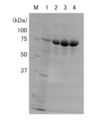
- M indicates a molecular weight marker (Precision Plus Protein unstained standards (Bio-Rad)
- Lane 1 indicates the crude protein before purification
- Lane 2 indicates the protein after purification by the HisTrap FF crude column
- Lane 3 shows the protein after purification by UnoQ column
- lane 4 shows the protein after fractionation by gel filtration chromatography.
- the molecular weight of the recombinant BDI_3064 protein was about 80 kDa.
- Example 3 Confirmation of action characteristics of recombinant BDI_3064 protein> Using each of linear ⁇ -1,2-glucan having an average polymerization degree of 25 and cyclic ⁇ -1,2-glucan as a substrate, the action characteristics of the recombinant BDI — 3064 protein were confirmed as follows.
- the recombinant BDI_3064 protein was terminated in 20 mM MES buffer (pH 6.5) containing 0.2 w / v% linear ⁇ -1,2-glucan or 0.2 w / v% cyclic ⁇ -1,2-glucan. It added so that it might become a density
- TLC thin layer chromatography
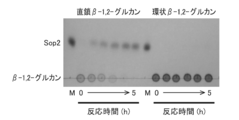
- M is a spot of 0.4 ⁇ L of 25 mM Sop2.
- the amount of Sop2 released increased with time, but when cyclic ⁇ -1,2-glucan was used as a substrate, Sop2 was not released. From these results, it can be seen that the recombinant BDI_3064 protein is an exo- ⁇ -1,2-glucanase that exo-degrades linear ⁇ -1,2-glucan by two sugars.
- Example 4 Confirmation of pH and temperature profile of recombinant BDI_3064 protein> The pH and temperature profile of the recombinant BDI_3064 protein was confirmed by the following procedure. First, Sop4 is degraded with recombinant BDI — 3064 protein, and the degradation product is degraded with almond-derived ⁇ -glucosidase (Oriental Yeast Co., Ltd.). Almond-derived ⁇ -glucosidase acts only on Sop2 and decomposes to glucose, but does not act on Sopn having a polymerization degree n of 3 or more.
- the reaction rate is determined by quantifying the produced glucose by GOPOD (glucose oxidase / peroxidase) method, and this reaction rate is defined as the enzyme activity.
- reaction liquid which mixed 3 mM Sop4, 20 mM MES buffer (pH 6.5), and the liquid mixture after incubation (1/10 amount of the reaction liquid) at 30 degreeC for 15 minutes, at 100 degreeC for 5 minutes
- the enzyme reaction was stopped by heating.
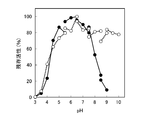
- FIG. 4 The results of pH dependency and pH stability of the recombinant BDI — 3064 protein are shown in FIG. In FIG. 4, a solid line shows pH dependence, and a broken line shows pH stability. As shown in FIG. 4, the recombinant BDI — 3064 protein was stable at pH 5.5 to 10 under the conditions of 30 ° C. and 1 hour. The optimum pH was pH 6.5 under the condition of 30 ° C.
- FIG. 5 shows the results of temperature dependency and temperature stability of the recombinant BDI_3064 protein.
- a solid line shows temperature stability and a broken line shows temperature dependence.
- the optimal temperature of the recombinant BDI — 3064 protein was 40 ° C. under the condition of pH 6.5.
- the recombinant BDI — 3064 protein was stable up to 30 ° C. under conditions of pH 6.5 and 1 hour.
- Example 5 Confirmation of substrate specificity of recombinant BDI_3064 protein for various polysaccharides> A reaction solution in which various polysaccharides, 0.1 mg / mL recombinant BDI_3064 protein, and 50 mM MES buffer (pH 6.5) are mixed is reacted at 30 ° C. for 24 hours, and then heated at 100 ° C. for 5 minutes to carry out an enzyme reaction. Stopped.
- Polysaccharides include linear ⁇ -1,2-glucan having an average degree of polymerization of 25, lichenan, laminarin, arabinogalactan, pachyman, carboxymethylated curdlan (CM-cardlan), carboxymethylated pachyman (CM-pachyman) , Glucomannan, tamarindoxyloglucan, polygalacturonic acid, carboxymethylcellulose (CM-cellulose), hydroxyethylcellulose, and arabinan were used.
- linear ⁇ -1,2-glucan is used as a substrate, the enzyme activity is measured by the GOPOD method.
- the enzyme activity is measured by the PAHBAH (p-hydroxybenzoic acid hydrazide) method.
- PAHBAH p-hydroxybenzoic acid hydrazide
- the relative activity (%) for each polysaccharide when the specific activity for linear ⁇ -1,2-glucan is 100% is shown in Table 1 below.
- “ND” indicates that the relative activity is less than 0.2%.
- Example 6 Confirmation of substrate specificity of recombinant BDI_3064 protein for various oligosaccharides> First, the reaction liquid which mixed 0.2 w / v% various oligosaccharides, 0.325 mg / mL recombinant BDI_3064 protein, and 50 mM MES buffer (pH 6.5) was made to react at 30 degreeC.
- Oligosaccharides include Sop3, Sop4, Sop5, Sop6, laminaribiose (Lam2), laminaritriose (Lam3), laminaritetraose (Lam4), cellobiose (Cel2), cellotriose (Cel3), cellotetraose (Cel4) ) And gentiobiose (Gen2).
- Sop4, Sop5, and Sop6 are used as substrates, 0 minutes, 2.5 minutes, 5 minutes, 7.5 minutes, 10 minutes, 15 minutes, 30 minutes, 1 hour after the start of the reaction The reaction solution was sampled later, and each sample was heated at 100 ° C. for 5 minutes to stop the enzyme reaction.
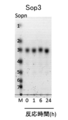
- reaction solution is sampled after 0 hours, 1 hour, 6 hours, and 24 hours from the start of the reaction, and each sample is heated at 100 ° C. for 5 minutes for the enzyme reaction. Was stopped.
- TLC thin layer chromatography
- 7A to 7C M represents Lam2, Lam3, Lam4, and glucose (Glc) as markers.
- 8A to 8C M indicates Cel2, Cel3, Cel4, and Glc as markers.
- M indicates Gen2 and Glc as markers.
- the recombinant BDI_3064 protein showed high substrate specificity for Sopn among various oligosaccharides, especially for Sopn having a degree of polymerization of 4 or more.
- ⁇ Example 7 Kinetic analysis of recombinant BDI_3064 protein> 3.3 ⁇ g / mL recombinant BDI — 3064 protein was reacted at 30 ° C. against 0.25 to 4.0 mM Sop4.
- the degradation product was degraded with almond-derived ⁇ -glucosidase, and the produced glucose was quantified by the GOPOD method and converted to Sop2 equivalent.
- the reaction kinetics amount was calculated by fitting experimental values to the Michaelis-Menten equation of the following equation (1) using a data analysis program (KaleidaGraph ver. 3.51, Hulinks Co., Ltd.).
- K m represents Michaelis constant
- k cat represents catalytic activity
- [S] represents substrate concentration
- [E] 0 represents total enzyme concentration.
- Recombinant BDI_3064 protein was similarly reacted with 0.3 to 4 mM Sop5 and 0.05 to 0.5 mM linear ⁇ -1,2-glucan (average polymerization degree 77), and the reaction kinetic amount was calculated.
- the calculation results of the reaction kinetic amounts are shown in Table 2 below.
- Example 8 Confirmation of degradation direction of recombinant BDI_3064 protein>
- the reaction liquid which mixed 0.2 w / v% Sop5R or Sop6R, recombinant BDI_3064 protein, and 50 mM MES buffer (pH 6.5) was made to react at 30 degreeC.
- the concentration of recombinant BDI — 3064 protein was 6.5 ⁇ g / mL for Sop5R and 33 ⁇ g / mL for Sop6R.
- the reaction solution was sampled at 0 ° C, 2.5 minutes, 5 minutes, 7.5 minutes, 10 minutes, 15 minutes, 30 minutes, and 1 hour after the start of the reaction.
- the enzyme reaction was stopped by heating for 5 minutes.
- TLC thin layer chromatography
- FIGS. 10A and 10B The results of thin layer chromatography are shown in FIGS. 10A and 10B.
- M3 represents SopnR (as a marker).
- n 3, 5, 7, 9)
- the numbers on the plate are the degree of polymerization of Sopn or SopnR.
- Sop2 was confirmed as a common product in both cases where Sop5R was used as a substrate and Sop6R was used as a substrate. From this result, it can be seen that the recombinant BDI_3064 protein exolytically degrades linear ⁇ -1,2-glucan by two sugars from the non-reducing end side.
- first glucose concentration The glucose concentration at this time is referred to as “first glucose concentration”.
- second glucose concentration the glucose concentration at this time is referred to as “second glucose concentration”.
- sophorose concentration was calculated based on the value obtained by subtracting the second glucose concentration from the first glucose concentration.
- the measurement result of the reaction yield of sophorose is shown in FIG. As shown in FIG. 11, at the stage of about 12 hours from the start of the reaction, the reaction yield of sophorose showed an extremely high value of about 90%, and almost no glucose as a by-product was produced.
- Sophorose was produced by reacting linear ⁇ -1,2-glucan having an average degree of polymerization of 25 with recombinant BDI_3064 protein on a 500 mL scale.
- the precipitated protein is removed by passing the reaction solution through a filter (Millex-GP, pore size 0.22 ⁇ m, Merck Millipore), and then deionized with a purified ion exchange resin (Amberlite MB-4, Organo Corp.). Salted (1.7 g when lyophilized at this point). After the desalted reaction solution was concentrated, it was subjected to gel filtration column chromatography (column: XK100 (GE Healthcare), carrier: HW-40F (Tosoh Corp.)) to collect a fraction containing sophorose. When the collected liquid was lyophilized, the yield of sophorose was 1.2 g.
Landscapes
- Health & Medical Sciences (AREA)
- Genetics & Genomics (AREA)
- Life Sciences & Earth Sciences (AREA)
- Engineering & Computer Science (AREA)
- Chemical & Material Sciences (AREA)
- Organic Chemistry (AREA)
- Zoology (AREA)
- Wood Science & Technology (AREA)
- Bioinformatics & Cheminformatics (AREA)
- Biomedical Technology (AREA)
- Biotechnology (AREA)
- General Engineering & Computer Science (AREA)
- Microbiology (AREA)
- Biochemistry (AREA)
- General Health & Medical Sciences (AREA)
- Molecular Biology (AREA)
- Plant Pathology (AREA)
- Biophysics (AREA)
- Physics & Mathematics (AREA)
- Cell Biology (AREA)
- Chemical Kinetics & Catalysis (AREA)
- General Chemical & Material Sciences (AREA)
- Medicinal Chemistry (AREA)
- Preparation Of Compounds By Using Micro-Organisms (AREA)
- Enzymes And Modification Thereof (AREA)
- Micro-Organisms Or Cultivation Processes Thereof (AREA)
Abstract
直鎖β-1,2-グルカンに作用してソホロースを生成するエキソ-β-1,2-グルカナーゼ、並びに、(a)配列番号1のアミノ酸配列からなるタンパク質、(b)配列番号1において1~18番目のアミノ酸残基を欠失したアミノ酸配列からなるタンパク質、(c)(a)又は(b)のアミノ酸配列において1個若しくは数個のアミノ酸残基が置換、欠失、又は付加されたアミノ酸配列からなり、かつ、エキソ-β-1,2-グルカナーゼ活性を有するタンパク質、及び(d)(a)又は(b)のアミノ酸配列と90%以上の配列同一性を有し、かつ、エキソ-β-1,2-グルカナーゼ活性を有するタンパク質、から選択されるいずれか1種であるエキソ-β-1,2-グルカナーゼを提供する。また、エキソ-β-1,2-グルカナーゼを用いたソホロースの製造方法を提供する。
Description
本開示は、エキソ-β-1,2-グルカナーゼ及びソホロースの製造方法に関する。
近年、セルロース系バイオマスを原料としてバイオエタノールを製造する際に、トリコデルマ(Trichoderma)属菌が生産するセルラーゼが広く利用されている。トリコデルマ属菌によるセルラーゼの生産効率を向上させるためには、セルラーゼ生産を誘導する成分を培地に添加する必要がある。従来、セルラーゼ生産の誘導効果に優れた成分として、ソホロースが知られている。
ソホロースは、2分子のグルコースがβ-1,2結合した希少二糖類であり、天然にはごく僅かしか存在しない。そこで、ソホロースを製造する方法が種々提案されている。
例えば、特許文献1には、アスペルギルス(Aspergillus)属菌に由来するβ-グルコシダーゼをグルコースに作用させ、ソホロースを製造する方法が開示されている。
非特許文献1には、リステリア・イノキュア(Listeria innocua)に由来するβ-1,2-オリゴグルカンホスホリラーゼをグルコース及びグルコース-1-リン酸に作用させ、ソホロースを製造する方法が開示されている。
特許文献2には、アクレモニウム(Acremonium)属菌に由来するエンド型のβ-1,2-グルカナーゼをβ-1,2-グルカンに作用させ、ソホロースを製造する方法が開示されている。
非特許文献1には、リステリア・イノキュア(Listeria innocua)に由来するβ-1,2-オリゴグルカンホスホリラーゼをグルコース及びグルコース-1-リン酸に作用させ、ソホロースを製造する方法が開示されている。
特許文献2には、アクレモニウム(Acremonium)属菌に由来するエンド型のβ-1,2-グルカナーゼをβ-1,2-グルカンに作用させ、ソホロースを製造する方法が開示されている。
M. Nakajima et al.,PLoS One,9(3),e92353(2014)
しかし、上述した従来の方法では、目的とするソホロース以外に他のオリゴ糖が多く生成してしまい、ソホロースの収率が低いという問題があった。
本開示は、上記に鑑みてなされたものであり、ソホロースを製造する際に好適に用いられるエキソ-β-1,2-グルカナーゼ、及びエキソ-β-1,2-グルカナーゼを用いたソホロースの製造方法を提供することを課題とする。
上記課題を解決するための具体的な手段には、以下の実施態様が含まれる。
<1> 直鎖β-1,2-グルカンに作用してソホロースを生成するエキソ-β-1,2-グルカナーゼ。
<1> 直鎖β-1,2-グルカンに作用してソホロースを生成するエキソ-β-1,2-グルカナーゼ。
<2> 以下の酵素学的性質を有する<1>に記載のエキソ-β-1,2-グルカナーゼ。
(i)基質特異性及び作用特性
直鎖β-1,2-グルカンにエキソ的に作用してソホロースを生成する。
(ii)至適pH
30℃の条件下で、pH6.5。
(iii)至適温度
pH6.5の条件下で、40℃。
(iv)安定pH
30℃、1時間の条件下で、pH5.5~10で安定。
(v)温度安定性
pH6.5、1時間の条件下で、30℃まで安定。
(i)基質特異性及び作用特性
直鎖β-1,2-グルカンにエキソ的に作用してソホロースを生成する。
(ii)至適pH
30℃の条件下で、pH6.5。
(iii)至適温度
pH6.5の条件下で、40℃。
(iv)安定pH
30℃、1時間の条件下で、pH5.5~10で安定。
(v)温度安定性
pH6.5、1時間の条件下で、30℃まで安定。
<3> パラバクテロイデス・ディスタソニス由来である<1>又は<2>に記載のエキソ-β-1,2-グルカナーゼ。
<4> 下記(a)~(d)から選択されるいずれか1種であるエキソ-β-1,2-グルカナーゼ。
(a)配列番号1のアミノ酸配列からなるタンパク質。
(b)配列番号1において1~18番目のアミノ酸残基を欠失したアミノ酸配列からなるタンパク質。
(c)前記(a)又は(b)のアミノ酸配列において1個若しくは数個のアミノ酸残基が置換、欠失、又は付加されたアミノ酸配列からなり、かつ、エキソ-β-1,2-グルカナーゼ活性を有するタンパク質。
(d)前記(a)又は(b)のアミノ酸配列と90%以上の配列同一性を有し、かつ、エキソ-β-1,2-グルカナーゼ活性を有するタンパク質。
(a)配列番号1のアミノ酸配列からなるタンパク質。
(b)配列番号1において1~18番目のアミノ酸残基を欠失したアミノ酸配列からなるタンパク質。
(c)前記(a)又は(b)のアミノ酸配列において1個若しくは数個のアミノ酸残基が置換、欠失、又は付加されたアミノ酸配列からなり、かつ、エキソ-β-1,2-グルカナーゼ活性を有するタンパク質。
(d)前記(a)又は(b)のアミノ酸配列と90%以上の配列同一性を有し、かつ、エキソ-β-1,2-グルカナーゼ活性を有するタンパク質。
<5> パラバクテロイデス・ディスタソニス由来である<4>に記載のエキソ-β-1,2-グルカナーゼ。
<6> <4>又は<5>に記載のエキソ-β-1,2-グルカナーゼをコードするポリヌクレオチド。
<7> <6>に記載のポリヌクレオチドを含む発現ベクター。
<8> <7>に記載の発現ベクターが導入された形質転換体。
<9> <8>に記載の形質転換体を培養し、培養物から<4>又は<5>に記載のエキソ-β-1,2-グルカナーゼを回収する工程を含むエキソ-β-1,2-グルカナーゼの製造方法。
<10> エキソ-β-1,2-グルカナーゼを直鎖β-1,2-グルカンに作用させる工程を含むソホロースの製造方法。
<11> 前記エキソ-β-1,2-グルカナーゼが以下の酵素学的性質を有する<10>に記載のソホロースの製造方法。
(i)基質特異性及び作用特性
直鎖β-1,2-グルカンにエキソ的に作用してソホロースを生成する。
(ii)至適pH
30℃の条件下で、pH6.5。
(iii)至適温度
pH6.5の条件下で、40℃。
(iv)安定pH
30℃、1時間の条件下で、pH5.5~10で安定。
(v)温度安定性
pH6.5、1時間の条件下で、30℃まで安定。
(i)基質特異性及び作用特性
直鎖β-1,2-グルカンにエキソ的に作用してソホロースを生成する。
(ii)至適pH
30℃の条件下で、pH6.5。
(iii)至適温度
pH6.5の条件下で、40℃。
(iv)安定pH
30℃、1時間の条件下で、pH5.5~10で安定。
(v)温度安定性
pH6.5、1時間の条件下で、30℃まで安定。
<12> 前記エキソ-β-1,2-グルカナーゼがパラバクテロイデス・ディスタソニス由来である<10>又は<11>に記載のソホロースの製造方法。
<13> 下記(a)~(d)から選択されるいずれか1種であるエキソ-β-1,2-グルカナーゼを直鎖β-1,2-グルカンに作用させる工程を含むソホロースの製造方法。
(a)配列番号1のアミノ酸配列からなるタンパク質。
(b)配列番号1において1~18番目のアミノ酸残基を欠失したアミノ酸配列からなるタンパク質。
(c)前記(a)又は(b)のアミノ酸配列において1個若しくは数個のアミノ酸残基が置換、欠失、又は付加されたアミノ酸配列からなり、かつ、エキソ-β-1,2-グルカナーゼ活性を有するタンパク質。
(d)前記(a)又は(b)のアミノ酸配列と90%以上の配列同一性を有し、かつ、エキソ-β-1,2-グルカナーゼ活性を有するタンパク質。
(a)配列番号1のアミノ酸配列からなるタンパク質。
(b)配列番号1において1~18番目のアミノ酸残基を欠失したアミノ酸配列からなるタンパク質。
(c)前記(a)又は(b)のアミノ酸配列において1個若しくは数個のアミノ酸残基が置換、欠失、又は付加されたアミノ酸配列からなり、かつ、エキソ-β-1,2-グルカナーゼ活性を有するタンパク質。
(d)前記(a)又は(b)のアミノ酸配列と90%以上の配列同一性を有し、かつ、エキソ-β-1,2-グルカナーゼ活性を有するタンパク質。
<14> 前記エキソ-β-1,2-グルカナーゼがパラバクテロイデス・ディスタソニス由来である<13>に記載のソホロースの製造方法。
本開示によれば、ソホロースを製造する際に好適に用いられるエキソ-β-1,2-グルカナーゼ、及びエキソ-β-1,2-グルカナーゼを用いたソホロースの製造方法を提供することができる。
以下、本発明の実施形態について説明する。ただし、本発明は以下の実施形態に限定されるものではない。
本明細書において「~」を用いて示された数値範囲は、「~」の前後に記載される数値をそれぞれ最小値及び最大値として含む範囲を示す。
アミノ酸配列の記載は左側がN末端側であり、アミノ酸残基は当分野で周知の1文字表記(例えば、グリシン残基であれば「G」)又は3文字表記(例えば、グリシン残基であれば「Gly」)を用いて表記する。
本明細書において「~」を用いて示された数値範囲は、「~」の前後に記載される数値をそれぞれ最小値及び最大値として含む範囲を示す。
アミノ酸配列の記載は左側がN末端側であり、アミノ酸残基は当分野で周知の1文字表記(例えば、グリシン残基であれば「G」)又は3文字表記(例えば、グリシン残基であれば「Gly」)を用いて表記する。
<エキソ-β-1,2-グルカナーゼ>
本実施形態の第1の態様に係るエキソ-β-1,2-グルカナーゼは、直鎖β-1,2-グルカンに作用してソホロースを生成するものである。第1の態様に係るエキソ-β-1,2-グルカナーゼの起源は特に制限されず、いかなる起源であってもよい。一例としては、パラバクテロイデス・ディスタソニス(Parabacteroides distasonis)由来のエキソ-β-1,2-グルカナーゼが挙げられる。
本実施形態の第1の態様に係るエキソ-β-1,2-グルカナーゼは、直鎖β-1,2-グルカンに作用してソホロースを生成するものである。第1の態様に係るエキソ-β-1,2-グルカナーゼの起源は特に制限されず、いかなる起源であってもよい。一例としては、パラバクテロイデス・ディスタソニス(Parabacteroides distasonis)由来のエキソ-β-1,2-グルカナーゼが挙げられる。
第1の態様に係るエキソ-β-1,2-グルカナーゼのより詳細な酵素学的性質は、例えば、以下のとおりである。
(i)基質特異性及び作用特性
直鎖β-1,2-グルカンにエキソ的に作用してソホロースを生成する。
(ii)至適pH
30℃の条件下で、pH6.5。
(iii)至適温度
pH6.5の条件下で、40℃。
(iv)安定pH
30℃、1時間の条件下で、pH5.5~10で安定。
(v)温度安定性
pH6.5、1時間の条件下で、30℃まで安定。
(i)基質特異性及び作用特性
直鎖β-1,2-グルカンにエキソ的に作用してソホロースを生成する。
(ii)至適pH
30℃の条件下で、pH6.5。
(iii)至適温度
pH6.5の条件下で、40℃。
(iv)安定pH
30℃、1時間の条件下で、pH5.5~10で安定。
(v)温度安定性
pH6.5、1時間の条件下で、30℃まで安定。
また、本実施形態の第2の態様に係るエキソ-β-1,2-グルカナーゼは、下記(a)~(d)から選択されるいずれか1種である。
(a)配列番号1のアミノ酸配列からなるタンパク質。
(b)配列番号1において1~18番目のアミノ酸残基を欠失したアミノ酸配列からなるタンパク質。
(c)上記(a)又は(b)のアミノ酸配列において1個若しくは数個のアミノ酸残基が置換、欠失、又は付加されたアミノ酸配列からなり、かつ、エキソ-β-1,2-グルカナーゼ活性を有するタンパク質。
(d)上記(a)又は(b)のアミノ酸配列と90%以上の配列同一性を有し、かつ、エキソ-β-1,2-グルカナーゼ活性を有するタンパク質。
(a)配列番号1のアミノ酸配列からなるタンパク質。
(b)配列番号1において1~18番目のアミノ酸残基を欠失したアミノ酸配列からなるタンパク質。
(c)上記(a)又は(b)のアミノ酸配列において1個若しくは数個のアミノ酸残基が置換、欠失、又は付加されたアミノ酸配列からなり、かつ、エキソ-β-1,2-グルカナーゼ活性を有するタンパク質。
(d)上記(a)又は(b)のアミノ酸配列と90%以上の配列同一性を有し、かつ、エキソ-β-1,2-グルカナーゼ活性を有するタンパク質。
第2の態様に係るエキソ-β-1,2-グルカナーゼの起源は特に制限されず、いかなる起源であってもよい。一例としては、パラバクテロイデス・ディスタソニス由来のエキソ-β-1,2-グルカナーゼが挙げられる。
上記(a)のタンパク質は、配列番号1のアミノ酸配列からなるタンパク質であり、配列番号2の塩基配列からなる遺伝子によりコードされている。以下、配列番号1のアミノ酸配列からなるタンパク質を「BDI_3064タンパク質」とも記す。
BDI_3064タンパク質のより詳細な酵素学的性質は以下のとおりである。
(i)基質特異性及び作用特性
直鎖β-1,2-グルカンにエキソ的に作用してソホロースを生成する。
(ii)至適pH
30℃の条件下で、pH6.5。
(iii)至適温度
pH6.5の条件下で、40℃。
(iv)安定pH
30℃、1時間の条件下で、pH5.5~10で安定。
(v)温度安定性
pH6.5、1時間の条件下で、30℃まで安定。
(i)基質特異性及び作用特性
直鎖β-1,2-グルカンにエキソ的に作用してソホロースを生成する。
(ii)至適pH
30℃の条件下で、pH6.5。
(iii)至適温度
pH6.5の条件下で、40℃。
(iv)安定pH
30℃、1時間の条件下で、pH5.5~10で安定。
(v)温度安定性
pH6.5、1時間の条件下で、30℃まで安定。
上記(b)のタンパク質は、配列番号1において1~18番目のアミノ酸残基を欠失したアミノ酸配列からなるタンパク質である。配列番号1の1~18番目のN末端領域は、シグナルペプチド予測サーバーSignalP4.0(http://www.cbs.dtu.dk/services/SignalP-4.0/)によりシグナルペプチドと判定される。したがって、上記(b)のタンパク質は、全長タンパク質からシグナルペプチドを除いた成熟タンパク質に対応すると考えられる。
上記(c)のタンパク質は、上記(a)又は(b)のアミノ酸配列において1個若しくは数個のアミノ酸残基が置換、欠失、又は付加されたアミノ酸配列からなり、かつ、エキソ-β-1,2-グルカナーゼ活性を有するタンパク質である。アミノ酸残基が置換、欠失、又は付加される位置は、エキソ-β-1,2-グルカナーゼ活性が維持される限り特に制限されない。また、置換、欠失、又は付加されるアミノ酸残基の数は、エキソ-β-1,2-グルカナーゼ活性が維持される限り特に制限されない。置換、欠失、又は付加されるアミノ酸残基の数は、例えば、1~70個であってもよく、1~55個であってもよく、1~40個であってもよく、1~25個であってもよく、1~10個であってもよい。
任意のアミノ酸残基を他のアミノ酸残基に置換する場合、通常、置換前後でアミノ酸側鎖の性質が保存されていることが好ましい。アミノ酸側鎖の性質によってアミノ酸を分類する場合、例えば、親水性アミノ酸(D、E、K、R、H、S、T、N、Q);疎水性アミノ酸(A、G、V、I、L、F、Y、W、M、C、P);酸性アミノ酸(D、E);塩基性アミノ酸(K、R、H);脂肪族側鎖を有するアミノ酸(A、G、V、I、L);芳香族含有側鎖を有するアミノ酸(F、Y、W);硫黄原子含有側鎖を有するアミノ酸(M、C);等に分類することができる(括弧内のアルファベットはアミノ酸の一文字表記を示す)。
上記(d)のタンパク質は、上記(a)又は(b)のアミノ酸配列と90%以上の配列同一性を有し、かつ、エキソ-β-1,2-グルカナーゼ活性を有するタンパク質である。上記(a)又は(b)のアミノ酸配列との配列同一性は、92%以上であってもよく、94%以上であってもよく、96%以上であってもよく、98%以上であってもよい。
なお、「配列同一性」とは、2つのアミノ酸配列をアラインメントした場合の配列間の一致性を意味し、例えば、BLASTプログラム(https://www.ncbi.nlm.nih.gov/Blast/cgi)を使用して算出することができる。
<ポリヌクレオチド>
本実施形態に係るポリヌクレオチドは、上述した第2の態様に係るエキソ-β-1,2-グルカナーゼをコードするものである。
本実施形態に係るポリヌクレオチドは、上述した第2の態様に係るエキソ-β-1,2-グルカナーゼをコードするものである。
本実施形態に係るポリヌクレオチドは、DNA、RNA、DNA/RNAキメラのいずれであってもよい。また、本実施形態に係るポリヌクレオチドは、一本鎖であっても二本鎖であってもよい。一本鎖の場合、第2の態様に係るエキソ-β-1,2-グルカナーゼをコードするセンス鎖であってもよく、センス鎖に対して相補的な配列を有するアンチセンス鎖であってもよい。二本鎖の場合、二本鎖DNA、二本鎖RNA、DNA及びRNAハイブリッドのいずれであってもよい。
<発現ベクター>
本実施形態に係る発現ベクターは、本実施形態に係るポリヌクレオチドを含むものである。本実施形態に係る発現ベクターは、本実施形態に係るポリヌクレオチドをベクター中のプロモーターの下流に機能的に連結することにより作製することができる。
本実施形態に係る発現ベクターは、本実施形態に係るポリヌクレオチドを含むものである。本実施形態に係る発現ベクターは、本実施形態に係るポリヌクレオチドをベクター中のプロモーターの下流に機能的に連結することにより作製することができる。
ベクターの種類としては、プラスミドベクター、ウイルスベクター等があり、用いる宿主に応じて適宜選択することができる。プラスミドベクターとしては、大腸菌由来のプラスミドベクター、枯草菌由来のプラスミドベクター、酵母由来のプラスミドベクター等が挙げられる。ウイルスベクターとしては、レトロウイルスベクター、アデノウイルスベクター、アデノ随伴ウイルスベクター、パピローマウイルスベクター、ワクシニアウイルスベクター、SV40ベクター等が挙げられる。
プロモーターとしては、trpプロモーター、lacプロモーター、T7プロモーター、CMVプロモーター、SRαプロモーター等があり、用いる宿主に応じて適宜選択することができる。
本実施形態に係る発現ベクターは、必要に応じて、エンハンサー、選択マーカー等を、それぞれ機能可能な態様で含んでいてもよい。
<形質転換体>
本実施形態に係る形質転換体は、本実施形態に係る発現ベクターが導入されたものである。
本実施形態に係る形質転換体は、本実施形態に係る発現ベクターが導入されたものである。
発現ベクターが導入される宿主としては、細菌、酵母、昆虫細胞、哺乳動物細胞等がある。細菌としては、エシェリヒア(Escherichia)属菌、バチルス(Bacillus)属菌等が挙げられる。哺乳動物細胞としては、COS-7細胞、CHO細胞、CV-1細胞等が挙げられる。
宿主に発現ベクターを導入する方法としては、リポフェクション法、リン酸カルシウム法、マイクロインジェクション法、プロトプラスト融合法、エレクトロポレーション法、DEAEデキストラン法、遺伝子銃法等が挙げられる。
宿主に発現ベクターを導入する方法としては、リポフェクション法、リン酸カルシウム法、マイクロインジェクション法、プロトプラスト融合法、エレクトロポレーション法、DEAEデキストラン法、遺伝子銃法等が挙げられる。
<エキソ-β-1,2-グルカナーゼの製造方法>
本実施形態に係るエキソ-β-1,2-グルカナーゼの製造方法は、本実施形態に係る形質転換体を培養し、培養物から上述した第2の態様に係るエキソ-β-1,2-グルカナーゼを回収する工程を含むものである。
本実施形態に係るエキソ-β-1,2-グルカナーゼの製造方法は、本実施形態に係る形質転換体を培養し、培養物から上述した第2の態様に係るエキソ-β-1,2-グルカナーゼを回収する工程を含むものである。
形質転換体を培養する培地及び培養条件は特に制限されず、宿主の種類に応じて適宜設定することができる。培養物から第2の態様に係るエキソ-β-1,2-グルカナーゼを回収する方法は特に制限されず、任意の方法を採用することができる。例えば、形質転換体を破砕した溶解液又は培養液をクロマトグラフィー(アフィニティクロマトグラフィー、サイズ排除クロマトグラフィー、逆相クロマトグラフィー、イオン交換クロマトグラフィー等)、限外濾過膜分離、逆浸透膜分離などに供することで、第2の態様に係るエキソ-β-1,2-グルカナーゼを精製し、回収することができる。なお、第2の態様に係るエキソ-β-1,2-グルカナーゼを回収する際には、必要に応じて結晶化を行ってもよい。結晶化方法としては、濃縮、温度低下、溶媒添加(エタノール、メタノール、アセトン等)などが挙げられる。
<ソホロースの製造方法>
本実施形態に係るソホロースの製造方法は、本実施形態に係るエキソ-β-1,2-グルカナーゼを直鎖β-1,2-グルカンに作用させる工程を含むものである。
本実施形態に係るソホロースの製造方法は、本実施形態に係るエキソ-β-1,2-グルカナーゼを直鎖β-1,2-グルカンに作用させる工程を含むものである。
基質となる直鎖β-1,2-グルカンの重合度は特に制限されない。反応速度の観点から、直鎖β-1,2-グルカンの平均重合度(平均DP)は、4以上であることが好ましい。
基質となる直鎖β-1,2-グルカンの調製方法は特に制限されず、任意の方法を採用することができる。
例えば、無機リン酸の存在下、スクロースホスホリラーゼ及びβ-1,2-オリゴグルカンホスホリラーゼをスクロース及びグルコースに作用させることで、直鎖β-1,2-グルカンを得ることができる(K. Abe et al.,J. Appl. Glycosci.,62(2),47-52(2015))。
また、アセトバクター(Acetobacter)属菌の培養上清に含まれる直鎖β-1,2-グルカンをエタノール沈殿により回収し、脱塩することによっても、直鎖β-1,2-グルカンを得ることができる(A. Amemura et al.,J. Gen. Microbiol.,131,301-307(1985))。
例えば、無機リン酸の存在下、スクロースホスホリラーゼ及びβ-1,2-オリゴグルカンホスホリラーゼをスクロース及びグルコースに作用させることで、直鎖β-1,2-グルカンを得ることができる(K. Abe et al.,J. Appl. Glycosci.,62(2),47-52(2015))。
また、アセトバクター(Acetobacter)属菌の培養上清に含まれる直鎖β-1,2-グルカンをエタノール沈殿により回収し、脱塩することによっても、直鎖β-1,2-グルカンを得ることができる(A. Amemura et al.,J. Gen. Microbiol.,131,301-307(1985))。
本実施形態に係るエキソ-β-1,2-グルカナーゼの使用形態は特に制限されず、菌体抽出液、精製酵素、組換え酵素等の種々の使用形態を採用することができる。また、本実施形態に係るエキソ-β-1,2-グルカナーゼを固定化したバイオリアクターカラムを用いて、固定化酵素リアクターとして反応を行うことも可能である。
本実施形態に係るエキソ-β-1,2-グルカナーゼを直鎖β-1,2-グルカンに作用させる条件は特に制限されない。ソホロースの収率を向上させる観点から、pHはpH5.5~7.0の範囲が好ましく、温度は25~35℃の範囲が好ましい。
生成したソホロースは、クロマトグラフィー(サイズ排除クロマトグラフィー、逆相クロマトグラフィー、イオン交換クロマトグラフィー等)、限外濾過膜分離、逆浸透膜分離などに供することで、精製し、回収することができる。なお、ソホロースを回収する際には、必要に応じて結晶化を行ってもよい。結晶化方法としては、濃縮、温度低下、溶媒添加(エタノール、メタノール、アセトン等)などが挙げられる。
以上のようにして製造されたソホロースは、例えば、トリコデルマ属菌によるセルラーゼの生産効率を向上させるために利用することができる。また、ソホロースは、良質な甘味を示すことに加え、動物はβ-1,2-グリコシド結合を切断する酵素を持たないため、ほぼノンカロリーである。このため、製造されたソホロースを、ダイエット食品等の甘味料として利用することもできる。また、製造されたソホロースを、糖含有分子を製造する際の材料として利用することもできる。さらに、製造されたソホロースを用いて、未知の有用機能を探索することもできる。
以下、本発明の実施例を説明するが、本発明の範囲はこれらの実施例に限定されるものではない。
以下の実施例で使用する直鎖β-1,2-グルカン、環状β-1,2-グルカン、重合度nのβ-1,2-グルコオリゴ糖(以下、「Sopn」とも記す。)、及びSopnの還元末端をアルコール化したSopnRは、それぞれ次のようにして合成した。
平均重合度25及び77の直鎖β-1,2-グルカンは、リステリア・イノキュア由来のβ-1,2-オリゴグルカンホスホリラーゼを用いて、既報に従って合成した(K. Abe et al.,J. Appl. Glycosci.,62(2),47-52(2015);M. Nakajima et al.,PLoS One,9(3),e92353(2014))。
環状β-1,2-グルカンは、以下のように合成した。
まず、リゾビウム・レグミノサルム・トリフォリイ(Rhizobium reguminosarum trifolii)(NBRC(IFO)13338)を500mLの培地(0.5w/v% マンニトール、0.1w/v% 酵母エキス、0.1w/v% MgSO4、0.07w/v% K2HPO4、0.01w/v% KH2PO4)に播種し、25℃で培養した。培地を遠心分離(15000rpm、10分間)して培養上清を回収した後、濃縮した。次いで、アセトンを終濃度30v/v%となるように加えて上清を回収し、さらにアセトンを終濃度90v/v%となるよう加えて沈殿物を回収した。回収した沈殿物を水に溶解した後、精製イオン交換樹脂(アンバーライトMB-4、オルガノ(株))で脱塩し、ゲル濾過クロマトグラフィー(カラム:XK100(GE Healthcare)、担体:HW-40F(東ソー(株)))に供した。環状β-1,2-グルカンを含む画分を回収し、凍結乾燥して300μLの水に再溶解した。
まず、リゾビウム・レグミノサルム・トリフォリイ(Rhizobium reguminosarum trifolii)(NBRC(IFO)13338)を500mLの培地(0.5w/v% マンニトール、0.1w/v% 酵母エキス、0.1w/v% MgSO4、0.07w/v% K2HPO4、0.01w/v% KH2PO4)に播種し、25℃で培養した。培地を遠心分離(15000rpm、10分間)して培養上清を回収した後、濃縮した。次いで、アセトンを終濃度30v/v%となるように加えて上清を回収し、さらにアセトンを終濃度90v/v%となるよう加えて沈殿物を回収した。回収した沈殿物を水に溶解した後、精製イオン交換樹脂(アンバーライトMB-4、オルガノ(株))で脱塩し、ゲル濾過クロマトグラフィー(カラム:XK100(GE Healthcare)、担体:HW-40F(東ソー(株)))に供した。環状β-1,2-グルカンを含む画分を回収し、凍結乾燥して300μLの水に再溶解した。
得られた環状β-1,2-グルカンは、直鎖β-1,2-グルカンに作用するが環状β-1,2-グルカンには作用しないβ-1,2-グルコシダーゼ(KEGG遺伝子ID:BT_3567)によって分解されず、エンド-β-1,2-グルカナーゼによって分解されることを確認した。
Sopnは、リステリア・イノキュア由来のβ-1,2-オリゴグルカンホスホリラーゼを用いて、既報に従って合成した(M. Nakajima et al.,PLoS One,9(3),e92353(2014))。
SopnRは、Sopnを水素化ホウ素ナトリウム(NaBH4)で処理することにより合成した。より具体的には、10w/v% Sopn溶液(40μL)に1M NaBH4(20μL)を加え、室温で5分間以上静置した。この溶液に3M 酢酸(15μL)を加えた後、2-プロパノールを1mL加えて氷上に5分間静置し、生成した沈殿物を遠心分離(15000rpm、4分間)により回収した。沈殿物を少量の水に溶解した後、2-プロパノールを1mL加え、得られた沈殿物を風乾することにより、SopnRを得た。
<実施例1:組換えBDI_3064タンパク質の製造>
まず、パラバクテロイデス・ディスタソニス(DSM20701)のゲノムDNA(Leibniz Institute DSMZ-German Collection of Microorganisms and Cell Cultures)を鋳型として、PCR法によりBDI_3064遺伝子を増幅した。PCR用酵素としては、KOD-Plus-(東洋紡(株))を用いた。フォワードプライマー及びリバースプライマーの塩基配列は以下のとおりである。塩基配列中の下線部は、制限酵素NdeI及びXhoIの認識部位を示す。
フォワードプライマー:5’-CAGCTTGCATATGGTGGAGAAACCTTAC-3’(配列番号3)
リバースプライマー:5’-GCACTCGAGTTTTATGGATTGAATCTTTTG-3’(配列番号4)
まず、パラバクテロイデス・ディスタソニス(DSM20701)のゲノムDNA(Leibniz Institute DSMZ-German Collection of Microorganisms and Cell Cultures)を鋳型として、PCR法によりBDI_3064遺伝子を増幅した。PCR用酵素としては、KOD-Plus-(東洋紡(株))を用いた。フォワードプライマー及びリバースプライマーの塩基配列は以下のとおりである。塩基配列中の下線部は、制限酵素NdeI及びXhoIの認識部位を示す。
フォワードプライマー:5’-CAGCTTGCATATGGTGGAGAAACCTTAC-3’(配列番号3)
リバースプライマー:5’-GCACTCGAGTTTTATGGATTGAATCTTTTG-3’(配列番号4)
得られたPCR増幅産物は、High PCR Product Purification kit(Roche Applied Science)を用いて精製した。
次いで、pET30aベクター(Novagen)の制限酵素NdeI及びXhoIの切断部位にPCR増幅産物を挿入(ライゲーション)し、発現ベクターを得た。ライゲーション用キットとしては、Ligation high Ver.2(東洋紡(株))を用いた。
得られた発現ベクターにより発現されるタンパク質(組換えBDI_3064タンパク質)のアミノ酸配列を配列番号5に示し、塩基配列を配列番号6に示す。配列番号5のC末端側の8個のアミノ酸残基(LeuGluHisHisHisHisHisHis)は、pET30aベクターに由来するタグペプチド部分である。
次いで、得られた発現ベクターを大腸菌Rosetta 2(DE3)に導入して形質転換し、形質転換体を得た。この形質転換体を30μg/mLのカナマイシンを含むLB培地に播種し、37℃で培養した。培地の波長600nmにおけるOD値が0.8に達するまで培養した後、イソプロピル-β-D-ガラクトピラノシド(IPTG)を終濃度0.1mMとなるように加え、20℃で一晩培養した。
次いで、培養後の形質転換体を遠心分離(5000rpm、10分間)により回収し、300mM NaClを含む50mM MOPSバッファー(pH7.0)で懸濁した。懸濁した形質転換体を超音波破砕した後、遠心分離(15000rpm、15分間)して上清を回収した。回収した上清を、平衡バッファー(50mM MOPSバッファー(pH7.0)、300mM NaCl)により平衡化したHisTrap FF crudeカラム(GE Healthcare)にアプライし、洗浄バッファー(50mM MOPSバッファー(pH7.0)、300mM NaCl、10mM イミダゾール)で洗浄した。洗浄後、10~300mMのイミダゾールの直線濃度勾配により、目的の組換えBDI_3064タンパク質を溶出させた。その後、Amicon Ultra 30,000 molecular weight cut-off(Merck Millipore)を用いて組換えBDI_3064タンパク質を濃縮し、50mM MOPSバッファー(pH7.0)にバッファー交換した。
なお、以降の実験において、組換えBDI_3064タンパク質のタンパク質濃度は、組換えBDI_3064タンパク質の理論モル吸光係数(187855M-1・cm-1)を用いて、波長280nmにおける吸光度に基づいて算出した。
<実施例2:組換えBDI_3064タンパク質の分子量の測定>
実施例1においてHisTrap FF crudeカラムにより精製した組換えBDI_3064タンパク質を、UnoQカラム(Bio-Rad)により精製した。そして、UnoQカラムにより精製した組換えBDI_3064タンパク質1.0mgを、平衡バッファー(20mM MESバッファー(pH6.5)、150mM NaCl)により平衡化したSuperdex200(Hiload 16/60、GE Healthcare)にアプライし、ゲル濾過クロマトグラフィーにより組換えBDI_3064タンパク質の分子量を測定した。標準タンパク質としては、オボアルブミン(45kDa)、コンアルブミン(75kDa)、アルドラーゼ(158kDa)、フェリチン(440kDa)、及びサイログロブリン(669kDa)を用いた。
実施例1においてHisTrap FF crudeカラムにより精製した組換えBDI_3064タンパク質を、UnoQカラム(Bio-Rad)により精製した。そして、UnoQカラムにより精製した組換えBDI_3064タンパク質1.0mgを、平衡バッファー(20mM MESバッファー(pH6.5)、150mM NaCl)により平衡化したSuperdex200(Hiload 16/60、GE Healthcare)にアプライし、ゲル濾過クロマトグラフィーにより組換えBDI_3064タンパク質の分子量を測定した。標準タンパク質としては、オボアルブミン(45kDa)、コンアルブミン(75kDa)、アルドラーゼ(158kDa)、フェリチン(440kDa)、及びサイログロブリン(669kDa)を用いた。
ゲル濾過クロマトグラフィーの結果を図1に示す。図1において、横軸は分配係数(Kav)を示し、縦軸は分子量(log10(Da))を示す。図1に示すとおり、組換えBDI_3064タンパク質の分子量は約114kDaと算出された。この結果から、組換えBDI_3064タンパク質は単量体であることが分かる。
次いで、精製前の粗タンパク質、HisTrap FF crudeカラムによる精製後のタンパク質、UnoQカラムによる精製後のタンパク質、及びゲル濾過クロマトグラフィーによる分離後のタンパク質について、SDS-ポリアクリルアミドゲル電気泳動(ゲル濃度:11w/v%)により分子量を測定した。
SDS-ポリアクリルアミドゲル電気泳動の結果を図2に示す。図2において、Mは分子量マーカー(Precision Plus Protein unstained standards(Bio-Rad))を示し、レーン1は精製前の粗タンパク質を示し、レーン2はHisTrap FF crudeカラムによる精製後のタンパク質を示し、レーン3はUnoQカラムによる精製後のタンパク質を示し、レーン4はゲル濾過クロマトグラフィーによる分取後のタンパク質を示す。図2に示すとおり、組換えBDI_3064タンパク質の分子量は約80kDaであった。
<実施例3:組換えBDI_3064タンパク質の作用特性の確認>
平均重合度25の直鎖β-1,2-グルカン及び環状β-1,2-グルカンのそれぞれを基質として、以下のように組換えBDI_3064タンパク質の作用特性を確認した。
平均重合度25の直鎖β-1,2-グルカン及び環状β-1,2-グルカンのそれぞれを基質として、以下のように組換えBDI_3064タンパク質の作用特性を確認した。
まず、0.2w/v% 直鎖β-1,2-グルカン又は0.2w/v% 環状β-1,2-グルカンを含む20mM MESバッファー(pH6.5)中に組換えBDI_3064タンパク質を終濃度0.625mg/mLとなるように添加し、30℃で反応させた(反応液50μL)。反応開始から0分後、15分後、30分後、1時間後、2時間後、5時間後に反応液を5μLずつサンプリングし、各サンプルを100℃で5分間加熱することにより酵素反応を停止させた。
次いで、各サンプルを薄層クロマトグフィー(TLC)に供した。具体的には、各サンプルをTLCシリカゲル60 F254プレート(Merck)に1.0μLずつスポットし、風乾させた後、展開液(アセトニトリル:水=3:1(体積比))により展開した。次いで、プレートを5w/v% 硫酸を含むエタノール溶液に浸漬した後、糖が検出されるまでオーブンで熱した。
薄層クロマトグフィーの結果を図3に示す。図3において、Mは25mMのSop2を0.4μLスポットしたものである。図3に示すとおり、直鎖β-1,2-グルカンを基質とした場合には時間経過に従って遊離したSop2の量が増加したが、環状β-1,2-グルカンを基質とした場合にはSop2が遊離しなかった。この結果から、組換えBDI_3064タンパク質は、直鎖β-1,2-グルカンを2糖ずつエキソ的に分解するエキソ-β-1,2-グルカナーゼであることが分かる。
<実施例4:組換えBDI_3064タンパク質のpH及び温度プロフィールの確認>
組換えBDI_3064タンパク質のpH及び温度プロフィールは、以下のような手順で確認した。まず、組換えBDI_3064タンパク質によりSop4を分解し、分解産物をアーモンド由来β-グルコシダーゼ(オリエンタル酵母工業(株))で分解する。アーモンド由来β-グルコシダーゼは、Sop2にのみ作用しグルコースまで分解するが、重合度nが3以上のSopnには作用しない。このため、組換えBDI_3064タンパク質により生成したSop2のみがグルコースまで分解される。生成したグルコースをGOPOD(グルコースオキシダーゼ/ペルオキシダーゼ)法で定量することにより反応速度を決定し、この反応速度を酵素活性とする。
組換えBDI_3064タンパク質のpH及び温度プロフィールは、以下のような手順で確認した。まず、組換えBDI_3064タンパク質によりSop4を分解し、分解産物をアーモンド由来β-グルコシダーゼ(オリエンタル酵母工業(株))で分解する。アーモンド由来β-グルコシダーゼは、Sop2にのみ作用しグルコースまで分解するが、重合度nが3以上のSopnには作用しない。このため、組換えBDI_3064タンパク質により生成したSop2のみがグルコースまで分解される。生成したグルコースをGOPOD(グルコースオキシダーゼ/ペルオキシダーゼ)法で定量することにより反応速度を決定し、この反応速度を酵素活性とする。
pH依存性を確認する際には、3mM Sop4、3.25μg/mL 組換えBDI_3064タンパク質、及び20mM 各種バッファー(クエン酸バッファー(pH3.0~5.5)、MESバッファー(pH5.5~6.5)、MOPSバッファー(pH6.5~7.5)、HEPPSOバッファー(pH7.5~8.5)、ビシンバッファー(pH8.5~9.0))を混合した反応液を30℃で15分間反応させた後、100℃で5分間加熱することにより酵素反応を停止させた。
pH安定性を確認する際には、3.25μg/mL 組換えBDI_3064タンパク質及び20mM 各種バッファー(クエン酸バッファー(pH3.0~5.5)、MESバッファー(pH5.5~6.5)、MOPSバッファー(pH6.5~7.5)、HEPPSOバッファー(pH7.5~8.5)、ビシンバッファー(pH8.5~9.0))を混合した混合液を30℃で1時間インキュベートした。そして、3mM Sop4、20mM MESバッファー(pH6.5)、及びインキュベート後の混合液(反応液の1/10量)を混合した反応液を30℃で15分間反応させた後、100℃で5分間加熱することにより酵素反応を停止させた。
温度依存性を確認する際には、3mM Sop4、3.25μg/mL 組換えBDI_3064タンパク質、及び20mM MESバッファー(pH6.5)を混合した反応液を各温度で15分間反応させた後、100℃で5分間加熱することにより酵素反応を停止させた。
温度安定性を確認する際には、3.25μg/mL 組換えBDI_3064タンパク質及び20mM MESバッファー(pH6.5)を混合した混合液を各温度で1時間インキュベートした。そして、3mM Sop4、20mM MESバッファー(pH6.5)、及びインキュベート後の混合液(反応液の1/10量)を混合した反応液を30℃で15分間反応させた後、100℃で5分間加熱することにより酵素反応を停止させた。
そして、反応停止後の溶液と、1.0mg/mL アーモンド由来β-グルコシダーゼを含む200mM 酢酸バッファー(pH5.0)とを等量混合し、50℃で2時間インキュベートした。このインキュベート後の溶液とGOPOD試薬(Megazyme)とを1:6の体積比で混合し、45℃で20分間インキュベートした。反応後、波長510nmにおける吸光度を測定することによりグルコース濃度を定量し、酵素活性を評価した。
組換えBDI_3064タンパク質のpH依存性及びpH安定性の結果を図4に示す。図4において、実線はpH依存性を示し、破線はpH安定性を示す。図4に示すとおり、組換えBDI_3064タンパク質は、30℃、1時間の条件下で、pH5.5~10で安定であった。至適pHは、30℃の条件下で、pH6.5であった。
また、組換えBDI_3064タンパク質の温度依存性及び温度安定性の結果を図5に示す。図5において、実線は温度安定性を示し、破線は温度依存性を示す。図5に示すとおり、組換えBDI_3064タンパク質の至適温度は、pH6.5の条件下で、40℃であった。また、組換えBDI_3064タンパク質は、pH6.5、1時間の条件下で、30℃まで安定であった。
<実施例5:組換えBDI_3064タンパク質の各種多糖に対する基質特異性の確認>
各種多糖、0.1mg/mL 組換えBDI_3064タンパク質、及び50mM MESバッファー(pH6.5)を混合した反応液を30℃で24時間反応させた後、100℃で5分間加熱することにより酵素反応を停止させた。多糖としては、平均重合度25の直鎖β-1,2-グルカン、リケナン、ラミナリン、アラビノガラクタン、パキマン、カルボキシメチル化カードラン(CM-カードラン)、カルボキシメチル化パキマン(CM-パキマン)、グルコマンナン、タマリンドキシログルカン、ポリガラクツロン酸、カルボキシメチルセルロース(CM-セルロース)、ヒドロキシエチルセルロース、及びアラビナンを用いた。そして、直鎖β-1,2-グルカンを基質とした場合にはGOPOD法により酵素活性を測定し、その他の多糖を基質とした場合にはPAHBAH(p-ヒドロキシ安息香酸ヒドラジド)法により酵素活性を測定した。
各種多糖、0.1mg/mL 組換えBDI_3064タンパク質、及び50mM MESバッファー(pH6.5)を混合した反応液を30℃で24時間反応させた後、100℃で5分間加熱することにより酵素反応を停止させた。多糖としては、平均重合度25の直鎖β-1,2-グルカン、リケナン、ラミナリン、アラビノガラクタン、パキマン、カルボキシメチル化カードラン(CM-カードラン)、カルボキシメチル化パキマン(CM-パキマン)、グルコマンナン、タマリンドキシログルカン、ポリガラクツロン酸、カルボキシメチルセルロース(CM-セルロース)、ヒドロキシエチルセルロース、及びアラビナンを用いた。そして、直鎖β-1,2-グルカンを基質とした場合にはGOPOD法により酵素活性を測定し、その他の多糖を基質とした場合にはPAHBAH(p-ヒドロキシ安息香酸ヒドラジド)法により酵素活性を測定した。
直鎖β-1,2-グルカンに対する比活性を100%としたときの、各多糖に対する相対活性(%)を下記表1に示す。表1において、「N.D.」は相対活性が0.2%未満であることを示す。

表1の結果から、組換えBDI_3064タンパク質は、各種多糖の中でも直鎖β-1,2-グルカンに対して高い基質特異性を示すことが分かる。
<実施例6:組換えBDI_3064タンパク質の各種オリゴ糖に対する基質特異性の確認>
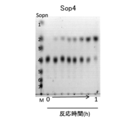
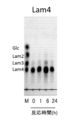
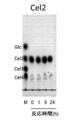
まず、0.2w/v% 各種オリゴ糖、0.325mg/mL 組換えBDI_3064タンパク質、及び50mM MESバッファー(pH6.5)を混合した反応液を30℃で反応させた。オリゴ糖としては、Sop3、Sop4、Sop5、Sop6、ラミナリビオース(Lam2)、ラミナリトリオース(Lam3)、ラミナリテトラオース(Lam4)、セロビオース(Cel2)、セロトリオース(Cel3)、セロテトラオース(Cel4)、及びゲンチオビオース(Gen2)を用いた。Sop4、Sop5、Sop6を基質とした場合には、反応開始から0分後、2.5分後、5分後、7.5分後、10分後、15分後、30分後、1時間後に反応液をサンプリングし、各サンプルを100℃で5分間加熱することにより酵素反応を停止させた。その他のオリゴ糖を基質とした場合には、反応開始から0時間後、1時間後、6時間後、24時間後に反応液をサンプリングし、各サンプルを100℃で5分間加熱することにより酵素反応を停止させた。
まず、0.2w/v% 各種オリゴ糖、0.325mg/mL 組換えBDI_3064タンパク質、及び50mM MESバッファー(pH6.5)を混合した反応液を30℃で反応させた。オリゴ糖としては、Sop3、Sop4、Sop5、Sop6、ラミナリビオース(Lam2)、ラミナリトリオース(Lam3)、ラミナリテトラオース(Lam4)、セロビオース(Cel2)、セロトリオース(Cel3)、セロテトラオース(Cel4)、及びゲンチオビオース(Gen2)を用いた。Sop4、Sop5、Sop6を基質とした場合には、反応開始から0分後、2.5分後、5分後、7.5分後、10分後、15分後、30分後、1時間後に反応液をサンプリングし、各サンプルを100℃で5分間加熱することにより酵素反応を停止させた。その他のオリゴ糖を基質とした場合には、反応開始から0時間後、1時間後、6時間後、24時間後に反応液をサンプリングし、各サンプルを100℃で5分間加熱することにより酵素反応を停止させた。
次いで、各サンプルを薄層クロマトグフィー(TLC)に供した。具体的には、各サンプルをTLCシリカゲル60 F254プレート(Merck)に1.0μLずつスポットし、風乾させた後、展開液(アセトニトリル:水=3:1(体積比))により展開した。次いで、プレートを5w/v% 硫酸を含むエタノール溶液に浸漬した後、糖が検出されるまでオーブンで熱した。
薄層クロマトグフィーの結果を図6A~図9に示す。図6A~図6Dにおいて、MはマーカーとしてのSopn(n=1~7)を示し、プレート上の数字はSopnの重合度である。図7A~図7Cにおいて、MはマーカーとしてのLam2、Lam3、Lam4、及びグルコース(Glc)を示す。図8A~図8Cにおいて、MはマーカーとしてのCel2、Cel3、Cel4、及びGlcを示す。図9において、MはマーカーとしてのGen2及びGlcを示す。図6A~図9に示すとおり、組換えBDI_3064タンパク質は、各種オリゴ糖の中でもSopnに対して、特に重合度が4以上のSopnに対して高い基質特異性を示した。
<実施例7:組換えBDI_3064タンパク質の反応速度論的解析>
0.25~4.0mMのSop4に対して3.3μg/mLの組換えBDI_3064タンパク質を30℃にて反応させた。分解産物をアーモンド由来β-グルコシダーゼで分解し、生成したグルコースをGOPOD法で定量し、Sop2当量に変換した。反応速度論量は、データ解析プログラム(KaleidaGraph ver.3.51、(株)ヒューリンクス)にて、実験値を下記式(1)のミカエリス-メンテン式にフィッティングすることにより算出した。式(1)中、Kmはミカエリス定数を示し、kcatは触媒活性を示し、[S]は基質濃度を示し、[E]0は全酵素濃度を示す。
0.25~4.0mMのSop4に対して3.3μg/mLの組換えBDI_3064タンパク質を30℃にて反応させた。分解産物をアーモンド由来β-グルコシダーゼで分解し、生成したグルコースをGOPOD法で定量し、Sop2当量に変換した。反応速度論量は、データ解析プログラム(KaleidaGraph ver.3.51、(株)ヒューリンクス)にて、実験値を下記式(1)のミカエリス-メンテン式にフィッティングすることにより算出した。式(1)中、Kmはミカエリス定数を示し、kcatは触媒活性を示し、[S]は基質濃度を示し、[E]0は全酵素濃度を示す。

0.3~4mMのSop5、及び0.05~0.5mMの直鎖β-1,2-グルカン(平均重合度77)に対しても同様に組換えBDI_3064タンパク質を反応させ、反応速度論量を算出した。反応速度論量の算出結果を下記表2に示す。

表2の結果から、重合数が少ないほどkcat/Kmの値が大きく、反応が速くなることが分かる。
<実施例8:組換えBDI_3064タンパク質の分解方向の確認>
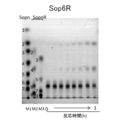
まず、0.2w/v% Sop5R又はSop6R、組換えBDI_3064タンパク質、及び50mM MESバッファー(pH6.5)を混合した反応液を30℃で反応させた。組換えBDI_3064タンパク質の濃度は、Sop5Rについては6.5μg/mL、Sop6Rについては33μg/mLとした。反応開始から0分後、2.5分後、5分後、7.5分後、10分後、15分後、30分後、1時間後に反応液をサンプリングし、各サンプルを100℃で5分間加熱することにより酵素反応を停止させた。
まず、0.2w/v% Sop5R又はSop6R、組換えBDI_3064タンパク質、及び50mM MESバッファー(pH6.5)を混合した反応液を30℃で反応させた。組換えBDI_3064タンパク質の濃度は、Sop5Rについては6.5μg/mL、Sop6Rについては33μg/mLとした。反応開始から0分後、2.5分後、5分後、7.5分後、10分後、15分後、30分後、1時間後に反応液をサンプリングし、各サンプルを100℃で5分間加熱することにより酵素反応を停止させた。
次いで、各サンプルを薄層クロマトグフィー(TLC)に供した。具体的には、各サンプルをTLCシリカゲル60 F254プレート(Merck)に1.0μLずつスポットし、風乾させた後、展開液(アセトニトリル:酢酸:2-プロパノール:水=17:4:4:3(体積比))により2回展開した。次いで、プレートを5w/v% 硫酸を含むエタノール溶液に浸漬した後、糖が検出されるまでオーブンで熱した。
薄層クロマトグフィーの結果を図10A及び図10Bに示す。図10A及び図10Bにおいて、M1はマーカーとしてのSopn(n=1~7)を示し、M2はマーカーとしてのSopnR(n=2、4、6、8)を示し、M3はマーカーとしてのSopnR(n=3、5、7、9)を示し、プレート上の数字はSopn又はSopnRの重合度である。図10A及び図10Bに示すとおり、Sop5Rを基質とした場合とSop6Rを基質とした場合とのいずれも、共通の生成物としてSop2が確認された。この結果から、組換えBDI_3064タンパク質は、直鎖β-1,2-グルカンを非還元末端側から2糖ずつエキソ的に分解することが分かる。
<実施例9:組換えBDI_3064タンパク質を用いたソホロースの製造(1)>
平均重合度25の直鎖β-1,2-グルカンと組換えBDI_3064タンパク質とを反応させた際のソホロースの反応収率を、1.5mLチューブスケール(反応液量1mL)で求めた。
平均重合度25の直鎖β-1,2-グルカンと組換えBDI_3064タンパク質とを反応させた際のソホロースの反応収率を、1.5mLチューブスケール(反応液量1mL)で求めた。
まず、0.34w/v% 直鎖β-1,2-グルカン、3.25μg/mL 組換えBDI_3064タンパク質、及び20mM MESバッファー(pH6.5)を混合した反応液1mLを30℃で反応させた。反応中に反応液の一部をサンプリングし、サンプルを100℃で5分間加熱して酵素反応を停止させた後、10倍希釈した。次いで、希釈後の反応液と1.0mg/mL アーモンド由来β-グルコシダーゼを含む200mM 酢酸バッファー(pH5.0)とを等量混合し、50℃で2時間インキュベートを行った後、グルコース濃度をGOPOD法で定量した(このときのグルコース濃度を「第1のグルコース濃度」という)。また、希釈後の反応液と200mM 酢酸バッファー(pH5.0)とを等量混合した混合液中のグルコース濃度をGOPOD法で定量した(このときのグルコース濃度を「第2のグルコース濃度」という)。そして、第1のグルコース濃度から第2のグルコース濃度を減算した値に基づいて、ソホロース濃度を算出した。
ソホロースの反応収率の測定結果を図11に示す。図11に示すとおり、反応開始から約12時間の段階で、ソホロースの反応収率は約90%という極めて高い値を示し、副産物としてのグルコースは殆ど生成しなかった。
<実施例10:組換えBDI_3064タンパク質を用いたソホロースの製造(2)>
平均重合度25の直鎖β-1,2-グルカンと組換えBDI_3064タンパク質とを500mLスケールで反応させ、ソホロースを製造した。
平均重合度25の直鎖β-1,2-グルカンと組換えBDI_3064タンパク質とを500mLスケールで反応させ、ソホロースを製造した。
まず、0.34w/v% 直鎖β-1,2-グルカン、0.15mg/mL 組換えBDI_3064タンパク質、及び5mM リン酸バッファー(pH6.5)を混合した反応液500mLを30℃で反応させた。40時間後、反応液を100℃で5分間加熱して酵素反応を停止させた。
次いで、反応液をフィルター(Millex-GP、孔径0.22μm、Merck Millipore)に通すことにより沈殿したタンパク質を除去し、その後、精製イオン交換樹脂(アンバーライトMB-4、オルガノ(株))で脱塩した(この時点で凍結乾燥すると1.7g)。脱塩後の反応液を濃縮した後、ゲル濾過カラムクロマトグラフィー(カラム:XK100(GE Healthcare)、担体:HW-40F(東ソー(株)))に供し、ソホロースを含む画分を回収した。回収した液を凍結乾燥したところ、ソホロースの収量は1.2gであった。
2017年4月18日に出願された日本出願2017-082216の開示はその全体が参照により本明細書に取り込まれる。
Claims (14)
- 直鎖β-1,2-グルカンに作用してソホロースを生成するエキソ-β-1,2-グルカナーゼ。
- 以下の酵素学的性質を有する請求項1に記載のエキソ-β-1,2-グルカナーゼ。
(i)基質特異性及び作用特性
直鎖β-1,2-グルカンにエキソ的に作用してソホロースを生成する。
(ii)至適pH
30℃の条件下で、pH6.5。
(iii)至適温度
pH6.5の条件下で、40℃。
(iv)安定pH
30℃、1時間の条件下で、pH5.5~10で安定。
(v)温度安定性
pH6.5、1時間の条件下で、30℃まで安定。 - パラバクテロイデス・ディスタソニス由来である請求項1又は2に記載のエキソ-β-1,2-グルカナーゼ。
- 下記(a)~(d)から選択されるいずれか1種であるエキソ-β-1,2-グルカナーゼ。
(a)配列番号1のアミノ酸配列からなるタンパク質。
(b)配列番号1において1~18番目のアミノ酸残基を欠失したアミノ酸配列からなるタンパク質。
(c)前記(a)又は(b)のアミノ酸配列において1個若しくは数個のアミノ酸残基が置換、欠失、又は付加されたアミノ酸配列からなり、かつ、エキソ-β-1,2-グルカナーゼ活性を有するタンパク質。
(d)前記(a)又は(b)のアミノ酸配列と90%以上の配列同一性を有し、かつ、エキソ-β-1,2-グルカナーゼ活性を有するタンパク質。 - パラバクテロイデス・ディスタソニス由来である請求項4に記載のエキソ-β-1,2-グルカナーゼ。
- 請求項4又は5に記載のエキソ-β-1,2-グルカナーゼをコードするポリヌクレオチド。
- 請求項6に記載のポリヌクレオチドを含む発現ベクター。
- 請求項7に記載の発現ベクターが導入された形質転換体。
- 請求項8に記載の形質転換体を培養し、培養物から請求項4又は5に記載のエキソ-β-1,2-グルカナーゼを回収する工程を含むエキソ-β-1,2-グルカナーゼの製造方法。
- エキソ-β-1,2-グルカナーゼを直鎖β-1,2-グルカンに作用させる工程を含むソホロースの製造方法。
- 前記エキソ-β-1,2-グルカナーゼが以下の酵素学的性質を有する請求項10に記載のソホロースの製造方法。
(i)基質特異性及び作用特性
直鎖β-1,2-グルカンにエキソ的に作用してソホロースを生成する。
(ii)至適pH
30℃の条件下で、pH6.5。
(iii)至適温度
pH6.5の条件下で、40℃。
(iv)安定pH
30℃、1時間の条件下で、pH5.5~10で安定。
(v)温度安定性
pH6.5、1時間の条件下で、30℃まで安定。 - 前記エキソ-β-1,2-グルカナーゼがパラバクテロイデス・ディスタソニス由来である請求項10又は11に記載のソホロースの製造方法。
- 下記(a)~(d)から選択されるいずれか1種であるエキソ-β-1,2-グルカナーゼを直鎖β-1,2-グルカンに作用させる工程を含むソホロースの製造方法。
(a)配列番号1のアミノ酸配列からなるタンパク質。
(b)配列番号1において1~18番目のアミノ酸残基を欠失したアミノ酸配列からなるタンパク質。
(c)前記(a)又は(b)のアミノ酸配列において1個若しくは数個のアミノ酸残基が置換、欠失、又は付加されたアミノ酸配列からなり、かつ、エキソ-β-1,2-グルカナーゼ活性を有するタンパク質。
(d)前記(a)又は(b)のアミノ酸配列と90%以上の配列同一性を有し、かつ、エキソ-β-1,2-グルカナーゼ活性を有するタンパク質。 - 前記エキソ-β-1,2-グルカナーゼがパラバクテロイデス・ディスタソニス由来である請求項13に記載のソホロースの製造方法。
Priority Applications (1)
| Application Number | Priority Date | Filing Date | Title |
|---|---|---|---|
| JP2019513665A JP7090291B2 (ja) | 2017-04-18 | 2018-04-18 | ソホロースの製造方法 |
Applications Claiming Priority (2)
| Application Number | Priority Date | Filing Date | Title |
|---|---|---|---|
| JP2017-082216 | 2017-04-18 | ||
| JP2017082216 | 2017-04-18 |
Publications (1)
| Publication Number | Publication Date |
|---|---|
| WO2018194092A1 true WO2018194092A1 (ja) | 2018-10-25 |
Family
ID=63856653
Family Applications (1)
| Application Number | Title | Priority Date | Filing Date |
|---|---|---|---|
| PCT/JP2018/016001 Ceased WO2018194092A1 (ja) | 2017-04-18 | 2018-04-18 | エキソ-β-1,2-グルカナーゼ及びソホロースの製造方法 |
Country Status (2)
| Country | Link |
|---|---|
| JP (1) | JP7090291B2 (ja) |
| WO (1) | WO2018194092A1 (ja) |
Citations (1)
| Publication number | Priority date | Publication date | Assignee | Title |
|---|---|---|---|---|
| JPS59154985A (ja) * | 1983-02-23 | 1984-09-04 | Daikin Ind Ltd | ベ−タ−d−1,2−グルカナ−ゼの製造法 |
-
2018
- 2018-04-18 JP JP2019513665A patent/JP7090291B2/ja active Active
- 2018-04-18 WO PCT/JP2018/016001 patent/WO2018194092A1/ja not_active Ceased
Patent Citations (1)
| Publication number | Priority date | Publication date | Assignee | Title |
|---|---|---|---|---|
| JPS59154985A (ja) * | 1983-02-23 | 1984-09-04 | Daikin Ind Ltd | ベ−タ−d−1,2−グルカナ−ゼの製造法 |
Non-Patent Citations (5)
| Title |
|---|
| ABE, KOICHI ET AL.: "Biochemical and structural analyses of a bacterial endo-beta-1, 2-glucanase reveal a new glycoside hydrolase family", JOURNAL OF BIOLOGICAL CHEMISTRY, vol. 292, no. 18, 7 March 2017 (2017-03-07), pages 7487 - 7506, XP055613367 * |
| DATABASE Protein [online] 31 January 2014 (2014-01-31), "Conserved hypothetical protein [Parabacteroides distasonis ATCC 8503", XP055613360, retrieved from NCBI Database accession no. ABR44770.1 * |
| REESE, ELWYN T. ET AL.: "beta-D-1,2-GLUCANASES IN FUNGI", CANADIAN JOURNAL OF MICROBIOLOGY, vol. 7, no. 3, 1961, pages 309 - 317 * |
| TANAKA, NOBUKIYO ET AL.: "Isolation and identification of novel 1, 2-beta-glucan degradation enzyme, and functional analysis", LECTURE ABSTRACT IN 2015 MEETING OF JAPAN SOCIETY OF BIOSCIENCE, BIOTECHNOLOGY AND AGROCHEMISTRY, 5 March 2015 (2015-03-05) * |
| XU, JIAN ET AL.: "Evolution of symbiotic bacteria in the distal human intestine", PLOS BIOLOGY, vol. 5, no. 7, 2007, pages 1575 1585 23 - 27, XP055103941 * |
Also Published As
| Publication number | Publication date |
|---|---|
| JP7090291B2 (ja) | 2022-06-24 |
| JPWO2018194092A1 (ja) | 2020-02-27 |
Similar Documents
| Publication | Publication Date | Title |
|---|---|---|
| Lee et al. | A novel agarolytic β-galactosidase acts on agarooligosaccharides for complete hydrolysis of agarose into monomers | |
| Zitouni et al. | Biochemical and molecular characterization of a thermostable chitosanase produced by the strain Paenibacillus sp. 1794 newly isolated from compost | |
| US9902983B2 (en) | Agarooligosaccharide hydrolase and method for producing 3,6-anhydro-L-galactose and galactose from agarose by using same | |
| US11180740B2 (en) | Synthesis of glucan comprising beta-1,3 glycosidic linkages with beta-1,3-glucan phosphorylase enzymes | |
| Park et al. | Cloning, expression, and biochemical characterization of a GH16 β-agarase AgaH71 from Pseudoalteromonas hodoensis H7 | |
| JP6730281B2 (ja) | バチルス・アガラドヘレンス(bacillus agaradhaerens)イヌロスクラーゼ(inuo)の使用を含む組成物および方法 | |
| JP2016111952A (ja) | 耐熱性β−グルコシダーゼ | |
| JP6319907B2 (ja) | 耐熱性β―キシロシダーゼ | |
| JP6354462B2 (ja) | Ghファミリー10に属する耐熱性キシラナーゼ | |
| JP5094461B2 (ja) | ヒアルロン酸加水分解酵素をコードする遺伝子 | |
| US11473116B2 (en) | Synthesis of glucan comprising alpha-1,3 glycosidic linkages with phosphorylase enzymes | |
| WO2019035482A1 (ja) | エピメリ化活性を有するタンパク質 | |
| JP2002345458A (ja) | スクロースホスホリラーゼの調製法 | |
| JP7090291B2 (ja) | ソホロースの製造方法 | |
| JP5967725B2 (ja) | 複合型糖鎖加水分解酵素 | |
| Kurakake et al. | Characteristics of α-L-arabinofuranosidase from Streptomyces sp I10-1 for production of L-arabinose from corn hull arabinoxylan | |
| EP3757209A1 (en) | Enzymatic production of levan-based, prebiotic fructooligosaccharides | |
| KR102300386B1 (ko) | 알파- 및 베타-1,4-글리코시드 결합을 모두 절단하는 효소의 용도 | |
| JP6315807B2 (ja) | Ghファミリー12に属する超耐熱性エンドグルカナーゼ | |
| JP2007049914A (ja) | キシロオリゴ糖の製造方法 | |
| CN110982831B (zh) | 基因AlgL23具有冷适应性的用途 | |
| WO2012073607A1 (ja) | セロビオース 2-エピメラーゼおよびその用途 | |
| CN121380034A (zh) | 一种壳聚糖酶突变体CsnW27-HF、质粒、重组菌及其应用 | |
| CN118516319A (zh) | 新型裂解多糖单加氧酶及其应用 | |
| WO2003072776A1 (en) | Gene encoding novel enzyme catalyzing glycosyl transfer reaction and process for producing the enzyme |
Legal Events
| Date | Code | Title | Description |
|---|---|---|---|
| 121 | Ep: the epo has been informed by wipo that ep was designated in this application |
Ref document number: 18788420 Country of ref document: EP Kind code of ref document: A1 |
|
| ENP | Entry into the national phase |
Ref document number: 2019513665 Country of ref document: JP Kind code of ref document: A |
|
| NENP | Non-entry into the national phase |
Ref country code: DE |
|
| 122 | Ep: pct application non-entry in european phase |
Ref document number: 18788420 Country of ref document: EP Kind code of ref document: A1 |