WO2018166897A1 - Epoxidharz-vergütete zusammensetzung als beschichtung oder versiegelung - Google Patents
Epoxidharz-vergütete zusammensetzung als beschichtung oder versiegelung Download PDFInfo
- Publication number
- WO2018166897A1 WO2018166897A1 PCT/EP2018/055831 EP2018055831W WO2018166897A1 WO 2018166897 A1 WO2018166897 A1 WO 2018166897A1 EP 2018055831 W EP2018055831 W EP 2018055831W WO 2018166897 A1 WO2018166897 A1 WO 2018166897A1
- Authority
- WO
- WIPO (PCT)
- Prior art keywords
- component
- weight
- polyamine
- composition
- composition according
- Prior art date
- Legal status (The legal status is an assumption and is not a legal conclusion. Google has not performed a legal analysis and makes no representation as to the accuracy of the status listed.)
- Ceased
Links
- 0 CNC(*)=C(*)C(*)=O Chemical compound CNC(*)=C(*)C(*)=O 0.000 description 4
Classifications
-
- C—CHEMISTRY; METALLURGY
- C08—ORGANIC MACROMOLECULAR COMPOUNDS; THEIR PREPARATION OR CHEMICAL WORKING-UP; COMPOSITIONS BASED THEREON
- C08G—MACROMOLECULAR COMPOUNDS OBTAINED OTHERWISE THAN BY REACTIONS ONLY INVOLVING UNSATURATED CARBON-TO-CARBON BONDS
- C08G59/00—Polycondensates containing more than one epoxy group per molecule; Macromolecules obtained by polymerising compounds containing more than one epoxy group per molecule using curing agents or catalysts which react with the epoxy groups
- C08G59/18—Macromolecules obtained by polymerising compounds containing more than one epoxy group per molecule using curing agents or catalysts which react with the epoxy groups ; e.g. general methods of curing
- C08G59/40—Macromolecules obtained by polymerising compounds containing more than one epoxy group per molecule using curing agents or catalysts which react with the epoxy groups ; e.g. general methods of curing characterised by the curing agents used
- C08G59/50—Amines
- C08G59/5006—Amines aliphatic
- C08G59/502—Polyalkylene polyamines
-
- C—CHEMISTRY; METALLURGY
- C04—CEMENTS; CONCRETE; ARTIFICIAL STONE; CERAMICS; REFRACTORIES
- C04B—LIME, MAGNESIA; SLAG; CEMENTS; COMPOSITIONS THEREOF, e.g. MORTARS, CONCRETE OR LIKE BUILDING MATERIALS; ARTIFICIAL STONE; CERAMICS; REFRACTORIES; TREATMENT OF NATURAL STONE
- C04B14/00—Use of inorganic materials as fillers, e.g. pigments, for mortars, concrete or artificial stone; Treatment of inorganic materials specially adapted to enhance their filling properties in mortars, concrete or artificial stone
- C04B14/02—Granular materials, e.g. microballoons
- C04B14/04—Silica-rich materials; Silicates
- C04B14/06—Quartz; Sand
-
- C—CHEMISTRY; METALLURGY
- C04—CEMENTS; CONCRETE; ARTIFICIAL STONE; CERAMICS; REFRACTORIES
- C04B—LIME, MAGNESIA; SLAG; CEMENTS; COMPOSITIONS THEREOF, e.g. MORTARS, CONCRETE OR LIKE BUILDING MATERIALS; ARTIFICIAL STONE; CERAMICS; REFRACTORIES; TREATMENT OF NATURAL STONE
- C04B26/00—Compositions of mortars, concrete or artificial stone, containing only organic binders, e.g. polymer or resin concrete
- C04B26/02—Macromolecular compounds
- C04B26/10—Macromolecular compounds obtained otherwise than by reactions only involving carbon-to-carbon unsaturated bonds
- C04B26/14—Polyepoxides
-
- C—CHEMISTRY; METALLURGY
- C04—CEMENTS; CONCRETE; ARTIFICIAL STONE; CERAMICS; REFRACTORIES
- C04B—LIME, MAGNESIA; SLAG; CEMENTS; COMPOSITIONS THEREOF, e.g. MORTARS, CONCRETE OR LIKE BUILDING MATERIALS; ARTIFICIAL STONE; CERAMICS; REFRACTORIES; TREATMENT OF NATURAL STONE
- C04B28/00—Compositions of mortars, concrete or artificial stone, containing inorganic binders or the reaction product of an inorganic and an organic binder, e.g. polycarboxylate cements
- C04B28/02—Compositions of mortars, concrete or artificial stone, containing inorganic binders or the reaction product of an inorganic and an organic binder, e.g. polycarboxylate cements containing hydraulic cements other than calcium sulfates
- C04B28/04—Portland cements
-
- C—CHEMISTRY; METALLURGY
- C08—ORGANIC MACROMOLECULAR COMPOUNDS; THEIR PREPARATION OR CHEMICAL WORKING-UP; COMPOSITIONS BASED THEREON
- C08G—MACROMOLECULAR COMPOUNDS OBTAINED OTHERWISE THAN BY REACTIONS ONLY INVOLVING UNSATURATED CARBON-TO-CARBON BONDS
- C08G59/00—Polycondensates containing more than one epoxy group per molecule; Macromolecules obtained by polymerising compounds containing more than one epoxy group per molecule using curing agents or catalysts which react with the epoxy groups
- C08G59/18—Macromolecules obtained by polymerising compounds containing more than one epoxy group per molecule using curing agents or catalysts which react with the epoxy groups ; e.g. general methods of curing
- C08G59/40—Macromolecules obtained by polymerising compounds containing more than one epoxy group per molecule using curing agents or catalysts which react with the epoxy groups ; e.g. general methods of curing characterised by the curing agents used
-
- C—CHEMISTRY; METALLURGY
- C08—ORGANIC MACROMOLECULAR COMPOUNDS; THEIR PREPARATION OR CHEMICAL WORKING-UP; COMPOSITIONS BASED THEREON
- C08G—MACROMOLECULAR COMPOUNDS OBTAINED OTHERWISE THAN BY REACTIONS ONLY INVOLVING UNSATURATED CARBON-TO-CARBON BONDS
- C08G59/00—Polycondensates containing more than one epoxy group per molecule; Macromolecules obtained by polymerising compounds containing more than one epoxy group per molecule using curing agents or catalysts which react with the epoxy groups
- C08G59/18—Macromolecules obtained by polymerising compounds containing more than one epoxy group per molecule using curing agents or catalysts which react with the epoxy groups ; e.g. general methods of curing
- C08G59/40—Macromolecules obtained by polymerising compounds containing more than one epoxy group per molecule using curing agents or catalysts which react with the epoxy groups ; e.g. general methods of curing characterised by the curing agents used
- C08G59/50—Amines
-
- C—CHEMISTRY; METALLURGY
- C08—ORGANIC MACROMOLECULAR COMPOUNDS; THEIR PREPARATION OR CHEMICAL WORKING-UP; COMPOSITIONS BASED THEREON
- C08G—MACROMOLECULAR COMPOUNDS OBTAINED OTHERWISE THAN BY REACTIONS ONLY INVOLVING UNSATURATED CARBON-TO-CARBON BONDS
- C08G59/00—Polycondensates containing more than one epoxy group per molecule; Macromolecules obtained by polymerising compounds containing more than one epoxy group per molecule using curing agents or catalysts which react with the epoxy groups
- C08G59/18—Macromolecules obtained by polymerising compounds containing more than one epoxy group per molecule using curing agents or catalysts which react with the epoxy groups ; e.g. general methods of curing
- C08G59/40—Macromolecules obtained by polymerising compounds containing more than one epoxy group per molecule using curing agents or catalysts which react with the epoxy groups ; e.g. general methods of curing characterised by the curing agents used
- C08G59/50—Amines
- C08G59/5026—Amines cycloaliphatic
-
- C—CHEMISTRY; METALLURGY
- C09—DYES; PAINTS; POLISHES; NATURAL RESINS; ADHESIVES; COMPOSITIONS NOT OTHERWISE PROVIDED FOR; APPLICATIONS OF MATERIALS NOT OTHERWISE PROVIDED FOR
- C09D—COATING COMPOSITIONS, e.g. PAINTS, VARNISHES OR LACQUERS; FILLING PASTES; CHEMICAL PAINT OR INK REMOVERS; INKS; CORRECTING FLUIDS; WOODSTAINS; PASTES OR SOLIDS FOR COLOURING OR PRINTING; USE OF MATERIALS THEREFOR
- C09D163/00—Coating compositions based on epoxy resins; Coating compositions based on derivatives of epoxy resins
-
- C—CHEMISTRY; METALLURGY
- C04—CEMENTS; CONCRETE; ARTIFICIAL STONE; CERAMICS; REFRACTORIES
- C04B—LIME, MAGNESIA; SLAG; CEMENTS; COMPOSITIONS THEREOF, e.g. MORTARS, CONCRETE OR LIKE BUILDING MATERIALS; ARTIFICIAL STONE; CERAMICS; REFRACTORIES; TREATMENT OF NATURAL STONE
- C04B2111/00—Mortars, concrete or artificial stone or mixtures to prepare them, characterised by specific function, property or use
- C04B2111/00474—Uses not provided for elsewhere in C04B2111/00
- C04B2111/00482—Coating or impregnation materials
-
- C—CHEMISTRY; METALLURGY
- C04—CEMENTS; CONCRETE; ARTIFICIAL STONE; CERAMICS; REFRACTORIES
- C04B—LIME, MAGNESIA; SLAG; CEMENTS; COMPOSITIONS THEREOF, e.g. MORTARS, CONCRETE OR LIKE BUILDING MATERIALS; ARTIFICIAL STONE; CERAMICS; REFRACTORIES; TREATMENT OF NATURAL STONE
- C04B2111/00—Mortars, concrete or artificial stone or mixtures to prepare them, characterised by specific function, property or use
- C04B2111/60—Flooring materials
Definitions
- Epoxy-coated composition as a coating or
- the invention relates to a multicomponent composition, a process for producing a coating with the multicomponent composition and the use of the multicomponent composition as a mortar, sealant or coating.
- Desired properties for floor coatings may e.g. an aesthetically pleasing appearance and a high
- Water-based epoxy resin coatings have relatively low mechanical and chemical resistance.
- Epoxy resin-modified cementitious systems often have a dull matt appearance and the gloss level is not variably adjustable.
- Conventional epoxy resin-modified cementitious systems have a relatively low organic binder content of at most 5% by weight.
- WO2009150212 discloses three-component epoxy resin-modified cementitious systems (ECC) containing aqueous hardener compositions, which can be used in particular as a coating.
- ECC epoxy resin-modified cementitious systems
- the object of the invention was therefore to provide a composition with which floor coatings having a balanced property profile can be produced.
- a composition with which floor coatings having a balanced property profile can be produced.
- Floor coating are provided, which at the same time has an aesthetically pleasing appearance (appearance, surface texture), good processability and flow, a high gloss level and a high proportion of environmentally friendly components.
- environmentally friendly components is understood to mean, in particular, additives which do not belong to the "organic fractions OA" described below.
- the multicomponent composition has a small amount of organic OA, with the organic Proportions OA are epoxy resins, reactive diluents, amine compounds PA and compounds VB.
- the invention therefore relates to a multicomponent composition
- a multicomponent composition comprising
- a binder component (A) comprising at least one
- the multicomponent composition 3 to 15% by weight of water, based on the total weight of the multicomponent
- Composition contains,
- R 1 and R 3 are each independently an alkyl, cycloalkyl, aryl or arylalkyl group having 1 to 12 C atoms, which optionally has ether groups or halogen atoms, are, and
- R 2 is a hydrogen atom or an alkyl, cycloalkyl, aryl or arylalkyl group having 1 to 12 C atoms, or
- R 2 and R 1 together represent a divalent hydrocarbon radical which is part of an optionally substituted carbocyclic ring having 5 to 8, preferably 5 or 6, carbon atoms, and R 3 is an alkyl, cycloalkyl, aryl or Arylalkyl group having 1 to 12 carbon atoms, which optionally has ether groups or halogen atoms;
- R 2 and R 3 together represent a divalent hydrocarbon radical which is part of an optionally substituted carbocyclic ring having 5 to 8, preferably 5 or 6, carbon atoms, and R 1 is an alkyl, cycloalkyl, aryl or Arylalkyl group having 1 to 12 carbon atoms, which optionally has ether groups or halogen atoms;
- R 4 and R 5 are each independently an alkyl, cycloalkyl,
- Aryl or arylalkyl group having 1 to 12 carbon atoms which may be
- a is an integer from 0 to 4.
- b is an integer from 1 to 4.
- the polyepoxide on which the polyamine-polyepoxide adduct is based is a polyepoxide E, in particular a diepoxide E1, and an epoxy-equivalent Weight (EEW) of 65 to 500 g / Eq,
- Compound VB is from 4 to 20,
- polyamine in the present document denotes compounds having at least two primary or secondary amino groups.
- a Nh group is attached, which is bonded to an organic radical
- a “secondary” amino group is an NH group referred to two organic radicals, which may also be part of a ring together , is bound.
- molecular weight refers to the molar mass (in grams per mole) of a molecule.
- Average molecular weight refers to the number average molecular weight M n of a polydisperse mixture of oligomeric or polymeric molecules, usually by GPC versus polystyrene standard is determined.
- polyepoxide refers to compounds having at least two epoxide groups.
- Diepoxide refers to compounds having two epoxide groups.
- acyl-enamino groups of formula (i) are in equilibrium with the tautomeric isomers of formula (ii) and formula (iii). Every mention of the acyl-enamino groups of the formula (i) also means the tautomers of the formula (ii) and the formula (iii), although this is not expressly mentioned in each case.
- R 1 and R 3 are each a methyl group.
- R 2 is a hydrogen atom.
- R 4 and R 5 are each a methyl group.
- a is 0.
- b is 1.
- the polyamine-polyepoxide adduct from which A is derived in formulas (I) and (II) is free of epoxide groups and has (a + b) primary amino groups. It is an addition product of at least one polyamine A1 and optionally further amines, preferably at least one further amine A2, with at least one polyepoxide E, in particular a diepoxide E1.
- the polyepoxide E has an epoxy equivalent weight of 65 to 500 g / Eq up.
- the polyamine A1 is preferably a polyamine having two primary amino groups.
- the amine A2 is preferably an amine having only one primary amino group.
- the polyepoxide E preferably represents a diepoxide E1, particularly preferably a liquid diglycidyl ether of bisphenols, in particular of bisphenol-A ,
- glycol ether an ether of 2,3-epoxy-1 - propanol (glycidol) is referred to.
- a compound VB of the formula (I) preferably represents a compound VB of the formula (Ia) or (Ib).
- a compound VB of the formula (II) preferably represents a compound VB of the formula (IIa) or (IIb) represents.
- R 1 , R 2 , R 3 , R 4 and R 5 have the meanings already mentioned, and
- R 6 represents an alkyl or cycloalkyl or arylalkyl group which optionally has ether or secondary amino groups
- E 1 and E 2 independently of one another are each the radical of a diepoxide E1 having an EEW 65-500 g / eq after removal of two epoxide groups;
- x is an integer from 0 to 50;
- y is an integer from 0 to 100, preferably from 10 to 50;
- z is an integer from 1 to 50;
- (x + z) is an integer from 1 to 100, preferably from 1 to 10; p is 0 or 1; and
- R 6 in the formulas (Ia), (IIa), (Ib) and (IIb) is preferably an alkyl or cycloalkyl or arylalkyl group having at least 4C -Atomen, in particular having 4 to 18 carbon atoms, which optionally has ether or secondary amino groups.
- the diepoxide E1 is selected from the group consisting of a bisphenol A, bisphenol F and bisphenol A / F diglycidyl ether having an epoxy equivalent weight of 156 to 250 g / Eq, ⁇ , ⁇ -diglycidylaniline and a polyglycol diglycidyl ether having an epoxy equivalent weight of 170 to 340 g / eq.
- the diepoxide E1 is particularly preferably a bisphenol A, bisphenol F and bisphenol A / F diglycidyl ether.
- E 1 in the formulas (I a) and (II a) and E 2 in the formulas (I b) and (II b) are preferably each independently of one another for the rest of a diepoxide E1, which is selected from the group from a Bisphenol A, bisphenol F and bisphenol A / F diglycidyl ethers having an epoxy equivalent weight of 156 to 250 g / Eq, ⁇ , ⁇ -diglycidylaniline and a polyglycol diglycidyl ether having an epoxy equivalent weight of 170 to 340 g / Eq, in particular a bisphenol A, bisphenol F and bisphenol A / F diglycidyl ether having an epoxy equivalent weight of 156 to 250 g / Eq, after removal of two epoxide groups.
- a diepoxide E1 which is selected from the group from a Bisphenol A, bisphenol F and bisphenol A / F diglycidyl ethers having an epoxy equivalent weight of 156 to 250
- the compound VB of the formula (I) or (II) is contained in the hardener component (B).
- poly refers to substances that formally contain two or more of the functional groups per molecule that occur in their names.
- the compound may be monomeric, oligomeric or polymeric.
- a polyamine is e.g. a compound having two or more amino groups.
- a polyepoxide is a compound having two or more epoxy groups.
- Epoxy resins are polyepoxides, ie compounds having two or more epoxide groups. Epoxy resins are preferably oligomeric or polymeric compounds. Epoxy resins are sometimes used in conjunction with so-called reactive diluents. Reactive diluents are mono- or polyepoxides. The reactive diluents have a lower viscosity than the epoxy resin used and serve to reduce the viscosity of the epoxy resin used. The optional reactive diluent is also incorporated in the organic binder matrix and is therefore attributed to the epoxy resins here for the determination of the organic binder content.
- the epoxy equivalent weight (EEW) can be determined according to DIN 53188 and is in g / Eq. specified.
- the NH equivalent weight can be determined according to DIN 1 6945 and is in g / Eq. specified.
- the stoichiometric ratio of epoxide functionality to amine functionality is the ratio of epoxide equivalent weight to NH equivalent weight and is often expressed in%.
- the NH equivalent weight refers to the active NH hydrogens.
- a primary amine has e.g. two active NH- hydrogens on.
- the composition of the invention is a multi-component composition, i. the composition comprises several, in particular three or more individual components, which are mixed together only in use. The components are stored separately before use to avoid spontaneous reaction. For use, the components are mixed together. After mixing, inorganic hydration and organic acids may begin
- the composition of the invention comprises a binder component (A), a hardener component (B) and a solid component (C). It can be a three-component composition consisting only of these three components. However, the composition may also include one or more other additional components as needed. If e.g. the multi-component composition according to the invention in the preferred embodiment contains pigments as colorants, these may be present in at least one of the three components (A), (B) or (C) and / or in an additional pigment component (D).
- the proportion of a particular ingredient in the mixture of components will depend on the proportion of that ingredient in the particular component and the mixing ratio of the components. Shares or ratios of certain ingredients that are given here, unless otherwise stated, refer to the appropriate or suitable proportions by weight or weight ratios of the ingredients in the mixture of the components of the multicomponent composition. This is for example by mixing the components in suitable
- the binder component (A) comprises at least one epoxy resin and, where appropriate, ⁇ a reactive diluent.
- the binder component (A) is preferably a liquid component. It can be viscous, but is generally pourable.
- the binder component (A) contains at least one epoxy resin.
- An epoxy resin or a mixture of two or more epoxy resins may be used.
- epoxy resin all epoxies commonly used in epoxy chemistry can be used.
- Epoxy resins can e.g. in a known manner from the oxidation of the corresponding olefins or from the reaction of epichlorohydrin with the corresponding polyols or polyphenols.
- Epoxy resins can be divided into epoxy liquid resins and solid epoxy resins.
- the epoxy resin may e.g. an epoxy equivalent weight of 156 to 500 g / Eq. exhibit.
- the epoxy resin is preferably a diepoxide.
- the epoxy resin may be an aromatic epoxy resin.
- the epoxy resins of the formula (III) are diglycidyl ethers of bisphenol A, bisphenol F and bisphenol A / F, where A is acetone and F is formaldehyde, which serve as starting materials for the preparation of these bisphenols.
- Such liquid epoxy resins are commercially available, for example under the designations Araldite ® from Huntsman, DER ® from Dow, Epikote ® from Momentive, Epalloy ® from CVC, Chem Res ® from Cognis or Beckopox ® from Cytec.
- Dihydroxybenzene derivatives such as resorcinol, hydroquinone and pyrocatechol; further bisphenols or polyphenols, such as bis (4-hydroxy-3-methylphenyl) -methane, 2,2-bis (4-hydroxy-3-methylphenyl) -propane (bisphenol-C), bis (3,5-bis) dimethyl-4-hydroxyphenyl) -methane, 2,2-bis (3,5-dimethyl-4-hydroxyphenyl) -propane, 2,2-bis (3,5-dibromo-4-hydroxyphenyl) propane, 2 , 2-bis- (4-hydroxy-3-tert-butylphenyl) -propane, 2,2-bis (4-hydroxyphenyl) -butane (bisphenol-B), 3,3-bis- (4-hydroxyphenyl) pentane, 3,4-bis (4-hydroxyphenyl) hexane, 4,4-bis (4-hydroxyphenyl) heptane, 2,4-bis (4-hydroxyphenyl
- aromatic amines such as aniline, toluidine, 4-aminophenol, 4,4'-methylenediphenyldiamine (MDA), 4,4'-methylenediphenyl-di (N-methyl) -amine, 4,4 '- [1,4-phenylene bis (1-methyl-ethylidene) -bisaniline (bisaniline-P), 4,4 '- [1,3-phenylenebis (1-methyl-ethylidene)] - bisaniline (bisaniline-M).
- MDA 4,4'-methylenediphenyldiamine
- N-methyl N-methyl
- aromatic amines such as aniline, toluidine, 4-aminophenol, 4,4'-methylenediphenyldiamine (MDA), 4,4'-methylenediphenyl-di (N-methyl) -amine, 4,4 '- [1,4-phenylene bis (1-methyl-ethylidene) -bisaniline (bisaniline-P),
- the epoxy resin may be an aliphatic or cycloaliphatic epoxy resin, e.g.
- a glycidyl ether of a saturated or unsaturated, branched or unbranched, cyclic or open-chain C2 to C30-D10IS e.g. Ethylene glycol, propylene glycol, butylene glycol, hexanediol, octanediol, a polypropylene glycol, dimethylol cyclohexane, neopentyl glycol;
- a glycidyl ether of a tri- or tetrafunctional, saturated or unsaturated, branched or unbranched, cyclic or open-chain polyol such as castor oil, trimethylolpropane, trimethylolethane, pentaerythrol, sorbitol or glycerol, as well as alkoxylated glycerol or alkoxylated trimethylolpropane;
- a hydrogenated bisphenol A, F or A / F liquid resin or the glycidylation products of hydrogenated bisphenol A, F or -A / F; an N-glycidyl derivative of amides or heterocyclic nitrogen bases, such as triglycidyl cyanurate and triglycidyl isocyanurate, as well as reaction products of epichlorohydrin and hydantoin.
- epoxy resins which can be used are epoxy resins which have been prepared from the oxidation of olefins, for example from the oxidation of vinylcyclohexene, dicyclopentadiene, cyclohexadiene, cyclododecadiene, cyclododecatriene, isoprene, 1,5-hexadiene, butadiene, polybutadiene or divinylbenzene.
- Further examples of epoxy resins which can be used are a bisphenol A, F or A / F solid resin, which are constituted like the abovementioned epoxy liquid resins of the formula (III), except that the index s has a value of 2 to 12 has.
- Further examples are all the above-mentioned epoxy resins, which are hydrophilically modified by the reaction with at least one polyoxyalkylene polyol.
- the epoxy resin are bisphenol A, F or A / F solid or liquid resins such as are commercially available from Dow, Huntsman and Momentive. Diepoxides of a bisphenol A, bisphenol F and bisphenol A / F diglycidyl ether are particularly preferred as epoxy resins used, especially those having an epoxide equivalent weight 156-250 g / Eq, for example the commercial products Araldite ® GY 250, Araldite ® PY 304, Araldite ® GY 282 (from Huntsman); DER® 331, DER® 330 (from Dow); Epikote ® 828, Epikote ® 862 (from Momentive), and ⁇ , ⁇ -diglycidylaniline and a polyglycol diglycidyl ether, preferably having an epoxy equivalent weight from 170 to 340 g / eq., For example the commercial products of the ® 732 and DER ® (736 from Dow).
- the binder component (A) may contain at least one reactive diluent. This is, as I said, for the organic
- Binder content attributed to the epoxy resin can be used.
- Suitable reactive diluents are mono- and polyepoxides.
- the addition of a reactive diluent to the epoxy resin causes a reduction of the viscosity, as well as a reduction of the glass transition temperature and the mechanical values in the cured state of the epoxy resin composition.
- reactive diluents are glycidyl ethers of monohydric or polyhydric phenols and aliphatic or cycloaliphatic alcohols, such as, in particular, the polyglycidyl ethers of diols or polyols already mentioned as aliphatic or cycloaliphatic epoxy resins, and furthermore, in particular, phenylglycidyl ether, cresyl glycidyl ether, p-n-butylphenyl glycidyl ether , p-tert-butylphenyl glycidyl ether, nonylphenyl glycidyl ether, allyl glycidyl ether, butyl glycidyl ether, hexyl glycidyl ether, 2-ethylhexyl glycidyl ether, and glycidyl ethers of natural alcohols, such as, for example,
- the binder component (A) may optionally contain one or more further additives. Suitable additives are explained below.
- the multicomponent composition based on the total weight of the multicomponent composition, preferably contains 25-40% by weight, in particular 25-35% by weight, of binder component (A).
- the hardener component (B) comprises at least one amine compound PA.
- the hardener component (B) is preferably a liquid component. It can be viscous, but is generally pourable.
- the amine compound PA may be any amine compound commonly used in the art as a curing agent for epoxy resins. Such amine hardeners are commercially available.
- An amine compound or two or more amine compounds can be used. In principle suitable as amine compounds are monoamines, if it is a primary amine, but compounds having at least two amino groups are more preferred. The amino groups may be primary and / or secondary amino groups. If appropriate, blocked amine compounds can also be used.
- the at least one amine compound PA is selected from the group consisting of polyamine A4, polyaminoamide, polyamine polyepoxide adduct AD and polyaminoamide polyepoxide adduct or a
- the polyamine-polyepoxide adduct AD is an adduct of at least one polyamine A3 having at least two amino groups in the form of primary or secondary amino groups and at least one
- Polyepoxide E having an epoxy equivalent weight (EEW) of 65 to 500 g / Eq, wherein the adduct has terminal primary and / or secondary amino groups, and wherein the polyamine A3 is selected from the group
- IPDA isophoronediamine
- TMD 2,2,4- and 2,4,4-trimethylhexamethylenediamine
- MXDA 1, 3-xylylenediamine
- a particularly suitable adduct AD is the adduct of two moles of polyamine A3 with two amino groups in the form of primary or secondary
- the polyamine A4 is selected from the group consisting of isophoronediamine (IPDA), bis (4-aminocyclohexyl) methane (H12-MDA), bis (4-amino-3-methylcyclohexyl) -methane, 2,2, 4- and 2,4,4-trimethylhexamethylenediamine (TMD), 1, 3-xylylenediamine (meta-xylylenediamine or MXDA) and 2-butyl-2-ethyl-1, 5-pentanediamine (C1 1 -nododiamine).
- IPDA isophoronediamine
- H12-MDA bis (4-aminocyclohexyl) methane
- TMD 2,2, 4- and 2,4,4-trimethylhexamethylenediamine
- TMD 1, 3-xylylenediamine
- metal-xylylenediamine or MXDA 2-butyl-2-ethyl-1, 5-pentanediamine
- polyamine used in stoichiometric excess becomes.
- polyvalent carboxylic acid is usually a so-called
- Dimer fatty acid is used, and as a polyamine is usually a
- Polyalkyleneamine such as TETA used.
- Commercially available polyamidoamines are, for example, Versamid ® 100, 125, 140 and 150 (from Cognis), Aradur ® 223, 250 and 848 (from Huntsman), Euretek ® 3607, Euretek ® 530 (from Huntsman), Beckopox ® EH 651, EH 654 , EH 655, EH 661 and EH 663 (from Cytec).
- the at least one amine compound PA is a polyamine A4 or a mixture of polyamine A4 and polyamine-polyepoxide adduct AD.
- the weight ratio of polyamine A4 to polyamine-polyepoxide adduct AD is preferably from 5 to 50, in particular from 10 to 45, preferably from 15 to 25.
- the weight ratio of amine compound PA to compound VB is from 4 to 20.
- the weight ratio of amine compound PA to compound VB is from 6 to 16, especially 6 to 15, preferably 7 to 10.
- Example Ex3 shows that higher values for the weight ratio of amine compound PA to compound VB in compositions without hydraulic inorganic binder, especially cement, result in a reduction in gloss.
- Example Ex8 it can be seen that in compositions containing a hydraulic inorganic binder, especially cement, which improve gloss values, however, the values for optics and processability deteriorate.
- Examples Ex4 and Ex7 show that lower values for the weight ratio of amine compound PA to compound VB result in a reduction in appearance, flow and processability. Next there are many pinpricks.
- the hardener component (B) may optionally contain one or more further additives. Suitable additives are explained below.
- the solid component (C) comprises at least one inorganic filler.
- Component (C) is a solid component and preferably
- the inorganic fillers are preferably selected from the list consisting of silicon compounds such as silica, silicates and precipitated and fumed silicas; Metal oxides such as titanium dioxide, iron oxide, alumina, zinc oxide and magnesium oxide; Metal carbonates, such as calcium carbonate or dolomite; Metal sulfates such as calcium sulfate (gypsum) and barium sulfate; Metal hydroxides such as aluminum hydroxide, nitrides or carbides, clay minerals such as kaolin, glasses and ceramics.
- silicon compounds such as silica, silicates and precipitated and fumed silicas
- Metal oxides such as titanium dioxide, iron oxide, alumina, zinc oxide and magnesium oxide
- Metal carbonates such as calcium carbonate or dolomite
- Metal sulfates such as calcium sulfate (gypsum) and barium sulfate
- Metal hydroxides such as aluminum hydroxide, nitrides or carbides, clay minerals such as kaolin,
- the silica may, for example, be quartz, e.g. B. in the form of quartz or quartz sand.
- the silicate may be, for example, talc, mica or wollastonite.
- the sulfate may, for example, be barite (barite, barium sulfate). It is also possible to use mixtures of different fillers and / or different fractions of a filler of different sizes.
- the fillers may have conventional forms. In particular, powders can be used, but also hollow spheres (for example of glass or ceramic) or fibers.
- the inorganic filler is particularly preferably silica, in particular quartz, particularly preferably quartz sand.
- the fillers used have particle sizes, for example of 1 ⁇ to 1 cm, in particular between 10 ⁇ and 6 mm.
- the mean grain size of the fillers may be, for example, between 10 ⁇ and 3 mm.
- the grain size and the particle size distribution of fillers can be determined by sieve analysis or by microscopic examination.
- the solid component (C) may further contain one or more additional additives.
- additional additives are additives and admixtures customary in the cement industry, such as condenser, setting accelerator, water reducer or deaerator / defoamer.
- the proportion by weight of the solid component (C) is 25-62% by weight, based on the total weight of the multicomponent composition.
- the proportion by weight of the solid component (C) is preferably 30-60% by weight, in particular 40-57.5% by weight, preferably 45-55% by weight, based on the total weight of the multicomponent composition. It can be seen from Comparative Example Ref5 (content by weight of component (C) 64.3% by weight) that if the proportion of component (C) is too high, the gloss, appearance, course and processability are insufficient.
- the multicomponent contains
- Composition refers to when a relatively small amount of material is applied to obtain layer thicknesses up to about 500 ⁇ . Even greater layer thicknesses are generally referred to as coatings, wherein the transition from primer to coating is not sharply demarcated.
- a primer has a layer thickness of 0.2 - 0.5 mm.
- a coating preferably has a layer thickness of 0.8 to 3.5 mm.
- the multicomponent contains
- Composition 0 - 5 wt .-%, 0 - 2 wt .-%, 0 - 1 wt .-%, 0 - 0.5 wt .-%, in particular 0 - 0.1 wt .-%, of a hydraulic inorganic
- Binder preferably cement, based on the total weight of the multicomponent composition.
- seals also referred to as “topcoats”, in particular bottom seals.
- Seals of this type preferably have a layer thickness of 0.1-0.9 mm, in particular 0.2-0.5 mm.
- hydraulic inorganic binders are inorganic binders which can be hardened with water even under water. Hydraulic inorganic binders also include so-called latent hydraulic binders which cure with the action of additives, such as water. Blast furnace slag, with one.
- Suitable hydraulic inorganic binders are hydrau ⁇ Lischer lime, cement, fly ash, rice husk ash, calcined Recycled products of the paper industry, blast furnace slag and blast furnace slag and mixtures thereof, cement being particularly preferred. It can be used all conventional cement types, in particular a cement according to Euronorm EN 197. Of course, cement types can be used according to another standard cement. It can be used a cement or a mixture of different types of cement.
- Preferred cement portland cements, sulfoaluminate and sound ⁇ earth melting cements are, in particular Portland cement.
- the multicomponent composition comprises 3-15% by weight of water, based on the total weight of the multicomponent composition.
- the multicomponent composition preferably contains 4 to 12% by weight, in particular 5 to 10% by weight, preferably 6 to 9% by weight, of water, based on the total weight of the multicomponent composition.
- Example Ex9 weight fraction of water 12.1% by weight shows that for compositions containing inorganic binders, in particular cement, a weight fraction above 12% by weight leads to a slight deterioration in the values of gloss, flow and processability ,
- the stoichiometric ratio of epoxy functionality to amine functionality is from 75% to 125% (or 0.75-1.25), preferably from 80% to 120%, especially 90% to 110%.
- the weight ratio of the solid component (C) to the binder component (A) of 1 .5 - 2.3, in particular 1 .6 - 2.0 is.
- the multicomponent composition based on the total weight, ⁇ 50 wt .-%, ⁇ 45 wt .-%, ⁇ 40 wt .-%, 15 - 32 wt .-%, 20 - 32 wt. %, 25 to 31% by weight, 26 to 30% by weight of organic components OA, where the organic components OA are epoxy resins, reactive diluents, amine compounds PA and compounds VB.
- the weight ratio of organic fractions OA to the total amount of water may be from 2 to 8, in particular 2.5 to 5, the organic fractions OA being epoxy resins, reactive diluents, amine compounds PA and compounds VB.
- Further optional additives which may in particular be present in the binder component (A) and / or in the hardener component (B) but optionally also in one or more other components, are additives customarily used in this field, for example stabilizers against heat, light or UV radiation; Flame retardant substances and biocides.
- the multicomponent composition may comprise other additional components as needed in addition to the three components mentioned.
- additional component is one
- the pigments may be inorganic or organic pigments.
- inorganic pigments are titanium dioxide, carbon black, bismuth ⁇ pigments, iron oxide pigments, chromium oxides, Mischphasenoxid pigments, Eisencyanblau, ultramarine, cobalt and chromate pigments.
- organic pigments are azo pigments and polycyclic pigments such as copper phthalocyanine, quinacridone, diketopyrrolopyrrole, perylene, isoindoline, dioxazine and indanthrone pigments.
- the multicomponent composition further preferably contains from 0.1% to 10% by weight, preferably from 0.5% to 5% by weight of pigment as
- Colorant based on the total weight.
- a part of the water as a separate component, which is added only when mixing the components before use to adjust the desired amount of water.
- the invention also relates to a process for producing a coating, primer or sealant, preferably a floor coating, floor primer or floor seal, with an advancing
- the method comprises the following method steps Mixing the binder component (A) and the hardener component (B),
- the multicomponent composition may also comprise one or more additional components.
- the type and sequence of addition of the additional components for mixing the composition is arbitrary, but one or more additional liquid components, if used, are preferably mixed in step a).
- One or more additional solid components, if used, are preferably mixed in step b).
- the substrate may be primed prior to application of the mixed composition. Furthermore, it is possible to apply to the applied mixed composition a cover layer as a sealing layer.
- the substrate may be any material. Preferably, it is a floor covering, for example made of concrete, mortar or screed, which may optionally have a coating, such as a scratch coat or a primer and / or another conventional coating.
- the curing reaction begins when the multicomponent composition is mixed.
- the epoxy groups of the epoxy resin and optionally of the reactive diluent react with the reactive NH hydrogens to form the organic binder matrix, while the optionally present hydraulic inorganic binder with the water
- the present invention also describes a cured composition or coating.
- the invention therefore also relates to a coating, primer or
- the invention relates to a use of a previously described multicomponent composition as a coating, primer or sealer, in particular floor coating, floor primer or floor seal.
- reaction diluent % By weight of reaction diluent.
- EPILINK 701 EPILINK 701, polyamine-polyepoxide adduct,
- compositions were formulated according to Tables 1a and 1b below.
- Tables 2a and 2b are properties of the compositions Ex1-Ex9 (inventive)
- compositions and Ref1-Ref11 (comparative examples).
- the composition Ref11 is a composition as described in WO2009150212 on page 42 as Example 30.
- the raw material "Ex. 10 "containing the compound VB was prepared as described in WO2009150212 on pages 39 to 40 for the preparation of Example 10, with the exception that less water was used for the preparation
- the raw material "Example 10" used in this document therefore contains 20% by weight of water, 32% by weight of compound VB, 36% by weight, in WO2009150212 on page 40 in Table 2.
- the water is placed in a suitable vessel and the other raw materials are added with stirring with a dissolver.
- the components A and B are mixed in the specified mixing ratio with a paddle stirrer and after thorough mixing (about 1 -2 minutes), the component C is added continuously and mixed for a further about 3 minutes.
- the mixed compositions Ex1-Ex9 and Ref1-Ref11 were tested as follows:
- the aim of the application is to apply a 2 mm thick layer with appropriate force and in a reasonable time with a squeegee can.
- the course is determined by visual assessment of a self-leveling coating processed with a dental blade.
- the coating is applied uniformly at 23 ° C as a 2 mm thick layer. Subsequently, the material is piled up at a location to a thickness of 10 mm with the sprocket. After curing any remaining traces of this experiment are assessed. The results of the progress measurements are shown in Table 2a.
- the overall appearance of the self-leveling coating applied by the method described above is assessed. Important aspects are how evenly the surface is cured. Degraded surface defects considered are stains, surface pitting, residual waves and the resulting resulting restless appearance of the surface, as well as pinholes. Pinholes are small holes left in the surface. " The weight ratio of amine compound PA to compound VB is reported as PA / VB The fraction of organic moieties OA, based on the total weight of the multicomponent composition, is reported as" fraction OA "in weight percent.
- the amount of water or cement contained is given as weight percent, based on the total weight of the multicomponent composition.
- the weight ratio of water to cement is designated as W / Z.
- the epoxide functionality, respectively, the amine functionality of the Centerkompo ⁇ wei ght composition is listed as EP-Eq, respectively as Eq NH-in [g / eq].
- the stoichiometric ratio of epoxide functionality to amine functionality is reported in% as "StöchVerh.”
- Weight ratio of organic components OA to the total amount of water is indicated as "OA / W.”
- the weight ratio of the solid component (C) to the binder component (A) is given as C / A.
Landscapes
- Chemical & Material Sciences (AREA)
- Engineering & Computer Science (AREA)
- Organic Chemistry (AREA)
- Ceramic Engineering (AREA)
- Chemical Kinetics & Catalysis (AREA)
- Materials Engineering (AREA)
- Health & Medical Sciences (AREA)
- Medicinal Chemistry (AREA)
- Polymers & Plastics (AREA)
- Structural Engineering (AREA)
- Wood Science & Technology (AREA)
- Life Sciences & Earth Sciences (AREA)
- Inorganic Chemistry (AREA)
- Civil Engineering (AREA)
- Paints Or Removers (AREA)
- Epoxy Resins (AREA)
Abstract
Beschrieben wird eine mehrkomponentige Zusammensetzung welche sich insbesondere für eine Bodenbeschichtung eignet. Die Zusammensetzung erlaubt gleichzeitig ein ästhetisch ansprechendes Aussehen (Optik, Oberflächenbeschaffenheit), eine gute Verarbeitbarkeit und Verlauf, einen hohen Glanzgrad sowie einen hohen Anteil an umweltfreundlichen Komponenten.
Description
Epoxidharz-vergütete Zusammensetzung als Beschichtung oder
Versiegelung
Beschreibung
Technisches Gebiet
Die Erfindung betrifft eine mehrkomponentige Zusammensetzung, ein Verfahren zur Herstellung einer Beschichtung mit der mehrkomponentigen Zusam- mensetzung und die Verwendung der mehrkomponentigen Zusammensetzung als Mörtel, Versiegelung oder Beschichtung.
Stand der Technik
Für Fußbodenbeschichtungssysteme gibt es ein teilweise vielfältiges Anforderungsprofil. Gewünschte Eigenschaften für Fußbodenbeschichtungen können z.B. ein ästhetisch ansprechendes Aussehen und eine hohe
mechanische Beständigkeit sein. Weitere Anforderungen sind z.B. gute
Verarbeitbarkeit und Verlauf, ein hoher Glanzgrad sowie der Einsatz umwelt¬ freundlicher Komponenten.
In der Praxis werden heutzutage häufig organische oder organisch-anorganische Hybridsysteme für Fußbodenbeschichtungen eingesetzt. Beispiele sind lösemittelfreie Epoxidharz-Reaktionsbeschichtungen, wässrige Epoxidharz- Beschichtungen, Kunststoff-modifizierte zementöse Systeme (PCC) wie Epoxidharz-modifizierte zementöse Systeme (ECC) oder Polyurethanmodifizierte zementöse Systeme. Die Kombination von verschiedenen, sich teilweise in den Materialanforderungen widersprechenden Eigenschaften in einem Fußbodenbeschichtungs- system ist dabei häufig schwierig. Während gängige Systeme z.B. hinsichtlich
einiger Anforderungen gute Eigenschaften aufweisen, sind die Eigenschaften des Systems in anderer Hinsicht häufig nicht zufriedenstellend.
Auf Wasser basierende Epoxidharz-Beschichtungen weisen eine relativ geringe mechanische und chemische Beständigkeit auf.
Epoxidharz-modifizierte zementöse Systeme weisen oft eine stumpf matte Optik auf und der Glanzgrad ist nicht variabel einstellbar. Übliche Epoxidharzmodifizierte zementöse Systeme weisen einen relativ geringen organischen Bindemittelgehalt von höchstens 5 Gew.-% auf.
WO2009150212 offenbart dreikomponentige Epoxidharz-modifizierte zementöse Systeme (ECC) enthaltend wässrige Härter-Zusammensetzungen, welche insbesondere als Beschichtung verwendet werden können. Diese Beschichtungen weisen jedoch einen geringen Glanzgrad auf.
Darstellung der Erfindung
Die Aufgabe der Erfindung bestand daher in der Bereitstellung einer Zusam- mensetzung, mit der Bodenbeschichtungen mit einem ausgewogenen Eigenschaftsprofil hergestellt werden können. Insbesondere soll eine
Bodenbeschichtung bereitgestellt werden, die gleichzeitig ein ästhetisch ansprechendes Aussehen (Optik, Oberflächenbeschaffenheit), eine gute Verarbeitbarkeit und Verlauf, einen hohen Glanzgrad sowie einen hohen Anteil an umweltfreundlicher Komponenten aufweist. Unter dem Begriff „umweltfreundlicher Komponenten" werden insbesondere Zusätze verstanden, welche nicht zu den nachfolgend beschriebenen„organischen Anteilen OA" gehören.
Die Aufgabe konnte überraschenderweise durch eine nachgehend
beschriebene mehrkomponentige Zusammensetzung gelöst werden. Die mehrkomponentige Zusammensetzung weist insbesondere eine geringe Menge an organischen Anteilen OA auf, wobei es sich bei den organischen
Anteilen OA um Epoxidharze, Reaktivverdünner, Aminverbindungen PA und Verbindungen VB handelt.
Die Erfindung betrifft daher eine mehrkomponentige Zusammensetzung, umfassend
A) eine Binderkomponente (A) umfassend mindestens ein
Epoxidharz,
B) eine Härterkomponente (B) umfassend mindestens eine
Aminverbindung PA, und
C) eine feste Komponente (C) umfassend mindestens einen anorganischen Füllstoff,
dadurch gekennzeichnet, dass
-die mehrkomponentige Zusammensetzung 3 - 15 Gew.-% Wasser, bezogen auf das Gesamtgewicht der mehrkomponentigen
Zusammensetzung, enthält,
-und dass die mehrkomponentige Zusammensetzung weiter eine
Verbindung VB der Formel I) oder (II)

enthält, wobei
entweder
R1 und R3 unabhängig voneinander jeweils für eine Alkyl-, Cycloalkyl-, Aryl- oder Arylalkylgruppe mit 1 bis 12 C-Atomen, welche gegebenenfalls Ethergruppen oder Halogenatome aufweist, stehen, und
R2 für ein Wasserstoffatom oder für eine Alkyl-, Cycloalkyl-, Aryl- oder Arylalkylgruppe mit 1 bis 12 C-Atomen steht,
oder
R2 und R1 zusammen für einen zweiwertigen Kohlenwasserstoffrest, der Teil eines, gegebenenfalls substituierten, carbocylischen Rings mit 5 bis 8, bevorzugt 5 oder 6, C-Atomen ist, stehen und R3 für eine Alkyl-, Cycloalkyl-, Aryl- oder Arylalkylgruppe mit 1 bis 12 C-Atomen, welche gegebenenfalls Ethergruppen oder Halogenatome aufweist, steht;
oder
R2 und R3 zusammen für einen zweiwertigen Kohlenwasserstoffrest, der Teil eines, gegebenenfalls substituierten, carbocylischen Rings mit 5 bis 8, bevorzugt 5 oder 6, C-Atomen ist, stehen und R1 für eine Alkyl-, Cycloalkyl-, Aryl- oder Arylalkylgruppe mit 1 bis 12 C-Atomen, welche gegebenenfalls Ethergruppen oder Halogenatome aufweist, steht;
R4 und R5 unabhängig voneinander jeweils für eine Alkyl-, Cycloalkyl-,
Aryl- oder Arylalkylgruppe mit 1 bis 12 C-Atomen, welche gegebenenfalls
Ethergruppen oder Halogenatome aufweist, stehen;
A für einen (a+b)-wertigen Rest eines Polyamin-Polyepoxid-Addukts nach
Entfernung von (a+b) primären Aminogruppen steht;
a für eine ganze Zahl von 0 bis 4 steht; und
b für eine ganze Zahl von 1 bis 4 steht;
mit den Massgaben, dass die Summe von a und b für eine ganze Zahl von 1 bis 4 steht, und dass das dem Polyamin-Polyepoxid-Addukt zugrunde liegende Polyepoxid ein Polyepoxid E, insbesondere ein Diepoxid E1 , ist, und ein Epoxy-Equivalent-Gewicht (EEW) von 65 bis 500 g/Eq aufweist,
-und wobei das Gewichtsverhältnis von Aminverbindung PA zu
Verbindung VB von 4 - 20 beträgt,
-und wobei der Gewichtsanteil der festen Komponente (C) 25 - 62 Gew.-%, bezogen auf das Gesamtgewicht der mehrkomponentigen Zusammensetzung, beträgt.
Der Begriff „Polyamin" bezeichnet im vorliegenden Dokument Verbindungen mit mindestens zwei primären oder sekundären Aminogruppen.
Als„primäre" Aminogruppe wird im vorliegenden Dokument eine Nh -Gruppe bezeichnet, die an einen organischen Rest gebunden ist, und als„sekundäre" Aminogruppe wird eine NH-Gruppe bezeichnet, die an zwei organische Reste, welche auch gemeinsam Teil eines Rings sein können, gebunden ist.
Unter„Molekulargewicht" versteht man im vorliegenden Dokument die molare Masse (in Gramm pro Mol) eines Moleküls. Als„mittleres Molekulargewicht" wird das zahlenmittlere Molekulargewicht Mn einer polydispersen Mischung von oligomeren oder polymeren Molekülen bezeichnet, welches üblicherweise mittels GPC gegen Polystyrol als Standard bestimmt wird.
Der Begriff „Polyepoxid" bezeichnet im vorliegenden Dokument Verbindungen mit mindestens zwei Epoxidgruppen. Als„Diepoxid" werden Verbindungen mit zwei Epoxidgruppen bezeichnet.
Als„Epoxidgruppe" oder„Epoxygruppe" wird im vorliegenden Dokument das
O
Strukturelement bezeichnet.
Die Acyl-Enaminogruppen der Formel (i) stehen in einem Gleichgewicht mit den tautomeren Isomeren der Formel (ii) und der Formel (iii). Bei jeder Erwähnung der Acyl-Enaminogruppen der Formel (i) sind die Tautomeren der Formel (ii) und der Formel (iii) ebenfalls gemeint, auch wenn dies jeweils nicht ausdrücklich erwähnt ist.

Die gestrichelten Linien in den Formeln stellen in diesem Dokument jeweils die Bindung zwischen einem Substituenten und dem zugehörigen Molekülrest dar.
Bevorzugt stehen R1 und R3 für je eine Methylgruppe.
Bevorzugt steht R2 für ein Wasserstoffatom.
Bevorzugt stehen R4 und R5 für je eine Methylgruppe.
Bevorzugt steht a für 0.
Bevorzugt steht b für 1 .
Das Polyamin-Polyepoxid-Addukt, von welchem sich A in den Formeln (I) und (II) ableitet, ist frei von Epoxidgruppen und weist (a+b) primäre Aminogruppen auf. Es stellt ein Additionsprodukt von mindestens einem Polyamin A1 und gegebenenfalls weiteren Aminen, bevorzugt mindestens einem weiteren Amin A2, mit mindestens einem Polyepoxid E, insbesondere einem Diepoxid E1 , dar. Das Polyepoxid E weist ein Epoxy-Equivalent-Gewicht von 65 bis 500 g/Eq auf. Das Polyamin A1 stellt bevorzugt ein Polyamin mit zwei primären Aminogruppen dar. Das Amin A2 stellt bevorzugt ein Amin mit nur einer primären Aminogruppe dar. Das Polyepoxid E stellt bevorzugt ein Diepoxid E1 dar, besonders bevorzugt einen flüssigen Diglycidylether von Bisphenolen, insbesondere von Bisphenol-A.
Die Abkürzung„EEW" steht im vorliegenden Dokument für„Epoxy-Equivalent- Gewicht".
Als„Glycidylether" wird im vorliegenden Dokument ein Ether von 2,3-Epoxy-1 - propanol (Glycidol) bezeichnet.
Eine Verbindung VB der Formel (I) stellt bevorzugt eine Verbindung VB der Formel (I a) oder (I b) dar. Eine Verbindung VB der Formel (II) stellt bevorzugt eine Verbindung VB der Formel (II a) oder (II b) dar.
OH OH I


In den Formeln (I a), (I b), (II a) und (II b) weisen R1 , R2, R3, R4 und R5 die bereits genannten Bedeutungen auf, und
R6 steht für eine Alkyl- oder Cycloalkyl- oder Arylalkylgruppe, welche gegebenenfalls Ether- oder sekundäre Aminogruppen aufweist;
E1 und E2 stehen unabhängig voneinander jeweils für den Rest eines Diepoxids E1 mit einem EEW von 65 bis 500 g/Eq nach Entfernung von zwei Epoxidgruppen;
x steht für eine ganze Zahl von 0 bis 50;
y steht für eine ganze Zahl von 0 bis 100, bevorzugt für 10 bis 50;
z steht für eine ganze Zahl von 1 bis 50;
(x+z) steht für eine ganze Zahl von 1 bis 100, bevorzugt für 1 bis 10; p steht für 0 oder 1 ; und
q steht für O, 1 , 2 oder 3. Bevorzugt steht R6 in den Formeln (I a), (II a), (I b) und (II b) für eine Alkyl- oder Cycloalkyl- oder Arylalkylgruppe mit mindestens 4 C-Atomen, insbesondere mit 4 bis 18 C-Atomen, welche gegebenenfalls Ether- oder sekundäre Aminogruppen aufweist. Bevorzugt ist das Diepoxid E1 ausgewählt aus der Gruppe bestehend aus einem Bisphenol-A-, Bisphenol-F- und Bisphenol-A/F-Diglycidylether mit einem Epoxy-Equivalent-Gewicht von 156 bis 250 g/Eq, Ν,Ν-Diglycidylanilin und einem Polyglykol-Diglycidylether mit einem Epoxy-Equivalent-Gewicht von 170 bis 340 g/Eq.
Besonders bevorzugt ist das Diepoxid E1 ein Bisphenol-A-, Bisphenol-F- und Bisphenol-A/F-Diglycidylether.
Somit stehen E1 in den Formeln (I a) und (II a) und E2 in den Formeln (I b) und (II b) bevorzugt je unabhängig voneinander jeweils für den Rest eines Diepoxids E1 , das ausgewählt ist aus der Gruppe bestehend aus einem
Bisphenol-A-, Bisphenol-F- und Bisphenol-A/F-Diglycidylether mit einem Epoxy-Equivalent-Gewicht von 156 bis 250 g/Eq, Ν,Ν-Diglycidylanilin und einem Polyglykol-Diglycidylether mit einem Epoxy-Equivalent-Gewicht von 170 bis 340 g/Eq, insbesondere einem Bisphenol-A-, Bisphenol-F- und Bisphenol- A/F-Diglycidylether mit einem Epoxy-Equivalent-Gewicht von 156 bis 250 g/Eq, nach Entfernung von zwei Epoxidgruppen.
Vorzugsweise ist die Verbindung VB der Formel (I) oder (II) enthalten in der Härterkomponente (B).
Bevorzugte Ausführungsformen der Zusammensetzung sind in den abhängigen Ansprüchen wiedergegeben. Im Folgenden wird die Erfindung ausführlich erläutert. Weg zur Ausführung der Erfindung
Verbindungsnamen, die mit "Poly" beginnen, bezeichnen Substanzen, die pro Molekül formal zwei oder mehr der funktionellen Gruppen enthalten, die in ihren Namen auftreten. Die Verbindung kann monomer, oligomer oder polymer sein. Ein Polyamin ist z.B. eine Verbindung mit zwei oder mehr Aminogruppen. Ein Polyepoxid ist eine Verbindung mit zwei oder mehr Epoxygruppen.
Epoxidharze sind Polyepoxide, d.h. Verbindungen mit zwei oder mehr Epoxidgruppen. Epoxidharze sind bevorzugt oligomere oder polymere Verbindungen. Epoxidharze werden manchmal auch in Verbindung mit sogenannten Reaktivverdünnern eingesetzt. Reaktivverdünner sind Mono- oder Polyepoxide. Die Reaktivverdünner besitzen eine geringere Viskosität als das eingesetzte Epoxidharz und dienen dazu, die Viskosität des eingesetzten Epoxidharzes zu verringern. Der optionale Reaktivverdünner wird ebenfalls in die organische Bindemittelmatrix eingebaut und wird daher hier für die Bestimmung des organischen Bindemittelgehalts den Epoxidharzen zugerechnet.
Das Epoxid-Equivalentgewicht (EEW) kann gemäß DIN 53188 bestimmt werden und wird in g/Eq. angegeben. Das NH-Equivalentgewicht kann gemäß DIN 1 6945 bestimmt werden und wird in g/Eq. angegeben. Das
stöchiometrische Verhältnis von Epoxidfunktionalität zu Aminfunktionalität ist der Quotient von Epoxid-Equivalentgewicht zu NH-Equivalentgewicht und wird häufig in % angegeben. Das NH-Equivalentgewicht bezieht sich dabei auf die aktiven NH-Wasserstoffe. Ein primäres Amin weist z.B. zwei aktive NH- Wasserstoffe auf. Bei der Zusammensetzung der Erfindung handelt es sich um eine mehrkom- ponentige Zusammensetzung, d.h. die Zusammensetzung umfasst mehrere, insbesondere drei oder mehr individuelle Komponenten, die erst bei Gebrauch miteinander gemischt werden. Die Komponenten werden vor Gebrauch gesondert gelagert, um spontane Reaktion zu vermeiden. Für den Gebrauch werden die Komponenten miteinander gemischt. Nach der Vermischung beginnen gegebenenfalls anorganische Hydratations- und organische
Vernetzungsreaktionen, die schließlich zur Härtung der Mischung führen.
Die erfindungsgemäße Zusammensetzung umfasst eine Binderkomponente (A), eine Härterkomponente (B) und eine feste Komponente (C). Es kann sich um eine dreikomponentige Zusammensetzung handeln, die nur aus diesen drei Komponenten besteht. Die Zusammensetzung kann aber nach Bedarf auch eine oder mehrere weitere zusätzliche Komponenten umfassen. Wenn z.B. die erfindungsgemäße mehrkomponentige Zusammensetzung in der bevorzugten Ausführungsform Pigmente als Farbmittel enthält, können diese in mindestens einer der drei genannten Komponenten (A), (B) oder (C) und/oder in einer zusätzlichen Pigmentkomponente (D) enthalten sein.
Es ist klar, dass der Anteil eines bestimmten Inhaltsstoffs in der Mischung der Komponenten von dem Anteil dieses Inhaltsstoffs in der betreffenden Komponente und dem Mischungsverhältnis der Komponenten abhängt. Anteile bzw. Verhältnisse von bestimmten Inhaltsstoffen, die hier angegeben werden, beziehen sich, sofern nicht anders angegeben, auf die zweckmäßigen bzw.
geeigneten Gewichtsanteile bzw. Gewichtsverhältnisse der Inhaltsstoffe in der Mischung der Komponenten der mehrkomponentigen Zusammensetzung. Diese wird z.B. durch Mischen der Komponenten in geeigneten
Mischungsverhältnissen gemäß Gebrauchsanweisung erhalten.
Die Binderkomponente (A) umfasst mindestens ein Epoxidharz und gegebe¬ nenfalls einen Reaktivverdünner. Die Binderkomponente (A) ist vorzugsweise eine flüssige Komponente. Sie kann viskos sein, ist aber im Allgemeinen gießfähig.
Die Binderkomponente (A) enthält mindestens ein Epoxidharz. Es kann ein Epoxidharz oder eine Mischung von zwei oder mehr Epoxidharzen eingesetzt werden. Als Epoxidharz können alle in der Epoxychemie üblichen Epoxidharze eingesetzt werden. Epoxidharze können z.B. auf bekannte Art und Weise aus der Oxidation von den entsprechenden Olefinen oder aus der Reaktion von Epichlorhydrin mit den entsprechenden Polyolen oder Polyphenolen hergestellt werden.
Epoxidharze können in Epoxid-Flüssigharze und Epoxid-Festharze unterteilt werden. Das Epoxidharz kann z.B. ein Epoxy-Equivalentgewicht von 156 bis 500 g/Eq. aufweisen. Das Epoxidharz ist vorzugsweise ein Diepoxid.
In einer Ausführungsform kann das Epoxidharz ein aromatisches Epoxidharz sein. Dafür geeignet sind beispielsweise Epoxid-Flüssigharze der Formel (III),

(III) wobei R' und R" unabhängig voneinander jeweils für ein Wasserstoffatom oder für eine Methylgruppe stehen, und s im Mittel für einen Wert von 0 bis kleiner 2
und bevorzugt 0 bis 1 steht. Bevorzugt sind solche Flüssigharze der Formel (III), bei denen der Index s im Mittel für einen Wert von kleiner als 0,2 steht.
Bei den Epoxidharzen der Formel (III) handelt es sich um Diglycidylether von Bisphenol-A, Bisphenol-F und Bisphenol-A/F, wobei A für Aceton und F für Formaldehyd steht, welche als Edukte zur Herstellung dieser Bisphenole dienen. Solche Epoxid-Flüssigharze sind kommerziell erhältlich, z.B. unter den Bezeichnungen Araldite® von Huntsman, D.E.R.® von Dow, Epikote®von Momentive, Epalloy®von CVC, Chem Res® von Cognis oder Beckopox® von Cytec.
Weitere geeignete aromatische Epoxidharze sind die Glycidylisierungsprodukte von:
Dihydroxybenzol-Derivaten wie Resorcin, Hydrochinon und Brenzkatechin; - weiteren Bisphenolen oder Polyphenolen wie Bis-(4-hydroxy-3- methylphenyl)-methan, 2,2-Bis-(4-hydroxy-3-methylyphenyl)-propan (Bisphenol-C), Bis-(3,5-dimethyl-4-hydroxyphenyl)-methan, 2,2-Bis-(3,5- dimethyl-4-hydroxyphenyl)-propan, 2,2-Bis-(3,5-dibromo-4-hydroxyphenyl)- propan, 2,2-Bis-(4-hydroxy-3-tert.-butylphenyl)-propan, 2,2-Bis-(4- hydroxyphenyl)-butan (Bisphenol-B), 3,3-Bis-(4-hydroxyphenyl)-pentan, 3,4-Bis-(4-hydroxyphenyl)-hexan, 4,4-Bis-(4-hydroxyphenyl)-heptan, 2,4- Bis-(4-hydroxyphenyl)-2-methylbutan, 2,4-Bis-(3,5-dimethyl-4- hydroxyphenyl)-2-methylbutan, 1 ,1 -Bis-(4-hydroxyphenyl)-cyclohexan (Bisphenol-Z), 1 ,1 -Bis-(4-hydroxyphenyl)-3,3,5-trimethylcyclohexan
(Bisphenol-TMC), 1 ,1 -Bis-(4-hydroxyphenyl)-1 -phenylethan, 1 ,4-Bis[2-(4- hydroxyphenyl)-2-propyl]-benzol) (Bisphenol-P), 1 ,3-Bis-[2-(4- hydroxyphenyl)-2-propyl]-benzol) (Bisphenol-M), 4,4'-Dihydroxydiphenyl (DOD), 4,4'-Dihydroxybenzophenon, Bis-(2-hydroxynapht-1 -yl)-methan, Bis-(4-hydroxynapht-1 -yl)-methan 1 ,5-Dihydroxy-naphthalin, Tris-(4- hydroxyphenyl)-methan, 1 ,1 ,2,2-Tetrakis-(4-hydroxyphenyl)-ethan Bis-(4- hydroxyphenyl)-ether, Bis-(4-hydroxyphenyl)sulfon ;
Kondensationsprodukten von Phenolen mit Formaldehyd, die unter sauren Bedingungen erhalten werden, wie Phenol-Novolaken oder Kresol- Novolaken;
aromatischen Aminen, wie Anilin, Toluidin, 4-Aminophenol, 4,4'-Methylen- diphenyldiamin (MDA), 4,4'-Methylendiphenyldi-(N-methyl)-amin, 4,4'-[1 ,4- Phenylen-bis-(1 -methyl-ethyliden)]-bisanilin (Bisanilin-P), 4,4'-[1 ,3- Phenylenbis-(1 -methyl-ethyliden)]-bisanilin (Bisanilin-M).
In einer weiteren Ausführungsform kann es sich beim Epoxidharz um ein aliphatisches oder cycloaliphatisches Epoxidharz handeln, wie z.B.
Diglycidylether;
ein Glycidylether eines gesättigten oder ungesättigten, verzweigten oder unverzweigten, zyklischen oder offenkettigen C2- bis C30- D10IS, wie z.B. Ethylenglykol, Propylenglykol, Butylenglykol, Hexandiol, Octandiol, ein Polypropylenglykol, Dimethylolcyclohexan, Neopentylglykol;
ein Glycidylether eines tri- oder tetrafunktionellen, gesättigten oder ungesättigten, verzweigten oder unverzweigten, zyklischen oder offenkettigen Polyols wie Rizinusöl, Trimethylolpropan, Trimethylolethan, Pentaerythrol, Sorbit oder Glycerin, sowie alkoxyliertes Glycerin oder alkoxyliertes Trimethylolpropan;
ein hydriertes Bisphenol-A-, -F- oder -A/F-Flüssigharz, beziehungsweise die Glycidylisierungsprodukte von hydriertem Bisphenol-A, -F oder -A/F; ein N-Glycidylderivat von Amiden oder heterocyclischen Stickstoff basen, wie Triglycidylcyanurat und Triglycidylisocyanurat, sowie Umsetzungs- produkte von Epichlorhydrin und Hydantoin.
Weitere Beispiele für einsetzbare Epoxidharze sind Epoxidharze, die aus der Oxidation von Olefinen hergestellt wurden, beispielsweise aus der Oxidation von Vinylcylohexen, Dicyclopentadien, Cyclohexadien, Cyclododecadien, Cyclododecatrien, Isopren, 1 ,5-Hexadien, Butadien, Polybutadien oder Divinylbenzol.
Weitere Beispiele für einsetzbare Epoxidharze sind ein Bisphenol-A-, -F- oder - A/F-Festharz, die aufgebaut sind, wie die vorstehend genannten Epoxid- Flüssigharze der Formel (III), außer dass der Index s einen Wert von 2 bis 12 aufweist. Weitere Beispiele sind alle vorstehend genannten Epoxidharze, die durch die Umsetzung mit mindestens einem Polyoxyalkylenpolyol hydrophil modifiziert sind.
Bevorzugt als Epoxidharz sind Bisphenol-A-, -F- oder -A/F-Fest- oder Flüssigharze, wie sie z.B. kommerziell von Dow, Huntsman und Momentive erhältlich sind. Besonders bevorzugt werden als Epoxidharze Diepoxide aus einem Bisphenol-A-, Bisphenol-F- und Bisphenol-A/F-Diglycidylether eingesetzt, insbesondere solche mit einem Epoxid-Equivalentgewicht von 156 bis 250 g/Eq, z.B. die Handelsprodukte Araldite® GY 250, Araldite® PY 304, Araldite® GY 282 (von Huntsman); D.E.R. ® 331 , D.E.R. ® 330 (von Dow); Epikote® 828, Epikote® 862 (von Momentive), und Ν,Ν-Diglycidylanilin und einem Polyglykol- Diglycidylether, bevorzugt mit einem Epoxy-Equivalentgewicht von 170 bis 340 g/Eq., z.B. die Handelsprodukte D.E.R.® 732 und D.E.R.® 736 (von Dow).
Es kann vorteilhaft sein, dass die Binderkomponente (A) mindestens einen Reaktivverdünner enthält. Dies wird, wie gesagt, für den organischen
Bindemittelanteil dem Epoxidharz zugerechnet. Es können ein oder mehrere Reaktivverdünner eingesetzt werden. Als Reaktivverdünner geeignet sind Mono- und Polyepoxide. Die Zugabe eines Reaktivverdünners zum Epoxidharz bewirkt eine Reduktion der Viskosität, sowie im ausgehärteten Zustand der Epoxidharz-Zusammensetzung eine Reduktion der Glasübergangstemperatur und der mechanischen Werte.
Beispiele für Reaktivverdünner sind Glycidylether von ein- oder mehrwertigen Phenolen und aliphatischen oder cycloaliphatischen Alkoholen, wie insbeson- dere die bereits als aliphatische oder cycloaliphatische Epoxidharze genannten Polyglycidylether von Di- oder Polyolen, sowie weiterhin insbesondere Phenyl- glycidylether, Kresylglycidylether, p-n-Butyl-phenylglycidylether, p-tert.Butyl- phenylglycidylether, Nonylphenylglycidylether, Allylglycidylether, Butylglycidyl-
ether, Hexylglycidylether, 2-Ethylhexylglycidylether, sowie Glycidylether von natürlichen Alkoholen, wie zum Beispiel Cs- bis Cio-Alkylglycidylether, C12- bis Ci 4-Alkylglycidylether oder C13- bis Cis-Alkylglycidylether, kommerziell erhältlich als Erisys® GE-7, Erisys® GE-8 (von CVC) oder als Epilox® P 13 - 19 (von Leuna).
Die Binderkomponente (A) kann gegebenenfalls ein oder mehrere weitere Additive enthalten. Geeignete Additive werden weiter unten erläutert. Vorzugsweise enthält die mehrkomponentige Zusammensetzung, bezogen auf das Gesamtgewicht der mehrkomponentigen Zusammensetzung, 25 - 40 Gew.-%, insbesondere 25 - 35 Gew.-%, an Binderkomponente (A).
Die Härterkomponente (B) umfasst mindestens eine Aminverbindung PA. Die Härterkomponente (B) ist vorzugsweise eine flüssige Komponente. Sie kann viskos sein, ist aber im Allgemeinen gießfähig.
Bei der Aminverbindung PA kann es sich um jede Aminverbindung handeln, die üblicherweise in der Technik als Härter für Epoxidharze eingesetzt wird. Solche Aminhärter sind im Handel erhältlich. Es können eine Aminverbindung oder zwei oder mehr Aminverbindungen eingesetzt werden. Prinzipiell geeignet als Aminverbindungen sind Monoamine, sofern es sich um ein primäres Amin handelt, Verbindungen mit mindestens zwei Aminogruppen sind aber bevorzugter. Bei den Aminogruppen kann es sich um primäre und/oder sekundäre Aminogruppen handeln. Es können gegebenenfalls auch blockierte Aminverbindungen eingesetzt werden.
Vorzugsweise ist die mindestens eine Aminverbindung PA ausgewählt ist aus der Gruppe bestehend aus Polyamin A4, Polyaminoamid, Polyamin- Polyepoxid-Addukt AD und Polyaminoamid-Polyepoxid-Addukt oder eine
Mischung von mindestens zwei dieser Verbindungen, die jeweils insbesondere mindestens zwei Aminogruppen enthalten, wobei die Aminogruppen gegeben-
enfalls in blockierter Form vorliegen können, was in der Regel aber nicht bevorzugt ist.
Vorzugsweise ist das Polyamin-Polyepoxid-Addukt AD ein Addukt aus mindestens einem Polyamin A3 mit mindestens zwei Aminogruppen in Form von primären oder sekundären Aminogruppen und mindestens einem
Polyepoxid E mit einem Epoxy-Equivalent-Gewicht (EEW) von 65 bis 500 g/Eq, wobei das Addukt terminale primäre und/oder sekundäre Aminogruppen aufweist, und wobei das Polyamin A3 ausgewählt ist aus der Gruppe
bestehend aus einerseits Polyoxyalkylen-Diaminen mit einem Molekulargewicht von höchstens 1000 g/mol, und andererseits Isophorondiamin (IPDA), 2,2,4- und 2,4,4-Trimethylhexamethylendiamin (TMD), 1 ,3-Xylylendiamin (meta-Xylylendiamin oder MXDA), 2-Butyl-2-ethyl-1 ,5-pentandiamin (C1 1 - Neodiamin), N-Ethyl-1 ,3-propandiamin und N-Cyclohexyl-1 ,3-propandiamin.
Zur Herstellung eines geeigneten Adduktes AD sind als Polyepoxid E
dieselben Polyepoxide geeignet und auch bevorzugt, wie sie bereits zur Herstellung einer Verbindung VB der Formel (I) oder (II) beschrieben sind, insbesondere die erwähnten Diepoxide E1.
Ein besonders geeignetes Addukt AD ist das Addukt aus zwei Mol Polyamin A3 mit zwei Aminogruppen in Form von primären oder sekundären
Aminogruppen und einem Mol Diepoxid E1.
Vorzugsweise ist das Polyamin A4 ausgewählt ist aus der Gruppe bestehend aus Isophorondiamin (IPDA), Bis-(4-aminocyclohexyl)-methan (H12-MDA), Bis- (4-amino-3-methylcyclohexyl)-methan, 2,2,4- und 2,4,4-Trimethylhexamethy- lendiamin (TMD), 1 ,3-Xylylendiamin (meta-Xylylendiamin oder MXDA) und 2- Butyl-2-ethyl-1 ,5-pentandiamin (C1 1 -Neodiamin). Als Polyamidoamin wird das Reaktionsprodukt aus einer ein- oder
mehrwertigen Carbonsäure, beziehungsweise deren Ester oder Anhydride, und einem aliphatischen, cycloaliphatischen oder aromatischen Polyamin
bezeichnet, wobei das Polyamin im stöchiometrischen Überschuss eingesetzt
wird. Als mehrwertige Carbonsäure wird üblicherweise eine sogenannte
Dimerfettsäure verwendet, und als Polyamin wird üblicherweise ein
Polyalkylenamin wie beispielsweise TETA verwendet. Kommerziell erhältliche Polyamidoamine sind beispielsweise Versamid® 100, 125, 140 und 150 (von Cognis), Aradur® 223, 250 und 848 (von Huntsman), Euretek®3607, Euretek® 530 (von Huntsman), Beckopox® EH 651 , EH 654, EH 655, EH 661 und EH 663 (von Cytec).
Es ist besonders bevorzugt, dass die mindestens eine Aminverbindung PA ein Polyamin A4 oder eine Mischung aus Polyamin A4 und Polyamin-Polyepoxid- Addukt AD ist.
Vorzugsweise beträgt das Gewichtsverhältnis von Polyamin A4 zu Polyamin- Polyepoxid-Addukt AD von 5 - 50, insbesondere 10 - 45, bevorzugt 15 - 25.
In der mehrkomponentigen Zusammensetzung beträgt das Gewichtsverhältnis von Aminverbindung PA zu Verbindung VB von 4 - 20. Vorzugsweise beträgt das Gewichtsverhältnis von Aminverbindung PA zu Verbindung VB von 6 - 1 6, insbesondere 6 - 15, bevorzugt 7 - 10.
Aus dem Vergleichsbeispiel Ref2 (ohne Verbindung VB) ist ersichtlich, dass bei einem Fehlen insbesondere die Optik und der Verlauf unzureichende Werte erreichen. Auch die Werte für den Glanz sind signifikant schlechter als beispielsweise für das Beispiel Ex1 oder Ex2.
Weiter zeigen das Beispiel Ex3, dass höhere Werte für das Gewichtsverhältnis von Aminverbindung PA zu Verbindung VB in Zusammensetzungen ohne hydraulisches anorganisches Bindemittel, insbesondere Zement, zu einer Verminderung im Glanz führen. Weiter ist in Beispiel Ex8 ersichtlich, dass sich in Zusammensetzungen, welche ein hydraulisches anorganisches Bindemittel, insbesondere Zement, aufweisen, die Glanzwerte verbessern, jedoch die Werte für die Optik sowie die Verarbeitbarkeit sich verschlechtern.
Weiter zeigen die Beispiele Ex4 und Ex7, dass tiefere Werte für das Gewichtsverhältnis von Aminverbindung PA zu Verbindung VB zu einer Verminderung in Optik, Verlauf und Verarbeitbarkeit führen. Weiter gibt es viele Nadelstiche.
Die Härterkomponente (B) kann gegebenenfalls ein oder mehrere weitere Additive enthalten. Geeignete Additive werden weiter unten erläutert.
Die feste Komponente (C) umfasst mindestens einen anorganischen Füllstoff. Die Komponente (C) ist eine feste Komponente und vorzugsweise
pulverförmig.
Die anorganischen Füllstoffe sind bevorzugt ausgewählt aus der Liste bestehend aus Siliciumverbindungen, wie Siliciumdioxid, Silicaten und gefällten und pyrogenen Kieselsäuren; Metalloxiden, wie Titandioxid, Eisenoxid, Alumina, Zinkoxid und Magnesiumoxid; Metallcarbonaten, wie Calciumcarbonat oder Dolomit; Metallsulfaten, wie Calciumsulfat (Gips) und Bariumsulfat; Metallhydroxiden, wie Aluminiumhydroxid, Nitriden oder Carbiden, Tonmineralen, wie Kaolin, Gläsern und keramischen Werkstoffen.
Das Siliciumdioxid kann beispielsweise Quarz sein, z. B. in Form von Quarzmehl oder Quarzsand. Das Silikat kann beispielsweise Talk, Mica oder Wollastonit sein. Das Sulfat kann beispielsweise Baryt (Schwerspat, Bariumsulfat) sein. Es können auch Gemische verschiedener Füllstoffen und/oder verschiedene Fraktionen eines Füllstoffs mit unterschiedlichen Größen eingesetzt werden. Die Füllstoffe können übliche Formen aufweisen. Insbesondere können Pulver eingesetzt werden, aber auch Hohlkugeln (zum Beispiel aus Glas oder Keramik) oder Fasern. Besonders bevorzugt handelt es sich bei dem anorganischen Füllstoff um Siliciumdioxid, insbesondere um Quarz, besonders bevorzugt Quarzsand.
Vorzugsweise weisen die eingesetzten Füllstoffe Korngrößen, beispielsweise von 1 μηπ bis 1 cm, insbesondere zwischen 10 μηι und 6 mm, auf. Die mittlere Korngröße der Füllstoffe kann beispielsweise zwischen 10 μηπ und 3 mm liegen. Die Korngröße und die Korngrößenverteilung von Füllstoffen kann durch Siebanalyse oder durch mikroskopische Untersuchung ermittelt werden.
Die feste Komponente (C) kann ferner ein oder mehrere zusätzliche Additive enthalten. Beispiele sind in der Zementindustrie übliche Hilfs- und Zusatzmittel wie zum Beispiel Verflüssiger, Abbindebeschleuniger, Wasserreduzierer oder Entlüfter/Entschäumer.
In der mehrkomponentigen Zusammensetzung beträgt der Gewichtsanteil der festen Komponente (C) 25 - 62 Gew.-%, bezogen auf das Gesamtgewicht der mehrkomponentigen Zusammensetzung. Vorzugsweise beträgt der Gewichtsanteil der festen Komponente (C) 30 - 60 Gew.-%, insbesondere 40 - 57.5 Gew.-%, vorzugsweise 45 - 55 Gew.-%, bezogen auf das Gesamtgewicht der mehrkomponentigen Zusammensetzung. Aus dem Vergleichsbeispiel Ref5 (Gewichtsanteil Komponente (C) 64.3 Gew.- %) ist ersichtlich, dass bei einem zu hohen Anteil an Komponente (C) Glanz, Optik, Verlauf sowie die Verarbeitbarkeit unzureichende Werte erhalten werden. In einer bevorzugten Ausführungsform enthält die mehrkomponentige
Zusammensetzung 5 - 62 Gew.-%, 5 - 50 Gew.-%, 5 - 30 Gew.-%, 8 - 25 Gew.- %, 12 - 22.5 Gew.-%, 18 - 22 Gew.-%, eines hydraulischen anorganischen Bindemittels, vorzugsweise Zement, bezogen auf das Gesamtgewicht der mehrkomponentigen Zusammensetzung.
Dies ist insbesondere vorteilhaft um Beschichtungen oder Grundierungen, insbesondere Bodenbeschichtungen oder Bodengrundierungen, zu erhalten. Dabei besteht der Hauptunterschied zwischen Beschichtung und
Grundierungen in der aufgebrachten Menge der erfindungsgemäßen
Zusammensetzung. Als Grundierungen wird die erfindungsgemäße
Zusammensetzung bezeichnet wenn eine relative geringe Menge Material aufgebracht wird, um Schichtdicken bis ca. 500μηπ zu erhalten. Noch größere Schichtdicken werden im Allgemeinen als Beschichtungen bezeichnet, wobei der Übergang von Grundierungen zu Beschichtung nicht scharf abgegrenzt ist. Vorzugsweise weist eine Grundierung eine Schichtdicke von 0.2 - 0.5 mm auf. Eine Beschichtung weist vorzugsweise eine Schichtdicke von 0.8 - 3.5 mm auf. Vorzugsweise befindet sich mehr als 70 Gew.-%, mehr als 80 Gew.-%, mehr als 90 Gew.-%, insbesondere mehr als 95 Gew.-%, besonders bevorzugt 100 Gew.-%, des hydraulischen anorganischen Bindemittels, vorzugsweise
Zement, in der festen Komponente (C). In einer bevorzugten Ausführungsform enthält die mehrkomponentige
Zusammensetzung 0 - 5 Gew.-%, 0 - 2 Gew.-%, 0 - 1 Gew.-%, 0 - 0.5 Gew.- %, insbesondere 0 - 0.1 Gew.-%, eines hydraulischen anorganischen
Bindemittels, vorzugsweise Zement, bezogen auf das Gesamtgewicht der mehrkomponentigen Zusammensetzung.
Dies ist insbesondere vorteilhaft um Versiegelungen, auch„Topcoats" genannt, insbesondere Bodenversiegelungen, zu erhalten. Solche Versiegelungen weisen vorzugsweise eine Schichtdicke von 0.1 - 0.9 mm, insbesondere 0.2 - 0.5 mm, auf.
Die vorgehend genannten hydraulischen anorganischen Bindemittel sind anorganische Bindemittel, die mit Wasser auch unter Wasser erhärtbar sind. Hydraulische anorganische Bindemittel schließen hier auch sogenannte latenthydraulische Bindemittel, die unter dem Einwirken von Zusätzen mit Wasser abbinden, wie z.B. Hochofenschlacke, mit ein.
Beispiele für geeignete hydraulische anorganische Bindemittel sind hydrau¬ lischer Kalk, Zement, Flugasche, Reisschalenasche, calcinierte
Recyclingprodukte der Papierindustrie, Hüttensand und Hochofenschlacke und Mischungen davon, wobei Zement besonders bevorzugt ist. Es können alle üblichen Zementsorten eingesetzt werden, insbesondere ein Zement gemäß Euronorm EN 197. Natürlich können auch Zementsorten gemäß einer anderen Zementnorm eingesetzt werden. Es kann ein Zement oder eine Mischung verschiedener Zementsorten eingesetzt werden.
Bevorzugt als Zement sind Portlandzemente, Sulfoaluminatzemente und Ton¬ erdeschmelzzemente, insbesondere Portlandzement. Mischungen von
Zementen können zu besonders guten Eigenschaften führen. Beispiele sind Mischungen von mindestens einem Portlandzement mit entweder mindestens einem Sulfoaluminatzement oder mit mindestens einem Tonerdeschmelzzement. Besonders vorteilhaft ist der Einsatz von Weißzement. Die mehrkomponentige Zusammensetzung umfasst 3 - 15 Gew.-% Wasser, bezogen auf das Gesamtgewicht der mehrkomponentigen Zusammensetzung. Vorzugsweise enthält die mehrkomponentige Zusammensetzung 4 - 12 Gew.- %, insbesondere 5 - 10 Gew.-%, bevorzugt 6 - 9 Gew.-% Wasser, bezogen auf das Gesamtgewicht der mehrkomponentigen Zusammensetzung.
Aus dem Vergleichsbeispiel Ref4 (Gewichtsanteil Wasser 19.9 Gew.-%) ist ersichtlich, dass bei einem zu hohen Anteil an Wasser für Glanz, Optik, Verlauf sowie die Verarbeitbarkeit unzureichende Werte erhalten werden. Weiter zeigt das Beispiel Ex9 (Gewichtsanteil Wasser 12.1 Gew.-%), dass bei Zusammensetzungen, welche anorganische Bindemittel, insbesondere Zement, enthalten, ein Gewichtsanteil oberhalb von 12 Gew.-% zu einer leichten Verschlechterung der Werte von Glanz, Verlauf und Verarbeitbarkeit führen.
Vorzugsweise ist mehr als 50 Gew.-%, mehr als 80 Gew.-%, insbesondere mehr als 90 Gew.-%, mehr als 95 Gew.-%, des Wassers enthalten in der Härterkomponente (B).
Es kann weiter vorteilhaft sein, die Menge an Wasser in der mehrkompo- nentigen Zusammensetzung vorzugsweise so zu wählen, dass das
Gewichtsverhältnis von Wasser zu hydraulischem anorganischem Bindemittel, bevorzugt Zement, im Bereich von 0,3 bis 0,8 liegt.
Es kann weiter vorteilhaft sein, dass das stöchiometrische Verhältnis von Epoxidfunktionalität zu Aminfunktionalität von 75% - 125% (bzw. 0.75 - 1 .25), vorzugsweise von 80% - 120%, insbesondere 90% - 1 10%, beträgt.
Weiter kann es vorteilhaft sein, dass das Gewichtsverhältnis von der festen Komponente (C) zu der Binderkomponente (A) von 1 .5 - 2.3, insbesondere 1 .6 - 2.0, beträgt. Weiter kann es vorteilhaft sein, dass die mehrkomponentige Zusammensetzung, bezogen auf das Gesamtgewicht, < 50 Gew.-%, < 45 Gew.-%, < 40 Gew.-%, 15 - 32 Gew.-%, 20 - 32 Gew.-%, 25 - 31 Gew.-%, 26 - 30 Gew.-% organische Anteile OA enthält, wobei es sich bei den organischen Anteilen OA um Epoxidharze, Reaktivverdünner, Aminverbindungen PA und Verbindungen VB handelt.
Aus dem Vergleich von Vergleichsbeispiel Ref1 (ohne Wasser und ohne Verbindung VB) mit beispielsweise Beispiel Ex1 oder Ex2 ist ersichtlich, dass bei den erfindungsgemässen Beispielen dieselben Werte für Glanz, Optik, Verlauf sowie Verarbeitbarkeit jedoch mit einem signifikant tieferen Anteil an organischen Anteilen OA erhalten werden können. Dadurch kann ein hoher Anteil an umweltfreundlichen Komponenten erreicht werden.
Weiter kann es vorteilhaft sein, dass das Gewichtsverhältnis von organischen Anteilen OA zu der Gesamtmenge an Wasser von 2 - 8, insbesondere 2.5 - 5, beträgt, wobei es sich bei den organischen Anteilen OA um Epoxidharze, Reaktivverdünner, Aminverbindungen PA und Verbindungen VB handelt.
Weitere optionale Additive, die insbesondere in der Binderkomponente (A) und/ oder in der Härterkomponente (B), gegebenenfalls aber auch in einer oder mehreren anderen Komponenten enthalten sein können, sind auf diesem Gebiet üblicherweise eingesetzte Additive, wie z.B. Stabilisatoren gegen Wärme, Licht oder UV-Strahlung; flammhemmende Substanzen und Biozide.
Die mehrkomponentige Zusammensetzung kann neben den drei genannten Komponenten nach Bedarf weitere zusätzliche Komponenten umfassen. Beispiele für solche optionale zusätzliche Komponente ist eine
Pigmentkomponente (D).
Bei den Pigmenten kann es sich um anorganische oder organische Pigmente handeln. Beispiele für anorganische Pigmente sind Titandioxid, Ruß, Bismut¬ pigmente, Eisenoxidpigmente, Chromoxide, Mischphasenoxid-Pigmente, Eisencyanblau, Ultramarin, Kobaltpigmente und Chromatpigmente. Beispiele für organische Pigmente sind Azopigmente und polycyclische Pigmente wie Kupferphthalocyanin-, Chinacridone-, Diketopyrrolopyrrol-, Perylen-, Isoindolin- , Dioxazin- und Indanthron-Pigmente. Die mehrkomponentige Zusammensetzung enthält ferner bevorzugt 0,1 Gew.- % bis 10 Gew.-%, bevorzugt 0,5 Gew.-% bis 5 Gew.-% an Pigment als
Farbmittel, bezogen auf das Gesamtgewicht.
Ferner kann z.B. ein Teil des Wassers als eigene Komponente vorliegen, die erst bei Mischung der Komponenten vor Gebrauch zugegeben wird, um die gewünschte Wassermenge einzustellen.
Die Erfindung betrifft auch ein Verfahren zur Herstellung einer Beschichtung, Grundierung oder Versiegelung, vorzugsweise einer Bodenbeschichtung, Bodengrundierung oder Bodenversiegelung, mit einer vorgehend
beschriebenen mehrkomponentigen Zusammensetzung, wobei das Verfahren folgende Verfahrensschritte umfasst
Mischen der Binderkomponente (A) und der Härterkomponente (B),
Zugabe der festen Komponente (C) und gegebenenfalls ein hydraulisches anorganisches Bindemittel sowie gegebenenfalls Zugabe von Wasser und Verbindung VB, falls Wasser und Verbindung VB nicht bereits in der Binderkomponente (A) oder der Härterkomponente (B) enthalten waren, zu der in Schritt a) erhaltenen Mischung unter Rühren, um eine gemischte
Zusammensetzung zu erhalten,
Aufbringen der erhaltenen gemischten Zusammensetzung auf ein Substrat,
gegebenenfalls Glätten oder Entlüften der aufgebrachten gemischten Zusammensetzung und
Aushärten der aufgebrachten gemischten Zusammensetzung, um die Beschichtung, Grundierung oder Versiegelung zu erhalten.
Das Aufbringen der gemischten Zusammensetzung und die Aushärtung erfolgen vorteilhaft z.B. bei Temperaturen im Bereich von 5 bis 40°C. Wie erläutert, kann die mehrkomponentige Zusammensetzung auch ein oder mehrere zusätzliche Komponenten umfassen. Die Art und Reihenfolge der Zugabe der zusätzlichen Komponenten zur Mischung der Zusammensetzung ist beliebig, vorzugsweise werden aber eine oder mehrere zusätzliche flüssige Komponenten, sofern eingesetzt, in Schritt a) zugemischt. Eine oder mehrere zusätzliche feste Komponenten, sofern eingesetzt, werden bevorzugt in Schritt b) zugemischt.
Das Substrat kann vor dem Aufbringen der gemischten Zusammensetzung mit einer Grundierung versehen werden. Ferner ist es möglich, auf die aufge- brachte gemischte Zusammensetzung eine Deckschicht als Versiegelungsschicht aufzubringen.
Bei dem Substrat kann es sich um jedes beliebiges Material handeln. Vorzugsweise handelt es sich um einen Bodenbelag, z.B. aus Beton, Mörtel oder Estrich, der gegebenenfalls eine Beschichtung, wie eine Kratzspachtelung oder eine Grundierung und/oder eine andere übliche Beschichtung, aufweisen kann.
Mit dem Mischen der mehrkomponentigen Zusammensetzung beginnt die Aushärtungsreaktion. Die Epoxygruppen des Epoxidharzes und gegebenenfalls des Reaktivverdünners reagieren mit den reaktiven NH-Wasserstoffen unter Bildung der organischen Bindemittelmatrix, während das gegebenenfalls vorhandene hydraulische anorganische Bindemittel mit dem Wasser unter
Hydratationsreaktionen die anorganische Bindemittelmatrix bildet, wodurch die Zusammensetzung schließlich aushärtet. Somit beschreibt die vorliegende Erfindung auch eine ausgehärtete Zusammensetzung bzw. Beschichtung. Die Erfindung betrifft daher auch eine Beschichtung, Grundierung oder
Versiegelung, insbesondere Bodenbeschichtung, Bodengrundierung oder Bodenversiegelung, erhältlich nach dem vorgehend beschriebenen Verfahren.
Die Erfindung betrifft eine Verwendung einer vorgehend beschriebenen mehrkomponentigen Zusammensetzung als Beschichtung, Grundierung oder Versiegelung, insbesondere Bodenbeschichtung, Bodengrundierung oder Bodenversiegelung.
Beispiele
Folgende Handelsprodukte werden verwendet:
Komponente A EEW 240 g/Eq, SikaFloor 253 Komponente A,
Sika Schweiz AG, 65 Gew.-% Epoxdidharze, 10
Gew.-% Reaktionsverdünner.
Additive Dispergiermittel und Entschäumungsmittel
D.E.H. 804 wässriger Aminhärter, Polyamin-Polyepoxid-Addukt,
Feststoffgehalt 70 Gew.%, Dow Chemical Company
EPILINK 701 EPILINK 701 , Polyamin-Polyepoxid-Addukt,
AirProducts
IPDA Vestamin® IPD, 3-Aminomethyl-3,5,5-trimethyl- cyclohexylamin, Evonik
Zement Weißzement CEM I 52,5R, Valderrivas
Quarzsand 0,06-0,3mm
Es wurden dreikomponentige Zusammensetzungen gemäß nachstehenden Tabellen 1 a und 1 b formuliert. In den Tabellen 2a und 2b sind Eigenschaften der Zusammensetzungen Ex1-Ex9 (erfindungsgemässe
Zusammensetzungen) und Ref1-Ref11 (Vergleichsbeispiele) aufgeführt. Bei dem Zusammensetzung Ref11 handelt es sich um eine Zusammensetzung, wie sie in WO2009150212 auf der Seite 42 als Beispiel 30 beschrieben ist.
Herstellung von„Bsp.10":
Der Rohstoff „Bsp. 10" enthaltend die Verbindung VB wurde hergestellt wie in WO2009150212 auf den Seiten 39 bis 40 für Herstellung von Beispiel 10 beschrieben, mit der Ausnahme, dass weniger Wasser für die Herstellung verwendet wurde. Der Wassergehalt des finalen Produktes betrug 20 Gew.-% anstelle der in der WO2009150212 auf Seite 40 in Tabelle 2 ausgewiesenen 50 Gew.-%. Der im vorliegenden Dokument eingesetzte Rohstoff „Bsp. 10" enthält daher 20 Gew.-% Wasser, 32 Gew.-% der Verbindung VB, 36 Gew.-% Polyamin-Polyepoxid-Addukt AD sowie 12 Gew.-% Polyamin A4 (IPDA).
Herstellung der Komponente B:
Das Wasser wird in einem geeigneten Gefäß vorgelegt und die weiteren Rohstoffe unter Rühren mit einem Dissolver zugegeben.
Herstellung der gemischten Zusammensetzungen:
Die Komponenten A und B werden im angegebenen Mischungsverhältnis mit einem Flügelrührer gemischt und nach guter Durchmischung (ca. 1 -2 Minuten) wird die Komponente C kontinuierlich zugegeben und für weitere ca. 3 Minuten gemischt.
Die gemischten Zusammensetzungen Ex1-Ex9 und Ref1-Ref11 wurden folgendermassen geprüft:
Glanzmessunq
Glanz wurde nach EN ISO 2813 gemessen bei einem Einfallswinkel von 85°. Alle Proben wiesen eine Filmdicke von 2 mm auf nach dem Härten bei 23°C und 50% relativer Luftfeuchtigkeit für 24 h. Die Ergebnisse der
Glanzmessungen sind in Tabelle 2a dargestellt. Verarbeitbarkeit
Die Verarbeitbarkeit wird durch den Verarbeiter während der Applikation bestimmt. Hierbei ist entscheidend mit welchem Widerstand sich die
Beschichtung verteilen lässt. Ziel der Applikation ist eine 2 mm dicke Schicht mit angemessenem Kraftaufwand und in angemessener Zeit mit einer Zahnrakel aufbringen zu können. Als Referenz dienen die auf dem Markt befindlichen selbstverlaufenden Beschichtungssysteme und deren
Applikationseigenschaften.
Verlauf
Der Verlauf wird durch visuelle Beurteilung einer mit einer Zahnrakel verarbeiteten selbstverlaufenden Beschichtung ermittelt. Dabei wird die Beschichtung bei 23°C gleichmäßig als 2 mm dicke Schicht aufgebracht. Anschließend wird mit der Zahnrakel das Material an einer Stelle auf eine Dicke von 10 mm aufgehäuft. Nach dem Aushärten werden eventuell zurückbleibende Spuren dieses Versuches beurteilt. Die Ergebnisse der Verlaufsmessungen sind in Tabelle 2a dargestellt.
Optik
Beurteilt wird das allgemeine Erscheinungsbild der nach oben beschriebenen Verfahren aufgebrachten selbstverlaufenden Beschichtung (Zahnrakel, 2 mm dicke Schicht, 23°C). Wichtige Aspekte sind wie gleichmäßig die Oberfläche ausgehärtet ist. Berücksichtigte nachteilige Oberflächendefekte sind Flecken, Narbigkeit der Oberfläche, zurückbleibende Wellen und das daraus
resultierende unruhige Aussehen der Oberfläche, sowie Nadelstiche. Als Nadelstiche werden in der Oberfläche zurückbleibende kleine Löcher bezeichnet." Das Gewichtsverhältnis von Aminverbindung PA zu Verbindung VB ist als PA/VB ausgewiesen. Der Anteil der organische Anteile OA, bezogen auf das Gesamtgewicht der mehrkomponentigen Zusammensetzung enthält, wird als „Anteil OA" in Gew.-% angegeben.
Die enthaltene Menge an Wasser oder Zement ist als Gew.-%, bezogen auf das Gesamtgewicht der mehrkomponentige Zusammensetzung, angegeben. Das Gewichtsverhältnis von Wasser zu Zement wird als W/Z ausgeweisen. Die Epoxidfunktionalität, respektive die Aminfunktionalität der mehrkompo¬ nentige Zusammensetzung wird als EP-Eq, respektive als NH-Eq in[g/eq] aufgeführt. Das stöchiometrische Verhältnis von Epoxidfunktionalität zu Aminfunktionalität ist in % als„StöchVerh" ausgewiesen. Das
Gewichtsverhältnis von organischen Anteilen OA zu der Gesamtmenge an Wasser wird als„OA/W" angegeben. Das Gewichtsverhältnis von der festen Komponente (C) zu der Binderkomponente (A) wird als C/A angegeben.
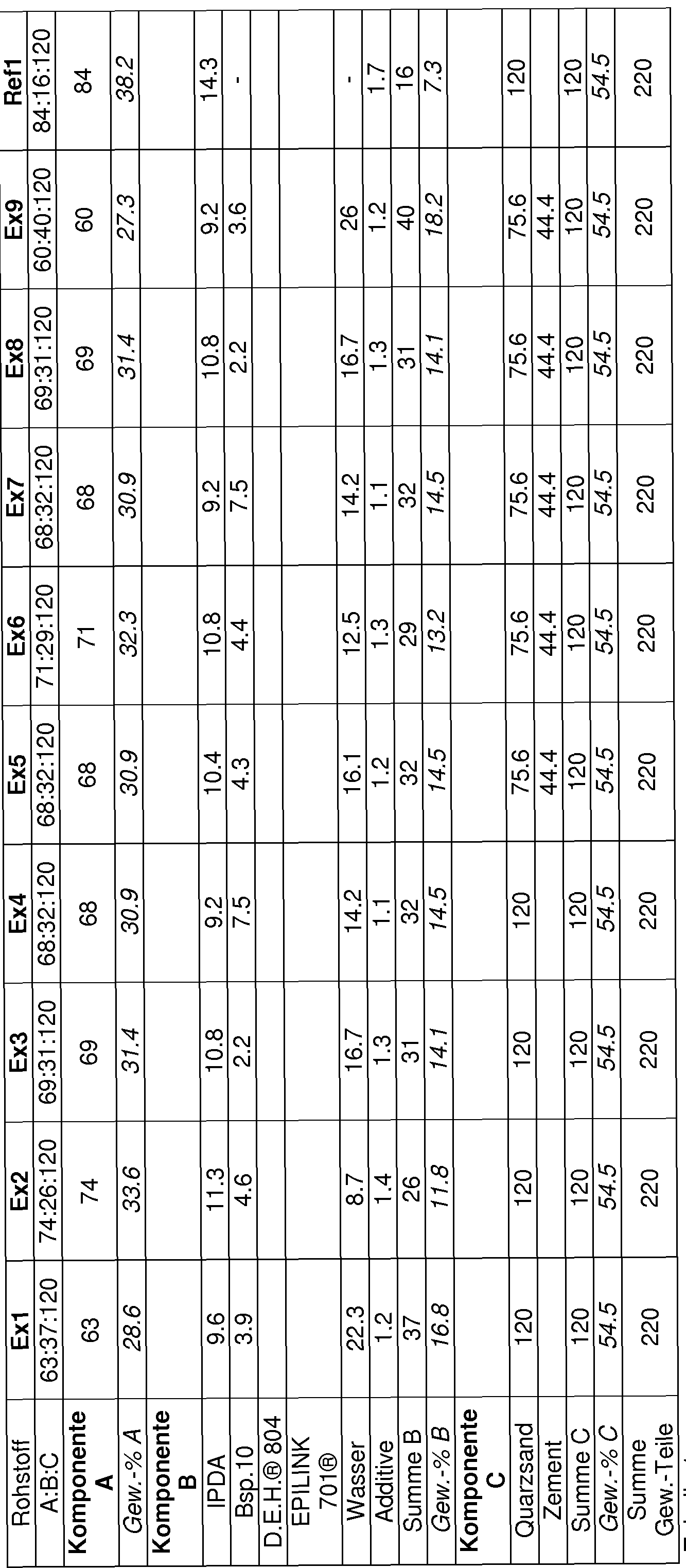
Tabelle 1a

Tabelle 1 b, 'Komponente A von Ref1 1 wie in WO2009150212 auf der Seite 42 als Beispiel 30 beschrieben

Tabelle 2a, n.m. = nicht messbar

Tabelle 2b
Claims
Patentansprüche 1 . Mehrkomponentige Zusammensetzung, umfassend
A) eine Binderkomponente (A) umfassend mindestens ein
Epoxidharz,
B) eine Härterkomponente (B) umfassend mindestens eine
Aminverbindung PA, und
C) eine feste Komponente (C) umfassend mindestens einen anorganischen Füllstoff,
dadurch gekennzeichnet, dass
-die mehrkomponentige Zusammensetzung 3 - 15 Gew.-% Wasser, bezogen auf das Gesamtgewicht der mehrkomponentigen
Zusammensetzung, enthält,
-und dass die mehrkomponentige Zusammensetzung weiter eine
Verbindung VB der Formel I) oder (II)

enthält, wobei
entweder
R1 und R3 unabhängig voneinander jeweils für eine Alkyl-, Cycloalkyl-, Aryl- oder Arylalkylgruppe mit 1 bis 12 C-Atomen, welche gegebenenfalls Ethergruppen oder Halogenatome aufweist, stehen, und
R2 für ein Wasserstoffatom oder für eine Alkyl-, Cycloalkyl-, Aryl- oder Arylalkylgruppe mit 1 bis 12 C-Atomen steht,
oder
R2 und R1 zusammen für einen zweiwertigen Kohlenwasserstoffrest, der Teil eines, gegebenenfalls substituierten, carbocylischen Rings mit 5 bis 8, bevorzugt 5 oder 6, C-Atomen ist, stehen und R3 für eine Alkyl-, Cycloalkyl-, Aryl- oder Arylalkylgruppe mit 1 bis 12 C-Atomen, welche gegebenenfalls Ethergruppen oder Halogenatome aufweist, steht;
oder
R2 und R3 zusammen für einen zweiwertigen Kohlenwasserstoffrest, der Teil eines, gegebenenfalls substituierten, carbocylischen Rings mit 5 bis 8, bevorzugt 5 oder 6, C-Atomen ist, stehen und R1 für eine Alkyl-, Cycloalkyl-, Aryl- oder Arylalkylgruppe mit 1 bis 12 C-Atomen, welche gegebenenfalls Ethergruppen oder Halogenatome aufweist, steht;
R4 und R5 unabhängig voneinander jeweils für eine Alkyl-, Cycloalkyl-,
Aryl- oder Arylalkylgruppe mit 1 bis 12 C-Atomen, welche gegebenenfalls
Ethergruppen oder Halogenatome aufweist, stehen;
A für einen (a+b)-wertigen Rest eines Polyamin-Polyepoxid-Addukts nach
Entfernung von (a+b) primären Aminogruppen steht;
a für eine ganze Zahl von 0 bis 4 steht; und
b für eine ganze Zahl von 1 bis 4 steht;
mit den Massgaben, dass die Summe von a und b für eine ganze Zahl von 1 bis 4 steht, und dass das dem Polyamin-Polyepoxid-Addukt zugrunde liegende Polyepoxid ein Polyepoxid E, insbesondere ein Diepoxid E1 , ist, und ein Epoxy-Equivalent-Gewicht (EEW) von 65 bis 500 g/Eq aufweist,
-und wobei das Gewichtsverhältnis von Aminverbindung PA zu
Verbindung VB von 4 - 20 beträgt,
-und wobei der Gewichtsanteil der festen Komponente (C) 25 - 62 Gew.-%, bezogen auf das Gesamtgewicht der mehrkomponentigen Zusammensetzung, beträgt.
Mehrkomponentige Zusammensetzung nach Anspruch 1 , dadurch gekennzeichnet, dass die mindestens eine Aminverbindung PA
ausgewählt ist aus der Gruppe bestehend aus Polyamin A4,
Polyaminoamid, Polyamin-Polyepoxid-Addukt AD und Polyaminoamid-
Polyepoxid-Addukt oder eine Mischung von mindestens zwei dieser Verbindungen ist.
Mehrkomponentige Zusammensetzung nach einem der vorgehenden Ansprüche, dadurch gekennzeichnet, dass die mindestens eine
Aminverbindung PA ein Polyamin A4 oder eine Mischung aus Polyamin A4 und Polyamin-Polyepoxid-Addukt AD ist,
vorzugsweise ist das Polyamin A4 ausgewählt ist aus der Gruppe bestehend aus Isophorondiamin (IPDA), Bis-(4-aminocyclohexyl)-methan (H12-MDA), Bis-(4-amino-3-methylcyclohexyl)-methan, 2,2,4- und 2,4,4- Trimethylhexamethylendiamin (TMD), 1 ,3-Xylylendiamin (meta-Xylylen- diamin oder MXDA) und 2-Butyl-2-ethyl-1 ,5-pentandiamin (C1 1 - Neodiamin), und vorzugsweise ist das Polyamin-Polyepoxid-Addukt AD ein Addukt aus mindestens einem Polyamin A3 mit mindestens zwei Aminogruppen in Form von primären oder sekundären Aminogruppen und mindestens einem Polyepoxid E mit einem Epoxy-Equivalent- Gewicht (EEW) von 65 bis 500 g/Eq, wobei das Addukt terminale primäre und/oder sekundäre Aminogruppen aufweist, und wobei das Polyamin A3 ausgewählt ist aus der Gruppe bestehend aus einerseits Polyoxyalkylen-Diaminen mit einem Molekulargewicht von höchstens 1000 g/mol, und andererseits Isophorondiamin (IPDA), 2,2,4- und 2,4,4- Trimethylhexamethylendiamin (TMD), 1 ,3-Xylylendiamin (meta-Xyly- lendiamin oder MXDA), 2-Butyl-2-ethyl-1 ,5-pentandiamin (C1 1 - Neodiamin), N-Ethyl-1 ,3-propandiamin und N-Cyclohexyl-1 ,3- propandiamin.
Mehrkomponentige Zusammensetzung nach einem der Ansprüche 2 oder 3, dadurch gekennzeichnet, dass das Gewichtsverhältnis von Polyamin A4 zu Polyamin-Polyepoxid-Addukt AD von 5 - 50,
insbesondere 10 - 45, bevorzugt 15 - 25, beträgt.
Mehrkomponentige Zusammensetzung nach einem der vorgehenden Ansprüche, dadurch gekennzeichnet, dass die mehrkomponentige
Zusammensetzung 4 - 12 Gew.-%, insbesondere 5 - 10 Gew.-%, bevorzugt 6 - 9 Gew.-% Wasser, bezogen auf das Gesamtgewicht der mehrkomponentigen Zusammensetzung, enthält. 6. Mehrkomponentige Zusammensetzung nach einem der vorgehenden Ansprüche, dadurch gekennzeichnet, dass das Gewichtsverhältnis von Aminverbindung PA zu Verbindung VB von 6 - 1 6, insbesondere 6 - 15, bevorzugt 7 - 10, beträgt.
Mehrkomponentige Zusammensetzung nach einem der vorgehenden Ansprüche, dadurch gekennzeichnet, dass die mehrkomponentige Zusammensetzung, bezogen auf das Gesamtgewicht der
mehrkomponentigen Zusammensetzung, 25 - 40 Gew.-%, insbesondere 25 - 35 Gew.-%, an Binderkomponente (A) enthält.
Mehrkomponentige Zusammensetzung nach einem der vorgehenden Ansprüche, dadurch gekennzeichnet, dass der Gewichtsanteil der festen Komponente (C) 30 - 60 Gew.-%, insbesondere 40 - 57.5 Gew.- %, vorzugsweise 45 - 55 Gew.-%, bezogen auf das Gesamtgewicht der mehrkomponentigen Zusammensetzung, beträgt.
Mehrkomponentige Zusammensetzung nach einem der vorgehenden Ansprüche, dadurch gekennzeichnet, dass das stöchiometrische Verhältnis von Epoxidfunktionalität zu Aminfunktionalität von 80% - 120%, insbesondere 90% - 1 10%, beträgt.
Mehrkomponentige Zusammensetzung nach einem der vorgehenden Ansprüche, dadurch gekennzeichnet, dass das Gewichtsverhältnis von der festen Komponente (C) zu der Binderkomponente (A) von 1 .5 - 2.3, insbesondere 1 .6 - 2.0, beträgt.
1 1 . Mehrkomponentige Zusammensetzung nach einem der vorgehenden Ansprüche, dadurch gekennzeichnet, dass die mehrkomponentige
Zusammensetzung 5 - 62 Gew.-%, 5 - 50 Gew.-%, 5 - 30 Gew.-%, 8 - 25 Gew.-%, 12 - 22.5 Gew.-%, 18 - 22 Gew.-%, eines hydraulischen anorganischen Bindemittels, vorzugsweise Zement, bezogen auf das Gesamtgewicht der mehrkomponentigen Zusammensetzung, enthält.
Mehrkomponentige Zusammensetzung nach einem der Ansprüche 1 bis 10, dadurch gekennzeichnet, dass die mehrkomponentige
Zusammensetzung 0 - 5 Gew.-%, 0 - 2 Gew.-%, 0 - 1 Gew.-%, 0 - 0.5 Gew.-%, insbesondere 0 - 0.1 Gew.-%, eines hydraulischen
anorganischen Bindemittels, vorzugsweise Zement, bezogen auf das Gesamtgewicht der mehrkomponentigen Zusammensetzung, enthält.
Verfahren zur Herstellung einer Beschichtung, Grundierung oder Versiegelung, vorzugsweise einer Bodenbeschichtung,
Bodengrundierung oder Bodenversiegelung, mit einer
mehrkomponentigen Zusammensetzung nach irgendeinem der
Ansprüche 1 bis 12, wobei das Verfahren folgende Verfahrensschritte umfasst
a) Mischen der Binderkomponente (A) und der Härterkomponente (B),
b) Zugabe der festen Komponente (C) und gegebenenfalls ein
hydraulisches anorganisches Bindemittel sowie gegebenenfalls Zugabe von Wasser und Verbindung VB, falls Wasser und Verbindung VB nicht bereits in der Binderkomponente (A) oder der Härterkomponente (B) enthalten waren, zu der in Schritt a) erhaltenen Mischung unter Rühren, um eine gemischte
Zusammensetzung zu erhalten,
c) Aufbringen der erhaltenen gemischten Zusammensetzung auf ein Substrat,
d) gegebenenfalls Glätten oder Entlüften der aufgebrachten
gemischten Zusammensetzung und
e) Aushärten der aufgebrachten gemischten Zusammensetzung, um die Beschichtung, Grundierung oder Versiegelung zu erhalten.
14. Beschichtung, Grundierung oder Versiegelung, insbesondere Bodenbeschichtung, Bodengrundierung oder Bodenversiegelung, erhältlich nach einem Verfahren nach Anspruch 13.
15. Verwendung einer mehrkomponentigen Zusammensetzung nach irgendeinem der Ansprüche 1 bis 12 als Beschichtung, Grundierung oder Versiegelung, insbesondere Bodenbeschichtung,
Bodengrundierung oder Bodenversiegelung.
Priority Applications (3)
| Application Number | Priority Date | Filing Date | Title |
|---|---|---|---|
| CN201880017498.9A CN110461967A (zh) | 2017-03-13 | 2018-03-08 | 作为涂料或密封剂的环氧树脂改性的组合物 |
| EP18708149.2A EP3596178B1 (de) | 2017-03-13 | 2018-03-08 | Epoxidharz-vergütete zusammensetzung als beschichtung oder versiegelung |
| US16/493,451 US20200123311A1 (en) | 2017-03-13 | 2018-03-08 | Epoxy-resin modified composition used for coating or sealing |
Applications Claiming Priority (2)
| Application Number | Priority Date | Filing Date | Title |
|---|---|---|---|
| EP17160580.1 | 2017-03-13 | ||
| EP17160580.1A EP3375831A1 (de) | 2017-03-13 | 2017-03-13 | Epoxidharz-vergütete zusammensetzung als beschichtung oder versiegelung |
Publications (1)
| Publication Number | Publication Date |
|---|---|
| WO2018166897A1 true WO2018166897A1 (de) | 2018-09-20 |
Family
ID=58277216
Family Applications (1)
| Application Number | Title | Priority Date | Filing Date |
|---|---|---|---|
| PCT/EP2018/055831 Ceased WO2018166897A1 (de) | 2017-03-13 | 2018-03-08 | Epoxidharz-vergütete zusammensetzung als beschichtung oder versiegelung |
Country Status (4)
| Country | Link |
|---|---|
| US (1) | US20200123311A1 (de) |
| EP (2) | EP3375831A1 (de) |
| CN (1) | CN110461967A (de) |
| WO (1) | WO2018166897A1 (de) |
Cited By (2)
| Publication number | Priority date | Publication date | Assignee | Title |
|---|---|---|---|---|
| EP3750935A1 (de) | 2019-06-14 | 2020-12-16 | Sika Technology Ag | Nichtbrennbarer wässriger selbstnivellierender epoxidboden |
| EP4269464A1 (de) | 2022-04-25 | 2023-11-01 | Sika Technology AG | Epoxidharzmodifizierte zusammensetzung, die zum beschichten oder versiegeln verwendet wird |
Families Citing this family (2)
| Publication number | Priority date | Publication date | Assignee | Title |
|---|---|---|---|---|
| US11773285B2 (en) | 2020-02-25 | 2023-10-03 | Axalta Coating Systems Ip Co., Llc | Sealers, methods of producing sealers, and methods of sealing construction products |
| US12275816B2 (en) * | 2022-04-28 | 2025-04-15 | Westlake Epoxy Inc. | Epoxy resin compositions and coating systems |
Citations (4)
| Publication number | Priority date | Publication date | Assignee | Title |
|---|---|---|---|---|
| US4980398A (en) * | 1990-02-23 | 1990-12-25 | E. I. Du Pont De Nemours And Company | Polyamine enamine containing cationic resin |
| EP2133378A1 (de) * | 2008-06-13 | 2009-12-16 | Sika Technology AG | Polyamin mit reduziertem Blushing und dessen Verwendung als Härter für Epoxidharze |
| WO2009150212A1 (de) | 2008-06-13 | 2009-12-17 | Sika Technology Ag | Wasserverdünnbares amin und dessen anwendungen |
| EP2826761A1 (de) * | 2013-07-16 | 2015-01-21 | Sika Technology AG | Epoxidharz-vergütete zementgebundene Zusammensetzung als Beschichtung oder Versiegelung |
-
2017
- 2017-03-13 EP EP17160580.1A patent/EP3375831A1/de not_active Withdrawn
-
2018
- 2018-03-08 US US16/493,451 patent/US20200123311A1/en not_active Abandoned
- 2018-03-08 EP EP18708149.2A patent/EP3596178B1/de not_active Not-in-force
- 2018-03-08 WO PCT/EP2018/055831 patent/WO2018166897A1/de not_active Ceased
- 2018-03-08 CN CN201880017498.9A patent/CN110461967A/zh active Pending
Patent Citations (4)
| Publication number | Priority date | Publication date | Assignee | Title |
|---|---|---|---|---|
| US4980398A (en) * | 1990-02-23 | 1990-12-25 | E. I. Du Pont De Nemours And Company | Polyamine enamine containing cationic resin |
| EP2133378A1 (de) * | 2008-06-13 | 2009-12-16 | Sika Technology AG | Polyamin mit reduziertem Blushing und dessen Verwendung als Härter für Epoxidharze |
| WO2009150212A1 (de) | 2008-06-13 | 2009-12-17 | Sika Technology Ag | Wasserverdünnbares amin und dessen anwendungen |
| EP2826761A1 (de) * | 2013-07-16 | 2015-01-21 | Sika Technology AG | Epoxidharz-vergütete zementgebundene Zusammensetzung als Beschichtung oder Versiegelung |
Cited By (4)
| Publication number | Priority date | Publication date | Assignee | Title |
|---|---|---|---|---|
| EP3750935A1 (de) | 2019-06-14 | 2020-12-16 | Sika Technology Ag | Nichtbrennbarer wässriger selbstnivellierender epoxidboden |
| WO2020249751A1 (en) | 2019-06-14 | 2020-12-17 | Sika Technology Ag | Non-combustible waterborne self levelling epoxy floor |
| EP4269464A1 (de) | 2022-04-25 | 2023-11-01 | Sika Technology AG | Epoxidharzmodifizierte zusammensetzung, die zum beschichten oder versiegeln verwendet wird |
| WO2023208831A1 (en) | 2022-04-25 | 2023-11-02 | Sika Technology Ag | Epoxy-resin modified composition used for coating or sealing |
Also Published As
| Publication number | Publication date |
|---|---|
| US20200123311A1 (en) | 2020-04-23 |
| CN110461967A (zh) | 2019-11-15 |
| EP3375831A1 (de) | 2018-09-19 |
| EP3596178B1 (de) | 2021-01-27 |
| EP3596178A1 (de) | 2020-01-22 |
Similar Documents
| Publication | Publication Date | Title |
|---|---|---|
| EP3022166A1 (de) | Epoxidharz-vergütete zementgebundene zusammensetzung als beschichtung oder versiegelung | |
| EP3022167B2 (de) | Kombination von ternären bindemitteln mit wässrigem epoxidharz-system | |
| EP2288640B1 (de) | Wasserverdünnbares amin und dessen anwendungen | |
| WO2016023839A1 (de) | Amin für emissionsarme epoxidharz-zusammensetzungen | |
| EP3596178B1 (de) | Epoxidharz-vergütete zusammensetzung als beschichtung oder versiegelung | |
| WO2015117846A1 (de) | Amin für emissionsarme epoxidharz-produkte | |
| EP3180382B1 (de) | Amin für emissionsarme epoxidharz-zusammensetzungen | |
| EP3350244B1 (de) | Härter für emissionsarme epoxidharz-zusammensetzungen | |
| EP2821424A1 (de) | Multi-Komponenten-Zusammensetzung | |
| EP3245173A1 (de) | Epoxidharz-vergütete zementgebundene zusammensetzung für elektrisch ableitfähige beschichtungen oder versiegelungen | |
| DE69711474T2 (de) | Reaktive Beschleuniger für Amin-gehärtete Epoxidharze | |
| EP3331935A1 (de) | Amin für emissionsarme epoxidharz-zusammensetzungen | |
| EP3252091B1 (de) | Tetrahydrofuran-diamin | |
| EP3344678A1 (de) | Amin für emissionsarme epoxidharz-zusammensetzungen | |
| EP4269464A1 (de) | Epoxidharzmodifizierte zusammensetzung, die zum beschichten oder versiegeln verwendet wird | |
| EP4372025A1 (de) | Wässrige mehrzweck-epoxydbodenbelagzusammensetzung | |
| DE2730642A1 (de) | Verwendung von haertbaren epoxidharz-bitumen-dispersionen fuer beschichtungen, verklebungen und vergussmassen |
Legal Events
| Date | Code | Title | Description |
|---|---|---|---|
| 121 | Ep: the epo has been informed by wipo that ep was designated in this application |
Ref document number: 18708149 Country of ref document: EP Kind code of ref document: A1 |
|
| NENP | Non-entry into the national phase |
Ref country code: DE |
|
| ENP | Entry into the national phase |
Ref document number: 2018708149 Country of ref document: EP Effective date: 20191014 |