WO2018147155A1 - 組成物 - Google Patents
組成物 Download PDFInfo
- Publication number
- WO2018147155A1 WO2018147155A1 PCT/JP2018/003353 JP2018003353W WO2018147155A1 WO 2018147155 A1 WO2018147155 A1 WO 2018147155A1 JP 2018003353 W JP2018003353 W JP 2018003353W WO 2018147155 A1 WO2018147155 A1 WO 2018147155A1
- Authority
- WO
- WIPO (PCT)
- Prior art keywords
- group
- carbon atoms
- polymer compound
- represented
- formula
- Prior art date
- Legal status (The legal status is an assumption and is not a legal conclusion. Google has not performed a legal analysis and makes no representation as to the accuracy of the status listed.)
- Ceased
Links
- 0 CCC(N)=C(C)C(C)* Chemical compound CCC(N)=C(C)C(C)* 0.000 description 3
- XXMMMXAPLOGVHX-QBWABLMJSA-N CCOC(C)(C(CO)[C@@H](C)N(CCOC(C)O)I)O Chemical compound CCOC(C)(C(CO)[C@@H](C)N(CCOC(C)O)I)O XXMMMXAPLOGVHX-QBWABLMJSA-N 0.000 description 1
Images


Classifications
-
- H—ELECTRICITY
- H10—SEMICONDUCTOR DEVICES; ELECTRIC SOLID-STATE DEVICES NOT OTHERWISE PROVIDED FOR
- H10P—GENERIC PROCESSES OR APPARATUS FOR THE MANUFACTURE OR TREATMENT OF DEVICES COVERED BY CLASS H10
- H10P14/00—Formation of materials, e.g. in the shape of layers or pillars
- H10P14/60—Formation of materials, e.g. in the shape of layers or pillars of insulating materials
- H10P14/68—Organic materials, e.g. photoresists
- H10P14/683—Organic materials, e.g. photoresists carbon-based polymeric organic materials, e.g. polyimides, poly cyclobutene or PVC
-
- C—CHEMISTRY; METALLURGY
- C08—ORGANIC MACROMOLECULAR COMPOUNDS; THEIR PREPARATION OR CHEMICAL WORKING-UP; COMPOSITIONS BASED THEREON
- C08F—MACROMOLECULAR COMPOUNDS OBTAINED BY REACTIONS ONLY INVOLVING CARBON-TO-CARBON UNSATURATED BONDS
- C08F20/00—Homopolymers and copolymers of compounds having one or more unsaturated aliphatic radicals, each having only one carbon-to-carbon double bond, and only one being terminated by only one carboxyl radical or a salt, anhydride, ester, amide, imide or nitrile thereof
- C08F20/02—Monocarboxylic acids having less than ten carbon atoms, Derivatives thereof
- C08F20/10—Esters
- C08F20/26—Esters containing oxygen in addition to the carboxy oxygen
- C08F20/28—Esters containing oxygen in addition to the carboxy oxygen containing no aromatic rings in the alcohol moiety
-
- C—CHEMISTRY; METALLURGY
- C08—ORGANIC MACROMOLECULAR COMPOUNDS; THEIR PREPARATION OR CHEMICAL WORKING-UP; COMPOSITIONS BASED THEREON
- C08F—MACROMOLECULAR COMPOUNDS OBTAINED BY REACTIONS ONLY INVOLVING CARBON-TO-CARBON UNSATURATED BONDS
- C08F20/00—Homopolymers and copolymers of compounds having one or more unsaturated aliphatic radicals, each having only one carbon-to-carbon double bond, and only one being terminated by only one carboxyl radical or a salt, anhydride, ester, amide, imide or nitrile thereof
- C08F20/02—Monocarboxylic acids having less than ten carbon atoms, Derivatives thereof
- C08F20/10—Esters
- C08F20/34—Esters containing nitrogen, e.g. N,N-dimethylaminoethyl (meth)acrylate
- C08F20/36—Esters containing nitrogen, e.g. N,N-dimethylaminoethyl (meth)acrylate containing oxygen in addition to the carboxy oxygen, e.g. 2-N-morpholinoethyl (meth)acrylate or 2-isocyanatoethyl (meth)acrylate
-
- C—CHEMISTRY; METALLURGY
- C08—ORGANIC MACROMOLECULAR COMPOUNDS; THEIR PREPARATION OR CHEMICAL WORKING-UP; COMPOSITIONS BASED THEREON
- C08K—Use of inorganic or non-macromolecular organic substances as compounding ingredients
- C08K5/00—Use of organic ingredients
- C08K5/04—Oxygen-containing compounds
- C08K5/05—Alcohols; Metal alcoholates
-
- C—CHEMISTRY; METALLURGY
- C08—ORGANIC MACROMOLECULAR COMPOUNDS; THEIR PREPARATION OR CHEMICAL WORKING-UP; COMPOSITIONS BASED THEREON
- C08L—COMPOSITIONS OF MACROMOLECULAR COMPOUNDS
- C08L33/00—Compositions of homopolymers or copolymers of compounds having one or more unsaturated aliphatic radicals, each having only one carbon-to-carbon double bond, and only one being terminated by only one carboxyl radical, or of salts, anhydrides, esters, amides, imides or nitriles thereof; Compositions of derivatives of such polymers
- C08L33/04—Homopolymers or copolymers of esters
- C08L33/14—Homopolymers or copolymers of esters of esters containing halogen, nitrogen, sulfur, or oxygen atoms in addition to the carboxy oxygen
-
- H—ELECTRICITY
- H01—ELECTRIC ELEMENTS
- H01B—CABLES; CONDUCTORS; INSULATORS; SELECTION OF MATERIALS FOR THEIR CONDUCTIVE, INSULATING OR DIELECTRIC PROPERTIES
- H01B3/00—Insulators or insulating bodies characterised by the insulating materials; Selection of materials for their insulating or dielectric properties
- H01B3/18—Insulators or insulating bodies characterised by the insulating materials; Selection of materials for their insulating or dielectric properties mainly consisting of organic substances
- H01B3/30—Insulators or insulating bodies characterised by the insulating materials; Selection of materials for their insulating or dielectric properties mainly consisting of organic substances plastics; resins; waxes
- H01B3/44—Insulators or insulating bodies characterised by the insulating materials; Selection of materials for their insulating or dielectric properties mainly consisting of organic substances plastics; resins; waxes vinyl resins; acrylic resins
-
- H—ELECTRICITY
- H10—SEMICONDUCTOR DEVICES; ELECTRIC SOLID-STATE DEVICES NOT OTHERWISE PROVIDED FOR
- H10D—INORGANIC ELECTRIC SEMICONDUCTOR DEVICES
- H10D30/00—Field-effect transistors [FET]
- H10D30/60—Insulated-gate field-effect transistors [IGFET]
- H10D30/67—Thin-film transistors [TFT]
Definitions
- the present invention relates to a composition.
- a composition that cures at a low temperature includes a product obtained by reacting 2-isocyanatoethyl methacrylate and diethyl malonate, styrene, methyl methacrylate, 2-butyl acrylate, and 2-hydroxyethyl methacrylate.
- a composition obtained by copolymerization in the presence of cyclohexanone has been reported (Patent Document 1).
- composition described in Patent Document 1 described above does not necessarily have sufficient storage stability at room temperature.
- An object of the present invention is to provide a composition having good storage stability under room temperature conditions.
- a polymer compound (A) having a repeating unit represented by the following formula (1) A polymer compound (B) having a repeating unit represented by the following formula (2); The composition containing the compound represented by following formula (3).
- R 1 , R 2 and R 3 may be different from each other and represent a hydrogen atom, a fluorine atom, or a monovalent organic group having 1 to 20 carbon atoms.
- R 4 and R 5 may be different from each other and each represents an alkyl group having 1 to 20 carbon atoms or a cycloalkyl group having 3 to 20 carbon atoms.
- the hydrogen atom in the alkyl group or cycloalkyl group is a cycloalkyl group having 3 to 20 carbon atoms, an alkoxy group having 1 to 20 carbon atoms, a cycloalkoxy group having 3 to 20 carbon atoms, or 6 carbon atoms.
- R a represents a divalent organic group having 1 to 20 carbon atoms.
- X represents an oxygen atom, or -NR n - represents a group represented by.
- R n represents a hydrogen atom or a monovalent organic group having 1 to 20 carbon atoms.
- l represents an integer of 1 to 6. When there are a plurality of R a s , they may be different from each other. * Represents a binding position. )
- R 6 , R 7 and R 8 may be different from each other and each represents a hydrogen atom, a fluorine atom, or a monovalent organic group having 1 to 20 carbon atoms.
- R b is a divalent organic group having 1 to 20 carbon atoms, a group represented by —O—, a group represented by —CO—, a group represented by —COO—, or a group represented by —NHCO—. Or a group represented by —NHCOO—.
- R c represents a single bond or a divalent organic group having 1 to 20 carbon atoms.
- m represents an integer of 0 to 6.
- R 9 represents an alkyl group having 1 to 20 carbon atoms, a cycloalkyl group having 3 to 20 carbon atoms, or a group represented by the following formula (6) having 2 to 20 carbon atoms.
- the hydrogen atom in the alkyl group, cycloalkyl group, or group represented by the following formula (6) is a cycloalkyl group having 3 to 20 carbon atoms, an alkoxy group having 1 to 20 carbon atoms, or 3 carbon atoms. It may be substituted with ⁇ 20 cycloalkoxy groups, monovalent aromatic hydrocarbon groups having 6 to 20 carbon atoms, or fluorine atoms.
- R 10 , R 11 , and R 12 may be different from each other, and each represents a hydrogen atom, a fluorine atom, or a monovalent organic group having 1 to 20 carbon atoms.
- R 13 represents a chlorine atom, a fluorine atom, a bromine atom, an iodine atom, or a monovalent organic group having 1 to 20 carbon atoms.
- R d is a divalent organic group having 1 to 20 carbon atoms, a group represented by —O—, a group represented by —CO—, a group represented by —COO—, or —NHCO—. Or a group represented by —NHCOO—.
- a group represented by —O— a group represented by —CO—, a group represented by —COO—, a group represented by —NHCO—, and a group represented by —NHCOO—
- R d A hydrogen atom in the divalent organic group represented by R d may be substituted with a fluorine atom.
- n1 represents an integer of 0 to 5.
- n2 represents an integer of 0 to 6.
- R 9 is an alkyl group having 1 to 20 carbon atoms or a cycloalkyl group having 3 to 20 carbon atoms (the hydrogen atom in the alkyl group or cycloalkyl group) Is a cycloalkyl group having 3 to 20 carbon atoms, an alkoxy group having 1 to 20 carbon atoms, a cycloalkoxy group having 3 to 20 carbon atoms, or a monovalent aromatic hydrocarbon having 6 to 20 carbon atoms. And optionally substituted with a group), the composition according to [1] or [2].
- a composition for an insulating layer comprising the composition according to any one of [1] to [4], which is used for an electronic device.
- An organic thin film transistor comprising, as a gate insulating layer, a film obtained by curing the composition according to any one of [1] to [4].
- a composition having high storage stability even at room temperature can be provided.
- the “polymer compound” means a compound containing a plurality of structural units (repeating units) that may be different from each other in the molecule, and so-called dimers are also included in the “polymer compound”.
- the “low molecular weight compound” means a compound that does not contain a plurality of structural units in the molecule.
- the monovalent organic group having 1 to 20 carbon atoms may be linear, branched or cyclic, and may be an aliphatic hydrocarbon group or an aromatic hydrocarbon group. Good.
- Examples of the monovalent organic group having 1 to 20 carbon atoms include: Monovalent linear aliphatic hydrocarbon group having 1 to 20 carbon atoms, monovalent branched aliphatic hydrocarbon group having 3 to 20 carbon atoms, monovalent alicyclic group having 3 to 20 carbon atoms Hydrocarbon group, monovalent aromatic hydrocarbon group having 6 to 20 carbon atoms, alkoxy group having 1 to 20 carbon atoms, aryloxy group having 6 to 20 carbon atoms, acyl group having 2 to 20 carbon atoms , An alkoxycarbonyl group having 2 to 20 carbon atoms, and an aryloxycarbonyl group having 7 to 20 carbon atoms.
- the hydrogen atom in the group is an alkyl group having 1 to 20 carbon atoms, a cycloalkyl group having 3 to 20 carbon atoms, an alkoxy group having 1 to 20 carbon atoms, or an alkyl group having 3 to 20 carbon atoms. It may be substituted with a cycloalkoxy group, a monovalent hydrocarbon group having 6 to 20 carbon atoms, or a halogen atom.
- the monovalent organic group is preferably Monovalent linear aliphatic hydrocarbon group having 1 to 6 carbon atoms, monovalent branched aliphatic hydrocarbon group having 3 to 6 carbon atoms, monovalent alicyclic group having 3 to 6 carbon atoms Hydrocarbon group, monovalent aromatic hydrocarbon group having 6 to 20 carbon atoms, alkoxy group having 1 to 6 carbon atoms, aryloxy group having 6 to 20 carbon atoms, acyl group having 2 to 7 carbon atoms , An alkoxycarbonyl group having 2 to 7 carbon atoms, and an aryloxycarbonyl group having 7 to 20 carbon atoms.
- the hydrogen atom in the group is an alkyl group having 1 to 20 carbon atoms, a cycloalkyl group having 3 to 20 carbon atoms, an alkoxy group having 1 to 20 carbon atoms, or an alkyl group having 3 to 20 carbon atoms. It may be substituted with a cycloalkoxy group, a monovalent hydrocarbon group having 6 to 20 carbon atoms, or a halogen atom.
- the monovalent organic group having 1 to 20 carbon atoms include Methyl group, ethyl group, propyl group, butyl group, pentyl group, hexyl group, isopropyl group, isobutyl group, tert-butyl group, cyclopropyl group, cyclobutyl group, cyclopentyl group, cyclohexyl group, cyclopentynyl group, cyclohexynyl group , Trifluoromethyl group, trifluoroethyl group, phenyl group, naphthyl group, anthryl group, tolyl group, xylyl group, dimethylphenyl group, trimethylphenyl group, ethylphenyl group, diethylphenyl group, triethylphenyl group, propylphenyl group, Butylphenyl, methylnaphthyl, dimethylnaphthyl, di
- the monovalent organic group having 1 to 20 carbon atoms is preferably an alkyl group having 1 to 20 carbon atoms or a cycloalkyl group having 3 to 20 carbon atoms.
- the alkyl group having 1 to 20 carbon atoms may be linear or branched.
- Examples of the alkyl group having 1 to 20 carbon atoms include: Methyl, ethyl, propyl, isopropyl, butyl, pentyl, isoamyl, 2-ethylbutyl, hexyl, heptyl, octyl, 2-ethylhexyl, 3-propylheptyl, decyl, 3 , 7-dimethyloctyl group, 2-ethyloctyl group, 2-hexyldecyl group and dodecyl group.
- the alkyl group having 1 to 20 carbon atoms includes, as a substituent, a cycloalkyl group having 3 to 20 carbon atoms, an alkoxy group having 1 to 20 carbon atoms, a cycloalkoxy group having 3 to 20 carbon atoms, It may have 6 to 20 monovalent aromatic hydrocarbon groups or fluorine atoms.
- alkyl group having 1 to 20 carbon atoms having a substituent examples include: Trifluoromethyl group, pentafluoroethyl group, perfluorobutyl group, perfluorohexyl group, perfluorooctyl group, benzyl group, 2-phenylethyl group, 3-phenylpropyl group, 3- (4-methylphenyl) propyl group 3- (3,5-di-hexylphenyl) propyl group, 6-ethyloxyhexyl group, methoxymethyl group, and ethoxyethyl group.
- Examples of the cycloalkyl group having 3 to 20 carbon atoms include: A cyclopentyl group and a cyclohexyl group are mentioned.
- the cycloalkyl group having 3 to 20 carbon atoms includes, as a substituent, an alkyl group having 1 to 20 carbon atoms, an alkoxy group having 1 to 20 carbon atoms, a cycloalkoxy group having 3 to 20 carbon atoms, It may have 6 to 20 monovalent aromatic hydrocarbon groups or fluorine atoms.
- the divalent organic group having 1 to 20 carbon atoms may be linear, branched or cyclic, and may be an aliphatic hydrocarbon group or an aromatic hydrocarbon group. Good.
- Examples of the divalent organic group having 1 to 20 carbon atoms include: A divalent linear aliphatic hydrocarbon group having 1 to 20 carbon atoms, a divalent branched aliphatic hydrocarbon group having 3 to 20 carbon atoms, and a divalent alicyclic group having 3 to 20 carbon atoms Examples thereof include a hydrocarbon group and a divalent aromatic hydrocarbon group having 6 to 20 carbon atoms. These groups include an alkyl group having 1 to 20 hydrogen atoms, a cycloalkyl group having 3 to 20 carbon atoms, an alkoxy group having 1 to 20 carbon atoms, and a cycloalkyl group having 3 to 20 carbon atoms. It may be substituted with an alkoxy group, a monovalent aromatic hydrocarbon group having 6 to 20 carbon atoms, or a halogen atom.
- a divalent linear aliphatic hydrocarbon group having 1 to 6 carbon atoms, a divalent branched aliphatic hydrocarbon group having 3 to 6 carbon atoms, and a divalent alicyclic group having 3 to 6 carbon atoms A hydrocarbon group and a divalent aromatic hydrocarbon group having 6 to 20 carbon atoms are preferred.
- These groups include an alkyl group having 1 to 20 hydrogen atoms, a cycloalkyl group having 3 to 20 carbon atoms, an alkoxy group having 1 to 20 carbon atoms, and a cycloalkyl group having 3 to 20 carbon atoms. It may be substituted with an alkoxy group, a monovalent aromatic hydrocarbon group having 6 to 20 carbon atoms, or a halogen atom.
- divalent aliphatic hydrocarbon group and the divalent alicyclic hydrocarbon group include Methylene group, ethylene group, n-propylene group, isopropylene group, cyclopropylene group, n-butylene group, isobutylene group, s-butylene group, t-butylene group, cyclobutylene group, 1-methyl-cyclopropylene group, 2 -Methyl-cyclopropylene group, n-pentylene group, 1-methyl-n-butylene group, 2-methyl-n-butylene group, 3-methyl-n-butylene group, 1,1-dimethyl-n-propylene group, 1,2-dimethyl-n-propylene group, 2,2-dimethyl-n-propylene group, 1-ethyl-n-propylene group, cyclopentylene group, n-hexylene group, 1-methyl-n-pentylene group, Examples thereof include a cyclohexylene group,
- divalent aromatic hydrocarbon group having 6 to 20 carbon atoms include Phenylene group, naphthylene group, anthrylene group, dimethylphenylene group, trimethylphenylene group, ethylenephenylene group, diethylenephenylene group, triethylenephenylene group, propylenephenylene group, butylenephenylene group, methylnaphthylene group, dimethylnaphthylene group, trimethylnaphthylene Examples include a len group, a vinyl naphthylene group, an ethenyl naphthylene group, a methylanthrylene group, and an ethylanthrylene group.
- the halogen atom is a fluorine atom, a chlorine atom, a bromine atom, or an iodine atom.
- * indicates a bonding position of the repeating unit.
- the composition of the present invention comprises a polymer compound (A) having a repeating unit represented by formula (1), a polymer compound (B) having a repeating unit represented by formula (2), and a formula (3). And a compound represented by The polymer compound (A) and the polymer compound (B) contained in the composition may each be one type or two or more types.
- the compound represented by the formula (3) is a solvent, and the polymer compound (A) and the polymer compound (B) are dissolved in the compound represented by the formula (3). Is preferred.
- the polymer compound (A) preferably has a weight average molecular weight of 3,000 to 1,000,000, more preferably 5,000 to 500,000.
- the polymer compound (A) may be in any form of linear, branched, and cyclic.
- the polymer compound (A) has a repeating unit represented by the formula (1).
- R 1 , R 2 and R 3 may be different from each other and represent a hydrogen atom, a fluorine atom, or a monovalent organic group having 1 to 20 carbon atoms.
- R 4 and R 5 may be different from each other and each represents an alkyl group having 1 to 20 carbon atoms or a cycloalkyl group having 3 to 20 carbon atoms.
- the hydrogen atom in the alkyl group or cycloalkyl group is a cycloalkyl group having 3 to 20 carbon atoms, an alkoxy group having 1 to 20 carbon atoms, a cycloalkoxy group having 3 to 20 carbon atoms, or 6 carbon atoms.
- R a represents a divalent organic group having 1 to 20 carbon atoms.
- X represents an oxygen atom, or -NR n - represents a group represented by.
- R n represents a hydrogen atom or a monovalent organic group having 1 to 20 carbon atoms.
- l represents an integer of 1 to 6. When there are a plurality of R a s , they may be different from each other. * Represents a binding position. )
- R ⁇ 1 >, R ⁇ 2 > and R ⁇ 3 > are a hydrogen atom or a methyl group mutually independently.
- X is preferably an oxygen atom or a group represented by —NH—.
- R a is preferably a methylene group, an ethylene group, an n-propylene group, or an n-butylene group.
- R 4 and R 5 are preferably each independently a methyl group or an ethyl group.
- An example of a monomer that is a raw material for the repeating unit represented by the formula (1) is 2- [bis (ethoxycarbonyl) methyl] carbonylamino] -ethyl methacrylate.
- the monomer used as the raw material of the repeating unit represented by the formula (1) can be produced by a known method, for example, by reacting a compound represented by the following formula (5) with a malonic ester. Can do.
- Examples of the compound represented by the formula (5) include 2-methacryloyloxyethyl isocyanate and a 1: 1 reaction product of 2-hydroxyethyl (meth) acrylate and a diisocyanate compound.
- Examples of the diisocyanate compound to be reacted with 2-hydroxyethyl (meth) acrylate include 2,4- or 2,6-tolylene diisocyanate (TDI), 4,4'-diphenylmethane diisocyanate (MDI), hexamethylene diisocyanate, 3, 5,5-trimethyl-3-isocyanatomethylcyclohexyl isocyanate (I PDI), m- or p-xylylene diisocyanate (m- or pX D I), 4,4'-dicyclohexylmethane diisocyanate (H12MDI), 1 , 3- or 1,4-bis (isocyanatomethyl) cyclohexane, lysine diisocyan
- 2-methacryloyloxyethyl isocyanate is preferable from the viewpoint of easy availability and handling of a high-purity product, and 2-methacryloyloxyethyl isocyanate is more preferable from the viewpoint of reactivity.
- the malonic acid ester to be reacted with the compound of the formula (5) is preferably, for example, malonic acid dimethyl ester and malonic acid diethyl ester.
- Malonic acid esters are aliphatic alcohols (eg, methanol, ethanol, iso- and n-propanol, various butanols, 2-ethylhexyl alcohol), alicyclic alcohols (eg, cyclohexylmethanol), and alcohols containing aromatic rings (eg, It can be obtained by reacting one or more alcohols selected from the group consisting of (benzyl alcohol) and malonic acid.
- polymer compound (A) having a repeating unit represented by the formula (1) Specific examples of the polymer compound (A) having a repeating unit represented by the formula (1) are shown below, but the present invention is not limited thereto.
- R 1 , R 2 , and R 3 may be different from each other and represent a hydrogen atom or a methyl group.
- R 4 and R 5 may be different from each other and each represents an alkyl group having 1 to 20 carbon atoms or a cycloalkyl group having 3 to 20 carbon atoms, and R 4 and R 5 are independently of each other. , Methyl group, or ethyl group is preferable.
- the polymer compound (A) contained in the composition is preferably 1% by mass to 90% by mass, more preferably 5% by mass to 60% by mass, and more preferably 5% by mass to 30% by mass. More preferably.
- the polymer compound (B) preferably has a weight average molecular weight of 3,000 to 1,000,000, more preferably 5,000 to 500,000.
- the polymer compound (B) may be in any form of linear, branched, and cyclic.
- the polymer compound (B) has a repeating unit represented by the formula (2).
- R 6 , R 7 and R 8 may be different from each other and each represents a hydrogen atom, a fluorine atom, or a monovalent organic group having 1 to 20 carbon atoms.
- R b is a divalent organic group having 1 to 20 carbon atoms, a group represented by —O—, a group represented by —CO—, a group represented by —COO—, or a group represented by —NHCO—. Or a group represented by —NHCOO—.
- R c represents a single bond or a divalent organic group having 1 to 20 carbon atoms.
- m represents an integer of 0 to 6.
- R ⁇ 6 >, R ⁇ 7 > and R ⁇ 8 > are a hydrogen atom or a methyl group mutually independently.
- m is preferably an integer of 0-2.
- R b is a group represented by —COO—, a group represented by —NHCO—, a group represented by —NHCOO—, a methylene group, an ethylene group, an n-propylene group, an iso A propylene group, an n-butylene group, or a phenylene group is preferred.
- R c is preferably a single bond, a methylene group, an ethylene group, an n-propylene group, an isopropylene group, an n-butylene group, or a phenylene group.
- a preferred embodiment as the formula (2) is: R 6 , R 7 , and R 8 are a hydrogen atom or a methyl group, m is 1, R b is a group represented by —COO—, Examples include a case where R c is a divalent aliphatic hydrocarbon group having 1 to 10 carbon atoms.
- Examples of the repeating unit represented by the formula (2) contained in the polymer compound (B) include repeating units derived from the following monomers. 2-hydroxyethyl acrylate, 2-hydroxypropyl acrylate, 3-hydroxypropyl acrylate, 2-hydroxybutyl acrylate, 4-hydroxybutyl acrylate, 6-hydroxyhexyl acrylate, 8-hydroxyoctyl acrylate, 4-hydroxymethylcyclohexyl acrylate, 2 -Hydroxy-1-methylethyl acrylate, 2- (2-hydroxyethoxy) ethyl acrylate, 2-hydroxycyclohexyl acrylate, 3-hydroxycyclohexyl acrylate, 4-hydroxycyclohexyl acrylate, 2-hydroxy-3-phenoxypropyl acrylate, 2- Hydroxyethyl methacrylate, 2-hydroxypropyl methacrylate, 3-hydroxypropyl methacrylate Acrylate, 2-hydroxybutyl methacrylate, 4-hydroxybutyl methacrylate, 6-
- polymer compound (B) having a repeating unit represented by the formula (2) for example, Poly (2-hydroxyethyl acrylate), poly (2-hydroxyethyl methacrylate), poly (2-hydroxybutyl methacrylate), poly (4-hydroxybutyl acrylate), poly (2-hydroxybutyl acrylamide), poly (4-hydroxy Butyl methacrylamide), poly (vinyl alcohol), Poly (styrene-co- (2-hydroxyethyl acrylate)), poly (styrene-co- (2-hydroxyethyl methacrylate)), poly (styrene-co- (2-hydroxybutyl methacrylate)), poly (styrene-co -(4-hydroxybutyl acrylate)), poly (2,3,4,5,6-pentafluorostyrene-co- (2-hydroxyethyl methacrylate)), poly (2,3,4,5,6-penta Fluorostyrene-co- (4-hydroxybutyl acrylate)),
- the polymer compound (B) contained in the composition is preferably 1% by mass to 90% by mass, more preferably 5% by mass to 60% by mass, and more preferably 5% by mass to 30% by mass. More preferably.
- the polymer compound (A) and / or (B) may contain a repeating unit represented by the following formula (4).
- R 10 , R 11 , and R 12 may be different from each other, and each represents a hydrogen atom, a fluorine atom, or a monovalent organic group having 1 to 20 carbon atoms.
- R 13 represents a chlorine atom, a fluorine atom, a bromine atom, an iodine atom, or a monovalent organic group having 1 to 20 carbon atoms.
- R d is a divalent organic group having 1 to 20 carbon atoms, a group represented by —O—, a group represented by —CO—, a group represented by —COO—, or —NHCO—. Or a group represented by —NHCOO—.
- n1 represents an integer of 0 to 5.
- n2 represents an integer of 0 to 6.
- R ⁇ 10 >, R ⁇ 11 > and R ⁇ 12 > are a hydrogen atom or a methyl group mutually independently.
- R d is preferably a divalent organic group having 1 to 20 carbon atoms or a group represented by —COO—.
- n2 is preferably an integer of 0-2.
- the proportion of the repeating unit represented by the formula (4) contained in the polymer compound (A) and / or (B) Is preferably 1 mol% or more and 90 mol% or less, preferably 10 mol% or more and 90 mol% or less, with the total content of all repeating units contained in each polymer compound being 100 mol%. More preferably, it is 30 mol% or more and 80 mol% or less.
- the monomer used as a raw material of the repeating unit represented by the formula (4) Styrene, 2,4-dimethyl- ⁇ -methylstyrene, o-methylstyrene, m-methylstyrene, p-methylstyrene, 2,4-dimethylstyrene, 2,5-dimethylstyrene, 2,6-dimethylstyrene, 3 , 4-dimethylstyrene, 3,5-dimethylstyrene, 2,4,6-trimethylstyrene, 2,4,5-trimethylstyrene, pentamethylstyrene, o-ethylstyrene, m-ethylstyrene, p-ethylstyrene, o-chlorostyrene, m-chlorostyrene, p-chlorostyrene, o-bromostyrene, m-bromostyrene, m-
- the polymer compound (A) may be a polymer compound having a repeating unit represented by the formula (1) and another repeating unit, The high molecular compound which has a repeating unit represented by Formula (1), a repeating unit represented by Formula (4), and another repeating unit may be sufficient.
- the polymer compound (B) may be a polymer compound having a repeating unit represented by the formula (2) and another repeating unit, The high molecular compound which has a repeating unit represented by Formula (2), a repeating unit represented by Formula (4), and another repeating unit may be sufficient.
- other repeating units are It means a repeating unit other than the repeating unit represented by formula (1), the repeating unit represented by formula (2), or the repeating unit represented by formula (4).
- the ratio of other repeating units contained in the polymer compound is not particularly limited.
- the total content of all repeating units contained in the polymer compound is 100 mol%, and 0 mol% or more and 90 mol% or less. It may be 0 mol% or more and 80 mol% or less, and may be 0 mol% or more and 50 mol% or less.
- Examples of monomers that can be used as starting materials for other repeating units include acrylic acid, methacrylic acid, 4-vinylbenzoic acid, acrylic esters and derivatives thereof, methacrylic esters and derivatives thereof, acrylamide and derivatives thereof, and methacrylamide and derivatives thereof.
- the monomer used as the material of the other repeating unit is appropriately selected according to the characteristics required for the insulating layer. It is preferable to use a monomer capable of imparting flexibility such as a methacrylic acid ester and a derivative thereof, an acrylic acid ester and a derivative thereof, as a monomer that becomes a material of another repeating unit.
- Monofunctional acrylates and polyfunctional acrylates can be used as acrylic acid esters and derivatives thereof, which are monomers used as materials for other repeating units.
- acrylic acid esters and derivatives thereof include methyl acrylate, ethyl acrylate, acrylic acid-n-propyl, isopropyl acrylate, acrylic acid-n-butyl, acrylic acid isobutyl, acrylic acid-sec-butyl, and acrylic acid.
- Methacrylic acid esters and derivatives thereof include, for example, methyl methacrylate, ethyl methacrylate, methacrylic acid-n-propyl, isopropyl methacrylate, methacrylic acid-n-butyl, isobutyl methacrylate, methacrylic acid-sec-butyl, methacrylic acid Hexyl, octyl methacrylate, 2-ethylhexyl methacrylate, decyl methacrylate, isobornyl methacrylate, cyclohexyl methacrylate, ethylene glycol dimethacrylate, propylene glycol dimethacrylate, 1,4-butanediol dimethacrylate, diethylene glycol dimethacrylate, triethylene Glycol dimethacrylate,
- acrylamide and its derivatives which are monomers used as materials for other repeating units, include acrylamide, N-methylacrylamide, N-ethylacrylamide, N-tert-butylacrylamide, N, N-dimethylacrylamide, N, N -Diethylacrylamide, N- (butoxymethyl) acrylamide, N- [3- (dimethylamino) propyl] acrylamide, N-acryloylmorpholine.
- methacrylamide and derivatives thereof as other repeating unit materials include methacrylamide, N-methylmethacrylamide, N-ethylmethacrylamide, N-tert-butylmethacrylamide, N, N-dimethyl.
- vinyl esters of organic carboxylic acids and derivatives thereof which are monomers used as materials for other repeating units, include vinyl acetate, vinyl propionate, vinyl butyrate, and divinyl adipate.
- allyl esters of organic carboxylic acids and derivatives thereof which are monomers that are materials for other repeating units, include allyl acetate, diallyl adipate, diallyl terephthalate, diallyl isophthalate, and diallyl phthalate.
- dialkyl esters of fumaric acid and derivatives thereof which are monomers that are materials of other repeating units, include dimethyl fumarate, diethyl fumarate, diisopropyl fumarate, di-sec-butyl fumarate, diisobutyl fumarate, fumarate Examples include di-n-butyl acid, di-2-ethylhexyl fumarate, and dibenzyl fumarate.
- dialkyl esters of maleic acid and their derivatives which are monomers that are materials for other repeating units, include dimethyl maleate, diethyl maleate, diisopropyl maleate, di-sec-butyl maleate, diisobutyl maleate, maleate Examples include di-n-butyl acid, di-2-ethylhexyl maleate, and dibenzyl maleate.
- dialkyl esters of itaconic acid and its derivatives which are monomers used as materials for other repeating units, include dimethyl itaconate, diethyl itaconate, diisopropyl itaconate, di-sec-butyl itaconate, diisobutyl itaconate, and itacon Examples include di-n-butyl acid, di-2-ethylhexyl itaconate, and dibenzyl itaconate.
- N-vinylamide derivatives of organic carboxylic acids which are monomers used as materials for other repeating units, include N-methyl-N-vinylacetamide and the like.
- maleimide and its derivatives which are monomers that are materials for other repeating units, include N-phenylmaleimide and N-cyclohexylmaleimide.
- terminal unsaturated hydrocarbons and derivatives thereof which are monomers that are materials of other repeating units, include 1-butene, 1-pentene, 1-hexene, 1-octene, vinylcyclohexane, vinyl chloride, and the like. .
- organic germanium derivatives which are monomers that serve as materials for other repeating units, include allyltrimethylgermanium, allyltriethylgermanium, allyltributylgermanium, trimethylvinylgermanium, triethylvinylgermanium, and the like.
- acrylic acid alkyl ester methacrylic acid alkyl ester, acrylonitrile, methacrylonitrile, or allyltrimethylgermanium are preferable.
- R 9 represents an alkyl group having 1 to 20 carbon atoms, a cycloalkyl group having 3 to 20 carbon atoms, or a group represented by the following formula (6) having 2 to 20 carbon atoms.
- the hydrogen atom in the alkyl group, cycloalkyl group, or group represented by the following formula (6) is a cycloalkyl group having 3 to 20 carbon atoms, an alkoxy group having 1 to 20 carbon atoms, or 3 carbon atoms. It may be substituted with ⁇ 20 cycloalkoxy groups, monovalent aromatic hydrocarbon groups having 6 to 20 carbon atoms, or fluorine atoms.
- R 15 represents a divalent linear aliphatic hydrocarbon group having 1 to 6 carbon atoms
- R 16 represents a monovalent linear aliphatic hydrocarbon group having 1 to 19 carbon atoms
- q represents an integer of 1 to 19. However, R 15 , R 16 , and q are adjusted so that the total number of carbon atoms is 2 to 20.
- R 9 represents an alkyl group having 1 to 20 carbon atoms or a cycloalkyl group having 3 to 20 carbon atoms (the hydrogen atom in the alkyl group or cycloalkyl group has 3 carbon atoms). Substituted with a cycloalkyl group having 20 to 20 carbon atoms, an alkoxy group having 1 to 20 carbon atoms, a cycloalkoxy group having 3 to 20 carbon atoms, or a monovalent aromatic hydrocarbon group having 6 to 20 carbon atoms. It is also preferable.
- methanol, ethanol and 1-pentanol are preferable from the viewpoint of easy availability of high-purity products, and cyclopentanol, cyclohexanol, 2 -Ethoxyethanol and benzyl alcohol are preferred.
- the content of the compound represented by formula (3) in the composition is preferably 1% by mass or more and 90% by mass or less, more preferably 5% by mass or more and 70% by mass or less, and more preferably 5% by mass or more. More preferably, it is 60 mass% or less. It is particularly preferably 10% by mass or more and 50% by mass or less.
- composition of the present invention may further contain a solvent for mixing and viscosity adjustment, an additive usually used in combination with a crosslinking agent when the polymer compound is crosslinked.
- solvent used examples include ether solvents such as tetrahydrofuran and diethyl ether, aliphatic hydrocarbon solvents such as hexane, alicyclic hydrocarbon solvents such as cyclohexane, unsaturated hydrocarbon solvents such as pentene, and aromatics such as xylene.
- examples thereof include hydrocarbon solvents, ketone solvents such as cyclopentanone, 2-heptanone and acetone, acetate solvents such as propylene glycol monomethyl ether acetate butyl acetate, halide solvents such as chloroform, and mixed solvents thereof.
- a catalyst for promoting a crosslinking reaction, a leveling agent, a viscosity modifier and the like can be used.
- the composition of the present invention can be produced by mixing the polymer compound (A), the polymer compound (B), and the compound represented by the formula (3).
- the method for producing the composition is, for example, (M1) a step of mixing the compound represented by the formula (3) with the polymer compound (A);
- the production method may include a step of mixing the obtained mixture and the polymer compound (B), (M2) a step of mixing the compound represented by formula (3) with the polymer compound (B);
- the production method may include a step of mixing the obtained mixture and the polymer compound (A), (M3) mixing the polymer compound (A) and the polymer compound (B);
- the production method may include a step of mixing the obtained mixture and the compound represented by the formula (3).
- a manufacturing method of a composition it is preferable that it is the manufacturing method of (M1) or (M2) from a viewpoint of stability of the composition at the time of a mixing process.
- M1 a composition containing a mixture of the compound represented by the formula (3) and the polymer compound (A) and the polymer compound (B) can be obtained.
- M2 a composition containing a mixture of the compound represented by formula (3) and the polymer compound (B) and the polymer compound (A) can be obtained.
- the mixing ratio of the polymer compound (A) and the polymer compound (B) is the repeating unit represented by the formula (1) of the polymer compound (A) and the formula (2) of the polymer compound (B).
- the repeating unit represented is adjusted so that the molar ratio is preferably 1/100 to 10000/100, more preferably 10/100 to 1000/100, and still more preferably 50/100 to 200/100.
- the polymer compound (A) is obtained, for example, by a method in which a monomer (polymerizable monomer) that is a raw material of the repeating unit represented by the above formula (1) is polymerized using a photopolymerization initiator or a thermal polymerization initiator. Can be manufactured.
- the polymer compound (A) further has at least one selected from the group consisting of the repeating unit represented by formula (4) and other repeating units, the raw material of the repeating unit represented by formula (1)
- radical polymerization initiators are preferable.
- a radical polymerization initiator is preferable, and examples thereof include 2,2′-azobisisobutyronitrile and 2,2′-azobisisovaleronitrile.
- the charged molar ratio of the monomer used as the raw material of the repeating unit represented by the formula (1) is 5 mol% or more and 100 mol% or less in all monomers involved in the polymerization. It is preferable that it is 10 mol% or more and 100 mol% or less.
- the polymer compound (B) is produced, for example, by a method in which a monomer (polymerizable monomer) that is a raw material of the repeating unit represented by the above formula (2) is polymerized using a photopolymerization initiator or a thermal polymerization initiator. can do.
- the polymer compound (B) has at least one selected from the group consisting of the repeating unit represented by the formula (2), the repeating unit represented by the formula (4), and other repeating units, At least selected from the group consisting of a monomer that is a raw material of the repeating unit represented by formula (2), a monomer that is a raw material of the repeating unit represented by formula (4), and a monomer that is a raw material of another repeating unit. It can be produced by a method of copolymerizing one monomer with a photopolymerization initiator or a thermal polymerization initiator.
- the charged molar ratio of the monomer as the raw material of the repeating unit represented by the formula (2) is preferably 5 mol% or more and 100 mol in all the monomers involved in the polymerization. % Or less, more preferably 10 mol% or more and 100 mol% or less.
- the same ones used for the production of the polymer compound (A) can be used.
- Film cured from the composition A cured film can be produced using the composition of the present invention.
- the cured film is A step of applying the composition of the present invention described above to the surface of the base material to be formed to form a coating layer; And a step of curing the coating layer.
- the method for producing a cured film is, for example, Adding an organic solvent to the composition of the present invention to obtain a coating solution; Forming a coating layer by applying a coating solution to the surface of the substrate;
- the manufacturing method including the process of hardening an application layer may be sufficient.
- the organic solvent used in the step of obtaining the coating solution is not particularly limited as long as it is an organic solvent that dissolves components such as a polymer compound and a crosslinking agent contained in the composition, and preferably has a boiling point of 100 ° C. to normal pressure. It is an organic solvent at 200 ° C. Examples of suitable organic solvents include 2-heptanone, propylene glycol monomethyl ether acetate, cyclopentanone and the like.
- the coating solution can contain a leveling agent, a surfactant, a curing catalyst, and the like as necessary.
- the organic solvent contained in the coating solution is preferably 30% by mass to 95% by mass with respect to the entire coating solution.
- a coating solution is applied onto a substrate by a coating method such as a known spin coating method, die coating method, screen printing method, or ink jet method. It can be done by forming.
- the step of curing the coating layer may be any step that allows the crosslinking reaction to proceed by the reactive functional group of the polymer compound contained in the coating layer. Or by heating with a heater and an oven.
- the coating layer is heated, it is usually heated for 1 minute to 120 minutes, but preferably heated for 10 minutes to 60 minutes. Since the crosslinkability and insulation of the insulating layer to be formed are excellent, the heating temperature of the coating film is preferably 80 ° C. or higher and 250 ° C. or lower, and more preferably 100 ° C. or higher and 230 ° C. or lower.
- a step of drying the coating layer may be provided between the step of forming the coating layer and the step of curing the coating layer.
- the step of drying the coating layer is intended to remove the solvent in the coating layer formed on the substrate by a coating method.
- the drying step can be performed, for example, by heating with a heater and an oven. When the coating layer is heated, it is usually heated for 1 minute to 120 minutes, but preferably heated for 2 minutes to 60 minutes.
- the heating temperature is preferably 40 ° C. or higher and 250 ° C. or lower, and more preferably 60 ° C. or higher and 230 ° C. or lower.
- the composition of the present invention can be cured using a polymer compound that cures at a low temperature
- the cured film using the composition of the present invention can be applied to various electronic devices such as organic thin film transistors, organic LEDs, and sensors. Can be used.
- an organic thin film transistor is suitable.
- the organic thin film transistor preferably includes the cured film as a gate insulating layer of the organic thin film transistor.
- the “film cured from the composition” of the present invention is excellent in insulating properties, sealing properties, adhesiveness, and solvent resistance, and therefore can be used as a protective layer such as an overcoat layer and an undercoat layer of an organic thin film transistor. it can.
- the organic thin film transistor may include, for example, a film obtained by curing the composition of the present invention as an overcoat layer in addition to the gate insulating layer that is a film obtained by curing the composition of the present invention.
- the organic thin-film transistor which can apply the cured film of this invention suitably is demonstrated.
- the organic thin film transistor includes the above-described cured film as a gate insulating layer.
- the organic thin film transistor may be a bottom gate top contact type (first embodiment), a bottom gate bottom contact type (second embodiment), or a top gate bottom contact type (third embodiment). ).
- first embodiment a bottom gate top contact type
- second embodiment a bottom gate bottom contact type
- third embodiment a top gate bottom contact type
- an embodiment of an organic thin film transistor, which is a suitable application destination of the composition of the present invention will be described with reference to the drawings.
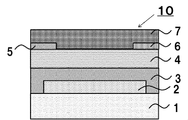
- FIG. 1 is a schematic view schematically showing the structure of a bottom gate top contact type organic thin film transistor according to the first embodiment.
- the organic thin film transistor 10 of the first embodiment is formed on a substrate 1, a gate electrode 2 provided so as to be bonded to the main surface of the substrate 1, and a substrate 1 so as to cover the gate electrode 2.
- a gate insulating layer 3 provided, an organic semiconductor layer 4 which is bonded to the gate insulating layer 3 so as to cover the gate electrode 2; and an organic semiconductor layer 4 which is bonded to the organic semiconductor layer 4;
- a source electrode 5 and a drain electrode 6 that are provided so as to be spaced apart from each other so that the channel region overlaps the gate electrode 2 when viewed in the thickness direction of the substrate 1 (in plan view) with the region interposed therebetween,
- an overcoat layer 7 provided so as to cover the gate electrode 2, the gate insulating layer 3, the organic semiconductor layer 4, the source electrode 5 and the drain electrode 6.
- FIG. 2 is a schematic diagram schematically showing the structure of the bottom gate bottom contact type organic thin film transistor 10 according to the second embodiment.
- the organic thin film transistor 10 of the second embodiment is formed on a substrate 1, a gate electrode 2 provided so as to be bonded to the main surface of the substrate 1, and a substrate 1 so as to cover the gate electrode 2.
- the provided gate insulating layer 3 is bonded to the gate insulating layer 3 so that the channel region overlaps the gate electrode 2 when viewed in the thickness direction of the substrate 1 with the channel region interposed therebetween (in plan view).
- Source electrode 5 and drain electrode 6 provided apart from each other, and provided on gate insulating layer 3 so as to straddle source electrode 5 and drain electrode 6 and include source electrode 5 and drain electrode 6 and a channel region.
- An organic semiconductor layer 4 and an overcoat layer provided to cover the gate electrode 2, the gate insulating layer 3, the organic semiconductor layer 4, the source electrode 5 and the drain electrode 6 provided on the substrate 1. It is equipped with a door.
- FIG. 3 is a schematic view schematically showing a structure of a top gate bottom contact type organic thin film transistor 10 according to the third embodiment.
- the organic thin film transistor 10 of the third embodiment spans the substrate 1, the source electrode 5 and the drain electrode 6 on the substrate 1, and the source electrode 5 and the drain electrode 6 on the substrate 1.
- the gate electrode 2 is formed on the main surface of the substrate 1 and the gate electrode 2 is provided so as to cover the gate electrode 2.
- a gate insulating layer 3 is formed on the surface of the substrate 1
- an organic semiconductor layer 4 is formed on the gate insulating layer 3
- a source electrode 5 and a drain electrode 6 are formed so as to be joined to the organic semiconductor layer 4, and further required
- it can be manufactured by forming the overcoat layer 7 so as to cover the gate electrode 2, the gate insulating layer 3, the organic semiconductor layer 4, the source electrode 5 and the drain electrode 6 provided on the substrate 1.
- the bottom gate bottom contact type organic thin film transistor 10 includes, for example, the gate electrode 2 formed on the main surface of the substrate 1 and the surface of the substrate 1 provided with the gate electrode 2 so as to cover the gate electrode 2.
- a gate insulating layer 3 is formed, a source electrode 5 and a drain electrode 6 are formed on the gate insulating layer 3, a part of the source electrode 5 and the drain electrode 6 and a channel region so as to straddle the source electrode 5 and the drain electrode 6.
- the organic semiconductor layer 4 is formed so as to cover a part of the gate insulating layer 3 including the gate electrode 2, and if necessary, the gate electrode 2, the gate insulating layer 3, the organic semiconductor layer 4, the source electrode 5 and the drain provided on the substrate 1 It can manufacture by forming the overcoat layer 7 so that the electrode 6 may be covered.
- an organic semiconductor layer is formed so that the source electrode 5 and the drain electrode 6 are formed on the main surface of the substrate 1 and straddle the source electrode 5 and the drain electrode 6. 4, a gate insulating layer 3, a gate electrode 2, and, if necessary, a source electrode 5, a drain electrode 6, an organic semiconductor layer 4, a gate insulating layer 3 and a gate provided on the substrate 1. It can manufacture by forming the overcoat layer 7 so that the electrode 2 may be covered.
- the gate insulating layer 3 a film obtained by curing the composition of the present invention described above can be used.
- the contact angle of the gate insulating layer 3 with respect to pure water is determined on the surface of the gate insulating layer 3 in consideration of the amount of fluorine atoms, hydrophobic functional groups and hydrophilic functional groups of the polymer compound in the insulating layer composition. It can be appropriately adjusted by increasing or decreasing the hydrophilicity.
- the hydrophilicity of the surface of the gate insulating layer 3 can be increased or decreased by adjusting the components of the atmosphere in which the heat treatment is performed. For example, if the drying step and the curing step (heating or baking) performed when forming the gate insulating layer 3 are performed in an atmosphere containing oxygen, the hydrophilicity of the surface of the gate insulating layer 3 increases, and the inert gas When performed in an atmosphere, the hydrophilicity of the surface of the gate insulating layer 3 is lowered. When heating is performed in an atmosphere containing oxygen, the hydrophilicity of the surface of the gate insulating layer 3 is further increased by increasing the temperature.
- the surface energy of the gate insulating layer 3 can be adjusted to an appropriate range.
- the interface with the organic semiconductor layer 4 is a good interface. be able to.
- the carrier mobility of an organic thin-film transistor can be improved more.
- the amount of fluorine atoms contained in the composition By setting the amount of fluorine atoms contained in the composition to 1% by mass or more, the hysteresis characteristics of the organic thin film transistor can be sufficiently reduced, and by setting it to 60% by mass or less, the affinity with the organic semiconductor layer can be improved.
- a good interface can be formed when the organic semiconductor layer and the gate insulating layer are bonded together while maintaining good.
- a self-assembled monolayer may be formed on the surface of the gate insulating layer 3 on the organic semiconductor layer 4 side.
- This self-assembled monolayer can be formed, for example, by treating the gate insulating layer 3 with a solution obtained by dissolving 1 to 10% by mass of an alkylchlorosilane compound or an alkylalkoxysilane compound in an organic solvent.
- alkylchlorosilane compound for forming a self-assembled monolayer examples include methyltrichlorosilane, ethyltrichlorosilane, butyltrichlorosilane, decyltrichlorosilane, octadecyltrichlorosilane, and the like.
- alkylalkoxysilane compound for forming the self-assembled monolayer include methyltrimethoxysilane, ethyltrimethoxysilane, butyltrimethoxysilane, decyltrimethoxysilane, octadecyltrimethoxysilane and the like.
- the substrate 1, the gate electrode 2, the source electrode 5, the drain electrode 6, and the organic semiconductor layer 4 may be composed of materials and methods that are usually used in conventionally known methods for manufacturing organic thin film transistors.
- a resin substrate or resin film As the substrate 1, a resin substrate or resin film, a plastic substrate or plastic film, a glass substrate, a silicon substrate, or the like is used.
- Examples of the material of the gate electrode 2, the source electrode 5, and the drain electrode 6 include chromium, gold, silver, aluminum, molybdenum, and the like.
- the gate electrode 2, the source electrode 5, and the drain electrode 6 can be formed by a known method such as a coating method such as a vapor deposition method, a sputtering method, or an ink jet printing method.
- organic semiconductor compound that is a material of the organic semiconductor layer 4
- ⁇ -conjugated polymers are widely used.
- polypyrroles, polythiophenes, polyanilines, polyallylamines, fluorenes, polycarbazoles, polyindoles, poly ( p-phenylene vinylene) and the like can be used.
- a low molecular compound having solubility in an organic solvent can be used as the organic semiconductor compound that is a material of the organic semiconductor layer 4.
- low molecular weight compounds include polycyclic aromatic derivatives such as pentacene, phthalocyanine derivatives, perylene derivatives, tetrathiafulvalene derivatives, tetracyanoquinodimethane derivatives, fullerenes, carbon nanotubes, and the like.
- Specific examples of such low molecular weight compounds include 9,9-di-n-octylfluorene-2,7-di (ethylene boronate) and 5,5′-dibromo-2,2′-. Examples include condensates with bithiophene.
- the organic semiconductor layer 4 is formed by preparing a coating solution for forming the organic semiconductor layer 4 by adding a solvent if necessary for the organic semiconductor compound, applying the coating solution, and drying the coating layer.
- the polymer compound constituting the gate insulating layer 3 has a phenyl moiety or a carbonyl moiety, and has an affinity for an organic semiconductor compound. Therefore, a uniform and flat interface can be formed between the organic semiconductor layer 4 and the gate insulating layer 3 by the coating step and the drying step.
- the solvent that can be used in the step of forming the organic semiconductor layer 4 is not particularly limited as long as it is a solvent that can dissolve or disperse the organic semiconductor compound.
- a solvent a solvent having a boiling point of 50 ° C. to 200 ° C. at normal pressure is preferable.
- examples of such solvents include chloroform, toluene, anisole, 2-heptanone, xylene, propylene glycol monomethyl ether acetate and the like.
- the coating liquid for forming the organic semiconductor layer 4 is formed by a known spin coating method, die coating method, screen printing method, ink jet printing method, or the like, as with the coating liquid for forming the insulating layer 3 described above. 1 or on the gate insulating layer 3.
- the overcoat layer 7 (protective layer) can be formed using, for example, the composition of the present invention already described, for example, in the same manner as the formation process of the gate insulating layer 3 already described. Also, an undercoat layer (not shown) can be formed in the same manner as the overcoat layer 7.
- composition of the present invention By using the composition of the present invention, a composition having good storage stability and curing at a low temperature can be obtained. As a result, the step of forming a gate insulating layer, and thus a method of manufacturing an organic thin film transistor can be more easily performed. .
- a display member including an organic thin film transistor can be produced using an organic thin film transistor produced using the composition of the present invention. Moreover, the display provided with the member for a display can be manufactured using the member for a display containing this organic thin-film transistor.
- the organic thin film transistor formed using the composition of the present invention can also be used for an OFET sensor.
- the OFET sensor is a sensor that uses an organic thin film transistor (organic field effect transistor: OFET) as a signal conversion element that converts an input signal into an electric signal and outputs the signal, and has an electrode, an insulating layer, or an organic semiconductor layer.
- OFET sensors include biosensors, gas sensors, ion sensors, and humidity sensors.
- the biosensor includes an organic thin film transistor having the configuration as described above.
- the organic thin film transistor has a probe (sensitive region) that specifically interacts with a target substance in a channel region and / or a gate insulating layer.
- concentration of the target substance is changed, the electrical characteristics of the probe are changed, so that it can function as a biosensor.
- biomolecules such as nucleic acids and proteins, or artificially synthesized functional groups are immobilized on the surface of a solid phase carrier, and these are used as probes. Is mentioned.
- This method utilizes specific affinity between substances or functional groups such as interaction of nucleic acid chains having complementary sequences, antigen-antibody reaction, enzyme-substrate reaction, receptor-ligand interaction, etc. Then, the target substance is captured with the probe of the solid phase carrier. Therefore, a substance or functional group having specific affinity for the target substance is selected as the probe.
- the probe is fixed on the surface of the solid phase carrier by a method according to the type of probe selected and the type of solid phase carrier.
- a probe can be synthesized on the surface of a solid phase carrier (for example, a probe is synthesized by a nucleic acid extension reaction).
- a probe-target substance complex is formed on the surface of the solid phase carrier by bringing the probe immobilized on the surface of the solid phase carrier into contact with the test sample and treating the sample under appropriate conditions.
- the channel region of the organic thin film transistor and / or the gate insulating layer itself may function as a probe.
- the gas sensor includes an organic thin film transistor having the configuration as described above.
- the channel region and / or the gate insulating layer functions as a gas sensitive part.
- a change occurs in the electrical characteristics (conductivity, dielectric constant, etc.) of the gas sensitive part, so that it can function as a gas sensor.
- Examples of the gas to be detected include an electron accepting gas and an electron donating gas.
- Examples of the electron-accepting gas include halogen acids such as F 2 and Cl 2 , organic acid gases such as nitrogen oxide gas, sulfur oxide gas, and acetic acid.
- Examples of the electron donating gas include amine gases such as ammonia gas and aniline, carbon monoxide gas, and hydrogen gas.
- the organic thin film transistor formed using the composition of the present invention can also be used for manufacturing a pressure sensor.
- the pressure sensor includes an organic thin film transistor having a configuration as described above.
- the channel region and / or the gate insulating layer functions as a pressure sensitive part.
- stress is applied to the pressure-sensitive part, the electrical characteristics of the pressure-sensitive part change, so that it can function as a pressure-sensitive sensor.
- the organic thin film transistor may further have an alignment layer in order to further increase the crystallinity of the organic semiconductor contained in the channel region.
- the alignment layer include a monomolecular layer provided so as to be bonded to the gate insulating layer using a silane coupling agent such as hexamethyldisilazane.
- the organic thin film transistor formed using the composition of the present invention can also be used for the production of a conductivity modulation type sensor.
- the conductivity modulation type sensor of the present invention uses a conductivity measuring element as a signal conversion element that converts an input signal into an electric signal and outputs it, and a film containing the composition of the present invention or the present invention.
- the film containing the composition is provided with a sensitivity function or a selectivity function with respect to an input to be detected.
- the conductivity modulation type sensor detects an input to be detected as a change in conductivity of the composition of the present invention. Examples of the conductivity modulation type sensor include a biosensor, a gas sensor, an ion sensor, and a humidity sensor.
- An organic thin film transistor formed using the composition of the present invention is an amplification circuit including an organic thin film transistor for amplifying output signals from various sensors such as a biosensor, a gas sensor, an ion sensor, a humidity sensor, and a pressure sensor. It can also be used for the manufacture of
- the organic thin film transistor formed using the composition of the present invention can also be used for the production of a sensor array in which a plurality of various sensors such as a biosensor, a gas sensor, an ion sensor, a humidity sensor, and a pressure sensor are integrated.
- the organic thin film transistor formed using the composition of the present invention integrates a plurality of various sensors such as biosensors, gas sensors, ion sensors, humidity sensors, and pressure sensors, and amplifies output signals from each sensor individually. Therefore, it can be used for manufacturing a sensor array with an amplifier circuit including an organic thin film transistor.
- the storage stability is evaluated by visually observing the state after production of the composition, after 2 months, 5 months, or 7 months at room temperature. When confirmed, the evaluation was completed at that time.
- the number average molecular weight and weight average molecular weight of the polymer compounds 1 to 13 were determined using gel permeation chromatography (GPC, manufactured by Tosoh Corporation). THF was used for the mobile phase of GPC. As the column, “PLgel 10 ⁇ m MIXED-B (one, manufactured by Agilent Technologies)” was used. A UV detector was used as the detector.
- Synthesis Example 1 ( Synthesis of polymer compound C) Polymer compound C was synthesized according to the following scheme. After replacing the gas in the reaction vessel with nitrogen gas, compound B-1 represented by the following formula B-1 (286.8 mg, 0.200 mmol), compound B-2 represented by the following formula B-2 ( 77.6 mg, 0.200 mmol), 19 mL of tetrahydrofuran, 7.3 mg of tris (dibenzylideneacetone) dipalladium, and 9.3 mg of tri-tert-butylphosphonium tetrafluoroborate were added and stirred.
- compound B-1 represented by the following formula B-1 (286.8 mg, 0.200 mmol)
- compound B-2 represented by the following formula B-2 ( 77.6 mg, 0.200 mmol)
- 19 mL of tetrahydrofuran 7.3 mg of tris (dibenzylideneacetone) dipalladium
- the obtained precipitate was Soxhlet washed using acetone as a solvent to obtain a polymer compound C containing a repeating unit represented by the following formula.
- the yield of the high molecular compound C was 244 mg, the number average molecular weight of polystyrene conversion was 3.1 * 10 ⁇ 4 >, and the weight average molecular weight was 6.5 * 10 ⁇ 4 >.
- Synthesis Example 2-1 Synthesis of polymer compound (1)
- Benzyl methacrylate Tokyo Kasei Co., Ltd.
- 2- [bis (ethoxycarbonyl) methyl] carbonylamino] -ethyl methacrylate Showa Denko, trade name “Karenz MOI-DEM” 1.51 g, 2, 2 Put 0.063 g of '-azobis (2-methylpropionitrile) and 21.44 g of 2-heptanone (manufactured by Tokyo Chemical Industry Co., Ltd.) into a 50 mL pressure vessel (manufactured by ACE GLASS), bubble with nitrogen gas, and seal tightly.
- the number average molecular weight in terms of polystyrene of the polymer compound (1) was 2.5 ⁇ 10 4
- the weight average molecular weight was 1.0 ⁇ 10 5 .
- Synthesis Example 2-2 ( Synthesis of polymer compound (2)) 4.19 g of styrene (manufactured by Junsei Kagaku), 3.90 g of 2,3,4,5,6-pentafluorostyrene (manufactured by Aldrich), 2- [bis (ethoxycarbonyl) methyl] carbonylamino] -ethyl methacrylate ( 2.11 g of trade name “Karenz MOI-DEM” manufactured by Showa Denko KK, 0.051 g of 2,2′-azobis (2-methylpropionitrile), 10.25 g of 2-heptanone (manufactured by Tokyo Chemical Industry Co., Ltd.) After putting in a 50 mL pressure vessel (ACE GLASS) and bubbling with nitrogen gas, it was sealed and polymerized in a 70 ° C. oil bath for 15 hours to obtain a copolymer solution. The number average molecular weight in terms of polystyrene of the polymer compound (2) was 4.2
- Synthesis Example 2-3 ( Synthesis of polymer compound (3)) 2,3,4,5,6-pentafluorostyrene (manufactured by Aldrich) 8.60 g, 2- [bis (ethoxycarbonyl) methyl] carbonylamino] -ethyl methacrylate (manufactured by Showa Denko KK, trade name “Karenz MOI- DEM ”) 1.55 g, 2,2′-azobis (2-methylpropionitrile) 0.051 g, 2-heptanone (Tokyo Kasei Co., Ltd.) 10.16 g are put into a 50 mL pressure vessel (ACE GLASS). After bubbling with nitrogen gas, it was sealed and polymerized in an oil bath at 70 ° C. for 15 hours to obtain a copolymer solution.
- the polymer compound (3) had a polystyrene-equivalent number average molecular weight of 3.6 ⁇ 10 4 and a weight average molecular weight of 7.5 ⁇ 10 4 .
- Synthesis Example 2-4 Synthesis of polymer compound (4)
- Styrene made by Junsei Kagaku
- 2- [bis (ethoxycarbonyl) methyl] carbonylamino] -ethyl methacrylate made by Showa Denko KK, trade name “Karenz MOI-DEM”) 2.52 g, 2,2 ′ -Azobis (2-methylpropionitrile) 0.050 g and propylene glycol monomethyl ether acetate (Tokyo Kasei Co., Ltd.) 15.11 g were put in a 50 mL pressure vessel (ACE GLASS Co.), bubbled with nitrogen gas, and sealed Then, polymerization was carried out in an oil bath at 70 ° C. for 16 hours to obtain a copolymer solution.
- the number average molecular weight in terms of polystyrene of the polymer compound (4) was 3.8 ⁇ 10 4
- the weight average molecular weight was 7.3 ⁇ 10 4 .
- Synthesis Example 2-5 ( Synthesis of polymer compound (5)) 6.76 g of methyl methacrylate (manufactured by Wako Pure Chemical Industries, Ltd.), 2.37 g of 2- [bis (ethoxycarbonyl) methyl] carbonylamino] -ethyl methacrylate (manufactured by Showa Denko KK, trade name “Karenz MOI-DEM”), 2 , 2'-azobis (2-methylpropionitrile) 0.099g, 2-heptanone (Tokyo Kasei Co., Ltd.) 21.52g was placed in a 50 mL pressure vessel (ACE GLASS Co.) and bubbled with nitrogen gas. The solution was sealed and polymerized in an oil bath at 70 ° C. for 18 hours to obtain a copolymer solution.
- the number average molecular weight in terms of polystyrene of the polymer compound (5) was 2.0 ⁇ 10 4
- the weight average molecular weight was 7.4 ⁇ 10 4 .
- Synthesis Example 2-6 ( Synthesis of polymer compound (6)) 2,3,4,5,6-pentafluorobenzyl methacrylate (Sinquest Laboratories) 8.15 g, 2- [bis (ethoxycarbonyl) methyl] carbonylamino] -ethyl methacrylate (Showa Denko, trade name) "Karenz MOI-DEM”) 1.07g, 2,2'-azobis (2-methylpropionitrile) 0.045g, 2-heptanone (manufactured by Tokyo Chemical Industry Co., Ltd.) 21.61g, 50mL pressure vessel (ACE GLASS) And then bubbled with nitrogen gas, sealed and polymerized in an oil bath at 70 ° C. for 18 hours to obtain a copolymer solution.
- the number average molecular weight in terms of polystyrene of the polymer compound (6) was 2.7 ⁇ 10 4 , and the weight average molecular weight was 1.2 ⁇ 10 5 .
- Synthesis Example 2-7 ( Synthesis of polymer compound (7)) 6.81 g of 2,2,2-trifluoroethyl methacrylate (manufactured by Tokyo Chemical Industry Co., Ltd.), 2- [bis (ethoxycarbonyl) methyl] carbonylamino] -ethyl methacrylate (manufactured by Showa Denko KK, trade name “Karenz MOI-DEM” ) 1.42 g, 2,2′-azobis (2-methylpropionitrile) 0.059 g, propylene glycol monomethyl ether acetate (manufactured by Tokyo Chemical Industry Co., Ltd.) 19.34 g are placed in a 50 mL pressure vessel (manufactured by ACE GLASS).
- the polymer compound (7) had a polystyrene equivalent number average molecular weight of 3.2 ⁇ 10 4 and a weight average molecular weight of 8.7 ⁇ 10 4 .
- Synthesis Example 2-8 ( Synthesis of polymer compound (8)) Benzyl methacrylate (manufactured by Tokyo Chemical Industry Co., Ltd.) 8.25 g, 4-hydroxybutyl acrylate (manufactured by Nippon Kasei Co., Ltd.) 1.00 g, 2,2′-azobis (2-methylpropionitrile) 0.068 g, 2-heptanone (Tokyo) 21.73 g (made by Kasei Co., Ltd.) was put into a 50 mL pressure vessel (made by ACE GLASS), bubbled with nitrogen gas, sealed, and polymerized in an oil bath at 70 ° C. for 18 hours to obtain a copolymer solution. .
- the number average molecular weight in terms of polystyrene of the polymer compound (8) was 2.8 ⁇ 10 4 , and the weight average molecular weight was 1.0 ⁇ 10 5 .
- Synthesis Example 2-9 ( Synthesis of polymer compound (9)) 4.69 g of styrene (manufactured by Junsei Kagaku), 4.37 g of 2,3,4,5,6-pentafluorostyrene (manufactured by Aldrich), 1.08 g of 4-hydroxybutyl acrylate (manufactured by Nippon Kasei Co., Ltd.), 2, 0.051 g of 2′-azobis (2-methylpropionitrile) and 10.19 g of 2-heptanone (manufactured by Tokyo Chemical Industry Co., Ltd.) were put in a 50 mL pressure vessel (manufactured by ACE GLASS), bubbled with nitrogen gas, and then sealed.
- the number average molecular weight in terms of polystyrene of the polymer compound (9) was 5.0 ⁇ 10 4 , and the weight average molecular weight was 1.1 ⁇ 10 5 .
- Synthesis Example 2-10 ( Synthesis of polymer compound (10)) 9.26 g of 2,3,4,5,6-pentafluorostyrene (manufactured by Aldrich), 0.76 g of 4-hydroxybutyl acrylate (manufactured by Nippon Kasei Co., Ltd.), 2,2′-azobis (2-methylpropionitrile) ) Put 0.050 g, 10.07 g of 2-heptanone (Tokyo Kasei Co., Ltd.) in a 50 mL pressure vessel (ACE GLASS), bubble with nitrogen gas, seal tightly, and in an oil bath at 70 ° C. for 15 hours A copolymer solution was obtained by polymerization. The number average molecular weight in terms of polystyrene of the polymer compound (10) was 3.9 ⁇ 10 4 , and the weight average molecular weight was 7.4 ⁇ 10 4 .
- Synthesis Example 2-11 ( Synthesis of polymer compound (11)) 9.37 g of styrene (manufactured by Junsei Co., Ltd.), 1.30 g of 2-hydroxyethyl methacrylate (manufactured by Tokyo Chemical Industry Co., Ltd.), 0.053 g of 2,2′-azobis (2-methylpropionitrile), propylene glycol monomethyl ether acetate 16.09 g (manufactured by Tokyo Chemical Industry Co., Ltd.) is put into a 50 mL pressure vessel (manufactured by ACE GLASS), bubbled with nitrogen gas, sealed, and polymerized in a 70 ° C. oil bath for 16 hours to obtain a copolymer solution. Obtained.
- the number average molecular weight in terms of polystyrene of the polymer compound (11) was 3.3 ⁇ 10 4
- the weight average molecular weight was 6.2 ⁇ 10 4 .
- Synthesis Example 2-12 ( Synthesis of polymer compound (12)) 9.37 g of styrene (manufactured by Junsei Kagaku), 1.44 g of 4-hydroxybutyl acrylate (manufactured by Nippon Kasei Co., Ltd.), 0.054 g of 2,2′-azobis (2-methylpropionitrile), cyclopentanol (Tokyo Kasei) 16.30 g was put into a 50 mL pressure vessel (ACE GLASS), bubbled with nitrogen gas, sealed, and polymerized in a 70 ° C. oil bath for 16 hours to obtain a copolymer solution. The number average molecular weight in terms of polystyrene of the polymer compound (12) was 5.4 ⁇ 10 4 , and the weight average molecular weight was 1.3 ⁇ 10 5 .
- Synthesis Example 2-13 Synthesis of polymer compound (13)) Styrene (made by Junsei Kagaku) 12.19g, 4-hydroxybutyl acrylate (made by Nippon Kasei Co., Ltd.) 1.87g, 2,2'-azobis (2-methylpropionitrile) 0.070g, propylene glycol monomethyl ether acetate ( 14.13 g (manufactured by Tokyo Chemical Industry Co., Ltd.) is put in a 50 mL pressure vessel (ACE GLASS), bubbled with nitrogen gas, sealed, and polymerized in an oil bath at 70 ° C. for 16 hours to obtain a copolymer solution. It was.
- the number average molecular weight in terms of polystyrene of the polymer compound (13) was 3.9 ⁇ 10 4 , and the weight average molecular weight was 8.6 ⁇ 10 4 .
- Synthesis Example 2-14 ( Synthesis of polymer compound (14)) Methyl methacrylate (Wako Pure Chemical Industries, Ltd.) 7.75 g, 4-hydroxybutyl acrylate (Nippon Kasei Co., Ltd.) 1.24 g, 2,2′-azobis (2-methylpropionitrile) 0.113 g, 2-heptanone 21.24 g (manufactured by Tokyo Chemical Industry Co., Ltd.) is put in a 50 mL pressure vessel (manufactured by ACE GLASS), bubbled with nitrogen gas, sealed, and polymerized in an oil bath at 70 ° C. for 18 hours to obtain a copolymer solution. Obtained.
- the number average molecular weight in terms of polystyrene of the polymer compound (14) was 1.9 ⁇ 10 4 , and the weight average molecular weight was 5.5 ⁇ 10 4 .
- Synthesis Example 2-15 Synthesis of polymer compound (15)) 2,3,4,5,6-pentafluorobenzyl methacrylate (made by Synquest Laboratories) 8.62 g, 4-hydroxybutyl acrylate (made by Nippon Kasei Co., Ltd.) 0.52 g, 2,2′-azobis (2- Methylpropionitrile (0.049 g) and 2-heptanone (Tokyo Kasei Co., Ltd.) (21.44 g) were placed in a 50 mL pressure vessel (ACE GLASS), bubbled with nitrogen gas, sealed, and oil bath at 70 ° C. The solution was polymerized for 18 hours to obtain a copolymer solution.
- the number average molecular weight in terms of polystyrene of the polymer compound (15) was 3.0 ⁇ 10 4 , and the weight average molecular weight was 9.9 ⁇ 10 4 .
- Synthesis Example 2-16 ( Synthesis of polymer compound (16)) Benzyl methacrylate (Tokyo Kasei Co., Ltd.) 8.41 g, 2-hydroxypropyl methacrylate (Tokyo Kasei Co., Ltd.) 0.76 g, 2,2′-azobis (2-methylpropionitrile) 0.070 g, 2-heptanone (Tokyo) 21.57 g (made by Kasei Co., Ltd.) was put in a 50 mL pressure vessel (made by ACE GLASS), bubbled with nitrogen gas, sealed, and polymerized in an oil bath at 70 ° C. for 18 hours to obtain a copolymer solution. .
- the number average molecular weight in terms of polystyrene of the polymer compound (16) was 2.3 ⁇ 10 4 , and the weight average molecular weight was 9.7 ⁇ 10 4 .
- Synthesis Example 2-17 ( Synthesis of polymer compound (17)) 2,2,2-trifluoroethyl methacrylate (Tokyo Kasei Co., Ltd.) 7.57 g, 4-hydroxybutyl acrylate (Nihon Kasei Co., Ltd.) 0.72 g, 2,2′-azobis (2-methylpropionitrile) 0 0.066 g and 19.49 g of propylene glycol monomethyl ether acetate (manufactured by Tokyo Chemical Industry Co., Ltd.) are placed in a 50 mL pressure vessel (ACE GLASS), bubbled with nitrogen gas, sealed, and 18 hours in a 70 ° C. oil bath. A copolymer solution was obtained by polymerization. The number average molecular weight of polystyrene conversion of the high molecular compound (17) was 2.2 ⁇ 10 4 , and the weight average molecular weight was 6.9 ⁇ 10 4 .
- Example 1 A 1.00 g 2-heptanone solution of polymer compound (1) obtained in Synthesis Example 2-1 and 0.38 g of cyclopentanol were placed in a 5 mL sample bottle and stirred to obtain a uniform solution. 0.91 g of a 2-heptanone solution of the polymer compound (8) obtained in 2-8 was added and stirred to obtain a uniform solution. Even if it was allowed to stand at room temperature for 2 months, it did not gel.
- Example 2 After putting 1.00 g of the 2-heptanone solution of the polymer compound (1) obtained in Synthesis Example 2-1 and 0.38 g of methanol into a 5 mL sample bottle and stirring to obtain a uniform solution, Synthesis Example 2- 0.91 g of a 2-heptanone solution of the polymer compound (8) obtained in 8 was added and stirred to obtain a uniform solution. Even if it was allowed to stand at room temperature for 2 months, it did not gel.
- Example 3 After putting 1.00 g of 2-heptanone solution of the polymer compound (1) obtained in Synthesis Example 2-1 and 0.38 g of ethoxyethanol into a 5 mL sample bottle and stirring to obtain a uniform solution, Synthesis Example 2 A homogeneous solution was obtained by adding 0.91 g of a 2-heptanone solution of the polymer compound (8) obtained in ⁇ 8 and stirring. Even if it was allowed to stand at room temperature for 2 months, it did not gel.
- Comparative Example 1 1.00 g of 2-heptanone solution of polymer compound (1) obtained in Synthesis Example 2-1 and 0.38 g of 2-heptanone were placed in a 5 mL sample bottle and stirred to obtain a uniform solution. By adding 0.91 g of 2-heptanone solution of the polymer compound (8) obtained in 2-8 and stirring, a uniform solution was obtained. When left at room temperature for 3 days, it gelled.
- Comparative Example 2 1.00 g of 2-heptanone solution of polymer compound (1) obtained in Synthesis Example 2-1 and 0.38 g of diethyl malonate are placed in a 5 mL sample bottle and stirred to obtain a uniform solution. By adding 0.91 g of 2-heptanone solution of the polymer compound (8) obtained in 2-8 and stirring, a uniform solution was obtained. When left at room temperature for 3 days, it gelled.
- Example 4 After putting 1.00 g of 2-heptanone solution of the polymer compound (2) obtained in Synthesis Example 2-2 and 0.38 g of methanol into a 5 mL sample bottle and stirring to obtain a uniform solution, Synthesis Example 2- By adding 0.88 g of the 2-heptanone solution of the polymer compound (9) obtained in 9 and stirring, a homogeneous solution was obtained. Even if it was allowed to stand at room temperature for 5 months, it did not gel.
- Example 5 After putting 1.50 g of the 2-heptanone solution of the polymer compound (3) obtained in Synthesis Example 2-3 and 0.92 g of methanol into a 5 mL sample bottle and stirring to obtain a uniform solution, Synthesis Example 2- A homogeneous solution was obtained by adding 0.69 g of the 2-heptanone solution of the polymer compound (10) obtained in 10 and stirring. Even if it was allowed to stand at room temperature for 5 months, it did not gel.
- Example 6 A PGMEA solution 1.50 g of the polymer compound (4) obtained in Synthesis Example 2-4 and 0.48 g of cyclopentanol were placed in a 5 mL sample bottle and stirred to obtain a uniform solution. The PGMEA solution 0.80 g of the polymer compound (11) obtained in 11 was added and stirred to obtain a uniform solution. Gelation did not occur even after standing at room temperature for 7 months.
- Comparative Example 6 A 1.50 g PGMEA solution of the polymer compound (4) obtained in Synthesis Example 2-4 and 0.48 g of PGMEA were placed in a 5 mL sample bottle and stirred to obtain a uniform solution, and then obtained in Synthesis Example 2-11. Then, 0.80 g of PGMEA solution of the polymer compound (11) was added and stirred to obtain a homogeneous solution. Gelation occurred when left at room temperature for 4 days.
- Example 7 A PGMEA solution 1.50 g of the polymer compound (4) obtained in Synthesis Example 2-4 and 0.91 g of cyclopentanol were placed in a 5 mL sample bottle and stirred to obtain a uniform solution. A uniform solution was obtained by adding 1.08 g of the cyclopentanol solution of the polymer compound (12) obtained in No. 12 and stirring. Gelation did not occur even after standing at room temperature for 7 months.
- Example 8 A PGMEA solution 1.50 g of the polymer compound (4) obtained in Synthesis Example 2-4 and 0.91 g of cyclopentanol were placed in a 5 mL sample bottle and stirred to obtain a uniform solution. A uniform solution was obtained by adding 1.08 g of the PGMEA solution of the polymer compound (13) obtained in 13 and stirring. Gelation did not occur even after standing at room temperature for 7 months.
- Comparative Example 7 A 1.50 g PGMEA solution of the polymer compound (4) obtained in Synthesis Example 2-4 and 0.91 g of PGMEA were placed in a 5 mL sample bottle and stirred to obtain a uniform solution, and then obtained in Synthesis Example 2-13. Then, 1.08 g of the PGMEA solution of the polymer compound (13) was added and stirred to obtain a uniform solution. Gelation occurred when left at room temperature for 4 days.
- Example 9 A 0.71 g 2-heptanone solution of polymer compound (5) obtained in Synthesis Example 2-5 and 0.42 g of cyclopentanol were placed in a 5 mL sample bottle and stirred to obtain a uniform solution. A uniform solution was obtained by adding 1.38 g of a 2-heptanone solution of the polymer compound (14) obtained in 2-14 and stirring. Even if it was allowed to stand at room temperature for 2 months, it did not gel.
- Example 10 A 2.00 g 2-heptanone solution of the polymer compound (6) obtained in Synthesis Example 2-6 and 0.78 g of cyclopentanol were placed in a 10 mL sample bottle and stirred to obtain a uniform solution. A uniform solution was obtained by adding 1.87 g of a 2-heptanone solution of the polymer compound (15) obtained in 2-15 and stirring. Even if it was allowed to stand at room temperature for 2 months, it did not gel.
- Example 11 A 1.00 g 2-heptanone solution of the polymer compound (5) obtained in Synthesis Example 2-5 and 0.38 g of benzyl alcohol were placed in a 5 mL sample bottle and stirred to obtain a uniform solution.
- Synthesis Example 2 A homogeneous solution was obtained by adding 0.91 g of the 2-heptanone solution of the polymer compound (16) obtained in ⁇ 16 and stirring to dissolve. Even if it was allowed to stand at room temperature for 2 months, it did not gel.
- Comparative Example 10 1.00 g of the 2-heptanone solution of polymer compound (5) obtained in Synthesis Example 2-5 and 0.38 g of 2-heptanone are placed in a 5 mL sample bottle and stirred to obtain a uniform solution. A uniform solution was prepared by adding 0.91 g of a 2-heptanone solution of the polymer compound (16) obtained in 2-16 and stirring. Gelation occurred after standing at room temperature for 7 days.
- Example 12 A 1.00 g 2-heptanone solution of the polymer compound (7) obtained in Synthesis Example 2-7 and 0.95 g of cyclopentanol were placed in a 5 mL sample bottle and stirred to obtain a uniform solution. A uniform solution was obtained by adding 0.91 g of a 2-heptanone solution of the polymer compound (17) obtained in 2-17 and stirring. Even if it was allowed to stand at room temperature for 2 months, it did not gel.
- Comparative Example 11 1.00 g of 2-heptanone solution of polymer compound (7) obtained in Synthesis Example 2-7 and 0.95 g of 2-heptanone were placed in a 5 mL sample bottle and stirred to obtain a uniform solution. A uniform solution was obtained by adding 0.91 g of a 2-heptanone solution of the polymer compound (17) obtained in 2-17 and stirring. When left at room temperature for 3 days, it gelled.
- Example 13 Manufacture and Evaluation of Insulating Layer
- the solution obtained in Example 5 was spin-coated on a glass substrate with a chromium electrode. Then, the insulating layer with a film thickness of 600 nm was obtained by drying for 30 minutes at 130 ° C. on a hot plate.
- an MIM (Metal Insulator Metal) element was produced by forming an aluminum electrode by vapor deposition using a metal mask. Evaluation as a composition for an insulating layer was performed by evaluating the electrical characteristics of the MIN element.
- the dielectric strength of the manufactured MIM element was measured using a vacuum probe (manufactured by Nagase Electronic Equipments Service Co., LTD, BCT22MDC-5-HT-SCU).
- the withstand voltage was evaluated by an electrolytic strength at which a leak current was 1 ⁇ 10 ⁇ 9 A / cm 2 when an electric field was applied between the electrodes.
- the value of the electric field strength at which the leakage current becomes 1 ⁇ 10 ⁇ 9 A / cm 2 was> 3.0 MV / cm.
- Example 14 (Production and Evaluation of Organic Thin Film Transistor (1)) Using the solution obtained in Example 5, a top gate bottom contact type organic thin film transistor (1) was manufactured, which will be specifically described below.
- a source electrode and a drain electrode were formed on a glass substrate by stacking chromium and gold in this order from the substrate side by sputtering and patterning by photolithography.
- the channel length of the source electrode and the drain electrode was 10 ⁇ m, and the channel width was 2 mm.
- the surface of the electrode (particularly gold) formed on the glass substrate was modified by immersing the glass substrate in a diluted solution of perfluorobenzenethiol in isopropyl alcohol for 2 minutes.
- the toluene solution of 0.5% by mass of the polymer compound C obtained in Synthesis Example 1 is spin-coated on the source electrode and the drain electrode side, and heat-treated at 120 ° C. for 30 minutes using a hot plate, An organic semiconductor layer was formed.
- Example 5 On this organic semiconductor layer, the solution obtained in Example 5 was applied by a spin coating method, and the formed application layer was heat-treated at 130 ° C. for 30 minutes to form a cured film in which the application layer was cured. A gate insulating layer was formed. The formed gate insulating layer had a thickness of 991 nm.
- an organic thin film transistor (1) was obtained by forming a gate electrode by depositing aluminum on the gate insulating layer by vapor deposition.
- the obtained organic thin film transistor (1) was evaluated. Specifically, using a vacuum probe (BCT22MDC-5-HT-SCU; manufactured by Nagase Electronic Equipment Service Co., LTD), a voltage is applied to the gate electrode of the organic thin film transistor (1) to obtain a gate voltage Vg. The carrier mobility was measured under the condition that the source-drain voltage Vsd was changed from 0 V to -40 V while the voltage was changed from 20 V to -40 V. The carrier mobility of the organic thin film transistor (1) was 0.41 cm 2 / Vs.
Landscapes
- Chemical & Material Sciences (AREA)
- Health & Medical Sciences (AREA)
- Chemical Kinetics & Catalysis (AREA)
- Medicinal Chemistry (AREA)
- Polymers & Plastics (AREA)
- Organic Chemistry (AREA)
- Physics & Mathematics (AREA)
- Spectroscopy & Molecular Physics (AREA)
- Addition Polymer Or Copolymer, Post-Treatments, Or Chemical Modifications (AREA)
- Compositions Of Macromolecular Compounds (AREA)
- Organic Insulating Materials (AREA)
Abstract
室温条件下でも保存安定性が高い、組成物を提供することを課題とする。 本発明は、式(1)で表される繰り返し単位を有する高分子化合物(A)と、式(2)で表される繰り返し単位を有する高分子化合物(B)と、式(3)で表される化合物とを含有する組成物を提供する。 また、本発明は、前記高分子化合物(A)、及び前記高分子化合物(B)からなる群より選ばれる少なくとも一種の高分子化合物が、式(4)で表される繰り返し単位をさらに含む高分子化合物である、上記組成物を提供する。
Description
本発明は、組成物に関する。
例えば、有機薄膜トランジスタの分野では、絶縁層用の組成物として、低温で硬化する組成物が求められている。
低温で硬化する組成物としては、2-イソシアナトエチルメタクリレート及びマロン酸ジエチルエステルを反応させて得られる生成物と、スチレンと、メチルメタクリレートと、2-ブチルアクリレートと、2-ヒドロキシエチルメタクリレートとを、シクロヘキサノンの存在下で共重合することで得られる組成物が報告されている(特許文献1)。
低温で硬化する組成物としては、2-イソシアナトエチルメタクリレート及びマロン酸ジエチルエステルを反応させて得られる生成物と、スチレンと、メチルメタクリレートと、2-ブチルアクリレートと、2-ヒドロキシエチルメタクリレートとを、シクロヘキサノンの存在下で共重合することで得られる組成物が報告されている(特許文献1)。
しかしながら、上述の特許文献1に記載された組成物では、室温条件下における保存安定性が必ずしも十分ではなかった。
本発明の目的は、室温条件下において保存安定性のよい組成物を提供することにある。
即ち、本発明の実施態様は、下記[1]~[6]に記載の発明を提供する。
[1] 下記式(1)で表される繰り返し単位を有する高分子化合物(A)と、
下記式(2)で表される繰り返し単位を有する高分子化合物(B)と、
下記式(3)で表される化合物と
を含有する組成物。
[1] 下記式(1)で表される繰り返し単位を有する高分子化合物(A)と、
下記式(2)で表される繰り返し単位を有する高分子化合物(B)と、
下記式(3)で表される化合物と
を含有する組成物。

(式(1)中、
R1、R2及びR3は、互いに異なっていてもよく、水素原子、フッ素原子、又は炭素原子数1~20の1価の有機基を表す。
R4及びR5は、互いに異なっていてもよく、炭素原子数1~20のアルキル基、又は炭素原子数3~20のシクロアルキル基を表す。該アルキル基、又はシクロアルキル基中の水素原子は、炭素原子数3~20のシクロアルキル基、炭素原子数1~20のアルコキシ基、炭素原子数3~20のシクロアルコキシ基、炭素原子数6~20の1価の芳香族炭化水素基、又はフッ素原子で置換されていてもよい。
Raは、炭素原子数1~20の2価の有機基を表す。
Xは、酸素原子、又は-NRn-で表される基を表す。Rnは、水素原子又は炭素原子数1~20の1価の有機基を表す。
lは、1~6の整数を表す。
Raが複数個ある場合、それらは互いに異なっていてもよい。
*は、結合位置を表す。)
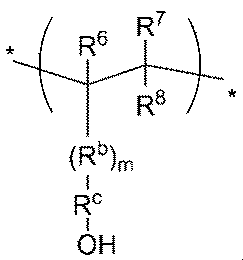
(式(2)中、
R6、R7及びR8は、互いに異なっていてもよく、水素原子、フッ素原子、又は炭素原子数1~20の1価の有機基を表す。
Rbは、炭素原子数1~20の2価の有機基、-O-で表される基、-CO-で表される基、-COO-で表される基、-NHCO-で表される基、又は-NHCOO-で表される基を表す。-O-で表される基、-CO-で表される基、-COO-で表される基、-NHCO-で表される基、及び-NHCOO-で表される基の2つの結合手は、どちらが、R6が結合する炭素原子側に位置していてもよい。
Rcは、単結合、又は炭素原子数1~20の2価の有機基を表す。
mは、0~6の整数を表す。
Rbが複数個ある場合、それらは互いに異なっていてもよい。
*は、結合位置を表す。)

(式(3)中、
R9は、炭素原子数1~20のアルキル基、炭素原子数3~20のシクロアルキル基、又は炭素原子数2~20の下記式(6)で表される基を表す。該アルキル基、シクロアルキル基、又は下記式(6)で表される基中の水素原子は、炭素原子数3~20のシクロアルキル基、炭素原子数1~20のアルコキシ基、炭素原子数3~20のシクロアルコキシ基、炭素原子数6~20の1価の芳香族炭化水素基、又はフッ素原子で置換されていてもよい。)

(式(6)中、
R15は、炭素原子数1~6の2価の直鎖状脂肪族炭化水素基を表し、
R16は、炭素原子数1~19の1価の直鎖状脂肪族炭化水素基を表し、
qは、1~19の整数を表す。
ただし、R15、R16、及びqは、全体の炭素原子数が2~20になるように調整される。)
[2] 前記高分子化合物(A)、及び前記高分子化合物(B)からなる群より選ばれる少なくとも一種の高分子化合物が、下記式(4)で表される繰り返し単位をさらに含む高分子化合物である、[1]に記載の組成物。
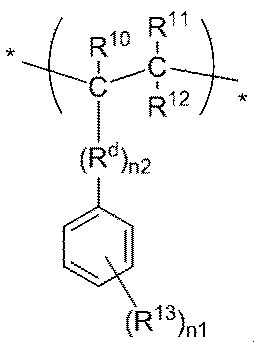
(式(4)中、
R10、R11、及びR12は、互いに異なっていてもよく、水素原子、フッ素原子、又は炭素原子数1~20の1価の有機基を表す。
R13は、塩素原子、フッ素原子、臭素原子、ヨウ素原子、又は炭素原子数1~20の1価の有機基を表す。
Rdは、炭素原子数1~20の2価の有機基、-O-で表される基、-CO-で表される基、-COO-で表される基、-NHCO-で表される基、又は-NHCOO-で表される基を表す。これらの-O-で表される基、-CO-で表される基、-COO-で表される基、-NHCO-で表される基、及び-NHCOO-で表される基の2つの結合手は、どちらが、R10が結合する炭素原子側に位置していてもよい。Rdで表される2価の有機基中の水素原子は、フッ素原子で置換されていてもよい。
n1は、0~5の整数を表す。
n2は、0~6の整数を表す。
Rdが複数個ある場合、それらは互いに異なっていてもよい。
R13が複数個ある場合、それらは互いに異なっていてもよい。
*は、結合位置を表す。)
[3] 前記式(3)中、R9が、炭素原子数1~20のアルキル基、又は炭素原子数3~20のシクロアルキル基である(該アルキル基、又はシクロアルキル基中の水素原子は、炭素原子数3~20のシクロアルキル基、炭素原子数1~20のアルコキシ基、炭素原子数3~20のシクロアルコキシ基、又は、炭素原子数6~20の1価の芳香族炭化水素基で置換されていてもよい。)、[1]又は[2]に記載の組成物。
[4] 組成物に含まれる前記式(3)で表される化合物が、1質量%以上90質量%以下である、[1]~[3]のいずれか1つに記載の組成物。
[5] 電子デバイスに用いられる、[1]~[4]のいずれか1つに記載の組成物を含む、絶縁層用組成物。
[6] 前記電子デバイスが有機薄膜トランジスタである、[5]に記載の絶縁層用組成物。
[7] [1]~[4]のいずれか1つに記載の組成物が硬化した膜をゲート絶縁層として含む、有機薄膜トランジスタ。
本発明によれば、室温条件下でも保存安定性が高い、組成物を提供することができる。
次に、本発明の実施形態についてさらに詳細に説明する。なお、参照される各図面は、発明が理解できる程度に、構成要素の形状、大きさ、及び配置が概略的に示されているに過ぎない。本発明は以下の記述によって限定されるものではなく、各構成要素は本発明の要旨を逸脱しない範囲において適宜変更可能である。説明に用いられる図面において、同様の構成要素については同一の符号を付して示し、重複する説明については省略する場合がある。また、本発明の実施形態にかかる構成は、必ずしも図面に示された配置で、製造されたり、使用されたりするわけではない。
<共通する用語の説明>
本明細書で共通して用いられる用語は、特記しない限り、以下の意味である。
本明細書で共通して用いられる用語は、特記しない限り、以下の意味である。
「高分子化合物」とは、分子中に互いに異なっていてもよい複数の構造単位(繰り返し単位)を含む化合物を意味しており、いわゆる2量体も「高分子化合物」に含まれる。また、本明細書において、「低分子化合物」とは、分子中に複数の構造単位を含んでいない化合物を意味する。
炭素原子数1~20の1価の有機基は、直鎖状、分岐状、環状のいずれの態様であってもよく、脂肪族炭化水素基であっても芳香族炭化水素基であってもよい。
炭素原子数1~20の1価の有機基としては、例えば、
炭素原子数1~20の1価の直鎖状脂肪族炭化水素基、炭素原子数3~20の1価の分岐状脂肪族炭化水素基、炭素原子数3~20の1価の脂環式炭化水素基、炭素原子数6~20の1価の芳香族炭化水素基、炭素原子数1~20のアルコキシ基、炭素原子数6~20のアリールオキシ基、炭素原子数2~20のアシル基、炭素原子数2~20のアルコキシカルボニル基、及び炭素原子数7~20のアリールオキシカルボニル基が挙げられる。
これらの基は、基中の水素原子が、炭素原子数1~20のアルキル基、炭素原子数3~20のシクロアルキル基、炭素原子数1~20のアルコキシ基、炭素原子数3~20のシクロアルコキシ基、炭素原子数6~20の1価の炭化水素基、又はハロゲン原子で置換されていてもよい。
炭素原子数1~20の1価の直鎖状脂肪族炭化水素基、炭素原子数3~20の1価の分岐状脂肪族炭化水素基、炭素原子数3~20の1価の脂環式炭化水素基、炭素原子数6~20の1価の芳香族炭化水素基、炭素原子数1~20のアルコキシ基、炭素原子数6~20のアリールオキシ基、炭素原子数2~20のアシル基、炭素原子数2~20のアルコキシカルボニル基、及び炭素原子数7~20のアリールオキシカルボニル基が挙げられる。
これらの基は、基中の水素原子が、炭素原子数1~20のアルキル基、炭素原子数3~20のシクロアルキル基、炭素原子数1~20のアルコキシ基、炭素原子数3~20のシクロアルコキシ基、炭素原子数6~20の1価の炭化水素基、又はハロゲン原子で置換されていてもよい。
1価の有機基は、好ましくは、
炭素原子数1~6の1価の直鎖状脂肪族炭化水素基、炭素原子数3~6の1価の分岐状脂肪族炭化水素基、炭素原子数3~6の1価の脂環式炭化水素基、炭素原子数6~20の1価の芳香族炭化水素基、炭素原子数1~6のアルコキシ基、炭素原子数6~20のアリールオキシ基、炭素原子数2~7のアシル基、炭素原子数2~7のアルコキシカルボニル基、及び炭素原子数7~20のアリールオキシカルボニル基である。
これらの基は、基中の水素原子が、炭素原子数1~20のアルキル基、炭素原子数3~20のシクロアルキル基、炭素原子数1~20のアルコキシ基、炭素原子数3~20のシクロアルコキシ基、炭素原子数6~20の1価の炭化水素基、又はハロゲン原子で置換されていてもよい。
炭素原子数1~6の1価の直鎖状脂肪族炭化水素基、炭素原子数3~6の1価の分岐状脂肪族炭化水素基、炭素原子数3~6の1価の脂環式炭化水素基、炭素原子数6~20の1価の芳香族炭化水素基、炭素原子数1~6のアルコキシ基、炭素原子数6~20のアリールオキシ基、炭素原子数2~7のアシル基、炭素原子数2~7のアルコキシカルボニル基、及び炭素原子数7~20のアリールオキシカルボニル基である。
これらの基は、基中の水素原子が、炭素原子数1~20のアルキル基、炭素原子数3~20のシクロアルキル基、炭素原子数1~20のアルコキシ基、炭素原子数3~20のシクロアルコキシ基、炭素原子数6~20の1価の炭化水素基、又はハロゲン原子で置換されていてもよい。
炭素原子数1~20の1価の有機基の具体例としては、
メチル基、エチル基、プロピル基、ブチル基、ペンチル基、ヘキシル基、イソプロピル基、イソブチル基、tert-ブチル基、シクロプロピル基、シクロブチル基、シクロペンチル基、シクロヘキシル基、シクロペンチニル基、シクロヘキシニル基、トリフルオロメチル基、トリフルオロエチル基、フェニル基、ナフチル基、アントリル基、トリル基、キシリル基、ジメチルフェニル基、トリメチルフェニル基、エチルフェニル基、ジエチルフェニル基、トリエチルフェニル基、プロピルフェニル基、ブチルフェニル基、メチルナフチル基、ジメチルナフチル基、トリメチルナフチル基、ビニルナフチル基、エテニルナフチル基、メチルアントリル基、エチルアントリル基、ペンタフルオロフェニル基、トリフルオロメチルフェニル基、クロロフェニル基、ブロモフェニル基、メトキシ基、エトキシ基、フェノキシ基、アセチル基、ベンゾイル基、メトキシカルボニル基、フェノキシカルボニル基、ベンジル基などが挙げられる。
メチル基、エチル基、プロピル基、ブチル基、ペンチル基、ヘキシル基、イソプロピル基、イソブチル基、tert-ブチル基、シクロプロピル基、シクロブチル基、シクロペンチル基、シクロヘキシル基、シクロペンチニル基、シクロヘキシニル基、トリフルオロメチル基、トリフルオロエチル基、フェニル基、ナフチル基、アントリル基、トリル基、キシリル基、ジメチルフェニル基、トリメチルフェニル基、エチルフェニル基、ジエチルフェニル基、トリエチルフェニル基、プロピルフェニル基、ブチルフェニル基、メチルナフチル基、ジメチルナフチル基、トリメチルナフチル基、ビニルナフチル基、エテニルナフチル基、メチルアントリル基、エチルアントリル基、ペンタフルオロフェニル基、トリフルオロメチルフェニル基、クロロフェニル基、ブロモフェニル基、メトキシ基、エトキシ基、フェノキシ基、アセチル基、ベンゾイル基、メトキシカルボニル基、フェノキシカルボニル基、ベンジル基などが挙げられる。
炭素原子数1~20の1価の有機基としては、炭素原子数1~20のアルキル基、又は炭素原子数3~20のシクロアルキル基が好ましい。
炭素原子数1~20のアルキル基は、直鎖状、分岐状のいずれでもよい。
炭素原子数1~20のアルキル基としては、例えば、
メチル基、エチル基、プロピル基、イソプロピル基、ブチル基、ペンチル基、イソアミル基、2-エチルブチル基、ヘキシル基、ヘプチル基、オクチル基、2-エチルヘキシル基、3-プロピルヘプチル基、デシル基、3,7-ジメチルオクチル基、2-エチルオクチル基、2-ヘキシルデシル基、ドデシル基が挙げられる。
炭素原子数1~20のアルキル基としては、例えば、
メチル基、エチル基、プロピル基、イソプロピル基、ブチル基、ペンチル基、イソアミル基、2-エチルブチル基、ヘキシル基、ヘプチル基、オクチル基、2-エチルヘキシル基、3-プロピルヘプチル基、デシル基、3,7-ジメチルオクチル基、2-エチルオクチル基、2-ヘキシルデシル基、ドデシル基が挙げられる。
炭素原子数1~20のアルキル基は、置換基として、炭素原子数3~20のシクロアルキル基、炭素原子数1~20のアルコキシ基、炭素原子数3~20のシクロアルコキシ基、炭素原子数6~20の1価の芳香族炭化水素基、又はフッ素原子を有していてもよい。
置換基を有する炭素原子数1~20のアルキル基としては、例えば、
トリフルオロメチル基、ペンタフルオロエチル基、パーフルオロブチル基、パーフルオロヘキシル基、パーフルオロオクチル基、ベンジル基、2-フェニルエチル基、3-フェニルプロピル基、3-(4-メチルフェニル)プロピル基、3-(3,5-ジ-ヘキシルフェニル)プロピル基、6-エチルオキシヘキシル基、メトキシメチル基、エトキシエチル基が挙げられる。
置換基を有する炭素原子数1~20のアルキル基としては、例えば、
トリフルオロメチル基、ペンタフルオロエチル基、パーフルオロブチル基、パーフルオロヘキシル基、パーフルオロオクチル基、ベンジル基、2-フェニルエチル基、3-フェニルプロピル基、3-(4-メチルフェニル)プロピル基、3-(3,5-ジ-ヘキシルフェニル)プロピル基、6-エチルオキシヘキシル基、メトキシメチル基、エトキシエチル基が挙げられる。
炭素原子数3~20のシクロアルキル基としては、例えば、
シクロペンチル基、シクロヘキシル基が挙げられる。
炭素原子数3~20のシクロアルキル基は、置換基として、炭素原子数1~20のアルキル基、炭素原子数1~20のアルコキシ基、炭素原子数3~20のシクロアルコキシ基、炭素原子数6~20の1価の芳香族炭化水素基、又はフッ素原子を有していてもよい。
シクロペンチル基、シクロヘキシル基が挙げられる。
炭素原子数3~20のシクロアルキル基は、置換基として、炭素原子数1~20のアルキル基、炭素原子数1~20のアルコキシ基、炭素原子数3~20のシクロアルコキシ基、炭素原子数6~20の1価の芳香族炭化水素基、又はフッ素原子を有していてもよい。
炭素原子数1~20の2価の有機基は、直鎖状、分岐状、環状のいずれの態様であってもよく、脂肪族炭化水素基であっても芳香族炭化水素基であってもよい。
炭素原子数1~20の2価の有機基としては、例えば、
炭素原子数1~20の2価の直鎖状脂肪族炭化水素基、炭素原子数3~20の2価の分岐状脂肪族炭化水素基、炭素原子数3~20の2価の脂環式炭化水素基、炭素原子数6~20の2価の芳香族炭化水素基が挙げられる。
これらの基は、基中の水素原子が炭素原子数1~20のアルキル基、炭素原子数3~20のシクロアルキル基、炭素原子数1~20のアルコキシ基、炭素原子数3~20のシクロアルコキシ基、炭素原子数6~20の1価の芳香族炭化水素基、又はハロゲン原子で置換されていてもよい。
炭素原子数1~20の2価の直鎖状脂肪族炭化水素基、炭素原子数3~20の2価の分岐状脂肪族炭化水素基、炭素原子数3~20の2価の脂環式炭化水素基、炭素原子数6~20の2価の芳香族炭化水素基が挙げられる。
これらの基は、基中の水素原子が炭素原子数1~20のアルキル基、炭素原子数3~20のシクロアルキル基、炭素原子数1~20のアルコキシ基、炭素原子数3~20のシクロアルコキシ基、炭素原子数6~20の1価の芳香族炭化水素基、又はハロゲン原子で置換されていてもよい。
中でも、炭素原子数1~20の2価の有機基としては、
炭素原子数1~6の2価の直鎖状脂肪族炭化水素基、炭素原子数3~6の2価の分岐状脂肪族炭化水素基、炭素原子数3~6の2価の脂環式炭化水素基、炭素原子数6~20の2価の芳香族炭化水素基が好ましい。
これらの基は、基中の水素原子が炭素原子数1~20のアルキル基、炭素原子数3~20のシクロアルキル基、炭素原子数1~20のアルコキシ基、炭素原子数3~20のシクロアルコキシ基、炭素原子数6~20の1価の芳香族炭化水素基、又はハロゲン原子で置換されていてもよい。
炭素原子数1~6の2価の直鎖状脂肪族炭化水素基、炭素原子数3~6の2価の分岐状脂肪族炭化水素基、炭素原子数3~6の2価の脂環式炭化水素基、炭素原子数6~20の2価の芳香族炭化水素基が好ましい。
これらの基は、基中の水素原子が炭素原子数1~20のアルキル基、炭素原子数3~20のシクロアルキル基、炭素原子数1~20のアルコキシ基、炭素原子数3~20のシクロアルコキシ基、炭素原子数6~20の1価の芳香族炭化水素基、又はハロゲン原子で置換されていてもよい。
2価の脂肪族炭化水素基、及び2価の脂環式炭化水素基の具体例としては、
メチレン基、エチレン基、n-プロピレン基、イソプロピレン基、シクロプロピレン基、n-ブチレン基、イソブチレン基、s-ブチレン基、t-ブチレン基、シクロブチレン基、1-メチル-シクロプロピレン基、2-メチル-シクロプロピレン基、n-ペンチレン基、1-メチル-n-ブチレン基、2-メチル-n-ブチレン基、3-メチル-n-ブチレン基、1,1-ジメチル-n-プロピレン基、1,2-ジメチル-n-プロピレン基、2,2-ジメチル-n-プロピレン基、1-エチル-n-プロピレン基、シクロペンチレン基、n-ヘキシレン基、1-メチル-n-ペンチレン基、シクロヘキシレン基、1-メチル-シクロペンチレン基、2-メチル-シクロペンチレン基、3-メチル-シクロペンチレン基などが挙げられる。
メチレン基、エチレン基、n-プロピレン基、イソプロピレン基、シクロプロピレン基、n-ブチレン基、イソブチレン基、s-ブチレン基、t-ブチレン基、シクロブチレン基、1-メチル-シクロプロピレン基、2-メチル-シクロプロピレン基、n-ペンチレン基、1-メチル-n-ブチレン基、2-メチル-n-ブチレン基、3-メチル-n-ブチレン基、1,1-ジメチル-n-プロピレン基、1,2-ジメチル-n-プロピレン基、2,2-ジメチル-n-プロピレン基、1-エチル-n-プロピレン基、シクロペンチレン基、n-ヘキシレン基、1-メチル-n-ペンチレン基、シクロヘキシレン基、1-メチル-シクロペンチレン基、2-メチル-シクロペンチレン基、3-メチル-シクロペンチレン基などが挙げられる。
炭素原子数6~20の2価の芳香族炭化水素基の具体例としては、
フェニレン基、ナフチレン基、アントリレン基、ジメチルフェニレン基、トリメチルフェニレン基、エチレンフェニレン基、ジエチレンフェニレン基、トリエチレンフェニレン基、プロピレンフェニレン基、ブチレンフェニレン基、メチルナフチレン基、ジメチルナフチレン基、トリメチルナフチレン基、ビニルナフチレン基、エテニルナフチレン基、メチルアントリレン基、エチルアントリレン基などが挙げられる。
フェニレン基、ナフチレン基、アントリレン基、ジメチルフェニレン基、トリメチルフェニレン基、エチレンフェニレン基、ジエチレンフェニレン基、トリエチレンフェニレン基、プロピレンフェニレン基、ブチレンフェニレン基、メチルナフチレン基、ジメチルナフチレン基、トリメチルナフチレン基、ビニルナフチレン基、エテニルナフチレン基、メチルアントリレン基、エチルアントリレン基などが挙げられる。
ハロゲン原子は、フッ素原子、塩素原子、臭素原子、又はヨウ素原子である。
式中、*は繰り返し単位の結合位置を示す。
<組成物>
本発明の組成物は、式(1)で表される繰り返し単位を有する高分子化合物(A)と、式(2)で表される繰り返し単位を有する高分子化合物(B)と、式(3)で表される化合物と
を含む。
組成物に含まれる高分子化合物(A)、及び高分子化合物(B)は、それぞれ1種であっても、2種以上であってもよい。
組成物においては、式(3)で表される化合物が溶媒であり、高分子化合物(A)と、高分子化合物(B)とが式(3)で表される化合物に溶解していることが好ましい。
本発明の組成物は、式(1)で表される繰り返し単位を有する高分子化合物(A)と、式(2)で表される繰り返し単位を有する高分子化合物(B)と、式(3)で表される化合物と
を含む。
組成物に含まれる高分子化合物(A)、及び高分子化合物(B)は、それぞれ1種であっても、2種以上であってもよい。
組成物においては、式(3)で表される化合物が溶媒であり、高分子化合物(A)と、高分子化合物(B)とが式(3)で表される化合物に溶解していることが好ましい。
(高分子化合物(A))
ここで、高分子化合物(A)について説明する。
ここで、高分子化合物(A)について説明する。
高分子化合物(A)は、重量平均分子量が3000~1000000であることが好ましく、5000~500000であることがより好ましい。
高分子化合物(A)は、直鎖状、分岐状、環状のいずれの態様であってもよい。
高分子化合物(A)は、式(1)で表される繰り返し単位を有する。
(式(1)で表される繰り返し単位)

(式(1)中、
R1、R2及びR3は、互いに異なっていてもよく、水素原子、フッ素原子、又は炭素原子数1~20の1価の有機基を表す。
R4及びR5は、互いに異なっていてもよく、炭素原子数1~20のアルキル基、又は炭素原子数3~20のシクロアルキル基を表す。該アルキル基、又はシクロアルキル基中の水素原子は、炭素原子数3~20のシクロアルキル基、炭素原子数1~20のアルコキシ基、炭素原子数3~20のシクロアルコキシ基、炭素原子数6~20の1価の芳香族炭化水素基、又はフッ素原子で置換されていてもよい。
Raは、炭素原子数1~20の2価の有機基を表す。
Xは、酸素原子、又は-NRn-で表される基を表す。Rnは、水素原子又は炭素原子数1~20の1価の有機基を表す。
lは、1~6の整数を表す。
Raが複数個ある場合、それらは互いに異なっていてもよい。
*は、結合位置を表す。)
前記式(1)中、R1、R2、及びR3は、互いに独立に、水素原子、又はメチル基であることが好ましい。
前記式(1)中、Xは、酸素原子、又は-NH-で表される基であることが好ましい。
前記式(1)中、Raは、メチレン基、エチレン基、n-プロピレン基、又はn-ブチレン基であることが好ましい。
前記式(1)中、R4、及びR5は、互いに独立に、メチル基、又はエチル基であることが好ましい。
式(1)で表される繰り返し単位の原料となるモノマーの例としては、2-〔ビス(エトキシカルボニル)メチル]カルボニルアミノ〕-エチルメタクリレートが挙げられる。
式(1)で表される繰り返し単位の原料となるモノマーは、公知の方法によって製造することができ、例えば、下記式(5)で示される化合物とマロン酸エステルとを反応させて製造することができる。
式(1)で表される繰り返し単位の原料となるモノマーは、公知の方法によって製造することができ、例えば、下記式(5)で示される化合物とマロン酸エステルとを反応させて製造することができる。

式(5)で示される化合物としては、2-メタクリロイルオキシエチルイソシアネート、及び、2-ヒドロキシエチル(メタ)アクリレートとジイソシアナト化合物との1 : 1 反応生成物が挙げられる。
2-ヒドロキシエチル(メタ)アクリレートと反応させるジイソシアナト化合物としては、例えば2,4-又は2,6-トリレンジイソシアネート(TDI)、4, 4′-ジフェニルメタンジイソシアネート(MDI)、ヘキサメチレンジイソシアネート、3,5,5-トリメチル-3-イソシアナトメチルシクロヘキシルイソシアネート(I PDI)、m-又はp- キシリレンジイソシアネート(m-又はp-X D I ) 、4,4′-ジシクロヘキシルメタンジイソシアネート(H12MDI)、1,3-又は1,4-ビス(イソシアナトメチル)シクロヘキサン、リジンジイソシアネート等が使用できる。
式(5)で示される化合物としては、高純度品の入手の容易さと取り扱いの容易さから、2-メタクリロイルオキシエチルイソシアネートが好ましく、反応性の点から2-メタクリロイルオキシエチルイソシアネートがより好ましい。
2-ヒドロキシエチル(メタ)アクリレートと反応させるジイソシアナト化合物としては、例えば2,4-又は2,6-トリレンジイソシアネート(TDI)、4, 4′-ジフェニルメタンジイソシアネート(MDI)、ヘキサメチレンジイソシアネート、3,5,5-トリメチル-3-イソシアナトメチルシクロヘキシルイソシアネート(I PDI)、m-又はp- キシリレンジイソシアネート(m-又はp-X D I ) 、4,4′-ジシクロヘキシルメタンジイソシアネート(H12MDI)、1,3-又は1,4-ビス(イソシアナトメチル)シクロヘキサン、リジンジイソシアネート等が使用できる。
式(5)で示される化合物としては、高純度品の入手の容易さと取り扱いの容易さから、2-メタクリロイルオキシエチルイソシアネートが好ましく、反応性の点から2-メタクリロイルオキシエチルイソシアネートがより好ましい。
式(5)の化合物と反応させるマロン酸エステルは例えば、マロン酸ジメチルエステル、及びマロン酸ジエチルエステルであることが好ましい。
マロン酸エステルは、脂肪族アルコール(例えば、メタノール、エタノール、イソ-及びn-プロパノール、各種ブタノール、2-エチルヘキシルアルコール)、脂環式アルコール(例えばシクロヘキシルメタノール)、及び芳香環を含むアルコール(例えば、ベンジルアルコール)からなる群より選ばれる1種以上のアルコールと、マロン酸とを反応させて得ることができる。
マロン酸エステルは、脂肪族アルコール(例えば、メタノール、エタノール、イソ-及びn-プロパノール、各種ブタノール、2-エチルヘキシルアルコール)、脂環式アルコール(例えばシクロヘキシルメタノール)、及び芳香環を含むアルコール(例えば、ベンジルアルコール)からなる群より選ばれる1種以上のアルコールと、マロン酸とを反応させて得ることができる。
式(1)で表される繰り返し単位を有する高分子化合物(A)の具体例を下記に示すが、本発明はこれらに限定されるものではない。



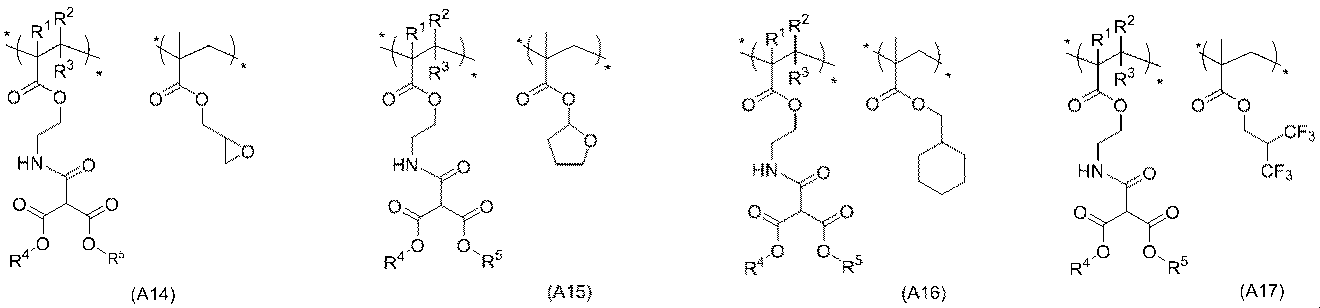
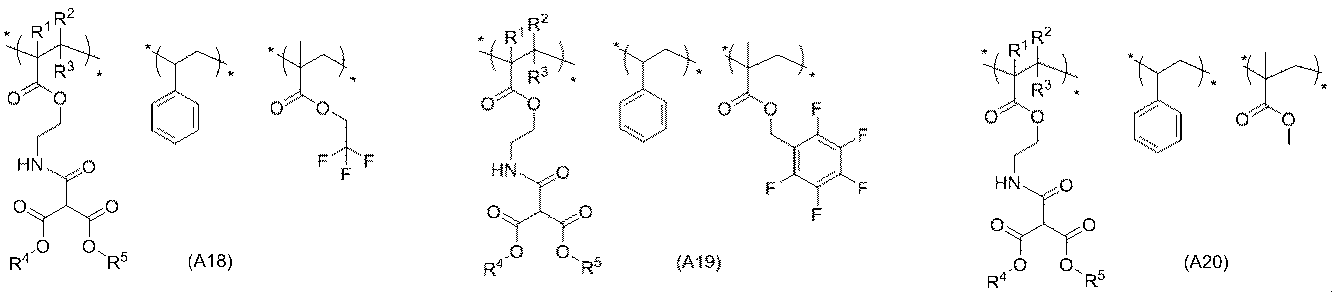


式(A1)~(A26)中、
R1、R2、及びR3は、互いに異なっていてもよく、水素原子又はメチル基を表す。
R4、及びR5は、互いに異なっていてもよく、炭素原子数1~20のアルキル基、又は炭素原子数3~20のシクロアルキル基を表し、R4、及びR5は、互いに独立に、メチル基、又はエチル基であることが好ましい。
R1、R2、及びR3は、互いに異なっていてもよく、水素原子又はメチル基を表す。
R4、及びR5は、互いに異なっていてもよく、炭素原子数1~20のアルキル基、又は炭素原子数3~20のシクロアルキル基を表し、R4、及びR5は、互いに独立に、メチル基、又はエチル基であることが好ましい。
組成物に含まれる高分子化合物(A)は、1質量%以上90質量%以下であることが好ましく、5質量%以上60質量%以下であることがより好ましく、5質量%以上30質量%以下であることがさらに好ましい。
(高分子化合物(B))
ここで、高分子化合物(B)について説明する。
ここで、高分子化合物(B)について説明する。
高分子化合物(B)は、重量平均分子量が3000~1000000であることが好ましく、5000~500000であることがより好ましい。
高分子化合物(B)は、直鎖状、分岐状、環状のいずれの態様であってもよい。
高分子化合物(B)は、式(2)で表される繰り返し単位を有する。
(式(2)で表される繰り返し単位)

(式(2)中、
R6、R7及びR8は、互いに異なっていてもよく、水素原子、フッ素原子、又は炭素原子数1~20の1価の有機基を表す。
Rbは、炭素原子数1~20の2価の有機基、-O-で表される基、-CO-で表される基、-COO-で表される基、-NHCO-で表される基、又は-NHCOO-で表される基を表す。-O-で表される基、-CO-で表される基、-COO-で表される基、-NHCO-で表される基、及び-NHCOO-で表される基の2つの結合手は、どちらが、R6が結合する炭素原子側に位置していてもよい。
Rcは、単結合、又は炭素原子数1~20の2価の有機基を表す。
mは、0~6の整数を表す。
Rbが複数個ある場合、それらは互いに異なっていてもよい。
*は、結合位置を表す。)
前記式(2)中、R6、R7、及びR8は、互いに独立に、水素原子又はメチル基であることが好ましい。
前記式(2)中、mは、0~2の整数であることが好ましい。
前記式(2)中、Rbは、-COO-で表される基、-NHCO-で表される基、-NHCOO-で表される基、メチレン基、エチレン基、n-プロピレン基、イソプロピレン基、n-ブチレン基、又はフェニレン基であることが好ましい。
前記式(2)中、Rcは、単結合、メチレン基、エチレン基、n-プロピレン基、イソプロピレン基、n-ブチレン基、又はフェニレン基であることが好ましい。
前記式(2)として好ましい態様は、
R6、R7、及びR8が、水素原子、又はメチル基であり、
mが、1であり、
Rbが、-COO-で表される基であり、
Rcが、炭素原子数1~10の2価の脂肪族炭化水素基である場合が挙げられる。
前記式(2)中、mは、0~2の整数であることが好ましい。
前記式(2)中、Rbは、-COO-で表される基、-NHCO-で表される基、-NHCOO-で表される基、メチレン基、エチレン基、n-プロピレン基、イソプロピレン基、n-ブチレン基、又はフェニレン基であることが好ましい。
前記式(2)中、Rcは、単結合、メチレン基、エチレン基、n-プロピレン基、イソプロピレン基、n-ブチレン基、又はフェニレン基であることが好ましい。
前記式(2)として好ましい態様は、
R6、R7、及びR8が、水素原子、又はメチル基であり、
mが、1であり、
Rbが、-COO-で表される基であり、
Rcが、炭素原子数1~10の2価の脂肪族炭化水素基である場合が挙げられる。
高分子化合物(B)に含まれる式(2)で表される繰り返し単位としては、次に挙げるモノマーに由来する繰り返し単位が例示される。
2-ヒドロキシエチルアクリレート、2-ヒドロキシプロピルアクリレート、3-ヒドロキシプロピルアクリレート、2-ヒドロキシブチルアクリレート、4-ヒドロキシブチルアクリレート、6-ヒドロキシヘキシルアクリレート、8-ヒドロキシオクチルアクリレート、4-ヒドロキシメチルシクロヘキシルアクリレート、2-ヒドロキシ-1-メチルエチルアクリレート、2-(2-ヒドロキシエトキシ)エチルアクリレート、2-ヒドロキシシクロヘキシルアクリレート、3-ヒドロキシシクロヘキシルアクリレート、4-ヒドロキシシクロヘキシルアクリレート、2-ヒドロキシ-3-フェノキシプロピルアクリレート、2-ヒドロキシエチルメタクリレート、2-ヒドロキシプロピルメタクリレート、3-ヒドロキシプロピルメタクリレート、2-ヒドロキシブチルメタクリレート、4-ヒドロキシブチルメタクリレート、6-ヒドロキシヘキシルメタクリレート、8-ヒドロキシオクチルメタクリレート、4-ヒドロキシメチルシクロヘキシルメタクリレート、2-ヒドロキシ-1-メチルエチルメタクリレート、2-(2-ヒドロキシエトキシ)エチルメタクリレート、2-ヒドロキシフェニルエチルメタクリレート、3-ヒドロキシ-1-アダマンチルメタクリレート、2-ヒドロキシシクロヘキシルメタクリレート、3-ヒドロキシシクロヘキシルメタクリレート、4-ヒドロキシシクロヘキシルメタクリレート、2-ヒドロキシ-3-フェノキシプロピルメタクリレート、3-パーフルオロブチル-2-ヒドロキシプロピルアクリレート、3-パーフルオロヘキシル-2-ヒドロキシプロピルアクリレート、3-パーフルオロオクチル-2-ヒドロキシプロピルアクリレート、3-(パーフルオロ-3-メチルブチル)-2-ヒドロキシプロピルアクリレート、2-(パーフルオロ-3-メチルブチル)-2-ヒドロキシプロピルアクリレート、3-(パーフルオロ-5-メチルヘキシル)-2-ヒドロキシプロピルアクリレート、3-パーフルオロブチル-2-ヒドロキシプロピルメタクリレート、3-パーフルオロヘキシル-2-ヒドロキシプロピルメタクリレート、3-パーフルオロオクチル-2-ヒドロキシプロピルメタクリレート、3-(パーフルオロ-3-メチルブチル)-2-ヒドロキシプロピルメタクリレート、2-(パーフルオロ-3-メチルブチル)-2-ヒドロキシプロピルメタクリレート、3-(パーフルオロ-5-メチルヘキシル)-2-ヒドロキシプロピルメタクリレート、3-(パーフルオロ-7-メチルオクチル)-2-ヒドロキシプロピルメタクリレート、及び2-アクリロイロキシエチル-2-ヒドロキシエチル-フタル酸等のヒドロキシアルキル基を有する(メタ)アクリレート、
ヒドロキシエチルビニルエーテル、ヒドロキシブチルビニルエーテル、及びエチレングリコールモノアリルエーテル等のヒドロキシビニルエーテル、
o-(ヒドロキシメチル)スチレン、m-(ヒドロキシメチル)スチレン、及びp-(ヒドロキシメチル)スチレン等のスチレン誘導体、
N-(2-ヒドロキシエチル)アクリルアミド等のヒドロキシアルキル基を有する(メタ)アクリルアミド、
2-ヒドロキシプロピオン酸(1-メチル)エテニルエステル、2-ヒドロキシプロピオン酸エテニルエステル、3-ヒドロキシプロピオン酸エテニルエステル、及び2-ヒドロキシ酢酸エテニルエステル等のエテニルエステル、
ビニルアルコール、並びにアリルアルコール。
式(2)で表される繰り返し単位としては、ヒドロキシアルキル基を有する(メタ)アクリレートに由来する繰り返し単位が好ましい。
2-ヒドロキシエチルアクリレート、2-ヒドロキシプロピルアクリレート、3-ヒドロキシプロピルアクリレート、2-ヒドロキシブチルアクリレート、4-ヒドロキシブチルアクリレート、6-ヒドロキシヘキシルアクリレート、8-ヒドロキシオクチルアクリレート、4-ヒドロキシメチルシクロヘキシルアクリレート、2-ヒドロキシ-1-メチルエチルアクリレート、2-(2-ヒドロキシエトキシ)エチルアクリレート、2-ヒドロキシシクロヘキシルアクリレート、3-ヒドロキシシクロヘキシルアクリレート、4-ヒドロキシシクロヘキシルアクリレート、2-ヒドロキシ-3-フェノキシプロピルアクリレート、2-ヒドロキシエチルメタクリレート、2-ヒドロキシプロピルメタクリレート、3-ヒドロキシプロピルメタクリレート、2-ヒドロキシブチルメタクリレート、4-ヒドロキシブチルメタクリレート、6-ヒドロキシヘキシルメタクリレート、8-ヒドロキシオクチルメタクリレート、4-ヒドロキシメチルシクロヘキシルメタクリレート、2-ヒドロキシ-1-メチルエチルメタクリレート、2-(2-ヒドロキシエトキシ)エチルメタクリレート、2-ヒドロキシフェニルエチルメタクリレート、3-ヒドロキシ-1-アダマンチルメタクリレート、2-ヒドロキシシクロヘキシルメタクリレート、3-ヒドロキシシクロヘキシルメタクリレート、4-ヒドロキシシクロヘキシルメタクリレート、2-ヒドロキシ-3-フェノキシプロピルメタクリレート、3-パーフルオロブチル-2-ヒドロキシプロピルアクリレート、3-パーフルオロヘキシル-2-ヒドロキシプロピルアクリレート、3-パーフルオロオクチル-2-ヒドロキシプロピルアクリレート、3-(パーフルオロ-3-メチルブチル)-2-ヒドロキシプロピルアクリレート、2-(パーフルオロ-3-メチルブチル)-2-ヒドロキシプロピルアクリレート、3-(パーフルオロ-5-メチルヘキシル)-2-ヒドロキシプロピルアクリレート、3-パーフルオロブチル-2-ヒドロキシプロピルメタクリレート、3-パーフルオロヘキシル-2-ヒドロキシプロピルメタクリレート、3-パーフルオロオクチル-2-ヒドロキシプロピルメタクリレート、3-(パーフルオロ-3-メチルブチル)-2-ヒドロキシプロピルメタクリレート、2-(パーフルオロ-3-メチルブチル)-2-ヒドロキシプロピルメタクリレート、3-(パーフルオロ-5-メチルヘキシル)-2-ヒドロキシプロピルメタクリレート、3-(パーフルオロ-7-メチルオクチル)-2-ヒドロキシプロピルメタクリレート、及び2-アクリロイロキシエチル-2-ヒドロキシエチル-フタル酸等のヒドロキシアルキル基を有する(メタ)アクリレート、
ヒドロキシエチルビニルエーテル、ヒドロキシブチルビニルエーテル、及びエチレングリコールモノアリルエーテル等のヒドロキシビニルエーテル、
o-(ヒドロキシメチル)スチレン、m-(ヒドロキシメチル)スチレン、及びp-(ヒドロキシメチル)スチレン等のスチレン誘導体、
N-(2-ヒドロキシエチル)アクリルアミド等のヒドロキシアルキル基を有する(メタ)アクリルアミド、
2-ヒドロキシプロピオン酸(1-メチル)エテニルエステル、2-ヒドロキシプロピオン酸エテニルエステル、3-ヒドロキシプロピオン酸エテニルエステル、及び2-ヒドロキシ酢酸エテニルエステル等のエテニルエステル、
ビニルアルコール、並びにアリルアルコール。
式(2)で表される繰り返し単位としては、ヒドロキシアルキル基を有する(メタ)アクリレートに由来する繰り返し単位が好ましい。
式(2)で表される繰り返し単位を有する高分子化合物(B)としては、例えば、
ポリ(2-ヒドロキシエチルアクリレート)、ポリ(2-ヒドロキシエチルメタクリレート)、ポリ(2-ヒドロキシブチルメタクリレート)、ポリ(4-ヒドロキシブチルアクリレート)、ポリ(2-ヒドロキシブチルアクリルアミド)、ポリ(4-ヒドロキシブチルメタクリルアミド)、ポリ(ビニルアルコール)、
ポリ(スチレン-コ-(2-ヒドロキシエチルアクリレート))、ポリ(スチレン-コ-(2-ヒドロキシエチルメタクリレート))、ポリ(スチレン-コ-(2-ヒドロキシブチルメタクリレート))、ポリ(スチレン-コ-(4-ヒドロキシブチルアクリレート))、ポリ(2,3,4,5,6-ペンタフルオロスチレン-コ-(2-ヒドロキシエチルメタクリレート))、ポリ(2,3,4,5,6-ペンタフルオロスチレン-コ-(4-ヒドロキシブチルアクリレート))、ポリ(ベンジルメタクリレート-コ-(2-ヒドロキシエチルメタクリレート))、ポリ(ベンジルメタクリレート-コ-(4-ヒドロキシブチルアクリレート))、ポリ(ベンジルメタクリレート-コ-(2-ヒドロキシプロピルメタクリレート))、ポリ(2,3,4,5,6-ペンタフルオロベンジルメタクリレート-コ-(2-ヒドロキシブチルメタクリレート))、ポリ(2,3,4,5,6-ペンタフルオロベンジルメタクリレート-コ-(2-ヒドロキシエチルメタクリレート))、ポリ(2,3,4,5,6-ペンタフルオロベンジルメタクリレート-コ-(4-ヒドロキシブチルアクリレート))、ポリ(メタクリル酸メチル-コ-(2-ヒドロキシエチルメタクリレート))、ポリ(メタクリル酸メチル-コ-(4-ヒドロキシブチルアクリレート))、ポリ(スチレン-コ-(2,3,4,5,6-ペンタフルオロスチレン)-コ-[2-ヒドロキシブチルメタクリレート])、ポリ(スチレン-コ-(2,3,4,5,6-ペンタフルオロスチレン)-コ-[2-ヒドロキシエチルメタクリレート])、ポリ(スチレン-コ-(2,3,4,5,6-ペンタフルオロスチレン)-コ-[4-ヒドロキシブチルアクリレート])、ポリ(2,2,2-トリフルオロエチルメタクリレート-コ-(2-ヒドロキシエチルメタクリレート))、ポリ(2,2,2-トリフルオロエチルメタクリレート-コ-(2-ヒドロキシエチルアクリレート))、ポリ(2,2,2-トリフルオロエチルメタクリレート-コ-(4-ヒドロキシブチルアクリレート))、ポリ(2,2,2-トリフルオロエチルメタクリレート-コ-(4-ヒドロキシブチルメタクリレート))、
ポリ(スチレン-コ-(2,3,4,5,6-ペンタフルオロスチレン)-コ-(2-ヒドロキシエチルメタクリレート))、ポリ(スチレン-コ-(2,3,4,5,6-ペンタフルオロスチレン)-コ-(4-ヒドロキシブチルアクリレート))、ポリ(スチレン-コ-(2,2,2-トリフルオロエチルメタクリレート)-コ-(2-ヒドロキシブチルメタクリレート))、ポリ(スチレン-コ-(2,2,2-トリフルオロエチルメタクリレート)-コ-(2-ヒドロキシエチルメタクリレート))、ポリ(スチレン-コ-(2,2,2-トリフルオロエチルメタクリレート)-コ-(4-ヒドロキシブチルメタクリレート))、ポリ((2,3,4,5,6-ペンタフルオロベンジルアクリレート)-コ-(4-ヒドロキシブチルメタクリレート))、ポリ(2,3,4,5,6-ペンタフルオロスチレン-コ-〔2-(2-ヒドロキシエトキシ)エチルアクリレート〕)、ポリ(2,3,4,5,6-ペンタフルオロスチレン-コ-アクリロニトリル-コ-(3-ヒドロキシ-1-アダマンチルアクリレート))、ポリ(2,3,4,5,6-ペンタフルオロスチレン-コ-アクリロニトリル-コ-(4-ヒドロキシシクロヘキシルアクリレート))、ポリ(2,3,4,5,6-ペンタフルオロスチレン-コ-アクリロニトリル-コ-アリルトリメチルゲルマニウム-コ-エチレングリコールモノアリルエーテル)、ポリ(スチレン-コ-2,3,4,5,6-ペンタフルオロスチレン-コ-アクリロニトリル-コ-(p-(ヒドロキシメチル)スチレン))、ポリ(スチレン-コ-2,3,4,5,6-ペンタフルオロスチレン-コ-アクリロニトリル-コ-アリルトリメチルゲルマニウム-コ-(8-ヒドロキシオクチルメタクリレート))、ポリ(スチレン-コ-2,3,4,5,6-ペンタフルオロスチレン-コ-アクリロニトリル-コ-アリルトリメチルゲルマニウム-コ-〔2-(2-ヒドロキシエトキシ)エチルメタクリレート〕)、ポリ(メチルメタクリレート-コ-2,3,4,5,6-ペンタフルオロスチレン-コ-(3-ヒドロキシ-1-アダマンチルメタクリレート))、ポリ(メチルメタクリレート-コ-2,3,4,5,6-ペンタフルオロスチレン-(4-ヒドロキシメチルシクロヘキシルアクリレート))、ポリ(2,3,4,5,6-ペンタフルオロスチレン-コ-(2,2,2-トリフルオロエチルメタクリレート)-コ-(4-ヒドロキシメチルシクロヘキシルメタリレート))、ポリ(スチレン-コ-2,3,4,5,6-ペンタフルオロベンジルメタクリレート-コ-アクリロニトリル-コ-(2-ヒドロキシエチルメタクリレート))、ポリ(スチレン-コ-2,3,4,5,6-ペンタフルオロベンジルメタクリレート-コ-アクリロニトリル-コ-アリルトリメチルゲルマニウム-コ-(2-ヒドロキシエチルメタクリレート))、ポリ(スチレン-コ-4-(1-エトキシエチル)スチレン-コ-2,3,4,5,6-ペンタフルオロベンジルメタクリレート-コ-(4-ヒドロキシブチルメタクリレート))、ポリ(スチレン-コ-4-(1-エトキシエチル)スチレン-コ-2,3,4,5,6-ペンタフルオロベンジルメタクリレート-コ-(4-ヒドロキシブチルメタクリレート))、ポリ(スチレン-コ-{4-ビニル-(テトラヒドロ-2-ピラニル)ベンゾエート}-コ-2,3,4,5,6-ペンタフルオロベンジルメタクリレート-コ-(4-ヒドロキシブチルメタクリレート))、ポリ(スチレン-コ-{4-ビニル-(テトラヒドロ-2-ピラニル)ベンゾエート}-コ-2,3,4,5,6-ペンタフルオロベンジルメタクリレート-コ-(4-ヒドロキシブチルメタクリレート))、ポリ(ビニルアルコール-コ-エチレン)、ポリ(ビニルアルコール-コ-酢酸ビニル)、ポリ(2-ヒドロキシプロピオン酸エテニルエステル-コ-酢酸ビニル)、ポリ(スチレン-コ-(2-ヒドロキシプロピオン酸エテニルエステル))、等が挙げられる。
ポリ(2-ヒドロキシエチルアクリレート)、ポリ(2-ヒドロキシエチルメタクリレート)、ポリ(2-ヒドロキシブチルメタクリレート)、ポリ(4-ヒドロキシブチルアクリレート)、ポリ(2-ヒドロキシブチルアクリルアミド)、ポリ(4-ヒドロキシブチルメタクリルアミド)、ポリ(ビニルアルコール)、
ポリ(スチレン-コ-(2-ヒドロキシエチルアクリレート))、ポリ(スチレン-コ-(2-ヒドロキシエチルメタクリレート))、ポリ(スチレン-コ-(2-ヒドロキシブチルメタクリレート))、ポリ(スチレン-コ-(4-ヒドロキシブチルアクリレート))、ポリ(2,3,4,5,6-ペンタフルオロスチレン-コ-(2-ヒドロキシエチルメタクリレート))、ポリ(2,3,4,5,6-ペンタフルオロスチレン-コ-(4-ヒドロキシブチルアクリレート))、ポリ(ベンジルメタクリレート-コ-(2-ヒドロキシエチルメタクリレート))、ポリ(ベンジルメタクリレート-コ-(4-ヒドロキシブチルアクリレート))、ポリ(ベンジルメタクリレート-コ-(2-ヒドロキシプロピルメタクリレート))、ポリ(2,3,4,5,6-ペンタフルオロベンジルメタクリレート-コ-(2-ヒドロキシブチルメタクリレート))、ポリ(2,3,4,5,6-ペンタフルオロベンジルメタクリレート-コ-(2-ヒドロキシエチルメタクリレート))、ポリ(2,3,4,5,6-ペンタフルオロベンジルメタクリレート-コ-(4-ヒドロキシブチルアクリレート))、ポリ(メタクリル酸メチル-コ-(2-ヒドロキシエチルメタクリレート))、ポリ(メタクリル酸メチル-コ-(4-ヒドロキシブチルアクリレート))、ポリ(スチレン-コ-(2,3,4,5,6-ペンタフルオロスチレン)-コ-[2-ヒドロキシブチルメタクリレート])、ポリ(スチレン-コ-(2,3,4,5,6-ペンタフルオロスチレン)-コ-[2-ヒドロキシエチルメタクリレート])、ポリ(スチレン-コ-(2,3,4,5,6-ペンタフルオロスチレン)-コ-[4-ヒドロキシブチルアクリレート])、ポリ(2,2,2-トリフルオロエチルメタクリレート-コ-(2-ヒドロキシエチルメタクリレート))、ポリ(2,2,2-トリフルオロエチルメタクリレート-コ-(2-ヒドロキシエチルアクリレート))、ポリ(2,2,2-トリフルオロエチルメタクリレート-コ-(4-ヒドロキシブチルアクリレート))、ポリ(2,2,2-トリフルオロエチルメタクリレート-コ-(4-ヒドロキシブチルメタクリレート))、
ポリ(スチレン-コ-(2,3,4,5,6-ペンタフルオロスチレン)-コ-(2-ヒドロキシエチルメタクリレート))、ポリ(スチレン-コ-(2,3,4,5,6-ペンタフルオロスチレン)-コ-(4-ヒドロキシブチルアクリレート))、ポリ(スチレン-コ-(2,2,2-トリフルオロエチルメタクリレート)-コ-(2-ヒドロキシブチルメタクリレート))、ポリ(スチレン-コ-(2,2,2-トリフルオロエチルメタクリレート)-コ-(2-ヒドロキシエチルメタクリレート))、ポリ(スチレン-コ-(2,2,2-トリフルオロエチルメタクリレート)-コ-(4-ヒドロキシブチルメタクリレート))、ポリ((2,3,4,5,6-ペンタフルオロベンジルアクリレート)-コ-(4-ヒドロキシブチルメタクリレート))、ポリ(2,3,4,5,6-ペンタフルオロスチレン-コ-〔2-(2-ヒドロキシエトキシ)エチルアクリレート〕)、ポリ(2,3,4,5,6-ペンタフルオロスチレン-コ-アクリロニトリル-コ-(3-ヒドロキシ-1-アダマンチルアクリレート))、ポリ(2,3,4,5,6-ペンタフルオロスチレン-コ-アクリロニトリル-コ-(4-ヒドロキシシクロヘキシルアクリレート))、ポリ(2,3,4,5,6-ペンタフルオロスチレン-コ-アクリロニトリル-コ-アリルトリメチルゲルマニウム-コ-エチレングリコールモノアリルエーテル)、ポリ(スチレン-コ-2,3,4,5,6-ペンタフルオロスチレン-コ-アクリロニトリル-コ-(p-(ヒドロキシメチル)スチレン))、ポリ(スチレン-コ-2,3,4,5,6-ペンタフルオロスチレン-コ-アクリロニトリル-コ-アリルトリメチルゲルマニウム-コ-(8-ヒドロキシオクチルメタクリレート))、ポリ(スチレン-コ-2,3,4,5,6-ペンタフルオロスチレン-コ-アクリロニトリル-コ-アリルトリメチルゲルマニウム-コ-〔2-(2-ヒドロキシエトキシ)エチルメタクリレート〕)、ポリ(メチルメタクリレート-コ-2,3,4,5,6-ペンタフルオロスチレン-コ-(3-ヒドロキシ-1-アダマンチルメタクリレート))、ポリ(メチルメタクリレート-コ-2,3,4,5,6-ペンタフルオロスチレン-(4-ヒドロキシメチルシクロヘキシルアクリレート))、ポリ(2,3,4,5,6-ペンタフルオロスチレン-コ-(2,2,2-トリフルオロエチルメタクリレート)-コ-(4-ヒドロキシメチルシクロヘキシルメタリレート))、ポリ(スチレン-コ-2,3,4,5,6-ペンタフルオロベンジルメタクリレート-コ-アクリロニトリル-コ-(2-ヒドロキシエチルメタクリレート))、ポリ(スチレン-コ-2,3,4,5,6-ペンタフルオロベンジルメタクリレート-コ-アクリロニトリル-コ-アリルトリメチルゲルマニウム-コ-(2-ヒドロキシエチルメタクリレート))、ポリ(スチレン-コ-4-(1-エトキシエチル)スチレン-コ-2,3,4,5,6-ペンタフルオロベンジルメタクリレート-コ-(4-ヒドロキシブチルメタクリレート))、ポリ(スチレン-コ-4-(1-エトキシエチル)スチレン-コ-2,3,4,5,6-ペンタフルオロベンジルメタクリレート-コ-(4-ヒドロキシブチルメタクリレート))、ポリ(スチレン-コ-{4-ビニル-(テトラヒドロ-2-ピラニル)ベンゾエート}-コ-2,3,4,5,6-ペンタフルオロベンジルメタクリレート-コ-(4-ヒドロキシブチルメタクリレート))、ポリ(スチレン-コ-{4-ビニル-(テトラヒドロ-2-ピラニル)ベンゾエート}-コ-2,3,4,5,6-ペンタフルオロベンジルメタクリレート-コ-(4-ヒドロキシブチルメタクリレート))、ポリ(ビニルアルコール-コ-エチレン)、ポリ(ビニルアルコール-コ-酢酸ビニル)、ポリ(2-ヒドロキシプロピオン酸エテニルエステル-コ-酢酸ビニル)、ポリ(スチレン-コ-(2-ヒドロキシプロピオン酸エテニルエステル))、等が挙げられる。
組成物に含まれる高分子化合物(B)は、1質量%以上90質量%以下であることが好ましく、5質量%以上60質量%以下であることがより好ましく、5質量%以上30質量%以下であることがさらに好ましい。
(式(4)で表される繰り返し単位)
高分子化合物(A)、及び/又は(B)は、下記式(4)で表される繰り返し単位を含んでいてもよい。
高分子化合物(A)、及び/又は(B)は、下記式(4)で表される繰り返し単位を含んでいてもよい。
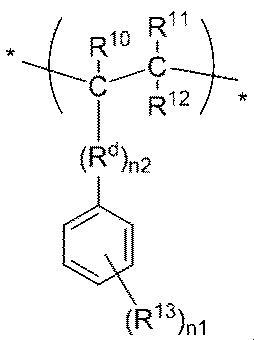
(式(4)中、
R10、R11、及びR12は、互いに異なっていてもよく、水素原子、フッ素原子、又は炭素原子数1~20の1価の有機基を表す。
R13は、塩素原子、フッ素原子、臭素原子、ヨウ素原子、又は炭素原子数1~20の1価の有機基を表す。
Rdは、炭素原子数1~20の2価の有機基、-O-で表される基、-CO-で表される基、-COO-で表される基、-NHCO-で表される基、又は-NHCOO-で表される基を表す。これらの-O-で表される基、-CO-で表される基、-COO-で表される基、-NHCO-で表される基、及び-NHCOO-で表される基の2つの結合手は、どちらが、R10が結合する炭素原子側に位置していてもよい。Rdで表される2価の有機基中の水素原子は、フッ素原子で置換されていてもよい。
n1は、0~5の整数を表す。
n2は、0~6の整数を表す。
Rdが複数個ある場合、それらは互いに異なっていてもよい。
R13が複数個ある場合、それらは互いに異なっていてもよい。
*は、結合位置を表す。)
R10、R11、及びR12は、互いに異なっていてもよく、水素原子、フッ素原子、又は炭素原子数1~20の1価の有機基を表す。
R13は、塩素原子、フッ素原子、臭素原子、ヨウ素原子、又は炭素原子数1~20の1価の有機基を表す。
Rdは、炭素原子数1~20の2価の有機基、-O-で表される基、-CO-で表される基、-COO-で表される基、-NHCO-で表される基、又は-NHCOO-で表される基を表す。これらの-O-で表される基、-CO-で表される基、-COO-で表される基、-NHCO-で表される基、及び-NHCOO-で表される基の2つの結合手は、どちらが、R10が結合する炭素原子側に位置していてもよい。Rdで表される2価の有機基中の水素原子は、フッ素原子で置換されていてもよい。
n1は、0~5の整数を表す。
n2は、0~6の整数を表す。
Rdが複数個ある場合、それらは互いに異なっていてもよい。
R13が複数個ある場合、それらは互いに異なっていてもよい。
*は、結合位置を表す。)
前記式(4)中、R10、R11、及びR12は、互いに独立に、水素原子又はメチル基であることが好ましい。
前記式(4)中、Rdは、炭素原子数1~20の2価の有機基、又は-COO-で表される基であることが好ましい。
前記式(4)中、n2は、0~2の整数であることが好ましい。
本発明の組成物を硬化させた硬化膜の絶縁破壊強度を向上させる観点から、高分子化合物(A)及び/又は(B)に含まれる、前記式(4)で表される繰り返し単位の割合は、それぞれの高分子化合物に含まれる全ての繰り返し単位の合計含有量を100モル%として、1モル%以上90モル%以下であることが好ましく、10モル%以上90モル%以下であることがより好ましく、30モル%以上80モル%以下であることがさらに好ましい。
式(4)で表される繰り返し単位の原料となるモノマーの例としては、
スチレン、2,4-ジメチル-α-メチルスチレン、o-メチルスチレン、m-メチルスチレン、p-メチルスチレン、2,4-ジメチルスチレン、2,5-ジメチルスチレン、2,6-ジメチルスチレン、3,4-ジメチルスチレン、3,5-ジメチルスチレン、2,4,6-トリメチルスチレン、2,4,5-トリメチルスチレン、ペンタメチルスチレン、o-エチルスチレン、m-エチルスチレン、p-エチルスチレン、o-クロロスチレン、m-クロロスチレン、p-クロロスチレン、o-ブロモスチレン、m-ブロモスチレン、p-ブロモスチレン、o-メトキシスチレン、m-メトキシスチレン、p-メトキシスチレン、2-ビニルビフェニル、3-ビニルビフェニル、4-ビニルビフェニル、4-ビニル-p-ターフェニル、α-メチルスチレン、o-イソプロペニルトルエン、m-イソプロペニルトルエン、p-イソプロペニルトルエン、2,4-ジメチル-α-メチルスチレン、2,3-ジメチル-α-メチルスチレン、3,5-ジメチル-α-メチルスチレン、p-イソプロピル-α-メチルスチレン、α-エチルスチレン、α-クロロスチレン、ジビニルベンゼン、ジビニルビフェニル、ジイソプロピルベンゼン、4-(メトキシメトキシ)スチレン、4-(メトキシエトキシメチルオキシ)スチレン、4-(1-エトキシエチルオキシ)スチレン、2-(メトキシメトキシカルボニル)スチレン、2-(メトキシエトキシメチルオキシカルボニル)スチレン、2-(1-エトキシエチルオキシカルボニル)スチレン、2-(テトラヒドロピラニルオキシカルボニル)スチレン、3-(メトキシメトキシカルボニル)スチレン、3-(メトキシエトキシメチルオキシカルボニル)スチレン、3-(1-エトキシエチルオキシカルボニル)スチレン、3-(テトラヒドロピラニルオキシカルボニル)スチレン、4-(メトキシメトキシカルボニル)スチレン、4-(メトキシエトキシメチルオキシカルボニル)スチレン、4-(1-エトキシエチルオキシカルボニル)スチレン、4-(テトラヒドロピラニルオキシカルボニル)スチレン、ベンジルアクリレート、ベンジルメタクリレート、2-トリフルオロメチルスチレン、3-トリフルオロメチルスチレン、4-トリフルオロメチルスチレン、2,3,4,5,6-ペンタフルオロスチレン、2-フルオロスチレン、3-フルオロスチレン、4-フルオロスチレン、2-フルオロ-α―メチルスチレン、3-フルオロ-α―メチルスチレン、4-フルオロ-α―メチルスチレン、4-フルオロ-β―メチルスチレン、4-トリフルオロメチル-α―メチルスチレン、4-フルオロ-2,6-ジメチルスチレン、
アクリル酸フェニル、アクリル酸ベンジル、メタクリル酸フェニル、メタクリル酸ベンジル、N-フェニルアクリルアミド、N-フェニルメタクリルアミド、安息香酸ビニル、安息香酸アリル、
2,3,4,5,6-ペンタフルオロベンジルアクリレート、2,3,4,5,6-ペンタフルオロベンジルメタクリレート、2-フルオロベンジルアクリレート、2-フルオロベンジルメタクリレート、3-フルオロベンジルアクリレート、3-フルオロベンジルメタクリレート、4-フルオロベンジルアクリレート、4-フルオロベンジルメタクリレート、4-トリフルオロメチルベンジルアクリレート、4-トリフルオロメチルベンジルメタクリレート、3-(4-フルオロフェニル)-1-プロペン、3-ペンタフルオロフェニル-1-プロペン、3-(4―トリフルオロメチルフェニル)-1-プロペン、(4-フルオロフェニル)アクリレート、(4-フルオロフェニル)メタクリレート、ペンタフルオロフェニルアクリレート、ペンタフルオロフェニルメタクリレート、2-(ペンタフルオロフェニル)エチルアクリレート、2-(ペンタフルオロフェニル)エチルメタクリレート、2-(4-フルオロフェニル)エチルアクリレート、2-(4-フルオロフェニル)エチルメタクリレート、N-(4-フルオロフェニル)アクリルアミド、N-(4-フルオロフェニル)メタクリルアミド、N-(ペンタフルオロフェニル)アクリルアミド、N-(ペンタフルオロフェニル)メタクリルアミド等が挙げられる。
スチレン、2,4-ジメチル-α-メチルスチレン、o-メチルスチレン、m-メチルスチレン、p-メチルスチレン、2,4-ジメチルスチレン、2,5-ジメチルスチレン、2,6-ジメチルスチレン、3,4-ジメチルスチレン、3,5-ジメチルスチレン、2,4,6-トリメチルスチレン、2,4,5-トリメチルスチレン、ペンタメチルスチレン、o-エチルスチレン、m-エチルスチレン、p-エチルスチレン、o-クロロスチレン、m-クロロスチレン、p-クロロスチレン、o-ブロモスチレン、m-ブロモスチレン、p-ブロモスチレン、o-メトキシスチレン、m-メトキシスチレン、p-メトキシスチレン、2-ビニルビフェニル、3-ビニルビフェニル、4-ビニルビフェニル、4-ビニル-p-ターフェニル、α-メチルスチレン、o-イソプロペニルトルエン、m-イソプロペニルトルエン、p-イソプロペニルトルエン、2,4-ジメチル-α-メチルスチレン、2,3-ジメチル-α-メチルスチレン、3,5-ジメチル-α-メチルスチレン、p-イソプロピル-α-メチルスチレン、α-エチルスチレン、α-クロロスチレン、ジビニルベンゼン、ジビニルビフェニル、ジイソプロピルベンゼン、4-(メトキシメトキシ)スチレン、4-(メトキシエトキシメチルオキシ)スチレン、4-(1-エトキシエチルオキシ)スチレン、2-(メトキシメトキシカルボニル)スチレン、2-(メトキシエトキシメチルオキシカルボニル)スチレン、2-(1-エトキシエチルオキシカルボニル)スチレン、2-(テトラヒドロピラニルオキシカルボニル)スチレン、3-(メトキシメトキシカルボニル)スチレン、3-(メトキシエトキシメチルオキシカルボニル)スチレン、3-(1-エトキシエチルオキシカルボニル)スチレン、3-(テトラヒドロピラニルオキシカルボニル)スチレン、4-(メトキシメトキシカルボニル)スチレン、4-(メトキシエトキシメチルオキシカルボニル)スチレン、4-(1-エトキシエチルオキシカルボニル)スチレン、4-(テトラヒドロピラニルオキシカルボニル)スチレン、ベンジルアクリレート、ベンジルメタクリレート、2-トリフルオロメチルスチレン、3-トリフルオロメチルスチレン、4-トリフルオロメチルスチレン、2,3,4,5,6-ペンタフルオロスチレン、2-フルオロスチレン、3-フルオロスチレン、4-フルオロスチレン、2-フルオロ-α―メチルスチレン、3-フルオロ-α―メチルスチレン、4-フルオロ-α―メチルスチレン、4-フルオロ-β―メチルスチレン、4-トリフルオロメチル-α―メチルスチレン、4-フルオロ-2,6-ジメチルスチレン、
アクリル酸フェニル、アクリル酸ベンジル、メタクリル酸フェニル、メタクリル酸ベンジル、N-フェニルアクリルアミド、N-フェニルメタクリルアミド、安息香酸ビニル、安息香酸アリル、
2,3,4,5,6-ペンタフルオロベンジルアクリレート、2,3,4,5,6-ペンタフルオロベンジルメタクリレート、2-フルオロベンジルアクリレート、2-フルオロベンジルメタクリレート、3-フルオロベンジルアクリレート、3-フルオロベンジルメタクリレート、4-フルオロベンジルアクリレート、4-フルオロベンジルメタクリレート、4-トリフルオロメチルベンジルアクリレート、4-トリフルオロメチルベンジルメタクリレート、3-(4-フルオロフェニル)-1-プロペン、3-ペンタフルオロフェニル-1-プロペン、3-(4―トリフルオロメチルフェニル)-1-プロペン、(4-フルオロフェニル)アクリレート、(4-フルオロフェニル)メタクリレート、ペンタフルオロフェニルアクリレート、ペンタフルオロフェニルメタクリレート、2-(ペンタフルオロフェニル)エチルアクリレート、2-(ペンタフルオロフェニル)エチルメタクリレート、2-(4-フルオロフェニル)エチルアクリレート、2-(4-フルオロフェニル)エチルメタクリレート、N-(4-フルオロフェニル)アクリルアミド、N-(4-フルオロフェニル)メタクリルアミド、N-(ペンタフルオロフェニル)アクリルアミド、N-(ペンタフルオロフェニル)メタクリルアミド等が挙げられる。
(他の繰り返し単位)
高分子化合物(A)は、式(1)で表される繰り返し単位と、他の繰り返し単位とを有する高分子化合物であってもよく、
式(1)で表される繰り返し単位と、式(4)で表される繰り返し単位と、他の繰り返し単位とを有する高分子化合物であってもよい。
高分子化合物(B)は、式(2)で表される繰り返し単位と、他の繰り返し単位とを有する高分子化合物であってもよく、
式(2)で表される繰り返し単位と、式(4)で表される繰り返し単位と、他の繰り返し単位とを有する高分子化合物であってもよい。
ここで、他の繰り返し単位とは、
式(1)で表される繰り返し単位、式(2)で表される繰り返し単位、又は式(4)で表される繰り返し単位以外の繰り返し単位を意味する。
高分子化合物(A)は、式(1)で表される繰り返し単位と、他の繰り返し単位とを有する高分子化合物であってもよく、
式(1)で表される繰り返し単位と、式(4)で表される繰り返し単位と、他の繰り返し単位とを有する高分子化合物であってもよい。
高分子化合物(B)は、式(2)で表される繰り返し単位と、他の繰り返し単位とを有する高分子化合物であってもよく、
式(2)で表される繰り返し単位と、式(4)で表される繰り返し単位と、他の繰り返し単位とを有する高分子化合物であってもよい。
ここで、他の繰り返し単位とは、
式(1)で表される繰り返し単位、式(2)で表される繰り返し単位、又は式(4)で表される繰り返し単位以外の繰り返し単位を意味する。
高分子化合物に含まれる、他の繰り返し単位の割合は、特に制限されず、例えば、高分子化合物に含まれる全ての繰り返し単位の合計含有量を100モル%として、0モル%以上90モル%以下であってよく、0モル%以上80モル%以下であってよく、0モル%以上50モル%以下であってよい。
他の繰り返し単位の原料となるモノマーとしては、例えば、アクリル酸、メタクリル酸、4-ビニル安息香酸、アクリル酸エステル及びその誘導体、メタクリル酸エステル及びその誘導体、アクリルアミド及びその誘導体、メタクリルアミド及びその誘導体、メタクリロニトリル、アクリロニトリル、有機カルボン酸のビニルエステル及びその誘導体、有機カルボン酸のアリルエステル及びその誘導体、フマル酸のジアルキルエステル及びその誘導体、マレイン酸のジアルキルエステル及びその誘導体、イタコン酸のジアルキルエステル及びその誘導体、有機カルボン酸のN-ビニルアミド誘導体、マレイミド及びその誘導体、末端不飽和炭化水素及びその誘導体、並びに有機ゲルマニウム誘導体等が挙げられる。
他の繰り返し単位の材料となるモノマーは、絶縁層に要求される特性に応じて適宜選択される。
他の繰り返し単位の材料となるモノマーとしては、メタクリル酸エステル及びその誘導体、アクリル酸エステル及びその誘導体のような柔軟性を付与することができるモノマーを用いることが好ましい。
他の繰り返し単位の材料となるモノマーとしては、メタクリル酸エステル及びその誘導体、アクリル酸エステル及びその誘導体のような柔軟性を付与することができるモノマーを用いることが好ましい。
他の繰り返し単位の材料となるモノマーである、アクリル酸エステル及びその誘導体としては、単官能のアクリレートや、多官能のアクリレートを使用することができる。
アクリル酸エステル及びその誘導体としては、例えば、アクリル酸メチル、アクリル酸エチル、アクリル酸-n-プロピル、アクリル酸イソプロピル、アクリル酸-n-ブチル、アクリル酸イソブチル、アクリル酸-sec-ブチル、アクリル酸ヘキシル、アクリル酸オクチル、アクリル酸-2-エチルヘキシル、アクリル酸デシル、アクリル酸イソボルニル、アクリル酸シクロヘキシル、2-シアノエチルアクリレート、エチレングリコールジアクリレート、プロピレングリコールジアクリレート、1,4-ブタンジオールジアクリレート、ジエチレングリコールジアクリレート、トリエチレングリコールジアクリレート、トリメチロールプロパンジアクリレート、トリメチロールプロパントリアクリレート、ペンタエリスリトールペンタアクリレート、2,2,2-トリフルオロエチルアクリレート、2,2,3,3,3-ペンタフルオロプロピルアクリレート、1,1,1,2,2,2-ヘキサフルオロイソプロピルアクリレート、2-(パーフルオロブチル)エチルアクリレート、2-(パーフルオロヘキシル)エチルアクリレート、2-(パーフルオロオクチル)エチルアクリレート、2-(パーフルオロデシル)エチルアクリレート、2-(パーフルオロ-3-メチルブチル)エチルアクリレート、2-(パーフルオロ-5-メチルヘキシル)エチルアクリレート、2-(パーフルオロ-7-メチルオクチル)エチルアクリレート、1H、1H、3H-テトラフルオロプロピルアクリレート、1H、1H、5H-オクタフルオロペンチルアクリレート、1H、1H、7H-ドデカフルオロヘプチルアクリレート、1H、1H、9H-ヘキサデカフルオロノニルアクリレート、1H-1-(トリフルオロメチル)トリフルオロエチルアクリレート、1H、1H、3H-ヘキサフルオロブチルアクリレート等を挙げることができる。
アクリル酸エステル及びその誘導体としては、例えば、アクリル酸メチル、アクリル酸エチル、アクリル酸-n-プロピル、アクリル酸イソプロピル、アクリル酸-n-ブチル、アクリル酸イソブチル、アクリル酸-sec-ブチル、アクリル酸ヘキシル、アクリル酸オクチル、アクリル酸-2-エチルヘキシル、アクリル酸デシル、アクリル酸イソボルニル、アクリル酸シクロヘキシル、2-シアノエチルアクリレート、エチレングリコールジアクリレート、プロピレングリコールジアクリレート、1,4-ブタンジオールジアクリレート、ジエチレングリコールジアクリレート、トリエチレングリコールジアクリレート、トリメチロールプロパンジアクリレート、トリメチロールプロパントリアクリレート、ペンタエリスリトールペンタアクリレート、2,2,2-トリフルオロエチルアクリレート、2,2,3,3,3-ペンタフルオロプロピルアクリレート、1,1,1,2,2,2-ヘキサフルオロイソプロピルアクリレート、2-(パーフルオロブチル)エチルアクリレート、2-(パーフルオロヘキシル)エチルアクリレート、2-(パーフルオロオクチル)エチルアクリレート、2-(パーフルオロデシル)エチルアクリレート、2-(パーフルオロ-3-メチルブチル)エチルアクリレート、2-(パーフルオロ-5-メチルヘキシル)エチルアクリレート、2-(パーフルオロ-7-メチルオクチル)エチルアクリレート、1H、1H、3H-テトラフルオロプロピルアクリレート、1H、1H、5H-オクタフルオロペンチルアクリレート、1H、1H、7H-ドデカフルオロヘプチルアクリレート、1H、1H、9H-ヘキサデカフルオロノニルアクリレート、1H-1-(トリフルオロメチル)トリフルオロエチルアクリレート、1H、1H、3H-ヘキサフルオロブチルアクリレート等を挙げることができる。
他の繰り返し単位の材料となるモノマーである、メタクリル酸エステル及びその誘導体としては、単官能のメタクリレート、多官能のメタクリレートを使用することができる。
メタクリル酸エステル及びその誘導体としては、例えば、メタクリル酸メチル、メタクリル酸エチル、メタクリル酸-n-プロピル、メタクリル酸イソプロピル、メタクリル酸-n-ブチル、メタクリル酸イソブチル、メタクリル酸-sec-ブチル、メタクリル酸ヘキシル、メタクリル酸オクチル、メタクリル酸-2-エチルヘキシル、メタクリル酸デシル、メタクリル酸イソボルニル、メタクリル酸シクロヘキシル、エチレングリコールジメタクリレート、プロピレングリコールジメタクリレート、1,4-ブタンジオールジメタクリレート、ジエチレングリコールジメタクリレート、トリエチレングリコールジメタクリレート、トリメチロールプロパンジメタクリレート、トリメチロールプロパントリメタクリレート、ペンタエリスリトールペンタメタクリレート、2,2,2-トリフルオロエチルメタクリレート、2,2,3,3,3-ペンタフルオロプロピルメタクリレート、1,1,1,2,2,2-ヘキサフルオロイソプロピルメタクリレート、2-(パーフルオロブチル)エチルメタクリレート、2-(パーフルオロヘキシル)エチルメタクリレート、2-(パーフルオロオクチル)エチルメタクリレート、2-(パーフルオロデシル)エチルメタクリレート、2-(パーフルオロ-3-メチルブチル)エチルメタクリレート、2-(パーフルオロ-5-メチルヘキシル)エチルメタクリレート、2-(パーフルオロ-7-メチルオクチル)エチルメタクリレート、1H、1H、3H-テトラフルオロプロピルメタクリレート、1H、1H、5H-オクタフルオロペンチルメタクリレート、1H、1H、7H-ドデカフルオロヘプチルメタクリレート、1H、1H、9H-ヘキサデカフルオロノニルメタクリレート、1H-1-(トリフルオロメチル)トリフルオロエチルメタクリレート、1H、1H、3H-ヘキサフルオロブチルメタクリレート等が挙げられる。
メタクリル酸エステル及びその誘導体としては、例えば、メタクリル酸メチル、メタクリル酸エチル、メタクリル酸-n-プロピル、メタクリル酸イソプロピル、メタクリル酸-n-ブチル、メタクリル酸イソブチル、メタクリル酸-sec-ブチル、メタクリル酸ヘキシル、メタクリル酸オクチル、メタクリル酸-2-エチルヘキシル、メタクリル酸デシル、メタクリル酸イソボルニル、メタクリル酸シクロヘキシル、エチレングリコールジメタクリレート、プロピレングリコールジメタクリレート、1,4-ブタンジオールジメタクリレート、ジエチレングリコールジメタクリレート、トリエチレングリコールジメタクリレート、トリメチロールプロパンジメタクリレート、トリメチロールプロパントリメタクリレート、ペンタエリスリトールペンタメタクリレート、2,2,2-トリフルオロエチルメタクリレート、2,2,3,3,3-ペンタフルオロプロピルメタクリレート、1,1,1,2,2,2-ヘキサフルオロイソプロピルメタクリレート、2-(パーフルオロブチル)エチルメタクリレート、2-(パーフルオロヘキシル)エチルメタクリレート、2-(パーフルオロオクチル)エチルメタクリレート、2-(パーフルオロデシル)エチルメタクリレート、2-(パーフルオロ-3-メチルブチル)エチルメタクリレート、2-(パーフルオロ-5-メチルヘキシル)エチルメタクリレート、2-(パーフルオロ-7-メチルオクチル)エチルメタクリレート、1H、1H、3H-テトラフルオロプロピルメタクリレート、1H、1H、5H-オクタフルオロペンチルメタクリレート、1H、1H、7H-ドデカフルオロヘプチルメタクリレート、1H、1H、9H-ヘキサデカフルオロノニルメタクリレート、1H-1-(トリフルオロメチル)トリフルオロエチルメタクリレート、1H、1H、3H-ヘキサフルオロブチルメタクリレート等が挙げられる。
他の繰り返し単位の材料となるモノマーである、アクリルアミド及びその誘導体の例としては、アクリルアミド、N-メチルアクリルアミド、N-エチルアクリルアミド、N-tert-ブチルアクリルアミド、N,N-ジメチルアクリルアミド、N,N-ジエチルアクリルアミド、N-(ブトキシメチル)アクリルアミド、N-[3-(ジメチルアミノ)プロピル]アクリルアミド、N-アクリロイルモルフォリンが挙げられる。
他の繰り返し単位の材料となるモノマーである、メタクリルアミド及びその誘導体の例としては、メタクリルアミド、N-メチルメタクリルアミド、N-エチルメタクリルアミド、N-tert-ブチルメタクリルアミド、N,N-ジメチルメタクリルアミド、N,N-ジエチルメタアクリルアミド、N-(ブトキシメチル)メタクリルアミド、N-[3-(ジメチルアミノ)プロピル]メタクリルアミド、N-アクリロイルモルフォリン、
が挙げられる。
が挙げられる。
他の繰り返し単位の材料となるモノマーである、有機カルボン酸のビニルエステル及びその誘導体の例としては、酢酸ビニル、プロピオン酸ビニル、酪酸ビニル、アジピン酸ジビニル等が挙げられる。
他の繰り返し単位の材料となるモノマーである、有機カルボン酸のアリルエステル及びその誘導体の例としては、酢酸アリル、アジピン酸ジアリル、テレフタル酸ジアリル、イソフタル酸ジアリル、フタル酸ジアリル等が挙げられる。
他の繰り返し単位の材料となるモノマーである、フマル酸のジアルキルエステル及びその誘導体の例としては、フマル酸ジメチル、フマル酸ジエチル、フマル酸ジイソプロピル、フマル酸ジ-sec-ブチル、フマル酸ジイソブチル、フマル酸ジ-n-ブチル、フマル酸ジ-2-エチルヘキシル、フマル酸ジベンジル等が挙げられる。
他の繰り返し単位の材料となるモノマーである、マレイン酸のジアルキルエステル及びその誘導体の例としては、マレイン酸ジメチル、マレイン酸ジエチル、マレイン酸ジイソプロピル、マレイン酸ジ-sec-ブチル、マレイン酸ジイソブチル、マレイン酸ジ-n-ブチル、マレイン酸ジ-2-エチルヘキシル、マレイン酸ジベンジル等が挙げられる。
他の繰り返し単位の材料となるモノマーである、イタコン酸のジアルキルエステル及びその誘導体の例としては、イタコン酸ジメチル、イタコン酸ジエチル、イタコン酸ジイソプロピル、イタコン酸ジ-sec-ブチル、イタコン酸ジイソブチル、イタコン酸ジ-n-ブチル、イタコン酸ジ-2-エチルヘキシル、イタコン酸ジベンジル等が挙げられる。
他の繰り返し単位の材料となるモノマーである、有機カルボン酸のN-ビニルアミド誘導体の例としては、N-メチル-N-ビニルアセトアミド等が挙げられる。
他の繰り返し単位の材料となるモノマーである、マレイミド及びその誘導体の例としては、N-フェニルマレイミド、N-シクロヘキシルマレイミド等が挙げられる。
他の繰り返し単位の材料となるモノマーである、末端不飽和炭化水素及びその誘導体の例としては、1-ブテン、1-ペンテン、1-ヘキセン、1-オクテン、ビニルシクロヘキサン、塩化ビニル等が挙げられる。
他の繰り返し単位の材料となるモノマーである、有機ゲルマニウム誘導体の例としては、アリルトリメチルゲルマニウム、アリルトリエチルゲルマニウム、アリルトリブチルゲルマニウム、トリメチルビニルゲルマニウム、トリエチルビニルゲルマニウム等が挙げられる。
これらの他の繰り返し単位の材料となるモノマーのうちでは、アクリル酸アルキルエステル、メタクリル酸アルキルエステル、アクリロニトリル、メタアクリロニトリル、又はアリルトリメチルゲルマニウムが好ましい。
(式(3)で表される化合物)
 (3)
(3)
(式(3)中、
R9は、炭素原子数1~20のアルキル基、炭素原子数3~20のシクロアルキル基、又は炭素原子数2~20の下記式(6)で表される基を表す。該アルキル基、シクロアルキル基、又は下記式(6)で表される基中の水素原子は、炭素原子数3~20のシクロアルキル基、炭素原子数1~20のアルコキシ基、炭素原子数3~20のシクロアルコキシ基、炭素原子数6~20の1価の芳香族炭化水素基、又はフッ素原子で置換されていてもよい。)
(式(3)中、
R9は、炭素原子数1~20のアルキル基、炭素原子数3~20のシクロアルキル基、又は炭素原子数2~20の下記式(6)で表される基を表す。該アルキル基、シクロアルキル基、又は下記式(6)で表される基中の水素原子は、炭素原子数3~20のシクロアルキル基、炭素原子数1~20のアルコキシ基、炭素原子数3~20のシクロアルコキシ基、炭素原子数6~20の1価の芳香族炭化水素基、又はフッ素原子で置換されていてもよい。)

(式(6)中、
R15は、炭素原子数1~6の2価の直鎖状脂肪族炭化水素基を表し、
R16は、炭素原子数1~19の1価の直鎖状脂肪族炭化水素基を表し、
qは、1~19の整数を表す。
ただし、R15、R16、及びqは、全体の炭素原子数が2~20になるように調整される。)
式(3)中、R9は、炭素原子数1~20のアルキル基、又は炭素原子数3~20のシクロアルキル基(該アルキル基、又はシクロアルキル基中の水素原子は、炭素原子数3~20のシクロアルキル基、炭素原子数1~20のアルコキシ基、炭素原子数3~20のシクロアルコキシ基、又は、炭素原子数6~20の1価の芳香族炭化水素基で置換されていてもよい。)であることが好ましい。
式(3)で表される化合物としては、
メタノール、エタノール、1-プロパノール、2-プロパノール、1-ブタノール、2-メチルー1-プロパノール、2-ブタノール、2-メチルー2-プロパノール、
1-ペンタノール、3-メチルー1-ブタノール、2-メチルー1-ブタノール、2,2-ジメチルー1-プロパノール、2-ペンタノール、3-メチル―2-ブタノール、3-ペンタノール、2-メチルー2-ブタノール、
1-ヘキサノール、2-ヘキサノール、1-ヘプタノール、1-オクタノール、1-ノナノール、1-デカノール、1-ウンデカノール、1-ドデカノール、1-テトラデカノール、1-オクタデカノール、シクロペンチルメタノール、シクロヘキシルメタノール、ベンジルアルコール、2-フェニルエタノール、3-フェニルプロパノール、メトキシエタノール、2-エトキシエタノール、2-プロポキシエタノール、2-ブトキシエタノール、ジエチレングリコールモノブチルエーテル、1-メトキシ-2-プロパノール、1-エトキシ-2-プロパノール、1-プロポキシ-2-プロパノール、1-ブトキシ-2-プロパノール、
2,2,3,3-テトラフルオロ-1-プロパノール、1,1,1,3,3,3-ヘキサフルオロ-2-プロパノール、2,2,2-トリフルオロエタノール、1H,1H,3H-ヘキサフルオロブタノール、1H,1H,5H-オクタフルオロペンタノール、及び1H,1H,7H-ドデカフルオロへプタノール、ペンタフルオロベンジルアルコール
等が挙げられる。
メタノール、エタノール、1-プロパノール、2-プロパノール、1-ブタノール、2-メチルー1-プロパノール、2-ブタノール、2-メチルー2-プロパノール、
1-ペンタノール、3-メチルー1-ブタノール、2-メチルー1-ブタノール、2,2-ジメチルー1-プロパノール、2-ペンタノール、3-メチル―2-ブタノール、3-ペンタノール、2-メチルー2-ブタノール、
1-ヘキサノール、2-ヘキサノール、1-ヘプタノール、1-オクタノール、1-ノナノール、1-デカノール、1-ウンデカノール、1-ドデカノール、1-テトラデカノール、1-オクタデカノール、シクロペンチルメタノール、シクロヘキシルメタノール、ベンジルアルコール、2-フェニルエタノール、3-フェニルプロパノール、メトキシエタノール、2-エトキシエタノール、2-プロポキシエタノール、2-ブトキシエタノール、ジエチレングリコールモノブチルエーテル、1-メトキシ-2-プロパノール、1-エトキシ-2-プロパノール、1-プロポキシ-2-プロパノール、1-ブトキシ-2-プロパノール、
2,2,3,3-テトラフルオロ-1-プロパノール、1,1,1,3,3,3-ヘキサフルオロ-2-プロパノール、2,2,2-トリフルオロエタノール、1H,1H,3H-ヘキサフルオロブタノール、1H,1H,5H-オクタフルオロペンタノール、及び1H,1H,7H-ドデカフルオロへプタノール、ペンタフルオロベンジルアルコール
等が挙げられる。
式(3)で表される化合物としては、高純度品の入手の容易さから、メタノール、エタノール及び1-ペンタノールが好ましく、高分子化合物の溶解性の点からシクロペンタノール、シクロヘキサノール、2-エトキシエタノール、及びベンジルアルコールが好ましい。
式(3)で表される化合物の組成物における含有量は、1質量%以上90質量%以下であることが好ましく、5質量%以上70質量%以下であることがより好ましく、5質量%以上60質量%以下であることがさらに好ましい。10質量%以上50質量%以下であることが特に好ましい。
(その他の成分)
本発明の組成物は、さらに、混合や粘度調節のための溶媒、高分子化合物を架橋させる際に架橋剤と組み合わせて通常用いられる添加剤などを含んでいてもよい。
本発明の組成物は、さらに、混合や粘度調節のための溶媒、高分子化合物を架橋させる際に架橋剤と組み合わせて通常用いられる添加剤などを含んでいてもよい。
用いられる溶媒の例としては、テトラヒドロフランやジエチルエーテルなどのエーテル溶媒、ヘキサンなどの脂肪族炭化水素溶媒、シクロヘキサンなどの脂環式炭化水素溶媒、ペンテン等の不飽和炭化水素溶媒、キシレンなどの芳香族炭化水素溶媒、シクロペンタノン、2-ヘプタノン、アセトンなどのケトン溶媒、プロピレングリコールモノメチルエーテルアセテートブチルアセテートなどのアセテート溶媒、クロロホルムなどのハロゲン化物溶媒及びこれらの混合溶媒が挙げられる。
添加剤としては、架橋反応を促進するための触媒、レベリング剤、粘度調節剤などを用いることができる。
添加剤としては、架橋反応を促進するための触媒、レベリング剤、粘度調節剤などを用いることができる。
<組成物の製造方法>
本発明の組成物は、高分子化合物(A)と、高分子化合物(B)と、式(3)で表される化合物とを混合することによって製造することができる。
組成物の製造方法は、例えば、
(M1) 式(3)で表される化合物と、高分子化合物(A)とを混合する工程と、
得られた混合物と、高分子化合物(B)とを混合する工程とを含む製造方法であってもよいし、
(M2) 式(3)で表される化合物と、高分子化合物(B)とを混合する工程と、
得られた混合物と、高分子化合物(A)とを混合する工程とを含む製造方法であってもよいし、
(M3) 高分子化合物(A)と高分子化合物(B)とを混合する工程と、
得られた混合物と、式(3)で表される化合物とを混合する工程とを含む製造歩法であってもよい。
組成物の製造方法としては、混合工程時の組成物の安定性の観点から(M1)又は(M2)の製造方法であることが好ましい。(M1)の製造方法によって、式(3)で表される化合物と高分子化合物(A)との混合物と、高分子化合物(B)とを含む組成物を得ることができる。(M2)の製造方法によって、式(3)で表される化合物と高分子化合物(B)との混合物と、高分子化合物(A)とを含む組成物を得ることができる。
本発明の組成物は、高分子化合物(A)と、高分子化合物(B)と、式(3)で表される化合物とを混合することによって製造することができる。
組成物の製造方法は、例えば、
(M1) 式(3)で表される化合物と、高分子化合物(A)とを混合する工程と、
得られた混合物と、高分子化合物(B)とを混合する工程とを含む製造方法であってもよいし、
(M2) 式(3)で表される化合物と、高分子化合物(B)とを混合する工程と、
得られた混合物と、高分子化合物(A)とを混合する工程とを含む製造方法であってもよいし、
(M3) 高分子化合物(A)と高分子化合物(B)とを混合する工程と、
得られた混合物と、式(3)で表される化合物とを混合する工程とを含む製造歩法であってもよい。
組成物の製造方法としては、混合工程時の組成物の安定性の観点から(M1)又は(M2)の製造方法であることが好ましい。(M1)の製造方法によって、式(3)で表される化合物と高分子化合物(A)との混合物と、高分子化合物(B)とを含む組成物を得ることができる。(M2)の製造方法によって、式(3)で表される化合物と高分子化合物(B)との混合物と、高分子化合物(A)とを含む組成物を得ることができる。
高分子化合物(A)と高分子化合物(B)とを混合する割合は、高分子化合物(A)の式(1)で表される繰り返し単位と高分子化合物(B)の式(2)で表される繰り返し単位とがモル比で、好ましくは1/100~10000/100、より好ましくは10/100~1000/100、さらに好ましくは50/100~200/100となるように調節される。上記モノマーの仕込みモル比をこの範囲に調節することにより、本発明の組成物を硬化した硬化物の内部に架橋構造が十分に形成され、耐溶剤性が向上する。
(高分子化合物(A)の製造方法)
高分子化合物(A)は、例えば、上述の式(1)で表される繰り返し単位の原料となるモノマー(重合性モノマー)を、光重合開始剤又は熱重合開始剤を用いて重合させる方法により製造することができる。
高分子化合物(A)が、さらに式(4)で表される繰り返し単位、及びその他の繰り返し単位からなる群より選ばれる少なくとも1種を有する場合、式(1)で表される繰り返し単位の原料となるモノマーと、式(4)で表される繰り返し単位の原料となるモノマー、及びその他の繰り返し単位の原料となるモノマーからなる群より選ばれる少なくとも1種のモノマーとを、光重合開始剤又は熱重合開始剤を用いて共重合させる方法により製造することができる。
高分子化合物(A)は、例えば、上述の式(1)で表される繰り返し単位の原料となるモノマー(重合性モノマー)を、光重合開始剤又は熱重合開始剤を用いて重合させる方法により製造することができる。
高分子化合物(A)が、さらに式(4)で表される繰り返し単位、及びその他の繰り返し単位からなる群より選ばれる少なくとも1種を有する場合、式(1)で表される繰り返し単位の原料となるモノマーと、式(4)で表される繰り返し単位の原料となるモノマー、及びその他の繰り返し単位の原料となるモノマーからなる群より選ばれる少なくとも1種のモノマーとを、光重合開始剤又は熱重合開始剤を用いて共重合させる方法により製造することができる。
高分子化合物(A)の製造に用いられる光重合開始剤としては、ラジカル重合の開始剤が好ましく、例えば、アセトフェノン、2,2-ジメトキシ-2-フェニルアセトフェノン、2,2-ジエトキシアセトフェノン、4-イソプロピル-2-ヒドロキシ-2-メチルプロピオフェノン、2-ヒドロキシ-2-メチルプロピオフェノン、4,4’-ビス(ジエチルアミノ)ベンゾフェノン、ベンゾフェノン、メチル(o-ベンゾイル)ベンゾエート、1-フェニル-1,2-プロパンジオン-2-(o-エトキシカルボニル)オキシム、1-フェニル-1,2-プロパンジオン-2-(o-ベンゾイル)オキシム、ベンゾイン、ベンゾインメチルエーテル、ベンゾインエチルエーテル、ベンゾインイソプロピルエーテル、ベンゾインイソブチルエーテル、ベンゾインオクチルエーテル、ベンジル、ベンジルジメチルケタール、ベンジルジエチルケタール、及びジアセチル等のカルボニル化合物、
メチルアントラキノン、クロロアントラキノン、クロロチオキサントン、2-メチルチオキサントン、及び2-イソプロピルチオキサントン等のアントラキノン又はチオキサントン誘導体、並びに
ジフェニルジスルフィド、及びジチオカーバメート等の硫黄化合物が挙げられる。
メチルアントラキノン、クロロアントラキノン、クロロチオキサントン、2-メチルチオキサントン、及び2-イソプロピルチオキサントン等のアントラキノン又はチオキサントン誘導体、並びに
ジフェニルジスルフィド、及びジチオカーバメート等の硫黄化合物が挙げられる。
高分子化合物(A)の製造に用いられる熱重合開始剤としては、ラジカル重合の開始剤が好ましく、例えば、2,2’-アゾビスイソブチロニトリル、2,2’-アゾビスイソバレロニトリル、2,2’-アゾビス(2,4-ジメチルバレロニトリル)、4,4’-アゾビス(4-シアノバレリックアシッド)、1,1’-アゾビス(シクロヘキサンカルボニトリル)、2,2’-アゾビス(2-メチルプロパン)、及び2,2’-アゾビス(2-メチルプロピオンアミジン)2塩酸塩等のアゾ化合物、
メチルエチルケトンパーオキシド、メチルイソブチルケトンパーオキシド、シクロヘキサノンパーオキシド、アセチルアセトンパーオキシド等のケトンパーオキシド、
イソブチルパーオキシド、ベンゾイルパーオキシド、2,4-ジクロロベンゾイルパーオキシド、o-メチルベンゾイルパーオキシド、ラウロイルパーオキシド、及びp-クロロベンゾイルパーオキシド等のジアシルパーオキシド、
2,4,4-トリメチルペンチル-2-ヒドロパーオキシド、ジイソプロピルベンゼンパーオキシド、クメンヒドロパーオキシド、tert-ブチルパーオキシド等のヒドロパーオキシド、ジクミルパーオキシド、tert-ブチルクミルパーオキシド、ジ-tert-ブチルパーオキシド、及びトリス(tert-ブチルパーオキシ)トリアジン等のジアルキルパーオキシド、
1,1-ジ-tert-ブチルパーオキシシクロヘキサン、及び2,2-ジ(tert-ブチルパーオキシ)ブタン等のパーオキシケタール、
tert-ブチルパーオキシピバレート、tert-ブチルパーオキシ-2-エチルヘキサノエート、tert-ブチルパーオキシイソブチレート、ジ-tert-ブチルパーオキシヘキサヒドロテレフタレート、ジ-tert-ブチルパーオキシアゼレート、tert-ブチルパーオキシ-3,5,5-トリメチルヘキサノエート、tert-ブチルパーオキシアセテート、tert-ブチルパーオキシベンゾエート、及びジ-tert-ブチルパーオキシトリメチルアジペート等のアルキルパーエステル、並びに
ジイソプロピルパーオキシジカーボネート、ジ-sec-ブチルパーオキシジカーボネート、及びtert-ブチルパーオキシイソプロピルカーボネート等のパーカーボネートが挙げられる。
メチルエチルケトンパーオキシド、メチルイソブチルケトンパーオキシド、シクロヘキサノンパーオキシド、アセチルアセトンパーオキシド等のケトンパーオキシド、
イソブチルパーオキシド、ベンゾイルパーオキシド、2,4-ジクロロベンゾイルパーオキシド、o-メチルベンゾイルパーオキシド、ラウロイルパーオキシド、及びp-クロロベンゾイルパーオキシド等のジアシルパーオキシド、
2,4,4-トリメチルペンチル-2-ヒドロパーオキシド、ジイソプロピルベンゼンパーオキシド、クメンヒドロパーオキシド、tert-ブチルパーオキシド等のヒドロパーオキシド、ジクミルパーオキシド、tert-ブチルクミルパーオキシド、ジ-tert-ブチルパーオキシド、及びトリス(tert-ブチルパーオキシ)トリアジン等のジアルキルパーオキシド、
1,1-ジ-tert-ブチルパーオキシシクロヘキサン、及び2,2-ジ(tert-ブチルパーオキシ)ブタン等のパーオキシケタール、
tert-ブチルパーオキシピバレート、tert-ブチルパーオキシ-2-エチルヘキサノエート、tert-ブチルパーオキシイソブチレート、ジ-tert-ブチルパーオキシヘキサヒドロテレフタレート、ジ-tert-ブチルパーオキシアゼレート、tert-ブチルパーオキシ-3,5,5-トリメチルヘキサノエート、tert-ブチルパーオキシアセテート、tert-ブチルパーオキシベンゾエート、及びジ-tert-ブチルパーオキシトリメチルアジペート等のアルキルパーエステル、並びに
ジイソプロピルパーオキシジカーボネート、ジ-sec-ブチルパーオキシジカーボネート、及びtert-ブチルパーオキシイソプロピルカーボネート等のパーカーボネートが挙げられる。
高分子化合物(A)を製造するにあたり、前記式(1)で表される繰り返し単位の原料となるモノマーの仕込みモル比は、重合に関与する全てのモノマー中、5モル%以上100モル%以下であることが好ましく、10モル%以上100モル%以下であることが好ましい。上記モノマーの仕込みモル比をこの範囲に調節することにより、本発明の組成物を硬化した硬化物の内部に架橋構造が十分に形成され、耐溶剤性が向上する。
(高分子化合物(B)の製造方法)
高分子化合物(B)は、例えば、上述の式(2)で表される繰り返し単位の原料となるモノマー(重合性モノマー)を光重合開始剤もしくは熱重合開始剤を用いて重合させる方法により製造することができる。
高分子化合物(B)が、式(2)で表される繰り返し単位と、式(4)で表される繰り返し単位、及びその他の繰り返し単位からなる群より選ばれる少なくとも1種とを有する場合、式(2)で表される繰り返し単位の原料となるモノマーと、式(4)で表される繰り返し単位の原料となるモノマー、及び他の繰り返し単位の原料となるモノマーからなる群より選ばれる少なくとも1種のモノマーとを、光重合開始剤又は熱重合開始剤を用いて共重合させる方法により製造することができる。
高分子化合物(B)は、例えば、上述の式(2)で表される繰り返し単位の原料となるモノマー(重合性モノマー)を光重合開始剤もしくは熱重合開始剤を用いて重合させる方法により製造することができる。
高分子化合物(B)が、式(2)で表される繰り返し単位と、式(4)で表される繰り返し単位、及びその他の繰り返し単位からなる群より選ばれる少なくとも1種とを有する場合、式(2)で表される繰り返し単位の原料となるモノマーと、式(4)で表される繰り返し単位の原料となるモノマー、及び他の繰り返し単位の原料となるモノマーからなる群より選ばれる少なくとも1種のモノマーとを、光重合開始剤又は熱重合開始剤を用いて共重合させる方法により製造することができる。
高分子化合物(B)を製造するにあたり、前記式(2)で表される繰り返し単位の原料となるモノマーの仕込みモル比は、重合に関与する全てのモノマー中、好ましくは5モル%以上100モル%以下であり、より好ましくは10モル%以上100モル%以下である。上記モノマーの仕込みモル比をこの範囲に調節することにより、本発明の組成物を硬化した硬化物の内部に架橋構造が十分に形成され、耐溶剤性が向上する。
高分子化合物(B)の製造に用いられる光重合開始剤もしくは熱重合開始剤としては、 前記、高分子化合物(A)の製造に用いられるものと同じものが使用できる。
組成物を硬化した膜
本発明の組成物を用いて、硬化膜を製造することができる。該硬化膜は、
既に説明した本発明の組成物を、例えば形成対象である基材の表面に塗布して塗布層を形成する工程と、
塗布層を硬化する工程とを含む製造方法により形成することができる。
本発明の組成物を用いて、硬化膜を製造することができる。該硬化膜は、
既に説明した本発明の組成物を、例えば形成対象である基材の表面に塗布して塗布層を形成する工程と、
塗布層を硬化する工程とを含む製造方法により形成することができる。
硬化膜の製造方法は、例えば、
本発明の組成物に、有機溶媒を添加して塗布液を得る工程と、
塗布液を基材の表面に塗布して塗布層を形成する工程と、
塗布層を硬化させる工程とを含む製造方法であってもよい。
本発明の組成物に、有機溶媒を添加して塗布液を得る工程と、
塗布液を基材の表面に塗布して塗布層を形成する工程と、
塗布層を硬化させる工程とを含む製造方法であってもよい。
塗布液を得る工程で用いる有機溶媒は、組成物に含まれる高分子化合物、架橋剤等の成分を溶解させる有機溶媒であれば特に制限は無く、好ましくは、常圧での沸点が100℃~200℃である有機溶媒である。
好適な有機溶媒の例としては、2-ヘプタノン、プロピレングリコールモノメチルエーテルアセテート、シクロペンタノン等が挙げられる。
塗布液には、必要に応じてレベリング剤、界面活性剤、硬化触媒等を含ませることができる。
好適な有機溶媒の例としては、2-ヘプタノン、プロピレングリコールモノメチルエーテルアセテート、シクロペンタノン等が挙げられる。
塗布液には、必要に応じてレベリング剤、界面活性剤、硬化触媒等を含ませることができる。
塗布液に含まれる有機溶媒は、塗布液全体に対し、30質量%~95質量%であることが好ましい。
塗布層を形成する工程(以下、塗布ステップと呼ぶことがある)は、塗布液を、公知のスピンコート法、ダイコート法、スクリーン印刷法、及びインクジェット法等の塗布法により基材上に塗布して形成することで行うことができる。
塗布層を硬化させる工程(以下、硬化ステップと呼ぶことがある)は、塗布層に含まれる高分子化合物が有する反応性の官能基による、架橋反応を進行させる工程であればよく、例えば、電磁波を照射すること、又はヒーター及びオーブンなどで加熱することで行うことができる。
塗布層を加熱する場合は、通常、1分以上120分以下で加熱するが、10分以上60分以下で加熱することが好ましい。形成される絶縁層の架橋性及び絶縁性が優れるため、塗布膜の加熱温度は、80℃以上250℃以下であることが好ましく、100℃以上230℃以下であることがより好ましい。
塗布層を加熱する場合は、通常、1分以上120分以下で加熱するが、10分以上60分以下で加熱することが好ましい。形成される絶縁層の架橋性及び絶縁性が優れるため、塗布膜の加熱温度は、80℃以上250℃以下であることが好ましく、100℃以上230℃以下であることがより好ましい。
塗布層を形成する工程と、塗布層を硬化させる工程との間に、塗布層を乾燥させる工程(以下、乾燥ステップと呼ぶことがある)を設けてもよい。
塗布層を乾燥させる工程は、塗布法により基材上に形成された塗布層中の溶媒を除去することを目的としている。乾燥させる工程は、例えば、ヒーター及びオーブンなどで加熱することで行うことができる。
塗布層を加熱する場合は、通常、1分以上120分以下で加熱するが、2分以上60分以下で加熱することが好ましい。加熱温度は、40℃以上250℃以下であることが好ましく、60℃以上230℃以下であることがより好ましい。
塗布層を乾燥させる工程は、塗布法により基材上に形成された塗布層中の溶媒を除去することを目的としている。乾燥させる工程は、例えば、ヒーター及びオーブンなどで加熱することで行うことができる。
塗布層を加熱する場合は、通常、1分以上120分以下で加熱するが、2分以上60分以下で加熱することが好ましい。加熱温度は、40℃以上250℃以下であることが好ましく、60℃以上230℃以下であることがより好ましい。
電子デバイス
上述の硬化膜を含む電子デバイスについて説明する。本発明の組成物は、低温で硬化する高分子化合物を用いて硬化させることができるため、本発明の組成物を用いた硬化膜は、有機薄膜トランジスタ、有機LED、センサーなどの種々の電子デバイスに用いることができる。
本発明の組成物を用いた硬化膜を含む電子デバイスとしては、有機薄膜トランジスタが好適である。有機薄膜トランジスタは、当該硬化膜を、有機薄膜トランジスタのゲート絶縁層として含むことが好適である。
上述の硬化膜を含む電子デバイスについて説明する。本発明の組成物は、低温で硬化する高分子化合物を用いて硬化させることができるため、本発明の組成物を用いた硬化膜は、有機薄膜トランジスタ、有機LED、センサーなどの種々の電子デバイスに用いることができる。
本発明の組成物を用いた硬化膜を含む電子デバイスとしては、有機薄膜トランジスタが好適である。有機薄膜トランジスタは、当該硬化膜を、有機薄膜トランジスタのゲート絶縁層として含むことが好適である。
また、本発明の「組成物を硬化した膜」は、絶縁性、封止性、密着性、耐溶剤性に優れるので、有機薄膜トランジスタのオーバーコート層、アンダーコート層などの保護層として用いることもできる。
有機薄膜トランジスタは、例えば、本発明の組成物を硬化した膜であるゲート絶縁層に加え、さらに本発明の組成物を硬化した膜をオーバーコート層として備えていてもよい。
以下、本発明の硬化膜を好適に適用できる有機薄膜トランジスタについて説明する。
有機薄膜トランジスタは、例えば、本発明の組成物を硬化した膜であるゲート絶縁層に加え、さらに本発明の組成物を硬化した膜をオーバーコート層として備えていてもよい。
以下、本発明の硬化膜を好適に適用できる有機薄膜トランジスタについて説明する。
有機薄膜トランジスタ
有機薄膜トランジスタは、上述の硬化膜をゲート絶縁層として含む。
有機薄膜トランジスタは、ボトムゲートトップコンタクト型(第一実施形態)であってもよいし、ボトムゲートボトムコンタクト型(第二実施形態)であってもよいし、トップゲートボトムコンタクト型(第三実施形態)であってもよい。
以下、図面を参照して、本発明の組成物の好適な適用先である有機薄膜トランジスタの実施形態について説明する。
有機薄膜トランジスタは、上述の硬化膜をゲート絶縁層として含む。
有機薄膜トランジスタは、ボトムゲートトップコンタクト型(第一実施形態)であってもよいし、ボトムゲートボトムコンタクト型(第二実施形態)であってもよいし、トップゲートボトムコンタクト型(第三実施形態)であってもよい。
以下、図面を参照して、本発明の組成物の好適な適用先である有機薄膜トランジスタの実施形態について説明する。
図1は、第1実施形態にかかるボトムゲートトップコンタクト型の有機薄膜トランジスタの構造を模式的に示す概略的な図である。
図1に示されるように、第1実施形態の有機薄膜トランジスタ10は、基板1と、基板1の主表面に接合するように設けられたゲート電極2と、ゲート電極2を覆うように基板1に設けられたゲート絶縁層3と、ゲート絶縁層3に接合しており、ゲート電極2の直上を覆うように設けられた有機半導体層4と、有機半導体層4に接合するように設けられ、チャネル領域を挟み、かつ基板1の厚さ方向にみたときに(平面視で)チャネル領域がゲート電極2と重なるように互いに離間させて設けられたソース電極5及びドレイン電極6と、基板1に設けられたゲート電極2、ゲート絶縁層3、有機半導体層4、ソース電極5及びドレイン電極6を覆うように設けられたオーバーコート層7とを備えている。
図1に示されるように、第1実施形態の有機薄膜トランジスタ10は、基板1と、基板1の主表面に接合するように設けられたゲート電極2と、ゲート電極2を覆うように基板1に設けられたゲート絶縁層3と、ゲート絶縁層3に接合しており、ゲート電極2の直上を覆うように設けられた有機半導体層4と、有機半導体層4に接合するように設けられ、チャネル領域を挟み、かつ基板1の厚さ方向にみたときに(平面視で)チャネル領域がゲート電極2と重なるように互いに離間させて設けられたソース電極5及びドレイン電極6と、基板1に設けられたゲート電極2、ゲート絶縁層3、有機半導体層4、ソース電極5及びドレイン電極6を覆うように設けられたオーバーコート層7とを備えている。
図2は、第2実施形態にかかるボトムゲートボトムコンタクト型の有機薄膜トランジスタ10の構造を模式的に示す概略的な図である。
図2に示されるように、第2実施形態の有機薄膜トランジスタ10は、基板1と、基板1の主表面に接合するように設けられたゲート電極2と、ゲート電極2を覆うように基板1に設けられたゲート絶縁層3と、ゲート絶縁層3に接合しており、チャネル領域を挟み、かつ基板1の厚さ方向にみたときに(平面視で)チャネル領域がゲート電極2と重なるように互いに離間させて設けられたソース電極5及びドレイン電極6と、ソース電極5及びドレイン電極6にまたがるように、かつソース電極5及びドレイン電極6及びチャネル領域を含むゲート絶縁層3上に設けられた有機半導体層4と、基板1に設けられたゲート電極2、ゲート絶縁層3、有機半導体層4、ソース電極5及びドレイン電極6を覆うように設けられたオーバーコート層7とを備えている。
図2に示されるように、第2実施形態の有機薄膜トランジスタ10は、基板1と、基板1の主表面に接合するように設けられたゲート電極2と、ゲート電極2を覆うように基板1に設けられたゲート絶縁層3と、ゲート絶縁層3に接合しており、チャネル領域を挟み、かつ基板1の厚さ方向にみたときに(平面視で)チャネル領域がゲート電極2と重なるように互いに離間させて設けられたソース電極5及びドレイン電極6と、ソース電極5及びドレイン電極6にまたがるように、かつソース電極5及びドレイン電極6及びチャネル領域を含むゲート絶縁層3上に設けられた有機半導体層4と、基板1に設けられたゲート電極2、ゲート絶縁層3、有機半導体層4、ソース電極5及びドレイン電極6を覆うように設けられたオーバーコート層7とを備えている。
図3は、第3実施形態にかかるトップゲートボトムコンタクト型の有機薄膜トランジスタ10の構造を模式的に示す概略的な図である。
図3に示されるように、第3実施形態の有機薄膜トランジスタ10は、基板1と、基板1上にソース電極5及びドレイン電極6と、基板1上にソース電極5及びドレイン電極6をまたがるように形成された有機半導体層4と、有機半導体層4上に形成されたゲート絶縁層3と、ゲート絶縁層3上に形成されたゲート電極2と、基板1に設けられたソース電極5、ドレイン電極6、有機半導体層4、ゲート絶縁層3及びゲート電極2を覆うオーバーコート層7とを備えている。
図3に示されるように、第3実施形態の有機薄膜トランジスタ10は、基板1と、基板1上にソース電極5及びドレイン電極6と、基板1上にソース電極5及びドレイン電極6をまたがるように形成された有機半導体層4と、有機半導体層4上に形成されたゲート絶縁層3と、ゲート絶縁層3上に形成されたゲート電極2と、基板1に設けられたソース電極5、ドレイン電極6、有機半導体層4、ゲート絶縁層3及びゲート電極2を覆うオーバーコート層7とを備えている。
有機薄膜トランジスタの製造方法
第1実施形態のボトムゲートトップコンタクト型の有機薄膜トランジスタ10は、例えば、基板1の主表面にゲート電極2を形成し、ゲート電極2を覆うようにゲート電極2が設けられた基板1の表面にゲート絶縁層3を形成し、ゲート絶縁層3上に有機半導体層4を形成し、有機半導体層4に接合するようにソース電極5及びドレイン電極6を形成し、さらに要すれば、基板1に設けられたゲート電極2、ゲート絶縁層3、有機半導体層4、ソース電極5及びドレイン電極6を覆うようにオーバーコート層7を形成することで製造することができる。
第1実施形態のボトムゲートトップコンタクト型の有機薄膜トランジスタ10は、例えば、基板1の主表面にゲート電極2を形成し、ゲート電極2を覆うようにゲート電極2が設けられた基板1の表面にゲート絶縁層3を形成し、ゲート絶縁層3上に有機半導体層4を形成し、有機半導体層4に接合するようにソース電極5及びドレイン電極6を形成し、さらに要すれば、基板1に設けられたゲート電極2、ゲート絶縁層3、有機半導体層4、ソース電極5及びドレイン電極6を覆うようにオーバーコート層7を形成することで製造することができる。
第2実施形態のボトムゲートボトムコンタクト型の有機薄膜トランジスタ10は、例えば、基板1の主表面にゲート電極2を形成し、ゲート電極2を覆うようにゲート電極2が設けられた基板1の表面にゲート絶縁層3を形成し、ゲート絶縁層3上にソース電極5及びドレイン電極6を形成し、ソース電極5及びドレイン電極6にまたがるように、かつソース電極5及びドレイン電極6の一部分及びチャネル領域を含むゲート絶縁層3の一部分を覆うように有機半導体層4を形成し、さらに要すれば、基板1に設けられたゲート電極2、ゲート絶縁層3、有機半導体層4、ソース電極5及びドレイン電極6を覆うようにオーバーコート層7を形成することで製造することができる。
第3実施形態のトップゲートボトムコンタクト型の有機薄膜トランジスタ10は、例えば、基板1の主表面にソース電極5及びドレイン電極6を形成し、ソース電極5及びドレイン電極6にまたがるように、有機半導体層4を形成し、ゲート絶縁層3を形成し、ゲート電極2を形成し、さらに要すれば、基板1に設けられたソース電極5、ドレイン電極6、有機半導体層4、ゲート絶縁層3及びゲート電極2を覆うようにオーバーコート層7を形成することで製造することができる。
ゲート絶縁層3には、既に説明した、本発明の組成物を硬化した膜を用いることができる。
ゲート絶縁層3の純水に対する接触角は、絶縁層用組成物中の高分子化合物が有するフッ素原子、疎水性官能基及び親水性官能基の量を考慮して、ゲート絶縁層3の表面の親水性を増減させることにより、適宜調節することができる。
ゲート絶縁層3の表面の親水性の増減は、加熱処理が行われる雰囲気の成分を調節することにより行うことができる。例えば、ゲート絶縁層3を形成する際に行われる乾燥ステップ及び硬化ステップ(加熱又は焼成)等を、酸素を含む雰囲気中で行うとゲート絶縁層3の表面の親水性は増大し、不活性ガス雰囲気中で行うとゲート絶縁層3の表面の親水性は低下する。酸素を含む雰囲気中で加熱を行う場合は、温度を高くするとゲート絶縁層3の表面の親水性はより増大する。
特に組成物に含まれるフッ素原子の量を調節することにより、ゲート絶縁層3の表面エネルギーを適切な範囲に調節することができ、結果として、有機半導体層4との界面を良好な界面とすることができる。これにより有機薄膜トランジスタのキャリア移動度をより向上させることができる。
組成物に含まれるフッ素原子の量を1質量%以上とすることで、有機薄膜トランジスタのヒステリシス特性を十分に低下させることができ、60質量%以下とすることで、有機半導体層との親和性を良好に保ち、有機半導体層とゲート絶縁層とを接合させたときに良好な界面を形成させることができる。
ゲート絶縁層3の有機半導体層4側の表面には、自己組織化単分子層を形成してもよい。この自己組織化単分子層は、例えば、有機溶媒にアルキルクロロシラン化合物もしくはアルキルアルコキシシラン化合物を1~10質量%溶解した溶液でゲート絶縁層3を処理することにより形成することができる。
自己組織化単分子層を形成するためのアルキルクロロシラン化合物としては、例えば、メチルトリクロロシラン、エチルトリクロロシラン、ブチルトリクロロシラン、デシルトリクロロシラン、オクタデシルトリクロロシラン等が挙げられる。
自己組織化単分子層を形成するためのアルキルアルコキシシラン化合物としては、メチルトリメトキシシラン、エチルトリメトキシシラン、ブチルトリメトキシシラン、デシルトリメトキシシラン、オクタデシルトリメトキシシラン等が挙げられる。
自己組織化単分子層を形成するためのアルキルアルコキシシラン化合物としては、メチルトリメトキシシラン、エチルトリメトキシシラン、ブチルトリメトキシシラン、デシルトリメトキシシラン、オクタデシルトリメトキシシラン等が挙げられる。
基板1、ゲート電極2、ソース電極5、ドレイン電極6及び有機半導体層4は、従来公知の有機薄膜トランジスタの製造方法に通常使用される材料及び方法で構成すればよい。
基板1としては樹脂基板又は樹脂フィルム、プラスチック基板又はプラスチックフィルム、ガラス基板、シリコン基板などが用いられる。
ゲート電極2、ソース電極5及びドレイン電極6の材料の例としては、クロム、金、銀、アルミニウム、モリブデン等が挙げられる。ゲート電極2、ソース電極5及びドレイン電極6は、蒸着法、スパッタ法、インクジェット印刷法などの塗布法等の公知の方法で形成することができる。
有機半導体層4の材料である有機半導体化合物としては、π共役ポリマーが広く用いられ、例えば、ポリピロール類、ポリチオフェン類、ポリアニリン類、ポリアリルアミン類、フルオレン類、ポリカルバゾール類、ポリインドール類、ポリ(p-フェニレンビニレン)類などを用いることができる。
また、有機半導体層4の材料である有機半導体化合物としては、有機溶媒への溶解性を有する低分子化合物を用いることもできる。このような低分子化合物としては、例えば、ペンタセンなどの多環芳香族の誘導体、フタロシアニン誘導体、ペリレン誘導体、テトラチアフルバレン誘導体、テトラシアノキノジメタン誘導体、フラーレン類、カーボンナノチューブ類などが挙げられる。このような低分子化合物の例としては、具体的には、9,9-ジ-n-オクチルフルオレン-2,7-ジ(エチレンボロネート)と5,5’-ジブロモ-2,2’-バイチオフェンとの縮合物等が挙げられる。
有機半導体層4の形成工程は、例えば、有機半導体化合物に要すれば溶媒などを添加して有機半導体層4の形成用の塗布液を調製し、これを塗布し、塗布層を乾燥させることにより行う。本発明では、ゲート絶縁層3を構成する高分子化合物がフェニル部分又はカルボニル部分を有し、有機半導体化合物と親和性がある。それゆえ、上記塗布ステップ及び乾燥ステップによって、有機半導体層4とゲート絶縁層3との間に均一で平坦な界面を形成することができる。
有機半導体層4の形成工程に使用することができる溶媒としては有機半導体化合物を溶解又は分散させることができる溶媒であれば特に制限はない。このような溶媒としては、常圧での沸点が50℃~200℃の溶媒が好ましい。このような溶媒の例としては、クロロホルム、トルエン、アニソール、2-ヘプタノン、キシレン、プロピレングリコールモノメチルエーテルアセテート等が挙げられる。有機半導体層4の形成用の塗布液は、既に説明した絶縁層3の形成用の塗布液と同様に、公知のスピンコート法、ダイコート法、スクリーン印刷法、インクジェット印刷法等の塗布法により基板1又はゲート絶縁層3上に塗布することができる。
オーバーコート層7(保護層)は、既に説明したゲート絶縁層3の形成工程と同様にして、例えば、既に説明した本発明の組成物を用いて形成することができる。
また、図示されていないアンダーコート層についてもオーバーコート層7と同様にして形成することができる。
また、図示されていないアンダーコート層についてもオーバーコート層7と同様にして形成することができる。
本発明の組成物を用いれば、保存安定性がよく、低温にて硬化する組成物が得られ、結果としてゲート絶縁層の形成工程、ひいては有機薄膜トランジスタの製造方法をより簡便に実施することができる。
有機薄膜トランジスタの用途
本発明の組成物を用いて製造した有機薄膜トランジスタを用いて、有機薄膜トランジスタを含むディスプレイ用部材を製造することができる。また該有機薄膜トランジスタを含むディスプレイ用部材を用いて、ディスプレイ用部材を備えるディスプレイを製造することができる。
本発明の組成物を用いて製造した有機薄膜トランジスタを用いて、有機薄膜トランジスタを含むディスプレイ用部材を製造することができる。また該有機薄膜トランジスタを含むディスプレイ用部材を用いて、ディスプレイ用部材を備えるディスプレイを製造することができる。
本発明の組成物を用いて形成された有機薄膜トランジスタは、OFETセンサに用いることもできる。OFETセンサは、入力信号を電気信号に変換して出力する信号変換素子として有機薄膜トランジスタ(有機電界効果トランジスタ:OFET)を用いたセンサであり、電極、絶縁層及び有機半導体層のいずれかの構造中に、感応性機能又は選択性機能を付与したものである。OFETセンサとしては、例えば、バイオセンサ、ガスセンサ、イオンセンサ、湿度センサが挙げられる。
例えばバイオセンサは、上記のとおりの構成を有する有機薄膜トランジスタを備える。
有機薄膜トランジスタは、チャネル領域及び/又はゲート絶縁層に、標的物質と特異的に相互作用するプローブ(感応性領域)を有している。標的物質の濃度が変化すると、プローブの電気的特性が変化することにより、バイオセンサとして機能させることができる。
有機薄膜トランジスタは、チャネル領域及び/又はゲート絶縁層に、標的物質と特異的に相互作用するプローブ(感応性領域)を有している。標的物質の濃度が変化すると、プローブの電気的特性が変化することにより、バイオセンサとして機能させることができる。
被検試料中の標的物質を検出する方法としては、例えば、核酸、タンパク質等の生体分子、又は、人工的に合成した官能基を固相担体の表面に固定して、これらをプローブとして用いる方法が挙げられる。
この方法では、相補的な配列を有する核酸鎖の相互作用、抗原-抗体反応、酵素-基質反応、受容体-リガンドの相互作用等の物質同士又は官能基同士の特異的な親和性を利用して、標的物質を固相担体のプローブで捕捉する。そのため、標的物質に対して特異的な親和性を有する物質又は官能基が、プローブとして選択される。
プローブは、選択されたプローブの種類や固相担体の種類に応じた方法により、固相担体の表面に固定される。また、固相担体の表面でプローブを合成する(例えば、核酸伸長反応によりプローブを合成する。)こともできる。いずれの場合も、固相担体の表面に固定されたプローブと被検試料とを接触させ、適当な条件下で処理することにより、固相担体の表面でプローブ-標的物質複合体が形成される。有機薄膜トランジスタのチャネル領域及び/又はゲート絶縁層自体が、プローブとして機能してもよい。
ガスセンサは、上記のとおりの構成を備える有機薄膜トランジスタを備える。この場合の有機薄膜トランジスタにおいては、チャネル領域及び/又はゲート絶縁層が、ガス感応部として機能する。ガス感応部に被検知ガスが接触した際に、ガス感応部の電気的な特性(導電率、誘電率等)に変化が生じることにより、ガスセンサとして機能させることができる。
被検知ガスとしては、例えば、電子受容性ガス、電子供与性ガスが挙げられる。電子受容性ガスとしては、例えば、F2、Cl2等のハロゲンガス、窒素酸化物ガス、硫黄酸化物ガス、酢酸等の有機酸ガスが挙げられる。電子供与性ガスとしては、例えば、アンモニアガス、アニリン等のアミン類ガス、一酸化炭素ガス、水素ガスが挙げられる。
本発明の組成物を用いて形成された有機薄膜トランジスタは、圧力センサの製造に用いることもできる。圧力センサは、上記のとおりの構成を備える有機薄膜トランジスタを備える。この場合、有機薄膜トランジスタにおいては、チャネル領域及び/又はゲート絶縁層が、感圧部として機能する。感圧部に応力が加わった場合に、感圧部の電気的な特性に変化が生じることにより、感圧センサとして機能させることができる。
チャネル領域が感圧部として機能する場合、チャネル領域に含有される有機半導体の結晶性をより高めるため、有機薄膜トランジスタはさらに配向層を有していてもよい。配向層としては、例えば、ヘキサメチルジシラザン等のシランカップリング剤を用いてゲート絶縁層に接合するように設けられた単分子層が挙げられる。
また、本発明の組成物を用いて形成された有機薄膜トランジスタは、電導度変調型センサの製造に用いることもできる。本発明の電導度変調型センサは、入力信号を電気信号に変換して出力する信号変換素子として電導度計測素子を用いたものであり、本発明の組成物を含有する膜、又は、本発明の組成物を含有する膜に、検出対象の入力に対する感応性機能又は選択性機能を付与したものである。電導度変調型センサは、検出対象の入力を、本発明の組成物の電導度の変化として検出する。電導度変調型センサとしては、例えば、バイオセンサ、ガスセンサ、イオンセンサ、湿度センサが挙げられる。
また、本発明の組成物を用いて形成された有機薄膜トランジスタは、バイオセンサ、ガスセンサ、イオンセンサ、湿度センサ、圧力センサ等の各種センサからの出力信号を増幅するための、有機薄膜トランジスタを含む増幅回路の製造に用いることもできる。
また、本発明の組成物を用いて形成された有機薄膜トランジスタは、バイオセンサ、ガスセンサ、イオンセンサ、湿度センサ、圧力センサ等の各種センサが複数個集積されたセンサアレイの製造に用いることもできる。
また、本発明の組成物を用いて形成された有機薄膜トランジスタは、バイオセンサ、ガスセンサ、イオンセンサ、湿度センサ、圧力センサ等の各種センサが複数個集積され、各センサからの出力信号を個別に増幅するための、有機薄膜トランジスタを含む増幅回路付きセンサアレイの製造に用いることもできる。
以下、実施例によって本発明をさらに詳細に説明する。本発明は以下に説明する実施例に限定されない。
実施例において、保存安定性は、組成物の製造後、室温条件下における2か月後、5か月後、又は7か月後の状態を目視することによって評価し、組成物のゲル化が確認されたときは、その時点で評価を終了した。
実施例において、保存安定性は、組成物の製造後、室温条件下における2か月後、5か月後、又は7か月後の状態を目視することによって評価し、組成物のゲル化が確認されたときは、その時点で評価を終了した。
(分子量分析)
後述する高分子化合物Cの数平均分子量及び重量平均分子量は、ゲル透過クロマトグラフィ(GPC、Waters社製、商品名:Alliance GPC 2000)を用いて求めた。測定される高分子化合物Cは、オルトジクロロベンゼンに溶解させ、GPCに注入した。GPCの移動相にはオルトジクロロベンゼンを用いた。カラムは、「TSKgel GMHHR-H(S)HT(2本連結、東ソー社製)」を用いた。検出器にはUV検出器を用いた。
後述する高分子化合物Cの数平均分子量及び重量平均分子量は、ゲル透過クロマトグラフィ(GPC、Waters社製、商品名:Alliance GPC 2000)を用いて求めた。測定される高分子化合物Cは、オルトジクロロベンゼンに溶解させ、GPCに注入した。GPCの移動相にはオルトジクロロベンゼンを用いた。カラムは、「TSKgel GMHHR-H(S)HT(2本連結、東ソー社製)」を用いた。検出器にはUV検出器を用いた。
高分子化合物1~13の数平均分子量及び重量平均分子量は、ゲル透過クロマトグラフィ(GPC、東ソー社製)を用いて求めた。GPCの移動相にはTHFを用いた。カラムは、「PLgel 10μm MIXED-B(1本、アジレント・テクノロジー社製)」を用いた。検出器にはUV検出器を用いた。
合成例1(高分子化合物Cの合成)
下記のスキームに沿って、高分子化合物Cを合成した。
反応容器内の気体を窒素ガスで置換した後に、下記式B-1で表される化合物B-1(286.8mg、0.200mmol)、下記式B-2で表される化合物B-2(77.6mg、0.200mmol)、テトラヒドロフランを19mL、トリス(ジベンジリデンアセトン)ジパラジウムを7.3mg、トリ-tert-ブチルホスホニウムテトラフルオロボレートを9.3mg加えて、撹拌した。得られた反応溶液に、3mol/Lのリン酸カリウム水溶液を1.0mL滴下し、3時間還流させた。得られた反応溶液に、フェニルボロン酸を24.4mg加えて、1時間還流させた。得られた反応溶液に、N,N-ジエチルジチオカルバミド酸ナトリウム三水和物を0.1g加えて、3時間還流させた。
得られた反応溶液を水に注ぎ、トルエンを加え、トルエン層を抽出した。得られたトルエン溶液を、酢酸水溶液及び水で洗浄した後、シリカゲルカラムを用いて精製した。得られたトルエン溶液をアセトンに滴下したところ、析出物が得られた。得られた析出物を、アセトンを溶媒として用いてソックスレー洗浄し、下記式で表される繰り返し単位を含む高分子化合物Cを得た。高分子化合物Cの得量は244mgであり、ポリスチレン換算の数平均分子量は3.1×10⁴であり、重量平均分子量は6.5×10⁴であった。
下記のスキームに沿って、高分子化合物Cを合成した。
反応容器内の気体を窒素ガスで置換した後に、下記式B-1で表される化合物B-1(286.8mg、0.200mmol)、下記式B-2で表される化合物B-2(77.6mg、0.200mmol)、テトラヒドロフランを19mL、トリス(ジベンジリデンアセトン)ジパラジウムを7.3mg、トリ-tert-ブチルホスホニウムテトラフルオロボレートを9.3mg加えて、撹拌した。得られた反応溶液に、3mol/Lのリン酸カリウム水溶液を1.0mL滴下し、3時間還流させた。得られた反応溶液に、フェニルボロン酸を24.4mg加えて、1時間還流させた。得られた反応溶液に、N,N-ジエチルジチオカルバミド酸ナトリウム三水和物を0.1g加えて、3時間還流させた。
得られた反応溶液を水に注ぎ、トルエンを加え、トルエン層を抽出した。得られたトルエン溶液を、酢酸水溶液及び水で洗浄した後、シリカゲルカラムを用いて精製した。得られたトルエン溶液をアセトンに滴下したところ、析出物が得られた。得られた析出物を、アセトンを溶媒として用いてソックスレー洗浄し、下記式で表される繰り返し単位を含む高分子化合物Cを得た。高分子化合物Cの得量は244mgであり、ポリスチレン換算の数平均分子量は3.1×10⁴であり、重量平均分子量は6.5×10⁴であった。

合成例2-1(高分子化合物(1)の合成)
ベンジルメタクリレート(東京化成社製)7.61g、2-〔ビス(エトキシカルボニル)メチル]カルボニルアミノ〕-エチルメタクリレート(昭和電工社製、商品名「カレンズMOI-DEM」)1.51g、2,2’-アゾビス(2-メチルプロピオニトリル)0.063g、2-ヘプタノン(東京化成社製)21.44gを、50mL耐圧容器(ACE GLASS社製)に入れ、窒素ガスでバブリングした後、密栓し、70℃のオイルバス中で18時間重合させて共重合体溶液を得た。高分子化合物(1)のポリスチレン換算の数平均分子量は2.5×10⁴であり、重量平均分子量は1.0×10⁵であった。
ベンジルメタクリレート(東京化成社製)7.61g、2-〔ビス(エトキシカルボニル)メチル]カルボニルアミノ〕-エチルメタクリレート(昭和電工社製、商品名「カレンズMOI-DEM」)1.51g、2,2’-アゾビス(2-メチルプロピオニトリル)0.063g、2-ヘプタノン(東京化成社製)21.44gを、50mL耐圧容器(ACE GLASS社製)に入れ、窒素ガスでバブリングした後、密栓し、70℃のオイルバス中で18時間重合させて共重合体溶液を得た。高分子化合物(1)のポリスチレン換算の数平均分子量は2.5×10⁴であり、重量平均分子量は1.0×10⁵であった。

合成例2-2(高分子化合物(2)の合成)
スチレン(純正化学社製)4.19g、2,3,4,5,6-ペンタフルオロスチレン(アルドリッチ社製)3.90g、2-〔ビス(エトキシカルボニル)メチル]カルボニルアミノ〕-エチルメタクリレート(昭和電工社製、商品名「カレンズMOI-DEM」)2.11g、2,2’-アゾビス(2-メチルプロピオニトリル)0.051g、2-ヘプタノン(東京化成社製)10.25gを、50mL耐圧容器(ACE GLASS社製)に入れ、窒素ガスでバブリングした後、密栓し、70℃のオイルバス中で15時間重合させて共重合体溶液を得た。高分子化合物(2)のポリスチレン換算の数平均分子量は4.2×10⁴であり、重量平均分子量は9.6×10⁴であった。
スチレン(純正化学社製)4.19g、2,3,4,5,6-ペンタフルオロスチレン(アルドリッチ社製)3.90g、2-〔ビス(エトキシカルボニル)メチル]カルボニルアミノ〕-エチルメタクリレート(昭和電工社製、商品名「カレンズMOI-DEM」)2.11g、2,2’-アゾビス(2-メチルプロピオニトリル)0.051g、2-ヘプタノン(東京化成社製)10.25gを、50mL耐圧容器(ACE GLASS社製)に入れ、窒素ガスでバブリングした後、密栓し、70℃のオイルバス中で15時間重合させて共重合体溶液を得た。高分子化合物(2)のポリスチレン換算の数平均分子量は4.2×10⁴であり、重量平均分子量は9.6×10⁴であった。
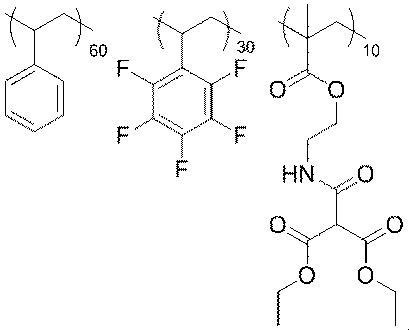
合成例2-3(高分子化合物(3)の合成)
2,3,4,5,6-ペンタフルオロスチレン(アルドリッチ社製)8.60g、2-〔ビス(エトキシカルボニル)メチル]カルボニルアミノ〕-エチルメタクリレート(昭和電工社製、商品名「カレンズMOI-DEM」)1.55g、2,2’-アゾビス(2-メチルプロピオニトリル)0.051g、2-ヘプタノン(東京化成社製)10.16gを、50mL耐圧容器(ACE GLASS社製)に入れ、窒素ガスでバブリングした後、密栓し、70℃のオイルバス中で15時間重合させて共重合体溶液を得た。高分子化合物(3)のポリスチレン換算の数平均分子量は3.6×10⁴であり、重量平均分子量は7.5×10⁴であった。
2,3,4,5,6-ペンタフルオロスチレン(アルドリッチ社製)8.60g、2-〔ビス(エトキシカルボニル)メチル]カルボニルアミノ〕-エチルメタクリレート(昭和電工社製、商品名「カレンズMOI-DEM」)1.55g、2,2’-アゾビス(2-メチルプロピオニトリル)0.051g、2-ヘプタノン(東京化成社製)10.16gを、50mL耐圧容器(ACE GLASS社製)に入れ、窒素ガスでバブリングした後、密栓し、70℃のオイルバス中で15時間重合させて共重合体溶液を得た。高分子化合物(3)のポリスチレン換算の数平均分子量は3.6×10⁴であり、重量平均分子量は7.5×10⁴であった。
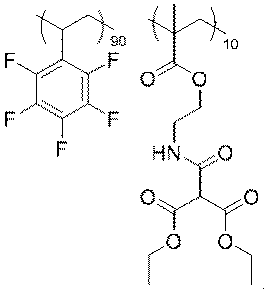
合成例2-4(高分子化合物(4)の合成)
スチレン(純正化学社製)7.50g、2-〔ビス(エトキシカルボニル)メチル]カルボニルアミノ〕-エチルメタクリレート(昭和電工社製、商品名「カレンズMOI-DEM」)2.52g、2,2’-アゾビス(2-メチルプロピオニトリル)0.050g、プロピレングリコールモノメチルエーテルアセテート(東京化成社製)15.11gを、50mL耐圧容器(ACE GLASS社製)に入れ、窒素ガスでバブリングした後、密栓し、70℃のオイルバス中で16時間重合させて共重合体溶液を得た。高分子化合物(4)のポリスチレン換算の数平均分子量は3.8×10⁴であり、重量平均分子量は7.3×10⁴であった。
スチレン(純正化学社製)7.50g、2-〔ビス(エトキシカルボニル)メチル]カルボニルアミノ〕-エチルメタクリレート(昭和電工社製、商品名「カレンズMOI-DEM」)2.52g、2,2’-アゾビス(2-メチルプロピオニトリル)0.050g、プロピレングリコールモノメチルエーテルアセテート(東京化成社製)15.11gを、50mL耐圧容器(ACE GLASS社製)に入れ、窒素ガスでバブリングした後、密栓し、70℃のオイルバス中で16時間重合させて共重合体溶液を得た。高分子化合物(4)のポリスチレン換算の数平均分子量は3.8×10⁴であり、重量平均分子量は7.3×10⁴であった。
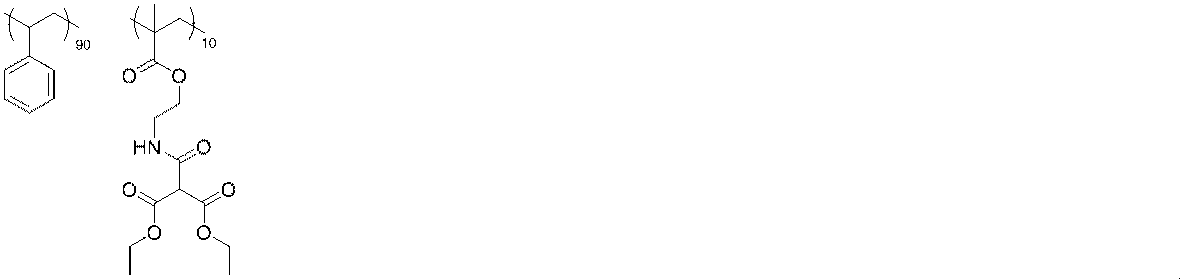
合成例2-5(高分子化合物(5)の合成)
メタクリル酸メチル(和光純薬社製)6.76g、2-〔ビス(エトキシカルボニル)メチル]カルボニルアミノ〕-エチルメタクリレート(昭和電工社製、商品名「カレンズMOI-DEM」)2.37g、2,2’-アゾビス(2-メチルプロピオニトリル)0.099g、2-ヘプタノン(東京化成社製)21.52gを、50mL耐圧容器(ACE GLASS社製)に入れ、窒素ガスでバブリングした後、密栓し、70℃のオイルバス中で18時間重合させて共重合体溶液を得た。高分子化合物(5)のポリスチレン換算の数平均分子量は2.0×10⁴であり、重量平均分子量は7.4×10⁴であった。
メタクリル酸メチル(和光純薬社製)6.76g、2-〔ビス(エトキシカルボニル)メチル]カルボニルアミノ〕-エチルメタクリレート(昭和電工社製、商品名「カレンズMOI-DEM」)2.37g、2,2’-アゾビス(2-メチルプロピオニトリル)0.099g、2-ヘプタノン(東京化成社製)21.52gを、50mL耐圧容器(ACE GLASS社製)に入れ、窒素ガスでバブリングした後、密栓し、70℃のオイルバス中で18時間重合させて共重合体溶液を得た。高分子化合物(5)のポリスチレン換算の数平均分子量は2.0×10⁴であり、重量平均分子量は7.4×10⁴であった。
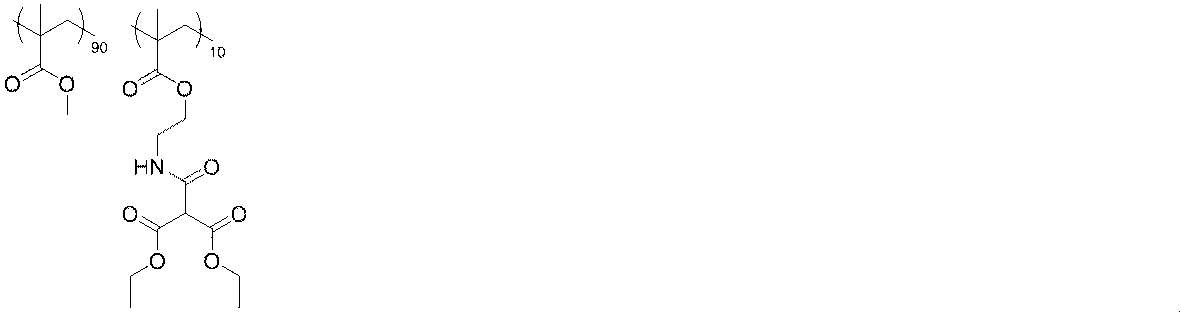
合成例2-6(高分子化合物(6)の合成)
2,3,4,5,6-ペンタフルオロベンジルメタクリレート(シンクエスト・ラボラトリーズ社製)8.15g、2-〔ビス(エトキシカルボニル)メチル]カルボニルアミノ〕-エチルメタクリレート(昭和電工社製、商品名「カレンズMOI-DEM」)1.07g、2,2’-アゾビス(2-メチルプロピオニトリル)0.045g、2-ヘプタノン(東京化成社製)21.61gを、50mL耐圧容器(ACE GLASS社製)に入れ、窒素ガスでバブリングした後、密栓し、70℃のオイルバス中で18時間重合させて共重合体溶液を得た。高分子化合物(6)のポリスチレン換算の数平均分子量は2.7×10⁴であり、重量平均分子量は1.2×10⁵であった。
2,3,4,5,6-ペンタフルオロベンジルメタクリレート(シンクエスト・ラボラトリーズ社製)8.15g、2-〔ビス(エトキシカルボニル)メチル]カルボニルアミノ〕-エチルメタクリレート(昭和電工社製、商品名「カレンズMOI-DEM」)1.07g、2,2’-アゾビス(2-メチルプロピオニトリル)0.045g、2-ヘプタノン(東京化成社製)21.61gを、50mL耐圧容器(ACE GLASS社製)に入れ、窒素ガスでバブリングした後、密栓し、70℃のオイルバス中で18時間重合させて共重合体溶液を得た。高分子化合物(6)のポリスチレン換算の数平均分子量は2.7×10⁴であり、重量平均分子量は1.2×10⁵であった。
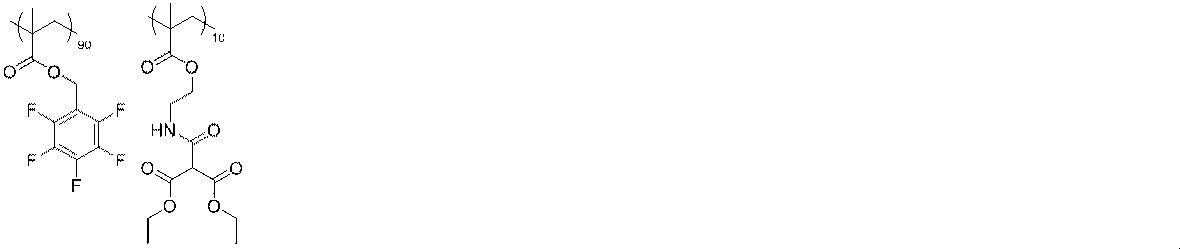
合成例2-7(高分子化合物(7)の合成)
2,2,2-トリフルオロエチルメタクリレート(東京化成社製)6.81g、2-〔ビス(エトキシカルボニル)メチル]カルボニルアミノ〕-エチルメタクリレート(昭和電工社製、商品名「カレンズMOI-DEM」)1.42g、2,2’-アゾビス(2-メチルプロピオニトリル)0.059g、プロピレングリコールモノメチルエーテルアセテート(東京化成社製)19.34gを、50mL耐圧容器(ACE GLASS社製)に入れ、窒素ガスでバブリングした後、密栓し、70℃のオイルバス中で18時間重合させて共重合体溶液を得た。高分子化合物(7)のポリスチレン換算の数平均分子量は3.2×10⁴であり、重量平均分子量は8.7×10⁴であった。
2,2,2-トリフルオロエチルメタクリレート(東京化成社製)6.81g、2-〔ビス(エトキシカルボニル)メチル]カルボニルアミノ〕-エチルメタクリレート(昭和電工社製、商品名「カレンズMOI-DEM」)1.42g、2,2’-アゾビス(2-メチルプロピオニトリル)0.059g、プロピレングリコールモノメチルエーテルアセテート(東京化成社製)19.34gを、50mL耐圧容器(ACE GLASS社製)に入れ、窒素ガスでバブリングした後、密栓し、70℃のオイルバス中で18時間重合させて共重合体溶液を得た。高分子化合物(7)のポリスチレン換算の数平均分子量は3.2×10⁴であり、重量平均分子量は8.7×10⁴であった。

合成例2-8(高分子化合物(8)の合成)
ベンジルメタクリレート(東京化成社製)8.25g、4-ヒドロキシブチルアクリレート(日本化成社製)1.00g、2,2’-アゾビス(2-メチルプロピオニトリル)0.068g、2-ヘプタノン(東京化成社製)21.73gを、50mL耐圧容器(ACE GLASS社製)に入れ、窒素ガスでバブリングした後、密栓し、70℃のオイルバス中で18時間重合させて共重合体溶液を得た。高分子化合物(8)のポリスチレン換算の数平均分子量は2.8×10⁴であり、重量平均分子量は1.0×10⁵であった。
ベンジルメタクリレート(東京化成社製)8.25g、4-ヒドロキシブチルアクリレート(日本化成社製)1.00g、2,2’-アゾビス(2-メチルプロピオニトリル)0.068g、2-ヘプタノン(東京化成社製)21.73gを、50mL耐圧容器(ACE GLASS社製)に入れ、窒素ガスでバブリングした後、密栓し、70℃のオイルバス中で18時間重合させて共重合体溶液を得た。高分子化合物(8)のポリスチレン換算の数平均分子量は2.8×10⁴であり、重量平均分子量は1.0×10⁵であった。

合成例2-9(高分子化合物(9)の合成)
スチレン(純正化学社製)4.69g、2,3,4,5,6-ペンタフルオロスチレン(アルドリッチ社製)4.37g、4-ヒドロキシブチルアクリレート(日本化成社製)1.08g、2,2’-アゾビス(2-メチルプロピオニトリル)0.051g、2-ヘプタノン(東京化成社製)10.19gを、50mL耐圧容器(ACE GLASS社製)に入れ、窒素ガスでバブリングした後、密栓し、70℃のオイルバス中で15時間重合させて共重合体溶液を得た。高分子化合物(9)のポリスチレン換算の数平均分子量は5.0×10⁴であり、重量平均分子量は1.1×10⁵であった。
スチレン(純正化学社製)4.69g、2,3,4,5,6-ペンタフルオロスチレン(アルドリッチ社製)4.37g、4-ヒドロキシブチルアクリレート(日本化成社製)1.08g、2,2’-アゾビス(2-メチルプロピオニトリル)0.051g、2-ヘプタノン(東京化成社製)10.19gを、50mL耐圧容器(ACE GLASS社製)に入れ、窒素ガスでバブリングした後、密栓し、70℃のオイルバス中で15時間重合させて共重合体溶液を得た。高分子化合物(9)のポリスチレン換算の数平均分子量は5.0×10⁴であり、重量平均分子量は1.1×10⁵であった。

合成例2-10(高分子化合物(10)の合成)
2,3,4,5,6-ペンタフルオロスチレン(アルドリッチ社製)9.26g、4-ヒドロキシブチルアクリレート(日本化成社製)0.76g、2,2’-アゾビス(2-メチルプロピオニトリル)0.050g、2-ヘプタノン(東京化成社製)10.07gを、50mL耐圧容器(ACE GLASS社製)に入れ、窒素ガスでバブリングした後、密栓し、70℃のオイルバス中で15時間重合させて共重合体溶液を得た。高分子化合物(10)のポリスチレン換算の数平均分子量は3.9×10⁴であり、重量平均分子量は7.4×10⁴であった。
2,3,4,5,6-ペンタフルオロスチレン(アルドリッチ社製)9.26g、4-ヒドロキシブチルアクリレート(日本化成社製)0.76g、2,2’-アゾビス(2-メチルプロピオニトリル)0.050g、2-ヘプタノン(東京化成社製)10.07gを、50mL耐圧容器(ACE GLASS社製)に入れ、窒素ガスでバブリングした後、密栓し、70℃のオイルバス中で15時間重合させて共重合体溶液を得た。高分子化合物(10)のポリスチレン換算の数平均分子量は3.9×10⁴であり、重量平均分子量は7.4×10⁴であった。

合成例2-11(高分子化合物(11)の合成)
スチレン(純正化学社製)9.37g、2-ヒドロキシエチルメタクリレート(東京化成製社製)1.30g、2,2’-アゾビス(2-メチルプロピオニトリル)0.053g、プロピレングリコールモノメチルエーテルアセテート(東京化成社製)16.09gを、50mL耐圧容器(ACE GLASS社製)に入れ、窒素ガスでバブリングした後、密栓し、70℃のオイルバス中で16時間重合させて共重合体溶液を得た。高分子化合物(11)のポリスチレン換算の数平均分子量は3.3×10⁴であり、重量平均分子量は6.2×10⁴であった。
スチレン(純正化学社製)9.37g、2-ヒドロキシエチルメタクリレート(東京化成製社製)1.30g、2,2’-アゾビス(2-メチルプロピオニトリル)0.053g、プロピレングリコールモノメチルエーテルアセテート(東京化成社製)16.09gを、50mL耐圧容器(ACE GLASS社製)に入れ、窒素ガスでバブリングした後、密栓し、70℃のオイルバス中で16時間重合させて共重合体溶液を得た。高分子化合物(11)のポリスチレン換算の数平均分子量は3.3×10⁴であり、重量平均分子量は6.2×10⁴であった。

合成例2-12(高分子化合物(12)の合成)
スチレン(純正化学社製)9.37g、4-ヒドロキシブチルアクリレート(日本化成社製)1.44g、2,2’-アゾビス(2-メチルプロピオニトリル)0.054g、シクロペンタノール(東京化成社製)16.30gを、50mL耐圧容器(ACE GLASS社製)に入れ、窒素ガスでバブリングした後、密栓し、70℃のオイルバス中で16時間重合させて共重合体溶液を得た。高分子化合物(12)のポリスチレン換算の数平均分子量は5.4×10⁴であり、重量平均分子量は1.3×10⁵であった。
スチレン(純正化学社製)9.37g、4-ヒドロキシブチルアクリレート(日本化成社製)1.44g、2,2’-アゾビス(2-メチルプロピオニトリル)0.054g、シクロペンタノール(東京化成社製)16.30gを、50mL耐圧容器(ACE GLASS社製)に入れ、窒素ガスでバブリングした後、密栓し、70℃のオイルバス中で16時間重合させて共重合体溶液を得た。高分子化合物(12)のポリスチレン換算の数平均分子量は5.4×10⁴であり、重量平均分子量は1.3×10⁵であった。

合成例2-13(高分子化合物(13)の合成)
スチレン(純正化学社製)12.19g、4-ヒドロキシブチルアクリレート(日本化成社製)1.87g、2,2’-アゾビス(2-メチルプロピオニトリル)0.070g、プロピレングリコールモノメチルエーテルアセテート(東京化成社製)14.13gを、50mL耐圧容器(ACE GLASS社製)に入れ、窒素ガスでバブリングした後、密栓し、70℃のオイルバス中で16時間重合させて共重合体溶液を得た。高分子化合物(13)のポリスチレン換算の数平均分子量は3.9×10⁴であり、重量平均分子量は8.6×10⁴であった。
スチレン(純正化学社製)12.19g、4-ヒドロキシブチルアクリレート(日本化成社製)1.87g、2,2’-アゾビス(2-メチルプロピオニトリル)0.070g、プロピレングリコールモノメチルエーテルアセテート(東京化成社製)14.13gを、50mL耐圧容器(ACE GLASS社製)に入れ、窒素ガスでバブリングした後、密栓し、70℃のオイルバス中で16時間重合させて共重合体溶液を得た。高分子化合物(13)のポリスチレン換算の数平均分子量は3.9×10⁴であり、重量平均分子量は8.6×10⁴であった。

合成例2-14(高分子化合物(14)の合成)
メタクリル酸メチル(和光純薬社製)7.75g、4-ヒドロキシブチルアクリレート(日本化成社製)1.24g、2,2’-アゾビス(2-メチルプロピオニトリル)0.113g、2-ヘプタノン(東京化成社製)21.24gを、50mL耐圧容器(ACE GLASS社製)に入れ、窒素ガスでバブリングした後、密栓し、70℃のオイルバス中で18時間重合させて共重合体溶液を得た。高分子化合物(14)のポリスチレン換算の数平均分子量は1.9×10⁴であり、重量平均分子量は5.5×10⁴であった。
メタクリル酸メチル(和光純薬社製)7.75g、4-ヒドロキシブチルアクリレート(日本化成社製)1.24g、2,2’-アゾビス(2-メチルプロピオニトリル)0.113g、2-ヘプタノン(東京化成社製)21.24gを、50mL耐圧容器(ACE GLASS社製)に入れ、窒素ガスでバブリングした後、密栓し、70℃のオイルバス中で18時間重合させて共重合体溶液を得た。高分子化合物(14)のポリスチレン換算の数平均分子量は1.9×10⁴であり、重量平均分子量は5.5×10⁴であった。

合成例2-15(高分子化合物(15)の合成)
2,3,4,5,6-ペンタフルオロベンジルメタクリレート(シンクエスト・ラボラトリーズ社製)8.62g、4-ヒドロキシブチルアクリレート(日本化成社製)0.52g、2,2’-アゾビス(2-メチルプロピオニトリル)0.049g、2-ヘプタノン(東京化成社製)21.44gを、50mL耐圧容器(ACE GLASS社製)に入れ、窒素ガスでバブリングした後、密栓し、70℃のオイルバス中で18時間重合させて共重合体溶液を得た。高分子化合物(15)のポリスチレン換算の数平均分子量は3.0×10⁴であり、重量平均分子量は9.9×10⁴であった。
2,3,4,5,6-ペンタフルオロベンジルメタクリレート(シンクエスト・ラボラトリーズ社製)8.62g、4-ヒドロキシブチルアクリレート(日本化成社製)0.52g、2,2’-アゾビス(2-メチルプロピオニトリル)0.049g、2-ヘプタノン(東京化成社製)21.44gを、50mL耐圧容器(ACE GLASS社製)に入れ、窒素ガスでバブリングした後、密栓し、70℃のオイルバス中で18時間重合させて共重合体溶液を得た。高分子化合物(15)のポリスチレン換算の数平均分子量は3.0×10⁴であり、重量平均分子量は9.9×10⁴であった。

合成例2-16(高分子化合物(16)の合成)
ベンジルメタクリレート(東京化成社製)8.41g、2-ヒドロキシプロピルメタクリレート(東京化成社製)0.76g、2,2’-アゾビス(2-メチルプロピオニトリル)0.070g、2-ヘプタノン(東京化成社製)21.57gを、50mL耐圧容器(ACE GLASS社製)に入れ、窒素ガスでバブリングした後、密栓し、70℃のオイルバス中で18時間重合させて共重合体溶液を得た。高分子化合物(16)のポリスチレン換算の数平均分子量は2.3×10⁴であり、重量平均分子量は9.7×10⁴であった。
ベンジルメタクリレート(東京化成社製)8.41g、2-ヒドロキシプロピルメタクリレート(東京化成社製)0.76g、2,2’-アゾビス(2-メチルプロピオニトリル)0.070g、2-ヘプタノン(東京化成社製)21.57gを、50mL耐圧容器(ACE GLASS社製)に入れ、窒素ガスでバブリングした後、密栓し、70℃のオイルバス中で18時間重合させて共重合体溶液を得た。高分子化合物(16)のポリスチレン換算の数平均分子量は2.3×10⁴であり、重量平均分子量は9.7×10⁴であった。

合成例2-17(高分子化合物(17)の合成)
2,2,2-トリフルオロエチルメタクリレート(東京化成社製)7.57g、4-ヒドロキシブチルアクリレート(日本化成社製)0.72g、2,2’-アゾビス(2-メチルプロピオニトリル)0.066g、プロピレングリコールモノメチルエーテルアセテート(東京化成社製)19.49gを、50mL耐圧容器(ACE GLASS社製)に入れ、窒素ガスでバブリングした後、密栓し、70℃のオイルバス中で18時間重合させて共重合体溶液を得た。高分子化合物(17)のポリスチレン換算の数平均分子量は2.2×10⁴であり、重量平均分子量は6.9×10⁴であった。
2,2,2-トリフルオロエチルメタクリレート(東京化成社製)7.57g、4-ヒドロキシブチルアクリレート(日本化成社製)0.72g、2,2’-アゾビス(2-メチルプロピオニトリル)0.066g、プロピレングリコールモノメチルエーテルアセテート(東京化成社製)19.49gを、50mL耐圧容器(ACE GLASS社製)に入れ、窒素ガスでバブリングした後、密栓し、70℃のオイルバス中で18時間重合させて共重合体溶液を得た。高分子化合物(17)のポリスチレン換算の数平均分子量は2.2×10⁴であり、重量平均分子量は6.9×10⁴であった。
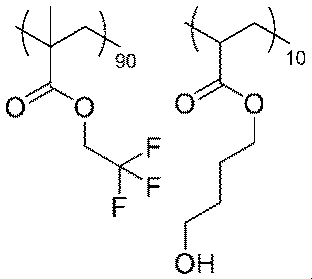
実施例1
合成例2-1で得た高分子化合物(1)の2-ヘプタノン溶液1.00g、及びシクロペンタノール0.38gを5mLのサンプル瓶に入れ、撹拌して均一な溶液とした後、合成例2-8で得た高分子化合物(8)の2-ヘプタノン溶液0.91gを入れて攪拌して均一な溶液とした。室温にて2か月間放置してもゲル化しなかった。
合成例2-1で得た高分子化合物(1)の2-ヘプタノン溶液1.00g、及びシクロペンタノール0.38gを5mLのサンプル瓶に入れ、撹拌して均一な溶液とした後、合成例2-8で得た高分子化合物(8)の2-ヘプタノン溶液0.91gを入れて攪拌して均一な溶液とした。室温にて2か月間放置してもゲル化しなかった。
実施例2
合成例2-1で得た高分子化合物(1)の2-ヘプタノン溶液1.00g、及びメタノール0.38gを5mLのサンプル瓶に入れ、撹拌して均一な溶液とした後、合成例2-8で得た高分子化合物(8)の2-ヘプタノン溶液0.91gを入れて撹拌することで均一な溶液とした。室温にて2か月間放置してもゲル化しなかった。
合成例2-1で得た高分子化合物(1)の2-ヘプタノン溶液1.00g、及びメタノール0.38gを5mLのサンプル瓶に入れ、撹拌して均一な溶液とした後、合成例2-8で得た高分子化合物(8)の2-ヘプタノン溶液0.91gを入れて撹拌することで均一な溶液とした。室温にて2か月間放置してもゲル化しなかった。
実施例3
合成例2-1で得た高分子化合物(1)の2-ヘプタノン溶液1.00g、及びエトキシエタノール0.38gを5mLのサンプル瓶に入れ、撹拌して均一な溶液とした後、合成例2-8で得た高分子化合物(8)の2-ヘプタノン溶液0.91gを入れて撹拌することで均一な溶液とした。室温にて2か月間放置してもゲル化しなかった。
合成例2-1で得た高分子化合物(1)の2-ヘプタノン溶液1.00g、及びエトキシエタノール0.38gを5mLのサンプル瓶に入れ、撹拌して均一な溶液とした後、合成例2-8で得た高分子化合物(8)の2-ヘプタノン溶液0.91gを入れて撹拌することで均一な溶液とした。室温にて2か月間放置してもゲル化しなかった。
比較例1
合成例2-1で得た高分子化合物(1)の2-ヘプタノン溶液1.00g、及び2-ヘプタノン0.38gを5mLのサンプル瓶に入れ、撹拌して均一な溶液とした後、合成例2-8で得た高分子化合物(8)の2-ヘプタノン溶液0.91gを入れて撹拌することで、均一な溶液とした。室温にて3日間放置したところゲル化してしまった。
合成例2-1で得た高分子化合物(1)の2-ヘプタノン溶液1.00g、及び2-ヘプタノン0.38gを5mLのサンプル瓶に入れ、撹拌して均一な溶液とした後、合成例2-8で得た高分子化合物(8)の2-ヘプタノン溶液0.91gを入れて撹拌することで、均一な溶液とした。室温にて3日間放置したところゲル化してしまった。
比較例2
合成例2-1で得た高分子化合物(1)の2-ヘプタノン溶液1.00g、及びマロン酸ジエチル0.38gを5mLのサンプル瓶に入れ、撹拌して均一な溶液とした後、合成例2-8で得た高分子化合物(8)の2-ヘプタノン溶液0.91gを入れて撹拌することで、均一な溶液とした。室温にて3日間放置したところゲル化してしまった。
合成例2-1で得た高分子化合物(1)の2-ヘプタノン溶液1.00g、及びマロン酸ジエチル0.38gを5mLのサンプル瓶に入れ、撹拌して均一な溶液とした後、合成例2-8で得た高分子化合物(8)の2-ヘプタノン溶液0.91gを入れて撹拌することで、均一な溶液とした。室温にて3日間放置したところゲル化してしまった。
比較例3
合成例2-1で得た高分子化合物(1)の2-ヘプタノン溶液1.00g、及びエチレングリコール0.38gを5mLのサンプル瓶に入れ、撹拌した後、合成例2-8で得た高分子化合物(8)の2-ヘプタノン溶液0.91gを入れて攪拌したところ、均一な溶液とならなかった。
合成例2-1で得た高分子化合物(1)の2-ヘプタノン溶液1.00g、及びエチレングリコール0.38gを5mLのサンプル瓶に入れ、撹拌した後、合成例2-8で得た高分子化合物(8)の2-ヘプタノン溶液0.91gを入れて攪拌したところ、均一な溶液とならなかった。
実施例4
合成例2-2で得た高分子化合物(2)の2-ヘプタノン溶液1.00g、及びメタノール0.38gを5mLのサンプル瓶に入れ、撹拌して均一な溶液とした後、合成例2-9で得た高分子化合物(9)の2-ヘプタノン溶液0.88gを入れて撹拌することで攪均一な溶液とした。室温にて5か月間放置してもゲル化しなかった。
合成例2-2で得た高分子化合物(2)の2-ヘプタノン溶液1.00g、及びメタノール0.38gを5mLのサンプル瓶に入れ、撹拌して均一な溶液とした後、合成例2-9で得た高分子化合物(9)の2-ヘプタノン溶液0.88gを入れて撹拌することで攪均一な溶液とした。室温にて5か月間放置してもゲル化しなかった。
比較例4
合成例2-2で得た高分子化合物(2)の2-ヘプタノン溶液1.00g、及びPGMEA0.38gを5mLのサンプル瓶に入れ、撹拌して均一な溶液とした後、合成例2-9で得た高分子化合物(9)の2-ヘプタノン溶液0.88gを入れて撹拌することで均一な溶液とした。室温にて3日間放置したところゲル化してしまった。
合成例2-2で得た高分子化合物(2)の2-ヘプタノン溶液1.00g、及びPGMEA0.38gを5mLのサンプル瓶に入れ、撹拌して均一な溶液とした後、合成例2-9で得た高分子化合物(9)の2-ヘプタノン溶液0.88gを入れて撹拌することで均一な溶液とした。室温にて3日間放置したところゲル化してしまった。
実施例5
合成例2-3で得た高分子化合物(3)の2-ヘプタノン溶液1.50g、及びメタノール0.92gを5mLのサンプル瓶に入れ、撹拌して均一な溶液とした後、合成例2-10で得た高分子化合物(10)の2-ヘプタノン溶液0.69gを入れて撹拌することで均一な溶液とした。室温にて5か月間放置してもゲル化しなかった。
合成例2-3で得た高分子化合物(3)の2-ヘプタノン溶液1.50g、及びメタノール0.92gを5mLのサンプル瓶に入れ、撹拌して均一な溶液とした後、合成例2-10で得た高分子化合物(10)の2-ヘプタノン溶液0.69gを入れて撹拌することで均一な溶液とした。室温にて5か月間放置してもゲル化しなかった。
比較例5
合成例2-3で得た高分子化合物(3)の2-ヘプタノン溶液1.00g、及びトルエン0.61gを5mLのサンプル瓶に入れ、撹拌して均一な溶液とした後、合成例2-10で得た高分子化合物(10)の2-ヘプタノン溶液0.69gを入れて撹拌することで均一な溶液とした。室温にて3日間放置したところゲル化してしまった。
合成例2-3で得た高分子化合物(3)の2-ヘプタノン溶液1.00g、及びトルエン0.61gを5mLのサンプル瓶に入れ、撹拌して均一な溶液とした後、合成例2-10で得た高分子化合物(10)の2-ヘプタノン溶液0.69gを入れて撹拌することで均一な溶液とした。室温にて3日間放置したところゲル化してしまった。
実施例6
合成例2-4で得た高分子化合物(4)のPGMEA溶液1.50g、及びシクロペンタノール0.48gを5mLのサンプル瓶に入れ、撹拌して均一な溶液とした後、合成例2-11で得た高分子化合物(11)のPGMEA溶液0.80gを入れて撹拌することで均一な溶液とした。室温にて7か月間放置してもゲル化しなかった。
合成例2-4で得た高分子化合物(4)のPGMEA溶液1.50g、及びシクロペンタノール0.48gを5mLのサンプル瓶に入れ、撹拌して均一な溶液とした後、合成例2-11で得た高分子化合物(11)のPGMEA溶液0.80gを入れて撹拌することで均一な溶液とした。室温にて7か月間放置してもゲル化しなかった。
比較例6
合成例2-4で得た高分子化合物(4)のPGMEA溶液1.50g、及びPGMEA0.48gを5mLのサンプル瓶に入れ、撹拌して均一な溶液とした後、合成例2-11で得た高分子化合物(11)のPGMEA溶液0.80gを入れて撹拌することで攪均一な溶液とした。室温にて4日間放置したところゲル化してしまった。
合成例2-4で得た高分子化合物(4)のPGMEA溶液1.50g、及びPGMEA0.48gを5mLのサンプル瓶に入れ、撹拌して均一な溶液とした後、合成例2-11で得た高分子化合物(11)のPGMEA溶液0.80gを入れて撹拌することで攪均一な溶液とした。室温にて4日間放置したところゲル化してしまった。
実施例7
合成例2-4で得た高分子化合物(4)のPGMEA溶液1.50g、及びシクロペンタノール0.91gを5mLのサンプル瓶に入れ、撹拌して均一な溶液とした後、合成例2-12で得た高分子化合物(12)のシクロペンタノール溶液1.08gを入れて撹拌することで均一な溶液とした。室温にて7か月間放置してもゲル化しなかった。
合成例2-4で得た高分子化合物(4)のPGMEA溶液1.50g、及びシクロペンタノール0.91gを5mLのサンプル瓶に入れ、撹拌して均一な溶液とした後、合成例2-12で得た高分子化合物(12)のシクロペンタノール溶液1.08gを入れて撹拌することで均一な溶液とした。室温にて7か月間放置してもゲル化しなかった。
実施例8
合成例2-4で得た高分子化合物(4)のPGMEA溶液1.50g、及びシクロペンタノール0.91gを5mLのサンプル瓶に入れ、撹拌して均一な溶液とした後、合成例2-13で得た高分子化合物(13)のPGMEA溶液1.08gを入れて撹拌することで均一な溶液とした。室温にて7か月間放置してもゲル化しなかった。
合成例2-4で得た高分子化合物(4)のPGMEA溶液1.50g、及びシクロペンタノール0.91gを5mLのサンプル瓶に入れ、撹拌して均一な溶液とした後、合成例2-13で得た高分子化合物(13)のPGMEA溶液1.08gを入れて撹拌することで均一な溶液とした。室温にて7か月間放置してもゲル化しなかった。
比較例7
合成例2-4で得た高分子化合物(4)のPGMEA溶液1.50g、及びPGMEA0.91gを5mLのサンプル瓶に入れ、撹拌して均一な溶液とした後、合成例2-13で得た高分子化合物(13)のPGMEA溶液1.08gを入れて撹拌することで均一な溶液とした。室温にて4日間放置したところゲル化してしまった。
合成例2-4で得た高分子化合物(4)のPGMEA溶液1.50g、及びPGMEA0.91gを5mLのサンプル瓶に入れ、撹拌して均一な溶液とした後、合成例2-13で得た高分子化合物(13)のPGMEA溶液1.08gを入れて撹拌することで均一な溶液とした。室温にて4日間放置したところゲル化してしまった。
実施例9
合成例2-5で得た高分子化合物(5)の2-ヘプタノン溶液0.71g、及びシクロペンタノール0.42gを5mLのサンプル瓶に入れ、撹拌して均一な溶液とした後、合成例2-14で得た高分子化合物(14)の2-ヘプタノン溶液1.38gを入れて撹拌することで均一な溶液とした。室温にて2か月間放置してもゲル化しなかった。
合成例2-5で得た高分子化合物(5)の2-ヘプタノン溶液0.71g、及びシクロペンタノール0.42gを5mLのサンプル瓶に入れ、撹拌して均一な溶液とした後、合成例2-14で得た高分子化合物(14)の2-ヘプタノン溶液1.38gを入れて撹拌することで均一な溶液とした。室温にて2か月間放置してもゲル化しなかった。
比較例8
合成例2-5で得た高分子化合物(5)の2-ヘプタノン溶液0.71g、及び2-ヘプタノン0.42gを5mLのサンプル瓶に入れ、撹拌して均一な溶液とした後、合成例2-14で得た高分子化合物(14)の2-ヘプタノン溶液1.38gを入れて撹拌することで均一な溶液とした。室温にて4日間放置したところゲル化してしまった。
合成例2-5で得た高分子化合物(5)の2-ヘプタノン溶液0.71g、及び2-ヘプタノン0.42gを5mLのサンプル瓶に入れ、撹拌して均一な溶液とした後、合成例2-14で得た高分子化合物(14)の2-ヘプタノン溶液1.38gを入れて撹拌することで均一な溶液とした。室温にて4日間放置したところゲル化してしまった。
実施例10
合成例2-6で得た高分子化合物(6)の2-ヘプタノン溶液2.00g、及びシクロペンタノール0.78gを10mLのサンプル瓶に入れ、撹拌して均一な溶液とした後、合成例2-15で得た高分子化合物(15)の2-ヘプタノン溶液1.87gを入れて撹拌することで均一な溶液とした。室温にて2か月間放置してもゲル化しなかった。
合成例2-6で得た高分子化合物(6)の2-ヘプタノン溶液2.00g、及びシクロペンタノール0.78gを10mLのサンプル瓶に入れ、撹拌して均一な溶液とした後、合成例2-15で得た高分子化合物(15)の2-ヘプタノン溶液1.87gを入れて撹拌することで均一な溶液とした。室温にて2か月間放置してもゲル化しなかった。
比較例9
合成例2-6で得た高分子化合物(6)の2-ヘプタノン溶液1.00g、及び2-ヘプタノン0.38gを5mLのサンプル瓶に入れ、撹拌して均一な溶液とした後、合成例2-15で得た高分子化合物(15)の2-ヘプタノン溶液0.94gを入れて撹拌することで均一な溶液とした。室温にて8日間放置したところゲル化してしまった。
合成例2-6で得た高分子化合物(6)の2-ヘプタノン溶液1.00g、及び2-ヘプタノン0.38gを5mLのサンプル瓶に入れ、撹拌して均一な溶液とした後、合成例2-15で得た高分子化合物(15)の2-ヘプタノン溶液0.94gを入れて撹拌することで均一な溶液とした。室温にて8日間放置したところゲル化してしまった。
実施例11
合成例2-5で得た高分子化合物(5)の2-ヘプタノン溶液1.00g、及びベンジルアルコール0.38gを5mLのサンプル瓶に入れ、撹拌して均一な溶液とした後、合成例2-16で得た高分子化合物(16)の2-ヘプタノン溶液0.91gを入れて撹拌することで攪拌して溶解させることにより均一な溶液とした。室温にて2か月間放置してもゲル化しなかった。
合成例2-5で得た高分子化合物(5)の2-ヘプタノン溶液1.00g、及びベンジルアルコール0.38gを5mLのサンプル瓶に入れ、撹拌して均一な溶液とした後、合成例2-16で得た高分子化合物(16)の2-ヘプタノン溶液0.91gを入れて撹拌することで攪拌して溶解させることにより均一な溶液とした。室温にて2か月間放置してもゲル化しなかった。
比較例10
合成例2-5で得た高分子化合物(5)の2-ヘプタノン溶液1.00g、及び2-ヘプタノン0.38gを5mLのサンプル瓶に入れ、撹拌して均一な溶液とした後、合成例2-16で得た高分子化合物(16)の2-ヘプタノン溶液0.91gを入れて撹拌することで均一な溶液とした。室温にて7日間放置したところゲル化してしまった。
合成例2-5で得た高分子化合物(5)の2-ヘプタノン溶液1.00g、及び2-ヘプタノン0.38gを5mLのサンプル瓶に入れ、撹拌して均一な溶液とした後、合成例2-16で得た高分子化合物(16)の2-ヘプタノン溶液0.91gを入れて撹拌することで均一な溶液とした。室温にて7日間放置したところゲル化してしまった。
実施例12
合成例2-7で得た高分子化合物(7)の2-ヘプタノン溶液1.00g、及びシクロペンタノール0.95gを5mLのサンプル瓶に入れ、撹拌して均一な溶液とした後、合成例2-17で得た高分子化合物(17)の2-ヘプタノン溶液0.91gを入れて撹拌することで均一な溶液とした。室温にて2か月間放置してもゲル化しなかった。
合成例2-7で得た高分子化合物(7)の2-ヘプタノン溶液1.00g、及びシクロペンタノール0.95gを5mLのサンプル瓶に入れ、撹拌して均一な溶液とした後、合成例2-17で得た高分子化合物(17)の2-ヘプタノン溶液0.91gを入れて撹拌することで均一な溶液とした。室温にて2か月間放置してもゲル化しなかった。
比較例11
合成例2-7で得た高分子化合物(7)の2-ヘプタノン溶液1.00g、及び2-ヘプタノン0.95gを5mLのサンプル瓶に入れ、撹拌して均一な溶液とした後、合成例2-17で得た高分子化合物(17)の2-ヘプタノン溶液0.91gを入れて撹拌することで均一な溶液とした。室温にて3日間放置したところゲル化してしまった。
合成例2-7で得た高分子化合物(7)の2-ヘプタノン溶液1.00g、及び2-ヘプタノン0.95gを5mLのサンプル瓶に入れ、撹拌して均一な溶液とした後、合成例2-17で得た高分子化合物(17)の2-ヘプタノン溶液0.91gを入れて撹拌することで均一な溶液とした。室温にて3日間放置したところゲル化してしまった。
実施例13(絶縁層の製造及び評価)
実施例5で得られた溶液を、クロム電極の付いたガラス基板上にスピンコートした。その後、ホットプレート上で130℃、30分間乾燥させることで、膜厚600nmの絶縁層を得た。
実施例5で得られた溶液を、クロム電極の付いたガラス基板上にスピンコートした。その後、ホットプレート上で130℃、30分間乾燥させることで、膜厚600nmの絶縁層を得た。
得られた絶縁層上に、メタルマスクを用いて蒸着によりアルミ電極を形成することで、MIM(Metal Insulator Metal)素子を作製した。
MIN素子の電気特性を評価することで、絶縁層用組成物としての評価をおこなった。
MIN素子の電気特性を評価することで、絶縁層用組成物としての評価をおこなった。
作製したMIM素子の絶縁耐圧を、真空プロ-バ(Nagase Electronic Equipments Service Co., LTD製、BCT22MDC-5-HT-SCU;)を用いて測定した。ここで、絶縁耐圧は、電極間に電界をかけて、リーク電流が1×10⁻⁹A/cm2となる電解強度により評価した。
リーク電流が1×10⁻⁹A/cm2となる電界強度の値は>3.0MV/cmであった。
リーク電流が1×10⁻⁹A/cm2となる電界強度の値は>3.0MV/cmであった。
実施例14(有機薄膜トランジスタ(1)の製造及び評価)
実施例5で得られた溶液を用いて、トップゲートボトムコンタクト型の有機薄膜トランジスタ(1)を製造した以下に具体的に説明する。
実施例5で得られた溶液を用いて、トップゲートボトムコンタクト型の有機薄膜トランジスタ(1)を製造した以下に具体的に説明する。
まず、ガラス基板に対し、オゾンUVを照射した後、アルカリ洗浄液により洗浄し、純水によりリンスした。
次に、ガラス基板上に、スパッタリング法により、基板側からクロム、金の順で積層し、フォトリソグラフィによりパターニングすることで、ソース電極、及びドレイン電極を形成した。このときのソース電極、及びドレイン電極のチャネル長は10μm、チャンネル幅は2mmとした。その後、パーフルオロベンゼンチオールのイソプロピルアルコール希釈液に、ガラス基板を2分間浸漬することにより、ガラス基板上に形成した電極(特に金)の表面を修飾した。
次に、ガラス基板上に、スパッタリング法により、基板側からクロム、金の順で積層し、フォトリソグラフィによりパターニングすることで、ソース電極、及びドレイン電極を形成した。このときのソース電極、及びドレイン電極のチャネル長は10μm、チャンネル幅は2mmとした。その後、パーフルオロベンゼンチオールのイソプロピルアルコール希釈液に、ガラス基板を2分間浸漬することにより、ガラス基板上に形成した電極(特に金)の表面を修飾した。
続いて合成例1で得られた0.5質量%の高分子化合物Cのトルエン溶液をソース電極及びドレイン電極側にスピンコートし、ホットプレートを用いて120℃で30分間加熱処理することで、有機半導体層を形成した。
この有機半導体層の上に、実施例5で得られた溶液をスピンコート法により塗布し、形成された塗布層を130℃で30分間分間加熱処理することで、塗布層が硬化した硬化膜である、ゲート絶縁層を形成した。形成されたゲート絶縁層の厚さは、991nmであった。
さらに、このゲート絶縁層上に、蒸着法によりアルミニウムを成膜して、ゲート電極を形成することで有機薄膜トランジスタ(1)を得た。
得られた有機薄膜トランジスタ(1)を評価した。
具体的には、真空プロ-バ(BCT22MDC-5-HT-SCU;Nagase Electronic Equipments Service Co.,LTD製)を用いて、有機薄膜トランジスタ(1)のゲート電極に電圧を印加してゲート電圧Vgを20V~-40Vに変化させ、ソース・ドレイン間電圧Vsdを0V~-40Vに変化させる条件で、キャリア移動度を測定した。
有機薄膜トランジスタ(1)のキャリア移動度は、0.41cm2/Vsであった。
具体的には、真空プロ-バ(BCT22MDC-5-HT-SCU;Nagase Electronic Equipments Service Co.,LTD製)を用いて、有機薄膜トランジスタ(1)のゲート電極に電圧を印加してゲート電圧Vgを20V~-40Vに変化させ、ソース・ドレイン間電圧Vsdを0V~-40Vに変化させる条件で、キャリア移動度を測定した。
有機薄膜トランジスタ(1)のキャリア移動度は、0.41cm2/Vsであった。
1…基板、
2…ゲート電極、
3…ゲート絶縁層、
4…有機半導体層、
5…ソース電極、
6…ドレイン電極、
7…オーバーコート層
10…有機薄膜トランジスタ。
2…ゲート電極、
3…ゲート絶縁層、
4…有機半導体層、
5…ソース電極、
6…ドレイン電極、
7…オーバーコート層
10…有機薄膜トランジスタ。
Claims (7)
- 下記式(1)で表される繰り返し単位を有する高分子化合物(A)と、
下記式(2)で表される繰り返し単位を有する高分子化合物(B)と、
下記式(3)で表される化合物と
を含有する組成物。
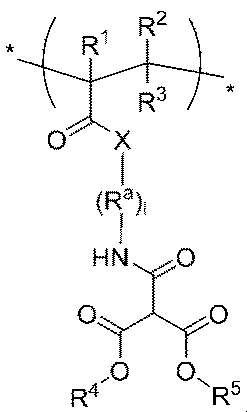
(式(1)中、
R1、R2及びR3は、互いに異なっていてもよく、水素原子、フッ素原子、又は炭素原子数1~20の1価の有機基を表す。
R4及びR5は、互いに異なっていてもよく、炭素原子数1~20のアルキル基、又は炭素原子数3~20のシクロアルキル基を表す。該アルキル基、又はシクロアルキル基中の水素原子は、炭素原子数3~20のシクロアルキル基、炭素原子数1~20のアルコキシ基、炭素原子数3~20のシクロアルコキシ基、炭素原子数6~20の1価の芳香族炭化水素基、又はフッ素原子で置換されていてもよい。
Raは、炭素原子数1~20の2価の有機基を表す。
Xは、酸素原子、又は-NRn-で表される基を表す。Rnは、水素原子又は炭素原子数1~20の1価の有機基を表す。
lは、1~6の整数を表す。
Raが複数個ある場合、それらは互いに異なっていてもよい。
*は、結合位置を表す。)

(式(2)中、
R6、R7及びR8は、互いに異なっていてもよく、水素原子、フッ素原子、又は炭素原子数1~20の1価の有機基を表す。
Rbは、炭素原子数1~20の2価の有機基、-O-で表される基、-CO-で表される基、-COO-で表される基、-NHCO-で表される基、又は-NHCOO-で表される基を表す。-O-で表される基、-CO-で表される基、-COO-で表される基、-NHCO-で表される基、及び-NHCOO-で表される基の2つの結合手は、どちらが、R6が結合する炭素原子側に位置していてもよい。
Rcは、単結合、又は炭素原子数1~20の2価の有機基を表す。
mは、0~6の整数を表す。
Rbが複数個ある場合、それらは互いに異なっていてもよい。
*は、結合位置を表す。)

(式(3)中、
R9は、炭素原子数1~20のアルキル基、炭素原子数3~20のシクロアルキル基、又は炭素原子数2~20の下記式(6)で表される基を表す。該アルキル基、シクロアルキル基、又は下記式(6)で表される基中の水素原子は、炭素原子数3~20のシクロアルキル基、炭素原子数1~20のアルコキシ基、炭素原子数3~20のシクロアルコキシ基、炭素原子数6~20の1価の芳香族炭化水素基、又はフッ素原子で置換されていてもよい。)

(式(6)中、
R15は、炭素原子数1~6の2価の直鎖状脂肪族炭化水素基を表し、
R16は、炭素原子数1~19の1価の直鎖状脂肪族炭化水素基を表し、
qは、1~19の整数を表す。
ただし、R15、R16、及びqは、全体の炭素原子数が2~20になるように調整される。) - 前記高分子化合物(A)、及び前記高分子化合物(B)からなる群より選ばれる少なくとも一種の高分子化合物が、下記式(4)で表される繰り返し単位をさらに含む高分子化合物である、請求項1に記載の組成物。

(式(4)中、
R10、R11、及びR12は、互いに異なっていてもよく、水素原子、フッ素原子、又は炭素原子数1~20の1価の有機基を表す。
R13は、塩素原子、フッ素原子、臭素原子、ヨウ素原子、又は炭素原子数1~20の1価の有機基を表す。
Rdは、炭素原子数1~20の2価の有機基、-O-で表される基、-CO-で表される基、-COO-で表される基、-NHCO-で表される基、又は-NHCOO-で表される基を表す。これらの-O-で表される基、-CO-で表される基、-COO-で表される基、-NHCO-で表される基、及び-NHCOO-で表される基の2つの結合手は、どちらが、R10が結合する炭素原子側に位置していてもよい。Rdで表される2価の有機基中の水素原子は、フッ素原子で置換されていてもよい。
n1は、0~5の整数を表す。
n2は、0~6の整数を表す。
Rdが複数個ある場合、それらは互いに異なっていてもよい。
R13が複数個ある場合、それらは互いに異なっていてもよい。
*は、結合位置を表す。) - 前記式(3)中、R9が、炭素原子数1~20のアルキル基、又は炭素原子数3~20のシクロアルキル基である(該アルキル基、又はシクロアルキル基中の水素原子は、炭素原子数3~20のシクロアルキル基、炭素原子数1~20のアルコキシ基、炭素原子数3~20のシクロアルコキシ基、又は、炭素原子数6~20の1価の芳香族炭化水素基で置換されていてもよい。)、請求項1又は2に記載の組成物。
- 組成物に含まれる前記式(3)で表される化合物が、1質量%以上90質量%以下である、請求項1~3のいずれか1項に記載の組成物。
- 電子デバイスに用いられる、請求項1~4のいずれか1項に記載の組成物を含む、絶縁層用組成物。
- 前記電子デバイスが有機薄膜トランジスタである、請求項5~に記載の絶縁層用組成物。
- 請求項1~4のいずれか1項に記載の組成物が硬化した膜をゲート絶縁層として含む、有機薄膜トランジスタ。
Priority Applications (1)
| Application Number | Priority Date | Filing Date | Title |
|---|---|---|---|
| JP2018567390A JP7225804B2 (ja) | 2017-02-07 | 2018-02-01 | 組成物 |
Applications Claiming Priority (2)
| Application Number | Priority Date | Filing Date | Title |
|---|---|---|---|
| JP2017020103 | 2017-02-07 | ||
| JP2017-020103 | 2017-02-07 |
Publications (1)
| Publication Number | Publication Date |
|---|---|
| WO2018147155A1 true WO2018147155A1 (ja) | 2018-08-16 |
Family
ID=63108159
Family Applications (1)
| Application Number | Title | Priority Date | Filing Date |
|---|---|---|---|
| PCT/JP2018/003353 Ceased WO2018147155A1 (ja) | 2017-02-07 | 2018-02-01 | 組成物 |
Country Status (3)
| Country | Link |
|---|---|
| JP (1) | JP7225804B2 (ja) |
| TW (1) | TW201840695A (ja) |
| WO (1) | WO2018147155A1 (ja) |
Citations (2)
| Publication number | Priority date | Publication date | Assignee | Title |
|---|---|---|---|---|
| JPH10316643A (ja) * | 1997-05-19 | 1998-12-02 | Showa Denko Kk | 重合性マロン酸誘導体および硬化性組成物 |
| WO2017115790A1 (ja) * | 2015-12-28 | 2017-07-06 | 日産化学工業株式会社 | イソシアネート基及び/又はブロック化されたイソシアネート基を有する部位及び光反応性を有する部位を有する重合体と架橋剤を含有する液晶配向剤、液晶配向膜、及び液晶表示素子 |
-
2018
- 2018-02-01 JP JP2018567390A patent/JP7225804B2/ja active Active
- 2018-02-01 WO PCT/JP2018/003353 patent/WO2018147155A1/ja not_active Ceased
- 2018-02-02 TW TW107103808A patent/TW201840695A/zh unknown
Patent Citations (2)
| Publication number | Priority date | Publication date | Assignee | Title |
|---|---|---|---|---|
| JPH10316643A (ja) * | 1997-05-19 | 1998-12-02 | Showa Denko Kk | 重合性マロン酸誘導体および硬化性組成物 |
| WO2017115790A1 (ja) * | 2015-12-28 | 2017-07-06 | 日産化学工業株式会社 | イソシアネート基及び/又はブロック化されたイソシアネート基を有する部位及び光反応性を有する部位を有する重合体と架橋剤を含有する液晶配向剤、液晶配向膜、及び液晶表示素子 |
Also Published As
| Publication number | Publication date |
|---|---|
| TW201840695A (zh) | 2018-11-16 |
| JPWO2018147155A1 (ja) | 2019-12-12 |
| JP7225804B2 (ja) | 2023-02-21 |
Similar Documents
| Publication | Publication Date | Title |
|---|---|---|
| TWI488906B (zh) | 樹脂組成物、閘極絕緣層及有機薄膜電晶體 | |
| JP6884745B2 (ja) | 高分子化合物、組成物、絶縁層および有機薄膜トランジスタ | |
| CN102612752A (zh) | 用于有机薄膜晶体管的光和热的能量可交联绝缘层材料 | |
| JP2013008951A (ja) | 光及び熱エネルギー架橋性有機薄膜トランジスタ絶縁層材料 | |
| JP6884746B2 (ja) | 高分子化合物、組成物及び有機薄膜トランジスタ | |
| WO2018147156A1 (ja) | 高分子化合物の製造方法及び組成物 | |
| EP2797110B1 (en) | Insulation-layer material for electronic device, and electronic device | |
| JP7225804B2 (ja) | 組成物 | |
| JP6399241B2 (ja) | 高分子化合物、該高分子化合物を硬化した膜及び該膜を含む電子デバイス | |
| JP2012164806A (ja) | 光及び熱エネルギー架橋性有機薄膜トランジスタ絶縁層材料 | |
| JP2017016820A (ja) | 絶縁材料用組成物及びそれを用いた有機薄膜トランジスタ | |
| TW201906877A (zh) | 薄膜電晶體及高分子化合物 | |
| JP2019015898A (ja) | 感光性組成物及び有機薄膜トランジスタ | |
| JP6308256B2 (ja) | 組成物、膜、電子デバイス、および有機薄膜トランジスタ | |
| JP2017002157A (ja) | 絶縁材料用組成物およびそれを用いた有機薄膜トランジスタ | |
| WO2012108326A1 (ja) | 光及び熱エネルギー架橋性有機薄膜トランジスタ絶縁層材料 |
Legal Events
| Date | Code | Title | Description |
|---|---|---|---|
| 121 | Ep: the epo has been informed by wipo that ep was designated in this application |
Ref document number: 18750638 Country of ref document: EP Kind code of ref document: A1 |
|
| ENP | Entry into the national phase |
Ref document number: 2018567390 Country of ref document: JP Kind code of ref document: A |
|
| NENP | Non-entry into the national phase |
Ref country code: DE |
|
| 122 | Ep: pct application non-entry in european phase |
Ref document number: 18750638 Country of ref document: EP Kind code of ref document: A1 |