WO2018079380A1 - 生体データ処理装置、生体データ処理システムおよびプログラム - Google Patents
生体データ処理装置、生体データ処理システムおよびプログラム Download PDFInfo
- Publication number
- WO2018079380A1 WO2018079380A1 PCT/JP2017/037713 JP2017037713W WO2018079380A1 WO 2018079380 A1 WO2018079380 A1 WO 2018079380A1 JP 2017037713 W JP2017037713 W JP 2017037713W WO 2018079380 A1 WO2018079380 A1 WO 2018079380A1
- Authority
- WO
- WIPO (PCT)
- Prior art keywords
- data
- event
- biological
- unit
- biometric
- Prior art date
- Legal status (The legal status is an assumption and is not a legal conclusion. Google has not performed a legal analysis and makes no representation as to the accuracy of the status listed.)
- Ceased
Links
Images






Classifications
-
- G—PHYSICS
- G16—INFORMATION AND COMMUNICATION TECHNOLOGY [ICT] SPECIALLY ADAPTED FOR SPECIFIC APPLICATION FIELDS
- G16H—HEALTHCARE INFORMATICS, i.e. INFORMATION AND COMMUNICATION TECHNOLOGY [ICT] SPECIALLY ADAPTED FOR THE HANDLING OR PROCESSING OF MEDICAL OR HEALTHCARE DATA
- G16H20/00—ICT specially adapted for therapies or health-improving plans, e.g. for handling prescriptions, for steering therapy or for monitoring patient compliance
- G16H20/10—ICT specially adapted for therapies or health-improving plans, e.g. for handling prescriptions, for steering therapy or for monitoring patient compliance relating to drugs or medications, e.g. for ensuring correct administration to patients
-
- A—HUMAN NECESSITIES
- A61—MEDICAL OR VETERINARY SCIENCE; HYGIENE
- A61B—DIAGNOSIS; SURGERY; IDENTIFICATION
- A61B5/00—Measuring for diagnostic purposes; Identification of persons
-
- A—HUMAN NECESSITIES
- A61—MEDICAL OR VETERINARY SCIENCE; HYGIENE
- A61B—DIAGNOSIS; SURGERY; IDENTIFICATION
- A61B5/00—Measuring for diagnostic purposes; Identification of persons
- A61B5/02—Detecting, measuring or recording for evaluating the cardiovascular system, e.g. pulse, heart rate, blood pressure or blood flow
- A61B5/021—Measuring pressure in heart or blood vessels
- A61B5/022—Measuring pressure in heart or blood vessels by applying pressure to close blood vessels, e.g. against the skin; Ophthalmodynamometers
-
- G—PHYSICS
- G16—INFORMATION AND COMMUNICATION TECHNOLOGY [ICT] SPECIALLY ADAPTED FOR SPECIFIC APPLICATION FIELDS
- G16H—HEALTHCARE INFORMATICS, i.e. INFORMATION AND COMMUNICATION TECHNOLOGY [ICT] SPECIALLY ADAPTED FOR THE HANDLING OR PROCESSING OF MEDICAL OR HEALTHCARE DATA
- G16H15/00—ICT specially adapted for medical reports, e.g. generation or transmission thereof
-
- G—PHYSICS
- G16—INFORMATION AND COMMUNICATION TECHNOLOGY [ICT] SPECIALLY ADAPTED FOR SPECIFIC APPLICATION FIELDS
- G16H—HEALTHCARE INFORMATICS, i.e. INFORMATION AND COMMUNICATION TECHNOLOGY [ICT] SPECIALLY ADAPTED FOR THE HANDLING OR PROCESSING OF MEDICAL OR HEALTHCARE DATA
- G16H40/00—ICT specially adapted for the management or administration of healthcare resources or facilities; ICT specially adapted for the management or operation of medical equipment or devices
- G16H40/60—ICT specially adapted for the management or administration of healthcare resources or facilities; ICT specially adapted for the management or operation of medical equipment or devices for the operation of medical equipment or devices
- G16H40/63—ICT specially adapted for the management or administration of healthcare resources or facilities; ICT specially adapted for the management or operation of medical equipment or devices for the operation of medical equipment or devices for local operation
-
- G—PHYSICS
- G16—INFORMATION AND COMMUNICATION TECHNOLOGY [ICT] SPECIALLY ADAPTED FOR SPECIFIC APPLICATION FIELDS
- G16H—HEALTHCARE INFORMATICS, i.e. INFORMATION AND COMMUNICATION TECHNOLOGY [ICT] SPECIALLY ADAPTED FOR THE HANDLING OR PROCESSING OF MEDICAL OR HEALTHCARE DATA
- G16H70/00—ICT specially adapted for the handling or processing of medical references
- G16H70/40—ICT specially adapted for the handling or processing of medical references relating to drugs, e.g. their side effects or intended usage
Definitions
- the present disclosure relates to an apparatus, a system, and a program for processing biometric data, and in particular, a biometric data processing apparatus, a biometric data processing system, and a program for processing biometric data of a measurement subject together with event data in the life activity of the measurement subject.
- a biometric data processing apparatus a biometric data processing system
- a program for processing biometric data of a measurement subject together with event data in the life activity of the measurement subject.
- Patent Document 1 Japanese Patent Laid-Open No. 2006-158879 discloses a configuration in which blood pressure data calculated by a blood pressure calculation unit and measurement conditions are associated with each other and stored in a storage unit.
- Patent Document 2 (Republished WO2010 / 073692) is a configuration in which measurement date / time and lifestyle information (after eating, after exercising, after smoking, at rest) and each measurement value such as blood pressure value / pulse rate are related. Is disclosed.
- Patent Document 3 Japanese Patent Application Laid-Open No. 2012-196508 discloses a configuration in which each blood glucose level is classified by the above-mentioned meal number and a post-meal symbol so that it can be seen whether the blood sugar level is before or after the meal.
- Patent Document 4 Japanese Patent Laid-Open No. 2010-213785 discloses a configuration in which a medication mark, a blood pressure value, and a medication time are stored in a memory unit, and blood pressure measurement and medication (medication) are managed in association with each other.
- JP 2006-158879 A Republished WO2010 / 073692 JP 2012-196508 A JP 2010-213785 A
- an object of the present disclosure is to provide a biometric data processing apparatus, a biometric data processing system, and a program that enable effective use of an area for storing biometric data.
- the biological data processing apparatus includes a data acquisition unit that acquires biological data measured from the measurement subject, and event acquisition that acquires event data indicating an event that has occurred in the life activity of the measurement subject.
- a storage unit a data area for storing biometric data acquired by the data acquisition unit, and a related area for storing data related to the biometric data stored in the data area, and event acquisition
- the storage control unit stores the event data in the related area for storing the data related to the biological data measured before and after the event occurrence time indicated by the event data And including.
- the biometric data acquired by the data acquisition unit includes biometric data measured every predetermined time.
- the event includes a plurality of types of events including medication
- the biological data processing apparatus determines the type of the event when the event data is acquired
- the storage control unit When event data is acquired, if the event is of a predetermined type, the event data is stored in the related area.
- the biometric data processing device further includes an operation unit that accepts a user operation on the biometric data processing device, and the event acquisition unit detects that an event has occurred based on the operation content accepted by the operation unit.
- a data processing unit for processing the biometric data is further provided, and the data processing unit displays the biometric data in the data area in association with event data stored in the related area of the data related to the biometric data.
- the event data includes an elapsed time since the last event occurred.
- a biological data processing system includes a measuring device that measures biological data from a measurement subject, and a terminal device that communicates with the measuring device.
- the terminal device includes a data acquisition unit that acquires the biological data from a measurement device, an event acquisition unit that acquires event data indicating an event that has occurred in the life activity of the measurement subject, and biological data acquired by the data acquisition unit
- event data is acquired by a storage unit including a data region for storing, a related region for storing data related to biometric data stored in the data region, and the event acquisition unit
- the event A storage control unit for storing the event data in a related area for storing data related to the biological data measured before and after the occurrence time of the event indicated by the data.
- the program according to still another aspect of the present disclosure is a program that causes a computer to execute a biological information processing method.
- the computer includes a storage unit including a data area for storing biometric data and a related area for storing data related to the biometric data stored in the data area.
- the processing method includes a step of acquiring biological data measured from the measurement subject, a step of acquiring event data indicating an event that has occurred in the life activity of the measurement subject, and when the event data is acquired, the event Storing the event data in a related area for storing data related to biometric data measured before and after the event occurrence time indicated by the data.
- the above events include medication.
- FIG. 1 is a configuration diagram of a sphygmomanometer 21 according to a first embodiment.
- FIG. 1 is a configuration diagram of a terminal device 10 according to a first embodiment.
- FIG. 1 is a configuration diagram of a server 30 according to a first embodiment.
- FIG. 2 is a diagram schematically illustrating a functional configuration of a terminal device 10 according to the first embodiment;
- FIG. It is a figure which shows the measurement time of the biometric data 5 concerning Embodiment 1, and the generation time of the event data 8 in time series.
- 4 is a diagram illustrating an example of data storage in a memory 154 by the storage control unit 124 according to the first embodiment;
- FIG. 3 is a flowchart of processing of the measuring device 20 according to the first embodiment.
- 3 is a flowchart of communication processing between the measuring apparatus and the terminal device according to the first embodiment;
- 6 is a diagram showing a display example of the display 158 according to the first embodiment.
- FIG. It is a figure which shows the structure of 120 A of data management parts of the sphygmomanometer 21 concerning Embodiment 2.
- the event data 8 is stored in the related area, it is not necessary to provide a special area for storing the event data 8. Therefore, an area for storing biometric data can be saved.
- the biological information measured from the measurement subject may include information indicating the state of the measurement subject's living body and information indicating the activity (movement) of the measurement subject's body.
- biometric data indicating biometric information includes blood pressure value, pulse rate (heart rate), blood sugar level, excretion, sweating, vital capacity, sleep volume, respiratory rate, body composition values (body weight, height, muscle mass , Values indicating body composition such as bone mass and fat mass).
- the amount of activity indicating an index of information indicating physical activity may include “steps” during walking, “calorie consumption” as heat consumption.
- the amount of activity of the body is not limited to these, and can be the amount of activity of the whole number of raising / lowering, posture, number of chewings, exercise and daily activities (for example, vacuuming, carrying luggage, cooking, etc.).
- the amount of inactivity may be used as an index of information indicating physical activity.
- the amount of inactivity is indicated by the time of physical inactivity, for example, the time of a sedentary activity such as desk work or TV viewing time.
- the “event” generated in the life activity of the measurement subject may include, but is not limited to, medication (medication), meal, exercise, smoking, sleep, excretion, and the like.
- the measuring device there is one user (measured person) of the measuring device, but it may be shared by a plurality of measured persons.
- FIG. 1 is a diagram showing a schematic configuration of an information processing system 1 according to the first embodiment.
- the information processing system 1 is an example of a “biological data processing system”.
- an information processing system 1 includes terminal devices 10A and 10B used by a person to be measured (also referred to as a user), a sphygmomanometer 21 and a sleep meter 22 having a function of measuring biological information of the person to be measured. , A pedometer 23, a weight / body composition meter 24 and a thermometer 25, a server 30, and networks 41 and 43.
- the terminal device 10A will be mainly described, but the terminal device 10A and the terminal device 10B have the same functions.
- the terminal device 10A and the terminal device 10B may be collectively referred to as “terminal device 10”.
- the measuring device for the biological information is not limited to the blood pressure monitor 21, the sleep meter 22, the pedometer 23, the body weight / body composition meter 24, and the thermometer 25, and may be any device for measuring the biological information of the user.
- the measuring device for biological information may be an activity meter.
- the sphygmomanometer 21, the sleep meter 22, the pedometer 23, the weight / body composition meter 24, and the thermometer 25 may be collectively referred to as “measuring device 20”.
- the sphygmomanometer 21 is a wristwatch sphygmomanometer in which a main body and a cuff (armband) are integrated.
- the sphygmomanometer 21 has a function of wearing a wrist for a long time like a wristwatch and measuring a pulsation every beat for 24 hours continuously, a function of always wearing it and pressing a measurement start button, and the like. . Thereby, the sphygmomanometer 21 can always measure the blood pressure of the user.
- the sphygmomanometer 21 also has a step count measuring function as will be described later.
- the measuring device 20 can be configured with a function of measuring multiple types of biological information.
- the terminal device 10 is, for example, a smartphone provided with a touch panel.
- a smartphone will be described as a representative example of a “terminal device”.
- the terminal device may be another terminal device such as a foldable mobile phone, a tablet terminal device, a PC (personal computer), or a PDA (Personal Data Assistance).
- the network 41 includes various networks such as the Internet and a mobile terminal communication network in order to connect to the terminal device 10A, the terminal device 10B, and the server 30.
- the network 43 for connecting the terminal device 10B and the measuring device 20 employs a short-range wireless communication method, and typically employs BLE (Bluetooth (registered trademark) low energy).
- BLE Bluetooth (registered trademark) low energy
- the network 43 is not limited to this, and a wired communication method may be adopted, or another wireless communication method such as a wireless LAN (local area network) may be adopted.
- the server 30 includes a database 32 that is an example of a storage area.
- the server 30 receives the data transmitted from each terminal device 10 and stores the received data in the database 32. Specifically, the server 30 stores the received data in the database 32 in association with the identification information (terminal ID) of the terminal device 10 that is the transmission source.
- the terminal device 10, the measuring device 20, and the server 30 are examples of a “data processing device”.
- FIG. 2 is a configuration diagram of the sphygmomanometer 21 according to the first embodiment.
- sphygmomanometer 21 includes a control unit 101 including a CPU (Central Processing Unit), a display unit 102 including a display such as a liquid crystal, and key buttons for receiving user operations on sphygmomanometer 21.
- control unit 101 including a CPU (Central Processing Unit)
- display unit 102 including a display such as a liquid crystal
- key buttons for receiving user operations on sphygmomanometer 21.
- An external information processing apparatus including a terminal unit 10 and a card R / W (Read / Write) unit 106 that reads and writes information on various recording media such as an operation unit 103, a memory unit 104, a timer 105, and a memory card
- R / W (Read / Write) unit 106 that reads and writes information on various recording media such as an operation unit 103, a memory unit 104, a timer 105, and a memory card
- a communication unit 107 and a power supply unit 108 for communication are included.
- the memory unit 104 is realized by a RAM (Random Access Memory), a ROM (Read-Only Memory), a flash memory, or the like.
- the storage area of the memory unit 104 stores a program executed by the CPU 101 or data used by the CPU 101.
- the operation unit 103 includes a button 157 operated by the user when an “event” occurs in the life activity of the user.
- the operation of the button 157 indicates that an “event” has occurred.
- the “event” may include a type of event related to the biological information measured by the sphygmomanometer 21. More specifically, it may include an event that can be a variation factor of biological information.
- the event type is “medicine”, but is not limited to “medicine”.
- the sphygmomanometer 21 includes an acceleration sensor 110 and a blood pressure measurement unit 111 including a circuit for measuring blood pressure.
- the acceleration sensor 110 measures the acceleration applied to the sphygmomanometer 21.
- the blood pressure measurement unit 111 includes a pressure sensor 111A, a valve 111B, a pump 111C, and a cuff 111D attached to a measurement site (arm).
- the pump 111C supplies air into the cuff 111D to expand the cuff 111D.
- the measurement site is pressurized by the expansion of the cuff 111D. Further, by opening the valve 111B after pressurization, the cuff 111D is exhausted and the measurement site is depressurized.
- the pressure sensor 111 ⁇ / b> A measures the cuff pressure that is the internal pressure of the cuff 111 ⁇ / b> D in the pressurization process or the decompression process, and outputs the cuff pressure to the control unit 101.
- the cuff pressure at the time of blood pressure measurement corresponds to arterial pressure (information indicating the state of the living body) measured non-invasively.
- the control unit 101 calculates blood pressure values (for example, indices such as systolic blood pressure SYS and diastolic blood pressure DIA) according to the oscillometric method, for example.
- the average blood pressure value may be calculated as the blood pressure value, and the pulse rate may be calculated.
- the acceleration sensor 110 measures the acceleration applied to the sphygmomanometer 21 and outputs the measured acceleration to the control unit 101.
- This acceleration corresponds to an acceleration component (information indicating physical activity) applied to the sphygmomanometer 21 when the user walks.
- the control unit 101 analyzes the acceleration component from the acceleration sensor 110 and calculates the number of steps based on the analysis result. Here, for example, the number of steps for one hour is calculated, and the number of steps for one hour is transmitted to the terminal device 10.
- the other measuring device 20 has the same basic configuration as that of the sphygmomanometer 21 except for the biological information measuring function, and therefore the description thereof will not be repeated here.
- FIG. 3 is a configuration diagram of the terminal device 10 according to the first embodiment.
- terminal device 10 includes, as main components, a CPU 152, a timer 153, a memory 154, an operation unit 156 that accepts a user operation on terminal device 10, a display 158, and an antenna 162 for wireless use.
- a communication unit 160, a memory interface (I / F) 164, a communication interface (I / F) 166, a speaker 168 for audio output, and a microphone 170 for audio input are included.
- the CPU 152 controls each unit by executing a program stored in the memory 154.
- the storage area of the memory 154 includes a RAM (Random Access Memory), a ROM (Read-Only Memory), a flash memory, a hard disk device, and the like.
- the memory 154 stores a program executed by the CPU 152 or data used by the CPU 152.
- the operation unit 156 accepts an operation input to the terminal device 10.
- the operation unit 156 is realized including a touch panel.
- the touch panel is provided on the display 158.
- the operation unit 156 may include a switch / button.
- the communication unit 160 connects to the mobile communication network via the antenna 162 and transmits and receives signals for wireless communication.
- the terminal device 10 can communicate with other communication devices (for example, the server 30 and other terminal devices 10) via a mobile communication network such as LTE (Long Term Evolution).
- LTE Long Term Evolution
- Memory interface 164 reads data from external storage medium 165.
- the CPU 152 reads data stored in the storage medium 165 via the memory interface 164 and stores the data in the memory 154.
- the CPU 152 reads data from the memory 154 and stores the data in the external storage medium 165 via the memory interface 164.
- the storage medium 165 is non-volatile such as CD (Compact Disc), DVD (Digital Versatile Disk), BD (Blu-ray (registered trademark) Disc), USB (Universal Serial Bus) memory, SD (Secure Digital) memory card, etc. Includes media for storing programs or data.
- CD Compact Disc
- DVD Digital Versatile Disk
- BD Blu-ray (registered trademark) Disc
- USB Universal Serial Bus
- SD Secure Digital
- the communication interface (I / F) 166 is a communication interface for exchanging various data between the terminal device 10 and the measuring device 20, and is realized by an adapter, a connector, or the like.
- BLE Bluetooth (registered trademark) low energy) is adopted as a communication method.
- the communication method may be a wireless communication method using a wireless LAN or the like, or a wired communication method using USB (Universal Serial Bus) or the like.
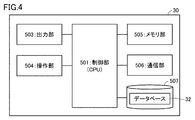
- FIG. 4 is a configuration diagram of the server 30 according to the first embodiment.
- server 30 includes a control unit 501 including a CPU, an output unit 503 for outputting information, and an operation unit 504 including a button / switch for accepting a user operation on server 30.
- the server 30 further stores various data such as a communication unit 506 for communicating with the terminal device 10 and the like via the network 41, a memory unit 505 including a ROM and a RAM for storing programs and data, and the database 32.
- HDD (Hard Disc Drive) 507 is provided.
- the control unit 101 of the sphygmomanometer 21 generates the blood pressure measurement or the biometric data 5 of the number of steps, and transmits it to the terminal device 10 via the communication unit 107. Further, the control unit 101 generates event data 8 when an event occurs, and transmits the event data 8 to the terminal device 10 via the communication unit 107.
- the biometric data 5 includes a blood pressure value or the number of steps and a measurement time (day / hour / minute).
- the event data 8 includes an event occurrence flag and an event occurrence time (day / hour / minute).
- the event occurrence flag may indicate the type of event (for example, medication).
- the event occurrence time indicates the time when the button 157 is operated.
- the sphygmomanometer 21 transmits the biological data 5 to the terminal device 10 every time blood pressure measurement or step count calculation is performed, or transmits the event data 8 to the terminal device 10 every time an event occurs. .
- the sphygmomanometer 21 may transmit the biological data 5 or the event data 8 periodically.
- the sphygmomanometer 21 transmits the biological data 5 and the event data 8 to the terminal device 10 in a packet format, but may transmit the data in a frame format.
- FIG. 5 is a diagram schematically illustrating a functional configuration of the terminal device 10 according to the first embodiment.
- the function of FIG. 5 is mainly realized by a program executed by the CPU 152 of the control unit 101 or a combination of a program and a circuit.
- the CPU 152 includes a data management unit 120 that manages data using the memory 154 and a data processing unit 125 that processes data in the memory 154.
- the data processing unit 125 is realized by the CP 152 executing the application program in the memory 154.
- the application program can be downloaded to the memory 154 from an external information processing apparatus (for example, the server 30).
- the data management unit 120 includes a data acquisition unit 121, an event acquisition unit 122, a determination unit 123, and a storage control unit 124 that controls storage of data in the memory 154.
- the data acquisition unit 121 and the event acquisition unit 122 acquire the biometric data 5 and the event data 8 from the data received from the sphygmomanometer 21 via the communication unit 160.
- the data acquisition unit 121 and the event acquisition unit 122 extract the biological data 5 or the event data 8 from the packet based on the header of the packet received from the sphygmomanometer 21.
- the determination unit 123 determines whether or not biological information is measured before and after the event occurrence time indicated by the event data 8.
- the storage control unit 124 stores the biometric data 5 or the event data 8 in the memory 154 based on the determination result of the determination unit 123, for example, in the form of the measurement record R1.
- the determination process of the determination unit 123 will be described later with reference to FIG. 6, and the storage process of the storage control unit 124 will be described later with reference to FIG.
- the biometric data 5 and the corresponding event data 8 are associated with each other in the record format.
- the format is not limited to the record format as long as both data can be stored in association with each other.
- FIG. 6 is a diagram showing the measurement time of the biological data 5 and the generation time of the event data 8 according to the first embodiment in time series.
- the measurement times T1, T2, T4 and T6 of the biological data 5 and the event occurrence times T3 and T5 of the event data 8 are shown on the time axis indicating the passage of time.
- the determination unit 123 manages the biological data 5 received from the data acquisition unit 121 in time series according to the measurement times T1, T2, T4, and T6 of each biological data 5. Similarly, each event data 8 received from the event acquisition unit 122 is managed in time series according to the event occurrence times T3 and T5.
- the determination unit 123 searches the time-series biological data 5 based on the event occurrence time of the received event data 8. Based on the search result, it is determined whether or not the biometric data 5 having the measurement time indicating “before” the event occurrence time is acquired. More specifically, the determination unit 123 performs measurement during the event occurrence time of the event data 8 received this time from “after” the event occurrence time of the event data 8 received immediately before, among the time-series biological data 5. It is determined whether there is biometric data 5 indicating time.
- the determination unit 123 when the determination unit 123 receives the event data 8 of the event occurrence time T3, the time-series biological data 5 is searched based on the time T3. Based on the search result, the determination unit 123 determines that the biological data 5 having the measurement time T2 indicating “before” the time T3 has been acquired. Similarly, when the event data 8 at the event occurrence time T5 is received, the determination unit 123 determines that the biological data 5 having the measurement time T4 “before” the time T5 has been acquired.
- the determination unit 123 searches for the time-series biological data 5 based on the time T1. It is determined that the biological data 5 having the measurement time indicating “before” is not acquired.
- the sphygmomanometer 21 transmits the biological data 5 of the number of steps to the terminal device 10 every hour.
- the determination unit 123 receives the event data 8 from the event acquisition unit 122 each time the event data 8 from the event acquisition unit 122 is received, based on the event occurrence time of the received event data 8 as described above.
- the biometric data 5 is searched. Based on the search result, it is determined whether or not the biometric data 5 having the measurement time “before” the event occurrence time has been acquired.
- FIG. 6 shows a state in which the determination unit 123 manages the biometric data 5 of the number of steps received from the data acquisition unit 121 every hour (1HR) according to time series.
- the determination unit 123 receives the event data 8 of the event occurrence time T3
- the biological data 5 of the number of steps in the 5th hour (5HR) indicating “before” the time T3 is acquired.
- the event data 8 of the event occurrence time T5 is received, it is determined that the biological data 5 of the number of steps in the ninth hour (9HR) indicating “before” the time T5 has been acquired.
- the determination unit 123 searches for the time-series biological data 5 based on the time T1. It is determined that the biometric data 5 having the measurement time indicating “before” is not acquired.
- the determination unit 123 is configured to determine whether or not there is the biometric data 5 measured “before” the event occurrence time of the event data 8, but the event occurrence time of the event data 8 is determined. It is good also as a structure which judges whether the biometric data 5 measured "after” exists. Alternatively, the determination unit 123 may be configured to determine whether the biometric data 5 exists for both “front” and “rear”.
- FIG. 7 is a diagram illustrating an example of data storage in the memory 154 by the storage control unit 124 according to the first embodiment.
- a storage example of the blood pressure value biometric data 5 is shown.
- the storage control unit 124 generates a measurement record R1 according to the determination result of the determination unit 123 described with reference to FIG.
- the memory 154 has an area for storing a plurality of measurement records R1.
- the measurement record R1 includes a metadata area E1 and a biometric data area E2 for storing measurement data obtained by the sphygmomanometer 21.
- the biometric data area E2 is an area for storing the biometric data 5 acquired by the data acquisition unit 121.
- the metadata area E1 corresponds to a related area for storing data related to the biometric data 5 stored in the biometric data area E2.
- the related data includes supplementary data 6 for supplementing the biometric data 5.
- the supplementary data 6 includes an ID 7 for identifying the biometric data 5 in the biometric data area E2.
- ID7 typically includes an identifier of the person being measured, but is not limited thereto. When the sphygmomanometer 21 and the terminal device 10 are owned for each user, the ID 7 may include the identifier of the sphygmomanometer 21 and the identifier of the terminal device 10.
- the determination unit 123 receives the event data 8
- the storage control unit 124 determines that there is the biological data 5 measured “before” the event occurrence time, as described in FIG. Then, the biometric data 5 measured “in front” is stored in the biometric data area E2 of the measurement record R1, and the event data 8 is stored together with the ID 7 in the metadata area E1.
- the event data 8 includes, for example, a flag 81 that can indicate an event type, an elapsed time 82 from the previous event occurrence time, and an occurrence time 83 of the event.
- a flag 81 that can indicate an event type
- an elapsed time 82 from the previous event occurrence time and an occurrence time 83 of the event.
- the elapsed time 82 it is possible to calculate the current event occurrence time 83 from the previous event occurrence time 83 and the elapsed time 82.
- the event occurrence time 83 can be omitted (not stored) in the metadata area E1, and the memory can be saved.
- the storage control unit 124 stores the event data 8 in the metadata area E1 of the measurement record R1.
- the biometric data 5 may not be stored in the area E2. Therefore, event data 8 and ID 7 are stored in the metadata area E1 of the measurement record R1, and no data is stored in the biometric data area E2.
- the storage control unit 124 may store the event data 8 in the metadata area E1 of the measurement record R1 of the biometric data 5 indicating the measurement time nearest (before and after) the event occurrence time.
- the event data 8 can be managed in association with the biological data 5 measured “before” the event occurrence time.
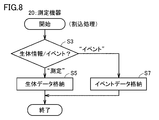
- FIG. 8 is a flowchart of the process of the measuring device 20 according to the first embodiment.
- the processing flow of FIG. 8 is stored in the memory unit 104 as a program.
- the processing is realized by the CPU of the control unit 101 reading and executing the program.
- the CPU processes the output from blood pressure measurement unit 111, acceleration sensor 110, or operation unit 103 as an interrupt.
- the CPU inputs the biological information from the blood pressure measurement unit 111 or the acceleration sensor 110 (“measurement” in step S3), the CPU uses the biological information (cuff pressure or acceleration component) from the blood pressure measurement unit 111 or the acceleration sensor 110. Based on this, the biological data 5 (blood pressure value or number of steps) is acquired, and the acquired biological data 5 is stored (step S5).
- step S3 When the CPU accepts the operation content of the button 157 from the output of the operation unit 103 (“event” in step S3), the CPU acquires the event data 8 and stores the acquired event data 8 (step S7).
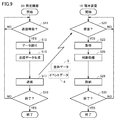
- FIG. 9 is a flowchart of communication processing between the measuring apparatus and the terminal apparatus according to the first embodiment.
- the processing flow on the measurement device 20 side in FIG. 9 is stored in the memory unit 104 as a program.
- the processing is realized by the CPU of the control unit 101 reading and executing the program.
- the processing flow on the terminal device 10 side is stored in the memory 154 as a program.
- the processing is realized by the CPU 152 reading and executing the program. Both processes are repeated at predetermined time intervals.
- the measuring device 20 and the terminal device 10 can communicate with each other by performing a pering process.
- a blood pressure monitor 21 will be described as the measuring device 20.
- the CPU of sphygmomanometer 21 determines whether or not it is time to transmit biometric data 5 or event data 8 stored in FIG. 8 to terminal device 10 (step S11). In Embodiment 1, it is determined that it is the transmission time every time biometric information is measured or every time an event occurs (YES in step S11). If the CPU does not determine the transmission time (NO in step S11), the CPU repeats step S11.
- the CPU reads the biometric data 5 or event data 8 stored in steps S5 and S7 (step S13), generates transmission data from the read data (step S15), and sends it to the terminal device 10 via the communication unit 107. Transmit (step S17).
- the CPU determines whether or not to end the process (step S19). For example, when the blood pressure monitor 21 is turned off, the CPU determines that the process is to be ended (YES in step S19), but if not determined to end the process (NO in step S19), the CPU proceeds to step S11. Return.
- the data management unit 120 of the terminal device 10 determines whether or not the biological data 5 or the event data 8 is received from the sphygmomanometer 21 via the communication unit 160 (step S21). When determining that the biometric data 5 or the event data 8 is not received (NO in step S21), the data management unit 120 repeats the process of step S21.
- the data management unit 120 determines that the biometric data 5 or the event data 8 has been received (YES in step S21)
- the data acquisition unit 121 or the event acquisition unit 122 uses the data received via the communication unit 160.
- the biometric data 5 or the event data 8 is acquired (step S23).
- the determination unit 123 manages the acquired biometric data 5 or event data 8 in time series.
- the determination part 123 performs the determination process demonstrated in FIG. 6, when the biometric data 5 are acquired by step S23 (step S25). Thereby, it is determined whether or not there is the biometric data 5 measured “before” the event occurrence time of the acquired event data 8.
- the storage control unit 124 stores the biometric data 5 in the biometric data area E2 of the measurement record R1 and the corresponding data.
- Event data 8 is stored in the metadata area E1 (step S29).
- the storage control unit 124 stores the biometric data 5 in the metadata area E1 of the measurement record R1. Is stored (step S29).
- the biometric data 5 is not stored in the biometric data area E2 of the measurement record R1.
- the event data 8 may be stored in the metadata area E1 of the measurement record R1 of the biometric data 5 indicating the measurement time nearest (before and after) the event occurrence time.
- the data management unit 120 determines whether or not to end the process (step S31). For example, when the power of the terminal device 10 is turned off, the data management unit 120 determines to end the process (YES in step S31), but does not determine to end the process (NO in step S31), Return to step S21.
- the data management unit 120 may encrypt the data of the measurement record R1 in the memory 154.
- each application program of the data processing unit 125 receives the decryption key from the server 30, reads out the data in the memory 154 with the received decryption key, and performs decryption processing.
- FIG. 10 is a diagram illustrating a display example of the display 158 according to the first embodiment.
- the data processing unit 125 displays the biometric data 5 in the biometric data area E2 of the measurement record R1 on the display 158 in association with the event data 8 stored in the corresponding metadata area E1.
- the data processing unit 125 reads the measurement record R1 in the memory 154, and generates display data according to the content of the read measurement record R1.
- the data processing unit 125 drives the display 158 based on the display data. As a result, an image according to the display data is displayed on the display 158.
- the biometric data 5 of the measurement record R1 and the event data 8 associated with the measurement record R1 are displayed in a list format arranged in time series.
- data is displayed in a manner different from that of the upper area.
- the blood pressure values (systolic blood pressure SYS, diastolic blood pressure DIA) are indicated by a line graph that follows a time series, and an event mark (medicine at the time when the event occurs is related to the line graph. (Capsule mark) is displayed.
- the display mode is not limited to the list format or the line graph as long as the biometric data 5 and the event data 8 can be displayed in association with each other according to the measurement time (event occurrence time).
- the user can confirm from the information on the screen that he / she is taking medicine according to the prescription, and can also confirm whether or not he / she has forgotten to take the medicine.
- the terminal device 10 stores the event data 8 in the measurement record R1 and the biological data 5 measured “before” the event occurrence time.
- the two can be linked and managed.
- the event data 8 in the metadata area E1 that originally stores the supplementary data 6, there is no need to prepare a special area for storing the event data 8, and the memory of the terminal device 10 can be used. 154 can be saved.
- the second embodiment shows a modification of the first embodiment.
- the data management unit 120 of the terminal device 10 manages the event data 8 so as to be associated with the biological data 5, but in the second embodiment, the data management unit 120A of the sphygmomanometer 21 performs the management. carry out.
- FIG. 11 is a diagram illustrating a configuration of the data management unit 120A of the sphygmomanometer 21 according to the second embodiment.
- the CPU of control unit 101 includes a data management unit 120A and a data processing unit 125A.
- the function of each unit in FIG. 11 is realized mainly by a program executed by the CPU of the control unit 101 or a combination of a program and a circuit.
- the CPU includes a data management unit 120A that manages data using the memory unit 104 and a data processing unit 125A that processes data in the memory unit 104.
- the data processing unit 125A is realized by the CPU executing an application program stored in the memory unit 104.
- the application program is stored in the memory unit 104 via the terminal device 10 from an external information processing apparatus (for example, the server 30). Alternatively, the data is stored in the memory unit 104 from an external storage medium via the card R / W unit 106.
- the data management unit 120A includes a data acquisition unit 121A, an event acquisition unit 122A, a determination unit 123A, and a storage control unit 124A that controls storage of data in the memory unit 104.
- the data acquisition unit 121A acquires biological data (blood pressure value or number of steps) 5 from the biological information (cuff pressure or acceleration component) output from the sphygmomanometer 21.
- the event acquisition unit 122A acquires the event data 8 when the button 157 is operated according to the operation content from the operation unit 103.
- the determination unit 123A follows the biological data 5 managed in time series as illustrated in FIG. It is determined whether or not there is the biometric data 5 measured in ".”
- the storage control unit 124A generates the measurement record R1 according to the procedure described in FIG. 7 based on the determination result of the determination unit 123A, and stores the generated measurement record R1 in the memory unit 104.
- the data processing unit 125 reads the data of the measurement record R1 from the memory unit 104, and processes the read biometric data. In this case, the read data or processing result is transmitted to the terminal device 10 via the communication unit 107 or displayed via the display unit 102 (see FIG. 10).
- the event data 8 is stored by storing the event data 8 in the metadata area E1 of the measurement record R1 that originally stores the supplementary data 6. This eliminates the need for a special area for saving memory.
- the terminal device 10 displays an icon on the display 158.
- the terminal device 10 can be instructed to generate the event.
- the terminal device 10 generates the event data 8 when the icon is touched.
- the determination unit 123 (123A) associates the event data 8 generated by touching the icon with the biological data 5 received from the sphygmomanometer 21.
- the type of event is one type of “medicine”, but in the fourth embodiment, a plurality of types of event data 8 are linked to the biological data 5. Also in the fourth embodiment, the user operates the button 157 every time an event occurs when instructing the occurrence of the event.
- the data management unit 120 (120A) of the terminal device 10 manages a plurality of types of events. For example, in accordance with a prescription, when the user takes medication after meals and measures blood pressure, the “order data” of “meal” ⁇ “medication” is registered in the data management unit 120. When the event data 8 is acquired, the determination unit 123 (123A) determines the type of the event based on the above “order data” according to the time series of the event data, and determines the determined type (“meal” or “medication” ]) As event data 8.
- the data management unit 120 120A
- the data management unit 120 120A
- the data management unit 120 120A
- the data management unit 120 120A
- the determination unit 123 (123A) acquires the event data 8
- the determination unit 123 (123A) determines the type of the event based on the above-described 'order data' according to the time series of the event data, and determines the determined type ("exercise” or "meal” Or “medicine”) as event data 8.
- the data management unit 120 (120 ⁇ / b> A) can acquire the above “order data” from the user operation content received through the operation unit 156.
- the determination unit 123 determines the event occurrence time of the event data 8 every time the event data 8 is acquired by the data acquisition unit 122 (122A). It is determined whether the biometric data 5 corresponding to the type of the event data 8 is measured among the biometric data 5 measured before and after.
- the user operates the operation unit 156 (103) to set the association between the type of the biometric data 5 and the event type in the terminal device 10 (blood pressure monitor 21).
- the association information includes, for example, “blood pressure” as the type of the biometric data 5 corresponding to the “medicine” and “smoking” event types. Further, the “number of steps” is included as the type of the biometric data 5 corresponding to the event type “meal”.
- the determination unit 123 obtains the biometric data 5 according to the association information. It is determined whether or not “blood pressure” is measured.
- the determination unit 123 determines whether “step count” is measured as the biological data 5 according to the association information. Judge whether or not.
- the biological data 5 is managed in association with the event data 8 in the database 32 of the server 30.
- the CPU 301 of the server 30 has the same function as the data management unit 120 (120A).
- the CPU 301 receives the biometric data 5 or the event data 8 from the sphygmomanometer 21 via the terminal device 10
- the received biometric data 5 is converted into the same format as in each of the above embodiments (see FIG. 7). Both are linked and stored in the database 32.
- the data in the database 32 can be browsed by the data processing unit 125 of the terminal device 10 and displayed on the display 158 (see FIG. 10).
- the method for managing the event data 8 described with reference to the flowchart described above in association with the biometric data 5 can also be provided as a program.
- a program for realizing this method is stored in the memory unit 104 of the sphygmomanometer 21 (measurement device 20), the memory 154 of the terminal device 10, and the memory unit 505 of the server 30, and the CPU reads the program from the memory.
- the processing is realized by executing the instruction code.
- this program is supplied by being downloaded from the external information processing apparatus (such as the terminal apparatus 10) to the memory unit 104 via the communication unit 107 and the communication line.
- the data is loaded from the external storage medium to the memory unit 104 via the card R / W 106.
- this program is supplied by being downloaded to the memory 154 from an external information processing device (such as the server 30) via the communication unit 160 via the communication line.
- the data is loaded from the storage medium 165 to the memory 154 via the memory I / F 164.
- this program is supplied by being downloaded from the external information processing apparatus to the memory unit 505 via the communication unit 506 and the communication line.
- 1 information processing system 5 biological data, 6 supplementary data, 8 event data, 10, 10A, 10B terminal device, 20 measuring devices, 21 blood pressure monitor, 22 sleep meter, 23 pedometer, 24 body composition meter, 25 thermometer, 30 Server, 32 database, 41, 43 network, 81 flag, 82 elapsed time, 83 generation time, 101, 501 control unit, 102 display unit, 103, 156, 504 operation unit, 104, 505 memory unit, 105, 153 timer, 110 acceleration sensor, 111 blood pressure measurement unit, 120, 120A data management unit, 121, 121A data acquisition unit, 122, 122A event acquisition unit, 123, 123A determination unit, 124, 124A storage control unit, 125, 125A data processing unit, 154, F164 I memory, 157 button, 158 display, 162 an antenna, E1 metadata area, E2 biometric data territory, R1 measurement record, T1, T2, T4, T6 measurement time, T3, T5 event occurrence time.
Landscapes
- Health & Medical Sciences (AREA)
- Engineering & Computer Science (AREA)
- Life Sciences & Earth Sciences (AREA)
- Public Health (AREA)
- General Health & Medical Sciences (AREA)
- Medical Informatics (AREA)
- Biomedical Technology (AREA)
- Epidemiology (AREA)
- Primary Health Care (AREA)
- Biophysics (AREA)
- Pathology (AREA)
- Veterinary Medicine (AREA)
- Animal Behavior & Ethology (AREA)
- Vascular Medicine (AREA)
- Cardiology (AREA)
- Surgery (AREA)
- Physics & Mathematics (AREA)
- Molecular Biology (AREA)
- Heart & Thoracic Surgery (AREA)
- Bioinformatics & Cheminformatics (AREA)
- Medicinal Chemistry (AREA)
- Chemical & Material Sciences (AREA)
- Ophthalmology & Optometry (AREA)
- Physiology (AREA)
- Toxicology (AREA)
- Pharmacology & Pharmacy (AREA)
- Business, Economics & Management (AREA)
- General Business, Economics & Management (AREA)
- Measuring And Recording Apparatus For Diagnosis (AREA)
- Measuring Pulse, Heart Rate, Blood Pressure Or Blood Flow (AREA)
Priority Applications (3)
| Application Number | Priority Date | Filing Date | Title |
|---|---|---|---|
| CN201780063521.3A CN109843153A (zh) | 2016-10-31 | 2017-10-18 | 生物体数据处理装置、生物体数据处理系统和程序 |
| DE112017005499.0T DE112017005499T5 (de) | 2016-10-31 | 2017-10-18 | Vorrichtung zur Verarbeitung biologischer Daten, System zur Verarbeitung biologischer Daten und Programm |
| US16/385,152 US20190244698A1 (en) | 2016-10-31 | 2019-04-16 | Biological data processing device, biological data processing system, and computer readable medium |
Applications Claiming Priority (2)
| Application Number | Priority Date | Filing Date | Title |
|---|---|---|---|
| JP2016213608A JP6793522B2 (ja) | 2016-10-31 | 2016-10-31 | 生体データ処理装置、生体データ処理システムおよびプログラム |
| JP2016-213608 | 2016-10-31 |
Related Child Applications (1)
| Application Number | Title | Priority Date | Filing Date |
|---|---|---|---|
| US16/385,152 Continuation US20190244698A1 (en) | 2016-10-31 | 2019-04-16 | Biological data processing device, biological data processing system, and computer readable medium |
Publications (1)
| Publication Number | Publication Date |
|---|---|
| WO2018079380A1 true WO2018079380A1 (ja) | 2018-05-03 |
Family
ID=62024969
Family Applications (1)
| Application Number | Title | Priority Date | Filing Date |
|---|---|---|---|
| PCT/JP2017/037713 Ceased WO2018079380A1 (ja) | 2016-10-31 | 2017-10-18 | 生体データ処理装置、生体データ処理システムおよびプログラム |
Country Status (5)
| Country | Link |
|---|---|
| US (1) | US20190244698A1 (https=) |
| JP (1) | JP6793522B2 (https=) |
| CN (1) | CN109843153A (https=) |
| DE (1) | DE112017005499T5 (https=) |
| WO (1) | WO2018079380A1 (https=) |
Families Citing this family (2)
| Publication number | Priority date | Publication date | Assignee | Title |
|---|---|---|---|---|
| GB2598312A (en) * | 2020-08-25 | 2022-03-02 | Prevayl Innovations Ltd | Electronics module and wearable assembly |
| JP2022147192A (ja) * | 2021-03-23 | 2022-10-06 | 株式会社バイタルDx | バイタル情報収集システム、端末装置及びバイタル情報収集方法 |
Citations (4)
| Publication number | Priority date | Publication date | Assignee | Title |
|---|---|---|---|---|
| JP2002366652A (ja) * | 2001-06-13 | 2002-12-20 | Matsushita Electric Ind Co Ltd | 医療情報通信システム |
| JP2004181137A (ja) * | 2002-12-06 | 2004-07-02 | Omron Healthcare Co Ltd | 薬収納ケース、血圧計測機能付き薬収納ケース、服薬管理システム及び血圧計 |
| JP2007188149A (ja) * | 2006-01-11 | 2007-07-26 | Sharp Corp | 服薬情報提供システム、服薬情報提供サーバ、服用者端末、並びにプログラムおよび記録媒体 |
| JP2010125145A (ja) * | 2008-11-28 | 2010-06-10 | Hitachi Ltd | センサノード、センサネットワークシステム及びデータ収集方法 |
Family Cites Families (10)
| Publication number | Priority date | Publication date | Assignee | Title |
|---|---|---|---|---|
| JP2789274B2 (ja) * | 1992-01-16 | 1998-08-20 | シャープ株式会社 | 携帯型心電計 |
| JP4752259B2 (ja) | 2004-12-10 | 2011-08-17 | オムロンヘルスケア株式会社 | 電子血圧計および血圧測定システム |
| CN101385635B (zh) * | 2007-09-11 | 2012-02-01 | 深圳迈瑞生物医疗电子股份有限公司 | 一种病理事件分析装置 |
| US8597570B2 (en) | 2008-11-04 | 2013-12-03 | Panasonic Corporation | Measurement device, insulin infusion device, measurement method, method for controlling insulin infusion device, and program |
| WO2010073689A1 (ja) | 2008-12-26 | 2010-07-01 | オムロンヘルスケア株式会社 | 電子血圧計および血圧測定方法 |
| JP2010213785A (ja) | 2009-03-13 | 2010-09-30 | Terumo Corp | 電子血圧計 |
| EP2448472B1 (en) * | 2009-07-01 | 2019-04-03 | Avinger, Inc. | Catheter-based off-axis optical coherence tomography imaging system |
| CN102076075B (zh) * | 2010-12-23 | 2014-03-19 | 意法·爱立信半导体(北京)有限公司 | 控制对端的数据发送功率的方法、装置以及系统 |
| JP5888305B2 (ja) * | 2013-10-11 | 2016-03-22 | セイコーエプソン株式会社 | 計測情報表示装置、計測情報表示システム、計測情報表示方法及び計測情報表示プログラム |
| CN104622448A (zh) * | 2013-11-15 | 2015-05-20 | 马志毅 | 一种用于电子血压计的数据采集与管理系统及方法 |
-
2016
- 2016-10-31 JP JP2016213608A patent/JP6793522B2/ja active Active
-
2017
- 2017-10-18 CN CN201780063521.3A patent/CN109843153A/zh active Pending
- 2017-10-18 WO PCT/JP2017/037713 patent/WO2018079380A1/ja not_active Ceased
- 2017-10-18 DE DE112017005499.0T patent/DE112017005499T5/de active Pending
-
2019
- 2019-04-16 US US16/385,152 patent/US20190244698A1/en not_active Abandoned
Patent Citations (4)
| Publication number | Priority date | Publication date | Assignee | Title |
|---|---|---|---|---|
| JP2002366652A (ja) * | 2001-06-13 | 2002-12-20 | Matsushita Electric Ind Co Ltd | 医療情報通信システム |
| JP2004181137A (ja) * | 2002-12-06 | 2004-07-02 | Omron Healthcare Co Ltd | 薬収納ケース、血圧計測機能付き薬収納ケース、服薬管理システム及び血圧計 |
| JP2007188149A (ja) * | 2006-01-11 | 2007-07-26 | Sharp Corp | 服薬情報提供システム、服薬情報提供サーバ、服用者端末、並びにプログラムおよび記録媒体 |
| JP2010125145A (ja) * | 2008-11-28 | 2010-06-10 | Hitachi Ltd | センサノード、センサネットワークシステム及びデータ収集方法 |
Also Published As
| Publication number | Publication date |
|---|---|
| US20190244698A1 (en) | 2019-08-08 |
| DE112017005499T5 (de) | 2019-10-24 |
| CN109843153A (zh) | 2019-06-04 |
| JP6793522B2 (ja) | 2020-12-02 |
| JP2018068763A (ja) | 2018-05-10 |
Similar Documents
| Publication | Publication Date | Title |
|---|---|---|
| US20190150786A1 (en) | User Interface Enhancements for Physiological Parameter Monitoring Platform Devices | |
| JP6173316B2 (ja) | 生活習慣病改善支援システム、生活習慣病改善支援方法、生活習慣病改善支援用コンピュータプログラム、及び、生活習慣病改善支援用コンピュータプログラムを格納したコンピュータ読み取り可能な記録媒体 | |
| US7367952B2 (en) | Electronic blood pressure monitor and blood pressure measuring system | |
| US20210082558A1 (en) | Medication management device, medication management method, and non-transitory computer-readable storage medium storing medication management program | |
| US20100217096A1 (en) | A health monitor and a method for health monitoring | |
| US20090062664A1 (en) | Blood pressure measurement device | |
| CN110446458A (zh) | 信息处理装置和信息处理程序 | |
| JP2016535606A (ja) | 健康管理を支援するデータ管理ユニット | |
| JP2014023715A (ja) | 測定支援装置、測定支援方法、制御プログラム、および、記録媒体 | |
| JP7076967B2 (ja) | データ処理装置、データ処理方法及びデータ処理プログラム | |
| JP3610949B2 (ja) | 生体情報測定器および生体情報測定システム | |
| CN110446460A (zh) | 信息处理装置和信息处理程序 | |
| WO2013136611A1 (ja) | 生体情報表示方法、生体情報表示画像データ作成装置およびそのためのプログラム | |
| US20090063098A1 (en) | System and method for providing notes in measurement devices | |
| US20210118539A1 (en) | Medication management device, medication management method, and non-transitory computer-readable storage medium storing medication management program | |
| WO2026056815A1 (zh) | 一种测量方法、系统及相关装置 | |
| JP2020017120A (ja) | 診断支援装置、診断支援方法及び診断支援プログラム | |
| CN112890785B (zh) | 利用非接触影像式生理检测技术的健康管理系统 | |
| JP2019003570A (ja) | 健康管理装置、健康管理方法、および健康管理プログラム | |
| JP6793522B2 (ja) | 生体データ処理装置、生体データ処理システムおよびプログラム | |
| JP4585219B2 (ja) | ヘルスケア情報提供システム、およびヘルスケア情報提供プログラム | |
| WO2020039827A1 (ja) | 健康管理装置、健康管理方法、及びプログラム | |
| JP2017074174A (ja) | 生体行動評価装置及び生体行動評価方法 | |
| CN110167435B (zh) | 用户终端装置和数据发送方法 | |
| JP5653469B2 (ja) | 測定装置および測定システム |
Legal Events
| Date | Code | Title | Description |
|---|---|---|---|
| DPE1 | Request for preliminary examination filed after expiration of 19th month from priority date (pct application filed from 20040101) | ||
| 121 | Ep: the epo has been informed by wipo that ep was designated in this application |
Ref document number: 17864027 Country of ref document: EP Kind code of ref document: A1 |
|
| 122 | Ep: pct application non-entry in european phase |
Ref document number: 17864027 Country of ref document: EP Kind code of ref document: A1 |