WO2018047771A1 - 核酸検出用素子、および核酸検出方法 - Google Patents
核酸検出用素子、および核酸検出方法 Download PDFInfo
- Publication number
- WO2018047771A1 WO2018047771A1 PCT/JP2017/031803 JP2017031803W WO2018047771A1 WO 2018047771 A1 WO2018047771 A1 WO 2018047771A1 JP 2017031803 W JP2017031803 W JP 2017031803W WO 2018047771 A1 WO2018047771 A1 WO 2018047771A1
- Authority
- WO
- WIPO (PCT)
- Prior art keywords
- nucleic acid
- detection element
- substrate
- acid detection
- compound
- Prior art date
- Legal status (The legal status is an assumption and is not a legal conclusion. Google has not performed a legal analysis and makes no representation as to the accuracy of the status listed.)
- Ceased
Links
Images


Classifications
-
- C—CHEMISTRY; METALLURGY
- C12—BIOCHEMISTRY; BEER; SPIRITS; WINE; VINEGAR; MICROBIOLOGY; ENZYMOLOGY; MUTATION OR GENETIC ENGINEERING
- C12M—APPARATUS FOR ENZYMOLOGY OR MICROBIOLOGY; APPARATUS FOR CULTURING MICROORGANISMS FOR PRODUCING BIOMASS, FOR GROWING CELLS OR FOR OBTAINING FERMENTATION OR METABOLIC PRODUCTS, i.e. BIOREACTORS OR FERMENTERS
- C12M1/00—Apparatus for enzymology or microbiology
-
- C—CHEMISTRY; METALLURGY
- C12—BIOCHEMISTRY; BEER; SPIRITS; WINE; VINEGAR; MICROBIOLOGY; ENZYMOLOGY; MUTATION OR GENETIC ENGINEERING
- C12M—APPARATUS FOR ENZYMOLOGY OR MICROBIOLOGY; APPARATUS FOR CULTURING MICROORGANISMS FOR PRODUCING BIOMASS, FOR GROWING CELLS OR FOR OBTAINING FERMENTATION OR METABOLIC PRODUCTS, i.e. BIOREACTORS OR FERMENTERS
- C12M1/00—Apparatus for enzymology or microbiology
- C12M1/34—Measuring or testing with condition measuring or sensing means, e.g. colony counters
-
- C—CHEMISTRY; METALLURGY
- C12—BIOCHEMISTRY; BEER; SPIRITS; WINE; VINEGAR; MICROBIOLOGY; ENZYMOLOGY; MUTATION OR GENETIC ENGINEERING
- C12Q—MEASURING OR TESTING PROCESSES INVOLVING ENZYMES, NUCLEIC ACIDS OR MICROORGANISMS; COMPOSITIONS OR TEST PAPERS THEREFOR; PROCESSES OF PREPARING SUCH COMPOSITIONS; CONDITION-RESPONSIVE CONTROL IN MICROBIOLOGICAL OR ENZYMOLOGICAL PROCESSES
- C12Q1/00—Measuring or testing processes involving enzymes, nucleic acids or microorganisms; Compositions therefor; Processes of preparing such compositions
- C12Q1/68—Measuring or testing processes involving enzymes, nucleic acids or microorganisms; Compositions therefor; Processes of preparing such compositions involving nucleic acids
-
- G—PHYSICS
- G01—MEASURING; TESTING
- G01N—INVESTIGATING OR ANALYSING MATERIALS BY DETERMINING THEIR CHEMICAL OR PHYSICAL PROPERTIES
- G01N27/00—Investigating or analysing materials by the use of electric, electrochemical, or magnetic means
- G01N27/26—Investigating or analysing materials by the use of electric, electrochemical, or magnetic means by investigating electrochemical variables; by using electrolysis or electrophoresis
- G01N27/403—Cells and electrode assemblies
- G01N27/414—Ion-sensitive or chemical field-effect transistors, i.e. ISFETS or CHEMFETS
-
- G—PHYSICS
- G01—MEASURING; TESTING
- G01N—INVESTIGATING OR ANALYSING MATERIALS BY DETERMINING THEIR CHEMICAL OR PHYSICAL PROPERTIES
- G01N27/00—Investigating or analysing materials by the use of electric, electrochemical, or magnetic means
- G01N27/26—Investigating or analysing materials by the use of electric, electrochemical, or magnetic means by investigating electrochemical variables; by using electrolysis or electrophoresis
- G01N27/416—Systems
Definitions
- the present invention relates to a nucleic acid detection element and a nucleic acid detection method.
- Non-patent Document 1 a graphene field-effect transistor (G-FET) as a method for detecting nucleic acids in a solution.
- the gate electrode part of the FET has a function of selectively binding to a nucleic acid having a specific structure as a detection target, for example, a primer part, and the negative charge of the nucleic acid is amplified and observed. is there.
- a DNA having a hairpin cytosine bulge structure is known as a nucleic acid having a primer portion which is a detection target, and N, N′-bis (3- (3) is a compound having a function of selectively binding to this DNA.
- Aminopropyl) -2,7-diamino-1,8-naphthyridine hereinafter abbreviated as DANP
- N- (3-((7-((3-aminopropyl) amino))-1,8-naphthyridine-2 -Il) amino) propyl) -4- (pyren-1-yl) butamide hereinafter abbreviated as PyDANP
- the main object of the present invention is to provide a nucleic acid detection element capable of imparting desired characteristics without being restricted by the substrate of the nucleic acid detection element.
- a first object is to provide a nucleic acid detection element structure capable of controlling the detection sensitivity.
- the second object is to provide a nucleic acid detection element structure capable of controlling the heat resistance of the fixing strength between the electrode part and the compound having a function of selectively binding to the nucleic acid.
- the present inventors have found that the above problem can be solved by providing an intermediate layer different from the substrate as a new adjustment layer, and have completed the present invention.
- a nucleic acid detection element for detecting a nucleic acid having a primer portion in a solution, wherein the element has at least a substrate, an intermediate layer different from the substrate, and a compound layer that binds to the nucleic acid in this order. element.
- nucleic acid detection element (1) The nucleic acid detection element according to 1 above, wherein the intermediate layer is a compound layer having a function of fixing a compound layer that binds to the nucleic acid.
- the nucleic acid detection element according to 1 or 2 wherein the nucleic acid has a secondary structure or a tertiary structure, and the compound layer is bonded to the secondary structure or the tertiary structure.
- the nucleic acid having the primer portion in the PCR reaction solution is subjected to a field effect transistor or electrochemical measurement. And detecting the target nucleic acid in the sample based on the detection result.
- desired characteristics can be imparted without being restricted by the substrate of the nucleic acid detection element, for example, the detection sensitivity of the nucleic acid or the fixing strength of the electrode portion and the compound having a function of selectively binding to the nucleic acid.
- a nucleic acid detection element with controlled heat resistance can be provided.
- the nucleic acid detection element of the present invention is a nucleic acid detection element for detecting a nucleic acid having a primer portion in a solution, and comprises at least a substrate, an intermediate layer different from the substrate, and a compound layer that binds to the nucleic acid. Have in order.
- the nucleic acid of the present invention includes DNA, DNA modified products, RNA, and RNA modified products.
- the nucleic acid detection element of the present invention has a function of detecting a nucleic acid having a primer portion contained in a solution to be observed. Furthermore, this nucleic acid may have a secondary structure or a tertiary structure in addition to the primer portion. This secondary structure or tertiary structure has a structure that binds to the nucleic acid detection element of the present invention, and the form of binding is not particularly limited. By having a hairpin type cytosine bulge structure, the selectivity of the nucleic acid binding to the detection element can be improved, and the detection sensitivity can be increased.
- the nucleic acid detection element of the present invention has a compound layer that binds to a nucleic acid having a primer portion contained in the solution.
- the compound that binds to the nucleic acid having the primer portion is preferably a compound having a primer portion that is a detection target, such as a compound that has a function of selectively binding to DNA, and typically has a nucleic acid. It is appropriately selected depending on the secondary structure or the tertiary structure.
- a compound having a naphthyridine ring such as DANP or PyDANP, is preferably used as the compound that selectively binds. Can do.
- compounds described in JP2011-182663A and WO2013 / 133402 can be used.
- the compound layer that binds to DNA having the primer portion of the present invention is not particularly limited, but DANP may be contained in an amount of 50% by mass or more. These additives may be used.
- the compound layer that binds to the nucleic acid of the present invention can be provided on the intermediate layer of the present invention by a known method.
- the amount of the compound is preferably 10 9 to 10 15 pieces / cm 2 from the viewpoint of improving the nucleic acid detection sensitivity.
- the amount of the compound may be 10 9 to 10 13 pieces / cm 2 .
- such a high-density compound layer can be formed by appropriately selecting an intermediate layer described later.
- the intermediate layer of the present invention is located between the substrate and the compound layer that binds to the nucleic acid of the present invention, and has different characteristics from the substrate. For this reason, by appropriately selecting the intermediate layer, it is possible to impart characteristics that are difficult to obtain in an embodiment in which the compound layer is directly laminated on the substrate.
- the intermediate layer may have a function of fixing the compound layer that binds to the nucleic acid, and the density can be improved by adopting an intermediate layer that easily controls the binding of the compound layer.
- the function of fixing the intermediate layer of the present invention is preferably a structure that arranges compounds that bind to nucleic acids to improve density (eg, rubbing), or a compound layer that reacts with compounds that bind to nucleic acids. Is more preferably provided by reacting with the substrate and each of the compound layers that bind to nucleic acids. The stronger the reaction, the more the heat resistance as the detection element can be improved.
- the intermediate layer of the present invention preferably contains a bifunctional compound.
- a compound that can be self-assembled In order to accurately control the density and maximize the density, it is preferable to use a compound that can be self-assembled. This is because the amount of these compounds attached to the substrate can be easily controlled, and the amount of nucleic acids attached to the compound can be easily controlled.
- a compound having a thiol (sulfur atom) at one end can be used.
- methylcyclohexane and mercaptoundecanoic acid having a thiol at the terminal are commercially available from Sigma-Aldrich.
- a bifunctional compound having a hydrophobic structure at one end can be used.
- one having pyrene at the terminal can be used, and pyrene is commercially available from Sigma-Aldrich.
- the intermediate layer of the present invention can be produced by a known method such as coating or vapor deposition.
- the amount is preferably 10 ⁇ 6 ⁇ g / cm 2 .
- the density of the functional group is preferably about 10 9 to 10 13 pieces / cm 2 .
- the substrate of the present invention is appropriately selected depending on the detection element of the present invention, but when used for an FET or the like, it is preferably a gate electrode portion, and examples include graphene, a silicon oxide film, and an organic film. A silicon oxide film and an organic film are preferable because the above-described appropriate intermediate layer can be easily formed. These can be produced by a known method.
- the gate electrode portion according to the FET of the present invention is preferably connected to an insulating region sandwiching a normal source electrode and drain electrode.
- a gold electrode and a carbon-based electrode are preferable because the intermediate layer can be easily produced.
- any electrode that can be used in an aqueous solution is used. be able to.
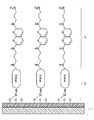
- FIG. 1 is a conceptual diagram of the detection element of the present invention.
- the silicon oxide insulating film portion (G) of the gate electrode portion sandwiched between the source electrode (S) and the drain electrode (D) is used as the base 1, and the intermediate layer 2 is formed on the base by a silane coupling agent having a self-organizing property.
- the DANP layer 3 reacted with one end of the silane coupling agent on the intermediate layer. Due to the presence of the intermediate layer, the amount of DANP can be adjusted as appropriate.
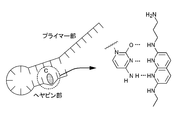
- the DNA 4 having a primer portion is a portion of the hairpin type cytosine bulge structure 5 and selectively binds to the detection element, and a negative charge is detected in the gate electrode portion according to the amount of binding.
- FIG. 2 is a conceptual diagram in which an intermediate layer made of a self-organizing silane coupling agent is provided on the substrate 1, and DyDANP is bonded and fixed. Such a strong bond can improve the heat resistance and can be used in a high-temperature cycle (for example, 30 to 40 cycles near 90 ° C.) by the PCR method.
- the temperature is set to about 90 ° C., then cooled to about 60 ° C., a nucleic acid having a primer portion is bound to DNA, and then a polymerase is used to extend a predetermined DNA.
- the active 70 ° C. is maintained.
- the temperature after extending the DNA is changed between the nucleic acid having a primer portion in the PCR reaction solution (for example, a nucleic acid having a hairpin type cytosine bulge structure) and the compound layer (for example, including DANP). This can be done by lowering the temperature to near the equilibrium temperature of the bond. In other words, the amount of negative charge on the substrate increases depending on the binding of the nucleic acid having the primer portion to the compound layer, so that the nucleic acid having the primer portion can be detected by monitoring the change in the charge amount. .
- the nucleic acid having the primer portion in the PCR reaction solution is consumed and decreased in the course of the PCR when the target nucleic acid (target to which the primer portion is bound) in the sample is present.
- the field effect transistor of the present invention it is possible to detect (quantify) DNA having a primer portion in the progress of PCR, and detect (quantitatively) target nucleic acid in a sample based on the result. Is possible.
- detection (quantification) of DNA having a primer portion in the progress of PCR may be performed using electrochemical measurement (measurement based on electrochemical theory).
- FIG. 4 shows a conceptual diagram of a detection element in which the present invention is used for a gold working electrode part for electrochemical measurement.
- a substrate 1 is a gold electrode portion formed on the substrate, and the substrate 1 has an intermediate layer 2 formed of thiol (sulfur atom) -terminated molecules having self-organization on the substrate, and one end of a thiol molecule on the intermediate layer.
- a DANP layer 3 reacted in sequence.
- the amount of DANP can be adjusted as appropriate by the presence of the intermediate layer.
- the DNA 4 having a primer portion is a portion of the hairpin type cytosine bulge structure 5 and selectively binds to a detection element, and the gold electrode portion increases in electrical resistance and impedance depending on the amount of binding.
- the nucleic acid having the primer portion in the PCR reaction solution is consumed and decreased in the course of PCR when the target nucleic acid (target to which the primer portion binds) in the sample is present. Therefore, it is possible to detect (quantify) DNA having a primer portion in the progress of PCR by measuring impedance using the electrode of FIG. 4, and detect (quantitatively) target nucleic acid in the sample based on the result. Is possible.
- the surface density of DANP is desirably about 10 9 to 10 13 pieces / cm 2, but more preferably 10 11 to 10 12 / cm 2 .
- an AC voltage of 1 to 20 mV, more preferably 5 to 10 mV is good, and a measurement frequency is preferably between 0.1 Hz and 1 MHz.
- a method of measuring with a fixed frequency or a method of measuring only a capacitance component or an actual resistance component may be used.
- a method of sweeping the frequency and measuring the adsorption amount by Nyquist plot may be used, but it is preferable to limit the sweep frequency in order to shorten the measurement time.
Landscapes
- Chemical & Material Sciences (AREA)
- Life Sciences & Earth Sciences (AREA)
- Health & Medical Sciences (AREA)
- Engineering & Computer Science (AREA)
- Bioinformatics & Cheminformatics (AREA)
- Organic Chemistry (AREA)
- Zoology (AREA)
- Wood Science & Technology (AREA)
- Biochemistry (AREA)
- General Health & Medical Sciences (AREA)
- Biotechnology (AREA)
- Analytical Chemistry (AREA)
- Physics & Mathematics (AREA)
- Genetics & Genomics (AREA)
- General Engineering & Computer Science (AREA)
- Immunology (AREA)
- Molecular Biology (AREA)
- Microbiology (AREA)
- Chemical Kinetics & Catalysis (AREA)
- Electrochemistry (AREA)
- Pathology (AREA)
- General Physics & Mathematics (AREA)
- Proteomics, Peptides & Aminoacids (AREA)
- Medicinal Chemistry (AREA)
- Biomedical Technology (AREA)
- Sustainable Development (AREA)
- Biophysics (AREA)
- Microelectronics & Electronic Packaging (AREA)
- Apparatus Associated With Microorganisms And Enzymes (AREA)
- Measuring Or Testing Involving Enzymes Or Micro-Organisms (AREA)
- Investigating Or Analyzing Materials By The Use Of Electric Means (AREA)
Abstract
DNA検出用素子構造が、検出感度および耐熱性に劣ることを課題とする。 溶液中のプライマー部分を有する核酸を検出するための核酸検出用素子であって、少なくとも基体、基体とは異なる中間層、該核酸と結合する化合物層、をこの順で有する核酸検出用素子。
Description
本発明は、核酸検出用素子および核酸検出方法に関する。
従来、溶液中の核酸を検出する方法としてグラフェン電界効果型トランジスタ(G-FET)を用いることが提案されている(非特許文献1)。この方法は、FETのゲート電極部に被検出体である特定の構造、例えばプライマー部分を有する核酸と選択的に結合するような機能を持たせ、核酸の有する負電荷を増幅観測するというものである。
被検出体であるプライマー部分を有する核酸としては、ヘアピン型シトシンバルジ構造を有するDNAが知られており、このDNAと選択的に結合する機能を有する化合物として、N、N’―ビス(3-アミノプロピル)-2,7-ジアミノー1,8-ナフチリジン(以下、DANPと略す)や、N―(3-((7-((3-アミノプロピル)アミノ))-1、8-ナフチリジン-2-イル)アミノ)プロピル)-4-(ピレン-1-イル)ブタミド(以下、PyDANPと略す)が知られている。
大阪大学産業科学研究所 岡野誠之等「グラフェンFETによる蛍光性結合分子-DNA結合の検出」第75回応用物理学会秋季学術講演会講演予稿集、17a-B1-3(2014秋)
しかしながら、電極部のDNAと選択的に結合する機能を有する化合物の密度を制御することが難しく、結果、検出感度を制御させることが困難であった。また、プライマー部分を有するDNAの検出において、DNAの増幅に一般的に使用されるPCR法を利用することも検討されているが、電極部とDNAと選択的に結合する機能を有する化合物との固定強度が耐熱性の点から実用化にはいたっていない。
このように被検出体と検出素子との間には、適当な調整機能が必要とされていた。
このように被検出体と検出素子との間には、適当な調整機能が必要とされていた。
本発明は、核酸検出用素子の基体に制約されず、所望の特性を付与し得る核酸検出用素子を提供することを主目的とする。
主目的の具体例として、検出感度を制御させることができる核酸検出用素子構造を提供することが第1の目的である。そして電極部と核酸と選択的に結合する機能を有する化合物との固定強度の耐熱性を制御することができる核酸検出用素子構造を提供することが第2の目的である。
主目的の具体例として、検出感度を制御させることができる核酸検出用素子構造を提供することが第1の目的である。そして電極部と核酸と選択的に結合する機能を有する化合物との固定強度の耐熱性を制御することができる核酸検出用素子構造を提供することが第2の目的である。
本発明者らは、新たな調整層として基体とは異なる中間層を設けることにより上記課題が解決される事を見出し、本発明を完成するに至った。
(1)溶液中のプライマー部分を有する核酸を検出するための核酸検出用素子であって、少なくとも基体、基体とは異なる中間層、該核酸と結合する化合物層、をこの順で有する核酸検出用素子。
(2)前記中間層が、前記核酸と結合する化合物層を、固定する機能を有する化合物層である前記1に記載の核酸検出用素子。
(3)前記核酸が二次構造または三次構造を有し、前記化合物層は前記二次構造または三次構造と結合する前記1または2に記載の核酸検出用素子。
(4)前記二次構造がヘアピン構造である前記3記載の核酸検出用素子。
(5)前記基体が、電界効果型トランジスタである前記1~4いずれかに記載の核酸検出用素子。
(6)試料中に存在し得る標的核酸を、前記プライマー部分を有する核酸を用いてPCRで増幅する工程において、PCR反応溶液中の前記プライマー部分を有する核酸を電界効果型トランジスタまたは電気化学的計測によって検出し、前記検出結果に基づき前記試料中の前記標的核酸を検出する方法。
(3)前記核酸が二次構造または三次構造を有し、前記化合物層は前記二次構造または三次構造と結合する前記1または2に記載の核酸検出用素子。
(4)前記二次構造がヘアピン構造である前記3記載の核酸検出用素子。
(5)前記基体が、電界効果型トランジスタである前記1~4いずれかに記載の核酸検出用素子。
(6)試料中に存在し得る標的核酸を、前記プライマー部分を有する核酸を用いてPCRで増幅する工程において、PCR反応溶液中の前記プライマー部分を有する核酸を電界効果型トランジスタまたは電気化学的計測によって検出し、前記検出結果に基づき前記試料中の前記標的核酸を検出する方法。
本発明によれば、核酸検出用素子の基体に制約されず、所望の特性を付与し得、例えば核酸の検出感度または電極部と核酸と選択的に結合する機能を有する化合物との固定強度の耐熱性が制御された核酸検出用素子を提供することができる。
以下、本発明の実施形態について説明する。
<核酸検出用素子>
本発明の核酸検出用素子は、溶液中のプライマー部分を有する核酸を検出するための核酸検出用素子であって、少なくとも基体、基体とは異なる中間層、該核酸と結合する化合物層、をこの順で有する。なお、本発明の核酸には、DNA、DNA修飾体、RNA、RNA修飾体が含まれる。
<核酸検出用素子>
本発明の核酸検出用素子は、溶液中のプライマー部分を有する核酸を検出するための核酸検出用素子であって、少なくとも基体、基体とは異なる中間層、該核酸と結合する化合物層、をこの順で有する。なお、本発明の核酸には、DNA、DNA修飾体、RNA、RNA修飾体が含まれる。
≪プライマー部分を有する核酸≫
本発明の核酸検出用素子は、観測対象である溶液中に含まれるプライマー部分を有する核酸を検出する機能を有する。さらにこの核酸は、プライマー部分の他に二次構造または三次構造を有してよい。この二次構造または三次構造は、本発明の核酸検出用素子と結合する構造を有しており、結合する形態は特に問わないが、ヘアピン構造、中でもヘアピン型シトシンバルジ構造であることが好ましい。ヘアピン型シトシンバルジ構造を有することにより、検出用素子に結合する核酸の選択性が向上し、検出感度も上げることができる。
本発明の核酸検出用素子は、観測対象である溶液中に含まれるプライマー部分を有する核酸を検出する機能を有する。さらにこの核酸は、プライマー部分の他に二次構造または三次構造を有してよい。この二次構造または三次構造は、本発明の核酸検出用素子と結合する構造を有しており、結合する形態は特に問わないが、ヘアピン構造、中でもヘアピン型シトシンバルジ構造であることが好ましい。ヘアピン型シトシンバルジ構造を有することにより、検出用素子に結合する核酸の選択性が向上し、検出感度も上げることができる。
≪核酸と結合する化合物層≫
本発明の核酸検出用素子は、前記溶液中に含まれるプライマー部分を有する核酸と結合する化合物層を有する。このプライマー部分を有する核酸と結合する化合物としては、被検出体であるプライマー部分を有する、例えばDNAと、選択的に結合する機能を有する化合物であることが好ましく、典型的には、核酸の有する二次構造または三次構造によって適宜選択される。
本発明の核酸検出用素子は、前記溶液中に含まれるプライマー部分を有する核酸と結合する化合物層を有する。このプライマー部分を有する核酸と結合する化合物としては、被検出体であるプライマー部分を有する、例えばDNAと、選択的に結合する機能を有する化合物であることが好ましく、典型的には、核酸の有する二次構造または三次構造によって適宜選択される。
本発明の被検出体であるDNAのプライマー部分の標識として、ヘアピン型シトシンバルジ構造が存在する場合、選択的に結合する化合物としては、ナフチリジン環を有する化合物、例えばDANP、PyDANPを好ましく使用することができる。その他、特開2011-182763号公報、WO2013/133402号公報記載の化合物を使用することができる。
本発明のプライマー部分を有するDNAと結合する化合物層は、例えば当該化合物としてDANPを使用する場合、DANPが特に限定されないが50質量%以上含有されていればよく、DANPの密度を上げるための他の添加剤を使用してもよい。
本発明の核酸と結合する化合物層は、本発明の中間層上に公知の方法で設けることができる。化合物の量としては、核酸検出感度向上の観点では109~1015個/cm2であることが好ましく、例えばDANPの場合は、109~1013個/cm2であってよい。なお、このように高密度の化合物層は、後述の中間層を適切に選択することで形成可能である。
≪基体とは異なる中間層≫
本発明の中間層は、基体と、本発明の核酸と結合する化合物層の中間に位置し、基体とは異なった特性を有する。このため、中間層を適宜選択することで、基体に化合物層を直接積層する態様では得難い特性を付与し得る。
中間層は、核酸と結合する化合物層を固定する機能を有してもよく、化合物層の結合を制御しやすい中間層を採用することで密度を向上させ得る。
本発明の中間層は、基体と、本発明の核酸と結合する化合物層の中間に位置し、基体とは異なった特性を有する。このため、中間層を適宜選択することで、基体に化合物層を直接積層する態様では得難い特性を付与し得る。
中間層は、核酸と結合する化合物層を固定する機能を有してもよく、化合物層の結合を制御しやすい中間層を採用することで密度を向上させ得る。
本発明の中間層を固定する機能は、核酸と結合する化合物を配列させ密度を向上させるような構造(例えばラビング)、あるいは、核酸と結合する化合物と反応するような化合物層であることが好ましいが、基体と、核酸と結合する化合物層のそれぞれと反応することにより設けられることがより好ましい。この反応が強いほど検出用素子としての耐熱性を向上させることができる。
本発明の中間層は、2官能性の化合物を含有することが好ましく、密度を正確に制御し、また密度を最大化し得るためには、自己組織化可能な化合物を使用することが好ましい。これら化合物の基体への付き量を制御しやすく、かつ、化合物への核酸の付き量も制御しやすいからである。
自己組織化可能な2官能性の化合物としては、基体が金電極で覆われている場合は、一末端にチオール(硫黄原子)を持つものを利用することができる。例えば末端にチオールを持つメチルシクロヘキサンやメルカプトウンデカン酸はシグマアルドリッチ社で市販されている。
そのほか、基体がカーボンを主とするカーボン化合物の場合には2官能性化合物として一端部に疎水性構造を持つものを使用することができる。例えばピレンを末端に持つものを使用することができ、ピレンはシグマアルドリッチ社で市販されている。
そのほか、基体がカーボンを主とするカーボン化合物の場合には2官能性化合物として一端部に疎水性構造を持つものを使用することができる。例えばピレンを末端に持つものを使用することができ、ピレンはシグマアルドリッチ社で市販されている。
本発明の中間層は、塗布、蒸着等の公知の方法によって作製することができる。例えば、シランカップリング剤であれば10-6μg/cm2を付き量とすることが好ましい。官能基の密度として109~1013個/cm2程度が好ましい。
≪基体≫
本発明の基体は、本発明の検出用素子によって適宜選択されるが、FET等に使用される場合ゲート電極部であることが好ましく、グラフェン、シリコン酸化膜、有機膜を挙げることができ、中でも上記した適切な中間層を形成しやすい点で、シリコン酸化膜、有機膜が好ましい。これらは、公知の方法によって作製することができる。
本発明のFETにかかるゲート電極部は、通常のソース電極、ドレイン電極を挟む絶縁領域につながるものであることが好ましい。
また基体が電気化学的計測の作用極である場合には、中間層を作製しやすことから金電極、カーボン系電極が好ましいが、そのほか水溶液中で使用可能な電極であればあらゆる電極を使用することができる。
本発明の基体は、本発明の検出用素子によって適宜選択されるが、FET等に使用される場合ゲート電極部であることが好ましく、グラフェン、シリコン酸化膜、有機膜を挙げることができ、中でも上記した適切な中間層を形成しやすい点で、シリコン酸化膜、有機膜が好ましい。これらは、公知の方法によって作製することができる。
本発明のFETにかかるゲート電極部は、通常のソース電極、ドレイン電極を挟む絶縁領域につながるものであることが好ましい。
また基体が電気化学的計測の作用極である場合には、中間層を作製しやすことから金電極、カーボン系電極が好ましいが、そのほか水溶液中で使用可能な電極であればあらゆる電極を使用することができる。
以下実施態様をもって本発明をより詳細に説明するが、それに限定されることはない。
<実施態様1>
本発明を、FETのゲート電極部に使用した場合について、具体的な例で説明する。図1は本発明の検出用素子の概念図である。ソース電極(S)とドレイン電極(D)に挟まれたゲート電極部のシリコン酸化絶縁膜部分(G)を基体1とし、その基体上に自己組織化性を有するシランカップリング剤による中間層2、その中間層上にシランカップリング剤の一方端と反応したDANP層3、を順に有している。中間層があることにより、DANPの量は、適宜調整することができる。
<実施態様1>
本発明を、FETのゲート電極部に使用した場合について、具体的な例で説明する。図1は本発明の検出用素子の概念図である。ソース電極(S)とドレイン電極(D)に挟まれたゲート電極部のシリコン酸化絶縁膜部分(G)を基体1とし、その基体上に自己組織化性を有するシランカップリング剤による中間層2、その中間層上にシランカップリング剤の一方端と反応したDANP層3、を順に有している。中間層があることにより、DANPの量は、適宜調整することができる。
プライマー部分を有するDNA4は、ヘアピン型シトシンバルジ構造5の部分で、検出用素子と選択的に結合し、ゲート電極部には結合量に応じて負の電荷が検知される。
図2は、基体1上に自己組織化型シランカップリング剤による中間層を設け、さらにDyDANPを結合固定させた概念図である。このような強固な結合により、耐熱性を向上させることができ、PCR法による高温サイクル(例えば90℃近辺で30~40サイクル)での使用が可能である。
図2は、基体1上に自己組織化型シランカップリング剤による中間層を設け、さらにDyDANPを結合固定させた概念図である。このような強固な結合により、耐熱性を向上させることができ、PCR法による高温サイクル(例えば90℃近辺で30~40サイクル)での使用が可能である。
例えば、試料中のDNAの2本鎖を1本化するために90℃程度とし、その後いったん60℃程度に冷却しプライマー部分を有する核酸をDNAに結合させ、ついで所定のDNAを伸長させるためポリメラーゼの活性な70℃を維持する。本発明のFETによるDNA検出は、DNAを伸長させた後温度を、PCR反応溶液中のプライマー部分を有する核酸(例えばヘアピン型シトシンバルジ構造も有する核酸)と化合物層(例えばDANPを含む)との結合の平衡温度近辺まで下げ、この結合を行わせて行うことができる。つまり、プライマー部分を有する核酸の化合物層への結合に依存して、基体上の負電荷の量が増加するため、電荷量の変化をモニタリングすることでプライマー部分を有する核酸を検出することができる。
ここで、PCR反応溶液中のプライマー部分を有する核酸は、試料中の標的核酸(上記プライマー部分が結合する対象)が存在する場合にはPCR進行過程で消費され、減少していく。このため、本発明の電界効果型トランジスタを使用することにより、PCRの進行過程におけるプライマー部分を有するDNAの検出(定量)が可能であり、その結果に基づき試料中の標的核酸を検出(定量)が可能である。なお、電界効果型トランジスタに代えて、電気化学的計測(電気化学的理論に基づく計測)を用いて、PCRの進行過程におけるプライマー部分を有するDNAの検出(定量)を行ってもよい。
<実施態様2>
本発明を電気化学的計測の金の作用電極部に使用した検出用素子の概念図を、図4に示す。基板上とその上に作製された金電極部を基体1とし、その基体上に自己組織化性を有するチオール(硫黄原子)末端の分子による中間層2、その中間層上にチオール分子の一方端と反応したDANP層3、を順に有している。
本発明を電気化学的計測の金の作用電極部に使用した検出用素子の概念図を、図4に示す。基板上とその上に作製された金電極部を基体1とし、その基体上に自己組織化性を有するチオール(硫黄原子)末端の分子による中間層2、その中間層上にチオール分子の一方端と反応したDANP層3、を順に有している。
中間層があることにより、DANPの量は、適宜調整することができる。プライマー部分を有するDNA4は、ヘアピン型シトシンバルジ構造5の部分で、検出用素子と選択的に結合し、金電極部は結合量に応じて電気的抵抗、インピーダンスが増える。PCR反応溶液中のプライマー部分を有する核酸は、試料中の標的核酸(上記プライマー部分が結合する対象)が存在する場合にはPCR進行過程で消費され、減少していく。このため、図4の電極を使用してインピーダンス測定をことにより、PCRの進行過程におけるプライマー部分を有するDNAの検出(定量)が可能であり、その結果に基づき試料中の標的核酸を検出(定量)が可能である。
この複素成分を持つ電気抵抗、インピーダンスが電極上の物質の吸着により変化することは電気化学的測定では広く知られている。この原理により図4の電極のインピーダンスを測定することにより試料中のDNAを検出することができる。DANPの面密度は109~1013個/cm2程度が望ましいが、より好ましくは1011~1012/cm2である。
インピーダンス測定は交流電圧1~20mV、より好ましくは5~10mVが良く、測定周波数は0.1Hz~1MHzの間が良い。
周波数を固定して測定する手法でも、キャパシタンス成分、もしくは実抵抗成分だけを測定する手法でも良い。また精度を上げるため周波数を掃引しナイキストプロットにより吸着量を測定する手法でも良いが、測定時間を短縮するため掃引周波数を限定することが好ましい。
周波数を固定して測定する手法でも、キャパシタンス成分、もしくは実抵抗成分だけを測定する手法でも良い。また精度を上げるため周波数を掃引しナイキストプロットにより吸着量を測定する手法でも良いが、測定時間を短縮するため掃引周波数を限定することが好ましい。
1 基体
2 中間層
3 プライマー部分を有するDNAと結合する化合物層
4 プライマー部分を有するDNA
5 ヘアピン構造部分
2 中間層
3 プライマー部分を有するDNAと結合する化合物層
4 プライマー部分を有するDNA
5 ヘアピン構造部分
Claims (6)
- 溶液中のプライマー部分を有する核酸を検出するための核酸検出用素子であって、少なくとも基体、基体とは異なる中間層、該核酸と結合する化合物層、をこの順で有する核酸検出用素子。
- 前記中間層が、前記核酸と結合する化合物層を、固定する機能を有する化合物層である請求項1記載の核酸検出用素子。
- 前記核酸が二次構造または三次構造を有し、前記化合物層は前記二次構造または三次構造と結合する請求項1または2に記載の核酸検出用素子。
- 前記二次構造がヘアピン構造である請求項3記載の核酸検出用素子。
- 前記基体が、電界効果型トランジスタである請求項1~4いずれかに記載の核酸検出用素子。
- 試料中に存在し得る標的核酸を、前記プライマー部分を有する核酸を用いてPCRで増幅する工程において、PCR反応溶液中の前記プライマー部分を有する核酸を電界効果型トランジスタまたは電気化学的計測によって検出し、前記検出結果に基づき前記試料中の前記標的核酸を検出する方法。
Priority Applications (1)
| Application Number | Priority Date | Filing Date | Title |
|---|---|---|---|
| JP2018538399A JPWO2018047771A1 (ja) | 2016-09-09 | 2017-09-04 | 核酸検出用素子、および核酸検出方法 |
Applications Claiming Priority (2)
| Application Number | Priority Date | Filing Date | Title |
|---|---|---|---|
| JP2016176726 | 2016-09-09 | ||
| JP2016-176726 | 2016-09-09 |
Publications (1)
| Publication Number | Publication Date |
|---|---|
| WO2018047771A1 true WO2018047771A1 (ja) | 2018-03-15 |
Family
ID=61562050
Family Applications (1)
| Application Number | Title | Priority Date | Filing Date |
|---|---|---|---|
| PCT/JP2017/031803 Ceased WO2018047771A1 (ja) | 2016-09-09 | 2017-09-04 | 核酸検出用素子、および核酸検出方法 |
Country Status (2)
| Country | Link |
|---|---|
| JP (1) | JPWO2018047771A1 (ja) |
| WO (1) | WO2018047771A1 (ja) |
Cited By (1)
| Publication number | Priority date | Publication date | Assignee | Title |
|---|---|---|---|---|
| US11408842B2 (en) | 2017-07-31 | 2022-08-09 | Osaka University | Method and system for detecting substance of interest in solution |
Citations (3)
| Publication number | Priority date | Publication date | Assignee | Title |
|---|---|---|---|---|
| WO2001068834A1 (en) * | 2000-03-16 | 2001-09-20 | Matsushita Electric Industrial Co., Ltd. | Nucleotide detector, process for producing the same and process for forming fine particle membrane |
| WO2011004136A1 (en) * | 2009-07-07 | 2011-01-13 | Uws Ventures Limited | Graphene biosensor |
| JP2016047777A (ja) * | 2014-08-27 | 2016-04-07 | 国立大学法人大阪大学 | グラフェン薄膜の製造方法、並びにグラフェン薄膜を備えた電子素子およびセンサ |
-
2017
- 2017-09-04 WO PCT/JP2017/031803 patent/WO2018047771A1/ja not_active Ceased
- 2017-09-04 JP JP2018538399A patent/JPWO2018047771A1/ja active Pending
Patent Citations (3)
| Publication number | Priority date | Publication date | Assignee | Title |
|---|---|---|---|---|
| WO2001068834A1 (en) * | 2000-03-16 | 2001-09-20 | Matsushita Electric Industrial Co., Ltd. | Nucleotide detector, process for producing the same and process for forming fine particle membrane |
| WO2011004136A1 (en) * | 2009-07-07 | 2011-01-13 | Uws Ventures Limited | Graphene biosensor |
| JP2016047777A (ja) * | 2014-08-27 | 2016-04-07 | 国立大学法人大阪大学 | グラフェン薄膜の製造方法、並びにグラフェン薄膜を備えた電子素子およびセンサ |
Non-Patent Citations (6)
| Title |
|---|
| MAEHASHI, K. ET AL.: "Biological sensors based on graphene devices", BIO INDUSTRY, vol. 32, no. 1, 2015, pages 29 - 34, ISSN: 0910-6545 * |
| MATSUMOTO, KAZUHIKO: "Strategic Basic Research Programs CREST Study area ''Establishment of Foundation for Nano-interface Technology", IMPLEMENTATION OF QUANTUM NANO-DEVICES BY QUANTUM INTERFACE SUPPRESSION, October 2008 (2008-10-01), pages 1 - 10, Retrieved from the Internet <URL:https://www.jst.go.jp/kisoken/crest/research/s-houkoku/JST_1111048_08062274_EE.pdf> * |
| OKAMOTO, S. ET AL.: "Fragment-modified graphene FET for highly sensitive detection of antigen-antibody reaction", THE 14TH INTERNATIONAL MEETING ON CHEMICAL SENSORS, 2012, pages 519 - 522, XP055473812, ISBN: 978-1-62993-526-3 * |
| OKANO, M. ET AL.: "Detection of fluorescence molecule-DNA binding based on a graphene FET", THE PREPRINTS OF THE 75TH JSAP AUTUMN MEETING, 2014, pages 17 - 151 * |
| OKANO, M. ET AL.: "Electrical detection of binding and separation between modified graphene FETs and DNA", THE PREPRINTS OF THE 62TH JSAP SPRING MEETING, 2015, pages 11 - 149 * |
| WANG, L. ET AL.: "Graphene sheets, polyaniline and AuNPs based DNA sensor for electrochemical determination of BCR/ABL fusion gene with functional hairpin probe", BIOSENSORS AND BIOELECTRONICS, vol. 51, 2014, pages 201 - 207, XP055473819, ISSN: 0956-5663 * |
Cited By (1)
| Publication number | Priority date | Publication date | Assignee | Title |
|---|---|---|---|---|
| US11408842B2 (en) | 2017-07-31 | 2022-08-09 | Osaka University | Method and system for detecting substance of interest in solution |
Also Published As
| Publication number | Publication date |
|---|---|
| JPWO2018047771A1 (ja) | 2019-08-15 |
Similar Documents
| Publication | Publication Date | Title |
|---|---|---|
| Mei et al. | Molybdenum disulfide field-effect transistor biosensor for ultrasensitive detection of DNA by employing morpholino as probe | |
| Hammock et al. | Investigation of protein detection parameters using nanofunctionalized organic field-effect transistors | |
| Khan et al. | An integrated microfluidic platform for selective and real-time detection of thrombin biomarkers using a graphene FET | |
| Lei et al. | Detection of heart failure-related biomarker in whole blood with graphene field effect transistor biosensor | |
| Chan et al. | A microfluidic flow-through chip integrated with reduced graphene oxide transistor for influenza virus gene detection | |
| Su et al. | Determination of endotoxin through an aptamer-based impedance biosensor | |
| Kavosi et al. | Au nanoparticles/PAMAM dendrimer functionalized wired ethyleneamine–viologen as highly efficient interface for ultra-sensitive α-fetoprotein electrochemical immunosensor | |
| Casalini et al. | Multiscale sensing of antibody–antigen interactions by organic transistors and single-molecule force spectroscopy | |
| JP6928103B2 (ja) | 少なくとも1つの流体試料中の少なくとも1つの分析物を検出する分析物検出器 | |
| Formisano et al. | Optimisation of an electrochemical impedance spectroscopy aptasensor by exploiting quartz crystal microbalance with dissipation signals | |
| Wang et al. | An electrochemiluminescence aptasensor for thrombin using graphene oxide to immobilize the aptamer and the intercalated Ru (phen) 32+ probe | |
| KR101610467B1 (ko) | 그래핀 산화물을 이용한 표적물질 검출용 바이오센서 및 이의 제조방법 | |
| Firoozbakhtian et al. | Buried-gate MWCNT FET-based nanobiosensing device for real-time detection of CRP | |
| US12345677B2 (en) | Integrated circuit with 2D FETs for direct and indirect target signal measurement | |
| Arya et al. | Label free biosensor for sensitive human influenza virus hemagglutinin specific antibody detection using coiled-coil peptide modified microelectrode array based platform | |
| Jarczewska et al. | Application of DNA aptamers as sensing layers for electrochemical detection of potassium ions | |
| JP6921217B2 (ja) | センサデバイスのための電極のポリマーコーティング | |
| CN101846648A (zh) | 石墨烯量子点修饰的电化学生物传感器及其制备方法 | |
| JP2014227304A (ja) | グラフェン薄膜の製造方法、並びにグラフェン薄膜を備えた電子素子、センサー、アレイ素子およびセンシング方法 | |
| Kuralay et al. | Highly sensitive disposable nucleic acid biosensors for direct bioelectronic detection in raw biological samples | |
| EP4433812A1 (en) | Directly functionalized electrochmical transisteors, and convection driven ultra-rapid detection of biomarkers using transistors | |
| Park et al. | Construction of a rapid electrochemical biosensor consisting of a nanozyme/aptamer conjugate for waterborne microcystin detection | |
| Lu et al. | A new phosphothreonine lyase electrochemical immunosensor for detecting Salmonella based on horseradish peroxidase/GNPs-thionine/chitosan | |
| Arya et al. | 4-Fluoro-3-nitrophenyl grafted gold electrode based platform for label free electrochemical detection of interleukin-2 protein | |
| He et al. | An electrochemical impedance sensor based on a small molecule modified Au electrode for the recognition of a trinucleotide repeat |
Legal Events
| Date | Code | Title | Description |
|---|---|---|---|
| 121 | Ep: the epo has been informed by wipo that ep was designated in this application |
Ref document number: 17848711 Country of ref document: EP Kind code of ref document: A1 |
|
| ENP | Entry into the national phase |
Ref document number: 2018538399 Country of ref document: JP Kind code of ref document: A |
|
| NENP | Non-entry into the national phase |
Ref country code: DE |
|
| 122 | Ep: pct application non-entry in european phase |
Ref document number: 17848711 Country of ref document: EP Kind code of ref document: A1 |