WO2018043475A1 - ガラス、プレス成形用ガラス素材、光学素子ブランクおよび光学素子 - Google Patents
ガラス、プレス成形用ガラス素材、光学素子ブランクおよび光学素子 Download PDFInfo
- Publication number
- WO2018043475A1 WO2018043475A1 PCT/JP2017/030898 JP2017030898W WO2018043475A1 WO 2018043475 A1 WO2018043475 A1 WO 2018043475A1 JP 2017030898 W JP2017030898 W JP 2017030898W WO 2018043475 A1 WO2018043475 A1 WO 2018043475A1
- Authority
- WO
- WIPO (PCT)
- Prior art keywords
- glass
- less
- content
- total content
- still
- Prior art date
- Legal status (The legal status is an assumption and is not a legal conclusion. Google has not performed a legal analysis and makes no representation as to the accuracy of the status listed.)
- Ceased
Links
Images
Classifications
-
- C—CHEMISTRY; METALLURGY
- C03—GLASS; MINERAL OR SLAG WOOL
- C03C—CHEMICAL COMPOSITION OF GLASSES, GLAZES OR VITREOUS ENAMELS; SURFACE TREATMENT OF GLASS; SURFACE TREATMENT OF FIBRES OR FILAMENTS MADE FROM GLASS, MINERALS OR SLAGS; JOINING GLASS TO GLASS OR OTHER MATERIALS
- C03C3/00—Glass compositions
- C03C3/04—Glass compositions containing silica
- C03C3/062—Glass compositions containing silica with less than 40% silica by weight
- C03C3/064—Glass compositions containing silica with less than 40% silica by weight containing boron
- C03C3/068—Glass compositions containing silica with less than 40% silica by weight containing boron containing rare earths
-
- G—PHYSICS
- G02—OPTICS
- G02B—OPTICAL ELEMENTS, SYSTEMS OR APPARATUS
- G02B1/00—Optical elements characterised by the material of which they are made; Optical coatings for optical elements
Definitions
- the present invention relates to glass, a glass material for press molding, an optical element blank, and an optical element.
- the lens made of high refractive index and low dispersion glass can be made a cemented lens in combination with a lens made of ultra-low dispersion glass, etc., thereby making it possible to make the optical system compact while correcting chromatic aberration. Therefore, the high refractive index and low dispersion glass occupies a very important position as an optical element constituting a projection optical system such as an imaging optical system or a projector.
- a high refractive index and low dispersion glass is described in, for example, Japanese Patent Application Laid-Open No. 2014-062024 (the entire description of which is specifically incorporated herein by reference).
- optical property maps are widely used to show the distribution of optical properties.
- the optical characteristic map has an Abbe number ⁇ d on the horizontal axis and a refractive index nd on the vertical axis.
- the Abbe number ⁇ d increases from the right side to the left side of the horizontal axis, and the refractive index increases from the lower side to the upper side of the vertical axis. It is created to increase accordingly.
- the refractive index and Abbe number refer to the refractive index nd with respect to helium d-line (wavelength 587.56 nm) and the Abbe number ⁇ d with respect to helium d-line (wavelength 587.56 nm), unless otherwise specified.
- the optical properties of the high refractive index low dispersion glass increase so that the refractive index increases as the Abbe number decreases, and the refractive index decreases as the Abbe number increases. Distribution is generally shown. This is considered to be because it was difficult for conventional high refractive index and low dispersion glass to increase both the Abbe number and the refractive index while suppressing the devitrification of the glass to be used as an optical element material.
- glass with a high refractive index and a large Abbe number is a material for optical elements that is extremely effective for correcting chromatic aberration, increasing the functionality of optical systems, and making them more compact. is there. Therefore, it is very meaningful to set a straight line that rises to the right on the optical property map, and to provide glass that has a higher refractive index than this straight line and the straight line (located on the left side of the straight line on the map). Big.
- the weight of optical elements constituting the projection optical system such as an imaging optical system and a projector.
- reducing the weight of the optical element leads to a reduction in the weight of the imaging optical system and projection optical system incorporating the optical element.
- the optical element is reduced in weight, the power consumption when driving the autofocus can be reduced and the battery life can be extended.
- the Abbe number ⁇ d is 35.5 or more and less than 39.0, the relationship of nd ⁇ ⁇ 1.0000 ⁇ 10 ⁇ 2 ⁇ ⁇ d + 2.2726 is satisfied, and the optical element is reduced in weight.
- Abbe number ⁇ d is 35.5 or more and less than 39.0
- refractive index nd is expressed by formula (1) with respect to Abbe number ⁇ d: nd ⁇ ⁇ 1.0000 ⁇ 10 ⁇ 2 ⁇ ⁇ d + 2.2726
- the filling, In the glass composition of cation% display The total content of B 3+ and Si 4+ is in the range of 35.0-53.0%; The total content of La 3+ , Gd 3+ , Y 3+ and Yb 3+ is in the range of 30.0-50.0%; The total content of Ti 4+ , Nb 5+ , Ta 5+ and W 6+ is in the range of 3.0-20.0%, Cation ratio of the total content of La 3+ , Gd 3+ , Y 3+ and Yb 3+ to the total content of Ti 4+ , Nb 5+ , Ta 5+ and W 6+ ⁇ (La 3+ + Gd 3+ + Y 3+ + Yb 3+ )
- the cation ratio of Ta 5+ content to the total content of Ti 4+ , Nb 5+ , Ta 5+ and W 6+ ⁇ Ta 5+ / (Ti 4+ + Nb 5+ + Ta 5+ + W 6+ ) ⁇ is 0.10 or less
- the cation ratio of W 6+ content to the total content of Ti 4+ , Nb 5+ , Ta 5+ and W 6+ ⁇ W 6+ / (Ti 4+ + Nb 5+ + Ta 5+ + W 6+ ) ⁇ is 0.20 or less
- Cation ratio of total content of B 3+ and Si 4+ to total content of La 3+ , Gd 3+ , Y 3+ and Yb 3+ ⁇ (B 3+ + Si 4+ ) / (La 3+ + Gd 3+ + Y 3+ + Yb 3+ ) ⁇ is 1 .40 or less
- Adjusting the composition of the glass so as to satisfy the above total content and cation ratio can contribute to high refractive index and low dispersion of the glass.
- the inventor has made considerable trial and error regarding the influence of each cation component in the glass composition satisfying the above total content and cation ratio on the specific gravity of the glass.
- the coefficients shown in Table 1 were determined for each cationic component.
- the Abbe number ⁇ d is 35.5 or more and 39.39 by adjusting the composition so that the total A calculated using such coefficients satisfies the formula (2).
- the specific gravity of the glass satisfying the relationship of less than 0 and nd ⁇ ⁇ 1.0000 ⁇ 10 ⁇ 2 ⁇ ⁇ d + 2.2726 can be reduced. That is, the provision of glass having an Abbe number ⁇ d of 35.5 or more and less than 39.0, satisfying the relationship of nd ⁇ ⁇ 1.000 ⁇ 10 ⁇ 2 ⁇ ⁇ d + 2.2726, and contributing to weight reduction of the optical element. Is possible.
- the present invention it is possible to provide glass that has optical characteristics useful in an optical system and can contribute to weight reduction of an optical element. Furthermore, according to one embodiment of the present invention, it is possible to provide a glass material for press molding, an optical element blank, and an optical element made of the glass.
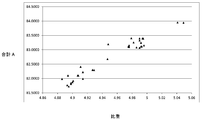
- FIG. 1 is a graph in which the horizontal axis represents the specific gravity of each glass of Example 1, and the vertical axis represents the total A of values obtained by multiplying the content of each cationic component by the coefficient described in Table 1.
- the glass composition in the present invention and the present specification can be quantified by a method such as ICP-AES (Inductively Coupled Plasma-Atomic Emission Spectrometry).
- the analysis value obtained by ICP-AES may include a measurement error of about ⁇ 5% of the analysis value.
- the content of the constituent component is 0% or does not contain or is not introduced means that the constituent component is substantially not contained, and the content of the constituent component is the impurity level. It means less than or equal to.
- the glass composition is expressed in terms of cation% for the cation component.
- the cation% is a percentage in which the total content of all cation components contained in the glass is 100%.
- the content of the cation component and the total content (total content) of the plurality of types of cation components are expressed in cation%.
- the ratio of the contents of cation components is referred to as a cation ratio.
- the glass has an Abbe number ⁇ d of 35.5 or more and less than 39.0, and a refractive index nd with respect to the Abbe number ⁇ d (1): nd ⁇ ⁇ 1.0000 ⁇ 10 ⁇ 2 ⁇ ⁇ d + 2.2726 (1) It is glass which satisfies.
- Glass having an Abbe number ⁇ d of 35.5 or more is effective for correcting chromatic aberration as a material for optical elements.
- the Abbe number ⁇ d is preferably 36.0 or more, more preferably 36.5 or more, further preferably 36.6 or more, and 36.7 or more from the viewpoint of correcting chromatic aberration. Is more preferably 36.8 or more, and further preferably 36.9 or more.
- a glass having an Abbe number ⁇ d of less than 39.0 has a good thermal stability of the glass and has a low tendency to devitrify in the process of producing the glass.
- the Abbe number ⁇ d is preferably 38.5 or less, more preferably 38.0 or less, still more preferably 37.8 or less, still more preferably 37.7 or less, and 37. 6 or less is even more preferable, and 37.5 or less is even more preferable.
- the refractive index nd satisfies the formula (1) with respect to the Abbe number ⁇ d.
- Glass having an Abbe number ⁇ d of 35.5 or more and less than 39.0 and a refractive index nd satisfying the formula (1) with respect to the Abbe number ⁇ d is a glass having high utility value in the design of an optical system. is there.
- Formula (1) is preferably the following formula (1-1), more preferably the following formula (1-2), more preferably the following formula (1-2), from the viewpoint of utility value in the design of an optical system. (1-3) is more preferable.
- the formula (1) is preferably the following formula (1-4).
- the formula (1-4) is more preferably the following formula (1-5), and further preferably the following formula (1-6).
- the upper limit of the refractive index nd is naturally determined from the Abbe number ⁇ d and the above formula.
- the refractive index nd is preferably 1.9550 or less, more preferably 1.9450 or less, and still more preferably 1.9350 or less.
- the refractive index nd is preferably 1.8800 or more, more preferably 1.8850 or more, further preferably 1.8880 or more, from the viewpoint of increasing the refractive index. Or more, more preferably 1.8950 or more, even more preferably 1.8980 or more, still more preferably 1.8990 or more, and 1.899978 or more. Even more preferably.
- the glass characteristics of the glass will be further described later.
- the composition of the glass so as to satisfy the total content and the cation ratio described above and in detail below can contribute to the increase in the refractive index and the low dispersion of the glass. Furthermore, in the glass composition satisfying the above total content and cation ratio, the total A calculated using the coefficients shown in Table 1 is the following formula (2): A ⁇ 137.778 ⁇ nd ⁇ 175.033 (2)
- the specific gravity of the glass satisfying the relationship of Abbe number ⁇ d of 35.5 or more and less than 39.0 and nd ⁇ ⁇ 1.0000 ⁇ 10 ⁇ 2 ⁇ ⁇ d + 2.2726 Is possible. This point was newly found as a result of intensive studies by the present inventors.
- cation components listed in Table 1 there may be a cation component not contained in the glass (that is, having a content of 0%).
- the formula (2) is preferably the following formula (2-1).
- Formula (2-1) is more preferably the following formula (2-2), more preferably the following formula (2-3), still more preferably the following formula (2-4),
- the following formula (2-5) is more preferable, the following formula (2-6) is still more preferable, and the following formula (2-7) is still more preferable.
- a ⁇ 137.778 ⁇ nd-177.033 (2-1) A ⁇ 137.778 ⁇ nd-178.033 (2-2) A ⁇ 137.778 ⁇ nd-178.333 (2-3) A ⁇ 137.778 ⁇ nd ⁇ 178.533 (2-4) A ⁇ 137.778 ⁇ nd ⁇ 178.833 (2-5) A ⁇ 137.778 ⁇ nd ⁇ 179.433 (2-6) A ⁇ 137.778 ⁇ nd-179.833 (2-7)
- the total A is preferably the following formula (2-8) from the viewpoint of the thermal stability of the glass.
- the lower limit of the total A is not particularly limited, and may be lower than the value calculated by the following formula (2-8).
- the glass is a glass whose composition is adjusted so as to satisfy the formula (2) while satisfying the total content and cation ratio described in detail below, whereby the Abbe number ⁇ d is 35.5 or more and less than 39.0.
- the total content and cation ratio of various cation components will be described in more detail.
- B 3+ and Si 4+ are glass network forming components.
- the thermal stability of the glass can be improved, and the crystallization of the glass during production can be suppressed. Can do.
- the total content of B 3+ and Si 4+ is 53.0% or less, a decrease in refractive index nd can be suppressed. preferable.
- the total content of B 3+ and Si 4+ in the glass is in the range of 35.0 to 53.0%.
- the total content of B 3+ and Si 4+ is preferably 38.0% or more, more preferably 39.0% or more, further preferably 40.0% or more, and 41.0%. % Or more is more preferable.
- the total content of B 3+ and Si 4+ is preferably 50.0% or less, more preferably 48.0% or less, still more preferably 47.0% or less, 46 More preferably, it is 0.0% or less.
- La 3+ , Gd 3+ , Y 3+ and Yb 3+ are components having a function of increasing the refractive index while suppressing a decrease in the Abbe number ⁇ d. These components also have the function of improving the chemical durability and / or weather resistance of the glass and increasing the glass transition temperature.
- the total content of La 3+ , Gd 3+ , Y 3+ and Yb 3+ (La 3+ + Gd 3+ + Y 3+ + Yb 3+ ) is 30.0% or more, a decrease in refractive index nd can be suppressed. It is preferable when producing glass having optical characteristics. Further, it is possible to suppress a decrease in chemical durability and / or weather resistance of the glass.
- the total content of La 3+ , Gd 3+ , Y 3+ and Yb 3+ in the glass is in the range of 30.0 to 50.0%.
- the total content of La 3+ , Gd 3+ , Y 3+ and Yb 3+ is preferably 33.0% or more, more preferably 35.0% or more, and further preferably 36.0% or more. Preferably, it is 37.0% or more.
- the total content of La 3+ , Gd 3+ , Y 3+ and Yb 3+ is preferably 48.0% or less, more preferably 45.0% or less, and 44.0% or less. Is more preferably 43.0% or less, and still more preferably 42.0% or less.
- Ti 4+ , Nb 5+ , Ta 5+ and W 6+ are components that have a function of increasing the refractive index, and also have a function of improving the thermal stability of the glass by containing an appropriate amount.
- the total content of Ti 4+ , Nb 5+ , Ta 5+ and W 6+ (Ti 4+ + Nb 5+ + Ta 5+ + W 6+ ) is 3.0% or more, the above optical characteristics are realized while maintaining thermal stability. In addition, it is preferable.
- the total content of Ti 4+ + Nb 5+ + Ta 5+ + W 6+ is 20.0% or less, it is possible to maintain the thermal stability of the glass and to suppress the decrease in the Abbe number ⁇ d.
- the total content of Ti 4+ + Nb 5+ + Ta 5+ + W 6+ in the glass is in the range of 3.0 to 20.0%.
- the total content of Ti 4+ + Nb 5+ + Ta 5+ + W 6+ is preferably 5.0% or more, more preferably 6.0% or more, still more preferably 7.0% or more, and 8 It is still more preferably 0.0% or more, and even more preferably 9.0% or more.
- the total content of Ti 4+ + Nb 5+ + Ta 5+ + W 6+ is preferably 18.0% or less, more preferably 15.0% or less, and further preferably 14.0% or less. It is more preferably 13.0% or less, still more preferably 12.0% or less, and still more preferably 11.0% or less.
- the cation ratio of content ⁇ (La 3+ + Gd 3+ + Y 3+ + Yb 3+ ) / (Ti 4+ + Nb 5+ + Ta 5+ + W 6+ ) ⁇ is preferably 3.56 or more.
- the cation ratio ⁇ (La 3+ + Gd 3+ + Y 3+ + Yb 3+ ) / (Ti 4+ + Nb 5+ + Ta 5+ + W 6+ ) ⁇ is 5 in order to maintain the thermal stability of the glass while suppressing the decrease in the refractive index. It is preferable that it is 20 or less. From the above viewpoints, in the glass, the cation ratio ⁇ (La 3+ + Gd 3+ + Y 3+ + Yb 3+ ) / (Ti 4+ + Nb 5+ + Ta 5+ + W 6+ ) ⁇ is in the range of 3.56 to 5.20.
- the cation ratio ⁇ (La 3+ + Gd 3+ + Y 3+ + Yb 3+ ) / (Ti 4+ + Nb 5+ + Ta 5+ + W 6+ ) ⁇ is preferably 3.60 or more, more preferably 3.65 or more. More preferably, it is 70 or more.
- the cation ratio ⁇ (La 3+ + Gd 3+ + Y 3+ + Yb 3+ ) / (Ti 4+ + Nb 5+ + Ta 5+ + W 6+ ) ⁇ is preferably 5.00 or less, more preferably 4.80 or less. It is more preferably 4.50 or less, still more preferably 4.30 or less, and still more preferably 4.20 or less.
- the cation ratio ⁇ Zn 2+ / (B 3+ + Si 4+ ) ⁇ of Zn 2+ content to the total content of B 3+ and Si 4+ is 0. It is preferable that it is 001 or more.
- the cation ratio ⁇ Zn 2+ / (B 3+ + Si 4+ ) ⁇ is preferably 0.200 or less. From the above viewpoint, in the glass, the cation ratio ⁇ Zn 2+ / (B 3+ + Si 4+ ) ⁇ is in the range of 0.001 to 0.200.
- the cation ratio ⁇ Zn 2+ / (B 3+ + Si 4+ ) ⁇ is preferably 0.002 or more, more preferably 0.003 or more, and further preferably 0.004 or more.
- the cation ratio ⁇ Zn 2+ / (B 3+ + Si 4+ ) ⁇ is preferably 0.180 or less, more preferably 0.150 or less, still more preferably 0.130 or less, and 0 More preferably, it is 100 or less.
- the cation ratio of La 3+ content to B 3+ content (B 3+ / La 3+ ) is 1.165 or less.
- the cation ratio (B 3+ / La 3+ ) is preferably 1.163 or less, more preferably 1.160 or less, further preferably 1.158 or less, and 1.156 or less. Is more preferable.
- the cation ratio (B 3+ / La 3+ ) is preferably 0.600 or more in the glass. More preferably, it is 700 or more, more preferably 0.800 or more, still more preferably 0.850 or more, and even more preferably 0.900 or more.
- Gd is a component that it is desirable to reduce the content in the glass from the viewpoint of stable supply of the glass.
- Gd is also a component that has a large atomic weight and increases the specific gravity of the glass. Therefore, it is preferable to reduce the ratio of the Gd content to the total content of rare earth elements.
- the cation ratio ⁇ Gd 3+ / (La 3+ + Gd 3+ + Y 3+ + Yb 3+ ) ⁇ of the Gd 3+ content to the total content of La 3+ , Gd 3+ , Y 3+ and Yb 3+ is 0 10 or less.
- the cation ratio ⁇ Gd 3+ / (La 3+ + Gd 3+ + Y 3+ + Yb 3+ ) ⁇ is preferably 0.08 or less, more preferably 0.06 or less, and even more preferably 0.05 or less. . It is also preferable that Gd is not contained in the glass. That is, the cation ratio ⁇ Gd 3+ / (La 3+ + Gd 3+ + Y 3+ + Yb 3+ ) ⁇ is preferably 0.
- the Y 3+, La 3+, Gd 3+, Y 3+ and Yb 3+ total content of Y 3+ to the content the cation ratio of ⁇ Y 3+ / (La 3+ + Gd 3+ + Y 3+ + Yb 3+) ⁇ is 0.03
- the cation ratio ⁇ Y 3+ / (La 3+ + Gd 3+ + Y 3+ + Yb 3+ ) ⁇ is preferably 0.50 or less from the viewpoint of maintaining the thermal stability of the glass and increasing the refractive index.
- the cation ratio ⁇ Y 3+ / (La 3+ + Gd 3+ + Y 3+ + Yb 3+ ) ⁇ is in the range of 0.03 to 0.50.
- the cation ratio ⁇ Y 3+ / (La 3+ + Gd 3+ + Y 3+ + Yb 3+ ) ⁇ is preferably 0.45 or less, more preferably 0.40 or less, and further preferably 0.35 or less. , 0.30 or less is more preferable, and 0.28 or less is even more preferable.
- the cation ratio ⁇ Y 3+ / (La 3+ + Gd 3+ + Y 3+ + Yb 3+ ) ⁇ is preferably 0.05 or more, more preferably 0.08 or more, and more preferably 0.10 or more. More preferably, it is more preferably 0.13 or more, still more preferably 0.15 or more, and still more preferably 0.18 or more.
- the total content of B 3+ and Si 4+ that are glass network forming components with respect to the total content of La 3+ , Gd 3+ , Y 3+ and Yb 3+ The cation ratio ⁇ (B 3+ + Si 4+ ) / (La 3+ + Gd 3+ + Y 3+ + Yb 3+ ) ⁇ is 1.40 or less.
- the cation ratio ⁇ (B 3+ + Si 4+ ) / (La 3+ + Gd 3+ + Y 3+ + Yb 3+ ) ⁇ is preferably 1.35 or less, more preferably 1.30 or less, and 1.28 or less.
- the cation ratio ⁇ (B 3+ + Si 4+ ) / (La 3+ + Gd 3+ + Y 3+ + Yb 3+ ) ⁇ is preferably 0.70 or more. It is more preferably 0.80 or more, further preferably 0.85 or more, more preferably 0.90 or more, and still more preferably 0.95 or more.
- Ti 4+ , Nb 5+ , Ta 5+ and W 6+ contain a proper amount, thereby increasing the refractive index and improving the thermal stability of the glass.
- Ti 4+, Nb 5+, of Ti 4+ content to the total content of Ta 5+ and W 6+ The cation ratio ⁇ Ti 4+ / (Ti 4+ + Nb 5+ + Ta 5+ + W 6+ ) ⁇ is 0.20 to 0.70.
- the cation ratio ⁇ Ti 4+ / (Ti 4+ + Nb 5+ + Ta 5+ + W 6+ ) ⁇ is preferably 0.65 or less, more preferably 0.60 or less, and even more preferably 0.55 or less. , 0.53 or less is more preferable, and 0.50 or less is even more preferable.
- the cation ratio ⁇ Ti 4+ / (Ti 4+ + Nb 5+ + Ta 5+ + W 6+ ) ⁇ is preferably 0.23 or more, more preferably 0.24 or more, and more preferably 0.25 or more. More preferably, it is more preferably 0.26 or more.
- Ta 5+ is a very expensive component although it functions to increase the refractive index. Therefore, from the viewpoint of stable glass supply, it is not preferable to use Ta 5+ positively. Moreover, when there is much content of Ta5 + , when melting glass, a raw material will become easy to remain unmelted. In addition, the specific gravity of the glass tends to increase. Thus, Ta 5+ is a component for which it is desirable to reduce the content. Therefore, in the above glass, for Ta 5+ , Ti 4+ , Nb 5+ , Ta 5+ and W 6+ are used to improve the thermal stability of the glass while reducing the refractive index and reducing the amount of Ta used.
- the cation ratio of Ta 5+ content to the total content ⁇ Ta 5+ / (Ti 4+ + Nb 5+ + Ta 5+ + W 6+ ) ⁇ is 0.10 or less.
- the cation ratio ⁇ Ta 5+ / (Ti 4+ + Nb 5+ + Ta 5+ + W 6+ ) ⁇ is preferably 0.08 or less, more preferably 0.06 or less, and even more preferably 0.04 or less. 0.02 or less is more preferable, and 0.01 or less is even more preferable. It is also preferable that Ta is not contained in the glass. That is, the cation ratio ⁇ Ta 5+ / (Ti 4+ + Nb 5+ + Ta 5+ + W 6+ ) ⁇ is preferably 0.
- the cation ratio of W 6+ content to the total content of Ti 4+ , Nb 5+ , Ta 5+ and W 6+ in the glass ⁇ W 6+ / (Ti 4+ + Nb 5+ + Ta 5+ + W 6+ ) ⁇ is 0.20 or less.
- the cation ratio ⁇ W 6+ / (Ti 4+ + Nb 5+ + Ta 5+ + W 6+ ) ⁇ is preferably 0.18 or less, more preferably 0.15 or less, and further preferably 0.13 or less. .
- W is not contained in glass. That is, the cation ratio ⁇ W 6+ / (Ti 4+ + Nb 5+ + Ta 5+ + W 6+ ) ⁇ is preferably 0.
- Ti 4+, Nb 5+, Ta 5+ , and W is a network former of the glass to the total content of 6+ B 3+ and Si 4+ to the total content of the cation ratio of ⁇ ( B 3+ + Si 4+ ) / (Ti 4+ + Nb 5+ + Ta 5+ + W 6+ ) ⁇ is preferably 5.70 or less.
- the cation ratio ⁇ (B 3+ + Si 4+ ) / (Ti 4+ + Nb 5+ + Ta 5+ + W 6+ ) ⁇ is 3.50 or more. Is preferred.
- the cation ratio ⁇ (B 3+ + Si 4+ ) / (Ti 4+ + Nb 5+ + Ta 5+ + W 6+ ) ⁇ is in the range of 3.50 to 5.70.
- the cation ratio ⁇ (B 3+ + Si 4+ ) / (Ti 4+ + Nb 5+ + Ta 5+ + W 6+ ) ⁇ is preferably 5.50 or less, more preferably 4.80 or less, and more preferably 4.70 or less. Is more preferably 4.60 or less, and even more preferably 4.55 or less.
- the cation ratio ⁇ (B 3+ + Si 4+ ) / (Ti 4+ + Nb 5+ + Ta 5+ + W 6+ ) ⁇ is preferably 3.60 or more, more preferably 3.80 or more, and 3.90 or more. More preferably.
- the total content of B 3+ and Si 4+ which are glass network forming components, is as described above. From the viewpoint of improving the devitrification resistance, meltability, moldability, chemical durability, weather resistance, machinability, etc. of the glass for each of B 3+ content and Si 4+ content, preferred ranges are as follows: It is.
- the B 3+ content is preferably 14.0% or more, more preferably 18.0% or more, further preferably 20.0% or more, and 23.0% or more. More preferably, it is more preferably 25.0% or more, and further preferably 27.0% or more. Further, the B 3+ content is preferably 50.0% or less, more preferably 45.0% or less, still more preferably 43.0% or less, and 40.0% or less.
- the Si 4+ content is preferably 2.0% or more, more preferably 4.0% or more, still more preferably 6.0% or more, and 7.0% or more. More preferably, it is more preferably 8.0% or more, and still more preferably 9.0% or more. Further, the Si 4+ content is preferably 39.0% or less, more preferably 30.0% or less, still more preferably 25.0% or less, and 23.0% or less. Is more preferably 20.0% or less, still more preferably 18.0% or less, still more preferably 15.0% or less.
- the preferred range of the cation ratio ⁇ B 3+ / (B 3+ + Si 4+ ) ⁇ of the B 3+ content to the total content of B 3+ and Si 4+ is as follows.
- the cation ratio ⁇ B 3+ / (B 3+ + Si 4+ ) ⁇ of the B 3+ content to the total content of B 3+ and Si 4+ is preferably 0.40 or more, and more preferably 0.50 or more. Preferably, it is 0.55 or more, more preferably 0.60 or more, still more preferably 0.65 or more, and even more preferably 0.68 or more.
- the cation ratio ⁇ B 3+ / (B 3+ + Si 4+ ) ⁇ is preferably equal to or more than the lower limit exemplified above from the viewpoint of improving the meltability of the glass.
- the cation ratio ⁇ B 3+ / (B 3+ + Si 4+ ) ⁇ is preferably 0.95 or less, more preferably 0.90 or less, still more preferably 0.85 or less, 0 Is more preferably 0.83 or less, still more preferably 0.80 or less, and even more preferably 0.78 or less.
- the cation ratio ⁇ B 3+ / (B 3+ + Si 4+ ) ⁇ is equal to or less than the upper limit exemplified above from the viewpoint of increasing the viscosity of the glass at the time of melting. Furthermore, the cation ratio ⁇ B 3+ / (B 3+ + Si 4+ ) ⁇ is equal to or lower than the above-exemplified upper limit, in order to reduce glass composition variation due to volatilization during melting and optical property variation due to this, and glass From the viewpoint of improving one or more of the chemical durability, weather resistance, and machinability.
- the glass is a sum of La 3+ , Gd 3+ , Y 3+ and Yb 3+
- the cation ratio of the Zn 2+ content to the content ⁇ Zn 2+ / (La 3+ + Gd 3+ + Y 3+ + Yb 3+ ) ⁇ is preferably 0.400 or less.
- the cation ratio ⁇ Zn 2+ / (La 3+ + Gd 3+ + Y 3+ + Yb 3+ ) ⁇ is 0.400 or less, which means that the glass transition temperature is prevented from lowering (improvement of machinability) and chemical durability is improved.
- the cation ratio ⁇ Zn 2+ / (La 3+ + Gd 3+ + Y 3+ + Yb 3+ ) ⁇ is more preferably 0.300 or less, further preferably 0.250 or less, and further preferably 0.200 or less. Preferably, it is 0.150 or less, more preferably 0.100 or less.
- the cation ratio ⁇ Zn 2+ / (La 3+ + Gd 3+ + Y 3+ + Yb 3+ ) ⁇ is preferably 0% or more and more preferably more than 0% from the viewpoint of improving the meltability.
- the cation ratio ⁇ Zn 2+ / (La 3+ + Gd 3+ + Y 3+ + Yb 3+ ) ⁇ is more preferably 0.001 or more, further preferably 0.005 or more, and more preferably 0.010 or more. More preferably, it is still more preferably 0.015 or more.
- the cation ratio of the Zn 2+ content to the content ⁇ Zn 2+ / (Ti 4+ + Nb 5+ + Ta 5+ + W 6+ ) ⁇ is preferably 0.550 or less.
- the cation ratio ⁇ Zn 2+ / (Ti 4+ + Nb 5+ + Ta 5+ + W 6+ ) ⁇ is more preferably 0.500 or less, further preferably 0.450 or less, and further preferably 0.430 or less. Preferably, it is still more preferably 0.400 or less.
- the cation ratio ⁇ Zn 2+ / (Ti 4+ + Nb 5+ + Ta 5+ + W 6+ ) ⁇ may be 0, and is preferably more than 0 from the viewpoint of improving the meltability.
- the cation ratio ⁇ Zn 2+ / (Ti 4+ + Nb 5+ + Ta 5+ + W 6+ ) ⁇ is more preferably 0.001 or more, further preferably 0.005 or more, and further preferably 0.010 or more. Preferably, it is still more preferably 0.015 or more.
- the preferred range of the Zn 2+ content is as follows.
- the Zn 2+ content is preferably more than 0%, more preferably 0.1% or more, and further preferably 0.2% or more. Further, the Zn 2+ content is preferably 10.0% or less, more preferably 8.0% or less, still more preferably 7.0% or less, and 6.0% or less. Is more preferably 5.0% or less, still more preferably 4.0% or less.
- La 3+ is a component useful for improving the thermal stability while suppressing an increase in specific gravity and providing a high refractive index and low dispersion glass. Therefore, in the glass, the La 3+ is, La 3+, Gd 3+, is La 3+ content of the cation ratio to the total content of Y 3+ and Yb 3+ ⁇ La 3+ / (La 3+ + Gd 3+ + Y 3+ + Yb 3+) ⁇ , It is preferably 0.50 or more, more preferably 0.55 or more, still more preferably 0.65 or more, still more preferably 0.68 or more, and 0.70 or more.
- the cation ratio ⁇ La 3+ / (La 3+ + Gd 3+ + Y 3+ + Yb 3+ ) ⁇ is preferably 0.97 or less, more preferably 0.95 or less, and preferably 0.93 or less. More preferably, it is more preferably 0.90 or less, still more preferably 0.88 or less, still more preferably 0.85 or less, and even more preferably 0.82 or less. .
- the La 3+ content is preferably 15.0% or more, more preferably 18.0% or more, still more preferably 20.0% or more, and 23.0% or more. More preferably, it is more preferably 25.0% or more.
- the La 3+ content is preferably 48.5% or less, more preferably 45.0% or less, still more preferably 43.0% or less, and 40.0% or less. Is more preferably 38.0% or less, still more preferably 35.0% or less.
- the Gd 3+ content is preferably 4.0% or less, more preferably 3.0% or less, still more preferably 2.5% or less, and 2.0% or less.
- the Gd 3+ content is preferably 0% or more, and from the viewpoint of facilitating stable supply of glass and low specific gravity, the Gd 3+ content is 0%, that is, Gd 3+ is not included. Particularly preferred.
- the Y 3+ content is preferably 0.9% or more, more preferably 2.0% or more, and 5.0% or more from the viewpoint of improving the thermal stability and melting property of the glass. Is more preferably 6.0% or more, still more preferably 6.5% or more, and even more preferably 7.0% or more. Further, the Y 3+ content is preferably 25.0% or less, more preferably 23.0% or less, further preferably 20.0% or less, and 18.0% or less.
- the Yb 3+ content is preferably 4.0% or less, more preferably 3.0% or less, still more preferably 2.0% or less, and 1.0% More preferably, it is as follows. Further, the Yb 3+ content can be 0% or more, and is particularly preferably 0%, that is, Yb 3+ is not included.
- Nb 5+ has a Nb 5+ content relative to the total content of Ti 4+ , Nb 5+ , Ta 5+ and W 6+ in order to provide a high refractive index and low dispersion glass having excellent thermal stability.
- the cation ratio ⁇ Nb 5+ / (Ti 4+ + Nb 5+ + Ta 5+ + W 6+ ) ⁇ is preferably 0.30 or more.
- Nb 5+ is a component that tends to increase the refractive index without increasing the specific gravity as compared with Ta 5 and W 6+ .
- the cation ratio ⁇ Nb 5+ / (Ti 4+ + Nb 5+ + Ta 5+ + W 6+ ) ⁇ is more preferably 0.35 or more, further preferably 0.40 or more, and further preferably 0.45 or more. Preferably, it is 0.48 or more, more preferably 0.49 or more.
- the cation ratio ⁇ Nb 5+ / (Ti 4+ + Nb 5+ + Ta 5+ + W 6+ ) ⁇ is preferably 0.80 or less, more preferably 0.75 or less, and preferably 0.73 or less. More preferably, it is more preferably 0.71 or less, still more preferably 0.70 or less, and even more preferably 0.69 or less.
- the Ti 4+ content is preferably 15.0% or less, more preferably 13.0% or less, still more preferably 11.0% or less, and 9.0% or less. More preferably, it is more preferably 7.0% or less, still more preferably 6.0% or less, and even more preferably 5.0% or less. Further, the Ti 4+ content is preferably 0.6% or more, more preferably 1.0% or more, further preferably 1.5% or more, and 2.0% or more. More preferably, it is more preferably 2.5% or more.
- the Nb 5+ content is preferably 16.0% or less, more preferably 14.0% or less, further preferably 12.0% or less, and 10.0% or less.
- the Nb 5+ content can be 0% or more, preferably 1.0% or more, more preferably 2.0% or more, and further preferably 3.0% or more. Preferably, it is 4.0% or more, more preferably 4.5% or more.
- Ta 5+ content is preferably 4.0% or less, more preferably 3.0% or less, still more preferably 2.0% or less, and 1.0% or less. More preferably, it is still more preferably 0.5% or less.
- the Ta 5+ content can be 0% or more, and in one embodiment, it is preferably 0%, that is, Ta 5+ is not included.
- the W 6+ content is preferably 5.0% or less, more preferably 4.0% or less, further preferably 3.0% or less, and 2.0% or less. More preferably, it is still more preferably 1.5% or less.
- the W 6+ content can be 0% or more, and in one embodiment, it is preferably 0%, that is, W 6+ is not included.
- the cation ratio of the total content of Ti 4+ and Nb 5+ to the total content of Ti 4+ , Nb 5+ , Ta 5+ and W 6+ ⁇ (Ti 4+ + Nb 5+ ) / (Ti 4+ + Nb 5+ + Ta 5+ + W 6+ ) ⁇ Is preferably 0.70 or more, more preferably 0.75 or more, still more preferably 0.80 or more, still more preferably 0.85 or more, and the cation ratio ⁇ (Ti 4+ + Nb 5+ ) / (Ti 4+ + Nb 5+ + Ta 5+ + W 6+ ) ⁇ can be 1.00 or less, especially 1.00, ie Ta 5+ and W 6+ are not included. preferable.
- Zr 4+ is a component having a function of increasing the refractive index, and also has a function of improving the thermal stability of the glass by containing an appropriate amount. Zr 4+ also has a function of making the glass difficult to break during mechanical processing by increasing the glass transition temperature.
- the content of Zr 4+ is preferably 2.0% or more, more preferably 2.5% or more, and 3.0% or more. Is more preferably 3.5% or more, still more preferably 4.0% or more, still more preferably 4.5% or more.
- the content of Zr 4+ is preferably 10.0% or less from the viewpoint of improving the thermal stability of the glass.
- the Zr 4+ content in the glass is more preferably 8.0% or less, still more preferably 7.5% or less, still more preferably 7.0% or less, and 6.5% or less. More preferably, it is 6.0% or less, still more preferably 5.5% or less.
- the cation ratio ⁇ Zr 4+ / (Ti 4+ + Nb 5+ ) ⁇ of the Zr 4+ content to the total content of Ti 4+ and Nb 5+ , which are components that increase the refractive index, is 0.40 or more. From the viewpoint of suppressing the decrease in Abbe number.
- the cation ratio ⁇ Zr 4+ / (Ti 4+ + Nb 5+ ) ⁇ is more preferably 0.42 or more, further preferably 0.44 or more, still more preferably 0.45 or more, and It is more preferable that it is 46 or more, and it is still more preferable that it is 0.47 or more.
- the cation ratio ⁇ Zr 4+ / (Ti 4+ + Nb 5+ ) ⁇ is preferably 0.60 or less, More preferably, it is 0.58 or less, More preferably, it is 0.56 or less, More preferably, it is 0.55 or less.
- the Li + content is preferably 5.0% or less, more preferably 4.0% or less, still more preferably 3.0% or less, and 2.0% or less. Is more preferable and 1.0% or less is even more preferable. Further, the Li + content can be 0% or more, and may be 0%.
- Na + , K + , Rb + , and Cs + all have a function of improving the meltability of the glass.
- the Na + content is preferably 8.0% or less, more preferably 6.0% or less, still more preferably 4.0% or less, and 2.0% or less. Even more preferred.
- the Na + content can be 0% or more, and may be 0%.
- the K + content is preferably 8.0% or less, more preferably 6.0% or less, further preferably 4.0% or less, and 2.0% or less. Even more preferred.
- the K + content can be 0% or more, and may be 0%.
- the Rb + content is preferably 5.0% or less, more preferably 4.0% or less, still more preferably 3.0% or less, and 2.0% or less. More preferably, it is still more preferably 1.0% or less.
- the Rb + content can be 0% or more, and may be 0%.
- the Cs ++ content is preferably 5.0% or less, more preferably 4.0% or less, still more preferably 3.0% or less, and 2.0% or less. More preferably, it is still more preferably 1.0% or less.
- the Cs + content can be 0% or more, and may be 0%.
- the total content of Li + , Na + and K + (Li + + Na + ) is preferably 8.0% or less, more preferably 6.0% or less, and 4.0% or less. More preferably, it is more preferably 2.0% or less. Further, the total content (Li + + Na + + K + ) of Li + , Na + and K + can be 0% or more, and may be 0%.
- Mg 2+ , Ca 2+ , Sr 2+ and Ba 2+ are all components having a function of improving the meltability of the glass. However, if the content of these components is increased, the thermal stability of the glass is lowered and a tendency to devitrification is exhibited. From the above viewpoint, the preferred range of the content of each of these components is as follows.
- the Mg 2+ content is preferably 10.0% or less, more preferably 8.0% or less, still more preferably 6.0% or less, and 4.0% or less. More preferably, it is still more preferably 2.0% or less. Further, the Mg 2+ content can be 0% or more, and may be 0%.
- the Ca 2+ content is preferably 10.0% or less, more preferably 8.0% or less, still more preferably 6.0% or less, and 4.0% or less. More preferably, it is still more preferably 2.0% or less.
- Ca ⁇ 2+ > content can be 0% or more, and may be 0%.
- the Sr 2+ content is preferably 10.0% or less, more preferably 8.0% or less, still more preferably 6.0% or less, and 4.0% or less. More preferably, it is still more preferably 2.0% or less.
- the Sr 2+ content can be 0% or more, and may be 0%.
- the Ba 2+ content is preferably 10.0% or less, more preferably 8.0% or less, still more preferably 6.0% or less, and 4.0% or less. More preferably, it is still more preferably 2.0% or less.
- the Ba 2+ content can be 0% or more, and may be 0%.
- the total content of Mg 2+ , Ca 2+ , Sr 2+ and Ba 2+ is 10.0% or less from the viewpoint of maintaining the thermal stability of the glass. Preferably, it is 8.0% or less, more preferably 6.0% or less, still more preferably 4.0% or less, and even more preferably 2.0% or less. .
- the total content of Mg 2+ , Ca 2+ , Sr 2+ and Ba 2+ can be 0% or more, and may be 0%.
- Al 3+ is a component having a function of improving the chemical durability and weather resistance of glass.
- the content of Al 3+ increases, a tendency of decreasing the refractive index nd, a tendency of decreasing the thermal stability of the glass, and a tendency of decreasing the meltability may be observed.
- the preferred range of the Al 3+ content is as follows.
- the Al 3+ content is preferably 10.0% or less, more preferably 8.0% or less, still more preferably 6.0% or less, and 4.0% or less. More preferably, it is still more preferably 2.0% or less.
- the Al 3+ content can be 0% or more, and may be 0%.
- P 5+ is a component that lowers the refractive index nd and is also a component that lowers the thermal stability of the glass, but if introduced in a very small amount, it may improve the thermal stability of the glass.
- the preferred range of the P 5+ content is as follows.
- the P 5+ content is preferably 5.0% or less, more preferably 4.0% or less, further preferably 3.0% or less, and 2.0% or less. More preferably, it is still more preferably 1.0% or less. Further, the P 5+ content can be 0% or more, and may be 0%.
- Bi 3+ is a component that increases the refractive index nd and decreases the Abbe number ⁇ d. It is also a component that tends to increase specific gravity and coloring.
- the preferred range for the Bi 3+ content is as follows in order to produce a glass having the above-mentioned optical properties and low coloring and low specific gravity.
- the Bi 3+ content is preferably 10.0% or less, more preferably 8.0% or less, still more preferably 6.0% or less, and 4.0% or less. More preferably, it is still more preferably 2.0% or less. Further, the Bi 3+ content can be 0% or more, and may be 0%.
- Ga 3+ , In 3+ , Sc 3+ , and Hf 4+ all have a function of increasing the refractive index nd.
- these components are expensive and are not essential components for obtaining the glass. Therefore, preferable ranges of the respective contents of Ga 3+ , In 3+ , Sc 3+ , and Hf 4+ are as follows.
- the Ga 3+ content is preferably 5.0% or less, more preferably 4.0% or less, still more preferably 3.0% or less, and 2.0% or less. More preferably, it is still more preferably 1.0% or less. Further, the Ga 3+ content can be 0% or more, and may be 0%.
- the In 3+ content is preferably 5.0% or less, more preferably 4.0% or less, still more preferably 3.0% or less, and 2.0% or less. More preferably, it is still more preferably 1.0% or less. Further, the In 3+ content can be 0% or more, and may be 0%. The Sc 3+ content is preferably 5.0% or less, more preferably 4.0% or less, still more preferably 3.0% or less, and 2.0% or less. More preferably, it is still more preferably 1.0% or less. Further, the Sc 3+ content can be 0% or more, and may be 0%. The Sc 3+ content is preferably 5.0% or less, more preferably 4.0% or less, still more preferably 3.0% or less, and 2.0% or less.
- the Sc 3+ content can be 0% or more, and may be 0%.
- the Hf 4+ content is preferably 10.0% or less, more preferably 8.0% or less, still more preferably 6.0% or less, and 4.0% or less. More preferably, it is still more preferably 2.0% or less. Further, the Hf 4+ content can be 0% or more, and may be 0%.
- Lu 3+ has a function of increasing the refractive index nd, but is also a component that increases the specific gravity of the glass. Further, since Lu is a heavy rare earth element like Gd and Yb, it is desirable to reduce the content in the glass from the viewpoint of stable supply of the glass. From the above viewpoint, the Lu 3+ content is preferably 10.0% or less, more preferably 8.0% or less, still more preferably 6.0% or less, and 4.0%. Or less, more preferably 2.0% or less. Further, the Lu 3+ content can be 0% or more, and may be 0%.
- the Ge 4+ has a function of increasing the refractive index nd, but is a prominent and expensive component among commonly used glass components. From the viewpoint of reducing the manufacturing cost of the glass, the Ge 4+ content is preferably 0.0% or less, more preferably 8.0% or less, and even more preferably 6.0% or less. 4.0% or less is more preferable, and 2.0% or less is even more preferable. Further, the Ge 4+ content can be 0% or more, and may be 0%.
- Te 4+ is a component that increases the refractive index nd. However, it is preferable to reduce the content of Te 4+ from the viewpoint of environmental considerations.
- the Te 4+ content is preferably 5.0% or less, more preferably 4.0% or less, still more preferably 3.0% or less, and 2.0% or less. More preferably, it is still more preferably 1.0% or less. Further, the Te 4+ content can be 0% or more, and may be 0%.
- B 3+ , La 3+ , Gd 3+ , Y 3+ , Yb 3+ , Si 4+ , Zn 2+ , Zr 4+ , Ti 4+ , Nb 5+ , Ta 5+ , W 6+ , Al 3+ , P 5+ , Li + , Na + , K + , Mg 2+ , Ca 2+ , Sr 2+ , Ba 2+ and Bi 3+ are preferably 90.0% or more, More preferably, it is 92.0% or more, more preferably 94.0% or more, still more preferably 96.0% or more, still more preferably 98.0% or more, 99 It is still more preferably 0.0% or more, and even more preferably 99.5% or more.
- the total content of K + , Mg 2+ , Ca 2+ , Sr 2+ , Ba 2+ and Bi 3+ can be 100% or less, and may be 100%.
- Pb, As, Cd, Tl, Be, and Se each have toxicity. Therefore, it is preferable not to contain these elements, that is, not to introduce these elements into the glass as glass components.
- U, Th, and Ra are all radioactive elements. Therefore, it is preferable not to contain these elements, that is, not to introduce these elements into the glass as glass components.
- V, Cr, Mn, Fe, Co, Ni, Cu, Pr, Nd, Pm, Sm, Eu, Tb, Dy, Ho, Er, Tm, and Ce increase the coloration of the glass and become a source of fluorescence.
- the element contained in the glass for optical elements is not preferable. Therefore, it is preferable not to contain these elements, that is, not to introduce these elements into the glass as glass components.
- Sb and Sn are arbitrarily addable elements that function as fining agents.
- the addition amount of Sb is converted into Sb 2 O 3, in the glass composition in terms of oxide, the content ratio when a total content of glass components other than Sb 2 O 3 is 100 mass% (hereinafter, such a content
- the rate is also referred to as “outside split”) is preferably in the range of 0 to 0.11% by mass, more preferably in the range of 0.01 to 0.08% by mass, and 0.02 to 0%. More preferably, it is in the range of 0.05 mass%.
- the addition amount of Sn is converted to SnO 2 , and the content rate (external division) when the total content of glass components other than SnO 2 is 100% by mass in the glass composition in terms of oxide is 0 to 0. It is preferably in the range of 0.5% by mass, more preferably in the range of 0 to 0.2% by mass, and still more preferably 0% by mass.
- the cationic component has been described above. Next, the anion component will be described.
- the glass is an oxide glass, it contains O 2 ⁇ as an anion component.
- the O 2 ⁇ content is preferably 95.0 anion% or more, more preferably 97.0 anion% or more, further preferably 98.0 anion% or more, and 99.0 anion%. More preferably, it is more preferably 99.5 anion% or more, and may be 100 anion%.
- anionic components other than O 2 ⁇ include F ⁇ , Cl ⁇ , Br ⁇ and I ⁇ .
- F ⁇ , Cl ⁇ , Br ⁇ and I ⁇ are likely to volatilize during melting of the glass. Due to volatilization of these components, the characteristics of the glass fluctuate and the homogeneity of the glass tends to decrease, or the melting equipment tends to be consumed significantly. Therefore, the total content of F ⁇ , Cl ⁇ , Br ⁇ and I ⁇ is preferably suppressed to an amount obtained by subtracting the content of O 2 ⁇ from 100 anion%.
- the anion% is a percentage with the total content of all anion components contained in the glass being 100%.
- the glass is preferably a glass having a small partial dispersion ratio when the Abbe number ⁇ d is fixed.
- the partial dispersion ratios Pg and F are expressed as (ng ⁇ nF) / (nF ⁇ nc) using the refractive indexes ng, nF and nc in the g-line, F-line and c-line.
- preferred ranges of the partial dispersion ratios Pg, F of the glass are as follows.
- the partial dispersion ratio Pg, F is preferably 0.590 or less, more preferably 0.588 or less, still more preferably 0.586 or less, and even more preferably 0.584 or less. , 0.583 or less is even more preferable, and 0.582 or less is even more preferable.
- the partial dispersion ratio Pg, F is preferably 0.564 or more, more preferably 0.566 or more, further preferably 0.568 or more, and 0.570 or more. More preferably, it is more preferably 0.572 or more, still more preferably 0.573 or more, and still more preferably 0.574 or more.
- the glass transition temperature (Tg) of the said glass is not specifically limited, Preferably it is 670 degreeC or more. By setting the glass transition temperature to 670 ° C. or higher, it is possible to make the glass difficult to break when performing glass machining such as cutting, cutting, grinding, and polishing. In addition, since it is not necessary to contain a large amount of components such as Li and Zn that have a strong function of lowering the glass transition temperature, it is desirable to reduce the amount used from the viewpoint of stable supply of glass, etc. Content of Gd and Ta Even if the amount of Yb is decreased and the content of Yb is also decreased, the thermal stability is easily improved.
- the preferred range of the glass transition temperature is as follows.
- the glass transition temperature is preferably 670 ° C or higher, more preferably 680 ° C or higher, further preferably 690 ° C or higher, more preferably 695 ° C or higher, and 700 ° C or higher. Is even more preferable.
- the glass transition temperature is preferably 790 ° C or lower, more preferably 780 ° C or lower, further preferably 770 ° C or lower, more preferably 760 ° C or lower, and 750 ° C or lower. It is still more preferable that it is 745 ° C. or lower.
- the refractive power is determined by the refractive index of the glass constituting the lens and the curvature of the optical functional surface of the lens (the surface on which light to be controlled is incident and emitted). If the curvature of the optical function surface is increased, the thickness of the lens also increases. As a result, the lens becomes heavy. On the other hand, if a glass having a high refractive index is used, a large refractive power can be obtained without increasing the curvature of the optical function surface. As described above, if the refractive index can be increased while suppressing an increase in the specific gravity of the glass, it is possible to reduce the weight of the optical element having a certain refractive power.
- a value obtained by taking the ratio of the specific gravity d of the glass to the value obtained by subtracting 1 which is the refractive index in a vacuum (nd-1) from the refractive index nd of the glass, d / (Nd-1) can be used as an index for reducing the weight of the optical element. That is, d / (nd-1) is used as an index for reducing the weight of the optical element, and by reducing this value, the lens can be reduced in weight.
- the glass can be reduced in specific gravity while being a high refractive index and low dispersion glass.
- d / (nd-1) of the glass can be, for example, 5.80 or less, preferably 5.70 or less, more preferably 5.65 or less, and 5.60 or less. More preferably.
- d / (nd-1) is preferably 4.50 or more, more preferably 4.80 or more, further preferably 5.00 or more, and 5.10 or more. Is more preferably 5.20 or more, still more preferably 5.30 or more.
- the specific gravity d satisfies the following formula (3) with respect to the refractive index nd. d ⁇ 14.00 ⁇ nd-21.69 (3)
- the specific gravity d of the glass is preferably 5.30 or less, more preferably 5.25 or less, still more preferably 5.23 or less, and even more preferably 5.20 or less. Preferably, it is 5.15 or less, more preferably 5.10 or less. Setting the specific gravity d below the above-exemplified upper limit is preferable from the viewpoint of reducing the weight of the optical element made of glass. Moreover, since the lower specific gravity of glass is more preferable from the viewpoint of reducing the weight of the optical element, the lower limit of the specific gravity d of the glass is not particularly limited. For example, from the viewpoint of further improving the thermal stability of the glass, the specific gravity d of the glass is preferably 4.00 or more.
- the liquidus temperature LT is preferably 1400 ° C. or lower, more preferably 1380 ° C. or lower, still more preferably 1360 ° C. or lower, 1340 It is still more preferable that it is below °C.
- the liquidus temperature LT can be, for example, 1150 ° C. or higher. However, since it is preferable that the liquidus temperature is low, the liquidus temperature may be lower than 1150 ° C., and the lower limit is not particularly limited.
- the coloring degree ⁇ 5 represents a wavelength at which the spectral transmittance (including surface reflection loss) of glass having a thickness of 10 mm is 5% from the ultraviolet region to the visible region.
- ⁇ 5 shown in the examples described later is a value measured in a wavelength region of 250 to 700 nm.
- Spectral transmittance means, for example, more specifically, glass samples having mutually parallel planes polished to a thickness of 10.0 ⁇ 0.1 mm are used, and light is incident from a direction perpendicular to the polished surface.
- the spectral transmittance obtained in this way that is, Iout / Iin where Iin is the intensity of light incident on the glass sample and Iout is the intensity of light transmitted through the glass sample.
- the absorption edge on the short wavelength side of the spectral transmittance can be quantitatively evaluated.
- the adhesive is cured by irradiating the adhesive with ultraviolet rays through an optical element. From the viewpoint of efficiently curing the ultraviolet curable adhesive, it is preferable that the absorption edge on the short wavelength side of the spectral transmittance is in a short wavelength region.
- the coloring degree ⁇ 5 can be used.
- the glass can exhibit a ⁇ 5 of preferably 370 nm or less, more preferably 360 nm or less, still more preferably 355 nm or less, still more preferably 350 nm or less, and even more preferably 349 nm or less by adjusting the composition described above.
- the lower limit of ⁇ 5 can be 315 nm, but it is not particularly limited as it is lower.
- coloring degree ⁇ 70 represents the wavelength at which the spectral transmittance measured by the method described for ⁇ 5 is 70%.
- the preferable range of ⁇ 70 is 450 nm or less, the more preferable range is 440 nm or less, the more preferable range is 430 nm or less, and the still more preferable range is 420 nm or less.
- a guideline for the lower limit of ⁇ 70 is 360 nm, but the lower limit is preferably not particularly limited.
- the glass according to one embodiment of the present invention described above has a large refractive index nd and Abbe number ⁇ d (that is, a high refractive index and low dispersion glass), and is useful as a glass material for optical elements. Furthermore, it is possible to homogenize and lower the specific gravity of the glass by adjusting the composition described above. Therefore, the glass is suitable as an optical glass that gives a lighter optical element.
- the glass is weighed and prepared as raw materials such as oxides, carbonates, sulfates, nitrates and hydroxides, and mixed well to form a mixed batch. It can be obtained by heating, melting, defoaming and stirring to make a molten glass free of bubbles and molding it. Specifically, it can be made using a known melting method.
- the above glass is a high refractive index low dispersion glass having the above-mentioned optical properties, it is excellent in thermal stability, and therefore can be stably produced using a known melting method and molding method.
- Another aspect of the present invention is: A glass material for press molding made of the glass described above; Optical element blank made of the glass described above, About.
- a method for producing a glass material for press molding comprising a step of forming the glass described above into a glass material for press molding;
- a method for producing an optical element blank comprising a step of producing an optical element blank by press-molding the above-mentioned press-molding glass material using a press mold;
- a method for producing an optical element blank comprising a step of forming the glass described above into an optical element blank; Is also provided.
- the optical element blank approximates the shape of the target optical element, and is polished to the shape of the optical element (surface layer to be removed by polishing) or ground as necessary (to be removed by grinding).
- the optical element is finished by grinding and polishing the surface of the optical element blank.
- an optical element blank can be produced by a method of pressing a molten glass obtained by melting an appropriate amount of the glass (referred to as a direct press method).
- an optical element blank can be produced by solidifying a molten glass obtained by melting an appropriate amount of the glass.
- an optical element blank can be produced by producing a press-molding glass material and press-molding the produced press-molding glass material.
- Press molding of the glass material for press molding can be performed by a known method of pressing the glass material for press molding in a softened state by heating with a press mold. Both heating and press molding can be performed in the atmosphere.
- a uniform optical element blank can be obtained by annealing after press molding to reduce strain inside the glass.
- the glass material for press molding is subjected to mechanical processing such as cutting, grinding, polishing, etc. in addition to what is called glass gob for press molding used for press molding for optical element blank production as it is. It includes those that are subjected to press molding via
- a cutting method a groove is formed in a portion of the surface of the glass plate to be cut by a method called scribing, and a local pressure is applied to the groove portion from the back surface of the surface on which the groove is formed.
- barrel polishing etc. are mentioned as a grinding
- the glass material for press molding can be produced, for example, by casting molten glass into a mold, forming it into a glass plate, and cutting the glass plate into a plurality of glass pieces.
- a glass gob for press molding can be produced by molding an appropriate amount of molten glass.
- An optical element blank can also be produced by repressing and softening a glass gob for press molding and press forming it.
- a method of producing an optical element blank by press-molding glass by reheating and softening is called a reheat press method as opposed to a direct press method.
- the present invention relates to an optical element made of the glass.
- the optical element is manufactured using the glass described above.
- one or more coatings such as a multilayer film such as an antireflection film may be formed on the glass surface.
- a method for producing an optical element comprising a step of producing an optical element by grinding and / or polishing the optical element blank described above, Is also provided.
- the manufacturing method of the optical element a known method may be applied for grinding and polishing, and an optical element having high internal quality and surface quality can be obtained by sufficiently washing and drying the surface of the optical element after processing. it can. In this way, an optical element made of the glass can be obtained.
- the optical element include various lenses such as a spherical lens, an aspheric lens, and a micro lens, a prism, and the like.
- the optical element made of the glass is also suitable as a lens constituting the cemented optical element.
- the cemented optical element include those in which lenses are cemented (a cemented lens), and in which lenses and a prism are cemented.
- the bonded optical element is an ultraviolet curable adhesive that is used for bonding a bonded lens by precisely processing (for example, spherical polishing) the bonded surface of two optical elements to be bonded so as to have an inverted shape. Can be produced by applying UV light through the lens and curing the adhesive.
- the glass is preferable.
- a plurality of optical elements to be bonded are manufactured using a plurality of types of glasses having different Abbe numbers ⁇ d, and bonded to each other, whereby an element suitable for correcting chromatic aberration can be obtained.
- the glass component may be expressed on an oxide basis, and the content of the glass component may be displayed in mass%.
- the composition represented by mass% on the basis of oxide can be converted into the composition represented by cation% and anion%, for example, by the following method. If it contains N species of the glass component in the glass, a k-th of the glass component is denoted as A (k) m O n. However, k is an arbitrary integer of 1 or more and N or less. A (k) is a cation, O is oxygen, and m and n are integers determined stoichiometrically.
- B 100 / ⁇ [m ⁇ X (k) / R (k)] ⁇ Then, the content (cation%) of the cation component A (k) s + is [X (k) / R (k)] ⁇ m ⁇ B (cation%).
- the molecular weight R (k) may be calculated using a value obtained by rounding off the fourth digit after the decimal point and displaying up to the third digit after the decimal point. Table 2 below shows molecular weights of some glass components and additives in terms of oxide standards.
- Example 1 In order to obtain a glass having the composition shown in the table below, compounds such as oxide and boric acid were weighed as raw materials and mixed sufficiently to prepare batch raw materials. This batch raw material was put in a platinum crucible, and the whole crucible was heated to a temperature of 1350 to 1450 ° C., and the glass was melted and refined over 2 to 3 hours. After the molten glass was agitated and homogenized, the molten glass was cast into a preheated mold and allowed to cool to near the glass transition temperature, and then the glass together with the mold was placed in an annealing furnace. Then, annealing was performed for about 1 hour near the glass transition temperature. After annealing, it was allowed to cool to room temperature in an annealing furnace. Observation of the glass thus prepared revealed no crystal precipitation, bubbles, striae, or unmelted raw material. In this way, highly homogenous glass could be made.
- the anion component of each glass shown in Table 3 (Tables 3-1 to 3-5) has an O 2 ⁇ content of 100 anions.
- the glass characteristic of the obtained glass was measured by the method shown below. The measurement results are shown in the following table.
- Refractive index nd, nF, nc, ng, Abbe number ⁇ d Refractive indexes nd, nF, nc, and ng of the glass obtained by lowering the temperature at a temperature drop rate of ⁇ 30 ° C./hour were measured by the refractive index measurement method of the Japan Optical Glass Industry Association standard.
- the Abbe number ⁇ d was calculated using the measured values of the refractive indexes nd, nF, and nc.
- Glass transition temperature Tg Using a differential scanning calorimeter (DSC), the heating rate was 10 ° C./min.
- Partial dispersion ratio Pg, F It calculated from the value of nF, nc, ng measured by said (1).
- Liquidus temperature LT The glass was placed in a furnace heated to a predetermined temperature and held for 2 hours. After cooling, the inside of the glass was observed with a 100 ⁇ optical microscope, and the liquidus temperature LT was determined from the presence or absence of crystals.
- Degree of coloring ⁇ 5, ⁇ 70 Using a glass sample having a thickness of 10 ⁇ 0.1 mm having two optically polished planes facing each other, a spectrophotometer is used to inject light having an intensity Iin from the direction perpendicular to the polished surface.
- the spectral intensity Iout / Iin was calculated by measuring the intensity Iout of the light transmitted through the light, and the wavelength at which the spectral transmittance was 5% was ⁇ 5, and the wavelength at which the spectral transmittance was 70% was ⁇ 70.
- FIG. 1 is a graph in which the horizontal axis represents the specific gravity of each glass of Example 1, and the vertical axis represents the total A of values obtained by multiplying the content of each cationic component by the coefficient described in Table 1.
- the total A obtained by multiplying the content of each cation component by the coefficient shown in Table 1 showed a good correlation with the specific gravity. From this result, it can be confirmed that low specific gravity glass can be obtained by adjusting the composition so as to satisfy the formula (2) based on the total A.
- Example 2 Various glasses obtained in Example 1 were used to produce a press-molding glass lump (glass gob). This glass lump was heated and softened in the atmosphere, and press-molded with a press mold to produce a lens blank (optical element blank). The produced lens blank was taken out from the press mold, annealed, and machined including polishing, and spherical lenses made of various glasses produced in Example 1 were produced.
- Example 3 A desired amount of the molten glass produced in Example 1 was press-molded with a press mold to produce a lens blank (optical element blank). The produced lens blank was taken out from the press mold, annealed, and machined including polishing, and spherical lenses made of various glasses produced in Example 1 were produced.
- Example 4 A glass lump (optical element blank) produced by solidifying the molten glass produced in Example 1 was annealed and subjected to mechanical processing including polishing to produce spherical lenses made of various glasses produced in Example 1.
- Example 5 The spherical lens produced in Examples 2 to 4 was bonded to a spherical lens made of another type of glass to produce a cemented lens.
- the cemented surfaces of the spherical lenses manufactured in Examples 2 to 4 were convex surfaces, and the cemented surfaces of spherical lenses made of other types of optical glass were concave surfaces.
- the two joint surfaces were produced so that the absolute values of the curvature radii were equal to each other.
- An ultraviolet curable adhesive for optical element bonding was applied to the bonding surface, and the two lenses were bonded to each other at the bonding surfaces. Thereafter, the adhesive applied to the joint surface was irradiated with ultraviolet rays through the spherical lenses prepared in Examples 2 to 4, and the adhesive was solidified.
- a cemented lens was produced as described above.
- the Abbe number ⁇ d is 35.5 or more and less than 39.0
- the refractive index nd satisfies the above formula (1) with respect to the Abbe number ⁇ d
- B 3+ The total content of Si 4+ is in the range of 35.0-53.0%
- the total content of La 3+ , Gd 3+ , Y 3+ and Yb 3+ is in the range of 30.0-50.0%
- Ti 4+, Nb 5+ ranges total content of 3.0 to 20.0% of Ta 5+, and W 6+
- Gd 3+ the total content of the cation ratio of Y 3+ and Yb 3+ ⁇ (La 3+ + Gd 3+ + Y 3+ + Yb 3+) / (Ti 4+ + Nb 5+ + Ta 5+ + W 6+) ⁇ is in the range of 3.56 ⁇ 5.20, B + And Zn 2+
- the glass is a glass having an Abbe number ⁇ d of 35.5 or more and less than 39.0 and satisfying the formula (1), and is a high refractive index low dispersion glass useful in an optical system. Furthermore, the glass can contribute to weight reduction of the optical element.
- the Zr 4+ content of the glass is preferably in the range of 2.0 to 10.0 cation%.
- the cation ratio ⁇ B 3+ / (B 3+ + Si 4+ ) ⁇ of the B 3+ content to the total content of B 3+ and Si 4+ in the glass is in the range of 0.40 to 0.95. Is preferred.
- the total content of + , Na + , K + , Mg 2+ , Ca 2+ , Sr 2+ , Ba 2+ and Bi 3+ is preferably 90.0 cation% or more.
- a glass material for press molding, an optical element blank, and an optical element can be produced. That is, according to another aspect, a glass material for press molding made of the above glass, an optical element blank, and an optical element are provided.
- a method for producing a press-molding glass material comprising a step of molding the glass into a press-molding glass material.
- an optical element blank manufacturing method including a step of manufacturing an optical element blank by press-molding the press-molding glass material using a press mold.
- an optical element blank manufacturing method including a step of forming the glass into an optical element blank.
- an optical element manufacturing method including a step of manufacturing an optical element by grinding and / or polishing the optical element blank.
- the embodiment disclosed this time should be considered as illustrative in all points and not restrictive.
- the scope of the present invention is defined by the terms of the claims, rather than the description above, and is intended to include any modifications within the scope and meaning equivalent to the terms of the claims.
- the glass concerning 1 aspect of this invention can be obtained by performing the composition adjustment as described in the specification with respect to the glass composition illustrated above.
- One embodiment of the present invention is useful in the field of manufacturing various optical elements.
Landscapes
- Physics & Mathematics (AREA)
- Chemical & Material Sciences (AREA)
- General Physics & Mathematics (AREA)
- Optics & Photonics (AREA)
- Life Sciences & Earth Sciences (AREA)
- Engineering & Computer Science (AREA)
- Chemical Kinetics & Catalysis (AREA)
- General Chemical & Material Sciences (AREA)
- Geochemistry & Mineralogy (AREA)
- Materials Engineering (AREA)
- Organic Chemistry (AREA)
- Glass Compositions (AREA)
Abstract
アッベ数νdが35.5以上39.0未満であり、かつnd≧-1.0000×10⁻²×νd+2.2726の関係を満たし、カチオン%表示のガラス組成において、B3+とSi4+との合計含有量、La3+、Gd3+、Y3+およびYb3+の合計含有量、Ti4+、Nb5+、Ta5+およびW6+の合計含有量、カチオン比{(La3++Gd3++Y3++Yb3+)/(Ti4++Nb5++Ta5++W6+)}、{Zn2+/(B3++Si4+)}、(B3+/La3+)、{Gd3+/(La3++Gd3++Y3++Yb3+)}、{Y3+/(La3++Gd3++Y3++Yb3+)}、{Ti4+/(Ti4++Nb5++Ta5++W6+)}、{Ta5+/(Ti4++Nb5++Ta5++W6+)}、{W6+/(Ti4++Nb5++Ta5++W6+)}、{(B3++Si4+)/(La3++Gd3++Y3++Yb3+)}、{(B3++Si4+)/(Ti4++Nb5++Ta5++W6+)}がそれぞれ所定範囲であり、かつ表1に記載のカチオン成分について、各カチオン成分の含有量に表1に記載の係数を掛けた値の合計Aが屈折率ndに対して所定の式を満たす酸化物ガラスであるガラスが提供される。
Description
本出願は、2016年8月31日出願の日本特願2016-169586号の優先権を主張し、その全記載は、ここに特に開示として援用される。
本発明は、ガラス、プレス成形用ガラス素材、光学素子ブランクおよび光学素子に関する。
高屈折率低分散ガラスからなるレンズは、超低分散ガラスからなるレンズ等と組み合わせて接合レンズとすることにより、色収差を補正しつつ光学系のコンパクト化を可能にすることができる。そのため、高屈折率低分散ガラスは、撮像光学系やプロジェクタなどの投射光学系を構成する光学素子として非常に重要な位置を占めている。そのような高屈折率低分散ガラスが、例えば日本特開2014-062024号公報(その全記載は、ここに特に開示として援用される)に記載されている。
光学素子用のガラスについては、光学特性の分布を示すために、光学特性マップ(アッベ図表とも呼ばれる)が広く使用されている。光学特性マップは、横軸にアッベ数νd、縦軸に屈折率ndを取り、アッベ数νdは横軸の右側から左側に向かうにしたがい増加し、屈折率は縦軸の下方から上方に向かうにしたがい増加するように作成される。なお以下において、屈折率、アッベ数は、特記しない限り、ヘリウムのd線(波長587.56nm)に対する屈折率nd、ヘリウムのd線(波長587.56nm)に対するアッベ数νdをいうものとする。
光学特性マップでは、高屈折率低分散ガラス(高nd高νdガラス)の光学特性は、アッベ数が小さくなると屈折率が増加し、アッベ数が増加すると屈折率が低下する、いわゆる右肩上がりの分布を一般に示す。これは、従来の高屈折率低分散ガラスでは、光学素子材料として使用すべくガラスの失透を抑制しつつアッベ数と屈折率を共に高めることが困難であったためと考えられる。
一方、光学系の設計において、屈折率が高く、アッベ数も大きい(分散の低い)ガラスは、色収差の補正、光学系の高機能化、コンパクト化のために極めて有効な光学素子用の材料である。したがって、光学特性マップ上で右肩上がりの直線を設定し、この直線上および直線よりも屈折率が高い(マップ上、直線よりも左側の領域に位置する)ガラスを提供することの意義は非常に大きい。
ところで、撮像光学系やプロジェクタなどの投射光学系を構成する光学素子は軽量化することが望ましい。光学素子を軽量化することは、この光学素子を組み込んだ撮像光学系や投影光学系の軽量化につながるからである。例えば、オートフォーカス式のカメラに重い光学素子を組み込むと、オートフォーカスを駆動する際の消費電力が増加し、早く電池が消耗してしまう。これに対し光学素子を軽量化すれば、オートフォーカスを駆動する際の消費電力を低減し電池寿命を延ばすことができる。
以上の点に関して本発明者が検討を重ねる中で、高屈折率低分散ガラスについて従来知られていたガラスの組成調整では、高屈折率化、低分散化および低比重化という3つの特性をいずれも満たすことが困難な領域があることが判明した。かかる領域とは、アッベ数νdが35.5以上39.0未満であり、かつ光学特性マップにおいて、右肩上がりの直線-1.0000×10⁻²×νd+2.2726の直線上および直線よりも屈折率が高い領域である。即ち、アッベ数νdが35.5以上39.0未満であり、nd≧-1.0000×10⁻²×νd+2.2726の関係を満たし、かつ光学素子の軽量化に寄与し得るガラスを得ることは、従来困難であった。
本発明の一態様は、アッベ数νdが35.5以上39.0未満であり、かつnd≧-1.0000×10⁻²×νd+2.2726の関係を満たし、かつ光学素子の軽量化に寄与するガラスを提供する。
本発明の一態様は、
アッベ数νdが35.5以上39.0未満であり、屈折率ndがアッベ数νdに対して式(1):
nd≧-1.0000×10⁻²×νd+2.2726 ・・・(1)
を満たし、
カチオン%表示のガラス組成において、
B3+とSi4+との合計含有量が35.0~53.0%の範囲であり、
La3+、Gd3+、Y3+およびYb3+の合計含有量が30.0~50.0%の範囲であり、
Ti4+、Nb5+、Ta5+およびW6+の合計含有量が3.0~20.0%の範囲であり、
Ti4+、Nb5+、Ta5+およびW6+の合計含有量に対するLa3+、Gd3+、Y3+およびYb3+の合計含有量のカチオン比{(La3++Gd3++Y3++Yb3+)/(Ti4++Nb5++Ta5++W6+)}が3.56~5.20の範囲であり、
B3+とSi4+との合計含有量に対するZn2+含有量のカチオン比{Zn2+/(B3++Si4+)}が0.001~0.200の範囲であり、
B3+含有量に対するLa3+含有量のカチオン比(B3+/La3+)が1.165以下であり、
La3+、Gd3+、Y3+およびYb3+の合計含有量に対するGd3+含有量のカチオン比{Gd3+/(La3++Gd3++Y3++Yb3+)}が0.10以下であり、
La3+、Gd3+、Y3+およびYb3+の合計含有量に対するY3+含有量のカチオン比{Y3+/(La3++Gd3++Y3++Yb3+)}が0.03~0.50の範囲であり、
Ti4+、Nb5+、Ta5+およびW6+の合計含有量に対するTi4+含有量のカチオン比{Ti4+/(Ti4++Nb5++Ta5++W6+)}が0.20~0.70の範囲であり、
Ti4+、Nb5+、Ta5+およびW6+の合計含有量に対するTa5+含有量のカチオン比{Ta5+/(Ti4++Nb5++Ta5++W6+)}が0.10以下であり、
Ti4+、Nb5+、Ta5+およびW6+の合計含有量に対するW6+含有量のカチオン比{W6+/(Ti4++Nb5++Ta5++W6+)}が0.20以下であり、
La3+、Gd3+、Y3+およびYb3+の合計含有量に対するB3+とSi4+との合計含有量のカチオン比{(B3++Si4+)/(La3++Gd3++Y3++Yb3+)}が1.40以下であり、
Ti4+、Nb5+、Ta5+およびW6+の合計含有量に対するB3+とSi4+との合計含有量のカチオン比{(B3++Si4+)/(Ti4++Nb5++Ta5++W6+)}が3.50~5.70の範囲であり、かつ
以下に示す表1に記載のカチオン成分について、各カチオン成分の含有量に表1に記載の係数を掛けた値の合計Aが屈折率ndに対して式(2):
A≦137.778×nd-175.033 ・・・(2)
を満たす酸化物ガラスであるガラス、
に関する。
アッベ数νdが35.5以上39.0未満であり、屈折率ndがアッベ数νdに対して式(1):
nd≧-1.0000×10⁻²×νd+2.2726 ・・・(1)
を満たし、
カチオン%表示のガラス組成において、
B3+とSi4+との合計含有量が35.0~53.0%の範囲であり、
La3+、Gd3+、Y3+およびYb3+の合計含有量が30.0~50.0%の範囲であり、
Ti4+、Nb5+、Ta5+およびW6+の合計含有量が3.0~20.0%の範囲であり、
Ti4+、Nb5+、Ta5+およびW6+の合計含有量に対するLa3+、Gd3+、Y3+およびYb3+の合計含有量のカチオン比{(La3++Gd3++Y3++Yb3+)/(Ti4++Nb5++Ta5++W6+)}が3.56~5.20の範囲であり、
B3+とSi4+との合計含有量に対するZn2+含有量のカチオン比{Zn2+/(B3++Si4+)}が0.001~0.200の範囲であり、
B3+含有量に対するLa3+含有量のカチオン比(B3+/La3+)が1.165以下であり、
La3+、Gd3+、Y3+およびYb3+の合計含有量に対するGd3+含有量のカチオン比{Gd3+/(La3++Gd3++Y3++Yb3+)}が0.10以下であり、
La3+、Gd3+、Y3+およびYb3+の合計含有量に対するY3+含有量のカチオン比{Y3+/(La3++Gd3++Y3++Yb3+)}が0.03~0.50の範囲であり、
Ti4+、Nb5+、Ta5+およびW6+の合計含有量に対するTi4+含有量のカチオン比{Ti4+/(Ti4++Nb5++Ta5++W6+)}が0.20~0.70の範囲であり、
Ti4+、Nb5+、Ta5+およびW6+の合計含有量に対するTa5+含有量のカチオン比{Ta5+/(Ti4++Nb5++Ta5++W6+)}が0.10以下であり、
Ti4+、Nb5+、Ta5+およびW6+の合計含有量に対するW6+含有量のカチオン比{W6+/(Ti4++Nb5++Ta5++W6+)}が0.20以下であり、
La3+、Gd3+、Y3+およびYb3+の合計含有量に対するB3+とSi4+との合計含有量のカチオン比{(B3++Si4+)/(La3++Gd3++Y3++Yb3+)}が1.40以下であり、
Ti4+、Nb5+、Ta5+およびW6+の合計含有量に対するB3+とSi4+との合計含有量のカチオン比{(B3++Si4+)/(Ti4++Nb5++Ta5++W6+)}が3.50~5.70の範囲であり、かつ
以下に示す表1に記載のカチオン成分について、各カチオン成分の含有量に表1に記載の係数を掛けた値の合計Aが屈折率ndに対して式(2):
A≦137.778×nd-175.033 ・・・(2)
を満たす酸化物ガラスであるガラス、
に関する。
上記の合計含有量およびカチオン比を満たすようにガラスの組成調整を行うことは、ガラスの高屈折率化および低分散化に寄与し得る。本発明者は、上記の合計含有量およびカチオン比を満たすガラス組成における各カチオン成分がガラスの比重に与える影響について相当数の試行錯誤を重ねた。その結果、各カチオン成分に表1に示す係数を定めた。上記の合計含有量およびカチオン比を満たすガラス組成において、かかる係数を用いて算出される合計Aが式(2)を満たすように組成調整を行うことによって、アッベ数νdが35.5以上39.0未満であり、かつnd≧-1.0000×10⁻²×νd+2.2726の関係を満たすガラスの低比重化が可能になる。即ち、アッベ数νdが35.5以上39.0未満であり、かつnd≧-1.0000×10⁻²×νd+2.2726の関係を満たし、かつ光学素子の軽量化に寄与し得るガラスの提供が可能になる。
本発明の一態様によれば、光学系において有用な光学特性を有し、かつ光学素子の軽量化に寄与し得るガラスを提供することができる。更に、本発明の一態様によれば、上記ガラスからなるプレス成形用ガラス素材、光学素子ブランク、および光学素子を提供することができる。
[ガラス]
以下、本発明の一態様にかかるガラスについて、更に詳細に説明する。
以下、本発明の一態様にかかるガラスについて、更に詳細に説明する。
本発明および本明細書におけるガラス組成は、例えばICP-AES(Inductively Coupled Plasma-Atomic Emission Spectrometry)等の方法により定量することができる。ICP-AESにより求められる分析値は、分析値の±5%程度の測定誤差を含んでいることがある。また、本発明および本明細書において、構成成分の含有量が0%または含まないもしくは導入しないとは、この構成成分を実質的に含まないことを意味し、この構成成分の含有量が不純物レベル程度以下であることを指す。
本発明および本明細書では、ガラス組成を、カチオン成分についてカチオン%で表記する。カチオン%とは、周知のように、ガラスに含まれるすべてのカチオン成分の合計含有量を100%とした百分率である。
以下、特記しない限り、カチオン成分の含有量、複数種のカチオン成分の含有量の合計(合計含有量)をカチオン%で表示する。更に、カチオン%表示において、カチオン成分同士の含有量(複数種のカチオン成分の合計含有量も含む)の比をカチオン比という。
以下、特記しない限り、カチオン成分の含有量、複数種のカチオン成分の含有量の合計(合計含有量)をカチオン%で表示する。更に、カチオン%表示において、カチオン成分同士の含有量(複数種のカチオン成分の合計含有量も含む)の比をカチオン比という。
<アッベ数νd、屈折率nd>
上記ガラスは、アッベ数νdが35.5以上39.0未満であり、かつ屈折率ndがアッベ数νdに対して式(1):
nd≧-1.0000×10⁻²×νd+2.2726 ・・・(1)
を満たすガラスである。
上記ガラスは、アッベ数νdが35.5以上39.0未満であり、かつ屈折率ndがアッベ数νdに対して式(1):
nd≧-1.0000×10⁻²×νd+2.2726 ・・・(1)
を満たすガラスである。
アッベ数νdが35.5以上のガラスは、光学素子の材料として色収差の補正に有効である。アッベ数νdは、色収差の補正の観点から、36.0以上であることが好ましく、36.5以上であることがより好ましく、36.6以上であることが更に好ましく、36.7以上であることが一層好ましく、36.8以上であることがより一層好ましく、36.9以上であることが更に一層好ましい。また、アッベ数νdが39.0未満であるガラスは、ガラスの熱的安定性が良好であり、ガラスを製造する過程での失透傾向が少ない。アッベ数νdは、38.5以下であることが好ましく、38.0以下であることがより好ましく、37.8以下であることが更に好ましく、37.7以下であることが一層好ましく、37.6以下であることがより一層好ましく、37.5以下であることが更に一層好ましい。
上記ガラスは、屈折率ndが、アッベ数νdに対して式(1)を満たす。アッベ数νdが35.5以上39.0未満であり、かつ屈折率ndがアッベ数νdに対して式(1)を満たす光学特性を有するガラスは、光学系の設計において利用価値の高いガラスである。ただし従来のガラスの組成調整では、かかる光学特性を有するガラスであって、かつ低比重化が可能なガラスを得ることは困難であった。これに対し、本発明の一態様によれば、以下に詳述するガラスの組成調整を行うことにより、上記光学特性を有し、かつ低比重化が可能なガラスを提供することができる。
式(1)は、光学系の設計における利用価値の観点から、一態様では、下記式(1-1)であることが好ましく、下記式(1-2)であることがより好ましく、下記式(1-3)であることが更に好ましい。
nd≧-1.0000×10⁻²×νd+2.2727 ・・・(1-1)
nd≧-1.0000×10⁻²×νd+2.2728 ・・・(1-2)
nd≧-1.0000×10⁻²×νd+2.2729 ・・・(1-3)
nd≧-1.0000×10⁻²×νd+2.2727 ・・・(1-1)
nd≧-1.0000×10⁻²×νd+2.2728 ・・・(1-2)
nd≧-1.0000×10⁻²×νd+2.2729 ・・・(1-3)
また、式(1)は、一態様では、下記式(1-4)であることも好ましい。式(1-4)は、下記式(1-5)であることがより好ましく、下記式(1-6)であることが更に好ましい。
nd≦-1.0000×10⁻²×νd+2.2950 ・・・(1-4)
nd≦-1.0000×10⁻²×νd+2.2850 ・・・(1-5)
nd≦-1.0000×10⁻²×νd+2.2760 ・・・(1-6)
nd≦-1.0000×10⁻²×νd+2.2950 ・・・(1-4)
nd≦-1.0000×10⁻²×νd+2.2850 ・・・(1-5)
nd≦-1.0000×10⁻²×νd+2.2760 ・・・(1-6)
屈折率ndの上限は、アッベ数νdと上記式から自ずと定まる。屈折率ndは、好ましくは1.9550以下であり、より好ましくは1.9450以下であり、更に好ましくは1.9350以下である。また、屈折率ndは、高屈折率化の観点から、1.8800以上であることが好ましく、1.8850以上であることがより好ましく、1.8880以上であることが更に好ましく、1.8900以上であることが一層好ましく、1.8950以上であることがより一層好ましく、1.8980以上であることが更に一層好ましく、1.8990以上であることが更により一層好ましく、1.89978以上であることがなお一層好ましい。
上記ガラスのガラス特性については、更に後述する。
<ガラス組成>
ガラス組成に関して、先に記載し、かつ以下に詳述する合計含有量およびカチオン比を満たすようにガラスの組成調整を行うことは、ガラスの高屈折率化および低分散化に寄与し得る。更に、上記の合計含有量およびカチオン比を満たすガラス組成において、表1に記載の係数を用いて算出される合計Aが下記式(2):
A≦137.778×nd-175.033 ・・・(2)
を満たすように組成調整を行うことによって、アッベ数νdが35.5以上39.0未満であり、かつnd≧-1.0000×10⁻²×νd+2.2726の関係を満たすガラスの低比重化が可能になる。この点は、本発明者の鋭意検討の結果、新たに見出された。
ガラス組成に関して、先に記載し、かつ以下に詳述する合計含有量およびカチオン比を満たすようにガラスの組成調整を行うことは、ガラスの高屈折率化および低分散化に寄与し得る。更に、上記の合計含有量およびカチオン比を満たすガラス組成において、表1に記載の係数を用いて算出される合計Aが下記式(2):
A≦137.778×nd-175.033 ・・・(2)
を満たすように組成調整を行うことによって、アッベ数νdが35.5以上39.0未満であり、かつnd≧-1.0000×10⁻²×νd+2.2726の関係を満たすガラスの低比重化が可能になる。この点は、本発明者の鋭意検討の結果、新たに見出された。
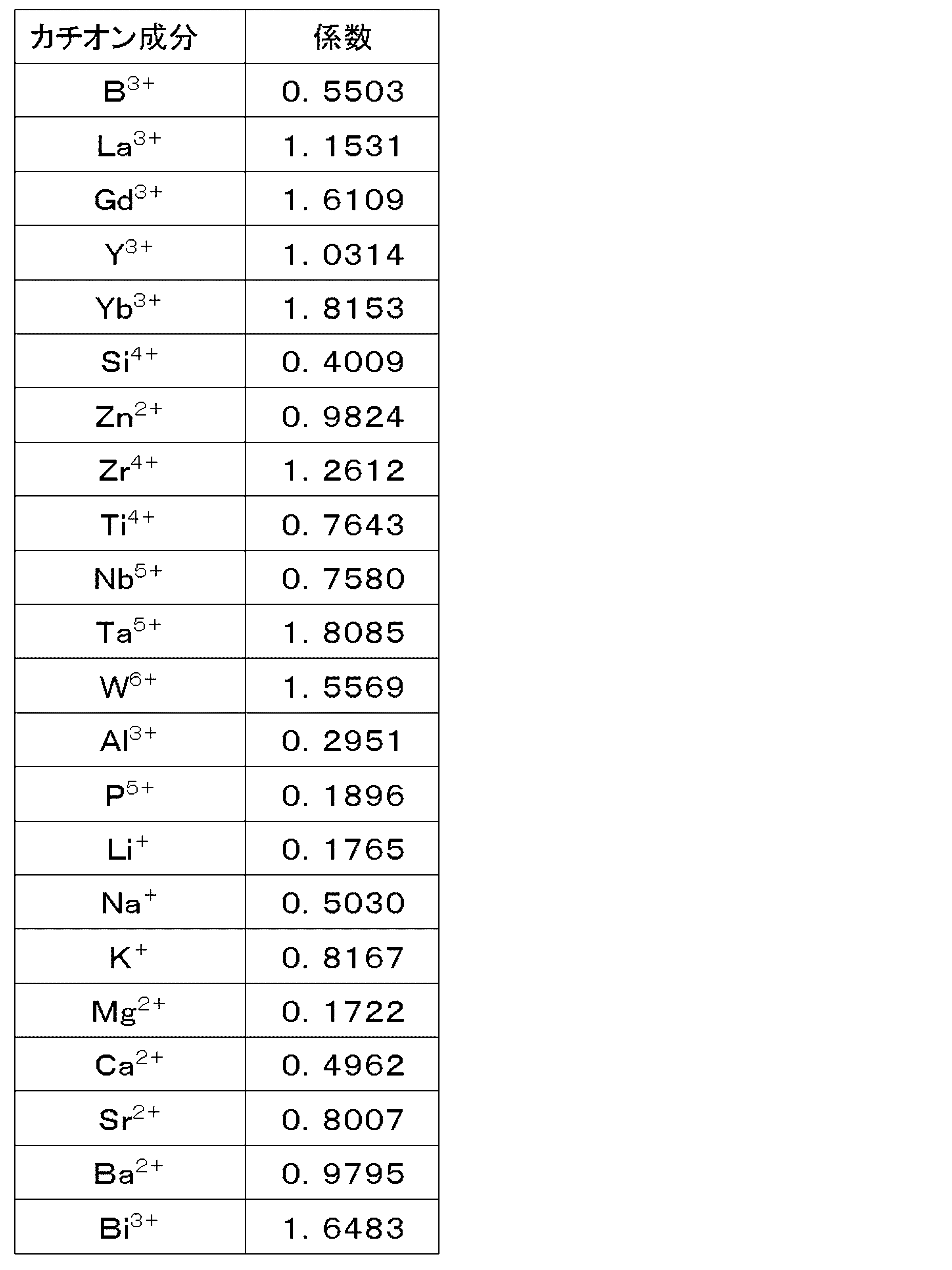
表1に記載のカチオン成分の中には、上記ガラスに含まれない(即ち含有量が0%の)カチオン成分があってもよい。
式(2)は、一態様では、下記式(2-1)であることも好ましい。式(2-1)は、下記式(2-2)であることがより好ましく、下記式(2-3)であることが更に好ましく、下記式(2-4)であることが一層好ましく、下記式(2-5)であることがより一層好ましく、下記式(2-6)であることが更に一層好ましく、下記式(2-7)であることが更により一層好ましい。
A≦137.778×nd-177.033 ・・・(2-1)
A≦137.778×nd-178.033 ・・・(2-2)
A≦137.778×nd-178.333 ・・・(2-3)
A≦137.778×nd-178.533 ・・・(2-4)
A≦137.778×nd-178.833 ・・・(2-5)
A≦137.778×nd-179.433 ・・・(2-6)
A≦137.778×nd-179.833 ・・・(2-7)
A≦137.778×nd-177.033 ・・・(2-1)
A≦137.778×nd-178.033 ・・・(2-2)
A≦137.778×nd-178.333 ・・・(2-3)
A≦137.778×nd-178.533 ・・・(2-4)
A≦137.778×nd-178.833 ・・・(2-5)
A≦137.778×nd-179.433 ・・・(2-6)
A≦137.778×nd-179.833 ・・・(2-7)
また、一態様では、合計Aは下記式(2-8)であることが、ガラスの熱的安定性の観点から好ましい。ただし、合計Aの下限は特に限定されるものではなく、下記式(2-8)により算出される値を下回ってもよい。
A≧137.778×nd-191.089 ・・・(2-8)
A≧137.778×nd-191.089 ・・・(2-8)
上記ガラスは、以下に詳述する合計含有量およびカチオン比を満たす中で式(2)を満たす組成調整を行ったガラスであり、これによりアッベ数νdが35.5以上39.0未満であり、かつnd≧-1.0000×10⁻²×νd+2.2726の関係を満たす光学系の設計における利用価値の高いガラスであって、しかも低比重化により光学素子の軽量化に寄与し得るガラスとなる。
以下に、各種カチオン成分の合計含有量およびカチオン比等について、更に詳細に説明する。
以下に、各種カチオン成分の合計含有量およびカチオン比等について、更に詳細に説明する。
B3+およびSi4+は、ガラスのネットワーク形成成分である。B3+とSi4+との合計含有量(B3++Si4+)が35.0%以上であると、ガラスの熱的安定性を改善することができ、製造中のガラスの結晶化を抑制することができる。一方、B3+の含有量とSi4+との合計含有量が53.0%以下であると、屈折率ndの低下を抑制することができるため、上記した光学特性を有するガラスを作製するうえで好ましい。以上の観点から、上記ガラスにおけるB3+とSi4+との合計含有量は、35.0~53.0%の範囲である。B3+とSi4+との合計含有量は、38.0%以上であることが好ましく、39.0%以上であることがより好ましく、40.0%以上であることが更に好ましく、41.0%以上であることが一層好ましい。また、B3+とSi4+との合計含有量は、50.0%以下であることが好ましく、48.0%以下であることがより好ましく、47.0%以下であることが更に好ましく、46.0%以下であることが一層好ましい。
La3+、Gd3+、Y3+およびYb3+は、アッベ数νdの減少を抑えつつ屈折率を高める働きを有する成分である。また、これらの成分は、ガラスの化学的耐久性および/または耐候性を改善し、ガラス転移温度を高める働きも有する。
La3+、Gd3+、Y3+およびYb3+の合計含有量(La3++Gd3++Y3++Yb3+)が30.0%以上であると、屈折率ndの低下を抑制することができるため、上記した光学特性を有するガラスを作製するうえで好ましい。更に、ガラスの化学的耐久性および/または耐候性の低下を抑制することもできる。なお、ガラス転移温度が低下すると、ガラスを機械的に加工(切断、切削、研削、研磨等)するときにガラスが破損しやすくなる(機械加工性の低下)が、La3+、Gd3+、Y3+およびYb3+の合計含有量が30.0%以上であると、ガラス転移温度の低下を抑制することができるため、機械加工性を高めることもできる。一方、La3+、Gd3+、Y3+およびYb3+の各成分の合計含有量が50.0%以下であれば、ガラスの熱的安定性を高めることができるため、ガラスを製造するときの結晶化の抑制や、ガラスを熔融するときの原料の熔け残りを低減することもできる。また、比重の上昇を抑制するうえでも好ましい。以上の観点から、上記ガラスにおいて、La3+、Gd3+、Y3+およびYb3+の合計含有量は、30.0~50.0%の範囲である。La3+、Gd3+、Y3+およびYb3+の合計含有量は、33.0%以上であることが好ましく、35.0%以上であることがより好ましく、36.0%以上であることが更に好ましく、37.0%以上であることが一層好ましい。また、La3+、Gd3+、Y3+およびYb3+の合計含有量は、48.0%以下であることが好ましく、45.0%以下であることがより好ましく、44.0%以下であることが更に好ましく、43.0%以下であることが一層好ましく、42.0%以下であることがより一層好ましい。
La3+、Gd3+、Y3+およびYb3+の合計含有量(La3++Gd3++Y3++Yb3+)が30.0%以上であると、屈折率ndの低下を抑制することができるため、上記した光学特性を有するガラスを作製するうえで好ましい。更に、ガラスの化学的耐久性および/または耐候性の低下を抑制することもできる。なお、ガラス転移温度が低下すると、ガラスを機械的に加工(切断、切削、研削、研磨等)するときにガラスが破損しやすくなる(機械加工性の低下)が、La3+、Gd3+、Y3+およびYb3+の合計含有量が30.0%以上であると、ガラス転移温度の低下を抑制することができるため、機械加工性を高めることもできる。一方、La3+、Gd3+、Y3+およびYb3+の各成分の合計含有量が50.0%以下であれば、ガラスの熱的安定性を高めることができるため、ガラスを製造するときの結晶化の抑制や、ガラスを熔融するときの原料の熔け残りを低減することもできる。また、比重の上昇を抑制するうえでも好ましい。以上の観点から、上記ガラスにおいて、La3+、Gd3+、Y3+およびYb3+の合計含有量は、30.0~50.0%の範囲である。La3+、Gd3+、Y3+およびYb3+の合計含有量は、33.0%以上であることが好ましく、35.0%以上であることがより好ましく、36.0%以上であることが更に好ましく、37.0%以上であることが一層好ましい。また、La3+、Gd3+、Y3+およびYb3+の合計含有量は、48.0%以下であることが好ましく、45.0%以下であることがより好ましく、44.0%以下であることが更に好ましく、43.0%以下であることが一層好ましく、42.0%以下であることがより一層好ましい。
Ti4+、Nb5+、Ta5+およびW6+は、屈折率を高める働きのある成分であり、適量を含有させることにより、ガラスの熱的安定性を改善する働きも有する。Ti4+、Nb5+、Ta5+およびW6+の合計含有量(Ti4++Nb5++Ta5++W6+)が3.0%以上であれば、熱的安定性を維持しつつ上記した光学特性を実現するうえで好ましい。一方、Ti4++Nb5++Ta5++W6+の合計含有量が20.0%以下であれば、ガラスの熱的安定性の維持およびアッベ数νdの低下抑制が可能である。以上の観点から、上記ガラスにおいて、Ti4++Nb5++Ta5++W6+の合計含有量を、3.0~20.0%の範囲である。Ti4++Nb5++Ta5++W6+の合計含有量は、5.0%以上であることが好ましく、6.0%以上であることがより好ましく、7.0%以上であることが更に好ましく、8.0%以上であることが一層好ましく、9.0%以上であることがより一層好ましい。また、Ti4++Nb5++Ta5++W6+の合計含有量は、18.0%以下であることが好ましく、15.0%以下であることがより好ましく、14.0%以下であることが更に好ましく、13.0%以下であることが一層好ましく、12.0%以下であることがより一層好ましく、11.0%以下であることが更に一層好ましい。
ガラスの熱的安定性を維持しつつ、アッベ数νdの低下を抑える上で、Ti4+、Nb5+、Ta5+およびW6+の合計含有量に対するLa3+、Gd3+、Y3+およびYb3+の合計含有量のカチオン比{(La3++Gd3++Y3++Yb3+)/(Ti4++Nb5++Ta5++W6+)}は、3.56以上であることが好ましい。一方、屈折率の低下を抑えつつ、ガラスの熱的安定性を維持する上で、カチオン比{(La3++Gd3++Y3++Yb3+)/(Ti4++Nb5++Ta5++W6+)}は、5.20以下であることが好ましい。以上の観点から、上記ガラスにおいて、カチオン比{(La3++Gd3++Y3++Yb3+)/(Ti4++Nb5++Ta5++W6+)}は、3.56~5.20の範囲である。カチオン比{(La3++Gd3++Y3++Yb3+)/(Ti4++Nb5++Ta5++W6+)}は、3.60以上であることが好ましく、3.65以上であることがより好ましく、3.70以上であることが更に好ましい。また、カチオン比{(La3++Gd3++Y3++Yb3+)/(Ti4++Nb5++Ta5++W6+)}は、5.00以下であることが好ましく、4.80以下であることが更に好ましく、4.50以下であることが一層好ましく、4.30以下であることがより一層好ましく、4.20以下であることが更に一層好ましい。
熔融性を改善して、ガラス原料の溶け残りを防ぐ観点から、B3+とSi4+との合計含有量に対するZn2+含有量のカチオン比{Zn2+/(B3++Si4+)}は、0.001以上であることが好ましい。一方、ガラス転移温度(Tg)の低下を抑制する観点から、カチオン比{Zn2+/(B3++Si4+)}は、0.200以下であることが好ましい。以上の観点から、上記ガラスにおいて、カチオン比{Zn2+/(B3++Si4+)}は、0.001~0.200の範囲である。カチオン比{Zn2+/(B3++Si4+)}は、0.002以上であることが好ましく、0.003以上であることがより好ましく、0.004以上であることが更に好ましい。また、カチオン比{Zn2+/(B3++Si4+)}は、0.180以下であることが好ましく、0.150以下であることがより好ましく、0.130以下であることが更に好ましく、0.100以下であることが一層好ましい。
ガラスの高屈折率低分散化と低比重化とを両立する観点から、上記ガラスにおいて、B3+含有量に対するLa3+含有量のカチオン比(B3+/La3+)は、1.165以下である。カチオン比(B3+/La3+)は、1.163以下であることが好ましく、1.160以下であることがより好ましく、1.158以下であることが更に好ましく、1.156以下であることが一層好ましい。また、ガラスの熱的安定性の維持、高分散化抑制および低比重化の観点から、上記ガラスにおいて、カチオン比(B3+/La3+)は、0.600以上であることが好ましく、0.700以上であることが更に好ましく、0.800以上であることが一層好ましく、0.850以上であることがより一層好ましく、0.900以上であることが更に一層好ましい。
希土類元素であるLa、Gd、YおよびYbに関して、Gdは、ガラスの安定供給の観点から、ガラス中の含有量を低減することが望ましい成分である。また、Gdは原子量が大きく、ガラスの比重を増加させる成分でもある。したがって、希土類元素の合計含有量に対するGd含有量の割合を低減することは好ましい。以上の観点から、上記ガラスにおいて、La3+、Gd3+、Y3+およびYb3+の合計含有量に対するGd3+含有量のカチオン比{Gd3+/(La3++Gd3++Y3++Yb3+)}は、0.10以下である。カチオン比{Gd3+/(La3++Gd3++Y3++Yb3+)}は、0.08以下であることが好ましく、0.06以下であることがより好ましく、0.05以下であることが更に好ましい。また、ガラス中にGdが含まれないことも好ましい。即ち、カチオン比{Gd3+/(La3++Gd3++Y3++Yb3+)}は、0であることも好ましい。
また、Y3+については、La3+、Gd3+、Y3+およびYb3+の合計含有量に対するY3+の含有量のカチオン比{Y3+/(La3++Gd3++Y3++Yb3+)}が0.03以上であることは、ガラスの熱的安定性の維持の観点から好ましい。一方、カチオン比{Y3+/(La3++Gd3++Y3++Yb3+)}が0.50以下であることは、ガラスの熱的安定性の維持および高屈折率化の観点から好ましい。以上の観点から、上記ガラスにおいて、カチオン比{Y3+/(La3++Gd3++Y3++Yb3+)}は、0.03~0.50の範囲である。カチオン比{Y3+/(La3++Gd3++Y3++Yb3+)}は、0.45以下であることが好ましく、0.40以下であることがより好ましく、0.35以下であることが更に好ましく、0.30以下であることが一層好ましく、0.28以下であることがより一層好ましい。また、カチオン比{Y3+/(La3++Gd3++Y3++Yb3+)}は、0.05以上であることが好ましく、0.08以上であることがより好ましく、0.10以上であることが更に好ましく、0.13以上であることが一層好ましく、0.15以上であることがより一層好ましく、0.18以上であることが更により一層好ましい。
また、ガラスの高屈折率化の観点から、上記ガラスにおいて、La3+、Gd3+、Y3+およびYb3+の合計含有量に対するガラスのネットワーク形成成分であるB3+とSi4+との合計含有量のカチオン比{(B3++Si4+)/(La3++Gd3++Y3++Yb3+)}は、1.40以下である。カチオン比{(B3++Si4+)/(La3++Gd3++Y3++Yb3+)}は、1.35以下であることが好ましく、1.30以下であることがより好ましく、1.28以下であることが更に好ましく、1.26以下であることが一層好ましく、1.24以下であることがより一層好ましく、1.22以下であることが更に一層好ましい。ガラスの熱的安定性の維持および低比重化の観点からは、カチオン比{(B3++Si4+)/(La3++Gd3++Y3++Yb3+)}は、0.70以上であることが好ましく、0.80以上であることがより好ましく、0.85以上であることが更に好ましく、0.90以上であることが一層好ましく、0.95以上であることがより一層好ましい。
Ti4+、Nb5+、Ta5+およびW6+は、適量を含有させることにより、屈折率を高め、ガラスの熱的安定性を改善する働きをする。これらの成分に関して、上記ガラスにおいて、高分散化防止、ガラスの熱的安定性の維持および着色低減の観点から、Ti4+、Nb5+、Ta5+およびW6+の合計含有量に対するTi4+含有量のカチオン比{Ti4+/(Ti4++Nb5++Ta5++W6+)}は、0.20~0.70である。カチオン比{Ti4+/(Ti4++Nb5++Ta5++W6+)}は、0.65以下であることが好ましく、0.60以下であることがより好ましく、0.55以下であることが更に好ましく、0.53以下であることが一層好ましく、0.50以下であることがより一層好ましい。また、カチオン比{Ti4+/(Ti4++Nb5++Ta5++W6+)}は、0.23以上であることが好ましく、0.24以上であることがより好ましく、0.25以上であることが更に好ましく、0.26以上であることが一層好ましい。
Ti4+、Nb5+、Ta5+およびW6+の中で、Ta5+は、屈折率を高める働きを有するものの、極めて高価な成分である。そのため、ガラスの安定供給の観点からは、Ta5+を積極的に使用することは好ましくない。また、Ta5+の含有量が多いと、ガラスを熔融するときに原料が熔け残りやすくなる。また、ガラスの比重が増加する傾向がある。このように、Ta5+は、含有量を低減することが望ましい成分である。そのため、上記ガラスにおいて、Ta5+については、ガラスの熱的安定性を改善しつつ、高屈折率低分散化とTaの使用量削減を図るため、Ti4+、Nb5+、Ta5+およびW6+の合計含有量に対するTa5+含有量のカチオン比{Ta5+/(Ti4++Nb5++Ta5++W6+)}は、0.10以下である。カチオン比{Ta5+/(Ti4++Nb5++Ta5++W6+)}は、0.08以下であることが好ましく、0.06以下であることがより好ましく、0.04以下であることが更に好ましく、0.02以下であることが一層好ましく、0.01以下であることがより一層好ましい。また、ガラス中にTaが含まれないことも好ましい。即ち、カチオン比{Ta5+/(Ti4++Nb5++Ta5++W6+)}は、0であることも好ましい。
W6+については、ガラスの着色抑制および低比重化の観点から、上記ガラスにおいて、Ti4+、Nb5+、Ta5+およびW6+の合計含有量に対するW6+含有量のカチオン比{W6+/(Ti4++Nb5++Ta5++W6+)}は、0.20以下である。カチオン比{W6+/(Ti4++Nb5++Ta5++W6+)}は、0.18以下であることが好ましく、0.15以下であることがより好ましく、0.13以下であることが更に好ましい。また、ガラス中にWが含まれないことも好ましい。即ち、カチオン比{W6+/(Ti4++Nb5++Ta5++W6+)}は、0であることも好ましい。
また、ガラスの高屈折率化の観点から、Ti4+、Nb5+、Ta5+およびW6+の合計含有量に対するガラスのネットワーク形成成分であるB3+とSi4+との合計含有量のカチオン比{(B3++Si4+)/(Ti4++Nb5++Ta5++W6+)}は、5.70以下であることが好ましい。一方、ガラスの高分散化抑制および熱的安定性の維持の観点からは、カチオン比{(B3++Si4+)/(Ti4++Nb5++Ta5++W6+)}は、3.50以上であることが好ましい。以上の観点から、上記ガラスにおいて、カチオン比{(B3++Si4+)/(Ti4++Nb5++Ta5++W6+)}は、3.50~5.70の範囲である。カチオン比{(B3++Si4+)/(Ti4++Nb5++Ta5++W6+)}は、5.50以下であることが好ましく、4.80以下であることがより好ましく、4.70以下であることが更に好ましく、4.60以下であることが一層好ましく、4.55以下であることがより一層好ましい。また、カチオン比{(B3++Si4+)/(Ti4++Nb5++Ta5++W6+)}は、3.60以上であることが好ましく、3.80以上であることがより好ましく、3.90以上であることが更に好ましい。
以下、上記ガラスのガラス組成について、更に説明する。
ガラスのネットワーク形成成分であるB3+とSi4+との合計含有量等については、先に記載した通りである。B3+含有量、Si4+含有量のそれぞれについて、ガラスの耐失透性、熔融性、成形性、化学的耐久性、耐候性、機械加工性等を改善する観点から好ましい範囲は、以下の通りである。
B3+含有量は、14.0%以上であることが好ましく、18.0%以上であることがより好ましく、20.0%以上であることが更に好ましく、23.0%以上であることが一層好ましく、25.0%以上であることがより一層好ましく、27.0%以上であることが更に一層好ましい。また、B3+含有量は、50.0%以下であることが好ましく、45.0%以下であることがより好ましく、43.0%以下であることが更に好ましく、40.0%以下であることが一層好ましく、38.0%以下であることがより一層好ましい。
Si4+含有量は、2.0%以上であることが好ましく、4.0%以上であることがより好ましく、6.0%以上であることが更に好ましく、7.0%以上であることが一層好ましく、8.0%以上であることがより一層好ましく、9.0%以上であることが更に一層好ましい。また、Si4+含有量は、39.0%以下であることが好ましく、30.0%以下であることがより好ましく、25.0%以下であることが更に好ましく、23.0%以下であることが一層好ましく、20.0%以下であることがより一層好ましく、18.0%以下であることが更に一層好ましく、15.0%以下であることが更により一層好ましい。
B3+含有量は、14.0%以上であることが好ましく、18.0%以上であることがより好ましく、20.0%以上であることが更に好ましく、23.0%以上であることが一層好ましく、25.0%以上であることがより一層好ましく、27.0%以上であることが更に一層好ましい。また、B3+含有量は、50.0%以下であることが好ましく、45.0%以下であることがより好ましく、43.0%以下であることが更に好ましく、40.0%以下であることが一層好ましく、38.0%以下であることがより一層好ましい。
Si4+含有量は、2.0%以上であることが好ましく、4.0%以上であることがより好ましく、6.0%以上であることが更に好ましく、7.0%以上であることが一層好ましく、8.0%以上であることがより一層好ましく、9.0%以上であることが更に一層好ましい。また、Si4+含有量は、39.0%以下であることが好ましく、30.0%以下であることがより好ましく、25.0%以下であることが更に好ましく、23.0%以下であることが一層好ましく、20.0%以下であることがより一層好ましく、18.0%以下であることが更に一層好ましく、15.0%以下であることが更により一層好ましい。
一般に、Bと希土類元素を含む高屈折率低分散ガラスでは、熔融時のガラスの粘性が低い傾向がある。しかし、熔融時のガラスの粘性が低いと結晶化しやすくなる。ガラス製造時の結晶化は、アモルファス状態(非晶質状態)よりも結晶化したほうが安定であり、ガラスを構成するイオンがガラス中を移動して結晶構造をもつように配列することにより生じる。したがって、熔融時の粘性が高くなるようにB3+とSi4+の各成分の含有量の比率を調整することにより、ガラスを構成するイオンが結晶構造をもつように配列しにくくして、ガラスの結晶化を更に抑制しガラスの耐失透性を一層改善することができる。
以上の観点から、B3+とSi4+との合計含有量に対するB3+含有量のカチオン比{B3+/(B3++Si4+)}の好ましい範囲は、以下の通りである。
B3+とSi4+との合計含有量に対するB3+含有量のカチオン比{B3+/(B3++Si4+)}は、0.40以上であることが好ましく、0.50以上であることがより好ましく、0.55以上であることが更に好ましく、0.60以上であることが一層好ましく、0.65以上であることがより一層好ましく、0.68以上であることが更に一層好ましい。カチオン比{B3+/(B3++Si4+)}が上記例示した下限以上であることは、ガラスの熔融性改善の観点からも好ましい。また、カチオン比{B3+/(B3++Si4+)}は、0.95以下であることが好ましく、0.90以下であることがより好ましく、0.85以下であることが更に好ましく、0.83以下であることが一層好ましく、0.80以下であることがより一層好ましく、0.78以下であることが更に一層好ましい。カチオン比{B3+/(B3++Si4+)}が上記例示した上限以下であることは、熔融時のガラスの粘性を高めるうえでも好ましい。更に、カチオン比{B3+/(B3++Si4+)}が上記例示した上限以下であることは、熔融時の揮発によるガラス組成の変動およびこれによる光学特性の変動を低減するために、またガラスの化学的耐久性、耐候性および機械加工性の1つ以上の改善の観点からも好ましい。
以上の観点から、B3+とSi4+との合計含有量に対するB3+含有量のカチオン比{B3+/(B3++Si4+)}の好ましい範囲は、以下の通りである。
B3+とSi4+との合計含有量に対するB3+含有量のカチオン比{B3+/(B3++Si4+)}は、0.40以上であることが好ましく、0.50以上であることがより好ましく、0.55以上であることが更に好ましく、0.60以上であることが一層好ましく、0.65以上であることがより一層好ましく、0.68以上であることが更に一層好ましい。カチオン比{B3+/(B3++Si4+)}が上記例示した下限以上であることは、ガラスの熔融性改善の観点からも好ましい。また、カチオン比{B3+/(B3++Si4+)}は、0.95以下であることが好ましく、0.90以下であることがより好ましく、0.85以下であることが更に好ましく、0.83以下であることが一層好ましく、0.80以下であることがより一層好ましく、0.78以下であることが更に一層好ましい。カチオン比{B3+/(B3++Si4+)}が上記例示した上限以下であることは、熔融時のガラスの粘性を高めるうえでも好ましい。更に、カチオン比{B3+/(B3++Si4+)}が上記例示した上限以下であることは、熔融時の揮発によるガラス組成の変動およびこれによる光学特性の変動を低減するために、またガラスの化学的耐久性、耐候性および機械加工性の1つ以上の改善の観点からも好ましい。
Zn2+に関して、ガラスの熱的安定性を改善してガラスの結晶化を抑制しつつ、上記した光学特性を実現するために、上記ガラスでは、La3+、Gd3+、Y3+およびYb3+の合計含有量に対するZn2+含有量のカチオン比{Zn2+/(La3++Gd3++Y3++Yb3+)}は、0.400以下であることが好ましい。また、カチオン比{Zn2+/(La3++Gd3++Y3++Yb3+)}が0.400以下であることは、ガラス転移温度の低下抑制(これによる機械加工性の改善)および化学的耐久性向上の観点からも好ましい。カチオン比{Zn2+/(La3++Gd3++Y3++Yb3+)}は、0.300以下であることがより好ましく、0.250以下であることが更に好ましく、0.200以下であることが一層好ましく、0.150以下であることがより一層好ましく、0.100以下であることが更に一層好ましい。カチオン比{Zn2+/(La3++Gd3++Y3++Yb3+)}は、熔融性改善の観点からは、0%以上であることが好ましく、0%超であることがより好ましい。カチオン比{Zn2+/(La3++Gd3++Y3++Yb3+)}は、0.001以上であることが更に好ましく、0.005以上であることが一層好ましく、0.010以上であることがより一層好ましく、0.015以上であることが更に一層好ましい。
ガラスの熱的安定性の更なる改善、ガラス転移温度の低下抑制(これによる機械加工性の改善)、化学的耐久性の改善の観点から、Ti4+、Nb5+、Ta5+およびW6+の合計含有量に対するZn2+含有量のカチオン比{Zn2+/(Ti4++Nb5++Ta5++W6+)}は、0.550以下であることが好ましい。カチオン比{Zn2+/(Ti4++Nb5++Ta5++W6+)}は、0.500以下であることがより好ましく、0.450以下であることが更に好ましく、0.430以下であることが一層好ましく、0.400以下であることがより一層好ましい。カチオン比{Zn2+/(Ti4++Nb5++Ta5++W6+)}は、0であってもよく、熔融性の向上の観点から、0超であることが好ましい。カチオン比{Zn2+/(Ti4++Nb5++Ta5++W6+)}は、0.001以上であることがより好ましく、0.005以上であることが更に好ましく、0.010以上であることが一層好ましく、0.015以上であることがより一層好ましい。
ガラスの熔融性、熱的安定性、成形性、機械加工性等を改善し、上記した光学特性を実現する観点から、Zn2+含有量の好ましい範囲は、以下の通りである。
Zn2+含有量は、0%超であることが好ましく、0.1%以上であることがより好ましく、0.2%以上であることが更に好ましい。また、Zn2+含有量は、10.0%以下であることが好ましく、8.0%以下であることがより好ましく、7.0%以下であることが更に好ましく、6.0%以下であることが一層好ましく、5.0%以下であることがより一層好ましく、4.0%以下であることが更に一層好ましい。
Zn2+含有量は、0%超であることが好ましく、0.1%以上であることがより好ましく、0.2%以上であることが更に好ましい。また、Zn2+含有量は、10.0%以下であることが好ましく、8.0%以下であることがより好ましく、7.0%以下であることが更に好ましく、6.0%以下であることが一層好ましく、5.0%以下であることがより一層好ましく、4.0%以下であることが更に一層好ましい。
La3+、Gd3+、Y3+およびYb3+の合計含有量等については、先に記載した通りである。La3+は、熱的安定性を改善しつつ、比重の増大を抑制し、高屈折率低分散ガラスを提供するうえで有用な成分である。そこで上記ガラスでは、La3+については、La3+、Gd3+、Y3+およびYb3+の合計含有量に対するLa3+含有量のカチオン比{La3+/(La3++Gd3++Y3++Yb3+)}が、0.50以上であることが好ましく、0.55以上であることがより好ましく、0.65以上であることが更に好ましく、0.68以上であることが一層好ましく、0.70以上であることがより一層好ましく、0.71以上であることが更に一層好ましく、0.72以上であることが更により一層好ましい。また、カチオン比{La3+/(La3++Gd3++Y3++Yb3+)}は、0.97以下であることが好ましく、0.95以下であることがより好ましく、0.93以下であることが更に好ましく、0.90以下であることが一層好ましく、0.88以下であることがより一層好ましく、0.85以下であることが更に一層好ましく、0.82以下であることが更により一層好ましい。
La3+、Gd3+、Y3+およびYb3+の各成分の含有量に関して、好ましい範囲は以下の通りである。
La3+含有量は、15.0%以上であることが好ましく、18.0%以上であることがより好ましく、20.0%以上であることが更に好ましく、23.0%以上であることが一層好ましく、25.0%以上であることがより一層好ましい。また、La3+含有量は、48.5%以下であることが好ましく、45.0%以下であることがより好ましく、43.0%以下であることが更に好ましく、40.0%以下であることが一層好ましく、38.0%以下であることがより一層好ましく、35.0%以下であることが更に一層好ましい。
Gd3+含有量は、4.0%以下であることが好ましく、3.0%以下であることがより好ましく、2.5%以下であることが更に好ましく、2.0%以下であることが一層好ましい。Gd3+含有量は、0%以上であることが好ましく、ガラスの安定供給および低比重化を容易にする観点から、Gd3+含有量が0%であること、即ちGd3+が含まれないことが特に好ましい。
Y3+含有量は、ガラスの熱的安定性および溶融性改善の観点から、0.9%以上であることが好ましく、2.0%以上であることがより好ましく、5.0%以上であることが更に好ましく、6.0%以上であることが一層好ましく、6.5%以上であることがより一層好ましく、7.0%以上であることが更に一層好ましい。また、Y3+含有量は、25.0%以下であることが好ましく、23.0%以下であることがより好ましく、20.0%以下であることが更に好ましく、18.0%以下であることが一層好ましく、15.0%以下であることがより一層好ましく、13.0%以下であることが更に一層好ましく、12.0%以下であることが更により一層好ましい。
Ybは希土類元素の中では原子量が大きくガラスの比重を増加させる傾向がある。また、Ybは近赤外域に吸収を有する。一方、一眼レフカメラ用の交換レンズや監視カメラのレンズは、近赤外域の光線透過率が高いことが望ましい。そのため、これらレンズの作製に有用なガラスとするためには、Ybの含有量を低減することが望ましい。以上の観点から、Yb3+含有量は、4.0%以下であることが好ましく、3.0%以下であることがより好ましく、2.0%以下であることが更に好ましく、1.0%以下であることが一層好ましい。また、Yb3+含有量は0%以上であることができ、0%であること、即ちYb3+が含まれないことが特に好ましい。
La3+含有量は、15.0%以上であることが好ましく、18.0%以上であることがより好ましく、20.0%以上であることが更に好ましく、23.0%以上であることが一層好ましく、25.0%以上であることがより一層好ましい。また、La3+含有量は、48.5%以下であることが好ましく、45.0%以下であることがより好ましく、43.0%以下であることが更に好ましく、40.0%以下であることが一層好ましく、38.0%以下であることがより一層好ましく、35.0%以下であることが更に一層好ましい。
Gd3+含有量は、4.0%以下であることが好ましく、3.0%以下であることがより好ましく、2.5%以下であることが更に好ましく、2.0%以下であることが一層好ましい。Gd3+含有量は、0%以上であることが好ましく、ガラスの安定供給および低比重化を容易にする観点から、Gd3+含有量が0%であること、即ちGd3+が含まれないことが特に好ましい。
Y3+含有量は、ガラスの熱的安定性および溶融性改善の観点から、0.9%以上であることが好ましく、2.0%以上であることがより好ましく、5.0%以上であることが更に好ましく、6.0%以上であることが一層好ましく、6.5%以上であることがより一層好ましく、7.0%以上であることが更に一層好ましい。また、Y3+含有量は、25.0%以下であることが好ましく、23.0%以下であることがより好ましく、20.0%以下であることが更に好ましく、18.0%以下であることが一層好ましく、15.0%以下であることがより一層好ましく、13.0%以下であることが更に一層好ましく、12.0%以下であることが更により一層好ましい。
Ybは希土類元素の中では原子量が大きくガラスの比重を増加させる傾向がある。また、Ybは近赤外域に吸収を有する。一方、一眼レフカメラ用の交換レンズや監視カメラのレンズは、近赤外域の光線透過率が高いことが望ましい。そのため、これらレンズの作製に有用なガラスとするためには、Ybの含有量を低減することが望ましい。以上の観点から、Yb3+含有量は、4.0%以下であることが好ましく、3.0%以下であることがより好ましく、2.0%以下であることが更に好ましく、1.0%以下であることが一層好ましい。また、Yb3+含有量は0%以上であることができ、0%であること、即ちYb3+が含まれないことが特に好ましい。
Ti4+、Nb5+、Ta5+およびW6+の合計含有量等については、先に記載した通りである。これらの成分の中で、Nb5+については、熱的安定性に優れる高屈折率低分散ガラスを提供するために、Ti4+、Nb5+、Ta5+およびW6+の合計含有量に対するNb5+含有量のカチオン比{Nb5+/(Ti4++Nb5++Ta5++W6+)}は、0.30以上であることが好ましい。また、Nb5+は、Ta5、W6+に比べ、比重を大きくせずに屈折率を高めることができる傾向のある成分である。したがって、比重の増大を抑制する上で、カチオン比{Nb5+/(Ti4++Nb5++Ta5++W6+)}を大きくすることは好ましい。カチオン比{Nb5+/(Ti4++Nb5++Ta5++W6+)}は、0.35以上であることがより好ましく、0.40以上であることが更に好ましく、0.45以上であることが一層好ましく、0.48以上であることがより一層好ましく、0.49以上であることが更に一層好ましい。また、カチオン比{Nb5+/(Ti4++Nb5++Ta5++W6+)}は、0.80以下であることが好ましく、0.75以下であることがより好ましく、0.73以下であることが更に好ましく、0.71以下であることが一層好ましく、0.70以下であることがより一層好ましく、0.69以下であることが更に一層好ましい。
Ti4+、Nb5+、Ta5+およびW6+の各成分の含有量に関して、好ましい範囲は以下の通りである。
Ti4+含有量は、15.0%以下であることが好ましく、13.0%以下であることがより好ましく、11.0%以下であることが更に好ましく、9.0%以下であることが一層好ましく、7.0%以下であることがより一層好ましく、6.0%以下であることが更に一層好ましく、5.0%以下であることが更により一層好ましい。また、Ti4+含有量は、0.6%以上であることが好ましく、1.0%以上であることがより好ましく、1.5%以上であることが更に好ましく、2.0%以上であることが一層好ましく、2.5%以上であることがより一層好ましい。
Nb5+含有量は、16.0%以下であることが好ましく、14.0%以下であることがより好ましく、12.0%以下であることが更に好ましく、10.0%以下であることが一層好ましく、9.0%以下であることがより一層好ましく、8.0%以下であることが更に一層好ましい。また、Nb5+含有量は、0%以上であることができ、1.0%以上であることが好ましく、2.0%以上であることがより好ましく、3.0%以上であることが更に好ましく、4.0%以上であることが一層好ましく、4.5%以上であることがより一層好ましい。
Ta5+含有量は、4.0%以下であることが好ましく、3.0%以下であることがより好ましく、2.0%以下であることが更に好ましく、1.0%以下であることが一層好ましく、0.5%以下であることがより一層好ましい。Ta5+含有量は、0%以上であることができ、一態様では、0%であること、即ちTa5+が含まれないことが好ましい。
W6+含有量は、5.0%以下であることが好ましく、4.0%以下であることがより好ましく、3.0%以下であることが更に好ましく、2.0%以下であることが一層好ましく、1.5%以下であることがより一層好ましい。W6+含有量は、0%以上であることができ、一態様では、0%であること、即ちW6+が含まれないことが好ましい。
Ti4+含有量は、15.0%以下であることが好ましく、13.0%以下であることがより好ましく、11.0%以下であることが更に好ましく、9.0%以下であることが一層好ましく、7.0%以下であることがより一層好ましく、6.0%以下であることが更に一層好ましく、5.0%以下であることが更により一層好ましい。また、Ti4+含有量は、0.6%以上であることが好ましく、1.0%以上であることがより好ましく、1.5%以上であることが更に好ましく、2.0%以上であることが一層好ましく、2.5%以上であることがより一層好ましい。
Nb5+含有量は、16.0%以下であることが好ましく、14.0%以下であることがより好ましく、12.0%以下であることが更に好ましく、10.0%以下であることが一層好ましく、9.0%以下であることがより一層好ましく、8.0%以下であることが更に一層好ましい。また、Nb5+含有量は、0%以上であることができ、1.0%以上であることが好ましく、2.0%以上であることがより好ましく、3.0%以上であることが更に好ましく、4.0%以上であることが一層好ましく、4.5%以上であることがより一層好ましい。
Ta5+含有量は、4.0%以下であることが好ましく、3.0%以下であることがより好ましく、2.0%以下であることが更に好ましく、1.0%以下であることが一層好ましく、0.5%以下であることがより一層好ましい。Ta5+含有量は、0%以上であることができ、一態様では、0%であること、即ちTa5+が含まれないことが好ましい。
W6+含有量は、5.0%以下であることが好ましく、4.0%以下であることがより好ましく、3.0%以下であることが更に好ましく、2.0%以下であることが一層好ましく、1.5%以下であることがより一層好ましい。W6+含有量は、0%以上であることができ、一態様では、0%であること、即ちW6+が含まれないことが好ましい。
また、低比重化の観点からは、Ti4+、Nb5+、Ta5+およびW6+の合計含有量においてTi4+とNb5+との合計含有量が占める割合を高めることが好ましい。この観点から、Ti4+、Nb5+、Ta5+およびW6+の合計含有量に対するTi4+とNb5+との合計含有量のカチオン比{(Ti4++Nb5+)/(Ti4++Nb5++Ta5++W6+)}は、0.70以上であることが好ましく、0.75以上であることがより好ましく、0.80以上であることが更に好ましく、0.85以上であることが一層好ましく、カチオン比{(Ti4++Nb5+)/(Ti4++Nb5++Ta5++W6+)}は、1.00以下であることができ、1.00であること、即ちTa5+およびW6+が含まれないことが特に好ましい。
次に、以上説明した成分以外の成分について説明する。
Zr4+は、屈折率を高める働きのある成分であり、適量を含有させることにより、ガラスの熱的安定性を改善する働きも有する。また、Zr4+は、ガラス転移温度を高めることにより機械的な加工時にガラスが破損しにくくする働きも有する。これらの効果を良好に得るために、上記ガラスでは、Zr4+の含有量が2.0%以上であることが好ましく、2.5%以上であることがより好ましく、3.0%以上であることが更に好ましく、3.5%以上であることが一層好ましく、4.0%以上であることがより一層好ましく、4.5%以上であることが更に一層好ましい。一方、Zr4+の含有量が10.0%以下であることは、ガラスの熱的安定性を改善する観点から好ましい。熱的安定性を改善することにより、ガラス製造時の結晶化やガラス熔融時の熔け残りの発生を抑制することができる。上記ガラスにおけるZr4+含有量は、8.0%以下であることがより好ましく、7.5%以下であることが更に好ましく、7.0%以下であることが一層好ましく、6.5%以下であることがより一層好ましく、6.0%以下であることが更に一層好ましく、5.5%以下であることが更により一層好ましい。
Zr4+については、屈折率を高める成分であるTi4+とNb5+との合計含有量に対するZr4+含有量のカチオン比{Zr4+/(Ti4++Nb5+)}が0.40以上であることが、アッベ数の低下を抑制する観点から好ましい。カチオン比{Zr4+/(Ti4++Nb5+)}は、0.42以上であることがより好ましく、0.44以上であることが更に好ましく、0.45以上であることが一層好ましく、0.46以上であることがより一層好ましく、0.47以上であることが更に一層好ましい。また、熔融性の改善によりガラスの熔け残りを抑制する観点やガラスの失透抑制の観点から、カチオン比{Zr4+/(Ti4++Nb5+)}は、0.60以下であることが好ましく、0.58以下であることがより好ましく、0.56以下であることが更に好ましく、0.55以下であることが一層好ましい。
Li+は、ガラス転移温度を低下させる作用が強いため、その含有量が多くなると機械加工性が低下傾向を示す。また、化学的耐久性や耐候性も低下傾向を示す。したがって、Li+含有量は5.0%以下であることが好ましく、4.0%以下であることがより好ましく、3.0%以下であることが更に好ましく、2.0%以下であることが一層好ましく、1.0%以下であることがより一層好ましい。また、Li+含有量は0%以上であることができ、0%であってもよい。
Na+、K+、Rb+、Cs+は、いずれも、ガラスの熔融性を改善する働きを有するが、これらの含有量が多くなると、ガラスの熱的安定性、化学的耐久性、耐候性、機械加工性が低下傾向を示す。したがって、Na+、K+、Rb+、Cs+の各含有量の好ましい範囲は、以下の通りである。
Na+含有量は、8.0%以下であることが好ましく、6.0%以下であることがより好ましく、4.0%以下であることが更に好ましく、2.0%以下であることが一層好ましい。また、Na+含有量は0%以上であることができ、0%であってもよい。
K+含有量は、8.0%以下であることが好ましく、6.0%以下であることがより好ましく、4.0%以下であることが更に好ましく、2.0%以下であることが一層好ましい。また、K+含有量は0%以上であることができ、0%であってもよい。
Rb+含有量は、5.0%以下であることが好ましく、4.0%以下であることがより好ましく、3.0%以下であることが更に好ましく、2.0%以下であることが一層好ましく、1.0%以下であることがより一層好ましい。また、Rb+含有量は0%以上であることができ、0%であってもよい。
Cs++含有量は、5.0%以下であることが好ましく、4.0%以下であることがより好ましく、3.0%以下であることが更に好ましく、2.0%以下であることが一層好ましく、1.0%以下であることがより一層好ましい。また、Cs+含有量は0%以上であることができ、0%であってもよい。
Na+含有量は、8.0%以下であることが好ましく、6.0%以下であることがより好ましく、4.0%以下であることが更に好ましく、2.0%以下であることが一層好ましい。また、Na+含有量は0%以上であることができ、0%であってもよい。
K+含有量は、8.0%以下であることが好ましく、6.0%以下であることがより好ましく、4.0%以下であることが更に好ましく、2.0%以下であることが一層好ましい。また、K+含有量は0%以上であることができ、0%であってもよい。
Rb+含有量は、5.0%以下であることが好ましく、4.0%以下であることがより好ましく、3.0%以下であることが更に好ましく、2.0%以下であることが一層好ましく、1.0%以下であることがより一層好ましい。また、Rb+含有量は0%以上であることができ、0%であってもよい。
Cs++含有量は、5.0%以下であることが好ましく、4.0%以下であることがより好ましく、3.0%以下であることが更に好ましく、2.0%以下であることが一層好ましく、1.0%以下であることがより一層好ましい。また、Cs+含有量は0%以上であることができ、0%であってもよい。
ガラスの熱的安定性、化学的耐久性、耐候性、機械加工性を維持しつつ、ガラスの熔融性を改善する観点から、Li+、Na+およびK+の合計含有量(Li++Na++K+)の好ましい範囲は、以下の通りである。
Li+、Na+およびK+の合計含有量(Li++Na++K+)は、8.0%以下であることが好ましく、6.0%以下であることがより好ましく、4.0%以下であることが更に好ましく、2.0%以下であることが一層好ましい。また、Li+、Na+およびK+の合計含有量(Li++Na++K+)は、0%以上であることができ、0%であってもよい。
Li+、Na+およびK+の合計含有量(Li++Na++K+)は、8.0%以下であることが好ましく、6.0%以下であることがより好ましく、4.0%以下であることが更に好ましく、2.0%以下であることが一層好ましい。また、Li+、Na+およびK+の合計含有量(Li++Na++K+)は、0%以上であることができ、0%であってもよい。
Mg2+、Ca2+、Sr2+、Ba2+は、いずれもガラスの熔融性を改善させる働きを有する成分である。ただし、これら成分の含有量が多くなると、ガラスの熱的安定性が低下し、失透傾向を示す。以上の観点から、これら成分のそれぞれの含有量の好ましい範囲は、以下の通りである。
Mg2+含有量は、10.0%以下であることが好ましく、8.0%以下であることがより好ましく、6.0%以下であることが更に好ましく、4.0%以下であることが一層好ましく、2.0%以下であることがより一層好ましい。また、Mg2+含有量は0%以上であることができ、0%であってもよい。
Ca2+含有量は、10.0%以下であることが好ましく、8.0%以下であることがより好ましく、6.0%以下であることが更に好ましく、4.0%以下であることが一層好ましく、2.0%以下であることがより一層好ましい。また、Ca2+含有量は0%以上であることができ、0%であってもよい。
Sr2+含有量は、10.0%以下であることが好ましく、8.0%以下であることがより好ましく、6.0%以下であることが更に好ましく、4.0%以下であることが一層好ましく、2.0%以下であることがより一層好ましい。また、Sr2+含有量は0%以上であることができ、0%であってもよい。
Ba2+含有量は、10.0%以下であることが好ましく、8.0%以下であることがより好ましく、6.0%以下であることが更に好ましく、4.0%以下であることが一層好ましく、2.0%以下であることがより一層好ましい。また、Ba2+含有量は0%以上であることができ、0%であってもよい。
Mg2+含有量は、10.0%以下であることが好ましく、8.0%以下であることがより好ましく、6.0%以下であることが更に好ましく、4.0%以下であることが一層好ましく、2.0%以下であることがより一層好ましい。また、Mg2+含有量は0%以上であることができ、0%であってもよい。
Ca2+含有量は、10.0%以下であることが好ましく、8.0%以下であることがより好ましく、6.0%以下であることが更に好ましく、4.0%以下であることが一層好ましく、2.0%以下であることがより一層好ましい。また、Ca2+含有量は0%以上であることができ、0%であってもよい。
Sr2+含有量は、10.0%以下であることが好ましく、8.0%以下であることがより好ましく、6.0%以下であることが更に好ましく、4.0%以下であることが一層好ましく、2.0%以下であることがより一層好ましい。また、Sr2+含有量は0%以上であることができ、0%であってもよい。
Ba2+含有量は、10.0%以下であることが好ましく、8.0%以下であることがより好ましく、6.0%以下であることが更に好ましく、4.0%以下であることが一層好ましく、2.0%以下であることがより一層好ましい。また、Ba2+含有量は0%以上であることができ、0%であってもよい。
また、Mg2+、Ca2+、Sr2+およびBa2+の合計含有量(Mg2++Ca2++Sr2++Ba2+)は、ガラスの熱的安定性を維持する観点から、10.0%以下であることが好ましく、8.0%以下であることがより好ましく、6.0%以下であることが更に好ましく、4.0%以下であることが一層好ましく、2.0%以下であることがより一層好ましい。また、Mg2+、Ca2+、Sr2+およびBa2+の合計含有量(Mg2++Ca2++Sr2++Ba2+)は0%以上であることができ、0%であってもよい。
Al3+は、ガラスの化学的耐久性、耐候性を改善する働きを有する成分である。ただし、Al3+の含有量が多くなると、屈折率ndの低下傾向、ガラスの熱的安定性の低下傾向、熔融性の低下傾向がみられることがある。以上の点を考慮し、Al3+含有量の好ましい範囲は、以下の通りである。
Al3+含有量は、10.0%以下であることが好ましく、8.0%以下であることがより好ましく、6.0%以下であることが更に好ましく、4.0%以下であることが一層好ましく、2.0%以下であることがより一層好ましい。また、Al3+含有量は0%以上であることができ、0%であってもよい。
Al3+含有量は、10.0%以下であることが好ましく、8.0%以下であることがより好ましく、6.0%以下であることが更に好ましく、4.0%以下であることが一層好ましく、2.0%以下であることがより一層好ましい。また、Al3+含有量は0%以上であることができ、0%であってもよい。
P5+は、屈折率ndを低下させる成分であり、ガラスの熱的安定性を低下させる成分でもあるが、極少量の導入であればガラスの熱的安定性を改善することがある。上記した光学特性を有するとともに、熱的安定性が優れたガラスを作製するうえで、P5+含有量の好ましい範囲は、以下の通りである。
P5+含有量は、5.0%以下であることが好ましく、4.0%以下であることがより好ましく、3.0%以下であることが更に好ましく、2.0%以下であることが一層好ましく、1.0%以下であることがより一層好ましい。また、P5+含有量は0%以上であることができ、0%であってもよい。
P5+含有量は、5.0%以下であることが好ましく、4.0%以下であることがより好ましく、3.0%以下であることが更に好ましく、2.0%以下であることが一層好ましく、1.0%以下であることがより一層好ましい。また、P5+含有量は0%以上であることができ、0%であってもよい。
Bi3+は、屈折率ndを高めるとともに、アッベ数νdを低下させる成分である。また、比重や着色を増大させやすい成分でもある。上記した光学特性を有し、かつ着色が少なく低比重なガラスを作製するうえで、Bi3+含有量の好ましい範囲は、以下の通りである。
Bi3+含有量は、10.0%以下であることが好ましく、8.0%以下であることがより好ましく、6.0%以下であることが更に好ましく、4.0%以下であることが一層好ましく、2.0%以下であることがより一層好ましい。また、Bi3+含有量は0%以上であることができ、0%であってもよい。
Bi3+含有量は、10.0%以下であることが好ましく、8.0%以下であることがより好ましく、6.0%以下であることが更に好ましく、4.0%以下であることが一層好ましく、2.0%以下であることがより一層好ましい。また、Bi3+含有量は0%以上であることができ、0%であってもよい。
Ga3+、In3+、Sc3+、Hf4+は、いずれも屈折率ndを高める働きを有する。ただし、これらの成分は高価であり、上記ガラスを得るうえで必須の成分ではない。したがって、Ga3+、In3+、Sc3+、Hf4+の各含有量の好ましい範囲は、以下の通りである。
Ga3+含有量は、5.0%以下であることが好ましく、4.0%以下であることがより好ましく、3.0%以下であることが更に好ましく、2.0%以下であることが一層好ましく、1.0%以下であることがより一層好ましい。また、Ga3+含有量は0%以上であることができ、0%であってもよい。
In3+含有量は、5.0%以下であることが好ましく、4.0%以下であることがより好ましく、3.0%以下であることが更に好ましく、2.0%以下であることが一層好ましく、1.0%以下であることがより一層好ましい。また、In3+含有量は0%以上であることができ、0%であってもよい。
Sc3+含有量は、5.0%以下であることが好ましく、4.0%以下であることがより好ましく、3.0%以下であることが更に好ましく、2.0%以下であることが一層好ましく、1.0%以下であることがより一層好ましい。また、Sc3+含有量は0%以上であることができ、0%であってもよい。
Sc3+含有量は、5.0%以下であることが好ましく、4.0%以下であることがより好ましく、3.0%以下であることが更に好ましく、2.0%以下であることが一層好ましく、1.0%以下であることがより一層好ましい。また、Sc3+含有量は0%以上であることができ、0%であってもよい。
Hf4+含有量は、10.0%以下であることが好ましく、8.0%以下であることがより好ましく、6.0%以下であることが更に好ましく、4.0%以下であることが一層好ましく、2.0%以下であることがより一層好ましい。また、Hf4+含有量は0%以上であることができ、0%であってもよい。
Ga3+含有量は、5.0%以下であることが好ましく、4.0%以下であることがより好ましく、3.0%以下であることが更に好ましく、2.0%以下であることが一層好ましく、1.0%以下であることがより一層好ましい。また、Ga3+含有量は0%以上であることができ、0%であってもよい。
In3+含有量は、5.0%以下であることが好ましく、4.0%以下であることがより好ましく、3.0%以下であることが更に好ましく、2.0%以下であることが一層好ましく、1.0%以下であることがより一層好ましい。また、In3+含有量は0%以上であることができ、0%であってもよい。
Sc3+含有量は、5.0%以下であることが好ましく、4.0%以下であることがより好ましく、3.0%以下であることが更に好ましく、2.0%以下であることが一層好ましく、1.0%以下であることがより一層好ましい。また、Sc3+含有量は0%以上であることができ、0%であってもよい。
Sc3+含有量は、5.0%以下であることが好ましく、4.0%以下であることがより好ましく、3.0%以下であることが更に好ましく、2.0%以下であることが一層好ましく、1.0%以下であることがより一層好ましい。また、Sc3+含有量は0%以上であることができ、0%であってもよい。
Hf4+含有量は、10.0%以下であることが好ましく、8.0%以下であることがより好ましく、6.0%以下であることが更に好ましく、4.0%以下であることが一層好ましく、2.0%以下であることがより一層好ましい。また、Hf4+含有量は0%以上であることができ、0%であってもよい。
Lu3+は、屈折率ndを高める働きを有するが、ガラスの比重を増加させる成分でもある。また、LuはGd、Ybと同様、重希土類元素であることから、ガラスの安定供給の観点から、ガラス中の含有量を低減することが望ましい。以上の観点から、Lu3+含有量は、10.0%以下であることが好ましく、8.0%以下であることがより好ましく、6.0%以下であることが更に好ましく、4.0%以下であることが一層好ましく、2.0%以下であることがより一層好ましい。また、Lu3+含有量は0%以上であることができ、0%であってもよい。
Ge4+は、屈折率ndを高める働きを有するが、一般的に使用されるガラス成分の中で、突出して高価な成分である。ガラスの製造コストを低減する観点から、Ge4+含有量は、0.0%以下であることが好ましく、8.0%以下であることがより好ましく、6.0%以下であることが更に好ましく、4.0%以下であることが一層好ましく、2.0%以下であることがより一層好ましい。また、Ge4+含有量は0%以上であることができ、0%であってもよい。
Te4+は、屈折率ndを高める成分であるが、環境への配慮等の観点からTe4+の含有量を少なくすることが好ましい。Te4+含有量は、5.0%以下であることが好ましく、4.0%以下であることがより好ましく、3.0%以下であることが更に好ましく、2.0%以下であることが一層好ましく、1.0%以下であることがより一層好ましい。また、Te4+含有量は0%以上であることができ、0%であってもよい。
以上説明した各種作用および効果を良好に得る観点から、上記ガラスにおいて、B3+、La3+、Gd3+、Y3+、Yb3+、Si4+、Zn2+、Zr4+、Ti4+、Nb5+、Ta5+、W6+、Al3+、P5+、Li+、Na+、K+、Mg2+、Ca2+、Sr2+、Ba2+およびBi3+の合計含有量は、90.0%以上であることが好ましく、92.0%以上であることがより好ましく、94.0%以上であることが更に好ましく、96.0%以上であることが一層好ましく、98.0%以上であることがより一層好ましく、99.0%以上であることが更に一層好ましく、99.5%以上であることが更により一層好ましい。また、B3+、La3+、Gd3+、Y3+、Yb3+、Si4+、Zn2+、Zr4+、Ti4+、Nb5+、Ta5+、W6+、Al3+、P5+、Li+、Na+、K+、Mg2+、Ca2+、Sr2+、Ba2+およびBi3+の合計含有量は100%以下であることができ、100%であってもよい。
Pb、As、Cd、Tl、Be、Seは、それぞれ毒性を有する。そのため、これらの元素を含有させないこと、すなわち、これら元素をガラス成分としてガラス中に導入しないことが好ましい。
U、Th、Raはいずれも放射性元素である。そのため、これらの元素を含有させないこと、すなわち、これら元素をガラス成分としてガラス中に導入しないことが好ましい。
V、Cr、Mn、Fe、Co、Ni、Cu、Pr,Nd、Pm、Sm、Eu、Tb、Dy、Ho、Er、Tm、Ceは、ガラスの着色を増大させたり、蛍光の発生源となり、光学素子用のガラスに含有させる元素としては好ましくない。そのため、これらの元素を含有させないこと、すなわち、これら元素をガラス成分としてガラス中に導入しないことが好ましい。
U、Th、Raはいずれも放射性元素である。そのため、これらの元素を含有させないこと、すなわち、これら元素をガラス成分としてガラス中に導入しないことが好ましい。
V、Cr、Mn、Fe、Co、Ni、Cu、Pr,Nd、Pm、Sm、Eu、Tb、Dy、Ho、Er、Tm、Ceは、ガラスの着色を増大させたり、蛍光の発生源となり、光学素子用のガラスに含有させる元素としては好ましくない。そのため、これらの元素を含有させないこと、すなわち、これら元素をガラス成分としてガラス中に導入しないことが好ましい。
Sb、Snは清澄剤として機能する任意に添加可能な元素である。
Sbの添加量は、Sb2O3に換算し、酸化物換算のガラス組成において、Sb2O3以外のガラス成分の含有量の合計を100質量%としたときの含有率(以下、かかる含有率を「外割り」ともいう。)は、0~0.11質量%の範囲にすることが好ましく、0.01~0.08質量%の範囲にすることがより好ましく、0.02~0.05質量%の範囲にすることが更に好ましい。
Snの添加量は、SnO2に換算し、酸化物換算のガラス組成において、SnO2以外のガラス成分の含有量の合計を100質量%としたときの含有率(外割り)は、0~0.5質量%の範囲にすることが好ましく、0~0.2質量%の範囲にすることがより好ましく、0質量%にすることが更に好ましい。
Sbの添加量は、Sb2O3に換算し、酸化物換算のガラス組成において、Sb2O3以外のガラス成分の含有量の合計を100質量%としたときの含有率(以下、かかる含有率を「外割り」ともいう。)は、0~0.11質量%の範囲にすることが好ましく、0.01~0.08質量%の範囲にすることがより好ましく、0.02~0.05質量%の範囲にすることが更に好ましい。
Snの添加量は、SnO2に換算し、酸化物換算のガラス組成において、SnO2以外のガラス成分の含有量の合計を100質量%としたときの含有率(外割り)は、0~0.5質量%の範囲にすることが好ましく、0~0.2質量%の範囲にすることがより好ましく、0質量%にすることが更に好ましい。
以上、カチオン成分について説明した。次に、アニオン成分について説明する。
上記ガラスは、酸化物ガラスであるため、アニオン成分としてO2-を含む。O2-含有量は、95.0アニオン%以上であることが好ましく、97.0アニオン%以上であることがより好ましく、98.0アニオン%以上であることが更に好ましく、99.0アニオン%以上であることが一層好ましく、99.5アニオン%以上であることがより一層好ましく、100アニオン%であってもよい。
O2-以外のアニオン成分としては、F-、Cl-、Br-、I-を例示することができる。ただし、F-、Cl-、Br-、I-は、いずれもガラスの熔融中に揮発しやすい。これらの成分の揮発によって、ガラスの特性が変動しガラスの均質性が低下したり、熔融設備の消耗が著しくなる傾向がある。したがって、F-、Cl-、Br-およびI-の合計含有量を、100アニオン%から、O2-の含有量を差し引いた量に抑えることが好ましい。
なお、アニオン%とは周知のように、ガラスに含まれるすべてのアニオン成分の合計含有量を100%とした百分率である。
なお、アニオン%とは周知のように、ガラスに含まれるすべてのアニオン成分の合計含有量を100%とした百分率である。
<ガラス特性>
(部分分散特性)
色収差補正の観点から、上記ガラスは、アッベ数νdを固定したとき、部分分散比が小さいガラスであることが好ましい。
ここで、部分分散比Pg,Fは、g線、F線、c線における各屈折率ng、nF、ncを用いて、(ng-nF)/(nF-nc)と表される。
高次の色収差補正に好適なガラスを提供する観点から、上記ガラスの部分分散比Pg,Fの好ましい範囲は、以下の通りである。
部分分散比Pg,Fは、0.590以下であることが好ましく、0.588以下であることがより好ましく、0.586以下であることが更に好ましく、0.584以下であることが一層好ましく、0.583以下であることがより一層好ましく、0.582以下であることが更に一層好ましい。また、部分分散比Pg,Fは、0.564以上であることが好ましく、0.566以上であることがより好ましく、0.568以上であることが更に好ましく、0.570以上であることが一層好ましく、0.572以上であることがより一層好ましく、0.573以上であることが更に一層好ましく、0.574以上であることが更により一層好ましい。
(部分分散特性)
色収差補正の観点から、上記ガラスは、アッベ数νdを固定したとき、部分分散比が小さいガラスであることが好ましい。
ここで、部分分散比Pg,Fは、g線、F線、c線における各屈折率ng、nF、ncを用いて、(ng-nF)/(nF-nc)と表される。
高次の色収差補正に好適なガラスを提供する観点から、上記ガラスの部分分散比Pg,Fの好ましい範囲は、以下の通りである。
部分分散比Pg,Fは、0.590以下であることが好ましく、0.588以下であることがより好ましく、0.586以下であることが更に好ましく、0.584以下であることが一層好ましく、0.583以下であることがより一層好ましく、0.582以下であることが更に一層好ましい。また、部分分散比Pg,Fは、0.564以上であることが好ましく、0.566以上であることがより好ましく、0.568以上であることが更に好ましく、0.570以上であることが一層好ましく、0.572以上であることがより一層好ましく、0.573以上であることが更に一層好ましく、0.574以上であることが更により一層好ましい。
(ガラス転移温度)
上記ガラスのガラス転移温度(Tg)は、特に限定されないが、好ましくは670℃以上である。ガラス転移温度を670℃以上にすることにより、切断、切削、研削、研磨等のガラスの機械加工行う際にガラスを破損しにくくすることができる。また、ガラス転移温度を低下させる働きの強いLi、Znなどの成分を多量に含有させなくてもよいため、ガラスの安定供給等の観点から使用量を低減することが望ましいGd、Taの含有量を少なくしても、更にはYbの含有量も少なくしても、熱的安定性を改善しやすくなる。
一方、ガラス転移温度を高くし過ぎると、ガラスを高温でアニールしなければならなくなり、アニール炉が著しく消耗する。また、ガラスを成形するときに、高い温度で成形を行わなければならず、成形に使用する型の消耗が著しくなる。
機械加工性の改善、アニール炉や成形型への負担軽減から、ガラス転移温度の好ましい範囲は、以下の通りである。
ガラス転移温度は、670℃以上であることが好ましく、680℃以上であることがより好ましく、690℃以上であることが更に好ましく、695℃以上であることが一層好ましく、700℃以上であることがより一層好ましい。また、ガラス転移温度は、790℃以下であることが好ましく、780℃以下であることがより好ましく、770℃以下であることが更に好ましく、760℃以下であることが一層好ましく、750℃以下であることがより一層好ましく、745℃以下であることが更に一層好ましい。
上記ガラスのガラス転移温度(Tg)は、特に限定されないが、好ましくは670℃以上である。ガラス転移温度を670℃以上にすることにより、切断、切削、研削、研磨等のガラスの機械加工行う際にガラスを破損しにくくすることができる。また、ガラス転移温度を低下させる働きの強いLi、Znなどの成分を多量に含有させなくてもよいため、ガラスの安定供給等の観点から使用量を低減することが望ましいGd、Taの含有量を少なくしても、更にはYbの含有量も少なくしても、熱的安定性を改善しやすくなる。
一方、ガラス転移温度を高くし過ぎると、ガラスを高温でアニールしなければならなくなり、アニール炉が著しく消耗する。また、ガラスを成形するときに、高い温度で成形を行わなければならず、成形に使用する型の消耗が著しくなる。
機械加工性の改善、アニール炉や成形型への負担軽減から、ガラス転移温度の好ましい範囲は、以下の通りである。
ガラス転移温度は、670℃以上であることが好ましく、680℃以上であることがより好ましく、690℃以上であることが更に好ましく、695℃以上であることが一層好ましく、700℃以上であることがより一層好ましい。また、ガラス転移温度は、790℃以下であることが好ましく、780℃以下であることがより好ましく、770℃以下であることが更に好ましく、760℃以下であることが一層好ましく、750℃以下であることがより一層好ましく、745℃以下であることが更に一層好ましい。
(ガラスの比重)
光学系を構成する光学素子(レンズ)では、レンズを構成するガラスの屈折率とレンズの光学機能面(制御しようとする光線が入射、出射する面)の曲率によって、屈折力が決まる。光学機能面の曲率を大きくしようとすると、レンズの厚みも増加する。その結果、レンズが重くなる。これに対し、屈折率の高いガラスを使用すれば、光学機能面の曲率を大きくしなくても大きな屈折力を得ることができる。
以上より、ガラスの比重の増加を抑えつつ、屈折率を高めることができれば、一定の屈折力を有する光学素子の軽量化が可能となる。
屈折率ndの屈折力への寄与に関しては、ガラスの屈折率ndから真空中の屈折率である1を引いた値(nd―1)に対してガラスの比重dの比を取った値、d/(nd-1)、を光学素子の軽量化を図る際の指標とすることができる。すなわち、d/(nd-1)を光学素子の軽量化を図る際の指標とし、この値を低減することにより、レンズの軽量化を図ることができる。
上記ガラスは、上記の合計Aが屈折率ndに対して上記式(2)を満たすことにより、高屈折率低分散ガラスでありながら、低比重化が可能である。したがって、上記ガラスのd/(nd-1)は、例えば5.80以下であることができ、5.70以下であることが好ましく、5.65以下であることがより好ましく、5.60以下であることが更に好ましい。ただし、d/(nd-1)を過剰に減少させると、ガラスの熱的安定性が低下傾向を示す。そのため、d/(nd-1)は、4.50以上であることが好ましく、4.80以上であることがより好ましく、5.00以上であることが更に好ましく、5.10以上であることが一層好ましく、5.20以上であることがより一層好ましく、5.30以上であることが更に一層好ましい。
光学系を構成する光学素子(レンズ)では、レンズを構成するガラスの屈折率とレンズの光学機能面(制御しようとする光線が入射、出射する面)の曲率によって、屈折力が決まる。光学機能面の曲率を大きくしようとすると、レンズの厚みも増加する。その結果、レンズが重くなる。これに対し、屈折率の高いガラスを使用すれば、光学機能面の曲率を大きくしなくても大きな屈折力を得ることができる。
以上より、ガラスの比重の増加を抑えつつ、屈折率を高めることができれば、一定の屈折力を有する光学素子の軽量化が可能となる。
屈折率ndの屈折力への寄与に関しては、ガラスの屈折率ndから真空中の屈折率である1を引いた値(nd―1)に対してガラスの比重dの比を取った値、d/(nd-1)、を光学素子の軽量化を図る際の指標とすることができる。すなわち、d/(nd-1)を光学素子の軽量化を図る際の指標とし、この値を低減することにより、レンズの軽量化を図ることができる。
上記ガラスは、上記の合計Aが屈折率ndに対して上記式(2)を満たすことにより、高屈折率低分散ガラスでありながら、低比重化が可能である。したがって、上記ガラスのd/(nd-1)は、例えば5.80以下であることができ、5.70以下であることが好ましく、5.65以下であることがより好ましく、5.60以下であることが更に好ましい。ただし、d/(nd-1)を過剰に減少させると、ガラスの熱的安定性が低下傾向を示す。そのため、d/(nd-1)は、4.50以上であることが好ましく、4.80以上であることがより好ましく、5.00以上であることが更に好ましく、5.10以上であることが一層好ましく、5.20以上であることがより一層好ましく、5.30以上であることが更に一層好ましい。
また、比重dが、屈折率ndに対して下記式(3)を満たすことも好ましい。
d≦14.00×nd-21.69 ・・・(3)
d≦14.00×nd-21.69 ・・・(3)
更に、上記ガラスの比重dは、5.30以下であることが好ましく、5.25以下であることがより好ましく、5.23以下であることが更に好ましく、5.20以下であることが一層好ましく、5.15以下であることがより一層好ましく、5.10以下であることが更に一層好ましい。比重dを上記例示した上限以下にすることは、このガラスからなる光学素子の軽量化の観点から好ましい。また、ガラスの比重は低いほど光学素子の軽量化の観点から好ましいため、上記ガラスの比重dについて、下限は特に限定されない。例えば、ガラスの熱的安定性をより改善する観点からは、上記ガラスの比重dは4.00以上であることが好ましい。
(液相温度)
ガラスの熱的安定性の指標の一つに液相温度がある。ガラス製造時の結晶化、失透を抑制する観点から、液相温度LTは1400℃以下であることが好ましく、1380℃以下であることがより好ましく、1360℃以下であることが更に好ましく、1340℃以下であることが一層好ましい。液相温度LTは、例えば1150℃以上であることができる。ただし、液相温度が低いことは好ましいため、液相温度は1150℃を下回ってもよく、下限は特に限定されるものではない。
ガラスの熱的安定性の指標の一つに液相温度がある。ガラス製造時の結晶化、失透を抑制する観点から、液相温度LTは1400℃以下であることが好ましく、1380℃以下であることがより好ましく、1360℃以下であることが更に好ましく、1340℃以下であることが一層好ましい。液相温度LTは、例えば1150℃以上であることができる。ただし、液相温度が低いことは好ましいため、液相温度は1150℃を下回ってもよく、下限は特に限定されるものではない。
(ガラスの光線透過性)
ガラスの光線透過性、詳しくは、短波長側の光吸収端の長波長化が抑制されていることは、着色度λ5により評価することができる。着色度λ5とは、紫外域から可視域にかけて、厚さ10mmのガラスの分光透過率(表面反射損失を含む)が5%となる波長を表す。後述の実施例に示すλ5は、250~700nmの波長域において測定された値である。分光透過率とは、例えばより詳しくは、10.0±0.1mmの厚さに研磨された互いに平行な平面を有するガラス試料を用い、上記研磨された面に対して垂直方向から光を入射して得られる分光透過率、すなわち、上記ガラス試料に入射する光の強度をIin、上記ガラス試料を透過した光の強度をIoutとしたときのIout/Iinのことである。
着色度λ5によれば、分光透過率の短波長側の吸収端を定量的に評価することができる。接合レンズ作製のためにレンズ同士を紫外線硬化型接着剤により接合する際等、光学素子を通して接着剤に紫外線を照射し接着剤を硬化させることが行われる。効率よく紫外線硬化型接着剤の硬化を行う観点から、分光透過率の短波長側の吸収端が短い波長域にあることが好ましい。この短波長側の吸収端を定量的に評価する指標として、着色度λ5を用いることができる。上記ガラスは、先に記載した組成調整により、好ましくは370nm以下、より好ましくは360nm以下、更に好ましくは355nm以下、一層好ましくは350nm以下、より一層好ましくは349nm以下のλ5を示すことができる。λ5の下限は、一例として、315nmを目安とすることができるが、低いほど好ましく特に限定されるものではない。
ガラスの光線透過性、詳しくは、短波長側の光吸収端の長波長化が抑制されていることは、着色度λ5により評価することができる。着色度λ5とは、紫外域から可視域にかけて、厚さ10mmのガラスの分光透過率(表面反射損失を含む)が5%となる波長を表す。後述の実施例に示すλ5は、250~700nmの波長域において測定された値である。分光透過率とは、例えばより詳しくは、10.0±0.1mmの厚さに研磨された互いに平行な平面を有するガラス試料を用い、上記研磨された面に対して垂直方向から光を入射して得られる分光透過率、すなわち、上記ガラス試料に入射する光の強度をIin、上記ガラス試料を透過した光の強度をIoutとしたときのIout/Iinのことである。
着色度λ5によれば、分光透過率の短波長側の吸収端を定量的に評価することができる。接合レンズ作製のためにレンズ同士を紫外線硬化型接着剤により接合する際等、光学素子を通して接着剤に紫外線を照射し接着剤を硬化させることが行われる。効率よく紫外線硬化型接着剤の硬化を行う観点から、分光透過率の短波長側の吸収端が短い波長域にあることが好ましい。この短波長側の吸収端を定量的に評価する指標として、着色度λ5を用いることができる。上記ガラスは、先に記載した組成調整により、好ましくは370nm以下、より好ましくは360nm以下、更に好ましくは355nm以下、一層好ましくは350nm以下、より一層好ましくは349nm以下のλ5を示すことができる。λ5の下限は、一例として、315nmを目安とすることができるが、低いほど好ましく特に限定されるものではない。
一方、ガラスの着色度の指標としては、着色度λ70も挙げられる。λ70は、λ5について記載した方法で測定される分光透過率が70%となる波長を表す。着色の少ないガラスとする観点から、λ70の好ましい範囲は450nm以下、より好ましい範囲は440nm以下、一層好ましい範囲は430nm以下、より一層好ましい範囲は420nm以下である。λ70の下限の目安は360nmであるが、低いほど好ましく特に限定されるものではない。
以上説明した本発明の一態様にかかるガラスは、屈折率ndおよびアッベ数νdが大きく(即ち高屈折率低分散ガラスであり)、光学素子用のガラス材料として有用である。更に、先に記載した組成調整により、ガラスの均質化および低比重化も可能である。したがって上記ガラスは、より軽量な光学素子を与える光学ガラスとして好適である。
<ガラスの製造方法>
上記ガラスは、目的のガラス組成が得られるように、原料である酸化物、炭酸塩、硫酸塩、硝酸塩、水酸化物などを秤量、調合し、十分に混合して混合バッチとし、熔融容器内で加熱、熔融し、脱泡、攪拌を行い均質かつ泡を含まない熔融ガラスを作り、これを成形することによって得ることができる。具体的には公知の熔融法を用いて作ることができる。上記ガラスは、上記した光学特性を有する高屈折率低分散ガラスでありながら、熱的安定性が優れているため、公知の熔融法、成形法を用いて、安定的に製造することができる。
上記ガラスは、目的のガラス組成が得られるように、原料である酸化物、炭酸塩、硫酸塩、硝酸塩、水酸化物などを秤量、調合し、十分に混合して混合バッチとし、熔融容器内で加熱、熔融し、脱泡、攪拌を行い均質かつ泡を含まない熔融ガラスを作り、これを成形することによって得ることができる。具体的には公知の熔融法を用いて作ることができる。上記ガラスは、上記した光学特性を有する高屈折率低分散ガラスでありながら、熱的安定性が優れているため、公知の熔融法、成形法を用いて、安定的に製造することができる。
[プレス成形用ガラス素材、光学素子ブランク、およびそれらの製造方法]
本発明の他の一態様は、
上述のガラスからなるプレス成形用ガラス素材;
上述のガラスからなる光学素子ブランク、
に関する。
本発明の他の一態様は、
上述のガラスからなるプレス成形用ガラス素材;
上述のガラスからなる光学素子ブランク、
に関する。
本発明の他の一態様によれば、
上述のガラスをプレス成形用ガラス素材に成形する工程を備えるプレス成形用ガラス素材の製造方法;
上述のプレス成形用ガラス素材を、プレス成形型を用いてプレス成形することにより光学素子ブランクを作製する工程を備える光学素子ブランクの製造方法;
上述のガラスを光学素子ブランクに成形する工程を備える光学素子ブランクの製造方法、
も提供される。
上述のガラスをプレス成形用ガラス素材に成形する工程を備えるプレス成形用ガラス素材の製造方法;
上述のプレス成形用ガラス素材を、プレス成形型を用いてプレス成形することにより光学素子ブランクを作製する工程を備える光学素子ブランクの製造方法;
上述のガラスを光学素子ブランクに成形する工程を備える光学素子ブランクの製造方法、
も提供される。
光学素子ブランクとは、目的とする光学素子の形状に近似し、光学素子の形状に研磨しろ(研磨により除去することになる表面層)、必要に応じて研削しろ(研削により除去することになる表面層)を加えた光学素子母材である。光学素子ブランクの表面を研削、研磨することにより、光学素子が仕上げられる。一態様では、上記ガラスを適量熔融して得た熔融ガラスをプレス成形する方法(ダイレクトプレス法と呼ばれる。)により、光学素子ブランクを作製することができる。他の一態様では、上記ガラスを適量熔融して得た熔融ガラスを固化することにより光学素子ブランクを作製することもできる。
また、他の一態様では、プレス成形用ガラス素材を作製し、作製したプレス成形用ガラス素材をプレス成形することにより、光学素子ブランクを作製することができる。
プレス成形用ガラス素材のプレス成形は、加熱して軟化した状態にあるプレス成形用ガラス素材をプレス成形型でプレスする公知の方法により行うことができる。加熱、プレス成形は、ともに大気中で行うことができる。プレス成形後にアニールしてガラス内部の歪を低減することにより、均質な光学素子ブランクを得ることができる。
プレス成形用ガラス素材は、そのままの状態で光学素子ブランク作製のためのプレス成形に供されるプレス成形用ガラスゴブと呼ばれるものに加え、切断、研削、研磨などの機械加工を施してプレス成形用ガラスゴブを経てプレス成形に供されるものも含む。切断方法としては、ガラス板の表面の切断したい部分にスクライビングと呼ばれる方法で溝を形成し、溝が形成された面の裏面から溝の部分に局所的な圧力を加えて、溝の部分でガラス板を割る方法や、切断刃によってガラス板をカットする方法などがある。また、研削、研磨方法としてはバレル研磨などが挙げられる。
プレス成形用ガラス素材は、例えば、熔融ガラスを鋳型に鋳込みガラス板に成形し、このガラス板を複数のガラス片に切断することにより作製することができる。または、適量の熔融ガラスを成形してプレス成形用ガラスゴブを作製することもできる。プレス成形用ガラスゴブを、再加熱、軟化してプレス成形して作製することにより、光学素子ブランクを作製することもできる。ガラスを再加熱、軟化してプレス成形して光学素子ブランクを作製する方法は、ダイレクトプレス法に対してリヒートプレス法と呼ばれる。
[光学素子およびその製造方法]
本発明の他の一態様は、
上述のガラスからなる光学素子
に関する。
上記光学素子は、上述のガラスを用いて作製される。上記光学素子において、ガラス表面には、例えば、反射防止膜等の多層膜等、一層以上のコーティングが形成されていてもよい。
本発明の他の一態様は、
上述のガラスからなる光学素子
に関する。
上記光学素子は、上述のガラスを用いて作製される。上記光学素子において、ガラス表面には、例えば、反射防止膜等の多層膜等、一層以上のコーティングが形成されていてもよい。
また、本発明の一態様によれば、
上述の光学素子ブランクを研削および/または研磨することにより光学素子を作製する工程を備える光学素子の製造方法、
も提供される。
上述の光学素子ブランクを研削および/または研磨することにより光学素子を作製する工程を備える光学素子の製造方法、
も提供される。
上記光学素子の製造方法において、研削、研磨は公知の方法を適用すればよく、加工後に光学素子表面を十分洗浄、乾燥させるなどすることにより、内部品質および表面品質の高い光学素子を得ることができる。このようにして、上記ガラスからなる光学素子を得ることができる。光学素子としては、球面レンズ、非球面レンズ、マイクロレンズなどの各種のレンズ、プリズムなどを例示することができる。
また、上記ガラスからなる光学素子は、接合光学素子を構成するレンズとしても好適である。接合光学素子としては、レンズ同士を接合したもの(接合レンズ)、レンズとプリズムを接合したものなどを例示することができる。例えば、接合光学素子は、接合する2つの光学素子の接合面を形状が反転形状となるように精密に加工(例えば、球面研磨加工)し、接合レンズの接着に使用される紫外線硬化型接着剤を塗布し、貼り合わせてからレンズを通して紫外線を照射し接着剤を硬化させることで作製することができる。このように接合光学素子を作製するために、上記ガラスは好ましい。接合する複数個の光学素子を、アッベ数νdが相違する複数種のガラスを用いてそれぞれ作製し、接合することにより、色収差の補正に好適な素子とすることができる。
ガラス組成の定量分析の結果、ガラス成分が酸化物基準で表され、ガラス成分の含有量が質量%表示されることがある。このように酸化物基準で質量%表示された組成は、例えば次のような方法で、カチオン%、アニオン%表示の組成に換算することができる。
ガラス中にN種のガラス成分が含まれる場合、k番目のガラス成分をA(k)mOnと表記する。ただし、kは1以上、N以下の任意の整数である。
A(k)はカチオン、Oは酸素、mとnは化学量論的に定まる整数である。例えば、酸化物基準による表記がB2O3の場合、m=2、n=3となり、SiO2の場合、m=1、n=2となる。
次に、A(k)mOnの含有量を、X(k)[質量%]とする。ここで、A(k)の原子量をP(k)、酸素Oの原子番号をQとすると、A(k)mOnの形式的な分子量R(k)は、
R(k)=P(k)×m+Q×n
となる。
更に、
B=100/{Σ[m×X(k)/R(k)]}
とすると、カチオン成分A(k)s+の含有量(カチオン%)は、[X(k)/R(k)]×m×B(カチオン%)となる。ここで、Σは、k=1からNまでのm×X(k)/R(K)の合計を意味する。mはkに応じて変化する。sは2n/mである。
また、分子量R(k)は、小数点以下4桁目を四捨五入し、小数点以下3桁目までの表示とした値を用いて計算すればよい。なお、幾つかのガラス成分、添加剤について、酸化物基準による表記における分子量を、下記の表2に示す。
ガラス中にN種のガラス成分が含まれる場合、k番目のガラス成分をA(k)mOnと表記する。ただし、kは1以上、N以下の任意の整数である。
A(k)はカチオン、Oは酸素、mとnは化学量論的に定まる整数である。例えば、酸化物基準による表記がB2O3の場合、m=2、n=3となり、SiO2の場合、m=1、n=2となる。
次に、A(k)mOnの含有量を、X(k)[質量%]とする。ここで、A(k)の原子量をP(k)、酸素Oの原子番号をQとすると、A(k)mOnの形式的な分子量R(k)は、
R(k)=P(k)×m+Q×n
となる。
更に、
B=100/{Σ[m×X(k)/R(k)]}
とすると、カチオン成分A(k)s+の含有量(カチオン%)は、[X(k)/R(k)]×m×B(カチオン%)となる。ここで、Σは、k=1からNまでのm×X(k)/R(K)の合計を意味する。mはkに応じて変化する。sは2n/mである。
また、分子量R(k)は、小数点以下4桁目を四捨五入し、小数点以下3桁目までの表示とした値を用いて計算すればよい。なお、幾つかのガラス成分、添加剤について、酸化物基準による表記における分子量を、下記の表2に示す。
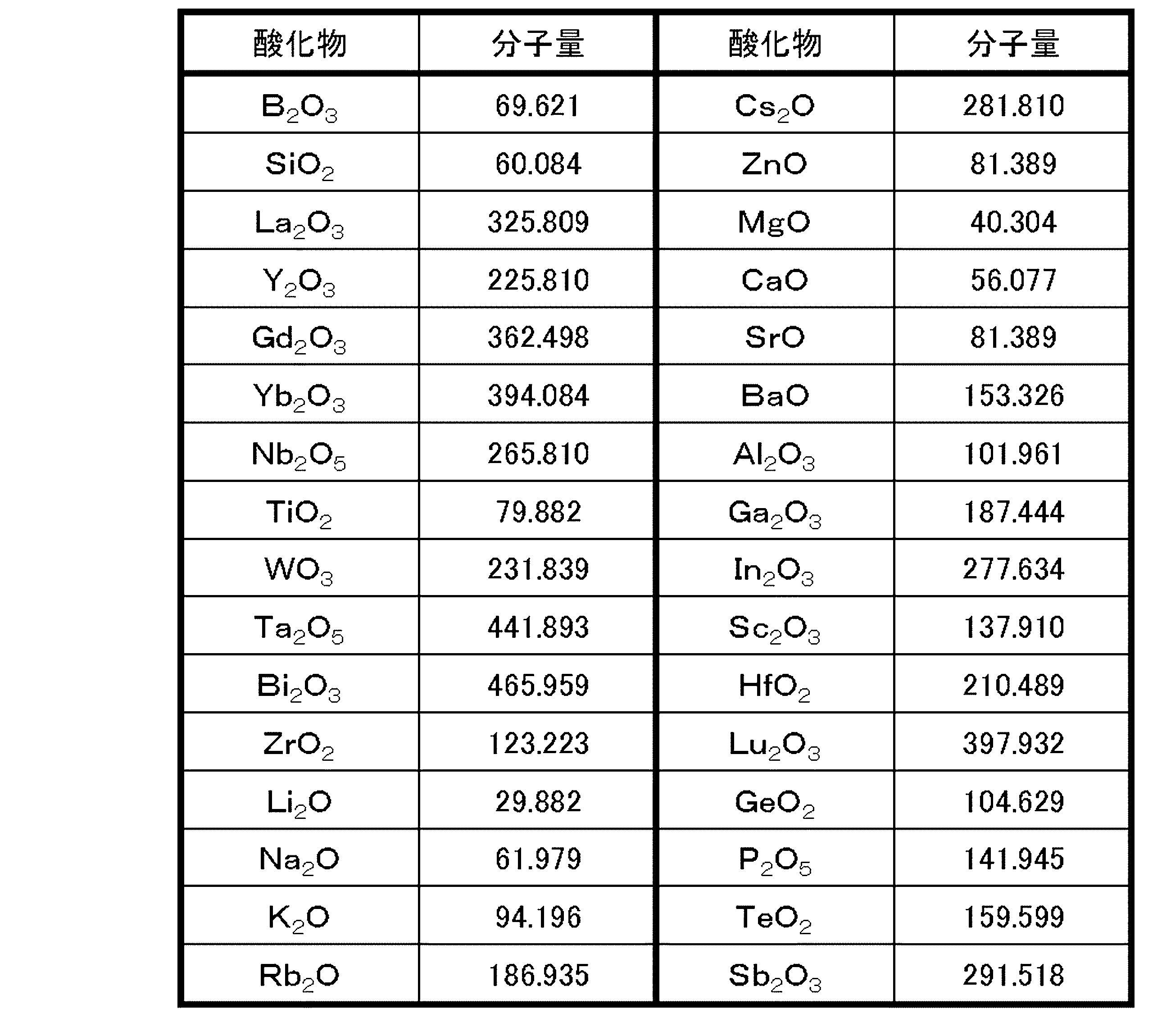
以下、本発明を実施例に基づき更に説明する。但し本発明は、実施例に示す態様に限定されるものではない。
(実施例1)
下記の表に示す組成を有するガラスが得られるように、原料として酸化物、ホウ酸などの化合物を秤量し、充分、混合してバッチ原料を作製した。
このバッチ原料を白金坩堝中に入れ、1350~1450℃の温度に坩堝ごと加熱し、2~3時間かけてガラスを熔融、清澄した。熔融ガラスを攪拌して均質化した後、予熱した成形型に熔融ガラスを鋳込み、ガラス転移温度付近まで放冷してから直ちに、成形型ごとガラスをアニール炉内に入れた。それから、ガラス転移温度付近で約1時間アニールした。アニールした後、アニール炉内で室温まで放冷した。
このようにして作製したガラスを観察したところ、結晶の析出、泡、脈理、原料の熔け残りは認められなかった。このようにして、均質性の高いガラスを作ることができた。
下記の表に示す組成を有するガラスが得られるように、原料として酸化物、ホウ酸などの化合物を秤量し、充分、混合してバッチ原料を作製した。
このバッチ原料を白金坩堝中に入れ、1350~1450℃の温度に坩堝ごと加熱し、2~3時間かけてガラスを熔融、清澄した。熔融ガラスを攪拌して均質化した後、予熱した成形型に熔融ガラスを鋳込み、ガラス転移温度付近まで放冷してから直ちに、成形型ごとガラスをアニール炉内に入れた。それから、ガラス転移温度付近で約1時間アニールした。アニールした後、アニール炉内で室温まで放冷した。
このようにして作製したガラスを観察したところ、結晶の析出、泡、脈理、原料の熔け残りは認められなかった。このようにして、均質性の高いガラスを作ることができた。
表3(表3-1~表3-5)に示す各ガラスのアニオン成分については、O2-含有量が100アニオン%である。
得られたガラスのガラス特性を、以下に示す方法で測定した。測定結果を下記の表に示す。
(1)屈折率nd、nF、nc、ng、アッベ数νd
降温速度-30℃/時間で降温して得たガラスについて、日本光学硝子工業会規格の屈折率測定法により、屈折率nd、nF、nc、ngを測定した。屈折率nd、nF、ncの各測定値を用いて、アッベ数νdを算出した。
(2)ガラス転移温度Tg
示差走査熱量分析装置(DSC)を用いて、昇温速度を10℃/分にして測定した。
(3)比重
アルキメデス法により測定した。
(4)部分分散比Pg,F
上記(1)で測定したnF、nc、ngの値から算出した。
(5)液相温度LT
ガラスを所定温度に加熱された炉内に入れて2時間保持し、冷却後、ガラス内部を100倍の光学顕微鏡で観察し、結晶の有無から液相温度LTを決定した。
(6)着色度λ5、λ70
互いに対向する2つの光学研磨された平面を有する厚さ10±0.1mmのガラス試料を用い、分光光度計により、研磨された面に対して垂直方向から強度Iinの光を入射し、ガラス試料を透過した光の強度Ioutを測定し、分光透過率Iout/Iinを算出し、分光透過率が5%になる波長をλ5、分光透過率が70%になる波長をλ70とした。
(1)屈折率nd、nF、nc、ng、アッベ数νd
降温速度-30℃/時間で降温して得たガラスについて、日本光学硝子工業会規格の屈折率測定法により、屈折率nd、nF、nc、ngを測定した。屈折率nd、nF、ncの各測定値を用いて、アッベ数νdを算出した。
(2)ガラス転移温度Tg
示差走査熱量分析装置(DSC)を用いて、昇温速度を10℃/分にして測定した。
(3)比重
アルキメデス法により測定した。
(4)部分分散比Pg,F
上記(1)で測定したnF、nc、ngの値から算出した。
(5)液相温度LT
ガラスを所定温度に加熱された炉内に入れて2時間保持し、冷却後、ガラス内部を100倍の光学顕微鏡で観察し、結晶の有無から液相温度LTを決定した。
(6)着色度λ5、λ70
互いに対向する2つの光学研磨された平面を有する厚さ10±0.1mmのガラス試料を用い、分光光度計により、研磨された面に対して垂直方向から強度Iinの光を入射し、ガラス試料を透過した光の強度Ioutを測定し、分光透過率Iout/Iinを算出し、分光透過率が5%になる波長をλ5、分光透過率が70%になる波長をλ70とした。

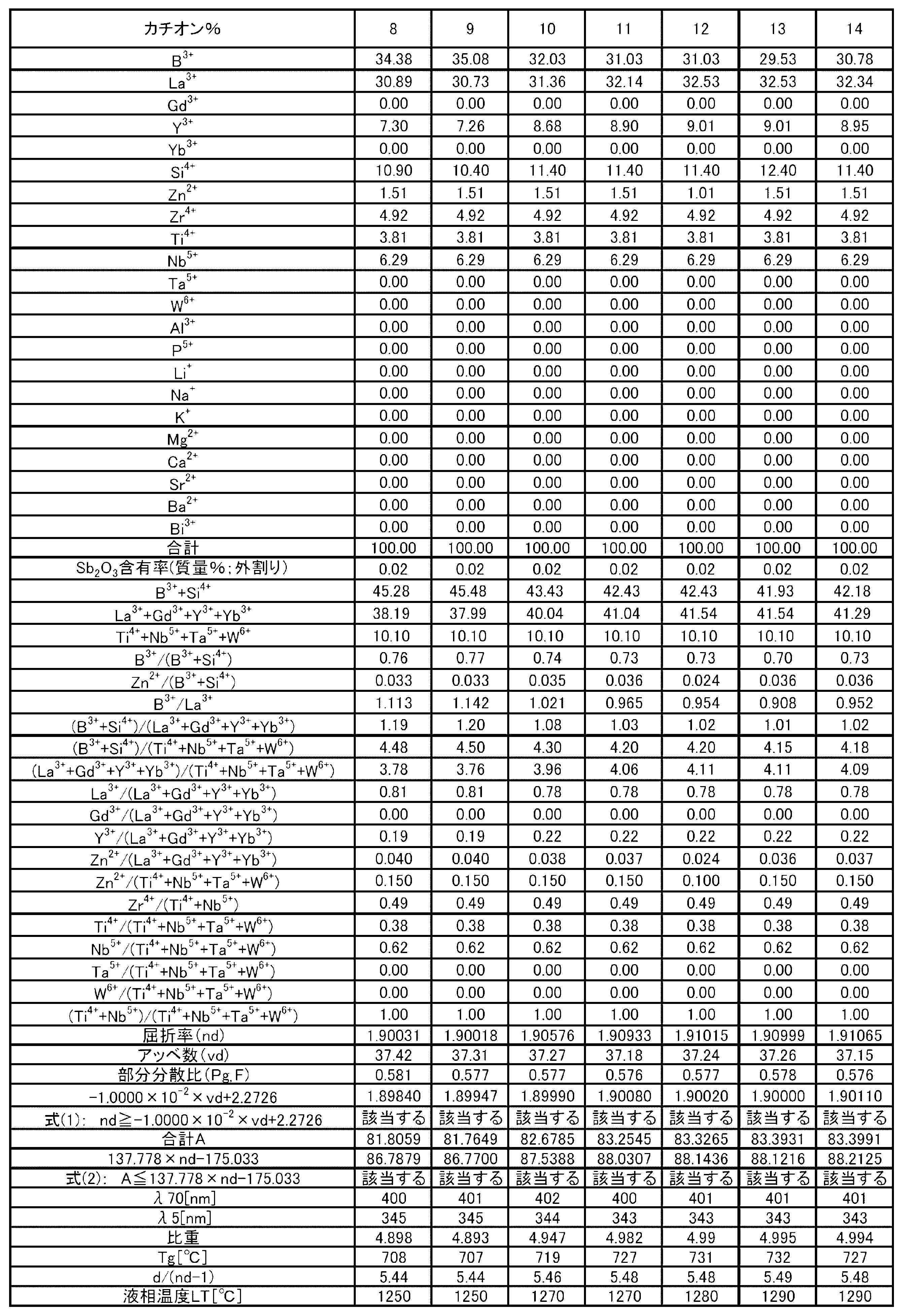
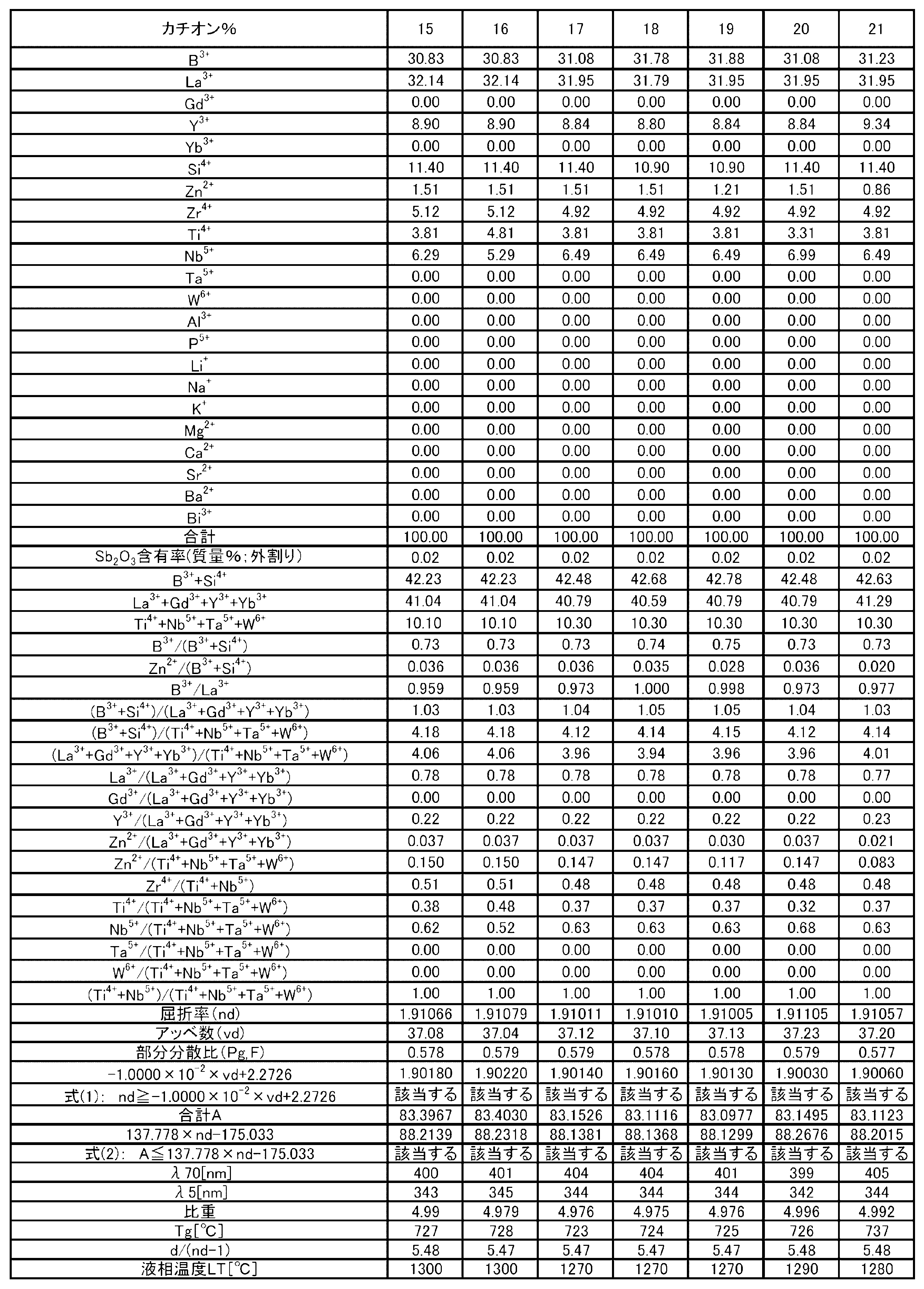

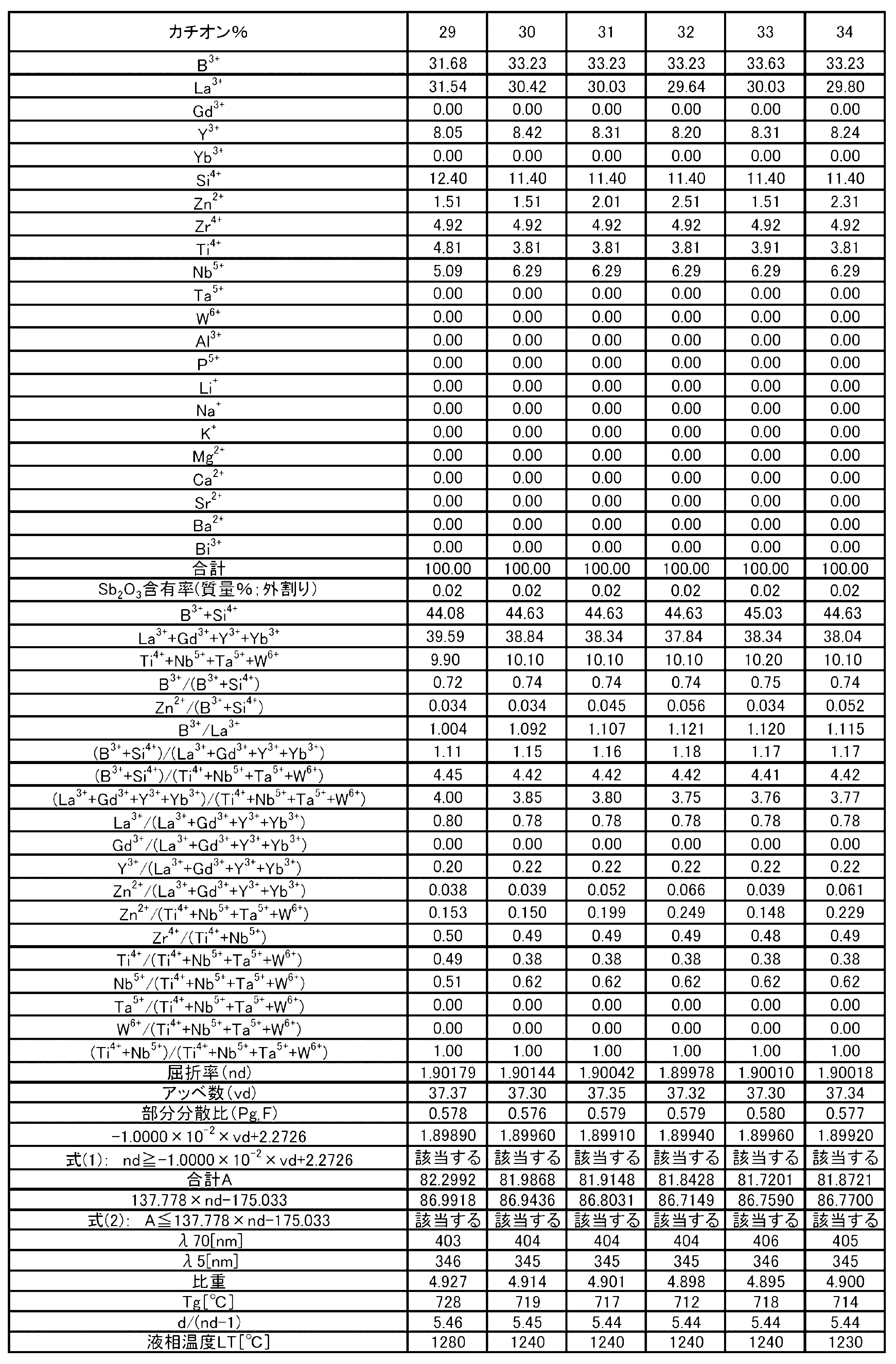
図1は、実施例1の各ガラスの比重を横軸に取り、各カチオン成分の含有量に表1に記載の係数を掛けた値の合計Aを縦軸に取ったグラフである。
図1に示すように、実施例1の各ガラスについて、各カチオン成分の含有量に表1に記載の係数を掛けた値の合計Aが比重と良好な相関関係を示した。この結果から、合計Aに基づき式(2)式を満たすように組成調整を行うことにより、低比重のガラスが得られることが確認できる。
図1に示すように、実施例1の各ガラスについて、各カチオン成分の含有量に表1に記載の係数を掛けた値の合計Aが比重と良好な相関関係を示した。この結果から、合計Aに基づき式(2)式を満たすように組成調整を行うことにより、低比重のガラスが得られることが確認できる。
(実施例2)
実施例1で得られた各種ガラスを使用し、プレス成形用ガラス塊(ガラスゴブ)を作製した。このガラス塊を大気中で加熱、軟化し、プレス成形型でプレス成形し、レンズブランク(光学素子ブランク)を作製した。作製したレンズブランクをプレス成形型から取り出し、アニールし、研磨を含む機械加工を行い、実施例1で作製した各種ガラスからなる球面レンズを作製した。
実施例1で得られた各種ガラスを使用し、プレス成形用ガラス塊(ガラスゴブ)を作製した。このガラス塊を大気中で加熱、軟化し、プレス成形型でプレス成形し、レンズブランク(光学素子ブランク)を作製した。作製したレンズブランクをプレス成形型から取り出し、アニールし、研磨を含む機械加工を行い、実施例1で作製した各種ガラスからなる球面レンズを作製した。
(実施例3)
実施例1において作製した熔融ガラスを所望量、プレス成形型でプレス成形し、レンズブランク(光学素子ブランク)を作製した。作製したレンズブランクをプレス成形型から取り出し、アニールし、研磨を含む機械加工を行い、実施例1で作製した各種ガラスからなる球面レンズを作製した。
実施例1において作製した熔融ガラスを所望量、プレス成形型でプレス成形し、レンズブランク(光学素子ブランク)を作製した。作製したレンズブランクをプレス成形型から取り出し、アニールし、研磨を含む機械加工を行い、実施例1で作製した各種ガラスからなる球面レンズを作製した。
(実施例4)
実施例1において作製した熔融ガラスを固化して作製したガラス塊(光学素子ブランク)アニールし、研磨を含む機械加工を行い、実施例1で作製した各種ガラスからなる球面レンズを作製した。
実施例1において作製した熔融ガラスを固化して作製したガラス塊(光学素子ブランク)アニールし、研磨を含む機械加工を行い、実施例1で作製した各種ガラスからなる球面レンズを作製した。
(実施例5)
実施例2~4において作製した球面レンズを、他種のガラスからなる球面レンズと貼り合せ、接合レンズを作製した。実施例2~4において作製した球面レンズの接合面は凸面、他種の光学ガラスからなる球面レンズの接合面は凹面であった。上記2つの接合面は、互いに曲率半径の絶対値が等しくなるように作製した。接合面に光学素子接合用の紫外線硬化型接着剤を塗布し、2つのレンズを接合面同士で貼り合せた。その後、実施例2~4において作製した球面レンズを通して、接合面に塗布した接着剤に紫外線を照射し、接着剤を固化させた。
上記のようにして接合レンズを作製した。
実施例2~4において作製した球面レンズを、他種のガラスからなる球面レンズと貼り合せ、接合レンズを作製した。実施例2~4において作製した球面レンズの接合面は凸面、他種の光学ガラスからなる球面レンズの接合面は凹面であった。上記2つの接合面は、互いに曲率半径の絶対値が等しくなるように作製した。接合面に光学素子接合用の紫外線硬化型接着剤を塗布し、2つのレンズを接合面同士で貼り合せた。その後、実施例2~4において作製した球面レンズを通して、接合面に塗布した接着剤に紫外線を照射し、接着剤を固化させた。
上記のようにして接合レンズを作製した。
最後に、前述の各態様を総括する。
一態様によれば、アッベ数νdが35.5以上39.0未満であり、屈折率ndがアッベ数νdに対して上記式(1)を満たし、カチオン%表示のガラス組成において、B3+とSi4+との合計含有量が35.0~53.0%の範囲であり、La3+、Gd3+、Y3+およびYb3+の合計含有量が30.0~50.0%の範囲であり、Ti4+、Nb5+、Ta5+およびW6+の合計含有量が3.0~20.0%の範囲であり、Ti4+、Nb5+、Ta5+およびW6+の合計含有量に対するLa3+、Gd3+、Y3+およびYb3+の合計含有量のカチオン比{(La3++Gd3++Y3++Yb3+)/(Ti4++Nb5++Ta5++W6+)}が3.56~5.20の範囲であり、B3+とSi4+との合計含有量に対するZn2+含有量のカチオン比{Zn2+/(B3++Si4+)}が0.001~0.200の範囲であり、B3+含有量に対するLa3+含有量のカチオン比(B3+/La3+)が1.165以下であり、La3+、Gd3+、Y3+およびYb3+の合計含有量に対するGd3+含有量のカチオン比{Gd3+/(La3++Gd3++Y3++Yb3+)}が0.10以下であり、La3+、Gd3+、Y3+およびYb3+の合計含有量に対するY3+含有量のカチオン比{Y3+/(La3++Gd3++Y3++Yb3+)}が0.03~0.50の範囲であり、Ti4+、Nb5+、Ta5+およびW6+の合計含有量に対するTi4+含有量のカチオン比{Ti4+/(Ti4++Nb5++Ta5++W6+)}が0.20~0.70の範囲であり、Ti4+、Nb5+、Ta5+およびW6+の合計含有量に対するTa5+含有量のカチオン比{Ta5+/(Ti4++Nb5++Ta5++W6+)}が0.10以下であり、Ti4+、Nb5+、Ta5+およびW6+の合計含有量に対するW6+含有量のカチオン比{W6+/(Ti4++Nb5++Ta5++W6+)}が0.20以下であり、La3+、Gd3+、Y3+およびYb3+の合計含有量に対するB3+とSi4+との合計含有量のカチオン比{(B3++Si4+)/(La3++Gd3++Y3++Yb3+)}が1.40以下であり、Ti4+、Nb5+、Ta5+およびW6+の合計含有量に対するB3+とSi4+との合計含有量のカチオン比{(B3++Si4+)/(Ti4++Nb5++Ta5++W6+)}が3.50~5.70の範囲であり、かつ表1に記載のカチオン成分について、各カチオン成分の含有量に表1に記載の係数を掛けた値の合計Aが屈折率ndに対して上記式(2)を満たす酸化物ガラスであるガラスが提供される。
上記ガラスは、アッベ数νdが35.5以上39.0未満であり、かつ式(1)を満たすガラスであり、光学系において有用な高屈折率低分散ガラスである。更に、上記ガラスは、光学素子の軽量化に寄与することができる。
一態様では、上記ガラスのZr4+含有量は、2.0~10.0カチオン%の範囲であることが好ましい。
一態様では、上記ガラスのB3+とSi4+との合計含有量に対するB3+含有量のカチオン比{B3+/(B3++Si4+)}は、0.40~0.95の範囲であることが好ましい。
一態様では、上記ガラスのB3+、La3+、Gd3+、Y3+、Yb3+、Si4+、Zn2+、Zr4+、Ti4+、Nb5+、Ta5+、W6+、Al3+、P5+、Li+、Na+、K+、Mg2+、Ca2+、Sr2+、Ba2+およびBi3+の合計含有量は、90.0カチオン%以上であることが好ましい。
以上説明したガラスから、プレス成形用ガラス素材、光学素子ブランク、および光学素子を作製することができる。即ち、他の態様によれば、上記ガラスからなるプレス成形用ガラス素材、光学素子ブランク、および光学素子が提供される。
また、他の態様によれば、上記ガラスをプレス成形用ガラス素材に成形する工程を備えるプレス成形用ガラス素材の製造方法も提供される。
さらに他の態様によれば、上記プレス成形用ガラス素材を、プレス成形型を用いてプレス成形することにより光学素子ブランクを作製する工程を備える光学素子ブランクの製造方法も提供される。
さらに他の態様によれば、上記ガラスを光学素子ブランクに成形する工程を備える光学素子ブランクの製造方法も提供される。
さらに他の態様によれば、上記光学素子ブランクを研削および/または研磨することにより光学素子を作製する工程を備える光学素子の製造方法も提供される。
本明細書に記載の各種態様は、任意の組み合わせで2つ以上を組み合わせることができる。
今回開示された実施の形態はすべての点で例示であって制限的なものではないと考えられるべきである。本発明の範囲は上記した説明ではなくて特許請求の範囲によって示され、特許請求の範囲と均等の意味および範囲内でのすべての変更が含まれることが意図される。
例えば、上述の例示されたガラス組成に対し、明細書に記載の組成調整を行うことにより、本発明の一態様にかかるガラスを得ることができる。
また、明細書に例示または好ましい範囲として記載した事項の2つ以上を任意に組み合わせることは、もちろん可能である。
例えば、上述の例示されたガラス組成に対し、明細書に記載の組成調整を行うことにより、本発明の一態様にかかるガラスを得ることができる。
また、明細書に例示または好ましい範囲として記載した事項の2つ以上を任意に組み合わせることは、もちろん可能である。
本発明の一態様は、各種光学素子の製造分野において有用である。
Claims (7)
- アッベ数νdが35.5以上39.0未満であり、屈折率ndがアッベ数νdに対して式(1):
nd≧-1.0000×10⁻²×νd+2.2726 ・・・(1)
を満たし、
カチオン%表示のガラス組成において、
B3+とSi4+との合計含有量が35.0~53.0%の範囲であり、
La3+、Gd3+、Y3+およびYb3+の合計含有量が30.0~50.0%の範囲であり、
Ti4+、Nb5+、Ta5+およびW6+の合計含有量が3.0~20.0%の範囲であり、
Ti4+、Nb5+、Ta5+およびW6+の合計含有量に対するLa3+、Gd3+、Y3+およびYb3+の合計含有量のカチオン比{(La3++Gd3++Y3++Yb3+)/(Ti4++Nb5++Ta5++W6+)}が3.56~5.20の範囲であり、
B3+とSi4+との合計含有量に対するZn2+含有量のカチオン比{Zn2+/(B3++Si4+)}が0.001~0.200の範囲であり、
B3+含有量に対するLa3+含有量のカチオン比(B3+/La3+)が1.165以下であり、
La3+、Gd3+、Y3+およびYb3+の合計含有量に対するGd3+含有量のカチオン比{Gd3+/(La3++Gd3++Y3++Yb3+)}が0.10以下であり、
La3+、Gd3+、Y3+およびYb3+の合計含有量に対するY3+含有量のカチオン比{Y3+/(La3++Gd3++Y3++Yb3+)}が0.03~0.50の範囲であり、
Ti4+、Nb5+、Ta5+およびW6+の合計含有量に対するTi4+含有量のカチオン比{Ti4+/(Ti4++Nb5++Ta5++W6+)}が0.20~0.70の範囲であり、
Ti4+、Nb5+、Ta5+およびW6+の合計含有量に対するTa5+含有量のカチオン比{Ta5+/(Ti4++Nb5++Ta5++W6+)}が0.10以下であり、
Ti4+、Nb5+、Ta5+およびW6+の合計含有量に対するW6+含有量のカチオン比{W6+/(Ti4++Nb5++Ta5++W6+)}が0.20以下であり、
La3+、Gd3+、Y3+およびYb3+の合計含有量に対するB3+とSi4+との合計含有量のカチオン比{(B3++Si4+)/(La3++Gd3++Y3++Yb3+)}が1.40以下であり、
Ti4+、Nb5+、Ta5+およびW6+の合計含有量に対するB3+とSi4+との合計含有量のカチオン比{(B3++Si4+)/(Ti4++Nb5++Ta5++W6+)}が3.50~5.70の範囲であり、かつ
表1に記載のカチオン成分について、各カチオン成分の含有量に表1に記載の係数を掛けた値の合計Aが屈折率ndに対して式(2):
A≦137.778×nd-175.033 ・・・(2)
を満たす酸化物ガラスであるガラス。

- Zr4+含有量が2.0~10.0カチオン%の範囲である、請求項1に記載のガラス。
- B3+とSi4+との合計含有量に対するB3+含有量のカチオン比{B3+/(B3++Si4+)}が0.40~0.95の範囲である、請求項1または2に記載のガラス。
- B3+、La3+、Gd3+、Y3+、Yb3+、Si4+、Zn2+、Zr4+、Ti4+、Nb5+、Ta5+、W6+、Al3+、P5+、Li+、Na+、K+、Mg2+、Ca2+、Sr2+、Ba2+およびBi3+の合計含有量が90.0カチオン%以上である、請求項1~3のいずれか1項に記載のガラス。
- 請求項1~4のいずれか1項に記載のガラスからなるプレス成形用ガラス素材。
- 請求項1~4のいずれか1項に記載のガラスからなる光学素子ブランク。
- 請求項1~4のいずれか1項に記載のガラスからなる光学素子。
Priority Applications (1)
| Application Number | Priority Date | Filing Date | Title |
|---|---|---|---|
| CN201780052702.6A CN109641781B (zh) | 2016-08-31 | 2017-08-29 | 玻璃、压制成型用玻璃原材料、光学元件坯件及光学元件 |
Applications Claiming Priority (2)
| Application Number | Priority Date | Filing Date | Title |
|---|---|---|---|
| JP2016169586A JP6738243B2 (ja) | 2016-08-31 | 2016-08-31 | ガラス、プレス成形用ガラス素材、光学素子ブランクおよび光学素子 |
| JP2016-169586 | 2016-08-31 |
Publications (1)
| Publication Number | Publication Date |
|---|---|
| WO2018043475A1 true WO2018043475A1 (ja) | 2018-03-08 |
Family
ID=61300768
Family Applications (1)
| Application Number | Title | Priority Date | Filing Date |
|---|---|---|---|
| PCT/JP2017/030898 Ceased WO2018043475A1 (ja) | 2016-08-31 | 2017-08-29 | ガラス、プレス成形用ガラス素材、光学素子ブランクおよび光学素子 |
Country Status (3)
| Country | Link |
|---|---|
| JP (1) | JP6738243B2 (ja) |
| CN (1) | CN109641781B (ja) |
| WO (1) | WO2018043475A1 (ja) |
Cited By (1)
| Publication number | Priority date | Publication date | Assignee | Title |
|---|---|---|---|---|
| CN115385569A (zh) * | 2022-08-26 | 2022-11-25 | 成都光明光电股份有限公司 | 光学玻璃和光学元件 |
Families Citing this family (8)
| Publication number | Priority date | Publication date | Assignee | Title |
|---|---|---|---|---|
| JP7250434B6 (ja) | 2018-05-11 | 2024-02-13 | キヤノン株式会社 | 光学ガラス、光学素子、光学機器、光学ガラスの製造方法および光学素子の製造方法 |
| JP7170488B2 (ja) * | 2018-10-11 | 2022-11-14 | Hoya株式会社 | 光学ガラス、プレス成形用ガラス素材、光学素子ブランクおよび光学素子 |
| CN118745077A (zh) * | 2022-08-26 | 2024-10-08 | 成都光明光电股份有限公司 | 光学玻璃、玻璃预制件和光学元件 |
| CN115385570A (zh) * | 2022-08-26 | 2022-11-25 | 成都光明光电股份有限公司 | 高折射率光学玻璃 |
| CN115321813A (zh) * | 2022-08-26 | 2022-11-11 | 成都光明光电股份有限公司 | 光学玻璃及光学元件 |
| CN117658449A (zh) * | 2022-08-26 | 2024-03-08 | 成都光明光电股份有限公司 | 光学玻璃、光学元件和光学仪器 |
| CN115304269A (zh) * | 2022-08-26 | 2022-11-08 | 成都光明光电股份有限公司 | 光学玻璃 |
| CN120965094A (zh) * | 2024-05-17 | 2025-11-18 | 成都光明光电股份有限公司 | 光学玻璃、玻璃预制件、光学元件和光学仪器 |
Citations (5)
| Publication number | Priority date | Publication date | Assignee | Title |
|---|---|---|---|---|
| WO2013069528A1 (ja) * | 2011-11-08 | 2013-05-16 | Hoya株式会社 | 光学ガラス、プレス成形用ガラス素材、ならびに光学素子およびその製造方法 |
| JP2014062025A (ja) * | 2011-12-20 | 2014-04-10 | Ohara Inc | 光学ガラス及び光学素子 |
| JP2014062024A (ja) * | 2011-12-28 | 2014-04-10 | Ohara Inc | 光学ガラス及び光学素子 |
| JP2014221704A (ja) * | 2013-05-14 | 2014-11-27 | 株式会社オハラ | 光学ガラス及び光学素子 |
| JP2016074556A (ja) * | 2014-10-06 | 2016-05-12 | 株式会社オハラ | 光学ガラス及び光学素子 |
Family Cites Families (2)
| Publication number | Priority date | Publication date | Assignee | Title |
|---|---|---|---|---|
| WO2013094619A1 (ja) * | 2011-12-20 | 2013-06-27 | 株式会社オハラ | 光学ガラス及び光学素子 |
| CN105293897B (zh) * | 2015-08-14 | 2017-11-21 | 成都光明光电股份有限公司 | 光学玻璃 |
-
2016
- 2016-08-31 JP JP2016169586A patent/JP6738243B2/ja active Active
-
2017
- 2017-08-29 WO PCT/JP2017/030898 patent/WO2018043475A1/ja not_active Ceased
- 2017-08-29 CN CN201780052702.6A patent/CN109641781B/zh active Active
Patent Citations (5)
| Publication number | Priority date | Publication date | Assignee | Title |
|---|---|---|---|---|
| WO2013069528A1 (ja) * | 2011-11-08 | 2013-05-16 | Hoya株式会社 | 光学ガラス、プレス成形用ガラス素材、ならびに光学素子およびその製造方法 |
| JP2014062025A (ja) * | 2011-12-20 | 2014-04-10 | Ohara Inc | 光学ガラス及び光学素子 |
| JP2014062024A (ja) * | 2011-12-28 | 2014-04-10 | Ohara Inc | 光学ガラス及び光学素子 |
| JP2014221704A (ja) * | 2013-05-14 | 2014-11-27 | 株式会社オハラ | 光学ガラス及び光学素子 |
| JP2016074556A (ja) * | 2014-10-06 | 2016-05-12 | 株式会社オハラ | 光学ガラス及び光学素子 |
Cited By (1)
| Publication number | Priority date | Publication date | Assignee | Title |
|---|---|---|---|---|
| CN115385569A (zh) * | 2022-08-26 | 2022-11-25 | 成都光明光电股份有限公司 | 光学玻璃和光学元件 |
Also Published As
| Publication number | Publication date |
|---|---|
| CN109641781B (zh) | 2022-02-11 |
| JP2018035037A (ja) | 2018-03-08 |
| CN109641781A (zh) | 2019-04-16 |
| JP6738243B2 (ja) | 2020-08-12 |
Similar Documents
| Publication | Publication Date | Title |
|---|---|---|
| CN108529871B (zh) | 玻璃、压制成型用玻璃材料、光学元件坯件及光学元件 | |
| JP6366628B2 (ja) | ガラス、プレス成形用ガラス素材、光学素子ブランク、および光学素子 | |
| JP6738243B2 (ja) | ガラス、プレス成形用ガラス素材、光学素子ブランクおよび光学素子 | |
| JP6587286B2 (ja) | ガラス、プレス成形用ガラス素材、光学素子ブランク、および光学素子 | |
| JP7194551B2 (ja) | 光学ガラス、プレス成形用ガラス素材、光学素子ブランクおよび光学素子 | |
| JP6280015B2 (ja) | ガラス、プレス成形用ガラス素材、光学素子ブランク、および光学素子 | |
| JP7003198B2 (ja) | ガラス、プレス成形用ガラス素材、光学素子ブランク、および光学素子 | |
| JP6808555B2 (ja) | ガラス、プレス成形用ガラス素材、光学素子ブランク、および光学素子 | |
| JP6693726B2 (ja) | ガラス、プレス成形用ガラス素材、光学素子ブランク、および光学素子 | |
| JP7394523B2 (ja) | 光学ガラス、プレス成形用ガラス素材、光学素子ブランクおよび光学素子 | |
| JP7450105B2 (ja) | 光学ガラス、プレス成形用ガラス素材、光学素子ブランクおよび光学素子 | |
| JP2018039729A (ja) | ガラス、プレス成形用ガラス素材、光学素子ブランク、および光学素子 | |
| TWI887211B (zh) | 光學玻璃、壓製成形用玻璃原材料、光學元件坯料及光學元件 | |
| JP6678008B2 (ja) | ガラス、プレス成形用ガラス素材、光学素子ブランク、および光学素子 | |
| JP6600702B2 (ja) | ガラス、プレス成形用ガラス素材、光学素子ブランク、および光学素子 | |
| JP7194861B2 (ja) | 光学ガラス、プレス成形用ガラス素材、光学素子ブランクおよび光学素子 | |
| JP6626907B2 (ja) | ガラス、プレス成形用ガラス素材、光学素子ブランク、および光学素子 |
Legal Events
| Date | Code | Title | Description |
|---|---|---|---|
| 121 | Ep: the epo has been informed by wipo that ep was designated in this application |
Ref document number: 17846480 Country of ref document: EP Kind code of ref document: A1 |
|
| NENP | Non-entry into the national phase |
Ref country code: DE |
|
| 122 | Ep: pct application non-entry in european phase |
Ref document number: 17846480 Country of ref document: EP Kind code of ref document: A1 |