WO2018042665A1 - 情報提示方法、装置、及びプログラム - Google Patents
情報提示方法、装置、及びプログラム Download PDFInfo
- Publication number
- WO2018042665A1 WO2018042665A1 PCT/JP2016/076023 JP2016076023W WO2018042665A1 WO 2018042665 A1 WO2018042665 A1 WO 2018042665A1 JP 2016076023 W JP2016076023 W JP 2016076023W WO 2018042665 A1 WO2018042665 A1 WO 2018042665A1
- Authority
- WO
- WIPO (PCT)
- Prior art keywords
- evaluation
- decision
- making
- value
- feature similarity
- Prior art date
- Legal status (The legal status is an assumption and is not a legal conclusion. Google has not performed a legal analysis and makes no representation as to the accuracy of the status listed.)
- Ceased
Links
Images



Classifications
-
- G—PHYSICS
- G06—COMPUTING OR CALCULATING; COUNTING
- G06Q—INFORMATION AND COMMUNICATION TECHNOLOGY [ICT] SPECIALLY ADAPTED FOR ADMINISTRATIVE, COMMERCIAL, FINANCIAL, MANAGERIAL OR SUPERVISORY PURPOSES; SYSTEMS OR METHODS SPECIALLY ADAPTED FOR ADMINISTRATIVE, COMMERCIAL, FINANCIAL, MANAGERIAL OR SUPERVISORY PURPOSES, NOT OTHERWISE PROVIDED FOR
- G06Q10/00—Administration; Management
- G06Q10/06—Resources, workflows, human or project management; Enterprise or organisation planning; Enterprise or organisation modelling
-
- G—PHYSICS
- G06—COMPUTING OR CALCULATING; COUNTING
- G06F—ELECTRIC DIGITAL DATA PROCESSING
- G06F17/00—Digital computing or data processing equipment or methods, specially adapted for specific functions
- G06F17/10—Complex mathematical operations
- G06F17/18—Complex mathematical operations for evaluating statistical data, e.g. average values, frequency distributions, probability functions, regression analysis
-
- G—PHYSICS
- G06—COMPUTING OR CALCULATING; COUNTING
- G06F—ELECTRIC DIGITAL DATA PROCESSING
- G06F18/00—Pattern recognition
- G06F18/20—Analysing
- G06F18/21—Design or setup of recognition systems or techniques; Extraction of features in feature space; Blind source separation
- G06F18/211—Selection of the most significant subset of features
- G06F18/2113—Selection of the most significant subset of features by ranking or filtering the set of features, e.g. using a measure of variance or of feature cross-correlation
-
- G—PHYSICS
- G06—COMPUTING OR CALCULATING; COUNTING
- G06Q—INFORMATION AND COMMUNICATION TECHNOLOGY [ICT] SPECIALLY ADAPTED FOR ADMINISTRATIVE, COMMERCIAL, FINANCIAL, MANAGERIAL OR SUPERVISORY PURPOSES; SYSTEMS OR METHODS SPECIALLY ADAPTED FOR ADMINISTRATIVE, COMMERCIAL, FINANCIAL, MANAGERIAL OR SUPERVISORY PURPOSES, NOT OTHERWISE PROVIDED FOR
- G06Q10/00—Administration; Management
- G06Q10/06—Resources, workflows, human or project management; Enterprise or organisation planning; Enterprise or organisation modelling
- G06Q10/063—Operations research, analysis or management
- G06Q10/0637—Strategic management or analysis, e.g. setting a goal or target of an organisation; Planning actions based on goals; Analysis or evaluation of effectiveness of goals
-
- G—PHYSICS
- G06—COMPUTING OR CALCULATING; COUNTING
- G06Q—INFORMATION AND COMMUNICATION TECHNOLOGY [ICT] SPECIALLY ADAPTED FOR ADMINISTRATIVE, COMMERCIAL, FINANCIAL, MANAGERIAL OR SUPERVISORY PURPOSES; SYSTEMS OR METHODS SPECIALLY ADAPTED FOR ADMINISTRATIVE, COMMERCIAL, FINANCIAL, MANAGERIAL OR SUPERVISORY PURPOSES, NOT OTHERWISE PROVIDED FOR
- G06Q10/00—Administration; Management
- G06Q10/06—Resources, workflows, human or project management; Enterprise or organisation planning; Enterprise or organisation modelling
- G06Q10/067—Enterprise or organisation modelling
-
- G—PHYSICS
- G06—COMPUTING OR CALCULATING; COUNTING
- G06Q—INFORMATION AND COMMUNICATION TECHNOLOGY [ICT] SPECIALLY ADAPTED FOR ADMINISTRATIVE, COMMERCIAL, FINANCIAL, MANAGERIAL OR SUPERVISORY PURPOSES; SYSTEMS OR METHODS SPECIALLY ADAPTED FOR ADMINISTRATIVE, COMMERCIAL, FINANCIAL, MANAGERIAL OR SUPERVISORY PURPOSES, NOT OTHERWISE PROVIDED FOR
- G06Q50/00—Information and communication technology [ICT] specially adapted for implementation of business processes of specific business sectors, e.g. utilities or tourism
- G06Q50/10—Services
- G06Q50/26—Government or public services
Definitions
- the present invention relates to an information presentation method, an information presentation device, and an information presentation program.
- a method of selecting at least one decision-making entity from a plurality of decision-making entities that is similar in characteristics to the target decision-making entity that is the target of information presentation In this method, an evaluation index for each of a plurality of evaluation items for each of a plurality of decision-making entities and based on characteristic information representing the characteristics of each decision-making entity is calculated for each decision-making entity. Then, based on the calculated evaluation index for each decision-making entity, a decision-making entity to be referred to is selected.
- a decision-making entity such as a local government or a company refers to information on the activities of other decision-making entities, it understands its characteristics and is among other decision-making entities that have similar characteristics. Therefore, it is desirable to be able to refer to the information of the decision-making body that is solving the problem.
- the present invention has, as one aspect, an object of presenting more characteristic information of another decision making entity when making a decision by the decision making entity.
- the information presentation method includes one or a plurality of evaluation items indicating characteristics of a target decision-making entity that is a target of information presentation among a plurality of evaluation items for each of a plurality of decision-making subjects. For each of the other decision-making entities other than the target decision-making entity included in the plurality of decision-making entities, corresponding to the extracted evaluation items, and the target decision-making entity and the other decision-making entities A feature similarity that increases as the degree of showing each feature increases is calculated based on the evaluation value of the evaluation item, and information about the other decision-making subject whose calculated feature similarity is a predetermined value or more is presented.
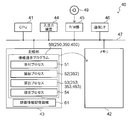
- FIG. 6 is a functional block diagram of an information presentation device according to first to fourth embodiments.
- FIG. It is a figure which shows an example of the evaluation information database in 1st-3rd embodiment. It is a figure for demonstrating the feature similarity in 1st Embodiment.
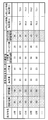
- It is a block diagram showing a schematic configuration of a computer that functions as an information presentation device according to the first to fourth embodiments. It is a flowchart which shows an example of an information presentation process. It is a figure for demonstrating the feature similarity in 2nd Embodiment. It is a figure for demonstrating the feature similarity in 3rd Embodiment. It is a figure which shows an example of the evaluation information database in 4th Embodiment.
- the information presentation apparatus 10 includes a reception unit 11, an extraction unit 12, a calculation unit 13, and a presentation unit 14.
- An evaluation information database (DB) 21 is stored in a predetermined storage area of the information presentation device 10.
- the evaluation information DB 21 stores evaluation values for each local government for each of the plurality of evaluation items.
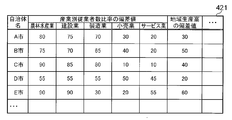
- FIG. 2 shows an example of the evaluation information DB 21.
- FIG. 2 shows the ratio of the number of employees of each municipality by industry as a deviation value in all municipalities. Each industry is an evaluation item, and the deviation value is an example of an evaluation value.
- the local government of the local government name j (hereinafter also referred to as “local government j”) for the i-th (i-th column in the deviation value column) industry (hereinafter also referred to as “industry i”) stored in the evaluation information DB 21.
- the deviation value of the ratio of the number of employees is expressed as S i, j .
- the evaluation value is not limited to the deviation value, and an index that can represent the degree of characteristics of the local government can be used for each evaluation item. For example, a value obtained by subtracting the average of all local governments from the actual value of each local government regarding the evaluation item, or a value obtained by dividing the value by the standard deviation may be used. Further, the evaluation value does not need to be a continuous value, and may be a discrete value such as a five-step evaluation or a ten-step evaluation. By using such an evaluation value, it is possible to determine that an evaluation item having a high or low evaluation value is a characteristic evaluation item for the corresponding local government.
- evaluation information DB 21 is not limited to being stored in a storage device inside the information presentation device 10, and may be stored in an external storage device or a storage device of another device connected via a network. .
- the reception unit 11 receives an input device (not shown) such as a keyboard and a mouse connected to the information presentation device 10 by a user who is a staff member of the target local government (hereinafter referred to as “target local government”) where information is presented.
- the identification information of the target local government input via the URL is received.
- This embodiment demonstrates the case where a local government name is used as local government identification information.
- the reception unit 11 notifies the extraction unit 12 of the received target local government name.
- the extraction unit 12 extracts one or more evaluation items indicating the characteristics of the target local government indicated by the target local government name notified from the reception unit 11 and evaluation values for the evaluation item from the evaluation information DB 21. Specifically, the extraction unit 12 extracts a predetermined number or the number of evaluation items designated by the user via the input device in descending order of evaluation values. Moreover, the extraction part 12 may extract the evaluation item whose evaluation value is a predetermined value or more.
- the extraction unit 12 the evaluation information DB 21, reads all of the deviation value S i, A of A City, deviation S i, industrial (Evaluation items) from the larger A to L th, the industrial A deviation value (evaluation value) is extracted.
- t A1 agriculture, forestry and fisheries industry
- t A2 construction fisheries industry
- a predetermined deviation value for example when a "70”, similar features industry t ak and deviation value S tak and the, a is extracted
- L 3 is determined after the fact.
- the extraction unit 12 passes the value of the target local government name, the characteristic industry t ak of the target local government a, the deviation value S tak, a , and L to the calculation unit 13.
- the calculation unit 13 calculates a feature similarity indicating how similar the feature is to the target local government for each of the other local governments other than the target local government stored in the evaluation information DB 21.
- similarity deviation S tak eligible municipalities a of the features industry t ak eligible municipalities a extracted by the extraction unit 12, the deviation value S tak of a and other municipalities j, j is the target municipalities a and The higher the degree of showing the characteristics of other municipalities j, the higher the value.
- the calculation unit 13 reads all the deviation values S i, j of the number of employees by industry of other municipalities j corresponding to the municipality name other than the target municipality name delivered from the extracting unit 12. .
- the calculation unit 13 specifies the deviation value S tak, j from the read deviation value S i, j of another local government j. Then, the calculation unit 13 uses the identified S tak, j and the values of the characteristic industry t ak , the deviation value S tak, a , and L passed from the extraction unit 12, for example, (1)
- the feature similarity T j is calculated for each other municipality j using the formula.
- the feature similarity T j in the equation (1) is a deviation value S tak, a of the target local government a for the characteristic industry t ak of the target local government a and a deviation of another local government j for the characteristic industry t ak of the target local government a.
- the product of the value S tak, j is used. That is, for a feature industry t ak having a high deviation value S tak, a for the target local government a, if other local governments j also have a high deviation value S tak, j , the feature similarity T j becomes high.
- the target local government a is A city using the evaluation information DB 21 shown in FIG.
- the feature similarity T j is calculated using the deviation value (shaded portion in FIG. 3).
- the calculation unit 13 delivers the calculated feature similarity T j for each local government j to the presentation unit 14.
- the presenting unit 14 presents, to the user, another locality name whose feature similarity T j received from the calculation unit 13 is equal to or greater than a predetermined value as a reference locality name.
- the presentation unit 14 the M-th feature similarity T j to a predetermined value from the larger feature similarity T j, municipality name feature similarity T j is equal to or greater than the predetermined value, i.e., feature similarity
- the names of municipalities up to M are extracted in descending order of the degree T j .
- the presentation unit 14 displays the extracted local government name as a reference local government name on the display connected to the information presentation apparatus 10 together with information on what number (Mth) the feature similarity T j is, or a printer Or present it to the user.
- the predetermined value may be a predetermined number or a value designated by the user via the input device.
- the same reference locality name as described above is presented.
- the rightmost column in FIG. 3 shows the result of calculating the similarity between A city and another local government j using the Euclidean distance of the vector value having the deviation value for each characteristic industry as an element.
- B city, C city, D city, and E city are obtained.
- C city has higher deviation values of Agricultural, Forestry and Fisheries, Construction Industry and Manufacturing Industry than A City, and these industries are more characteristic than B City. Therefore, it is highly likely that City A will find a good measure earlier if City C is referenced before City B.
- E city has high deviation values for the agriculture, forestry and fisheries industry and the construction industry, and it can be said that it is characteristic for the two industries compared to D city. Therefore, it is more likely that a good measure will be found sooner if E city is referenced first than D city.
- the feature similarity that increases as the deviation values of the target local government and other local governments for the feature industry of the target local government are higher, the feature similarity is C city, E city, B city. , D city order. Therefore, it is possible to preferentially present the local government that is more characteristic and the local government that is more characteristic even in some evaluation items.
- the information presentation device 10 can be realized by a computer 40 shown in FIG. 4, for example.
- the computer 40 includes a Central / Processing / Unit (CPU) 41, a memory 42 as a temporary storage area, and a nonvolatile storage unit 43.
- the computer 40 also includes an input / output device 44, a read / write (R / W) unit 45 that controls reading and writing of data with respect to the storage medium 49, and a communication interface (I / F) connected to a network such as the Internet. 46).
- the CPU 41, the memory 42, the storage unit 43, the input / output device 44, the R / W unit 45, and the communication I / F 46 are connected to each other via a bus 47.
- the storage unit 43 can be realized by a hard disk drive (HDD), a solid state drive (SSD), a flash memory, or the like.
- An information presentation program 50 for causing the computer 40 to function as the information presentation device 10 is stored in the storage unit 43 as a storage medium.
- the information presentation program 50 includes a reception process 51, an extraction process 52, a calculation process 53, and a presentation process 54.
- the storage unit 43 has an evaluation information storage area 61 in which information constituting the evaluation information DB 21 is stored.
- the CPU41 reads the information presentation program 50 from the memory
- the CPU 41 operates as the reception unit 11 illustrated in FIG. 1 by executing the reception process 51. Further, the CPU 41 operates as the extraction unit 12 illustrated in FIG. 1 by executing the extraction process 52. Further, the CPU 41 operates as the calculation unit 13 illustrated in FIG. 1 by executing the calculation process 53. Further, the CPU 41 operates as the presentation unit 14 illustrated in FIG. 1 by executing the presentation process 54. Further, the CPU 41 reads information from the evaluation information storage area 61 and develops the evaluation information DB 21 in the memory 42. As a result, the computer 40 that has executed the information presentation program 50 functions as the information presentation apparatus 10.
- the function realized by the information presentation program 50 can be realized by, for example, a semiconductor integrated circuit, more specifically, Application ⁇ Specific Integrated Circuit (ASIC).
- ASIC Application ⁇ Specific Integrated Circuit
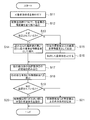
- the information presentation device 10 When a user who is a staff member of the target local government inputs the name of the target local government via an input device such as a keyboard or a mouse connected to the information presentation device 10, the information presentation device 10 presents information shown in FIG. Processing is executed.
- step S11 the reception unit 11 receives the input target local government name and notifies the extraction unit 12 of the received target local government name.
- step S12 the extraction unit 12 reads all the deviation values S i, a of each industry i for the target local government a from the evaluation information DB 21.
- step S13 the extraction unit 12 determines whether or not a value L indicating the number of feature industries to be extracted is designated. If L is specified, the process proceeds to step S14. If L is not specified, the process proceeds to step S15.
- step S14 the extraction unit 12 extracts the industry from the larger deviation value S i, A read in step S12 to the Lth as the feature industry t ak and extracts it along with the deviation value S tak, a , and processes it. Moves to step S17.
- step S15 the extraction unit 12, a feature industrial t ak a predetermined deviation value or more industries to extract the deviation value S tak, with a.
- step S16 the extraction unit 12 sets the number of extracted feature industries t ak to L, and the process proceeds to step S17.
- step S ⁇ b> 17 the extraction unit 12 passes the target local government name, the characteristic industry t ak of the target local government a, the deviation value S tak, a , and the value of L to the calculation unit 13. Then, the calculation unit 13 reads all the deviation values S i, j of the number of employees by industry of other local governments j corresponding to the local government names other than the target local government name passed from the extraction unit 12.
- step S18 the calculation unit 13 identifies the deviation value S tal, j from the read deviation value S i, j of another local government j. Then, the calculation unit 13 uses the specified deviation value S tal, j and the characteristic industry t ak , the deviation value S tak, a , and the L value received from the extraction unit 12, for example, (1)
- the feature similarity T j is calculated for each other municipality j using the formula.
- the calculation unit 13 delivers the calculated feature similarity T j for each local government j to the presentation unit 14.
- step S19 the presentation unit 14 determines whether or not a value M indicating the number of reference local government names to be presented is designated. If M is designated, the process proceeds to step S20. If M is not designated, the process proceeds to step S21.
- step S20 the presentation unit 14, extracts the municipality name to M-th in the order large feature similarity T j, extracted municipality name and the reference municipality name, what number is the size of the feature similarity T j (M).
- M the size of the feature similarity
- step S20 the presentation unit 14 extracts a local government name having a feature similarity T j greater than or equal to a predetermined value, and uses the extracted local government name as a reference local government name, and what is the size of the feature similarity T j (M The information presentation process ends.
- feature similarity is achieved using the evaluation value (deviation value) of the characteristic evaluation item (characteristic industry) of the target decision-making entity (target local government). Calculate the degree.
- the feature similarity is a value that increases as the evaluation values of the target decision-making entity and other decision-making entities increase for the characteristic evaluation item.
- Information of the decision-making entity (name of decision-making entity, etc.) can be presented.
- the feature similarity is calculated using the product of the evaluation value of the target decision-making entity and the evaluation value of other local governments for the characteristic evaluation items in the target decision-making entity. As a result, it is possible to calculate the feature similarity that increases as the evaluation values of the target decision-making entity and the other decision-making entities are higher for the characteristic evaluation items by simple calculation.
- the information presentation apparatus 210 includes a reception unit 11, an extraction unit 12, a calculation unit 213, and a presentation unit 14.
- the evaluation information DB 21 is stored in a predetermined storage area of the information presentation device 210.
- the calculation unit 213 calculates the feature similarity T j with the target local government a for each of the other local governments j other than the target local government a, for example, using equation (1). To do. At this time, the calculation unit 213 uses the deviation value S i, j read from the evaluation information DB 21 as S tak, j in the expression (1), and the industry deviation value S i, j is used.
- the calculation unit 213 calculates the feature similarity T j using only the industry deviation value tak, j (the deviation value indicated in the shaded portion in FIG. 6) included in the top three types of each local government. Used for.
- B city, C city, and D city are all included in the characteristic industry tAk of A city, which is the agriculture, forestry and fisheries industry, construction industry, and manufacturing industry, which are the top three industries of deviation value.
- the feature similarities T B , T C , and T D are calculated using the deviation values of the three industries.
- city E uses characteristic deviation degree T using deviation values of agriculture, forestry and fisheries industry and construction industry included in characteristic industry tAk of city A among agriculture, forestry and fisheries industry, construction industry, and service industry which are the top three industries E is calculated.
- the presentation unit 14 presents the first C city, the second B city, and the third E city to the user as reference local government names, unlike the first embodiment.
- the information presentation device 210 can be realized by, for example, the computer 40 shown in FIG.
- An information presentation program 250 for causing the computer 40 to function as the information presentation device 210 is stored in the storage unit 43 of the computer 40.
- the information presentation program 250 includes a reception process 51, an extraction process 52, a calculation process 253, and a presentation process 54. Further, the storage unit 43 has an evaluation information storage area 61.
- CPU41 reads the information presentation program 250 from the memory
- the CPU 41 operates as the calculation unit 213 illustrated in FIG. 1 by executing the calculation process 253.
- Other processes are the same as those of the information presentation program 50 according to the first embodiment.
- the computer 40 that has executed the information presentation program 250 functions as the information presentation device 210.
- the function realized by the information presentation program 250 can be realized by, for example, a semiconductor integrated circuit, more specifically, an ASIC or the like.
- the feature similarity is obtained using only the evaluation values of the feature evaluation items common to the target decision-making entity and other decision-making entities. Calculated. Therefore, it is possible to eliminate the influence of evaluation items that are not characteristic in one decision-making entity, and to calculate the feature similarity in which more characteristic evaluation items are emphasized.
- the information presentation apparatus 310 includes a reception unit 11, an extraction unit 312, a calculation unit 313, and a presentation unit 14.
- the evaluation information DB 21 is stored in a predetermined storage area of the information presentation device 310.
- the extraction unit 312 evaluates an evaluation item indicating the characteristics of the target local government indicated by the name of the target local government notified from the reception unit 11 and an evaluation value for the evaluation item. One or more are extracted from the information DB 21. At this time, the extraction unit 312 extracts an evaluation item having a low evaluation value as an evaluation item indicating the characteristics of the target local government.
- the extraction unit 312 calculates a reverse evaluation value obtained by subtracting the evaluation value from twice the average value or the median value for an evaluation item having an evaluation value equal to or lower than the average value or the median value of the evaluation values.
- the reversal evaluation value is calculated as the evaluation value of the evaluation item.
- a deviation value is used as an evaluation value as in the present embodiment, for an industry where the deviation value S i, a is smaller than 50, which is an average value, a value obtained by subtracting the true deviation value from 100 is used.
- the extraction unit 312 extracts a predetermined number or evaluation items specified by the user via the input device in descending order of evaluation values. Further, the extraction unit 312 may extract an evaluation item having an evaluation value equal to or greater than a predetermined value.
- t A1 agriculture, forestry and fisheries
- t A2 service industry
- t A3 construction industry are extracted.
- Calculator 313 reverses deviation S i by the extraction unit 312, the features industry t ak extracted with a, deviation S tak other municipalities j, for even j, reverse deviation S 'tak,
- the feature similarity T j is calculated using j (shaded portion in FIG. 7).
- the information presentation device 310 can be realized by, for example, the computer 40 shown in FIG.
- An information presentation program 350 for causing the computer 40 to function as the information presentation device 310 is stored in the storage unit 43 of the computer 40.
- the information presentation program 350 includes a reception process 51, an extraction process 352, a calculation process 353, and a presentation process 54. Further, the storage unit 43 has an evaluation information storage area 61.
- CPU41 reads the information presentation program 350 from the memory
- the CPU 41 operates as the extraction unit 312 illustrated in FIG. 1 by executing the extraction process 352. Further, the CPU 41 operates as the calculation unit 313 illustrated in FIG. 1 by executing the calculation process 353.
- Other processes are the same as those of the information presentation program 50 according to the first embodiment.
- the computer 40 that has executed the information presentation program 350 functions as the information presentation device 310.
- the function realized by the information presentation program 350 can be realized by, for example, a semiconductor integrated circuit, more specifically, an ASIC or the like.
- the reverse deviation value is used for the extraction of the feature industry in step S14 or S15 of the information presentation process shown in FIG. 5 and the calculation of the feature similarity in step S18. Since only the points differ from the first embodiment, the description is omitted.
- an evaluation item having a low evaluation value is also treated as a characteristic evaluation item for the target decision-making subject. For this reason, it is possible to present information of other decision-making subjects to be referred to in consideration of the entire evaluation item. For example, in the example of the above embodiment, by providing both the industry with a high deviation value and the industry with a low deviation value as characteristic industries, a reference local government name that is effective for examining measures that affect the entire industrial structure is presented. Can do.
- the user may be able to select whether an evaluation item having a high evaluation value is a feature evaluation item, an evaluation item having a low evaluation value is a feature evaluation item, or both are feature evaluation items.
- the reception unit 11 may receive the selection of the user input via the input device, and specify the extraction method and the calculation method in the extraction unit 312 and the calculation unit 313.
- the evaluation value or reverse evaluation of the characteristic evaluation item common to the target decision-making entity and the other decision-making entities as in the second embodiment may be calculated using only the value.
- the information presentation device 410 includes a reception unit 11, an extraction unit 12, a calculation unit 413, and a presentation unit 14.
- the evaluation information DB 421 is stored in a predetermined storage area of the information presentation device 410.
- the evaluation information DB 421 includes evaluation items other than the evaluation items used for calculating the feature similarity in addition to the evaluation information DB 21 in the first embodiment.
- FIG. 8 shows an example including other evaluation items such as a deviation value of regional output in addition to the deviation value of the ratio of the number of employees by industry used for calculating the feature similarity.
- the calculation unit 413 calculates the feature similarity T j in the same manner as the calculation unit 13 in the first embodiment, and the calculated feature similarity T j is an evaluation item other than the evaluation item used for calculating the feature similarity T j.
- the degree of reference taking into account the evaluation value is calculated.
- the calculation unit 413 determines an evaluation item (hereinafter referred to as “issue item”) indicating an issue of the target local government from evaluation items other than the evaluation item used for calculating the feature similarity T j. Specified). For example, the calculation unit 413 identifies an evaluation item whose deviation value is equal to or less than a predetermined value among the evaluation items other than the evaluation item used for calculating the feature similarity T j as the task item P. And the calculation part 413 calculates the reference degree Vj which becomes so high that the local government j which has a high deviation value about the specified subject item P for every other local government j. Calculator 413, the deviation value S P output target municipalities a of the issues item P, with the deviation value S P, j of a and other municipalities j, calculates a reference degree V j, for example, by (2).
- issue item an evaluation item indicating an issue of the target local government from evaluation items other than the evaluation item used for calculating the feature similarity T j. Specified).
- V j (S P, j ⁇ S P, a ) + T j (2)
- V VE of E city having a high deviation value with respect to the subject item “regional output” of A city that is the target local government a becomes high.
- the calculation unit 413 delivers the calculated reference degree V j for each local government j to the presentation unit 14.
- the presentation unit 14 presents to the user another locality name whose reference degree V j received from the calculation unit 413 is a predetermined value or more as a reference locality name.
- the information presentation device 410 can be realized by, for example, the computer 40 shown in FIG.
- An information presentation program 450 for causing the computer 40 to function as the information presentation device 410 is stored in the storage unit 43 of the computer 40.
- the information presentation program 450 includes a reception process 51, an extraction process 52, a calculation process 453, and a presentation process 54.
- the storage unit 43 has an evaluation information storage area 61 in which information constituting the evaluation information DB 421 is stored.
- the CPU41 reads the information presentation program 450 from the memory
- the CPU 41 operates as the calculation unit 413 illustrated in FIG. 1 by executing the calculation process 453.
- Other processes are the same as those of the information presentation program 50 according to the first embodiment.
- the computer 40 that has executed the information presentation program 450 functions as the information presentation device 410.
- the function realized by the information presentation program 450 can be realized by, for example, a semiconductor integrated circuit, more specifically, an ASIC or the like.
- step S18 the point which calculates a reference degree by step S18 of the information presentation process shown in FIG. 5, and a reference local government name based on a reference degree are shown by step S20 or S21. Since only the points differ from the first embodiment, the description is omitted.
- the reference degree is calculated by adding the evaluation value of the evaluation item other than the evaluation item used for calculating the feature similarity to the feature similarity, Based on this degree of reference, information on other decision-making entities for reference is presented. For this reason, among other decision-making entities having similar characteristics, other decision-making entities that are particularly useful can be preferentially presented.
- the calculation unit 413 specifies the task item based on the evaluation value of the evaluation item other than the evaluation item used for calculating the feature similarity.
- the present invention is not limited to this.
- An evaluation item designated by user input may be specified as a task item.
- the evaluation items used for calculating the reference degree are not limited to the subject items of the target local government, and can be appropriately selected according to the purpose of decision making of the target local government.
- any one of the calculation methods of the feature similarity or the reference degree in each of the above embodiments may be selectable by the user.
- the decision-making entity is the local government and the evaluation item is the ratio of the number of employees by industry has been described, but the present invention is not limited to this.
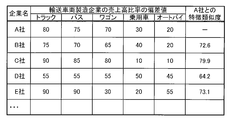
- FIG. 10 shows an example of using a deviation value for each vehicle type such as a truck and a bus for a sales ratio of a transportation vehicle of a transportation vehicle manufacturer, where the vehicle type is an evaluation item and the deviation value of the sales ratio is an example of an evaluation value.
- company A is a company whose information is to be presented
- trucks, buses, and wagons are extracted as characteristic vehicle types of company A by extracting a model of company A having a high deviation value.
- the other companies having characteristics similar to Company A are Company C, It turns out that it is the order of E company and B company.
- the feature similarity is calculated using the product of the evaluation value of the target decision-making entity and the evaluation value of another decision-making entity for the feature evaluation item of the target decision-making entity.
- the feature similarity is set so that the higher the both evaluation values, the higher the feature similarity. Can be calculated.
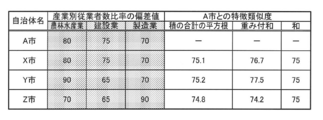
- the weighted sum is obtained by multiplying the sum of the deviation values of the target local government for each feature industry and other target local governments by a larger coefficient in descending order of the deviation value of the target local government. It can be.
- division is performed by a predetermined constant (here, “12”).
- a city and X city have the same deviation value for any characteristic industry, but Y city has a high deviation value for the most characteristic agriculture, forestry and fisheries industry in A city. .
- Y city has a higher value than X city, and the more characteristic Y city has priority. It can be seen that it can be presented.
- the reference local government name has been described, but other information related to the reference local government may be presented together.
- it maintains a database that stores information on each municipality, such as successful cases, failure cases, budget allocations for decision-making items, details of measures introduced by decision-making, and organizational structure at the time of decision-making. Keep it.
- stored corresponding to the reference local government with the reference local government name can be shown.
- the mode in which the information presentation programs 50, 250, 350, and 450, which are examples of the program according to the disclosed technology, are stored (installed) in the storage unit 43 in advance has been described.
- the program according to the disclosed technology can be provided in a form stored in a storage medium such as a CD-ROM, a DVD-ROM, or a USB memory.
Landscapes
- Business, Economics & Management (AREA)
- Engineering & Computer Science (AREA)
- Human Resources & Organizations (AREA)
- Strategic Management (AREA)
- Economics (AREA)
- Physics & Mathematics (AREA)
- General Physics & Mathematics (AREA)
- Theoretical Computer Science (AREA)
- Entrepreneurship & Innovation (AREA)
- Tourism & Hospitality (AREA)
- Educational Administration (AREA)
- Marketing (AREA)
- General Business, Economics & Management (AREA)
- Development Economics (AREA)
- Operations Research (AREA)
- Quality & Reliability (AREA)
- Game Theory and Decision Science (AREA)
- Data Mining & Analysis (AREA)
- Mathematical Analysis (AREA)
- Computational Mathematics (AREA)
- Mathematical Physics (AREA)
- Pure & Applied Mathematics (AREA)
- Mathematical Optimization (AREA)
- Bioinformatics & Cheminformatics (AREA)
- General Engineering & Computer Science (AREA)
- Evolutionary Biology (AREA)
- Bioinformatics & Computational Biology (AREA)
- Life Sciences & Earth Sciences (AREA)
- Health & Medical Sciences (AREA)
- General Health & Medical Sciences (AREA)
- Primary Health Care (AREA)
- Probability & Statistics with Applications (AREA)
- Algebra (AREA)
- Databases & Information Systems (AREA)
- Software Systems (AREA)
- Computer Vision & Pattern Recognition (AREA)
- Artificial Intelligence (AREA)
- Evolutionary Computation (AREA)
- Management, Administration, Business Operations System, And Electronic Commerce (AREA)
- Information Retrieval, Db Structures And Fs Structures Therefor (AREA)
Abstract
意思決定主体による意思決定の際に、より特徴的な他の意思決定主体の情報を提示する。抽出部(12)が、複数の意思決定主体の各々に対する複数の評価項目のうち、情報提示を行う対象である対象意思決定主体の特徴を示す評価項目を1つ又は複数抽出し、算出部(13)が、複数の意思決定主体に含まれる対象意思決定主体以外の他の意思決定主体の各々について、抽出された評価項目に対応し、対象意思決定主体及び他の意思決定主体の各々の特徴を示す程度が高いほど高くなる特徴類似度を、評価項目の評価値に基づいて算出し、提示部(14)が、算出した特徴類似度が所定値以上の他の意思決定主体に関する情報を提示する。
Description
本発明は、情報提示方法、情報提示装置、及び情報提示プログラムに関する。
自治体が自らの課題を解決するための行政施策を検討する際に他の自治体の施策を参考にする場合や、企業が自らの課題を解決するための事業計画を検討する際に他の企業の事業を参考にする場合などがあり、これを支援する技術が存在する。
例えば、情報提示を行う対象である対象意思決定主体と特性が類似する意思決定主体を、複数の意思決定主体から、少なくとも一つ選択する方法が提案されている。この方法では、複数の意思決定主体の各々に対する複数の評価項目の各々についての評価指標であって、各意思決定主体の特性を表す特性情報に基づく評価指標を、意思決定主体毎に計算する。そして、計算された意思決定主体毎の評価指標に基づいて、参考にする意思決定主体を選択する。
上述のように、自治体や企業などの意思決定主体が他の意思決定主体の活動に関する情報を参考にする際、自身の特徴を把握し、その特徴が類似している他の意思決定主体の中で、課題を解決している意思決定主体の情報を参考にできることが望ましい。また、その特徴が、他の自治体において、より特徴的であるほど、その自治体の情報は参考にすべき優先度が高い。
しかし、従来技術では、意思決定主体の類似性を評価する方法として、評価項目毎の評価値のユークリッド距離などを使った距離関数を利用する方法がとられている。すなわち、従来技術では、評価項目の評価値が数字上似ている他の意思決定主体を選択しており、必ずしも、より特徴的な他の意思決定主体を選択できているとはいえない。
本発明は、一つの側面として、意思決定主体による意思決定の際に、より特徴的な他の意思決定主体の情報を提示することを目的とする。
一つの態様では、情報提示方法は、コンピュータが、複数の意思決定主体の各々に対する複数の評価項目のうち、情報提示を行う対象である対象意思決定主体の特徴を示す評価項目を1つ又は複数抽出し、前記複数の意思決定主体に含まれる前記対象意思決定主体以外の他の意思決定主体の各々について、抽出された評価項目に対応し、前記対象意思決定主体及び前記他の意思決定主体の各々の特徴を示す程度が高いほど高くなる特徴類似度を前記評価項目の評価値に基づいて算出し、算出した特徴類似度が所定値以上の前記他の意思決定主体に関する情報を提示する。
一つの側面として、意思決定主体による意思決定の際に、より特徴的な他の意思決定主体の情報を提示することができる。
以下、図面を参照して開示の技術に係る実施形態の一例を詳細に説明する。以下の各実施形態では、政策立案や戦略決定等の意思決定を行う意思決定主体の一例である自治体に、情報提示を行う場合を例に説明する。
<第1実施形態>
図1に示すように、第1実施形態に係る情報提示装置10は、受付部11、抽出部12、算出部13、及び提示部14を備える。また、情報提示装置10の所定の記憶領域には、評価情報データベース(DB)21が記憶される。
図1に示すように、第1実施形態に係る情報提示装置10は、受付部11、抽出部12、算出部13、及び提示部14を備える。また、情報提示装置10の所定の記憶領域には、評価情報データベース(DB)21が記憶される。
評価情報DB21には、複数の評価項目の各々についての自治体毎の評価値が記憶される。図2に、評価情報DB21の一例を示す。図2は、各自治体の産業別の従業者数の比率を、全自治体における偏差値で表したものであり、各産業が評価項目、偏差値が評価値の一例である。以下では、評価情報DB21に記憶されたi番目(偏差値欄のi列目)の産業(以下、「産業i」ともいう)についての自治体名jの自治体(以下、「自治体j」ともいう)の従業者数の比率の偏差値をSi,jと表す。例えば、A市(j=A)の農林水産業の従業者比率(i=1)の偏差値は、S1,Aと表す。
なお、評価値としては、偏差値に限らず、各評価項目に関して、自治体の特徴の程度を表すことができる指標を用いることができる。例えば、評価項目に関する各自治体の実際の値から全自治体の平均を引いた値、その値を標準偏差で割った値などを用いてもよい。また、評価値は連続値である必要はなく、例えば5段階評価や10段階評価のような離散値であってもよい。このような評価値を用いることで、評価値が高い又は低い評価項目を、該当の自治体にとって特徴的な評価項目であると判断することができる。
また、評価情報DB21は、情報提示装置10内部の記憶装置に記憶される場合に限定されず、外部の記憶装置や、ネットワークを介して接続された他の装置の記憶装置に記憶されてもよい。
受付部11は、情報提示が行われる対象の自治体(以下、「対象自治体」という)の職員等であるユーザにより、情報提示装置10に接続されたキーボードやマウス等の入力装置(図示省略)を介して入力された対象自治体の識別情報を受け付ける。本実施形態では、自治体の識別情報として、自治体名を用いる場合について説明する。受付部11は、受け付けた対象自治体名を、抽出部12に通知する。
抽出部12は、受付部11から通知された対象自治体名が示す対象自治体の特徴を示す評価項目と、その評価項目についての評価値とを、評価情報DB21から1つ又は複数抽出する。具体的には、抽出部12は、評価値が高い順に、予め定めた数又は利用者により入力装置を介して指定された数の評価項目を抽出する。また、抽出部12は、評価値が所定値以上の評価項目を抽出してもよい。
例えば、図2に示す評価情報DB21が記憶されている場合で、受付部11から、対象自体名「A市」が通知されたとする。この場合、抽出部12は、評価情報DB21から、A市の偏差値Si,Aを全て読み出し、偏差値Si,Aの大きい方からL番目までの産業(評価項目)と、その産業の偏差値(評価値)とを抽出する。以下では、抽出部12により抽出される産業を、対象自治体aについての特徴産業tak(k=1,・・・,L)という。また、特徴産業takについての自治体jの偏差値をStak,j(k=1,・・・,L)と表し、特に、特徴産業takについての対象自治体aの偏差値をStak,a(k=1,・・・,L)と表す。ここでは、例えば、L=3とすると、A市の特徴産業として、tA1=農林水産業、tA2=建設水産業、及びtA3=製造業が、それぞれの偏差値StA1,A=80、StA2,A=75、StA3,A=70と共に抽出される。
また、所定の偏差値以上の産業を特徴産業takとして抽出する場合、所定の偏差値を、例えば「70」とすると、上記と同様の特徴産業tak及び偏差値Stak,aが抽出される。この場合、事後的にL=3が定まる。また、所定の偏差値を、例えば「75」とすると、A市の特徴産業として、tA1=農林水産業、tA2=建設水産業が、それぞれの偏差値StA1,A=80、StA2,A=75と共に抽出され、L=2となる。
抽出部12は、対象自治体名、対象自治体aの特徴産業tak、偏差値Stak,a、及びLの値を算出部13へ受け渡す。
算出部13は、評価情報DB21に記憶された対象自治体以外の他の自治体の各々について、対象自治体と特徴がどの程度類似しているかを示す特徴類似度を算出する。特徴類似度は、抽出部12により抽出された対象自治体aの特徴産業takについての対象自治体aの偏差値Stak,a及び他の自治体jの偏差値Stak,jが、対象自治体a及び他の自治体jの特徴を示す程度が高いほど高くなる値とする。
具体的には、算出部13は、抽出部12から受け渡された対象自治体名以外の自治体名に対応する他の自治体jの産業別の従業者数比率の偏差値Si,jを全て読み込む。算出部13は、読み込んだ他の自治体jの偏差値Si,jから偏差値Stak,jを特定する。そして、算出部13は、特定したStak,jと、抽出部12から受け渡された特徴産業tak、偏差値Stak,a、及びLの値とを用いて、例えば、下記(1)式により、他の自治体j毎に、特徴類似度Tjを算出する。

(1)式の特徴類似度Tjは、対象自治体aの特徴産業takについての対象自治体aの偏差値Stak,aと、対象自治体aの特徴産業takについての他の自治体jの偏差値Stak,jとの積を用いている。すなわち、対象自治体aの偏差値Stak,aが高い特徴産業takについて、他の自治体jも高い偏差値Stak,jを有する場合には、特徴類似度Tjが高くなる。
例えば、図2に示す評価情報DB21を用い、対象自治体aがA市であるとする。この場合、図3に示すように、A市とA市以外の自治体jとについて、農林水産業(k=1)、建設業(k=2)、製造業(k=3)の3産業の偏差値(図3の網掛け部分)を用いて特徴類似度Tjが算出される。例えば、A市とB市との特徴類似度TBは、TB=((80×75+75×70+70×65)/3)1/2=72.6となる。同様にC市、D市、及びE市の各々についての特徴類似度Tjは、図3に示すように、TC=79.9、TD=64.2、TE=73.1と算出される。
算出部13は、算出した各自治体jについての特徴類似度Tjを提示部14に受け渡す。
提示部14は、算出部13から受け渡された特徴類似度Tjが所定値以上の他の自治体名を参考自治体名としてユーザに提示する。
具体的には、提示部14は、特徴類似度Tjが大きい方からM番目の特徴類似度Tjを所定値とし、特徴類似度Tjが所定値以上である自治体名、すなわち、特徴類似度Tjが大きい順にM番目までの自治体名を抽出する。提示部14は、特徴類似度Tjの大きさが何番目(M番目)かの情報と共に、抽出した自治体名を参考自治体名として、情報提示装置10に接続されたディスプレイに表示したり、プリンタから出力したりすることにより、ユーザに提示する。
例えば、対象自治体aであるA市とA市以外の自治体jとの特徴類似度Tjが図3に示すように算出されており、M=3の場合、提示部14は、参考自治体名として、1番目C市、2番目E市、3番目B市の情報を提示する。
なお、所定値は予め定めた数であってもよいし、ユーザが入力装置を介して指定する値であってもよい。図3の場合において、例えば、特徴類似度Tj=70以上の自治体を参考自治体とすることが設定されているとすると、上記と同様の参考自治体名が提示される。また、特徴類似度Tj=73以上の自治体を参考自治体とすることが設定されているとすると、1番目C市、2番目E市のみが出力される。
ここで、参考として、各特徴産業についての偏差値を要素とするベクトル値のユークリッド距離を用いて、A市と他の自治体jとの類似度を算出した結果を図3の最右欄に示す。この参考例で、ユークリッド距離が近い順に参考自治体を抽出すると、B市、C市、D市、E市となる。
しかし、C市は、農林水産業、建設業、製造業の偏差値がA市より高く、これらの産業がB市よりも特徴的であることがわかる。したがって、A市は、B市よりC市を先に参考にすると良い施策が早く見つかる可能性が高い。また、E市は、農林水産業と建設業について高い偏差値を有しており、D市と比較してその2産業について特徴的であると言える。したがって、D市よりも、E市を先に参考にすると良い施策が早く見つかる可能性が高い。
このように、評価項目の評価値(偏差値)の数字上の類似度を用いただけでは、より特徴的である自治体や、一部の評価項目でもより特徴的である自治体を優先的に提示することができない。
一方、本実施形態では、対象自治体の特徴産業についての対象自治体及び他の自治体の各々の偏差値が高いほど高くなる特徴類似度を用いるため、特徴類似度は、C市、E市、B市、D市の順となる。したがって、より特徴的である自治体や、一部の評価項目でもより特徴的である自治体を優先的に提示することができる。
情報提示装置10は、例えば図4に示すコンピュータ40で実現することができる。コンピュータ40は、Central Processing Unit(CPU)41と、一時記憶領域としてのメモリ42と、不揮発性の記憶部43とを備える。また、コンピュータ40は、入出力装置44と、記憶媒体49に対するデータの読み込み及び書き込みを制御するRead/Write(R/W)部45と、インターネット等のネットワークに接続される通信インターフェース(I/F)46とを備える。CPU41、メモリ42、記憶部43、入出力装置44、R/W部45、及び通信I/F46は、バス47を介して互いに接続される。
記憶部43は、Hard Disk Drive(HDD)、Solid State Drive(SSD)、フラッシュメモリ等によって実現できる。記憶媒体としての記憶部43には、コンピュータ40を情報提示装置10として機能させるための情報提示プログラム50が記憶される。情報提示プログラム50は、受付プロセス51と、抽出プロセス52と、算出プロセス53と、提示プロセス54とを有する。また、記憶部43は、評価情報DB21を構成する情報が記憶される評価情報記憶領域61を有する。
CPU41は、情報提示プログラム50を記憶部43から読み出してメモリ42に展開し、情報提示プログラム50が有するプロセスを順次実行する。CPU41は、受付プロセス51を実行することで、図1に示す受付部11として動作する。また、CPU41は、抽出プロセス52を実行することで、図1に示す抽出部12として動作する。また、CPU41は、算出プロセス53を実行することで、図1に示す算出部13として動作する。また、CPU41は、提示プロセス54を実行することで、図1に示す提示部14として動作する。また、CPU41は、評価情報記憶領域61から情報を読み出して、評価情報DB21をメモリ42に展開する。これにより、情報提示プログラム50を実行したコンピュータ40が、情報提示装置10として機能することになる。
なお、情報提示プログラム50により実現される機能は、例えば半導体集積回路、より詳しくはApplication Specific Integrated Circuit(ASIC)等で実現することも可能である。
次に、第1実施形態に係る情報提示装置10の作用について説明する。対象自治体の職員等であるユーザにより、情報提示装置10に接続されたキーボードやマウス等の入力装置を介して、対象自治体名が入力されると、情報提示装置10において、図5に示す情報提示処理が実行される。
ステップS11で、受付部11が、入力された対象自治体名を受け付け、受け付けた対象自治体名を、抽出部12に通知する。
ステップS12で、抽出部12が、評価情報DB21から、対象自治体aについて、各産業iの偏差値Si,aを全て読み込む。
次に、ステップS13で、抽出部12が、抽出する特徴産業の数を示す値Lが指定されているか否かを判定する。Lが指定されている場合には、処理はステップS14へ移行し、Lが指定されていない場合には、処理はステップS15へ移行する。
ステップS14では、抽出部12が、上記ステップS12で読み込んだ偏差値Si,Aの大きい方からL番目までの産業を、特徴産業takとして、その偏差値Stak,aと共に抽出し、処理はステップS17へ移行する。
一方、ステップS15では、抽出部12が、所定の偏差値以上の産業を特徴産業takとして、その偏差値Stak,aと共に抽出する。次に、ステップS16で、抽出部12が、抽出した特徴産業takの数をLに設定し、処理はステップS17へ移行する。
ステップS17では、抽出部12が、対象自治体名、対象自治体aの特徴産業tak、偏差値Stak,a、及びLの値を算出部13へ受け渡す。そして、算出部13が、抽出部12から受け渡された対象自治体名以外の自治体名に対応する他の自治体jの産業別の従業数比率の偏差値Si,jを全て読み込む。
次に、ステップS18で、算出部13は、読み込んだ他の自治体jの偏差値Si,jから偏差値Stal,jを特定する。そして、算出部13は、特定した偏差値Stal,jと、抽出部12から受け渡された特徴産業tak、偏差値Stak,a、及びLの値とを用いて、例えば(1)式により、他の自治体j毎に、特徴類似度Tjを算出する。算出部13は、算出した各自治体jについての特徴類似度Tjを提示部14に受け渡す。
次に、ステップS19で、提示部14が、提示する参考自治体名の数を示す値Mが指定されているか否かを判定する。Mが指定されている場合には、処理はステップS20へ移行し、Mが指定されていない場合には、処理はステップS21へ移行する。
ステップS20では、提示部14が、特徴類似度Tjが大きい順にM番目までの自治体名を抽出し、抽出した自治体名を参考自治体名として、特徴類似度Tjの大きさが何番目(M番目)かの情報と共にユーザに提示し、情報提示処理は終了する。
一方、ステップS20では、提示部14が、特徴類似度Tjが所定値以上の自治体名を抽出し、抽出した自治体名を参考自治体名として、特徴類似度Tjの大きさが何番目(M番目)かの情報と共にユーザに提示し、情報提示処理は終了する。
以上説明したように、第1実施形態に係る情報提示装置10によれば、対象意思決定主体(対象自治体)の特徴的な評価項目(特徴産業)の評価値(偏差値)を用いて特徴類似度を算出する。特徴類似度は、特徴的な評価項目について、対象意思決定主体及び他の意思決定主体の各々の評価値が高いほど高くなる値であるため、この特徴類似度を用いて、より特徴的な他の意思決定主体の情報(意思決定主体の名称など)を提示することができる。
また、第1実施形態では、特徴類似度を、対象意思決定主体において特徴的な評価項目について、対象意思決定主体の評価値と他の自治体の評価値との積を用いて算出する。これにより、簡易な計算で、特徴的な評価項目について、対象意思決定主体及び他の意思決定主体の各々の評価値が高いほど高くなる特徴類似度を算出することができる。
<第2実施形態>
次に、第2実施形態について説明する。なお、第2実施形態に係る情報提示装置について、第1実施形態に係る情報提示装置10と同様の部分については、同一符号を付して詳細な説明を省略する。
次に、第2実施形態について説明する。なお、第2実施形態に係る情報提示装置について、第1実施形態に係る情報提示装置10と同様の部分については、同一符号を付して詳細な説明を省略する。
図1に示すように、第2実施形態に係る情報提示装置210は、受付部11、抽出部12、算出部213、及び提示部14を備える。また、情報提示装置210の所定の記憶領域には、評価情報DB21が記憶される。
算出部213は、第1実施形態に係る算出部13と同様に、例えば(1)式により、対象自治体a以外の他の自治体jの各々について、対象自治体aとの特徴類似度Tjを算出する。この際、算出部213は、(1)式のStak,jとして、評価情報DB21から読み込んだ偏差値Si,jのうち、他の自治体jにとっても特徴的な産業の偏差値Si,jを用いる。
例えば、図2に示す評価情報DB21を用い、対象自治体aをA市とし、L=3とした場合、図6に示すように、農林水産業、建設業、及び製造業が特徴産業tAk(k=1,2,3)として抽出される。さらに、図6では、各自治体jについて、偏差値Si,jが大きい方から順に3種類の産業の偏差値のみを示し、他の偏差値をブランクとして表す。そして、算出部213は、各自治体の上位3種類に含まれる産業の偏差値tak,j(図6の網掛け部分のうち、表記されている偏差値)のみを、特徴類似度Tjの算出に用いる。
具体的には、B市、C市、D市は、各市の中で偏差値の上位3産業である農林水産業、建設業、製造業は、全てA市の特徴産業tAkに含まれるため、この3産業の偏差値を用いて特徴類似度TB、TC、TDを算出する。一方、E市は、上位の3産業である農林水産業、建設業、サービス業のうち、A市の特徴産業tAkに含まれる農林水産業及び建設業の偏差値を用いて特徴類似度TEを算出する。すなわち、A市の特徴産業tAkに含まれないサービス業の偏差値は、A市とE市との特徴類似度TEの算出には用いられず、TE=((80×90+75×90)/3)1/2=68.2となる。
このため、提示部14では、M=3の場合、第1実施形態とは異なり、1番目C市、2番目B市、3番目E市を、参考自治体名としてユーザに提示する。
情報提示装置210は、例えば図4に示すコンピュータ40で実現することができる。コンピュータ40の記憶部43には、コンピュータ40を情報提示装置210として機能させるための情報提示プログラム250が記憶される。情報提示プログラム250は、受付プロセス51と、抽出プロセス52と、算出プロセス253と、提示プロセス54とを有する。また、記憶部43は、評価情報記憶領域61を有する。
CPU41は、情報提示プログラム250を記憶部43から読み出してメモリ42に展開し、情報提示プログラム250が有するプロセスを順次実行する。CPU41は、算出プロセス253を実行することで、図1に示す算出部213として動作する。他のプロセスについては、第1実施形態に係る情報提示プログラム50と同様である。これにより、情報提示プログラム250を実行したコンピュータ40が、情報提示装置210として機能することになる。
なお、情報提示プログラム250により実現される機能は、例えば半導体集積回路、より詳しくはASIC等で実現することも可能である。
第2実施形態に係る情報提示装置210の作用については、図5に示す情報提示処理のステップS18で算出される特徴類似度Tjが第1実施形態と異なるだけであるため、説明を省略する。
以上説明したように、第2実施形態に係る情報提示装置210によれば、対象意思決定主体と他の意思決定主体とで共通している特徴評価項目の評価値のみを用いて特徴類似度が算出される。このため、一方の意思決定主体では特徴的ではない評価項目の影響を無くすことができ、より特徴的な評価項目が強調された特徴類似度を算出することができる。
なお、第1実施形態及び第2実施形態では、評価値(偏差値)が高い評価項目(産業)を特徴的な評価項目(特徴産業)とする場合について説明したが、評価値が低い評価項目を特徴的な評価項目として抽出するようにしてもよい。
<第3実施形態>
次に、第3実施形態について説明する。なお、第3実施形態に係る情報提示装置について、第1実施形態に係る情報提示装置10と同様の部分については、同一符号を付して詳細な説明を省略する。
次に、第3実施形態について説明する。なお、第3実施形態に係る情報提示装置について、第1実施形態に係る情報提示装置10と同様の部分については、同一符号を付して詳細な説明を省略する。
図1に示すように、第3実施形態に係る情報提示装置310は、受付部11、抽出部312、算出部313、及び提示部14を備える。また、情報提示装置310の所定の記憶領域には、評価情報DB21が記憶される。
抽出部312は、第1実施形態における抽出部12と同様に、受付部11から通知された対象自治体名が示す対象自治体の特徴を示す評価項目と、その評価項目についての評価値とを、評価情報DB21から1つ又は複数抽出する。この際、抽出部312は、評価値が低い評価項目も、対象自治体の特徴を示す評価項目として抽出する。
具体的には、抽出部312は、評価値が取り得る値の平均値又は中央値以下の評価値を持つ評価項目について、平均値又は中央値の2倍から評価値を引いた逆転評価値を計算し、この逆転評価値をその評価項目の評価値とする。本実施形態のように、評価値として偏差値を用いている場合には、偏差値Si,aが平均値である50よりも小さい産業については、100から真の偏差値を引いた値である逆転偏差値S’i,aを使う。例えば、偏差値Si,a=20の場合、逆転偏差値S’i,a=80となる。
その上で、抽出部312は、評価値が高い順に、予め定めた数又は利用者により入力装置を介して指定された数の評価項目を抽出する。また、抽出部312は、評価値が所定値以上の評価項目を抽出してもよい。
例えば、図2に示す評価情報DB21を用い、対象自治体aをA市とする場合、図7に示すように、抽出部312は、偏差値Si,Aが50以下の小売業について、100から実際の偏差値S4,A=30を引くことで、逆転偏差値S’4,A=70を計算する。同様に、抽出部312は、偏差値S5,A=20のサービス業についても、逆転偏差値S’5,A=80を計算する。そして、L=3の場合、抽出部312は、偏差値Si,A又は逆転偏差値S’i,Aが高い順に上位3産業を、対象自治体aであるA市の特徴産業tAkとして抽出する。ここでは、tA1=農林水産業、tA2=サービス業、及びtA3=建設業が抽出される。
算出部313は、抽出部312により逆転偏差値Si,aを用いて抽出された特徴産業takについては、他の自治体jの偏差値Stak,jについても、逆転偏差値S’tak,jを用いて特徴類似度Tjを算出する(図7の網掛け部分)。例えば、図7の例で、A市とB市との特徴類似度TBは、TB=((80×75+80×80+75×70)/3)1/2=76.7と算出される。
情報提示装置310は、例えば図4に示すコンピュータ40で実現することができる。コンピュータ40の記憶部43には、コンピュータ40を情報提示装置310として機能させるための情報提示プログラム350が記憶される。情報提示プログラム350は、受付プロセス51と、抽出プロセス352と、算出プロセス353と、提示プロセス54とを有する。また、記憶部43は、評価情報記憶領域61を有する。
CPU41は、情報提示プログラム350を記憶部43から読み出してメモリ42に展開し、情報提示プログラム350が有するプロセスを順次実行する。CPU41は、抽出プロセス352を実行することで、図1に示す抽出部312として動作する。また、CPU41は、算出プロセス353を実行することで、図1に示す算出部313として動作する。他のプロセスについては、第1実施形態に係る情報提示プログラム50と同様である。これにより、情報提示プログラム350を実行したコンピュータ40が、情報提示装置310として機能することになる。
なお、情報提示プログラム350により実現される機能は、例えば半導体集積回路、より詳しくはASIC等で実現することも可能である。
第3実施形態に係る情報提示装置310の作用については、図5に示す情報提示処理のステップS14又はS15での特徴産業の抽出、及びステップS18での特徴類似度の算出に逆転偏差値を用いる点が第1実施形態と異なるだけであるため、説明を省略する。
以上説明したように、第3実施形態に係る情報提示装置310によれば、評価値が低い評価項目も、対象意思決定主体にとって特徴的な評価項目として扱う。このため、評価項目全体を考慮して、参考とする他の意思決定主体の情報を提示することができる。例えば、上記実施形態の例では、偏差値が高い産業、及び偏差値が低い産業の両方を特徴産業とすることで、産業構造全体に影響する施策の検討に有効な参考自治体名を提示することができる。
なお、高い評価値を持つ評価項目を特徴評価項目とするか、低い評価値を持つ評価項目を特徴評価項目とするか、又は両方を特徴評価項目とするかを、ユーザにより選択可能としてもよい。この場合、受付部11が、入力装置を介して入力されたユーザの選択を受け付け、抽出部312及び算出部313に抽出方法及び算出方法を指定するようにすればよい。
また、逆転評価値を用いて特徴評価項目を抽出した上で、第2実施形態と同様に、対象意思決定主体と他の意思決定主体とで共通している特徴評価項目の評価値又は逆転評価値のみを用いて特徴類似度を算出するようにしてもよい。
<第4実施形態>
次に、第4実施形態について説明する。なお、第4実施形態に係る情報提示装置について、第1実施形態に係る情報提示装置10と同様の部分については、同一符号を付して詳細な説明を省略する。
次に、第4実施形態について説明する。なお、第4実施形態に係る情報提示装置について、第1実施形態に係る情報提示装置10と同様の部分については、同一符号を付して詳細な説明を省略する。
図1に示すように、第4実施形態に係る情報提示装置410は、受付部11、抽出部12、算出部413、及び提示部14を備える。また、情報提示装置410の所定の記憶領域には、評価情報DB421が記憶される。評価情報DB421は、図8に示すように、第1実施形態における評価情報DB21に加え、特徴類似度の算出に用いる評価項目以外の評価項目を含む。図8では、特徴類似度の算出に用いる産業別従業者数比率の偏差値に加え、地域生産高の偏差値等の他の評価項目を含む例を示している。
算出部413は、第1実施形態における算出部13と同様に特徴類似度Tjを算出し、算出した特徴類似度Tjに、特徴類似度Tjの算出に用いた評価項目以外の評価項目の評価値を加味した参考度を算出する。
具体的には、算出部413は、予め定めた規則にしたがって、特徴類似度Tjの算出に用いた評価項目以外の評価項目から、対象自治体の課題を示す評価項目(以下、「課題項目」という)を特定する。例えば、算出部413は、特徴類似度Tjの算出に用いた評価項目以外の評価項目のうち、偏差値が所定値以下の評価項目を課題項目Pとして特定する。そして、算出部413は、特定した課題項目Pについて高い偏差値を持つ自治体jほど高くなる参考度Vjを、他の自治体j毎に算出する。算出部413は、課題項目Pについての対象自治体aの偏差値SP,a及び他の自治体jの偏差値SP,jを用いて、例えば(2)式により参考度Vjを算出する。
Vj=(SP,j-SP,a)+Tj (2)
例えば、図8に示す評価情報DB421を用いて、対象自治体aがA市であり、課題項目Pが「地域生産高」と特定された場合、A市に対するB市の参考度VBは、図9に示すように、VB=(50-30)+72.6=92.6となる。C市、D市、及びE市についても同様に、VC=89.9、VD=54.2、VE=103.1と算出される。図9の例では、対象自治体aであるA市の課題項目「地域生産高」について高い偏差値を持つE市の参考度VEが高くなる。
算出部413は、算出した各自治体jについての参考度Vjを提示部14に受け渡す。
提示部14は、算出部413から受け渡された参考度Vjが所定値以上の他の自治体名を参考自治体名としてユーザに提示する。
情報提示装置410は、例えば図4に示すコンピュータ40で実現することができる。コンピュータ40の記憶部43には、コンピュータ40を情報提示装置410として機能させるための情報提示プログラム450が記憶される。情報提示プログラム450は、受付プロセス51と、抽出プロセス52と、算出プロセス453と、提示プロセス54とを有する。また、記憶部43は、評価情報DB421を構成する情報が記憶される評価情報記憶領域61を有する。
CPU41は、情報提示プログラム450を記憶部43から読み出してメモリ42に展開し、情報提示プログラム450が有するプロセスを順次実行する。CPU41は、算出プロセス453を実行することで、図1に示す算出部413として動作する。他のプロセスについては、第1実施形態に係る情報提示プログラム50と同様である。これにより、情報提示プログラム450を実行したコンピュータ40が、情報提示装置410として機能することになる。
なお、情報提示プログラム450により実現される機能は、例えば半導体集積回路、より詳しくはASIC等で実現することも可能である。
第4実施形態に係る情報提示装置410の作用については、図5に示す情報提示処理のステップS18で参考度を算出する点、及びステップS20又はS21で参考度に基づいて参考自治体名を提示する点が第1実施形態と異なるだけであるため、説明を省略する。
以上説明したように、第4実施形態に係る情報提示装置410によれば、特徴類似度に、特徴類似度の算出に用いる評価項目以外の評価項目の評価値を加味した参考度を算出し、この参考度に基づいて、参考とする他の意思決定主体の情報を提示する。このため、特徴が類似する他の意思決定主体の中でも、特に参考となる他の意思決定主体を優先的に提示することができる。
なお、第4実施形態では、課題項目を、特徴類似度の算出に用いる評価項目以外の評価項目の評価値に基づいて、算出部413が特定する場合について説明したが、これに限定されない。ユーザの入力により指定された評価項目を課題項目として特定してもよい。また、参考度の算出に用いる評価項目は、対象自治体の課題項目に限定されず、対象自治体の意思決定の目的に応じて適宜選択可能である。
また、上記各実施形態における特徴類似度又は参考度の算出方法のうち、いずれかの算出方法をユーザにより選択可能としてもよい。
また、上記各実施形態では、意思決定主体が自治体、評価項目が産業別の従業者数の比率である場合について説明したが、これに限定されない。
例えば、図10に示すように、意思決定主体の一例である企業が事業計画等の意思決定を行う際に、参考とする他の企業を探索する場合にも、開示の技術を適用することができる。図10では、輸送車両製造企業の輸送車両の売上高比率について、トラック、バスなど車種毎の偏差値を用いる例であり、車種が評価項目、売上高比率の偏差値が評価値の一例である。A社を情報提示の対象である企業とすると、A社について偏差値の高い車種を抽出することで、A社の特徴車種として、トラック、バス、ワゴンが抽出される。そして、これらA社の特徴車種についての他の企業の偏差値を用いて、各企業についてA社との特徴類似度を算出すると、A社と類似する特徴を持つ他の企業は、C社、E社、B社の順であることがわかる。
また、上記各実施形態では、対象意思決定主体の特徴評価項目について、対象意思決定主体の評価値と他の意思決定主体の評価値との積を用いて特徴類似度を算出する場合について説明したが、これに限定されない。例えば、特徴評価項目毎の両者の評価値の和やその和に所定の係数を乗算した値の合計など、同じ特徴評価項目について、両者の評価値が共に高いほど高くなるように特徴類似度を算出することができる。
ここで、図11を参照して、特徴類似度の算出に、上記各実施形態と同様に積を用いた場合、重み付和を用いた場合、和を用いた場合を比較した結果を示す。重み付和は、例えば、下記(3)式に示すように、特徴産業毎の対象自治体と他の対象自治体との偏差値の和に、対象自治体の偏差値が高い順に大きな係数を乗算したものとすることができる。なお、ここでは、他の算出方法との比較のため、所定の定数(ここでは、「12」)で除算している。

例えば、図11の例で、A市とX市との重み付和を用いた特徴類似度TXは、TX=(((80+80)×3+(75+75)×2+(70+70)×1))/12=76.7と計算することができる。
図11に示すように、A市とX市とは、いずれの特徴産業についても同じ偏差値を持っているが、Y市は、A市で最も特徴的な農林水産業について高い偏差値を持つ。特徴類似度の算出に、積を用いた場合、及び重み付和を用いた場合のいずれの場合も、X市よりY市の方が高い値となっており、より特徴的なY市を優先的に提示できることが分かる。
なお、対象自治体の特徴産業の偏差値に応じた重みを乗算することなく、単純に特徴産業毎の対象自治体と他の対象自治体との偏差値の和を用いた場合には、図11の「和」の欄に示すように、他の自治体について、いずれも同じ特徴類似度が算出されている。なお、ここでは、他の算出方法との比較のため、所定の定数(ここでは、「6」)で除算している。すなわち、和を用いる場合、特徴的な他の自治体を特定するためには、対象自治体の特徴産業に応じた適切な重みを乗算することが必要であるが、この重みの適切な値を一律に定めておくことは困難である。一方、積を用いる場合には、重みなどのパラメータの設定が不要であるため、簡易に適切な特徴類似度を算出することができる。
また、上記各実施形態では、参考自治体名を提示する場合について説明したが、参考自治体に関連する他の情報も合わせて提示するようにしてもよい。例えば、意思決定の際の成功事例、失敗事例、意思決定事項に対する予算配分、意思決定により導入された施策内容、意思決定時の組織体制等の提示情報が自治体毎に記憶されたデータベースを保持しておく。そして、参考自治体名と共に、その参考自治体に対応付けて記憶された提示情報を提示することができる。
また、上記では、開示の技術に係るプログラムの一例である情報提示プログラム50、250、350、450が記憶部43に予め記憶(インストール)されている態様を説明したが、これに限定されない。開示の技術に係るプログラムは、CD-ROM、DVD-ROM、USBメモリ等の記憶媒体に記憶された形態で提供することも可能である。
10、210、310、410 情報提示装置
11 受付部
12、312 抽出部
13、213、313、413 算出部
14 提示部
21、421 評価情報データベース
40 コンピュータ
41 CPU
42 メモリ
43 記憶部
49 記憶媒体
50、250、350、450 情報提示プログラム
11 受付部
12、312 抽出部
13、213、313、413 算出部
14 提示部
21、421 評価情報データベース
40 コンピュータ
41 CPU
42 メモリ
43 記憶部
49 記憶媒体
50、250、350、450 情報提示プログラム
Claims (22)
- コンピュータが、
複数の意思決定主体の各々に対する複数の評価項目のうち、情報提示を行う対象である対象意思決定主体の特徴を示す評価項目を1つ又は複数抽出し、
前記複数の意思決定主体に含まれる前記対象意思決定主体以外の他の意思決定主体の各々について、抽出された評価項目に対応し、前記対象意思決定主体及び前記他の意思決定主体の各々の特徴を示す程度が高いほど高くなる特徴類似度を、前記評価項目の評価値に基づいて算出し、
算出した特徴類似度が所定値以上の前記他の意思決定主体に関する情報を提示する
ことを含む処理を実行する情報提示方法。 - 前記特徴類似度として、前記抽出された評価項目について、前記対象意思決定主体の評価値と、前記他の意思決定主体の評価値との積を用いた値を算出する請求項1に記載の情報提示方法。
- 前記抽出された評価項目のうち、前記他の意思決定主体の特徴を示す評価項目の評価値に基づいて前記特徴類似度を算出する請求項1又は請求項2に記載の情報提示方法。
- 前記評価項目を1つ又は複数抽出する際、前記対象意思決定主体について、評価値が取り得る値の平均値又は中央値以下の評価値を持つ評価項目については、前記平均値又は中央値の2倍から前記評価値を引いた逆転評価値を前記評価項目の評価値とし、
前記抽出された評価項目のうち、逆転評価値を持つ評価項目については、前記特徴類似度を算出する際、前記評価項目の評価値として前記逆転評価値を用いる
請求項1~請求項3のいずれか1項に記載の情報提示方法。 - 前記他の意思決定主体に関する情報を提示する際、前記特徴類似度が高い順に順位付けして提示する請求項1~請求項4のいずれか1項に記載の情報提示方法。
- 前記特徴類似度の算出に用いた評価項目以外の評価項目の評価値に基づく参考度を前記特徴類似度に加える請求項1~請求項5のいずれか1項に記載の情報提示方法。
- 前記特徴類似度の複数の算出方法から、利用者によりいずれかの算出方法を選択可能である請求項1~請求項6のいずれか1項に記載の情報提示方法。
- 複数の意思決定主体の各々に対する複数の評価項目のうち、情報提示を行う対象である対象意思決定主体の特徴を示す評価項目を1つ又は複数抽出する抽出部と、
前記複数の意思決定主体に含まれる前記対象意思決定主体以外の他の意思決定主体の各々について、抽出された評価項目に対応し、前記対象意思決定主体及び前記他の意思決定主体の各々の特徴を示す程度が高いほど高くなる特徴類似度を、前記評価項目の評価値に基づいて算出する算出部と、
算出した特徴類似度が所定値以上の前記他の意思決定主体に関する情報を提示する提示部と、
を含む情報提示装置。 - 前記算出部は、前記特徴類似度として、前記抽出された評価項目について、前記対象意思決定主体の評価値と、前記他の意思決定主体の評価値との積を用いた値を算出する請求項8に記載の情報提示装置。
- 前記算出部は、前記抽出された評価項目のうち、前記他の意思決定主体の特徴を示す評価項目の評価値に基づいて前記特徴類似度を算出する請求項8又は請求項9に記載の情報提示装置。
- 前記抽出部は、前記評価項目を1つ又は複数抽出する際、前記対象意思決定主体について、評価値が取り得る値の平均値又は中央値以下の評価値を持つ評価項目については、前記平均値又は中央値の2倍から前記評価値を引いた逆転評価値を前記評価項目の評価値とし、
前記算出部は、前記抽出された評価項目のうち、逆転評価値を持つ評価項目については、前記特徴類似度を算出する際、前記評価項目の評価値として前記逆転評価値を用いる
請求項8~請求項10のいずれか1項に記載の情報提示装置。 - 前記提示部は、前記他の意思決定主体に関する情報を提示する際、前記特徴類似度が高い順に順位付けして提示する請求項8~請求項11のいずれか1項に記載の情報提示装置。
- 前記算出部は、前記特徴類似度の算出に用いた評価項目以外の評価項目の評価値に基づく参考度を前記特徴類似度に加える請求項8~請求項12のいずれか1項に記載の情報提示装置。
- 前記特徴類似度の複数の算出方法から、利用者によりいずれかの算出方法を選択可能である請求項8~請求項13のいずれか1項に記載の情報提示装置。
- コンピュータに、
複数の意思決定主体の各々に対する複数の評価項目のうち、情報提示を行う対象である対象意思決定主体の特徴を示す評価項目を1つ又は複数抽出し、
前記複数の意思決定主体に含まれる前記対象意思決定主体以外の他の意思決定主体の各々について、抽出された評価項目に対応し、前記対象意思決定主体及び前記他の意思決定主体の各々の特徴を示す程度が高いほど高くなる特徴類似度を、前記評価項目の評価値に基づいて算出し、
算出した特徴類似度が所定値以上の前記他の意思決定主体に関する情報を提示する
ことを含む処理を実行させるための情報提示プログラム。 - 前記特徴類似度として、前記抽出された評価項目について、前記対象意思決定主体の評価値と、前記他の意思決定主体の評価値との積を用いた値を算出する請求項15に記載の情報提示プログラム。
- 前記抽出された評価項目のうち、前記他の意思決定主体の特徴を示す評価項目の評価値に基づいて前記特徴類似度を算出する請求項15又は請求項16に記載の情報提示プログラム。
- 前記評価項目を1つ又は複数抽出する際、前記対象意思決定主体について、評価値が取り得る値の平均値又は中央値以下の評価値を持つ評価項目については、前記平均値又は中央値の2倍から前記評価値を引いた逆転評価値を前記評価項目の評価値とし、
前記抽出された評価項目のうち、逆転評価値を持つ評価項目については、前記特徴類似度を算出する際、前記評価項目の評価値として前記逆転評価値を用いる
請求項15~請求項17のいずれか1項に記載の情報提示プログラム。 - 前記他の意思決定主体に関する情報を提示する際、前記特徴類似度が高い順に順位付けして提示する請求項15~請求項18のいずれか1項に記載の情報提示プログラム。
- 前記特徴類似度の算出に用いた評価項目以外の評価項目の評価値に基づく参考度を前記特徴類似度に加える請求項15~請求項19のいずれか1項に記載の情報提示プログラム。
- 前記特徴類似度の複数の算出方法から、利用者によりいずれかの算出方法を選択可能である請求項15~請求項20のいずれか1項に記載の情報提示プログラム。
- コンピュータに、
複数の意思決定主体の各々に対する複数の評価項目のうち、情報提示を行う対象である対象意思決定主体の特徴を示す評価項目を1つ又は複数抽出し、
前記複数の意思決定主体に含まれる前記対象意思決定主体以外の他の意思決定主体の各々について、抽出された評価項目に対応し、前記対象意思決定主体及び前記他の意思決定主体の各々の特徴を示す程度が高いほど高くなる特徴類似度を、前記評価項目の評価値に基づいて算出し、
算出した特徴類似度が所定値以上の前記他の意思決定主体に関する情報を提示する
ことを含む処理を実行させるための情報提示プログラムを記憶した記憶媒体。
Priority Applications (3)
| Application Number | Priority Date | Filing Date | Title |
|---|---|---|---|
| PCT/JP2016/076023 WO2018042665A1 (ja) | 2016-09-05 | 2016-09-05 | 情報提示方法、装置、及びプログラム |
| JP2018536670A JP6729703B2 (ja) | 2016-09-05 | 2016-09-05 | 情報提示方法、装置、及びプログラム |
| US16/285,427 US20190188532A1 (en) | 2016-09-05 | 2019-02-26 | Method, apparatus, and program for information presentation |
Applications Claiming Priority (1)
| Application Number | Priority Date | Filing Date | Title |
|---|---|---|---|
| PCT/JP2016/076023 WO2018042665A1 (ja) | 2016-09-05 | 2016-09-05 | 情報提示方法、装置、及びプログラム |
Related Child Applications (1)
| Application Number | Title | Priority Date | Filing Date |
|---|---|---|---|
| US16/285,427 Continuation US20190188532A1 (en) | 2016-09-05 | 2019-02-26 | Method, apparatus, and program for information presentation |
Publications (1)
| Publication Number | Publication Date |
|---|---|
| WO2018042665A1 true WO2018042665A1 (ja) | 2018-03-08 |
Family
ID=61305153
Family Applications (1)
| Application Number | Title | Priority Date | Filing Date |
|---|---|---|---|
| PCT/JP2016/076023 Ceased WO2018042665A1 (ja) | 2016-09-05 | 2016-09-05 | 情報提示方法、装置、及びプログラム |
Country Status (3)
| Country | Link |
|---|---|
| US (1) | US20190188532A1 (ja) |
| JP (1) | JP6729703B2 (ja) |
| WO (1) | WO2018042665A1 (ja) |
Cited By (2)
| Publication number | Priority date | Publication date | Assignee | Title |
|---|---|---|---|---|
| JPWO2023148820A1 (ja) * | 2022-02-01 | 2023-08-10 | ||
| WO2024176681A1 (ja) * | 2023-02-24 | 2024-08-29 | 富士通株式会社 | 施策評価支援方法、施策評価支援プログラム及び施策評価支援装置 |
Families Citing this family (1)
| Publication number | Priority date | Publication date | Assignee | Title |
|---|---|---|---|---|
| CN110134965B (zh) * | 2019-05-21 | 2023-08-18 | 北京百度网讯科技有限公司 | 用于信息处理的方法、装置、设备和计算机可读存储介质 |
Citations (1)
| Publication number | Priority date | Publication date | Assignee | Title |
|---|---|---|---|---|
| WO2015064713A1 (ja) * | 2013-10-31 | 2015-05-07 | 富士通株式会社 | 情報提示方法、装置、及びプログラム |
Family Cites Families (2)
| Publication number | Priority date | Publication date | Assignee | Title |
|---|---|---|---|---|
| JP2002288391A (ja) * | 2001-03-27 | 2002-10-04 | Ayumi Tamai | 地方自治体における政策・施策評価システム |
| EP2180435A4 (en) * | 2007-08-22 | 2011-01-05 | Fujitsu Ltd | CONNECTIVE PROPERTY PREDICTIVE DEVICE, PROPERTY PRESENCE METHOD AND PROGRAM FOR CARRYING OUT THE METHOD |
-
2016
- 2016-09-05 WO PCT/JP2016/076023 patent/WO2018042665A1/ja not_active Ceased
- 2016-09-05 JP JP2018536670A patent/JP6729703B2/ja not_active Expired - Fee Related
-
2019
- 2019-02-26 US US16/285,427 patent/US20190188532A1/en not_active Abandoned
Patent Citations (1)
| Publication number | Priority date | Publication date | Assignee | Title |
|---|---|---|---|---|
| WO2015064713A1 (ja) * | 2013-10-31 | 2015-05-07 | 富士通株式会社 | 情報提示方法、装置、及びプログラム |
Cited By (4)
| Publication number | Priority date | Publication date | Assignee | Title |
|---|---|---|---|---|
| JPWO2023148820A1 (ja) * | 2022-02-01 | 2023-08-10 | ||
| WO2023148820A1 (ja) * | 2022-02-01 | 2023-08-10 | 日本電気株式会社 | 政策決定支援プラットフォーム、方法、及びプログラムが格納された非一時的なコンピュータ可読媒体 |
| JP7747076B2 (ja) | 2022-02-01 | 2025-10-01 | 日本電気株式会社 | 政策決定支援プラットフォーム、方法、及びプログラム |
| WO2024176681A1 (ja) * | 2023-02-24 | 2024-08-29 | 富士通株式会社 | 施策評価支援方法、施策評価支援プログラム及び施策評価支援装置 |
Also Published As
| Publication number | Publication date |
|---|---|
| JP6729703B2 (ja) | 2020-07-22 |
| JPWO2018042665A1 (ja) | 2019-04-11 |
| US20190188532A1 (en) | 2019-06-20 |
Similar Documents
| Publication | Publication Date | Title |
|---|---|---|
| Cook et al. | When to consult precision-recall curves | |
| CA2655196C (en) | System and method for generating a display of tags | |
| US10997612B2 (en) | Estimation model for estimating an attribute of an unknown customer | |
| US9846885B1 (en) | Method and system for comparing commercial entities based on purchase patterns | |
| Akinlo et al. | Determinants of total factor productivity growth in Nigeria, 1970–2009 | |
| WO2013179884A1 (ja) | 企業持続性評価装置、企業持続性評価方法、及びコンピュータ読み取り可能な記録媒体 | |
| Sen | What explains the job creating potential of industrialisation in the developing world? | |
| US12530722B2 (en) | Asset value evaluation method and apparatus, model training method and apparatus, and readable storage medium | |
| Opoku Appiah et al. | Predicting corporate failure: some empirical evidence from the UK | |
| Ju et al. | Behavioral technology credit scoring model with time-dependent covariates for stress test | |
| Beyers | The Great Recession and state unemployment trends | |
| WO2018042665A1 (ja) | 情報提示方法、装置、及びプログラム | |
| JP6696568B2 (ja) | アイテム推奨方法、アイテム推奨プログラムおよびアイテム推奨装置 | |
| Nguyen et al. | Invoice currency choice, nonlinearities and exchange rate pass-through | |
| Káčer et al. | SMEs’ failure prediction: are machine learning models superior? | |
| JP6490271B1 (ja) | 情報処理装置、情報処理方法及び情報処理プログラム | |
| Goindani et al. | Employer industry classification using job postings | |
| US11042837B2 (en) | System and method for predicting average inventory with new items | |
| CN110458581B (zh) | 商户业务周转异常的识别方法及装置 | |
| Panigrahi | Evaluating level efficiency versus growth efficiency in the Indian automobile industry in a non-parametric DEA approach | |
| CN113743440B (zh) | 一种信息处理方法及装置、存储介质 | |
| Saif et al. | Web complexity factors! A novel approach for predicting size measures for web application development | |
| US20210065227A1 (en) | Information processing method and information processing apparatus | |
| CN112785090A (zh) | 模型训练方法、类型预测方法、装置和计算设备 | |
| Khezrimotlagh | How to deal with numbers of decision-making units and number of variables in multiple input-output production functions |
Legal Events
| Date | Code | Title | Description |
|---|---|---|---|
| 121 | Ep: the epo has been informed by wipo that ep was designated in this application |
Ref document number: 16915220 Country of ref document: EP Kind code of ref document: A1 |
|
| ENP | Entry into the national phase |
Ref document number: 2018536670 Country of ref document: JP Kind code of ref document: A |
|
| NENP | Non-entry into the national phase |
Ref country code: DE |
|
| 122 | Ep: pct application non-entry in european phase |
Ref document number: 16915220 Country of ref document: EP Kind code of ref document: A1 |