WO2018034118A1 - 対話システム及びそのためのコンピュータプログラム - Google Patents
対話システム及びそのためのコンピュータプログラム Download PDFInfo
- Publication number
- WO2018034118A1 WO2018034118A1 PCT/JP2017/027011 JP2017027011W WO2018034118A1 WO 2018034118 A1 WO2018034118 A1 WO 2018034118A1 JP 2017027011 W JP2017027011 W JP 2017027011W WO 2018034118 A1 WO2018034118 A1 WO 2018034118A1
- Authority
- WO
- WIPO (PCT)
- Prior art keywords
- question
- utterance
- unit
- sentence
- response
- Prior art date
- Legal status (The legal status is an assumption and is not a legal conclusion. Google has not performed a legal analysis and makes no representation as to the accuracy of the status listed.)
- Ceased
Links
Images





Classifications
-
- G—PHYSICS
- G06—COMPUTING OR CALCULATING; COUNTING
- G06F—ELECTRIC DIGITAL DATA PROCESSING
- G06F16/00—Information retrieval; Database structures therefor; File system structures therefor
- G06F16/30—Information retrieval; Database structures therefor; File system structures therefor of unstructured textual data
- G06F16/33—Querying
- G06F16/332—Query formulation
- G06F16/3329—Natural language query formulation
-
- G—PHYSICS
- G06—COMPUTING OR CALCULATING; COUNTING
- G06F—ELECTRIC DIGITAL DATA PROCESSING
- G06F16/00—Information retrieval; Database structures therefor; File system structures therefor
- G06F16/20—Information retrieval; Database structures therefor; File system structures therefor of structured data, e.g. relational data
- G06F16/24—Querying
- G06F16/242—Query formulation
- G06F16/243—Natural language query formulation
-
- G—PHYSICS
- G06—COMPUTING OR CALCULATING; COUNTING
- G06F—ELECTRIC DIGITAL DATA PROCESSING
- G06F16/00—Information retrieval; Database structures therefor; File system structures therefor
- G06F16/30—Information retrieval; Database structures therefor; File system structures therefor of unstructured textual data
- G06F16/33—Querying
- G06F16/3331—Query processing
- G06F16/334—Query execution
- G06F16/3343—Query execution using phonetics
-
- G—PHYSICS
- G06—COMPUTING OR CALCULATING; COUNTING
- G06F—ELECTRIC DIGITAL DATA PROCESSING
- G06F16/00—Information retrieval; Database structures therefor; File system structures therefor
- G06F16/30—Information retrieval; Database structures therefor; File system structures therefor of unstructured textual data
- G06F16/33—Querying
- G06F16/3331—Query processing
- G06F16/334—Query execution
- G06F16/3344—Query execution using natural language analysis
-
- G—PHYSICS
- G06—COMPUTING OR CALCULATING; COUNTING
- G06F—ELECTRIC DIGITAL DATA PROCESSING
- G06F16/00—Information retrieval; Database structures therefor; File system structures therefor
- G06F16/90—Details of database functions independent of the retrieved data types
- G06F16/903—Querying
- G06F16/9032—Query formulation
- G06F16/90332—Natural language query formulation or dialogue systems
-
- G—PHYSICS
- G06—COMPUTING OR CALCULATING; COUNTING
- G06F—ELECTRIC DIGITAL DATA PROCESSING
- G06F40/00—Handling natural language data
- G06F40/20—Natural language analysis
-
- G—PHYSICS
- G06—COMPUTING OR CALCULATING; COUNTING
- G06F—ELECTRIC DIGITAL DATA PROCESSING
- G06F40/00—Handling natural language data
- G06F40/20—Natural language analysis
- G06F40/205—Parsing
- G06F40/211—Syntactic parsing, e.g. based on context-free grammar [CFG] or unification grammars
-
- G—PHYSICS
- G06—COMPUTING OR CALCULATING; COUNTING
- G06F—ELECTRIC DIGITAL DATA PROCESSING
- G06F40/00—Handling natural language data
- G06F40/20—Natural language analysis
- G06F40/268—Morphological analysis
-
- G—PHYSICS
- G06—COMPUTING OR CALCULATING; COUNTING
- G06F—ELECTRIC DIGITAL DATA PROCESSING
- G06F40/00—Handling natural language data
- G06F40/40—Processing or translation of natural language
-
- G—PHYSICS
- G10—MUSICAL INSTRUMENTS; ACOUSTICS
- G10L—SPEECH ANALYSIS TECHNIQUES OR SPEECH SYNTHESIS; SPEECH RECOGNITION; SPEECH OR VOICE PROCESSING TECHNIQUES; SPEECH OR AUDIO CODING OR DECODING
- G10L15/00—Speech recognition
- G10L15/26—Speech to text systems
-
- G—PHYSICS
- G10—MUSICAL INSTRUMENTS; ACOUSTICS
- G10L—SPEECH ANALYSIS TECHNIQUES OR SPEECH SYNTHESIS; SPEECH RECOGNITION; SPEECH OR VOICE PROCESSING TECHNIQUES; SPEECH OR AUDIO CODING OR DECODING
- G10L15/00—Speech recognition
- G10L15/22—Procedures used during a speech recognition process, e.g. man-machine dialogue
Definitions
- the present invention relates to a dialog system that performs a dialog with a user, and more particularly to a dialog system that enables a natural dialog.
- Yet another approach involves extracting keywords from user utterances, performing keyword searches, and using the results to generate system utterances. For example, if the user utterance is "buy game machine today”, search the web using the keywords “game machine” and “buy”, collect multiple documents, and words that appear in close proximity to the keyword (For example, “Marco Cargo”). This word is applied to a template prepared in advance to generate a system utterance.
- search result document contains too many words, so there is a lot of unnecessary information in the search result, and it is difficult to extract the originally desired information.
- search results based on keywords included in user utterances are used, it is impossible to control utterance intentions on the system side (for example, whether you want to give information to users, express feedback, or sympathy) It is.
- Patent Document 1 A proposal for solving such a problem has been made in Patent Document 1 described later.
- the speech dialogue system described in Patent Literature 1 understands the speech recognition device that recognizes the user's utterance, the intention of the utterance, and what information the user wants to know in a specific domain.
- Patent Document 1 lists a specific website on the Internet as this information source and an impression database that stores people's impressions on various movies, and selects either one according to the intention of the speaker. If so.
- the movie director is searched on the website. If the user's utterance is to know the impression of the movie, the impression beta base is searched to extract the impression of others related to the movie.
- the spoken dialogue system described in Patent Document 1 further includes a dialogue scenario that describes the flow of dialogue about what exchange should be performed when various intentions are input.
- the system further includes a response sentence generation unit that generates a response sentence to the utterance of the speaker using the information acquired from the information source by the dialogue management unit, and a voice that is obtained by synthesizing the response sentence generated by the response sentence generation unit.
- a speech synthesis unit that generates a signal and a speaker that converts the speech signal into speech are included.
- Patent Document 1 collects answers to users from a wide range, the range is limited to a specific domain (for example, a movie).
- the other party's utterance is a question and the intention can be easily determined, it may be possible to generate a meaningful response, but if not, it is totally predictable what kind of response will be made.
- an object of the present invention is to provide a dialog system that can perform a natural dialog with a user based on the user's utterance regardless of the topic of the utterance.
- the dialog system includes a parameter generation unit that receives an input utterance from a user and generates a parameter for using the question / answer system using an expression included in the input utterance. Input a parameter generated by the parameter generation unit into the question / response system, obtain an answer to the parameter, and obtain a response to the input utterance based on the answer obtained by the answer obtaining unit Including.
- the parameter generation means includes utterance analysis means for performing morphological analysis and syntax analysis on the input utterance, a subject estimation means for estimating the subject of the input utterance from the result analyzed by the utterance analysis means, and estimation by the subject estimation means. And a factoid type question generating means for generating a factoid type question including a partial expression constituting the subject based on the subject.
- the parameter generation means is configured to generate a non-expression based on the partial analysis specified by the partial expression specifying means and the partial expression specifying means for specifying the partial expression representing the input utterance from the result analyzed by the utterance analysis means.
- non-factoid question generation means for generating a factoid question.
- the response generation means applies an utterance generation rule prepared in advance to the answer, and forms an utterance candidate according to an utterance shaping rule prepared in advance.
- speech shaping means for generating a response to the input utterance.
- the question / answer system outputs a plurality of answers for one parameter
- the response generation means applies an utterance generation rule prepared in advance to each of the plurality of answers.
- Utterance candidate generation means for generating a plurality of utterance candidates; and utterance shaping means for selecting a plurality of utterance candidates and shaping in accordance with a prepared utterance shaping rule to generate a response to the input utterance; including.
- the response generation means shapes the utterance generation model learned in advance to generate an utterance from the answer and the utterance generated by the utterance generation model according to an utterance shaping rule prepared in advance.
- Utterance shaping means for generating a response to the input utterance may be included.
- the question / response system outputs a plurality of answers for one parameter
- the response generation means when given an answer to the question, an utterance generation model learned in advance to generate an utterance from the answer, and an utterance
- the generation model may include an utterance shaping unit that selects any one of the utterances generated for each of the plurality of answers and shapes the utterance according to an utterance shaping rule prepared in advance to generate a response to the input utterance.
- the computer program according to the second aspect of the present invention causes a computer to function as any of the above-described dialog systems.
- a type question is handled as a factoid type question, and a type question is handled as a non-factoid type question.
- the present invention is not limited to such an embodiment.
- the factoid type question may be of any type as long as it is a question about a fact (for example, a question involving “who”, “when”, “where”, etc.).
- questions such as “what” type and “how” type other than the type may be handled.
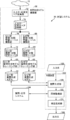
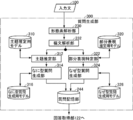
- a dialogue system 30 is connected to the Internet 70, and a question for training a type question generation model 82 and a type question generation model 92. From the generation model construction unit 50 and the input sentence 100 from the user, a series of questions is generated by using the type question generation model 82 and the type question generation model 92 and the response from the question / response system 104 is received. And an interactive device 102 that generates and outputs an output sentence 106 for the input sentence 100 using the response.
- the question generation model construction unit 50 is connected to the Internet 70 and receives a certain sentence (referred to as an “input sentence”) and a response to the input sentence from a dialogue performed by a large number of users via the web, SNS, and the like on the Internet 70.
- An input sentence / response sentence pair collection unit 72 for collecting a large number of pairs consisting of sentences (input sentence / response sentence pairs), and a large amount of input sentences / response sentences collected by the input sentence / response sentence pair collection unit 72
- an input sentence / response sentence pair storage unit 74 for storing pairs.
- the question generation model construction unit 50 further constructs a type question / dialog learning corpus 78 based on a large number of input sentence / response sentence pairs stored in the input sentence / response sentence pair storage unit 74.
- a type question / dialog learning corpus construction unit 76 and a type question generation model training unit 80 for training the type question generation model 82 using the type question / dialog learning corpus 78 are included.
- the question generation model construction unit 50 further explains why the type question for constructing the type question / dialog learning corpus 88 based on a large number of input sentence / response sentence pairs stored in the input sentence / response sentence pair storage unit 74.
- a dialogue learning corpus construction unit 86 and a why type question generation model training unit 90 for training the type question generation model 92 using the type question / dialog learning corpus construction unit 86 are included.
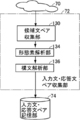
- input sentence / response sentence pair collection unit 72 includes candidate sentence pair collection unit 130 for collecting a large number of input sentence / response sentence pair candidates (candidate sentence pairs) from Internet 70, and candidate Of the candidate sentence pairs collected by the sentence pair collecting unit 130, only the response sentence whose length is equal to or shorter than a predetermined length is adopted as the input sentence / response sentence pair, and the length check for discarding the other candidate sentence pairs.
- morpheme analysis unit 134 that performs morphological analysis of each sentence of the input sentence / response sentence pair adopted by length checking unit 132, and performs parse analysis of each sentence, so that the part of speech information and the syntax information are
- a syntax analysis unit 136 for storing the attached input sentence / response sentence pair in the input sentence / response sentence pair storage unit 74.
- the length checking unit 132 employs only an input sentence / response sentence pair in which the number of words included in the response sentence is less than 15.
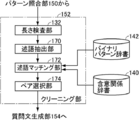
- the type question / dialog learning corpus constructing unit 76 displays information indicating an implication relationship or synonym relationship between predicates, such as “play” implies “play”.
- the stored implication relation dictionary 140 a binary pattern that is an expression composed of two variables (A, B) and a predicate, such as “play B with A”, and an actual corpus that shares this binary pattern.
- the binary pattern dictionary 142 storing a large number of combinations (this is called “binary trible”) composed of pairs of words corresponding to the variables A and B, and the input sentence / response sentence pair storage unit 74 are read.
- the binary pattern dictionary is created from a corpus different from the question / dialog learning corpus.
- the type question / dialogue learning corpus construction unit 76 further uses the implication relation dictionary 140 and the binary pattern dictionary 142 to select a pair that is highly likely to be noise from among each candidate sentence pair output from the pattern matching unit 150. Based on the input sentence / response sentence pair adopted by the cleaning unit 152 that discards and outputs only the other pairs and outputs them, the question generation rules stored in the question generation rule storage unit 146 are displayed.
- a question sentence generation unit 154 that generates a question sentence with reference, a record creation part 156 that creates a record to be added to the corpus together with attached information, for each question sentence generated by the question sentence generation unit 154, and a record
- the corpus adding unit 15 adds the record created by the creating unit 156 to the type question / dialog learning corpus 78. Including the door.
- the format of the record created by the record creation unit 156 is, for example, as shown in Table 1. Each type of record is also stored in the type question / dialogue learning corpus 78 in this format.
- the cleaning unit 152 shown in FIG. 3 has 15 or more words included in the response sentence among the input sentence / response sentence pairs read from the input sentence / response sentence pair storage unit 74.
- the length checker 132 that adopts the rest, the predicate extractor 170 that extracts the predicate included in the response sentence from the input sentence / response sentence pair adopted by the length checker 132, and the predicate extractor
- a predicate matching unit 172 that matches the predicate extracted in 170 with the predicate in each binary pattern included in the binary pattern dictionary 142, including the implication relation and synonym relation with reference to the implication relation dictionary 140, and predicate matching
- a pair selection unit 174 to be supplied to the select pattern consisting of a set of words selected from matched input sentence and response sentence pairs according to a binary pattern as a pair for learning question generator
- “Match” here means the following.
- the binary pattern is “play B with A”.
- This binary pattern includes a combination of one variable and one predicate “play B”.
- a combination of one word “play a game” and one predicate can be made.
- This is called “unary phrase generated from binary pattern” or simply “unary phrase”. It is said that if the response sentence of the input sentence / response sentence pair includes this unary phrase, the response sentence matches the binary pattern that is the basis of this unary phrase.
- the response sentence has a unitary pattern in which the predicate part is replaced with a word having an implication relation or synonym relation.
- the why-type question / dialog learning corpus construction unit 86 reads the input sentence / response sentence pair from the input sentence / response sentence pair storage unit 74, and represents the subject of the pair from the input sentence
- a partial expression extraction unit 190 that extracts an expression with reference to dependency information and the like
- a question sentence generation unit that generates a question sentence by applying a predetermined modification to the partial expression extracted by the partial expression extraction unit 190 192.
- the transformation performed by the question sentence generation unit 192 is performed, for example, by adding expressions such as “why”, “how”, and “how” to the partial expression.
- the reason-type question / dialog learning corpus construction unit 86 further provides the question / answer system 196 with the question / answer system 196 and the question / answer system 196 by giving the question text generated by the question text generator 192 to the question / answer system 196.
- the acquired answer acquisition unit 194 and the question sentence given to the question / answer system 196 and the answer sentence from the question / answer system 196 include a certain amount or more of common words
- the pair selection unit 198 that selects a pair and discards other input sentence / response sentence pairs and the input sentence / response sentence pair selected by the pair selection unit 198 are stored in the type question / dialog learning corpus 88.
- a corpus adding unit 202 to be added to the database.
- the record structure of the type question / dialog learning corpus 88 is as shown in Table 2 in this embodiment.
- the question generation unit 120 of the dialogue apparatus 102 illustrated in FIG. 1 performs a morpheme analysis unit 230 that performs morpheme analysis on the input sentence 100, and an input sentence 100 that has been morphologically analyzed by the morpheme analysis unit 230. And a syntax analysis unit 232 that performs syntax analysis and adds and outputs syntax analysis information.
- the question generation unit 120 further includes a type question feature extraction unit 234 for extracting a type question feature from the input sentence 100 to which syntax analysis information is added by the syntax analysis unit 232, and a type Based on the question hypothesis and likelihood information output from the type question generation model 82 by inputting the feature vector consisting of the features extracted by the question feature extraction unit 234 into the type question generation model 82.
- the type question generating unit 236, the type question feature extracting unit 240 for extracting the type question feature from the input sentence 100, and the type question feature extracting unit 240 are extracted.
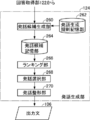
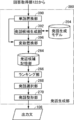
- the utterance generation unit 124 of the dialogue apparatus 102 shown in FIG. 1 includes an utterance generation rule storage unit 262 that stores in advance a plurality of rules for generating utterance candidates from a question sentence, and an answer acquisition unit.
- the utterance candidate generation unit 260 that generates a plurality of utterance candidates by applying the utterance generation rule stored in the utterance generation rule storage unit 262 to the answer given from 122, and the utterance generated by the utterance candidate generation unit 260
- An utterance candidate storage unit 264 that stores candidates, a ranking unit 266 for scoring and ranking the utterance candidates stored in the utterance candidate storage unit 264 according to some criteria, and the ranking unit 266 ranking highest
- An utterance selection unit 268 for selecting the selected utterance candidate, and adding a colloquial expression suitable for dialogue to the utterance selected by the utterance selection unit 268 Ri and a speech shaping unit 270 for shaping to produce an output sentence 106.
- the shaping by the utterance shaping unit 270 is to add a colloquial ending such as “Dayo!” Or “Dane!” To the ending.
- Ranking by the ranking unit 266 is performed as follows, for example.
- the response sent from the question / response system 104 to the answer acquisition unit 122 is given a score indicating how appropriate the response is to the question.
- the ranking unit 266 basically performs ranking based on the product of both.
- the utterance naturalness may be scored for each of the utterance candidates, and this may be further used for ranking.
- the dialog system 30 described above operates as follows.
- the dialogue system 30 has two operation phases, a learning phase and a service phase.
- ⁇ Learning phase In the learning phase, the learning of the type question generation model 82 and the type question generation model 92 will be described.
- the question generation model construction unit 50 shown in FIG. 1 operates as follows.
- candidate sentence pair collection unit 130 of input sentence / response sentence pair collection unit 72 is a variety of websites on the Internet 70 (particularly, sites where postings and responses to them are the main contents).
- the collected candidate sentence pairs are given to the morphological analyzer 134.
- the morpheme analysis unit 134 performs morpheme analysis on both the input sentence and the response sentence in the given candidate pair, and gives the obtained morpheme sequence to the syntax analysis unit 136.
- the syntax analysis unit 136 performs syntax analysis on both morpheme strings of the input sentence and the response sentence included in each pair, and stores the pair with the result of the syntax analysis in the input sentence / response sentence pair storage unit 74. .
- each of the input sentence and the response sentence of the candidate sentence pair read from the input sentence / response sentence pair storage unit 74 by the pattern matching unit 150 of the type question / dialog learning corpus construction unit 76 Are extracted, and it is determined whether there is a binary pair stored in the binary pattern dictionary 142 that matches the extracted word combination. If there is, the pattern matching unit 150 gives the candidate sentence pair to the cleaning unit 152 together with the binary pattern corresponding to the matched binary pair. If there is no such binary pair, the binary pattern dictionary 142 does nothing (discards) the candidate sentence pair.
- length checking unit 132 determines whether the length of the response sentence in the candidate sentence pair is 15 words or more.
- the length checking unit 132 discards candidate sentence pairs whose response sentence is 15 words or more, and gives a question sentence generation part 154 that has less than 15 words.
- the predicate extraction unit 170 extracts a predicate included in the response sentence from the input sentence / response sentence pair given from the binary pattern dictionary 142 and gives it to the predicate matching unit 172.
- the predicate matching unit 172 searches the binary pattern dictionary 142 for a binary pattern including a predicate that matches the predicate.
- the predicate matching unit 172 refers to not only the extracted predicate but also the implication relation dictionary 140, and the extracted predicate is a word having an implication relation (the upper and lower of the implication relation do not matter) or synonymous relation. For a certain word, the corresponding binary pattern is searched in the binary pattern dictionary 142.
- the predicate matching unit 172 gives a result indicating that there is a corresponding binary pattern to the pair selection unit 174 if there is no corresponding binary pattern.
- the pair selection unit 174 gives the input sentence / response sentence pair to the question sentence generation unit 154 when there is a corresponding binary pattern, and does nothing (discards) when there is no binary pattern.
- the pattern matching unit 150 and the cleaning unit 152 By such processing by the pattern matching unit 150 and the cleaning unit 152, it can be avoided that the corpus for learning the type question / dialog learning corpus 78 becomes noisy. Of course, such a cleaning process for the learning data may not be performed.
- the question sentence generation unit 154 selects an applicable one of the question generation rules stored in the question generation rule storage unit 146. Apply to create a question sentence. At this time, a plurality of question sentences may be created. Since the binary pattern is a simple pattern, the query generation rules may be relatively simple. For example, in the case of a binary pattern of “play B with A”, replace some of the variables with interrogatives such as “What do you play with A?” And “Why do you play B?” If necessary, the end of the sentence can be further modified like a question.
- the record creation unit 156 includes an input sentence and a response sentence that constitute an input sentence / response sentence pair, a binary pair, a word pair corresponding to a variable of the binary pair, a question sentence, and a question among the input sentence / response sentence pair.
- a record of a predetermined format is created by collecting the types of data and provided to the corpus adding unit 158.
- the corpus adding unit 158 adds this record to the type question / dialog learning corpus 78.
- the type question generation model training unit 80 shown in FIG. 1 creates learning data for training the type question generation model 82 from a large number of records stored in the type question / dialog learning corpus 78. Then, the type question generation model 82 is trained. This training is performed to train the type question generation model 82 as a statistical model for generating a question sentence hypothesis and its likelihood information given an input sentence.
- the features used in this learning are not described in detail here, but this model can be basically considered as a translation model with the input sentence as the source language and the question sentence as the target language. Therefore, it is possible to train by applying the same technique using the same features as the translation model in machine translation.
- the why-type question / dialog learning corpus construction unit 86 shown in FIG. 1 operates as follows.
- the partial expression extraction unit 190 reads out one input sentence / response sentence pair from the input sentence / response sentence pair storage unit 74 one by one, extracts a part representing the subject of the pair from the input sentence using a dependency relationship, This is given to the question sentence generation unit 192.
- the question sentence generation unit 192 generates a question sentence by performing a predetermined transformation on the partial expression extracted by the partial expression extraction part 190.
- the transformation performed by the question sentence generation unit 192 is performed by adding expressions such as “why”, “how”, and “how” to the partial expression, for example.
- the answer obtaining unit 194 obtains the answer from the question / answer system 196 by giving the question / answer system 196 the question sentence generated by the question sentence generating unit 192, and provides the answer to the pair selecting unit 198.
- the pair selection unit 198 selects an input sentence / response sentence pair to be processed when the question sentence given to the question / answer system 196 and the answer sentence from the question / answer system 196 include a certain amount or more of common words. To do.
- the pair selection unit 198 does nothing (discards) other input sentence / response sentence pairs.
- the record creation unit 200 determines why the type question / dialog from the input / response sentence pair selected by the pair selection unit 198.
- a record to be stored in the learning corpus 88 is created.
- the corpus adding unit 202 adds the record created by the record creating unit 200 to the database constituting the type question / dialog learning corpus 88.
- the type question generation model training unit 90 uses the type question / dialog learning corpus 88 to train the type question generation model 92.
- the why-type question generation model 92 is a statistical model that, when an input sentence is given, outputs a hypothesis of why-type question for the input sentence and its likelihood information. Therefore, the why-type question generation model training unit 90 uses each input sentence of the why-type question / dialogue learning corpus 88 as an input, and uses the question sentence of the why-question / dialogue learning corpus 88 as teacher data, and why the question-type generation model 92 learning is performed.
- This model is also basically considered as a translation model in which the input sentence is the source language and the question sentence is the target language.
- the language model required for translation is also required for both the input sentence and the question sentence, but is not shown here for the sake of simplicity.
- ⁇ Dialogue with Dialogue Device 102> when the input sentence 100 is given from the user, the morpheme analysis unit 230 of the question generation unit 120 performs morpheme analysis on the input sentence 100.
- the syntax analysis unit 232 performs syntax analysis based on the morpheme sequence output from the morpheme analysis unit 230, and provides the result to the type question feature extraction unit 234 and the type question feature extraction unit 240.
- the type question feature extraction unit 234 extracts the type question feature from the input sentence 100 to which the syntax analysis unit 232 has attached the syntax analysis information.
- the type question generation unit 236 outputs nothing from the type question generation model 82 by inputting the feature vector consisting of the features extracted by the type question feature extraction unit 234 into the type question generation model 82.
- a type question is generated based on the hypothesis and likelihood information of the question.
- the why-type question feature extraction unit 240 extracts why-type question features from the input sentence 100.
- the why type question generation unit 242 inputs the feature vector composed of the features extracted from the type question feature extraction unit 240 to the why type question generation model 92, and thereby the hypothesis of the question output from the type question generation model 92 And why generate type questions based on likelihood information.
- the question storage unit 244 stores both the type question generated by the type question generation unit 236 and the why type question generated by the type question generation unit 242.
- the utterance generation rule storage unit 262 of the utterance generation unit 124 stores in advance a plurality of rules for generating utterance candidates from a question sentence.
- the utterance candidate generation unit 260 applies a utterance generation rule stored in the utterance generation rule storage unit 262 to the answer given from the answer acquisition unit 122 to generate a plurality of utterance candidates.
- the utterance candidate storage unit 264 stores the utterance candidates generated by the utterance candidate generation unit 260.
- the ranking unit 266 ranks the speech candidates stored in the speech candidate storage unit 264 according to some criteria.
- the utterance selection unit 268 selects the utterance candidate ranked highest by the ranking unit 266.
- the utterance shaping unit 270 shapes the utterance selected by the utterance selection unit 268 by adding a colloquial expression suitable for dialogue, and generates an output sentence 106.
- an output sentence is not simply generated from information that seems to be related to an input sentence.
- a question sentence is generated once from the input sentence and given to the question / answer system to obtain an answer.
- This question is generated by removing unnecessary information from the user's utterance, and is based on information frequently seen on the web, and clearly expresses the user's utterance intention in the input sentence.
- the question / answer system outputs an answer having an appropriate relationship to this question. Using this answer, an output sentence for the user utterance is generated.
- the relationship between the user utterance and the system utterance can be properly grasped, and the flow of dialogue can be appropriately controlled.
- question generation is performed according to a question generation rule. Since question generation is relatively easy to order, question generation rules can be used in this way. However, the present invention is not limited to the first embodiment using the question generation rule. Question generation may be performed by a statistical model instead of a rule.
- the second embodiment has such a configuration. In the second embodiment, the question generator 300 shown in FIG. 8 is used instead of the question generator 120 shown in FIG. 6, and the utterance shown in FIG. 9 is used instead of the utterance generator 124 shown in FIG. The generation unit 350 is used. In other respects, the second embodiment is the same as each part of the first embodiment.
- question generation unit 300 includes a morpheme analysis unit 230 connected to receive input sentence 100, and a syntax analysis unit 232 connected to receive the output of morpheme analysis unit 230. .
- the question generation unit 300 further generates a predetermined feature vector from the subject estimation model 310 statistically learning in advance and the input sentence 100 to which the syntax analysis information output from the syntax analysis unit 232 is attached,
- the subject estimation unit 312 for estimating the subject of the input sentence 100 with reference to the subject estimation model 310, and given the subject of the dialogue, the hypothesis of the type query based on the subject is given to the likelihood information.
- the feature questions are extracted from the model question generation model 316 that has been trained in advance to be output together with the theme output from the subject estimation unit 312, and the type question generation model 316 is used to generate a type question.
- a type question generation unit 314 is included.
- the question generating unit 300 When given a predetermined feature vector obtained from the input sentence 100 to which the parsing information is attached, the question generating unit 300 further converts the unary phrase included in the input sentence 100 into a partial expression hypothesis and its likelihood information.
- a partial expression specifying unit 322 for specifying the partial expression in the input sentence 100 based on the partial expression hypothesis to be output to the model 320 and its likelihood information.
- the question generation unit 300 is further trained in advance to output a question hypothesis for generating an appropriate why-type question based on the partial expression and its likelihood information when given a predetermined feature extracted from the partial expression.
- a question hypothesis for generating an appropriate why-type question based on the partial expression and its likelihood information when given a predetermined feature extracted from the partial expression.
- the why type question generation unit 324 for generating a why type question for appropriately controlling the dialogue, the question generated by the type question generation unit 314 and the question generated by the type question generation unit 324 are stored. And a question storage unit 244.
- utterance generation unit 350 in the second embodiment when given a sentence as utterance material, utterance hypotheses to be output to the user based on the sentence and those hypotheses
- an answer is given from the answer acquisition unit 122 (see FIG. 1)
- an utterance generation model 362 that has been learned in advance so as to output the likelihood information and an answer from the question / response system 104 (see FIG. 1) are uttered.
- An utterance candidate generation unit 360 for generating an utterance candidate based on an utterance hypothesis and likelihood information input to the generation model 362 and output from the utterance generation model 362, and an utterance candidate generated by the utterance candidate generation unit 360 7 includes a ranking unit 266, an utterance selection unit 268, and an utterance shaping unit 270 which are connected in the same manner as shown in FIG.
- the system according to the second embodiment operates as follows. Here, only operations of the question generation unit 300 and the utterance generation unit 350 will be described.
- the morpheme analysis unit 230 When the input sentence 100 is given to the morpheme analysis unit 230 of the question generation unit 300 shown in FIG. 8, the morpheme analysis unit 230 performs a morpheme analysis on the input sentence 100 and gives a morpheme string to the syntax analysis unit 232.
- the syntax analysis unit 232 performs syntax analysis on the morpheme sequence and gives the input sentence 100 with syntax analysis information to the subject estimation unit 312 and the partial expression specifying unit 322.
- the subject estimation unit 312 extracts features to be given to the subject estimation model 310 from the parsing information and the input sentence 100, gives them to the subject estimation model 310 in the form of feature vectors, and outputs the hypothesis and likelihood of the output subject matter. Based on the information, the subject of the input sentence 100 is estimated. The subject estimation unit 312 gives this subject to the type question generation unit 314.
- the type question generation unit 314 obtains a feature for the type question generation model 316 based on this subject and supplies the feature to the type question generation model 316 in the form of a feature vector.
- the type question generation unit 314 generates a type question based on the question hypothesis and likelihood information output from the type question generation model 316 and stores it in the question storage unit 244.
- the partial representation specifying unit 322 extracts features for estimating a partial representation from the syntax analysis information given from the syntax analysis unit 232 and the input sentence 100, and a partial representation estimation model 320 in the form of a feature vector.
- the partial expression estimation model 320 outputs hypotheses of partial expressions in the input sentence 100 and their likelihood information based on the feature vectors.
- the partial expression specifying unit 322 estimates the partial expression based on the likelihood information, and gives this partial expression to the type question generation unit 324.
- the type question generation unit 324 creates a feature vector for generating a type question on the basis of this partial expression, and supplies the feature vector to the type question generation model 326.
- the reason type question generation unit 324 generates a question candidate based on the hypothesis and likelihood information of the question and stores the question candidate in the question storage unit 244.
- the type question generation unit 314 and the reason type question generation unit 324 both generate a plurality of question candidates.
- the utterance candidate generation unit 360 extracts a feature vector for the utterance generation model 362 from each of these responses, gives it to the utterance generation model 362, and selects an utterance candidate based on the output utterance hypothesis and their likelihood information. Generate.
- the utterance candidate generation unit 360 stores the utterance candidate generated based on the output of the utterance generation model 362 in the utterance candidate storage unit 264.
- each utterance candidate generated based on the utterance hypothesis and likelihood information output from the utterance generation model 362 is given a score by the utterance generation model 362. This score is a value indicating how appropriate an utterance candidate is for a given feature vector.
- the operations of the ranking unit 266, the utterance selection unit 268, and the utterance shaping unit 270 are the same as those in the first embodiment.
- the ranking performed by the ranking unit 266 is the same as that in the first embodiment, but in the second embodiment, the score assigned to each utterance candidate by the utterance generation model 362 is not the importance of the utterance rule. Is different.
- the question generation unit 300 also uses the subject estimation model 310, the type question generation model 316, the partial expression estimation model 320, and the type question generation for the question given to the question / answer system 104.
- the model 326 gives a score. Therefore, these scores may be reflected in scoring of the final utterance candidate.
- an utterance generation model 362 is used.
- the utterance generation model 362 is applied to the response from the question / answer system 104 and outputs answer hypotheses together with their likelihood information.
- the response from the question / response system 104 may vary greatly depending on the variation of the question.
- the learning data for training the utterance generation model 362 becomes sparse, and there is a risk that the generation accuracy of the utterance candidate using the utterance generation model 362 is lowered. Therefore, in the third embodiment, for example, assuming that the learning data includes the unary phrase, the utterance generation model is trained after the nouns in the learning data are replaced with general variables, thereby solving these problems. .
- the hypothesis output from the utterance generation model also includes variables.
- the utterance generation unit 380 replaces the utterance generation model 362 of FIG. 9 with the utterance generation model 394 trained in advance as described above, and the answer acquisition unit 122.
- the utterance generation model 394 outputs the utterance hypothesis including the variable symbol together with the likelihood information by giving the utterance generation model 394 as a feature vector, and the utterance candidate generation unit 392 that generates an utterance candidate based on the utterance hypothesis
- the variable symbol included in the utterance candidate output by the generation unit 392 is replaced with the original word replaced by the word replacement unit 390.
- Including variable substitution unit 396 to be stored in the utterance candidate storage unit 264 to complete the utterance candidate by.
- the configuration and operation of the utterance generation unit 380 are the same as those of the utterance generation unit 350 shown in FIG.
- training data of the utterance generation model 394 can be prevented from becoming sparse, and the accuracy of generation of utterance candidates by the model can be increased.
- the dialogue device 102 or the like sends a question comprising a natural language sentence to the question / response system 104, and generates a next utterance using the response, thereby carrying out a dialogue.
- I was in control.
- the present invention is not limited to such an embodiment.
- any system can be used as long as it has a mechanism for outputting information for dialogue in response to some parameter generated from an input sentence.
- a general system such as the question / answer system 104 shown in FIG.
- a core system for searching and creating information for answering a question and an external question are analyzed, A response sentence is generated using an input interface part for generating parameters to be given to the core system and information (for example, a word group) for generating a response output from the core system, and transmitted to a terminal or the like that has sent the question. With output interface.
- the external device did not bother to generate a natural language sentence and give it to this device. And give it to the core system.
- the output from the core system is given to the external device as a response in the form of natural language via the external interface. If the external device is not a human being, it will bother to convert the output of the core system to natural language. do not have to.
- the output of the core system can be received as it is, and an external device can process it according to the purpose.
- the fourth embodiment relates to such a system.
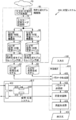
- a dialogue system 400 includes a question generation model construction unit 50 having a configuration similar to that of the first embodiment, what type question generation model 82, and why In addition to including the type question generation model 92, in response to the input sentence 100 instead of the interactive apparatus 102 of the first embodiment, what is generated using the type question generation model 82 and the type question generation model 92.
- a parameter representing the question is directly given from the natural language sentence to the core system 450 of the external question / answer system 412 and is given to the question / answer system 412, and the output sentence 414 is obtained from the information obtained from the question / answer system 412.
- the dialog device 410 receives the input sentence 100 and generates parameters to be given to the core system of the question / answer system 412 from the question sentence obtained by using the type question generation model 82 and the reason type generation model 92.
- Parameter generation unit 430, a parameter transmission unit 432 for directly transmitting the parameter generated by the parameter generation unit 430 to the core system of the question / response system 412, and the question / response system 412 outputs the parameter A response receiving unit 434 for receiving information for generating a response, and an utterance generating unit 436 for generating and outputting an utterance for the input sentence 100 based on the information received by the response receiving unit 434.
- the question / answer system 412 analyzes a question given in the form of a natural language sentence from the core system 450, an input interface 452 for generating parameters to be given to the core system 450 and giving them to the core system 450, On the other hand, it includes an output interface 454 for receiving information output from the core system 450 from the core system 450, generating a natural language sentence from the information, and outputting it as a response.
- the core system 450 includes an input unit 470 for receiving input parameters from the input interface 452 and an output unit 472 for outputting information for generating a response to the question generated by the core system.
- the input interface 452 receives an input of a natural language question sentence from an external device, analyzes it, generates an input parameter to the core system 450, and gives it to the input unit 470.
- the core system 450 searches for information for responding using the internal DB, and outputs the information via the output unit 472. Based on this information, the output interface 454 generates and outputs a natural language sentence suitable as a response.
- the parameter generation unit 430 directly gives a parameter representing a question to the input unit 470 of the core system 450, and the response reception unit 434 receives the information output from the core system 450 directly from the output unit 472.
- the utterance generation unit 436 generates the next utterance for the user from this word group and outputs it as an output sentence 414.
- the type question generation model 82 and the reason type generation model 92 when an input sentence is given in accordance with the characteristics or specifications of the core system 450 of the question / answer system 412, an appropriate question for the core system 450 is obtained. It is still more efficient to learn so that the parameters can be generated directly.
- the question generation model construction unit 50 does not use a pair of an input sentence and a corresponding question sentence as model learning data, but uses an input sentence and a parameter equivalent to the corresponding question. Train these models.
- the parameter generation unit 430 may provide the core system 450 via the parameter transmission unit 432 as it is without processing this parameter.
- the parameters generated by the parameter generation unit 430 depend on the input specifications of the core system 450.
- the interactive apparatus 410 according to the present embodiment cannot be used.
- the parameter generation unit 430 Since the parameters generated by the parameter generation unit 430 depend on the specifications of the core system 450, when using a plurality of question / answer systems having core systems with different specifications, the type question generation model 82, why It is necessary to use a combination of a plurality of type question generation models 92 and interactive devices 410.
- the dependency relationship of the user's utterance is effectively used in generating a response to the user's utterance. Furthermore, since the statistical model used in the system is based on the dialog information that actually appears on the web and SNS, it is possible to prevent the flow of the dialog from becoming unnatural. Also, unnecessary information is deleted from the large amount of information included in the utterance when generating a question to the question / answer system. Therefore, it is possible to generate an appropriate system utterance that guides a natural conversation with respect to the user utterance.
- the question to the question / response system is generated based on the user's utterance, and the utterance is generated using the response to the question, so the relationship between the user's utterance and the system utterance is captured by the generated question, Control the flow of system utterances and dialogues.
- the dialogue system, the dialogue device, and the question generation model construction unit according to each embodiment of the present invention can be realized by computer hardware and a computer program executed on the computer hardware.
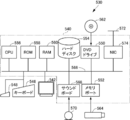
- FIG. 12 shows the external appearance of the computer system 530
- FIG. 13 shows the internal configuration of the computer system 530.
- the computer system 530 includes a computer 540 having a memory port 552 and a DVD (Digital Versatile Disc) drive 550, a keyboard 546, a mouse 548, and a monitor 542.
- DVD Digital Versatile Disc
- computer 540 includes a CPU (central processing unit) 556, a bus 566 connected to CPU 556, memory port 552 and DVD drive 550, and a boot program. And the like, a read only memory (ROM) 558 for storing etc., a random access memory (RAM) 560 connected to the bus 566 for storing program instructions, system programs, work data and the like, and a hard disk 554.
- the computer system 530 is further connected to the bus 566 and provides a connection to a sound board 568 for digitizing and converting the audio signal into a form that can be processed by the computer, and a network 572 that allows communication with other terminals.
- Network interface card (NIC) 574 Network interface card
- a microphone 570 is connected to the sound board 568.
- a computer program for causing the computer system 530 to function as each functional unit of the interactive system according to each embodiment described above is stored in the DVD drive 550 or the DVD 562 or the removable memory 564 installed in the memory port 552, and further the hard disk 554. Forwarded to Alternatively, the program may be transmitted to the computer 540 through the network 568 and stored in the hard disk 554. The program is loaded into the RAM 560 when executed. The program may be loaded directly into the RAM 560 from the DVD 562, from the removable memory 564, or via the network 568.
- This program includes an instruction sequence including a plurality of instructions for causing the computer 540 to function as each functional unit of each interactive system according to each of the above embodiments.
- Some of the basic functions necessary to cause the computer 540 to perform this operation are an operating system or third party program running on the computer 540 or various dynamically linkable programming toolkits or programs installed on the computer 540. Provided by the library. Therefore, this program itself does not necessarily include all the functions necessary for realizing the system, apparatus, and method of this embodiment.
- the program is a system as described above by dynamically calling an appropriate program in an appropriate function or programming toolkit or program library in a controlled manner to obtain a desired result among instructions, It is only necessary to include an instruction for realizing a function as an apparatus or a method. Of course, all necessary functions may be provided only by the program.
- the present invention can be used in any industry where a dialogue with a user is necessary, and in particular, can be used for devices and services where natural dialogue is important, and interfaces in such devices and services.
- Question generation model construction unit 70 Internet 72 Input sentence / response sentence pair collection part 74 Input sentence / response sentence pair storage part 76 What type question / dialog learning corpus construction part 78 What type question / dialog learning Corpus 80 What type question generation model training unit 82 What type question generation model 86 Why type question / dialog learning corpus construction unit 88 Why type question / dialog learning corpus 90 Why type question generation model training unit 92 Why type question generation model 100 Input sentence 102, 410 Dialogue device 104, 412 Question / response system 106, 414 Output sentence 120, 300 Question generation unit 122, 194 Answer acquisition unit 124, 350, 380, 436 Utterance generation unit 130 Candidate sentence pair collection unit 132 Length Inspection unit 134, 230 Morphological analysis unit 136, 232 Syntax analysis unit 1 0 Implication relation dictionary 142 Binary pattern dictionary 146 Question generation rule storage unit 150 Pattern matching unit 152 Cleaning unit 154, 192 Question sentence generation unit 156, 200 Record creation unit 158, 202
Landscapes
- Engineering & Computer Science (AREA)
- Theoretical Computer Science (AREA)
- Physics & Mathematics (AREA)
- Computational Linguistics (AREA)
- General Physics & Mathematics (AREA)
- General Engineering & Computer Science (AREA)
- Artificial Intelligence (AREA)
- Mathematical Physics (AREA)
- Health & Medical Sciences (AREA)
- Audiology, Speech & Language Pathology (AREA)
- Databases & Information Systems (AREA)
- General Health & Medical Sciences (AREA)
- Data Mining & Analysis (AREA)
- Human Computer Interaction (AREA)
- Acoustics & Sound (AREA)
- Multimedia (AREA)
- Machine Translation (AREA)
- Information Retrieval, Db Structures And Fs Structures Therefor (AREA)
Abstract
【課題】トピックにかかわらずユーザとの自然な対話を行うことができる対話システムを提供する。 【解決手段】対話システム30は、ユーザからの入力文100を受け、係り受け関係を用いて入力文100に含まれる表現を用いた質問を生成する質問生成部120と、質問生成部120により生成された質問を質問・応答システム104に入力し、当該質問に対する回答を質問・応答システム104から取得する回答取得部122と、回答取得部122が取得した回答に基づいて、入力文100に対する出力文106を生成する発話生成部124とを含む。
Description
この発明はユーザとの間で対話を行う対話システムに関し、特に、自然な対話を可能にする対話システムに関する。
コンピュータがユーザと対話するシステムに関しては、これまでも多くの試みがなされている。最も簡単なものは、予め対話のルールを決めたスクリプトを準備しておき、コンピュータがこのスクリプトに沿って発話を行うというものである。スクリプトの中には、いずれかの単語で置換される変数が含まれており、ユーザの発話を音声認識して、そこから何らかの単語を抽出してこの変数を置換することにより応答する。すぐ分かるように、このような対話システムはスクリプトの数が制限されることにより、応答のパターンも制約を受ける。対話において生じうる場合の数は無限であるから、こうしたシステムで自然な対話を行うことは不可能である。
また、多くの対話データ中の文の係り受けを解析し、その結果を利用するものもある。例えばある文を解析した結果、「今日ゲーム機買ったのでマルコカーゴをやる」(「マルコカーゴ」はゲームの名前とする。)という文から「(今日)ゲーム機買った」と「マルコカーゴをやる」との組み合わせを抽出し、パターンとして記憶しておく。対話時、ユーザ発話の中に「今日ゲーム機買った」という表現が出てきたら、その表現に対応付けられていた「マルコカーゴをやる」という表現を抽出し、語尾変換して例えば「マルコカーゴがやれるね」というシステム発話を生成する。
さらに別の取り組みでは、ユーザの発話からキーワードを抽出し、キーワード検索を行ってその結果をシステム発話の生成に用いるものがある。例えばユーザ発話が「今日ゲーム機買う」というものであれば「ゲーム機」と「買う」をキーワードにしてウェブを検索し、複数個の文書を集め、その中でキーワードと近接して出現した単語(例えば「マルコカーゴ」)を抽出する。この単語を、予め準備したテンプレートに当てはめてシステム発話を生成する。
しかしこうしたものはいずれも、ユーザ発話又はウェブ上の文の係り受けの意味的関係(原因、結果、並列等)を正しく理解できていないという問題がある。そのため、不適切なシステム発話を生成してしまうことがある。例えば、「アキバ行ってゲーム機買ってラーメンを食べる。」という発話が例としてあったものとする。この発話から、「ゲーム機買う」という表現と「ラーメンを食べる」という表現とが抽出され、両者が一応は関係付けられる。しかし、対話時、「今日ゲーム機買う」というユーザ発話に対してこの関係のみに基づいて「ラーメンを食べられるね」というシステム発話を生成したら、通常は理解不可能であり、自然な対話を維持できない。
キーワード検索を用いる場合には、検索結果の文書が含む単語の語彙が大きすぎるため、検索結果には不要な情報が多く、本来欲しい情報を抽出することが困難である。またユーザ発話に含まれるキーワードに基づく検索結果を利用するので、システム側の発話意図(例えばユーザに情報を与えたいのか、感想を言いたいのか、共感したいのか、等)を制御することは不可能である。
こうした問題を解決するための提案が後掲の特許文献1においてなされている。特許文献1に記載の音声対話システムは、ユーザの発話を認識する音声認識装置と、この発話の意図を理解し、特定のドメインにおけるどのような情報を知りたがっているのかを理解するために、予め学習済の意図理解モデル及び問題解決知識を用いて発話の意図を理解するための意図理解部と、この意図に対応した応答文を生成するために、応答のための情報を情報源から取得するための対話管理部とを含む。特許文献1は、この情報源としてインターネット上の特定のウェブサイトと、様々な映画に関する人々の感想を保存している感想データベースとを挙げており、発話者の意図に応じて何れか一方を選択するとしている。例えば、ユーザの発話が、映画の監督を知りたいというものであればウェブサイトでその映画の監督を検索する。ユーザの発話が、映画の感想を知りたいというものであれば、感想ベータベースを検索してその映画に関する他人の感想を取り出す。
特許文献1に記載の音声対話システムはさらに、様々な意図が入力されたときにどのようなやり取りをすべきかという対話の流れを記述した対話シナリオを含む。
このシステムはさらに、対話管理部が情報源から取得した情報を用いて、発話者の発話に対する応答文を生成する応答文生成部と、応答文生成部が生成した応答文を音声合成して音声信号を生成する音声合成部と、この音声信号を音声に変換するスピーカとを含む。
上記した特許文献1に記載のシステムは、ユーザに対する回答を広い範囲から収集するものの、その範囲は特定のドメイン(例えば映画)に限定される。しかも相手の発話が質問でしかもその意図が容易に判定できる場合には意味のある応答を生成することができる可能性があるが、そうでない場合にはどのような応答がなされるか、全く予測がつかないという問題がある。そもそも、ユーザが質問しか発することができないような対話はとても自然なものとは言えない。そのために、このシステムではユーザとの自然な対話を行うことは不可能である。
したがって、本発明の目的は、発話のトピックにかかわらず、ユーザの発話に基づいてユーザとの自然な対話を行うことができる対話システムを提供することである。
本発明の第1の局面に係る対話システムは、ユーザからの入力発話を受け、当該入力発話に含まれる表現を用いて、質問・応答システムを利用するためのパラメータを生成するパラメータ生成手段と、パラメータ生成手段により生成されたパラメータを質問・応答システムに入力し、当該パラメータに対する回答を取得する回答取得手段と、回答取得手段が取得した回答に基づいて、入力発話に対する応答を生成する応答生成手段とを含む。
好ましくは、パラメータ生成手段は、入力発話に対する形態素解析及び構文解析を行う発話解析手段と、発話解析手段により解析された結果から、入力発話の主題を推定する主題推定手段と、主題推定手段により推定された主題に基づいて、当該主題を構成する部分表現を含むファクトイド型質問を生成するファクトイド型質問生成手段とを含む。
より好ましくは、パラメータ生成手段は、発話解析手段により解析された結果から、入力発話を代表する部分表現を特定する部分表現特定手段と、部分表現特定手段により特定された部分表現に基づいて、ノン・ファクトイド型質問を生成するノン・ファクトイド型質問生成手段とを含む。
さらに好ましくは、応答生成手段は、回答に対して予め準備された発話生成規則を適用することにより、発話候補を生成する発話候補生成手段と、発話候補を予め準備された発話整形規則にしたがって整形して入力発話に対する応答を生成する発話整形手段とを含んでもよい。
さらに好ましくは、質問・応答システムは、1つのパラメータに対して複数個の回答を出力し、応答生成手段は、複数個の回答の各々に対して予め準備された発話生成規則を適用することにより、複数個の発話候補を生成する発話候補生成手段と、複数個の発話候補のいずれかを選択し、予め準備された発話整形規則にしたがって整形して入力発話に対する応答を生成する発話整形手段とを含む。
応答生成手段は、質問に対する回答が与えられると、当該回答から発話を生成するよう予め学習した発話生成モデルと、発話生成モデルが生成した発話を、予め準備された発話整形規則にしたがって整形して入力発話に対する応答を生成する発話整形手段とを含んでもよい。
質問・応答システムは、1つのパラメータに対して複数個の回答を出力し、応答生成手段は、質問に対する回答が与えられると、当該回答から発話を生成するよう予め学習した発話生成モデルと、発話生成モデルが複数個の回答の各々に対して生成した発話のいずれかを選択し、予め準備された発話整形規則にしたがって整形して入力発話に対する応答を生成する発話整形手段とを含んでもよい。
本発明の第2の局面に係るコンピュータプログラムは、コンピュータを、上記したいずれかの対話システムとして機能させる。
以下の説明及び図面では、同一の部品には同一の参照番号を付してある。したがって、それらについての詳細な説明は繰返さない。なお、以下の実施の形態では、ファクトイド型の質問としてなに型質問を扱い、ノン・ファクトイド型の質問としてなぜ型質問を扱う。しかし本発明はそのような実施の形態には限定されない。例えばファクトイド型の質問は事実について問う質問(例えば「誰」、「いつ」、「どこ」等を伴う質問)であればどのようなタイプでもよい。ノン・ファクトイド型の質問としては、なぜ型以外に「どうなる」型、「どうやって」型等の質問を扱うようにしてもよい。
[第1の実施の形態]
<構成>
図1を参照して、本発明の第1の実施の形態に係る対話システム30は、インターネット70に接続され、なに型質問生成モデル82及びなぜ型質問生成モデル92のトレーニングを行うための質問生成モデル構築部50と、ユーザからの入力文100から、なに型質問生成モデル82及びなぜ型質問生成モデル92を用いて一連の質問を生成して質問・応答システム104からのその応答を受信し、その応答を用いて入力文100に対する出力文106を生成し出力する対話装置102とを含む。
<構成>
図1を参照して、本発明の第1の実施の形態に係る対話システム30は、インターネット70に接続され、なに型質問生成モデル82及びなぜ型質問生成モデル92のトレーニングを行うための質問生成モデル構築部50と、ユーザからの入力文100から、なに型質問生成モデル82及びなぜ型質問生成モデル92を用いて一連の質問を生成して質問・応答システム104からのその応答を受信し、その応答を用いて入力文100に対する出力文106を生成し出力する対話装置102とを含む。
〈質問生成モデル構築部50〉
質問生成モデル構築部50は、インターネット70に接続され、インターネット70上のウェブ及びSNS等で多数のユーザが行う対話から、ある文(これを「入力文」と呼ぶ。)と、入力文に対する応答文とからなるペア(入力文・応答文ペア)を大量に収集するための入力文・応答文ペア収集部72と、入力文・応答文ペア収集部72が収集した大量の入力文・応答文ペアを記憶する入力文・応答文ペア記憶部74とを含む。
質問生成モデル構築部50は、インターネット70に接続され、インターネット70上のウェブ及びSNS等で多数のユーザが行う対話から、ある文(これを「入力文」と呼ぶ。)と、入力文に対する応答文とからなるペア(入力文・応答文ペア)を大量に収集するための入力文・応答文ペア収集部72と、入力文・応答文ペア収集部72が収集した大量の入力文・応答文ペアを記憶する入力文・応答文ペア記憶部74とを含む。
質問生成モデル構築部50はさらに、入力文・応答文ペア記憶部74に記憶された大量の入力文・応答文ペアに基づいて、なに型質問・対話学習コーパス78を構築するためのなに型質問・対話学習コーパス構築部76と、なに型質問・対話学習コーパス78を用いてなに型質問生成モデル82をトレーニングするためのなに型質問生成モデルトレーニング部80とを含む。
質問生成モデル構築部50はさらに、入力文・応答文ペア記憶部74に記憶された大量の入力文・応答文ペアに基づいて、なぜ型質問・対話学習コーパス88を構築するためのなぜ型質問・対話学習コーパス構築部86と、なぜ型質問・対話学習コーパス構築部86を用いてなぜ型質問生成モデル92をトレーニングするためのなぜ型質問生成モデルトレーニング部90とを含む。
《入力文・応答文ペア収集部72》
図2を参照して、入力文・応答文ペア収集部72は、インターネット70から入力文・応答文ペアの候補(候補文ペア)を大量に収集するための候補文ペア収集部130と、候補文ペア収集部130が収集した候補文ペアのうち、応答文の長さが所定長以下のもののみを入力文・応答文ペアとして採用しそれ以外の候補文ペアを破棄するための長さ検査部132と、長さ検査部132により採用された入力文・応答文ペアの各々の文の形態素解析を行う形態素解析部134と、各々の文の構文解析を行って、品詞情報及び構文情報が付された入力文・応答文ペアを入力文・応答文ペア記憶部74に格納するための構文解析部136とを含む。本実施の形態では、長さ検査部132は、応答文に含まれる単語数が15未満の入力文・応答文ペアのみを採用する。
図2を参照して、入力文・応答文ペア収集部72は、インターネット70から入力文・応答文ペアの候補(候補文ペア)を大量に収集するための候補文ペア収集部130と、候補文ペア収集部130が収集した候補文ペアのうち、応答文の長さが所定長以下のもののみを入力文・応答文ペアとして採用しそれ以外の候補文ペアを破棄するための長さ検査部132と、長さ検査部132により採用された入力文・応答文ペアの各々の文の形態素解析を行う形態素解析部134と、各々の文の構文解析を行って、品詞情報及び構文情報が付された入力文・応答文ペアを入力文・応答文ペア記憶部74に格納するための構文解析部136とを含む。本実施の形態では、長さ検査部132は、応答文に含まれる単語数が15未満の入力文・応答文ペアのみを採用する。
《なに型質問・対話学習コーパス構築部76》
図3を参照して、なに型質問・対話学習コーパス構築部76は、「プレイする」が「遊ぶ」を含意する、というような、述語の間の含意関係又は同義語関係を示す情報を記憶した含意関係辞書140と、「AでBをプレイする。」のように、2つの変数(A、B)と述部からなる表現であるバイナリパターンと、実際のコーパスでこのバイナリパターンと共起する、変数A及びBに相当する単語のペアとからなる組み合わせ(これを「バイナリトリブル」と呼ぶ。)を多数記憶したバイナリパターン辞書142と、入力文・応答文ペア記憶部74から読出した入力文・応答文ペアの各々について、入力文に含まれる単語と応答文に含まれる単語との組み合わせに対し、バイナリパターン辞書142にその組み合わせと一致する単語の組み合わせを含むバイナリトリプルが存在するか否かを判定し、もし存在すれば、その入力文・応答文ペアと、一致したバイナリトリプルとを採用し、存在しなければ何もしない(破棄する)パターン照合部150とを含む。
図3を参照して、なに型質問・対話学習コーパス構築部76は、「プレイする」が「遊ぶ」を含意する、というような、述語の間の含意関係又は同義語関係を示す情報を記憶した含意関係辞書140と、「AでBをプレイする。」のように、2つの変数(A、B)と述部からなる表現であるバイナリパターンと、実際のコーパスでこのバイナリパターンと共起する、変数A及びBに相当する単語のペアとからなる組み合わせ(これを「バイナリトリブル」と呼ぶ。)を多数記憶したバイナリパターン辞書142と、入力文・応答文ペア記憶部74から読出した入力文・応答文ペアの各々について、入力文に含まれる単語と応答文に含まれる単語との組み合わせに対し、バイナリパターン辞書142にその組み合わせと一致する単語の組み合わせを含むバイナリトリプルが存在するか否かを判定し、もし存在すれば、その入力文・応答文ペアと、一致したバイナリトリプルとを採用し、存在しなければ何もしない(破棄する)パターン照合部150とを含む。
例えば、入力文が「ゲーム機買ったよ」であり、応答文が「マルコカーゴできるね」というものであった場合を考える。バイナリトリプルの中にバイナリパターン=「AでBができるね」、A=「ゲーム機」、B=「マルコカーゴ」というものがあった場合、この入力文と応答文の組み合わせは採用される。バイナリトリプルも一緒に出力される。もしなければ入力文と応答文との組み合わせは破棄される。なお、バイナリパターン辞書は、質問・対話学習コーパスとは別のコーパスから作成される。
なに型質問・対話学習コーパス構築部76はさらに、含意関係辞書140及びバイナリパターン辞書142を用い、パターン照合部150から出力される各候補文ペアのうち、ノイズである可能性が高いペアを破棄し、それ以外のペアのみを採用し出力するクリーニング部152と、クリーニング部152により採用された入力文・応答文ペアに基づいて、質問生成規則記憶部146に記憶されている質問生成規則を参照して質問文を生成する質問文生成部154と、質問文生成部154により生成された質問文の各々について、付属する情報とともにコーパスに追加すべきレコードを作成するレコード作成部156と、レコード作成部156により作成されたレコードをなに型質問・対話学習コーパス78に追加するコーパス追加部158とを含む。
レコード作成部156が作成するレコードの形式は、例えばテーブル1の様なものである。なに型質問・対話学習コーパス78にもこの形式で各レコードが記憶される。

図4を参照して、図3に示すクリーニング部152は、入力文・応答文ペア記憶部74から読み出した各入力文・応答文ペアのうち、応答文に含まれる単語が15個以上のものを破棄し、残りを採用する長さ検査部132と、長さ検査部132が採用した入力文・応答文ペアのうち、応答文に含まれる述語を抽出する述語抽出部170と、述語抽出部170により抽出された述語とバイナリパターン辞書142に含まれる各バイナリパターン中の述語とを、含意関係辞書140を参照して含意関係・同義語関係も含めてマッチングする述語マッチング部172と、述語マッチング部172によりバイナリパターン辞書142にマッチするバイナリパターンが発見された場合に、処理中の入力文・応答文ペアと、そのペアから抽出された述語と、マッチされたバイナリパターンにしたがって入力文・応答文ペアから選択された1組の単語とからなるパターンを学習用のペアとして選択し質問文生成部154に与えるペア選択部174とを含む。ここでは、バイナリパターン辞書142に一つでもマッチするものがあればそのペアを採用することとする。
ここで「マッチする」とは次のようなことをいう。バイナリパターンが「AでBをプレイする」というものである場合を考える。このバイナリパターンは、「Bをプレイする」という、1つの変数と1つの述語との組み合わせを含む。この変数Bを、対応する変数(例えば「ゲーム」)で置換することにより、「ゲームをプレイする」という、1つの単語と1つの述語との組み合わせができる。これを「バイナリパターンから生成されるユナリフレーズ」又は単に「ユナリフレーズ」と呼ぶ。入力文・応答文ペアのうち、応答文がこのユナリフレーズを含む場合、その応答文はこのユナリフレーズのもとになったバイナリパターンとマッチする、という。述語部分を含意関係又は同義関係を持つ単語で置換したユナリパターンを応答文が持つ場合も同様である。
《なぜ型質問・対話学習コーパス構築部86》
図5を参照して、なぜ型質問・対話学習コーパス構築部86は、入力文・応答文ペア記憶部74から入力文・応答文ペアを読出し、入力文から、そのペアの主題を代表する部分表現を、係り受け情報等を参考にして抽出する部分表現抽出部190と、部分表現抽出部190により抽出された部分表現に対して所定の変形を施すことにより質問文を生成する質問文生成部192とを含む。質問文生成部192が行う変形は、例えば「なぜ」「どうなる」「どうやって」等の表現を部分表現に付加することにより行う。
図5を参照して、なぜ型質問・対話学習コーパス構築部86は、入力文・応答文ペア記憶部74から入力文・応答文ペアを読出し、入力文から、そのペアの主題を代表する部分表現を、係り受け情報等を参考にして抽出する部分表現抽出部190と、部分表現抽出部190により抽出された部分表現に対して所定の変形を施すことにより質問文を生成する質問文生成部192とを含む。質問文生成部192が行う変形は、例えば「なぜ」「どうなる」「どうやって」等の表現を部分表現に付加することにより行う。
なぜ型質問・対話学習コーパス構築部86はさらに、質問・回答システム196と、質問文生成部192により生成された質問文を質問・回答システム196に与えることにより、質問・回答システム196から回答を取得する回答取得部194と、質問・回答システム196に与えた質問文と質問・回答システム196からの回答文とが一定量以上の共通の単語を含むときに、処理対象の入力文・応答文ペアを選択し、それ以外の入力文・応答文ペアを破棄するペア選択部198と、ペア選択部198により選択された入力文・応答文ペアから、なぜ型質問・対話学習コーパス88に格納すべきレコードを作成するレコード作成部200と、レコード作成部200により作成されたレコードをなぜ型質問・対話学習コーパス88を構成するデータベースに追加するコーパス追加部202とを含む。
なぜ型質問・対話学習コーパス88のレコード構成は本実施の形態ではテーブル2の様なものである。
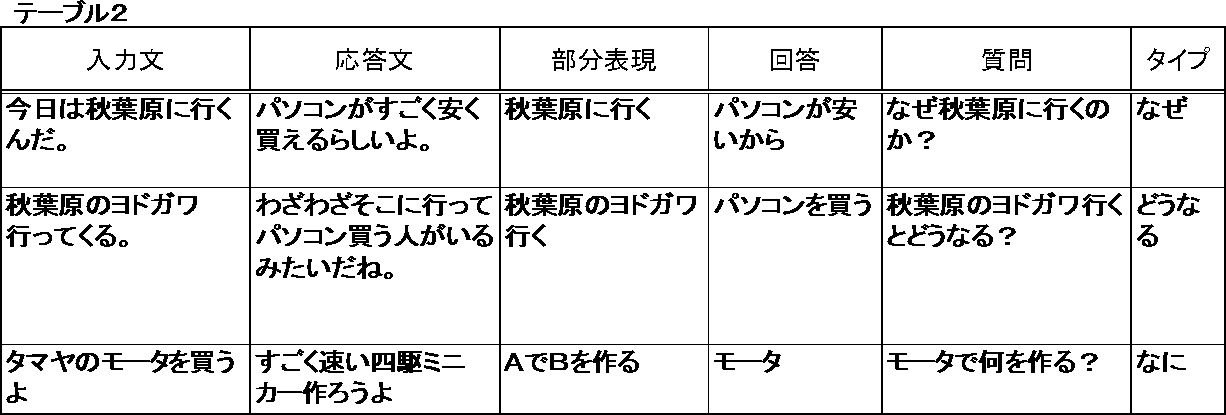
〈対話装置102〉
《質問生成部120》
図6を参照して、図1に示す対話装置102の質問生成部120は、入力文100に対して形態素解析を行う形態素解析部230と、形態素解析部230により形態素解析された入力文100に対して構文解析を行い、構文解析情報を付して出力する構文解析部232とを含む。
《質問生成部120》
図6を参照して、図1に示す対話装置102の質問生成部120は、入力文100に対して形態素解析を行う形態素解析部230と、形態素解析部230により形態素解析された入力文100に対して構文解析を行い、構文解析情報を付して出力する構文解析部232とを含む。
質問生成部120はさらに、構文解析部232により構文解析情報が付された入力文100から、なに型質問用の素性を抽出するためのなに型質問用素性抽出部234と、なに型質問用素性抽出部234により抽出された素性からなる素性ベクトルをなに型質問生成モデル82に入力することによりなに型質問生成モデル82から出力される質問の仮説と尤度情報に基づいてなに型質問を生成するなに型質問生成部236と、入力文100からなぜ型質問用の素性を抽出するためのなぜ型質問用素性抽出部240と、なぜ型質問用素性抽出部240から抽出された素性からなる素性ベクトルをなぜ型質問生成モデル92に入力することによりなぜ型質問生成モデル92から出力される質問の仮説と尤度情報に基づいてなぜ型質問を生成するなぜ型質問生成部242と、なに型質問生成部236により生成されるなに型質問と、なぜ型質問生成部242により生成されるなぜ型質問とを記憶するための質問記憶部244とを含む。
《発話生成部124》
図7を参照して、図1に示す対話装置102の発話生成部124は、質問文から発話候補を生成するための複数個の規則を予め記憶した発話生成規則記憶部262と、回答取得部122から与えられる回答に対し、発話生成規則記憶部262に記憶されている発話生成規則を適用して複数個の発話候補を生成する発話候補生成部260と、発話候補生成部260が生成した発話候補を記憶する発話候補記憶部264と、発話候補記憶部264に記憶されている発話候補を何らかの基準にしたがってスコア付けし、ランク付けするためのランキング部266と、ランキング部266により最も高くランク付けされた発話候補を選択する発話選択部268と、発話選択部268により選択された発話を、対話に適した口語的表現等を加えることにより整形し出力文106を生成するための発話整形部270とを含む。発話整形部270による整形は、例えば語尾に「だよ!」とか「だね!」とかいうような、口語的な語尾を付加することである。
図7を参照して、図1に示す対話装置102の発話生成部124は、質問文から発話候補を生成するための複数個の規則を予め記憶した発話生成規則記憶部262と、回答取得部122から与えられる回答に対し、発話生成規則記憶部262に記憶されている発話生成規則を適用して複数個の発話候補を生成する発話候補生成部260と、発話候補生成部260が生成した発話候補を記憶する発話候補記憶部264と、発話候補記憶部264に記憶されている発話候補を何らかの基準にしたがってスコア付けし、ランク付けするためのランキング部266と、ランキング部266により最も高くランク付けされた発話候補を選択する発話選択部268と、発話選択部268により選択された発話を、対話に適した口語的表現等を加えることにより整形し出力文106を生成するための発話整形部270とを含む。発話整形部270による整形は、例えば語尾に「だよ!」とか「だね!」とかいうような、口語的な語尾を付加することである。
ランキング部266によるランキングは、例えば以下のようにして行われる。質問・応答システム104から回答取得部122に送られてくる応答には、その応答が質問に対してどの程度適切なものかを示すスコアが付けられている。一方、図7に示す発話生成規則記憶部262に記憶されている発話生成規則には予めそれらの重要度が重みとして与えられている。ランキング部266は、基本的には両者の積に基づいてランク付けを行う。なお、図示していないが、言語モデルを用いることにより、発話候補の各々について発話の自然さをスコア付し、これをさらに用いてランク付けしても良い。
[動作]
上記した対話システム30は以下のように動作する。対話システム30は、大きく分けて学習フェーズとサービスフェーズとの2つの動作フェーズを持つ。
上記した対話システム30は以下のように動作する。対話システム30は、大きく分けて学習フェーズとサービスフェーズとの2つの動作フェーズを持つ。
〈学習フェーズ〉
学習フェーズでは、なに型質問生成モデル82及びなぜ型質問生成モデル92の学習について説明する。
学習フェーズでは、なに型質問生成モデル82及びなぜ型質問生成モデル92の学習について説明する。
図1に示される質問生成モデル構築部50は以下のように動作する。図2を参照して、入力文・応答文ペア収集部72の候補文ペア収集部130は、インターネット70上の様々なウェブサイト(特に投稿とそれに対する応答が主要な内容となっているサイト)を巡回し、入力文とそれに対する応答文とからなる候補文のペアを収集する。収集された候補文のペアは形態素解析部134に与えられる。
形態素解析部134は、与えられた候補ペアの内の入力文と応答文との双方について形態素解析を行い、得られた形態素列を構文解析部136に与える。構文解析部136は、各ペアに含まれる入力文と応答文との双方の形態素列に対して構文解析を行い、構文解析結果を付したペアを入力文・応答文ペア記憶部74に格納する。
図3を参照して、なに型質問・対話学習コーパス構築部76のパターン照合部150が、入力文・応答文ペア記憶部74から読み出された候補文ペアの入力文及び応答文の各々に存在する単語を抽出し、バイナリパターン辞書142に記憶されたバイナリペアのうちに、抽出された単語の組み合わせと一致するものがあるか否かを判定する。もしあれば、パターン照合部150は、その候補文ペアを、一致したバイナリペアに対応するバイナリパターンとともにクリーニング部152に与える。もしそのようなバイナリペアがなければ、バイナリパターン辞書142はその候補文ペアに対しては何もしない(破棄する)。
図4を参照して、長さ検査部132が、候補文ペアのうち応答文の長さが15単語以上か否かを判定する。長さ検査部132は、応答文が15単語以上である候補文ペアは破棄し、15単語未満のものは質問文生成部154に与える。述語抽出部170が、バイナリパターン辞書142から与えられる入力文・応答文ペアのうち、応答文に含まれる述語を抽出して述語マッチング部172に与える。述語マッチング部172はこの述語と一致する述語を含むバイナリパターンをバイナリパターン辞書142内で検索する。述語マッチング部172はこのとき、抽出された述語だけではなく、含意関係辞書140を参照して、抽出された述語と含意関係にある単語(含意関係の上下は問わない。)、又は同義関係にある単語についてもバイナリパターン辞書142内で該当するバイナリパターンを検索する。
述語マッチング部172は、該当するバイナリパターンがあればその結果を、なければ該当するバイナリパターンがなかったことを示す結果をペア選択部174に与える。ペア選択部174は、該当するバイナリパターンがあった場合にはその入力文・応答文ペアを質問文生成部154に与え、なかった場合には何もしない(破棄する)。
パターン照合部150及びクリーニング部152によるこのような処理により、なに型質問・対話学習コーパス78の学習を行うためのコーパスがノイジーになることを避けることができる。もちろん、学習データに対するこのようなクリーニング処理を行わなくても良い。
図3を参照して、質問文生成部154は、クリーニング部152から入力文・応答文ペアを受け取ると、質問生成規則記憶部146に記憶されている質問生成規則のうち、適用可能なものを適用して質問文を作成する。このとき、複数個の質問文が作成されてもよい。バイナリパターンは単純なパターンであるため、質問生成規則は比較的簡単なものでよい。例えば「AでBをプレイする。」というバイナリパターンの場合には、「Aで何をプレイするの?」「何でBをプレイするの?」のように変数の一部を疑問詞に置き換え、必要であればさらに文の末尾を疑問文らしく変形すればよい。
レコード作成部156は、入力文・応答文ペアを構成する入力文と応答文、バイナリペア、入力文・応答文ペアの内で、バイナリペアの変数に相当する単語のペア、質問文、及び質問のタイプをまとめて所定の形式のレコードを作成しコーパス追加部158に与える。コーパス追加部158は、このレコードをなに型質問・対話学習コーパス78に追加する。
図1に示すなに型質問生成モデルトレーニング部80は、このなに型質問・対話学習コーパス78に記憶されている多数のレコードからなに型質問生成モデル82をトレーニングするための学習データを作成し、なに型質問生成モデル82をトレーニングする。このトレーニングは、入力文が与えられると質問文の仮説とその尤度情報を生成するような統計的モデルとしてなに型質問生成モデル82をトレーニングするために行われる。この学習でどのような素性を用いるかについてはここでは詳細には述べないが、このモデルは基本的には入力文をソース言語、質問文をターゲット言語とする翻訳モデルと考えることができる。したがって、機械翻訳における翻訳モデルと同様の素性を用い、同じ技術を適用してトレーニングできる。もちろんこの場合、言語モデル等、通常の翻訳で使用するものと同様のモデルを、入力文と質問文との双方について別々に作成する必要があるが、図を見やすくするためにここではそれらについては図示はしていない。なお、このモデルは機械翻訳と同様の仕組みでトレーニングできるが、ソース言語とターゲット言語とが同じ言語なので、このモデルを用いて質問文を生成する場合には、入力文の部分表現(単語、単語列、述語等)が質問文にも出現することが通常である。このような性質は、なに型質問生成モデル82だけではなく、他のモデルであって、ソース言語とターゲット言語とが同一であるモデルには共通して現れる。
図5を参照して、図1に示すなぜ型質問・対話学習コーパス構築部86は以下のように動作する。部分表現抽出部190は、入力文・応答文ペア記憶部74から入力文・応答文ペアを1つずつ読み出し、入力文から、そのペアの主題を表す部分を係り受け関係を用いて抽出し、質問文生成部192に与える。質問文生成部192は、部分表現抽出部190により抽出された部分表現に対して所定の変形を施すことにより質問文を生成する。質問文生成部192が行う変形は、例えば「なぜ」「どうなる」「どうやって」等の表現を部分表現に付加することにより行われる。
さらに、回答取得部194が、質問文生成部192により生成された質問文を質問・回答システム196に与えることにより、質問・回答システム196から回答を取得しペア選択部198に与える。ペア選択部198は質問・回答システム196に与えた質問文と質問・回答システム196からの回答文とが一定量以上の共通の単語を含むときに、処理対象の入力文・応答文ペアを選択する。ペア選択部198は、それ以外の入力文・応答文ペアについては何もしない(破棄する)。レコード作成部200は、図3に示すなに型質問・対話学習コーパス構築部76のレコード作成部156と同様、ペア選択部198により選択された入力文・応答文ペアから、なぜ型質問・対話学習コーパス88に格納すべきレコードを作成する。コーパス追加部202は、レコード作成部200により作成されたレコードをなぜ型質問・対話学習コーパス88を構成するデータベースに追加する。
なぜ型質問・対話学習コーパス88が完成すると、なぜ型質問生成モデルトレーニング部90がこのなぜ型質問・対話学習コーパス88を用いてなぜ型質問生成モデル92のトレーニングを行う。なぜ型質問生成モデル92は、入力文が与えられるとその入力文に対するなぜ型の質問の仮説とその尤度情報を出力するような統計的モデルである。したがってなぜ型質問生成モデルトレーニング部90は、入力としてなぜ型質問・対話学習コーパス88の各入力文を用い、教師データとしてなぜ型質問・対話学習コーパス88の質問文を用いてなぜ型質問生成モデル92の学習を行う。このモデルも、基本的には、入力文をソース言語とし、質問文をターゲット言語とした翻訳モデルと考えられる。翻訳の際に必要となる言語モデルも入力文と質問文との双方に必要となるが、ここでは説明を簡略にするために図示していない。
なに型質問生成モデル82及びなぜ型質問生成モデル92のトレーニングが完了すると、対話装置102による対話動作が可能になる。
なお、これ以外のモデルについても、いずれも統計的モデルであり、上と同様にしてトレーニングを行うことができる。トレーニングにおける素性としてどのようなものを用いるかが問題となるが、通常の自然言語処理にしたがって、単語nグラム、品詞nグラム、構文解析木のパス上の単語nグラム又は品詞nグラム等を用いることが考えられる。教師データとしては、通常は人手で正解を与える。もちろん、教師データに相当するデータを推定できるプログラムツールがあれば、それらを用いてトレーニングデータを充実させることが可能である。
〈対話装置102による対話〉
図6を参照して、ユーザから入力文100が与えられると、質問生成部120の形態素解析部230はこの入力文100に対する形態素解析を行う。構文解析部232が形態素解析部230の出力する形態素列に基づいて構文解析を行い、その結果をなに型質問用素性抽出部234となぜ型質問用素性抽出部240に与える。
図6を参照して、ユーザから入力文100が与えられると、質問生成部120の形態素解析部230はこの入力文100に対する形態素解析を行う。構文解析部232が形態素解析部230の出力する形態素列に基づいて構文解析を行い、その結果をなに型質問用素性抽出部234となぜ型質問用素性抽出部240に与える。
なに型質問用素性抽出部234は構文解析部232により構文解析情報が付された入力文100から、なに型質問用の素性を抽出する。なに型質問生成部236は、なに型質問用素性抽出部234により抽出された素性からなる素性ベクトルをなに型質問生成モデル82に入力することによりなに型質問生成モデル82から出力される質問の仮説と尤度情報に基づいてなに型質問を生成する。これと並行して、なぜ型質問用素性抽出部240は、入力文100からなぜ型質問用の素性を抽出する。なぜ型質問生成部242は、なぜ型質問用素性抽出部240から抽出された素性からなる素性ベクトルをなぜ型質問生成モデル92に入力することによりなぜ型質問生成モデル92から出力される質問の仮説と尤度情報に基づいてなぜ型質問を生成する。質問記憶部244は、なに型質問生成部236により生成されるなに型質問と、なぜ型質問生成部242により生成されるなぜ型質問とをともに記憶する。
図7を参照して、発話生成部124の発話生成規則記憶部262には、質問文から発話候補を生成するための複数個の規則が予め記憶されている。発話候補生成部260は、回答取得部122から与えられる回答に対し、発話生成規則記憶部262に記憶されている発話生成規則を適用して複数個の発話候補を生成する。発話候補記憶部264は、発話候補生成部260が生成した発話候補を記憶する。ランキング部266は、発話候補記憶部264に記憶されている発話候補を何らかの基準にしたがってランク付けする。発話選択部268は、ランキング部266により最も高くランク付けされた発話候補を選択する。発話整形部270は、発話選択部268により選択された発話に、対話に適した口語的表現等を加えることにより整形し出力文106を生成する。
以上のように本実施の形態によれば、単に入力文に関連すると思われる情報から出力文を生成するのではない。入力文から一旦質問文を生成して質問・応答システムに与えてその回答を得る。この質問は、ユーザ発話から不要な情報を除去して生成したものであり、かつウェブ上で頻繁に見られる情報に基づくもので、入力文におけるユーザの発話意図を明確に表している。質問・応答システムは、この質問に対し適切な関係を持つ回答を出力する。この回答を用いて、ユーザ発話に対する出力文が生成される。質問を生成することによってユーザ発話とシステム発話との関係が適切に捉えられ、対話の流れを適切に制御することができる。
[第2の実施の形態]
第1の実施の形態では、質問生成は質問生成規則によって行われている。質問生成は、比較的規則化し易いため、このように質問生成規則を用いることも可能である。しかし本発明は質問生成規則を用いる第1の実施の形態には限定されない。質問生成を規則ではなく統計的モデルによって行っても良い。第2の実施の形態はそのような構成を持つ。なお、この第2の実施の形態においては、図6に示す質問生成部120に代えて図8に示す質問生成部300を用い、図7に示す発話生成部124に代えて図9に示す発話生成部350を用いる。その他の点では第2の実施の形態は第1の実施の形態の各部と同様である。
第1の実施の形態では、質問生成は質問生成規則によって行われている。質問生成は、比較的規則化し易いため、このように質問生成規則を用いることも可能である。しかし本発明は質問生成規則を用いる第1の実施の形態には限定されない。質問生成を規則ではなく統計的モデルによって行っても良い。第2の実施の形態はそのような構成を持つ。なお、この第2の実施の形態においては、図6に示す質問生成部120に代えて図8に示す質問生成部300を用い、図7に示す発話生成部124に代えて図9に示す発話生成部350を用いる。その他の点では第2の実施の形態は第1の実施の形態の各部と同様である。
図8を参照して、この質問生成部300は、入力文100を受けるように接続された形態素解析部230と、形態素解析部230の出力を受けるように接続された構文解析部232とを含む。質問生成部300はさらに、予め統計的に学習をしている主題推定用モデル310と、構文解析部232から出力される構文解析情報が付された入力文100から所定の素性ベクトルを生成し、主題推定用モデル310を参照して入力文100の主題を推定するための主題推定部312と、対話の主題が与えられると、その主題に基づいてなに型質問の仮説をそれらの尤度情報とともに出力するよう予めトレーニング済のなに型質問生成用モデル316と、主題推定部312の出力する主題から素性を抽出し、なに型質問生成用モデル316を用いてなに型質問を生成するためのなに型質問生成部314とを含む。
質問生成部300はさらに、構文解析情報が付された入力文100から得られた所定の素性ベクトルが与えられると、入力文100の中に含まれるユナリフレーズを部分表現の仮説とその尤度情報とを出力するように予めトレーニング済の部分表現推定用モデル320と、構文解析部232から出力される、構文解析情報が付された入力文100から所定の素性を抽出し素性ベクトルとして部分表現推定用モデル320に与え、その出力する部分表現仮説とその尤度情報に基づいて入力文100内の部分表現を特定するための部分表現特定部322とを含む。
質問生成部300はさらに、部分表現から抽出した所定の素性が与えられると、その部分表現に基づいて適切ななぜ型質問を生成するための質問仮説とそれらの尤度情報を出力するよう予めトレーニング済のなぜ型質問生成用モデル326と、部分表現特定部322により特定された部分表現から素性を抽出しなぜ型質問生成用モデル326に与えて、その出力に基づいて、入力文100に応じて対話を適切に制御するためのなぜ型質問を生成するためのなぜ型質問生成部324と、なに型質問生成部314により生成された質問及びなぜ型質問生成部324により生成された質問を記憶するための質問記憶部244とを含む。
一方、図9を参照して、この第2の実施の形態における発話生成部350は、発話の材料として何らかの文が与えられると、その文に基づいてユーザに対して出力する発話の仮説とそれらの尤度情報を出力するよう予め学習済の発話生成モデル362と、質問・応答システム104(図1参照)からの回答が回答取得部122(図1参照)から与えられると、その回答を発話生成モデル362に入力し、発話生成モデル362が出力する発話仮説と尤度情報に基づいて発話候補を生成するための発話候補生成部360と、発話候補生成部360により生成された発話候補を記憶するための発話候補記憶部264を始めとして図7に示すものと同様に接続されたランキング部266、発話選択部268、及び発話整形部270を含む。
この第2の実施の形態に係るシステムは以下のように動作する。ここでは、質問生成部300及び発話生成部350の動作のみについて説明する。
入力文100が図8に示す質問生成部300の形態素解析部230に与えられると、形態素解析部230は入力文100に対する形態素解析を行って形態素列を構文解析部232に与える。構文解析部232はこの形態素列に対して構文解析を行って構文解析情報を付した入力文100を主題推定部312及び部分表現特定部322に与える。
主題推定部312は、この構文解析情報と入力文100とから主題推定用モデル310に与える素性を抽出し、素性ベクトルの形で主題推定用モデル310に与え、その出力する主題の仮説と尤度情報に基づいて入力文100の主題を推定する。主題推定部312は、この主題をなに型質問生成部314に与える。なに型質問生成部314は、この主題に基づいて、なに型質問生成用モデル316のための素性を得て、素性ベクトルの形でなに型質問生成用モデル316に与える。なに型質問生成部314は、なに型質問生成用モデル316から出力される質問の仮説と尤度情報に基づいてなに型質問を生成し質問記憶部244に記憶させる。
一方、部分表現特定部322は、構文解析部232から与えられた構文解析情報と入力文100とから、部分表現を推定するための素性を抽出し、素性ベクトルの形で部分表現推定用モデル320に与える。部分表現推定用モデル320はこの素性ベクトルに基づいて入力文100内の部分表現の仮説とそれらの尤度情報を出力する。部分表現特定部322は尤度情報に基づいて部分表現を推定し、この部分表現をなぜ型質問生成部324に与える。なぜ型質問生成部324はこの部分表現に基づき、なぜ型質問を生成するための素性ベクトルを作成し、なぜ型質問生成用モデル326に与える。なぜ型質問生成用モデル326はこの素性ベクトルが与えられると、なぜ型質問の仮説とそれらの尤度情報を出力する。なぜ型質問生成部324は、この質問の仮説と尤度情報とに基づいて質問候補を生成し質問記憶部244に記憶させる。なお、なに型質問生成部314及びなぜ型質問生成部324は、いずれも質問候補を複数個生成する。
図1に示す回答取得部122は、これら複数個の質問を質問・応答システム104に与えることで、複数個の応答を質問・応答システム104から得る。質問・応答システム104は、これらの応答を図9に示す発話生成部350の発話候補生成部360に与える。発話候補生成部360は、これら応答の各々から、発話生成モデル362のための素性ベクトルを抽出し、発話生成モデル362に与え、その出力する発話仮説とそれらの尤度情報に基づいて発話候補を生成する。発話候補生成部360は、発話生成モデル362の出力に基づいて生成した発話候補を発話候補記憶部264に記憶させる。なお、発話生成モデル362の出力する発話仮説と尤度情報に基づいて生成された発話候補の各々には、発話生成モデル362によるスコアが付されている。このスコアは、与えられた素性ベクトルに対して発話候補がどの程度適切なものかを示す値である。
ランキング部266、発話選択部268及び発話整形部270の動作は第1の実施の形態と同様である。なお、ランキング部266が行うランク付けも第1の実施の形態と同様であるが、この第2の実施の形態では、発話規則の重要度ではなく、発話生成モデル362が各発話候補に付すスコアを用いる点が異なる。さらに本実施の形態では、質問・応答システム104に与えられる質問についても、質問生成部300において主題推定用モデル310、なに型質問生成用モデル316、部分表現推定用モデル320及びなぜ型質問生成用モデル326によりスコアが付されている。したがって、最終の発話候補のスコアリングにこれらのスコアを反映させるようにしてもよい。
[第3の実施の形態]
第2の実施の形態では、発話生成モデル362を用いている。この発話生成モデル362は、質問・応答システム104からの応答に対して適用されて回答仮説をそれらの尤度情報とともに出力する。ところが、質問・応答システム104からの応答は、質問のバリエーションに応じてバリエーションが非常に大きくなる可能性がある。そうした場合には、発話生成モデル362をトレーニングするための学習データが疎となり、発話生成モデル362を用いた発話候補の生成の精度が低くなる危険性がある。そのため、この第3の実施の形態では、例えば学習データがユナリフレーズを含むものとして、その中の名詞を一般的な変数に置換した上で発話生成モデルのトレーニングを行うことによってこうした問題を解決する。この場合、発話生成モデルが出力する仮説にも変数が含まれることになる。
第2の実施の形態では、発話生成モデル362を用いている。この発話生成モデル362は、質問・応答システム104からの応答に対して適用されて回答仮説をそれらの尤度情報とともに出力する。ところが、質問・応答システム104からの応答は、質問のバリエーションに応じてバリエーションが非常に大きくなる可能性がある。そうした場合には、発話生成モデル362をトレーニングするための学習データが疎となり、発話生成モデル362を用いた発話候補の生成の精度が低くなる危険性がある。そのため、この第3の実施の形態では、例えば学習データがユナリフレーズを含むものとして、その中の名詞を一般的な変数に置換した上で発話生成モデルのトレーニングを行うことによってこうした問題を解決する。この場合、発話生成モデルが出力する仮説にも変数が含まれることになる。
図10を参照して、この第3の実施の形態に係る発話生成部380は、図9の発話生成モデル362に代えて、上記したように予めトレーニングした発話生成モデル394と、回答取得部122から与えられる質問・応答システムの応答のうち、ユナリフレーズの名詞部分を変数シンボルに置換するための単語置換部390と、単語置換部390から与えられた、変数シンボルを含む応答から素性を抽出し、素性ベクトルとして発話生成モデル394に与えることにより、発話生成モデル394に変数シンボルを含む発話仮説を尤度情報とともに出力させ、それらに基づいて発話候補を生成する発話候補生成部392と、発話候補生成部392が出力する発話候補に含まれる変数シンボルを、単語置換部390が置換した元の単語で置換することにより発話候補を完成し発話候補記憶部264に記憶させる変数置換部396を含む。
発話生成部380の構成及び動作は、これ以外の部分では図9に示す発話生成部350と同じである。
この実施の形態の装置によれば、発話生成モデル394のトレーニングデータが疎になることが防止でき、モデルによる発話候補の生成の精度を高めることができる。
[第4の実施の形態]
上記第1~第3の実施の形態においては、対話装置102等は質問・応答システム104に対して自然言語文からなる質問を送り、その応答を用いて次の発話を生成することにより対話を制御していた。しかし本発明はそのような実施の形態には限定されない。質問・応答システム104に代えて、入力文から生成した何らかのパラメータに応答して、対話のための情報を出力する仕組みを持つシステムであればどのようなものでも利用できる。例えば、図1に示す質問・応答システム104のような一般的なシステムの場合、質問に対する応答のための情報を検索したり作成したりするためのコアシステムと、外部からの質問を分析し、コアシステムに与えるパラメータを生成する入力インターフェイス部分と、コアシステムが出力する、応答を生成するための情報(例えば単語群)を用いて応答文を生成し、質問を送ってきた端末などに送信する出力インターフェイスとを持つ。
上記第1~第3の実施の形態においては、対話装置102等は質問・応答システム104に対して自然言語文からなる質問を送り、その応答を用いて次の発話を生成することにより対話を制御していた。しかし本発明はそのような実施の形態には限定されない。質問・応答システム104に代えて、入力文から生成した何らかのパラメータに応答して、対話のための情報を出力する仕組みを持つシステムであればどのようなものでも利用できる。例えば、図1に示す質問・応答システム104のような一般的なシステムの場合、質問に対する応答のための情報を検索したり作成したりするためのコアシステムと、外部からの質問を分析し、コアシステムに与えるパラメータを生成する入力インターフェイス部分と、コアシステムが出力する、応答を生成するための情報(例えば単語群)を用いて応答文を生成し、質問を送ってきた端末などに送信する出力インターフェイスとを持つ。
仮に外部装置がこの入出力インターフェイスと同様の機能を持っていたならば、外部装置はわざわざ自然言語文を生成してこの装置に与えなくても、質問文を解析した結果をコアシステムの入力仕様にあわせてコアシステムに与えてやればよい。また、コアシステムからの出力は外部インターフェイスを介して自然言語の形で応答として外部装置に与えられるが、外部装置が人間ではない場合には、わざわざこのようにコアシステムの出力を自然言語に変換する必要はない。コアシステムの出力をそのまま受け取り、外部装置がそれを目的にあわせて処理すればよい。第4の実施の形態はそのようなシステムに関する。
図11を参照して、この第4の実施の形態に係る対話システム400は、第1の実施の形態と同様の構成を持つ質問生成モデル構築部50、なに型質問生成モデル82、及びなぜ型質問生成モデル92を含む他、第1の実施の形態の対話装置102に代えて、入力文100に応答し、なに型質問生成モデル82及びなぜ型質問生成モデル92を用いて生成される自然言語文から外部の質問・応答システム412のコアシステム450に直接与える、質問を表すパラメータを生成し、質問・応答システム412に与えて、質問・応答システム412から得られた情報から出力文414を生成するための対話装置410を含む。
対話装置410は、入力文100を受けて、なに型質問生成モデル82及びなぜ型質問生成モデル92を用いて得られる質問文から、質問・応答システム412のコアシステムに与えるパラメータを生成するためのパラメータ生成部430と、パラメータ生成部430により生成されたパラメータを質問・応答システム412のコアシステムに直接送信するためのパラメータ送信部432と、このパラメータに対して質問・応答システム412が出力する、応答を生成するための情報を受信するための応答受信部434と、応答受信部434が受信した情報に基づいて、入力文100に対する発話を生成し出力する発話生成部436とを含む。
質問・応答システム412は、コアシステム450と、外部から自然言語文の形で与えられる質問を解析し、コアシステム450に与えるパラメータを生成しコアシステム450に与えるための入力インターフェイス452と、質問に対してコアシステム450が出力する情報をコアシステム450から受け取り、その情報から自然言語文を生成して応答として出力するための出力インターフェイス454とを含む。コアシステム450は、入力インターフェイス452から入力パラメータを受信するための入力部470と、コアシステムが生成した、質問に対する応答を生成するための情報を出力する出力部472とを持つ。
通常は、入力インターフェイス452が外部装置から自然言語文の質問文の入力を受け、解析してコアシステム450への入力パラメータを生成して入力部470に与える。これに対してコアシステム450が内部DBを用いて応答するための情報を検索し、出力部472を介して出力する。出力インターフェイス454がこの情報に基づき、応答としてふさわしい自然言語文を生成して出力する。
しかし、こうした動作は、質問文の入力をしたものが人間であることを想定している。本実施の形態のように、対話装置410が質問・応答システム412を利用するときには、わざわざ自然言語文を用いた入出力を行う必要はない。そこで、本実施の形態では、パラメータ生成部430がコアシステム450の入力部470に質問を表すパラメータを直接与え、コアシステム450が出力する情報を応答受信部434が直接出力部472から受信する。発話生成部436が、この単語群から、ユーザに対する次の発話を生成し出力文414として出力する。
このようにすると、質問・応答システム412との間で自然言語文でのやり取りをする必要がなくなり、質問・応答システム412のコアシステムを利用してより効率よく対話を行うことができる。
なお、なに型質問生成モデル82及びなぜ型質問生成モデル92については、質問・応答システム412のコアシステム450の特性又は仕様にあわせて、入力文が与えられると、コアシステム450に対する適切な質問のパラメータを直接に生成できるように学習するとなお効率がよくなる。例えば、なに型質問生成モデル82及びなぜ型質問生成モデル92に代えて、入力文が与えられると、質問文を生成するのではなく、直接にコアシステム450に与えるパラメータを生成するようトレーニングしたモデルを用いればよい。そのためには、質問生成モデル構築部50において、モデルの学習データとして、入力文とそれ対応する質問文との組を用いるのではなく、入力文と、それに対応する質問と等価なパラメータを用いてこれらモデルをトレーニングする。このようなモデルを用いる場合、入力文100に対してなに型質問生成モデル82及びなぜ型質問生成モデル92からは、質問と等価なパラメータが得られる。パラメータ生成部430は、このパラメータをなんら加工することなく、そのままパラメータ送信部432を介してコアシステム450に与えてやれば良い。
パラメータ生成部430が生成するパラメータは、コアシステム450の入力仕様に依存する。コアシステム450の入力仕様が公表されていない場合には、本実施の形態に係る対話装置410は使用できない。
なお、パラメータ生成部430が生成するパラメータがコアシステム450の仕様に依存するため、異なる仕様のコアシステムを持つ質問・応答システムを複数個利用する場合には、なに型質問生成モデル82、なぜ型質問生成モデル92及び対話装置410を実質的に複数個組み合わせて使用する必要がある。
以上のように本発明によれば、ユーザの発話に対する応答を生成するにあたり、ユーザの発話の係り受け関係を有効に利用している。さらに、システムで使用する統計的モデル生成にあたり、実際にウェブ及びSNS上に出現している対話情報を基礎にしているので、対話の流れが不自然になることが防止できる。また、発話に含まれる多くの情報の中から、質問・応答システムへの質問を生成する際に不要な情報を削除している。したがって、ユーザ発話に対して自然な対話を導く適切なシステム発話を生成できる。また、質問・応答システムへの質問をユーザの発話に基づいて生成し、その質問に対する応答を用いて発話を生成しているので、生成された質問によってユーザの発話とシステム発話の関係を捉え、システム発話及び対話の流れを制御できる。
[コンピュータによる実現]
本発明の各実施の形態に係る対話システム、対話装置及び質問生成モデル構築部は、コンピュータハードウェアと、そのコンピュータハードウェア上で実行されるコンピュータプログラムとにより実現できる。図12はこのコンピュータシステム530の外観を示し、図13はコンピュータシステム530の内部構成を示す。
本発明の各実施の形態に係る対話システム、対話装置及び質問生成モデル構築部は、コンピュータハードウェアと、そのコンピュータハードウェア上で実行されるコンピュータプログラムとにより実現できる。図12はこのコンピュータシステム530の外観を示し、図13はコンピュータシステム530の内部構成を示す。
図12を参照して、このコンピュータシステム530は、メモリポート552及びDVD(Digital Versatile Disc)ドライブ550を有するコンピュータ540と、キーボード546と、マウス548と、モニタ542とを含む。
図13を参照して、コンピュータ540は、メモリポート552及びDVDドライブ550に加えて、CPU(中央処理装置)556と、CPU556、メモリポート552及びDVDドライブ550に接続されたバス566と、ブートプログラム等を記憶する読出専用メモリ(ROM)558と、バス566に接続され、プログラム命令、システムプログラム及び作業データ等を記憶するランダムアクセスメモリ(RAM)560と、ハードディスク554を含む。コンピュータシステム530はさらに、バス566に接続され、音声信号をデジタル化してコンピュータにおいて処理可能な形式に変換するためのサウンドボード568と、他端末との通信を可能とするネットワーク572への接続を提供するネットワークインターフェイスカード(NIC)574を含む。サウンドボード568にはマイクロフォン570が接続される。
コンピュータシステム530を上記した各実施の形態に係る対話システムの各機能部として機能させるためのコンピュータプログラムは、DVDドライブ550又はメモリポート552に装着されるDVD562又はリムーバブルメモリ564に記憶され、さらにハードディスク554に転送される。又は、プログラムはネットワーク568を通じてコンピュータ540に送信されハードディスク554に記憶されてもよい。プログラムは実行の際にRAM560にロードされる。DVD562から、リムーバブルメモリ564から又はネットワーク568を介して、直接にRAM560にプログラムをロードしてもよい。
このプログラムは、コンピュータ540を、上記各実施の形態に係る各対話システムの各機能部として機能させるための複数個の命令からなる命令列を含む。コンピュータ540にこの動作を行わせるのに必要な基本的機能のいくつかはコンピュータ540上で動作するオペレーティングシステム若しくはサードパーティのプログラム又はコンピュータ540にインストールされる、ダイナミックリンク可能な各種プログラミングツールキット又はプログラムライブラリにより提供される。したがって、このプログラム自体はこの実施の形態のシステム、装置及び方法を実現するのに必要な機能全てを必ずしも含まなくてよい。このプログラムは、命令のうち、所望の結果が得られるように制御されたやり方で適切な機能又はプログラミングツールキット又はプログラムライブラリ内の適切なプログラムを実行時に動的に呼出すことにより、上記したシステム、装置又は方法としての機能を実現する命令のみを含んでいればよい。もちろん、プログラムのみで必要な機能を全て提供してもよい。
今回開示された実施の形態は単に例示であって、本発明が上記した実施の形態のみに制限されるわけではない。本発明の範囲は、発明の詳細な説明の記載を参酌した上で、請求の範囲の各請求項によって示され、そこに記載された文言と均等の意味及び範囲内での全ての変更を含む。
以上のように本発明は、あらゆる産業において、ユーザとの対話が必要な場面において利用可能であり、特に、自然な対話が重要となる機器及びサービス、並びにそうした機器及びサービスにおけるインターフェイスに利用できる。
30、400 対話システム
50 質問生成モデル構築部
70 インターネット
72 入力文・応答文ペア収集部
74 入力文・応答文ペア記憶部
76 なに型質問・対話学習コーパス構築部
78 なに型質問・対話学習コーパス
80 なに型質問生成モデルトレーニング部
82 なに型質問生成モデル
86 なぜ型質問・対話学習コーパス構築部
88 なぜ型質問・対話学習コーパス
90 なぜ型質問生成モデルトレーニング部
92 なぜ型質問生成モデル
100 入力文
102、410 対話装置
104、412 質問・応答システム
106、414 出力文
120、300 質問生成部
122、194 回答取得部
124、350、380、436 発話生成部
130 候補文ペア収集部
132 長さ検査部
134、230 形態素解析部
136、232 構文解析部
140 含意関係辞書
142 バイナリパターン辞書
146 質問生成規則記憶部
150 パターン照合部
152 クリーニング部
154、192 質問文生成部
156、200 レコード作成部
158、202 コーパス追加部
170 述語抽出部
172 述語マッチング部
174、198 ペア選択部
190 部分表現抽出部
196 質問・回答システム
234 なに型質問用素性抽出部
236、314 なに型質問生成部
240 なぜ型質問用素性抽出部
242、324 なぜ型質問生成部
244 質問記憶部
260、360、392 発話候補生成部
262 発話生成規則記憶部
264 発話候補記憶部
266 ランキング部
268 発話選択部
270 発話整形部
268 発話選択部
310 主題推定用モデル
312 主題推定部
316 なに型質問生成用モデル
320 部分表現推定用モデル
322 部分表現特定部
326 なぜ型質問生成用モデル
362、394 発話生成モデル
390 単語置換部
396 変数置換部
430 パラメータ生成部
432 パラメータ送信部
434 応答受信部
450 コアシステム
50 質問生成モデル構築部
70 インターネット
72 入力文・応答文ペア収集部
74 入力文・応答文ペア記憶部
76 なに型質問・対話学習コーパス構築部
78 なに型質問・対話学習コーパス
80 なに型質問生成モデルトレーニング部
82 なに型質問生成モデル
86 なぜ型質問・対話学習コーパス構築部
88 なぜ型質問・対話学習コーパス
90 なぜ型質問生成モデルトレーニング部
92 なぜ型質問生成モデル
100 入力文
102、410 対話装置
104、412 質問・応答システム
106、414 出力文
120、300 質問生成部
122、194 回答取得部
124、350、380、436 発話生成部
130 候補文ペア収集部
132 長さ検査部
134、230 形態素解析部
136、232 構文解析部
140 含意関係辞書
142 バイナリパターン辞書
146 質問生成規則記憶部
150 パターン照合部
152 クリーニング部
154、192 質問文生成部
156、200 レコード作成部
158、202 コーパス追加部
170 述語抽出部
172 述語マッチング部
174、198 ペア選択部
190 部分表現抽出部
196 質問・回答システム
234 なに型質問用素性抽出部
236、314 なに型質問生成部
240 なぜ型質問用素性抽出部
242、324 なぜ型質問生成部
244 質問記憶部
260、360、392 発話候補生成部
262 発話生成規則記憶部
264 発話候補記憶部
266 ランキング部
268 発話選択部
270 発話整形部
268 発話選択部
310 主題推定用モデル
312 主題推定部
316 なに型質問生成用モデル
320 部分表現推定用モデル
322 部分表現特定部
326 なぜ型質問生成用モデル
362、394 発話生成モデル
390 単語置換部
396 変数置換部
430 パラメータ生成部
432 パラメータ送信部
434 応答受信部
450 コアシステム
Claims (6)
- ユーザからの入力発話を受け、当該入力発話に含まれる表現を用いて、質問・応答システムを利用するためのパラメータを生成するパラメータ生成手段と、
前記パラメータ生成手段により生成されたパラメータを前記質問・応答システムに入力し、当該パラメータに対する回答を取得する回答取得手段と、
前記回答取得手段が取得した回答に基づいて、前記入力発話に対する応答を生成する応答生成手段とを含む、対話システム。 - 前記パラメータ生成手段は、
前記入力発話に対する形態素解析及び構文解析を行う発話解析手段と、
前記発話解析手段により解析された結果から、前記入力発話の主題を推定する主題推定手段と、
前記主題推定手段により推定された主題に基づいて、当該主題を構成する部分表現を含むファクトイド型質問を生成するファクトイド型質問生成手段とを含む、請求項1に記載の対話システム。 - 前記パラメータ生成手段は、
前記発話解析手段により解析された結果から、前記入力発話を代表する部分表現を特定する部分表現特定手段と、
前記部分表現特定手段により特定された部分表現に基づいて、ノン・ファクトイド型質問を生成するノン・ファクトイド型質問生成手段とを含む、請求項1に記載の対話システム。 - 前記応答生成手段は、
前記回答に対して予め準備された発話生成規則を適用することにより、発話候補を生成する発話候補生成手段と、
前記発話候補を予め準備された発話整形規則にしたがって整形して前記入力発話に対する前記応答を生成する発話整形手段とを含む、請求項1~請求項3のいずれかに記載の対話システム。 - 前記応答生成手段は、
質問に対する回答が与えられると、当該回答から発話を生成するよう予め学習した発話生成モデルと、
前記発話生成モデルが生成した発話を、予め準備された発話整形規則にしたがって整形して前記入力発話に対する前記応答を生成する発話整形手段とを含む、請求項1~請求項3のいずれかに記載の対話システム。 - コンピュータを、請求項1~請求項5のいずれかに記載の対話システムとして機能させる、コンピュータプログラム。
Priority Applications (3)
| Application Number | Priority Date | Filing Date | Title |
|---|---|---|---|
| CN201780043642.1A CN109478188A (zh) | 2016-08-16 | 2017-07-26 | 对话系统以及用于其的计算机程序 |
| US16/321,988 US10936664B2 (en) | 2016-08-16 | 2017-07-26 | Dialogue system and computer program therefor |
| KR1020197001187A KR102388042B1 (ko) | 2016-08-16 | 2017-07-26 | 대화 시스템 및 그것을 위한 컴퓨터 프로그램 |
Applications Claiming Priority (2)
| Application Number | Priority Date | Filing Date | Title |
|---|---|---|---|
| JP2016159505A JP6819990B2 (ja) | 2016-08-16 | 2016-08-16 | 対話システム及びそのためのコンピュータプログラム |
| JP2016-159505 | 2016-08-16 |
Publications (1)
| Publication Number | Publication Date |
|---|---|
| WO2018034118A1 true WO2018034118A1 (ja) | 2018-02-22 |
Family
ID=61196539
Family Applications (1)
| Application Number | Title | Priority Date | Filing Date |
|---|---|---|---|
| PCT/JP2017/027011 Ceased WO2018034118A1 (ja) | 2016-08-16 | 2017-07-26 | 対話システム及びそのためのコンピュータプログラム |
Country Status (5)
| Country | Link |
|---|---|
| US (1) | US10936664B2 (ja) |
| JP (1) | JP6819990B2 (ja) |
| KR (1) | KR102388042B1 (ja) |
| CN (1) | CN109478188A (ja) |
| WO (1) | WO2018034118A1 (ja) |
Families Citing this family (27)
| Publication number | Priority date | Publication date | Assignee | Title |
|---|---|---|---|---|
| WO2019187463A1 (ja) * | 2018-03-27 | 2019-10-03 | 株式会社Nttドコモ | 対話サーバ |
| US11106664B2 (en) * | 2018-05-03 | 2021-08-31 | Thomson Reuters Enterprise Centre Gmbh | Systems and methods for generating a contextually and conversationally correct response to a query |
| JP6775545B2 (ja) * | 2018-05-09 | 2020-10-28 | 日本電信電話株式会社 | 対話データ生成装置、対話データ生成方法、およびプログラム |
| US10872208B2 (en) * | 2018-12-20 | 2020-12-22 | Rakuten, Inc. | Sentence conversion system, sentence conversion method, and information storage medium |
| KR102778472B1 (ko) * | 2019-02-08 | 2025-03-12 | 삼성디스플레이 주식회사 | 표시 장치 및 그 제조방법 |
| US11526674B2 (en) * | 2019-03-01 | 2022-12-13 | Rakuten Group, Inc. | Sentence extraction system, sentence extraction method, and information storage medium |
| JP7215309B2 (ja) * | 2019-04-16 | 2023-01-31 | 日本電信電話株式会社 | 発話文拡張装置、発話文生成装置、発話文拡張方法、およびプログラム |
| US11410643B2 (en) * | 2019-08-12 | 2022-08-09 | Microsoft Technology Licensing, Llc | Response generation for conversational computing interface |
| CN111125330A (zh) * | 2019-12-19 | 2020-05-08 | 厦门快商通科技股份有限公司 | 一种基于人机对话的智能问答方法和装置以及设备 |
| CN111143527A (zh) * | 2019-12-19 | 2020-05-12 | 厦门快商通科技股份有限公司 | 一种基于人机对话的自动问答方法和装置以及设备 |
| CN111858869B (zh) * | 2020-01-03 | 2024-06-04 | 北京嘀嘀无限科技发展有限公司 | 一种数据匹配方法、装置、电子设备和存储介质 |
| JP7200154B2 (ja) * | 2020-02-14 | 2023-01-06 | Kddi株式会社 | 受話文に対する応答文を推論するプログラム、装置及び方法 |
| CN111400466A (zh) * | 2020-03-05 | 2020-07-10 | 中国工商银行股份有限公司 | 一种基于强化学习的智能对话方法及装置 |
| US11676496B2 (en) * | 2020-03-19 | 2023-06-13 | Honeywell International Inc. | Methods and systems for querying for parameter retrieval |
| US11521616B2 (en) | 2020-10-13 | 2022-12-06 | Merlin Labs, Inc. | System and/or method for semantic parsing of air traffic control audio |
| US11423887B2 (en) | 2020-10-13 | 2022-08-23 | Merlin Labs, Inc. | System and/or method for semantic parsing of air traffic control audio |
| KR102654480B1 (ko) * | 2020-11-05 | 2024-04-04 | 한국전자통신연구원 | 언어학습을 위한 지식 기반 대화 시스템 및 방법 |
| JP7224327B2 (ja) * | 2020-11-18 | 2023-02-17 | 西日本電信電話株式会社 | 文書作成支援装置、文書作成支援方法およびプログラム |
| EP4016502B1 (en) * | 2020-12-17 | 2025-06-18 | The Boeing Company | Dialogue system for autonomous aircraft |
| US12333246B1 (en) * | 2021-12-17 | 2025-06-17 | American Express (India) Private Limited | Automated question-answer generation system for documents |
| US12322410B2 (en) * | 2022-04-29 | 2025-06-03 | Honeywell International, Inc. | System and method for handling unsplit segments in transcription of air traffic communication (ATC) |
| US11862031B1 (en) | 2023-03-24 | 2024-01-02 | Merlin Labs, Inc. | System and/or method for directed aircraft perception |
| JP2024138678A (ja) * | 2023-03-27 | 2024-10-09 | 国立研究開発法人情報通信研究機構 | 仮説生成装置及び仮説生成方法 |
| CN118410132B (zh) * | 2023-04-07 | 2024-12-06 | 重庆邮电大学 | 一种基于大数据的智能政务问答系统 |
| CN117332072B (zh) * | 2023-12-01 | 2024-02-13 | 阿里云计算有限公司 | 对话处理、语音摘要提取以及目标对话模型训练方法 |
| CN117828017B (zh) * | 2023-12-27 | 2024-05-28 | 中建八局第一数字科技有限公司 | 一种智能问答方法、装置及电子设备 |
| WO2025150134A1 (ja) * | 2024-01-11 | 2025-07-17 | 日本電気株式会社 | 情報処理装置、検査支援方法、及び検査支援プログラム |
Citations (2)
| Publication number | Priority date | Publication date | Assignee | Title |
|---|---|---|---|---|
| WO2013080406A1 (ja) * | 2011-11-28 | 2013-06-06 | Necソフト株式会社 | 対話システム、冗長メッセージ排除方法および冗長メッセージ排除プログラム |
| JP2016045652A (ja) * | 2014-08-21 | 2016-04-04 | 国立研究開発法人情報通信研究機構 | 質問文生成装置及びコンピュータプログラム |
Family Cites Families (12)
| Publication number | Priority date | Publication date | Assignee | Title |
|---|---|---|---|---|
| CN100436082C (zh) * | 2003-08-12 | 2008-11-26 | 株式会社国际电气通信基础技术研究所 | 用于通信机器人的控制系统 |
| US8543565B2 (en) * | 2007-09-07 | 2013-09-24 | At&T Intellectual Property Ii, L.P. | System and method using a discriminative learning approach for question answering |
| JP2010002973A (ja) * | 2008-06-18 | 2010-01-07 | Oki Electric Ind Co Ltd | 音声データ主題推定装置およびこれを用いたコールセンタ |
| US10388178B2 (en) * | 2010-08-27 | 2019-08-20 | Arthur Carl Graesser | Affect-sensitive intelligent tutoring system |
| CN102737042B (zh) * | 2011-04-08 | 2015-03-25 | 北京百度网讯科技有限公司 | 建立问句生成模型的方法和装置以及问句生成方法和装置 |
| CN103000052A (zh) * | 2011-09-16 | 2013-03-27 | 上海先先信息科技有限公司 | 人机互动的口语对话系统及其实现方法 |
| KR20150136583A (ko) * | 2014-05-27 | 2015-12-07 | 얄리주식회사 | 사용자와 다국어 대화를 수행하는 장치 및 그 수행 방법 |
| KR20160010190A (ko) * | 2014-07-18 | 2016-01-27 | 정선호 | 문자 자동 응답 서비스 제공 방법 |
| JP6433765B2 (ja) | 2014-11-18 | 2018-12-05 | 三星電子株式会社Samsung Electronics Co.,Ltd. | 音声対話システムおよび音声対話方法 |
| TWI553491B (zh) * | 2014-11-21 | 2016-10-11 | 財團法人工業技術研究院 | 問句處理系統及其方法 |
| CN105513593B (zh) * | 2015-11-24 | 2019-09-17 | 南京师范大学 | 一种语音驱动的智能人机交互方法 |
| US10540967B2 (en) * | 2016-11-14 | 2020-01-21 | Xerox Corporation | Machine reading method for dialog state tracking |
-
2016
- 2016-08-16 JP JP2016159505A patent/JP6819990B2/ja active Active
-
2017
- 2017-07-26 WO PCT/JP2017/027011 patent/WO2018034118A1/ja not_active Ceased
- 2017-07-26 US US16/321,988 patent/US10936664B2/en active Active
- 2017-07-26 CN CN201780043642.1A patent/CN109478188A/zh active Pending
- 2017-07-26 KR KR1020197001187A patent/KR102388042B1/ko active Active
Patent Citations (2)
| Publication number | Priority date | Publication date | Assignee | Title |
|---|---|---|---|---|
| WO2013080406A1 (ja) * | 2011-11-28 | 2013-06-06 | Necソフト株式会社 | 対話システム、冗長メッセージ排除方法および冗長メッセージ排除プログラム |
| JP2016045652A (ja) * | 2014-08-21 | 2016-04-04 | 国立研究開発法人情報通信研究機構 | 質問文生成装置及びコンピュータプログラム |
Also Published As
| Publication number | Publication date |
|---|---|
| KR102388042B1 (ko) | 2022-04-19 |
| JP6819990B2 (ja) | 2021-01-27 |
| US20200183983A1 (en) | 2020-06-11 |
| KR20190039079A (ko) | 2019-04-10 |
| JP2018028752A (ja) | 2018-02-22 |
| CN109478188A (zh) | 2019-03-15 |
| US10936664B2 (en) | 2021-03-02 |
Similar Documents
| Publication | Publication Date | Title |
|---|---|---|
| KR102388042B1 (ko) | 대화 시스템 및 그것을 위한 컴퓨터 프로그램 | |
| KR102170563B1 (ko) | 인공 지능에 기반한 휴먼 머신 인터랙티브 방법 및 장치 | |
| CN110413729B (zh) | 基于尾句-上下文双重注意力模型的多轮对话生成方法 | |
| US12001465B2 (en) | Response selecting apparatus, response selecting method, and response selecting program | |
| US8818926B2 (en) | Method for personalizing chat bots | |
| US10672391B2 (en) | Improving automatic speech recognition of multilingual named entities | |
| EP1901283A2 (en) | Automatic generation of statistical laguage models for interactive voice response applacation | |
| CN110717018A (zh) | 一种基于知识图谱的工业设备故障维修问答系统 | |
| KR20220000046A (ko) | 대화형 지능 서비스 제공 챗봇 제작 시스템 및 방법 | |
| JP6676110B2 (ja) | 発話文生成装置とその方法とプログラム | |
| WO2017133165A1 (zh) | 一种满意度自动测评的方法、装置、设备和计算机存储介质 | |
| KR101677859B1 (ko) | 지식 베이스를 이용하는 시스템 응답 생성 방법 및 이를 수행하는 장치 | |
| US11907665B2 (en) | Method and system for processing user inputs using natural language processing | |
| JP2004005530A (ja) | 音声対話インターフェースを利用した情報提供装置及びその方法 | |
| JP2019139574A (ja) | 情報提供装置、情報提供方法、およびプログラム | |
| KR101534413B1 (ko) | 상담 정보를 이용하여 상담 대화를 제공하는 방법 및 장치 | |
| CN113971212B (zh) | 多语种问答方法、装置、电子设备及存储介质 | |
| CN114661864A (zh) | 一种基于受控文本生成的心理咨询方法、装置及终端设备 | |
| CN114220425B (zh) | 基于语音识别和Rasa框架的聊天机器人系统及对话方法 | |
| KR20180022156A (ko) | 대화 관리 장치 및 방법 | |
| Tsiakoulis et al. | Dialogue context sensitive HMM-based speech synthesis | |
| Le et al. | Automatic quality estimation for speech translation using joint ASR and MT features | |
| JP2019125154A (ja) | 情報処理装置、会話データ処理方法及び情報処理システム | |
| US20220215834A1 (en) | System and method for speech to text conversion | |
| Joshi et al. | Implementation Strategy of Virtual Conversation Bot for Speech Reorganisation Using Natural Language Processing |
Legal Events
| Date | Code | Title | Description |
|---|---|---|---|
| 121 | Ep: the epo has been informed by wipo that ep was designated in this application |
Ref document number: 17841346 Country of ref document: EP Kind code of ref document: A1 |
|
| ENP | Entry into the national phase |
Ref document number: 20197001187 Country of ref document: KR Kind code of ref document: A |
|
| NENP | Non-entry into the national phase |
Ref country code: DE |
|
| 122 | Ep: pct application non-entry in european phase |
Ref document number: 17841346 Country of ref document: EP Kind code of ref document: A1 |