WO2018025828A1 - ブロック共重合体、多層構造体、固体高分子膜、燃料電池、多層構造体の製造方法、及び無機ナノ粒子を含む多層構造体の製造方法 - Google Patents
ブロック共重合体、多層構造体、固体高分子膜、燃料電池、多層構造体の製造方法、及び無機ナノ粒子を含む多層構造体の製造方法 Download PDFInfo
- Publication number
- WO2018025828A1 WO2018025828A1 PCT/JP2017/027793 JP2017027793W WO2018025828A1 WO 2018025828 A1 WO2018025828 A1 WO 2018025828A1 JP 2017027793 W JP2017027793 W JP 2017027793W WO 2018025828 A1 WO2018025828 A1 WO 2018025828A1
- Authority
- WO
- WIPO (PCT)
- Prior art keywords
- group
- multilayer structure
- block copolymer
- carbon atoms
- meth
- Prior art date
- Legal status (The legal status is an assumption and is not a legal conclusion. Google has not performed a legal analysis and makes no representation as to the accuracy of the status listed.)
- Ceased
Links
Images




Classifications
-
- C—CHEMISTRY; METALLURGY
- C08—ORGANIC MACROMOLECULAR COMPOUNDS; THEIR PREPARATION OR CHEMICAL WORKING-UP; COMPOSITIONS BASED THEREON
- C08F—MACROMOLECULAR COMPOUNDS OBTAINED BY REACTIONS ONLY INVOLVING CARBON-TO-CARBON UNSATURATED BONDS
- C08F212/00—Copolymers of compounds having one or more unsaturated aliphatic radicals, each having only one carbon-to-carbon double bond, and at least one being terminated by an aromatic carbocyclic ring
- C08F212/02—Monomers containing only one unsaturated aliphatic radical
- C08F212/04—Monomers containing only one unsaturated aliphatic radical containing one ring
- C08F212/14—Monomers containing only one unsaturated aliphatic radical containing one ring substituted by heteroatoms or groups containing heteroatoms
- C08F212/22—Oxygen
-
- C—CHEMISTRY; METALLURGY
- C08—ORGANIC MACROMOLECULAR COMPOUNDS; THEIR PREPARATION OR CHEMICAL WORKING-UP; COMPOSITIONS BASED THEREON
- C08F—MACROMOLECULAR COMPOUNDS OBTAINED BY REACTIONS ONLY INVOLVING CARBON-TO-CARBON UNSATURATED BONDS
- C08F212/00—Copolymers of compounds having one or more unsaturated aliphatic radicals, each having only one carbon-to-carbon double bond, and at least one being terminated by an aromatic carbocyclic ring
- C08F212/02—Monomers containing only one unsaturated aliphatic radical
- C08F212/04—Monomers containing only one unsaturated aliphatic radical containing one ring
- C08F212/14—Monomers containing only one unsaturated aliphatic radical containing one ring substituted by heteroatoms or groups containing heteroatoms
- C08F212/22—Oxygen
- C08F212/24—Phenols or alcohols
-
- C—CHEMISTRY; METALLURGY
- C08—ORGANIC MACROMOLECULAR COMPOUNDS; THEIR PREPARATION OR CHEMICAL WORKING-UP; COMPOSITIONS BASED THEREON
- C08F—MACROMOLECULAR COMPOUNDS OBTAINED BY REACTIONS ONLY INVOLVING CARBON-TO-CARBON UNSATURATED BONDS
- C08F293/00—Macromolecular compounds obtained by polymerisation on to a macromolecule having groups capable of inducing the formation of new polymer chains bound exclusively at one or both ends of the starting macromolecule
- C08F293/005—Macromolecular compounds obtained by polymerisation on to a macromolecule having groups capable of inducing the formation of new polymer chains bound exclusively at one or both ends of the starting macromolecule using free radical "living" or "controlled" polymerisation, e.g. using a complexing agent
-
- C—CHEMISTRY; METALLURGY
- C08—ORGANIC MACROMOLECULAR COMPOUNDS; THEIR PREPARATION OR CHEMICAL WORKING-UP; COMPOSITIONS BASED THEREON
- C08F—MACROMOLECULAR COMPOUNDS OBTAINED BY REACTIONS ONLY INVOLVING CARBON-TO-CARBON UNSATURATED BONDS
- C08F8/00—Chemical modification by after-treatment
- C08F8/12—Hydrolysis
-
- C—CHEMISTRY; METALLURGY
- C08—ORGANIC MACROMOLECULAR COMPOUNDS; THEIR PREPARATION OR CHEMICAL WORKING-UP; COMPOSITIONS BASED THEREON
- C08J—WORKING-UP; GENERAL PROCESSES OF COMPOUNDING; AFTER-TREATMENT NOT COVERED BY SUBCLASSES C08B, C08C, C08F, C08G or C08H
- C08J7/00—Chemical treatment or coating of shaped articles made of macromolecular substances
- C08J7/04—Coating
- C08J7/043—Improving the adhesiveness of the coatings per se, e.g. forming primers
-
- C—CHEMISTRY; METALLURGY
- C08—ORGANIC MACROMOLECULAR COMPOUNDS; THEIR PREPARATION OR CHEMICAL WORKING-UP; COMPOSITIONS BASED THEREON
- C08J—WORKING-UP; GENERAL PROCESSES OF COMPOUNDING; AFTER-TREATMENT NOT COVERED BY SUBCLASSES C08B, C08C, C08F, C08G or C08H
- C08J7/00—Chemical treatment or coating of shaped articles made of macromolecular substances
- C08J7/04—Coating
- C08J7/06—Coating with compositions not containing macromolecular substances
-
- C—CHEMISTRY; METALLURGY
- C08—ORGANIC MACROMOLECULAR COMPOUNDS; THEIR PREPARATION OR CHEMICAL WORKING-UP; COMPOSITIONS BASED THEREON
- C08L—COMPOSITIONS OF MACROMOLECULAR COMPOUNDS
- C08L53/00—Compositions of block copolymers containing at least one sequence of a polymer obtained by reactions only involving carbon-to-carbon unsaturated bonds; Compositions of derivatives of such polymers
- C08L53/005—Modified block copolymers
-
- H—ELECTRICITY
- H01—ELECTRIC ELEMENTS
- H01M—PROCESSES OR MEANS, e.g. BATTERIES, FOR THE DIRECT CONVERSION OF CHEMICAL ENERGY INTO ELECTRICAL ENERGY
- H01M8/00—Fuel cells; Manufacture thereof
- H01M8/02—Details
-
- H—ELECTRICITY
- H01—ELECTRIC ELEMENTS
- H01M—PROCESSES OR MEANS, e.g. BATTERIES, FOR THE DIRECT CONVERSION OF CHEMICAL ENERGY INTO ELECTRICAL ENERGY
- H01M8/00—Fuel cells; Manufacture thereof
- H01M8/02—Details
- H01M8/0202—Collectors; Separators, e.g. bipolar separators; Interconnectors
- H01M8/0204—Non-porous and characterised by the material
- H01M8/0223—Composites
- H01M8/0228—Composites in the form of layered or coated products
-
- H—ELECTRICITY
- H01—ELECTRIC ELEMENTS
- H01M—PROCESSES OR MEANS, e.g. BATTERIES, FOR THE DIRECT CONVERSION OF CHEMICAL ENERGY INTO ELECTRICAL ENERGY
- H01M8/00—Fuel cells; Manufacture thereof
- H01M8/10—Fuel cells with solid electrolytes
-
- H—ELECTRICITY
- H01—ELECTRIC ELEMENTS
- H01M—PROCESSES OR MEANS, e.g. BATTERIES, FOR THE DIRECT CONVERSION OF CHEMICAL ENERGY INTO ELECTRICAL ENERGY
- H01M8/00—Fuel cells; Manufacture thereof
- H01M8/10—Fuel cells with solid electrolytes
- H01M8/1004—Fuel cells with solid electrolytes characterised by membrane-electrode assemblies [MEA]
-
- H—ELECTRICITY
- H01—ELECTRIC ELEMENTS
- H01M—PROCESSES OR MEANS, e.g. BATTERIES, FOR THE DIRECT CONVERSION OF CHEMICAL ENERGY INTO ELECTRICAL ENERGY
- H01M8/00—Fuel cells; Manufacture thereof
- H01M8/10—Fuel cells with solid electrolytes
- H01M8/1016—Fuel cells with solid electrolytes characterised by the electrolyte material
- H01M8/1018—Polymeric electrolyte materials
- H01M8/102—Polymeric electrolyte materials characterised by the chemical structure of the main chain of the ion-conducting polymer
- H01M8/1025—Polymeric electrolyte materials characterised by the chemical structure of the main chain of the ion-conducting polymer having only carbon and oxygen, e.g. polyethers, sulfonated polyetheretherketones [S-PEEK], sulfonated polysaccharides, sulfonated celluloses or sulfonated polyesters
-
- H—ELECTRICITY
- H01—ELECTRIC ELEMENTS
- H01M—PROCESSES OR MEANS, e.g. BATTERIES, FOR THE DIRECT CONVERSION OF CHEMICAL ENERGY INTO ELECTRICAL ENERGY
- H01M8/00—Fuel cells; Manufacture thereof
- H01M8/10—Fuel cells with solid electrolytes
- H01M8/1016—Fuel cells with solid electrolytes characterised by the electrolyte material
- H01M8/1018—Polymeric electrolyte materials
- H01M8/102—Polymeric electrolyte materials characterised by the chemical structure of the main chain of the ion-conducting polymer
- H01M8/103—Polymeric electrolyte materials characterised by the chemical structure of the main chain of the ion-conducting polymer having nitrogen, e.g. sulfonated polybenzimidazoles [S-PBI], polybenzimidazoles with phosphoric acid, sulfonated polyamides [S-PA] or sulfonated polyphosphazenes [S-PPh]
-
- H—ELECTRICITY
- H01—ELECTRIC ELEMENTS
- H01M—PROCESSES OR MEANS, e.g. BATTERIES, FOR THE DIRECT CONVERSION OF CHEMICAL ENERGY INTO ELECTRICAL ENERGY
- H01M8/00—Fuel cells; Manufacture thereof
- H01M8/10—Fuel cells with solid electrolytes
- H01M8/1016—Fuel cells with solid electrolytes characterised by the electrolyte material
- H01M8/1018—Polymeric electrolyte materials
- H01M8/1041—Polymer electrolyte composites, mixtures or blends
- H01M8/1053—Polymer electrolyte composites, mixtures or blends consisting of layers of polymers with at least one layer being ionically conductive
-
- B—PERFORMING OPERATIONS; TRANSPORTING
- B82—NANOTECHNOLOGY
- B82Y—SPECIFIC USES OR APPLICATIONS OF NANOSTRUCTURES; MEASUREMENT OR ANALYSIS OF NANOSTRUCTURES; MANUFACTURE OR TREATMENT OF NANOSTRUCTURES
- B82Y30/00—Nanotechnology for materials or surface science, e.g. nanocomposites
-
- B—PERFORMING OPERATIONS; TRANSPORTING
- B82—NANOTECHNOLOGY
- B82Y—SPECIFIC USES OR APPLICATIONS OF NANOSTRUCTURES; MEASUREMENT OR ANALYSIS OF NANOSTRUCTURES; MANUFACTURE OR TREATMENT OF NANOSTRUCTURES
- B82Y40/00—Manufacture or treatment of nanostructures
-
- C—CHEMISTRY; METALLURGY
- C08—ORGANIC MACROMOLECULAR COMPOUNDS; THEIR PREPARATION OR CHEMICAL WORKING-UP; COMPOSITIONS BASED THEREON
- C08F—MACROMOLECULAR COMPOUNDS OBTAINED BY REACTIONS ONLY INVOLVING CARBON-TO-CARBON UNSATURATED BONDS
- C08F2438/00—Living radical polymerisation
- C08F2438/03—Use of a di- or tri-thiocarbonylthio compound, e.g. di- or tri-thioester, di- or tri-thiocarbamate, or a xanthate as chain transfer agent, e.g . Reversible Addition Fragmentation chain Transfer [RAFT] or Macromolecular Design via Interchange of Xanthates [MADIX]
-
- C—CHEMISTRY; METALLURGY
- C08—ORGANIC MACROMOLECULAR COMPOUNDS; THEIR PREPARATION OR CHEMICAL WORKING-UP; COMPOSITIONS BASED THEREON
- C08F—MACROMOLECULAR COMPOUNDS OBTAINED BY REACTIONS ONLY INVOLVING CARBON-TO-CARBON UNSATURATED BONDS
- C08F299/00—Macromolecular compounds obtained by interreacting polymers involving only carbon-to-carbon unsaturated bond reactions, in the absence of non-macromolecular monomers
- C08F299/02—Macromolecular compounds obtained by interreacting polymers involving only carbon-to-carbon unsaturated bond reactions, in the absence of non-macromolecular monomers from unsaturated polycondensates
- C08F299/022—Macromolecular compounds obtained by interreacting polymers involving only carbon-to-carbon unsaturated bond reactions, in the absence of non-macromolecular monomers from unsaturated polycondensates from polycondensates with side or terminal unsaturations
-
- C—CHEMISTRY; METALLURGY
- C08—ORGANIC MACROMOLECULAR COMPOUNDS; THEIR PREPARATION OR CHEMICAL WORKING-UP; COMPOSITIONS BASED THEREON
- C08J—WORKING-UP; GENERAL PROCESSES OF COMPOUNDING; AFTER-TREATMENT NOT COVERED BY SUBCLASSES C08B, C08C, C08F, C08G or C08H
- C08J2323/00—Characterised by the use of homopolymers or copolymers of unsaturated aliphatic hydrocarbons having only one carbon-to-carbon double bond; Derivatives of such polymers
- C08J2323/02—Characterised by the use of homopolymers or copolymers of unsaturated aliphatic hydrocarbons having only one carbon-to-carbon double bond; Derivatives of such polymers not modified by chemical after treatment
-
- C—CHEMISTRY; METALLURGY
- C08—ORGANIC MACROMOLECULAR COMPOUNDS; THEIR PREPARATION OR CHEMICAL WORKING-UP; COMPOSITIONS BASED THEREON
- C08J—WORKING-UP; GENERAL PROCESSES OF COMPOUNDING; AFTER-TREATMENT NOT COVERED BY SUBCLASSES C08B, C08C, C08F, C08G or C08H
- C08J2325/00—Characterised by the use of homopolymers or copolymers of compounds having one or more unsaturated aliphatic radicals, each having only one carbon-to-carbon double bond, and at least one being terminated by an aromatic carbocyclic ring; Derivatives of such polymers
- C08J2325/02—Homopolymers or copolymers of hydrocarbons
- C08J2325/04—Homopolymers or copolymers of styrene
- C08J2325/06—Polystyrene
-
- C—CHEMISTRY; METALLURGY
- C09—DYES; PAINTS; POLISHES; NATURAL RESINS; ADHESIVES; COMPOSITIONS NOT OTHERWISE PROVIDED FOR; APPLICATIONS OF MATERIALS NOT OTHERWISE PROVIDED FOR
- C09D—COATING COMPOSITIONS, e.g. PAINTS, VARNISHES OR LACQUERS; FILLING PASTES; CHEMICAL PAINT OR INK REMOVERS; INKS; CORRECTING FLUIDS; WOODSTAINS; PASTES OR SOLIDS FOR COLOURING OR PRINTING; USE OF MATERIALS THEREFOR
- C09D153/00—Coating compositions based on block copolymers containing at least one sequence of a polymer obtained by reactions only involving carbon-to-carbon unsaturated bonds; Coating compositions based on derivatives of such polymers
-
- H—ELECTRICITY
- H01—ELECTRIC ELEMENTS
- H01M—PROCESSES OR MEANS, e.g. BATTERIES, FOR THE DIRECT CONVERSION OF CHEMICAL ENERGY INTO ELECTRICAL ENERGY
- H01M8/00—Fuel cells; Manufacture thereof
- H01M8/10—Fuel cells with solid electrolytes
- H01M2008/1095—Fuel cells with polymeric electrolytes
-
- H—ELECTRICITY
- H01—ELECTRIC ELEMENTS
- H01M—PROCESSES OR MEANS, e.g. BATTERIES, FOR THE DIRECT CONVERSION OF CHEMICAL ENERGY INTO ELECTRICAL ENERGY
- H01M8/00—Fuel cells; Manufacture thereof
- H01M8/02—Details
- H01M8/0202—Collectors; Separators, e.g. bipolar separators; Interconnectors
- H01M8/0204—Non-porous and characterised by the material
- H01M8/0221—Organic resins; Organic polymers
-
- Y—GENERAL TAGGING OF NEW TECHNOLOGICAL DEVELOPMENTS; GENERAL TAGGING OF CROSS-SECTIONAL TECHNOLOGIES SPANNING OVER SEVERAL SECTIONS OF THE IPC; TECHNICAL SUBJECTS COVERED BY FORMER USPC CROSS-REFERENCE ART COLLECTIONS [XRACs] AND DIGESTS
- Y02—TECHNOLOGIES OR APPLICATIONS FOR MITIGATION OR ADAPTATION AGAINST CLIMATE CHANGE
- Y02E—REDUCTION OF GREENHOUSE GAS [GHG] EMISSIONS, RELATED TO ENERGY GENERATION, TRANSMISSION OR DISTRIBUTION
- Y02E60/00—Enabling technologies; Technologies with a potential or indirect contribution to GHG emissions mitigation
- Y02E60/30—Hydrogen technology
- Y02E60/50—Fuel cells
-
- Y—GENERAL TAGGING OF NEW TECHNOLOGICAL DEVELOPMENTS; GENERAL TAGGING OF CROSS-SECTIONAL TECHNOLOGIES SPANNING OVER SEVERAL SECTIONS OF THE IPC; TECHNICAL SUBJECTS COVERED BY FORMER USPC CROSS-REFERENCE ART COLLECTIONS [XRACs] AND DIGESTS
- Y02—TECHNOLOGIES OR APPLICATIONS FOR MITIGATION OR ADAPTATION AGAINST CLIMATE CHANGE
- Y02P—CLIMATE CHANGE MITIGATION TECHNOLOGIES IN THE PRODUCTION OR PROCESSING OF GOODS
- Y02P70/00—Climate change mitigation technologies in the production process for final industrial or consumer products
- Y02P70/50—Manufacturing or production processes characterised by the final manufactured product
Definitions
- the present invention relates to a block copolymer, a multilayer structure, a solid polymer membrane, a fuel cell, a method for producing a multilayer structure, and a method for producing a multilayer structure containing inorganic nanoparticles.
- Fuel cells are devices that generate electricity by chemically reacting hydrogen and oxygen, have high energy efficiency, and emit almost no environmental pollutants. Therefore, further spread is expected as a new power generation system considering the global environment.
- a fuel cell includes an anode electrode to which a fuel gas is supplied, a cathode electrode to which an oxidant gas is supplied, and a solid polymer membrane that is provided between the electrodes and that conducts protons from the anode electrode to the cathode electrode.
- Nafion (registered trademark) is known as a solid polymer membrane that conducts protons.
- Nafion is a sulfonated tetrafluoroethylene copolymer, and the sulfonic acid group grafted to the end of the polytetrafluoroethylene backbone has a negative charge, so that the positively charged proton group can easily move between them. Thus, proton conductivity is increased.
- Nafion since Nafion was developed in the 1960s and blended with various other polymers and improved in stability and the like, Nafion is often used as a solid polymer membrane for fuel cells. However, since Nafion has a sulfonic acid group, it is strongly acidic and cannot be used in a neutral solvent atmosphere (see Patent Document 1).
- an organic / metal comprising one or more metal ions selected from the group of Fe ions, Co ions, Ru ions, Zn ions, and Ni ions and bis (terpyridyl) benzene
- Patent Document 1 A polymer film capable of proton conduction in a neutral solvent atmosphere by a hybrid polymer film is known (see Patent Document 1).
- Patent Document 1 a polymer film capable of conducting protons in a neutral solvent atmosphere is known. Further, as described in Patent Document 2, it is also known to improve the function of the constituent elements by including nanoparticles in the constituent elements of the fuel cell. In the example, an example in which nanoparticles of a noble metal excellent in moisture retention capability are included in elements constituting the anode electrode and the cathode electrode is disclosed.
- the solid polymer film is arranged between the anode electrode and the cathode electrode and a current flows, it is considered that the nanoparticles move due to the current when nanoparticles such as metal are included.
- Patent Document 2 there are many examples in which nanoparticles are included in the elements constituting the anode electrode and the cathode electrode, but the nanoparticles are included in the solid polymer film. It is not known to be included.
- the polymer film includes any one or two or more complex metal ions selected from the group of Fe ions, Co ions, Ru ions, Zn ions, and Ni ions. is there. At present, a solid polymer film that can be used in a neutral solvent atmosphere and contains nanoparticles is not known.
- the present invention is an invention that has been made through extensive research.
- a hydrophilic segment containing a catechol group, a hydrophobic segment containing a hydrophobic substitution from the hydrophilic segment containing the catechol group, and an acid dissociation constant pKa contained as needed of 0.5 or more and 7 or less A block copolymer containing a hydrophilic segment containing a functional group of, for example, a block copolymer represented by the following formula (1):
- the catechol group of the multilayer structure can reduce the inorganic ions to produce nanoparticles
- the block copolymer is weakly acidic to neutral, it can provide a solid polymer film containing inorganic
- R 1 is C 1 -C 20 straight, branched or cyclic alkyl group, an aryl group having 6 to 20 carbon atoms, or .R 2 in which an aralkyl group having 7 to 20 carbon atoms is acid dissociation constant pKa
- R 3 , R 4 and R 5 each represent a group having a functional group of 0.5 or more and 7 or less, and each represents H or a linear, branched or cyclic alkyl group having 1 to 20 carbon atoms.
- R 6 , R 7 and R 8 each represent hydrogen, a hydroxyl group, a nitro group, a carboxy group, or a carbonyl group
- X represents an amide or ester, but may not be included
- Y represents an amide or ester
- P may be an integer from 1 to 10, but may not be contained
- n is an integer from 3 to 1000
- m is an integer from 3 to 1000
- t is 3. Represents an integer of ⁇ 1000, but n may not be included. Sequence of t is arbitrary but, if it contains n, n and m are adjacent.)
- an object of the present invention is to provide a block copolymer that can be used for the production of a solid polymer film containing nanoparticles, a multilayer structure produced from the block copolymer, and a solid polymer produced from the multilayer structure. It is intended to provide a molecular film, a fuel cell including the solid polymer film, a method for manufacturing a multilayer structure, and a method for manufacturing a multilayer structure including inorganic nanoparticles.
- the present invention relates to a block copolymer, a multilayer structure, a solid polymer membrane, a fuel cell, a method for producing a multilayer structure, and a method for producing a multilayer structure containing inorganic nanoparticles, as shown below.
- R 1 represents a linear, branched or cyclic alkyl group having 1 to 20 carbon atoms, an aryl group having 6 to 20 carbon atoms, or an aralkyl group having 7 to 20 carbon atoms.
- R 2 represents an acid dissociation constant pKa.
- R 3 , R 4 and R 5 each represent a group having a functional group of 0.5 or more and 7 or less, and each represents H or a linear, branched or cyclic alkyl group having 1 to 20 carbon atoms.
- R 7 and R 8 are each hydrogen, hydroxyl, nitro, carboxyl group, .
- X representing the carbonyl group is an amide or ester, which may not be contained .
- Y is an amide or ester P may be an integer from 1 to 10, but may not be contained, n is an integer from 3 to 1000, m is an integer from 3 to 1000, and t is 3. Represents an integer of ⁇ 1000, but n may not be included. Sequence of t is arbitrary but, if it contains n, n and m are adjacent.) [2]
- the multilayer structure has a thickness of 20 nm to 500 nm.
- the microlayer composed of the hydrophilic segment includes inorganic nanoparticles, The multilayer structure according to the above [4] or [5].
- the hydrophilic segment includes a catechol group and a quinone.
- R 1 is C 1 -C 20 straight, branched or cyclic alkyl group, an aryl group having 6 to 20 carbon atoms, or .R 2 in which an aralkyl group having 7 to 20 carbon atoms is acid dissociation constant pKa
- R 3 , R 4 and R 5 each represent a group having a functional group of 0.5 or more and 7 or less, and each represents H or a linear, branched or cyclic alkyl group having 1 to 20 carbon atoms.
- R 6 , R 7 and R 8 each represent hydrogen, a hydroxyl group, a nitro group, a carboxy group, or a carbonyl group
- X represents an amide or ester, but may not be included
- Y represents an amide or ester
- P may be an integer from 1 to 10, but may not be contained
- n is an integer from 3 to 1000
- m is an integer from 3 to 1000
- t is 3. Represents an integer of ⁇ 1000, but n may not be included. Sequence of t is arbitrary but, if it contains n, n and m are adjacent.) [11] The method for producing a multilayer structure according to [10], wherein n is included.
- a hydrophilic segment containing a catechol group A hydrophobic segment comprising a hydrophobic substitution rather than a hydrophilic segment comprising the catechol group, and, A hydrophilic segment containing a functional group having an acid dissociation constant pKa of 0.5 or more and 7 or less, which is included as necessary; Including When the acid dissociation constant pKa includes a hydrophilic segment containing a functional group of 0.5 or more and 7 or less, it is adjacent to the hydrophilic segment containing the catechol group, Block copolymer. [14] The block copolymer according to [13], wherein the acid dissociation constant pKa includes a hydrophilic segment containing a functional group of 0.5 or more and 7 or less.
- the hydrophilic segment and the hydrophobic segment of the block copolymer according to the above [13] or [14] have a layer structure in which micro layers are separated.
- Multilayer structure [16] The multilayer structure has a thickness of 20 nm to 500 nm. The multilayer structure according to the above [15].
- the microlayer composed of the hydrophilic segment includes inorganic nanoparticles, The multilayer structure according to the above [15] or [16].
- the hydrophilic segment includes a catechol group and a quinone. The multilayer structure according to the above [17].
- the block copolymer of the present invention has a hydrophilic segment containing a catechol group and a hydrophobic segment, a multilayer structure separated by microlayers is produced, and further, inorganic ions are reduced by reducing inorganic ions with the catechol group.
- a solid polymer film containing the same can be produced. Since the block copolymer has side chains in a weakly acidic to neutral region, it can be used in a neutral solvent atmosphere and can provide a solid polymer film containing inorganic nanoparticles.
- FIG. 1 shows the NMR measurement result of the block copolymer synthesized in Example 1.
- FIG. 2 shows a GPC chart of the triblock copolymer synthesized in Example 2.
- FIG. 3 shows the NMR measurement results of the triblock copolymer synthesized in Example 2 before deprotection.
- FIG. 4 shows the NMR measurement results after deprotection of the triblock copolymer synthesized in Example 2.
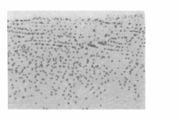
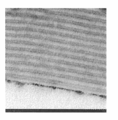
- FIG. 5 is a drawing-substituting photograph and a TEM photograph of the multilayer structure produced in Example 3.
- FIG. 6 is a drawing-substituting photograph, which is a TEM photograph of a multilayer structure containing inorganic nanoparticles prepared in Example 4.
- FIG. 1 shows the NMR measurement result of the block copolymer synthesized in Example 1.
- FIG. 2 shows a GPC chart of the triblock copolymer synthesized in Example 2.
- FIG. 3 shows the NMR measurement results of the triblock copolymer synthesized in
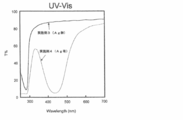
- FIG. 7 is a graph showing the results of measuring the absorption wavelength of the multilayer structures produced in Example 3 (without Ag nanoparticles) and Example 4 (with Ag nanoparticles) using UV-Vis.
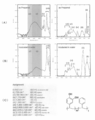
- FIG. 8 shows the result of measuring the multilayer structure containing Ag nanoparticles prepared in Example 4 with an infrared spectrometer, and FIG. 8A shows the multilayer structure containing Ag nanoparticles in a dry state. Infrared absorption spectrum, FIG. 8B shows the infrared absorption spectrum of the multilayer structure containing Ag nanoparticles in the wet state, and FIG. 8C shows the wavelength to which each molecule belongs.
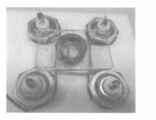
- FIG. 9 is a drawing-substituting photograph and a photograph of the experimental apparatus used in Example 5.
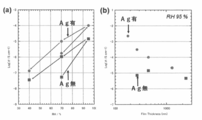
- FIG. 10A is a graph showing the relationship between humidity and proton conductivity when a multilayer structure having a thickness of 500 nm is used in Example 5, and FIG. 10B is a graph showing the thickness of the multilayer structure and proton conductivity. It is a graph showing the relationship.
- FIG. 11 is a drawing-substituting photograph
- FIG. 11 (A) is a TEM photograph of a multilayer structure containing Ag nanoparticles before energization of the electrode in Example 5
- FIG. 11 (B) is after energization. It is a TEM photograph of the multilayer structure containing the Ag nanoparticles.
- FIG. 12 is a photograph substituted for a drawing, and is a TEM photograph of a sample after a film produced by spin coating in Example 6 was immersed in an aqueous silver nitrate solution.
- the block copolymer of the present invention has a hydrophilic segment containing a catechol group, a hydrophobic segment containing a hydrophobic substitution from the hydrophilic segment containing the catechol group, and an acid dissociation constant pKa contained as necessary of 0.
- R 1 is a linear, branched or cyclic alkyl group having 1 to 20 carbon atoms, an aryl group having 6 to 20 carbon atoms, or 7 to 20 carbon atoms. Represents an aralkyl group.
- the t segment containing R 1 functions as a hydrophobic segment. Therefore, R 1 may be relatively hydrophobic as compared with the catechol group of the hydrophilic segment (m segment and n segment) described later and R 2 , but preferably, R 1 has 3 carbon atoms. That's it.
- linear, branched or cyclic alkyl group having 1 to 20 carbon atoms include, for example, methyl, ethyl, n-propyl, 2-propyl, n-butyl, 1-methylpropyl, 2-methylpropyl, tert-butyl, n-pentyl, 1-methylbutyl, 1-ethylpropyl, tert-pentyl, 2-methylbutyl, 3-methylbutyl, 2,2-dimethylpropyl, n-hexyl, 1-methylpentyl, 1-ethylbutyl, 2 -Methylpentyl, 3-methylpentyl, 4-methylpentyl, 2-methylpentan-3-yl, 3,3-dimethylbutyl, 2,2-dimethylbutyl, 1,1-dimethylbutyl, 1,2-dimethylbutyl 1,3-dimethylbutyl, 2,3-dimethylbutyl, 1-ethylbuty
- aryl group having 6 to 20 carbon atoms include phenyl, indenyl, pentarenyl, naphthyl, azulenyl, fluorenyl, phenanthrenyl, anthracenyl, acenaphthylenyl, biphenylenyl, naphthacenyl, and pyrenyl.
- aralkyl group having 7 to 20 carbon atoms include benzyl, phenethyl, 1-phenylpropyl, 2-phenylpropyl, 3-phenylpropyl, 1-phenylbutyl, 2-phenylbutyl, 3-phenylbutyl, 4-phenyl Phenylbutyl, 1-phenylpentylbutyl, 2-phenylpentylbutyl, 3-phenylpentylbutyl, 4-phenylpentylbutyl, 5-phenylpentylbutyl, 1-phenylhexylbutyl, 2-phenylhexylbutyl, 3-phenylhexylbutyl 4-phenylhexylbutyl, 5-phenylhexylbutyl, 6-phenylhexylbutyl, 1-phenylheptyl, 1-phenyloctyl, 1-phenylnonyl, 1-phenyldecy
- R 2 represents a group having a functional group with an acid dissociation constant (hereinafter sometimes referred to as “pKa”) of 0.5 or more and 7 or less, preferably 4 or less.
- pKa acid dissociation constant
- the n segment containing R 2 is not essential, but weak acidity can be imparted when a solid polymer membrane prepared from the copolymer represented by formula (1) is used in a fuel cell. . If pKa is less than 0.5, the acidity is too strong and unstable, which is not preferable. On the other hand, when pKa is larger than 7, it is not preferable because dissociation of protons is suppressed and catechol group may be quinoneized.
- R 2 represents at least hydrogen of the above functional group, or a linear, branched or cyclic alkyl group having 1 to 20 carbon atoms, an aryl group having 6 to 20 carbon atoms, or an aralkyl group having 7 to 20 carbon atoms. Examples include groups in which one or more are substituted with the above functional groups.
- linear, branched or cyclic alkyl group having 1 to 20 carbon atoms, the aryl group having 6 to 20 carbon atoms, or the aralkyl group having 7 to 20 carbon atoms are the same as those for R 1 .
- R 2 of the n segment of the block copolymer it is not necessary that all R 2 of the n segment of the block copolymer have a functional group satisfying the above pKa, and as described later, some of the protective groups may remain or may be unsubstituted. There may be.
- R 3 , R 4 and R 5 each represent H or a linear, branched or cyclic alkyl group having 1 to 20 carbon atoms. Preferred is H or an alkyl group having 1 to 5 carbon atoms, more preferred is H or a linear alkyl group having 3 or less carbon atoms, and still more preferred is H or CH 3 .
- R 6 , R 7 and R 8 each represent hydrogen, a hydroxyl group, a nitro group, a carboxy group or a carbonyl group.
- X represents an amide or ester, but may not be included.
- Y represents an amide or ester, but may not be contained.
- P represents 0 or an integer of 1 to 10, preferably 0 or an integer of 1 to 5, more preferably 0 or an integer of 1 to 3, and further preferably 2.
- N represents an integer of 3 to 1000
- m represents an integer of 3 to 1000
- t represents an integer of 3 to 1000
- the arrangement of n, m, and t may be arbitrary, but when n is included, hydrophilic n and m segments must be adjacent to each other in order to produce a multilayer structure separated by microlayers.
- the block copolymer of the present invention is prepared in the order of polymerization in the order of a tm block copolymer, an mt block copolymer, a tmn block copolymer, and a tnm block copolymer. , Nmt block copolymer, and mt block copolymer.
- the block copolymer is not limited to the above-mentioned diblock copolymer and triblock copolymer, and the tnmn block copolymer is used.
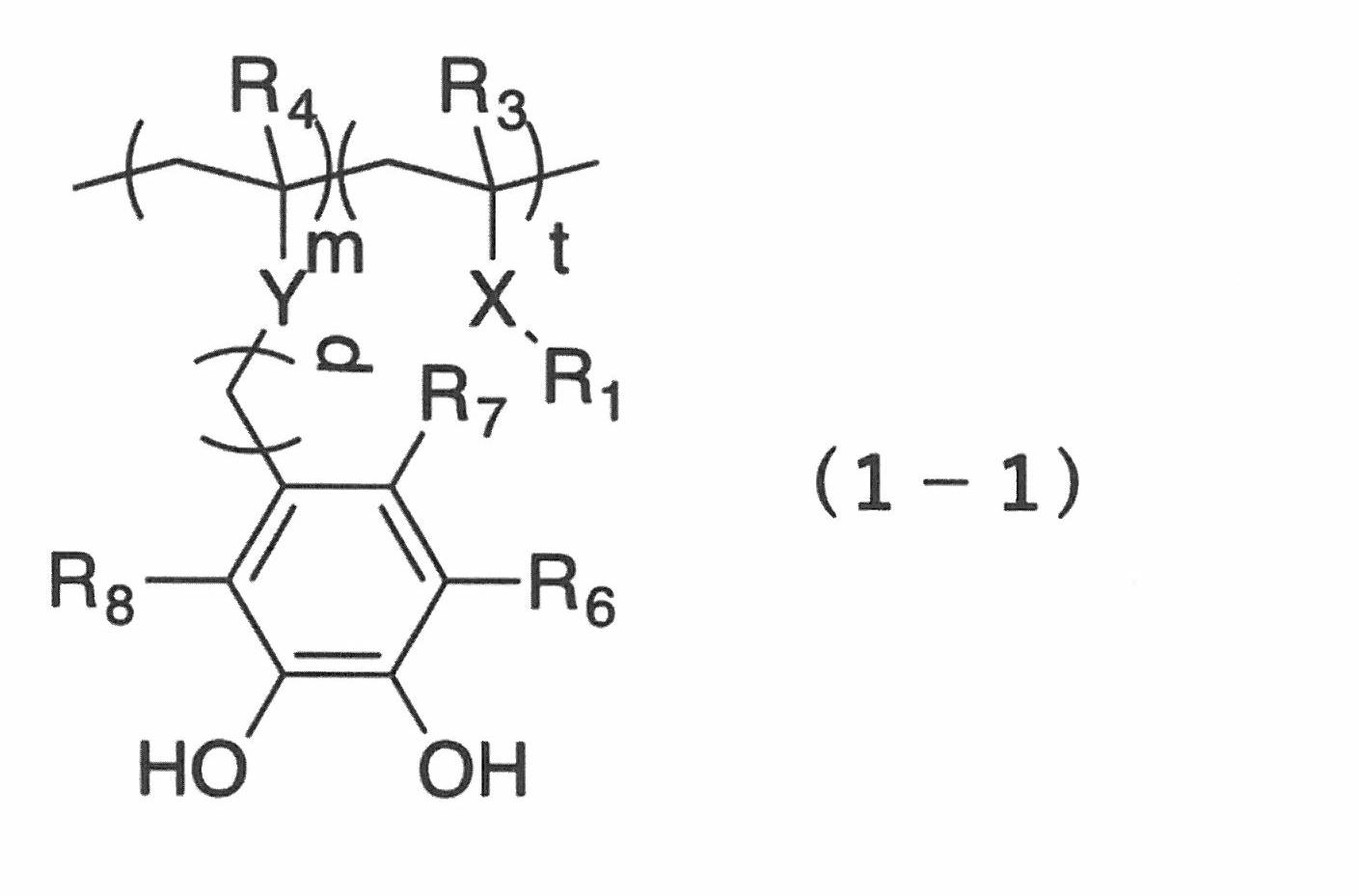
- a multi-component copolymer such as When n is 0, the block copolymer can be represented by the following formula.
- the multilayer structure of the present invention is obtained by casting and drying a block copolymer solution dissolved in an organic solvent, so that the hydrophilic segment represented by m and n of the block copolymer and the hydrophobicity represented by t A segment can be produced by micro-layer separation.
- the multilayer structure is used as a solid polymer membrane for a fuel cell separator, it is necessary to conduct protons in the solid polymer membrane from the anode electrode direction to the cathode electrode direction. Therefore, it is desirable that the individual layers constituting the multilayer structure are continuous.
- the layer structure of the multilayer structure is not particularly limited as long as individual layers are continuous.
- a lamellar structure (hydrophilic layer and hydrophobic layer are alternately laminated), hexagonal structure (hydrophilic cylindrical body
- the periphery of the layer is covered with a hydrophobic layer, or the periphery of a layer of a hydrophobic cylindrical body is covered with a hydrophilic layer.
- a co-continuous structure (the hydrophilic layer is connected indefinitely in three directions to surround the periphery)
- a hydrophobic layer may be covered, or a hydrophobic layer may be connected indefinitely in three directions and a periphery may be covered with a hydrophilic layer).
- m + n / m + n + t 0.2 to 0.8 is preferable, and 0.25 to 0.6 is more preferable.
- m + n / m + n + t is smaller than 0.2, the hydrophilic segment becomes a ball shape on the inner side in an organic solvent, and a reverse micelle structure with the hydrophobic segment facing the outer side makes it difficult to produce a continuous multilayer structure.
- m + n / m + n + t is larger than 0.8, conversely to the above, in the organic solvent, the hydrophobic segment becomes a ball shape on the inner side and the hydrophilic segment becomes the micelle structure facing the outer side. It becomes difficult to make a body.
- m + n / m + n + t is 0.2 or more, first, a hexagonal structure is formed in which a hydrophobic layer covers the periphery of a hydrophilic cylindrical layer.
- hydrophilic segments As the proportion of hydrophilic segments increases, it becomes a co-continuous structure and lamellar structure where hydrophilic layers are connected in three directions, and when the proportion of hydrophilic segments is further increased, hydrophobic layers are connected in three directions
- the co-continuous structure is a hexagonal structure in which a hydrophilic layer covers the periphery of a hydrophobic cylindrical layer.
- m is set to 5 or more, 10 or more, 15 or more, etc. Adjust it.
- m is set to 5 or more, 10 or more, 15 or more, etc. Adjust it.
- the block copolymer represented by the above formula (1) is not particularly limited as long as it can be synthesized so as to include m, n, and t segments, and may be synthesized using a known synthesis method.
- RAFT method addition-fragmentation chain transfer
- formula (2) hereinafter sometimes referred to as “RAFT agent”.
- R 10 is a linear, branched or cyclic alkyl group having 1 to 18 carbon atoms, an alkenyl group having 2 to 18 carbon atoms, or a monovalent aromatic hydrocarbon group having 6 to 18 carbon atoms. Alternatively, it represents a monovalent heterocyclic group having a total of 3 to 18 carbon atoms and hetero atoms selected from N, S, O, Se, and Te.
- R 10 alkyl group having 1 to 18 carbon atoms, alkenyl group having 2 to 18 carbon atoms, monovalent aromatic hydrocarbon group having 6 to 18 carbon atoms, monovalent heterocyclic group having 3 to 18 carbon atoms in total
- These hydrogen atoms may be substituted with a carboxyl group, a hydroxyl group, a cyano group, or an alkyl group having 1 to 20 carbon atoms.
- Z is a hydrogen atom, chlorine atom, carboxyl group, cyano group, alkyl group having 1 to 20 carbon atoms, monovalent aromatic hydrocarbon group having 6 to 20 carbon atoms, carbon atom and N, S, O, Se, Te
- a monovalent heterocyclic group having 3 to 20 atoms in total with a hetero atom selected from: —OH, —SR 11 , —N (R 11 ) 2 , —OC ( ⁇ O) R 11 , —C ( O) OR 11 , —C ( ⁇ O) N (R 11 ) 2 , —P ( ⁇ O) (OR 11 ) 2 , or —P ( ⁇ O) (R 11 ) 2 is shown.
- R 11 represents an alkyl group having 1 to 20 carbon atoms, a monovalent aliphatic hydrocarbon group having 3 to 20 carbon atoms, a monovalent aromatic hydrocarbon group having 6 to 20 carbon atoms, a carbon atom and a hetero atom.
- Each R ′ is an alkyl group having 1 to 18 carbon atoms, an alkenyl group having 2 to 18 carbon atoms, a monovalent aromatic hydrocarbon group having 6 to 18 carbon atoms or a carbon atom and N, S, O, Se, or Te.
- a monovalent heterocyclic group having a total number of 3 to 18 atoms with the selected hetero atom is shown.
- the alkyl group having 1 to 20 carbon atoms, monovalent aromatic hydrocarbon having 6 to 20 carbon atoms, monovalent heterocyclic group having 3 to 20 atoms in total, carboxyl group, and hydrogen of R 11 are as follows: Each may be substituted with a carboxyl group, a hydroxyl group, a cyano group, or an alkyl group having 1 to 20 carbon atoms.
- R 1, R 3, and X are the same as R 1, R 3, and X in formula (1).
- R 4, R 6, R 7, R 8, p and Y are the same as R 4, R 6, R 7 , R 8, p and Y of formula (1).
- R 12 and R 13 represent a protecting group for a hydroxy group.
- the protecting group is not particularly limited as long as it can protect and deprotect a hydroxy group.
- an acyl-type protecting group having 2 to 15 carbon atoms an ether-type protecting group having 1 to 15 carbon atoms, a carbon number
- Examples include an acetal type protecting group having 3 to 15 carbon atoms, a silyl ether type protecting group having 3 to 15 carbon atoms, an aralkyl type protecting group having 7 to 15 carbon atoms, and an allyl type protecting group having 3 to 15 carbon atoms.
- the acyl-type protecting group include an acetyl group, a bivaloyl group, and a benzoyl group.
- Examples of the ether-type protecting group include a methyl group, a benzyl group, a p-methoxybenzyl group, and a tert-butyl group.
- Examples of the type protecting group include methoxymethyl, 2-tetrahydropyranyl group, ethoxyethyl group, etc.
- examples of the silyl ether type protecting group include trimethylsilyl group, triethylsilyl group, tert-butyldimethylsilyl group, triisopropylsilyl group. Tert-butyldiphenylsilyl group and the like.
- R 12 and R 13 may be the same protecting group or different.
- the catechol group of the block copolymer represented by the formula (1) includes a catechol group protected by a protecting group.
- R 2, R 5, and X are the same as R 2, R 5, and X in formula (1).
- the functional groups of R 2 may be one which is protected by a protecting group. Examples of the protecting group include the same protecting groups as R 12 and R 13 described above.
- Examples of the RAFT agent represented by the above formula (2) include 2-cyano-2-benzodithioate, 4-cyano-4- (phenylcarbonothioylthio) pentanoic acid, 2-cyano-2-propyldodecyltrithiocarbo 4-cyano-4-[(dodecylsulfanylthiocarbonyl) sulfanyl] pentanoic acid, 2- (dodecylthiocarbonothioylthio) -2-methylpropionic acid, cyanomethyldodecyltrithiocarbonate, cyanomethylmethyl (phenyl) ) Carbamodithioate, bis (thiobenzoyl) disulfide, bis (dodecylsulfanylthiocarbonyl) disulfide, cumyldithiobenzoate, [1- (O-ethylxanthyl) ethyl] benzene, 2-phenyl
- the monomer represented by the above formula (3) is a hydrophobic vinyl monomer, and when X is an amide or ester and R 1 is a linear, branched or cyclic alkyl group having 1 to 20 carbon atoms, methyl ( (Meth) acrylamide, ethyl (meth) acrylamide, n-propyl (meth) acrylamide, 2-propyl (meth) acrylamide, n-butyl (meth) acrylamide, 1-methylpropyl (meth) acrylamide, 2-methylpropyl (meth) Acrylamide, tert-butyl (meth) acrylamide, n-pentyl (meth) acrylamide, 1-methylbutyl (meth) acrylamide, 1-ethylpropyl (meth) acrylamide, tert-pentyl (meth) acrylamide, 2-methylbutyl (meth) acrylamide , 3-methylbutyl (meta Acrylamide, 2,2-dimethyl
- R 1 is an aryl group having 6 to 20 carbon atoms
- phenyl (meth) acrylamide, indenyl (meth) acrylamide, pentarenyl (meth) acrylamide, naphthyl (meth) acrylamide, azulenyl (meth) acrylamide examples include aryl (meth) acrylates such as fluorenyl (meth) acrylamide.
- X is an amide or ester and R 1 is an aralkyl group having 7 to 20 carbon atoms
- aralkyl (meth) acrylamides such as benzyl (meth) acrylamide
- aralkyl (meth) acrylates such as benzyl (meth) acrylate
- X is an amide or ester
- R 1 is an aralkyl group having 7 to 20 carbon atoms
- aralkyl (meth) acrylamides such as benzyl (meth) acrylamide
- aralkyl (meth) acrylates such as benzyl (meth) acrylatekind.
- R 1 is a linear, branched or cyclic alkyl group having 1 to 20 carbon atoms, propylene, 2-methyl-1-propylene, -Butene, 2-methyl-1-butene, 3-methyl-1-butene, 3,3-dimethyl-1-butene, 3-methyl-2-ethyl-1-butene, 2,3-dimethyl-1-butene 2-tert-butyl-3,3-dimethyl-1-butene, cyclopropylene, cyclobutene, cyclopentene or cyclohexene.
- Examples of the monomer not containing X in the above formula (3) include vinylaryls such as vinylbenzene (styrene) when R 1 is an aryl group having 6 to 20 carbon atoms.
- the monomer contains no X in the above formula (3), when R 1 is an aralkyl group having 7 to 20 carbon atoms, 3-phenyl-1-propylene, 2-phenyl-1-propylene, 4-phenyl -1 -Butene, 3-phenyl-1-butene, 2-phenyl-1-butene, 5-phenyl-1-pentene, 4-phenyl-1-pentene, 3-phenyl-1-pentene, 2-phenyl-1-pentene 6-phenyl-1-hexene, 5-phenyl-1-hexene, 4-phenyl-1-hexene, 3-phenyl-1-hexene, 2-phenyl-1-hexene, 7-phenyl-1-heptene, 6 -Phenyl-1-heptene, 5-phenyl-1-heptene, 4-phenyl-1-heptene, 3-phenyl-1-heptene, 2-phenyl-1-heptene, 8-phenyl
- R 6 , R 7 , and R 8 are hydrogen
- a monomer obtained by protecting a monomer containing a catechol group exemplified below with the above-described protecting group may be mentioned.
- each protecting group may be protected by a known method.
- the monomers shown above are specific examples when R 6 , R 7 , and R 8 are hydrogen, but the monomer represented by the formula (4) is one of R 6 , R 7 , and R 8 .
- Substituents may be introduced as described above. That is, the side chain may contain a group in which hydrogen of the catechol group is substituted by a substituent. Examples of the substituent include a hydroxyl group, a nitro group, a carboxy group, and a carbonyl group. When introducing a plurality of substituents, the same group may be introduced, or different groups may be introduced.
- the monomer represented by the above formula (4) those derived from dopa or derivatives thereof are preferable in terms of performance and ease of manufacture, and those derived from dopa in terms of easy availability. Is more preferable.
- the monomer represented by the formula (5) is obtained by converting the hydrogen of the monomer exemplified in the above formula (3) into a functional group having a pKa of 0.5 or more and 7 or less, such as —OH (hydroxyl group), —COOH (carboxyl). Group), —SH (thiol group), —H 2 PO 4 (phosphate group), —SO 3 H (sulfonic acid group) and the like.
- the substitution with a functional group may be one or plural. When multiple substitutions are made, they may be substituted with the same functional group or with different functional groups. Alternatively, R 2 may be the above functional group.
- the functional group may be protected with a protecting group, and when a monomer protected with a protecting group is used, it may be deprotected simultaneously with R 12 and R 13 after the synthesis of the block copolymer.
- Specific examples of the monomer represented by the formula (5) include methyl methacrylate, butyl methacrylate, and styrene sulfonic acid tosyl ester.
- the functional group may be oxidized depending on the type of the deprotecting agent.
- the monomer represented by the formula (5) is a carboxylic acid or Methyl methacrylate and styrene sulfonic acid tosyl ester which generate sulfonic acid are preferred. Further, a part of the protecting group may remain without being deprotected.
- Examples of the organic solvent for producing the block polymer represented by the above formula (1) include aliphatic hydrocarbons such as hexane, heptane, cyclohexane and mineral terpene; diethyl ether, tetrahydrofuran, dioxane, diphenyl ether, Ethers such as anisole and dimethoxybenzene; Amides such as N, N-dimethylformamide and N, N-dimethylacetamide; Nitriles such as acetonitrile, propionitrile and benzonitrile; Acetone, methyl ethyl ketone and methyl isobutyl Ester compounds or carbonate compounds such as ketone, ethyl acetate, butyl acetate, ethylene carbonate, propylene carbonate; methanol, ethanol, propanol, isopropanol, n- Butyl alcohol, t-butyl alcohol Le, isoamyl alcohol - alcohol, such
- the radical polymerization initiator for living radical polymerization (RAFT polymerization) of the monomers represented by the above formulas (3) to (5) is not particularly limited as long as the monomer can be radically polymerized.
- Peroxides such as isobutyl peroxide, t-butyl peroxide, octanoyl peroxide, decanoyl peroxide, lauroyl peroxide, benzoyl peroxide, potassium persulfate, ammonium persulfate, sodium persulfate; azobisisobutyronitrile (AIBN), 2,2′-azobis (4-methoxy-2,4-dimethylvaleronitrile), 2,2′-azobis (2-cyclopropylpropionitrile), 2,2′-azobis (2-methyl) Propionitrile), 2,2'-azobis (2-methylbutyronitrile) ) Azo compounds, such as hydrogen peroxide - ascorbic acid, hydrogen peroxide - ferrous chloride
- a deprotecting agent corresponding to the protecting group used may be used.
- a strong Lewis acid such as boron tribromide; Reaction or birch reduction
- p-methoxybenzyl group in addition to the same conditions as benzyl group, oxidation conditions with 2,3-dicyano-5,6-dichloro-p-benzoquinone, cerium ammonium nitrate, etc .
- tert-butyl group In the case of a strong acidic condition such as trifluoroacetic acid or 4 mol / L hydrochloric acid-ethyl acetate solution; in the case of an acetal type such as a methoxymethyl group, 2-tetrahydropyranyl group, ethoxyethyl group, reaction with water under acidic conditions; Potassium carbonate in methanol for acetyl groups; basic conditions stronger than acetyl groups
- a radical polymerization initiator such as a RAFT agent represented by the above formula (2), a hydrophobic vinyl monomer represented by the above formula (3), or azobisisobutyronitrile is added to an organic solvent such as dioxane. Dissolve and perform freeze deaeration using liquid nitrogen or the like. Next, this solution is heated to 50 to 100 ° C. to cause a living radical polymerization reaction, and the solution after the reaction is added dropwise to hexane or the like, and unreacted monomers are removed by centrifugation, followed by vacuum drying. A polymer containing a segment in which the monomers are polymerized is obtained.
- the length of each segment in which the monomers represented by the above formulas (3) to (5) are polymerized can be controlled by adjusting the amount of the monomer added to the organic solvent and the reaction time.
- the block copolymer includes a segment in which the monomer represented by the formula (3) is polymerized, a segment in which the monomer represented by the formula (4) is polymerized, and a monomer represented by the formula (5).
- the block copolymer is synthesized in the order of the segments, the order of the segments can be changed by changing the steps (e) to (g).
- Living radical polymerization is an example of a method for producing a block copolymer represented by the formula (1) from monomers represented by the formulas (3), (4), and (5). Other methods may be used as long as the block copolymer can be synthesized. Examples include anionic polymerization and atom transfer radical polymerization.
- Examples of the block copolymer obtained by the above method include the following block copolymers.
- the m segment of the following block copolymers has shown the example containing a catechol group, as above-mentioned, a protective group may remain, without a part of H being deprotected. Moreover, the protective group may remain as a part of the functional group of the n segment.
- the manufacturing method of the multilayer structure of the present invention includes the following steps.
- the organic solvent used in the step (i) is not particularly limited as long as it can dissolve the block copolymer.
- aliphatic hydrocarbons such as hexane, heptane, cyclohexane, mineral terpenes; ethers such as diethyl ether, tetrahydrofuran, dioxane, diphenyl ether, anisole, dimethoxybenzene; N, N-dimethylformamide, Amides such as N, N-dimethylacetamide; Nitriles such as acetonitrile, propionitrile, benzonitrile; acetone, methyl ethyl ketone, methyl isobutyl ketone, ethyl acetate, butyl acetate, ethylene carbonate, propylene carbonate Ester compounds such as carbonate compounds, etc .; alcohols such as methanol, ethanol, propanol, isopropanol, n-butyl alcohol,
- a mold capable of producing the desired shape of the multilayer structure may be used, and when producing a multilayer structure on a thin film, it may be cast into a flat plate.
- the film thickness can be adjusted by changing the amount of casting.
- a sacrificial layer that dissolves in a solvent that does not dissolve the polymer, such as polyvinyl alcohol, may be formed on the substrate, and a thin film may be formed thereon.
- the solvent may be evaporated by air drying or vacuum drying at normal temperature and pressure.
- the manufacturing method of the multilayer structure containing the inorganic nanoparticles of the present invention includes the following steps.
- (m) The inorganic ions are reduced by the catechol group of the segment represented by m of the multilayer structure, and m
- inorganic nanoparticles mean particles formed by reduction of inorganic ions by donating electrons from the hydroxy group of catechol.
- the particle size of the “inorganic nanoparticle” in the present invention varies depending on the kind of inorganic substance, but is from the atomic size of each inorganic substance to about 100 nm (when the length b of the catechol segment is 1000).
- the “inorganic salt” in the present invention means that an inorganic ionic solution is formed by adding water, a polar organic solvent that does not dissolve the block copolymer, or an ionic liquid to produce the above “inorganic nanoparticles”. It means what can be done.
- Examples of the polar organic solvent include dimethyl sulfoxide (DMSO), dimethyl sulfoxide (DMF) and the like.
- Examples of the ionic liquid include imidazolium salts, pyridinium salts, ammonium salts, and the like.
- the inorganic nanoparticles of the present invention are not particularly limited as long as they are reduced to particles by donating electrons from the hydroxy group of catechol as described above.
- gold Au
- silver Ag
- platinum Pt
- palladium Pd
- rhodium Rh
- iridium Ir
- ruthenium Ru
- osmium Os
- metals such as copper (Cu); CdS, CeSe, CeTe, ZnS, etc.
- metal compounds ferrimagnetic materials such as Fe 2 O 3 and alloys such as Ag / Au and Au / Pt.
- inorganic ions are reduced by donating electrons from the hydroxy group of catechol to become inorganic nanoparticles, but when inorganic ions with a smaller ionization tendency are added thereafter, inorganic nanoparticles are added. Is ionized again, and the added inorganic ions having a small ionization tendency are reduced to form inorganic nanoparticles.
- the “alloy” in the present invention utilizes the above-mentioned ionization tendency, and means that the metal particles having different ionization tendency are mixed in the segment containing the catechol group of the block copolymer of the present invention. Oxides such as Fe 2 O 3 may be oxidized by bubbling oxygen after reducing inorganic ions.
- sulfides such as CdS may be sulfided by bubbling hydrogen sulfide gas after reducing inorganic ions.
- a metal compound such as CeTe may be reduced in a state where each ion coexists.
- metal particles having different ionization tendency may be mixed in the segment containing the catechol group by reducing in a state where each ion coexists.
- the inorganic salt for producing the inorganic nanoparticles is not particularly limited as long as it is ionized with water as described above.
- gold chloride (III) AuCl 3
- tetrachlorogold (III) acid chloroauric acid
- HuCl 4 tetrachlorogold (III) acid
- silver nitrate (I) AgNO 3
- hexachloride platinum (IV) acid H H 2 [ PtCl 6 ].
- unreacted inorganic ions may be washed away by washing the multilayer structure with water as necessary.
- the catechol group becomes quinone when inorganic ions are reduced.
- quinone is hydrophobic.
- the m segment of the formula (1) becomes hydrophobic, so that it is difficult to reduce ions dissolved in water.
- the catechol group and the quinone are contained in the hydrophilic segment of the formula (1) of the “multilayer structure containing inorganic nanoparticles” of the present invention.
- catechol group (dopa derivative) has a high adhesion ability (Japanese Patent Publication No. 2013-503688). Further, as described above, catechol groups remain in the “multilayer structure containing inorganic nanoparticles” of the present invention. Therefore, when the “multilayer structure containing inorganic nanoparticles” is used as a solid polymer membrane for a fuel cell separator, even if an electric current is passed between the anode electrode and the cathode electrode, the adhesive force of the residual catechol group In addition, it is possible to suppress the movement of the inorganic nanoparticles in the microlayer composed of the hydrophilic segment.
- the multilayer structure containing inorganic nanoparticles can be used as a solid polymer film for a fuel cell separator by itself, but a protective film or the like may be attached if necessary.
- a solid polymer membrane may be sandwiched between a known anode electrode and cathode electrode.
- the solution after the reaction was dropped into hexane, and then centrifuged at 1500 rpm for 10 minutes in a centrifuge to remove the monomer and vacuum dried.
- the molecular weight of the dried polymer was measured by GPC. From the measurement results of GPC, the weight average molecular weight (Mw) of the polymer was 19,800.
- FIG. 1 shows the NMR measurement results of the block copolymer synthesized in Example 1.
- the “molecular weight of the block copolymer” in the present invention means a weight average molecular weight when measured in terms of polystyrene using Tosoh HLC-8320GPC.
- the trichloromethane in FIG. 1 has been exchanged with hydrogen contained in the heavy solvent, and acetone is thought to have remained when the NMR tube was washed.
- the polymerization reaction was carried out at 60 ° C. for 6 hours with an aluminum block heater.
- the obtained solution was reprecipitated in a large excess of methanol, and the obtained solid was dried under reduced pressure.
- the GPC chart is shown in FIG.
- GPC chart is shown in FIG.
- Example 3 [Production of multilayer structure]
- a block copolymer solution was prepared by dissolving the block copolymer synthesized in Example 1 in tetrahydrofuran (THF). Next, the block copolymer solution was cast on a silicon substrate or a silicon substrate on which a PVA sacrificial layer was spin-coated, and the solvent of the cast block copolymer solution was evaporated to prepare a multilayer structure. Next, the produced multilayer structure was dyed with osmium tetroxide.
- FIG. 5 is a TEM photograph of the multilayer structure produced in Example 3. It was confirmed that a multilayer structure can be produced from the block copolymer of the present invention.
- Example 4 [Preparation of multilayer structure containing inorganic (Ag) nanoparticles]
- the multilayer structure produced in Example 3 was immersed in a 200 mg / L AgNO 3 aqueous solution for 30 minutes and then washed with pure water to produce a multilayer structure containing inorganic (Ag) nanoparticles.
- 6 is a TEM photograph of a multilayer structure containing inorganic nanoparticles prepared in Example 4.
- FIG. The black dots in the photograph are Ag nanoparticles. As apparent from the photograph, it was confirmed that the Ag nanoparticles were produced along the microlayer of the multilayer structure.
- FIG. 7 shows the measurement of the absorption wavelength of the multilayer structures prepared in Example 3 (without Ag nanoparticles) and Example 4 (with Ag nanoparticles) using UV-Vis (V-670 manufactured by JASCO Corporation). It is a graph showing the result of having performed.
- the multilayer structure produced in Example 4 had an orange color, and had an absorption maximum at 416 nm from the measurement result of UV-Vis. This wavelength was consistent with the absorption wavelength of Ag nanoparticles.
- FIG. 8 shows the results of measuring the multilayer structure containing Ag nanoparticles prepared in Example 4 using an infrared spectrometer (FT / IR6700 manufactured by JASCO Corporation).
- FIG. 8A shows an infrared absorption spectrum of a multilayer structure containing Ag nanoparticles in a dry state
- FIG. 8B shows an infrared absorption spectrum of a multilayer structure containing Ag nanoparticles in a wet state
- FIG. ) Represents the wavelength to which each molecule belongs. As shown in FIGS. 8A and 8B, it was confirmed that all the peaks belonged cleanly.
- Example 5 [Confirmation of proton conductivity of multilayer structure]
- the multilayer structure of the present invention is presumed to have improved proton conductivity when placed in a wet state, so that the proton conductivity of the multilayer structures prepared in Examples 3 and 4 was confirmed.
- the experiment was conducted.
- multilayer structures having different thicknesses were prepared by changing the amount of the block copolymer solution at the time of casting.
- the experiment was carried out in a humidity control chamber (SH-221, Esspec Corp.) using an impedance measuring device (SI1260, Solatoron Analytical). Two gold paste electrodes were applied in parallel, and a gold wire was used as the electrode.
- 9 is a photograph of the experimental apparatus used in Example 5, FIG.
- FIG. 10A is a graph showing the relationship between humidity and proton conductivity when a multilayer structure having a thickness of 500 nm is used
- FIG. 10B is a multilayer. It is a guf representing the relationship between the thickness of the structure and proton conductivity.
- both the multilayer structures produced in Example 3 (without Ag nanoparticles) and Example 4 (with Ag nanoparticles) absorb protons and thus have proton transport ability. It was confirmed that it improved.
- the multilayer structure including the Ag nanoparticles of Example 4 has about one order of magnitude higher proton conductivity than the multilayer structure of Example 3 that does not include Ag nanoparticles.
- the multilayer structure containing Ag nanoparticle of Example 4 improves proton conductivity, so that thickness is thinned.
- the multilayer structure including Ag nanoparticles was thinner than about 500 nm, proton conductivity was further improved as compared with the case where Ag nanoparticles were not included.
- the thickness of one separated layer separated by micro layers is about 20 nm. Therefore, when Ag nanoparticles are included, the multilayer structure preferably has a thickness of about 20 nm to 500 nm.
- FIG. 11A is a TEM photograph of a multilayer structure including Ag nanoparticles before energization of an electrode in Example 5, and FIG. 11B is a multilayer structure including Ag nanoparticles after energization. It is a TEM photograph of. Black dots (points of arrows) in the photograph are Ag nanoparticles.
- the multilayer structure including the Ag nanoparticles of the present invention was dispersed in the hydrophilic segment layer of the multilayer structure even after energization. It was confirmed that it stayed in the state.
- Example 3 without Ag nanoparticles
- Example 4 with Ag nanoparticles
- the multilayer structure containing Ag nanoparticles is more preferable. It has been clarified that is excellent in proton conductivity, and that proton conductivity increases as the thickness of the multilayer structure decreases. Further, since the multilayer structure of the present invention exhibits proton conductivity, it has been clarified that it can be used as a solid polymer membrane for a fuel cell separator.
- Example 6 [Preparation of multilayer structure containing inorganic nanoparticles using triblock copolymer and confirmation of proton conductivity]
- a 10 wt% THF solution of the triblock copolymer (PMMA-b-PVCa-b-PSt) prepared in Example 2 was prepared, and cast-coated or spin-coated at 2000 rpm on a 20 ⁇ 10 mm quartz substrate.
- a film was prepared. Then, the Ag nanoparticle was formed in the film by being immersed in 200 mM silver nitrate aqueous solution.
- FIG. 12 is a TEM photograph after a film produced by spin coating is immersed in an aqueous silver nitrate solution. As is clear from the photograph, it was confirmed that Ag nanoparticles were formed along the microlayers of the multilayer structure as in the case of the diblock copolymer even when the triblock copolymer was used.
- the block copolymer of the present invention can produce a multilayer structure, and the multilayer structure has proton conductivity. Therefore, the multilayer structure can be used as a solid polymer membrane for a fuel cell separator, and a fuel cell can be produced using the solid polymer membrane. Thus, the present invention is useful for the fuel cell industry.
Landscapes
- Chemical & Material Sciences (AREA)
- Chemical Kinetics & Catalysis (AREA)
- Health & Medical Sciences (AREA)
- Medicinal Chemistry (AREA)
- Polymers & Plastics (AREA)
- Organic Chemistry (AREA)
- General Chemical & Material Sciences (AREA)
- Life Sciences & Earth Sciences (AREA)
- Engineering & Computer Science (AREA)
- Manufacturing & Machinery (AREA)
- Sustainable Development (AREA)
- Sustainable Energy (AREA)
- Electrochemistry (AREA)
- Emergency Medicine (AREA)
- Composite Materials (AREA)
- Crystallography & Structural Chemistry (AREA)
- Fuel Cell (AREA)
- Graft Or Block Polymers (AREA)
- Conductive Materials (AREA)
Abstract
中性溶媒雰囲気で使用でき、且つナノ粒子を含んだ固体高分子膜を作製できるブロック共重合体を提供することを課題とする。 下記式(1)で表されるブロック共重合体で課題を解決できる。 (R1は炭素数1~20の直鎖状、分岐状あるいは環状アルキル基、炭素数6~20のアリール基、又は炭素数7~20のアラルキル基を表す。R2は酸解離定数pKaが0.5以上、7以下の官能基を有する基を表す。R3、R4及びR5は、それぞれ、H又は炭素数1~20の直鎖状、分岐状あるいは環状アルキル基を示す。R6、R7及びR8は、それぞれ、水素、水酸基、ニトロ基、カルボキシ基、カルボニル基を表す。Xは、アミド又はエステルを表すが、含まれていなくてもよい。Yは、アミド又はエステルを表すが、含まれていなくてもよい。pは1~10の整数を表すが、含まれていなくてもよい。nは3~1000の整数、mは3~1000の整数、tは3~1000の整数を表すが、nは含まれていなくてもよい。n,m,tの並びは任意でよいが、nが含まれる場合は、n及びmは隣接する。)
Description
本発明は、ブロック共重合体、多層構造体、固体高分子膜、燃料電池、多層構造体の製造方法、及び無機ナノ粒子を含む多層構造体の製造方法に関する。
燃料電池は、水素と酸素を化学反応させて電気を発電する装置であり、エネルギー効率が高く、環境汚染物質の排出がほとんどない。そのため、地球環境に配慮した新しい発電システムとして、さらなる普及が期待されている。燃料電池には、燃料ガスが供給されるアノード電極と、酸化剤ガスが供給されるカソード電極と、各電極間に設けられ、アノード電極からカソード電極へプロトンを伝導する固体高分子膜が構成要素として含まれている。
上記構成要素のうち、プロトンを伝導する固体高分子膜としては、ナフィオン(Nafion、登録商標)が知られている。ナフィオンは、スルホン化テトラフルオロエチレンコポリマーであり、ポリテトラフルオロエチレン骨格鎖の末端にグラフトされたスルホン酸基がマイナスチャージを有するので、それらの間をプラスチャージされたプロトン基が移動することが容易となり、プロトン伝導度が高くなる。
また、ナフィオンは1960年代に開発されてから、様々な他のポリマーとブレンドされ、安定性等の改良もなされているため、燃料電池の固体高分子膜としてナフィオンが採用されている例は多い。しかしながら、ナフィオンは、スルホン酸基を有することから強酸性であり、中性溶媒雰囲気で使用ができないという問題がある(特許文献1参照)。
上記問題点を解決するため、Feイオン、Coイオン、Ruイオン、Znイオン、Niイオンの群から選択されるいずれか1又は2以上の金属イオンと、ビス(ターピリジル)ベンゼンとからなる有機/金属ハイブリッドポリマーのフィルムにより、中性溶媒雰囲気でプロトン伝導ができるポリマーフィルムが知られている(特許文献1参照)。
また、燃料電池の分野においては、アノード電極及びカソード電極を構成する要素中に、水分の保持能力に優れた貴金属のナノ粒子を含ませることが記載されている(特許文献2参照)。
上記特許文献1に記載されているように、中性溶媒雰囲気でプロトン伝導ができるポリマーフィルムは知られている。また、特許文献2に記載されているように、燃料電池を構成する要素中に、ナノ粒子を含ませることで構成要素の機能を向上させることも知られており、上記特許文献2に記載の例では、水分保持能力に優れた貴金属のナノ粒子をアノード電極及びカソード電極を構成する要素中に含ませた例が開示されている。
しかしながら、固体高分子膜はアノード電極とカソード電極の間に配置され電流が流れることから、金属等のナノ粒子を含ませると、電流によりナノ粒子が移動してしまうと考えられている。そのため、上記特許文献2に記載されているように、アノード電極及びカソード電極を構成する要素中にナノ粒子を含ませることは多くの例が知られているが、固体高分子膜にナノ粒子を含ませることは知られていない。上記特許文献1においても、ポリマーフィルムに含まれているのは、Feイオン、Coイオン、Ruイオン、Znイオン、Niイオンの群から選択されるいずれか1又は2以上の錯体状の金属イオンである。現在のところ、中性溶媒雰囲気で使用でき、且つナノ粒子を含んだ固体高分子膜は知られていない。
本発明は上記問題点を解決するために、鋭意研究を行ってなされた発明であるところ、
(i)カテコール基を含む親水性セグメント、前記カテコール基を含む親水性セグメントより疎水性の置換を含む疎水性セグメント、および、必要に応じて含まれる酸解離定数pKaが0.5以上、7以下の官能基を含む親水性セグメント、を含むブロック共重合体、例えば、下記式(1)で表されるブロック共重合体は、
(ii)親水性セグメントと疎水性セグメントを含むことから、ブロック共重合体を有機溶媒に溶解し、キャストすることで多層構造体を作製できること、
(iii)無機イオンを含む溶液に作製した多層構造体を浸漬すると、多層構造体のカテコール基が無機イオンを還元してナノ粒子を作製できること、
(iV)ブロック共重合体は、弱酸性~中性であるため、無機ナノ粒子を含み且つ中性溶媒雰囲気で使用できる固体高分子膜を提供できること、
を新たに見出し、本発明を完成した。
(i)カテコール基を含む親水性セグメント、前記カテコール基を含む親水性セグメントより疎水性の置換を含む疎水性セグメント、および、必要に応じて含まれる酸解離定数pKaが0.5以上、7以下の官能基を含む親水性セグメント、を含むブロック共重合体、例えば、下記式(1)で表されるブロック共重合体は、
(ii)親水性セグメントと疎水性セグメントを含むことから、ブロック共重合体を有機溶媒に溶解し、キャストすることで多層構造体を作製できること、
(iii)無機イオンを含む溶液に作製した多層構造体を浸漬すると、多層構造体のカテコール基が無機イオンを還元してナノ粒子を作製できること、
(iV)ブロック共重合体は、弱酸性~中性であるため、無機ナノ粒子を含み且つ中性溶媒雰囲気で使用できる固体高分子膜を提供できること、
を新たに見出し、本発明を完成した。

(R1は炭素数1~20の直鎖状、分岐状あるいは環状アルキル基、炭素数6~20のアリール基、又は炭素数7~20のアラルキル基を表す。R2は酸解離定数pKaが0.5以上、7以下の官能基を有する基を表す。R3、R4及びR5は、それぞれ、H又は炭素数1~20の直鎖状、分岐状あるいは環状アルキル基を示す。R6、R7及びR8は、それぞれ、水素、水酸基、ニトロ基、カルボキシ基、カルボニル基を表す。Xは、アミド又はエステルを表すが、含まれていなくてもよい。Yは、アミド又はエステルを表すが、含まれていなくてもよい。pは1~10の整数を表すが、含まれていなくてもよい。nは3~1000の整数、mは3~1000の整数、tは3~1000の整数を表すが、nは含まれていなくてもよい。n,m,tの並びは任意でよいが、nが含まれる場合は、n及びmは隣接する。)
すなわち、本発明の目的は、ナノ粒子を含んだ固体高分子膜の作製に用いることができるブロック共重合体、該ブロック共重合体から作製した多層構造体、該多層構造体から作製した固体高分子膜、該固体高分子膜を含む燃料電池、多層構造体の製造方法、及び無機ナノ粒子を含む多層構造体の製造方法を提供することである。
本発明は、以下に示す、ブロック共重合体、多層構造体、固体高分子膜、燃料電池、多層構造体の製造方法、及び無機ナノ粒子を含む多層構造体の製造方法に関する。
[1]下記式(1)で表されるブロック共重合体。
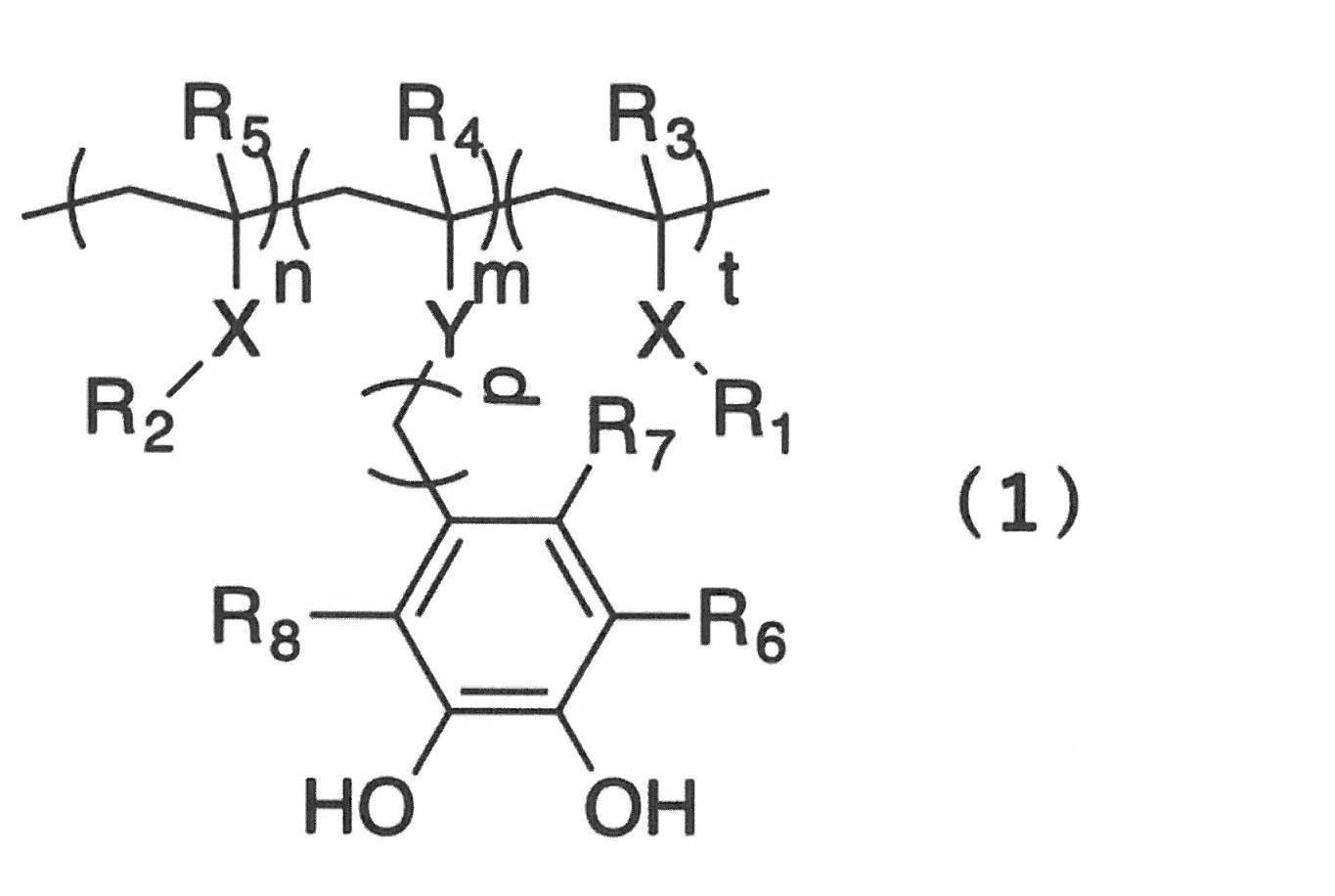
(R1は炭素数1~20の直鎖状、分岐状あるいは環状アルキル基、炭素数6~20のアリール基、又は炭素数7~20のアラルキル基を表す。R2は酸解離定数pKaが0.5以上、7以下の官能基を有する基を表す。R3、R4及びR5は、それぞれ、H又は炭素数1~20の直鎖状、分岐状あるいは環状アルキル基を示す。R6、R7及びR8は、それぞれ、水素、水酸基、ニトロ基、カルボキシ基、カルボニル基を表す。Xは、アミド又はエステルを表すが、含まれていなくてもよい。Yは、アミド又はエステルを表すが、含まれていなくてもよい。pは1~10の整数を表すが、含まれていなくてもよい。nは3~1000の整数、mは3~1000の整数、tは3~1000の整数を表すが、nは含まれていなくてもよい。n,m,tの並びは任意でよいが、nが含まれる場合は、n及びmは隣接する。)
[2]前記m、n、tが、m+n/m+n+t=0.2~0.8である、
上記[1]に記載のブロック共重合体。
[3]前記nが含まれる、上記[1]又は[2]に記載のブロック共重合体。
[4]上記[1]~[3]の何れか一つに記載のブロック共重合体のm及びnで表される親水性セグメント及びtで表される疎水性セグメントが、ミクロ層分離した層構造を有する、
多層構造体。
[5]前記多層構造体の厚さが20nm~500nmである、
上記[4]に記載の多層構造体。
[6]前記親水性セグメントからなるミクロ層が無機ナノ粒子を含む、
上記[4]又は[5]に記載の多層構造体。
[7]前記親水性セグメントがカテコール基及びキノンを含む、
上記[6]に記載の多層構造体。
[8]上記[4]~[7]の何れか一つに記載の多層構造体を含む、
燃料電池のセパレータ用の固体高分子膜。
[9]上記[8]に記載の固体高分子膜、アノード電極及びカソード電極を含む、
燃料電池。
[10]下記式(1)で表されるブロック共重合体を有機溶媒に溶解してブロック共重合体溶液を作製する工程、
前記ブロック共重合体溶液をキャストするキャスト工程、
キャストされた前記ブロック共重合体溶液の溶媒を蒸発させることで、前記ブロック共重合体のm及びnで表される親水性セグメント及びtで表される疎水性セグメントが、ミクロ層分離した多層構造体を作製する多層構造体作製工程、
を含む、多層構造体の製造方法。

(R1は炭素数1~20の直鎖状、分岐状あるいは環状アルキル基、炭素数6~20のアリール基、又は炭素数7~20のアラルキル基を表す。R2は酸解離定数pKaが0.5以上、7以下の官能基を有する基を表す。R3、R4及びR5は、それぞれ、H又は炭素数1~20の直鎖状、分岐状あるいは環状アルキル基を示す。R6、R7及びR8は、それぞれ、水素、水酸基、ニトロ基、カルボキシ基、カルボニル基を表す。Xは、アミド又はエステルを表すが、含まれていなくてもよい。Yは、アミド又はエステルを表すが、含まれていなくてもよい。pは1~10の整数を表すが、含まれていなくてもよい。nは3~1000の整数、mは3~1000の整数、tは3~1000の整数を表すが、nは含まれていなくてもよい。n,m,tの並びは任意でよいが、nが含まれる場合は、n及びmは隣接する。)
[11]前記nが含まれる、上記[10]に記載の多層構造体の製造方法。
[12]無機イオンを含む溶液に上記[10]又は[11]に記載の製造方法で製造した多層構造体を浸漬する浸漬工程、
前記無機イオンが、多層構造体のmで表されるセグメントのカテコール基により還元され、mで表されるセグメントを含むミクロ層中に無機ナノ粒子を作製する無機ナノ粒子作製工程、
を含む、無機ナノ粒子を含む多層構造体の製造方法。
[13]カテコール基を含む親水性セグメント、
前記カテコール基を含む親水性セグメントより疎水性の置換を含む疎水性セグメント、
および、
必要に応じて含まれる、酸解離定数pKaが0.5以上、7以下の官能基を含む親水性セグメント、
を含み、
前記酸解離定数pKaが0.5以上、7以下の官能基を含む親水性セグメントが含まれる場合は、前記カテコール基を含む親水性セグメントに隣接する、
ブロック共重合体。
[14]前記酸解離定数pKaが0.5以上、7以下の官能基を含む親水性セグメントが含まれる、上記[13]に記載のブロック共重合体。
[15]上記[13]又は[14]に記載のブロック共重合体の親水性セグメント及び疎水性セグメントが、ミクロ層分離した層構造を有する、
多層構造体。
[16]前記多層構造体の厚さが20nm~500nmである、
上記[15]に記載の多層構造体。
[17]前記親水性セグメントからなるミクロ層が無機ナノ粒子を含む、
上記[15]又は[16]に記載の多層構造体。
[18]前記親水性セグメントがカテコール基及びキノンを含む、
上記[17]に記載の多層構造体。
[19]上記[15]~[18]の何れか一つに記載の多層構造体を含む、
燃料電池のセパレータ用の固体高分子膜。
[20]上記[19]に記載の固体高分子膜、アノード電極及びカソード電極を含む、
燃料電池。
[2]前記m、n、tが、m+n/m+n+t=0.2~0.8である、
上記[1]に記載のブロック共重合体。
[3]前記nが含まれる、上記[1]又は[2]に記載のブロック共重合体。
[4]上記[1]~[3]の何れか一つに記載のブロック共重合体のm及びnで表される親水性セグメント及びtで表される疎水性セグメントが、ミクロ層分離した層構造を有する、
多層構造体。
[5]前記多層構造体の厚さが20nm~500nmである、
上記[4]に記載の多層構造体。
[6]前記親水性セグメントからなるミクロ層が無機ナノ粒子を含む、
上記[4]又は[5]に記載の多層構造体。
[7]前記親水性セグメントがカテコール基及びキノンを含む、
上記[6]に記載の多層構造体。
[8]上記[4]~[7]の何れか一つに記載の多層構造体を含む、
燃料電池のセパレータ用の固体高分子膜。
[9]上記[8]に記載の固体高分子膜、アノード電極及びカソード電極を含む、
燃料電池。
[10]下記式(1)で表されるブロック共重合体を有機溶媒に溶解してブロック共重合体溶液を作製する工程、
前記ブロック共重合体溶液をキャストするキャスト工程、
キャストされた前記ブロック共重合体溶液の溶媒を蒸発させることで、前記ブロック共重合体のm及びnで表される親水性セグメント及びtで表される疎水性セグメントが、ミクロ層分離した多層構造体を作製する多層構造体作製工程、
を含む、多層構造体の製造方法。
[11]前記nが含まれる、上記[10]に記載の多層構造体の製造方法。
[12]無機イオンを含む溶液に上記[10]又は[11]に記載の製造方法で製造した多層構造体を浸漬する浸漬工程、
前記無機イオンが、多層構造体のmで表されるセグメントのカテコール基により還元され、mで表されるセグメントを含むミクロ層中に無機ナノ粒子を作製する無機ナノ粒子作製工程、
を含む、無機ナノ粒子を含む多層構造体の製造方法。
[13]カテコール基を含む親水性セグメント、
前記カテコール基を含む親水性セグメントより疎水性の置換を含む疎水性セグメント、
および、
必要に応じて含まれる、酸解離定数pKaが0.5以上、7以下の官能基を含む親水性セグメント、
を含み、
前記酸解離定数pKaが0.5以上、7以下の官能基を含む親水性セグメントが含まれる場合は、前記カテコール基を含む親水性セグメントに隣接する、
ブロック共重合体。
[14]前記酸解離定数pKaが0.5以上、7以下の官能基を含む親水性セグメントが含まれる、上記[13]に記載のブロック共重合体。
[15]上記[13]又は[14]に記載のブロック共重合体の親水性セグメント及び疎水性セグメントが、ミクロ層分離した層構造を有する、
多層構造体。
[16]前記多層構造体の厚さが20nm~500nmである、
上記[15]に記載の多層構造体。
[17]前記親水性セグメントからなるミクロ層が無機ナノ粒子を含む、
上記[15]又は[16]に記載の多層構造体。
[18]前記親水性セグメントがカテコール基及びキノンを含む、
上記[17]に記載の多層構造体。
[19]上記[15]~[18]の何れか一つに記載の多層構造体を含む、
燃料電池のセパレータ用の固体高分子膜。
[20]上記[19]に記載の固体高分子膜、アノード電極及びカソード電極を含む、
燃料電池。
本発明のブロック共重合体は、カテコール基を含む親水性セグメントと疎水性セグメントを有することからミクロ層分離した多層構造体を作製し、更にカテコール基で無機イオンを還元することで無機ナノ粒子を含む固体高分子膜を作製できる。そして、ブロック共重合体は、弱酸性~中性領域の側鎖を有することから、中性溶媒雰囲気で使用でき、且つ無機ナノ粒子を含んだ固体高分子膜を提供することができる。
以下に、本発明のブロック共重合体、多層構造体、固体高分子膜、燃料電池、多層構造体の製造方法、及び無機ナノ粒子を含む多層構造体の製造方法についてさらに具体的に説明する。
本発明のブロック共重合体は、カテコール基を含む親水性セグメント、前記カテコール基を含む親水性セグメントより疎水性の置換を含む疎水性セグメント、および、必要に応じて含まれる酸解離定数pKaが0.5以上、7以下の官能基を含む親水性セグメント、を含み、例えば、下記式(1)で表される。
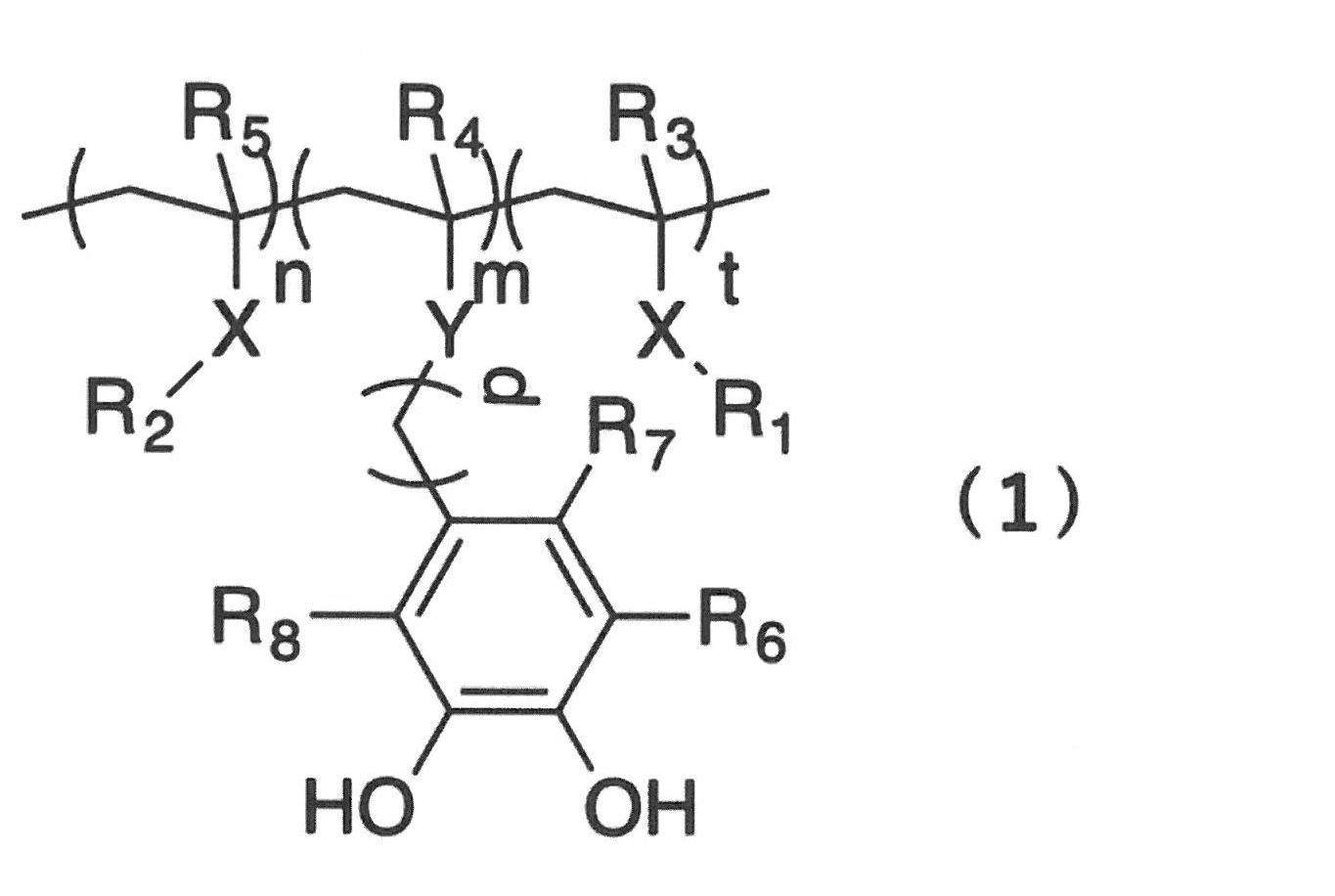
前記式(1)で表されるブロック共重合体中、R1は炭素数1~20の直鎖状、分岐状あるいは環状アルキル基、炭素数6~20のアリール基、又は炭素数7~20のアラルキル基を表す。ブロック共重合体中、R1を含むtセグメントは、疎水性セグメントとして機能する。したがって、R1は、後述する親水性セグメント(mセグメント及びnセグメント)のカテコール基及びR2と比較して、相対的に疎水性であればよいが、好ましくは、R1の炭素数は3以上である。
炭素数1~20の直鎖状、分岐状あるいは環状アルキル基の具体例としては、例えば、メチル、エチル、n-プロピル、2-プロピル、n-ブチル、1-メチルプロピル、2-メチルプロピル、tert-ブチル、n-ペンチル、1-メチルブチル、1-エチルプロピル、tert-ペンチル、2-メチルブチル、3-メチルブチル、2,2-ジメチルプロピル、n-ヘキシル、1-メチルペンチル、1-エチルブチル、2-メチルペンチル、3-メチルペンチル、4-メチルペンチル、2-メチルペンタン-3-イル、3,3-ジメチルブチル、2,2-ジメチルブチル、1,1-ジメチルブチル、1,2-ジメチルブチル、1,3-ジメチルブチル、2,3-ジメチルブチル、1-エチルブチル、2-エチルブチル、ヘプチル、オクチル、ノニル、デシル、ウンデシル、ドデシル、トリデシル、テトラデシル、ペンタデシル、ヘキサデシル、ヘプタデシル、オクタデシル、ノナデシル、イコシル、シクロプロピル、シクロブチル、シクロペンチル又はシクロヘキシル等が挙げられる。前記したアルキル基の中では、炭素数1~12のアルキル基が好ましい。
炭素数6~20のアリール基の具体例としては、フェニル、インデニル、ペンタレニル、ナフチル、アズレニル、フルオレニル、フェナントレニル、アントラセニル、アセナフチレニル、ビフェニレニル、ナフタセニル又はピレニル等が挙げられる。
炭素数7~20のアラルキル基の具体例としては、ベンジル、フェネチル、1-フェニルプロピル、2-フェニルプロピル、3-フェニルプロピル、1-フェニルブチル、2-フェニルブチル、3-フェニルブチル、4-フェニルブチル、1-フェニルペンチルブチル、2-フェニルペンチルブチル、3-フェニルペンチルブチル、4-フェニルペンチルブチル、5-フェニルペンチルブチル、1-フェニルヘキシルブチル、2-フェニルヘキシルブチル、3-フェニルヘキシルブチル、4-フェニルヘキシルブチル、5-フェニルヘキシルブチル、6-フェニルヘキシルブチル、1-フェニルヘプチル、1-フェニルオクチル、1-フェニルノニル、1-フェニルデシル、1-フェニルウンデシル、1-フェニルドデシル、1-フェニルトリデシル又は1-フェニルテトラデシル等が挙げられる。
R2は、酸解離定数(以下、「pKa」と記載する場合がある。)が0.5以上、7以下、好ましくは4以下の官能基を有する基を表す。後述するとおり、R2を含むnセグメントは必須ではないが、式(1)で表される共重合体から作製した固体高分子膜を燃料電池に用いた場合、弱酸性を付与することができる。pKaが0.5より小さいと酸性度が強すぎ、不安定と成るため好ましくない。また、pKaが7より大きいとプロトンの解離が抑制される上、カテコール基がキノン化する可能性があるため好ましくない。
上記pKaを満たす官能基としては、-OH(ヒドロキシル基)、-COOH(カルボキシル基)、-SH(チオール基)、-H2PO4(リン酸基)、-SO3H(スルホン酸基)等が挙げられる。R2としては、上記官能基、あるいは、炭素数1~20の直鎖状、分岐状あるいは環状アルキル基、炭素数6~20のアリール基、又は炭素数7~20のアラルキル基の水素の少なくとも1以上が上記官能基で置換された基が挙げられる。炭素数1~20の直鎖状、分岐状あるいは環状アルキル基、炭素数6~20のアリール基、又は炭素数7~20のアラルキル基の具体例は、R1と同様である。なお、ブロック共重合体のnセグメントの全てのR2が上記pKaを満たす官能基を有する基である必要はなく、後述するとおり、一部は保護基が残っていてもよいし、未置換であってもよい。
R3、R4及びR5は、それぞれ、H又は炭素数1~20の直鎖状、分岐状あるいは環状のアルキル基を表す。好ましくはH又は炭素数1~5のアルキル基であり、より好ましくはH又は炭素数3以下の直鎖状アルキル基であり、更に好ましくはH又はCH3である。
R6、R7及びR8は、それぞれ、水素、水酸基、ニトロ基、カルボキシ基、カルボニル基を表す。
Xは、アミド又はエステルを表すが、含まれていなくてもよい。Yは、アミド又はエステルを表すが、含まれていなくてもよい。
pは0又は1~10の整数を表し、好ましくは0又は1~5の整数であり、より好ましくは0又は1~3の整数であり、さらに好ましくは2である。
nは3~1000の整数、mは3~1000の整数、tは3~1000の整数を表すが、nは含まれていなくてもよい。n,m,tの並びは任意でよいが、nが含まれる場合、ミクロ層分離した多層構造体を作製するためには、親水性のn及びmセグメントは隣接する必要がある。つまり、本発明のブロック共重合体は、重合する順に、t-mブロック共重合体、m-tブロック共重合体、t-m-nブロック共重合体、t-n-mブロック共重合体、n-m-tブロック共重合体、m-n-tブロック共重合体が挙げられる。なお、親水性のn及びmセグメントが隣接していれば、ブロック共重合体は上記のジブロック共重合体、トリブロック共重合体に限定されず、t-n-m-nブロック共重合体等の多元共重合体であってもよい。nが0の場合は、ブロック共重合体は以下の式で表すことができる。
本発明の多層構造体は、有機溶媒に溶解したブロック共重合体溶液をキャストして乾燥することで、ブロック共重合体のm及びnで表される親水性セグメント及びtで表される疎水性セグメントが、ミクロ層分離することで作製できる。多層構造体を燃料電池のセパレータ用の固体高分子膜として使用する場合、固体高分子膜中において、プロトンをアノード電極方向からカソード電極方向に伝導する必要がある。したがって、多層構造体を構成する個々の層は連続していることが望ましい。多層構造体の層構造については個々の層が連続していれば特に制限はなく、例えば、ラメラ構造(親水性層と疎水性層が交互に積層)、ヘキサゴナル構造(親水性の筒状体の層の周囲を疎水性の層が覆う、又は、疎水性の筒状体の層の周囲を親水性の層が覆う)、共連続構造(親水性の層が3方向に無限に連結し周囲を疎水性の層が覆う、又は、疎水性の層が3方向に無限に連結し周囲を親水性の層が覆う)等が挙げられる。
上記のような個々の層が連続した多層構造体を作製するためには、m+n/m+n+t=0.2~0.8とすることが好ましく、0.25~0.6がより好ましい。m+n/m+n+tが0.2より小さくなると、有機溶媒中で親水性セグメントが内側で玉状となり、疎水性セグメントが外側に向く逆ミセル構造となることから連続した多層構造体を作製し難くなる。また、m+n/m+n+tが0.8より大きいと、上記とは逆に、有機溶媒中で疎水性セグメントが内側で玉状となり、親水性セグメントが外側に向くミセル構造となることから連続した多層構造体を作製し難くなる。m+n/m+n+tを0.2以上にすると、先ず、親水性の筒状体の層の周囲を疎水性の層が覆うヘキサゴナル構造となる。そして、親水性セグメントの割合を増加するにしたがって、親水性の層が3方向に連結した共連続構造、ラメラ構造となり、更に親水性セグメントの割合を増加すると、疎水性の層が3方向に連結した共連続構造、疎水性の筒状体の層の周囲を親水性の層が覆うヘキサゴナル構造となる。
mが3より小さいと、無機イオンを還元するカテコール基が少なくなり、無機ナノ粒子が得られ難くなるので好ましくない。mセグメントを長くすることで、得られる無機ナノ粒子のサイズも大きくなることから、例えば、mを5以上、10以上、15以上にする等、所望とする無機ナノ粒子のサイズとなるように適宜調整すればよい。一方、mが1000より大きくなると、分子間の相互作用が強くなるので架橋体が形成される可能性があり、その結果有機溶媒に対するブロック共重合体の溶解性が悪くなるので好ましくない。溶解度及び所望の無機ナノ粒子のサイズを考慮し、例えば、mを800以下、500以下としてもよい。n及tは、3~1000の範囲内で、mのサイズに応じて、m+n/m+n+t=0.2~0.8となるように適宜選択すればよい。
上記式(1)で表されるブロック共重合体は、m、n、及びtセグメントを含むように合成できれば特に制限はなく、公知の合成方法を用いて合成すればよい。例えば、下記式(2)で表される付加解裂型連鎖移動反応(Reversible Addition-Fragmentation Chain Transfer:RAFT法)に用いられる化合物(以下、「RAFT剤」と記載することがある。)を含む有機溶媒下で、
(a)下記式(3)で表されるラジカル重合可能な疎水性ビニル系モノマー(tセグメント)をリビングラジカル重合させる工程、
(b)下記式(4)で表されるラジカル重合可能な親水性ビニル系モノマー(mセグメント)をリビングラジカル重合させる工程、
(c)下記式(5)で表されるラジカル重合可能なビニル系モノマー(nセグメント)をリビングラジカル重合させる工程、
(d)得られたリビングポリマーのR12及びR13を脱保護し、ヒドロキシ基を形成する工程、
により製造することができる。なお、上記のとおり、n,m,tの並びは任意でよいが、nが含まれる場合は、n及びmは隣接する。したがって、上記(a)~(c)に記載された工程の順番は、適宜変更してもよい。
(a)下記式(3)で表されるラジカル重合可能な疎水性ビニル系モノマー(tセグメント)をリビングラジカル重合させる工程、
(b)下記式(4)で表されるラジカル重合可能な親水性ビニル系モノマー(mセグメント)をリビングラジカル重合させる工程、
(c)下記式(5)で表されるラジカル重合可能なビニル系モノマー(nセグメント)をリビングラジカル重合させる工程、
(d)得られたリビングポリマーのR12及びR13を脱保護し、ヒドロキシ基を形成する工程、
により製造することができる。なお、上記のとおり、n,m,tの並びは任意でよいが、nが含まれる場合は、n及びmは隣接する。したがって、上記(a)~(c)に記載された工程の順番は、適宜変更してもよい。
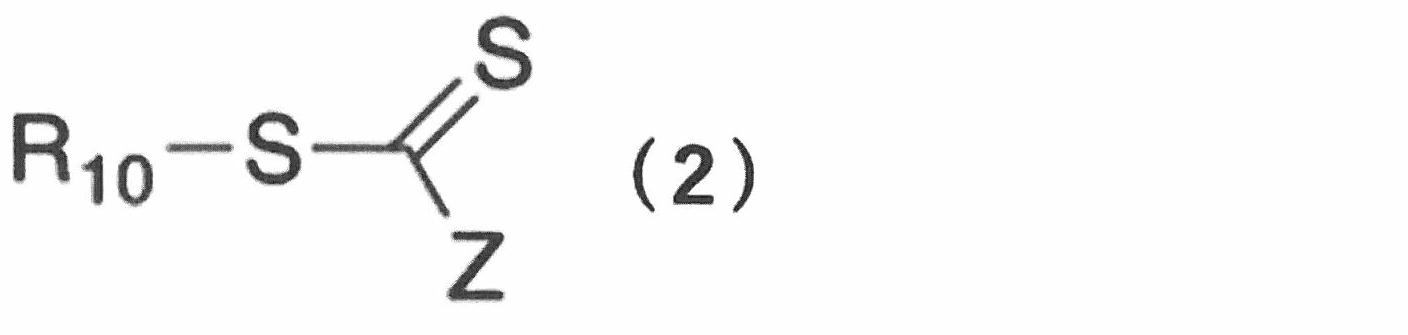
式(2)中、R10は、炭素数1~18の直鎖状、分岐状あるいは環状アルキル基、炭素数2~18のアルケニル基、炭素数6~18の1価の芳香族炭化水素基または炭素原子とN、S、O、Se、Teから選択される異項原子との合計数3~18の1価の複素環式基を示す。前記R10の炭素数1~18のアルキル基、炭素数2~18のアルケニル基、炭素数6~18の1価の芳香族炭化水素基、合計数3~18の1価の複素環式基の水素は、それぞれ、カルボキシル基、ヒドロキシル基、シアノ基、炭素数1~20のアルキル基に置換されてもよい。Zは水素原子、塩素原子、カルボキシル基、シアノ基、炭素数1~20のアルキル基、炭素数6~20の1価の芳香族炭化水素基、炭素原子とN、S、O、Se、Teから選択される異項原子との合計原子数3~20の1価の複素環式基、-OH、-SR11、―N(R11)2、―OC(=O)R11、-C(=O)OR11、-C(=O)N(R11)2、-P(=O)(OR11)2、または-P(=O)(R11)2を示す。上記R11は、炭素数1~20のアルキル基、炭素数3~20の1価の脂肪族炭化水素基、炭素数6~20の1価芳香族炭化水素基、炭素原子と異項原子との合計数3~20の1価の複素環式基、-OR’、-SR’、-N(R’)2または重合体鎖を有する1価の基を示す。各R’は炭素数1~18のアルキル基、炭素数2~18のアルケニル基、炭素数6~18の1価の芳香族炭化水素基または炭素原子とN、S、O、Se、Teから選択される異項原子との合計原子数3~18の1価の複素環式基を示す。上記Zの炭素数1~20のアルキル基、炭素数6~20の1価の芳香族炭化水素、合計原子数3~20の1価の複素環式基、カルボキシル基、R11の水素は、それぞれ、カルボキシル基、ヒドロキシル基、シアノ基、炭素数1~20のアルキル基に置換されてもよい。
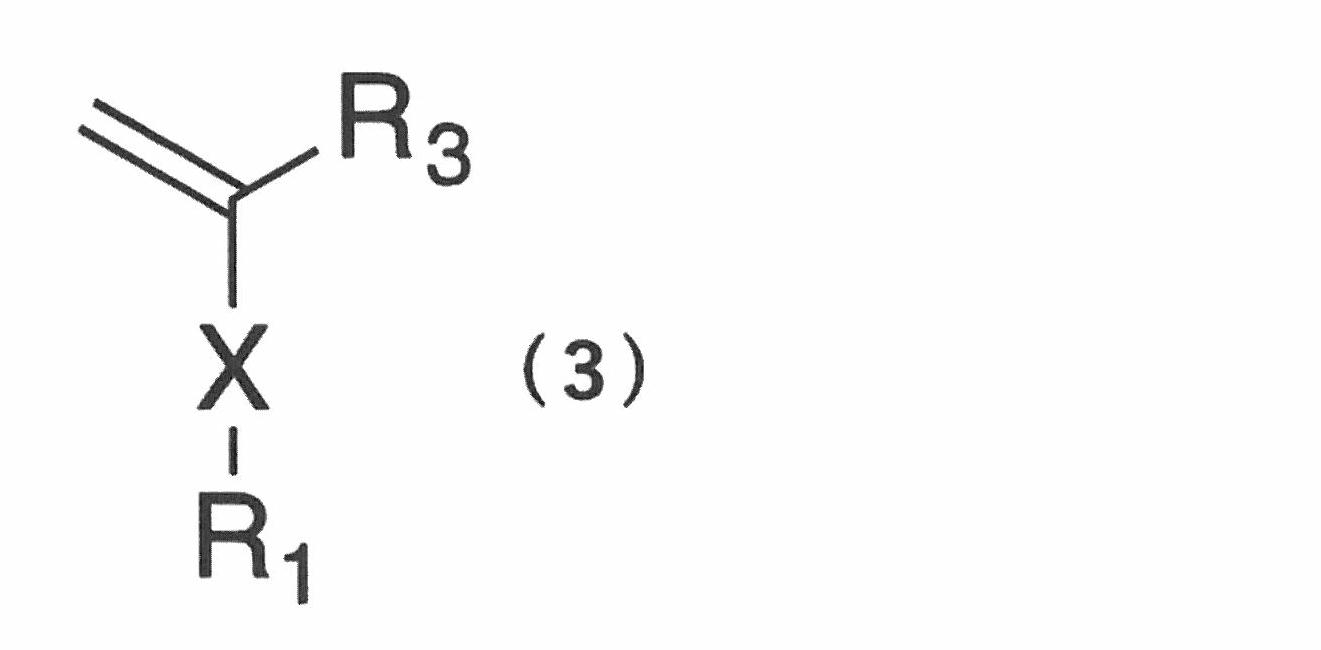
式(3)中、R1、R3、及びXは、式(1)のR1、R3、及びXと同じである。
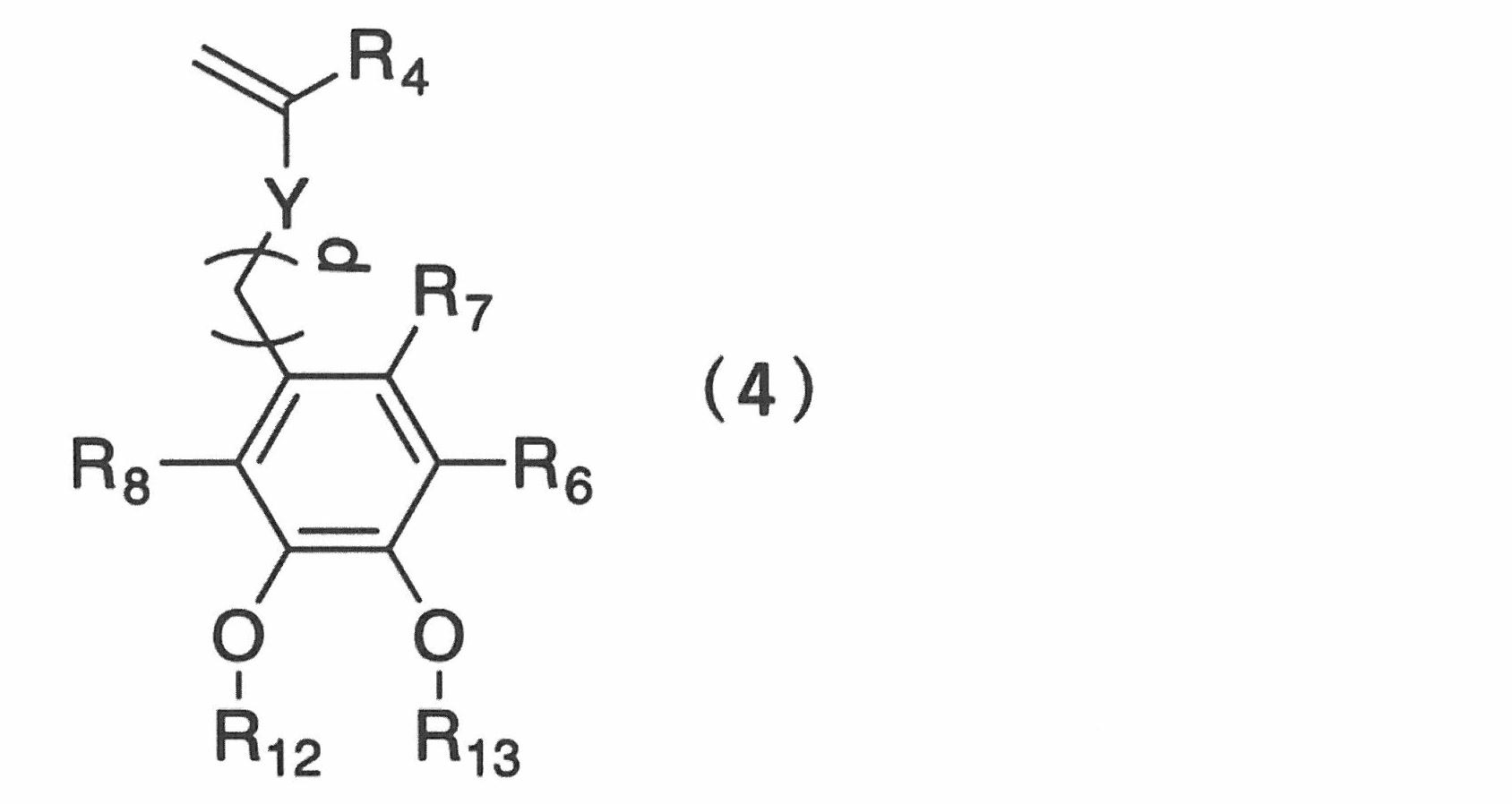
式(4)中、R4、R6、R7、R8、p及びYは、式(1)のR4、R6、R7、R8、p及びYと同じである。R12及びR13は、ヒドロキシ基の保護基を表す。
保護基としては、ヒドロキシ基を保護し、脱保護できるもので有れば特に制限はなく、例えば、炭素数2~15のアシル型保護基、炭素数1~15のエーテル型保護基、炭素数3~15のアセタール型保護基、炭素数3~15のシリルエーテル型保護基、炭素数7~15のアラルキル型保護基、または炭素数3~15のアリル型保護基などが挙げられる。アシル型の保護基としては、アセチル基、ビバロイル基、ベンゾイル基等が挙げられ、エーテル型保護基としては、メチル基、ベンジル基、p-メトキシベンジル基、tert-ブチル基等が挙げられ、アセタール型保護基としては、メトキシメチル、2-テトラヒドロピラニル基、エトキシエチル基等が挙げられ、シリルエーテル型保護基としては、トリメチルシリル基、トリエチルシリル基、tert-ブチルジメチルシリル基、トリイソプロピルシリル基、tert-ブチルジフェニルシリル基等が挙げられる。R12及びR13は、同じ保護基であっても異なっていてもよい。なお、上記(d)得られたリビングポリマーのR12及びR13を脱保護し、ヒドロキシ基を形成する工程において、一部の保護基は脱保護せずに、残留する場合もある。したがって、本発明に於いて、式(1)で表されるブロック共重合体のカテコール基には、保護基で保護さているカテコール基も含む。

式(5)中、R2、R5、及びXは、式(1)のR2、R5、及びXと同じである。なお、R2の官能基は保護基で保護されたものであってもよい。保護基は、上記R12及びR13と同じ保護基が挙げられる。
上記式(2)で表わされるRAFT剤としては、2-シアノ-2-ベンゾジチオエート、4-シアノ-4-(フェニルカルボノチオイルチオ)ペンタン酸、2-シアノ-2-プロピルドデシルトリチオカルボネート、4-シアノ-4-[(ドデシルスルファニルチオカルボニル)スルファニル]ペンタン酸、2-(ドデシルチオカルボノチオイルチオ)-2-メチルプロピオン酸、シアノメチルドデシルトリチオカルボネート、シアノメチルメチル(フェニル)カルバモジチオエート、ビス(チオベンゾイル)ジスルフィド、ビス(ドデシルスルファニルチオカルボニル)ジスルフィド、クミルジチオベンゾエート、[1-(O-エチルザンチル)エチル]ベンゼン、2-フェニル-2-プロピルベンゾジチオエート、ベンジルベンゾジチオエート等のジチオエステル化合物が挙げられる。
上記式(3)で表されるモノマーは、疎水性ビニル系モノマーであり、Xがアミド又はエステルでR1が炭素数1~20の直鎖状、分岐状あるいは環状アルキル基の場合、メチル(メタ)アクリルアミド、エチル(メタ)アクリルアミド、n-プロピル(メタ)アクリルアミド、2-プロピル(メタ)アクリルアミド、n-ブチル(メタ)アクリルアミド、1-メチルプロピル(メタ)アクリルアミド、2-メチルプロピル(メタ)アクリルアミド、tert-ブチル(メタ)アクリルアミド、n-ペンチル(メタ)アクリルアミド、1-メチルブチル(メタ)アクリルアミド、1-エチルプロピル(メタ)アクリルアミド、tert-ペンチル(メタ)アクリルアミド、2-メチルブチル(メタ)アクリルアミド、3-メチルブチル(メタ)アクリルアミド、2,2-ジメチルプロピル(メタ)アクリルアミド、n-ヘキシル(メタ)アクリルアミド、1-メチルペンチル(メタ)アクリルアミド、1-エチルブチル(メタ)アクリルアミド、2-メチルペンチル(メタ)アクリルアミド、3-メチルペンチル(メタ)アクリルアミド、4-メチルペンチル(メタ)アクリルアミド、2-メチルペンタン-3-イル(メタ)アクリルアミド、3,3-ジメチルブチル(メタ)アクリルアミド、2,2-ジメチルブチル(メタ)アクリルアミド、1,1-ジメチルブチル(メタ)アクリルアミド、1,2-ジメチルブチル(メタ)アクリルアミド、1,3-ジメチルブチル(メタ)アクリルアミド、2,3-ジメチルブチル(メタ)アクリルアミド、1-エチルブチル(メタ)アクリルアミド、2-エチルブチル(メタ)アクリルアミド、ヘプチル(メタ)アクリルアミド、オクチル(メタ)アクリルアミド、ノニル(メタ)アクリルアミド、デシル(メタ)アクリルアミド、ウンデシル(メタ)アクリルアミド、ドデシル(メタ)アクリルアミド、トリデシル(メタ)アクリルアミド、テトラデシル(メタ)アクリルアミド、ペンタデシル(メタ)アクリルアミド、ヘキサデシル(メタ)アクリルアミド、ヘプタデシル(メタ)アクリルアミド、オクタデシル(メタ)アクリルアミド、ノナデシル(メタ)アクリルアミド、イコシル(メタ)アクリルアミド、シクロプロピル(メタ)アクリルアミド、シクロブチル(メタ)アクリルアミド、シクロペンチル(メタ)アクリルアミド、シクロヘキシル(メタ)アクリルアミド等のアルキル(メタ)アクリルアミド類、及びメチル(メタ)アクリレート、エチル(メタ)アクリレート、n-プロピル(メタ)アクリレート、2-プロピル(メタ)アクリレート、n-ブチル(メタ)アクリレート、1-メチルプロピル(メタ)アクリレート、2-メチルプロピル(メタ)アクリレート、tert-ブチル(メタ)アクリレート、n-ペンチル(メタ)アクリレート、1-メチルブチル(メタ)アクリレート、1-エチルプロピル(メタ)アクリレート、tert-ペンチル(メタ)アクリレート、2-メチルブチル(メタ)アクリレート、3-メチルブチル(メタ)アクリレート、2,2-ジメチルプロピル(メタ)アクリレート、n-ヘキシル(メタ)アクリレート、1-メチルペンチル(メタ)アクリレート、1-エチルブチル(メタ)アクリレート、2-メチルペンチル(メタ)アクリレート、3-メチルペンチル(メタ)アクリレート、4-メチルペンチル(メタ)アクリレート、2-メチルペンタン-3-イル(メタ)アクリレート、3,3-ジメチルブチル(メタ)アクリレート、2,2-ジメチルブチル(メタ)アクリレート、1,1-ジメチルブチル(メタ)アクリレート、1,2-ジメチルブチル(メタ)アクリレート、1,3-ジメチルブチル(メタ)アクリレート、2,3-ジメチルブチル(メタ)アクリレート、1-エチルブチル(メタ)アクリレート、2-エチルブチル(メタ)アクリレート等のアルキル(メタ)アクリレート類が挙げられる。
Xがアミド又はエステルでR1が炭素数6~20のアリール基の場合、フェニル(メタ)アクリルアミド、インデニル(メタ)アクリルアミド、ペンタレニル(メタ)アクリルアミド、ナフチル(メタ)アクリルアミド、アズレニル(メタ)アクリルアミド、フルオレニル(メタ)アクリルアミド等のアリール(メタ)アクリレート類が挙げられる。
また、Xがアミド又はエステルでR1が炭素数7~20のアラルキル基の場合、ベンジル(メタ)アクリルアミド等のアラルキル(メタ)アクリルアミド類、及びベンジル(メタ)アクリレート、等のアラルキル(メタ)アクリレート類が挙げられる。
一方、上記式(3)でXが含まれないモノマーとしては、R1が炭素数1~20の直鎖状、分岐状あるいは環状アルキル基の場合、プロピレン、2-メチル-1-プロピレン、1-ブテン、2-メチル-1-ブテン、3-メチル-1-ブテン、3,3-ジメチル-1-ブテン、3-メチル-2-エチル-1-ブテン、2,3-ジメチル-1-ブテン、2-tert-ブチル-3,3-ジメチル-1-ブテン、シクロプロピレン、シクロブテン、シクロペンテン又はシクロヘキセン等が挙げられる。
上記式(3)でXが含まれないモノマーとしては、R1が炭素数6~20のアリール基の場合、ビニルベンゼン(スチレン)、等のビニルアリール類が挙げられる。
上記式(3)でXが含まれないモノマーとしては、R1が炭素数7~20のアラルキル基の場合、3-フェニル-1-プロピレン、2-フェニル-1-プロピレン、4-フェニル-1-ブテン、3-フェニル-1-ブテン、2-フェニル-1-ブテン、5-フェニル-1-ペンテン、4-フェニル-1-ペンテン、3-フェニル-1-ペンテン、2-フェニル-1-ペンテン、6-フェニル-1-ヘキセン、5-フェニル-1-ヘキセン、4-フェニル-1-ヘキセン、3-フェニル-1-ヘキセン、2-フェニル-1-ヘキセン、7-フェニル-1-ヘプテン、6-フェニル-1-ヘプテン、5-フェニル-1-ヘプテン、4-フェニル-1-ヘプテン、3-フェニル-1-ヘプテン、2-フェニル-1-ヘプテン、8-フェニル-1-オクテン、7-フェニル-1-オクテン、6-フェニル-1-オクテン、5-フェニル-1-オクテン、4-フェニル-1-オクテン、3-フェニル-1-オクテン、2-フェニル-1-オクテン、9-フェニル-1-ノネン、8-フェニル-1-ノネン、7-フェニル-1-ノネン、6-フェニル-1-ノネン、5-フェニル-1-ノネン、4-フェニル-1-ノネン、3-フェニル-1-ノネン、2-フェニル-1-ノネン、10-フェニル-1-デセン、9-フェニル-1-デセン、8-フェニル-1-デセン、7-フェニル-1-デセン、6-フェニル-1-デセン、5-フェニル-1-デセン、4-フェニル-1-デセン、3-フェニル-1-デセン、2-フェニル-1-デセン、11-フェニル-1-ウンデセン、10-フェニル-1-ウンデセン、9-フェニル-1-ウンデセン、8-フェニル-1-ウンデセン、7-フェニル-1-ウンデセン、6-フェニル-1-ウンデセン、5-フェニル-1-ウンデセン、4-フェニル-1-ウンデセン、3-フェニル-1-ウンデセン、2-フェニル-1-ウンデセン、12-フェニル-1-ドデセン、11-フェニル-1-ドデセン、10-フェニル-1-ドデセン、9-フェニル-1-ドデセン、8-フェニル-1-ドデセン、7-フェニル-1-ドデセン、6-フェニル-1-ドデセン、5-フェニル-1-ドデセン、4-フェニル-1-ドデセン、3-フェニル-1-ドデセン、2-フェニル-1-ドデセン、13-フェニル-1-トリデセン、12-フェニル-1-トリデセン、11-フェニル-1-トリデセン、10-フェニル-1-トリデセン、9-フェニル-1-トリデセン、8-フェニル-1-トリデセン、7-フェニル-1-トリデセン、6-フェニル-1-トリデセン、5-フェニル-1-トリデセン、4-フェニル-1-トリデセン、3-フェニル-1-トリデセン、2-フェニル-1-トリデセン、14-フェニル-1-テトラデセン、13-フェニル-1-テトラデセン、12-フェニル-1-テトラデセン、11-フェニル-1-テトラデセン、10-フェニル-1-テトラデセン、9-フェニル-1-テトラデセン、8-フェニル-1-テトラデセン、7-フェニル-1-テトラデセン、6-フェニル-1-テトラデセン、5-フェニル-1-テトラデセン、4-フェニル-1-テトラデセン、3-フェニル-1-テトラデセン、2-フェニル-1-テトラデセン等が挙げられる。また、これらモノマーにその他の有機モノマーをあわせて用いてもよい。
上記式(4)で表されるモノマーとしては、R6、R7、及びR8が水素の場合、例えば、以下に例示するカテコール基を含むモノマーを、前記保護基で保護したモノマーが挙げられる。保護基による保護化は、各々の保護基を公知の方法で保護すればよい。
Yがアミドの場合、N-[2-(3,4-ジヒドロキシフェニル)メチル](メタ)アクリルアミド、N-[2-(3,4-ジヒドロキシフェニル)エチル](メタ)アクリルアミド(ドーパミン(メタ)アクリルアミド)、N-[2-(3,4-ジヒドロキシフェニル)プロピル](メタ)アクリルアミド、N-[2-(3,4-ジヒドロキシフェニル)ブチル](メタ)アクリルアミド、N-[2-(3,4-ジヒドロキシフェニル)ペンチル](メタ)アクリルアミド、N-[2-(3,4-ジヒドロキシフェニル)ヘキシル](メタ)アクリルアミド、N-[2-(3,4-ジヒドロキシフェニル)ヘプチル](メタ)アクリルアミド、N-[2-(3,4-ジヒドロキシフェニル)オクチル](メタ)アクリルアミド、N-[2-(3,4-ジヒドロキシフェニル)ノニル](メタ)アクリルアミド、N-[2-(3,4-ジヒドロキシフェニル)デシル](メタ)アクリルアミドが挙げられる。
また、Yがエステルの場合、N-[2-(3,4-ジヒドロキシフェニル)メチル](メタ)アクリレート、N-[2-(3,4-ジヒドロキシフェニル)エチル](メタ)アクリレート(ドーパミン(メタ)アクリレート)、N-[2-(3,4-ジヒドロキシフェニル)プロピル](メタ)アクリレート、N-[2-(3,4-ジヒドロキシフェニル)ブチル](メタ)アクリレート、N-[2-(3,4-ジヒドロキシフェニル)ペンチル](メタ)アクリレート、N-[2-(3,4-ジヒドロキシフェニル)ヘキシル](メタ)アクリレート、N-[2-(3,4-ジヒドロキシフェニル)ヘプチル](メタ)アクリレート、N-[2-(3,4-ジヒドロキシフェニル)オクチル](メタ)アクリレート、N-[2-(3,4-ジヒドロキシフェニル)ノニル](メタ)アクリレート、N-[2-(3,4-ジヒドロキシフェニル)デシル](メタ)アクリレート、が挙げられる。
Yが含まれない場合は、3,4-ジヒドロキシスチレン、3-(3,4-ジヒドロキシフェニル)-1-プロペン、4-(3,4-ジヒドロキシフェニル)-1-ブテン、5-(3,4-ジヒドロキシフェニル)-1-ペンテン、6-(3,4-ジヒドロキシフェニル)-1-ヘキセン、7-(3,4-ジヒドロキシフェニル)-1-ヘプテン、8-(3,4-ジヒドロキシフェニル)-1-オクテン、9-(3,4-ジヒドロキシフェニル)-1-ノネン、10-(3,4-ジヒドロキシフェニル)-1-デセン、3-(3,4-ジヒドロキシフェニル)-2-メチル-1-プロペン、4-(3,4-ジヒドロキシフェニル)-2-メチル-1-ブテン、5-(3,4-ジヒドロキシフェニル)-2-メチル-1-ペンテン、6-(3,4-ジヒドロキシフェニル)-2-メチル-1-ヘキセン、7-(3,4-ジヒドロキシフェニル)-2メチル-1-ヘプテン、8-(3,4-ジヒドロキシフェニル)-2メチル-1-オクテン、9-(3,4-ジヒドロキシフェニル)-2メチル-1-ノネン、10-(3,4-ジヒドロキシフェニル)-2メチル-1-デセン等が挙げられる。
上記に示したモノマーは、R6、R7、及びR8が水素の場合の具体例であるが、式(4)で表されるモノマーは、R6、R7、及びR8の1つ以上に置換基を導入してもよい。すなわち、カテコール基の水素が置換基によって置換された基を側鎖に含むものであってもよい。置換基としては、水酸基、ニトロ基、カルボキシ基、カルボニル基などが挙げられる。置換基を複数導入する場合は、同一の基を導入してもよいし、異なる基を導入してもよい。
上記式(4)で表されるモノマーの具体例としては、ドーパ又はその誘導体に由来するものが、性能や製造の容易さの点で好ましく、容易に入手可能な点で、ドーパに由来するものがより好ましい。ここでいうドーパ又はその誘導体に由来するものとは、上記式(4)で表わされるもののうち、p=2で表わされるものをいい、好ましくは製造のしやすさからドーパに由来するものであり、具体的にはドーパ(3,4-ジヒドロキシフェニルアラニン)から合成することができるものをいい、より好ましくはドーパミン(メタ)アクリルアミド、ドーパミン(メタ)アクリレートであり、製造のしやすさからドーパミン(メタ)アクリルアミドが更に好ましい。
式(5)で表されるモノマーは、上記式(3)で例示したモノマーの水素を、pKaが0.5以上、7以下の官能基、例えば、-OH(ヒドロキシル基)、-COOH(カルボキシル基)、-SH(チオール基)、-H2PO4(リン酸基)、-SO3H(スルホン酸基)等で置換したモノマーが挙げられる。官能基による置換は1つでもよいし、複数置換してもよい。複数置換する場合は、同一の官能基で置換してもよいし、異なる官能基で置換してもよい。あるいは、R2は上記官能基であってもよい。また、官能基は保護基で保護されていてもよく、保護基で保護されているモノマーを用いた場合は、ブロック共重合体合成後に、R12及びR13と同時に脱保護をすればよい。式(5)で表されるモノマーの具体例としては、メタクリル酸メチル、メタクリル酸ブチル、スチレンスルホン酸トシルエステルなどが挙げられる。なお、保護基(R12及びR13)の脱保護過程で、脱保護剤の種類によっては官能基が酸化される事があることから、式(5)で表されるモノマーは、カルボン酸やスルホン酸を生成するメタクリル酸メチルやスチレンスルホン酸トシルエステルが好ましい。また、保護基の一部は脱保護されずに残留してもよい。
上記式(1)で表されるブロック重合体を製造するための有機溶媒としては、ヘキサン、ヘプタン、シクロヘキサン、ミネラルターペンなどの脂肪族炭化水素;ジエチルエ-テル、テトラヒドロフラン、ジオキサン、ジフェニルエ-テル、アニソ-ル、ジメトキシベンゼンなどのエ-テル類;N,N-ジメチルホルムアミド、N,N-ジメチルアセトアミドなどのアミド類;アセトニトリル、プロピオニトリル、ベンゾニトリルなどのニトリル類;アセトン、メチルエチルケトン、メチルイソブチルケトン、酢酸エチル、酢酸ブチル、エチレンカ-ボネ-ト、プロピレンカ-ボネ-トなどのエステル化合物またはカ-ボネ-ト化合物;メタノ-ル、エタノ-ル、プロパノ-ル、イソプロパノ-ル、n-ブチルアルコ-ル、t-ブチルアルコ-ル、イソアミルアルコ-ルなどのアルコ-ル類;ベンゼン、トルエンなどの芳香族炭化水素類;クロロベンゼン、塩化メチレン、クロロホルム、クロロベンゼン、ベンゾトリフルオライドなどハロゲン化炭化水素類が挙げられる。
上記式(3)乃至(5)で表されるモノマーをリビングラジカル重合(RAFT重合)させるためのラジカル重合開始剤は、モノマーをラジカル重合することができれば特に制限されず、例えば、過酸化水素、イソブチルパーオキサイド、t-ブチルパーオキサイド、オクタノイルパーオキサイド、デカノイルパーオキサイド、ラウロイルパーオキサイド、過酸化ベンゾイル、過硫酸カリウム、過硫酸アンモニウム、過硫酸ナトリウムなどの過酸化物;アゾビスイソブチロニトリル(AIBN)、2,2’-アゾビス(4-メトキシ-2,4-ジメチルバレロニトリル)、2,2’-アゾビス(2-シクロプロピルプロピオニトリル)、2,2’-アゾビス(2-メチルプロピオニトリル)、2,2’-アゾビス(2-メチルブチロニトリル)などのアゾ化合物;過酸化水素-アスコルビン酸、過酸化水素-塩化第一鉄、過硫酸塩-亜硫酸水素ナトリウムなどのレドックス開始剤;などが挙げられる。ラジカル重合開始剤の使用量は、RAFT剤1モルに対して、通常、0.01~1モル、好ましくは、0.1~0.5モル程度加えればよい。
脱保護剤は、用いた保護基に応じた脱保護剤を使用すればよく、例えば、メチル基の場合は三臭化ホウ素などの強いルイス酸;ベンジル基の場合はパラジウムを触媒とした水素添加反応又はバーチ還元;p-メトキシベンジル基の場合はベンジル基と同様な条件の他、2,3-ジシアノ-5,6-ジクロロ-p-ベンゾキノンや硝酸セリウムアンモニウムなどによる酸化条件;tert-ブチル基の場合はトリフルオロ酢酸や、4mol/L塩酸-酢酸エチル溶液などの強酸性条件;メトキシメチル基、2-テトラヒドロピラニル基、エトキシエチル基などのアセタール系の場合は酸性条件下水との反応;アセチル基の場合はメタノール中炭酸カリウム;ピバロイル基の場合はアセチル基よりも強い塩基性条件;ベンゾイル基の場合は強塩基条件または強いヒドリド還元条件;トリメチルシリル、トリエチルシリル、tert-ブチルジメチルシリル、トリイソプロピルシリル、tert-ブチルジフェニルシリルなどのシリルエーテル系の場合は酸性条件またはフッ化物イオンを作用;させることで、脱保護することができる。
本発明のブロック共重合体のより具体的な製造方法の一例は、以下の工程のとおりである。
(e)ジオキサン等の有機溶媒に、上記式(2)で表されるRAFT剤及び上記式(3)で表される疎水性ビニル系モノマー、アゾビスイソブチロニトリル等のラジカル重合開始剤を溶解させ液体窒素等を用いて凍結脱気を行う。次に、この溶液を50~100℃に加熱してリビングラジカル重合反応させ、反応後の溶液をヘキサン等に滴下して遠心分離により未反応モノマーを取り除き真空乾燥することで、上記式(3)のモノマーが重合したセグメントを含むポリマーを得る。
(f)上記(e)で得られたポリマー、上記式(4)で表されるビニル系モノマー、アゾビスイソブチロニトリル等のラジカル重合開始剤をジオキサン等の有機溶媒に入れ凍結脱気を行う。次に、この溶液を50~100℃に加熱してリビングラジカル重合反応させ、反応後の溶液をヘキサン等に滴下して遠心分離により未反応モノマーを取り除き真空乾燥することで、上記式(3)のモノマーが重合したセグメントに隣接するように、上記式(4)のモノマーが重合したセグメントを含むポリマーを得る。
(g)上記(f)で得られたポリマー、上記式(5)で表されるビニル系モノマー、アゾビスイソブチロニトリル等のラジカル重合開始剤をジオキサン等の有機溶媒に入れ凍結脱気を行う。次に、この溶液を50~100℃に加熱してリビングラジカル重合反応させ、反応後の溶液をヘキサン等に滴下して遠心分離により未反応モノマーを取り除き真空乾燥することで、上記式(4)のモノマーが重合したセグメントに隣接するように、上記式(4)のモノマーが重合したセグメントを含む、本発明のブロック共重合体のカテコール基が保護基で保護されている前駆ブロック共重合体が得られる。
(e)ジオキサン等の有機溶媒に、上記式(2)で表されるRAFT剤及び上記式(3)で表される疎水性ビニル系モノマー、アゾビスイソブチロニトリル等のラジカル重合開始剤を溶解させ液体窒素等を用いて凍結脱気を行う。次に、この溶液を50~100℃に加熱してリビングラジカル重合反応させ、反応後の溶液をヘキサン等に滴下して遠心分離により未反応モノマーを取り除き真空乾燥することで、上記式(3)のモノマーが重合したセグメントを含むポリマーを得る。
(f)上記(e)で得られたポリマー、上記式(4)で表されるビニル系モノマー、アゾビスイソブチロニトリル等のラジカル重合開始剤をジオキサン等の有機溶媒に入れ凍結脱気を行う。次に、この溶液を50~100℃に加熱してリビングラジカル重合反応させ、反応後の溶液をヘキサン等に滴下して遠心分離により未反応モノマーを取り除き真空乾燥することで、上記式(3)のモノマーが重合したセグメントに隣接するように、上記式(4)のモノマーが重合したセグメントを含むポリマーを得る。
(g)上記(f)で得られたポリマー、上記式(5)で表されるビニル系モノマー、アゾビスイソブチロニトリル等のラジカル重合開始剤をジオキサン等の有機溶媒に入れ凍結脱気を行う。次に、この溶液を50~100℃に加熱してリビングラジカル重合反応させ、反応後の溶液をヘキサン等に滴下して遠心分離により未反応モノマーを取り除き真空乾燥することで、上記式(4)のモノマーが重合したセグメントに隣接するように、上記式(4)のモノマーが重合したセグメントを含む、本発明のブロック共重合体のカテコール基が保護基で保護されている前駆ブロック共重合体が得られる。
上記式(3)~(5)で表されるモノマーが重合した各セグメントの長さは、有機溶媒中に添加するモノマーの量及び反応時間を調整することで制御することができる。
上記のブロック共重合体は、上記式(3)で表されるモノマーが重合したセグメント、上記式(4)で表されるモノマーが重合したセグメント、上記式(5)で表されるモノマーが重合したセグメントの順に合成したブロック共重合体であるが、上記(e)~(g)の工程を入れ替えることで、セグメントの順番を入れ替えることが可能である。
そして、上記(e)~(g)工程の後に、
(h)得られたブロック共重合体を、ジクロロメタン等の有機溶剤に溶解し、使用した保護基に応じた試薬を用いてR12及びR13を脱保護してヒドロキシ基を形成する、
ことで、本発明のブロック共重合体を得ることができる。
(h)得られたブロック共重合体を、ジクロロメタン等の有機溶剤に溶解し、使用した保護基に応じた試薬を用いてR12及びR13を脱保護してヒドロキシ基を形成する、
ことで、本発明のブロック共重合体を得ることができる。
なお、リビングラジカル重合(RAFT重合)は、式(3)、(4)、(5)で表されるモノマーから式(1)で表されるブロック共重合体を作製する方法の一例であって、ブロック共重合体を合成できれば他の方法であってもよい。例えば、アニオン重合や原子移動ラジカル重合等が挙げられる。
上記の方法により得られるブロック共重合体としては、例えば、以下に示すブロック共重合体が挙げられる。なお、以下のブロック共重合体のmセグメントは全てカテコール基を含む例を示しているが、上記のとおり、Hの一部が脱保護されずに保護基が残っていてもよい。また、nセグメントの官能基の一部も、保護基が残っていてもよい。


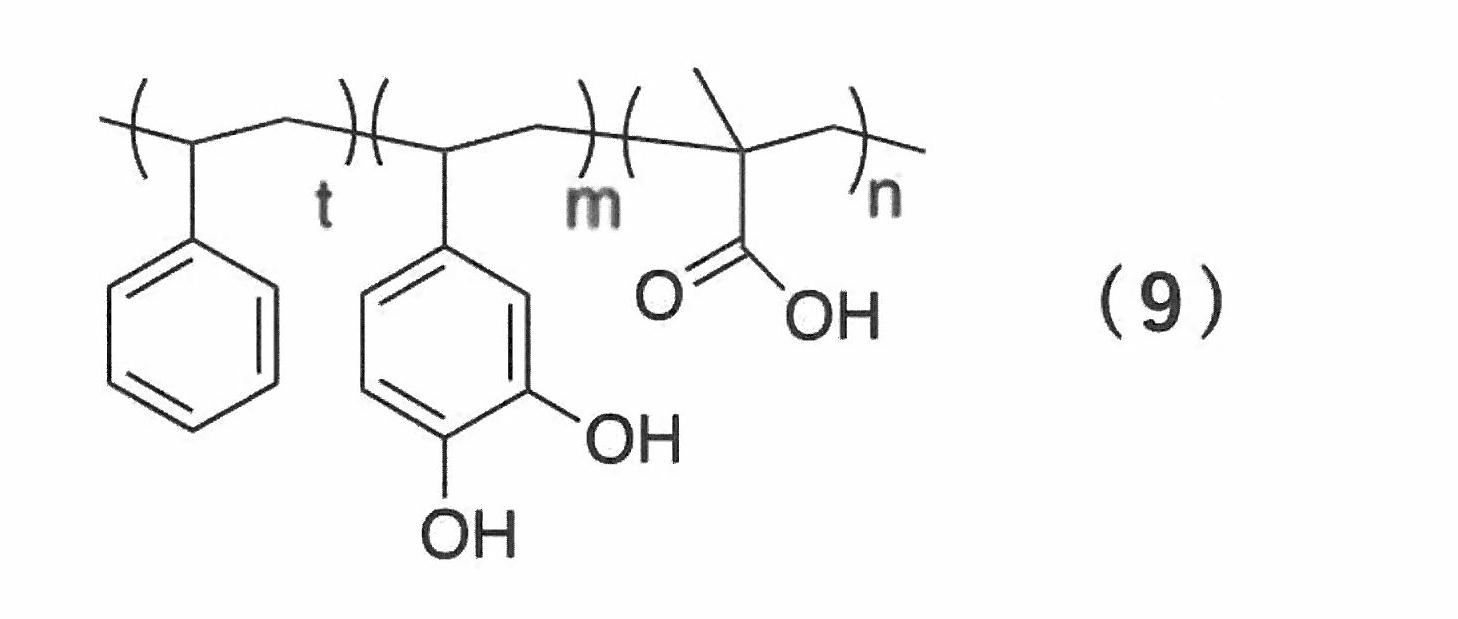

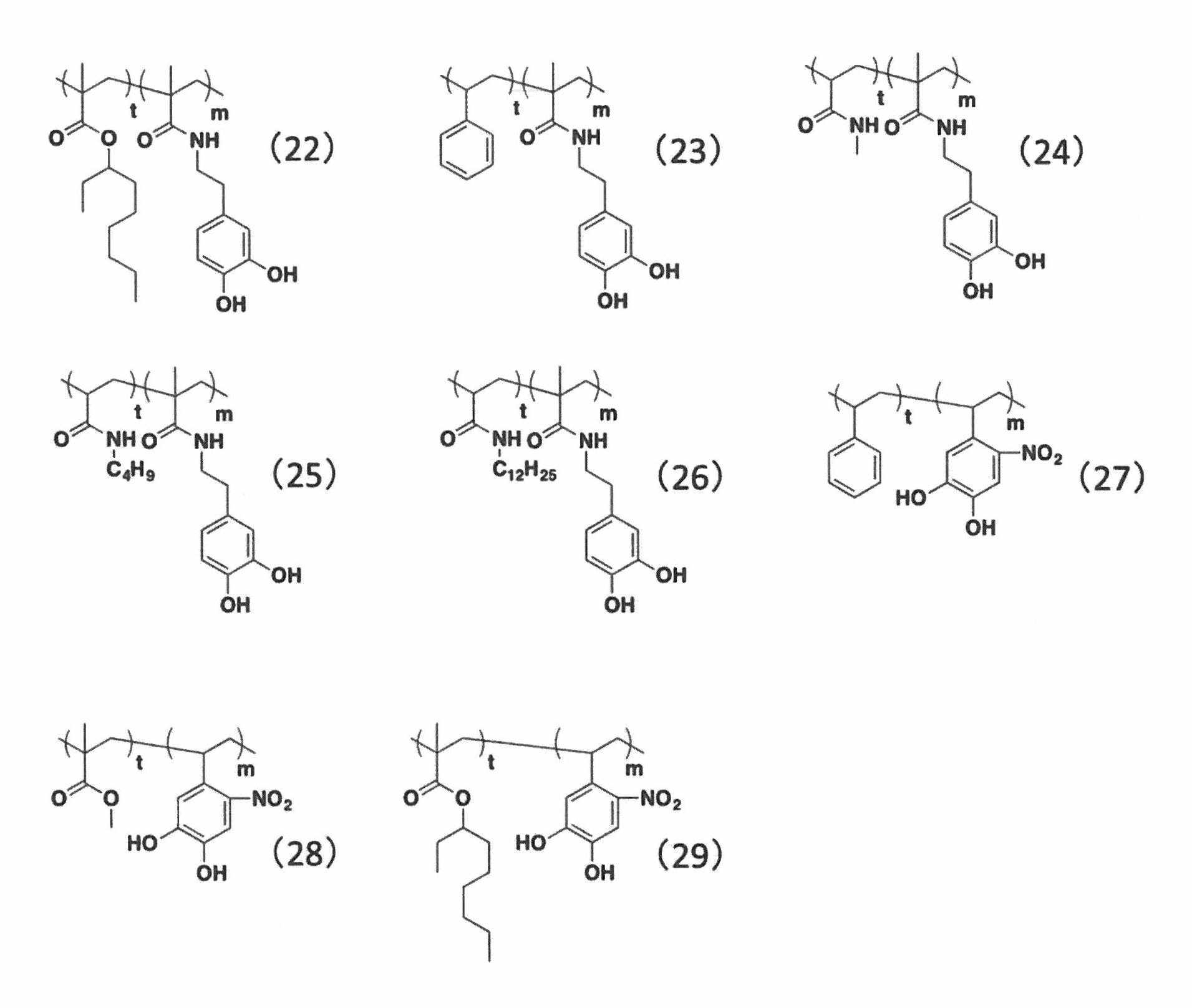
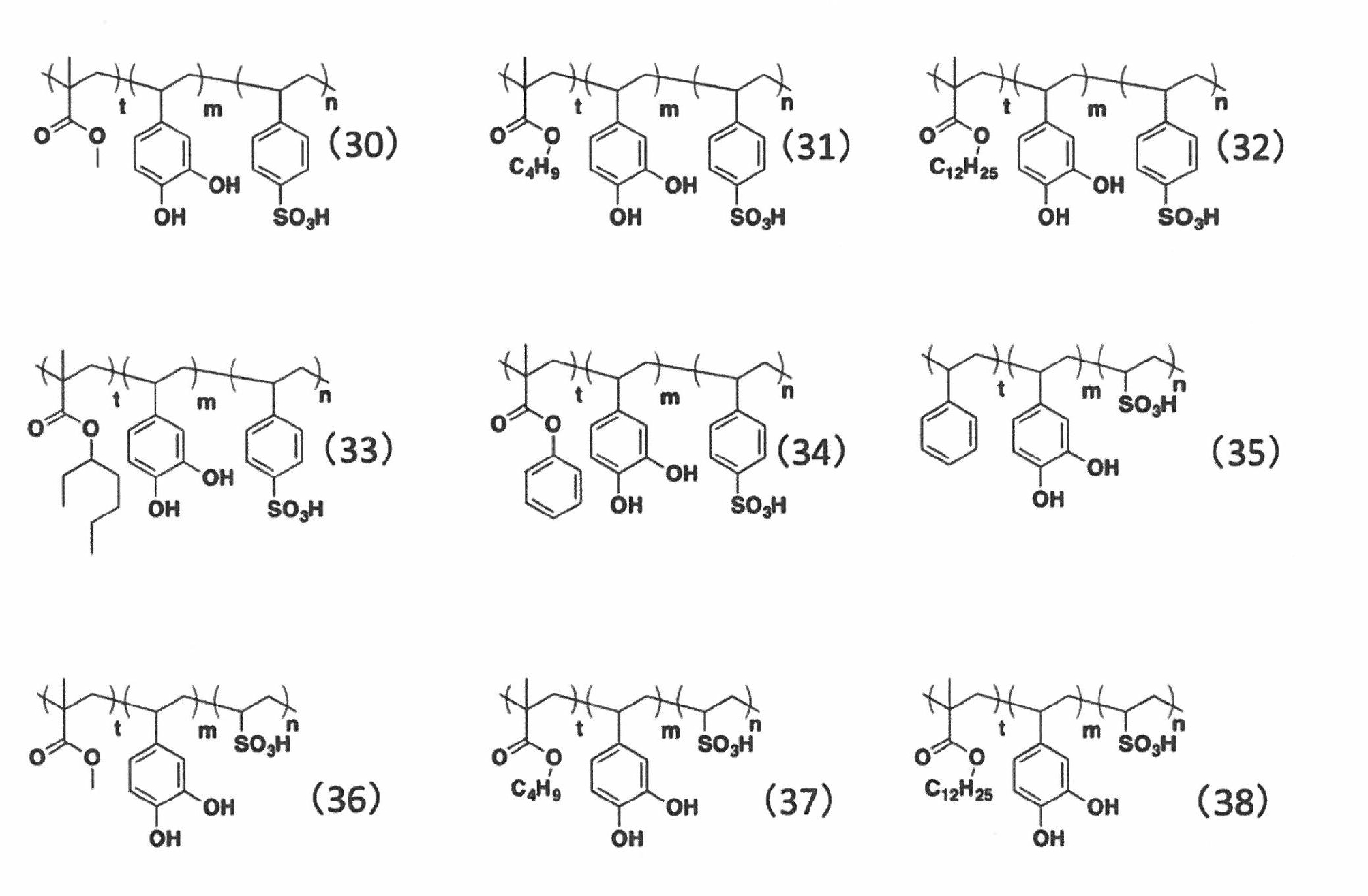
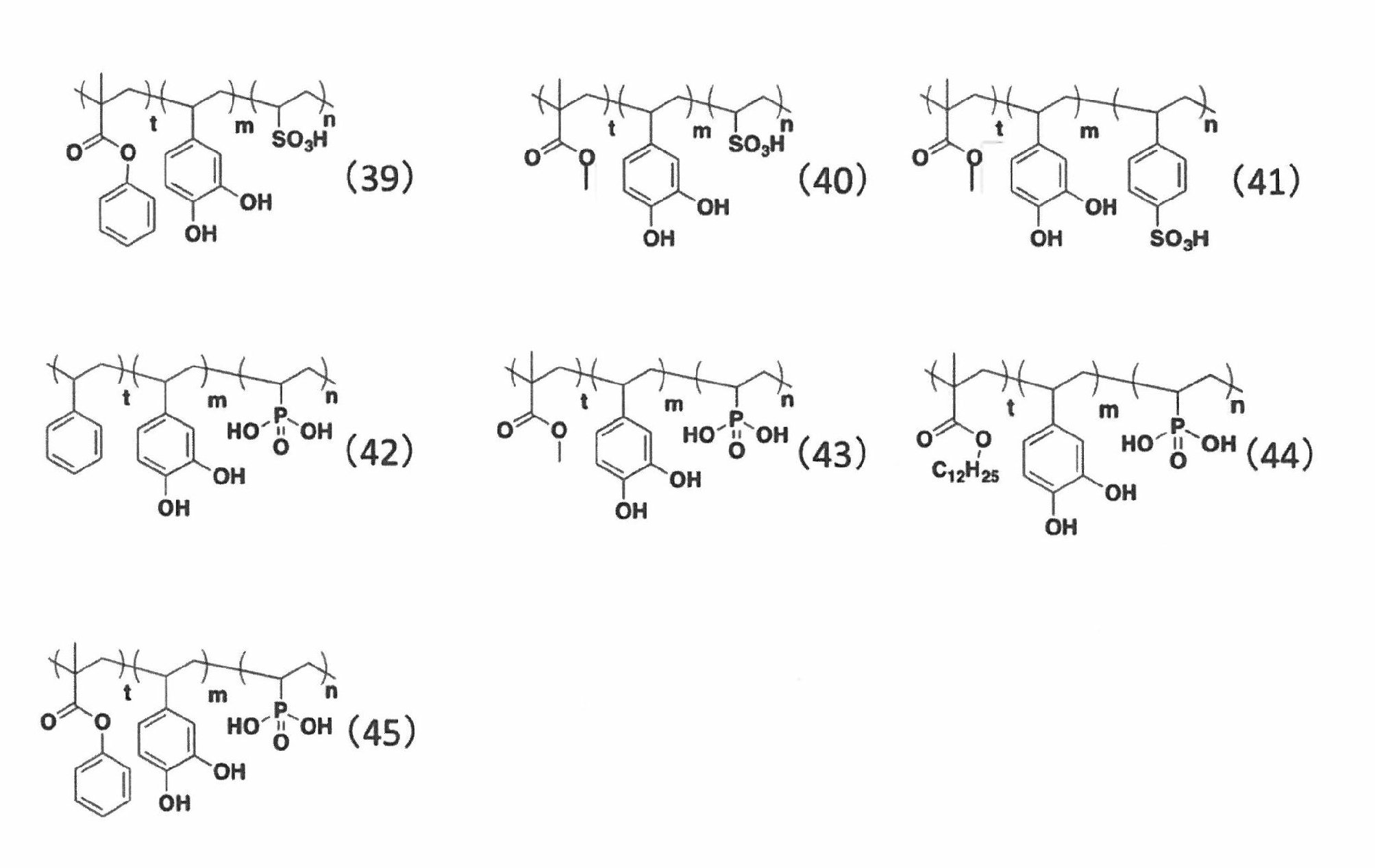
本発明の多層構造体の製造方法は、以下の工程を含んでいる。
(i)作製したブロック共重合体を有機溶媒に溶解してブロック共重合体溶液を作製する工程
(j)前記ブロック共重合体溶液をキャストするキャスト工程
(k)キャストされた前記ブロック共重合体溶液の溶媒を蒸発させることで、前記ブロック共重合体のm及びnで表される親水性セグメント及びtで表される疎水性セグメントが、ミクロ層分離した多層構造体を作製する多層構造体作製工程
(i)作製したブロック共重合体を有機溶媒に溶解してブロック共重合体溶液を作製する工程
(j)前記ブロック共重合体溶液をキャストするキャスト工程
(k)キャストされた前記ブロック共重合体溶液の溶媒を蒸発させることで、前記ブロック共重合体のm及びnで表される親水性セグメント及びtで表される疎水性セグメントが、ミクロ層分離した多層構造体を作製する多層構造体作製工程
上記(i)工程で用いる有機溶媒は、ブロック共重合体を溶解できるものであれば特に制限はない。例えば、ヘキサン、ヘプタン、シクロヘキサン、ミネラルターペンなどの脂肪族炭化水素;ジエチルエ-テル、テトラヒドロフラン、ジオキサン、ジフェニルエ-テル、アニソ-ル、ジメトキシベンゼンなどのエ-テル類;N,N-ジメチルホルムアミド、N,N-ジメチルアセトアミドなどのアミド類;アセトニトリル、プロピオニトリル、ベンゾニトリルなどのニトリル類;アセトン、メチルエチルケトン、メチルイソブチルケトン、酢酸エチル、酢酸ブチル、エチレンカ-ボネ-ト、プロピレンカ-ボネ-トなどのエステル化合物またはカ-ボネ-ト化合物;メタノ-ル、エタノ-ル、プロパノ-ル、イソプロパノ-ル、n-ブチルアルコ-ル、t-ブチルアルコ-ル、イソアミルアルコ-ルなどのアルコ-ル類;ベンゼン、トルエンなどの芳香族炭化水素類;クロロベンゼン、塩化メチレン、クロロホルム、クロロベンゼン、ベンゾトリフルオライドなどハロゲン化炭化水素類が挙げられる。
上記(j)キャスト工程は、所期の多層構造体の形状を作製できる型を用いればよく、薄膜上の多層構造体を作製する場合は、平板にキャストすればよい。また、膜厚は、キャストする量を変えることで調整できる。ポリビニルアルコールなど、ポリマーを溶かさない溶媒で溶解する犠牲層を基板上に形成し、その上に薄膜を形成しても良い。
上記(k)多層構造体作製工程では、溶媒は常温常圧で風乾、あるいは真空乾燥等により蒸発させればよい。
本発明の無機ナノ粒子を含む多層構造体の製造方法は、以下の工程を含んでいる。
(l)無機イオンを含む溶液に上記(k)で作製した多層構造体を浸漬する浸漬工程
(m)無機イオンが、多層構造体のmで表されるセグメントのカテコール基により還元され、mで表されるセグメントを含むミクロ層中に無機ナノ粒子を作製する無機ナノ粒子作製工程
(l)無機イオンを含む溶液に上記(k)で作製した多層構造体を浸漬する浸漬工程
(m)無機イオンが、多層構造体のmで表されるセグメントのカテコール基により還元され、mで表されるセグメントを含むミクロ層中に無機ナノ粒子を作製する無機ナノ粒子作製工程
なお、本発明において、「無機ナノ粒子」とは、無機イオンがカテコールのヒドロキシ基から電子を供与されることで還元されて粒子化したものを意味する。本発明における「無機ナノ粒子」の粒径は、無機物質の種類に応じて変わるが、各無機物の原子サイズ~約100nm程度(カテコールセグメントの長さbが1000の場合)である。また、本発明における「無機塩」とは、水、ブロック共重合体を溶解しない極性有機溶媒、イオン性液体に添加することで無機イオン溶液を形成し上記「無機ナノ粒子」を作製することができるものを意味する。極性有機溶媒としては、ジメチルスフホキシド(DMSO)、ジメチルスルホキシド(DMF)等が挙げられる。イオン液体としては、イミダゾリウム塩、ピリジニウム塩、アンモニウム塩等が挙げられる。
本発明の無機ナノ粒子としては、上記のとおり、カテコールのヒドロキシ基から電子を供与されることで還元されて粒子化されるものであれば特に制限は無いが、例えば、金(Au)、銀(Ag)、白金(Pt)、パラジウム(Pd)、ロジウム(Rh)、イリジウム(Ir)、ルテニウム(Ru)、オスミウム(Os)、銅(Cu)などの金属;CdS、CeSe、CeTe、ZnSなどの金属化合物;Fe2O3などのフェリ磁性材料、Ag/Au、Au/Ptなどの合金などを挙げることができる。
なお、本発明では、無機イオンがカテコールのヒドロキシ基から電子を供与されることで還元されて無機ナノ粒子となるが、その後に、よりイオン化傾向の小さな無機イオンが添加されると、無機ナノ粒子は再度イオン化し、添加されたイオン化傾向の小さな無機イオンが還元されて無機ナノ粒子となる。本発明における「合金」とは、上記イオン化傾向を利用したもので、本発明のブロック共重合体のカテコール基を含むセグメント中で、イオン化傾向の異なる金属粒子が混在しているものを意味する。Fe2O3などの酸化物は、無機イオンを還元した後に、酸素をバブリングすることで酸化すれよい。また、CdS等の硫化物は、無機イオンを還元した後に硫化水素ガスをバブリングすれことで硫化すればよい。CeTe等の金属化合物は、各イオンを共存した状態で還元すればよい。また、イオン化傾向が近い場合は、各イオンが共存した状態で還元することで、カテコール基を含むセグメント中に、イオン化傾向の異なる金属粒子が混在するようにしてもよい。
上記無機ナノ粒子を製造するための無機塩としては、上記のとおり、水でイオン化するものであれば特に制限は無い。例えば、塩化金(III)(AuCl3)、テトラクロロ金(III)酸(塩化金酸)(HAuCl4)、硝酸銀(I)(AgNO3)、ヘキサクロリド白金(IV)酸H(H2[PtCl6]・(H2O)6)、塩化パラジウム(PdCl2)、硫酸ロジウム(O4Rh2S)、ヘキサクロロイリジウム酸カリウム(Cl6IrK2)、過ルテニウム酸テトラプロピルアンモニウム(C3H7)4N+ RuO4
-)、四酸化オスミウム(O4Os)、硫酸銅(CuSO4)、塩化カドミウム(CdCl2)、酸セリウム(III)八水和物(Ce2(SO4)3・8H2O)、四塩化セレン(SeCl4)、硫化テルル(TeS)、硫酸亜鉛(ZnSO4)、塩化鉄(FeCl2)等が挙げられる。
無機ナノ粒子作製工程の後は、必要に応じて、多層構造体を水で洗浄することで、未反応の無機イオンを洗い流せばよい。
なお、カテコール基は無機イオンを還元するとキノンになる。ところで、キノンは疎水性である。そのため、親水性のカテコール基から疎水性のキノンに変化するにしたがって、式(1)のmセグメントは疎水性となることから、水に溶解したイオンを還元し難くなる。その結果、無機イオンの濃度によらず、一定量の無機イオンの還元が進むと、式(1)のmセグメントにカテコール基が存在しているにもかかわらず、無機イオンは還元されなくなる。したがって、本発明の「無機ナノ粒子を含む多層構造体」の式(1)の親水性セグメントには、カテコール基及びキノンが含まれる。
ところで、カテコール基(ドーパ誘導体)は高い接着能力を有することが知られている(特表2013-503688号公報)。また、上記のとおり、本発明の「無機ナノ粒子を含む多層構造体」には、カテコール基が残留している。したがって、「無機ナノ粒子を含む多層構造体」を燃料電池のセパレータ用の固体高分子膜として使用した場合、アノード電極とカソード電極の間に電流を流しても、残留するカテコール基の接着力により、親水性セグメントからなるミクロ層内において無機ナノ粒子が移動することを抑制できる。
無機ナノ粒子を含む多層構造体は、それ自体で燃料電池のセパレータ用の固体高分子膜として用いることができるが、必要に応じて、保護膜等を貼り付けてもよい。
また、燃料電池を作製する場合には、公知のアノード電極及びカソード電極で固体高分子膜を挟めばよい。
以下に実施例を掲げ、本発明を具体的に説明するが、この実施例は単に本発明の説明のため、その具体的な態様の参考のために提供されているものである。これらの例示は本発明の特定の具体的な態様を説明するためのものであるが、本願で開示する発明の範囲を限定したり、あるいは制限することを表すものではない。
<実施例1>
〔保護基で保護されたカテコールセグメントを含むブロック共重合体の合成〕
以下に記載する手順で、ブロック共重合体を合成した。
〔保護基で保護されたカテコールセグメントを含むブロック共重合体の合成〕
以下に記載する手順で、ブロック共重合体を合成した。
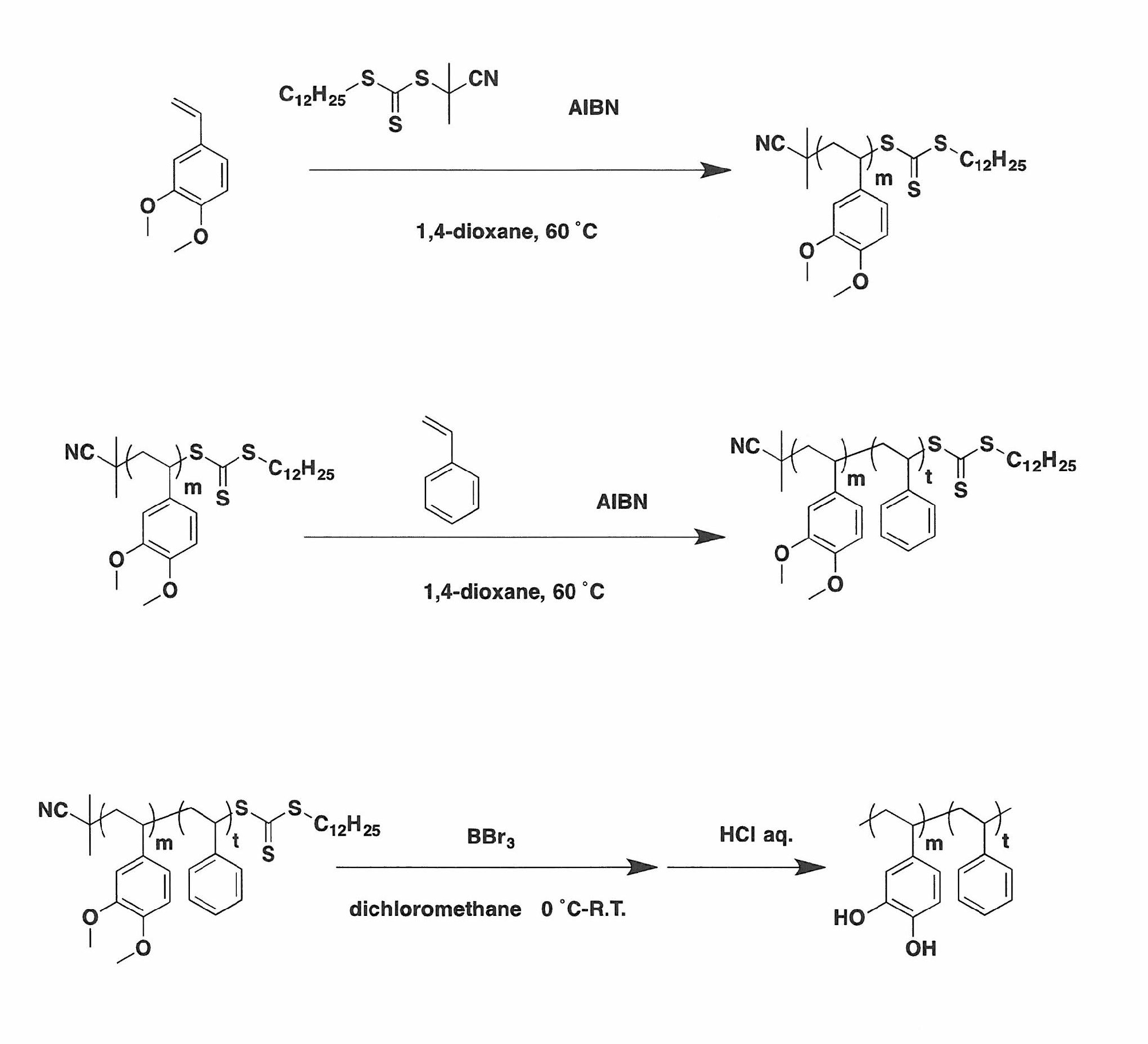
・ジメトキシスチレン(DMSt;アルドリッチ社製154466)を300mg、
・2-シアノ-2-プロピルドデシルトリチオカルボネート(アルドリッチ社製723037)を6.3mg、
・アゾビスイソブチロニトリル(AIBN;和光純薬工業株式会社製019-04932)を1.0mg、
・1,4-ジオキサン(和光純薬工業株式会社製042-03766)を500mg、
を試験管内に投入し、液体窒素を用いて溶液を凍結させポンプで吸引後、溶液を溶解させ内部を窒素で置換した。この操作を2回繰り返した後、60℃で60時間反応させた。反応後の溶液をヘキサン中に滴下し、その後遠心分離機において1500rpm、10分の条件で遠心しモノマーを取り除き、真空乾燥した。乾燥後のポリマーはGPCにより分子量を測定した。GPCの測定結果よりポリマーの重量平均分子量(Mw)は19,800であった。
・2-シアノ-2-プロピルドデシルトリチオカルボネート(アルドリッチ社製723037)を6.3mg、
・アゾビスイソブチロニトリル(AIBN;和光純薬工業株式会社製019-04932)を1.0mg、
・1,4-ジオキサン(和光純薬工業株式会社製042-03766)を500mg、
を試験管内に投入し、液体窒素を用いて溶液を凍結させポンプで吸引後、溶液を溶解させ内部を窒素で置換した。この操作を2回繰り返した後、60℃で60時間反応させた。反応後の溶液をヘキサン中に滴下し、その後遠心分離機において1500rpm、10分の条件で遠心しモノマーを取り除き、真空乾燥した。乾燥後のポリマーはGPCにより分子量を測定した。GPCの測定結果よりポリマーの重量平均分子量(Mw)は19,800であった。
次に、
・乾燥後のポリマーを110mg、
・スチレン(St;和光純薬工業株式会社製191-08206)を1000mg、
・アゾビスイソブチロニトリルを1.6mg、
・1,4-ジオキサンを500mg、
を試験管内に投入し液体窒素を用いて溶液を凍結させ、ポンプで吸引後溶液を溶解させ内部を窒素で置換した。この操作を2回繰り返した後、60℃で61時間反応させた。反応後の溶液をヘキサン中に滴下し、その後遠心分離機において1500rpm、10分の条件で遠心しモノマーを取り除き、真空乾燥した。乾燥後のブロック共重合体はGPCにより分子量を測定し、ブロック共重合体の化学構造をNMRにより決定した。
GPCの結果より、合成したブロック共重合体の重量平均分子量(Mw)は57,900で、重合比はSt:DMSt=3.1:1であった。また、図1は、実施例1で合成したブロック共重合体のNMR測定結果を示している。なお、本発明における「ブロック共重合体の分子量」とは、東ソー製HLC-8320GPCを用いてポリスチレン換算で測定したときの重量平均分子量を意味する。図1中のトリクロロメタンは重溶媒中に含まれる水素交換されたものであり、アセトンはNMR管を洗浄した際に残ってしまったものであると考えられる。
・乾燥後のポリマーを110mg、
・スチレン(St;和光純薬工業株式会社製191-08206)を1000mg、
・アゾビスイソブチロニトリルを1.6mg、
・1,4-ジオキサンを500mg、
を試験管内に投入し液体窒素を用いて溶液を凍結させ、ポンプで吸引後溶液を溶解させ内部を窒素で置換した。この操作を2回繰り返した後、60℃で61時間反応させた。反応後の溶液をヘキサン中に滴下し、その後遠心分離機において1500rpm、10分の条件で遠心しモノマーを取り除き、真空乾燥した。乾燥後のブロック共重合体はGPCにより分子量を測定し、ブロック共重合体の化学構造をNMRにより決定した。
GPCの結果より、合成したブロック共重合体の重量平均分子量(Mw)は57,900で、重合比はSt:DMSt=3.1:1であった。また、図1は、実施例1で合成したブロック共重合体のNMR測定結果を示している。なお、本発明における「ブロック共重合体の分子量」とは、東ソー製HLC-8320GPCを用いてポリスチレン換算で測定したときの重量平均分子量を意味する。図1中のトリクロロメタンは重溶媒中に含まれる水素交換されたものであり、アセトンはNMR管を洗浄した際に残ってしまったものであると考えられる。
〔カテコールセグメントを含むジブロック共重合体の合成〕
上記の手順で得られた乾燥ブロック共重合体100mgを、ジクロロメタン(和光純薬工業株式会社製135-02446)5mlに溶解させ、窒素バブリングを行った後、75.7g/lの三臭化ホウ素(アルドリッチ社製202207)溶液0.3mlを投入し一晩室温で撹拌した。この溶液に水2.5mlを投入し、その後、2Mの塩化ナトリウム水溶液5mlを10000rpm、15min、5℃の条件で遠心分離を行った。その後メタノール5mlを用いて10000rpm、15min、5℃の条件で遠心分離を行った。得られたブロック共重合体を真空条件で乾燥させることで、カテコールセグメントを含むブロック共重合体を合成した。
上記の手順で得られた乾燥ブロック共重合体100mgを、ジクロロメタン(和光純薬工業株式会社製135-02446)5mlに溶解させ、窒素バブリングを行った後、75.7g/lの三臭化ホウ素(アルドリッチ社製202207)溶液0.3mlを投入し一晩室温で撹拌した。この溶液に水2.5mlを投入し、その後、2Mの塩化ナトリウム水溶液5mlを10000rpm、15min、5℃の条件で遠心分離を行った。その後メタノール5mlを用いて10000rpm、15min、5℃の条件で遠心分離を行った。得られたブロック共重合体を真空条件で乾燥させることで、カテコールセグメントを含むブロック共重合体を合成した。
<実施例2>
[トリブロック共重合体の合成]
以下に記載する手順で、トリブロック共重合体を合成した。
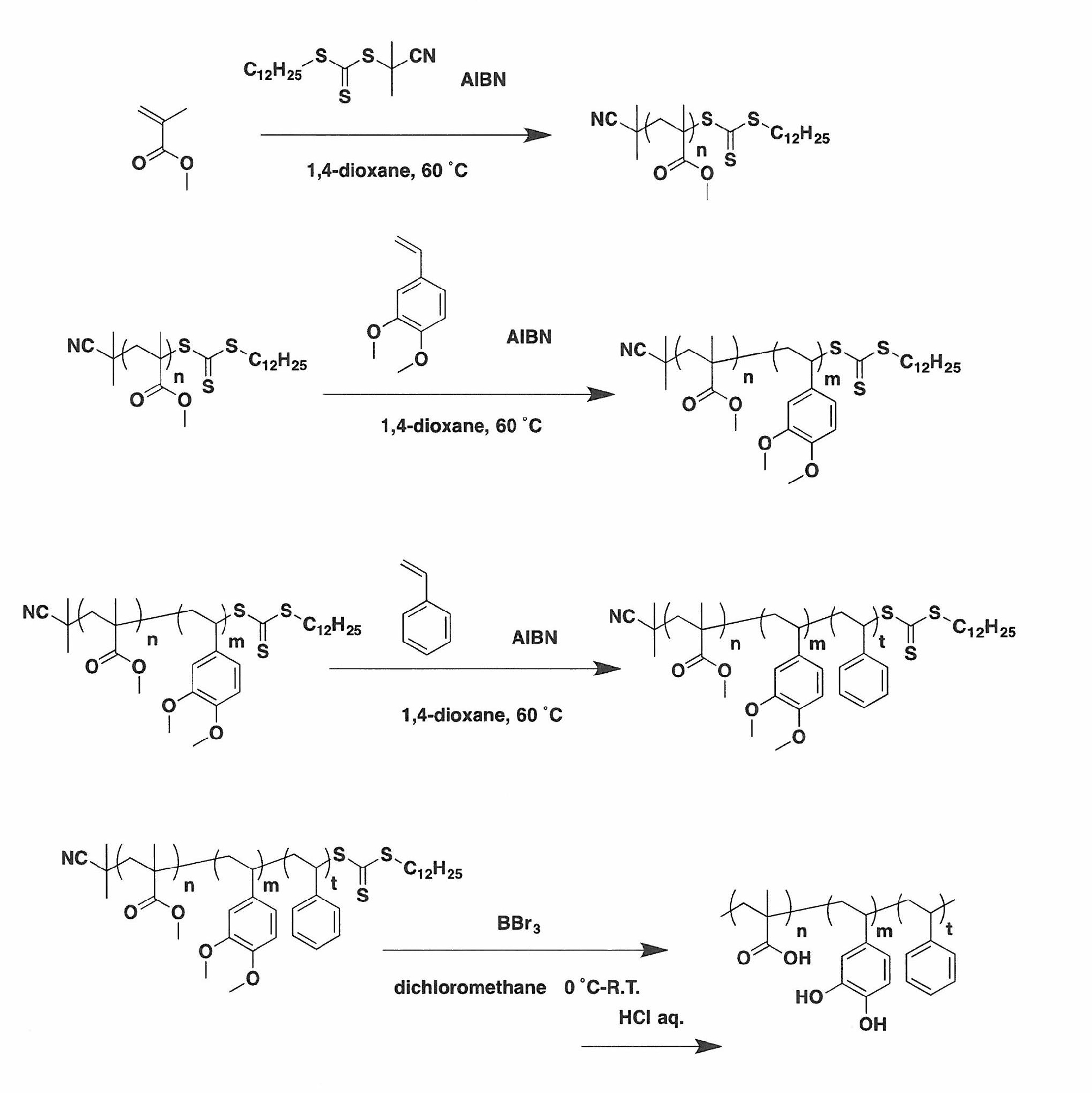
[トリブロック共重合体の合成]
以下に記載する手順で、トリブロック共重合体を合成した。
(1)PMMA-RAFTの合成
・メタクリル酸メチル(MMA、和光純薬工業株式会社製139-02726)を2g、
・2-シアノ-2-プロピルドデシルトリチオカーボネート(RAFT剤、CPDTTC、シグマ-アルドリッチ社製)を41.6mg、
・2,2-アゾビスイソブチロニトリル(AIBN、和光純薬工業株式会社製019-04932)を10.8mg、
を1,4-ジオキサン(和光純薬工業株式会社製042-03766)1gに溶解させ、ガラスチューブ中に封入した。凍結脱気を3回行うことにより脱酸素し、最終的に窒素にチューブ内を置換した。アルミブロックヒーターにより60℃で6時間重合反応を行った。得られた溶液を大過剰のメタノール中に再沈殿し、得られた固体を減圧乾燥した。ゲル濾過クロマトグラフィー(GPC)により、得られたポリマー(PMMA-RAFT)の数平均分子量(Mn)、重量平均分子量(Mw)、多分散度(PDI)はMn=11.5k、Mw=12.9k、PDI=1.12であった。GPCチャートは図2に示す。
・メタクリル酸メチル(MMA、和光純薬工業株式会社製139-02726)を2g、
・2-シアノ-2-プロピルドデシルトリチオカーボネート(RAFT剤、CPDTTC、シグマ-アルドリッチ社製)を41.6mg、
・2,2-アゾビスイソブチロニトリル(AIBN、和光純薬工業株式会社製019-04932)を10.8mg、
を1,4-ジオキサン(和光純薬工業株式会社製042-03766)1gに溶解させ、ガラスチューブ中に封入した。凍結脱気を3回行うことにより脱酸素し、最終的に窒素にチューブ内を置換した。アルミブロックヒーターにより60℃で6時間重合反応を行った。得られた溶液を大過剰のメタノール中に再沈殿し、得られた固体を減圧乾燥した。ゲル濾過クロマトグラフィー(GPC)により、得られたポリマー(PMMA-RAFT)の数平均分子量(Mn)、重量平均分子量(Mw)、多分散度(PDI)はMn=11.5k、Mw=12.9k、PDI=1.12であった。GPCチャートは図2に示す。
(2)PMMA-b-PDMSt-RAFTの合成
・PMMA-RAFTを632.5mg、
・1,4-ジメトキシスチレン(DMSt、和光純薬工業株式会社製)を2g、
・AIBNを6.9mg、
を1,4-ジオキサン1g中に溶解させ、ガラスチューブ中に封入した。凍結脱気を3回行うことにより脱酸素し、最終的に窒素にチューブ内を置換した。アルミブロックヒーターにより60℃で6時間重合反応を行った。得られた溶液を大過剰のメタノール中に再沈殿し、得られた固体を減圧乾燥した。ゲル濾過クロマトグラフィー(GPC)により、得られたポリマー(PMMA-b-PDMSt-RAFT)の数平均分子量(Mn)、重量平均分子量(Mw)、多分散度(PDI)はMn=17.2k、Mw=19.4k、PDI=1.13であった。GPCチャートは図2に示す。
・PMMA-RAFTを632.5mg、
・1,4-ジメトキシスチレン(DMSt、和光純薬工業株式会社製)を2g、
・AIBNを6.9mg、
を1,4-ジオキサン1g中に溶解させ、ガラスチューブ中に封入した。凍結脱気を3回行うことにより脱酸素し、最終的に窒素にチューブ内を置換した。アルミブロックヒーターにより60℃で6時間重合反応を行った。得られた溶液を大過剰のメタノール中に再沈殿し、得られた固体を減圧乾燥した。ゲル濾過クロマトグラフィー(GPC)により、得られたポリマー(PMMA-b-PDMSt-RAFT)の数平均分子量(Mn)、重量平均分子量(Mw)、多分散度(PDI)はMn=17.2k、Mw=19.4k、PDI=1.13であった。GPCチャートは図2に示す。
(3)PMMA-b-PDMSt-b-PSt-RAFTの合成
・PMMA-b-PDMSt-RAFTを856.4mg、
・スチレン(St、和光純薬工業株式会社製)を2.06g、
・AIBNを5.2mg、
を1,4-ジオキサン1g中に溶解させ、ガラスチューブ中に封入した。凍結脱気を3回行うことにより脱酸素し、最終的に窒素にチューブ内を置換した。アルミブロックヒーターにより60℃で6時間重合反応を行った。得られた溶液を大過剰のメタノール中に再沈殿し、得られた固体を減圧乾燥した。ゲル濾過クロマトグラフィー(GPC)により、得られたポリマー(PMMA-b-PDMSt-b-PSt-RAFT)の数平均分子量(Mn)、重量平均分子量(Mw)、多分散度(PDI)はMn=27.0k、Mw=30.6k、PDI=1.14であった。GPCチャートは図2に示す。
・PMMA-b-PDMSt-RAFTを856.4mg、
・スチレン(St、和光純薬工業株式会社製)を2.06g、
・AIBNを5.2mg、
を1,4-ジオキサン1g中に溶解させ、ガラスチューブ中に封入した。凍結脱気を3回行うことにより脱酸素し、最終的に窒素にチューブ内を置換した。アルミブロックヒーターにより60℃で6時間重合反応を行った。得られた溶液を大過剰のメタノール中に再沈殿し、得られた固体を減圧乾燥した。ゲル濾過クロマトグラフィー(GPC)により、得られたポリマー(PMMA-b-PDMSt-b-PSt-RAFT)の数平均分子量(Mn)、重量平均分子量(Mw)、多分散度(PDI)はMn=27.0k、Mw=30.6k、PDI=1.14であった。GPCチャートは図2に示す。
(4)脱保護
・PMMA-b-PDMSt-b-PSt-RAFTを150mg、
をジクロロメタン(和光純薬工業株式会社製)5mLに溶解させ、ガラスバイアルにラバーセプタムで封をした後、0℃に冷却した状態で三臭化ホウ素(アルドリッチ社製202207)0.5mLをゆっくりと注入した。12時間反応後、過剰量の1規定塩酸水溶液に混合し、脱保護を行った。3時間撹拌後、白色の沈殿を減圧乾燥した。反応前(図3)後(図4)の1H-NMRにより、メトキシ基のプロトンに由来するδ=3.785のピークが消失していることにより、脱保護が完了し、PMMA-b-PVCa-b-PStが合成できたことを確認した。なお、NMRの積分比から見て、PMMAの一部のメトキシ基が脱保護され、カルボン酸になった。
・PMMA-b-PDMSt-b-PSt-RAFTを150mg、
をジクロロメタン(和光純薬工業株式会社製)5mLに溶解させ、ガラスバイアルにラバーセプタムで封をした後、0℃に冷却した状態で三臭化ホウ素(アルドリッチ社製202207)0.5mLをゆっくりと注入した。12時間反応後、過剰量の1規定塩酸水溶液に混合し、脱保護を行った。3時間撹拌後、白色の沈殿を減圧乾燥した。反応前(図3)後(図4)の1H-NMRにより、メトキシ基のプロトンに由来するδ=3.785のピークが消失していることにより、脱保護が完了し、PMMA-b-PVCa-b-PStが合成できたことを確認した。なお、NMRの積分比から見て、PMMAの一部のメトキシ基が脱保護され、カルボン酸になった。
<実施例3>
〔多層構造体の作製〕
実施例1で合成したブロック共重合体をテトラヒドロフラン(THF)に溶解することでブロック共重合体溶液を作製した。次いで、ブロック共重合体溶液をシリコン基板あるいはPVA犠牲層をスピンコートしたシリコン基板にキャストし、キャストしたブロック共重合体溶液の溶媒を蒸発させることで多層構造体を作製した。次いで、作製した多層構造体を四酸化オスミウムで染色した。図5は、実施例3で作製した多層構造体のTEM写真である。本発明のブロック共重合体から、多層構造体を作製できることを確認した。
〔多層構造体の作製〕
実施例1で合成したブロック共重合体をテトラヒドロフラン(THF)に溶解することでブロック共重合体溶液を作製した。次いで、ブロック共重合体溶液をシリコン基板あるいはPVA犠牲層をスピンコートしたシリコン基板にキャストし、キャストしたブロック共重合体溶液の溶媒を蒸発させることで多層構造体を作製した。次いで、作製した多層構造体を四酸化オスミウムで染色した。図5は、実施例3で作製した多層構造体のTEM写真である。本発明のブロック共重合体から、多層構造体を作製できることを確認した。
<実施例4>
〔無機(Ag)ナノ粒子を含む多層構造体の作製〕
200mg/LのAgNO3水溶液に、実施例3で作製した多層構造体を30分間浸漬後、純水で洗浄することで、無機(Ag)ナノ粒子を含む多層構造体を作製した。図6は、実施例4で作製した無機ナノ粒子を含む多層構造体のTEM写真である。写真の黒色の点がAgナノ粒子である。写真から明らかなように、Agナノ粒子は、多層構造体のミクロ層に沿って作製されていることを確認した。
〔無機(Ag)ナノ粒子を含む多層構造体の作製〕
200mg/LのAgNO3水溶液に、実施例3で作製した多層構造体を30分間浸漬後、純水で洗浄することで、無機(Ag)ナノ粒子を含む多層構造体を作製した。図6は、実施例4で作製した無機ナノ粒子を含む多層構造体のTEM写真である。写真の黒色の点がAgナノ粒子である。写真から明らかなように、Agナノ粒子は、多層構造体のミクロ層に沿って作製されていることを確認した。
図7は、実施例3(Agナノ粒子無)及び実施例4(Agナノ粒子有)で作製した多層構造体の吸収波長をUV-Visを用いて測定(日本分光株式会社製V-670)した結果を表すグラフである。実施例4で作製した多層構造体はオレンジ色を呈しており、UV-Visの測定結果より416nmに吸収極大を有していた。この波長はAgナノ粒子の吸収波長と一致していた。
図8は、実施例4で作製したAgナノ粒子を含む多層構造体を、赤外分光装置(日本分光社製FT/IR6700)で測定した結果を示している。図8(A)は乾燥状態のAgナノ粒子を含む多層構造体の赤外吸収スペクトル、図8(B)は湿潤状態のAgナノ粒子を含む多層構造体の赤外吸収スペクトル、図8(C)は各分子が帰属する波長を表す。図8(A)及び(B)に示すように、全てのピークがきれいに帰属することを確認した。また、乾燥状態ではスチレン由来のベンゼン環ピーク《(ii)及び(iX)》が明確に観察された。一方、湿潤状態では、カテコールのC-H変角に由来するピーク(iii)が増大し、1置換ベンゼン《(ii)及び(iX)》のピークが減少した。このことは、水の導入によりカテコール層が膨潤したことを示している。更に、OH振動を見ると、乾燥状態の方がフリーのOH基が多いが(Xi)、湿潤状態ではほとんどのOHは水素結合していた(X)。
以上の結果より、Agイオンを含む溶液にブロック共重合体から作製した多層構造体を浸漬することで、カテコール基がAgイオンを還元し、カテコール基を有する親水性セグメントのミクロ層にAgナノ粒子が形成されることを確認した。また、湿潤状態でカテコールのC-H変角に由来するピーク(iii)が増大したことから、Agナノ粒子を形成した後の親水性セグメントには、カテコール基が含まれていることを確認した。更に、水の導入により親水性セグメントのカテコール基が水素結合したことから、本発明の多層構造体は、湿潤状態にすることでプロトン伝導性が向上すると推測できる。
<実施例5>
[多層構造体のプロトン伝導性の確認]
上記のとおり、本発明の多層構造体は、湿潤状態にすることでプロトン伝導性が向上することが推測されるので、実施例3及び4で作製した多層構造体のプロトン伝導性を確認するための実験を行った。なお、実験には、キャストする際のブロック共重合体溶液量を変えることで、異なる厚さを有する多層構造体を準備した。実験は湿度調整チャンバー(SH-221, Espec Corp.)中で、インピーダンス測定装置(SI1260,Solatoron Analytical)を用いて測定を行った。金ペースト電極を2本平行に塗布し、金線を電極に用いた。図9は実施例5で使用した実験装置の写真、図10(a)は厚さ500nmの多層構造体を用いた際の湿度とプロトン伝導性の関係を表すグラフ、図10(b)は多層構造体の厚さとプロトン伝導性の関係を表すグフである。
[多層構造体のプロトン伝導性の確認]
上記のとおり、本発明の多層構造体は、湿潤状態にすることでプロトン伝導性が向上することが推測されるので、実施例3及び4で作製した多層構造体のプロトン伝導性を確認するための実験を行った。なお、実験には、キャストする際のブロック共重合体溶液量を変えることで、異なる厚さを有する多層構造体を準備した。実験は湿度調整チャンバー(SH-221, Espec Corp.)中で、インピーダンス測定装置(SI1260,Solatoron Analytical)を用いて測定を行った。金ペースト電極を2本平行に塗布し、金線を電極に用いた。図9は実施例5で使用した実験装置の写真、図10(a)は厚さ500nmの多層構造体を用いた際の湿度とプロトン伝導性の関係を表すグラフ、図10(b)は多層構造体の厚さとプロトン伝導性の関係を表すグフである。
図10(a)に示すように、実施例3(Agナノ粒子無)及び実施例4(Agナノ粒子有)で作製した多層構造体のいずれも、水分を吸収することでプロトンの輸送能が向上することが確認できた。また、実施例4のAgナノ粒子を含む多層構造体は、Agナノ粒子を含まない実施例3の多層構造体と比較して、プロトン伝導性が約一桁上がることが確認できた。また、図10(b)に示すように、実施例4のAgナノ粒子を含む多層構造体は、厚さを薄くするほどプロトン伝導性が向上することが確認された。Agナノ粒子を含む多層構造体は、約500nmより薄くなると、Agナノ粒子を含まない場合と比較して、プロトン伝導性がより向上した。一方、ミクロ層分離した分離層の1層の膜厚は約20nmである。したがって、Agナノ粒子を含ませる場合、多層構造体としては、20nm~500nm程度の厚みにすることが好ましい。
[プロトン伝導性実験前後のAgナノ粒子の観察]
図11(A)は、実施例5に於いて、電極に通電する前のAgナノ粒子を含む多層構造体のTEM写真、図11(B)は、通電後のAgナノ粒子を含む多層構造体のTEM写真である。写真中の黒い点(矢印の先)がAgナノ粒子である。図11(A)及び(B)から明らかなように、本発明のAgナノ粒子を含む多層構造体は、通電後においてもAgナノ粒子は多層構造体の親水性セグメントの層内に分散された状態で留まることが確認できた。
図11(A)は、実施例5に於いて、電極に通電する前のAgナノ粒子を含む多層構造体のTEM写真、図11(B)は、通電後のAgナノ粒子を含む多層構造体のTEM写真である。写真中の黒い点(矢印の先)がAgナノ粒子である。図11(A)及び(B)から明らかなように、本発明のAgナノ粒子を含む多層構造体は、通電後においてもAgナノ粒子は多層構造体の親水性セグメントの層内に分散された状態で留まることが確認できた。
以上の結果より、実施例3(Agナノ粒子無)及び実施例4(Agナノ粒子有)で作製したいずれの多層構造体もプロトン伝導性を示すが、Agナノ粒子を含む多層構造体の方がプロトン伝導性に優れていること、及び、多層構造体の膜厚を薄くするほどプロトン伝導性が高くなることが明らかとなった。また、本発明の多層構造体はプロトン伝導性を示すことから、燃料電池のセパレータ用の固体高分子膜として使用できることが明らかとなった。
<実施例6>
[トリブロック共重合体を用いた無機ナノ粒子を含む多層構造体の作製及びプロトン伝導性の確認]
実施例2で作製したトリブロック共重合体(PMMA-b-PVCa-b-PSt)の10wt%THF溶液を調製し、20×10mmの石英基板上にキャストコート、あるいは、2000rpmでスピンコートを行い、フィルムの作製を行った。その後、200mM硝酸銀水溶液に浸漬することで、フィルム中にAgナノ粒子の形成を行った。得られたフィルムの一部を四酸化オスミウムで染色し、エポキシ樹脂に包埋した後、ウルトラミクロトームにより超薄切片を作製し、透過型電子顕微鏡で観察を行ったところ、キャストコートで作製したフィルムの膜厚は1.4μm、スピンコートで作製したフィルムの膜厚は70nm程度であった。また、内部にはシリンダーが積層した構造が観察された。図12はスピンコートで作製したフィルムを、硝酸銀水溶液に浸漬した後のTEM写真である。写真から明らかなように、トリブロック共重合体を用いた場合にも、ジブロック共重合体と同様にAgナノ粒子が多層構造体のミクロ層に沿って形成されていることを確認した。
[トリブロック共重合体を用いた無機ナノ粒子を含む多層構造体の作製及びプロトン伝導性の確認]
実施例2で作製したトリブロック共重合体(PMMA-b-PVCa-b-PSt)の10wt%THF溶液を調製し、20×10mmの石英基板上にキャストコート、あるいは、2000rpmでスピンコートを行い、フィルムの作製を行った。その後、200mM硝酸銀水溶液に浸漬することで、フィルム中にAgナノ粒子の形成を行った。得られたフィルムの一部を四酸化オスミウムで染色し、エポキシ樹脂に包埋した後、ウルトラミクロトームにより超薄切片を作製し、透過型電子顕微鏡で観察を行ったところ、キャストコートで作製したフィルムの膜厚は1.4μm、スピンコートで作製したフィルムの膜厚は70nm程度であった。また、内部にはシリンダーが積層した構造が観察された。図12はスピンコートで作製したフィルムを、硝酸銀水溶液に浸漬した後のTEM写真である。写真から明らかなように、トリブロック共重合体を用いた場合にも、ジブロック共重合体と同様にAgナノ粒子が多層構造体のミクロ層に沿って形成されていることを確認した。
次に、スピンコートで作製したAgナノ粒子が形成されたフィルムを用い、実施例5と同様の手順(湿度95%)で、プロトン伝導性の評価を行った。logσ(S/cm)の値は-4.9で、プロトン伝導性を有することを確認した。
本発明のブロック共重合体は、多層構造体を作製することができ、該多層構造体はプロトン伝導性がある。したがって、多層構造体を燃料電池のセパレータ用の固体高分子膜として用いることができ、更に、固体高分子膜を用いて燃料電池を作製することができる。したがって、本発明は、燃料電池産業にとって有用である。
Claims (20)
- 下記式(1)で表されるブロック共重合体。

- 前記m、n、tが、m+n/m+n+t=0.2~0.8である、
請求項1に記載のブロック共重合体。 - 前記nが含まれる、請求項1又は2に記載のブロック共重合体。
- 請求項1~3の何れか一項に記載のブロック共重合体のm及びnで表される親水性セグメント及びtで表される疎水性セグメントが、ミクロ層分離した層構造を有する、
多層構造体。 - 前記多層構造体の厚さが20nm~500nmである、
請求項4に記載の多層構造体。 - 前記親水性セグメントからなるミクロ層が無機ナノ粒子を含む、
請求項4又は5に記載の多層構造体。 - 前記親水性セグメントがカテコール基及びキノンを含む、
請求項6に記載の多層構造体。 - 請求項4~7の何れか一項に記載の多層構造体を含む、
燃料電池のセパレータ用の固体高分子膜。 - 請求項8に記載の固体高分子膜、アノード電極及びカソード電極を含む、
燃料電池。 - 下記式(1)で表されるブロック共重合体を有機溶媒に溶解してブロック共重合体溶液を作製する工程、
前記ブロック共重合体溶液をキャストするキャスト工程、
キャストされた前記ブロック共重合体溶液の溶媒を蒸発させることで、前記ブロック共重合体のm及びnで表される親水性セグメント及びtで表される疎水性セグメントが、ミクロ層分離した多層構造体を作製する多層構造体作製工程、
を含む、多層構造体の製造方法。
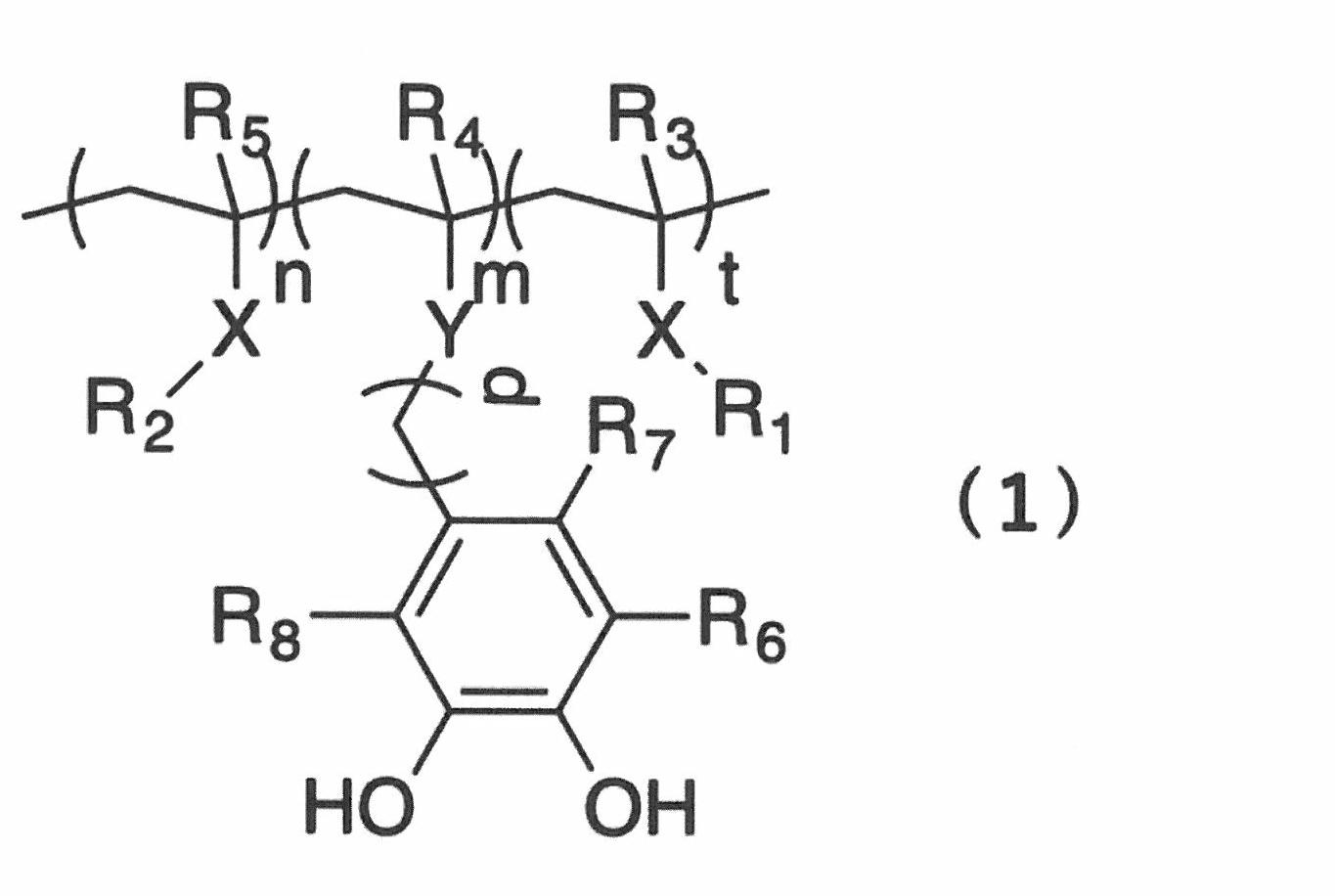
- 前記nが含まれる、請求項10に記載の多層構造体の製造方法。
- 無機イオンを含む溶液に請求項10又は11に記載の製造方法で製造した多層構造体を浸漬する浸漬工程、
前記無機イオンが、多層構造体のmで表されるセグメントのカテコール基により還元され、mで表されるセグメントを含むミクロ層中に無機ナノ粒子を作製する無機ナノ粒子作製工程、
を含む、無機ナノ粒子を含む多層構造体の製造方法。 - カテコール基を含む親水性セグメント、
前記カテコール基を含む親水性セグメントより疎水性の置換を含む疎水性セグメント、
および、
必要に応じて含まれる、酸解離定数pKaが0.5以上、7以下の官能基を含む親水性セグメント、
を含み、
前記酸解離定数pKaが0.5以上、7以下の官能基を含む親水性セグメントが含まれる場合は、前記カテコール基を含む親水性セグメントに隣接する、
ブロック共重合体。 - 前記酸解離定数pKaが0.5以上、7以下の官能基を含む親水性セグメントが含まれる、請求項13に記載のブロック共重合体。
- 請求項13又は14に記載のブロック共重合体の親水性セグメント及び疎水性セグメントが、ミクロ層分離した層構造を有する、
多層構造体。 - 前記多層構造体の厚さが20nm~500nmである、
請求項15に記載の多層構造体。 - 前記親水性セグメントからなるミクロ層が無機ナノ粒子を含む、
請求項15又は16に記載の多層構造体。 - 前記親水性セグメントがカテコール基及びキノンを含む、
請求項17に記載の多層構造体。 - 請求項15~18の何れか一項に記載の多層構造体を含む、
燃料電池のセパレータ用の固体高分子膜。 - 請求項19に記載の固体高分子膜、アノード電極及びカソード電極を含む、
燃料電池。
Priority Applications (2)
| Application Number | Priority Date | Filing Date | Title |
|---|---|---|---|
| JP2018531901A JP6655250B2 (ja) | 2016-08-05 | 2017-08-01 | ブロック共重合体、多層構造体、固体高分子膜、燃料電池、多層構造体の製造方法、及び無機ナノ粒子を含む多層構造体の製造方法 |
| US16/321,083 US10851237B2 (en) | 2016-08-05 | 2017-08-01 | Block copolymer, multilayered structure, solid polymer membrane, fuel cell, method for producing multilayered structure, and method for producing multilayered structure including inorganic nanoparticles |
Applications Claiming Priority (2)
| Application Number | Priority Date | Filing Date | Title |
|---|---|---|---|
| JP2016-154294 | 2016-08-05 | ||
| JP2016154294 | 2016-08-05 |
Publications (1)
| Publication Number | Publication Date |
|---|---|
| WO2018025828A1 true WO2018025828A1 (ja) | 2018-02-08 |
Family
ID=61073763
Family Applications (1)
| Application Number | Title | Priority Date | Filing Date |
|---|---|---|---|
| PCT/JP2017/027793 Ceased WO2018025828A1 (ja) | 2016-08-05 | 2017-08-01 | ブロック共重合体、多層構造体、固体高分子膜、燃料電池、多層構造体の製造方法、及び無機ナノ粒子を含む多層構造体の製造方法 |
Country Status (3)
| Country | Link |
|---|---|
| US (1) | US10851237B2 (ja) |
| JP (1) | JP6655250B2 (ja) |
| WO (1) | WO2018025828A1 (ja) |
Cited By (2)
| Publication number | Priority date | Publication date | Assignee | Title |
|---|---|---|---|---|
| CN109908775A (zh) * | 2019-02-01 | 2019-06-21 | 浙江大学 | 一种利用嵌段聚合物制备多孔分离膜的方法 |
| CN110707341A (zh) * | 2019-10-23 | 2020-01-17 | 苏州晋承技术咨询有限公司 | 一种用于燃料电池的双极板亲水-疏水表面及其制备方法 |
Families Citing this family (1)
| Publication number | Priority date | Publication date | Assignee | Title |
|---|---|---|---|---|
| US11680162B2 (en) * | 2020-04-01 | 2023-06-20 | Alliance For Sustainable Energy, Llc | Compositions for electrolyte fuel cells and other electrochemical conversion devices |
Citations (3)
| Publication number | Priority date | Publication date | Assignee | Title |
|---|---|---|---|---|
| JP2004062044A (ja) * | 2002-07-31 | 2004-02-26 | Fuji Photo Film Co Ltd | 電子線、x線又はeuv用ネガ型レジスト組成物 |
| JP2010501027A (ja) * | 2006-08-04 | 2010-01-14 | ネリテス コーポレイション | バイオミメティック化合物およびその合成方法 |
| WO2015129846A1 (ja) * | 2014-02-28 | 2015-09-03 | 独立行政法人科学技術振興機構 | カテコールセグメントを含むブロック共重合体及び該ブロック共重合体で被覆された無機ナノ粒子、並びに、カテコールセグメントを含むブロック共重合体の製造方法及び該ブロック共重合体で被覆された無機ナノ粒子の製造方法 |
Family Cites Families (3)
| Publication number | Priority date | Publication date | Assignee | Title |
|---|---|---|---|---|
| JP2007311334A (ja) * | 2006-04-17 | 2007-11-29 | Dainippon Printing Co Ltd | 燃料電池用のセパレータおよびその製造方法 |
| JP5613181B2 (ja) | 2010-02-02 | 2014-10-22 | 本田技研工業株式会社 | 固体高分子型燃料電池用膜電極構造体および固体高分子型燃料電池 |
| WO2014021208A1 (ja) | 2012-08-01 | 2014-02-06 | 独立行政法人物質・材料研究機構 | 高プロトン伝導性ポリマーフィルム、その製造方法及び湿度センサー |
-
2017
- 2017-08-01 US US16/321,083 patent/US10851237B2/en active Active
- 2017-08-01 WO PCT/JP2017/027793 patent/WO2018025828A1/ja not_active Ceased
- 2017-08-01 JP JP2018531901A patent/JP6655250B2/ja active Active
Patent Citations (3)
| Publication number | Priority date | Publication date | Assignee | Title |
|---|---|---|---|---|
| JP2004062044A (ja) * | 2002-07-31 | 2004-02-26 | Fuji Photo Film Co Ltd | 電子線、x線又はeuv用ネガ型レジスト組成物 |
| JP2010501027A (ja) * | 2006-08-04 | 2010-01-14 | ネリテス コーポレイション | バイオミメティック化合物およびその合成方法 |
| WO2015129846A1 (ja) * | 2014-02-28 | 2015-09-03 | 独立行政法人科学技術振興機構 | カテコールセグメントを含むブロック共重合体及び該ブロック共重合体で被覆された無機ナノ粒子、並びに、カテコールセグメントを含むブロック共重合体の製造方法及び該ブロック共重合体で被覆された無機ナノ粒子の製造方法 |
Non-Patent Citations (11)
Cited By (2)
| Publication number | Priority date | Publication date | Assignee | Title |
|---|---|---|---|---|
| CN109908775A (zh) * | 2019-02-01 | 2019-06-21 | 浙江大学 | 一种利用嵌段聚合物制备多孔分离膜的方法 |
| CN110707341A (zh) * | 2019-10-23 | 2020-01-17 | 苏州晋承技术咨询有限公司 | 一种用于燃料电池的双极板亲水-疏水表面及其制备方法 |
Also Published As
| Publication number | Publication date |
|---|---|
| US20190169420A1 (en) | 2019-06-06 |
| US10851237B2 (en) | 2020-12-01 |
| JPWO2018025828A1 (ja) | 2019-03-28 |
| JP6655250B2 (ja) | 2020-02-26 |
Similar Documents
| Publication | Publication Date | Title |
|---|---|---|
| Jia et al. | Composite electrolytes comprised of poly (ethylene oxide) and silica nanoparticles with grafted poly (ethylene oxide)-containing polymers | |
| Wei et al. | High performance polymer binders inspired by chemical finishing of textiles for silicon anodes in lithium ion batteries | |
| US20180375089A1 (en) | Anode active material particles having an artificial sei layer | |
| Ni et al. | “Clicking” fluorinated polyhedral oligomeric silsesquioxane onto polymers: a modular approach toward shape amphiphiles with fluorous molecular clusters | |
| US10377894B2 (en) | Block copolymer | |
| JP6270179B2 (ja) | カテコールセグメントを含むブロック共重合体及び該ブロック共重合体で被覆された無機ナノ粒子、並びに、カテコールセグメントを含むブロック共重合体の製造方法及び該ブロック共重合体で被覆された無機ナノ粒子の製造方法 | |
| JP6655250B2 (ja) | ブロック共重合体、多層構造体、固体高分子膜、燃料電池、多層構造体の製造方法、及び無機ナノ粒子を含む多層構造体の製造方法 | |
| TW201235205A (en) | Modifier for polyvinylidene fluoride, binder resin composition for battery, electrode and battery for secondary battery | |
| US20180159132A1 (en) | ANODE ACTIVE MATERIAL PARTICLES WITH ARTIFICIAL SEl-LAYER BY MEANS OF GRAFT-TO-POLYMERIZATION | |
| Zeng et al. | Rapid deswelling and reswelling response of poly (N-isopropylacrylamide) hydrogels via formation of interpenetrating polymer networks with polyhedral oligomeric silsesquioxane-capped poly (ethylene oxide) amphiphilic telechelics | |
| US20200291145A1 (en) | Polymer compound for conductive polymer and method for producing same | |
| CN108155355A (zh) | 借助活性自由基聚合具有合成sei层的阳极活性材料颗粒 | |
| CN1802399A (zh) | 新型水溶性自掺杂聚苯胺接枝共聚物 | |
| Mumtaz et al. | Synthesis of hybrid semiconducting polymer–metal latexes | |
| Tungala et al. | Dendrimer like star polymer based on β-cyclodextrin with ABC type miktoarms | |
| JP2009102461A (ja) | 導電性含水ゲル | |
| Tang et al. | Synthesis of poly (sodium styrene sulfonate)-b-poly (butyl acrylate) block copolymers via RAFT emulsifier-free emulsion polymerization and their application in PEDOT aqueous dispersions | |
| JP7310279B2 (ja) | ポリチオフェン-ポリスチレンスルホン酸共重合体からなる複合体、及びそれを含有する水分散液 | |
| Wang et al. | Photo-patternable, stretchable and electrically conductive graft copolymers of poly (3-hexylthiophene) | |
| Massoumi et al. | Chemical and electrochemical grafting of polythiophene onto polystyrene synthesized via ‘living’anionic polymerization | |
| US11932773B2 (en) | Coated particle, dispersion solution, dispersion method of coated particles, coating film, manufacturing method of coating film, and copolymer | |
| WO2024232342A1 (ja) | 有機リチウム塩の製造方法、当該有機リチウム塩を含む組成物、及び重合体 | |
| US11299572B2 (en) | Block copolymer | |
| Lakshmi et al. | Chimeric polymers formed from a monomer capable of free radical, oxidative and electrochemical polymerisation | |
| Yabu et al. | Core-shell cylinder (CSC) nanotemplates comprising mussel-inspired catechol-containing triblock copolymers for silver nanoparticle arrays and ion conductive channels |
Legal Events
| Date | Code | Title | Description |
|---|---|---|---|
| ENP | Entry into the national phase |
Ref document number: 2018531901 Country of ref document: JP Kind code of ref document: A |
|
| 121 | Ep: the epo has been informed by wipo that ep was designated in this application |
Ref document number: 17836933 Country of ref document: EP Kind code of ref document: A1 |
|
| NENP | Non-entry into the national phase |
Ref country code: DE |
|
| 122 | Ep: pct application non-entry in european phase |
Ref document number: 17836933 Country of ref document: EP Kind code of ref document: A1 |