WO2017209165A1 - Skin cleansing composition comprising cellulose particles as scrubbing agent - Google Patents
Skin cleansing composition comprising cellulose particles as scrubbing agent Download PDFInfo
- Publication number
- WO2017209165A1 WO2017209165A1 PCT/JP2017/020198 JP2017020198W WO2017209165A1 WO 2017209165 A1 WO2017209165 A1 WO 2017209165A1 JP 2017020198 W JP2017020198 W JP 2017020198W WO 2017209165 A1 WO2017209165 A1 WO 2017209165A1
- Authority
- WO
- WIPO (PCT)
- Prior art keywords
- mass
- less
- cleansing composition
- skin cleansing
- component
- Prior art date
- Legal status (The legal status is an assumption and is not a legal conclusion. Google has not performed a legal analysis and makes no representation as to the accuracy of the status listed.)
- Ceased
Links
Classifications
-
- A—HUMAN NECESSITIES
- A61—MEDICAL OR VETERINARY SCIENCE; HYGIENE
- A61K—PREPARATIONS FOR MEDICAL, DENTAL OR TOILETRY PURPOSES
- A61K8/00—Cosmetics or similar toiletry preparations
- A61K8/02—Cosmetics or similar toiletry preparations characterised by special physical form
- A61K8/0241—Containing particulates characterized by their shape and/or structure
- A61K8/025—Explicitly spheroidal or spherical shape
-
- A—HUMAN NECESSITIES
- A61—MEDICAL OR VETERINARY SCIENCE; HYGIENE
- A61K—PREPARATIONS FOR MEDICAL, DENTAL OR TOILETRY PURPOSES
- A61K8/00—Cosmetics or similar toiletry preparations
- A61K8/18—Cosmetics or similar toiletry preparations characterised by the composition
- A61K8/30—Cosmetics or similar toiletry preparations characterised by the composition containing organic compounds
- A61K8/33—Cosmetics or similar toiletry preparations characterised by the composition containing organic compounds containing oxygen
- A61K8/36—Carboxylic acids; Salts or anhydrides thereof
- A61K8/361—Carboxylic acids having more than seven carbon atoms in an unbroken chain; Salts or anhydrides thereof
-
- A—HUMAN NECESSITIES
- A61—MEDICAL OR VETERINARY SCIENCE; HYGIENE
- A61K—PREPARATIONS FOR MEDICAL, DENTAL OR TOILETRY PURPOSES
- A61K8/00—Cosmetics or similar toiletry preparations
- A61K8/18—Cosmetics or similar toiletry preparations characterised by the composition
- A61K8/30—Cosmetics or similar toiletry preparations characterised by the composition containing organic compounds
- A61K8/40—Cosmetics or similar toiletry preparations characterised by the composition containing organic compounds containing nitrogen
- A61K8/44—Aminocarboxylic acids or derivatives thereof, e.g. aminocarboxylic acids containing sulfur; Salts; Esters or N-acylated derivatives thereof
- A61K8/442—Aminocarboxylic acids or derivatives thereof, e.g. aminocarboxylic acids containing sulfur; Salts; Esters or N-acylated derivatives thereof substituted by amido group(s)
-
- A—HUMAN NECESSITIES
- A61—MEDICAL OR VETERINARY SCIENCE; HYGIENE
- A61K—PREPARATIONS FOR MEDICAL, DENTAL OR TOILETRY PURPOSES
- A61K8/00—Cosmetics or similar toiletry preparations
- A61K8/18—Cosmetics or similar toiletry preparations characterised by the composition
- A61K8/30—Cosmetics or similar toiletry preparations characterised by the composition containing organic compounds
- A61K8/46—Cosmetics or similar toiletry preparations characterised by the composition containing organic compounds containing sulfur
- A61K8/463—Cosmetics or similar toiletry preparations characterised by the composition containing organic compounds containing sulfur containing sulfuric acid derivatives, e.g. sodium lauryl sulfate
-
- A—HUMAN NECESSITIES
- A61—MEDICAL OR VETERINARY SCIENCE; HYGIENE
- A61K—PREPARATIONS FOR MEDICAL, DENTAL OR TOILETRY PURPOSES
- A61K8/00—Cosmetics or similar toiletry preparations
- A61K8/18—Cosmetics or similar toiletry preparations characterised by the composition
- A61K8/72—Cosmetics or similar toiletry preparations characterised by the composition containing organic macromolecular compounds
- A61K8/73—Polysaccharides
- A61K8/731—Cellulose; Quaternized cellulose derivatives
-
- A—HUMAN NECESSITIES
- A61—MEDICAL OR VETERINARY SCIENCE; HYGIENE
- A61K—PREPARATIONS FOR MEDICAL, DENTAL OR TOILETRY PURPOSES
- A61K8/00—Cosmetics or similar toiletry preparations
- A61K8/18—Cosmetics or similar toiletry preparations characterised by the composition
- A61K8/72—Cosmetics or similar toiletry preparations characterised by the composition containing organic macromolecular compounds
- A61K8/81—Cosmetics or similar toiletry preparations characterised by the composition containing organic macromolecular compounds obtained by reactions involving only carbon-to-carbon unsaturated bonds
- A61K8/8141—Compositions of homopolymers or copolymers of compounds having one or more unsaturated aliphatic radicals, each having only one carbon-to-carbon double bond, and at least one being terminated by only one carboxyl radical, or of salts, anhydrides, esters, amides, imides or nitriles thereof; Compositions of derivatives of such polymers
- A61K8/8152—Homopolymers or copolymers of esters, e.g. (meth)acrylic acid esters; Compositions of derivatives of such polymers
-
- A—HUMAN NECESSITIES
- A61—MEDICAL OR VETERINARY SCIENCE; HYGIENE
- A61Q—SPECIFIC USE OF COSMETICS OR SIMILAR TOILETRY PREPARATIONS
- A61Q19/00—Preparations for care of the skin
- A61Q19/10—Washing or bathing preparations
-
- A—HUMAN NECESSITIES
- A61—MEDICAL OR VETERINARY SCIENCE; HYGIENE
- A61K—PREPARATIONS FOR MEDICAL, DENTAL OR TOILETRY PURPOSES
- A61K2800/00—Properties of cosmetic compositions or active ingredients thereof or formulation aids used therein and process related aspects
- A61K2800/20—Chemical, physico-chemical or functional or structural properties of the composition as a whole
- A61K2800/28—Rubbing or scrubbing compositions; Peeling or abrasive compositions; Containing exfoliants
Definitions
- the present invention relates to a skin cleansing composition containing a particle.
- Patent JP-A-H11-172296 Patent JP-A-2005-539097 (PTL 3) Patent JP-A-2006-348258
- the present invention provides a skin cleansing composition
- a skin cleansing composition comprising the following components (A) to (E): (A) 6% by mass or more and 18% by mass or less of a fatty acid or a salt thereof represented by formula (1) as an acid and having a degree of neutralization of 0.85 to 1.02 as an acid: R 1 -COOX (1) wherein R 1 represents an alkyl group having 11 to 23 carbon atoms, and X represents a hydrogen atom, an alkali metal, ammonium or organic ammonium; (B) 0.15% by mass or more and 2% by mass or less of an alkyl ether sulfate represented by formula (2): R 2 -O-(CH 2 CH 2 O) n -SO 3 Y (2) wherein R 2 represents an alkyl group or alkenyl group having 8 to 22 carbon atoms, n represents an average number of moles of oxyethylene added of 0.5 to 12, and Y represents a hydrogen atom, an alkali metal, an alkaline-
- the present inventor has extensively studied and found that a skin cleansing composition containing a cellulose particle, being excellent in dispensability transferred from a container, foamability, rinsability, a scrubbed feeling, and stability after long-term storage can be obtained by using both a fatty acid salt and an alkyl ether sulfate as anionic surfactants, and blending an amphoteric surfactant with an alkyl-modified carboxyvinyl polymer in certain amounts, and thus completed the present invention.
- the skin cleansing composition of the present invention comprises a cellulose particle as a scrubbing agent component, gives an excellent scrubbed feeling, and has a good dispensability transferred from a container, good foamability and good rinsability, a good stability after long-term storage, and a good dispensability transferred from a container after storage.
- the component (A) used in the skin cleansing composition of the present invention is a fatty acid or a salt thereof represented by formula (1) below and having a degree of neutralization of 0.85 to 1.02: R 1 -COOX (1) wherein R 1 represents an alkyl group having 11 to 23 carbon atoms, and X represents a hydrogen atom, an alkali metal, ammonium or organic ammonium.
- R 1 is preferably a linear alkyl group having 11 to 16 carbon atoms.
- X include alkali metals such as sodium and potassium; ammonium; alkanolamines such as monoethanolamine, diethanolamine and triethanolamine; and cations derived from basic amino acids such as arginine and lysine.
- component (A) More specific examples of the component (A) include lauric acid, myristic acid, palmitic acid, stearic acid, arachidic acid, behenic acid, lignoceric acid, and salts thereof, and lauric acid, myristic acid, palmitic acid, and salts thereof are preferred. Among these, potassium salts of lauric acid, myristic acid, and palmitic acid are more preferred. These fatty acids or salts thereof may be used singly or in combinations of two or more.
- the degree of neutralization of a fatty acid or a salt thereof (1) is from 0.85 to 1.02, preferably from 0.85 to 0.97, and further more preferably from 0.87 to 0.94 from the viewpoint of enhancing cleansability, spreadability, foamability, rinsability, a scrubbed feeling, dispensability transferred from a container, and storage stability.
- the degree of neutralization is expressed by the ratio of the number of moles of a base added to the number of moles of carboxyl groups of a monomer having a carboxyl group.
- the skin cleansing composition of the present invention comprises a fatty acid and a salt thereof as the compound represented by formula (1), when the degree of neutralization thereof is less than 1.0, and it is considered that when the degree of neutralization is more than 1.0, only a fatty acid salt is present. That is, it is considered that the component (A) is present as a fatty acid and a fatty acid salt or as a fatty acid salt in the skin cleansing composition.
- the content of the component (A) as an acid in the skin cleansing composition is 6% by mass or more and 18% by mass or less, preferably 8% by mass or more, more preferably 10% by mass or more, and further more preferably 12% by mass or more, and also preferably 17% by mass or less, and more preferably 16% by mass or less, from the viewpoint of enhancing skin cleansability, foamability, rinsability and storage stability.
- Specific ranges of the content of the component (A) are preferably from 8 to 17% by mass, more preferably from 10 to 17% by mass, and further more preferably from 12 to 16% by mass.
- the content of a fatty acid or a salt thereof other than the component (A) as an acid in the skin cleansing composition is preferably from 2% by mass or less, more preferably 1% by mass or less, further more preferably 0.1% by mass or less, and still more preferably 0% by mass.
- the component (B) used in the present invention is an alkyl ether sulfate represented by formula (2) below: R 2 -O-(CH 2 CH 2 O) n -SO 3 Y (2) wherein R 2 represents an alkyl group or alkenyl group having 8 to 22 carbon atoms, n represents an average number of moles of oxyethylene added of from 0.5 to 12, and Y represents a hydrogen atom, an alkali metal, an alkaline-earth metal, ammonium (NH 4 + ) or organic ammonium.
- formula (2) alkyl ether sulfate represented by formula (2) below: R 2 -O-(CH 2 CH 2 O) n -SO 3 Y (2) wherein R 2 represents an alkyl group or alkenyl group having 8 to 22 carbon atoms, n represents an average number of moles of oxyethylene added of from 0.5 to 12, and Y represents a hydrogen atom, an alkali metal, an alkaline-earth metal, ammonium (NH 4 +
- R 2 is preferably a linear or branched alkyl or alkenyl group having 12 to 18 carbon atoms, and further more preferably a linear or branched alkyl or alkenyl group having 12 to 14 carbon atoms.
- the average value n of the number of moles of oxyethylene added is preferably from 0.5 to 10, and more preferably from 0.5 to 5, and further more preferably from 0.5 to 3 from the viewpoint of enhancing cleansability, foamability, rinsability, and the feeling upon application (e.g. moist feeling).
- Examples of Y include alkali metals such as sodium and potassium; alkaline-earth metals such as calcium; alkanolamines such as monoethanolamine, diethanolamine and triethanolamine; and cations derived from basic amino acids such as arginine and lysine.
- the content of the component (B) is, from the viewpoint of enhancing cleansability, foamability and long-term storage stability, 0.15% by mass or more, and preferably 0.18% by mass or more, more preferably 0.19% by mass or more, and still more preferably 0.20% by mass or more, and also 2% by mass or less, preferably 1.8% by mass or less, more preferably 1.6% by mass or less, further more preferably 1.0% by mass or less, and still more preferably 0.50% by mass or less in the skin cleansing composition.
- Specific ranges of the content of the component (B) are 0.15 to 2% by mass, preferably 0.18 to 1.8% by mass, more preferably from 0.19 to 1.6% by mass, further more preferably from 0.20 to 1.0% by mass, and still more preferably from 0.20 to 0.50% by mass.
- the mass content ratio (A/B) of the component (A) to the component (B) is preferably 5 or more, more preferably 10 or more, further more preferably 30 or more, and still more preferably 56 or more, and also preferably 80 or less, more preferably 70 or less, further more preferably 68 or less, and still more preferably 65 or less from the viewpoint of enhancing skin cleansability, spreadability, foamability, rinsability, a scrubbed feeling, dispensability transferred from a container, the feeling upon application (e.g., moist feeling), and storage stability.
- Specific ranges for A/B are preferably from 5 to 80, more preferably from 10 to 70, further more preferably from 30 to 68, and still more preferably from 56 to 65.
- the component (C) used in the present invention is an amphoteric surfactant.
- the amphoteric surfactant is not particularly limited as long as it is one commonly used in cleansers, and examples thereof include acetic acid betaine surfactants such as lauryldimethylaminoacetic acid betaine, amine oxide surfactants such as lauryldimethylamine oxide, imidazolinium betaine surfactants such as 2-alkyl-N-carboxymethyl-N-hydroxyethylimidazolinium betaine, amide betaine surfactants such as lauramidopropyl betaine, and sulfobetaine surfactants such as laurylhydroxysulfobetaine.
- amide betaine surfactants such as lauramidopropyl betaine, and sulfobetaine surfactants such as laurylhydroxysulfobetaine are preferred.
- the content of the component (C) in the skin cleansing composition is, from the viewpoint of enhancing foamability, rinsability, and storage stability, 0.1% by mass or more and 4% by mass or less, and preferably 0.2% by mass or more, more preferably 0.3% by mass or more, further more preferably 0.4% by mass or more, and still more preferably 0.6% by mass or more, and also preferably 3% by mass or less, more preferably 2% by mass or less, further more preferably 1.8% by mass or less, and still more preferably 1.0% by mass or less.
- Specific ranges of the content of the component (C) are preferably from 0.2 to 3% by mass, more preferably from 0.3 to 2% by mass, further more preferably from 0.4 to 1.8% by mass, and still more preferably from 0.6 to 1.0% by mass.
- the total content (B + C) of the component (B) and the component (C) is preferably 0.3% by mass or more, more preferably 0.5% by mass or more, further more preferably 0.6% by mass or more, and still more preferably 0.7% by mass or more, and also preferably 6% by mass or less, more preferably 4% by mass or less, further more preferably 2% by mass or less, and still more preferably 1.0% by mass or less from the viewpoint of enhancing foamability, rinsability, spreadability, a scrubbed feeling, the feeling upon use (e.g., moist feeling), and storage stability.
- Specific ranges of the above content (B + C) are preferably from 0.3 to 6% by mass, more preferably from 0.5 to 4% by mass, further more preferably from 0.6 to 2% by mass, and still more preferably from 0.7 to 1.0% by mass.
- the component (D) used in the present invention is an alkyl-modified carboxyvinyl polymer.
- the alkyl-modified carboxyvinyl polymer is preferably (meth)acrylic acid/alkyl (meth)acrylate copolymer, and more preferably a poly(meth)acrylic acid, acrylates/alkyl methacrylate copolymer (INCI: ACRYLATES/C10-30 ALKYL ACRYLATE CROSSPOLYMER).
- Example commercial products are Carbopol SC200, Carbopol ETD2020, and Pemulen TR-2. These may be used singly or in combinations of two or more.
- the content of the component (D) in the skin cleansing composition is 0.1% by mass or more and 1.0% by mass or less, and preferably 0.2% by mass or more, more preferably 0.3% by mass or more, and further more preferably 0.5% by mass or more from the viewpoint of enhancing foamability, spreadability, a scrubbed feeling, dispensability transferred from a container, the feeling upon application (e.g., moist feeling) and storage stability.
- Specific ranges of the content of the component (D) are preferably from 0.2 to 1.0% by mass, more preferably from 0.3 to 1.0% by mass, and further more preferably from 0.5 to 1.0% by mass.
- the skin cleansing composition may comprise a water-soluble polymer other than the component (D), such as, for example, a non-alkyl modified carboxyvinyl polymer without impairing the effects of the present invention.
- a water-soluble polymer other than the component (D) such as, for example, a non-alkyl modified carboxyvinyl polymer without impairing the effects of the present invention.
- the content of the non-alkyl modified carboxyvinyl polymer in the skin cleansing compositions is preferably 0.3% by mass or less, more preferably 0.1% by mass or less, further more preferably 0.01% by mass or less, and most preferably substantially 0% by mass.
- the component (E) used in the present invention is a cellulose particle.
- the cellulose particle include a cellulose-based powder having an average particle size of from 100 to 700 ⁇ m, and cellulose-containing disintegrating granules. Of these, a cellulose-based powder having an average particle size of from 100 to 700 ⁇ m is more preferred.
- the cellulose-based powder examples include cellulose acetate, powdered cellulose, and crystalline cellulose.
- the average particle size for these cellulose-based powders is preferably from 100 to 700 ⁇ m.
- the average particle size of the cellulose-based powder means the volume average particle size, and is measured with a laser scattering particle size distribution analyzer (LA-910 manufactured by Horiba, Ltd.).
- cellulose-containing disintegrating granules is granules comprising one or more selected from crystalline cellulose and cornstarch; and ethyl cellulose.
- crystalline cellulose and cornstarch are bases making up the disintegrating granules.
- These base powders serve as water-insoluble primary particles.
- the shape of these primary particles may be any of spherical, amorphous, etc., and among these, spherical is preferred from the viewpoint of reducing excessive irritation during massage.
- Crystalline cellulose is obtained by partial depolymerization of ⁇ -cellulose with a mineral acid and purification, and indicates unmodified cellulose.
- the disintegrating granules comprise one or more selected from crystalline cellulose and cornstarch, and from the viewpoint of enhancing the storage stability of the cosmetic at high temperatures, preferably comprise crystalline cellulose.
- the contents of the crystalline cellulose and cornstarch in the disintegrating granules are, based on the whole disintegrating granules, in a total of the crystalline cellulose and cornstarch, 80% by mass or more, preferably 85% by mass or more, and more preferably 89% by mass or more, and also 99% by mass or less, more preferably 97% by mass or less, and further more preferably 95% by mass or less from the viewpoint of providing an actual granular feeling and a preferable disintegrating speed of the disintegrating granules during massage.
- the disintegrating granules may comprise as a base a component other than the above-mentioned crystalline cellulose or cornstarch.
- the base other than crystalline cellulose and cornstarch include organic polymer compounds such as polyethylenes, polystyrenes, polyesters, polyvinyl chlorides, polyamides, polypropylenes, nylons, polyvinylidene fluorides, polyurethanes, acrylic resins, polysiloxanes, cornstarches, starches and their derivatives; and inorganic compounds such as silica, alumina, talc, kaolin, titanium oxide, zinc oxide, quartz, and calcium phosphate.
- the shape of the primary particles composed of these base powders may be any of spherical, amorphous, etc., and among these, spherical is preferred from the viewpoint of reducing excessive irritation to the skin during massage.
- the content of the base other than crystalline cellulose and cornstarch in the disintegrating granules is, based on the whole disintegrating granules, preferably 15% by mass or less, more preferably 10% by mass or less, further more preferably 5% by mass or less, still more preferably 1% by mass or less, and particularly preferably 0.1% by mass or less.
- the average particle size of the primary particles of the crystalline cellulose, cornstarch and other base is preferably 1 ⁇ m or more, and more preferably 3 ⁇ m or more from the viewpoint of providing an actual granular feeling and a preferable disintegrating speed of the disintegrating granules during massage. Also, from the viewpoint of suppressing the occurrence of excessive irritation after disintegration of the disintegrating granules, the average particle size of the primary particles of the crystalline cellulose, cornstarch and other base is preferably 100 ⁇ m or less, more preferably 20 ⁇ m or less, and further more preferably 15 ⁇ m or less.
- the average particle size of the primary particles of the crystalline cellulose, cornstarch and other base is the number average particle size measured with Laser Scattering Particle Size Distribution Analyzer LA-910 (manufactured by Horiba, Ltd.).
- ethyl cellulose serves as a binder in the disintegrating granules.
- the content of the ethyl cellulose in the disintegrating granules is, based on the whole disintegrating granules, 1% by mass or more, preferably 3% by mass or more, and more preferably 5% by mass or more, and also preferably 18% by mass or less, more preferably 15% by mass or less, and further more preferably 12% by mass or less from the viewpoint of providing an actual granular feeling and a preferable disintegrating speed of the disintegrating granules during massage.
- the disintegrating granules may also contain a binder other than ethyl cellulose.
- the binder other than ethyl cellulose include oil binders such as animal and plant oils which are solid at normal temperature, for example, hydrogenated fish oil, hydrogenated castor oil, and hydrogenated rapeseed oil; and aqueous binders such as organic polymer compounds such as acetyl celluloses, nitrocelluloses, hydroxymethyl celluloses, hydroxyethyl celluloses, hydroxypropyl celluloses, polyvinylpyrrolidones, vinyl acetates, and polyvinyl alcohols.
- the content of the binder other than ethyl cellulose in the disintegrating granules based on the whole disintegrating granules is, from the viewpoints of enhancing the storage stability of the cosmetic at high temperatures and providing an actual granular feeling and a preferable disintegrating speed of the disintegrating granules during massage, preferably 5% by mass or less, more preferably 3% by mass or less, further more preferably 1% by mass or less, and still more preferably 0.1% by mass or less, and it is particularly preferred that the disintegrating granules be substantially devoid of the binder other than ethyl cellulose.
- the disintegrating granules may be produced by common granulation methods such as fluidized bed granulation methods, agitation granulation methods, and extrusion granulation methods.
- the disintegrating granules are suitably produced according to a method as described in JP-A-S60-152407, more specifically a method of dissolving a water-insoluble binder in a solvent, and volatilizing the organic solvent; or a method as described in JP-A-H6-271417, more specifically a method of mixing a water-insoluble binder powder with primary particles of the granules, which are then granulated with a water-soluble binder, and then heated to melt the water-insoluble binder powder, and cooled to enhance the water resistance of the granules.
- the average particle size of the disintegrating granules is preferably 100 ⁇ m or more, more preferably 200 ⁇ m or more, and further more preferably 250 ⁇ m or more from the viewpoint of providing an actual granular feeling and a preferable disintegrating speed of the disintegrating granules during massage. Also, from the viewpoint of reducing excessive irritation to the skin, the average particle size of the disintegrating granules is preferably 2,000 ⁇ m or less, more preferably 1,000 ⁇ m or less, and further more preferably 500 ⁇ m or less.
- the average particle size of the disintegrating granules is the number average particle size before blended into the cosmetic, measured by the following method.
- the content of the component (E) in the skin cleansing composition is 0.1% by mass or more and 10% by mass or less, and preferably 0.3% by mass or more, and more preferably 0.5% by mass or more, and also preferably 8% by mass or less, more preferably 6% by mass or less, and further more preferably 5% by mass or less from the viewpoint of attaining a good scrubbed feeling, and from the viewpoint of enhancing foamability and storage stability.
- Specific ranges for the content of the component (E) are preferably from 0.3 to 8% by mass, more preferably from 0.5 to 6% by mass, and further more preferably from 0.5 to 5% by mass.
- the mass content ratio (D/E) of the component (D) to the component (E) is preferably 0.025 or more, more preferably 0.05 or more, further more preferably 0.125 or more, and still more preferably 0.25 or more, and also preferably 3.3 or less, more preferably 2 or less, further more preferably 1 or less, and still more preferably 0.7 or less from the viewpoints of a good scrubbed feeling, foamability and storage stability.
- the skin cleansing composition of the present invention further comprise (F) a polyol, from the viewpoint of enhancing storage stability and the moist feeling.
- a polyol may be any one commonly used in cleansing compositions, and examples thereof include polyhydric alcohols such as glycerin, propylene glycol, dipropylene glycol, ethylene glycol, polyethylene glycol, isoprene glycol, and 1,3-butylene glycol, and sugar alcohols such as sorbitol, xylitol, mannitol, and maltitol. Among these, a sugar alcohol is preferred.
- the component (F) these may be used singly or in combinations of two or more.
- the content of the component (F) in the skin cleansing composition is, from the viewpoint of enhancing storage stability and the moist feeling, preferably 0.1% by mass or more, more preferably 0.5% by mass or more, further more preferably 1% by mass or more, still more preferably 4% by mass or more, and most preferably 5.5% by mass or more, and also preferably 20% by mass or less, more preferably 15% by mass or less, further more preferably 12% by mass or less, still more preferably 9% by mass or less, and most preferably 8% by mass or less.
- Specific ranges for the component (F) are preferably from 0.1 to 20% by mass, more preferably from 0.5 to 15% by mass, further more preferably from 1 to 12% by mass, still more preferably from 4 to 9% by mass, and even preferably from 5.5 to 8% by mass.
- the skin cleansing composition of the present invention may further comprise water as a solvent.
- the content of the water is preferably from 20 to 90% by mass, more preferably from 40 to 85% by mass, and further more preferably from 60 to 80% by mass in the total composition, and is the balance of the cleansing composition when the above-mentioned components and other components making up the cleansing composition are accounted for.
- the skin cleansing composition of the present invention may further comprise a component commonly used in cleansers, for example, a surfactant other than the components (A), (B) and (C), a moisturizing agent other than the component (F), an oily component, a sterilizing agent, an anti-inflammatory agent, an antiseptic, a chelating agent, a salt, a pearl agent, a fragrance, a coolant, a dye, an ultraviolet absorber, an oxidation inhibitor, a plant extract or the like.
- a component commonly used in cleansers for example, a surfactant other than the components (A), (B) and (C), a moisturizing agent other than the component (F), an oily component, a sterilizing agent, an anti-inflammatory agent, an antiseptic, a chelating agent, a salt, a pearl agent, a fragrance, a coolant, a dye, an ultraviolet absorber, an oxidation inhibitor, a plant extract or the like.
- agents are not limited to the intended use of the agents, and may be used for other use depending on a purpose, for example, a fragrance may be used as a coolant, or may be used also for other use in addition to their intended use, for example, as one having effects of fragrance and coolant.
- the skin cleansing composition of the present invention is produced by mixing formulation components according to a conventional method, and obtained in a liquid state.
- the liquid state refers to viscosity as measured with a Brookfield type viscometer (manufactured by Tokyo Keiki Inc.) at 30°C is from 300 to 18,000 mPa ⁇ s. Furthermore, from 1,000 to 15,000 mPa ⁇ s is preferred, and in view of the dispensability and the spreadability of the formulation, from 2,000 to 12,000 mPa ⁇ s is preferred.
- the pH thereof is preferably from 8 to 12, and further more preferably from 9 to 11.
- a value employed is obtained by measuring the cleansing compositions subjected to 20-fold dilution with ion exchange water at 25°C.
- the skin cleansing composition of the present invention is suitable as facial cleanser, body soap, and hand soap, for example, and facial cleanser and body soap are preferred.
- An example of the method of cleansing the skin using the skin cleansing composition of the present invention is as follows. That is, a moderate amount of the skin cleansing composition of the present invention is applied to the body, i.e., to the skin of body parts such as the face, hands and arms, feet and legs, and torso, and foamed for cleansing, and then rinsed off with hot water from the shower or the like. Alternatively, a moderate amount of the skin cleansing composition of the present invention may be applied to a cleansing aid such as a washcloth, a sponge and a brush, and foamed for cleansing.
- the present invention further discloses the following compositions.
- a skin cleansing composition comprising the following components (A) to (E): (A) 6% by mass or more and 18% by mass or less of a fatty acid or a salt thereof represented by formula (1) as an acid and having a degree of neutralization of from 0.85 to 1.02: R 1 -COOX (1) wherein R 1 represents an alkyl group having 11 to 23 carbon atoms, and X represents a hydrogen atom, an alkali metal, ammonium or organic ammonium; (B) 0.15% by mass or more and 2% by mass or less of an alkyl ether sulfate represented by formula (2): R 2 -O-(CH 2 CH 2 O) n -SO 3 Y (2) wherein R 2 represents an alkyl group or alkenyl group having 8 to 22 carbon atoms, n represents an average number of moles of oxyethylene added of from 0.5 to 12, and Y represents a hydrogen atom, an alkali metal, an alkaline-earth metal, ammonium or organic am
- R 1 is a linear alkyl group having 11 to 16 carbon atoms.
- R 1 is a linear alkyl group having 11 to 16 carbon atoms.
- R 1 is a linear alkyl group having 11 to 16 carbon atoms.
- ⁇ 4> The skin cleansing composition according to any one of ⁇ 1> to ⁇ 3>, wherein the content of the component (A) is preferably 8% by mass or more, more preferably 10% by mass or more, and further more preferably 12% by mass or more, and also preferably 17% by mass or less, and more preferably 16% by mass or less.
- ⁇ 5> The skin cleansing composition according to any one of ⁇ 1> to ⁇ 4>, wherein the content of the component (A) is preferably from 8 to 17% by mass, more preferably from 10 to 17% by mass, and further more preferably from 12 to 16% by mass.
- R 2 is preferably a linear or branched alkyl or alkenyl group having 12 to 18 carbon atoms, and more preferably a linear or branched alkyl or alkenyl group having 12 to 14 carbon atoms.
- n of the number of moles of oxyethylene added is preferably from 0.5 to 10, more preferably from 0.5 to 5, and further more preferably from 0.5 to 3.
- n8> The skin cleansing composition according to any one of ⁇ 1> to ⁇ 7>, wherein the content of the component (B) in the skin cleansing composition is preferably 0.18% by mass or more and 1.8% by mass or less, more preferably 0.19% by mass or more and 1.6% by mass or less, and further more preferably 0.20% by mass or more and 1.0% by mass or less.
- the skin cleansing composition according to any one of ⁇ 1> to ⁇ 8> having a mass content ratio (A/B) of the component (A) to the component (B) of preferably 5 or more, more preferably 10 or more, further more preferably 30 or more, and still more preferably 56 or more, and also preferably 80 or less, more preferably 70 or less, further more preferably 68 or less, and still more preferably 65 or less.
- A/B mass content ratio
- the skin cleansing composition according to any one of ⁇ 1> to ⁇ 9>, wherein the mass content ratio (A/B) of the component (A) to the component (B) is preferably from 5 to 80, more preferably from 10 to 70, further more preferably from 30 to 68, and still more preferably from 56 to 65.
- ⁇ 11> The skin cleansing composition according to any one of ⁇ 1> to ⁇ 10>, wherein the component (C) is one or more selected from acetic acid betaine surfactants, amine oxide surfactants, imidazolinium betaine surfactants, amide betaine surfactants and sulfobetaine surfactants.
- component (C) is one or more selected from amide betaine surfactants and sulfobetaine surfactants.
- the skin cleansing composition according to any one of ⁇ 1> to ⁇ 14> having a total content of the component (B) and the component (C) of preferably 0.3% by mass or more, more preferably 0.5% by mass or more, further more preferably 0.6% by mass or more, and still more preferably 0.7% by mass or more, and also preferably 6% by mass or less, more preferably 4% by mass or less, further more preferably 2% by mass or less, and still more preferably 1.0% by mass or less.
- the content of the component (D) in the skin cleansing composition is preferably 0.2% by mass or more, more preferably 0.3% by mass or more, and further more preferably 0.5% by mass or more.
- the component (E) is preferably a cellulose-based powder having an average particle size of from 100 to 700 ⁇ m, or cellulose-containing disintegrating granules having an average particle size of from 100 to 700 ⁇ m, and more preferably a cellulose-based powder having an average particle size of from 100 to 700 ⁇ m.
- ⁇ 20> The skin cleansing composition according to any one of ⁇ 1> to ⁇ 19>, wherein the content of the component (E) in the skin cleansing composition is preferably 0.3% by mass or more, and more preferably 0.5% by mass or more, and also preferably 8% by mass or less, more preferably 6% by mass or less, and further more preferably 5% by mass or less.
- the content of the component (E) is preferably from 0.3 to 8% by mass, more preferably from 0.5 to 6% by mass, and further more preferably from 0.5 to 5% by mass.
- ⁇ 22> The skin cleansing composition according to any one of ⁇ 1> to ⁇ 21>, having a mass content ratio (D/E) of the component (D) to the component (E) of preferably 0.025 or more, more preferably 0.05 or more, further more preferably 0.125 or more, and still more preferably 0.25 or more, and also preferably 3.3 or less, more preferably 2 or less, further more preferably 1 or less, and still more preferably 0.7 or less.
- ⁇ 23> The skin cleansing composition according to any one of ⁇ 1> to ⁇ 22>, further comprising a component (F) a polyol.
- ⁇ 24> The skin cleansing composition according to ⁇ 23>, wherein the component (F) is one or more selected from sugar alcohols.
- the skin cleansing composition according to ⁇ 23> or ⁇ 24> having a content of the component (F) in the skin cleansing composition of preferably 0.1% by mass or more, more preferably 0.5% by mass or more, further more preferably 1% by mass or more, still more preferably 4% by mass or more, and even more preferably 5.5% by mass or more, and also preferably 20% by mass or less, more preferably 15% by mass or less, further more preferably 12% by mass or less, still more preferably 9% by mass or less, and even more preferably 8% by mass or less.
- ⁇ 26> The skin cleansing composition according to any one of ⁇ 23> to ⁇ 25>, wherein the content of the component (F) is preferably from 0.1 to 20% by mass, more preferably from 0.5 to 15% by mass, further more preferably from 1 to 12% by mass, still more preferably from 4 to 9% by mass, and even more preferably from 5.5 to 8% by mass.
- ⁇ 28> The skin cleansing composition according to ⁇ 27>, having a content of the water of from 20 to 90% by mass, preferably from 40 to 85% by mass, and more preferably from 60 to 80% by mass.
- ⁇ 29> The skin cleansing composition according to any one of ⁇ 1> to ⁇ 28>, wherein the composition is in a liquid state, and has a viscosity at 30°C of preferably from 300 to 18,000 mPa ⁇ s, more preferably from 1,000 to 15,000 mPa ⁇ s, and further more preferably from 2,000 to 12,000 mPa ⁇ s.
- a cleansing method comprising: applying the cleansing composition according to any one of ⁇ 1> to ⁇ 28> to the skin, cleansing the skin, and then rinsing the skin.
- Examples 1 to 10 and Comparative Examples 1 to 9 Skin cleansers having compositions shown in Table 1 and Table 2 were produced and evaluated for performance. Evaluation results are shown in Table 1 and Table 2. Note that the component (A) is either a fatty acid and a fatty acid salt or a fatty acid salt, but in the present invention, the content of the component (A) is the content as an acid, and thus the amount of the fatty acid blended is described as that of the component (A).
- Two-point scale evaluation criteria a; Water-insoluble particles uniformly dispersed, and the liquid homogeneous. b; Water-insoluble particles non-uniformly distributed, or/and the liquid separated.
- Comparative Examples 1 and 2 each have a content of the component (A) outside the scope of the present invention.
- Comparative Examples 3 and 4 each have a degree of neutralization of the component (A) outside the scope of the present invention.
- Comparative Example 5 has a content of each of the components (B) and (C) outside the scope of the present invention.
- Comparative Example 6 is an example not containing the component (B) and (C).
- Comparative Example 7 has a content of the component (D) outside the scope of the present invention.
- Comparative Example 8 and 9 each have a polymer outside the scope of the present invention.
- Comparative Examples are inferior to Examples 1 to 10 of the present invention in at least one of the scrubbed feeling, foamability, rinsability, dispensability transferred from a container, the feeling upon application (moist feeling), and storage stability.
- Examples 1 to 10 according to the present invention were free from precipitation after storage, excellent in fluidity, and thus Examples 1 to 10 showed excellent dispensability transferred from a container.
Landscapes
- Health & Medical Sciences (AREA)
- Life Sciences & Earth Sciences (AREA)
- Animal Behavior & Ethology (AREA)
- General Health & Medical Sciences (AREA)
- Public Health (AREA)
- Veterinary Medicine (AREA)
- Birds (AREA)
- Epidemiology (AREA)
- Emergency Medicine (AREA)
- Dermatology (AREA)
- Cosmetics (AREA)
- Detergent Compositions (AREA)
Abstract
It is an object of the present invention to provide a skin cleansing composition containing cellulose particles as scrubbing agent, the composition being stable and having good foamability. The present invention provides a skin cleansing composition comprising the following components (A) to (E): (A) 6% by mass or more and 18% by mass or less of a fatty acid or a salt thereof represented by formula (1) as an acid and having a degree of neutralization of from 0.85 to 1.02: R'-COOX (1) wherein R 1represents an alkyl group having 11 to 23 carbon atoms, and X represents a hydrogen atom, an alkali metal, ammonium or organic ammonium; (B) 0.15% by mass or more and 2% by mass or less of an alkyl ether sulfate represented by formula (2): R 2-0-(CH 2CH 20) n-S0 3Y (2) wherein R 2represents an alkyl group or alkenyl group having 8 to 22 carbon atoms, n represents an average number of moles of oxyethylene added of from 0.5 to 12, and Y represents a hydrogen atom, an alkali metal, an alkaline-earth metal, ammonium or organic ammonium; (C) 0.1% by mass or more and 4% by mass or less of an amphoteric surfactant; (D) 0. 1% by mass or more and 1.0% by mass or less of an alkyl-modified carboxyvinyl polymer; and (E) 0.1% by mass or more and 10% by mass or less of a cellulose particle.
Description
The present invention relates to a skin cleansing composition containing a particle.
Many skin cleansers such as facial cleansers and body shampoos are in the form of liquid or foam in view of usability. These skin cleansers contain anionic surfactants having high detergency as main detergents. Furthermore, in order to enhance sebum-removing performance, skin cleansers containing scrubbing agents such as polyethylene beads and organogel particles have also been developed and used (Patent Literatures 1 to 3).
(PTL 1) Patent JP-A-H11-172296
(PTL 2) Patent JP-A-2005-539097
(PTL 3) Patent JP-A-2006-348258
(PTL 2) Patent JP-A-2005-539097
(PTL 3) Patent JP-A-2006-348258
The present invention provides a skin cleansing composition comprising the following components (A) to (E):
(A) 6% by mass or more and 18% by mass or less of a fatty acid or a salt thereof represented by formula (1) as an acid and having a degree of neutralization of 0.85 to 1.02 as an acid:
R1-COOX (1)
wherein R1 represents an alkyl group having 11 to 23 carbon atoms, and X represents a hydrogen atom, an alkali metal, ammonium or organic ammonium;
(B) 0.15% by mass or more and 2% by mass or less of an alkyl ether sulfate represented by formula (2):
R2-O-(CH2CH2O)n-SO3Y (2)
wherein R2 represents an alkyl group or alkenyl group having 8 to 22 carbon atoms, n represents an average number of moles of oxyethylene added of 0.5 to 12, and Y represents a hydrogen atom, an alkali metal, an alkaline-earth metal, ammonium or organic ammonium;
(C) 0.1% by mass or more and 4% by mass or less of an amphoteric surfactant;
(D) 0.1% by mass or more and 1.0% by mass or less of an alkyl-modified carboxyvinyl polymer; and
(E) 0.1% by mass or more and 10% by mass or less of a cellulose particle.
(A) 6% by mass or more and 18% by mass or less of a fatty acid or a salt thereof represented by formula (1) as an acid and having a degree of neutralization of 0.85 to 1.02 as an acid:
R1-COOX (1)
wherein R1 represents an alkyl group having 11 to 23 carbon atoms, and X represents a hydrogen atom, an alkali metal, ammonium or organic ammonium;
(B) 0.15% by mass or more and 2% by mass or less of an alkyl ether sulfate represented by formula (2):
R2-O-(CH2CH2O)n-SO3Y (2)
wherein R2 represents an alkyl group or alkenyl group having 8 to 22 carbon atoms, n represents an average number of moles of oxyethylene added of 0.5 to 12, and Y represents a hydrogen atom, an alkali metal, an alkaline-earth metal, ammonium or organic ammonium;
(C) 0.1% by mass or more and 4% by mass or less of an amphoteric surfactant;
(D) 0.1% by mass or more and 1.0% by mass or less of an alkyl-modified carboxyvinyl polymer; and
(E) 0.1% by mass or more and 10% by mass or less of a cellulose particle.
Skin cleansers containing polyethylene beads which have been conventionally widely used are not fully satisfying in view of the feeling upon application or the like, and there is a need for development of skin cleansers containing new water-insoluble particles. To deal with this, the present inventor tried to develop a cleanser containing a cellulose particle as a water-insoluble particle.
However, it was found that when the cellulose particle was incorporated into a cleanser along with an anionic surfactant, there arose new problems with stability, dispensability, foamability or the like such as decreased dispensability transferred from a container after storage.
Therefore, the present invention provides a skin cleansing composition containing a cellulose particle, the composition being stable and having good foamability, etc.
However, it was found that when the cellulose particle was incorporated into a cleanser along with an anionic surfactant, there arose new problems with stability, dispensability, foamability or the like such as decreased dispensability transferred from a container after storage.
Therefore, the present invention provides a skin cleansing composition containing a cellulose particle, the composition being stable and having good foamability, etc.
The present inventor has extensively studied and found that a skin cleansing composition containing a cellulose particle, being excellent in dispensability transferred from a container, foamability, rinsability, a scrubbed feeling, and stability after long-term storage can be obtained by using both a fatty acid salt and an alkyl ether sulfate as anionic surfactants, and blending an amphoteric surfactant with an alkyl-modified carboxyvinyl polymer in certain amounts, and thus completed the present invention.
The skin cleansing composition of the present invention comprises a cellulose particle as a scrubbing agent component, gives an excellent scrubbed feeling, and has a good dispensability transferred from a container, good foamability and good rinsability, a good stability after long-term storage, and a good dispensability transferred from a container after storage.
The component (A) used in the skin cleansing composition of the present invention is a fatty acid or a salt thereof represented by formula (1) below and having a degree of neutralization of 0.85 to 1.02:
R1-COOX (1)
wherein R1 represents an alkyl group having 11 to 23 carbon atoms, and X represents a hydrogen atom, an alkali metal, ammonium or organic ammonium.
R1-COOX (1)
wherein R1 represents an alkyl group having 11 to 23 carbon atoms, and X represents a hydrogen atom, an alkali metal, ammonium or organic ammonium.
In formula (1), R1 is preferably a linear alkyl group having 11 to 16 carbon atoms. Examples of X include alkali metals such as sodium and potassium; ammonium; alkanolamines such as monoethanolamine, diethanolamine and triethanolamine; and cations derived from basic amino acids such as arginine and lysine.
More specific examples of the component (A) include lauric acid, myristic acid, palmitic acid, stearic acid, arachidic acid, behenic acid, lignoceric acid, and salts thereof, and lauric acid, myristic acid, palmitic acid, and salts thereof are preferred. Among these, potassium salts of lauric acid, myristic acid, and palmitic acid are more preferred. These fatty acids or salts thereof may be used singly or in combinations of two or more.
The degree of neutralization of a fatty acid or a salt thereof (1) is from 0.85 to 1.02, preferably from 0.85 to 0.97, and further more preferably from 0.87 to 0.94 from the viewpoint of enhancing cleansability, spreadability, foamability, rinsability, a scrubbed feeling, dispensability transferred from a container, and storage stability. Here, the degree of neutralization is expressed by the ratio of the number of moles of a base added to the number of moles of carboxyl groups of a monomer having a carboxyl group.
That is, it is considered that the skin cleansing composition of the present invention comprises a fatty acid and a salt thereof as the compound represented by formula (1), when the degree of neutralization thereof is less than 1.0, and it is considered that when the degree of neutralization is more than 1.0, only a fatty acid salt is present. That is, it is considered that the component (A) is present as a fatty acid and a fatty acid salt or as a fatty acid salt in the skin cleansing composition.
That is, it is considered that the skin cleansing composition of the present invention comprises a fatty acid and a salt thereof as the compound represented by formula (1), when the degree of neutralization thereof is less than 1.0, and it is considered that when the degree of neutralization is more than 1.0, only a fatty acid salt is present. That is, it is considered that the component (A) is present as a fatty acid and a fatty acid salt or as a fatty acid salt in the skin cleansing composition.
The content of the component (A) as an acid in the skin cleansing composition is 6% by mass or more and 18% by mass or less, preferably 8% by mass or more, more preferably 10% by mass or more, and further more preferably 12% by mass or more, and also preferably 17% by mass or less, and more preferably 16% by mass or less, from the viewpoint of enhancing skin cleansability, foamability, rinsability and storage stability. Specific ranges of the content of the component (A) are preferably from 8 to 17% by mass, more preferably from 10 to 17% by mass, and further more preferably from 12 to 16% by mass.
The content of a fatty acid or a salt thereof other than the component (A) as an acid in the skin cleansing composition is preferably from 2% by mass or less, more preferably 1% by mass or less, further more preferably 0.1% by mass or less, and still more preferably 0% by mass.
The content of a fatty acid or a salt thereof other than the component (A) as an acid in the skin cleansing composition is preferably from 2% by mass or less, more preferably 1% by mass or less, further more preferably 0.1% by mass or less, and still more preferably 0% by mass.
The component (B) used in the present invention is an alkyl ether sulfate represented by formula (2) below:
R2-O-(CH2CH2O)n-SO3Y (2)
wherein R2 represents an alkyl group or alkenyl group having 8 to 22 carbon atoms, n represents an average number of moles of oxyethylene added of from 0.5 to 12, and Y represents a hydrogen atom, an alkali metal, an alkaline-earth metal, ammonium (NH4 +) or organic ammonium.
R2-O-(CH2CH2O)n-SO3Y (2)
wherein R2 represents an alkyl group or alkenyl group having 8 to 22 carbon atoms, n represents an average number of moles of oxyethylene added of from 0.5 to 12, and Y represents a hydrogen atom, an alkali metal, an alkaline-earth metal, ammonium (NH4 +) or organic ammonium.
In formula (2), R2 is preferably a linear or branched alkyl or alkenyl group having 12 to 18 carbon atoms, and further more preferably a linear or branched alkyl or alkenyl group having 12 to 14 carbon atoms.
The average value n of the number of moles of oxyethylene added is preferably from 0.5 to 10, and more preferably from 0.5 to 5, and further more preferably from 0.5 to 3 from the viewpoint of enhancing cleansability, foamability, rinsability, and the feeling upon application (e.g. moist feeling).
Examples of Y include alkali metals such as sodium and potassium; alkaline-earth metals such as calcium; alkanolamines such as monoethanolamine, diethanolamine and triethanolamine; and cations derived from basic amino acids such as arginine and lysine.
The average value n of the number of moles of oxyethylene added is preferably from 0.5 to 10, and more preferably from 0.5 to 5, and further more preferably from 0.5 to 3 from the viewpoint of enhancing cleansability, foamability, rinsability, and the feeling upon application (e.g. moist feeling).
Examples of Y include alkali metals such as sodium and potassium; alkaline-earth metals such as calcium; alkanolamines such as monoethanolamine, diethanolamine and triethanolamine; and cations derived from basic amino acids such as arginine and lysine.
The content of the component (B) is, from the viewpoint of enhancing cleansability, foamability and long-term storage stability, 0.15% by mass or more, and preferably 0.18% by mass or more, more preferably 0.19% by mass or more, and still more preferably 0.20% by mass or more, and also 2% by mass or less, preferably 1.8% by mass or less, more preferably 1.6% by mass or less, further more preferably 1.0% by mass or less, and still more preferably 0.50% by mass or less in the skin cleansing composition. Specific ranges of the content of the component (B) are 0.15 to 2% by mass, preferably 0.18 to 1.8% by mass, more preferably from 0.19 to 1.6% by mass, further more preferably from 0.20 to 1.0% by mass, and still more preferably from 0.20 to 0.50% by mass.
The mass content ratio (A/B) of the component (A) to the component (B) is preferably 5 or more, more preferably 10 or more, further more preferably 30 or more, and still more preferably 56 or more, and also preferably 80 or less, more preferably 70 or less, further more preferably 68 or less, and still more preferably 65 or less from the viewpoint of enhancing skin cleansability, spreadability, foamability, rinsability, a scrubbed feeling, dispensability transferred from a container, the feeling upon application (e.g., moist feeling), and storage stability. Specific ranges for A/B are preferably from 5 to 80, more preferably from 10 to 70, further more preferably from 30 to 68, and still more preferably from 56 to 65.
The component (C) used in the present invention is an amphoteric surfactant. The amphoteric surfactant is not particularly limited as long as it is one commonly used in cleansers, and examples thereof include acetic acid betaine surfactants such as lauryldimethylaminoacetic acid betaine, amine oxide surfactants such as lauryldimethylamine oxide, imidazolinium betaine surfactants such as 2-alkyl-N-carboxymethyl-N-hydroxyethylimidazolinium betaine, amide betaine surfactants such as lauramidopropyl betaine, and sulfobetaine surfactants such as laurylhydroxysulfobetaine.
Among these, from the viewpoint of enhancing the foamability and the feeling upon application of the skin cleansing composition, amide betaine surfactants such as lauramidopropyl betaine, and sulfobetaine surfactants such as laurylhydroxysulfobetaine are preferred.
Among these, from the viewpoint of enhancing the foamability and the feeling upon application of the skin cleansing composition, amide betaine surfactants such as lauramidopropyl betaine, and sulfobetaine surfactants such as laurylhydroxysulfobetaine are preferred.
The content of the component (C) in the skin cleansing composition is, from the viewpoint of enhancing foamability, rinsability, and storage stability, 0.1% by mass or more and 4% by mass or less, and preferably 0.2% by mass or more, more preferably 0.3% by mass or more, further more preferably 0.4% by mass or more, and still more preferably 0.6% by mass or more, and also preferably 3% by mass or less, more preferably 2% by mass or less, further more preferably 1.8% by mass or less, and still more preferably 1.0% by mass or less. Specific ranges of the content of the component (C) are preferably from 0.2 to 3% by mass, more preferably from 0.3 to 2% by mass, further more preferably from 0.4 to 1.8% by mass, and still more preferably from 0.6 to 1.0% by mass.
The total content (B + C) of the component (B) and the component (C) is preferably 0.3% by mass or more, more preferably 0.5% by mass or more, further more preferably 0.6% by mass or more, and still more preferably 0.7% by mass or more, and also preferably 6% by mass or less, more preferably 4% by mass or less, further more preferably 2% by mass or less, and still more preferably 1.0% by mass or less from the viewpoint of enhancing foamability, rinsability, spreadability, a scrubbed feeling, the feeling upon use (e.g., moist feeling), and storage stability. Specific ranges of the above content (B + C) are preferably from 0.3 to 6% by mass, more preferably from 0.5 to 4% by mass, further more preferably from 0.6 to 2% by mass, and still more preferably from 0.7 to 1.0% by mass.
The component (D) used in the present invention is an alkyl-modified carboxyvinyl polymer. The alkyl-modified carboxyvinyl polymer is preferably (meth)acrylic acid/alkyl (meth)acrylate copolymer, and more preferably a poly(meth)acrylic acid, acrylates/alkyl methacrylate copolymer (INCI: ACRYLATES/C10-30 ALKYL ACRYLATE CROSSPOLYMER). Example commercial products are Carbopol SC200, Carbopol ETD2020, and Pemulen TR-2. These may be used singly or in combinations of two or more.
The content of the component (D) in the skin cleansing composition is 0.1% by mass or more and 1.0% by mass or less, and preferably 0.2% by mass or more, more preferably 0.3% by mass or more, and further more preferably 0.5% by mass or more from the viewpoint of enhancing foamability, spreadability, a scrubbed feeling, dispensability transferred from a container, the feeling upon application (e.g., moist feeling) and storage stability. Specific ranges of the content of the component (D) are preferably from 0.2 to 1.0% by mass, more preferably from 0.3 to 1.0% by mass, and further more preferably from 0.5 to 1.0% by mass.
Note that the skin cleansing composition may comprise a water-soluble polymer other than the component (D), such as, for example, a non-alkyl modified carboxyvinyl polymer without impairing the effects of the present invention. From the viewpoint of enhancing foamability, the feeling upon application and storage stability, the content of the non-alkyl modified carboxyvinyl polymer in the skin cleansing compositions is preferably 0.3% by mass or less, more preferably 0.1% by mass or less, further more preferably 0.01% by mass or less, and most preferably substantially 0% by mass.
Note that the skin cleansing composition may comprise a water-soluble polymer other than the component (D), such as, for example, a non-alkyl modified carboxyvinyl polymer without impairing the effects of the present invention. From the viewpoint of enhancing foamability, the feeling upon application and storage stability, the content of the non-alkyl modified carboxyvinyl polymer in the skin cleansing compositions is preferably 0.3% by mass or less, more preferably 0.1% by mass or less, further more preferably 0.01% by mass or less, and most preferably substantially 0% by mass.
The component (E) used in the present invention is a cellulose particle. Examples of the cellulose particle include a cellulose-based powder having an average particle size of from 100 to 700 μm, and cellulose-containing disintegrating granules. Of these, a cellulose-based powder having an average particle size of from 100 to 700 μm is more preferred.
Examples of the cellulose-based powder include cellulose acetate, powdered cellulose, and crystalline cellulose. The average particle size for these cellulose-based powders is preferably from 100 to 700 μm.
In the present invention, the average particle size of the cellulose-based powder means the volume average particle size, and is measured with a laser scattering particle size distribution analyzer (LA-910 manufactured by Horiba, Ltd.).
In the present invention, the average particle size of the cellulose-based powder means the volume average particle size, and is measured with a laser scattering particle size distribution analyzer (LA-910 manufactured by Horiba, Ltd.).
An example of the cellulose-containing disintegrating granules is granules comprising one or more selected from crystalline cellulose and cornstarch; and ethyl cellulose.
Of them, crystalline cellulose and cornstarch are bases making up the disintegrating granules. These base powders serve as water-insoluble primary particles. The shape of these primary particles may be any of spherical, amorphous, etc., and among these, spherical is preferred from the viewpoint of reducing excessive irritation during massage.
Of them, crystalline cellulose and cornstarch are bases making up the disintegrating granules. These base powders serve as water-insoluble primary particles. The shape of these primary particles may be any of spherical, amorphous, etc., and among these, spherical is preferred from the viewpoint of reducing excessive irritation during massage.
Crystalline cellulose is obtained by partial depolymerization of α-cellulose with a mineral acid and purification, and indicates unmodified cellulose.
The disintegrating granules comprise one or more selected from crystalline cellulose and cornstarch, and from the viewpoint of enhancing the storage stability of the cosmetic at high temperatures, preferably comprise crystalline cellulose.
The contents of the crystalline cellulose and cornstarch in the disintegrating granules are, based on the whole disintegrating granules, in a total of the crystalline cellulose and cornstarch, 80% by mass or more, preferably 85% by mass or more, and more preferably 89% by mass or more, and also 99% by mass or less, more preferably 97% by mass or less, and further more preferably 95% by mass or less from the viewpoint of providing an actual granular feeling and a preferable disintegrating speed of the disintegrating granules during massage.
The disintegrating granules may comprise as a base a component other than the above-mentioned crystalline cellulose or cornstarch. Examples of the base other than crystalline cellulose and cornstarch include organic polymer compounds such as polyethylenes, polystyrenes, polyesters, polyvinyl chlorides, polyamides, polypropylenes, nylons, polyvinylidene fluorides, polyurethanes, acrylic resins, polysiloxanes, cornstarches, starches and their derivatives; and inorganic compounds such as silica, alumina, talc, kaolin, titanium oxide, zinc oxide, quartz, and calcium phosphate.
The shape of the primary particles composed of these base powders may be any of spherical, amorphous, etc., and among these, spherical is preferred from the viewpoint of reducing excessive irritation to the skin during massage.
The content of the base other than crystalline cellulose and cornstarch in the disintegrating granules is, based on the whole disintegrating granules, preferably 15% by mass or less, more preferably 10% by mass or less, further more preferably 5% by mass or less, still more preferably 1% by mass or less, and particularly preferably 0.1% by mass or less.
The shape of the primary particles composed of these base powders may be any of spherical, amorphous, etc., and among these, spherical is preferred from the viewpoint of reducing excessive irritation to the skin during massage.
The content of the base other than crystalline cellulose and cornstarch in the disintegrating granules is, based on the whole disintegrating granules, preferably 15% by mass or less, more preferably 10% by mass or less, further more preferably 5% by mass or less, still more preferably 1% by mass or less, and particularly preferably 0.1% by mass or less.
The average particle size of the primary particles of the crystalline cellulose, cornstarch and other base is preferably 1 μm or more, and more preferably 3 μm or more from the viewpoint of providing an actual granular feeling and a preferable disintegrating speed of the disintegrating granules during massage. Also, from the viewpoint of suppressing the occurrence of excessive irritation after disintegration of the disintegrating granules, the average particle size of the primary particles of the crystalline cellulose, cornstarch and other base is preferably 100 μm or less, more preferably 20 μm or less, and further more preferably 15 μm or less.
Here, the average particle size of the primary particles of the crystalline cellulose, cornstarch and other base is the number average particle size measured with Laser Scattering Particle Size Distribution Analyzer LA-910 (manufactured by Horiba, Ltd.).
Here, the average particle size of the primary particles of the crystalline cellulose, cornstarch and other base is the number average particle size measured with Laser Scattering Particle Size Distribution Analyzer LA-910 (manufactured by Horiba, Ltd.).
Next, of the components contained in the disintegrating granules, ethyl cellulose serves as a binder in the disintegrating granules.
The content of the ethyl cellulose in the disintegrating granules is, based on the whole disintegrating granules, 1% by mass or more, preferably 3% by mass or more, and more preferably 5% by mass or more, and also preferably 18% by mass or less, more preferably 15% by mass or less, and further more preferably 12% by mass or less from the viewpoint of providing an actual granular feeling and a preferable disintegrating speed of the disintegrating granules during massage.
The content of the ethyl cellulose in the disintegrating granules is, based on the whole disintegrating granules, 1% by mass or more, preferably 3% by mass or more, and more preferably 5% by mass or more, and also preferably 18% by mass or less, more preferably 15% by mass or less, and further more preferably 12% by mass or less from the viewpoint of providing an actual granular feeling and a preferable disintegrating speed of the disintegrating granules during massage.
The disintegrating granules may also contain a binder other than ethyl cellulose.
Examples of the binder other than ethyl cellulose include oil binders such as animal and plant oils which are solid at normal temperature, for example, hydrogenated fish oil, hydrogenated castor oil, and hydrogenated rapeseed oil; and aqueous binders such as organic polymer compounds such as acetyl celluloses, nitrocelluloses, hydroxymethyl celluloses, hydroxyethyl celluloses, hydroxypropyl celluloses, polyvinylpyrrolidones, vinyl acetates, and polyvinyl alcohols.
Examples of the binder other than ethyl cellulose include oil binders such as animal and plant oils which are solid at normal temperature, for example, hydrogenated fish oil, hydrogenated castor oil, and hydrogenated rapeseed oil; and aqueous binders such as organic polymer compounds such as acetyl celluloses, nitrocelluloses, hydroxymethyl celluloses, hydroxyethyl celluloses, hydroxypropyl celluloses, polyvinylpyrrolidones, vinyl acetates, and polyvinyl alcohols.
The content of the binder other than ethyl cellulose in the disintegrating granules based on the whole disintegrating granules is, from the viewpoints of enhancing the storage stability of the cosmetic at high temperatures and providing an actual granular feeling and a preferable disintegrating speed of the disintegrating granules during massage, preferably 5% by mass or less, more preferably 3% by mass or less, further more preferably 1% by mass or less, and still more preferably 0.1% by mass or less, and it is particularly preferred that the disintegrating granules be substantially devoid of the binder other than ethyl cellulose.
The blending ratio of the base and binder in the disintegrating granules is preferably base:binder = from 80:20 to 99:1, more preferably from 85:15 to 98:2, and further more preferably from 90:10 to 95:5 from the viewpoint of providing an actual granular feeling and a preferable disintegrating speed of the disintegrating granules during massage.
The blending ratio of the base and binder in the disintegrating granules is preferably base:binder = from 80:20 to 99:1, more preferably from 85:15 to 98:2, and further more preferably from 90:10 to 95:5 from the viewpoint of providing an actual granular feeling and a preferable disintegrating speed of the disintegrating granules during massage.
The disintegrating granules may be produced by common granulation methods such as fluidized bed granulation methods, agitation granulation methods, and extrusion granulation methods. Among these, the disintegrating granules are suitably produced according to a method as described in JP-A-S60-152407, more specifically a method of dissolving a water-insoluble binder in a solvent, and volatilizing the organic solvent; or a method as described in JP-A-H6-271417, more specifically a method of mixing a water-insoluble binder powder with primary particles of the granules, which are then granulated with a water-soluble binder, and then heated to melt the water-insoluble binder powder, and cooled to enhance the water resistance of the granules.
The average particle size of the disintegrating granules is preferably 100 μm or more, more preferably 200 μm or more, and further more preferably 250 μm or more from the viewpoint of providing an actual granular feeling and a preferable disintegrating speed of the disintegrating granules during massage. Also, from the viewpoint of reducing excessive irritation to the skin, the average particle size of the disintegrating granules is preferably 2,000 μm or less, more preferably 1,000 μm or less, and further more preferably 500 μm or less.
Here, the average particle size of the disintegrating granules is the number average particle size before blended into the cosmetic, measured by the following method. That is, 10 granules of the disintegrating granules are randomly selected, the particle size of each granule is measured with Digipa PC-15J (manufactured by Mitutoyo Corporation), and the average value of them is calculated to give the number average particle size of the disintegrating granules.
Here, the average particle size of the disintegrating granules is the number average particle size before blended into the cosmetic, measured by the following method. That is, 10 granules of the disintegrating granules are randomly selected, the particle size of each granule is measured with Digipa PC-15J (manufactured by Mitutoyo Corporation), and the average value of them is calculated to give the number average particle size of the disintegrating granules.
The content of the component (E) in the skin cleansing composition is 0.1% by mass or more and 10% by mass or less, and preferably 0.3% by mass or more, and more preferably 0.5% by mass or more, and also preferably 8% by mass or less, more preferably 6% by mass or less, and further more preferably 5% by mass or less from the viewpoint of attaining a good scrubbed feeling, and from the viewpoint of enhancing foamability and storage stability. Specific ranges for the content of the component (E) are preferably from 0.3 to 8% by mass, more preferably from 0.5 to 6% by mass, and further more preferably from 0.5 to 5% by mass.
In the present invention, the mass content ratio (D/E) of the component (D) to the component (E) is preferably 0.025 or more, more preferably 0.05 or more, further more preferably 0.125 or more, and still more preferably 0.25 or more, and also preferably 3.3 or less, more preferably 2 or less, further more preferably 1 or less, and still more preferably 0.7 or less from the viewpoints of a good scrubbed feeling, foamability and storage stability.
It is preferred that the skin cleansing composition of the present invention further comprise (F) a polyol, from the viewpoint of enhancing storage stability and the moist feeling. Such polyol may be any one commonly used in cleansing compositions, and examples thereof include polyhydric alcohols such as glycerin, propylene glycol, dipropylene glycol, ethylene glycol, polyethylene glycol, isoprene glycol, and 1,3-butylene glycol, and sugar alcohols such as sorbitol, xylitol, mannitol, and maltitol. Among these, a sugar alcohol is preferred. As the component (F), these may be used singly or in combinations of two or more.
The content of the component (F) in the skin cleansing composition is, from the viewpoint of enhancing storage stability and the moist feeling, preferably 0.1% by mass or more, more preferably 0.5% by mass or more, further more preferably 1% by mass or more, still more preferably 4% by mass or more, and most preferably 5.5% by mass or more, and also preferably 20% by mass or less, more preferably 15% by mass or less, further more preferably 12% by mass or less, still more preferably 9% by mass or less, and most preferably 8% by mass or less. Specific ranges for the component (F) are preferably from 0.1 to 20% by mass, more preferably from 0.5 to 15% by mass, further more preferably from 1 to 12% by mass, still more preferably from 4 to 9% by mass, and even preferably from 5.5 to 8% by mass.
The skin cleansing composition of the present invention may further comprise water as a solvent. The content of the water is preferably from 20 to 90% by mass, more preferably from 40 to 85% by mass, and further more preferably from 60 to 80% by mass in the total composition, and is the balance of the cleansing composition when the above-mentioned components and other components making up the cleansing composition are accounted for.
The skin cleansing composition of the present invention may further comprise a component commonly used in cleansers, for example, a surfactant other than the components (A), (B) and (C), a moisturizing agent other than the component (F), an oily component, a sterilizing agent, an anti-inflammatory agent, an antiseptic, a chelating agent, a salt, a pearl agent, a fragrance, a coolant, a dye, an ultraviolet absorber, an oxidation inhibitor, a plant extract or the like. These agents are not limited to the intended use of the agents, and may be used for other use depending on a purpose, for example, a fragrance may be used as a coolant, or may be used also for other use in addition to their intended use, for example, as one having effects of fragrance and coolant.
The skin cleansing composition of the present invention is produced by mixing formulation components according to a conventional method, and obtained in a liquid state.
Here, the liquid state refers to viscosity as measured with a Brookfield type viscometer (manufactured by Tokyo Keiki Inc.) at 30°C is from 300 to 18,000 mPa・s. Furthermore, from 1,000 to 15,000 mPa・s is preferred, and in view of the dispensability and the spreadability of the formulation, from 2,000 to 12,000 mPa・s is preferred.
Here, the liquid state refers to viscosity as measured with a Brookfield type viscometer (manufactured by Tokyo Keiki Inc.) at 30°C is from 300 to 18,000 mPa・s. Furthermore, from 1,000 to 15,000 mPa・s is preferred, and in view of the dispensability and the spreadability of the formulation, from 2,000 to 12,000 mPa・s is preferred.
In the skin cleansing composition of the present invention, the pH thereof is preferably from 8 to 12, and further more preferably from 9 to 11. In pH measurement, a value employed is obtained by measuring the cleansing compositions subjected to 20-fold dilution with ion exchange water at 25°C.
The skin cleansing composition of the present invention is suitable as facial cleanser, body soap, and hand soap, for example, and facial cleanser and body soap are preferred.
An example of the method of cleansing the skin using the skin cleansing composition of the present invention is as follows. That is, a moderate amount of the skin cleansing composition of the present invention is applied to the body, i.e., to the skin of body parts such as the face, hands and arms, feet and legs, and torso, and foamed for cleansing, and then rinsed off with hot water from the shower or the like. Alternatively, a moderate amount of the skin cleansing composition of the present invention may be applied to a cleansing aid such as a washcloth, a sponge and a brush, and foamed for cleansing.
An example of the method of cleansing the skin using the skin cleansing composition of the present invention is as follows. That is, a moderate amount of the skin cleansing composition of the present invention is applied to the body, i.e., to the skin of body parts such as the face, hands and arms, feet and legs, and torso, and foamed for cleansing, and then rinsed off with hot water from the shower or the like. Alternatively, a moderate amount of the skin cleansing composition of the present invention may be applied to a cleansing aid such as a washcloth, a sponge and a brush, and foamed for cleansing.
With respect to the embodiments described above, the present invention further discloses the following compositions.
<1> A skin cleansing composition comprising the following components (A) to (E):
(A) 6% by mass or more and 18% by mass or less of a fatty acid or a salt thereof represented by formula (1) as an acid and having a degree of neutralization of from 0.85 to 1.02:
R1-COOX (1)
wherein R1 represents an alkyl group having 11 to 23 carbon atoms, and X represents a hydrogen atom, an alkali metal, ammonium or organic ammonium;
(B) 0.15% by mass or more and 2% by mass or less of an alkyl ether sulfate represented by formula (2):
R2-O-(CH2CH2O)n-SO3Y (2)
wherein R2 represents an alkyl group or alkenyl group having 8 to 22 carbon atoms, n represents an average number of moles of oxyethylene added of from 0.5 to 12, and Y represents a hydrogen atom, an alkali metal, an alkaline-earth metal, ammonium or organic ammonium;
(C) 0.1% by mass or more and 4% by mass or less of an amphoteric surfactant;
(D) 0.1% by mass or more and 1.0% by mass or less of an alkyl-modified carboxyvinyl polymer; and
(E) 0.1% by mass or more and 10% by mass or less of a cellulose particle.
(A) 6% by mass or more and 18% by mass or less of a fatty acid or a salt thereof represented by formula (1) as an acid and having a degree of neutralization of from 0.85 to 1.02:
R1-COOX (1)
wherein R1 represents an alkyl group having 11 to 23 carbon atoms, and X represents a hydrogen atom, an alkali metal, ammonium or organic ammonium;
(B) 0.15% by mass or more and 2% by mass or less of an alkyl ether sulfate represented by formula (2):
R2-O-(CH2CH2O)n-SO3Y (2)
wherein R2 represents an alkyl group or alkenyl group having 8 to 22 carbon atoms, n represents an average number of moles of oxyethylene added of from 0.5 to 12, and Y represents a hydrogen atom, an alkali metal, an alkaline-earth metal, ammonium or organic ammonium;
(C) 0.1% by mass or more and 4% by mass or less of an amphoteric surfactant;
(D) 0.1% by mass or more and 1.0% by mass or less of an alkyl-modified carboxyvinyl polymer; and
(E) 0.1% by mass or more and 10% by mass or less of a cellulose particle.
<2> The skin cleansing composition according to <1>, wherein in formula (1), R1 is a linear alkyl group having 11 to 16 carbon atoms.
<3> The skin cleansing composition according to <1> or <2>, wherein the degree of neutralization of the component (A) is preferably from 0.85 to 0.97, and more preferably from 0.87 to 0.94.
<4> The skin cleansing composition according to any one of <1> to <3>, wherein the content of the component (A) is preferably 8% by mass or more, more preferably 10% by mass or more, and further more preferably 12% by mass or more, and also preferably 17% by mass or less, and more preferably 16% by mass or less.
<5> The skin cleansing composition according to any one of <1> to <4>, wherein the content of the component (A) is preferably from 8 to 17% by mass, more preferably from 10 to 17% by mass, and further more preferably from 12 to 16% by mass.
<6> The skin cleansing composition according to any one of <1> to <5>, wherein in formula (2), R2 is preferably a linear or branched alkyl or alkenyl group having 12 to 18 carbon atoms, and more preferably a linear or branched alkyl or alkenyl group having 12 to 14 carbon atoms.
<7> The skin cleansing composition according to any one of <1> to <6>, wherein in formula (2), the average value n of the number of moles of oxyethylene added is preferably from 0.5 to 10, more preferably from 0.5 to 5, and further more preferably from 0.5 to 3.
<8> The skin cleansing composition according to any one of <1> to <7>, wherein the content of the component (B) in the skin cleansing composition is preferably 0.18% by mass or more and 1.8% by mass or less, more preferably 0.19% by mass or more and 1.6% by mass or less, and further more preferably 0.20% by mass or more and 1.0% by mass or less.
<9> The skin cleansing composition according to any one of <1> to <8>, having a mass content ratio (A/B) of the component (A) to the component (B) of preferably 5 or more, more preferably 10 or more, further more preferably 30 or more, and still more preferably 56 or more, and also preferably 80 or less, more preferably 70 or less, further more preferably 68 or less, and still more preferably 65 or less.
<10> The skin cleansing composition according to any one of <1> to <9>, wherein the mass content ratio (A/B) of the component (A) to the component (B) is preferably from 5 to 80, more preferably from 10 to 70, further more preferably from 30 to 68, and still more preferably from 56 to 65.
<11> The skin cleansing composition according to any one of <1> to <10>, wherein the component (C) is one or more selected from acetic acid betaine surfactants, amine oxide surfactants, imidazolinium betaine surfactants, amide betaine surfactants and sulfobetaine surfactants.
<12> The skin cleansing composition according to any one of <1> to <11>, wherein the component (C) is one or more selected from amide betaine surfactants and sulfobetaine surfactants.
<13> The skin cleansing composition according to any one of <1> to <12>, wherein the content of the component (C) in the skin cleansing composition is preferably 0.2% by mass or more, more preferably 0.3% by mass or more, further more preferably 0.4% by mass or more, and still more preferably 0.6% by mass or more, and also preferably 3% by mass or less, more preferably 2% by mass or less, further more preferably 1.8% by mass or less, and still more preferably 1.0% by mass or less.
<14> The skin cleansing composition according to any one of <1> to <13>, wherein the content of the component (C) in the skin cleansing composition is preferably from 0.2 to 3% by mass, more preferably from 0.3 to 2% by mass, further more preferably from 0.4 to 1.8% by mass, and still more preferably from 0.6 to 1.0% by mass.
<15> The skin cleansing composition according to any one of <1> to <14>, having a total content of the component (B) and the component (C) of preferably 0.3% by mass or more, more preferably 0.5% by mass or more, further more preferably 0.6% by mass or more, and still more preferably 0.7% by mass or more, and also preferably 6% by mass or less, more preferably 4% by mass or less, further more preferably 2% by mass or less, and still more preferably 1.0% by mass or less.
<16> The skin cleansing composition according to any one of <1> to <15>, wherein the total content of the component (B) and the component (C) is preferably from 0.3 to 6% by mass, more preferably from 0.5 to 4% by mass, further more preferably from 0.6 to 2% by mass, and still more preferably from 0.7 to 1.0% by mass or less.
<17> The skin cleansing composition according to any one of <1> to <16>, wherein the content of the component (D) in the skin cleansing composition is preferably 0.2% by mass or more, more preferably 0.3% by mass or more, and further more preferably 0.5% by mass or more.
<18> The skin cleansing composition according to any one of <1> to <17>, wherein the content of the component (D) is preferably from 0.2 to 1.0% by mass, more preferably from 0.3 to 1.0% by mass, and further more preferably from 0.5 to 1.0% by mass.
<19> The skin cleansing composition according to any one of <1> to <18>, wherein the component (E) is preferably a cellulose-based powder having an average particle size of from 100 to 700 μm, or cellulose-containing disintegrating granules having an average particle size of from 100 to 700 μm, and more preferably a cellulose-based powder having an average particle size of from 100 to 700 μm.
<20> The skin cleansing composition according to any one of <1> to <19>, wherein the content of the component (E) in the skin cleansing composition is preferably 0.3% by mass or more, and more preferably 0.5% by mass or more, and also preferably 8% by mass or less, more preferably 6% by mass or less, and further more preferably 5% by mass or less.
<21> The skin cleansing composition according to any one of <1> to <20>, wherein the content of the component (E) is preferably from 0.3 to 8% by mass, more preferably from 0.5 to 6% by mass, and further more preferably from 0.5 to 5% by mass.
<22> The skin cleansing composition according to any one of <1> to <21>, having a mass content ratio (D/E) of the component (D) to the component (E) of preferably 0.025 or more, more preferably 0.05 or more, further more preferably 0.125 or more, and still more preferably 0.25 or more, and also preferably 3.3 or less, more preferably 2 or less, further more preferably 1 or less, and still more preferably 0.7 or less.
<23> The skin cleansing composition according to any one of <1> to <22>, further comprising a component (F) a polyol.
<24> The skin cleansing composition according to <23>, wherein the component (F) is one or more selected from sugar alcohols.
<25> The skin cleansing composition according to <23> or <24>, having a content of the component (F) in the skin cleansing composition of preferably 0.1% by mass or more, more preferably 0.5% by mass or more, further more preferably 1% by mass or more, still more preferably 4% by mass or more, and even more preferably 5.5% by mass or more, and also preferably 20% by mass or less, more preferably 15% by mass or less, further more preferably 12% by mass or less, still more preferably 9% by mass or less, and even more preferably 8% by mass or less.
<26> The skin cleansing composition according to any one of <23> to <25>, wherein the content of the component (F) is preferably from 0.1 to 20% by mass, more preferably from 0.5 to 15% by mass, further more preferably from 1 to 12% by mass, still more preferably from 4 to 9% by mass, and even more preferably from 5.5 to 8% by mass.
<27> The skin cleansing composition according to any one of <1> to <26>, further comprising water.
<28> The skin cleansing composition according to <27>, having a content of the water of from 20 to 90% by mass, preferably from 40 to 85% by mass, and more preferably from 60 to 80% by mass.
<29> The skin cleansing composition according to any one of <1> to <28>, wherein the composition is in a liquid state, and has a viscosity at 30°C of preferably from 300 to 18,000 mPa・s, more preferably from 1,000 to 15,000 mPa・s, and further more preferably from 2,000 to 12,000 mPa・s.
<30> A cleansing method comprising: applying the cleansing composition according to any one of <1> to <28> to the skin, cleansing the skin, and then rinsing the skin.
<31> Use of the cleansing composition according to any one of <1> to <28> as a skin cleansing composition, wherein the cleansing composition is applied to the skin for cleansing the skin.
<3> The skin cleansing composition according to <1> or <2>, wherein the degree of neutralization of the component (A) is preferably from 0.85 to 0.97, and more preferably from 0.87 to 0.94.
<4> The skin cleansing composition according to any one of <1> to <3>, wherein the content of the component (A) is preferably 8% by mass or more, more preferably 10% by mass or more, and further more preferably 12% by mass or more, and also preferably 17% by mass or less, and more preferably 16% by mass or less.
<5> The skin cleansing composition according to any one of <1> to <4>, wherein the content of the component (A) is preferably from 8 to 17% by mass, more preferably from 10 to 17% by mass, and further more preferably from 12 to 16% by mass.
<6> The skin cleansing composition according to any one of <1> to <5>, wherein in formula (2), R2 is preferably a linear or branched alkyl or alkenyl group having 12 to 18 carbon atoms, and more preferably a linear or branched alkyl or alkenyl group having 12 to 14 carbon atoms.
<7> The skin cleansing composition according to any one of <1> to <6>, wherein in formula (2), the average value n of the number of moles of oxyethylene added is preferably from 0.5 to 10, more preferably from 0.5 to 5, and further more preferably from 0.5 to 3.
<8> The skin cleansing composition according to any one of <1> to <7>, wherein the content of the component (B) in the skin cleansing composition is preferably 0.18% by mass or more and 1.8% by mass or less, more preferably 0.19% by mass or more and 1.6% by mass or less, and further more preferably 0.20% by mass or more and 1.0% by mass or less.
<9> The skin cleansing composition according to any one of <1> to <8>, having a mass content ratio (A/B) of the component (A) to the component (B) of preferably 5 or more, more preferably 10 or more, further more preferably 30 or more, and still more preferably 56 or more, and also preferably 80 or less, more preferably 70 or less, further more preferably 68 or less, and still more preferably 65 or less.
<10> The skin cleansing composition according to any one of <1> to <9>, wherein the mass content ratio (A/B) of the component (A) to the component (B) is preferably from 5 to 80, more preferably from 10 to 70, further more preferably from 30 to 68, and still more preferably from 56 to 65.
<11> The skin cleansing composition according to any one of <1> to <10>, wherein the component (C) is one or more selected from acetic acid betaine surfactants, amine oxide surfactants, imidazolinium betaine surfactants, amide betaine surfactants and sulfobetaine surfactants.
<12> The skin cleansing composition according to any one of <1> to <11>, wherein the component (C) is one or more selected from amide betaine surfactants and sulfobetaine surfactants.
<13> The skin cleansing composition according to any one of <1> to <12>, wherein the content of the component (C) in the skin cleansing composition is preferably 0.2% by mass or more, more preferably 0.3% by mass or more, further more preferably 0.4% by mass or more, and still more preferably 0.6% by mass or more, and also preferably 3% by mass or less, more preferably 2% by mass or less, further more preferably 1.8% by mass or less, and still more preferably 1.0% by mass or less.
<14> The skin cleansing composition according to any one of <1> to <13>, wherein the content of the component (C) in the skin cleansing composition is preferably from 0.2 to 3% by mass, more preferably from 0.3 to 2% by mass, further more preferably from 0.4 to 1.8% by mass, and still more preferably from 0.6 to 1.0% by mass.
<15> The skin cleansing composition according to any one of <1> to <14>, having a total content of the component (B) and the component (C) of preferably 0.3% by mass or more, more preferably 0.5% by mass or more, further more preferably 0.6% by mass or more, and still more preferably 0.7% by mass or more, and also preferably 6% by mass or less, more preferably 4% by mass or less, further more preferably 2% by mass or less, and still more preferably 1.0% by mass or less.
<16> The skin cleansing composition according to any one of <1> to <15>, wherein the total content of the component (B) and the component (C) is preferably from 0.3 to 6% by mass, more preferably from 0.5 to 4% by mass, further more preferably from 0.6 to 2% by mass, and still more preferably from 0.7 to 1.0% by mass or less.
<17> The skin cleansing composition according to any one of <1> to <16>, wherein the content of the component (D) in the skin cleansing composition is preferably 0.2% by mass or more, more preferably 0.3% by mass or more, and further more preferably 0.5% by mass or more.
<18> The skin cleansing composition according to any one of <1> to <17>, wherein the content of the component (D) is preferably from 0.2 to 1.0% by mass, more preferably from 0.3 to 1.0% by mass, and further more preferably from 0.5 to 1.0% by mass.
<19> The skin cleansing composition according to any one of <1> to <18>, wherein the component (E) is preferably a cellulose-based powder having an average particle size of from 100 to 700 μm, or cellulose-containing disintegrating granules having an average particle size of from 100 to 700 μm, and more preferably a cellulose-based powder having an average particle size of from 100 to 700 μm.
<20> The skin cleansing composition according to any one of <1> to <19>, wherein the content of the component (E) in the skin cleansing composition is preferably 0.3% by mass or more, and more preferably 0.5% by mass or more, and also preferably 8% by mass or less, more preferably 6% by mass or less, and further more preferably 5% by mass or less.
<21> The skin cleansing composition according to any one of <1> to <20>, wherein the content of the component (E) is preferably from 0.3 to 8% by mass, more preferably from 0.5 to 6% by mass, and further more preferably from 0.5 to 5% by mass.
<22> The skin cleansing composition according to any one of <1> to <21>, having a mass content ratio (D/E) of the component (D) to the component (E) of preferably 0.025 or more, more preferably 0.05 or more, further more preferably 0.125 or more, and still more preferably 0.25 or more, and also preferably 3.3 or less, more preferably 2 or less, further more preferably 1 or less, and still more preferably 0.7 or less.
<23> The skin cleansing composition according to any one of <1> to <22>, further comprising a component (F) a polyol.
<24> The skin cleansing composition according to <23>, wherein the component (F) is one or more selected from sugar alcohols.
<25> The skin cleansing composition according to <23> or <24>, having a content of the component (F) in the skin cleansing composition of preferably 0.1% by mass or more, more preferably 0.5% by mass or more, further more preferably 1% by mass or more, still more preferably 4% by mass or more, and even more preferably 5.5% by mass or more, and also preferably 20% by mass or less, more preferably 15% by mass or less, further more preferably 12% by mass or less, still more preferably 9% by mass or less, and even more preferably 8% by mass or less.
<26> The skin cleansing composition according to any one of <23> to <25>, wherein the content of the component (F) is preferably from 0.1 to 20% by mass, more preferably from 0.5 to 15% by mass, further more preferably from 1 to 12% by mass, still more preferably from 4 to 9% by mass, and even more preferably from 5.5 to 8% by mass.
<27> The skin cleansing composition according to any one of <1> to <26>, further comprising water.
<28> The skin cleansing composition according to <27>, having a content of the water of from 20 to 90% by mass, preferably from 40 to 85% by mass, and more preferably from 60 to 80% by mass.
<29> The skin cleansing composition according to any one of <1> to <28>, wherein the composition is in a liquid state, and has a viscosity at 30°C of preferably from 300 to 18,000 mPa・s, more preferably from 1,000 to 15,000 mPa・s, and further more preferably from 2,000 to 12,000 mPa・s.
<30> A cleansing method comprising: applying the cleansing composition according to any one of <1> to <28> to the skin, cleansing the skin, and then rinsing the skin.
<31> Use of the cleansing composition according to any one of <1> to <28> as a skin cleansing composition, wherein the cleansing composition is applied to the skin for cleansing the skin.
The present invention will be described in more detail with reference to Examples below.
Examples 1 to 10 and Comparative Examples 1 to 9
Skin cleansers having compositions shown in Table 1 and Table 2 were produced and evaluated for performance. Evaluation results are shown in Table 1 and Table 2. Note that the component (A) is either a fatty acid and a fatty acid salt or a fatty acid salt, but in the present invention, the content of the component (A) is the content as an acid, and thus the amount of the fatty acid blended is described as that of the component (A).
Skin cleansers having compositions shown in Table 1 and Table 2 were produced and evaluated for performance. Evaluation results are shown in Table 1 and Table 2. Note that the component (A) is either a fatty acid and a fatty acid salt or a fatty acid salt, but in the present invention, the content of the component (A) is the content as an acid, and thus the amount of the fatty acid blended is described as that of the component (A).
(Production method)
The components (excluding potassium hydroxide) and water were mixed, and warmed to 70°C until homogeneous. Subsequently, a desired amount of potassium hydroxide was added, and the mixture was stirred until homogeneous. Furthermore, the mixture was cooled to room temperature (25°C) under stirring to obtain a skin cleansing composition. A 250 g-bottle with a cap was filled with 200 g of the obtained skin cleansing composition.
The components (excluding potassium hydroxide) and water were mixed, and warmed to 70°C until homogeneous. Subsequently, a desired amount of potassium hydroxide was added, and the mixture was stirred until homogeneous. Furthermore, the mixture was cooled to room temperature (25°C) under stirring to obtain a skin cleansing composition. A 250 g-bottle with a cap was filled with 200 g of the obtained skin cleansing composition.
(Evaluation methods)
(1) Dispensability
Under a condition of 25°C, each of five expert panelists held the container so that the dispensing outlet side was perpendicular to the palm of a hand, and took out 3 g of the skin cleansing composition with one light push. Then, the ease of taking out the formulation from the container was evaluated according to the criteria below. The average value of the results from the five panelists was the evaluation result of the liquid skin cleanser.
5; Good dispensability.
4; Slightly good dispensability.
3; Neutral.
2; Slightly poor dispensability.
1; Poor dispensability.
(1) Dispensability
Under a condition of 25°C, each of five expert panelists held the container so that the dispensing outlet side was perpendicular to the palm of a hand, and took out 3 g of the skin cleansing composition with one light push. Then, the ease of taking out the formulation from the container was evaluated according to the criteria below. The average value of the results from the five panelists was the evaluation result of the liquid skin cleanser.
5; Good dispensability.
4; Slightly good dispensability.
3; Neutral.
2; Slightly poor dispensability.
1; Poor dispensability.
(2) Spreadability
Five expert panelists each took 3 g of each skin cleansing composition onto a hand, added a small amount of water thereto, and spread the mixture with the hand to the whole body. Then, they were each asked to perform a sensory evaluation of the spreadability at that time according to the five-point scale evaluation criteria shown below. The average value of the scores from the five panelists was determined.
5; The formulation is easy to spread uniformly.
4; The formulation is slightly easy to spread uniformly.
3; Neutral.
2; The formulation is slightly hard to spread uniformly.
1; The formulation is hard to spread uniformly.
Five expert panelists each took 3 g of each skin cleansing composition onto a hand, added a small amount of water thereto, and spread the mixture with the hand to the whole body. Then, they were each asked to perform a sensory evaluation of the spreadability at that time according to the five-point scale evaluation criteria shown below. The average value of the scores from the five panelists was determined.
5; The formulation is easy to spread uniformly.
4; The formulation is slightly easy to spread uniformly.
3; Neutral.
2; The formulation is slightly hard to spread uniformly.
1; The formulation is hard to spread uniformly.
(3) Foamability
Five expert panelists each took 1 g of each skin cleanser onto a hand, added a small amount of water thereto, and rubbed the hands together 10 times for foaming. Then, they were asked to perform a sensory evaluation of the foamability at that time according to the five-point scale evaluation criteria shown below. The average value of the scores from the five panelists was determined.
5; Good foamability.
4; Slightly good foamability.
3; Neutral.
2; Slightly poor foamability.
1; Poor foamability.
Five expert panelists each took 1 g of each skin cleanser onto a hand, added a small amount of water thereto, and rubbed the hands together 10 times for foaming. Then, they were asked to perform a sensory evaluation of the foamability at that time according to the five-point scale evaluation criteria shown below. The average value of the scores from the five panelists was determined.
5; Good foamability.
4; Slightly good foamability.
3; Neutral.
2; Slightly poor foamability.
1; Poor foamability.
(4) Scrubbed feeling
Five expert panelists each took 1 g of each skin cleansing composition to a hand, added a small amount of water thereto, and rubbed the hands together 10 times for foaming. Subsequently, one arm was massaged 10 times while the foam was spread onto the arm. Furthermore, the hand of the other arm was put on the one arm, and a sensory evaluation of the granular feeling given by the scrub at that time was performed according to the five-point scale evaluation criteria shown below. The average value of the scores from the five panelists was determined.
5; Granules are clearly felt.
4; Granules are felt.
3; Granules are slightly felt.
2; Granules are poorly felt.
1; Granules are not felt at all.
Five expert panelists each took 1 g of each skin cleansing composition to a hand, added a small amount of water thereto, and rubbed the hands together 10 times for foaming. Subsequently, one arm was massaged 10 times while the foam was spread onto the arm. Furthermore, the hand of the other arm was put on the one arm, and a sensory evaluation of the granular feeling given by the scrub at that time was performed according to the five-point scale evaluation criteria shown below. The average value of the scores from the five panelists was determined.
5; Granules are clearly felt.
4; Granules are felt.
3; Granules are slightly felt.
2; Granules are poorly felt.
1; Granules are not felt at all.
(5) Rinsability
Five expert panelists each took 1 g of each skin cleanser to the hands, added a small amount of water thereto, and rubbed the hands together 10 times for foaming. Subsequently, one arm was massaged 10 times while the foam was spread onto the arm. Subsequently, the foam was rinsed off with tap water. Then, they were asked to perform a sensory evaluation of the rinsability according to the five-point scale evaluation criteria shown below. The average value of the scores from the five panelists was determined.
5; Easily rinsed off.
4; Slightly easily rinsed off.
3; Neutral.
2; Poorly rinsed off.
1; Very poorly rinsed off.
Five expert panelists each took 1 g of each skin cleanser to the hands, added a small amount of water thereto, and rubbed the hands together 10 times for foaming. Subsequently, one arm was massaged 10 times while the foam was spread onto the arm. Subsequently, the foam was rinsed off with tap water. Then, they were asked to perform a sensory evaluation of the rinsability according to the five-point scale evaluation criteria shown below. The average value of the scores from the five panelists was determined.
5; Easily rinsed off.
4; Slightly easily rinsed off.
3; Neutral.
2; Poorly rinsed off.
1; Very poorly rinsed off.
(6) Moist feeling
Five expert panelists each took 1 g of each skin cleanser to a hand, added a small amount of water thereto, and rubbed the hands together 10 times for foaming. Subsequently, one arm was massaged 10 times while the foam was spread onto the arm. Subsequently, the foam was rinsed off with tap water. Then, they were asked to perform a sensory evaluation of the moist feeling after wiping the arm with a towel according to the five-point scale evaluation criteria shown below. The average value of the scores from the five panelists was determined.
5; Moist.
4; Slightly moist.
3; Neutral.
2; Poorly moist.
1; Not moist.
Five expert panelists each took 1 g of each skin cleanser to a hand, added a small amount of water thereto, and rubbed the hands together 10 times for foaming. Subsequently, one arm was massaged 10 times while the foam was spread onto the arm. Subsequently, the foam was rinsed off with tap water. Then, they were asked to perform a sensory evaluation of the moist feeling after wiping the arm with a towel according to the five-point scale evaluation criteria shown below. The average value of the scores from the five panelists was determined.
5; Moist.
4; Slightly moist.
3; Neutral.
2; Poorly moist.
1; Not moist.
(7-1) Storage stability at 10°C
A glass bottle having a volume of 130 mL was charged with 100 g of each skin cleansing composition. Subsequently, the bottle was hermetically sealed, and allowed to stand at 10°C for seven days, and then the appearance and state of the skin cleanser were visually observed and scored according to the two-point scale evaluation criteria shown below.
a; In appearance, no precipitation, and fluidity present.
b; In appearance, precipitation observed, and no fluidity.
(7-2) Storage stability at 50°C
A glass bottle having a volume of 130 mL was charged with 100 g of each skin cleansing composition. Subsequently, the bottle was hermetically sealed, and allowed to stand at 50°C for seven days, and then the suspension (or sedimentation) state of the scrub in the skin cleanser, or the separation state of the liquid was visually observed and scored according to the two-point scale evaluation criteria shown below.
Two-point scale evaluation criteria;
a; Water-insoluble particles uniformly dispersed, and the liquid homogeneous.
b; Water-insoluble particles non-uniformly distributed, or/and the liquid separated.
A glass bottle having a volume of 130 mL was charged with 100 g of each skin cleansing composition. Subsequently, the bottle was hermetically sealed, and allowed to stand at 10°C for seven days, and then the appearance and state of the skin cleanser were visually observed and scored according to the two-point scale evaluation criteria shown below.
a; In appearance, no precipitation, and fluidity present.
b; In appearance, precipitation observed, and no fluidity.
(7-2) Storage stability at 50°C
A glass bottle having a volume of 130 mL was charged with 100 g of each skin cleansing composition. Subsequently, the bottle was hermetically sealed, and allowed to stand at 50°C for seven days, and then the suspension (or sedimentation) state of the scrub in the skin cleanser, or the separation state of the liquid was visually observed and scored according to the two-point scale evaluation criteria shown below.
Two-point scale evaluation criteria;
a; Water-insoluble particles uniformly dispersed, and the liquid homogeneous.
b; Water-insoluble particles non-uniformly distributed, or/and the liquid separated.
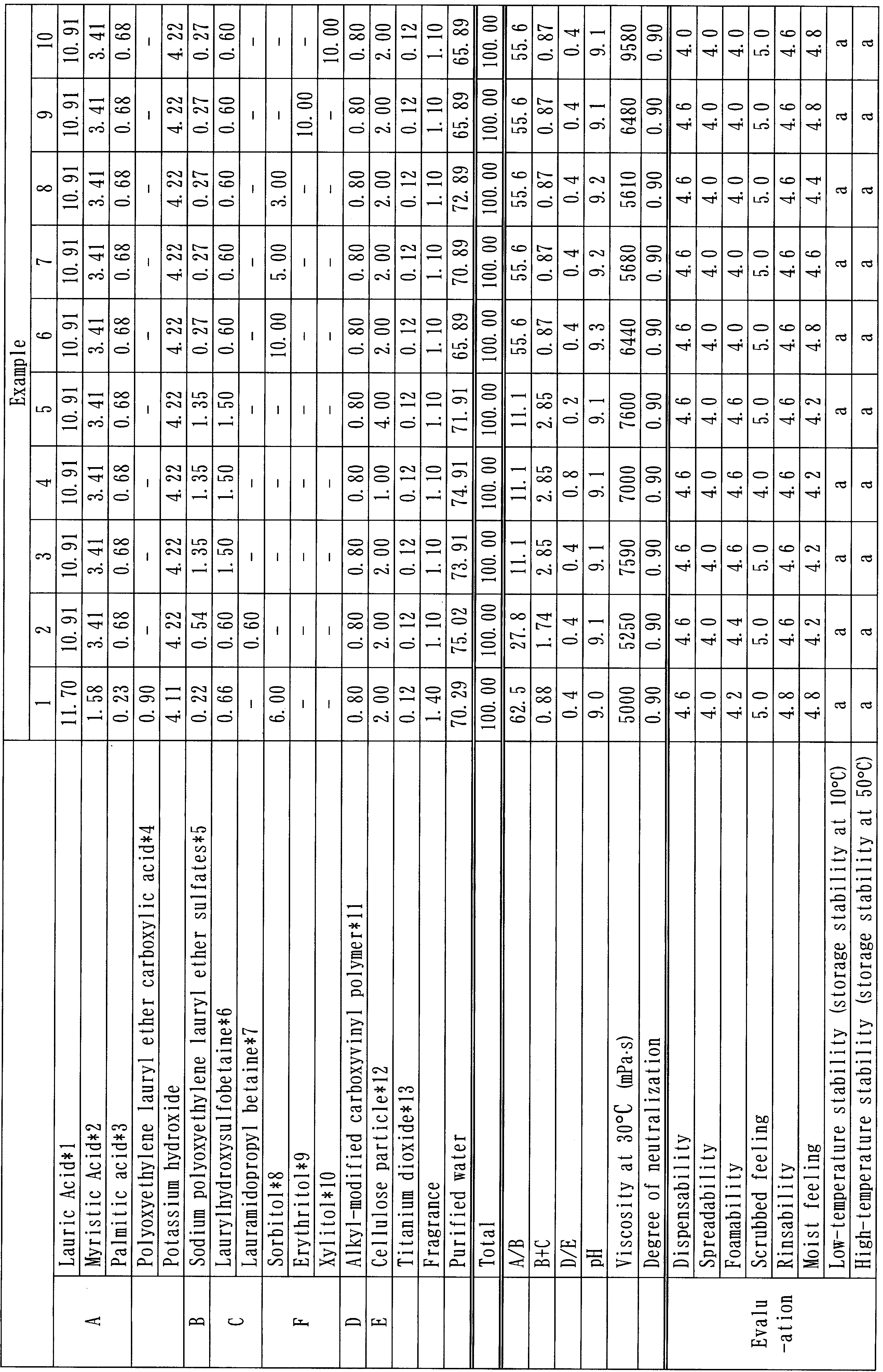

*1 LUNAC L-98 (manufactured by Kao Corporation)
*2 LUNAC MY-98 (manufactured by Kao Corporation)
*3 LUNAC P-95 (manufactured by Kao Corporation)
*4 JP-A-2013-53092 Preparation Example 1
*5 EMAL 227HP (manufactured by Kao Corporation, average POE = 2, active content: 27%)
*6 AMPHITOL 20HD (manufactured by Kao Corporation, active content: 30%)
*7 AMPHITOL 20AB (manufactured by Kao Corporation, active content: 30%)
*8 SORBITOL (manufactured by Kao Corporation, active content: 70%)
*9 Erythritol (manufactured by Maruzen Chemicals Co., Ltd.)
*10 Xylitol (manufactured by Eisai Food & Chemical Co., Ltd.)
*11 CARBOPOL SC200 (manufactured by Noveon, Inc.)
*12 CARBOPOL 981 (manufactured by Lubrizol Advanced Materials, Inc.)
*13 VITACEL CS250G (manufactured by J. Rettenmaier & Sohne GmbH + Co KG, cellulose content above 99%, specific density 1.3 g/cm3, average particle size: 300 micro-m by DIN EN ISO 4610/air jet sieve)
*14 CR-50 (manufactured by Ishihara Sangyo Kaisha, Ltd.)
*2 LUNAC MY-98 (manufactured by Kao Corporation)
*3 LUNAC P-95 (manufactured by Kao Corporation)
*4 JP-A-2013-53092 Preparation Example 1
*5 EMAL 227HP (manufactured by Kao Corporation, average POE = 2, active content: 27%)
*6 AMPHITOL 20HD (manufactured by Kao Corporation, active content: 30%)
*7 AMPHITOL 20AB (manufactured by Kao Corporation, active content: 30%)
*8 SORBITOL (manufactured by Kao Corporation, active content: 70%)
*9 Erythritol (manufactured by Maruzen Chemicals Co., Ltd.)
*10 Xylitol (manufactured by Eisai Food & Chemical Co., Ltd.)
*11 CARBOPOL SC200 (manufactured by Noveon, Inc.)
*12 CARBOPOL 981 (manufactured by Lubrizol Advanced Materials, Inc.)
*13 VITACEL CS250G (manufactured by J. Rettenmaier & Sohne GmbH + Co KG, cellulose content above 99%, specific density 1.3 g/cm3, average particle size: 300 micro-m by DIN EN ISO 4610/air jet sieve)
*14 CR-50 (manufactured by Ishihara Sangyo Kaisha, Ltd.)
In Table 1 and Table 2, Comparative Examples 1 and 2 each have a content of the component (A) outside the scope of the present invention. Comparative Examples 3 and 4 each have a degree of neutralization of the component (A) outside the scope of the present invention. Comparative Example 5 has a content of each of the components (B) and (C) outside the scope of the present invention. Comparative Example 6 is an example not containing the component (B) and (C). Comparative Example 7 has a content of the component (D) outside the scope of the present invention. Comparative Example 8 and 9 each have a polymer outside the scope of the present invention. These Comparative Examples are inferior to Examples 1 to 10 of the present invention in at least one of the scrubbed feeling, foamability, rinsability, dispensability transferred from a container, the feeling upon application (moist feeling), and storage stability. Examples 1 to 10 according to the present invention were free from precipitation after storage, excellent in fluidity, and thus Examples 1 to 10 showed excellent dispensability transferred from a container.
Claims (6)
- A skin cleansing composition comprising the following components (A) to (E):
(A) 6% by mass or more and 18% by mass or less of a fatty acid or a salt thereof represented by formula (1) as an acid and having a degree of neutralization of from 0.85 to 1.02:
R1-COOX (1)
wherein R1 represents an alkyl group having 11 to 23 carbon atoms, and X represents a hydrogen atom, an alkali metal, ammonium or organic ammonium;
(B) 0.15% by mass or more and 2% by mass or less of an alkyl ether sulfate represented by formula (2):
R2-O-(CH2CH2O)n-SO3Y (2)
wherein R2 represents an alkyl group or alkenyl group having 8 to 22 carbon atoms, n represents an average number of moles of oxyethylene added of 0.5 to 12, and Y represents a hydrogen atom, an alkali metal, an alkaline-earth metal, ammonium or organic ammonium;
(C) 0.1% by mass or more and 4% by mass or less of an amphoteric surfactant;
(D) 0.1% by mass or more and 1.0% by mass or less of an alkyl-modified carboxyvinyl polymer; and
(E) 0.1% by mass or more and 10% by mass or less of a cellulose particle. - The skin cleansing composition according to claim 1, having a viscosity at 30°C of 300 mPa・s or more and 18,000 mPa・s or less.
- The skin cleansing composition according to claim 1 or 2, having a total content of the component (B) and the component (C) of 0.3% by mass or more and 6% by mass or less.
- The skin cleansing composition according to claim 1 or 2, having a mass content ratio (A/B) of the component (A) to the component (B) of 5 or more and 80 or less.
- The skin cleansing composition according to claim 1 or 2, having a mass content ratio (D/E) of the component (D) to the component (E) of 0.025 or more and 3.3 or less.
- The skin cleansing composition according to claim 1 or 2, further comprising a component (F) which is a polyol.
Priority Applications (1)
| Application Number | Priority Date | Filing Date | Title |
|---|---|---|---|
| JP2018562381A JP6949056B2 (en) | 2016-06-01 | 2017-05-31 | Skin cleanser composition |
Applications Claiming Priority (2)
| Application Number | Priority Date | Filing Date | Title |
|---|---|---|---|
| JP2016109733 | 2016-06-01 | ||
| JP2016-109733 | 2016-06-01 |
Publications (1)
| Publication Number | Publication Date |
|---|---|
| WO2017209165A1 true WO2017209165A1 (en) | 2017-12-07 |
Family
ID=59258293
Family Applications (1)
| Application Number | Title | Priority Date | Filing Date |
|---|---|---|---|
| PCT/JP2017/020198 Ceased WO2017209165A1 (en) | 2016-06-01 | 2017-05-31 | Skin cleansing composition comprising cellulose particles as scrubbing agent |
Country Status (3)
| Country | Link |
|---|---|
| JP (1) | JP6949056B2 (en) |
| TW (1) | TWI746564B (en) |
| WO (1) | WO2017209165A1 (en) |
Families Citing this family (1)
| Publication number | Priority date | Publication date | Assignee | Title |
|---|---|---|---|---|
| WO2024142838A1 (en) * | 2022-12-26 | 2024-07-04 | 株式会社 資生堂 | Composition |
Citations (9)
| Publication number | Priority date | Publication date | Assignee | Title |
|---|---|---|---|---|
| JPS60152407A (en) | 1984-01-19 | 1985-08-10 | Shiseido Co Ltd | External preparation for skin blended with granule |
| JPH06271417A (en) | 1993-03-18 | 1994-09-27 | Ichimaru Pharcos Co Ltd | Scrubbing granules for skin external drugs and skin external drug containing the same |
| JPH11172296A (en) | 1997-12-08 | 1999-06-29 | Kao Corp | Detergent composition |
| JP2005539097A (en) | 2002-03-04 | 2005-12-22 | ユニリーバー・ナームローゼ・ベンノートシヤープ | Isotropic cleaning composition containing beneficial agent particles |
| JP2006348258A (en) | 2005-06-14 | 2006-12-28 | Ikeda Corp | Detergent composition |
| US20120277137A1 (en) * | 2009-12-08 | 2012-11-01 | Kao Corporation | Skin cleansing agent |
| JP2013053092A (en) | 2011-09-02 | 2013-03-21 | Kao Corp | Skin cleanser composition |
| EP2907498A1 (en) * | 2014-02-13 | 2015-08-19 | Induchem Ag | Exfoliating cellulose beads and cosmetic uses thereof |
| DE102014204053A1 (en) * | 2014-03-05 | 2015-09-10 | Beiersdorf Ag | Abrasive skin cleanser II |
Family Cites Families (2)
| Publication number | Priority date | Publication date | Assignee | Title |
|---|---|---|---|---|
| GB9323306D0 (en) * | 1993-11-11 | 1994-01-05 | Procter & Gamble | Cleansing compositions |
| JP5856754B2 (en) * | 2011-05-02 | 2016-02-10 | 花王株式会社 | Cleaning composition |
-
2017
- 2017-05-31 WO PCT/JP2017/020198 patent/WO2017209165A1/en not_active Ceased
- 2017-05-31 JP JP2018562381A patent/JP6949056B2/en active Active
- 2017-06-01 TW TW106118091A patent/TWI746564B/en active
Patent Citations (9)
| Publication number | Priority date | Publication date | Assignee | Title |
|---|---|---|---|---|
| JPS60152407A (en) | 1984-01-19 | 1985-08-10 | Shiseido Co Ltd | External preparation for skin blended with granule |
| JPH06271417A (en) | 1993-03-18 | 1994-09-27 | Ichimaru Pharcos Co Ltd | Scrubbing granules for skin external drugs and skin external drug containing the same |
| JPH11172296A (en) | 1997-12-08 | 1999-06-29 | Kao Corp | Detergent composition |
| JP2005539097A (en) | 2002-03-04 | 2005-12-22 | ユニリーバー・ナームローゼ・ベンノートシヤープ | Isotropic cleaning composition containing beneficial agent particles |
| JP2006348258A (en) | 2005-06-14 | 2006-12-28 | Ikeda Corp | Detergent composition |
| US20120277137A1 (en) * | 2009-12-08 | 2012-11-01 | Kao Corporation | Skin cleansing agent |
| JP2013053092A (en) | 2011-09-02 | 2013-03-21 | Kao Corp | Skin cleanser composition |
| EP2907498A1 (en) * | 2014-02-13 | 2015-08-19 | Induchem Ag | Exfoliating cellulose beads and cosmetic uses thereof |
| DE102014204053A1 (en) * | 2014-03-05 | 2015-09-10 | Beiersdorf Ag | Abrasive skin cleanser II |
Also Published As
| Publication number | Publication date |
|---|---|
| JP2019518021A (en) | 2019-06-27 |
| TW201808258A (en) | 2018-03-16 |
| TWI746564B (en) | 2021-11-21 |
| JP6949056B2 (en) | 2021-10-13 |
Similar Documents
| Publication | Publication Date | Title |
|---|---|---|
| EP2510917B1 (en) | Skin cleansing agent | |
| JP5328032B2 (en) | Cleaning composition | |
| US20010029243A1 (en) | Disintegrating particles and cleanser or detergent composition | |
| JP5522828B2 (en) | Skin cleanser | |
| JP2011162708A (en) | Detergent composition | |
| JP5680496B2 (en) | Warmth cleaning agent | |
| JP2008031187A (en) | Disintegrating particles | |
| JP2002020739A (en) | Exothermic particles | |
| JP6563191B2 (en) | Cleaning composition | |
| JP2017039660A (en) | Skin cleansing composition and method for producing skin cleansing composition | |
| JP6430852B2 (en) | Cleaning composition | |
| JP7463038B2 (en) | Liquid skin cleansing composition | |
| TWI746564B (en) | Skin cleansing composition | |
| JP3930014B2 (en) | Skin cleanser composition | |
| JP2006169453A (en) | Detergent composition | |
| JP5490440B2 (en) | Skin cleanser composition | |
| CN1853606B (en) | Detergent composition | |
| JP6611675B2 (en) | Skin cosmetics | |
| JP2001278778A (en) | Skin detergent | |
| JP5864208B2 (en) | Cleaning composition | |
| JP2001199876A (en) | Skin detergent | |
| JP7745735B2 (en) | Carbonated foaming composition | |
| JP6190239B2 (en) | Cleaning composition | |
| JPH11106797A (en) | Disintegrable particles and detergent composition | |
| JP2025155440A (en) | Skin cleansing composition |
Legal Events
| Date | Code | Title | Description |
|---|---|---|---|
| 121 | Ep: the epo has been informed by wipo that ep was designated in this application |
Ref document number: 17734498 Country of ref document: EP Kind code of ref document: A1 |
|
| ENP | Entry into the national phase |
Ref document number: 2018562381 Country of ref document: JP Kind code of ref document: A |
|
| NENP | Non-entry into the national phase |
Ref country code: DE |
|
| 122 | Ep: pct application non-entry in european phase |
Ref document number: 17734498 Country of ref document: EP Kind code of ref document: A1 |