WO2017170481A1 - 改質ポリプロピレン系樹脂及び改質ポリプロピレン系樹脂の製造方法 - Google Patents
改質ポリプロピレン系樹脂及び改質ポリプロピレン系樹脂の製造方法 Download PDFInfo
- Publication number
- WO2017170481A1 WO2017170481A1 PCT/JP2017/012533 JP2017012533W WO2017170481A1 WO 2017170481 A1 WO2017170481 A1 WO 2017170481A1 JP 2017012533 W JP2017012533 W JP 2017012533W WO 2017170481 A1 WO2017170481 A1 WO 2017170481A1
- Authority
- WO
- WIPO (PCT)
- Prior art keywords
- polypropylene resin
- modified polypropylene
- extruder
- modified
- mass
- Prior art date
- Legal status (The legal status is an assumption and is not a legal conclusion. Google has not performed a legal analysis and makes no representation as to the accuracy of the status listed.)
- Ceased
Links
Images


Classifications
-
- C—CHEMISTRY; METALLURGY
- C08—ORGANIC MACROMOLECULAR COMPOUNDS; THEIR PREPARATION OR CHEMICAL WORKING-UP; COMPOSITIONS BASED THEREON
- C08F—MACROMOLECULAR COMPOUNDS OBTAINED BY REACTIONS ONLY INVOLVING CARBON-TO-CARBON UNSATURATED BONDS
- C08F10/00—Homopolymers and copolymers of unsaturated aliphatic hydrocarbons having only one carbon-to-carbon double bond
- C08F10/04—Monomers containing three or four carbon atoms
- C08F10/06—Propene
-
- C—CHEMISTRY; METALLURGY
- C08—ORGANIC MACROMOLECULAR COMPOUNDS; THEIR PREPARATION OR CHEMICAL WORKING-UP; COMPOSITIONS BASED THEREON
- C08F—MACROMOLECULAR COMPOUNDS OBTAINED BY REACTIONS ONLY INVOLVING CARBON-TO-CARBON UNSATURATED BONDS
- C08F255/00—Macromolecular compounds obtained by polymerising monomers on to polymers of hydrocarbons as defined in group C08F10/00
- C08F255/02—Macromolecular compounds obtained by polymerising monomers on to polymers of hydrocarbons as defined in group C08F10/00 on to polymers of olefins having two or three carbon atoms
Definitions
- the present invention relates to a modified polypropylene resin and a method for producing the modified polypropylene resin.
- polypropylene resins have been used as raw materials for various molded articles because of their excellent mechanical properties and chemical resistance.
- a foam molded product obtained by thermoforming a polypropylene resin foam sheet is known.
- this polypropylene resin foam sheet one having a single foam layer or one having a laminated structure in which a foam layer and a non-foam layer are laminated is known.
- the term “foamed sheet” is used in the narrow sense and used in the former sense, and the latter is referred to as “laminated foamed sheet” or the like.
- foam sheets and laminated foam sheets are conventionally produced by extrusion foaming, but polypropylene resins generally have crystallinity, so the viscosity and melt tension at the time of melting tend to be insufficient, and the foamed state is good. It is difficult to get things.
- Patent Document 1 describes a method for obtaining a modified polypropylene resin having a property that the elongational viscosity measured in a molten state rapidly increases as the amount of strain increases (also referred to as “strain hardening”). Has been.
- the modified polypropylene resin as described above exhibits a high melt tension at the time of heat melting, but may not exhibit sufficient fluidity.
- An object of the present invention is to provide a modified polypropylene resin which exhibits high melt tension at the time of heat melting and exhibits high fluidity.
- the present invention is a modified polypropylene resin which is a reaction product of a polypropylene resin and an aromatic vinyl monomer and has a higher melt tension than the polypropylene resin
- the polypropylene resin Provides a modified polypropylene resin having a melt mass flow rate of 4.0 g / 10 min or more measured at a temperature of 230 ° C. and a nominal load of 2.16 kg.
- the present invention provides a method for producing a modified polypropylene resin, in which an aromatic vinyl monomer is reacted with a polypropylene resin to produce a modified polypropylene resin having a higher melt tension than the polypropylene resin.
- a process for producing a modified polypropylene resin using a polypropylene resin exhibiting a melt mass flow rate of 4.0 g / 10 min or more under the measurement conditions of a temperature of 230 ° C. and a nominal load of 2.16 kg is provided as the polypropylene resin. To do.
- FIG. 1 is a schematic cross-sectional view of a laminated foamed sheet using a modified polypropylene resin according to an embodiment. Schematic showing the equipment structure for manufacturing the laminated foam sheet.
- FIG. 3 is a detailed view of a broken line A portion in FIG. 2. The schematic perspective view which showed the instruments for measuring a gel fraction.
- FIG. 1 is a schematic cross-sectional view of a polypropylene resin foam sheet. As shown in FIG. And foam layers 20 and 20 '.
- a polypropylene resin foam sheet having one or more foamed layers and one or more non-foamed layers including the one shown in FIG. 1 and a polypropylene system having two or more foamed layers are included.
- the resin foam sheet is referred to as a “laminated foam sheet” and is distinguished from a polypropylene resin foam sheet having a single foam layer. Therefore, in the following, unless otherwise specified, the term “laminated foam sheet” means that having a laminated structure as shown in FIG. 1, and the term “foam sheet” means a single foam layer. It is used as a term to mean the sheet.
- the laminated foam sheet 1 includes the foam layer 10 and the non-foam layers 20 and 20 '.
- the foam layer 10 is formed of a foam sheet produced by an extrusion foaming method.
- the non-foamed layers 20 and 20 ′ are formed of a resin film produced by an extrusion method.
- the laminated foam sheet 1 is a co-extruded product of the foam layer 10 and the non-foam layers 20 and 20 ′. That is, the laminated foamed sheet 1 is extruded in a state in which a polypropylene resin composition for producing an extruded foamed sheet and an extruded film is laminated in a confluence mold, and these are laminated and integrated from one die slit. It has been made.
- the foamed layer 10 and the non-foamed layers 20, 20 ′ are formed of a polypropylene resin composition containing a modified polypropylene resin.
- the first polypropylene resin composition that forms the foam layer 10 includes a modified polypropylene resin, and is further expanded. Contains ingredients for.
- the second polypropylene resin composition that forms the non-foamed layers 20 and 20 ' also contains a modified polypropylene resin.
- the first polypropylene resin composition that forms the foamed layer 10 and the second polypropylene resin composition that forms the non-foamed layers 20 and 20 ' are different even if they contain the same modified polypropylene resin. May be.
- the modified polypropylene resin of this embodiment is produced by a specific modified polymer manufacturing method. First, the modified polypropylene resin and the production method thereof will be described.
- the modified polypropylene resin of the present embodiment is a resin composition containing (A) a polypropylene resin, (B) an organic peroxide, and (C) an aromatic vinyl monomer (hereinafter also referred to as “raw material composition”). It was obtained by reacting.
- the modified polypropylene-based resin of the present embodiment it is preferable to employ a resin whose phase angle obtained by frequency dispersion dynamic viscoelasticity measurement at 200 ° C. is 30 ° or more and 70 ° or less at a frequency of 0.01 Hz. In frequency dispersion dynamic viscoelasticity measurement, the influence of the viscosity term tends to appear in the low frequency region.
- the modified polypropylene resin of the present embodiment has a small phase angle in the low frequency region and is less likely to cause “slip” between molecules. Therefore, the modified polypropylene resin of the present embodiment exhibits a moderate elongation when foamed to form a foamed layer, and it is possible to suppress the bubble film from becoming rapidly thinner as the bubble grows. Therefore, film breakage (bubble breakage) is prevented, which is advantageous for obtaining a foam sheet having a low open cell ratio.
- the non-foamed layer is subject to a phenomenon such as tearing or opening due to stretching (hereinafter referred to as “resin running out”), and the foamed layer is exposed on the surface of the non-foamed layer. It is also advantageous to suppress the draw down when being extruded in a state of being formed and laminated and integrated from the die slit.
- the phase angle is obtained as follows. (How to find the phase angle)
- the dynamic viscoelasticity measurement is performed with a viscoelasticity measuring device PHYSICA MCR301 (manufactured by Anton Paar) and a temperature control system CTD450.
- the modified polypropylene resin used as a sample is pressed under a condition of heating at a temperature of 200 ° C. for 5 minutes with a hot press machine to produce a disk sample having a diameter of 25 mm and a thickness of 3 mm.
- the sample is set on a plate of a viscoelasticity measuring apparatus heated to a measurement temperature (200 ° C.), and heated and melted for 5 minutes in a nitrogen atmosphere.
- the interval is crushed to 2.0 mm with a parallel plate having a diameter of 25 mm, and the resin protruding from the plate is removed. Furthermore, after reaching the measurement temperature ⁇ 1 ° C, after heating for 5 minutes, the strain is 5%, the frequency is 0.01 to 100 (Hz), the number of measurement points is 21 (5 points / digit), and the measurement temperature is 200 ° C. Then, dynamic viscoelasticity measurement is performed to measure the phase angle ⁇ (°). Measurement starts from the high frequency side (100 Hz). Then, the phase angle ⁇ at a frequency of 0.01 Hz is obtained.
- the modified polypropylene resin not only exhibits the above phase angle.
- at least one of the first polypropylene resin composition and the second polypropylene resin composition preferably both, exhibit a phase angle of 30 ° to 70 ° at a temperature of 200 ° C. and a frequency of 0.01 Hz. preferable.
- the modified polypropylene resin contained in the first polypropylene resin composition and the second polypropylene resin composition is modified so as to exhibit a higher melt tension than the starting material (A) polypropylene resin. It is. Whether or not the modified polypropylene resin exhibits a higher melt tension than the polypropylene resin used as a raw material can be determined by comparing the melt tension at a temperature of 230 ° C., for example. Since a general polypropylene resin has a melt tension of less than 5 cN at 230 ° C., the melt tension measured at 230 ° C. is a value of 6 cN or more, as compared with the starting material (A) polypropylene resin. Those exhibiting can be regarded as modified polypropylene resins.
- the modified polypropylene resin preferably has a melt tension at 230 ° C. of 6 cN or more, more preferably a melt tension at 230 ° C. of 10 cN or more, and a melt tension at 230 ° C. of 15 cN or more. Is particularly preferred. However, if the melt tension of the modified polypropylene resin is excessively high, the load on the extruder may be increased when the first polypropylene resin composition or the second polypropylene resin composition is extruded. Therefore, the value at 230 ° C. is preferably 30 cN or less, and more preferably 28 cN or less.
- the melt tension is measured using a twin-bore capillary rheometer Rheological 5000T (manufactured by Chiast, Italy). That is, after filling the measurement sample resin in a 15 mm diameter barrel heated to the test temperature and preheating for 5 minutes, the piston descending speed from the capillary die (diameter 2.0 mm, length 20 mm, inflow angle flat) of the above measuring device While holding (0.1546 mm / s) constant and extruding into a string, the string was passed through a tension detection pulley located 27 cm below the capillary die, and then using a winding roll, The winding speed is gradually increased at an initial speed of 8.7 mm / s and an acceleration of 12 mm / s 2 , and the average of the maximum value and the minimum value immediately before the string-like material is cut is defined as the melt tension of the sample. . When there is only one maximum point on the tension chart, the maximum value is taken as the melt tension.
- the modified polypropylene-based resin is melted in order to reduce the load on the extruder during extrusion, to exhibit good foamability in the foamed layer 10, and to prevent the non-foamed layers 20 and 20 'from being out of resin. It is preferable that a mass flow rate (MFR) shows a predetermined value. More specifically, the modified polypropylene resin preferably has an MFR of 0.5 g / 10 min or more, more preferably 0.7 g / 10 min or more, and particularly preferably 1.0 g / 10 min or more. preferable. In forming a foamed layer having excellent closed cell properties (low open cell rate), the MFR of the modified polypropylene resin is preferably 0.7 g / 10 min or more.
- the MFR of the modified polypropylene resin is preferably 5.0 g / 10 min or less. More preferably, it is 0 g / 10 min or less.
- the MFR of the modified polypropylene resin can be measured based on the method B of JIS K7210: 1999 “Plastics—Test methods for melt mass flow rate (MFR) and melt volume flow rate (MVR) of thermoplastics”. It can be measured at a temperature of 230 ° C. and a nominal load of 2.16 kg. More specifically, MFR is measured as follows. When the measurement object is a pellet, it is used as it is as a measurement sample.
- the foam sheet is pelletized using a pelletizer “Hand Truda Model PM-1” manufactured by Toyo Seiki Seisakusho Co., Ltd. as a measurement sample.
- the cylinder temperature at the time of producing a pellet from a foam sheet using a pelletizer shall be 220 degreeC, and the waiting time from a sample filling to the start of extrusion shall be 2.5 minutes.
- the melt mass flow rate (MFR) is a semi-auto melt indexer 2A manufactured by Toyo Seiki Seisakusho Co., Ltd. Method Measured by “b) Method of measuring time for piston to move a predetermined distance” described in method B.
- the measurement conditions are a sample amount of 3 to 8 g, a preheating time of 270 seconds, a load hold time of 30 seconds, a test temperature of 230 ° C., a test load of 21.18 N, and a piston moving distance (interval) of 4 mm.
- the number of tests is 3 times, and the average value is the value of melt mass flow rate (g / 10 min).
- the starting material (A) polypropylene resin preferably has a predetermined melting property.
- (A) Polypropylene resin is a polymer obtained by polymerizing a propylene monomer.
- Examples of the (A) polypropylene resin to be contained in the raw material composition for obtaining the modified polypropylene resin include a homopolymer of a propylene monomer and a copolymer of a propylene monomer and another monomer.
- the content of propylene monomer is preferably 50% by mass or more, and the content of propylene monomer is more preferably 80% by mass or more. The content of is particularly preferably 90% by mass or more.
- the copolymerization may be random copolymerization or block copolymerization.
- the component other than the propylene monomer is preferably at least one selected from the group consisting of an ethylene monomer and an ⁇ -olefin monomer having 4 to 8 carbon atoms.
- -More preferably one or more of butene monomers.
- polypropylene resins include propylene homopolymers, propylene random polymers, and propylene block polymers.
- the polypropylene resin is preferably a homopolymer of a propylene monomer, and is preferably a propylene homopolymer.
- the modified polypropylene resin In order for the modified polypropylene resin to exhibit a high MFR value, it is preferable to employ (A) a polypropylene resin that exhibits a high MFR.
- Polypropylene resin used as a general foam sheet forming material has an MFR of about 1 g / 10 min or less, but as a polypropylene resin as a starting material for the modified polypropylene resin, melt mass flow rate (MFR) is 4 It is preferable that it is 0.0 g / 10 min or more.
- MFR of the polypropylene resin is more preferably 4.0 g / 10 min or more and 20.0 g / 10 min or less, and particularly preferably 7.0 g / 10 min or more and 18.0 g / 10 min or less.
- the first polypropylene resin showing an MFR of 4.0 g / 10 min or more and the second polypropylene resin having an MFR of less than 4.0 g / 10 min are used in combination. It is preferable.
- the first polypropylene resin is preferably selected from those showing an MFR of 4.0 g / 10 min or more and 20 g / 10 min or less, although it shows an MFR of 7.0 g / 10 min or more and 18.0 g / 10 min or less. More preferably, it is selected from among them.
- the second polypropylene resin having an MFR lower than that of the first polypropylene resin is preferably selected from those showing an MFR of 0.1 g / 10 min or more and less than 4.0 g / 10 min. More preferably, it is selected from those showing an MFR of 10 min or more and less than 4.0 g / 10 min.
- the first polypropylene resin and the second polypropylene resin can be blended so that the mass ratio (first PP / second PP) is 90/10 to 10/90, for example.
- the mixed resin obtained by mixing the plurality of polypropylene resins preferably has an MFR of 4.0 g / 10 min or more.
- the MFR of the mixed resin is, for example, blending a polypropylene resin in the same proportion as that contained in the starting material, and melt-mixing the blended polypropylene resin to prepare a measurement sample. It can be determined by measuring.
- the raw material composition has a mass percentage of the first polypropylene resin in the total value of the mass of the first polypropylene resin and the mass of the second polypropylene resin, a 1 (%), the second polypropylene
- the mass percentage of the system resin is a 2 (%), the melt mass flow rate value of the first polypropylene resin is A 1 (g / 10 min), and the melt mass flow rate value of the second polypropylene resin is A 2 ( g / 10 min), it is preferable that at least the following relational expression (x) is satisfied.
- the modified polypropylene resin of this embodiment uses a polypropylene resin having a high MFR as a starting material, excellent strain curability can be exhibited even after passing through an extruder.
- the laminated foamed sheet not only has the strain-hardening property in the initial state of the modified polypropylene resin, but also can be in a good foamed state because the modified polypropylene-based resin exhibits strain-hardening properties even after passing through the extruder. .
- the modified polypropylene resin exhibits strain-hardening properties when measured at a constant strain rate of 200 ° C. and a constant strain rate of 1.0 / sec after passing through an extruder,
- the measurement result of uniaxial extensional viscosity is expressed by a logarithmic graph in which the axis is the logarithm of the amount of strain ( ⁇ ) (log ( ⁇ )) and the vertical axis is the logarithm of the extensional viscosity ( ⁇ ) (log ( ⁇ ))
- the slope of the graph within the range of the strain amount of 1 to 3 is 1.0 or more.
- the slope of the graph within the range of strain 1 to 3 in principle means that the graph is linearly approximated by the least square method between strains 1 to 3. This means the slope of this straight line.
- the graph ends between strains 1 and 3 due to cutting of the stretched resin before the strain amount becomes 3 exceptionally, from the strain amount 1 to the above graph A straight line approximation is performed up to the end point by the least square method, and the gradient is determined as “the gradient of the graph within the range of strain 1 to 3”.
- the slope of the graph shown by the modified polypropylene resin of this embodiment is preferably 1.1 or more, and more preferably 1.2 or more.
- the slope of the graph is usually 4 or less, preferably 3 or less, more preferably 2.5 or less, and still more preferably 1.6 or less.
- the term “after passing through an extruder” in the present specification means a state after being extruded by “Lab Plast Mill (trade name)” manufactured by Toyo Seiki Seisakusho Co., Ltd. More specifically, the main screw (model: 4M150) manufactured by Toyo Seiki Seisakusho is equipped with a single screw extruder (model: D2020 (caliber: 20mm, L / D: 20), standard screw (one full flight). ))) Is attached, and the temperatures of the three zones of the single screw extruder are set to 210 ° C., 190 ° C., and 190 ° C. in order from the upstream side to the downstream side in the extrusion direction, and the tip mold temperature is set to 180 ° C.
- the rotation speed of the screw is fixed so that the discharge amount becomes 1 kg / h, and the state after passing through the “lab plast mill” is referred to as “after passing through the extruder” in this specification. It is determined as a state.
- the measurement of the uniaxial extensional viscosity was performed by supplying the modified polypropylene resin to the “laboplast mill” set as described above and extruding it into a strand shape, and water at 20 ° C. was added to the strand-shaped sample. It can be obtained by passing through a 1 m water tank and cooling, cutting the cooled sample to produce a rod-shaped pellet having a length of about 4 mm.
- the value of the uniaxial elongation viscosity after passing through the extruder of the modified polypropylene resin can be measured.
- the value of the uniaxial elongation viscosity of the modified polypropylene resin after passing through the extruder can be measured under the following conditions.
- the uniaxial elongation viscosity can be measured under the following conditions.
- ⁇ Uniaxial elongation viscosity measurement conditions Uniaxial extensional viscosity measurement is performed with a viscoelasticity measuring apparatus “PHYSICA MCR301” (manufactured by Anton Paar) and a temperature control system “CTD450”.
- the modified polypropylene resin to be measured is pressed with a hot press machine at a temperature of 190 ° C. for 5 minutes to produce a strip sample having a width of 10 mm and a thickness of about 0.8 mm.
- this strip-shaped sample is cut out to have a length of 20 to 25 mm to obtain a test piece.
- a test piece is set on a uniaxial extensional viscosity measuring jig (SER2) heated to 200 ° C., and after waiting for 10 seconds at a temperature of 200 ° C. ⁇ 0.5 ° C. in a nitrogen atmosphere, strain is applied.
- the uniaxial extensional viscosity is measured at a speed of 1.0 / sec.
- the measurement point interval is set to “obtain measurement point interval logarithmically”, and the start is 0.01 sec and the end is 26 sec.
- the measurement point is 200.
- the measurement results are as follows: the vertical axis is the common logarithm value (log ( ⁇ )) of elongational viscosity ( ⁇ : Pa ⁇ s), and the horizontal axis is the common logarithm value (log ( ⁇ )) of strain ( ⁇ : s / s).
- the graph is a logarithmic axis graph. Is linearly approximated by the method of least squares, and the inclination of the approximated straight line is obtained.
- modified polypropylene resin in which the slope in the uniaxial elongation viscosity graph is 1.0 or more after passing through the extruder include those having a branched structure in the molecular chain. That is, the modified polypropylene resin before passing through the extruder (hereinafter also referred to as “initial-mPP”) has a branched molecular structure in this embodiment.
- the “initial-mPP” those having a large number of branches and being easily entangled with molecular chains are preferable.
- a modified polypropylene resin with few branches is easily entangled by molecular chains due to shear applied in the extruder, and the strain hardenability after passing through the extruder is likely to be greatly reduced as compared with that before passing through the extruder. If an attempt is made to produce a laminated foam sheet by an extrusion foaming method using this type of modified polypropylene resin, the strain-hardening property of the modified polypropylene resin is already lost when it is extruded from the die slit, and good foaming is achieved. There is a possibility that a laminated foam sheet in a state cannot be obtained.
- a modified polypropylene resin having a large number of branches and easily forming entanglement of molecular chains can maintain good strain hardening even after extrusion.
- a high MFR as described above is used as a polypropylene resin having a linear molecular structure (hereinafter also referred to as “linear PP”) used as a starting material. It is advantageous to employ what is shown.
- the main chain of the linear PP is cleaved by ⁇ -cleavage, and the cleaved molecules are bonded to other molecules to form long chain branches. Therefore, if the linear PP used as the starting material for the modified polypropylene resin has a large molecular weight, if a large amount of vinyl monomer or radical generator is added, the melt viscosity of the resin becomes too high and the number of branches may be increased too much. It may not be possible. On the other hand, a linear PP having a low molecular weight and a high MFR does not increase until the melt viscosity becomes a practical problem even if many branches are introduced. Therefore, in order to obtain a modified polypropylene-based resin exhibiting good strain hardening even after passing through the extruder, it is preferable to employ linear PP having a high MFR as a starting material.
- the MFR of the polypropylene resin used as a starting material for the modified polypropylene resin is more preferably 5.0 g / 10 min or more, and even more preferably 7.0 g / 10 min or more.
- the MFR of the polypropylene resin is preferably 20.0 g / 10 min or less, and more preferably 18.0 g / 10 min or less.
- the MFR of the polypropylene resin (A), which is the starting material of the modified polypropylene resin, is JIS K7210: 1999 “Plastic / thermoplastic melt mass flow rate (MFR) and melt, similarly to the MFR of the modified polypropylene resin. Based on Method B of “Volume Flow Rate (MVR) Test Method”, measurement can be performed under conditions of a temperature of 230 ° C. and a nominal load of 2.16 kg.
- the modified polypropylene-based resin after passing through an extruder, has a uniaxial elongational viscosity of 0.25 or more when measured at a temperature of 180 ° C. and a strain rate of 0.1 to 8.5 (sec ⁇ 1 ). It is preferable to show a branching index (MBI).
- MBI branching index
- the multi-branch index is a semi-logarithmic graph in which the horizontal axis is the logarithm of the strain rate (v) (log (v)) and the vertical axis is the strain hardening degree (SHI). This means the slope of the graph when the measurement result is expressed.
- the strain hardening degree (SHI) is a logarithmic graph in which the horizontal axis is the logarithm of the strain amount ( ⁇ ) (log ( ⁇ )) and the vertical axis is the logarithm of the extensional viscosity ( ⁇ ) (log ( ⁇ )).
- the “slope of the graph” when obtaining the multi-branch index (MBI) and the strain hardening degree (SHI) means the slope of this straight line when linearly approximated by the method of least squares.
- the modified polypropylene resin of this embodiment when the uniaxial extensional viscosity is measured at a temperature of 180 ° C. and a strain rate of 0.1 to 8.5 (sec ⁇ 1 ) after passing through an extruder, any rate is obtained. It is preferable to employ a material exhibiting strain hardening property. Further, the multi-branch index (MBI) of the modified polypropylene resin is usually 0.6 or less, and preferably 0.5 or less.
- Uniaxial extensional viscosity measurement when determining the strain hardening degree (SHI) can be carried out using a viscoelasticity measuring device “PHYSICA MCR301” (manufactured by Anton Paar) and a temperature control system “CTD450”.
- PHYSICA MCR301 manufactured by Anton Paar
- CCD450 temperature control system
- the modified polypropylene resin to be measured is pressed at a temperature of 220 ° C. for 6 minutes with a hot press machine to produce a strip-shaped sample having a width of 10 mm and a thickness of about 0.8 mm.
- this strip-shaped sample is cut out to have a length of 20 to 25 mm to obtain a test piece.
- a test piece is set on a uniaxial extensional viscosity measuring jig (SER2) heated to 180 ° C., and after waiting for 10 seconds under a nitrogen atmosphere at 180 ° C. ⁇ 0.5 ° C., strain is applied.
- the measurement point interval is set to “obtain measurement point interval logarithmically”, and the start is 0.01 sec and the end is 26 sec.
- the measurement point is 200.
- the multi-branch index (MBI) can be obtained as follows. First, in the graph in which the horizontal axis is the logarithm of log strain ( ⁇ : s / s) (log ( ⁇ )) and the vertical axis is the logarithm of extension viscosity ( ⁇ : Pa ⁇ s) (log ( ⁇ )), The measurement result of the uniaxial extensional viscosity carried out at a strain rate of 0.1 (s ⁇ 1 ) is represented. The graph is linearly approximated by a least square method between the strain amount 1 and the strain amount 3, and the slope (degree of strain hardening ( SHI 0.1 )) is determined.
- the strain rate was then changed to 0.3 (s ⁇ 1 ), 1.0 (s ⁇ 1 ), 3.0 (s ⁇ 1 ), and 8.5 (s ⁇ 1 ), respectively, and the above Measurements are made to determine the strain hardening degree (SHI 0.3 , SHI 1.0 , SHI 3.0 , SHI 8.5 ) for each.
- the above results are plotted on a graph in which the vertical axis is the strain hardening degree (SHI) and the horizontal axis is the logarithm of the strain rate (log (v)).
- the polypropylene resin used as a starting material is preferably one having a relatively low molecular weight and high melt mass flow rate (MFR). That is, the melt mass flow rate (MFR) of the polypropylene resin used as a starting material is preferably 4.0 g / 10 min or more in order to obtain a modified polypropylene resin exhibiting a multi-branch index as described above. It is more preferably 0.0 g / 10 min or more, and further preferably 7.0 g / 10 min or more.
- the MFR of the polypropylene resin is preferably 20.0 g / 10 min or less, and more preferably 18.0 g / 10 min or less.
- the modified polypropylene-based resin not only exhibits the above multi-branching index (MBI) but also can reduce the gel content because the starting material has a high MFR.
- MBI multi-branching index
- the gel contained in the modified polypropylene resin may cause coarse bubbles to be formed in the foamed layer, or cause the resin to run out or form minute protrusions in the non-foamed layer.
- the modified polypropylene resin of the present embodiment uses a plurality of polypropylene resins having different MFRs as a starting material as described above, so that the gel fraction value is, for example, 1.0% by mass or less.
- the value of the gel fraction can be 0.6% by mass or less, particularly preferably 0.3% by mass or less.
- a mesh wire net containing a sample is placed on the slat and 80 ml of xylene is added. After stirring for 3 hours at 130 ° C. and 80 rpm using a heating and agitation driver apparatus (Aswan HDBS-6), the 200-mesh wire mesh in the tall beaker was taken out with tweezers and washed in 80 mL of xylene heated to 130 ° C. Remove deposits on the side of the wire mesh. Thereafter, the resin insoluble matter on the wire mesh is naturally dried in a draft to evaporate xylene, and finally the resin insoluble matter is dried together with the wire mesh at 120 ° C. for 2 hours in a constant temperature dryer.
- the amount of gel contained in the modified polypropylene resin is not limited to using a plurality of polypropylene resins having different MFR as a starting material, but also a monomer that reacts with the starting material and a radical that reacts the monomer with the polypropylene resin. It can also be reduced by selecting the type of generator and limiting the amount.
- an organic peroxide is used as the radical generator, and an aromatic vinyl monomer is used as the monomer.
- the (B) organic peroxide of this embodiment has a hydrogen abstraction ability with respect to a polypropylene resin, and is not particularly limited.
- hydroperoxide, dialkyl peroxide, peroxyester, diacyl peroxide, peroxide examples thereof include oxydicarbonate, peroxyketal, and ketone peroxide.
- hydroperoxide examples include permethane hydroperoxide, diisopropylbenzene hydroperoxide, cumene hydroperoxide, and t-butyl hydroperoxide.
- dialkyl peroxide examples include dicumyl peroxide, di-t-butyl peroxide, and 2,5-dimethyl-2,5-di (t-butylperoxy) -hexyne-3. .
- peroxy ester examples include t-butyl peroxy 2-ethylhexyl carbonate, t-hexyl peroxyisopropyl monocarbonate, t-hexyl peroxybenzoate, t-butyl peroxybenzoate, t-butyl peroxylaurate, t-butylperoxy-3,5,5-trimethylhexanoate, t-butylperoxyacetate, 2,5-dimethyl2,5-di (benzoylperoxy) hexane, and t-butylperoxyisopropyl monocarbonate Etc.
- diacyl peroxide examples include dibenzoyl peroxide, di (4-methylbenzoyl) peroxide, and di (3-methylbenzoyl) peroxide.
- peroxydicarbonate examples include di (2-ethylhexyl) peroxydicarbonate and diisopropyl peroxydicarbonate.
- the organic peroxide (B) in this embodiment is preferably a peroxyester, diacyl peroxide, or peroxydicarbonate.
- the organic peroxide preferably has a structure represented by the following general formula (X).
- R 1 represents a substituted or unsubstituted phenyl group or a substituted or unsubstituted alkoxy group
- R 2 represents a monovalent organic group
- R 1 when “R 1 ” is an alkoxy group, “R 1 ” is an alkyl group having a branched structure having 3 to 8 carbon atoms (for example, isopropyl, t-butyl, An alkoxy group in which an oxygen atom is bonded to t-hexyl, 2-ethylhexyl and the like is preferable.
- R 1 is other than an alkoxy group having an oxygen atom bonded to 2-ethylhexyl
- the oxygen atom is preferably bonded to a secondary carbon or a tertiary carbon, and is represented by the following general formula (Y) It preferably has a structure.
- R 11 and R 12 are either a methyl group, the other is a hydrogen atom, and “R 14 ” represents a linear alkyl group having 1 to 6 carbon atoms; 13 "represents secondary carbon or tertiary carbon.)
- R 1 is either a substituted or unsubstituted phenyl group
- R 1 is an unsubstituted phenyl group or a substituted phenyl in which one hydrogen atom is substituted with a methyl group It is preferable that
- R 2 also preferably has a bulky structure such as branched alkyl or phenyl. Specifically, it preferably has a structure represented by the following general formula (Z).
- R 21 in the formula represents either a linear alkyl group having 1 to 6 carbon atoms or a monovalent organic group having a phenyl group.
- Examples of the organic peroxide having the structure represented by the general formula (X) include t-butyl peroxy 2-ethylhexyl carbonate, t-hexyl peroxyisopropyl monocarbonate, t-butyl peroxyisopropyl monocarbonate, t -Hexylperoxybenzoate, 2,5-dimethyl-2,5-di (benzoylperoxy) hexane, dibenzoyl peroxide, di (4-methylbenzoyl) peroxide, diisopropylperoxydicarbonate, etc. .
- the content of the organic peroxide (B) relative to 100 parts by mass of the (A) polypropylene resin is 0.1 parts by mass or more and 1.5 parts by mass or less. Preferably there is.
- the content of (B) organic peroxide when the content of (B) organic peroxide is too small, the reactivity of the raw material composition becomes low, so that a good modifying effect may not be exhibited.
- the modified polypropylene resin of this embodiment if the content of (B) organic peroxide is excessive, the decomposition reaction of the polypropylene resin is likely to occur during melt-kneading, so the elastic component becomes small and good modification is achieved. The effect may not be demonstrated.
- the raw material composition does not control the reaction conditions during melt-kneading with high accuracy.
- a modified polypropylene resin having excellent melt tension can be produced.
- the content of (B) organic peroxide with respect to 100 parts by mass of (A) polypropylene resin is 0.3.
- the amount is preferably at least part by mass, and preferably at most 1.0 part by mass.
- the (C) aromatic vinyl monomer is a component that acts as a crosslinking agent that chemically bonds to the (A) polypropylene resin to form a branched structure and to crosslink the polypropylene resins.
- the (C) aromatic vinyl monomer to be contained in the raw material composition may be one type or two or more types.
- aromatic vinyl monomer examples include styrene; methyl styrene such as o-methyl styrene, m-methyl styrene, p-methyl styrene, ⁇ -methyl styrene, ⁇ -methyl styrene, dimethyl styrene, and trimethyl styrene; ⁇ -chlorostyrene.
- the content of the aromatic vinyl monomer (C) in the raw material composition is preferably 0.1 parts by mass or more and 10 parts by mass or less with respect to 100 parts by mass of the (A) polypropylene resin. If the content of the aromatic vinyl monomer (C) is too small in the modified polypropylene resin, there is a possibility that the branched and crosslinked structure is not sufficiently formed in the melt-kneading. In addition, if the content of the aromatic vinyl monomer (C) is too small, the decomposition of the resin by the peroxide is also insufficiently suppressed, so that a good reforming effect may not be exhibited.
- the modified polypropylene resin tends to be unreacted with a part of the (C) aromatic vinyl monomer by melt kneading. Therefore, if the content of the aromatic vinyl monomer (C) is excessive, the modified polypropylene resin may contain a large amount of oligomers or may have a problem of cloudiness due to microphase separation or the like. . As a result, the influence of the elastic component is greatly reflected in the properties of the modified polypropylene resin, and the modified polypropylene resin is not good and may not exhibit a good modifying effect.
- the quality of the aromatic vinyl monomer (C) in the raw material composition is 0.1 parts by mass or more and 10 parts by mass or less, the quality can be improved without controlling the reaction conditions at the time of melt-kneading with high accuracy.
- Quality polypropylene resin can be produced.
- the modified polypropylene resin thus obtained is effective for producing a laminated foam sheet having a foam layer having a low open cell ratio.
- the raw material composition may contain a monomer other than the aromatic vinyl monomer.
- the monomer include ethylene, 1-butene, isobutene, 1-pentene, 3-methyl-1-butene, 1-hexene, 4-methyl-1-pentene, 3,4-dimethyl-1-butene, ⁇ -olefin monomers such as heptene, 3-methyl-1-hexene, 1-octene and 1-decene; cycloolefin monomers such as cyclopentene and norbornene; 5-methylene-2-norbornene, 5-ethylidene-2-norbornene, Diene monomers such as 1,4-hexadiene, methyl-1,4-hexadiene, 7-methyl-1,6-octadiene; chlorine-based monomers such as vinyl chloride and vinylidene chloride; acrylonitrile, acrylic acid, methacrylic acid, maleic acid, Ethyl acrylate, buty
- the raw material composition preferably contains (D) a radical scavenger to control the reactivity.
- (D) Use of the radical scavenger is effective for increasing the melt tension of the modified polypropylene resin. That is, the radical scavenger (D) is effective in obtaining a resin foam having a good appearance using a modified polypropylene resin.
- the radical scavenger is capable of reacting with alkyl radical species.
- the radical scavenger can be bonded to the aromatic vinyl monomer after being bonded to the alkyl radical.
- a radical scavenger only 1 type may be used and 2 or more types may be used together.
- radical scavenger examples include quinone compounds (quinones), naphthoquinone compounds (naphthoquinones), phenothiazine compounds (phenothiazines), and the like.
- Examples of the quinone compound include p-benzoquinone, p-naphthoquinone, 2-t-butyl-p-benzoquinone, and 2,5-diphenyl-p-benzoquinone.
- Examples of the naphthoquinone compound include 1,4-naphthoquinone, 2-hydroxy-1,4-naphthoquinone, vitamin K, and the like.
- Examples of the phenothiazine compound include phenothiazine, bis- ( ⁇ -methylbenzyl) phenothiazine, 3,7-dioctylphenothiazine, and bis- ( ⁇ -dimethylbenzyl) phenothiazine.
- the content of the (D) radical scavenger with respect to 100 parts by mass of the (A) polypropylene resin is preferably 0.005 parts by mass or more, more preferably 0.05 parts by mass or more. Further, the content of the (D) radical scavenger with respect to 100 parts by mass of (A) polypropylene resin is preferably 1 part by mass or less.
- the content of the radical scavenger is not less than the lower limit and not more than the upper limit, the melt tension of the modified polypropylene resin is effectively increased, and the appearance of the foam is further improved.
- an additive is suitably used according to various objectives, and is not specifically limited.
- the additive include a weather resistance stabilizer, an antistatic agent, an antioxidant, a deodorant, a light stabilizer, a crystal nucleating agent, a pigment, a lubricant, imparting slipperiness or anti-blocking property.
- examples thereof include a surfactant for the purpose of imparting, an inorganic filler, and a dispersibility improver for improving the dispersibility of the inorganic filler.
- the dispersibility improver include higher fatty acids, higher fatty acid esters, and higher fatty acid amides.
- the (E) additive may be contained in the raw material composition before melt-kneading or at the time of melt-kneading. In addition, the additive (E) may be added after melt-kneading and contained in the modified polypropylene resin. (E) As for an additive, only 1 type may be used and 2 or more types may be used together.
- the organic peroxide is contained in an amount of 0.1 to 1.5 parts by mass with respect to 100 parts by mass of the polypropylene resin, and the aromatic vinyl monomer
- it can be easily obtained by melt-kneading a raw material composition containing 0.1 to 10 parts by mass of the aromatic vinyl monomer with respect to 100 parts by mass of the polypropylene resin.
- the modified polypropylene resin according to the present embodiment is suitable for forming a foam molded article having a good appearance and excellent strength.
- the modified polypropylene resin according to the present embodiment is foamed, it is difficult for foam breakage to occur inside, and it is possible to obtain a foamed molded article having a good appearance with a low open cell ratio.
- the modified polypropylene resin according to the present embodiment has an advantage that a foamed sheet having a low open cell ratio is easily obtained.
- the modified polypropylene resin according to the present embodiment has a low gel fraction and exhibits good flowability, and is suitable not only for forming a foam layer but also for forming a non-foam layer.
- Method for producing modified polypropylene resin for example, (A) 100 parts by mass of polypropylene resin, (B) 0.1 to 1.5 parts by mass of organic peroxide, and (C) aromatic vinyl
- a method of obtaining a modified polypropylene resin by melting and kneading a raw material composition containing 0.1 to 10 parts by mass of a monomer can be employed. At the time of melt kneading the raw material composition, it is preferable to control the heating temperature in order to bring the raw material composition into a good molten state. The raw material composition reacts by heating during melt kneading.
- the organic peroxide generates a radical by the heating, and the radical attacks the hydrogen bonded to the tertiary carbon of the polypropylene resin to form an alkyl radical.
- ⁇ -cleavage occurs and molecular cleavage of the polypropylene resin occurs, but in this embodiment, the aromatic vinyl monomer is bonded to the site to form a branched structure (crosslinked structure).
- the aromatic vinyl monomer is obtained by mixing (A) a polypropylene resin and (B) an organic peroxide from the viewpoint of making the addition effect remarkable, and then obtaining the mixture. It is preferable to add to. However, (A) polypropylene resin, (B) organic peroxide, and (C) aromatic vinyl monomer may be mixed together.
- (D) The radical scavenger may be added before (C) the aromatic vinyl monomer is added, or may be added after (C) the aromatic vinyl monomer is added, and mixed together with other components. May be.
- the additive may be added before adding the (C) aromatic vinyl monomer, or may be added after adding the (C) aromatic vinyl monomer, and is mixed together with other components. May be.
- melt kneading mixing of a raw material composition can be implemented using general apparatuses, such as a kneader, a Banbury mixer, and an extruder.
- melt-kneading the raw material composition it is preferable to use an extruder.
- the raw material composition is supplied to an extruder and subjected to a crosslinking reaction in the extruder to form a modified polypropylene resin, and the modified polypropylene resin is extruded from the extruder.
- a modified polypropylene resin is efficiently obtained by continuously supplying the raw material composition to an extruder and continuously extruding the modified polypropylene resin from the extruder.
- the extruder examples include a single screw extruder and a twin screw extruder.
- the said extruder can be used for manufacture of a modified polypropylene resin as a single or a tandem-type extruder connected in plural.
- a twin screw extruder is preferable from the viewpoint of further increasing dispersibility and reactivity of other components with respect to the polypropylene resin as the base resin.
- carbon dioxide is supplied to an extruder, carbon dioxide is added to the kneaded material melt-kneaded, and the kneaded material added with carbon dioxide is further melt-kneaded for a certain period of time. It is preferable to discharge the gas containing carbon from the kneaded product.
- a reaction step of reacting a polymer and a monomer by melt kneading and a carbon dioxide addition step of adding carbon dioxide to a kneaded product obtained by melt kneading in the reaction step It is preferable to carry out a degassing step of discharging a gas containing carbon dioxide from the kneaded material to which carbon dioxide has been added.
- the carbon dioxide addition step is preferably carried out with the same extruder as the reaction step or another extruder connected to the extruder. That is, in the former case, for example, a carbon dioxide supply point is provided near the exit of the extruder, and (A) a polypropylene resin, (B) an organic peroxide, (C) upstream of the carbon dioxide supply point. ) It can be carried out using an extruder provided with a material supply point for a raw material composition such as an aromatic vinyl monomer.
- a tandem extruder in which an upstream extruder and a downstream extruder are connected is used, a polypropylene resin is reformed in the upstream extruder, and carbon dioxide is added in the downstream extruder. And further melt kneading.
- the degassing step may be performed simply by discharging the kneaded material from an extruder, and using an extruder provided with a vent mechanism, carbon dioxide is discharged from the kneaded material before discharging the kneaded material by the vent mechanism. You may make it discharge.
- the carbon dioxide addition step and the degassing step the remaining monomer without being consumed in the reaction in the reaction step, the oligomer that is a decomposition product of the polymer, and the alcohol formed by decomposing the organic peroxide , Ketones and the like can be discharged together with carbon dioxide, and a modified polypropylene resin with reduced volatile organic substances can be obtained.
- the modified polypropylene resin is preferably pelletized once for use in forming a foamed layer or a non-foamed layer. Therefore, in the method for producing a modified polypropylene resin according to the present embodiment, the kneaded material is extruded into a sheet shape or a strand shape from a die attached to the tip of the extruder, and then the modified polypropylene resin sheet or the modified polypropylene resin strand. It is preferable that the sheet or strand is pelletized with a pelletizer.
- the MFR of the polypropylene resin used as a starting material for the modified polypropylene resin in order to obtain a uniform strand is more preferably 5.0 g / 10 min or more. Preferably, it is more preferably 7.0 g / 10 min or more.
- the kneaded material is extruded into a strand shape from a die attached to the tip of the extruder, and the strand is intermittently cut at the outlet of the die to be pelletized. May be.
- the method for producing a modified polypropylene resin of this embodiment since the kneaded material is discharged in a shape having a large specific surface area such as a sheet or a strand, in the method for producing a modified polypropylene resin of this embodiment, carbon dioxide and volatile organic matter are produced from this sheet or strand. Can be efficiently discharged, and a modified polypropylene resin with less volatile organic substances can be obtained. That is, the deaeration process in this embodiment can be performed by a method in which gas is discharged from the kneaded material by spontaneous release when the kneaded material is extruded from the extruder.
- the carbon dioxide addition step is preferably carried out under conditions where carbon dioxide is in a supercritical state in that a modified polypropylene resin with reduced volatile organic substances is easily obtained. It is preferable to bring carbon into a supercritical state. At this time, when the amount of carbon dioxide added to the kneaded product is larger, the amount of volatile organic substances contained in the modified polypropylene resin can be reduced. However, excessive addition of carbon dioxide may cause foaming in the modified polypropylene resin sheet or the modified polypropylene resin strand in the deaeration process. The foamed modified polypropylene-based resin pellet can cause the formation of coarse bubbles in the foam layer when the laminated foam sheet is produced by the coextrusion method, or cause the resin to break in the non-foam layer.
- the amount of carbon dioxide used in the carbon dioxide addition step is 1.0 part by mass or more and 4.0 parts by mass or less with respect to 100 parts by mass of the produced modified polypropylene resin. More preferably, the content is 2.0 parts by mass or more and 3.0 parts by mass or less.
- a mixed gas containing a small amount of a hydrocarbon having a carbon number of 5 or less such as methane, ethane, or propane, or nitrogen (for example, 95% by mass or more of CO 2 and 5% by mass or less).
- the carbon dioxide addition step may be performed using a mixed gas containing other gas). When such a mixed gas is used, the ratio is preferably within the above range.
- the carbon dioxide addition step may be performed after pelletization.
- carbon dioxide after pelletization may be performed.
- An addition step may be performed.
- the carbon dioxide addition step for the pelletized modified polypropylene resin includes, for example, placing the modified polypropylene resin pellets in a pressure vessel and introducing carbon dioxide in a supercritical state into the pressure vessel. It can be carried out by such a method that the pellet is impregnated with carbon dioxide in a supercritical state.
- the degassing step can be performed by discharging carbon dioxide from the pressure vessel after a predetermined time has elapsed, and reducing the pressure vessel to atmospheric pressure or lower as necessary.
- the modified polypropylene resin thus obtained can be used as a raw material for the laminated foam sheet of the present embodiment (first polypropylene resin composition, second polypropylene resin composition) as it is or blended with other polymer components. ).
- an unmodified polypropylene resin is preferable.
- the polypropylene resin include those exemplified above as starting materials for the modified polypropylene resin.
- a soft resin obtained by a multistage polymerization method is preferable.
- the polypropylene resin includes a first stage in which homopolymerization of propylene or random copolymerization of propylene and ethylene, and ethylene and one or more ⁇ -olefins having 3 or more carbon atoms after the first stage. What is obtained through at least two steps of the second step of carrying out copolymerization is preferred.
- the modified polypropylene resin and the other resin are, for example, 9: The mass ratio is preferably 1 to 1: 9 (modified polypropylene resin: other resin).
- the first polypropylene resin composition and the second polypropylene resin composition are also subjected to frequency dispersion dynamics at 200 ° C. in the same manner as the modified polypropylene resin. It is preferable that the phase angle obtained by viscoelasticity measurement is 30 ° or more and 70 ° or less at a frequency of 0.01 Hz.
- the melt mass flow rate (MFR1) of the first polypropylene resin composition and the melt mass flow rate (MFR2) of the second polypropylene resin composition may have the relationship shown in (y) below. preferable.
- (MFR1) ⁇ (MFR2) (y) (Here, “MFR1” means the melt mass flow rate of the first polypropylene resin composition at a temperature of 230 ° C. and a nominal load of 2.16 kg, and “MFR2” means a temperature of 230 ° C. and a nominal load of 2 . Means the melt mass flow rate of the second polypropylene resin composition at 16 kg.)
- the extrusion temperature In order to obtain a good laminated foam sheet by the coextrusion method, it is desirable to lower the extrusion temperature as much as possible from the viewpoint of reducing the open cell ratio. Since the first polypropylene resin composition contains a foaming agent when forming the foamed layer, the extrusion temperature can be lowered by utilizing the plasticizing effect of the foaming agent. On the other hand, since it is difficult to expect the second polypropylene resin composition used for forming the non-foamed layer to exhibit such an effect, it is difficult to lower the extrusion temperature.
- melt mass flow rate (MFR1) of the first polypropylene resin composition and the melt mass flow rate (MFR2) of the second polypropylene resin composition are as described above. It is preferable to satisfy the relationship.
- phase angle (PA1) of the first polypropylene resin composition In order to obtain a good laminated foam sheet by the coextrusion method, between the phase angle (PA1) of the first polypropylene resin composition and the phase angle (PA2) of the second polypropylene resin composition, It is preferable to have the relationship shown in the following (z). (PA1) ⁇ (PA2) (z) (Here, “PA1” means the phase angle at a frequency of 0.01 Hz of the first polypropylene resin composition obtained by frequency dispersion dynamic viscoelasticity measurement at 200 ° C., and “PA2” (It means the phase angle at a frequency of 0.01 Hz of the second polypropylene resin composition determined by frequency dispersion dynamic viscoelasticity measurement at 200 ° C.)
- the first polypropylene resin composition containing the modified polypropylene resin can contain a foaming agent and a cell regulator necessary for forming the foamed layer, and the first polypropylene resin composition
- a foamed layer can be formed by extrusion foaming a product.
- the blowing agent include hydrocarbons such as propane, n-butane, i-butane, n-pentane, i-pentane, and cyclopentane, halides thereof, carbon dioxide gas, and nitrogen.
- Examples of the air conditioner include talc, mica, silica, diatomaceous earth, aluminum oxide, titanium oxide, zinc oxide, magnesium oxide, magnesium hydroxide, aluminum hydroxide, calcium hydroxide, potassium carbonate, calcium carbonate, magnesium carbonate, Examples include inorganic compound particles such as potassium sulfate, barium sulfate and glass beads, and organic compound particles such as polytetrafluoroethylene.
- azodicarbonamide, sodium hydrogen carbonate, a mixture of sodium hydrogen carbonate and citric acid, which also functions as a thermal decomposition type foaming agent, and the like can also be used as the bubble regulator.
- the bubble regulator and the foaming agent do not need to be used singly and may be used in combination of two or more.
- the second polypropylene resin composition containing the modified polypropylene resin also contains components necessary for forming the non-foamed layer, and the second polypropylene resin composition is used as the first polypropylene resin composition. It can be coextruded with the product to form a non-foamed layer.
- FIG. 2 is a block diagram showing an example of a production apparatus used for producing a laminated foamed sheet, in which a first polypropylene resin composition containing a foaming agent is extruded and foamed from a circular die and second from the same circular die.
- the polypropylene-based resin composition was extruded in a non-foamed state to form a cylindrical laminated foam in which the non-foamed layer overlapped on both sides of the foamed layer.
- FIG. 3 is an enlarged cross-sectional view showing details of a portion indicated by a broken line circle A in FIG. 2, showing a state in which the cooled laminated foam is cooled and divided into two vertically and wound on a roll. Represents.
- the manufacturing apparatus of the present embodiment includes a first extrusion line 70 for forming a foamed layer, a second extrusion line 80 for forming a non-foamed layer, and a first melt-kneaded in the first extrusion line 70.
- the joining mold 90 has a resin flow path formed therein so that the first polypropylene resin composition and the second polypropylene resin composition are cylindrical, and the first polypropylene resin composition
- the second polypropylene resin composition flows on both the inside and outside of the object.
- the laminated foam sheet manufacturing apparatus includes a cooling device CR1 for air-cooling the laminated foam FB discharged from the circular die 100 in a cylindrical shape from the inside, and a predetermined diameter by expanding the diameter of the cylindrical laminated foam FB.
- a winding roller 92 is provided for winding the strip-shaped laminated foamed sheet 1 after passing the plurality of rollers 91.
- a modified polypropylene resin that exhibits a higher melt tension than a general polypropylene resin is used as a foam layer forming material, so that high discharge from the circular die 100 is achieved.
- the cooling mandrel 200 can be expanded in diameter with a high blow-up ratio.
- the modified polypropylene resin since the modified polypropylene resin is adopted as a material for forming the non-foamed layer, the non-foamed layer has a high follow-up property even when the foamed layer is extruded at a high speed and expanded at a high magnification. It is difficult to cause the resin to run out.
- the resin temperature of the second polypropylene-based resin composition is preferably set to be somewhat higher in order to reduce the load on the extruder of the second extrusion line 80. If such conditions are set, the foamed layer that has been extruded and foamed is less likely to be cooled, so that the extrusion conditions are set such that bubble breakage is likely to occur in the foamed layer.
- the laminated foam sheet has a low gel fraction of the modified polypropylene resin contained in the first polypropylene resin composition and a high MFR.
- the laminated foam sheet reduces the load on the extruder of the second extrusion line 80 because there are few gels that are the starting points for the tearing of the foam film, and excellent extensibility is exhibited by the high MFR in the foam film.
- the foamed layer can be in a dense and highly foamed state with closed cells.
- the produced laminated foam sheet has excellent moldability in thermoforming and the like.
- the resin of the non-foamed layer is likely to break at the boundary between the bottom surface and the side surface, but the laminated foam sheet is modified to a non-foamed layer.
- Such a trouble is unlikely to occur because a modified polypropylene resin is included and the modified polypropylene resin exhibits a high MFR. That is, the laminated foam sheet is effective not only for improving the efficiency during production, but also for improving the yield of molded products.
- the laminated foam sheet is preferably produced under conditions where the blow-up ratio is 1.8 or more, and more preferably produced under conditions where the blow-up ratio is 2.3 or more.
- the blow-up ratio is a value (D / d) obtained from the diameter (D) of the cooling mandrel with respect to the diameter (d) of the circular discharge port of the circular die, and the diameter (d) of the discharge port of the circular die. ) Means the diameter of a circle passing through the inner edge of the discharge port.
- the laminated foam sheet with a thin non-foamed layer is prone to resin breakage in the non-foamed layer.
- the laminated foam sheet does not cause resin breakage even in such a case. It can be said that it is effective for conversion.
- the laminated foam sheet preferably has a non-foam basis weight of 100 g / m 2 or less, and more preferably 50 g / m 2 or less.
- the laminated foam sheet is usually produced so that the apparent density of the foam layer is 0.025 g / cm 3 or more and 0.5 g / cm 3 or less.
- the apparent density of the laminated foam sheet is measured by the method described in JIS K7222: 1999 “Foamed Plastics and Rubber—Measurement of Apparent Density”, and specifically by the following method.
- (Density measurement method) A sample of 100 cm 3 or more was prepared from the laminated foam sheet, and this sample was conditioned in JIS K7100: 1999 symbol 23/50, second grade environment for 16 hours, and then its dimensions and mass were measured to obtain an apparent density. Is calculated by the following equation.
- Apparent density (g / cm 3 ) Sample mass (g) / Sample volume (cm 3 )
- a “DIGIMATIC” CD-15 type manufactured by Mitutoyo Corporation can be used for measuring the dimensions of the sample.
- the open cell ratio of the foamed layer is preferably 40% or less, and more preferably 30% or less.
- the open cell ratio of the foam layer is measured by the following method. That is, a plurality of sheet-like samples having a length of 25 mm and a width of 25 mm are cut out from the laminated foam sheet, and the cut samples are overlapped so that there is no gap to obtain a measurement sample having a thickness of 25 mm. Is measured to 1/100 mm using “Digimatic Caliper” manufactured by Mitutoyo Corporation, and the apparent volume (cm 3 ) is obtained. Next, the volume (cm 3 ) of the sample for measurement is obtained by the 1-1 / 2-1 atmospheric pressure method using an air comparison type hydrometer 1000 type (manufactured by Tokyo Science).
- the open cell ratio (%) is calculated from these obtained values and the following formula, and the average value of 5 tests is obtained.
- the measurement is carried out in a JIS K7100-1999 symbol 23/50, second grade environment after conditioning for 16 hours in a JIS K7100-1999 symbol 23/50, second grade environment.
- the air-comparing hydrometer corrects with a standard sphere (large 28.9 cc, small 8.5 cc).
- Open cell ratio (%) 100 ⁇ (apparent volume ⁇ volume measured with air-based hydrometer) / apparent volume
- the laminated foam sheet is useful as a foam molded article such as a buffer sheet as it is, and also as a raw material for a foam molded article provided with a three-dimensional shape by thermoforming or the like.
- thermoforming include vacuum forming, pressure forming, vacuum / pressure forming, match mold forming, and press forming.
- a container is preferable.
- the foamed resin container thus produced is preferably used as various packaging containers because it is not only lightweight and high in strength, but also easily mass-produced.
- the foamed resin container is preferably used for food packaging because it is excellent in heat insulation and the like.
- a nonwoven fabric, metal foil, decorative paper, a printing film, or the like may be laminated on the surface of the foamed molded product depending on the application.
- modified polypropylene resin is used as a forming material of a laminated foam sheet
- the modified polypropylene resin of this invention can be used also for another use. That is, the present invention is not limited to the above examples.
- Example 1 melt tension, MFR, phase angle>
- the feed section was set to 170 ° C. and the subsequent temperature was set to 230 ° C., and the raw material composition was melt-kneaded in a twin-screw extruder under the conditions of a rotation speed of 120 rpm and a gear pump rotation speed of 25 rpm.
- the melt-kneaded product was extruded in a strand form at a discharge rate of 45 kg / h from a die having a diameter of 2 mm and 9 holes attached to the tip.
- the extruded strand-shaped melt-kneaded product was cooled by passing through a cooling water tank containing 30 ° C. water.
- the cooled strand kneaded material was cut with a pelletizer to obtain pellets of a modified polypropylene resin.
- Table 1 shows the results of the characteristic evaluation of the obtained modified polypropylene resin pellets.
- Examples 2 to 7, Comparative Examples 1 to 10 A modified polypropylene resin was prepared in the same manner as described above except that the polypropylene resin used, the amount of styrene, and the amount of organic peroxide were changed as shown in the following table.
- J105G”, “MA3H”, “MA3”, “J106”, “PM802A”, “PM900A”, “FY4”, “PL500A”, “E111G”, and “E200GP” are the following polypropylenes: It means a system resin.
- the polypropylene resin used for the modification was a mixture of “PM802A” and “PM900A”.
- the discharge amount from the die is made uniform when the modified polypropylene resin is produced.
- the feed section is set to 170 ° C
- the subsequent temperature is set to 230 ° C
- the raw material composition is melted and kneaded in a twin-screw extruder under the conditions of a rotation speed of 120 rpm and a gear pump rotation speed of 25 rpm, and attached to the tip.
- the melt-kneaded product was extruded in a strand shape from a die having a diameter of 2 mm, a land of 10 mm, and a number of holes of 9 at a discharge rate of 45 kg / h.
- the extruded strand-shaped melt-kneaded product was cooled by passing through a cooling water tank containing 30 ° C. water.
- a polypropylene resin composition containing a foaming agent was melt-kneaded by pressing into one extruder, and a first polypropylene resin composition for forming a foam layer was prepared in the extruder. Then, this 1st polypropylene resin composition is No.1. No. 1 extruder and No. 1 No. 2 through the transfer section connecting the extruder. 2 Flowed into the extruder. Then, this No.
- the first polypropylene resin composition was uniformly cooled in the barrel of the two extruder, it was allowed to flow into the merging die.
- the resin temperature at this time is 180 ° C.
- the discharge rate from the 2 extruder was 30 kg / h.
- the second polypropylene resin composition for the non-foamed layer includes the above-mentioned “modified PP-A” as the modified polypropylene resin, and the product name “Q100F” manufactured by Basell as the thermoplastic elastomer,
- a polymer type antistatic agent containing a product name “Pelestat 230” (polyether-polypropylene block copolymer) manufactured by Sanyo Chemical Co., Ltd. was used.
- a mixed raw material containing 74 parts by mass of the above-mentioned “modified PP-A”, 13 parts by mass of the thermoplastic elastomer, and 13 parts by mass of a polymer type antistatic agent is simply added with a diameter of 32 mm.
- the mixture was supplied to a hopper of a shaft extruder, melted and kneaded, and then flowed into the joining die.
- the discharge rate at this time was 3 kg / h.
- the slit diameter of the first polypropylene resin composition and the second polypropylene resin composition joined by a joining die is 70 mm.
- the circular die was fed and coextruded into a cylindrical shape from an annular discharge port (slit interval 0.4 mm) of the circular die.
- the cylindrical foam with the non-foamed layer laminated on the foamed layer is cooled by a cooling mandrel, and then the cylindrical foam is cut by a cutter attached to the rear part of the cooling mandrel to form a long strip of laminated foam.
- a sheet was prepared, and the laminated foam sheet was wound up at a take-up speed of 2.1 m / min. The average thickness of the laminated foam sheet at this time was 2.12 mm.
- the modified polypropylene resin having excellent fluidity is useful for forming a laminated foam sheet having a low open cell ratio.
- the feed section was set to 170 ° C. and the subsequent temperature was set to 230 ° C., and the raw material composition was melt-kneaded in a twin-screw extruder under the conditions of a rotation speed of 120 rpm and a gear pump rotation speed of 25 rpm.
- the melt-kneaded product was extruded in a strand form at a discharge rate of 45 kg / h from a die having a diameter of 2 mm and 9 holes attached to the tip.
- the extruded strand-shaped melt-kneaded product was cooled by passing through a cooling water tank containing 30 ° C. water.
- the cooled strand kneaded product was cut with a pelletizer to obtain pellets of a modified polypropylene resin (modified PP-a).
- melt tension As a sample, the pellet is used as it is.
- the melt tension is measured using a twin-bore capillary rheometer Rheological 5000T (manufactured by Chiast, Italy). That is, after filling a measurement sample resin in a 15 mm diameter barrel heated to a test temperature (230 ° C.) and preheating for 5 minutes, the capillary die (2.0 mm diameter, 20 mm length, inflow angle flat) of the above measuring device While keeping the piston descending speed (0.1546 mm / s) constant and pushing it into a string shape, the string-like material is passed through a tension detection pulley located 27 cm below the capillary die, and then a winding roll The winding speed is gradually increased at an initial speed of 8.7 mm / s and an acceleration of 12 mm / s 2 , and the average of the maximum value and the minimum value immediately before the string-like material is cut is measured. Let melt tension. When there is only one
- the modified PP-a pellets obtained above were supplied to this “lab plast mill” and extruded into a strand shape, and the strand-shaped extrudate was cooled by passing it through a water tank storing 20 ° C. cooling water. The cooled strand was cut and pelletized, and the uniaxial elongation viscosity (“slope of graph” at a strain of 1 to 3), MFR, and melt tension were measured again.
- the first polypropylene resin composition was uniformly cooled in the barrel of the two extruder, it was allowed to flow into a confluence die.
- the resin temperature at this time is 180 ° C.
- the discharge rate from the 2 extruder was 30 kg / h.
- the second polypropylene resin composition for the non-foamed layer includes the above-mentioned “modified PP-a” as a modified polypropylene resin, and the product name “Q100F” manufactured by Basell as a thermoplastic elastomer,
- a polymer type antistatic agent containing a product name “Pelestat 230” (polyether-polypropylene block copolymer) manufactured by Sanyo Chemical Co., Ltd. was used.
- a mixed raw material containing 74 parts by mass of the above-mentioned “modified PP-a”, 13 parts by mass of the thermoplastic elastomer, and 13 parts by mass of a polymer type antistatic agent is a single material having a diameter of 32 mm.
- the mixture was supplied to a hopper of a shaft extruder, melted and kneaded, and then flowed into the joining die. The discharge rate at this time was 3 kg / h.
- the foamed layer and the non-foamed layer are fed into the circular die having a slit diameter of 70 mm, and the first polypropylene resin composition and the second polypropylene resin composition joined by the joining die are fed into the circular die. It was produced by coextrusion into a cylindrical shape from an annular discharge port (slit spacing 0.4 mm). After this, the cylindrical foam with the non-foamed layer laminated on the foamed layer is cooled by a cooling mandrel, then the cylindrical foam is cut by a cutter attached to the rear of the cooling mandrel, and a long band-shaped resin foam is formed. The sheet (laminated foam sheet 1) was wound up at a take-up speed of 2.1 m / min. The average thickness of the resin foam sheet at this time was 2.18 mm.
- Modified PP-b to Modified PP-f Laminated foam sheets 2 to 5
- a modified polypropylene resin was prepared in the same manner as the modified PP-a except that the polypropylene resin used, the amount of styrene, and the amount of organic peroxide were changed as shown in Table 6 below, and various physical properties were investigated. . Further, using the obtained modified polypropylene resin, a laminated foam sheet was produced in the same manner as in the case of modified PP-a.
- a laminated foam sheet was prepared using the modified PP-a and the modified PP-f. 39 parts by weight of “modified PP-a”, 55 parts by weight of a block PP commercially available from Nippon Polypro Co., Ltd. under the trade name “BC6C”, 6 parts by weight of a thermoplastic elastomer resin manufactured by Sun Allomer, A mixture was obtained by dry blending 1.5 parts by mass of a bubble regulator (“Fine Cell Master HCPO410K” manufactured by Dainichi Seika Kogyo Co., Ltd.). This mixture was mixed with No. 50 having a diameter of 50 mm. No. 1 extruder, No. 65 caliber No. No. of tandem type extruder with 2 extruders.
- the first polypropylene resin composition was uniformly cooled in the barrel of the two extruder, it was allowed to flow into a confluence die.
- the resin temperature at this time is 180 ° C.
- the discharge rate from the 2 extruder was 30 kg / h.
- the second polypropylene resin composition for the non-foamed layer includes the above-mentioned “modified PP-a” as a modified polypropylene resin, and the product name “Q100F” manufactured by Basell as a thermoplastic elastomer,
- a polymer type antistatic agent containing a product name “Pelestat 230” (polyether-polypropylene block copolymer) manufactured by Sanyo Chemical Co., Ltd. was used.
- a mixed raw material containing 74 parts by mass of the above-mentioned “modified PP-a”, 13 parts by mass of the thermoplastic elastomer, and 13 parts by mass of a polymer type antistatic agent is a single material having a diameter of 32 mm.
- the mixture was supplied to a hopper of a shaft extruder, melted and kneaded, and then flowed into the joining die. Thereafter, a resin foam sheet (laminated foam sheet 6) was produced in the same manner as "Laminated foam sheet 1". The discharge rate at this time was 3 kg / h.
- the modified PP-a was replaced with the modified PP-f to obtain a “laminated foam sheet 8”.
- Table 7 shows the characteristics of the modified PP-a to the modified PP-e before passing through the extruder and after passing through the extruder.
- Table 8 shows the characteristics of the foamed sheets produced using the modified PP-a to modified PP-f.
- a modified polypropylene resin obtained by modifying a polypropylene resin having a high MFR exhibits a specific uniaxial elongation viscosity after passing through an extruder, and is suitable for applications where processing at a high shear rate is performed in a molten state. It turns out that it is a thing. From the above results, it can be seen that by using such a modified PP, a foam sheet in a good foamed state having high closed cell properties (low open cell ratio) can be obtained.
- a foam sheet having a single layer structure was produced using the modified PP-a and the modified PP-f.
- foam sheet (foam sheets 9, 10) 85 parts by mass of the obtained “modified PP”, a thermoplastic elastomer resin manufactured by Sun Allomer Co., Ltd., and 15 parts by mass of the trade name “Q100F” were dry blended to obtain a polymer mixture.
- This polymer mixture was melt-kneaded with a chemical foaming agent ("Finecell Master HCPO410K” manufactured by Dainichi Seika Kogyo Co., Ltd.) in an extruder, and foamed while being extruded from a circular die attached to the tip of the extruder to produce a foamed sheet.
- the characteristics of the foam sheet obtained using each modified PP are as follows.
- a mold in which 22 truncated cones having a diameter of 10 mm (top surface) x a diameter of 35 mm (bottom surface) and different heights are arranged is used. Then, the mold surface temperature was adjusted to 50 ° C. to perform heat molding. The height of the 22 truncated cones is as shown in the table below.
- the modified PP using a polypropylene resin having a high MFR as a starting material can form a resin foam having a high closed cell property (low open cell ratio) and good moldability (good elongation). It turns out that it is effective.
- a modified polypropylene resin was produced in the same manner as the modified PP-a except that the polypropylene resin used, the amount of styrene, and the amount of organic peroxide were changed as shown in Table 12 below.
- Four types (mPP1 to mPP4) of modified polypropylene resins having a multi-branch index before and after passing through the extruder as shown in Table 13 were prepared.
- Table 13 shows the phase angle, MFR, and melt tension of the modified polypropylene resin.
- mPP1 85 parts by mass of “mPP1” to “mPP4”, a thermoplastic elastomer resin manufactured by Sun Allomer, and 15 parts by mass of “Q100F” were dry-blended to obtain a polymer mixture.
- This polymer mixture was melt kneaded with a chemical foaming agent ("Finecell Master HCPO410K” manufactured by Dainichi Seika Kogyo Co., Ltd.) with an extruder, foamed while being extruded from a circular die attached to the tip of the extruder, and shown in Table 14 below.
- a foam sheet was prepared.
- the characteristics of the resin foam sheet obtained using each mPP are as follows.
- a flat rectangular test piece of 700 mm length ⁇ 1050 mm width was cut out from each produced foamed sheet. Then, a single molding machine (trade name “Unic Automatic Molding Machine FM-3A” manufactured by Tosei Sangyo Co., Ltd.) was prepared. The average temperature of the upper heater of this single molding machine was 274 ° C., the average temperature of the lower heater was 237 ° C., The upper atmosphere temperature was 192 ° C. and the lower atmosphere temperature was 185 ° C.
- the modified PP exhibiting a specific multi-branch index after passing through the extruder is suitable for applications in which processing at a high shear rate is performed in a molten state. Moreover, it can be seen from the above results that a resin foam having high closed cell properties (low open cell ratio) and good moldability (good elongation) can be obtained by using such modified PP.
Landscapes
- Chemical & Material Sciences (AREA)
- Health & Medical Sciences (AREA)
- Chemical Kinetics & Catalysis (AREA)
- Medicinal Chemistry (AREA)
- Polymers & Plastics (AREA)
- Organic Chemistry (AREA)
- Laminated Bodies (AREA)
- Manufacture Of Porous Articles, And Recovery And Treatment Of Waste Products (AREA)
- Addition Polymer Or Copolymer, Post-Treatments, Or Chemical Modifications (AREA)
- Graft Or Block Polymers (AREA)
Abstract
本発明は、加熱溶融時に優れた流動性を示す改質ポリプロピレン系樹脂を得ることを課題としている。 上記課題を解決するために本発明は、原料となるポリプロピレン系樹脂として特定の熱溶融特性粘弾性を示すポリプロピレン系樹脂を用いる。
Description
本発明は、改質ポリプロピレン系樹脂及び改質ポリプロピレン系樹脂の製造方法に関する。
従来、ポリプロピレン系樹脂は、機械的性質及び耐薬品性などに優れることから、種々の成形品の原材料として利用されている。
ポリプロピレン系樹脂製の成形品としては、ポリプロピレン系樹脂発泡シートを熱成形した発泡成形品などが知られている。
このポリプロピレン系樹脂発泡シートとしては、発泡層単層のものや発泡層と非発泡層とが積層された積層構造を有するものが知られている。
これらについて区別する際には、「発泡シート」との用語が狭義に用いられて前者の意味で用いられ、後者のものは「積層発泡シート」などと称されている。
この発泡シートや積層発泡シートは、従来、押出発泡法によって作製されているが、ポリプロピレン系樹脂は一般的に結晶性を有することから溶融時の粘度及び溶融張力が不足し易く、良好な発泡状態のものが得られにくい。
ポリプロピレン系樹脂製の成形品としては、ポリプロピレン系樹脂発泡シートを熱成形した発泡成形品などが知られている。
このポリプロピレン系樹脂発泡シートとしては、発泡層単層のものや発泡層と非発泡層とが積層された積層構造を有するものが知られている。
これらについて区別する際には、「発泡シート」との用語が狭義に用いられて前者の意味で用いられ、後者のものは「積層発泡シート」などと称されている。
この発泡シートや積層発泡シートは、従来、押出発泡法によって作製されているが、ポリプロピレン系樹脂は一般的に結晶性を有することから溶融時の粘度及び溶融張力が不足し易く、良好な発泡状態のものが得られにくい。
このような問題を解決するために、ポリプロピレン系樹脂をスチレンモノマーなどの芳香族ビニルモノマーで改質して、溶融特性を調整することが検討されている。
例えば、下記の特許文献1には、溶融状態で測定した伸長粘度が歪量の増加に伴い急激に上昇する性質(“歪硬化性”ともいう)を有する改質ポリプロピレン系樹脂を得る方法について記載されている。
例えば、下記の特許文献1には、溶融状態で測定した伸長粘度が歪量の増加に伴い急激に上昇する性質(“歪硬化性”ともいう)を有する改質ポリプロピレン系樹脂を得る方法について記載されている。
上記のような改質ポリプロピレン系樹脂は、熱溶融時に高い溶融張力を発揮するものの十分な流動性を発揮しない場合がある。
本発明は、熱溶融時に高い溶融張力を発揮しつつ、かつ高い流動性を示す改質ポリプロピレン系樹脂を提供することを課題としている。
本発明は、熱溶融時に高い溶融張力を発揮しつつ、かつ高い流動性を示す改質ポリプロピレン系樹脂を提供することを課題としている。
本発明は上記課題を解決すべく、ポリプロピレン系樹脂と、芳香族ビニルモノマーとの反応物であり、前記ポリプロピレン系樹脂よりも高い溶融張力を有する改質ポリプロピレン系樹脂であって、前記ポリプロピレン系樹脂は、温度230℃、公称荷重2.16kgの条件で測定されるメルトマスフローレイトが4.0g/10min以上である改質ポリプロピレン系樹脂を提供する。
また、本発明は上記課題を解決すべく、ポリプロピレン系樹脂に芳香族ビニルモノマーを反応させて前記ポリプロピレン系樹脂よりも溶融張力の高い改質ポリプロピレン系樹脂を作製する改質ポリプロピレン系樹脂の製造方法であって、前記ポリプロピレン系樹脂として、温度230℃、公称荷重2.16kgの測定条件で4.0g/10min以上のメルトマスフローレイトを示すポリプロピレン系樹脂を用いる改質ポリプロピレン系樹脂の製造方法を提供する。
本発明によれば、熱溶融時に高い溶融張力を発揮しつつ、かつ高い流動性を示す改質ポリプロピレン系樹脂が提供され得る。
本発明の実施の形態について説明する。
以下においては、ポリプロピレン系樹脂と芳香族ビニルモノマーとを反応させた改質ポリプロピレン系樹脂を用いて積層構造を有するポリプロピレン系樹脂発泡シートを作製する場合を例にして図を参照しつつ説明する。
図1は、ポリプロピレン系樹脂発泡シートの概略断面図であり、図に示されているように本実施形態の改質ポリプロピレン系樹脂が用いられてなるポリプロピレン系樹脂発泡シートは、発泡層10と非発泡層20、20’とを備えている。
なお、以下においては、図1に示したような態様のものを含め1以上の発泡層と1以上の非発泡層とを備えたポリプロピレン系樹脂発泡シート並びに2以上の発泡層を備えたポリプロピレン系樹脂発泡シートを「積層発泡シート」と称し、発泡層単層のポリプロピレン系樹脂発泡シートと区別する。
従って、以下においては、特段の断りがない限りにおいて「積層発泡シート」との用語は図1に示したような積層構造を有するものを意味し、「発泡シート」との用語は発泡層単層のシートを意味する用語として用いる。
以下においては、ポリプロピレン系樹脂と芳香族ビニルモノマーとを反応させた改質ポリプロピレン系樹脂を用いて積層構造を有するポリプロピレン系樹脂発泡シートを作製する場合を例にして図を参照しつつ説明する。
図1は、ポリプロピレン系樹脂発泡シートの概略断面図であり、図に示されているように本実施形態の改質ポリプロピレン系樹脂が用いられてなるポリプロピレン系樹脂発泡シートは、発泡層10と非発泡層20、20’とを備えている。
なお、以下においては、図1に示したような態様のものを含め1以上の発泡層と1以上の非発泡層とを備えたポリプロピレン系樹脂発泡シート並びに2以上の発泡層を備えたポリプロピレン系樹脂発泡シートを「積層発泡シート」と称し、発泡層単層のポリプロピレン系樹脂発泡シートと区別する。
従って、以下においては、特段の断りがない限りにおいて「積層発泡シート」との用語は図1に示したような積層構造を有するものを意味し、「発泡シート」との用語は発泡層単層のシートを意味する用語として用いる。
上記のように前記積層発泡シート1は、発泡層10と非発泡層20、20’とを備えている。
前記前記発泡層10は、押出発泡法で作製された発泡シートによって形成されている。
また、前記非発泡層20、20’は、押出法によって作製された樹脂フィルムで形成されている。
前記積層発泡シート1は、前記発泡層10と前記非発泡層20、20’との共押出品である。
即ち、前記積層発泡シート1は、押出発泡シートと押出フィルムとを作製するためのポリプロピレン系樹脂組成物が合流金型にて積層され、一つのダイスリットよりこれらが積層一体化された状態で押出されてなるものである。
前記前記発泡層10は、押出発泡法で作製された発泡シートによって形成されている。
また、前記非発泡層20、20’は、押出法によって作製された樹脂フィルムで形成されている。
前記積層発泡シート1は、前記発泡層10と前記非発泡層20、20’との共押出品である。
即ち、前記積層発泡シート1は、押出発泡シートと押出フィルムとを作製するためのポリプロピレン系樹脂組成物が合流金型にて積層され、一つのダイスリットよりこれらが積層一体化された状態で押出されてなるものである。
前記積層発泡シート1は、発泡層10と非発泡層20、20’とが改質ポリプロピレン系樹脂を含むポリプロピレン系樹脂組成物によって形成されている。
発泡層10と非発泡層20、20’とを形成するポリプロピレン系樹脂組成物の内、発泡層10を形成する第1のポリプロピレン系樹脂組成物は、改質ポリプロピレン系樹脂を含み、さらに発泡のための成分を含有している。
非発泡層20、20’を形成する第2のポリプロピレン系樹脂組成物も改質ポリプロピレン系樹脂を含んでいる。
発泡層10を形成する第1のポリプロピレン系樹脂組成物と非発泡層20、20’を形成する第2のポリプロピレン系樹脂組成物とは含有する改質ポリプロピレン系樹脂が共通していても異なっていてもよい。
発泡層10と非発泡層20、20’とを形成するポリプロピレン系樹脂組成物の内、発泡層10を形成する第1のポリプロピレン系樹脂組成物は、改質ポリプロピレン系樹脂を含み、さらに発泡のための成分を含有している。
非発泡層20、20’を形成する第2のポリプロピレン系樹脂組成物も改質ポリプロピレン系樹脂を含んでいる。
発泡層10を形成する第1のポリプロピレン系樹脂組成物と非発泡層20、20’を形成する第2のポリプロピレン系樹脂組成物とは含有する改質ポリプロピレン系樹脂が共通していても異なっていてもよい。
本実施形態の改質ポリプロピレン系樹脂は、特定の改質ポリマーの製造方法によって作製されたものである。
まずは、改質ポリプロピレン系樹脂とその製造方法とについて説明する。
まずは、改質ポリプロピレン系樹脂とその製造方法とについて説明する。
(改質ポリプロピレン系樹脂)
本実施形態の改質ポリプロピレン系樹脂は、(A)ポリプロピレン系樹脂、(B)有機過酸化物、及び、(C)芳香族ビニルモノマーを含む樹脂組成物(以下「原料組成物」ともいう)を反応させて得られたものである。
本実施形態の改質ポリプロピレン系樹脂としては、200℃での周波数分散動的粘弾性測定で求められる位相角が周波数0.01Hzにおいて30°以上70°以下となるものを採用することが好ましい。
周波数分散動的粘弾性測定においては、低周波数領域に粘性項の影響が現れやすい。
即ち、本実施形態の改質ポリプロピレン系樹脂は、低周波数領域における位相角が小さく、分子間の “滑り”が生じ難いものとなっている。
従って、本実施形態の改質ポリプロピレン系樹脂は、発泡層を形成すべく発泡させるのに際して程良い伸びを示し、気泡の成長に伴って気泡膜が急激に薄くなってしまうことが抑制されることから膜の破壊(破泡)が防止され、連続気泡率の低い発泡シートを得るのに有利なものである。
さらに、本実施形態の改質ポリプロピレン系樹脂は、非発泡層に延伸による破れや穴開きなどの現象(以下、「樹脂切れ」という)が生じて非発泡層の表面に発泡層が露出している箇所が形成されてしまうことやダイスリットより積層一体化された状態で押出された際のドローダウンを抑制するのにも有利なものである。
本実施形態の改質ポリプロピレン系樹脂は、(A)ポリプロピレン系樹脂、(B)有機過酸化物、及び、(C)芳香族ビニルモノマーを含む樹脂組成物(以下「原料組成物」ともいう)を反応させて得られたものである。
本実施形態の改質ポリプロピレン系樹脂としては、200℃での周波数分散動的粘弾性測定で求められる位相角が周波数0.01Hzにおいて30°以上70°以下となるものを採用することが好ましい。
周波数分散動的粘弾性測定においては、低周波数領域に粘性項の影響が現れやすい。
即ち、本実施形態の改質ポリプロピレン系樹脂は、低周波数領域における位相角が小さく、分子間の “滑り”が生じ難いものとなっている。
従って、本実施形態の改質ポリプロピレン系樹脂は、発泡層を形成すべく発泡させるのに際して程良い伸びを示し、気泡の成長に伴って気泡膜が急激に薄くなってしまうことが抑制されることから膜の破壊(破泡)が防止され、連続気泡率の低い発泡シートを得るのに有利なものである。
さらに、本実施形態の改質ポリプロピレン系樹脂は、非発泡層に延伸による破れや穴開きなどの現象(以下、「樹脂切れ」という)が生じて非発泡層の表面に発泡層が露出している箇所が形成されてしまうことやダイスリットより積層一体化された状態で押出された際のドローダウンを抑制するのにも有利なものである。
なお、前記位相角については、下記のようにして求められるものである。
(位相角の求め方)
動的粘弾性測定は、粘弾性測定装置PHYSICA MCR301(Anton Paar社製)、温度制御システムCTD450にて測定する。
まず、試料となる改質ポリプロピレン系樹脂を熱プレス機にて、温度200℃×5分加熱の条件下でプレスし、直径25mm、厚さ3mmの円盤サンプルを作製する。
次にサンプルを測定温度(200℃)に加熱した粘弾性測定装置のプレート上にセットし窒素雰囲気下にて5分間に亘って加熱し溶融させる。
その後、直径25mmのパラレルプレートにて間隔を2.0mmまで押しつぶし、プレートからはみ出した樹脂を取り除く。
更に測定温度±1℃に達してから5分間加熱後、歪み5%、周波数0.01~100(Hz)、測定点の点数を21(5点/桁)、測定温度200℃の条件下にて、動的粘弾性測定を行い、位相角δ(°)を測定する。
なお、測定開始は高周波数側(100Hz)からとする。
そして、周波数0.01Hzにおける位相角δを求める。
(位相角の求め方)
動的粘弾性測定は、粘弾性測定装置PHYSICA MCR301(Anton Paar社製)、温度制御システムCTD450にて測定する。
まず、試料となる改質ポリプロピレン系樹脂を熱プレス機にて、温度200℃×5分加熱の条件下でプレスし、直径25mm、厚さ3mmの円盤サンプルを作製する。
次にサンプルを測定温度(200℃)に加熱した粘弾性測定装置のプレート上にセットし窒素雰囲気下にて5分間に亘って加熱し溶融させる。
その後、直径25mmのパラレルプレートにて間隔を2.0mmまで押しつぶし、プレートからはみ出した樹脂を取り除く。
更に測定温度±1℃に達してから5分間加熱後、歪み5%、周波数0.01~100(Hz)、測定点の点数を21(5点/桁)、測定温度200℃の条件下にて、動的粘弾性測定を行い、位相角δ(°)を測定する。
なお、測定開始は高周波数側(100Hz)からとする。
そして、周波数0.01Hzにおける位相角δを求める。
発泡層10の連続気泡率の低減や非発泡層20、20’の樹脂切れの抑制といった効果をより確実に発揮させる上において、改質ポリプロピレン系樹脂が上記のような位相角を示すだけでなく、第1のポリプロピレン系樹脂組成物と第2のポリプロピレン系樹脂組成物との少なくとも一方、好ましくは両方が、温度200℃、周波数0.01Hzで30°以上70°以下の位相角を示すことが好ましい。
第1のポリプロピレン系樹脂組成物と第2のポリプロピレン系樹脂組成物に含まれる改質ポリプロピレン系樹脂は、出発原料たる(A)ポリプロピレン系樹脂よりも高い溶融張力を示すように改質されたものである。
改質ポリプロピレン系樹脂が原料として用いるポリプロピレン系樹脂よりも高い溶融張力を示すものかどうかは、例えば、230℃の温度で両者の溶融張力を比較することで判別可能である。
一般的なポリプロピレン系樹脂は、230℃での溶融張力が、5cN未満であるため、出発原料たる(A)ポリプロピレン系樹脂と比較するまでもなく、230℃で測定した溶融張力が6cN以上の値を示すものについては改質ポリプロピレン系樹脂としてみなすことができる。
改質ポリプロピレン系樹脂が原料として用いるポリプロピレン系樹脂よりも高い溶融張力を示すものかどうかは、例えば、230℃の温度で両者の溶融張力を比較することで判別可能である。
一般的なポリプロピレン系樹脂は、230℃での溶融張力が、5cN未満であるため、出発原料たる(A)ポリプロピレン系樹脂と比較するまでもなく、230℃で測定した溶融張力が6cN以上の値を示すものについては改質ポリプロピレン系樹脂としてみなすことができる。
改質ポリプロピレン系樹脂は、230℃での溶融張力が6cN以上であることが好ましく、230℃での溶融張力が10cN以上であることがより好ましく、230℃での溶融張力が15cN以上であることが特に好ましい。
但し、改質ポリプロピレン系樹脂の溶融張力は、過度に高いと第1のポリプロピレン系樹脂組成物や第2のポリプロピレン系樹脂組成物を押出す際に押出機の負荷を大きなものにしてしまうおそれがあるため、230℃における値が30cN以下であることが好ましく、28cN以下であることがより好ましい。
但し、改質ポリプロピレン系樹脂の溶融張力は、過度に高いと第1のポリプロピレン系樹脂組成物や第2のポリプロピレン系樹脂組成物を押出す際に押出機の負荷を大きなものにしてしまうおそれがあるため、230℃における値が30cN以下であることが好ましく、28cN以下であることがより好ましい。
なお、改質ポリプロピレン系樹脂や積層発泡シートなどに関して溶融張力を求める場合は、下記のような方法で求めることができる。
[溶融張力測定方法]
試料は、測定対象がペレットの場合はそのまま使用し、積層発泡シートなどのシート状の場合は当該シートをペレタイザー(例えば、株式会社東洋精機製作所製の「ハンドトゥルーダ 型式PM-1」)を使用し、シリンダ温度220℃、試料充填から押し出し開始までの待機時間2.5分の条件でペレット化したものを用いる。
溶融張力は、ツインボアキャピラリーレオメーターRheologic5000T(イタリア チアスト社製)を用いて測定する。
すなわち、試験温度に加熱された径15mmのバレルに測定試料樹脂を充填後、5分間予熱したのち、上記測定装置のキャピラリーダイ(口径2.0mm、長さ20mm、流入角度フラット)からピストン降下速度(0.1546mm/s)を一定に保持して紐状に押出しながら、この紐状物を上記キャピラリーダイの下方27cmに位置する張力検出のプーリーに通過させた後、巻取りロールを用いて、その巻取り速度を初速8.7mm/s、加速度12mm/s2で徐々に増加させつつ巻き取って行き、紐状物が切断する直前の極大値と極小値の平均を試料の溶融張力とする。
なお、張力チャートに極大点が1個しかない場合はその極大値を溶融張力とする。
[溶融張力測定方法]
試料は、測定対象がペレットの場合はそのまま使用し、積層発泡シートなどのシート状の場合は当該シートをペレタイザー(例えば、株式会社東洋精機製作所製の「ハンドトゥルーダ 型式PM-1」)を使用し、シリンダ温度220℃、試料充填から押し出し開始までの待機時間2.5分の条件でペレット化したものを用いる。
溶融張力は、ツインボアキャピラリーレオメーターRheologic5000T(イタリア チアスト社製)を用いて測定する。
すなわち、試験温度に加熱された径15mmのバレルに測定試料樹脂を充填後、5分間予熱したのち、上記測定装置のキャピラリーダイ(口径2.0mm、長さ20mm、流入角度フラット)からピストン降下速度(0.1546mm/s)を一定に保持して紐状に押出しながら、この紐状物を上記キャピラリーダイの下方27cmに位置する張力検出のプーリーに通過させた後、巻取りロールを用いて、その巻取り速度を初速8.7mm/s、加速度12mm/s2で徐々に増加させつつ巻き取って行き、紐状物が切断する直前の極大値と極小値の平均を試料の溶融張力とする。
なお、張力チャートに極大点が1個しかない場合はその極大値を溶融張力とする。
改質ポリプロピレン系樹脂は、押出時における押出機の負荷軽減を図るとともに発泡層10に良好な発泡性を発揮させ、非発泡層20、20’に樹脂切れなどが生じないようにするためにメルトマスフローレイト(MFR)が所定の値を示すことが好ましい。
より具体的には、改質ポリプロピレン系樹脂は、MFRが0.5g/10min以上であることが好ましく、0.7g/10min以上であることがより好ましく1.0g/10min以上であることが特に好ましい。
独立気泡性に優れた(連続気泡率の低い)発泡層を形成させる上において、改質ポリプロピレン系樹脂のMFRは0.7g/10min以上であることが好ましい。
但し、過度にMFRが高いと発泡層10に良好な発泡性を発揮させることが難しくなる場合があるので改質ポリプロピレン系樹脂のMFRは、5.0g/10min以下であることが好ましく、3.0g/10min以下であることがより好ましい。
なお、改質ポリプロピレン系樹脂のMFRは、JIS K7210:1999「プラスチック-熱可塑性プラスチックのメルトマスフローレイト(MFR)及びメルトボリュームフローレイト(MVR)の試験方法」のB法に基づいて測定することができ、温度230℃、公称荷重2.16kgの条件にて測定することができる。
より具体的にはMFRは以下のようにして測定される。
測定対象がペレットの場合はそのまま測定用試料として使用する。
測定対象が、発泡シートの場合は当該発泡シートを株式会社東洋精機製作所製のペレタイザー「ハンドトゥルーダ 型式PM-1」を使用してペレット化したものを測定用試料として用いる。
なお、ペレタイザーを使用して発泡シートからペレットを作製する際のシリンダ温度は220℃とし、試料充填から押し出し開始までの待機時間は2.5分とする。
メルトマスフローレイト(MFR)は株式会社東洋精機製作所製のセミオートメルトインデクサー2Aを用い、JIS K 7210:1999「プラスチック-熱可塑性プラスチックのメルトマスフローレイト(MFR)及びメルトボリュームフローレイト(MVR)の試験方法」B法記載の「b)ピストンが所定の距離を移動する時間を測定する方法」によって測定する。
測定条件は、試料量3~8g、予熱時間270秒、ロードホールド時間30秒、試験温度230℃、試験荷重21.18N、ピストン移動距離(インターバル)4mmとする。
試験回数は3回とし、その平均値をメルトマスフローレイト(g/10min)の値とする。
より具体的には、改質ポリプロピレン系樹脂は、MFRが0.5g/10min以上であることが好ましく、0.7g/10min以上であることがより好ましく1.0g/10min以上であることが特に好ましい。
独立気泡性に優れた(連続気泡率の低い)発泡層を形成させる上において、改質ポリプロピレン系樹脂のMFRは0.7g/10min以上であることが好ましい。
但し、過度にMFRが高いと発泡層10に良好な発泡性を発揮させることが難しくなる場合があるので改質ポリプロピレン系樹脂のMFRは、5.0g/10min以下であることが好ましく、3.0g/10min以下であることがより好ましい。
なお、改質ポリプロピレン系樹脂のMFRは、JIS K7210:1999「プラスチック-熱可塑性プラスチックのメルトマスフローレイト(MFR)及びメルトボリュームフローレイト(MVR)の試験方法」のB法に基づいて測定することができ、温度230℃、公称荷重2.16kgの条件にて測定することができる。
より具体的にはMFRは以下のようにして測定される。
測定対象がペレットの場合はそのまま測定用試料として使用する。
測定対象が、発泡シートの場合は当該発泡シートを株式会社東洋精機製作所製のペレタイザー「ハンドトゥルーダ 型式PM-1」を使用してペレット化したものを測定用試料として用いる。
なお、ペレタイザーを使用して発泡シートからペレットを作製する際のシリンダ温度は220℃とし、試料充填から押し出し開始までの待機時間は2.5分とする。
メルトマスフローレイト(MFR)は株式会社東洋精機製作所製のセミオートメルトインデクサー2Aを用い、JIS K 7210:1999「プラスチック-熱可塑性プラスチックのメルトマスフローレイト(MFR)及びメルトボリュームフローレイト(MVR)の試験方法」B法記載の「b)ピストンが所定の距離を移動する時間を測定する方法」によって測定する。
測定条件は、試料量3~8g、予熱時間270秒、ロードホールド時間30秒、試験温度230℃、試験荷重21.18N、ピストン移動距離(インターバル)4mmとする。
試験回数は3回とし、その平均値をメルトマスフローレイト(g/10min)の値とする。
このような改質ポリプロピレン系樹脂を得る上において、その出発原料である(A)ポリプロピレン系樹脂は、所定の溶融特性を有することが好ましい。
[(A)ポリプロピレン系樹脂]
(A)ポリプロピレン系樹脂は、プロピレンモノマーを重合させることにより得られる重合体である。
改質ポリプロピレン系樹脂を得るための原料組成物に含有させる(A)ポリプロピレン系樹脂としては、プロピレンモノマーの単独重合体やプロピレンモノマーと他のモノマーとの共重合体などが挙げられる。
前記共重合体は、例えば、重合成分100質量%中、プロピレンモノマーの含有量が50質量%以上であることが好ましく、プロピレンモノマーの含有量が80質量%以上であることがより好ましく、プロピレンモノマーの含有量が90質量%以上であることが特に好ましい。
共重合は、ランダム共重合であってもよく、ブロック共重合であってもよい。
ポリプロピレン系樹脂は、共重合体である場合、プロピレンモノマー以外の成分が、エチレンモノマー及び炭素数4~8のαオレフィンモノマーからなる群より選ばれる1種以上であることが好ましく、エチレンモノマー及び1-ブテンモノマーの内の1種以上であることがより好ましい。
(A)ポリプロピレン系樹脂は、プロピレンモノマーを重合させることにより得られる重合体である。
改質ポリプロピレン系樹脂を得るための原料組成物に含有させる(A)ポリプロピレン系樹脂としては、プロピレンモノマーの単独重合体やプロピレンモノマーと他のモノマーとの共重合体などが挙げられる。
前記共重合体は、例えば、重合成分100質量%中、プロピレンモノマーの含有量が50質量%以上であることが好ましく、プロピレンモノマーの含有量が80質量%以上であることがより好ましく、プロピレンモノマーの含有量が90質量%以上であることが特に好ましい。
共重合は、ランダム共重合であってもよく、ブロック共重合であってもよい。
ポリプロピレン系樹脂は、共重合体である場合、プロピレンモノマー以外の成分が、エチレンモノマー及び炭素数4~8のαオレフィンモノマーからなる群より選ばれる1種以上であることが好ましく、エチレンモノマー及び1-ブテンモノマーの内の1種以上であることがより好ましい。
(A)ポリプロピレン系樹脂としては、具体的には、プロピレンホモポリマー、プロピレンランダムポリマー及びプロピレンブロックポリマー等が挙げられる。
(A)ポリプロピレン系樹脂は、プロピレンモノマーの単独重合体であることが好ましく、プロピレンホモポリマーであることが好ましい。
(A)ポリプロピレン系樹脂は、プロピレンモノマーの単独重合体であることが好ましく、プロピレンホモポリマーであることが好ましい。
改質ポリプロピレン系樹脂が高いMFRの値を示すようにするためには、(A)ポリプロピレン系樹脂として高いMFRを示すものを採用することが好ましい。
一般的な発泡シートの形成材料として用いられるポリプロピレン系樹脂は、MFRが1g/10min以下程度であるが改質ポリプロピレン系樹脂の出発原料たるポリプロピレン系樹脂としては、メルトマスフローレイト(MFR)が、4.0g/10min以上であることが好ましい。
(A)ポリプロピレン系樹脂のMFRは、4.0g/10min以上20.0g/10min以下であることがより好ましく、7.0g/10min以上18.0g/10min以下であることが特に好ましい。
一般的な発泡シートの形成材料として用いられるポリプロピレン系樹脂は、MFRが1g/10min以下程度であるが改質ポリプロピレン系樹脂の出発原料たるポリプロピレン系樹脂としては、メルトマスフローレイト(MFR)が、4.0g/10min以上であることが好ましい。
(A)ポリプロピレン系樹脂のMFRは、4.0g/10min以上20.0g/10min以下であることがより好ましく、7.0g/10min以上18.0g/10min以下であることが特に好ましい。
(A)ポリプロピレン系樹脂は、通常、メルトマスフローレイトの値が低いほど、改質ポリプロピレン系樹脂に高い溶融張力を与える上において有利である。
そのため上記のように高いMFRの(A)ポリプロピレン系樹脂だけを改質ポリプロピレン系樹脂の出発原料としたのでは、改質ポリプロピレン系樹脂に高い溶融張力を与えるために(B)有機過酸化物や(C)芳香族ビニルモノマーの使用量を増大させる結果となって改質ポリプロピレン系樹脂中に多くのゲルを含ませてしまう可能性がある。
そこで、改質ポリプロピレン系樹脂の出発原料としては、4.0g/10min以上のMFRを示す第1のポリプロピレン系樹脂と、MFRが4.0g/10min未満の第2のポリプロピレン系樹脂とを併用することが好ましい。
そのため上記のように高いMFRの(A)ポリプロピレン系樹脂だけを改質ポリプロピレン系樹脂の出発原料としたのでは、改質ポリプロピレン系樹脂に高い溶融張力を与えるために(B)有機過酸化物や(C)芳香族ビニルモノマーの使用量を増大させる結果となって改質ポリプロピレン系樹脂中に多くのゲルを含ませてしまう可能性がある。
そこで、改質ポリプロピレン系樹脂の出発原料としては、4.0g/10min以上のMFRを示す第1のポリプロピレン系樹脂と、MFRが4.0g/10min未満の第2のポリプロピレン系樹脂とを併用することが好ましい。
第1のポリプロピレン系樹脂としては、4.0g/10min以上20g/10min以下のMFRを示すものの中から選択されることが好ましく、7.0g/10min以上18.0g/10min以下のMFRを示すものの中から選択されることがより好ましい。
第1のポリプロピレン系樹脂よりもMFRの低い第2のポリプロピレン系樹脂としては、0.1g/10min以上4.0g/10min未満のMFRを示すものの中から選択されることが好ましく、0.5g/10min以上4.0g/10min未満のMFRを示すものの中から選択されることがより好ましい。
第1のポリプロピレン系樹脂と第2のポリプロピレン系樹脂とは、例えば、質量比率(第1PP/第2PP)が90/10~10/90となるようにブレンドして用いることができる。
このように複数のポリプロピレン系樹脂を改質ポリプロピレン系樹脂の出発原料とする場合、この複数のポリプロピレン系樹脂を混合した混合樹脂は、MFRが4.0g/10min以上であることが好ましい。
混合樹脂のMFRは、例えば、出発原料に含まれる割合と同じ割合でポリプロピレン系樹脂をブレンドし、ブレンドされたポリプロピレン系樹脂を溶融混合して測定用試料を作製し、該測定用試料のMFRを測定することによって求めることができる。
このように複数のポリプロピレン系樹脂を改質ポリプロピレン系樹脂の出発原料とする場合、この複数のポリプロピレン系樹脂を混合した混合樹脂は、MFRが4.0g/10min以上であることが好ましい。
混合樹脂のMFRは、例えば、出発原料に含まれる割合と同じ割合でポリプロピレン系樹脂をブレンドし、ブレンドされたポリプロピレン系樹脂を溶融混合して測定用試料を作製し、該測定用試料のMFRを測定することによって求めることができる。
また、原料組成物は、第1のポリプロピレン系樹脂の質量と第2のポリプロピレン系樹脂の質量との合計値に占める第1のポリプロピレン系樹脂の質量百分率をa1(%)、第2のポリプロピレン系樹脂の質量百分率をa2(%)とし、第1のポリプロピレン系樹脂のメルトマスフローレイトの値をA1(g/10min)、第2のポリプロピレン系樹脂のメルトマスフローレイトの値をA2(g/10min)、とした際に、少なくとも下記関係式(x)を満足することが好ましい。
[A1×a1+A2×a2]/100 ≧ 4.0 ・・・(x)
原料組成物における第1のポリプロピレン系樹脂と第2のポリプロピレン系樹脂とが上記の関係を有することにより、連気率の低い押出積層発泡シートが得られるための改質ポリプロピレン系樹脂を得ることができるという効果を奏する。
[A1×a1+A2×a2]/100 ≧ 4.0 ・・・(x)
原料組成物における第1のポリプロピレン系樹脂と第2のポリプロピレン系樹脂とが上記の関係を有することにより、連気率の低い押出積層発泡シートが得られるための改質ポリプロピレン系樹脂を得ることができるという効果を奏する。
本実施形態の改質ポリプロピレン系樹脂は、MFRの高いポリプロピレン系樹脂が出発原料として用いられるため、優れたひずみ硬化性が押出機を通過した後においても発揮され得る。
積層発泡シートは、改質ポリプロピレン系樹脂が初期状態においてひずみ硬化性を有するだけでなく、押出機を通過した後も改質ポリプロピレン系樹脂がひずみ硬化性を発揮することで良好な発泡状態となり得る。
積層発泡シートは、改質ポリプロピレン系樹脂が初期状態においてひずみ硬化性を有するだけでなく、押出機を通過した後も改質ポリプロピレン系樹脂がひずみ硬化性を発揮することで良好な発泡状態となり得る。
具体的には、改質ポリプロピレン系樹脂は、押出機を通過させた後に温度200℃、1.0/秒の一定ひずみ速度で一軸伸長粘度を測定した際に歪み硬化性を示し、且つ、横軸をひずみ量(ε)の対数(log(ε))、縦軸を伸長粘度(η)の対数(log(η))とした両対数のグラフで一軸伸長粘度の測定結果を表した際にひずみ量1以上3以下の範囲内でのグラフの傾きが1.0以上となることが好ましい。
なお、本明細書中における「ひずみ量1以上3以下の範囲内でのグラフの傾き」とは、原則的には、前記グラフをひずみ量1から3の間で最小2乗法によって直線近似したときのこの直線の傾きを意味する。
但し、ひずみ量が3となる前に伸長した樹脂に切断が生じるなどしてグラフがひずみ量1から3の間で終了してしまうような場合は、例外的に、ひずみ量1から前記グラフの終点までを最小2乗法によって直線近似し、その傾きを「ひずみ量1以上3以下の範囲内でのグラフの傾き」として判断する。
但し、ひずみ量が3となる前に伸長した樹脂に切断が生じるなどしてグラフがひずみ量1から3の間で終了してしまうような場合は、例外的に、ひずみ量1から前記グラフの終点までを最小2乗法によって直線近似し、その傾きを「ひずみ量1以上3以下の範囲内でのグラフの傾き」として判断する。
本実施形態の改質ポリプロピレン系樹脂が示す前記グラフの傾きは、1.1以上であることが好ましく、1.2以上であることがより好ましい。
前記グラフの傾きは、通常、4以下であり、3以下であることが好ましく、2.5以下であることがより好ましく、1.6以下であることがさらに好ましい。
前記グラフの傾きは、通常、4以下であり、3以下であることが好ましく、2.5以下であることがより好ましく、1.6以下であることがさらに好ましい。
本明細書中における「押出機を通過させた後」とは、原則的に、株式会社 東洋精機製作所製「ラボプラストミル(商品名)」によって押し出した後の状態を意味する。
より詳しくは、東洋精機製作所製の「ラボプラストミル」の本体(型式:4M150)に、単軸押出機(型式:D2020(口径:20mm、L/D:20 備え付けの標準スクリュー(1条フルフライト)))を取り付け、単軸押出機の3ゾーンの温度を、押出し方向上流側から下流側に向かって、順に210℃、190℃、190℃に設定し、且つ、先端金型温度を180℃に設定するとともに吐出量が1kg/hとなるようにスクリューの回転数を固定し、この「ラボプラストミル」を通過させた後の状態を本明細書では「押出機を通過させた後」の状態として定めている。
なお、一軸伸長粘度の測定は、上記のように設定された「ラボプラストミル」に改質ポリプロピレン系樹脂を供給してストランド状に押出させ、このストランド状の試料を20℃の水を入れた1mの水槽中を通過させて冷却し、冷却された試料を切断して4mm程度の長さの棒状ペレットを作製して求めることができる。
より詳しくは、この棒状ペレットの一軸伸長粘度を粘弾性測定装置を用いて測定することで、改質ポリプロピレン系樹脂の押出機を通過させた後の一軸伸長粘度の値を測定することができる。
より詳しくは、東洋精機製作所製の「ラボプラストミル」の本体(型式:4M150)に、単軸押出機(型式:D2020(口径:20mm、L/D:20 備え付けの標準スクリュー(1条フルフライト)))を取り付け、単軸押出機の3ゾーンの温度を、押出し方向上流側から下流側に向かって、順に210℃、190℃、190℃に設定し、且つ、先端金型温度を180℃に設定するとともに吐出量が1kg/hとなるようにスクリューの回転数を固定し、この「ラボプラストミル」を通過させた後の状態を本明細書では「押出機を通過させた後」の状態として定めている。
なお、一軸伸長粘度の測定は、上記のように設定された「ラボプラストミル」に改質ポリプロピレン系樹脂を供給してストランド状に押出させ、このストランド状の試料を20℃の水を入れた1mの水槽中を通過させて冷却し、冷却された試料を切断して4mm程度の長さの棒状ペレットを作製して求めることができる。
より詳しくは、この棒状ペレットの一軸伸長粘度を粘弾性測定装置を用いて測定することで、改質ポリプロピレン系樹脂の押出機を通過させた後の一軸伸長粘度の値を測定することができる。
さらに詳細に説明すると、押出機を通過させた後の改質ポリプロピレン系樹脂の一軸伸長粘度の値は、下記条件のもとで測定することができる。
また、押出機を通過させる前の改質ポリプロピレン系樹脂の一軸伸長粘度について測定する必要がある場合も、当該一軸伸長粘度は、下記条件で測定することができる。
<一軸伸長粘度測定条件>
一軸伸張粘度測定は、粘弾性測定装置「PHYSICA MCR301」(Anton Paar社製)、温度制御システム「CTD450」にて測定する。
まず、測定する改質ポリプロピレン系樹脂を熱プレス機にて190℃の温度で5分間プレスし、幅10mm、厚さ約0.8mmの短冊状サンプルを作製する。
次にこの短冊状サンプルを長さが20~25mmとなるように切り出して試験片とする。
200℃に加熱した粘弾性測定装置の一軸伸張粘度測定用治具(SER2)に試験片をセットし、窒素雰囲気下にて200℃±0.5℃の温度条件で10秒間待機した後、ひずみ速度1.0/秒で一軸伸張粘度を測定する。
測定点間隔は「測定点間隔を対数で取得」に設定し、開始を0.01sec、終了を26secとする。
測定点は200とする。
測定結果は、縦軸を伸長粘度(η:Pa・s)の常用対数値(log(η))、横軸をひずみ量(ε:s/s)の常用対数値(log(ε))とした両対数軸のグラフとし、ひずみ量1から3までの範囲、若しくは、ひずみ量が3に至るまでに試験片が切断したり、ずれる場合はひずみ量1から最大伸長粘度を示したひずみ量までを最小2乗法によって直線近似し、該近似直線の傾きを求める。
また、押出機を通過させる前の改質ポリプロピレン系樹脂の一軸伸長粘度について測定する必要がある場合も、当該一軸伸長粘度は、下記条件で測定することができる。
<一軸伸長粘度測定条件>
一軸伸張粘度測定は、粘弾性測定装置「PHYSICA MCR301」(Anton Paar社製)、温度制御システム「CTD450」にて測定する。
まず、測定する改質ポリプロピレン系樹脂を熱プレス機にて190℃の温度で5分間プレスし、幅10mm、厚さ約0.8mmの短冊状サンプルを作製する。
次にこの短冊状サンプルを長さが20~25mmとなるように切り出して試験片とする。
200℃に加熱した粘弾性測定装置の一軸伸張粘度測定用治具(SER2)に試験片をセットし、窒素雰囲気下にて200℃±0.5℃の温度条件で10秒間待機した後、ひずみ速度1.0/秒で一軸伸張粘度を測定する。
測定点間隔は「測定点間隔を対数で取得」に設定し、開始を0.01sec、終了を26secとする。
測定点は200とする。
測定結果は、縦軸を伸長粘度(η:Pa・s)の常用対数値(log(η))、横軸をひずみ量(ε:s/s)の常用対数値(log(ε))とした両対数軸のグラフとし、ひずみ量1から3までの範囲、若しくは、ひずみ量が3に至るまでに試験片が切断したり、ずれる場合はひずみ量1から最大伸長粘度を示したひずみ量までを最小2乗法によって直線近似し、該近似直線の傾きを求める。
押出機を通過させた後に一軸伸長粘度のグラフにおける前記傾きが1.0以上となる改質ポリプロピレン系樹脂としては、分子鎖に分岐構造を有するものが挙げられる。
即ち、押出機通過前の改質ポリプロピレン系樹脂(以下「初期-mPP」ともいう)は、本実施形態においては分岐した分子構造を有するものである。
即ち、押出機通過前の改質ポリプロピレン系樹脂(以下「初期-mPP」ともいう)は、本実施形態においては分岐した分子構造を有するものである。
この「初期-mPP」としては、分岐数が多く、分子鎖どうしの絡み合いが形成され易いものが好ましい。
分岐が少ない改質ポリプロピレン系樹脂は、押出機中で加わるせん断によって分子鎖の絡み合いが解け易く、押出機通過後のひずみ硬化性を押出機通過前に比べて大きく低下させ易い。
この種の改質ポリプロピレン系樹脂を用いた押出発泡法によって積層発泡シートを製造しようとした場合、改質ポリプロピレン系樹脂のひずみ硬化性がダイスリットから押出される時点で既に失われ、良好な発泡状態の積層発泡シートが得られないおそれがある。
分岐が少ない改質ポリプロピレン系樹脂は、押出機中で加わるせん断によって分子鎖の絡み合いが解け易く、押出機通過後のひずみ硬化性を押出機通過前に比べて大きく低下させ易い。
この種の改質ポリプロピレン系樹脂を用いた押出発泡法によって積層発泡シートを製造しようとした場合、改質ポリプロピレン系樹脂のひずみ硬化性がダイスリットから押出される時点で既に失われ、良好な発泡状態の積層発泡シートが得られないおそれがある。
一方で分岐数が多く、分子鎖の絡み合いが形成され易い改質ポリプロピレン系樹脂は、良好なひずみ硬化性が押出後にも維持され得る。
改質ポリプロピレン系樹脂にこのような分岐構造を形成させる上においては、出発原料として用いる線状の分子構造を有するポリプロピレン系樹脂(以下、「リニアPP」ともいう)として前記のような高いMFRを示すものを採用することが有利となる。
改質ポリプロピレン系樹脂にこのような分岐構造を形成させる上においては、出発原料として用いる線状の分子構造を有するポリプロピレン系樹脂(以下、「リニアPP」ともいう)として前記のような高いMFRを示すものを採用することが有利となる。
前記改質ポリプロピレン系樹脂を作製する際には、β開裂によるリニアPPの主鎖切断が生じ、切断された分子が他の分子に結合することで長鎖分岐が形成される。
そこで、改質ポリプロピレン系樹脂の出発原料となるリニアPPが分子量の大きなものであるとビニルモノマーやラジカル発生剤を多く添加した場合、樹脂の溶融粘度が高くなり過ぎ、分岐数をあまり増やすことができないおそれがある。
その一方で分子量が小さく高いMFRを有するリニアPPは、多くの分岐を導入しても溶融粘度が実用上問題になるまで上昇しない。
そのため、押出機通過後も良好なるひずみ硬化性を示す改質ポリプロピレン系樹脂を得るためには、出発材料としてMFRの高いリニアPPを採用することが好ましい。
そこで、改質ポリプロピレン系樹脂の出発原料となるリニアPPが分子量の大きなものであるとビニルモノマーやラジカル発生剤を多く添加した場合、樹脂の溶融粘度が高くなり過ぎ、分岐数をあまり増やすことができないおそれがある。
その一方で分子量が小さく高いMFRを有するリニアPPは、多くの分岐を導入しても溶融粘度が実用上問題になるまで上昇しない。
そのため、押出機通過後も良好なるひずみ硬化性を示す改質ポリプロピレン系樹脂を得るためには、出発材料としてMFRの高いリニアPPを採用することが好ましい。
前記のようなことから改質ポリプロピレン系樹脂の出発原料となるポリプロピレン系樹脂のMFRは、5.0g/10min以上であることがより好ましく、7.0g/10min以上であることがさらに好ましい。
該ポリプロピレン系樹脂のMFRは、20.0g/10min以下であることが好ましく、18.0g/10min以下であることがより好ましい。
該ポリプロピレン系樹脂のMFRは、20.0g/10min以下であることが好ましく、18.0g/10min以下であることがより好ましい。
なお、改質ポリプロピレン系樹脂の出発原料である(A)ポリプロピレン系樹脂のMFRも改質ポリプロピレン系樹脂のMFRと同様にJIS K7210:1999「プラスチック?熱可塑性プラスチックのメルトマスフローレイト(MFR)及びメルトボリュームフローレイト(MVR)の試験方法」のB法に基づいて、温度230℃、公称荷重2.16kgの条件にて測定することができる。
前記改質ポリプロピレン系樹脂は、押出機を通過させた後、温度180℃、ひずみ速度0.1~8.5(sec-1)で一軸伸長粘度を測定した際に、0.25以上の多分岐指数(MBI)を示すことが好ましい。
本明細書中における多分岐指数(MBI)とは、横軸をひずみ速度(v)の対数(log(v))、縦軸をひずみ硬化度(SHI)とした片対数のグラフで一軸伸長粘度の測定結果を表した際のグラフの傾きを意味する。また、ひずみ硬化度(SHI)とは、横軸をひずみ量(ε)の対数(log(ε))、縦軸を伸長粘度(η)の対数(log(η))とした両対数のグラフで一軸伸長粘度の測定結果を表した際のひずみ量1以上3以下の範囲におけるグラフの傾きを意味する。
また、多分岐指数(MBI)及びひずみ硬化度(SHI)を求める際の「グラフの傾き」とは、最小2乗法によって直線近似したときのこの直線の傾きを意味する。
また、多分岐指数(MBI)及びひずみ硬化度(SHI)を求める際の「グラフの傾き」とは、最小2乗法によって直線近似したときのこの直線の傾きを意味する。
本実施形態の改質ポリプロピレン系樹脂としては、押出機を通過させた後に温度180℃、ひずみ速度0.1~8.5(sec-1)で一軸伸長粘度を測定した際に、いずれの速度においてもひずみ硬化性を示すものを採用することが好ましい。
また、改質ポリプロピレン系樹脂の多分岐指数(MBI)は、通常、0.6以下であり、0.5以下であることが好ましい。
また、改質ポリプロピレン系樹脂の多分岐指数(MBI)は、通常、0.6以下であり、0.5以下であることが好ましい。
ここでの「押出機を通過させた後」とは、前記の通り株式会社 東洋精機製作所製「ラボプラストミル(商品名)」によって押し出した後の状態を意味する。
<一軸伸長粘度測定条件>
ひずみ硬化度(SHI)を求める際の一軸伸張粘度測定は、粘弾性測定装置「PHYSICA MCR301」(Anton Paar社製)、温度制御システム「CTD450」を用いて実施できる。
まず、測定する改質ポリプロピレン系樹脂を熱プレス機にて220℃の温度で6分間プレスし、幅10mm、厚さ約0.8mmの短冊状サンプルを作製する。
次にこの短冊状サンプルを長さが20~25mmとなるように切り出して試験片とする。
180℃に加熱した粘弾性測定装置の一軸伸張粘度測定用治具(SER2)に試験片をセットし、窒素雰囲気下にて180℃±0.5℃の温度条件で10秒間待機した後、ひずみ速度(v):5点(0.1、0.3、1.0、3.0、及び、8.5(s-1))で一軸伸張粘度を各々測定する。
測定点間隔は「測定点間隔を対数で取得」に設定し、開始を0.01sec、終了を26secとする。
測定点は200とする。
ひずみ硬化度(SHI)を求める際の一軸伸張粘度測定は、粘弾性測定装置「PHYSICA MCR301」(Anton Paar社製)、温度制御システム「CTD450」を用いて実施できる。
まず、測定する改質ポリプロピレン系樹脂を熱プレス機にて220℃の温度で6分間プレスし、幅10mm、厚さ約0.8mmの短冊状サンプルを作製する。
次にこの短冊状サンプルを長さが20~25mmとなるように切り出して試験片とする。
180℃に加熱した粘弾性測定装置の一軸伸張粘度測定用治具(SER2)に試験片をセットし、窒素雰囲気下にて180℃±0.5℃の温度条件で10秒間待機した後、ひずみ速度(v):5点(0.1、0.3、1.0、3.0、及び、8.5(s-1))で一軸伸張粘度を各々測定する。
測定点間隔は「測定点間隔を対数で取得」に設定し、開始を0.01sec、終了を26secとする。
測定点は200とする。
多分岐指数(MBI)は、以下のようにして求めることができる。
まず、横軸がひずみ量(ε:s/s)の対数(log(ε))、縦軸が伸長粘度(η:Pa・s)の対数(log(η))となったグラフにて、ひずみ速度0.1(s-1)で実施した一軸伸長粘度の測定結果を表し、ひずみ量1からひずみ量3までの間でグラフを最小2乗法で直線近似し、その傾き(ひずみ硬化度(SHI0.1))を求める。
次いで、ひずみ速度を、それぞれ、0.3(s-1)、1.0(s-1)、3.0(s-1)、及び、8.5(s-1)に変更して上記測定を行い、各々に対してひずみ硬化度(SHI0.3、SHI1.0、SHI3.0、SHI8.5)を求める。
そして、縦軸がひずみ硬化度(SHI)、横軸がひずみ速度の対数(log(v))となったグラフにて上記の結果をプロットする。
即ち、(log(0.1),SHI0.1)、(log(0.3),SHI0.3)、(log(1.0),SHI1.0)、(log(3.0),SHI3.0)、(log(8.5),SHI8.5)の5点をグラフにプロットする。
そして、この5点のプロットを最小2乗法で直線近似し、得られた傾きを多分岐指数(MBI)とする。
まず、横軸がひずみ量(ε:s/s)の対数(log(ε))、縦軸が伸長粘度(η:Pa・s)の対数(log(η))となったグラフにて、ひずみ速度0.1(s-1)で実施した一軸伸長粘度の測定結果を表し、ひずみ量1からひずみ量3までの間でグラフを最小2乗法で直線近似し、その傾き(ひずみ硬化度(SHI0.1))を求める。
次いで、ひずみ速度を、それぞれ、0.3(s-1)、1.0(s-1)、3.0(s-1)、及び、8.5(s-1)に変更して上記測定を行い、各々に対してひずみ硬化度(SHI0.3、SHI1.0、SHI3.0、SHI8.5)を求める。
そして、縦軸がひずみ硬化度(SHI)、横軸がひずみ速度の対数(log(v))となったグラフにて上記の結果をプロットする。
即ち、(log(0.1),SHI0.1)、(log(0.3),SHI0.3)、(log(1.0),SHI1.0)、(log(3.0),SHI3.0)、(log(8.5),SHI8.5)の5点をグラフにプロットする。
そして、この5点のプロットを最小2乗法で直線近似し、得られた傾きを多分岐指数(MBI)とする。
このような多分岐指数を有する改質ポリプロピレン系樹脂を得る上においても、出発原料として用いるポリプロピレン系樹脂は、分子量が比較的小さく、高いメルトマスフローレイト(MFR)を示すものが好ましい。
即ち、上記のような多分岐指数を示す改質ポリプロピレン系樹脂を得る上においても出発原料となるポリプロピレン系樹脂のメルトマスフローレイト(MFR)は、4.0g/10min以上であることが好ましく、5.0g/10min以上であることがより好ましく、7.0g/10min以上であることがさらに好ましい。
該ポリプロピレン系樹脂のMFRは、20.0g/10min以下であることが好ましく、18.0g/10min以下であることがより好ましい。
即ち、上記のような多分岐指数を示す改質ポリプロピレン系樹脂を得る上においても出発原料となるポリプロピレン系樹脂のメルトマスフローレイト(MFR)は、4.0g/10min以上であることが好ましく、5.0g/10min以上であることがより好ましく、7.0g/10min以上であることがさらに好ましい。
該ポリプロピレン系樹脂のMFRは、20.0g/10min以下であることが好ましく、18.0g/10min以下であることがより好ましい。
改質ポリプロピレン系樹脂は、出発原料が高いMFRを有することで上記のような多分岐指数(MBI)を示すだけでなくゲルの含有率を低減できる。
改質ポリプロピレン系樹脂に含まれるゲルは、発泡層に粗大気泡を形成させる原因となったり、非発泡層に樹脂切れや微小突起を形成させる原因となったりする。
しかしながら、本実施形態の改質ポリプロピレン系樹脂は、上記のようにMFRの異なる複数のポリプロピレン系樹脂を出発原料とすることで、そのゲル分率の値を、例えば、1.0質量%以下とすることができ、好ましくは、ゲル分率の値を0.6質量%以下、特に好ましくは0.3質量%以下とすることができる。
しかしながら、本実施形態の改質ポリプロピレン系樹脂は、上記のようにMFRの異なる複数のポリプロピレン系樹脂を出発原料とすることで、そのゲル分率の値を、例えば、1.0質量%以下とすることができ、好ましくは、ゲル分率の値を0.6質量%以下、特に好ましくは0.3質量%以下とすることができる。
なお、改質ポリプロピレン系樹脂や積層発泡シートについてゲル含有量(ゲル分率)を求める場合は、図4に示したような器具を利用し、下記のような方法で求めることができる。
[ゲル含有量測定方法]
試料はペレットやビーズはそのまま使用し、発泡体は1cm角程度にカットする。
その試料0.8gを精秤後、底部が平らで側面をひだ折りにした200メッシュ金網にいれる。
200mLトールビーカー(図4の符号TB)にスノコ(図4の符号BM)を入れ、該スノコとトールビーカーの底との間の空間にスターラーピース(図4の符号ST)を入れる。
スノコの上に試料をいれたメッシュ金網を設置し、キシレン80mLを加える。
加熱攪拌ドライバス装置(アズワン製HDBS-6)を用いて130℃、80rpmで3時間攪拌後、トールビーカー内の200メッシュ金網をピンセットで取り出し、130℃に加熱したキシレン80mL中にて共洗いし金網側面の付着物除去を行う。
その後、金網上の樹脂不溶物をドラフト内で自然乾燥させてキシレンを蒸発させ、最後に樹脂不溶物を金網ごと恒温乾燥器で120℃、2時間乾燥させる。
デシケーター内で放冷後金網ごと質量を測定し、ゲル含有量(質量%)を次式で算出した。
ゲル含有量(質量%)=金網上の不溶樹脂質量(g)/試料質量(0.8g) ×100
(金網上の不溶樹脂質量=ろ過乾燥後の金網質量-ろ過前金網のみ質量)
[ゲル含有量測定方法]
試料はペレットやビーズはそのまま使用し、発泡体は1cm角程度にカットする。
その試料0.8gを精秤後、底部が平らで側面をひだ折りにした200メッシュ金網にいれる。
200mLトールビーカー(図4の符号TB)にスノコ(図4の符号BM)を入れ、該スノコとトールビーカーの底との間の空間にスターラーピース(図4の符号ST)を入れる。
スノコの上に試料をいれたメッシュ金網を設置し、キシレン80mLを加える。
加熱攪拌ドライバス装置(アズワン製HDBS-6)を用いて130℃、80rpmで3時間攪拌後、トールビーカー内の200メッシュ金網をピンセットで取り出し、130℃に加熱したキシレン80mL中にて共洗いし金網側面の付着物除去を行う。
その後、金網上の樹脂不溶物をドラフト内で自然乾燥させてキシレンを蒸発させ、最後に樹脂不溶物を金網ごと恒温乾燥器で120℃、2時間乾燥させる。
デシケーター内で放冷後金網ごと質量を測定し、ゲル含有量(質量%)を次式で算出した。
ゲル含有量(質量%)=金網上の不溶樹脂質量(g)/試料質量(0.8g) ×100
(金網上の不溶樹脂質量=ろ過乾燥後の金網質量-ろ過前金網のみ質量)
改質ポリプロピレン系樹脂に含まれるゲルの量は、MFRの異なる複数のポリプロピレン系樹脂を出発原料とするだけでなく、この出発原料に反応させるモノマーや該モノマーをポリプロピレン系樹脂に反応させるためのラジカル発生剤の種類の選択や量の制限によっても低減できる。
本実施形態においては、前記ラジカル発生剤として有機過酸化物を用い、前記モノマーとして芳香族ビニルモノマーを用いる。
本実施形態においては、前記ラジカル発生剤として有機過酸化物を用い、前記モノマーとして芳香族ビニルモノマーを用いる。
[(B)有機過酸化物]
本実施形態の(B)有機過酸化物は、ポリプロピレン系樹脂に対する水素引抜能を有するものであり、特に限定されず、例えば、ハイドロパーオキサイド、ジアルキルパーオキサイド、パーオキシエステル、ジアシルパーオキサイド、パーオキシジカーボネート、パーオキシケタール及びケトンパーオキサイド等が挙げられる。
本実施形態の(B)有機過酸化物は、ポリプロピレン系樹脂に対する水素引抜能を有するものであり、特に限定されず、例えば、ハイドロパーオキサイド、ジアルキルパーオキサイド、パーオキシエステル、ジアシルパーオキサイド、パーオキシジカーボネート、パーオキシケタール及びケトンパーオキサイド等が挙げられる。
前記ハイドロパーオキサイドとしては、例えば、パーメタンハイドロパーオキシド、ジイソプロピルベンゼンハイドロパーオキサイド、クメンハイドロパーオキサイド、及びt-ブチルハイドロパーオキサイド等が挙げられる。
前記ジアルキルパーオキサイドとしては、例えば、ジクミルパーオキサイド、ジ-t-ブチルパーオキサイド、及び、2,5-ジメチル-2,5-ジ(t-ブチルパーオキシ)-ヘキシン-3等が挙げられる。
前記パーオキシエステルとしては、例えば、t-ブチルパーオキシ2-エチルヘキシルカーボネート、t-ヘキシルパーオキシイソプロピルモノカーボネート、t-ヘキシルパーオキシベンゾエート、t-ブチルパーオキシベンゾエート、t-ブチルパーオキシラウレート、t-ブチルパーオキシ-3,5,5-トリメチルヘキサノエート、t-ブチルパーオキシアセテート、2,5-ジメチル2,5-ジ(ベンゾイルパーオキシ)ヘキサン、及びt-ブチルパーオキシイソプロピルモノカーボネート等が挙げられる。
前記ジアシルパーオキサイドとしては、例えば、ジベンゾイルパーキサイド、ジ(4-メチルベンゾイル)パーオキサイド、及びジ(3-メチルベンゾイル)パーオキサイド等が挙げられる。
前記パーオキシジカーボネートとしては、例えば、ジ(2-エチルヘキシル)パーオキシジカーボネート、ジイソプロピルパーオキシジカーボネート等が挙げられる。
前記パーオキシケタールとしては、例えば、1,1-ジ-t-ブチルパーオキシ-3,3,5-トリメチルシクロヘキサン、1,1-ジ-t-ブチルパーオキシシクロヘキサン、2,2-ジ(t-ブチルパーオキシ)-ブタン、n-ブチル4,4-ジ-(t-ブチルパーオキシ)バレレート、及び2,2-ビス(4,4-ジ-t-ブチルパーオキシシクロヘキシル)プロパン等が挙げられる。
前記ケトンパーオキシドとしては、例えば、メチルエチルケトンパーオキサイド、アセチルアセトンパーオキサイド等が挙げられる。
前記ジアルキルパーオキサイドとしては、例えば、ジクミルパーオキサイド、ジ-t-ブチルパーオキサイド、及び、2,5-ジメチル-2,5-ジ(t-ブチルパーオキシ)-ヘキシン-3等が挙げられる。
前記パーオキシエステルとしては、例えば、t-ブチルパーオキシ2-エチルヘキシルカーボネート、t-ヘキシルパーオキシイソプロピルモノカーボネート、t-ヘキシルパーオキシベンゾエート、t-ブチルパーオキシベンゾエート、t-ブチルパーオキシラウレート、t-ブチルパーオキシ-3,5,5-トリメチルヘキサノエート、t-ブチルパーオキシアセテート、2,5-ジメチル2,5-ジ(ベンゾイルパーオキシ)ヘキサン、及びt-ブチルパーオキシイソプロピルモノカーボネート等が挙げられる。
前記ジアシルパーオキサイドとしては、例えば、ジベンゾイルパーキサイド、ジ(4-メチルベンゾイル)パーオキサイド、及びジ(3-メチルベンゾイル)パーオキサイド等が挙げられる。
前記パーオキシジカーボネートとしては、例えば、ジ(2-エチルヘキシル)パーオキシジカーボネート、ジイソプロピルパーオキシジカーボネート等が挙げられる。
前記パーオキシケタールとしては、例えば、1,1-ジ-t-ブチルパーオキシ-3,3,5-トリメチルシクロヘキサン、1,1-ジ-t-ブチルパーオキシシクロヘキサン、2,2-ジ(t-ブチルパーオキシ)-ブタン、n-ブチル4,4-ジ-(t-ブチルパーオキシ)バレレート、及び2,2-ビス(4,4-ジ-t-ブチルパーオキシシクロヘキシル)プロパン等が挙げられる。
前記ケトンパーオキシドとしては、例えば、メチルエチルケトンパーオキサイド、アセチルアセトンパーオキサイド等が挙げられる。
本実施形態の(B)有機過酸化物は、パーオキシエステル、ジアシルパーオキサイド、又は、パーオキシジカーボネートであることが好ましい。
前記有機過酸化物は、下記一般式(X)で表される構造を有していることが好ましい。
前記有機過酸化物は、下記一般式(X)で表される構造を有していることが好ましい。

(但し、R1は、置換若しくは非置換のフェニル基又は置換若しくは非置換のアルコキシ基を表し、R2は1価の有機基を表している。)
なお、一般式(X)の内、「R1」がアルコキシ基である場合、「R1」は、炭素数が3~8個の分岐構造を有するアルキル基(例えば、イソプロピル、t-ブチル、t-ヘキシル、2-エチルヘキシルなど)に酸素原子が結合したアルコキシ基であることが好ましい。
「R1」が2-エチルヘキシルに酸素原子が結合したアルコキシ基以外の場合、酸素原子は、2級炭素か3級炭素かに結合していることが好ましく下記一般式(Y)で表される構造を有していることが好ましい。
「R1」が2-エチルヘキシルに酸素原子が結合したアルコキシ基以外の場合、酸素原子は、2級炭素か3級炭素かに結合していることが好ましく下記一般式(Y)で表される構造を有していることが好ましい。

(但し、式中の「R11」、「R12」は、何れか一方がメチル基で他方が水素原子で、「R14」が炭素数1~6の直鎖アルキル基を表し、「R13」が2級炭素か3級炭素であることを表している。)
なお、「R1」が置換又は非置換のフェニル基かの何れかである場合、「R1」は、非置換のフェニル基か、又は、1つの水素原子がメチル基で置換された置換フェニルであることが好ましい。
また、「R2」も分岐アルキルやフェニルなどの嵩高い構造を有することが好ましい。
具体的には、下記一般式(Z)で表される構造を有していることが好ましい。
具体的には、下記一般式(Z)で表される構造を有していることが好ましい。

(但し、式中の「R21」は、炭素数1~6の直鎖アルキル基か、又は、フェニル基を有する1価の有機基かの何れかであることを表している。)
一般式(X)で表される構造を有する有機過酸化物としては、例えば、t-ブチルパーオキシ2-エチルヘキシルカーボネート、t-ヘキシルパーオキシイソプロピルモノカーボネート、t-ブチルパーオキシイソプロピルモノカーボネート、t-ヘキシルパーオキシベンゾエート、2,5-ジメチル-2,5-ジ(ベンゾイルパーオキシ)へキサン、ジベンゾイルパーオキサイド、ジ(4-メチルベンゾイル)パーオキサイド、ジイソプロピルパーオキシジカーボネート、などが挙げられる。
前記改質ポリプロピレン系樹脂を作製するための原料組成物において、(A)ポリプロピレン系樹脂100質量部に対する(B)有機過酸化物の含有量は0.1質量部以上1.5質量部以下であることが好ましい。
本実施形態の改質ポリプロピレン系樹脂は、(B)有機過酸化物の含有量が過少であると、原料組成物の反応性が低くなるため、良好な改質効果が発揮されないおそれがある。
本実施形態の改質ポリプロピレン系樹脂は、(B)有機過酸化物の含有量が過大であると、溶融混練時にポリプロピレン系樹脂の分解反応が起こり易くなるため弾性成分が小さくなり良好な改質効果が発揮されないおそれがある。
即ち、(B)有機過酸化物の含有量が0.1質量部以上1.5質量部以下であることにより、前記原料組成物は、溶融混練時における反応条件を高い精度でコントロールしなくても優れた溶融張力を有する改質ポリプロピレン系樹脂を作製することができる。
本実施形態の改質ポリプロピレン系樹脂は、(B)有機過酸化物の含有量が過少であると、原料組成物の反応性が低くなるため、良好な改質効果が発揮されないおそれがある。
本実施形態の改質ポリプロピレン系樹脂は、(B)有機過酸化物の含有量が過大であると、溶融混練時にポリプロピレン系樹脂の分解反応が起こり易くなるため弾性成分が小さくなり良好な改質効果が発揮されないおそれがある。
即ち、(B)有機過酸化物の含有量が0.1質量部以上1.5質量部以下であることにより、前記原料組成物は、溶融混練時における反応条件を高い精度でコントロールしなくても優れた溶融張力を有する改質ポリプロピレン系樹脂を作製することができる。
前記原料組成物は、優れた溶融張力を有する改質ポリプロピレン系樹脂をより確実に作製する上において、(A)ポリプロピレン系樹脂100質量部に対する(B)有機過酸化物の含有量が0.3質量部以上であることが好ましく、1.0質量部以下であることが好ましい。
[(C)芳香族ビニルモノマー]
(C)芳香族ビニルモノマーは、(A)ポリプロピレン系樹脂に化学的結合をし、分岐構造を形成するとともにポリプロピレン系樹脂どうしを架橋する架橋剤として作用する成分である。
原料組成物に含有させる(C)芳香族ビニルモノマーは、1種のみでも、2種以上でもよい。
前記芳香族ビニルモノマーとしては、たとえばスチレン;o-メチルスチレン、m-メチルスチレン、p-メチルスチレン、α-メチルスチレン、β-メチルスチレン、ジメチルスチレン、トリメチルスチレンなどのメチルスチレン;α-クロロスチレン、β-クロロスチレン、o-クロロスチレン、m-クロロスチレン、p-クロロスチレン、ジクロロスチレン、トリクロロスチレンなどのクロロスチレン;o-ブロモスチレン、m-ブロモスチレン、p-ブロモスチレン、ジブロモスチレン、トリブロモスチレンなどのブロモスチレン;o-フルオロスチレン、m-フルオロスチレン、p-フルオロスチレン、ジフルオロスチレン、トリフルオロスチレンなどのフルオロスチレン;o-ニトロスチレン、m-ニトロスチレン、p-ニトロスチレン、ジニトロスチレン、トリニトロスチレンなどのニトロスチレン;o-ヒドロキシスチレン、m-ヒドロキシスチレン、p-ヒドロキシスチレン、ジヒドロキシスチレン、トリヒドロキシスチレンなどのビニルフェノール;o-ジビニルベンゼン、m-ジビニルベンゼン、p-ジビニルベンゼンなどのジビニルベンゼン;o-ジイソプロペニルベンゼン、m-ジイソプロペニルベンゼン、p-ジイソプロペニルベンゼンなどのイソプロペニルベンゼンが挙げられる。
なかでも、芳香族ビニルモノマーは、スチレンであることが好ましい。
(C)芳香族ビニルモノマーは、(A)ポリプロピレン系樹脂に化学的結合をし、分岐構造を形成するとともにポリプロピレン系樹脂どうしを架橋する架橋剤として作用する成分である。
原料組成物に含有させる(C)芳香族ビニルモノマーは、1種のみでも、2種以上でもよい。
前記芳香族ビニルモノマーとしては、たとえばスチレン;o-メチルスチレン、m-メチルスチレン、p-メチルスチレン、α-メチルスチレン、β-メチルスチレン、ジメチルスチレン、トリメチルスチレンなどのメチルスチレン;α-クロロスチレン、β-クロロスチレン、o-クロロスチレン、m-クロロスチレン、p-クロロスチレン、ジクロロスチレン、トリクロロスチレンなどのクロロスチレン;o-ブロモスチレン、m-ブロモスチレン、p-ブロモスチレン、ジブロモスチレン、トリブロモスチレンなどのブロモスチレン;o-フルオロスチレン、m-フルオロスチレン、p-フルオロスチレン、ジフルオロスチレン、トリフルオロスチレンなどのフルオロスチレン;o-ニトロスチレン、m-ニトロスチレン、p-ニトロスチレン、ジニトロスチレン、トリニトロスチレンなどのニトロスチレン;o-ヒドロキシスチレン、m-ヒドロキシスチレン、p-ヒドロキシスチレン、ジヒドロキシスチレン、トリヒドロキシスチレンなどのビニルフェノール;o-ジビニルベンゼン、m-ジビニルベンゼン、p-ジビニルベンゼンなどのジビニルベンゼン;o-ジイソプロペニルベンゼン、m-ジイソプロペニルベンゼン、p-ジイソプロペニルベンゼンなどのイソプロペニルベンゼンが挙げられる。
なかでも、芳香族ビニルモノマーは、スチレンであることが好ましい。
原料組成物における(C)芳香族ビニルモノマーの含有量は、(A)ポリプロピレン系樹脂100質量部に対して、0.1質量部以上10質量部以下であることが好ましい。
改質ポリプロピレン系樹脂は、(C)芳香族ビニルモノマーの含有量が過少であると、溶融混練において分岐、架橋構造が十分に形成されないおそれがある。また、(C)芳香族ビニルモノマーの含有量が過少であると過酸化物による樹脂の分解抑制も不十分になるため、良好な改質効果を発揮できないおそれがある。
改質ポリプロピレン系樹脂は、(C)芳香族ビニルモノマーの含有量が過大であると、溶融混練で(C)芳香族ビニルモノマーの一部が未反応となり易い。そのため、(C)芳香族ビニルモノマーの含有量が過大であると、改質ポリプロピレン系樹脂にオリゴマーを多く含有させたり、ミクロ相分離などを原因とした白濁の問題を有するものになるおそれがある。その結果、改質ポリプロピレン系樹脂の特性に弾性成分の影響が大きく反映されるようになり、改質ポリプロピレン系樹脂は、ノビが悪く良好な改質効果を示さないおそれがある。
即ち、原料組成物における(C)芳香族ビニルモノマーの含有量が0.1質量部以上10質量部以下であることにより、溶融混練時における反応条件を高い精度でコントロールしなくても良質の改質ポリプロピレン系樹脂を作製することができる。
このようにして得られる改質ポリプロピレン系樹脂は、連続気泡率が低い発泡層を備えた積層発泡シートの作製に有効なものとなる。
改質ポリプロピレン系樹脂は、(C)芳香族ビニルモノマーの含有量が過少であると、溶融混練において分岐、架橋構造が十分に形成されないおそれがある。また、(C)芳香族ビニルモノマーの含有量が過少であると過酸化物による樹脂の分解抑制も不十分になるため、良好な改質効果を発揮できないおそれがある。
改質ポリプロピレン系樹脂は、(C)芳香族ビニルモノマーの含有量が過大であると、溶融混練で(C)芳香族ビニルモノマーの一部が未反応となり易い。そのため、(C)芳香族ビニルモノマーの含有量が過大であると、改質ポリプロピレン系樹脂にオリゴマーを多く含有させたり、ミクロ相分離などを原因とした白濁の問題を有するものになるおそれがある。その結果、改質ポリプロピレン系樹脂の特性に弾性成分の影響が大きく反映されるようになり、改質ポリプロピレン系樹脂は、ノビが悪く良好な改質効果を示さないおそれがある。
即ち、原料組成物における(C)芳香族ビニルモノマーの含有量が0.1質量部以上10質量部以下であることにより、溶融混練時における反応条件を高い精度でコントロールしなくても良質の改質ポリプロピレン系樹脂を作製することができる。
このようにして得られる改質ポリプロピレン系樹脂は、連続気泡率が低い発泡層を備えた積層発泡シートの作製に有効なものとなる。
なお、要すれば、原料組成物には、芳香族ビニルモノマー以外のモノマーを含有させてもよい。
該モノマーとしては、例えば、エチレン、1-ブテン、イソブテン、1-ペンテン、3-メチル-1-ブテン、1-ヘキセン、4-メチル-1-ペンテン、3,4-ジメチル-1-ブテン、1-ヘプテン、3-メチル-1-ヘキセン、1-オクテン、1-デセンなどのα-オレフィンモノマー;シクロペンテン、ノルボルネンなどのシクロオレフィンモノマー;5-メチレン-2-ノルボルネン、5-エチリデン-2-ノルボルネン、1,4-ヘキサジエン、メチル-1,4-ヘキサジエン、7-メチル-1,6-オクタジエンなどのジエンモノマー;塩化ビニル、塩化ビニリデンなどの塩素系モノマー;アクリロニトリル、アクリル酸、メタクリル酸、マレイン酸、アクリル酸エチル、アクリル酸ブチル、アクリル酸グリシジル、メタクリル酸メチル、メタクリル酸グリシジル、無水マレイン酸などのアクリル系モノマー;エポキシ系モノマー;ビニルアセテートなどのアセテート系モノマーがあげられる。
該モノマーとしては、例えば、エチレン、1-ブテン、イソブテン、1-ペンテン、3-メチル-1-ブテン、1-ヘキセン、4-メチル-1-ペンテン、3,4-ジメチル-1-ブテン、1-ヘプテン、3-メチル-1-ヘキセン、1-オクテン、1-デセンなどのα-オレフィンモノマー;シクロペンテン、ノルボルネンなどのシクロオレフィンモノマー;5-メチレン-2-ノルボルネン、5-エチリデン-2-ノルボルネン、1,4-ヘキサジエン、メチル-1,4-ヘキサジエン、7-メチル-1,6-オクタジエンなどのジエンモノマー;塩化ビニル、塩化ビニリデンなどの塩素系モノマー;アクリロニトリル、アクリル酸、メタクリル酸、マレイン酸、アクリル酸エチル、アクリル酸ブチル、アクリル酸グリシジル、メタクリル酸メチル、メタクリル酸グリシジル、無水マレイン酸などのアクリル系モノマー;エポキシ系モノマー;ビニルアセテートなどのアセテート系モノマーがあげられる。
[(D)ラジカル捕捉剤]
前記改質ポリプロピレン系樹脂を得るために、前記原料組成物は、その反応性を制御すべく(D)ラジカル捕捉剤を含むことが好ましい。
(D)ラジカル捕捉剤の使用は、改質ポリプロピレン系樹脂の溶融張力を高くするのに有効である。
即ち、(D)ラジカル捕捉剤は、改質ポリプロピレン系樹脂を使って外観が良好な樹脂発泡体を得る上において有効なものである。
前記改質ポリプロピレン系樹脂を得るために、前記原料組成物は、その反応性を制御すべく(D)ラジカル捕捉剤を含むことが好ましい。
(D)ラジカル捕捉剤の使用は、改質ポリプロピレン系樹脂の溶融張力を高くするのに有効である。
即ち、(D)ラジカル捕捉剤は、改質ポリプロピレン系樹脂を使って外観が良好な樹脂発泡体を得る上において有効なものである。
(D)ラジカル捕捉剤は、アルキルラジカル種と反応可能である。
(D)ラジカル捕捉剤は、アルキルラジカルと結合した後の芳香族ビニルモノマーと結合可能であることが好ましい。
(D)ラジカル捕捉剤は、1種のみが用いられてもよく、2種以上が併用されてもよい。
(D)ラジカル捕捉剤は、アルキルラジカルと結合した後の芳香族ビニルモノマーと結合可能であることが好ましい。
(D)ラジカル捕捉剤は、1種のみが用いられてもよく、2種以上が併用されてもよい。
(D)ラジカル捕捉剤としては、キノン化合物(キノン類)、ナフトキノン化合物(ナフトキノン類)及びフェノチアジン化合物(フェノチアジン類)等が挙げられる。
前記キノン化合物としては、p-ベンゾキノン、p-ナフトキノン、2-t-ブチル-p-ベンゾキノン、及び2,5-ジフェニル-p-ベンゾキノン等が挙げられる。前記ナフトキノン化合物としては、1,4-ナフトキノン、2-ヒドロキシ-1,4-ナフトキノン、及びビタミンK等が挙げられる。
前記フェノチアジン化合物としては、フェノチアジン、ビス-(α-メチルベンジル)フェノチアジン、3,7-ジオクチルフェノチアジン、及びビス-(α-ジメチルベンジル)フェノチアジン等が挙げられる。
前記フェノチアジン化合物としては、フェノチアジン、ビス-(α-メチルベンジル)フェノチアジン、3,7-ジオクチルフェノチアジン、及びビス-(α-ジメチルベンジル)フェノチアジン等が挙げられる。
前記原料組成物において、(A)ポリプロピレン系樹脂100質量部に対する(D)ラジカル捕捉剤の含有量は好ましくは0.005質量部以上、より好ましくは0.05質量部以上である。
また、(A)ポリプロピレン系樹脂100質量部に対する(D)ラジカル捕捉剤の含有量は、好ましくは1質量部以下である。
(D)ラジカル捕捉剤の含有量が前記下限以上及び前記上限以下であると、改質ポリプロピレン系樹脂の溶融張力が効果的に高くなり、発泡体の外観がより一層良好になる。
また、(A)ポリプロピレン系樹脂100質量部に対する(D)ラジカル捕捉剤の含有量は、好ましくは1質量部以下である。
(D)ラジカル捕捉剤の含有量が前記下限以上及び前記上限以下であると、改質ポリプロピレン系樹脂の溶融張力が効果的に高くなり、発泡体の外観がより一層良好になる。
これら以外に原料組成物に含有させる(E)他成分としては、各種添加剤が挙げられる。
[(E)添加剤]
(E)添加剤は、様々な目的に応じて適宜用いられ、特に限定されない。
(E)添加剤の具体例としては、耐候性安定剤、帯電防止剤、酸化防止剤、消臭剤、光安定剤、結晶核剤、顔料、滑材、すべり性の付与又はアンチブロッキング性の付与を目的とした界面活性剤、無機充填剤、並びに無機充填剤の分散性を向上させる分散性向上剤等が挙げられる。
前記分散性向上剤としては、高級脂肪酸、高級脂肪酸エステル及び高級脂肪酸アミド等が挙げられる。
(E)添加剤は、様々な目的に応じて適宜用いられ、特に限定されない。
(E)添加剤の具体例としては、耐候性安定剤、帯電防止剤、酸化防止剤、消臭剤、光安定剤、結晶核剤、顔料、滑材、すべり性の付与又はアンチブロッキング性の付与を目的とした界面活性剤、無機充填剤、並びに無機充填剤の分散性を向上させる分散性向上剤等が挙げられる。
前記分散性向上剤としては、高級脂肪酸、高級脂肪酸エステル及び高級脂肪酸アミド等が挙げられる。
前記の(E)添加剤は、溶融混練される前、又は、溶融混練時に前記原料組成物に含有させてもよい。
また、(E)添加剤は、溶融混練後に添加して改質ポリプロピレン系樹脂に含有させるようにしてもよい。
(E)添加剤は、1種のみが用いられてもよく、2種以上が併用されてもよい。
また、(E)添加剤は、溶融混練後に添加して改質ポリプロピレン系樹脂に含有させるようにしてもよい。
(E)添加剤は、1種のみが用いられてもよく、2種以上が併用されてもよい。
本実施形態に係る改質ポリプロピレン系樹脂は、前記有機過酸化物が前記ポリプロピレン系樹脂100質量部に対して0.1質量部以上1.5質量部以下含有され、且つ、前記芳香族ビニルモノマーが前記ポリプロピレン系樹脂100質量部に対して前記芳香族ビニルモノマーが0.1質量部以上10質量部以下含有されている原料組成物を溶融混練することで容易に得ることができる。
本実施形態に係る改質ポリプロピレン系樹脂は、外観が良好で強度に優れた発泡成形品の形成に適したものである。
本実施形態に係る改質ポリプロピレン系樹脂は、発泡させた際に内部で破泡が生じにくく、連続気泡率の低い外観が良好な発泡成形品を得ることができる。
また、本実施形態に係る改質ポリプロピレン系樹脂は、低い連続気泡率を有する発泡シートが得られ易いという利点を有する。
さらに、本実施形態に係る改質ポリプロピレン系樹脂は、低いゲル分率を有するとともに良好な流れ性を示し、発泡層の形成のみならず非発泡層の形成材料としても好適なものである。
本実施形態に係る改質ポリプロピレン系樹脂は、発泡させた際に内部で破泡が生じにくく、連続気泡率の低い外観が良好な発泡成形品を得ることができる。
また、本実施形態に係る改質ポリプロピレン系樹脂は、低い連続気泡率を有する発泡シートが得られ易いという利点を有する。
さらに、本実施形態に係る改質ポリプロピレン系樹脂は、低いゲル分率を有するとともに良好な流れ性を示し、発泡層の形成のみならず非発泡層の形成材料としても好適なものである。
(改質ポリプロピレン系樹脂の製造方法)
改質ポリプロピレン系樹脂の製造に際しては、例えば、(A)ポリプロピレン系樹脂100質量部と、(B)有機過酸化物0.1質量部以上1.5質量部以下と、(C)芳香族ビニルモノマー0.1質量部以上10質量部以下とを含む原料組成物を溶融混練して、改質ポリプロピレン系樹脂を得る方法が採用できる。
原料組成物の溶融混練時には、当該原料組成物を良好な溶融状態とするために加熱温度を制御することが好ましい。
前記原料組成物は、その溶融混練時における加熱により反応する。
即ち、前記加熱により有機過酸化物がラジカルを発生させ、当該ラジカルがポリプロピレン系樹脂の三級炭素に結合している水素を攻撃してアルキルラジカルを形成させる。
なお、そのままの状態ではβ開裂が生じポリプロピレン系樹脂の分子切断が生じることになるが本実施形態においては芳香族ビニルモノマーが当該箇所に結合し、分岐構造(架橋構造)を形成する。
改質ポリプロピレン系樹脂の製造に際しては、例えば、(A)ポリプロピレン系樹脂100質量部と、(B)有機過酸化物0.1質量部以上1.5質量部以下と、(C)芳香族ビニルモノマー0.1質量部以上10質量部以下とを含む原料組成物を溶融混練して、改質ポリプロピレン系樹脂を得る方法が採用できる。
原料組成物の溶融混練時には、当該原料組成物を良好な溶融状態とするために加熱温度を制御することが好ましい。
前記原料組成物は、その溶融混練時における加熱により反応する。
即ち、前記加熱により有機過酸化物がラジカルを発生させ、当該ラジカルがポリプロピレン系樹脂の三級炭素に結合している水素を攻撃してアルキルラジカルを形成させる。
なお、そのままの状態ではβ開裂が生じポリプロピレン系樹脂の分子切断が生じることになるが本実施形態においては芳香族ビニルモノマーが当該箇所に結合し、分岐構造(架橋構造)を形成する。
(C)芳香族ビニルモノマーは、その添加効果を顕著なものとする観点から、(A)ポリプロピレン系樹脂と(B)有機過酸化物とを混合して混合物を得た後に、得られた混合物に添加することが好ましい。
但し、(A)ポリプロピレン系樹脂と(B)有機過酸化物と(C)芳香族ビニルモノマーとは、一括で混合されてもよい。
(D)ラジカル捕捉剤は、(C)芳香族ビニルモノマーを添加する前に添加されてもよく、(C)芳香族ビニルモノマーを添加した後に添加されてもよく、他の成分と一括で混合されてもよい。
(E)添加剤は、(C)芳香族ビニルモノマーを添加する前に添加されてもよく、(C)芳香族ビニルモノマーを添加した後に添加されてもよく、他の成分と一括で混合されてもよい。
但し、(A)ポリプロピレン系樹脂と(B)有機過酸化物と(C)芳香族ビニルモノマーとは、一括で混合されてもよい。
(D)ラジカル捕捉剤は、(C)芳香族ビニルモノマーを添加する前に添加されてもよく、(C)芳香族ビニルモノマーを添加した後に添加されてもよく、他の成分と一括で混合されてもよい。
(E)添加剤は、(C)芳香族ビニルモノマーを添加する前に添加されてもよく、(C)芳香族ビニルモノマーを添加した後に添加されてもよく、他の成分と一括で混合されてもよい。
なお、原料組成物の溶融混練は、ニーダー、バンバリーミキサー、押出機などの一般的な機器を用いて実施することができる。
前記原料組成物を溶融混練する際には、押出機を用いることが好ましい。
押出機に前記原料組成物を供給して、押出機内で架橋反応をさせて、改質ポリプロピレン系樹脂を形成しつつ、押出機から改質ポリプロピレン系樹脂を押出すことが好ましい。
押出機に前記原料組成物を連続的に供給し、押出機から改質ポリプロピレン系樹脂を連続的に押出すことにより、改質ポリプロピレン系樹脂が効率的に得られる。
前記原料組成物を溶融混練する際には、押出機を用いることが好ましい。
押出機に前記原料組成物を供給して、押出機内で架橋反応をさせて、改質ポリプロピレン系樹脂を形成しつつ、押出機から改質ポリプロピレン系樹脂を押出すことが好ましい。
押出機に前記原料組成物を連続的に供給し、押出機から改質ポリプロピレン系樹脂を連続的に押出すことにより、改質ポリプロピレン系樹脂が効率的に得られる。
前記押出機としては、単軸押出機及び二軸押出機等が挙げられる。
前記押出機は、単独で、又は複数連結したタンデム型の押出機として、改質ポリプロピレン系樹脂の製造に用いることができる。
特に、ベース樹脂であるポリプロピレン系樹脂に対して、他の成分の分散性及び反応性をより一層高める観点からは、二軸押出機が好ましい。
前記押出機は、単独で、又は複数連結したタンデム型の押出機として、改質ポリプロピレン系樹脂の製造に用いることができる。
特に、ベース樹脂であるポリプロピレン系樹脂に対して、他の成分の分散性及び反応性をより一層高める観点からは、二軸押出機が好ましい。
この改質ポリプロピレン系樹脂の製造方法においては、押出機に二酸化炭素を供給して溶融混練された混練物に二酸化炭素を加え、二酸化炭素を加えた混練物をさらに一定時間溶融混練してから二酸化炭素を含むガスを混練物から排出させることが好ましい。
即ち、改質ポリプロピレン系樹脂の製造方法においては、溶融混練することによってポリマーとモノマーとを反応させる反応工程と、反応工程での溶融混練によって得られた混練物に二酸化炭素を加える二酸化炭素添加工程、及び、前記二酸化炭素を加えた混練物から二酸化炭素を含むガスを排出させる脱気工程を実施することが好ましい。
即ち、改質ポリプロピレン系樹脂の製造方法においては、溶融混練することによってポリマーとモノマーとを反応させる反応工程と、反応工程での溶融混練によって得られた混練物に二酸化炭素を加える二酸化炭素添加工程、及び、前記二酸化炭素を加えた混練物から二酸化炭素を含むガスを排出させる脱気工程を実施することが好ましい。
前記反応工程を押出機で実施する場合、前記二酸化炭素添加工程は、反応工程と同じ押出機、又は、該押出機に接続された別の押出機で実施することが好ましい。
即ち、前者の場合、例えば、押出機の出口付近に二酸化炭素の供給地点が設けられ、この二酸化炭素供給地点よりも上流側に(A)ポリプロピレン系樹脂、(B)有機過酸化物、(C)芳香族ビニルモノマーなどの原料組成物の材料供給地点が設けられた押出機を用いて実施できる。
また、後者の場合、上流側押出機と下流側押出機とが連結されたタンデム押出機を用い、上流側押出機でポリプロピレン系樹脂の改質を実施し、下流側押出機で二酸化炭素を加えてさらなる溶融混練を実施すればよい。
即ち、前者の場合、例えば、押出機の出口付近に二酸化炭素の供給地点が設けられ、この二酸化炭素供給地点よりも上流側に(A)ポリプロピレン系樹脂、(B)有機過酸化物、(C)芳香族ビニルモノマーなどの原料組成物の材料供給地点が設けられた押出機を用いて実施できる。
また、後者の場合、上流側押出機と下流側押出機とが連結されたタンデム押出機を用い、上流側押出機でポリプロピレン系樹脂の改質を実施し、下流側押出機で二酸化炭素を加えてさらなる溶融混練を実施すればよい。
前記脱気工程は、単に押出機から混練物を吐出することによって実施してもよく、ベント機構を設けた押出機を利用し、該ベント機構により混練物の吐出前に二酸化炭素を混練物から排出させるようにしてもよい。
前記二酸化炭素添加工程や前記脱気工程を実施することにより、反応工程で反応に消費されずに残存したモノマー、ポリマーの分解生成物であるオリゴマー、有機過酸化物が分解して形成されたアルコール類、ケトン類などを二酸化炭素に同伴して排出させることができ、揮発性有機物の低減された改質ポリプロピレン系樹脂を得ることができる。
前記二酸化炭素添加工程や前記脱気工程を実施することにより、反応工程で反応に消費されずに残存したモノマー、ポリマーの分解生成物であるオリゴマー、有機過酸化物が分解して形成されたアルコール類、ケトン類などを二酸化炭素に同伴して排出させることができ、揮発性有機物の低減された改質ポリプロピレン系樹脂を得ることができる。
改質されたポリプロピレン系樹脂は、発泡層や非発泡層の形成に利用するために、一旦ペレット化することが好ましい。
従って、本実施形態の改質ポリプロピレン系樹脂の製造方法においては、押出機の先端に装着したダイスから混練物をシート状やストランド状に押出して改質ポリプロピレン系樹脂シートや改質ポリプロピレン系樹脂ストランドを作製し、該シートやストランドをペレタイザーでペレット化することが好ましい。
このようなダイスを用いてストランドを作製する際においても、均一なストランドを得るために改質ポリプロピレン系樹脂の出発原料となるポリプロピレン系樹脂のMFRは、5.0g/10min以上であることがより好ましく、7.0g/10min以上であることがさらに好ましい。
また、本実施形態の改質ポリプロピレン系樹脂の製造方法においては、押出機の先端に装着したダイスから混練物をストランド状に押出しつつこのダイス出口でストランドを断続的にカットしてペレット化を行ってもよい。
従って、本実施形態の改質ポリプロピレン系樹脂の製造方法においては、押出機の先端に装着したダイスから混練物をシート状やストランド状に押出して改質ポリプロピレン系樹脂シートや改質ポリプロピレン系樹脂ストランドを作製し、該シートやストランドをペレタイザーでペレット化することが好ましい。
このようなダイスを用いてストランドを作製する際においても、均一なストランドを得るために改質ポリプロピレン系樹脂の出発原料となるポリプロピレン系樹脂のMFRは、5.0g/10min以上であることがより好ましく、7.0g/10min以上であることがさらに好ましい。
また、本実施形態の改質ポリプロピレン系樹脂の製造方法においては、押出機の先端に装着したダイスから混練物をストランド状に押出しつつこのダイス出口でストランドを断続的にカットしてペレット化を行ってもよい。
上記においてはシートやストランドといった比表面積の大きな形状となって混練物が吐出されることから、本実施形態の改質ポリプロピレン系樹脂の製造方法においては、このシートやストランドから二酸化炭素と揮発性有機物とを含有するガスを効率良く排出させることができ、揮発性有機物の少ない改質ポリプロピレン系樹脂を得ることができる。
即ち、本実施形態における脱気工程は、押出機から混練物を押出す際の自然放出によって混練物からガスを排出させるような方法で実施できる。
即ち、本実施形態における脱気工程は、押出機から混練物を押出す際の自然放出によって混練物からガスを排出させるような方法で実施できる。
二酸化炭素添加工程は、揮発性有機物の低減された改質ポリプロピレン系樹脂が得られやすくなる点において、二酸化炭素が超臨界状態となる条件下で実施されることが好ましく、押出機に供給する二酸化炭素を超臨界状態とすることが好ましい。
このとき混練物に加える二酸化炭素の量が多い方が改質ポリプロピレン系樹脂に含まれる揮発性有機物の量を低減することができる。
しかし、過度に二酸化炭素を加えると、脱気工程において改質ポリプロピレン系樹脂シートや改質ポリプロピレン系樹脂ストランドに発泡を生じさせるおそれがある。
発泡した改質ポリプロピレン系樹脂ペレットは、積層発泡シートを共押出法によって作製する際に発泡層に粗大気泡を形成させる原因や非発泡層に樹脂切れを生じさせる原因となり得る。
このとき混練物に加える二酸化炭素の量が多い方が改質ポリプロピレン系樹脂に含まれる揮発性有機物の量を低減することができる。
しかし、過度に二酸化炭素を加えると、脱気工程において改質ポリプロピレン系樹脂シートや改質ポリプロピレン系樹脂ストランドに発泡を生じさせるおそれがある。
発泡した改質ポリプロピレン系樹脂ペレットは、積層発泡シートを共押出法によって作製する際に発泡層に粗大気泡を形成させる原因や非発泡層に樹脂切れを生じさせる原因となり得る。
上記のようなことから二酸化炭素添加工程で用いる二酸化炭素の量は、作製される改質ポリプロピレン系樹脂100質量部に対し、1.0質量部以上4.0質量部以下とされることが好ましく、2.0質量部以上3.0質量部以下とされることがより好ましい。
なお、要すれば、二酸化炭素とともに、例えば、メタン、エタン、プロパンなどの炭素数5以下の炭化水素や窒素を少量含んだ混合ガス(例えば、95質量%以上のCO2と5質量%以下の他のガスとを含む混合ガス)を用いて二酸化炭素添加工程を実施しても良い。
このような混合ガスを用いる場合も、その割合は上記のような範囲内とすることが好ましい。
なお、要すれば、二酸化炭素とともに、例えば、メタン、エタン、プロパンなどの炭素数5以下の炭化水素や窒素を少量含んだ混合ガス(例えば、95質量%以上のCO2と5質量%以下の他のガスとを含む混合ガス)を用いて二酸化炭素添加工程を実施しても良い。
このような混合ガスを用いる場合も、その割合は上記のような範囲内とすることが好ましい。
本実施形態においては、ペレット化前に実施する二酸化炭素添加工程に代えてペレット化後に二酸化炭素添加工程を実施してもよく、ペレット化前の二酸化炭素添加工程に加えてペレット化後の二酸化炭素添加工程を実施してもよい。
ペレット化された改質ポリプロピレン系樹脂に対する二酸化炭素添加工程は、例えば、改質ポリプロピレン系樹脂ペレットを圧力容器に入れ、該圧力容器内に超臨界状態の二酸化炭素を導入して改質ポリプロピレン系樹脂ペレットに超臨界状態の二酸化炭素を含浸させるような方法によって実施できる。
この場合、一定時間経過後に圧力容器内から二酸化炭素を排出させ、必要に応じて圧力容器内を大気圧以下に減圧することで脱気工程を実施することができる。
ペレット化された改質ポリプロピレン系樹脂に対する二酸化炭素添加工程は、例えば、改質ポリプロピレン系樹脂ペレットを圧力容器に入れ、該圧力容器内に超臨界状態の二酸化炭素を導入して改質ポリプロピレン系樹脂ペレットに超臨界状態の二酸化炭素を含浸させるような方法によって実施できる。
この場合、一定時間経過後に圧力容器内から二酸化炭素を排出させ、必要に応じて圧力容器内を大気圧以下に減圧することで脱気工程を実施することができる。
このようにして得られる改質ポリプロピレン系樹脂は、そのまま又は他のポリマー成分とブレンドして本実施形態の積層発泡シートの原材料(第1のポリプロピレン系樹脂組成物、第2のポリプロピレン系樹脂組成物)の主成分とすることができる。
積層発泡シートの原材料として改質ポリプロピレン系樹脂以外に用いるポリマー成分としては、改質されていないポリプロピレン系樹脂が好ましい。
このポリプロピレン系樹脂としては、改質ポリプロピレン系樹脂の出発物質として前記に例示したものが挙げられる。
改質ポリプロピレン系樹脂とともに積層発泡シートを構成するポリプロピレン系樹脂としては、多段重合法によって得られる軟質系のものが好ましい。
このポリプロピレン系樹脂としては、改質ポリプロピレン系樹脂の出発物質として前記に例示したものが挙げられる。
改質ポリプロピレン系樹脂とともに積層発泡シートを構成するポリプロピレン系樹脂としては、多段重合法によって得られる軟質系のものが好ましい。
即ち、前記ポリプロピレン系樹脂としては、プロピレンの単独重合又はプロピレンとエチレンとのランダム共重合を行う第1段階と、該第1段階後にエチレンと1種類以上の炭素数3以上のα-オレフィンとの共重合を行う第2段階との少なくとも2段階の工程を経て得られるものが好ましい。
なお、改質ポリプロピレン系樹脂以外のポリマー成分を第1のポリプロピレン系樹脂組成物や第2のポリプロピレン系樹脂組成物に含有させる場合、改質ポリプロピレン系樹脂と他の樹脂とは、例えば、9:1~1:9(改質ポリプロピレン系樹脂:他の樹脂)の質量比率とすることが好ましい。
なお、積層発泡シートの形成に他の樹脂を用いる場合、第1のポリプロピレン系樹脂組成物や第2のポリプロピレン系樹脂組成物についても改質ポリプロピレン系樹脂と同様に200℃での周波数分散動的粘弾性測定で求められる位相角が周波数0.01Hzにおいて30°以上70°以下を示すことが好ましい。
なお、改質ポリプロピレン系樹脂以外のポリマー成分を第1のポリプロピレン系樹脂組成物や第2のポリプロピレン系樹脂組成物に含有させる場合、改質ポリプロピレン系樹脂と他の樹脂とは、例えば、9:1~1:9(改質ポリプロピレン系樹脂:他の樹脂)の質量比率とすることが好ましい。
なお、積層発泡シートの形成に他の樹脂を用いる場合、第1のポリプロピレン系樹脂組成物や第2のポリプロピレン系樹脂組成物についても改質ポリプロピレン系樹脂と同様に200℃での周波数分散動的粘弾性測定で求められる位相角が周波数0.01Hzにおいて30°以上70°以下を示すことが好ましい。
なお、第1のポリプロピレン系樹脂組成物のメルトマスフローレイト(MFR1)と第2のポリプロピレン系樹脂組成物のメルトマスフローレイト(MFR2)との間には下記(y)に示した関係を有することが好ましい。
(MFR1) ≦ (MFR2) ・・・ (y)
(ここで、「MFR1」とは、温度230℃、公称荷重2.16kgでの第1のポリプロピレン系樹脂組成物のメルトマスフローレイトを意味し、「MFR2」とは、温度230℃、公称荷重2.16kgでの第2のポリプロピレン系樹脂組成物のメルトマスフローレイトを意味する。)
(MFR1) ≦ (MFR2) ・・・ (y)
(ここで、「MFR1」とは、温度230℃、公称荷重2.16kgでの第1のポリプロピレン系樹脂組成物のメルトマスフローレイトを意味し、「MFR2」とは、温度230℃、公称荷重2.16kgでの第2のポリプロピレン系樹脂組成物のメルトマスフローレイトを意味する。)
共押出法によって良好な積層発泡シートを得るためには、連続気泡率を低下させるという観点から、押出温度を出来る限り下げることが望ましい。
第1のポリプロピレン系樹脂組成物には発泡層を形成するのに際して発泡剤が含有されるため、発泡剤による可塑化効果を利用して押出温度を低下させることができる。
一方で非発泡層の形成に際して用いる第2のポリプロピレン系樹脂組成物にはそのような効果を発揮することが期待し難いため、押出温度の低下が困難となる。
よって、非発泡層の押出温度を下げるために、第1のポリプロピレン系樹脂組成物のメルトマスフローレイト(MFR1)と第2のポリプロピレン系樹脂組成物のメルトマスフローレイト(MFR2)とが上記のような関係を満たすことが好ましい。
第1のポリプロピレン系樹脂組成物には発泡層を形成するのに際して発泡剤が含有されるため、発泡剤による可塑化効果を利用して押出温度を低下させることができる。
一方で非発泡層の形成に際して用いる第2のポリプロピレン系樹脂組成物にはそのような効果を発揮することが期待し難いため、押出温度の低下が困難となる。
よって、非発泡層の押出温度を下げるために、第1のポリプロピレン系樹脂組成物のメルトマスフローレイト(MFR1)と第2のポリプロピレン系樹脂組成物のメルトマスフローレイト(MFR2)とが上記のような関係を満たすことが好ましい。
共押出法によって良好な積層発泡シートを得るためには、第1のポリプロピレン系樹脂組成物の位相角(PA1)と第2のポリプロピレン系樹脂組成物の位相角(PA2)との間には、下記(z)に示した関係を有することが好ましい。
(PA1) ≦ (PA2) ・・・ (z)
(ここで、「PA1」とは、200℃での周波数分散動的粘弾性測定で求められる第1のポリプロピレン系樹脂組成物の周波数0.01Hzにおける位相角を意味し、「PA2」とは、200℃での周波数分散動的粘弾性測定で求められる第2のポリプロピレン系樹脂組成物の周波数0.01Hzにおける位相角を意味する。)
(PA1) ≦ (PA2) ・・・ (z)
(ここで、「PA1」とは、200℃での周波数分散動的粘弾性測定で求められる第1のポリプロピレン系樹脂組成物の周波数0.01Hzにおける位相角を意味し、「PA2」とは、200℃での周波数分散動的粘弾性測定で求められる第2のポリプロピレン系樹脂組成物の周波数0.01Hzにおける位相角を意味する。)
改質ポリプロピレン系樹脂を含んだ第1のポリプロピレン系樹脂組成物には、発泡層を形成させるために必要となる発泡剤や気泡調整剤を含有させることができ、該第1のポリプロピレン系樹脂組成物を押出発泡させることで発泡層を形成させうる。
前記発泡剤としては、プロパン、n-ブタン、i-ブタン、n-ペンタン、i-ペンタン、シクロペンタン等の炭化水素やこれらのハロゲン化物、炭酸ガス及び窒素が挙げられる。
前記気泡調整剤としては、例えば、タルク、マイカ、シリカ、珪藻土、酸化アルミニウム、酸化チタン、酸化亜鉛、酸化マグネシウム、水酸化マグネシウム、水酸化アルミニウム、水酸化カルシウム、炭酸カリウム、炭酸カルシウム、炭酸マグネシウム、硫酸カリウム、硫酸バリウム、ガラスビーズなどの無機化合物粒子、ポリテトラフルオロエチレンなどの有機化合物粒子などが挙げられる。
さらには、加熱分解型の発泡剤としても機能するアゾジカルボンアミド、炭酸水素ナトリウム、炭酸水素ナトリウムとクエン酸の混合物なども前記気泡調整剤として用いることができる。
該気泡調整剤や前記発泡剤は、1種単独で用いる必要はなく2種以上を併用してもよい。
前記発泡剤としては、プロパン、n-ブタン、i-ブタン、n-ペンタン、i-ペンタン、シクロペンタン等の炭化水素やこれらのハロゲン化物、炭酸ガス及び窒素が挙げられる。
前記気泡調整剤としては、例えば、タルク、マイカ、シリカ、珪藻土、酸化アルミニウム、酸化チタン、酸化亜鉛、酸化マグネシウム、水酸化マグネシウム、水酸化アルミニウム、水酸化カルシウム、炭酸カリウム、炭酸カルシウム、炭酸マグネシウム、硫酸カリウム、硫酸バリウム、ガラスビーズなどの無機化合物粒子、ポリテトラフルオロエチレンなどの有機化合物粒子などが挙げられる。
さらには、加熱分解型の発泡剤としても機能するアゾジカルボンアミド、炭酸水素ナトリウム、炭酸水素ナトリウムとクエン酸の混合物なども前記気泡調整剤として用いることができる。
該気泡調整剤や前記発泡剤は、1種単独で用いる必要はなく2種以上を併用してもよい。
また、改質ポリプロピレン系樹脂を含んだ第2のポリプロピレン系樹脂組成物についても非発泡層の形成に必要な成分を含有させ、この第2のポリプロピレン系樹脂組成物を第1のポリプロピレン系樹脂組成物とともに共押出して非発泡層を形成させることができる。
このような積層発泡シートの形成には、例えば、図2、3に示したような設備を用いることができる。
図2は、積層発泡シートの製造に用いられる製造装置の一例を示す構成図であり、サーキュラーダイから発泡剤を含有する第1のポリプロピレン系樹脂組成物を押出発泡するとともに同じサーキュラーダイから第2のポリプロピレン系樹脂組成物を非発泡な状態で押出し、非発泡層が発泡層の両面に重なり合った筒状の積層発泡体を形成させた後、該積層発泡体を冷却マンドレルの外周に沿わせて冷却し、冷却された積層発泡体を上下に二分割してロールに巻き取る様子を示したもので図3は、図2の破線丸囲いAで示した部分の詳細を示すべく拡大した断面図を表している。
図2は、積層発泡シートの製造に用いられる製造装置の一例を示す構成図であり、サーキュラーダイから発泡剤を含有する第1のポリプロピレン系樹脂組成物を押出発泡するとともに同じサーキュラーダイから第2のポリプロピレン系樹脂組成物を非発泡な状態で押出し、非発泡層が発泡層の両面に重なり合った筒状の積層発泡体を形成させた後、該積層発泡体を冷却マンドレルの外周に沿わせて冷却し、冷却された積層発泡体を上下に二分割してロールに巻き取る様子を示したもので図3は、図2の破線丸囲いAで示した部分の詳細を示すべく拡大した断面図を表している。
本実施形態の製造装置は、発泡層を形成させるための第1押出ライン70と、非発泡層を形成させるための第2押出ライン80と、第1押出ライン70で溶融混練された第1のポリプロピレン系樹脂組成物と第2押出ライン80で溶融混練された第2のポリプロピレン系樹脂組成物とを合流させる合流金型90と、該合流金型で合流した第1のポリプロピレン系樹脂組成物と第2のポリプロピレン系樹脂組成物とを筒状に押出すサーキュラーダイ100とを備えている。
前記合流金型90は、第1のポリプロピレン系樹脂組成物と第2のポリプロピレン系樹脂組成物とが円筒状となるように内部に樹脂流路が形成されており、第1のポリプロピレン系樹脂組成物の内外両側に第2のポリプロピレン系樹脂組成物が流れるようになっている。
積層発泡シートの製造装置には、サーキュラーダイ100から筒状に吐出された積層発泡体FBを内側から空冷するための冷却装置CR1と、この筒状の積層発泡体FBを拡径して所定の大きさの筒状にするための冷却マンドレル200と、該冷却マンドレル200を通過した後の積層発泡体FB’をスリットして2枚の帯状の積層発泡シート1に分割するスリット装置CTと、スリットされた帯状の積層発泡シート1を複数のローラ91を通過させた後に巻き取るための巻取ローラ92が備えられている。
積層発泡シートを製造する際には、一般的なポリプロピレン系樹脂に比べて高い溶融張力を発揮する改質ポリプロピレン系樹脂が発泡層の形成材料として採用されていることから、サーキュラーダイ100から高い吐出量での押出発泡が可能であるとともに冷却マンドレル200では高いブローアップ比で拡径が可能となる。
そして、前記積層発泡シートは、改質ポリプロピレン系樹脂が非発泡層の形成材料として採用されていることから発泡層の高速押出し及び高倍率での拡径に対しても非発泡層が高い追従性を示して樹脂切れなどが生じ難い。
そして、前記積層発泡シートは、改質ポリプロピレン系樹脂が非発泡層の形成材料として採用されていることから発泡層の高速押出し及び高倍率での拡径に対しても非発泡層が高い追従性を示して樹脂切れなどが生じ難い。
前記積層発泡シートは、第2押出ライン80の押出機の負荷を軽減すべく第2のポリプロピレン系樹脂組成物の樹脂温度をある程度高めに設定することが好ましい。
なお、そのような条件設定を行うと押出発泡された発泡層が冷却され難くなるため発泡層に気泡破れが発生しやすくなる押出条件を設定することになる。
しかしながら、前記積層発泡シートは、第1のポリプロピレン系樹脂組成物に含まれている改質ポリプロピレン系樹脂のゲル分率が低く、且つ、MFRが高い。
即ち、気泡膜の破れの起点となるゲルが少なく、且つ、高いMFRによって気泡膜に優れた伸展性が発揮されることから前記積層発泡シートは、第2押出ライン80の押出機の負荷を軽減しつつも発泡層を緻密で独立気泡性の高い発泡状態とすることができる。
なお、そのような条件設定を行うと押出発泡された発泡層が冷却され難くなるため発泡層に気泡破れが発生しやすくなる押出条件を設定することになる。
しかしながら、前記積層発泡シートは、第1のポリプロピレン系樹脂組成物に含まれている改質ポリプロピレン系樹脂のゲル分率が低く、且つ、MFRが高い。
即ち、気泡膜の破れの起点となるゲルが少なく、且つ、高いMFRによって気泡膜に優れた伸展性が発揮されることから前記積層発泡シートは、第2押出ライン80の押出機の負荷を軽減しつつも発泡層を緻密で独立気泡性の高い発泡状態とすることができる。
そのため、作製された積層発泡シートは、熱成形などにおける成形性にも優れたものとなる。
積層発泡シートは、カップ容器のような深絞り成形される場合、底面部と側面部との境界部で非発泡層の樹脂切れなどが生じやすいが、前記積層発泡シートは、非発泡層に改質ポリプロピレン系樹脂が含まれ、且つ、この改質ポリプロピレン系樹脂が高いMFRを示すことからこのようなトラブルが生じ難い。
即ち、前記積層発泡シートは、その製造時における効率改善に有効であるばかりでなく、成形品の歩留まり向上にも有効である。
積層発泡シートは、カップ容器のような深絞り成形される場合、底面部と側面部との境界部で非発泡層の樹脂切れなどが生じやすいが、前記積層発泡シートは、非発泡層に改質ポリプロピレン系樹脂が含まれ、且つ、この改質ポリプロピレン系樹脂が高いMFRを示すことからこのようなトラブルが生じ難い。
即ち、前記積層発泡シートは、その製造時における効率改善に有効であるばかりでなく、成形品の歩留まり向上にも有効である。
従来の積層発泡シートであればドローダウンが生じやすいようなブローアップ比であっても、本実施形態の改質ポリプロピレン系樹脂が用いられてなる積層発泡シートはドローダウンが生じ難い。
従って、前記積層発泡シートは優れた生産効率で作製することができる。
積層発泡シートは、ブローアップ比が1.8以上の条件で製造されることが好ましく、ブローアップ比が2.3以上の条件で製造されることがより好ましい。
なお、ブローアップ比とは、サーキュラーダイの円環状の吐出口の直径(d)に対する冷却マンドレルの直径(D)によって求められる値(D/d)であり、サーキュラーダイの吐出口の直径(d)とは吐出口の内縁を通る円の直径を意味する。
また非発泡層の厚みが薄い積層発泡シートは、非発泡層に樹脂切れが生じ易いが、前記積層発泡シートはこのような場合においても樹脂切れが生じないため、積層発泡シートや成形品の軽量化に有効であると言える。
このような点において、前記積層発泡シートは、非発泡の坪量が100g/m2以下であることが好ましく、50g/m2以下であることがより好ましい。
従って、前記積層発泡シートは優れた生産効率で作製することができる。
積層発泡シートは、ブローアップ比が1.8以上の条件で製造されることが好ましく、ブローアップ比が2.3以上の条件で製造されることがより好ましい。
なお、ブローアップ比とは、サーキュラーダイの円環状の吐出口の直径(d)に対する冷却マンドレルの直径(D)によって求められる値(D/d)であり、サーキュラーダイの吐出口の直径(d)とは吐出口の内縁を通る円の直径を意味する。
また非発泡層の厚みが薄い積層発泡シートは、非発泡層に樹脂切れが生じ易いが、前記積層発泡シートはこのような場合においても樹脂切れが生じないため、積層発泡シートや成形品の軽量化に有効であると言える。
このような点において、前記積層発泡シートは、非発泡の坪量が100g/m2以下であることが好ましく、50g/m2以下であることがより好ましい。
前記積層発泡シートは、通常、発泡層の見掛け密度が0.025g/cm3以上0.5g/cm3以下となるように作製される。
前記積層発泡シートの見掛け密度は、JIS K7222:1999「発泡プラスチックおよびゴム-見掛け密度の測定」に記載される方法により測定され、具体的には下記のような方法で測定される。
(密度測定方法)
積層発泡シートから、100cm3以上の試料を作製し、この試料をJIS K7100:1999の記号23/50、2級環境下で16時間状態調節した後、その寸法、質量を測定して、見掛け密度を下記式により算出する。
見掛け密度(g/cm3)=試料の質量(g)/試料の体積(cm3)
なお、試料の寸法測定には、例えば、Mitutoyo Corporation社製「DIGIMATIC」CD-15タイプを用いることができる。
(密度測定方法)
積層発泡シートから、100cm3以上の試料を作製し、この試料をJIS K7100:1999の記号23/50、2級環境下で16時間状態調節した後、その寸法、質量を測定して、見掛け密度を下記式により算出する。
見掛け密度(g/cm3)=試料の質量(g)/試料の体積(cm3)
なお、試料の寸法測定には、例えば、Mitutoyo Corporation社製「DIGIMATIC」CD-15タイプを用いることができる。
前記積層発泡シートは、発泡層の連続気泡率が40%以下であることが好ましく、30%以下であることがより好ましい。
前記発泡層の連続気泡率は、以下の方法で測定される。
すなわち、積層発泡シートから、縦25mm、横25mmのシート状サンプルを複数枚切り出し、切り出したサンプルを隙間があかないようにして重ね合わせて厚み25mmの測定用試料とし、この測定用試料の外寸をミツトヨ社製「デジマチックキャリパ」を使用して1/100mmまで測定し、見掛けの体積(cm3)を求める。
次に空気比較式比重計1000型(東京サイエンス社製)を使用して、1-1/2-1気圧法により測定用試料の体積(cm3)を求める。
これらの求めた値と下記式とにより連続気泡率(%)を計算し、試験数5個の平均値を求める。
なお、測定は、測定用試料をJIS K7100-1999 記号23/50、2級の環境下で16時間状態調節した後、JIS K7100-1999 記号23/50、2級の環境下で行う。
また、空気比較式比重計は、標準球(大28.9cc 小8.5cc)にて補正を行う。
連続気泡率(%)=100×(見掛け体積-空気比較式比重計での測定体積)/見掛け体積
すなわち、積層発泡シートから、縦25mm、横25mmのシート状サンプルを複数枚切り出し、切り出したサンプルを隙間があかないようにして重ね合わせて厚み25mmの測定用試料とし、この測定用試料の外寸をミツトヨ社製「デジマチックキャリパ」を使用して1/100mmまで測定し、見掛けの体積(cm3)を求める。
次に空気比較式比重計1000型(東京サイエンス社製)を使用して、1-1/2-1気圧法により測定用試料の体積(cm3)を求める。
これらの求めた値と下記式とにより連続気泡率(%)を計算し、試験数5個の平均値を求める。
なお、測定は、測定用試料をJIS K7100-1999 記号23/50、2級の環境下で16時間状態調節した後、JIS K7100-1999 記号23/50、2級の環境下で行う。
また、空気比較式比重計は、標準球(大28.9cc 小8.5cc)にて補正を行う。
連続気泡率(%)=100×(見掛け体積-空気比較式比重計での測定体積)/見掛け体積
前記積層発泡シートは、そのままの状態でも緩衝シートなどの発泡成形品として有用であるとともに熱成形などによって立体形状が付与された発泡成形品の原材料としても有用である。
該熱成形としては、例えば、真空成形、圧空成形、真空圧空成形、マッチモールド成形、プレス成型などが挙げられる。
この熱成形により作製する具体的な製品としては、容器が好ましい。
このようにして作製される発泡樹脂製容器は、軽量且つ高強度であるばかりでなく大量生産が容易であることから各種の包装用容器として利用されることが好ましい。
また、発泡樹脂製容器は、断熱性などにおいても優れることから食品包装に用いられることが好ましい。
前記発泡成形品の表面には、用途に応じて、不織布、金属箔、化粧紙、印刷フィルム等を積層してもよい。
該熱成形としては、例えば、真空成形、圧空成形、真空圧空成形、マッチモールド成形、プレス成型などが挙げられる。
この熱成形により作製する具体的な製品としては、容器が好ましい。
このようにして作製される発泡樹脂製容器は、軽量且つ高強度であるばかりでなく大量生産が容易であることから各種の包装用容器として利用されることが好ましい。
また、発泡樹脂製容器は、断熱性などにおいても優れることから食品包装に用いられることが好ましい。
前記発泡成形品の表面には、用途に応じて、不織布、金属箔、化粧紙、印刷フィルム等を積層してもよい。
なお、本実施形態においては、積層発泡シートの形成材料として改質ポリプロピレン系樹脂を用いる場合を例示しているが、本発明の改質ポリプロピレン系樹脂はその他の用途にも用いることができる。
即ち、本発明は上記例示に何等限定されるものではない。
即ち、本発明は上記例示に何等限定されるものではない。
以下に実施例を示して、本発明をさらに詳細に説明するが、本発明はこれらの例示に限定されるものでもない。
<第1の検討:溶融張力、MFR、位相角>
(実施例1)
(1)改質ポリプロピレン系樹脂の作製
ポリプロピレン系樹脂(ホモポリプロピレン樹脂、プライムポリマー社製「PM600A」、MFR=7.5g/10min、密度=0.9g/cm3)100質量部と、t-ブチルパーオキシイソプロピルカーボネート(化薬アクゾ社製「カヤカルボンBIC-75」、1分間半減期温度:156℃)0.84質量部とをリボンブレンダーにて攪拌混合して、混合物を得た。
得られた混合物を、口径が41mmの二軸押出機(L/D=42)に供給し、液体注入ポンプを用いて二軸押出機の途中から、スチレンモノマーをポリプロピレン系樹脂100質量部に対する割合が2.5質量部となるように供給した。
フィード部の設定温度を170℃、それ以降の温度を230℃に設定し、回転数120rpm、ギアポンプ回転数25rpmの条件にて二軸押出機中で、原料組成物を溶融混練させ、押出機の先端に取り付けた口径2mm、孔数9個のダイスから、45kg/hの吐出量で、溶融混練物をストランド状に押し出した。
次いで、押し出されたストランド状の溶融混練物を、30℃の水を収容した冷却水槽中を通過させて、冷却した。
冷却されたストランド状の混練物を、ペレタイザーでカットして、改質ポリプロピレン系樹脂のペレットを得た。得られた改質ポリプロピレン系樹脂ペレットについての特性評価を行った結果を表1に示す
<第1の検討:溶融張力、MFR、位相角>
(実施例1)
(1)改質ポリプロピレン系樹脂の作製
ポリプロピレン系樹脂(ホモポリプロピレン樹脂、プライムポリマー社製「PM600A」、MFR=7.5g/10min、密度=0.9g/cm3)100質量部と、t-ブチルパーオキシイソプロピルカーボネート(化薬アクゾ社製「カヤカルボンBIC-75」、1分間半減期温度:156℃)0.84質量部とをリボンブレンダーにて攪拌混合して、混合物を得た。
得られた混合物を、口径が41mmの二軸押出機(L/D=42)に供給し、液体注入ポンプを用いて二軸押出機の途中から、スチレンモノマーをポリプロピレン系樹脂100質量部に対する割合が2.5質量部となるように供給した。
フィード部の設定温度を170℃、それ以降の温度を230℃に設定し、回転数120rpm、ギアポンプ回転数25rpmの条件にて二軸押出機中で、原料組成物を溶融混練させ、押出機の先端に取り付けた口径2mm、孔数9個のダイスから、45kg/hの吐出量で、溶融混練物をストランド状に押し出した。
次いで、押し出されたストランド状の溶融混練物を、30℃の水を収容した冷却水槽中を通過させて、冷却した。
冷却されたストランド状の混練物を、ペレタイザーでカットして、改質ポリプロピレン系樹脂のペレットを得た。得られた改質ポリプロピレン系樹脂ペレットについての特性評価を行った結果を表1に示す
(実施例2~7、比較例1~10)
使用したポリプロピレン系樹脂、スチレン量、有機過酸化物の量を以下の表どおりに変更した以外は上記と同様にして改質ポリプロピレン系樹脂を作製した。
なお、表の「J105G」、「MA3H」、「MA3」、「J106」、「PM802A」、「PM900A」、「FY4」、「PL500A」「E111G」、「E200GP」とは、以下のようなポリプロピレン系樹脂を意味する。
また、比較例10では、改質に用いるポリプロピレン系樹脂を、「PM802A」と「PM900A」との混合物とした。なお、当該混合物における「PM802A」と「PM900A」との質量比率は、7:3(「PM802A」:「PM900A」)とした。
「J105G」:
ホモポリプロピレン樹脂、プライムポリマー社製「J105G」、MFR=9.0g/10min、密度=0.9g/cm3
「MA3H」:
ホモポリプロピレン樹脂、日本ポリプロ社製「MA3H」、MFR=10.0g/10min、密度=0.9g/cm3
「MA3」:
ホモポリプロピレン樹脂、日本ポリプロ社製「MA3」、MFR=11.0g/10min、密度=0.9g/cm3
「FY4」:
ホモポリプロピレン樹脂、日本ポリプロ社製「FY4」、MFR=5.0g/10min、密度=0.9g/cm3
「J106」:
ホモポリプロピレン樹脂、プライムポリマー社製「J106」、MFR=18.0g/10min、密度=0.9g/cm3
「PM802A」:
ホモポリプロピレン樹脂、サンアロマー社製「PM802A」、MFR=20.0g/10min、密度=0.9g/cm3
「PM900A」:
ホモポリプロピレン樹脂、サンアロマー社製「PM900A」、MFR=30.0g/10min、密度=0.9g/cm3
「PL500A」:
ホモポリプロピレン樹脂、サンアロマー社製「PL500A」、MFR=3.3g/10min、密度=0.9g/cm3
「E111G」:
ホモポリプロピレン樹脂、プライムポリマー社製「E111G」、MFR=0.5g/10min、密度=0.9g/cm3
「E200GP」:
ホモポリプロピレン樹脂、プライムポリマー社製「E200GP」、MFR=2.0g/10min、密度=0.9g/cm3
使用したポリプロピレン系樹脂、スチレン量、有機過酸化物の量を以下の表どおりに変更した以外は上記と同様にして改質ポリプロピレン系樹脂を作製した。
なお、表の「J105G」、「MA3H」、「MA3」、「J106」、「PM802A」、「PM900A」、「FY4」、「PL500A」「E111G」、「E200GP」とは、以下のようなポリプロピレン系樹脂を意味する。
また、比較例10では、改質に用いるポリプロピレン系樹脂を、「PM802A」と「PM900A」との混合物とした。なお、当該混合物における「PM802A」と「PM900A」との質量比率は、7:3(「PM802A」:「PM900A」)とした。
「J105G」:
ホモポリプロピレン樹脂、プライムポリマー社製「J105G」、MFR=9.0g/10min、密度=0.9g/cm3
「MA3H」:
ホモポリプロピレン樹脂、日本ポリプロ社製「MA3H」、MFR=10.0g/10min、密度=0.9g/cm3
「MA3」:
ホモポリプロピレン樹脂、日本ポリプロ社製「MA3」、MFR=11.0g/10min、密度=0.9g/cm3
「FY4」:
ホモポリプロピレン樹脂、日本ポリプロ社製「FY4」、MFR=5.0g/10min、密度=0.9g/cm3
「J106」:
ホモポリプロピレン樹脂、プライムポリマー社製「J106」、MFR=18.0g/10min、密度=0.9g/cm3
「PM802A」:
ホモポリプロピレン樹脂、サンアロマー社製「PM802A」、MFR=20.0g/10min、密度=0.9g/cm3
「PM900A」:
ホモポリプロピレン樹脂、サンアロマー社製「PM900A」、MFR=30.0g/10min、密度=0.9g/cm3
「PL500A」:
ホモポリプロピレン樹脂、サンアロマー社製「PL500A」、MFR=3.3g/10min、密度=0.9g/cm3
「E111G」:
ホモポリプロピレン樹脂、プライムポリマー社製「E111G」、MFR=0.5g/10min、密度=0.9g/cm3
「E200GP」:
ホモポリプロピレン樹脂、プライムポリマー社製「E200GP」、MFR=2.0g/10min、密度=0.9g/cm3
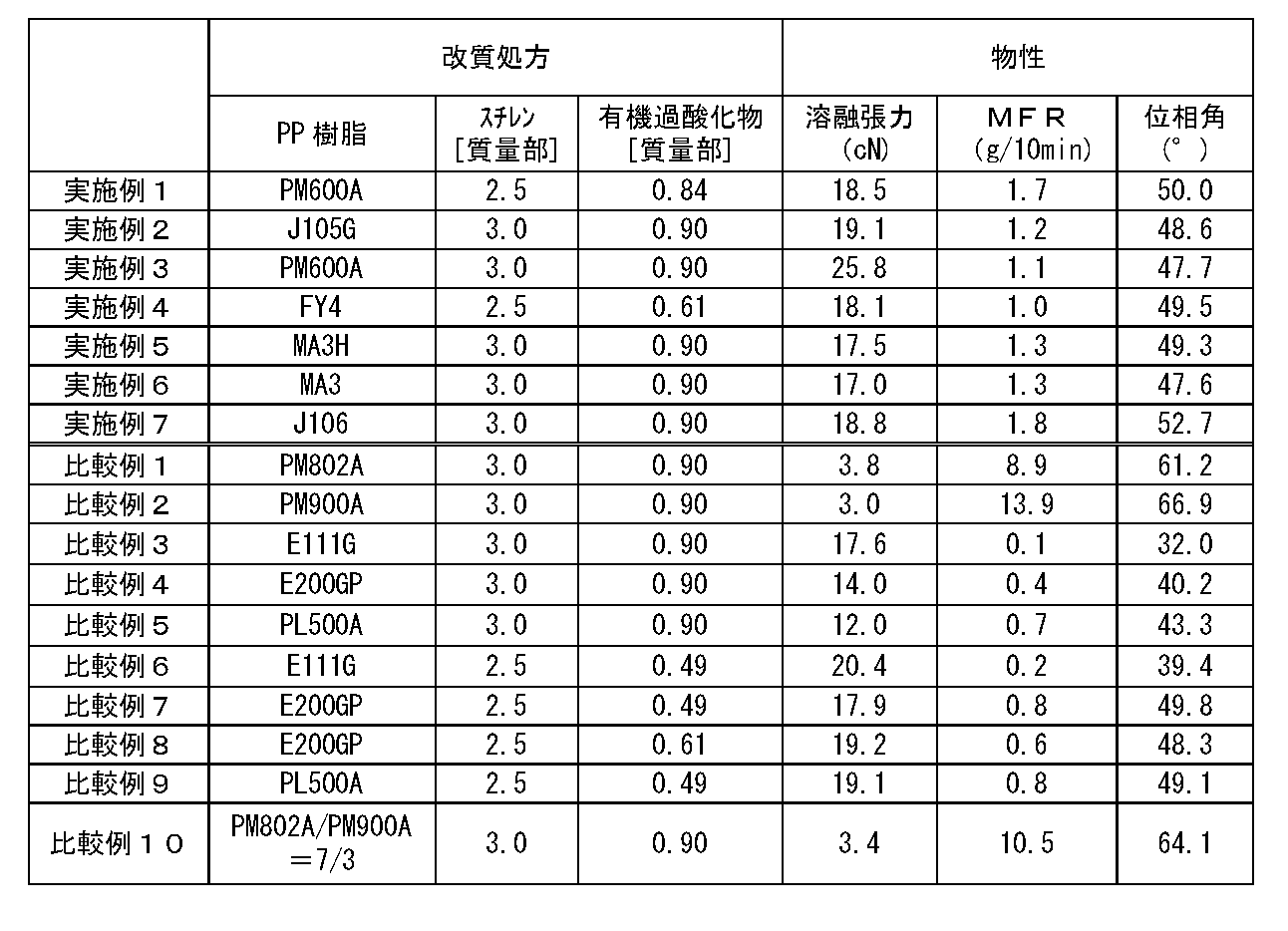
以上のことからも、本発明によれば熱溶融時における高い溶融張力を発揮しつつ、かつ流動性に優れた改質ポリプロピレン系樹脂が得られることがわかる。
<第2の検討:ストランドの均一性>
上述した改質ポリプロピレン系樹脂の作製時における前記ダイス(口径2mm、孔数9個(#1~#9))のそれぞれの孔から押出される各ストランドの吐出量のバラツキを測定した。
測定結果を以下に示す。
表中の「R」は、各吐出量の最大値と最小値の差を表している。
上述した改質ポリプロピレン系樹脂の作製時における前記ダイス(口径2mm、孔数9個(#1~#9))のそれぞれの孔から押出される各ストランドの吐出量のバラツキを測定した。
測定結果を以下に示す。
表中の「R」は、各吐出量の最大値と最小値の差を表している。

以上のことから、本発明によれば改質ポリプロピレン系樹脂の作製時においてダイスからの吐出量が均一化されることがわかる。
<第3の検討:連続気泡率>
(参考例1)
(1)改質ポリプロピレン系樹脂の作製
ポリプロピレン系樹脂(ホモポリプロピレン樹脂、サンアロマー社製「PM600A」、MFR=7.5g/10min、密度=0.9g/cm3)100質量部と、t-ブチルパーオキシイソプロピルカーボネート(化薬アクゾ株式会社製「カヤカルボンBIC-75」、1分間半減期温度T1:156℃)0.84質量部とをリボンブレンダーにて攪拌混合して、混合物を得た。
得られた混合物を、口径が41mmの二軸押出機(L/D=42)に供給し、液体注入ポンプを用いて二軸押出機の途中から、スチレンモノマーをポリプロピレン系樹脂100質量部に対する割合が2.5質量部となるように供給した。
フィード部の設定温度を170℃、それ以降の温度を230℃に設定し、回転数120rpm、ギアポンプ回転数25rpmの条件にて二軸押出機中で、原料組成物を溶融混練させ、先端に取り付けた口径2mm、ランド10mm、孔数9個のダイスから、45kg/hの吐出量で、溶融混練物をストランド状に押し出した。
次いで、押し出されたストランド状の溶融混練物を、30℃の水を収容した冷却水槽中を通過させて、冷却した。
冷却されたストランド状の混練物を、ペレタイザーでカットして、改質ポリプロピレン系樹脂A(MFR=1.7g/10min、溶融張力=18.5cN、以下、「改質PP-A」)のペレットを得た。
(2)発泡体の作製
得られた「改質PP-A」85質量部、サンアロマー社製の熱可塑性エラストマー樹脂、商品名「Q100F」15質量部、及び、気泡調整剤(大日精化工業社製「ファインセルマスターHCPO410K」)0.45質量部をドライブレンドして、混合物を得た。
この混合物を、口径50mmのNo.1押出機と、口径65mmのNo.2押出機とを持つタンデム型押出機のNo.1押出機のホッパーに供給し、No.1押出機のバレル内で加熱溶融混練した後、発泡剤として混合ブタンガス(ノルマルブタン:イソブタン=7:3)を2.5質量%の割合となるようにNo.1押出機へ圧入し、発泡剤を含むポリプロピレン系樹脂組成物を溶融混練して発泡層形成用の第1のポリプロピレン系樹脂組成物を当該押出機内で調製した。
その後、この第1のポリプロピレン系樹脂組成物をNo.1押出機とNo.2押出機とを接続する移送部を通じてNo.2押出機へ流入させた。
次いで、このNo.2押出機のバレル内で均一に第1のポリプロピレン系樹脂組成物を冷却した後、合流ダイへ流入させた。
この時の樹脂温度は180℃であり、No.2押出機からの吐出量は30kg/hであった。
(参考例1)
(1)改質ポリプロピレン系樹脂の作製
ポリプロピレン系樹脂(ホモポリプロピレン樹脂、サンアロマー社製「PM600A」、MFR=7.5g/10min、密度=0.9g/cm3)100質量部と、t-ブチルパーオキシイソプロピルカーボネート(化薬アクゾ株式会社製「カヤカルボンBIC-75」、1分間半減期温度T1:156℃)0.84質量部とをリボンブレンダーにて攪拌混合して、混合物を得た。
得られた混合物を、口径が41mmの二軸押出機(L/D=42)に供給し、液体注入ポンプを用いて二軸押出機の途中から、スチレンモノマーをポリプロピレン系樹脂100質量部に対する割合が2.5質量部となるように供給した。
フィード部の設定温度を170℃、それ以降の温度を230℃に設定し、回転数120rpm、ギアポンプ回転数25rpmの条件にて二軸押出機中で、原料組成物を溶融混練させ、先端に取り付けた口径2mm、ランド10mm、孔数9個のダイスから、45kg/hの吐出量で、溶融混練物をストランド状に押し出した。
次いで、押し出されたストランド状の溶融混練物を、30℃の水を収容した冷却水槽中を通過させて、冷却した。
冷却されたストランド状の混練物を、ペレタイザーでカットして、改質ポリプロピレン系樹脂A(MFR=1.7g/10min、溶融張力=18.5cN、以下、「改質PP-A」)のペレットを得た。
(2)発泡体の作製
得られた「改質PP-A」85質量部、サンアロマー社製の熱可塑性エラストマー樹脂、商品名「Q100F」15質量部、及び、気泡調整剤(大日精化工業社製「ファインセルマスターHCPO410K」)0.45質量部をドライブレンドして、混合物を得た。
この混合物を、口径50mmのNo.1押出機と、口径65mmのNo.2押出機とを持つタンデム型押出機のNo.1押出機のホッパーに供給し、No.1押出機のバレル内で加熱溶融混練した後、発泡剤として混合ブタンガス(ノルマルブタン:イソブタン=7:3)を2.5質量%の割合となるようにNo.1押出機へ圧入し、発泡剤を含むポリプロピレン系樹脂組成物を溶融混練して発泡層形成用の第1のポリプロピレン系樹脂組成物を当該押出機内で調製した。
その後、この第1のポリプロピレン系樹脂組成物をNo.1押出機とNo.2押出機とを接続する移送部を通じてNo.2押出機へ流入させた。
次いで、このNo.2押出機のバレル内で均一に第1のポリプロピレン系樹脂組成物を冷却した後、合流ダイへ流入させた。
この時の樹脂温度は180℃であり、No.2押出機からの吐出量は30kg/hであった。
一方、非発泡層用の第2のポリプロピレン系樹脂組成物としては、改質ポリプロピレン系樹脂として上述した「改質PP-A」を含み、熱可塑性エラストマーとしてBasell社製の商品名「Q100F」、及び、高分子型帯電防止剤として三洋化成株式会社製の商品名:「ペレスタット230」(ポリエーテル-ポリプロピレンブロック共重合体)を含むものを用いた。
具体的には前記の「改質PP-A」を74質量部、前記熱可塑性エラストマーを13質量部及び、高分子型帯電防止剤を13質量部の割合で含有する混合原料を口径32mmの単軸押出機のホッパーに供給して溶融混練させた後、前記合流ダイへ流入させた。
この時の吐出量は3kg/hであった。
具体的には前記の「改質PP-A」を74質量部、前記熱可塑性エラストマーを13質量部及び、高分子型帯電防止剤を13質量部の割合で含有する混合原料を口径32mmの単軸押出機のホッパーに供給して溶融混練させた後、前記合流ダイへ流入させた。
この時の吐出量は3kg/hであった。
発泡層と非発泡層とを備えた積層発泡シートの作製にあたっては、まず、合流ダイで合流させた第1のポリプロピレン系樹脂組成物と第2のポリプロピレン系樹脂組成物とをスリットの口径が70mmのサーキュラーダイヘ送り込み、該サーキュラーダイの円環状の吐出口(スリット間隔0.4mm)から円筒状に共押出しした。
この後、非発泡層が発泡層に積層された状態の円筒状発泡体を冷却マンドレルによって冷却成形後、冷却マンドレルの後部に取り付けたカッターにより円筒状発泡体を切開して長尺帯状の積層発泡シートを作製し、該積層発泡シートを引き取り速度2.1m/minで巻き取った。
このときの積層発泡シートの平均厚みは2.12mmであった。
この後、非発泡層が発泡層に積層された状態の円筒状発泡体を冷却マンドレルによって冷却成形後、冷却マンドレルの後部に取り付けたカッターにより円筒状発泡体を切開して長尺帯状の積層発泡シートを作製し、該積層発泡シートを引き取り速度2.1m/minで巻き取った。
このときの積層発泡シートの平均厚みは2.12mmであった。
(参考例2~4、比較参考例1~5)
改質ポリプロピレン系樹脂を得るために使用したポリプロピレン系樹脂、スチレン量、有機過酸化物量及び、積層発泡シート得るために使用した改質ポリプロピレン系樹脂を以下の表どおりに変更した以外は上記と同様にして積層発泡シートを作製した。
なお、表の「J105G」、「FY4」、「E111G」、「E200GP」とは、前記の通りのもので「PL400A」は以下のようなポリプロピレン系樹脂を意味する。
「PL400A」:
ホモポリプロピレン樹脂、サンアロマー社製「PL400A」、MFR=2.0g/10min、密度=0.9g/cm3
改質ポリプロピレン系樹脂を得るために使用したポリプロピレン系樹脂、スチレン量、有機過酸化物量及び、積層発泡シート得るために使用した改質ポリプロピレン系樹脂を以下の表どおりに変更した以外は上記と同様にして積層発泡シートを作製した。
なお、表の「J105G」、「FY4」、「E111G」、「E200GP」とは、前記の通りのもので「PL400A」は以下のようなポリプロピレン系樹脂を意味する。
「PL400A」:
ホモポリプロピレン樹脂、サンアロマー社製「PL400A」、MFR=2.0g/10min、密度=0.9g/cm3


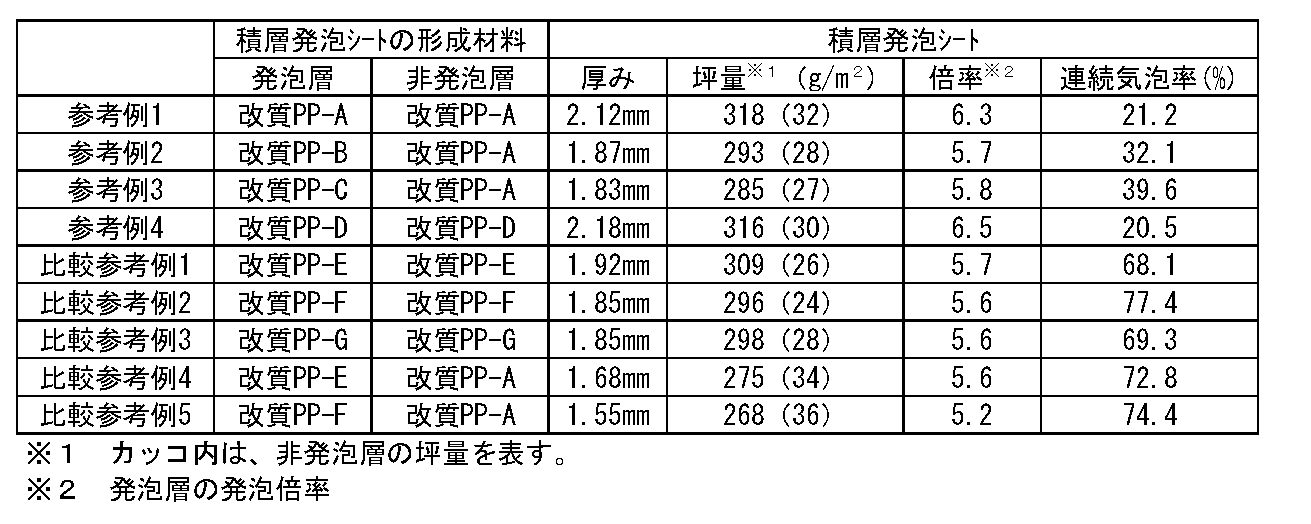
上記のことから流動性に優れた改質ポリプロピレン系樹脂は、連続気泡率の低い積層発泡シートの形成に有用であることがわかる。
<第4の検討:連続気泡率及び成形性>
[評価1]
(1)改質ポリプロピレン系樹脂(改質PP-a)の作製
リニアPP(PP1:線状の分子構造を有するホモポリプロピレン樹脂、MFR=7.5g/10min、密度=0.9g/cm3)100質量部と、t-ブチルパーオキシイソプロピルカーボネート(化薬アクゾ社製「カヤカルボンBIC-75」、1分間半減期温度:156℃)0.90質量部とをリボンブレンダーにて攪拌混合して、混合物を得た。
得られた混合物を、口径が41mmの二軸押出機(L/D=42)に供給し、液体注入ポンプを用いて二軸押出機の途中から、スチレンモノマーをリニアPP100質量部に対する割合が3.0質量部となるように供給した。
フィード部の設定温度を170℃、それ以降の温度を230℃に設定し、回転数120rpm、ギアポンプ回転数25rpmの条件にて二軸押出機中で、原料組成物を溶融混練させ、押出機の先端に取り付けた口径2mm、孔数9個のダイスから、45kg/hの吐出量で、溶融混練物をストランド状に押し出した。
次いで、押し出されたストランド状の溶融混練物を、30℃の水を収容した冷却水槽中を通過させて、冷却した。
冷却されたストランド状の混練物を、ペレタイザーでカットして、改質ポリプロピレン系樹脂(改質PP-a)のペレットを得た。
[評価1]
(1)改質ポリプロピレン系樹脂(改質PP-a)の作製
リニアPP(PP1:線状の分子構造を有するホモポリプロピレン樹脂、MFR=7.5g/10min、密度=0.9g/cm3)100質量部と、t-ブチルパーオキシイソプロピルカーボネート(化薬アクゾ社製「カヤカルボンBIC-75」、1分間半減期温度:156℃)0.90質量部とをリボンブレンダーにて攪拌混合して、混合物を得た。
得られた混合物を、口径が41mmの二軸押出機(L/D=42)に供給し、液体注入ポンプを用いて二軸押出機の途中から、スチレンモノマーをリニアPP100質量部に対する割合が3.0質量部となるように供給した。
フィード部の設定温度を170℃、それ以降の温度を230℃に設定し、回転数120rpm、ギアポンプ回転数25rpmの条件にて二軸押出機中で、原料組成物を溶融混練させ、押出機の先端に取り付けた口径2mm、孔数9個のダイスから、45kg/hの吐出量で、溶融混練物をストランド状に押し出した。
次いで、押し出されたストランド状の溶融混練物を、30℃の水を収容した冷却水槽中を通過させて、冷却した。
冷却されたストランド状の混練物を、ペレタイザーでカットして、改質ポリプロピレン系樹脂(改質PP-a)のペレットを得た。
(2)改質PPの特性調査
上記のようにして得られた改質PP-aのペレットの一軸伸長粘度(非線形領域の傾き)、MFR、及び、溶融張力を測定した。
なお、溶融張力は下記のようにして測定した。
上記のようにして得られた改質PP-aのペレットの一軸伸長粘度(非線形領域の傾き)、MFR、及び、溶融張力を測定した。
なお、溶融張力は下記のようにして測定した。
[溶融張力測定方法]
試料は、ペレットをそのまま使用する。
溶融張力は、ツインボアキャピラリーレオメーターRheologic5000T(イタリア チアスト社製)を用いて測定する。
即ち、試験温度(230℃)に加熱された径15mmのバレルに測定試料樹脂を充填後、5分間予熱したのち、上記測定装置のキャピラリーダイ(口径2.0mm、長さ20mm、流入角度フラット)からピストン降下速度(0.1546mm/s)を一定に保持して紐状に押出しながら、この紐状物を上記キャピラリーダイの下方27cmに位置する張力検出のプーリーに通過させた後、巻取りロールを用いて、その巻取り速度を初速8.7mm/s、加速度12mm/s2で徐々に増加させつつ巻き取って行き、紐状物が切断する直前の極大値と極小値の平均を試料の溶融張力とする。
なお、張力チャートに極大点が1個しかない場合はその極大値を溶融張力とする。
試料は、ペレットをそのまま使用する。
溶融張力は、ツインボアキャピラリーレオメーターRheologic5000T(イタリア チアスト社製)を用いて測定する。
即ち、試験温度(230℃)に加熱された径15mmのバレルに測定試料樹脂を充填後、5分間予熱したのち、上記測定装置のキャピラリーダイ(口径2.0mm、長さ20mm、流入角度フラット)からピストン降下速度(0.1546mm/s)を一定に保持して紐状に押出しながら、この紐状物を上記キャピラリーダイの下方27cmに位置する張力検出のプーリーに通過させた後、巻取りロールを用いて、その巻取り速度を初速8.7mm/s、加速度12mm/s2で徐々に増加させつつ巻き取って行き、紐状物が切断する直前の極大値と極小値の平均を試料の溶融張力とする。
なお、張力チャートに極大点が1個しかない場合はその極大値を溶融張力とする。
(3)押出機通過後の特性調査
東洋精機製作所製の「ラボプラストミル」の本体(型式:4M150)に、単軸押出機(型式:D2020(口径:20mm、L/D:20 備え付けの標準スクリュー(1条フルフライト)))を取り付け、単軸押出機の3ゾーンの温度を、押出し方向上流側から下流側に向かって、順に210℃、190℃、190℃に設定し、且つ、先端金型温度を180℃に設定するとともに吐出量が1kg/hとなるようにスクリューの回転数を固定した。
上記で得られた改質PP-aのペレットをこの「ラボプラストミル」に供給してストランド状に押出し、該ストランド状の押出物を20℃の冷却水を蓄えた水槽に通して冷却した。
冷却後のストランドを切断してペレット化し、得られたペレットの一軸伸長粘度(ひずみ量1~3における「グラフの傾き」)、MFR、及び、溶融張力を再び測定した。
東洋精機製作所製の「ラボプラストミル」の本体(型式:4M150)に、単軸押出機(型式:D2020(口径:20mm、L/D:20 備え付けの標準スクリュー(1条フルフライト)))を取り付け、単軸押出機の3ゾーンの温度を、押出し方向上流側から下流側に向かって、順に210℃、190℃、190℃に設定し、且つ、先端金型温度を180℃に設定するとともに吐出量が1kg/hとなるようにスクリューの回転数を固定した。
上記で得られた改質PP-aのペレットをこの「ラボプラストミル」に供給してストランド状に押出し、該ストランド状の押出物を20℃の冷却水を蓄えた水槽に通して冷却した。
冷却後のストランドを切断してペレット化し、得られたペレットの一軸伸長粘度(ひずみ量1~3における「グラフの傾き」)、MFR、及び、溶融張力を再び測定した。
(4)樹脂発泡シート(積層発泡シート)の作製
得られた「改質PP-a」85質量部、サンアロマー社製の熱可塑性エラストマー樹脂、商品名「Q100F」15質量部、及び、気泡調整剤(大日精化工業社製「ファインセルマスターHCPO410K」)0.45質量部をドライブレンドして混合物を得た。
この混合物を、口径50mmのNo.1押出機と、口径65mmのNo.2押出機とを持つタンデム型押出機のNo.1押出機のホッパーに供給し、No.1押出機のバレル内で加熱溶融混練した後、発泡剤として混合ブタンガス(ノルマルブタン:イソブタン=7:3)を2.5質量%の割合となるようにNo.1押出機へ圧入した。圧入された発泡剤を含むポリプロピレン系樹脂組成物を溶融混練して発泡層形成用の第1のポリプロピレン系樹脂組成物を当該押出機内で調製した後、この第1のポリプロピレン系樹脂組成物をNo.1押出機とNo.2押出機とを接続する移送部を通じてNo.2押出機へ流入させた。
次いで、このNo.2押出機のバレル内で第1のポリプロピレン系樹脂組成物を均一に冷却した後、合流ダイへ流入させた。
この時の樹脂温度は180℃であり、No.2押出機からの吐出量は30kg/hであった。
得られた「改質PP-a」85質量部、サンアロマー社製の熱可塑性エラストマー樹脂、商品名「Q100F」15質量部、及び、気泡調整剤(大日精化工業社製「ファインセルマスターHCPO410K」)0.45質量部をドライブレンドして混合物を得た。
この混合物を、口径50mmのNo.1押出機と、口径65mmのNo.2押出機とを持つタンデム型押出機のNo.1押出機のホッパーに供給し、No.1押出機のバレル内で加熱溶融混練した後、発泡剤として混合ブタンガス(ノルマルブタン:イソブタン=7:3)を2.5質量%の割合となるようにNo.1押出機へ圧入した。圧入された発泡剤を含むポリプロピレン系樹脂組成物を溶融混練して発泡層形成用の第1のポリプロピレン系樹脂組成物を当該押出機内で調製した後、この第1のポリプロピレン系樹脂組成物をNo.1押出機とNo.2押出機とを接続する移送部を通じてNo.2押出機へ流入させた。
次いで、このNo.2押出機のバレル内で第1のポリプロピレン系樹脂組成物を均一に冷却した後、合流ダイへ流入させた。
この時の樹脂温度は180℃であり、No.2押出機からの吐出量は30kg/hであった。
一方、非発泡層用の第2のポリプロピレン系樹脂組成物としては、改質ポリプロピレン系樹脂として上述した「改質PP-a」を含み、熱可塑性エラストマーとしてBasell社製の商品名「Q100F」、及び、高分子型帯電防止剤として三洋化成株式会社製の商品名:「ペレスタット230」(ポリエーテル-ポリプロピレンブロック共重合体)を含むものを用いた。
具体的には前記の「改質PP-a」を74質量部、前記熱可塑性エラストマーを13質量部及び、高分子型帯電防止剤を13質量部の割合で含有する混合原料を口径32mmの単軸押出機のホッパーに供給して溶融混練させた後、前記合流ダイへ流入させた。
この時の吐出量は3kg/hであった。
具体的には前記の「改質PP-a」を74質量部、前記熱可塑性エラストマーを13質量部及び、高分子型帯電防止剤を13質量部の割合で含有する混合原料を口径32mmの単軸押出機のホッパーに供給して溶融混練させた後、前記合流ダイへ流入させた。
この時の吐出量は3kg/hであった。
発泡層と非発泡層とは、合流ダイで合流させた第1のポリプロピレン系樹脂組成物と第2のポリプロピレン系樹脂組成物とをスリットの口径が70mmのサーキュラーダイヘ送り込み、該サーキュラーダイの円環状の吐出口(スリット間隔0.4mm)から円筒状に共押出して作製した。
この後、非発泡層が発泡層に積層された状態の円筒状発泡体を冷却マンドレルによって冷却成形後、冷却マンドレルの後部に取り付けたカッターにより円筒状発泡体を切開して長尺帯状の樹脂発泡シート(積層発泡シート1)を引き取り速度2.1m/minで巻き取った。
このときの樹脂発泡シートの平均厚みは2.18mmであった。
この後、非発泡層が発泡層に積層された状態の円筒状発泡体を冷却マンドレルによって冷却成形後、冷却マンドレルの後部に取り付けたカッターにより円筒状発泡体を切開して長尺帯状の樹脂発泡シート(積層発泡シート1)を引き取り速度2.1m/minで巻き取った。
このときの樹脂発泡シートの平均厚みは2.18mmであった。
(改質PP-b~改質PP-f:積層発泡シート2~5)
使用したポリプロピレン系樹脂、スチレン量、有機過酸化物の量を以下の表6のとおりに変更した以外は改質PP-aと同様にして改質ポリプロピレン系樹脂を作製し、各種物性を調査した。
また、得られた改質ポリプロピレン系樹脂を用い、改質PP-aの場合と同様に積層発泡シートを作製した。
使用したポリプロピレン系樹脂、スチレン量、有機過酸化物の量を以下の表6のとおりに変更した以外は改質PP-aと同様にして改質ポリプロピレン系樹脂を作製し、各種物性を調査した。
また、得られた改質ポリプロピレン系樹脂を用い、改質PP-aの場合と同様に積層発泡シートを作製した。
(積層発泡シート6、7)
改質PP-aおよび改質PP-fを用いて積層発泡シートを作製した。
「改質PP-a」39質量部、日本ポリプロ社から商品名「BC6C」として市販のブロックPPを55質量部、サンアロマー社製の熱可塑性エラストマー樹脂、商品名「Q100F」6質量部、及び、気泡調整剤(大日精化工業社製「ファインセルマスターHCPO410K」)1.5質量部をドライブレンドして混合物を得た。
この混合物を、口径50mmのNo.1押出機と、口径65mmのNo.2押出機とを持つタンデム型押出機のNo.1押出機のホッパーに供給し、No.1押出機のバレル内で加熱溶融混練した後、発泡剤として混合ブタンガス(ノルマルブタン:イソブタン=7:3)を1.3質量%の割合となるようにNo.1押出機へ圧入した。圧入された発泡剤を含むポリプロピレン系樹脂組成物を溶融混練して発泡層形成用の第1のポリプロピレン系樹脂組成物を当該押出機内で調製した後、この第1のポリプロピレン系樹脂組成物をNo.1押出機とNo.2押出機とを接続する移送部を通じてNo.2押出機へ流入させた。
次いで、このNo.2押出機のバレル内で第1のポリプロピレン系樹脂組成物を均一に冷却した後、合流ダイへ流入させた。
この時の樹脂温度は180℃であり、No.2押出機からの吐出量は30kg/hであった。
改質PP-aおよび改質PP-fを用いて積層発泡シートを作製した。
「改質PP-a」39質量部、日本ポリプロ社から商品名「BC6C」として市販のブロックPPを55質量部、サンアロマー社製の熱可塑性エラストマー樹脂、商品名「Q100F」6質量部、及び、気泡調整剤(大日精化工業社製「ファインセルマスターHCPO410K」)1.5質量部をドライブレンドして混合物を得た。
この混合物を、口径50mmのNo.1押出機と、口径65mmのNo.2押出機とを持つタンデム型押出機のNo.1押出機のホッパーに供給し、No.1押出機のバレル内で加熱溶融混練した後、発泡剤として混合ブタンガス(ノルマルブタン:イソブタン=7:3)を1.3質量%の割合となるようにNo.1押出機へ圧入した。圧入された発泡剤を含むポリプロピレン系樹脂組成物を溶融混練して発泡層形成用の第1のポリプロピレン系樹脂組成物を当該押出機内で調製した後、この第1のポリプロピレン系樹脂組成物をNo.1押出機とNo.2押出機とを接続する移送部を通じてNo.2押出機へ流入させた。
次いで、このNo.2押出機のバレル内で第1のポリプロピレン系樹脂組成物を均一に冷却した後、合流ダイへ流入させた。
この時の樹脂温度は180℃であり、No.2押出機からの吐出量は30kg/hであった。
一方、非発泡層用の第2のポリプロピレン系樹脂組成物としては、改質ポリプロピレン系樹脂として上述した「改質PP-a」を含み、熱可塑性エラストマーとしてBasell社製の商品名「Q100F」、及び、高分子型帯電防止剤として三洋化成株式会社製の商品名:「ペレスタット230」(ポリエーテル-ポリプロピレンブロック共重合体)を含むものを用いた。
具体的には前記の「改質PP-a」を74質量部、前記熱可塑性エラストマーを13質量部及び、高分子型帯電防止剤を13質量部の割合で含有する混合原料を口径32mmの単軸押出機のホッパーに供給して溶融混練させた後、前記合流ダイへ流入させた。
そして、その後は「積層発泡シート1」と同様にして樹脂発泡シート(積層発泡シート6)を作製した。
この時の吐出量は3kg/hであった。
同様に改質PP-aを改質PP-fに置き換えて「積層発泡シート8」を得た。
具体的には前記の「改質PP-a」を74質量部、前記熱可塑性エラストマーを13質量部及び、高分子型帯電防止剤を13質量部の割合で含有する混合原料を口径32mmの単軸押出機のホッパーに供給して溶融混練させた後、前記合流ダイへ流入させた。
そして、その後は「積層発泡シート1」と同様にして樹脂発泡シート(積層発泡シート6)を作製した。
この時の吐出量は3kg/hであった。
同様に改質PP-aを改質PP-fに置き換えて「積層発泡シート8」を得た。
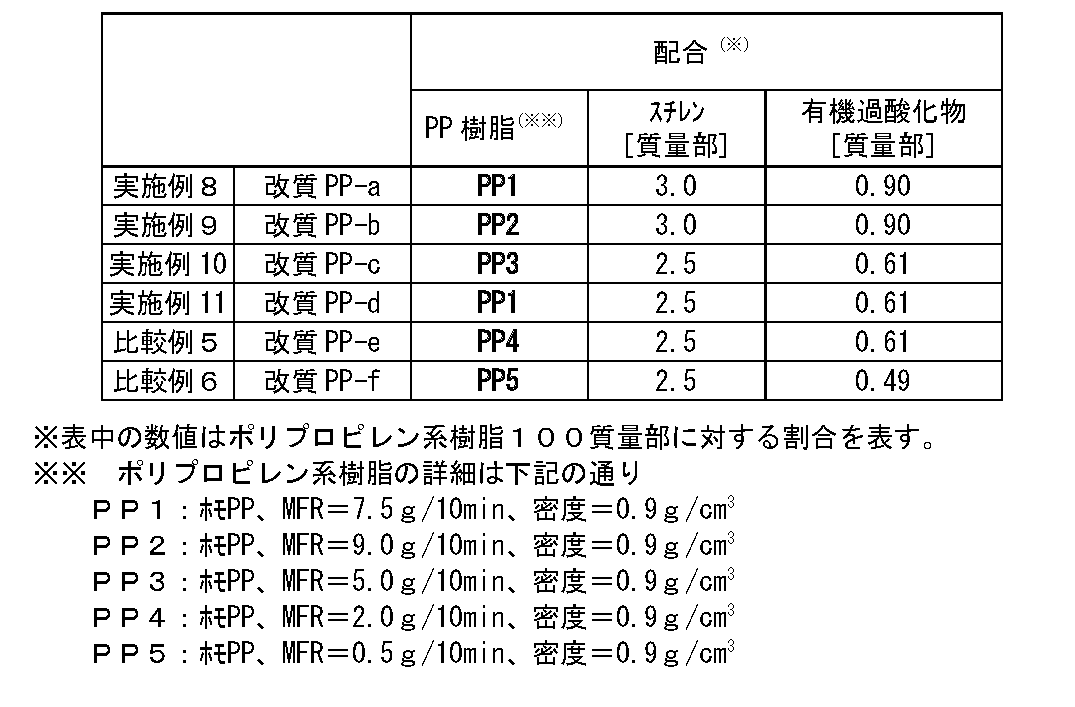
改質PP-a~改質PP-eの押出機通過前の特性と通過後の特性をと表7に示す。
また、改質PP-a~改質PP-fを用いて作製した発泡シートの特性を表8に示す。
また、改質PP-a~改質PP-fを用いて作製した発泡シートの特性を表8に示す。


上記の結果から、MFRが高いポリプロピレン系樹脂を改質した改質ポリプロピレン系樹脂は、押出機通過後に特定の一軸伸長粘度を示し、溶融状態において高いせん断速度での加工が行われる用途に適したものであることがわかる。
また、上記の結果から、そのような改質PPを用いることで独立気泡性が高い(連続気泡率が低い)良好な発泡状態の発泡シートが得られることが分かる。
また、上記の結果から、そのような改質PPを用いることで独立気泡性が高い(連続気泡率が低い)良好な発泡状態の発泡シートが得られることが分かる。
[評価2]
改質PP-aおよび改質PP-fを用いて単層構造の発泡シートを作製した。
(1)発泡シートの作製(発泡シート9、10)
得られた「改質PP」85質量部、サンアロマー社製の熱可塑性エラストマー樹脂、商品名「Q100F」15質量部をドライブレンドしてポリマー混合物を得た。
このポリマー混合物を化学発泡剤(大日精化工業社製「ファインセルマスターHCPO410K」)とともに押出機で溶融混練し、該押出機の先端に装着したサーキュラーダイから押出しつつ発泡させて発泡シートを作製した。
各改質PPを使って得られた発泡シートの特性は下記の通り。
改質PP-aおよび改質PP-fを用いて単層構造の発泡シートを作製した。
(1)発泡シートの作製(発泡シート9、10)
得られた「改質PP」85質量部、サンアロマー社製の熱可塑性エラストマー樹脂、商品名「Q100F」15質量部をドライブレンドしてポリマー混合物を得た。
このポリマー混合物を化学発泡剤(大日精化工業社製「ファインセルマスターHCPO410K」)とともに押出機で溶融混練し、該押出機の先端に装着したサーキュラーダイから押出しつつ発泡させて発泡シートを作製した。
各改質PPを使って得られた発泡シートの特性は下記の通り。

(2)成形性評価
作製した各発泡シートから縦700mm×横1050mmの平面長方形状の試験片を切り出した。
そして、単発成形機(東成産業社製 商品名「ユニック自動成形機 FM-3A」)を用意し、この単発成形機の上側ヒーターの平均温度を274℃、下側ヒーターの平均温度を237℃、上側雰囲気温度を192℃、下側雰囲気温度を185℃にした。
次に、上記試験片を単発成形機に導入して14~18秒間各々加熱した後に、直径10mm(上面)×直径35mm(底面)で高さが違う円錐台を22個配置した金型を用いて、金型表面温度を50℃に温調し、加熱成形を行なった。
22個の円錐台の高さは、下記表に示す通りである。
作製した各発泡シートから縦700mm×横1050mmの平面長方形状の試験片を切り出した。
そして、単発成形機(東成産業社製 商品名「ユニック自動成形機 FM-3A」)を用意し、この単発成形機の上側ヒーターの平均温度を274℃、下側ヒーターの平均温度を237℃、上側雰囲気温度を192℃、下側雰囲気温度を185℃にした。
次に、上記試験片を単発成形機に導入して14~18秒間各々加熱した後に、直径10mm(上面)×直径35mm(底面)で高さが違う円錐台を22個配置した金型を用いて、金型表面温度を50℃に温調し、加熱成形を行なった。
22個の円錐台の高さは、下記表に示す通りである。
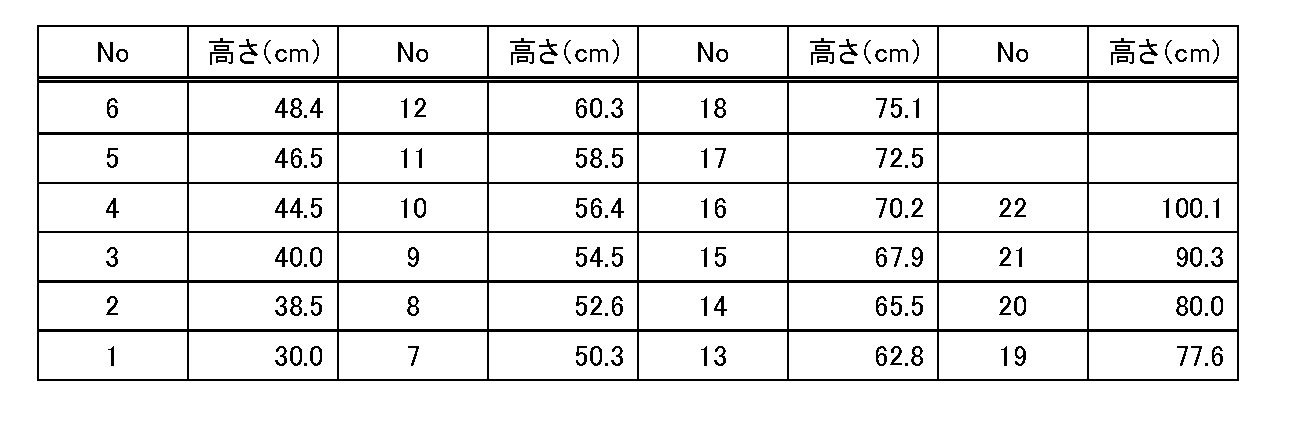
そして、得られた成形体を目視観察し、各円錐形状に破れが無いもののうち、最も高さの高い円錐台のNoを下記表にまとめた。
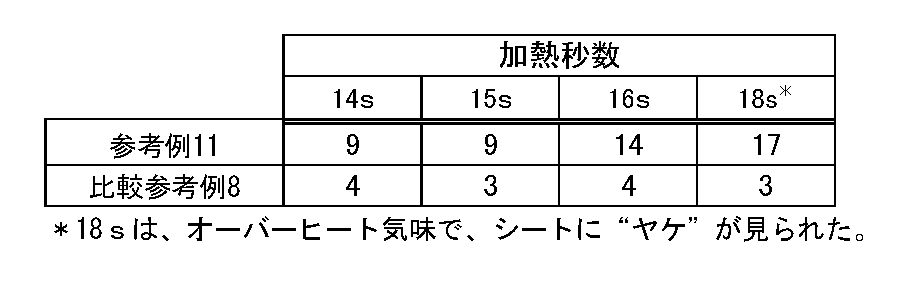
上記の結果から、MFRの高いポリプロピレン系樹脂を出発原料とした改質PPは、独立気泡性が高く(連続気泡率が低い)良好な成形性(伸びが良い)を有する樹脂発泡体の形成に有効であることが分かる。
<第5の検討:多分岐指数と成形性>
使用したポリプロピレン系樹脂、スチレン量、有機過酸化物の量を以下の表12のとおりに変更した以外は改質PP-aと同様にして改質ポリプロピレン系樹脂を作製した。、
押出機通過前後における多分岐指数が表13に示す状態となる改質ポリプロピレン系樹脂を、4種類(mPP1~mPP4)作製した。
該改質ポリプロピレン系樹脂の位相角、MFR、及び、溶融張力を併せて表13に示す。
使用したポリプロピレン系樹脂、スチレン量、有機過酸化物の量を以下の表12のとおりに変更した以外は改質PP-aと同様にして改質ポリプロピレン系樹脂を作製した。、
押出機通過前後における多分岐指数が表13に示す状態となる改質ポリプロピレン系樹脂を、4種類(mPP1~mPP4)作製した。
該改質ポリプロピレン系樹脂の位相角、MFR、及び、溶融張力を併せて表13に示す。

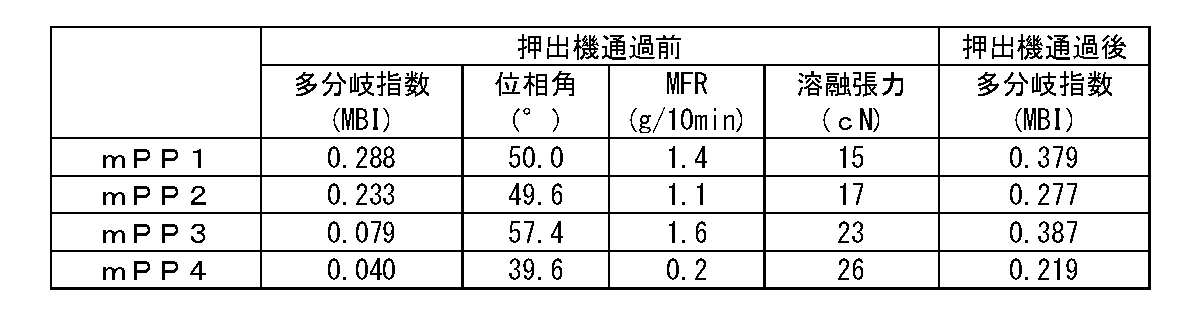
「mPP1」~「mPP4」を85質量部、サンアロマー社製の熱可塑性エラストマー樹脂、商品名「Q100F」15質量部をドライブレンドしてポリマー混合物を得た。
このポリマー混合物を化学発泡剤(大日精化工業社製「ファインセルマスターHCPO410K」)とともに押出機で溶融混練し、該押出機の先端に装着したサーキュラーダイから押出しつつ発泡させて下記表14に示した発泡シートを作製した。
各mPPを使って得られた樹脂発泡シートの特性は下記の通り。
このポリマー混合物を化学発泡剤(大日精化工業社製「ファインセルマスターHCPO410K」)とともに押出機で溶融混練し、該押出機の先端に装着したサーキュラーダイから押出しつつ発泡させて下記表14に示した発泡シートを作製した。
各mPPを使って得られた樹脂発泡シートの特性は下記の通り。

作製した各発泡シートから縦700mm×横1050mmの平面長方形状の試験片を切り出した。
そして、単発成形機(東成産業社製 商品名「ユニック自動成形機 FM-3A」)を用意し、この単発成形機の上側ヒーターの平均温度を274℃、下側ヒーターの平均温度を237℃、上側雰囲気温度を192℃、下側雰囲気温度を185℃にした。
次に、上記試験片を単発成形機に導入して14~18秒間各々加熱した後に、直径10mm(上面)×直径35mm(底面)で高さが違う円錐台を22個配置した金型を用いて、金型表面温度を50℃に温調し、加熱成形を行なった。
22個の円錐台の高さは、前記の表10に示した通りである。
そして、単発成形機(東成産業社製 商品名「ユニック自動成形機 FM-3A」)を用意し、この単発成形機の上側ヒーターの平均温度を274℃、下側ヒーターの平均温度を237℃、上側雰囲気温度を192℃、下側雰囲気温度を185℃にした。
次に、上記試験片を単発成形機に導入して14~18秒間各々加熱した後に、直径10mm(上面)×直径35mm(底面)で高さが違う円錐台を22個配置した金型を用いて、金型表面温度を50℃に温調し、加熱成形を行なった。
22個の円錐台の高さは、前記の表10に示した通りである。
そして、得られた成形体を目視観察し、各円錐形状に破れが無いもののうち、最も高さの高い円錐台のNoを下記表にまとめた。

上記の結果から、押出機通過後に特定の多分岐指数を示す改質PPは、溶融状態で高いせん断速度での加工が行われる用途に適したものであることがわかる。
また、上記の結果から、そのような改質PPを用いることで独立気泡性が高く(連続気泡率が低い)良好な成形性(伸びが良い)を有する樹脂発泡体が得られることが分かる。
また、上記の結果から、そのような改質PPを用いることで独立気泡性が高く(連続気泡率が低い)良好な成形性(伸びが良い)を有する樹脂発泡体が得られることが分かる。
1 積層発泡シート
10 発泡層
20 非発泡層
10 発泡層
20 非発泡層
Claims (4)
- ポリプロピレン系樹脂と、芳香族ビニルモノマーとの反応物であり、前記ポリプロピレン系樹脂よりも高い溶融張力を有する改質ポリプロピレン系樹脂であって、
前記ポリプロピレン系樹脂は、温度230℃、公称荷重2.16kgの条件で測定されるメルトマスフローレイトが4.0g/10min以上である改質ポリプロピレン系樹脂。 - 押出機を通過させた後に温度200℃、1.0/秒の一定ひずみ速度で一軸伸長粘度を測定した際に歪み硬化性を示し、且つ、横軸をひずみ量(ε)の対数(log(ε))、縦軸を伸長粘度(η)の対数(log(η))とした両対数のグラフで一軸伸長粘度の測定結果を表した際にひずみ量1以上3以下の範囲内でのグラフの傾きが1.0以上となる請求項1記載の改質ポリプロピレン系樹脂。
- 押出機を通過させた後、温度180℃、ひずみ速度0.1~8.5(sec-1)で一軸伸長粘度を測定した際に、0.25以上の多分岐指数(MBI)を示す請求項1または2記載の改質ポリプロピレン系樹脂。
(但し、多分岐指数(MBI)とは、横軸をひずみ速度(v)の対数(log(v))、縦軸をひずみ硬化度(SHI)とした片対数のグラフで一軸伸長粘度の測定結果を表した際のグラフの傾きを意味する。また、ひずみ硬化度(SHI)とは、横軸をひずみ量(ε)の対数(log(ε))、縦軸を伸長粘度(η)の対数(log(η))とした両対数のグラフで一軸伸長粘度の測定結果を表した際のひずみ量1以上3以下の範囲におけるグラフの傾きを意味する。) - ポリプロピレン系樹脂に芳香族ビニルモノマーを反応させて前記ポリプロピレン系樹脂よりも溶融張力の高い改質ポリプロピレン系樹脂を作製する改質ポリプロピレン系樹脂の製造方法であって、
前記ポリプロピレン系樹脂として、温度230℃、公称荷重2.16kgの測定条件で4.0g/10min以上のメルトマスフローレイトを示すポリプロピレン系樹脂を用いる改質ポリプロピレン系樹脂の製造方法。
Priority Applications (1)
| Application Number | Priority Date | Filing Date | Title |
|---|---|---|---|
| JP2018508032A JPWO2017170481A1 (ja) | 2016-03-29 | 2017-03-28 | 改質ポリプロピレン系樹脂及び改質ポリプロピレン系樹脂の製造方法 |
Applications Claiming Priority (2)
| Application Number | Priority Date | Filing Date | Title |
|---|---|---|---|
| JP2016-066525 | 2016-03-29 | ||
| JP2016066525 | 2016-03-29 |
Publications (1)
| Publication Number | Publication Date |
|---|---|
| WO2017170481A1 true WO2017170481A1 (ja) | 2017-10-05 |
Family
ID=59965768
Family Applications (1)
| Application Number | Title | Priority Date | Filing Date |
|---|---|---|---|
| PCT/JP2017/012533 Ceased WO2017170481A1 (ja) | 2016-03-29 | 2017-03-28 | 改質ポリプロピレン系樹脂及び改質ポリプロピレン系樹脂の製造方法 |
Country Status (3)
| Country | Link |
|---|---|
| JP (1) | JPWO2017170481A1 (ja) |
| TW (1) | TWI627193B (ja) |
| WO (1) | WO2017170481A1 (ja) |
Cited By (1)
| Publication number | Priority date | Publication date | Assignee | Title |
|---|---|---|---|---|
| JP2020143208A (ja) * | 2019-03-06 | 2020-09-10 | キョーラク株式会社 | 発泡ブロー成形用樹脂、発泡ブロー成形体の製造方法 |
Citations (6)
| Publication number | Priority date | Publication date | Assignee | Title |
|---|---|---|---|---|
| WO1992007887A1 (en) * | 1990-11-02 | 1992-05-14 | Sumitomo Chemical Company, Limited | Modified propylene polymer and thermoplastic resin composition comprising modified propylene polymer and polyphenylene ether |
| JPH09188728A (ja) * | 1996-01-09 | 1997-07-22 | Kanegafuchi Chem Ind Co Ltd | 改質ポリプロピレン系樹脂およびその製法 |
| JPH10298336A (ja) * | 1997-04-23 | 1998-11-10 | Kanegafuchi Chem Ind Co Ltd | 改質ポリプロピレン系樹脂組成物からなる発泡体およびその製法 |
| JP2008075076A (ja) * | 2006-08-25 | 2008-04-03 | Sekisui Plastics Co Ltd | スチレン改質ポリプロピレン系樹脂粒子及びその発泡性樹脂粒子、それらの製造方法、予備発泡粒子及び発泡成形体 |
| JP2012188642A (ja) * | 2011-02-25 | 2012-10-04 | Sekisui Plastics Co Ltd | 改質ポリプロピレン系樹脂の予備発泡粒子および発泡成形体の製造方法 |
| WO2016067814A1 (ja) * | 2014-10-30 | 2016-05-06 | 積水化成品工業株式会社 | 改質ポリプロピレン系樹脂、ポリプロピレン系樹脂発泡シート、発泡樹脂製容器、及び、改質ポリプロピレン系樹脂の製造方法 |
Family Cites Families (1)
| Publication number | Priority date | Publication date | Assignee | Title |
|---|---|---|---|---|
| EP0679684B1 (en) * | 1993-11-12 | 1999-07-14 | Kanegafuchi Kagaku Kogyo Kabushiki Kaisha | Polyolefin resin composition |
-
2017
- 2017-03-28 TW TW106110299A patent/TWI627193B/zh not_active IP Right Cessation
- 2017-03-28 JP JP2018508032A patent/JPWO2017170481A1/ja active Pending
- 2017-03-28 WO PCT/JP2017/012533 patent/WO2017170481A1/ja not_active Ceased
Patent Citations (6)
| Publication number | Priority date | Publication date | Assignee | Title |
|---|---|---|---|---|
| WO1992007887A1 (en) * | 1990-11-02 | 1992-05-14 | Sumitomo Chemical Company, Limited | Modified propylene polymer and thermoplastic resin composition comprising modified propylene polymer and polyphenylene ether |
| JPH09188728A (ja) * | 1996-01-09 | 1997-07-22 | Kanegafuchi Chem Ind Co Ltd | 改質ポリプロピレン系樹脂およびその製法 |
| JPH10298336A (ja) * | 1997-04-23 | 1998-11-10 | Kanegafuchi Chem Ind Co Ltd | 改質ポリプロピレン系樹脂組成物からなる発泡体およびその製法 |
| JP2008075076A (ja) * | 2006-08-25 | 2008-04-03 | Sekisui Plastics Co Ltd | スチレン改質ポリプロピレン系樹脂粒子及びその発泡性樹脂粒子、それらの製造方法、予備発泡粒子及び発泡成形体 |
| JP2012188642A (ja) * | 2011-02-25 | 2012-10-04 | Sekisui Plastics Co Ltd | 改質ポリプロピレン系樹脂の予備発泡粒子および発泡成形体の製造方法 |
| WO2016067814A1 (ja) * | 2014-10-30 | 2016-05-06 | 積水化成品工業株式会社 | 改質ポリプロピレン系樹脂、ポリプロピレン系樹脂発泡シート、発泡樹脂製容器、及び、改質ポリプロピレン系樹脂の製造方法 |
Cited By (3)
| Publication number | Priority date | Publication date | Assignee | Title |
|---|---|---|---|---|
| JP2020143208A (ja) * | 2019-03-06 | 2020-09-10 | キョーラク株式会社 | 発泡ブロー成形用樹脂、発泡ブロー成形体の製造方法 |
| WO2020179792A1 (ja) * | 2019-03-06 | 2020-09-10 | キョーラク株式会社 | 発泡ブロー成形用樹脂、発泡ブロー成形体の製造方法 |
| JP7201910B2 (ja) | 2019-03-06 | 2023-01-11 | キョーラク株式会社 | 発泡ブロー成形用樹脂、発泡ブロー成形体の製造方法 |
Also Published As
| Publication number | Publication date |
|---|---|
| TW201739776A (zh) | 2017-11-16 |
| JPWO2017170481A1 (ja) | 2018-11-08 |
| TWI627193B (zh) | 2018-06-21 |
Similar Documents
| Publication | Publication Date | Title |
|---|---|---|
| JP4011962B2 (ja) | ポリプロピレン系樹脂押出発泡シートの製造方法、製造された押出発泡シートおよび該発泡シートからなる成形体 | |
| WO1997005183A1 (en) | Foam made from modified polypropylene resin and process for the production thereof | |
| JP7717047B2 (ja) | ポリプロピレン系樹脂発泡粒子、その製造方法及びポリプロピレン系樹脂発泡成形体 | |
| JP6093795B2 (ja) | ポリプロピレン系樹脂発泡シートの製造方法 | |
| WO1997025356A1 (en) | Modified polypropylene resin, foam made from the resin and processes for the production of both | |
| JP2018059055A (ja) | ポリプロピレン系樹脂、樹脂発泡シート、及び、樹脂発泡成形体 | |
| JP6229100B1 (ja) | 積層発泡シート及び発泡成形品 | |
| WO2022154070A1 (ja) | ポリプロピレン系樹脂押出発泡粒子およびその製造方法、並びに発泡成形体 | |
| WO2022163627A1 (ja) | 分岐構造を有するポリプロピレン系樹脂の製造方法、押出発泡粒子の製造方法、および、発泡成形体の製造方法 | |
| JPWO2017170481A1 (ja) | 改質ポリプロピレン系樹脂及び改質ポリプロピレン系樹脂の製造方法 | |
| JP6322148B2 (ja) | シード重合用種粒子、複合樹脂粒子、発泡性粒子、発泡粒子及び複合樹脂発泡成形体 | |
| JP2018059056A (ja) | ポリプロピレン系樹脂、樹脂発泡体、及び、樹脂成形品 | |
| WO2016067814A1 (ja) | 改質ポリプロピレン系樹脂、ポリプロピレン系樹脂発泡シート、発泡樹脂製容器、及び、改質ポリプロピレン系樹脂の製造方法 | |
| JP2002059473A (ja) | ポリプロピレン系樹脂組成物からなる発泡シート、およびその成形体 | |
| JP2003327732A (ja) | ポリプロピレン系樹脂発泡シート、成形体 | |
| JP2017179070A (ja) | 改質ポリプロピレン系樹脂の製造方法 | |
| WO2022191181A1 (ja) | 押出発泡用ポリプロピレン系樹脂組成物、押出発泡粒子および発泡成形体 | |
| JP2017177471A (ja) | 改質ポリマーの製造方法 | |
| JP2001139717A (ja) | ポリプロピレン系樹脂組成物からなる発泡シートおよびそれよりなる成形体 | |
| JP2019044060A (ja) | 押出発泡シート、発泡樹脂成形品、及び、押出発泡シートの製造方法 | |
| JP6568798B2 (ja) | 改質ポリプロピレン系樹脂、樹脂発泡体及び発泡樹脂製容器、及び、改質ポリプロピレン系樹脂の製造方法 | |
| JP2001138378A (ja) | ポリプロピレン系樹脂押出発泡シートおよびその製造方法および該発泡シートよりなる成形体 | |
| JP2019044059A (ja) | 押出発泡シート、発泡樹脂成形品、及び、押出発泡シートの製造方法 | |
| JP2000129026A (ja) | 改質ポリプロピレン系樹脂組成物からなる発泡シートおよび成形体 | |
| WO2022210645A1 (ja) | ポリプロピレン系樹脂押出発泡粒子およびその製造方法、並びに発泡成形体 |
Legal Events
| Date | Code | Title | Description |
|---|---|---|---|
| WWE | Wipo information: entry into national phase |
Ref document number: 2018508032 Country of ref document: JP |
|
| NENP | Non-entry into the national phase |
Ref country code: DE |
|
| 121 | Ep: the epo has been informed by wipo that ep was designated in this application |
Ref document number: 17775018 Country of ref document: EP Kind code of ref document: A1 |
|
| 122 | Ep: pct application non-entry in european phase |
Ref document number: 17775018 Country of ref document: EP Kind code of ref document: A1 |