WO2017150327A1 - 神経栄養因子の脳内分泌促進するための食品添加用組成物 - Google Patents
神経栄養因子の脳内分泌促進するための食品添加用組成物 Download PDFInfo
- Publication number
- WO2017150327A1 WO2017150327A1 PCT/JP2017/006800 JP2017006800W WO2017150327A1 WO 2017150327 A1 WO2017150327 A1 WO 2017150327A1 JP 2017006800 W JP2017006800 W JP 2017006800W WO 2017150327 A1 WO2017150327 A1 WO 2017150327A1
- Authority
- WO
- WIPO (PCT)
- Prior art keywords
- arg
- lys
- brain
- amino acid
- gly
- Prior art date
- Legal status (The legal status is an assumption and is not a legal conclusion. Google has not performed a legal analysis and makes no representation as to the accuracy of the status listed.)
- Ceased
Links
Classifications
-
- A—HUMAN NECESSITIES
- A23—FOODS OR FOODSTUFFS; TREATMENT THEREOF, NOT COVERED BY OTHER CLASSES
- A23L—FOODS, FOODSTUFFS OR NON-ALCOHOLIC BEVERAGES, NOT OTHERWISE PROVIDED FOR; PREPARATION OR TREATMENT THEREOF
- A23L33/00—Modifying nutritive qualities of foods; Dietetic products; Preparation or treatment thereof
- A23L33/10—Modifying nutritive qualities of foods; Dietetic products; Preparation or treatment thereof using additives
- A23L33/17—Amino acids, peptides or proteins
- A23L33/18—Peptides; Protein hydrolysates
-
- A—HUMAN NECESSITIES
- A61—MEDICAL OR VETERINARY SCIENCE; HYGIENE
- A61K—PREPARATIONS FOR MEDICAL, DENTAL OR TOILETRY PURPOSES
- A61K38/00—Medicinal preparations containing peptides
Definitions
- the present invention relates to a food additive composition for promoting brain endocrine secretion of neurotrophic factor.
- the number of senile dementia patients including Alzheimer's disease is increasing.
- the dementia reserve army is called mild cognitive impairment (MCI), and if it is diagnosed as MCI, prevention by improving life is necessary.
- MCI mild cognitive impairment
- the number of patients with dementia will increase 1.8 times from 2012 to 2030
- the number of patients with MCI in 2030 is estimated to be 7.2 million, assuming that the number will increase at the same rate.
- the number of patients with brain troubles such as depression caused by various stresses such as work environment, family circumstances, and human relations is increasing year by year. Recent research has revealed that food components affect brain function, and food components having effects on brain function improvement, antidepressant, antidementia and the like are drawing attention.
- Neurotrophin is a general term for substances that promote the generation, growth, maintenance, and regeneration of neurons, and various trophic factors have been identified so far.
- brain-derived neurotrophic factor (BDNF) exhibits actions such as maintaining survival of nerve cells, promoting neurite outgrowth and promoting neurotransmitter synthesis.
- the function of these BDNF is via a high affinity receptor (TrkB) (nonpatent literature 1, 2).
- TrkB high affinity receptor
- BDNF has been reported to be associated with neuropsychiatric disorders such as Alzheimer's disease and depression. In the brains of Alzheimer's disease patients, BDNF and TrkB levels are lower than in healthy individuals, particularly in the cerebral cortex and hippocampus.
- TrkB mRNA levels decrease with age in the prefrontal cortex.
- a decrease in spatial memory with age has been shown to correlate with a decrease in hippocampal BDNF mRNA expression.
- the present inventors have found an oligopeptide mixture containing a dipeptide or tripeptide having lysine and / or arginine as constituent amino acids.
- the present inventors have found that the neurotrophic factor in the brain can be efficiently increased and have completed the present invention.
- the present invention (1) A food additive composition for promoting brain endocrine secretion of neurotrophic factor, comprising as an active ingredient an oligopeptide mixture containing a dipeptide or tripeptide having lysine and / or arginine as a constituent amino acid, (2) The composition for food addition for promoting brain endocrine secretion of neurotrophic factor according to (1), wherein the ratio of the amount of lysine and / or arginine to the total amino acid amount in the oligopeptide mixture is 5% by weight or more, (3) To promote the brain endocrine secretion of the neurotrophic factor according to (1) or (2), wherein the content of the peptide having a molecular weight of less than 500 in the oligopeptide mixture is 50% by weight or more based on the total amount of peptide and free amino acid A food additive composition, (4) a brain endocrine promoter for neurotrophic factor, comprising as an active ingredient an oligopeptide mixture containing a dipeptide or
- Ingestion of a specific dipeptide or tripeptide of the present invention as an active ingredient can promote brain endocrine secretion of a neurotrophic factor such as BDNF. Thereby, it can be used for prevention of various cranial nerve diseases and improvement of brain function.
- BDNF neurotrophic factor
- the oligopeptide mixture is not a peptide having only a specific amino acid sequence, but a mixture of peptides having various amino acid sequences and molecular weights.
- the oligopeptide mixture used as the food additive of the present invention includes, as one embodiment, an acid hydrolyzate of a protein obtained by hydrolyzing a protein raw material with an acid or an enzyme hydrolyzate of a protein obtained by enzymatic degradation with a protein hydrolase (protease). Can be. In addition, it can also be prepared by a conventional method by a chemical synthesis method or an enzymatic method.
- protein raw materials various protein raw materials obtained by extracting, concentrating, or separating proteins from animal or plant natural raw materials can be used, and a suitable protein content in the protein raw materials is 50% by weight or more in terms of dry weight. It is preferably 70% by weight or more, more preferably 80% by weight or more, and still more preferably 90% by weight or more.
- Animal protein raw materials include milk, eggs, livestock meat, seafood, and microorganisms.
- Plant protein raw materials derived from beans such as soybeans and peas, rice, wheat, barley, Examples include cereals such as corn, and nuts such as almonds, cashews, walnuts, pistachios, hazelnuts, and madakamian nuts.
- the amino acid sequence of protein contains a lot of basic amino acids such as lysine and arginine residues and neutral amino acids such as glycine.
- Examples thereof include soybean, milk, livestock meat, and seafood meat. , Eggs and the like, and soybean is more preferable.
- soy milk whether whole fat, defatted, etc.
- concentrated soybean protein separated soybean protein, fractionated soybean protein, etc.
- isolated soybean protein or fractionated soy protein having a high protein content of 80% by weight or more in terms of dry weight.
- the degree of enzymatic degradation and enzymatic degradation of a protein raw material with a protein hydrolase is suitably that all molecules are not degraded to free amino acids, and the degree of degradation is preferably higher.
- the content of the peptide fraction having a molecular weight of less than 500 in the oligopeptide mixture is 50% by weight or more, preferably 60% by weight or more based on the total amount of the peptide and free amino acid.
- the peptide having a molecular weight of less than 500 is substantially composed of a dipeptide and a tripeptide in which 2 to 3 amino acids are bonded. If the molecular weight of the oligopeptide mixture is too large, the superiority of the absorption rate may be reduced, and the effect of promoting neurotrophic factor secretion may be diminished.
- the content of the peptide having a molecular weight of less than 500 is determined by measuring the ratio of the peptide having a molecular weight of less than 500 and a free amino acid fraction in the oligopeptide mixture by gel filtration chromatography for peptides, and then calculating the amino acid analysis in the protein hydrolyzate. It shall be calculated by subtracting the free amino acid content.
- the oligopeptide mixture identified as described above is preferably a mixture in which the ratio of peptides other than peptides having a molecular weight of less than 500 and free amino acids is reduced as much as possible. That is, the content of the free amino acid in the oligopeptide mixture is appropriately 12% by weight or less, preferably 5% by weight or less based on the total amount of the peptide and free amino acid. This is because too many free amino acids may cause problems due to large intake.
- the fraction of the molecular weight of 500 or more in the oligopeptide mixture is 40% by weight or less with respect to the total amount of peptide and free amino acid. Preferably, it is 38 wt% or less, and more preferably 35 wt% or less.
- Proteases used for enzymatic degradation to obtain oligopeptide mixtures are classified as “metal protease”, “acidic protease”, “thiol protease”, “serine protease” regardless of animal origin, plant origin or microbial origin. Can be appropriately selected from proteases classified as “metal protease”, “thiol protease”, and “serine protease”.
- a degradation method in which enzymes belonging to two or more, or three or more different classifications are used sequentially or simultaneously in combination can increase the proportion of peptides having a molecular weight of less than 500, which is preferable. Furthermore, it is preferable to use an enzyme with low exoprotease activity to reduce the content of free amino acids.
- protease is a classification method based on the type of amino acid at the active center, which is usually performed in the field of enzyme science.
- metal protease includes neutral protease derived from Bacillus, neutral protease derived from Streptomyces, neutral protease derived from Aspergillus, “Samoase”, etc.
- acid protease includes pepsin, acidic protease derived from Aspergillus, “Sumiteam FP” and the like
- thiol protease includes bromelain, papain and the like
- seerine protease includes trypsin, chymotrypsin, subtilisin, Streptomyces-derived alkaline protease, “alkalase”, “bioplase” and the like .
- the classification can be confirmed by the action pH and the reactivity with inhibitors. Since the site of action on the substrate is greatly different between enzymes having different active centers, it is possible to reduce “uncut residue” and efficiently obtain an enzyme degradation product. In addition, enzymatic degradation products can be produced more efficiently by using enzymes of different origins (origin organisms) together. Even in the same classification, if the origins are different, the site of action on the protein as a substrate is also different, and as a result, the proportion of peptides having a molecular weight of less than 500 can be increased.
- the reaction pH and reaction temperature for the protease treatment may be set in accordance with the characteristics of the protease to be used. Usually, the reaction pH is carried out near the optimum pH, and the reaction temperature may be carried out around the optimum temperature. In general, the reaction temperature is 20 to 80 ° C., preferably 40 to 60 ° C. After the reaction, the enzyme is heated to a temperature sufficient to inactivate the enzyme (about 60 to 170 ° C.) to inactivate the residual enzyme activity.
- the reaction solution after the protease treatment can be used as it is or after being concentrated, but is usually sterilized, spray-dried, freeze-dried, etc. and used in the form of a dry powder.
- Sterilization is preferably heat sterilization, the heating temperature is preferably 110 to 170 ° C., more preferably 130 to 170 ° C., and the heating time is preferably 3 to 20 seconds.
- Insoluble matter (precipitate or suspension) generated during protease treatment or pH adjustment may be removed by centrifugation, filtration, etc. This removal of insoluble matter improves the potency of the active ingredient in the oligopeptide mixture. This is preferable. Furthermore, you may refine
- NSPP Basic amino acid dipeptides or tripeptides containing lysine and / or arginine as constituent amino acids
- the oligopeptide mixture used in the present invention may be abbreviated as “basic amino acid dipeptide or tripeptide containing lysine and / or arginine as constituent amino acids” (hereinafter referred to as “NSPP” (Neurotrophin Secretion Promoting Peptides). . It is important to contain That is, the present invention is based on the fact that the NSPP acts as an effective component that promotes secretion of neurotrophic factors from neurons in the brain.
- the NSPP contains one or two lysine residues or arginine residues, and in the case of only one residue, the remaining residues preferably contain neutral amino acids.
- Tripeptides contain 1 to 3 lysine or arginine residues, and in the case of only 1 to 2 residues, the remaining residues preferably contain neutral amino acids. Examples of neutral amino acids include glycine.
- the lysine residue or arginine residue may be present at either the N-terminus or C-terminus of NSPP, and in the case of a tripeptide, it may be present in the middle of the amino acid sequence.
- peptide transporter independent of the amino acid transporter exists in the digestive tract, it is known that not only dipeptides but also tripeptides are transported into cells in the peptide state. Is equivalent to ingesting a dipeptide (Adibi SA.
- the NSPP contained in the oligopeptide mixture may be not only a single amino acid sequence containing lysine or arginine but also a mixture of two or more amino acid sequences containing lysine or arginine.
- NSPPs used in the present invention those having higher expression and secretion of neurotrophic factor are particularly preferred in screening for active substances using astrocytes, and when measured by the method described in the Examples,
- the increase in secretion is preferably 1.2 times or more, more preferably 1.3 times or more, and even more preferably 1.5 times or more, as compared with the solvent-only control.
- NSPPs satisfying such indices include, for example, Lys-Arg, Arg-Lys, Lys-Lys, Arg-Arg, Gly-Arg, Gly-Lys, Lsy-Gly, Pro-Arg, Arg-Pro, Ser for dipeptides -Arg, Arg-Ser, Ala-Arg, Arg-Ala, Ile-Arg, Lys-Ile, Ala-Lys, Val-Arg, Arg-Gly, Val-Lys, Leu-Arg, Arg-Ile, Ser-Lys , Tyr-Arg, Lys-Tyr, Asn-Lys, Lys-Val and Lys-Ser, preferably Lys-Arg, Arg-Lys, Lys-Lys, Arg-Arg , Gly-Arg, Gly-Lys, Lsy-Gly, Pro-Arg, Arg-Pro, Ser-Arg, Arg-Ser, Ala-Arg, Arg-Ala, Ile-Arg
- Lys-Gly-Arg For tripeptides, Lys-Gly-Arg, Gly-Arg-Lys, Gly-Lys-Arg, Arg-Pro-Arg, Arg-Ser-Arg, Arg-Ala-Arg, Lys-Ile-Arg, Ser-Arg -Lys, Ser-Lys-Arg, Pro-Arg-Arg, Arg-Ala-Lys, Lys-Tyr-Arg, Lys-Val-Arg, Ala-Arg-Arg, Arg-Gly-Arg, Val-Lys-Arg , Val-Arg-Arg, Leu-Arg-Arg, Val-Arg-Lys, Pro-Arg-Lys, Asn-Lys-Arg, Arg-Ile-Arg and Lys-Ser-Arg More preferably, Lys-Gly-Arg, Gly-Arg-Lys, Gly-Lys-Arg, Arg-Pro-Arg, Arg-Ser-Arg, Arg-Ala-Arg and Lys-Ile
- the ratio of the amount of lysine and arginine to the total amount of amino acids in the oligopeptide mixture is considered to be higher, the amount of NSPP is considered to be higher. Therefore, the higher one is preferable, specifically, 5 wt% or more and 80 wt% or less. It is preferable.
- the protein raw material can be further concentrated or purified after enzymatic degradation of the protein raw material with a protein hydrolase.
- the NSPP used in the present invention can be obtained by preparing an oligopeptide mixture by an enzymatic method using a plastein reaction or an amino acid ligase, or by chemically synthesizing it. In view of efficiency, it is preferable to concentrate or purify the protein hydrolyzate in consideration of its use as a food material.
- Concentration can be performed by adsorbing a fraction rich in NSPP in the oligopeptide mixture using an adsorbent or the like.
- a fraction containing a large amount of NSPP can be obtained by adding a polar organic solvent such as ethanol to the oligopeptide mixture solution and collecting the precipitate (International Publication WO2008 / 123033).
- NSPP physiological functions In screening of active substances using astrocytes, oligopeptide mixtures containing dipeptides and / or tripeptides having basic amino acids including lysine and arginine as constituent amino acids, for example, Lys-Gly-Arg, Gly-Arg- It has been found by the present inventors that NSPP with Lys sequence significantly increases BDNF expression and secretion compared to controls.
- oligopeptides that promoted the expression or secretion of neurotrophic factors in the screening of active substances using NSPP, particularly preferably astrocytes, were found to ingest BDNF in the brain.
- the present inventors have demonstrated that such a neurotrophic factor exhibits a high secretion promoting effect.
- composition for food addition to promote brain endocrine secretion of neurotrophic factor containing oligopeptide mixture having NSPP can be blended in various foods. For example, it can mix
- Cranial nerve diseases include higher brain dysfunction such as memory disorder, attention disorder, executive dysfunction, social behavior disorder, and symptoms pathologically related to these disorders such as cerebral infarction, head injury, brain Examples include vascular dementia, Alzheimer type dementia, Parkinson's disease, schizophrenia, depression, and anxiety.
- Improved brain function Specific effects of improving brain function include memory improvement, learning ability improvement, attention improvement, stress tolerance, antidepressant action, anxiolytic action, concentration improvement, and sleep quality improvement.
- the molecular weight distribution of the oligopeptide mixture shall be measured by the HPLC method using the following gel filtration column.
- An HPLC system using a gel filtration column for peptides is assembled, a known peptide serving as a molecular weight marker is charged, and a calibration curve is obtained in relation to the molecular weight and the retention time.
- the molecular weight markers are [ ⁇ -Asp] -Angiotensin II ⁇ -Asp-Arg-Val-Tyr-Ile-His-Pro-Phe (SEQ ID NO: 1; molecular weight 1046) as octapeptide and Angiotensin IV as hexapeptide.
- Val-Tyr-Ile-His-Pro-Phe (SEQ ID NO: 2; molecular weight 775), Leu-Enkephalin Tyr-Gly-Gly-Phe-Leu (SEQ ID NO: 3; molecular weight 555) as a pentapeptide, Glu- Glu-Glu (molecular weight 405) and Pro (molecular weight 115) as a free amino acid are used.
- the supernatant obtained by centrifuging an oligopeptide mixture (1%) at 10,000 rpm for 10 minutes is diluted 2-fold with a solvent for gel filtration, and 5 ⁇ l thereof is applied to HPLC.
- the ratio (%) of the free amino acid in the protein hydrolyzate and the peptide fraction having a molecular weight of less than 500 is determined by the ratio of the area of the molecular weight less than 500 (time range) to the total absorbance chart area (column used: Superdex Peptide 7.5 / 300GL (manufactured by GE Healthcare Japan), solvent: 1% SDS / 10 mM phosphate buffer, pH 8.0, column temperature 25 ° C., flow rate 0.25 ml / min, detection wavelength: 220 nm).
- the ratio (%) of the peptide fraction having a molecular weight of 500 or more in the protein hydrolyzate is determined by the ratio of the area having a molecular weight of 500 or more to the total absorbance chart area as described above.
- the free amino acid content in the protein hydrolyzate is measured by amino acid analysis.
- Protein hydrolyzate (4 mg / ml) is added to an equal volume of 3% sulfosalicylic acid and shaken at room temperature for 15 minutes. Centrifugation is performed at 10,000 rpm for 10 minutes, and the resulting supernatant is filtered through a 0.45 ⁇ m filter, and free amino acids are measured with an amino acid analyzer “JLC500V” (manufactured by JEOL Ltd.).
- the free amino acid content in the protein hydrolyzate is calculated as a ratio to the protein content obtained by the Kjeldahl method.
- the value obtained by subtracting “free amino acid content” from the “ratio of free amino acids and peptide fractions having a molecular weight of less than 500” obtained as described above is defined as “content of peptides having a molecular weight of less than 500” in the proteolysate.
- mice Female C57BL / 6J mice (8-10 weeks old, manufactured by Oriental Yeast Co., Ltd.) were made pregnant, fetal brain cells at day 18 of fetal age were isolated, and DMEM / F12 medium supplemented with G5-Supplement (Invitrogen) ( Invitrogen) was induced to differentiate into astrocytes. Seven days after induction, the positive rate of differentiation marker GFAP was examined, and it was confirmed that the positive rate was 95% or more.
- Primary cultured astrocytes derived from mouse fetal brain final concentration 2 ⁇ 10 5 cells / mL were seeded in a 60 mm dish and cultured in a CO 2 incubator for 4 days under conditions of 37 ° C. and 5% CO 2.
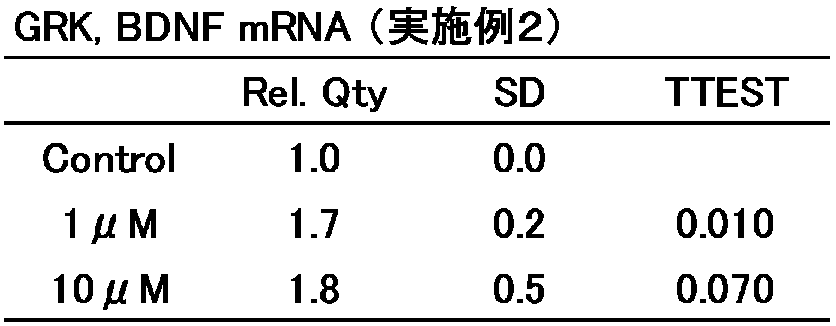
- Example 2 Examination of tripeptides As tripeptides, KGR (Lys-Gly-Arg) (Example 1) and GRK (Gly-Arg-Lys) (Example 2) were added to primary cultured astrocytes. Then, the mRNA expression level of brain-derived neurotrophic factor (BDNF) was examined. Table 1 shows the results. It was confirmed that the mRNA expression level of BDNF was significantly increased in any tripeptide.
- BDNF brain-derived neurotrophic factor
Landscapes
- Life Sciences & Earth Sciences (AREA)
- Health & Medical Sciences (AREA)
- Proteomics, Peptides & Aminoacids (AREA)
- Chemical & Material Sciences (AREA)
- Engineering & Computer Science (AREA)
- Animal Behavior & Ethology (AREA)
- Molecular Biology (AREA)
- Pharmacology & Pharmacy (AREA)
- Immunology (AREA)
- Epidemiology (AREA)
- Bioinformatics & Cheminformatics (AREA)
- General Health & Medical Sciences (AREA)
- Public Health (AREA)
- Veterinary Medicine (AREA)
- Medicinal Chemistry (AREA)
- Mycology (AREA)
- Nutrition Science (AREA)
- Food Science & Technology (AREA)
- Polymers & Plastics (AREA)
- Medicines That Contain Protein Lipid Enzymes And Other Medicines (AREA)
- Coloring Foods And Improving Nutritive Qualities (AREA)
- Peptides Or Proteins (AREA)
Abstract
本発明は、食品に添加することでBDNFを含む神経栄養因子の脳内分泌を促進し、脳神経疾患の予防機能や脳機能改善機能を食品に付加することのできる食品素材を提供することを課題とする。 構成アミノ酸としてリジン及び/またはアルギニンを有するジペプチドもしくはトリペプチドを含有するオリゴペプチド混合物が、脳内の神経栄養因子を効率よく増加させることができる。
Description
本発明は、神経栄養因子の脳内分泌促進するための食品添加用組成物に関するものである。
老齢人口の増加と共に、アルツハイマー病を含む老人性痴呆患者数が増加している。厚生労働省によると、2012年の認知症患者数は462万人(65歳以上の7人に1人)から、2030年には830万人になると推測されている。一方、認知症予備軍を軽度認知障害(Mild Cognitive Impairment: MCI)と呼び、MCIと診断されたら、生活改善による予防が必要となる。認知症患者が2012年から2030年で1.8倍になるので、同じ割合で増加すると仮定して試算すると、2030年のMCI患者数は720万人と推測される。一方、仕事環境、家庭的事情、人間関係などの様々なストレスによるうつ病など、脳のトラブルを抱えている患者数は年々増加している。近年の研究で、食品成分が脳の機能に影響を及ぼすことが明らかになり、脳機能改善、抗うつ、抗認知症などに関する効果を有する食品成分が注目されている。
神経栄養因子(Neurotrophin)とは神経細胞の発生・成長・維持・再生を促進させる物質の総称であり、これまでに様々な栄養因子が同定されている。その中で、脳由来神経栄養因子(Brain-Derived Neurotrophic Factor: BDNF)は神経細胞の生存維持、神経突起の伸張促進、神経伝達物質の合成促進などの作用を示す。なお、これらのBDNFの機能は高親和性受容体(TrkB)を介する(非特許文献1,2)。
BDNFは、アルツハイマー病、うつ病などの精神神経疾患との関連が報告されている。アルツハイマー病の患者の脳では、特に大脳皮質や海馬において、BDNFとTrkBのレベルが健常者よりも低い。健常者では前頭前野においてTrkB mRNAレベルが加齢に伴い減少する。ラットでは加齢に伴う空間記憶の低下と、海馬のBDNF mRNA発現量の減少が相関することが示されている。これらの事実は、加齢及びアルツハイマー病における記憶低下に、BDNF作用の減少の関与が示唆されている(非特許文献3)。
BDNFとうつ病との関連を示すデータも報告されている(非特許文献4)。うつ病患者の脳では、海馬を含むいくつかの領域でBDNF蛋白量の減少が認められる。うつ病のモデル動物では海馬のセロトニンン作動性神経線維の脱落が認められるが、BDNFはセロトニン作動性ニューロンの生存維持に作用する。
BDNFは、アルツハイマー病、うつ病などの精神神経疾患との関連が報告されている。アルツハイマー病の患者の脳では、特に大脳皮質や海馬において、BDNFとTrkBのレベルが健常者よりも低い。健常者では前頭前野においてTrkB mRNAレベルが加齢に伴い減少する。ラットでは加齢に伴う空間記憶の低下と、海馬のBDNF mRNA発現量の減少が相関することが示されている。これらの事実は、加齢及びアルツハイマー病における記憶低下に、BDNF作用の減少の関与が示唆されている(非特許文献3)。
BDNFとうつ病との関連を示すデータも報告されている(非特許文献4)。うつ病患者の脳では、海馬を含むいくつかの領域でBDNF蛋白量の減少が認められる。うつ病のモデル動物では海馬のセロトニンン作動性神経線維の脱落が認められるが、BDNFはセロトニン作動性ニューロンの生存維持に作用する。
したがって、BDNFを含む神経栄養因子の脳内レベルを増加させることにより、脳機能の低下に起因する症状あるいは疾患を予防し、さらに改善効果を示し、安全性の高い食品原料の開発が強く望まれている。
Huang EJ and Reichardt LF. Neurotrophins: roles in neuronal development and function. Annu. Rev. Neurosci. 2001, 24, 677.
Schinder AF and Poo M. The neurotrophin hypothesis for synaptic plasticity. Trends Neurosci. 2000; 23: 639-645.
Tapia-Arancibia L, Aliaga E, Silhol M, Arancibia S.New insights into brain BDNF function in normal aging and Alzheimer disease. Brain Res. Rev.2008; 59: 201-220.
Erickson KI, Miller DL, Roecklein KA.The aging hippocampus: interactions between exercise, depression, and BDNF.Neuroscientist. 2015; 18: 82-97.
本発明は、食品に添加することでBDNFを含む神経栄養因子の脳内分泌を促進し、脳神経疾患の予防機能や脳機能改善機能を食品に付加することのできる食品素材を提供することを課題とする。
本発明者らは、脳内神経栄養因子レベルを効率よく増加させる安全性の高い食品素材を鋭意研究した結果、構成アミノ酸としてリジン及び/またはアルギニンを有するジペプチドもしくはトリペプチドを含有するオリゴペプチド混合物が、脳内の神経栄養因子を効率よく増加させることを見出し、本発明を完成させるに至った。
すなわち、本発明は、
(1)構成アミノ酸としてリジン及び/またはアルギニンを有するジペプチドまたはトリペプチドを含有するオリゴペプチド混合物を有効成分とする、神経栄養因子の脳内分泌促進するための食品添加用組成物、
(2)オリゴペプチド混合物中の全アミノ酸量に対するリジン及び/またはアルギニンの量の割合が5重量%以上である、(1)記載の神経栄養因子の脳内分泌促進するための食品添加用組成物、
(3)オリゴペプチド混合物中の分子量500未満のペプチド含量がペプチド及び遊離アミノ酸の合計量に対して50重量%以上である、(1)または(2)記載の神経栄養因子の脳内分泌促進するための食品添加用組成物、
(4)構成アミノ酸としてリジン及び/またはアルギニンを有するジペプチドまたはトリペプチドを含有するオリゴペプチド混合物を有効成分とする、神経栄養因子の脳内分泌促進剤、
(5)神経栄養因子の脳内分泌促進のために用いられる食品を製造するために、構成アミノ酸としてリジン及び/またはアルギニンを有するジペプチドまたはトリペプチドを、食品に有効成分として添加して使用する方法、
である。
(1)構成アミノ酸としてリジン及び/またはアルギニンを有するジペプチドまたはトリペプチドを含有するオリゴペプチド混合物を有効成分とする、神経栄養因子の脳内分泌促進するための食品添加用組成物、
(2)オリゴペプチド混合物中の全アミノ酸量に対するリジン及び/またはアルギニンの量の割合が5重量%以上である、(1)記載の神経栄養因子の脳内分泌促進するための食品添加用組成物、
(3)オリゴペプチド混合物中の分子量500未満のペプチド含量がペプチド及び遊離アミノ酸の合計量に対して50重量%以上である、(1)または(2)記載の神経栄養因子の脳内分泌促進するための食品添加用組成物、
(4)構成アミノ酸としてリジン及び/またはアルギニンを有するジペプチドまたはトリペプチドを含有するオリゴペプチド混合物を有効成分とする、神経栄養因子の脳内分泌促進剤、
(5)神経栄養因子の脳内分泌促進のために用いられる食品を製造するために、構成アミノ酸としてリジン及び/またはアルギニンを有するジペプチドまたはトリペプチドを、食品に有効成分として添加して使用する方法、
である。
本発明の特定のジペプチド又はトリペプチドを有効成分として摂取することにより、BDNFのような神経栄養因子の脳内分泌を促進させることができる。これにより、種々の脳神経疾患の予防や脳機能の改善に役立てることができる。
以下、本発明の実施形態について詳細に説明する。
(オリゴペプチド混合物)
オリゴペプチド混合物は特定のアミノ酸配列のみを有するペプチドではなく、様々なアミノ酸配列と分子量を有するペプチドの混合物である。
本発明の食品添加物として使用されるオリゴペプチド混合物は、一つの態様として蛋白質原料を酸で加水分解した蛋白質の酸加水分解物もしくは蛋白質加水分解酵素(プロテアーゼ)により酵素分解した蛋白質の酵素分解物であることができる。それ以外に、化学合成法や酵素法により常法で調製することもできる。
オリゴペプチド混合物は特定のアミノ酸配列のみを有するペプチドではなく、様々なアミノ酸配列と分子量を有するペプチドの混合物である。
本発明の食品添加物として使用されるオリゴペプチド混合物は、一つの態様として蛋白質原料を酸で加水分解した蛋白質の酸加水分解物もしくは蛋白質加水分解酵素(プロテアーゼ)により酵素分解した蛋白質の酵素分解物であることができる。それ以外に、化学合成法や酵素法により常法で調製することもできる。
以下、酵素分解法によりオリゴペプチド混合物を得る態様について説明する。
蛋白質原料としては、動物性又は植物性の天然原料から蛋白質を抽出,濃縮,又は分離した各種蛋白質原料を用いることができ、該蛋白質原料中の好適な蛋白質含量は乾燥重量換算で50重量%以上、好ましくは70重量%以上、より好ましくは80重量%以上、さらに好ましくは90重量%以上である。
動物性の蛋白質原料の由来としては、乳,卵,家畜肉,魚介肉,微生物などがあり、植物性の蛋白質原料の由来としては、大豆,エンドウ豆等の豆類や、米,小麦,大麦,トウモロコシ等の穀類等、アーモンド、カシューナッツ、クルミ、ピスタチオ、ヘーゼルナッツ、マダカミアンナッツ等のナッツ類が挙げられる。
蛋白質原料としては、動物性又は植物性の天然原料から蛋白質を抽出,濃縮,又は分離した各種蛋白質原料を用いることができ、該蛋白質原料中の好適な蛋白質含量は乾燥重量換算で50重量%以上、好ましくは70重量%以上、より好ましくは80重量%以上、さらに好ましくは90重量%以上である。
動物性の蛋白質原料の由来としては、乳,卵,家畜肉,魚介肉,微生物などがあり、植物性の蛋白質原料の由来としては、大豆,エンドウ豆等の豆類や、米,小麦,大麦,トウモロコシ等の穀類等、アーモンド、カシューナッツ、クルミ、ピスタチオ、ヘーゼルナッツ、マダカミアンナッツ等のナッツ類が挙げられる。
この中でも、蛋白質のアミノ酸配列中に塩基性アミノ酸であるリジンやアルギニン残基及びグリシンのような中性アミノ酸を多く含むのが好ましく、そのような例としては、大豆,乳,家畜肉,魚介肉,卵等が挙げられ、さらに大豆が好ましい。大豆の場合、豆乳(全脂、脱脂等を問わない),濃縮大豆蛋白,分離大豆蛋白,分画大豆蛋白などを使用することができる。特に少量の摂取でより多量のオリゴペプチドを摂取できるようにしたい場合には、乾燥重量換算で80重量%以上の高い蛋白質含量を持つ分離大豆蛋白や分画大豆蛋白の使用が好ましい。
蛋白質原料を蛋白質加水分解酵素(プロテアーゼ)により酵素分解、酵素分解の程度は、全ての分子が遊離アミノ酸にまで分解されていないことが適当であり、分解度がより高いことが好ましい。特にオリゴペプチド混合物中、分子量500未満のペプチド画分の含量が、ペプチド及び遊離アミノ酸の合計量に対して50重量%以上、好ましくは60重量%以上となる程度が適当である。
この分子量500未満のペプチドは、アミノ酸が2~3分子結合したジペプチドおよびトリペプチドから実質的に構成されるものである。
オリゴペプチド混合物の分子量が大きすぎると吸収速度の優位性が少なくなり、神経栄養因子分泌促進の効果が減殺される可能性がある。
なお、分子量500未満のペプチドの含量は、ペプチド用ゲルろ過クロマトグラフィーによりオリゴペプチド混合物における分子量500未満のペプチド及び遊離アミノ酸画分の割合を測定した後、アミノ酸分析により算出した蛋白質加水分解物中の遊離アミノ酸含量を差し引くことにより算出するものとする。
オリゴペプチド混合物の分子量が大きすぎると吸収速度の優位性が少なくなり、神経栄養因子分泌促進の効果が減殺される可能性がある。
なお、分子量500未満のペプチドの含量は、ペプチド用ゲルろ過クロマトグラフィーによりオリゴペプチド混合物における分子量500未満のペプチド及び遊離アミノ酸画分の割合を測定した後、アミノ酸分析により算出した蛋白質加水分解物中の遊離アミノ酸含量を差し引くことにより算出するものとする。
また、上記のように特定されるオリゴペプチド混合物は分子量500未満のペプチド以外のペプチド及び遊離アミノ酸の割合ができるだけ低減されたものが好ましい。すなわち、オリゴペプチド混合物中の遊離アミノ酸の含量は、ペプチド及び遊離アミノ酸の合計量に対して12重量%以下、好ましくは5重量%以下となる程度が適当である。遊離アミノ酸が多くなりすぎると大量摂取による問題を生じる可能性があるためである。
さらに、該オリゴペプチド混合物中のペプチド体はより低分子であることが望ましいことから、オリゴペプチド混合物中の分子量500以上の画分の割合がペプチド及び遊離アミノ酸の合計量に対して40重量%以下であることが好ましく、38重量%以下であることがより好ましく、35重量%以下がさらに好ましい。
オリゴペプチド混合物を得るために酵素分解に使用されるプロテアーゼは、動物起源、植物起源又は微生物起源を問わず、プロテアーゼの分類において「金属プロテアーゼ」,「酸性プロテアーゼ」,「チオールプロテアーゼ」,「セリンプロテアーゼ」に分類されるプロテアーゼ、好ましくは「金属プロテアーゼ」、「チオールプロテアーゼ」、「セリンプロテアーゼ」に分類されるプロテアーゼの中から適宜選択することができる。
特に2種類以上、あるいは3種類以上の異なった分類に属する酵素を、順次若しくは同時に併用して作用させる分解方法が分子量500未満のペプチドの割合を増加させることができ、効率的で好ましい。
さらに、遊離アミノ酸の含量を減らすにはエキソプロテアーゼ活性の少ない酵素を使用することが好ましい。
さらに、遊離アミノ酸の含量を減らすにはエキソプロテアーゼ活性の少ない酵素を使用することが好ましい。
このプロテアーゼの分類は、酵素科学の分野において通常行われている活性中心のアミノ酸の種類による分類方法である。
各々の代表として「金属プロテアーゼ」にはBacillus由来中性プロテアーゼ,Streptomyces由来中性プロテアーゼ,Aspergillus由来中性プロテアーゼ,『サモアーゼ』等が挙げられ、「酸性プロテアーゼ」にはペプシン,Aspergillus由来酸性プロテアーゼ,『スミチームFP』等が挙げられ、「チオールプロテアーゼ」にはブロメライン,パパイン等が挙げられ、「セリンプロテアーゼ」にはトリプシン,キモトリプシン,ズブチリシン,Streptomyces由来アルカリプロテアーゼ,『アルカラーゼ』,『ビオプラーゼ』等が挙げられる。
各々の代表として「金属プロテアーゼ」にはBacillus由来中性プロテアーゼ,Streptomyces由来中性プロテアーゼ,Aspergillus由来中性プロテアーゼ,『サモアーゼ』等が挙げられ、「酸性プロテアーゼ」にはペプシン,Aspergillus由来酸性プロテアーゼ,『スミチームFP』等が挙げられ、「チオールプロテアーゼ」にはブロメライン,パパイン等が挙げられ、「セリンプロテアーゼ」にはトリプシン,キモトリプシン,ズブチリシン,Streptomyces由来アルカリプロテアーゼ,『アルカラーゼ』,『ビオプラーゼ』等が挙げられる。
これら以外の酵素でも作用pHや阻害剤との反応性により、その分類を確認することができる。
活性中心が異なる酵素間では、基質への作用部位が大きく異なるため、「切れ残り」を減らし、効率よく酵素分解物を得ることができる。
また、異なった起源の(起源生物)の酵素を併用することで、更に効率よく酵素分解物を製造することができる。
同分類でも起源が異なれば、基質である蛋白質への作用部位も異なり、結果として分子量500未満のペプチドの割合を増やすことができる。
活性中心が異なる酵素間では、基質への作用部位が大きく異なるため、「切れ残り」を減らし、効率よく酵素分解物を得ることができる。
また、異なった起源の(起源生物)の酵素を併用することで、更に効率よく酵素分解物を製造することができる。
同分類でも起源が異なれば、基質である蛋白質への作用部位も異なり、結果として分子量500未満のペプチドの割合を増やすことができる。
プロテアーゼ処理の反応pHや反応温度は、用いるプロテアーゼの特性に合わせて設定すれば良く、通常、反応pHは至適pH付近で行い、反応温度は至適温度付近で行えば良い。
概ね反応温度は20~80℃、好ましくは40~60℃である。反応後は酵素を失活させるのに十分な温度(60~170℃程度)まで加熱し、残存酵素活性を失活させる。
概ね反応温度は20~80℃、好ましくは40~60℃である。反応後は酵素を失活させるのに十分な温度(60~170℃程度)まで加熱し、残存酵素活性を失活させる。
プロテアーゼ処理後の反応液は、そのまま又は濃縮して用いることもできるが、通常、殺菌し、噴霧乾燥、凍結乾燥等して乾燥粉末の状態で利用する。
殺菌は、加熱殺菌が好ましく、加熱温度は110~170℃が好ましく、130~170℃が更に好ましく、加熱時間は3~20秒間が好ましい。また、反応液を任意のpHに調整してもよい。
殺菌は、加熱殺菌が好ましく、加熱温度は110~170℃が好ましく、130~170℃が更に好ましく、加熱時間は3~20秒間が好ましい。また、反応液を任意のpHに調整してもよい。
プロテアーゼ処理時やpH調整時に発生する不溶物(沈殿物や懸濁物)を遠心分離やろ過等により除去してもよく、この不溶物の除去はオリゴペプチド混合物中の有効成分の力価を向上させることができるため、好ましい。更に活性炭や吸着樹脂により精製してもよい。
(構成アミノ酸としてリジン及び/またはアルギニンを含む塩基性アミノ酸ジペプチドまたはトリペプチド:NSPP)
本発明において使用されるオリゴペプチド混合物は、「構成アミノ酸としてリジン及び/またはアルギニンを含む塩基性アミノ酸ジペプチドまたはトリペプチド」〔以下、これを「NSPP」(Neurotrophin Secretion Promoting Peptides)と略する場合がある。〕を含有することが重要である。すなわち、本発明は該NSPPを神経栄養因子の脳内神経細胞からの分泌を促進する有効な成分として作用させることを本質とするものである。
本発明において使用されるオリゴペプチド混合物は、「構成アミノ酸としてリジン及び/またはアルギニンを含む塩基性アミノ酸ジペプチドまたはトリペプチド」〔以下、これを「NSPP」(Neurotrophin Secretion Promoting Peptides)と略する場合がある。〕を含有することが重要である。すなわち、本発明は該NSPPを神経栄養因子の脳内神経細胞からの分泌を促進する有効な成分として作用させることを本質とするものである。
該NSPPは、ジペプチドの場合ではリジン残基またはアルギニン残基を1または2残基含むものであり、1残基のみの場合は、残る残基は中性アミノ酸を含むことが好ましい。トリペプチドの場合はリジン残基またはアルギニン残基を1~3残基含むものであり、1~2残基のみの場合は、残る残基は中性アミノ酸を含むことが好ましい。中性アミノ酸としては、例えば、グリシンが挙げられる。
リジン残基またはアルギニン残基はNSPPのN末端又はC末端の何れに存在していてもよく、またトリペプチドの場合はアミノ酸配列の中間に存在していても良い。なお、消化管にはアミノ酸トランスポーターとは独立したペプチドトランスポーターが存在し、ジペプチドだけでなくトリペプチドもペプチド態のまま細胞内へと輸送されることが知られているため、実質はトリペプチドはジペプチドを摂取するのと同等である(Adibi SA. The oligopeptide transporter (Pept-1) in human intestine: biology and function. Gastroenterology. 1997; 113: 332-340.)。
リジン残基またはアルギニン残基はNSPPのN末端又はC末端の何れに存在していてもよく、またトリペプチドの場合はアミノ酸配列の中間に存在していても良い。なお、消化管にはアミノ酸トランスポーターとは独立したペプチドトランスポーターが存在し、ジペプチドだけでなくトリペプチドもペプチド態のまま細胞内へと輸送されることが知られているため、実質はトリペプチドはジペプチドを摂取するのと同等である(Adibi SA. The oligopeptide transporter (Pept-1) in human intestine: biology and function. Gastroenterology. 1997; 113: 332-340.)。
またオリゴペプチド混合物中に含まれるNSPPは、リジンまたはアルギニンを含む単一のアミノ酸配列のものだけでなく、リジンまたはアルギニンを含む2種類以上のアミノ酸配列を有するものの混合物であってよい。
本発明で使用されるNSPPの中でも、特にアストロサイトを用いる活性物質のスクリーニングにて神経栄養因子の発現及び分泌がより高いものが好ましく、実施例に記載される方法で測定した場合に、発現または分泌の亢進が溶媒のみのコントロールに較べ1.2倍以上であるのが好ましく、1.3倍以上であるのがより好ましく、1.5倍以上であるのがさらに好ましい。
このような指標を満たすNSPPとしては、例えばジペプチドではLys-Arg,Arg-Lys, Lys-Lys, Arg-Arg, Gly-Arg, Gly-Lys, Lsy-Gly, Pro-Arg, Arg-Pro, Ser-Arg, Arg-Ser, Ala-Arg, Arg-Ala, Ile-Arg, Lys-Ile, Ala-Lys, Val-Arg, Arg-Gly, Val-Lys, Leu-Arg, Arg-Ile, Ser-Lys, Tyr-Arg, Lys-Tyr, Asn-Lys, Lys-Val及びLys-Serからなる群より選択されるのが好ましく、さらに好ましくは、Lys-Arg,Arg-Lys, Lys-Lys, Arg-Arg, Gly-Arg, Gly-Lys, Lsy-Gly, Pro-Arg, Arg-Pro, Ser-Arg, Arg-Ser, Ala-Arg, Arg-Ala, Ile-Arg, Lys-Ile, Ala-Lys, Val-Arg, Arg-Gly, Val-Lys, Leu-Arg及びArg-Ile、特にLys-Arg,Arg-Lys, Lys-Lys, Arg-Arg, Gly-Arg, Gly-Lys, 及びLys-Glyからなる群より選択されるジペプチドが好ましい。
また、トリペプチドではLys-Gly-Arg,Gly-Arg-Lys,Gly-Lys-Arg,Arg-Pro-Arg, Arg-Ser-Arg, Arg-Ala-Arg, Lys-Ile-Arg, Ser-Arg-Lys, Ser-Lys-Arg, Pro-Arg-Arg, Arg-Ala-Lys, Lys-Tyr-Arg, Lys-Val-Arg, Ala-Arg-Arg, Arg-Gly-Arg, Val-Lys-Arg, Val-Arg-Arg, Leu-Arg-Arg, Val-Arg-Lys, Pro-Arg-Lys, Asn-Lys-Arg, Arg-Ile-Arg及びLys-Ser-Argからなる群より選択されるのが好ましく、さらに好ましくはLys-Gly-Arg,Gly-Arg-Lys,Gly-Lys-Arg,Arg-Pro-Arg, Arg-Ser-Arg, Arg-Ala-Arg及びLys-Ile-Arg、特にLys-Gly-Arg,Gly-Arg-Lys,Gly-Lys-Argからなる群より選択されるトリペプチドが好ましい。
本発明で使用されるNSPPの中でも、特にアストロサイトを用いる活性物質のスクリーニングにて神経栄養因子の発現及び分泌がより高いものが好ましく、実施例に記載される方法で測定した場合に、発現または分泌の亢進が溶媒のみのコントロールに較べ1.2倍以上であるのが好ましく、1.3倍以上であるのがより好ましく、1.5倍以上であるのがさらに好ましい。
このような指標を満たすNSPPとしては、例えばジペプチドではLys-Arg,Arg-Lys, Lys-Lys, Arg-Arg, Gly-Arg, Gly-Lys, Lsy-Gly, Pro-Arg, Arg-Pro, Ser-Arg, Arg-Ser, Ala-Arg, Arg-Ala, Ile-Arg, Lys-Ile, Ala-Lys, Val-Arg, Arg-Gly, Val-Lys, Leu-Arg, Arg-Ile, Ser-Lys, Tyr-Arg, Lys-Tyr, Asn-Lys, Lys-Val及びLys-Serからなる群より選択されるのが好ましく、さらに好ましくは、Lys-Arg,Arg-Lys, Lys-Lys, Arg-Arg, Gly-Arg, Gly-Lys, Lsy-Gly, Pro-Arg, Arg-Pro, Ser-Arg, Arg-Ser, Ala-Arg, Arg-Ala, Ile-Arg, Lys-Ile, Ala-Lys, Val-Arg, Arg-Gly, Val-Lys, Leu-Arg及びArg-Ile、特にLys-Arg,Arg-Lys, Lys-Lys, Arg-Arg, Gly-Arg, Gly-Lys, 及びLys-Glyからなる群より選択されるジペプチドが好ましい。
また、トリペプチドではLys-Gly-Arg,Gly-Arg-Lys,Gly-Lys-Arg,Arg-Pro-Arg, Arg-Ser-Arg, Arg-Ala-Arg, Lys-Ile-Arg, Ser-Arg-Lys, Ser-Lys-Arg, Pro-Arg-Arg, Arg-Ala-Lys, Lys-Tyr-Arg, Lys-Val-Arg, Ala-Arg-Arg, Arg-Gly-Arg, Val-Lys-Arg, Val-Arg-Arg, Leu-Arg-Arg, Val-Arg-Lys, Pro-Arg-Lys, Asn-Lys-Arg, Arg-Ile-Arg及びLys-Ser-Argからなる群より選択されるのが好ましく、さらに好ましくはLys-Gly-Arg,Gly-Arg-Lys,Gly-Lys-Arg,Arg-Pro-Arg, Arg-Ser-Arg, Arg-Ala-Arg及びLys-Ile-Arg、特にLys-Gly-Arg,Gly-Arg-Lys,Gly-Lys-Argからなる群より選択されるトリペプチドが好ましい。
オリゴペプチド混合物中の全アミノ酸量に対するリジン及びアルギニンの量の割合は高いほどNSPPの量も多くなると考えられるため、より高い方が好ましく、具体的には5重量%以上、80重量%以下となることが好ましい。
必須ではないが、オリゴペプチド混合物中のNSPPの含量をより高めたい場合には、蛋白質原料を蛋白質加水分解酵素により酵素分解した後、蛋白質の酵素分解物をさらに濃縮又は精製することができる。
なお、本発明に使用されるNSPPをオリゴペプチド混合物は、プラステイン反応やアミノ酸リガーゼを用いた酵素法により調製したり、化学的に合成したりして得ることも可能であるが、経済性、効率面、食品原料としての使用を考慮すると、蛋白質の加水分解物から濃縮や精製する方が好ましい。
なお、本発明に使用されるNSPPをオリゴペプチド混合物は、プラステイン反応やアミノ酸リガーゼを用いた酵素法により調製したり、化学的に合成したりして得ることも可能であるが、経済性、効率面、食品原料としての使用を考慮すると、蛋白質の加水分解物から濃縮や精製する方が好ましい。
濃縮は吸着剤等を用いてオリゴペプチド混合物中のNSPPを多く含む画分を吸着させることにより行うことができる。
また精製は、オリゴペプチド混合物の溶液にエタノール等の極性有機溶媒を添加し、沈殿物を回収することで、NSPPを多く含む画分を得ることができる(国際公開WO2008/123033号)。
また精製は、オリゴペプチド混合物の溶液にエタノール等の極性有機溶媒を添加し、沈殿物を回収することで、NSPPを多く含む画分を得ることができる(国際公開WO2008/123033号)。
(NSPPの生理機能)
アストロサイトを用いる活性物質のスクリーニングにて、構成アミノ酸としてリジン及びアルギニンを含む塩基性アミノ酸を有するジペプチド及び/またはトリペプチドを含有するオリゴペプチド混合物として、例えば、Lys-Gly-Arg、Gly-Arg-Lysの配列を持つNSPPがBDNFの発現および分泌を対照と比較して有意に高くなることが、本発明らにより見出された。
アストロサイトを用いる活性物質のスクリーニングにて、構成アミノ酸としてリジン及びアルギニンを含む塩基性アミノ酸を有するジペプチド及び/またはトリペプチドを含有するオリゴペプチド混合物として、例えば、Lys-Gly-Arg、Gly-Arg-Lysの配列を持つNSPPがBDNFの発現および分泌を対照と比較して有意に高くなることが、本発明らにより見出された。
この実証結果から、NSPP、特に好ましくはアストロサイトを用いる活性物質のスクリーニングにて神経栄養因子の発現促進または分泌促進が見られたオリゴペプチドは、これらを摂取することにより、脳内でのBDNFのような神経栄養因子の高い分泌促進効果を示すことが本発明者らにより実証された。
(NSPPを有するオリゴペプチド混合物を含有する神経栄養因子の脳内分泌促進するための食品添加用組成物)
NSPPを有するオリゴペプチド混合物を含有する神経栄養因子の脳内分泌促進するための食品添加用組成物は様々な食品に配合することができる。例えば、飲料,タブレット,フードバー,肉製品,デザート,菓子類及び栄養補助食品などの製品に配合して使用することができる。
これらの製品はパッケージや広告媒体に脳神経疾患の予防や脳機能の改善の効果が明示されているものであっても良いし、かかる明示がなくとも本発明に係る食品添加物を使用することにより実質的に該効果の付与を販売者が目的とし、又は期待するものであってもよい。
NSPPを有するオリゴペプチド混合物を含有する神経栄養因子の脳内分泌促進するための食品添加用組成物は様々な食品に配合することができる。例えば、飲料,タブレット,フードバー,肉製品,デザート,菓子類及び栄養補助食品などの製品に配合して使用することができる。
これらの製品はパッケージや広告媒体に脳神経疾患の予防や脳機能の改善の効果が明示されているものであっても良いし、かかる明示がなくとも本発明に係る食品添加物を使用することにより実質的に該効果の付与を販売者が目的とし、又は期待するものであってもよい。
(脳神経疾患)
脳神経疾患としては、記憶障害、注意障害、遂行機能障害、社会的行動障害などの高次脳機能障害や、これらの障害と病理学的に関連する症状、例えば、脳梗塞、頭部外傷、脳血管性認知症、アルツハイマー型認知症、パーキンソン病、総合失調症、うつ病、不安症などが挙げられる。
脳神経疾患としては、記憶障害、注意障害、遂行機能障害、社会的行動障害などの高次脳機能障害や、これらの障害と病理学的に関連する症状、例えば、脳梗塞、頭部外傷、脳血管性認知症、アルツハイマー型認知症、パーキンソン病、総合失調症、うつ病、不安症などが挙げられる。
(脳機能改善)
脳機能の改善効果としては、具体的には記憶力改善、学習能向上、注意力改善、ストレス耐性、抗うつ作用、抗不安作用、集中力改善、睡眠の質改善などが挙げられる。
脳機能の改善効果としては、具体的には記憶力改善、学習能向上、注意力改善、ストレス耐性、抗うつ作用、抗不安作用、集中力改善、睡眠の質改善などが挙げられる。
(遊離アミノ酸及びペプチド含量の測定方法)
オリゴペプチド混合物の分子量分布は、以下のゲルろ過カラムを用いたHPLC法により測定するものとする。
ペプチド用ゲルろ過カラムを用いたHPLCシステムを組み、分子量マーカーとなる既知のペプチドをチャージし、分子量と保持時間の関係において検量線を求める。なお、分子量マーカーは、オクタペプチドとして[β-Asp]-Angiotensin IIのβ-Asp-Arg-Val-Tyr-Ile-His-Pro-Phe(配列番号1;分子量1046)、ヘキサペプチドとしてAngiotensin IVのVal-Tyr-Ile-His-Pro-Phe(配列番号2;分子量775)、ペンタペプチドとしてLeu-EnkephalinのTyr-Gly-Gly-Phe-Leu(配列番号3;分子量555)、トリペプチドとしてGlu-Glu-Glu(分子量405)、遊離アミノ酸としてPro(分子量115)を用いる。
オリゴペプチド混合物の分子量分布は、以下のゲルろ過カラムを用いたHPLC法により測定するものとする。
ペプチド用ゲルろ過カラムを用いたHPLCシステムを組み、分子量マーカーとなる既知のペプチドをチャージし、分子量と保持時間の関係において検量線を求める。なお、分子量マーカーは、オクタペプチドとして[β-Asp]-Angiotensin IIのβ-Asp-Arg-Val-Tyr-Ile-His-Pro-Phe(配列番号1;分子量1046)、ヘキサペプチドとしてAngiotensin IVのVal-Tyr-Ile-His-Pro-Phe(配列番号2;分子量775)、ペンタペプチドとしてLeu-EnkephalinのTyr-Gly-Gly-Phe-Leu(配列番号3;分子量555)、トリペプチドとしてGlu-Glu-Glu(分子量405)、遊離アミノ酸としてPro(分子量115)を用いる。
オリゴペプチド混合物(1%)を10,000rpm、10分間で遠心分離した上清を、ゲルろ過用溶媒で2倍に希釈し、その5μlをHPLCにアプライする。
蛋白質加水分解物中の遊離アミノ酸及び分子量500未満のペプチド画分の割合(%)は、全体の吸光度のチャート面積に対する、分子量500未満の範囲(時間範囲)の面積の割合によって求める(使用カラム:Superdex Peptide 7.5/300GL(GEヘルスケア・ジャパン(株)製)、溶媒:1%SDS/10mMリン酸緩衝液、pH8.0、カラム温度25℃、流速0.25ml/min、検出波長:220nm)。
蛋白質加水分解物中の遊離アミノ酸及び分子量500未満のペプチド画分の割合(%)は、全体の吸光度のチャート面積に対する、分子量500未満の範囲(時間範囲)の面積の割合によって求める(使用カラム:Superdex Peptide 7.5/300GL(GEヘルスケア・ジャパン(株)製)、溶媒:1%SDS/10mMリン酸緩衝液、pH8.0、カラム温度25℃、流速0.25ml/min、検出波長:220nm)。
また蛋白質加水分解物中の分子量500以上のペプチド画分の割合(%)は、上記と同様に、全体の吸光度のチャート面積に対する、分子量500以上の範囲の面積の割合によって求める。
次に、アミノ酸分析により蛋白質加水分解物中の遊離アミノ酸含量の測定を行う。蛋白質加水分解物(4mg/ml)を等量の3%スルホサリチル酸に加え、室温で15分間振とうする。10,000rpmで10分間遠心分離し、得られた上澄みを0.45μmフィルターでろ過し、アミノ酸分析器「JLC500V」(日本電子(株)製)にて、遊離アミノ酸を測定する。
蛋白質加水分解物中の遊離アミノ酸含量はケルダール法にて得られた蛋白質含量に対する割合として算出する。
以上より得られる、「遊離アミノ酸及び分子量500未満のペプチド画分の割合」から「遊離アミノ酸含量」を差し引いた値を、蛋白質分解物中の「分子量500未満のペプチドの含量」とする。
蛋白質加水分解物中の遊離アミノ酸含量はケルダール法にて得られた蛋白質含量に対する割合として算出する。
以上より得られる、「遊離アミノ酸及び分子量500未満のペプチド画分の割合」から「遊離アミノ酸含量」を差し引いた値を、蛋白質分解物中の「分子量500未満のペプチドの含量」とする。
以下、組成例、実施例及び実験例を挙げて本発明をさらに具体的に説明する。
(ペプチド)
本試験で使用したペプチド(Lys-Gly-Arg、Gly-Arg-Lys、Lys-Gly-Arg-Lys(配列番号4)、Gly-Arg-Lys-Gly(配列番号5)、Lys-Gly-Arg-Lys-Gly(配列番号6))は、GenScript社で受託合成したものを用いた。
本試験で使用したペプチド(Lys-Gly-Arg、Gly-Arg-Lys、Lys-Gly-Arg-Lys(配列番号4)、Gly-Arg-Lys-Gly(配列番号5)、Lys-Gly-Arg-Lys-Gly(配列番号6))は、GenScript社で受託合成したものを用いた。
(試験方法)
雌性C57BL/6Jマウス(8~10週齢、オリエンタル酵母株式会社製)を妊娠させ、胎齢18日の胎児の脳細胞を単離し、G5-Supplement(Invitrogen社製)を添加したDMEM/F12培地(Invitrogen社製)にてアストロサイトに分化誘導させた。誘導7日後、分化マーカーであるGFAPの陽性割合を調べ、陽性率が95%以上であることを確認した。
マウス胎児脳由来の初代培養アストロサイト(終濃度2×10⁵cells/mL)を60mmシャーレに播種し、37℃、5%CO2の条件下で、4日間CO2インキュベーターで培養した後、合成ペプチド(終濃度1、10μM)を添加した。コントロールとして培地を使用した。培養6時間後、RNAiso Plus(タカラバイオ社製)を用いてTotal RNAを抽出した。続いて、ReverTra Ace qPCR RT Kit(KAPAバイオシステムズ社)を用いてリアルタイムPCRを行い、脳由来神経栄養因子(BDNF)のmRNA発現量を定量した。内部標準遺伝子β-actinで標準化した。使用したプライマーの配列を表1に示した。
雌性C57BL/6Jマウス(8~10週齢、オリエンタル酵母株式会社製)を妊娠させ、胎齢18日の胎児の脳細胞を単離し、G5-Supplement(Invitrogen社製)を添加したDMEM/F12培地(Invitrogen社製)にてアストロサイトに分化誘導させた。誘導7日後、分化マーカーであるGFAPの陽性割合を調べ、陽性率が95%以上であることを確認した。
マウス胎児脳由来の初代培養アストロサイト(終濃度2×10⁵cells/mL)を60mmシャーレに播種し、37℃、5%CO2の条件下で、4日間CO2インキュベーターで培養した後、合成ペプチド(終濃度1、10μM)を添加した。コントロールとして培地を使用した。培養6時間後、RNAiso Plus(タカラバイオ社製)を用いてTotal RNAを抽出した。続いて、ReverTra Ace qPCR RT Kit(KAPAバイオシステムズ社)を用いてリアルタイムPCRを行い、脳由来神経栄養因子(BDNF)のmRNA発現量を定量した。内部標準遺伝子β-actinで標準化した。使用したプライマーの配列を表1に示した。
(表1)プライマーの配列

(実施例1~2)トリペプチドの検討
トリペプチドとして、KGR(Lys-Gly-Arg)(実施例1)、GRK(Gly-Arg-Lys)(実施例2)を初代培養アストロサイトに添加して、脳由来神経栄養因子(BDNF)のmRNA発現量を調べた。
表1に結果を示した。いずれのトリペプチドの場合もBDNFのmRNA発現量が有意に増加することが確認された。
トリペプチドとして、KGR(Lys-Gly-Arg)(実施例1)、GRK(Gly-Arg-Lys)(実施例2)を初代培養アストロサイトに添加して、脳由来神経栄養因子(BDNF)のmRNA発現量を調べた。
表1に結果を示した。いずれのトリペプチドの場合もBDNFのmRNA発現量が有意に増加することが確認された。
(表1)

(比較例1~2)テトラペプチドの検討
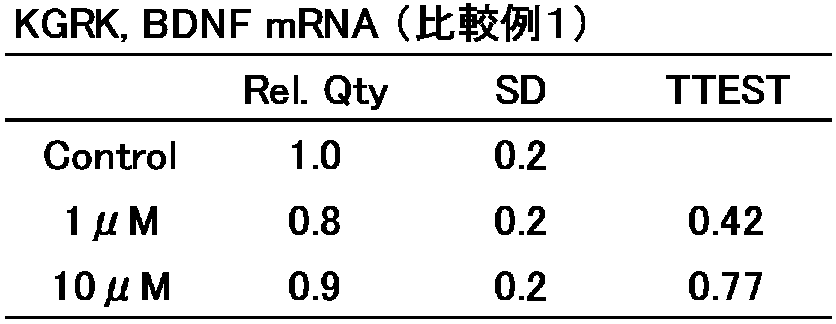
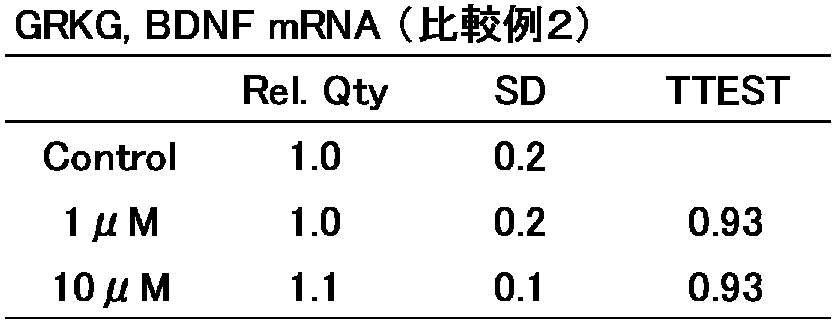
テトラペプチドとして、KGRK(Lys-Gly-Arg-Lys)(配列番号4:比較例1)、GRKG(Gly-Arg-Lys-Gly)(配列番号5:比較例2)について、実施例1と同様にBDNFのmRNA発現量を調べた。
表2に結果を示した。いずれのテトラペプチドもBDNFのmRNA発現量は有意に増加しなかった。
テトラペプチドとして、KGRK(Lys-Gly-Arg-Lys)(配列番号4:比較例1)、GRKG(Gly-Arg-Lys-Gly)(配列番号5:比較例2)について、実施例1と同様にBDNFのmRNA発現量を調べた。
表2に結果を示した。いずれのテトラペプチドもBDNFのmRNA発現量は有意に増加しなかった。
(表2)
(比較例3)ペンタペプチドの検討
ペンタペプチドとして、KGRKG(Lys-Gly-Arg-Lys-Gly)(配列番号6:比較例3)について、実施例1と同様にBDNFのmRNA発現量を調べた。
表3に結果を示した。ペンタペプチドはBDNFのmRNA発現量を有意に増加しなかった。
ペンタペプチドとして、KGRKG(Lys-Gly-Arg-Lys-Gly)(配列番号6:比較例3)について、実施例1と同様にBDNFのmRNA発現量を調べた。
表3に結果を示した。ペンタペプチドはBDNFのmRNA発現量を有意に増加しなかった。
(表3)

Claims (5)
- 構成アミノ酸としてリジン及び/またはアルギニンを有するジペプチドまたはトリペプチドを含有するオリゴペプチド混合物を有効成分とする、神経栄養因子の脳内分泌促進するための食品添加用組成物。
- オリゴペプチド混合物中の全アミノ酸量に対するリジン及び/またはアルギニンの量の割合が5重量%以上である、請求項1記載の神経栄養因子の脳内分泌促進するための食品添加用組成物。
- オリゴペプチド混合物中の分子量500未満のペプチド含量がペプチド及び遊離アミノ酸の合計量に対して50重量%以上である、請求項1または2記載の神経栄養因子の脳内分泌促進するための食品添加用組成物。
- 構成アミノ酸としてリジン及び/またはアルギニンを有するジペプチドまたはトリペプチドを含有するオリゴペプチド混合物を有効成分とする、神経栄養因子の脳内分泌促進剤。
- 神経栄養因子の脳内分泌促進のために用いられる食品を製造するために、構成アミノ酸としてリジン及び/またはアルギニンを有するジペプチドまたはトリペプチドを、食品に有効成分として添加して使用する方法。
Priority Applications (1)
| Application Number | Priority Date | Filing Date | Title |
|---|---|---|---|
| JP2018503084A JP6863362B2 (ja) | 2016-03-03 | 2017-02-23 | 神経栄養因子の脳内分泌促進するための食品添加用組成物 |
Applications Claiming Priority (2)
| Application Number | Priority Date | Filing Date | Title |
|---|---|---|---|
| JP2016-041191 | 2016-03-03 | ||
| JP2016041191 | 2016-03-03 |
Publications (1)
| Publication Number | Publication Date |
|---|---|
| WO2017150327A1 true WO2017150327A1 (ja) | 2017-09-08 |
Family
ID=59742835
Family Applications (1)
| Application Number | Title | Priority Date | Filing Date |
|---|---|---|---|
| PCT/JP2017/006800 Ceased WO2017150327A1 (ja) | 2016-03-03 | 2017-02-23 | 神経栄養因子の脳内分泌促進するための食品添加用組成物 |
Country Status (2)
| Country | Link |
|---|---|
| JP (1) | JP6863362B2 (ja) |
| WO (1) | WO2017150327A1 (ja) |
Cited By (1)
| Publication number | Priority date | Publication date | Assignee | Title |
|---|---|---|---|---|
| KR20240144277A (ko) | 2022-03-01 | 2024-10-02 | 야마사 쇼유 가부시키가이샤 | Bdnf 산생 촉진제 |
Citations (3)
| Publication number | Priority date | Publication date | Assignee | Title |
|---|---|---|---|---|
| JP2007137811A (ja) * | 2005-11-17 | 2007-06-07 | Lion Corp | 神経栄養因子−4(Neurotrophin−4)アンタゴニスト |
| US20120208747A1 (en) * | 2009-11-06 | 2012-08-16 | Sungyunkwan University Foundation For Corporate Collaboration | Novel peptide for augmenting and expression of bdnf and pharmaceutical composition for prevention and treatment of neurodegenerative diseases including alzheimer's disease or parkinson's disease, comprising the same |
| WO2015054006A2 (en) * | 2013-10-11 | 2015-04-16 | Tarix Pharmaceuticals Ltd. | Novel peptide compositions |
-
2017
- 2017-02-23 WO PCT/JP2017/006800 patent/WO2017150327A1/ja not_active Ceased
- 2017-02-23 JP JP2018503084A patent/JP6863362B2/ja active Active
Patent Citations (3)
| Publication number | Priority date | Publication date | Assignee | Title |
|---|---|---|---|---|
| JP2007137811A (ja) * | 2005-11-17 | 2007-06-07 | Lion Corp | 神経栄養因子−4(Neurotrophin−4)アンタゴニスト |
| US20120208747A1 (en) * | 2009-11-06 | 2012-08-16 | Sungyunkwan University Foundation For Corporate Collaboration | Novel peptide for augmenting and expression of bdnf and pharmaceutical composition for prevention and treatment of neurodegenerative diseases including alzheimer's disease or parkinson's disease, comprising the same |
| WO2015054006A2 (en) * | 2013-10-11 | 2015-04-16 | Tarix Pharmaceuticals Ltd. | Novel peptide compositions |
Non-Patent Citations (4)
| Title |
|---|
| "Daizu Yurai Enkisei 1-5 Peptide no BDNF Sansei Sokushin Koka", JAPANESE SOCIETY OF FOOD CHEMISTRY DAI 22 KAI SOKAI, 2 June 2016 (2016-06-02), pages 106 * |
| FLETCHER J. M. ET AL.: "Design of a Conformationally Defined and Proteolytically Stable Circular Mimetic of Brain-derived Neurotrophic Factor", THE JOURNAL OF BIOLOGICAL CHEMISTRY, vol. 283, no. 48, 2008, pages 33375 - 33383, XP055275272, DOI: doi:10.1074/jbc.M802789200 * |
| SEREDENIN S. B. ET AL.: "Antidepressant Effect of Dimeric Dipeptide GSB-106, an Original Low-Molecular-Weight Mimetic of BDNF", ACTA NATURAE, vol. 5, no. 4, 2013, pages 105 - 109, XP055601403 * |
| SHIN M.-K. ET AL.: "A novel brain-derived neurotrophic factor-modulating peptide attenuates A beta 1-42-induced neurotoxicity in vitro", NEUROSCIENCE LETTERS, vol. 595, 2015, pages 63 - 68, XP055601400 * |
Cited By (1)
| Publication number | Priority date | Publication date | Assignee | Title |
|---|---|---|---|---|
| KR20240144277A (ko) | 2022-03-01 | 2024-10-02 | 야마사 쇼유 가부시키가이샤 | Bdnf 산생 촉진제 |
Also Published As
| Publication number | Publication date |
|---|---|
| JP6863362B2 (ja) | 2021-04-21 |
| JPWO2017150327A1 (ja) | 2018-12-20 |
Similar Documents
| Publication | Publication Date | Title |
|---|---|---|
| Patil et al. | Food protein-derived bioactive peptides in management of type 2 diabetes | |
| AU2015277883B2 (en) | Composition for enhancing memorization learning function and/or cognitive function | |
| Jang et al. | Antimicrobial and human cancer cell cytotoxic effect of synthetic angiotensin-converting enzyme (ACE) inhibitory peptides | |
| KR101331777B1 (ko) | Dpp-iv를 억제하는 펩타이드가 풍부한 단백질가수분해물 및 이의 용도 | |
| KR101343904B1 (ko) | 우유 카제인의 효소 가수분해물에서 식별된 생물활성펩티드 및 그것을 얻는 방법 | |
| CN102665749B (zh) | 口服抗炎剂和口服抗炎肽 | |
| JP2013040111A (ja) | ジペプチジルペプチダーゼ−iv阻害剤及びその製造方法 | |
| WO2018021471A1 (ja) | 脳機能改善するための食品組成物 | |
| Wang et al. | Purification and identification of an ACE-inhibitory peptide from walnut protein hydrolysate | |
| JP6667194B2 (ja) | 脳神経疾患の予防又は脳機能改善用食品を製造するための食品添加物 | |
| Mustafa et al. | Bioactive peptides and their natural sources | |
| AU2016268710B2 (en) | Inflammation-suppressing composition including peptide | |
| AU2009254570B2 (en) | Anxiolytic composition containing alphas1-casein-derived peptides | |
| JP6863362B2 (ja) | 神経栄養因子の脳内分泌促進するための食品添加用組成物 | |
| Szerszunowicz et al. | The Use of UniProtKB/BIOPEP for the Analysis of Oat Globulin Physicochemical Parameters and Bioactivity. | |
| WO2007079977A2 (en) | Nutraceutical compositions comprising tripeptides | |
| JP7392474B2 (ja) | 脳機能を改善するための食品組成物 | |
| Yaji et al. | Red Tilapia By-Product (Oreochromis Sp.) Hydrolysates: Bioactivities, Bioprocessing, and Potential Applications | |
| Madar et al. | Physiological Activities of Bioactive Peptides Against Diabetes and Obesity | |
| Hashidu et al. | Isolation and purification of angiotensin converting enzyme inhibitory peptide from goat milk hydrolysate by ultrafiltration membrane | |
| US8673862B1 (en) | Peptides and use thereof in the inhibition of angiotensin converting enzyme | |
| CN101678071A (zh) | 肾衰竭预防剂 | |
| Abdulazeez et al. | Isolation and Characterization of a New Angiotensin-converting Enzyme Inhibitory Peptide from Heterobronchus bidorsalis | |
| Recio et al. | Bioactive peptides identified in enzymatic hydrolyzates of milk caseins and method of obtaining same. | |
| Ko et al. | Marine Natural Antihypertensive Peptides from Styela clava Having Multifunctions of ACE Inhibition and NO Production |
Legal Events
| Date | Code | Title | Description |
|---|---|---|---|
| ENP | Entry into the national phase |
Ref document number: 2018503084 Country of ref document: JP Kind code of ref document: A |
|
| NENP | Non-entry into the national phase |
Ref country code: DE |
|
| 121 | Ep: the epo has been informed by wipo that ep was designated in this application |
Ref document number: 17759793 Country of ref document: EP Kind code of ref document: A1 |
|
| 122 | Ep: pct application non-entry in european phase |
Ref document number: 17759793 Country of ref document: EP Kind code of ref document: A1 |