WO2017131034A1 - 経皮吸収製剤 - Google Patents
経皮吸収製剤 Download PDFInfo
- Publication number
- WO2017131034A1 WO2017131034A1 PCT/JP2017/002553 JP2017002553W WO2017131034A1 WO 2017131034 A1 WO2017131034 A1 WO 2017131034A1 JP 2017002553 W JP2017002553 W JP 2017002553W WO 2017131034 A1 WO2017131034 A1 WO 2017131034A1
- Authority
- WO
- WIPO (PCT)
- Prior art keywords
- drug reservoir
- drug
- mass
- layer
- reservoir layer
- Prior art date
- Legal status (The legal status is an assumption and is not a legal conclusion. Google has not performed a legal analysis and makes no representation as to the accuracy of the status listed.)
- Ceased
Links
Classifications
-
- A—HUMAN NECESSITIES
- A61—MEDICAL OR VETERINARY SCIENCE; HYGIENE
- A61K—PREPARATIONS FOR MEDICAL, DENTAL OR TOILETRY PURPOSES
- A61K9/00—Medicinal preparations characterised by special physical form
- A61K9/70—Web, sheet or filament bases ; Films; Fibres of the matrix type containing drug
-
- A—HUMAN NECESSITIES
- A61—MEDICAL OR VETERINARY SCIENCE; HYGIENE
- A61K—PREPARATIONS FOR MEDICAL, DENTAL OR TOILETRY PURPOSES
- A61K31/00—Medicinal preparations containing organic active ingredients
- A61K31/13—Amines
- A61K31/135—Amines having aromatic rings, e.g. ketamine, nortriptyline
- A61K31/138—Aryloxyalkylamines, e.g. propranolol, tamoxifen, phenoxybenzamine
-
- A—HUMAN NECESSITIES
- A61—MEDICAL OR VETERINARY SCIENCE; HYGIENE
- A61K—PREPARATIONS FOR MEDICAL, DENTAL OR TOILETRY PURPOSES
- A61K31/00—Medicinal preparations containing organic active ingredients
- A61K31/21—Esters, e.g. nitroglycerine, selenocyanates
- A61K31/215—Esters, e.g. nitroglycerine, selenocyanates of carboxylic acids
- A61K31/216—Esters, e.g. nitroglycerine, selenocyanates of carboxylic acids of acids having aromatic rings, e.g. benactizyne, clofibrate
-
- A—HUMAN NECESSITIES
- A61—MEDICAL OR VETERINARY SCIENCE; HYGIENE
- A61K—PREPARATIONS FOR MEDICAL, DENTAL OR TOILETRY PURPOSES
- A61K31/00—Medicinal preparations containing organic active ingredients
- A61K31/21—Esters, e.g. nitroglycerine, selenocyanates
- A61K31/27—Esters, e.g. nitroglycerine, selenocyanates of carbamic or thiocarbamic acids, meprobamate, carbachol, neostigmine
-
- A—HUMAN NECESSITIES
- A61—MEDICAL OR VETERINARY SCIENCE; HYGIENE
- A61K—PREPARATIONS FOR MEDICAL, DENTAL OR TOILETRY PURPOSES
- A61K47/00—Medicinal preparations characterised by the non-active ingredients used, e.g. carriers or inert additives; Targeting or modifying agents chemically bound to the active ingredient
- A61K47/30—Macromolecular organic or inorganic compounds, e.g. inorganic polyphosphates
- A61K47/32—Macromolecular compounds obtained by reactions only involving carbon-to-carbon unsaturated bonds, e.g. carbomers, poly(meth)acrylates, or polyvinyl pyrrolidone
-
- A—HUMAN NECESSITIES
- A61—MEDICAL OR VETERINARY SCIENCE; HYGIENE
- A61K—PREPARATIONS FOR MEDICAL, DENTAL OR TOILETRY PURPOSES
- A61K47/00—Medicinal preparations characterised by the non-active ingredients used, e.g. carriers or inert additives; Targeting or modifying agents chemically bound to the active ingredient
- A61K47/30—Macromolecular organic or inorganic compounds, e.g. inorganic polyphosphates
- A61K47/34—Macromolecular compounds obtained otherwise than by reactions only involving carbon-to-carbon unsaturated bonds, e.g. polyesters, polyamino acids, polysiloxanes, polyphosphazines, copolymers of polyalkylene glycol or poloxamers
-
- A—HUMAN NECESSITIES
- A61—MEDICAL OR VETERINARY SCIENCE; HYGIENE
- A61K—PREPARATIONS FOR MEDICAL, DENTAL OR TOILETRY PURPOSES
- A61K47/00—Medicinal preparations characterised by the non-active ingredients used, e.g. carriers or inert additives; Targeting or modifying agents chemically bound to the active ingredient
- A61K47/30—Macromolecular organic or inorganic compounds, e.g. inorganic polyphosphates
- A61K47/36—Polysaccharides; Derivatives thereof, e.g. gums, starch, alginate, dextrin, hyaluronic acid, chitosan, inulin, agar or pectin
- A61K47/38—Cellulose; Derivatives thereof
Definitions
- the present invention relates to a percutaneous absorption preparation containing a drug and a silicone adhesive.
- Patent Document 1 discloses the structure of a transdermally absorbable preparation comprising a drug reservoir layer, a drug permeation layer and a support. This transdermally absorbable preparation can absorb the drug percutaneously through the drug permeation layer without bringing the drug reservoir layer into direct contact with the skin.
- the percutaneous absorption preparation such as the structure described in Patent Document 1 has a structure in which the drug reservoir layer is not in direct contact with the skin, the drug released from the percutaneous absorption preparation when applied to the skin for a long period of time. May cause skin irritation.
- an object of the present invention is to provide a percutaneous absorption preparation in which drug-induced skin irritation caused by long-term application is reduced.
- the inventors have made the pressure-sensitive adhesive layer contain a silicone pressure-sensitive adhesive containing polyorganosiloxane in an amount of 20% by mass or more with respect to the total mass of the pressure-sensitive adhesive layer, so the, 20g / m 2 ⁇ 24hr or more, by a 314g / m 2 ⁇ 24hr within the range, it is possible to make the percutaneous absorption preparation having a suitable sustained release and skin permeation persistence of drug, As a result, the inventors have found that the above problems can be solved.
- the transdermally absorbable preparation has first and second main surfaces, and is provided on a drug reservoir layer containing a drug and on the first main surface side of the drug reservoir layer.
- a transdermal absorption preparation comprising a pressure-sensitive adhesive layer containing a silicone pressure-sensitive adhesive containing polyorganosiloxane, and a support formed so as to cover a side surface of the drug reservoir layer and the second main surface.
- the content of the silicone pressure-sensitive adhesive is 20% by mass or more with respect to the total mass of the pressure-sensitive adhesive layer, and the moisture permeability of the transdermal absorption preparation as a whole is 20 g / m 2 ⁇ 24 hr or more, 314 g / m 2.
- Provide a transdermally absorbable preparation that is 24 hr or less.
- the pressure-sensitive adhesive layer may further contain a pressure-sensitive adhesive base containing one or more compounds selected from the group consisting of a styrene-isoprene-styrene block copolymer (SIS), a tackifier resin, and a plasticizer. You may contain 80 mass% or less of the said adhesive base with respect to the total mass of an adhesive layer.
- the drug reservoir layer may contain ethyl cellulose. The content of ethyl cellulose in the drug reservoir layer may be 40 to 99% by mass with respect to the total mass of the drug reservoir layer.
- the drug reservoir layer may contain an acrylic base. The content of the acrylic base in the drug reservoir layer may be 40 to 99% by mass with respect to the total mass of the drug reservoir layer.
- the support may contain a polyethylene terephthalate (PET) knitted fabric or an ethylene vinyl acetate copolymer film.
- PET polyethylene terephthalate
- the transdermally absorbable preparation according to the present invention has appropriate sustained release of the drug and long-term skin permeation, and can reduce drug-derived skin irritation caused by long-term application.
- One embodiment of the present invention has first and second main surfaces, a drug reservoir layer containing a drug, and provided on the first main surface side of the drug reservoir layer, and includes polyorganosiloxane
- a percutaneously absorbable preparation comprising a pressure-sensitive adhesive layer containing a silicone pressure-sensitive adhesive, and a support formed to cover the side surface of the drug reservoir layer and the second main surface. content, the is 20 mass% or more relative to the total weight of the adhesive layer, the moisture permeability of the whole percutaneous absorption preparation is 20g / m 2 ⁇ 24hr or more, or less 314g / m 2 ⁇ 24hr, through It is a skin-absorbing preparation.
- the moisture permeability of the whole percutaneous absorption preparation is 20g / m 2 ⁇ 24hr or more, or less 314g / m 2 ⁇ 24hr.
- the lower limit of moisture permeability as the whole transdermally absorbable preparation is not particularly limited, and may be 25, 30, 35, 40, or 100 g / m 2 ⁇ 24 hr.
- the upper limit value of moisture permeability as the whole transdermally absorbable preparation is not particularly limited, and may be 150, 200, 250, or 300 g / m 2 ⁇ 24 hr.
- the drug reservoir layer is a layer containing a drug to be administered transdermally.
- the area of the drug reservoir layer can be arbitrarily set in consideration of the drug amount, the application time, etc., but is, for example, in the range of 3 to 150 cm 2 , preferably in the range of 10 to 100 cm 2 , and in the range of 10 to 50 cm 2 . A range is more preferred.
- the thickness of the drug reservoir layer is not particularly limited, but is preferably 25 to 1000 ⁇ m from the viewpoint that it can contain an amount of drug capable of exerting a sufficient therapeutic effect over the application period of the preparation, ease of production, strength of the preparation, etc. 50 to 500 ⁇ m is more preferable, and 75 to 250 ⁇ m is more preferable.
- the drug is not particularly limited as long as it is transdermally administrable, but the more easily the drug causes skin irritation, the more easily the skin irritation reducing effect of the present invention is exhibited.
- Examples of drugs that are relatively susceptible to skin irritation include oxybutynin, asenapine, bisoprolol, risperidone, nicotine, and citalopram.
- non-steroidal anti-inflammatory drugs such as indomethacin, ketoprofen, methyl salicylate, glycol salicylate, diclofenac sodium, flurbiprofen, felbinac, meloxicam and loxoprofen sodium, estradiol, norethisterone
- hormonal drugs such as estriol, antihistamines such as ketotifen, anti-Alzheimer drugs such as memantine, rivastigmine, donepezil, galantamine, sertraline, fluoxetine, paroxetine, antidepressants such as fluvoxamine, gastric ulcer drugs such as teprone, tolterodine, And overactive bladder drugs such as solifenacin, bronchodilators such as tulobuterol, Parkinson's disease drugs such as rotigotine, and metoprolol Antihypertensive drugs, and the like.
- the drug may be selected from the group consisting of, for example, oxybutynin, asenapine, bisoprolol, citalopram, diclofenac sodium, memantine, rivastigmine, donepezil, galantamine, fluoxetine, paroxetine, tolterodine, and rotigotine.
- the drug contained in the drug reservoir can be contained in the drug reservoir in a dissolved state, a saturated state, a supersaturated crystal state, or a dispersed state.
- the lower limit of the content of the drug contained in the drug reservoir layer is not particularly limited, and may be 1, 5, 10, 15, 20, 30, or 40% by mass with respect to the total mass of the drug reservoir layer. When it is at least the above lower limit, sufficient skin permeability of the drug is easily obtained.
- the upper limit of the content of the drug contained in the drug reservoir layer is not particularly limited, and may be 50, 60, 70, 80, or 85 mass% with respect to the total mass of the drug reservoir layer. When the amount is not more than the above upper limit value, sufficient strength for maintaining the shape of the drug reservoir layer is easily secured.
- the content of the drug contained in the drug reservoir layer may be, for example, 1 to 90% by mass and 15 to 85% by mass with respect to the total mass of the drug reservoir layer.
- the drug reservoir layer may contain ethyl cellulose. Since the drug reservoir contains ethyl cellulose, the drug reservoir maintains cohesiveness even when exposed to perspiration at the skin application site, environmental moisture, etc., and can reduce skin irritation due to swelling and destruction. .
- the lower limit of the content of ethylcellulose contained in the drug reservoir layer is not particularly limited, and may be 20, 25, 30, 35, 40, or 50 mass% with respect to the total mass of the drug reservoir layer. It is easy to maintain the cohesiveness of a drug reservoir layer as it is above the lower limit.
- the upper limit value of the content of ethyl cellulose contained in the drug reservoir layer is not particularly limited, and may be 70, 80, 90, 95, or 99 mass% with respect to the total mass of the drug reservoir layer.
- the content of ethyl cellulose contained in the drug reservoir layer may be, for example, 40 to 99% by mass with respect to the total mass of the drug reservoir layer.
- the drug reservoir may contain an acrylic base. Because the drug reservoir contains an acrylic base, the drug reservoir maintains cohesiveness and reduces skin irritation due to swelling and destruction even when exposed to sweat at the skin application site and moisture in the environment. Can do.
- the lower limit value of the content of the acrylic base contained in the drug reservoir layer is not particularly limited, and may be 20, 25, 30, 35, 40, or 50 mass% with respect to the total mass of the drug reservoir layer. It is easy to maintain the cohesiveness of a drug reservoir layer as it is above the lower limit.
- the upper limit of the content of the acrylic base contained in the drug reservoir layer is not particularly limited, and may be 70, 80, 90, 95, or 99 mass% with respect to the total mass of the drug reservoir layer.
- the content of the acrylic base contained in the drug reservoir layer may be, for example, 40 to 99% by mass with respect to the total mass of the drug reservoir layer.
- (meth) acrylic acid alkyl ester having an alkyl group having 4 to 18 carbon atoms, or the above (meth) acrylic acid alkyl ester and other A copolymer with a functional monomer is preferably used.
- (meth) acryl means acryl or methacryl.
- an acrylate copolymer is preferable.
- the acrylate copolymer may be selected from the group consisting of an acrylate copolymer having no functional group, an acrylate copolymer having a hydroxy group, an acrylate copolymer having a carboxy group, and combinations thereof.
- Examples of the acrylate copolymer having no functional group include Duro-tak (registered trademark, Henkel Corporation) 87-9900, Duro-tak (registered trademark) 87-9301, GELVA (registered trademark) GMS 3083, and the like. It is done.
- Examples of the acrylate copolymer having a hydroxy group include hydroxyalkyl acrylates such as 2-hydroxyethyl acrylate. The hydroxyalkyl acrylate may be further substituted with a halogen atom, an alkyl group, an alkenyl group, an alkynyl group or the like.
- Examples of the acrylate copolymer having a hydroxy group include Duro-tak (registered trademark) 87-2516, GELVA (registered trademark) GMS 788, GELVA (registered trademark) GMS 737, and the like.
- Examples of the acrylate copolymer having a carboxy group include acrylic acid-containing acrylate copolymers.
- the monomer component copolymerized with acrylic acid is not particularly limited as long as it can be copolymerized with acrylic acid. Examples thereof include acrylic acid esters such as methyl acrylate and 2-ethylhexyl acrylate; Examples include acrylic acid amides such as acid morpholine amide; vinyl acetate; vinyl alcohol; styrene.
- the monomer component copolymerized with acrylic acid may be one kind alone, or two or more kinds.
- Examples of the acrylate copolymer having a carboxy group include Duro-tak (registered trademark) 87-2194, Duro-tak (registered trademark) 87-2852, GELVA (registered trademark) GMS 753, and the like.
- the drug reservoir layer may contain components other than the drug and ethyl cellulose as long as the coagulability of the drug reservoir layer can be maintained.
- other components include, but are not limited to, drug stabilizers, plasticizers, solubilizers, transdermal absorption enhancers, and fats and oils.
- the stabilizer is not particularly limited as long as it is a compound that has been confirmed to have a stabilizing action in a transdermal absorption preparation, and examples thereof include tocopherols, ascorbic acids, dibutylhydroxytoluene, sodium hydrogen sulfite, and ethylenediaminetetraacetate. It is done.
- the plasticizer is not particularly limited as long as it is a compound in which a plasticizing action is recognized in the transdermal preparation, and examples thereof include liquid paraffin, liquid polybutene, liquid polyisoprene, and esterified oils.
- the solubilizing agent is not particularly limited as long as it is a compound having a dissolving action on a drug
- the percutaneous absorption enhancer is not particularly limited as long as it is a compound having an absorption promoting action in a transdermal absorption preparation.
- the solubilizer and absorption promoter include fatty acids having 6 to 20 carbon chains, aliphatic alcohols, fatty acid esters, fatty acid amides, fatty acid ethers, aromatic organic acids, aromatic alcohols, and aromatic organic acids.
- Esters aromatic organic acid ethers (which may be saturated or unsaturated, and may be cyclic, linear or branched), lactic acid esters, acetic acid esters, monoterpene compounds, sesquiterpenes Compounds, Azone, Azone derivatives, Pyrothiodecane, Glycerin fatty acid esters, Propylene glycol fatty acid esters, Sorbitan fatty acid esters (Span), Polysorbate (Tween), Polyethylene glycol fatty acid esters, Polyoxyethylene cured Castor oil (HCO), polyoxy Chi alkylene alkyl ethers, sucrose fatty acid esters and vegetable oil, and the like.
- lauryl alcohol myristyl alcohol, oleyl alcohol, isostearyl alcohol, diethyl sebacate, glycerol monocaprate, glycerol monolaurate, glycerol monooleate, sorbitan monolaurate, propylene glycol monolaurate, polyoxyethylene
- lauryl ether pyrothiodecane, and isopropyl myristate.
- the pressure-sensitive adhesive layer is a layer that is provided on the first main surface side of the drug reservoir layer that is in contact with the skin, and serves to prevent the drug reservoir layer from directly contacting the skin.
- the area of the pressure-sensitive adhesive layer is not particularly limited as long as it is equal to or larger than the area of the drug reservoir layer, but is preferably wider than the drug reservoir layer in order to securely fix the support covering the drug reservoir layer.
- the thickness of an adhesive layer is not specifically limited, It can set arbitrarily.
- the pressure-sensitive adhesive layer contains a silicone pressure-sensitive adhesive containing polyorganosiloxane.
- the pressure-sensitive adhesive layer contains a silicone pressure-sensitive adhesive containing polyorganosiloxane, the moisture permeability of the transdermally absorbable preparation is increased.
- the polyorganosiloxane commercially available products such as BIO-PSA 7-4202 and BIO-PSA 7-4302 manufactured by Dow Corning can be used.
- the lower limit value of the polyorganosiloxane content in the silicone pressure-sensitive adhesive is not particularly limited, and may be 40, 50, 60, 70, 80, or 90% by mass.
- the upper limit of the content of polyorganosiloxane in the silicone pressure-sensitive adhesive is not particularly limited, and may be 80, 90, 95 or 100% by mass.
- Content of a silicone adhesive is 20 mass% or more with respect to the total mass of an adhesive layer.
- the lower limit of the content of the silicone pressure-sensitive adhesive may be 30, 35, or 40% by mass with respect to the total mass of the pressure-sensitive adhesive layer.
- the upper limit of content of a silicone adhesive is not specifically limited, It may be 60, 70, 80, 90 or 100 mass% with respect to the total mass of an adhesive layer.
- the pressure-sensitive adhesive layer may further contain a pressure-sensitive adhesive base containing one or more compounds selected from the group consisting of a styrene-isoprene-styrene block copolymer, a tackifying resin, and a plasticizer in addition to the silicone pressure-sensitive adhesive. More preferably, it further contains an adhesive base containing two or more compounds selected from the group consisting of a styrene-isoprene-styrene block copolymer, a tackifier resin and a plasticizer, and a styrene-isoprene-styrene block. It is further preferable to further contain an adhesive base containing a copolymer, a tackifying resin and a plasticizer. By further containing the above adhesive base, the permeation persistence of the transdermally absorbable preparation can be enhanced.
- the lower limit of the content of the styrene-isoprene-styrene block copolymer in the adhesive base is not particularly limited, and may be 1, 5, 10 or 20% by mass with respect to the total mass of the adhesive base.
- the upper limit of the content of the styrene-isoprene-styrene block copolymer in the adhesive base is not particularly limited, and is 60, 70, 80, 90, or 95% by mass with respect to the total mass of the adhesive base. It's okay.
- the tackifying resin is not particularly limited as long as it is a compound having an effect of improving the adhesive strength.
- alicyclic saturated hydrocarbon resin for example, Alcon P-100 of Arakawa Chemical Industries
- rosin derivative for example, rosin
- Rosin glycerin ester for example, hydrogenated rosin and hydrogenated rosin glycerin ester
- terpene resin for example, Clearon P-125 of Yashara Chemical
- aliphatic hydrocarbon resin for example, Quinton B170 of Nippon Zeon
- maleic resin etc.
- the lower limit value of the content of the tackifying resin in the adhesive base is not particularly limited, and may be 5, 10, 20, 30, or 40% by mass with respect to the total mass of the adhesive base.
- the upper limit of content of the tackifying resin in the said adhesive base is not specifically limited, It may be 60, 70, 80, 90, or 95 mass% with respect to the total mass of an adhesive base.
- the plasticizer is as described above.
- the lower limit of content of the plasticizer in the said adhesive base is not specifically limited, It may be 1, 5, 10 or 20 mass% with respect to the total mass of the said adhesive base.
- the upper limit of content of the plasticizer in the said adhesive base is not specifically limited, It may be 60, 70, 80, 90, or 95 mass% with respect to the total mass of an adhesive base.
- the lower limit of content of the said adhesive base is not specifically limited, It may be 5, 10, 20, 30 or 40 mass% with respect to the total mass of an adhesive layer.
- the upper limit of content of the said adhesive base is not specifically limited, It may be 60, 70, 80, 90, or 95 mass% with respect to the total mass of an adhesive layer.
- the ratio of the content of the silicone pressure-sensitive adhesive and the pressure-sensitive adhesive base in the pressure-sensitive adhesive layer may be 1: 4 to 7: 3, or 3: 7 to 7: 3. . When the ratio is in the above range, the skin permeation persistence tends to be enhanced while maintaining good moisture permeability of the transdermally absorbable preparation.
- the pressure-sensitive adhesive layer may further contain a (meth) acrylic acid ester copolymer.
- the (meth) acrylic acid ester copolymer include C4-C20 alkyl ester of (meth) acrylic acid and (meth) acrylic acid hydroxy C4-C20 alkyl ester as main monomers.
- Copolymerized monomers of (meth) acrylic acid ester copolymers include C4 to C20 alkyl esters of (meth) acrylic acid, (meth) acrylic acid hydroxy C4 to C20 alkyl esters, (meth) acrylic acid, vinyl acetate and vinyl. Examples include pyrrolidone and the like.
- the pressure-sensitive adhesive layer may contain components other than the pressure-sensitive adhesive and the pressure-sensitive adhesive base.
- the other components are not particularly limited as long as they are generally used for transdermally absorbable preparations, and examples thereof include stabilizers.
- the support is a layer that holds the drug reservoir layer.
- the area of a support body is not specifically limited, It can set arbitrarily.
- the thickness of the support is not particularly limited, but is, for example, 1 to 3000 ⁇ m, preferably 1 to 1000 ⁇ m, more preferably 50 to 500 ⁇ m, and further preferably 100 to 250 ⁇ m.
- the support is made of a sheet having a property that does not swell due to migration of a drug or the like in the drug reservoir layer.
- the material for the support include polyester (such as PET), polyolefin (such as polyethylene and polypropylene), and polyurethane.
- the properties of the support include films, nonwoven fabrics, woven fabrics, knitted fabrics, and porous sheets.
- Examples of the water repellent treatment include silicone water repellent, fluororesin water repellent, paraffin wax water repellent, zirconium compound water repellent, ethylene urea water repellent, methylolamide water repellent and aliphatic. Treatment with a water repellent or the like can be mentioned.
- a laminate film of PET film and PET nonwoven fabric hereinafter referred to as PET / nonwoven fabric laminate film
- PET / nonwoven fabric laminate film a laminate film of PET film and PET nonwoven fabric
- a polyurethane film a polyurethane film
- an ethylene vinyl acetate copolymer film are preferable
- a water-repellent treated PET knitted fabric Is more preferable.
- the support may be selected, for example, from the group consisting of a water-repellent treated PET knitted fabric, an ethylene vinyl acetate copolymer film, a PET / nonwoven fabric laminate film, a polyurethane nonwoven fabric, a polyurethane film, and a PET film. Further, from the viewpoint of increasing the moisture permeability of the transdermally absorbable preparation, the support is selected from the group consisting of a water-repellent treated PET knitted fabric, an ethylene vinyl acetate copolymer film, a polyurethane nonwoven fabric, and a polyurethane film. It is preferable.
- the support is more preferably a PET knitted fabric or an ethylene vinyl acetate copolymer film subjected to a water repellent treatment.
- the back-through of the drug refers to a phenomenon in which the drug escapes from the support side due to moisture brought from the external environment.
- the transdermally absorbable preparation of the present invention may be further covered with a cover material, or the cover material may be further laminated.
- the cover material is composed of a support and an adhesive layer laminated on one side.
- Cover materials include those that cover the transdermally absorbable preparation of the present invention and are fixed to the skin, and those that are further laminated on the transdermally absorbable preparation.
- the cover material can be used, for example, to maintain the state of the percutaneously absorbable preparation during the administration period of the drug and to protect the percutaneously absorbable preparation from moisture (such as a shower) brought from the external environment.
- the support of the cover material is preferably provided with appropriate strength, moisture permeability, water resistance, and the like, and is preferably selected from polyester (PET, etc.), polyolefin (polyethylene, polypropylene, etc.) and polyurethane.
- Examples of the properties of the support of the cover material include films (preferably urethane films), non-woven fabrics, woven fabrics, knitted fabrics, porous sheets, and the like, but sweat generated when a percutaneous absorption preparation is applied to the skin. From the point of promoting the volatilization of moisture such as, it is preferably a cloth shape, more preferably a knitted fabric.
- the support When the support is in the form of a cloth, it may be subjected to water repellent treatment in order to improve its waterproofness.
- Examples of the water repellent treatment include silicone water repellent, fluororesin water repellent, paraffin wax water repellent, zirconium compound water repellent, ethylene urea water repellent, methylolamide water repellent and aliphatic. Treatment with a water repellent or the like can be mentioned.
- the adhesive layer of the cover material covers the percutaneously absorbable preparation and is fixed to the skin, it has an adhesive property for fixing the percutaneously absorbable preparation to the skin and is further laminated on the percutaneously absorbable preparation. In this case, it has adhesiveness for adhering to the transdermally absorbable preparation. It is preferable that the cover material has further excellent moisture permeability.
- Examples of the adhesive base contained in the adhesive layer of the cover material include an acrylic adhesive, a silicone adhesive, and a rubber adhesive.
- an acrylic adhesive what contains a (meth) acrylic acid ester copolymer is mentioned, for example.
- Examples of the (meth) acrylic acid ester copolymer include C4-C20 alkyl ester of (meth) acrylic acid and (meth) acrylic acid hydroxy C4-C20 alkyl ester as main monomers.
- Copolymerized monomers of (meth) acrylic acid ester copolymers include C4 to C20 alkyl esters of (meth) acrylic acid, (meth) acrylic acid hydroxy C4 to C20 alkyl esters, (meth) acrylic acid, vinyl acetate and vinyl. Examples include pyrrolidone and the like.
- silicone pressure-sensitive adhesive examples include polydimethylsiloxane.
- rubber adhesive examples include polyisobutylene (PIB), polyisoprene, and styrene-isoprene-styrene block copolymer (SIS).
- the pressure-sensitive adhesive layer of the cover material may contain components other than the pressure-sensitive adhesive.
- the other components are not particularly limited as long as they are generally used for transdermally absorbable preparations, and examples thereof include tackifier resins, plasticizers, and stabilizers.
- the cover material is provided separately from the percutaneous absorption preparation, may be used in combination with the application of the percutaneous absorption preparation, or may be provided in a form bonded in advance to the percutaneous absorption preparation.
- the pressure-sensitive adhesive layer of the transdermally absorbable preparation of the present invention or the pressure-sensitive adhesive layer of the cover material may be covered with a layer for protecting the pressure-sensitive adhesive layer until application to the skin, for example, a layer comprising a release liner. .
- Release liners include, for example, films such as polyester (such as PET), polyvinyl chloride, polyvinylidene chloride, nylon and polyolefin (such as polyethylene and polypropylene), paper such as fine paper and glassine paper, fine paper or glassine paper, and polyolefin Laminating film or the like.
- the release liner can be subjected to a wrinkle release treatment by applying a silicone resin, a fluororesin or the like to the surface in contact with the pressure-sensitive adhesive layer.
- the release liner may be formed from a plurality of pieces.
- the release liner has a size that can cover at least the entire pressure-sensitive adhesive layer of the transdermal absorption preparation or the pressure-sensitive adhesive layer of the cover material, and may extend outward from each pressure-sensitive adhesive layer.
- Examples of the basic production method of the transdermally absorbable preparation of the present invention include the following methods.
- a drug reservoir is obtained by cutting.
- the drug reservoir layer is heated and softened and bonded to the support.
- a drug reservoir layer is laminated on the pressure-sensitive adhesive layer, and cut into an appropriate shape to obtain a transdermally absorbable preparation.
- the sheet serving as the cover material can be obtained by forming a pressure-sensitive adhesive layer on a release liner by a conventional method, laminating a support on the pressure-sensitive adhesive layer, and cutting it into an appropriate shape.
- the release liner When covering the percutaneously absorbable preparation with a cover material, the release liner is peeled off from the cover material sheet, and the support layer of the percutaneously absorbable preparation is joined to the adhesive surface of the adhesive layer of the exposed cover material sheet, Cut into an appropriate shape if necessary. Furthermore, when the adhesive layer of the transdermal absorption preparation is coated with a release liner, the release liner attached to the transdermal absorption preparation is peeled and removed as necessary, and the adhesive surface of the cover material sheet is instead removed with the release liner. After covering the side to form a sheet, it is cut into an appropriate shape.
- the coating liquid was applied onto the release liner, and the solvent was removed by drying to obtain a pressure-sensitive adhesive layer having a thickness of 75 g / m 2 .
- the drug reservoir layer is bonded on the adhesive layer, the release liner of the drug reservoir layer is peeled and removed, and a support (water-repellent PET knitted fabric) is laminated on the exposed surface, with the drug reservoir layer approximately in the center. It was cut in (38cm 2), whereby a transdermal absorption preparation was obtained.
- Moisture permeability test method The moisture permeability of the transdermally absorbable preparation is determined according to the moisture permeability test method (cup method) of the moisture-proof packaging material defined in JIS Z 0208: 1976. Relative humidity: Moisture permeation rate (MVTR) g / m 2 ⁇ 24 hr at 90 ⁇ 2% was measured.
- MVTR Moisture permeation rate
- moisture permeability of 40g / m 2 ⁇ 24hr or more moisture permeability is high, irritation of the skin is almost no
- moisture permeability of 20g / m 2 ⁇ 24hr or more ⁇ 40g / m 2 ⁇ 24hr Less than moisture permeability is slightly high and skin irritation hardly occurs
- the amount of drug permeated at each time was calculated from the measured concentration value, and the skin permeation rate ( ⁇ g / cm 2 / hr) of the drug at each time was determined. Further, as an index representing the permeation persistence of the drug, the skin permeation speed J last after 168 hours was divided by the maximum skin speed J max to calculate a J last / J max value. A large J last / J max value means that the drug permeation persistence is high.
- J last / J max value is 0.60 or more ⁇ : J last / J max value is 0.30 or more and less than 0.60 ⁇ : J last / J max value is 0 Less than 30
- the drug reservoir was obtained by weighing 40 mass% bisoprolol and 60 mass% ethyl cellulose and using the same method as described in Test 1.
- the pressure-sensitive adhesive layer was obtained by weighing out 100% by mass of a silicone-based pressure-sensitive adhesive containing polyorganosiloxane and by the same method as described in Test 1.
- the drug reservoir layer is bonded onto the adhesive layer, the release liner of the drug reservoir layer is peeled and removed, and the support of Table 3 is laminated on the exposed surface (Comparative Example 2 has no support laminate).
- Moisture permeability test method The moisture permeability of the transdermally absorbable preparation is determined according to the moisture permeability test method (cup method) of the moisture-proof packaging material defined in JIS Z 0208: 1976. Relative humidity: Moisture permeation rate (MVTR) g / m 2 ⁇ 24 hr at 90 ⁇ 2% was measured.
- MVTR Moisture permeation rate
- a percutaneous absorption preparation using a PET knitted fabric (water repellent treatment), an ethylene vinyl acetate copolymer film, and a PET film as a support was found to have a high tendency to prevent the drug from falling through.
- the drug reservoir layer is bonded onto the adhesive layer, the release liner of the drug reservoir layer is peeled and removed, a support (PET / nonwoven fabric laminate film) is laminated on the exposed surface, and the drug reservoir layer is approximately square ( 13.4 cm 2 ) to obtain a transdermal absorption preparation.
Landscapes
- Health & Medical Sciences (AREA)
- Chemical & Material Sciences (AREA)
- Life Sciences & Earth Sciences (AREA)
- General Health & Medical Sciences (AREA)
- Veterinary Medicine (AREA)
- Epidemiology (AREA)
- Medicinal Chemistry (AREA)
- Animal Behavior & Ethology (AREA)
- Pharmacology & Pharmacy (AREA)
- Public Health (AREA)
- Inorganic Chemistry (AREA)
- Emergency Medicine (AREA)
- Proteomics, Peptides & Aminoacids (AREA)
- Engineering & Computer Science (AREA)
- Bioinformatics & Cheminformatics (AREA)
- Medicinal Preparation (AREA)
- Acyclic And Carbocyclic Compounds In Medicinal Compositions (AREA)
Abstract
第1及び第2の主面を有し、薬物を含有する薬物貯留層と、上記薬物貯留層の上記第1の主面側に設けられ、ポリオルガノシロキサンを含むシリコーン粘着剤を含有する粘着剤層と、上記薬物貯留層の側面及び上記第2の主面を覆うように形成される支持体と、を備える経皮吸収製剤であって、上記シリコーン粘着剤の含有量が、前記粘着剤層の全質量に対して20質量%以上であり、経皮吸収製剤全体としての透湿度が20g/m2・24hr以上、314g/m2・24hr以下である、経皮吸収製剤を開示する。
Description
本発明は、薬物及びシリコーン粘着剤を含有する経皮吸収製剤に関するものである。
近年、短期間にわたって薬物を投与するための経皮吸収製剤だけでなく、薬物を長期間効率的且つ安定的に生体に投与可能な経皮吸収製剤に対する需要が高まっており、その研究開発が進められてきた。
例えば、特許文献1には、薬物貯留層、薬物浸透層及び支持体からなる経皮吸収製剤の構造が開示されている。この経皮吸収製剤は、薬物貯留層を直接皮膚に接触させることなく薬物浸透層を介して徐放的に薬物を経皮吸収させることができる。
しかしながら、特許文献1に記載の構造のような経皮吸収製剤は、薬物貯留層を直接皮膚に接触させない構造ではあるものの、長期間皮膚に適用することにより、経皮吸収製剤から放出される薬物により皮膚刺激が生じてしまう場合があった。
そこで本発明は、長期間の適用による薬物由来の皮膚刺激が低減された経皮吸収製剤を提供することを目的とする。
本発明者らは、鋭意検討の結果、粘着剤層に、ポリオルガノシロキサンを含むシリコーン粘着剤を粘着剤層の全質量に対して20質量%以上含有させ、経皮吸収製剤全体としての透湿度を、20g/m2・24hr以上、314g/m2・24hr以下の範囲内とすることで、薬物の適切な徐放性及び皮膚透過持続性を有する経皮吸収製剤とすることが可能となり、それにより上記課題が解決することを見出した。
すなわち、本発明の一形態である経皮吸収製剤は、第1及び第2の主面を有し、薬物を含有する薬物貯留層と、上記薬物貯留層の上記第1の主面側に設けられ、ポリオルガノシロキサンを含むシリコーン粘着剤を含有する粘着剤層と、上記薬物貯留層の側面及び上記第2の主面を覆うように形成される支持体と、を備える経皮吸収製剤であって、上記シリコーン粘着剤の含有量が、前記粘着剤層の全質量に対して20質量%以上であり、経皮吸収製剤全体としての透湿度が20g/m2・24hr以上、314g/m2・24hr以下である、経皮吸収製剤を提供する。
上記粘着剤層は、スチレン-イソプレン-スチレンブロック共重合体(SIS)、粘着付与樹脂及び可塑剤からなる群から選択される1以上の化合物を含有する粘着基剤をさらに含有してもよい。上記粘着基剤を、粘着剤層の全質量に対して80質量%以下含有してもよい。上記薬物貯留層は、エチルセルロースを含有してもよい。上記薬物貯留層中のエチルセルロースの含有量は、薬物貯留層の全質量に対して40~99質量%であってよい。上記薬物貯留層は、アクリル基剤を含有してもよい。上記薬物貯留層中のアクリル基剤の含有量は、薬物貯留層の全質量に対して40~99質量%であってよい。前記支持体は、ポリエチレンテレフタレート(PET)編布又はエチレン酢酸ビニル共重合体フィルムを含有してもよい。
本発明に係る経皮吸収製剤は、薬物の適切な徐放性及び皮膚透過持続性を有し、長期間の適用による薬物由来の皮膚刺激を低減することができる。
本発明の一実施形態は、第1及び第2の主面を有し、薬物を含有する薬物貯留層と、上記薬物貯留層の上記第1の主面側に設けられ、ポリオルガノシロキサンを含むシリコーン粘着剤を含有する粘着剤層と、上記薬物貯留層の側面及び上記第2の主面を覆うように形成される支持体と、を備える経皮吸収製剤であって、上記シリコーン粘着剤の含有量が、前記粘着剤層の全質量に対して20質量%以上であり、経皮吸収製剤全体としての透湿度が20g/m2・24hr以上、314g/m2・24hr以下である、経皮吸収製剤である。
本発明の一実施形態における経皮吸収製剤は、経皮吸収製剤全体としての透湿度が20g/m2・24hr以上、314g/m2・24hr以下である。経皮吸収製剤全体としての透湿度の下限値は、特に限定されず、25、30、35、40又は100g/m2・24hrであってよい。経皮吸収製剤全体としての透湿度の上限値は、特に限定されず、150、200、250又は300g/m2・24hrであってよい。
薬物貯留層は、経皮投与される薬物を含有する層である。
薬物貯留層の面積は、薬物量及び貼付時間等を考慮して任意に設定することができるが、例えば3~150cm2の範囲であり、10~100cm2の範囲が好ましく、10~50cm2の範囲がより好ましい。また、薬物貯留層の厚みは、特に限定されないが、製剤の貼付期間にわたり、十分な治療効果を発揮できる量の薬物を含有できること、製造の容易さ及び製剤の強度等から25~1000μmが好ましく、50~500μmがより好ましく、75~250μmがさらに好ましい。
薬物貯留層の面積は、薬物量及び貼付時間等を考慮して任意に設定することができるが、例えば3~150cm2の範囲であり、10~100cm2の範囲が好ましく、10~50cm2の範囲がより好ましい。また、薬物貯留層の厚みは、特に限定されないが、製剤の貼付期間にわたり、十分な治療効果を発揮できる量の薬物を含有できること、製造の容易さ及び製剤の強度等から25~1000μmが好ましく、50~500μmがより好ましく、75~250μmがさらに好ましい。
薬物は、経皮投与可能なものであれば特に限定されないが、比較的皮膚刺激を生じやすい薬物である程、本発明の皮膚刺激低減効果が発揮されやすい。比較的皮膚刺激を生じやすい薬物としては、例えば、オキシブチニン、アセナピン、ビソプロロール、リスペリドン、ニコチン及びシタロプラム等が挙げられる。他にも、比較的皮膚刺激を生じやすい薬物として、インドメタシン、ケトプロフェン、サリチル酸メチル、サリチル酸グリコール、ジクロフェナクナトリウム、フルルビプロフェン、フェルビナク、メロキシカム及びロキソプロフェンナトリウム等の非ステロイド性消炎鎮痛薬、エストラジオール、ノルエチステロン及びエストリオール等のホルモン薬、ケトチフェン等の抗ヒスタミン薬、メマンチン、リバスチグミン、ドネペジル、ガランタミン等の抗アルツハイマー薬、セルトラリン、フルオキセチン、パロキセチン、フルボキサミン等の抗うつ薬、テプレノン等の胃潰瘍治療薬、トルテロジン、及びソリフェナシン等の過活動膀胱治療薬、ツロブテロール等の気管支拡張薬、ロチゴチン等のパーキンソン病治療薬並びにメトプロロール等の降圧薬、等が挙げられる。薬物は、例えば、オキシブチニン、アセナピン、ビソプロロール、シタロプラム、ジクロフェナクナトリウム、メマンチン、リバスチグミン、ドネペジル、ガランタミン、フルオキセチン、パロキセチン、トルテロジン、及びロチゴチンからなる群から選択されてもよい。
薬物貯留層に含まれる薬物は、薬物貯留層中に、溶解状態、飽和状態、過飽和結晶状態又は分散状態で含有させることができる。
薬物貯留層に含まれる薬物の含有量の下限値は、特に限定されず、薬物貯留層の全質量に対して1、5、10、15、20、30又は40質量%であってよい。上記下限値以上であると、薬物の十分な皮膚透過性が得られやすい。薬物貯留層に含まれる薬物の含有量の上限値は、特に限定されず、薬物貯留層の全質量に対して50、60、70、80又は85質量%であってよい。上記上限値以下であると、薬物貯留層の形状を維持するための十分な強度が確保されやすい。薬物貯留層に含まれる薬物の含有量は、例えば、薬物貯留層の全質量に対して1~90質量%であってよく、15~85質量%であってよい。
薬物貯留層に含まれる薬物の含有量の下限値は、特に限定されず、薬物貯留層の全質量に対して1、5、10、15、20、30又は40質量%であってよい。上記下限値以上であると、薬物の十分な皮膚透過性が得られやすい。薬物貯留層に含まれる薬物の含有量の上限値は、特に限定されず、薬物貯留層の全質量に対して50、60、70、80又は85質量%であってよい。上記上限値以下であると、薬物貯留層の形状を維持するための十分な強度が確保されやすい。薬物貯留層に含まれる薬物の含有量は、例えば、薬物貯留層の全質量に対して1~90質量%であってよく、15~85質量%であってよい。
薬物貯留層はエチルセルロースを含有してもよい。薬物貯留層がエチルセルロースを含有することによって、皮膚適用部位での発汗及び環境中の水分等に曝されても、薬物貯留層が凝集性を維持し、膨張破壊による皮膚刺激を低減することができる。薬物貯留層に含まれるエチルセルロースの含有量の下限値は、特に限定されず、薬物貯留層の全質量に対して20、25、30、35、40又は50質量%であってよい。上記下限値以上であると、薬物貯留層の凝集性を維持しやすい。薬物貯留層に含まれるエチルセルロースの含有量の上限値は、特に限定されず、薬物貯留層の全質量に対して70、80、90、95又は99質量%であってよい。薬物貯留層に含まれるエチルセルロースの含有量は、例えば、薬物貯留層の全質量に対して、40~99質量%であってよい。
薬物貯留層はアクリル基剤を含有してもよい。薬物貯留層がアクリル基剤を含有することによって、皮膚適用部位での発汗及び環境中の水分等に曝されても、薬物貯留層が凝集性を維持し、膨張破壊による皮膚刺激を低減することができる。薬物貯留層に含まれるアクリル基剤の含有量の下限値は、特に限定されず、薬物貯留層の全質量に対して20、25、30、35、40又は50質量%であってよい。上記下限値以上であると、薬物貯留層の凝集性を維持しやすい。薬物貯留層に含まれるアクリル基剤の含有量の上限値は、特に限定されず、薬物貯留層の全質量に対して70、80、90、95又は99質量%であってよい。薬物貯留層に含まれるアクリル基剤の含有量は、例えば、薬物貯留層の全質量に対して、40~99質量%であってよい。
薬物貯留層に含まれるアクリル基剤としては、アルキル基の炭素数が4~18の(メタ)アクリル酸アルキルエステルの単独重合体又は共重合体、あるいは上記(メタ)アクリル酸アルキルエステルとその他の官能性モノマ-との共重合体が好適に用いられる。なお、(メタ)アクリルとは、アクリル又はメタクリルを意味する。
薬物貯留層に含まれるアクリル基剤としては、アクリレート共重合体が好ましい。アクリレート共重合体は、官能基を有さないアクリレート共重合体、ヒドロキシ基を有するアクリレート共重合体及びカルボキシ基を有するアクリレート共重合体並びにこれらの組み合わせからなる群から選択されてもよい。
官能基を有さないアクリレート共重合体としては、例えば、Duro-tak(登録商標、ヘンケルコーポレーション)87-9900、Duro-tak(登録商標)87-9301及びGELVA(登録商標)GMS 3083等が挙げられる。
ヒドロキシ基を有するアクリレート共重合体としては、例えば、アクリル酸2-ヒドロキシエチル等のヒドロキシアルキルアクリレートが挙げられる。上記ヒドロキシアルキルアクリレートは、さらにハロゲン原子、アルキル基、アルケニル基、アルキニル基等で置換されていてもよい。ヒドロキシ基を有するアクリレート共重合体としては、例えば、Duro-tak(登録商標)87-2516、GELVA(登録商標)GMS 788及びGELVA(登録商標)GMS 737等が挙げられる。
カルボキシ基を有するアクリレート共重合体としては、アクリル酸を含有するアクリレート共重合体が挙げられる。アクリル酸と共重合するモノマー成分としては、アクリル酸と共重合できるものであれば、特に制限はなく、例えば、アクリル酸メチル、アクリル酸2-エチルヘキシル等のアクリル酸エステル;アクリル酸ジメチルアミド、アクリル酸モルホリンアミド等のアクリル酸アミド;酢酸ビニル;ビニルアルコール;スチレンなどが挙げられる。アクリル酸と共重合するモノマー成分は1種単独であってもよいし、2種以上であってもよい。カルボキシ基を有するアクリレート共重合体としては、例えば、Duro-tak(登録商標)87-2194、Duro-tak(登録商標)87-2852及びGELVA(登録商標)GMS 753等が挙げられる。
ヒドロキシ基を有するアクリレート共重合体としては、例えば、アクリル酸2-ヒドロキシエチル等のヒドロキシアルキルアクリレートが挙げられる。上記ヒドロキシアルキルアクリレートは、さらにハロゲン原子、アルキル基、アルケニル基、アルキニル基等で置換されていてもよい。ヒドロキシ基を有するアクリレート共重合体としては、例えば、Duro-tak(登録商標)87-2516、GELVA(登録商標)GMS 788及びGELVA(登録商標)GMS 737等が挙げられる。
カルボキシ基を有するアクリレート共重合体としては、アクリル酸を含有するアクリレート共重合体が挙げられる。アクリル酸と共重合するモノマー成分としては、アクリル酸と共重合できるものであれば、特に制限はなく、例えば、アクリル酸メチル、アクリル酸2-エチルヘキシル等のアクリル酸エステル;アクリル酸ジメチルアミド、アクリル酸モルホリンアミド等のアクリル酸アミド;酢酸ビニル;ビニルアルコール;スチレンなどが挙げられる。アクリル酸と共重合するモノマー成分は1種単独であってもよいし、2種以上であってもよい。カルボキシ基を有するアクリレート共重合体としては、例えば、Duro-tak(登録商標)87-2194、Duro-tak(登録商標)87-2852及びGELVA(登録商標)GMS 753等が挙げられる。
薬物貯留層は、薬物貯留層の凝集性を維持できるのであれば、薬物及びエチルセルロース以外の他の成分を含有してもよい。他の成分とは、特に限定されないが、例えば、薬物の安定化剤、可塑剤、溶解剤、経皮吸収促進剤及び油脂等が挙げられる。
安定化剤は、経皮吸収製剤において安定化作用が認められている化合物であれば特に限定されないが、例えば、トコフェロール類、アスコルビン酸類、ジブチルヒドロキシトルエン、亜硫酸水素ナトリウム及びエチレンジアミン四酢酸塩等が挙げられる。
可塑剤は、経皮吸収製剤において可塑作用が認められている化合物であれば特に限定されないが、例えば、流動パラフィン、液状ポリブテン、液状ポリイソプレン及びエステル化油類等が挙げられる。
溶解剤は、薬物に対して溶解作用を有する化合物であれば特に限定されず、経皮吸収促進剤も、経皮吸収製剤において吸収促進作用が認められている化合物であれば特に限定されない。溶解剤及び吸収促進剤としては、例えば、炭素鎖数6~20の脂肪酸、脂肪族アルコール、脂肪酸エステル、脂肪酸アミド、脂肪酸エーテル類、芳香族系有機酸、芳香族系アルコール、芳香族系有機酸エステル、芳香族系有機酸エーテル(以上は飽和又は不飽和のいずれでもよく、環状、直鎖状又は分枝状のいずれでもよい)、乳酸エステル類、酢酸エステル類、モノテルペン系化合物、セスキテルペン系化合物、エイゾン(Azone)、エイゾン誘導体、ピロチオデカン、グリセリン脂肪酸エステル類、プロピレングリコール脂肪酸エステル類、ソルビタン脂肪酸エステル類(Span系)、ポリソルベート系(Tween系)、ポリエチレングリコール脂肪酸エステル類、ポリオキシエチレン硬化ヒマシ油系(HCO系)、ポリオキシエチレンアルキルエーテル類、ショ糖脂肪酸エステル類及び植物油等が挙げられる。具体的には、ラウリルアルコール、ミリスチルアルコール、オレイルアルコール、イソステアリルアルコール、セバシン酸ジエチル、グリセリンモノカプレート、グリセリンモノラウレート、グリセリンモノオレエート、ソルビタンモノラウレート、プロピレングリコールモノラウレート、ポリオキシエチレンラウリルエーテル、ピロチオデカン及びミリスチン酸イソプロピル等が挙げられる。
粘着剤層は、薬物貯留層の皮膚と接する側の第1の主面側に設けられ、薬物貯留層が直接皮膚に接触するのを防ぐ役割をしている層である。
粘着剤層の面積は、薬物貯留層の面積以上であれば特に限定されないが、薬物貯留層を覆う支持体を確実に固定するために、薬物貯留層より広い面積であることが好ましい。粘着剤層の厚みは特に限定されず、任意に設定することができる。
粘着剤層の面積は、薬物貯留層の面積以上であれば特に限定されないが、薬物貯留層を覆う支持体を確実に固定するために、薬物貯留層より広い面積であることが好ましい。粘着剤層の厚みは特に限定されず、任意に設定することができる。
粘着剤層は、ポリオルガノシロキサンを含むシリコーン粘着剤を含有する。粘着剤層がポリオルガノシロキサンを含むシリコーン粘着剤を含有することにより、経皮吸収製剤の透湿度が高まる。
ポリオルガノシロキサンとしては、例えば、ダウコーニング社のBIO-PSA 7-4202及びBIO-PSA 7-4302等の市販されているものを用いることができる。
シリコーン粘着剤におけるポリオルガノシロキサンの含有量の下限値は特に限定されず、40、50、60、70、80又は90質量%であってよい。シリコーン粘着剤におけるポリオルガノシロキサンの含有量の上限値は特に限定されず、80、90、95又は100質量%であってよい。
シリコーン粘着剤の含有量は、粘着剤層の全質量に対して20質量%以上である。シリコーン粘着剤の含有量の下限値は、粘着剤層の全質量に対して30、35又は40質量%であってもよい。シリコーン粘着剤の含有量の上限値は特に限定されず、粘着剤層の全質量に対して60、70、80、90又は100質量%であってよい。
ポリオルガノシロキサンとしては、例えば、ダウコーニング社のBIO-PSA 7-4202及びBIO-PSA 7-4302等の市販されているものを用いることができる。
シリコーン粘着剤におけるポリオルガノシロキサンの含有量の下限値は特に限定されず、40、50、60、70、80又は90質量%であってよい。シリコーン粘着剤におけるポリオルガノシロキサンの含有量の上限値は特に限定されず、80、90、95又は100質量%であってよい。
シリコーン粘着剤の含有量は、粘着剤層の全質量に対して20質量%以上である。シリコーン粘着剤の含有量の下限値は、粘着剤層の全質量に対して30、35又は40質量%であってもよい。シリコーン粘着剤の含有量の上限値は特に限定されず、粘着剤層の全質量に対して60、70、80、90又は100質量%であってよい。
粘着剤層は、シリコーン粘着剤に加え、スチレン-イソプレン-スチレンブロック共重合体、粘着付与樹脂及び可塑剤からなる群から選択される1以上の化合物を含有する粘着基剤をさらに含有することが好ましく、スチレン-イソプレン-スチレンブロック共重合体、粘着付与樹脂及び可塑剤からなる群から選択される2以上の化合物を含有する粘着基剤をさらに含有することがより好ましく、スチレン-イソプレン-スチレンブロック共重合体、粘着付与樹脂及び可塑剤を含有する粘着基剤をさらに含有することがさらに好ましい。上記粘着基剤をさらに含有することによって、経皮吸収製剤の皮膚透過持続性を高めることができる。
上記粘着基剤におけるスチレン-イソプレン-スチレンブロック共重合体の含有量の下限値は特に限定されず、上記粘着基剤の全質量に対して1、5、10又は20質量%であってよい。また、上記粘着基剤におけるスチレン-イソプレン-スチレンブロック共重合体の含有量の上限値は特に限定されず、粘着基剤の全質量に対して60、70、80、90又は95質量%であってよい。
粘着付与樹脂は、粘着力を向上させる作用を有する化合物であれば特に限定されないが、例えば、脂環族飽和炭化水素樹脂(例えば、荒川化学工業のアルコンP-100)、ロジン誘導体(例えば、ロジン、ロジングリセリンエステル、水添ロジン及び水添ロジングリセリンエステル)、テルペン樹脂(例えば、ヤスハラケミカルのクリアロンP-125)、脂肪族系炭化水素樹脂(例えば、日本ゼオンのクイントンB170)及びマレイン酸レジン等が挙げられる。上記粘着基剤における粘着付与樹脂の含有量の下限値は特に限定されず、上記粘着基剤の全質量に対して5、10、20、30又は40質量%であってよい。また、上記粘着基剤における粘着付与樹脂の含有量の上限値は特に限定されず、粘着基剤の全質量に対して60、70、80、90又は95質量%であってよい。
可塑剤については、上述した通りである。上記粘着基剤における可塑剤の含有量の下限値は特に限定されず、上記粘着基剤の全質量に対して1、5、10又は20質量%であってよい。また、上記粘着基剤における可塑剤の含有量の上限値は特に限定されず、粘着基剤の全質量に対して60、70、80、90又は95質量%であってよい。
粘着付与樹脂は、粘着力を向上させる作用を有する化合物であれば特に限定されないが、例えば、脂環族飽和炭化水素樹脂(例えば、荒川化学工業のアルコンP-100)、ロジン誘導体(例えば、ロジン、ロジングリセリンエステル、水添ロジン及び水添ロジングリセリンエステル)、テルペン樹脂(例えば、ヤスハラケミカルのクリアロンP-125)、脂肪族系炭化水素樹脂(例えば、日本ゼオンのクイントンB170)及びマレイン酸レジン等が挙げられる。上記粘着基剤における粘着付与樹脂の含有量の下限値は特に限定されず、上記粘着基剤の全質量に対して5、10、20、30又は40質量%であってよい。また、上記粘着基剤における粘着付与樹脂の含有量の上限値は特に限定されず、粘着基剤の全質量に対して60、70、80、90又は95質量%であってよい。
可塑剤については、上述した通りである。上記粘着基剤における可塑剤の含有量の下限値は特に限定されず、上記粘着基剤の全質量に対して1、5、10又は20質量%であってよい。また、上記粘着基剤における可塑剤の含有量の上限値は特に限定されず、粘着基剤の全質量に対して60、70、80、90又は95質量%であってよい。
上記粘着基剤の含有量の下限値は特に限定されず、粘着剤層の全質量に対して5、10、20、30又は40質量%であってよい。また、上記粘着基剤の含有量の上限値は特に限定されず、粘着剤層の全質量に対して60、70、80、90又は95質量%であってよい。
上記粘着基剤を含む場合、粘着剤層におけるシリコーン粘着剤と上記粘着基剤の含有量の割合は、1:4~7:3であってよく、3:7~7:3であってよい。上記割合であると、経皮吸収製剤の良好な透湿度を維持しつつ、皮膚透過持続性を高められる傾向にある。
上記粘着基剤を含む場合、粘着剤層におけるシリコーン粘着剤と上記粘着基剤の含有量の割合は、1:4~7:3であってよく、3:7~7:3であってよい。上記割合であると、経皮吸収製剤の良好な透湿度を維持しつつ、皮膚透過持続性を高められる傾向にある。
粘着剤層は、(メタ)アクリル酸エステル共重合体をさらに含有してもよい。(メタ)アクリル酸エステル共重合体としては、例えば、主モノマーとして、(メタ)アクリル酸のC4~C20アルキルエステル及び(メタ)アクリル酸ヒドロキシC4~C20アルキルエステル等が挙げられる。(メタ)アクリル酸エステル共重合体の共重合モノマーとしては、(メタ)アクリル酸のC4~C20アルキルエステル、(メタ)アクリル酸ヒドロキシC4~C20アルキルエステル、(メタ)アクリル酸、酢酸ビニル及びビニルピロリドン等が挙げられる。
粘着剤層は、上記粘着剤及び粘着基剤以外の他の成分を含有してもよい。他の成分とは、経皮吸収製剤に一般的に用いられるものであれば、特に限定されないが、例えば、安定化剤等が挙げられる。
支持体は、薬物貯留層を保持する層である。
支持体の面積は、特に限定されず、任意に設定することができる。支持体の厚みは、特に限定されないが、例えば1~3000μmであり、1~1000μmが好ましく、50~500μmがより好ましく、100~250μmがさらに好ましい。
支持体の面積は、特に限定されず、任意に設定することができる。支持体の厚みは、特に限定されないが、例えば1~3000μmであり、1~1000μmが好ましく、50~500μmがより好ましく、100~250μmがさらに好ましい。
支持体は、薬物貯留層中の薬物等の移行等により膨潤しない性質を有するシートからなる。支持体の材質としては、例えば、ポリエステル(PET等)、ポリオレフィン(ポリエチレン及びポリプロピレン等)及びポリウレタン等が挙げられる。
支持体の性状としては、例えば、フィルム、不織布、織布、編布及び多孔質シート等が挙げられる。支持体が布状である場合には、撥水処理を施してもよい。支持体を撥水処理することで、薬物貯留層が吸収する環境中の水分等を減少させ、薬物貯留層の膨潤が軽減される傾向にあるからである。撥水処理としては、例えば、シリコーン系撥水剤、フッ素樹脂系撥水剤、パラフィンワックス撥水剤、ジルコニウム化合物系撥水剤、エチレン尿素系撥水剤、メチロールアミド系撥水剤及び脂肪族系撥水剤等による処理が挙げられる。
支持体の材質及び性状としては、PETフィルムとPET不織布のラミネートフィルム(以後、PET/不織布ラミネートフィルム)、ポリウレタン製フィルム、エチレン酢酸ビニル共重合体フィルムが好ましく、撥水処理を施したPET編布がより好ましい。支持体は、例えば、撥水処理を施したPET編布、エチレン酢酸ビニル共重合体フィルム、PET/不織布ラミネートフィルム、ポリウレタン製不織布、ポリウレタン製フィルム及びPETフィルムからなる群から選択されてもよい。また、経皮吸収製剤の透湿度を高める観点から、支持体は、撥水処理を施したPET編布、エチレン酢酸ビニル共重合体フィルム、ポリウレタン製不織布及びポリウレタン製フィルムからなる群から選択されることが好ましい。さらに薬物の裏抜けを防止する観点から、支持体は、撥水処理を施したPET編布又はエチレン酢酸ビニル共重合体フィルムであることがより好ましい。なお、ここで薬物の裏抜けとは、外的環境からもたらされる水分により支持体側から薬物が抜け出してしまう現象を指す。
支持体の性状としては、例えば、フィルム、不織布、織布、編布及び多孔質シート等が挙げられる。支持体が布状である場合には、撥水処理を施してもよい。支持体を撥水処理することで、薬物貯留層が吸収する環境中の水分等を減少させ、薬物貯留層の膨潤が軽減される傾向にあるからである。撥水処理としては、例えば、シリコーン系撥水剤、フッ素樹脂系撥水剤、パラフィンワックス撥水剤、ジルコニウム化合物系撥水剤、エチレン尿素系撥水剤、メチロールアミド系撥水剤及び脂肪族系撥水剤等による処理が挙げられる。
支持体の材質及び性状としては、PETフィルムとPET不織布のラミネートフィルム(以後、PET/不織布ラミネートフィルム)、ポリウレタン製フィルム、エチレン酢酸ビニル共重合体フィルムが好ましく、撥水処理を施したPET編布がより好ましい。支持体は、例えば、撥水処理を施したPET編布、エチレン酢酸ビニル共重合体フィルム、PET/不織布ラミネートフィルム、ポリウレタン製不織布、ポリウレタン製フィルム及びPETフィルムからなる群から選択されてもよい。また、経皮吸収製剤の透湿度を高める観点から、支持体は、撥水処理を施したPET編布、エチレン酢酸ビニル共重合体フィルム、ポリウレタン製不織布及びポリウレタン製フィルムからなる群から選択されることが好ましい。さらに薬物の裏抜けを防止する観点から、支持体は、撥水処理を施したPET編布又はエチレン酢酸ビニル共重合体フィルムであることがより好ましい。なお、ここで薬物の裏抜けとは、外的環境からもたらされる水分により支持体側から薬物が抜け出してしまう現象を指す。
本発明の経皮吸収製剤は、さらにカバー材により覆われるか、カバー材がさらに積層されていてもよい。
カバー材は、支持体と、その片面に積層された粘着剤層とから構成される。カバー材は、本発明の経皮吸収製剤を覆って皮膚に固定するもの及び経皮吸収製剤にさらに積層されるものを含む。カバー材は、例えば、経皮吸収製剤の状態を薬物の投与期間中維持するため及び経皮吸収製剤を外的環境からもたらされる水分(シャワー等)から保護するため等に用いることができる。
カバー材の支持体は、適切な強度、透湿性及び耐水性等を備えているものが好ましく、ポリエステル(PET等)、ポリオレフィン(ポリエチレン及びポリプロピレン等)及びポリウレタン等から選択させることが好ましい。
カバー材の支持体の性状としては、例えば、フィルム(好ましくはウレタンフィルム)、不織布、織布、編布及び多孔質シート等が挙げられるが、経皮吸収製剤を皮膚に適用する際に生じる汗等の水分の揮発を促す点から、布状であることが好ましく、編布がより好ましい。支持体が布状である場合には、その防水性を向上させるために、撥水処理を施してもよい。撥水処理としては、例えば、シリコーン系撥水剤、フッ素樹脂系撥水剤、パラフィンワックス撥水剤、ジルコニウム化合物系撥水剤、エチレン尿素系撥水剤、メチロールアミド系撥水剤及び脂肪族系撥水剤等による処理が挙げられる。
カバー材の粘着剤層は、経皮吸収製剤を覆って皮膚に固定するものである場合には、経皮吸収製剤を皮膚に固定するための接着性を備え、経皮吸収製剤にさらに積層される場合には、経皮吸収製剤に接着するための接着性を備える。カバー材は、さらに良好な透湿性を備えることが好ましい。
カバー材の粘着剤層に含有される粘着基剤としては、例えば、アクリル系粘着剤、シリコーン粘着剤及びゴム系粘着剤等が挙げられる。アクリル系粘着剤としては、例えば、(メタ)アクリル酸エステル共重合体を含有するものが挙げられる。(メタ)アクリル酸エステル共重合体としては、例えば、主モノマーとして、(メタ)アクリル酸のC4~C20アルキルエステル及び(メタ)アクリル酸ヒドロキシC4~C20アルキルエステル等が挙げられる。(メタ)アクリル酸エステル共重合体の共重合モノマーとしては、(メタ)アクリル酸のC4~C20アルキルエステル、(メタ)アクリル酸ヒドロキシC4~C20アルキルエステル、(メタ)アクリル酸、酢酸ビニル及びビニルピロリドン等が挙げられる。
シリコーン粘着剤としては、例えば、ポリジメチルシロキサン等が挙げられる。
ゴム系粘着剤としては、例えば、ポリイソブチレン(PIB)、ポリイソプレン及びスチレン-イソプレン-スチレンブロック共重合体(SIS)等が挙げられる。
ゴム系粘着剤としては、例えば、ポリイソブチレン(PIB)、ポリイソプレン及びスチレン-イソプレン-スチレンブロック共重合体(SIS)等が挙げられる。
カバー材の粘着剤層は、上記粘着剤以外の他の成分を含有してもよい。他の成分とは、経皮吸収製剤に一般的に用いられるものであれば、特に限定されないが、例えば、粘着付与樹脂、可塑剤及び安定化剤等が挙げられる。
カバー材は、経皮吸収製剤と別個に提供し、経皮吸収製剤の施用の際に併せて用いてもよく、予め経皮吸収製剤と接合させた形態で提供してもよい。
本発明の経皮吸収製剤の粘着剤層又はカバー材の粘着剤層は、皮膚への適用時まで粘着剤層を保護するための層、例えば、剥離ライナーからなる層により覆われていてもよい。
剥離ライナーは、例えば、ポリエステル(PET等)、ポリ塩化ビニル、ポリ塩化ビニリデン、ナイロン及びポリオレフィン(ポリエチレン及びポリプロピレン等)等のフィルム、上質紙及びグラシン紙等の紙、上質紙若しくはグラシン紙等とポリオレフィンのラミネートフィルム等が挙げられる。
剥離ライナーは、粘着剤層と接する面に、シリコーン樹脂又はフッ素樹脂等を塗布することによって昜剥離処理を施すことができる。
剥離ライナーは、複数の断片から形成されていてもよい。また、剥離ライナーは、少なくとも経皮吸収製剤の粘着剤層又はカバー材の粘着剤層の全体を被覆可能な大きさであり、各粘着剤層よりも外方へ延出してもよい。
剥離ライナーは、粘着剤層と接する面に、シリコーン樹脂又はフッ素樹脂等を塗布することによって昜剥離処理を施すことができる。
剥離ライナーは、複数の断片から形成されていてもよい。また、剥離ライナーは、少なくとも経皮吸収製剤の粘着剤層又はカバー材の粘着剤層の全体を被覆可能な大きさであり、各粘着剤層よりも外方へ延出してもよい。
本発明の経皮吸収製剤等の基本的な製造方法としては、例えば以下のような方法が挙げられる。
経皮吸収製剤の製造例
薬物等を秤取及び混合したものを、溶媒を加える又は溶融する等の方法により流動化させてシート状とした後、溶媒を除く等により固化させ、適当な形状に裁断することにより薬物貯留層を得る。次に、薬物貯留層を加熱して軟化させ、支持体に接合する。
薬物等を秤取及び混合したものを、溶媒を加える又は溶融する等の方法により流動化させてシート状とした後、溶媒を除く等により固化させ、適当な形状に裁断することにより薬物貯留層を得る。次に、薬物貯留層を加熱して軟化させ、支持体に接合する。
剥離ライナー上に、常法によりシリコーン粘着剤を含有する粘着剤層を形成した後、粘着剤層上に薬物貯留層を積層し、適切な形状に裁断して経皮吸収製剤を得る。
カバー材となるシートは、剥離ライナー上に、常法により粘着剤層を形成した後、粘着剤層に支持体を積層し、適当な形状に裁断することにより得られる。
経皮吸収製剤をカバー材により覆う場合には、カバー材シートから剥離ライナーを剥離除去し、露出したカバー材シートの粘着剤層の粘着面に、経皮吸収製剤の支持体層を接合し、必要に応じて適切な形状に裁断する。さらに経皮吸収製剤の粘着剤層を剥離ライナーにより被覆する場合には、必要に応じて経皮吸収製剤に付着している剥離ライナーを剥離除去し、代わりに剥離ライナーによりカバー材シートの粘着面側を被覆してシート化した後、適切な形状に裁断する。
[試験1]
粘着剤層の基剤組成の比較
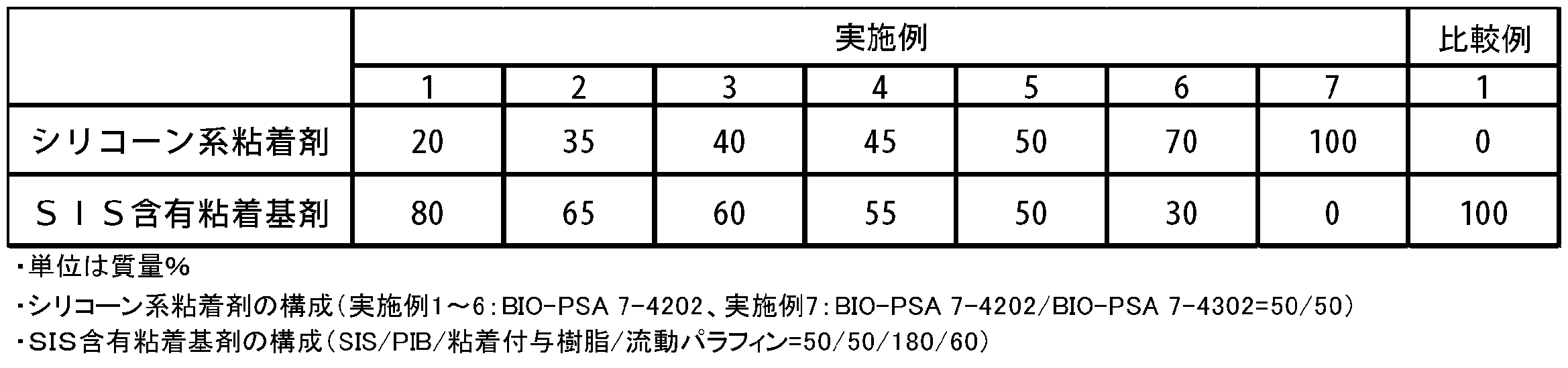
粘着剤層の基剤として、ポリオルガノシロキサンを含むシリコーン系粘着剤と、スチレン-イソプレン-スチレンブロック共重合体(SIS)、粘着付与樹脂及び可塑剤を含む粘着基剤(以後、「SIS含有粘着基剤」とも表す)とを所定の割合で含有した経皮吸収製剤(実施例1~7及び比較例1)について、透湿度及び薬物の皮膚透過持続性を比較した。
粘着剤層の基剤組成の比較
粘着剤層の基剤として、ポリオルガノシロキサンを含むシリコーン系粘着剤と、スチレン-イソプレン-スチレンブロック共重合体(SIS)、粘着付与樹脂及び可塑剤を含む粘着基剤(以後、「SIS含有粘着基剤」とも表す)とを所定の割合で含有した経皮吸収製剤(実施例1~7及び比較例1)について、透湿度及び薬物の皮膚透過持続性を比較した。
実施例1~7及び比較例1の製造
薬物貯留層は、ビソプロロール40質量%及びエチルセルロース60質量%を秤取し、適量の溶媒(メタノール)を加えて溶解し、塗布液を得た。剥離ライナー上に塗布液を塗布し、溶媒を乾燥除去して、厚み150g/m2のシートを得た。このシートを円形(38cm2)に裁断し、薬物貯留層を得た。表1の各成分を秤取し、適量の溶媒(トルエン又は酢酸エチル)を加えて溶解し、塗布液を得た。剥離ライナー上に塗布液を塗布し、溶媒を乾燥除去して、厚み75g/m2の粘着剤層を得た。粘着剤層上に薬物貯留層を接合し、薬物貯留層の剥離ライナーを剥離除去し、露出した面に支持体(撥水処理したPET編布)を積層し、薬物貯留層を略中心として円形(38cm2)に裁断し、経皮吸収製剤を得た。
薬物貯留層は、ビソプロロール40質量%及びエチルセルロース60質量%を秤取し、適量の溶媒(メタノール)を加えて溶解し、塗布液を得た。剥離ライナー上に塗布液を塗布し、溶媒を乾燥除去して、厚み150g/m2のシートを得た。このシートを円形(38cm2)に裁断し、薬物貯留層を得た。表1の各成分を秤取し、適量の溶媒(トルエン又は酢酸エチル)を加えて溶解し、塗布液を得た。剥離ライナー上に塗布液を塗布し、溶媒を乾燥除去して、厚み75g/m2の粘着剤層を得た。粘着剤層上に薬物貯留層を接合し、薬物貯留層の剥離ライナーを剥離除去し、露出した面に支持体(撥水処理したPET編布)を積層し、薬物貯留層を略中心として円形(38cm2)に裁断し、経皮吸収製剤を得た。
評価方法
(1)透湿度試験方法
経皮吸収製剤の透湿度は、JIS Z 0208:1976に規定される防湿包装材料の透湿度試験方法(カップ法)に従い、温度:40±0.5℃、相対湿度:90±2%における水分の透過速度(MVTR)g/m2・24hrを測定した。
(1)透湿度試験方法
経皮吸収製剤の透湿度は、JIS Z 0208:1976に規定される防湿包装材料の透湿度試験方法(カップ法)に従い、温度:40±0.5℃、相対湿度:90±2%における水分の透過速度(MVTR)g/m2・24hrを測定した。
透湿度試験の評価基準
◎:透湿度が40g/m2・24hr以上=透湿度が高く、皮膚の刺激がほとんど生じない
○:透湿度が20g/m2・24hr以上~40g/m2・24hr未満=透湿度がやや高く、皮膚の刺激が生じにくい
×:透湿度が20g/m2・24hr未満=透湿度が低く、皮膚の刺激が生じやすい
◎:透湿度が40g/m2・24hr以上=透湿度が高く、皮膚の刺激がほとんど生じない
○:透湿度が20g/m2・24hr以上~40g/m2・24hr未満=透湿度がやや高く、皮膚の刺激が生じにくい
×:透湿度が20g/m2・24hr未満=透湿度が低く、皮膚の刺激が生じやすい
(2)in vitroヒト皮膚透過試験方法
ヒト皮膚片の角質層側に経皮吸収製剤を貼り(適用面積3cm2)、皮膚真皮側がレセプター槽側になるように、32℃の温水を循環させて保温したフロースルー型拡散セルに皮膚片を装着した。次に、レセプター槽にリン酸緩衝生理食塩水を満たし、一定の流速で置換しながら、6時間毎に168時間後までレセプター槽から溶液を採取した。採取された溶液中の薬物(ビソプロロール)濃度を高速液体クロマトグラフ法により測定した。
ヒト皮膚片の角質層側に経皮吸収製剤を貼り(適用面積3cm2)、皮膚真皮側がレセプター槽側になるように、32℃の温水を循環させて保温したフロースルー型拡散セルに皮膚片を装着した。次に、レセプター槽にリン酸緩衝生理食塩水を満たし、一定の流速で置換しながら、6時間毎に168時間後までレセプター槽から溶液を採取した。採取された溶液中の薬物(ビソプロロール)濃度を高速液体クロマトグラフ法により測定した。
次に、濃度測定値から各時間における透過した薬物量を算出し、各時間における薬物の皮膚透過速度(μg/cm2/hr)を求めた。さらに、薬物の皮膚透過持続性を表す指標として、168時間後の皮膚透過速度Jlastを最大皮膚速度Jmaxで除してJlast/Jmax値を算出した。Jlast/Jmax値が大きいと、薬物の皮膚透過持続性が高いことを意味する。
in vitroヒト皮膚透過試験の評価基準
◎:Jlast/Jmax値が0.60以上
○:Jlast/Jmax値が0.30以上、0.60未満
×:Jlast/Jmax値が0.30未満
◎:Jlast/Jmax値が0.60以上
○:Jlast/Jmax値が0.30以上、0.60未満
×:Jlast/Jmax値が0.30未満
実施例1~7及び比較例1の評価結果
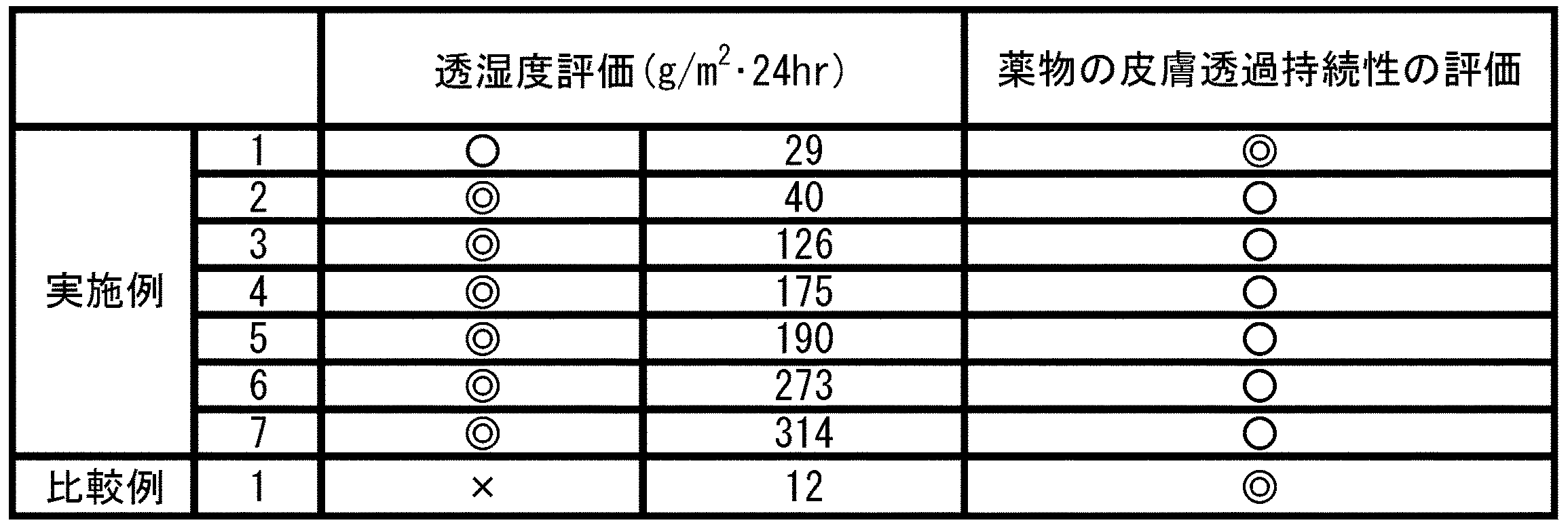
粘着剤層中のポリオルガノシロキサンを含むシリコーン系粘着剤の割合が増加すると、経皮吸収製剤の透湿度が増加する傾向がみられた。薬物の皮膚透過持続性は、ポリオルガノシロキサンを含むシリコーン系粘着剤の割合が増加するに伴い、やや低下したものの、十分な値を維持していた。実施例1~7、特に実施例2~7の経皮吸収製剤は、透湿度及び薬物の皮膚透過持続性ともに良好であった。
なお、実施例1及び4の薬物貯留層中のビソプロロールを、オキシブチニン、アセナピン、シタロプラム、ジクロフェナクナトリウム、メマンチン、リバスチグミン、ドネペジル、ガランタミン、フルオキセチン、パロキセチン、トルテロジン、及びロチゴチンにそれぞれ変更した経皮吸収製剤も、透湿度及び薬物の皮膚透過持続性ともに良好であった。
[試験2]
経皮吸収製剤の支持体の比較
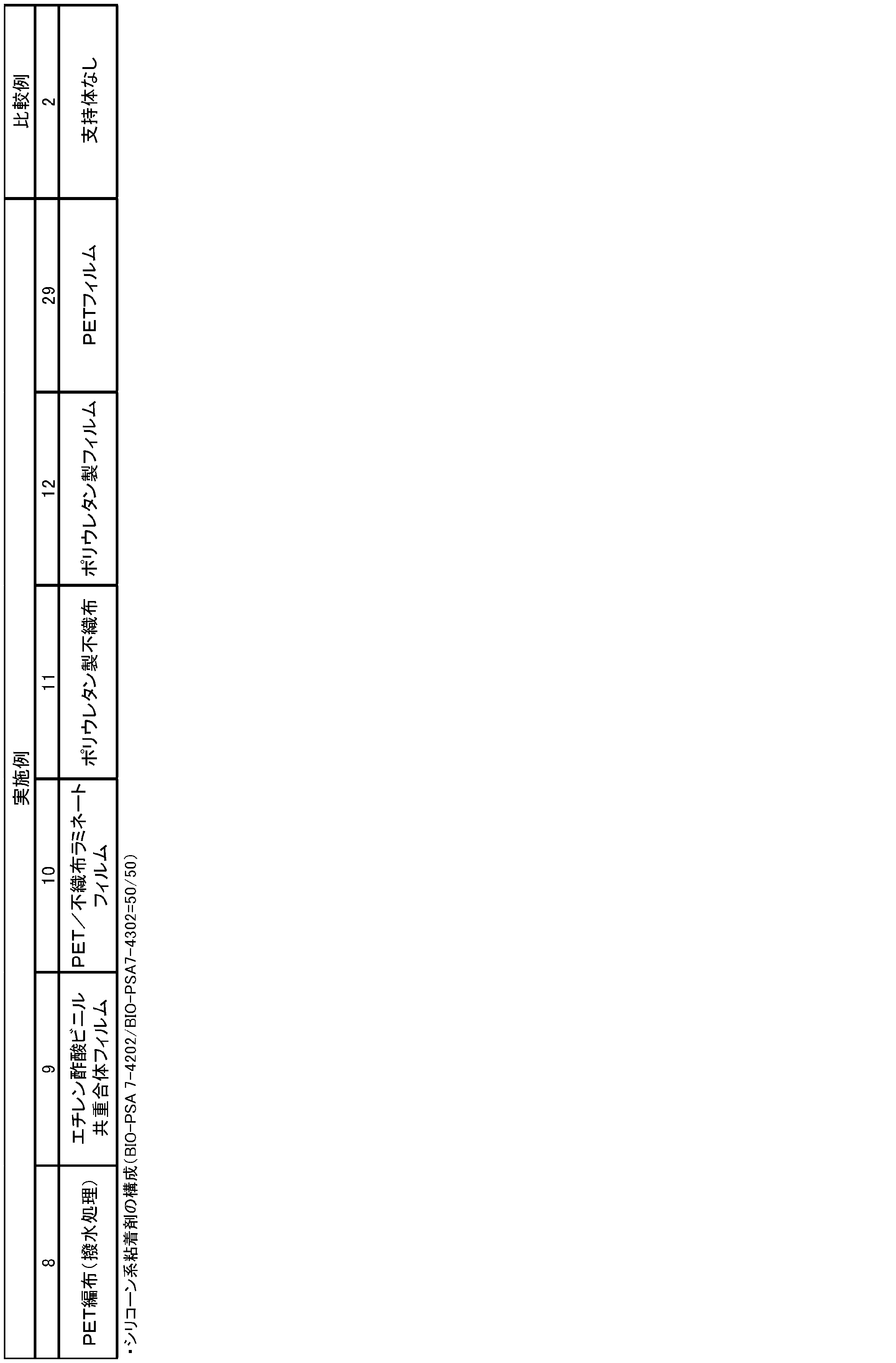
支持体に、撥水処理をしたPET編布、エチレン酢酸ビニル共重合体フィルム、PET/不織布ラミネートフィルム、ポリウレタン製不織布又はポリウレタン製フィルムを用いた経皮吸収製剤(実施例8~12)について、透湿度を比較した。また、支持体に、撥水処理をしたPET編布、エチレン酢酸ビニル共重合体フィルム又はPETフィルムを用いた経皮吸収製剤(実施例8~9及び29)、及び支持体を積層しない経皮吸収製剤(比較例2)について、薬物の裏抜け防止性を比較した。
経皮吸収製剤の支持体の比較
支持体に、撥水処理をしたPET編布、エチレン酢酸ビニル共重合体フィルム、PET/不織布ラミネートフィルム、ポリウレタン製不織布又はポリウレタン製フィルムを用いた経皮吸収製剤(実施例8~12)について、透湿度を比較した。また、支持体に、撥水処理をしたPET編布、エチレン酢酸ビニル共重合体フィルム又はPETフィルムを用いた経皮吸収製剤(実施例8~9及び29)、及び支持体を積層しない経皮吸収製剤(比較例2)について、薬物の裏抜け防止性を比較した。
実施例8~12、29及び比較例2の製造
薬物貯留層は、ビソプロロール40質量%及びエチルセルロース60質量%を秤取し、試験1で記載した方法と同様の方法により得た。粘着剤層は、ポリオルガノシロキサンを含むシリコーン系粘着剤100質量%を秤取し、試験1で記載した方法と同様の方法により得た。粘着剤層上に薬物貯留層を接合し、薬物貯留層の剥離ライナーを剥離除去し、露出した面に表3の支持体を積層し(比較例2は支持体の積層なし)、薬物貯留層を略中心として円形(38cm2)に裁断し、経皮吸収製剤を得た。
薬物貯留層は、ビソプロロール40質量%及びエチルセルロース60質量%を秤取し、試験1で記載した方法と同様の方法により得た。粘着剤層は、ポリオルガノシロキサンを含むシリコーン系粘着剤100質量%を秤取し、試験1で記載した方法と同様の方法により得た。粘着剤層上に薬物貯留層を接合し、薬物貯留層の剥離ライナーを剥離除去し、露出した面に表3の支持体を積層し(比較例2は支持体の積層なし)、薬物貯留層を略中心として円形(38cm2)に裁断し、経皮吸収製剤を得た。
評価方法
(1)透湿度試験方法
経皮吸収製剤の透湿度は、JIS Z 0208:1976に規定される防湿包装材料の透湿度試験方法(カップ法)に従い、温度:40±0.5℃、相対湿度:90±2%における水分の透過速度(MVTR)g/m2・24hrを測定した。
(1)透湿度試験方法
経皮吸収製剤の透湿度は、JIS Z 0208:1976に規定される防湿包装材料の透湿度試験方法(カップ法)に従い、温度:40±0.5℃、相対湿度:90±2%における水分の透過速度(MVTR)g/m2・24hrを測定した。
透湿度試験の評価基準
◎:透湿度が40g/m2・24hr以上=透湿度が高く、皮膚の刺激がほとんど生じない
○:透湿度が20g/m2・24hr以上~40g/m2・24hr未満=透湿度がやや高く、皮膚の刺激が生じにくい
×:透湿度が20g/m2・24hr未満=透湿度が低く、皮膚の刺激が生じやすい
◎:透湿度が40g/m2・24hr以上=透湿度が高く、皮膚の刺激がほとんど生じない
○:透湿度が20g/m2・24hr以上~40g/m2・24hr未満=透湿度がやや高く、皮膚の刺激が生じにくい
×:透湿度が20g/m2・24hr未満=透湿度が低く、皮膚の刺激が生じやすい
実施例8~12の評価結果
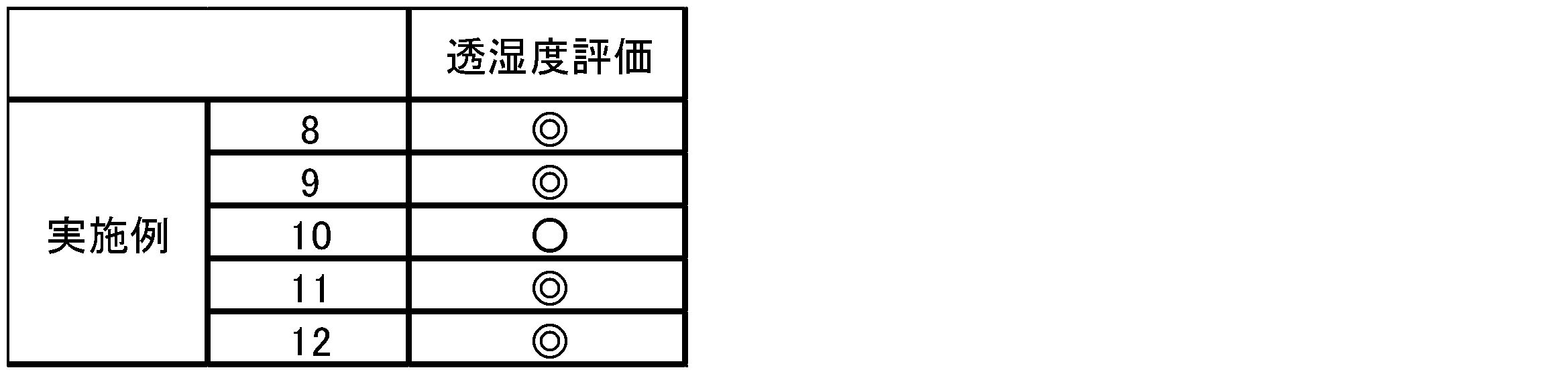
PET編布(撥水処理)、エチレン酢酸ビニル共重合体フィルム、ポリウレタン製不織布及びポリウレタン製フィルムを支持体に用いた経皮吸収製剤の透湿度は高い傾向がみとめられた。
(2)薬物の裏抜け防止性試験方法
実施例8~9、29及び比較例2の経皮吸収製剤の支持体側を900mLの水に浸し、15分静置した後、水分中の薬物含有率を測定した。
実施例8~9、29及び比較例2の経皮吸収製剤の支持体側を900mLの水に浸し、15分静置した後、水分中の薬物含有率を測定した。
薬物の裏抜け防止性の評価基準
○:支持体側からの薬物の裏抜けがほとんど認められなかった。
×:支持体側からの薬物の裏抜けが認められた。
○:支持体側からの薬物の裏抜けがほとんど認められなかった。
×:支持体側からの薬物の裏抜けが認められた。
実施例8~9、29及び比較例2の評価結果

PET編布(撥水処理)、エチレン酢酸ビニル共重合体フィルム及びPETフィルムを支持体に用いた経皮吸収製剤は、薬物の裏抜け防止性が高い傾向が認められた。
[試験3]
薬物貯留層の比較
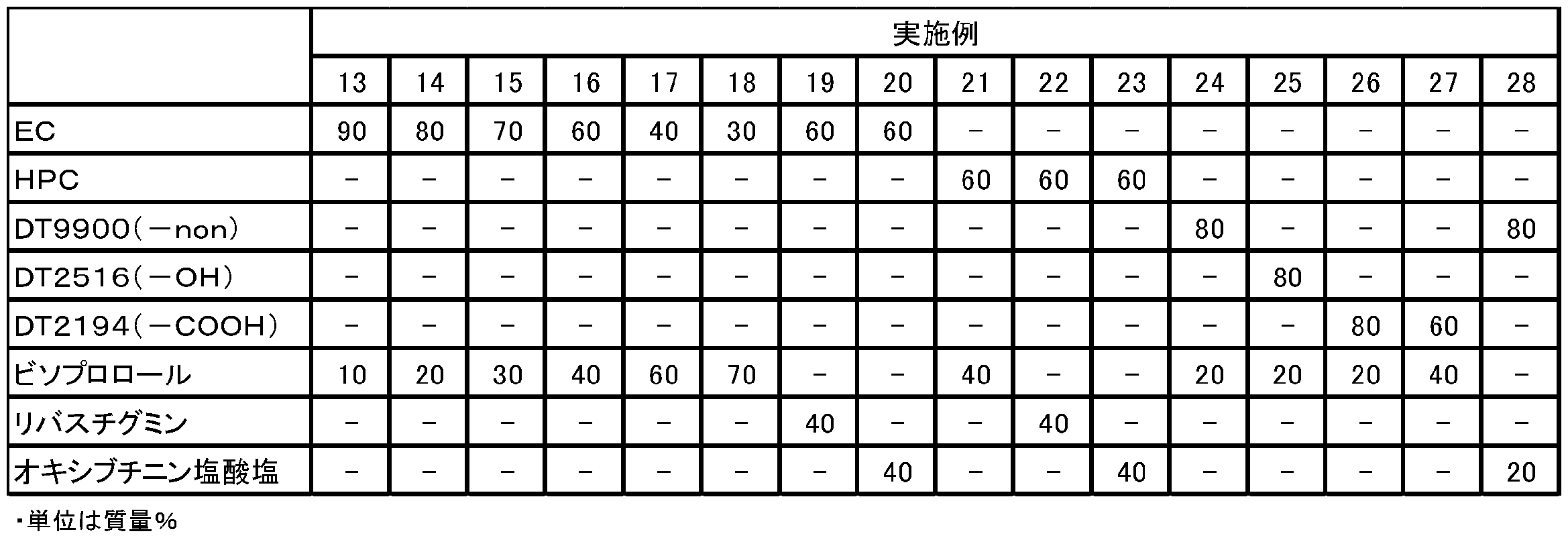
薬物貯留層にエチルセルロース(EC)、アクリル基剤又はヒドロキシプロピルセルロース(HPC)を含有する経皮吸収製剤(実施例13~28)について、薬物貯留層の凝集性を比較した。
薬物貯留層の比較
薬物貯留層にエチルセルロース(EC)、アクリル基剤又はヒドロキシプロピルセルロース(HPC)を含有する経皮吸収製剤(実施例13~28)について、薬物貯留層の凝集性を比較した。
実施例13~28の製造
表6の各成分を秤取し、試験1で記載した方法と同様の方法により薬物貯留層を得た。
表6の各成分を秤取し、試験1で記載した方法と同様の方法により薬物貯留層を得た。
ポリオルガノシロキサンを含むシリコーン系粘着剤100質量%(BIO-PSA 7-4202/BIO-PSA 7-4302=50/50)を秤取し、試験1で記載した方法と同様の方法により粘着剤層を得た。
粘着剤層上に薬物貯留層を接合し、薬物貯留層の剥離ライナーを剥離除去し、露出した面に支持体(PET/不織布ラミネートフィルム)を積層し、薬物貯留層を略中心として略方形(13.4cm2)に裁断し、経皮吸収製剤を得た。
凝集性の評価方法
寒天2質量%を含有するゲルシートを準備し、上記で得られた実施例13~28の経皮吸収製剤の粘着剤層の剥離ライナーを剥離除去し、露出した粘着面がゲルシートと接するようにゲルシート上に経皮吸収材を積層し、24時間静置した。ゲルシートから経皮吸収製剤を剥離し、経皮吸収製剤の粘着面に付着した水分を風乾させた後、フィンガータックにより、薬物貯留層の凝集性を次の基準に基づいて評価した。
寒天2質量%を含有するゲルシートを準備し、上記で得られた実施例13~28の経皮吸収製剤の粘着剤層の剥離ライナーを剥離除去し、露出した粘着面がゲルシートと接するようにゲルシート上に経皮吸収材を積層し、24時間静置した。ゲルシートから経皮吸収製剤を剥離し、経皮吸収製剤の粘着面に付着した水分を風乾させた後、フィンガータックにより、薬物貯留層の凝集性を次の基準に基づいて評価した。
凝集性の評価基準
○:薬物貯留層が凝集破壊しなかった
△:薬物貯留層がわずかに凝集破壊した
×:薬物貯留層が凝集破壊した
○:薬物貯留層が凝集破壊しなかった
△:薬物貯留層がわずかに凝集破壊した
×:薬物貯留層が凝集破壊した
実施例13~28の評価結果

薬物貯留層の基剤としてHPCを含有する実施例21~23の経皮吸収製剤では、薬物貯留層が水分によって膨潤し、経皮吸収製剤をゲルシートから剥離する際に薬物貯留層が凝集破壊する傾向が見られた。
一方、薬物貯留層の基剤としてエチルセルロースを含有する実施例13~20の経皮吸収製剤、薬物貯留層の基剤としてアクリル基剤を含有する実施例24~28では、薬物貯留層の凝集破壊が抑えられ、凝集性が維持される傾向が見られた。特に、実施例13~17、19~20及び24~28の経皮吸収製剤では、薬物貯留層が凝集破壊せず、凝集性は良好であった。
一方、薬物貯留層の基剤としてエチルセルロースを含有する実施例13~20の経皮吸収製剤、薬物貯留層の基剤としてアクリル基剤を含有する実施例24~28では、薬物貯留層の凝集破壊が抑えられ、凝集性が維持される傾向が見られた。特に、実施例13~17、19~20及び24~28の経皮吸収製剤では、薬物貯留層が凝集破壊せず、凝集性は良好であった。
Claims (8)
- 第1及び第2の主面を有し、薬物を含有する薬物貯留層と、
前記薬物貯留層の前記第1の主面側に設けられ、ポリオルガノシロキサンを含むシリコーン粘着剤を含有する粘着剤層と、
前記薬物貯留層の側面及び前記第2の主面を覆うように形成される支持体と、
を備える経皮吸収製剤であって、
前記シリコーン粘着剤の含有量が、前記粘着剤層の全質量に対して20質量%以上であり、
経皮吸収製剤全体としての透湿度が20g/m2・24hr以上、314g/m2・24hr以下である、経皮吸収製剤。 - 前記粘着剤層が、スチレン-イソプレン-スチレンブロック共重合体、粘着付与樹脂及び可塑剤からなる群から選択される1以上の化合物を含有する粘着基剤をさらに含有する請求項1に記載の経皮吸収製剤。
- 前記粘着基剤の含有量が、前記粘着剤層の全質量に対して80質量%以下である請求項2に記載の経皮吸収製剤。
- 前記薬物貯留層がエチルセルロースを含有する、請求項1~3のいずれか一項に記載の経皮吸収製剤。
- エチルセルロースの含有量が、前記薬物貯留層の全質量に対して40~99質量%である、請求項4に記載の経皮吸収製剤。
- 前記薬物貯留層がアクリル基剤を含有する、請求項1~3のいずれか一項に記載の経皮吸収製剤。
- アクリル基剤の含有量が、前記薬物貯留層の全質量に対して40~99質量%である、請求項6に記載の経皮吸収製剤。
- 前記支持体が、ポリエチレンテレフタレート編布又はエチレン酢酸ビニル共重合体フィルムを含有する請求項1~7のいずれか一項に記載の経皮吸収製剤。
Priority Applications (1)
| Application Number | Priority Date | Filing Date | Title |
|---|---|---|---|
| JP2017564310A JP6556873B2 (ja) | 2016-01-28 | 2017-01-25 | 経皮吸収製剤 |
Applications Claiming Priority (2)
| Application Number | Priority Date | Filing Date | Title |
|---|---|---|---|
| JP2016-014170 | 2016-01-28 | ||
| JP2016014170 | 2016-01-28 |
Publications (1)
| Publication Number | Publication Date |
|---|---|
| WO2017131034A1 true WO2017131034A1 (ja) | 2017-08-03 |
Family
ID=59398365
Family Applications (1)
| Application Number | Title | Priority Date | Filing Date |
|---|---|---|---|
| PCT/JP2017/002553 Ceased WO2017131034A1 (ja) | 2016-01-28 | 2017-01-25 | 経皮吸収製剤 |
Country Status (3)
| Country | Link |
|---|---|
| JP (1) | JP6556873B2 (ja) |
| TW (1) | TWI710381B (ja) |
| WO (1) | WO2017131034A1 (ja) |
Cited By (7)
| Publication number | Priority date | Publication date | Assignee | Title |
|---|---|---|---|---|
| WO2020071207A1 (ja) * | 2018-10-01 | 2020-04-09 | 久光製薬株式会社 | アセナピン含有貼付剤 |
| WO2020071205A1 (ja) * | 2018-10-01 | 2020-04-09 | 久光製薬株式会社 | アセナピン含有貼付剤 |
| US10898449B2 (en) | 2016-12-20 | 2021-01-26 | Lts Lohmann Therapie-Systeme Ag | Transdermal therapeutic system containing asenapine |
| US11033512B2 (en) | 2017-06-26 | 2021-06-15 | Lts Lohmann Therapie-Systeme Ag | Transdermal therapeutic system containing asenapine and silicone acrylic hybrid polymer |
| US11337932B2 (en) | 2016-12-20 | 2022-05-24 | Lts Lohmann Therapie-Systeme Ag | Transdermal therapeutic system containing asenapine and polysiloxane or polyisobutylene |
| US11648213B2 (en) | 2018-06-20 | 2023-05-16 | Lts Lohmann Therapie-Systeme Ag | Transdermal therapeutic system containing asenapine |
| US12329862B2 (en) | 2018-06-20 | 2025-06-17 | Lts Lohmann Therapie-Systeme Ag | Transdermal therapeutic system containing asenapine |
Families Citing this family (1)
| Publication number | Priority date | Publication date | Assignee | Title |
|---|---|---|---|---|
| CN112823793A (zh) * | 2019-11-20 | 2021-05-21 | 成都康弘药业集团股份有限公司 | 一种含有多奈哌齐的透皮贴剂及其制备方法 |
Citations (6)
| Publication number | Priority date | Publication date | Assignee | Title |
|---|---|---|---|---|
| JPH07157423A (ja) * | 1993-12-06 | 1995-06-20 | Sekisui Chem Co Ltd | 経皮吸収貼付剤 |
| JPH09124462A (ja) * | 1995-11-01 | 1997-05-13 | Nitto Denko Corp | 貼付剤および貼付製剤 |
| JPH11152224A (ja) * | 1997-09-17 | 1999-06-08 | Permatec Technol Ag | 制御されかつ持続した経皮性投与用新規組成物 |
| WO2007099966A1 (ja) * | 2006-02-28 | 2007-09-07 | Hisamitsu Pharmaceutical Co., Inc. | 経皮吸収型製剤 |
| WO2010095537A1 (ja) * | 2009-02-18 | 2010-08-26 | 久光製薬株式会社 | 経皮吸収製剤 |
| JP2015508813A (ja) * | 2012-02-28 | 2015-03-23 | エスケー ケミカルズ カンパニー, リミテッドSk Chemicals Co., Ltd. | ドネペジルを含有する経皮吸収製剤及びその製造方法 |
-
2017
- 2017-01-25 WO PCT/JP2017/002553 patent/WO2017131034A1/ja not_active Ceased
- 2017-01-25 JP JP2017564310A patent/JP6556873B2/ja active Active
- 2017-01-26 TW TW106103164A patent/TWI710381B/zh active
Patent Citations (6)
| Publication number | Priority date | Publication date | Assignee | Title |
|---|---|---|---|---|
| JPH07157423A (ja) * | 1993-12-06 | 1995-06-20 | Sekisui Chem Co Ltd | 経皮吸収貼付剤 |
| JPH09124462A (ja) * | 1995-11-01 | 1997-05-13 | Nitto Denko Corp | 貼付剤および貼付製剤 |
| JPH11152224A (ja) * | 1997-09-17 | 1999-06-08 | Permatec Technol Ag | 制御されかつ持続した経皮性投与用新規組成物 |
| WO2007099966A1 (ja) * | 2006-02-28 | 2007-09-07 | Hisamitsu Pharmaceutical Co., Inc. | 経皮吸収型製剤 |
| WO2010095537A1 (ja) * | 2009-02-18 | 2010-08-26 | 久光製薬株式会社 | 経皮吸収製剤 |
| JP2015508813A (ja) * | 2012-02-28 | 2015-03-23 | エスケー ケミカルズ カンパニー, リミテッドSk Chemicals Co., Ltd. | ドネペジルを含有する経皮吸収製剤及びその製造方法 |
Cited By (16)
| Publication number | Priority date | Publication date | Assignee | Title |
|---|---|---|---|---|
| US12485099B2 (en) | 2016-12-20 | 2025-12-02 | Lts Lohmann Therapie-Systeme Ag | Transdermal therapeutic system containing asenapine and polysiloxane or polyisobutylene |
| US10898449B2 (en) | 2016-12-20 | 2021-01-26 | Lts Lohmann Therapie-Systeme Ag | Transdermal therapeutic system containing asenapine |
| US10980753B2 (en) | 2016-12-20 | 2021-04-20 | Lts Lohmann Therapie-Systeme Ag | Transdermal therapeutic system containing asenapine |
| US12138353B2 (en) | 2016-12-20 | 2024-11-12 | Lts Lohmann Therapie-Systeme Ag | Transdermal therapeutic system containing asenapine |
| US11337932B2 (en) | 2016-12-20 | 2022-05-24 | Lts Lohmann Therapie-Systeme Ag | Transdermal therapeutic system containing asenapine and polysiloxane or polyisobutylene |
| US11033512B2 (en) | 2017-06-26 | 2021-06-15 | Lts Lohmann Therapie-Systeme Ag | Transdermal therapeutic system containing asenapine and silicone acrylic hybrid polymer |
| US11648213B2 (en) | 2018-06-20 | 2023-05-16 | Lts Lohmann Therapie-Systeme Ag | Transdermal therapeutic system containing asenapine |
| US12329862B2 (en) | 2018-06-20 | 2025-06-17 | Lts Lohmann Therapie-Systeme Ag | Transdermal therapeutic system containing asenapine |
| JP7152500B2 (ja) | 2018-10-01 | 2022-10-12 | 久光製薬株式会社 | アセナピン含有貼付剤 |
| JP7152499B2 (ja) | 2018-10-01 | 2022-10-12 | 久光製薬株式会社 | アセナピン含有貼付剤 |
| US11590106B2 (en) | 2018-10-01 | 2023-02-28 | Hisamitsu Pharmaceutical Co., Inc. | Asenapine-containing adhesive patch |
| WO2020071207A1 (ja) * | 2018-10-01 | 2020-04-09 | 久光製薬株式会社 | アセナピン含有貼付剤 |
| US11850311B2 (en) | 2018-10-01 | 2023-12-26 | Hisamitsu Pharmaceutical Co., Inc. | Asenapine-containing adhesive patch |
| JPWO2020071205A1 (ja) * | 2018-10-01 | 2021-09-02 | 久光製薬株式会社 | アセナピン含有貼付剤 |
| JPWO2020071207A1 (ja) * | 2018-10-01 | 2021-09-02 | 久光製薬株式会社 | アセナピン含有貼付剤 |
| WO2020071205A1 (ja) * | 2018-10-01 | 2020-04-09 | 久光製薬株式会社 | アセナピン含有貼付剤 |
Also Published As
| Publication number | Publication date |
|---|---|
| JP6556873B2 (ja) | 2019-08-07 |
| TW201726119A (zh) | 2017-08-01 |
| TWI710381B (zh) | 2020-11-21 |
| JPWO2017131034A1 (ja) | 2018-09-06 |
Similar Documents
| Publication | Publication Date | Title |
|---|---|---|
| JP6556873B2 (ja) | 経皮吸収製剤 | |
| US6316022B1 (en) | Transdermal compositions containing low molecular weight drugs which are liquid at room temperatures | |
| US8337884B2 (en) | Transdermal compositions containing low molecular weight drugs which are liquid at room temperatures | |
| JP3489831B2 (ja) | 活性成分パッチ | |
| CN107847487B (zh) | 含有阿塞那平的贴剂 | |
| JP5615697B2 (ja) | β遮断剤の安定化組成物およびそれを用いた経皮吸収製剤 | |
| KR101853082B1 (ko) | 활성제층 및 활성제 변환층을 포함하는 경피 조성물 | |
| JP3576608B2 (ja) | 貼付剤および貼付製剤 | |
| DK201600113U1 (da) | Transdermalt, terapeutisk system til administration af rivastigmin | |
| US20070264319A1 (en) | Transdermal Antiemesis Delivery System, Method and Composition Therefor | |
| JP5542791B2 (ja) | 経皮吸収製剤 | |
| JP5870350B2 (ja) | ビソプロロール経皮投与デバイス | |
| CA2373171A1 (en) | Stretch plaster | |
| EP1696013B1 (en) | Pressure sensitive adhesive and patch | |
| WO2008050673A1 (en) | Adhesive skin patch | |
| KR20120137373A (ko) | 프로필아미노인단 경피 조성물 | |
| JP4428903B2 (ja) | 非吸蔵性裏打ち層を有する吸蔵性経皮治療系 | |
| JP2002537244A (ja) | デオキシペガニン経皮治療系 | |
| WO2013047410A1 (ja) | 持続型アルツハイマー病治療用貼付剤及びその製造方法 | |
| JP4824963B2 (ja) | 貼付材及び貼付製剤 | |
| CN113382724B (zh) | 贴剂 | |
| JP6457486B2 (ja) | 貼付製剤 | |
| JP2971998B2 (ja) | アクリル系粘着シートおよびこれを用いてなる粘着製剤 | |
| US20050186262A1 (en) | Transdermal delivery device for dihydropyridine type calcium antagonists |
Legal Events
| Date | Code | Title | Description |
|---|---|---|---|
| 121 | Ep: the epo has been informed by wipo that ep was designated in this application |
Ref document number: 17744264 Country of ref document: EP Kind code of ref document: A1 |
|
| ENP | Entry into the national phase |
Ref document number: 2017564310 Country of ref document: JP Kind code of ref document: A |
|
| NENP | Non-entry into the national phase |
Ref country code: DE |
|
| 122 | Ep: pct application non-entry in european phase |
Ref document number: 17744264 Country of ref document: EP Kind code of ref document: A1 |