WO2017110697A1 - インプリント材料 - Google Patents
インプリント材料 Download PDFInfo
- Publication number
- WO2017110697A1 WO2017110697A1 PCT/JP2016/087665 JP2016087665W WO2017110697A1 WO 2017110697 A1 WO2017110697 A1 WO 2017110697A1 JP 2016087665 W JP2016087665 W JP 2016087665W WO 2017110697 A1 WO2017110697 A1 WO 2017110697A1
- Authority
- WO
- WIPO (PCT)
- Prior art keywords
- group
- component
- tmpt
- dmaa
- atm
- Prior art date
- Legal status (The legal status is an assumption and is not a legal conclusion. Google has not performed a legal analysis and makes no representation as to the accuracy of the status listed.)
- Ceased
Links
Classifications
-
- C—CHEMISTRY; METALLURGY
- C08—ORGANIC MACROMOLECULAR COMPOUNDS; THEIR PREPARATION OR CHEMICAL WORKING-UP; COMPOSITIONS BASED THEREON
- C08F—MACROMOLECULAR COMPOUNDS OBTAINED BY REACTIONS ONLY INVOLVING CARBON-TO-CARBON UNSATURATED BONDS
- C08F222/00—Copolymers of compounds having one or more unsaturated aliphatic radicals, each having only one carbon-to-carbon double bond, and at least one being terminated by a carboxyl radical and containing at least one other carboxyl radical in the molecule; Salts, anhydrides, esters, amides, imides, or nitriles thereof
- C08F222/10—Esters
- C08F222/1006—Esters of polyhydric alcohols or polyhydric phenols
- C08F222/102—Esters of polyhydric alcohols or polyhydric phenols of dialcohols, e.g. ethylene glycol di(meth)acrylate or 1,4-butanediol dimethacrylate
-
- C—CHEMISTRY; METALLURGY
- C08—ORGANIC MACROMOLECULAR COMPOUNDS; THEIR PREPARATION OR CHEMICAL WORKING-UP; COMPOSITIONS BASED THEREON
- C08F—MACROMOLECULAR COMPOUNDS OBTAINED BY REACTIONS ONLY INVOLVING CARBON-TO-CARBON UNSATURATED BONDS
- C08F220/00—Copolymers of compounds having one or more unsaturated aliphatic radicals, each having only one carbon-to-carbon double bond, and only one being terminated by only one carboxyl radical or a salt, anhydride ester, amide, imide or nitrile thereof
- C08F220/02—Monocarboxylic acids having less than ten carbon atoms; Derivatives thereof
- C08F220/10—Esters
- C08F220/26—Esters containing oxygen in addition to the carboxy oxygen
-
- B—PERFORMING OPERATIONS; TRANSPORTING
- B29—WORKING OF PLASTICS; WORKING OF SUBSTANCES IN A PLASTIC STATE IN GENERAL
- B29C—SHAPING OR JOINING OF PLASTICS; SHAPING OF MATERIAL IN A PLASTIC STATE, NOT OTHERWISE PROVIDED FOR; AFTER-TREATMENT OF THE SHAPED PRODUCTS, e.g. REPAIRING
- B29C59/00—Surface shaping of articles, e.g. embossing; Apparatus therefor
- B29C59/02—Surface shaping of articles, e.g. embossing; Apparatus therefor by mechanical means, e.g. pressing
- B29C59/022—Surface shaping of articles, e.g. embossing; Apparatus therefor by mechanical means, e.g. pressing characterised by the disposition or the configuration, e.g. dimensions, of the embossments or the shaping tools therefor
-
- B—PERFORMING OPERATIONS; TRANSPORTING
- B29—WORKING OF PLASTICS; WORKING OF SUBSTANCES IN A PLASTIC STATE IN GENERAL
- B29C—SHAPING OR JOINING OF PLASTICS; SHAPING OF MATERIAL IN A PLASTIC STATE, NOT OTHERWISE PROVIDED FOR; AFTER-TREATMENT OF THE SHAPED PRODUCTS, e.g. REPAIRING
- B29C59/00—Surface shaping of articles, e.g. embossing; Apparatus therefor
- B29C59/02—Surface shaping of articles, e.g. embossing; Apparatus therefor by mechanical means, e.g. pressing
- B29C59/04—Surface shaping of articles, e.g. embossing; Apparatus therefor by mechanical means, e.g. pressing using rollers or endless belts
-
- C—CHEMISTRY; METALLURGY
- C08—ORGANIC MACROMOLECULAR COMPOUNDS; THEIR PREPARATION OR CHEMICAL WORKING-UP; COMPOSITIONS BASED THEREON
- C08F—MACROMOLECULAR COMPOUNDS OBTAINED BY REACTIONS ONLY INVOLVING CARBON-TO-CARBON UNSATURATED BONDS
- C08F2/00—Processes of polymerisation
- C08F2/46—Polymerisation initiated by wave energy or particle radiation
-
- C—CHEMISTRY; METALLURGY
- C08—ORGANIC MACROMOLECULAR COMPOUNDS; THEIR PREPARATION OR CHEMICAL WORKING-UP; COMPOSITIONS BASED THEREON
- C08F—MACROMOLECULAR COMPOUNDS OBTAINED BY REACTIONS ONLY INVOLVING CARBON-TO-CARBON UNSATURATED BONDS
- C08F2/00—Processes of polymerisation
- C08F2/46—Polymerisation initiated by wave energy or particle radiation
- C08F2/48—Polymerisation initiated by wave energy or particle radiation by ultraviolet or visible light
-
- C—CHEMISTRY; METALLURGY
- C08—ORGANIC MACROMOLECULAR COMPOUNDS; THEIR PREPARATION OR CHEMICAL WORKING-UP; COMPOSITIONS BASED THEREON
- C08F—MACROMOLECULAR COMPOUNDS OBTAINED BY REACTIONS ONLY INVOLVING CARBON-TO-CARBON UNSATURATED BONDS
- C08F2/00—Processes of polymerisation
- C08F2/46—Polymerisation initiated by wave energy or particle radiation
- C08F2/48—Polymerisation initiated by wave energy or particle radiation by ultraviolet or visible light
- C08F2/50—Polymerisation initiated by wave energy or particle radiation by ultraviolet or visible light with sensitising agents
-
- C—CHEMISTRY; METALLURGY
- C08—ORGANIC MACROMOLECULAR COMPOUNDS; THEIR PREPARATION OR CHEMICAL WORKING-UP; COMPOSITIONS BASED THEREON
- C08F—MACROMOLECULAR COMPOUNDS OBTAINED BY REACTIONS ONLY INVOLVING CARBON-TO-CARBON UNSATURATED BONDS
- C08F220/00—Copolymers of compounds having one or more unsaturated aliphatic radicals, each having only one carbon-to-carbon double bond, and only one being terminated by only one carboxyl radical or a salt, anhydride ester, amide, imide or nitrile thereof
- C08F220/02—Monocarboxylic acids having less than ten carbon atoms; Derivatives thereof
- C08F220/10—Esters
-
- C—CHEMISTRY; METALLURGY
- C08—ORGANIC MACROMOLECULAR COMPOUNDS; THEIR PREPARATION OR CHEMICAL WORKING-UP; COMPOSITIONS BASED THEREON
- C08F—MACROMOLECULAR COMPOUNDS OBTAINED BY REACTIONS ONLY INVOLVING CARBON-TO-CARBON UNSATURATED BONDS
- C08F220/00—Copolymers of compounds having one or more unsaturated aliphatic radicals, each having only one carbon-to-carbon double bond, and only one being terminated by only one carboxyl radical or a salt, anhydride ester, amide, imide or nitrile thereof
- C08F220/02—Monocarboxylic acids having less than ten carbon atoms; Derivatives thereof
- C08F220/10—Esters
- C08F220/20—Esters of polyhydric alcohols or phenols, e.g. 2-hydroxyethyl (meth)acrylate or glycerol mono-(meth)acrylate
-
- C—CHEMISTRY; METALLURGY
- C08—ORGANIC MACROMOLECULAR COMPOUNDS; THEIR PREPARATION OR CHEMICAL WORKING-UP; COMPOSITIONS BASED THEREON
- C08F—MACROMOLECULAR COMPOUNDS OBTAINED BY REACTIONS ONLY INVOLVING CARBON-TO-CARBON UNSATURATED BONDS
- C08F220/00—Copolymers of compounds having one or more unsaturated aliphatic radicals, each having only one carbon-to-carbon double bond, and only one being terminated by only one carboxyl radical or a salt, anhydride ester, amide, imide or nitrile thereof
- C08F220/02—Monocarboxylic acids having less than ten carbon atoms; Derivatives thereof
- C08F220/52—Amides or imides
- C08F220/54—Amides, e.g. N,N-dimethylacrylamide or N-isopropylacrylamide
- C08F220/56—Acrylamide; Methacrylamide
-
- C—CHEMISTRY; METALLURGY
- C08—ORGANIC MACROMOLECULAR COMPOUNDS; THEIR PREPARATION OR CHEMICAL WORKING-UP; COMPOSITIONS BASED THEREON
- C08F—MACROMOLECULAR COMPOUNDS OBTAINED BY REACTIONS ONLY INVOLVING CARBON-TO-CARBON UNSATURATED BONDS
- C08F220/00—Copolymers of compounds having one or more unsaturated aliphatic radicals, each having only one carbon-to-carbon double bond, and only one being terminated by only one carboxyl radical or a salt, anhydride ester, amide, imide or nitrile thereof
- C08F220/02—Monocarboxylic acids having less than ten carbon atoms; Derivatives thereof
- C08F220/52—Amides or imides
- C08F220/54—Amides, e.g. N,N-dimethylacrylamide or N-isopropylacrylamide
- C08F220/58—Amides, e.g. N,N-dimethylacrylamide or N-isopropylacrylamide containing oxygen in addition to the carbonamido oxygen, e.g. N-methylolacrylamide, N-(meth)acryloylmorpholine
-
- C—CHEMISTRY; METALLURGY
- C08—ORGANIC MACROMOLECULAR COMPOUNDS; THEIR PREPARATION OR CHEMICAL WORKING-UP; COMPOSITIONS BASED THEREON
- C08F—MACROMOLECULAR COMPOUNDS OBTAINED BY REACTIONS ONLY INVOLVING CARBON-TO-CARBON UNSATURATED BONDS
- C08F222/00—Copolymers of compounds having one or more unsaturated aliphatic radicals, each having only one carbon-to-carbon double bond, and at least one being terminated by a carboxyl radical and containing at least one other carboxyl radical in the molecule; Salts, anhydrides, esters, amides, imides, or nitriles thereof
- C08F222/10—Esters
- C08F222/1006—Esters of polyhydric alcohols or polyhydric phenols
-
- C—CHEMISTRY; METALLURGY
- C08—ORGANIC MACROMOLECULAR COMPOUNDS; THEIR PREPARATION OR CHEMICAL WORKING-UP; COMPOSITIONS BASED THEREON
- C08F—MACROMOLECULAR COMPOUNDS OBTAINED BY REACTIONS ONLY INVOLVING CARBON-TO-CARBON UNSATURATED BONDS
- C08F222/00—Copolymers of compounds having one or more unsaturated aliphatic radicals, each having only one carbon-to-carbon double bond, and at least one being terminated by a carboxyl radical and containing at least one other carboxyl radical in the molecule; Salts, anhydrides, esters, amides, imides, or nitriles thereof
- C08F222/36—Amides or imides
- C08F222/38—Amides
- C08F222/385—Monomers containing two or more (meth)acrylamide groups, e.g. N,N'-methylenebisacrylamide
-
- C—CHEMISTRY; METALLURGY
- C08—ORGANIC MACROMOLECULAR COMPOUNDS; THEIR PREPARATION OR CHEMICAL WORKING-UP; COMPOSITIONS BASED THEREON
- C08L—COMPOSITIONS OF MACROMOLECULAR COMPOUNDS
- C08L71/00—Compositions of polyethers obtained by reactions forming an ether link in the main chain; Compositions of derivatives of such polymers
- C08L71/02—Polyalkylene oxides
-
- G—PHYSICS
- G03—PHOTOGRAPHY; CINEMATOGRAPHY; ANALOGOUS TECHNIQUES USING WAVES OTHER THAN OPTICAL WAVES; ELECTROGRAPHY; HOLOGRAPHY
- G03F—PHOTOMECHANICAL PRODUCTION OF TEXTURED OR PATTERNED SURFACES, e.g. FOR PRINTING, FOR PROCESSING OF SEMICONDUCTOR DEVICES; MATERIALS THEREFOR; ORIGINALS THEREFOR; APPARATUS SPECIALLY ADAPTED THEREFOR
- G03F7/00—Photomechanical, e.g. photolithographic, production of textured or patterned surfaces, e.g. printing surfaces; Materials therefor, e.g. comprising photoresists; Apparatus specially adapted therefor
- G03F7/0002—Lithographic processes using patterning methods other than those involving the exposure to radiation, e.g. by stamping
-
- G—PHYSICS
- G03—PHOTOGRAPHY; CINEMATOGRAPHY; ANALOGOUS TECHNIQUES USING WAVES OTHER THAN OPTICAL WAVES; ELECTROGRAPHY; HOLOGRAPHY
- G03F—PHOTOMECHANICAL PRODUCTION OF TEXTURED OR PATTERNED SURFACES, e.g. FOR PRINTING, FOR PROCESSING OF SEMICONDUCTOR DEVICES; MATERIALS THEREFOR; ORIGINALS THEREFOR; APPARATUS SPECIALLY ADAPTED THEREFOR
- G03F7/00—Photomechanical, e.g. photolithographic, production of textured or patterned surfaces, e.g. printing surfaces; Materials therefor, e.g. comprising photoresists; Apparatus specially adapted therefor
- G03F7/004—Photosensitive materials
- G03F7/027—Non-macromolecular photopolymerisable compounds having carbon-to-carbon double bonds, e.g. ethylenic compounds
-
- G—PHYSICS
- G03—PHOTOGRAPHY; CINEMATOGRAPHY; ANALOGOUS TECHNIQUES USING WAVES OTHER THAN OPTICAL WAVES; ELECTROGRAPHY; HOLOGRAPHY
- G03F—PHOTOMECHANICAL PRODUCTION OF TEXTURED OR PATTERNED SURFACES, e.g. FOR PRINTING, FOR PROCESSING OF SEMICONDUCTOR DEVICES; MATERIALS THEREFOR; ORIGINALS THEREFOR; APPARATUS SPECIALLY ADAPTED THEREFOR
- G03F7/00—Photomechanical, e.g. photolithographic, production of textured or patterned surfaces, e.g. printing surfaces; Materials therefor, e.g. comprising photoresists; Apparatus specially adapted therefor
- G03F7/16—Coating processes; Apparatus therefor
- G03F7/168—Finishing the coated layer, e.g. drying, baking, soaking
-
- B—PERFORMING OPERATIONS; TRANSPORTING
- B29—WORKING OF PLASTICS; WORKING OF SUBSTANCES IN A PLASTIC STATE IN GENERAL
- B29C—SHAPING OR JOINING OF PLASTICS; SHAPING OF MATERIAL IN A PLASTIC STATE, NOT OTHERWISE PROVIDED FOR; AFTER-TREATMENT OF THE SHAPED PRODUCTS, e.g. REPAIRING
- B29C59/00—Surface shaping of articles, e.g. embossing; Apparatus therefor
- B29C59/02—Surface shaping of articles, e.g. embossing; Apparatus therefor by mechanical means, e.g. pressing
- B29C59/022—Surface shaping of articles, e.g. embossing; Apparatus therefor by mechanical means, e.g. pressing characterised by the disposition or the configuration, e.g. dimensions, of the embossments or the shaping tools therefor
- B29C2059/023—Microembossing
-
- B—PERFORMING OPERATIONS; TRANSPORTING
- B82—NANOTECHNOLOGY
- B82Y—SPECIFIC USES OR APPLICATIONS OF NANOSTRUCTURES; MEASUREMENT OR ANALYSIS OF NANOSTRUCTURES; MANUFACTURE OR TREATMENT OF NANOSTRUCTURES
- B82Y40/00—Manufacture or treatment of nanostructures
-
- C—CHEMISTRY; METALLURGY
- C08—ORGANIC MACROMOLECULAR COMPOUNDS; THEIR PREPARATION OR CHEMICAL WORKING-UP; COMPOSITIONS BASED THEREON
- C08F—MACROMOLECULAR COMPOUNDS OBTAINED BY REACTIONS ONLY INVOLVING CARBON-TO-CARBON UNSATURATED BONDS
- C08F222/00—Copolymers of compounds having one or more unsaturated aliphatic radicals, each having only one carbon-to-carbon double bond, and at least one being terminated by a carboxyl radical and containing at least one other carboxyl radical in the molecule; Salts, anhydrides, esters, amides, imides, or nitriles thereof
- C08F222/10—Esters
- C08F222/1006—Esters of polyhydric alcohols or polyhydric phenols
- C08F222/103—Esters of polyhydric alcohols or polyhydric phenols of trialcohols, e.g. trimethylolpropane tri(meth)acrylate
-
- C—CHEMISTRY; METALLURGY
- C08—ORGANIC MACROMOLECULAR COMPOUNDS; THEIR PREPARATION OR CHEMICAL WORKING-UP; COMPOSITIONS BASED THEREON
- C08F—MACROMOLECULAR COMPOUNDS OBTAINED BY REACTIONS ONLY INVOLVING CARBON-TO-CARBON UNSATURATED BONDS
- C08F222/00—Copolymers of compounds having one or more unsaturated aliphatic radicals, each having only one carbon-to-carbon double bond, and at least one being terminated by a carboxyl radical and containing at least one other carboxyl radical in the molecule; Salts, anhydrides, esters, amides, imides, or nitriles thereof
- C08F222/10—Esters
- C08F222/1006—Esters of polyhydric alcohols or polyhydric phenols
- C08F222/106—Esters of polycondensation macromers
- C08F222/1063—Esters of polycondensation macromers of alcohol terminated polyethers
Definitions
- the present invention relates to an imprint material (film-forming composition for imprint) and a film produced from the material and having a pattern transferred thereto. More specifically, the present invention relates to a film made of the material, and onto which a pattern having excellent adhesion to a substrate, scratch resistance, and wiping resistance under high load is transferred.
- Nanoimprint lithography is a method in which a mold having an arbitrary pattern is brought into contact with a substrate on which a resin film is formed, the resin film is pressurized, and heat or light is used as an external stimulus to cure the target pattern.
- This nanoimprint lithography has an advantage that nanoscale processing can be performed easily and inexpensively as compared with optical lithography or the like in conventional semiconductor device manufacturing. Therefore, nanoimprint lithography is a technology that is expected to be applied to the manufacture of semiconductor devices, opto-devices, displays, storage media, biochips, etc., instead of optical lithography technology.
- Various reports have been made on curable compositions (Patent Documents 2 and 3).
- a roll-to-roll method has been proposed as a method for mass-producing a film with a transferred pattern with high efficiency.
- the roll-to-roll method proposed in optical nanoimprint lithography uses a flexible film as a base material and a pattern as a material used in nanoimprint lithography (hereinafter abbreviated as “imprint material” in this specification).
- imprint material used in nanoimprint lithography
- the mainstream method is to use a solvent-free type material that does not add a solvent so that the dimensions are difficult to change.
- a solvent-free type material is used for the conventionally proposed imprint material, but there are cases where suitable adhesion between the film after imprinting and the substrate film cannot be established.
- scratch resistance may be required for uneven shapes produced as optical members inside or on the surface.
- tissue or cloth may be used to remove dirt on the surface with a high load. At that time, the convex portion is prevented from collapsing in the uneven shape. It is essential.
- the present invention has been made based on the above circumstances, and the problem to be solved is that when a resin film is formed using an imprint material, the film substrate has sufficient adhesion. And it aims at providing the imprint material which is excellent in scratch resistance and forms the film
- the present inventors have a predetermined compound having a polymerizable group at the end, a propylene oxide unit and / or an ethylene oxide unit, and a polymerizable group at the end.
- the following knowledge is obtained by using a compound containing a compound having a predetermined (meth) acrylamide compound, a compound having a predetermined ethylene oxide unit and having a polymerizable group at the terminal and a photopolymerization initiator as an imprint material. To achieve the present invention.
- the present invention provides the first aspect as follows:
- the present invention relates to an imprint material containing the following component (A), component (B), component (C), component (D), and component (E).
- (A) a compound represented by the following formula (1)
- (B) a compound represented by the following formula (2)
- (C) a compound represented by the following formula (3)
- Compound (E) photopolymerization initiator wherein, R 1 independently represents a hydrogen atom or a methyl group, R 2 represents a divalent or trivalent hydrocarbon group having 1 to 5 carbon atoms, j represents 0 or 1, and k represents 2 or 3,
- X represents a divalent linking group having an ethylene oxide unit and / or a propylene oxide unit,
- R 3 represents a hydrogen atom or an alkyl group having 1 to 3 carbon atoms, and m is 1 or 2
- R 5 represents a trivalent, tetravalent, pentavalent, or he
- An alkyl group having 1 to 12 carbon atoms which may be substituted with at least one substituent selected from the group consisting of When m represents 2, R 4 represents a hydroxy group, a carboxy group, an acetyl group, an amino group in which one or two hydrogen atoms may be substituted with a methyl group, a sulfo group, and 1 to 4 carbon atoms.
- each R 1 independently represents a hydrogen atom or a methyl group
- R 5 ′ represents a trivalent, tetravalent, pentavalent or hexavalent organic group having 3 to 10 carbon atoms having an ether bond in the main chain.
- R 6 represents a trimethylene group or a propylene group
- p, q, r and s are each independently 0 or Represents an integer of 1 or more and satisfies the relational expression 1 ⁇ (p + q + r + s) ⁇ 30.
- the imprint material as described in the 1st viewpoint containing 1 type or 2 types of compounds represented by these.
- the content rate of this (A) component is 1 mass% or more and 40 mass% or less.
- each R 1 independently represents a hydrogen atom or a methyl group
- R 7 represents a tetravalent, pentavalent or hexavalent organic group having 1 to 9 carbon atoms having an ether bond in the main chain, or the number of carbon atoms.
- 1 to 9 represents a tetravalent, pentavalent or hexavalent hydrocarbon group, t represents 0 or 1, and u represents an integer of 3 to 6.
- or 4th viewpoint containing 1 type or 2 types of compounds represented by these.
- the present invention relates to the imprint material according to any one of the first to fifth aspects, which further contains a silicone compound as the component (G).
- the present invention relates to the imprint material according to any one of the first to sixth aspects, which further contains a surfactant as the component (H).
- a step in which a film is formed by applying the imprint material according to any one of the first aspect to the eighth aspect to a substrate, and a mold in which a pattern is formed using an optical imprint apparatus A film on which the pattern is transferred, the step of transferring the pattern to the film by bringing the film into contact with the film, further pressing the film with the mold, subsequently photocuring the film, and then releasing the film It relates to a manufacturing method.
- the imprint material of the present invention contains a predetermined compound having a polymerizable group at the end, a compound having a propylene oxide unit and / or an ethylene oxide unit and having a polymerizable group at the end, and a predetermined (meth) acrylamide compound.
- the imprint material of the present invention can be photocured, and since a part of the pattern does not peel off when peeled from the mold surface, a film in which a desired pattern is accurately formed can be obtained. Therefore, it is possible to form a good optical imprint pattern.
- the imprint material of the present invention can be formed on an arbitrary substrate, and the formed film and the film substrate have sufficient adhesion, and the film has scratch resistance. Have. Furthermore, when the surface on which the uneven shape of the film is transferred is wiped with a high load, the protrusion does not collapse. For this reason, the film to which the pattern formed after imprinting is transferred is preferably used for the production of optical members such as solid-state imaging devices, solar cells, LED devices, and displays that require scratch resistance and dirt wiping resistance. Can do.
- the imprint material of this invention can control a cure rate, dynamic viscosity, and a film thickness by changing the kind and content rate of the compound of the said (B) component. Therefore, the imprint material of the present invention can be designed suitably for the type of device to be manufactured, the type of exposure process and the type of baking process, and the process margin can be expanded. it can.
- Component (A) Compound represented by Formula (1)
- the compound of component (A) is a compound represented by the following formula (1). (Wherein, R 1 independently represents a hydrogen atom or a methyl group, R 2 represents a divalent or trivalent hydrocarbon group having 1 to 5 carbon atoms, j represents 0 or 1, and k represents Represents 2 or 3.)
- Specific examples of the compound represented by the above formula (1) include trimethylolpropane triacrylate, pentaerythritol triacrylate, trimethylolpropane trimethacrylate, and pentaerythritol trimethacrylate.
- the compound represented by the above formula (1) is available as a commercial product, and specific examples thereof include NK ester 701A, 701, A-HD-N, A-NPG, NPG, A-TMPT, TMPT (above, Shin-Nakamura Chemical Co., Ltd.), Aronix (registered trademark) M309 (Toagosei Co., Ltd.), KAYARAD NPGDA, TMPTA (above, Nippon Kayaku Co., Ltd.) .
- the compound of the said (A) component can be used individually or in combination of 2 or more types.
- the content ratio of the component (A) in the imprint material of the present invention is based on the total mass of the component (A) and the components (B), (C), (D), and (F) described later. It is preferably 1% by mass or more and 40% by mass or less.
- the proportion of the component (A) is less than 1% by mass, the convex portions are liable to collapse when the surface to which the concavo-convex shape of the film obtained by optical imprinting has been transferred is wiped with a high load. On the other hand, if it exceeds 40% by mass, the scratch resistance is drastically lowered.
- Component (B) Compound represented by Formula (2)
- the compound of a component is a compound represented by following formula (2).
- each R 1 independently represents a hydrogen atom or a methyl group
- X represents a divalent linking group having an ethylene oxide unit and / or a propylene oxide unit.
- the propylene oxide unit is, for example, “—CH 2 CH (CH 3 ) O—”, “—CH (CH 3 ) CH 2 O—” or “—CH 2 CH 2 CH 2 O—”.
- the ethylene oxide unit represents, for example, “—CH 2 CH 2 O—”.
- ethylene glycol di (meth) acrylate examples include ethylene glycol di (meth) acrylate, polyethylene glycol di (meth) acrylate, and ethoxylation.
- examples include bisphenol A di (meth) acrylate and isocyanuric acid ethylene oxide-modified diacrylate.
- a (meth) acrylate compound means both an acrylate compound and a methacrylate compound, for example, (meth) acrylic acid means both acrylic acid and methacrylic acid.
- a compound having one or more ethylene oxide units in one molecule can be obtained as a commercial product.
- Specific examples thereof include NK ester A-200, A -400, A-600, A-1000, 1G, 2G, 3G, 4G, 9G, 14G, 23G, ABE-300, A-BPE-4, A-BPE -6, A-BPE-10, A-BPE-20, A-BPE-30, BPE-80N, BPE-100N, BPE-200, BPE-500, BPE-900, BPE-1300N (above, Shin-Nakamura Chemical Co., Ltd.), KAYARAD (registered trademark) PEG400DA (above, manufactured by Nippon Kayaku Co., Ltd.), Aronix (registered trademark) M-215, M-240 (Tojo) Forming Co., Ltd.), Fancryl (registered trademark) FA-220M (manufactured by Hitachi Chemical Co., Ltd.) and the
- specific examples of the compound having one or more propylene oxide units in one molecule include dipropylene glycol di (meth) acrylate, tripropylene glycol di (meth) acrylate, Examples include polypropylene glycol # 400 di (meth) acrylate and polypropylene glycol # 700 di (meth) acrylate.
- compounds having one or more propylene oxide units in one molecule are available as commercial products. Specific examples thereof include NK ester APG-100, APG- 200, APG-400, APG-700, 3PG, 9PG (above, Shin-Nakamura Chemical Co., Ltd.), Aronix (registered trademark) M-220, M-225, M-270 (Toagosei Co., Ltd.) FANCLIL (registered trademark) FA-P240A, FA-P270A (manufactured by Hitachi Chemical Co., Ltd.).
- specific examples of the compounds each having one or more ethylene oxide units and propylene oxide units in one molecule include ethylene oxide propylene oxide copolymer di (meth) acrylic acid.
- examples include esters, propoxylated ethoxylated bisphenol A di (meth) acrylate, and ethoxylated polypropylene glycol # 700 di (meth) acrylate.
- a compound having at least one ethylene oxide unit and one propylene oxide unit in each molecule can be obtained as a commercial product.
- Specific examples thereof include A-1000PER.
- A-B1206PE manufactured by Shin-Nakamura Chemical Co., Ltd.
- FANCLIL registered trademark
- FA-023M manufactured by Hitachi Chemical Co., Ltd.
- the compound of the said (B) component can be used individually or in combination of 2 or more types.
- the compound for example, the following formula (2a): (Wherein R 1 independently represents a hydrogen atom or a methyl group, R 6 represents a trimethylene group or a propylene group, p, q, r and s each independently represent an integer of 0 or more, and 1 ⁇
- the compound represented by (p + q + r + s) ⁇ 30 is satisfied.
- a combination of a compound having one or more ethylene oxide units in one molecule and a compound having one or more propylene oxide units and one or more ethylene oxide units in one molecule A combination of a compound having one or more ethylene oxide units in one molecule and a compound having one or more propylene oxide units in one molecule, and a compound having one or more propylene oxide units in one molecule
- a combination with a compound having one or more propylene oxide units and one or more ethylene oxide units may be mentioned.
- the content ratio of the component (B) in the imprint material of the present invention is based on the total mass of the component (A) and the component (B) and the components (C), (D), and (F) described later. For example, they are 5 mass% or more and 80 mass% or less, Preferably they are 50 mass% or more and 80 mass% or less.
- the component (B) in the imprint material of the present invention can impart scratch resistance to the film after pattern transfer. Also, at the time of curing during imprinting, it helps to bleed out the silicone compound of component (G), which will be described later, and the mold release force measured when peeling off from the mold surface in the obtained resin film (cured coating) Can be reduced. Moreover, the dynamic viscosity of the imprint material, the curing speed at the time of imprint, and the film thickness to be formed can be controlled by changing the type and content ratio of the component (B).
- Component (C) Compound represented by Formula (3)
- the compound of component (C) is a compound represented by the following formula (3), that is, a compound having a (meth) acrylamide structure in its structure.
- R 1 represents a hydrogen atom or a methyl group
- R 3 represents a hydrogen atom or an alkyl group having 1 to 3 carbon atoms
- m represents 1 or 2
- R 4 represents a hydroxy group, a carboxy group, an acetyl group, an amino group in which one or two hydrogen atoms may be substituted with a methyl group, a sulfo group, and 1 to 4 carbon atoms.
- R 4 represents a hydroxy group, a carboxy group, an acetyl group, an amino group in which one or two hydrogen atoms may be substituted with a methyl group, a sulfo group, and 1 to 4 carbon atoms.
- the alkyl group having 1 to 12 carbon atoms may be a linear, branched or cyclic alkyl group, and specifically includes a methyl group, an ethyl group, an n-propyl group, Isopropyl group, cyclopropyl group, n-butyl group, isobutyl group, sec-butyl group, tert-butyl group, cyclobutyl group, 1-methyl-cyclopropyl group, 2-methyl-cyclopropyl group, n-pentyl group, 1 -Methyl-n-butyl group, 2-methyl-n-butyl group, 3-methyl-n-butyl group, 1,1-dimethyl-n-propyl group, 1,2-dimethyl-n-propyl group, 2, 2-dimethyl-n-propyl group, 1-ethyl-n-propyl group, cyclopentyl group, 1-methyl-cyclobutyl group, 2-methyl-cyclobuty
- alkylene group having 1 to 12 carbon atoms may be linear, branched, or cyclic.
- Specific examples include a methylene group, an ethylene group, a propane-1,2-diyl group, and propane.
- the compound represented by the above formula (3) include (meth) acrylamide, N, N′-dimethyl (meth) acrylamide, N, N′-diethyl (meth) acrylamide, N- [3- (dimethyl Amino) propyl] (meth) acrylamide, N-isopropyl (meth) acrylamide, N- (hydroxymethyl) (meth) acrylamide, N- (2-hydroxyethyl) (meth) acrylamide, N-dodecyl (meth) acrylamide, diacetone (Meth) acrylamide, N-tert-butyl (meth) acrylamide, N- (butoxymethyl) (meth) acrylamide, 2- (meth) acrylamide-2-methylpropanesulfonic acid, 6- (meth) acrylamide hexanoic acid, N, N '-(1,2-dihydroxyethylene) bis (meth) Acrylamide, N, include N'- methylenebis (meth)
- N, N′-dimethyl (meth) acrylamide, N, N′-diethyl (meta) is used from the viewpoint of developing adhesion with a very small addition amount.
- Acrylamide and N, N ′-(1,2-dihydroxyethylene) bis (meth) acrylamide are preferred.
- N, N′-dimethylacrylamide, N, N′-diethylacrylamide, N, N ′-(1 , 2-dihydroxyethylene) bisacrylamide is most preferred.
- the compound of the said (C) component can be used individually or in combination of 2 or more types.
- the content ratio of the component (C) in the imprint material of the present invention is based on the total mass of the component (A), the component (B) and the component (C), and the component (D) and the component (F) described later. For example, they are 1 mass% or more and 40 mass% or less, Preferably they are 5 mass% or more and 20 mass% or less.
- the content ratio of the component (C) is less than 1% by mass, the adhesion of the film obtained by photoimprinting to the substrate decreases, and when it exceeds 40% by mass, the scratch resistance of the obtained film decreases. .
- Component (D) Compound represented by Formula (4)
- the compound of (D) component is a compound represented by following formula (4).
- each R 1 independently represents a hydrogen atom or a methyl group
- X represents a divalent linking group having an ethylene oxide unit and / or a propylene oxide unit
- R 5 has at least one hetero atom.
- R 5 represents a trivalent, tetravalent, pentavalent or hexavalent organic group having 3 to 10 carbon atoms
- n represents an integer of 3 to 6.
- a hetero atom is selected from the group which consists of an oxygen atom, a nitrogen atom, and a sulfur atom, for example.
- examples of the compound having one or more ethylene oxide units in one molecule include ethoxylated trimethylolpropane tri (meth) acrylate and ethoxylated pentaerythritol tetra (meth).
- examples include acrylate, ethoxylated glycerin tri (meth) acrylate, ethoxylated dipentaerythritol hexa (meth) acrylate, and ethoxylated isocyanuric acid tri (meth) acrylate.
- a compound having one or more ethylene oxide units in one molecule can be obtained as a commercial product, and specific examples thereof include NK ester (registered trademark) A. -TMPT-3EO, A-TMPT-9EO, ATM-35E, A-GLY-9E, A-GLY-20E, A-9300 (above, Shin-Nakamura Chemical Co., Ltd.), Biscote # 360 (Osaka Organic Industrial Co., Ltd.) KAYARAD (registered trademark) DPEA-12 (manufactured by Nippon Kayaku Co., Ltd.), Aronix (registered trademark) M-315 (manufactured by Toa Gosei Co., Ltd.).
- examples of the compound having one or more propylene oxide units in one molecule include glycerin tripropoxy tri (meth) acrylate.
- a compound having one or more propylene oxide units in one molecule can be obtained as a commercial product.
- Specific examples thereof include KAYARAD (registered trademark) GPO-303. (Nippon Kayaku Co., Ltd.).
- the compound of the said (D) component can be used individually or in combination of 2 or more types.
- the compound for example, the following formula (4a): (In the formula, each R 1 independently represents a hydrogen atom or a methyl group, and R 5 ′ represents a trivalent, tetravalent, pentavalent or hexavalent organic group having 3 to 10 carbon atoms having an ether bond in the main chain.
- R 6 represents a trimethylene group or a propylene group
- p, q, r and s are each independently 0 or Represents an integer of 1 or more and satisfies the relational expression 1 ⁇ (p + q + r + s) ⁇ 30.)
- the compound represented by these is preferable.
- a combination of a compound having one or more ethylene oxide units in one molecule and a compound having one or more propylene oxide units in one molecule may be mentioned.
- the content ratio of the component (D) in the imprint material of the present invention is based on the total mass of the component (A), the component (B), the component (C), the component (D), and the component (F) described later. For example, they are 5 mass% or more and 70 mass% or less, Preferably they are 10 mass% or more and 50 mass% or less.
- the content ratio of the component (D) is less than 5% by mass, the scratch resistance of the film obtained by photoimprinting is lowered.
- it exceeds 70% by mass the adhesion of the obtained film to the substrate is lowered.
- the photopolymerization initiator as the component (E) is not particularly limited as long as it has absorption in the light source used during photocuring.
- the photopolymerization initiator as the component (E) is not particularly limited as long as it has absorption in the light source used during photocuring.
- tert-butylperoxy-iso-butyrate 2,5-dimethyl-2,5-bis (benzoyldioxy) hexane
- the photopolymerization initiator can be obtained as a commercial product. Specific examples thereof include IRGACURE (registered trademark) 651, 184, 500, 2959, 127, 754, 907, 369, 379, 379EG, 819, 819DW, 1800, 1870, 784, OXE01, OXE02, 250, 1173, MBF, 4265, TPO (above, manufactured by BASF Japan Ltd.) , KAYACURE (registered trademark) DETX, MBP, DMBI, EPA, OA (manufactured by Nippon Kayaku Co., Ltd.), VISURE-10, 55 (manufactured by STAUFFER Co.
- IRGACURE registered trademark
- 184 500, 2959, 127, 754, 907, 369, 379, 379EG, 819, 819DW, 1800, 1870, 784, OXE01, OXE02, 250, 1173, MBF, 4265, TPO (above, manufactured by BA
- the said photoinitiator can be used individually or in combination of 2 or more types.
- the content ratio of the component (E) in the imprint material of the present invention is based on the total mass of the component (A), the component (B), the component (C) and the component (D), and the component (F) described later.
- 0.1 phr to 30 phr preferably 1 phr to 20 phr, more preferably 1 phr to 8 phr. This is because when the content ratio of the component (E) is less than 0.1 phr, sufficient curability cannot be obtained, and patterning characteristics are deteriorated and scratch resistance is deteriorated.
- component photopolymerization initiation with respect to 100 g of the total mass of component (A), component (B), component (C), component (D) and component (F). Represents the mass of the agent.
- the imprint material of this invention may contain 1 type or 2 types of compounds represented by following formula (5) as (F) component.
- each R 1 independently represents a hydrogen atom or a methyl group
- R 7 represents a tetravalent, pentavalent or hexavalent organic group having 1 to 9 carbon atoms having an ether bond in the main chain, or the number of carbon atoms.
- 1 to 9 represents a tetravalent, pentavalent or hexavalent hydrocarbon group
- t represents 0 or 1
- u represents an integer of 3 to 6.
- Specific examples of the compound represented by the above formula (5) include pentaerythritol tri (meth) acrylate, pentaerythritol tetra (meth) acrylate, ditrimethylolpropane tetra (meth) acrylate, dipentaerythritol penta (meth) acrylate, Dipentaerythritol hexa (meth) acrylate is mentioned.
- the compound represented by the above formula (5) can be obtained as a commercial product.
- Specific examples thereof include KAYARAD (registered trademark) DPHA, the same PET-30 (above, Nippon Kayaku Co., Ltd.), NK Ester (registered trademark) A-TMMT, AD-TMP, A-9550, A-9530, A-DPH (manufactured by Shin-Nakamura Chemical Co., Ltd.), Biscote # 400 (manufactured by Osaka Organic Industry Co., Ltd.), Aronix (registered trademark) ) M-402, M-408 (manufactured by Toa Gosei Co., Ltd.) KAYARAD (registered trademark) T-1420 (T), D-310.
- KAYARAD registered trademark
- T-1420 T
- D-310 D-310.
- the content ratio of the component (F) in the imprint material of the present invention is, for example, 1 based on the total mass of the components (A), (B), (C), (D), and (F).
- the content is from 15% by mass to 15% by mass, preferably from 1% by mass to 10% by mass.
- the content ratio of the component (F) is less than 1% by mass, the sensitivity of the composition at the time of photoimprinting is lowered. On the other hand, when it exceeds 15% by mass, the scratch resistance of the resulting film to the substrate is lowered.
- the imprint material of the present invention may contain a silicone compound as the component (G).
- the silicone compound as an optional component represents a compound having a silicone skeleton (siloxane skeleton) in the molecule, and preferably has a dimethyl silicone skeleton.
- the silicone compound can be obtained as a commercial product, and specific examples thereof include BYK-302, BYK-307, BYK-322, BYK-323, BYK-330, BYK-333, BYK-370, BYK- 375, BYK-378, BYK-UV 3500, BYK-UV 3570 (above, manufactured by Big Chemie Japan Co., Ltd.), X-22-164, X-22-164AS, X-22-164A, X-22-164B, X-22-164C, X-22-164E, X-22-163, X-22-169AS, X-22-174DX, X-22-2426, X-22-9002, X-22-2475, X- 22-4952, KF-643, X-22-343, X-22-2404, X-22-2046, X-22-1602 ( Above, manufactured by Shin-Etsu Chemical Co., Ltd.), Tego (registered trademark) Rad 2010, Rad 2011, Rad 2100, Rad 2200
- the said silicone compound can be used individually or in combination of 2 or more types.
- the content ratio thereof is the component (A), the component (B), the component (C), the component (D), and the component (F).
- the imprint material of the present invention may contain a surfactant as the component (H).
- the surfactant which is an optional component plays a role of adjusting the film forming property of the obtained coating film.
- surfactant examples include polyoxyethylene lauryl ether, polyoxyethylene stearyl ether, polyoxyethylene cetyl ether, polyoxyethylene alkyl ethers such as polyoxyethylene oleyl ether, polyoxyethylene octylphenyl ether, polyoxyethylene Polyoxyethylene alkyl aryl ethers such as ethylene nonylphenyl ether, polyoxyethylene / polyoxypropylene block copolymers, sorbitan monolaurate, sorbitan monopalmitate, sorbitan monostearate, sorbitan monooleate, sorbitan trioleate, sorbitan Sorbitan fatty acid esters such as tristearate, polyoxyethylene sorbitan monolaurate, polyoxyethylene Nonionic surfactants such as polyoxyethylene sorbitan fatty acid esters such as rubitan monopalmitate, polyoxyethylene sorbitan monostearate, polyoxyethylene sorbitan trioleate, polyoxyethylene sorbitan tristea
- the said surfactant can be used individually or in combination of 2 or more types.
- the proportion is preferably 0.01 phr, based on the total mass of component (A), component (B), component (C), component (D) and component (F).
- the proportion is preferably 0.01 phr, based on the total mass of component (A), component (B), component (C), component (D) and component (F).
- To 40 phr more preferably 0.01 phr to 10 phr.
- the imprint material of the present invention may contain a solvent as the component (I).
- the solvent which is an optional component plays a role of adjusting the viscosity of the component (A), the component (B), the component (C), the component (D) and the component (F).
- solvent examples include toluene, p-xylene, o-xylene, styrene, ethylene glycol dimethyl ether, propylene glycol monomethyl ether, ethylene glycol monomethyl ether, propylene glycol monoethyl ether, ethylene glycol monoethyl ether, ethylene glycol monoisopropyl ether.
- the said solvent can be used individually or in combination of 2 or more types.
- all the components of the imprint material of the present invention that is, the above-mentioned components (A) to (D), (F), and all components including other additives described later from (I) to (I)
- the solid content defined as excluding the solvent is preferably 20 to 80% by mass, preferably 40 to 60% by mass, based on the total mass of the imprint material of the present invention.
- an epoxy compound As long as the imprint material of the present invention does not impair the effects of the present invention, an epoxy compound, a photoacid generator, a photosensitizer, an ultraviolet absorber, an antioxidant, an adhesion aid, or a mold release is used as necessary.
- a property improver can be contained.
- epoxy compound examples include Epolide (registered trademark) GT-401, PB3600, Celoxide (registered trademark) 2021P, 2000, 3000, EHPE3150, EHPE3150CE, Cyclomer (registered trademark) M100 (above, Inc.) Daicel), EPICLON (registered trademark) 840, 840-S, N-660, N-673-80M (above, manufactured by DIC Corporation).
- photoacid generator examples include IRGACURE (registered trademark) PAG103, PAG108, PAG121, PAG203, CGI725 (above, manufactured by BASF Japan Ltd.), WPAG-145, WPAG-170, WPAG-199, WPAG-281, WPAG-336, WPAG-367 (Wako Pure Chemical Industries, Ltd.), TFE triazine, TME-triazine, MP-triazine, dimethoxytriazine, TS-91, TS-01 (Sanwa Chemical Co., Ltd.) Manufactured).
- IRGACURE registered trademark
- PAG103, PAG108, PAG121, PAG203, CGI725 above, manufactured by BASF Japan Ltd.
- WPAG-145, WPAG-170, WPAG-199, WPAG-281, WPAG-336, WPAG-367 Wako Pure Chemical Industries, Ltd.
- TFE triazine TME-triazine
- the photosensitizer examples include, for example, thioxanthene series, xanthene series, ketone series, thiopyrylium salt series, base styryl series, merocyanine series, 3-substituted coumarin series, 3,4-substituted coumarin series, cyanine series, acridine series. , Thiazine, phenothiazine, anthracene, coronene, benzanthracene, perylene, ketocoumarin, coumarin, and borate. These photosensitizers can be used alone or in combination of two or more. The absorption wavelength in the UV region can be adjusted by using the photosensitizer.
- Examples of the ultraviolet absorber include TINUVIN (registered trademark) PS, 99-2, 109, 328, 384-2, 400, 405, 460, 477, 479, 900, 928, 1130, 111FDL, 123, 144, 152, 292, 5100, 400-DW, 477-DW, 99-DW, 123-DW, 5050, 5060, 5151 (above, BASF Japan Ltd.). These ultraviolet absorbers can be used alone or in combination of two or more. By using the ultraviolet absorber, it is possible to control the curing speed of the outermost surface of the film during photocuring and to improve the mold release property.
- TINUVIN registered trademark
- PS 99-2, 109, 328, 384-2
- antioxidants examples include IRGANOX (registered trademark) 1010, 1035, 1076, 1135, and 1520L (above, BASF Japan Ltd.). These antioxidants can be used alone or in combination of two or more. By using the antioxidant, it is possible to prevent the film from turning yellow due to oxidation.
- adhesion aid examples include 3-methacryloxypropyltrimethoxysilane and 3-acryloxypropyltrimethoxysilane.
- the content of the adhesion aid is preferably 5 phr to 50 phr, more preferably 10 phr to 50 phr, based on the total mass of the component (A), the component (B), and the component (C).
- Examples of the mold release improver include fluorine-containing compounds.
- Examples of the fluorine-containing compound include R-5410, R-1420, M-5410, M-1420, E-5444, E-7432, A-1430, A-1630 (above, Daikin Industries, Ltd.), FOMBLIN. (Registered trademark) MT70, MD40, Fluorolink (registered trademark) MD500, MD700, and AD1700 (above, Solvay).
- (F) component which is (A) component, (B) component, (C) component, (D) component, (E) component, and optional component , (G) component, (H) component and (I) component, and other additives as required, may be mixed so that the imprint material is in a uniform state.
- the order of mixing the components (A) to (I) and other additives as required is not particularly limited as long as a uniform imprint material can be obtained.
- the (A) component, the (B) component, the (C) component, and the (D) component are mixed at a predetermined ratio, and then the (E) component and optionally the (F) component.
- the (G) component, (H) component and (I) component may be appropriately mixed to obtain a uniform imprint material.
- this preparation method there may be mentioned a method in which other additives are further added and mixed as necessary.
- the imprint material of the present invention can be coated on a substrate and photocured to obtain a desired film.
- a coating method a known or well-known method such as a spin coating method, a dip method, a flow coating method, an ink jet method, a spray method, a bar coating method, a gravure coating method, a slit coating method, a roll coating method, a transfer printing method, Examples thereof include brush coating, blade coating, and air knife coating.
- ITO substrate glass on which silicon and indium tin oxide (ITO) are formed
- ITO substrate Glass formed with silicon nitride (SiN) (SiN substrate), glass formed with indium zinc oxide (IZO), polyethylene terephthalate (PET), triacetyl cellulose (TAC), acrylic, plastic, glass
- ITO substrate Glass formed with silicon nitride (SiN) (SiN substrate), glass formed with indium zinc oxide (IZO), polyethylene terephthalate (PET), triacetyl cellulose (TAC), acrylic, plastic, glass
- ITO substrate Glass formed with silicon nitride (SiN) (SiN substrate), glass formed with indium zinc oxide (IZO), polyethylene terephthalate (PET), triacetyl cellulose (TAC), acrylic, plastic, glass, Examples thereof include a base material made of quartz, ceramics or the like.
- flexible flexible substrates such as triacetyl cellulose, polyethylene terephthalate, polymethyl methacrylate, cycloolefin (co) polymer, polyvinyl alcohol, polycarbonate, polystyrene, polyimide, polyamide, polyolefin, polypropylene, polyethylene, polyethylene naphthalate. It is also possible to use a substrate made of phthalate, polyethersulfone, and a copolymer obtained by combining these polymers.
- the light source for curing the imprint material of the present invention is not particularly limited.
- the wavelength generally, a 436 nm G line, a 405 nm H line, a 365 nm I line, or a GHI mixed line can be used.
- the exposure amount is preferably, 30 mJ / cm 2 to 2000 mJ / cm 2, more preferably from 30 mJ / cm 2 to 1000 mJ / cm 2.
- the baking equipment is not particularly limited, and can be fired in an appropriate atmosphere, that is, in an inert gas such as air or nitrogen, or in a vacuum using, for example, a hot plate, an oven, or a furnace. If it is.
- the firing temperature is not particularly limited for the purpose of evaporating the solvent, but can be performed at 40 ° C. to 200 ° C., for example.
- the optical imprinting apparatus is not particularly limited as long as a target pattern can be obtained.
- ST50 manufactured by Toshiba Machine Co., Ltd.
- Sindre registered trademark
- NM-0801HB manufactured by Meisho Kiko Co., Ltd.
- examples of the mold material used for the optical imprint used in the present invention include quartz, silicon, nickel, alumina, carbonylsilane, and glassy carbon.
- the target pattern it is particularly limited.
- the mold may be subjected to a mold release treatment for forming a thin film of a fluorine compound or the like on the surface thereof in order to improve mold release properties.
- examples of the mold release agent used for the mold release treatment include OPTOOL (registered trademark) HD and DSX manufactured by Daikin Industries, Ltd., but are not particularly limited as long as the target pattern can be obtained.
- the pattern size of the optical imprint is on the order of nanometers, and specifically conforms to a pattern size of less than 1 micron.
- NK ester A-TMPT (hereinafter abbreviated as “A-TMPT” in the present specification) (manufactured by Shin-Nakamura Chemical Co., Ltd.), NK ester A-200 (hereinafter referred to as “A-200” in the present specification) (Simply referred to as “A-GLY-9E” in the present specification) 7.1 g (made by Shin-Nakamura Chemical Co., Ltd.), NK ester A-GLY-9E (hereinafter referred to as “A-GLY-9E”) 1 g) and N, N′-dimethylacrylamide (hereinafter abbreviated as “DMAA” in this specification) (0.9 g, manufactured by KJ Chemicals Co., Ltd.) are mixed, and IRGACURE (registered trademark) TPO is mixed with the mixture.
- Example 2 1.5 g of A-TMPT, 7.1 g of A-200, KAYARAD DPEA-12 (hereinafter abbreviated as “DPEA-12” in this specification) (0.5 g of Nippon Kayaku Co., Ltd.), and 0.9 g of DMAA was mixed, and 0.1 g of IRGACURE TPO (A-TMPT, A-200, DPEA-12, 1 phr based on the total mass of DMAA) was added to the mixture to prepare an imprint material PNI-a2. .
- DPEA-12 KAYARAD DPEA-12
- Example 3 1 g of A-TMPT, 7 g of A-200, 1 g of NK ester ATM-35E (hereinafter abbreviated as “ATM-35E” in this specification) (manufactured by Shin-Nakamura Chemical Co., Ltd.) and 1 g of DMAA are mixed. Then, 0.1 g of IRGACURE TPO (A-TMPT, A-200, ATM-35E, 1 phr based on the total mass of DMAA) was added to the mixture to prepare an imprint material PNI-a3.
- ATM-35E NK ester ATM-35E
- Example 4 0.9 g of A-TMPT, 7 g of A-200, 1 g of ATM-35E, 1 g of DMAA and KAYARAD DPHA (hereinafter abbreviated as “DPHA” in this specification) (manufactured by Nippon Kayaku Co., Ltd.) 0 0.1 g of IRGACURE TPO (1 phr with respect to the total mass of A-TMPT, A-200, ATM-35E, DMAA, DPHA) was added to the mixture to prepare imprint material PNI-a4 .
- DPHA KAYARAD DPHA
- Example 5 0.8 g of A-TMPT, 7 g of A-200, 1 g of ATM-35E, 1 g of DMAA and 0.2 g of DPHA were mixed, and 0.1 g of IRGACURE TPO (A-TMPT, A-200, The imprint material PNI-a5 was prepared by adding 1 phr) to the total mass of ATM-35E, DMAA, and DPHA.
- Example 6 0.8 g of A-TMPT, 7 g of A-200, 1 g of ATM-35E, 1 g of DMAA, and 0.2 g of DPHA were mixed, and 0.5 g of BYK-UV3570 (manufactured by Big Chemie Japan Co., Ltd.) A-TMPT, A-200, ATM-35E, DMAA, 5 phr for the total mass of DPHA), IRGACURE TPO 0.1g (A-TMPT, A-200, ATM-35E, DMAA, DPHA 1 phr) was added to prepare an imprint material PNI-a6.
- Example 7 0.7 g of A-TMPT, 7 g of A-200, 1 g of ATM-35E, 1 g of DMAA and 0.3 g of DPHA were mixed, and 0.1 g of IRGACURE TPO (A-TMPT, A-200, The imprint material PNI-a7 was prepared by adding 1 phr) to the total mass of ATM-35E, DMAA, and DPHA.
- Example 8 0.6 g of A-TMPT, 7 g of A-200, 1 g of ATM-35E, 1 g of DMAA and 0.4 g of DPHA were mixed, and 0.1 g of IRGACURE TPO (A-TMPT, A-200, Imprint material PNI-a8 was prepared by adding 1 phr) to the total mass of ATM-35E, DMAA, and DPHA.
- Example 9 0.5 g of A-TMPT, 7 g of A-200, 1 g of ATM-35E, 1 g of DMAA and 0.5 g of DPHA were mixed, and 0.1 g of IRGACURE TPO (A-TMPT, A-200, Imprint material PNI-a9 was prepared by adding 1 phr) to the total mass of ATM-35E, DMAA, and DPHA.
- Example 10 1 g of A-TMPT, 7.1 g of A-200, 1 g of ATM-35E and 0.9 g of DMAA were mixed, and 0.1 g of IRGACURE TPO (A-TMPT, A-200, ATM-35E, Imprint material PNI-a10 was prepared by adding 1 phr) to the total mass of DMAA.
- Example 11 0.9 g of A-TMPT, 7.1 g of A-200, 1 g of ATM-35E, 0.9 g of DMAA and 0.1 g of DPHA were mixed, and 0.1 g of IRGACURE TPO was added to the mixture (A-TMPT, Imprint material PNI-a11 was prepared by adding 1 phr) to the total mass of A-200, ATM-35E, DMAA, and DPHA.
- Example 12 0.8 g of A-TMPT, 7.1 g of A-200, 1 g of ATM-35E, 0.9 g of DMAA and 0.2 g of DPHA are mixed, and 0.1 g of IRGACURE TPO is added to the mixture (A-TMPT,
- the imprint material PNI-a12 was prepared by adding 1 phr) to the total mass of A-200, ATM-35E, DMAA, and DPHA.
- Example 13 0.8 g of A-TMPT, 7.1 g of A-200, 1 g of ATM-35E, 0.9 g of DMAA and 0.2 g of DPHA are mixed, and BYK-UV3570 (manufactured by Big Chemie Japan Co., Ltd.) is added to the mixture.
- BYK-UV3570 manufactured by Big Chemie Japan Co., Ltd.
- 0.5 g (5 phr with respect to the total mass of A-TMPT, A-200, ATM-35E, DMAA, DPHA)
- IRGACURE TPO A-TMPT, A-200, ATM-35E, DMAA, DPHA
- the imprint material PNI-a13 was prepared.
- Example 14 0.7 g of A-TMPT, 7.1 g of A-200, 1 g of ATM-35E, 0.9 g of DMAA and 0.3 g of DPHA are mixed, and 0.5 g of BYK-UV3570 is added to the mixture (A-TMPT , A-200, ATM-35E, DMAA, DPHA, 5 phr), IRGACURE TPO 0.1 g (A-TMPT, A-200, ATM-35E, DMAA, DPHA, 1 phr relative to the total mass) In addition, an imprint material PNI-a14 was prepared.
- Example 15 0.6 g of A-TMPT, 7.1 g of A-200, 1 g of ATM-35E, 0.9 g of DMAA and 0.4 g of DPHA are mixed, and 0.1 g of IRGACURE TPO is added to the mixture (A-TMPT, Imprint material PNI-a15 was prepared by adding 1 phr) to the total mass of A-200, ATM-35E, DMAA, and DPHA.
- Example 16 0.5 g of A-TMPT, 7.1 g of A-200, 1 g of ATM-35E, 0.9 g of DMAA and 0.5 g of DPHA are mixed, and 0.1 g of IRGACURE TPO is added to the mixture (A-TMPT,
- the imprint material PNI-a16 was prepared by adding 1 phr) to the total mass of A-200, ATM-35E, DMAA, and DPHA.
- Example 17 1 g of A-TMPT, 7 g of A-200, 1 g of ATM-35E, 0.9 g of DMAA and 0.1 g of DPHA were mixed, and 0.1 g of IRGACURE TPO was added to the mixture (A-TMPT, A-200, Imprint material PNI-a17 was prepared by adding 1 phr) to the total mass of ATM-35E, DMAA, and DPHA.
- Example 18 1 g of A-TMPT, 7 g of A-200, 1 g of ATM-35E, 0.9 g of DMAA and 0.1 g of DPHA were mixed, and 0.1 g of BYK-UV3570 was added to the mixture (A-TMPT, A-200 , 1 phr for the total mass of ATM-35E, DMAA, DPHA), 0.1 g of IRGACURE TPO (1 phr for the total mass of A-TMPT, A-200, ATM-35E, DMAA, DPHA) Print material PNI-a18 was prepared.
- Example 19 1 g of A-TMPT, 7 g of A-200, 1 g of ATM-35E, 0.9 g of DMAA and 0.1 g of DPHA were mixed, and 0.2 g of BYK-UV3570 was added to the mixture (A-TMPT, A-200 , 2 phr for the total mass of ATM-35E, DMAA, DPHA), 0.1 g of IRGACURE TPO (1 phr for the total mass of A-TMPT, A-200, ATM-35E, DMAA, DPHA) Print material PNI-a19 was prepared.
- Example 20 1 g of A-TMPT, 7 g of A-200, 1 g of ATM-35E, 0.9 g of DMAA and 0.1 g of DPHA are mixed, and 0.3 g of BYK-UV3570 is added to the mixture (A-TMPT, A-200 , 3 phr for the total mass of ATM-35E, DMAA and DPHA), 0.1 g of IRGACURE TPO (1 phr for the total mass of A-TMPT, A-200, ATM-35E, DMAA and DPHA) Print material PNI-a20 was prepared.
- Example 21 1 g of A-TMPT, 7 g of A-200, 1 g of ATM-35E, 0.9 g of DMAA and 0.1 g of DPHA were mixed, and 0.4 g of BYK-UV3570 was added to the mixture (A-TMPT, A-200 , 4 phr for the total mass of ATM-35E, DMAA, DPHA), 0.1 g of IRGACURE TPO (1 phr for the total mass of A-TMPT, A-200, ATM-35E, DMAA, DPHA) Print material PNI-a21 was prepared.
- Example 22 1 g of A-TMPT, 7 g of A-200, 1 g of ATM-35E, 0.9 g of DMAA and 0.1 g of DPHA were mixed, and 0.5 g of BYK-UV3570 was added to the mixture (A-TMPT, A-200 , 5 phr for the total mass of ATM-35E, DMAA, DPHA), 0.1 g of IRGACURE TPO (1 phr for the total mass of A-TMPT, A-200, ATM-35E, DMAA, DPHA) Print material PNI-a22 was prepared.
- Example 23 1 g of A-TMPT, 7.1 g of A-200, 0.9 g of ATM-35E, 0.9 g of DMAA and 0.1 g of DPHA were mixed, and 0.1 g of IRGACURE TPO was added to the mixture (A-TMPT,
- the imprint material PNI-a23 was prepared by adding 1 phr) to the total mass of A-200, ATM-35E, DMAA, and DPHA.
- Example 24 1 g of A-TMPT, 7.1 g of A-200, 0.9 g of ATM-35E, 0.9 g of DMAA and 0.1 g of DPHA were mixed, and 0.5 g of BYK-UV3570 was added to the mixture (A-TMPT , A-200, ATM-35E, DMAA, DPHA, 5 phr), IRGACURE TPO 0.1 g (A-TMPT, A-200, ATM-35E, DMAA, DPHA, 1 phr relative to the total mass) In addition, an imprint material PNI-a24 was prepared.
- Example 25 1 g of A-TMPT, 7.1 g of A-200, 0.8 g of ATM-35E, 0.9 g of DMAA and 0.2 g of DPHA were mixed, and 0.1 g of IRGACURE TPO was added to the mixture (A-TMPT, 1 phr) with respect to the total mass of A-200, ATM-35E, DMAA, and DPHA) to prepare an imprint material PNI-a25.
- Example 26 1 g of A-TMPT, 7.1 g of A-200, 0.7 g of ATM-35E, 0.9 g of DMAA and 0.3 g of DPHA were mixed, and 0.1 g of IRGACURE TPO was added to the mixture (A-TMPT, The imprint material PNI-a26 was prepared by adding 1 phr) to the total mass of A-200, ATM-35E, DMAA, and DPHA.
- Example 27 1 g of A-TMPT, 6.9 g of A-200, 1 g of ATM-35E, 1 g of DMAA and 0.1 g of DPHA were mixed, and 0.1 g of IRGACURE TPO was added to the mixture (A-TMPT, A-200, Imprint material PNI-a27 was prepared by adding 1 phr) to the total mass of ATM-35E, DMAA, and DPHA.
- Example 28 1 g of A-TMPT, 7 g of A-200, 0.9 g of ATM-35E, 1 g of DMAA and 0.1 g of DPHA are mixed, and 0.1 g of IRGACURE TPO is added to the mixture (A-TMPT, A-200,
- the imprint material PNI-a28 was prepared by adding 1 phr) to the total mass of ATM-35E, DMAA, and DPHA.
- Example 29 1 g of A-TMPT, 7 g of A-200, 0.8 g of ATM-35E, 1 g of DMAA and 0.2 g of DPHA are mixed, and 0.1 g of IRGACURE TPO is added to the mixture (A-TMPT, A-200, Imprint material PNI-a29 was prepared by adding 1 phr) to the total mass of ATM-35E, DMAA, and DPHA.
- Example 30 1 g of A-TMPT, 7 g of A-200, 0.7 g of ATM-35E, 1 g of DMAA and 0.3 g of DPHA were mixed, and 0.1 g of IRGACURE TPO was added to the mixture (A-TMPT, A-200, Imprint material PNI-a30 was prepared by adding 1 phr) to the total mass of ATM-35E, DMAA, and DPHA.
- Example 31 1 g of A-TMPT, 7 g of A-200, 1 g of ATM-35E, 0.9 g of DMAA and KAYARAD PET30 (hereinafter abbreviated as “PET30” in this specification) (manufactured by Nippon Kayaku Co., Ltd.) 0 0.1 g of IRGACURE TPO (1 phr with respect to the total mass of A-TMPT, A-200, ATM-35E, DMAA, and DPHA) was added to the mixture to prepare imprint material PNI-a31.
- Example 32 0.1 g of A-TMPT, 7 g of A-200, NK ester A-GLY-20E (hereinafter abbreviated as “A-GLY-20E” in this specification) (manufactured by Shin-Nakamura Chemical Co., Ltd.) 1.9 g and 1 g of DMAA are mixed, and 0.1 g of IRGACURE TPO (A-TMPT, A-200, A-GLY-20E, 1 phr based on the total mass of DMAA) is added to the mixture, and the imprint material PNI- a32 was prepared.
- A-TMPT 7 g of A-200, NK ester A-GLY-20E
- IRGACURE TPO IRGACURE TPO
- Example 33 0.1 g of A-TMPT, 7 g of A-200, 1.9 g of NK ester A-GLY-20E and 1 g of DMAA were mixed, and 0.5 g of BYK-UV3570 was added to the mixture (A-TMPT, A-200 , A-GLY-20E, 5 phr with respect to the total mass of DMAA), 0.1 g of IRGACURE TPO (1 phr with respect to the total mass of A-TMPT, A-200, A-GLY-20E, DMAA) Print material PNI-a33 was prepared.
- Example 34 0.1 g of A-TMPT, 6.8 g of A-200, 2.1 g of A-GLY-20E and 1 g of DMAA were mixed, and 0.1 g of IRGACURE TPO was added to the mixture (A-TMPT, A-200, A-GLY-20E, 1 phr) based on the total mass of DMAA, was added to prepare an imprint material PNI-a34.
- Example 35 0.1 g of A-TMPT, 6.8 g of A-200, 2.1 g of A-GLY-20E and 1 g of DMAA were mixed, and 0.5 g of BYK-UV3570 was added to the mixture (A-TMPT, A-200 , A-GLY-20E, 5 phr with respect to the total mass of DMAA), 0.1 g of IRGACURE TPO (1 phr with respect to the total mass of A-TMPT, A-200, A-GLY-20E, DMAA) Print material PNI-a35 was prepared.
- Example 36 0.2 g of A-TMPT, 6.8 g of A-200, 2 g of A-GLY-20E and 1 g of DMAA were mixed, and 0.1 g of IRGACURE TPO was added to the mixture (A-TMPT, A-200, A- GLY-20E and 1 phr) with respect to the total mass of DMAA were added to prepare an imprint material PNI-a36.
- Example 37 0.2 g of A-TMPT, 6.8 g of A-200, 2 g of A-GLY-20E, and 1 g of DMAA were mixed, and 0.5 g of BYK-UV3570 was added to the mixture (A-TMPT, A-200, A -GLY-20E, 5 phr with respect to the total mass of DMAA), 0.1 g of IRGACURE TPO (A-TMPT, A-200, A-GLY-20E, 1 phr with respect to the total mass of DMAA), and imprint material PNI-a37 was prepared.
- Example 38 0.2 g of A-TMPT, 6.8 g of A-200, 2 g of A-GLY-20E, and 1 g of DMAA were mixed, and Tego (registered trademark) Rad 2200N (hereinafter referred to as “Tego Rad” in this specification) was mixed.
- Example 39 0.2 g of A-TMPT, 6.8 g of A-200, 2 g of A-GLY-20E, and 1 g of DMAA were mixed, and 0.1 g of Tego Rad 2200N was added to the mixture (A-TMPT, A-200, A -GLY-20E, 1 phr with respect to the total mass of DMAA), 0.2 g of BYK-UV3570 (A-TMPT, A-200, A-GLY-20E, 2 phr with respect to the total mass of DMAA), IRGACURE TPO Imprint material PNI-a39 was prepared by adding 0.1 g (A-TMPT, A-200, ATM-35E, 1 phr based on the total mass of DMAA).
- Example 40 0.2 g of A-TMPT, 6.8 g of A-200, 2 g of A-GLY-20E and 1 g of DMAA were mixed, and 0.05 g of Tego Rad 2200N was added to the mixture (A-TMPT, A-200, A -GLY-20E, 0.5 phr with respect to the total mass of DMAA), BYK-UV3570, 0.25 g (A-TMPT, A-200, A-GLY-20E, 2.5 phr with respect to the total mass of DMAA) IRGACURE TPO was added in an amount of 0.1 g (A-TMPT, A-200, ATM-35E, 1 phr based on the total mass of DMAA) to prepare imprint material PNI-a40.
- Example 41 0.1 g of A-TMPT, 6.8 g of A-200, 2 g of A-GLY-20E, 1 g of DMAA and 0.1 g of DPHA were mixed, and 0.1 g of IRGACURE TPO was added to the mixture (A-TMPT,
- the imprint material PNI-a41 was prepared by adding 1 phr) to the total mass of A-200, A-GLY-20E, DMAA, and DPHA.
- Example 42 0.1 g of A-TMPT, 6.8 g of A-200, 2 g of A-GLY-20E, 1 g of DMAA and 0.1 g of DPHA are mixed, and 0.5 g of BYK-UV3570 is added to the mixture (A-TMPT , A-200, A-GLY-20E, DMAA, DPHA, 5 phr), IRGACURE TPO 0.1 g (A-TMPT, A-200, A-GLY-20E, DMAA, DPHA total mass) 1 phr), and an imprint material PNI-a42 was prepared.
- Example 43 0.2 g of A-TMPT, 6.9 g of A-200, 2 g of A-GLY-20E, and 0.9 g of DMAA were mixed, and 0.4 g of BYK-UV3570 (A-TMPT, A-200) was added to the mixture. , A-GLY-20E, 4 phr with respect to the total mass of DMAA), 0.1 g of IRGACURE TPO (1 phr with respect to the total mass of A-TMPT, A-200, A-GLY-20E, DMAA) Print material PNI-a43 was prepared.
- Example 44 0.2 g of A-TMPT, 6.9 g of A-200, 2 g of A-GLY-20E, and 0.9 g of DMAA were mixed, and 0.5 g of BYK-UV3570 was added to the mixture (A-TMPT, A-200 , A-GLY-20E, 5 phr with respect to the total mass of DMAA), 0.1 g of IRGACURE TPO (1 phr with respect to the total mass of A-TMPT, A-200, A-GLY-20E, DMAA) Print material PNI-a44 was prepared.
- Example 45 0.2 g of A-TMPT, 6.9 g of A-200, 2 g of A-GLY-20E, and 0.9 g of DMAA were mixed, and 0.6 g of BYK-UV3570 was added to the mixture (A-TMPT, A-200 , A-GLY-20E, 6 phr with respect to the total mass of DMAA), 0.1 g of IRGACURE TPO (1 phr with respect to the total mass of A-TMPT, A-200, A-GLY-20E, DMAA) Print material PNI-a45 was prepared.
- Example 46 1 g of A-TMPT, 7 g of A-200, 1 g of ATM-35E, 0.9 g of DMAA and 0.1 g of DPHA were mixed, and Tego (registered trademark) Rad 2300 (hereinafter referred to as “ “Tego Rad 2300” (abbreviated as "Evonik Japan Co., Ltd.") 0.3 g (3 phr with respect to the total mass of A-TMPT, A-200, ATM-35E, DMAA, DPHA), IRGACURE TPO is 0.00.
- Imprint material PNI-a46 was prepared by adding 1 g (1 phr based on the total mass of A-TMPT, A-200, ATM-35E, DMAA, and DPHA).
- Example 47 1 g of A-TMPT, 7 g of A-200, 1 g of ATM-35E, 0.9 g of DMAA and 0.1 g of DPHA were mixed, and 0.4 g of Tego Rad 2300 was added to the mixture (A-TMPT, A-200 , 4 phr for the total mass of ATM-35E, DMAA, DPHA), 0.1 g of IRGACURE TPO (1 phr for the total mass of A-TMPT, A-200, ATM-35E, DMAA, DPHA) Print material PNI-a47 was prepared.
- Example 48 1 g of A-TMPT, 7 g of A-200, 1 g of ATM-35E, 0.9 g of DMAA and 0.1 g of DPHA are mixed, and 0.5 g of Tego Rad 2300 is added to the mixture (A-TMPT, A-200 , 5 phr for the total mass of ATM-35E, DMAA, DPHA), 0.1 g of IRGACURE TPO (1 phr for the total mass of A-TMPT, A-200, ATM-35E, DMAA, DPHA) Print material PNI-a48 was prepared.
- Example 49 1 g of A-TMPT, 7 g of A-200, 1 g of ATM-35E, 0.9 g of DMAA and 0.1 g of DPHA were mixed, and 0.6 g of Tego Rad 2300 was added to the mixture (A-TMPT, A-200 , 6 phr for the total mass of ATM-35E, DMAA, DPHA), 0.1 g of IRGACURE TPO (1 phr for the total mass of A-TMPT, A-200, ATM-35E, DMAA, DPHA) Print material PNI-a49 was prepared.
- Example 50 1.1 g of A-TMPT, 7 g of A-200, 1 g of ATM-35E and 0.9 g of DMAA were mixed, and 0.3 g of Tego Rad 2300 was added to the mixture (A-TMPT, A-200, ATM-35E). And 3 gphr of the total mass of DMAA) and 0.1 g of IRGACURE TPO (A-TMPT, A-200, ATM-35E, 1 phr based on the total mass of DMAA) were added to prepare an imprint material PNI-a50. .
- Example 51 1 g of A-TMPT, 7.1 g of A-200, 1 g of ATM-35E, and 0.9 g of DMAA were mixed, and 0.3 g of Tego Rad 2300 (A-TMPT, A-200, ATM-35E) was added to the mixture. And 3 gphr of the total mass of DMAA) and 0.1 g of IRGACURE TPO (A-TMPT, A-200, ATM-35E, 1 phr based on the total mass of DMAA) were added to prepare the imprint material PNI-a51. .
- Example 52 1.0 g of A-TMPT, 7 g of A-200, 1 g of ATM-35E, 0.9 g of DMAA and 0.05 g of DPHA were mixed, and 0.3 g of Tego Rad 2300 was added to the mixture (A-TMPT, A -200, ATM-35E, DMAA, DPHA, 3 phr), IRGACURE TPO 0.1 g (A-TMPT, A-200, ATM-35E, DMAA, DPHA, 1 phr) An imprint material PNI-a52 was prepared.
- Example 53 1 g of A-TMPT, 7.05 g of A-200, 1 g of ATM-35E, 0.9 g of DMAA and 0.05 g of DPHA were mixed, and 0.3 g of Tego Rad 2300 (A-TMPT, A -200, ATM-35E, DMAA, DPHA, 3 phr), IRGACURE TPO 0.1 g (A-TMPT, A-200, ATM-35E, DMAA, DPHA, 1 phr) An imprint material PNI-a53 was prepared.
- Example 54 1 g of A-TMPT, 7.1 g of A-200, 1 g of ATM-35E, and 0.9 g of DMAA are mixed, and 0.1 g of Tego Rad 2300 is added to the mixture (A-TMPT, A-200, ATM-35E).
- Example 55 1 g of A-TMPT, 7.1 g of A-200, 1 g of ATM-35E, and 0.9 g of DMAA were mixed, and 0.2 g of Tego Rad 2300 (A-TMPT, A-200, ATM-35E) was added to the mixture.
- Example 56 1 g of A-TMPT, 7.1 g of A-200, 1 g of ATM-35E, and 0.9 g of DMAA were mixed, and 0.01 g of Tego Rad 2300 (A-TMPT, A-200, ATM-35E) was added to the mixture. , 0.1 phr with respect to the total mass of DMAA), 0.31 g of BYK-UV3570 (A-TMPT, A-200, ATM-35E, 3.1 phr with respect to the total mass of DMAA), 0.1 g of IRGACURE TPO.
- Imprint material PNI-a56 was prepared by adding 1 g (A-TMPT, A-200, ATM-35E, 1 phr based on the total mass of DMAA).
- Example 57 1 g of A-TMPT, 7.1 g of A-200, 1 g of ATM-35E and 0.9 g of DMAA were mixed, and 0.03 g of Tego Rad 2300 (A-TMPT, A-200, ATM-35E) was added to the mixture. , 0.3 phr with respect to the total mass of DMAA), 0.28 g of BYK-UV3570 (A-TMPT, A-200, ATM-35E, 2.8 phr with respect to the total mass of DMAA), and IRGACURE TPO of 0.20 g.
- Imprint material PNI-a57 was prepared by adding 1 g (A-TMPT, A-200, ATM-35E, 1 phr based on the total mass of DMAA).
- Example 58 1 g of A-TMPT, 7.1 g of A-200, 1 g of ATM-35E and 0.9 g of DMAA were mixed, and 0.05 g of Tego Rad 2300 (A-TMPT, A-200, ATM-35E) was added to the mixture. , 0.5 phr with respect to the total mass of DMAA), 0.25 g of BYK-UV3570 (A-TMPT, A-200, ATM-35E, 2.5 phr with respect to the total mass of DMAA), and IRGACURE TPO of 0. Imprint material PNI-a58 was prepared by adding 1 g (A-TMPT, A-200, ATM-35E, 1 phr based on the total mass of DMAA).
- Example 59 1 g of A-TMPT, 7 g of A-200, 1 g of ATM-35E, 0.9 g of DMAA and 0.1 g of DPHA were mixed, and 0.01 g of Tego Rad 2300 was added to the mixture (A-TMPT, A-200 , 0.1-phr with respect to the total mass of ATM-35E, DMAA, and DPHA), and 0.31 g of BYK-UV3570 (with respect to the total mass of A-TMPT, A-200, ATM-35E, DMAA, and DPHA).
- Example 60 1 g of A-TMPT, 7 g of A-200, 1 g of ATM-35E, 0.9 g of DMAA and 0.1 g of DPHA were mixed, and 0.03 g of Tego Rad 2300 was added to the mixture (A-TMPT, A-200 , 0.3-phr with respect to the total mass of ATM-35E, DMAA and DPHA), 0.28 g of BYK-UV3570 (2. with respect to the total mass of A-TMPT, A-200, ATM-35E, DMAA and DPHA).
- Example 61 1 g of A-TMPT, 7 g of A-200, 1 g of ATM-35E, 0.9 g of DMAA and 0.1 g of DPHA were mixed, and 0.05 g of Tego Rad 2300 was added to the mixture (A-TMPT, A-200 , 0.5 phr with respect to the total mass of ATM-35E, DMAA, and DPHA), and 0.25 g of BYK-UV3570 (with respect to the total mass of A-TMPT, A-200, ATM-35E, DMAA, and DPHA).
- Example 62 1 g of A-TMPT, 7 g of A-200, 1 g of ATM-35E, 0.9 g of DMAA and 0.1 g of DPHA were mixed, and 0.1 g of Tego Rad 2300 was added to the mixture (A-TMPT, A-200 , 1 phr with respect to the total mass of ATM-35E, DMAA, DPHA), 0.2 g of BYK-UV3570 (2 phr with respect to the total mass of A-TMPT, A-200, ATM-35E, DMAA, DPHA), IRGACURE Imprint material PNI-a62 was prepared by adding 0.1 g of TPO (1 phr with respect to the total mass of A-TMPT, A-200, ATM-35E, DMAA, and DPHA).
- Example 63 1 g of A-TMPT, 7 g of A-200, 1 g of ATM-35E, 0.9 g of DMAA and 0.1 g of DPHA were mixed, and FOBBLIN (registered trademark) MT70 (hereinafter referred to as “MT70” in this mixture) was mixed. (Solvay) 0.125 g (1 phr with respect to the total mass of A-TMPT, A-200, ATM-35E, DMAA and DPHA) and IRGACURE TPO 0.1 g (A-TMPT , A-200, ATM-35E, DMAA, DPHA, 1 phr), and imprint material PNI-a63 was prepared.
- FOBBLIN registered trademark
- Example 64 1 g of A-TMPT, 7 g of A-200, 1 g of ATM-35E, 0.9 g of DMAA and 0.1 g of DPHA were mixed, and 0.25 g of MT70 (A-TMPT, A-200, ATM) was added to the mixture.
- imprint material PNI-a64 was prepared.
- Example 65 1 g of A-TMPT, 7 g of A-200, 1 g of ATM-35E, 0.9 g of DMAA and 0.1 g of DPHA were mixed, and 0.375 g of MT70 (A-TMPT, A-200, ATM) was added to the mixture.
- imprint material PNI-a65 was prepared.
- Example 66 A part of methyl ethyl ketone contained in MT70 was distilled off using an evaporator, and the residue was adjusted so that the residue of methyl ethyl ketone was 6.8% by mass to obtain MT70-A. Then, 0.2146 g of MT70-A (2 phr with respect to the total mass of A-TMPT, A-200, ATM-35E, DMAA and DPHA) was added to the imprint material PNI-a17 obtained in Example 17, and the imprint material PNI-a66 was prepared.
- Example 67 1 g of A-TMPT, 7.1 g of A-200, 1 g of ATM-35E, 0.8 g of DMAA and 0.1 g of DPHA were mixed, and 0.25 g of MT70 (A-TMPT, A-200) was added to the mixture. , 2 phr for the total mass of ATM-35E, DMAA, DPHA), 0.1 g of IRGACURE TPO (1 phr for the total mass of A-TMPT, A-200, ATM-35E, DMAA, DPHA) Print material PNI-a67 was prepared.
- Example 68 1 g of A-TMPT, 7.2 g of A-200, 1 g of ATM-35E, 0.7 g of DMAA and 0.1 g of DPHA were mixed, and 0.25 g of MT70 (A-TMPT, A-200) was added to the mixture. , 2 phr for the total mass of ATM-35E, DMAA, DPHA), 0.1 g of IRGACURE TPO (1 phr for the total mass of A-TMPT, A-200, ATM-35E, DMAA, DPHA) Print material PNI-a68 was prepared.
- Example 69 1 g of A-TMPT, 7.3 g of A-200, 1 g of ATM-35E, 0.6 g of DMAA and 0.1 g of DPHA were mixed, and 0.25 g of MT70 (A-TMPT, A-200) was added to the mixture. , 2 phr for the total mass of ATM-35E, DMAA, DPHA), 0.1 g of IRGACURE TPO (1 phr for the total mass of A-TMPT, A-200, ATM-35E, DMAA, DPHA) Print material PNI-a69 was prepared.
- Example 70 1 g of A-TMPT, 7.4 g of A-200, 1 g of ATM-35E, 0.5 g of DMAA and 0.1 g of DPHA were mixed, and 0.25 g of MT70 (A-TMPT, A-200) was added to the mixture. , 2 phr for the total mass of ATM-35E, DMAA, DPHA), 0.1 g of IRGACURE TPO (1 phr for the total mass of A-TMPT, A-200, ATM-35E, DMAA, DPHA) A print material PNI-a70 was prepared.
- Example 71 1 g of A-TMPT, 7.5 g of A-200, 1 g of ATM-35E, 0.4 g of DMAA and 0.1 g of DPHA are mixed, and 0.25 g of MT70 is added to the mixture (A-TMPT, A-200 , 2 phr for the total mass of ATM-35E, DMAA, DPHA), 0.1 g of IRGACURE TPO (1 phr for the total mass of A-TMPT, A-200, ATM-35E, DMAA, DPHA) Print material PNI-a71 was prepared.
- Example 72 1 g of A-TMPT, 7.6 g of A-200, 1 g of ATM-35E, 0.3 g of DMAA and 0.1 g of DPHA were mixed, and 0.25 g of MT70 (A-TMPT, A-200) was added to the mixture. , 2 phr for the total mass of ATM-35E, DMAA, DPHA), 0.1 g of IRGACURE TPO (1 phr for the total mass of A-TMPT, A-200, ATM-35E, DMAA, DPHA) Print material PNI-a72 was prepared.
- Example 73 1 g of A-TMPT, 7.7 g of A-200, 1 g of ATM-35E, 0.2 g of DMAA and 0.1 g of DPHA were mixed, and 0.25 g of MT70 (A-TMPT, A-200) was added to the mixture. , 2 phr for the total mass of ATM-35E, DMAA, DPHA), 0.1 g of IRGACURE TPO (1 phr for the total mass of A-TMPT, A-200, ATM-35E, DMAA, DPHA) Print material PNI-a73 was prepared.
- Example 74 1 g of A-TMPT, 7.8 g of A-200, 1 g of ATM-35E, 0.1 g of DMAA and 0.1 g of DPHA were mixed, and 0.25 g of MT70 (A-TMPT, A-200) was added to the mixture. , 2 phr for the total mass of ATM-35E, DMAA, DPHA), 0.1 g of IRGACURE TPO (1 phr for the total mass of A-TMPT, A-200, ATM-35E, DMAA, DPHA) Print material PNI-a74 was prepared.
- Imprint material PNI-b1 was prepared by mixing 10 g of A-TMPT and 0.1 g of IRGACURE TPO (1 phr with respect to A-TMPT).
- Imprint material PNI-b2 was prepared by mixing 10 g of PET30 and 0.1 g of IRGACURE TPO (1 phr with respect to A-TMPT).
- Imprint material PNI-b4 was prepared by adding 0.1 g of TPO (1 phr with respect to the total mass of A-200 and A-1000PER).
- Each imprint material obtained in Example 1 to Example 74 and Comparative Example 1 to Comparative Example 7 was obtained by using a triacetyl cellulose film having a thickness of 60 ⁇ m (using Fujitac (registered trademark) manufactured by Fuji Film Co., Ltd.) In this specification, it is applied using a bar coater (fully automated film applicator KT-AB3120 Co-Tech Co., Ltd.) on the TAC film, and the coating film on the TAC film is subjected to the above-described release treatment. Roller pressure bonding was applied to the applied moth-eye pattern mold.
- the coating film was exposed to 256 mJ / cm 2 from the TAC film side with an electrodeless uniform irradiation device (QRE-4016A, manufactured by Oak Manufacturing Co., Ltd.), photocured, and then the TAC film was removed. It peeled from the said moth-eye pattern mold and the cured film in which the uneven
- QRE-4016A an electrodeless uniform irradiation device
- Adhesion test About the obtained cured film, the adhesiveness test with a TAC film was done.
- the adhesion test was performed according to JIS K5400 according to the following procedure. First, 100 squares of grid-like cuts reaching the TAC film were applied to the cured coating at 1 mm intervals. A cellophane adhesive tape having a length of about 50 mm was adhered onto the grid and peeled off at an angle of 90 ° with respect to the film surface. The squares after tape peeling were observed, and the number of squares not peeled from 100 squares was evaluated as x, and the adhesion was evaluated as x / 100. This adhesion test was repeated three times, and the average value of each evaluation was calculated.
- Step wool scratch test The obtained cured film was subjected to a steel wool scratch test.
- the test machine used was made by Daiei Seiki Co., Ltd., and # 0000 steel wool was used.
- the load per unit area was 81.5 g / cm 2 , the steel wool was reciprocated 10 times, and the number of scratches after scratching was confirmed.
- This scratch test was repeated three times, and the average value of the number of scratches after the scratch was calculated and evaluated as follows. 0-1: A 2 to 5: B 6-10: C 11 or more: D
- the cured film obtained using the imprint material prepared in Comparative Example 4 and Comparative Example 5 collapses the convex portion when the surface with the concavo-convex shape transferred is rubbed with a high load, and haze is generated. As a result.
- the cured film obtained from the imprint material of the present invention has excellent adhesion to the substrate, scratch resistance, and excellent wiping resistance.
Landscapes
- Chemical & Material Sciences (AREA)
- Chemical Kinetics & Catalysis (AREA)
- Medicinal Chemistry (AREA)
- Polymers & Plastics (AREA)
- Organic Chemistry (AREA)
- Health & Medical Sciences (AREA)
- Physics & Mathematics (AREA)
- Engineering & Computer Science (AREA)
- General Physics & Mathematics (AREA)
- Mechanical Engineering (AREA)
- Spectroscopy & Molecular Physics (AREA)
- Nanotechnology (AREA)
- Condensed Matter Physics & Semiconductors (AREA)
- Manufacturing & Machinery (AREA)
- Crystallography & Structural Chemistry (AREA)
- Exposure Of Semiconductors, Excluding Electron Or Ion Beam Exposure (AREA)
- Shaping Of Tube Ends By Bending Or Straightening (AREA)
- Addition Polymer Or Copolymer, Post-Treatments, Or Chemical Modifications (AREA)
- Macromonomer-Based Addition Polymer (AREA)
- Polymerisation Methods In General (AREA)
Abstract
Description
したがって、ナノインプリントリソグラフィは、光リソグラフィ技術に代わり、半導体デバイス、オプトデバイス、ディスプレイ、記憶媒体、バイオチップ等の製造への適用が期待されている技術であることから、ナノインプリントリソグラフィに用いる光ナノインプリントリソグラフィ用硬化性組成物について様々な報告がなされている(特許文献2、特許文献3)。
下記(A)成分、(B)成分、(C)成分、(D)成分及び(E)成分を含有するインプリント材料に関する。
(A)下記式(1)で表される化合物
(B)下記式(2)で表される化合物
(C)下記式(3)で表される化合物
(D)下記式(4)で表される化合物
(E)光重合開始剤
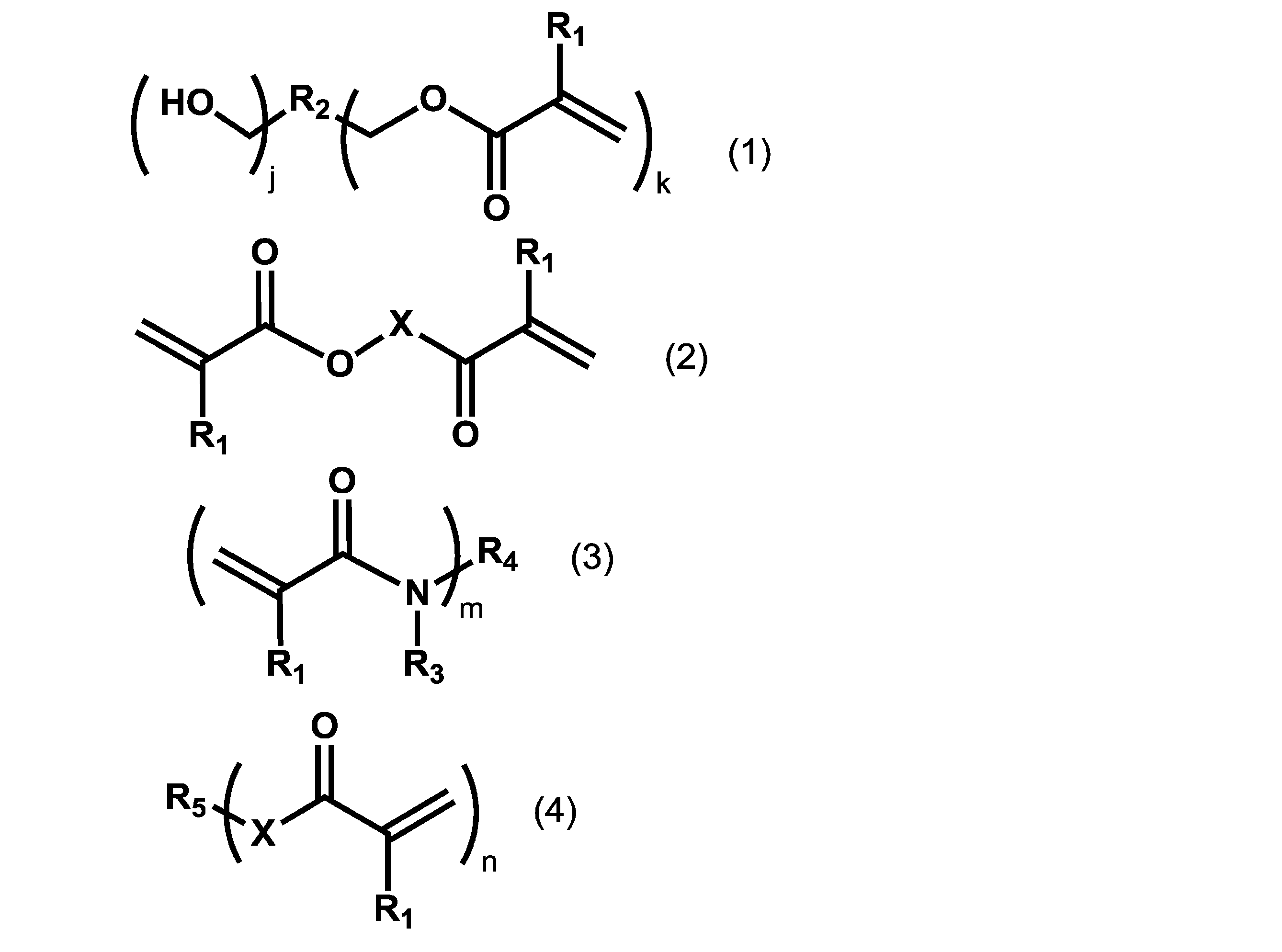
(式中、R1はそれぞれ独立に水素原子又はメチル基を表し、R2は炭素原子数1乃至5の2価又は3価の炭化水素基を表し、jは0又は1を表し、kは2又は3を表し、Xはエチレンオキサイドユニット及び/又はプロピレンオキサイドユニットを有する二価の連結基を表し、R3は水素原子又は炭素原子数1乃至3のアルキル基を表し、mは1又は2を表し、R5はヘテロ原子を少なくとも一つ有してもよい炭素原子数3乃至10の3価、4価、5価又は6価の有機基を表し、nは3乃至6の整数を表し、
mが1を表す場合、R4は、ヒドロキシ基、カルボキシ基、アセチル基、1つ又は2つの水素原子がメチル基で置換されていてもよいアミノ基、スルホ基、及び炭素原子数1乃至4のアルコキシ基からなる群から選択される少なくとも一つの置換基で置換されていてもよい、炭素原子数1乃至12のアルキル基を表し、
mが2を表す場合、R4は、ヒドロキシ基、カルボキシ基、アセチル基、1つ又は2つの水素原子がメチル基で置換されていてもよいアミノ基、スルホ基、及び炭素原子数1乃至4のアルコキシ基からなる群から選択される少なくとも一つの置換基で置換されていてもよい、炭素原子数1乃至12のアルキレン基を表す。)
第2観点として、前記(B)成分及び前記(D)成分は、それぞれ下記式(2a)及び下記式(4a):

(式中、R1はそれぞれ独立に水素原子又はメチル基を表し、R5´は主鎖にエーテル結合を有する炭素原子数3乃至10の3価、4価、5価又は6価の有機基又は炭素原子数3乃至10の3価、4価、5価又は6価の炭化水素基を表し、R6はトリメチレン基又はプロピレン基を表し、p、q、r及びsはそれぞれ独立に0又は1以上の整数を表し、かつ1≦(p+q+r+s)≦30の関係式を満たす。)
で表される1種又は2種の化合物を含む第1観点に記載のインプリント材料に関する。
第3観点として、前記(A)成分、(B)成分、(C)成分及び(D)成分の合計質量に基づいて、該(A)成分の含有割合は1質量%以上40質量%以下である第1観点又は第2観点に記載のインプリント材料に関する。
第4観点として、前記(A)成分、(B)成分、(C)成分及び(D)成分の合計質量に基づいて、該(C)成分の含有割合は1質量%以上40質量%以下である第1観点乃至第3観点のいずれか一に記載のインプリント材料に関する。
第5観点として、更に(F)成分として下記式(5):
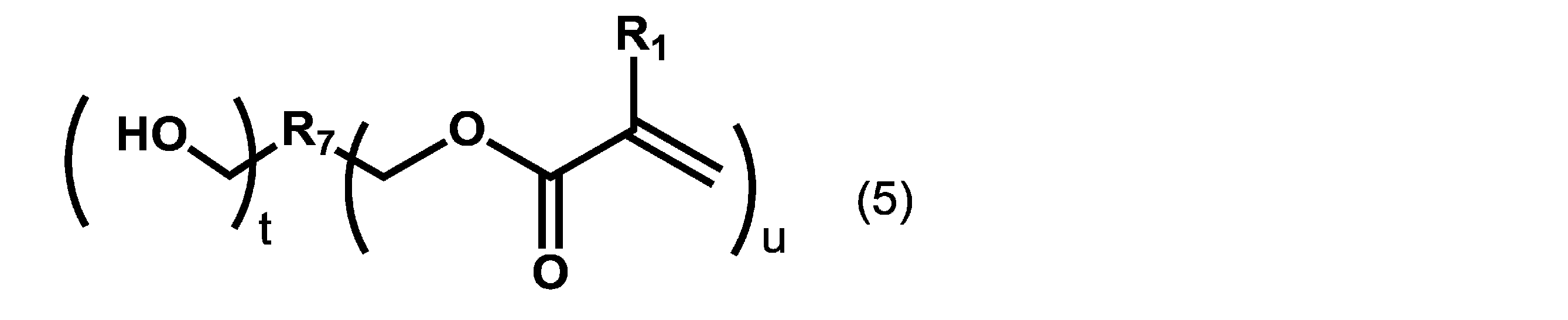
(式中、R1はそれぞれ独立に水素原子又はメチル基を表し、R7は主鎖にエーテル結合を有する炭素原子数1乃至9の4価、5価もしくは6価の有機基又は炭素原子数1乃至9の4価、5価もしくは6価の炭化水素基を表し、tは0又は1を表し、uは3乃至6の整数を表す。)
で表される1種又は2種の化合物を含む第1観点乃至第4観点のいずれか一に記載のインプリント材料に関する。
第6観点として、(G)成分としてシリコーン化合物をさらに含有する第1観点乃至第5観点のいずれか一に記載のインプリント材料に関する。
第7観点として、(H)成分として界面活性剤をさらに含有する第1観点乃至第6観点のいずれか一に記載のインプリント材料に関する。
第8観点として、(I)成分として溶剤をさらに含有する第1観点乃至第7観点のいずれか一に記載のインプリント材料に関する。
第9観点として、第1観点乃至第8観点のいずれか一に記載のインプリント材料を基材に塗布して膜を形成する工程、及び光インプリント装置を用いて、パターンが形成されたモールドを前記膜に接触させ、さらに該膜を前記モールドと圧着させ、続いて該膜を光硬化させ、その後離型することにより前記パターンを該膜に転写する工程、を有するパターンが転写された膜の作製方法に関する。
(A)成分の化合物は、下記式(1)で表される化合物である。

(式中、R1はそれぞれ独立に水素原子又はメチル基を表し、R2は炭素原子数1乃至5の2価又は3価の炭化水素基を表し、jは0又は1を表し、kは2又は3を表す。)
(B)成分の化合物は、下記式(2)で表される化合物である。
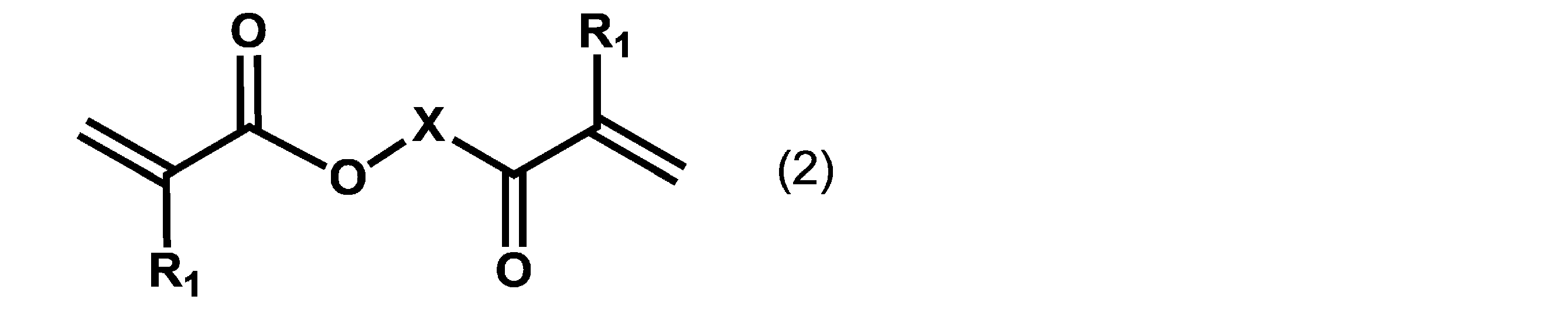
(式中、R1はそれぞれ独立に水素原子又はメチル基を表し、Xはエチレンオキサイドユニット及び/又はプロピレンオキサイドユニットを有する二価の連結基を表す。)
なお、本明細書において、プロピレンオキサイドユニットとは例えば“-CH2CH(CH3)O-”、“-CH(CH3)CH2O-”又は“-CH2CH2CH2O-”を表し、エチレンオキサイドユニットとは例えば“-CH2CH2O-”を表す。
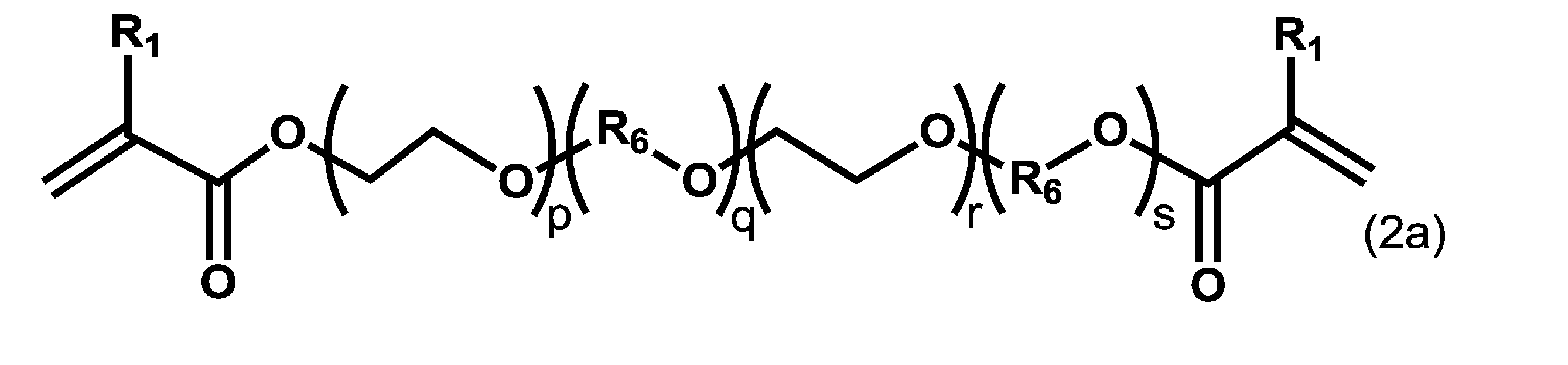
(式中、R1はそれぞれ独立に水素原子又はメチル基を表し、R6はトリメチレン基又はプロピレン基を表し、p、q、r及びsはそれぞれ独立に0以上の整数を表し、かつ1≦(p+q+r+s)≦30の関係式を満たす。)で表される化合物が好ましい。式(2a)で表される化合物を2種用いる場合、一分子内にエチレンオキサイドユニットを1つ以上有する化合物と一分子内にプロピレンオキサイドユニット及びエチレンオキサイドユニットをそれぞれ1つ以上有する化合物との組み合わせ、一分子内にエチレンオキサイドユニットを1つ以上有する化合物と一分子内にプロピレンオキサイドユニットを1つ以上有する化合物との組み合わせ、一分子内にプロピレンオキサイドユニットを1つ以上有する化合物と一分子内にプロピレンオキサイドユニット及びエチレンオキサイドユニットをそれぞれ1つ以上有する化合物との組み合わせが挙げられる。
(C)成分の化合物は、下記式(3)で表される化合物であり、すなわちその構造内に(メタ)アクリルアミド構造を有する化合物である。

(式中、R1は水素原子又はメチル基を表し、R3は水素原子又は炭素原子数1乃至3のアルキル基を表し、mは1又は2を表し、
mが1を表す場合、R4は、ヒドロキシ基、カルボキシ基、アセチル基、1つ又は2つの水素原子がメチル基で置換されていてもよいアミノ基、スルホ基、及び炭素原子数1乃至4のアルコキシ基からなる群から選択される少なくとも一つの置換基で置換されていてもよい炭素原子数1乃至12のアルキル基を表し、
mが2を表す場合、R4は、ヒドロキシ基、カルボキシ基、アセチル基、1つ又は2つの水素原子がメチル基で置換されていてもよいアミノ基、スルホ基、及び炭素原子数1乃至4のアルコキシ基からなる群から選択される少なくとも一つの置換基で置換されていてもよい炭素原子数1乃至12のアルキレン基を表す。)
(D)成分の化合物は、下記式(4)で表される化合物である。
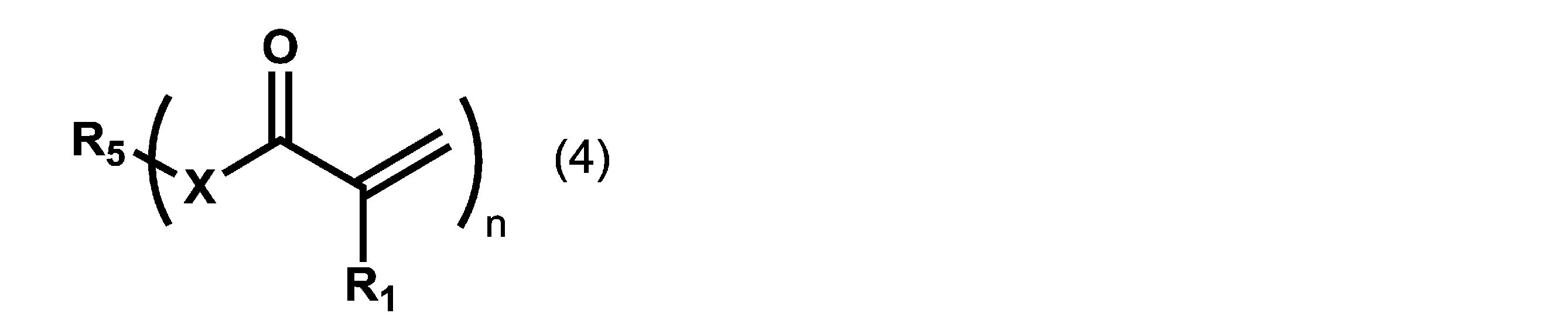
(式中、R1はそれぞれ独立に水素原子又はメチル基を表し、Xはエチレンオキサイドユニット及び/又はプロピレンオキサイドユニットを有する二価の連結基を表し、R5はヘテロ原子を少なくとも一つ有してもよい炭素原子数3乃至10の3価、4価、5価又は6価の有機基を表し、nは3乃至6の整数を表す。)
なお、本明細書においてヘテロ原子は、例えば、酸素原子、窒素原子及び硫黄原子からなる群から選択される。
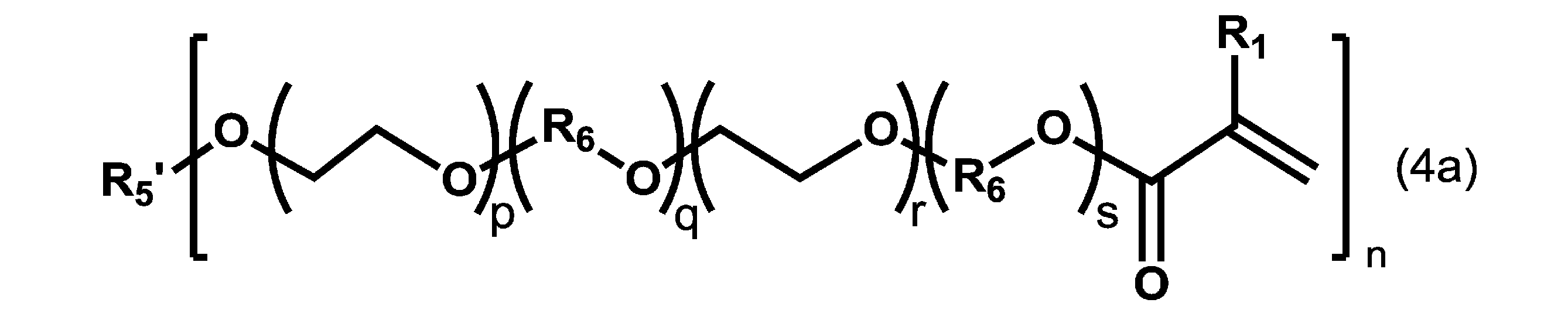
(式中、R1はそれぞれ独立に水素原子又はメチル基を表し、R5´は主鎖にエーテル結合を有する炭素原子数3乃至10の3価、4価、5価又は6価の有機基又は炭素原子数3乃至10の3価、4価、5価又は6価の炭化水素基を表し、R6はトリメチレン基又はプロピレン基を表し、p、q、r及びsはそれぞれ独立に0又は1以上の整数を表し、かつ1≦(p+q+r+s)≦30の関係式を満たす。)
で表される化合物が好ましい。式(4a)で表される化合物を2種用いる場合、一分子内にエチレンオキサイドユニットを1つ以上有する化合物と一分子内にプロピレンオキサイドユニットを1つ以上有する化合物との組み合わせが挙げられる。
(E)成分である光重合開始剤は、光硬化時に使用する光源に吸収をもつものであれば、特に限定されるものではない。例えば、tert-ブチルペルオキシ-iso-ブチレート、2,5-ジメチル-2,5-ビス(ベンゾイルジオキシ)ヘキサン、1,4-ビス[α-(tert-ブチルジオキシ)-iso-プロポキシ]ベンゼン、ジ-tert-ブチルペルオキシド、2,5-ジメチル-2,5-ビス(tert-ブチルジオキシ)ヘキセンヒドロペルオキシド、α-(iso-プロピルフェニル)-iso-プロピルヒドロペルオキシド、tert-ブチルヒドロペルオキシド、1,1-ビス(tert-ブチルジオキシ)-3,3,5-トリメチルシクロヘキサン、ブチル-4,4-ビス(tert-ブチルジオキシ)バレレート、シクロヘキサノンペルオキシド、2,2’,5,5’-テトラ(tert-ブチルペルオキシカルボニル)ベンゾフェノン、3,3’,4,4’-テトラ(tert-ブチルペルオキシカルボニル)ベンゾフェノン、3,3’,4,4’-テトラ(tert-アミルペルオキシカルボニル)ベンゾフェノン、3,3’,4,4’-テトラ(tert-ヘキシルペルオキシカルボニル)ベンゾフェノン、3,3’-ビス(tert-ブチルペルオキシカルボニル)-4,4’-ジカルボキシベンゾフェノン、tert-ブチルペルオキシベンゾエート、ジ-tert-ブチルジペルオキシイソフタレート等の有機過酸化物;9,10-アントラキノン、1-クロロアントラキノン、2-クロロアントラキノン、オクタメチルアントラキノン、1,2-ベンズアントラキノン等のキノン類;ベンゾインメチル、ベンゾインエチルエーテル、α-メチルベンゾイン、α-フェニルベンゾイン等のベンゾイン誘導体;2,2-ジメトキシ-1,2-ジフェニルエタン-1-オン、1-ヒドロキシ-シクロヘキシル-フェニル-ケトン、2-ヒドロキシ-2-メチル-1-フェニル-プロパン-1-オン、1-[4-(2-ヒドロキシエトキシ)-フェニル]-2-ヒドロキシ-2-メチル-1-プロパン-1-オン、2-ヒドロキシ-1-[4-{4-(2-ヒドロキシ-2-メチル-プロピオニル)ベンジル}-フェニル]-2-メチル-プロパン-1-オン、フェニルグリオキシリックアシッドメチルエステル、2-メチル-1-[4-(メチルチオ)フェニル]-2-モルホリノプロパン-1-オン、2-ベンジル-2-ジメチルアミノ-1-(4-モルホリノフェニル)-1-ブタノン、2-ジメチルアミノ-2-(4-メチル-ベンジル)-1-(4-モルホリン-4-イル-フェニル)-ブタン-1-オン等のアルキルフェノン系化合物;ビス(2,4,6-トリメチルベンゾイル)-フェニルホスフィンオキサイド、2,4,6-トリメチルベンゾイル-ジフェニル-ホスフィンオキサイド等のアシルホスフィンオキサイド系化合物;2-(O-ベンゾイルオキシム)-1-[4-(フェニルチオ)フェニル]-1,2-オクタンジオン、1-(O-アセチルオキシム)-1-[9-エチル-6-(2-メチルベンゾイル)-9H-カルバゾール-3-イル]エタノン等のオキシムエステル系化合物が挙げられる。
本発明のインプリント材料は、(F)成分として下記式(5)で表される化合物を1種又は2種含有してもよい。

(式中、R1はそれぞれ独立に水素原子又はメチル基を表し、R7は主鎖にエーテル結合を有する炭素原子数1乃至9の4価、5価又は6価の有機基又は炭素原子数1乃至9の4価、5価又は6価の炭化水素基を表し、tは0又は1を表し、uは3乃至6の整数を表す。)
本発明のインプリント材料は、(G)成分としてシリコーン化合物を含有してもよい。任意成分であるそのシリコーン化合物は、分子内にシリコーン骨格(シロキサン骨格)を有する化合物を表し、特にジメチルシリコーン骨格を有することが好ましい。
本発明のインプリント材料は、(H)成分として界面活性剤を含有してもよい。任意成分であるその界面活性剤は、得られる塗膜の製膜性を調整する役割を果たす。
本発明のインプリント材料は、(I)成分として溶剤を含有してもよい。任意成分であるその溶剤は、前記(A)成分、(B)成分、(C)成分、(D)成分及び(F)成分の粘度調節の役割を果たす。
本発明のインプリント材料は、本発明の効果を損なわない限りにおいて、必要に応じて、エポキシ化合物、光酸発生剤、光増感剤、紫外線吸収剤、酸化防止剤、密着補助剤又は離型性向上剤を含有することができる。
本発明のインプリント材料の調製方法は、特に限定されないが、(A)成分、(B)成分、(C)成分、(D)成分、(E)成分、並びに任意成分である(F)成分、(G)成分、(H)成分及び(I)成分、並びに所望によりその他添加剤を混合し、インプリント材料が均一な状態となっていればよい。また、(A)成分乃至(I)成分並びに所望によりその他添加剤を混合する際の順序は、均一なインプリント材料が得られるなら問題なく、特に限定されない。当該調製方法としては、例えば、(A)成分、(B)成分、(C)成分及び(D)成分を所定の割合で混合し、これに更に(E)成分、並びに任意で(F)成分、(G)成分、(H)成分及び(I)成分を適宜混合し、均一なインプリント材料とする方法も挙げられる。さらに、この調製方法の適当な段階において、必要に応じて、その他の添加剤を更に添加して混合する方法が挙げられる。
本発明のインプリント材料は、基材上に塗布し光硬化させることで所望の被膜を得ることができる。塗布方法としては、公知又は周知の方法、例えば、スピンコート法、ディップ法、フローコート法、インクジェット法、スプレー法、バーコート法、グラビアコート法、スリットコート法、ロールコート法、転写印刷法、刷毛塗り、ブレードコート法、エアーナイフコート法を挙げることができる。
<実施例1>
NKエステル A-TMPT(以下、本明細書では「A-TMPT」と略称する。)(新中村化学工業株式会社製)1g、NKエステル A-200(以下、本明細書では「A-200」と略称する。)(新中村化学工業株式会社製)7.1g、NKエステル A-GLY-9E(以下、本明細書では「A-GLY-9E」と略称する。)(新中村化学工業株式会社製)1g及びN,N’-ジメチルアクリルアミド(以下、本明細書では「DMAA」と略称する。)(KJケミカルズ株式会社製)0.9gを混合し、その混合物にIRGACURE(登録商標)TPO(BASFジャパン株式会社製)(以下、本明細書では「IRGACURE TPO」と略称する。)を0.1g(A-TMPT、A-200、A-GLY-9E、DMAAの総質量に対して1phr)加え、インプリント材料PNI-a1を調製した。
A-TMPTを1.5g、A-200を7.1g、KAYARAD DPEA-12(以下、本明細書では「DPEA-12」と略称する。)(日本化薬株式会社製)0.5g、及びDMAAを0.9g混合し、その混合物にIRGACURE TPOを0.1g(A-TMPT、A-200、DPEA-12、DMAAの総質量に対して1phr)加え、インプリント材料PNI-a2を調製した。
A-TMPTを1g、A-200を7g、NKエステル ATM-35E(以下、本明細書では「ATM-35E」と略称する。)(新中村化学工業株式会社製)1g及びDMAAを1g混合し、その混合物にIRGACURE TPOを0.1g(A-TMPT、A-200、ATM-35E、DMAAの総質量に対して1phr)加え、インプリント材料PNI-a3を調製した。
A-TMPTを0.9g、A-200を7g、ATM-35Eを1g、DMAAを1g及びKAYARAD DPHA(以下、本明細書では「DPHA」と略称する。)(日本化薬株式会社製)0.1gを混合し、その混合物にIRGACURE TPOを0.1g(A-TMPT、A-200、ATM-35E、DMAA、DPHAの総質量に対して1phr)加え、インプリント材料PNI-a4を調製した。
A-TMPTを0.8g、A-200を7g、ATM-35Eを1g、DMAAを1g及びDPHAを0.2g混合し、その混合物にIRGACURE TPOを0.1g(A-TMPT、A-200、ATM-35E、DMAA、DPHAの総質量に対して1phr)加え、インプリント材料PNI-a5を調製した。
A-TMPTを0.8g、A-200を7g、ATM-35Eを1g、DMAAを1g及びDPHAを0.2g混合し、その混合物にBYK-UV3570(ビックケミー・ジャパン株式会社製)0.5g(A-TMPT、A-200、ATM-35E、DMAA、DPHAの総質量に対して5phr)、IRGACURE TPOを0.1g(A-TMPT、A-200、ATM-35E、DMAA、DPHAの総質量に対して1phr)加え、インプリント材料PNI-a6を調製した。
A-TMPTを0.7g、A-200を7g、ATM-35Eを1g、DMAAを1g及びDPHAを0.3g混合し、その混合物にIRGACURE TPOを0.1g(A-TMPT、A-200、ATM-35E、DMAA、DPHAの総質量に対して1phr)加え、インプリント材料PNI-a7を調製した。
A-TMPTを0.6g、A-200を7g、ATM-35Eを1g、DMAAを1g及びDPHAを0.4g混合し、その混合物にIRGACURE TPOを0.1g(A-TMPT、A-200、ATM-35E、DMAA、DPHAの総質量に対して1phr)加え、インプリント材料PNI-a8を調製した。
A-TMPTを0.5g、A-200を7g、ATM-35Eを1g、DMAAを1g及びDPHAを0.5g混合し、その混合物にIRGACURE TPOを0.1g(A-TMPT、A-200、ATM-35E、DMAA、DPHAの総質量に対して1phr)加え、インプリント材料PNI-a9を調製した。
A-TMPTを1g、A-200を7.1g、ATM-35Eを1g及びDMAAを0.9g混合し、その混合物にIRGACURE TPOを0.1g(A-TMPT、A-200、ATM-35E、DMAAの総質量に対して1phr)加え、インプリント材料PNI-a10を調製した。
A-TMPTを0.9g、A-200を7.1g、ATM-35Eを1g、DMAAを0.9g及びDPHAを0.1g混合し、その混合物にIRGACURE TPOを0.1g(A-TMPT、A-200、ATM-35E、DMAA、DPHAの総質量に対して1phr)加え、インプリント材料PNI-a11を調製した。
A-TMPTを0.8g、A-200を7.1g、ATM-35Eを1g、DMAAを0.9g及びDPHAを0.2g混合し、その混合物にIRGACURE TPOを0.1g(A-TMPT、A-200、ATM-35E、DMAA、DPHAの総質量に対して1phr)加え、インプリント材料PNI-a12を調製した。
A-TMPTを0.8g、A-200を7.1g、ATM-35Eを1g、DMAAを0.9g及びDPHAを0.2g混合し、その混合物にBYK-UV3570(ビックケミー・ジャパン株式会社製)0.5g(A-TMPT、A-200、ATM-35E、DMAA、DPHAの総質量に対して5phr)、IRGACURE TPOを0.1g(A-TMPT、A-200、ATM-35E、DMAA、DPHAの総質量に対して1phr)加え、インプリント材料PNI-a13を調製した。
A-TMPTを0.7g、A-200を7.1g、ATM-35Eを1g、DMAAを0.9g及びDPHAを0.3g混合し、その混合物にBYK-UV3570を0.5g(A-TMPT、A-200、ATM-35E、DMAA、DPHAの総質量に対して5phr)、IRGACURE TPOを0.1g(A-TMPT、A-200、ATM-35E、DMAA、DPHAの総質量に対して1phr)加え、インプリント材料PNI-a14を調製した。
A-TMPTを0.6g、A-200を7.1g、ATM-35Eを1g、DMAAを0.9g及びDPHAを0.4g混合し、その混合物にIRGACURE TPOを0.1g(A-TMPT、A-200、ATM-35E、DMAA、DPHAの総質量に対して1phr)加え、インプリント材料PNI-a15を調製した。
A-TMPTを0.5g、A-200を7.1g、ATM-35Eを1g、DMAAを0.9g及びDPHAを0.5g混合し、その混合物にIRGACURE TPOを0.1g(A-TMPT、A-200、ATM-35E、DMAA、DPHAの総質量に対して1phr)加え、インプリント材料PNI-a16を調製した。
A-TMPTを1g、A-200を7g、ATM-35Eを1g、DMAAを0.9g及びDPHAを0.1g混合し、その混合物にIRGACURE TPOを0.1g(A-TMPT、A-200、ATM-35E、DMAA、DPHAの総質量に対して1phr)加え、インプリント材料PNI-a17を調製した。
A-TMPTを1g、A-200を7g、ATM-35Eを1g、DMAAを0.9g及びDPHAを0.1g混合し、その混合物にBYK-UV3570を0.1g(A-TMPT、A-200、ATM-35E、DMAA、DPHAの総質量に対して1phr)、IRGACURE TPOを0.1g(A-TMPT、A-200、ATM-35E、DMAA、DPHAの総質量に対して1phr)加え、インプリント材料PNI-a18を調製した。
A-TMPTを1g、A-200を7g、ATM-35Eを1g、DMAAを0.9g及びDPHAを0.1g混合し、その混合物にBYK-UV3570を0.2g(A-TMPT、A-200、ATM-35E、DMAA、DPHAの総質量に対して2phr)、IRGACURE TPOを0.1g(A-TMPT、A-200、ATM-35E、DMAA、DPHAの総質量に対して1phr)加え、インプリント材料PNI-a19を調製した。
A-TMPTを1g、A-200を7g、ATM-35Eを1g、DMAAを0.9g及びDPHAを0.1g混合し、その混合物にBYK-UV3570を0.3g(A-TMPT、A-200、ATM-35E、DMAA、DPHAの総質量に対して3phr)、IRGACURE TPOを0.1g(A-TMPT、A-200、ATM-35E、DMAA、DPHAの総質量に対して1phr)加え、インプリント材料PNI-a20を調製した。
A-TMPTを1g、A-200を7g、ATM-35Eを1g、DMAAを0.9g及びDPHAを0.1g混合し、その混合物にBYK-UV3570を0.4g(A-TMPT、A-200、ATM-35E、DMAA、DPHAの総質量に対して4phr)、IRGACURE TPOを0.1g(A-TMPT、A-200、ATM-35E、DMAA、DPHAの総質量に対して1phr)加え、インプリント材料PNI-a21を調製した。
A-TMPTを1g、A-200を7g、ATM-35Eを1g、DMAAを0.9g及びDPHAを0.1g混合し、その混合物にBYK-UV3570を0.5g(A-TMPT、A-200、ATM-35E、DMAA、DPHAの総質量に対して5phr)、IRGACURE TPOを0.1g(A-TMPT、A-200、ATM-35E、DMAA、DPHAの総質量に対して1phr)加え、インプリント材料PNI-a22を調製した。
A-TMPTを1g、A-200を7.1g、ATM-35Eを0.9g、DMAAを0.9g及びDPHAを0.1g混合し、その混合物にIRGACURE TPOを0.1g(A-TMPT、A-200、ATM-35E、DMAA、DPHAの総質量に対して1phr)加え、インプリント材料PNI-a23を調製した。
A-TMPTを1g、A-200を7.1g、ATM-35Eを0.9g、DMAAを0.9g及びDPHAを0.1g混合し、その混合物にBYK-UV3570を0.5g(A-TMPT、A-200、ATM-35E、DMAA、DPHAの総質量に対して5phr)、IRGACURE TPOを0.1g(A-TMPT、A-200、ATM-35E、DMAA、DPHAの総質量に対して1phr)加え、インプリント材料PNI-a24を調製した。
A-TMPTを1g、A-200を7.1g、ATM-35Eを0.8g、DMAAを0.9g及びDPHAを0.2g混合し、その混合物にIRGACURE TPOを0.1g(A-TMPT、A-200、ATM-35E、DMAA、DPHAの総質量に対して1phr)加え、インプリント材料PNI-a25を調製した。
A-TMPTを1g、A-200を7.1g、ATM-35Eを0.7g、DMAAを0.9g及びDPHAを0.3g混合し、その混合物にIRGACURE TPOを0.1g(A-TMPT、A-200、ATM-35E、DMAA、DPHAの総質量に対して1phr)加え、インプリント材料PNI-a26を調製した。
A-TMPTを1g、A-200を6.9g、ATM-35Eを1g、DMAAを1g及びDPHAを0.1g混合し、その混合物にIRGACURE TPOを0.1g(A-TMPT、A-200、ATM-35E、DMAA、DPHAの総質量に対して1phr)加え、インプリント材料PNI-a27を調製した。
A-TMPTを1g、A-200を7g、ATM-35Eを0.9g、DMAAを1g及びDPHAを0.1g混合し、その混合物にIRGACURE TPOを0.1g(A-TMPT、A-200、ATM-35E、DMAA、DPHAの総質量に対して1phr)加え、インプリント材料PNI-a28を調製した。
A-TMPTを1g、A-200を7g、ATM-35Eを0.8g、DMAAを1g及びDPHAを0.2g混合し、その混合物にIRGACURE TPOを0.1g(A-TMPT、A-200、ATM-35E、DMAA、DPHAの総質量に対して1phr)加え、インプリント材料PNI-a29を調製した。
A-TMPTを1g、A-200を7g、ATM-35Eを0.7g、DMAAを1g及びDPHAを0.3g混合し、その混合物にIRGACURE TPOを0.1g(A-TMPT、A-200、ATM-35E、DMAA、DPHAの総質量に対して1phr)加え、インプリント材料PNI-a30を調製した。
A-TMPTを1g、A-200を7g、ATM-35Eを1g、DMAAを0.9g及びKAYARAD PET30(以下、本明細書では「PET30」と略称する。)(日本化薬株式会社製)0.1g混合し、その混合物にIRGACURE TPOを0.1g(A-TMPT、A-200、ATM-35E、DMAA、DPHAの総質量に対して1phr)加え、インプリント材料PNI-a31を調製した。
A-TMPTを0.1g、A-200を7g、NKエステル A-GLY-20E(以下、本明細書では「A-GLY-20E」と略称する。)(新中村化学工業株式会社製)を1.9g、DMAAを1g混合し、その混合物にIRGACURE TPOを0.1g(A-TMPT、A-200、A-GLY-20E、DMAAの総質量に対して1phr)加え、インプリント材料PNI-a32を調製した。
A-TMPTを0.1g、A-200を7g、NKエステル A-GLY-20Eを1.9g、DMAAを1g混合し、その混合物にBYK-UV3570を0.5g(A-TMPT、A-200、A-GLY-20E、DMAAの総質量に対して5phr)、IRGACURE TPOを0.1g(A-TMPT、A-200、A-GLY-20E、DMAAの総質量に対して1phr)加え、インプリント材料PNI-a33を調製した。
A-TMPTを0.1g、A-200を6.8g、A-GLY-20Eを2.1g、DMAAを1g混合し、その混合物にIRGACURE TPOを0.1g(A-TMPT、A-200、A-GLY-20E、DMAAの総質量に対して1phr)加え、インプリント材料PNI-a34を調製した。
A-TMPTを0.1g、A-200を6.8g、A-GLY-20Eを2.1g、DMAAを1g混合し、その混合物にBYK-UV3570を0.5g(A-TMPT、A-200、A-GLY-20E、DMAAの総質量に対して5phr)、IRGACURE TPOを0.1g(A-TMPT、A-200、A-GLY-20E、DMAAの総質量に対して1phr)加え、インプリント材料PNI-a35を調製した。
A-TMPTを0.2g、A-200を6.8g、A-GLY-20Eを2g、DMAAを1g混合し、その混合物にIRGACURE TPOを0.1g(A-TMPT、A-200、A-GLY-20E、DMAAの総質量に対して1phr)加え、インプリント材料PNI-a36を調製した。
A-TMPTを0.2g、A-200を6.8g、A-GLY-20Eを2g、DMAAを1g混合し、その混合物にBYK-UV3570を0.5g(A-TMPT、A-200、A-GLY-20E、DMAAの総質量に対して5phr)、IRGACURE TPOを0.1g(A-TMPT、A-200、A-GLY-20E、DMAAの総質量に対して1phr)加え、インプリント材料PNI-a37を調製した。
A-TMPTを0.2g、A-200を6.8g、A-GLY-20Eを2g、DMAAを1g混合し、その混合物にTego(登録商標)Rad 2200N(以下、本明細書では「Tego Rad 2200N」と略称する。)(エボニックジャパン株式会社製)を0.2g(A-TMPT、A-200、A-GLY-20E、DMAAの総質量に対して2phr)、BYK-UV3570を0.1g(A-TMPT、A-200、A-GLY-20E、DMAAの総質量に対して1phr)、IRGACURE TPOを0.1g(A-TMPT、A-200、ATM-35E、DMAAの総質量に対して1phr)加え、インプリント材料PNI-a38を調製した。
A-TMPTを0.2g、A-200を6.8g、A-GLY-20Eを2g、DMAAを1g混合し、その混合物にTego Rad 2200Nを0.1g(A-TMPT、A-200、A-GLY-20E、DMAAの総質量に対して1phr)、BYK-UV3570を0.2g(A-TMPT、A-200、A-GLY-20E、DMAAの総質量に対して2phr)、IRGACURE TPOを0.1g(A-TMPT、A-200、ATM-35E、DMAAの総質量に対して1phr)加え、インプリント材料PNI-a39を調製した。
A-TMPTを0.2g、A-200を6.8g、A-GLY-20Eを2g、DMAAを1g混合し、その混合物にTego Rad 2200Nを0.05g(A-TMPT、A-200、A-GLY-20E、DMAAの総質量に対して0.5phr)、BYK-UV3570を0.25g(A-TMPT、A-200、A-GLY-20E、DMAAの総質量に対して2.5phr)、IRGACURE TPOを0.1g(A-TMPT、A-200、ATM-35E、DMAAの総質量に対して1phr)加え、インプリント材料PNI-a40を調製した。
A-TMPTを0.1g、A-200を6.8g、A-GLY-20Eを2g、DMAAを1g及びDPHAを0.1g混合し、その混合物にIRGACURE TPOを0.1g(A-TMPT、A-200、A-GLY-20E、DMAA、DPHAの総質量に対して1phr)加え、インプリント材料PNI-a41を調製した。
A-TMPTを0.1g、A-200を6.8g、A-GLY-20Eを2g、DMAAを1g及びDPHAを0.1g混合し、その混合物にBYK-UV3570を0.5g(A-TMPT、A-200、A-GLY-20E、DMAA、DPHAの総質量に対して5phr)、IRGACURE TPOを0.1g(A-TMPT、A-200、A-GLY-20E、DMAA、DPHAの総質量に対して1phr)加え、インプリント材料PNI-a42を調製した。
A-TMPTを0.2g、A-200を6.9g、A-GLY-20Eを2g、DMAAを0.9g混合し、その混合物にBYK-UV3570を0.4g(A-TMPT、A-200、A-GLY-20E、DMAAの総質量に対して4phr)、IRGACURE TPOを0.1g(A-TMPT、A-200、A-GLY-20E、DMAAの総質量に対して1phr)加え、インプリント材料PNI-a43を調製した。
A-TMPTを0.2g、A-200を6.9g、A-GLY-20Eを2g、DMAAを0.9g混合し、その混合物にBYK-UV3570を0.5g(A-TMPT、A-200、A-GLY-20E、DMAAの総質量に対して5phr)、IRGACURE TPOを0.1g(A-TMPT、A-200、A-GLY-20E、DMAAの総質量に対して1phr)加え、インプリント材料PNI-a44を調製した。
A-TMPTを0.2g、A-200を6.9g、A-GLY-20Eを2g、DMAAを0.9g混合し、その混合物にBYK-UV3570を0.6g(A-TMPT、A-200、A-GLY-20E、DMAAの総質量に対して6phr)、IRGACURE TPOを0.1g(A-TMPT、A-200、A-GLY-20E、DMAAの総質量に対して1phr)加え、インプリント材料PNI-a45を調製した。
A-TMPTを1g、A-200を7g、ATM-35Eを1g、DMAAを0.9g及びDPHAを0.1g混合し、その混合物にTego(登録商標) Rad 2300(以下、本明細書では「Tego Rad 2300」と略称する。)(エボニックジャパン株式会社製)を0.3g(A-TMPT、A-200、ATM-35E、DMAA、DPHAの総質量に対して3phr)、IRGACURE TPOを0.1g(A-TMPT、A-200、ATM-35E、DMAA、DPHAの総質量に対して1phr)加え、インプリント材料PNI-a46を調製した。
A-TMPTを1g、A-200を7g、ATM-35Eを1g、DMAAを0.9g及びDPHAを0.1g混合し、その混合物にTego Rad 2300を0.4g(A-TMPT、A-200、ATM-35E、DMAA、DPHAの総質量に対して4phr)、IRGACURE TPOを0.1g(A-TMPT、A-200、ATM-35E、DMAA、DPHAの総質量に対して1phr)加え、インプリント材料PNI-a47を調製した。
A-TMPTを1g、A-200を7g、ATM-35Eを1g、DMAAを0.9g及びDPHAを0.1g混合し、その混合物にTego Rad 2300を0.5g(A-TMPT、A-200、ATM-35E、DMAA、DPHAの総質量に対して5phr)、IRGACURE TPOを0.1g(A-TMPT、A-200、ATM-35E、DMAA、DPHAの総質量に対して1phr)加え、インプリント材料PNI-a48を調製した。
A-TMPTを1g、A-200を7g、ATM-35Eを1g、DMAAを0.9g及びDPHAを0.1g混合し、その混合物にTego Rad 2300を0.6g(A-TMPT、A-200、ATM-35E、DMAA、DPHAの総質量に対して6phr)、IRGACURE TPOを0.1g(A-TMPT、A-200、ATM-35E、DMAA、DPHAの総質量に対して1phr)加え、インプリント材料PNI-a49を調製した。
A-TMPTを1.1g、A-200を7g、ATM-35Eを1g、DMAAを0.9g混合し、その混合物にTego Rad 2300を0.3g(A-TMPT、A-200、ATM-35E、DMAAの総質量に対して3phr)、IRGACURE TPOを0.1g(A-TMPT、A-200、ATM-35E、DMAAの総質量に対して1phr)加え、インプリント材料PNI-a50を調製した。
A-TMPTを1g、A-200を7.1g、ATM-35Eを1g、DMAAを0.9g混合し、その混合物にTego Rad 2300を0.3g(A-TMPT、A-200、ATM-35E、DMAAの総質量に対して3phr)、IRGACURE TPOを0.1g(A-TMPT、A-200、ATM-35E、DMAAの総質量に対して1phr)加え、インプリント材料PNI-a51を調製した。
A-TMPTを1.05g、A-200を7g、ATM-35Eを1g、DMAAを0.9g及びDPHAを0.05g混合し、その混合物にTego Rad 2300を0.3g(A-TMPT、A-200、ATM-35E、DMAA、DPHAの総質量に対して3phr)、IRGACURE TPOを0.1g(A-TMPT、A-200、ATM-35E、DMAA、DPHAの総質量に対して1phr)加え、インプリント材料PNI-a52を調製した。
A-TMPTを1g、A-200を7.05g、ATM-35Eを1g、DMAAを0.9g及びDPHAを0.05g混合し、その混合物にTego Rad 2300を0.3g(A-TMPT、A-200、ATM-35E、DMAA、DPHAの総質量に対して3phr)、IRGACURE TPOを0.1g(A-TMPT、A-200、ATM-35E、DMAA、DPHAの総質量に対して1phr)加え、インプリント材料PNI-a53を調製した。
A-TMPTを1g、A-200を7.1g、ATM-35Eを1g、DMAAを0.9g混合し、その混合物にTego Rad 2300を0.1g(A-TMPT、A-200、ATM-35E、DMAAの総質量に対して1phr)、BYK-UV3570を0.2g(A-TMPT、A-200、ATM-35E、DMAAの総質量に対して2phr)、IRGACURE TPOを0.1g(A-TMPT、A-200、ATM-35E、DMAAの総質量に対して1phr)加え、インプリント材料PNI-a54を調製した。
A-TMPTを1g、A-200を7.1g、ATM-35Eを1g、DMAAを0.9g混合し、その混合物にTego Rad 2300を0.2g(A-TMPT、A-200、ATM-35E、DMAAの総質量に対して2phr)、BYK-UV3570を0.1g(A-TMPT、A-200、ATM-35E、DMAAの総質量に対して1phr)、IRGACURE TPOを0.1g(A-TMPT、A-200、ATM-35E、DMAAの総質量に対して1phr)加え、インプリント材料PNI-a55を調製した。
A-TMPTを1g、A-200を7.1g、ATM-35Eを1g、DMAAを0.9g混合し、その混合物にTego Rad 2300を0.01g(A-TMPT、A-200、ATM-35E、DMAAの総質量に対して0.1phr)、BYK-UV3570を0.31g(A-TMPT、A-200、ATM-35E、DMAAの総質量に対して3.1phr)、IRGACURE TPOを0.1g(A-TMPT、A-200、ATM-35E、DMAAの総質量に対して1phr)加え、インプリント材料PNI-a56を調製した。
A-TMPTを1g、A-200を7.1g、ATM-35Eを1g、DMAAを0.9g混合し、その混合物にTego Rad 2300を0.03g(A-TMPT、A-200、ATM-35E、DMAAの総質量に対して0.3phr)、BYK-UV3570を0.28g(A-TMPT、A-200、ATM-35E、DMAAの総質量に対して2.8phr)、IRGACURE TPOを0.1g(A-TMPT、A-200、ATM-35E、DMAAの総質量に対して1phr)加え、インプリント材料PNI-a57を調製した。
A-TMPTを1g、A-200を7.1g、ATM-35Eを1g、DMAAを0.9g混合し、その混合物にTego Rad 2300を0.05g(A-TMPT、A-200、ATM-35E、DMAAの総質量に対して0.5phr)、BYK-UV3570を0.25g(A-TMPT、A-200、ATM-35E、DMAAの総質量に対して2.5phr)、IRGACURE TPOを0.1g(A-TMPT、A-200、ATM-35E、DMAAの総質量に対して1phr)加え、インプリント材料PNI-a58を調製した。
A-TMPTを1g、A-200を7g、ATM-35Eを1g、DMAAを0.9g及びDPHAを0.1g混合し、その混合物にTego Rad 2300を0.01g(A-TMPT、A-200、ATM-35E、DMAA、DPHAの総質量に対して0.1phr)、BYK-UV3570を0.31g(A-TMPT、A-200、ATM-35E、DMAA、DPHAの総質量に対して3.1phr)、IRGACURE TPOを0.1g(A-TMPT、A-200、ATM-35E、DMAA、DPHAの総質量に対して1phr)加え、インプリント材料PNI-a59を調製した。
A-TMPTを1g、A-200を7g、ATM-35Eを1g、DMAAを0.9g及びDPHAを0.1g混合し、その混合物にTego Rad 2300を0.03g(A-TMPT、A-200、ATM-35E、DMAA、DPHAの総質量に対して0.3phr)、BYK-UV3570を0.28g(A-TMPT、A-200、ATM-35E、DMAA、DPHAの総質量に対して2.8phr)、IRGACURE TPOを0.1g(A-TMPT、A-200、ATM-35E、DMAA、DPHAの総質量に対して1phr)加え、インプリント材料PNI-a60を調製した。
A-TMPTを1g、A-200を7g、ATM-35Eを1g、DMAAを0.9g及びDPHAを0.1g混合し、その混合物にTego Rad 2300を0.05g(A-TMPT、A-200、ATM-35E、DMAA、DPHAの総質量に対して0.5phr)、BYK-UV3570を0.25g(A-TMPT、A-200、ATM-35E、DMAA、DPHAの総質量に対して2.5phr)、IRGACURE TPOを0.1g(A-TMPT、A-200、ATM-35E、DMAA、DPHAの総質量に対して1phr)加え、インプリント材料PNI-a61を調製した。
A-TMPTを1g、A-200を7g、ATM-35Eを1g、DMAAを0.9g及びDPHAを0.1g混合し、その混合物にTego Rad 2300を0.1g(A-TMPT、A-200、ATM-35E、DMAA、DPHAの総質量に対して1phr)、BYK-UV3570を0.2g(A-TMPT、A-200、ATM-35E、DMAA、DPHAの総質量に対して2phr)、IRGACURE TPOを0.1g(A-TMPT、A-200、ATM-35E、DMAA、DPHAの総質量に対して1phr)加え、インプリント材料PNI-a62を調製した。
A-TMPTを1g、A-200を7g、ATM-35Eを1g、DMAAを0.9g及びDPHAを0.1g混合し、その混合物にFOMBLIN(登録商標)MT70(以下、本明細書では「MT70」と略称する。)(Solvay社製)を0.125g(A-TMPT、A-200、ATM-35E、DMAA、DPHAの総質量に対して1phr)、IRGACURE TPOを0.1g(A-TMPT、A-200、ATM-35E、DMAA、DPHAの総質量に対して1phr)加え、インプリント材料PNI-a63を調製した。
A-TMPTを1g、A-200を7g、ATM-35Eを1g、DMAAを0.9g及びDPHAを0.1g混合し、その混合物にMT70を0.25g(A-TMPT、A-200、ATM-35E、DMAA、DPHAの総質量に対して2phr)、IRGACURE TPOを0.1g(A-TMPT、A-200、ATM-35E、DMAA、DPHAの総質量に対して1phr)加え、インプリント材料PNI-a64を調製した。
A-TMPTを1g、A-200を7g、ATM-35Eを1g、DMAAを0.9g及びDPHAを0.1g混合し、その混合物にMT70を0.375g(A-TMPT、A-200、ATM-35E、DMAA、DPHAの総質量に対して3phr)、IRGACURE TPOを0.1g(A-TMPT、A-200、ATM-35E、DMAA、DPHAの総質量に対して1phr)加え、インプリント材料PNI-a65を調製した。
エバポレーターを用いてMT70に含まれるメチルエチルケトンを一部留去し、メチルエチルケトンの残分が6.8質量%になるよう調整し、MT70-Aを得た。そして実施例17で得たインプリント材料PNI-a17にMT70-Aを0.2146g(A-TMPT、A-200、ATM-35E、DMAA、DPHAの総質量に対して2phr)加え、インプリント材料PNI-a66を調製した。
A-TMPTを1g、A-200を7.1g、ATM-35Eを1g、DMAAを0.8g及びDPHAを0.1g混合し、その混合物にMT70を0.25g(A-TMPT、A-200、ATM-35E、DMAA、DPHAの総質量に対して2phr)、IRGACURE TPOを0.1g(A-TMPT、A-200、ATM-35E、DMAA、DPHAの総質量に対して1phr)加え、インプリント材料PNI-a67を調製した。
A-TMPTを1g、A-200を7.2g、ATM-35Eを1g、DMAAを0.7g及びDPHAを0.1g混合し、その混合物にMT70を0.25g(A-TMPT、A-200、ATM-35E、DMAA、DPHAの総質量に対して2phr)、IRGACURE TPOを0.1g(A-TMPT、A-200、ATM-35E、DMAA、DPHAの総質量に対して1phr)加え、インプリント材料PNI-a68を調製した。
A-TMPTを1g、A-200を7.3g、ATM-35Eを1g、DMAAを0.6g及びDPHAを0.1g混合し、その混合物にMT70を0.25g(A-TMPT、A-200、ATM-35E、DMAA、DPHAの総質量に対して2phr)、IRGACURE TPOを0.1g(A-TMPT、A-200、ATM-35E、DMAA、DPHAの総質量に対して1phr)加え、インプリント材料PNI-a69を調製した。
A-TMPTを1g、A-200を7.4g、ATM-35Eを1g、DMAAを0.5g及びDPHAを0.1g混合し、その混合物にMT70を0.25g(A-TMPT、A-200、ATM-35E、DMAA、DPHAの総質量に対して2phr)、IRGACURE TPOを0.1g(A-TMPT、A-200、ATM-35E、DMAA、DPHAの総質量に対して1phr)加え、インプリント材料PNI-a70を調製した。
A-TMPTを1g、A-200を7.5g、ATM-35Eを1g、DMAAを0.4g及びDPHAを0.1g混合し、その混合物にMT70を0.25g(A-TMPT、A-200、ATM-35E、DMAA、DPHAの総質量に対して2phr)、IRGACURE TPOを0.1g(A-TMPT、A-200、ATM-35E、DMAA、DPHAの総質量に対して1phr)加え、インプリント材料PNI-a71を調製した。
A-TMPTを1g、A-200を7.6g、ATM-35Eを1g、DMAAを0.3g及びDPHAを0.1g混合し、その混合物にMT70を0.25g(A-TMPT、A-200、ATM-35E、DMAA、DPHAの総質量に対して2phr)、IRGACURE TPOを0.1g(A-TMPT、A-200、ATM-35E、DMAA、DPHAの総質量に対して1phr)加え、インプリント材料PNI-a72を調製した。
A-TMPTを1g、A-200を7.7g、ATM-35Eを1g、DMAAを0.2g及びDPHAを0.1g混合し、その混合物にMT70を0.25g(A-TMPT、A-200、ATM-35E、DMAA、DPHAの総質量に対して2phr)、IRGACURE TPOを0.1g(A-TMPT、A-200、ATM-35E、DMAA、DPHAの総質量に対して1phr)加え、インプリント材料PNI-a73を調製した。
A-TMPTを1g、A-200を7.8g、ATM-35Eを1g、DMAAを0.1g及びDPHAを0.1g混合し、その混合物にMT70を0.25g(A-TMPT、A-200、ATM-35E、DMAA、DPHAの総質量に対して2phr)、IRGACURE TPOを0.1g(A-TMPT、A-200、ATM-35E、DMAA、DPHAの総質量に対して1phr)加え、インプリント材料PNI-a74を調製した。
A-TMPTを10g、IRGACURE TPOを0.1g(A-TMPTに対して1phr)混合し、インプリント材料PNI-b1を調製した。
PET30を10g、IRGACURE TPOを0.1g(A-TMPTに対して1phr)混合し、インプリント材料PNI-b2を調製した。
A-TMPTを9g、DMAAを1g混合し、その混合物にIRGACURE TPOを0.1g(A-TMPT、DMAAの総質量に対して1phr)加え、インプリント材料PNI-b3を調製した。
A-200を6.5g、NK エコノマー A-1000PER(以下、本明細書では「A-1000PER」と略称する。)(新中村化学工業株式会社製)3.5gを混合し、その混合物にIRGACURE TPOを0.1g(A-200、A-1000PERの総質量に対して1phr)加え、インプリント材料PNI-b4を調製した。
A-200を8.7g、DMAAを1.3g混合し、その混合物にIRGACURE TPOを0.1g(A-200、DMAAの総質量に対して1phr)加え、インプリント材料PNI-b5を調製した。
PET30を3.0g、A-200を6g、DMAAを1g混合し、その混合物にBYK-UV3570を0.5g(PET30、A-200、DMAAの総質量に対して5phr)、IRGACURE TPOを0.1g(PET30、A-200、DMAAの総質量に対して1phr)加え、インプリント材料PNI-b6を調製した。
PET30を3.0g、A-200を6g、DMAAを1g混合し、その混合物にIRGACURE TPOを0.1g(PET30、A-200、DMAAの総質量に対して1phr)加え、インプリント材料PNI-b7を調製した。
ニッケル製のピッチ250nm、高さ250nmのモスアイパターンモールド(株式会社イノックス製)及びシリコンウエハを、オプツール(登録商標)DSX(ダイキン工業株式会社製)をノベック(登録商標)HFE-7100(ハイドロフルオロエーテル、住友スリーエム株式会社)(以下、本明細書では「ノベックHFE-7100」と略称する。)で0.1質量%に希釈した溶液へ浸漬し、温度が90℃、湿度が90RH%の高温高湿装置を用いて1時間処理し、ノベックHFE-7100でリンス後、エアーで乾燥させた。
実施例1乃至実施例74及び比較例1乃至比較例7で得られた各インプリント材料を、厚さ60μmのトリアセチルセルロースフィルム(富士フイルム株式会社製 フジタック(登録商標)を使用)(以下、本明細書では「TACフィルム」と略称する。)上にバーコーター(全自動フィルムアプリケーター KT-AB3120 コーテック株式会社製)を用いて塗布し、そのTACフィルム上の塗膜を前述の離型処理を施したモスアイパターンモールドへローラー圧着させた。続いて該塗膜に対し、TACフィルム側から無電極均一照射装置(QRE-4016A、株式会社オーク製作所製)にて、256mJ/cm2の露光を施し、光硬化を行った後にそのTACフィルムを前記モスアイパターンモールドから剥離し、そのモスアイパターンモールドの凹凸形状が転写された硬化被膜を得た。
得られた硬化被膜について、TACフィルムとの密着性試験を行った。密着性試験はJIS K5400に従い、以下の手順にて行った。
まず、前記硬化被膜を、カッターを用いてTACフィルムに達する碁盤目状の切り傷を1mm間隔にて100マス付けた。約50mmの長さのセロハン粘着テープを碁盤目の上に粘着し、膜面に対して90°の角度で瞬間的に引き剥がした。テープ剥離後のマス目を観察し、100マスに対して剥離しなかったマス目数をxとし、密着性をx/100として評価した。本密着性試験を3回繰り返し、各評価の平均値を算出した。
得られた硬化被膜について、スチールウール擦傷試験を行った。試験機は大栄精機(有)製を使用し、#0000のスチールウールを使用した。単位面積当たりの荷重は81.5g/cm2とし、上記スチールウールを10往復させ、擦傷後の傷本数を確認した。本擦傷試験を3回繰り返し、擦傷後の傷本数の平均値を算出し、以下のように評価した。
0~1本:A
2~5本:B
6~10本:C
11本以上:D
得られた硬化被膜の凹凸形状が転写された面の裏面を黒色のアクリル板へ貼り付け、凹凸形状が転写された面をベンコットM-1(旭化成せんい株式会社製)で4kgの荷重をかけて一方向へ擦った。その後、硬化被膜の凹凸形状側から蛍光灯を照射し、その硬化被膜に対し斜め30°から目視でヘイズの有無を確認した。本明細書においてヘイズとは、上記凹凸形状において、凸部が倒壊した箇所にて起こる光の散乱を表す。
得られた結果を表1乃至表4に示す。
ニッケル製のピッチ250nm、高さ300nmのモスアイパターンモールド(株式会社イノックス製)に前述の方法で離型処理を行い、実施例63乃至実施例74で得られた各インプリント材料を前述の通り光インプリントをして得られた硬化被膜について、パターンの剥がれ及びパターンの割れの有無を、工業用顕微鏡 ECLIPSE L150(株式会社ニコン製)を用いて観察した。得られた結果を表5に示す。


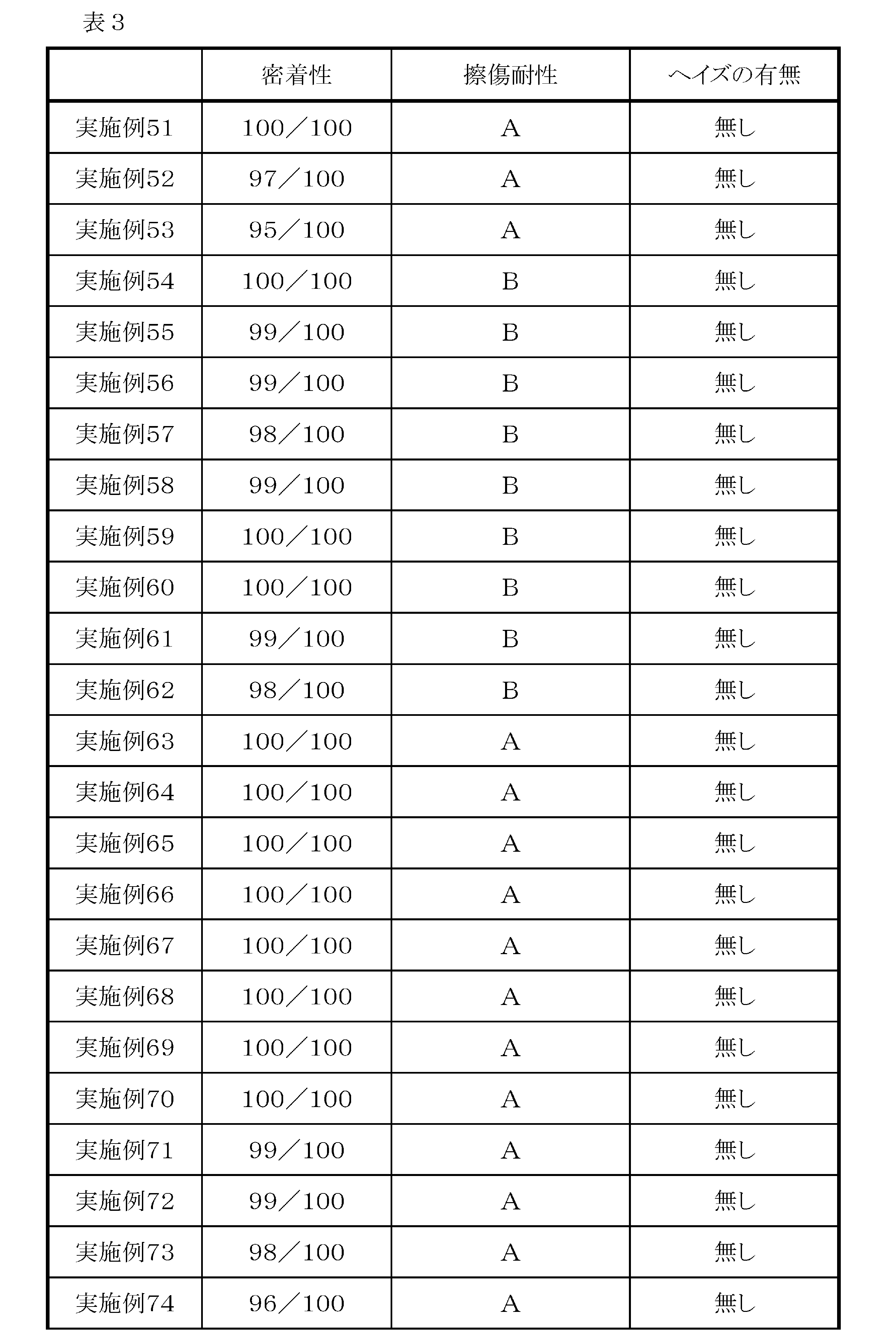
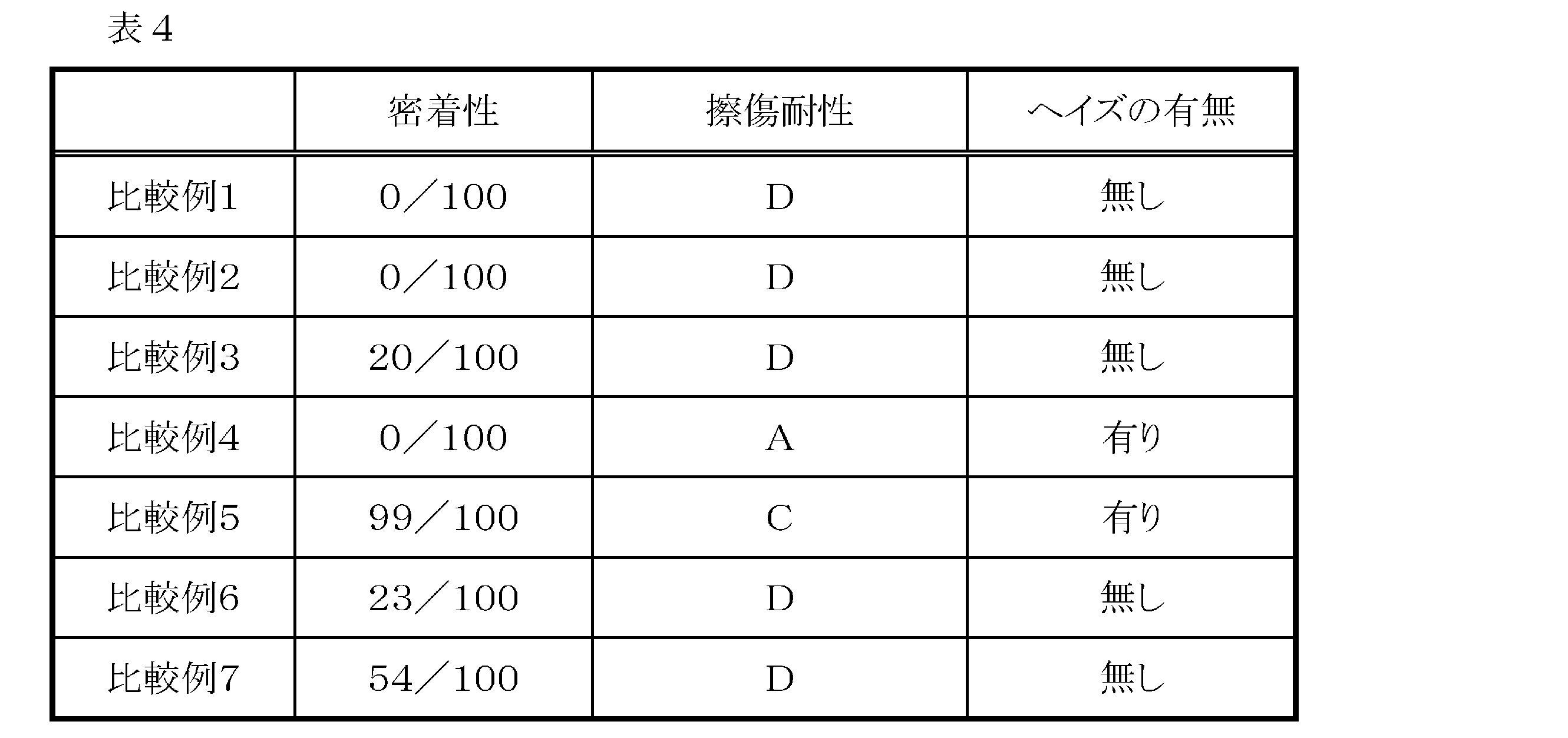
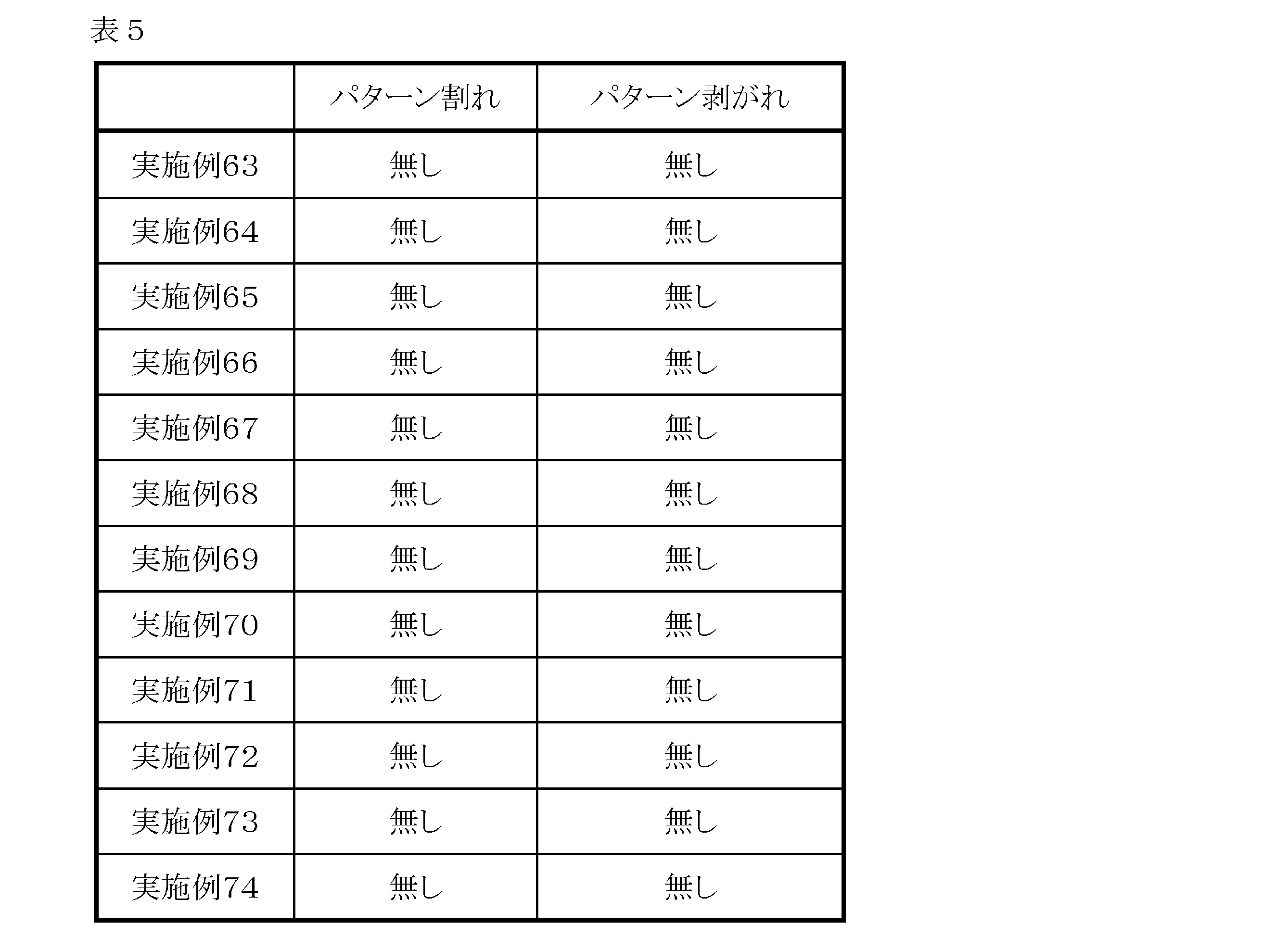
Claims (9)
- 下記(A)成分、(B)成分、(C)成分、(D)成分及び(E)成分を含有するインプリント材料。
(A)下記式(1)で表される化合物
(B)下記式(2)で表される化合物
(C)下記式(3)で表される化合物
(D)下記式(4)で表される化合物
(E)光重合開始剤
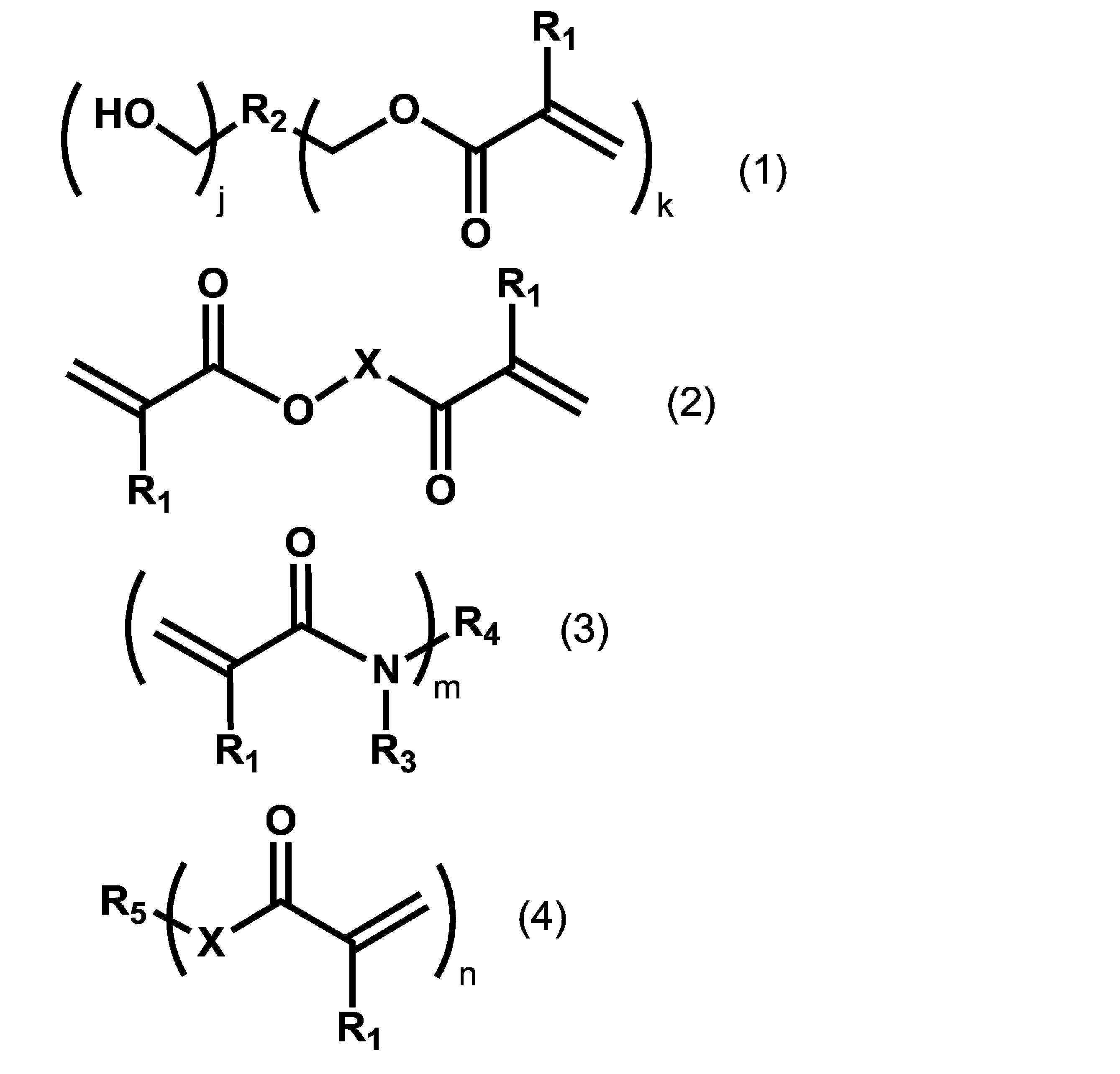
(式中、R1はそれぞれ独立に水素原子又はメチル基を表し、R2は炭素原子数1乃至5の2価又は3価の炭化水素基を表し、jは0又は1を表し、kは2又は3を表し、Xはエチレンオキサイドユニット及び/又はプロピレンオキサイドユニットを有する二価の連結基を表し、R3は水素原子又は炭素原子数1乃至3のアルキル基を表し、mは1又は2を表し、R5はヘテロ原子を少なくとも一つ有してもよい炭素原子数3乃至10の3価、4価、5価又は6価の有機基を表し、nは3乃至6の整数を表し、
mが1を表す場合、R4は、ヒドロキシ基、カルボキシ基、アセチル基、1つ又は2つの水素原子がメチル基で置換されていてもよいアミノ基、スルホ基、及び炭素原子数1乃至4のアルコキシ基からなる群から選択される少なくとも一つの置換基で置換されていてもよい、炭素原子数1乃至12のアルキル基を表し、
mが2を表す場合、R4は、ヒドロキシ基、カルボキシ基、アセチル基、1つ又は2つの水素原子がメチル基で置換されていてもよいアミノ基、スルホ基、及び炭素原子数1乃至4のアルコキシ基からなる群から選択される少なくとも一つの置換基で置換されていてもよい、炭素原子数1乃至12のアルキレン基を表す。) - 前記(B)成分及び前記(D)成分は、それぞれ下記式(2a)及び下記式(4a):
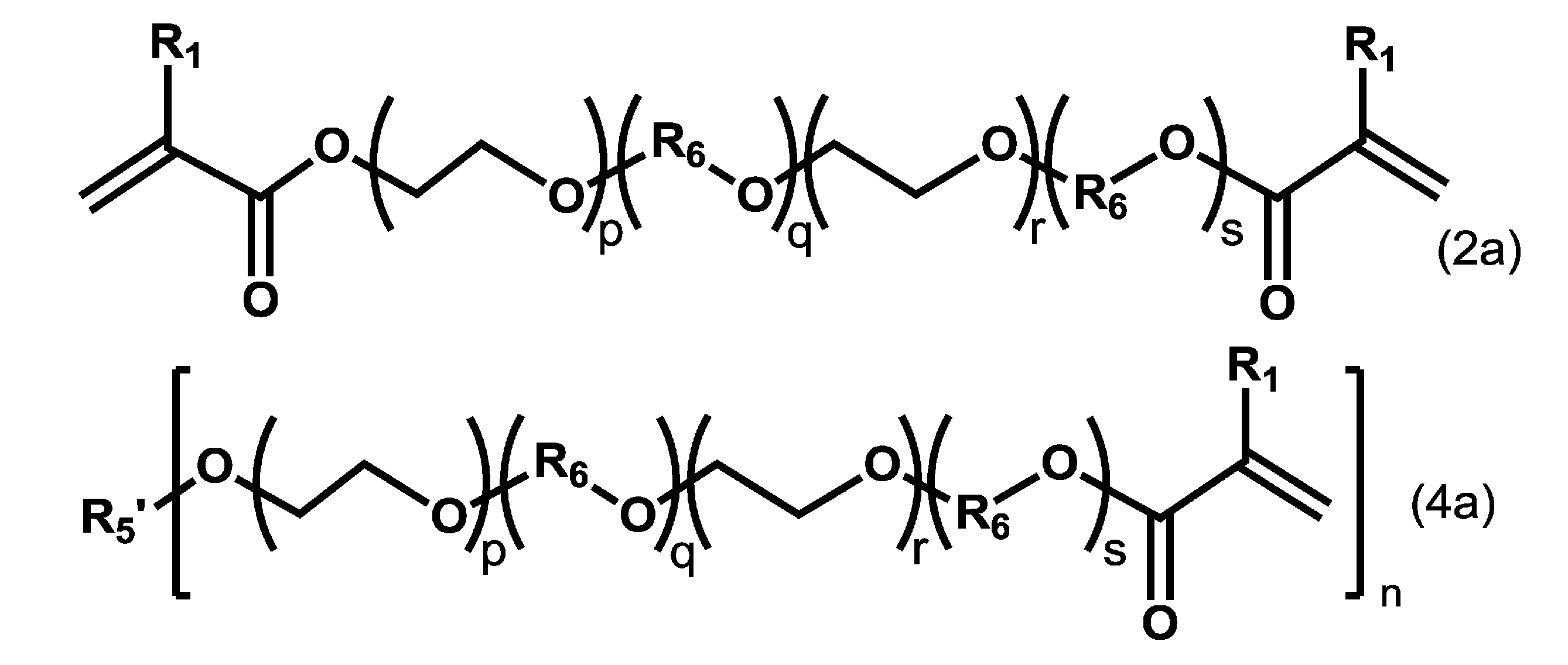
(式中、R1はそれぞれ独立に水素原子又はメチル基を表し、R5´は主鎖にエーテル結合を有する炭素原子数3乃至10の3価、4価、5価又は6価の有機基又は炭素原子数3乃至10の3価、4価、5価又は6価の炭化水素基を表し、R6はトリメチレン基又はプロピレン基を表し、p、q、r及びsはそれぞれ独立に0又は1以上の整数を表し、かつ1≦(p+q+r+s)≦30の関係式を満たす。)
で表される1種又は2種の化合物を含む請求項1に記載のインプリント材料。 - 前記(A)成分、(B)成分、(C)成分及び(D)成分の合計質量に基づいて、該(A)成分の含有割合は1質量%以上40質量%以下である請求項1又は請求項2に記載のインプリント材料。
- 前記(A)成分、(B)成分、(C)成分及び(D)成分の合計質量に基づいて、該(C)成分の含有割合は1質量%以上40質量%以下である請求項1又は請求項3に記載のインプリント材料。
- 更に(F)成分として下記式(5):

(式中、R1はそれぞれ独立に水素原子又はメチル基を表し、R7は主鎖にエーテル結合を有する炭素原子数1乃至9の4価、5価もしくは6価の有機基又は炭素原子数1乃至9の4価、5価もしくは6価の炭化水素基を表し、tは0又は1を表し、uは3乃至6の整数を表す。)
で表される1種又は2種の化合物を含む請求項1乃至請求項4のいずれか一項に記載のインプリント材料。 - (G)成分としてシリコーン化合物をさらに含有する請求項1乃至請求項5のいずれか一項に記載のインプリント材料。
- (H)成分として界面活性剤をさらに含有する請求項1乃至請求項6のいずれか一項に記載のインプリント材料。
- (I)成分として溶剤をさらに含有する請求項1乃至請求項7のいずれか一項に記載のインプリント材料。
- 請求項1乃至請求項8のいずれか一項に記載のインプリント材料を基材に塗布して膜を形成する工程、及び
光インプリント装置を用いて、パターンが形成されたモールドを前記膜に接触させ、さらに該膜を前記モールドと圧着させ、続いて該膜を光硬化させ、その後離型することにより前記パターンを該膜に転写する工程、を有する
パターンが転写された膜の作製方法。
Priority Applications (4)
| Application Number | Priority Date | Filing Date | Title |
|---|---|---|---|
| US16/064,674 US20180371136A1 (en) | 2015-12-22 | 2016-12-16 | Imprint material |
| CN201680074713.XA CN108541333A (zh) | 2015-12-22 | 2016-12-16 | 压印材料 |
| KR1020187016415A KR20180096614A (ko) | 2015-12-22 | 2016-12-16 | 임프린트재료 |
| JP2017558096A JPWO2017110697A1 (ja) | 2015-12-22 | 2016-12-16 | インプリント材料 |
Applications Claiming Priority (4)
| Application Number | Priority Date | Filing Date | Title |
|---|---|---|---|
| JP2015250427 | 2015-12-22 | ||
| JP2015-250427 | 2015-12-22 | ||
| JP2016029832 | 2016-02-19 | ||
| JP2016-029832 | 2016-02-19 |
Publications (1)
| Publication Number | Publication Date |
|---|---|
| WO2017110697A1 true WO2017110697A1 (ja) | 2017-06-29 |
Family
ID=59090294
Family Applications (1)
| Application Number | Title | Priority Date | Filing Date |
|---|---|---|---|
| PCT/JP2016/087665 Ceased WO2017110697A1 (ja) | 2015-12-22 | 2016-12-16 | インプリント材料 |
Country Status (6)
| Country | Link |
|---|---|
| US (1) | US20180371136A1 (ja) |
| JP (1) | JPWO2017110697A1 (ja) |
| KR (1) | KR20180096614A (ja) |
| CN (1) | CN108541333A (ja) |
| TW (1) | TW201736406A (ja) |
| WO (1) | WO2017110697A1 (ja) |
Cited By (1)
| Publication number | Priority date | Publication date | Assignee | Title |
|---|---|---|---|---|
| US20190276577A1 (en) * | 2018-03-07 | 2019-09-12 | Sharp Kabushiki Kaisha | Synthetic polymer film and plastic product which includes synthetic polymer film |
Families Citing this family (1)
| Publication number | Priority date | Publication date | Assignee | Title |
|---|---|---|---|---|
| WO2020194438A1 (ja) * | 2019-03-25 | 2020-10-01 | 日清紡ホールディングス株式会社 | 電解液用添加剤 |
Citations (8)
| Publication number | Priority date | Publication date | Assignee | Title |
|---|---|---|---|---|
| JP2008202022A (ja) * | 2007-01-23 | 2008-09-04 | Fujifilm Corp | 光ナノインプリントリソグラフィ用硬化性組成物およびそれを用いたパターン形成方法 |
| JP2009208410A (ja) * | 2008-03-05 | 2009-09-17 | Toyo Gosei Kogyo Kk | モールドの製造方法 |
| JP2012033517A (ja) * | 2010-06-29 | 2012-02-16 | Fujifilm Corp | 光インプリント用硬化性組成物およびそれを用いた硬化物の製造方法 |
| WO2013005769A1 (ja) * | 2011-07-05 | 2013-01-10 | 三菱レイヨン株式会社 | 微細凹凸構造を表面に有する物品、およびこれを備えた映像表示装置 |
| WO2013172448A1 (ja) * | 2012-05-18 | 2013-11-21 | 三菱レイヨン株式会社 | フィルムとその製造方法、板状物、画像表示装置、太陽電池 |
| JP2014040046A (ja) * | 2012-08-22 | 2014-03-06 | Asahi Glass Co Ltd | 微細パターンを表面に有する成形体および該成形体の製造方法 |
| WO2014065136A1 (ja) * | 2012-10-22 | 2014-05-01 | 三菱レイヨン株式会社 | 積層構造体およびその製造方法と、物品 |
| WO2017002506A1 (ja) * | 2015-06-29 | 2017-01-05 | 日産化学工業株式会社 | インプリント材料 |
Family Cites Families (4)
| Publication number | Priority date | Publication date | Assignee | Title |
|---|---|---|---|---|
| JP2009215179A (ja) * | 2008-03-07 | 2009-09-24 | Fujifilm Corp | (メタ)アクリレート化合物、これを用いた硬化性組成物、光ナノインプリント用組成物、並びにこれらの硬化性組成物の硬化物およびその製造方法 |
| JP2012099638A (ja) * | 2010-11-02 | 2012-05-24 | Fujifilm Corp | インプリント用硬化性組成物 |
| KR101500897B1 (ko) * | 2011-01-12 | 2015-03-12 | 미쯔비시 레이온 가부시끼가이샤 | 활성 에너지선 경화성 수지 조성물, 미세 요철 구조체 및 미세 요철 구조체의 제조 방법 |
| JP6748399B2 (ja) * | 2012-11-30 | 2020-09-02 | キヤノン株式会社 | インプリント方法およびインプリント用硬化性組成物 |
-
2016
- 2016-12-16 CN CN201680074713.XA patent/CN108541333A/zh not_active Withdrawn
- 2016-12-16 WO PCT/JP2016/087665 patent/WO2017110697A1/ja not_active Ceased
- 2016-12-16 KR KR1020187016415A patent/KR20180096614A/ko not_active Withdrawn
- 2016-12-16 US US16/064,674 patent/US20180371136A1/en not_active Abandoned
- 2016-12-16 JP JP2017558096A patent/JPWO2017110697A1/ja active Pending
- 2016-12-22 TW TW105142750A patent/TW201736406A/zh unknown
Patent Citations (8)
| Publication number | Priority date | Publication date | Assignee | Title |
|---|---|---|---|---|
| JP2008202022A (ja) * | 2007-01-23 | 2008-09-04 | Fujifilm Corp | 光ナノインプリントリソグラフィ用硬化性組成物およびそれを用いたパターン形成方法 |
| JP2009208410A (ja) * | 2008-03-05 | 2009-09-17 | Toyo Gosei Kogyo Kk | モールドの製造方法 |
| JP2012033517A (ja) * | 2010-06-29 | 2012-02-16 | Fujifilm Corp | 光インプリント用硬化性組成物およびそれを用いた硬化物の製造方法 |
| WO2013005769A1 (ja) * | 2011-07-05 | 2013-01-10 | 三菱レイヨン株式会社 | 微細凹凸構造を表面に有する物品、およびこれを備えた映像表示装置 |
| WO2013172448A1 (ja) * | 2012-05-18 | 2013-11-21 | 三菱レイヨン株式会社 | フィルムとその製造方法、板状物、画像表示装置、太陽電池 |
| JP2014040046A (ja) * | 2012-08-22 | 2014-03-06 | Asahi Glass Co Ltd | 微細パターンを表面に有する成形体および該成形体の製造方法 |
| WO2014065136A1 (ja) * | 2012-10-22 | 2014-05-01 | 三菱レイヨン株式会社 | 積層構造体およびその製造方法と、物品 |
| WO2017002506A1 (ja) * | 2015-06-29 | 2017-01-05 | 日産化学工業株式会社 | インプリント材料 |
Cited By (1)
| Publication number | Priority date | Publication date | Assignee | Title |
|---|---|---|---|---|
| US20190276577A1 (en) * | 2018-03-07 | 2019-09-12 | Sharp Kabushiki Kaisha | Synthetic polymer film and plastic product which includes synthetic polymer film |
Also Published As
| Publication number | Publication date |
|---|---|
| US20180371136A1 (en) | 2018-12-27 |
| JPWO2017110697A1 (ja) | 2018-10-11 |
| CN108541333A (zh) | 2018-09-14 |
| KR20180096614A (ko) | 2018-08-29 |
| TW201736406A (zh) | 2017-10-16 |
Similar Documents
| Publication | Publication Date | Title |
|---|---|---|
| JP6238026B2 (ja) | インプリント材料 | |
| KR102121762B1 (ko) | 방오성을 갖는 요철형상의 표면을 갖는 구조체 및 그 제조방법 | |
| JP6319596B2 (ja) | 高耐擦傷性インプリント材料 | |
| JP5263560B2 (ja) | 高硬度インプリント材料 | |
| JP6429031B2 (ja) | シルセスキオキサン化合物及び変性シリコーン化合物を含むインプリント材料 | |
| KR20120034105A (ko) | 저유전율 임프린트 재료 | |
| JP6338061B2 (ja) | 低離型力性を有するインプリント材料 | |
| WO2017110697A1 (ja) | インプリント材料 | |
| WO2017002506A1 (ja) | インプリント材料 | |
| JP6508488B2 (ja) | インプリント材料 |
Legal Events
| Date | Code | Title | Description |
|---|---|---|---|
| 121 | Ep: the epo has been informed by wipo that ep was designated in this application |
Ref document number: 16878586 Country of ref document: EP Kind code of ref document: A1 |
|
| ENP | Entry into the national phase |
Ref document number: 2017558096 Country of ref document: JP Kind code of ref document: A |
|
| ENP | Entry into the national phase |
Ref document number: 20187016415 Country of ref document: KR Kind code of ref document: A |
|
| NENP | Non-entry into the national phase |
Ref country code: DE |
|
| 122 | Ep: pct application non-entry in european phase |
Ref document number: 16878586 Country of ref document: EP Kind code of ref document: A1 |