WO2017030077A1 - アルミニウム顔料、アルミニウム顔料の製造方法、アルミニウム顔料を含む塗料組成物、塗膜、当該塗膜を有する物品、インキ組成物、及び印刷物 - Google Patents
アルミニウム顔料、アルミニウム顔料の製造方法、アルミニウム顔料を含む塗料組成物、塗膜、当該塗膜を有する物品、インキ組成物、及び印刷物 Download PDFInfo
- Publication number
- WO2017030077A1 WO2017030077A1 PCT/JP2016/073660 JP2016073660W WO2017030077A1 WO 2017030077 A1 WO2017030077 A1 WO 2017030077A1 JP 2016073660 W JP2016073660 W JP 2016073660W WO 2017030077 A1 WO2017030077 A1 WO 2017030077A1
- Authority
- WO
- WIPO (PCT)
- Prior art keywords
- aluminum pigment
- particles
- aluminum
- grinding
- coating film
- Prior art date
- Legal status (The legal status is an assumption and is not a legal conclusion. Google has not performed a legal analysis and makes no representation as to the accuracy of the status listed.)
- Ceased
Links
Images

Classifications
-
- C—CHEMISTRY; METALLURGY
- C09—DYES; PAINTS; POLISHES; NATURAL RESINS; ADHESIVES; COMPOSITIONS NOT OTHERWISE PROVIDED FOR; APPLICATIONS OF MATERIALS NOT OTHERWISE PROVIDED FOR
- C09C—TREATMENT OF INORGANIC MATERIALS, OTHER THAN FIBROUS FILLERS, TO ENHANCE THEIR PIGMENTING OR FILLING PROPERTIES ; PREPARATION OF CARBON BLACK ; PREPARATION OF INORGANIC MATERIALS WHICH ARE NO SINGLE CHEMICAL COMPOUNDS AND WHICH ARE MAINLY USED AS PIGMENTS OR FILLERS
- C09C1/00—Treatment of specific inorganic materials other than fibrous fillers; Preparation of carbon black
- C09C1/62—Metallic pigments or fillers
- C09C1/64—Aluminium
-
- B—PERFORMING OPERATIONS; TRANSPORTING
- B22—CASTING; POWDER METALLURGY
- B22F—WORKING METALLIC POWDER; MANUFACTURE OF ARTICLES FROM METALLIC POWDER; MAKING METALLIC POWDER; APPARATUS OR DEVICES SPECIALLY ADAPTED FOR METALLIC POWDER
- B22F1/00—Metallic powder; Treatment of metallic powder, e.g. to facilitate working or to improve properties
- B22F1/05—Metallic powder characterised by the size or surface area of the particles
-
- B—PERFORMING OPERATIONS; TRANSPORTING
- B22—CASTING; POWDER METALLURGY
- B22F—WORKING METALLIC POWDER; MANUFACTURE OF ARTICLES FROM METALLIC POWDER; MAKING METALLIC POWDER; APPARATUS OR DEVICES SPECIALLY ADAPTED FOR METALLIC POWDER
- B22F9/00—Making metallic powder or suspensions thereof
- B22F9/02—Making metallic powder or suspensions thereof using physical processes
- B22F9/04—Making metallic powder or suspensions thereof using physical processes starting from solid material, e.g. by crushing, grinding or milling
-
- C—CHEMISTRY; METALLURGY
- C09—DYES; PAINTS; POLISHES; NATURAL RESINS; ADHESIVES; COMPOSITIONS NOT OTHERWISE PROVIDED FOR; APPLICATIONS OF MATERIALS NOT OTHERWISE PROVIDED FOR
- C09C—TREATMENT OF INORGANIC MATERIALS, OTHER THAN FIBROUS FILLERS, TO ENHANCE THEIR PIGMENTING OR FILLING PROPERTIES ; PREPARATION OF CARBON BLACK ; PREPARATION OF INORGANIC MATERIALS WHICH ARE NO SINGLE CHEMICAL COMPOUNDS AND WHICH ARE MAINLY USED AS PIGMENTS OR FILLERS
- C09C3/00—Treatment in general of inorganic materials, other than fibrous fillers, to enhance their pigmenting or filling properties
- C09C3/04—Physical treatment, e.g. grinding, treatment with ultrasonic vibrations
- C09C3/041—Grinding
-
- C—CHEMISTRY; METALLURGY
- C09—DYES; PAINTS; POLISHES; NATURAL RESINS; ADHESIVES; COMPOSITIONS NOT OTHERWISE PROVIDED FOR; APPLICATIONS OF MATERIALS NOT OTHERWISE PROVIDED FOR
- C09D—COATING COMPOSITIONS, e.g. PAINTS, VARNISHES OR LACQUERS; FILLING PASTES; CHEMICAL PAINT OR INK REMOVERS; INKS; CORRECTING FLUIDS; WOODSTAINS; PASTES OR SOLIDS FOR COLOURING OR PRINTING; USE OF MATERIALS THEREFOR
- C09D11/00—Inks
- C09D11/02—Printing inks
- C09D11/03—Printing inks characterised by features other than the chemical nature of the binder
- C09D11/037—Printing inks characterised by features other than the chemical nature of the binder characterised by the pigment
-
- C—CHEMISTRY; METALLURGY
- C09—DYES; PAINTS; POLISHES; NATURAL RESINS; ADHESIVES; COMPOSITIONS NOT OTHERWISE PROVIDED FOR; APPLICATIONS OF MATERIALS NOT OTHERWISE PROVIDED FOR
- C09D—COATING COMPOSITIONS, e.g. PAINTS, VARNISHES OR LACQUERS; FILLING PASTES; CHEMICAL PAINT OR INK REMOVERS; INKS; CORRECTING FLUIDS; WOODSTAINS; PASTES OR SOLIDS FOR COLOURING OR PRINTING; USE OF MATERIALS THEREFOR
- C09D11/00—Inks
- C09D11/30—Inkjet printing inks
- C09D11/32—Inkjet printing inks characterised by colouring agents
- C09D11/322—Pigment inks
-
- C—CHEMISTRY; METALLURGY
- C09—DYES; PAINTS; POLISHES; NATURAL RESINS; ADHESIVES; COMPOSITIONS NOT OTHERWISE PROVIDED FOR; APPLICATIONS OF MATERIALS NOT OTHERWISE PROVIDED FOR
- C09D—COATING COMPOSITIONS, e.g. PAINTS, VARNISHES OR LACQUERS; FILLING PASTES; CHEMICAL PAINT OR INK REMOVERS; INKS; CORRECTING FLUIDS; WOODSTAINS; PASTES OR SOLIDS FOR COLOURING OR PRINTING; USE OF MATERIALS THEREFOR
- C09D201/00—Coating compositions based on unspecified macromolecular compounds
-
- C—CHEMISTRY; METALLURGY
- C09—DYES; PAINTS; POLISHES; NATURAL RESINS; ADHESIVES; COMPOSITIONS NOT OTHERWISE PROVIDED FOR; APPLICATIONS OF MATERIALS NOT OTHERWISE PROVIDED FOR
- C09D—COATING COMPOSITIONS, e.g. PAINTS, VARNISHES OR LACQUERS; FILLING PASTES; CHEMICAL PAINT OR INK REMOVERS; INKS; CORRECTING FLUIDS; WOODSTAINS; PASTES OR SOLIDS FOR COLOURING OR PRINTING; USE OF MATERIALS THEREFOR
- C09D7/00—Features of coating compositions, not provided for in group C09D5/00; Processes for incorporating ingredients in coating compositions
- C09D7/40—Additives
- C09D7/60—Additives non-macromolecular
- C09D7/61—Additives non-macromolecular inorganic
-
- C—CHEMISTRY; METALLURGY
- C09—DYES; PAINTS; POLISHES; NATURAL RESINS; ADHESIVES; COMPOSITIONS NOT OTHERWISE PROVIDED FOR; APPLICATIONS OF MATERIALS NOT OTHERWISE PROVIDED FOR
- C09D—COATING COMPOSITIONS, e.g. PAINTS, VARNISHES OR LACQUERS; FILLING PASTES; CHEMICAL PAINT OR INK REMOVERS; INKS; CORRECTING FLUIDS; WOODSTAINS; PASTES OR SOLIDS FOR COLOURING OR PRINTING; USE OF MATERIALS THEREFOR
- C09D7/00—Features of coating compositions, not provided for in group C09D5/00; Processes for incorporating ingredients in coating compositions
- C09D7/40—Additives
- C09D7/70—Additives characterised by shape, e.g. fibres, flakes or microspheres
-
- B—PERFORMING OPERATIONS; TRANSPORTING
- B22—CASTING; POWDER METALLURGY
- B22F—WORKING METALLIC POWDER; MANUFACTURE OF ARTICLES FROM METALLIC POWDER; MAKING METALLIC POWDER; APPARATUS OR DEVICES SPECIALLY ADAPTED FOR METALLIC POWDER
- B22F9/00—Making metallic powder or suspensions thereof
- B22F9/02—Making metallic powder or suspensions thereof using physical processes
- B22F9/04—Making metallic powder or suspensions thereof using physical processes starting from solid material, e.g. by crushing, grinding or milling
- B22F2009/043—Making metallic powder or suspensions thereof using physical processes starting from solid material, e.g. by crushing, grinding or milling by ball milling
-
- B—PERFORMING OPERATIONS; TRANSPORTING
- B22—CASTING; POWDER METALLURGY
- B22F—WORKING METALLIC POWDER; MANUFACTURE OF ARTICLES FROM METALLIC POWDER; MAKING METALLIC POWDER; APPARATUS OR DEVICES SPECIALLY ADAPTED FOR METALLIC POWDER
- B22F2301/00—Metallic composition of the powder or its coating
- B22F2301/05—Light metals
- B22F2301/052—Aluminium
-
- B—PERFORMING OPERATIONS; TRANSPORTING
- B22—CASTING; POWDER METALLURGY
- B22F—WORKING METALLIC POWDER; MANUFACTURE OF ARTICLES FROM METALLIC POWDER; MAKING METALLIC POWDER; APPARATUS OR DEVICES SPECIALLY ADAPTED FOR METALLIC POWDER
- B22F2302/00—Metal Compound, non-Metallic compound or non-metal composition of the powder or its coating
- B22F2302/45—Others, including non-metals
-
- C—CHEMISTRY; METALLURGY
- C01—INORGANIC CHEMISTRY
- C01P—INDEXING SCHEME RELATING TO STRUCTURAL AND PHYSICAL ASPECTS OF SOLID INORGANIC COMPOUNDS
- C01P2004/00—Particle morphology
- C01P2004/01—Particle morphology depicted by an image
- C01P2004/03—Particle morphology depicted by an image obtained by SEM
-
- C—CHEMISTRY; METALLURGY
- C01—INORGANIC CHEMISTRY
- C01P—INDEXING SCHEME RELATING TO STRUCTURAL AND PHYSICAL ASPECTS OF SOLID INORGANIC COMPOUNDS
- C01P2004/00—Particle morphology
- C01P2004/01—Particle morphology depicted by an image
- C01P2004/04—Particle morphology depicted by an image obtained by TEM, STEM, STM or AFM
-
- C—CHEMISTRY; METALLURGY
- C01—INORGANIC CHEMISTRY
- C01P—INDEXING SCHEME RELATING TO STRUCTURAL AND PHYSICAL ASPECTS OF SOLID INORGANIC COMPOUNDS
- C01P2004/00—Particle morphology
- C01P2004/20—Particle morphology extending in two dimensions, e.g. plate-like
-
- C—CHEMISTRY; METALLURGY
- C01—INORGANIC CHEMISTRY
- C01P—INDEXING SCHEME RELATING TO STRUCTURAL AND PHYSICAL ASPECTS OF SOLID INORGANIC COMPOUNDS
- C01P2004/00—Particle morphology
- C01P2004/51—Particles with a specific particle size distribution
-
- C—CHEMISTRY; METALLURGY
- C01—INORGANIC CHEMISTRY
- C01P—INDEXING SCHEME RELATING TO STRUCTURAL AND PHYSICAL ASPECTS OF SOLID INORGANIC COMPOUNDS
- C01P2004/00—Particle morphology
- C01P2004/54—Particles characterised by their aspect ratio, i.e. the ratio of sizes in the longest to the shortest dimension
-
- C—CHEMISTRY; METALLURGY
- C01—INORGANIC CHEMISTRY
- C01P—INDEXING SCHEME RELATING TO STRUCTURAL AND PHYSICAL ASPECTS OF SOLID INORGANIC COMPOUNDS
- C01P2004/00—Particle morphology
- C01P2004/60—Particles characterised by their size
- C01P2004/61—Micrometer sized, i.e. from 1-100 micrometer
-
- C—CHEMISTRY; METALLURGY
- C01—INORGANIC CHEMISTRY
- C01P—INDEXING SCHEME RELATING TO STRUCTURAL AND PHYSICAL ASPECTS OF SOLID INORGANIC COMPOUNDS
- C01P2006/00—Physical properties of inorganic compounds
- C01P2006/10—Solid density
-
- C—CHEMISTRY; METALLURGY
- C08—ORGANIC MACROMOLECULAR COMPOUNDS; THEIR PREPARATION OR CHEMICAL WORKING-UP; COMPOSITIONS BASED THEREON
- C08K—Use of inorganic or non-macromolecular organic substances as compounding ingredients
- C08K3/00—Use of inorganic substances as compounding ingredients
- C08K3/02—Elements
- C08K3/08—Metals
- C08K2003/0812—Aluminium
Definitions
- the present invention relates to an aluminum pigment and a method for producing the same, a coating composition containing the aluminum pigment, a coating film, an article having the coating film, an ink composition, and a printed matter.
- Patent Document 1 discloses an aluminum pigment that can reduce the aluminum particles into a thin film by extending the grinding time of the raw material aluminum powder, and has an excellent metallic luster and a plating-like appearance.
- Patent Documents 2 and 3 disclose a predetermined thin-film aluminum pigment. By specifying the thickness distribution (range of relative width ⁇ h) and aspect ratio of aluminum particles, the dispersibility is disclosed. To improve the workability.
- Patent Document 4 discloses a method for producing an aluminum pigment by a metal vapor deposition method. In this production method, a method completely different from a method for producing an aluminum pigment by machining using a pulverizer is used. Adopted, the aluminum particle thickness is set to be thin and single thickness, and the product with excellent smoothness can be manufactured, and it is possible to obtain a dense feeling, high brightness and high gloss.
- the aluminum pigments described in Patent Documents 1 to 3 described above obtain an excellent metallic luster by making the aluminum particles thin, but have a high density and a regular reflection region. From the viewpoint of realizing both high luminance and low scattered light generation, there is a problem that sufficient characteristics are not yet obtained.
- the aluminum pigment described in Patent Document 4 also has high density and high brightness by being produced by the vapor deposition method. However, similarly to the above, it has high density and high brightness in the regular reflection region. And, from the viewpoint of realizing all the generation of low scattered light, there is a problem that sufficient characteristics are not yet obtained.
- an aluminum pigment capable of realizing all of high density, high luminance in a regular reflection region, and generation of a small amount of scattered light has not been obtained. have.
- An object is to provide an aluminum pigment capable of realizing a metallic design.
- the present inventors paid attention to the cross-sectional shape of the aluminum pigment particles, and for the cross-sectional shape of the particles in the cross-section of the coating film, By setting the ratio of the particles having a cross-sectional length) in the range of 0.95 to 1.00 to a specific range and further setting the average particle diameter (d50) of the particles to a specific range, a high sense of density can be obtained.
- the inventors have found that an aluminum pigment can be obtained that has a very high luminance in the regular reflection region, generates little scattered light, and can exhibit a mirror-like metallic design.
- the present invention has been completed. That is, the present invention is as follows.
- [4] The aluminum pigment according to any one of [1] to [3], wherein a ratio (d50 / t) of an average particle diameter d50 ( ⁇ m) to an average thickness t ( ⁇ m) of the particles is 90 to 250.
- the method for producing an aluminum pigment according to any one of [1] to [5] The manufacturing method of an aluminum pigment which has the process of grinding the atomized aluminum powder with the grinding apparatus which comprises a ball mill.
- a coating composition comprising the aluminum pigment according to any one of [1] to [5].
- [8] The coating film containing the coating composition as described in said [7].
- An ink composition comprising the aluminum pigment according to any one of [1] to [5].
- [11] Printed matter containing the ink composition according to [10].
- an aluminum pigment that can achieve a mirror-like metallic design that provides a high density, has extremely high brightness in the regular reflection region, and generates little scattered light.
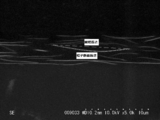
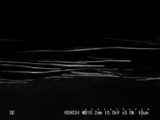
- Photograph of FE-SEM image of particle cross section of aluminum pigment obtained by using field emission type FE-SEM to explain the method of evaluating the flatness of aluminum pigment particles
- An example is shown.
- the photograph of the FE-SEM image obtained by using the field emission type FE-SEM (manufactured by HITACHI / S-4700) of the particle cross section of the aluminum pigment of [Example 2] is shown.
- the photograph of the FE-SEM image obtained by using the field emission type FE-SEM (manufactured by HITACHI / S-4700) of the cross section of the aluminum pigment particle of [Comparative Example 1] is shown.
- the present embodiment a mode for carrying out the present invention (hereinafter referred to as “the present embodiment”) will be described in detail.
- the following embodiments are examples for explaining the present invention, and are not intended to limit the present invention to the following contents.
- the present invention can be appropriately modified and implemented within the scope of the gist.
- the aluminum pigment of the present embodiment contains 60% to 100% of the number of flat particles having a particle flatness (shortest length / particle cross-sectional length) of 0.95 to 1.00, and The average particle diameter d50 of the particles is 4 ⁇ m to 15 ⁇ m.
- the average particle diameter d50 of particles, the flatness of particles (shortest length / particle cross-sectional length), and average thickness t ( ⁇ m) are defined as follows.
- the average particle diameter d50 ( ⁇ m) is a median diameter, and the average particle diameter d50 can be measured using a laser diffraction / scattering particle size distribution measuring apparatus.
- the average particle diameter d50 of the aluminum pigment of this embodiment is 4 ⁇ m to 15 ⁇ m.
- the average particle diameter d50 of the aluminum pigment particles of the present embodiment may be within the above numerical range, and fine particles and small particles may be selected according to the final design properties.
- the average particle diameter d50 of the particles is 4 ⁇ m or more, the particles can be oriented in a certain direction in the coating film using the aluminum pigment of the present embodiment, light scattering can be reduced, and the luminance can be increased. preferable.
- the average particle diameter of the aluminum pigment particles of the present embodiment is preferably 5 ⁇ m or more and 13 ⁇ m or less, and more preferably 6 ⁇ m or more and 12 ⁇ m or less.
- the average particle diameter d50 of the aluminum pigment is a process of grinding the raw material atomized aluminum powder using a ball mill in the method for producing an aluminum pigment to be described later, and the particle diameter of the raw material atomized aluminum powder is one of the grinding balls. It can control by adjusting the mass per round and the rotation speed of the grinding device.
- the flatness (minimum length / particle cross-sectional length) of the particles is measured by obtaining an FE-SEM image of the cross-section of the coating film formed from the coating composition containing the aluminum pigment of the present embodiment and using image analysis software. Can be obtained. A measurement method will be described. In the FE-SEM image of the cross section of the coating film, a measurement value obtained by connecting both ends of the particle cross section with a straight line is defined as a “shortest length”. Further, a measurement value of a line connecting both ends of the particle cross section along the shape of the particle cross section is referred to as “particle cross section length”.
- the value of the ratio of the shortest length to the particle cross-sectional length is defined as the flatness of the particle.
- the flatness of the particles indicates that the warpage and distortion of the particles are smaller as the value is closer to 1.00.
- the planarity of 100 particles is determined by the above definition.
- the threshold for distinguishing is defined as 0.95
- particles in the range of 0.95 to 1.00 are defined as planar particles
- the ratio is determined as (%: number ratio).
- the aluminum pigment of the present embodiment includes 60% to 100% of the above-mentioned flat particles having a flatness of 0.95 to 1.00.
- the ratio of the planar particles is 60% or more, the luminance in the regular reflection region can be increased, the scattered light can be reduced, and a preferable design can be obtained. That is, the aluminum pigment of the present embodiment includes 60% to 100% of particles having a particle flatness in the range of 0.95 to 1.00. A mirror-like metallic design with very little light is obtained.
- the content ratio of particles having a particle planarity of 0.95 to 1.00 is preferably 60% or more and 98%, more preferably 65% or more and 98% or less, and further preferably 70% or more and 98% or less. It is. When the ratio of the flat particles is 98% or less, the grinding time required for producing the aluminum pigment of the present embodiment is not extremely long, and the productivity is excellent.
- the average thickness t ( ⁇ m) of the aluminum pigment particles of this embodiment is measured by using the FE-SEM image of the coating film cross section applied in the measurement of the flatness of the particles and using image analysis software. Can be sought. Specifically, it can be obtained by selecting 100 particles randomly in the FE-SEM image of the cross section of the coating film, automatically measuring the cross-sectional thickness of the particles, and calculating the arithmetic average value of 100 particles. .
- the average thickness t ( ⁇ m) of the aluminum pigment particles of the present embodiment is preferably 0.03 ⁇ m to 0.12 ⁇ m.
- the average thickness t is 0.03 ⁇ m or more, the above-described particle flatness (shortest length / particle cross-sectional length) can be easily controlled in the range of 0.95 to 1.00, and the regular reflection region This is preferable because the brightness at the surface is high and the scattered light can be reduced.
- the average thickness t of the particles is 0.12 ⁇ m or less, it is possible to suitably adjust the shadow area at the end of the particle, to obtain a dense feeling, and to reduce scattered light, which is preferable.
- the average thickness t ( ⁇ m) of the aluminum pigment particles of the present embodiment is more preferably 0.03 ⁇ m or more and 0.10 ⁇ m or less, and further preferably 0.04 ⁇ m or more and 0.09 ⁇ m or less.
- the ratio of the average particle diameter d50 to the average thickness t of the aluminum pigment particles of the present embodiment is the aspect ratio of the aluminum particles.
- the aspect ratio is 90 to 250. Is preferred.
- the aspect ratio is 90 or more, higher brightness in the regular reflection region and higher hiding power can be obtained, and when used for thin film coating, a high-grade feeling can be obtained with a mirror tone in the coating film.
- the aspect ratio is 250 or less, warping, distortion, and cracking of the particles can be prevented, the particles are not broken, and the generation of scattered light can be greatly reduced.
- the aspect ratio (d50 / t) of the aluminum pigment particles of the present embodiment is more preferably from 100 to 250, and even more preferably from 130 to 250.
- the average roughness Ra of the surface of the aluminum pigment particles of the present embodiment is an index indicating the smoothness of the surface of the aluminum pigment particles, and can be measured by an SPM (Scanning Probe Microscope) including an atomic force microscope. it can.
- This average roughness Ra is preferably 2 to 12 nm. Since the average roughness Ra is 12 nm or less, the smoothness of the particle surface is high, so that the amount of specular reflection of light is high, and a higher luminance feeling is obtained. When the average roughness Ra is 2 nm or more, the grinding time required for producing the aluminum pigment of this embodiment is not extremely long, and the productivity is excellent.
- This Ra is more preferably 2 to 10 nm, and further preferably 2 to 8 nm.
- the manufacturing method of the aluminum pigment of this embodiment mentioned above is demonstrated below.
- the aluminum pigment of the present embodiment has a step of grinding the atomized aluminum powder by a grinding device equipped with a ball mill. Adjust and combine the conditions such as increasing the particle size of the atomized aluminum powder used as a raw material, reducing the mass per grinding ball, and reducing the rotational speed of the grinding device. As a result, the proportion of planar particles having the above-described particle planarity (shortest length / particle cross-sectional length) of 0.95 to 1.00 can be increased.
- the conditions such as increasing the mass per one grinding ball, increasing the number of revolutions of the grinding device, and reducing the average thickness t of the aluminum pigment particles are appropriately adjusted and combined. Thus, the ratio of the planar particles can be reduced.
- the average particle diameter (d50) to the range of the present embodiment and improving the productivity, the grinding conditions are determined.
- the average particle diameter d50 is in the range of 4 ⁇ m to 15 ⁇ m
- particularly preferable grinding conditions are preferably a particle size of 1.5 to 5.0 ⁇ m, more preferably a particle size of 1.5 to 4 as a raw material.
- 0.05 ⁇ m atomized aluminum powder, and the mass per grinding ball used in the grinding apparatus is preferably 0.08 to 11.00 mg, more preferably 0.08 to 9.00 mg.
- the conditions are such that the rotation speed of the crusher is 33% to 78%, more preferably 36% to 57%, relative to the critical rotation speed (Nc).
- the aluminum pigment of this embodiment containing 60% to 100% of the number of flat particles having a particle flatness (shortest length / particle cross-sectional length) in the range of 0.95 to 1.00 is obtained.
- the specific gravity of the grinding balls used in a ball mill or the like is preferably 8 or less from the viewpoint of facilitating an increase in the proportion of the above planar particles and the surface smoothness of the aluminum particles. Or less, more preferably 7 or less.
- the specific gravity of the grinding balls is preferably larger than the specific gravity of the grinding solvent. Since the specific gravity of the grinding balls is greater than the specific gravity of the grinding solvent, the grinding balls can be prevented from floating in the solvent, the shear stress between the grinding balls can be sufficiently obtained, and the grinding proceeds sufficiently. There is a tendency.
- the grinding balls used in the method for producing an aluminum pigment of the present embodiment those having high surface smoothness such as stainless steel balls, zirconia balls, glass balls, etc. are used for adjusting the surface smoothness of aluminum particles and for the durability of the grinding balls. From the viewpoint of sex. On the other hand, steel balls, alumina balls and the like having low surface smoothness are not preferable from the viewpoint of adjusting the surface smoothness of aluminum particles and the durability of the ground balls. For this reason, for example, in the case of a stainless steel ball, it is preferable to use a material having improved surface smoothness by mechanical polishing and chemical polishing.
- the mass per grinding ball is preferably 0.08 to 11.00 mg as described above.
- a grinding ball having a mass of 0.08 mg / piece or more the grinding ball does not move individually but moves as a group or a lump so that the shear stress between the grinding balls decreases and grinding progresses. It is possible to prevent the occurrence of a so-called group motion.
- a grinding ball having a mass of 11.00 mg / piece or less it is possible to prevent an excessive impact force from being applied to the aluminum powder and to prevent the occurrence of warpage, distortion, cracks and the like.
- the atomized aluminum powder used as a raw material a material having few impurities other than aluminum is preferable.
- the purity of the atomized aluminum powder is preferably 99.5% or more, more preferably 99.7% or more, and further preferably 99.8% or more.
- the average particle diameter of the atomized aluminum powder as a raw material is preferably 1.5 to 5.0 ⁇ m, more preferably 1.5 to 4.0 ⁇ m.
- the energy applied to the particles during the grinding process is not excessive, warping and distortion of the particles can be prevented, and the particle shape can be kept good.
- the atomized aluminum powder has an average particle size of 5.0 ⁇ m or less, the average particle size of the particles of the ground product can be adjusted to 15 ⁇ m or less, and the aluminum pigment of this embodiment is suitably used. It tends to be obtained.
- a spherical powder or a teardrop-shaped powder is preferable. By using these, there exists a tendency for the shape of the aluminum pigment at the time of grinding to become difficult to collapse. On the other hand, needle-shaped powder and irregular-shaped powder are not preferable because the shape of the aluminum pigment at the time of grinding tends to collapse.
- the aluminum pigment of this embodiment is produced by a grinding apparatus equipped with a ball mill, it is preferable to use a grinding solvent.
- the type of grinding solvent is not limited to the following, but, for example, conventionally used hydrocarbon solvents such as mineral spirits and solvent naphtha, alcohols, ethers, ketones, esters And low viscosity solvents.
- the volume of the grinding solvent with respect to the mass of aluminum in the atomized aluminum powder is preferably 1.5 to 16.0 times, more preferably 2.0 to 12.0 times. preferable.
- the volume of the grinding solvent with respect to the mass of aluminum in the atomized aluminum powder is 1.5 times or more, which can prevent warpage, distortion, cracks, etc.
- the volume of the grinding solvent relative to the mass of aluminum in the atomized aluminum powder is 16.0 times or less, the uniformity in the mill at the time of grinding is improved, and the atomized aluminum powder is used as the grinding media. It tends to contact efficiently and the grinding proceeds favorably.
- the volume of the grinding balls relative to the volume of the grinding solvent is preferably 0.5 to 3.5 times, and preferably 0.8 to 2.5 times. It is more preferable.
- the volume of the grinding balls with respect to the volume of the grinding solvent is 0.5 times or more, the uniformity of the grinding balls in the mill at the time of grinding is improved, and the grinding tends to proceed suitably.
- the volume of the grinding balls is 3.5 times or less with respect to the volume of the grinding solvent, the ratio of the grinding balls in the mill is within a suitable range, and the lamination of the balls does not become too high. It is preferable because problems of shape deterioration such as warping, distortion and cracking of particles due to crushing stress can be prevented, and reduction in luminance and intensity of scattered light can be prevented.
- the grinding aid is not limited to the following as long as it exhibits the characteristics as a non-leafing pigment, and examples thereof include higher unsaturated fatty acids such as oleic acid and higher aliphatic amines such as stearamine. Higher fatty alcohols such as stearyl alcohol and oleyl alcohol; higher fatty acid amides such as stearic acid amide and oleic acid amide; higher fatty acid metal salts such as aluminum stearate and aluminum oleic acid.
- the grinding aid is preferably used in an amount of 0.2 to 30% by mass with respect to the mass of the atomized aluminum powder.
- the ball mill used for grinding the atomized aluminum powder preferably has a diameter of 0.6 m ⁇ to 2.4 m ⁇ , and more preferably 0.8 m ⁇ to 2.0 m ⁇ .
- a ball mill having a diameter of 0.6 m ⁇ or more the lamination of the grinding balls does not become too low, the pressure applied to the aluminum particles during the grinding process is in a suitable range, and the grinding tends to proceed suitably.
- a ball mill having a diameter of 2.4 m ⁇ or less the lamination of the ground balls does not become too high, and the problem of shape deterioration such as particle warpage, distortion, cracks due to the weight of the balls is prevented, and It is preferable because it is possible to prevent a decrease and an increase in scattered light.
- the rotational speed of the ball mill at the time of grinding the atomized aluminum powder is preferably 33% to 78%, and preferably 36% to 57% with respect to the critical rotational speed (Nc). More preferred. It is preferable that the ratio of the rotational speed / critical rotational speed is 33% or more because the uniformity of the aluminum slurry and the ball motion in the ball mill is maintained. Further, when the ratio of rotational speed / critical rotational speed is 78% or less, the behavior of the grinding ball being scraped up or falling by its own weight is prevented, and the impact force applied to the aluminum particles received from the grinding ball. Is not excessively high, and problems of shape deterioration such as warping, distortion, and cracking of particles are prevented, which is preferable.
- the aluminum pigment of this embodiment can also be manufactured by a vacuum evaporation method other than the manufacturing method which has the process of grinding the atomized aluminum powder mentioned above.
- the coating composition of this embodiment contains the aluminum pigment of this embodiment mentioned above.
- the coating composition of the present embodiment can be used in combination with mica, a coloring pigment, and the like in addition to the aluminum pigment. Moreover, you may use together various additives, such as various resin, antioxidant, a light stabilizer, a polymerization inhibitor, and surfactant, in the coating composition of this embodiment.
- the coating composition of this embodiment can be manufactured by mixing an aluminum pigment and various materials as required.
- the coating composition of this embodiment can be used as a metallic paint.
- the coating film of this embodiment contains the aluminum pigment of this embodiment mentioned above, and can be formed by apply
- Various articles can be selected as the base material, and the coating film of the present embodiment can be formed on a target by the selected article. Examples of such articles include automobile bodies, automobile interior parts, household appliances, mobile phones, smart phones, PCs, tablets, cameras, optical devices such as televisions, and the like.
- the method for forming the coating film is not particularly limited, and a conventionally known method can be appropriately applied depending on the target article.
- the ink composition of this embodiment contains the aluminum pigment of this embodiment described above.
- the ink composition of the present embodiment can be used in combination with a predetermined color pigment, a solvent and the like in addition to the aluminum pigment described above.
- various additives such as various resin, antioxidant, a light stabilizer, a polymerization inhibitor, and surfactant, in the ink composition of this embodiment.
- the ink composition of the present embodiment can be produced by mixing an aluminum pigment and other various materials as required, and can be used as a metallic ink.
- the printed matter of this embodiment can be formed by printing using the ink composition mentioned above including the aluminum pigment of this embodiment mentioned above. Examples of the printed material include ink printed materials that form a coating film by gravure printing, offset printing, screen printing, and the like.
- the aluminum pigment of this embodiment can be kneaded with a resin or the like and used as a water-resistant binder or filler.
- Hitaloid varnish 3785S manufactured by Hitachi Chemical
- Mixing thinner 20g (Solvent mixing ratio / toluene: 45% by mass, butyl acetate: 30% by mass, (Ethyl acetate: 20% by mass, 2-acetoxy-1-methoxypropane: 5% by mass)
- Duranate TPA100 manufactured by Asahi Kasei Chemicals: 5g After the above-mentioned coating, it was dried in an oven at 60 ° C. for 30 minutes to obtain a coated plate for evaluation.
- the coating cross section obtained as described above is set so that ion beam irradiation is possible up to a part 20 ⁇ m away from the cross section of the coating, and ion milling Then, a cross section of a coating film for obtaining an FE-SEM image described later was prepared.
- FE-SEM image 10,000 times obtained by the procedure for obtaining the particle cross section (FE-SEM image) of ((I)-(3)), and image analysis software Win Roof version 5.5 (manufactured by MITINI CORPORATION) was used to measure the thickness of the particles in the cross section of the aluminum particles and calculate the average thickness.
- FE-SEM image that measures the thickness of the particle in the cross section of the aluminum particle is displayed as an image, select the ROI line, align the ROI line to the 5 ⁇ m scale of the image, and enter and set the length and unit from registration / change did.
- an image to be subjected to thickness measurement of the cross section of the aluminum particle was displayed, a rectangular ROI was selected, and the binary ROI was performed by aligning the rectangular ROI with the cross section of the particle.
- the measurement was executed, and the automatic measurement value (vertical chord length value) by the image analysis software was displayed on the image.
- the image analysis software Win Roof version 5.5 100 particles having an average particle size of d50 within ⁇ 50% of [(IV) average particle size: d50] described later are selected.
- the thickness of the cross section of the aluminum particles was automatically measured, 100 arithmetic average values were calculated, and the average thickness t of the particles was determined.
- FIG. 1 shows an example of an image for measuring the flatness (shortest length / particle cross-sectional length) of particles.
- FIG. 2 is a photograph of an FE-SEM image obtained by using a field emission type FE-SEM (HITACHI / S-4700) of a cross section of an aluminum pigment particle of [Example 2] described later. Indicates.
- FIG. 1 A photograph of an FE-SEM image obtained by using a field emission type FE-SEM (HITACHI / S-4700) of a cross section of an aluminum pigment particle of [Example 2] described later. Indicates.
- FIG. 1 is a photograph of an FE-SEM image obtained by using a field emission type FE-SEM (HITACHI / S-4700) of a cross section of an aluminum pigment particle of [Example 2] described later. Indicates.
- FIG. 1 A photograph of an FE-SEM image obtained by using a field emission type FE-SEM (HITACHI / S-4700) of a cross section of an aluminum pigment particle of [Example 2] described later. Indicates.
- FIG. 3 is a photograph of an FE-SEM image obtained by using a field emission type FE-SEM (HITACHI / S-4700) of a cross section of an aluminum pigment particle of [Comparative Example 1] described later. Indicates.
- FIG. 2 is compared with FIG. 3, it can be seen that the cross-sectional length of FIG. 2 is closer to the shortest length.
- the average particle size (d50) of the aluminum pigment was measured with a laser diffraction / scattering particle size distribution analyzer (LA-300 / Horiba, Ltd.). Mineral spirit was used as a measurement solvent. The measurement was carried out in accordance with the instruction manual of the equipment. However, as a precaution, the aluminum pigment used as a sample was subjected to ultrasonic dispersion for 2 minutes as a pretreatment, and was then introduced into the dispersion tank to obtain an appropriate concentration. After confirmation, measurement was started. After the measurement was completed, d50 was automatically displayed.
- the average roughness Ra of the aluminum pigment was measured by the following method. ((1) Pretreatment) The aluminum pigments obtained in the examples and comparative examples described later were mixed with mineral spirits and solvent naphtha, and thus washed. 100 mg of Al paste was collected in a screw tube, and 5 mL of toluene was added. The mixture was shaken with a handshake for several tens of seconds to perform dispersion. The supernatant was removed, 5 mL of toluene was added again, and dispersion and centrifugation were performed in the same manner.
- the luminance was evaluated using a gonometric colorimeter (manufactured by Suga Test Instruments Co., Ltd.). Luminance was measured with an incident angle of 45 degrees and a setting of a light receiving angle of 5 degrees (L5) close to regular reflection light, excluding the light in the specular reflection area reflected on the coating film surface. Luminance is a parameter proportional to the intensity of specular reflection light from the aluminum pigment.
- the amount of scattered light was evaluated using a MA68II multi-angle spectrocolorimeter (American X-Rite Co., Ltd.).
- the geometric conditions were incident 45 °, full-range light reception (from regular reflection angle) 15 °, 25 °, 45 °, 75 °, and 110 °.
- the amount of scattered light is a parameter (L110) corresponding to the value of the received light amount L of 110 degrees from the regular reflection angle, and it was determined that the smaller the measured value, the less scattered light on the coated plate and the better the optical characteristics.
- BYK-mac manufactured by BYK Gardner
- diffuse light ⁇ 15 °, 45 °, 75 °
- the uniformity of bright and dark portions was displayed as numerical values.
- the measured value of the uniformity of the bright and dark portions was determined by reading the value of the graininess and indicating that the smaller the numerical value, the more dense the feeling was obtained.
- Example 1 A ball mill having an inner diameter of 2 m and a length of 30 cm is filled with a composition consisting of 9.5 kg of raw material atomized aluminum powder (average particle diameter: 2 ⁇ m), 45.8 kg of mineral spirits, and 570 g of oleic acid, and has a diameter of 0.8 mm. Of zirconia balls were ground using 309 kg. As the zirconia balls, those containing 94% by mass or more of ZrO 2 main component and having a circularity ratio of 95% or more were used. The ball mill was rotated at 13 rpm and milled for 80 hours.
- the slurry in the mill was washed out with mineral spirit, passed through a 400 mesh vibrating screen, and the passed slurry was filtered and concentrated with a filter to obtain a cake having a heating residue of 76% by mass.
- the obtained cake was transferred into a vertical mixer, a predetermined amount of solvent naphtha was added, and the mixture was mixed for 20 minutes to obtain an aluminum pigment having a heating residue of 66% by mass.
- the obtained aluminum pigment was evaluated for luminance, amount of scattered light, and denseness according to (VII) above. The evaluation results are shown in Table 1.
- Example 2 Raw material atomized aluminum powder (average particle size: 2.2 ⁇ m) was used, and the number of revolutions of the ball mill was 11 rpm, and grinding was performed for 110 hours. Other conditions were the same as in [Example 1] to obtain an aluminum pigment. The obtained aluminum pigment was evaluated for luminance, amount of scattered light, and denseness according to (VII) above. The evaluation results are shown in Table 1.
- Example 3 Raw material atomized aluminum powder (average particle size: 3.5 ⁇ m) was used, filled with a blend of 53.4 kg of mineral spirits and 950 g of oleic acid, and milled for 45 hours at a ball mill speed of 17 rpm. . Other conditions were the same as in [Example 1] to obtain an aluminum pigment. The obtained aluminum pigment was evaluated for luminance, amount of scattered light, and denseness according to (VII) above. The evaluation results are shown in Table 1.
- Example 4 A material filled with the same composition as in [Example 2] was used, and grinding was performed by changing only the grinding time by a ball mill to 150 hours. Other conditions were the same as in [Example 1] to obtain an aluminum pigment. The obtained aluminum pigment was evaluated for luminance, amount of scattered light, and denseness according to (VII) above. The evaluation results are shown in Table 1.
- Example 5 The raw material atomized aluminum powder (average particle diameter: 1.7 ⁇ m) was used, and the raw material atomized aluminum powder 8.6 kg and oleic acid 515 g were used. The other ingredients were the same as in [Example 1]. Further, grinding was performed with a grinding time by a ball mill of 105 hours. After completion of the grinding, the same operation as in [Example 1] was performed, except that a cake with a heating residue of 74% by mass was obtained, whereby an aluminum pigment was obtained. The obtained aluminum pigment was evaluated for luminance, amount of scattered light, and denseness according to (VII) above. The evaluation results are shown in Table 1.
- Example 6 A glass ball 309 kg having a diameter of 1.3 mm was used. Moreover, the same formulation as [Example 2] was filled, the ball mill rotation speed was 11 rpm, and grinding was performed for 120 hours. Other conditions were the same as in [Example 1] to obtain an aluminum pigment. The obtained aluminum pigment was evaluated for luminance, amount of scattered light, and denseness according to (VII) above. The evaluation results are shown in Table 1.
- Example 3 The same raw material atomized aluminum powder as in [Example 2] was used, and the filling amount was the same as in Example 2, and 82.0 kg of mineral spirit, 950 g of oleic acid, and 309 kg of zirconia balls having a diameter of 2.0 mm were used. The ball mill was rotated at 17 rpm for 40 hours. Further, after the grinding, except that a cake having a heating residue of 78% by mass was obtained, the same operation as in [Example 1] was performed to obtain an aluminum pigment. The obtained aluminum pigment was evaluated for luminance, amount of scattered light, and denseness according to (VII) above. The evaluation results are shown in Table 1.
- Example 6 The same material atomized aluminum powder as in [Example 1] was used, and the filling amount was also the same as in Example 1. Using 309 kg of glass balls having a diameter of 3.0 mm, the ball mill was rotated at 17 rpm, and milled for 65 hours. Other conditions were the same as in [Example 1] to obtain an aluminum pigment. The obtained aluminum pigment was evaluated for luminance, amount of scattered light, and denseness according to (VII) above. The evaluation results are shown in Table 1.
- Table 1 shows the evaluation results of the brightness, the amount of scattered light, and the denseness of the aluminum pigment by the metal vapor deposition method of Metallure L 55700 manufactured by Eckart.
- the aluminum pigment of the present invention is dense and extremely high in brightness, and the amount of scattered light is very small.
- the aluminum pigment of the present invention is a high-grade metallic paint for automobile bodies and automobile interior parts, metallic paint for automobile repair, metallic paint for home appliances, mobile phones, smart phones, PCs, tablets, cameras, televisions, etc. It has industrial applicability as a material for high-grade metallic printing ink fields such as PCM, industrial metallic paint, gravure printing, offset printing and screen printing, and high-grade metallic resin kneading.
Landscapes
- Chemical & Material Sciences (AREA)
- Organic Chemistry (AREA)
- Engineering & Computer Science (AREA)
- Life Sciences & Earth Sciences (AREA)
- Materials Engineering (AREA)
- Wood Science & Technology (AREA)
- Chemical Kinetics & Catalysis (AREA)
- General Chemical & Material Sciences (AREA)
- Inorganic Chemistry (AREA)
- Pigments, Carbon Blacks, Or Wood Stains (AREA)
- Paints Or Removers (AREA)
- Inks, Pencil-Leads, Or Crayons (AREA)
- Manufacture Of Metal Powder And Suspensions Thereof (AREA)
Priority Applications (6)
| Application Number | Priority Date | Filing Date | Title |
|---|---|---|---|
| KR1020207014904A KR102344276B1 (ko) | 2015-08-14 | 2016-08-10 | 알루미늄 안료, 알루미늄 안료의 제조 방법, 알루미늄 안료를 포함하는 도료 조성물, 도막, 당해 도막을 갖는 물품, 잉크 조성물 및 인쇄물 |
| CN201680046050.0A CN107922753B (zh) | 2015-08-14 | 2016-08-10 | 铝颜料、铝颜料的制造方法、含有铝颜料的涂料组合物、涂膜、具有该涂膜的物品、油墨组合物、及印刷物 |
| DE112016003707.4T DE112016003707B4 (de) | 2015-08-14 | 2016-08-10 | Aluminiumpigment, Verfahren zur Herstellung von Aluminiumpigmenten und deren Verwendung |
| JP2017535510A JP6855378B2 (ja) | 2015-08-14 | 2016-08-10 | アルミニウム顔料、アルミニウム顔料の製造方法、アルミニウム顔料を含む塗料組成物、塗膜、当該塗膜を有する物品、インキ組成物、及び印刷物 |
| KR1020187001795A KR20180020233A (ko) | 2015-08-14 | 2016-08-10 | 알루미늄 안료, 알루미늄 안료의 제조 방법, 알루미늄 안료를 포함하는 도료 조성물, 도막, 당해 도막을 갖는 물품, 잉크 조성물 및 인쇄물 |
| US15/751,333 US11292916B2 (en) | 2015-08-14 | 2016-08-10 | Aluminum pigment, method for producing aluminum pigment, coating composition comprising aluminum pigment, coating film, article having the coating film, ink composition, and printed product |
Applications Claiming Priority (2)
| Application Number | Priority Date | Filing Date | Title |
|---|---|---|---|
| JP2015160205 | 2015-08-14 | ||
| JP2015-160205 | 2015-08-14 |
Publications (1)
| Publication Number | Publication Date |
|---|---|
| WO2017030077A1 true WO2017030077A1 (ja) | 2017-02-23 |
Family
ID=58051765
Family Applications (1)
| Application Number | Title | Priority Date | Filing Date |
|---|---|---|---|
| PCT/JP2016/073660 Ceased WO2017030077A1 (ja) | 2015-08-14 | 2016-08-10 | アルミニウム顔料、アルミニウム顔料の製造方法、アルミニウム顔料を含む塗料組成物、塗膜、当該塗膜を有する物品、インキ組成物、及び印刷物 |
Country Status (6)
| Country | Link |
|---|---|
| US (1) | US11292916B2 (enExample) |
| JP (2) | JP6855378B2 (enExample) |
| KR (2) | KR102344276B1 (enExample) |
| CN (1) | CN107922753B (enExample) |
| DE (1) | DE112016003707B4 (enExample) |
| WO (1) | WO2017030077A1 (enExample) |
Cited By (3)
| Publication number | Priority date | Publication date | Assignee | Title |
|---|---|---|---|---|
| JP2022162329A (ja) * | 2021-04-12 | 2022-10-24 | 旭化成株式会社 | アルミニウム顔料組成物 |
| JPWO2023038009A1 (enExample) * | 2021-09-10 | 2023-03-16 | ||
| EP4279267A4 (en) * | 2021-01-12 | 2025-10-08 | Asahi Chemical Ind | METALLIC PIGMENT, APPLICATION OF METALLIC PIGMENT AND METHOD FOR MANUFACTURING METALLIC PIGMENT |
Families Citing this family (2)
| Publication number | Priority date | Publication date | Assignee | Title |
|---|---|---|---|---|
| CN116669959A (zh) * | 2021-01-12 | 2023-08-29 | 旭化成株式会社 | 金属颜料、其用途和金属颜料的制造方法 |
| JP7749494B2 (ja) * | 2022-03-08 | 2025-10-06 | 旭化成株式会社 | アルミニウム顔料組成物 |
Citations (11)
| Publication number | Priority date | Publication date | Assignee | Title |
|---|---|---|---|---|
| JPS6454070A (en) * | 1987-08-25 | 1989-03-01 | Toyo Aluminium Kk | Aluminum flake pigment |
| JPH03294360A (ja) * | 1990-04-11 | 1991-12-25 | Asahi Kasei Metals Kk | アルミニウム顔料 |
| JPH11152423A (ja) * | 1997-11-21 | 1999-06-08 | Toyo Alum Kk | アルミニウムフレーク顔料、それを含む塗料組成物及び塗膜 |
| JP2003082258A (ja) * | 2001-09-06 | 2003-03-19 | Toyo Aluminium Kk | アルミニウムフレーク顔料、それを含む塗料組成物、インキ組成物およびそれらの塗膜 |
| JP2004269559A (ja) * | 2003-03-05 | 2004-09-30 | Toyo Aluminium Kk | アルミニウムフレーク顔料、その製造方法、それを用いた塗料およびインキ |
| JP2004315674A (ja) * | 2003-04-17 | 2004-11-11 | Asahi Kasei Chemicals Corp | アルミニウム顔料ペーストの製造方法 |
| JP2005240013A (ja) * | 2004-01-30 | 2005-09-08 | Asahi Kasei Chemicals Corp | 配向性に優れた自動車用メタリック塗料組成物 |
| JP2007204852A (ja) * | 2001-09-06 | 2007-08-16 | Toyo Aluminium Kk | アルミニウムフレーク顔料の製造方法 |
| JP2010513619A (ja) * | 2006-12-22 | 2010-04-30 | エッカルト ゲゼルシャフト ミット ベシュレンクテル ハフツング | 狭い厚み分布を有する薄いアルミニウム顔料、それを製造するための方法、およびその使用 |
| JP2015007159A (ja) * | 2013-06-24 | 2015-01-15 | 旭化成ケミカルズ株式会社 | メタリック樹脂組成物及び成形品 |
| JP2015516502A (ja) * | 2012-03-02 | 2015-06-11 | ビーエーエスエフ ソシエタス・ヨーロピアBasf Se | 薄いアルミニウムフレーク |
Family Cites Families (8)
| Publication number | Priority date | Publication date | Assignee | Title |
|---|---|---|---|---|
| DE69931912T2 (de) | 1998-04-20 | 2007-01-18 | Asahi Kasei Metals Ltd. | Aluminiumpigment |
| BR9914744A (pt) | 1998-10-23 | 2001-07-31 | Avery Dennison Corp | Processo para produção de flocos metálicos |
| JP2001181576A (ja) * | 1999-12-27 | 2001-07-03 | Toyo Aluminium Kk | 着色メタリック粉体塗料組成物およびその製造方法 |
| US8999054B2 (en) | 2001-09-06 | 2015-04-07 | Toyo Aluminium Kabushiki Kaisha | Method of manufacturing aluminum flake pigment, aluminum flake pigment obtained by the manufacturing method and grinding media employed for the manufacturing method |
| CN102389977B (zh) * | 2003-03-13 | 2014-07-16 | 东洋铝株式会社 | 铝片颜料的制备方法 |
| DE10315775A1 (de) | 2003-04-04 | 2004-10-14 | Eckart Gmbh & Co. Kg | Dünne deckende Aluminiumpigmente, Verfahren zur Herstellung derselben und Verwendung der Aluminiumpigmente |
| DE102007062942A1 (de) | 2006-12-22 | 2008-06-26 | Eckart Gmbh | Dünne Aluminiumpigmente mit enger Dickenverteilung, Verfahren zur Herstellung derselben und Verwendung der Aluminiumpigmente |
| JP2015160205A (ja) | 2014-02-28 | 2015-09-07 | 国立研究開発法人物質・材料研究機構 | アンカー近接場光構造体及び結晶体−アンカー近接場光構造体 |
-
2016
- 2016-08-10 JP JP2017535510A patent/JP6855378B2/ja active Active
- 2016-08-10 KR KR1020207014904A patent/KR102344276B1/ko active Active
- 2016-08-10 US US15/751,333 patent/US11292916B2/en active Active
- 2016-08-10 WO PCT/JP2016/073660 patent/WO2017030077A1/ja not_active Ceased
- 2016-08-10 CN CN201680046050.0A patent/CN107922753B/zh active Active
- 2016-08-10 DE DE112016003707.4T patent/DE112016003707B4/de active Active
- 2016-08-10 KR KR1020187001795A patent/KR20180020233A/ko not_active Ceased
-
2019
- 2019-08-08 JP JP2019146794A patent/JP6892902B2/ja active Active
Patent Citations (11)
| Publication number | Priority date | Publication date | Assignee | Title |
|---|---|---|---|---|
| JPS6454070A (en) * | 1987-08-25 | 1989-03-01 | Toyo Aluminium Kk | Aluminum flake pigment |
| JPH03294360A (ja) * | 1990-04-11 | 1991-12-25 | Asahi Kasei Metals Kk | アルミニウム顔料 |
| JPH11152423A (ja) * | 1997-11-21 | 1999-06-08 | Toyo Alum Kk | アルミニウムフレーク顔料、それを含む塗料組成物及び塗膜 |
| JP2003082258A (ja) * | 2001-09-06 | 2003-03-19 | Toyo Aluminium Kk | アルミニウムフレーク顔料、それを含む塗料組成物、インキ組成物およびそれらの塗膜 |
| JP2007204852A (ja) * | 2001-09-06 | 2007-08-16 | Toyo Aluminium Kk | アルミニウムフレーク顔料の製造方法 |
| JP2004269559A (ja) * | 2003-03-05 | 2004-09-30 | Toyo Aluminium Kk | アルミニウムフレーク顔料、その製造方法、それを用いた塗料およびインキ |
| JP2004315674A (ja) * | 2003-04-17 | 2004-11-11 | Asahi Kasei Chemicals Corp | アルミニウム顔料ペーストの製造方法 |
| JP2005240013A (ja) * | 2004-01-30 | 2005-09-08 | Asahi Kasei Chemicals Corp | 配向性に優れた自動車用メタリック塗料組成物 |
| JP2010513619A (ja) * | 2006-12-22 | 2010-04-30 | エッカルト ゲゼルシャフト ミット ベシュレンクテル ハフツング | 狭い厚み分布を有する薄いアルミニウム顔料、それを製造するための方法、およびその使用 |
| JP2015516502A (ja) * | 2012-03-02 | 2015-06-11 | ビーエーエスエフ ソシエタス・ヨーロピアBasf Se | 薄いアルミニウムフレーク |
| JP2015007159A (ja) * | 2013-06-24 | 2015-01-15 | 旭化成ケミカルズ株式会社 | メタリック樹脂組成物及び成形品 |
Cited By (6)
| Publication number | Priority date | Publication date | Assignee | Title |
|---|---|---|---|---|
| EP4279267A4 (en) * | 2021-01-12 | 2025-10-08 | Asahi Chemical Ind | METALLIC PIGMENT, APPLICATION OF METALLIC PIGMENT AND METHOD FOR MANUFACTURING METALLIC PIGMENT |
| JP2022162329A (ja) * | 2021-04-12 | 2022-10-24 | 旭化成株式会社 | アルミニウム顔料組成物 |
| JPWO2023038009A1 (enExample) * | 2021-09-10 | 2023-03-16 | ||
| WO2023038009A1 (ja) * | 2021-09-10 | 2023-03-16 | 旭化成株式会社 | アルミニウム顔料、アルミニウム顔料の製造方法、アルミニウム顔料を含む塗料組成物、インキ組成物 |
| DE112022004349T5 (de) | 2021-09-10 | 2024-06-20 | Asahi Kasei Kabushiki Kaisha | Aluminiumpigment, verfahren zur herstellung von aluminiumpigment, aluminiumpigment enthaltende beschichtungsmaterialzusammensetzung und druckfarbenzusammensetzung |
| JP7641394B2 (ja) | 2021-09-10 | 2025-03-06 | 旭化成株式会社 | アルミニウム顔料、アルミニウム顔料の製造方法、アルミニウム顔料を含む塗料組成物、インキ組成物 |
Also Published As
| Publication number | Publication date |
|---|---|
| DE112016003707T5 (de) | 2018-05-17 |
| US11292916B2 (en) | 2022-04-05 |
| DE112016003707B4 (de) | 2024-05-08 |
| US20180230315A1 (en) | 2018-08-16 |
| KR20180020233A (ko) | 2018-02-27 |
| KR102344276B1 (ko) | 2021-12-29 |
| KR20200063258A (ko) | 2020-06-04 |
| JP6855378B2 (ja) | 2021-04-07 |
| JPWO2017030077A1 (ja) | 2018-06-07 |
| JP6892902B2 (ja) | 2021-06-23 |
| CN107922753B (zh) | 2021-06-15 |
| JP2019210483A (ja) | 2019-12-12 |
| CN107922753A (zh) | 2018-04-17 |
Similar Documents
| Publication | Publication Date | Title |
|---|---|---|
| JP6892902B2 (ja) | アルミニウム顔料、アルミニウム顔料の製造方法、アルミニウム顔料を含む塗料組成物、塗膜、当該塗膜を有する物品、インキ組成物、及び印刷物 | |
| JP3954024B2 (ja) | アルミニウムフレーク顔料の製造方法、その製造方法により得られるアルミニウムフレーク顔料、その製造方法に用いられる磨砕メディア | |
| JP2003082258A (ja) | アルミニウムフレーク顔料、それを含む塗料組成物、インキ組成物およびそれらの塗膜 | |
| EP2399967B1 (en) | Process for producing powder coating composition | |
| AU738308B2 (en) | Aluminum pigment and manufacturing process thereof | |
| JPWO1999054074A1 (ja) | アルミニウム顔料及びその製造方法 | |
| JPH0668121B2 (ja) | アルミフレ−ク顔料 | |
| KR102550884B1 (ko) | 알루미늄 플레이크 안료 및 그 제조 방법 | |
| CN102002266A (zh) | 银元形铝颜料的制造方法 | |
| JP6982963B2 (ja) | リーフィングアルミニウム顔料、リーフィングアルミニウム顔料の製造方法、リーフィングアルミニウム顔料を含む塗料組成物、塗膜、当該塗膜を有する物品、インキ組成物、及び印刷物 | |
| JP4315791B2 (ja) | メタリック塗料組成物 | |
| JP7641394B2 (ja) | アルミニウム顔料、アルミニウム顔料の製造方法、アルミニウム顔料を含む塗料組成物、インキ組成物 | |
| JP2007204852A (ja) | アルミニウムフレーク顔料の製造方法 | |
| JP7749494B2 (ja) | アルミニウム顔料組成物 | |
| CN117957286A (zh) | 铝颜料、铝颜料的制造方法、含有铝颜料的涂料组合物、油墨组合物 | |
| JP2023148582A (ja) | アルミニウム顔料及びその製造方法 | |
| JP4484503B2 (ja) | アルミニウム顔料の製造方法 | |
| JP2506609B2 (ja) | メタリック仕上げ方法 | |
| JP2022162329A (ja) | アルミニウム顔料組成物 | |
| JP2022185820A (ja) | アルミニウム顔料及びその製造方法 |
Legal Events
| Date | Code | Title | Description |
|---|---|---|---|
| 121 | Ep: the epo has been informed by wipo that ep was designated in this application |
Ref document number: 16837067 Country of ref document: EP Kind code of ref document: A1 |
|
| ENP | Entry into the national phase |
Ref document number: 20187001795 Country of ref document: KR Kind code of ref document: A |
|
| ENP | Entry into the national phase |
Ref document number: 2017535510 Country of ref document: JP Kind code of ref document: A |
|
| WWE | Wipo information: entry into national phase |
Ref document number: 15751333 Country of ref document: US |
|
| WWE | Wipo information: entry into national phase |
Ref document number: 112016003707 Country of ref document: DE |
|
| 122 | Ep: pct application non-entry in european phase |
Ref document number: 16837067 Country of ref document: EP Kind code of ref document: A1 |