WO2017002929A1 - 植物の生長を促進する方法、植物生長促進物質を製造する方法及びこれらに利用されるタンパク質 - Google Patents
植物の生長を促進する方法、植物生長促進物質を製造する方法及びこれらに利用されるタンパク質 Download PDFInfo
- Publication number
- WO2017002929A1 WO2017002929A1 PCT/JP2016/069474 JP2016069474W WO2017002929A1 WO 2017002929 A1 WO2017002929 A1 WO 2017002929A1 JP 2016069474 W JP2016069474 W JP 2016069474W WO 2017002929 A1 WO2017002929 A1 WO 2017002929A1
- Authority
- WO
- WIPO (PCT)
- Prior art keywords
- acid sequence
- amino acid
- seq
- protein
- sequence shown
- Prior art date
- Legal status (The legal status is an assumption and is not a legal conclusion. Google has not performed a legal analysis and makes no representation as to the accuracy of the status listed.)
- Ceased
Links
Images






Classifications
-
- A—HUMAN NECESSITIES
- A01—AGRICULTURE; FORESTRY; ANIMAL HUSBANDRY; HUNTING; TRAPPING; FISHING
- A01G—HORTICULTURE; CULTIVATION OF VEGETABLES, FLOWERS, RICE, FRUIT, VINES, HOPS OR SEAWEED; FORESTRY; WATERING
- A01G7/00—Botany in general
-
- C—CHEMISTRY; METALLURGY
- C07—ORGANIC CHEMISTRY
- C07K—PEPTIDES
- C07K14/00—Peptides having more than 20 amino acids; Gastrins; Somatostatins; Melanotropins; Derivatives thereof
- C07K14/195—Peptides having more than 20 amino acids; Gastrins; Somatostatins; Melanotropins; Derivatives thereof from bacteria
-
- C—CHEMISTRY; METALLURGY
- C12—BIOCHEMISTRY; BEER; SPIRITS; WINE; VINEGAR; MICROBIOLOGY; ENZYMOLOGY; MUTATION OR GENETIC ENGINEERING
- C12N—MICROORGANISMS OR ENZYMES; COMPOSITIONS THEREOF; PROPAGATING, PRESERVING, OR MAINTAINING MICROORGANISMS; MUTATION OR GENETIC ENGINEERING; CULTURE MEDIA
- C12N1/00—Microorganisms; Compositions thereof; Processes of propagating, maintaining or preserving microorganisms or compositions thereof; Processes of preparing or isolating a composition containing a microorganism; Culture media therefor
-
- C—CHEMISTRY; METALLURGY
- C12—BIOCHEMISTRY; BEER; SPIRITS; WINE; VINEGAR; MICROBIOLOGY; ENZYMOLOGY; MUTATION OR GENETIC ENGINEERING
- C12N—MICROORGANISMS OR ENZYMES; COMPOSITIONS THEREOF; PROPAGATING, PRESERVING, OR MAINTAINING MICROORGANISMS; MUTATION OR GENETIC ENGINEERING; CULTURE MEDIA
- C12N15/00—Mutation or genetic engineering; DNA or RNA concerning genetic engineering, vectors, e.g. plasmids, or their isolation, preparation or purification; Use of hosts therefor
- C12N15/09—Recombinant DNA-technology
-
- C—CHEMISTRY; METALLURGY
- C12—BIOCHEMISTRY; BEER; SPIRITS; WINE; VINEGAR; MICROBIOLOGY; ENZYMOLOGY; MUTATION OR GENETIC ENGINEERING
- C12N—MICROORGANISMS OR ENZYMES; COMPOSITIONS THEREOF; PROPAGATING, PRESERVING, OR MAINTAINING MICROORGANISMS; MUTATION OR GENETIC ENGINEERING; CULTURE MEDIA
- C12N5/00—Undifferentiated human, animal or plant cells, e.g. cell lines; Tissues; Cultivation or maintenance thereof; Culture media therefor
- C12N5/10—Cells modified by introduction of foreign genetic material
Definitions
- the present invention relates to a method for promoting plant growth, a method for producing a plant growth promoting substance, and a protein used in these methods.
- the duckweed plant (Lemnaceae) is a freshwater aquatic plant that inhabits almost the entire earth.
- the use of duckweed plants, especially duckweed (Lemna minor, English name duckweed) in the industry has mainly been related to water purification of industrial wastewater using duckweed containing rhizosphere microorganisms (for example, Patent Document 1).
- a technique using a duckweed family plant as a genetic recombination host for production of useful proteins has been developed (Patent Document 2 and Patent Document 3).
- duckweed plants are extremely nutritious plants having about 60% starch and more than 15% protein per plant weight, and duckweed plants are used as biomass, especially biomass energy.
- cultivation of duckweed plants using urban sewage, factory effluent, agricultural effluent, etc. combined with the conventionally known water purification capacity, can achieve energy-saving water purification and biomass production at the same time. And attractive.
- P23 strain Acetobacter calcoaceticus P23 (hereinafter referred to as P23 strain) is PGPB, and that the polysaccharide secreted by P23 strain is a plant growth promoting compound (Plant Growing Compound, PGPC) Patent Document 1).
- JP 2009-247279 A JP-T-2001-513325 Special table 2009-523431
- the present invention aims at effective utilization of microorganisms having a function of promoting the growth of plants, particularly duckweed plants.
- the present inventors found in the genome of the P23 strain a gene group related to biosynthesis of PGPC that promotes duckweed growth (referred to as a PGPC-related gene cluster), and completed the following inventions.
- a method for promoting plant growth comprising a step of allowing a microorganism (except Acinetobacter calcoaceticus P23) capable of expressing at least one of the following genes 1) to 5) to coexist with a plant .
- a microorganism except Acinetobacter calcoaceticus P23
- a protein consisting of an amino acid sequence to which 1 to several amino acids are added the gene encoding a protein involved in biosynthesis of a plant growth promoting substance
- a gene encoding a protein involved in biosynthesis of a promoter 5) A shown in SEQ ID NO: 5
- a protein comprising the amino acid sequence shown in SEQ ID NO: 1, or an amino acid sequence in which one to several amino acids of the amino acid sequence shown in SEQ ID NO: 1 have been deleted or substituted or the amino acid sequence shown in SEQ ID NO: 1
- a protein comprising an amino acid sequence in which one to several amino acids of the amino acid sequence shown in No. 2 are deleted or substituted, or an amino acid sequence in which one to several amino acids are added to the amino acid sequence shown in SEQ ID No. 2.
- a gene encoding a protein involved in biosynthesis of a promoter 5) A shown in SEQ ID NO: 5
- a method for producing a plant growth promoting substance comprising a step of growing a microorganism (excluding Acinetobacter calcoaceticus P23) capable of expressing at least one of the following genes 1) to 5): 1) a protein comprising the amino acid sequence shown in SEQ ID NO: 1, or an amino acid sequence in which one to several amino acids of the amino acid sequence shown in SEQ ID NO: 1 have been deleted or substituted or the amino acid sequence shown in SEQ ID NO: 1 A protein consisting of an amino acid sequence to which 1 to several amino acids are added, the gene encoding a protein involved in biosynthesis of a plant growth promoting substance 2) a protein consisting of an amino acid sequence shown in SEQ ID NO: 2 or a sequence A protein comprising an amino acid sequence in which one to several amino acids of the amino acid sequence shown in No.
- a protein comprising the amino acid sequence shown in SEQ ID NO: 1, or an amino acid sequence in which one to several amino acids of the amino acid sequence shown in SEQ ID NO: 1 have been deleted or substituted or the amino acid sequence shown in SEQ ID NO: 1
- a protein comprising an amino acid sequence in which one to several amino acids of the amino acid sequence shown in No. 2 are deleted or substituted, or an amino acid sequence in which one to several amino acids are added to the amino acid sequence shown in SEQ ID No. 2.
- a gene encoding a protein involved in biosynthesis of a promoter 5) A shown in SEQ ID NO: 5
- the method according to (6) or (7) comprising a step of growing a microorganism having all the genes of 1) to 5).
- a protein consisting of the amino acid sequence shown in SEQ ID NO: 4 or shown in SEQ ID NO: 4 A protein comprising an amino acid sequence in which one to several amino acids have been deleted or substituted, or an amino acid sequence having one to several amino acids added to the amino acid sequence shown in SEQ ID NO: 4, Protein involved in biosynthesis of growth promoting substance 3) Tan consisting of amino acid sequence shown in SEQ ID NO:
- new microorganisms other than the P23 strain having a PGPC-related gene can be used, and the efficiency of biomass production can be enhanced by promoting the growth of plants, particularly duckweed plants.
- the range of microbial species that can promote plant growth can be expanded by producing recombinant microorganisms introduced with PGPC-related genes using genetic engineering techniques. Utilization of microorganisms suitable for plants expected to promote production or growth becomes possible.
- FIG. 2 is a schematic diagram of mcs-nov obtained by incorporating a PGPC / P23 gene cluster containing P23-2757 to 2761 into the pBBR-1 MCS-2 vector.
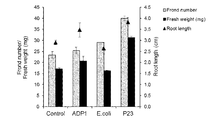
- E. No recombination It is a graph which shows transition of the number of fronds of duckweed cultured for 10 days after attaching E. coli, ADP1 or P23 strain.
- E. No recombination It is a graph which shows the chlorophyll content of the duckweed cultured for 10 days after attaching E. coli, ADP1 or P23 strain.
- E. No recombination It is a graph which shows the number of fronds of a duckweed cultured for 10 days after attaching E.
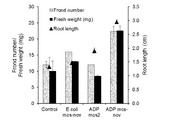
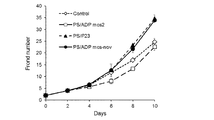
- FIG. 3 is a graph showing the number of leafy bodies, damp weight and root length of duckweed cultured for 10 days after attaching E. coli mcs-nov, ADP1 mcs-nov or ADP1 mcs2. It is a graph which shows transition of the number of leaf-like bodies of duckweed cultured for 10 days in a culture solution added with a polysaccharide derived from culture supernatant of P23 strain, ADP1 mcs-nov or ADP1 mcs2.
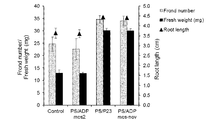
- FIG. 3 is a graph showing the number of duckweed fronds, wet weight and root length cultured for 10 days in a culture solution to which a polysaccharide derived from culture supernatant of P23 strain, ADP1 mcs-nov or ADP1 mcs2 is added.
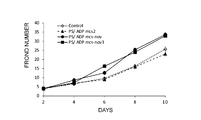
- 6 is a graph showing the change in the number of leafy bodies of duckweed cultured for 10 days after adhering a recombinant bacterium (ADP1 mcs-nov3), ADP1 mcs-nov or ADP1 mcs2 introduced with P23-2759-2761.
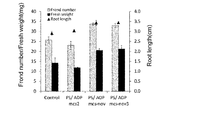
- FIG. 1 It is a graph which shows the number of foliar bodies, the wet weight, and the length of the duckweed cultured for 10 days after attaching ADP1 mcs-nov3, ADP1 mcs-nov or ADP1 mcs2. It is a graph which shows the transition of the number of fronds of duckweed cultured for 10 days in a culture solution to which a polysaccharide derived from culture supernatant of ADP1 mcs-nov3, ADP1 mcs-nov or ADP1 mcs2 is added.
- FIG. 1 shows the number of foliar bodies, the wet weight, and the length of the duckweed cultured for 10 days after attaching ADP1 mcs-nov3, ADP1 mcs-nov or ADP1 mcs2. It is a graph which shows the transition of the number of fronds of duckweed cultured for 10 days in a culture solution to which a polysaccharide derived from culture supernatant
- FIG. 3 is a graph showing the number, wet weight, and root length of duckweed cultured for 10 days in a culture solution to which polysaccharides derived from culture supernatant of ADP1 mcs-nov3, ADP1 mcs-nov or ADP1 mcs2 are added.
- the first aspect of the present invention promotes plant growth, including the step of allowing a microorganism (except P23 strain) capable of expressing at least one of the following genes 1) to 5) to coexist with a plant: Regarding the method.
- PGPC 2 a protein consisting of the amino acid sequence shown in SEQ ID NO: 2 or A protein comprising an amino acid sequence in which 1 to several amino acids of the amino acid sequence shown are deleted or substituted, or an amino acid sequence in which 1 to several amino acids are added to the amino acid sequence shown in SEQ ID NO: 2
- the P23 strain is a kind of PGPB having an action of promoting the growth of plants, particularly duckweed plants, and produces a polysaccharide (hereinafter referred to as PGPC / P23) containing glucose, galactose and N-acetylglucosamine as constituent components. .
- the proteins consisting of the amino acid sequences shown in SEQ ID NOs: 1 to 5 are proteins encoded by the five genes constituting the PGPC-related gene cluster involved in the biosynthesis of PGPC / P23 cloned from the P23 strain, It is a protein involved in PGPC biosynthesis.
- a PGPC-related gene cluster involved in the biosynthesis of PGPC / P23 is referred to as a PGPC / P23 gene cluster.
- the genome base sequence of the P23 strain containing the PGPC / P23 gene cluster is registered in the database DDBJ / EMBL / GenBank with the accession number BBQU01000012.
- the base sequence of the cloned PGPC / P23 gene cluster (SEQ ID NO: 6) is as described above. This corresponds to the 102,725 to 107,026th base sequence registered with the accession number.
- the protein consisting of the amino acid sequence shown in SEQ ID NO: 1 is presumed to be a kind of glycosyltransferase from its characteristic motif sequence.
- the gene encoding this protein in the P23 strain is registered under the gene name P23_2757 and accession number GAM32233, and corresponds to a base sequence complementary to the 130th to 951th base sequences of SEQ ID NO: 6.
- P23_2757 is arranged in the direction opposite to the transfer direction of P23_2758 and P23_2759.
- the protein consisting of the amino acid sequence shown in SEQ ID NO: 2 is a protein involved in the biosynthesis of PGPC / P23 in cooperation with other proteins.
- the gene encoding this protein in the P23 strain is registered under the gene name P23_2758 and accession number GAM32234, and corresponds to the 1,461 to 1,673th base sequences of SEQ ID NO: 6.
- the protein consisting of the amino acid sequence shown in SEQ ID NO: 3 is presumed to be a kind of mannosyl transferase from its characteristic motif sequence.
- the gene encoding this protein in the P23 strain is registered under the gene name P23_2759 and accession number GAM32235, and corresponds to the 1709th to 2629th nucleotide sequences of SEQ ID NO: 6.
- the protein consisting of the amino acid sequence shown in SEQ ID NO: 4 is presumed to be a kind of glycosyltransferase from its characteristic motif sequence.
- the gene encoding this protein in the P23 strain is registered under the gene name P23_2760 and accession number GAM32236, and corresponds to the base sequence complementary to the 2,641 to 3,582nd base sequences of SEQ ID NO: 6.
- P23_2760 is arranged in the direction opposite to the transfer direction of P23_2758 and P23_2759.
- the protein consisting of the amino acid sequence shown in SEQ ID NO: 5 is presumed to be a kind of glycosyltransferase from its characteristic motif sequence.
- the gene encoding this protein in the P23 strain is registered under the gene name P23_2761, accession number GAM32237, and corresponds to the base sequence complementary to the 3,624th to 4,262nd base sequences of SEQ ID NO: 6.
- P23_2761 is arranged in the direction opposite to the transfer direction of P23_2758 and P23_2759.
- Table 1 shows the results of homology search using NCBI BLAST for the above five genes constituting the PGPC / P23 gene cluster.
- genes P23 — 2759 to 2761 enclosed in a frame have low sequence identity with known genes and are considered to be novel genes.
- P23_2759-2761 is also not found on the genomic sequence of Acinetobacter calcoaceticus PHEA-2 and Acinetobacter calcoaceticus LB'-3, which are similar species with phenolic resolution as does the P23 strain, Alternatively, it has been confirmed that the sequence identity is low.
- the first aspect of the present invention is a microorganism excluding the P23 strain, and can express at least one of a gene encoding a protein consisting of the amino acid sequence of SEQ ID NOs: 1 to 5 or a gene encoding a protein equivalent thereto.
- the “gene encoding the equivalent protein” is a gene encoding a protein substantially equivalent to each protein in relation to the protein consisting of the amino acid sequences shown in SEQ ID NOs: 1 to 5, and specifically Is as follows.
- -It consists of an amino acid sequence in which 1 to several amino acids of the amino acid sequence shown in SEQ ID NO: 1 have been deleted or substituted, or an amino acid sequence in which 1 to several amino acids have been added to the amino acid sequence shown in SEQ ID NO: 1.
- -It consists of an amino acid sequence in which 1 to several amino acids of the amino acid sequence shown in SEQ ID NO: 2 are deleted or substituted, or an amino acid sequence in which 1 to several amino acids are added to the amino acid sequence shown in SEQ ID NO: 2.
- the amino acid sequence shown in SEQ ID NO: 3 consists of an amino acid sequence in which 1 to several amino acids are deleted or substituted, or an amino acid sequence in which 1 to several amino acids are added to the amino acid sequence shown in SEQ ID NO: 3.
- -It consists of an amino acid sequence in which 1 to several amino acids of the amino acid sequence shown in SEQ ID NO: 4 are deleted or substituted, or an amino acid sequence in which 1 to several amino acids are added to the amino acid sequence shown in SEQ ID NO: 4.
- a gene encoding a protein that is involved in the biosynthesis of PGPC, particularly a protein having glycosyltransferase activity is a gene encoding a protein that is involved in the biosynthesis of PGPC, particularly a protein having glycosyltransferase activity. -Consisting of an amino acid sequence in which one to several amino acids of the amino acid sequence shown in SEQ ID NO: 5 have been deleted or substituted, or an amino acid sequence in which one to several amino acids have been added to the amino acid sequence shown in SEQ ID NO: 5
- a gene encoding a protein that is involved in the biosynthesis of PGPC, particularly a protein having glycosyltransferase activity is a gene encoding a protein that is involved in the biosynthesis of PGPC, particularly a protein having glycosyltransferase activity.
- the microorganism is preferably a microorganism capable of expressing at least three of a gene encoding a protein consisting of the amino acid sequence of SEQ ID NOs: 1 to 5 or a gene encoding a protein equivalent thereto, and the amino acids of SEQ ID NOs: 1 to 5 More preferably, a microorganism that can express at least four of genes encoding a protein consisting of a sequence or a gene encoding a protein equivalent thereto, a gene encoding a protein consisting of the amino acid sequence of SEQ ID NOs: 1 to 5 or More preferred are microorganisms that can express all five of the genes encoding proteins equivalent to these.
- PGPC / P23 produced by the P23 strain is a polysaccharide containing glucose, galactose and N-acetylglucosamine as constituent components. This polysaccharide is presumed to be biosynthesized due to the involvement of a protein consisting of each amino acid sequence of SEQ ID NOs: 1 to 5.
- PGPC produced by a microorganism having such an equivalent gene is PGPC having at least a partial structure different from that of PGPC / P23, and can exhibit the same growth promoting effect on plants as PGPC / P23.
- the coexistence of a microorganism with a plant means that the microorganism and the plant are present in the same medium, and the microorganism and the plant are in direct contact as long as the PGPC produced by the microorganism can contact the plant. I don't need that.
- the presence of a microorganism and a plant separated by a filter having a pore size that allows PGPC to permeate but the microorganism itself cannot permeate is also included in the “coexisting microorganism with plant” in the present invention.
- a specific example of “to make a microorganism coexist with a plant” is, for example, a method in which a plant root is immersed in a liquid in which the microorganism is suspended, for example, a culture liquid in which a microorganism is cultured or suspended, or the culture liquid of the microorganism is kneaded. For example, planting plants in appropriate soil.
- the number of microorganisms may be 10 4 to 10 10 cells / mL, preferably 10 6 to 10 8 cells / mL.
- PGPC PGPC produced by the microorganism
- any part such as leaves, stems, and roots (including foliate) coexist with the microorganism.
- a part having higher PGPC absorption capacity for example, a leaf or root of a plant coexist with the microorganism.
- the microorganism that can be used in the first aspect of the present invention is homologous to the genome information of the microorganism using the base sequence of the entire PGPC / P23 gene cluster (SEQ ID NO: 6) or the base sequence of each gene constituting the query as a query.
- a candidate microorganism is selected by in silico screening such as search or by a hybridization method for microbial genomic DNA using an appropriate nucleic acid molecule having the base sequence, and further, for example, using a culture solution in which the candidate microorganism is suspended. Can be selected by confirming that growth of duckweed is promoted.
- the promotion of plant growth is achieved by comparing the present invention with respect to indicators of the degree of plant growth, such as the weight of individual plants and the number of leaves or leaf-like bodies, as compared with the case where plants are grown without using the microorganism according to the present invention. It can be confirmed by observing the difference that occurs when a plant is grown using such microorganisms, for example, an increase in the weight of a plant individual or an increase in the number of leaves.
- a microorganism is added to a plant culture solution such as Hoagland medium floating with 10 to 20 duckweeds as an appropriate number of fronds and incubated at 28 ° C.
- the plant to which the method of the first aspect of the present invention is applied is preferably an aquatic plant such as floating, water-extracting or submerged, particularly a duckweed plant.
- duckweed plants include plants belonging to the genus Lemna, such as L. minor and L. L. disperma, L. L. ecuadoriensi, Drosophila, L. Japonica, L. japonica L. miniscula, L. L. obscura, L. L. perpusilla, L. L. tenera, L. trisulca, L. tenella. Plants of the genus Spirodella, such as L. turififera and L. valdiviana. Intel Media, S.I. Polylisa, S.M.
- a second aspect of the present invention relates to a method for promoting plant growth, comprising a step of allowing a microorganism into which at least one of the following genes 1) to 5) is introduced so as to allow expression to coexist with a plant.
- the “process for allowing microorganisms to coexist with plants” and the means for confirming the growth promoting action on plants in the second aspect of the present invention are as described in the first aspect of the present invention.
- a microorganism into which at least one of a gene encoding a protein consisting of the amino acid sequence shown in SEQ ID NOs: 1 to 5 or a gene encoding a protein equivalent thereto is introduced so as to be expressed can be planted. Including the step of coexisting with.
- the microorganism is preferably a microorganism into which at least three of genes encoding a protein consisting of the amino acid sequence shown in SEQ ID NOs: 1 to 5 or a gene encoding a protein equivalent thereto are introduced, shown in SEQ ID NOs: 1 to 5 More preferably, a microorganism into which at least four of genes encoding a protein consisting of the amino acid sequence described above or a gene encoding a protein equivalent thereto is introduced, encoding a protein consisting of the amino acid sequence shown in SEQ ID NOs: 1 to 5 More preferred are microorganisms into which all five of the genes or genes encoding proteins equivalent to these genes have been introduced.
- a microorganism into which a nucleic acid comprising the base sequence shown in SEQ ID NO: 6 has been introduced.
- the microorganism before recombination already has a gene encoding a protein consisting of the amino acid sequence shown in SEQ ID NOs: 1 to 5 and some of the genes encoding equivalent proteins, the other proteins A gene to be encoded may be selected and introduced.
- one or a plurality of genes can be incorporated into one vector for introduction.
- any of five vectors incorporating genes individually, a plurality of vectors incorporating a plurality of genes, and one vector incorporating all five genes can be used.
- Introduction of a vector may be performed continuously for each vector, or may be performed simultaneously using a mixture of vectors.
- the microorganism used in the second embodiment is preferably a highly safe microorganism that is known to be an appropriate host vector system that allows functional expression of a foreign gene.
- microorganisms include non-pathogenic Escherichia coli, Bacillus subtilis, yeast, PGPB such as Acinetobacter microorganisms, Pseudomonas putida, Pseudomonas microorganisms such as Serratia fotoncola, and Serratia gonticola.
- PGPF such as Rhizoctonia solani, Fusarium microorganism, Penicillium microorganism.
- Acinetobacter microorganisms that do not produce PGPC can also be used.
- Particularly preferred microorganisms are non-pathogenic E. coli, Pseudomonas putida and Acinetobacter baili.
- transcriptional regulatory region a nucleotide sequence that regulates
- a known transcriptional regulatory region may be selected and used for each host microorganism, but it encodes a protein consisting of the amino acid sequence shown in SEQ ID NOs: 1 to 5 or a protein equivalent thereto.
- the transcriptional regulatory region unique to each gene may be used as it is.
- An example of a nucleic acid containing a unique transcriptional regulatory region is a nucleic acid consisting of the base sequence shown in SEQ ID NO: 6.
- nucleic acid containing a unique transcriptional regulatory region is a nucleic acid consisting of the base sequence shown in SEQ ID NO: 7.
- the microorganism according to the second aspect of the present invention is a recombinant microorganism obtained by transforming the microorganism with a nucleic acid containing a base sequence encoding the gene or an expression vector incorporating the nucleic acid.
- the expression vector is a vector that can transiently or stably express the gene in the host, and may be appropriately selected from, for example, a plasmid vector, a phage vector, a cosmid vector, etc. according to the host microorganism.
- a broad range host expression vector such as pBBR-1 or MCS-2 can be used.
- the third aspect of the present invention relates to a method for producing a PGPC, that is, a plant growth promoting substance, which comprises the step of growing the microorganism described in the first aspect (except for the P23 strain).
- the 4th aspect of this invention is related with the manufacturing method of PGPC including the process of growing the recombinant microorganism demonstrated in the said 2nd aspect.
- the microorganisms described in the first aspect are grown using an appropriate medium. This is a method for causing microorganisms to produce PGPC.
- PGPC / P23 is salting out at a salt concentration of 50% by adding ammonium sulfate to the culture supernatant from which the microorganisms grown in a liquid medium have been removed, desalting after adding water to the precipitate, phenol Can be prepared by deproteinization by stirring extraction with the addition of sodium chloride, ethanol precipitation in which sodium chloride and about 1 to 5 times the amount of ethanol are added to the aqueous layer after extraction, and desalting after addition of water to the precipitate. . PGPC other than PGPC / P23 can also be prepared according to this method or this method.
- the growth promoting action of PGPC on a plant is achieved by adding an appropriate amount of PGPC such as 5 to 20 ⁇ g / mL instead of the microorganism according to the method for confirming the growth promotion of the plant in the first embodiment. This can be confirmed.
- PGPC prepared by the above method may be stored in a state of being suspended or dissolved in an appropriate amount of liquid, for example, water or a buffer, or may be stored by lyophilization.
- the fifth aspect of the present invention relates to a protein consisting of the amino acid sequence shown in SEQ ID NOs: 3 to 5 described in the second aspect and proteins equivalent thereto.
- a nucleic acid encoding such a protein an expression vector that can express the nucleic acid, and a microorganism transformed with the nucleic acid or expression vector are also provided as the present invention.
- the types of expression vectors or microorganisms are as described in the second aspect, and experimental operations such as nucleic acid preparation, recombination, and microorganism transformation are also performed as described in the second aspect of the present invention. This can be done using techniques widely used by those skilled in the art.
- Example 1 Cloning of PGPC / P23 gene cluster and preparation of recombinant bacteria Based on the genome base sequence of the P23 strain registered in the database DDBJ / EMBL / GenBank with the accession number BBQU01000012, P23-2757 to 2761 Primer sets (Fnov and Rp23nov) consisting of the base sequences shown in SEQ ID NOs: 8 and 9 were prepared so that the base sequence shown in SEQ ID NO: 6 containing 5 genes could be amplified.
- Plasmid mcs-nov was transformed into E. coli by the calcium chloride method.
- E. coli DH5 ⁇ strain is introduced and transformed into a recombinant bacterium E. coli having 5 genes P23-2757-2761.
- E. coli mcs-nov was produced.
- E.I. E. coli mcs-nov was cultured in LB medium to recover the plasmid from the cells. It was introduced into Baylyi ADP-1 to produce a recombinant bacterium ADP1 mcs-nov.
- Baylyi ADP1 ADP1 mcs2 was also produced in the same manner.
- Example 2 Evaluation of Plant Growth Promoting Activity of Recombinant Bacteria E. coli produced in Example 1 E. coli mcs-nov, ADP1 mcs-nov and ADP1 mcs2 recombinant bacteria, E. coli, ADP1 strain and P23 strain were evaluated for growth promoting activity against duckweed.
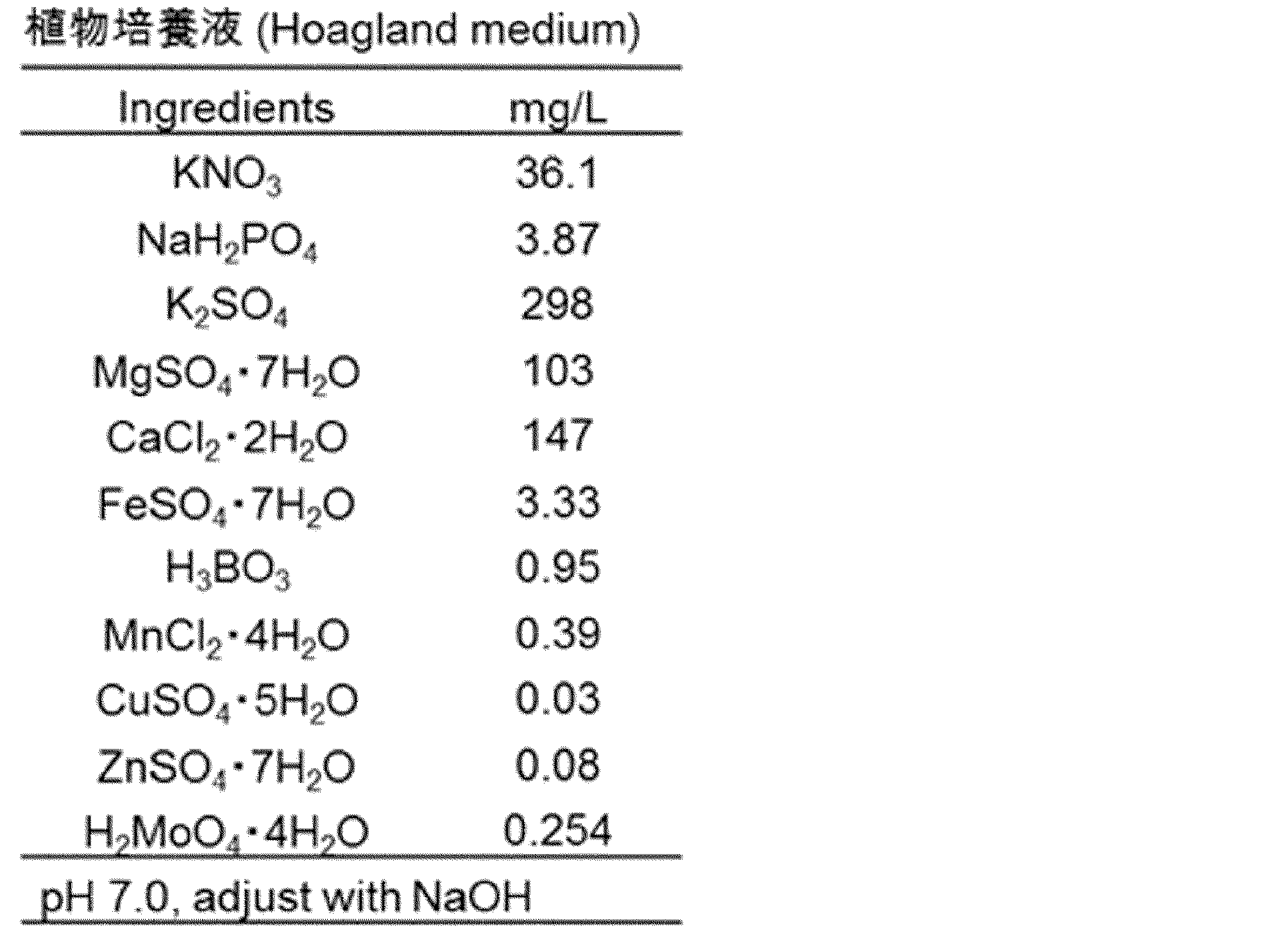
- E. No recombination Evaluation of E. coli, ADP1 strain, and P23 strain 50 mL of Hoagland's medium was dispensed into a 100 mL culture flask, and 20 sterilized duckweed leaves that had been pre-cultured in Hoagland's medium were placed therein. E. No recombination E. coli, ADP1 strain, and P23 strain were inoculated to a final OD 0.3 (about 10 8 cells / mL), and then cultured for 3 days. The culture conditions are shown below. Thereafter, culture was performed under the same conditions unless otherwise specified. Plant culture medium: Hoglund medium (Table 2) Temperature: 28 ° C Relative humidity: 60-70% 16 hours light period (5000 lux) / 8 hours dark period
- the plants were transferred to a tube containing 40 mL of a new Hoglund medium, and the non-adherent bacteria were washed away by inverting the tube twice. After performing this washing operation twice, one plant having two leaf-like bodies was transferred to a 100 mL culture flask in which 50 mL of Hogland medium was dispensed, and cultured for 10 days. During the culture period, the number of fronds was counted every two days, and the chlorophyll content, the wet weight of the plant and the root length were measured at the end of the test. Chlorophyll content was measured by Suzuki W et al., J Biosci Bioeng. 118 (1): 41-4.
- FIGS. E The results are shown in FIGS. E.
- the duckweed cultured with E. coli mcs-nov or ADP1 mcs-nov attached has more leaflets than the control cultured without attaching the bacteria and ADP1 mcs2 introduced with an empty vector.
- the chlorophyll content and wet weight increased, and the tendency was particularly remarkable in ADP1 mcs-nov.
- ADP1 mcs-nov an increase in root length was also observed. From these results, it was shown that the bacterium introduced with P23-2757 to 2761 has a plant growth promoting activity.
- Example 3 Evaluation of plant growth-promoting activity of polysaccharides produced by recombinant bacteria
- the P23 strain and ADP1 mcs2 and ADP1 mcs-nov prepared in Example 1 were prepared in the M9S medium shown in Table 3 at 30 ° C, 3 ° C.
- the culture was performed with shaking at 120 rpm for 1 day to obtain 1.5 L of the culture supernatant.
- 313 g of ammonium sulfate (50% saturation) was added to the culture supernatant, and the mixture was allowed to stand at 4 ° C. overnight, and then the precipitate was collected by centrifugation (8000 rpm, 15 minutes, 4 ° C.).
- the precipitate was suspended in 20 mL of MilliQ water and dialyzed against 3 L of MilliQ water. During dialysis, the water was changed at least 5 times. After dialysis, 20 mL of 90% phenol preheated to 65 ° C was added, and after vigorous stirring, maintained at 65 ° C for 15 minutes, cooled in an ice bath, and centrifuged (5000 rpm, 30 minutes, 10 ° C) to form a layer. Separated. The aqueous layer was collected, water previously heated to 65 ° C. was added to the remaining phenol layer and intermediate layer, and the above phenol extraction operation was performed again.
- the results are shown in FIGS.
- the ADP1 mcs-nov PS increased the number of duckweed fronds, wet weight and root length compared to the control and ADP1 mcs2 PS cultured without inoculation, and the strength of its activity was P23 It was equivalent to the stock PS. From this result, it was shown that the introduction of P23-2757 to 2761 induces the production of PGPC having the same activity as P23 PGPC.
- Example 4 Production of Recombinant Bacteria Introduced with Three Genes P23-2759 to 2761
- the region containing the three genes P23-2759 to 2761 was a base represented by SEQ ID NOs: 10 and 9.
- a recombinant bacterium ADP1 mcs-nov3 was prepared by introducing into baylyi ADP-1.
- the orientation of the 3 genes in the plasmid mcs-nov3 was the same as that of the plasmid mcs-nov.
- Example 5 Evaluation of Plant Growth Promoting Activity of Recombinant Bacteria Containing 3 Genes P23-2759 to 2761
- the plant growth promoting activity possessed by ADP1 mcs-nov3, ADP1 mcs-nov and ADP1 mcs2 is added to the Hoglund medium.
- Example 2-2 except that the final concentration of IPTG was 0.02 mM.
- the results are shown in FIGS.
- the duckweed cultivated with ADP1 mcs-nov3 attached is not as good as when cultivated with ADP1 mcs-nov attached, but the control cultivated without attaching the fungus and ADP1 mcs2 introduced with the empty vector were attached.
- the number of foliar bodies and the wet weight increased compared with the case where the cells were cultured. Also, plasmid mcs-nov3 was transformed into E. coli. A similar tendency was observed for recombinant bacteria obtained by introduction into E. coli. From this result, it was shown that the bacterium introduced with P23-2759 to 2761 also has plant growth promoting activity.
- Example 6 Evaluation of Plant Growth Promoting Activity of Polysaccharides Produced by Recombinant Bacteria Having Three Genes P23-2759 to 2761 ADP1 mcs-nov3, ADP1 mcs-nov and ADP1 mcs2 were treated with kanamycin (final concentration 50 ⁇ g / mL). ) And IPTG (final concentration: 1 mM) in 300 mL of M9S medium at 30 ° C. for 3 days with shaking at 110 rpm, and culture supernatant was obtained by centrifugation and filtration.
- This culture supernatant was subjected to ammonium sulfate precipitation (50% saturation), dialysis, lyophilization, and hot phenol extraction in order to obtain a polysaccharide extract (PS).
- PS obtained from the culture supernatant of ADP1 mcs-nov was 2.5 mg
- PS obtained from the culture supernatant of ADP1 mcs-nov3 was 2.3 mg
- PS obtained from the culture supernatant of ADP1 mcs2 was 2.0 mg. It was.
- the plant growth promoting activity of these PS was evaluated in the same manner as in Example 3.
- the results are shown in FIGS.
- the ADP1 mcs-nov PS the ADP1 mcs-nov3 PS has a higher number of leafy bodies, damp weight and root length than the control and ADP1 mcs2 PS cultured without inoculation. Increased. From this result, it was shown that the introduction of P23-2759 to 2761 induces the production of PGPC to the same extent as the introduction of P23-2757 to 2761.
- the present invention can promote plant growth by utilizing a new microorganism other than the P23 strain having a PGPC-related gene, or a recombinant microorganism into which a PGPC-related gene has been introduced using a genetic engineering technique. Has industrial applicability in production.
Landscapes
- Life Sciences & Earth Sciences (AREA)
- Health & Medical Sciences (AREA)
- Chemical & Material Sciences (AREA)
- Engineering & Computer Science (AREA)
- Genetics & Genomics (AREA)
- Organic Chemistry (AREA)
- Wood Science & Technology (AREA)
- Biotechnology (AREA)
- Zoology (AREA)
- Bioinformatics & Cheminformatics (AREA)
- Biomedical Technology (AREA)
- General Health & Medical Sciences (AREA)
- Biochemistry (AREA)
- General Engineering & Computer Science (AREA)
- Microbiology (AREA)
- Molecular Biology (AREA)
- Biophysics (AREA)
- Medicinal Chemistry (AREA)
- Environmental Sciences (AREA)
- Cell Biology (AREA)
- Ecology (AREA)
- Forests & Forestry (AREA)
- Biodiversity & Conservation Biology (AREA)
- Gastroenterology & Hepatology (AREA)
- Tropical Medicine & Parasitology (AREA)
- Virology (AREA)
- Proteomics, Peptides & Aminoacids (AREA)
- Botany (AREA)
- Physics & Mathematics (AREA)
- Plant Pathology (AREA)
- Breeding Of Plants And Reproduction By Means Of Culturing (AREA)
- Enzymes And Modification Thereof (AREA)
- Preparation Of Compounds By Using Micro-Organisms (AREA)
- Micro-Organisms Or Cultivation Processes Thereof (AREA)
- Peptides Or Proteins (AREA)
Abstract
【課題】 本発明は、植物、特にウキクサ科植物の生長を促進する機能を有する微生物の有効利用を目的とするものである。 【解決手段】 本発明は、配列番号1~5に示されるタンパク質をコードする遺伝子の少なくとも1つを発現可能に有する微生物(ただしアシネトバクター・カルコアセティカス P23を除く)を植物と共存させる工程を含む、植物の生長を促進する方法を提供する。本発明によれば、PGPC関連遺伝子を有するP23株以外の新たな微生物を利用することができ、植物特にウキクサ科植物の生長を促進させることでバイオマス生産の効率を高めることが可能となる。
Description
本発明は、植物の生長を促進する方法、植物生長促進物質を製造する方法、及びこれらの方法において利用されるタンパク質に関する。
ウキクサ科植物(Lemnaceae)は、地球のほぼ全域に生息する淡水性の水生植物である。これまで、ウキクサ科植物、特にコウキクサ(Lemna minor、英語名duckweed)の産業への利用は、根圏微生物を含むコウキクサを用いた産業廃水の水質浄化に関連するものが主流であった(例えば、特許文献1)。また、有用タンパク質の生産のための遺伝子組換え宿主としてウキクサ科植物を利用する技術も開発されている(特許文献2及び特許文献3)。
近年、ウキクサ科植物が植物体重量当たり60%程のデンプンと15%を越えるタンパク質を有する極めて栄養価の高い植物であることが認識されるようになり、ウキクサ科植物をバイオマス、特にバイオマスエネルギーとして活用することへの関心が高まっている。特に、従来知られている水質浄化能力と組み合わせた都市下水、工場廃水、農業廃水などを利用したウキクサ科植物の栽培は、省エネ型の水質浄化とバイオマス生産を同時に達成することが可能となる点で、魅力的である。
水質浄化及びバイオマス生産へのいずれの利用においても、低コストでウキクサ科植物の生長速度を高める技術の開発は有益である。係る観点から、本発明者らはコウキクサの生長を促進する機能を有する根圏微生物(Plant Growth Promoting Bacterium(PGPB)及びPlant Growth Promoting Fungi(PGPF))に注目して研究を行い、アシネトバクター・カルコアセティカス(Acinetobactor calcoaceticus)P23(以下、P23株と表す)がPGPBであること、及びP23株の分泌する多糖が植物生長促進物質(Plant Growth Promoting Compound、PGPC)であることを見出している(非特許文献1)。
M.Sugawaraら、"Identification of the plant growth-promoting factor produced by Acinetobacter sp.P23"、[online]、平成26年5月19日、第114回米国微生物学会大会 発表番号Q-1851[平成27年6月17日検索]、インターネット〈URL:http://www.asmonlineeducation.com/php/asm2014abstracts/data/index.htm〉
本発明は、植物、特にウキクサ科植物の生長を促進する機能を有する微生物の有効利用を目的とするものである。
本発明者らは、ウキクサの生長を促進させるPGPCの生合成に関する遺伝子群(PGPC関連遺伝子クラスターと表す)をP23株のゲノム中に見いだし、下記の各発明を完成させた。
(1)下記の1)~5)の遺伝子の少なくとも1つを発現可能に有する微生物(ただしアシネトバクター・カルコアセティカス P23を除く)を植物と共存させる工程を含む、植物の生長を促進する方法。
1)配列番号1に示されるアミノ酸配列からなるタンパク質、又は配列番号1に示されるアミノ酸配列の1~数個のアミノ酸が欠失され若しくは置換されたアミノ酸配列若しくは配列番号1に示されるアミノ酸配列に1~数個のアミノ酸が付加されたアミノ酸配列からなるタンパク質であって、植物生長促進物質の生合成に関与するタンパク質をコードする遺伝子
2)配列番号2に示されるアミノ酸配列からなるタンパク質、又は配列番号2に示されるアミノ酸配列の1~数個のアミノ酸が欠失され若しくは置換されたアミノ酸配列若しくは配列番号2に示されるアミノ酸配列に1~数個のアミノ酸が付加されたアミノ酸配列からなるタンパク質であって、植物生長促進物質の生合成に関与するタンパク質をコードする遺伝子
3)配列番号3に示されるアミノ酸配列からなるタンパク質、又は配列番号3に示されるアミノ酸配列の1~数個のアミノ酸が欠失され若しくは置換されたアミノ酸配列若しくは配列番号3に示されるアミノ酸配列に1~数個のアミノ酸が付加されたアミノ酸配列からなるタンパク質であって、植物生長促進物質の生合成に関与するタンパク質をコードする遺伝子
4)配列番号4に示されるアミノ酸配列からなるタンパク質、又は配列番号4に示されるアミノ酸配列の1~数個のアミノ酸が欠失され若しくは置換されたアミノ酸配列若しくは配列番号4に示されるアミノ酸配列に1~数個のアミノ酸が付加されたアミノ酸配列からなるタンパク質であって、植物生長促進物質の生合成に関与するタンパク質をコードする遺伝子
5)配列番号5に示されるアミノ酸配列からなるタンパク質、又は配列番号5に示されるアミノ酸配列の1~数個のアミノ酸が欠失され若しくは置換されたアミノ酸配列若しくは配列番号5に示されるアミノ酸配列に1~数個のアミノ酸が付加されたアミノ酸配列からなるタンパク質であって、植物生長促進物質の生合成に関与するタンパク質をコードする遺伝子
(2)下記の1)~5)の遺伝子の少なくとも1つを発現可能に導入された微生物を植物と共存させる工程を含む、植物の生長を促進する方法。
1)配列番号1に示されるアミノ酸配列からなるタンパク質、又は配列番号1に示されるアミノ酸配列の1~数個のアミノ酸が欠失され若しくは置換されたアミノ酸配列若しくは配列番号1に示されるアミノ酸配列に1~数個のアミノ酸が付加されたアミノ酸配列からなるタンパク質であって、植物生長促進物質の生合成に関与するタンパク質をコードする遺伝子
2)配列番号2に示されるアミノ酸配列からなるタンパク質、又は配列番号2に示されるアミノ酸配列の1~数個のアミノ酸が欠失され若しくは置換されたアミノ酸配列若しくは配列番号2に示されるアミノ酸配列に1~数個のアミノ酸が付加されたアミノ酸配列からなるタンパク質であって、植物生長促進物質の生合成に関与するタンパク質をコードする遺伝子
3)配列番号3に示されるアミノ酸配列からなるタンパク質、又は配列番号3に示されるアミノ酸配列の1~数個のアミノ酸が欠失され若しくは置換されたアミノ酸配列若しくは配列番号3に示されるアミノ酸配列に1~数個のアミノ酸が付加されたアミノ酸配列からなるタンパク質であって、植物生長促進物質の生合成に関与するタンパク質をコードする遺伝子
4)配列番号4に示されるアミノ酸配列からなるタンパク質、又は配列番号4に示されるアミノ酸配列の1~数個のアミノ酸が欠失され若しくは置換されたアミノ酸配列若しくは配列番号4に示されるアミノ酸配列に1~数個のアミノ酸が付加されたアミノ酸配列からなるタンパク質であって、植物生長促進物質の生合成に関与するタンパク質をコードする遺伝子
5)配列番号5に示されるアミノ酸配列からなるタンパク質、又は配列番号5に示されるアミノ酸配列の1~数個のアミノ酸が欠失され若しくは置換されたアミノ酸配列若しくは配列番号5に示されるアミノ酸配列に1~数個のアミノ酸が付加されたアミノ酸配列からなるタンパク質であって、植物生長促進物質の生合成に関与するタンパク質をコードする遺伝子
(3)前記1)~5)の遺伝子の少なくとも3つを有する微生物を植物と共存させる工程を含む、(1)又は(2)に記載の方法。
(4)前記1)~5)の全ての遺伝子を有する微生物を植物と共存させる工程を含む、(1)又は(2)に記載の方法。
(5)植物がウキクサ科植物である、(1)~(4)のいずれかに記載の方法。
(6)下記の1)~5)の遺伝子の少なくとも1つを発現可能に有する微生物(ただしアシネトバクター・カルコアセティカス P23を除く)を増殖させる工程を含む、植物生長促進物質の製造方法。
1)配列番号1に示されるアミノ酸配列からなるタンパク質、又は配列番号1に示されるアミノ酸配列の1~数個のアミノ酸が欠失され若しくは置換されたアミノ酸配列若しくは配列番号1に示されるアミノ酸配列に1~数個のアミノ酸が付加されたアミノ酸配列からなるタンパク質であって、植物生長促進物質の生合成に関与するタンパク質をコードする遺伝子
2)配列番号2に示されるアミノ酸配列からなるタンパク質、又は配列番号2に示されるアミノ酸配列の1~数個のアミノ酸が欠失され若しくは置換されたアミノ酸配列、若しくは配列番号2に示されるアミノ酸配列に1~数個のアミノ酸が付加されたアミノ酸配列からなるタンパク質であって、植物生長促進物質の生合成に関与するタンパク質をコードする遺伝子
3)配列番号3に示されるアミノ酸配列からなるタンパク質、又は配列番号3に示されるアミノ酸配列の1~数個のアミノ酸が欠失され若しくは置換されたアミノ酸配列若しくは配列番号3に示されるアミノ酸配列に1~数個のアミノ酸が付加されたアミノ酸配列からなるタンパク質であって、植物生長促進物質の生合成に関与するタンパク質をコードする遺伝子
4)配列番号4に示されるアミノ酸配列からなるタンパク質、又は配列番号4に示されるアミノ酸配列の1~数個のアミノ酸が欠失され若しくは置換されたアミノ酸配列若しくは配列番号4に示されるアミノ酸配列に1~数個のアミノ酸が付加されたアミノ酸配列からなるタンパク質であって、植物生長促進物質の生合成に関与するタンパク質をコードする遺伝子
5)配列番号5に示されるアミノ酸配列からなるタンパク質、又は配列番号5に示されるアミノ酸配列の1~数個のアミノ酸が欠失され若しくは置換されたアミノ酸配列若しくは配列番号5に示されるアミノ酸配列に1~数個のアミノ酸が付加されたアミノ酸配列からなるタンパク質であって、植物生長促進物質の生合成に関与するタンパク質をコードする遺伝子
(7)下記の1)~5)の遺伝子の少なくとも1つを発現可能に導入された微生物を増殖させる工程を含む、植物生長促進物質の製造方法。
1)配列番号1に示されるアミノ酸配列からなるタンパク質、又は配列番号1に示されるアミノ酸配列の1~数個のアミノ酸が欠失され若しくは置換されたアミノ酸配列若しくは配列番号1に示されるアミノ酸配列に1~数個のアミノ酸が付加されたアミノ酸配列からなるタンパク質であって、植物生長促進物質の生合成に関与するタンパク質をコードする遺伝子
2)配列番号2に示されるアミノ酸配列からなるタンパク質、又は配列番号2に示されるアミノ酸配列の1~数個のアミノ酸が欠失され若しくは置換されたアミノ酸配列若しくは配列番号2に示されるアミノ酸配列に1~数個のアミノ酸が付加されたアミノ酸配列からなるタンパク質であって、植物生長促進物質の生合成に関与するタンパク質をコードする遺伝子
3)配列番号3に示されるアミノ酸配列からなるタンパク質、又は配列番号3に示されるアミノ酸配列の1~数個のアミノ酸が欠失され若しくは置換されたアミノ酸配列若しくは配列番号3に示されるアミノ酸配列に1~数個のアミノ酸が付加されたアミノ酸配列からなるタンパク質であって、植物生長促進物質の生合成に関与するタンパク質をコードする遺伝子
4)配列番号4に示されるアミノ酸配列からなるタンパク質、又は配列番号4に示されるアミノ酸配列の1~数個のアミノ酸が欠失され若しくは置換されたアミノ酸配列若しくは配列番号4に示されるアミノ酸配列に1~数個のアミノ酸が付加されたアミノ酸配列からなるタンパク質であって、植物生長促進物質の生合成に関与するタンパク質をコードする遺伝子
5)配列番号5に示されるアミノ酸配列からなるタンパク質、又は配列番号5に示されるアミノ酸配列の1~数個のアミノ酸が欠失され若しくは置換されたアミノ酸配列若しくは配列番号5に示されるアミノ酸配列に1~数個のアミノ酸が付加されたアミノ酸配列からなるタンパク質であって、植物生長促進物質の生合成に関与するタンパク質をコードする遺伝子
(8)前記1)~5)の遺伝子の少なくとも3つを有する微生物を増殖させる工程を含む、(6)又は(7)に記載の方法。
(9)前記1)~5)の全ての遺伝子を有する微生物を増殖させる工程を含む、(6)又は(7)に記載の方法。
(10)下記1)~3)のいずれかのタンパク質。
1)配列番号3に示されるアミノ酸配列からなるタンパク質、又は配列番号3に示されるアミノ酸配列の1~数個のアミノ酸が欠失され若しくは置換されたアミノ酸配列若しくは配列番号3に示されるアミノ酸配列に1~数個のアミノ酸が付加されたアミノ酸配列からなるタンパク質であって、植物生長促進物質の生合成に関与するタンパク質
2)配列番号4に示されるアミノ酸配列からなるタンパク質、又は配列番号4に示されるアミノ酸配列の1~数個のアミノ酸が欠失され若しくは置換されたアミノ酸配列若しくは配列番号4に示されるアミノ酸配列に1~数個のアミノ酸が付加されたアミノ酸配列からなるタンパク質であって、植物生長促進物質の生合成に関与するタンパク質
3)配列番号5に示されるアミノ酸配列からなるタンパク質、又は配列番号5に示されるアミノ酸配列の1~数個のアミノ酸が欠失され若しくは置換されたアミノ酸配列若しくは配列番号5に示されるアミノ酸配列に1~数個のアミノ酸が付加されたアミノ酸配列からなるタンパク質であって、植物生長促進物質の生合成に関与するタンパク質
(11)(10)に記載のいずれかのタンパク質のアミノ酸配列をコードする核酸。
(12)(11)に記載の核酸を発現可能に含むベクター。
(13)(11)に記載の核酸又は(12)に記載のベクターで形質転換された微生物。
1)配列番号1に示されるアミノ酸配列からなるタンパク質、又は配列番号1に示されるアミノ酸配列の1~数個のアミノ酸が欠失され若しくは置換されたアミノ酸配列若しくは配列番号1に示されるアミノ酸配列に1~数個のアミノ酸が付加されたアミノ酸配列からなるタンパク質であって、植物生長促進物質の生合成に関与するタンパク質をコードする遺伝子
2)配列番号2に示されるアミノ酸配列からなるタンパク質、又は配列番号2に示されるアミノ酸配列の1~数個のアミノ酸が欠失され若しくは置換されたアミノ酸配列若しくは配列番号2に示されるアミノ酸配列に1~数個のアミノ酸が付加されたアミノ酸配列からなるタンパク質であって、植物生長促進物質の生合成に関与するタンパク質をコードする遺伝子
3)配列番号3に示されるアミノ酸配列からなるタンパク質、又は配列番号3に示されるアミノ酸配列の1~数個のアミノ酸が欠失され若しくは置換されたアミノ酸配列若しくは配列番号3に示されるアミノ酸配列に1~数個のアミノ酸が付加されたアミノ酸配列からなるタンパク質であって、植物生長促進物質の生合成に関与するタンパク質をコードする遺伝子
4)配列番号4に示されるアミノ酸配列からなるタンパク質、又は配列番号4に示されるアミノ酸配列の1~数個のアミノ酸が欠失され若しくは置換されたアミノ酸配列若しくは配列番号4に示されるアミノ酸配列に1~数個のアミノ酸が付加されたアミノ酸配列からなるタンパク質であって、植物生長促進物質の生合成に関与するタンパク質をコードする遺伝子
5)配列番号5に示されるアミノ酸配列からなるタンパク質、又は配列番号5に示されるアミノ酸配列の1~数個のアミノ酸が欠失され若しくは置換されたアミノ酸配列若しくは配列番号5に示されるアミノ酸配列に1~数個のアミノ酸が付加されたアミノ酸配列からなるタンパク質であって、植物生長促進物質の生合成に関与するタンパク質をコードする遺伝子
(2)下記の1)~5)の遺伝子の少なくとも1つを発現可能に導入された微生物を植物と共存させる工程を含む、植物の生長を促進する方法。
1)配列番号1に示されるアミノ酸配列からなるタンパク質、又は配列番号1に示されるアミノ酸配列の1~数個のアミノ酸が欠失され若しくは置換されたアミノ酸配列若しくは配列番号1に示されるアミノ酸配列に1~数個のアミノ酸が付加されたアミノ酸配列からなるタンパク質であって、植物生長促進物質の生合成に関与するタンパク質をコードする遺伝子
2)配列番号2に示されるアミノ酸配列からなるタンパク質、又は配列番号2に示されるアミノ酸配列の1~数個のアミノ酸が欠失され若しくは置換されたアミノ酸配列若しくは配列番号2に示されるアミノ酸配列に1~数個のアミノ酸が付加されたアミノ酸配列からなるタンパク質であって、植物生長促進物質の生合成に関与するタンパク質をコードする遺伝子
3)配列番号3に示されるアミノ酸配列からなるタンパク質、又は配列番号3に示されるアミノ酸配列の1~数個のアミノ酸が欠失され若しくは置換されたアミノ酸配列若しくは配列番号3に示されるアミノ酸配列に1~数個のアミノ酸が付加されたアミノ酸配列からなるタンパク質であって、植物生長促進物質の生合成に関与するタンパク質をコードする遺伝子
4)配列番号4に示されるアミノ酸配列からなるタンパク質、又は配列番号4に示されるアミノ酸配列の1~数個のアミノ酸が欠失され若しくは置換されたアミノ酸配列若しくは配列番号4に示されるアミノ酸配列に1~数個のアミノ酸が付加されたアミノ酸配列からなるタンパク質であって、植物生長促進物質の生合成に関与するタンパク質をコードする遺伝子
5)配列番号5に示されるアミノ酸配列からなるタンパク質、又は配列番号5に示されるアミノ酸配列の1~数個のアミノ酸が欠失され若しくは置換されたアミノ酸配列若しくは配列番号5に示されるアミノ酸配列に1~数個のアミノ酸が付加されたアミノ酸配列からなるタンパク質であって、植物生長促進物質の生合成に関与するタンパク質をコードする遺伝子
(3)前記1)~5)の遺伝子の少なくとも3つを有する微生物を植物と共存させる工程を含む、(1)又は(2)に記載の方法。
(4)前記1)~5)の全ての遺伝子を有する微生物を植物と共存させる工程を含む、(1)又は(2)に記載の方法。
(5)植物がウキクサ科植物である、(1)~(4)のいずれかに記載の方法。
(6)下記の1)~5)の遺伝子の少なくとも1つを発現可能に有する微生物(ただしアシネトバクター・カルコアセティカス P23を除く)を増殖させる工程を含む、植物生長促進物質の製造方法。
1)配列番号1に示されるアミノ酸配列からなるタンパク質、又は配列番号1に示されるアミノ酸配列の1~数個のアミノ酸が欠失され若しくは置換されたアミノ酸配列若しくは配列番号1に示されるアミノ酸配列に1~数個のアミノ酸が付加されたアミノ酸配列からなるタンパク質であって、植物生長促進物質の生合成に関与するタンパク質をコードする遺伝子
2)配列番号2に示されるアミノ酸配列からなるタンパク質、又は配列番号2に示されるアミノ酸配列の1~数個のアミノ酸が欠失され若しくは置換されたアミノ酸配列、若しくは配列番号2に示されるアミノ酸配列に1~数個のアミノ酸が付加されたアミノ酸配列からなるタンパク質であって、植物生長促進物質の生合成に関与するタンパク質をコードする遺伝子
3)配列番号3に示されるアミノ酸配列からなるタンパク質、又は配列番号3に示されるアミノ酸配列の1~数個のアミノ酸が欠失され若しくは置換されたアミノ酸配列若しくは配列番号3に示されるアミノ酸配列に1~数個のアミノ酸が付加されたアミノ酸配列からなるタンパク質であって、植物生長促進物質の生合成に関与するタンパク質をコードする遺伝子
4)配列番号4に示されるアミノ酸配列からなるタンパク質、又は配列番号4に示されるアミノ酸配列の1~数個のアミノ酸が欠失され若しくは置換されたアミノ酸配列若しくは配列番号4に示されるアミノ酸配列に1~数個のアミノ酸が付加されたアミノ酸配列からなるタンパク質であって、植物生長促進物質の生合成に関与するタンパク質をコードする遺伝子
5)配列番号5に示されるアミノ酸配列からなるタンパク質、又は配列番号5に示されるアミノ酸配列の1~数個のアミノ酸が欠失され若しくは置換されたアミノ酸配列若しくは配列番号5に示されるアミノ酸配列に1~数個のアミノ酸が付加されたアミノ酸配列からなるタンパク質であって、植物生長促進物質の生合成に関与するタンパク質をコードする遺伝子
(7)下記の1)~5)の遺伝子の少なくとも1つを発現可能に導入された微生物を増殖させる工程を含む、植物生長促進物質の製造方法。
1)配列番号1に示されるアミノ酸配列からなるタンパク質、又は配列番号1に示されるアミノ酸配列の1~数個のアミノ酸が欠失され若しくは置換されたアミノ酸配列若しくは配列番号1に示されるアミノ酸配列に1~数個のアミノ酸が付加されたアミノ酸配列からなるタンパク質であって、植物生長促進物質の生合成に関与するタンパク質をコードする遺伝子
2)配列番号2に示されるアミノ酸配列からなるタンパク質、又は配列番号2に示されるアミノ酸配列の1~数個のアミノ酸が欠失され若しくは置換されたアミノ酸配列若しくは配列番号2に示されるアミノ酸配列に1~数個のアミノ酸が付加されたアミノ酸配列からなるタンパク質であって、植物生長促進物質の生合成に関与するタンパク質をコードする遺伝子
3)配列番号3に示されるアミノ酸配列からなるタンパク質、又は配列番号3に示されるアミノ酸配列の1~数個のアミノ酸が欠失され若しくは置換されたアミノ酸配列若しくは配列番号3に示されるアミノ酸配列に1~数個のアミノ酸が付加されたアミノ酸配列からなるタンパク質であって、植物生長促進物質の生合成に関与するタンパク質をコードする遺伝子
4)配列番号4に示されるアミノ酸配列からなるタンパク質、又は配列番号4に示されるアミノ酸配列の1~数個のアミノ酸が欠失され若しくは置換されたアミノ酸配列若しくは配列番号4に示されるアミノ酸配列に1~数個のアミノ酸が付加されたアミノ酸配列からなるタンパク質であって、植物生長促進物質の生合成に関与するタンパク質をコードする遺伝子
5)配列番号5に示されるアミノ酸配列からなるタンパク質、又は配列番号5に示されるアミノ酸配列の1~数個のアミノ酸が欠失され若しくは置換されたアミノ酸配列若しくは配列番号5に示されるアミノ酸配列に1~数個のアミノ酸が付加されたアミノ酸配列からなるタンパク質であって、植物生長促進物質の生合成に関与するタンパク質をコードする遺伝子
(8)前記1)~5)の遺伝子の少なくとも3つを有する微生物を増殖させる工程を含む、(6)又は(7)に記載の方法。
(9)前記1)~5)の全ての遺伝子を有する微生物を増殖させる工程を含む、(6)又は(7)に記載の方法。
(10)下記1)~3)のいずれかのタンパク質。
1)配列番号3に示されるアミノ酸配列からなるタンパク質、又は配列番号3に示されるアミノ酸配列の1~数個のアミノ酸が欠失され若しくは置換されたアミノ酸配列若しくは配列番号3に示されるアミノ酸配列に1~数個のアミノ酸が付加されたアミノ酸配列からなるタンパク質であって、植物生長促進物質の生合成に関与するタンパク質
2)配列番号4に示されるアミノ酸配列からなるタンパク質、又は配列番号4に示されるアミノ酸配列の1~数個のアミノ酸が欠失され若しくは置換されたアミノ酸配列若しくは配列番号4に示されるアミノ酸配列に1~数個のアミノ酸が付加されたアミノ酸配列からなるタンパク質であって、植物生長促進物質の生合成に関与するタンパク質
3)配列番号5に示されるアミノ酸配列からなるタンパク質、又は配列番号5に示されるアミノ酸配列の1~数個のアミノ酸が欠失され若しくは置換されたアミノ酸配列若しくは配列番号5に示されるアミノ酸配列に1~数個のアミノ酸が付加されたアミノ酸配列からなるタンパク質であって、植物生長促進物質の生合成に関与するタンパク質
(11)(10)に記載のいずれかのタンパク質のアミノ酸配列をコードする核酸。
(12)(11)に記載の核酸を発現可能に含むベクター。
(13)(11)に記載の核酸又は(12)に記載のベクターで形質転換された微生物。
本発明によれば、PGPC関連遺伝子を有するP23株以外の新たな微生物を利用することができ、植物特にウキクサ科植物の生長を促進させることでバイオマス生産の効率を高めることができる。また、遺伝子工学的手法を用いてPGPC関連遺伝子を導入した組換え微生物を作製することで、植物の生長を促進させることのできる微生物種の範囲を拡大することができる他、PGPCの効率的な生産又は生長促進が期待される植物に合わせた微生物の利用が可能となる。
本発明の第1の態様は、下記の1)~5)の遺伝子の少なくとも1つを発現可能に有する微生物(ただしP23株を除く)を植物と共存させる工程を含む、植物の生長を促進する方法に関する。
1)配列番号1に示されるアミノ酸配列からなるタンパク質、又は配列番号1に示されるアミノ酸配列の1~数個のアミノ酸が欠失され若しくは置換されたアミノ酸配列若しくは配列番号1に示されるアミノ酸配列に1~数個のアミノ酸が付加されたアミノ酸配列からなるタンパク質であって、PGPCの生合成に関与するタンパク質をコードする遺伝子
2)配列番号2に示されるアミノ酸配列からなるタンパク質、又は配列番号2に示されるアミノ酸配列の1~数個のアミノ酸が欠失され若しくは置換されたアミノ酸配列若しくは配列番号2に示されるアミノ酸配列に1~数個のアミノ酸が付加されたアミノ酸配列からなるタンパク質であって、PGPCの生合成に関与するタンパク質をコードする遺伝子
3)配列番号3に示されるアミノ酸配列からなるタンパク質、又は配列番号3に示されるアミノ酸配列の1~数個のアミノ酸が欠失され若しくは置換されたアミノ酸配列若しくは配列番号3に示されるアミノ酸配列に1~数個のアミノ酸が付加されたアミノ酸配列からなるタンパク質であって、PGPCの生合成に関与するタンパク質をコードする遺伝子
4)配列番号4に示されるアミノ酸配列からなるタンパク質、又は配列番号4に示されるアミノ酸配列の1~数個のアミノ酸が欠失され若しくは置換されたアミノ酸配列若しくは配列番号4に示されるアミノ酸配列に1~数個のアミノ酸が付加されたアミノ酸配列からなるタンパク質であって、PGPCの生合成に関与するタンパク質をコードする遺伝子
5)配列番号5に示されるアミノ酸配列からなるタンパク質、又は配列番号5に示されるアミノ酸配列の1~数個のアミノ酸が欠失され若しくは置換されたアミノ酸配列若しくは配列番号5に示されるアミノ酸配列に1~数個のアミノ酸が付加されたアミノ酸配列からなるタンパク質であって、PGPCの生合成に関与するタンパク質をコードする遺伝子
1)配列番号1に示されるアミノ酸配列からなるタンパク質、又は配列番号1に示されるアミノ酸配列の1~数個のアミノ酸が欠失され若しくは置換されたアミノ酸配列若しくは配列番号1に示されるアミノ酸配列に1~数個のアミノ酸が付加されたアミノ酸配列からなるタンパク質であって、PGPCの生合成に関与するタンパク質をコードする遺伝子
2)配列番号2に示されるアミノ酸配列からなるタンパク質、又は配列番号2に示されるアミノ酸配列の1~数個のアミノ酸が欠失され若しくは置換されたアミノ酸配列若しくは配列番号2に示されるアミノ酸配列に1~数個のアミノ酸が付加されたアミノ酸配列からなるタンパク質であって、PGPCの生合成に関与するタンパク質をコードする遺伝子
3)配列番号3に示されるアミノ酸配列からなるタンパク質、又は配列番号3に示されるアミノ酸配列の1~数個のアミノ酸が欠失され若しくは置換されたアミノ酸配列若しくは配列番号3に示されるアミノ酸配列に1~数個のアミノ酸が付加されたアミノ酸配列からなるタンパク質であって、PGPCの生合成に関与するタンパク質をコードする遺伝子
4)配列番号4に示されるアミノ酸配列からなるタンパク質、又は配列番号4に示されるアミノ酸配列の1~数個のアミノ酸が欠失され若しくは置換されたアミノ酸配列若しくは配列番号4に示されるアミノ酸配列に1~数個のアミノ酸が付加されたアミノ酸配列からなるタンパク質であって、PGPCの生合成に関与するタンパク質をコードする遺伝子
5)配列番号5に示されるアミノ酸配列からなるタンパク質、又は配列番号5に示されるアミノ酸配列の1~数個のアミノ酸が欠失され若しくは置換されたアミノ酸配列若しくは配列番号5に示されるアミノ酸配列に1~数個のアミノ酸が付加されたアミノ酸配列からなるタンパク質であって、PGPCの生合成に関与するタンパク質をコードする遺伝子
P23株は、植物、特にウキクサ科植物の生長を促進する作用を有するPGPBの一種で、グルコース、ガラクトース及びN-アセチルグルコサミンを構成成分として含む多糖類(以下、PGPC/P23と表す)を産生する。
配列番号1~5に示されるアミノ酸配列からなるタンパク質は、P23株からクローニングされた、PGPC/P23の生合成に関与するPGPC関連遺伝子クラスターを構成する5つの遺伝子にそれぞれコードされているタンパク質、すなわちPGPCの生合成に関与するタンパク質である。以下、PGPC/P23の生合成に関与するPGPC関連遺伝子クラスターをPGPC/P23遺伝子クラスターと表す。PGPC/P23遺伝子クラスターを含むP23株のゲノム塩基配列はデータベースDDBJ/EMBL/GenBankにアクセッション番号BBQU01000012で登録されており、クローニングされたPGPC/P23遺伝子クラスターの塩基配列(配列番号6)は、上記アクセッション番号で登録されている塩基配列の102,725~107,026番目に相当する。
配列番号1に示されるアミノ酸配列からなるタンパク質は、その特徴的なモチーフ配列などから、グリコシルトランスフェラーゼの一種であると推察される。P23株におけるこのタンパク質をコードする遺伝子は、遺伝子名P23_2757、アクセッション番号GAM32233として登録されており、配列番号6の130~951番目の塩基配列に相補する塩基配列に相当する。P23_2757は、P23_2758及びP23_2759の転写方向とは逆向きに配置されている。
配列番号2に示されるアミノ酸配列からなるタンパク質は他のタンパク質と協同してPGPC/P23の生合成に関与しているタンパク質である。P23株におけるこのタンパク質をコードする遺伝子は、遺伝子名P23_2758、アクセッション番号GAM32234として登録されており、配列番号6の1,461~1,673番目の塩基配列に相当する。
配列番号3に示されるアミノ酸配列からなるタンパク質は、その特徴的なモチーフ配列などから、マンノシルトランスフェラーゼの一種であると推察される。P23株におけるこのタンパク質をコードする遺伝子は、遺伝子名P23_2759、アクセッション番号GAM32235として登録されており、配列番号6の1,709~2,629番目の塩基配列に相当する。
配列番号4に示されるアミノ酸配列からなるタンパク質は、その特徴的なモチーフ配列などから、グリコシルトランスフェラーゼの一種であると推察される。P23株におけるこのタンパク質をコードする遺伝子は、遺伝子名P23_2760、アクセッション番号GAM32236として登録されており、配列番号6の2,641~3,582番目の塩基配列に相補する塩基配列に相当する。P23_2760は、P23_2758及びP23_2759の転写方向とは逆向きに配置されている。
配列番号5に示されるアミノ酸配列からなるタンパク質は、その特徴的なモチーフ配列などから、グリコシルトランスフェラーゼの一種であると推察される。P23株におけるこのタンパク質をコードする遺伝子は、遺伝子名P23_2761、アクセッション番号GAM32237として登録されており、配列番号6の3,624~4,262番目の塩基配列に相補する塩基配列に相当する。P23_2761は、P23_2758及びP23_2759の転写方向とは逆向きに配置されている。
PGPC/P23遺伝子クラスターを構成する上記5つの遺伝子について、NCBI BLASTで相同性検索を行った結果を表1に示す。表中、枠で囲われた遺伝子P23_2759~2761は既知遺伝子との配列同一性が低く、新規の遺伝子であると考えられる。P23_2759~2761はまた、P23株と同様にフェノール分解能を持つ近縁種であるアシネトバクター・カルコアセティカスPHEA-2及びアシネトバクター・カルコアセティカスLB’-3のゲノム配列上には見出されない、又は配列同一性が低いことが確認されている。

本発明の第1の態様は、P23株を除く微生物であって、配列番号1~5のアミノ酸配列からなるタンパク質をコードする遺伝子又はこれらと同等のタンパク質をコードする遺伝子の少なくとも1つを発現可能に有する微生物を植物と共存させる工程を含む。
上記「同等のタンパク質をコードする遺伝子」とは、配列番号1~5に示されるアミノ酸配列からなるタンパク質に関連して、各タンパク質と実質的に同等のタンパク質をコードする遺伝子であり、具体的には、次の通りである。
・配列番号1に示されるアミノ酸配列の1~数個のアミノ酸が欠失され若しくは置換されたアミノ酸配列又は配列番号1に示されるアミノ酸配列に1~数個のアミノ酸が付加されたアミノ酸配列からなるタンパク質であって、PGPCの生合成に関与するタンパク質、特にグリコシルトランスフェラーゼ活性を有するタンパク質をコードする遺伝子。
・配列番号2に示されるアミノ酸配列の1~数個のアミノ酸が欠失され若しくは置換されたアミノ酸配列又は配列番号2に示されるアミノ酸配列に1~数個のアミノ酸が付加されたアミノ酸配列からなるタンパク質であって、PGPCの生合成に関与するタンパク質タンパク質をコードする遺伝子。
・配列番号3に示されるアミノ酸配列の1~数個のアミノ酸が欠失され若しくは置換されたアミノ酸配列又は配列番号3に示されるアミノ酸配列に1~数個のアミノ酸が付加されたアミノ酸配列からなるタンパク質であって、PGPCの生合成に関与するタンパク質、特にマンノシルトランスフェラーゼ活性を有するタンパク質をコードする遺伝子。
・配列番号4に示されるアミノ酸配列の1~数個のアミノ酸が欠失され若しくは置換されたアミノ酸配列又は配列番号4に示されるアミノ酸配列に1~数個のアミノ酸が付加されたアミノ酸配列からなるタンパク質であって、PGPCの生合成に関与するタンパク質、特にグリコシルトランスフェラーゼ活性を有するタンパク質をコードする遺伝子。
・配列番号5に示されるアミノ酸配列の1~数個のアミノ酸が欠失され若しくは置換されたアミノ酸配列又は配列番号5に示されるアミノ酸配列に1~数個のアミノ酸が付加されたアミノ酸配列からなるタンパク質であって、PGPCの生合成に関与するタンパク質、特にグリコシルトランスフェラーゼ活性を有するタンパク質をコードする遺伝子。
・配列番号2に示されるアミノ酸配列の1~数個のアミノ酸が欠失され若しくは置換されたアミノ酸配列又は配列番号2に示されるアミノ酸配列に1~数個のアミノ酸が付加されたアミノ酸配列からなるタンパク質であって、PGPCの生合成に関与するタンパク質タンパク質をコードする遺伝子。
・配列番号3に示されるアミノ酸配列の1~数個のアミノ酸が欠失され若しくは置換されたアミノ酸配列又は配列番号3に示されるアミノ酸配列に1~数個のアミノ酸が付加されたアミノ酸配列からなるタンパク質であって、PGPCの生合成に関与するタンパク質、特にマンノシルトランスフェラーゼ活性を有するタンパク質をコードする遺伝子。
・配列番号4に示されるアミノ酸配列の1~数個のアミノ酸が欠失され若しくは置換されたアミノ酸配列又は配列番号4に示されるアミノ酸配列に1~数個のアミノ酸が付加されたアミノ酸配列からなるタンパク質であって、PGPCの生合成に関与するタンパク質、特にグリコシルトランスフェラーゼ活性を有するタンパク質をコードする遺伝子。
・配列番号5に示されるアミノ酸配列の1~数個のアミノ酸が欠失され若しくは置換されたアミノ酸配列又は配列番号5に示されるアミノ酸配列に1~数個のアミノ酸が付加されたアミノ酸配列からなるタンパク質であって、PGPCの生合成に関与するタンパク質、特にグリコシルトランスフェラーゼ活性を有するタンパク質をコードする遺伝子。
微生物は、配列番号1~5のアミノ酸配列からなるタンパク質をコードする遺伝子又はこれらと同等のタンパク質をコードする遺伝子のうちの少なくとも3つを発現可能に有する微生物が好ましく、配列番号1~5のアミノ酸配列からなるタンパク質をコードする遺伝子又はこれらと同等のタンパク質をコードする遺伝子のうちの少なくとも4つを発現可能に有する微生物がより好ましく、配列番号1~5のアミノ酸配列からなるタンパク質をコードする遺伝子又はこれらと同等のタンパク質をコードする遺伝子のうちの5つ全てを発現可能に有する微生物がさらに好ましい。
P23株が産生するPGPC/P23は、グルコース、ガラクトース及びN-アセチルグルコサミンを構成成分として含む多糖類である。この多糖類は、配列番号1~5の各アミノ酸配列からなるタンパク質の関与により生合成されていると推察される。本発明の第1の態様においては、PGPC/P23遺伝子クラスターを構成する各遺伝子と同一の遺伝子を有する微生物に限らず、上記タンパク質と同等のタンパク質をコードする遺伝子を有する微生物も利用することができる。かかる同等の遺伝子を有する微生物が産生するPGPCは、PGPC/P23とは少なくとも一部の構造が異なるPGPCであって、PGPC/P23と同様の植物に対する生長促進作用を示すものであり得る。
微生物を植物と共存させるとは、微生物と植物とを同じ媒体中に存在させることを意味し、微生物が産生するPGPCが植物に接触することができる限り、微生物と植物とが直接的に接触することを必要としない。例えば、PGPCは透過できるが微生物自身は透過できない程度の孔経を持つフィルターで微生物と植物とを隔てて存在させることも、本発明における「微生物を植物と共存させる」に包含される。
「微生物を植物と共存させる」の具体例は、例えば前記微生物が懸濁された液体例えば微生物を培養若しくは懸濁した培養液に植物の根を浸すこと、又は前記微生物の培養液を練り込んだ適当な土壌に植物を植えることなどが挙げられる。特に、微生物を培養又は懸濁した培養液に植物の根を浸すことが好ましく、微生物を懸濁した培養液に植物の根を浸して微生物を根に定着させた後に植物を生長させる、又はかかる培養液に植物の根を浸したまま植物を生長させることが特に好ましい。また、屋外で生息中の水生植物に対して本発明を適用する場合は、植物が生息している水に前記微生物の培養液を混合するなどしてもよい。微生物の数としては、104~1010細胞/mL、好ましくは106~108細胞/mLとすればよい。
微生物と共存させる植物の部位は、微生物が産生するPGPCを感知あるいは吸収することができる部位である限り制限はなく、葉、茎、根(葉状体を含む)などのいずれの部位を微生物と共存させてもよいが、よりPGPC吸収能が高い部位、例えば植物の葉又は根を微生物と共存させることが好ましい。
本発明の第1の態様において利用可能な微生物は、PGPC/P23遺伝子クラスター全体の塩基配列(配列番号6)若しくはこれを構成する各遺伝子の塩基配列をクエリーとした、微生物のゲノム情報に対する相同性検索などのインシリコスクリーニングによって、又は前記塩基配列を有する適当な核酸分子を用いた微生物ゲノムDNAに対するハイブリダイゼーション法などによって候補微生物を選択し、さらに例えば前記候補微生物を懸濁した培養液を用いてコウキクサを生長させて、コウキクサの生長が促進されることを確認することで、選択することができる。
植物の生長促進は、植物個体の重量、葉又は葉状体の枚数などの植物の生長度合いの指標について、本発明にかかる微生物を利用せずに植物を生長させたときと比較して、本発明にかかる微生物を利用して植物を生長させたときに生ずる差、例えば植物個体の重量が増加する、葉の枚数が増加するなどを観察することによって確認することができる。具体例としては、適当数例えば葉状体数として10~20枚のコウキクサを浮かべたホーグランド(Hoagland)培地などの植物培養液に微生物を添加して28℃で一日インキュベートした後に、葉状体2枚ずつを新しい植物培養液に移し、さらに10日間ほど生長させた後に葉状体数を数え、微生物を添加しないコントロールにおける葉状体数との差を確認すればよい。
本発明の第1の態様の方法が適用される植物としては、浮遊性、抽水性あるいは沈水性などの水生植物、特にウキクサ科植物が好ましい。ウキクサ科植物の例としては、アオウキクサ(Lemna)属植物例えばコウキクサ(L.minor)、L.ディスペルマ(L.disperma)、L.エクアドリエンシス(L.ecuadoriensi)、イボウキクサ、L.ジャポニカ(L.japonica)、L.ミニスクラ(L.miniscula)、L.オブスクラ(L.obscura)、L.ペルプシラ(L.perpusilla)、L.テネラ(L.tenera)、ヒンジモ(L.trisulca)、L.ツリオニフェラ(L.turionifera)、チリウキクサ(L.valdiviana)など、スピロデラ(Spirodela)属植物例えばS.インテルメディア(S.intermedia)、S.ポリリザ、S.ポンクタタ(S.punctata)、ミジンコウキクサ(Wolffia)属植物例えばWa.アングスタ(Wa.angusta)、Wa.アリザ(Wa.arrhiza)、Wa.オーストラリナ(Wa.australina)、Wa.ボレアリス(Wa.borealis)、Wa.ブラジリエンシス(Wa.brasiliensis)、Wa.コロンビアナ(Wa.columbiana)、Wa.エロンガタ(Wa.elongata)、Wa.グロバサ(Wa.globosa)、Wa.ミクロスコピア(Wa.microscopica)、Wa.ネグレクタ(Wa.neglecta)、ウォルフィエラ(Wolfiella)属植物例えばWl.カウダタ(Wl.caudata)、Wl.デンティクラタ(Wl.denticulata)、Wl.グラディアタ(Wl.gladiata)、Wl.ヒアリナ(Wl.hyalina)、Wl.リングラタ(Wl.lingulata)、Wl.レプンダ(Wl.repunda)、Wl.ロタンダ(Wl.rotunda)、及びWl.ネオトロピカ(Wl.neotropica)及びランドルティア(Landoltia)属植物例えばL.ポンクタタ(L.punctata)などを挙げることができる。
本発明の第2の態様は、下記の1)~5)の遺伝子の少なくとも1つを発現可能に導入された微生物を植物と共存させる工程を含む、植物の生長を促進する方法に関する。
1)配列番号1に示されるアミノ酸配列からなるタンパク質、又は配列番号1に示されるアミノ酸配列の1~数個のアミノ酸が欠失され若しくは置換されたアミノ酸配列若しくは配列番号1に示されるアミノ酸配列に1~数個のアミノ酸が付加されたアミノ酸配列からなるタンパク質であって、PGPCの生合成に関与するタンパク質をコードする遺伝子
2)配列番号2に示されるアミノ酸配列からなるタンパク質、又は配列番号2に示されるアミノ酸配列の1~数個のアミノ酸が欠失され若しくは置換されたアミノ酸配列若しくは配列番号2に示されるアミノ酸配列に1~数個のアミノ酸が付加されたアミノ酸配列からなるタンパク質であって、PGPCの生合成に関与するタンパク質をコードする遺伝子
3)配列番号3に示されるアミノ酸配列からなるタンパク質、又は配列番号3に示されるアミノ酸配列の1~数個のアミノ酸が欠失され若しくは置換されたアミノ酸配列若しくは配列番号3に示されるアミノ酸配列に1~数個のアミノ酸が付加されたアミノ酸配列からなるタンパク質であって、PGPCの生合成に関与するタンパク質をコードする遺伝子
4)配列番号4に示されるアミノ酸配列からなるタンパク質、又は配列番号4に示されるアミノ酸配列の1~数個のアミノ酸が欠失され若しくは置換されたアミノ酸配列若しくは配列番号4に示されるアミノ酸配列に1~数個のアミノ酸が付加されたアミノ酸配列からなるタンパク質であって、PGPCの生合成に関与するタンパク質をコードする遺伝子
5)配列番号5に示されるアミノ酸配列からなるタンパク質、又は配列番号5に示されるアミノ酸配列の1~数個のアミノ酸が欠失され若しくは置換されたアミノ酸配列若しくは配列番号5に示されるアミノ酸配列に1~数個のアミノ酸が付加されたアミノ酸配列からなるタンパク質であって、PGPCの生合成に関与するタンパク質をコードする遺伝子
1)配列番号1に示されるアミノ酸配列からなるタンパク質、又は配列番号1に示されるアミノ酸配列の1~数個のアミノ酸が欠失され若しくは置換されたアミノ酸配列若しくは配列番号1に示されるアミノ酸配列に1~数個のアミノ酸が付加されたアミノ酸配列からなるタンパク質であって、PGPCの生合成に関与するタンパク質をコードする遺伝子
2)配列番号2に示されるアミノ酸配列からなるタンパク質、又は配列番号2に示されるアミノ酸配列の1~数個のアミノ酸が欠失され若しくは置換されたアミノ酸配列若しくは配列番号2に示されるアミノ酸配列に1~数個のアミノ酸が付加されたアミノ酸配列からなるタンパク質であって、PGPCの生合成に関与するタンパク質をコードする遺伝子
3)配列番号3に示されるアミノ酸配列からなるタンパク質、又は配列番号3に示されるアミノ酸配列の1~数個のアミノ酸が欠失され若しくは置換されたアミノ酸配列若しくは配列番号3に示されるアミノ酸配列に1~数個のアミノ酸が付加されたアミノ酸配列からなるタンパク質であって、PGPCの生合成に関与するタンパク質をコードする遺伝子
4)配列番号4に示されるアミノ酸配列からなるタンパク質、又は配列番号4に示されるアミノ酸配列の1~数個のアミノ酸が欠失され若しくは置換されたアミノ酸配列若しくは配列番号4に示されるアミノ酸配列に1~数個のアミノ酸が付加されたアミノ酸配列からなるタンパク質であって、PGPCの生合成に関与するタンパク質をコードする遺伝子
5)配列番号5に示されるアミノ酸配列からなるタンパク質、又は配列番号5に示されるアミノ酸配列の1~数個のアミノ酸が欠失され若しくは置換されたアミノ酸配列若しくは配列番号5に示されるアミノ酸配列に1~数個のアミノ酸が付加されたアミノ酸配列からなるタンパク質であって、PGPCの生合成に関与するタンパク質をコードする遺伝子
本発明の第2の態様における「微生物を植物と共存させる工程」及び植物に対する生長促進作用を確認する手段は、本発明の第1の態様において説明したとおりである。
本発明の第2の態様は、配列番号1~5に示されるアミノ酸配列からなるタンパク質をコードする遺伝子又はこれらと同等のタンパク質をコードする遺伝子の少なくとも1つを発現可能に導入された微生物を植物と共存させる工程を含む。
微生物は、配列番号1~5に示されるアミノ酸配列からなるタンパク質をコードする遺伝子又はこれらと同等のタンパク質をコードする遺伝子のうちの少なくとも3つが導入された微生物が好ましく、配列番号1~5に示されるアミノ酸配列からなるタンパク質をコードする遺伝子又はこれらと同等のタンパク質をコードする遺伝子のうちの少なくとも4つが導入された微生物がより好ましく、配列番号1~5に示されるアミノ酸配列からなるタンパク質をコードする遺伝子又はこれらと同等のタンパク質をコードする遺伝子のうちの5つ全てが導入された微生物がさらに好ましい。特に好ましくは、配列番号6に示される塩基配列からなる核酸が導入された微生物である。組み換える前の微生物が配列番号1~5に示されるアミノ酸配列からなるタンパク質をコードする遺伝子及びこれらと同等のタンパク質をコードする遺伝子の幾つかを既に有しているときは、それら以外のタンパク質をコードする遺伝子を選択して導入すればよい。
複数の遺伝子を導入するときは、1のベクターに1又は複数の遺伝子を組み込んで導入することができる。例えば5つ全ての遺伝子を導入する場合、遺伝子を個別に組み込んだ5のベクター、複数の遺伝子を組み込んだ複数のベクター、5つ全ての遺伝子を組み込んだ1のベクターのいずれも用いることができる。ベクターの導入は、ベクター毎に連続して行ってもよく、ベクターの混合物を用いて同時に行ってもよい。
第2の態様において利用される微生物は、外来遺伝子の機能的発現を可能にする適当な宿主ベクター系が知られており、かつ安全性の高い微生物であることが好ましい。そのような微生物としては、非病原性大腸菌、枯草菌、酵母、PGPB例えばアシネトバクター属微生物、シュードモナス・プチダ(Pseudomonas putida)などのシュードモナス属微生物、セラチア・ホンチコラ(Serratia fonticola)などのセラチア属微生物、又はPGPF例えばリゾクトニア・ソラニ(Rhizoctonia solani)、フザリウム属微生物又はペニシリウム属微生物などを挙げることができる。また、PGPCを生産しないアシネトバクター属微生物、例えばアシネトバクター・ベイリ(Acinetobactor baylyi)なども利用可能である。特に好ましい微生物は非病原性大腸菌、シュードモナス・プチダ及びアシネトバクター・ベイリである。
配列番号1~5に示されるアミノ酸配列からなるタンパク質又はこれらと同等のタンパク質をコードする遺伝子は、宿主となる微生物で発現可能な状態で導入されている限り、それぞれ異なるプロモーター配列その他の遺伝子の転写を調節する塩基配列(以下、転写調節領域と表す)の制御下にあるように導入されてもよく、又は複数の遺伝子が一種類の転写調節領域の支配下にあるように導入されてもよい。
また、転写調節領域は、宿主となる微生物ごとに公知の転写調節領域を選択して使用してもよいが、配列番号1~5に示されるアミノ酸配列からなるタンパク質又はこれらと同等のタンパク質をコードする遺伝子をPGPB又はPGPFからクローニングして利用するときは、それぞれに固有の転写調節領域をそのまま使用してもよい。固有の転写調節領域を含む核酸の例は、配列番号6に示される塩基配列からなる核酸である。同様に、配列番号3~5に示されるアミノ酸配列からなるタンパク質又はこれらと同等のタンパク質をコードする遺伝子をPGPB又はPGPFからクローニングして利用するときは、それぞれに固有の転写調節領域をそのまま使用してもよい。固有の転写調節領域を含む核酸の例は、配列番号7に示される塩基配列からなる核酸である。
本発明の第2の態様にかかる微生物は、前記遺伝子をコードする塩基配列を含む核酸又はこれを組み込んだ発現ベクターによって前記微生物を形質転換した、組換え微生物である。発現ベクターは宿主内で前記遺伝子を一過性又は安定的に発現させることができるベクターであり、宿主となる微生物に応じて、例えばプラスミドベクター、ファージベクター、コスミドベクターなどから適宜選択すればよい。また例えばpBBR-1 MCS-2などの広域宿主発現ベクターを利用することもできる。
核酸の調製、組換え、微生物の形質転換などの実験的操作は、いずれも当業者に公知又は周知の手法、例えばSambrookらによる「Molecular Cloning:A Laboratory Manual 2nd.edition」(1989年、Cold Spring Harbor Laboratory Press、Cold Spring Harbor、N.Y.)その他の、当分野の教科書又はハンドブックに記載され、当業者に広く利用されている手法を用いて行うことができる。また、市販のキットや試薬の使用を伴う手順は、当該キットや試薬の製造者が定めたプロトコル及び/又はパラメータに従って行えばよい。
本発明の第3の態様は、前記第1の態様で説明した微生物(ただしP23株を除く)を増殖させる工程を含む、PGPCすなわち植物生長促進物質の製造方法に関する。また、本発明の第4の態様は、前記第2の態様で説明した組換え微生物を増殖させる工程を含む、PGPCの製造方法に関する。
第3の態様及び第4の態様いずれの方法も、前記第1の態様で説明した微生物(ただしP23株を除く)又は前記第2の態様で説明した組換え微生物を適当な培地を用いて増殖させることにより、微生物にPGPCを生産させる方法である。
PGPC/P23は、液体培地で増殖させた上記微生物の菌体を除去した培養上清に硫酸アンモニウム等を加えた塩濃度50%での塩析、沈殿物に水を添加した後の脱塩、フェノールを添加した攪拌抽出による除タンパク質、抽出後の水層に塩化ナトリウム及び1~5倍量程度のエタノールを加えたエタノール沈殿、及び沈殿物に水を添加した後の脱塩によって調製することができる。PGPC/P23以外のPGPCも、この方法又はこの方法に準じて調製することができる。また、PGPCの植物に対する生長促進作用は、前記第1の態様において植物の生長促進を確認する方法に従い、微生物の代わりに適当量の例えば5~20μg/mLとなるような量のPGPCを添加することで確認することができる。
上記方法で調製されたPGPCは、適当量の液体、例えば水若しくは緩衝液に懸濁若しくは溶解した状態で保存してもよく、又は凍結乾燥させて保存してもよい。
本発明の第5の態様は、前記第2の態様において説明した配列番号3~5に示されるアミノ酸配列からなるタンパク質及びこれらと同等のタンパク質に関する。また、かかるタンパク質をコードする核酸、該核酸を発現可能に含む発現ベクター、該核酸又は発現ベクターで形質転換された微生物も本発明として提供される。発現ベクター又は微生物の種類は、前記第2の態様において説明したとおりであり、核酸の調製、組換え、微生物の形質転換などの実験的操作も、本発明の第2の態様で説明したとおりに当業者に広く利用されている手法を用いて行うことができる。
以下の実施例によって本発明をさらに詳細に説明する。
<実施例1>PGPC/P23遺伝子クラスターのクローニング及び組換え菌の作製
データベースDDBJ/EMBL/GenBankにアクセッション番号BBQU01000012で登録されているP23株のゲノム塩基配列を元に、P23-2757~2761の5つの遺伝子を含む配列番号6に示される塩基配列を増幅できるように、配列番号8及び9に示される塩基配列からなるプライマーセット(Fnov及びRp23nov)を作製した。
データベースDDBJ/EMBL/GenBankにアクセッション番号BBQU01000012で登録されているP23株のゲノム塩基配列を元に、P23-2757~2761の5つの遺伝子を含む配列番号6に示される塩基配列を増幅できるように、配列番号8及び9に示される塩基配列からなるプライマーセット(Fnov及びRp23nov)を作製した。
A.calcoaceticus P23の培養菌体から調製したゲノムDNAに対して前記プライマーセット及びKODポリメラーゼを用いたPCRを行い、約4.5kbpの増幅断片を得た。これを制限酵素SmaIで開環させた広域宿主ベクターpBBR-1 MCS-2(Kovach ME ら Gene、1995年、第166巻、第175~176ページ)に組み込んで、P23-2757~2761の5つの遺伝子を有するプラスミドmcs-novを作製した。このプラスミドのインサート部分について塩基配列解析を行い、図1に示す方向で5つの遺伝子が導入されていることを確認した。
プラスミドmcs-novを塩化カルシウム法でE.coliDH5α株に導入して形質転換させ、P23-2757~2761の5つの遺伝子を有する組換え菌E.coli mcs-novを作製した。さらに、E.coli mcs-novをLB培地で培養して菌体からプラスミドを回収し、これをA.baylyi ADP-1に導入して、組換え菌ADP1 mcs-novを作製した。上記5遺伝子を持たない空のベクターpBBR-1 MCS-2を導入したA.baylyi ADP1(ADP1 mcs2)も同様に作製した。
<実施例2>組換え菌の植物生長促進活性評価
実施例1で作製したE.coli mcs-nov、ADP1 mcs-nov及びADP1 mcs2の各組換え菌、並びに組換えを行っていないE.coli、ADP1株及びP23株について、コウキクサに対する生長促進活性の評価を行った。
実施例1で作製したE.coli mcs-nov、ADP1 mcs-nov及びADP1 mcs2の各組換え菌、並びに組換えを行っていないE.coli、ADP1株及びP23株について、コウキクサに対する生長促進活性の評価を行った。
2-1.組換えを行っていないE.coli、ADP1株及びP23株の評価
100mL容の培養フラスコにホーグランド培地50mLを分注し、これにホーグランド培地中で予め培養した滅菌コウキクサの葉状体20枚を入れた。組換えを行っていないE.coli、ADP1株及びP23株を最終OD=0.3(約108細胞/mL)になるように接種した後、3日間培養した。培養条件を以下に示す。以降、特に指定がない限り、同じ条件で培養を行った。
植物培養液:ホーグランド培地(表2)
温度:28℃
相対湿度:60~70%
16時間の明期(5000ルクス)/8時間の暗期
100mL容の培養フラスコにホーグランド培地50mLを分注し、これにホーグランド培地中で予め培養した滅菌コウキクサの葉状体20枚を入れた。組換えを行っていないE.coli、ADP1株及びP23株を最終OD=0.3(約108細胞/mL)になるように接種した後、3日間培養した。培養条件を以下に示す。以降、特に指定がない限り、同じ条件で培養を行った。
植物培養液:ホーグランド培地(表2)
相対湿度:60~70%
16時間の明期(5000ルクス)/8時間の暗期
培養終了後、40mLの新たなホーグランド培地を入れたチューブに植物を移し、チューブを2回反転させることにより非付着菌を洗浄除去した。この洗浄操作を2回行った後、2枚の葉状体を有する1個の植物体を、50mLのホーグランド培地を分注した100mL容培養フラスコに移し、10日間培養した。培養期間中は葉状体の数を2日毎に計数し、試験終了時にクロロフィル含量、植物の湿重量及び根の長さを測定した。クロロフィル含量の測定は、Suzuki Wら、J Biosci Bioeng.118(1):41-4に記載の方法により行った。
結果を図2~図4に示す。既に報告されているように、P23株を付着させて培養したコウキクサは、菌を付着させずに培養したコントロール及びE.coli又はADP1を付着させて培養した場合と比べて、葉状体の数、クロロフィル含量、湿重量が大きく増加した。なお、根に付着した菌数は、P23株及びADP1が約106cfu/植物個体、E.coliが約104cfu/植物個体であった。
2-2.組換え菌の評価
E.coli mcs-nov、ADP1 mcs-nov及びADP1 mcs2が有する植物生長促進活性について、使用するホーグランド培地にカナマイシン(終濃度100ng/mL)及びIPTG(終濃度0.5mM)を添加した以外は上記2-1.と同様の方法で評価した。
E.coli mcs-nov、ADP1 mcs-nov及びADP1 mcs2が有する植物生長促進活性について、使用するホーグランド培地にカナマイシン(終濃度100ng/mL)及びIPTG(終濃度0.5mM)を添加した以外は上記2-1.と同様の方法で評価した。
結果を図5~図7に示す。E.coli mcs-nov又はADP1 mcs-novを付着させて培養したコウキクサは、菌を付着させずに培養したコントロール及び空ベクターを導入したADP1 mcs2を付着させて培養した場合と比べて、葉状体の数、クロロフィル含量及び湿重量が増加し、その傾向はADP1 mcs-novにおいて特に顕著であった。ADP1 mcs-novでは根の長さの増加も観察された。この結果から、P23-2757~2761を導入された菌は、植物生長促進活性を有することが示された。
<実施例3>組換え菌により産生された多糖の植物生長促進活性評価
P23株並びに実施例1で作製したADP1 mcs2及びADP1 mcs-novを、表3に示すM9S培地中で、30℃、3日間、120rpmで振盪しながら培養し、1.5Lの培養上清を得た。

この培養上清に313gの硫酸アンモニウム(50%飽和)を加え、4℃で一晩置いた後、遠心分離(8000rpm、15分間、4℃)により沈殿を回収した。沈殿を20mLのMilliQ水に懸濁し、3LのMilliQ水に対して透析を行った。透析中、少なくとも5回水を交換した。透析後、予め65℃に加温した90%フェノール20mLを加え、激しく撹拌した後に65℃で15分間維持した後、氷浴中で冷却し、遠心分離(5000rpm、30分間、10℃)により層を分離した。水層を回収し、残ったフェノール層及び中間層に予め65℃に加熱した水を加え、上記のフェノール抽出操作を再度行った。回収した水層を合わせ、10分の1量の1M NaCl及び5倍量の冷エタノールを加えた後、遠心分離(7500rpm、15分間、4℃)により沈殿を回収した。沈殿を70%エタノールで2回洗浄した後、MilliQ水に懸濁し、PD-10カラム(GEヘルスケア社製)により脱塩した。これを凍結乾燥して、多糖抽出物(PS)を得た。P23株の培養上清から得たPSは6mg、ADP1 mcs2の培養上清から得たPSは1.5mg、ADP1 mcs-nov培養上清から得たPSは2.0mgであった。
P23株並びに実施例1で作製したADP1 mcs2及びADP1 mcs-novを、表3に示すM9S培地中で、30℃、3日間、120rpmで振盪しながら培養し、1.5Lの培養上清を得た。
次いで、これらのPSの植物生長促進活性を評価した。評価は、菌を接種する代わりにPSを終濃度10μg/mLで添加した以外は、上記2-1.と同様の方法で実施した。
結果を図8及び図9に示す。ADP1 mcs-novのPSは、菌を接種せずに培養したコントロール及びADP1 mcs2のPSと比べて、コウキクサの葉状体数、湿重量及び根の長さを増加させ、その活性の強さはP23株のPSと同等であった。この結果から、P23-2757~2761の導入により、P23のPGPCと同等の活性を持つPGPCの産生が誘導されることが示された。
<実施例4>P23-2759~2761の3遺伝子を導入した組換え菌の作製
実施例1と同様に、P23-2759~2761の3つの遺伝子を含む領域を配列番号10及び9に示される塩基配列からなるプライマーセット(Fp23nov及びRp23nov)を用いたPCRで増幅し、制限酵素SmaIで開環させた広域宿主ベクターpBBR-1 MCS-2に組み込んで、プラスミドmcs-nov3を作製し、これをA.baylyi ADP-1に導入して、組換え菌ADP1 mcs-nov3を作製した。プラスミドmcs-nov3中の前記3遺伝子の向きは、プラスミドmcs-novのそれと同じであった。
実施例1と同様に、P23-2759~2761の3つの遺伝子を含む領域を配列番号10及び9に示される塩基配列からなるプライマーセット(Fp23nov及びRp23nov)を用いたPCRで増幅し、制限酵素SmaIで開環させた広域宿主ベクターpBBR-1 MCS-2に組み込んで、プラスミドmcs-nov3を作製し、これをA.baylyi ADP-1に導入して、組換え菌ADP1 mcs-nov3を作製した。プラスミドmcs-nov3中の前記3遺伝子の向きは、プラスミドmcs-novのそれと同じであった。
<実施例5>P23-2759~2761の3遺伝子を有する組換え菌の植物生長促進活性評価
ADP1 mcs-nov3、ADP1 mcs-nov及びADP1 mcs2が有する植物生長促進活性について、ホーグランド培地に添加するIPTGの終濃度を0.02mMとした以外は実施例2の2-2.と同様の方法で評価した。結果を図10及び図11に示す。ADP1 mcs-nov3を付着させて培養したコウキクサは、ADP1 mcs-novを付着させて培養した場合には及ばないものの、菌を付着させずに培養したコントロール及び空ベクターを導入したADP1 mcs2を付着させて培養した場合と比べて葉状体の数及び湿重量が増加した。また、プラスミドmcs-nov3をE.coliに導入して得た組換え菌についても同様の傾向が認められた。この結果から、P23-2759~2761を導入された菌もまた、植物生長促進活性を有することが示された。
ADP1 mcs-nov3、ADP1 mcs-nov及びADP1 mcs2が有する植物生長促進活性について、ホーグランド培地に添加するIPTGの終濃度を0.02mMとした以外は実施例2の2-2.と同様の方法で評価した。結果を図10及び図11に示す。ADP1 mcs-nov3を付着させて培養したコウキクサは、ADP1 mcs-novを付着させて培養した場合には及ばないものの、菌を付着させずに培養したコントロール及び空ベクターを導入したADP1 mcs2を付着させて培養した場合と比べて葉状体の数及び湿重量が増加した。また、プラスミドmcs-nov3をE.coliに導入して得た組換え菌についても同様の傾向が認められた。この結果から、P23-2759~2761を導入された菌もまた、植物生長促進活性を有することが示された。
<実施例6>P23-2759~2761の3遺伝子を有する組換え菌により産生された多糖の植物生長促進活性評価
ADP1 mcs-nov3、ADP1 mcs-nov及びADP1 mcs2を、カナマイシン(終濃度50μg/mL)及びIPTG(終濃度1mM)を添加した300mLのM9S培地中で、30℃、3日間、110rpmで振盪しながら培養し、遠心分離及びろ過により培養上清を得た。この培養上清を硫酸アンモニウム沈殿(50%飽和)、透析、凍結乾燥、熱フェノール抽出処理に順に供し、多糖抽出物(PS)を得た。個々の操作は実施例3と同様に行った。ADP1 mcs-novの培養上清から得たPSは2.5mg、ADP1 mcs-nov3の培養上清から得たPSは2.3mg、ADP1 mcs2の培養上清から得たPSは2.0mgであった。
ADP1 mcs-nov3、ADP1 mcs-nov及びADP1 mcs2を、カナマイシン(終濃度50μg/mL)及びIPTG(終濃度1mM)を添加した300mLのM9S培地中で、30℃、3日間、110rpmで振盪しながら培養し、遠心分離及びろ過により培養上清を得た。この培養上清を硫酸アンモニウム沈殿(50%飽和)、透析、凍結乾燥、熱フェノール抽出処理に順に供し、多糖抽出物(PS)を得た。個々の操作は実施例3と同様に行った。ADP1 mcs-novの培養上清から得たPSは2.5mg、ADP1 mcs-nov3の培養上清から得たPSは2.3mg、ADP1 mcs2の培養上清から得たPSは2.0mgであった。
次いで、これらのPSの植物生長促進活性を実施例3と同様に評価した。結果を図12及び図13に示す。ADP1 mcs-nov3のPSは、ADP1 mcs-novのPSと同じように、菌を接種せずに培養したコントロール及びADP1 mcs2のPSと比べてコウキクサの葉状体数、湿重量及び根の長さを増加させた。この結果から、P23-2759~2761の導入によって、P23-2757~2761の導入と同程度にPGPCの産生が誘導されることが示された。
本発明は、PGPC関連遺伝子を有するP23株以外の新たな微生物、又は遺伝子工学的手法を用いてPGPC関連遺伝子を導入した組換え微生物を利用することで植物の生長を促進させることができ、バイオマス生産における産業上の利用可能性を有する。
Claims (13)
- 下記の1)~5)の遺伝子の少なくとも1つを発現可能に有する微生物(ただしアシネトバクター・カルコアセティカス P23を除く)を植物と共存させる工程を含む、植物の生長を促進する方法。
1)配列番号1に示されるアミノ酸配列からなるタンパク質、又は配列番号1に示されるアミノ酸配列の1~数個のアミノ酸が欠失され若しくは置換されたアミノ酸配列若しくは配列番号1に示されるアミノ酸配列に1~数個のアミノ酸が付加されたアミノ酸配列からなるタンパク質であって、植物生長促進物質の生合成に関与するタンパク質をコードする遺伝子
2)配列番号2に示されるアミノ酸配列からなるタンパク質、又は配列番号2に示されるアミノ酸配列の1~数個のアミノ酸が欠失され若しくは置換されたアミノ酸配列若しくは配列番号2に示されるアミノ酸配列に1~数個のアミノ酸が付加されたアミノ酸配列からなるタンパク質であって、植物生長促進物質の生合成に関与するタンパク質をコードする遺伝子
3)配列番号3に示されるアミノ酸配列からなるタンパク質、又は配列番号3に示されるアミノ酸配列の1~数個のアミノ酸が欠失され若しくは置換されたアミノ酸配列若しくは配列番号3に示されるアミノ酸配列に1~数個のアミノ酸が付加されたアミノ酸配列からなるタンパク質であって、植物生長促進物質の生合成に関与するタンパク質をコードする遺伝子
4)配列番号4に示されるアミノ酸配列からなるタンパク質、又は配列番号4に示されるアミノ酸配列の1~数個のアミノ酸が欠失され若しくは置換されたアミノ酸配列若しくは配列番号4に示されるアミノ酸配列に1~数個のアミノ酸が付加されたアミノ酸配列からなるタンパク質であって、植物生長促進物質の生合成に関与するタンパク質をコードする遺伝子
5)配列番号5に示されるアミノ酸配列からなるタンパク質、又は配列番号5に示されるアミノ酸配列の1~数個のアミノ酸が欠失され若しくは置換されたアミノ酸配列若しくは配列番号5に示されるアミノ酸配列に1~数個のアミノ酸が付加されたアミノ酸配列からなるタンパク質であって、植物生長促進物質の生合成に関与するタンパク質をコードする遺伝子 - 下記の1)~5)の遺伝子の少なくとも1つを発現可能に導入された微生物を植物と共存させる工程を含む、植物の生長を促進する方法。
1)配列番号1に示されるアミノ酸配列からなるタンパク質、又は配列番号1に示されるアミノ酸配列の1~数個のアミノ酸が欠失され若しくは置換されたアミノ酸配列若しくは配列番号1に示されるアミノ酸配列に1~数個のアミノ酸が付加されたアミノ酸配列からなるタンパク質であって、植物生長促進物質の生合成に関与するタンパク質をコードする遺伝子
2)配列番号2に示されるアミノ酸配列からなるタンパク質、又は配列番号2に示されるアミノ酸配列の1~数個のアミノ酸が欠失され若しくは置換されたアミノ酸配列若しくは配列番号2に示されるアミノ酸配列に1~数個のアミノ酸が付加されたアミノ酸配列からなるタンパク質であって、植物生長促進物質の生合成に関与するタンパク質をコードする遺伝子
3)配列番号3に示されるアミノ酸配列からなるタンパク質、又は配列番号3に示されるアミノ酸配列の1~数個のアミノ酸が欠失され若しくは置換されたアミノ酸配列若しくは配列番号3に示されるアミノ酸配列に1~数個のアミノ酸が付加されたアミノ酸配列からなるタンパク質であって、植物生長促進物質の生合成に関与するタンパク質をコードする遺伝子
4)配列番号4に示されるアミノ酸配列からなるタンパク質、又は配列番号4に示されるアミノ酸配列の1~数個のアミノ酸が欠失され若しくは置換されたアミノ酸配列若しくは配列番号4に示されるアミノ酸配列に1~数個のアミノ酸が付加されたアミノ酸配列からなるタンパク質であって、植物生長促進物質の生合成に関与するタンパク質をコードする遺伝子
5)配列番号5に示されるアミノ酸配列からなるタンパク質、又は配列番号5に示されるアミノ酸配列の1~数個のアミノ酸が欠失され若しくは置換されたアミノ酸配列若しくは配列番号5に示されるアミノ酸配列に1~数個のアミノ酸が付加されたアミノ酸配列からなるタンパク質であって、植物生長促進物質の生合成に関与するタンパク質をコードする遺伝子 - 前記1)~5)の遺伝子の少なくとも3つを有する微生物を植物と共存させる工程を含む、請求項1又は2に記載の方法。
- 前記1)~5)の全ての遺伝子を有する微生物を植物と共存させる工程を含む、請求項1又は2に記載の方法。
- 植物がウキクサ科植物である、請求項1~4のいずれかに記載の方法。
- 下記の1)~5)の遺伝子の少なくとも1つを発現可能に有する微生物(ただしアシネトバクター・カルコアセティカス P23を除く)を増殖させる工程を含む、植物生長促進物質の製造方法。
1)配列番号1に示されるアミノ酸配列からなるタンパク質、又は配列番号1に示されるアミノ酸配列の1~数個のアミノ酸が欠失され若しくは置換されたアミノ酸配列若しくは配列番号1に示されるアミノ酸配列に1~数個のアミノ酸が付加されたアミノ酸配列からなるタンパク質であって、植物生長促進物質の生合成に関与するタンパク質をコードする遺伝子
2)配列番号2に示されるアミノ酸配列からなるタンパク質、又は配列番号2に示されるアミノ酸配列の1~数個のアミノ酸が欠失され若しくは置換されたアミノ酸配列、若しくは配列番号2に示されるアミノ酸配列に1~数個のアミノ酸が付加されたアミノ酸配列からなるタンパク質であって、植物生長促進物質の生合成に関与するタンパク質をコードする遺伝子
3)配列番号3に示されるアミノ酸配列からなるタンパク質、又は配列番号3に示されるアミノ酸配列の1~数個のアミノ酸が欠失され若しくは置換されたアミノ酸配列若しくは配列番号3に示されるアミノ酸配列に1~数個のアミノ酸が付加されたアミノ酸配列からなるタンパク質であって、植物生長促進物質の生合成に関与するタンパク質をコードする遺伝子
4)配列番号4に示されるアミノ酸配列からなるタンパク質、又は配列番号4に示されるアミノ酸配列の1~数個のアミノ酸が欠失され若しくは置換されたアミノ酸配列若しくは配列番号4に示されるアミノ酸配列に1~数個のアミノ酸が付加されたアミノ酸配列からなるタンパク質であって、植物生長促進物質の生合成に関与するタンパク質をコードする遺伝子
5)配列番号5に示されるアミノ酸配列からなるタンパク質、又は配列番号5に示されるアミノ酸配列の1~数個のアミノ酸が欠失され若しくは置換されたアミノ酸配列若しくは配列番号5に示されるアミノ酸配列に1~数個のアミノ酸が付加されたアミノ酸配列からなるタンパク質であって、植物生長促進物質の生合成に関与するタンパク質をコードする遺伝子 - 下記の1)~5)の遺伝子の少なくとも1つを発現可能に導入された微生物を増殖させる工程を含む、植物生長促進物質の製造方法。
1)配列番号1に示されるアミノ酸配列からなるタンパク質、又は配列番号1に示されるアミノ酸配列の1~数個のアミノ酸が欠失され若しくは置換されたアミノ酸配列若しくは配列番号1に示されるアミノ酸配列に1~数個のアミノ酸が付加されたアミノ酸配列からなるタンパク質であって、植物生長促進物質の生合成に関与するタンパク質をコードする遺伝子
2)配列番号2に示されるアミノ酸配列からなるタンパク質、又は配列番号2に示されるアミノ酸配列の1~数個のアミノ酸が欠失され若しくは置換されたアミノ酸配列若しくは配列番号2に示されるアミノ酸配列に1~数個のアミノ酸が付加されたアミノ酸配列からなるタンパク質であって、植物生長促進物質の生合成に関与するタンパク質をコードする遺伝子
3)配列番号3に示されるアミノ酸配列からなるタンパク質、又は配列番号3に示されるアミノ酸配列の1~数個のアミノ酸が欠失され若しくは置換されたアミノ酸配列若しくは配列番号3に示されるアミノ酸配列に1~数個のアミノ酸が付加されたアミノ酸配列からなるタンパク質であって、植物生長促進物質の生合成に関与するタンパク質をコードする遺伝子
4)配列番号4に示されるアミノ酸配列からなるタンパク質、又は配列番号4に示されるアミノ酸配列の1~数個のアミノ酸が欠失され若しくは置換されたアミノ酸配列若しくは配列番号4に示されるアミノ酸配列に1~数個のアミノ酸が付加されたアミノ酸配列からなるタンパク質であって、植物生長促進物質の生合成に関与するタンパク質をコードする遺伝子
5)配列番号5に示されるアミノ酸配列からなるタンパク質、又は配列番号5に示されるアミノ酸配列の1~数個のアミノ酸が欠失され若しくは置換されたアミノ酸配列若しくは配列番号5に示されるアミノ酸配列に1~数個のアミノ酸が付加されたアミノ酸配列からなるタンパク質であって、植物生長促進物質の生合成に関与するタンパク質をコードする遺伝子 - 前記1)~5)の遺伝子の少なくとも3つを有する微生物を増殖させる工程を含む、請求項6又は7に記載の方法。
- 前記1)~5)の全ての遺伝子を有する微生物を増殖させる工程を含む、請求項6又は7に記載の方法。
- 下記1)~3)のいずれかのタンパク質。
1)配列番号3に示されるアミノ酸配列からなるタンパク質、又は配列番号3に示されるアミノ酸配列の1~数個のアミノ酸が欠失され若しくは置換されたアミノ酸配列若しくは配列番号3に示されるアミノ酸配列に1~数個のアミノ酸が付加されたアミノ酸配列からなるタンパク質であって、植物生長促進物質の生合成に関与するタンパク質
2)配列番号4に示されるアミノ酸配列からなるタンパク質、又は配列番号4に示されるアミノ酸配列の1~数個のアミノ酸が欠失され若しくは置換されたアミノ酸配列若しくは配列番号4に示されるアミノ酸配列に1~数個のアミノ酸が付加されたアミノ酸配列からなるタンパク質であって、植物生長促進物質の生合成に関与するタンパク質
3)配列番号5に示されるアミノ酸配列からなるタンパク質、又は配列番号5に示されるアミノ酸配列の1~数個のアミノ酸が欠失され若しくは置換されたアミノ酸配列若しくは配列番号5に示されるアミノ酸配列に1~数個のアミノ酸が付加されたアミノ酸配列からなるタンパク質であって、植物生長促進物質の生合成に関与するタンパク質 - 請求項10に記載のいずれかのタンパク質のアミノ酸配列をコードする核酸。
- 請求項11に記載の核酸を発現可能に含むベクター。
- 請求項11に記載の核酸又は請求項12に記載のベクターで形質転換された微生物。
Priority Applications (1)
| Application Number | Priority Date | Filing Date | Title |
|---|---|---|---|
| JP2017526438A JP6800484B2 (ja) | 2015-06-30 | 2016-06-30 | 植物の生長を促進する方法、植物生長促進物質を製造する方法及びこれらに利用されるタンパク質 |
Applications Claiming Priority (2)
| Application Number | Priority Date | Filing Date | Title |
|---|---|---|---|
| JP2015-130895 | 2015-06-30 | ||
| JP2015130895 | 2015-06-30 |
Publications (1)
| Publication Number | Publication Date |
|---|---|
| WO2017002929A1 true WO2017002929A1 (ja) | 2017-01-05 |
Family
ID=57608328
Family Applications (1)
| Application Number | Title | Priority Date | Filing Date |
|---|---|---|---|
| PCT/JP2016/069474 Ceased WO2017002929A1 (ja) | 2015-06-30 | 2016-06-30 | 植物の生長を促進する方法、植物生長促進物質を製造する方法及びこれらに利用されるタンパク質 |
Country Status (2)
| Country | Link |
|---|---|
| JP (1) | JP6800484B2 (ja) |
| WO (1) | WO2017002929A1 (ja) |
Cited By (1)
| Publication number | Priority date | Publication date | Assignee | Title |
|---|---|---|---|---|
| CN118006632A (zh) * | 2024-03-21 | 2024-05-10 | 青岛农业大学 | 浮萍LtADPgp12707基因在淀粉合成中的作用 |
Citations (1)
| Publication number | Priority date | Publication date | Assignee | Title |
|---|---|---|---|---|
| JP2009247279A (ja) * | 2008-04-07 | 2009-10-29 | Hokkaido Univ | 新規水草根圏微生物 |
-
2016
- 2016-06-30 WO PCT/JP2016/069474 patent/WO2017002929A1/ja not_active Ceased
- 2016-06-30 JP JP2017526438A patent/JP6800484B2/ja active Active
Patent Citations (1)
| Publication number | Priority date | Publication date | Assignee | Title |
|---|---|---|---|---|
| JP2009247279A (ja) * | 2008-04-07 | 2009-10-29 | Hokkaido Univ | 新規水草根圏微生物 |
Non-Patent Citations (10)
| Title |
|---|
| DATABASE GenBank [O] SUGAWARA, M. ET AL.: "hypothetical protein P 23_ 2758 [Acinetobacter calcoaceticus", XP055344108, Database accession no. GAM32234 * |
| DATABASE GenBank SUGAWARA, M. ET AL.: "hypothetical protein P 23- 2760 [Acinetobacter calcoaceticus", XP055344113, Database accession no. GAM32236 * |
| DATABASE NCBI [O] 16 April 2013 (2013-04-16), CERQUEIRA, G. ET AL.: "hypothetical protein F937_00043 [Acinetobacter calcoaceticus ANC 3680", XP055344120, Database accession no. ENV96343 * |
| DATABASE NCBI [O] 16 May 2013 (2013-05-16), CERQUEIRA, G. ET AL.: "hypothetical protein F935_00215 [Acinetobacter calcoaceticus ANC 3811", XP055344124, Database accession no. EOQ65371 * |
| DATABASE NCBI [O] SUGAWARA, M. ET AL.: "hypothetical protein P 23- 2759 [Acinetobacter calcoaceticus", XP055344110, Database accession no. GAM32235 * |
| DATABASE NCBI [O] SUGAWARA, M. ET AL.: "UDP-glucose-4-epimerase [Acinetobacter calcoaceticus", XP055344105, Database accession no. GAM32233 * |
| DATABASE NCBI 16 April 2013 (2013-04-16), CERQUEIRA, G. ET AL.: "hypothetical protein F937_00042 [Acinetobacter calcoaceticus ANC 3680", XP055344127, Database accession no. ENV96342 * |
| DATABASE NCBI 16 April 2013 (2013-04-16), CERQUEIRA, G. ET AL.: "hypothetical protein F937_00044 [Acinetobacter calcoaceticus ANC 3680", XP055344116, Database accession no. ENV96344 * |
| DATABASE NCBI 16 April 2013 (2013-04-16), CERQUEIRA, G. ET AL.: "hypothetical protein F937_00046 [Acinetobacter calcoaceticus ANC 3680", XP055344122, Database accession no. ENV96346 * |
| DATABASE NCBI SUGAWARA, M. ET AL.: "hypothetical protein P 23- 2761 [Acinetobacter calcoaceticus", XP055344115, Database accession no. GAM32237 * |
Cited By (1)
| Publication number | Priority date | Publication date | Assignee | Title |
|---|---|---|---|---|
| CN118006632A (zh) * | 2024-03-21 | 2024-05-10 | 青岛农业大学 | 浮萍LtADPgp12707基因在淀粉合成中的作用 |
Also Published As
| Publication number | Publication date |
|---|---|
| JP6800484B2 (ja) | 2020-12-16 |
| JPWO2017002929A1 (ja) | 2018-05-24 |
Similar Documents
| Publication | Publication Date | Title |
|---|---|---|
| Wang et al. | Novel bacterial isolate from Permian groundwater, capable of aggregating potential biofuel-producing microalga Nannochloropsis oceanica IMET1 | |
| Behera et al. | Alkaline phosphatase activity of a phosphate solubilizing Alcaligenes faecalis, isolated from Mangrove soil | |
| Kang et al. | Description of a new planktonic mixotrophic dinoflagellate Paragymnodinium shiwhaense n. gen., n. sp. from the coastal waters off western Korea: morphology, pigments, and ribosomal DNA gene sequence | |
| Kim et al. | Isolation and characterization of Leptolyngbya sp. KIOST‐1, a basophilic and euryhaline filamentous cyanobacterium from an open paddle‐wheel raceway Arthrospira culture pond in Korea | |
| AU2015227693B2 (en) | Method for preparing triacylglycerol high-productivity algae | |
| Sim et al. | Molecular diversity of fungal endophytes isolated from Garcinia mangostana and Garcinia parvifolia | |
| Bashan et al. | Chlorella sorokiniana (formerly C. vulgaris) UTEX 2714, a non-thermotolerant microalga useful for biotechnological applications and as a reference strain | |
| JP2009500013A (ja) | 植物細胞懸濁培養によるコロソール酸の製造方法 | |
| Alič et al. | Putative new species of the genus Dickeya as major soft rot pathogens in Phalaenopsis orchid production | |
| Hipol et al. | Antioxidant activities of fungal endophytes isolated from strawberry Fragaria× ananassa fruit | |
| La Claire | Analysis of expressed sequence tags from the harmful alga, Prymnesium parvum (Prymnesiophyceae, Haptophyta) | |
| Zin et al. | Purification and characterization of a carboxymethyl cellulase from Artemia salina | |
| CN103509816A (zh) | 生产辅酶q10工程菌的构建方法、工程菌及其应用 | |
| Krishnan et al. | Isolation and characterization of a novel 1-aminocyclopropane-1-carboxylate (ACC) deaminase producing plant growth promoting marine Gammaproteobacteria from crops grown in brackish environments. Proposal for Pokkaliibacter plantistimulans gen. nov., sp. nov., Balneatrichaceae fam. nov. in the order Oceanospirillales and an emended description of the genus Balneatrix | |
| Shi et al. | Characterization of regulatory pathways in Xylella fastidiosa: genes and phenotypes controlled by algU | |
| US20190297894A1 (en) | Method for selecting plant symbiotic microbes, and microbial mixture | |
| JP6800484B2 (ja) | 植物の生長を促進する方法、植物生長促進物質を製造する方法及びこれらに利用されるタンパク質 | |
| JP6249456B2 (ja) | 藍藻においてプラスチック原料を生産する方法 | |
| CN106591145A (zh) | 一种从三叶青块根中分离的小不整球菌ef01及其应用 | |
| KR101602772B1 (ko) | 비올라세인을 생산하는 마실리아 속 신규 미생물 ep15224 | |
| CN103667149B (zh) | 一株具有抗菌活性的菌株及其筛选方法和应用 | |
| RU2523606C1 (ru) | ШТАММ Gluconacetobacter sucrofermentans -ПРОДУЦЕНТ БАКТЕРИАЛЬНОЙ ЦЕЛЛЮЛОЗЫ | |
| CN113684199A (zh) | 水稻半胱氨酸蛋白酶编码基因OsRD21及在稻瘟病菌抗性中的应用 | |
| JP2009195124A (ja) | 難培養性微生物の培養方法 | |
| Sarjono et al. | Isolation, characterization, and identification of endophytic bacteria by 16S rRNA partial sequencing technique from leaves of carica papaya and its potential as an antioxidant |
Legal Events
| Date | Code | Title | Description |
|---|---|---|---|
| 121 | Ep: the epo has been informed by wipo that ep was designated in this application |
Ref document number: 16818037 Country of ref document: EP Kind code of ref document: A1 |
|
| ENP | Entry into the national phase |
Ref document number: 2017526438 Country of ref document: JP Kind code of ref document: A |
|
| NENP | Non-entry into the national phase |
Ref country code: DE |
|
| 122 | Ep: pct application non-entry in european phase |
Ref document number: 16818037 Country of ref document: EP Kind code of ref document: A1 |